EASTERN EDITION
country-guide.ca
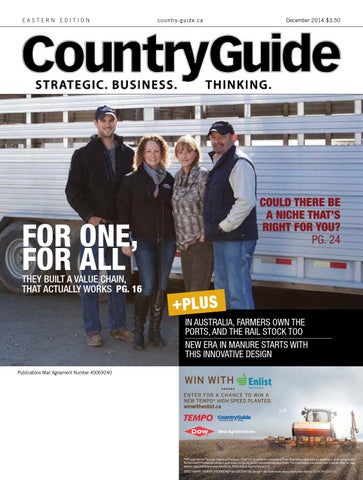
COULD THERE BE A NICHE THAT’S RIGHT FOR YOU? PG. 24
FOR ONE, FOR ALL
THEY BUILT A VALUE CHAIN, THAT ACTUALLY WORKS PG. 16
December 2014 $3.50
+PLUS IN AUSTRALIA, FARMERS OWN THE PORTS, AND THE RAIL STOCK TOO NEW ERA IN MANURE STARTS WITH THIS INNOVATIVE DESIGN
Publications Mail Agreement Number 40069240
WIN WITH ENTER FOR A CHANCE TO WIN A NEW TEMPO® HIGH SPEED PLANTER.
winwithenlist.ca
® ™Trademark of The Dow Chemical Company (“Dow”) or an affiliated company of Dow. Regulatory approvals are pending in other geographies for the Enlist™ herbicide solution and crops containing Enlist herbicide tolerance traits. The information presented here is not an offer for sale. Always read and follow label directions. ©2014 Dow AgroSciences LLC.
SEED HAWK®, TEMPO®, VÄDERSTAD® and VÄDERSTAD Design® are trademarks being used under license. 11/14-39512R CGE
BE READY.
Our innovations do more than solve everyday problems – they maximize output while saving your operation money. That’s why Case IH continues to innovate with proven, efficient and reliable solutions. Be ready with innovations like the Axial-Flow® rotor that started the rotary combine revolution; Quadtrac® technology that gives you less compaction and better traction; Advanced Farming Systems – a less complex precision farming solution; and an SCR-only emissions solution that gives you more power with less fuel. To learn more, visit your local dealer or caseih.com.
©2014 CNH Industrial America LLC. All rights reserved. Case IH is a trademark registered in the United States and many other countries, owned by or licensed to CNH Industrial N.V., its subsidiaries or affiliates. www.caseih.com
CONTENTS
DECEMBER 2014
BUSINESS 9
AUSTRALIA’S DIFFERENT APPROACH
12
MAKING SENSE OF IT ALL
16
SUPPLY LOOP THAT WORKS FOR EVERYONE
21
THE CHALLENGE OF DIVERSIFICATION
24
FINDING THE RIGHT NICHE
26
THE BEST ADVICE
29
GUIDE HR — ARE YOU A ‘ONE-MAN SHOW?’
30
STARTING SMALL
34
BLACK BARLEY GETS ITS CHANCE
46
IT WON’T BE EASY BEING GREEN — OR RED, OR BLUE
50
GUIDE LIFE — SING AND READ WITH YOUR CHILD
Owned by 4,200 farmers, CBH Group controls the country’s four grain ports, plus locomotives, elevators and much more. You can’t escape global economic trends, but our Errol Anderson shows how your marketing plan may be able to harness them. If you thought lamb was a small niche, think again. This group of six farmers has converted the sector into big business. Only one out of five diversification plans survives to become an integral part of the farm. Here’s how to succeed with yours. Farmers share their niche stories, and ask the most important question of all: Do you have the passion to make it work? Ask your financial and legal advisers these five questions if you want to be sure you’re getting the best possible advice. If you are, your farm may be suffering more than you know.
For decades, the “experts” have talked about new diversification plans, new niches, new value chains and more. Now, farmers are actually getting beyond the hype and making real business plans that earn real dollars. Is your farm ripe for diversification? What kind of diversification is best for you? All in this COUNTRY GUIDE.
This exotic strain is a hit with foodies, and soon it may be a favourite with a growing number of farmers too. Machinery companies must apply the brakes to their assemply lines, but keep the pedal to the metal on new design. Their first few years can help make them better farmers.
EVERY ISSUE 5
NEW OPPORTUNITIES FOR OUR FARMS
For established farmers, niche marketing is an option. For new farmers like Nathan Klassen, there isn’t any choice at all.
MACHINERY GUIDE
Get a look at these new combines, with even more technology.
52
GUIDE HEALTH
54
HANSON ACRES Where did that combine come from? Only Connor knows.
These rules will keep you in charge of your antibiotics.
CROPS GUIDE 36
THE FIRST 100 DAYS
40
A NEW ERA FOR MANURE?
44
PEST PATROL
Check out our Ralph Pearce’s preview of the meetings that you won’t want to miss this winter.
This European design promises to put more manure where it can really drive crop performance.
Nobody ever thought OMAFRA’s Peter Johnson was the retiring type. In fact, Mike Cowbrough seems convinced he isn’t.
Our commitment to your privacy At Farm Business Communications we have a firm commitment to protecting your privacy and security as our customer. Farm Business Communications will only collect personal information if it is required for the proper functioning of our business. As part of our commitment to enhance customer service, we may share this personal information with other strategic business partners. For more information regarding our Customer Information Privacy Policy, write to: Information Protection Officer, Farm Business Communications, 1666 Dublin Avenue, Winnipeg, MB R3H 0H1. Occasionally we make our list of subscribers available to other reputable firms whose products and services might be of interest to you. If you would prefer not to receive such offers, please contact us at the address in the preceding paragraph, or call 1-800-665-1362.
DECEMBER 2014
country-guide.ca 3
desk EDITORIAL STAFF Editor: Tom Button 12827 Klondyke Line, Ridgetown, ON N0P 2C0 (519) 674-1449 Fax (519) 674-5229 Email: tom.button@fbcpublishing.com Associate Editors: Maggie Van Camp Fax (905) 986-9991 (905) 986-5342 Email: mvancamp@fbcpublishing.com Gord Gilmour (204) 453-7624 Cell: (204) 294-9195 Fax (204) 942-8463 Email: gord.gilmour@fbcpublishing.com Production Editor: Ralph Pearce (226) 448-4351 Email: ralph.pearce@fbcpublishing.com ADVERTISING SALES Lillie Ann Morris (905) 838-2826 Email: lamorris@xplornet.com Dan Kuchma Cell (204) 290-5419 (204) 944-5560 Email: dan.kuchma@fbcpublishing.com
Tom Button is editor of Country Guide magazine
If not now... Canada’s mainline farm organizations are struggling for your support. They deserve another shot. That’s not based on their past performance. It’s because of the scale and the solvability of the challenges ahead. In other words, we’re at a point in history where farm organizations can make a difference, if they have good leadership. Those who know me will know this isn’t a sentence that has always rolled easily out of my mouth. In a way, the big farm organizations are on the wrong side of two mega-trends. There’s a political trend that says the role of government is to get out of the way. So why give your time to a political lobby? There’s also a cultural trend affecting everything from churches and service clubs to industry organizations. It’s the trend that has so many of us willing to help with special projects, but if you’re thinking I should sign up as a member of your group, well, thanks anyway. Both trends have made it tough for farm organizations to not only have a reliable base to build on, but also to recruit the best delegates and leaders. Nor does it help that there is still such intense pressure for everyone who ever speaks in public about agriculture to sing from the same song sheet, note for note. A “please park your brain at the door” approach isn’t exactly the best way to encourage constructive thinkers to join. 4 country-guide.ca
Head Office: 1666 Dublin Ave., Winnipeg, MB R3H 0H1 (204) 944-5765 Fax (204) 944-5562 Advertising Services Co-ordinator: Sharon Komoski Fax (204) 944-5562 (204) 944-5758 Email: ads@fbcpublishing.com Designer: Jenelle Jensen Publisher: Lynda Tityk Email: lynda.tityk@fbcpublishing.com
Instead, agricultural groups could be talking about positive possibilities. Here are three, although I can only give thumbnail descriptions. Still, you’ll know what I mean. 1. Our infrastructure of roads, railroads, bins, ports, and everything else that separates our output from its markets is in serious decline. Repairing it will likely take not only farm leadership, but farm money too. 2. Provincial and federal programs need to be recalibrated to help today’s diverse generation of young farmers become not only the world’s most competitive farmers, but also to grow more of the food that Canadians want to buy. Governments are increasingly unwilling to support the incomes of what they believe are wealthy older farmers. 3. University economic departments must be shaken up. This is a frequent bugbear of mine. If we’re to succeed in an increasingly complex business environment, where mistakes are fatally expensive, we must get the best insights and research from top brains that are focused on the problems that farmers — not government policy makers — actually face. Of course, you’re justified in saying you don’t have time to participate. My question is: if not now, when? What would a worthwhile mixture of need and opportunity look like if it isn’t what we’re in the midst of now? Are we getting it right? Let me know at tom.button@fbcpublishing.com.
Associate Publisher/Editorial Director: John Morriss Email: john.morriss@fbcpublishing.com Production Director: Shawna Gibson Email: shawna@fbcpublishing.com Circulation Manager: Heather Anderson Email: heather@fbcpublishing.com President: Bob Willcox Glacier FarmMedia Email: bwillcox@farmmedia.com Contents of this publication are copyrighted and may be reproduced only with the permission of the editor. Country Guide, incorporating the Nor’West Farmer and Farm & Home, is published by Farm Business Communications. Head office: Winnipeg, Manitoba. Printed by Transcontinental LGMC. C o u n t r y G u i d e is published 13 times per year by Farm Business Communications. Subscription rates in Canada — Farmer $39 for one year, $58 for 2 years, $83 for 3 years. (Prices include GST) U.S. subscription rate — $35 (U.S. funds). Subscription rate outside Canada and U.S. — $50 per year. Single copies: $3.50. Publications Mail Agreement Number 40069240. We acknowledge the financial support of the Government of Canada through the Canada Periodical Fund of the Department of Canadian Heritage.
Canadian Postmaster: Return undeliverable Canadian addresses (covers only) to: Circulation Dept., PO Box 9800, Winnipeg, Manitoba R3C 3K7. U.S. Postmaster: Send address changes and undeliverable addresses (covers only) to: Circulation Dept., PO Box 9800, Winnipeg, Manitoba R3C 3K7. Subscription inquiries:
Call toll-free 1-800-665-1362 or email: subscription@fbcpublishing.com U.S. subscribers call 1-204-944-5766 Country Guide is printed with linseed oil-based inks PRINTED IN CANADA Vol. 133 No. 13 Internet address: www.agcanada.com
ISSN 1915-8491 The editors and journalists who write, contribute and provide opinions to Country Guide and Farm Business Communications attempt to provide accurate and useful opinions, information and analysis. However, the editors, journalists, Country Guide and Farm Business Communications, cannot and do not guarantee the accuracy of the information contained in this publication and the editors as well as Country Guide and Farm Business Communications assume no responsibility for any actions or decisions taken by any reader for this publication based on any and all information provided.
december 2014
Machinery
By Ralph Pearce, CG Production Editor
It’s said that yield is the ultimate measure of a growing season, and if that’s true, then the combine is the ultimate device for measuring success. Sales of combines, like most farm machines, are admittedly finding the going tough these days. In its most recent assessment, the Association of Equipment Manufacturers (AEM) reported that North American equipment sales are likely to take a hit in the wake of lower commodity prices. Not only are net incomes falling, but the glut of used equipment at dealerships is also weighing on the market. Against this backdrop, however, manufacturers are continuing to innovate and improve. Simply put, the combines on this year’s market are the best ever.
New Holland CX8000 Elevation New Holland has redesigned its CX Series by looking across the Atlantic and importing some key European features, all with an eye to boosting productivity. The CX8000 Elevation provides 490 horsepower, billed as the world’s most powerful conventional combine, yet capable of handling all crops from wheat to corn to canola. With a new, ultra-functional cab design, growers can stay in constant contact with the PLM Connect telematics, whether it’s planning to unload or refuel. Fingertip control means improved performance and the Harvest Suite cab provides superior operator comfort to keep fatigue to a minimum.
www.newholland.com
John Deere S Series John Deere has taken a look inside its popular S Series combine and made some significant changes to its S680 and S690 designs. At the same time, the company is introducing its new 645SFD Hydraflex Draper to help growers improve their performance and productivity in soybeans as well as small grains. In the S680 and S690, throughput has been increased by as much as 20 per cent with Active Concave isolation, interrupter bars and heavy-duty separator gates. There’s also a new PlatformTilt feature, which ensures proper cutter bar positioning no matter the ground conditions or the terrain. Deere says the 645FD Hydraflex Draper means growers can harvest 10 per cent more acres per day.
www.deere.com
December 2014
country-guide.ca 5
WHAT MATTERS MOST?
Syngenta listens. My diversified operation uses a lot of product. When I told my Rep empty jugs were a hassle, he passed that information on. This year, my product is available in bulk. Syngenta makes my efficiency a priority, and I appreciate that. Jesse Kloepfer, 3rd generation farm owner and custom operator, Lola May Farms, Harley, ON
Visit SyngentaFarm.ca or contact our Customer Resource Centre at 1-87-SYNGENTA (1-877-964-3682). Always read and follow label directions. The Syngenta logo is a registered trademark of a Syngenta Group Company. Š 2014 Syngenta.
Gleaner S8 Series It may be new, but Gleaner says it has taken all it has learned in more than eight decades in the field to launch the S8 Series. Significant upgrades have been made, but Gleaner’s performance in this series is based on proven yet unique technology. A twostage, four-strand gathering chain system translates into smooth feeding, always at the same angle, regardless of the header’s height. The distribution augers spread material evenly before entering the cleaning stage, reducing uneven feeding and blockages. The machine’s low centre of gravity, welded frames and heavy final drives also set the stage for a bin capacity of 390 bushels on the S68, S78 and the new 8 S88.
www.gleanercombines.com
Case IH 240 Series Looking ahead to 2015, Case IH is defining its new 240 Series Axial Flow combine with more grain tank space, more fuel capacity and more power. Three models — the 7240, 8240 and 9240 — makeup this series, with a view to the increasing size and productivity of today’s farms, and those farmers’ need for more capacity, better fuel efficiency and the capability to ramp up more power to unload that harvested crop without slowing down. The continuously variable transmission (CVT) provides smoother, easier operations, and a 30-inch track for specialty crop harvesting is among the available options.
www.caseih.com
8 country-guide.ca
Claas 700 Series Claas combines are known for their size, but with the refinements added to the Lexion 700 Series combines, the company has taken yet another step forward. Claas says its accelerated pre-separation (APS) threshing system, combined with Roto Plus separation offer the industry’s most productive harvester. Added to its many features is the Terra-Trac undercarriage option, offering greater traction, lower compaction and greater header stability on challenging terrain. In response to higher planting populations and more residue, Claas has also improved residue management with Pro Chop and Turbo Chop options.
www.claasofamerica.com
December 2014
business
Australia’s different approach Owned by 4,200 farmers, the giant CBH Group adds a whole new dimension to phrases like value-adding and diversification By Gerald Pilger
Australia’s farmers own their own fleet of locomotives and rolling stock through their CBH shares.
iven the demise of the prairie pools and the recent sales of a number of Canada’s new-generation co-operative grain terminals, it would be understandable if many Canadian farmers, grain traders, farm advisers and policy makers believe co-operative grain marketing ventures are simply not viable in today’s world. Just don’t try and tell that to Western Australian farmers. Their Commodity Bulk Handling Group (CBH) is now the largest co-operative in Australia. It receives and stores 90 per cent of the grain produced in Western Australia at 197 receiving sites, and it has 100 per cent ownership of and operates all four of the region’s port terminals. CBH provides growers a total of 20 MMT of storage capacity even though Western Australia only produces an average 10.3 MMT of grains annually. CBH has also captured over 50 per cent market share of Western Australia bulk exports of grain, and is the largest grain exporter in the country. Most remarkably, CBH is solely owned and controlled by 4,200 Western Australia farmers. These farmer-stakeholders have even expanded CBH into railroading through its own fleet of rolling stock and locomotives. CBH has also created value-adding opportunities through their wholly owned subsidiary Lupin Foods Australia, by a joint venture with Hudson Shipping Lines to create Australian Bulk Stevedoring,
and through Daily Grain, which is the leading price discovery and management service in Western Australia. CBH not only markets and exports commodities, it even processes Western Australia grains internationally through their 50 per cent ownership of Interflour, which operates seven flour mills in Indonesia, Vietnam, Malaysia and Turkey. In total, Western Australia farmers oversee an agricultural marketing co-operative that now has over C$2 billion in assets. Remarkably, CBH started humbly in 1933, much like Canadian grain co-operatives. According to Brianna Peake, CBH government and industry relations manager, “The CBH storage and handling network was built by the growers of Western Australia starting in the 1930s when the price of bags became greater than the price of the wheat that went in them. The growers came together collectively to store wheat in bulk, and reinvested their profits back into the infrastructure, sowing the seeds for the storage and handling network model we have today.” While Canadian grain co-operatives sought to increase revenues for members, however, CBH focused on reducing its members’ costs. Cheap, efficient upcountry storage was the co-operative’s cornerstone, and the focus on reducing costs has continued as CBH expanded into rail transport, port terminals, shipping, marketing, exporting, and processing. As a result, average post-farmgate costs for CBH members are 15 per cent lower than for Australian farmers who rely on multinational corporations like GrainCorp, Glencore/Viterra, and Cargill for storage, movement, marketing and export of grains. The lower costs enjoyed CBH members translate into higher net crop returns. To see the impact of working to control costs, we only need to compare rail freight rates. While Western Canadian farmers have been frustrated by continually rising rail freight rates, in the 2013 CBH annual report CBH Chairman Neil Wandel noted: “During the 2012-13 harvest, CBH reduced rail freight rates by an average of seven percent, providing real value back to growers from the investment in rail.” Peake concludes: “CBH offers storage and handling and transport services at significantly lower rates than other Australian bulk handlers as we are Continued on page 10
December 2014
country-guide.ca 9
business
Grower-owned CBH has reinvested $500 million in infrastructure in the last five years.
Continued from page 9 not driven by shareholder profits but by value to our grower members in low fees and efficient services.”
Across the Pacific There are a number of other notable differences between CBH and the defunct Western Canadian cooperatives. “CBH does not pay dividends to growers,” Peake points out. “The CBH rebate system is a patronage-based system, based on a grower delivering to the CBH system and the following year receiving a rebate on charges due to the volume of business they have done with the co-operative.” While this patronage rebate system may seem similar to the Canadian experience, a much greater percentage of the co-operative revenues are reinvested in CBH rather than distributed back to the members. “When CBH Operations develops their budget and sets their charges, they factor into this a minimum return of A$85 million per annum to be spent on capital and maintenance works across the network each year,” Peake says. “In high-volume years, this increases significantly and over the last five years CBH has invested more than A$500 million back into the storage and handling network.” Another difference is that membership in CBH is strictly limited to active farmers. Before becoming a member, a farmer must have delivered over 600 tonnes of grain to CBH within a three-year period. Once this minimum is met, the farmer will be offered the opportunity to buy one share for A$2. If the farmer fails to continue to deliver this amount of grain over a three-year period, that $2 is redeemed and that farmer ceases to be a member.
10 country-guide.ca
Pilger asks: Should farmers here hope that Australia’s CBH will buy our grain handling systems? Also, there is no retention of earnings held in a shareholder’s name by the co-operative, and no payment to shareholders to reflect any increase in value of the co-operative over the time a farmer was a member. Instead of offering growers higher prices and/ or retention and subsequent payments reflecting any increase in value of the co-operative, the CBH model strives to reduce costs, increase efficiency and promote sustainability. In reality, it is a long-term growth plan for Australian crop production. The most important difference is the attitude Western Australia farmers have to grain marketing, co-operatives and particularly CBH. “… in Western Australia, based on grower survey results, the loyalty for doing business with CBH is at an all-time high of 88 per cent. Many growers have a good understanding of the competition in global grain markets and that they are competing in these markets with growers who have significantly lower supply-chain costs and subsidy assistance from their governments,” says Peake. “The majority of Western Australia growers understand that ownership and control of their supply chain is critical to keeping their costs as low as possible and driving efficiencies that they would not be able to recognize on their own. This is a main driver for retaining CBH as a co-operative with the growers as its sole focus.”
December 2014
business
Dr. Andrew Crane, the co-operative’s CEO, summed up the role of CBH in their 2013 annual report: “The CBH Group exists to create and return value to growers and to do that over the long term. CBH has a key role to play in ensuring the sustainability of the Australian grain industry. The best way we can deliver this is helping growers run their own integrated supply chain to Asia, ensuring they can be competitive against other origins and other business models that return less value to the farm gate.”
What can we learn? I found the co-operative which Western Australia farmers built to be not only efficient and successful but also exciting and inspiring. It has left me wondering if there is any way we could rebuild a co-operative grain marketing system in Canada. But Peake reminds me that building up the CBH Group has taken over 80 years, and has benefited from the continual reinvestment of much of the cost savings the system has generated back into the co-operative. In other words, Canadian farmers would need to find billions of dollars to build such a system overnight. Then it occurred to me that we may not be starting from zero. Farmers have already built much of the up-country storage that CBH provides Australian farmers, although it is privately owned and onfarm rather than part of the co-operative. We already have a few short-line railroad co-operatives as well as producer loading car sites across the Prairies which give us access to the rail system. Farmers should still have interest in the large fleet of rail rolling stock bought by the federal and provincial governments as well as the Canadian Wheat Board (CWB). And the CWB, regardless of what you thought
December 2014
of the single desk, was very successful at developing international markets and creating a highly respected Canadian brand for our crops. By 2017 the wheat board must be privatized. Could it become a co-operative modelled after CBH? Would Western Canadian farmers in particular be willing to forego higher prices in exchange for a lower cost system? After the fiasco of last year with all the shipping problems and the poorest basis levels ever, are farmers willing to at least consider a cooperative alternative to the present grain marketing system dominated by a few multinational players? Do farmers now have the attitude needed to build a new grain system for the benefit of western Canadian farmers? Can farmers find the expertise that could manage grain held in onfarm storage and market that grain through a co-operative system without immediately having to spend billions on additional country storage? Fortunately, we are not at the financial cliff that farmers faced back in the ’30s when they created CBH, the pools in Canada, and even the CWB. But since Canadian farmers are still enjoying relative prosperity, I question if Western Canadian farmers would buy into the CBH model, even though its performance is head and shoulders above its Australian competitors. Perhaps our best bet for an alternative marketing system is if CBH would either partner with or even purchase the CWB. A partnership or even a sale of the CWB to a friendly low-cost competitor might be more beneficial to Canadian farmers than seeing the CWB sold to profit-seeking stakeholders of a multinational grain company which is likely already sourcing grain from our competitors. CG
Australia’s four grain export terminals are operated by farmers through their CBH co-op.
country-guide.ca 11
business
Making sense of it all Agriculture can’t escape global economic trends, but farmers can adapt their market plans to key numbers. In this second of five columns, market analyst Errol Anderson tells us how By Gord Gilmour, CG Associate Editor Grain prices rise, and grain prices fall. Sometimes it’s a straight supply issue. More grain gets produced, or less gets produced, and prices react accordingly. But those movements tend to happen over the short term. Often too, they’re tough to plan for because they’re sparked by either good weather or bad. Other issues hit on the demand side, however, and they can get very complex very quickly. These include issues like the health of national economies around the world, as well, how the greater commodity complex is faring. And then there are interest rates, currency fluctuations, credit availability, stock markets… It can seem bewildering, and it can also seem a long way from the farmgate. Yet if these trends are caught soon enough and farm managers respond wisely, they can make a real difference in any farm’s economic success. Market analyst and Country Guide columnist Errol Anderson recently sat down to talk to us about the key trends in the global economy that bear watching this winter, and over the next few years.
Country Guide: Everyone is a bit worried about what to expect from the global economy, especially with the recent stock market volatility, which I should note you were predicting the last time we spoke. What are the things we should be watching now, especially in a global context? Errol Anderson: There are three key geographic areas that can impact commodities, and we should probably look at all three in some detail. They’re China, the U.S., and Europe, and each of those three are in very different circumstances. Probably the country that everyone thinks about first when it comes to commodity demand is China,
12 country-guide.ca
and there’s no denying it’s been very important in recent years. In a lot of ways, following the crash of 2008, it was Chinese demand that kept prices high. They were still buying a lot of things like iron ore, copper and energy. That supported the overall commodity complex, and their changed diets also supported agricultural commodities. There are now some signs that their economy is slowing, and growth there is predicted to be around 6.5 or seven per cent next year. That’s still high, but in 2007, for example, their economy grew by 13 per cent. This will likely temper demand for commodities somewhat. The U.S. is still feeling the effects of 2008 and working their way through that. We have to remember, at the time they were really heading into a depression and they did things like quantitative easing — basically printing money — and other extraordinary measures to prevent that from hap-
december 2014
business
pening. What remains to be seen is whether they’ve succeeded or just kicked the can down the road. I suspect they’re going to be a lot like Japan has been since the 1980s and we’re going to see a long period of extremely low growth. We’ve just seen the U.S. Federal Reserve ending their QE3 program, and what remains to be seen is if the country can maintain even modest growth without it. But from our perspective, what was interesting was those two things playing out at the same time and how it affected us. If China saved the world economy after 2008, whatever it gave came doubly back to Canada, because we’re a commodity producer, and we’re ordinarily directly tied to the U.S. economy. But now the slowdown in China is our slow down, and unfortunately, I don’t think the U.S. is going to pick up the slack.
Guide: So it sounds like you’re most concerned about the demand, not the supply, side of the equation? EA:
Yes, I think that’s a fair way to put it. Everyone always talks about the supply side, but I really think the true driver of commodity markets is always demand. In the end, demand is king and it doesn’t matter what supply is. Supply certainly changes the picture, but only over the short term. In the long term, it’s the demand trends that set the prices in commodity markets, and unfortunately right now those trends don’t look good. We’ve seen an overall growth in the supply of all commodities, from oil to grains and everything in between. At the same time, we’re now seeing falling demand. That’s going to mean overall lower commodity prices for a period, until demand catches up, and agriculture commodities are going to go along for the ride.
Guide: You’ve said when it comes to commodity prices, there are leaders, and there are followers. Can you tell us a bit more about this? EA: There are really two commodities that lead the rest when it comes to pricing — oil and gold. Everything else basically follows these two, even if there’s no direct connection between them. We’ve seen gold fall substantially. In 2011, it hit its peak at around $1,900 an ounce. Right now it’s just over $1,200 an ounce. And oil, of course, has been falling too. It hit a peak in 2008 at around $140 a barrel, and they were talking credibly about $200 oil. After the crash of 2008, it fell briefly to about $40 a barrel, then recovered to around $100 a barrel. Now it’s been moving downwards again, and it’s no secret the industry is worried. december 2014
I think both of them have fallen for fairly understandable reasons. High gold prices were a reflection of economic uncertainty, and ideas of increased inflationary pressure, stemming from U.S. Federal Reserve QE stimulus. But U.S. money printing did not stoke inflation as planned. The price of gold fell back as a result. High oil prices were a reflection of demand, which fell when we had a recession, and now what’s causing them to fall even further is new supply from non-traditional oil sources like fracking — just on that alone, they’re predicting North American energy independence in the next few years. Other commodities, like agricultural commodities, generally follow these big two. Until oil and gold begin moving up again, it’s unlikely we’ll see a large move upward in agricultural commodities. We’re just waiting for something to happen on the supply side to give us an upward tick.
“ The true driver of commodity markets is always demand. In the end, demand is king… and unfortunately right now, those trends don’t look good.” Guide: What about interest rates? They can always hit hard if they go up. What do you think will happen with them over the next while? EA: I think over time they will go up, but not immediately and not by very much when they do move. My reasoning for this is pretty straightforward. I just see too much slack in the global economy to justifying moving them upwards quickly and risk choking off any recovery that may be happening. It’s true, they’re very low right now, but I just don’t see them rising much, like they did in the ’70s and ’80s. The difference today is debt. I was recently in New York City, and there’s a debt clock just off Times Square showing the public a real-time look at the astonishing rise in U.S. debt. If interest rates move up, it’s going to increase the cost to the U.S. federal government too much — I simply don’t think they can afford to raise rates right now. I’m not expecting to see any movement for the next 12 to 18 months at least. Continued on page 14
country-guide.ca 13
business Continued from page 13 When we do see movement, I suspect it’s going to be several small increments that might see interest rates rise by one or two per cent, and it’s going to be a few years out. In other places, like Europe, there’s even more pressure to keep rates low since they’re fighting deflation. You could even see them cut rates even further over the next while. They want to do everything they can to keep their economies moving. I really think they’ve got a tough five years or so ahead of them. That said, however, I think now would be the time to look at whether there’s any way to get your debt exposure down, while rates are low, and even though they’re going to stay low for a time.
Guide: What about currencies? The Canadian dollar has fallen relative to the U.S. dollar. What do you see driving this? What should we be watching over the next while? EA:
Two things have been happening at the same time. The U.S. dollar has strengthened, partly on the perception that the American economy is improving, partly because of the safe-haven buying, and partly from fallout of other currencies such as the Euro and Japanese yen. The U.S. dollar is still seen as a safe place to store wealth. That strengthening has pretty much been across the board against all major currencies. Then in the Canadian dollar we have seen some of the value come off because of falling commodity prices, especially oil. Over time I think we could see that pattern continuing. Within Canada, that’s going to do a couple things. It’s going to hurt commodity producers because their products are priced on global markets in U.S. dollars. It could help the manufacturing sector in places like Central Canada, where they’ve been in real trouble in recent years due to the strong dollar. For domestic consumers, it’s going to mean some price inflation because so much of what we consume is imported, and a lot of it from the U.S. Over the longer term we’re going to have to watch what these currency gyrations are going to mean. They can trigger trade issues, and those can be really hard to predict.
14 country-guide.ca
Guide: What are some of the other things that we’ll need to be looking out for? EA: Credit markets are another key
area, especially with the move to end QE3 and any move to start a program like it in Europe. The major test of this is still straight ahead of us. Sure, the end of the program has caused a modest stock market correction, but it’s been short lived and the market has come back. Will this continue? I don’t think anyone knows for sure. But I think if, over the next few months, we saw a stock market correction of 20 to 25 per cent, there would be a lot of pressure to rethink this decision. That would, of course, have a huge impact on all the markets. So we’re certainly still not entirely out of the woods yet.
Guide: Can you boil down what this all may mean for agricultural commodity markets? EA: I think for an agricultural producer, now is definitely a time to be very disciplined. It’s definitely a very different world for a grain producer. It’s now a time to play defense, not offense. Cost-cutting and managing exposure are key. There will be opportunities to find profitable prices. Markets will rally, but those rallies won’t hold, they’ll fall back. When they do occur, you need to be ready to act, because they won’t last long. I’ve said this before, but it’s a very important point to realize: unfortunately, commodity markets don’t care about your cost of production. They will sometimes pay you less than your cost of production for a very long period of time. There will be times when there is an opportunity to lock in a great delivery basis. When you get that opportunity, you may consider a strategy of flatpricing your cash grain and replacing your tonnage with call options to reopen the price ceiling. This strategy moves physical grain, taking advantage of a delivery opportunity, while injecting cash flow into a farm operation. But it also offers growers the opportunity to take advantage of a possible price rise later in the crop year. Livestock producers are in a very interesting situation. They’ve enjoyed a very strong market recently, and I think they need to begin to prepare for the end of that. I can’t see these prices continuing indefinitely while you’ve basically got a third of the global economy — the U.S. — just getting by, and two-thirds of it — China and Europe — seeing slowing growth or no real growth. This global environment is going to reduce demand or, at least, dampen the appetite for purchasing any commodity at a high price point. CG
december 2014
“AGROTAIN ” IT’S NOT AGROTAIN. IF IT DOESN’T SAY
®
®
Don’t be fooled by imitators. AGROTAIN® nitrogen stabilizer is the original, most research-proven urease inhibitor technology on the market. With 20 years of trials and real-world results on millions of acres worldwide, it’s the one growers trust to protect their nitrogen investment and yield potential every time. Ask your retailer for AGROTAIN® stabilizer, or visit agrotain.com to learn more.
AGROTAIN® and the AGROTAIN logo, are trademarks of Koch Agronomic Services, LLC. Koch and the Koch logo are trademarks of Koch Industries, Inc. ©2014 Koch Agronomic Services, LLC. 650-1400-AGR_Canada
650-1400 AGR_Print_Grow_CANADA_8.125x10.75_FINAL.indd 1
10/7/14 9:56 AM
business
Supply loop that works for everyone If you’re skeptical about value chains, it’s time for a hard look at how these Ontario farmers helped build Trillium Lamb Inc. By Maggie Van Camp, CG Associate Editor emand is flying high. Lamb isn’t a niche anymore. It’s everywhere on mainstream meat counters. But it isn’t on the farm, and in 2010, Newmarket Meat Packers (NMP) found only 10 per cent of Ontario lamb sales were being met with Ontario-grown lamb. Surely, that sounds like an opportunity. “Our demographics have changed,” says Newmarket’s Maggie Pearce. “Sixty per cent of the world eats goat, but our new immigrants can’t get enough here (in Toronto) so they are turning to lamb.” The problem was escalating because the number of sheep producers — mostly hobby farmers — was shrinking. Most of the flocks were lambed on grass once a year, which creates lumpy supplies into the market. Also, mutton entered the meat supply marketed as lamb, causing confusion and dissatisfaction among consumers and retailers. Equally bad, said the Newmarket study, was that the supply chain was deeply fragmented into farmers, auctions, processors, retailers and consumers, with little or no communication between these parts. At the time, Pearce was literally knocking on doors looking for supply for their small-ruminant abattoir, and she was holding meetings to encourage more farmers to expand into the sheep business. Yet while a few more signed on, it didn’t address the consistency problems at their plant. Now four years later, a solution has been built, centred on open communication and collaboration. Six large-flock, year-round lambing producers have formed a company to establish a stable price contract based on consistent quality and quantity 16 country-guide.ca
Maggie Pearce
“ Consumers drive the bus,” Pearce says. “They put the money in. The rest of us just move it around.”
December 2014
business
Photography: deb deville
From left to right: Zach Grove, Jenny Carnaghan, Maggie Pearce and Marc Carere. of lambs. NMP has installed handling and traceability technology and can track the meat from farm to checkout. It’s giving carcass information back to the producers and has been the conduit to link these farmers with a large family-owned retailer. Now, the large retailer is starting to market the meat based on the farmers’ photographs and stories. It’s a value chain management success story that started on a trip overseas. In 2012, a dozen largeflock operators from Ontario toured Great Britain, including the Cotswold region an hour and a half northwest of London, designated an elite producer of sheep like the Champagne region of France. At one stop, the tour was told how the Cotswold Sheep Group (a group of lamb producers in the region) had hired a marketing person to liaise between the producers and the abattoirs The Canadian farmers nodded. That’s what we need, they thought, i.e. someone to organize marketing and transportation because we’re too busy operating our own farms. After the trip, the Canadians went home to tend to those flocks, but didn’t forget the Cotswold lesson. December 2014
Shortly after returning, Marc Carere from Lindsay, Ont. was asked to join a sheep industry strategy task force, which included transportation suppliers, processors, extension, retailers and farmers. The conversations started with issues. “We didn’t understand each other’s businesses, so we talked, asked questions and learned,” says Carere. Again they went home to tend their flocks. But a link had been forged, and it would become a catalyst for a new business model. NMP’s Pearce was on that task force too, and she kept the conversation with Carere going long after the task force meeting. He and two other larger yearround producers met one of the owners of NMP, Nick D’Elia, and started delivering directly to the plant. D’Elia liked the consistency and quality this group delivered, and wanted more. A more formal think-tank was formed with Pearce. One producer dropped out, but more large-flock farms signed on, all from the nearby area and each producing lambs year round with RFID tags. The group of
“ The power of this group is the power of wanting to learn,” says value chain expert Martin Gooch.
Continued on page 18 country-guide.ca 17
business Continued from page 17 six now includes Miklin Farms (Mike and Linda Thompson), Ryan Van Loon, Maple Winds Farm (Ken Lamb), Eden Lane Farm (Dick Kuiperij), Carncroft Farms (Jenny and Luke Carnaghan and Zach Grove) and Ballinahistle Farms (Marc and Helen Carere). The six shared ideas and asked questions. They all wanted a steadier price and knew they needed a more consistent supply of quality lambs to drive demand. They soon learned that neither the processors nor the producers were making huge profits off the backs of the other parts of the supply system. “We started by building the relationship, the trust,” says Carere. Martin Gooch, chief executive officer of Value Chain Management International, believes those first steps were exactly right. “They started small and involved only people with the right attitude,” Gooch says. “The power of this group is the power of wanting to learn.” The group also wanted to inspire industry-wide change to improve the quality, reputation, quantity and ultimately the demand for Ontario lamb. Led by Pearce, the group organized a learning day to connect buyers, processor and producers. At the abattoir they saw what the animals eventually looked like as carcasses and discussed how that related to grade and what buyers wanted. With some Green Belt funding, they even made a video of it as a teaching tool for the industry. (The video is available via the Ontario Sheep Marketing Agency’s website.) For the producers it was a kind of revelation. Suddenly they could appreciate the impact of their production methods. “It gave us the ability to see what our premium animals looked like compared to mutton,” says Jenny Carnaghan from Blackstock, Ont. “They showed us how they graded them, and what quality means.” However, it’s not a simple case of good and bad. Demand for lamb in Ontario is driven by large, growing ethnic communities, each wanting something different from their meat. During the video, retailers and wholesalers explain what they’re looking for. NMP now addresses the segments of the market based on its buyers’ needs by shipping more boxed cuts targeted for specific uses. “Instead of selling only whole carcasses, one carcass now does two or more markets,” says Pearce. 18 country-guide.ca
“ Their mindset was like ours,” Carere says. “We’re here, and we’re not going anywhere, so let’s help each other.”
Marc Carere
Jenny Carnaghan Recently, the company has started stamping “MUTTON” on the old ewes that come through their plant, whereas normally mutton goes into the mainstream under the “Ontario Lamb” moniker. Selling mutton for lamb prices makes for big margins, but can also turn customers off eating lamb, hurting the entire industry. “The consumers drive the bus,” says Pearce. “They put the money in; the rest of
us just move it around. If they don’t buy, we don’t play.” To use the less marketable cuts, NMP has also created a value-added division, and has planned another expansion for the spring. “We need to sell the whole carcass,” says Pearce. “The profits are what’s left over in the cooler.” The farmers went home from the learning session with a commitment to keep the learning and the conversations going. NMP organized a meeting with one of its large retail customers, and when the small group of sheep farmers from rural Ontario sat down in the retailer’s swanky downtown Toronto office, the conversation once again started with the issues of steady supply and quality. The sheep farmers explained the challenges of year-round lambing and price swings. To their surprise, they discovered the suits were a multi-generational family business wanting stable, sustainable business relationships, just like them. “The discussion was honest and open, with no hidden agendas,” says Carere. “Their mindset was like ours; we are here and we are not going anywhere, so let’s help each other.” Continued on page 20 December 2014
WIN WITH ENLIST! ENTER FOR A CHANCE TO WIN A NEW TEMPO HIGH SPEED PLANTER.
Ready. Set. Advance! Here’s your chance to win an 8-row Tempo® High Speed Planter, courtesy of the Enlist™ Weed Control System from Dow AgroSciences. You could also win 80 acres of Enlist corn seed and Enlist Duo herbicide. Advance your acres. Enter at winwithenlist.ca today. Find out more about the evolution of speed and precision at TempoPlanter.com
® ™Trademark of The Dow Chemical Company (“Dow”) or an affiliated company of Dow TEMPO® is a trademark being used under license.
39512_DAS_Enlist_Contest_CS_v5_8-125x10-75.indd 1
8/13/14 5:03 PM
business Continued from page 18 NMP and the farmers hosted a bus full of meat counter staff at one of their sheep farms, followed by a tour of NMP’s abattoir and value-added facilities. They ate together and asked each other questions. Most of the butchers had never set foot on a farm and were surprised by the scale and professionalism. Key shifts in perception began to happen. The butchers and farmers learned what was chopped off before they get chops, and how waste impacts profits all the way along the value chain. The retailer realized how much more was involved for farmers to produce lamb in the winter, and that they couldn’t just turn on volume like a tap. The abattoir saw how certain production practices produced better-quality, more uniform lambs and better final yields. The farmers learned that a consistent, traceable supply was valuable, and by working together it was doable. Most significantly, the farmers were inspired to formalize their supply loop. With some assistance from a federal Growing Forward 2 grant, they started a new company called Trillium Lamb Inc. The six original farms are shareholders and board members, and they have an annually established price contract with NMP. They’ve also added a few more producers to ship about 100 lambs a week, but still aren’t totally filling the demand. Trillium Lamb Inc. is in the process of expanding the number and geography of farmers supplying lambs, and they are setting formal quality requirements to ship under the Trillium Lamb agreement. According to Gooch, for a value chain management to have staying power everyone involved must follow an agreed set of practices. And if someone doesn’t, there must be repercussions.
20 country-guide.ca
Trillium Lamb is in the process of hiring a person to handle the links between them, NMP and the retailer and to do their marketing, as they had seen in Cotswold. “Bringing people in with the right attitude, someone who understands the vision, can help make it sustainable,” says Gooch, although he says it doesn’t always happen. “Generally, farmers don’t want to invest, to cover the costs in human resources to maintain it.” Christoph Wand, OMAF livestock sustainability specialist, has seen other initiatives last only a few years. “What sets this one apart is the idea of the field person who communicates along the supply/value chain but is an employee of the producer group.” Together with NMP, the Trillium producers want to have a formal pricing-and-supply contract directly with the retailers. Normally the price paid for live lambs is set every Monday at Cookstown auction market and varies from week to week. However, the price in the grocery store is set once a year based on discussion between the abattoir and the retailers, and varies depending on the size of the order. Trillium shareholders and suppliers all use RFID tags so each carcass can be traced back to their farm, and with some grant money NMP has updated its equipment to read and share that information with the farmers. The Trillium producers can then use those numbers to select genetics based on carcass traits, such as percentage cut-out or shipping weights. NMP asked the group for its data wish list and shares its own quality assurance values, such as cleanliness of the animals. Most recently, Growing Forward 2 has also helped NMP update its gating and sorting system. As well, the farmers’ photographs and stories are going to be part of the marketing and packaging program led by the retailer. In the end, the value chain has been short-linked and information flows freely from producer to abattoir to retailer and soon to the customer. Yet without government grants and behind-thescenes help from Wand, it probably wouldn’t have happened. Still, the grants and extension work are only the starting points for change. It takes an investment in the vision from all parties to recreate long-established marketing routes. “It’s been a team effort to get this off the ground,” says Carere. They are all aware of other supply loops that have failed because processors went broke, or because retailers or farmers didn’t have loyalty to the program. What makes this one different? Probably it’s because now, they all know more about each other’s businesses. “To be fair, we do not chase the market price,” says Carere. “We all have to be reasonable.” “Our business model is based on openness, honesty and loyalty,” agrees Pearce. “Without that, it would all fall apart.” It’s also based on recognizing both the market and the players at every level, including that the number of slaughter plants in Canada has plummeted by a third in the last decade. Over those same years, much hot air and government money got pumped into the concept of value chain management. Perhaps inevitably, a lot of the initial projects came to learn their feet weren’t solid enough, and their hopes sank into the mists. But others made progress quietly, eventually, including Trillium Lamb. Some lessons also emerged. Most important may be that value chain management takes commitment, openness, trust and a champion to lead the cause. And yes, it can also help if the change in supply is pulled by customer demand, not pushed by producers. CG December 2014
business
The challenge of diversification The odds that your diversification plan will succeed are just one in five. But you can stack the deck By Maggie Van Camp, CG Associate Editor or decades, on-farm diversification has been talked about, ruminated on, spit at and swallowed whole. We’ve seen underdogs become successes, and we’ve also seen outrageous failures, even when they had big government backing. At the same time, economies of scale have propelled non-diversified farms to unbelievable sizes, backed by the five-year bull market in grains. It all leaves Michael Gertler looking back on his work about diversification with some hard questions. “For decades, specialization and scale has driven agriculture,” says the retired sociology professor from the University of Saskatchewan. “This is economies of size, using the same amount of labour for a lot more output.” In the race to get bigger, Gertler says, we’ve forgotten economies of scope, which are synergies created between enterprises on farms.
Diversification itself is getting more diversified, with farmers taking on an ever-wider range of business projects Partly it’s because agronomic technology (fertilizer, GPS, large equipment, breeding stock, seed, etc.) and crop insurance have taken the place of diversification as a risk management tool. It can also be partly because our farm community has become so diversified. In the last decade, while commodity farms have been sizing up, there’s also an influx of very diversified farms, with everything from organic production and direct-marketed ethnic produce to value-added operations of every different kind. Along our rural roads, there are also unprecedented differences in farming styles and farm sizes. Today, Gertler sees rich-man and poor-man diversification. A “poor man’s” approach means small steps of adding value to try to increase the value of core production. These projects are flexible, don’t require huge capital and carry less risk. By getting into it gradually, December 2014
farmers can experiment and test to see if it meets their economic and financial rationality. On the other end of the scale, farmers with established, strong capital bases are typically looking for good investments of all sorts, including off-farm investments like rental units. On-farm, they tend to get into larger projects since they can afford to invest more money, time and expertise to start new businesses. They may even hire management for the existing enterprise while the owner takes the time to develop the next one, says Bev Connell, from Proagri Consulting and co-author of the Ontario ag ministry’s Exploring Value Added Opportunities. For example, Connell has worked closely with a large farm in Nova Scotia which now boasts not only a large beef cow-calf operation and a feedlot, but also a business that exports strawberry plants and perennial flowers, plus another that produces fresh fruit and plant cuttings, with each of those enterprises large enough to be a standalone business. It’s diversification of a different order than adding a row of beets to sell at a farmers’ market. Over the 20 years Connell has been working with farmers and other businesses (lately he’s been working in the lumber and mining industries), he has noticed two distinct attitudes that drive diversification. First is the business entrepreneur who wants to create and develop new businesses, and continue to grow and expand. Those individuals can be large or small farmers; it’s more about their culture and personality than the sizes of their businesses. The other group includes those who diversify to try to create more value from what they’ve traditionally done. They want to keep farming, but need to generate additional revenue to stay in business. For them, diversification is more of a necessity than a desire. Anecdotally, Connell has noticed ventures fail more often if the farm needs to bring in more money rather than if the farmers have an interest in developing another enterprise. Typically more money can be made by first being better at their base enterprise before they divert their attention and resources to a new enterprise. “When farms have tried to start a Continued on page 22 country-guide.ca 21
business
Continued from page 21 new enterprise and taken their eye off the ball, it has typically resulted in a failure of the new enterprise as well as damage to the existing one,” says Connell. The success rates for farm diversification efforts are probably not much different than for any small business venture. The majority fails in the first five years, and many don’t make it past the first year. Based on the survival rate of other business ventures, Connell estimates only one in five are successful, with success defined as contributing positively to the financial health of the farm. However, sometimes the objectives of the enterprise may not be all about money. Maybe the farmers are only looking to feel good about what they are doing as citizens of the world, or it could be part of the succession process. “Many diversification projects break even or occupy time and provide purpose, but do not contribute financially,” says Connell. It’s important to understand why you want to diversify. “People give it meaning,” agrees Gertler. “What’s valuable to you?” A survey of farmers in Sweden found they wanted to diversify to reduce risk, to use idle resources and develop a business for social and lifestyle reasons. In a Saskatchewan survey, farmers often diversified to use available management and labour and to provide full-time, year-round employment for key hired personnel. For example, by diversifying into fabrication, processing, transportation or livestock a farmer could retain and make economical use of a full-time employee or other family members. The Saskatchewan farmers tended to reduce exposure to market and production risks with off-farm income, or through nonagricultural enterprises. However, Connell says that while access to big chunks of capital can help you grow and capture economies of scale, at some point diseconomies creep in. The enterprise starts to lose efficiency because it’s too large for the management capability. The Internet has also dramatically changed how we market. Diversification used to focus mainly on local markets since many farms didn’t have the resources to market regionally, nationally or internationally. Now everyone can reach potential customers worldwide, so marketing “local” means mar22 country-guide.ca
“ Attitude is the biggest determinant,” says Bev Connell. “If you think you can’t, you’ll probably be proved right.” keting a local product to the world. Moreover, people will pay for an experience and a story and not just buy food that tastes good and fills their belly. Many successful ventures are also driven by either children or spouse. Gertler says many modern farm women want to manage an enterprise by themselves, leveraging their skills and experience and contributing to family income, instead of just helping behind the scenes. Connell has seen farming parents form a new business venture with the non-farm children, using some of the farm’s resources to help get the new enterprise started. They plan to transfer the new venture to the non-farm children once viable. Connell also knows a case where the senior generation transferred the base farm to their children and then started a new enterprise as their semi-retirement project to keep them busy. The retiring generation is typically financially established and can put the time and patience into developing something new. Risk becomes less of a factor because they’re not necessarily relying on it for a living, so they are willing and able to experiment and be creative. Whatever the motive, it should match risk tolerance, and this needs to be talked about with everyone involved. Share up front how much money you want to make, how much you’ll need to start and operate, and exactly how you’re going to get funding. Lack of patience and cash flow can crash startups. When University of Kentucky researchers studied 120 valueadded dairy processors across the U.S., they found only about a third had reached positive cash flow one to three years after launch. For six per cent, it took five to 10 years. That first year can be very tough sledding. Of the nine per cent of the respondents who had been involved in on-farm processing for less than a year, only 12.5 per cent had positive cash flow. This type of value-added enterprise is not a quick solution to profitability issues for a dairy, concluded the researchers.
Although we read and hear about current success stories, often they have been working towards diversification for many years before becoming successful. With today’s instant communication networks it seems like it happened overnight, but it likely took a long time. Plan ahead and share your idea with others to validate your assumptions, says Connell. Some people think that if they share, someone will steal their ideas, or they’re afraid to hear critical comments about their plan. However, more of that type of critical thinking and discussion is needed to develop ideas and make stronger business. “Many people get married to their idea and start to convince themselves it’s fail-proof when it may not appeal to many others,” says Connell. Farmers by nature are risk takers, so simply taking an off-farm job may not provide the incentive they need to feel successful, says Connell. Although sometimes it’s the right thing to do and will bring in the necessary revenue to keep the farm going, it’s typically not what makes a farmer excited to get out of bed in the morning. “It’s the creation, development and independence that motivates them to continue,” says Connell. “It’s not always just about money.” Connell knows first hand how an entrepreneurial heart beats under flannel. He has created and sold several businesses ranging from a beef enterprise to a farm market, Christmas wreath export business and blueberry-packing enterprise. One thing he has learned over the years is that a farm diversification is no different than any other business created by an entrepreneur: Many fail, and not always for lack of planning. Some fail due to timing. Others because consumers’ tastes change before a business reaches maturity where it can afford to change. Entrepreneurs with the ability to regroup, learn, persevere and stay positive attract like-minded individuals, creating a positive culture and that eventually leads to success. “Every failure just identifies a way not to do it,” Connell says. “It doesn’t mean it cannot be done.” CG December 2014
SoilSmart Friday, January 23, 2015
RIM Manulife Financial Sportsplex, Forbes Hall, Waterloo
FarmSmart Saturday, January 24, 2015
University of Guelph, Rozanski Hall, Guelph Feature Speakers Don Schiefelbein Don Schiefelbein is president of Schiefelbein Farms, located in Kimball, Minnesota. The farm is operated by father, eight sons and their families They operate a large diversified farm with 4500 acres of pasture and crop land and 800 registered Angus cows. They feed 25000 head of cattle per year in their feedlot operation.
Paul Uys Ray Archuleta Ray is a Conservation Agronomist at the USDA-Natural Resource Conservation Service, based in North Carolina. Known as “The Soil Guy” he travels internationally to increase farmers knowledge of soils through his lively and engaging presentation style. Explore the production benefits of healthy soils through a full day program lead by Ray. Through a series of talks, demonstrations, farmer panels and Q&A sessions, you will gain a better understanding of what a healthy soil is, how to build towards it, and why it will benefit you in your current and future farming practices. Please visit the FarmSmart website for full program details.
Registration closes Jan. 21, 2015
Paul’s professional retail experience spans 40 years. He retired from Loblaws in 2013 having held positions of Vice President Innovation and Sr. Director of Sustainability where he helped launch many President’s Choice products. He is an advisor to World Wildlife Fund and director of a number of boards in-cluding the recently formed Livestock Re-search Innovation Corporation (LRIC). His newest pursuit is as Senior Director of the University of Guelph Food Institute. Paul will share his unique insights on the agri-food industry and its future. Watch for program brochure insert in the Ontario Farmer in January or visit the FarmSmart website to learn about other Speakers and session highlights.
Presenting Sponsor
OSCIA members - $75.00 Non-members $110 (incl. 1 yr membership) PRE-REGISTRATION ONLY - NO WALK-INS SEATING IS LIMITED!
REGISTER NOW! www.farmsmartconference.com
Pre-Registration closes Jan. 21, 2015 OSCIA members - $75.00 Non-members $110 (incl. 1 yr membership) After January 21st, rates are: Students/youth $40; everyone else $110 No OSCIA membership benefit
1-877-424-1300
@FarmSmart15
business
Finding the right niche Is niche diversification really the right strategy for your farm? Your best answer may come from answering this: ‘How driven are you?’
he reasons for wanting to diversify the farming operation are almost as diverse as the opportunities themselves. On many farms, it’s because expansion is so costly at today’s land prices, so the only way to grow is to intensify. Or it may be because there are more generations needing to draw income from the operation. Or it could be simply because you see an opportunity and the business possibilities are just too intriguing to overlook. But those are only the beginning of the possible reasons for wanting to diversify. Maybe a pumpkin patch that you used to grow for the kids in the area becomes a full-service Halloween fright night, or maybe a niche grain processor opens up in your area, or a new road opens so all of a sudden you have traffic zooming past your laneway, paving the way for a thousand different retail ideas. For some farmers, diversification opportunities are hobbies on steroids. A case in point would be the greenhouse operation at Court Seeds and Greenhouses located at Plumas, Man. Look Plumas up on a map and you might not think that this would be an ideal location for a retail greenhouse operation. “Our greenhouse business could be regarded as an accidental success, but that would take away from the actual hard work that went into it,” says Randy Court, who owns Court Seeds and Greenhouses with his wife and business partner Jeanine. “It started from Jeanine’s hobby. After our two children were walking, she built a smaller greenhouse to supply our family, friends and neighbours. To take the next step and invest in proper infrastructure, we quickly realized we needed a lot more customers — our business plan was clear about that.” The Courts looked to the nearest business centre, Neepawa, and met with some of the larger retailers — groceries like Safeway and Co-op as well as hardware stores. “It was Safeway that stepped up first,” says Court. “They realized that the garden centre business was not their strength. We were able to negotiate a lease agreement with them and took over the entire
24 country-guide.ca
business, and they supported us. We each focused on what we did best, and we did really well together.” It wasn’t long before the Co-op store in Gladstone made a similar arrangement. “In seven years we had gone from a hobby to 15,000 square feet of greenhouse, two retail locations and 12 staff,” says Court. “It was quite a learning curve.” Along the way, however, the Courts had to learn the lessons that many farmers bump up against when they invest in diversification. “Growing a plant yourself is very different from teaching, managing and directing staff to do it for you,” Court says. “We had maxed out on the size of our operation and stabilized it at that level over the next 25 years.” The Courts started farming from scratch with 400 acres they bought in 1980. Very quickly they realized that they’d have a hard time making a go of it with conventional production and by 1981, they had switched to seed production. Then, by 1987, the greenhouse operation grew to its final size, and by 1990 the farm itself was on the path to its current 4,000 acres, of which 60 per cent is owned. Their daughter Tracey has joined the operation and has added her own business as an agronomist. “We were successful, yes,” says Court. “We tried other diversification ideas. We toyed with a poultry barn, and woodcrafts. We even bought a small cattle herd which only lasted three months. I quickly realized I had no patience or passion for livestock and sold the herd when prices were at a good level. “Trial and error is part of farming and growing the business,” Court now says, but he has also come to recognize that some management traits pave the way for successful diversifications. In particular, he believes he has a natural passion for business, team work and hard work. That doesn’t mean other farmers don’t, he’s quick to add. But those are the traits that he has needed to rely on. “You have to be passionate about whatever it is you do,” Court says. “Without that, you won’t stick with it. Or if you do, it’ll be a chore, and success will be limited.”
December 2014
Photography: Sandy Black
By Andrea Hilderman
business
eye on what differentiates successful diversifications from those that struggle. For the most part, he emphasizes, he rarely runs across horror stories. “Usually you will see the disaster coming before it hits,” he says. “There’s generally enough time to get out, even with a loss, before that happens.” Still, on many farms, it may be more important than ever to get it right with niche agriculture. Simply put, there may not be many other options for achieving your objectives, such as trying to provide a way for two, three or more kids to succeed you in an era of high land prices and high input costs. Because of this, Veldhuis works with his young students on putting some business rigour around their ideas. “Mom and Dad often can’t provide a farming opportunity for all their kids,” Veldhuis explains, “so we are teaching the kids to come back to the farm with their own business idea and plan. “And maybe this idea isn’t a hands-on farming idea either. Farms need legal and financial advice — lawyers and accountants — that’s an opportunity.
Niche production demands passion, Randy Court says. And it also takes a love for business, and team work too Court also stresses discipline on the business side. In other words, passion is essential, but it isn’t enough on its own. Success demands business discipline too. “You have to spend your limited resources wisely,” Court says. “That said, I also say the only reason to have money is to spend money and make more money!” Nathan Veldhuis agrees with Court. Just because you enjoy doing something, or even take pride in it, isn’t enough to make it a good diversification project. The entire psychology of the project has to change when it becomes a business. “Going from a small flock of turkeys to supply your family and friends to a turkey barn is a big step,” Veldhuis says. “What took 10 minutes of your time on a daily basis before is now eating up three or more hours a day. And if you get busy with other farm tasks, you will start missing out on the small details that govern profitability.” Veldhuis runs a bee farm at Starbuck, Man., and also works as an instructor in ag business at the University of Manitoba. Honey might sound like a niche, but with 1,200 hives and a business with a solid 20-year track record, niche probably isn’t the right word. Over those years, Veldhuis has kept a careful
December 2014
Or maybe it’s a new venture or a custom operation business of some sort that allows you to participate in the farm way of life.” Of course, diversification can start with your personal philosophy too, which has an ironic twist these days. It isn’t that so many more farmers are becoming organic purists, for example. It’s that so many farmers have eased up on their antipathy to the concept. “Those producers for whom organic production was a philosophy have already transitioned,” says Laura Telford, business development specialist in organic marketing with Manitoba Agriculture, Food and Rural Development. “Now we are seeing more conventional farmers looking at organic and seeing a real economic advantage.” Increasingly, organic is just one of myriad of diversification options, Telford says, and it’s being judged on business criteria. “Organic is a real, viable option for the farm that is not difficult to embark upon,” she says, noting that conventional farmers are often converting only a portion of their farms to organic, not the whole operation. “Transitioning to organic isn’t complicated,” says Telford. “If you have some existing pasture land, the transition can take as little as one to two years. It’s definitely not an all-or-nothing exercise.” CG
country-guide.ca 25
business
The best advice These five questions will help you be sure you’ve got the right business advisers for your farm By Amy Petherick It’s not a bad thing to seek outside advice — as long as it’s good advice. No matter how smart you are, you can’t be aware of all your options and opportunities. We all need great input that we can ruminate on, evaluate and implement, and this great input must come from people we are confident will give us the best advice. They need to be people we trust and that we can talk to openly, because we have to talk to them about the most important things in our lives — our families, our dreams, and our money. Are you getting the best business advice? Even if you think your answer is yes, get ready for 2015 by asking your financial advisers these five questions.
1. Does our farm align with your current client portfolio targets? Both the company they work for and your advisers themselves likely have goals that they are working towards. Those are goals that can change. So even if your business matched the criteria your adviser was targeting initially, that may no longer be the case. Asking this sort of question also offers your adviser an opportunity to share their career path
If you want good advice, Stefanson says, you have to be willing to pay for it.
26 country-guide.ca
plans with you. Farmers may never plan to truly retire, but other people do and your financial advisers may be among them. Or perhaps they just plan to cut back their workload in the coming year. Maybe they’re aspiring to make a move up the corporate ladder. If you have advisers who are comfortable enough with you and are permitted to divulge this information, then you might get the chance to plan ahead for any imminent changes. More importantly, this question will help you assess changes within your own operation and whether your adviser remains compatible or not. Brenda Stefanson is a regional farm business management specialist for Saskatchewan’s Ministry of Agriculture who says even if your farm hasn’t physically changed, outside forces may be having an impact. “The assets farmers control, in Saskatchewan and right across the country, are much more valuable than they were even 10 years ago,” Stefanson says. Farmers may own the same amount of land, for instance, but today it’s worth much more money than when it was originally purchased, so it may require new financial management strategies. “I have had some farmers come in here and talk about dissatisfaction with their regular adviser just because of that issue,” Stefanson says. There’s no one reason farmers start to feel out of sync with their current advisers, but Stefanson rattles off a number of common ones she hears about regularly: “their outlook has changed, their goals have changed, or there’s a younger generation involved that changes the risk tolerance of the farm.” With all the many advisers out there, Stefanson says you don’t have to just put up with someone who has become a bad fit with your business. But don’t throw out the baby with the bathwater, warns Lloyd Steier, professor of strategic management at the University of Alberta School of Business. December 2014
business Steier says a great example is when the next generation inherits the family farm and envisions major business changes. “New products, new markets, new strategies, growth; all those things may necessitate bringing on new advisers,” he says. “But inherited businesses come with social capital, something built up over years, and that’s an incredible resource.” Social capital includes things such as outstanding favours, community goodwill, and your reputation within the industry. So before you fire the adviser who sang at your father’s funeral, Steier suggests acting out of respect for previous good service by keeping up old relationships while you build new relationships into your team that are more consistent with your new intentions.
2. Are any of our farm’s 2015 objectives unclear to you? Whether you’re talking in the ultra-long term, or even if you’re just thinking through all the jobs you’ve got to get done today, farm management is really a series of what, when, who, where, and why questions. Adding up those questions then helps you think your way through to a strategy that you can use to prioritize your business activities for the rest of the year. What do you really want to accomplish, and how are you going to accomplish it? Sharing this strategic plan with your adviser provides them with important context, so you want to make sure your advisers understand it well. “Strategy should drive structure,” says Steier, who then adds, “strategy should also drive what you’re doing.” Sporadically seeking a little legal, accounting, and banking advice when you need it might be enough for a “Mom and Pop” farm that owns a little bit of land and a couple of tractors, but complex operations need more. “Typically, operations have evolved to be fairly complex, in terms of costs and assets, but still use very informal governance mechanisms that really don’t fit with where they need to go,” Steier says. “Farmers are running multimillion dollar companies and they haven’t moved beyond coffee shop-type forums as their major source of advice.” Steier says he doesn’t mean that the informal advice you get from peers is worthless. In fact, he believes it is the most cost-effective way for someone starting up to get some really good input. But for the same reasons you don’t use a horse and plow to farm 1,000 acres, you can’t expect to make milliondollar decisions really well without sophisticating these systems as well. Clients who don’t outline their strategic plans to their adviser do so at their own peril, says Don Shaughnessy of the Protector’s Group in Peterborough, Ont. Often, however, Shaughnessy finds the clients can’t outline their strategic plans because they haven’t articulated them for themselves. “Most of the people I talk to have never asked themselves the ‘W’ questions,” Shaughnessy says. “Because of that, the adviser takes over by default and they end up driving the bus.” December 2014
“ The people I talk to have never asked themselves the ‘W’ questions,” Shaughnessy says. To understand why that’s a recipe for disaster, he says consider this: good financial planning breaks down into strategic, tactical, and logistical layers. Business owners must be responsible for the first layer, since no one else can define the values of the business. As experts in the tactical field, advisers provide the second layer, and then collaborate in implementing that plan during the final phase with the business owner. If you don’t bring a good strategic layer to start with, Shaughnessy says the tactical discussions can become confusing, so it’s hard to make choices. “If the client comes with a strategic idea, the client and the adviser actually have some sort of reasonable working relationship,” Shaughnessy says. “If your possible solution has come through a tactical door, one of the things you’ll find is people aren’t especially good at sharing blame.” One way Shaughnessy says you can keep your strategic conversations clear is to eliminate precise details from the discussion. “In strategic planning, precision is of no value whatsoever,” he explains. “All you’re looking for is direction.” In other words, this is a good time to only use round numbers. Shaughnessy says to think of it like you would a connect-the-dots drawing. All the points have to be there for the right picture to emerge, but look too hard at the size or shape of any one dot and you lose sight of the larger image. “Strategic planning is just organized common sense, there’s nothing magic about it,” he says. Still, he says he never had any trouble providing advice to farm clients who could clearly outline their plan for him.
Continued on page 28 country-guide.ca 27
business
“ I don’t advocate switching advisers so much as broadening,” says Steier. Continued from page 27
3. What professional development opportunities would you recommend for us? One thing Stefanson, Steier and Shaughnessy all agree on is that while farmers today are better educated than ever, the pressure is on to get even more highly trained. Go to workshops. Read magazines. Watch webinars. Talk to government representatives who can channel unbiased information to you. Seek new ideas. “You have to go outside of your social system to learn something new,” Steier says. “You have to bring in other resources.” In sociology textbooks, the idea you want to build on is called the strength of weak ties. It describes how cultivating relationships with many acquaintances improves access to fresh ideas even more than strengthening all your closest relationships. Some of your most valuable network connections could prove to be old dorm mates, your hired hand’s brother or your dental hygienist. Steier says this is why it’s wise to grow your team of advisers when you’re making major changes to your business. “I don’t advocate switching advisers so much as broadening your advisory capacity,” he says.
4. What services should we consider outsourcing this year? Outsourcing specific services is one way you can use your current advisers to help in the process of broadening advisory capacity. Perhaps monthly 28 country-guide.ca
bookkeeping has become more than the family can handle, and so it waits until the cropping season is over. Your accountant may suggest that it’s time to bring in a professional. Stop before you just call in the person your accountant suggests though. “You’re going to pay this person a substantial amount of money, you’re going to work very closely with them over a period of time, and the advice they give you will guide you in some of the most important decisions you will make,” says Stefanson. In many ways, this person is about to become a new farm employee, so she urges farmers to prepare themselves accordingly. When you choose a new outside resource, interview at least three people. “I would say interview five, but three seems to be as much time as people want to put into it,” she says. Why so many? “You want something to compare to because the first person you interview might have a great sales pitch you fall for hook, line, and sinker.” Make sure it is someone who listens, she adds. “I’ve been in this situation as a farmer myself,” Stefanson says. “I’ve gone to look for advice and I felt like the adviser wasn’t listening to what I wanted.” Stefanson also recommends asking for a resumé and three to five references from every adviser you interview. Don’t just look at the list of names and expect that’s enough confirmation. Before you sign any contracts, call these farmers and ask them about their satisfaction with the adviser’s work, how easy it is to get a hold of the adviser, and if they’ve ever been surprised by extra fees.
5. Can we get that in writing? Stefanson says you want a contract with your adviser not for legal protection so much as for clarity’s sake. “You can have a conversation with somebody and hear different things,” Stefanson says. “If it’s written down and you agree to the wording, then that’s what’s agreed on.” This prevents simple little misunderstandings or confusion as a result of jargon, and it can help you stick to budgets better. A contract or letter of agreement lays out what services will be provided, by certain dates, and what costs will be associated with them including things like hourly fees and mileage. No matter who comes to see her, Stefanson says cost is always part of her discussions, and it always seems to be an issue. “We’re often reluctant to pay,” agrees Steier. “If you want to get good quality advice, you have to be willing to pay for it.” Steier’s top advice is to beware of false saving. “I’ve seen people go out and spend $300,000 to $400,000 on a combine and then they have a do-ityourself will kit,” Steier says. “When those people passed away, they create multimillion dollar problems just to save $10,000 in legal costs.” Good advice comes at a cost, Steier says. But it also delivers value, he adds, so make sure to always buy the absolute best advice you can afford. CG December 2014
HR
Are you a ‘one-man show?’ Most farmers are entitled to feel proud. But what happens when your ego won’t fit through the door anymore? By Pierrette Desrosiers, work psychologist, business coach and author
e were starting into a critical phase of succession planning on a family farm, and the farmer had something he wanted me to know. His son wasn’t cut from the same stuff that he was, Paul told me. “He will never be able to succeed like I have.” Paul’s pride, unfortunately, had reached an unhealthy and destructive level. He was a 60-yearold farmer who started with nothing and built a prosperous company, attaining impressive success. That is all to his credit, but the problem was that his ego was as developed as his business. There’s nothing wrong with that, you may think. What happens, though, when that ego swells out of proportion?
“ Business is like making babies, it’s not something you can do all by yourself; it requires the collective efforts of others.” — Robert Kiyosaki The results are often tragic. The “one-man show” inevitably leads to failure during a transfer. The qualities that helped the entrepreneur achieve success can also lead directly to a farm’s collapse. It’s an outcome we see time and time again in family businesses from many sectors, where some failures are directly attributable to the founder’s style. Just think of the traits associated with successful entrepreneurs: being independently minded, needing to get their own way, making all the decisions alone, having a strong need to be personally identified with the success of the business, not consulting with others, having an authoritarian and dominant approach, doggedly pursuing their objectives, and being competitive. In some contexts, those traits may lead to success, but we can also imagine the havoc they create in partnerships involving either family members or others. Ironically, some entrepreneurs who have achieved major professional success may have perpetual doubts about their own worth. In some cases, it is more important to the father that his children not outdo him than it is to ensure the success of the business, even when that implies significant financial loss. December 2014
Often, the ego wins because human beings tend to be more emotional than rational. Exactly how does a “one-man show” type of father interact with his children? Here is how Paul’s son responds to that question: “He never congratulates me or recognizes my accomplishments, or my successes, but takes all the credit when they work and puts me down when I make a mistake. I have the impression that he is constantly trying to find fault in me. He has no interest in my needs, my expectations or my interests. He doesn’t discuss anything with me, but he makes all the decisions and then makes demands of me. I’m 35 years old, and he treats me as if I were still 15.” Of course, the “one-man show” isn’t limited to parent-child relationships. It is also common in employer-employee relationships. As the leader of your company, your job is to lead well, making the business effective and efficient so that it achieves its goals without wasting time, money, or resources. Here is the formula that all leaders should remember: Right PEOPLE + right POSITIONS + right ACTIONS + right REASONS + right TIME = EFFECTIVE ORGANIZATION A leader should not be blinded by his omnipotence. He should care for and listen to others. He needs to ask questions and be concerned about others’ motivations, needs and fears. He should leave his ego at the door. The “one-man show” types should avoid partnerships because they will sabotage their businesses and their relationship with their family, often unconsciously. Often this type is only interested in continuing his show alone and waiting for the curtain to fall so that he can sit back and revel in his achievements. However, he needs to know that after the show is over and the applause dies away, he will be alone in his dressing room without anyone to celebrate with him. Ironically, while no one person can single-handedly build a great company, one wrong leader can single-handedly cause its demise. As we know, cemeteries are full of people who thought they were irreplaceable. CG Pierrette Desrosiers, MPS, CRHA is a work psychologist, professional speaker, coach and author who specializes in the agricultural industry. She comes from a family of farmers and she and her husband have farmed for more than 25 years (www.pierrettedesrosiers.com). Contact her at pierrette@pierrettedesrosiers.com. country-guide.ca 29
business
Starting small Is diversification the best way to get a start today? As Nathan Klassen is learning, even if the answer is yes, that doesn’t make it easy By Helen Lammers-Helps athan Klassen might not have grown up on a farm, but for as long as he can remember, he’s wanted to be a farmer, so in 2011, in the midst of North America’s record-smashing run-up in the price of farmland, he made that dream come true. Klassen was 24 that year, and he bought his first patch of farming ground. But whether, at 75 acres, you’d call that patch a farm probably depends more on who you are than on any definition you’ll find in a dictionary. For some of his neighbours, 75 acres is more like a big backyard than a working farm. In the best traditions of agriculture, however, the only opinion that really matters to Klassen is his own, and he’s convinced that he’s on the right path. When he bought that ground near Plattsville, Ont., Klassen saw it as a key step in achieving a goal he’d been working towards his whole life. Growing up near Rochester, New York, he had taken every opportunity to work on farms, and in 2010, he
As with any kind of farming, Klassen’s operation starts with a focus on efficient production.
30 country-guide.ca
completed a degree in organic agriculture from the University of Guelph. Using organic production methods, Klassen grew just one acre of vegetables that first year to test the water. But with a farm to pay for, he’s been more or less doubling his acres ever since. The second year he grew three acres, the next year, six, and then 10. Recognizing that he must be careful not to overextend himself, he plans to expand at a slower rate in 2015 by bringing two more acres into vegetable production for a total of 12 acres. “With the rapid growth, systems are always changing,” explains Klassen. “I’d like to get to more of a steady state.” If a dozen acres still seems a very small number, however, just read on. The numbers soon get bigger. With 40 different vegetable crops, and a total of 200 varieties, farming for Klassen is anything but simple. Tomatoes are one of his most important crops and he grows 40 different kinds. He is constantly evaluating varieties. Some are old standbys that he grows year after year. Others don’t make the cut and are only grown once. And as on any other farm, the numbers keep multiplying. Klassen, for instance, takes note of the days to maturity advertised by the seed company, but also keeps careful notes on maturity and other agronomic factors on his own property. He has even developed his own customized system of maturity ratings, which he considers an indispensable tool for ensuring a consistent supply of vegetables ready for harvest. As well, by saving seed from the earliest-producing plants, Klassen has been able to shorten the days to maturity of one of his favourite varieties. Despite knowing the dangers of expanding too fast, Klassen says it’s hard to be patient. “I see so many opportunities, and I want to go after them.” At this stage, sales aren’t the problem, Klassen says. While it did take a few years to make a name for himself, he has a reputation now. It wasn’t always easy though. It took trial and error to figure out what would grow well and sell well. For example, he learned in his first year that
December 2014
business
It’s hard to be patient, Klassen says. “I see so many opportunities, and I want to go after them all.”
Klassen started with just 10 CSA customers. This year, he’s looking at 100.
broccoli doesn’t grow well on his farm, nor sell well in his markets. This past year he added a walk-in cooler which increased his capacity to store vegetables, thereby substantially reducing waste. One of the coolers is set at 5 C and the other at 10 C so he can store vegetables at temperatures closer to their optimum. This past year Klassen purchased a second delivery van. In addition to delivering vegetables to market he also used the van to pick up harvested vegetables in the field. He also uses two bicycles outfitted with trailers as a low-cost and environmentally friendly way to run back and forth between house and fields. Again, established farmers mighthardly call such things “farm machinery.” But for Klassen, the important thing is to keep one eye on the work, and the other eye on the budget, and somehow manage to make a living. It’s why, for instance, he has two converted clothes washing machines that he uses to wash and spin dry the salad greens. Similar to the way he expanded production, Klassen has been growing his markets, i.e. step by step. In addition to selling at five farmers’ markets in Waterloo, Toronto, Brampton, Etobicoke and Aberfoyle, he’s been growing his weekly veggie box program. He started with just 10 the first year while he got the hang of it. The next year he had 20 members, then 50. He thinks next year he will aim for 100. The CSA members generally pick up their weekly boxes at the markets he sells at or at the farm. Klassen is considering shifting more of his sales to the CSA model. “There are some real advantages to the CSA model over selling at market,” he explains. Continued on page 32
December 2014
country-guide.ca 31
business
Continued from page 31 That includes a better cash flow, since members pay up front at the beginning of the season for a share of vegetables. Secondly, CSA is a dependable market. “If it’s rainy, people don’t buy at the market,” Klasen explains. Filling the weekly boxes also reduces waste. “You sell 100 per cent of what you harvest,” he says. There is flexibility with the CSA model too, since he can put in the boxes whatever he is harvesting that week. Finally, selling through the CSA program is less time consuming. When he goes to market, he usually spends four to five hours at the market plus travel and
32 country-guide.ca
setup time. With the boxes, he just fills them and drops them off Still, Klassen recognizes the time he spends at markets gives him useful feedback and helps him to ensure his CSA customers are getting good value. Klassen also sells some produce from the farm but needs to invest some time and effort into a better setup to exploit this more fully. For example, people tend to buy what they can see, so a refrigerator with a glass front would be helpful. Branding has been a very important part of Klassen’s marketing strategy. He grows high-quality produce using organic methods so he can command higher prices and develop loyal customers. With the help of his family during a brainstorming session they came up with the name Nith Valley Organics, named for the Nith River that meanders behind his property. Klassen explains that he wanted a name that was tied to the local region. With the help of his sister, a graphic designer, he developed a logo which he uses on marketing materials, the website, signage and the delivery van. (His sister created the website but Klassen keeps it updated.) At market, Klassen keys into the romanticized image of farming by using rustic wooden packing crates painted barn red. (The paint was left over from
painting the barns.) Klassen and his employees wear plaid shirts and straw hats as part of this image. Customers often have questions about the produce so he makes sure his market staff know how to cook what they sell. And with an uncommon vegetable like Jerusalem artichoke, he incudes instructions on how to prepare it. Klassen is also very aware of the psychology involved in selling at market. For example, displays shouldn’t be too symmetrical or too neat. Otherwise, potential customers will be loath to disturb the display by removing a basket. Not one to stand still, Klassen is always looking for new opportunities. This fall he started growing cold-tolerant salad greens in hoop houses to extend his sales season, and he will soon try sprouts as well. He will also offer a few shares of a winter CSA program to get experience with it before deciding if he wants to pursue this on a bigger scale. Eventually Klassen plans to target restaurants but he wants to be sure he is in a position to provide a consistent supply of high-quality vegetables first. Despite the hard work, Klassen remains excited about his chosen profession. “We’re moving in the right direction. And I’m doing what I love,” he says with a smile. CG
December 2014
Photography: David Charlesworth
We’re moving in the right direction,” Klassen says. “And I’m doing what I love.”
CHRISTIAN FARMERS FEDERATION OF ONTARIO 7660 Mill Rd. RR4, Guelph ON N1H 6J1 Voice: (519) 837-1620 Fax: (519) 824-1835 Email: cffomail@christianfarmers.org Web site: www.christianfarmers.org
Being leaders and building relationships
T
he Christian Farmers Federation of Ontario (CFFO) recognizes the importance of being a leader as a representative organization within the Ontario agriculture industry along with the notion that leadership is built on good relationships with its stakeholders. The CFFO is intent on representing its farmer members and ensuring their businesses can be successful in producing safe and healthy food for today’s consumers. The Federation values the network it has developed and looks forward to establishing new and exciting relationships with others. To be acknowledged as a leader takes time and commitment, with a set of workable, achievable goals. The CFFO works hard in training its leaders to be effective and an example worth following to those around them. The CFFO also places emphasis on building relations with other organizations, believing in the concept put forth by Farm Credit Canada, that “partnering with other positive organizations, grows the agricultural industry”. This can be accomplished in several ways: 1. Staff training. 2. CFFO Leadership Summit. 3. Stakeholder relationships. Members of the CFFO staff are enrolled in the Advanced Agricultural Leadership Program, a program that has been training leaders for 30 years, currently working with its 15th class. These 18-month programs train people from all sectors of the industry to be leaders in various organizations
and businesses, and challenge participants to influence positive change. “AALPers”, those enrolled in the program, spend many hours learning to work as part of a team and to accomplish set goals in a way that utilizes the strengths of all the team members. When they have graduated from this program, many of them become influential in their businesses and communities. Another way the CFFO develops leaders is by training its own leaders. The CFFO Leadership Summit is an annual event which enables members of the district boards to come together with staff and executive board members to develop their leadership role within the local communities. This year the theme is ‘Community Building’, emphasizing the importance of
A general farm organization that is rooted in faith and guided by values
being involved in communities where our members live, work and make a positive impact. The third pillar in which the organization embodies leadership is by building relations with industry stakeholders within the farming community. For years the CFFO has been working with many organizations to assist the agriculture industry and the farmers of this province. CFFO staff and executive board members have also been meeting with MPPs to convey what we value and discuss those issues we consider important in the coming years. As an accredited General Farm Organization, the CFFO is providing leadership and builds relationships that help the industry grow. We are convinced that these are great times for Ontario farmers and are pleased to work with and for them.
• 22 District Associations Across Ontario • Supporting our members since 1954 • A Professional Organization of Entrepreneurial Farming Families
www.christianfarmers.org
A professional organization of entrepreneurial farming families
business
Black barley gets its chance The exotic strain is a hit with food enthusiasts — and maybe soon it will be a hit with farmers too By Ralph Pearce, CG Production Editor n the past 10 years, growers across Canada have been introduced to a parade of specialty and alternative crops. East and west, there’s been camelina, crambe, sainfoin and, of course, quinoa — with test plots indicating it might be grown here with even better quality than in South America. Black barley is among the newest of these new arrivals. Also referred to as Ethiopian black barley because of its country of origin, black barley was once an important food source for the ancient civilizations of North Africa, the Middle East and the Himalayas. Its name derives from the black colour of its edible gloom (i.e. bran) layer, which stays attached to the kernel. The grain itself is white, yet unlike most other hulled barley varieties which are fed to livestock, black barley is considered a hulless or “naked” type, and could see its greatest demand from specialty food markets seeking its reported nutritional and medicinal values.
“ It tillers profusely,” Sahota says, adding “There’s no room for weeds to grow.” Its North American history isn’t clear. One report says the crop was first raised by an American farmer in Montana. Another contends that it started with seed imported from Russia in 1911. What is clearer, however, is that black barley is currently being grown in Arizona and California, although specific acreages aren’t available. For Dr. Tarlok Singh Sahota at the Thunder Bay Agricultural Research Station (TBARS), 2014 is also the first year he’s been able to give black bar-
34 country-guide.ca
ley a fair chance in test plots. In 2013, seed from Woodland Foods in Waukegan, Illinois, arrived too late for optimal planting and the weather at the Lakehead remained relatively cool, so what did get planted in June didn’t mature very well. This year, Sahota was delayed again by the prolonged winter, but he did manage to get the plots planted on May 23.
Balanced yields “We found that it tillers profusely and has a pale green canopy,” says Sahota, the director of research and business at TBARS. “It’s nearly one month later to head compared to AC Newdale and at 96 cm in height, is eight cm (about three inches) taller than AC Newdale. But it’s also seven cm shorter than Millhouse.” In addition to its tillering capability, black barley has shown test yields that are comparable to other barley varieties. According to an extension bulletin from the University of Vermont, field trials conducted in 2012 indicated grain yield from black barley was 58.3 bu./ac. On paper, this may not measure up compared 72.6 bu./ac. for AC Newdale and 59.8 bu./ac. for Robust. However, Sahota notes that both Newdale and Robust are hulled barley varieties, meaning their net grain yield after removing the hulls is closer to 48.8 bu./ac. for Newdale, and 40 bu./ac. for Robust. Bushel weight is also higher in black barley at 54.4 lb., compared to AC Newdale at 46 lb. and Robust at 47 lb. Another positive trait is its adaptability. Similar to conventional hulled varieties, black barley is expected to be as easy to grow near Palmerston or Winchester, Ont., or St. Hyacinthe, Que., as it is south of Thunder Bay. The longer growing season in southern regions is another advantage. Weed control is also expected to be a simple matter, not only because the same chemistries that are used on feed barley apply to black
December 2014
Photo: Dr. Tarlok Singh Sahota
business
varieties, but because of the thicker tillering in black barley varieties. “There’s no room for weeds to grow,” says Sahota. Preliminary indications are that disease control may be an issue, Sahota says, but it will depend on the specific area, the barley varieties grown there, and on the disease species particular to that area. “Each barley variety will be different in terms of susceptibility to a particular disease.” The separation process also sets black barley apart from hulled barley production. When processed as a food source, barley hulls bind to the kernels and must be removed, usually with the loss of the bran layer. But with black barley being hulless, there is no separation stage; the hull simply falls off during combining, leaving the whole-grain kernel and the edible-bran layer intact.
A new food frontier Black barley has a unique opportunity to tempt so-called “foodies,” many of whom are including quinoa in their diets. Black barley is touted as having a rich, nut-like flavour, and an appealing chewy, pasty-like texture, and has a glossy “sheen” to it when cooked. When it comes to its uses, it can be eaten alone as a hot breakfast cereal or added to soups, stir fries, rice pilafs, grain salads and even stuffing.
December 2014
Black barley is seen growing in a test plot at the Thunder Bay Agricultural Research Centre, with director Dr. Tarlok Singh Sahota.
Ground into flour, black barley can be used to make bread, pancakes, pasta — anything that conventional wheat flours can be used to make. From a health perspective, black barley is reported to be high in dietary fibre, minerals (including molybdenum, manganese, selenium, copper, phosphorus and magnesium), Vitamin B1 and niacin. It’s believed that niacin can help reduce total cholesterol and lipoprotein (a) levels. Its dietary fibre is high in beta glucan, which can also help lower cholesterol by binding to biliary acids and excreting them from the body. According to work done at Agriculture and AgriFood Canada’s Cereal Research Centre in Morden, Man., a quarter-cup of barley provides three grams of beta glucan per day, sufficient to reduce cholesterol and the risk of coronary heart disease and diabetes. In concept, Sahota says, black varieties may therefore become barley’s equivalent to identitypreserved soybeans. Barley’s chief current markets are for livestock feed and the brewing industry (although malting barley production is almost exclusive to Western Canada). That’s why Sahota maintains that black barley is a perfect fit for the specialty food market. As consumers’ tastes and demands for different flavours and healthier food choices continue to grow, Sahota believes farmers may find this as a perfect opportunity to feed those demands. CG
country-guide.ca 35
guide
The first
10 0 d ay s
With its full slate of meetings and conferences, this coming winter can be a business-building time for growers to meet, talk, compare notes — and learn. To help make the most of the opportunities, Country Guide offers this look ahead at events to the end of March. As always, though, check websites early for agendas, fee and advance registration.
JANUARY DECEMBER
By Ralph Pearce, CG Production Editor
16th Innovative Farmers Association of Ontario Marketing Workshop
Holiday Inn, Guelph, Ont. Included in the day’s proceedings are presentations by John Lanthier of MarketSmart and Dr. Clarence Swanton of the University of Guelph.
www.ifao.com
6th & 22nd Annual Southwest Agricultural Conference 7th University of Guelph Ridgetown Campus, Ridgetown, Ont.
The Southwest Agricultural Conference has come to symbolize excellence in learning and networking for Ontario farmers. It’s the best way to open the new year, and 2015 will continue building on that reputation. Featured speakers include Dr. David Kohl, agriculture’s “Road Warrior” and a professor emeritus at Virginia Tech University. Also on the schedule as a featured speaker is Greg Johnson, “the Tornado Hunter.” There will also be dozens of presentations that explore topics ranging from building soils to variable-rate seeding, and from grain marketing to disease control. Of course, there will also be the annual Production Pundits, as well as the trade show taking place at the Rudy Brown Centre.
www.southwestagconference.ca/
13 – Salon de l’agriculture 15th Espace St-Hyacinthe, Que. th
Quebec’s foremost agronomy show, with exhibits and presentations scheduled throughout the three-day event. www.salondelagriculture.com/
14th & 12th Annual Certified Crop Advisers 15th (CCA) Conference and Annual Meeting Best Western — Lamplighter Inn, London, Ont. Topics from both days include nitrogen management, alternative uses for agricultural products, and new or emerging diseases in soybeans.
21st & Annual Convention of Land Improvement Contractors of Ontario (LICO) 22nd Best Western — Lamplighter Inn, London, Ont. The theme for the convention is “Controlled Drainage: the Why and the How.” Climate change predictions suggest there will more intense weather events in the future. How will this impact drainage at the local and watershed scale?
www.drainage.org
23rd SoilSmart RIM Park, Waterloo, Ont. Featured speaker will be Ray Archuletta with the USDA Natural Resources Conservation Service (USDANRCS), based in Greensboro, North Carolina. Dr. Bill Deen of the University of Guelph will also be part of the program, presenting his overview of 30 years of rotation and tillage research in Ontario. There will also be a panel of Ontario growers who are making a soil-health strategy work for them on their farms.
www.farmsmartconference.com 36 country-guide.ca
December 2014
JANUARY
guide 24th FarmSmart Rosansky Hall, University of Guelph, Guelph, Ont. Among the 60 topics will be Don Schiefelbein, a Minnesota farmer managing 4,500 acres and 800 Angus cows with his father and eight brothers. Schiefelbein is the farm’s chief financial officer and co-ordinates the genetic program as well. The second feature speaker is Dr. Paul Uys of the University of Guelph’s new Food Institute. Uys is former senior director of sustainability at Loblaws Companies and will discuss the “Fork to Field,” initiative, as well as how the retail industry makes its decisions. Other presentations include innovations in interseeding cover crops, new research into phosphorus losses, plus livestock sessions.
www.farmsmartconference.com
28th & Chatham-Kent Farm Show 29th John D. Bradley Chatham-Kent Convention Centre, Chatham, Ont.
This is the second annual C-K Show, with more than 100 local exhibiting companies and presentations covering topics ranging from precision farming to techniques for market analysis.
www.ontariotradeshows.com/event/chatham-kent-farm-show
29th – SIMAQ — Salon Industrie Machinerie Agricole de Quebec 31st Centre de Foires ExpoCite, Quebec City, Que. 29th – Guelph Organic Conference 2015 Feb 1st Guelph University Centre, Guelph, Ont.
Workshops and presentations include, among many others, “Closed fertility systems and the Keyline Effect” and “High-quality crop production — Building soil for superior flavour.”
february
www.guelphorganicconf.ca
3rd & Ontario Soil and Crop Improvement Association Annual General Meeting 4th Best Western — Lamplighter Inn, London, Ont.
In all, there will be four keynote speakers, including Dr. David Montgomery, department of earth and space sciences from the University of Washington, making a case for “global soil restoration,” and Peter Marshall, a documentary film producer from Minnesota. His most recent production, “Labrador Passage” charts his trip this past summer along the rivers in that part of the province.
www.ontariosoilcrop.org
4th & Canadian Dairy Xpo 5th Stratford Rotary Complex, Stratford, Ont.
This is billed as Canada’s largest “dairy only” trade show, with more than 350 exhibitors, featuring product launches and innovations, along with interactive demonstrations, milking equipment and food sampling.
www.dairyxpo.ca
10th Eastern Ontario Crops Conference North Greenville Community Complex, Kemptville, Ont. Organized by the University of Guelph, Ontario Ministry of Agriculture, Food and Rural Affairs and the Eastern Ontario Crop Advisory Committee.
10th – 2015 World Ag Expo 12th International Agri-Centre, Tulare, California
Billed as the world’s largest annual agricultural exposition, this event features more than 1,400 exhibitors, with the latest in farm equipment and technology. Plus there’s a wide range of seminars covering topics of interest to dairy producers, farmers and other agribusiness professionals.
www.worldagexpo.com
11th – National Farm Machinery Show (“The Louisville Show”) 14th Kentucky Exposition Center, Louisville, Kentucky
This show has a history of 50 years behind it, offering the most complete selection of cutting-edge agricultural products, equipment and services. This is the largest indoor farm show in the United States, complete with 860 exhibitors and the most innovative technology and product launches.
www.farmmachineryshow.org December 2014
country-guide.ca 37
guide
february
The first 100 days continued 17th – Beef Farmers of Ontario 53rd Annual General Meeting 19th International Plaza Hotel, Toronto, Ont.
Tuesday, February 17 (Cattlemen’s College) to Wednesday, February 18 and Thursday, February 19 (annual meeting), 2015.
www.ontariobeef.com
17th Ontario Bean Growers Annual General Meeting Kirkton Community Centre, Kirkton, Ont.
www.ontariobeans.on.ca
22nD – Paris International Agri Business Show 26th North Paris-Villepinte Exposition Park, France
The numbers on this show are staggering: 248,000 professional entries, 65 acres of display space, 1,700 companies from 40 countries, 330 international delegates, and 145 countries represented.
www.en.simaonline.com
24th & Innovative Farmers Association of Ontario 2015 Conference 25th Best Western — Lamplighter Inn, London, Ont.
Among those presenting at this year’s conference are David Montgomery, author of Dirt: The Erosion of Civilization, Dwayne Beck on “Cover Crops, Diversity and Soil Health” and Jeff Reints, with a presentation titled “Strip Tillage — In Spring, Residue and Precision.”
www.ifao.com
26th – 20th Annual Commodity Classic 28th Phoenix Convention Center, Phoenix, Arizona
This event is viewed by many as among the key meetings of the year for corn and soybean growers, with its “farmer-led, farmer-focused” approach. This year’s edition will try to fill the newly expanded facilities at Phoenix’s Convention Center.
MARCH
www.commodityclassic.com
4th & 2015 East Central Farm Show 5th Farmers’ Mutual Exhibition Building, Lindsay Fairgrounds, Lindsay, Ont. The East Central Farm Show is celebrating its 35th annual edition.
www.regionalscia.org/ECFS.html
4th – Western Fair (London) Farm Show 6th Western Fair District, London, Ont.
This has become one of the more anticipated events of the winter season, certainly for southern Ontario but also for much of the province. Every facet of the agribusiness sector seems to be represented and covered at this show.
www.westernfairdistrict.com
5th – Atlantic Farm Mechanization Show 7th Moncton Coliseum Complex, Moncton, N.B.
The theme for this year’s edition is “Gateway to Farm Innovation” and will feature more than 160 exhibitors focused on providing the latest information to help farmers, no matter the size of the operation — from small family farms to largerscale, multi-functional farms.
www.farmmechshow.com
10th – Ottawa Valley Farm Show 12th Ernst & Young Centre, Ottawa, Ont.
This will be the 88th annual Ottawa Valley Farm Show, making it Ontario’s longest-running agricultural exhibition.
www.ottawafarmshow.com 38 country-guide.ca
December 2014
IFAO CONFERENCE 2015
February 24 and 25, 2015
Lamplighter Inn, London
Here’s a conference with a difference. More opportunities for direct contact with speakers in breakout sessions and opportunities to share with Ontario’s most progressive farmers at a banquet followed by a host bar and networking session. This is a conference that sends you home with more than general concepts and novel ideas. You will have the opportunity to ask “how will this work within my operation” and start the process of fleshing out how these new concepts could be implemented on your farm.
“Dirt: The Erosion of Civilization” author, David Montgomery
Dr. Montgomery believes soil loss and degradation is one of the most serious environmental crises facing the human race. “Dirt” traces the use and abuse of soil historically as civilizations have risen, prospered and ploughed through their fertile soils. David sees the rise of organic and no-till farming as a hope for a new agricultural revolution that might help us avoid the fate of previous civilizations.
The Value of Diverse Rotations For a Resilient Cropping System Dwayne Beck, Director of the Dakota Lakes Research Farm
Beck has spent 30 years developing successful no till ecosystems by diversifying crop rotations with cover crops cocktails to minimize weed, disease, and insect problems, sequester nitrogen, speed residue decomposition, create habitat for beneficial predators, increase organic matter and provide feed for livestock. Diverse rotations, input cycling and no-till are used to create a resilient, profitable system.
What Can We Learn From Organic Farmers? Jeff Moyer, Rodale Institute Farm Director
Cover crops and new farm equipment have enabled organic farmers to move away from tillage towards complete no-till strategies. Organic cover crop management strategies are now spilling over into conventional farms where together with long term diverse cropping systems, they improve soil biology, lower pest and disease stresses and stabilize the long term economics of the farm.
Spring Strip-Till: Transitioning From Fall to Spring Jeff Reints, Veteran Strip-Tiller from Shell Rock, Iowa
Jeff will share his experiences with strip-till over the past 20 years including equipment evolution and targeted fertility. His operation has evolved from pure notill, to zone-till, then to fall shank strip till rigs and finally to spring strip till. Always with the goal of conservation and placing fertility where plants will benefit the most. Blake Vince – Global Perspective on Conservation Tillage, Water Quality and Diversity Brenda Robinson – The International Challenge For Family Farms: Differences Are Not Difficulties The Hour of Innovation – Four Presentations on Farm Driven Innovative Solutions
For details or to register go to our website at www.ifao.com
guide
A new era for manure? European design promises to put more manure where it can push the throttle on crop yields By Ralph Pearce, CG Production Editor
Those attending Canada’s Outdoor Farm Show got to see the Vogelsang unit up close.
f you’ve been around livestock production for the past 20 years, the concept of using drag hoses to apply manure won’t strike you as anything so very new, yet the arrival of the Vogelsang dribble-bar application system with its precision distribution is generating a lot of interest and anticipation. The unit was on display at the 2014 Canada Outdoor Farm Show, with a field demo the next week at Embro, Ont., hosted by Husky (which is partnering with Vogelsang on the setup), plus Farm and Food Care and the Ontario ag ministry. The difference in this system is its precision application capability across widths that the company says can reach 36 metres. The applicator on this particular unit boasts 60 evenly spaced hoses on a 15-metre boom (four groupings of 15). That’s far wider than the innovative designs built by producers in the past 15 to 20 years, as well as the design that’s been a part of the AerWay
40 country-guide.ca
spreading system (which also happens to be a Vogelsang unit). But the hoses are not typical drag-type, either. They are rigid, and mounted to the boom to ensure consistent widths when applying. When the load is complete, the hoses can be inverted (thus preventing spillage or leaks), then folded into a narrower profile, making transport safe and convenient. Among this configuration’s other features is a macerator which chops any solid material contained in the manure — bedding, animal hair — and removes them along with stones or larger foreign matter through a separate port on the bottom of the macerator itself. This is especially helpful in applying dairy manure, traditionally thought to contain too much solid matter to be effective in a hose distribution system. The goal is a wider application window, plus the ability to put the nutrients where they will do the most good, such as into a standing corn crop.
December 2014
guide
Changing technology The other selling point that separates this unit from the do-it-yourself innovations of the past 20 years is its precision ag technology. In fact, according to Walter Grose of Husky Farm Equipment, the cab-controlled accuracy from start to finish is better than gravity-fed distribution systems because the Vogelsang unit pumps manure upwards, providing better, more even and controlled distribution through the hoses. “It’s so exact that we can actually set the rotary on the hydraulic loader to go through a laptop so that we can control our flow,” says Grose, the president of sales and marketing for Husky. “If you get to a spot in the field where it doesn’t require as much nitrogen, it can actually slow it right down, and we can control that from the tractor. We have all of that control already available.” Grose was fielding questions at the Outdoor Farm Show and continues to get calls from growers who want to put the unit to the test. At a field demonstration held near Rockwood, Ont., at the beginning of October, one grower wanted to see if they could run enough solid manure through the unit that it would clog. “That’s a question that everyone asks,” says Christine Brown, nutrient management field crops program lead for the Ontario ag ministry. “And the other thing that it allows is to determine how good these macerators are.” Brown was at the Embro demonstration and has been following the progress of farmers’ queries about the effectiveness of this type of manure spreader. She’s quite
December 2014
enthusiastic about its potential and sees it as an important first step in changing the mindset surrounding the use of manure. Brown says she’s encountered naysayers throughout the industry, who claim change will “never work” or that it will “shut down the industry.” “Over time when you see how it works and where the opportunities are, then slowly the mindset changes,” says Brown.
“ Over time when you see how it works and where the opportunities are, then slowly the mindset changes.” — Christine Brown, OMAFRA Brown says a key consideration is the type of livestock operation you have. That alone will indicate the complexity of the system needed. If it’s dairy manure, then it’s going to require the best macerator possible, she says. Hog manure, on the other hand, might not need as aggressive a system. The move towards acknowledging the nutrient value of manure is already well underway, says Brown, but it’ll be the custom applicators who marry the precision ag/GPS technology for variable rate nutrient management that will have the biggest impact. However that adoption happens, Brown says the technology may help prevent legislation being forced Continued on page 42
Manure is applied at ground level, reducing any damage from a topical application.
country-guide.ca 41
guide Continued from page 41 upon the agricultural community. Europe, she says, has a policy where farmers can’t apply any manure outside of the growing season — roughly from the middle of March to the middle of October. Perhaps the focus should be on embracing these types of technologies, as a means of avoiding such restrictive policies. And if it helps that there are environmental benefits, such as decreasing greenhouse gas emissions or reducing phosphorus contamination into nearby watercourses, or agronomic benefits such as reduced commercial nitrogen use or a yield bump, then those are added selling points.
Tough sell in some circles Gord Green is the grower with the Embro farm where the demonstration took place. Although he’s intrigued by what he saw, he’s also quick to point out that the manure used in the demonstration was actually digestate from his dairy operation. The point of the demonstration, he says, was to show the flow through the system, not to plug up the works, and to see how the manure could be applied to a cover crop — in this case, oats. “So there was virtually no fibre in the manure at all, which was fine for the initial demo, just to get the equipment running and to show what it’ll do,” says Green, who is also a member of the Ontario Soil
Back to the future In 1999, Ron Van Bakel tested the use of a series of drag hoses mounted on a spray boom and attached to his manure tanker. By his own admission, the idea of applying manure through a hose wasn’t new, even 15 years ago. But he was able to reduce odour issues by applying the manure along the ground — and he did it into a standing corn crop in late spring. Back then, Van Bakel’s design also provided some pleasant surprises as well. First, he noticed little or no leakage of manure into his tile drains, even with a rain shortly after application. He also had the foresight to grow test plots to study the effects of manure on his corn. In 1998, he planted three plots and applied a combination of manure and commercial nitrogen fertilizer on one, a commercial fertilizer on its own on another, and manure on its own on the third plot. The 1997 crop on that field had been corn and each plot in 1998 was planted May 8 at 30,000 seeds per acre, then harvested on October 1. The results indicated a 10 bu./ac. benefit with manure alone (155.0 bu./ac. versus 145.8 bu./ac. with manure and nitrogen versus 148.1 bu./ac.with commercial nitrogen alone). If there was a drawback, it was the size of his invention. At six to eight drag hoses, it took him a long time to spread manure. And in spite of his belief that he was doing “something good” for his soil, he also found that such traffic was, in fact, creating a fair bit of compaction, even in the middle of a relatively dry summer. On the positive side, the drag hoses allowed Van Bakel to run manure out on to the field at a time when the corn crop could best utilize the nutrients in the manure. Today, Van Bakel is no longer involved in livestock production; he’s now working in product development in the heating and ventilation business. But he firmly believes that the livestock sector has come a long way in reducing odour concerns. He also believes producers are more conscientious and are doing more to avoid just splashing manure on to bare ground.
42 country-guide.ca
and Crop Improvement Association. “If I was using regular dairy manure with all kinds of straw and fibre in it, then I would have been concerned with how good a job it’d do, but they assured me that it’d be fine and there’d be no issue. With the digestate, you also don’t get the smell as bad, so as far as the demonstration goes, it wasn’t as offensive.” Green also likes the idea of expanding the application window, particularly to apply manure on a growing crop instead of on bare ground. If a crop is better able to utilize more of the available nutrients, it means less of the manure going to waste. “It is an interesting concept, and it’d be nice to try it here under Ontario conditions, and find out what some of its applications might be that would help improve what we’re doing,” says Green. Currently, he uses a tanker with a splash plate, which he acknowledges doesn’t do a great job of distributing the manure. “If we could do a better job at distribution, we would get a yield bump. Also with these hoses dropping the manure down into the crop canopy as opposed to spreading it on top, it’d allow you to spread on growing crops without causing the damage that a topical application could cause. So there’s potential there.” Avoiding imposed legislation from outside of the agri-food industry is also key from Sam Bradshaw’s perspective. As the environmental specialist with Ontario Pork, Bradshaw has seen many farmers with their own solutions for applying manure into standing crops or to reduce odour concerns, but he believes this particular configuration holds considerable promise. He’s especially intrigued by the ExaCut macerator and its ability to shred and separate unwanted material, reducing the potential for plugged hoses. And he agrees the precision ag component — the ability to vary the application according to pre-set data from soil sampling and GPS capabilities — is another key to selling the technology within the livestock sector. “Presently, a number of people in the industry believe that incorporating manure is often the best approach, and as Chris Brown said to me, a lot of custom applicators will say that will slow them down,” says Bradshaw. “Using this dribble bar equipment will interest them, as it’ll speed up their operation, expand the application window and gain precision and odour control. It’s beneficial to apply manure in the spring when the crop can use it, but when farmers are waiting for the soil to dry so they can apply manure, they’d rather be planting corn. This technology will allow manure to be applied after the crop is growing.”
More research needed No matter how much anticipation there is with this technology, all four agree that more research on its capabilities needs to be conducted. It’s easy to see the environmental and agronomic benefits, but some of the economic metrics need to be determined: How do you make this technology pay? For Walter Grose, it may be a matter of perspective, and a value statement on what an hour of someone’s December 2014
guide
“ It’s beneficial to apply manure in the spring when the crop can use it, but when farmers are waiting for the soil to dry so they can apply manure, they’d rather be planting corn.” — Sam Bradshaw, Ontario Pork time is worth. “Once they count the fertilizer value of the manure they have compared to commercial fertilizer that they’re buying, and with the potential to put it on in three different windows of application, I think you could find a huge advantage in doing that.” Brown is involved in researching the use of this technology along with other designs, including those on Aerway units. She and others within the ag ministry have been testing the use of drag hoses, with and without injectors, as well as testing nitrogen rates in different standing crops. The really good news is that Brown believes application could work with a variety of crops, including wheat and edible beans. “It could be applied to wheat at the same time as you’re putting your fertilizer on,” says Brown, noting that she’s worked with cereal specialist Peter Johnson on applying manure on forages and wheat. “I don’t think you could ever put 100 per cent of your nitrogen on as manure, but definitely two-thirds or three-quarters, especially with pig manure, and then probably at about the same timing. Maybe on really hilly ground, you wouldn’t do it — because if you get a big rain storm that phosphorus is still going to move. But on frost and placed as evenly as what that machine can do, it would be good.” Brown has tried the same type of application on wheat in the middle of May when the crop was
starting to elongate. They used a drag hose, in spite of Brown’s concern that the wheat wouldn’t come back up after being tramped (the farmer involved in the research wanted to try it anyway), and the crop came back fine. That work was also done using a Veenhuis unit, which also uses a dribble bar like the Vogelsang, although it does some shallow injection, and the Veenhuis unit itself is narrower. “But they were good results, except that you can’t put 100 per cent of your nitrogen on as manure,” says Brown. “That’s because the soils are colder, so the availability takes a bit longer and the wheat needs that nitrogen sooner and the conditions are still cold. So that commercial nitrogen is still very important.” The other crop that could have potential for this system, although Brown hasn’t tried it, is canola. In theory, she would want to plant the canola and then apply the manure right after. Since canola is such a high-demand crop for nitrogen, she believes it has potential, although the spacing and tire width issues might offer up some challenges. It might work as a post-emerge treatment, as well. Edible beans might also respond well to nitrogen in the event of nodulation problems or an early issue with root rot diseases, Brown believes. In those instances, the beans could use more nitrogen, and this system could deliver what they need. CG
The Vogelsang unit applying manure directly on to an oat cover crop at the farm of Gord Green, near Embro, Ont.
Trait Stewardship Responsibilities Notice to Farmers Monsanto Company is a member of Excellence Through Stewardship® (ETS). Monsanto products are commercialized in accordance with ETS Product Launch Stewardship Guidance, and in compliance with Monsanto’s Policy for Commercialization of Biotechnology-Derived Plant Products in Commodity Crops. Commercialized products have been approved for import into key export markets with functioning regulatory systems. Any crop or material produced from this product can only be exported to, or used, processed or sold in countries where all necessary regulatory approvals have been granted. It is a violation of national and international law to move material containing biotech traits across boundaries into nations where import is not permitted. Growers should talk to their grain handler or product purchaser to confirm their buying position for this product. Excellence Through Stewardship® is a registered trademark of Excellence Through Stewardship. ALWAYS READ AND FOLLOW PESTICIDE LABEL DIRECTIONS. Roundup Ready® crops contain genes that confer tolerance to glyphosate, the active ingredient in Roundup® brand agricultural herbicides. Roundup® brand agricultural herbicides will kill crops that are not tolerant to glyphosate. Acceleron® seed treatment technology for canola contains the active ingredients difenoconazole, metalaxyl (M and S isomers), fludioxonil, and thiamethoxam. Acceleron® seed treatment technology for soybeans (fungicides only) is a combination of three separate individually registered products, which together contain the active ingredients fluxapyroxad, pyraclostrobin and metalaxyl. Acceleron® seed treatment technology for soybeans (fungicides and insecticide) is a combination of four separate individually registered products, which together contain the active ingredients fluxapyroxad, pyraclostrobin, metalaxyl and imidacloprid. Acceleron® seed treatment technology for corn (fungicides only) is a combination of three separate individually-registered products, which together contain the active ingredients metalaxyl, trifloxystrobin and ipconazole. Acceleron® seed treatment technology for corn (fungicides and insecticide) is a combination of four separate individually-registered products, which together contain the active ingredients metalaxyl, trifloxystrobin, ipconazole, and clothianidin. Acceleron® seed treatment technology for corn with Poncho®/VoTivo™ (fungicides, insecticide and nematicide) is a combination of five separate individually-registered products, which together contain the active ingredients metalaxyl, trifloxystrobin, ipconazole, clothianidin and Bacillus firmus strain I-5821. Acceleron®, Acceleron and Design®, DEKALB and Design®, DEKALB®, Genuity and Design®, Genuity®, RIB Complete and Design®, RIB Complete®, Roundup Ready 2 Technology and Design®, Roundup Ready 2 Yield®, Roundup Ready®, Roundup Transorb®, Roundup WeatherMAX®, Roundup®, SmartStax and Design®, SmartStax®, Transorb®, VT Double PRO® and VT Triple PRO® are trademarks of Monsanto Technology LLC. Used under license. LibertyLink® and the Water Droplet Design are trademarks of Bayer. Used under license. Herculex® is a registered trademark of Dow AgroSciences LLC. Used under license. Poncho® and Votivo™ are trademarks of Bayer. Used under license. All other trademarks are the property of their respective owners.
Genuity Legal Ad Ad # 4187 7 x 2.5 CGE LCA00893 Urban & Co
December 2014
country-guide.ca 43
GUIDE
#PestPatrol
with Mike Cowbrough, OMAFRA Have a question you want answered? Hashtag #PestPatrol on twitter.com to @cowbrough or email Mike at mike.cowbrough@ontario.ca.
A valued colleague, @wheatpete, goes on to the next chapter of his distinguished career henever I mention the name Peter Johnson to someone in agriculture, it always gets a reaction, be it a smile, a shake of the head or a roll of the eyes. That’s the price you pay for being passionate, unafraid to share an opinion and continually challenging the industry to step up their game. Not everyone is going to agree with you, and not everyone is going to appreciate your style. I would hope though, that Peter has earned many people’s respect; he certainly has mine. After a 30-year career with the Ontario Ministry of Agriculture, Food and Rural Affairs, the “Wild Man” will be ending his post as the provincial wheat specialist with the field crop unit. He will not be retiring from Ontario agriculture, however, so expect many contributions in the years to come. I have had three completely different interactions with Peter spanning some 34 years. My first encounter with him was around 1980. His farm was located on the next side road east of the farm I grew up on and where I live today. I went to grade school with his nephews and, for a brief time, his oldest son Jeremy. Peter and his brother Paisley farmed a considerable amount of ground and while riding the school bus I would often see them working the land. This was also the peak of my one-sixty-fourth-scale tractor-collecting phase and I was determined to collect any tractor I saw in the fields of Guelph Township. Their farm presented a unique challenge for this conquest. Although I was able to easily grab an Allis Chalmers 8000 series toy tractor that they had, try as I might I could never find their unusual-looking Muir Hill tractors, or the “yellow beasts” as they were sometimes referred to by my classmates. I remember they grew sunflowers, a crop you simply didn’t see anywhere else. They owned a “White” combine, just like my dad did. My dad sold his in 1991, Peter still uses that same one. Around 1984-85, Peter and his family moved to Lucan and we would not cross paths for another 15 years. My first full-time job out of university was as a sales rep for a crop protection company. I was at one of the “ag breakfast meetings” that the ministry hosted and when asked a technical question about a
44 country-guide.ca
product, I simply regurgitated an answer a colleague had previously given because I had little personal experience and didn’t want to come across like I didn’t know the answer. Not surprisingly, Peter had a lot of challenging followup questions that I couldn’t provide any satisfactory responses for. A valuable lesson was learned that day: It’s all right to say “I don’t know.” From Peter’s perspective it has always been about making the best information available to the Ontario farmer so they can make the best decisions for their operations. That comes with experience and wisdom, and since that encounter I have made it a priority to talk less (which can be debated) and learn more from others in Ontario agriculture so as to gain more experience. This will be a lifelong pursuit. Lastly, I became a colleague of Peter’s about 12 years ago and it has been invaluable. I will miss him because of his fierce loyalty to those he works with and for. I will miss him because of his incredible support, especially when things haven’t gone as planned. I’m excited for what he will do next because I have no doubt that it will benefit the agricultural community in some way. CG
DECEMBER 2014
THE ONTARIO AGROLOGIST Doug Youngblut Ph.D., P.Ag, and principle of Youngblut & Associates - an Independent Consultancy working with regional and national agricultural organizations, and also multinational companies in International Agricultural and Agribusiness Regulatory projects. For over 30 years Doug has gained experience with multinational and Canadian companies in animal health, biotechnology and animal nutrition sectors. Dr. Youngblut is a past president of the Ontario Institute of Agrologists (OIA) as well as the Agricultural Institute of Canada (AIC). Q: You’re educated at both
Q: Does membership in the OIA have
Guelph and at Perdue — why follow
tangible benefits?
that up with a P.Ag designation?
From my own standpoint I can say that
I started my career as a Ph.D.
membership in the OIA has been a
Nutritionist. There are a lot of people out
direct help in my consulting business.
there who call themselves nutritionists
I’ve been contacted by OIA members
who, quite frankly, are not. I felt that
and associates for assistance, and
being a licensed nutritionist gave me
conversely I’ve lent my assistance to
more credibility within the industry, and
other OIA members, so it’s very much
to some extent with customers, and now
give-and-take. Most recently, I’ve been
clients. So, I guess as a philosophical
involved with the Hamilton branch of
consideration, I just felt it was necessary
OIA organizing meetings, which puts me
that I go the extra step and show that
in touch with a lot of interesting people
contacts than I would get by just being
I’m a professional with actual work
as well.
among, say, nutrition people. I get to
experience in the field. I felt that getting
Q: As a self-employed professional,
my P.Ag. accreditation was a way of
what advice do you have for potential
doing that.
Independent Contractors?
Q: At the broader Industry level,
One thing I’ve learned, after being
why do you believe professional Accreditation is important?
speak with different people working across different fields of Agrology, and beyond, and that networking has really opened up some interesting opportunities for me over the years.
on my own for 10 years now as an independent consultant, is that pretty
We have to remember that the
much every business opportunity
The Ontario Institute of Agrologists
agricultural industry is so very important,
I’ve had has come through business
represents nearly 500 Professional
because it affects every person in
contacts and networking. You have
(P.Ag.), Technical (T.Ag.), and
society as a whole — we’re in charge of
to get out there. I do have a website
Articling (A.Ag.) Agrologist
the world’s food supply. Certainly here
(www.yungblutconsulting.ca) and I do
members across Ontario’s diverse
we’re in charge of the Canadian food
get some business through that, but
agricultural industry. The OIA is
supply. And as professionals working at
most of the business I get is through
based in Guelph. For a current
various points across the food chain,
personal contacts. And I feel that
listing of OIA Members, events
we must be held to an accountable
being part of OIA helps me to maintain
and information go to the website
standard simply because we have that
that active network of contacts. It’s a
shown below.
level of responsibility.
broader, but more relevant network of
www.oia.on.ca
mACHINERY
It won’t be easy being green — or red, or blue Tough decisions lie ahead, with all the major brands needing to throttle back production but still keep up with changing market demand By Scott Garvey, CG Machinery Editor
hat a difference a year makes. The heady days of overfilled order books at ag equipment assembly plants have faded into history. By the end of September, the Association of Equipment Manufacturers (AEM) was reporting year-to-date sales of four-wheel-drive tractors in Canada were down by 19.8 per cent. Combine sales had slumped even further, dipping 21.1 per cent, although sales of rigid-frame tractors above 100 horsepower still managed modest growth of 3.9 per cent. In the U.S., the news is as bad or worse, with a 15 per cent decline in four-wheel-drive tractors and a 17 per cent dip in combines. Sales of rigid-frame tractors above 100 horsepower there have fallen off 8.6 per cent. Meanwhile in Russia, the only overseas country in which AEM tracks sales, year-to-date sales had actually been riding high over 2013 numbers, but by August they were plunging, with overall tractor and combine sales down about 30 per cent on a monthto-month comparison, suggesting a severe cooling off. Russia was one of the growth markets that the Big Four equipment brands have had their eyes on and invested in, so declining sales there are bound to be a blow to shareholder expectations. Low commodity prices, the loss of access to capital and political isolationism are fuelling uncertainty there. Although the dynamics affecting global farm revenue and machinery sales vary from region to region, overall demand for ag equipment is clearly falling. Agriculture, and therefore ag equipment sales, had been among
46 country-guide.ca
the few sectors to weather the latest global economic downturn virtually unhindered. Now they’re staring at tougher times ahead, at least in the short term. It’s important to remember, though, that the decline in farm equipment sales is happening to an industry that was surfing along on never-beforeseen, record highs. A cooling down may have been inevitable, and even a pull-back of 10 to 20 per cent overall still equates to relatively strong demand from a historic perspective. But there are some new problems the sector will have to deal with. “We believe the long-term fundamentals in agriculture are very strong,” says John Lagemann, John Deere’s VP of ag and turf sales and marketing. “Having said that, the market will go through dynamics and we’re going through dynamics right now. We understand this industry has some cycles to it and we’re very well prepared, we’re managing appropriately… we’ll match our production to market demand and that’s what we’ll do. That’s the way we’ve always run the business.” For Deere, and the other brands the first step in matching production to market demand is to slow down assembly lines and lay off workers. In August, Deere announced it was placing 460 employees from its Waterloo assembly plant on “indefinite layoff.” Other brands have made similar announcements. For example, short-line manufacturer Great Plains gave 40 workers their pink slips this past summer, and AGCO announced it will cut back production at its facilities.
December 2014
MACHINERY
John Deere’s new 9R tractors are being released into a Canadian market that has seen sales of similar machines decline almost 20 per cent so far this year.
John Lagemann, VP of ag and turf sales and marketing at John Deere. Photos: Scott Garvey
December 2014
“During the third quarter, we experienced weaker-than-anticipated levels of demand and are responding by making more aggressive cuts in production schedules and expenses,” stated Martin Richenhagen, AGCO’s chairman, president and CEO in an investor-relations press release. In the U.S., which is still the largest and most lucrative market for equipment manufacturers, there are several factors putting pressure on sales. Low commodity prices, of course, are front and centre, and there may be no immediate relief on that front. “The big question is, of course: ‘how long will this downturn in farm income last?’’’ says an article published by AEM. “According to the USDA’s 2023 projections, lower crop prices will continue to result in declines in export values and farm cash receipts through 2016 (in the U.S.).” According to the OECD-FAO Agricultural outlook, Canadian farmers will face the same. “Crop prices are expected to drop for one or two more years, before stabilizing at levels that remain above the pre-2008 period, but significantly below recent peaks,” reads their report. One factor unique to the U.S. that will drive sales numbers lower is a change in tax laws that will affect new machine depreciation. “Capital expenditures on machinery are expected to decrease from past heights due to a change in tax incentives and subsidies,” forecasts the AEM. “The amount that can currently be deducted for tax purposes is set to drop from $75,000 to $25,000.” The ag equipment sector is also feeling the full effects of a hangover from the previously overheated market, which left dealer lots littered with low-hour, highvalue machines looking for homes. “The large inventory of used equipment sitting on dealer lots is not only decreasing the ability of the dealers to purchase and finance new equipment, but is also lowering the value of the trade-ins farmers tend to use when buying new equipment,” notes the AEM. “Dealers might go so far as to not accept used equipment for trade-ins. The fact that some large companies are offering sales incentives such as free warranties on used equipment illustrates the urgency to get it off the lots.” Deere is one of those to announce an incentive program this summer to help keep demand up for used equipment.
“We are introducing a strategy we’re calling certified pre-owned,” says Lagemann. “We think it’s the right kind of strategy because of the value of used equipment. One of the biggest reasons customers purchase equipment is to help them manage their risk. When they buy equipment, they want to use it.” Lagemann says there are two elements of Deere’s certified pre-owned strategy that are especially important. First is that every piece of certified equipment it qualifies will have a one-year comprehensive warranty on it just like a new warranty. Second is that they will all have JD Link capability, which means they will be telematically enabled, allowing a customer to manage risk profile and also boost their productivity. Lagemann also sees a bright spot in the current commodity price doldrums. Livestock producers who are looking at record beef prices will also have lower production costs, greatly increasing their profit margins. “We’re going to have a record corn and soybean crop, that’s putting pressure on prices,” Lagemann says. “But if you think about it, from the livestock customer segment, that means the lowest cost those producers have seen in many years.” In an act of impeccable timing, Deere just released an almost entirely updated line of hay and forage products that will cash in on what could be a jump in new equipment sales in that sector, which had been an industry laggard. “We’re very, very pleased with what we’ve introduced,” Lagemann says. And Lagemann sees one other potential bright spot for Deere from lower farm incomes. He believes farmers will be looking for ways to better manage input costs. That in turn means they will be in the market for products that help them do that, which suits Deere’s digital technology strategy right down to a tee. “If you think about the ability to analyze the effect of inputs, that’s a big deal,” Lagemann says. “I argue now our customers will be even more focused on the cost side than they’ve ever been… and if you think about cost management, that really invites precision agriculture.” Says Lagemann: “We believe technology integrated with the product, supported by the customer allows us to take agriculture to another level. That’s what we’re really excited about.” CG
country-guide.ca 47
w e at h e r
MILDER THAN NORMAL AVERAGE PRECIPITATION
ld Mi in / Ra now s
MILDER THAN NORMAL
y w o d Sn Mil
Oc
ca s s Bl no ion ow w al in g
SUAL HAN UITATION T R E ECIP MILD A BIT ORMAL PR N R A NE
NEAR-NORMAL TEMPERATURES AND SNOWFALL
le geab in n a h C / ra Snow
P sn erio ow dic Mi / rai ld n
NEAR NORMAL
December 14, 2014 to January 17, 2015
ONTARIO
Dec. 14-20: Changeable this week as fair skies alternate with some snow. Chance of rain in the southwest. Windy from time to time. Temperatures swing from mild to cold with a few higher wind chills. Dec. 21-27: Fair and mild most days but expect a couple of unsettled days with occasional snow and brisk winds. Chance of heavier snow in lee of lakes. Mostly cold in the north with intermittent snow. Dec. 28-Jan. 3: Blustery winds bring variable temperatures with a few high-wind chill days. Fair but occasional snow on two or three occasions. Risk of rain in southern regions. Cold with flurries in northern regions. Jan. 4-10: Cold air dominates with a few high wind chills but a couple of milder days with blustery winds bring snow, chance heavy in places. Squalls in Snow Belt areas. Clear, cold in the north. Jan. 11-17: Brisk winds and cold air combine to bring high wind chills on several days. Scattered snow except heavier snow in the lee of larger lakes. Continuing settled and cold in the north.
QUEBEC Dec. 14-20: Unsettled on a couple of days this week with occasional snow, possibly heavy in places. Risk of rain in the south. Temperatures fluctuate but average close to normal. Colder and snowy in the north. Dec. 21-27: Mostly fair although a disturbance brings snow on two or three days, chance heavy in a few localities. Temperatures vary from seasonal to colder 48 country-guide.ca
under often windy conditions. Mainly cold, flurries in the north. Dec. 28-Jan. 3: Fair skies will alternate with periodic snow. Chance of heavier snow, especially near open waters. Risk of rain in southern areas. Temperatures vary and lean to the cold side. Very cold, flurries in the north. Jan. 4-10: Seasonal to cold temperatures prevail with a few high-wind chill days. Clear skies interchange with snow in southern regions. Areas of heavier snow in the lee of larger lakes. Settled and cold in the north. Jan. 11-17: Fair overall but look for occasional snow, chance heavy in places on two to three days this week. Windy days produce fluctuating temperatures trending to the cold side. Fair and cold in the north.
ATLANTIC PROVINCES Dec. 14-20: Temperatures vary but lean to the mild side. Windy at times. Fair overall this week apart from intermittent snow, mixed with rain in coastal areas. Heavier snow in western and northern areas. Dec. 21-27: Unsettled weather on a few occasions as disturbances move through bringing occasional snow, mixed at times with rain in coastal localities. Chance of heavy precipitation in some regions. Dec. 28-Jan. 3: Variable this week as fair skies interchange with intermittent snow, heavier along windward coasts. Temperatures fluctuate with colder air to the north and west, seasonable in the east. Jan. 4-10: Colder, windy weather moves
in this week with a few higher wind chills. Fair overall apart from scattered snow, heavier and more frequent along windward coasts and in far-northern regions. Jan. 11-17: Seasonal to cold on most days with a few high wind chills. Windy from time to time. Generally fair apart from periodic snow, especially near open water and windward coasts. Very cold, flurries far north.
December 14, 2014 to January 17, 2015 NATIONAL HIGHLIGHTS The shortest and coldest days of the year will be accompanied by occasional harsh winter weather from the Prairies eastward to Quebec. However, a milder circulation in British Columbia and also in the Atlantic provinces should somewhat lessen the severity of the conditions. Some of this mild air will make its way into central portions of Canada from time to time. As a result the cold air will occassionally be moderated, resulting overall in nearnormal average temperatures and near-normal snowfall from the western Prairies to Ontario and western Quebec.
Prepared by meteorologist Larry Romaniuk of Weatherite Services. Forecasts should be 80 per cent accurate for your area; expect variations by a day or two due to changeable speed of weather systems. December 2014
I go to AgDealer.com when I need to search and find the right equipment fast! OVER 30,000 NEW & USED EQUIPMENT LISTINGS POWERFUL LOCAL, REGIONAL OR NATIONAL SEARCH FUNCTIONS NORTH AMERICA’S #1 AG CLASSIFIED NETWORK!
RIGHT EQUIPMENT » RIGHT PRICE » RIGHT NOW
FOR ADVERTISING INFORMATION: 1-888-999-4178
life
Sing and read with your child ... it sets them up for a life of farming success By Helen Lammers-Helps hen you play pat-a-cake with your baby, you might think you’re just enjoying a fun game. However, child experts say rhymes, songs, and finger play actually help our children develop early literacy skills and build the foundations for a lifetime of learning. Language and literacy do more than open up the possibility of academic achievement, says Daniela O’Neill, professor of developmental psychology at the University of Waterloo. Research has shown that oral language and literacy skills affect not only our reading, writing and math skills, but also our ability to get along with peers and to manage emotions. Some researchers have even looked 20 years down the line and been able to see the impact of early literacy on the level of education attainment and the type of jobs people excel at, adds O’Neill. The good news is that all of us — parents, grandparents, aunts, uncles and childcare providers — can help a child develop fundamental literacy skills. O’Neill along with early childhood educator and children’s book author, Lana Button, share practical advice for how we can do this every day. Both O’Neill and Button (no relation to CG editor Tom Button) agree that the essential thing for us to do with our kids is to read, read, read. It’s never too early to start. For babies, look for sturdy, washable books. But don’t expect baby to sit
What to look for when choosing children’s books Children’s author Lana Button makes the following suggestions: Babies — Look for sturdy board books with bright colours, textures and few words. Age 2-3 — Look for simple text and avoid heavy themes. Age 4-6 — Look for simple story lines. They will appreciate a series like Franklin where the main character and setting become familiar. Age 5 — Children this age will start to be able to appreciate humour. Button recommends reading through books yourself before reading them with your kids to make sure they are appropriate. Some themes will be too complex for some kids.
50 country-guide.ca
while you read or talk about the pictures in the book. “It’s OK if baby moves around, or even chews on the book,” says O’Neill. “It’s the sharing that’s important.” However, reading isn’t the only way to promote language and literacy skills in young children. Talking and singing are two other ways adults can help children with literacy, says O’Neill. Speaking any language with the child will promote language development, she says. “Talk about routines like bedtime or bath time or what you see when you go on a walk.” When you are grocery shopping you can talk about the food, or point out logos and talk about what they mean, continues O’Neill. Babies also enjoy rhymes, short poems and finger plays, adds Button. And, says O’Neill, two-year-olds love repetition. They may want you to read the same book over and over again, and that’s OK, she says. “Follow the child’s lead… follow the child’s interests and don’t try to redirect him or her. Children learn the most when you talk about things they are interested in.” Rhymes help toddlers remember stories, anticipate what’s coming, and figure out word patterns, says O’Neill. This helps prepare them for when they start to read. Singing simple songs also exposes them to word patterns. While books with simple text suitable for a short attention span are best for toddlers, four- to six-yearolds will enjoy a more complex story, says Button. For example, many children like the Franklin series. They get to know the main character and the setting, she says. Books can also be used to start a conversation or to create links to real life events, says Button. For example, reading the book How Cold Is It? can lead to a discussion of temperature. Reading the book Today I Feel Silly can prompt a discussion of emotions. There are many resources to help adults select appropriate songs, finger plays or poems if you can’t remember the songs from your own childhood or if you’d like to expand your repertoire beyond Wheels on the Bus and Itsy, Bitsy Spider. Try searching the Internet, or attend a reading circle or song time at your local library, community centre or book store. When it comes to school age children, educators agree that reading for at least 20 minutes every night
December 2014
life
Recommended Books is crucial, says O’Neill. You want reading time to be a positive experience, so choose a time of day when they aren’t too tired if they are getting frustrated, she says. Most schools have levelled reading programs to help gauge a child’s reading ability. If you have any concerns about your child’s ability you should talk to his or her teacher, O’Neill adds. Be aware that the child’s age when starting school can make a big difference in their reading readiness, especially when a child is only three or four, says O’Neill. Boys may also lag a little bit in their development, but O’Neill’s research shows the lag is only about two months. If there is some kind of issue, the sooner the problem is investigated and identified the better. “There can be many, many reasons for a problem,” says O’Neill. Sometimes problems can be identified as young as 18 months, she says. If you have concerns about a child who is not yet in school, seek out a child speech pathologist in your community. “Earlier interventions are more successful,” she says. If your child prefers factual books over fiction, that’s OK, says Button. But if you can find a fictional book on a subject of interest, it will really come alive for them, she says. Some schools will hold reading nights where staff provides information to help parents explore books with their children. For example, O’Neill says you
December 2014
Babies — Goodnight Gorilla by Peggy Rathmann Babies — Read Me a Story by Barbara Reid Baby — The Zoe Board books by Barbara Reid Age 2-5 — 10 Minutes to Bedtime by Peggy Rathmann Age 3 — Red is Best by Cathy Stinson Age 3 — Giraffe and Bird by Rebecca Bender Age 3 — Where the Wild Things Are by Maurice Sendak Age 3 — How Cold Was It? by Jane Barclay Age 4 — Today I Feel Silly by Jamie L. Curtis Age 5 — The Day the Crayons Quit by Drew Daywalt Age 4-8 — This Is Not My Hat (series) by John Klassen
can go on a “picture walk” in a book where you just look at the pictures and try to anticipate where the story is going. Even when children are reading by themselves, both O’Neill and Button urge parents to continue to read with their kids. It’s an important way to bond with your kids and maintain a connection. “This may be the time when they want to tell you about their day,” says O’Neill. CG
Sources of Recommendations for Books Your local librarian Good Reads www.goodreads.com Amazon www.amazon.ca Pinterest www.pinterest.com Reading is Fundamental website at www.rif.org/kids
country-guide.ca 51
h e a lt h
Smart use of antibiotics By Marie Berry
ith the discovery of penicillin by Alexander Fleming in 1928, people were able to effectively treat diseases that once killed them. While this marked the birth of modern antibiotics, the actual use of a substance derived from one living organism (i.e. mould on bread) to kill another living organism (i.e. a bacterial infection) is considerably older. Over 2,500 years ago, the Chinese applied mouldy soybean curd to carbuncles, boils, and other skin infections. You know that penicillin antibiotics originated from Fleming’s mouldy bread. But did you know that sulfonamide drugs were discovered as a byproduct of azo fabric dyes in Germany, and that the cephalosporins were first noticed in a sewer outlet off the Sardinian coast? Tetracyclines and erythromycins were found when soil samples from various world locations were systematically screened. Today, the chemical structures of antibiotics are known, and they are manufactured in pharmaceutical plants. Moreover, new antibiotics are discovered by researchers in their labs manipulating chemical formulas, not searching mouldy bread! When you take an antibiotic, it almost seems like magic that the antibiotic knows where to go in your body to fight the infection, but it’s not. Each antibiotic is effective against a specific group of bacteria, and each type of infection is most often caused by a specific type of bacteria. For example, 80 to 90 per cent of urinary tract infections are caused by E. coli, and sulfonamide antibiotics are the most effective against this bacteria. Over time, researchers have found which bacteria are most likely to cause an infection, and thus which antibiotic is the best fit. However, you may still need a culture and sensitivity test to check to see which bacteria is causing the infection, and to which antibiotics it is sensitive, especially if the infection persists. In recent years, antibiotic resistance has become
more common. It occurs when the bacteria causing the infection develops resistance to an antibiotic. If it is resistant to one member of the antibiotic group, it is likely resistant to all. A different and often more potent antibiotic is needed. Spread of an infection that has antibiotic resistance is always a problem because infections are difficult to treat and often older or sicker individuals have poor outcomes. At one time, if you had a serious infection, for example a bone infection or osteomyelitis, you needed to be in hospital and to take intravenous antibiotics. Today many “Home IV” programs are in place which mean that you go to a hospital or clinic on a daily basis for the intravenous drug, but you remain at home. Then, of course, after you complete the course of the IV antibiotic, you will be prescribed oral antibiotics for a continuing period of time. Ideally, antibiotics should be taken on an empty stomach so that you have the maximum absorption. However, stomach irritation can occur with some antibiotics, for example erythromycins, and you need to take them with food so that you tolerate them better. Antibiotics are best spaced evenly throughout the day. If the dosing is twice daily, then try to space the doses 12 hours apart; three times daily, eight hours apart; and four times daily, six hours apart. Remember, antibiotics are only effective against bacterial infections, not fungal or viral infections. Coughs, colds, and the flu are viral infections and antibiotics have no value here. In fact, by exposing any bacteria in your body to an antibiotic, if you insist on taking one for a cough, cold, or the flu, you can contribute to resistance. Also remember to take your complete antibiotic prescription. If you stop too soon, you may feel better, but some bacteria may remain and develop resistance. You want to be smart when you take an antibiotic so that when you need one, it will be effective. Marie Berry is a lawyer/pharmacist interested in health and education.
How many of you have difficulty swallowing a tablet, big or small? There are many ways of handling the swallowing, one of which is NOT to give up trying because you can’t swallow it. Next month we’ll look at some ideas which will help you swallow even the largest tablet.
52 country-guide.ca
December 2014
SAVE UP TO 26%!
Country Guide ✃
Please respond by
December 24, 2014 Gift #1 ❍ 1 Year $39.00 $32.00 ❍ 2 Years $58.00 $43.00 ❍ New Subscription ❍ Renewal Gift Name:___________________________________________ ___________________________________________ Address:_____________________________________________ City/Town: ________________________Prov.: _____________ Postal Code:___________________ Ph: ___________________ Sign Gift Card : _______________________________________
Gift #2 ❍ 1 Year $39.00 $32.00 ❍ 2 Years $58.00 $43.00 ❍ New Subscription ❍ Renewal Gift Name:___________________________________________ Address:_____________________________________________ City/Town: ________________________Prov.: _____________ Postal Code:___________________ Ph: ___________________ Sign Gift Card : _______________________________________ Please attach a sheet with additional gifts.
✃
Gifts Are From: My Name: ___________________________________________ Address:_____________________________________________ City/Town: __________________________________________ Prov:______________ Postal Code: ______________________ Phone:_____________________ Fax: ____________________
✃
Tax Deduction: Farm-related subscriptions qualify as a deductible business expense. Order today and save on your 2014 return! My 1st subscription: 1 year ($32.00) or 2 years ($43)
$
Additional Gifts: 1 year ($32.00) or 2 years ($43)
$
Manitoba Residents add 8% PST (we’ll pay the GST)
$
US 1 year $45 Outside Canada & US 1 yr. $70
$ $
Total
New gift subscriptions start with the January 2015 issue.
✃
❍ Cheque enclosed ❍ Charge My: ❍ Visa ❍ Mastercard Credit Card #: _______________________________________________ Expiry Date: ________________________________________________ Are you currently: ❑ Farming ❑ Ranching
Mail this ad with payment to: Country Guide 1666 Dublin Ave, Winnipeg, MB R3H OH1 Or call toll-free: 1-800-665-1362 E-mail: subscription@fbcpublishing.com
EASTERN EDI TION
country-guide. ca
September 2014 $3.50
✃
December 2014
Give the gift of…
✃
“Life as a Mountie on the Prairies was never dull.” Darby Elder, 82, spends his days sitting by the window in a care home. His body is limited by a stroke, but his mind is active. His bedside table is covered with pictures from years as an RCMP officer in Saskatchewan. Early in his career, Darby was the lone policeman in a small town. He recalls a man, long since deceased, who “sold a lot of grain.” He had a quarter section of scrubland which did not grow much. “But he had a three-ton truck.” Another man sold 12 calves in one year but only owned one cow. “He testified the cow had twins and triplets. The magistrate was raised on a farm. He was not fooled.” Darby is especially proud of a picture of himself in red serge astride a black gelding named Trump. He was a member of the RCMP Musical Ride in 1953, the year of Queen Elizabeth’s coronation. The troop travelled across Canada and also performed in Portland, San Francisco and Los Angeles. The young Mounties were a huge attraction beyond the welltrained horses. A smile comes across Darby’s face when he confides “coming home late at night covered in lipstick… but we still had to get up early and shovel manure.” As a chaplain, I attend monthly meetings with the RCMP veterans. We enjoy ham and eggs at morning meetings, and steak when we meet in the evening. I was pleased to see Darby at the last meeting, smartly dressed in a blazer and tie. Some friends had loaded his wheelchair into a van and hoisted him up a set of stairs. The Sick and Visiting committee reported on ailing members. A few were in hospital. Others were recuperating at home. Committee members had visited most of them, taking fruit baskets to some. Darby spoke up when they finished their report: “If I may speak for the sick and shut in, I want to say how much we appreciate your visits and your concern.” When he finished there was silence in the room. Some may have felt guilty for not visiting more often. Others may have wondered who would visit them when they encounter limitations of sickness and old age. During the busy Christmas season, we might give some non-material gifts. Most of us know a Darby Elder, someone who spends long days alone. A few minutes for a chat will bring back memories and brighten a lonely person’s day. Darby has dreams. We all dream. Humans have a great capacity to dream, to yearn, and to search. Even when our dreams fail to come true, or our yearnings go unfulfilled, we dream. Something from our souls keeps bubbling up and calling us to hope again. The day we refuse to hope is the day our souls flatten out. We begin to die from the inside out. Some people are excited about the coming of Christmas. Others just want to reduce a long to-do list. No matter how we approach Christmas, most of us dream more at this time of year. We let our imaginations run further. Maybe it is the music, the candles in a silent night, or the Christmas message about peace, hope, joy and love. These become invitations for something deep within us to rise up again and search for something or someone worthy of adoration. At Christmas we dare to dream there is hope for our world, that a better future lies ahead. Suggested Scripture: Isaiah 9:2-7, Luke 2:8-14 Rod Andrews is a retired Anglican bishop. He lives in Saskatoon.
STAN JEEVES
GO TO MARKET BUILDIN
G A PLAN THAT WORKS PG. 24
+PLUS
country-guide.ca 53 Publications Mail Agreement
Number 40069240
SHHH! YOUR NEIGHBOURS DON’T HAVE A SUCCESSION PLAN EITHER PROFESSIONAL TIPS TO GET FROM THIS YEAR’S GRAIN MORE PRICING HOW TO FIRE THAT EMPLOYEE, WITHOUT GETTING SUED
ACRES
By Leeann Minogue
Where’d that combine come from? “He must have seen this coming,” Jeff said. Dale just shook his head eff was looking at his laptop screen at the kitchen table when his father, Dale, came in the back door. “There’s coffee on,” Jeff said, not looking up. “Elaine’s at a meeting in the city, but she left some cookies on the cupboard.” “I’d better pass on the cookies. I just had breakfast in town at Wong’s, and your mother’s been nagging me about eating too much.” Dale helped himself to a cup of coffee, then poked his head into the living room to see what his grandson was up to. “I’m farming, Grandpa!” Connor announced. He was in the middle of the living room floor, surrounded by all kinds of miniature farm equipment. “Do you want to help? You could run the combine.” “Not right now, Connor. I need to talk to your dad. Make sure you have the sieves set right. No point throwing a bunch of durum out under the coffee table.” Dale turned back to the kitchen table, grinning when he heard five-year-old Connor making engine sounds in the next room. “We’ve got some decisions to make,” Dale said, putting his cup down on a coaster on the table. “No kidding. If we’re going to get a full discount on this overpriced canola seed, we’ve got to book it before Friday.” “Well, you might want to book more than you planned.” This made Jeff look up from his screen.
54 country-guide.ca
“Ron Friesen’s finally pulling the plug. He booked an auction sale.” This news didn’t come as a big surprise. Jeff, Dale and every other farmer in a 20-mile radius had spent a lot of time considering what might become of the Friesens’ four sections of high-quality farmland. Ron had to be nearing 75, and both of Mary and Ron’s daughters had moved East after graduating from high school. If the Friesens had other relatives waiting in the wings to take over, none of the locals knew about them. “Geez,” Jeff said. “Are you kidding me? You found out about his auction sale at the coffee shop? I’ve been blowing snow out of that guy’s driveway every blizzard for the past three years, hoping we’d get a crack at that land one day. And you hear about it at coffee row, like every other clown?” “I didn’t hear about it at the café. Ron phoned while I was in town. Your mom took a message.” “Oh. Oops.” Jeff was embarrassed. “But it did sound like the kind of intel you’d bring home from breakfast in town. Do you think he wants to sell?” “He asked your mom if we’d want to rent. Some of it, anyway.” “That’s a relief,” Jeff said. “I don’t like the looks of land prices around here. Not with wheat and soybean prices falling. And all that fusarium in our bins.” “Yup.” “Just one problem,” Jeff said. “Yup,” Dale said again.
DECEMBER 2014
acres
They both knew the problem. Finding time. Rain and breakdowns had kept them harvesting until well after Thanksgiving this year. In September, it seemed like every time it was dry enough to get into the fields, it rained again. Then they’d lost three good days when their one-year-old combine broke down. “If we add any more land to this farm next year, we’ll have to hang our Christmas stockings up in the cab of the grain truck.” The men were both silent long enough for them to hear Connor talking to himself while he pushed his toys around. “Get that truck over to the combine,” the boy ordered. “Greg’s been out here a lot this summer,” Jeff said. Greg was a salesman at the machinery dealership in town. “Kept asking if he could get us a quote on a second combine. He must have seen this coming.” Dale just shook his head. “I know,” Jeff said. “We spent most of August and half of September trying to figure out who was going to run just one combine. Beats me how we could keep two of the damn things going.” “Yup.” “But it would be handy to have two. We wouldn’t feel quite so sick when one went down.” “Yup.” “We haven’t put out an ad in a while. There might be someone we could hire.” Dale didn’t say “yup” this time. Both of them were remembering the responses they’d gotten the last time they advertised for a farmhand. The long list of impossible candidates included a senior citizen from Ontario who said he’d “always loved gardening,” and a civil engineer from Malaysia who claimed to “have very fine English.” None of the applicants had experience operating any farm equipment — let alone an almost new line of expensive machinery with the latest GPS technology. Jeff went to the kitchen for more coffee, and topped up both their cups. “I remember when you were about Connor’s size,” Dale said. “You wore a hole in our living room rug, ‘farming’ the carpet. Just like he’s doing now.” “That’s why we put in hardwood,” Jeff grinned. “You couldn’t wait to get in the combine.” “Yeah,” Jeff said. “I’d still like to get more time in there. Seems like there’s always so much else to do, just running around from field to field, keeping everything going.” “That won’t get any different if we rent more land and pick up a second combine,” Dale said. “You’ll be one of those guys out driving around with a cellphone in one hand and a clipboard in the other.” “Probably an iPad, Dad,” Jeff said. “I don’t
December 2014
think they make clipboards anymore… But… Yeah. The job’s changing. And I don’t know what I think about that.” “Yup.” “It would sure be nice to take on the Friesens’ north section. The one that’s right up against ours. He hasn’t seeded canola on that land for years. And it’s high enough, it won’t likely flood this spring. Jeff’s computer dinged, and he glanced down at his screen. “Dad, you won’t believe it. It’s an email from Greg. Sending over a quote on a used combine, same make as ours.” “Huh,” Dale said. “That guy doesn’t miss a trick, does he?” Dale and Jeff spent the next hour looking at the specs on the used combine, and estimating potential profits from renting more land. “I don’t even know what to pencil in for hired help,” Jeff said.
“ We’ve got some decisions to make,” Dale wanted Jeff to know. “Ron Friesen’s finally pulling the plug. He booked an auction sale.” “If that gardener from Toronto’s still available, you might get him at a discount,” Dale said, getting up from his chair. “I’d better get home for lunch. I’ll call Ron when I get home. I’ll tell him you want to make a deal.” “All right,” Jeff said. “I’ll set up a meeting with Greg. Monday?” “Yup,” Dale said. He poked his head into the living room again on his way to the door. “Hang on,” Dale said. “Jeff, come take a look at this!” Jeff went in to look. Connor was still “farming” in the living room. He had two identical combines moving in parallel lines across the floor. “I thought he just had one,” Jeff said. “Connor, where did you get that new combine?” “Greg,” said Connor. “He said you need another one too.” CG Leeann Minogue is the editor of Grainews, a playwright and part of a family grain farm in southeastern Saskatchewan.
country-guide.ca 55
Live: 7”
®
®
No matter what the weather may be, Pioneer brand Optimum
enjoy top-end yield potential under ideal conditions and harvest more bushels per drop under drought stress. Talk to your
AQUAmax corn products are designed to deliver. Their superior
local Pioneer sales rep about the right Optimum®
genetics use water more efficiently from root to tassel. So you’ll
AQUAmax® corn products for your acres.
®
Our experts are grown locally
Live: 10”
Optimum® AQUAmax® products deliver, rain or shine.
Pioneer® brand products are provided subject to the terms and conditions of purchase which are part of the labeling and purchase documents. The DuPont Oval Logo is a registered trademark of DuPont. ® TM SM , , Trademarks and service marks licensed to Pioneer Hi-Bred Limited. © 2014, PHL.
Designed to under all d l yie - kinds of CONDITIONS. Especially yours. ——————