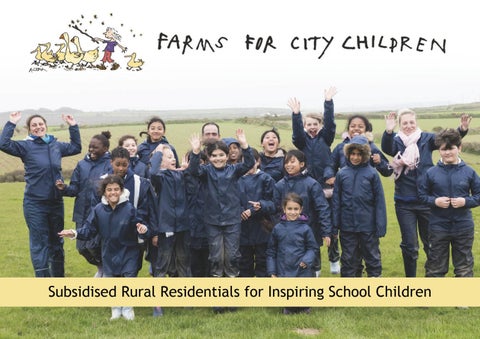
Subsidised Rural Residentials for Inspiring School Children
Contact us Farms for City Children Huxham Barns Huxham Exeter EX5 4EJ 01392 276381 bookings@farmsforcitychildren.org www.farmsforcitychildren.org Patron HRH The Princess Royal Registered Charity No. 325120 Registered Company No. 1177239
Education in its broadest sense is not just about delivering a curriculum. It is about giving children the chance to extend their life skills. It is about developing their confidence. It is about fostering their resilience and a sense of responsibility. And – let us not forget – it is about the enjoyment, engagement and excitement about venturing out into the real world, with all its capacity for uncertainty, stimulation and delight.
Tim Gill ‘Nothing Ventured’ 2010
Contents 5
Welcome
7
About Us
8
Introduction
10 Benefits 11 Impact • Countryside Effect • Outdoor Learning • Lifelong Wellbeing • Space to Be • Food for Thought • Analogue Experience 17 What the Teachers Say 18 What the Children Say 19 Farms and Facilities • Nethercott House – Devon • Lower Treginnis – Pembrokeshire • Wick Court – Gloucestershire Rural Residentials Farms for City Children
3
Some of the children we took to the farms had very difficult and chaotic lives. We took them out of a very difficult environment where they were unable to socialise and didn’t know how to share and put them into a totally different world. It was a haven where they could thrive. London based Teacher who has brought inner-city children to our farms for 14 years
4 Farms for City Children Rural Residentials
A Welcome from our Founders, Michael and Clare Morpurgo Farms for City Children is a charity that offers children from towns and cities all over the country a unique, subsidised opportunity to live and work together for a week at a time, on a real farm, in the heart of the countryside. Since we started the charity back in 1976, almost 100,000 children have been to one of our farms – Nethercott House in Devon, Lower Treginnis in Pembrokeshire, and Wick Court in Gloucestershire. But it should be millions. It’s a week that builds their selfconfidence and self-worth as they work on the farm, a week full of fun too, the most memorable week of their young lives. What we do is more necessary than ever as children become ever more disconnected from the countryside, the environment, and the source of the food they eat. The children enjoy an immersive, ‘learning through doing’ experience of a different life – for children who may not know where their food comes from and have limited opportunities to explore the countryside. We hope to see you and your class down on the farm very soon. Michael and Clare Morpurgo Rural Residentials Farms for City Children
5
6 Farms for City Children Rural Residentials
About us Farms for City Children is a charity that gives school children the chance to become an integral part of one of our three working farms in Devon, Pembrokeshire and Gloucestershire for a whole week. During their week-long stay, the children and their teachers live and work at the farms, explore the countryside, and find out where good food comes from. They also discover self-confidence as they conquer fears, grow in self-belief as they overcome challenges as part of hard working
teams, develop new friendships, create stories and poems filled with the vibrant sounds and language of the rural environment, and learn to see a bigger, brighter future than they might realise exists beyond their crowded city horizons. Today, Farms for City Children welcomes 3,000 children per year for a weeklong stay on our farms. We work exclusively with schools that meet our eligibility criteria around local area deprivation and eligibility for free school meals.
The teachers and other adults who accompany visiting school groups have in loco parentis responsibility for all the children throughout the week. Children participate in the seasonal farming tasks of the week: there are no pick-and-mix preferences or opt-outs – these are working farms, with purposeful activities pegged to the farming calendar. Our farm teams are led by knowledgeable and experienced former primary school teachers. These key members of staff – our Farm School Managers – will be your host for the
week. The Farm School Managers and their team will guide the children through all farming activities and will give you all the information and equipment you need to keep your children safe and well throughout the visit. The charity subsidises almost 60% of the true cost of a week on the farm, making it as affordable as possible for all families, whatever their background.
Rural Residentials Farms for City Children
7
Introduction – a week on the farm Residentials at Farms for City Children are based around a week-long, fully-immersive stay at one of our farms in the heart of the British countryside. KS2 and KS3 children and their teachers work as a team alongside the Farms for City Children staff to undertake all the purposeful tasks that keep the farm running. Days start early and, whilst the cycle of the seasons and vagaries of the weather ensure that each day is different, there is a reassuring routine and structure to life on the farms. Animals must be fed before the children enjoy their own hearty farmhouse breakfast. Then there’s always a busy day ahead with the children working in groups to muck-out stalls and lay fresh bedding for the animals, undertake stock-checks to ensure the animals are in good health, weigh piglets and bottle-feed calves, collect freshly-laid eggs, sow seeds and harvest fruits and vegetables, chop logs for firewood, and prepare nutritious meals. They also go for long walks in the countryside, taking in the sights and sounds of hedgerows, riverbanks or beaches, and will fall asleep under velvety dark-skies, pierced by the light of a billion stars. 8 Farms for City Children Rural Residentials
All children will experience the joy of discovery during their stay – whether it’s discovering the taste of freshly picked foods, the softness of a sheep’s fleece, a hitherto unknown aptitude for practical mathematics when weighing out animal feed, or the sense of achievement that comes from completing a series of tough but meaningful tasks. Some of these new experiences may be quite daunting at first so we make sure all children repeat each of the farming tasks several times during the week. This allows them to gently confront fears and overcome anxieties. The total immersion in a richly stimulating environment provides children and their teachers with an opportunity to extend language and communication skills. By working closely together the children forge new friendships that last long beyond their week-in-wellies. Many also learn that some conundrums cannot be solved alone, rather they require teamwork and collaboration. Perhaps most importantly the children learn to believe in their own ability, they develop confidence in themselves and their decision making, and recognise that perseverance and tenacity deliver results. Rural Residentials Farms for City Children
9
Benefits Living and working on the farm for a week fosters children’s independence, confidence, self-esteem, resilience and collaborative skills, whilst encouraging the importance of physical activity and a healthy lifestyle. The impact extends beyond the week – children take their new skills and experiences back to school and their homes; schools, teachers and parents see a positive and lasting impact on their behaviour and learning. A week on the farm… provides children of all abilities with the space and time to succeed – children experience growth in their personal development, their relationship with others, and their connection with the curriculum, all of which are more meaningful when embedded in real life learning. A week on the farm… provides urban children with a completely different life experience – being immersed in a rural environment for a week, children enjoy many new sensory experiences; the sights, sounds and smell of the countryside, living together as a family, as well as tasting food fresh from the farm and working physically. A week on the farm… provides teachers with the opportunity to embed classroom learning in real life situations – through calculating and weighing correct animal feed, working out areas for the correct spacing of plants, or discussing profit margins. A week on the farm… provides teachers with a living history in which to embed classroom learning – children live amongst the rich history of our 10 Farms for City Children Rural Residentials
heritage-listed houses and surrounding land, from 12th century farmstead settlements, to Elizabethan moated hunting lodges with secret stairways, and imposing Victorian Manor Houses, the landscape is alive with the history of previous generations. A week on the farm… provides children with the opportunity to take on meaningful responsibilities – from caring for the animals, to planting crops and tending the land. Children overcome fears and gain lasting confidence from the progress they make as they become increasingly skilled farmers. A week on the farm… provides children (and teachers!) with a unique opportunity to be screen-free – with no televisions, games consoles, iPads, or mobile phones, the week on the farm stretches the children physically, emotionally and intellectually. Children (re)learn how to play, they discover the joy of running across open, grassy fields, they talk about their experiences, and share stories of their lives at home. A week on the farm… nurtures a real and lasting sense of achievement for all children, frequently inverting the pyramid of attainment and success that exists in the classroom, which translates directly back into improved confidence, independence, and interaction in the classroom and beyond. A week on the farm… provides a warm and caring home from home environment for all visitors.
Impact The Countryside Effect The positive impact of the countryside effect is considerable1. Children exposed to nature score higher on concentration and self-discipline; improve their awareness, reasoning and observational skills; do better in reading, writing, maths, science and social studies; are better at working in teams; and show improved behaviour overall. Yet children from lower income areas continue to have fewer visits to the natural environment than children from higher income areas2. A week at Farms for City Children allows all children to benefit from the muck and magic of the countryside effect.
Outdoor Learning: Nurturing the Whole Child Children who learn outdoors know more, understand more, feel better, behave better, work more cooperatively and are physically healthier3. Increased contact with nature improves the way children learn, formally and informally, and often re-motivates children who do not thrive in the traditional classroom environment. Outdoor learning gives children practical experience of taught subjects and enables them to develop vital connections between the outside world and their ‘interior, hidden, affective world’ 4.
As an adult, who has lived in London my entire life, this experience was life-changing, so I can only imagine how this experience has impacted the children.
The breadth, depth and wide variety of farming tasks, activities, and experiences during the residential visit allows the school to provide a ‘broad, rich and deep curriculum’, and supports teachers wishing to develop pedagogical skills to support pupil engagement, progress and attainment. 1 Sigman, A. 2007 Agricultural Literacy: Giving concrete children food for thought; 2 Monitor of Engagement with the Natural Environment Children’s Report (MENE) 2017-2018; 3 National Trust: Natural Childhood Report, 2012; 4 Robin Moore ‘Last Child in the Woods’ 2005
Rural Residentials Farms for City Children
11
Children are more engaged with their school work, show greater self-awareness and demonstrate resilience and independence
Lifelong Wellbeing: Fostering Resilience One in eight children and young people have a diagnosable mental health problem5. Half of those suffering from life-long mental health problems first experience symptoms by the age of 146. For many children, a residential visit is their first experience of being away from home. Through the variety or purposeful activities on the farm children develop communication and life skills that will stay with them for many years to come. Improving children’s resilience helps them to deal with the hardships they experience during childhood and develops resilience and positive relationships that enable them to deal with later adversities during adolescence and adulthood. Children and teachers also notice a smoother transition from KS2 into the Secondary phase of learning. 5 NHS Digital 2018 6 Kessler and Wang 2007
For the children who are often shy in class, they really thrived in the environment. For those who are very good academically, it was nice for them to be challenged and build resilience in tasks they found challenging.
12 Farms for City Children Rural Residentials
Space to be Exposure to the natural environment can reduce stress and aggressive behaviour in all children and give them a greater sense of self-worth7. The more children play outdoors, the more they learn to cope with the risks and challenges they will go on to face as adults. Nothing can replace what children gain from the freedom and independence of thought they have when trying new things out in the open8.
The whole class came together (teachers and children). They break out of their ‘bubble’ with their peers, and form new friendships with old faces.
In forest school and woodland sessions (Nethercott House and Wick Court) the children choose how to interact with the natural environment – from making charcoal to willow-crowns, den building to wood turning, the children are encouraged to let their imagination run wild. There is also plenty of down-time and space for children to relax and play in the green fields and lawns that surround each of the farms. 7 Various sources, as cited in Bird, William 2007 ‘Natural Thinking’. 8 Byron, Tanya, cited in Hillsdon, M. 2009 ‘Getting Kids Back to Nature’
Rural Residentials Farms for City Children
13
Food for thought Severe obesity among Year 6 students has risen by more than a third over the past 11 years and is over twice as common in the most deprived areas9. Children with excess weight are more likely to suffer from poor self-esteem, bullying and stigma in childhood, and are more likely to be overweight or obese as adults, increasing their risk of preventable illnesses10. Malnutrition in children in the UK is strongly associated with poverty and inequality11. Malnourished children suffer from issues with both growth (the most deprived children are more than a centimetre shorter by the age of 10 than the least deprived children12) and impaired cognitive function13. The 10% of children in the UK who are living in food insecurity are more likely to face impaired academic performance, shame at being out of food and behavioural problems14. 9 National Child Measurement programme 2017/18 10 ‘Health matters: obesity and the food environment’ Public Health England 2017 11 Food Foundation, UK AND GLOBAL MALNUTRITION: THE NEW NORMAL INTERNATIONAL LEARNING SERIES, July 2017 12 Hancock C et al., 2016 13 Food for Thought, Save the Children, 2013 14 UNICEF. 2017. Prevalence and Correlates of Food Insecurity among Children across the Globe. Innocenti Working Paper. https://www.unicef-irc.org/publications/pdf/IWP_2017_09.pdf
Meal times were clearly a bit of a revelation for him! The communal aspect of them really helped him to improve his manners, helped him to learn to share and made some way in developing his conflict resolution.
14 Farms for City Children Rural Residentials
The food was amazing, yummy and fills you up so you never get hungry. It’s like biting into a rainbow.
At the farms, children learn about where their food comes from and are equipped with the skills they need to grow, harvest, prepare and cook their own food. This improves children’s food choices, increases their fruit and vegetable consumption, and can support resilience in the face of poverty15. Children taste a wide variety of freshly prepared, seasonal, healthy food, and benefit from the social aspects of eating together and sharing conversation at meal times, which can help them to develop social skills such as empathy as views and perspectives other than one’s own can be discussed16. Improved food choices can also lead to more holistic happiness - researchers have found that happiness increased incrementally for each extra daily portion of fruit and vegetables up to eight portions per day17. 15 Food for Life’ 2015 16 Food Foundation 17 Mujcic and Oswald 2016 University of Warwick & University of Queensland
Rural Residentials Farms for City Children
15
Analogue experience for the digital generation The growth of screen-based and virtual play is having a profound effect on children’s lives and is being called ‘the extinction of experience’18. The happiness of children in the UK is dependent on two things: having time with a stable family and plenty of things to do – especially outdoors19. Despite this, parents in the UK, especially the lowest-income households, said they felt tremendous pressure from society to buy material goods for their children. Our farms seek to address the poverty of experience arising not just from economic and social deprivation, but also from the effects of increasing materialism. Living screen-free for a week children learn to play together, they invent games, share discoveries, and unlock their analogue imaginations. 18 Pyle, R. (2003) ‘Nature Matrix: reconnecting people and nature’ 19 UNICEF/Ipsos MORI Social Research Institute 2011 Children’s Well-being in UK, Sweden and Spain: The Role of Inequality and Materialism
The week away from technology is also really useful for the children – it gives them chance to step away and be content with what’s around them. The children play chess together and have even set up a chess club when they came back to school. It also helps with the mental health of the children, which is becoming increasingly important in primary school.
16 Farms for City Children Rural Residentials
What the teachers say... “One child found things he was good at and discovered what it felt like to have the support of his classmates. At school he was quiet and shy and found social interactions difficult. He struggled with learning and so the effect of finding he was good at doing the jobs on the farm was transformational. When we went back to school he was suddenly putting his hand up to answer questions and volunteering for drama. Things he had always avoided previously. The effect on him was so significant we were looking for agricultural linked secondary schools for him so that he could fulfil his new dream to be a farmer.”
“Working with the animals is one of the main attractions of Farms for City Children. I remember one visit with a group of children with particularly challenging behaviour we were went on a long walk across the farm to check the livestock. When we came to a field of sheep who were pregnant one of the children voiced a concern that they might get kicked or bitten by the animals. The Farms for City Children Farm Manager replied that the animals only do that if they are scared – just like people do. There was a quiet moment after that – that really resonated with the children. Making the link between their emotional state and their behaviour, via a sheep, was so much more accessible to them than the sessions in school that had focused on them and their behaviour.”
“I visited Farms for City Children’s Nethercott House farm twice as a child in the mid 1980s and returned three times as a teacher. It is so much fun and so exciting and adventurous but also very useful. As an adult I have been to other residential settings. What’s different about Nethercott House is it never feels as if it is a business – the fact that we are the only school there and that all the adults that the children meet are so friendly and helpful and kind and intent on making a relationship with each child makes it feel very homely and this has a rapid effect on the children. They genuinely are sad to leave.”
Rural Residentials Farms for City Children
17
What the children say... There is less pollution here. We don’t use our phones or other electronics.
I am most proud of being responsible for myself.
When I get milk, meat and cheese I’ll think about the farmer waking up early to get our food for us.
I will now play more with nature rather than staying inside.
Because of my week on the farm, when I go home I will choose food responsibly and reduce my food waste. I am most proud of how we worked as a team!
There are no roads and cars to be seen on the farm. 18 Farms for City Children Rural Residentials
Life is different on the farm because there is space to run around – London is full of buildings.
When I go home, I will be more independent because of my week on the farm.
I will do more jobs at home or school in order to help out.
I am most proud of facing my fears by holding animals I didn’t like before.
Our farms The farms and facilities Each of our three farms provides a vibrant living laboratory for children to explore, a practical classroom in which children are immersed in lifelong learning and, most importantly a warm, welcoming, and homely environment in which all visitors can relax, forge new friendships, and enjoy a moment of respite from the hectic pace of modern life. Children are accommodated in cosy dormitories with bathroom facilities, and there are comfortable single and twin en-suite bedrooms for teachers. Homemade meals made with fresh produce from the farm, or highest quality local providers, are eaten together in the dining room. Special dietary requirements are readily accommodated by our kitchen teams, who are skilled and experienced at meeting the needs of our visitors. Free time can be spent in the parlor or library, full of books and games, or outside in the fresh air. Many visiting children enjoy writing a daily diary or drawing on the many new experiences to write stories. A creative classroom is available at each farm for visiting teachers to use with their children. Each farm has Wi-Fi access for teachers (although don’t expect inner-city broadband speeds out here!). Rural Residentials Farms for City Children
19
Nethercott House, Devon Nethercott House is in a stunning rural environment close to Dartmoor National Park. Deep in Devonshire farming country Nethercott is an imposing Victorian manor house with wide sweeping lawns and gnarled old oaks lining the steeply-banked walkways and hedgerows that lead down to the river Torridge. Maximum occupancy – 39 children, 5 adults Indicative Farming activities include: • Feeding and watering poultry and pigs • Grooming and mucking out horses, ponies, and donkeys • Commercial dairy farming – watching the morning or evening milking, feeding dairy calves • Commercial beef and sheep farming – feeding cattle, checking livestock health, herding sheep • Kitchen garden – sowing, potting, harvesting, tasting fruits and vegetables • Cooking – preparing nutritious meals from the produce harvested on the farms • Creamery – a special food-preparation room allows children to experience cheese and yogurt making • Countryside walk through the fields and alongside the trout stream • Forest school – unstructured and self-led play, including making charcoal, learning to light fires, whittling wood, making dens, and getting creative with willow. • Village walk to Iddesleigh, the historic home of Michael Morpurgo’s Joey (WarHorse) Farm School Manager: Katy Martin – NethercottHouse@farmsforcitychildren.org
20 Farms for City Children Rural Residentials
Lower Treginnis, Pembrokeshire Lower Treginnis farm sits on the stunningly beautiful site of a 700 year old farmstead and is the most westerly farm in Wales. Just outside of Saint Davids – the UK’s smallest city – Lower Treginnis provides visitors with an incredible mix of wild and windswept Welsh sheep farming heritage and the dramatic cliffs and wildlife of the Pembrokeshire coastline. Maximum occupancy – 39 children, 6 adults Indicative Farming activities include: • • • •
Feeding and watering poultry and pigs Grooming and mucking out horses, ponies, and donkeys Feeding and milking goats Commercial sheep farming – bottle feeding lambs in Spring, checking livestock health, herding sheep • Kitchen garden – sowing, potting, harvesting, tasting fruits and vegetables • Field-scale cropping – planting, harvesting, and packaging potatoes, swedes, or pumpkins • Cooking – preparing nutritious meals from the produce harvested on the farms • Log sawing – mastering the art of splitting and sawing logs for the fire • Countryside and Coastal walk through the fields and down to the beautiful sandy beach • Village walk to the historic city of Saint Davids Farm School Manager: Dan Jones – LowerTreginnis@farmsforcitychildren.org
Rural Residentials Farms for City Children
21
Wick Court, Gloucestershire Wick Court is an Elizabethan moated manor house once used as a hunting lodge by the Lords of Berkeley and visited by Elizabeth I. The majestic house stands on site dating back to thirteenth century, looking out across idyllic swathes of farming land to the reed beds of the River Severn. Maximum occupancy – 36 children, 5 adults Indicative Farming activities include: • • • • • • • • •
Feeding and watering poultry and pigs Grooming and mucking out horses and ponies Pressing apples and making juice Commercial dairy farming – watching the automatic milking robots in a fully modernised dairy operation, feeding dairy calves Kitchen garden – sowing, potting, harvesting, tasting fruits and vegetables Bee keeping and birdwatching Cooking – preparing nutritious meals from the produce harvested on the farms Woodland – unstructured and self-led play, including making willow crowns, building dens, and storytelling in the roundhouse. Countryside walks in the beautiful land surrounding the farm
Farm School Manager: Stevie Edge-McKee – WickCourt@farmsforcitychildren.org
22 Farms for City Children Rural Residentials
admin@farmsforcitychildren.org
www.farmsforcitychildren.org
01392 276381