Welcome to the latest edition of Growing Success, where we highlight new and key products, offer practical guidance on herbicide use, hear more about a topical research project and provide clarity around agrichemical standards and certification requirements.
We all continue to operate our businesses in unprecedented conditions of uncertainty, whether that’s supply chain pressures, market disruption, labour force constraints or new regulatory frameworks. In many respects the health of our export economy is testament to the hard work, innovation and market-led focus of our farmers and growers. I’m confident that this approach will serve us well, as we continue to navigate the challenges ahead.
Farmlands is proud to be a key partner of many primary producers and we take the responsibility of supporting our shareholders through these turbulent times very seriously. Ensuring consistent supply of critical inputs has been more challenging than ever over the last 12 months and our suppliers advise us that disruption is likely to continue through into 2023.
We have adapted to this challenge through our work with suppliers, supply chain and use of in-house technology, to ensure that product supply for our shareholders remains an absolute priority. If you have any concerns around key product supply for next season, please reach out to your Farmlands Technical Advisor or local store.
I’ll leave you with the words of our Chairman, Rob Hewett from his 2021 Annual Report. “In 2022 Farmlands Co-operative turns sixty. It’s a timely reminder that we have served, supplied and supported generations of kiwi farmers and growers and their businesses. We were created to disrupt, compete and challenge. Our ambition is to continue to re-invent, to be relevant and to help you succeed.”
All the very best for the harvest that many of you are about to embark upon.
Mark Daniels Head of Horticulture Farmlands
Choose your weapon for dust supression
The changing climate in New Zealand is indicating more drought like conditions for the future. Increasingly, farms, orchards and vineyards are facing issues around dust control from a health and safety, environmental and crop safety point of view. Mining & forestry industries, as well as regional authorities have been using dust suppression technologies for over 25 years to effectively control dust.
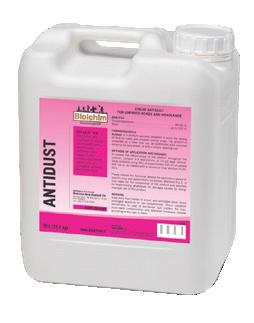
Biolchim New Zealand is now providing a solution to this issue with Antidust. A costeffective dust control product that can maintain road surfaces, headlands and farm, orchard and vineyard tracks from deterioration. Untreated road surfaces require more frequent repairs of potholes, washboard and rutting. Antidust will assist in compacting road surfaces which
essentially helps reduce time-consuming and expensive road repairs. Antidust will also prevent accidents caused by poor visibility and helps reduce health problems related to airborne dust particles.
Further advantages of Antidust are:
• Reducing the risk of dust and ground surface contaminants being blown up onto fruit in rows adjacent to tracks and driveways.
• Minimisation of excessive dust during harvest which can be a nuisance to workers, neighbours and the community at large. During drier seasons, harvest activities will likely result in increased dust due to lack of rainfall.
• Prevention of dust particles from entering streams and waterways where they can contribute to sediment levels which can be dangerous to aquatic life.
Application Method and Rates:
To ensure effectiveness throughout summer, Antidust should be applied over 2-3 applications, 15-20 days apart. Wet evenly with 40 to 50 litres of solution (15 to 20 litres of product) for every 100 m2 of surface area. Depending on conditions and season, application rates can vary for y our property.
Antidust is a safe and cost-effective solution to control dust on your property. This product is distributed in New Zealand exclusively through Farmlands. For further information, contact your Farmlands Technical Advisor or the friendly team at your local Farmlands store.
Article supplied by Biolchim.
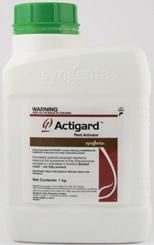
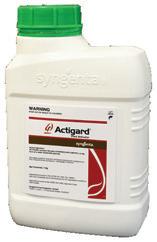
Research supports use of Actigard® post-harvest
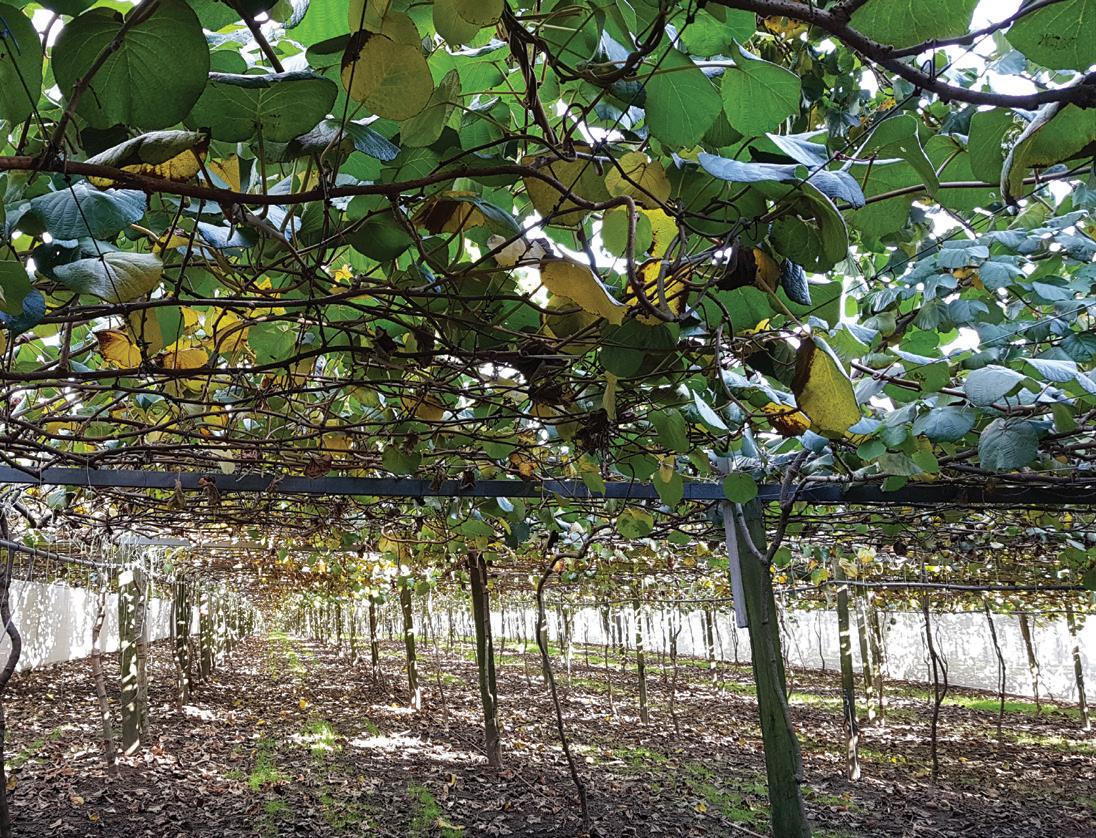
Post-harvest is a high-risk period for Psa in Kiwifruit, with cooler, wetter weather conditions favouring infection. Around 300,000 to 500,000 wounds per hectare are created at harvest on fruit stalks, providing entry points for Psa.
Psa infection that occurs post-harvest may not be visible until the following spring, but applications of Actigard®
post-harvest can help reduce Psa pressure.
Actigard is unique in that it interacts directly with the plant, triggering its natural self-defence mechanisms to help protect against Psa infection. Until recently, most of the research into the effectiveness of Actigard has been focused on spring applications prior to flowering, where visual effects can
be measured by how well leaf spotting and shoot dieback are controlled a few weeks after application.
In 2019 Syngenta, Zespri, Kiwifruit Vine Health (KVH) and Plant & Food Research collaborated to design a research programme to get a better understanding about post-harvest use of Actigard and what impact (if any) it was having on kiwifruit vines at this later growth stage.
KIWIFRUIT
As Tony Reglinski,
Senior
Research Scientist at Plant & Food Research explains, “the best way to understand the effect of Actigard in the post-harvest window, is to look for changes in the defence gene expression in Actigard treated vines compared with the untreated vines. An increase in gene expression is likely to equate to an increase in protection against Psa.”
The good news is the vines were responsive to Actigard on both early and late harvested Hayward vines and the gene response patterns were similar. This is good supporting
evidence of the value in using Actigard post-harvest to help protect vines against Psa infection, occurring from fruit scars and leaf fall after harvest. It also indicates good flexibility in the application timing of Actigard in relation to leaf condition after harvest.
Further work is being carried out on Gold3 this season and hopefully new data will be available in the coming months.
A maximum of four sprays of Actigard can be applied on kiwifruit each season at 21-day intervals. This normally allows two sprays if the first spray is applied immediately post-harvest. To avoid the
risk of residues, extreme care must be taken to prevent spray drift into unharvested fruit in adjacent blocks.
Leaves need to be actively photosynthesising for Actigard to be properly absorbed. Actigard is likely to be less effective if applied to leaves at an advanced stage of deterioration, or after a significant frost event.
For more information on how best to use Actigard in your kiwifruit orchard for Psa control, contact your local Farmlands Technical Advisor.
Article supplied by Syngenta
The importance of humates in soil structure
Humates are a pure form of organic matter, resulting from an accumulation of decayed forest and carbon rich plant residues that have been compressed and preserved over the ages.
High in carbon, natural minerals and trace elements, Humates contain two powerful bioactive acids, humic and fulvic acid. The material is known for the beneficial role it plays in stimulating microbiological activity and increased fungi levels in soil.
Humic acid is a group of molecules that bind to and help plant roots receive water and nutrients. They are therefore extremely important as a medium for transporting nutrients from the soil to the plant. Their ability to hold on to ionized nutrients prevent them from being leached.
Positive ions are more easily absorbed
by a plant’s root due to the root having a negative charge. In other words, the positive (cation) is attracted to the negative (the living root). Humic acids hold cations (positive ions) in a way that can be more easily absorbed by a plant’s root, improving micronutrient transfer to the plant’s circulation system. This works through humic acids (ulmic, humic and fulvic) picking up positive ions and then being attracted to the root depletion zone and to the hyphae micro- tubes of mycorrhizae.
Four years of independent field trials have resulted in a paper being published in Nature Science Journal confirming the addition of humate to urea increases pasture growth. The full paper is available under “Articles” at www.southernhumates.co.nz
A field trial is just underway in the Bay of Plenty that will assess the effects of humates in reducing nitrate leaching
in kiwifruit orchards. A further kiwifruit field trial is investigating the effects of humates on heavy metals and this is indicating a positive result.
International lab analysis of Southern Humates product indicates a high level of carbon, 43%; humic acid, 48%; and Cation Exchange Capacity (CEC) of 78 meq/100g. It is generally considered that the high levels relate to the geographic location of the Southern Humates site in the deep south at Wyndham.
Southern Humates supplies a range of products in both solid and liquid form to meet spreading requirements across both agriculture and horticulture sectors. The range is certified organic for input.
For further information please contact your Farmlands Technical Advisor, or local Farmlands branch.
Supplied by Janet Brooker Southern Humates
SOIL
Advanced copper with Kintech technology
Grochem has launched a new generation copper formulation, Norshield ® 45WG, using new technology from Europe.
Norshield 45 WG reduces copper use rates by up to 30% for grape disease control, while maintaining the same level of efficacy as Nordox 75WG.
Norshield 45WG has superior rain fastness and is BioGro approved for organic crop use in New Zealand.
Manufactured by Nordox, Norshield 45WG contains 450 g/kg copper as cuprous oxide and is registered for use on grapes for Black spot, Botrytis, Sour Rot, Downy and Powdery Mildew.
Developed in Norway to meet tough European regulatory standards.
Norshield 45WG is now a leading viticultural fungicide in France, Italy and Spain. Showcasing lower copper use rates per hectare and gaining international organic certification.
Why the change? Norshield 45WG has more activity per gram of copper thanks to an improved formulation and reduced particle size. This has shown better disease efficacy at lower use rates of active copper per hectare.
Norshield 45WG has a dual mode of action. The traditional direct mode of activity of copper, plus the addition of Kintech technology to stimulate the plants own resistance pathway.
Scientists found the new formulation had crop enhancement properties too. They found Norshield 45WG activated the plants own defence systems by inducing resistance and using the plants natural pathways. This provided disease control beyond the contact zone of applied product.
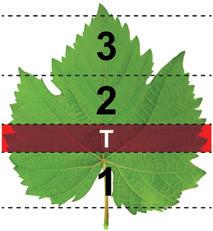
This was demonstrated in a laboratory by treating grape leaves in only one zone, on the underside of the leaf and the inoculating the leaf with downy mildew.
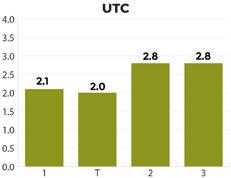
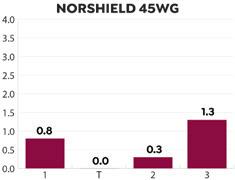
Efficacy comparisons were made alongside other commonly used copper fungicides and tested for disease control outside of the area treated.
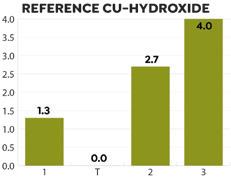
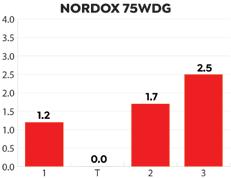
The trial below shows the treatment area in red and the level of control by each copper product in the untreated zones. This trial illustrates how Norshield 45WG induces resistance using the plants natural pathways after being applied to a single zone on the leaf surface.
Norshield is available in a 10kg bucket. To learn more about Norshield please call your local technical advisor, Grochem representative or visit www.grochem.com.
Norshield ® is registered under the ACVM Act in New Zealand. ‘ACVM Registration No. P009734.
Severity 7 days after inoculation
Kiwifruit nutrient leaching study
In a joint project with Southern Humates, Farmlands is seeking to understand opportunities for improvements in water quality and sustainability, to drive better nutrient efficiency within kiwifruit orchards.
Nitrogen leaching is fast becoming a major topic for New Zealand orchards. Currently regional councils are in the process of developing legislation and implementing policy for managing freshwater quality. Driven by the Resource Management Act and the National Policy Statement for Fresh Water, councils will take a varied approach in setting limits across catchments and designated sensitive areas to control nitrogen losses to ground water. Overall this will impact farm, orchard and vineyard management and in some instances their economic viability.
The pilot study involving Farmlands and Southern Humates is a proof-of-concept test to validate nitrogen measurement work already underway, comparing use of humate products on Southland dairy farms. The Southland trials are showing promise, demonstrating increased dry matter production and nitrate loss reduction. Both Farmlands and Southern Humates are enthusiastic to learn if the paradigm can shift into the horticulture industry.
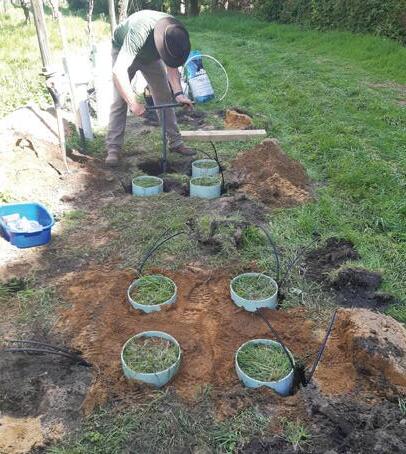
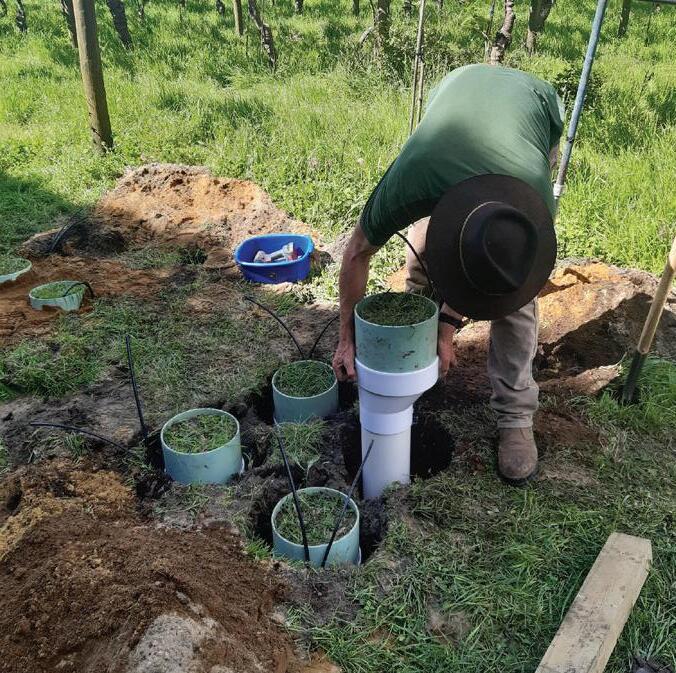
The project is underway with 12 lysimeters buried in the pumice/sandy soils on 8.2ha of kiwifruit at Ross and Dell Bawden’s 37ha mixed farm property in the Bay of Plenty. The lysimeters are testing three treatments that growers currently apply to orchards.
Two treatments will have nitrogen mitigation techniques applied. It is hypothesised that if nutrient efficiency can be obtained, then improved water quality can be achieved. Measurements will be taken after rain events and tracked over time. If the project demonstrates positive outcomes, then further work will be undertaken to validate and model the findings.
Ross is no stranger to environmental issues within the primary sector having worked as an operations planning manager for a significant Bay of Plenty forestry business. He has witnessed what happens when an industry runs into environmental issues and loses its social
licence to operate. Ross was subsequently involved in change management processes that lead to forestry companies signing up to the Forest Stewardship Council environmental accreditation programme. This was a precursor to the Environmental, Social and Governance standards that corporations aspire to now. Ross is quick to quip “social license is hard to get but is easy to lose.”
It is inevitable that many horticulture operations will suffer nutrient losses. However more efficient use of nutrients such as nitrogen will have strong sustainability benefits for growers, both financially and environmentally. There is a strong belief the data obtained over time will give growers the ability to make informed decisions on how to better manage nutrients.
| Lysimeters being installed in the kiwifruit orchard
Agrichemical certification requirements
With a recently released New Zealand Standard for the Management of Agrichemicals and some misunderstandings around the requirements for purchase and use of agrichemicals, it’s timely we clarify the situation.
A new standard was released in August 2021 for the Management of Agrichemicals: NZS8409:2021, superseding the 2004 standard (NZS8409:2004). This was written following a 10-month review process and 12-week public consultation period.
The agrichemicals in this standard include pesticides, veterinary medicines and extends to the agricultural use of detergents and sanitisers.
The standard covers storage, supply, transport, use and training requirements for agrichemicals in New Zealand and includes relevant information governing the use (including off label), spray planning, transport, storage, handling, disposal and consistent good practice.
Acute toxicity oral category 1
Acute toxicity dermal category 1
Acute toxicity inhalation category 1
Acute toxicity oral category 2
Acute toxicity dermal category 2
Acute toxicity inhalation category 2
Acute toxicity oral category 3
Acute toxicity dermal category 3
Acute toxicity inhalation category 3
A key change to the scope of the Standard is to limit its application to the workplace. The Hazardous Substances Regulations 2017 are a significant determinant of the rules applying to hazardous substances and these regulations only apply to the workplace, rather than noncommercial (residential) locations. There is some confusion about the training and certification requirements for the purchase, storage and use of agrichemicals. Fortunately this information can be found online by visiting hazardoussubstances.govt. nz and using the calculator. To do this, you will need to have the Safety Data Sheets for all of your agrichemicals. Further information can be found on the WorkSafe or Growsafe websites, or by searching ‘agrichemical training NZ’. Worth noting is that Approved Handler certification no longer exists and has been replaced by the Certified Handler
qualification. Purchasers of some agrichemical products are required to have a valid Certified Handler certificate. There are however a relatively small number of products in this category. Previously classified under the old HSNO hazard classifications 6.1A and 6.1B, the Environmental Protection Authority now classify these under an international classification standard, GHS (Globally Harmonised System of Classification and Labelling of Chemicals) class – see below.
A list of the products that require the purchaser to hold a Certified Handler certificate can be found on the Growsafe website under the tab Resources and “Product requiring CH”. Farmlands can also advise which products require this certificate. In addition, as shown in the table below, there are products that can only be used in the workplace. Suppliers/retailers must be provided with evidence that a competent person in that workplace will take responsibility for these products. The Standard describes a competent person as someone who has had appropriate training and instruction in the management of hazardous substances. The Standard lists what the competency training must include. This information can also be found in Clause 4.5 of the Hazardous Substances Regulations. A Growsafe Standard certificate is one type of acceptable evidence of competency, as is a Certified Handler certificate or any other training which meets the requirements laid out in the Standard or Hazardous Substances Regulations.
The requirements set out above relate to the sale or transfer of products. There are different requirements for training and competency relating to the use of products, particularly where products have environmental hazard classifications. Further information relating to this can be found on the Growsafe website. Or phone: 0508 GROWSAFE (0508 476 972)
Article supplied by Farmlands
Chemical weed control 101
Growing a crop and maximising yield can be challenging with the presence of weeds. They can multiply through seed, rhizomes or cuttings and can be spread by cultivation, birds, humans, machinery or wind.
Weed identification and understanding how they grow is important when planning to successfully manage the weed problem.
Understanding the following herbicide classifications will assist in decisionmaking on weed-control. These classifications describe the action of the product once applied to target weeds (active ingredients examples in brackets):
• Selective: Controls only certain types of plants (clethodim, oxyfluorfen, linuron)
• Non-selective: Damages or controls most plants (glufosinate, glyphosate)
• Systemic: Translocated throughout the plant (glyphosate)
• Contact: Controls only the portion of the plant that is treated (paraquat, carfentrazone)
• Pre-emergent: Controls plants once the seed germinates and as it emerges through the soil (pendimethalin, oryzalin)
• Foliar systemic: Applied to top growth and translocated throughout the plant (glyphosate)
• Soil Active systemic: Absorbed into the root system and translocated throughout the plant (terbuthylazine)
The mode of entry is the primary means by which a herbicide is transported into the plant. This can be either by uptake through the leaf, taken in by the soil or both.
Understanding Mode of Action (MoA)
• Herbicide labels display the term “mode of action”. This is the plant’s cell division and growth in response to the herbicide, or the sequence of events leading to the plant’s death
• The mode of action displayed on the label will assist the user in managing herbicide resistance
What is herbicide resistance?
Continuous use of a herbicide in the same MoA group increases the selection for herbicide resistance. Effectively the weed species will get used to having the same cell division process being disrupted and will find a way to “resist” this process.
Once a weed species become resistant, herbicides with the same MoA will no longer be effective, i.e. the weed species becomes resistant to this herbicide.
How should herbicide resistance be managed?
• Reduce the reliance on a single herbicide MoA
• Use herbicides from different MoA groups, alternating or mixing them (always check the product label or seek advice prior to mixing products)
• Alternate herbicide use with other weed control strategies e.g. mowing
• Apply herbicides at the recommended label rates for the hardest to kill weed
• Do not under-dose herbicide products.
Herbicide Application
- some considerations:
• Make applications when windspeed is between 5 km/h and 15 km/h
• Use shrouded application equipment to prevent any possible crop damage
• Have spray equipment accurately calibrated to ensure that the correct amount of chemical and water is applied
• Consider weather conditions i.e. drying time, humidity and drought/plant stress that affect herbicide uptake
• Water rates: Follow label recommendations
• The inclusion of adjuvants: Always consult the product label
• Health and Environmental hazards
• Adhere to industry risk management guidelines relative to the crop
Further information can be obtained from your local Farmlands Technical Advisor and from the Farmlands GrowGuide App - available on Android and IOS App Store.
Article supplied by Mart Verstappen, Farmlands Technical Leader Viticulture.
Presentation title
Name
• ACTIGARD® is a systemic plant activator, which triggers the plants natural self-defence against Psa.
• Apply 200 grams per hectare immediately postharvest and 21 days later - subject to leaf condition.
• The addition of copper is recommended.
For more information contact your local Farmlands store or visit syngenta.co.nz
LIKE BEING LOCAL.
Just like the team at Farmlands, FMG likes to have people on the ground. FMG has been here for farmers all over New Zealand for over 100 years. And it’s something we’ll continue to do for many years to come. If that sounds like the kind of insurer you’d like to deal with, ask around about us. Or better still, call us now on 0800 366 466.