$7.95
September October 2026
ENTREPRENEURS IN AGRICULTURE
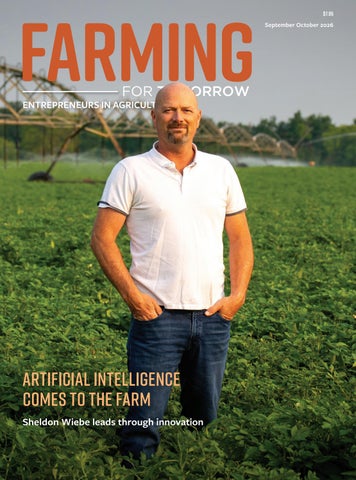
Artificial Intelligence Comes to the Farm Sheldon Wiebe leads through innovation
Ride above it all RIDE ABOVE IT ALL WITH THE CAN-AM DEFENDER, FEATURING HEAVY-DUTY TOUGHNESS, UNBEATABLE GROUND CLEARANCE AND THE LARGEST CARGO BOX IN ITS CLASS. NO MATTER THE LOAD OR TERRAIN, IT’S BUILT TO POWER THROUGH ANYTHING AND KEEP MOVING FORWARD. LOAD UP AND GO BEYOND.
2026 defender LEARN MORE AT CANAMOFFROAD.COM
©2026 Bombardier Recreational Products Inc. (BRP). All rights reserved. ®, TM and the BRP logo are trademarks of BRP or its affiliates. In the USA, products are distributed by BRP US Inc. †All other trademarks are the property of their respective owners. BRP reserves the right to discontinue or change specifications, prices, designs, features, models or equipment without incurring obligation. Some models shown may include optional equipment. Product performance may vary depending on external factors. BRP recommends that all ATV-SSV drivers take a training course. See your dealer or call the ATV Safety Institute at 1-800-887-2887 (USA) or the Canadian Safety Council at 1-613-739-1535 (Canada). ATV and SSV can be hazardous to operate. Never exceed the ATV-SSV’s passenger capacity. All adult model ATV are meant to be used by drivers of age 16 and older. Read the operator’s guide. Follow all instructional and safety material and observe applicable laws and regulations. ATV and SSV are for off-road use only; never ride on paved surfaces or public roads. For your safety, the operator and passenger(s) must wear a helmet, eye protection and applicable protective clothing. Always remember that riding and alcohol/drugs don’t mix. Never engage in stunt driving. Avoid excessive speed and be particularly careful on difficult terrain. Always ride responsibly and safely. See your authorized BRP dealer for details and visit https://can-am.brp.com/.
new Vertical Fuel Tanks
“I wish I didn’t have that extra storage...”
said no one, ever. Market volatility and supply uncertainty aren’t new to farming, but they don’t have to control your operation. With on-site fertilizer and fuel storage from Meridian, you gain the freedom to buy when timing is right, secure product when it’s available, and keep your operation moving without disruption. Add in the convenience of having supply at your fingertips, plus the ability to protect and preserve your harvest, and it’s a smarter, more efficient way to run your farm. Contact us today to learn about our full line of high-quality storage products for your farm.
Find your local dealer at
meridianmfg.com © 2026 Meridian Manufacturing Inc. Registered Trademarks Used Under License. (05/2026)
®
Built ahead of our time, since 1985. We started moving grain, seed, and fertilizer differently the moment we built our first conveyor. A decade later, we introduced the industry’s first Commercial Seed Tender. Then came our signature Hydraulic Drive in 2008- another benchmark the industry followed. Contact us at (800) 665-7259 or visit convey-all.com to learn more.
Others chase trends. We set them. And we’re not slowing down.
CONVEY-ALL BEGINS MANUFACTURING CONVEYORS
THE FIRST COMMERCIAL SEED TENDER IS DESIGNED AND BUILT
CONVEY-ALL LAUNCHES ITS HYDRAULIC DRIVE CONVEYOR
THE ‘VOLT’ BATTERY POWERED CONVEYOR IS INTRODUCED
28
Artificial Intelligence Comes to the Farm BY ANGELA LOVELL
10
34
Evaluating Risk and Insurance Options
New Seed Varieties Making Their Way into Farmers’ Fields
A Farmer’s Viewpoint by Kevin Hursh
Seed
by Becky Zimmer
14
38
Grain Market Analysis
Weathering the Elements
Succession
Your Farm is a Success… Now What?
by Scott Shiels
by Nerissa McNaughton
24
44
Farming Your Money
Romance Versus Finance
Spraying 101
by Paul Kuntz
The Application Triangle by Tom Wolf
26
Risk Management
The Unforgiven by Evan Shout
KEVIN HURSH 6
PAUL KUNTZ
SCOTT SHIELS
TOM WOLF
TITLE | SECTION
AT UFA, WE’RE FOR
STRAIGHT-SHOOTING ALL-IN HONEST-DAYS-WORK SUNRISE-TO-SUNSET BOOTS-ON-THE-GROUND DIRT-UNDER-THE-NAILS ROLL-UP-YOUR-SLEEVES MAKE-IT-WORK NEVER-QUIT ALL-WEATHER FAMILY-ROOTED COMMUNITY-MINDED NEXTGENERATION LEGACY-BUILDING LAND-STEWARDING CALLOUS-HANDED EARLY-RISING CROP-GROWING ANIMAL-RAISING FIGURE-IT-OUT GET-AFTER-ITWHATEVER-IT-TAKES HEAD-DOWN HANDS-ON CAN DO STICK-TO-IT-IVENESS GET-UP-AND-GO GRIT-BUILT WIND-CHAPPED LONG-HAUL BEEN-THROUGH-ITALL NEIGHBOUR-HELPING BUILT-FOR-IT
FARMERS Find out how at UFA.com/ForFarmers
7 © 2026 UFA Co-operative Ltd. All rights reserved. 14705
Publishers
Pat Ottmann & Tim Ottmann
Editor
Lisa Johnston
Design
Cole Ottmann
Regular Contributors Kevin Hursh Paul Kuntz
Scott Shiels Tom Wolf
Copy Editor
Nerissa McNaughton
Sales
INDUCTOR FLEX
The new Inductor FLEX Series by Pattison Liquid Systems is designed with flexibility in mind. The Inductor FLEX has the capacity to service todays demanding sprayer filling needs. As optimal spraying conditions are limited, it is important to keep your sprayer where you need it. In the field spraying. The Inductor Flex takes inducting chemical to a new level with a 220 liter per minute venturi, turning filling into a race day pit stop. The Inductor Flex System is offered with a Main Tank Assembly, a Tote Meter option and a 3 inch Pump option. The whole system is designed with versatility, allowing you to set it up accordingly to your sprayer deck configuration. All of the components of the Inductor Flex can be arranged on any side of the skid or mounted elsewhere to meet your needs.
Tote Meter Option
Pat Ottmann pat@farmingfortomorrow.ca 587-774-7619 Nancy Bielecki nancy@farmingfortomorrow.ca 587-774-7618 /farming4tomorrow /FFTMagazine /farming-for-tomorrow /farmingfortomorrow WWW.FARMINGFORTOMORROW.CA Farming For Tomorrow is delivered to 79,873 farm and agribusiness addresses every second month. The areas of distribution include Manitoba, Saskatchewan, Alberta and the Peace region of B.C. The publisher does not assume any responsibility for the content of any advertisement, and all representations of warranties made in such advertisements are those of the advertiser and not of the publisher. No portion of this publication may be reproduced, in all or in part, without the written permission of the publisher. Canadian Publications mail sales product agreement no. 41126516.
1-306-335-2215 admin@liquidsystems.net www.liquidsystems.net 8
TITLE | SECTION
9
SECTION | TITLE A FARMER’S VIEWPOINT | EVALUATING RISK AND INSURANCE OPTIONS
Evaluating Risk and Insurance Options Farming is a risky business. Some risks are not quite what they seem. Some are insurable, but the insurance may not cover what you think. Everybody analyzes their risks differently.
Kevin Hursh, P.Ag. Kevin Hursh is one of the country’s leading agricultural commentators. He is an agrologist, journalist and farmer. Kevin and his wife Marlene run Hursh Consulting & Communications based in Saskatoon. They also own and operate a farm near Cabri in southwest Saskatchewan growing a wide variety of crops. Kevin writes regular columns for farm publications and can often be heard on Saskatchewan radio stations. In 2021, Kevin received a Distinguished Agrologist Award from the Saskatchewan Institute of Agrologists. In 2023, he was inducted into the Saskatchewan Agricultural Hall of Fame. X: @KevinHursh1
10
Let’s start with hail insurance. Everybody knows what a hailstorm can do to crops. Hail damage is highly visible and a prime topic of conversation. But hail insurance companies know the odds, and the odds are you’re unlikely to cover your premiums over the long term. If your base premium is three per cent, companies know your odds of a significant claim are well below three per cent. After all, the company has to pay its employees and administration in addition to paying out claims. Plus, private insurance companies want to make money. This doesn’t mean you shouldn’t buy hail insurance, but it’s reasonable to calculate how it fits into your other safety nets. If you carry crop insurance and if some or all of a crop type is in the same location, crop insurance may be triggered in the event of a significant storm. That may lead you to buy less hail insurance. If, on the other hand, you have crops that are widely scattered, crop insurance support may be limited in the event of a storm. Crops not hit with hail could easily offset crops that are hit. In this case, hail insurance could be more important. Gross margin insurance programs, such as Global Ag Risk, can also change the hail insurance equation. It’s useful to consider the various scenarios and how much you can afford to lose as you make your decisions. Remember that with crop insurance, governments are covering over half of the premium as well as paying the administration costs. Therefore, long-term involvement in crop insurance would seem to have better odds of positive net returns versus hail insurance. Crop insurance is multi-peril, but doesn’t cover spot losses such as flooding.
EVALUATING RISK AND INSURANCE OPTIONS | A FARMER’S VIEWPOINT
If your grain bin blows over, that should be covered by insurance. If it falls over because one side sinks into the ground, good luck getting insurance. Unfortunately, not everyone fully understands how crop insurance actually works. Let’s say your guaranteed canola yield is 36 bushels per acre at an insured price of $14 a bushel. Some people do the math and conclude that in this scenario they cannot do worse than $504 an acre. However, crop insurance is production insurance, not price insurance. If you produce a crop that averages right at that 36 bushels per acre guarantee, but the price of canola drops to $12 a bushel, your return is $432 an acre and there’s no crop insurance support. After the crop disaster of 2021, many producers were burned by crop contracts. They didn’t have enough production to fill
contracts and market prices ended up dramatically higher than contract prices. Buying out contracts was expensive, causing some to declare that they would never pre-contract ever again. That’s an overreaction. The risk of prices dropping can be much greater than the risk of an epic crop failure. Of course, you should only lock in a reasonable percentage of a typical crop. Options contracts on canola are also a tool worth exploring. On specialty crops, many contracts include an act of God clause to protect producers in the event of crop failure. What about insurance on your farm equipment and buildings? Those policies have so much fine print that it’s difficult to know just what is covered and what isn’t. A neighbour had his high-clearance sprayer frame fail, essentially breaking the sprayer in half. The spray tank broke through the back window. Last I heard, the neighbour was still in heated discussions with the insurance company with the company maintaining that mechanical failure is not an insurable risk. If your grain bin blows over, that should be covered by insurance. If it falls over because one side sinks into the ground, good luck getting insurance. I view insurance in its various forms as a necessary evil.
Move grain quickly & safely with less damage. No more legs or augers. Each system uniquely designed for you. No filters. Automatic control.
Maximize profit & performance with Smart-Flo Call WALINGA today!
1-888-WALINGA
(1-888-925-4642) 11
NEW PRODUCT LAUNCHES
+ 500+ EXHIBITS
+ BILLY BOB’S BAR LIVE ENTERTAINMENT
NOVEMBER WESTERNER PARK
NEW EDUCATIONAL SESSIONS
+ AG INNOVATIONS COMPETITION
+ YOUTH SCHOLARSHIP 50/50
Agri-Trade 2026:
New Tech, New Talk, New Reasons to show up. For three days every November, Westerner Park in Red Deer becomes the epicenter of Canada’s ag equipment industry. This year, Agri-Trade Equipment Expo returns November 11–13, 2026, and for crop and livestock producers across the country, it remains a show worth clearing the calendar for. With the event taking place after harvest, it’s the ideal time to plan for the next growing season.
The biggest misconception about trade shows is that once you’ve been, you’ve seen it. Agri-Trade proves otherwise. Every year, the show floor features dozens of new product launches — equipment, technology, and tools that weren’t available the year before. More than 500 exhibitors use Agri-Trade as a launchpad, meaning producers who skip a year aren’t missing a repeat performance — they’re missing an entirely different show. That’s by design. New exhibitors arrive, returning companies bring updated lineups, and the educational programming evolves alongside the equipment, helping producers understand not just what’s new, but how to apply it on their own operations.
Ag Innovations: Where New Ideas Take the Stage One of Agri-Trade’s signature events is the Ag Innovations Competition, now celebrating its 18th year. Built to showcase agriculture’s most promising innovations, the competition awards a combined $25,000 in prizes. Join the finalists on November 12 at 3 p.m. on the Centrium Stage as they present practical solutions designed to solve real challenges facing crop and livestock producers.
New this year: Education That Grows with the Industry Agri-Trade is expanding its educational programming with daily sessions that connect producers directly with industry experts. Covering topics from farm management and ag technology to future planning, these sessions focus on practical knowledge producers can put to work immediately.
A 50/50 Draw That Gives Back Agri-Trade’s 50/50 raffle supports more than just one lucky winner. Proceeds are shared between the winner, a youth agriculture scholarship program, and a local service organization of Red Deer. Last year’s jackpot reached $8,955. Tickets go on sale online November 1 and will also be available throughout the show.
The Connections You Can’t Make from the Farm Ask returning attendees why they come back, and equipment is only part of the answer. Agri-Trade brings together producers, manufacturers, and industry experts from across Canada, creating opportunities for conversations that often prove just as valuable as the equipment itself. When the day’s business wraps up, Billy Bob’s Bar in the Ag East Gallery offers live music, a mechanical bull, and daily food and drink specials, making it the perfect place to continue the conversations.
Why It’s Worth the Trip Canadian agriculture never stands still, and neither does Agri-Trade. With new product launches, fresh educational sessions, and emerging innovations every year, the show continues to reward repeat attendance. This November, Westerner Park will once again become the place where producers discover their next equipment purchase, operational insight, or game-changing idea. Mark your calendar for November 11–13. Bring your questions, and don’t be surprised if you leave with a few answers you weren’t expecting.
Advanced tickets go on sale October 1 at www.agri-trade.com. Agri-Trade Equipment Expo runs November 11–13, 2026, at Westerner Park in Red Deer, Alberta. For more information on exhibitors, educational sessions, and event programming, visit www.agri-trade.com.
@AgriTradeToday
GRAIN MARKET ANALYSIS | WEATHERING THE ELEMENTS
Weathering the Elements Scott Shiels Scott Shiels grew up in Killarney, Man. and has been in the grain industry for 30 years. He has worked with Grain Millers Canada for over 10 years and manages procurement for both conventional and organic oats for their Canadian operation. Scott is an elected board member for Farm and Food Care Saskatchewan and sits on several other committees on both the organic and conventional sides of the oat industry. Scott and his wife Jenn live on an acreage near Yorkton, Sask. Find out more at www.grainmillers.com.
14
What a year this has been on the weather and political fronts! Both of which can have massive effects on the markets as we look to the fall, winter and spring months of the new crop year. The summer of 2026 will likely be remembered as the summer of storms, as we saw near-record amounts of rainfall in many parts of the Prairies, as well as record amounts of tornadoes and devastating hailstorms throughout the season. Many areas had thousands of acres drowned or hailed out early, with most farmers dealing with too much moisture instead of not enough, making for tough spraying conditions. There was a lot of extra sprayer time to get some disease protection onto the remaining acres. Grain markets have generally been reacting the way we expected, considering the issues facing this year’s crop. Whether or not you believe StatCan’s claim that there were record canola acres planted this year, it does appear the canola crop suffered the worst damage from the excess moisture than any other crop. Final production will be much lower than what the seeded acreage should have produced. Canola prices were on a steady increase through the middle of July, and the expectation is that we will see a tight supply number once harvest is completed. Add to that the additional crush capacity, especially in Saskatchewan, and everything adds up to a very positive pricing outlook for canola this coming year. The other oilseed with a very positive outlook across the Prairies is flax. After a year that saw a large increase in acreage and very strong pricing, the potential was there for another increase this year; however, the late seeding seems to have impacted flax acreage considerably, leaving us with an even amount, or possibly less acreage planted this year. Either way, the flax market will stay strong as demand for Canadian flax continues to increase, which should lead to stable and robust flax prices.
WEATHERING THE ELEMENTS | GRAIN MARKET ANALYSIS
While I know “more is always better,” this kind of pricing level coupled with above-average yields should put some black ink on the farm bottom line. On the cereal grain front, wheat prices continue to confuse most analysts and traders. We have known for months that the U.S. winter wheat crop is not good, but wheat has struggled to sustain any major rally for months now. There is still a lot of time for the market to realize the actual size of not only the U.S. crop, but ours here in Canada as well, so I do feel strongly that we will see a good rally into the new year for wheat prices on the Prairies. That said, our wheat crop here, where it hasn’t had too much excess moisture, looks very good. I would think that we should see aboveaverage yields on harvested acres, and that could be bearish in the fall for prices, so don’t rush to market based on that.
feel that we increased oat acres by a lot down the stretch, I do think the realistic decrease from last year is more like 10 to 12 per cent, not 15 per cent. This difference is small, but with the large carryout from last year – and the fact that cereal crop acres not drowned out have a fantastic yield potential – we could see oat prices stall out in the $4-$4.50 range. While I know “more is always better,” this kind of pricing level coupled with above-average yields should put some black ink on the farm bottom line. Until next time…
Oats are my other conundrum this time around. We know that StatCan announced that acreage was down 15 per cent, but that report survey was done long before seeding conditions dictated that some acres would need to change. While I do not
Can’t Wait? Brandt has in-stock options ready now. Scan to see them all.
$624,000
ORDER EARLY. SAVE BIG. Now is the best time to secure your new John Deere combine with the Brandt Early Order Program. The earlier you book, the more you save.
More Locations As Canada’s largest John Deere dealer, Brandt has more inventory, faster access, and local expertise you can count on.
Unmatched Support
Flexible Financing
Brandt delivers 24/7/365 support to minimize your downtime and keep you running all season long.
Get the machine you want with flexible financing options tailored to your operation’s needs.
$869,000 $650,000
2021 JOHN DEERE X9 1000 2021 JOHN DEERE X9 1000 Stk: 1AU15036 | 1375 hrs Stk: 1AU15130 | 1099 hrs
$316,000
2018 JOHN DEERE S780 Stk: 1AU01878 | 2247 hrs
$178,000
2009 JOHN DEERE T670 Stk: 136240 | 1896 hrs
Visit your local Brandt Ag dealer today to order your new combine. Terms and conditions apply.
more.brandt.ca/john-deere 15
SECTION | TITLE
16
TITLE | SECTION
The small moments that make farming worth it,
the small seeds that turn into big harvests,
and the “small” things you do day in and day out, that are anything but small.
The Dery Family SASKATOON AREA, SASKATCHEWAN
PROUDLY FARMER-OWNED 17
SECTION | TITLE
The small things add up.
As a farmer-owned seed company with a team of 41, we care about the small things. That even if you’ve never bought from us, you can call your local rep. That we offer simple programs with no bundling or rebates. And most importantly, that our hybrids perform on your farm.
CS4100 LL
CS4200 LL
canola hybrid
canola hybrid
For when dependable performance matters most, outyielding the average across 96 independent trials in 2025.
For when pod shatter matters most, with an 8.0 pod shatter rating*.
• Excellent straight cut and yield potential
• 8.0 pod shatter rating*; PodProtect™
• 7.3 pod shatter rating*; PodProtect™
• 1st and 2nd generation clubroot resistance including resistance to pathotypes 3A, 3D and 3H
• 1 and 2 generation clubroot resistance including resistance to pathotypes 3A, 3D and 3H st
nd
• R-E2,G blackleg resistance
• Excellent early-season vigour
• R-F blackleg resistance, diversifying our blackleg genes
• Mid-maturity hybrid with broad regional fit
• Mid-full maturity hybrid best suited to mid-long season growing zones
YIELD PERFORMANCE
YIELD PERFORMANCE
CS4100 LL InVigor L340PC
103.5% 100% N = 35, 2025 Independent Strip Trials
CS4200 LL Pioneer P1540L
102.2% 100% N = 5, 2025 Independent Strip Trials
*Canola pod shatter ratings, Canola Council of Canada. Shatter ratings are subject to change. Performance may vary depending on environmental conditions and farming practices. LibertyLink® and the Water Droplet Design are registered trademarks of BASF. Used under license. All other trademarks are the property of their respective owners. If you’re reading this, you’re just like us and notice the small things. As a Western Canadian company with only 41 employees, we love this. Text CANOLA to 204.794.8689 so we can send you a token of our appreciation.
18
TITLE | SECTION We love to chat about seed! Give your local Territory Manager a call or text at 866.744.4321
CS3300 TF
CS3400 TF
canola hybrid
canola hybrid
For when the only way to be on time, is to be early.
For when clubroot resistance is a must, with 1st and 2nd gen resistance.
• Excellent straight cut and yield potential
• Excellent early-season vigour
• 7.0 pod shatter rating*, PodProtect
• 7.7 pod shatter rating*, PodProtect™
• 1st generation clubroot resistance including resistance to pathotypes 3H
• 1st and 2nd generation clubroot resistance
• R-A,E2 blackleg resistance
• Mid-maturity hybrid best suited to mid-long season growing zones
™
• Early-maturity hybrid that combines shortseason fit with excellent broad acre performance
YIELD PERFORMANCE CS3300 TF Pioneer P1530G
YIELD PERFORMANCE 109.7% 100%
N = 10, 2025 Independent Strip Trials
CS3300 TF
• R-A,E2 blackleg resistance
CS3400 TF WCC/RRC Checks**
106% 100% N = 15, DL Seeds Plots
DK401TL
**InVigor L255PC & InVigor LR354PC Always read and follow insect resistance management requirements (where applicable), grain marketing and all other stewardship practices and pesticide label directions. Scan the QR code or visit cropscience.bayer.ca/product-legal to review important stewardship and product information including regulatory status, grain marketing requirements, herbicide and insect tolerance, pesticide use and product trial results. Roundup Ready® and TruFlex® are trademarks of Bayer Group. Used under license. ©2026 Bayer Group. All rights reserved. All other trademarks are the property of their respective owners.
19
SECTION | TITLE
The small things add up.
-2.0
0
EARLY
CS3200 TF CS4200 LL
-1.0
CS4100 LL
CS4000 LL CS3400 TF
-3.0
CS3000 TF
CS3300 TF
CS2600 CR-T
Relative Maturity Scale
1.0
2.0
MID
3.0 FULL
LibertyLink® Canola TruFlex® Canola
Canola Shatter Ratings RELATIVE SHATTER PERFORMANCE Swathing Swatthing Recommended Reco ommende ed
Straight Cut Option
PodProtect™
Pioneer 45H33
InVigor L255PC CS4000 LL CS3000 TF
CS4100 LL CS3300 TF CS3200 TF
CS4200 LL
CS3400 TF
CS2600 CR-T
3+
4+
LibertyLink® Canola Hybrid
5+
6+
7+
8+
9+
TruFlex® Canola Hybrid
*Canola pod shatter ratings, Canola Council of Canada. Shatter ratings are subject to change. Performance may vary depending on environmental conditions and farming practices. Disclaimer: Canola pod shatter ratings are based on the Canola Council of Canada Canola Shatter Ratings scale where Pioneer 45H33 is rated a 4 and InVigor L255PC is rated an 8. The scale indicates relative shatter ratings compared to checks and is not an indication of percent shatter. Shatter ratings are subject to change and experiences will vary based on unique farming practices and local environmental conditions. LibertyLink® and the Water Droplet Design are registered trademarks of BASF. Used under license. All other trademarks are the property of their respective owners.
20
TITLE | SECTION
Clubroot CANTERRA SEEDS offers canola hybrids with strong, targeted resistance to the most prevalent clubroot pathotypes. By focusing on pathotypes that matter most, we help you choose the right hybrid for your farm – whether you’re in a low- or highpressure zone – to slow spore buildup and protect your yield. Susceptible
Resistant
In Testing
Not Tested
PATHOTYPE RESISTANCE
HYBRID
3A
3D
3H
8E
8N
8P
9E
8A
5L
5G
8D
5C
5X
5I
8J
Pathotype Frequency* 30.1% 17.3% 15.7% 5.7% 5.6% 4.0% 3.6% 2.1% 1.8% 1.7% 1.3% 1.1% 0.7% 0.6% 0.6%
1st & 2nd Gen
2nd Gen 1st Gen
CS4200LL
R
R
R
R
R
R
IT
R
R
R
R
R
R
CS4100 LL
R
R
R
R
R
R
IT
R
R
R
R
R
R
CS3400TF
R
R
R
R
R
R
IT
R
R
R
R
R
R
CS3200 TF
R
R
R
R
R
R
IT
R
R
R
R
R
R
CS2600 CR-T
R
R
R
R
R
R
R
R
R
R
R
R
R
R
S
CS3000 TF
R
R
R
R
R
R
R
R
R
S
R
R
S
R
S
CS4000 LL
S
S
R
S
R
S
S
S
S
S
S
S
S
R
S
CS3300 TF
S
S
R
S
R
S
S
R
R
R
R
R
R
S
1st Generation Resistance
2nd Generation Resistance
Suitable for fields where there is no known clubroot infection, low spore load or where 1st generation genetics are working. Suitable for most areas of the Prairies.
Choose a hybrid with 2nd generation resistance where resistance-breaking pathotypes are found and where 1st generation resistance is showing symptoms.
*Frequency is based on number of times detected from 2014 - 2023. Data analysis by Stephen Fox, Ph.D, Canola Breeder at DL Seeds Inc. Original Sources: Strelkov et al. 2018 (2014-2016), Strelkov et al. 2020 (Peace), Hollman et al. 2021 (2017-2018), Hollman et al. 2023 (2019-2020), Storfie et al. 2025 (2021-2023) Always read and follow insect resistance management requirements (where applicable), grain marketing and all other stewardship practices and pesticide label directions. Scan the QR code or visit cropscience.bayer.ca/product-legal to review important stewardship and product information including regulatory status, grain marketing requirements, herbicide and insect tolerance, pesticide use and product trial results. Roundup Ready® and TruFlex® are trademarks of Bayer Group. Used under license. ©2026 Bayer Group. All rights reserved. All other trademarks are the property of their respective owners.
21
SECTION | TITLE
YIELD PERFORMANCE
Rolla, BC
YIELD bu/ac 64.0 61.0 60.0
View Trial Results: CS4100 LL
120%
CS4100 LL
OF TRIAL AVG
CS3400 TF
109% OF TRIAL AVG
Three Hills, AB YIELD bu/ac
Fort Macleod, AB
Performance may vary depending on environmental conditions and farming practices. All trial averages are calculated using the other hybrids in the trial and exclude the referenced hybrid.
22
YIELD bu/ac
B3020
CP24L3C
75.7 74.9 73.3
CP25L3C
78.6
DK801LL
CS4100 LL
84.2
69.5
B4021
DK900TF
71.3 70.9
BY 6223TF
CS2600 CR-T
CS3300 TF
75.2 74.6
109% OF TRIAL AVG
PV 881 0CM
54.0
B4015
DK901TF
PV 783 TCN
CS3300 TF
B4021
P1530G
66.0 65.0
44.3 43.7
BY 6217TF
46.9 46.8
CS3200 TF
DK904TF
DK900TF
47.8
Wandering River, AB
YIELD bu/ac
BY 6223TF
50.3 49.8
CS3300 TF
Want to know how our canola hybrids performed in your backyard?
TITLE | SECTION CANTERRA SEEDS works with independent, local trial cooperators across Western Canada to give you unbiased performance data on our top-performing canola hybrids.
We test our current and up-and-coming canola hybrids in over 100 Independent Trials against leading competitors to ensure we have topperforming hybrids for your farm.
Nipawin, SK
P1530G
58.0 56.4
B4970N
63.4 62.3
DK900TF
DK902TF
DK903TF
DK401TL
B4015
38.5 36.6
BY 6217TF
BY 6223TF
B4021
43.7 42.6
CS3300 TF
48.9
CS3300 TF
68.1 66.9 66.4 65.3
YIELD bu/ac
YIELD bu/ac
B4021
71.1
DK904TF
Blaine Lake, SK
CS4100 LL
106%
Battleford, SK
DK800LL
P1540L
CS4200 LL
62.3
61.2
L340PC
63.9 63.8 63.7
CS4100 LL
OF TRIAL AVG
YIELD bu/ac
CS4200 LL
CS4200 LL
OF TRIAL AVG
OF TRIAL AVG
106%
CS4100 LL
108%
CS4100 LL
116%
OF TRIAL AVG
108%
CS4100 LL
101% OF TRIAL AVG
OF TRIAL AVG
CS4100 LL
108% OF TRIAL AVG
23
SECTION |YOUR FARMING TITLE MONEY | ROMANCE VERSUS FINANCE
Romance Versus Finance Paul Kuntz Paul Kuntz is the owner of Wheatland Financial. He offers financial consulting and debt broker services. Paul is also an advisor with Global Ag Risk Solutions. He can be reached through wheatlandfinancial.ca.
When I worked at the credit union, I used to joke with the livestock producers that there was more romance than finance in their industry. Back in the 1990s and early 2000s, the livestock industry was financially challenging. The ones who stayed truly had a love for livestock production; it definitely wasn’t for the money. I tease one livestock client I still deal with today that the only reason he has cattle is to justify his obsession with horses. If you want to ride a horse every day, it works best if you have cattle. In the past few years, the livestock industry has become very lucrative. Today, there is a lot of finance in the industry. The romance is still there, but there is finance to match. Now, we are starting to see grain and oilseed producers staying put because of their love of farming. Margins are decreasing due to increased input costs and lower grain prices. Machinery costs have risen, and so have land costs. All these financial pressures are making a difficult business case for grain farming right now. Regardless of these financial challenges, producers stick with it because it is what we love. Other industries experience ups and downs. You cannot exit every time it is bad and jump back in when it is good. The barrier to entry for farming is very high. You are not going to sell your land and machinery when times are tough and then re-buy when things look good again. We need to be in it for the long haul. These tough times do require tough questions: How long can we stay? At what point are we losing more than we can gain back? Do we have the working capital to weather the storm? Do we have the equity? And, most importantly, do we have creditors on the same page as us? We have all witnessed the largest grain farm in Western Canada go through some tough financial times. This is reality. It is not rumour and innuendo. I am not going to cast judgment as to what happened. I am sure that their decisions were based on the information they had at the time and an educated estimate as to how things would pan out in the future. Is this the last large farm to experience this? Will there be more? What impact will it have on the rest of us? The answers to these questions are unknown, but they are relevant. The livestock industry has shown that if you stick with it over the long term, there can be great rewards. We sometimes must look past the finance aspect of our business to reach our goals. My consulting sector often preaches to farmers that they need to run their operations like a business. This is definitely true. They are business entities that require profit in order to succeed. But if farmers bailed every time there was no profit, we would have a massive worldwide food shortage by now. Farming is long term. We cannot have a short-term view of our operations. Sometimes the numbers work, and sometimes they don’t. We have Mother Nature to contend with, and then we have commodity markets to battle. Sometimes one of these fails us; some years, both fail us. But
24
ROMANCE VERSUS FINANCE | FARMING YOUR MONEY every now and then, they both reward us. If neither Mother Nature nor commodity markets cooperate for an extended period, it can bring our operations to an end. We need to be able to recognize when we are beaten, and when we need to dig in for the long haul. That will be different for every operation. It will depend first on your working capital and then on your long-term equity. We need to be careful when we start to erode our net worth. My wish is that every producer gets to make those decisions on their own before someone else makes them for you. When I look at my own operation, I have a few businesses that I run, a small grain farm and a flock of sheep. I love working with producers in my businesses, but none of the work I do on my business side brings me the satisfaction I get from farming. To be in a field, going up and down the rows, brings a peace and happiness that is unlike anything else. To see the crops emerge and grow to maturity is a feeling of accomplishment that I cannot get in my business world. Working with a ewe and her newborn lambs to get them established to the point where the lambs are healthy and full grown is unlike any other work I do. The excitement and satisfaction from farming are different from what I experience anywhere else.
I can also say that the problems I experience in grain farming and raising livestock are much greater than in my other pursuits. I rarely have a mechanical breakdown when I am consulting or advising a client on crop insurance options. I do not have to chase clients down the road, so they go back in the fence! That is only something that happens with livestock. So, it is fair to say that the rewards are greater, but so are the challenges. I believe it is this connection to the animals and the land that keeps producers going. This is the romance that we have for our industry. We need the finance to be there, as this is essential to success. But the financial rewards cannot measure up to the satisfaction we get as producers for just producing. This is where romance beats finance. It is for these reasons that I have made a career in agriculture. There is something special about dealing with farmers who care for the land and animals. When our farming industry punches us in the gut, we need to remember all the blessings this industry gives us. I consider myself very fortunate to be a part of this community. That is my romance with farming. I hope you find yours.
WATER
Pump your slough dry in record breaking time. Move up to 2000 GPM covering 4-6 acres.
Pump Early, Seed More Boost Yields & Reduce Costs Protect Your Crops
CANNONS
2000 GPM MOVE UP TO
Vegreville, AB | 780-657-0008 | www.doubleatrailers.ca | sales@doubleatrailers.ca 25
RISK MANAGEMENT | THE UNFORGIVEN
The Unforgiven When rain is too much of a good thing By Evan Shout, president of Maverick Ag and co-founder of Farmer Coach
Evan Shout Evan Shout is the co-founder of Farmer Coach, a business coaching and peer advisory program designed for farms that want to think bigger, lead better and build more resilient businesses. Farmer Coach helps producers step out of the day-to-day weeds and focus on the financial, strategic and leadership decisions that shape the future of their operations. Evan also co-hosts The Truth About Ag podcast with Kristjan Hebert, where they have candid conversations about what’s happening in modern agriculture and offer advice on growth, risk and mindset. He is also a CPA and co-founder of Maverick Ag, bringing a practical, numbers-driven perspective to the future of farm management.
26
“To a farmer, the rain is a beautiful song until it starts repeating the same verse for three weeks straight.” – Unknown author It was Will Rogers who wrote, “The farmer has to be an optimist or he wouldn’t still be a farmer.” As I write this article, a large percentage of western Canadian farmers have not only watched their crops suffer under the weight of the rain but are now preoccupied with filling sandbags to save their local communities. Only in primary production agriculture can Mother Nature take you from seven years of drought to flash flooding across less than 540 kilometres of land base from east to west in Saskatchewan. Last month I wrote the article “I Can Sleep Through a Storm,” describing how preparation is key in dire situations. It feels only right now that we discuss the road ahead for areas devastated in the last month. So, without throwing more salt on the wound, here are a few farm areas that may require more attention.
Transparency with Lenders Against popular opinion, your lending institutions are not the enemy. In fact, in times like this, your relationship manager may be the one person who can help you find options. Too often in times like these, we tend to believe that nobody is coming to save us. While this is the partial truth, we must also remember that in a storm, a herd of buffalo turns into the wind to get through it more quickly. The first step for farmers in this situation is to turn towards the storm. While the office may not be the place you want to spend your time, this may be the most important remedy for the situation. Are the books up to date? Do you know the cash flow for the coming months? What is the worst-case scenario for the farm? All these questions need to be answered
THE UNFORGIVEN | RISK MANAGEMENT
Crop insurance is just math: dollars and cents. The number of insurance estimates I have done over the last few weeks shows the damage in Western Canada. But to be fair, it also shows the strength of a portion of the producers. By the end of June, they already knew what this devastation looked like, and they were already working on solutions to mitigate what happens next. It is easy to get caught watching the damage unfold online or documenting what is happening in the field. But the strongest farms are also spending time in the office, working through the numbers and building the next plan. Know your insurance products and how they work. Which ones require established crops, which ones are best on money spent, and which ones will pay and when? All these questions will dictate the plan moving forward, not only with cash flow planning but also with your banks and other advisors. The ability to understand your lifeline is something many operations often take for granted.
The Cascading Effect – Tax A lesson was learned over some tough conversations. Unlike other industries, the worst year for a tax problem is the one where you don’t grow a crop. Sounds backwards, doesn’t it?
before moving into discussions with a lender. Going to your bank with a plan, and going to the bank looking for a solution, are two very different positions. One will be favourable, one will not. Identifying current weaknesses is also imperative. Is cash flow going to be tight for the fall with limited revenue? Will you be able to make repayment on all obligations moving forward? Do you have additional equity and leverage to provide a solution? If your balance sheet is in a strong position, and you have managed your costs and insurance to a basic level, most of these discussions with the bank will provide answers for your anxiety. The best time for this discussion was yesterday; the second-best time is today. Approaching a lender after harvest is the “kiss of death” for most well-laid plans.
Transparency with Insurance Most producers we work with identify the worst-case scenario before a seed is ever put into the ground. Insurance is a strategy, no different from crop rotation, built to mitigate and manage risks between the strength of the balance sheet and the risk of the income statement. A mix of cash availability, unsecured equity and cost of production allows many producers to identify a relative amount they are comfortable risking per year. Insurance does the rest.
For any other industry, the worst year is the lowest net earnings and often the lowest tax burden. For agriculture, most producers remember to cash their crop insurance cheques; they just forget the tax effect. When you grow a crop, most producers stage sell over months, if not years. The cash revenue is earned over a longer period and that usually crosses multiple tax years. When you rely on insurance, the cheque is often received and cashed within a short time window. This is what we call the cascading effect. Many producers today carry their crop inputs and expenses over many months during the growing season. Once the combines hit the field, the cheques start replenishing the account. The problem with insurance is that we need the cash to pay the bills, but the insurance cheques are received in a short period of time. After what is most likely one of the worst years of your farming career, you just want to cash the insurance cheque and move on to next year. Then the tax bill comes. We could go into numerous areas that a farmer needs to prepare for the coming months if the rain has not stopped. Without going into detail, there will be ramifications operationally and agronomically that could take months or years to repair. The business planning is meant to give you the time and the opportunity to do so. The path is not simple, but in farming, what is? “Farming looks mighty easy when your plow is a pencil, and you’re a thousand miles from the corn field.” – Dwight D. Eisenhower. 27
COVER STORY | ARTIFICIAL INTELLIGENCE COMES TO THE FARM
ARTIFICIAL INTELLIGENCE
COMES TO THE FARM BY ANGELA LOVELL PHOTOGRAPHY BY COMMON GROUND MEDIA
When Sheldon Wiebe attended a conference five years ago, hosted by EMILI (Enterprise Machine Intelligence & Learning Initiative), he didn’t expect it would result in a partnership that is bringing cutting-edge artificial intelligence (AI) technology to his family farm at MacGregor, Manitoba. J.P. Wiebe Ltd., a 10,000-acre farm that grows grain, oilseeds and 3,000 acres of potatoes annually, is one of EMILI’s two Innovation Farms. Owner and president Sheldon Wiebe and his wife Jennifer, also his business partner, represent the third generation on the farm, working alongside their three sons – Ryan, Evan and Jason – and daughter, Jordyn. With a 20-year track record of adopting innovations like variable rate fertilization, the Wiebes were eager to experiment with EMILI’s AI systems at a field scale on their farm. “EMILI has leased a couple of fields where they do the technology projects and they are self-sufficient; we don’t have anything to do with it other than helping them with good placement, and then we can utilize the results if we want,” says Wiebe. “But they do brainstorm with us to see what the industry is looking for. We talk to them about our challenges and they go out and look for solutions. Or, if we see something, we will bring it to the table and say, ‘What about this product? Are you interested?’ and they will do the R&D on it. They are very good to work with. It’s a good partnership.”
AI projects on the farm EMILI projects on the farm include BioScout testing, an airborne spore monitoring system originally developed in Australia that detects diseases such as early blight or late blight before becoming visible in the crop. Sensors collect spores and then AI detects disease particles, sends the data to a dashboard, and sends alerts to the producer’s mobile device regarding any issues. The aim is early disease detection to allow producers to manage it more quickly to effectively reduce crop damage. 28
ARTIFICIAL INTELLIGENCE COMES TO THE FARM | COVER STORY
Sheldon Wiebe of J.P. Wiebe Ltd. is bringing cutting-edge artificial intelligence to his family farm near MacGregor, Manitoba.
29
COVER STORY | ARTIFICIAL INTELLIGENCE COMES TO THE FARM
“It helps sense if there is an issue in your storage and lets you know remotely, rather than just relying on human interaction with your storage. It does help, especially when you have multiple storages, as we do.” - Sheldon Wiebe Although the data is still being collected and it will be a while before EMILI can share results with the farm, Wiebe says their in-house agronomist is already excited about the system. “If it gives an edge on fungicide treatment or timing by being proactive rather than reactive, that will get us ahead of the game,” Wiebe says. The Wiebes are also trialing an autonomous pivot, although it’s not their first. They have had autonomous pivots that manage water use on the farm for about three years, but the new model takes it a stage further. It uses AI to combine sensor data, crop growth stages, weather forecasts and intelligent learning to optimize irrigation and send alerts about any pest or disease issues. “It is like an onboard soil-sensing, moisture-sensing tool that reads the moisture as it goes; there are no soil probes. It has cameras and takes pictures of pests or blight areas or whatever you are looking for, and gives you really good data to work with,” Wiebe says. “We have over 40 pivots on our farm, and it’s crucial with our very sandy soil type that they work well all the time. If we can get a technology that helps with that, it enhances what we can do.”
Monitoring storage with digital technology The farm has a number of potato storages, and inside one of them EMILI is testing a Cellar Insights Smart Storage unit designed to help ensure optimal storage conditions. It can sense potato rot, monitor temperature, humidity and carbon dioxide, and deliver early warnings on spoilage risk, shrink and quality issues in the crop. “It helps sense if there is an issue in your storage and lets you know remotely, rather than just relying on human interaction with your storage,” Wiebe says. “It does help, especially when you have multiple storages, as we do.” Sheldon Wiebe (and his wife Jennifer) represent the third generation on the grain, oilseed and potato farm.
30
Deployed at 15 locations across the farm in various crop types over the last couple of years is the Agi3 Crop Sentry system, an
ARTIFICIAL INTELLIGENCE COMES TO THE FARM | COVER STORY
AI-driven IoT (Internet of Things) platform that provides 24-7 crop monitoring and analytics. It is equipped with long-range LiDAR (light detection and ranging), high-resolution multispectral cameras that measure crop growth and health, and also integrates weather data with wireless soil moisture data. The goal is to test the system’s ability to monitor crop performance and predict yields based on in-season changes. The most recent project, started in 2026, is evaluating Irrigated Farming Ultra, a hardware and software solution from Crop Intelligence that combines wireless soil moisture probes and rain buckets with a weather station to measure water-driven yield potential to determine how much irrigation is needed to reach target yields. Ultimately, the aim of all this digital AI technology is to improve the efficiency, yield and quality of the crops grown on the farm, and that’s particularly important for potatoes. “Our potato contracts are driven by quality,” Wiebe says. “There are a lot of quality aspects that we have to meet and if we do that, we are always looking at more return.”
The benefits of technology
As one of only two EMILI Innovation Farms, J.P. Wiebe Ltd. is testing a Cellar Insights Smart Storage unit designed to help ensure optimal potato storage.
Technology has definitely made a difference to the farm,
SEE THE
DIFFERENCE PRECISION MAKES.
NL5060
OWN EVERY PASS WITH THE NL5060. Apply your own fertilizer, at your own rates, on your own timing, using your own equipment.
DISCOVER MORE AT NEWLEADER.COM 31
COVER STORY | ARTIFICIAL INTELLIGENCE COMES TO THE FARM making operations more efficient and helping utilize human resources more effectively. “We can be more efficient in placement of water and fertilizer, and it helps with labour management because you can do more with less people as long as you trust the system,” Wiebe says. “We can use our people in different areas, and even have people who aren’t as skilled do more because of the technology. They just have to maintain it or do the work that is needed.” Wiebe is waiting for the results of the EMILI projects before deciding if he will permanently adopt these AI technologies on the farm, but he’s reasonably sure they will stay. “The downfall always with anything new is if it’s wrong then you could go down the wrong path with it,” he says. “That’s where it is nice working with EMILI because they are taking products to a field scale right away rather than just plots, so that helps you gain confidence in the products that they are trying.” There is a lot going on, but the Wiebes have help, with their sons Ryan and Evan running the day-to-day operations, including the farm’s 17 full-time employees. Meanwhile, son Jason manages the irrigation, while daughter Jordyn takes care of the books and the complex food safety requirements. With the economics of farming today, and the rapid growth of the farm over the last few years, the short-term plan is to benefit from the investments they have already made.
Ultimately, the aim of the digital AI technology is to improve the efficiency, yield and quality of the crops grown on the farm.
32
“We can be more efficient in placement of water and fertilizer, and it helps with labour management because you can do more with less people as long as you trust the system.” - Sheldon Wiebe “We have done some major expansions over the years, but with all of the pressure of fertility pricing and fuel and labour, it puts a damper on how much more of your equity you can outlay,” Wiebe says. “The plan right now is to stay as status quo as we can, build our equity back up a bit and see where it goes in a few years.” But they will always keep an eye out for innovative technologies that could bring more value to the farm. “Our focus is on soil health and will always be, but maybe there is a fit for AI there too in the future,” Wiebe says.
@ CABEFscholarship
cabef.org
Farm Smart. Dig Safe.
Underground Pipelines Cross Alberta Fields
Meet the next generation of Canadian agri-food leaders These exceptional students are the winners of the 2026 CABEF Scholarships. We are proud to support each of them with $2,500 for their ag-related post-secondary education. Help us empower more students to pursue diverse careers in agri-food. Strengthen the future of Canadian agriculture and food by investing in the cream of the crop. Become a Champion of CABEF and directly support a scholarship for a Canadian student. Congratulations to this year’s CABEF scholarship recipients.
WESTERN CANADA
Max Burris Gunn, AB
WESTERN CANADA
Victoria Pitsiaeli
Port Coquitlam, BC
CENTRAL CANADA
Gabriella Vecchio
CENTRAL CANADA
Tyson Griffin Darlingford, MB
EASTERN CANADA
EASTERN CANADA
St. Mary’s, ON
Port Perry, ON
Leah Hachler Bayly Wilson
Bjorkdale, SK
EASTERN CANADA
Alexis Desgranges Granby, QC
Contact CABEF today to learn how you can become a “Champion of CABEF” at info@cabef.org CABEF is a registered charity (#828593731RR0001). For more information on all registered charities in Canada under the Income Tax Act , please visit Canada Revenue Agency www.cra-arc.gc.ca/charities.
FFT_CABEF_FUNDYOURFUTURE_CONGRATULATORY26_3.3125x4.6875.indd 1
2026-07-16 8:23 AM
33
SEED | NEW SEED VARIETIES MAKING THEIR WAY INTO FARMERS’ FIELDS
New Seed Varieties Making Their Way into Farmers’ Fields By Becky Zimmer
Farmers are always looking for the best seed varieties for their operations, and Canadian seed developers have some new ones in the hopper. “Most of all, farmers are looking for consistency and standability,” says Todd Hyra, SeCan’s western business manager based in Winnipeg, “and some new varieties provide that – and more – for farmers.” After 10 years of AAC Brandon, the next big Canadian Western Red Spring Wheat on the seed market could soon be AAC Westking. “Maybe not next year, but in the next couple of years,” says Hyra. “AAC Westking has the combination of straw strength, yield potential, grade retention and consistency that Brandon had, to replace it over time.” Tracy Court with Manitoba-based Court Seeds states farmers can be a bit hesitant to jump to new varieties, which is why she is surprised at the uptake for Westking, especially since it was just recently released this year. Westking has a lot to live up to, regarding the AAC Brandon performance, something past varieties haven’t been able to do. Farmers are looking for short straw with a high and consistent yield that stands well. “That was the one thing Brandon had going for it. You could grow it in a wet year, dry year, best land, worst land; it was always good. It seemed to be able to adapt really well to any kind of condition,” adds Court. 34
On average, crop varieties last about five to six years on the market before farmers are looking for newer and better options – a transition that is even significantly faster for canola and soybeans. The fact that Brandon has retained its popularity for a decade is impressive, Court says, as farmers usually see a bump in yield with a new variety. For now, though, Court is still waiting to see if Westking lives up to the hype. According to SeCan’s Westking fact sheet, the new variety is showing improved yields, kernel size and lodgeability over Brandon, but only a moderate resistance to fusarium head blight and stem rust. Court is also impressed by AAC Walker VB. The Canada Western Red Spring (CWRS) Wheat did very well on Court’s farm last year, outyielding other varieties, even under dry conditions. This year, she’ll see how it performs under wet conditions. According to its FP Genetics fact sheet, Walker also shows improved yields over Brandon and possesses an excellent pre-harvest sprouting tolerance and disease package. For Saskatchewan seed growers, CDC Vantta has been an exciting new variety of durum. Saskatchewan Seed Growers’ Association president Nick Petruic farms near Avonlea in the province’s south, where
NEW SEED VARIETIES MAKING THEIR WAY INTO FARMERS’ FIELDS | SEED wheat stem sawfly is becoming more prevalent for farmers north of him. They are looking for durum varieties that are going to survive sawfly damage, and Vantta has been a strong seller this past season. The semi-dwarf variety is high-yielding with a strong disease package and not a lot of straw at harvest time. Even being a hollow-stemmed variety, the sawfly just doesn’t attack it with the same vigour, notes Petruic. “I’m not too sure if it’s something in the genetic makeup of the parents used, if it’s just a gene expression or some sort of plant architecture, but they’re not liking it,” he says. Developed at Agriculture and Agri-Food Canada’s Swift Current Research and Development Centre, AAC Frontier is already making waves even though it won’t be available until 2027. Frontier will be the first durum to have built-in ergot tolerance. “Next to fusarium head blight, ergot is the next major downgrading factor for durum,” says Hyra. According to Greg Stamp, seed business manager with Stamp Seeds near Enchant, Alberta, a lot of people are excited for Frontier’s release, as ergot concerns continue to grow for southern Prairie farmers.
AAC
“That was the one thing Brandon had going for it. You could grow it in a wet year, dry year, best land, worst land; it was always good. It seemed to be able to adapt really well to any kind of condition.” - Tracy Court Hyra says concern for sawfly has also been growing in the southwestern Prairies, noting another up-and-coming variety that does well under pest pressure has been AAC Oakman VB. With few varietal options on the market for solid-stem durum, Oakman is the first solid-stem Canada Western Red Spring Wheat, he adds, which makes it resistant to two prevalent Prairie pests. As a varietal blend, it provides midge tolerance with AAC Brandon as a refuge variety, but being solid stem, it also provides some built-in resistance to wheat stem sawfly.
Walker VB
One Target! The best overall midge tolerant package we have seen yet.
Financing Available.
Visit fpgenetics.ca to connect and discover more! Call 877 791 1045 to speak with a Territory Manager or Product Specialist. 35
SEED | NEW SEED VARIETIES MAKING THEIR WAY INTO FARMERS’ FIELDS Wheat midge has been a growing problem in Manitoba over the past 10 years, prompting farmers to look for midge tolerance in their varieties. “They are making that switch if it provides them that pest package, as well as that bump in yields,” Court says. Another new high-yielding Canadian Red Spring Wheat on the market this year is Canterra Seeds’ CS Baker. Across the Prairies, CS Baker is showing great adaptability, with growers pleased by its strong results and traits. It has performed well from dry to very wet areas of the Prairies, giving operators in all regions a new option. This variety has short stature, good disease resistance and excellent milling quality. It offers mid-season maturity and touts a yield potential at 104 per cent of AAC Brandon. Canterra continues to offer new improved varieties that are helping to improve the overall performance of Prairie farms. This variety has early adopters looking to increase acres in their wheat rotation.
For other lentil varieties, Petruic says Saskatchewan growers are excited for the small green lentil CDC 6964 CL. Compared to CDC Jimini, 6964 has shown improved standability and root rot resistance, according to Condie Genetics’ fact sheet. With all the rain hitting Saskatchewan farms this past growing season, Petruic adds 6964 is already proving its root rot tolerance. “We’ve got a lot of lentil damage already, and it appears that 6964 are holding on better. I’m not saying that they’re perfect, but they are better, so I’m encouraged by the genetics there.” With all the moisture being a hindrance to the lentil yields, Petruic notes there may be more lentil diversity in the future. Soybeans might be a future rotational option for farmers if these wet seasons continue, since they better handle the moisture. “I’m not going to go full hog wild into it, but it’s something we should consider because there’s dramatic yield loss from Aphanomyces and root rot this year in lentils. A good reason to have a hedge (crop diversity).”
One upcoming lentil variety that will be available in 2027 is Hammer faba beans from DL Seeds. Similar to the Fabelle variety, Hammer is predicted to provide a higher yield at a slightly smaller size.
As a seed seller in central Manitoba, Court is also seeing farmers look for more diversity in their rotations. Dry beans, sunflowers and other crops that Court has never seen grown in Manitoba are starting to pop up.
“If trade routes to China open back up again in the near future, this could drive up the demand for faba beans,” says Stamp, “so farmers could soon be looking for better faba bean varieties.”
“I think a lot of that has to do with market prices, trying to find a niche crop that maybe will offer a little bit more profit potential.”
36
FERTILIZER CANADA RELEASES UPDATED COMMERCIALIZATION GUIDANCE TO STRENGTHEN AND NETWORKING 4R PLANNING | PRECISION | FERTILIZER AG
Fertilizer Canada Releases Updated Guidance to Strengthen 4R Planning Fertilizer Canada has released updated 4R Practice Guidance for Canadian cropping systems, incorporating the latest nutrient stewardship research and emerging technologies to support efficient fertilizer use. The updated document provides 4R-designated agronomists and certified crop advisors (CCAs) with current, region-specific guidance to support nutrient management planning with farmers. 4R Nutrient Stewardship is a science-based approach to fertilizer management that applies the right source of nutrients at the right rate, right time and right place to improve nutrient use efficiency and reduce environmental losses. “There is no one-size-fits-all approach to nutrient management, which is why these tables are such an important tool for agronomists and certified crop advisors developing 4R plans tailored to individual farm operations,” says Michael Bourque, president and CEO of Fertilizer Canada. “Because 4R Nutrient Stewardship is grounded in science, it is essential that these resources reflect the latest research and innovations available.” In 2025, more than 10.2 million acres in Canada were managed under a 4R plan. While many farmers believe they are implementing 4R practices, formal nutrient management planning remains limited. According to the 2024 Fertilizer Use Survey, 65 per cent of farmers said they believed they were following 4R practices, while only 17 per cent had a formal 4R plan in place. The 4R Practice Guidance covers nitrogen, phosphorus, potassium and sulphur fertilizer management across Canadian cropping systems, with recommendations tailored by crop and region where applicable. 4R practices are categorized as basic, intermediate or advanced across each of the Rs, recognizing that appropriate nutrient
“Because 4R Nutrient Stewardship is grounded in science, it is essential that these resources reflect the latest research and innovations available.” - Michael Bourque management practices vary by crop, region and soil conditions. Advanced practices represent the highest level of alignment with 4R principles and nutrient stewardship outcomes. Access the updated 4R Practice Guidance at https:// fertilizercanada.ca/wp-content/uploads/2026/06/4R-PracticeGuidance-2026-Digital-2.pdf.
About Fertilizer Canada Fertilizer Canada represents producers, manufacturers, importers, wholesale and retail distributors of nitrogen, phosphate, potash and sulphur fertilizers. The fertilizer industry plays an essential role in Canada’s economy, contributing over $42 billion annually and employing over 118,000 workers throughout the supply chain. Fertilizer Canada is committed to supporting the industry through innovation, stewardship, safety and security. As the foundation of Canada’s agri-food sector, it applies innovative solutions that positively impact agriculture, the economy and the social fabric of Canadian life. 37
SUCCESSION | YOUR FARM IS A SUCCESS… NOW WHAT? SECTION | TITLE
Your Farm is a Success… Now What? Part III: Technology and Fractional Services in the Modern Farm Operation By Nerissa McNaughton
This is part three of a series examining how Canadian farm families can build generational wealth through strategic planning, smart financial structures and expert guidance. Part one explored the foundational elements of a family office approach. Part two looked at wealth building through passive real estate income. Here, the focus shifts to technology and the growing value of fractional advisory services. Running a large farming operation has always demanded more than ag skills. Today’s farm operators are navigating equipment finance, tax strategy, commodity markets, succession law, mental health pressures and rapid technological change – often all at once, and often alone. Growing issues in ag increasingly focus on how to find guidance beyond crop cycles and fertilizer choices. Robert Saik, an international consultant and keynote speaker, has spent four decades thinking about these paradigm shifts. A professional agrologist, serial entrepreneur and author of FOOD 5.0: How We Feed the Future, Saik is the founder and CEO of T1 Technology Corporation, which builds solutions for the blue-collar sectors of agriculture and heavy equipment. He’s also the founder of PowerFARM, a peer group for progressive farm operators, and runs his advisory work through Saik Management Group Inc. Few people in Canadian agriculture have thought more carefully about the 38
intersection of technology, knowledge and farm-level decision-making. To understand where agriculture is going, Saik begins with where it has been. In FOOD 5.0, he traces agriculture through five eras: muscle, machines, chemistry, biology and now convergence. “We were in the era of muscle for 10,000 years – oxen, horses, humans pulling something, creating calories for food,” Saik explains. “Then came the era of machines – steam engines, kerosene, internal combustion engines and now electric and robotics. After that, the era of chemistry, including production of nitrogen fertilizer. Without nitrogen fertilizer, half the planet is gone.”
The fourth era: genetic engineering. “If you have a negative opinion of the terminology GMO, it’s because you don’t understand it. Gene editing and CRISPR technology are allowing us to breed crops faster with specific traits to help us deal with drought and salinity and to significantly reduce the amount of pesticide we’re using,” he points out. Now, according to Saik, the technologies can no longer be separated. That’s convergence. “If you sit on a modern tractor or sprayer or combine today,
YOUR FARM IS A SUCCESS… NOW WHAT? | SUCCESSION
WE BUY
DAMAGED GRAIN & FEED GRAINS!
HEATED CANOLA! Oats, Wheat, Barley, Peas, Flax
- Tough - Bugs - Heated - Screenings - Green Canola - Light Weight - Spring Thrashed
Prompt Movement On Farm Pick-Up Competitive Pricing OFFICE@WESTCANFEEDANDGRAIN.COM
1-877-250-5252
CALL NOW! 39
SUCCESSION | YOUR FARM IS A SUCCESS… NOW WHAT?
“I don’t believe the adoption or lack of adoption of technology on the farm has anything to do with age. I think it has to do with a psychographic analysis. Give me a 70-year-old who thinks like a 30-year-old versus a 30-year-old thinking like a 70-year-old.” - Robert Saik the GPS is integrated; the compute power and edge computing is all done inside the cab. The telematics – the communication between the piece of equipment and the operations centre – that’s all happening through remote sensing. You’ve got satellite imagery generating maps of farmers’ fields. Variable rate application of fertilizer, seed and chemical. All of this is being done because of convergence.”
whether it’s remote sensing, weather stations, soil moisture probes, grain bin sensors or in-field tractor sensors. The second part is judgment, where a farmer applies experiential knowledge and wisdom over top of the information. AI and convergence will pull together more information faster so farmers can make better decisions based on their judgment alongside accurate data.”
Layered on top of all of it is the final piece: artificial intelligence.
It’s tempting to frame technology adoption in agriculture as a generational divide. Saik pushes back on that framing firmly.
“AI is going to help farmers make better decisions. A decision has two sides. One is prediction – the accumulation of data from all the sensors on the farming operation,
40
“I don’t believe the adoption or lack of adoption of technology on the farm has anything to do with age. I think it has to do
with a psychographic analysis. Give me a 70-year-old who thinks like a 30-year-old versus a 30-year-old thinking like a 70-year-old,” he says. “The overarching conception of a farmer with a straw hat and bib overalls standing in front of a little red barn – it’s not even funny how far that is from reality. If you’re a farmer of consequence these days, you’re somebody very connected to technology and devoting a lot of time to it. There is an increasing chasm between those who are adopting technology and those who are not.” The platform Saik built is designed to “uberize” agricultural knowledge. AGvisorPRO is a mobile application (available on iOS and Android) built on an algorithm that matches a farmer’s question to experts and companies in specific agricultural domains. The platform has attracted users from across North America and around the world. For farming operations that don’t need a full-time agronomist, a full-time financial advisor or a full-time legal expert on staff, the model allows access to the expertise you need, when you need it, without the overhead. Saik has since expanded beyond the mobile app. Through T1 Technology Corporation – named after the brand on his father’s farm – he has developed visorPRO, an AI-powered
Direct Dealing vs Third Party
Serving Albertans for 60+ Years
Comprehensive Based Wording
Liability Limits up to $5 Million
Free Quotes
Simplified Flexible & Customizable Products
Farming is more than a business—it’s a legacy built on hard work, land, and the promise of the next season. Farm insurance should protect that legacy with coverage designed for the realities of modern agriculture. From crops and livestock to equipment, buildings, and liability, comprehensive farm insurance helps safeguard what matters most against unpredictable weather, and accidents. At MMI Insurance we offer tailored protection and knowledgeable guidance, farmers can focus on growing their operation with confidence, knowing their livelihood is protected today and for generations to come. • Livestock • Tractor • Quonset • Farm Equipment mmiab.ca/farm-insurance-alberta/ 1-866-222-6996 commercial@mmiab.ca Serving Alberta Only
41
RISK MANAGEMENT | YOUR FARM IS A SUCCESS… NOW WHAT?
Robert Saik is a strong believer in the value of expert access for farm operations.
service platform now operating in the heavy equipment dealership sector, with reach into Australia, the United States and Canada. Saik is a strong believer in the value of expert access for farm operations, whether through platforms like AGvisorPRO, peer groups like PowerFARM or what he describes as strategic advisory meetings. “Farming is an extremely lonely activity. In many cases you’re living in a rural area, a long way from other people, and in many cases you’re out there by yourself,” he says. “Farmers will work on getting all the fertilizer, chemical and seed on the farm. They’ll tune up their tractors, sprayers and combines … but how much time do they work on tuning up themselves?” One of the services Saik brings to farm operations is a structured strategy session – typically a day and a half – designed to merge vision and create operational alignment across a family and its team. The process draws heavily on Strategic Coach principles, which Saik has practiced himself for more than 30 years. “Usually what I’ll do is get together with the family for the first half a day, really work hard on the vision of the operation and try to turn that into a 10-year vision, a three-year plan, a one-year plan and the top 10 things that need to get done,” he explains. “The other really important 42
“Farmers will work on getting all the fertilizer, chemical and seed on the farm. They’ll tune up their tractors, sprayers and combines … but how much time do they work on tuning up themselves?” - Robert Saik one is RACI – responsibility, accountability, consult and inform – which starts to delineate who’s got the ball on what aspect of the farming operation.” The result, Saik says, is clarity and movement. “Everyone walks out with a one-year planner for the farming operation, and each person has a planner with up to their top 10 things to do on the operation, distilled down to a 30-60-90 day strategy.” These are classic fractional services; expert-level inputs that farm operations can easily leverage without hiring full-time consultants. Saik says, “There are literally billions, if not trillions, of
dollars changing hands in the next few decades. Farm families must form leadership, put together a strategy and put together a continuity plan for the farming children to continue on and the non-farming children to understand they are taken care of as well. Fair does not mean equal. Plan and execute. Don’t have it as a can you kick down the road.”
Protecting Prairie Producers Since 1983 Locally Owned in Saskatchewan
Why does this matter to him? Because he has lived it. Many people recognize continuity planning as one of the biggest challenges in agriculture, yet few can offer a real solution. Saik can. When he sold one of his brands, he faced the same dilemma that keeps so many farm families awake at night: how to cover future estate obligations without taking cash from the current operation. Additionally, farm families often have at least one child working the land and others who are not, adding in a layer of how to care for all the dependants fairly. Through 33seven’s (www.33seven.ca) focused program for the ag industry, Saik found a practical path forward that protected the estate, while keeping capital working in the business, and providing for the on-farm and off-farm children. That first-hand experience cemented for him the value of continuity planning, and the importance of leaning on experts who understand the realities farm families face. Today, Saik puts that experience to work for others. Through his programs, keynote addresses and being an advisor with Farmstrong, he helps families move beyond naming the problem and toward building solutions that reduce their mental, physical and emotional workload. He also keeps a close eye on what’s coming next. Alongside his work coaching businesses, Saik is a member of Abundance360, the Peter Diamandis community focused on the world’s most advanced technology – artificial intelligence, robotics, biology and autonomous vehicles. That forward-looking perspective shapes how he guides others. By combining hard-won experience with the right expertise and technology, farm families can plan ahead with confidence and protect both the people and the operation they’ve built. For farm operations looking to grow, preserve wealth across generations and stay competitive in an era of rapid technological change, Farmstrong and the professional advisors within it continue to make an impact and spark discussions and change. The world is changing. Get help from those keeping pace with the fast clip of technology and progress so you know how to make it work for you, your farm and your family’s future. Stay tuned for part four.
Claims Handling You Can Trust
Claims managed directly in conjunction with your dedicated broker — no runaround. 24-hour claims service available when you need it most. Fast, fair, and personal.
Brokers Who Know Agriculture Inside Out Our team brings real farming experience. We understand crops, equipment, livestock, weather risks, and the day-to-day realities of running a successful prairie operation.
Locally Owned. Community Focused.
Proudly Saskatchewan-owned and operated. We live here, farm here, and serve the communities we call home with integrity and personal attention. Serving You In: Yorkton • Humboldt / Lake Lenore • Stoughton / Regina & surrounding areas
GET PROTECTED BY BROKERS WHO UNDERSTAND YOUR FARM Contact Dave Nussbaumer, Managing Partner dnussbaumer@lakeviewinsurance.com 306-621-1611 Yorkton Office: (306) 782-5467 After Hours Claims: 1-844-897-1439 385 Broadway St E, Yorkton, SK S3N 3Z3
www.lakeviewinsurance.com • Lakeview Insurance Brokers (Yorkton) Ltd. • Independent Brokerage • Committed to Saskatchewan Farmers & Families
43
SECTION | TITLE SPRAYING 101 | THE APPLICATION TRIANGLE
The Application Triangle Tom Wolf, PhD, P.Ag. Tom Wolf grew up on a grain farm in southern Manitoba. He obtained his BSA and M.Sc. (Plant Science) at the University of Manitoba and his PhD (Agronomy) at Ohio State University. Tom was a research scientist with Agriculture & Agri-Food Canada for 17 years before forming AgriMetrix, an agricultural research company that he now operates in Saskatoon. He specializes in spray drift, pesticide efficacy and sprayer tank cleanout, and conducts research and training on these topics throughout Canada. Tom sits on the board of the Saskatchewan Soil Conservation Association, is an active member of the American Society of Agricultural and Biological Engineers and is a member and past president of the Canadian Weed Science Society.
44
Whenever new technology comes along, it can be helpful to evaluate its usefulness with some sort of measure. There’s a classic one – the application triangle – that I sometimes refer to. Here’s what it is: Sprayers should meet three goals. They should provide good efficacy. They should do so in an economical, efficient way. And they need to protect the environment, non-target areas. These are sometimes called the three Es of application. 1. Efficacy 2. Efficiency 3. Environment Now choose any two. The third one will be harder to meet. An example might be a low-volume sprayer that uses smaller droplets. This approach has seen waves of popularity over the years. For efficacy, it gets the thumbs up. Smaller droplets usually work well, providing good coverage. Yes, they can evaporate faster in hot dry weather, but they work more often than not for herbicides earlier in the season. For efficiency, they also get a pass. Smaller droplets allow for lower water volumes, as we’ve discussed in these pages in the last issue. That means less water hauling, maybe lighter sprayers. More acres per hour. When it comes to the environment, we have a problem. Smaller droplets drift. Or they constrain the hours available in a day for spraying due to lower tolerance for windy conditions.
So that’s two out of three. Let’s change the sprayer setup to address the problem. We will now use low-drift nozzles that produce larger droplets. Efficacy is still good. We have over 30 years of experience with low-drift sprays and can say that they provide equivalent efficacy when used correctly. Environmental issues are now properly addressed. We have reduced spray drift and can operate the sprayer under more marginal wind conditions. But efficiency becomes a problem. With the coarser sprays, we must now use slightly higher water volumes. We typically want to see 10 gallons per acre (gpa). If we go down to five gallons per acre, coverage may become sub-optimal. Again, two out of three. There is one last example. Some technologies use drift protection such as shields or air assist. These can technically apply finer sprays at lower volumes and still be environmentally responsible. These sprayers exist, but are rare or expensive. So, in a way, they violate the efficiency portion of the triangle. These sprayers certainly don’t represent even a small fraction of the mainstream in Canada.
IZA
CE
T
NT
RE GROUP OF
C
TA N D A R D I Z AT
IO
IES
THE GE
PA N
DR
N
SE
QUALITY R S
OF
A weakness is the spot sprayer’s efficacy. Is it able to see the weeds? Sometimes they are small or obscured by a canopy or crop residue. The nozzle configuration also matters. Sometimes a single nozzle may be at the wrong boom height for effective targeting or dosing. These aspects represent
NAL ORGAN
CERTIFIED
N
FO
The environmental impact is also generally beneficial. Less product applied means less potential off-target movement. Again, nozzle choice will impact this, as always, but spot sprayers, even with finer nozzles, will likely create less off-target movement than a broadcast boom.
TIO
AR
NA
OM
ER
IO
A spot sprayer’s efficiency is its strong suit. Less spray mixture is needed when only a fraction of the total area is treated. The dramatic increase in efficiency allows for some adjustments that may benefit efficacy, such as more overlapping nozzles deployed for a single weed detection, or higher product rates.
OUR DEPENDABLE PARTS & SERVICES WILL HELP YOU GET THE JOB DONE
T
Spot sprayers are basically conventional sprayers – same drivetrain, same tank and boom sizes. In fact, most are simply a retrofit option. So, the fundamentals haven’t changed, save for the addition of cameras, a weed detection algorithm and nozzle body solenoids.
WHEN YOU WORK IN ACRES, NOT HOURS
IN
I like to use the application triangle to help me understand the place of other hot technologies in spraying. Spot sprayers are one example.
IVE
TRAIN E
R XPE
TI
Call for a Branch Near You 1-800-661-8825
Edmonton • Calgary • Red Deer • Lethbridge Medicine Hat • Grand Prairie • Fort McMurray Surrey • Mississauga • Moncton GE A RCEN T REGROUP.COM
45
SPRAYING 101 | THE APPLICATION TRIANGLE the system’s biggest potential weakness. Again, it’s two out of three. The benefits of less drift and better efficiency (product savings) are dominant, but farmers may be hesitant to use a spot sprayer until they have some assurance that efficacy is as good as it needs to be. Spray drones provide another example. They use smaller droplets and very low-water volumes, possessing small tanks and narrow, variable swath widths. On the efficacy front, the jury is still out. The use of smaller droplets has been shown to be effective, but when combined with very low-water volumes, there are still unanswered questions for many products. There are known issues of deposit variability across the swath width, which is higher than for other application methods. And of course, the variation in observed swath width during any given sprayer pass, or among several sprayer passes during which conditions change, is fundamentally problematic. On the efficiency side, it’s also a mixed bag. Yes, drones are inexpensive to purchase. But they will require a unique tendering system fitted with generators and landing pads, as well as a mixing and loading system tailored to the smaller tank volumes. They require more than one person to operate. Under the Letter of No Objection issued on June 10, 2026, the Pesticide Regulatory Directorate (PRD) requires two people to operate a spray drone. These two – a pilot and a mixer loader – are to have no shared duties. And then there’s the actual productivity. A spray drone can cover between 30 and 60 acres per hour, depending on its size and operating conditions. It’s possible to increase that value, but likely only by widening the spray swath or decreasing water volumes, jeopardizing efficacy. Finally, the environment. Spray drones are known to drift more than ground sprayers. The PRD is utilizing models developed for rotary-wing crewed aircraft to assess drift risk, and the resulting wind speed restrictions and buffer zones are more severe than for ground sprayers. There is no closed transfer system available for drones; tanks are refilled by inserting a hose into the tank opening after removal of the lid. This poses mixer exposure and spill risks that are no longer present for modern ground sprayers. Using the application triangle helps shed light on new technologies. Of course, there are other factors that this approach doesn’t cover. The ability to spray on wet ground, for example, can override other concerns. But the basics of spraying remain important no matter how exciting a new technology might be. It is worth our time to do a sober assessment each time such a new technology appears. 46
WE’LL STRENGTHEN COMMUNITIES TOGETHER. Farming can be challenging, but like a true community, we pull together, supporting one another and growing stronger together. The path forward becomes easier to navigate when you have someone walking with you. PROUD TO SUPPORT AGRICULTURE IN ALBERTA
AFSC.ca
PTO GENERATORS
Pre-order your Baumalight generator or mini skid steer now for delivery in 8 weeks and get an 8% discount.
Locate A Dealer Online
Adair Sales & Marketing Company Inc. | 306-773-0996 | info@adairreps.com MANUFACTURING OF MINI SKID STEERS AND A VARIETY OF ATTACHMENTS INCLUDING BRUSH MULCHERS | ROTARY BRUSH CUTTERS | STUMP GRINDERS | PTO GENERATORS | FLAIL MOWERS AUGER DRIVES | TRENCHERS | TREE SPADES | TREE SAWS & SHEARS | PTO POWER PACKS | LOG GRAPPLES BOOM MOWERS | TREE PULLERS | FELLER BUNCHERS | EXCAVATOR ADAPTERS | SCREW SPLITTERS