1
Vol 24 No 35 | September 7, 2026
View online at farmersweekly.co.nz
$5.25 Incl GST
Towns seek soaring new sector rates Neal Wallace
NEWS
C
Local government
OUNCILS are increasingly imposing differential rates on the primary sector to fund road maintenance, resulting in proposed rate increases of between 200% and 1200%. Forestry owner and investment banker Lewis Tucker faces a potential 1200% differential rate increase from the Carterton District Council for a forestry block, in addition to a 570% rate increase from the Wairoa District Council on another forest block. “It’s spreading around the country at the moment, and it is targeting forestry, and there is nothing stopping councils turning their attention to any other industry,” said Lewis Tucker executive director Colin Jacobs. As proposed, a large Carterton dairy farm would face an extra $47,000 in differential rates while pastoral farms face a 20-30% increase to fund road maintenance. Differential rates allow local authorities to levy differing amounts on sectors based on their impact, such as on roads. Carterton mayor Steve Cretney said these rate increases are the worst-case scenario, prompting Jacobs to ask why it was the only option provided. “We are committed to paying our
fair share and covering costs we incur, but using differential rates is an excuse to raise revenue by penalising legitimate businesses that employ people and stimulate regional growth,” said Jacobs. His company faces these higher rates for road maintenance even though the forests are 20 years away from being harvested. Jacobs said while the government has a imposed 4% general rates cap from 2029, there is no limit on differential rate increases, something he thinks the government should address. Annual rates on the company’s five-year-old Wairoa forest have increased from $30,000 to $200,000, he said. The Carterton proposal will see rates for one block rise from $13,759 in 2026-27 to $183,548. Cretney said the intention of the proposed rate increase is to provide transparency and for sectors to pay for their wear and tear on the council’s 886km of roads. “I don’t ever believe it will be 1000% on forestry,” he said. Cretney said the council needs an equitable rating system. “We are not targeting forestry or farmers. This is about being fair across a broad spectrum of ratepayers, which has been unsustainable in the past.” Wairoa District Council mayor Craig Little said one logging truck Continued page 3
AGC3115
GET YOUR SEASON OFF TO A GREAT START.
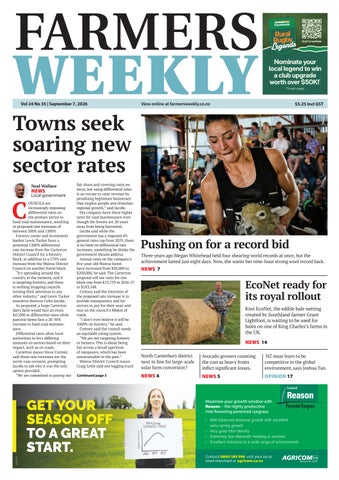
Pushing on for a record bid Three years ago Megan Whitehead held four shearing world records at once, but the achievement lasted just eight days. Now, she wants her nine-hour strong wool record back.
NEWS 7
EcoNet ready for its royal rollout Kiwi EcoNet, the edible bale netting created by Southland farmer Grant Lightfoot, is waiting to be used for bales on one of King Charles’s farms in the UK.
NEWS 14 North Canterbury district next in line for large-scale solar farm conversion?
Avocado growers counting the cost as heavy frosts inflict significant losses.
NZ must learn to be competitive in the global environment, says Joshua Tan.
NEWS 4
NEWS 5
OPINION 17
Maximise your growth window with Reason – the highly productive mid-flowering perennial ryegrass. • Well balanced seasonal growth with excellent early spring growth • Very good tiller density • Extremely low aftermath heading in summer • Excellent tolerance to a wide range of environments
Contact 0800 183 358, visit your local seed merchant or agricom.co.nz
2
New Zealand’s most trusted source of agricultural news and information
Get in touch
Advertise
EDITORIAL
SALES CONTACTS
Bryan Gibson | 06 323 1519 Managing Editor bryan.gibson@agrihq.co.nz
Andy Whitson | 027 626 2269 Sales & Marketing Manager andy.whitson@agrihq.co.nz
Craig Page | 03 470 2469 Editor craig.page@agrihq.co.nz Claire Robertson Sub-Editor claire.robertson@agrihq.co.nz Neal Wallace | 03 474 9240 Journalist neal.wallace@agrihq.co.nz
Janine Aish | 027 300 5990 Auckland/Northland Partnership Manager janine.aish@agrihq.co.nz Jody Anderson | 027 474 6094 Waikato/Bay of Plenty Partnership Manager jody.anderson@agrihq.co.nz
Gerald Piddock | 027 486 8346 Journalist gerald.piddock@agrihq.co.nz
Charlie Williamson | 027 510 0430 Lower North Island Partnership Manager charlie.williamson@agrihq.co.nz
Annette Scott | 021 908 400 Journalist annette.scott@agrihq.co.nz
Andy Whitson | 027 626 2269 South Island Partnership Manager andy.whitson@agrihq.co.nz
Hugh Stringleman | 027 474 4003 Journalist stringleman@outlook.co.nz Richard Rennie | 027 475 4256 Journalist richard.rennie@agrihq.co.nz Gerhard Uys | 027 239 4388 Journalist gerhard.uys@agrihq.co.nz Rebecca Greaves | 027 320 9111 Journalist rebecca.greaves@agrihq.co.nz Nigel Stirling | 021 136 5570 Journalist nigel.g.stirling@gmail.com Isabella Beale | 027 299 0596 Multimedia Journalist isabella.beale@agrihq.co.nz
PRODUCTION Lana Kieselbach | 027 739 4295 production@agrihq.co.nz
ADVERTISING MATERIAL
Supply to: adcopy@agrihq.co.nz
SUBSCRIPTIONS & DELIVERY 0800 85 25 80 subs@agrihq.co.nz
PRINTER Printed by NZME Delivered by Reach Media Ltd
Julie Hill | 027 705 7181 Marketplace Partnership Manager classifieds@agrihq.co.nz
Contents News . . . . . . . . . . . . . . . . 1-15 Opinion . . . . . . . . . . . 16-17 Sector Focus . . . . . . . 18-19 Rural Women . . . . . . . . . . 21 Federated Farmers . 22-25 Real Estate . . . . . . . . 26-27 Marketplace . . . . . . . 28-29 Livestock . . . . . . . . . . 29-35 Markets . . . . . . . . . . . 36-39 Weather . . . . . . . . . . . . . . . 40
Fonterra expects to declare underlying earnings per share towards the top end of its 60-70c guidance range when it publishes the 2026 financial results on September 24. Fonterra’s dividend policy is 60-80% of full-year earnings. In FY25 the normalised earnings per share came to 65c and the dividend paid was 57c fully imputed, at the 80% policy level.
Fuel tax delay The government has delayed increases to fuel taxes by one year and will use its fuel crisis rainy day fund to help pay for it. Fuel excise taxes were due to be increased by 12 cents from January 1 2027, then increase annually by 6 cents and 4 cents heading into 2029 – a total increase of 22 cents. Instead, the tax will go up by 5 cents every six months, beginning in 2028 through the end of 2029.
A $16 million project to install heat pumps at three of the Alliance Group’s southern South Island plants has won a New Zealand Energy Excellence Award. The four-year project replaced coal boilers at Alliance’s Lorneville, Mataura and Pukeuri sites with industrial heat pumps, which cut annual greenhouse gas emissions by more than 24,000 tonnes of carbon dioxide equivalent. The heat pumps reduced coal use and used waste heat and local water sources to produce hot water for processing.
Real Estate | 0800 85 25 80 realestate@agrihq.co.nz Word Only Advertising | 0800 85 25 80 Marketplace wordads@agrihq.co.nz
PUBLISHERS Dean and Cushla Williamson Phone: 027 323 9407 dean.williamson@agrihq.co.nz cushla.williamson@agrihq.co.nz
ISSN 2463-6002 (Print) ISSN 2463-6010 (Online)
Fonterra earnings
Alliance award
Andrea Mansfield | 027 602 4925 National Livestock Manager livestock@agrihq.co.nz
Farmers Weekly is Published by AgriHQ PO Box 529, Feilding 4740, New Zealand Phone: 0800 85 25 80 Website: www.farmersweekly.co.nz
News in brief
Allied in profit RIGHTS: Environmental law expert Johanna King cautions that acquiring water rights risks pitching farmer against farmer under the new RMA proposals. STORY P9
Allied Farmers has reported after-tax profit of $3 million for the FY2026 year ended June 30, but the outlook for FY27 is less clear, chair Shelley Ruha says. “The board continues to explore opportunities to deploy its cash reserves into new investment opportunities but in the absence of those and the nonoccurrence of a FY26 tax benefit, the FY27 profit is expected to be materially lower.”
3
News
3
FARMERS WEEKLY – farmersweekly.co.nz – September 7, 2026
Red tape trips surging wild deer harvest Gerhard Uys
NEWS
T
Deer
HE harvesting of wild deer is surging, but red tape and a lack of coordination are stifling the ability to grow the market, according to industry sources. Numbers from the MPI show that, in 2020, just over 11,000 wild deer went through postmortem inspection for human consumption. In 2025 more than 41,000 were inspected, with this year’s numbers to July 2026 already over 25,000. With a lull in culling over the roar period between March and April, estimates are that this year’s number could top 50,000, and reach more than 60,000 next year. A Federated Farmers survey recently showed wild deer, pigs and goats are destroying farm pastures and costing farmers significant amounts to control. Director of Southern Wild Game, in Dunedin, Jim Goodall, told Farmers Weekly they are seeing significantly more deer being harvested under wild animal recovery operations (WARO). WARO is culling by hunters from Continued from page 1 does the same amount of damage to roads as 40 cars. He noted that 45% of the logs shipped through the Port of Napier are trucked from Wairoa. He accepts differential rates are a blunt tool that has made forest owners “grumpy”, but said Wairoa ratepayers want the sector to pay its share. “All we have done is spread the cost to those who make the damage. “We don’t get any more money.” Little said forestry expansion in Wairoa has slowed since the differential rate.
helicopters, often referred to as commercial hunting. He said in the South Island alone three venison processing plants opened recently. The plants could open because of work done to open new markets for venison, with particularly the United States market creating new opportunities. A decline of farmed deer over the past few years has made wild deer harvesting appealing. It also means WARO, which was subject to boom and bust cycles in the past, might be more sustainable in future. “With the decline in farm deer numbers, there’s now a gap in that market for low-fat, healthy protein, which is where wild venison fits.” Goodall forecast wild deer numbers culled for venison could reach 70,000 by 2027. “I agree we have a deer problem,” he said. “The thing I can’t agree with is there’s not enough being done. There is probably a need for a more cohesive approach. There’s not one solution that fits all. “There’s a balance between commercial hunting, and recreational hunters needs.
“Constructive discussion between them should find a solution to bring deer numbers back to an ecologically sustainable level.” Fewer wild deer would mean more lamb and beef could be grazed, he said. The owner of Fare Game NZ, Jimmy Ferris, said they process about 150 wild deer per week, and some plants process 100 per day. Fare Game NZ supplies freerange game meat to restaurants, pie makers and other butcheries. He said procuring wild deer for human consumption is made
tough by MPI rules around poison declarations. Anyone who wants to supply wild deer for human consumption from a farm needs to have poison declarations signed by neighbouring farms to show they don’t use specific poisons on their farms. The process, which has to be renewed every three months, is a nightmare, he said. He said many hunters are keen to cull deer for him until they are faced with this paperwork. In the past there were chiller systems in every town where deer could be left.
The Southland District Council manages about 5000km of roads and apportions the cost according to land use and freight tonnage, a fixed charge, and a portion based on a property’s capital value. Mayor Rob Scott said in 202425 the three largest contributors to the roading rate were dairy, 33.6%, forestry, 6.5%, and pastoral farming 31.4%. “It’s ended up being the fairest way to cover the costs of our infrastructure, with the very blunt instruments, rates, that we have available to us.” Forest Owners Association president Sean McBride accepts his industry damages roads
but said councils need to recognise the sector’s wider benefits. Transporting New Zealand’s head of policy and advocacy, James McDevitt, said he commends the Carterton council’s different thinking on road funding, but said using freight tonnage is too simplistic a measure by which to gauge the impact. “We’re concerned that this proposal could end up treating farmers and forestry as the only road users placing pressure on the network.” More certainty is needed on road maintenance funding, especially rural roads, but
targeting primary production in one district risks incentivising production to shift to another, adding more freight movements. Federated Farmers Wairarapa president Robert Hickson said the proposal would disproportionately collect more from farming and forestry but ignore the fact that the capital value of the nonresidential component of the farm was already included in the general rates calculation. “This proposal is worth discussion, but there are big holes in [the] council’s explanatory notes underpinning the figures,” said Hickson.
VENISON: The harvest of wild deer is surging but red tape and a lack of coordination is stifling the ability to grow it even more. Photo: Environment Canterbury
MORE:
See page 13
I agree we have a deer problem. The thing I can’t agree with is there’s not enough being done. Jim Goodall Southern Wild Game Farmers can fetch up to $250 for a decent-sized hind. Bringing such a system back would motivate more shooting, he said. Federated Farmers pest management spokesperson Richard Dawkins, who has been calling for a national pest strategy, said updated poison declaration settings and new micro abattoir rules would make a difference. “Without significant change, we’re just going to continue chasing our tail. He said Federated Farmers isn’t calling for eradication but simply for sustainable limits. “Your farmer who wants a few running around, that’s fine. But I will highlight the survey results that found 83% [of farmers said] none of the pest species on their farm had any economic value,” Dawkins said.
This week’s poll question:
Should councils increase differential rates for some primary sector areas to pay for roading maintenance?
Have your say at farmersweekly.co.nz/poll
National is fixing the basics and building the future for rural New Zealand
National keeps its promises to farmers •
Scrapped the Ute Tax
•
Replaced the RMA
•
Delivered the UAE, Gulf Cooperation Council, and India FTAs
•
Removed unworkable winter grazing, stock exclusion and SNA rules
•
Created Investment Boost – tax deductions on assets to turbocharge your productivity
•
Tackling wilding pines and pests across the country
•
Banned farm-to-forestry conversions
•
Removed Agriculture from the ETS
Authorised by J de Joux, ps@national.org.nz
national.org.nz/farming
4
4
FARMERS WEEKLY – farmersweekly.co.nz – September 7, 2026
News
Huge solar project could eclipse farmland Richard Rennie
NEWS
T
Solar
HE latest Overseas Investment Office data reveals the North Canterbury district of Scargill may be next in line for large-scale solar farm conversion. In August consent was granted for over 1500 hectares of farm land to be leased by Australianowned NZ Clean Energy (NZCE) Investments to establish solar panels and a battery installation. While about 500ha of this covers known solar farm projects in Masterton, Dannevirke and Darfield and a battery installation at Glenbrook, the remaining 900950ha encompasses five freehold farming properties near the tiny village of Waikari on State Highway 7. The leasehold rights were granted under the “benefit to New Zealand” test for projects of national significance that meet government policy, in this case sustainable energy generation Specifically, the rights include farm properties on Scargill Valley road, Waikari Valley Road, Gates Road and Megowan’s Road,
totaling 952ha. The largest of the properties is a 340ha property on Scargill Valley road. The North Canterbury project has been a low-profile play by NZCE, which registered a company, Scargill Solar and Energy Storage Ltd, in January 2025 with the NZ Companies Office. There is also no reference to the Scargill project on NZCE’s website, with only Masterton, Darfield and Dannevirke listed.
The first thing we would do if proceeding is talk to the neighbours. We do have rights to it, but it is still years away. George Hughes NZCE At about 950ha, the Scargill project footprint represents almost 10% of the 10,000ha identified for solar projects in progress. George Hughes, NZCE’s chief operating officer, said the project’s low profile to date was because it is further down the company’s list of priorities. “We are continually assessing projects in our portfolio. The first
thing we would do if proceeding is talk to the neighbours. We do have rights to it, but it is still years away.” The proximity to the national grid makes the Waikari site particularly suitable for such a project, which the OIO report notes is to be developed on sensitive land, currently used for beef, sheep and dairy farming. Hughes said while the grant is for almost 1000ha, this would not be the area in solar panels. He said the area that would go into panels could be “less than half” the area granted. It may also include a battery installation. This would still make the project the company’s largest, with the Masterton, Darfield and Dannevirke projects averaging 150ha each. Nationally the pipeline for largescale solar installations remains significant, with estimates of about 10,000ha of land consented for conversion, under construction or going through fast-track consenting. The MPI estimates a further 10,000-20,000ha of land could be destined for solar installations in future. Bex Green, Federated Farmers
LOOMING: While NZCE has acquired leasehold rights to almost 1000ha in the Scargill district of North Canterbury, the company says solar panels will not occupy the entire area. Photo: Pexels North Canterbury president, said she felt the local community would be shocked and horrified to learn such a large amount of productive farmland was going to be covered in solar panels. “I could understand small-scale solar going in, but 1000ha, or even 500ha, is a huge amount of land to be lost from productive sheep and beef farming.” She said large-scale solar farms is quickly becoming the “new carbon forestry”. “This is a real emerging issue and I think we are only going to hear more about the scale of these conversions as time goes by. It is happening all over the country now,”
A Beef + Lamb NZ spokesperson said the body did not have a position on solar installations’ impact on farmland at this point. NZCE’s investments are on behalf of the Australian Renewables Income Fund (ARIF), itself partly backed by the Australian government to the tune of AU$175 million. The ARIF manages about AU$2 billion in wind, hydro, solar and battery assets and the investments represent its first foray into NZ’s sustainable energy market. Hughes confirmed none of the NZCE projects have been earmarked for the government’s fast-track process, having commenced prior to that process being established.
OSPRI hikes NAIT Locals in the dark on solar deals NEWS tags, slaughter fees Solar Richard Rennie
RNZ
NEWS
Livestock FARMERS are facing higher levies for the mandatory NAIT livestock tracing programme. NAIT is run by OSPRI, whose board decided to raise prices for the ear tags by 39% to $1.35 for deer and cattle, and to put slaughter fees up 28% to $1.91 per cattle beast, from September 1. During consultation in June and July, levy increase proposals were supported by industry groups like DairyNZ and Beef + Lamb New Zealand. But 63% of 69 submitters – including farmers and meat processors – opposed them, due to concerns about affordability, governance and confidence in delivery.
TRACKED: OSPRI runs the National Animal Identification and Tracing (NAIT) programme, tracking livestock movements for biosecurity and animal disease management.
OSPRI deputy chief executive Simon Andrew said it had made the decision carefully. “There were mixed views on the levy increases itself, and that’s understandable in terms of an added cost of their business,” he said. “So we had to balance those concerns around affordability ... with our responsibility to modernise the NAIT system and maintain a fit-for-purpose and reliable traceability system.” Levies will help fund replacement software for the NAIT service. Earlier reports cited concerns about the current platform’s unsatisfactory farmer user experience, frustrating technological barriers to compliance and limited data access.
ALMOST 4000 hectares of New Zealand farmland have been leased or sold to foreign-owned solar companies over the past four years without first being offered to New Zealand interests, under exemptions granted by the Overseas Investment Office. OIO records reveal multiple solar projects over the past four years have included largely leasehold deals with the companies, extending from the Far North to Otago. The total area acquired is 3917ha. Normally, under overseas investment regulations when overseas interests wish to acquire farmland that is classed as sensitive under the Overseas Investment Act, it must be offered for acquisition on the open market to New Zealanders first. The prescriptive rules require at least 30 working days both online and in print. The scale of the exempted projects leased to overseas interests varies between a 53ha project near Auckland, to a 460ha project this year in Taranaki, leased to Stratford Solar, a joint project between Contact and Lightsource, a global solar energy developer. The approval of 1536ha to NZ Clean Energy Ltd does not appear in the latest OIO exemption updates (see accompanying article). Acquisition of land for solar projects was particularly intense in 2023 when 1750ha was obtained for leasing.
CONCERNS: Feds energy spokesperson Greg Anderson says the stealthy nature of the solar conversions will be of huge concern to a lot of farmers.
Solar projects dominate the OIO’s exemptions list, and the office is required to state the reasons for exempting companies from seeking local interest. Typically, on most of the exemptions the office states that publicising the property increases risks around alerting the foreign company’s competitors to the location of the project, increasing likelihood of those competitors acquiring it. In the case of leasehold land it usually also notes the use is temporary, some of it will also still be used for grazing, and it is not a permanent loss of New Zealanders’ opportunity to buy the land given the leasehold arrangement. Farmland leases for solar projects typically run for a lengthy 35 years. The creep of unadvertised, exempted solar leases across farmland has rung alarm bells with Federated Farmers.
Feds energy spokesperson Greg Anderson said the stealthy nature of the solar conversions will be of huge concern to a lot of farmers and Federated Farmers is watching closely. “There are a lot of similarities with the carbon farming situation, where there could be a lot of unintended consequences further down the line. When there’s no public consultation, you don’t know these solar farms are going in until they’re already up – but by then it’s too late.” He called for greater transparency around the projects to ensure communities are aware of what is going on, and to give greater opportunity for scrutiny. “Land Information NZ’s own guidance says a solar farm may stop being a farm once it’s built. That means a later sale to an overseas buyer may not face the farmland rules that a normal farm sale would.”
5
News
5
FARMERS WEEKLY – farmersweekly.co.nz – September 7, 2026
Avocado growers count cost of major frost Richard Rennie
NEWS
A
Horticulture
VOCADO growers are still counting the cost of a major frost event that extended from Northland to Bay of Plenty in early August, inflicting significant losses on some operators’ crops. Described by some as the worst frost event for 30 years, the frost hit on the evenings of August 5 and 6, when temperatures even in Northland plummeted to as low as -4degC. Brad Siebert, CEO of NZ Avocados, said in some orchards the damage is so severe, it looks as though a flame thrower has played across the trees, with extensive fruit and foliage damage. Some orchardists have reported as much as half their crop area affected. “At this stage we are still establishing just how extensive the damage is, and how much it will impact upon fruit volumes.
BLASTED: Avocado frost damage has extended from Northland to Bay of Plenty, with the sector still assessing the full extent of losses from the August 5 and 6 event. These trees were in Bay of Plenty.
We still have a lot of fruit dropping because of the event, and we are planning grower meetings in Northland and Bay of Plenty. Some have lost their entire crop and their trees.” The impact extends to the next
crop, with that crop’s flowers also affected. “The first frost was the worst, there were icicles dropping off the trees.” Katikati grower and NZ Avocado board member Alistair
Young told Farmers Weekly he had been fortunate enough to dodge the frost in Bay of Plenty, but a Northland orchard he has an interest in had been hit particularly hard. “It got down to -2.8degC, and that was enough for us to lose about 15% of our crop there.” He expects his trees to lose some wood and leaves but said they are likely to regrow. “Others have not been so lucky.” Siebert said the losses will be particularly keenly felt this season, coming amid expectations for a strong export year, both to Australia and beyond into burgeoning Asian markets. Expectations are this year that 2.8 million trays are destined for Australia, well up on last year’s 750,000. Siebert is confident there will still be sufficient volume to also meet domestic and Asian supplies, despite the frost event. “The plan is for 5 million trays to go into Asia this year. We have had a 70% increase in demand out
of South Korea, and significant jumps in the Hong Kong, Thailand and China markets.” He remains confident that markets could still be served, despite the losses. “Even with a 10-20% reduction we can still prioritise to ensure the Asian markets are served.” With the recent signing of the NZ-India free trade agreement, the avocado sector secured a progressive 10-year reduction in the 30% tariff on fruit. “Consumption remains relatively modest there at present, but the greatest attribute is the scale of that market. Logistics challenges remain. It is still an air freight market and requires more reliable cool chain links.” In contrast to the likes of kiwifruit and apples, avocado growers are not required under the FTA to engage in educating local Indian growers on better growing skills, nor are they subject to the quota management system that apples face.
Kiwis come from behind to seal Wayleggo win Neal Wallace
NEWS
Skills
THE New Zealand sheep dog trial team left the best to last, coming from behind to win the threetest Wayleggo Cup Trans-Tasman series by just eight points late last month. Australia was 20 points ahead going into the weekend’s third and final test at Stanthorpe in southern Queensland, but the rub of the green went the way of the Kiwis. Team manager Pat Coogan said the result came down to the last couple of runs on the last day. Despite southern Queensland being in drought with just 13mm
of rain since February, Coogan said the sheep were settled and moved freely for the NZ triallists, while the Australian triallists had some issues. One Australian had the sheep break during their run, and another failed to complete the yarding. From being 20.25 points behind, the New Zealanders finished the series on 808.5 points to Australia’s 799.5. The New Zealanders averaged 67 points per run over the three tests and the Australians 66. “She was pretty tight,” said Coogan. Australia has dominated recent trans-Tasman contests, winning the 2002 event in Campbell Town Tasmania, 2024 in
WAYLEGGO WINNERS: The NZ dog trial team that has beaten Australia are, from left Ben Millar, Rakaia Gorge, with King, Scott Hunter, Omarama, Lucy, Lloyd Smith, Palmerston, Guide, team captain Mark Copland, Methven, Don, and team manager Pat Coogan, Taumarunui. Geelong Victoria and last year in Ashburton. New Zealand last won in 2023 in Ashburton and prior to that, 2019 in Nelson. The 2020 and 2021 events were cancelled due to covid.
EXPERIENCE NEXT LEVEL WITH FENDT. When a great machine meets a greater offer, it’s worth making the move. Whether you’re se eeding, cutting or towing a chaser bin bin, there’s there s a Fendt tractor made for the task task. Discover a new sta standard and secure a Fendt today – you’re made for this.
Coogan said this year’s team had plenty of experience. Mark Copland, Methven, has been a member of the NZ team 11 times, Lloyd Smith, Palmerston, and Ben Millar, Rakaia Gorge,
three times each, and Scott Hunter, Omarama, twice. The dogs will enter quarantine for checks and vaccinations, if needed, and will return to NZ on the same flight as the triallists.
Starting from: 2.99% finance 30% deposit 36 month payment terms Offer ends 30 September 2026
Speak to your nearest Fendt dealer to find out more. *Offer ends 30 September 2026, while stocks last and applies to Fendt tractors only and excludes track tractor machines. Finance with an interest rate of 2.99% p.a. available over a 36-month term with monthly payments in arrears. Finance available on a Chattel Mortgage agreement based on a minimum 30% cash deposit and the GST component repaid in the fourth month. Fees and lending conditions apply to approved ABN number holders who use the equipment for business purposes. Finance is approved by AGCO Finance Limited, NZBN: 9429035304203, Company No: 1530800, GST No: 88-831-861. Contact your local Fendt dealer for full terms and conditions.
Leaders drive Fendt.
fendt.com/au fendt.com | Fendt Fendt ist is eine a worldwide weltweite brand Marke von of AGCO. AGCO.
6
Certainty, by the bagful. There’s plenty on a New Zealand farm you can’t control. The weather. The markets. The summer that turns up late – or doesn’t arrive at all. Your pasture seed shouldn’t be one of them.
Stack the odds in your favour. Choose proven Barenbrug cultivars and grow with confidence. Learn more at barenbrug.co.nz
Maxsyn
Array
4front
Shogun
Forge
The next generation perennial legend, for superior persistence and summer growth.
The superstar perennial, delivering high intake, yield, N uptake and persistence. The diploid of the future!
The benchmark in tetraploid perennials. Grows longer, is good for the environment and animals love it.
The outstanding hybrid, rockstar with NEA12 – still setting the standard for 1-3 year pasture.
The phenomenal 3-5 year pasture. With environmental benefits, delivers performance your neighbours will envy.
Perennial
Perennial
Perennial
1-3 years
3-5 years
Scan the QR code to learn more.
Grow with Confidence
BBGN0133 Spring_Farmers Weekly FP ad.indd 1
01/09/2026 8:17 AM
7
News
7
FARMERS WEEKLY – farmersweekly.co.nz – September 7, 2026
Whitehead pushes herself towards record attempt Olivia Caldwell
PEOPLE
T
Shearing
HREE years ago, Megan Whitehead held four shearing world records at once, but the achievement lasted just eight days. Now, she wants her ninehour strong wool record back. Whitehead will attempt to reclaim the record from North Island shearer Sacha Bond, who broke Whitehead’s mark in 2023 by shearing 720 lambs in nine hours. Whitehead had held the record since January 2021, when she shore 661 lambs. In 2023, Whitehead also took the eight-hour strong wool record from Bond by shearing 686 lambs, while simultaneously setting a two-stand world record of 1283 lambs with her cousin Hannah McColl. She is also part of a team of four shearers who hold the four-stand record of 2066 lambs, which they set in 2020. The 30-year-old has been
shearing sheep for a living for a decade, having travelled the world and spending summers in New Zealand and Australia, and across to the UK and Europe. This year, Whitehead has stayed in the southern hemisphere to focus on training for the world record attempt.
It is a very lonely road ... and you are stuck in your own head. Megan Whitehead Champion shearer “It is a bit complicated doing it overseas. You aren’t close to the gym, you are in the country and you can leave at 5am and get home at 10 o’clock at night.” She has also taken up a new CrossFit training regime and is targeting a record well beyond the previous marks, aiming to shear at a pace of about 40.5 seconds per lamb. Whitehead said she has also improved as a shearer and has a
little more experience and wisdom behind her. But she admits the physical training and mental demands of preparing for the record attempt can make for some tough days. “It is a very lonely road, it is selfish and it is all about yourself and you are stuck in your own head,” she said. “One of the toughest things about training for a record is you are travelling here, there and everywhere and you don’t really get much sleep. “You have no spare time, you are chasing sheep, you have to be training every day, you have washing to do, and organising the record itself. It’s busy.” Right now, Whitehead is based in Central Otago, where she is spending more hours on the handpiece shearing Merino sheep. Her daily schedule is not for the faint-hearted: up at 4am for mobility work, followed by a full day of shearing, home by 6pm, then off to the gym, before dinner and bed around 11pm. She does this six days a week.
ROUTINE: Megan Whitehead’s gruelling training routine starts at 4am and combines full days of shearing with evening gym sessions, six days a week. Photo: Supplied “I love it. The competitive side, travelling the world and getting paid good money. You get to see the whole world, and in many normal jobs you don’t get to do that sort of stuff.”
The record attempt will take place on December 18 near Gore on Robert Grant’s farm, in the same woolshed where Whitehead set her initial ninehour record.
Delight at KiwiSaver first-home rule change Neal Wallace
NEWS
Land
A WAIKATO sharemilker has welcomed legislation introduced in Parliament last week allowing farm workers to access their KiwiSaver savings to buy a house or farm. Danielle Hovmand has spent five years seeking the change and said once it has become law it will help young farmers build equity faster as they use it to get a foot on the land-ownership ladder.
“It will make a big difference in their careers, by allowing us to access our KiwiSaver and utilise it how we see fit to grow our equity faster,” she said. Finance Minister Nicola Willis and Commerce and Consumer Affairs Minister Cameron Brewer introduced the bill, having adopted a member’s bill from Rangitīkei National MP Suze Redmayne. Willis said the bill will treat farm workers and home owners the same. “Many farm workers are
required to live where they work. “But a first-home withdrawal requires you to move into the home you buy, so they have been paying into KiwiSaver alongside everyone else while shut out of a withdrawal every other member can make.” Willis said the rule had been written with a suburban street in mind, not a farm gate. “The bill also allows first-time farm buyers to use their KiwiSaver towards a farm bought through a company, trust or partnership they majority own and control,
where the farm will be their main home.” Current rules only allow this if the farm is in the buyer’s own name. “If your job comes with a roof over your head, you should not be locked out of your own savings,” Willis said. Hovmand said the issue was first raised by young farmers with Prime Minister Christopher Luxon before the last election, and she is delighted there has been progress before the next election. “Before it was fixed to
THE ULTIMATE PROTECTION for you and your livestock
Be prepared with this reversible, water resistant, hi-vis vest FREE* with qualifying ECLIPSE products. We’re proudly partnering with Farmstrong to ensure your wellbeing is a priority. Sign up to receive helpful fortnightly Toolbox tips. Do Farmstrong. Be Farmstrong.
For more information visit
futureproducers.co.nz PROUDLY AVAILABLE FROM YOUR LOCAL PARTICIPATING VETE ERINARY CLINIC See product labels for full claim details and directions for use. ACVM Registration t ti N Nos. A011151 A011151, A009270, A010640. ECLIPSE® is a registered trademark of Boehringer Ingelheim Vetmedica GmbH, used under license. © Copyright 2026. Boehringer Ingelheim Animal Health New Zealand Limited. All rights reserved. NZ-RUM-0056-2026. *Promo runs 1st Aug - 30th Sept 2026. While stocks last.
It will make a big difference in their careers. Danielle Hovmand Waikato housing but now there is more opportunity for young farmers to potentially get into contract milking, share farming or farm ownership by using their equity.” The KiwiSaver (First Home or Farm) Amendment Bill will now go before a Select Committee.
8
8
FARMERS WEEKLY – farmersweekly.co.nz – September 7, 2026
News
Skim milk powder lights up dairy market Hugh Stringleman
MARKETS
S
Dairy
KIM milk powder prices have almost single-handedly, albeit marginally, lifted the Global Dairy Trade market to a 0.9% rise in the price index after the latest auction. Skim milk powder was up across all contract periods, registering 5.3% increase back to back with a 7.6% increase in the previous GDT auction. The SMP index is now at US$3665/tonne, $110 above that of whole milk powder at $3555. The current price level is the highest since September 2022. Demand for milk protein is
driving up the SMP prices. It is rare for SMP to be worth more than WMP, which still has its milkfat components. Milkfat prices fell in the latest auction, anhydrous milk fat was down 1.3% and butter down 0.8%. Cheddar was down 6.6% and WMP down 0.1%. NZX head of dairy insights Cristina Alvarado said the GDT market delivered a more resilient result than the increase in seasonal supply might have suggested. The August Global Dairy Update said that milk production increased in May, June and July for New Zealand, Australia, Europe and the United States. “Milk powder demand remained firm, while milk fat declines were more contained than at the
previous event,” Alvarado said. “Overall, the latest GDT event reinforces the increasingly divergent dairy market. “Protein demand is providing price support despite higher powder availability, while fats remain under pressure and cheese faces a much heavier supply burden. “The resilience of powders will remain important as northern hemisphere milk production responds to the effects of recent heatwaves and drought.” The next GDT event will be on September 14/15, to be followed by Fonterra’s annual results on September 24, when the company provides an update on the farmgate milk price forecast for the current season.
MPI opens consultation on possible homekill changes Gerhard Uys
NEWS
Health
HOMEKILL and recreational catch rules are under the magnifying glass with the Ministry for Primary Industries seeking public feedback on possible amendments to the Animal Products Act 1999. The MPI said it wants feedback on whether the 28-day rule for homekill should be retained, reduced, or removed. At present, legislation requires animal owners to be involved in the daily maintenance of an animal for at least 28 days if they choose to have its slaughter undertaken by a listed service provider. The rule prevents the practice of “sale and slaughter”, where animals could be purchased for
immediate slaughter by a listed service provider. Slaughter of an animal by its owner can take place anytime. Removing the rule could increase access to homekill, but could also increase the risk of unlawful trade in meat not subject to food safety, the MPI said.
Homekill and recreational catch rules have not been reviewed for more than 20 years. Ministry for Primary Industries The MPI also wants to know if it should retain existing rules on who may consume homekill and recreational catch or remove restrictions, enabling broader access.
Currently the animal’s owners, catcher, family and household members as well as farm employees/members of the catcher’s party and their family/ household are the only ones who may consume homekill. Homekill and recreational catch products cannot be traded. The rules are silent on donating or gifting homekill and recreational catch products. Lastly, the MPI wants feedback on whether listed service providers should label homekill and recreational catch products to provide more information to consumers. Homekill and recreational catch rules have not been reviewed for more than 20 years, even though the way Kiwis live and share food has changed, the MPI said.
TURBOCHARGE YOUR PARASITEE CONTROL PROGRAMME TURBO TRIPLE + TAPE MINERALISED ORAL DRENCH FOR SHEEP For lambs you need a drench with a better safety profile* and high potency against a wide range of parasites…including tapeworm. That’s what we’ve delivered. World first combination for:
AAH-TTTP-2025-028
Worm Parasites
PROUDLY
NZ
OWNED
Tapeworm Available exclusively through veterinary practices nationwide. Visit www.alleva.co.nz for more information.
TURBO® is a registered trademark of Alleva Animal Health Ltd. TURBO Triple + Tape Mineralised Oral Drench for Sheep (A011932) is registered pursuant to the ACVM Act 1997. See www.foodsafety.govt.nz for registration conditions. *Compared with abamectin-based treatments.
PRODUCTION: The August Global Dairy Update says milk production increased in May, June and July for New Zealand, Australia, Europe and the United States.
Bremworth back on even keel, awaiting offer Hugh Stringleman
NEWS
Food & fibre LISTED carpet maker Bremworth made a loss of $11.4 million in the financial year to June 30 after increasing revenue, mainly in its wool-buying arm Elco Direct, by 21% to $106m. The preliminary unaudited results show normalised loss before interest and tax of $9.4m, an improvement on the previous year’s $15.9m. Chair Rob Hewett said Bremworth has made meaningful progress in strengthening the business while continuing to operate in difficult market conditions. “While the financial result remains below where the board expects the business to perform over time, we have made progress in addressing a number of the operational and commercial issues that have constrained performance. “Our focus is now firmly on converting those improvements into better margins, stronger cash generation and a return to sustainable profitability.”
Overall flooring demand remained subdued during the year, reflecting continued weakness in residential construction and renovation activity and pressure on discretionary consumer spending. The Elco wool sourcing business had a strong year with a seismic shift in demand for wool in the second half, particularly from exporters, driving up volume and wool price. While the timing and pace of a broader market recovery remain uncertain, Bremworth expects financial performance to improve in FY27 as the benefits from revenue initiatives, cost reductions and manufacturing improvements progressively flow through. The recently announced partial takeover move by David Ferrier’s Mangawhai Collective for 44% of shares it does not already own has not been made into a formal offer. The board reiterated its midAugust advice to shareholders to take no action until they receive further advice from the company.
News
9 FARMERS WEEKLY – farmersweekly.co.nz – September 7, 2026
9
RMA changes could spark resource scramble Richard Rennie
NEWS
L
Environment
EGISLATION aimed at speeding up the resource management process brings a risk of pitching farmer against farmer in a disjointed scramble for natural assets like water, warns an environmental law expert. At present the replacement Resource Management Act legislation, the Planning Bill and the Natural Environment Bill, have moved through Select Committee review and are looking likely to pass before the election in early November. Johanna King, environmental lawyer and senior associate at national law firm Tavendale and Partners, said there is a real risk the bills as they stand will face even further reiterations, should a new government take power.
It also risks seeing individuals taking a more siloed approach to applications for water use, protecting their own permits. Johanna King Tavendale and Partners But she has highlighted how, despite the original bills attempting to include other methods, the Select Committee’s changes show that the allocation of water resources would be sticking with the current “first in, first served”, with priority for existing permit holders’ approaches. “Retaining those approaches is good news for farmers who have existing permits, but it leaves the barriers in place for anyone entering new and goes against the comparative reset many were wanting to see, especially in over-allocated catchments,” King said. “It also risks seeing individuals taking a more siloed approach to applications for water use, protecting their own permits. “This contrasts with efforts to address allocation issues across sectors and catchments collectively.” She cautioned that the approach and wording have not necessarily been drafted into a final form yet. At the time of writing a further 71 amendment papers had been issued across the two bills, but she doubted the approach would change much if the current government is re-elected. The RMA changes are aiming to make approvals less of a “case by case” matter, reducing time spent in the likes of council hearings and the Environment Court.
SILOED: Environmental law expert Johanna King cautions that acquiring water rights risks pitching farmer against farmer under the new RMA proposals.
“There is a lot of annoyance with the current rules, and the time and costs involved in obtaining consents. But based on the new regime in the bills, a lot rides on the yet-to-be finalised national direction and minister input to trickle down into the new local planning rules.” But she said because the reform bills are changing a number of key pillars in the current RMA system, a natural consequence will be debates about how to properly give effect to the new legislation via the new local plans. “This will keep lawyers busy and complicate the transition period between
the current and new regimes. Things may well be trickier before they get better.” She also notes the latest changes include damming of water as an allocation issue. “The illustrative National Planning Direction document released yesterday indicates that enabling more on-farm storage will be in the mix, which is great for the food and fibre sector, but the formal national direction detailing this is not expected to be released for consultation until 2027. “Things are still a bit ‘cart before the horse’ in that respect.” King’s concerns also reflect widening
sector concerns over the fast-track process now underway. The high-profile process has been raising community ire recently, particularly around housing developments included on its schedule. “It has been a successful option for some key infrastructure projects, but it’s causing growing pains where private developers get the green light for large housing developments out of sequence.” She noted that, with all the criticism levelled at the fast-track regime, it is possible it will get brought back to more of an infrastructure-only focus.
10
10
FARMERS WEEKLY – farmersweekly.co.nz – September 7, 2026
News
Manawatū couple dig deep to fund surgical robot Staff reporter
NEWS
Community
F
OR more than a century, the Frecklington family has called the same patch of Manawatū farmland home. Now fifth-generation farmer Paul Frecklington and his wife Christine are giving back to the wider community with a $500,000 donation towards a new surgical robot at Palmerston North Hospital. At 87, Paul has spent his life farming at Tangimoana, where
Frecklington Farms includes three properties, among them Cartref Jersey Stud. Fittingly, “cartref” is Welsh for “home”. Beyond the farm gate, Paul and Christine have quietly supported their community for years, helping refurbish local school tennis courts and stepping in to complete a swimming pool when funding ran short. Now retired, their latest contribution has been shaped by Paul’s own experiences undergoing bowel and knee surgery. “When I heard about it, my ears pricked up. It was a good
VALUE: Manawatū farmers Christine and Paul Frecklington say they saw the value a surgical robot could bring to rural communities.
opportunity to do something to help. From what I’ve heard about the other supporters, we’re in good company,” he said. The Frecklingtons know how important the surgical robot project is, and believe that rural communities shouldn’t have to go without access to life-saving tools. The Palmerston North Hospital Foundation’s goal was to raise the $2.5 million + GST needed ($2,875,000) – something it achieved within six months. Foundation chair Brendan Duffy said this is a moment for the whole community to be proud of. Paul said he has seen the benefits of robotic systems in the agriculture industry, both at home and abroad, and understands how useful this technology will be to surgical teams. “Everyone thinks those things happen to everyone else and never yourself. We need it, we might not think we do because we think we’re indestructible.” He said this was an opportunity to give something back to a region that has given them everything.
CARE: The surgical robot will allow for safer surgeries and better cancer care for all of the central North Island, including procedures in urology, general surgery, gynaecology and ear, nose and throat surgeries. Photo: Supplied
Everyone thinks those things happen to everyone else and never yourself. Paul Frecklington Tangimoana “Our staff and our family are proud of what we’ve done on the farm, and having something to get involved in now means a lot.” The surgical robot will allow for
Northern yearling Modest bulls begin strongly growth Hugh Stringleman
MARKETS
Livestock
THE first on-farm yearling bull sale for Cornwall Park Simmentals, Auckland, saw all 20 sold for an average of $5615. The top-priced bull was lot 8 Cornwall Park 557, sold to Caniwi Simmentals, Waimamaku, Northland. Also in Northland, Chris and Karren Biddles, Pouto Peninsula, had a full clearance of 124 Angus yearling bulls, which averaged $6773, ahead of last year’s $5571. Top price was $12,200 for Lot 31, Te Atarangi Crumb W061, sired by TA Crumble S008. He was bought by Parengarenga Incorporation, Far North. Another bull, TA Solution W020, from Stokman Solution S329, made $12,000, paid by
Marchant Farms, Maramarua. Hoobees Herefords, Coromandel, began the upper North Island yearling bull sale season with $15,600 paid for Hoobees Arturo 2511. Vendors Bryce and Sue Hooton sold 15 out of 17 and averaged $8300, a leap ahead of last year’s $4575. Otamatea Herefords, Waiuku, sold 104 with an average of $4297 and a top price of $5000. The Shepherd family’s Waimaire and Otengi Polled Herefords, Kaeo, sold all three two-year bulls, averaging $4400, 13 of 13 18-month bulls, averaging $4900 and 36 from 36 yearling bulls, averaging $5466 and a top price of $11,000 paid by Kaitoa Herefords, Dannevirke. Argyle Angus, Kaikohe, sold 19 of 21 two-year-old bulls with an average of $4921 and a top price of $13,000.
KICKOFF: Te Atarangi Angus stud principal Chris Biddles in the ring at his annual yearling bull sale, where 124 were sold, averaging $6773.
outlook in Asian markets
safer surgeries and better cancer care for all of the central North Island, including procedures in urology, general surgery, gynaecology and ear, nose and throat surgeries. The foundation says that more than 580,000 people are covered by the hospital’s cancer services, including patients from Palmerston North, Manawatū, Horowhenua, and Tararua, but also Ōtaki, Whanganui, Wairarapa, Taranaki and Hawke’s Bay.
POSITIVE: China’s beef market is showing positive signs, says Silver Fern Farms chief executive Dan Boulton.
Neal Wallace
MARKETS
Trade
TWO of New Zealand’s key Asian markets are experiencing quite different fortunes. China’s beef retail sector is improving while in Japan the government is planning to slash its consumption tax to stimulate the domestic economy. A report by the NZ Ministry of Foreign Affairs and Trade says the Japanese government plans to reduce its 8% consumption tax on food to 1% for two years from next April to stimulate domestic demand. China has a two-speed economy, with economic growth of 4.7% for the first half of the year, but domestic consumption remains soft, except for sales of beverage and online food. In a report to suppliers, Silver Fern Farms chief executive Dan Boulton said there were positive signs for beef in China, with retail programmes performing well and demand strong. “As processing capacity increases, there may be opportunities to grow shipments into the market.” The market has been helped by Brazil filling its annual Chinese
beef quota, which could strengthen demand from other suppliers. Demand for sheepmeat is subdued with buyers described as cautious and consumers facing competition from cheaper forms of protein. Boulton said seasonal demand is expected to lift as China moves into winter and seasonal consumption of hot pots increases. He expects any recovery to be gradual.
As processing capacity increases, there may be opportunities to grow shipments into the market. Dan Boulton Silver Fern Farms A NZ Ministry of Foreign Affairs and Trade report notes that while the Chinese economy grew, growth was uneven. Retail consumption was subdued, increasing just 1.3% year on year in the first half of 2026, due to a weak property market. Sales of beverages and online food were relatively strong, growing at 6% and 17% respectively in
the first six months of the year. “New Zealand’s exports to China are generally sold to relatively prosperous households in the form of consumer goods,” the report notes. “Higher household incomes and greater economic security will ultimately flow through to whether Chinese consumers are willing to pay a premium for New Zealand meat, dairy or travel.” Japan is NZ’s fifth-largest trading partner, but its economy suffers from a weak currency, high government debt and a shrinking workforce. The Ministry of Foreign Affairs and Trade says a reduction in Japan’s consumption tax rate “could modestly improve consumer demand and retail competitiveness” for NZ dairy, kiwifruit, and meat exporters. “However, the impact on restaurant demand is unclear given the potential for the consumption tax rate difference between dine-in meals and takehome foods to grow.” There have been some suggestions that the Japanese government is looking at how it can support the hospitality sector.
11
The Card that never takes its foot off the value. Got your machinery spring-ready? It’s easy with your Farmlands Card. Get card partner deals on servicing, warranties, upgrades and fuel.
T&Cs apply
Put it on your Farmlands Card. Use your Card instore or online today with any of our partners. Scan code to view all offers.
12 ADVERTISEMENT
How One NZ Satellite is improving connectivity for rural communities
One NZ’s satellite mobile and IoT solutions are changing the way Kiwi businesses across Aotearoa operate. “It helped prevent a tanker being stuck for a month,” says Depot Manager Richard Knight. “Instead, it was back collecting within minutes.” Fonterra aren’t the only ones reaping the benefits of better connectivity. One NZ’s satellite mobile and IoT solutions are changing the way Kiwi businesses across Aotearoa operate. For scenic flight company HeliServices, operating over the rugged and remote West Coast meant communication was a challenge. One NZ Satellite
changed that and quickly became an essential part of their daily operations, dramatically improving their ability to stay in touch with pilots, customers, and the office for everything from basic logistics right through to supporting a rescue callout via WhatsApp! “One NZ Satellite has been a gamechanger,” says pilot Nathan Healy. “It gives us better communication, more flexibility, and real peace of mind when it comes to safety.” With One NZ Satellite, you can TXT and use select mobile apps anywhere you have a line of sight to the sky. Satellite coverage kicks in automatically whenever you go somewhere cell towers can’t reach (around 40% of NZ’s landmass!), so you can keep working in places you couldn’t before - on the road, on the farm, or even out on the water (up to 85 nautical miles offshore). But for many rural businesses, it goes beyond just better connectivity. The real value emerges when satellite connectivity combines with IoT to power practical solutions like virtual fencing collars for cattle (in partnership with Halter), nextgeneration asset management, and satellite-enabled water sensors. Solar-powered smart collars from Halter are now connected to One NZ Satellite, letting farmers manage cattle without costly physical fences or bespoke celltower infrastructure. Instead of building and maintaining extensive fencing or installing multiple towers, farmers can guide and contain cattle virtually. It’s a huge win for beef farmers like Shaun Draper, who runs a 1550-hectare cattle and sheep farm in Claremont, near Martinborough paving the way for better land use, reduced fencing infrastructure, and greater access to real-time insights into livestock.
Nathan Healy, HeliServices Haast. “The innovative technology that these companies like One NZ and Halter have developed and we’ve been given the privilege to use is just unbelievable,” Shaun says. “The future of farming with this type of technology is so exciting now.” Staying connected shouldn’t depend on where you’re working, and it doesn’t with One NZ Satellite. Nobody knows satellite connectivity like the team at One New Zealand do, which is why they’ve been recognised with an Innovation Excellence Award by Canstar. One NZ Satellite TXT and Data are included at no extra cost on One NZ’s best business and personal mobile plans and are available as paid Add-Ons on other plans.
Manpreet Singh, Fonterra driver.
Interested in how satellite connectivity could benefit your business? Contact us on 0800 888 382. For more examples of One NZ Satellite in action and to learn about eligible plans and phones, head to:
one.nz/satellite Shaun Draper, Claremont, Martinborough
Terms: TXT/MMS in minutes and use data on select apps. Requires eligible phone/device and plan/IoT plan. Requires line of sight to the sky. Limited app features. Paid Add-On may apply. Terms, fair use, standard MMS charges and capacity control applies.
LK0124729©
F
or Fonterra, safe and timely milk collection is critical. They need to keep vital routes moving, no matter the conditions. Which is why equipping their drivers with One NZ Satellite was such a no-brainer. For them and thousands of businesses across Aotearoa, staying connected matters. For safety, productivity, and simply keeping things running day-to-day. Fonterra drivers can now stay connected beyond traditional cell tower coverage, enabling better communication with the depot and preventing costly disruptions. Weather-related incidents can take a tanker off the road if it gets stuck. But when severe weather caused a major slip in the Waioweka Gorge earlier this year, all it took was a quick TXT from the driver back to the depot, who were able to respond immediately and reroute safely.
News
13
13
FARMERS WEEKLY – farmersweekly.co.nz – September 7, 2026
It’s all about the land at Tiki vineyard Gerhard Uys
NEWS
F
Viticulture
OR Tiki Wine & Vineyards founder Royce McKean, regenerative farming is more than a set of practices; it is rooted in a Māori view of the relationship between people and the land – one he inherited from his mother, Hariata. “Her deeply-held belief was that land and people are one, and basically what you do to the land, ultimately you end up doing to yourself,” Royce told Farmers Weekly. Tiki Wine & Vineyards recently became New Zealand’s first certified regenerative vineyard. The head of Māori export customers at New Zealand Trade and Enterprise, Jeremy Gardiner, said they are seeing increasing global demand for products that reflect consumers’ values,
including sustainability. Sue grew up on a sheep farm, and neither she nor Royce, who grew up as a city slicker, could be said to have had wine in their DNA. The couple met skiing in Wānaka and worked various jobs here and overseas to live the ski bum life, something Royce jokes they are still kind of doing, although work seems to get in the way. They always had it in the back of their minds that they wanted to save money to eventually have a go at something of their own. Royce said he saw vineyards being planted in areas previously deemed unfit for growing wine grapes, and they looked for a deal. Eventually they came across a property in Waipara, which they bought in 2004. They have bought and sold other properties since, but this first property is still where they grow grapes today. In 2005 they had already planted
REGEN: Tiki Wine & Vineyards recently became New Zealand’s first certified regenerative vineyard, and hopes it is setting a trend that will one day permeate the New Zealand wine industry.
INFLUENCE: From left, Royce McKean’s father Bill, Royce and Sue McKean, and Hariata, who had a significant influence on how Royce and Sue view their relationship to the land.
the first vines on contract to supply wine companies. Their dream from the start was to take their own grown fruit through to a finished product. The Tiki brand had already been brewing in the back of their minds. Royce and Sue liked the name Tiki, saying if they had a son they’d name him Tiki. When Royce spoke to his mother about the Tiki name, she said they had a linkage to the name through an ancestor, Ngāti Uenuku Kōpako chief Tikitere Mihi. They applied to the then Māori Advisory Committee to use the name as a brand and got approval, something he said they had not expected. The name has strong significance within Māoridom and throughout the Pacific, and is often recognised overseas also. In 2009 they produced their
first wine, 700 cases of a single vineyard sauvignon blanc. Today their wine portfolio includes everything from pinot noir to sparkling and 0%.
Her deeply-held belief was that land and people are one, and basically what you do to the land, ultimately you end up doing to yourself. Royce McKean Tiki Wine & Vineyards Their road to regenerative practices was not straight, with trials and tests, and some bumps along the road, to find what worked for the vineyard. Royce said he always liked the ethos of permaculture and organics.
Today practices such as sheep grazing between vineyard rows – something followed by conventional growers also – cover crops and composting are followed at Tiki. They run regen trials in stages, learning about a practice before fully adopting it. They are slowly progressing improvements, such as using a chicken trailer to spread chicken litter, and have a long-term goal of improving the biodiversity of the vineyard. Regenerative practices are something Royce still needs to explain to customers, but they hope that Tiki can be a trendsetter for something that will one day be common practice in vineyards across New Zealand. It’s all about kaitiakitanga, said Royce, the Māori concept of stewardship of the land, sky, water and living things.
Forestry should talk about industry’s positive stories Neal Wallace
NEWS
Forestry THE management of commercial forests needs to amount to more than just compliance if the sector is to regain public acceptance, says an environmental consultant. “A decade ago, compliance was the basic. Today proof of story and partnerships are the basics,” Rhys Millar, the managing director of Whirika Consulting, told about 300 people attending the NZ Institute of Forestry annual conference in Dunedin. He said the sector had been poor at promoting its positive contributions, such as nurturing native wildlife, protecting wetlands and native forest, partnering with the community, and providing public access. Instead, public debate has been shaped by issues of forestry slash, erosion, and carbon forestry, which erodes trust. “But that is not the whole story,” he said. “There are falcons, galaxiids, wetlands and predator networks inside the gate.” The issue of the sector’s loss of social licence was top of mind at
the conference, with chair David Cormack saying in his opening address that forestry is attracting intense scrutiny, and is subject to difficult conversation and changing expectations. Millar agreed, adding that the public never hears about the positive initiatives undertaken by forest owners. He gave the example of working with Otago-based forestry companies Wenita, RayonierMatariki, City Forests and the Otago Regional Council to protect and enhance the habitat of the kārearea, or native falcon, in exotic forests. A 2022-23 survey of the Dunedin environs found 46 pairs of kārearea, of which 28 were in pine plantations that had never previously been surveyed. Of those 46 pairs, 26 nests were identified, and 20 of those fledged young. Forestry companies have agreed to cease activities within 200m of active nests until the chicks have fledged. Millar, who is also involved with Predator-Free Dunedin, an entity of more than 20 organisations, worked with Wenita and City Forests on that programme,
to fund pest control on 14,500 hectares in and around the city. A panel discussion reinforced forestry’s wider benefits.
A decade ago, compliance was the basics. Today proof of story and partnerships are the basics. Rhys Millar Whirika Consulting South Otago-based property development and construction business and forest owner Calder Stewart is developing two business hubs, one at Milburn near Milton and the other near Invercargill. John D’Arcy, the company’s lower South Island business development manager, said the 200ha Milburn Quadrant will be powered by solar energy and wind turbines and wood biomass situated and sourced from its adjacent forestry estate. Pioneer Energy operates six thermal energy plants around the country, burning biofuel sourced from forestry and wilding pines. James Flexman, the Central Otago-based energy company’s
YOURS TO TELL: Forest owners have been poor at telling the positive stories about their forests, says Rhys Millar, the managing director of environmental consultancy firm Whirika Consulting. He is pictured with Keiko Hashiba, a senior ecologist who previously worked with Whirika Consulting. renewables manager, told the conference logs have to dry for a year before chipping. That means the biofuel business is heavily reliant on partnerships to ensure a continuous supply of biomass to provide customers with a constant source of energy. That partnership list includes log suppliers, chipping companies, and transport operators. Mountain Biking Otago life
member Craig Bates said the club has worked with City Forests for more than 20 years to establish tracks in plantations around Dunedin. It has now established close to 60km of mountain bike trails of varying degrees of difficulty in two of the company’s forests. Bates said this is the result of a relationship built on mutual respect and communication.
14
14
FARMERS WEEKLY – farmersweekly.co.nz – September 7, 2026
News
Champion growers named in Cromwell final Staff reporter
NEWS
Awards
P
UKEKOHE agronomist James Blair has won the 2026 Young Grower national title. Blair, 29, an agronomist for AS Wilcox and the Pukekohe regional champion, competed against six other regional winners in a series of challenges on August 27-28, with the practical day events hosted at 45 South Cherries in Cromwell. Runner-up was Amber Davy, the Canterbury regional champion. Davy, a quality and field manager for seed potato supplier Eurogrow, also won the Innovation Award. Third place went to Nelson regional champion Amelia Marsden. A nursery manager at Thomas Brothers Orchard in Riwaka, Marsden won the Leadership Award. The seven finalists competed in a series of practical and theoretical horticulture modules, testing their vegetable- and fruit-growing knowledge and the skills needed to be successful growers. The finalists also took part in a Leadership panel and presented speeches at the gala dinner in Cromwell.
TOP TIER: The top place-getters in this year’s Young Grower national competition are, from left, third-placed Amelia Marsden, winner James Blair and second-placed Amber Davy. Blair grew up on a dairy farm in the UK before gaining a degree in agricultural crop science. After working for two years as an agronomist in the UK, he worked in Australia before heading for New Zealand where he joined AS Wilcox as a technical crop supervisor for potatoes, and discovered a passion for horticulture.
He is now technical support for four regions, from Pukunui in the Far North to Ohakune, as well overseeing the seed programme for the South Island. “The Young Grower final was incredible,” he said. “It was very tough competition, the calibre of the other contestants was unbelievable, but it was a lot of fun.
“Initially, I wasn’t sure when it was suggested I enter the regional competition because it’s putting yourself out there and it seemed a bit daunting but I’m very glad I did. I’d say to other young growers, just back yourself and have a crack at it.” The Young Grower competition celebrates the success of young people in the industry as well as encouraging others to consider a career in horticulture. Regional organisers host and run the regional competitions independently, with Horticulture New Zealand hosting the final in a different part of the country each year. Entry is open to both commercial fruit and vegetable growers from across the regions, up to the age of 30. HortNZ chair Bernadine Guilleux said the regional and national competitions play an important role in raising awareness about the many career and personal development opportunities across the horticulture sector. “Once again, across all growing regions, we have seen dedicated organisers working so hard and highly skilled young growers undertaking a lot of preparation and giving their all to make the
It was very tough competition, the calibre of the other contestants was unbelievable, but it was a lot of fun. James Blair 2026 Young Grower national winner competitions such fantastic events and highlight the opportunities offered by careers in the sector.” HortNZ chief executive Kate Scott said all the Young Grower events have provided excellent examples of the range of different roles in the sector, the opportunities for career progression and the support provided to enable young people to gain skills and qualifications and step up into leadership roles. “This is a sector offering many opportunities and both on and off the job training to gain skills and qualifications that will be highly valued by employers countrywide. “We are always very happy to hear from young people who would like to know more about the range of options the industry offers.”
EcoNet ready to roll on King Charles’s UK farm Gerhard Uys
TECHNOLOGY
Environment
KIWI EcoNet, the edible bale netting created by Southland farmer Grant Lightfoot, will be used for bales on one of King Charles’s farms in the UK. Speaking to Farmers Weekly, Lightfoot said he was in the UK earlier this year to showcase the product at the Royal Norfolk Show and the Cereals 2026 show. The Cereals 2026 show was
held at the Diddly Squat Farm, owned by Jeremy Clarkson of Clarkson’s Farm and Top Gear fame. Lightfoot said he gave a roll of EcoNet to one of King Charles’s farm managers who wanted to test it this season on a farm where the king runs a Shorthorn stud.
However, with the extreme heat in the UK over summer it is unlikely the farm will bale this year, and Lightfoot hopes the royal farm will use it next season. Kiwi EcoNet is being introduced in New Zealand through a controlled release this year, and farmers can reserve rolls for
Kiwi EcoNet is being introduced in New Zealand through a controlled release this year.
the season ahead of time. EcoNet is now being sold through distributor EcoNet Store, with Lightfoot saying he could not keep up with the administration himself. Farmers buy half a dozen rolls at a time, he said, but he projects that once it has been tested, and farmers see it can go through any baler, there will be significantly more orders next year. Locally, orders are coming primarily from South Island farmers, he said.
Lightfoot said there is already a container on the way to a client in Switzerland, where farmers have a green mindset. He said United States President Donald Trump’s policies have created headaches for the business. It used to cost about $1500 to send a container to many of the overseas markets he has supplied to, but with new tariffs and the off-and-on closure of the Strait of Hormuz, those costs have skyrocketed to about $8000, eating into profits.
Know who’s in your corner. Kiwi-owned, backing Kiwi farmers. A dedicated manager there when you need. Whether you need livestock finance or a farm loan, we’ve got rural managers across the country, ready to chat. Find yours at heartland.co.nz/rural-loans Heartland Bank Limited’s lending criteria, T&Cs and fees apply.
Kim McCabe Relationship Manager, Southland
15
Rural never grows it alone. You can count on us this spring. And for every spring to come. Talk to your Farmlands rep, order in FarmlandsPRO or head into your local store.
16 Editorial
16
Opinion
FARMERS WEEKLY – farmersweekly.co.nz – September 7, 2026
Letters of the week Plans for pen-pushers Sandra Goudie
Thames-Coromandel Retired MP, retired mayor
From the Editor
The cost of keeping NZ’s roads open Craig Page
Editor
B
OTH National and Labour have signalled plans to put the brakes on increasing fuel charges – but will it be rural road users who are left to dodge the potholes as road maintenance funding dries up? Prime Minister Christopher Luxon announced last week that the government has delayed its planned 12 cents per litre fuel tax by a year. Fuel excise taxes had been due to increase by 12 cents from January 1 2027, then annually by 6 cents and 4 cents heading into 2029 – a total increase of 22 cents. Instead, the tax will go up by 5 cents every six months, beginning in 2028 through to the end of 2029 – an increase of 20 cents. To keep up with maintenance and planned projects, the government will use
its $450 million rainy day fund, created in this year’s Budget, to top up the National Land Transport Fund – expected to need $1.4 billion over the forecast period. It is unclear where the significant funding shortfall will come from. The government’s timing has raised questions, coming just days after Labour announced it would not increase fuel excise duty or road user charges for the next three years, in a bid to address the cost-of-living crisis. Chris Hipkins has not ruled out borrowing to pay for the transport funding shortfall. With the election just two months away, the race is on to woo voters and, not surprisingly, many people will welcome the chance to keep more money in their wallets.
New Zealand’s road network is a national asset. New Zealanders are already experiencing pain at the pump and have been since the Iran war began in February this year. Stats NZ figures showed in June this year that petrol was 24% more expensive than a year ago and diesel was 57% more than in the previous 12 months. But the decision to delay a fuel tax, from both political parties, does raise questions about how the country’s extensive roading
Chart Title
LAST WEEK’S POLL RESULT And it’s a no from me. Voters were asked last week if they would support a land value tax on rural land as proposed by The Opportunity Party. Almost 90% of those who took the poll were against the plan. “We already have a land value tax – its called rates,” said one voter. Several others shared that sentiment. “A small percentage capital gains tax on sale of property I could understand, but an annual land tax is beyond stupid,” said another voter. “The government has no right to dip into every pocket like this. It is unearned and theft plain and simple,” said another. Of the 10.4% who voted yes, several said the land tax needed to be considered alongside The Opportunity Party’s other policies. “It depends what it looks like really, the tax rates, citizens income etc all come into it. “Opportunity Party has a few policies that interrelate. If viewed as a standalone policy it can often be not so attractive.”
network will be enhanced and maintained without added investment. Transporting New Zealand was quick to wade in, saying the decreased investment will lead to transport issues that actually fuel the cost-of-living crisis. “New Zealand’s road network is a national asset. Keeping it in good shape is essential for moving freight, growing the economy, and keeping communities connected,” Transporting New Zealand chief executive Dom Kalasih said. Rural New Zealand knows only too well how it feels to be at the bottom of the pile when it comes to roading upgrades. Farmers Weekly has written at length about the state of some New Zealand rural roads. Earlier this year it was reported that millions of dollars a day in costs and lost income were being incurred by growers and businesses because of the increasingly frequent closures of the Waioweka Gorge highway between Tairāwhiti Gisborne and Ōpōtiki, which has been impacted by flood damage since Cyclone Gabrielle. The losses raised questions about the ability of Gisborne to grow its horticultural base, generating doubt in the minds of potential investors about the region’s future access reliability. Dropping fuel tax offers short-term relief for motorists, but be prepared for long-term pain if roads are allowed to deteriorate.
10.4%
SPAWNED from co-governance communistic ideology and predicated on a false premise, courtesy of the current government, farm plans will employ hundreds and produce nothing. It will be another pen-pushing industry that will find excuses to grow itself, clawing funds from hard-working food producers. There are enough leeches in the system already. And these pen-pushers will know nothing about food production and all the many variables. It doesn’t begin and end with dairy farming: less money for food producers, erosion of food production, increased costs to consumers, erosion of local, regional and national economies, and the further erosion of rights in property ... Is Federated Farmers still doing its usual soft shoe shuffle? Government placation with a holding pattern? Forget putting it on hold, ditch it completely. And if farmers say shove your plan where the sun doesn’t shine, what will the powers that be do? Shut farms down? Take the stock? Uproot the vegetables? Knowingly decrease food production and increase consumers costs, food production costs, erode local, regional and national economies? Will the ultimate penalty for noncompliance be to take your land? Guess hubby and I are about to find out. Bring it on!
Road repairs need fixing Mike Davies Hororata IT IS time for a major rethink on how road repairs are done in this country. When the crew and their gear drives for an hour, the traffic management the same (one-third of the cost of the job) to “repair” the same pothole/failure for the fifth time and counting, there is a system failure. There are far too many repairs that fail. Sometimes in a matter of days. Surely it would be cheaper for the road user/ratepayer if repairs were done to last the life of the road and were smooth?
Last week’s question: Would you support a land value tax on rural land?
This week’s poll question (see page 1):
89.6% Yes No
Should councils increase differential rates for some primary sector areas to pay for roading maintenance? Have your say at farmersweekly.co.nz/poll
1
2
3
Opinion
OpEd 17
17
FARMERS WEEKLY – farmersweekly.co.nz – September 7, 2026
Pāmu result confirms logic of Crown tenure Meaty matters
Allan Barber
Meat industry commentator: allan@barberstrategic.co.nz, http://allanbarber.wordpress.com
F
OUR months ago I assessed Pāmu as making positive progress towards justifying its role as manager of a wide range of farms, some of which belong to the Crown and some that are leased or managed, in some cases pending Treaty of Waitangi settlements. The 2026 operating result announced two weeks ago is its strongest on record, achieved through a combination of better farm performance, tight cost control and a generally favourable market in the face of higher raw material costs. The after-tax profit was 33% higher than the previous year, benefiting from asset revaluations, but the real standout was the net operating profit, the preferred
measure of CEO Mark Leslie. He says this is logically the best comparison with the year before, as it excludes large oneoff fluctuations like livestock and land revaluations. This was 131% higher at $113 million, while debt was reduced by $36m and the return on equity rose 9%. Most importantly from the Crown’s perspective, $40m will be paid in dividends between now and early in the 2027 financial year. Performance has improved across all parts of the operation, leading to an increase in revenue of $91m last year and $158m compared with three years earlier. Milk production has risen 2.1 million kilos since 2023, livestock production is 2.2 million kg higher over the same period. The cost of dairy production has risen, although it was 4% lower last year, while the livestock production cost has dropped over three years. Leslie points to several reasons for the gains. The most fundamental is the decision to change the separate focus on beef and dairy into a more cohesive grouping of farms as regional clusters. A move away from breeding cows has resulted in 72% of all calves to be reared instead of buying weaners to supplement any shortfall. While performance is still mixed across the portfolio of leased Wairakei Pastoral dairy farms east of Taupō where the soil is not as good as other areas such as the
Waikato, these are now starting to perform well and contribute a sizeable proportion of the annual milk production. The past four years of improved performance have been all about “earning the right” to survive as a standalone Crown-owned farming enterprise. This has been achieved through improved productivity and a careful focus on farming practices. Pāmu’s business objective is not to conduct R&D for its own sake, but to share the results of work such as genetic breeding improvements and particularly ways to increase the rearing of beef-on-dairy for the good of the industry as a whole. Trainee development is another way to promote agricultural excellence by developing the next generation of good farmers. Pāmu has also tidied up what might be considered more speculative or non-core parts of its business, partly in response to the current government’s letter of expectations, which demands more focus and better performance. Areas where this has been achieved include the discontinuation of Pāmu Foods, the creation of an integrated organic farms business unit in partnership with Fonterra, a partnership with LIC for the commercialisation of synergiser bulls, and the investment in majority-owned Spring Sheep by Chinese nutrition company Sharejoy Group.
PROFIT: Pāmu’s after-tax profit was 33% higher than the previous year, benefiting from asset revaluations, but the real standout was the net operating profit, the preferred measure of CEO Mark Leslie. Leslie says Pāmu will continue to diversify where it makes sense, but this will be in partnership with businesses with appropriate expertise, such as an energy company to build wind farms on its properties. The ending of its lease of Molesworth Station, which Pāmu told the Department of Conservation it would not renew, will result in roughly half the land under management being handed over to Ngāi Tahu Farming. This change of responsibility will have relatively little effect on Pāmu’s business model and profitability. The forecast for the 2027 financial year is for net operating profit between $77m and $87m, down from the record FY26 result, but still a solid performance. Headwinds include continuing tensions in the Middle East, the predicted El Niño this spring and increasing farm costs. As well as those issues, further
challenges are likely to be some degree of price resistance in the main export markets, which will put pressure on livestock prices. Another rogue element is the potential effect on beef prices from United States President Donald Trump’s decision to provide additional tariff-free quota access, especially to Brazil, for three months to ensure cheaper hamburgers for the American consumer. China’s activation of tariff-free quotas for Australian and Brazilian beef may also have a ripple effect, while the US investigation of the impact of lamb imports from New Zealand and Australia may cause resistance in that market. That said, Pāmu looks set to perform well by focusing on what it can control, making good decisions on farm, carrying out careful cost management, and looking after its people, animals and environment.
Wanted: policies that back export growth In my view Joshua Tan
Tan is executive director of Export NZ
F
OR the better part of the past six years, one word has repeatedly been used to describe New Zealand’s exporters: resilient. It is a description they have earned. A global pandemic, supply chain disruption, conflict, rising protectionism, geopolitical competition and tariff uncertainty have fundamentally changed the environment in which New Zealand businesses operate. Despite this, exporters have continued to perform. Last year, New Zealand’s export earnings surpassed $100 billion for the first time, and are now around $115bn. Our latest ExportNZ DHL Export Barometer found 45% of exporters increased international sales over the past year, while 57% expect further growth in the next 12 months. But resilience cannot be New Zealand’s export strategy. The same survey found that, for the first time in its history, every
major barrier to exporting had worsened. Businesses are increasingly competing in a world where trade policy, economic security, industrial policy and geopolitics are intertwined. There is much in that environment New Zealand cannot control. We cannot determine trade policy in Washington, Beijing or Brussels, prevent geopolitical conflict or stop larger economies turning towards protectionism. What we can control is the environment at home. Over the past several months, I’ve been speaking to exporters around the country about what matters to them ahead of this year’s election. Frequently, those conversations moved away from what was happening overseas and back to domestic policy. I recently attended a meeting with exporters in Hawke’s Bay. Export leaders talked about practical constraints on growth, including energy and water, and there was another question – New Zealand has ambitious targets for export growth, but where is the enduring national strategy to match that ambition and coordinate work across government and industry? Exporters also spoke about
the global competition for their growth and investment. Many want to invest, expand and create jobs here in New Zealand. But capital is mobile, and other countries are actively vying for New Zealand’s innovation, ideas, and businesses. We cannot take for granted that our businesses will always choose to grow at home.
New Zealand must continue negotiating ambitious trade agreements and defending the rules-based trading system. For an exporter deciding whether to expand a plant, grow their staff count, or invest in new technology, these issues can determine whether that investment happens in New Zealand at all and whether a Kiwi business can compete overseas. Trade policy and market access remain incredibly important. New Zealand must continue negotiating ambitious trade agreements, defending the rulesbased trading system and investing in the capability needed to resolve barriers when they arise. Trade agreements open doors.
But our exporters still need to be competitive enough to walk through them. Governments change, and policies will change with them; that is what happens in a vibrant democracy, and political parties don’t need to agree on everything. But an exporter considering new investment may be making decisions with a 10-, 20- or 30-year horizon. Greater consistency on infrastructure, energy, skills development, innovation and investment would give businesses greater confidence to make those decisions. In exporting, setting a target is only the beginning. You want to develop a market overseas? You need to set a strategy. Understand the opportunity, the threats, the weaknesses, assign responsibility and know what investments are required to achieve it. Why should government promises and ambitions be any different? As the election campaign develops, there will be debate about New Zealand’s economic direction. That is healthy. But the business community will be looking for more than campaign slogans. Exporters will want credible, tangible plans to lift growth, support investment,
improve productivity, and strengthen New Zealand’s international competitiveness. That is the thinking behind ExportNZ’s 2026 Pre-Election Blueprint, Grow Locally, Compete Globally. At its heart is a call for a more deliberate, long-term, functional NZ Inc approach to international competitiveness, better aligning trade, infrastructure, energy, skills, innovation and investment around the shared objective of creating and capturing more value from our export economy. New Zealand cannot control the global environment. But we can control how competitive we are within it. The ideas and innovations that come out of New Zealand can be worldchanging. We’ve got a growing reputation, and good access into global markets. Getting our domestic settings right will give our businesses the confidence to create and keep value here. Our exporters have demonstrated their resilience repeatedly. The challenge for the next government should be to ensure they do not have to rely on it quite so often. More of your favourite opinion pieces now online farmersweekly.co.nz/opinion
18 Seed & Grain
Sector Focus
Seed & Grain
Research pins carbon stats for local grains Annette Scott
NEWS
U
Arable
PDATED carbon footprint profiles have been released for four New Zealand-grown arable crops in a bid to boost effective use of local grains in animal feeds. In a report commissioned by the Foundation for Arable Research (FAR), the greenhouse gas emissions covering feed wheat, feed barley, maize grain and maize silage, all commonly fed to dairy cattle, use real NZ arable grower data to generate the carbon footprints. FAR chief executive Scott Champion said the report is part of a larger FAR focus around supporting a better understanding of the arable sector and generating robust evidence to support the effective use of arable products, in this case in the context of animal feed. “When New Zealanders think about end uses for wheat and barley, they often assume our grains are for human consumption
in products such as bread or beer.” However, 75% of the cereal grains grown in NZ are eaten by animals. NZ has a pasture-based dairy system, but these products, along with feeds like maize grain and silage, are important supplements when pasture growth or available nutrients don’t meet a cow’s needs. “We are working with dairy to understand the nutritional and environmental requirements of dairy systems and how NZ arable growers can help to meet them,” Champion said. The project involved 23 arable growers from across the country contributing their crop production and management information. This data was used to create a national average carbon footprint for each of the crops selected using a life-cycle assessment methodology. FAR commissioned the Bioeconomy Science Institute to carry out the research. Champion said the results are valuable for both the arable farmers who grow the crops and the dairy farmers who are their largest end users. With growing interest in
We are working with dairy to understand the nutritional and environmental requirements of dairy systems. Scott Champion FAR
END USE: When New Zealanders think about end uses for wheat and barley, they may assume they are for bread or beer, but 75% of the cereal grain grown in NZ is eaten by animals. reducing Scope 3 emissions from pastoral agriculture, farmers and their processors are increasingly monitoring their emissions at the farm gate. FAR general manager of operations Ivan Lawrie said the research was sought by both cropping and dairy farmers. “We know from the questions we
receive from both arable growers and dairy farmers that they are looking for this sort of information to help them to accurately calculate and then reduce their emissions. “Using the Ag: LCA team at BSI means the figures stand up to industry and international scrutiny and the unique contribution of this
work is that it uses real NZ arable grower data around management and yields to generate the carbon footprint.” A carbon footprint is the total amount of greenhouse gases released when a product is created. The report numbers showed the emission factor was lowest for maize silage at 0.18kg CO2e / kg dry matter, while barley grain came in at 0.21kg CO2e/kg grain at 14% moisture content (MC) with maize grain 0.31kg CO2e/kg grain at 14% MC and wheat grain 0.30kg CO2e/kg grain at 14% MC. These emissions include the production of farm inputs, such as supplementary feed, which contribute materially to the farm footprint.
industry team recognised Wheat ‘to make a lovely Seed for cross-pollination safeguard flour’ takes top prize Annette Scott
NEWS
Annette Scott
NEWS
Arable
CANTERBURY growers dominated the 2026 United Wheat Grower awards with quality results achieved despite the challenging harvest conditions. The awards, announced as part of the Arable Awards celebrations in Christchurch, were established to recognise prowess in growing wheat while giving growers the opportunity to benchmark the quality and performance of their crops against the best in the industry. United Wheat Grower’s (UWG) chair Michael Tayler said the awards were designed
to be about more than simply recognising the highestyielding crop. “They are also an opportunity to celebrate excellence and promote the quality of our wheat industry.” While yield remains an important factor for premium milling wheat, quality and milling test results are key to producing top-quality New Zealand-grown flour. The premium milling wheat award was won by Robin and Lisa Kingsbury from Tahuri Farm in Mid Canterbury, with a line of Aston that judges said “ticked all the boxes required to make a lovely flour”. “This is an excellent result in what can only be described as a very challenging season.”
MILLERS TALE: Robin and Lisa Kingsbury from Tahuri Farm in Mid Canterbury won the premium milling wheat award. Photo: Supplied
Runner-up was also a crop of Aston wheat, grown by Scott Clemens of Barrhill, near Rakaia. Winners of the milling wheat award were another Mid Canterbury farming couple, Dan and Tash White, of Willowbank Ag, with a their entry of Discovery wheat. The judges noted that while yielding well, the Discovery wheat produced a line “a flour miller would be proud to use in their flour mix”. For milling wheat, the visual quality of the wheat is judged in conjunction with milling test results. Runners-up were Andrew and Sonya Spencer of Ashburton. The judging criteria is more yield-driven for the feed wheat award, where the judges look for good bright lines with low screenings and high yields of quality grain to feed New Zealand’s livestock sectors. The feed wheat section was won by South Canterbury farmers Andrew and Amy Darling of Adar Farming with their crop of Skybolt wheat. The Darlings also won Cereal Grower of the Year in the 2026 Arable Awards. Runners-up in the feed wheat award were Peter and Maree Hampton of Ashburton, with Kinetic wheat.
Arable
A CRITICAL piece of industry infrastructure underpinning New Zealand’s world-leading seed industry has been recognised at the top level. A team of seed industry leaders and technical specialists responsible for rebuilding NZ’s Seed Crop Isolation Distance (SCID) system scooped up the national Working Together Award at the 2026 NZ Arable Awards held in Christchurch. The award recognises outstanding collaboration within the arable industry. The SCID rebuild team gathered members from across NZ’s vegetable seed sector to successfully deliver a new seed crop isolation distance system under significant time pressure. The SCID system protects the integrity of seed crops by managing isolation distances and reducing the risk of cross-pollination. The successful redevelopment of the system ensures NZ growers and seed companies can continue producing premium-quality seed for domestic and international markets. Seed and Grain NZ (SGNZ) chief executive Sarah Clark said the award reflects the strength of collaboration that underpins NZ’s world-leading seed sector. “The SCID rebuild was a significant undertaking that required growers and competing seed companies and industry representatives to work together towards a shared goal. “The success of this project demonstrates what can be achieved
when the industry puts collective benefit ahead of individual interests.” The team included seed industry members Richard van Garderen, John Foley, Ross Wilson, Lauren Beattie, Arjen Buter, Brad Quinlan, Jo Townshend and Sharon Dawe, along with farmer representatives David Birkett and Darrell Hyde. The team worked with the technical team at Christchurch-based Stratos Technology Partners. Judges noted the group’s ability to work through a challenging environment while delivering the project on time and on budget, with clear practical benefits for growers and the wider seed industry. “The team showed exceptional collaboration, communication and commitment in rebuilding a critical industry tool that supports high-value seed production.” Stratos Technology Partners chief executive David Carter said strong collaboration was key to the success of the project. “Our team worked side by side with growers and seed companies who brought decades of knowledge to the table, and that’s what made it possible to deliver a system the whole industry can rely on.” Many members of the SCID rebuild team have longstanding connections with SGNZ through their leadership roles in the vegetable and arable seed industries, participation in SGNZ committees and technical groups, and contributions to sector-wide initiatives that support growers and seed exporters. The SCID system is now administered by the NZ Seeds Authority.
19
HAVE PARTS ON HAND TO KEEP HARVEST ON TRACK Limited-time offer across 7, 8 & 9 Series Tractors, Combines, and Fronts. *Get 8% off qualifying John Deere 7, 8 and 9 Series Tractor, Combine Harvester and Front parts (includes Genuine, Reman, and Alternative Parts) when you spend $1000 or more (excluding GST) from a participating John Deere dealer between 1 August and 31 October 2026. Lubricants, labour or travel discounts not included. Offer not valid on previously purchased parts or attachments nor on attachments ordered as an option code. Offer has no cash value and cannot be redeemed for cash. Promotion subject to change or withdrawal without notice. Other restrictions may apply – speak to your dealer for full offer details.
20
We're not normal. EDITORIAL Bryan Gibson | 06 323 1519 Managing Editor bryan.gibson@agrihq.co.nz Craig Page | 03 470 2469 Editor craig.page@agrihq.co.nz Claire Robertson Sub-Editor claire.robertson@agrihq.co.nz Neal Wallace | 03 474 9240 Journalist neal.wallace@agrihq.co.nz Gerald Piddock | 027 486 8346 Journalist gerald.piddock@agrihq.co.nz Annette Scott | 021 908 400 Journalist annette.scott@agrihq.co.nz Hugh Stringleman | 027 474 4003 Journalist stringleman@outlook.co.nz Richard Rennie | 027 475 4256 Journalist richard.rennie@agrihq.co.nz Gerhard Uys | 027 239 4388 Journalist gewrhard.uys@agrihq.co.nz Rebecca Greaves | 027 320 9111 Journalist rebecca.greaves@agrihq.co.nz Nigel Stirling | 021 136 5570 Journalist nigel.g.stirling@gmail.com
To get the depth and breadth of editorial, advocacy news and market information we deliver free, you’d normally have to subscribe. We’re committed to filling a comprehensive newspaper every week and delivering it to all 74,000 farming letterboxes. We’re also committed to uploading stories to our free website and social media channels every day. Farmers nationwide tell us they appreciate getting our paper. More than 300,000 read it online. (There have been more than 300,000 ‘unique visitors’ to our website each month for the past three months!) It’s not normal to ask for a voluntary subscription, but we’re not normal. Thank you to our 1275 subscribers so far, but we need to double that number, and double it again. Take out your voluntary subscription today and we’ll send you our classic enamel mug for you to use proudly in the garden, on the farm, on the boat or in the bush. Keep those mugshot photos coming in! A massive thank-you for reading, following and supporting the work we do. Dean, Cushla, Charlie, and our nationwide team at AgriHQ/Farmers Weekly.
LK0124814©
Isabella Beale | 027 299 0596 Multimedia Journalist isabella.beale@agrihq.co.nz
Any normal newspaper with an editorial team this size would not be free.
SUBSCRIBER TARGET
8000
Support us with a voluntary annual subscription to Farmers Weekly.
6000
$120 for 12 months. This is a voluntary subscription for you, a rural letterbox-holder already receiving Farmers Weekly every week, free, and for those who read us online.
4000
1275
BECOME A VOLUNTARY SUBSCRIBER
2000
I'm a er b u s scrib
1. Scan the QR code or go to www.farmersweekly.co.nz/donate 2. Email your name, postal address and phone number to: voluntarysub@farmersweekly.co.nz and we’ll send you an invoice.
3. Call us on 0800 85 25 80 Note: A GST receipt will be provided for all voluntary subscriptions.
Scan here
Rural Women 21
Tiny sprouts lead to bigger rewards Georgia Nelson
T
INY but mighty, that’s how the South Island’s largest sprout grower describes the superfood. Karen McGrath from Southern Alps Sprouts won this year’s Love of the Land category at the NZI Rural Women New Zealand Business Awards. Alongside husband Jason, she’s been growing sprouts for 28 years, based out of Springfield and now Yaldhurst in Canterbury. Karen’s passion for the nutritional benefits of sprouts is contagious. “We call them tiny but mighty in the industry because they’re just amazing. So they’re actually still living, if you eat them, you are eating a living product and it gives you energy,” she said. And she wants everyone to know how good sprouts are. “It’s just about public awareness because of how much nourishment you get from how little you need. If everybody had a little bit of sprouts every day I think we’d be in such a better place in our health system,” said Karen. She recommends 50 grams of sprouts per day. “Broccoli sprouts are like 40 times more potent than a broccoli head. They have all the vitamins and minerals and omegas and everything that’s good for your gut health, your brain health, your hormone health, which is a really important one these days. Antioxidants and just everything in them, full of that goodness.” Entering the 2026 Business Awards happened after a few prompts from fellow members at the Rural Women Darfield Branch’s dinner group meeting. “I thought this is really cool. This is about women in business and how we juggle everything. But it
was all very last minute because we’re so, so busy. I didn’t think I was going to have a chance at all with all the amazing women that are out there, so it was a great honour to be selected for it,” she said. Karen and Jason flew to Wellington for the awards after completing the morning shift at their growing facility. Southern Alps Sprouts is a major operation, with sprouts growing 365 days a year in a purpose-built 900 square metre temperaturecontrolled facility. Karen calls it the hospital. “I call it the hospital because it has to be super hygienic, and sanitised. It’s all freezer panels, so it’s easy to clean, and stainlesssteel equipment. We have our wash downs, we have our sanitisers, everything. We have flaps you have to come through, then you go through a foot bath, once you’ve done all that then you come into the main pack area!” she said. Mung beans, alfalfa, radish, crunchy combo, snow peas, tendrils and broccoli are grown in different rooms. “We can grow alfalfa, broccoli and radish in the same type of way. They’re grown in these massive big rotatecs that are like in four quads, and they turn very, very slowly, so you don’t get the heat buildup in them and they have the air and water coming through,” said Karen. Technology has changed the game over the years. “The big one is automotive machinery, we’ve bought a lot of machinery from the States and China that does a lot of the work for us and takes out the guesswork as well. They put air in, and water in so everything is run at optimal conditions for the sprouts. “They’re huge, absolutely huge machines. We’ve got a big lineup
It never stops, our little sprouts are growing all year, day round, night and weekends. Karen McGrath Southern Alps Sprouts
LOVING IT: Karen McGrath, pictured with Minister of Agriculture Todd McClay, won this year’s Love of the Land category at the NZI Rural Women New Zealand Business Awards. of those from America, they’re all very specialised and made especially for sprouts,” she said. Snow peas and tendrils are grown differently again, in their own racking system within the ‘hospital’. Some sprouts take less than five days to grow and be ready for supermarket shelves. Southern Alps Sprouts supplies; Foodstuffs, Woolworths, Market Gardeners, Bidfoods and greengrocers across the South Island as well as My Food Bag.
All up around 20 to 30 thousand units a week. They have 10 employees, and both Karen and Jason working fulltime. “It never stops, our little sprouts are growing all year, day round, night and weekends. “Everything has got to be controlled, temperature controlled and traceable, we do lots of testing, and water testing. “It never ever lets up, and you are constantly on it all the time,” she said.
Karen is also on the board for the International Sprout Growers Association, a global industry group that works with researchers, regulatory bodies and growers. As for a favourite way to consume sprouts, Karen recommends straight out the punnet or try switching out pasta or noodles for mung beans. Rural Women New Zealand National President Heather Sorensen said Karen’s journey with Southern Alps Sprouts is a genuinely inspiring New Zealand business story. “What we saw as a judging panel was years of grit and growth, she has achieved remarkable scale from humble beginnings and is a worthy recipient of the Love of the Land award,” said Heather. The Love of the Land category was sponsored by the Ministry for Primary Industries (MPI). Acting director of investment programmes and operations, Neil Williams, congratulated Southern Alp Sprouts founder Karen McGrath. “The awards have become an important platform for recognising excellence, determination, and leadership,” he said. “The calibre of finalists and winners reflects the depth of talent, skill, and resilience that exists within our rural communities. Our support is part of our efforts to back farmers, growers, and rural communities to adapt, innovate, and drive long-term sector growth,” said Neil.
FEDERATED 22 Feds
FARMERS Vol 4 No 35, September 7, 2026
fedfarm.org.nz
More firepower in the pest fight
A
$9.7 million funding boost will put feral goats and wild deer directly in the crosshairs, Federated Farmers says. The funding will come from the International Visitor Conservation and Tourism Levy (IVL), aimed at protecting New Zealand’s national parks and native ecosystems. “This is an incredibly positive announcement and exactly the kind of work the IVL should be funding,” Feds pest management spokesperson Richard Dawkins says. “New Zealand has a serious pest problem, with wild animals like deer and feral goats costing farmers almost half a billion dollars each year. “There’s also a significant environmental cost as these pests are doing huge damage not only on farms but throughout our conservation estate. “Unfortunately, this issue is only getting worse. Pests are totally out of control and they’re breeding fast. We need to get on top of them before it’s too late.” In 2019, the Government introduced the IVL to fund conservation and infrastructure used for tourism. The levy raises around $240 million each year, but Dawkins says most Kiwis would be shocked to learn how little of the money is actually spent on its intended purpose. “In our list of election priorities, Federated Farmers has challenged the Government to commit to investing 100% of IVL funds where it’s meant to go. “Right now, less than half of
HANDS ON: Federated Farmers’ 2026 Pest Survey found nearly half of farmers are now actively managing wild deer on their land, up from 33% two years ago. the $240 million goes towards its intended purpose: $55 million on conservation projects and $35 million on infrastructure projects. “The remaining funds effectively go back into the general government coffers, diverted and swapped out to cover baseline funding for DOC and MBIE. “We want the Government to commit to investing all of the IVL money into its intended purpose, which is to fund tourism and conservation projects like controlling wilding pines.” In announcing the funding injection, Minister for Conservation Tama Potaka said it will help protect New Zealand’s national parks and
native ecosystems from wild goats and deer. “When left unchecked, wild goats and deer can cause significant damage and impact productivity for farmers and other land managers,” Potaka says. The funding will support monitoring, surveillance and operational work to reduce wild goat and deer impacts, protect previous conservation gains and reduce the risk of reinvasion. The announcement came the same day Federated Farmers released the results of its 2026 National Pests Survey, showing New Zealand’s pest problem has reached crisis point. “Our survey clearly shows that
Farmers are doing their bit on their own land, but we aren’t going to see real progress unless we can get on top of the pest populations in the DOC estate. Richard Dawkins Federated Farmers pest management spokesperson farmers are spending more money and effort controlling pests – but they’re still going backwards,” Dawkins says. The survey estimates pests are costing farmers around $466 million
a year through direct control costs and lost production. Two-thirds of farmers now report pest numbers have increased over the past five years, up from around half in 2024. Farmers are now spending an average $6.18 per hectare each year on pest control, up around 13% in two years. The survey also shows farmers are eight times more likely to identify forestry or Crown land than another farm as the neighbouring land use making pest control difficult. Dawkins says that’s precisely why the $9.7 million funding announcement is so significant. “Farmers are doing their bit on their own land, but we aren’t going to see real progress unless we can get on top of the pest populations in the DOC estate. “Recreational hunters are a tool, but they alone are not the solution. We’re not going to shoot our way out of this problem one weekend at a time. “What New Zealand actually needs is for the Government to be taking a much more strategic and coordinated approach to pest management. “This funding announcement is a great start and will make a meaningful difference, but the time for sitting around and talking deer strategy has passed. “Now is the time for action with a nationally coordinated pest management strategy that recognises the significant environmental and economic cost of these pests.”
Leasing his way to farm ownership Hear why Taranaki farmer Nick Brown is putting his capital into livestock and plant to build wealth.
EP 103
Listen on iHeart, Spotify, Apple, & other platforms
23
Federated Farmers
23
fedfarm.org.nz – September 7, 2026
Agricultural drone use set for take-off
GROWTH: Dan Devine says their drone use is only going to increase, including for tasks such as checking grass growth and spotting weed infestations.
growers and foresters had made it clear the current certification process is impractical and no longer fit-for-purpose. “Farmers have told us about routine spraying operations being held up due to costly and complex regulatory roadblocks. This must change,” Meager says. “We will scrap requirements for lower-risk routine drone operations to apply and wait for certification before starting work, which can take up to nine months and cost thousands of dollars. “Only a notification to the Civil
Drones can apply fertiliser and agrichemicals with incredible precision, targeting exactly where they’re needed rather than treating areas unnecessarily. Chris Dillon Federated Farmers transport spokesperson
Aviation Authority ahead of time will be needed. “This will cover routine activities such as spraying of pesticides and herbicides and the distribution of fertiliser, lime, seeds and manures across cropland, pasture, orchards, vineyards, market gardens and forests.” Dillon says drones have huge potential to improve the precision of agricultural applications, while reducing the amount of product farmers need to use. “Drones can apply fertiliser and agrichemicals with incredible precision, targeting exactly where they’re needed rather than treating areas unnecessarily. “That means less product being used, which is good for farmers’ bottom lines and good for the environment.” He says use of drones for routine farm tasks like mustering, checking crops and doing flood assessments is already high. “That’s largely because operating small drones on farms hasn’t required the hassle of a Part 102 certificate. “More and more farmers have started using drones after seeing them showcased at a farm discussion group, and they don’t cost a lot to buy. “It makes sense to remove unnecessary barriers stopping farmers from using them for spraying as well.” Dan Devine, from Awakino Station between Oamaru and Omarama, agrees with Dillon, saying the changes are a positive step because they’ll make it easier for farmers to use drones for routine agricultural work. He currently uses a drone for mustering, checking water troughs and looking for stock or pests. “You can get drones with a siren or flashing lights on them and they can be really useful for mustering stock, although they work better on some stock than others.
Canada & Alaskan Cruise JULY 2027
ON BOARD: Awakino Station’s Dan Devine uses a drone for mustering, checking water and finding stock or pests, and says the rule changes are a positive step. “They can be a great way to check if there’s stock up a tricky gully.” With high-definition cameras now available on some drones, Devine says their use is only going to increase, including for tasks such as checking grass growth and spotting weed infestations. Last year, Devine was quoted as saying a Civil Aviation Authority proposal to exclude agricultural drone use from Part 101 rules was “overkill”. Meager says he’s directed officials to overhaul the rules and create a simpler pathway, while maintaining critical public safety and environmental protections. This will come into effect mid2027, following detailed design and engagement. The reforms build on earlier changes allowing drones under 25kg to be used for mapping, monitoring and
United Kingdom & Ireland JUNE/JULY 2027
Includes exciting Calgary Stampede!
EEscorted Global Tours for Farmers Be Quick for 2026! B
stock shifting without certification or notification. “We are now looking at ways to extend that flexibility to larger drones,” Meager says. High-risk or complex drone operations, and spraying from planes and helicopters, will remain subject to existing requirements. “I am confident this will strike the correct balance, so regulation is right-sized and proportionate to risk. Public consultation will also provide another layer of certainty,” Meager says. Dillon says Federated Farmers will now work with Government and officials to ensure the new rules are practical for farmers operating in real-world agricultural environments. “We want to make sure the final rules deliver the flexibility farmers need while maintaining appropriate safety protections.”
Includes Royal Highland Show
ph 0800 38 38 747 www.farmtofarm.co.nz
FARMERS WEEKLY AUG 26
C
utting the red tape around agricultural drone use will unlock a technology with huge potential on Kiwi farms, Federated Farmers transport spokesperson Chris Dillon says. “Farmers have been telling us for some time that the rules around agricultural drone use were getting in the way of innovation,” Dillon says. “Under the current system, farmers wanting to use drones for applications such as spraying fertiliser or agrichemicals have faced the prospect of applying for a Part 102 certificate and potentially waiting years to find out whether they could get one. “For many farmers, that simply wasn’t worth the hassle – so they haven’t even bothered. “We’re really pleased the Government is now stepping in to make sensible changes that will make agricultural drone use much more accessible.” In an announcement on 20 August, Regulation Minister David Seymour and Associate Transport Minister James Meager said farmers,
24
24
Federated Farmers
fedfarm.org.nz – September 7, 2026
Carbon forestry boom under fire
F
ederated Farmers is backing a new report that raises major concerns about the impacts of carbon forestry in New Zealand. Parliamentary Commissioner for the Environment (PCE) Simon Upton has just released his findings on the future of New Zealand’s Emissions Trading Scheme. It says forestry has become a cheap way out for climate change gas emitters, kicking the can down the road instead of taking effective action. “We couldn’t agree more if we tried,” says Federated Farmers climate change spokesperson Richard Dawkins. “Carbon forestry is a serious issue for farmers that destroys productive land, undermines local economies and rips the guts out of our rural communities. “We’re already seeing the impact of reduced populations for our rural communities, who are struggling to keep school buses, sports clubs and local shops running. “That’s why we’ve been so vocal in our calls for the Government to make changes to the Emissions Trading Scheme (ETS) and stop
incentivising carbon forestry conversions. “It’s great to know New Zealand’s leading voice for the environment, the Parliamentary Commissioner, is on the same page as us. He carries real credibility and clout.” Last year Federated Farmers warned tightened rules aimed at protecting farmland and the vitality of rural communities from the march of pines didn’t go far enough. The organisation has listed further action to stop whole-farm conversions to permanent carbon forestry as a top priority for the upcoming election. “The rule changes were a good start, and they did slow planting of some of our flatter land, but they’re not a solution for our hill country,” Dawkins says. “We’re still seeing far too much productive sheep and beef land being planted in pines, with wholefarm conversions still happening on classes 6 and 7.” Upton’s new report agrees, saying the new regulations have only succeeded in imposing a complex bureaucratic system with limited effect. It concludes that the NZ ETS
CARBON CONSEQUENCES: ETS-driven conversion of farmland to carbon-only forestry has social and economic repercussions for rural communities, Simon Upton says.
is essentially rudderless, at risk of being swamped by unit supply, and that the Government lacks the levers to effectively manage that supply. He’s calling for a cross-party overhaul of the ETS and a temporary moratorium on new registrations until a major review is completed and recommendations implemented. With no hard cap on the number of forestry units, some businesses are effectively paying foresters to store their emissions in forests permanently rather than invest in technologies to get their own emissions down. Upton says such technologies are now available on a scale and at a
SAME: Richard Dawkins says it’s great to know New Zealand’s leading voice for the environment, the Parliamentary Commissioner, is on the same page as Federated Farmers.
price unimaginable 20-30 years ago, but forestry offsets are seen as cheaper and easier. To meet Net-Zero and our international climate change commitments, sequestration of carbon emitted to date needs to be held in perpetuity, and more forestry will be needed to offset future emissions. Not enough account is being taken of the risk to forests from climate change – more wildfires, pests and storm damage, Upton says. An increasing number of forests are being grown just for carbon revenue, rather than also for harvest. Upton says a 2021 survey shows foresters intended to manage 16% of planted exotic forestry as permanent the following year. Projections last year said that will hit 34% this year. The Government is estimating around 700,000 hectares of land will be converted to forestry by 2050. “This equates to about 15% of sheep and beef land in New Zealand today. “This land-use change has both social and economic repercussions for rural communities,” Upton says. Dawkins says the Commissioner’s warnings give plenty for politicians campaigning to form the next government to think about. “This is not an attack on trees being grown for timber or exotic trees being planted on more marginal slopes by farmers as part of smart land use and diversification. “Our concern – and it seems the
Parliamentary Commissioner’s too – is with productive land being lost to permanent, and often undermanaged, carbon forestry. “It undermines genuine action on reducing emissions, hollows out rural communities and displaces other land uses that contribute to our economic prosperity,” Dawkins says.
Our concern – and it seems the Parliamentary Commissioner’s too – is with productive land being lost to permanent, and often undermanaged, carbon forestry. Richard Dawkins Federated Farmers climate change spokesperson “In the words of Simon Upton, ‘a policy instrument that is viewed as offering the lowest cost abatement today might not prove to be the lowest cost in the future’.” Federated Farmers’ priority is for the Government to extend the block on ETS-driven pine conversions on LUC 6 and 7 land that would not happen on timber value alone. “This is productive hill country, earning export revenue, not land to tie up forever in carbon forestry that supports no-one except greedy investors – many of them offshore.”
Build for what’s next Spring is a time for getting things in order, making plans and looking ahead. A Lockwood is built for the long haul — a home designed for rural living, made in New Zealand and backed by more than 75 years of experience.
Start planning your Lockwood home today.
0508 562 596 | lockwood.co.nz
Federated Farmers
25 fedfarm.org.nz – September 7, 2026
25
Feds backs city-province split for Otago
T
he councils of Otago’s two largest urban areas have let the rest of the province down with their local government reorganisation proposals, Federated Farmers Otago president Anna Gillespie says. Dunedin and Queenstown councillors have proposed that Otago should be split into two new unitary councils, but Gillespie says their model will leave Dunedin and Queenstown dominating decision-making and use of resources. “Dunedin and Queenstown councillors have concentrated on what’s best for their urban populations and voter strongholds, tacking on rural areas as an after-thought,” she says. “If they get their way, they’ll pretty much disenfranchise the entire rural community of Otago. “Their proposed model not only defies common sense, it’s also a recipe for locking in provincial and rural community resentment and under-performance for years to come.” The Government wants to disestablish the country’s 11 regional councils from 2028, replaced by fewer, larger unitary councils that would carry out the responsibilities of both city/district and regional councils. Councils had until 9 August to submit their reorganisation proposals under the ‘Head Start’ process. Those that didn’t will go into what’s called the ‘Back Stop’ process, where the Government will decide their future for them. Central Otago and Clutha District Councils said they could join Queenstown Lakes District Council. The combined unitary council would govern an area serving about 96,000 residents and sharing strong common interests through their economies, landscapes, primary industries, tourism focus and infrastructure needs. They also suggested that farming areas on the Taieri plains and Middlemarch should logically
come out from under Dunedin City Council jurisdiction and into the new provincial-focused council. That would leave Dunedin City – population 132,000 – able to concentrate on city challenges and priorities. “This is a model that Federated Farmers backs,” Gillespie says.
Their proposed model not only defies common sense, it’s also a recipe for locking in provincial and rural community resentment and under-performance for years to come. Anna Gillespie Federated Farmers Otago president “It preserves communities of interest and strong representation – both for provincial communities and Dunedin residents – and dovetails well with transfer of the Otago Regional Council’s current roles to the new unitaries.” However, the Dunedin and Queenstown councils submitted a different proposal. They want a coastal Otago unitary
authority, comprising Dunedin, the Clutha District and perhaps Waitaki District, and an inland Otago unitary council taking in the current Queenstown Lakes and Central Otago Districts. Regional functions currently delivered by Otago Regional Council (ORC) would be delivered through a shared regional services structure operating across both unitary councils. “This is flawed on several counts,” Gillespie says. “They’re talking about a shared regional services structure, but that just sounds like an ORC-like body with a different name. We’ll end up with the same duplication and inefficiency. “There’d be an awkward mix of urban and rural interests. “You would need people who understand city growth and urban design, but also rural land use, farming, viticulture and catchment management. Those are very different things. “Worst of all, rural voices and interests are likely to be drowned out if representation is based on population. “How will the priorities and rates expectations of Clutha residents stack up against those of a neigh-
PRESERVE: Anna Gillespie says the proposed model preserves communities of interest and strong representation – both for provincial communities and Dunedin residents.
“
DUNEDIN DREAD: The priorities and rates expectations of Clutha district residents are likely to be trampled underfoot if a merger with Dunedin City – with six times Clutha’s population – is forced, says Anna Gillespie. bouring metropolitan area with more than six times as many people?” Gillespie says comments from Dunedin’s Mayor Sophie Barker show the likely attitude: “…This is about being prepared, engaged, and focused on the best long-term outcome for Dunedin.” Earlier this year, Federated Farmers released a comprehensive thinkpiece on local government reform called Enough Talk, Fix It. Feds agreed there was ample scope to get rid of duplication and achieve greater cost efficiency. But it said a core principle should be preserving representation and communities of interest by separating new unitary councils along metropolitan (50,000+ urban areas) and provincial areas. Gillespie says the Clutha/Central Otago/Queenstown Lakes and Dunedin City model meets that principle. “Of course, Queenstown is a significant urban area with growth and tourism pressure issues, but it
Federated Farmers protects our seat at the table — because if we’re not at the table, we’re on the menu.
CARLA DE WET WAIKATO DAIRY FARMER Stronger together. Join Federated Farmers today.
0800 327 646
fedfarm.org.nz/join
has those in common with wider central Otago. “It might have been better to ringfence Queenstown as its own urbanfocused unitary, as with Dunedin, or Queenstown and Dunedin could be one metro council – there’s nothing to say they have to be contiguous. “The worst thing the Government could do is decide Otago should have just one ‘mega’ council. That would be a disastrous recipe for rural representation.” Queenstown Lakes also has farming, viticulture, horticulture, rural catchment and flooding issues, pest control, water constraints and a host of other commonalities with central Otago and Clutha, Gillespie says. “Feds has long experience working alongside Queenstown, Clutha and Central Otago councils through annual and long-term plans, regional planning processes and wider local government advocacy. “That has underlined to us the huge value of strong local relationships and decision-making that understands rural communities.”
26 Real Estate
26
Real Estate
FARMERS WEEKLY – farmersweekly.co.nz – September 7, 2026
Boundary lines are indicative only
Hawke's Bay 717 Puketitiri Road, Puketapu
Location, scale, contour and development potential
716.6 ha
Located just 7.0km from the suburbs of Napier, Brooklands provides an exceptional 716ha landholding which combines economic scale farming, location and future development potential. In four titles, the farm has over 40ha of Class 1 fertile flats with consent to irrigate 24ha, and large portions of tractor country, providing the ideal conditions for winter beef and lamb premiums. Only minutes from an excellent country school, pub and city amenities. There is good clean water from streams, dams and excellent springs which have potential to supply an extensive system of troughs. Farm workability is enhanced by a central laneway. Improvements include three low maintenance dwellings, an historic five stand woolshed, a very large four bay implement shed and workshop complex with a contained office, all topped off with station sized sheep and cattle yards.
Auction 12pm, Fri 25 Sep 2026 15 Havelock Road, Havelock North View by appointment Tony Rasmussen 027 429 2253 tony.rasmussen@bayleys.co.nz James Macpherson 021 488 018 james.macpherson@bayleys.co.nz
bayleys.co.nz/2854613
EASTERN REALTY LTD, BAYLEYS, LICENSED UNDER THE REA ACT 2008
LIST WITH BAYLEYS’
COUNTRY Secure your space in the upcoming Bayleys’ Country portfolio, New Zealand’s multi-channel campaign showcasing the latest rural and lifestyle properties for sale with unmatched digital reach.
Get in front of motivated buyers through Bayleys’ powerful combination of precision digital targeting, extensive buyer databases and nationwide rural expertise. Country puts your property in front of more qualified and engaged audiences – driving stronger enquiry and better outcomes within a highly costeffective model. We’re New Zealand’s #1 rural real estate brand – so invest in Country to get the best result for the sale of your property.
Call 0800 BAYLEYS or visit bayleys.co.nz/country LICENSED UNDER THE REA ACT 2008
Residential / Commercial / Rural / Property Services
27
Real Estate
27
FARMERS WEEKLY – farmersweekly.co.nz – September 7, 2026
Accelerating success.
Accelerating success.
“Wai-iti” and “Kintail”
Iconic Olrig Station
For Sale
For Sale
283 McRaes Road, Waikari, North Canterbury
1233 Kereru Road, Maraekakaho, Hawke’s Bay
For Sale by Deadline, closing 2pm Thursday 10th September 2026 (unless sold prior)
“Kintail” 456 Ha (more or less)
“Wai-iti” 282 Ha (more or less)
Purchase as a whole or in two separate blocks
248 sqm 5 bedroom homestead
Colliers proudly presents a substantial 738.7273 ha freehold hill country farming property in the Hurunui District. The property is available for purchase as a whole or in two separate blocks, providing flexibility for purchasers seeking either a complete farming operation or an additional grazing and finishing unit.
George Fox 027 614 3763
846.95 hectares (more or less)
Sheep & Beef finishing unit
Stunning homestead
Irrigation & storage consents
Rich in history and exceptionally well developed Olrig Station offers an excellent balance of contour, ranging from high-quality cropping flats through to easy rolling hill country, creating a versatile and highly productive farming platform. With its combination of productive scale, substantial infrastructure, irrigation potential, diversified income opportunities and impressive accommodation this property is an exceptional Hawke’s Bay holding.
Hadley Brown 027 442 3539
Mick Sidey 027 229 8888
colliers.co.nz/p-NZL67041850
For Sale by Tender closing 2pm Wed 14 October 2026 (plus GST, if any)
Agri Realty Limited Colliers Licensed REAA 2008
colliers.co.nz/p-NZL67042087
CRHB Limited Colliers Licensed REAA 2008
Waianakarua 74 Frame Road Auction
SELLING YOUR FARM? Your agent may suggest you advertise in their brand publication. We suggest you remind them that this is the publication you, and every other farmer you know, reads.
Call 0800 85 25 80 realestate@agrihq.co.nz
74 Frame Road, Waianakarua Receivership Sale - Ideally located just 1km from State Highway One, this low-altitude property enjoys an extended growing season. 165.5 ha (more or less), well-fenced paddocks are serviced by the Hampden/Herbert Water Scheme, with an allocation of (3 units). Mature shelter belts are thoughtfully established to provide excellent protection for livestock while enhancing pasture performance. The property is divided by a railway line, offering distinct grazing areas and management options, property in 2 titles with Frame Road going to one part of the farm and Bluff Hill Road going to the other end. Ideal for cropping, cash and carry and add-on farm or self-contained dairy grazing unit. Property Brokers Ltd Licensed REAA 2008 | pb.co.nz
Auction 2.00pm, Tue 22nd Sep, 2026, Moeraki Hall, 2pm View By appointment Web pb.co.nz/OMR234251
Stephen Heffernan M 027 255 9927
28 Marketplace
Marketplace
FARMERS WEEKLY – farmersweekly.co.nz – September 7, 2026
GET YOUR POTHOLES, RUTS & CORRUGATIONS SORTED
Made in Germany
Up to 90% cheaper
fredsfencing.co.nz
• Electro-hydraulic with wireless remote control • Side & rear tipping, 6t-rated ram, 3.5t GVM • Double-hinged rear flap for regulated spreading • 3.25m x 1.8m (11‘x6‘) steel deck • Removeable 350mm aluminium sidewalls • Other trailer types & sizes available to order • Germany’s #1 horse float & trailer brand • 3-year warranty $17,995+GST www.boeckmann.co.nz robert@boeckmann.co.nz 021 02255648
Ph: 027 22 88 190
LK0123191©
LK0124776©
Contact Fred today
Set and leave.
than traditional methods
Boeckmann 3-way tipper
FAST, EFFICIENT & RELIABLE
Servicing Greater Manawatu and Taranaki
The Automated Bait Station
That saves hours of reluring and checking
LK0125262©
For a cost effective portable steel solution to your stock handling needs.
100™
Contact today - Stu Carey 022 522 7887 Info@countryruts.nz
This pest control tool continuously offers lures and baits from secure on-board storage; overcoming the need for daily replacement. Once pests are feeding from it bring in traps or add poison pellets to the lure mix. One unit can control 24ha per year when rotated. Contact Shane Hyde Mobile: 021 326 563 A/H: 09 405 1376 Email: enviromate100@gmail.com automatedbaitstation
www.enviromate.co.nz
NEW – MACKRAFT 4.8 metre LS1 engine. 212 Hamilton jet unit
Heartland High Country Tour
Tours include: ♦ 2 nights at Mt White Station ♦ Silverstream Clydedales ♦ All meals & accommodation
♦ 2 nights at Mt Cook station ♦ The iconic Mesopotamia Station ♦ Experienced driver/guide 35 +years
For info and itinerary contact Wayne P: 0800 425 772 • E: info@alps2ocean.co.nz www.alps2ocean.co.nz
LK0125207©
Small tour groups – max 10 • Starts/finishes Christchurch
$120,000 Ph: 027 603 2822
LK0125139©
Quiet 2-n-1 exhaust. Heat exchanger, sand trap and inline filter. Quiet in-tank fuel pump. Painted non slip plywood floor. Front hatch without bulkhead panel. Adjustable slide on driver’s seat. Locking rotator on front passenger seat (sturdy unit). Storage under front seats. 135 litre fuel tank under back seat. All seats are vinyl upholstered over alloy and nylon – no wood to rot!. Fixed ski pole behind back seat. 12 volt and USB plugs in glovebox. Trailer hot dipped galvanised with brakes, stone guards, fixed tie downs. Full length road cover.
15th-22nd Oct – Spring tour ♦ 29th Apr-5th May – Autumn tour
STUART TAYLOR FOR RAVENSDOWN BOARD
EXPERIENCE THAT DELIVERS VALUE FARMER. LEADER. DISCIPLINED.
Hands-on farming experience across New Zealand. I have farmed in Northland, Waikato, Manawatū Whanganui and Canterbury.
Leading Provider of Generator Sets Nationwide
Proven leadership in large-scale agribusiness, with a disciplined approach to investment and long-term value.
✪ MY PRIORITIES Secure fertiliser supply Competitive pricing
Smarter long-term supply solutions Strong shareholder value
Sincro 16 to 93 kVA Inmesol 40 to 360 kVA
FARM GATE. BOARDROOM. BALANCE SHEET. RAVENSDOWN BOARD
Call me anytime: 027 252 6191
LK0125287©
VOTE STUART TAYLOR
Contact Dean Shaw CALL 027 403 3960 marineindustrial.abequipment.co.nz
LK0125223©
28
MPlace-LStock 29
Marketplace
Livestock
EX FARMER, mid 30’s, looking for a farmhouse/ cottage to rent, around the Palmerston North area. Could also be interested in helping on the farm. References available. Text only 027 816 4821 or email dunnteri31@gmail.com
ANIMAL HANDLING
Call us today
03 365 9712
FLY OR LICE problem? Electrodip – the magic eye sheepjetter since 1989 with unique self adjusting sides. Incredible chemical and time savings with proven effectiveness. Phone 07 573 8512 w w w. e l e c t ro d i p. c o m
TRUSTED IN CANTERBURY FOR 34+ YEARS
CRAIGCO SHEEP JETTERS. Sensor Jet. Deal to fly and Lice now. Guaranteed performance. Unbeatable pricing. Phone 06 835 6863. www.craigcojetters.com BOOK AN AD. For only $3.30 + gst per word you can book a word only ad in Farmers Weekly Classifieds section. Phone 0800 85 25 80 to book in or email wordads@agrihq. co.nz
jobs
List your job with us
ATTENTION FARMERS CENTRAL NORTH ISLAND FARMS. Free large game pest control. Hunters seeking access to properties with deer, pigs and other problem pests. Builder, sparky, fridgy, and police officer with farming experience. Respectful of stock, fences and farm rules. Phone Kayden 021 925 713.
Call Julie Hill 027 705 7181 classifieds@agrihq.co.nz farmersweeklyjobs.co.nz
CONNECTING RURAL EMPLOYERS AND JOB SEEKERS
80¢ BALES / 70¢ FADGES per kg for dags. Replacement woolpacks. PV Weber Wools. Kawakawa Road, Feilding. Phone 027 458 2727.
DOLOMITE NZ’s finest BioGro certified Mg fertiliser For a delivered price call ....
0800 436 566
WE BUY MILK! Got rejected milk or surplus milk? Call us today on 027 871 5075. We collect within 1.5 hours drive from Te Awamutu. Farrelly Calves Limited.
FENCER WANTED
We are a small fencing contracting business based in Methven, delivering high-quality fencing solutions for rural, lifestyle, and commercial clients in the wider mid Canterbury area. We are after an experienced and motivated fencer who takes pride in their workmanship and can hit the ground running.
FARM HOUSE WANTED EX FARMER, mid 30’s, looking for a farmhouse/ cottage to rent, around the Palmerston North area. Could also be interested in helping on the farm. References available. Text only 027 816 4821 or email dunnteri31@gmail.com
You’ll need: • Proven experience in rural/lifestyle fencing (post & wire, post & rail, netting, deer, electric, etc.) • Strong practical skills and attention to detail • Ability to read plans and work to specifications • Physical fitness and willingness to work in all conditions • Full NZ driver’s licence (WTR endorsements an advantage) • A strong work ethic and reliability
FLOOR COATING HIGH-IMPACT POLYUREA. Seamless floor coating, chemical resistant bonds to multiple surfaces. Closedcell spray foam ideal for large sheds and warmer drier buildings. Phone 021 217 4428.
We offer: • Competitive pay package based on experience • Modern tools, vehicles, and equipment • Supportive team environment • Variety of work across interesting projects • Option to study Level 3 and/or Level 4 New Zealand Certificate in Fencing
Advertise with us LK0125406©
Or call Henry on 027 658 6393 for a confidential chat.
DOGS FOR SALE FREE TO GOOD HOME. 2 x 3-year-old Heading & Eye dogs. Need training. Need to go together. Dargarville area. Txt only 021 245 7528.
Call 0800 85 25 80
wordads@agrihq.co.nz
GOATS WANTED
Bred for high performance and ‘cast iron’ constitution
FERAL GOATS WANTED. Pick-up within 24 hours. Prices based on works schedule. Phone Vicky Le Feuvre 07 893 8916 or 027 363 2932.
We deliberately challenge our Romneys by farming them on unfertilised hill country in order to provide the maximum selection pressure and expose ‘soft’ sheep.
GOATS WANTED. All weights. All breeds. Prompt service. Payment on pick up. My on farm prices will not be beaten. Phone David Hutchings 07 895 8845 or 0274 519 249. Feral goats mustered on a 50/50 share basis.
HORTICULTURE NZ KELP. FRESH, wild ocean harvested giant kelp. The world’s richest source of natural iodine. Dried and milled for use in agriculture and horticulture. Growth promotant / stock health food. As seen on Country Calendar. Orders to: 03 322 6115 or info@nzkelp.co.nz
LIVESTOCK FOR SALE ARVIDSON WILTSHIRES Annual ram auction Taupo Saleyards 24th November. On-farm sales available. Phone David 027 277 1556. BOOK AN AD. For only $3.30 + gst per word you can book a word only ad in Farmers Weekly Classifieds section. Phone 0800 85 25 80 to book in or email wordads@agrihq.co.nz
FERTILITY GROWTH RATE & SURVIVAL • • • • • • •
PUMPS HIGH PRESSURE WATER PUMPS, suitable on high headlifts. Low energy usage for single/3-phase motors, waterwheel and turbine drives. Low maintenance costs and easy to service. Enquiries phone 04 526 4415, email sales@hydra-cell.co.nz
Over the same period weaning weights (adj. 100 days) have exceeded 36kg from a lambing % consistently above 150%.
All sheep DNA and SIL recorded. Ram hoggets eye muscle scanned since 1996. IMF scanned since 2023. Ewe hoggets have been mated (to Romney sires) for over 20 years. Breeding programme puts an emphasis on worm resilience – lambs drenched only once prior to autumn. FE tolerance introduced more recently. Scored for dags and feet shape. Sires DNA rated for footrot and cold tolerance. We are ‘hands on’ breeders with a focus on detail and quality. We take an uncompromising approach – sheep must constantly measure up.
Glenview Romneys
PERSONAL COUNTRY COMPANIONSHIP. Looking to meet someone special? Meet genuine people from country, rural and regional communities seeking friendship, companionship and a meaningful relationship. Introductions are made via a phone call. No compute required. Call 0800 446 332 today.
Over the last 20 years ewes (including 2ths) have scanned between 185% and 210% despite droughts.
We aim to breed superior Romneys that produce the most from the least input.
& South Suffolks
GEOFF & BARB CROKER
LK0125408©
ACCOMMODATION WANTED
Keeping your farm running and your homestead bright.
Apply now by sending your CV and references to: threeriversfencing@gmail.com
Glenview Romneys
CLASSIFIEDS
SOLAR & OFF GRID POWER
29
502 Millars Road, Masterton 5884 027 2071779 • barbandbobcroker@gmail.com www.glenviewromneys.co.nz
You work hard to get the stock right. We help you get the timing right.
SALE TALK A MAN WALKS in a bar and shouts “free beers outside!” So everyone in the bar, except the bartender, ran outside in excitement. The bartender, visibly angry, yells at the man “What the hell did you do that for? Now I have no customers!!” The man says “Sorry mister, I honestly didn’t fink any of those men would be brave enough to fight a grizzly beer, let alone free of them”
WANTED TO BUY WHAT’S SITTING IN your barn? Ford, Ferguson, Hitachi, Komatsu, JD. Be it an excavator, loader or tractor, wherever it is in NZ. Don’t let it rust. We may trade in and return you a brand new bucket for your digger or cash for your pocket. Email admin@loaderparts.co.nz or phone Colin 0274 426 936. SAWN SHED TIMBER including Black Maire, Matai, Totara, Rimu, Mac, Redwood, Western Red Cedar etc. Also buying salvaged native logs. Phone Richard Uren. NZ Native Timber Supplies. Phone 027 688 2954.
AgriHQ livestock reports turn market data into trusted insight. See the signals early at agrihq.co.nz Subscribe from $35/month*
agrihq.co.nz/livestock-reports *PRICES ARE GST EXCLUSIVE
LIVESTOCK REPORTS
30 Livestock
30
Livestock
FARMERS WEEKLY – farmersweekly.co.nz – September 7, 2026
ECZEMA TOLERANT ROMNEYS RAMGUARD TESTING SINCE 1985
YEARLING BULL SALE
• 5 star rating • Bred on challenging hill country • Robust functional sheep that survive • Structurally sound • Selecting for parasite tolerance and less dags • No ewes worm drenched, dipped or vaccinated
027 463 9859 | www.waiteikaromneys.co.nz @waiteikaromneys
625 Jackson Road, Kumeroa kev.meg.co@xtra.co.nz www.mtmableangus.co.nz
Bulls have been stringently graded on temperament and type, with all bulls will be brought forward in a service condition. PAYMENT & DELIVERY TERMS: Payment due October 16th, 2026. Immediate delivery.
www.carrfields.co.nz
Advertise with us
ENQUIRIES CONTACT: Mike McKenzie – 027 674 1149 Luke Gilbert – 027 849 2112
Call Andrea 027 602 4925
ANGUS NZ REGISTERED TB STATUS - C10 LEPTO VACCINATED BVD TESTED AND VACCINATED FREEZE BRANDED FOR ID VET CHECKED FOR SOUNDNESS
DECEASED ESTATE
A/C Finch Contracting Date: Thursday 17th September 2026 Address: 972 Paterangi Rd, Te Awamutu Start Time: 11:30am
UPCOMING PLANT & MACHINERY CLEARING SALE
COMPRISING: 262x Frsn, FrsnX, Jrsy, & JrsyX High Index Cows
ON BEHALF OF: JOESEPH (JOE) STEADMAN
DETAILS: BW227 (up to BW404), PW352 (up to PW808), LW334, A2A2 Tested & DNA Profiled. Herd Tested 25/08/26, averaging 2.11KgMS/cow, SCC 81,000. TB, BVD, & Johnes tested clear. Cows are due to be Lepto vaccinated prior to auction.
Friday 11th September Sale Viewing: 10:00am Sale Commences: 11:00am
AUCTIONEERS NOTE: This sale represents one of the most impressive offerings ever presented by the Finch Contracting team. With herd data and index rankings placing these cows in the top 5% nationally, each animal has been handselected from leading herds under a rigorous selection process. Young, structurally sound, and in optimal condition for mating, these cows are ready to deliver results! Whether you’re a regular buyer or attending your first Finch Contracting Sale, you can bid with confidence in the quality and consistency of cows on offer. LK0125213©
Sale in conjunction with: Jason Roberts (BYL) M: 027 707 1271
Viewing from 11am with Auction commencing at 1pm. Light luncheon provided
will be available for online bidding
Wednesday 9th September 2026, 12pm 873 Owairaka Valley Road, Te Awamutu or online via Looking for quality, well-grown, high-index yearling bulls this mating? Don’t miss this outstanding line-up of 52 fully recorded J16 Jersey bulls going to auction this September. Riverina Jerseys is a well-established stud delivering top-performing genetics nationwide. Their proven success includes Riverina Castro ET, ranked 1st on the Jersey RAS list in October 2025 and currently sitting 3rd, with a BW of 519 (19/06/26). Marketed through ST Genetics, his daughters are already making an impact across the country. Sale bulls average 329 BW (up to 421) and include a mix of mainstream, overseas, polled, and unproven sires, offering options to suit all breeding goals. Herd Averages: 227BW, 252PW, RA99% Scan the QR code to view the full sale catalogue
LK0125284©
CARRFIELDS LIVESTOCK AGENT: Ben Deroles M: 027 702 4196
www.koanuiherefords.co.nz
19TH ANNUAL HIGH INDEX IN-MILK AUCTION
RIVERINA JERSEYS 3RD ANNUAL RECORDED JERSEY BULL SALE A/C Riverina Jerseys Ltd Warren, Louise, Jordan and Liam Berry
All bulls are double vaccinated and tested for BVD, testing was completed on the 22nd of August Additionally, all bulls have been TB tested negative, testing was completed on the 18th of August.
ALL WEATHER SALE BARN AT:
PAYMENT & DELIVERY TERMS: Deferred payment due 20th October 2026. Immediate deliveries or truck to suit. CARRFIELDS LIVESTOCK AGENT: Ben Deroles M: 027 702 4196
We create value for farmers
LK0125395©
Enquiries and inspection welcome Contact Kevin or Megan FRIEL • Ph: 027 667 7795
LK0125393©
Fully performance recorded, registered and vaccinated, BVD free Suitable for heifers and cows
AUCTIONEERS NOTE: This is a great opportunity to attain and select bulls that fit your service bull requirements.
Chris: 027 4888 635 Jen: 027 4777 637
CONTACTS: Kevin & Janette Davenport 027 245 4106 PGG Wrightson: Finn Kamphorst 027 493 4484 Cam Heggie 027 501 8182
12 Low BW, high calving ease yearling bulls
COMPRISING: 225x Mixed Breed & Age Service Bulls 35x Hereford R2 Service Bulls 30x Angus R2 Service Bulls 40x Friesian R2 Service Bulls 70x Jersey R3 Service Bulls 50x Jersey R1 Service Bulls
Find your next bull:
Come be part of our annual Bull Sale & enjoy a cuppa or beverage with some good old fashioned home baking
139 White Road, Broadland, Reporoa Sale due to vendor passing; all items must be sold (unreserved sale). Numerous collectors’ items, highly desired tools, and much more valuable farming items. Visit our website to view further sale information and photos. FOR ALL ENQUIRIES, PLEASE CONTACT: Chris Jackson - 027 433 9089 Or your local Carrfields Livestock Representative.
Contact us 0800 141 545
LK0125392©
est 1967
THURSDAY SEPTEMBER 16TH 7.00PM –
A/C GOASIR Friday, 11th September, 11:30am Cambridge Saleyards & online via
On-farm & online auction
679 Paradise Valley Road, Rotorua
ONLINE YEARLING BULL SALE
MULTI-AGE & BREED SERVICE BULL AUCTION
35 yearling bulls
FRIDAY 18TH SEPTEMBER 2026
KEITH ABBOTT, RAGLAN
Mt Mable Angus
Friday 25 Sept
31
Livestock
FARMERS WEEKLY – farmersweekly.co.nz – September 7, 2026
31
BULL SALE
Tuesday September 22, 12 noon
On-Farm Auction and Live on 608 Fern Flats Road, Marton. 100 Yearling Bulls • 30 2-Yr-Old Bulls
YEARLINGS LOVE YEARLINGS A MATERNAL MATCH MADE
It's proven. Early conceiving yearling heifers that calve easily and are quick to rebreed, establish long-lived productive cow herds.
Ardo Trust 3207
50 YEARLING BULLS ~ FRIDAY - 2ND OCTOBER ~ ON-FARM - TUTIRA
LK0125359©
Guaranteed Quiet. Support and bull back-up assured.
William Morrison 027 640 1166 ardofarm@xtra.co.nz Morrison Farming Ezicalve www.morrisonfarming.co.nz
Be part of the “KayJay Bred” Premium
BULL SALE
Lot 2: KayJay Captain W901
Thursday 10th September 2pm
Weaning weight: 335kg Heifers first calf: (60% cow weight) Yearling Weight 530kg Rump: 5.33mm Rib: 5.33mm EMA:75.4cm IMF: 2 CED: +7.9 GL: -7.3 BW: +2.4
Selling on-farm & online with
– To view our catalogue: kayjayangus.co.nz
213 Hakakino Road, Masterton
Ph: Roddy 027 303 9280
LK0125365©
20 Maternal Quality Yearling Bulls
32
32
Livestock
FARMERS WEEKLY – farmersweekly.co.nz – September 7, 2026
3rd generation Lindsay Johnstone
24 12pm
86 Yearling Bulls – Parent Verified
YEARLING BULL & HEIFER SALE
Including low birth weight bulls for yearling heifer mating & bulls suitable for MA cow mating
Tuesday 15th September @ 12noon on farm, 82318 SH2 Pahiatua
An outstanding lineup of 30 Yearling Bulls & 50 Yearling Heifers available.
www.totaranuistud.co.nz
LK0125181©
SEPT
Email for a catalogue: bulls@totaranuistud.co.nz
SCAN FOR MORE INFO WWW.RANUIANGUS.CO.NZ
Daimien & Tally 021 430 710
craigmore
Mark Crooks – PGG Wrightson 027 590 1452
AllAll bulls are ready bulls are readytotoperform! perform!
polled herefords
We’ve done done the forfor you! We’ve thework work you! • Polled gene tested • Polled gene tested • BVD tested • BVD tested • Semen tested SPECIAL
FER
OF the ll,purchased er For ev y bu Craigmore has been breeding Hereford s u n ceive a bo On farm bull salebull plussale online at bidr buyer will re On farm plussale online sale at bidr s w cattle for over 50 years! Craigmore has been breeding Hereford cattle for over 50 years! ra st semen package of 10 250 for use Sign upSign at www.bidr.co.nz up at www.bidr.co.nz 23 havethat bullswill thatsuit will beef suit beef dairy farmers We haveWe bulls andand dairy farmers of Craigmore Monday 14th September 2026, at 2023, 12.30pm Monday 11th September at 12.30pm in commercial and www.craigmoreherefords.co.nz www.craigmoreherefords.co.nz LuncheonLuncheon available available dairy herds. For further information inspection, please contact: For further information or or inspection, please contact: On A/C D.BOn & A/C S.E Henderson D.B & S.E Henderson Vendors: David 021 166 1389 and Daniel 027 753 6669 or the selling agents: Vendors: David 021 166 1389 and Daniel 027 753 6669 or the selling agents: At the studAtproperty: 429 Rukuhia Road, RD 2, Ohaupo the stud property: 429 Rukuhia Road, RD 2, Ohaupo PGG Wrightson: Vaughn Larsen 4599, Cam Heggie 8182 PGG Wrightson: Vaughn Larsen 027027 801801 4599, Cam Heggie 027027 501501 8182 100+ registered well grownwell bulls 100+ registered grown bulls
YEARLING BULL SALE YEARLING BULL SALE
angus GENUINE BULLS FROM GENUINE HILLS Great constitution with added calving ease and performance
50 top 2-year-olds 72 yearlings selected for heifer mating
THURSDAY 24th SEPTEMBER 2026 12 NOON ON-FARM & ONLINE NEW LOCATION 633 Waterworks Road, Rd 1, Morrinsville (Te Miro end) (opp. Te Miro woolshed wedding venue)
25 SPECKLE PARK & 15 MURRAY GREY BULLS WILL SELL!
ON FARM SALE
Derek Hayward ✆ 027 226 6686 *derek.premier@farmside.co.nz www.premiercattleco.co.nz
Fraser Crawford 07 828 5755 • 0272 85 95 87
LK0124487©
MONDAY SEPTEMBER 21ST, FROM 11.30AM
SCAN TO FOLLOW US ON FACEBOOK FOR THE LATEST SALE INFORMATION
Kelly Higgins ✆ 027 600 2374
LK0124886© LK0116191©
All bulls are: All bulls are: • Performance recorded for 55 years • Performance recorded • Craigmore has genomic tested • Genomics tested to improve >200 cattle per year since 2018 accuracy of EBVs
Livestock
33
33
FARMERS WEEKLY – farmersweekly.co.nz – September 7, 2026
SHADOW DOWNS PO LL ED H EREF OR D ST UD
Twenty Third On Farm BULL SALE WEDNESDAY 1 6 th SEPTEMBER 2026 a t 1 2 p m L OW ER H E R EN G A W E R O A D , W AV E R L EY 13 - 1yr Hereford Bulls and 42 - 2yr Hereford Bulls Offering Merit Sires • Low Birth Weights Easy Calving • Whitehead Premiums Performance Recorded • BVD & Lepto vaccinated/tested
994 Victoria Rd, RD 7, Hamilton 3287 028 258 14890 | kivell.lean@xtra.co.nz Kivlean Limousin Beef Cattle limousin.co.nz/kivlean-limousins/
PGG WRIGHTSON
NZ FARMERS LIVESTOCK
Mark Neil: 027 742 8580 Andrew Gibson: 027 444 0108 Simon Smith: 027 444 0733
Josh Howe: 027 817 0264 Karl Stratton: 027 316 5572 Steve Quinnell: 027 552 3514
GENUINE HOME-BRED BEEF BULLS
Selling online with
DANIEL SMITH P/F: 06 762 7899 • Mobile: 021 749 235 Email: shadowdownsnz@gmail.com
“The beef breed for every need”
YEARLING AND TWO-YEAR-OLD BULLS BY PRIVATE TREATY
Traditional moderate animals bred for exceptional temperament, enhanced carcass quality, and hill country resilience Elevate your herd with proven genetics today. DICKIE SANSOME: 0274 888 629 475 Wilton Collieries Road, Glen Massey
GLEN R ANGUS Spring Sale 2026
Stokman Angus BREEDING CATTLE MORE PROFITABLE - FROM CONCEPTION TO CARCASS OPEN to inspectDAY b Thursd ulls 3 Septemay b from 11a er m to 4pm
WED. SEPTEMBER
30
TH
1:30PM
122 Bulls & 20 Heifers Sell
30
RUGGED 2-YEAR-OLD
BULLS
Sandown 445 Deans Rd (SH72), Darfield Call Peter Heddell on 027 436 1388
Wednesday 16 September - 1 pm start 1708 Te Kopia Road - Waikite Valley, Rotorua
Fertility Tested
Short Gestation
Elite Calving Ease
Quiet Temperament
Well Grown - suitable for heifers & cows
“The numbers speak for themselves - Our 2026 sale bulls: 81% are in the top 50% for Calving Ease, 60% in the top 50% for growth. That’s what we call breeding curve benders.”
Mark Stokman 027 640 4028 Jake Stokman 027 787 4008 Cam Heggie 027 501 8182 John McKone 027 229 9375 Ryan Whitelock 027 211 7524 Shane Scott 027 495 6031 email: mtkiwi@farmside.co.nz facebook: Stokman Angus Farm web: Stokmanangus.com
LK0125182©
Bulls available are sired by Matauri Reality, Black Rock of Stern, Tangihau Topgun and Millah Murrah Rembrandt
34
Livestock
FARMERS WEEKLY – farmersweekly.co.nz – September 7, 2026
@fowlerfarmsbullsale
BEXLEY HEREFORDS Yearling Bull Sale
Fowler Farms Ltd
RIVERTON HEREFORDS
450 TOP QUALITY SERVICE BULLS
Bulls For Heifer Mating
470 Wilford Road, Hurleyville, Taranaki Tuesday 15th September at 11.00am
Friday 25th September 2026 at 12.00 noon • • • • • • LK0125355©
LK0125362©
To be conducted at Bexley Station, 3715 State Highway 3, Awakino Gorge, Mokau 4376 Registered and Unregistered Bulls comprising of: 45 Yearling Pedigree Herefords, 7 Yearling Herefords, 5 Purebred Registered Speckle Park, 14 Yearling Angus Top yearlings grown to suit heifer mating, cow mating or beef mating. VENDORS: Colin & Carol King P: 06 752 9863 | E: ccking@farmside.co.nz NZFL Stud Stock - Brent Bougen M: 027 210 4698 NZFL Agent - Stephen Sutton M: 027 442 3207 Carrfields Agent - Grant Ross M: 021 174 8403
35TH ANNUAL SALE
HEREFORD 50 grass fed Hereford Yearling Bulls – approx 485kg l/w ave . Suitable for cows. BW & LW provided, TB C10, EBL free, BVD negative, double vaccinated, also Lepto 7 in 1
25 Recorded Friesians 25 R3 Jersey 15 Recorded 2Yr Jerseys 200 R2 Jersey 15 Recorded 1YrJerseys 20 1Yr Jerseys
• Grazing available at vendors risk until 20th November 2026 Deferred payment until 20th NOVEMBER 2026
Bernie & Irene Fowler 06 273 4400 or 027 201 2552
Hybrid auction on Add value to your calves with confidence
MIKE CRANSTONE 027 218 0123
LK0125323©
FOR FURTHER DETAILS CONTACT: VENDORS: HELEN & CHARLIE LEA – 07 827 6868 OR 021 833 221 | info@ratanuifarm.co.nz NZ FARMERS LIVESTOCK – BRENT BOUGEN 027 210 4698, GARETH PRICE 027 477 7310 FINDLAY LIVESTOCK – ANDREW FINDLAY 027 273 4808
• • • • • •
All entries are TB and BVD tested Negative, BVD and IRB vaccinated
40 TWO-YEAR BULLS 100 YEARLING BULLS
Bred for medium birth weight, calving ease and temperament. All bull purchasers enter a draw for 2 x lots of 30 native trees from Cambrilea Riparian Services. Light luncheon & drinks provided. Signposted from Mobil Karapiro, SH1.
75 Hereford 30 Angus 20 Murray Grey 10 Red Devon 2 Beef Shorthorn 20 Ayshire
COMPLIMENTARY BBQ LUNCH PROVIDED $50 cash back on any bulls taken on week of sale
FORDELL, WHANGANUI THURSDAY 17 SEPT – 12 NOON
15th Annual Bull Sale – Monday 21st September 2026 1358 Buckland Road, Cambridge – Undercover – 12 Noon
ORDER OF SALE:
NZ FARMERS LIVESTOCK
PGGW - KEITH WILSHER 027 596 5143
Grant Hobbs 027 477 7406
www.rivertonezicalve.nz
Brent Espin 027 551 3660
NZFL - MALCOLM COOMBE 027 432 6104
LK0125194©
34
IN MILK HERD SALE In Conjunction with Bryce Young Livestock
Bull Sale
Friday 18th September 2026 at 12.30pm To be conducted at Rolling Heights Farm 500 McDonald Mine Road, Waikokowai, Huntly
Tuesday 22nd September 2026 – 11.30AM
Comprising of: 15 x 2yr Purebred Hereford Bulls 30 x 1yr Purebred Hereford Bulls
Comprising: 130 x LIC & CRV Bred 4-9 Yr Frsn & Frsn Cross Cows • Closed Herd – all 1 Herd Code
LK0125361©
• BW 117/50 PW 140/81 97% REC, C10 • Leptop Vac. BVD Tested Clear, Herd Tested 13/9/26 • 474 m/s on Herd Test 25/26 season • SCC Current 130,000 After 30 years milking cows our vendors are retiring from the Dairy Industry. Complete Herd of LIC & CRV Frsn & Frsn Cross Cows milked on rolling contoured farm.
VALDA ROSE 7 ANNUAL HEREFORD BULL SALE TH
Lot 38 - McFadzean Cruizy Calve 5020 Sire - Stokman Stella U337 CED - +7.2| Gestation Length -5.2 BthWt - +0 Rump 6.8mm|Rib - 5.3mm| EMA - 63.5 |IMF - 2.7
System 3 farming practice. Strong capacious cows that will suit any system they go to.
60 Hutchinson Road, Walton Tuesday 15th September 2026 – 12 Noon start
In full milk with Herd test info on sale day.
69 x Registered 1yr Hereford Bulls Exceptionally quiet and well grown low birth weight bulls.
An opportunity to buy genuine hard working cows that carry strong production, type, longevity and index traits.
LK0125268©
Livestreamed with online bidding available on (please register 48 hours before auction) www.bidr.co.nz
ALL BULLS HAVE PASSED SEMEN TESTING
Livestreamed on mylivestock Please register to bid at least 24 hours prior to the sale www.mylivestock.co.nz Contact: NZFL Darryl Houghton 027 451 5315 BYL Jason Roberts 027 707 1271
Deferred Payment Available
48 Years of Proven Performance Top Quality Yearling Bulls LK0125363©
To view full catalogue www.mylivestock.co.nz
Vendors: LE Baker & SL Redman – 021 043 1422 NZFL Agent: Chris (Spagz) Martelletti – 027 497 3802 NZFL Stud Stock Agent: Brent Bougen – 027 210 4698
HILL COUNTRY CATTLE BRED TO LIFT YOUR CATTLE PERFORMANCE AND YOUR BOTTOM LINE
A/c: Zenzelle Farm
Livestreamed with online bidding available on (please register 48 hours before auction) www.bidr.co.nz Contact Vendor: Cory Norman 021 024 12686 NZFLL Stud Stock: Brent Bougen 027 210 4698
NINTH ANNUAL YEARLING BULL SALE FRIDAY 11TH SEPTEMBER 1PM
On Farm: 399 Buckland Road, Matamata D/No. 77483
216 Wiltons Road, Carterton www.mcfadzeancattlecompany.co.nz Johnie McFadzean 0274295777 Andrew Jennings PGG Wrightsons 0275946820
35
Livestock
35
FARMERS WEEKLY – farmersweekly.co.nz – September 7, 2026
ANNUAL BULLSALES
ESTB. 1907
M AUNGAHINA STUD
SEPT/OCT 2026
Red Poll on Facebook
Medium size and docile Fertile – Polled – Free calving High yielding tender carcass
Wednesday 23 September 2026, 12noon
FRIdAY 18 SEptEmBER - 1pm 45 mAUNGAhINA RoAd, oFF CAStLEpoINt Rd, mAStErtoN – StREAmEd LIvE FoR oNLINE BIddERS ANd vIEwS
rd
ON FARM - LUNCHEON PROVIDED 660 Ngaroma Rd, 26km off SH3, Sth East of Te Awamutu.
Also available online on
50 TOP YEARLING BULLS & 62 2-YEAR OLD BULLS
Further Enquiries: Callum Dunnett 027 462 0126
LK0124477©
Been in NZ since 1898 Proven as a pure breed Proven as dairy beef sires Premium beef at its best Breeders New Zealand wide www.redpollcattle.co.nz
62nd Annual Hereford Bull Sale
YEARLING BULL SALE 2026
Full EBV details in catalogue. Bulls ideal for Beef & Dairy. Sound bulls with exceptional temperament. Selection of Short Gestation & Low Birth Weights. Free local delivery - OR - Grazing till 1st Nov Payment 20th October 2026
25 hEREFoRd YEARLINGS 25 SpECkLE pARk YEARLINGS Follow us on Facebook FACEBOOK.COM/MAUNGAHINA
KELVIN & CYNTHIA PORT M: 022 648 2417 E: kelvin@bushydowns.co.nz Web: www.bushydowns.co.nz
hazlett.nz
Mark McKenzie | 027 415 8696 mark.maungahina@xtra.co.nz LK0124919©
> Thursday 24th September TWIN OAKS ANGUS, Te Akau In conjunction with PGGW 60 Yearling Bulls > Tuesday 29th September RIVERROCK ANGUS, Cambridge 5 R2 Bulls MATAI MARA ANGUS, Cambridge 9 Yearling Bulls Bidr online only for both the above sales - 7pm > Wednesday 30th September GLENGYLE ANGUS, Dannevirke 25 Yearling Bulls > Friday 2nd October HALLMARK ANGUS, Tutira In conjunction with Redshaw Livestock 45 Yearling Bulls MEADOWSLEA ANGUS, Fairlie 30 R2 Bulls 90 Yearling Bulls > Tuesday 6th October VERMONT ANGUS, Alford Forest 30 Yearling Bulls > Thursday 8th October SILVERSTREAM CHAROLAIS, Lincoln In conjuction with RLL 14 Autumn Bulls 36 Yearling Bulls 16 Yearling Heifers (transferable) > Tuesday 13th October WOODBANK ANGUS & MATARIKI HEREFORD, Clarence In conjunction with PGGW 40 Angus Yearling Bulls 35 Hereford Yearling Bulls 50 Hereford Yearling Heifers (not for transfer) 20 Angus Yearling Heifers (not for transfer)
MAUNGAHINA.CO.NZ
Key: Dairy
Cattle
Sheep
Other
STORTFORD LODGE SALEYARDS SALE
65TH NATIONAL HOLSTEIN FRIESIAN BULL SALE
103RD NATIONAL JERSEY BULL SALE
Wednesday 16 September 10.30am
Wednesday 16 September | 11.00am
Thursday 17 September | 11.30am
Te Awamutu Saleyards
Te Awamutu Saleyards
Comprising: • 54 18mth and 2yr Recorded Friesian Bulls • 34 Recorded Yearling Friesian Bulls
Comprising: • 10 18mth and 2yr Recorded Jersey Bulls • 37 Yearling Recorded Jersey Bulls
Outstanding offering of high BW and production bulls.
BWs up to 471 – 28 Bulls BW plus 360
BWs up to 473
66 straws of semen.
Dam’s production up to 970 MS
This year’s line-up of well-bred & presented Jersey bulls are backed by many generations of high-quality female bloodlines. Sired by the best type & production bulls currently available. They have been selected by their owners from the top individual cows within their herd. Take a look at the footnotes in the catalogue-a large number of these sale bulls have brothers already at AI centres. Heifer calves by this year’s offering can be kept as replacements with confidence. Farmers requiring well recorded high genetic merit bulls should attend this sale.
Stortford Lodge Saleyards Lloyd & Sonia Holloway & Family – Waitara Station, Te Pohue Comprising of: • 170 1yr Angus Steers • 35 1yr Angus Heifers • 50 Autumn born Angus Steers • 40 Autumn born Angus Heifers Annual line of mid-October/November born yearlings. Hill Country cattle that are renowned for their shifting ability. Sired by Tarangower genetics.
Contact: Paul Bayes 027 442 5151 For a full list of entries please visit our facebook page or our website: stortfordlodgesaleyards.com PGG Wrightson Livestock – Hawkes Bay
FIND US ON FACEBOOK Follow fb.com/pgwlivestock
FIND US ON INSTAGRAM
Follow instagram.com/pgwlivestock
200 straws of semen including Lambda-Atlantis-A2P2-and many more – sold at the conclusion of the Bull Sale. Fantastic line-up of exceptionally well-bred Friesian bulls that can be used with confidence in your mating program. Most are G3 profiled so their offspring can be fully recorded as replacement heifers. Whether you are looking for bulls from high BW - NZ bred cow families that have supplied numerous sons to AI - or overseas genetics that have proven conformation and production traits needed in a higher input system, you won’t be disappointed when you look through this catalogue. Bulls are predominately owner bred/reared & will come forward in excellent order. These bulls give you different options at mating time & would be great running with a non-cycling herd & condensing the calving pattern.
Bulls have been BVD tested & vaccinated.
Catalogues available on agonline.co.nz/upcomingsales
Catalogues available on www.agonline.co.nz/ upcomingsales
Online bidding available via BIDR.
Online bidding available via BIDR.
Contact: Andrew Reyland 027 223 7092 Bill Moore 027 825 7505
Contact: Andrew Reyland 027 223 7092 Bill Moore 027 825 7505
PGG Wrightson Livestock – Waikato
PGG Wrightson Livestock – Waikato
NZ’s Virtual Saleyard bidr.co.nz
NZ’s Virtual Saleyard bidr.co.nz
Freephone 0800 10 22 76 | www.pggwrightson.co.nz
Helping grow the country
36 Markets
Markets
Proudly sponsored by
Range of dynamics reshaping national herd Supplies are turning a relatively sharp corner, mostly due to calf rearers getting back in on the action. Reece Brick
MARKETS
C
Livestock
ATTLE have been the shining light of the livestock industry over the past few years, especially when compared with the volatile sheep markets. There’ve been a few reasons for this, ranging from key overseas markets suffering from cattle shortages, to beef markets following a more stable, predictable pattern due to their global scale, compared to the likes of lamb and venison. As is the case overseas, one major cause of strong cattle values has been scant supply within New Zealand. This was the result of a one-two-three punch: calf rearers exiting the game after back-to-back years of bad returns, beef cow stations lost to forestry conversions, and an inch-by-inch decline in the national dairy cow herd. From its peak in 2021 to its low point at the start of this year, the rolling annual New Zealand cattle kill shrank by 519,000 head. This was particularly impactful in the North Island, where the annual kill had only been this low twice in the past 20 years, in 2005-06 and 2011-12. But now, supplies are turning a relatively sharp corner, mostly due to calf rearers getting back in on the action. Last year’s bobby kill was the lowest in 13 years.
Factoring in dairy cow numbers and a steady dry rate, the number of calves reared last year was up roughly 120,000-145,000 on 2024, depending which numbers you use, and around 230,000 more than 2023. (Obviously some of these extra numbers would be dairy replacement heifers, so they haven’t immediately entered the beef supply chain.) As of early August data, this winter’s national bobby calf production was back another 51,000 head on last year.
One fundamental change that could help prop up the dairy-beef market is the growing use of Charolais over dairy herds. Throughput has reportedly closed in on last year since then, but it’s still clear that a heap more calves have been reared once again. One great indicator of how many beef cattle are on farm is in the store market. When supplies are tight, buyers will more often pay what they have to, to get anything that fits the budget. When there are ample supplies around, buyers become much more selective, leading to large price discrepancies depending on the quality and breeding of the cattle available. This has been especially clear when focusing in on the spring
yearling cattle market in recent years. In spring 2019-2021, when store supplies were at their highest, traditional-bred (Angus, Hereford, Angus-Hereford) steers sold for a premium of 50c/kgLW or 16% over dairy-beef steers when offered through the North Island saleyards. Skip forward to 2023-2025, when supplies had tightened, and this average premium had squeezed to 35c/kgLW or 8%. The specific numbers change when looking at heifers and the South Island, but the trend is the same. It is a little too early to say for sure whether this spring’s price difference between traditional and dairy-beef yearlings will be as extreme as 2019-2021, but based on numbers through the yards and agent comments, there are certainly a lot more of the latter available. And there has already been the odd South Island sale where lighter dairy-beef cattle have struggled, particularly the heifers. One fundamental change more than a few years back that could help prop up the dairy-beef market is the growing use of Charolais over dairy herds. This has been a game-changer for those with crossbred or Jersey herds, since Herefords used over these cows tend to throw brindle and mottled-marked calves, which cattle finishers often avoid due to their perceived lower growth rates.
Take control of your mating season. CIDR® Cattle Insert. NZ’s #1 repro device*. Take control of mating season and maximise herd reproductive efficiency with the trusted, Kiwi-made CIDR® from Zoetis. It’s the cost-effective, vet preferred tool proven to tighten calving spread and produce more days in milk. Talk to your local vet about boosting your productivity and profitability.
Zoetis New Zealand Limited. Tel: 0800 963 847; www.zoetis.co.nz. *CEESA data March 2026. ACVM No.A4559
KILL: From its peak in 2021 to its low point at the start of this year, the rolling annual New Zealand cattle kill shrank by 519,000 head.
Annual cattle kill (million head) 3.0 2.8 2.6 2.4 2.2 2.0 1.8 Aug-06
Aug-10
Aug-14
On average, Charolais-cross dairy-beef yearlings sold in spring have made 25-35c/kgLW more in the yards nationwide than brindle/ mottle-marked Hereford-cross yearlings over the past three years. Not long ago it was rare to see dairy farmers use Charolais in their herds, but this season they’re the second-ranked beef
Aug-18
Aug-22
Aug-26
breed used, at least based on the number of feeder calves sold. Out of a sample of 22,500 beef-cross calves sold in the Waikato and nearby yards this winter/spring, 6200 or 28% were Charolais-cross, ahead of Angus-cross calves, which numbered 3300 or 15%, and behind only Hereford-cross at 11,900 or 53% of beef-cross calves sold.
37
Markets
37
FARMERS WEEKLY – farmersweekly.co.nz – September 7, 2026
Cattle
Sheep
Deer
Beef
Sheep Meat
Venison
Slaughter price (NZ$/kgCW)
Last week
Last year
North Island P2 steer (300kg)
9.95
8.85
North Island M2 bull (300kg)
9.75
8.50
North Island M cow (190kg)
7.80
7.15
South Island P2 steer (300kg)
9.90
8.60
South Island M2 bull (300kg)
9.60
7.90
South Island M cow (190kg)
7.90
7.10
Last week
Last year
North Island AP stag (60kg)
11.10
10.10
5.20
South Island AP stag (60kg)
11.10
10.10
12.10
10.15
8.10
5.20
Fertiliser Last week
Last year
DAP
1874
1519
Potash (MoP)
947
922
Super
634
507
1344
995
July
Last year
China
1,608,775
1,576,392
Last week
Last year
North Island lamb (18kg)
12.15
10.10
North Island mutton (25kg)
8.15
South Island lamb (18kg) South Island mutton (25kg)
US imported 95CL bull
13.07
12.48
US domestic 90CL cow
17.08
16.23
NOTE: Slaughter values are weighted average gross operating prices including premiums but excluding breed premiums for cattle.
Steer slaughter price ($/kgCW)
China lamb flaps
12.61
10.63
27-Aug
Last year
Crossbred fleece
6.60
3.66
Urea (Coated)
Crossbred 2nd shear
6.01
3.52
Forestry
Courtesy of www.fusca.co.nz
Exports NZ Log Exports (m3)
13.0 12.0
10.0 9.0 8.0
NZ average (NZ$/tonne)
(NZ$/kg clean)
Lamb slaughter price ($/kgCW)
11.0
Slaughter price (NZ$/kgCW)
Fertiliser
Export markets (NZ$/kg)
Wool
Export markets (NZ$/kg)
7.0
Slaughter price (NZ$/kgCW)
Rest of world
196,195
165,190
11.0
Carbon price (NZ$/tonne)
Last week
Last year
10.0
NZU
49.5
57.5
9.0 Aug
Oct Dec North Isla nd
Feb Apr South Island
8.0
Jun
Source: AgriHQ
Aug
Oct Dec North Isla nd
Feb Apr South Island
Stag Slaughter price ($/kgCW)
Jun
Source: AgriHQ
NZ lamb & mutton slaughter (thous. head)
NZ cattle slaughter (thous. head)
12.0 11.0
100
500
10.0
80
400
9.0
60
300
40
200
20
100
0 23-May
23-Jun 23-Jul 23-Aug 5-yr ave This year
23-Sep 23-Oct Last yea r
8.0
0 23-May
23-Jun 23-Jul 23-Aug 5-yr Ave This year
Aug
Oct Dec North Isla nd
Feb Apr South Island
Jun
Source: AgriHQ
Data provided by For more visit www.agrihq.co.nz
23-Sep 23-Oct Last yea r
Disclaimer: Data published on these pages is licensed and may not be redistributed, republished, or used for commercial purposes without the written permission of the data owners.
Dairy
Data provided by
Milk price futures ($/kgMS)
Listed Agri shares
Canterbury feed wheat & feed barley ($/tonne)
Company
Close
YTD High YTD Low
ArborGen Holdings Limited
0.065
0.132
0.059
The a2 Milk Company Limited
8.22
11.9
6.25
Comvita Limited
0.79
0.835
0.505
Delegat Group Limited
4.64
4.73
3.6
Fonterra Shareholders' Fund (NS)
7.35
8.539
6.138
Foley Wines Limited
0.555
0.63
0.43
Livestock Improvement Corporation Ltd (NS)
1.1
1.22
1.0
NZ King Salmon Investments Limited
0.225
0.255
0.189
PGG Wrightson Limited
2.3
2.4
2.0
Rua Bioscience Limited
0.035
0.042
0.028
600
10.5 10.0
550
9.5
500
9.0
450
8.5 8.0
Grain
Aug
Oct
Dec
Feb
Sep-2027
Apr Sep-2028
Jun
Aug
Source: NZX
Aug
Oct Dec Feed Wheat
Feb
Apr Jun Aug Feed Barley Source: NZX
Waikato palm kernel & maize ($/tonne)
Dairy Futures (US$/t) Nearest contract Last price*
400
Prior week
4 weeks prior
600
Sanford Limited (NS)
6.9
8.17
6.7
WMP
3705
3610
3535
550
Scales Corporation Limited
7.18
7.2
5.59
SMP
3670
3515
3295
500
Seeka Limited
5.1
5.55
4.4
AMF
5960
6090
6205
450
Synlait Milk Limited
0.395
0.66
0.35
Butter
4980
4980
5050
400
T&G Global Limited
2.31
2.79
2.17
Milk Price
9.95
9.77
9.53
350
S&P/NZX Primary Sector Equity Index
17053
17053
15511
S&P/NZX 50 Index
13931
14013
12702
S&P/NZX 10 Index
13707
13863
12194
* price as at close of business on Wednesday
300
Aug
Oct
Dec PKE
Feb
Apr Maize
Jun
Aug
Source: NZX
38
38
Markets
FARMERS WEEKLY – farmersweekly.co.nz – September 7, 2026
Weekly saleyard results These weekly saleyard results are collated by the AgriHQ LivestockEye team. Cattle weights and prices are averages and sheep prices are ranges. For more detailed results and analysis subscribe to your selection of LivestockEye reports. Scan the QR code or visit www.agrihq.co.nz/livestock-reports Wellsford | August 31 | 289 cattle
Frankton | September 2 | 436 cattle
$/kg or $/hd 2-year traditional steers, 425kg
5.15
Yearling dairy-beef steers, 235kg
2-year dairy-beef steers, 450kg
5.03
$/kg or $/hd
Yearling traditional steers, 270kg
5.97
5.93
Yearling dairy-beef steers, 225kg
4.96 5.29
2-year dairy-beef steers, 445kg
5.14
Yearling dairy-beef heifers, 230kg
5.70
Yearling traditional heifers, 230kg
2-year traditional heifers, 385kg
5.01
Prime dairy-beef steers, 590kg
5.21
Yearling dairy-beef heifers, 220kg
5.22
Mixed-age ewes & lambs, all
151-159
Store cryptorchid lambs, all
265-312
Store ewe lambs, all
194-288
Yearling dairy-beef heifers, 235kg
5.25
Pukekohe | August 31
Prime exotic-beef heifers, 580kg
Rangiuru | September 1 | 227 cattle, 48 sheep
$/kg or $/hd
$/kg or $/hd
Prime steers, 650kg
5.12
Yearling dairy-beef steers, 260kg
6.46
Prime heifers, 591kg
5.12
Yearling dairy-beef heifers, 240kg
5.61
Store lambs, all
140-180
Prime traditional bulls, 790kg
5.60
Prime lambs, all
220-262
Boner Friesian cows, 440kg
3.52
Tuakau | August 27 | 440 cattle
Te Kuiti | August 28 | 217 cattle
$/kg or $/hd
$/kg or $/hd
2-year dairy-beef steers, 442kg
5.31
2-year traditional heifers, 410kg
5.32
2-year dairy-beef heifers, 388kg
5.56
Yearling dairy-beef steers, 255kg
6.27
Yearling dairy-beef steers, 308kg
6.17
Yearling dairy-beef heifers, 225kg
5.85
Yearling exotic-beef heifers, 243kg
6.13
Matawhero | August 28 | 353 sheep
$/kg or $/hd
Tuakau | August 31 | 1000 sheep
$/kg or $/hd
Store male lambs, all
Store lambs, most
140-196
Store mixed-sex lambs, all
Prime ewes, most
170-260
Matawhero | September 1 | 742 cattle
Prime lambs, most
234-300
Tuakau | September 2 | 293 cattle
310 153-310
$/kg or $/hd 3-year traditional steers, 540kg
5.57
$/kg or $/hd
2-year traditional heifers, 395kg
5.03
Prime dairy-beef steers, 655kg
5.23
Yearling traditional bulls, 270kg
5.64
Prime dairy-beef heifers, 530kg
5.19
Yearling traditional heifers, 230kg
5.24
Boner Friesian cows, 550kg
3.46
Taranaki | September 2 | 119 cattle
Boner crossbred cows, 510kg
3.44
Boner crossbred heifers, 390kg
4.06
Frankton | September 1 | 395 cattle
$/kg or $/hd Yearling dairy-beef steers, 225kg
5.56
Stortford Lodge | August 31 | 1177 sheep
$/kg or $/hd
4.56
Dannevirke | August 27
$/kg or $/hd Store cryptorchid lambs, all
205-229
Prime lambs, most
261-297
Feilding | August 28 | 1363 cattle, 2163 sheep
$/kg or $/hd 2-year traditional steers, 515kg
5.77
2-year dairy-beef steers, 485kg
5.42
2-year traditional heifers, 455kg
5.45
Yearling traditional steers, 240kg
6.43
Yearling dairy-beef steers, 310kg
5.99
Yearling dairy-beef bulls, 235kg
5.90
Yearling Friesian bulls, 245kg
5.53
Yearling dairy-beef heifers, 220kg
5.39
Aut-born weaner dairy-beef bulls, 125kg
1100
Aut-born weaner dairy-beef heifers, 120kg
830
Mixed-age ewes & lambs, most
185-196
Store male lambs, most
211-294
Store ewe lambs, most
190-254
Feilding | August 31 | 50 cattle, 3716 sheep
$/kg or $/hd Prime ewes, most
164-298
Prime 2-tooth ewes, all
160-270
Prime cryptorchid lambs, all
298-315
$/kg or $/hd
Prime male lambs, most
286-379
Aut-born R2 dairy-beef steers, 350kg
5.51
Prime ewes, most
110-299
Prime ewe lambs, most
269-309
Yearling dairy-beef steers, 240kg
5.99
Prime male lambs, all
268-305
Prime mixed-sex lambs, most
247-399
Yearling Friesian bulls, 300kg
5.03
Stortford Lodge | September 2 | 593 cattle, 5053 sheep
Yearling dairy-beef heifers, 230kg
5.88
Prime dairy-beef heifers, 535kg
5.22
3-year traditional heifers, 525kg
5.36
Yearling traditional heifers, 210kg
5.93
Boner Friesian cows, 530kg
3.61
2-year traditional steers, 505kg
5.17
Prime traditional steers, 540kg
5.47
Coalgate | August 27 | 284 cattle, 1457 sheep
$/kg or $/hd
$/kg or $/hd
2027 Kellogg Programme One applications are open. Apply by 25 October
ruralleaders.co.nz/kellogg
Natasha Cave, 2025 Scholar, Sheep & Beef Farmer
39
Markets
Lorneville | September 1
Prime dairy-beef steers, 585kg
5.48
Prime traditional heifers, 505kg
5.39
Prime dairy-beef heifers, 510kg
5.23
2-year dairy-beef heifers, 388kg
Boner crossbred cows, 490kg
3.68
Boner Friesian heifers, 455kg
4.70
Mixed-age Halfbred ewes, SIL, all
144-170
Store mixed-sex lambs, most
160-204
Store Halfbred mixed-sex lambs, all
220-230
Prime ewes, all
141-317
Prime lambs, most
200-326
Canterbury Park | September 1 | 547 cattle, 1234 sheep
$/kg or $/hd 2-year dairy-beef steers, 395kg
4.95
2-year dairy-beef heifers, 370kg
4.63
Yearling dairy-beef steers, 295kg
5.32
Yearling exotic-beef heifers, 275kg
5.17
Yearling dairy-beef heifers, 240kg
Hereford-dairy bulls, all
10-170
Charolais-dairy bulls, most
135-370
4.69
Angus-dairy bulls, all
10-290
Yearling dairy-beef steers, 290kg
5.17
Hereford-Friesian (black) heifers, most
50-190
Boner cows, 525kg
3.10
Charolais-dairy heifers, most
50-170
$/kg or $/hd
Store lambs, most
150-220
Prime ewes, most
200-300
Prime lambs, most
216-300
Feeder Calf Sales
Hereford-Friesian (black) bulls, all
150-550
Tuakau | August 31 | 539 cattle
Hereford-Friesian (red) bulls, all
90-150
Hereford-dairy bulls, all
20-130
Charolais-dairy bulls, all
130-320
$/kg or $/hd Friesian bulls, all
20-220
Hereford-Friesian (black) bulls, all
180-490
Hereford-dairy bulls, all
80-235
5.28
Charolais-dairy bulls, all
110-400
Prime dairy-beef steers, 560kg
5.09
Angus-dairy bulls, all
50-400
Prime dairy-beef heifers, 465kg
4.94
Hereford-Friesian (black) heifers, all
150-305
Store ewe lambs, most
120-200
Hereford-dairy heifers, all
60-170
Store mixed-sex lambs, most
130-196
Charolais-dairy heifers, all
80-275
Prime ewes, most
160-326
Angus-dairy heifers, all
20-235
Prime adult males, most
100-326
Paeroa | August 31 | 188 cattle
Prime lambs, most
200-352
$/kg or $/hd
$/kg or $/hd Hereford-Friesian (black) bulls, all
150-380
Hereford-Friesian (red) bulls, all
75-180
2-year traditional steers, 405kg
5.35
Angus-dairy bulls, all
80-180
2-year traditional heifers, 515kg
5.40
Hereford-Friesian (black) heifers, all
75-180
2-year dairy-beef heifers, 435kg
5.17
Hereford-dairy heifers, all
20-50
Yearling dairy-beef steers, 245kg
5.27
Yearling dairy-beef heifers, 250kg
4.90
Angus-dairy heifers, all
10-75
Temuka | August 31 | 479 cattle, 1856 sheep
$/kg or $/hd
$/kg or $/hd 20-285
150-280
Temuka | August 27 | 670 cattle
Te Awamutu | August 27 | 647 cattle Friesian bulls, most
Hereford-Friesian (red) bulls, most
Frankton | September 1, 2 | 1535 cattle
Angus-dairy bulls, all
20-300
Hereford-Friesian (black) heifers, all
140-340
Charolais-dairy heifers, all
130-300
Angus-dairy heifers, all
50-290
Tirau | September 2 | 685 cattle
$/kg or $/hd Friesian bulls, all
30-150
Hereford-Friesian (black) bulls, all
110-350
Hereford-dairy bulls, all
45-170
Charolais-dairy bulls, all
110-450
Angus-dairy bulls, all
55-190
Hereford-Friesian (black) heifers, all
140-270
Hereford-Friesian (red) heifers, all
20-70
Hereford-dairy heifers, all
20-45
Angus-dairy heifers, all
30-90
Reporoa | August 27, 31 | 933 cattle
$/kg or $/hd Friesian bulls, all
40-275
Hereford-Friesian (black) bulls, all
160-440
$/kg or $/hd
Hereford-dairy bulls, all
60-195
Friesian bulls, all
20-300
Angus-dairy bulls, all
80-210
Hereford-Friesian (black) bulls, all
130-470
Charolais-dairy bulls, all
150-360
Charolais-dairy bulls, all
50-390
Hereford-Friesian (black) heifers, all
35-245
Angus-dairy bulls, all
20-220
Hereford-Friesian (red) heifers, all
30-90
Hereford-Friesian (black) heifers, all
10-230
Angus-dairy heifers, all
55-105 15-200
Prime dairy-beef steers, 570kg
5.10
Prime traditional heifers, 545kg
5.15
Prime dairy-beef heifers, 500kg
4.94
Boner Friesian cows, 535kg
3.22
Store mixed-sex lambs, most
242-255
Store Merino mixed-sex lambs, most
209-240
Charolais-dairy heifers, all
20-260
Charolais-dairy heifers, all
Prime ewes, most
204-250
Angus-dairy heifers, all
10-150
Feilding | August 27, 31 | 532 cattle
Prime mixed-sex lambs, most
240-300
Cambridge | September 1 | 702 cattle
$/kg or $/hd $/kg or $/hd
Charlton | August 27
$/kg or $/hd Prime lambs, all
39
FARMERS WEEKLY – farmersweekly.co.nz – September 7, 2026
182-254
Friesian bulls, all
20-250
Friesian bulls, all
65-160
Hereford-Friesian bulls, all
100-480
Hereford-Friesian (black) bulls, all
165-460
Hereford-Friesian heifers, all
100-400
Notice of change to Mycoplasma bovis – beef slaughter levy rate Levy rate from 1 October 2026 is (GST exclusive): •
Beef cattle 0.0 cents per head for beef cattle slaughtered (decreased from 40 cents per head for beef cattle slaughtered)
Background to levy setting The National Pest Management Plan for Mycoplasma bovis is funded by agreement between the Ministry for Primary Industries, DairyNZ, Beef + Lamb New Zealand, and the Mycoplasma bovis Programme.
Funding is through a combination of fixed funding and levies charged on the production of milk solids, and slaughter of cattle. The respective industry shares of this funding are subject to annual adjustment based on shifts in the relative size and value of each industry. The funding received is also affected by the actual cattle slaughter volumes for the beef sector and actual milk production for the dairy sector. Each financial year, a reconciliation is made of the amount contributed by each industry and levy rates may be adjusted accordingly. Dated this 1 September 2026 Sam McIvor, Chief Executive, Mycoplasma bovis New Zealand Limited
For further information on OSPRI’s M. bovis programme, please visit ospri.co.nz
LK0125421©
Pursuant to Clause 10 of the Biosecurity (Mycoplasma bovis – Cattle Levy) Order 2024 notice is hereby given that the rate of levy for beef cattle will reduce to 0.0 cents.
40 NI-SI split
Weather
In partnership with ruralweather.co.nz
El Niño set to peak in late spring Philip Duncan
NEWS
E
Weather
L NIÑO is continuing to intensify and global modelling suggests it will peak sometime in late spring, or the start of summer. But what goes up must come back down, and the latest update also shows El Niño starting to weaken by mid to late summer and easing back more significantly during autumn next year. As sea surface temperatures continue to rise at the equator north of Tahiti there is now the expected upwelling of colder waters around the tropical islands back north of New Zealand, while dry high-pressure zones frequently move over the subtropics. The latest weather pattern has been very spring-like since the windy westerlies kicked in. High pressure has frequently been north of NZ lately, encouraging the westerly flow over us. To help fuel those windy westerlies further, the Southern
Annular Mode (SAM) is in a negative phase. Negative means the windy westerlies are pushed northwards into southern Australia and across much of NZ. El Niño is likely encouraging SAM to be in this negative, windier, phase – and this also means we’re still vulnerable to shots of polar air and winter weather conditions.
Southland and Otago will get wet weather but many other eastern regions will miss out on the bulk of this rain. From a soil moisture point of view the country is mostly in good shape for this time of year. In recent months parts of Canterbury (especially nearer to Christchurch), along with parts of Hawke’s Bay (especially nearer to Hastings) have been leaning drier than usual – but recent rain events have reversed that trend, putting soil conditions closer to normal. Over the past few weeks I’ve had some people message me
from other areas, including Northland, where one farmer told me he felt a “green drought” was forming. Less than a week later a low delivered significant downpours over Northland and the upper North Island, effectively putting an end to that. Rainfall has been below normal in some western and southern parts of the North Island, but the westerly flow should see more wet weather chances in the west coming up. As I said last week, this spring has a higher than normal chance of both windy westerlies and injections of polar air. This week we have both wind and colder air coming back in. The large high-pressure zones are still avoiding coming directly over NZ and bringing calmer days. In fact this week there is a very strong high-pressure zone parked over the southeast of Australia and the shape of this high will encourage the polar boundary to spread over the country, bringing a shot of wintry air over the country. By Monday next week this same high-pressure zone may only have moved from eastern Australia to north of NZ –
Rainfall Anomaly followed by another high behind 9am 01/08/2026 it moving into South Australia. to 9am 01/09/2026 This “ceiling” of high pressure keeps the lows mostly well south of the country and encourages that classic windy westerly over us. This will drag in numerous cold fronts and shots of colder air – and really build the rainfall totals for the West Coast, where 300mm+ is expected. There should be some eastern spillover too. Southland and Otago will get wet weather but many other eastern regions will miss out on the bulk of this rain, especially Hawke’s Bay, Wairarapa and Bay of Plenty, which all lean drier. The windy weather will also help dry out eastern regions faster. So while things are looking good now – though that could easily change in just a few weeks’ time. Our classic westerly spring looks likely to continue for the rest of this month with very MIX: Rainfall over August was heavy for few days without that windier some, lacking for others. westerly flow over NZ. Image: Earth Sciences NZ
SUPERIOR DISEASE MANAGEMENT STARTS HERE
Take control with
• The “must-have” cost-effective solo Revysol formulation • Highly flexible mix partner for targeted disease control • Exceptionally reliable performance in adverse weather To find out more scan the QR code or call our customer service number on 0800 558 399 ALWAYS READ AND FOLLOW LABEL DIRECTIONS © Copyright BASF 2026. ®Registered trademark of BASF. ACVM registration number: Revylution®: P009923. Read product label before use. BASFNZNA0005 0826 NI
country
living
Rugby legend Sam Cane at the new award-winning Tamahere show home by Urban Homes
Experience matters.
Whether you’re at the beach, on a rural block or in town, it makes sense to build with a trusted local builder. We did.
urban.co.nz
COUNTRY LIVING
Build the beach or country home
you deserve
It took just one visit to an Urban Homes show home to inspire Sam Cane and his wife Harriet.
It’s not just a rugby match that can build excitement and make your heart beat a little faster. Seeing your dream build come to life can do that too, and that’s exactly where the Urban Homes experience can help. On farms, lifestyle blocks, beach and town sites throughout the wider Waikato and Bay of Plenty region, Urban Homes creates bespoke homes with a real point of difference. And the first step for clients is usually a visit to one of their show homes. For Sam and Harriet Cane, a walk through the Urban Homes show home at Flagstaff was all the inspiration they needed to start
their own home build. And they say they enjoyed the whole building process, going out to their rural site to check on progress every day or two, because they couldn’t stay away: “The whole journey was simply amazing,” Sam says. “They never made us feel like we were a nuisance, although we probably were. We felt the Urban Homes team was committed to bringing our dream to life in the best possible way.” Recently Sam had his first visit to Urban Homes’ new Tamahere show home, and he found it so inspiring, he says he wouldn’t mind doing it all again.
Walking through this home, I’m inspired all over again. It has me wanting to build again!
At the end of a sweeping, tree-lined driveway, the Tamahere show home has an entry reminiscent of a country manor - and a stunning Central Otago aesthetic. Bagged stone is teamed with beautiful timbers, and the design of the soaring gabled pavilions brings a touch of Wanaka to the Waikato. Exposed natural materials continue through to the interior, reinforcing a strong visual connection with the outdoors. Urban Homes has created a very calm and collected openplan living space with warm-toned furnishings - a look that works just as
well in the country, at the beach or in town. “As Sam and Harriet discovered, show homes are all about inspiration,” says Tanya Lea-Hunter of Urban Homes. “People often walk in with preconceived ideas, then they see something they absolutely fall in love with, and that becomes their starting point.” Sam agrees: “Go and see the new show home for yourself. We loved the whole experience with Urban Homes and you will too.”
Look back at Sam and Harriet Cane’s original Urban Homes build journey. Discover how an Urban Homes build all comes together, and why our experience matters.
urban.co.nz
3
COUNTRY LIVING
Heritage charm in the Waikato
A stone fireplace, bedroom wings for the teenagers and a ‘Great Room’ that swallows a crowd. Discover how Simon and Lucie James built their Wanaka lodge-style home on the Hamilton fringe, with Urban Homes alongside them the whole way. 4
Experience matters.
There’s a room at the heart of Simon and Lucie’s home that does the heavy lifting. “We call it the Great Room, and Urban Homes call it the Great Room too,” says Simon. It sits between two wings: one for the teenagers, one for the adults. The open fireplace, wrapped floor-toceiling in stone, is the centerpiece. “It gives the house that Wanaka lodge vibe, which was exactly what we were after.” The layout earned its keep two Christmases ago, when Lucie’s sister arrived with her family and the household swelled to ten. With every bedroom having its own ensuite, nobody was queuing for a shower. “Everyone just disappeared into their own space,” Lucie laughs. “You didn’t feel like there were ten people here at all.” For Lucie, who loves to cook and entertain, the long
kitchen bench was non-negotiable. She can plate up tapas and stay in the conversation, rather than being stuck somewhere in the back - with speakers built into the ceiling, inside and out, setting the mood. The build started mid 2022, and the handover was just under a year later. Simon spent the best part of 20 hours in Urban Homes’ StudioU design centre, working through flooring, tiles and paint with the team. “I said, if I have a dumb idea, tell me it’s a dumb idea. And if something’s really good, jump all over it.” When they couldn’t land on a floor, their Urban Homes Sales Consultant rang one day with the answer. The floor they now love so much, they later discovered is the same flooring as in the home of Daniel Klinkenberg, Urban Homes’ owner. Simon could
pick up the phone to Daniel directly. “He’d just answer. There was full transparency, which was really important.” Three years after handover with Urban Homes, after-sales service still going strong, Simon’s advice is simple: go out there, get it done.
There was full transparency, which was really important.
Experience the ambience, artistry and exceptional design quality of our show homes. Open Wednesday - Sunday 12pm - 4pm
ROTORUA
TAMAHERE
25 Manawa Road Redwood Park, Rotorua
214a Newell Road Tamahere, Hamilton
urban.co.nz
5
WHY URBAN HOMES?
Experience matters
We don’t just build houses, we take ownership and craft beautifully designed homes with the wow factor. Daniel and Bronwyn Klinkenberg Urban Homes owners
Building beautiful homes and taking ownership of each project is in our DNA. This means every project is personal for us - we are just as passionate about getting it right as our clients. And that starts the first time you enter one of our show homes - it’s where that excitement begins. You discover features you love and some things you would do differently. “Would it be possible to..?’ is a question we hear frequently. And the answer is very often a “yes”. Because our builds are bespoke - designed specially for your site, your requirements, budget and taste. Our show homes are not just about the wow factor, although there’s plenty of that. You can also see the latest advances in building technology and materials. New products, innovative storage
6
Experience matters.
solutions, stunning kitchens, and, yes, EV chargers in the garages. Our StudioU design centre is where you can pull it all together for your own home.
Quality doesn’t happen by accident. We are just as excited as you to see your build progress. Every build follows a simple 5 stage process, centered around transparency and collaboration. This ensures nothing is overlooked, and you can relax knowing all the details will be covered, with clarity every step of the way.
Caroline Mahon Colour Consultant
The 5 stages of building with Urban Homes:
STAGE 1
Discovery
Jordan Harding Head of Construction
We take the time to understand you, your land, and the life you’re building there. From there, it’s about keeping you informed, being there when you need us, and doing what we say we will do.
We start by listening. We get to know you and what you want from your new home. Then we walk the site and assess sun, wind, access, services and ground conditions, review plan and design options, and have an honest conversation about what’s achievable. There’s no commitment until we’ve earned the right.
STAGE 2
Design and initial build estimate
Design is genuinely collaborative - we shape it together until it’s right for you, your site and your investment level. We’ll guide you toward smart design decisions to achieve a home you’ll love, within your budget. You’ll have an accurate estimate of your build cost at this stage.
STAGE 3
Pricing, specification and your proposal
Once you love the design, we get specific - every product, material and finish. This comprehensive proposal provides full transparency of what’s included and what isn’t, giving you clarity and confidence in your decisions. One fixed price, no grey areas.
STAGE 4
Contract, consent and selections
We agree on the final scope together, then you sign a fixed-price contract. While we prepare your consent documentation, you’ll choose colours and finishes with our team at StudioU - decisions made early, so you can enjoy the build rather than field questions all the way through it.
STAGE 5
Construction and handover
Your project manager is your single point of contact, with a written update every week so you always know where things are at. And once the keys are yours, we’re still here - that part doesn’t change.
Building your dream home starts with the right floor plan. View our full set of plans at urban.co.nz
FENDALTON 291
FERNANDO 464
Floor Area: 291m
Floor Area: 464m2
2
4
2
3
2
5
4
3
3
urban.co.nz
7
Talk to the team that’s local like you. If you’re looking to build a new home in the city, country or on the coast, start your journey with Urban Homes.
WA I K AT O
ROTORUA
THAMES COROMANDEL
sales@urban.co.nz
rotorua@urban.co.nz
coromandel@urban.co.nz
0800 698 7226
021 502 700
07 868 0502
Experience matters.
urban.co.nz