1
Find out more at farmlands.co.nz
We’re giving away a club upgrade worth over $50K!* NOMINATIONS CLOSE 3 OCT *Ts and Cs apply.
Vol 24 No 38 | September 28, 2026
View online at farmersweekly.co.nz
$5.25 Incl GST
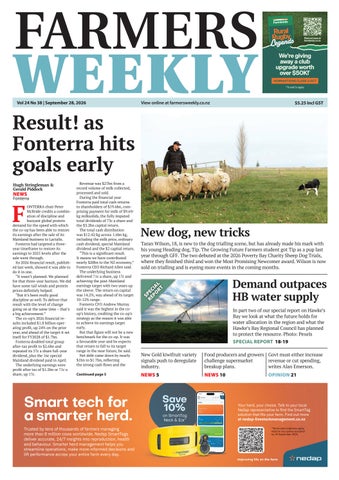
Result! as Fonterra hits goals early NEWS
Fonterra
F
ONTERRA chair Peter McBride credits a combination of discipline and buoyant global protein demand for the speed with which the co-op has been able to restore its earnings after the sale of its Mainland business to Lactalis. Fonterra had targeted a threeyear timeframe to restore its earnings to 2025 levels after the sale went through. Its 2026 financial result, published last week, showed it was able to do it in one. “It wasn’t planned. We planned for that three-year horizon. We did have some tail winds and protein prices definitely helped. “But it’s been really good discipline as well. To deliver that result with the level of change going on at the same time – that’s a big achievement.” The co-op’s 2026 financial results included $1.8 billion operating profit, up 24% on the prior year, and ahead of the target it set itself for FY2028 of $1.7bn. Fonterra doubled total group after-tax profit to $2.6bn and repeated its 57c a share full-year dividend, plus the 16c special Mainland dividend paid in April. The underlying earnings were profit after tax of $1.2bn or 71c a share, up 17c.
Revenue was $27bn from a record volume of milk collected, processed and sold. During the financial year Fonterra paid total cash returns to shareholders of $19.6bn, comprising payment for milk of $9.69/ kg milksolids, the fully imputed total dividends of 73c a share and the $3.2bn capital return. The total cash distribution was $12.42/kg across 1.6bn kg, including the milk price, ordinary cash dividend, special Mainland dividend and the $2 capital return. “This is a significant result. It means we have contributed nearly $20bn to the NZ economy,” Fonterra CEO Richard Allen said. The underlying business delivered 71c a share, up 17c and achieving the post-Mainland earnings target with two years up the sleeve. The return on capital was 14.2%, way ahead of its target 10-12% range. Fonterra CFO Andrew Murray said it was the highest in the coop’s history, crediting the co-op’s strategy as the reason it was able to achieve its earnings target early. But that figure will not be a new benchmark for the co-op. It was a favourable year and he expects that return to fall to its target range in the near future, he said. Net debt came down by nearly $1bn to $1.7bn, reflecting the strong cash flows and the Continued page 5
Smart tech for a smarter herd. Trusted by tens of thousands of farmers managing more than 8 million cows worldwide, Nedap SmartTags deliver accurate, 24/7 insights into reproduction, health and behaviour. Smarter herd management helps you streamline operations, make more informed decisions and lift performance across your entire farm every day.
New dog, new tricks Taran Wilson, 18, is new to the dog trialling scene, but has already made his mark with his young Heading dog, Tip. The Growing Future Farmers student got Tip as a pup last year through GFF. The two debuted at the 2026 Poverty Bay Charity Sheep Dog Trials, where they finished third and won the Most Promising Newcomer award. Wilson is now sold on trialling and is eyeing more events in the coming months.
Demand outpaces HB water supply
S RE PEC PO IA RT L
Hugh Stringleman & Gerald Piddock
In part two of our special report on Hawke’s Bay we look at what the future holds for water allocation in the region and what the Hawke’s Bay Regional Council has planned to protect the resource. Photo: Pexels
SPECIAL REPORT 18-19 New Gold kiwifruit variety signals push to deregulate industry.
Food producers and growers Govt must either increase challenge supermarket revenue or cut spending, breakup plans. writes Alan Emerson.
NEWS 5
NEWS 10
Save 10%
on SmartTag Neck & Ear*
OPINION 21
Your herd, your choice. Talk to your local Nedap representative to find the SmartTag solution that fits your farm. Find out more at nedap-livestockmanagement.co.nz *Terms and conditions apply. Valid on any quotes accepted by 30 September 2026.
Improving life on the farm
2 DPS
AGAIN. AND AGAIN. AND AGAIN.
NEW ZEALAND’S #1 RURAL REAL ESTATE
BRAND OF 2026 Bayleys Country – the most awarded rural real estate brand at the 2026 REINZ Awards The strength of Bayleys Country lies in our people, our expertise, and the trust we’ve earned across rural New Zealand. Recognised with 5 out of 7 rural awards at the 2026 REINZ Awards for Excellence and taking out every region in the REINZ Rural Region of the Year, Bayleys has once again been recognised as New Zealand’s most awarded rural real estate brand. To our clients and people, thank you for making this possible.
If you’re looking for an awarded real estate brand that delivers Altogether Better results time after time, in any market, contact us today. Call 0800 BAYLEYS or visit bayleys.co.nz/rural
LICENSED UNDER THE REA ACT 2008
As awarded by:
3
REINZ RURAL REGION OF THE YEAR - ALL REGIONS 2026
Bayleys Overall winner: Region Two – Bayleys Waikato, Bayleys Bay of Plenty and Bayleys Gisborne
RURAL SAL LES TEAM OF THE E YEAR 2026
RURAL SALES PARTNERSHIP OF THE YEAR 2026
Ben Turner, Bayleys Christchurch Finalist for Supreme Sales Performance of the Year – All Disciplines
Tony Rasmussen & Chris Heenan, Bayleys Havelock North
RURAL OFFIICE OF THE YEAR – MEDIUM 2026
RURAL OFFICE OF THE YEAR – SMALL 2026
Country & Co in partnership with Bayleys
Bayleys Christchurch
Residential / Commercial / Rural / Property Services
4 Contents
New Zealand’s most trusted source of agricultural news and information
Get in touch
Advertise
EDITORIAL
SALES CONTACTS
Bryan Gibson | 06 323 1519 Managing Editor bryan.gibson@agrihq.co.nz
Andy Whitson | 027 626 2269 Sales & Marketing Manager andy.whitson@agrihq.co.nz
News . . . . . . . . . . . . . . . . 1-17
Janine Aish | 027 300 5990 Auckland/Northland Partnership Manager janine.aish@agrihq.co.nz
Opinion . . . . . . . . . . . 20-21
Craig Page | 03 470 2469 Editor craig.page@agrihq.co.nz Claire Robertson Sub-Editor claire.robertson@agrihq.co.nz Neal Wallace | 03 474 9240 Journalist neal.wallace@agrihq.co.nz
Jody Anderson | 027 474 6094 Waikato/Bay of Plenty Partnership Manager jody.anderson@agrihq.co.nz
Gerald Piddock | 027 486 8346 Journalist gerald.piddock@agrihq.co.nz
Palak Arora | 027 474 6095 Lower North Island Partnership Manager palak.arora@agrihq.co.nz
Annette Scott | 021 908 400 Journalist annette.scott@agrihq.co.nz
Andy Whitson | 027 626 2269 South Island Partnership Manager andy.whitson@agrihq.co.nz
Hugh Stringleman | 027 474 4003 Journalist stringleman@outlook.co.nz Richard Rennie | 027 475 4256 Journalist richard.rennie@agrihq.co.nz Gerhard Uys | 027 239 4388 Journalist gerhard.uys@agrihq.co.nz Rebecca Greaves | 027 320 9111 Journalist rebecca.greaves@agrihq.co.nz Nigel Stirling | 021 136 5570 Journalist nigel.g.stirling@gmail.com Isabella Beale | 027 299 0596 Multimedia Journalist isabella.beale@agrihq.co.nz
PRODUCTION Lana Kieselbach | 027 739 4295 production@agrihq.co.nz
ADVERTISING MATERIAL
Supply to: adcopy@agrihq.co.nz
SUBSCRIPTIONS & DELIVERY 0800 85 25 80 subs@agrihq.co.nz
PRINTER Printed by NZME Delivered by Reach Media Ltd
Julie Hill | 027 705 7181 Marketplace Partnership Manager classifieds@agrihq.co.nz
Contents Special Report . . . . . 18-19 Sector Focus . . . . . . . 22-23 Rural Women . . . . . . . . . . 24 Federated Farmers . 25-28 Real Estate . . . . . . . . 29-34 Marketplace . . . . . . . 35-36 Livestock . . . . . . . . . . 37-39 Markets . . . . . . . . . . . 40-43 Weather . . . . . . . . . . . . . . . 44
Andrea Mansfield | 027 602 4925 National Livestock Manager livestock@agrihq.co.nz
Word Only Advertising | 0800 85 25 80 Marketplace wordads@agrihq.co.nz
PUBLISHERS Dean and Cushla Williamson Phone: 027 323 9407 dean.williamson@agrihq.co.nz cushla.williamson@agrihq.co.nz
ISSN 2463-6002 (Print) ISSN 2463-6010 (Online)
Honey purchase New Plymouth-based mānuka honey exporter Egmont Honey has purchased Taihape beekeeping business Tweeddale’s Honey, which was placed in receivership earlier this year. The settlement, which took place on September 18, takes Egmont Honey to more than 22,000 hives across its Taranaki and Taihape operations going into the 2026/27 season.
O’Regan new chair Waikato dairy farmer Susan O’Regan has been appointed chair of the Queen Elizabeth II National Trust board. QEII National Trust is an independent charitable trust that works alongside private landowners to protect open spaces of special significance through establishing and monitoring covenants. O’Regan has strong connections to the rural community, and is a current Crown appointment of the Waikato River Authority.
Health priorities The Rural Health Network is calling on political parties to commit to six priorities it says are needed to avert further serious degradation in access to healthcare for rural people. Network chief executive Dr Grant Davidson said the declaration provides a clear direction for rural health, which requires political support. The network’s manifesto notes that one in five people – 908,000 in all – live rurally across 91% of the country’s land area, yet they carry a disproportionate burden of ill health and face the greatest barriers to care.
Real Estate | 0800 85 25 80 realestate@agrihq.co.nz
Farmers Weekly is Published by AgriHQ PO Box 529, Feilding 4740, New Zealand Phone: 0800 85 25 80 Website: www.farmersweekly.co.nz
News in brief
Positive outlook
CAPTURED: Victoria University’s Dr Luke Liu says metal organic frameworks could prove an effective harvesting tool for NZ’s abundant dairy cow methane supply. STORY P11
For the ninth successive quarter, confidence in the rural sector is net positive, according to a new survey. The latest Rabobank Rural Confidence Survey attributes the result to strong prices for New Zealand’s key agricultural commodities and confidence in the outlook for the broader agricultural economy. The survey found 30% of farmers are expecting the performance of the broader agri-economy to improve in the year ahead, up slightly from 29% in the previous quarter.
News 5
News
5
FARMERS WEEKLY – farmersweekly.co.nz – September 28, 2026
Bostock seeks kiwifruit bust-up with Korea deal Richard Rennie
NEWS
A
Horticulture
N AGREEMENT between Hawke’s Bay apple grower John Bostock and his Korean partners to grow a new variety of Gold kiwifruit signals the first shot in a bid to deregulate the kiwifruit industry. The high-profile grower and founder of the organic apple company has formally signed an agreement with Korean partners to secure exclusive southern hemisphere rights to market the Haegeum gold kiwifruit. It means Hawke’s Bay is due to become the centre for development trials in the southern hemisphere, the second Gold kiwifruit not in Zespri’s brand portfolio. But Bostock told Farmers Weekly he has a broader vision to be growing and exporting the fruit from New Zealand in the “fullness of time”. At present any kiwifruit exports out of NZ and beyond Australia are subject the Kiwifruit Export Regulations 1999, backed by the Kiwifruit Restructuring Act 1999. These rules give Zespri legal status Continued from page 1 Mainland sale proceeds retained for growth. The co-operative will invest an incremental $1bn over the next three years to the South Island to accelerate protein manufacturing and improve its environmental performance. “These projects position us to respond to changes in how people want to consume dairy,” Allen said. “There is a growing focus on
Under current rules Bostock could sell the fruit within NZ and to Australia, a combined market of about 30 million. “Australia is a difficult market, retailers are tough, access and pricing are not good. We want to be in the premium high-end markets of South Korea, Japan and China,” Bostock said. At a time when kiwifruit returns are good, with solid market growth
expectations globally, Bostock said, any change in the sector’s structure is unlikely. “Growers will only wake up when they are not making as many dollars,” he said. He also said trade risks exist between NZ and Korea, where NZ can export its varieties to South Korea but will not allow a Korean variety to exported from here to South Korea. He labelled the Zespri marketing regulations as a type of “state compulsory collective” enforced by archaic monopolistic regulations in NZ. Bostock’s run at the regulations is not the first in the past 20 years. The most substantial challenge was mounted over a decade ago by then Turners and Growers (T&G) chair Tony Gibbs, and ended up in the High Court as Turners sought to strip Zespri of its monopoly power. The judgement explicitly considered the hypothetical consequences of revoking the regulations and creating a completely deregulated market. The judge noted the legislation did create a legal barrier preventing competitors entering the market. However, the court did not
sustainably produced, proteinrich and nutrient-dense foods. “They are critical to our future value growth, and improve our optionality. “As a result, it will strengthen returns for farmers and shareholders over the long term. “Using the capital retained from the Mainland divestment, alongside our strong cashflow, this additional investment will help us move more milk from whole milk powder and
commodities into high-value products.” McBride said the growth in dairy conversions is also influencing these decisions. Milk collection in FY26 was up 4.1% on the prior year and production per farm was 194,000kg milksolids, up from 183,000. Therefore, cash distribution was an average $2.4 million per farm, an extraordinary season unlikely to be ever repeated, because of the Mainland divestment.
as the single and sole exporter of fruit from NZ. In announcing his intentions, Bostock claimed the gold Haegeum kiwifruit fruit is superior to other Gold fruit in terms of its colour, taste, appearance, disease tolerance and cropping capability. The tetraploid plant has its origins in Gold Chinese kiwifruit stock. Bostock holds plant variety rights to it for 23 years, effective from June this year.
We want to be in the premium high-end markets of South Korea, Japan and China. John Bostock Bostock Limited
ARCHAIC: Hawke’s Bay apple grower John Bostock wants to bust down kiwifruit marketing regulations to open the pathway for his branded variety of Gold kiwifruit. overturn the statutory system. Turners ultimately appealed, but abandoned the appeal as the industry came under pressure from the Psa outbreak. The ACT Party entered the fray in 2010, linking with Turners to sponsor a Private Member’s Bill to restructure the kiwifruit plant licenses without Zespri restrictions. In 2015 Seeka applied for collaborative marketing arrangements, which were rejected by the legislative body Kiwifruit NZ. High Court action in 2016 ultimately ruled independent
exporters could only operate through a collaborative marketing mechanism in conjunction with Zespri. Zespri declined to comment on Bostock’s claims. But NZ Kiwifruit Growers Incorporated CEO Colin Bond said the single-desk seller was put in place by growers for growers, and is helping create significant value for NZ. “Opportunities for exporters outside of Zespri which create value for NZ growers are available through collaborative marketing, overseen by industry regulator Kiwifruit NZ,” he said.
Fonterra is forecasting another 2% increase in volume this season, to remain at 78% market share, helped by 130 first-time farm owners joining. The $300m underlying profit increase in FY26 came equally from ingredients and foodservice. Foodservice delivered 30% of the $1.8bn operating profit. The farmgate milk price forecast has been updated to $8.50-$10.50 and the forecast earnings range for FY27 is 65c-85c a share.
Looking ahead, Allen said the way people consume dairy is changing and the co-op has to move with that. People are wanting different components of dairy. Either the fat to make it taste good or the protein to make food nutritious and there are great opportunities for this in Fonterra’s ingredients and food service businesses, he said. “The growth you are seeing today is really centred around that.”
6
6
News
FARMERS WEEKLY – farmersweekly.co.nz – September 28, 2026
After the flood: a Pirongia farm recovers Gerald Piddock
NEWS
I
Weather
T’S been seven months since a flash flood caused extensive damage to Jo and Michael Earwaker’s 400 hectare dairy farm at Pirongia. Over 12km of fencing has been repaired, silt-covered paddocks ploughed and re-sown and the farm’s critical infrastructure has been replaced. The farm lies in the foothills of Mt Pirongia with SH39 running through its middle. It runs 1050 cows in a split calving system. “It was February 13 – and it started raining,” Jo Earwaker told a webinar organised by the Smaller Milk and Supply Herds group. It started with heavy rain that afternoon and by 5.30pm it had turned torrential with water pooling on the ground. The rain stopped at 7pm and Earwaker said she remembers seeing brown water everywhere and hearing a dull roaring sound, similar to a jet engine.
“In about three hours we got 100mm. I think in the whole event we got 180mm that whole night. From 3 to 7pm, my rain gauge overflowed. “The main devastation was the amount of water that came down off the mountain all in one go, and that was the jet engine noise we could hear that came rushing down. “The amount of debris that came with it and the force that pushed everything along with is what caused a lot of the devastation.” The next morning they saw the damage. The flood had knocked out a bridge on nearby Kiwi Road and the main bridge that linked 180ha of their farm to the milking shed – with the herd of springcalving cows stuck on the other side. These cows were bellowing, wanting to be milked. “We had no power, but we had to get these girls to the shed to work out what to do.” With help from the local community the Earwakers cleared the debris off Kiwi Road bridge and
POLICY: Jo Earwaker says one of the key lessons she learned was to align farm insurance policies to reflect the important things that keep the farm functioning – like their bridge.
used a nearby gravel pit to shore it up. They were then able to walk the cows across the bridge and along SH37 to their shed. By then, power had been restored and they were able to milk those cows. After that, they could survey the rest of the damage, including fences as well as a large area of land that was inaccessible where their autumn-calving cows were. Those cows were three weeks away from calving, so were left where they were. Fortunately, two of the farm’s underpasses were undamaged, giving them access to 250ha of land for their milking cows. Their fences were covered in grass and vegetation, and stripping those fences of debris so they could be electrified was a big job. Next up was fencing races for cow flow and fencing off their waterways, she said. “We worked out we lost just over 12km of fencing.” It took them six weeks to get their bridge back, giving them access to that part of the farm. “That was a huge weight off our shoulders.” It meant the farm was relatively back to normal in terms of cow flow and milking. Other jobs included ploughing the siltcovered paddocks and repairing the fences. Several months later, they have about a kilometre of fencing still to go, Earwaker said. Looking back, one of the key lessons she learned was aligning farm insurance policies to reflect the important things that keep the farm functioning – like their bridge. It was not covered because of the cost and until then it had never been damaged, she said. “The biggest lesson learned was when you’re standing there working out what to insure, you can take the hit on a $10,000 shed that you can build again later but you don’t need that $10,000 shed
FLOOD: More than 180mm of rain fell on the Pirongia dairy farm of Jo and Michael Earwaker in February, causing extensive damage. every single day – you need your bridge every day or your underpass every day. “When you’re stuck with no bridge and the insurance company offers you $10,000 and you’ve had a quote for $750,000, it didn’t really line up.” The experience also taught them the importance of back-up power via a generator. High up on their list of capital investments is getting a generator that can power the dairy shed, she said. The mental toll of dealing with the damage caused a delayed reaction to the disaster. The immediate support from the local community was fantastic and appreciated, and then they put their head down and for the next eight weeks worked their way through it.
It was a real lost feeling of now what do we do. Jo Earwaker Pirongia They had used up their adrenaline and found themselves running on nothing, she said. “It was a real lost feeling of now what do we do.” Having some level of ongoing support after the immediate issues around the impact of the flood would have been great, she said. “There’s a lot of support straightaway and people are fantastic, but it’s when everything is better is when it’s the hardest.”
THE UNDISPUTED CHAMP KNO OCKOUT SLUGS AND SNAILS Strong g, palatable and proven, SlugOut® is still the heavyweight champ pion in moderate to high pressure situations. • 2 to 3 x more baits per m2 + faster kill • Cost effective solution, developed and tested in NZ • Not to oxic to earthworms or predatory beetles • Durab ble in all weather with mould inhibitor Contact y your local Rural Supplier or your Nufarm B Business Development Manager today. 0800 NU UFARM or visit us at nufarm.co.nz/slugout
® SlugOut iss a registered trademark of Nufarm Technologies USA Pty Ltd
News
7
7
FARMERS WEEKLY – farmersweekly.co.nz – September 28, 2026
War’s impact on food prices still to be felt Neal Wallace in London
MARKETS
C
Food and fibre
ONSUMERS may be grumbling about food price inflation, but that is likely just a harbinger of increases still to come, said speakers at an agritech conference in London. Higher input costs, consumer demand for less chemical use, and heightened production risks will result in greater food prices, according to a speaker at last week’s World Agri-Tech conference. George Eustice, the former Secretary of State for Environment, Food and Rural Affairs under the UK’s previous Conservative government, said tight margins mean farmers have been unable to insulate
their businesses against risk such as climate change, or improve resilience. “Increased risk means increased cost,” he said. Consumers need to carry some of that risk and he can see food prices consistently increasing in the coming decades. “The world has had cheap food for a long time,” he told several hundred people at the London conference. Eustice said consumers are requiring food producers to use technology, adopt systems such as regenerative farming and use less chemicals, which all comes at a cost, either financial or from lower yields. The full impact on global crop volumes due to disrupted fertiliser supply and higher prices from the blockade of the Strait of Hormuz, is still to be felt. Speakers at a session on
E U RO P E: T RAC K I N G TO M O R ROW ’S FOOD TRENDS
agriculture’s reliance on fertiliser said high prices mean farmers have to make tough decisions on the type and amount of fertiliser used. Patrick Heffer, the deputy director-general of the International Fertiliser Association, said high inventory levels before the conflict provided farmers with a temporary buffer. “The impact is still to come, and it will come after this harvest,” he said. Louis-Marie Catala Groupe a business manager at Soufflet Agriculture, said costs mean farmers are avoiding planting crops in areas with poorer soils. He said before the Ukraine war,
IMPACT: It will another season before the full impact of high fertiliser prices will be felt, the World Agri Tech conference in London has been told. Speaking on the issue were, from left, Patrick Heffer, from the International Fertiliser Association, Willis Thomas, CRU, Louise-Marie Catala, Soufflet Agriculture, and Mike Garnett, Anglo American Crop Nutrients. contingency plans for disrupted fertiliser supplies. Mike Garnett, the chief commercial officer at Anglo American Crop Nutrients, said fertiliser is essential for food security. Thomas said while there is no silver bullet for fertiliser supply contingency, it could include local production or diversity of supply, as is evident as new nitrogen suppliers emerge.
a French arable farmer needed to sell 1.2 tonnes of wheat to buy a tonne of fertiliser. That ratio has now blown out to 4 tonnes of wheat to buy 1 tonne of fertiliser. Willis Thomas, the head fertiliser analyst at consultancy CRU, said there would be a time lag before the full impact on crop yield was known. The speakers said governments had been caught out by not having
Drones, landmines and more confront Ukraine’s farmers Neal Wallace in London
MARKETS
Food and fibre STAFF shortages and being unable to farm 20% of arable land are the new normal for war-torn Ukraine. Volodymyr Pugachov, a Ukrainian Chamber of Commerce official, told the World Agri-Tech conference in London last week that, before the Russian invasion,
This is our response to what is happening in Ukraine. Volodymyr Pugachov Ukrainian Chamber of Commerce
between 4 million and 5 million tonnes of cereal and grain a month were exported. The inability of ships to use the Black Sea due to the conflict means inland road and rail routes are the only transport options, and export volumes have subsequently plummeted to 1.5 million tonnes a month. “We have a big amount of production but limited ability to ship it,” he said. This has created a stockpile of 23-24 million tonnes of grain that is being stored because it cannot be shipped. Pugachov said the country has about 35 million hectares of arable land, but the war means about 20% has been lost to production in the east and south. This is due to
combat, or because it is occupied by Russia or infested with mines. There are 200,000 farmers registered with the Ukrainian State Agriculture System, and farms are large, with 1000ha considered small and corporations owning properties covering 100,000ha, and employing large numbers of staff. With staff called on to fight, Pugachov said, owners are adjusting to, in some cases, having 15 to 20 fewer workers by reducing inputs, the area sowed or employing new technology. That technology includes techniques and systems to make them resilient and sustainable, such as monitoring crops, saving fuel and accurately applying seed and fertiliser. “It’s what we need to do. This is
REMARKABLE RESULT T TS
our response to what is happening in Ukraine.” With some estimates that Ukraine has lost to 625,000 soldiers killed, wounded or missing in action, technology could be a new tool for its farmers. But there are constraints, such as the loss of GPS signals and limited internet access, all due to the war effort. Another hazard for farmers is the threat of attack from Russian drones. Pugachov said digital systems have been developed for reporting hazards caused by war, and a system to prioritise the clearing of mined areas. As if the war were not enough, parts of the country suffered from drought this summer.
While the human toll from the war has been devastating for Ukraine, there are estimates Russia has lost 1.4 million soldiers. Pugachov lives in Kiev with his family, and to return home has to fly to Budapest then take a 20- to 24-hour bus trip to his home. “This is not normal but for us we adapt. It has become the real reality.”
• Meeting the Market has the support of grants from Beef + Lamb NZ, Nedap, Silver Fern Farms, Deer Industry New Zealand, Alliance / Dawn Meats, the Meat Industry Association, Rabobank and the European Commission. https://www.farmersweekly.co.nz/ meeting-the-market/
ENERGY TO GO THE EXTRA MILE PROVEN* trace mineral injection for cattle to support optimal health, production and fertility, with the added benefit of Vitamin B12 in one convenient injection PPORTS SU
PPORTS SU
PPORTS SU
PPORTS SU
IMMUNITY
FERTILITY
ENERGY
GROWTH
*Boehringer Ingelheim data on file.
PROUDLY AVAILABLE FROM YOUR LOCAL PARTICIPATING VETERINARY CLIN N NIC
See product labels for full claim details and directions for use. MARKS-MIN® a registered trademarks of Boehringer Ingelheim Vetmedica GmbH, used under license. ACVM Registration No. A011687. © Copyrigh h 2024. ht Boehringer Ingelheim Animal Health New Zealand Limited. All rights reserved. NZ-MSP-0026-2024.
futureproducers.co.nz
8 ADVERTISEMENT
Sow Smart, Bank Resilience Dr Elena Duter, Head of Agronomy, Farmlands
he right cultivar matters more than ever this spring, proven genetics are the cheapest insurance against a dry summer ahead. With one of the strongest El Niño events in decades forecast, we can expect a drier, windier spring for northern and eastern parts of both islands, and a tough, dry summer for Northland, Canterbury and the Hawke’s Bay. Farmers who get spring planting and pasture management right now will have feed in the paddock and bales in the shed, if the taps turn off in summer.
Cheap seed is a false economy
Protecting the moisture you’ve got
One of the biggest shifts in establishment practice over the past decade is the move toward strip tillage for pasture renewal and summer crops. Rather than working the whole paddock, strip-till disturbs only a narrow band where the seed goes, leaving the rest of the paddock covered in residue. This year every millimetre of soil moisture matters, that residue will do real work: protecting the soil, slowing evaporation, and keeping rainfall where it lands. Farmers who striptill report better soil structure, less erosion risk on rolling country, and crops that establish with deeper, and better-anchored root systems. Where dry summers are the main risk to manage, the extra soil moisture held through into late spring and early summer can be the difference between a crop that gets away and one that doesn’t.
Weighing up strip-till and no-till
The moisture-saving logic behind reduced tillage gets stronger with full no-
Patience for the deep-rooted allrounder
till or direct drilling, where the paddock isn’t disturbed beyond a narrow slot for the seed. Left undisturbed, the soil holds onto structure and moisture right through to sowing, and residue on the surface keeps doing its job as a mulch layer once the crop is in. The trade-off is what’s living in that residue and topsoil. A paddock that hasn’t been cultivated carries over a bigger population of grass grub, Argentine stem weevil and other soil-dwelling pests than one that’s been worked, because there’s more root matter and undisturbed ground for them to shelter in. The same applies to weeds: without a cultivation pass to bury seed and disturb germinating weeds, competition from surviving pasture species and weed seedlings can be more intense in the sown row, particularly in a dry spring when the new crop can least afford to be competing for moisture. Strip-till is a middle ground, enough soil disturbance in the row to knock back weeds and expose or disrupt some pest larvae, while leaving the inter-row undisturbed to keep protecting moisture. Whichever system is used, a thorough spray-out ahead of drilling, a contact insecticide applied with the last glyphosate pass, and insecticide-treated seed are the standard tools for getting a crop through its vulnerable early weeks.
Tall fescue has become the go-to grass for farmers on drought-prone country. Its root system reaches considerably deeper into the profile than ryegrass, and its optimum growth temperature sits several degrees higher, so it keeps producing through the kind of heat that shuts ryegrass down. Breeding programmes from Agricom and RAGT have put serious investment into soft-leaved, animal-friendly fescue cultivars in recent years, a marked improvement on the older, stemmy types that put a generation of farmers off the species. RAGT’s Nouga, for example, has been bred specifically for a softer leaf and better clover compatibility, addressing the palatability concerns that used to be fescue’s biggest drawback. The trade-off is patience and management: fescue is slower out of the blocks than ryegrass and can take the better part of a season to fully establish. Spring sowing this year is about building drought insurance for next summer and beyond. Get the weed control right ahead of sowing, don’t be tempted to graze it the way you would ryegrass. Fescue needs a change in grazing rhythm to avoid leaving high residuals that choke off future growth.
Clover: the engine room of a dry-year pasture
The right type of clover, sown now, is one of the simplest ways to build resilience into your pasture programme. White clover remains the default on moderate dry country, fixing nitrogen and lifting feed quality without relying on bagged fertiliser. But on genuinely dryland country (under 700mm annual rainfall, shallow or stony soils), subterranean clover typically outperforms it. As an annual, it grows earlier in spring, then buries its seed ahead of summer and re-establishes after the autumn break, timing its peak growth to spring lambing demand. Red clover is worth adding to base for extra summer bulk and quality, though its
upright, tap-rooted habit needs longer rotations and can’t take the hard grazing white or sub clovers tolerate. All five major forage breeders have put serious investment into this space: RAGT’s range spans persistent white clovers, a highquality red clover, and several sub clovers bred for dryland systems, while Agricom, PGGW Seeds and Barenbrug offer their own trialled white, red and sub clover genetics for our conditions.
Sorghum: the specialist summer crop
Where a dedicated summer crop makes more sense than a pasture renewal, sorghum deserves serious consideration. As a C4 plant, sorghum uses water far more efficiently than temperate grasses and crops, and its deep, fibrous root system lets it keep extracting moisture long after ryegrass and fescue have stopped growing. Sown once soils have warmed in late spring, it can deliver a reliable bulk of high-yielding, high-fibre feed exactly when a strong El Niño is most likely to be biting. It won’t suit every farm or every soil, and management around prussic acid risk in young growth needs to be respected, but as an insurance crop against a dry summer, few options offer the same combination of yield and drought tolerance. With a new Sorghum variety in the market, Genetic Technologies have a strong Sorghum and Sudan grass portfolio.
Get the conversation started early
With seed companies, contractors and fertiliser reps all expecting a busy spring, the farmers who plan with our Technical Field Sales reps alongside their local reps at Barenbrug, RAGT, Agricom, PGGW Seeds or Cropmark now, will have the best pick of cultivars and the best shot at getting crops in the ground while there’s still moisture to work with. With the right mix of deep-rooted grasses, a wellmanaged clover component, a summer specialist crop like sorghum, and pastures fed hard enough now to bank reserves, this spring’s planting decisions can be the difference between managing a dry summer and being managed by it.
LK0125371©
It’s tempting to save on your seed order and treat cultivar choice as a minor line item, this is the year that this logic falls over. The gap between an old, unimproved line and a modern, proven cultivar isn’t cosmetic, it shows up in root depth, drought tolerance, disease resistance, endophyte performance and persistence, all of which matter more when the season turns dry than when it doesn’t. A cheaper seed line with unknown parentage, unclear cultivar mixes and no declared heading date can carry hidden costs that never show up on the invoice. Farmer saved seed or cheap seed always comes at a high cost: poor vigour, uneven germination and unwanted species in the pasture, which is compounded by moisture stress. Other hidden costs include lost grazing days, additional supplements, increased agrichemical use to eliminate competition, and reduced pasture persistence. Every dollar spent on drilling, fertiliser, spray and machinery time is dependent on the seed doing its job, so seed is the last place to cut corners. With El Niño forecast, this is exactly the season to be paying for proven, welltrialled genetics from established breeding programmes. PGGW Seeds, Barenbrug, RAGT, Agricom and Cropmark all invest heavily in trialling cultivars for New Zealand’s dryland and variable-rainfall regions.
News
9
9
FARMERS WEEKLY – farmersweekly.co.nz – September 28, 2026
Most farmers to contest shipment ruling Annette Scott
NEWS
HANDFUL of farmers have fronted up to pay back money they received from a failed live export company, but most farmers involved have joined an appeal against a High Court ruling that they must return the more than $9 million in insolvent transactions. Last month the High Court of Hamilton ruled in favour of the liquidators’ claim against Southern Dairies Ltd (SDL) for $266,570, actioned by the liquidators as a representative case of Genetic Development (NZ) Exports Limited Partnership (GDX LP). The liquidator has now chased up the insolvent transactions, issuing notice of repayment letters to legally reclaim all monies paid out to all parties initially believing to be secured creditors. This includes 96 farmers who were paid in full while a further 47 farmers were left in the pool of more than 100 unsecured creditors owed a further $11.3m. Several service providers, including feed companies, quarantine properties and Irishbased Purcell Brothers SPV (Purcell Exports, Australia), which
BROKER: Purcells brokered the financial arrangement with the Allied Irish Bank that enabled the voyage of the Ocean Ute shipment of live cattle to China in May 2022. Photo: File received almost $750,000 as a commission fee, are also in the pipeline to repay the money. Purcells brokered the financial arrangement with the Allied Irish Bank (AIB) that enabled the voyage of the Ocean Ute shipment of live cattle to China in May 2022. Liquidator Malcolm Hollis of Teneo Advisory Services NZ Ltd, (formerly PwC) said at the close of the appeal period, September 20, 2026, the lawyers for SDL, and about 50 supporting farmers who received payment, had confirmed
they will appeal the High Court ruling. “It is disappointing but it’s their right, and while we’re not certain of the exact grounds of the appeal we understand they are trying to convince the Court that the payment was not between GDX and farmers, it was Purcell and farmers. “It’s tactical, buying time while incurring more cost.” The appeal will be scheduled in the Court of Appeal into 2027. In making its ruling, the
Don’t leave your lambs’ health to chance.
“We knew only of the $9m and had a list of those who were to get paid; regarding anyone else, that wasn’t our business. “I’d love to help more but it’s in the hands of our lawyer now.” Several livestock companies waiting on the fringe told Farmers Weekly they believe they were misled.
We were approached by a third party to please help so the farmers get paid. It was a very good deal. Patrick Purcell Financier “It was a panic situation, and while lawyer advice was sought regarding the Purcell letters of credit, clearly not enough questions were answered. “To us it sounded like a solution; to us Purcell was taking over the shipment. “The undertone at the time was GDX had solved its problems, but obviously not; if there’d been even a sniff this was going on those cattle would never have gone on the boat. “On reflection we were misled,” one livestock company concluded.
In fighting clostridial diseases, not all 5-in-1 vaccines deliver the same advanced protection! See the trial that shows which 5-in-1 vaccine to invest in this season:
sheepvax.co.nz/get-more-with-multine
Are you a gambler or an investor?
NZ’s leading clostridial vaccine range.
sheepvax.co.nz/get-more-with-multine ACVM No’s: A934, A935, A11311 & A11766. Schering-Plough Animal Health Ltd. Ph: 0800 800 543. www.msd-animal-health.co.nz © 2024 Merck & Co., Inc., Rahway, NJ, USA and its affiliates. All rights reserved. NZ-MUL-240800003
KIGST_2396_FW_B
A
Livestock
Hamilton court had to determine that payment made by Purcells and AIB was payment by GDX. Justice Rachel Sussock held that SDL could not rely on a “no reason to suspect insolvency” defence when suspicion about GDX’s financial position was effectively the reason for structuring the payment mechanism to enable the funds to bypass GDX. “It remains our view that it’s a strong judgement and the Court got it right,” Hollis said. Meanwhile “a handful of farmers”, mostly owing smaller amounts, are in the process of settling repayments. “In feedback they’re saying they’re not wanting to waste money on legal fees, they’re over it.” The liquidator offered a discount to these farmers. “We are not being overly generous but giving them something for fronting up.” Financier Patrick Purcell told Farmers Weekly he sees no wrong in how the finance deal was brokered. “We were approached by a third party to please help so the farmers get paid. It was a very good deal. “We had no connection with GDX or [GDX managing director] Dave Hayman, never have; we had no view of the accounts.
10
10
News
FARMERS WEEKLY – farmersweekly.co.nz – September 28, 2026
Sector challenges supermarket breakup
L
OCAL food producers and growers are challenging the government’s proposal to break up the Foodstuffs co-operative’s New World and Pak’nSave franchise, saying such a solution may prove worse than what it is trying to solve. In a plethora of pre-election policy announcements, National’s proposal came within moments of Labour’s vow to come down hard on big companies shown to be price-gouging consumers, whether they be in groceries, energy or banking. But Simon Berry, who heads up the Whitestone Cheese Company, told Farmers Weekly that forcing the sale of a grocery business built up by a hardworking family over years is a “pretty strong” response to try to lower high food prices. As an owner in a family business himself, he said, the move appears to run contra to National’s open business, free-market roots, and he wondered if the government has fully thought through its proposal. Berry pointed to the unseen but valuable infrastructure and systems that sit behind food distribution in an isolated country
Market access for us is about facings and store numbers. If that gets reduced by government, the effects of that are only to increase costs per unit. Simon Berry Whitestone Cheese CAUTIOUS: Whitestone Cheese Company MD Simon Berry urges politicians to get a better understanding of the infrastructure sitting behind the headline supermarkets before they try to dismantle it. whose population, geography and production are unevenly stretched along its length. “Market access for us is about facings and store numbers. If that gets reduced by government, the effects of that are only to increase costs per unit. “We can have a product leave here [Oamaru] and be on the shelf in Auckland in four days, delivered
retailers” catch cry. “If they are looking at grocery prices, versus power and banking costs, you need to consider just how much may be saved through this. Would you save $1000 a year a family? “That could easily go in fuel or power costs that have increased faster than food costs.” Jerry Prendergast, president of the fresh produce body United Fresh, said any proposed structural changes must be evaluated by what they deliver on the ground for fresh produce, from growers and logistics operators through to consumers.
This week’s poll question:
Will breaking up the Foodstuffs co-operative’s New World and Pak’nSave franchise benefit New Zealand’s food producers?
Have your say at farmersweekly.co.nz/poll
#
T B E S S EL L
ER
1
UN
B
EA
Ts
NEWS
Food & fibre
of competition to emerge. “Co-operation allows for hundreds of locally owned businesses to pool purchasing power, distribution technology, infrastructure and investment so they can compete at a scale they could not achieve individually. “Any assessment of separation needs to test whether two networks, each with fewer stores and less purchasing volume, could maintain the efficiencies and geographic reach currently supported by the combined cooperative network.”
“While greater market competition can offer suppliers more options, our priority is ensuring supply chain efficiency, fair commercial terms, and longterm viability for growers and suppliers.” He said for fresh, perishable produce producers, the proposal has to be also carefully scrutinised for how it would impact grower relations, supply chain logistics and food security. Raewyn Bleakley, CEO of the NZ Food and Grocery Council, said her group welcomes any measures to improve competition and improve outcomes for NZ consumers, while maintaining supplier confidence to succeed, invest and grow in the sector. “Given the complexity of the sector, any election policy proposal should be subject to rigorous independent analysis and consultation, including careful consideration of impacts such as supply chain efficiency, investment, product availability and prices.” Saya Wahrlich, CEO of Cooperative Business NZ, agreed with Berry’s caution over how great the benefits may be. She said any proposal needed to properly account for the benefits created by co-operative scale, while greater attention should be given to enabling new forms
TEN NF
V
in a difficult country that is subject to weather, roading and ferry issues. It’s not just store level, it’s an entire system behind that.” He challenged the government to consider the background impacts of such a decision, beyond the headline-grabbing “break up the
Richard Rennie
Certainty, by the bagful. There’s plenty on a New Zealand farm you can’t control. The weather. The markets. The summer that turns up late – or doesn’t arrive at all.
Your pasture seed shouldn’t be one of them. Stack the odds in your favour. Choose proven Barenbrug cultivars and grow with confidence. Ask your reseller or learn more at barenbrug.co.nz
Scan the QR code to learn more.
Grow with Confidence
11
News
11
FARMERS WEEKLY – farmersweekly.co.nz – September 28, 2026
Science looks to cow gas for next reserve Richard Rennie
TECHNOLOGY
J
Emissions
UST as New Zealand’s viable gas supplies start to run low, work by a Victoria University researcher may prove the country’s next big gas reserve has already been discovered, and it lies in the national dairy herd. Dr Luke Liu works in a relatively new and emerging field as a materials chemist, combining the likes of conventional metals with organic compounds to create metal-organic frameworks (MOFs). He is also a principal investigator with the MacDiarmid Institute and leader of the Zero Carbon Research programme, with multiple researchers coming together to solve climate challenges. The MOF structures can capture different molecules, with almost infinite capability determined by the many different combinations of materials and organic compounds. Liu likens the combination of organic compounds and metals to a lattice-like structure holding tight at a nano scale,
like a scaffolding that extends throughout the molecule. “If you think about the rope cages kids play on in playgrounds, that’s a pretty good visual of what they look like on a 3D level. “We got particularly excited about this field last year when the 2025 Nobel prize in chemistry was awarded to chemists who developed MOFs.” Their uses can extend to pulling water out of dry desert air to capturing carbon dioxide for storage.
If you think about the rope cages kids play on in playgrounds, that’s a pretty good visual of what they look like on a 3D level. Dr Luke Liu Victoria University For Liu and his team at Victoria, their initial work trialing early MOF creations found some were particularly good at selectively trapping methane. “This was encouraging because the ability to capture methane is a
particularly rare one. It is regarded as quite a difficult gas molecule to trap thanks to its shape, compared to something like carbon dioxide, for example.” Total dairy herd emissions are about 17 million tonnes a year in NZ, but from a practical perspective NZ’s livestock emissions are a challenge to capture effectively, particularly given this country’s outdoor grazing practices. But Liu maintains a significant portion could be captured in the farm dairy at milking, with the right MOF technology in place. His team have found a MOF lattice containing copper as the base metal has proven particularly effective at absorbing methane. Once developed into a practical, installable structure, it could become a fixture in farm dairies. “You might find it sits within a passive extractor fan system that pulls the methane in, to the MOF.” He freely acknowledges there are a number of practicalities to sort through, not least creating an affordable, effective MOF structure. “We then need to determine what to do with the captured
CAPTURED: Victoria University’s Dr Luke Liu says metal organic frameworks could prove an effective harvesting tool for NZ’s abundant dairy cow methane supply. methane. This will involve quite a bit of process engineering.” They are testing multiple different MOF combinations to find a cheaper, more effective structure, and AI computing is playing a big part in helping verify these combinations. So far after starting with hundreds, they have pared their options down to about 40 for practical trials to be conducted with Professor Shane Telfer at Massey University. Work by Professor Alex Yip of the MacDiarmid Institute would then come into play, determining
if the captured methane could be used. “We will need to determine if the methane captured can be used economically. It will come down to how dilute the methane is that we get,” said Liu. “Cows emit a lot of methane, and being able to capture that comes just as Methanex is winding down due to a lack of gas supply, and NZ also faces a carbon credit bill of anywhere from $4 billion to $5bn to meet 2030 obligations. “The potential for investment in such work to pay off is highly positive.”
GET GEARED UP WITH CASE IH Unlock value on Case IH tractors and hay equipment. There’s never been a better time to invest in proven performance that’s built to deliver and backed by us.
1.99% P.A1 FINANCE ON ALL TRACTORS
PUMA & OPTUM CONNECTED TRACTORS
1.50% P.A2 FINANCE ON HAY GEAR
Whether you’re upgrading or expanding, make your investment go further with low-rate 1.99% P.A1 finance across all Case IH tractors.
For a limited time get an extra 4 years/4,000 hours of RedXtend Total Protect coverage.3 More capability, more value and greater peace of mind.
Case IH hay tools deliver the performance and reliability you need for every pass. Secure with low-rate finance.
GET A QUOTE
Terms & Conditions apply. Finance provided by CNH Capital Pty Limited. For full terms and conditions please visit caseih.co.nz or contact your local dealer.
12 NI SI Split
12
FARMERS WEEKLY – farmersweekly.co.nz – September 28, 2026
News
CEO steps down after kiwifruit wins Richard Rennie
NEWS
N
Horticulture
EW Zealand Kiwifruit Growers CEO Colin Bond was compelled to perform a quickstep across a trifecta of burning platforms almost as soon as he stepped into his role back in May 2021. This month he announced his decision to step down early next year, taking a chance to decompress and reflect on a role that had him fronting up to the major issues that rolled through regularly, almost from day one on the job. As NZ emerged from the difficult lockdown period, it was quickly apparent international travel restrictions were going to severely curtail the sector’s ability for the coming season. The Recognised Seasonal Employer (RSE) scheme was the most obvious labour pool. “But after Psa a lot of employers had handed back their RSE allocations, uncertain where things would go after that, only to find the industry’s growth trajectory and lack of access to staff was really going to hit hard.” Bond’s team convinced ministers and the government to reconsider the allocation allowance for the
scheme, to which he attributes the subsequent boost from 16,000 to 19,000 workers. Today the RSE allocation sits comfortably at 20,700 workers, as a scheme Bond believes is firmly embedded as an ethical, constructive partnership between the government and industry. Next, Bond had to grapple with the tough issues around the use of Hi-Cane, or hydrogen cyanamide, used to promote bud-burst on kiwifruit vines. “Hi-Cane, of all the treatments we use, has always caused the most concerns.”
Its loss really would have been a billion-dollar problem for the Green growers and would have impacted yields for high value Gold growers too. Colin Bond NZKGI An Environmental Protection Authority (EPA) review on grounds of human health and environmental risk compelled New Zealand Kiwifruit Growers Incorporated (NZKGI) to dive into the science on the spray’s impact. “We put in the effort to demonstrate that if it was used in
accordance with instructions, it was no danger. “Its loss really would have been a billion-dollar problem for the Green growers and would have impacted yields for high value Gold growers too.” Ultimately the industry was granted rights to continue using the product. But the NZKGI work also highlighted flaws in the models the EPA had been using to evaluate such treatments, prompting a full review and 16 recommendations being made to improve its assessment processes. Early 2023 heralded the start of a weather year from hell for the upper North Island. Bay of Plenty growers dealt with hundreds of millimeters of rainfall often overnight in January, culminating in Cyclone Hale’s intense impact around Te Puke. But Bond said it was Gabrielle, with its wholesale destruction of some orchards in Hawke’s Bay and Tairāwhiti-Gisborne, both relatively new planted areas, that continues to echo through those regions on the long road to recovery. A key mandate Bond set for NZKGI was to work to ensure NZ growers were “future ready”, capable of adapting to new technologies as they presented themselves.
BROAD: NZKGI’s CEO Colin Bond says he is proud the body’s work on HiCane chemical use resulted in a wholesale review of the EPA’s processes, and improvements in the approvals process. “This meant we have had to walk towards having the hard conversations, and that has included gene technology.” He organised an extensive road show through growing regions, taking the tech to growers with presentations from scientists and experts on its deployment and development. “We remain neutral about it, but it was still an important conversation to have.” He maintains most growers were genuinely interested in learning more about the tech, while those
with their minds made up may have been disappointed. Going forward, Bond sees Zespri’s engagement with Chinese kiwifruit growers as the industry’s next big challenge and one NZKGI intends to build grower knowledge of with independent information. “I think the other big issue for the sector is retaining our social licence to continue operating. “We are still a growing industry, and it is important we take people and communities along with us, and do the right thing.”
The biggest job requires the best solutions To love and succeed in farming you have to enjoy solving problems. The next potential setback is never far away. Fortunately we now have better solutions than ever before and with our ongoing investment in R&D both here and around the world, we look forward to partnering with you for many years to come. The challenge is big, but so too is the appetite for success.
For the love of farming
#TheBiggestJobOnEarth
Scan here for more information or call us on 0800 558 399 ALWAYS READ AND FOLLOW LABEL DIRECTIONS. ACVM Registration Nos: Belanty P009798, Polyram DF: P002062, Delan WG: P003507, Sercadis: P008977 & Regalis Xtra: P008734 © Copyright BASF 2026 ® Registered trademark of BASF. BASFNZNA0005 0826
NI
13
News
FARMERS WEEKLY – farmersweekly.co.nz – September 28, 2026
13
Plantain N effect under fresh scrutiny Richard Rennie
NEWS
T
Emissions
HE latest research on low dry matter forages including plantain and chicory has challenged how plantain works, and whether its nitrogen-mitigating effects are unique, or could be achieved with other low dry matter forages. Plantain has been the focus of DairyNZ’s plantain potency and practice programme. Most of the programme’s research has used Ecotain, the commercial blend of the Ceres Tonic and Agritonic plantain cultivars. Agritonic is currently the benchmark cultivar in DairyNZ’s plantain evaluation system. Latest research published in the Journal of Animal Science and conducted in Canterbury compared eight plantain-chicoryryegrass treatments, including the Ecotain blend, in three autumn experimental runs involving 120 young sheep. The researchers examined relationships between forage dry matter (DM), water intake, urine production and urinary nitrogen, and three secondary
compounds found in plantain. DairyNZ has claimed the secondary compounds may reduce rumen ammonia production. But the researchers found no biologically meaningful evidence in this experiment that the compounds increased urine production or further diluted urinary N. The work raises questions about whether Ecotain has unique properties that distinguish it from other low-dry-matter plantains and forages such as chicory. The paper’s findings do, however, support DairyNZ’s work showing lower DM content results in more water intake, and higher urine volume, with lower urine N levels. The researchers also found substantial variation in the DM content of the Tonic plantain used as a control between the three autumn runs, with urine output changing in a similar direction. They said this supported DM content, rather than a fixed cultivar effect, as the main driver of urine production. However, the research did demonstrate plantain-fed animals generally partitioned a smaller proportion of excreted nitrogen into urine than ryegrass-fed sheep.
But researchers cautioned that plantain’s nitrogen concentration is not necessarily lower than ryegrass or chicory, particularly under commercial pasture conditions. DairyNZ senior project manager Kate Fransen said the trial had limitations because it used nonlactating sheep, and measurements covered seven days rather than the multiple seasons of DairyNZ’s farmlet trials. Fransen noted, however, that the research confirmed DairyNZ’s own work that plantain partitioned more N into faeces and less to urine. She also pointed out animals fed chicory had high N intake and urinary N losses, with no comparable body of farm-scale chicory nitrate leaching evidence. The latest research did not measure if plantain reduces actual nitrate leaching, while DairyNZ’s work has farmlet and lysimeter work supporting this, recording reductions of about 33% in annual nitrate leaching over the four-year Lincoln farmlet trial in pastures with 17% plantain DM content. The paper follows last year’s scientific debate over plantain, including a review questioning
NO LINK: The latest research on plantain’s N lowering ability maintains it is low dry matter content, not grass type, that can most impact a forage’s lower N production in animal urine. evidence around secondary compounds and soil-N mechanisms. In its response at the time, DairyNZ rejected the review’s conclusions on most points but agreed low DM content was the dominant and best documented plantain effect on urine N dilution. The latest work provides further evidence supporting that, something DairyNZ confirms, with Fransen noting plantain reduces urinary N through a “dilution effect” driven by high water intake leading to high urine volumes. She confirmed the latest study provides further evidence of this rather than the second compounds themselves driving the increased urine production. “This is consistent with the pre-
liminary findings from DairyNZ’s recent cultivar research,” she said. However, she noted the latest study did not prove if those compounds contribute to other positive pathways, and such compounds have been found to play a role in lowering N leaching via soil pathways. Fransen confirmed DairyNZ has not undertaken farm-scale headto-head comparisons between Ecotain, chicory, and other low DM forages. “Our confidence in recommending plantain is based on a substantial body of evidence showing that it can reduce nitrate leaching through several mechanisms, not urine dilution alone,” she said.
New alliance harnesses hive mind for honey Staff reporter
NEWS
Apiculture NEW Zealand honey producers, researchers, bee experts, and the government are partnering to drive the success and resilience of the country’s honey and bee sector. Murray Bush, chair of the new national commercial beekeeping body Honey and Bees New Zealand, said the New Zealand Honey and Bee Alliance recently met for the first time, with representation from across the value chain. “The inaugural meeting of the new alliance brought together commercial beekeepers, honey producers, bee health experts, researchers, industry bodies, government, and the kiwifruit sector that relies on pollination,” said Bush. “The alliance is the first undertaking of its kind in New Zealand for the honey and bee sector, drawing wide interest and support. “Key discussion included shared challenges and opportunities and initial priorities that can deliver the most impact for the sector.” The group identified initial priorities that aim to add the most value to the sector, including improving data collection and production planning, strengthening coordination across pollination and honey collection, and building a better understanding of varroa and reducing its impact.
GAVEL: Riverton Herefords Ezicalve vendor Mike Cranstone selling two of 36 two-year-olds. Photo: Andrea Mansfield
OUT HE GOES: Morrison Farming Ezicalve made $20,500 for Ardo Trident 5023. Photo: Andrea Mansfield
Yearling bulls keep price averages up Hugh Stringleman
MARKETS
Livestock
YEARLING beef bulls, averaging $6000 this year, are making between $1000 and $1500 more than last year, along with full clearances of catalogues with 100 bulls or more. Every offering is being sold as beef cattle farmers reinvest their higher meat schedule returns and dairy farmers aim for better calf rearing options. Riverton Herefords Ezicalve, Fordell, Whanganui, sold 106 yearling bulls averaging $6409, with a top price of $20,000 paid by Morrison Farming for Riverton Redford 25 140. Riverton also sold all 36 twoyear bulls, averaging $5767, compared with $5200 across the offering last year. Several days later Morrison
Farming Ezicalve, Marton, sold all 97 yearling bulls and 28 two-year-olds. The average prices for both age classes were remarkably similar, being $5990 for yearlings and $5950 for the older ones, compared with $4300-$4500 last year. Top price was $20,500 for Lot 5 Ardo Trident 5023 to Riverton Herefords. Turihaua Angus, Gisborne, sold 35 bulls, 29 of them yearling averaging a very consistent $9500, similar to last year. The top prices were $16,000 for Lot 33, two-year Turihaua V154 and $15,000 for yearling Lot 10 Turihaua W88. Maungahina Herefords and Speckle Parks, Masterton sold all 23 Hereford yearling bulls with an average price of $5484 and a top of $8500. The 18 Speckle Park bulls
averaged $5500 with a top of $9000 paid for Maungahina W197. Hillcroft Angus, Ohinewai, sold all 66 yearling bulls with an average price of $4533 and a top of $15,000 paid by Benatrade Angus, Wallacetown. It also sold 29 of 46 two-yearolds averaging $6007 and a top of $13,000. Black Bear Angus, Rotorua, sold 34 of 41, averaging $3614 and a top of $7200. Rolling Heights Herefords, Huntly, sold 46 of 48 bulls with a top price of $5200, and the charity bull made $4600 for the Waikato Hospital newborn intensive care unit. The yearling bulls averaged $3661 and the two-year-olds $4662. Highpeak Simmentals, Uruti, sold all nine bulls for an excellent average of $9555 and a top price of $15,000 paid by
Beresford Simmentals, in the Catlins. In the same sale Taranui Angus sold all 25 yearling bulls with an average of $4665 and a top of $6500. One of the biggest offerings was for Mangaotea Farm, Taraiki, with bulls from four breeds in 150 lots. Results were 27 two-year Herefords averaging $5885; four Murray Greys $4150; 15 Angus $5213 and 34 Jersey $3482. In the yearlings 23 Angus bought $4921 and 45 Jerseys $2115. Bushy Downs Herefords, Te Awamutu, sold 108 bulls, 60 of them yearlings with an average of $7025 and 48 two-year-olds averaging $6720. The top price was $16,500 made twice for yearlings, one of them paid by Otamatea Herefords, Waiuku for Bushy Downs Steakout 25 834.
14
14
News
FARMERS WEEKLY – farmersweekly.co.nz – September 28, 2026
Exports looking up as ships brave Suez again Nigel Stirling
MARKETS
E
Shipping
XPORTERS are hopeful of soon resuming shipments of their products directly to Europe via the Suez Canal after being blocked from using the route for the past three years. Container ships have avoided the route since Iranian-backed Houthis began attacks on vessels passing through the Red Sea in late 2023. Ships have instead been rerouted around the Cape of Good Hope, adding six weeks’ sailing time to containers bound for Europe. However in July two of the biggest container shipping lines – Maersk and Hapag-Lloyd – resumed limited services through the Red Sea and the Suez Canal for ships on their way to ports in southern Europe. Council of Cargo Owners chair
Nigel Jones said more services were added on this route in August and more again this month. Jones said the resumption is being carefully staged by the shipping lines to avoid clogging up European ports. “Otherwise it could end up in significant disruption as you have multiple vessels all arriving in Europe at the same time even though they left Asia in different windows,” he said.
Who knows what you are going to wake up to tomorrow morning. Nigel Jones Council of Cargo Owners Jones, who is also meat exporter Alliance Group’s general manager of supply chain and planning, said container services to Northern European ports have yet to resume.
“The majority of [NZ] chilled meat goes into Northern Europe and at this point in time there has not been any material change in those services but hopefully we will see that by the end of the year or very early next year assuming the current open passage for merchant vessels through that region continues.” Jones was cautiously optimistic despite a stepping up of Houthi attacks on oil tankers in the Red Sea since July. “It seems to be confined to [Saudi] oil supply at this time but that is the fragility of the situation you are dealing with at the moment. Who knows what you are going to wake up to tomorrow morning,” he said. Logistics company Kotahi negotiates freight rates with Maersk on behalf of multiple NZ primary exporters, including Fonterra and Silver Fern Farms. Its chief executive, Emma Parsons, said Maersk has doubled
Going gets tough as contractors get going
SAFETY: Kotahi chief executive Emma Parsons anticipates a staged approach to Suez will continue, as safety remains the top priority for all carriers. the number of services it runs through the Suez Canal from two to four so far this month. Nine services continue to be routed around the Cape of Good Hope. “We anticipate this staged approach to Suez to continue, as safety remains the top priority for all carriers,” Parsons said. “As further services return,
Parties flag issues with new resource laws
Gerald Piddock
Bryan Gibson
Agribusiness
Agriculture
POLITICS
NEWS
THE spike in fuel costs combined with unpredictable spring weather and the El Niño summer forecast has created an uncertain outlook for contractors heading into one of the busiest times of the year. It’s created some tough decisions for farmers, Rural Contractors NZ president Clinton Carroll said. The likelihood of a very dry summer means farmers in places such as the East Coast will be wanting feed crops – but with costs rising, the decision then becomes how much crop do they put in, he said. “Some people say it’s not worth it and some say you can’t do without it. “The best way forward is communication between the farmer, the contractor and your merchant rep. If all those people are talking on the same page, it goes well.” Fuel prices had sat below $3 a litre for the past few months before jumping over 20 cents for 91 and 95 and more than 30 cents a litre for diesel in the past few weeks. There are indications that fuel costs could jump even higher. When prices spiked last year contractors added a fuel surcharge for their services and most have carried that over, he said. “It’s a pain and we hate
CHALLENGES: Contractors face a challenging start to spring as they navigate a spike in fuel prices, changeable weather and farmer uncertainty over a possible dry summer.
The best way forward is communication between the farmer, the contractor and your merchant rep. Clinton Carroll Rural Contractors NZ doing it. At the end of the day, it will be put onto the farmer who is the end user unfortunately.” The last time fuel costs jumped to this level it cost larger contractors an extra $60,000-$70,000 a week in fuel during the peak periods as they burned through 100150 litres an hour, he said. Contractors are trying to be as efficient as possible when it comes to jobs to keep costs down. The cost will also be carried
over into other inputs such as fertiliser. On the positive side, the strong sheep, beef and dairy returns should mean demand for work around planting summer feed crops and cutting and baling grass for silage is there. However, arable farmers are definitely weighing up their options, he said. “I’ve got a couple of clients who are pulling right back on their arable and going to just do sheep.”
NZ exporters can expect to see improved transit times to some, but not all, destinations in the Mediterranean, North Africa and Europe. “We are hopeful that more services will open through Suez in time for NZ’s peak export season, which will make a significant difference for our farmers and producers.”
OPPOSITION parties say new the resource management laws give the minister of the day too much power, and were passed through Parliament without the usual consultation. Representatives of the main political parties took part in a debate organised by the New Zealand Guild of Agricultural Journalists and Communicators at the Beehive’s Theatrette on Wednesday evening, where farming issues were discussed. Labour’s agriculture spokesperson, Jo Luxton, said the main issue she had with the Natural Environment Bill and the Planning Bill was that they give the minister too much power. “And one of the other risks is that we had large amendments that were brought into this Bill [that] didn’t go through the proper fulsome process where the public had an opportunity to submit on it – it was just simply done under urgency. When we rush legislation we often have unintended consequences and so that is something we might be concerned about.” Opportunity deputy leader Daniel Eb agreed, saying the bipartisan agreement that the Resource
Management Act had run its course was lost in the process adopted to replace it. “To exclude that from the process opens it up to just putting it back into the pendulum swing and the sort of the cycle of waste that we’ve seen characterise so much of our politics.” But Associate Agriculture Minister, ACT’s Andrew Hoggard, said the laws lay the foundation for a new era that supports investment and growth, citing discussions he’d had with farmers frustrated with the process of getting a consent to build a wetland. “I have met so many people that have tried to do this, have spent hundreds of thousands of dollars on consents for this. NIWA has a guide and that should just be the national standard. Follow the NIWA guide, Bob’s your uncle.” National’s Associate Agriculture Minister Mike Butterick agreed. “If it’s okay to do something in Northland, put a hay shed on your hill, it should be okay to put the same hay shed on a hill in Southland. And it should not be open to someone’s particular interpretation. So I think it’s going to unshackle a lot of opportunities in this country. And my word, we need to keep unlocking those.” FARMING’S FUTURE: Andrew Hoggard from ACT, Jo Luxton, Labour, Mark Patterson, NZ First, Daniel Eb, Opportunity, Steve Abel, Greens, and Mike Butterick, National, with moderator AnneMarie Case-Miller at the NZGAJC debate.
15
Investing in our sector’s future Beef + Lamb New Zealand (B+LNZ) invests in growing, training and retaining people in our sector. By working alongside industry partners, educators and employers, we’re helping build a thriving sheep and beef farming community through education, leadership development, career pathways and lifelong learning.
2016 – 2026
Growing leaders: B+LNZ’s Rural Leadership Advancement Scholarship now open
Investing in future leaders: Tertiary Scholarships open 1 November
B+LNZ is offering a $4,000 contribution towards a place on any Rural Leaders New Zealand programme for six livestock farmers looking to grow their leadership skills and impact on the sector. Learn more and apply before 11 October 2026 at beeflambnz.com
B+LNZ’s Agricultural Student Scholarship supports students pursuing study and careers that will contribute to New Zealand’s sheep and beef sector. Applications open 1 November 2026.
Support your local school
Refreshed support for farm employers
People and Capability Farmer Reference Group (PCRG)
To help farmers build and support strong teams, B+LNZ recently refreshed its Employment Hub, bringing together practical tools and resources to support recruitment, onboarding and people management. Access the hub on B+LNZ’s website – link below.
Made up of farmers with a strong interest in attracting, developing and retaining great people, the PCRG helps guide B+LNZ’s People and Capability programme. The group provides real-world feedback and farmer perspectives to ensure initiatives deliver practical value for farming businesses. Get to know them on B+LNZ’s website.
B+LNZ offers classroom resources, curriculum-aligned learning tools and support to help bring New Zealand’s sheep and beef sector to life for students. Farmers please sign up to B+LNZ’s Farmer Speakers Database, connecting schools with farmers who are willing to visit classrooms and speak with students about farming and food production. Learn more and apply via link below.
Find out more Visit: beeflambnz.com/people-and-capability Contact: peopleandcapability@beeflambnz.com
Stay connected via B+LNZ Generation Next Alumni Have you been through a B+LNZ Generation Next programme? If you haven’t signed up for the alumni, join us for timely updates, connections and to be part of events like the 10year celebration reconnection dinner on 19 November at Telford. Email generation.next@beeflambnz.com. Applications for the 2027 intake open 7 December.
16
16
FARMERS WEEKLY – farmersweekly.co.nz – September 28, 2026
News
Skilled stickmaker carves his own path Rebecca Greaves
PEOPLE
A
Community
RARE find of a small kahikatea in a swamp, with a vine growing around it, provided the inspiration for Graeme Williamson’s first stick. As a young shepherd working on the east coast, he used it for dog trials. That first stick, which Williamson still has today, was made in 1960 and set him on a path to learn the ancient craft of stick making. “I added a cast antler I had found, and completed the stick with an inlay piece of greenstone on the head. I had no tools; to get the dark colour on it we heated
ALL NATURAL: Williamson uses mānuka, kānuka, lancewood and hazelnut for his shafts. Handles are crafted from materials including deer antler and Merino horn.
six-inch nails in the fire using tongs and burned around the groove where the vine had been. This was at Ruakituri Station in Wairoa, where I was working as a shepherd.” Later, he became manager, a role he filled for 10 years. Throughout his farming career, from shepherding to managing and farm ownership, Williamson always rode a horse, and was never without a stick. Now retired, this quintessential gentleman farmer is skilled in a craft rarely seen in New Zealand these days, each stick a unique work of art. In his workshop at his Havelock North home, he points out an anvil he said put his three children through boarding school when he had a run as a farrier, doing 120 horses every six weeks. Williamson is one of few stick makers in New Zealand, largely self-taught by trial and error, and he makes shepherd’s crooks, drover, market, cleeks and walking sticks. Stick making is an exercise in patience. Freshly cut sticks (shafts) must be dried for six months before work can start. The shafts are made from mānuka, kānuka, lancewood and hazelnut. The latter he grows at home in his garden. The secret to a good stick is straightness. “I am very picky when I go looking for a stick, to find one that’s dead straight. Lancewood is probably the straightest you can find. You can put them in a vice and clamp them to straighten them up a bit.” The majority of handles are
made using deer antler or Merino horn, though he has also worked with Arapawa wild Merino, goat, cow and buffalo horn. Some sticks are embellished with a greenstone inlaid in the handle. Antler cannot be shaped, as it is bone, he said, but horns can be shaped, either by boiling or with heat. Williamson’s preferred method is to use a heat gun, carefully, so as not to burn them. A vice and clamps are employed when shaping horns. Williamson has been a member of the British Stick Makers Guild for 40 years. Their magazine, Stickmakers, arrives in the post and is an eagerly anticipated source of ideas. He has enjoyed overseas visits, attending country shows to meet fellow craft stick makers and admire their workmanship. In the UK, it’s not uncommon to find 350 sticks entered in competitions at small country shows, he said. “In England, everyone has one [a stick]. You go to the sale in New Zealand and never see anyone with a stick. These days I like one to help keep my balance when I go to the saleyards.” Williamson has recently hung up his riding boots, having followed the hounds for 75 years since starting in Northland when he was 11, but he has no intention to give up making sticks any time soon. In recent years, daughter Leigh has served a kind of apprenticeship, learning to work with deer antler and creating a range of bespoke handmade antler crafts, as The Huntsman’s Daughter. Now, father and daughter regularly attend markets together
DECADES: Graeme Williamson has been making shepherd’s crooks and walking sticks for more than 60 years, a craft he first discovered as a young east coast shepherd. Photos: Rebecca Greaves in Auckland and big trade shows, like the Sika Show at Mystery Creek, something that gives Williamson great pleasure. He also sells his sticks locally, gifts them to friends, and his dog trial sticks are presented at the Smedley Station prizegiving annually to cadets who have excelled. Williamson reckons a good stick is still an everyday essential when farming. “During my 60-year farming career I always had a shepherd’s crook, a must for the lambing beat, drafting cattle and opening gates.”
SHEPHERD: More than six decades later, Williamson still treasures the first stick he made as a young shepherd on the east coast.
Farming comes to life for city schoolchildren Isabella Beale
NEWS
Food & fibre FOR many children, seeing where their food comes from or experiencing life on a working farm is becoming increasingly rare. Pātoka-based farmer and veterinarian Sally Newall hopes to help remedy that with a new on-farm learning facility that she plans to open to school groups later this spring, after the calving and lambing season. Newall already uses her Kiwi Country Kids platform on Instagram and Facebook to give people a glimpse of day-to-day farming. But watching her own children become confused about what was real online prompted her to think more about the value of experiencing farming firsthand. “If you get people out on the farm, they’re going to make their own opinion of what you’re doing ... it’s kind of come a little bit through the advent of AI, I guess, and just going, ‘Right, we’ve got to give people real experiences these days’,” she said. The purpose-built on-farm facility is part of Newall’s working farm near Napier. The shed is
divided into three sections, with three calf bays on one side, a milking area on the other and a larger enclosed event space in the middle. The event space will also be available for workshops, meetings and training days. Visiting groups will experience the everyday activities of a working farm, with what they see and do changing with the seasons. Children could feed chickens and pigs, collect eggs, see calves, visit sheep and lambs, work in the vegetable garden and take part in native planting. “We’re not a petting zoo, so we won’t have pet lambs all throughout the year. It’s a real working farm,” she said. “It’s literally going to be taking groups around showing them what I do every morning and they’ll be helping me to care for the animals, to feed the animals, to do every job that I do on a normal morning.” Animal welfare and husbandry will be a particular focus, drawing on Newall’s veterinary background. Sustainability is also integrated into the farm’s daily operations, including native planting, composting and food production. Seventy-nine solar panels and batteries now provide
power for the farm and the new shed. Newall is also involved with Farmer Time New Zealand and has advocated for more opportunities for primary school children to experience farming. “I really feel that’s where you ignite the spark of interest,” she said. “By the time they’ve got to secondary school, if they’re not interested in farming, it’s going to be harder to hook them in at that point.” Primary school children will be the main focus of the educational programme, but Newall plans to open the facility to a wider range of groups, including retirement homes, tourists and agricultural businesses. Commercial hire of the facility will also help keep the cost of school visits down. “I’m obviously not going to charge school groups very much to come on the farm because schools can’t afford to pay very much to do outings,” she said. “I really want them [the schoolaged children] to know where the food comes from. I think every kid should have the opportunity to get out on a farm and ask any questions they want to.”
FOCUS: Sally Newall will draw on her veterinary background to make animal welfare and husbandry a particular focus of the educational programme, alongside sustainability. Photo: Supplied
17
, We re Meeting the Market. Last week our award-winning senior reporter Neal Wallace flew from his home in Dunedin to Auckland, and then left New Zealand for Europe. He’s making this trip for the good of the country. Over the next few weeks you can read Neal’s next wave of Meeting the Market stories in Farmers Weekly and online at farmersweekly.co.nz. Neal told us, “I was reflecting earlier today on how incredibly fortunate I am to have these opportunities when I should be thinking about getting Winston’s oldies card. “Thanks for your support. I am excited by the potential stories from this trip which I believe will be very good for our readers.”
You can help support our Meeting the Market initiative by taking out a voluntary subscription to Farmers Weekly. Thank you to all our Meeting the Market partners this year: Beef+Lamb NZ, Nedap, Silver Fern Farms, Deer Industry New Zealand, Alliance/Dawn Meats, MIA, Rabobank and the European Commission. Thank you also to the 1295 voluntary subscribers so far. We do this for you and invite more of you to join the team. Dean Williamson CEO and publisher JW124817©
This is the third year in a row Neal will spend many weeks on the other side of the world, reporting from international food and fibre events and meeting the decision-makers who buy around $60 billion worth of our food and fibre each year.
Why Meeting the Market is good for you, and the industry: • Knowing we’re good and claiming we’re the best farmers in the world is not enough. • Reporting independently from the markets we export to helps us all understand how we can match our products to consumer expectations. • We want you to know why you get the price you do, and give you the knowledge to improve it.
SUBSCRIBER TARGET
I'm a er subscrib
8000
Support us with a voluntary annual subscription to Farmers Weekly.
6000
$120 for 12 months. This is a voluntary subscription for you, a rural letterbox-holder already receiving Farmers Weekly every week, free, and for those who read us online.
4000
1295
BECOME A VOLUNTARY SUBSCRIBER
2000
1. Scan the QR code or go to www.farmersweekly.co.nz/donate 2. Email your name, postal address and phone number to: voluntarysub@farmersweekly.co.nz and we’ll send you an invoice.
3. Call us on 0800 85 25 80 Note: A GST receipt will be provided for all voluntary subscriptions.
Scan here
14Special HB HortReport & Viti 18
Special Report Beneath the surface: a new future for Hawke’s Bay In part two of our special report on Hawke’s Bay we look at what the future holds for water allocation in the region. It was always believed the Heretaunga aquifer was plentiful but science says it is depleted, and there is a projected widening gap between supply and demand for water. Growers say the Hawke’s Bay Regional Council TANK Plan Change, which slashes water allocations on the Heretaunga Plains, would render many businesses unviable. But the council maintains there is not enough water, and the region’s resource must be protected.
When demand outpaces water supply Rebecca Greaves
What is TANK?
NEWS
I
Water
T WAS always believed the Heretaunga aquifer was plentiful, unlimited even. Science now says the aquifer is depleted, and there is a projected widening gap between supply and demand for water in the region. Growers say the Hawke’s Bay Regional Council’s (HBRC) TANK Plan Change, slashing water allocations on the Plains, would render many businesses unviable in their current land use and rip the heart out of the Plains production-wise. Modelling shows a worst-case scenario cost of $4 billion to the local economy. But HBRC stands by the TANK process, which is currently paused awaiting the outcome of Resource Management Act reform, after long and drawn-out Environment Court proceedings. The way things stand, no one can apply for water currently, and it’s stifling appetite for investment in the region. Council chair Sophie Siers said TANK is one of a number of measures being taken under its Regional Water Plan, which includes natural and managed aquifer recharge, addressing leakage in pipes for towns and cities and recycling waste water. “It’s looking at how we might close the growing gap between supply and demand, not only for growers but for the whole system – things like re-circulating or reusing wastewater to get greater efficiency from what we have got.” A water storage project, with
RANGE: Historically, land on the Heretaunga Plains could be worth around $150,000/ha with water, and as low as $75,000/ha without it. Photo: Pexels a potential site at Whanawhana having been identified and in the feasibility stages, has been devolved from the council and is going forward as its own entity, under a partnership with the council, growers and industry, and iwi. Simply put, there is not enough water, and the region’s resource must be protected, while balancing sustainable business and food production on the Plains. “If we go back to the early 2000s, the Heretaunga aquifer was one of the biggest in New Zealand and there was a belief it was unlimited. There is 160 million cubic metres allocated and it was given on the
GROWING GAP: Hawke’s Bay Regional Council chair Sophie Siers says the TANK Plan Change is ‘looking at how we might close the growing gap between supply and demand’.
basis there was more than enough water. We now know that is not the case,” Siers said. “Science has informed our knowledge. Then we have land that has no water and, in some cases, paper allocations are far beyond what has ever been taken.” TANK seeks to reduce the amount of water allocated to 90 million cubic metres, a number based on what is actually being used. Siers said that, in some years, as little as 30 to 40 million cubic metres of water has been used. She acknowledges people have purchased land on the Plains at a value because it has a water consent associated with it. “People are meeting market forces all the time. Farmers will go to where the market is, and the market always drives activity.” Historically, land on the Plains could be worth around $150,000/ ha with water, and as low as $75,000/ha without water. “Banks won’t lend without water security either. Long-term investment in Hawke’s Bay is damaged by the lack of certainty with water ... We have heard that people will not invest in Hawke’s Bay further without water security being resolved.” For Siers, it’s about creating a sustainable water programme the whole community is working towards, not just growers. She points to a unique partnership between industry and the council, working together on an
THE Plan Change introduces new ways to manage the land and waterways of the Tūtaekurī, Ahuriri, Ngaruroro and Karamū (TANK) – a more stringent approach to land and water use, intended to enable objectives for freshwater to be met. This includes updated allocation limits and minimum flow regimes for the surface and groundwater in the TANK catchments. The rule in the TANK Plan Change took immediate legal effect upon notification on May 2 2020. The rules in the consent order version of the TANK Plan Change, issued on April 29 2026, are now the rules with legal effect. The TANK Plan Change is currently subject to an Environment Court appeal process. Mediation was undertaken from 2023 to 2025, and HBRC is now preparing for an Environment Court hearing. There are 16 appellants, and 18 parties registering their special interest to proceedings. HBRC group manager of policy and regulation Katrina Brunton said TANK is the current regulatory framework. “It was initiated about 12 years ago and has been working its way through a long and slow RMA process. A decision was issued and it was appealed to the Environment Court; we have been working through those changes.” The primary focus is on water allocation, given there are overallocated catchments, she said. “The Heretaunga aquifer is overallocated and the TANK Plan brought in a new regulatory process to determine use.”
The allocations were determined by using a reference period from 2010 to 2020 (which included two significant drought years) to understand “actual” use. Industry information was used to understand what would be considered “reasonable” use. Bruton said there are 1000 consent holders. As consents have come up for renewal, these consent holders were given their new actual and reasonable number, versus what they had been allocated previously. The council has asked the Environment Court to pause proceedings while the RMA is under reform. It also paused the consenting process during the recovery from Cyclone Gabrielle, and while working through the Environment Court. All consents are currently on hold. Anyone sitting on an existing use right has had their consent rolled over. Of the 1000 consent holders, Brunton said there are 100 who have already chosen to accept the number offered, believing they can live with that water allocation. Brunton said the council undertook a collaborative TANK development process, including industry, growers and tangata whenua. The proposal was notified, submissions called for and then it went through a hearing process with an independent commissioner. “Because the legislation enables it currently, anyone can appeal all those decisions to the Environment Court. There’s lots to be gained here. What remains in dispute is what the number should be. TANK says it should be 90 million cubic metres, others say it should be higher, others say it should be lower.”
aquifer recharge project on the Ngaruroro. “We are partnering on a piece of work that will actually build water security for the region.” Globalisation holds potential – the idea that a group of growers in an area could agree to pool their water allocation and share it as and when it is needed. Siers said there is already a collective of orchardists in Twyford who have successfully used this method to save water. Other efficiency methods include things like the use of drip-line irrigation under the soil in orchards, as opposed to above ground, to reduce evaporation. There are trials underway to irrigate more effectively, to reduce consumption, though the temptation then is to increase production.
“Land is only as productive as the water available to it.” One solution alone will not fix the water woes on the Heretaunga Plains, but the HBRC feels it is taking steps to address the problem, and it wants to take the whole community with it. “We have to start to think differently about what we grow and where. We have great soils and a great climate. How do we maximise what we’ve got? The regional council should be constantly enabling these conversations.” What Siers does know is that water security and overallocation must be dealt with together. “We are lucky the aquifer is still in really good condition. We don’t have a nitrate problem or salt water incursion. We want to keep it that way.”
19
Special Report
19
FARMERS WEEKLY – farmersweekly.co.nz – September 28, 2026
Dam proposed to fill gap for HB economy Rebecca Greaves
NEWS
A
Infrastructure
PROPOSED water storage dam at Whanawhana could help ease water woes in Hawke’s Bay, providing muchneeded water security as the gap between future supply and demand for freshwater widens. So says Xan Harding, a grape grower in Bridge Pa and chair of the Heretaunga Water Storage Project. He’s been in the thick of water and Resource Management Act issues in the region for years, and understands that the stakes are high. Harding said water is the lifeblood of the Hawke’s Bay economy, and Heretaunga is the economic engine. The proposed $225 million dam aims to deliver water security for Heretaunga at the lowest possible price, he said, but it must stack up commercially. Doing nothing is not an option for Harding, who said ongoing
ACTION: Heretaunga Water Storage chair and Bridge Pa grape grower Xan Harding says doing nothing is not an option.
water insecurity will lead to value destruction and reversion to lower-value land uses. The Hawke’s Bay Regional Council is taking an active role in trying to promote regional water security. After heading down a very expensive dead end with the Ruataniwha dam scheme, it has turned its focus to the Heretaunga Plains, he said. “HBRC ended up as the owner of the Ruataniwha scheme, it cost about $30 million and they didn’t build a dam. The Heretaunga Plains is different, there’s already 18,000 hectares under irrigation and 3000ha of new irrigation that could be enabled. There is also land there that has insufficient allocation of water.” The question is, if there was more water, what could be produced on the lighter soils? Prior to the pullback of Wattie’s and McCain, the answer was likely intensive vegetable crops. Frozen process vegetables are not an option currently, but other vegetable production could be possible. Harding said there are 4000ha of irrigated grapes on the Plains and lowland hills. Water allocation is about a third to a half of what is required for other intensive land use. In 2016 the HBRC realised, during its TANK planning exercise, that if everyone used their full paper allocation it could result in a situation where the Ngaruroro River ran dry. “Leadership at the time decided the Heretaunga Plains was fully allocated, if not overallocated, and there was no more water. We have been running 10 years now with constrained water. “It’s a deterrent for new people coming in and is eating away at economic activity.” Harding said there’s long been a perception of the Heretaunga Plains as one of plenty – great, clean aquifers, good rivers, no problem.
“We now understand there are limits to what we can take without having what the community considers to be unacceptable impacts on the environment. We are in a process of learning to live within limits, no longer is the resource limitless.” He said the TANK process has not landed, nor is it final. He accepts there need to be rules and limits but said people need to know what they are so there is certainty. At a national level, this also means waiting to see where the Natural Environment Bill and the new National Policy Statement for Freshwater Management land. “Some people just carry on and will worry about it later. For others, it’s just don’t re-invest. Certainly, for the grape growers that’s the most rational economic course, run the business down, do not re-invest. Where you have energy and sufficient water, land use change could be an option, or selling.” One solution to the problem is the proposed dam, capturing excess water in winter during peak flows and using it in summer when most needed.
We now understand there are limits to what we can take without having what the community considers to be unacceptable impacts on the environment. Xan Harding Heretaunga Water Storage Project Moving to address the growing gap between future supply and demand for freshwater has given impetus to explore the best options for water storage on the Ngaruroro, he said. The council learned from the Ruataniwha exercise and decided to devolve the water storage project to the water users
FLOW: In 2016 the HBRC realised, during its TANK planning exercise, that if everyone used their full paper allocation it could result in a situation where the Ngaruroro River ran dry. who would have to make the investment decisions. In December 2025 the project was placed in the hands of Heretaunga Water Storage Limited (HWSL), an incorporated company that comprises three shareholding groups: mana whenua authorities, the irrigator and industrial water users, and the local authorities (Napier and Hastings City Councils). HWSL was created to include the voice of all water users, and it now owns and operates the dam project, which is currently in the feasibility stage. In this phase a preferred site has been identified, preparations will be made for resource consenting, design and costings will be refined and commercial feasibility tested. Harding said they are well funded to get to project through consenting, and expects to complete the feasibility phase by Quarter 1 next year. A decision will then be made whether to carry on to consenting.
The proposed dam would be a 58m-high rockfill dam with the capacity to store 27 million cubic metres of water. There are five private landowners, who are on board with investigating the project. The dam would enable water to be released directly into the main stem of the Ngaruroro River, benefiting both the river and groundwater. There is also a proposal for a pipeline to cut off at Maraekakaho to feed the Karamu. Harding is quietly confident. “We know that we can build the dam, technically, and we have a consenting pathway. We are applying for fast-track approval because of critically important regional benefits. We think that there is demand from our shareholder groups and we can fund it. “The project is going well. It’s highly complex and things always take longer than you would hope, but it’s on track.”
SPRING INTO TILLAGE Get your ground ready with AMAZONE
With AMAZONE cultivation equipment, you can prepare your paddocks with the performance, precision and reliability you need for the season ahead.
FINANCE P.A. FROM
*
0%
ON ALL IN-STOCK AMAZONE CULTIVATION MACHINES
“The Catros performs well in all conditions, wet and dry, stone and sand, it’s consistent everywhere you go. Stones bounce through it, and it is easy to use if you understand cultivation.”
26-167
Paul Everest — Dairy Farmer
Speak to your local AMAZONE dealer to find out more. *
Terms and Conditions apply. Offer valid until 01/12/2026 or while stocks last. Finance establishment fee of $295. Images illustrative only
20 Editorial
20
Opinion
FARMERS WEEKLY – farmersweekly.co.nz – September 28, 2026
Letters of the week Hit pause on this tech Phyllis Tichinin Havelock North
From the Editor Finding honey’s sweet spot Craig Page
Editor
T
HE honey industry has taken its fair share of knocks in recent years. Varroa mite, extreme weather events and plummeting mānuka returns, coupled with significant honey stockpiling, have all contributed to some tough times for those in the industry. The number of registered hives in New Zealand has dropped from 918,000 in 2019 to under 490,000. But now the industry is taking the lead to secure its future and has formed a group to help provide direction and support for the sector. The new group, the New Zealand Honey and Bee Alliance, includes the government, honey producers, researchers and bee experts. Its aim is to drive the success and resilience of New Zealand’s honey and bee industry. Murray Bush, chair of the new national commercial beekeeping body Honey
and Bees New Zealand, says it’s the first undertaking of its kind in this country. The group has identified priorities that will add the most value to the sector. They include improving data collection and production planning, strengthening coordination across pollination and honey collection, and building a better understanding of varroa and reducing its impact. The initiative has the backing of the government, with Minister of Agriculture Todd McClay saying it is committed to supporting the success of the honey and bee sector as it works to double the value of New Zealand’s exports by 2034.
We need to be an industry built on planning, timing and execution. Bay of Plenty honey processor Logan Bowyer of Mānuka Orchard has already made some inroads into trying to address the industry’s woes by creating Project 2030, which aims to provide more transparency on pricing through the supply chain. Bowyer wants to increase information on honey volumes and pricing, getting it to landowners and beekeepers earlier and enabling them to be better informed before locking in commitments to hives, land areas and collection ahead of the honey season.
Bowyer’s vision includes building replicated versions of his Bay of Plenty honey extraction plant around the country, acting as central collection points for beekeepers to bring hives for processing at scale. The Project 2030 name echoes the industry’s aim to be worth over $1 billion by 2030, as per Apiculture NZ’s strategy. As Bowyer says, “to get to that 2030 vision we need to be an industry built on planning, timing and execution. If we want to be the next Fonterra, how are we going to get there?” For some, the new initiatives will come too late. In recent times there have multiple failures of honey companies of high profile and long standing. Earlier this year Farmers Weekly reported on the Tweeddale’s Honey company going into receivership owing $13.3 million, largely to secured creditor BNZ. The Taihape-based company had been operating for over 70 years, maintaining 17,000 hives throughout the central and lower North Island. Just last week mānuka honey exporter Egmont Honey confirmed it had purchased Tweeddale’s Honey. The new initiatives show the sector is taking positive steps to secure its own future. There is plenty of belief that the honey industry Chart Title has a strong future and, most importantly, there are people who are prepared to make it happen.
LAST WEEK’S POLL RESULT More than 98% of those who took the poll believe we should be celebrating New Zealand farming as more than just an economic mainstay. “There is more to primary industries than just ‘farming’,” said one voter. “Referring to farmers as food producers would help the relationship with the 1.6% rest of NZ. Food is valued by most, farming not so much. If you look at the towns and cities that are predominantly rural-based economies, there is so much more to these towns.” Another said: “Absolutely, farming supports a community that is spread through not only rural areas but in urban areas as well. Keep in mind the truck drivers, mechanics, trades people etc who live in urban areas, but do a large part of their work on rural jobs.” Others shared similar sentiments. “It’s all about community in provincial New Zealand.” “Farming is more than just for economic reasons, it’s a great lifestyle as well.” Of the 1.6% of voters who voted no, one said “Farming is less than 6% of GDP. It’s not NZ’s future. Please be realistic.”
Last week’s question: Should we celebrate NZ farming as more than just an economic mainstay? 98.4%
Yes No
WHY would NZ Inc risk crashing our Pure NZ high-quality export food advantage by greasing the skids for wholesale genetic experimentation through the Gene Tech Bill? Our high-end markets increasingly want unmodified food. I think it goes back to the 1990s shift from wholly government-funded pure science for the public good to requiring partial Industry funding. We backed our very able scientists into a corner, forcing them to pander to commercial interests to secure any government money. Industries want exclusivity for their invested research funds and that means something you can patent – like genetically modified organisms (GMOs). There have been dozens of permits granted for outdoor NZ trials of GMO plants. Some violated their permit conditions. None succeeded to commercialisation. Hundreds of millions wasted. And it’s not just us. Repeated commercial failures plague gene tech companies worldwide. Big hopes, salaries, hype and crashes. Most of the gene tech “solutions” being proposed for NZ agriculture problems could be cheaply solved by focusing on growing healthier soils through less chemical use and a better understanding of the recuperatory powers of well-nourished ecosystems. Stop beating up our soils and nuture them instead. We now have a government taking biased advice from its research scientists, who have a horse in the gene tech race. Forfeiting tens of billions of our huge advantage as a high-end food producer to benefit a tiny percentage of researchers is economic suicide. Let’s hit pause. Let’s actually run the numbers. Let’s find a better way to support our scientists and let’s especially improve return for our farmers. With gene tech the money comes from farmers, not to them.
Best letter WINS a quality hiking knife Send your letter to the Editor at Farmers Weekly P.0. Box 529, Feilding or email us at
farmers.weekly@agrihq.co.nz
This week’s poll question (see page 10):
Will breaking up the Foodstuffs cooperative’s New World and Pak’nSave franchise benefit New Zealand’s food producers? Have your say at farmersweekly.co.nz/poll
Opinion
Opinion 21
21
FARMERS WEEKLY – farmersweekly.co.nz – September 28, 2026
Politicians off their trolley on groceries Meaty matters
Allan Barber
Meat industry commentator: allan@barberstrategic.co.nz, http://allanbarber.wordpress.com
T
HERE are few things more dispiriting than observing the antics of the politicians who want to govern us for the next three years. By now you have probably realised that I am a grumpy old cynic who has no faith in the ability of any political party to tackle and solve the multiple issues that face us, including those caused by global problems we cannot control. The closer we come to an election, the more chaotic and irrational the behaviour of our would-be leaders. The latest candidate for policy madness is the unseemly race to bring about change in the country’s grocery retail and wholesale sector with the laudable purpose of making food more affordable. There are several ironies here. The first one that strikes me is
the fact that the Commerce Commission (ComCom) facilitated the Foodstuffs/Woolworths duopoly 25 years ago when it approved the acquisition of Woolworths New Zealand from Hong Kong’s Dairy Farm International subsidiary Foodland NZ by Progressive Enterprises, which owned Foodtown and Countdown. This was subsequently overturned following an objection by Foodstuffs, but the Judicial Committee of the Privy Council cleared the merger less than a year later. In 2005 the ComCom approved the sale of that business to Woolworths Australia, which initially named all the stores Countdown before changing them all to Woolworths. So the very duopoly the politicians would like to break up was actually approved by the ComCom in the first place. The second irony is that the ComCom declined the application to merge Foodstuffs North Island and Foodstuffs South Island because it believed this would bring about greater concentration of power. National now wants Foodstuffs to merge its wholesale operations to service the proposed separate chains of Pak ’n Save and New World/Four Square. The third irony is the role of the Grocery Commissioner, which was established by the previous Labour Government, in 2023. His key responsibilities include monitoring and regulating grocery retailers and suppliers, investigating restrictive practices, enforcing unit pricing regulations, protecting suppliers
and conducting inquiries and reviews, including the Wholesale Supply Inquiry and Grocery Supply Code Review, to identify areas for improvement in market competition. The Grocery Commissioner operates within the ComCom, the body responsible for approving mergers and takeovers as well as pursuing and prosecuting anticompetitive behaviour. Labour’s policy to introduce legislation to prosecute price gouging (whatever that is) is a further admission neither the ComCom nor the Grocery Commissioner has done the job required of it. Clearly none of the main political parties except ACT has any confidence in the organisation established specifically to oversee and adjudicate market behaviour or in the individual appointed to do all the things they think should be done. The fourth irony is National’s proposal to get the ComCom to carry out a review into splitting Foodstuffs into two national grocery chains to decide whether it makes financial sense. It was Rob Muldoon’s National government 50 years ago that taunted Labour with its Dancing Cossacks advertising campaign likening Labour’s compulsory superannuation policy to communism. National clearly has no qualms about introducing a potential policy that could also be said to be akin to that of a communist state. Sharon Murdoch’s recent cartoon in the Sunday Star Times neatly makes that comparison.
POLICY MADNESS: The latest candidate for policy madness is the unseemly race to bring about change in the country’s grocery sector with the laudable purpose of making food more affordable Photo: Pexels The Greens have also flirted with communism with their mad idea to force Woolworths and Foodstuffs to shed 120 stores, which would then become a governmentowned supermarket chain. They don’t seem to have given much thought to the logistical challenge of setting up a wholesale and distribution business to service this new, presumably loss-making, enterprise nor to the question of compelling private owners to dispose of their hard-won and successful stores. Apart from the slightly dubious contention by the ComCom that supermarkets in New Zealand are making excess profits of $1 million a day, none of the parties has yet justified why they think supermarkets are making unjustified profits. Admittedly New Zealand supermarkets appear to earn a higher
return on capital than in Australia, but not unrealistically so. The Australian experience with discount chain Aldi suggests prices drop slightly in the immediate vicinity of an Aldi store, but not further away, while it’s worth remembering a discounter normally offers a much narrower range. The main problem in New Zealand may not be that our supermarkets charge too much, but that some people on low incomes earn too little. Instead of blaming and threatening a well-run, profitable part of the economy, inspired by a media frenzy, our next government should develop policies that encourage better performance and productivity. Hopefully it will also ensure we don’t go backwards on agricultural policies while remaining mindful of the challenges of climate change.
As any farmer knows, something’s got to give
Alternative view
Alan Emerson
Semi-retired Wairarapa farmer and businessman: dath.emerson@gmail.com
I
’D DESCRIBE most farmers I’ve dealt with as financially conservative. They practice the Dickensian Micawber principle of earning more than they spend. It isn’t that easy. They have the weather, from drought to extreme climatic events, international pressure such as the Iranian war, geopolitical events such as trade barriers and tariffs, and the whims of both central and local government.
Despite all those pressures farmers generally come through. They know that despite the many pressures they face that Mr Micawber was right; you need to earn more than you spend. Farmers are a shining example of fiscal responsibility. Our politicians of all colours are anything but. Let me start with balancing the Budget. Neither the current coalition government nor the previous one was able to and please don’t blame the other. According to the much vaunted Operating Balance Before Gains and Losses, (OBEGAL), our deficit in 2024 was $8.4 billion. Last year it was $9.3bn and the current data is due on October 8. We’re spending more than we’re earning. Now a farmer would either increase revenue or cut costs, but they think differently in politics. The government could increase revenue tomorrow by increasing taxes but that’s not going to happen no matter who wins the election. The government could cut costs by cutting social security and health to the tune of $10bn and if it did that it’d be in surplus immediately. That’s not going to happen
either and shouldn’t. Our health and welfare systems can only be described as shambolic. They need more money not less. So what we’ll be putting up with over the next weeks are accusations, obfuscation, the scoring of debating points and misleading social and mainstream media points, but no one will have any real answers and, as we know, when the cards are down one blames the other. The answer is, in reality, simple. Increase taxes, broaden the tax base or cut government spending. Those options are politically unpalatable. National has said no new taxes and cancelled the bed tax, which was farcical. Local government needs the money. The government then told the councils they can have a share of the international tourist levy. Our main tourist market, Australians, don’t pay the levy and the money raised is for conservation. So we’re going to cut conservation spending. Labour’s limited capital gains tax is far too timid. I support a capital gains tax, it broadens our tax base and makes tax far more equitable. We should have the same system as Australia and the rest of the world.
Labour’s capital gains tax is but a small tentative step. The Greens have a bevy of taxes in their policy document along with increased spending. It won’t achieve much. NZ First wants to establish a $100bn NZ Future Fund and lower tax for low and middle income earners. That won’t achieve much either. ACT tells me there will be no new taxes but we’ll have a faster return to surplus. My question to ACT is how? Opportunities want a broad taxpayer-provided income base replacing welfare and a land tax. Many countries do have land tax but I can’t imagine potential coalition partners supporting it. The depressing situation we’re in is that we’re spending more than we’re earning and no political party is addressing the core issue. They won’t provide us with the honest answers to two simple questions. 1. How are you going to increase income? 2. How are you going to cut costs? My position is that cutting costs can’t happen. I’d suggest we need to increase our expenditure particularly in health and government research. We could cover the extra expense by increasing borrowing
as both National- and Labour-led governments have done but that incurs an interest cost and we need to pay the money back. Our debt is just 42% of GDP, which is small compared with the United States at 124% and Japan at 237%. A debt-to-GDP ratio of less than 60% is considered healthy. Putting the current interest cost of $9.3bn in perspective, it’s just a little less than our total expenditure on both law and order and defence. Going forward I want the political parties to answer my two questions in detail. The first is specifically what costs are you going to reduce? Don’t tell me you’re going to “make the state sector leaner and more efficient”. Tell me how. The second is we have to increase our income and that is despite global conflicts and tariffs. We also need a strategy specifically to address our appalling productivity. Finally, don’t insult my intelligence by telling me you’re going to “grow the economy”. Tell me specifically how. Read weekly articles from Alan Emerson at farmersweekly.co.nz/ author/alan-emerson
22 Sector Focus
Sector Focus
Sheep & Beef
Farmer butchery shortens supply chain Isabella Beale
NEWS
Butchery
T
WO farmers, a butcher and some friends decided over a few beers to start a business together, produce better meat, and sell directly to customers to capture more value from their livestock. Five years on, The Local Farmer Butchery co-owner Dave Taylor says the process has been a lot more complicated than the group first thought.
VARIETY: The butchers have worked in the shop on the farm to create products such as pinwheels, sausage rolls and kebabs, to add value to lesser cuts of beef.
“To be completely honest with you, it’s probably the opposite,” he said, when asked whether processing and selling their own meat provides better margins than selling livestock through the traditional supply chain. The Dairy Flat-based business opened in May 2022 after two years of planning and covidrelated delays. It was founded by sheep and beef farmer Taylor and wife Candace, deer farmer and former All Black Tony Woodcock, his wife Tracy, and a local butcher. Taylor said part of the idea for the business came from the large demand for home kill. “Everyone used to ask us if they could buy home kill off us because it was so much better,” Taylor said. The Local Farmer Butchery business now supplies lamb, beef and venison from the owners’ farms, processing the meat on site and selling it through the retail side of the operation. It also buys a range of New Zealand pork and free-range chicken from NZ farms to keep things convenient for buyers and provides home kill and wild game processing services. Taylor said that taking control of the supply chain comes with high costs, more than what the founders originally thought. Originally, the business used an Auckland processing facility to kill its animals, but after it cancelled
MEATING PLACE: From left, head butcher Ryan Baney, Tony Woodcock, butchery assistant Joe Legislador and Dave Taylor in the Local Farmer processing room. Photo: Supplied
their hook numbers, The Local Farmer shifted to using a mobile abattoir on farm. He said the cost of killing an animal has nearly tripled since the change, due to red tape. MPIapproved inspectors are required on site to inspect each animal before culling, and the business also carries licensing, auditing and compliance costs. “It’s the killing cost that’s actually killing it,” Taylor said. “We’re killing every fortnight for the shop.” He said the biggest upside to the business model is greater control over the final product and having a direct relationship with customers.
Rather than sending an animal on the truck and not knowing what happens to it, the farmers hear directly from people eating their meat. “It’s just good to know that it’s being appreciated,” Taylor said. The business has also found ways to create more value from the whole carcase. Initially, it found that premium cuts such as scotch fillet and eye fillet sold quickly, leaving the business with trim and less valuable cuts. The three butchers began working in the shop creating products such as pinwheels, sausage rolls and kebabs, which
has helped to turn those cuts into higher-value convenience products. Taylor said that these products have sold very well, with customers increasingly wanting food they can put straight into the oven or air fryer. His advice for farmers considering a similar model is to be aware of the costs, red tape and tiny margins involved. He does not regret starting the business, but admitted he probably would not do it again. He said the reward is less about the financial return and more about being able to stand behind the product and see it being enjoyed.
Global view affirms New Zealand production strategy Sector perspective Sarah and Jarred Coogan
MataRata Downs, Taranaki, farmers and winners of the Silver Fern Farms Plate To Pasture Award 2025. LIKE many New Zealand farmers, we’d spent years hearing about United States markets through industry reports, farming papers and market insights. Standing in a retail store in Chicago and seeing New Zealand red meat on the shelf bought it to reality. We’ve been farming in Taranaki since 2010 and bought into the Hocken family farm with Sarah’s parents in 2015. We had arrived back at farming after a decade in agricultural corporate roles – rural banking, regional council, fertiliser rep, marketing and supply chain. Having children certainly changed our perspective. We both grew up farming sheep and beef and had wanted to raise our kids on the land too. However, we’re also grateful we gained experience outside the farm gate when we did. It gave us a broad understanding of international markets, customers and what it actually takes to get food into the hands of consumers.
Winning the 2025 Silver Fern Farms Plate to Pasture Award gave us the opportunity to join the annual International Market Tour this year, travelling alongside other farming couples from around New Zealand. The tour included visits to Texas, Detroit, Chicago, Boston and Toronto, where we met customers, retailers and industry partners and saw firsthand how New Zealand red meat is positioned in market. The first thing about the US we noticed was the scale.
Everything felt bigger. The farms, supermarkets, distribution centres and population numbers were operating on a completely different level to what we’re used to in NZ. The scale of US beef production was remarkable, but it reinforced that NZ’s advantage isn’t competing on size. Our strength lies in our natural environment, grass-fed farming systems and the quality story behind our product. The tour highlighted how focused some US consumers are
PASTURE: Sarah and Jarred Coogan say a consistent message throughout the market tour was that grass-fed remains a significant point of difference for New Zealand.
on understanding where their food comes from and being able to back up claims around production systems. Like many farmers, we’ve sometimes wondered whether all the audits, paperwork and reporting requirements are worth the effort. After seeing global markets firsthand, we’re convinced they are, and that farmers play a direct role in supporting the story being told to consumers thousands of kilometres away. It was clear that claims need to be backed up with evidence. It’s no longer enough to simply say you’re grass-fed or managing environmental outcomes responsibly. As we experienced at McDonald’s HQ and at Costco, customers increasingly want validation. The work farmers do collecting data and completing assurance programmes gives customers confidence that what we’re telling them is true. It helps to tell our story. A consistent message throughout the tour was that grass-fed remains a significant point of difference for NZ. What encouraged us most was hearing that it isn’t viewed as a passing fad but a “forever trend”. We also noticed a huge focus on protein. Everywhere we went,
The scale of US beef production was remarkable, but it reinforced that New Zealand’s advantage isn’t competing on size. Our strength lies in our natural environment. protein was being promoted as part of a healthy diet and consumer purchasing decisions. As one customer told us, “protein is hot right now”. For anyone thinking about taking part in a future market tour, we’d say go for it. As farmers, we’re genuinely curious about where our product ends up and what happens to it along the way. We want to know what’s important to the people selling it and what matters to the customer standing in front of the shelf deciding what to buy. Ultimately, the trip reminded us that every animal we raise eventually ends up on someone’s plate. Seeing that connection firsthand reinforced the responsibility we have as farmers, but it also gave us confidence that New Zealand’s story continues to resonate in some of the world’s most important markets.
23
GENETIC VALUE YOU CAN SEE
Watch nProve Tracker in action
Connect today’s sire decisions with future flock performance. nProve Tracker is a new tool within the nProve platform that helps farmers monitor the genetic progress of their flock through the sires they use. By providing visibility of how flock genetics are improving over time, nProve Tracker supports more informed sire purchasing and breeding decisions, enables farmers to track genetic progress, and realise the long-term impact of genetics in their flock. Genetic value you can see See the impact of breeding decisions over time.
Make informed decisions Use genetic insights to guide sire selection.
Find out more at nprovetracker.nz
24 Rural Women
Online rural women business hub a hit
T
WENTY-TWO new businesses have recently joined the online platform designed to promote and celebrate entrepreneurs in rural New Zealand. The Country Women’s Collective, an initiative by Rural Women New Zealand, has been operating for over two years. It features 57 women-led businesses, across nine categories from; clothing and accessories, food and beverages, woollen goods, home and living and agritourism to name a few. Professional services are also listed, so consumers can choose a rural woman as their accountant or consultant. It also includes pantry staples as well, such as The Limery and Southern Alps Sprouts. Rural Women New Zealand CE Sandra Kirby said The Country Women’s Collective is growing in popularity. “Our recent business awards process saw a huge jump in listings, and we are so thrilled to be able to shine a spotlight on enterprising businesswomen in our communities. “While you can find The Collective on our website, we also promote members’ products across social media, in our Express magazine and are always searching for opportunities to highlight these rural-run businesses. “We want it to become a first port of call, that consumers are making a conscious choice to support a business run by a rural woman. I would encourage everyone to consider doing their Christmas shopping on The Country Women’s Collective this year,” she said. It’s part of RWNZ’s wider range of work to support rural businesswomen and professionals.
We want it to become a first port of call, that consumers are making a conscious choice to support a business run by a rural woman. Sandra Kirby Rural Women New Zealand
SHOWCASE: Foxtrot Home founders Kate Cullwick and Prue Watson say The Country Women’s Collective is a terrific platform to showcase their goods and brand. “Members who list their businesses are also encouraged to join our Activator business development programme and of course enter the NZI Rural Women Business Awards. “The number of talented entrepreneurs across rural New Zealand never ceases to amaze me. Seeing them all featured together on The County Women’s Collective is really impressive. At Rural Women New Zealand we want to ensure we are doing everything we can to support, grow and uplift women in business,” said Kirby. It was launched in May 2024 and is supported with funding from the Ministry for Primary Industries. Former National President Gill Naylor said it started as a way to support and promote rural businesswomen beyond the annual
Rural Women Business Awards. “When we started we weren’t aware of anything else like it, there are just so many fantastic women in business, it shows how diverse our communities are and the entrepreneurial spirit out there. “Agriculture will always be the backbone of our country, but The Collective shows there’s so much more happening out in rural New Zealand,” she said. Still an active Rural Women Member, Gill said it’s great to see its evolution. “Of course, I still keep an eye on it, and it’s awesome to see The Collective is still growing and creating a connected network of women-led rural businesses.” Beloved New Zealand brands and household names can be found on The Country Women’s Collective,
from Repost to Foxtrot Linen, Hemprino, Ruanui Station, Davaar and What’s for Smoko. Foxtrot Home founder Kate Cullwick has been involved from the early days. “It is a really terrific platform to showcase our goods and our brand because we find rural women are awesome at supporting each other. We are a unique group, we have so much in common with supporting our farming peers, our husbands and the farm team, raising kids and then running a business in a rural community,” she said. Although she initially joined to support the organisation, it’s become so much more. “The reason we joined wasn’t to receive support, but to actually show solidarity with Rural Women New Zaland, we absolutely believe
in the cause and felt so honoured to be asked to be part of it the things the organisation does for rural women is really special. “The Country Women’s Collective is without a doubt an excellent platform, and rural women are very much the customer we hope to support. Because we don’t just sell something we think is a really beautiful product, but we try to tell the story of rural living,” said Cullwick. The Country Women’s Collective If you are shopping for yourself or others, you can find gifts and quality services and unique rural experiences that suit any need or occasion. From handmade goods to professional services. Inspired by The Countrywoman Magazine launched in 1933 designed to support rural women, this Collective continues the legacy of connection, creativity, and community. The criteria for a listing is you have to be a paid Member of Rural Women and operate a business or enterprise in rural or regional New Zealand that is at least 50% owned by women.
MORE:
Check out The Country Women’s Collective on the Rural Women New Zealand website https://www. ruralwomennz.nz/the-countrywomens-collective
FEDERATED Feds 25
FARMERS Vol 4 No 38, September 28, 2026
fedfarm.org.nz
Sludge fight heads to Wellington
A
stoush over Wānaka’s wastewater has moved from the Manuherekia Valley to Parliament, with Federated Farmers calling on the Government to stop councils exporting urban waste problems into rural communities. Otago Federated Farmers president Anna Gillespie has sent a letter to Local Government Minister Simon Watts calling for action over the consent allowing wastewater sludge from Wānaka and Albert Town to be spread on farmland at Lauder. Gillespie says the issue is a lot bigger than just one consent or one farm. “It exposes an indefensible regulatory disparity,” she says in the letter. “Primary producers are held to exacting standards under national and regional freshwater rules, facing rigorous enforcement over diffuse nutrient runoff and stock exclusion. “In stark contrast, an urban territorial authority can avoid upgrading its municipal treatment facilities by having high-pathogen urban waste trucked out of sight and out of mind into a neighbouring rural district.” Under the consent, up to 2000 cubic metres of wastewater sludge can be spread each year across 178 hectares of a former sheep and beef farm in Lauder, within the sensitive Manuherekia catchment. A further 3600 cubic metres of waste from grease traps, mud tanks/ sumps and winery wastewater can
also be spread on the property. The sludge is mainly de-watered organic matter, the remains of micro-organisms that have digested human wastewater at Wānaka’s sewage treatment plant. It was previously trucked three hours to a landfill in Southland. Gillespie says sending it to Lauder raises serious questions about who should carry the consequences of Wānaka’s growth. “Contracting out sludge disposal to a low-rainfall rural basin (receiving only 450–500 mm of rain annually) is not a long-term waste strategy – it is an abdication of municipal responsibility,” she says in her letter. “Fast-track consenting must not outpace core infrastructure delivery.” The concern comes as Wānaka continues to grow, with Gillespie pointing to recent fast-tracked consents approving another 250 homes in the town. She says Queenstown Lakes District Council (QLDC), which has contracted waste operators SJ Allen Ltd to dispose of the sludge, should have to prove its own infrastructure is capable of supporting that growth. Gillespie’s letter also highlights the work already undertaken by Manuherekia farmers and the Manuherekia Catchment Group to improve freshwater health. She says they’ve invested significant time, money and labour in environmental improvements, alongside Government investment through the Jobs for Nature programme. Independent ecological
Contracting out sludge disposal to a low-rainfall rural basin is not a long-term waste strategy – it is an abdication of municipal responsibility. Anna Gillsepie Federated Farmers Otago president
WORK UNDERMINED: Manuherekia farmers have worked hard to improve local water quality and it’s unacceptable that thousands of cubic metres of external municipal sludge are now permitted to be spread over local soils and aquifers, Anna Gillespie says. monitoring shows the catchment continues to meet stringent macroinvertebrate and water quality guidelines despite the challenges of farming in a dryland environment. In light of that, “our community finds it unacceptable that thousands of cubic metres of external municipal sludge are now permitted to be spread over local soils and aquifers”, Gillespie says. The consent was granted by Otago Regional Council (ORC) on a
non-notified basis, meaning local residents had no opportunity to have a say. While ORC is listening to community concerns and following its statutory process, Gillespie says the community’s primary concern is how the situation was allowed to happen in the first place. “The core issue lies with QLDC’s failure to build adequate wastewater infrastructure to manage its own urban growth, choosing instead to
contract out and export its municipal waste into an adjoining foodproducing catchment.” Gillespie is asking the Government to establish national policy preventing territorial authorities from sending municipal wastewater sludge across district boundaries as a substitute for adequate local treatment capacity. She also wants councils to prove they have sufficient wastewater processing capacity before major residential developments and fasttrack housing projects are approved. Finally, she is backing calls for the consent to be revoked and for QLDC to process its municipal waste within its own district boundaries. For Gillespie, the issue comes down to consistency. “Our community has worked diligently to be proactive environmental stewards,” she says. “We ask that central government hold urban councils to that exact same standard.” She says that means Wānaka’s waste should not simply become Lauder’s problem.
Cutting out the middleman Logan Wait’s abattoir on a truck is changing how farmers can get their meat from farm to table.
EP 106
Listen on iHeart, Spotify, Apple & other platforms
26
26
September 28, 2026 – fedfarm.org.nz
Federated Farmers
Feds want homekill rule rethink
F
DIRECT TO CUSTOMER: Federated Farmers wants to preserve the direct farmer-to-customer homekill arrangement. ‘We’re not at all asking for homekill meat to be able to be sold through the back door,’ James Fairbrass says. Instead, Feds says any replacement should focus on who can participate, how animals are transferred and who can process them. The organisation’s Rural Butchers group says there should be a clear connection between the animal, the farmer and the person ultimately consuming the meat, with appropriate traceability. The preferred pathway would be limited to the farmer, the end customer and a listed homekill service provider. That would preserve direct farmer-to-customer arrangements, while reducing the risk of homekill becoming an anonymous online marketplace. James Fairbrass, Federated Farmers’ other rural butcher co-chair, says the distinction between homekill and a regulated meat market must remain clear. “We’re not at all asking for homekill meat to be able to be sold through the back door,” Fairbrass says. “That line needs to stay very clear. If meat’s being sold commercially,
Turn every paddock into a weigh i h station. t ti
GEAR
ederated Farmers supports removing the 28-day rule for homekill but says it should be replaced with targeted safeguards rather than an arbitrary ownership period. The Ministry for Primary Industries is consulting on whether people should still have to own and care for an animal for at least 28 days before it is slaughtered as homekill. The review also covers who can consume homekill and recreational catch, and whether additional labelling requirements should apply. Federated Farmers rural butcher co-chair Andrew Hudson says the current 28-day rule is the wrong tool for managing the risks associated with homekill. “For a lot of rural families, homekill is simply a practical and affordable way of putting food on the table,” Hudson says. “It provides a way for rural people to feed themselves, their families and those around them. “People also have relationships with farmers, and they may want to buy an animal and have it processed. “It doesn’t make much sense to say ‘yes, you can do that, but only after you’ve owned the animal for 28 days’.” Hudson says legitimate concerns around food safety, animal welfare, biosecurity, livestock theft and illegal trading of meat need to be addressed – but the ownership period doesn’t necessarily address them. “If those are genuine risks, they should be managed directly. “Putting an arbitrary clock on how long someone has owned an animal doesn’t necessarily make that animal safer, or the meat safer.” Federated Farmers says the rule may also disproportionately affect people who are trying to follow the rules. “Someone stealing livestock or deliberately trading homekill meat illegally is pretty unlikely to care about following the 28-day rule,” Hudson says.
This spring, every $500 spent on weighing and EID gear earns an entry. Scan to redeem & learn more
Valid purchase entries must be redeemed via Gallagher website to be in the draw. T&C’s apply. Offer valid Sep 01 - Nov 30.
it should be going through the appropriate food safety controls.” Feds says safeguards could include clear labelling and traceability, limiting processing to listed homekill service providers, and introducing
appropriate minimum standards for those operators. Those standards could sit within the Ministry for Primary Industries/New Zealand Food Safety framework, or potentially be developed as an agreed industry standard. Fairbrass says the review is also an opportunity to look at the wider regulatory environment facing rural butchers and improve access to legal, locally processed meat. “One of the big issues is there aren’t enough options for farmers who want to have animals processed locally and legally sold,” he says. “Micro and mobile abattoirs could provide that pathway, but the cost and regulatory requirements can make it really difficult for small operators to get up and running.” Micro and mobile abattoirs provide a regulated pathway for locally processed meat to enter the domestic market. These operators currently make up a relatively small part of the sector but could play a bigger role in future. Rather than competing with homekill, the Rural Butchers group sees regulated local processing and homekill as complementary pathways that can help address
Putting an arbitrary clock on how long someone has owned an animal doesn’t necessarily make that animal safer, or the meat safer. Andrew Hudson Federated Farmers Rural Butchers co-chair the wider challenge of access to processing in rural communities. Fairbrass says the Government should consider how to make the regulated pathway more accessible to small operators. “If someone wants to take the next step and process meat legally for sale, we should be making that easier, not harder,” he says. “We need a system that works for a small rural butcher, not just a large processing plant.” Federated Farmers says the 28-day rule should be removed, but not replaced with a free-for-all. Instead, the Government should use targeted rules to manage the risks around homekill. Submissions on the Government’s consultation close on 5 October 2026.
SENSIBLE SAFEGUARDS: The 28-day rule for homekill should go, but it shouldn’t be a free-for-all, Andrew Hudson says.
TO UP
WIN AN AUTO
WEIGHER
REDEEM YOUR ENTRIES AM.GALLAGHER.COM
27
Federated Farmers
27
fedfarm.org.nz – September 28, 2026
Red tape continues to drain farmers
S
omehow down the years, what’s practical for farm drain maintenance has been sidelined by council regulators and the clipboard brigade, Logan Wallace says. The 2018 NZ Young Farmer of the Year and former Federated Farmers Otago sheep and beef chair has spent many hours advocating for sensible freshwater rules. “I remember for one plan change, the council was trying to bring in a rule requiring drains to be cleaned when there was low or no flow. “I was pointing out to the hearings commissioners there had to be flow so that the galaxiids and eels had somewhere to go while the work was being done,” Wallace says. “For maintenance of drains and modified waterways, farmers want sensible rules, practical advice on options and then to be left to get on with it.”
Federated Farmers has made bringing in 10 new national permitted activity standards one of the organisation’s top policy priorities for the upcoming General Election. These standards would cover activities such as drain maintenance, vegetable growing, effluent management, on-farm quarrying and small-to-medium solar installations. They’d mean if set standards are met, there’s no need for an expensive and uncertain resource consenting process. Federated Farmers president Colin Hurst says it’s a no brainer - drain maintenance is essential to the running of a farm. “If they aren’t maintained, they silt up. Farms will become boggy and this leads to more sediment in rivers and less pasture growth. “But increasingly, councils are requiring complex rules for drain
FORGET: Logan Wallace believes councils and governments have forgotten about solutions that have served us well in the past.
SENSIBLE SOLUTIONS: A national permitted activity standard for drain maintenance, including use of such tools as sediment traps, would give farmers certainty and guidance without the need for an expensive resource consent.
maintenance or even requiring a resource consent. “Drains are being defined as ‘modified water courses’ and elaborate conditions being put on their maintenance.” A national standard would set clear, simple rules and standards for drain maintenance across New Zealand. This would give farmers certainty and reduce the red tape, costs and delays on maintaining drains. Before he took up the reins as president, Hurst was for years the federation’s freshwater spokesperson and regularly heard from farmers frustrated by over-the-top drain maintenance rules. Now his family business has purchased a dairy farm, he’s experiencing the costs himself. “The farm has drains everywhere and they’re all man-made. “They came with existing resource consents, but I hate to think how many thousands of dollars it will cost to get them renewed. “There’s uncertainty and argument over when a drain becomes a waterway, dragging farmers into a whole lot more restrictions and consent requirements. “Where councils had been issuing 35-year consents for various farming activities they’ve now become super-conservative, and will only issue them for 10 years, or in some case five.
“That’s no basis for investing in your farm. “And every time they come around for renewal, you’ve got to employ a consultant, wade through the paperwork and cough up more money.” Hurst says it’s important to note a national standard doesn’t mean a free-for-all. “The standard would set the environmental rules that farmers have to follow but it avoids the need for costly consents and regulatory duplication at council level.
For maintenance of drains and modified waterways, farmers want sensible rules, practical advice on options and then to be left to get on with it. Logan Wallace Otago farmer “Anything outside what the standard covers, such as extensive modifications to a drain, would require consent.” Logan Wallace believes councils and governments have forgotten about solutions that have served us well in the past, such as in-stream sediment traps. “I was involved in multiple arguments with councils over drain
issues, but I was able to show them, with videos, how modified waterways with well-designed sediment traps became havens for native galaxiids during low-flow periods. “Even the Fish and Game people were applauding them. “Based on research that MAF (The Ministry of Agriculture and Fisheries) did back in the day, I put together a rule based around 10 metre sediment traps for every 200 metres of drain.” When cleaned as they clogged, there’s no need for longitudinal clearing right along the length of a drain. “You’d need something different for gravel-bottom waterways but traps like that would deal with a fair few problems of modified waterways, in tandem with a permitted activity standard.” Hurst says without drainage infrastructure, farming in areas like Waikato, Hawke’s Bay, Wairarapa, Otago and other parts of New Zealand would be nothing like as productive as they are. “The drainage schemes of the early 20th century made a lot of modern New Zealand. “Farmers are best placed to maintain their own drains. They have the resources, know when the maintenance is needed, and are motivated to get the job done properly.”
Made in New Zealand
• Granulated products for precision farming • Targeted soil nutrition
Omya Magprill
• Easy application with starter fertilizer and/or seed
Soil pH, magnesium and calcium nutrition
Precision
• Trusted quality for optimal results
WHERE YOU NEED IT MOST
Omya Calciprill Soil pH, calcium nutrition
Ian Campbell Mobile: 021 271 5963 ian.campbell@omya.com Tala SaxonAliifaalogo Mobile: 021 935379 tala.saxonaliifaalogo@omya.com For more information and advice, please scan our QR code.
28
28
September 28, 2026 – fedfarm.org.nz
Federated Farmers
YouTuber targets deer hunting mismatch
F
armers battling exploding deer numbers need hunters who are focused on serious pest control, not just bagging a few animals to put in the freezer. North Canterbury sheep and beef farmer Alistair Bird recently took aim at that mismatch in a clip on his popular YouTube channel Kiwi Farmer. “When a farmer with a serious deer problem prioritises meat hunters over a culler, they’re unlikely to achieve what they need. “Every farm and situation is different but for me it’s involved flipping the script,” Bird says. “We’ve got a great group of local guys who have been hunting here a long time. I’ve now told them that in certain areas, I want the deer numbers cleaned right out. “I’ve said ‘shoot to waste in those blocks, I don’t mind whether you retrieve or not’. In other areas of the farm, they pick and choose when to shoot and if they’re too hard to recover, they don’t pull the trigger.”
IMPACT: Alistair Bird’s Kiwi Farmer post was sparked by the huge damage wild deer were inflicting on $12,500 worth of young trees he’d planted. Photo: File
His Kiwi Farmer post, now watched by 26,000 people, was sparked by the huge damage wild deer were inflicting on $12,500 worth of young trees he’d planted. As well as working with a trusted group of hunters, Bird recently invested in a thermal scope for his Tikka .308 rifle.
It doesn’t work for me to open up access to that minority of hunters who think if you can’t shoot it from the side of the road out of your Hi-Lux, it’s not worth it. Alistair Bird Kiwi farmer “It’s been a game-changer,” he says. “I shot 10 myself the other night, bringing my total to 38 deer across just three of four paddocks.” Hunters he’d asked to shoot as many as they could have put down
another 50 or so, without even getting into the back country yet. Bird and his wife Genna farm at The Grange, near Oxford, sharing a boundary with the high-country Lees Valley. “The number of deer we hear are being shot from a chopper out there is extraordinary – something like 3000 in a six-month period,” Bird says. “That area leads onto DOC land that goes right up the Waimakariri and into the Southern Alps.” Bird says he’s not surprised by findings of Federated Farmers’ 2026 national pests survey, showing pests are costing farmers an estimated $466 million a year. The number of deer culled per hectare has more than doubled since 2024, and the proportion of farmers actively managing deer is up 13%. Bird’s Kiwi Farmer channel has nearly 20,000 subscribers, including from overseas. He says he hesitated to post the deer pest clip for fear he’d get
SHOOT TO CLEAR: Alistair Bird says with the number of deer currently invading his property, he needs cullers rather than hunters in some parts of the farm. hundreds of people offering help to shoot a few. “I’m not after hunters looking for meat,” he says on the video. “I’m after complete eradication of deer on this piece of country.” But he also wants to get conversations going between farmers, hunters, the Deerstalkers Association and the Game Animal Council. The deer problem has steadily got worse, he says. “Deer are incredibly intelligent animals and they learn pretty quickly in response to hunting habits. “This can be very counterproductive if the people hunting are not skilled enough or don’t have the correct tools for the job. “For our farm, it doesn’t work for me to open up access to that minority of hunters who don’t want to go further in than the first valley, or who think if you can’t shoot it from the side of the road out of your Hi-Lux, it’s not worth it. “For us, having hunters who have the same understanding about what
we are trying to achieve is the key to success” Bird says feedback to his video shows there are plenty of farmers who feel the same as himself, and are night shooting with thermal gear. “There are others who don’t agree with what I’m portraying, and hunters who see culling as a waste. “Well, it is a waste, and I don’t like doing it. I hate shooting deer on the farm and leaving them out there but at the end of the day they’re a pest causing huge damage.” Federated Farmers pest management spokesperson Richard Dawkins says the size of problem Bird is grappling with is common around the country. “It’s why we’re pushing for the Government to lead a much more strategic and co-ordinated approach to pest management – and that includes getting on top of pests in the DOC estate. “Recreational hunters are a useful tool but they alone are not the solution.”
Real Estate 29
Te Aroha 5885 State Highway 26 Tender
Scan for more
Dairy farm with solid infrastructure
121.51 ha
A well-established 121 ha dairy farm in the Hauraki Plains, offering productive pasture, quality infrastructure and a strong focus on long-term farm resilience. With the option to continue with the dairy operation or transition to a large-scale runoff system. The property features a 30 ASHB cowshed, good supporting infrastructure and clean, well-maintained pastures. Since 2022, the farm has been part of a Living Soils project, focused on building soil health and resilience through diverse pastures. This farm has been operating under a OAD system all year round, milking 280 cows with no imported feed, system one. Featured on this farm are a number of well-established and recently fenced off kahikatea stands with some regeneration and underplanting completed. The farm includes two recently renovated homes, both presented in good condition and providing comfortable accommodation for family or staff.
Tender closes 2.00pm, Mon 12th Oct, 2026 (unless sold prior), Property Brokers - C/- Farmlands, 127 Mangawhero Road, Matamata View Thu 1 Oct 11.00 - 12.00pm Thu 8 Oct 11.00 - 12.00pm Web pb.co.nz/MAR236362 Alwin Thorne George M 027 208 1414 E alwin@pb.co.nz Ian Morgan M 027 492 5878
E ian.morgan@pb.co.nz
Marotiri 550 Puketapu Road Tender
Scan for more
Lakeside Farm Lakeside Farm is a well-established dairy support and beef finishing property comprising approximately 230 ha (more or less), overlooking Lake Taupo and enjoying expansive lake and mountain views. Predominantly flat and highly productive, the farm has been completely regrassed and features established stands of lucerne, quality pastures and reliable silage production. Located at the end of a no-exit road, the property provides excellent privacy and biosecurity while remaining approximately 40 minutes west of Taupo. A reliable bore-fed water supply is reticulated throughout the farm, while a well-formed all-weather laneway provides convenient year-round access. Modern cattle yards, constructed within the past few years, feature all-weather access for efficient stock handling. Accommodation is provided by a comfortable three-bedroom home with a spacious deck and elevated rural outlook.
Property Brokers Ltd Licensed REAA 2008 | pb.co.nz
230.29 ha Tender closes 2.00pm, Wed 21st Oct, 2026 (unless sold prior), Property Brokers 5 Tarawera Road, Rotorua View Wed 30 Sep 2.00 - 3.00pm Web pb.co.nz/RTR232426
Phil Badger M 027 357 5704
E phil.badger@pb.co.nz Proud to be here
30
Dannevirke 235 Otope Road Tender
Scan for more
Hirawai - Exceptional intensive finishing property
603.49 ha
Hirawai is an exceptionally well-located intensive finishing property just 5 km east of Dannevirke, offering scale, versatility and outstanding production. The property features exceptional contour, with nearly 500 ha of tractor country developed through cropping and regrassing programmes, including approximately 70 ha of highly productive alluvial flats adjoining the Manawatu River. Its combination of soil types, contour and location places Hirawai among the Lower North Island's most highly regarded farming properties. An aesthetically pleasing landscape includes well-tended woodlots, juvenile pines and native plantings, with approximately 65 ha ETS registered to provide a diversified income stream. Infrastructure includes a centrally located five-stand woolshed and covered yards, two cattle yards, two smaller woolsheds and satellite sheep yards, all serviced by a central laneway. Three homes provide accommodation, including a superior refurbished five bedroom, two bathroom main home.
Tender closes 2.00pm, Wed 21st Oct, 2026, Property Brokers, 4 Stanley Street Dannevirke View By appointment Web pb.co.nz/DR235663
Jared Brock M 027 449 5496
E jared@pb.co.nz
Dannevirke 558 Pukeatua Road Tender
Scan for more
Pukeatua - Fertile, productive and well located Located just 12 km from Dannevirke in a highly sought-after farming district, Pukeatua combines a prime location, diverse fertile soils and proven production. The property comprises approximately 40 ha of cultivatable land, with the remaining 435 ha of effective area predominantly easy to medium limestone and red metal hill country. Approximately 35 ha is planted in ETS-registered juvenile pines. Pukeatua has proven its versatility, wintering significant numbers of trade cattle alongside a high-performing ewe flock, supported by excellent natural water, fertility and a reliable farming climate. Infrastructure includes a four-stand woolshed and yards, new cattle yards, satellite sheep and cattle yards, plus a large implement shed/workshop. The five-bedroom, two-bathroom main home is set in well-maintained grounds and features an in-ground pool. Pukeatua is offered with Hirawai, a 603 ha intensive finishing property located 5 km away. Hirawai is also available as an optional purchase Property Brokers Ltd Licensed REAA 2008 | pb.co.nz
475.43 ha Tender closes 2.00pm, Wed 21st Oct, 2026, Property Brokers, 4 Stanley Street Dannevirke View By appointment Web pb.co.nz/DR235662
Jared Brock M 027 449 5496
E jared@pb.co.nz Proud to be here
31
Aokautere 534 - 734 Fitzherbert Road East Tender
Scan for more
Te Kura - Multiple purchase options
182.7 ha
Located just 12 km from Palmerston North's CBD, Te Kura presents an outstanding opportunity to secure a highly productive and well-developed finishing property with flexible purchase options to suit a range of purchasers. Over the vendors' tenure, the property has undergone significant development, with investment in pasture renewal, fertility, fencing and drainage. Purchasers have the flexibility to choose from a range of options, including approximately 137 ha* of highly productive flat land through to the full 182 ha* option, which includes approximately 40 ha* of easy hill country, a woolshed and a four-bedroom dwelling. Adding further recreational appeal is a centrally located 4 ha wetland, providing an excellent habitat for ducks and an opportunity for the avid duck hunter. With its proximity to Palmerston North, productive land, recent development and flexible purchase options, Te Kura represents an attractive opportunity. *Subject to Survey.
Tender closes 2.00pm, Wed 28th Oct, 2026, Property Brokers, 54-56 Kimbolton Road, Feilding View Wed 30 Sep 10.00 - 12.00pm Web pb.co.nz/PR198862 Jared Brock M 027 449 5496
E jared@pb.co.nz
Blair Cottrill M 027 354 5419
E blair@pb.co.nz
Geraldine 399 Gualter Road
Scan for more
Kakahu Dairy A highly productive and efficient dairy unit located on the Geraldine Flats. Approximately 185 effective hectares of well-maintained land benefits from reliable irrigation, quality infrastructure including a 41 aside Herringbone shed, and a well-established farm layout. Consistently delivering strong production, the property produced approximately 150,374kgMS from 410 cows in the 2024/25 season. A turnkey opportunity for its next owner, with upside production capacity.
200.03 ha Deadline Sale closes Wednesday 28th October, 2026 at 12.00pm, (unless sold prior) View By appointment Web pb.co.nz/AR236566
Jason Rickard M 027 245 8495 Property Brokers Ltd Licensed REAA 2008 | pb.co.nz
E jason.rickard@pb.co.nz Proud to be here
32
32
FARMERS WEEKLY – farmersweekly.co.nz – September 28, 2026
Real Estate
NEW LISTING
Boundary lines are indicative only
Whanganui 40 and 61 Burtts Road Elevate your lifestyle in Durie Hill Whether you are seeking a multi-generational lifestyle retreat, landbank investment or a large-scale development project, these neighbouring properties combine location, versatility and vision in a way that is seldom available. Set across an impressive 28.87 hectares (more or less), 40 Burtts Road currently comprises three separate titles and offers a blend of flat and sloping pastoral land, ideal for grazing, lifestyle living or exploring future subdivision possibilities. 61 Burtts Road offers a completely different yet equally compelling dimension to this unique opportunity, positioned on 2,515sqm (more or less) of land.
bayleys.co.nz/3003689
Paeroa 6379 State Highway 26, Tirohia 29.117 ha
7
4
Tender (will not be sold prior) Closing 1pm, Wed 4 Nov 2026 158 Wicksteed Street, Whanganui View by appointment Duncan Ashby 022 069 2890 duncan.ashby@bayleys.co.nz Will Kellick 021 0812 0339 will.kellick@bayleys.co.nz Kim Ahern 021 242 0133 kim.ahern@bayleys.co.nz BARTLEY REAL ESTATE LTD, BAYLEYS, LICENSED UNDER THE REA ACT 2008
A proven performer, five titles Set across approximately 97.45ha of fertile, flat Waihou silt and peat soils, this well-established dairy unit presents a proven farming opportunity in a sought-after Hauraki Plains location. Producing 110,499kgMS in 2024–25, the property features a 24-aside herringbone cowshed, 300-cow yard, extensive shedding and upgraded water reticulation with a new Grundfos pump. The spacious four-bedroom plus office main home offers quality family living, while a second three-bedroom dwelling provides excellent staff, extended family or income accommodation. Conveniently positioned between Te Aroha and Paeroa, with easy access to Hamilton, this is a productive, wellequipped operation with proven performance and versatility.
97.45 ha Tender (unless sold prior) Closing 3pm, Wed 28 Oct 2026 96 Ulster Street, Hamilton View 12-1pm Mon 5 Oct or by appointment Karl Davis 027 496 4633 karl.davis@bayleys.co.nz Sam Aislabie 027 429 5410 sam.aislabie@bayleys.co.nz SUCCESS REALTY LIMITED, BAYLEYS, LICENSED UNDER THE REA ACT 2008
bayleys.co.nz/2315222
property.jll.nz
Inherit a 65-year legacy secure the next generation of property returns. For sale Corner Spa Road & Tongariro Street, Taupo By Deadline Private Treaty Closing Thursday 22 October 2026 at 4pm (NZST) unless sold prior
– Rare opportunity to secure a top performing supermarket investment – State of the the art, brand new & purpose build 4,171 sqm Woolworths (approx.) – Never to be repeated location – 7,309 sqm (approx.) freehold site with 195 carparks – Annual net rental of $2,097,553 + GST (approx.) – Ultra-secure, ASX-listed tenant on a new 10-year lease
Jones Lang LaSalle Limited, Licensed under the REA Act 2008
Harry Fergusson 027 844 9336
Jonathan Ogg 021 909 951
33
Real Estate
33
FARMERS WEEKLY – farmersweekly.co.nz – September 28, 2026
Accelerating Success.
Accelerating Success. Scale, Nature and Opportunity
299 hectares of possibility - minutes from Auckland
For Sale
For Sale
982 Herepuru Road, Manawahe Colliers Rural & Agribusiness presents 982 Herepuru Road, a substantial 358.84-hectare rural holding combining productive grazing country with extensive native bush, natural water and outstanding recreational appeal. Held by the same ownership for more than 40 years, the property offers genuine scale and privacy, with a diverse mix of open grazing, native bush, pine stands, streams and natural features.
77 Remiger Road, Puhoi Rarely does an opportunity of this scale and proximity to Auckland come to market. Held by the same family and offered for the first time in generations, 77 Remiger Road is approximately 299 hectares of Puhoi hill country, an easy drive north on State Highway 1. Farmed as a sheep and beef unit, the property carries a full complement of farming amenities, spring-fed water and dual road access off Remiger and Tunnel Roads. Pasture that was largely non-forest in 1989 also opens the door to ETS afforestation alongside grazing. Almost 300 hectares offer scope for mountain biking, horse trekking, hunting or exploring. A natural stream and substantial areas of retired native forest add seclusion and character, while elevated sites open to views of Great Barrier Island, the Coromandel and west across the ranges. Orewa Beach and Warkworth are both around 20 minutes, the Puhoi Pub just minutes, and the Te Araroa Trail runs along Remiger Road.
Key features: •
358.84ha total.
•
Established drystock operation with productive grazing country
•
Extensive areas of native bush, pine and natural waterways
•
Four-bedroom home plus storage and machinery sheds
•
Significant recreational potential for hunting, horse trekking, four-wheel driving and outdoor pursuits
•
A unique combination of open country, bush, waterways, privacy and scale
•
Potential to provide a valuable grazing support block for nearby farming operations
For Sale by Tender, Closing 4pm, Wednesday 4th November 2026 (unless sold prior)
A substantial and naturally diverse rural holding where farming and recreation come together in one of the Manawahe district’s more distinctive properties.
Clint Brereton 027 897 1161
James Burke 021 824 145
For Sale by Tender – closing 4pm, Wednesday 4 November 2026.
Warwick Searle 021 362 778
George Cashmore 021 026 41362
Clint Brereton 027 897 1161 Waikato CR Limited Forestry Sales Limited Colliers Licensed REAA 2008
colliers.co.nz/p-NZL67042473 Searleagri.co.nz
Hadley Brown 027 442 3539 Waikato CR Limited Colliers Licensed REAA 2008
colliers.co.nz/p-NZL67042506
Accelerating success.
Rakaia Plains Dairy | Perfect Size, Perfect Location
Licensed Agent REAA 2008
For Sale
A Garden Estate 30 Years in the Making South Auckland – 333 Kaipara Road, Ardmore
Boundary lines are indicative only
Some properties are purchased. Others are created over a lifetime.
317 South Two Chain Road, Dunsandel
For the first time since it was built, 333 Kaipara Road is being offered to the market, a special lifestyle property shaped over decades by its original owners, whose nursery background helped transform the land into the remarkable garden setting it is today.
For Sale by Deadline closing 2pm, Wednesday 14th October 2026 (unless sold prior)
Set in an elevated position amongst mature trees, sweeping lawns and established planting, the home enjoys impressive outlooks and a wonderful sense of privacy and tranquillity. The substantial two-level residence offers excellent flexibility for family living, with generous living spaces, a spacious kitchen, additional upstairs areas and extensive garaging. Property highlights: • 4 bedrooms • 2 full bathrooms & 2 ensuites. 6 toilets in total – one in the workshop and one washroom • Generous lounge, dining and kitchen • Upstairs rumpus and office spaces • Double garage plus additional garage/ workshop
198 hectares (subject to final survey)
• Town water and tank water • Exceptional established botanical-style gardens • Elevated position with impressive outlooks • Approx. 1.1013ha freehold land • 1/6 share in the adjoining 3.1826ha bush lot
Spray Irrigation (190 ha approx.)
Modern 44-aside Herringbone Dairy Shed
High-production, low-maintenance dairy unit in the sought-after district between Rakaia and Dunsandel. ‘Rakaia Plains’ comprises approximately 198 hectares (subject to final survey), including 193 effective hectares and a 700-plus-cow operation. Irrigation is via three centre pivots (172 ha approx.), supported by 195 CPW shares, with a 44-aside herringbone shed featuring PPP in-shed feeding and Protrack auto drafting, plus quality accommodation built in 2015. A proven, fully operational dairy platform offering productive soils, secure water and a prime Canterbury location.
Outside is where this property truly sets itself apart. Years of care and planting have created a remarkable garden environment with mature specimens, sheltered spaces and beautiful outlooks from the higher parts of the property.
LK0125522©
After many years here, the owners are moving into the next stage of their lives, creating a rare opportunity for someone new to enjoy a lifestyle property that would take decades to recreate. Team Waja Aalayya Waja: Ph 021 073 4565 - aalayya.waja@harcourts.co.nz Aadil Waja: Ph 021 979 788 - aadil.waja@harcourts.co.nz
Three Quality Dwellings
Mick Sidey 027 229 8888
colliers.co.nz/p-NZL6704243
Richard O’Sullivan 027 292 3921
Agri Realty Limited. Colliers Licensed REAA 2008
34
RURAL | LIFESTYLE | RESIDENTIAL
NEW LISTING
PUKEHINA, BAY OF PLENTY 155 Cutwater Road
DEADLINE PRIVATE TREATY
Plus GST (if any) (Unless Sold Prior) Closes 3.00pm, Wednesday 11 November
Sunshine and Scale, a Stones Throw from the Beach! • • • • • • • • • •
330ha dairy unit (305 effective) on six freehold titles Consented to milk 1000 cows twice-a-day 50 bail rotary shed with ACR, ATS and in-shed feeding Raised stand-off area (sand) adjacent to shed Stable production up over 305,000kg MS using system 2 Modern effluent system with Kliptank storage Plenty of staff accommodation with five houses Herd available to purchaser, with 50 years of breeding 1st June 2027 settlement (or mid-season by agreement) Available on its own or combined with adjoining 161ha (approx.) 520 cow dairy unit making a 1500 cow two-shed farm, scale rarely available in the sunny Bay of Plenty!
VIEW 9.30-10.30am Monday 5 & 12 October
Tim Gallagher M 027 801 2888 E tim.gallagher@pggwrightson.co.nz
pggwre.co.nz/TEP44087
AUCTION
TE PUKE, BOP 364 Te Matai Road Talk About Dress-Circle! • • • • • •
9.2015ha on one title at 85-105m elevation (approx) 4.09ha G3 and 1.10ha R19 all on ag-beam 18,000 plant (approx) tunnel house nursery Sheds, workshop and a concrete loadout pad Four bedroom, two bathroom double-glazed solid brick home No prior offers. Will not be sold prior to Auction date
NEW LISTING
4
AUCTION
2
1
Plus GST (if any) Will not be sold prior 1pm, Thur 29 Oct, The Citizens RSA 179 Jellicoe St, Te Puke
VIEW 12.00-1.00pm, Tuesday 29 September, 6, 13 October
PUKEHINA, BOP 2 Gardiner Place Walk Straight from the Farm to the Beach! • • • • • •
Tim Gallagher M 027 801 2888 E tim.gallagher@pggwrightson.co.nz pggwre.co.nz/TEP44070
•
161ha (approx) dairy farm with 40 ASHB Milking 520 cows, with 2.5 FTE and Halter Large concrete feed pad with adjacent modern concrete silage bunkers 177,600kg MS last season (system 2), and on track to match or exceed this year Modern effluent system with 3457m³ storage Two x three bedroom houses, a modern transportable with single mans quarters Available on its own or with adjoining 330ha 1000 cow unit making a 1500 cow two-shed farm
DEADLINE PRIVATE TREATY Plus GST (if any) (Unless Sold Prior) Closes 3.00pm, Wednesday 11 November
VIEW 10.45-11.45am,
Monday 5 & 12 October
Tim Gallagher M 027 801 2888 E tim.gallagher@pggwrightson.co.nz
pggwre.co.nz/TEP44086 Helping grow the country
PGG Wrightson Real Estate Limited, licensed under REAA 2008
NEW ISSUE COMING SOON RESERVE YOUR COPY PGGWRE.CO.NZ
PGG Wrightson Real Estate Limited, licensed under REAA 2008
Marketplace 34
Marketplace
35
FARMERS WEEKLY – farmersweekly.co.nz – September 28, 2026
CLASSIFIEDS
SOLAR & OFF GRID POWER
Heavy duty, long lasting incinerators
Keeping your farm running and your homestead bright.
Three sizes available
Call us today
LK0124728©
03 365 9712 TRUSTED IN CANTERBURY FOR 34+ YEARS
Phone 021 047 9299
80¢ BALES / 70¢ FADGES per kg for dags. Replacement woolpacks. PV Weber Wools. Kawakawa Road, Feilding. Phone 027 458 2727.
Remanufacture Steering Joints To New Again Don‘t Replace - Rebuild & Save
WE SUPPLY QUALITY FEED. YOU GET ON WITH THE FARMING.
LK0123624©
From one truckload to ongoing supply, we have the right feed at the right price and get it where it needs to be.
Includes: • Jetter Unit • Pump & Hose Kit • Delivery to nearest main centre
WE SUPPLY
• • • • •
Hay Straw Baleage NZ-grown Grain Wood Shavings
WE ALSO OFFER
• Feed budgeting advice • General logistics services • Feed testing
Over 60 years experience in remanufacturing steering joints.
From classics, cars, trucks, buses and tractors.
CALL TODAY - PH 03 348 3624 LK0125444©
0800 901 902
hbiengineering.com
NOW BRANDING SOUTH ISLAND WIDE
FLOOR COATING HIGH-IMPACT POLYUREA. Seamless floor coating, chemical resistant bonds to multiple surfaces. Closedcell spray foam ideal for large sheds and warmer drier buildings. Phone 021 217 4428.
FOR SALE
BEEF & DAIRY FREEZE BRANDING
2 57
DOGS WANTED GOOD HUNTAWAY dog wanted. Phone Jeff Pearse 027 214 7422. OLDER HEADING OR Huntaway dog for sheep. North Island. Phone 06 328 5891.
All makes and models.
HBI Engineering Limited 31 Epsom Road, Sockburn Christchurch 8042, New Zealand
LOOKING FOR SCRUB CUTTING, gorse cutting, barberry cutting or spraying. Small and large areas. Central and Lower North Island. Phone Jayden 021 129 9774. WE BUY MILK! Got rejected milk or surplus milk? Call us today on 027 871 5075. We collect within 1.5 hours drive from Te Awamutu. Farrelly Calves Limited.
Tie rods, drag links, suspensions, rack joints, sway bars, torque rods, gear linkages, suspension bushes, idlers, drop arms, idler nuts and make brand new joints to suit customers specifications.
WE ARE PROUD TO STAND BY THE QUALITY OF OUR WORK
www.pppindustries.co.nz sales@pppindustries.co.nz
WANTED NATIVE FOREST FOR MILLING, also Macrocarpa, Redwood and Western Cedar, NZ wide. We can arrange permits and plans. Also after milled timber to purchase. NEW ZEALAND NATIVE TIMBER SUPPLIES (WGTN) LTD. 027 688 2954 Richard.
IF YOU HAVE too many deer, Northland farmer is looking for deer hunting. Mostly harvested and processed to needy families. Phone 021 283 1600.
JW 0125573©
$7+,G8S2T 5
NEED FEED?
FORESTRY
FLY OR LICE problem? Electrodip – the magic eye sheepjetter since 1989 with unique self adjusting sides. Incredible chemical and time savings with proven effectiveness. Phone 07 573 8512 w w w. e l e c t ro d i p. c o m
ATTENTION FARMERS
irontreeproducts.co.nz
CONTROL FLYSTRIKE & LICE
ANIMAL HANDLING
422 WHANGAEHU ROAD Central Hawke’s Bay. Near new 2-bedroom home, 800m from Whangaehu beach. $545,000. Phone 021 159 4838.
• Fast, easy and reliable • Makes herd testing a breeze
GOATS WANTED GOATS WANTED. All weights. All breeds. Prompt service. Payment on pick up. My on farm prices will not be beaten. Ph David Hutchings 07 895 8845 or 0274 519 249. Feral goats mustered on a 50/50 share basis. FERAL GOATS WANTED. Pick-up within 24 hours. Prices based on works schedule. Phone Vicky Le Feuvre 07 893 8916 or 027 363 2932. BOOK AN AD in Farmers Weekly Classifieds section. Phone 0800 85 25 80 to book in or email wordads@agrihq. co.nz
GRAZING WANTED LOOKING FOR A trusted and reliable grazier for 150 dairy weaners from November 2026 in the Waikato or surrounding area. Please contact Xavier on 027 308 7082 to discuss.
LEASE LAND WANTED ANYTHING CONSIDERED. Hawke’s Bay - Manawatu districts and surrounds. Phone 027 255 8595.
LIVESTOCK FOR SALE ARVIDSON WILTSHIRES Annual ram auction Taupo Saleyards 24th November. On-farm sales available. Phone David 027 277 1556.
SALE TALK THREE GOLF CLUBS walk into a bar. The Putter orders a beer, the Wedge orders a whisky. The Bartender asks the 3rd one if he wants anything. He replies, “No thanks, I’m the Driver.”
jobs
jobs jobs
• You will wish you did it years ago
Serving the Lower North Island
Contact: Grant Jenkins | Mob: 027 896 6774
Email: grantjenkins32@hotmail.com
LK0125425©
Coast to Coast B&F Contracting Ltd
4X4 TAGALONG TOURS Bring your own 4X4 on a guided small group tour to discover Marlborough’s high country. Tour 1 Molesworth, St James, Rainbow and other stations. Meet farmers, 4-star farm accommodation, hot tubs, chef cuisine. NEW ITINERARY
Molesworth Cycle Tours for group bookings by arrangement
Dates: Feb 8-12, Feb 24-28, March 20-24, April 3-7
Tour 2: Central Otago, Maniototo, historic pubs & trails, local guides to unique places. Meet farmers, farm visits, quality accommodation
Ph: 0274 351 955
E: info@southislandtoursnz.com • www.southislandtoursnz.com
SH125594©
Dates: March 4-8, March 16-20
Advertise with us Call Julie 027 705 7181
List your job with us List your job us Listwith your job with us
Call Julie Hill 027 705 7181 classifieds@agrihq.co.nz farmersweeklyjobs.co.nz Call Julie Hill 027 705 7181 classifieds@agrihq.co.nz farmersweeklyjobs.co.nz CONNECTING Call Julie Hill 027 705 7181 RURAL EMPLOYERS classifieds@agrihq.co.nz AND JOB SEEKERS farmersweeklyjobs.co.nz CONNECTING RURAL EMPLOYERS
36
36
FARMERS WEEKLY – farmersweekly.co.nz – September 28, 2026
Marketplace
Join the team!
Join the team!
Partnership Manager Farmers Weekly
Publishing Designer Location: Feilding head office AgriHQ is New Zealand’s leading multi-platform agricultural media and insights business. We’re looking for a talented and energetic Publishing Designer to join our Production Team, working closely with our Production Manager and playing a key role in bringing Farmers Weekly to life each week.
About Farmers Weekly Farmers Weekly is published by AgriHQ, New Zealand’s leading multi-platform agricultural media and insights business. We deliver trusted journalism, market intelligence, and storytelling to hundreds of thousands of rural New Zealanders every week.
About the role This fast-paced role is central to our operation, requiring close collaboration with our editorial, sales, digital and administration teams. You’ll be part of the team responsible for designing and producing Farmers Weekly and other titles, including laying out editorial content and creating advertisements.
About the role This is an exciting opportunity for a commercially focused and relationship-driven sales professional. As one of our Partnership Managers you will nurture a portfolio of existing advertising and subscription clients as well as prospect new ones, helping them to achieve their goals through our tailored media solutions.
About you You’re a confident, energetic and capable designer who enjoys the combination of creativity, accuracy and getting things out the door. You’ll have strong experience with Adobe Creative Cloud, particularly InDesign and Photoshop, excellent layout, typography and visual communication skills, a meticulous eye for detail and a high standard of accuracy.
About you You are a high-achieving sales professional with a proven track-record of exceeding sales targets, bringing in new business, building relationships and working with a CRM system.
Experience in publishing, media, advertising or a production environment would be an advantage. If you’re a designer who loves great-looking work but is equally comfortable working to a deadline, solving problems collaboratively and making sure the details are right, we’d love to hear from you.
This role offers flexibility in location for the right candidate, along with regular travel throughout New Zealand. To request a full job description and company application form please email hr@agrihq.co.nz
Interested? To request the full job description and company application form, please email hr@agrihq.co.nz.
Applications close Sunday 18 October 2026, 8pm.
LK0125589©
LK0125589©
Applications close Sunday 18 October 2026 at 8pm.
JOIN OUR TEAM AT JACK’S CREEK
Looking for a new opportunity in Australia? Join our growing team and experience life and work in one of Australia’s leading agricultural regions. Jack’s Creek is a family-owned and operated mixed cropping and cattle enterprise located at Breeza on the Liverpool Plains, NSW. Internationally recognised for premium Australian beef and recently awarded World’s Best Wagyu at the 2026 World Steak Challenge, we offer rewarding careers within a progressive agricultural business. We currently have three exciting opportunities to join our growing team.
10 days on, 4 days off roster
Key responsibilities include: • Livestock feeding and cattle operations • General farming and property maintenance • Fencing, machinery, and water systems • Operating feed mixers, tractors, telehandlers/loaders, and side-by-sides • Maintaining livestock, commodity, chemical and diesel records We’re looking for someone with farm machinery experience, a strong work ethic and a positive, practical attitude. You’ll need to be comfortable working outdoors, both independently and as part of a team.
TECHNICAL ASSISTANT
An opportunity to combine livestock administration and data management with hands-on cattle operations. Key responsibilities include: • Livestock records, data and reporting • Updating and maintaining software systems; Livestock Management (Stockbook) and Feed Management (BeefTracker) • LPA documentation and stocktakes • General livestock administration • Station hand duties as required • Advanced computer skills (Office, Excel, Word) We’re seeking an organised, proactive person who is confident with computers and has a Bachelor of Agricultural Science (or similar qualification) or relevant industry experience.
WHY JOIN JACK’S CREEK?
TRUCK DRIVER
Join our team transporting grain and commodities across our farming and cattle operations. The role includes:
Operating tippers and flatbeds to transport grain for cattle feeding and during harvest, including wheat, barley, and cotton.
Applicants will require a current truck licence and a willingness to obtain an MC licence.
Ready for your next career move? Make it Australia – join an established agricultural business, grow your career, be part of a great team and enjoy the regional lifestyle while helping produce some of the world’s best beef. Competitive remuneration | Accommodation & travel to Australia provided | Career opportunities | Breeza, NSW
JW0125586©
FARMHAND/ LIVESTOCK FEEDER
Please email your resume to hr.wfm@jackscreek.au or, to discuss any of these opportunities, call Anna +61 403 418 090
Livestock 37
Livestock
37
FARMERS WEEKLY – farmersweekly.co.nz – September 28, 2026
Advertise with us Call Andrea 027 602 4925
A/c AGT Dairies Ltd - K & C Death Date: Thursday 8th October, 2026 Address: 376 Eltham Road, Eltham Supply No. 41217 Start time: 11.30am will be available for online bidding COMPRISING: 120x Hand-Picked, well recorded Frsn & FrsnX In-Milk Cows
ANNUAL HIGH-QUALITY MULTI-VENDOR DAIRY SALE
11TH ANNUAL YOUNG IN-MILK FRSN/FRSNX COW AUCTION
Monday 5th October, 11:30am
Date: Friday 2nd October, 2026 Address: 437 Patiki Road, Pihama, South Taranaki Start Time: 11.30am (undercover, Gourmet BBQ lunch provided) will be available for online bidding
Kaponga saleyards & online via
A/C KILLARNEY PASTORAL:
• 4th Annual consignment of quality Friesian In-Milk Cows & Heifers. Deferred payment is available upon request.
• Cows renowned for high volume production, herd test data available prior to the sale.
• One herd code closed system. Cows will come forward in excellent condition ready for mating.
Jack Kiernan 027 823 2373
LK0125579©
Daniel Crowley 027 215 3609
CARRFIELDS LIVESTOCK AGENT: Jack Kiernan 027 823 2373 Daniel Crowley 027 515 3609
CARRFIELDS LIVESTOCK AGENTS: Brent Espin (Vendor Agent) M: 027 551 3660 Daniel Crowley M: 027 215 3609 Daniel Hornby M: 027 636 2090
LK0125559©
Daniel Hornby 027 636 2090
www.carrfields.co.nz
PAYMENT/DELIVERY TERMS Payment deferred until January 20th, 2027. Immediate delivery.
A/C DEVONIA:
• 20x In-Milk Frsn Cows. Milked twice a day through herringbone shed.
OUR VENDORS: Kevin & Cindy Death 027 223 8254
This 11th annual offering presents a top-quality lineup, the result of a rigorous selection process. Each cow is personally guaranteed by our trusted vendors and comes with a one-week soundness trial. These cows are currently being milked for calf milk and will be presented in strong condition, ready for mating. All are young, sound, and wellprepared. We highly recommend this offering. Repeat buyers consistently praise the high standard of cows presented in previous years.
• 25x In-Milk, hand selected Frsn cows. Mixture of overseas genetics following years of robust breeding.
CARRFIELDS LIVESTOCK AGENTS: Brent Espin (Vendor Agent) 027 551 3660
DETAILS: • BW158, PW206, LW184, SCC54, 2.11Kg/MS/Cow at HT on 14/09/26 • Strict selection policy all young cows mainly 2-4 year olds. • All cows are in-milk, milked twice daily in rotary shed. • Johnes test & BVD bulk milk tested clear on 14/09/2026, TB C10. AUCTIONEER’S NOTES
A/C PAGE DAIRIES:
PAYMENT TERMS/DELIVERY: Payment deferred until 20th November 2026. Immediate delivery.
COMPRISING: 140x Young Frsn & FrsnX In-Milk Cows
• 70x In-Milk Frsn cows, BW134, PW165, RA100%, Johnes & Herd tested 25/09. • Group of cows include a capital replacement line of 35x 2024 born in-milk heifers previously owned for over 45 years.
DETAILS: • Strict selection policy with 120 cows hand-picked from 200 cows. • All well recorded, young and sound with a majority aged 2-5 years old. • Sale will also include heifers from the vendors two capital replacement lines. • Herd tested 22/09/26 (profiles to come). Johnes tested negative.
Tim Hurley 027 414 6756
A/C Troy Stevenson
We create value for farmers
Tim Hurley M: 027 414 6756
Jack Kiernan M: 027 823 2373
OUR VENDOR: Troy Stevenson M: 027 469 7636
Contact us 0800 141 545
LK0125556©
3RD ANNUAL HAND-PICKED IN-MILK DAIRY AUCTION
38
38
Livestock
FARMERS WEEKLY – farmersweekly.co.nz – September 28, 2026
SILVERSTREAM CHAROLAIS THURSDAY 8TH OCTOBER Brent and Anna Fisher 100 Gammacks Road, Greenpark Viewing 1.30pm, Sale 3.30pm
VERMONT ANGUS ALFORD FOREST CANTERBURY Tuesday 6th October Viewing 11am, Sale 1pm > 35 Yearling Angus Bulls
> 11 Charolais Autumn Born Bulls > 39 Charolais Yearling Bulls > 16 Charolais Yearling Heifers
A top line of well-grown, low birth, calving ease and growth EBV’s. All bulls are DNA-HD50K. Genetically defect tested free. Semen fertility tested.
Bidr® online bidding option available if you cannot attend the auction. To register for Bidr® please go to www.bidr.co.nz.
Bidr® online bidding option available if you cannot attend the auction. To register for Bidr® please go to www.bidr.co.nz.
Further enquiries: Brent Fisher (Vendor) 027 251 4791 Callum Dunnett (Hazlett) 027 462 0126 Guy Martin (Hazlett) 027 538 3741 Anthony Cox (RLL) 027 208 3071 Bob Davidson (RLL) 027 473 0806
BLACK RIDGE ANGUS STUD
Key: Dairy
Yearling Bulls
Cattle
Sheep
Other
UPCOMING EAST COAST CATTLE SALES
ON-FARM BULL SALE TUESDAY 6TH OCTOBER 11AM
Wairoa Cattle Sale
Thursday 1 October | 11am
Matawhero Cattle Sale
Further enquiries: Callum Dunnett 027 462 0126 Charles Keenan 027 462 2489 Russell Berquist 027 478 5981 Kim Berquist 027 487 5411
Tuesday 6 October | 11am
For further information contact: Jamie Hayward 027 434 7586 Follow us online for updates: www.AgOnline.co.nz PGG Wrightson Livestock - East Coast
WOODBANK ANGUS
TUESDAY 13TH OCTOBER Ben and Caroline Murray 82 Clarence Valley Road, Kaikoura Viewing 12pm, Sale 2pm > 40 Angus Yearling Bulls Bidr® online bidding option available if you cannot attend the auction. Register at www.bidr.co.nz. Further enquiries: Ben Murray (Woodbank) 027 449 4409 Callum Dunnett (Hazlett) 027 462 0126 Sam Brown (Hazlett) 027 462 0118 Simon Eddington (PGGW) 027 590 8612 Ross Sutherland (PGGW) 027 434 4068
MATARIKI
WAIKAREAO ON FARM SPRING LAMB SALE
COMMERCIAL HEIFERSALE Wednesday 14th October Bidr® Online Sale 7pm Start
> 50 Hereford Yearling Heifers > 20 Angus Yearling Heifers This is a very good opportunity to purchase well bred commercial heifers suitable for breeding. Please note: there is no on farm auction. Yearling Bulls are for sale by private treaty. To register for Bidr® please go to www.bidr.co.nz. Further enquiries: Sam Brown (Hazlett) 027 462 0118 Ross Sutherland (PGGW) 027 434 4068
Tuesday 13 October | 12 noon
Waikareao Farm | 327 Waikareao Road, Te Aute, Hawke’s Bay Approximate tallies: • 3000 South Down x MS Spring lambs Annual line of top quality, undrafted new season spring lambs sired by the very best of South Down Rams purchased from Turiroa, Te Mara & Mapua studs. • 800 Ewes – Cast for Age
32 Purpose bred heifer mating bulls
DEAN & TERESA SHERSON 675 Taringamotu Road, RD 4, TAUMARUNUI 3994 p: 07 896 7211 m: 027 690 2033 e: blackridgeangus@outlook.com
Contact: Neil Common 027 444 8745 Visit us: stortfordlodgesaleyards.com PGG Wrightson Livestock – Hawkes Bay
Like and Find us on Facebook Helping grow the country
You work hard to get the stock right. We help you get the timing right.
BANK THE MILK OR SECURE THE COWS Auctions on farm:
711 Henry Watson Rd, Matamata 3475
AgriHQ livestock reports turn market data into trusted insight.
October 13th 2026 250 x Elite Jersey and X-bred cows. Sale Group 299 BW 354 PW.
See the signals early at agrihq.co.nz
October 15th 2026 375 x Jersey and X-bred A2 cows from same genetic base. Sale Group 201 BW 211 PW. A once-in-a-generation opportunity, with flexible possession. The cows behind the industry renowned udder focused Stony Creek sires. Decades of Alpha breeding have built a herd of functional, proven females with the type to match - cows trusted to produce contract-mated bulls for the dairy industry.
A MATERNAL MATCH MADE
It's proven. Early conceiving yearling heifers that calve easily and are quick to rebreed, establish long-lived productive cow herds.
50 YEARLING BULLS ~ FRIDAY - 2ND OCTOBER ~ ON-FARM - TUTIRA
agrihq.co.nz/livestock-reports *PRICES ARE GST EXCLUSIVE
Full details to follow October 5th. Contact: Michael Conwell NZFL 027 226 161
SH0125591©
YEARLINGS LOVE YEARLINGS
Subscribe from $35/month*
Now, in a rare offering, you have the opportunity to secure these genetics and take delivery and payment to suit you, immediate or even up till 1st June.
LIVESTOCK REPORTS
39
2026 RAM SALES SHOWCASE T WEEK!
IN MAILBOXES NEX
NEW FOR 2026
YOUR GO-TO PLANNING TOOL FOR THE SEASON AHEAD WHAT'S INSIDE • News articles and market intel - supporting you to make smarter buying decisions • Breeder profiles - take a look behind the farm gate at breeders’ operations • Breeder advertising directory - key sale information in one place
For further information contact Andrea Mansfield National Livestock Manager, Farmers Weekly p. 027 602 4925 e. livestock@agrihq.co.nz
Presented in a lift-out format and inserted into next week’s Farmers Weekly, October 5 Available online October 2 at farmersweekly.co.nz/stud-stock-sales/ Stay connected across the seasons. Access our 2026 Livestock Showcases and exclusive updates at farmersweekly.co.nz/stud-stock-sales/
LIVING BREATHING LIVESTOCK
40 Markets
Markets
Proudly sponsored by
Stellar season will be a hard act to follow Sheep and beef farmers likely to pull their horns in and protect margins rather than chase record returns. Sara Hilhorst
MARKETS
T
Sheep & beef
HE livestock export processing season is a few days from finishing and farmers are looking toward the new season. New Zealand’s sheep and beef sector is entering the 2026-27 season in a strong position, though it will be hard to beat 2025-26 in terms of returns. Therefore, the theme for the new season looks to be about protecting margins rather than chasing records. There is strong global protein demand and historically high livestock prices on one side, against falling sheep numbers, increased costs, potentially drier conditions, and an unclear export market outlook on the other. There is no denying that farmers are coming into the new season in an improved financial position relative to the opening of 2024-25. Exceptional livestock prices have allowed farmers to catch up on maintenance and fertiliser, and invest in improved genetics, after putting some of these things to one side when cashflow was tight.
However, buying into livestock at these highs has somewhat balanced some of these higher returns. After two tough seasons, some debt has been repaid, and while there will be some significant tax bills, this season continued to deliver from start to finish. While some of the highs have come out of returns, no one would have quite forecast the season to finish on schedules around $12/kg for lamb and $10/kg for prime and bull. Not to mention the fact that cow and mutton broke records along the way too. Some of the peaks of these returns are coming out now but they are still strong relative to previous years. And it’s not just schedule prices that have hit the highs. As expected, store prices also broke records. Even now, returns are exceptional, but there are some concerns as to why, notably for lambs. Ultimately, there are just not enough lambs out there to fill demand. Store lambs through the season have consistently been in the late-$5kg to mid-$6/kg range – $2.00-$2.50/kg stronger than the five-year average. Wool prices have also staged a
FIRM: Global beef demand remains firm, though the US market is very much beyond New Zealand’s control.
Exceptional livestock prices have allowed farmers to catch up on maintenance and fertiliser, and invest in improved genetics. revival this year, often averaging $1.50-$2.00/kgCL stronger than historical averages. It has been a long wait for sheep farmers to be clipping the ticket on meat and wool returns, and in the lull, it can’t be forgotten that forestry and changes in farming systems increased. While this season should be encouraging a rebuild in sheep numbers, according to recent industry forecasts there are no signs of a lift in lamb numbers and breeding flocks.
Notably in the South Island, a lot of lamb trading land is being converted into other land use, particularly dairy. There are major concerns around lamb numbers and logistically how they can improve, despite what should be a time of great confidence in the sector. Beef + Lamb New Zealand is forecasting the national lamb crop to drop by 60,000 lambs this season, if lambing goes well. Export returns should continue to track near historical highs as supply and demand of red meat are forecast to remain out of balance. But margins for farmers and processors alike may be hindered by the ever-increasing operating costs and global trade disruption. For beef, in terms of numbers, the opposite is true. Forecasts suggest a lift of nearly 200,000
cattle for processing in the 202627 season. Global beef demand remains firm, though the United States market is very much beyond New Zealand’s control. “Here today, gone tomorrow” tariffs pose the largest risk and disruption to the market, and this is becoming clearer in the final few months of the year. However, there is no denying that the US continues to demand beef as its herd rebuild is only very slowly gaining any traction. Other large exporting markets (Brazil and Australia) will be ones to watch, if their ability to supply such large quantities over New Zealand at lower prices continues. While the 2026-27 season will be approached in a positive tone, the likelihood of continued pricing growth as shown through the current season is less likely and markets will stabilise.
Know who’s in your corner. Kiwi-owned, backing Kiwi farmers. A dedicated manager there when you need. Whether you need livestock finance or a farm loan, we’ve got rural managers across the country, ready to chat. Find yours at heartland.co.nz/rural-loans Heartland Bank Limited’s lending criteria, T&Cs and fees apply.
Gemma Nunn Rural Manager, South Waikato, Taranaki, Whanganui, Manawatu
41
Markets
41
FARMERS WEEKLY – farmersweekly.co.nz – September 28, 2026
Cattle
Sheep
Deer
Beef
Sheep Meat
Venison
Slaughter price (NZ$/kgCW)
Last week
Last year
North Island P2 steer (300kg)
10.00
9.10
North Island M2 bull (300kg)
9.70
8.60
North Island M cow (190kg)
7.65
7.30
South Island P2 steer (300kg)
9.85
9.10
South Island M2 bull (300kg)
9.45
8.25
South Island M cow (190kg)
7.65
7.20
Last week
Last year
North Island AP stag (60kg)
11.45
10.10
5.35
South Island AP stag (60kg)
11.45
10.10
12.15
10.45
8.20
5.25
Fertiliser Last week
Last year
DAP
1874
1519
Potash (MoP)
947
922
Super
629
507
1334
995
NZ Log Exports (m3)
August
Last year
China
1,620,353
1,431,567
Last week
Last year
North Island lamb (18kg)
12.20
10.35
North Island mutton (25kg)
8.15
South Island lamb (18kg) South Island mutton (25kg)
US imported 95CL bull
13.24
12.74
US domestic 90CL cow
15.84
16.41
NOTE: Slaughter values are weighted average gross operating prices including premiums but excluding breed premiums for cattle.
Steer slaughter price ($/kgCW)
China lamb flaps
12.78
10.72
10-Sep
Last year
Crossbred fleece
6.60
3.66
Urea (Coated)
Crossbred 2nd shear
6.33
3.60
Forestry
Courtesy of www.fusca.co.nz
Exports
13.0 12.0
10.0 9.0 8.0
NZ average (NZ$/tonne)
(NZ$/kg clean)
Lamb slaughter price ($/kgCW)
11.0
Slaughter price (NZ$/kgCW)
Fertiliser
Export markets (NZ$/kg)
Wool
Export markets (NZ$/kg)
7.0
Slaughter price (NZ$/kgCW)
Rest of world
248,790
192,212
11.0
Carbon price (NZ$/tonne)
Last week
Last year
10.0
NZU
52.0
57.3
9.0 Sep
Nov Jan North Isla nd
Mar May South Island
Jul
Sep
8.0
Source: AgriHQ
Sep
Nov Jan North Isla nd
Mar May South Island
Jul
Sep
Source: AgriHQ
NZ lamb & mutton slaughter (thous. head)
NZ cattle slaughter (thous. head) 80 60
500
10.0
400
9.0 8.0
200
20
100
0 13-Jun
13-Jul 13-Aug 13-Sep 5-yr ave This year
13-Oct 13-Nov Last yea r
12.0 11.0
300
40
Stag Slaughter price ($/kgCW)
0 13-Jun
13-Jul 13-Aug 13-Sep 5-yr Ave This year
Sep
Nov Jan North Isla nd
Mar May South Island
Jul
Sep
Source: AgriHQ
Data provided by For more visit www.agrihq.co.nz
13-Oct 13-Nov Last yea r
Disclaimer: Data published on these pages is licensed and may not be redistributed, republished, or used for commercial purposes without the written permission of the data owners.
Dairy
Data provided by
Milk price futures ($/kgMS)
Listed Agri shares
Canterbury feed wheat & feed barley ($/tonne)
Company
Close
YTD High YTD Low
ArborGen Holdings Limited
0.07
0.132
0.059
The a2 Milk Company Limited
8.23
11.9
6.25
Comvita Limited
0.75
0.84
0.505
Delegat Group Limited
4.59
4.78
3.6
Fonterra Shareholders' Fund (NS)
8.165
8.539
6.138
Foley Wines Limited
0.55
0.63
0.43
Livestock Improvement Corporation Ltd (NS)
1.13
1.22
1.0
NZ King Salmon Investments Limited
0.245
0.255
0.189
PGG Wrightson Limited
2.12
2.4
2.0
Rua Bioscience Limited
0.029
0.042
0.028
600
10.5 10.0
550
9.5
500
9.0
450
8.5 8.0
Grain
Sep
Nov
Jan
Mar
Sep-2027
May Sep-2028
Jul
Sep
Source: NZX
Sep
Nov Jan Feed Wheat
Mar
May Jul Sep Feed Barley Source: NZX
Waikato palm kernel & maize ($/tonne)
Dairy Futures (US$/t) Nearest contract Last price*
400
Prior week
4 weeks prior
600
Sanford Limited (NS)
6.4
8.17
6.06
WMP
3600
3695
3710
550
Scales Corporation Limited
6.64
7.5
5.59
SMP
3720
3785
3600
500
Seeka Limited
5.21
5.55
4.4
AMF
5670
5710
5850
450
Synlait Milk Limited
0.4
0.66
0.35
Butter
4570
4650
4850
400
T&G Global Limited
2.3
2.79
2.17
Milk Price
9.86
9.90
9.82
350
S&P/NZX Primary Sector Equity Index
17086
17292
15511
S&P/NZX 50 Index
13822
14013
12702
S&P/NZX 10 Index
13596
13863
12194
* price as at close of business on Wednesday
300
Sep
Nov
Jan PKE
Mar
May Maize
Jul
Sep
Source: NZX
42
42
FARMERS WEEKLY – farmersweekly.co.nz – September 28, 2026
Markets
Weekly saleyard results These weekly saleyard results are collated by the AgriHQ LivestockEye team. Cattle weights and prices are averages and sheep prices are ranges. For more detailed results and analysis subscribe to your selection of LivestockEye reports. Scan the QR code or visit www.agrihq.co.nz/livestock-reports Wellsford | September 21 | 500 cattle
Taranaki | September 23 | 302 cattle
Frankton | September 22 | 749 cattle
$/kg or $/hd
$/kg or $/hd
$/kg or $/hd 2-year dairy-beef steers, 515kg
5.42
2-year dairy-beef heifers, 435kg
5.21
Yearling dairy-beef steers, 305kg
5.65
Yearling dairy-beef heifers, 215kg
5.54
2-year dairy-beef steers, 530kg
5.11
Aut-born R2 dairy-beef heifers, 385kg
5.15
2-year dairy-beef heifers, 405kg
5.03
Yearling dairy-beef steers, 285kg
5.80
Yearling dairy-beef steers, 280kg
5.54
Yearling dairy-beef heifers, 285kg
5.39
Yearling Friesian bulls, 285kg
5.38
Aut-born weaner dairy-beef bulls, 125kg
880
Yearling dairy-beef heifers, 235kg
5.19
Prime dairy-beef steers, 590kg
5.41
Prime dairy-beef steers, 620kg
5.38
Boner Friesian cows, 540kg
3.62
Boner Friesian cows, 545kg
3.73
Stortford Lodge | September 21 | 1079 sheep
Pukekohe | September 19
$/kg or $/hd 2-year heifers, 348kg
5.06
Yearling steers, 276kg
5.74
Yearling heifers, 270kg
4.96
Prime steers, 572kg
5.10
Prime lambs, all
240-255
Tuakau | September 17 | 720 cattle
$/kg or $/hd 2-year dairy-beef steers, 442kg
5.58
2-year dairy-beef heifers, 418kg
5.21
Yearling dairy-beef steers, 282kg
5.84
Yearling dairy-beef heifers, 248kg
5.20
Tuakau | September 21 | 600 sheep
$/kg or $/hd Store lambs, most
160-200
Prime ewes, most
137-240
Prime lambs, most
237-298
Tuakau | September 23 | 515 cattle
$/kg or $/hd
$/kg or $/hd
Frankton | September 23 | 520 cattle
$/kg or $/hd Yearling dairy-beef steers, 245kg
5.75
Yearling dairy-beef heifers, 240kg
5.55
Aut-born weaner Friesian bulls, 120kg
755
Aut-born weaner dairy-beef heifers, 135kg
940
Prime dairy-beef heifers, 525kg
5.32
Prime ewes, most
181-271
Prime male lambs, all
219-348
Prime ewe lambs, all
261-299
Stortford Lodge | September 23 | 847 cattle, 3372 sheep
$/kg or $/hd 2-year traditional steers, 520kg
5.67
2-year Friesian bulls, 560kg
5.38
Yearling traditional steers, 250kg
6.07
$/kg or $/hd
Yearling traditional heifers, 230kg
5.63
2-year dairy-beef steers, 485kg
5.32
Yearling dairy-beef heifers, 235kg
4.73
2-year traditional heifers, 380kg
5.30
5-year Romney ewes & lambs, all
156-166.50
Store male lambs, all
254-300
Store ewe lambs, all
191-283
Store mixed-sex lambs, all
131-277
Cambridge | September 22 | 661 cattle
Aut-born R2 dairy-beef steers, 390kg
5.40
Aut-born R2 dairy-beef heifers, 385kg
5.22
Yearling dairy-beef steers, 325kg
5.46
Aut-born weaner dairy-beef bulls, 120kg
1170
Aut-born weaner dairy-beef heifers, 110kg
815
3-year traditional steers, 545kg
5.72
Prime dairy-beef steers, 640kg
5.45
2-year traditional steers, 520kg
5.73
Prime dairy-beef heifers, 580kg
5.33
2-year dairy-beef steers, 490kg
5.41
3.83
2-year traditional heifers, 510kg
5.54
Yearling traditional steers, 320kg
6.46
Yearling dairy-beef steers, 320kg
6.05
Yearling Friesian bulls, 265kg
5.57
Yearling traditional heifers, 265kg
5.79
Feilding | September 18 | 1657 cattle, 2350 sheep
$/kg or $/hd
Prime traditional steers, 720kg
5.51
Boner dairy cows, 510kg
Prime dairy-beef steers, 640kg
5.41
Rangiuru | September 22 | 355 cattle, 34 sheep
Prime dairy-beef bulls, 545kg
5.15
Prime traditional heifers, 500kg
5.31
2-year dairy-beef steers, 425kg
5.34
Prime dairy-beef heifers, 495kg
5.26
Yearling dairy-beef steers, 225kg
5.62
Yearling dairy-beef heifers, 285kg
5.14
Boner Friesian cows, 570kg
3.90
Yearling dairy-beef heifers, 220kg
5.47
Mixed-age ewes & lambs, most
161-180
Boner crossbred cows, 485kg
3.74
Prime dairy-beef steers, 635kg
5.27
Store ewe lambs, all
180-278
$/kg or $/hd
BUILT TO LAST
PERMANENTT YARDS BUILT FOR BETTER FLOW Purpose-built yard systems designed around your stock flow, your operation and the way you work info@landquip.co.nz | 0800 269 776
Installed NZZ Wide
Hawkes Bay
43
Markets
43
FARMERS WEEKLY – farmersweekly.co.nz – September 28, 2026
Feilding | September 21 | 69 cattle, 4373 sheep
Balclutha | September 17 | 635 cattle
$/kg or $/hd Boner Friesian cows, 515kg
3.77
Prime ewes, most
140-278
Prime male lambs, all
275-373
Prime ewe lambs, all
281-374
Prime mixed-sex lambs, most
201-379
Coalgate | September 17 | 290 cattle, 2702 sheep
$/kg or $/hd
$/kg or $/hd 2-year dairy-beef steers, 430kg
5.01
2-year dairy-beef heifers, 410kg
4.92
Yearling traditional steers, 315kg
6.21
Yearling dairy-beef steers, 265kg
5.75
Yearling traditional heifers, 250kg
5.76
Yearling dairy-beef heifers, 235kg
5.11
Charlton | September 17
2-year dairy-beef steers, 420kg
5.19
2-year dairy-beef heifers, 375kg
4.88
Yearling dairy-beef steers, 240kg
5.15
Prime ewes, most
180-300
Yearling dairy-beef heifers, 255kg
4.81
Prime lambs, all
172-368
Prime traditional steers, 485kg
5.16
Lorneville | September 22
Prime traditional heifers, 515kg
5.11
Prime dairy-beef heifers, 465kg
4.89
Mixed-age ewes & lambs, most
160-174
Store ewe lambs, most
154-248
Store Halfbred ewe lambs, most
185-210
$/kg or $/hd
$/kg or $/hd 2-year dairy-beef steers, 500kg
4.96
Yearling exotic-beef steers, 340kg
4.41
Boner dairy cows, 500kg
3.20
Store lambs, all
150-220
Store Merino ewe lambs, most
154-213
Prime ewes, most
180-342
Prime ewes, most
180-346
Prime lambs, most
220-362
Prime lambs, most
235-408
Canterbury Park | September 22 | 251 cattle
TRAILBLAZERS: These yearling Hereford-beef heifers were part of 330 cattle sold at Stortford Lodge on Wednesday that made the inaugural trip from the Chatham Islands on a converted barge, owned and operated by McCallum Bros Ltd. This line sold for $1460 per head. Cambridge | September 22 | 247 cattle
$/kg or $/hd Hereford-Friesian (black) bulls, all
170-270
Angus-dairy bulls, all
115-190
Hereford-Friesian (black) heifers, all
110-160
Te Awamutu | September 17 | 323 cattle
Feeder Calf Sales
$/kg or $/hd Prime traditional steers, 520kg
5.19
Prime dairy-beef steers, 470kg
4.81
Prime traditional heifers, 490kg
5.13
Store ewe lambs, most
180-210
Prime ewes, most
230-300
Prime mixed-sex lambs, most
220-290
Temuka | September 17 | 853 cattle
$/kg or $/hd
$/kg or $/hd
Tuakau | September 21 | 486 cattle
$/kg or $/hd
Friesian bulls, all
10-290
Hereford-Friesian (black) bulls, all
60-350
Hereford-Friesian (black) bulls, most
130-400
Charolais-dairy bulls, all
120-340
Hereford-dairy bulls, all
55-150
Angus-dairy bulls, most
90-280
Charolais-dairy bulls, all
130-300
Hereford-Friesian (black) heifers, all
20-220
Angus-dairy bulls, all
40-200
Charolais-dairy heifers, all
30-260
Hereford-Friesian (black) heifers, most
35-160
Angus-dairy heifers, all
20-150
Hereford-Friesian (red) heifers, all
10-40
Tirau | September 23 | 365 cattle
$/kg or $/hd
2-year dairy-beef heifers, 405kg
4.93
Hereford-dairy heifers, all
15-50
Yearling dairy-beef steers, 235kg
5.56
Charolais-dairy heifers, all
30-110
Hereford-Friesian (black) bulls, most
80-370
Yearling Friesian bulls, 235kg
5.25
Angus-dairy heifers, all
40-100
Hereford-Friesian (red) bulls, all
60-285
Yearling dairy-beef heifers, 230kg
5.19
Hereford-dairy bulls, all
10-150
Hereford-Friesian (black) bulls, all
10-270 10-40
Frankton | September 22, 23 | 621 cattle
Temuka | September 21 | 517 cattle, 1769 sheep
$/kg or $/hd
$/kg or $/hd Friesian bulls, all
20-120
Hereford-dairy bulls, all
Hereford-Friesian (black) bulls, all
100-390
Feilding | September 21 | 246 cattle
Charolais-dairy bulls, all
50-300
Angus-dairy bulls, all
160-290
Hereford-Friesian bulls, all
100-390
190-214
Hereford-Friesian (black) heifers, all
30-230
Angus-dairy bulls, all
70-300
Prime ewes, most
240-300
Charolais-dairy heifers, all
160-200
Hereford-Friesian heifers, all
60-200
Prime mixed-sex lambs, most
260-312
Angus-dairy heifers, all
30-160
Angus-dairy heifers, all
30-180
Prime exotic-beef steers, 550kg
5.06
Prime dairy-beef steers, 565kg
5.02
Prime dairy-beef heifers, 515kg
5.03
Boner Friesian cows, 520kg
3.34
Store mixed-sex lambs, most
$/kg or $/hd
When you see the whole market, you make better calls. AgriHQ gives you the data and insight to stay confident, no matter what the season brings.
Make every decision count, visit agrihq.co.nz
LIVESTOCK REPORTS
Subscribe from $35/month*
agrihq.co.nz/livestock-reports *PRICES ARE GST EXCLUSIVE
44 Weather
Weather
In partnership with ruralweather.co.nz
Hoping the pattern holds for rain outlook Philip Duncan
NEWS
N
Weather
O MATTER how you slice or dice it, spring is definitely here now. The spring equinox was last week – the precise halfway mark between our shortest day of the year back in June and our longest day of the year later in December. This means we’re now on the “summer” side of the year – the six months with the most available sunlight. Our days are rapidly getting longer now. I know people are getting sick of hearing about El Niño; it has so many negative connotations for us after some pretty major El Niño events over the past few decades. El Niño, to me, is like a flu strain. Just because there is an outbreak doesn’t guarantee you’ll catch it, or get badly sick. But the chances of that happening are increased during an outbreak. Every El Niño event is unique. No two tropical cyclones are identical, no two thunderstorm outbreaks are identical and no two El Niño events are identical. According to Earth Sciences NZ,
the El Niño events tend to affect our weather by about 25% overall. It’s excellent to see NIWA (Earth Sciences NZ) actually promote that number. It’s good for us as New Zealanders to know that it’s not one direct impact, it’s a partial impact to our weather. Because New Zealand is a mountainous few islands out in the middle of nowhere, we’re naturally a windy nation. So I see El Niño as like carving out a deeper west to southwest wind valley over the NZ area – that alone doesn’t bring us drought, but the repetitive nature of it can, especially when coupled with our naturally windier pattern from August/September through to November/December. It simply enhances our spring and makes it more “spring like”. More powerful at directly affecting our weather is the Southern Ocean weather pattern, SAM – and this year that is providing us with enormous energy, fuelling the windy and winter bursts we had last week, and again over the weekend and kicking off this new week. The stratospheric polar vortex – which is like an elastic boundary trapping the coldest air in the
LATEST: El Niño overtakes the 2023/24 event. Image: WeatherWatch.co.nz & BOM
southern hemisphere south of NZ – has been continuously surging up into both NZ and Australia bringing frosts and bitterly low temperatures at times. Back in winter I said this spring would have a high chance of that occurring (September/October in particular) and so far that’s what we’ve had, even if some regions have been leaning warmer than usual. The next two months are critical to test just how much El Niño is
You’renotjust milkingaherd. You’rebreedingone. Every herd tells a story of Kiwi farmers thinking beyond today. Shared knowledge and generations of insight helping breed better herds. That’s the strength of a co-operative.
www.lic.co.nz
impacting us. If the pattern we have now continues on, then we’re actually in good shape when it comes to rainfall. Long-range rainfall forecasts out to October 10 still paint NZ with the chance of rain, although worth noting that in some areas of the North Island and maybe around Nelson and Marlborough we may start to see rainfall numbers dropping. If we can make it to the end of November with similar soil
moisture levels I’d say that bodes very well for our summer, and will decide if this El Niño event will be one to remember, or one we forget. If you’re one of the people asking “Where is El Niño?”, you’re looking at this the wrong way. El Niño is here, already powerful and further intensifying. But like a powerful cyclone that has formed in the tropics, it may – or may not – seriously affect us here in New Zealand. We simply need to monitor it closely.