1
Spring Bull Sales Review Pages 49-51
Proudly supported by
Vol 24 No 42 | October 26, 2026
View online at farmersweekly.co.nz
$5.25 Incl GST
Ag curriculum changes don’t make the grade NEWS
F
Education
EILDING High School principal Nathan Stewart says it may require a “captain’s call” from the prime minister to reinstate agriculture as a standalone Year 11 subject. But getting that call will require the farming community to keep putting pressure on local MPs to raise the issue with Christopher Luxon or Education Minister Erica Stanford. The alternative is that it could get lost in the noise of the election. “Ask the question and be loud enough to be heard.” Hopefully that will create change, he said. The government is planning a new industry-led food and fibre systems subject, available to Year 12 and 13 students from 2029. But it is proposing that agribusiness, agriculture and horticulture science be dropped as standalone Year 11 subjects, with a small component of those topics being incorporated into general science instead. The move has been met with widespread opposition from politicians, Federated Farmers and the principals of schools where teaching agriculture is a mainstay. Stewart said the support from parents and the wider community has been very positive for him. Opposition to the government’s decision to remove it as a
standalone subject has also gained momentum with support from ACT and National MPs such as Suze Redmayne. Stewart said he supports National’s latest education policy announcement, the Plan for Kiwi Kids. “The direction is good, but this is just a mistake to drop agriculture in New Zealand when it effectively is our bread and butter.” Sow the Seed agricultural and horticultural science adviser Suzy Newman said she fears the change will erode years of work in establishing these subjects in schools across the country. It could lead to schools reconsidering agriculture and horticulture as teaching subjects, putting them “in the too-hard basket”. Schools with long-established ag and hort programmes, like Feilding High School and Napier Boys High School, will have the backing of their senior leadership team, she said. “Stronghold schools like Feilding High and Napier Boys, it’s their bread and butter. Their senior management will be supportive of them offering that as a subject.” Newman said they are starting to see the benefits of the Ag in Schools programme with feedback from graduates at universities such as Lincoln saying their interest in agriculture was sparked after taking it at Year 11. “They need it at a younger age.
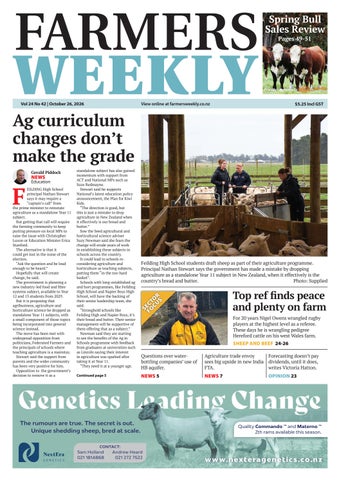
Feilding High School students draft sheep as part of their agriculture programme. Principal Nathan Stewart says the government has made a mistake by dropping agriculture as a standalone Year 11 subject in New Zealand, when it effectively is the country’s bread and butter. Photo: Supplied
Top ref finds peace and plenty on farm
S FOECT CU OR S
Gerald Piddock
Continued page 5
For 20 years Nigel Owens wrangled rugby players at the highest level as a referee. These days he is wrangling pedigree Hereford cattle on his west Wales farm.
SHEEP AND BEEF 24-26 Questions over waterbottling companies’ use of HB aquifer.
Agriculture trade envoy Forecasting doesn’t pay sees big upside in new India dividends, until it does, FTA. writes Victoria Hatton.
NEWS 5
NEWS 7
The rumours are true. The secret is out. Unique shedding sheep, bred at scale.
OPINION 23
Quality Commando ™ and Materno ™ 2th rams available this season.
CONTACT:
Sam Holland 021 1814868
Andrew Heard 021 272 7522
w w w.nexte rag e net ic s .co.nz
2
National backs farmers and growers Farmers don’t need more bureaucracy, they need confidence, certainty and access to more customers overseas. That’s why National is focused on growing exports and supporting those who feed the world, with a goal to double New Zealand’s export value within a decade. When rural communities thrive, all Kiwis benefit.
Authorised by J de Joux, partysecretary@national.org.nz
national.org.nz/delivered/farming
3
Delivering for rural communities
We’re making good progress by delivering the UAE, Gulf Cooperation Council, and India FTAs. We’ve also: Scrapped the Ute Tax
Created Investment Boost – tax deductions on assets to turbocharge your productivity Banned full farm-to-forestry conversions Replaced the RMA Simplified unworkable winter grazing, stock exclusion and SNA rules Started tackling wilding pines and pests across the country Removed Agriculture from the ETS
National is fixing the basics and building the future for rural New Zealand.
Authorised by J de Joux, ps@national.org.nz
4
New Zealand’s most trusted source of agricultural news and information
Get in touch
Advertise
EDITORIAL
SALES CONTACTS
Bryan Gibson | 06 323 1519 Managing Editor bryan.gibson@agrihq.co.nz
Andy Whitson | 027 626 2269 Sales & Marketing Manager andy.whitson@agrihq.co.nz
News . . . . . . . . . . . . . . . . 1-20
Janine Aish | 027 300 5990 Auckland/Northland Partnership Manager janine.aish@agrihq.co.nz
Opinion . . . . . . . . . . . 22-23 Sector Focus . . . . . . . 24-26
Craig Page | 03 470 2469 Editor craig.page@agrihq.co.nz Claire Robertson Sub-Editor claire.robertson@agrihq.co.nz Neal Wallace | 03 474 9240 Journalist neal.wallace@agrihq.co.nz
Jody Anderson | 027 474 6094 Waikato/Bay of Plenty Partnership Manager jody.anderson@agrihq.co.nz
Gerald Piddock | 027 486 8346 Journalist gerald.piddock@agrihq.co.nz
Charlie Williamson | 027 510 0430 Lower North Island Partnership Manager charlie.williamson@agrihq.co.nz
Annette Scott | 021 908 400 Journalist annette.scott@agrihq.co.nz
Andy Whitson | 027 626 2269 South Island Partnership Manager andy.whitson@agrihq.co.nz
Hugh Stringleman | 027 474 4003 Journalist stringleman@outlook.co.nz Richard Rennie | 027 475 4256 Journalist richard.rennie@agrihq.co.nz Gerhard Uys | 027 239 4388 Journalist gerhard.uys@agrihq.co.nz Rebecca Greaves | 027 320 9111 Journalist rebecca.greaves@agrihq.co.nz Nigel Stirling | 021 136 5570 Journalist nigel.g.stirling@gmail.com Isabella Beale | 027 299 0596 Multimedia Journalist isabella.beale@agrihq.co.nz
PRODUCTION Lana Kieselbach | 027 739 4295 production@agrihq.co.nz
ADVERTISING MATERIAL
Supply to: adcopy@agrihq.co.nz
SUBSCRIPTIONS & DELIVERY 0800 85 25 80 subs@agrihq.co.nz
PRINTER Printed by NZME Delivered by Reach Media Ltd
Julie Hill | 027 705 7181 Marketplace Partnership Manager classifieds@agrihq.co.nz Andrea Mansfield | 027 602 4925 National Livestock Manager livestock@agrihq.co.nz
News in brief
Contents
Bremworth election
10 weeks of tech . . . . . . . 21
Rural Women . . . . . . . . . . 27 Federated Farmers . 28-31 Real Estate . . . . . . . . 32-41 Marketplace . . . . . . . . . . . 42 Livestock . . . . . . . . . . 43-45 WormFEC Gold . . . . 46-48 2026 Spring Bull Sales Results . . . . . . . 49-51 Markets . . . . . . . . . . . 52-55 Weather . . . . . . . . . . . . . . . 56
Real Estate | 0800 85 25 80 realestate@agrihq.co.nz Word Only Advertising | 0800 85 25 80 Marketplace wordads@agrihq.co.nz
PUBLISHERS Dean and Cushla Williamson Phone: 027 323 9407 dean.williamson@agrihq.co.nz cushla.williamson@agrihq.co.nz Farmers Weekly is Published by AgriHQ PO Box 529, Feilding 4740, New Zealand Phone: 0800 85 25 80 Website: www.farmersweekly.co.nz
ISSN 2463-6002 (Print) ISSN 2463-6010 (Online)
Bremworth shareholders will approve the appointment of new majority shareholder David Ferrier at the listed company’s annual meeting on November 19. Ferrier is the sole owner of Mangawhai Collective, which now holds or controls 55% of Bremworth shares. He has a long family history in wool processing. The annual meeting will also be asked to approve the election of independent directors Greg Knowles and Shelley Ruha.
Rodeo feedback The National Animal Welfare Advisory Committee is seeking public feedback on proposed changes to the Code of Welfare for Rodeos. These changes include changing the definition of a rodeo to include public and non-public events as well as updating some minimum standards and introducing new ones.
Hooper appointed Mark Hooper has been appointed chair of NZPork, the organisation representing New Zealand pig farmers. Hooper replaces Paul Bucknell, who has retired from the board after 10 years. “New Zealand’s pork sector has a strong environmental record and upholds some of the highest animal welfare standards in the world,” Hooper said. “With greater certainty around welfare rules, pig farmers can now invest confidently in their farms, adopt new systems and continue building a resilient future for the sector.”
Fonterra vote FINE DINING: Kiwi chef Chantelle Nicholson prides herself on her use of seasonal food in her Apricity Restaurant in Mayfair, London. STORY P18
Fonterra’s annual meeting of shareholders will be a hybrid meeting on November 12 with most interest surrounding the election of two farmer-directors from among four candidates. Those candidates are two-term director Cathy Quinn, seeking a third term, and newcomers Jessie Chan, Mark Cox and Peter Moynihan. Each shareholder may vote for one or two candidates in a first-past-the-post format.
Know who’s in your corner. Kiwi-owned, backing Kiwi farmers. A dedicated manager there when you need. Whether you need livestock finance or a farm loan, we’ve got rural managers across the country, ready to chat. Find yours at heartland.co.nz/rural-loans Heartland Bank Limited’s lending criteria, T&Cs and fees apply.
John Pearce Rural Manager, Gisborne, Hawke’s Bay, Wairarapa & Manawatu
5
News
5
FARMERS WEEKLY – farmersweekly.co.nz – October 26, 2026
Rising concern over exporting aquifer water Rebecca Greaves
NEWS
U
Resources
NCERTAINTY over water security on the Heretaunga Plains has concerned locals asking why water-bottling companies are being allowed to take water from the Heretaunga aquifer and send it offshore. OnePure International is one water-bottling company based in Hawke’s Bay. Its website says water is bottled at source “from the mineral rich Heretaunga Plains aquifer in the abundant Hawke’s Bay”. It says the aquifer has “enormous capacity”. But a recent Farmers Weekly special report highlighted that the Heretaunga aquifer is not unlimited – and is in fact depleting. Hawke’s Bay Regional Council (HBRC) said science has shown the aquifer is not as plentiful as previously thought. It has taken a number of steps to address the widening gap between supply and demand for water on the Plains, including the controversial TANK Plan Change, cutting water allocations to consent holders. OnePure is available in New Zealand and exported around the world. Concerned locals have contacted Farmers Weekly to Continued from page 1 They are not just going to pick it up at Year 12. Most people are looking at the exit door at that stage.” The Ministry of Education Curriculum Centre’s deputy secretary, Pauline Cleaver, said last week that Year 11 science will be compulsory, so all students will get agriculture-related learning within this subject rather than only those who might have selected a separate subject. Education Minister Stanford told
ask why, if the water is in short supply, it is being sent offshore. They asked if the water-bottling companies are also subject to the TANK Plan Change. OnePure did not respond to a request for an interview. In a written response to questions, Katrina Brunton, group manager for policy and regulation for HBRC, said the council is unable to say how many water-exporting companies have consent to take water as this is not something it records or monitors, and is not an assessment factor under the Resource Management Act. There are eight consents authorising groundwater takes from the Heretaunga aquifer for water bottling. Of those, three have consent to take water for water bottling use in addition to other uses, such as irrigation and food and beverage production. The eight consents have a combined consented allocation of 3.5 million cubic metres per year. However, she said actual recorded use is significantly lower than what is allocated. Brunton said the taking of groundwater for any purpose is subject to the TANK Plan Change provisions, including the need for reassessment of what can be allocated to a consent upon expiry
under the Actual and Reasonable Use method. Consent durations had been automatically extended by the government until around 2031, and the current consents and associated abstraction limits could be in effect until then, unless replaced earlier. Asked whether, given the water insecurity issue, companies should be allowed to send water offshore and if the council would reevaluate
RNZ that advice from education experts was that Year 11 is too early to specialise in individual sciences. “The primary sector is critical to our economy, and we have ensured that the refreshed National Curriculum provides a comprehensive pathway for the farmers of the future.” Stewart said whatever happens with the final decision, the school will box on. While he cannot speak for other schools, like Newman he fears those without the agricultural
resources that Feilding High School has may choose to opt out of teaching it altogether, he said. “It’s the kids that will miss out.” It would take away opportunities for top kids to progress and do something they enjoy, he said. “If we want more people to create businesses like Halter and Rocket Lab they have to invest in that, otherwise we’re just going to be a consumer nation. “Science and technology and those sorts of subjects – I believe they are really important for us as a country.”
The TANK Plan Change ... does not provide a preference or priority for one use of water over another. Katrina Brunton HBRC
CONSENTS: Katrina Brunton says there are eight consents authorising groundwater takes from the Heretaunga aquifer for water bottling. Photo: Dreamstime consents, Brunton said this was not specifically addressed in the council’s regional plan provisions. “The current plan provisions allow consent holders to apply to replace their consents for water bottling, subject to the same provisions that apply to other industrial/commercial consents. Under TANK, this requires the reassessment of what can be re-allocated based on the Actual and Reasonable Use method.
This approach looks to reduce over-allocation of the aquifer by effectively clawing back allocated but unused water, she said. “The TANK Plan Change provisions provide an opportunity for the council to review the quantities of groundwater allocated to each consent holder upon expiry, but [they do] not provide a preference or priority for one use of water over another, except for providing for growth in municipal, community, marae or papakāinga drinking water supplies.” Unless changes in the allocation approach to water-bottling use are directed through national direction developed by central government, or as proposed through the new planning system in the new Natural Environment Plan that the region must prepare in 2028, all consent holders are entitled to rely on the consents they hold, which now do not expire until around 2031.
This week’s poll question: Should the government back down over plans to remove agriculture as a Year 11 standalone subject? Have your say at farmersweekly.co.nz/poll
SPRING INTO TILLAGE Get your ground ready with AMAZONE
With AMAZONE cultivation equipment, you can prepare your paddocks with the performance, precision and reliability you need for the season ahead.
FINANCE P.A. FROM
*
0%
ON ALL IN-STOCK AMAZONE CULTIVATION MACHINES
“The Catros performs well in all conditions, wet and dry, stone and sand, it’s consistent everywhere you go. Stones bounce through it, and it is easy to use if you understand cultivation.”
26-167
Paul Everest — Dairy Farmer
Speak to your local AMAZONE dealer to find out more. *
Terms and Conditions apply. Offer valid until 01/12/2026 or while stocks last. Finance establishment fee of $295. Images illustrative only
6
6
News
FARMERS WEEKLY – farmersweekly.co.nz – October 26, 2026
‘Laggard’ NZ left behind as ag tech advances Annette Scott
TECHNOLOGY
T
Trends
HE primary sector, particularly the pastoral sector, is at risk from stifling regulation and a drop in research funding, a leading scientist says. In his keynote address to the New Zealand Institute of Agricultural and Horticultural Science (NZIAHS), Grasslanz chief technology officer John Caradus said that NZ has become “a laggard”. “We face several challenges, one of which is increasing productivity. “Research and Development has a significant role to play in achieving solutions and while there’s acknowledgment of the issue, the problem is we have not got a solution,” he said. “Research is coasting on past investment in building knowledge.” It will come to a stop without more investment and a funding
system that builds depth with money for both short and the long term. “Funding support is stagnant, primary industries and bioeconomy decreasing to just 22% of the total science investment by government by 2030. We need change. “We need visionary leadership to drive solutions to the challenges and support for primary sector investment in R&D.” A recent overview of NZ’s agriculture productivity concluded that agricultural total factor productivity remains lower than OECD averages mainly because NZ devotes insufficient resources to agricultural R&D. “We continue to fail to reach full potential because of low investment from both public and private sources.” Caradus said NZ’s agricultural innovation system has three issues blocking co-innovation and impact: competitive science in silos, laissez faire innovation,
and a lack of science-centred innovation. NZ has fallen behind everyone else in the OECD in not allowing genetic modification. The most sustainable path to achieving food security is by increasing crop yields instead of clearing more land, accompanied by the improved ability of crop plants to cope with biotic and abiotic stresses. Additionally, climatic events, competition for and use, biosecurity incursions, energy use efficiency, changing consumer preference, and creation of new added-value food products all pose challenges for declining plant productivity. “Genetic technologies can assist us to deliver against these challenges confronting grassland agricultural systems and plant breeding with increased precision. “All plant breeding is humandirected evolution. “The problem is while it’s become more precision direct,
DELIVER: Grasslanz chief technology officer John Caradus says genetic technologies can assist NZ to deliver against the challenges confronting grassland agricultural systems and plant breeding. Photo: Annette Scott
so have regulations, stifling opportunity.” Gene technologies are not going away. “We cure cancer with genetic engineering but ban it on farm.” The Gene Technology Bill is currently on hold, awaiting the election. “NZ needs to sort out its position here; we are stagnant at the moment with almost every country where NZ inter-relates having more permissive regulation or considering it.” NZ once led the way as a pioneer in plant breeding with exports to OECD countries, including trading
partners Australia, the United States, the European Union, Japan and South Korea, averaging $2.25 billion a month from 2014 to 2024. Recent legislation changes in the EU have indicated that come 2028 plants developed using new genomic technique (NGT) will have a more permissive regulatory framework to be grown in the EU. “NZ’s gene regulation rules are not in harmony with the EU’s and that could shut NZ out of the EU market. “NZ is clearly now an outlier, being overly cautious, taking the soft route and leaving us behind the rest of the world.”
Halal muddle leaves New Zealand processors in limbo Nigel Stirling
STALLED: The New Zealand Islamic Development Trust has been unable to certify meat exports as halal for the United Arab Emirates since its government decided not to renew the trust’s registration as a Halal Certification Body last month.
NEWS
Processing MEAT companies have been unable to export to a key Middle Eastern market for the past month after the body that provides halal certification to most of the industry’s plants had its accreditation withdrawn. The New Zealand Islamic Development Trust (NZIDT) has been unable to certify meat exports as halal for the United Arab Emirates since its government decided not to renew the trust’s registration as a Halal Certification Body last month.
This has meant meat halal certified by NZIDT for the UAE market – the industry’s second largest in the Persian Gulf after Saudi Arabia, and worth $60 million last year – had been unable to be shipped since the trust’s
registration was cancelled on September 24. “The Ministry for Primary Industries managed to get an exemption for anything that was certified and on the water as of that date but anything beyond that
date – inventory that we held or product that was made after that date – has not been able to be shipped,” one large exporter said. “There was no justification given, they just decided they were going to change and we are all in limbo until we get a new halal approver in place.” The impact is not confined to just a few industry players. “Everybody uses the same provider,” the exporter said. According to MPI, there are two remaining Halal Certification Bodies accredited by the UAE government. However, neither has extensive coverage of NZ meat plants. “One certifies just the one red
meat plant and the other is new to NZ,” said another exporter. Negotiations are now being fasttracked to get contracts quickly in place with the new certifiers so certifications can resume before the new production season gets into full swing. It is understood the Meat Industry Association is conducting the negotiations on behalf of its exporter members, who are receiving daily updates. In the meantime exporters are bracing for price increases. “They are going to be more expensive than the old provider but we have no leverage as every day that goes by is another day with no trade,” one exporter said.
Knock down grass weeds for thriving forage crops Remove grass weed competition in a wide range of forage crops and allow them to thrive. A combination of SeQuence® and Bonza® Gold will control over 20 grass weeds. Contact your local Rural Supplier or Nufarm Business Development Manager today.
1000OLLD
BONZA G NOW AVAILABLE
0800 NUFARM | nufarm.co.nz
® seQuence is a registered trademark of Nufarm Australia Limited. ® Bonza is a registered trademark of Nufarm Limited.
News
7
7
FARMERS WEEKLY – farmersweekly.co.nz – October 26, 2026
Envoy sees big upside in India FTA Richard Rennie
NEWS
S
Trade
PECIAL Agricultural Trade Envoy Nathan Guy’s recent intensive trip through India provided an insight to the size of the free trade prize as the NZ-India FTA began last week. Guy travelled on a trade visit focusing on the key products standing to benefit from the deal, which officially commenced on October 20. The trip included visiting two Centres of Excellence, one for kiwifruit and one for apples, established under the collaborative pillar of the agreement to offer New Zealand expertise and assistance to Indian growers. Other visits included contact with bankers, a hotel chain and honey, wine and lamb exporters. “I came to realise during the trip we have a country of 1.4 billion of whom roughly half are vegetarian and half are meat eaters. Either way NZ stands to win,” Guy said.
The Indian economy is undergoing rapid expansion and urbanisation, with its GDP growth rate of 7% making it one of the world’s strongest performing economies, running at double the global average. This month the International Monetary Fund upgraded its forecast for India, citing solid domestic growth, strong services activity, and good investment momentum. Guy contrasted the India FTA with the one signed with China in 2008. “They talk about five to 10 years being a short time in India. You must keep turning up and build long-term relationships, and a trusted supply chain.” Compared to China, which has a centralised government focused upon feeding its population well in the wake of food safety scares and a growing need for protein, India’s needs differ, he said. “We also had first-mover advantage in China. They needed food and we were the best then, and now, at providing that quality
VALUED: Nathan Guy, left, with Himanshu Arora, Zespri’s head of APAC South division, in Delhi.
property a week in the past year. “They are crying out for high-quality products, and our reputation is strong as a highquality supplier.”
food for them.” He met with executives of the luxury Taj hotel chain, who, according to the Times of India, have signed on one new hotel
India’s ability to generate sufficient food, albeit sometimes unevenly distributed, has made it a net exporter of some products including beef, rice, dairy and some fruits. It is a net importer of other fruits, including apples, and some cereals and cooking oils. Whereas China is a communist state with 70% of listed businesses ultimately controlled by local or central government, India is a democracy across 28 states. “It means the ease of doing business is different in almost every state, with different rules and regulations. Building a relationship and long-term partnership with people in those states is vital.” During his visit, Guy and officials met with ANZ bank, which has a presence on the sub-continent, and he believed this would make transactions easier for parties on both sides of any deal. A direct air link between the two countries remains elusive and Guy said he understands the government and airlines are exploring options there.
Dairy eyes WTO case as Canada dispute heats up Nigel Stirling
MARKETS
Dairy
A LEGAL challenge by New Zealand against damaging Canadian milk subsidies could be on the cards if new trade talks cannot resolve the matter soon. The NZ dairy industry has for two years been calling on the government to take a case to the World Trade Organisation to address the “urgent” problem of subsidised Canadian dairy production undercutting its exporter members in the United States and other markets. The Dairy Companies
Association (DCANZ) would give only qualified support to the government’s announcement on Monday of an annual “trade and investment dialogue” to boost trade and “work through challenging international and domestic trade issues” between the two countries. “DCANZ welcomes efforts to strengthen trade with Canada but says a process of annual talks will be too slow to resolve pressing dairy concerns. Canada’s subsidised dairy exports are already harming NZ exporters in global protein markets,” chief executive Kimberly Crewther said. Farmers Weekly understands the first talks between Trade Minister
Todd McClay and his Canadian counterpart could come as early as next month’s meeting of APEC trade ministers in Shenzhen, China. “We are going to give it a real shot to try and work it through but if it does not work then we reserve the right to take other action and we are getting closer to the end where those options are getting fewer,” a source close to the Beehive said. In the meantime, lawyers at the Ministry of Foreign Affairs and Trade are finalising their advice to ministers on NZ’s chances of success at the WTO. Recruitment of other dairy exporting countries to potentially
Lamb Growth Paparata Priority
Lambs killed at 40kgs & above 300gm/day liveweight growth rates achieved FE Testing for 26 years CARLA testing for worm resistance Methane Testing for lower emissions Eye muscle scanning
join NZ as litigants is ongoing. The insider conceded that the recent escalation of tit-for-tat tariffs between the United States and Canada meant NZ would be pressing the issue of reform to its milk pricing system at a “sensitive” time for the Canadians. However, Crewther said the US-Canada trade war had the potential to raise the costs to NZ exporters of Canada’s dairy policies even further. The association has previously estimated that the cost of reducing margins on high-value protein products to compete with subsidised Canadian competitors was depressing NZ exporters’ returns by $256 million annually.
Canada’s subsidised dairy exports are already harming NZ exporters in global protein markets. Kimberly Crewther DCANZ “Our concern is the North American dispute creates additional risks for us in that it risks displacing more of the subsidised products into other markets that we compete in,” Crewther said. This increases the stakes in the upcoming talks between NZ and Canada, she said.
38th Annual Ram Sale
on farm, Tatu Ohura, Thursday 19th November, 2026 www.paparata.co.nz Trevor Johnson on 027 2209 567 Seymour Spence 027 8810 685
8
IT STARTS
Your fertiliser decision deserves more than a quick phone call.
ON YOUR FARM
Helping grow the country
Backed by a wider team
News
9
9
FARMERS WEEKLY – farmersweekly.co.nz – October 26, 2026
US farmers come out swinging at hearing Nigel Stirling
MARKETS
HE United States sheep industry has hit back at claims that increased imports of Australian and New Zealand lamb are filling gaps it is unable to fill itself. A procession of US farmers and processors appeared in front of the International Trade Commission in Washington DC on October 17 (NZT) during a one-day hearing to determine whether imports are causing or threatening to cause serious injury to the local industry. NZ’s ambassador to the US, Chris Seed, told the hearing that lamb imports from NZ had “remained steady” at 13-15% of US total lamb consumption over the past two decades with “minor fluctuations” in response to US consumer demand. “NZ lamb supply to the US plays an important role in meeting US consumer demand, supporting unique market segments for which there is insufficient US supply, and helping to grow overall consumption of lamb in the US to all producers’ benefit,” he said. NZ and Australian exporterowned US importer Greenstone Meats president of sales, Brian Holland, said NZ and Australian exporters supply the smaller size
The domestic producers that have struggled the most serve the heavy-lamb segment, which reflects a shift in demand, not imports. Brian Holland Greenstone Meats
FLOCK: Wyoming sheep farmer and former American Sheep Industry Association president Brad Boner says poor prices in 2024 and 2025 led US farmers to reduce flock sizes. Photo: Pexels Superior Farms, which accounts for up to 20% of total lamb slaughter capacity in the US, blamed the loss of a major customer in 2024 to competition from imports. “Another customer, who expressed a strong desire to maintain a US source, told us we could not compete on price,” Barba said. He said claims by Australia and NZ that idle processing capacity had caused the US industry’s poor profitability ignored the
role played by imports in keeping prices low and squeezing supply from farmers. Wyoming sheep farmer and former American Sheep Industry Association president Brad Boner said poor prices in 2024 and 2025 had led US farmers to reduce flock sizes and left them unable to take advantage of a rebound in US domestic lamb prices this year. Boner said import restrictions were needed to restore farmer confidence.
Don’t leave your lambs’ health to chance.
“Growers need to have confidence that another wave of low-priced imports will not drive prices back down,” he said. The ITC has until November 13 to determine whether imports are injuring the US sheep industry or posing a risk of injury. If injury is proven, the commission must hold a further hearing on possible remedies by December 1. It then makes formal recommendations to the US president, who has 60 days to decide whether to implement these or not. NZ lamb exports to the US currently face a 13.2% tariff. The ASI, which filed the complaint currently being investigated by the ITC, has previously suggested a 21% tariff just to maintain its own farmers’ share of US lamb consumption. Australia and NZ account for 99% of lamb imports into the US.
In fighting clostridial diseases, not all 5-in-1 vaccines deliver the same advanced protection! See the trial that shows which 5-in-1 vaccine to invest in this season:
sheepvax.co.nz/get-more-with-multine
Are you a gambler or an investor?
NZ’s leading clostridial vaccine range.
sheepvax.co.nz/get-more-with-multine ACVM No’s: A934, A935, A11311 & A11766. Schering-Plough Animal Health Ltd. Ph: 0800 800 543. www.msd-animal-health.co.nz © 2024 Merck & Co., Inc., Rahway, NJ, USA and its affiliates. All rights reserved. NZ-MUL-240800003
KIGST_2396_FW_B
T
Sheep and beef
of cuts demanded by the largest foodservice and retail customers. Holland said research from the US sheep industry itself showed US processors sourcing lambs weighing less than 100lb expanding production. “The domestic producers that have struggled the most serve the heavy-lamb segment, which reflects a shift in demand, not imports,” Holland said. Imported lamb also ticks antibiotic and grass-fed boxes for US customers as well as providing more consistent meat yields. However, these claims were rejected in testimony from US farmers and processors who laid the blame for poor profitability and declining sales squarely at the feet of imports from Australia and NZ. The testimony of Greg Gunthorp, the fifth-generation owner of Gunthorp Farms, a 240 acre sheep and pig farm in Indiana with its own processing facilities, was typical. “We sell exactly the same types of lambs that the New Zealanders sell – smaller, grass-fed lambs,” he said. “The issue is that even loyal customers do not buy our lamb because we cannot compete with imports on price.” Carlos Barba, the vice-president of sales for California-based
10
10
News
FARMERS WEEKLY – farmersweekly.co.nz – October 26, 2026
Kawerau keen to set success on its terms Richard Rennie
ROAD
POLITICS
A
Road to the Election
T JUST over 70 years old, Kawerau can claim to be New Zealand’s youngest town district, created on the back of the mighty Tasman pulp and paper mill. Today the mill has closed, and times have been tough, but community leaders and businesses see a town re-inventing itself on its own terms. It has them weaving a path between government-funding austerity and the natural assets of location, energy, and forestry that prompted the mill town’s genesis back in the 1950s. Keen to work to set their district’s future on their terms, they are looking to central government this election to provide foundations of housing, education and health to underpin Kawerau’s renaissance. Kawerau District Council mayor Faylene Tunui freely acknowledges work remains to be done to restore its economy to its healthy heydays. “Tasman Mill was very much the main event back then, but there
to the
ELECTION Kawerau Location – eastern Bay of Plenty Population – 7680 Industry – farming, forestry, engineering, geothermal energy was little thought about when the mill’s gone, what is left?” The Act of Parliament that created Tasman Mill bought a prosperous mill town to life. However, it also left a legacy of land and water waste that turned the Tarawera River into the infamous “black drain”, often smelled before it was seen. Meantime the bustling population of 9000 in the 1980s dwindled to a trough of 6000 in 2013. Since then, however, it has enjoyed a healthy recovery, with a large young Māori family population alongside a growing population of older retirees. “We have been trying to create a plan for the district on the run
really, while dealing with the legacy left behind,” Tunui said. This has meant trying to encourage more sustainable and steady businesses in the town. She points to the commissioning this year of the Eastland Generation and Ngāti Tūwharetoa geothermal power station project, generating 49mW, sufficient to supply 50,000 homes. The town’s largest remaining paper mill, employing over 200 people, is owned by Swedish company Essity. Last year Essity invested $20 million into its tissue plant to run it on geothermal energy and today is proudly claimed to be the world’s first tissue processor run wholly on geothermal steam production. In looking to reinvent itself, Tunui admits Kawerau has made a mistake common to others facing decline. “Leadership was trying to replace the mill with new business options. But those businesses already here felt ignored. We then opted to play a retention game with those already here, and doing well.” That includes a raft of heavy engineering firms that evolved in the mill’s shadow and have
REAL: After having its creation dictated by a top-down Act of Parliament, Kawerau’s mayor Faylene Tunui says central government’s role should focus on the basics of housing and affordable food, leaving communities like Kawerau to set their growth pathway.
since diversified across multiple processing sectors. With its good rail head, easy road access, geothermal energy and this base of engineering heritage, the town’s appeal to new entrants is well founded. Forestry biofuel company Foresta is a new arrival. Foresta’s business development manager, Dean Ormrod, speaks highly of a council keen to help the company establish in the new Pūtauaki Trust industrial zone. After years of central government pushing local councils on plans and legislation, Tunui said Kawerau has developed
its own plan for its future, highlighting the parts most attractive to the government of the day. Looking to the next general election, Tunui said there is underlying resentment at her tiny council being forced to be absorbed into a wider Eastern Bay of Plenty unitary authority. “I have already said publicly that we are like a reluctant bridesmaid.” Also, over the next three years she would also like to see “real basic stuff” taken care of, including more housing and job training linked to specific industries.
Don’t leave mating g season to chance.. Get individual heat & health insights for every single cow 24/7 – 365 days of the year.
Heat detection Accurate heat detection that works 24/7– 365 days a year
Track key metrics Automatically track progress through the season
Mating insights Identify non-cyclers, slow recoveries, or slipped cows early
Feed accurately Meet your herd's feed requirements every day of the year
Learn more at halterhq.com
News
11
11
FARMERS WEEKLY – farmersweekly.co.nz – October 26, 2026
Steady hand from central govt is needed proposals to give first farm buyers a chance to tap into their savings for a property. They have already taken advantage of more affordable house prices in nearby Kawerau, buying a property as an investment. “The price difference between Kawerau and even nearby Edgecumbe was significant. Kawerau was over $100,000 more affordable.” They are also hoping the government’s Investment Boost policy that allows businesses to immediately deduct 20% of the cost of new assets in year one remains. Meantime the couple, who employ five staff, are hoping the minimum living wage, which they are committed to paying, does not increase significantly under the next government’s watch. “It is now $29.90 an hour and went up 9% in one year.” He also hopes the next govern-
Richard Rennie
POLITICS
D
Road to the Election
AIRY farmer Thomas Lundman sees some easy wins for the next government that would be a big help to the next generation of landowners he intends to be part of. He and his wife Alice farm only minutes from Kawerau, milking 1100 cows on a contract-milking job that has the young couple firmly on an upward trajectory, boosted by Thomas winning the 2025 BoP Dairy Manager of the Year award. “We have seen milk prices keep up enough to combat most of the farm inflation we have seen. “But if those prices stalled, things would get tight quickly, particularly if interest rates come up.” With that in mind, he’s hoping
STEADY: Award-winning dairy farmer Thomas Lundman is keen to see a continuing steady hand from the government, hopefully to ensure interest rates remain lower, and farm cost rises slow. the next government can ensure rates stay low. “And that can only come with the government maintaining its financial discipline.”
He is looking for “more of the same” approach after the election, with a steady hand on policy. He and Alice have been encouraged by the KiwiSaver
If those prices stalled, things would get tight quickly, particularly if interest rates come up. Thomas Lundman Contract milker ment tries harder to protect valued farmland from the creep of not only houses, but also solar panels. “There are a lot in the Edgecumbe area, and it is hard to see how you can allow them on what is very good quality dairy land there.” Hailing from the deep south, Thomas said they enjoy farming in the Kawerau district and are encouraged by the positive signs coming from their local town. “I think things are looking up. There is more investment both commercial and industrial. Of course there are rough parts, but it has a lot going for it.”
Location, laws make a good fit for Foresta Richard Rennie
POLITICS
A
Road to the Election
COMBINATION of positive government policies and natural assets have been played together to make Kawerau the base for biofuel company Foresta NZ. The company is on track to turn the first sod in 2027 on its 10 hectare site within Kawerau’s Pūtauaki Trust industrial site, with hopes its plant will be producing wood-sourced bio-chemicals and torrified wood fuel pellets by 2029. Foresta’s business development manager, Dean Ormrod, said initially it had considered Taupō
or Rotorua for the bio-refining site. “But the penny dropped quickly when we looked at Kawerau. It has everything we need including rail and road access to a port, geothermal energy and of course wood processing background that includes skilled staff.” He also pointed to government fast-track legislation as playing a positive part in getting Foresta’s proposal off the drawing board and into the consenting planning process. “We were accepted as one of 12 in the Bay of Plenty and are currently working through it.” He said the key benefit of fasttracking is how it will streamline the consenting process, to obtain
the approvals required to get over the line. It has meant the company can get on with sifting through potential investors, and Ormrod said there are multiple overseas investors keen to participate in the plant’s ownership, and ultimately in the biofuel pellets it will generate. He also said the government’s changes to the Golden Visa programme had increased high net worth individuals’ awareness of opportunities here. The company is seeking investment of about $400 million for its process plant. Forest feed stock supply has been secured through PF Olsen, and a non-binding term sheet has been signed with Genesis
You’re warmly invited to our...
INVESTMENT: Foresta business development manager Dean Ormrod, left, and Rafael Moradei, Foresta supply chain manager. The company is seeking investment of about $400 million for its plant. Energy for wood pellet supply to Huntly power station. Ormrod said few Kiwis may appreciate just how significant the scale of demand is for the pellets, and just how great NZ’s ability
to supply timber out of forests around Kawerau is. “We can see Foresta creating 200 jobs for construction, and 70 jobs in the plant, and it is a very good fit for Kawerau.”
30-31 OCTOB BER 10AM-4P PM, FRI & SAT
OPEN DAY
Come and discoverr your space to live – where spacious grounds, luxxurious villas and impressive amenities come togeth her with a vibrant, social community. Explore the village, meet some of the locals and discover a life you’ll love. Come along, bring the fam mily – no booking needed.
10 Teviotview Place, Amberley, North Canterbury. Only 35 minutes from Christchurch Airport.
0800 573 573
amberleycountryestate.co.nz
12
12
News
FARMERS WEEKLY – farmersweekly.co.nz – October 26, 2026
Collaboration gets things done in Kaipara Hugh Stringleman
POLITICS
ROAD
Road to the Election
M
AJOR capital works in water storage, irrigation, harbour wharves, flood control and electricity generation have boosted Kaipara District over the past three years. The southern region of the Northland electorate, containing about one-third of total voters, has benefited from multi-party support. Farmer and former mayor Jason Smith, Matakohe, said the big-ticket infrastructure items completed in the past three years hold great economic promise for the western region of Kaipara District. “They generate power and produce and are substantial million-dollar investments for the future. But voters are more concerned about cost of living, paying the bills and fuelling the car.” Eastern centres like Mangawhai and Kaiwaka have civic projects and private developments, like world-leading golf courses, that are closer to the people. “This small district with a small population is growing a very interesting profile,” Smith said. Commercial activity in
to the
ELECTION Dargaville Location – Kaipara District Population – 5170 Industry – agriculture, horticulture, manufacturing, forestry Dargaville is changing under the influence of website ordering and purchasing. The previous Labour-led government offered a $3.5m building fund to include a town hall, library and community hub, but that wasn’t taken up. Instead, the council is proposing to demolish the 1950s Northern Wairoa War Memorial Hall and this is being strongly opposed by townspeople. The ratepayers’ and residents’ association will seek a High Court injunction to stop demolition. Kaipara District Council has also tried to stay out of local government reform in Northland, specifically against the amalgamation terms laid down by central government. “The council ignored the riding instructions and has misled the
people and I expect that after the election that will become a controversy,” Smith said. Kaipara Kūmara managing director Anthony Blundell said he is disillusioned with politicians, especially their various policy announcements about supermarkets. National’s announcement about splitting up Foodstuffs supermarkets was very upsetting, along with the policies of other parties, he said. “We have robust discussions with wholesalers and retailers every year, but ownership of the stores is not the main issue facing the country.” Blundell said fruit and vegetables are unfairly nominated as being too expensive whereas fast foods are never criticised. The bad state of highways and back-county roads is very concerning to the 27-year veteran volunteer firefighter. The money going into the Warkworth to Te Hana tollway would be better spent on road maintenance, he said. The recent $5m replacement of the main floodgate on the Raupō drainage scheme near Ruawai was welcomed by Blundell. Kaipara farmer and regional councillor John Blackwell said in his experience Northland’s
PRODUCTIVE: A new $5 million floodgate on G canal near Ruawai was opened in May and protects some of the most productive farm land in the country. politicians from all parties work together for the region’s good and are very accessible. “They have provided cross-party support for these big infrastructure projects. “We have got the new motorway commitment, but we haven’t quite got the Marsden Point/Northport rail spur go-ahead. “It is all set to go, so for the next government that should be a priority, in my view.” Farmers welcome RMA reform and the cutting of red tape. Blackwell, who is a former Kaipara District councillor and Federated Farmers Northland
president, said one unitary council for the whole province is the only viable proposal. He expects central government to override Kaipara and require provincial amalgamation. Beef breeder Colin Rowse, at Awakino Point adjacent to Dargaville, said recent floodgate renewals on the Awakino creek and the Kaihū river have complemented the big $5m project near Ruawai. “We all are low-lying, tidal and subject to flooding down the mighty Wairoa to the Kaipara harbour so we must have those control schemes working well.”
Partnerships and innovative thinking are key Hugh Stringleman
POLITICS
Road to the Election DARGAVILLE is a major population centre in the Northland electorate and the central office site for the Kaipara District Council, one of the most sparsely populated local government areas in New Zealand. Founded in 1872, it was the
commercial centre of kauri gum and logging industries worked by Dalmatian migrants, and the make-up of Dargaville contains many descendants alongside tangata whenua. It has a static population of 5000 and is situated at the western end of Kaipara District, while the rapidly growing Mangawhai population centre is at the eastern end. This dichotomy has been
contentious and continues to generate friction in resourcing and local government representation. Kaipara mayor Jonathan Larsen said the region has made good progress in the past three years with support from central government for roads, flood protection, stormwater and water infrastructure. “Our small rating base, relative to our size, geography and
Enrolments open now!
Training available across agriculture, horticulture, processing and support services. Talk to one of our Training Advisers today to learn more about our courses and how they can help you and your business. primaryito.ac.nz 0800 20 80 20
productive rural economy means we need significant sustained investment in dependable roads, resilient infrastructure and services. “The best results come when central government, councils, communities and private investors work together,” he said. Typical was the new G canal floodgate on the Raupō scheme, a $5 million joint venture protecting some of the most
productive farming land in the country. “From central government and the Raupō Drainage Committee to local landowners, engineers and contractors, this project shows what can be achieved through partnerships and a bit of innovative thinking.” Larsen said the central government’s rates cap doesn’t make the cost of running a council disappear.
News
13
13
FARMERS WEEKLY – farmersweekly.co.nz – October 26, 2026
Young sheep breeder finds flock of mentors Hugh Stringleman
PEOPLE
H
Sheep and beef
E IS not yet old enough to study agriculture at high school, but 15-year-old Jasper Hewlett-Coffey already has the knowledge and skills to teach the subject. Sheep breeding has been his speciality for the past six years, having begun at the age of nine with the purchase of 10 ewes from one of New Zealand’s leading stud masters, Gordon Levet of Kikitangeo Romeys, Wellsford. Now Jasper owns Kikitangeo North Romneys and Te Kapaha Terminals for Suffolk rams, among more than 100 recorded sheep run with his family’s commercial flock. He offers ram hoggets for sale from both breeds, makes the weights, dates, observations and payments for SIL recording, and feeds his passion for sheep farming in Northland. That passion has been
recognised and encouraged by mentors such as Levet, wool classer Lance Paganini, auctioneer Cam Heggie, breeders Russell Profitt and Alex Clements and wool processor David Ferrier. They have responded to Jasper’s enthusiasm and willingness to learn, bridging what are 40- to 60-year age gaps, starting from when Jasper was only seven or eight. Jasper is the seventh generation of Hewletts to farm on Te Kapaha peninsula on the southern shore of Whangārei Harbour, between the settlements of Mata and Oakleigh on State Highway 1 south of Whangārei. He is home-schooled by mother Sarah Hewlett and father Chris Coffey, also learning practical livestock management from grandfather John Hewlett in taking full advantage of his location and whakapapa. The north-facing 230 hectare sheep and beef farm has three harbour boundaries and spectacular views of Limestone
INDISPENSABLE: Border Collie Coast was a gift from Gordon Levet and works with Jasper Hewlett-Coffey around the farm.
Island, Portland cement works and the Onerahi airport. Among his subjects in Year 10, Jasper had science and genetics, mathematics and business studies. He is disappointed that agriculture is no longer available in Year 11 but opportunities to further his knowledge of sheep farming surround his life, for example showing and stewarding at the upcoming Whangārei A & P Association annual show. Jasper said sheep farmers are keen on Suffolks for terminal lamb production and he finds them good to work with in breeding management, especially sound constitution and feet. The family farm runs 600 commercial Romney ewes, and traditionally used locally bred Poll Dorset rams from the Clements’ Manu stud for lamb production. Following Jasper’s enthusiasm, Suffolk and Suftex rams are used for commercial lamb production and Romney rams go over 100 to 120 ewes selected for breeding flock replacements. Jasper bought his first Suffolk sire ram from Russell Profitt in 2023 and he recently also bought two from Limavady Suffolks in Canterbury. He needs four or five sires to use over 40 to 50 recorded Suffolk ewes, including his home-bred two-tooth selection and the purchased rams since 2023. A similar number of recorded Romney ewes will be bred to three or four reference rams, including one Kikitangeo ram born in 2020, still with a great constitution, and two bred from Levet’s genetics. Ram breeders have encouraged Jasper’s purchasing with some discounted prices. “It is amazing how many stud breeders and industry professionals are willing to help someone young and passionate,” Jasper said.
ENTHUSIAST: Jasper HewlettCoffey has his own sheep studs to breed Romney and Suffolk ram hoggets for sale. Photo: Jasper Suffolks
For example, David Ferrier, a major shareholder in Bremworth and Woolworks, has encouraged Jasper and suggested a visit to the carpet factory in Auckland. All the Hewlett sheep are run together, commercial with recorded, except at lambing and mating. Rams go out on February 20 and scanning is between May 20 and 25, with lambing between late July and September 1, concentrated in the first two weeks of August. Docking is around September 20. Romneys have a pre-lamb shearing followed by another in late December, while the terminal flock ewes are shorn three times in two years. Jasper’s breeding objectives for the Romney wool include thick staple, good colour and lustre. Paganini, formerly a PGG Wrightson wool specialist in Northland, has taught wool assessing and introduced possible ram clients. Levet has also taught Jasper since the age of seven or eight, when the Hewletts bought a big commercial ewe group for worm resistance. They went back for 30 stud Romney 2-tooth ewes when Kikitangeo was dispersed in 2021-22.
Jasper’s Border Collie, Coast, was a gift from Levet in 2020 and faecal egg counting for the breeding of worm resistance has been demonstrated and encouraged. PGG Wrightson northern genetics representative Cam Heggie has mentored Jasper since 2020, including a visit to Mahoenui in the King Country to meet Russell Profitt at Raupuha Studs. Manu Poll Dorset breeder Alex Clements has helped with eye muscle area and intramuscular fat scanning of the Te Kapaha Suffolk ram lambs. Advice from these older specialists has been hands-on and eagerly received. All SIL requirements go to a bureau run by Barbara Beckett for uploading. Private ram sales for Kikitangeo North and Te Kapaha begin in early November with farm visits by clients. Sales in the past two years have totalled 60 rams, and this season Jasper expects to boost that tally over 100. Jasper earns other income from prime lambs, cull ewes and rearing calves and operates his own trading account.
Upgrade your boots. Get $50 off! Good boots keep you on your feet. Thanks to Safer Farms and PGG Wrightson, stepping into safer footwear is easier than ever. Simply scan the QR code, enter your details, and claim a $50 discount code to use on eligible boots $149 and over.
Visit saferfarms.org.nz for footwear tips, safety guidelines, and resources.
SCAN & SAVE! Terms and conditions apply.
14
14
News
FARMERS WEEKLY – farmersweekly.co.nz – October 26, 2026
Scars of 2025 wind event evident on land Gerhard Uys
NEWS
I
Weather
T’S been a year since 164km/h winds tore through Southland and Clutha, and the devastation the storm caused is still in evidence, with piles of trees around and clean-up work ongoing. Severe winds downed thousands of trees across the region, bringing down kilometres of power lines and leaving almost 50,000 people without power. Some dairy farmers had to dump milk. The rest of the South Island was not immune, with high winds cutting power to almost 6000 people in Canterbury and causing damage to irrigation schemes. Emergency Management Southland declared a state of emergency and arranged 34 generators for use by farmers and businesses, with the air force flying in more. FMG head of claims, Mike Cameron said by September this year they had processed 5173 claims related to the storm, and paid out $51.2m. Over $5.1m was paid for damage to centre pivot irrigators. More than 1881 farm and commercial buildings were damaged, Cameron said. Company director at Cow Power Generators in Southland said numbers on how many generators it has sold since the storm is commercially sensitive
information, but numbers are considerably higher compared to previous years before the storm hit. He said farmers had “quite the awakening” when they were left without power for extended periods. Federated Farmers dairy vicechair in Southland Kass Rauber said the bulk of the clean-up has been done, with trees that stopped fences from being repaired moved first so stock could be contained. After the wind event it has become more common for generators to be installed for housing and not just sheds. Rauber said farmers need to make sure they have backstops in their farm system. PowerNet chief executive Paul Blue said the electricity industry
You can only build so much resilience into the system. If that gets exceeded, then you have a problem. Grant Dodson City Forests has been advocating for stronger rules around trees, with some improved rules for vegetation coming into force from October this year and more coming in 2027. Blue said PowerNet did a debrief after the event and is fine-tuning incident management response and building relationships with other agencies to better
WIND: Hedges came down, taking fences and power lines with them.
DEBRIS: A year on since the October wind event in Southland and Clutha, evidence of the wind’s ferocity is still around, with wood piles waiting to be chipped. understand shared challenges. The CEO at City Forests, Grant Dodson, said they have focused their harvesting on salvaging wind-blown trees before they rot. City Forests manages a 25,000 hectare estate in Otago-Southland, and estimated losses from the wind event at about 500ha. Dodson said salvaging wood is hard because affected sites are scattered across a wide area. Domestic mills have taken salvaged wood. City Forests is “pushing replanting hard” and trying to create wind-stable edges in new blocks. “You can only build so much resilience into the system. If that gets exceeded, then you have a problem.” Paul Balneaves, previous general manager of DT Kings in Otautau, who has been chipping wood for farmers, said there are still piles of wood lying around. Wood was stacked and left until this year because there was more
wood than there was demand for chipping. Chipping is generally used for animal bedding. DT Kings is waiting until farmers have animal housing ready to receive chips before it will start chipping again, avoiding double handling. Doug Bickley, who runs six farms around Southland, said multiple houses across the six farms were hit by a power outage during the storm. Like many farmers, Bickley had supplied generators to the houses to keep freezers going with staff sharing generators on a day-on, day-off basis. Bickley said they have since bought one generator for a house, and already owned two generators. They lost cow sheds, hay barns and calf sheds, but these have been repaired. Farming in extreme conditions might be the norm in future, he said, with the winter wet and cold this year the worst he has seen.
Fonterra’s 25-year influence on milk prices Hugh Stringleman
NEWS
Fonterra HIGHER farmgate milk prices and increasing stability are top of the list of achievements for dairy farmers from Fonterra’s 25 years since formation in October 2001. The co-operative’s shareholders and those supplying other New Zealand processors have lately enjoyed $9-plus kg milksolids after a shaky start when eight of the first 14 annual payouts were under $5. Some higher payouts were immediately followed by precipitous falls, including $4 and $3 movements. In learning how to handle price volatility Fonterra harnessed commodity auctions, strong demand from China and the end of European Union dairy quotas. It also benefited from favourable NZ dollar exchange rates against the US dollar, used currency hedging and futures market tools and handled product optionality with spare peak processing capacity. When reviewing the payout record of the past 25 years, has Fonterra created its own price stability, steadily improved the industry’s revenue and
repaid the faith of government policymakers? Lincoln University senior lecturer in agribusiness management Dr Nic Lees said the long-run rise in the milk price is one of the clearest measures of Fonterra’s success from a farmer perspective. “But I believe that most of the movements in farmgate milk price have been driven by factors outside of Fonterra’s control. “The milk price is fundamentally determined by international dairy commodity prices, so global demand and supply are doing most of the work. “Chinese whole milk powder imports grew rapidly between 2009 and 2014, becoming an increasingly important influence on New Zealand dairy prices. “China’s WMP imports reached around 670,000 tonnes in 2014 but fell sharply as inventories built up and demand weakened. “This was one of the major factors behind the fall in the milk price from $8.40 to $4.40 and then $3.90. “So I would say the rapid growth in Chinese demand helped lift dairy prices but also contributed to the very high volatility during this period.”
Fonterra launched Global Dairy Trade in 2008, when improved transparency and price discovery made supply and demand much more visible and helped the market respond more quickly. On the supply side, the European Union dairy quota system ended in 2015 and European production responded more to market signals. “My sense is that the lower milk price volatility since 2017 is more the result of the global dairy market becoming larger, deeper and more diversified,” Lees said. “Chinese demand has matured, US milk-powder exports have grown, NZ exports have increased, and the market is now much less dependent on one rapidly growing buyer than it was a decade ago.” The NZD/USD exchange rate is a major driver, with a weaker NZD lifting the farmgate price and a stronger NZD lowering it. As a rough example, a 10 US cents increase in the NZD exchange rate from its current level, if international prices in USD stay steady, could reduce the farmgate milk price by around NZ$1.50/kg MS. “Some of the stability farmers experience can come from offsetting movements in the
SUCCESS: Lincoln University senior lecturer in agribusiness management Dr Nic Lees says the long-run rise in the milk price is one of the clearest measures of Fonterra’s success from a farmer perspective. exchange rate and world dairy prices, as well as Fonterra’s currency hedging. “Where Fonterra can really add value is through the performance of the company itself – moving milk into highervalue products such as specialised nutrition, foodservice and other differentiated products. “I think the key question is not just whether farmers are receiving a higher milk price, but whether Fonterra is creating additional value for farmer-shareholders above the underlying commodity value of the milk.”
The most recent decade shows a steady increase and four $9-plus payouts, not to mention the Soprole and Mainland capital returns, such that farmers should feel confident, and there has been a return to dairy farm conversions. The breakeven milk price has risen to near $8.90, including farm working expenses around $6.60, and the on-farm profit margin is very tight. Milk price stability above $9 is now relied upon and Fonterra has used two decades to get to that predictable level.
15
News
15
FARMERS WEEKLY – farmersweekly.co.nz – October 26, 2026
Math skills make a shearing career add up Annette Scott
PEOPLE
Wool
W
HEN Tony Chamberlain left school at age 15, he had one goal: to be
a carpenter. “I had done well in maths and tech drawing, that’s all I needed to be a carpenter, I didn’t care much for anything else at school. “I had a job lined up and was going strawberry picking with Mum before starting my apprenticeship to be a carpenter, that was my goal and I was going for it.” The 2026 Waimate Shears this month saw him step onto the board for his 50th consecutive year competing in his hometown event, the goal now “to shear five sheep as quick and as clean as I can”. The youngest of 13 children, Chamberlain has lived all his near-70 years of life in the Waimate district. “The shearing took a hold by chance, even before I got strawberry picking with Mum. “I had no intention at all of
following my older brothers into the shed, but when I realised I could get 75 cents an hour in the shed against 25c an hour in the strawberry patch, the maths kicked in.” Pretty much straight to the handpiece, he was shearing 200 sheep in his first week and, driven by the challenge of bettering his brothers, he was shearing 300 a week in his first season.
I always wanted to buy a farm, so I was talked into shearing for the money as that was definitely my driving point. Tony Chamberlain Waimate “I always wanted to buy a farm, so I was talked into shearing for the money as that was definitely my driving point and the faster I shore the more money and the more saved.” By age 22 Chamberlain had his own run with eight men working for him. At that time there were 76 shearers in Waimate.
“Conquering each day was about being aware that you were working with a live animal and every time you dragged one out of the pen it was fresh and it wants to beat you. “To be a good shearer you have got to work with the sheep, not against it.” Chamberlain made his foray into competition when he entered his first Waimate Shears in 1976 and the following year won the intermediate section. He went onto shear in open competitions where he found himself up against New Zealand’s top shearers, including Sir David Fagan, and was very soon in the top 12 himself. Fagan once said backstage when asked what makes a good shearer, “I’m no different to you guys, when you get to this level it’s the top two inches that makes the difference.” Chamberlain soon figured that was about being calm and relaxed. “That meant not pacing backstage burning nervous energy before the competition.” Tragedy struck Chamberlain in 1989 when he went to get out bed one morning and was paralysed from the hips down.
TEAM WORK: Tony Chamberlain sheds yet another fleece in his 50th consecutive Waimate Shears event, ably assisted by his wife and wool handler, Sue Chamberlain. Photo: Supplied “A collapsed vertebrae put me Timaru hospital, I was completely paralysed for 48 hours and in traction for 30 days. “The doctor apologised as he told me the bad news; I would possibly never walk again, and I would certainly never shear another sheep. “I said you’ve given me the best news. You’ve given me strength to prove you wrong. I said I am going to shear again within a year.” That he did in 10 months and with a “lot of pain and suffering” was shearing at the next Waimate Shears – making history as the first to shear in a harness. If that wasn’t enough, he has
Powder keg fires up global dairy prices Hugh Stringleman
MARKETS
Dairy
RISING prices for milk powder across three types and six delivery periods have boosted the Global Dairy Trade price index by 2.5%, the biggest rise since last February. Whole milk powder jumped 4.4%, skim milk powder by 3.4% and butter milk powder was up 8.4%.
Along with mozzarella prices being up 1.3%, the strength in milk powder prices will be enough to revise upwards the farmgate milk price forecasts at the peak of the New Zealand dairy season. Fonterra may revise before its annual shareholders meeting on November 12. On the negative side of the latest auction, cheddar was down 7.4%, anhydrous milk fat down 3.4% and butter down 0.4%. NZX Dairy Insights said that
strong buying from China was behind the milk powder price increases, with just over half of the volume going that way, especially in the near-term contract periods. “NZ milk production data released hours ahead of the GDT event saw a 1.9% rise in milksolids and a new record for September collections,” NZX analyst Rosalind Crickett said. “However, the growth trajectory seems to be slowing, with reports on the ground noting that
North Island regions appear to be experiencing a drier than normal spring, with risks of El Niño in early to mid summer still being priced in, in the background. “With the largest price increases seen in C1 November delivery, last-minute restocking ahead of the festive season could also be at play, particularly with potential concerns of product accessibility in the months to come amid a backdrop of drought and ongoing geopolitical tensions.”
also battled through four heart attacks and is currently receiving treatment for recently diagnosed cancer. But there’s no holding him back. “It’s the 60th Waimate Shears next year and I wouldn’t say no; my body is probably not up to but it’s still on the radar for the 60th. “That could see a murder on the board,” wife Sue chimed in. Meantime in pending retirement Chamberlain is eyeing up relaxation on the 80 hectare property where he was born on the outskirts of Waimate, running 300 to 400 sheep and 100 cattle, “depending on what’s paying best”.
Reports on the ground note that North Island regions appear to be experiencing a drier than normal spring. Rosalind Crickett NZX Dairy Insights The global demand for whey protein is also generating more cheese products and GDT cheddar prices plummeted as inventories and export volumes grow.
Change starts with a conversation. Zoetis oral sheep drenches support a wide range of parasite management needs so you can choose options that are effective on your farm. Options include: • • • •
Combination drenches Novel drench combination Added minerals Short and long-acting protection
Have the conversation with your vet, or visit ChangeItUp.nz to find the Zoetis oral drench options that are right for your sheep.
Zoetis New Zealand Limited. Tel: 0800 963 847; www.zoetis.co.nz. Q-drench, Pentamox, Troika, Cydectin, Strategik and Startect are registered trade marks of Zoetis. ACVM No. A9291, A10983, A10598, A10353, A7388, A7700. ZOET26015_OralDrench_FW_2
16
16
News
FARMERS WEEKLY – farmersweekly.co.nz – October 26, 2026
New metric on calf potential in the works Gerald Piddock
TECHNOLOGY
A
Livestock
NEW metric that aims to help farmers make more informed calf-buying decisions has been piloted at the Frankton Saleyards in Waikato. Known as finishing value (FV), it gives an indication of a calf’s genetic potential for growth in kilograms. It represents the estimated difference in liveweight at 18 months compared with a standard beef-on-dairy calf. The measurement featured in 150 calves at NZ Farmers Livestock Dairy Beef weaner sale at the saleyards on October 19. A second sale featuring FV with a similar sized yarding will be held on November 2. FV is part of the Dairy Beef Opportunities (DBO) programme, a collaboration between the dairy and beef sectors that aims
to maximise the value of nonreplaceable dairy beef calves. FV helps identify calves with higher growth potential but, while it indicates genetic potential, it does not guarantee performance. Feeding, health, environment and farm management will all influence how an animal performs.
People are keen for something to tell them what they can’t see, the parentage of that calf, what potential for growth there is. Lucy Coleman Beef + Lamb NZ DBO lead Jenny Jago said FV will drive more efficiencies into the system by giving farmers more information about a calf’s potential. “It will be the first time there’s a bit of objective information that
goes with the calf and the farmer can look at that, along with all of the other things that they look at when making their decision.” It will also help foster more of a common language and integration across dairy and beef and will be a new way of communicating, if it works, Jago said. “It’s another piece of information that sellers and buyers can use, along with all the other bits of information that they use. “This would be an objective piece of information about their calf. “It’s an exciting step towards something that we need for the dairy and the beef sectors to be more integrated.” BLNZ beef on dairy engagement and relationship manager Lucy Coleman said the pilot was spread across the sale on October 19. The FV heifers made $750-$835 and weighed 100-110kg, the bulls sold for $900-$1200 and weighed around 105kg.
PILOT: BLNZ beef on dairy engagement and relationship manager Lucy Coleman with some of the weaner calves that were measured using the new finishing value metric. It was not expected that the FV would influence price, given that it was the first time it was used. “We’re hoping to build good momentum and if we get good feedback, we can start to roll it out a bit wider and it can become a tool that farmers are using to look at which calves to buy.” Feedback from farmers will help determine whether the measure is useful and should be developed further.
Initial feedback prior to the sale had been positive. “People are keen for something to tell them what they can’t see, the parentage of that calf and with the genetics of that calf, what potential for growth there is.” While FV will never be the primary factor that people purchase on, it will be an extra tool available to farmers to help them decide what pen of calves to buy, Coleman said.
Second shearer sentenced in PETA abuse case Gerhard Uys
NEWS
Animal welfare A NORTH Otago shearer has been placed on two months home detention for physically abusing seven lambs while shearing them. The sentence follows the widely known case where the animal rights organisation, People for the Ethical Treatment of Animals, provided the Ministry for Primary Industries with 560 hours of video footage of sheep being abused by shearers. The MPI said it responded by launching a nationwide investigation of shearing practices.
SENTENCED: A North Otago shearer has been placed on two months home detention for physically abusing seven lambs while shearing them. Photo: files Damian Walter David Fraser, 37, was sentenced in the Oamaru District Court on seven charges of
ill-treatment of sheep under the Animal Welfare Act, following the MPI’s prosecution.
He pleaded guilty to all charges. The MPI’s regional manager investigations Central and South, Gerry Anderson, said Fraser’s prosecution was the second to come as a result of a thorough investigation. “Our team spent thousands of hours studying video footage of shearing operations, and Mr Fraser was identified as deliberately abusing lambs on seven occasions.” Video footage captured at shearing sheds in Otago showed Fraser striking a lamb in the face with his shearing handpiece and stomping on an animal. Other footage showed Fraser deliberately dropping a lamb on its
head onto the hard wooden floor. That animal was then lifted, swung and it hit the floor a second time on its head. Fraser then held that animal in a way that restricted its airway. “A veterinarian who viewed the video footage says that the animal appeared to lose consciousness before being sent down the chute,” said Anderson. Another shearer identified in the PETA video footage has already been sentenced to six months’ community detention and 12 months’ supervision. Two other shearers are still before the court and are facing charges under the Animal Welfare Act, the MPI said.
Markets shift fast. You can be one step smarter. AgriHQ livestock reports give you weekly and monthly insights and forecasts so you can buy, sell, and plan with confidence.
Make every decision count, visit agrihq.co.nz
LIVESTOCK REPORTS
Subscribe from $35/month*
agrihq.co.nz/livestock-reports
News
17
17
FARMERS WEEKLY – farmersweekly.co.nz – October 26, 2026
Biosecurity career capped with Rutherford Staff reporter
NEWS
Awards
L
INCOLN University Professor of Plant Biosecurity Philip Hulme has received the 2026 Rutherford Medal for his research on invasive species and the threats they pose to New Zealand’s biodiversity, agriculture and economy. The medal was presented to Hulme at a celebration held at Dunedin Town Hall on October 15. The Rutherford medal is awarded by the Royal Society Te Apārangi for preeminent research, scholarship or innovation in any field/s of engineering, humanities, mathematics, sciences, social sciences or technology. Hulme has dedicated much of his career to understanding and reducing the threat of invasive species to NZ. His research has demonstrated how pests, weeds and diseases establish and spread
across NZ’s natural and productive land, helping to improve strategies to protect ecosystems, agriculture and forestry. His research has also highlighted how global trade, transport, tourism and horticulture impact biological invasions worldwide, and how those risks can be reduced through evidence-backed policy. Beyond NZ, Hulme has helped shape international practice and decision-making. He was a coordinating lead author of a United Nations report on invasive alien species and their control. The report, published in 2023, was approved by 143 member states and provides governments with guidance on addressing invasive species. More recently, Hulme has championed the concept of One Biosecurity, an approach that recognises the connections between environmental, plant, animal and human health. The approach provides a framework for
Professor Hulme is directly contributing solutions to protect ecosystems, agriculture and economies. Prof Grant Edwards Lincoln University
TOP HONOUR: The Rutherford Medal was presented to Professor Philip Hulme at a celebration held at Dunedin Town Hall on October 15. Photo: Supplied addressing complex risks that may be beyond traditional disciplinary and policy boundaries. Through his directorship of Lincoln University’s Centre of Excellence: The Centre for One
Biosecurity Research, Analysis and Synthesis (COBRAS), he has helped to develop research agendas and policy across government, industry and conservation organisations. He has been named a Clarivate
Highly Cited Researcher for more than a decade, placing him among the top 0.1% of scientists globally. Lincoln University ViceChancellor, Professor Grant Edwards, said the Rutherford medal was both a well-deserved honour for Hulme. “As one of the world’s most influential ecological scientists, Professor Hulme is directly contributing solutions to protect ecosystems, agriculture and economies, while also inspiring new generations to play their part in shaping a more resilient and sustainable future,” said Edwards.
Turns out local app can help track hunting parties on farm Gerhard Uys
TECHNOLOGY
Hunting
A FEATURE on a well-known New Zealand topography map phone app can help farmers keep track of hunters on their property and aid in transparency and safety. IT expert Zane De’souza, who is a co vice-president of Upper Clutha Deer Stalkers, said the organisation undertakes many club hunts on different properties, often farms, and it divides hunting areas into smaller blocks with different hunters assigned to different blocks. Traditional paper maps can be
confusing and often hunters don’t know what block they are in or where their mates are, he said. De’souza said he had wanted to write his own app to track hunters, but discovered that a location-sharing feature on the NZ Topo50 app allows different people who follow the same channel on the app to see one another’s location. To do this, simply go to the settings, create a new channel under the Channel ID setting, and enter a channel name. Once all users are on the same channel, they can track each other’s movement. De’souza said landowners who
join the same channel can see the location of hunters and can check if people are staying within agreed boundaries. Hunters can see the agreed area on their phone, which reduces the chance of straying onto parts of a property they don’t have permission for. If someone is injured or lost, the group already knows where they are, so help can reach them sooner. De’souza has gone one step further and also draws a hunting block’s boundaries on Google Earth, and imports that into the app to allow hunters to see a block’s boundaries.
THERE YOU ARE: The blue and green dots show where two different people are when using the locationsharing function on the NZ Topo50 app.
Fellow hunter and member of the Invercargill Rifle Club Foster Price said the location-sharing function in the app is just one more tool that allows landowners to have comfort about where people are on their farm. “There are many barriers to access, both real and imagined.”
Price said a farmer who has a pest problem does not necessarily want numbers of individual hunters to ask for access, but recreational hunting fraternities who are serious about pest control can use this tool for transparency and safety during hunts.
Proud Sponsors
Engineering & Industrial Supply Specialists
Buy ANY CRC product to be in to
WIN W IN A FFISHIN FISHING ISHING T TRIP RIP With Nicky Wilson & 2 mates PLUS P LUS a $ $2,000 2,,0 000 P Prezzy rezzzyy C Card ard
*Terms & Conditions apply
SHOP NOW - 34 locations NZ-Wide IF IT MATTERS, IT’S TRADEZONE.
18
18
FARMERS WEEKLY – farmersweekly.co.nz – October 26, 2026
News
UK farmers wrestle with funding change Neal Wallace in London
NEWS
FINE DINING: Kiwi chef Chantelle Nicholson prides herself on her use of seasonal food in her Apricity Restaurant in Mayfair, London.
Seasonality keeps menu fresh for Kiwi chef Neal Wallace in London
NEWS
I
Food and fibre
T WAS the asparagus for sale in London supermarkets in September that triggered Chantelle Nicholson. The New Zealand chef had just arrived in London in 2004 to start working with fellow Kiwi chef Josh Emett at the prestigious Savoy Grill. Seeing the early spring vegetable available in early autumn did not fit. Hamilton-born Nicholson’s restaurant career subsequently bloomed in London. In 2022 she opened Apricity in London’s Mayfair district, just off Oxford Street, a Michelin Green Star restaurant recognised for culinary excellence with outstanding eco-friendly commitments. She bases her restaurant offering on seasonal, local produce, a philosophy embedded by memories growing up in New Zealand and a far cry from the year-round supply of produce today’s consumers expect. Nicholson recalls a childhood when produce was bought from a local fruit and vegetable vendor or Harry’s fruit stall on State Highway 1 outside Hamilton. Friends, workmates or neighbours shared their bountiful harvest. “I grew up seeing how hard people work, so I now have the opportunity to make a sourcing decision and how I can show my support and respect to farmers and growers who create this amazing produce, which is a privilege to work with.” Nicholson said year-round production means people no longer appreciate the taste of the first strawberries or tomatoes
of the season as their palates have become desensitised by the bland and watery tastelessness of produce grown in Spanish and North African hot houses. “The expectation is to have year-round fruit like berries, but they don’t think how it arrives in their cereal bowl. “I believe we follow the flow of nature,” she said. Like fruit and vegetables, Nicholson said, intensively farmed animals lose their flavour profile – unlike those that are grass-fed. Consumers want to know where their meat comes from, how it was reared and treated.
The expectation is to have year-round fruit like berries, but they don’t think how it arrives in their cereal bowl. Chantelle Nicholson London chef Nicholson was raised in Hamilton and studied law and commerce at the University of Otago. Realising she needed a job, in her third year of study she walked into a Dunedin café. Although cooking was not a career path she had considered, she was employed cooking breakfast and baking. “I enjoyed it,” she said. For the final two years of study, Nicholson worked as a cook for a boutique hotel before moving to Wellington and a job with the Banking Ombudsman, but her passion for cooking burned bright. “My passion for cooking didn’t die and I did catering on the side.” That passion prompted her to
E U RO P E: T RAC K I N G TO M O R ROW ’S FOOD TRENDS
enter a Chef Search competition run by Gordon Ramsey with Emett a judge, requiring a menu and recipe to be submitted. She won but the real prize was an offer from Emett of a job in London. “I jumped on a plane, came over in September 2004 and started working at the Savoy Grill,” she said. For someone who had largely learnt on the job, the size of the Savoy kitchen was a shock and for two years she soaked up the skills required for fine dining. She had found her calling and her career alternated between working in the kitchen and using her degrees managing restaurants in London. She opened her first restaurant in 2011 and another in 2014 but the onset of covid made her take stock of her life and realise she wanted a more intimate venue. “I realised what I wanted to do, something a bit smaller.” Her Apricity restaurant seats 42 people and Nicholson said that size allows her to ensure guests have an enjoyable dining experience eating local, seasonal food. “We can only do what we do because of nature and if we destroy it, we can’t enjoy great food.” • Meeting the Market has the support of grants from Beef + Lamb NZ, Nedap, Silver Fern Farms, Deer Industry New Zealand, Alliance / Dawn Meats, the Meat Industry Association, Rabobank and the European Commission. https://www.farmersweekly.co.nz/ meeting-the-market/
Agriculture THE jury is still out on the impact on English agricultural production from a once-in-a generation change to support payment for farmers. This is the last year English farmers will receive direct payments, the European Union Common Agriculture Policy (CAP) era payments based on land area or production. They are being replaced by five environmental-based funds. Wales, Scotland and Northern Ireland are retaining a version of the CAP payments while English farmers face a steep reduction in direct payments. In 2020, a 450 hectare arable farm received the equivalent of NZ$247,245 a year in direct payments, a 150ha sheep and beef farm NZ$79,667 and a 105ha dairy farm NZ$54,943 – payments that represented 80% of government support for the primary sector. In 2027, the last year of direct payments, those arable and sheep and beef farms will receive $1414 and dairy farms $1098. What this means to farm production is unknown but in just six hours this month the opening round of applications for the $549 million Sustainable Farming Incentive was fully allocated with many landowners missing out. It was an outcome National Farmers Union President Tom Bradshaw had warned would happen. “Farmers charged with producing the nation’s food, delivering for nature and building the resilience of their businesses have been left high, dry and desperate,” he said in a statement. George Eustice was the Conservative government’s minister for the Department for Environment, Food and Rural Affairs (Defra) from 2015 to 2022 and said direct payments drove up land prices and benefited the largest landowners. “Subsidising land ownership made no sense. “Fifty percent of it went to the wealthiest landowners,” he told Farmers Weekly in an interview in London.
He said he does not consider it the job of government to prop up farm production but to reward for income forgone and the cost of projects to protect wildlife and improve the environment. Eustice said while some marginal areas could be taken out of production, other parts could be intensified. A bigger issue is the need for the true cost of food production to be reflected in prices paid by consumers. “Consumers will not like it but fundamentally if you want food on your table, there needs to be a structural increase in food prices to cover the increased risk and cost of production.” The UK imports about 40% of its food, a reliance Eustice said could be threatened if extreme weather hits food growing areas in Spain and Morocco. Sarah Baker, the head economist with the UK’s Agriculture, Horticulture Development Board (AHDB), said the funds are payment for farmers doing public good. “You have to provide an outcome, do some actions and provide evidence.” Annual farm support this year will be between $5.66 billion and $6.37bn, a similar amount to the annual CAP budget from 2019 to 2024 but much less in inflationadjusted terms. Amandeep Kaur Purewal, an AHDB senior economist, said direct payments contribute 60% of an arable farmer’s income and are crucial to keep some sheep and beef farmers viable. When the transition was introduced, an upfront exit grant equivalent to seven years of direct payments was offered, but Kaur Purewal said few farmers took it. Baker said modelling shows the top 25% of English farmers will remain profitable while those at the other end of the spectrum will require additional income. Some farmers are selling product direct to consumers. Others are finding alternative income from holiday stays or offfarm work. With the average age of farmers well into their 60s, Baker said, newcomers will bring with them a different approach and new ideas of diversification.
FAIRNESS: Former cabinet minister George Eustice says replacing direct payments to English farmers with environmental funding is about fairness.
19
Common ground goes a long way Before the digital revolution turned us all into news reporting and commentating experts, we paid for good journalism with newspaper subscriptions and radio and TV broadcasting fees.
team of experienced journalists and analysts at Farmers Weekly, and we still deliver it free to every farmer in the country, and there’s even more content online.
Our news sources were well researched and safe.
For us to deliver the high level of farming business news, insights and market analysis that keeps us all well informed, we need your support.
Whether we agreed or disagreed with what we read, watched and heard, we had a starting point in common for our news discussions. Now our news sources are as disparate as they can be, which means there is little common ground from which to kickstart a meaningful conversation.
Thank you to the 1292 voluntary subscribers so far. We do this for you and invite more of you to join the team. Dean Williamson CEO and publisher
LK0125679©
Luckily for our biggest export industry, we still have a big
Please don’t take it for granted.
BECOME A VOLUNTARY SUBSCRIBER SUBSCRIBER TARGET
8000 6000 4000
1292
2000
Support us with a voluntary annual subscription to Farmers Weekly.
I'm a er subscrib
$120 for 12 months. This is a voluntary subscription for you, a rural letterbox-holder already receiving Farmers Weekly every week, free, and for those who read us online.
1. Scan the QR code or go to www.farmersweekly.co.nz/donate 2. Email your name, postal address and phone number to: voluntarysub@farmersweekly.co.nz and we’ll send you an invoice.
3. Call us on 0800 85 25 80 Note: A GST receipt will be provided for all voluntary subscriptions.
Scan here
20
20
FARMERS WEEKLY – farmersweekly.co.nz – October 26, 2026
News
Taste for protein, fibre builds food sector Neal Wallace in Utrecht
MARKETS
C
Food and fibre
ONSUMERS continue to follow a high protein diet, but fibre is emerging as a desirable addition to people’s health. Cyrille Filott, the global consumer head at RaboResearch Food and Agribusiness, said demand for protein may be peaking. The unknown is the impact on demand from continued growth in the use of weight loss drugs. “I’m not saying we will see a substantial drop in protein, but growth may slow,” he told Farmers Weekly in an interview at Rabobank’s headquarter in Utrecht in the Netherlands.
Fibre is emerging as a new trend among health-conscious consumers fearing it is lacking in their diets. Large food manufacturers have released new products high in both protein and fibre, he said. “I believe fibre will be the story of 2026-27.” Demand for animal protein is expected to be sustained to the continued benefit of New Zealand dairy and meat producers.
From a consumption point of view, I would not be worried on the protein side. Cyrille Filott RaboResearch
DEMAND: The use of weight-loss drugs remains high, with users consuming protein to retain muscle mass.
“From a consumption point of view, I would not be worried on the protein side.” The use of GLP-1, the generic term for the new generation of weight-loss drugs, remains high, with users consuming protein to retain muscle mass. Previously, these drugs were administered intravenously but new pill versions have been released, reducing their cost and potentially expanding user access. Filott said between 15% and 17% of US adults have tried or are using GLP-1, with 11% to 12% using them at any one time. US President Donald Trump has negotiated a reduction in price to make them accessible to lowerincome earners, but exactly what that means to overall food trends is unclear, said Filott. Data on use of GLP-1 is difficult to get, but Filott said access is free in France, about 6% of adults in Germany and Spain are using it but it is tightly restricted throughout the rest of Europe. In England it is used by between 10-11% of the adult population. Without government assistance, it costs between NZ$500 and $600 a month, but most of the drugs will come off patent in 2030. Filott said GLP-1 has revolutionised the food sector. “It’s the biggest change in the food sector I’ve ever seen in 18 years because of these unexpected results.” One unexpected side-effect is increased demand for dark chocolate because GLP-1 users still
HEALTHY: Consumers seeking healthy diets are changing the food sector, says Cyrille Filott, the global consumer head at RaboResearch Food and Agribusiness.
want a snack but a version that is not as sweet. Consumer backlash against ultra processed foods (UPF) has led manufacturers to reduce ingredients considered unhealthy in their food products. Several states in the US have successfully taken legal action against UPF manufacturers or have legislated against some ingredients. Filott describes this reformatting of ingredients as an evolution rather than a revolution but said it signals a trend by many towards a healthier lifestyle. “There is more of a focus on health in general, people working out more and adjusting their diet, and the focus on health and food is part of that.” That trend is also reflected in a global reduction in the amount of alcohol people are consuming. The latest data from the US, for example, shows the number
High-protein food is what’s for tea in UK Neal Wallace in London
NEWS
Food and fibre MORE than half United Kingdom consumers are following diets that require high-protein food, according to research by Euromonitor. Steven Evans, the lead consumer insight manager with the UK’s Agriculture and Horticulture Development Board (AHDB), said the study revealed 57% of UK shoppers are following a high-protein diet. At least a third consume protein to improve overall health, skin, or immune health, to feel satisfied after eating, and also to retain muscle while using GLP-1 weight loss drugs. Protein-based foods, including those with added protein, grew in the UK by 9.6% in the second half of 2025, well ahead of growth in the total grocery category, and nearly two-thirds of people are each week buying functional foods containing ingredients
such as protein, whole grains and probiotics. “We have certainly seen in the last 12 to 18 months consumer interest in high-protein sources,” said Evans. As with the rest of the world, the UK has been grappling with high food prices, but consumers have put affordability concerns aside in the hunt for healthy food. This has led shoppers to trade down to lower-priced chicken and pork, but red meat is still consumed, albeit in lesser volumes, he said. “The evidence is that people are continuing to buy meat,” said Evans. “Although they are reducing their consumption, they are staying in the category.” In hand with the shift to healthy food, consumers are looking for leaner and cleaner products that are simpler to cook, which he said creates opportunities for healthy, convenient condiments to enhance flavours. The healthy food argument has been flipped, he said.
GROWING: Consumer demand for protein is not slowing despite higher prices, said Steven Evans of the UK-based Agriculture and Horticulture Development Board. Photo: Dreamstime “It was previously about what was not in a product that made it healthy, low fat etcetera, now it has flipped and the talk is about the health benefits that are in a product.” The level of protein can nullify consumer concern about price, he said. Evans gave the example of a container of yoghurt selling for NZ$8.36 which can command a higher price of $8.80 because of
the addition of protein. This creates opportunities for convenient high-protein products for busy lifestyles and less processed protein sources for those looking to lower their intake of ultra-processed foods. A report by AHDB analyst Hannah McLoughlin found dairy was already perceived as healthy, nutrient dense and convenient, with meat appealing to consumers seeking a nutrient-dense,
drinking alcohol has fallen from 58% in 2024 to 54% last year, the lowest ever recorded. In the 1970s the number of drinkers in the US peaked at 71%. Another looming issue is food inflation driven by soaring energy prices. Filott said European natural gas prices in particular are hitting manufacturers as previously hedged contracts are renewed or renegotiated. E U RO P E: T RAC K I N G TO M O R ROW ’S FOOD TRENDS
• Meeting the Market has the support of grants from Beef + Lamb NZ, Nedap, Silver Fern Farms, Deer Industry New Zealand, Alliance / Dawn Meats, the Meat Industry Association, Rabobank and the European Commission. https://www.farmersweekly.co.nz/ meeting-the-market/
natural source of protein. Research by the AHDB-Blue Marble trust showed 71% of consumers prefer to their protein from whole foods or natural sources which she said created an opportunity to broaden the appeal of the meat protein category. “There is an opportunity to highlight existing products and develop red meat recipes that make its high-quality protein credentials easy to understand.” High-protein dairy products are consistently priced above standard alternatives, McLoughlin said. Cow yoghurts carrying a protein claim cost NZ$8.84 on average, compared with NZ$8.39 for those without. Dairy products with a protein claim are mostly sold to older couples, post-family and maturing families, showing it appeals to consumers in different stages of life. UK sales of cottage cheese increased 43% year on year to August 2026 across all demographic groups, showing the product’s broad appeal. Sales of cow’s yoghurt carrying a protein claim grew 8% while snacking cheese is an emerging category.
Tech 21
Virtual fencing pays off on hard hill country Nine farms across the country are enrolled in the Livestock Innovation Farming Transformation programme, known as LIFT, with the ultimate goal of building a shared data library on how virtual fencing works under commercial conditions across different farm types and conditions. Gerhard Uys
TECHNOLOGY
Livestock
L
YNDON McNab is only a couple of months into using virtual fencing on the hard hill country of Lochindorb Run, the 2500 hectare sheep and beef operation he and wife Jade run in South Otago, and already he is seeing the benefits. McNab is part of the recently launched Livestock Innovation Farming Transformation programme, known as LIFT. Nine farms from across the country are enrolled in the programme, with the ultimate goal of building a shared data library on how virtual fencing and related farm system changes work under commercial conditions across different farm types and conditions. As a trade for the financial and technical support from the LIFT programme, McNab has to be willing to share his experience at events such as field days. McNab is the third generation on Lochindorb Run, with his grandfather buying the farm in 1953 and later passing it to his parents, who still help out today. He and Jade began working on the property in 2010. In 2019 they bought the stock and plant, and are leasing the land. They wintered 600 in-calf cows and run about 6500 ewes. They also sell bulls, although they do not run a registered stud. McNab said when the opportunity to be part of LIFT came he jumped at it because they
had already considered virtual fencing, but without land to back the purchase of Halter collars, having financial support from the programme got the decision across the line. Virtual fencing on the farm makes sense. Beef + Lamb NZ classifies the land type as hard hill, with a lot of area accessible only by foot. They budget for at least 100 days without grass growth every year. McNab hopes the collars will help him get more out of his existing land and stock by improving feed use and reducing wastage. He hopes better nutrition in young capital stock means more will be in-calf and don’t have to return to the bull. First and second calvers, which are the most labour intensive through calving, were fitted with collars two months ago and the
benefits of the move are already clear. This season has been extremely wet in Southland and Otago. Ordinarily first and second calvers are calved behind a hot wire, with the hot wire break getting bigger as they are allocated more area and grass. “The first area they’re given gets muddier and muddier,” McNab said. “You end up with calving areas that don’t grow grass again until after Christmas.” With virtual fencing he has been able to constantly back-fence. “You could do it with a hot wire, but doing it with Halter is a swipe with your finger on the phone. “The recovery of those blocks and the initial mess we make through the calving period has been massively reduced.” Another benefit McNab did not anticipate is that with constant
HARD HILL: Virtual fencing on the farm makes sense. Beef + Lamb NZ classifies the land type as hard hill, with a lot of area accessible only by foot.
Mating is better with Halter. Every heat picked up, the best time to inseminate, and a clear view of how your season’s tracking.
Learn more at halterhq.com
ADOPT: Lyndon McNab says he’s only a few months into adopting virtual fencing on his farm and already he is seeing it pay off with better pasture use.
What you’re able to achieve with your grazing rotation has completely changed. Lyndon McNab Lochindorb Run virtual back fencing the first break given to stock is regrowing as soon as they’re shifted. “I think that’s going to be quite exciting across the board, particularly in tight seasons. “What you’re able to achieve with your grazing rotation has completely changed”. On really wet days cows are easily shifted to higher ground, saving lower paddocks from damage. Calving notifications help you know when there is a problem or not, he said. “When you get up in the morning and there’s a notification from 1am and you go out and that cow hasn’t calved yet, you know you’ve got a problem. It can eliminate waiting to see what’ll happen because you’re not sure when the [calving] process started.”
McNab said Halter’s satellite connectivity is a major advantage, as installing towers across the hills would have been costly. He said he doesn’t have a specific tech philosophy, but with a lot of innovation around he evaluates each product on what can be saved or achieved by bringing it onto the farm. He has adopted the Resolution App, an app to map the farm, manage staff and help with task comms and compliance. “There’s no notebooks anywhere on the farm, everything is on phones.” He said it is a real benefit to have Jade on the farm. She is an interior designer by trade and tech savvy, with no farming background and therefore no preconceptions or biases about anything farm related. He finds it a useful exercise to drill down into his motivation when he explains his decisionmaking to her. McNab said he isn’t necessarily an early adopter, but is not far behind those first users. Technology, he said, must be used in a way that helps sustain rural communities by making farms more attractive and helping them retain staff.
22 Editorial
22
Opinion
FARMERS WEEKLY – farmersweekly.co.nz – October 26, 2026
Letters of the week School bus issues go round and round Judy Bogaard Wairoa
From the Editor
Doing a deal with India Craig Page
Editor
T
HE much-vaunted free trade deal between New Zealand and India is now official and the primary sector will be eyeing how it might best benefit from the new arrangement. The deal kicked off on October 20, meaning 57% of exports to India are now tariff-free, including sheepmeat and wool, coal and most forestry products. This is expected to rise to 82% over time, with the next round of tariff cuts due from January 1 2027. Trade talks began in March last year and a deal was reached within nine months, which the government says is proof of its ability to get a deal done. New Zealand’s winemakers, who were previously shut out of India by excessive tariffs, are among the biggest winners. The tariffs were previously at 150% but
will come down to 25% or 50% over 10 years. As Trade Minister Todd McClay said last week, getting a deal with India was essential given the uncertainty in the world. Rising fuel prices are making everyone nervous and United States President Donald Trump’s propensity to use tariffs as a form of punishment on countries means nothing is certain. “India is one of the fastest-growing economies in the world and is forecast to reach NZ$12 trillion by 2030. Getting in early, on good terms, matters,” said McClay. “The India free trade agreement helps our exporters diversify and grow. It’s a big step towards doubling the value of our exports in 10 years.”
Getting in early, on good terms, matters. Todd McClay Trade Minister The two-way trade between New Zealand and India was worth NZ$3.95 billion in the year ended December 2025, and last year the leaders of both countries set an aspirational goal of growing trade to NZ$7bn by 2030.
LAST WEEK’S POLL RESULT It was a tightly run race but most of those who took the poll do not believe political threats about NZ’s Paris Accord status will damage the country’s environmental reputation. Of the 53.7% who voted no, many felt New Zealand should challenge the relevance of the accord. “We survived before the Paris agreement and we will survive without it. When you have to pay out millions to keep markets when our emissions are so low anyway is ridiculous. Let’s stand on our own two feet and build our own country strong again,” said one voter. Another said: “The world, including our main trading partners, want our food and fibre, based on quality, constant supply and a good price. Get your heads out of the sand about Paris and net zero.” Of the 46.3% of voters who voted yes, many cited the risk to the country’s clean, green image. “Losing our clean green status is a very real threat – not just from GHGs and the Paris Accord, but the health of our freshwater and seas,” said one voter. “It’s a very difficult tightrope to navigate. Our agricultural produce secures a premium because of our perceived environmental status.”
Sadly, New Zealand dairy continues to be left out in the cold. Dairy exporters were disappointed when negotiations wrapped up late last year with India agreeing to reduce tariffs on limited product categories accounting for just 3.8% of NZ’s global dairy trade. It looks as though the dairy sector will now have to wait until October next year to see if market access improves. Farmers Weekly reporter Richard Rennie was recently in India as part of the Meeting the Market series, looking at kiwifruit trade and initiatives, and wool opportunities. His stories will feature over coming weeks. While there, he crossed paths with Special Agricultural Trade Envoy Nathan Guy, who is enthusiastic about what India can offer this country. “I came to realise during the trip we have a country of 1.4 billion, of whom roughly half are vegetarian and half are meat eaters. Either way NZ stands to win,” Guy said. The door to India has been opened by this trade deal, but as India New Zealand Business Council chief executive Sunil Kaushal has warned, its success rests with New Zealand businesses making the most of the opportunity. That opportunity requires exporters to gain the trust and respect of those they do business with in India.
Last week’s question: Do political threats about NZ’s Paris Accord status risk ltiT trahCenvironmental reputation? damaging theecountry’s
46.3%
COUNTRY people who live in Wairoa and probably elsewhere should be looking carefully at the school bus routes issue. In the early 2000s, school mergers in our area and the movement of Year 7 and 8s to the local college meant that Year 7 and 8s living in our area were entitled to use a local school bus to get to the college. The mergers were partially instigated to help the college with roll numbers, qualified teacher staffing and subject offerings. Recently, with no fanfare at all, the Ministry of Education has allowed changes, so that many of the Year 0-6 primary schools can now retain children who are moving into Year 7 and 8. Some parents want this and others not. However, as I understand it, this move has changed the rules for the bus. If you wish your Year 7 or 8 child to attend the college, you may not now use the school bus which goes into town if you are bypassing a primary school that can enrol that age group. If there is room on the bus you may be allowed to pay for that mileage to attend the college. No room, bad luck: Your child may have to attend a smaller school with fewer classmates in the same age range. A charter school has recently opened in town. I do not know if rural children enrolled are allowed to use a school bus. What would or should their entitlement be? A further concerning issue is that of split custody between parents. If one parent lives in town and the other rurally, the rural parent has to pay for bus transport, but they can only do this if there is room on the bus. This affects several parents I know, and the cost is astronomical for the rural parent. This seems very unfair when shared custody is mandated by a court. School is a must for children. Every government needs to tackle these issues sensibly and ensure that children can get to school on a bus or other publicly funded transport without the parents or grandparents, working or not, driving all over the place and using up large quantities of carbon emissions on difficult rural roads.
Best letter WINS a quality hiking knife Send your letter to the Editor at Farmers Weekly P.0. Box 529, Feilding or email us at farmers.weekly@agrihq.co.nz
This week’s poll question (see page 1):
53.7%
Yes No 3
2
1
Should the government back down over plans to remove agriculture as a Year 11 standalone subject? Have your say at farmersweekly.co.nz/poll
Opinion
OpEd 23
23
FARMERS WEEKLY – farmersweekly.co.nz – October 26, 2026
NZ is on the menu, and not in a good way Alternative view
Alan Emerson
Semi-retired Wairarapa farmer and businessman: dath.emerson@gmail.com
I
’M SURE that, like me, you’re over the upcoming election that’s been, for the most part petty, negative and destructive. I’ve felt an obligation to watch all of the debates, which have generated much heat and little light. Politics has changed markedly over the decades. For example, back in the late 1970s it was estimated that around 250,000 Kiwis were members of a political party – and that was almost 10% of our entire population back then. Today I’d be surprised if a total of 25,000 people were involved over all of our parties. That tells me that party politics have lost everyday relevance for your average Kiwi and it shows. In addition, election campaigns and promises are largely irrelevant as they are all up for debate
during coalition negotiations. The cynic in me suggests that the lure of the ministerial limo is every bit as important if not more so than pre-election promises. I congratulate Opportunity for publishing its five non-negotiables for any coalition negotiations and wonder why other parties haven’t followed suit. A simple example you either love or hate is the Paris Accord, pivotal to our trade access in several key markets. National has pledged to stay in the accord while NZ First and ACT have committed to leaving it. What’s going to happen? Your guess is as good as mine. On election promises, one subject I find pivotal – and which to date has had little discussion – is the various parties’ foreign policies. We survive on trade, as every farmer knows, and it is our foreign policy that encourages that trading environment. With National I couldn’t find any policy but I’m pleased with the broadening of its trade direction to include different areas of Europe, Africa and South America. Aukus 2 was seen as an option, which I think is crazy. Labour wants to support the development of multilateral institutions, prioritise our growing relationship with the EU and Canada and to deepen our relationship with ASEAN countries plus Africa and South America. Labour also wants a balanced approach to the US and China and describes its overall policy as “independent, principled and unafraid”.
OUT OF TOUCH: Alan Emerson believes party politics have lost everyday relevance for your average Kiwi. Photo: Electoral Commission
NZ First wants to promote security in the Pacific and to withdraw from the Paris Accord as does ACT, which also wants to cut foreign aid and to counter the influence of the Chinese Communist Party. I found this ACT aim bizarre as China is our biggest market. In addition I’ve been listening to the anti-Chinese Communist Party rhetoric since the mid 1970s. It’s been irrelevant for over 50 years. The Greens want an independent and principled foreign policy and to support an international rulesbased order. Opportunity also supports a rules-based order. I rate Professor Robert Patman, the Professor of International Relations at the University of Otago. In an article in The Conversation and repeated on RNZ he makes some valid points on the future direction of our foreign policy. It is a must-read as he points out that the next government has a choice to make. “It can continue to tacitly
normalise the destruction of international law by not applying the same moral and legal standards to every complicit major power.
We survive on trade as every farmer knows and it is our foreign policy that encourages that trading environment. “Or it can begin the task of realigning its foreign policy to deepen cooperation with other small and middle powers that, like New Zealand, depend on a functioning international rulesbased order.” I’m reminded of the speech to the World Economic Forum earlier this year by Canadian Prime Minister Mark Carney. He said that the old world order “is over and not coming back”. He made the same points as Professor Patman, urging smaller and middle-power nations to unite for strategic autonomy, telling
them, “if we’re not at the table we’re on the menu”. He then announced how Canada is diversifying international partnerships including the EU, India, ASEAN and others. It provides a strong lesson for NZ. We condemn Russia’s invasion of Ukraine yet tacitly support the US’s unprovoked war with Iran, its support of genocide in Gaza and interference in Venezuela. We provoke China as recently as last month by sailing a warship through the Formosa Strait, where China claims sovereignty. We condemn the Cook Islands for involvement with China yet volunteer NZ taxpayer dollars to support US involvement there. Just last week 153 countries supported the United Nations Political Declaration on Pandemic Prevention, Preparedness and Response. Three opposed it: the US, Israel and Argentina. NZ and Paraguay abstained. That abstention made us look like a US-worshipping banana republic. While most NZ political parties support a world-based order I agree with Canadian PM Carney that the old world-based order is over. It’s finished. We need to realign our foreign policy and cooperate with like-minded small and middle powers. We need to move on in the new world and be at the table, not on the menu. Read weekly articles from Alan Emerson at farmersweekly.co.nz/ author/alan-emerson
The future doesn’t pay a dividend, until it does In my view Victoria Hatton
Dr Hatton is the outgoing chief executive of FoodHQ and founder of Be.Deliberate, a foresight agency
I
FINISH at FoodHQ at the end of the month, and after 13 years the organisation closes its doors. I want to start by saying thank you. Thank you to our members and shareholders for backing the work for as long as they did, and to the sponsors, partners, speakers and delegates who gave their time and ideas. Thank you to the small team who gave this everything. And thank you to Bryan Gibson for asking, in Farmers Weekly last week, whether we have enough eyes on the horizon. It’s the right question, and I wanted to respond to it. Futures work doesn’t give a good return on investment. Not one you can measure in a year or put in a business case with confidence. A foresight report doesn’t sell more
milk next season. A room full of farmers, scientists and young people imagining what 2040 looks like doesn’t show up in the accounts. When budgets tighten, this is the work that gets a red pen through it first, and I understand why. But we don’t judge insurance, fire breaks or a good board by their return in any one year. We judge them by the losses they help us avoid and the options they keep open. Futures work belongs in that category. We already know what this looks like when it works. In the 1990s, scientists began a kiwifruit breeding programme with no guarantee of a return. One seedling planted in 2002 was being trialled as an early-season gold variety when PSA arrived in 2010 and devastated the industry’s main gold crop. That seedling became SunGold. It turned out to tolerate the disease, and it is expected to earn around $40 billion over its life. No business case written in 2002 could have predicted that. The value came from having options
ready before anyone knew they would be needed. Today’s equivalent questions are things like what people on GLP-1 medicines will want to eat, or how a changing climate will reshape what we can grow and where. The answers won’t pay off this year, but someone needs to be asking them now. This is the hard truth about foresight. When the payback is shared across a whole sector, no single organisation can capture it. So, no single organisation will ever find it easy to fund. Each one makes a sensible decision for itself, and together we end up with no one watching the horizon. That isn’t a failure of any one board. It’s a gap in how we invest as a country. Food and fibre is our largest export earner, and we’re about to post record exports. Yet we still mostly sell on volume rather than value, and science investment in the primary sector is set to fall by a third by the end of the decade. If we want to own the future plate rather than simply supply it, someone has to ask what our
FRUITFUL: In the 1990s scientists began a kiwifruit breeding programme with no guarantee of a return. One seedling planted in 2002 was being trialled as an early-season gold variety when PSA arrived in 2010. That seedling, SunGold, was not affected by the disease. customers will want in 15 years, and bring the people who will decide the answer into the same room. So, my ask is simple. Treat futures thinking as shared infrastructure, not a discretionary extra. Levy bodies, the government, industry and science can each fund a small part of something none of them can justify alone. Boards can keep a standing place on their agenda for questions
that won’t pay off this year. And all of us can get more comfortable acting before we feel certain, because certainty rarely comes. FoodHQ is closing, but the questions we were asking are not going away. I’m grateful to have spent these years asking them, and I intend to keep going. More of your favourite opinion pieces now online farmersweekly.co.nz/opinion
24 S&B Focus
Sector Focus
Sheep & Beef
Top ref finds peace and plenty in west Wales school, all the while hiding from Neal Wallace in Carmarthen, Wales friends and family the fact that he
PEOPLE
F
Livestock
OR 20 years Nigel Owens wrangled rugby players at the highest level as a referee. These days he enjoys a quieter life, wrangling pedigree Hereford cattle on his farm in the rolling west Wales countryside. Considered the game’s greatest ever referee, Owens controlled a record 100 test matches, but that pathway was littered with adversity. He overcame it and that journey ultimately helped him thrive in elite sport and later as a farmer. Owens’ 70 hectare Bryn Wicket farm, a mix of owned and leased land, is near Carmarthen, a 90-minute coastal train journey north of Cardiff. On it he runs his Mairwen Hereford herd, named after his late mother, which peaks at about 85 cows, calves, replacements, and bulls. Owens still lives in the area where he was raised and although his parents did not farm, his grandparents had a smallholding on which he spent much of his spare time. “I always wanted to be a farmer,” he said. He initially worked as a technician and social worker in a
was gay. He said it was a difficult part of his life, driving him to consider suicide. In 2007, six years into his professional rugby referee career, he publicly announced he was gay, a move he says brought support, but also abuse. For him it was a release, and dealing with those struggles taught him resilience and how to deal with pressure. “Coming out was a release. It let me get on with my life and with rugby.” He learned that, provided the mistakes he made on the field did not influence the result, he would learn from those incidents but let them go. “A better performance means less mistakes, which means those mistakes usually do not matter.” Owens officiated at four Rugby World Cups and controlled one final, potentially robbed of a second due to injury. During the later stages of his rugby career, he began looking for some land and on the eve of leaving for the 2019 Rugby World Cup in Japan, agreed to purchase Bryn Wicket farm. The following 12 months were significant for Owens. At age 49, he controlled France v Italy, his 100th and last rugby test,
E U RO P E: T RAC K I N G TO M O R ROW ’S FOOD TRENDS
bought his farm and a pedigree Hereford stud. In 2024 Owens married his longtime partner, Barrie Jones-Davies, a teacher, and later they adopted two children. “It was pure enjoyment on the field no matter how challenging the match was,” he said. “Now I love being on the field with the cows or on my tractor.” He chose Herefords because they are quiet and safe to run on his own, and he likes the idea of producing bulls for breeding, selling about 20 a year. And sheep? “They’re a bloody nuisance.” Since buying Bryn Wicket, he has replaced fences, planted about 4km of hedgerows, rebuilt the home and farm sheds, and added a holiday let. Owens said while he earned a reasonable salary as a professional referee, his income was bolstered by endorsements and advertising opportunities, roles enhanced by his background as an actor and singer and from television work. Today he coaches referees, talks to groups about how he overcame his struggles in the hope he can assist others, and is involved in television. He is currently shooting a series following young people who have had a rough start in life trying to find work in the rural sector. Other off-farm income includes speaking engagements and selling meat under his name through
WRANGLING: Nigel Owens has swapped refereeing international rugby players to controlling Hereford cattle on his farm in west Wales.
I sometimes pinch myself that I have achieved this from those difficult, dark places. Nigel Owens Bryn Wicket, Wales butcher’s shops in Cardiff and Kilgetty, a business that may expand. Bovine tuberculosis spread by native badgers is a constant risk for UK farmers. Owens rents land adjacent to a
PASTURE: Hereford cattle graze on Nigel Owens’ Bryn Wicket farm in Wales.
clan of badgers that he can only use for haylage given the Tb risk should he graze cattle. Protecting badgers is a contentious issue in the UK because they also kill ground nesting birds, and wildlife such as hedgehogs. “We don’t want to get rid of them, but to maintain a healthy population.” Owens said he enjoyed refereeing the All Blacks. “Refereeing NZ was relatively straightforward as long as you set your standards. “They wanted to play their own game and they wanted to play rugby the way it was meant to be played.” It is a toss-up between Dan Carter and Ritchie McCaw for the title of the best player he refereed, but he said the 2010-2015 All Blacks starting 15 were the most complete side he officiated. The current South African squad are, however, the strongest he has ever seen and he believes next year they should win their third World Cup title in a row. Given the pressure and the challenges Owens has faced, he describes his life as surreal. “I sometimes look out the window over the farm, at the cattle grazing and pinch myself that I have achieved this after coming from those difficult, dark places.” • Meeting the Market has the support of grants from Beef + Lamb NZ, Nedap, Silver Fern Farms, Deer Industry New Zealand, Alliance / Dawn Meats, the Meat Industry Association, Rabobank and the European Commission.
SHELTER: Sheds on Nigel Owens’ Bryn Wicket farm in Wales.
CAREER CHANGE: Nigel Owens now farms cattle in west Wales after refereeing a record 100 rugby tests.
https://www.farmersweekly.co.nz/ meeting-the-market/
25
Are you registered on the B+LNZ electoral roll? If you send sheep or cattle – including cull dairy cows, heifers and bulls – to the works you pay levies that fund Beef + Lamb New Zealand’s ‘industry good’ activities in the interests of all sheep and beef producers, including dairy-beef. Early next year sheep, beef and dairy cattle owners will have the opportunity to vote on the continuation of these levies in a referendum. Make sure you can have your say. Previously voted in recent B+LNZ processes (like the Annual Meeting)? You’re already on the roll and no further action is required Not on the roll? Register online at beeflambnz.com/user/register Need d hellp or want to ch heck k if you’re on th he rolll? Email enquiries@beeflambnz.com or call 0800 BEEFLAMB (0800 233 352).
26
26
FARMERS WEEKLY – farmersweekly.co.nz – October 26, 2026
Sheep & Beef
Welsh plant moves with the times and tastes Neal Wallace
in Llanybydder, Wales
MARKETS
T
Sheep and beef HE history of Dunbia’s Llanybydder plant in Wales mirrors how markets have changed
for meat. Initially a lamb processing plant, it was established in 1956 by butcher Oriel Jones near the market town of Llanybydder, a community that straddles the River Teifi in Carmarthenshire, West Wales. Current plant manager Paul Edwards said in those days the 70 staff mainly processed 13-14kg lambs for Smithfield market in London. Oriel Jones and his son Barrie were very much hands-on managers. The business was later acquired by Dunbia and in 2017, following a merger, it became part of Dawn Meats.
LAMB ADVOCATE: Michelle White, the head of marketing for Dawn Meats which includes Dunbia.
The arrival in the 1990s of supermarkets had completely reorientated the food industry, and saw retail packing added to the Llanybydder plant. With that change, lamb weight increased and today they average 19kg. A beef processing chain was later added to provide year-round work for staff. Each week the plant processes 1000 cattle and 15,000 lambs, and bones-out another 20,000 lambs. In 2018 the cutting operation was shifted to a business park at Cross Hands, and today it employs about 1000 people working two shifts a day, seven days a week. Peter Young, a senior finance business partner with Dawn Meats, said Cross Hands is the company’s first purpose-built further processing plant, supplying products throughout the UK. Vacuum-packed minced or diced meat, steak, French racks, precooked cuts such as lamb shanks,
E U RO P E: T RAC K I N G TO M O R ROW ’S FOOD TRENDS
through to sous vide, ready toheat kits of vacuum-packed meat, vegetables and sauces, come off multiple production lines. Young said an innovation adopted from the fishing industry is an X-ray that measures the CL content in beef, detects bone fragments and ensures the exact fat content in beef mince required by customers. From January to June, the plant packs NZ-sourced lamb. Poultry and pork products are also packed as requested by customers. The plant’s versatility means an order received at 10am can be dispatched by 2pm, said Young. “It’s all about speed and convenience.” Michelle White, the head of
HISTORY: Paul Edwards, the manager of Dawn Meats’ Llanybydder plant and James Edwards, the site’s food safety and quality manager, outside the Welsh plant.
ELITE: Welsh Lamb has established itself as an elite brand in the UK, reflecting its distinct taste profile. marketing for Dawn Meats which includes Dunbia, said Welsh Lamb has been established as a brand, its promotion supported by levies from farmers and processors. She said the brand trades on history and provenance but also a distinct taste profile. Lambs must be born and raised in Wales to qualify for the Welsh Lamb promotion. Markets supplied by Llanybydder are quite diverse. Edwards said buyers in Portugal and Spain want lambs between 9kg and 14kg, which are source from the late lambing Upland properties. Most farmers decide when their animals are ready for slaughter, but Dawn Meats employs about 100 fieldsmen, or drafters, around the UK and Ireland to assist with stock flow and management. Edwards said fieldsmen were especially relevant during last summer’s drought, assisting some 15,000 farmers to finish stock during testing conditions. The Llanybydder plant’s 360 staff work a single shift, alternating between processing lamb and beef. Edwards has visited NZ many times, looking at processes and automation, and has adopted technology such as electrical
It’s all about speed and convenience. Peter Young Dawn Meats stimulation of carcases, head cutters, hot cutting, and rapid chilling. In the past year, a Scott Technology primal cutting system was installed, sourced from the recently closed Alliance Smithfield plant. Culture is important at Dawn Meats, and Edwards said staff programmes promote food safety, environment and health and safety, and they use interesting and fun ways to deliver those messages. “It’s not just about putting up posters, it’s a matter of getting buy-in and then the culture starts to develop,” he said. • Meeting the Market has the support of grants from Beef + Lamb NZ, Nedap, Silver Fern Farms, Deer Industry New Zealand, Alliance / Dawn Meats, the Meat Industry Association, Rabobank and the European Commission. https://www.farmersweekly.co.nz/ meeting-the-market/
Research wakes up to wool’s sleep benefits Rebecca Greaves
NEWS
Wool
IN A world first, a clinical sleep trial will put New Zealand strong-wool bedding to the test, analysing how it performs against synthetic alternatives. Agriculture Minister Todd McClay and Rural Communities Minister Mark Patterson announced the three-year, $2 million sleep science research programme, supported with $800,000 from the Primary Sector Growth Fund and led by Wisewool. The project will involve real people in their own homes and in sleep laboratories, measuring how New Zealand strong-wool bedding performs against synthetic alternatives. It will assess sleep latency, body temperature regulation, breathability, moisture management, hypoallergenic performance and overall user comfort.
Based in Gisborne and founded in 2021, Wisewool produces an engineered natural fibre. Wisewool operations manager Angus Hansen said that, as a fifthgeneration wool family, they have already had amazing feedback on their bedding products from customers around the world, in every kind of climate. “This grant means Wisewool can turn that feedback, and what we’ve always believed about strong wool, into evidence. What we want out of it is clear, credible data on how strong wool improves sleep, because better sleep means sharper minds, healthier communities and stronger economies,” he said. “That proof is what strong wool needs to earn its place in the modern bedroom, and it gives New Zealand growers a stronger story to take to the world.” McClay said the project is a major opportunity for New Zealand’s wool sector. “Scientifically validating wool’s sleep benefits will allow
HANSEN FAMILY: Wisewool, run by the Hansen family, will lead the sleep science research programme putting New Zealand strong-wool bedding to the test. From left are Nicky Hansen, Harry Urquhart-Hay, Angus Hansen and Henry Hansen. strong wool to command a premium, positioning it as a highperformance natural alternative to foam, synthetics, feathers and cotton. “Working with leading sleep researchers to provide credible
evidence will open doors in international markets.” The project builds on earlier government support that helped Wisewool develop its premium wool bud filler for furniture and bedding products.
“Thanks to that work, Wisewool already pays Tairāwhiti East Coast farmers a 50-cent premium for every kilogram of raw wool they supply,” McClay said. “The company aims to process 30 million kilograms of wool across the North Island over the next decade. Achieving this will require sourcing a significant share of New Zealand’s strongwool from all over the country. This project is critical to making that vision a reality.” Patterson said the investment reflects the government’s commitment to rural communities. “This is exactly the kind of innovation New Zealand needs – science led, sustainability driven and delivering real value for farmers. “The long-term potential for regional growth is significant. “Proving the premium sleep case for New Zealand strong wool lifts demand and farmgate returns right across the sector, from growers through to exporters.”
Rural Women 27
Alarming reality for rural women India Grigson
M
ORE than half of rural women surveyed by Southland dairy farmer and Kellogg scholar Kaylene Bennett, reported constantly managing too many tasks, while over 80% described themselves as spending most of their time in an unhealthy state of wellbeing. The alarming findings formed part of Bennett’s Kellogg Rural Leadership Programme research into the mental load of rural women in New Zealand. For Bennett, the topic was deeply personal. A particularly trying time in 2024 pushed the mother of five to her own limit. “I just was absolutely at capacity and not coping,” she shared. Working alongside a coach, Kaylene was asked to write down everything she managed in a typical day. “I had a big chart that I did on a daily basis and underneath all those things, there’s more. That was pretty phenomenal,” she said. That realisation and acknowledgement of all she holds sparked a question that shaped her Kellogg research project; was she alone in feeling this way, or were other rural women carrying a similar mental load? That answer became clear as Bennett heard stories from the 196 survey participants repeatedly placing themselves at the bottom of their own priority lists. Interviews with 15 participants confirmed that mental exhaustion was common among rural women, even in the absence of physical labour. “In my survey responses, on a priority list of one to 10, with one being where you’d sit yourself at
the top of the list, the majority of my responses were less than five. “It’s like trying to run a car on empty, isn’t it, if you’re not even at the top of your own priority list?” Bennett said the research was never intended to tell women they simply needed to do more selfcare or become better at managing their time. Instead, it highlighted the complexity of the issue and the need for a broader conversation. One finding that stood out was the importance of confidence and boundaries. “I found that women in leadership roles had the confidence and the ability to say no. “These roles matched their why, they had their goals and values aligned.” One woman told Bennett her answers would have been completely different a decade earlier. “She’d invested in herself and decided that she was important. So that had changed how she viewed everything. “The biggest thing is growing that confidence of women to say, ‘I’m doing amazing and I don’t need to do more.’” Many of the challenges Bennett documented are not new. Research into the wellbeing, mental load and invisible labour of rural women has been undertaken many times over recent decades. Rural Women New Zealand was founded 100 years ago because rural women were experiencing isolation, carrying enormous family and community responsibilities, and needed connection and support. A century later, the challenges may look different, but many women are still carrying a significant mental load. So where to from here?
Time and time again we see women gaining so much from making connections with others and developing a sense of belonging in a group of like-minded women. Heather Sorensen Rural Women New Zealand’s National President
TALK: Kaylene Bennett says her research was never intended to tell women they simply needed to do more self-care or become better at managing their time. Instead, it highlighted the complexity of the issue and the need for a broader conversation. Bennett admits she has wrestled with that reality herself. “I did an interview with CountryWide and he made the comment, ‘It’s sad to see that these discussions are still having to take place. “So, it’s nothing new,” said Bennett. Rather than feeling discouraged by that, however, she believes the next step lies in working together. “One of the biggest things that I found in my research was the need to collaborate.” She believes no single person or organisation can solve the
issue alone, and that progress will require rural organisations, communities and rural women themselves to work collectively. “It’s really important for industry bodies to collaborate together. “So that it’s not a competitive environment to be offering the things that are needed across our industry, not just for the benefit of the industry body, but for the benefit of all the women involved,” she said. Connection remains a key part of that solution. Recently, Bennett became a member of Rural Women New
Zealand after conversations she had while conducting her research. She was encouraged by the organisation’s focus on building confidence, creating opportunities and bringing women together. For Bennett, simply creating space for women to talk openly about their experiences is powerful. “It’s incredible when you sit a bunch of women down and start having those conversations, that they go, ‘Oh yeah, I’m not the only one.’” Rural Women New Zealand’s National President, Heather Sorensen, said connection and belonging are key priorities for the organisation. “Time and time again we see women gaining so much from making connections with others and developing a sense of belonging in a group of likeminded women. “It has always been important for women to thrive through building skills, confidence and knowledge in welcoming and safe environments which we are proud to offer. We know these needs are ongoing and RWNZ will be continuing to provide opportunities to support the well-being of women in rural communities throughout the country.”
FEDERATED 28 Feds
FARMERS Vol 4 No 42, October 26, 2026
fedfarm.org.nz
Water the difference in tale of two towns
W
hy have two Northland towns with similar agricultural potential taken such wildly different economic paths? Federated Farmers Northland president Colin Hannah says the reason is obvious: one has access to water, and the other doesn’t. Hannah is speaking about Kerikeri and Kaikohe – two ‘K’ towns with very different economic fortunes. “Kerikeri got a head start when the Ministry of Works built a reservoir in the 1980s. “Having access to managed water helped the town and surrounding district build a thriving horticulture industry,” Hannah says. “Kaikohe has volcanic soils that are arguably even better than Kerikeri’s, but without the same access to water, it’s struggled to attract investment and create economic opportunities. “We’ve seen low incomes, high unemployment and more land going into forestry. “The two towns are only 30 minutes apart by road, but economically they’re worlds apart. “It shows just how much reliable water can mean for a community.” Hannah says it’s by no means the only case of turbocharged growth coming from building water infrastructure – the transformation of the Canterbury plains is another obvious example. “That’s why Federated Farmers has
made water storage a priority for the next government. “We want to see greater investment from the government, and less red tape around on-farm storage too.” Back in the 1980s, the government built the Kerikeri irrigation scheme, but it was soon purchased by local horticulturalists and farmers, who took over funding its expansion. “It shows how early seed funding from the government can get these projects across the start line,” Hannah says.
Kerikeri and Kaikohe are only 30 minutes apart by road, but economically they’re worlds apart. Colin Hannah Federated Farmers Northland president “We need more of that now.” Federated Farmers has applauded the National Party’s announcement that, if re-elected, it will fund $300 million in concessional loans for water storage projects. In Kerikeri there are now two reservoirs feeding 2300ha of horticultural land, 350ha of agricultural land, as well as commercial users and bulk water for the town supply. Packhouses, processors and other allied businesses mushroomed to support the high-value crop
conversions, such as for kiwifruit, citrus and avocados. A 2016 report said the scheme was adding more than $100 million a year to the region’s GDP, with 1300 extra jobs. Hannah says land values are another way of illustrating the contrasting growth story. Unirrigated pastoral land in the mid-North near Kaikohe has historically sat around $30,000 to $50,000 per hectare. Meanwhile, irrigated horticultural land within the Kerikeri Irrigation Scheme commands values between $115,000 and $135,000 per hectare. “Fortunately, the Government, Northland authorities and local iwi have more recently recognised water security will boost the mid-North’s fortunes. “Co-investment in the Otawere reservoir is designed to unlock about 1600 hectares for high-value horticulture right on Kaikohe’s doorstep and the Te Waihekeora reservoir will be fantastic for Kaipara and Dargaville.” Hannah says too much productive land in Northland is being swallowed up by forestry, reducing job opportunities. “In the medium and long-term, with China’s population growth slowing and so much of their built accommodation already unoccupied, they won’t want our timber,” he says. “Northland’s future is in food – dairy, beef, orchards, horticulture
STORING SUCCESS: The 750,000 cubic metre Matawii reservoir near Kaikohe, one of the new water security infrastructure projects helping to drive food production and industry development in the district. Photo: Tai Tokerau Water Trust and the processing jobs down the line. “Pukekohe’s vegetable growing land is under pressure from urban expansion and Northland is an alternative. “We have warm temperatures, good soils, available workforce. “The trouble is that Northland, and plenty of other districts too, regularly gets tripped up by droughts. “That’s why water storage – capturing it when it’s plentiful for use when it’s not – is the key to it all.” When one of New Zealand’s bigger newspapers recently suggested National’s plan for $300 million in water storage loans was a “gamble”, Federated Farmers water storage spokesperson Richard Dawkins hit back. “Water storage is an investment, not a gamble,” Dawkins says. “The editorial’s suggestion we shouldn’t invest in dams until
we’ve finished building hospitals and classrooms is particularly disappointing. “Where does the writer think money to pay for those services come from? “New Zealand relies heavily on export earnings to fund our standard of living. Investing in infrastructure that helps generate those earnings should be part of the solution, not competition for funding.” Dawkins says National’s commitment is about developing a long-term pipeline of potential projects, not blindly funding dam construction. Projects will still need thorough feasibility assessments and sound business cases. “Federated Farmers says National is showing foresight and leadership with their commitment to water storage. “We think other parties should follow suit.”
Thousands of Kiwi farmers are members. Are you one of them? Become a member today! 0800 327 646 FFNZ-Farmers Weekly Ads_Jan 2026.indd 2
fedfarm.org.nz 14/01/2026 9:56 AM
Federated Farmers
29
29
fedfarm.org.nz – October 26, 2026
New national standards will pave the way for growth
N
ational’s pledge to introduce 19 new national standards shows the party is serious about getting Wellington out of farming, Federated Farmers says. “Introducing new national standards to make everyday farming activities a permitted activity will unlock farming’s potential,” Federated Farmers president Colin Hurst says. “It will cut unnecessary cost and complexity, give farmers the confidence we need to get on with the business of farming, and help grow New Zealand’s export-led economy. “That’s why this policy sat at
IMPACT: Federated Farmers president Colin Hurst says farm production barriers and costs ultimately flow through to the cost of food on our supermarket shelves.
the top of our priority list for the incoming Government. We think it has the most potential to help transform our primary sector.” Federated Farmers released Backing Kiwi Farmers, a five-point plan to double farm productivity, cut costs and improve the environment, in June this year. “We asked for 10 national standards but National have gone even further, announcing 19 new national standards for farming to help grow our economy,” Hurst says. “This is going to be transformational for our primary sector, but it will also help everyday Kiwi families who are struggling with the cost of living. “Farm production barriers and costs ultimately flow through to the cost of food on our supermarket shelves – especially fresh fruits and vegetables. “This isn’t just a plan for farming; it’s a plan to grow the economy, grow our exports, and help New Zealanders get ahead.” National Party agriculture spokesman Todd McClay said in a media release that the 19 new standards would “slash red tape” around the work farmers and growers do every day. “In many cases, these standards will remove the need for consents entirely. “Even where consents may still be required, they will be easier, faster, and cheaper. “This means more time and money spent on growing their businesses, rather than paying for needless bureaucracy.” Hurst says permitted activity
Now one man can do 4,000 sheep. These sort of systems create efficiencies and build accuracy. — CRAIG ALEXANDER SHEEP & BEEF FARMER MATAMATA, NZ
RIGHT TRACK: New national standards, including one for farm tracks, would help farmers drive agricultural export value to double by 2034, Federated Farmers says.
This is going to be transformational for our primary sector, but it will also help everyday Kiwi families who are struggling with the cost of living. Colin Hurst Federated Farmers national president standards aren’t simply a licence to do whatever a farmer wants. “They set a clear benchmark farmers must meet to ensure protection for the environment. “If those standards are met and you’re farming within the guardrails, you can just get on with the job,” Hurst says. “It means you don’t have all the unnecessary cost, complexity, uncertainty and delays that come with jumping through bureaucratic resource consenting hoops.” National’s 19 national standards build on work already done to reform New Zealand’s resource management system.
“This is going to be what paves the way for farmers to double the value of agricultural exports to $106 billion by 2034,” Hurst says. “We’ve sent the Government a consistent message that if they want to grow the economy, they just need to get out of the way and let farmers get on with it. “They need to let us do what we do best: innovating, investing and increasing the production to really drive export growth and lift New Zealand’s standard of living.” Federated Farmers’ proposed national standards included farm plans, vegetable growing, on-farm water storage, gravel extraction, drain maintenance, effluent management, fertiliser application, farm quarries, wetland restoration, and small and medium-scale solar. The National Party has added micro-hydro, irrigation, energy storage, small-scale seasonal worker accommodation, farm tracks, agricultural aviation, culverts, offal holes and managing contaminated soils. For example, a national standard for farm tracks will let farmers build and maintain access tracks, with
sensible controls on erosion and sediment, the party says. Its national standard for farm plans will give farmers one practical, consistent, risk-based way to identify and manage environmental risks on their land. “This will ensure approaches to farm plans don’t differ wildly from council to council,” National says. Hurst says it’s an incredibly positive announcement that sets a clear vision and ambition for farming and growing in New Zealand. “With these standards replacing the need for consents, farmers can spend more time and money on growing their businesses and less on unnecessary bureaucracy.” National’s agriculture manifesto states that, right now, the rules are different and fragmented from one council to the next. That’s driving inefficiency, uncertainty and leading to huge compliance costs for farmers, the party says. It says it will prioritise the delivery of standards based on which will remove the highest number of consents, balanced with the complexity of the standard.
Weighing gets the data. Deciding what's next gets the result. For Craig, it’s about concentrating on being sale ready. He drafts into five groups, pushing feed into the top ones, monitoring the gain of the others and, in a dry summer, prioritising those that need it. That’s targeting what matters, not catering for everything. Get insight that leads to real impact. Want to know more? Talk to your local Territory Manager today
This spring, every $500 spent on weigh gear could SCAN TO DISCOVER MORE
WIN *T&C's Apply
AN AUTO WEIGHER
30
30
Federated Farmers
fedfarm.org.nz – October 26, 2026
Sharemilking reform making progress
F
ederated Farmers’ call for changes to the Sharemilking Agreements Act is gathering momentum, with the National Party now committing to a review of the legislation. National’s agriculture spokesman Todd McClay has announced that, if re-elected, his party will review the Act to reflect the growth of contract milking, protect young entrants and reduce disputes. The commitment is exactly what Federated Farmers has been advocating for on behalf of its members, the organisation’s dairy chair Karl Dean says. “Last month, Labour said it would review the sharemilking laws if elected to government, and we challenged other parties to make the same commitment. “It’s incredibly promising that National has also thrown its support behind bringing the legislation into line with modern dairy farming. “Both major parties have now committed to this, so that’s a big win. It means it’s definitely going to happen during the next term of Parliament.” Dean says contract milking has become a common step on the dairy progression pathway, but contract milkers lack the same legal protections as sharemilkers.
“The legislation was written way back in 1937, when contract milking didn’t even exist. We need the law updated to reflect what the sector actually looks like today. “Contract milkers perform much the same role as variable-order sharemilkers, but they sit outside the Act because they’re paid a negotiated rate rather than a share of returns.
FAIR GO: It’s time contract milkers enjoyed the same protections as sharemilkers, Karl Dean says.
Both major parties have now committed to this, so that’s a big win. It means it’s definitely going to happen during the next term of Parliament. Karl Dean Federated Farmers national dairy chair “We know some contract milkers have struggled because they don’t have the same protections, and that’s simply not good enough. “It’s time those protections were extended to cover contract milking too.” There were 1367 dairy herds operated by contract milkers in the 2024/25 season, representing 13.2% of all dairy herds. Unlike variable-order sharemilkers,
PILLAR: Karl Dean says the dairy sector has been an absolute pillar of the New Zealand economy.
contract milkers aren’t guaranteed the minimum terms and disputeresolution processes provided by the Act and Sharemilking Agreements Order 2011. Instead, they rely on their individual agreements and general contract law, even where there’s a significant imbalance in bargaining power. Dean says farm owners are also affected by the current legislation’s shortcomings. “Sharemilking and contract milking are hugely important to our sector, giving the next generation a
way to build their skills, experience and capital. “These arrangements also give many farm owners a way to gradually transition out of the business. “We need the legislation to reflect how farming businesses actually operate today, while retaining the flexibility that makes these progression pathways work so well. “That’s good for everyone – both farm owners and sharefarmers.” Dean says Federated Farmers sharefarmer chair Sam Ebbett and sharefarm owner chair Brendan Attrill have been instrumental in pushing for the review. “They will also be instrumental when it comes to the actual review. “Sam represents sharemilkers and contract milkers, and Brendan represents farm owners, so they bring both sides of the equation to the table. “Having them both involved will be crucial to making sure any changes work for everyone.” Federated Farmers wants a review to consider how the framework can provide appropriate and consistent minimum protections for comparable dairy operating arrangements, without turning independent operators into employees.
It also wants the law to recognise the nature of the work being done, rather than relying solely on how an operator is paid. The organisation also wants the legislation to provide greater clarity around new revenue and incentive payments, and establish clearer, more accessible and proportionate dispute-resolution processes. Federated Farmers wrote to the major political parties last month asking them to commit to reviewing the Sharemilking Agreements Act 1937 and Sharemilking Agreements Order 2011. “We’re very pleased to have National and Labour on board, and we invite the other major parties to make the same commitment,” Dean says. “Our dairy sector has been an absolute pillar of the New Zealand economy. “Updating these laws will help protect the next generation of dairy farmers and ensure the sector goes from strength to strength.”
MORE:
Listen to Sam Ebbett and Brendan Attrill unpack why contract milker are missing out on key protections, and what needs to change, on the Federated Farmers Podcast episode 110.
A fairer go for contract milkers Brendan Attrill and Sam Ebbett discuss why the sharemilking law needs to change – and what’s at stake for dairy farming’s next generation
EP 110
Listen on iHeart, Spotify, Apple & other platforms
Federated Farmers
31 fedfarm.org.nz – October 26, 2026
31
Govt must get tough on carbon forestry Richard Dawkins
I
must admit there’s something surprisingly therapeutic about taking a chainsaw to young pine trees. A couple of well-placed swipes and another handful of pines are on the ground. Recently, I joined Federated Farmers meat and wool leaders visiting the Hain and Long families in Gisborne, who are investing in returning around 400 hectares of forestry land to productive agriculture. For a few hours, we got to enjoy felling a few trees on the property. But for Sam Hain and Matt Long, cutting down trees comes with a hefty price tag. At around $900 per hectare to repay carbon credits and remove the trees, that’s $360,000 before they’ve even started rebuilding the farming operation. Their investment shows farmers are still prepared to back agriculture with their own money. It also highlights a much bigger problem: New Zealand is still losing productive farmland to carbon forestry, with consequences reaching well beyond the farm gate. Research from Beef + Lamb New Zealand shows another 30,000 hectares of whole sheep and beef farms have been sold for forestry since mid-2025. That brings the total sold for afforestation since January 2017 to almost 330,000 hectares. To put that into perspective, it’s equivalent to nearly two Molesworth Stations lost to pine trees in less than a decade. During our visit to Tairāwhiti, alongside Federated Farmers president Colin Hurst, we got to see what’s at stake. At Ovation’s meat processing plant, we saw the jobs and economic activity supported by livestock
farming, including tanning and pet food manufacturing. When whole farms become carbon forests, the effects ripple through processors, rural businesses and communities already struggling to sustain schools, sports clubs and local shops. With the election only weeks away, the next government must do more to stop the wholesale conversion of productive farmland to carbon forestry. National needs to strengthen its restrictions, not just stand by them. To its credit, National has introduced some limits on
National has so far refused to go further, but Labour’s promise to consider additional restrictions shows there is political room to move. Richard Dawkins Federated Farmers meat and wool chair
registering farmland in the Emissions Trading Scheme (ETS), including a 25% cap for land use capability (LUC) classes 1 to 5. But those rules miss much of the problem, because only 12% of recent carbon forestry conversions have occurred on this land. The remaining 88% have been on LUC classes 6 and 7 – the hill country where many of our sheep and beef farmers operate. The Government has imposed a 15,000-hectare annual cap on ETS registrations for class 6 land, but class 7 remains unrestricted. Some people think of this land as blocks of scrub or waste, but we’re actually talking about productive hill country that underpins our red meat industry and supports rural communities. That’s why Federated Farmers wants the next government, whoever forms it, to extend much tougher restrictions to classes 6 and 7. National has so far refused to go further, but Labour’s promise to consider additional restrictions shows there is political room to move.
ATTRACTIVE: The ETS can make carbon farming more attractive than producing food, encouraging landowners to plant pines across productive country, says Richard Dawkins.
BUCKING THE TREND: Federated Farmers meat and wool chair Richard Dawkins (right) and vice chair Simon Cameron get stuck in, felling pines on a rare property being returned to farmland. This isn’t about opposing all forestry because, at Federated Farmers, we’re big supporters of the right tree in the right place. We fully agree that some steep, erosion-prone land needs permanent vegetation cover, and that targeted planting and native regeneration can complement productive farming. It’s about getting the balance right and recognising that land-use decisions have major economic and social consequences. Right now, the incentives remain badly skewed. The ETS can make carbon farming more attractive than producing food, encouraging landowners to plant pines across productive country that may never return to agriculture. The result is fewer livestock, less work for processors and other rural businesses, and mounting pressure
on the communities that depend on farming. Once that productive capacity and infrastructure disappear, rebuilding them is really challenging. The Hain and Long families are showing that returning land to farming is possible, but the massive cost of their conversion shows how difficult it can be. New Zealand needs a more strategic approach to land use that protects food production, supports regional economies and delivers genuine environmental gains. With voters heading to the polls in just a few weeks, National has an opportunity to show it understands what’s at stake. The next government must stop allowing climate policy to drive the wholesale loss of productive farmland. We simply cannot afford to keep getting this wrong.
32 Real Estate
Morrinsville 637 to 897 Tahuroa Road Tender
Scan for more
Scale, location and versatility
648.44 ha
Looking for a substantial grazing, finishing or cropping unit in the heart of the Waikato? This property deserves serious consideration. Comprising 648 ha freehold plus 108 ha leasehold, located minutes from Morrinsville and within easy commuting distance of Cambridge and Hamilton. Subdivided into over 300 paddocks, with water troughs throughout. A central all-weather hard-surface laneway provides efficient access. Three homes, a sound range of farm buildings, new cattle yards and a loading facility. Current stocking includes approximately: •500 R1 dairy replacements •500 R2 dairy replacements •500 R3 dairy replacements •500 2-year beef steers •60 bulls •30 horses. Around 2,000 wrapped silage bales are harvested annually, with substantial areas of the property also well suited to cropping.
Tender closes 2.00pm, Wed 25th Nov, 2026 (unless sold prior), Property Brokers, C/- Farmlands, 127 Mangawhero Road, Matamata View By appointment Web pb.co.nz/MAR236390 Ian Morgan M 027 492 5878
E ian.morgan@pb.co.nz
Jay Halstead M 022 084 8164
E jay.halstead@pb.co.nz
Piarere 58 Nicholson Road Auction
Scan for more
Productive dairy farm with great infrastructure 58 Nicholson Road is a well-established dairy property offering a great combination of production, infrastructure and accommodation. Our vendors have plans in place and are ready to see this property move to its next chapter. Currently milking around 300 cows through a 30 ASHB, the property is well set up for efficient dairy farming, with an in-shed feed system and automated cup removers with a Bovonic system on every second cup. The infrastructure continues to impress, with a feed pad, maize bunker, three-bay calf shed and four-bay implement shed, providing plenty of space for the day-to-day running of the farm. The property currently has a 50:50 sharemilker who is in his last year and has produced 113,000 kgMS for the 2026 season. The farm’s record production of 125,980 kgMS in 2020 demonstrates its productive capability, particularly given its 97.43 ha (more or less), including approximately 95 ha effective.
Property Brokers Ltd Licensed REAA 2008 | pb.co.nz
97.43 ha Auction 11.00am, Tue 17th Nov, 2026, 27 Main Road, Tirau 3410 - Tirau War Memorial Hall View Wed 28 Oct 11.00 - 12.30pm Web pb.co.nz/PTR238460 Scott Mathis M 027 298 3318
E scott.mathis@pb.co.nz
Ian Morgan M 027 492 5878
E ian.morgan@pb.co.nz Proud to be here
33
Kinleith 91 State Highway 30 Auction
Scan for more
Proven production. Proven returns.
112.7 ha
A high-performing dairy unit combining proven production, excellent infrastructure and a highly desirable location. Set across 112.69 ha in two freehold titles, this predominantly flat, fully irrigated property is just 23 minutes to Rotorua, 30 minutes to Taupo and 20 minutes to Tokoroa. Production tells the story, with a threeyear average of 197,164 kgMS from 375 cows, or approximately 1,950 kgMS/ha. The farm includes a 22 ASHB dairy, complete with in-shed feeding. Two Herd Homes with solids bunkers provide ease with wintering management. Three homes provide genuine flexibility for family and staff. This truly is a proven dairy performer in a central location. Properties of this calibre are rarely available. Contact Phil or Paul for further information.
Auction 11.00am, Mon 2nd Nov, 2026, (unless sold prior), Tokoroa Event Centre, 25 Mossop Road, Tokoroa 3420 View Thu 29 Oct 11.00 - 12.00pm Web pb.co.nz/RTR225185 Phil Badger M 027 357 5704
E phil.badger@pb.co.nz
Paul O'Sullivan M 027 496 4417
E paulo@pb.co.nz
Matawai 313 Te Wera Road Tender
Scan for more
Potential and growth Homebrook is a substantial and highly productive dairy operation, comprising a 319 ha effective dairy platform with the scale, infrastructure and facilities to support a large commercial dairy enterprise. The farm produced 283,579 kgMS in the 2025/26 season, equating to approximately 889 kgMS per effective hectare and 347 kgMS per cow based on peak milking numbers from 817 cows. The property is equipped with a modern 60-bail rotary milking shed, complemented by multiple dwellings, including an executive-style owner's home. The established accommodation and operational facilities provide a strong foundation for efficient farm management and staff requirements. The effluent system has been designed to accommodate a feed pad, with consent for up to 1,000 cows should a feed pad be added in the future.
Property Brokers Ltd Licensed REAA 2008 | pb.co.nz
325.58 ha Tender closes 4.00pm, Tue 1st Dec, 2026 (unless sold prior), Property Brokers Gisborne, 66 Reads Quay View Thu 12 Nov 11.30 - 1.00pm Thu 19 Nov 11.30 - 1.00pm Web pb.co.nz/GIR238563
Chris Meban M 027 484 4574
E chris.meban@pb.co.nz Proud to be here
34
Whakamaru 850 Sandel Road Auction
Scan for more
Scale and opportunity
405.44 ha
Some farms simply work, and this is one of them. Set on a north-westerly aspect at 850 Sandel Road is a selfcontained dairy operation with scale and opportunity. Held in two separate titles, the property gives you genuine flexibility. Around 277 ha of rolling dairy land is backed by a further 100 ha of dairy support land, while 31 ha of mixed-age pines (outside the ETS) add future income. All animals are wintered on and fully self-contained. At the heart of the farm sits a centrally placed 50-bale rotary, serviced by a well-formed central race network. Two bores supply header tanks that gravity-feed troughs in every paddock. An electric pump in the unlined effluent pond (recent pond drop test on file) spreads the effluent by travelling irrigator over approximately 40 ha. Milking an average of 550 cows, the farm consistently produces around 235,000 kgMS, peaking at 265,000 kgMS and leaving room for more future production.
Auction 11.00am, Mon 2nd Nov, 2026, Tokoroa Event Centre, 25 Mossop Road, Tokoroa 3420 View Wed 28 Oct 11.00 - 12.00pm Web pb.co.nz/RTR236380 Phil Badger M 027 357 5704
E phil.badger@pb.co.nz
Paul O'Sullivan M 027 496 4417
E paulo@pb.co.nz
Taumarunui 2057 Ohura Mokau Road Open Day
Scan for more
Mahoe 529.45 ha in total with approximately 490 ha of effective grazing land, this property presents an exceptional opportunity combining contour, water infrastructure, fertility and location, only 25 km from Piopio in the heart of the King Country. One of this property's most impressive features is its reliable water supply. Water for stock is well catered for, with troughs to all paddocks via two separate reticulation systems. Infrastructure includes a well-equipped four-stand woolshed and covered yards, along with separate covered cattle yards. The main home boasts four bedrooms, one bathroom, an en-suite and two lounges, is set overlooking the property and is well supported by a three-bay lockable implement shed. This property also features an additional two sound homes, providing ample accommodation. Currently running as a ewe breeding and cattle finishing operation, Mahoe offers excellent scale with opportunities for a diverse range of systems.
Property Brokers Ltd Licensed REAA 2008 | pb.co.nz
529.45 ha Auction 2.00pm, Tue 24th Nov, 2026, Aria Club View Tue 27 Oct 10.00 - 10.30am Tue 3 Nov 10.00 - 10.30am Web pb.co.nz/TUR237917 Katie Walker M 027 757 7477
E katiew@pb.co.nz
Alan Blackburn M 027 203 9112
E alan.blackburn@pb.co.nz Proud to be here
35
Central Hawkes Bay 566 Lindsay Road Tender
Scan for more
Certified organic dairy farm
103.02 ha
Lindsay Farm presents a unique opportunity to secure a 103 ha, aesthetically appealing certified organic dairy property located 6 km from Waipukurau. Comprising three separate titles, the property includes 41 ha of irrigated alluvial flats, 61 ha of easy to medium limestone hill country, and a 1 ha homestead block. Improvements include an elevated four-bedroom homestead, 18 ASHB, irrigation infrastructure and auxiliary farm buildings. Currently supplying raw milk from 130 cows to a loyal Hawke’s Bay client base, a discerning purchaser may consider a Fonterra organic supply contract. The property offers flexibility for purchasers to acquire the entire holding or explore individual purchasing options, with scope for varied farming practices across the three titles.
Tender closes 2.00pm, Thu 3rd Dec, 2026, Property Brokers, 98 Ruataniwha Street, Waipukurau View By appointment Web pb.co.nz/WR231284
Pat Portas M 027 447 0612
E patp@pb.co.nz
Pahiatua 100 Inglis Road Tender
Scan for more
Ataahua Ideally located just 15 minutes west of Pahiatua and under 25 minutes from Palmerston North CBD, this excellent dairy unit offers an appealing combination of production capability, modern infrastructure and location. Targeting 150,000 kgMS, peak milking 370 cows, alongside 310 calves reared to weaning from the vat, the property demonstrates its capability as a productive dairy operation. A modern 40 ASHB cowshed is centrally positioned within the farm and features ACRs, a rectangular yard and an adjoining feed pad, providing a practical and efficient level of infrastructure. Two homes provide ample accommodation, including a superior four-bedroom, owner-operator home being circa 20 years old. With a summer-safe location, full compliance and multiple Records of Title offering flexibility and alternative purchase options, this is an attractive opportunity to secure a quality dairy unit in an affordable and accessible location.
Property Brokers Ltd Licensed REAA 2008 | pb.co.nz
204.47 ha Tender closes 2.00pm, Wed 25th Nov, 2026, Property Brokers, 141 Main Street, Pahiatua View By appointment Web pb.co.nz/PR225838
Jared Brock M 027 449 5496
E jared@pb.co.nz Proud to be here
36
Shannon 1237 State Highway 57 Auction
Scan for more
Proven dairy performer
98.68 ha
A dairy farm with an impressive track record, outstanding production and a location to match - this is an opportunity that demands attention. Just 2 km from Shannon, this well-established dairy unit combines productive Kiwitea silt loam and Kairanga loam soils with approximately 90% flat contour, excellent laneways, high levels of fertility, modern pasture species and reliable bore water, providing a strong foundation. The production figures speak for themselves. Consistently exceeding 100,000 kgMS, with a record of 106,651 kgMS, this farm has proven its ability to perform year after year. Even more impressive is its history of producing five Sharemilker of the Year winners - a remarkable achievement that speaks volumes about the quality of this farming operation. Infrastructure includes a 24 ASHB cowshed, half-round hay shed, new implement shed and supporting farm buildings, complemented by a 2023 three-bedroom home.
Toko 139 Ahuroa Road
Auction 1.00pm, Tue 17th Nov, 2026, 240 Broadway Ave, Palmerston North View Thu 29 Oct 11.00 - 11.30am Web pb.co.nz/FR237321 Blair Cottrill M 027 354 5419
E blair@pb.co.nz
Ted Shannon M 021 833 536
E ted.shannon@pb.co.nz
Methven 172 Barkers Road Open Day
Toko dairy farm Property Brokers is privileged to offer for sale this high-quality, multi-generational-owned dairy farm. Being small- to mediumscale and located in the strong farming area of Toko, east of Stratford, this farm will appeal to those wanting to buy their first farm, expand their farming business or looking for an investment property. The contour is flat to rolling and is well subdivided, with excellent laneways providing access to the 68 effective ha. Naturally fertile soils, along with a strong fertiliser maintenance programme, help promote excellent pasture growth. The infrastructure is to a high standard and includes a large fivebedroom home and a modern 24 ASHB shed with Pro-Trac.
Property Brokers Ltd Licensed REAA 2008 | pb.co.nz
75.12 ha Deadline Sale closes Thursday 12th November, 2026 at 4.00pm, (unless sold prior) View Thu 29 Oct 1.00 - 2.30pm Wed 4 Nov 12.00 - 1.30pm Web pb.co.nz/NPR217797
Greg O'Byrne M 027 598 3000
Deadline Sale
Premium rural living Opportunities of this calibre are rarely found. Set on 20.54 ha of productive land, this impressive lifestyle property combines a quality executive home, versatile infrastructure and stunning mountain views, all just minutes from Methven. Built in 2011, the spacious two-level residence features a designer kitchen with butler's pantry, generous living areas and a superb upstairs master suite. Extensive shedding includes a 120 m2 workshop, with additional outbuildings supporting a range of lifestyle or rural pursuits. Zoned Rural A and Rural B, this is premium country living with exceptional potential.
20.54 ha Deadline Sale closes Thursday 19th November, 2026 at 12.00pm, (unless sold prior) View By appointment Web pb.co.nz/AR238409
Greg Jopson M 027 447 4382
Proud to be here
37
FINAL NOTICE
Boundary lines are indicative only
Hawke's Bay 1626 Tikokino Road, Tikokino
182 hectares of quality flat land
182.4 ha
Not often does a sizeable parcel of Class 1, 2 and 3 flat land come to the market. Located only three kilometres from Tikokino and 18 kilometres west of Waipawa township, this land has been faithfully farmed as a sheep and beef finishing unit for 124 years. With fully reticulated water and conventional fencing, this farm has the variation in soil type to cater for the different seasons. Providing a tidy woolshed, covered sheep yards complex and a set of cattle yards, it is the complete farm, perfect as an additional finishing unit or as a standalone farm. An appealing four bedroom bungalow home is nicely set in established gardens and tops off this fantastic flat farming opportunity. Retiring vendor wants it sold.
Auction 12pm, Fri 6 Nov 2026 15 Havelock Road, Havelock North View by appointment Tony Rasmussen 027 429 2253 tony.rasmussen@bayleys.co.nz Chris Heenan 027 599 3527 chris.heenan@bayleys.co.nz
bayleys.co.nz/2854714
EASTERN REALTY LTD, BAYLEYS, LICENSED UNDER THE REA ACT 2008
Manawatū 762 Rangiwahia Road
First farm opportunity
179.5793 ha
Situated in the Northern Manawatū, approximately 8 kilometres from Kimbolton is a great first farm opportunity with 179 hectares (more or less) on offer and a good level of infrastructure. A mix of medium to steeper hill with a portion of irrigated flats the farm has been conservatively farmed as a breeding unit with the capability to finish and supply forward store stock. Improvements include reticulated water, woolshed and yards, satellite yards, two haysheds, implement sheds plus consented irrigation sourced from the river to the bottom flats. Accommodation is a well maintained three bedroom plus office home with detached garaging and workshop, and a renovated single bedroom cottage both with attractive views down across the farm. A great opportunity to secure a conservatively run first farm or additional land holding in close proximity to Feilding.
Deadline Sale (unless sold prior) 1pm, Thu 12 Nov 2026 49 Manchester Street, Feilding Phone for viewing times Mark Monckton 021 724 833 mark.monckton@bayleys.co.nz Jack Monckton 027 394 3705 jack.monckton@bayleys.co.nz
bayleys.co.nz/3053438
BARTLEY REAL ESTATE MANAWATU LTD, BAYLEYS, LICENSED UNDER THE REA ACT 2008
bayleys.co.nz
38
38
FARMERS WEEKLY – farmersweekly.co.nz – October 26, 2026
Real Estate
Boundary lines are indicative only
Ashburton 405 Upper Downs Road, Mt Somers
Bombay 468 Pinnacle Hill Road
Wakare - diverse sustainability
Counties Custom Killing
Set amongst the rolling foothills of the renowned Surrey Hills district, offering a well-balanced mix of productive farmland, extensive infrastructure and providing scale with diversity across multiple livestock enterprises. Significant development in recent years has increased production and revenue across the Angus herd, breeding deer unit and ewe flock with flexibility to respond to market conditions. Quality improvements and developed with a strong focus on productivity and sustainability. A rare opportunity to secure a substantial, proven and highly regarded Mid Canterbury farming property.
1,465.5539 ha Auction (unless sold prior) 11am, Thu 19 Nov 2026 3 Deans Avenue, Chch View by appointment Mike Preston 027 430 7041 mike.preston@bayleys.co.nz Rob McConachy 021 823 406 rob.mcconachy@bayleys.co.nz
• Locally and regionally renown as one of the finest, and wellestablished home-kill & recreational butcheries in Auckland • Includes – House and lifestyle on a 3.06ha (more or less) block and business only 6km from SH1 Bombay • Annual processing income exceeding $1,000,000 gross • Dedicated team of experienced butchery staff in situ Step into this rare opportunity – a blend of lifestyle and wellestablished income with a solid foundation, excellent community goodwill, and top-tier facilities, Counties Custom Killing is ready for immediate handover.
WHALAN AND PARTNERS LTD, BAYLEYS, LICENSED UNDER THE REA ACT 2008
bayleys.co.nz/5531426
Information pack available on application
bayleys.co.nz/1973075
1637 Parewanui Road, BULLS304.8855 HECTARES ( 753 acres) OPIAKO NEW LISTING
950 cow (peak), 246 hectare / 607 acre dairy farm located in Bulls, the heart of dairy country in the Rangitikei. • With a current lease of 80 ha, the property is 294 hectares effective. • Consented for irrigation which covers approx. 205 hectares. • 46 aside Herringbone shed with in-shed feeder. • Four houses. Invest in dairy, where GREEN is GOLD
Jerome Pitt
Rural & Lifestyle Specialist 027 242 2199 jeromep@forfarms.co.nz Licensed under the REA 2008
1480 State Highway 1, GLEN OROUA NEW LISTING
114 hectare / 281 acre flat to easy dairy unit located at Glen Oroua, approx. 33 km Enquire Now! west of Palmerston North. • Currently milking 350 cows. Contact: For Farms (NZ) Ltd • Opiako—304.8855 hectares (753 acres) for Information Memorandum • Irrigation consent in place. • Arguably the most admired sheep and cattle • Pivot irrigator and K Line. finishing farm in the district, only 13km east of Dannevirke • 26 aside Herringbone shed. • Excellent balance of contour, fertile flats, • Four bedroom home.
30 Mangahei Rd, Dannevirke
LK0124930©
undulating easy to medium hill Call me today for more • First class improvements and facilities; four information & to book your bedroom homestead, 3 stand woolshed, covered appointment to view yards, cattle yards and satellite yards Jerome Pitt Craig Boyden Graeme Thomson • Price on Application. Rural Lifestyle M: 027 443 2738 M: 027 &450 7681 Specialist www.forfarms.co.nz - Property ID FF4204
O: 06 374 4105 E: craigb@forfarms.co.nz
O: 06 374 4108027 242 2199 jeromep@forfarms.co.nz E: Graemet@forfarms.co.nz Licensed under the REA 2008
www.forfarms.co.nz 06 374 4104
3.06 ha Tender (will not be sold prior) Closing 2pm, Wed 11 Nov 2026 8 Massey Avenue, Pukekohe View by appointment Ben Jameson 021 568 800 ben.jameson@bayleys.co.nz James Macmillan 021 242 9653 james.macmillan@bayleys.co.nz BAYLEYS REAL ESTATE LTD, PUKEKOHE, LICENSED UNDER THE REA ACT 2008 BAYLEYS REAL ESTATE LTD, AUCKLAND CENTRAL, LICENSED UNDER THE REA ACT 2008
39
40
40
FARMERS WEEKLY – farmersweekly.co.nz – October 26, 2026
Real Estate
Accelerating success.
Some Farms Simply Stand Apart 2/1389 Taharua Road, Rangitaiki For Sale By Tender closing 1pm Wed 2 Dec 2026, at Colliers, 95 Te Heuheu Street, Taupo (unless sold prior)
Land Area 731ha (more or less)
30 minutes east of Taupo
6 houses
80 bale rotary
colliers.co.nz/p-NZL67042951
Wharetoto Dairy presents an exceptional opportunity to secure a large-scale dairy investment of 731 hectares, (more or less) including 605 hectares effective. Predominantly flat to easy contour, situated 745 metres above sea level, with annual rainfall averaging 1,430mm. Significant investment is evident throughout, featuring an impressive 80-bale rotary, six modern dwellings, new calf sheds accommodating 1,200 calves, upgraded water systems, 333 hectares of pasture renewal and extensive tree plantings. The 1,337-cow herd is targeting approx. 600,000kgMS this season, with owners confident the farm will achieve over 600,000kgMS annually with a further increase in cow numbers. Wide, well-maintained pumice races complete this outstanding farming operation, offering scale, performance, and the opportunity to build a lasting dairy legacy.
Stan Sickler 021 275 7826 stan.sickler@colliers.com
CRHB Limited Licensed REAA 2008
colliers.co.nz
RURAL | LIFESTYLE | RESIDENTIAL
OPEN DAY
331 Milliken Road, Richmond Downs AUCTION Thurs 29th Oct 11am Limited edition 85.60 ha (more or less)
Don’t get caught napping. This impressive 86-hectare dairy farm has consistently produced approximately 2100kgs/ms/ha, averaging 180,000 kgs /ms for the last 15 years. The two huge composting barns, location, contour, and presentation all add to this properties appeal. Two dwellings complete the package. The main being a beautifully presented three-bedroom brick home with sleepout.
Enquire today Interested parties must rely solely on their own enquiries. We cannot guarantee or give any warranty about the information provided. All information contained therein is gathered from relevant third party sources.
Matamata Club (unless sold prior) VIEW
Tues 27th Oct 11am - 12pm AGENTS
Rex Butterworth 021 348 276 Peter Begovich 027 476 5787 AGENCY
LJ Hooker Matamata Link Realty Limited Licensed Agent REA 2008
SOUTHLAND Whare Creek Station A Legacy Station with Scale - 2359.3577ha Whare Creek is a highly regarded sheep and beef property comprising 2,359ha of freehold land plus 120.8ha of leasehold, situated in the Te Anau Basin beneath the Takitimu Mountains. Whare Creek offers a balance of productive flats, easy rolling country, and extensive hill terrain. Currently run as a largescale sheep and beef enterprise, wintering approximately 18,900 stock units with a balanced mix of sheep and cattle. Improvements include four dwellings, two woolsheds with covered yards, and extensive farm infrastructure.
DEADLINE PRIVATE TREATY Plus GST (if any) No Prior Offers Closes 12.00pm Wednesday 9 December
VIEW 11.00am
Thursday 5 November 211 Blackmount Redcliff Road
Andrew Patterson M 027 434 7636 E apatterson@pggwrightson.co.nz Nick Robertson M 027 431 6533 E nrobertson@pggwrightson.co.nz
pggwre.co.nz/INV43911 PGG Wrightson Real Estate Limited, licensed under REAA 2008
Helping grow the country
41
RURAL | LIFESTYLE | RESIDENTIAL
FINAL NOTICE
TE PUKE, BAY OF PLENTY 364 Te Matai Road
4
AUCTION
Talk About Dress-Circle! • • • • • • •
2
1
Plus GST (if any) Will not be sold prior 1pm Thurs 29 Oct The Citizens RSA, 179 Jellicoe St, Te Puke
9.2015ha on one title at 85-105m elevation (approx) 4.09ha G3 and 1.08ha R19 all on ag-beam 18,000 plant (approx) tunnel house nursery Sheds, workshop and a concrete loadout pad Four bedroom, two bathroom double-glazed solid brick home The sale includes 2027 crop proceeds and 4.09ha G3 and 1.08ha R19 licences No prior offers. Will not be sold prior to Auction date
Tim Gallagher M 027 801 2888 E tim.gallagher@pggwrightson.co.nz pggwre.co.nz/TEP44070
NEW LISTING
ONEMANA, THAMES-COROMANDEL 735 Tairua SH25 Road Very Productive Ideal First Farm This well presented dairy farm of 87 ha (more or less – Subject to Survey) is located approximately 6km north of Whangamata. The land has a predominantly flat to easy undulating contour with a small amount of steeper land. Dairy is a 19 ASHB milking shed with an in-shed feed system. Production last season 2025/2026 was 97,511kg MS and previous season 2024/2025 was 103,421kg milk solids milking 228 cows. This Fonterra farm has been in the top 10 15% for the last four seasons in the North & East BOP and Coromandel areas. Good races and well fenced.
AUCTION
3
AUCTION
1
2
Plus GST (if any) Will not be sold prior 11.00am, Tuesday 17 November
VIEW 12.00-1.00pm
Thursday 29 October & Tuesday 3 November
Allister Coombe M 027 507 7622 E allister.coombe@pggwrightson.co.nz
pggwre.co.nz/MOR44067
DANNEVIRKE, MANAWATU 63 Hamilton Rd AUCTION Versatile Rural Opportunity 10km to town is this well presented prime finishing block ideal for a range of farming practices including dairy support and supplement production. Featuring 52.8ha of flat land terraced to the Manawatu River. Subdivided into 16 paddocks, excellent standard of conventional fencing with reticulated stock water. Sheep/cattle yards with load out facility, 2-stand woolshed, sundry sheds and original cottage (uninhabitable). Conveniently located, easily accessible, this property combines location, infrastructure and productive potential making it an appealing option to enhance your farm operation.
Plus GST (if any) (Unless Sold Prior) 1.00pm, Thurs 19 November The Hub, 23 Gordon St, Dannevirke
VIEW By Appointment Only
Geoff Waterworth M 027 437 8063 E geoff.waterworth@pggwrightson.co.nz
pggwre.co.nz/DAN44122
NEW ISSUE OUT NOW SCAN TO READ ONLINE PGGWRE.CO.NZ
PGG Wrightson Real Estate Limited, licensed under REAA 2008
42 Marketplace
42
Marketplace
FARMERS WEEKLY – farmersweekly.co.nz – October 26, 2026
FARMLAND LEASE WANTED
SOLAR & OFF GRID POWER Keeping your farm running and your homestead bright.
jobs
List your job with us
For a cost effective portable steel solution to your stock handling needs.
Call us today
03 365 9712
Contact Fred today
TRUSTED IN CANTERBURY FOR 34+ YEARS
LK0125810©
Experienced younger farming family looking for farmland to lease for cattle grazing. Big on honesty, communication and looking after/improving the owner’s land asset. Short or long-term lease options or potentially lease to buy. Would love to have a chat if this could suit you. Jono Wright 027 701 3052
LK0125785©
fredsfencing.co.nz Ph: 027 22 88 190
Call Julie Hill 027 705 7181 classifieds@agrihq.co.nz farmersweeklyjobs.co.nz
CONNECTING RURAL EMPLOYERS AND JOB SEEKERS
CLASSIFIEDS
Heavy duty, long lasting incinerators
NZ-Made N Z-Made Windscreens, Windscreens, UTV + ATV ATV Accessories Accessories UTV
FLY OR LICE problem? Electrodip – the magic eye sheepjetter since 1989 with unique self adjusting sides. Incredible chemical and time savings with proven effectiveness. Phone 07 573 8512 w w w. e l e c t ro d i p. c o m
GOATS WANTED. All weights. All breeds. Prompt service. Payment on pick up. My on farm prices will not be beaten. Phone David Hutchings 07 895 8845 or 0274 519 249. Feral goats mustered on a 50/50 share basis.
WE BUY MILK! Got rejected milk or surplus milk? Call us today on 027 871 5075. We collect within 1.5 hours drive from Te Awamutu. Farrelly Calves Limited.
Scan here to see our range
Phone 021 047 9299 irontreeproducts.co.nz
90¢ BALES / 80¢ FADGES per kg for dags. Replacement woolpacks. PV Weber Wools. Kawakawa Road, Feilding. Phone 027 458 2727.
www.traxequipment.co.nz
CONTROL FLYSTRIKE & LICE
Neutral Critical Election Information ✓ Tactical Voting Maximum Impact ✓ Split your Vote Grow your Team ✓ Two Votes Two Different Parties ✓ NO wasted Votes Assist the Election
LK0123624©
$7+,G8S2T 5
Includes: • Jetter Unit • Pump & Hose Kit • Delivery to nearest main centre
Donated by basilwalker27@gmail.com Queenstown
Please refer www.splityourvote for confirmation
GOATS WANTED
ATTENTION FARMERS
LK0125729©
www.pppindustries.co.nz sales@pppindustries.co.nz
0800 901 902
Leading Provider of Generator Sets Nationwide Sincro 16 to 93 kVA Inmesol 40 to 360 kVA
Contact Dean Shaw CALL 027 403 3960 marineindustrial.abequipment.co.nz
All your rural and farm quantity surveying needs – NZ wide.
Advertise with us
Reach every farmer in New Zealand every week
Call Julie 027 705 7181 P: Chris 0274 887 401 E: chris@bycroftgroup.co.nz
LK0125745©
SH0125524©
Three sizes available
ANIMAL HANDLING
FLOOR COATING HIGH-IMPACT POLYUREA. Seamless floor coating, chemical resistant bonds to multiple surfaces. Closedcell spray foam ideal for large sheds and warmer drier buildings. Phone 021 217 4428.
FORESTRY WANTED NATIVE FOREST FOR MILLING, also Macrocarpa, Redwood and Western Cedar, NZ wide. We can arrange permits and plans. Also after milled timber to purchase. NEW ZEALAND NATIVE TIMBER SUPPLIES (WGTN) LTD. 027 688 2954 Richard.
GOATS WANTED FERAL GOATS WANTED. Pick-up within 24 hours. Prices based on works schedule. Phone Vicky Le Feuvre 07 893 8916 or 027 363 2932.
LIVESTOCK FOR SALE ARVIDSON WILTSHIRES Annual ram auction Taupo Saleyards 24th November. On-farm sales available. Phone David 027 277 1556. BROOKLAND SIMMENTAL, LBW, short gestation, bulls, suitable for beef or dairy, EBV’s available. Phone 06 374 1802.
SALE TALK A SALES MANAGER, an administration clerk and the general manager are walking to lunch when they find an antique oil lamp. They rub it and a Genie comes out. The Genie says, “I’ll give each of you just one wish.’ “me first! Me first! Says the administration clerk. “I want to be in the Bahamas, driving a speedboat, without a care in the world.” Poof! She’s gone. “Me next! Me next! Says the sales manager. “I want to be in Hawaii, relaxing on the beach with my personal masseuse, an endless supply of Pina Coladas and the love of my life.” Poof! He’s gone. “OK you’re up,’ the Genie says to the general manager. The general manager says, ‘I want those two back in the office after lunch.” Moral of the story: Always let your boss have the first say.
Livestock
Livestock 43
43
FARMERS WEEKLY – farmersweekly.co.nz – October 26, 2026
TAURAPA STATION LAMB
RIVER ROAD SHEEP SALE THURSDAY 19 NOVEMBER 11AM START
CANCELLATION NOTICE Tuesday 3rd November
Key: Dairy
Cattle
Sheep
Other
TOTANGI FARM LTD LAMB SALE
TAURAPA STATION On a/c of Ocean Beach Farms Partnership Due to unforeseen circumstances the above on farm lamb sale has been cancelled.
Thursday 29 October | 10.30am Matawhero Saleyards • 4000 m/s terminal lambs Contact: Alex Chrisp 027 801 0104
Further enquiries: Angus Hazlett 027 462 0136
UPCOMING MATAWHERO CATTLE SALE hazlett.nz
MOUTERE DOWNS ROMNEYSTUD NELSON
Rams for Sale - Online Bidr Auction Tuesday 3rd November - 7pm
> 15 Romney Elite Rams SIL Recorded Flock No. 124 FE & Worm FEC Gold Videos and ram info will be available to view on Bidr®. To register for Bidr® please go to www.bidr.co.nz. If you would like assistance registering please call the bidr team on 0800 TO BIDR (0800 86 2437). Further enquiries: Reuben Moore (Vendor) 027 843 9908 Callum Dunnett (Hazlett) 027 462 0126
We are a business built on the belief that people come first Our commitment to you is to provide quality advice and to optimise value for you at every opportunity. Give us a call and we’ll prove it. › Hazlett Livestock › Hazlett Agronomy › Hazlett Insurance › Hazlett Funding › Hazlett Procurement 03 358 7988 hazlett.nz
NOVEMBER/DECEMBER 2026 > Tuesday 3rd November MOUTERE DOWNS, Nelson Via Bidr® online auction 15 Romney Rams > Thursday 19th November BELTEX NZ, Mt Somers In conjunction with PGGW & Carrfields 10 Beltex Rams 64 Beltex Suffolk Rams 18 Cheviot Beltex Rams 13 Texel Beltex Rams 28 Beltex Ultrawhite Rams > Monday 23rd November MT CASS, Waipara In conjunction with PGGW 60 Wiltshire Rams > Tuesday 24th November WILLOWHAUGH, Blenheim Via Bidr® online auction 50 Southdown Rams > Wednesday 25th November HERMISTON, Ashburton In conjunction with Carrfields 40 Romney Rams 50 Dorset Down Rams 15 Dorbell Rams 12 Border Leicester Rams > Friday 27th November CHCH STUD, Canty Park All breeds > Wednesday 2nd December In conjunction with Rural Livestock MACLAIRE GENETICS, Tai Tapu 60 La-Mac Hampshire Rams 54 Lochaire Poll Dorset Rams CAMLA, Kaituna 22 South Suffolk Rams > Wednesday 2nd December LAMMERLAW, Fairlie 30 Romney Rams 20 Romdale Rams 14 Halfbred Rams > Wednesday 2nd December RATANUI, Wairoa In conjunction with PGGW 90 Suffmax Rams
> Friday 4th December SNOWDON, Rakaia Gorge In conjunction with PGGW 80 Perendale Rams 70 Suffolk Rams 40 Romdale Rams > Wednesday 9th December KAITUNA ROMNEYS, Marlborough 150 Romney Rams 20 Suffolk Texel Rams > Thursday 10th December FOULDEN HILLS, Middlemarch 32 Suffolk Rams 40 White Suffolk Rams 18 Suffolk Texel Rams > Thursday 10th December TURIROA, Wairoa In conjunction with Redshaw Livestock 20 Southdown Rams 40 Tigers Rams 30 Suftex Rams > Friday 11th December STONEYLEA, Canty Park In conjunction with PGGW 100 Suffolk Rams > Tuesday 15th December WATERTON, Cave 30 Suffolk Rams 20 South Suffolk Rams 20 Charollais Rams 10 Charollais x Suffolk Rams 10 Kerry Hills Rams
Please visit www.hazlett.nz - “What’s On” for further information or call Callum Dunnett (Stud Stock) on 027 462 0126
• 2,500 Undrafted Mixed Sex SuffTex Lambs • 500 Cast for Age Ewes Contact: Cam Waugh (Carrfields) 027 480 0898
Te Tumu Station, 1437 River Road, Akitio
Tuesday 3 November | 11am
• 2,000 Undrafted South Dorset Down Mixed Sex Lambs Contact: Bjorn Andersen (PGW) 027 440 5888
Grand opportunity to purchase hill country station bred cattle.
Mangahuia Station, 1553 River Road, Akitio
Contact: Jamie Hayward 027 434 7586
TANGIHAU STATION ON-FARM LAMB SALE Monday 9 November | 12.30pm • 5000 m/s B/F terminal lambs • 3000 Romney C/O lambs Contact: Jamie Hayward 027 434 7586 Follow us online for updates: www.AgOnline.co.nz PGGWrightson Livestock - East Coast Helping grow the country
ANNUAL RAMSALES
Huiarau Station, 954 River Road, Akitio
• 1,000 Undrafted South Suffolk Mixed Sex Lambs • 450 Cast for Age Romney Ewes Contact: Lars Hardy (PGW) 027 289 9872
Ora Station, 1405 Glenora Road, Akitio
• 500 Undrafted Mixed Sex Suffolk • 200 Undrafted Romney C/O Lambs Contact: Lars Hardy (PGW) 027 289 9872
Akitio Station, 2503 River Road, Akitio
• 2,500 Undrafted Romney C/O Lambs Contact: Cam Waugh (Carrfields) 027 484 0898 GAP accredited, NZFAP accredited 2% rebate to be paid to all outside companies Refreshments After The Sale
44 FARMERS WEEKLY – farmersweekly.co.nz – October 26, 2026
Livestock
MANA STUD
PERFORMANCE SHEEP GENETICS
2026 RAM SALE Tuesday Malcolm Wyeth 06 3727875
17th November at 1.30pm On Farm 127 Admiral Road, Gladstone, Masterton. Inspection invited from 12pm
Hardy & Efficient
50 Stud and Top Commercial Romney Rams to be sold at Auction Romney and Romdale rams also available for private sale
Nick Diederich
Rams selected on structural soundness and high performance data
027 356 1705
SIL Maternal worth indexes from 3000 to 4000
glendryneoch@gmail.com
All enquiries: Please contact Malcolm Wyeth 027 252 7151 Tom Suttor/PGG Wrightson 027 446 9967 or Simon Smith/PGG Wrightson 027 444 0733
NZ’s Top 200 Facial Eczema Rams for Wiltshires Arvidson Wiltshires Auction - 80 Rams: Tuesday 24th November - 11am Taupo Saleyards, 15 Oruanui Road. My Top 10 rams for sale will be at Auction.
• FUTURE FOCUSED - Performance Recording Shedding Sheep Since 1995 • FIRST for FACIAL ECZEMA - Ramguard™ since 2006, 0.55. • FIRST for PARASITES - Carla™ antibody test since 2012. • FIRST for MEAT, FERTILITY - AnimalPlan/SIL recording since 1995. • TOP MEAT YIELDING RAMS - Low Input Trial Results. • HOOF SCORING - Every Ewe and Ram Hogget.
COOPWORTH • COOPDALE • SUFTEX
Bred Under Pressure.
David Arvidson 027 277 1556 | arvidsonz@gmail.com Cam Heggie Mobile 027 501 8182
LK0125776©
20 Stud Ewes born 2024 to be auctioned at our ram sale
30 OCT
OPEN DAY
10AM - 3PM
RAM SALE
1PM ON FARM
13 NOV
Alan & Kerri-Anne Blake • triplefarmslimited@gmail.com • 027 896 8313 2741 Ngakonui-Ongarue Rd, Ongarue, NZ T R I P L E FA R M S . C O. N Z
The rumours are true. The secret is out. Unique shedding sheep, bred at scale. NextEra Commandos™ Shedding, multi-trait meat sheep developed through superior genetics and rigorous selection for performance and profitability.
NextEra Materno™ Our maternal shedding breed, combining strong maternal performance, delivering low-input, high-output results.
Two breeds. One goal. Discover the next era of sheep breeding. CONTACT: Sam Holland Andrew Heard 021 1814868 021 272 7522
Quality Commando ™ and Materno ™ 2th rams available this season.
www.nexteragenetics.co.nz
LK0125432©
44
45
Livestock
45
FARMERS WEEKLY – farmersweekly.co.nz – October 26, 2026
SOUTHDOWNS
33rd Annual NI Perendale Ram Sale
INTERISLAND TRANSPORT
4 Purebred predictability
12 Noon Monday 16th November 2026 Te Kuiti Saleyards
North & South Interisland Livestock Transport
50 Top Rams for sale by 5 North Island Breeders
Competitive pricing
26th Annual NI Perendale Ram Sale Contact: Sale Secretary Monday 18th November 2019 Philip1pmBrandon 027 406 4336 Te Kuiti Saleyards e: pa.brandon@farmside.co.nz New Venue
Experienced livestock carriers
70 Top
Rams for sale by 9 North Island Breeders
Cam Heggie, PGG Wrightson 027 501 8182 Rams all selected from top 20% of Vendors Flock
Contact:
Taking bookings now! Colin: 027 858 5217 Colin@valleycattle.co.nz
Sale Secretary:
Catalogue available online 7th November Cam Heggie PGG Wrightson
Philip Brandon
Ph: 027 501 8182
Ph:07 873 6313
www.perendalenz.com E: pa.brandon@farmside.co.nz
Catalogue available online 12th Nov: www.perendalenz.com
LK0125726©
LK0125027©
www.southdownsheep.org.nz
Mt Cass Wiltshires Breeding Shedding Sheep Since 2009.
Building Better Bloodlines Piquet Hill Rams are: • Moderately framed and structurally sound • Extremely hardy • Prolific and vigorous
Elite Ram Sale 23rd November 2026
Maternal composite (FE testing @ .67) Romney (FE testing @ .72)
Dave Wooldridge 027 259 4859
Shedding composite (FE testing @ .4) Blackface terminal composite
Enquiries and viewings welcome
wiltshirestud@mtcass.co.nz
Will Jackson 027 739 9939 | william@piquethillfarms.co.nz www.piquethillfarms.co.nz
www.mtcass.co.nz
BLACK
• FE tolerant • Worm resistant • DNA profiled and parent verified
COLOUR
MATTERS
LK0125813©
400 SIL Recorded Ewes | Low Drench Fertility | Growth | Clean Shedding
Constitution # Structure # Performance Constitution # Structure # Performance
SUFFOLK – NO. 1 TERMINAL BREED
PAKI-ITI ROMNEY • 170 clients last year purchased or leased Paki-iti PAKI-ITI ROMNEY
Constitution # Structure # Performance
rams and ram hoggets. • 170 clients last year purchased or leased Paki-iti Bred on an 870ha hard hill country property rising rams and ram• hoggets. up to 637m asl (2090ft). Constitution # Constitution Structure # Performance • Bred on an 870ha hard hill country property rising # Structure # Performance • (2090ft). Moderate frame, deep bodied type of sheep. up to 637m asl • Traits on - growth, fertility, survival, • Moderate frame, deepfocused bodied type of sheep. Constitution # Structure # Performance PAKI-ITI ROMNEY PAKI-ITI ROMNEY parasite resistance, longevity, hogget fertility. • Traits focused on - growth, fertility, survival, • 170 clients last year purchased orclients leased Paki-iti • 170 clients last year• purchased or last leased Paki-iti 170 year purchased or leased Paki-iti • Ten years developing Facial Eczema sub flock parasite resistance, longevity, hogget a fertility. rams and ram hoggets. rams and ram hoggets. rams and ram hoggets. PAKI-ITI ROMNEY with sires used tested at .6mg/kg sporodesmin and• Bred on an 870ha hard hill country property rising • Ten years developing a Facial Eczema sub flock • Bred on anor870ha hard hill country property rising • 170 clients last year purchased leased Paki-iti progeny tested at .4mg/kg• sporodesmin. up to 637mhill asl (2090ft). Bred property rising up to 637m asl (2090ft). rams and ramcountry hoggets. with sires used tested at .6mg/kg sporodesmin and on an 870ha hard • Moderate frame, deep bodied type of sheep. • Bred on an 870ha hard hill country property rising progeny tested at .4mg/kg sporodesmin. • Moderate frame, deep bodied type of sheep. up to 637m asl (2090ft).
THAT WILL GIVE YOUR LAMBS 100% BLACK COLOUR
PAKI-ITI ROMNEY
PAKI-ITI ROMNEY
– MATERNAL BLACK COLOUR = PROVEN STORE PREMIUMS • 160+ clients purchased/leased Paki-iti It’s real, just ask your stock agent • Traits on - growth, fertility, survival, up focused to 637m asl (2090ft). rams/hoggets last season • longevity, Traits focused on - growth, fertility, survival, parasite resistance, hogget • Moderate frame, deep bodied type offertility. sheep. • Moderate frame,• deep bodied type of sheep. parasite resistance, longevity, hogget fertility. yearsfocused developing a Facialfertility, Eczema sub flock •a Traits on -hard growth, survival, BLACK COLOUR = 100% HYBRID VIGOR • Bred onTen 870ha hill country property • Ten yearshogget developing a Facial Eczema sub flock withparasite sires used tested at .6mg/kg sporodesmin resistance, longevity, fertility. and • Traits focused on progeny - growth, survival, with sires used tested at .6mg/kg sporodesmin and tested atfertility, .4mg/kg sporodesmin. • Ten years developingasl a Facial Eczema sub flock rising up to 637m That’s more growth, more meat and more live lambs progeny tested at .4mg/kg sporodesmin. PAKI-ITI PAKI ITI ROMTEX parasite resistance,with longevity, hogget sires used tested at .6mg/kg fertility. sporodesmin and progeny tested at .4mg/kg sporodesmin. • Twelve years developing a stabilized breeding PAKI-ITI PAKI ITI ROMTEX • Moderate bodied type of sheep • Ten years developingframe, a Facial deep Eczema sub flock program – better fertility, better structure. • Twelve years developing a stabilized breeding with sires used tested at .6mg/kg sporodesmin and • Off ffering f faster rate and higher meat yield. PAKI program – better fertility, bettergrowth structure. • Growth, fertility, survival, worm tolerance, PAKI-ITI ITI ROMTEX progeny tested at .4mg/kg sporodesmin. PAKI-ITI PAKI ITI ROMTEX Traits focused – growth, • Off ffering f faster• growth rate andon higher meat fertility, yield. survival, • Twelve years developing a stabilized breeding longevity, hogget fertility PAKI-ITI PAKI ITI ROMTEX better structure. program – better fertility, parasite resistance, longevity, hogget fertility. • Twelve years developing a stabilized breeding • Traits focused on – growth, fertility, survival, • Twelve years developing a stabilized breeding – better fertility, • Off ffering f faster growth program rate and higher meat yield.better structure. program – better fertility, better structure. at 0.42mg/kg • Romtex rams sold as 22th rams. • Facial Eczema flock testing parasite resistance, longevity, hogget fertility. • Traits on growth –•growth, survival, Off ffering fratefertility, faster growth rate and higher meat yield. • Off ffering f focused faster and higher meat yield. parasite resistance, longevity, hogget fertility. • Romtex rams sold as 22th rams. sporodesmin on – growth, fertility, survival, • Traits focused on• – Traits growth,focused fertility, survival, • Romtex rams sold as parasite 22th rams. resistance, longevity, hogget fertility. parasite resistance, longevity, hogget fertility. • Romtex rams sold 22th rams. • as Romtex rams sold as 22th rams.
PAKI-ITI PAKI ITI ROMTEX
FO PAKI-ITI SUFTEX & PAKI-ITI SUFFOLK LK UF • Twelve years developing a stabilized breeding S • Over 500 terminal rams and ram hoggets sold andPAKI-ITI SUFTEX & PAKI-ITI SUFFOLK PAKI-ITI SUFTEX & PAKI-ITI SUFFOLK program – better fertility, better structure.
PAKI-ITI ROMTEX
– MATERNAL + GROWTH • Stabilised breeding programme – better fertility, better structure • Offering faster growth rates and higher meat yield • Growth, yield, fertility, survival, worm tolerance, longevity, hogget fertility • Lease Terminal Ram hog ggets available in March. CONTACT DETAILS CONTACT DETAILS • Romtex rams sold as 22th rams
That’s more money for you, proving that • Lease Terminal Ram hog ggets available in March. BLACK COLOUR DOES INDEED MATTER CONTACT DETAILS when using terminal sires CONTACT DETAILS
Stewart Morton: Ph Ph (06) 328 5772 Stewart Morton: (06) 328 5772Mob Mob(0274) (0274)453 453110 110
Partners with Partners with
Andrew Morton: Ph Ph (06) 328 2856 Andrew Morton: (06) 328 2856Mob Mob(0274) (0274)488 488511 511
Partners with CONTACT DETAILS pakiroms@farmside.co.nz Stewart Morton: Ph (06) 328 5772 Mob (0274) 453 110 pakiroms@farmside.co.nz Stewart Morton: Ph (06) 328 5772 Mob (0274) 453 110 Partners with
Partners with
Andrew Morton:SUFFOLK Ph (06) 328 2856 Mob (0274) 488 511 PAKI-ITI SUFTEX & PAKI-ITI www.paki-iti.co.nz www.paki-iti.co.nz
Andrew Morton: Ph (06) 328 2856 Mob (0274) 488 511 Stewart Morton: Ph (06) 328 5772 Mob (0274) 453 110
FOR YOUR NEAREST SUFFOLK BREEDER VISIT
Andrew Morton: pakiroms@farmside.co.nz Ph (06) 328 2856 Mob (0274) 488 511
nz.sheep.co.nz/suffolk
LK0125596©
pakiroms@farmside.co.nz www.paki-iti.co.nz www.paki-iti.co.nz
pakiroms@farmside.co.nz
• Over 500 terminal rams and ram hoggets sold and www.paki-iti.co.nz leased last season. Stewart Morton P 06 328 5772 M 027 4453 110 • Fast Growth, Hight Meat Yield and High Survival.
P 06 328 2856 M 027 4488 511 E pakiroms@farmside.co.nz • BredAndrew for hill countryMorton use – Moderate frame, Northern Manawatū longevity, structural soundness. • Fourteen years of wintering ram hoggets on hard hill country.
paki-iti.co.nz
• Incorporating meat quality traits (IMF, tenderness and pH). • Lease Terminal Ram hog ggets available in March.
LK0125129©
E
NC
M
L
A
SEA
PAKI-ITI SUFTEX PAKI-ITI SUFFOLK • Over 500 terminal rams & and ram hoggets sold and leased last season. PAKI-ITI SUFTEX & PAKI-ITI SUFFOLK • Over 500 terminal rams and ram hoggets sold and leased • Overlast 500season. terminal rams and ram hoggets sold and • Fast Growth, Hight Meat Yield and • Off ffering f High Survival. faster growth rate and higher meat yield. leased last season. leased last Hight season. •Meat Over 500and terminal rams and ram hoggets sold and • Fast Growth, Yield High Survival. leased lastand season. • Fast Hightuse Meat Yield High Survival. BredMeat for hill country use –Survival. Moderate frame, • Bred forGrowth, hill country – Moderate frame, • Fast Growth, •Hight Yield and High • Traits focused on – growth, fertility, survival, • Bred forstructural hill country use –Growth, ModerateHight frame, longevity, •soundness. Fast Meat Yield and High Survival. longevity, structural soundness. • Bred for hill country use – Moderate frame, longevity, structural soundness. years of wintering ramhill hoggets onuse hard parasite longevity, fertility. • hogget Bred for country – Moderate frame, • Fourteen years of wintering ram hoggetsresistance, on hard • Fourteen longevity, structural soundness. • Fourteen ramstructural hoggets on hard hill country. years of wintering longevity, soundness. O hill country. hill country. R • Incorporating meat quality traits (IMF, tenderness • Fourteen yearsFofPwinteringOram hoggets on hard • Romtex rams sold• as 22th rams. • Fourteen years of wintering ram hoggets on hard F E Incorporating meat quality traits (IMF, tenderness R and pH). hill country. • Incorporating meat quality traits (IMF, tenderness hill country. and pH). and pH). • Lease Terminal Ram ggets available in March. • hog Incorporating meat • Lease Terminal Ram hog ggets available in quality March. traits (IMF, tenderness • Incorporating meat quality traits (IMF, tenderness and pH). • Lease Terminal Ram hog ggets available in March. and pH).
46 WormFEC Gold
46
FARMERS WEEKLY – farmersweekly.co.nz – October 26, 2026
Raupuha Studs Where every day is an open day Russell and Mavis Proffit M 027 355 2927 | E: raupuhastud@gmail.com 2033 State Highway 3, RD, Mahoenui 3978 www.raupuhastud.co.nz
WORM FEC GOLD MAKING A POSITIVE IMPACT ON THE NZ SHEEP INDUSTRY
The only NZ Perendale & Romdale breeder with rams tested at 0.6! Start your genetic progress here.
RAUPUHA #1 Follow the leader
For an obligation free chat with a Worm FEC Gold breeder near you, please scan the QR code. Or alternatively check our website wormfecgold.co.nz
Perendales & Romdales are
PERENDALE 2TH RAMS TESTED 0.6 ROMDALE 2TH RAMS TESTED 0.6
The tide has turned with a growing number of NZ sheep farmers utilising Worm FEC Gold genetics as part of their long term approach to parasite management.
Suffolk and Suftex
• These key Worm FEC Gold group stats tell the story• 14,000 SIL performance recorded ewes within the group. • Over 10,000 FEC samples on average collected per season. • 4000 rams sold per year on average, and growing. • $100,000 invested on average per year recording this trait alone, with decades of FEC testing to back this up.
terminal 2ths are available
ON FARM SALE Tues 17 Nov 2026 at 12 Noon th
Add real value to your parasite management plan Find out more today
OPEN DAY Tuesday 3rd November, 1pm-3pm at SH3, Mahoenui
www.wormfecgold.co.nz
Romani
ECZEMA TOLERANT ROMNEYS
COOPWORTHS & RICHWILT COOPWORTH
LK0122119©
• • • • •
RAMGUARD TESTING SINCE 1985 • Selecting for parasite tolerance and less dags • No ewes worm drenched, dipped or vaccinated
• • • • • • • •
No shearing or dagging Fully SIL recorded Top production Easy handling Excellent feet and teeth Worm tolerance Ramguard testing at .55 Flystrike tolerance
Romani rams are top performers in B+LNZ Genetics Low Input Progeny Test Search us on BLGNZ NProve and see how we compare to your current ram breeder LK0125254©
KEITH ABBOTT, RAGLAN 027 463 9859 | www.waiteikaromneys.co.nz @waiteikaromneys
RICHWILT
Ross Richards, Taumarunui • Phone 07 895 7144 romani@farmside.co.nz
LK0125257©
• Bred on challenging hill country • Robust functional sheep that survive • Unlock their potential • Structurally sound
High performance with low inputs Excellent Flystrike tolerance Excellent Worm tolerance Less work. More income Fully SIL recorded under true commercial conditions
47
47
FARMERS WEEKLY – farmersweekly.co.nz – October 26, 2026
Low Input High Profit Genetics High Production
Worm FEC Gold
2026 Waimai Sires Av 3461 for NZ Maternal Worth — Top 10% in SIL.
Beat drench resistance by using worm resistant genetics as one of your tools to mitigate worm burdens.
FE Gold
Easy Care
40 Years selecting for tolerance to facial Eczema. Like winter, it’s coming.
Selecting for Low Dags and Bare Breech
Sale Thursday 5th Nov 12pm Start Private Treaty to follow
ALASTAIR REEVES 027 457 3615 waimairomney.co.nz waimairomney@gmail.com
Providing progressive farmers an excellent solution to improve their profit margins with Romneys, Growbulks, Angus and Salers
49th Annual Sale SALE DATE
OPEN DAY
Friday 6 November 2026
Frankton Saleyards – 12.30pm
Friday 30 October 2026 122 Kokonga West Rd, Waikaretu
Trusted and proven from Balclutha to Northland Founding member of FE Gold and WormFEC GoldSuperior maternal ability of the Coopworth coupled with Industry leading genetics for Performance and Health traits All rams presented for sale have had minimal drench, never been dagged, and sit in the top 25th % for Growth. on SIL. Selected for performance under pressure in a hot FE / parasite environment
Forbes Cameron 027 529 4050 cameronfamily@inspire.net.nz Angus Cameron 027 299 1350
09 2333 230 broadbent.ka@gmail.com www.nikaucoopworth.co.nz
48
48
FARMERS WEEKLY – farmersweekly.co.nz – October 26, 2026
B
Bonnieview Perendale & Suftex
Breed More Profitable Sheep Five Specialist Romney Breeders Almost six decades of FE testing, performance recording, and genetic progress. 2025-born ARDG progeny compared with the national recorded average:
114% HIGHER FACIAL ECZEMA TOLERANCE Over 100 rams tested at 0.71 dose rate
227% HIGHER WORM RESISTANCE The ARDG ewe flock doesn’t need drenching
45% HIGHER
NZ MATERNAL WORTH | $10.10 greater genetic value per ewe
ARDG ACCREDITED BREEDERS DARGAVILLE Bob Steed / Rhys & Helen Dackers Bob 027 777 0832 Rhys 027 241 5564
High performing, low input Perendale rams available, run under commercial conditions in our highly-stocked operation. Grunty early maturing Suftex rams also available.
Bonnieview Perendale and Suftex
LK0125770©
Give us a call to discuss your requirements Scott and Kjersti Walker 027 630 5301 skwalker@outlook.co.nz
MATAMATA Craig & Tina Alexander 07 888 1703 027 774 6644
KAUKAPAKAPA Adrian & Jenny Savannah 09 427 6393 027 481 6599
MARAMARUA John & Jan Marchant 09 232 5613 027 442 3130
MASTERTON Paul Crick & Dayanne Almeida 027 450 4085
www.ardg.co.nz
SCAN TO FIND OUT MORE
NZ’S LEADING CERTIFICATION FOR WORM RESISTANT SHEEP GENETICS Genetics are a sustainable, cumulative part of a parasite management plan. WormFEC Gold genetics add real value to your ram team Find out more today
www.wormfecgold.co.nz
cre8ive 10211
One of only 4 WORM FEC GOLD breeders in the South Island
49 Spring Bull Review
Spring 2026 Bull Sales Review
Proudly supported by
Curtain falls on hit season for yearling bulls Hugh Stringleman
MARKETS
T
Livestock
HE yearling bull sale season was very successful with high clearance rates and average prices for vendors, PGG Wrightson national genetics manager Callum McDonald says. “It was to be expected with the high beef prices and the good health of sheep and cattle farming.” Demand for yearling beef bulls was uniformly high throughout the country and purchasing for suitable genetics to mate beef bulls over dairy cows gained more momentum. “We had highlights of $40,000plus and $50,000 and very good clearance rates across the country,” McDonald said. His northern North Island colleague Cam Heggie said that almost all bull vendors had increased prices over the previous years. “Initially, I thought that the yearlings wouldn’t have the lift in averages that we saw in twoyear-old bulls back in winter, but I was wrong. For some studs their yearling average increases were better than the older bulls, and it seemed to get stronger as the season went on.”
The highlights were record prices paid for yearling beef bulls by other beef studs, identifying genetics they want and being prepared to take the punt a year earlier than usual. “Now that top two-year-olds have prices of $100,000 and more, buying those standouts as yearlings for $40,000 or $50,000 looks reasonable. “If he develops the way we think he will and we can get him for $40,000, that’s a bargain.”
We had highlights of $40,000-plus and $50,000 and very good clearance rates across the country. Callum McDonald PGG Wrightson Also noticeable were dairy farmers buying better beef bulls than they did in the past, as the beef-on-dairy wave gathers strength. “They are normally buying at the cut-off point but more of them stepped up their bids and bought earlier in the catalogue.” The national beef herd is growing while the sheep industry is static, due to the workload, Heggie said. NZ Farmers Livestock agent Brent Bougen said the market for
WAITING: Shadow Downs Hereford bulls at Waverley had a full clearance of 53 yearlings and two-year-olds. Photo: Andrea Mansfield
beef bulls was very strong this year, reflecting the high prices for store stock and prime beef. “Nearly all the paddock bulls have been cleaned up and all vendors had clearance rates ahead of past years.” KayJay Angus, Masterton, has set an Angus yearling bull price record of $50,000 when selling Lot 2, KayJay Captain W901, to Jeremy and Kate Cullwick, Tapahia Angus, Hawke’s Bay. The KayJay sale was a highlight of more than 2500 yearling bulls sold out of 3363 bulls in total sold by auction and private treaty and reported to Farmers Weekly during the spring season, worth more than $20 million. The average price for 1340 Angus yearling bulls sold was $7463, up $1311 on the average in 2025. Broken down, Angus in the North Island achieved an average of $7493 across 1026 bulls sold, and Angus in the South Island $7367 across 314 bulls sold. These were increases of $1342 and $1209. For the older bulls put forward, Angus in the North achieved an average of $6329 across 56 bulls sold, and in the South $5825 across 48 bulls sold. Yearling Angus clearance rates stayed consistent with 2025, with the North Island remaining in the 96% bracket, and the South
RECORD: The Kjestrup family of KayJay Angus, Masterton, set an Angus yearling bull record price of $50,000 when selling to Tapahia Angus, Hawke’s Bay and 3R Premium Angus Genetics in Australia. Photo supplied. remaining in the 97% bracket. For Hereford bulls sold and reported, just under 1000 yearlings had an overall national average price of $5113. This was an increase of $875 on 2025. Broken down, Hereford in the North achieved an average of $5371 across 851 bulls sold, and Hereford in the South $3591 across 144 bulls sold. These were increases of $994 and $240.
CLEARANCE: Morrison Farming Ezicalve at Marton sold 125 bulls with an average of $5900, $1500 more than last year. Photo: Andrea Mansfield
For the older bulls put forward, Hereford in the North achieved an average of $5112 across 577 bulls sold, and in the South $4479 across 50 bulls sold. For Simmental, Charolais and Speckle Park bulls, three sales were recorded for each breed. Simmental sold 39 bulls with an average of $7295. For Charolais the North Island average was $10,840 and for the South Island $9895, across 91 bulls sold. Speckle Park studs sold 47 bulls with an average of $5287. Murray Grey recorded an overall average of $5500 with full clearances. Towards the end of the season Mount Linton Angus, Ohai, sold 45 of 49, averaged $7477 and topped at $14,500 twice. Kakahu Angus, Geraldine, sold 30 of 35, averaged $8892 and made $16,000 twice. Potaka Charolais, Taihape, sold all 22 bulls, averaged $10,841 and topped out at $20,000. Statistics from these three sales are not included in the summaries above.
Where eShepherd controls where cattle graze, the StrongBó Auto Weigher measures how they respond. One system manages the inputs. The other tracks the outcomes. Weight trends surface within days - not after your next muster. If a mob’s growth rate slips, you can identify the cause and act immediately: adjust the rotation, shift the boundary, change the approach. No yarding. No stress. No lag.
Precision grazing made easy AM.GALLAGHER.COM
It’s the difference between managing by instinct and managing by data - continuously, automatically, and without adding labour. And the data compounds. Over time, you build a clear record of which rotations consistently hit target growth rates, which paddocks underperform in dry conditions, and which mobs respond best to intensive cell grazing. Every season, your decisions get sharper.
SCAN TO FIND OUT MORE
50
Spring 2026 Bull Sales Review
FARMERS WEEKLY – farmersweekly.co.nz – October 26, 2026
REGION
AGE OF BULL
TOTAL OFFERED
TOTAL SOLD
Bexley Herefords, Speckle Park and Angus Awakino Gorge
Waikato
Yearling
13
13
$3,646
$4,600
Black Bear Angus
Rotorua
Bay of Plenty
Yearling
41
34
$3,614
$7,200
Black Ridge Angus
Taumarunui
King Country
Yearling
25
21
$5,414
$7,200
Glanworth Angus
Pahiatua
Manawatū-Whanganui
Yearling
37
30
$5,733
$11,500
Lot 3 Glanworth Waigroup 25097 to Winkx Farming
Glengyle Angus
Dannevirke
Manawatū-Whanganui
Yearling
20
19
$6,715
$11,500
Lot 10 Glengyle W52
Glen R Angus
Sheffield
Canterbury
2 year
28
20
$6,000
$9,000
Hallmark Angus
Tūtira
Hawke's Bay
Yearling
33
33
$11,515
$17,000
Lot 20 Hallmark Thiel W193 to Kenhardt Angus
Hillcroft angus & hereford
Ōhinewai
Waikato
Yearling
66
66
$5,103
$15,000
Benatrade Angus
Hillcroft angus & hereford
Ōhinewai
Waikato
2 year
46
30
$6,007
$13,000
Hollowtop Angus
Havelock North
Hawke's Bay
Yearling
15
10
$4,950
$8,000
Kaingaroa Angus
Kaitaia
Northland
Yearling
9
9
$4,666
$7,000
Lot 3 Kaingaroa W534 to James Bowen
KayJay Angus
Masterton
Wairarapa
Yearling
19
19
$13,580
$50,000
Lot 2 KayJay Captain W901 to Tapahia Angus
Komako Angus
Ashhurst
Manawatū-Whanganui
Yearling
46
46
$11,696
$27,000
Lot 2 Komako V7 to Sammie and Laura Werder, Stratford
Mangaotea Farm
Tariki
Taranaki
Yearling
23
23
$4,921
$6,200
Mangaotea Farm
Tariki
Taranaki
2 year
17
15
$5,213
$7,000
Maranui Angus
Waihī
Waikato
Yearling
13
13
$5,815
$8,000
Matai Mara Angus
Cambridge
Waikato
Yearling
8
6
$4,290
$5,000
McFadzean Cattle Company
Carterton
Wairarapa
Yearling
30
30
$9,883
Results from the Meat Maker and Super Angus bulls catalogue
McFadzean Cattle Company
Carterton
Wairarapa
Yearling
49
49
$6,796
Results from the Cruizy Calve bulls catalogue
Meadowslea Angus & Sheep Genetics
Fairlie
Canterbury
Yearling
80
78
$5,100
Meadowslea Angus & Sheep Genetics
Fairlie
Canterbury
2 year
34
28
$5,700
Mt Mable Angus
Kumeroa
Manawatū-Whanganui
Yearling
10
8
$8,500
$15,000
Blue Creek Farm
Piquet Hill Farms
Wharepūhunga, Te Awamutu Waikato
Yearling
40
40
$5,143
$10,200
Lot 12 to Whakatupu Angus
Ranui Angus
Kai Iwi
Manawatū-Whanganui
Yearling
31
31
$7,383
$14,000
Homackey Ridge Angus
Riverrock Angus
Cambridge
Waikato
2 year
5
5
$6,600
$8,250
Rockley Angus
Balfour
Southland
Yearling
39
39
$9,256
$46,000
Rotowai Angus
Te Kūiti
King Country
Yearling
27
22
$4,486
$7,200
Stern Angus
Tōtara Valley
Canterbury
Yearling
46
45
$7,888
$16,500
Lot 11 Stern 25694
Stokman Angus
Waikite Valley, Rotorua
Bay of Plenty
Yearling
116
113
$9,232
$19,500
Twice to Commercial
Sudeley Angus
Irwell
Canterbury
Yearling
29
29
$6,600
$13,000
Taranui Angus
Urutī
Taranaki
Yearling
25
25
$4,669
$6,500
Te Atarangi angus
Te Kōpuru
Northland
Yearling
124
124
$6,773
$12,200
Te Mania Angus
Conway Flat
Canterbury
Yearling
30
29
$9,482
$14,500
Timperlea Angus
Oxford
Canterbury
Yearling
26
25
$10,000
$21,000
Totaranui Angus
Pahiatua
Manawatū-Whanganui
Yearling
75
72
$6,590
$16,000
Turihaua Angus
Gisborne
Gisborne
Yearling
29
29
$9,500
$15,000
Lot 10 Turihaua W88
Turihaua Angus
Gisborne
Gisborne
R2
6
6
$10,500
$16,000
Lot 33 Turihaua V154
Twin Oaks Angus
Te Ākau
Waikato
Yearling
60
59
$10,850
$42,000
Lot 27 Twin Oaks W263 to MVP Genetics
Vermont Angus
Alford Forest
Canterbury
Yearling
33
31
$5,925
$12,000
Lot 15 VTMNZ W166
Waitangi Angus
Bay of Islands
Northland
Yearling
82
82
$8,106
$17,000
Lot 19 Waitangi W220 to Roger Boese Trust and Partners
Woodbank Angus
Clarence Bridge
Canterbury
Yearling
39
38
$7,880
$20,000
Lot 2 Woodbank W093
Potaka Charolais
Taihape
Manawatū-Whanganui
Yearling
$10,841
$20,000
Commercial
Rockland Charolais Taranaki
New Plymouth
Taranaki
Yearling
24
21
$6,350
$10,500
Silverstream Charolais.Herefords
Christchurch
Canterbury
Yearling
37
37
$8,973
$11,000
Lot 16 Marian Merrin, Tauranga
Silverstream Charolais.Herefords
Christchurch
Canterbury
Autumn born
11
11
$12,995
$18,000
Once to El Dorado Farms. Once to Vickers Farms.
Bexley Herefords, Speckle Park and Angus Awakino Gorge
Waikato
Yearling
45
45
$4,608
$17,000
Bluestone Hereford Stud
Cave
Canterbury
Yearling
83
83
$3,446
$5,100
Bluestone Hereford Stud
Cave
Canterbury
2 year
22
22
$5,227
$5,900
Bluff Hereford Stud
Glenbrook
Auckland
Yearling
60
60
$4,521
$6,500
STUD NAME
LOCATION
AVERAGE PRICE
TOP PRICE SOLD TO
ANGUS
Lot 4 Maranui Rupert W19 to St Leger Genetics
$14,000
Lot 19 Rockley W073 to Taimate Angus and Mt Possession Angus
Lot 31 Te Atarangi Crumb W061 to Parengarenga Incorporation
Lot 5 Timperlea Wako 21 to Gus Waghorn
CHAROLAIS
HEREFORD
Achieved twice
51
Proudly supported by
LOCATION
REGION
AGE OF BULL
TOTAL OFFERED
TOTAL SOLD
Bushy Downs Hereford Stud
Te Awamutu
Waikato
Yearling
48
48
$6,720
$16,500
Twice. Lot 40 to Swap Farms. Lot 42 Bushy Downs Steakout 25 834 to Otamatea Herefords.
Bushy Downs Hereford Stud
Te Awamutu
Waikato
2 year
60
60
$7,025
$11,000
Lot 18 to Swap Farms
Charwell Polled Hereford Stud
Manawahē
Bay of Plenty
Yearling
30
30
$2,530
Charwell Polled Hereford Stud
Manawahē
Bay of Plenty
18-month
11
11
$4,055
Charwell Polled Hereford Stud
Manawahē
Bay of Plenty
R2
57
57
$4,796
Colraine Hereford Stud
Ōhaupō
Waikato
Yearling
11
11
$5,000
$6,000
Craigmore Polled Herefords
Ōhaupō
Waikato
Yearling
95
95
$4,588
$12,500
Herepuru Station Herefords
Whakatāne
Bay of Plenty
2 year
40
40
$4,842
$5,300
Hoobees Herefords
Coroglen
Waikato
Yearling
17
14
$5,914
$15,600
Kaipara Herefords
Pouto
Northland
15-month
77
64
$4,519
$6,000
Kairaumati Polled Hereford
Turua
Waikato
Yearling
18
15
$4,406
$8,700
Kairaumati Polled Hereford
Turua
Waikato
18-month
34
33
$5,058
$9,000
Commercial
Kanuka Polled Herefords
Ōhaupō
Waikato
Yearling
12
12
$4,891
$11,000
Lot 3 Kanuka Ultron 2501 to Otapawa Polled Herefords
Koanui Polled Herefords
Havelock North
Hawke's Bay
Yearling
30
22
$6,145
$10,500
Mahuta Hereford Stud
Glen Murray
Waikato
Yearling
69
69
$7,370
$17,500
Mangaotea Farm
Tariki
Taranaki
2 year
27
27
$5,885
$6,600
Maranui Hereford Stud
Waihī
Waikato
Yearling
28
28
$5,171
$11,000
Matapouri Polled Herefords
Hikurangi
Northland
Yearling
75
54
$4,733
$6,500
Matapouri Polled Herefords
Hikurangi
Northland
2 year
61
61
$5,118
$6,500
Maungahina Stud
Masterton
Wairarapa
Yearling
23
23
$5,484
$8,500
Morrison Farming Ezicalve
Marton
Manawatū-Whanganui
Yearling
97
97
$5,990
$20,500
Lot 5 Ardo Trident 5023 to Riverton Herefords Ezicalve
Morrison Farming Ezicalve
Marton
Manawatū-Whanganui
2 year
28
28
$5,950
$7,600
Lot 221 Ardo Hood 4120
Orari Gorge Herefords
Geraldine
Canterbury
Yearling
17
17
$3,500
$4,600
Otamatea Herefords
Waiuku
Auckland
18-Month
104
104
$4,257
$5,000
Riverton Herefords Ezicalve
Fordell
Manawatū-Whanganui
Yearling
106
106
$6,409
$20,000
Lot 2 Riverton Redford 25 140 to Morrison Farming Ezicalve
Riverton Herefords Ezicalve
Fordell
Manawatū-Whanganui
2 year
36
36
$5,767
$6,400
Top price achieved multiple times
Shadow Downs Polled Hereford Stud
Waverley
Taranaki
Yearling
13
13
$3,946
$4,600
Lot 8 Shadow Downs Hendrix 5106 to Hayley Goodwin, Oakura
Shadow Downs Polled Hereford Stud
Waverley
Taranaki
2 year
40
40
$4,885
$7,400
Lot 19 Shadow Downs Leap Forward 4069 to Aiken Farm
Valda Rose Herefords
Matamata
Waikato
Yearling
64
62
$3,990
$6,500
Lot 16 to Twinstar Herefords
Waimaire & Otengi Polled Herefords
Kāeo
Northland
Yearling
36
36
$5,466
$11,000
Kaitoa Herefords
Waimaire & Otengi Polled Herefords
Kāeo
Northland
18-month
13
13
$4,900
$5,800
Waimaire & Otengi Polled Herefords
Kāeo
Northland
2 year
3
3
$4,400
$5,200
Waiohine Hereford
Havelock North
Hawke's Bay
Yearling
17
11
$6,250
$15,000
Westholm Polled Herefords
Tapanui
Otago
Yearling
45
44
$3,900
$6,500
Willowspring Hereford Stud
Ōtorohanga
Waikato
$4,626
$6,000
Mangaotea Farm
Tariki
Taranaki
Yearling
45
45
$2,115
$2,400
Mangaotea Farm
Tariki
Taranaki
2 year
35
34
$3,482
$4,200
Mangaotea Farm
Tariki
Taranaki
2 year
4
4
$4,150
$4,200
Premier Cattle Company
Cambridge
Waikato
Yearling
12
12
$5,630
$8,000
Lot 36 MJH S74 Thor W101 to Noa Farms
Torrisdale Murray Grey Stud
Ōreti
Southland
Yearling
46
46
$5,593
$11,500
Lot 11 Torrisdale Wesar W16
Blackbridge Simmentals
Kaikohe
Northland
15-month
10
10
$8,620
$12,500
Cornwall Park Simmentals
One Tree Hill, Auckland
Auckland
Yearling
20
20
$5,615
$8,000
Lot 8 Cornwall Park 557 to Caniwi Simmentals
Highpeak Simmentals
Urutī
Taranaki
Yearling
9
9
$9,555
$15,000
Lot 1 to Beresford Simmentals
Rakaia
Canterbury
2 year
$7,500
Burtergill South Devons
Bexley Herefords, Speckle Park and Angus Awakino Gorge
Waikato
Yearling
5
5
$3,620
$4,000
Maungahina Hereford Stud
Masterton
Wairarapa
Yearling
18
18
$5,500
$9,000
Maungahina W197
Premier Cattle Company
Cambridge
Waikato
Yearling
24
24
$5,475
$11,500
Twice. Lot 2 Premier S1 Excalibur W5 to W Mason, Northland. Lot 10 Premier S1 Loki W59 to N Vinac, Northland.
STUD NAME
52 Markets
Markets Bull prices have lost their spring momentum
Proudly sponsored by
SOFTENING: AgriHQ’s latest Livestock Outlook report points to further softening in farmgate bull prices through spring and into early summer.
Increased supplies into the US imported beef market are the problem. Mel Croad
MARKETS
N
Livestock
ORMALLY, farmgate bull prices have a bit more spring in their step at this time of year. Over the past five years, prices have peaked anywhere between October and December. This year, however, the peak came early, with prices topping out in August. The reason lies squarely with international market conditions. The United States is a key destination for New Zealand manufacturing beef, meaning movements in its imported beef market have a significant influence on returns here. US imported 95CL bull prices peaked in March this year at just over US$4/lb and have trended lower ever since, recently falling to around US$3.30/lb. Farmgate bull prices largely defied that downward trend, continuing to climb through winter. By late August, prices peaked at $9.75/kg in the South Island and $9.95/kg in the North
Island. Strong winter procurement competition appeared to buffer farmgate prices from the falling US market. However, there has been no shortage of bulls available for processing through most of 2026. Rather, it was a case of strong returns in New Zealand dollar terms giving processors more room to pass on value without putting excessive pressure on their gross margins. That said, margins became increasingly sticky in August. While they remained above five-year average levels, they had slipped below those of 2025, hence the subsequent pullback in farmgate returns. Last year between September and the end of December it was a very different scenario. US imported 95CL prices rose by an average of US40c/lb, allowing farmgate bull prices to lift by around 55-75c/kg over the same period. Historically, imported prices have tended to ease by 5-10c/lb during these months. This reflects how much of an anomaly last spring was for US imported beef demand. Against
The US imported beef market is far from being in poor shape with prices remaining historically high. the current backdrop, a repeat of last October-to-December’s price gains looks unlikely. The US imported beef market is far from being in poor shape with prices remaining historically high. But the market has lost its usual momentum. Increased supplies are the problem combined with a reduced urgency to secure product as beef demand seasonally tapers. This is adding further downward pressure to imported prices. Compared to a year ago, the US imported beef market reflects a market reaching saturation point, despite the country’s ongoing domestic production shortfall. On top of an already ample supply of imported beef this year, Brazilian beef has recently been granted tariff-free access to the US for 100,000 tonnes per month from
September to November. This coincides with Brazil facing 67% tariffs on beef exports to China until December 31, temporarily disrupting access to its key market. Although Brazil has struggled to fully use the monthly tariff-free quota, it still shipped more than 40,000t of lower-priced beef into the US in September. Australia is facing a similar situation in China, although its tariffs are less extreme. As a result, Australian beef exports to the US have also remained above 40,000t per month. A sustained recovery will require imported volumes to ease and buyer confidence to return. That shift could emerge over the coming months as Brazil and Australia redirect more product towards China, with their quota allocations resetting on January 1 2027. Early signs of a two-tier market are already emerging in the US, with premiums being priced into beef arriving from January. US beef demand typically begins
to ramp up in the first quarter, building towards a seasonal peak between May and July. If imported volumes can reduce enough at this point to spark buyer interest, it will once again be reflected in firming imported beef prices. The underlying US supply picture also remains supportive. The USDA continues to revise domestic beef production forecasts lower, with 2026 production now expected to be the lowest in 11 years, followed by a further decline in 2027. AgriHQ’s latest Livestock Outlook report points to further softening in farmgate bull prices through spring and into early summer, reflecting increased cattle availability and a US imported beef market that has yet to bottom out. However, the outlook is not entirely one-sided. As supply flows adjust and seasonal demand strengthens within the US during the first quarter of 2027, firmer imported values are expected to help farmgate bull prices recover some of their recent downside.
Support when you need it most. Rural Support is here to help with the unique challenges of rural life. Our local teams have first-hand experience and knowledge to understand what you’re going through, and are here to listen to whatever’s on your mind.
Give us a free, confidential call today.
0800 787 254 | rural-support.org.nz
Tautoko Taiwhenua
AVERAGE PRICE
TOP PRICE SOLD TO
Waimaire & Otengi Polled Herefords
Hoobees Arturo 2511
Maranui Hereford Stud
Lot 17 Maranui Franklin 2513 to Tawanui Herefords
Achieved twice
JERSEY
MURRAY GREY
SIMMENTAL
SOUTH DEVON Rosehill South Devons Private Treaty Sale
1
SPECKLE PARK
Results published are from data provided to or collected by AgriHQ
52 Markets
Markets Bull prices have lost their spring momentum
Proudly sponsored by
SOFTENING: AgriHQ’s latest Livestock Outlook report points to further softening in farmgate bull prices through spring and into early summer.
Increased supplies into the US imported beef market are the problem. Mel Croad
MARKETS
N
Livestock
ORMALLY, farmgate bull prices have a bit more spring in their step at this time of year. Over the past five years, prices have peaked anywhere between October and December. This year, however, the peak came early, with prices topping out in August. The reason lies squarely with international market conditions. The United States is a key destination for New Zealand manufacturing beef, meaning movements in its imported beef market have a significant influence on returns here. US imported 95CL bull prices peaked in March this year at just over US$4/lb and have trended lower ever since, recently falling to around US$3.30/lb. Farmgate bull prices largely defied that downward trend, continuing to climb through winter. By late August, prices peaked at $9.75/kg in the South Island and $9.95/kg in the North
Island. Strong winter procurement competition appeared to buffer farmgate prices from the falling US market. However, there has been no shortage of bulls available for processing through most of 2026. Rather, it was a case of strong returns in New Zealand dollar terms giving processors more room to pass on value without putting excessive pressure on their gross margins. That said, margins became increasingly sticky in August. While they remained above five-year average levels, they had slipped below those of 2025, hence the subsequent pullback in farmgate returns. Last year between September and the end of December it was a very different scenario. US imported 95CL prices rose by an average of US40c/lb, allowing farmgate bull prices to lift by around 55-75c/kg over the same period. Historically, imported prices have tended to ease by 5-10c/lb during these months. This reflects how much of an anomaly last spring was for US imported beef demand. Against
The US imported beef market is far from being in poor shape with prices remaining historically high. the current backdrop, a repeat of last October-to-December’s price gains looks unlikely. The US imported beef market is far from being in poor shape with prices remaining historically high. But the market has lost its usual momentum. Increased supplies are the problem combined with a reduced urgency to secure product as beef demand seasonally tapers. This is adding further downward pressure to imported prices. Compared to a year ago, the US imported beef market reflects a market reaching saturation point, despite the country’s ongoing domestic production shortfall. On top of an already ample supply of imported beef this year, Brazilian beef has recently been granted tariff-free access to the US for 100,000 tonnes per month from
September to November. This coincides with Brazil facing 67% tariffs on beef exports to China until December 31, temporarily disrupting access to its key market. Although Brazil has struggled to fully use the monthly tariff-free quota, it still shipped more than 40,000t of lower-priced beef into the US in September. Australia is facing a similar situation in China, although its tariffs are less extreme. As a result, Australian beef exports to the US have also remained above 40,000t per month. A sustained recovery will require imported volumes to ease and buyer confidence to return. That shift could emerge over the coming months as Brazil and Australia redirect more product towards China, with their quota allocations resetting on January 1 2027. Early signs of a two-tier market are already emerging in the US, with premiums being priced into beef arriving from January. US beef demand typically begins
to ramp up in the first quarter, building towards a seasonal peak between May and July. If imported volumes can reduce enough at this point to spark buyer interest, it will once again be reflected in firming imported beef prices. The underlying US supply picture also remains supportive. The USDA continues to revise domestic beef production forecasts lower, with 2026 production now expected to be the lowest in 11 years, followed by a further decline in 2027. AgriHQ’s latest Livestock Outlook report points to further softening in farmgate bull prices through spring and into early summer, reflecting increased cattle availability and a US imported beef market that has yet to bottom out. However, the outlook is not entirely one-sided. As supply flows adjust and seasonal demand strengthens within the US during the first quarter of 2027, firmer imported values are expected to help farmgate bull prices recover some of their recent downside.
Support when you need it most. Rural Support is here to help with the unique challenges of rural life. Our local teams have first-hand experience and knowledge to understand what you’re going through, and are here to listen to whatever’s on your mind.
Give us a free, confidential call today.
0800 787 254 | rural-support.org.nz
Tautoko Taiwhenua
53
Markets
53
FARMERS WEEKLY – farmersweekly.co.nz – October 26, 2026
Cattle
Sheep
Deer
Beef
Sheep Meat
Venison
Slaughter price (NZ$/kgCW)
Last week
Last year
North Island P2 steer (300kg)
10.05
9.40
North Island M2 bull (300kg)
9.80
9.00
North Island M cow (190kg)
7.70
7.30
South Island P2 steer (300kg)
9.90
9.10
South Island M2 bull (300kg)
9.50
8.40
South Island M cow (190kg)
7.60
7.10
Last week
Last year
North Island AP stag (60kg)
11.50
10.30
5.80
South Island AP stag (60kg)
11.50
10.40
12.20
10.75
8.30
5.70
Fertiliser Last week
Last year
DAP
1807
1519
Potash (MoP)
947
922
Super
629
512
1284
1006
NZ Log Exports (m3)
September
Last year
China
1,617,671
1,674,644
Rest of world
230,990
149,808
Carbon price (NZ$/tonne)
Last week
Last year
50.0
55.7
Last week
Last year
North Island lamb (18kg)
12.20
10.80
North Island mutton (25kg)
8.15
South Island lamb (18kg) South Island mutton (25kg)
US imported 95CL bull
12.88
13.51
US domestic 90CL cow
14.99
15.74
NOTE: Slaughter values are weighted average gross operating prices including premiums but excluding breed premiums for cattle.
Steer slaughter price ($/kgCW)
China lamb flaps
13.24
11.14
21-Oct
Last year
Crossbred fleece
6.75
4.21
Urea (Coated)
Crossbred 2nd shear
5.92
4.04
Forestry
Courtesy of www.fusca.co.nz
Exports
13.0 12.0
10.0
11.0
9.0
10.0
8.0
NZ average (NZ$/tonne)
(NZ$/kg clean)
Lamb slaughter price ($/kgCW)
11.0
Slaughter price (NZ$/kgCW)
Fertiliser
Export markets (NZ$/kg)
Wool
Export markets (NZ$/kg)
7.0
Slaughter price (NZ$/kgCW)
NZU
9.0 Oct
Dec Feb North Isla nd
Apr Jun South Island
Aug
Oct
8.0
Source: AgriHQ
Oct
Dec Feb North Isla nd
Apr Jun South Island
Aug
Oct
Source: AgriHQ
NZ lamb average export value (NZ$/kg)
NZ beef average export value (NZ$/kg)
Stag Slaughter price ($/kgCW) 12.0 11.0
15.0
18.0
10.0
13.0
16.0
9.0
11.0
14.0
8.0
9.0
12.0
7.0
Apr
Jun Aug 5-yr ave
Oct Last yea r
Dec
10.0
Feb This year
Apr
Jun Aug 5-yr ave
Oct Last yea r
Dec
Oct
Dec Feb North Isla nd
Apr Jun South Island
Aug
Oct
Source: AgriHQ
Data provided by For more visit www.agrihq.co.nz
Feb This year
Disclaimer: Data published on these pages is licensed and may not be redistributed, republished, or used for commercial purposes without the written permission of the data owners.
Dairy
Data provided by
Milk price futures ($/kgMS)
Listed Agri shares
Canterbury feed wheat & feed barley ($/tonne)
Company
Close
YTD High YTD Low
ArborGen Holdings Limited
0.06
0.132
0.059
The a2 Milk Company Limited
8.52
11.9
6.25
Comvita Limited
0.825
0.84
0.505
Delegat Group Limited
4.16
4.78
3.6
Fonterra Shareholders' Fund (NS)
9.4
9.49
6.138
Foley Wines Limited
0.595
0.66
0.43
Livestock Improvement Corporation Ltd (NS)
1.12
1.22
1.0
NZ King Salmon Investments Limited
0.24
0.255
0.189
PGG Wrightson Limited
2.1
2.4
2.0
Rua Bioscience Limited
0.028
0.042
0.025
600
10.5 10.0
550
9.5
500
9.0
450
8.5 8.0
Grain
Oct
Dec
Feb
Apr
Sep-2027
Jun Sep-2028
Aug
Oct
Source: NZX
Oct
Dec Feb Feed Wheat
Apr
Jun Aug Oct Feed Barley Source: NZX
Waikato palm kernel & maize ($/tonne)
Dairy Futures (US$/t) Nearest contract Last price*
400
Prior week
4 weeks prior
600
Sanford Limited (NS)
6.0
8.17
5.82
WMP
3645
3590
3600
550
Scales Corporation Limited
6.25
7.5
5.59
SMP
3860
3840
3765
500
Seeka Limited
5.2
5.55
4.4
AMF
5650
5650
5450
450
Synlait Milk Limited
0.48
0.66
0.35
Butter
4700
4600
4555
400
T&G Global Limited
2.29
2.79
2.16
Milk Price
10.31
10.13
9.85
350
S&P/NZX Primary Sector Equity Index
17404
17623
15511
S&P/NZX 50 Index
13761
14013
12702
S&P/NZX 10 Index
13675
13863
12194
* price as at close of business on Wednesday
300
Oct
Dec
Feb PKE
Apr
Jun Maize
Aug
Oct
Source: NZX
54
54
FARMERS WEEKLY – farmersweekly.co.nz – October 26, 2026
Markets
Weekly saleyard results These weekly saleyard results are collated by the AgriHQ LivestockEye team. Cattle weights and prices are averages and sheep prices are ranges. For more detailed results and analysis subscribe to your selection of LivestockEye reports. Scan the QR code or visit www.agrihq.co.nz/livestock-reports Kaikohe | October 21 | 677 cattle
Frankton | October 21 | 394 cattle
Tuakau | October 16 | 448 cattle
$/kg or $/hd
$/kg or $/hd
$/kg or $/hd
Mixed-age cows, 491kg
3.80
Aut-born weaner dairy-beef steers, 180kg
1310
2-year dairy-beef steers, 480kg
5.17
Yearling bulls, 287kg
4.61
Aut-born weaner dairy-beef heifers, 165kg
995
Yearling dairy-beef steers, 320kg
5.44
Yearling heifers, 242kg
4.58
Weaner dairy-beef steers, 110kg
1020
Yearling dairy-beef heifers, 320kg
4.66
Weaner dairy-beef heifers, 110kg
840
Prime dairy-beef heifers, 505kg
5.21
Boner Friesian cows, 490kg
3.78
Wellsford | October 19 | 1215 cattle
$/kg or $/hd 2-year dairy-beef steers, 470kg
5.01
2-year dairy-beef heifers, 465kg
5.18
Aut-born R2 dairy-beef steers, 420kg
5.03
Aut-born R2 dairy-beef heifers, 370kg
5.10
Yearling dairy-beef steers, 295kg
5.19
Yearling dairy-beef heifers, 275kg
4.81
Aut-born weaner dairy-beef steers, 120kg
980
Aut-born weaner dairy-beef bulls, 145kg
910
Aut-born weaner dairy-beef heifers, 125kg
685
Pukekohe | October 19
$/kg or $/hd 2-year steers, 486kg
4.95
2-year heifers, 404kg
4.93
Yearling steers, 260kg
5.45
Yearling heifers, 260kg
5.23
Weaner steers, 113kg
855
Weaner heifers, 130kg
880
Tuakau | October 19 | 200 sheep
$/kg or $/hd
Cambridge | October 20 | 442 cattle
$/kg or $/hd
Store hoggets, most
160-185
Prime ewes, most
165-240
Yearling dairy-beef steers, 315kg
5.24
Prime hoggets, most
250-289
Yearling dairy-beef heifers, 240kg
5.00
Prime dairy-beef steers, 630kg
5.34
$/kg or $/hd
Boner Friesian cows, 565kg
3.58
Prime traditional steers, 660kg
5.56
Boner crossbred cows, 485kg
3.41
Prime exotic-beef steers, 715kg
5.45
Boner Jersey cows, 430kg
3.63
Prime dairy-beef steers, 635kg
5.30
Rangiuru | October 20 | 486 cattle, 18 sheep
Prime dairy-beef bulls, 665kg
5.49
Prime traditional heifers, 545kg
5.38
2-year dairy-beef steers, 430kg
4.83
Prime dairy-beef heifers, 525kg
5.24
2-year dairy-beef heifers, 420kg
5.17
Boner Friesian bulls, 560kg
3.44
Yearling dairy-beef steers, 300kg
5.32
Yearling dairy-beef heifers, 295kg
4.83
$/kg or $/hd
Prime dairy-beef steers, 690kg
5.24
Weaner dairy-beef steers, 100kg
985
Prime dairy-beef heifers, 525kg
5.24
Weaner dairy-beef bulls, 110kg
1010
Boner Friesian cows, 500kg
3.59 3.82
Tuakau | October 21 | 469 cattle
Frankton | October 15, 19 | 843 cattle
$/kg or $/hd
Prime ewes, all
245-272
Prime hoggets, all
196-260
Weaner Friesian bulls, 105kg
765
Boner crossbred cows, 515kg
Store ewes & lambs, all
135-146
Weaner dairy-beef heifers, 105kg
760
Taupo | October 19 | 833 cattle
107
Frankton | October 20 | 710 cattle
Store lambs, all
$/kg or $/hd
2-year dairy-beef heifers, 410kg
5.08
2-year dairy-beef steers, 505kg
5.18
Yearling traditional steers, 355kg
5.49
Tuakau | October 15 | 760 cattle
$/kg or $/hd
$/kg or $/hd
2-year dairy-beef steers, 500kg
5.23
Aut-born R2 dairy-beef steers, 415kg
5.09
Yearling dairy-beef steers, 285kg
5.69
2-year exotic-beef heifers, 487kg
5.17
Yearling dairy-beef steers, 300kg
5.63
Yearling Friesian bulls, 275kg
5.04
Yearling dairy-beef steers, 295kg
5.42
Yearling dairy-beef heifers, 305kg
4.93
Yearling traditional heifers, 275kg
5.63
Yearling Friesian bulls, 315kg
4.59
Prime dairy-beef heifers, 535kg
5.31
Yearling Charolais-beef heifers, 275kg
5.50
Yearling dairy-beef heifers, 280kg
4.89
Boner Friesian cows, 585kg
3.73
Yearling dairy-beef heifers, 320kg
5.66
For you, the right information changes everything. AgriHQ livestock reports keep you across store, slaughter, and export markets, including forecasts and widespread saleyard coverage. Make every decision count, visit agrihq.co.nz
LIVESTOCK REPORTS
55
Markets
55
FARMERS WEEKLY – farmersweekly.co.nz – October 26, 2026
Taranaki | October 15 | 494 cattle
$/kg or $/hd Yearling dairy-beef steers, 315kg
5.48
Yearling dairy-beef heifers, 270kg
5.08
Taranaki | October 21 | 446 cattle
$/kg or $/hd
Mixed-age ewes & lambs, all
131-176
Mixed-age ewes, all
189-243
Feilding | October 19 | 95 cattle, 3407 sheep
Temuka | October 19 | 324 cattle, 2983 sheep
$/kg or $/hd Prime traditional steers, 605kg
5.29
$/kg or $/hd
Prime dairy-beef steers, 550kg
5.09
Prime ewes, most
200-290
Prime traditional heifers, 590kg
5.21
Prime 2-tooth ewes, all
212-290
Prime dairy-beef heifers, 555kg
5.05
Prime dairy-beef heifers, 560kg
4.99
Prime male hoggets, most
272-375
Boner Friesian cows, 565kg
3.75
Boner Friesian cows, 515kg
3.81
Prime mixed-sex hoggets, most
191-374
Mixed-age ewes & lambs, all
170-187
2-year dairy-beef steers, 480kg
5.18
Prime mixed-sex lambs, all
257-290
Store Halfbred mixed-sex hoggets, most
120-190
2-year dairy-beef heifers, 460kg
4.84
Blenheim | October 21 | 639 cattle
Store ewe hoggets, most
242-268
Yearling dairy-beef steers, 265kg
5.41
Prime ewes, most
225-285
Yearling dairy-beef heifers, 265kg
5.09
280-380
Stortford Lodge | October 19 | 954 sheep
$/kg or $/hd Prime ewes, most
163-266
Prime 2-tooth males, all
151-280
Prime ewe hoggets, all
256-278
Stortford Lodge | October 21 | 1087 cattle, 1511 sheep
$/kg or $/hd 2-year traditional steers, 550kg
5.76
2-year dairy-beef heifers, 465kg
5.21
Yearling traditional steers, 335kg
6.69
Yearling exotic-beef steers, 345kg
6.78
Yearling traditional heifers, 315kg
5.49
Yearling exotic-beef heifers, 320kg
5.66
Store lambs, all
178-246
Dannevirke | October 15
$/kg or $/hd Prime ewes, all
136-276
Feilding | October 16 | 1797 cattle, 549 sheep
$/kg or $/hd
$/kg or $/hd 2-year traditional steers, 360kg
5.81
Prime mixed-sex hoggets, most
2-year traditional heifers, 365kg
5.40
Charlton | October 15
Yearling traditional steers, 325kg
6.01
Yearling dairy-beef steers, 270kg
5.54
Prime ewes, all
152-325
Yearling traditional heifers, 325kg
5.40
Prime hoggets, most
200-485
Coalgate | October 15 | 260 cattle, 2514 sheep
$/kg or $/hd
Gore | October 21 | 578 cattle
$/kg or $/hd
$/kg or $/hd
Yearling dairy-beef steers, 235kg
5.83
2-year dairy-beef steers, 440kg
5.45
Yearling dairy-beef heifers, 230kg
4.89
Yearling traditional steers, 255kg
6.58
Prime dairy-beef cows, 620kg
4.00
Yearling dairy-beef steers, 325kg
5.56
Prime dairy-beef steers, 550kg
5.25
Yearling dairy-beef bulls, 255kg
5.35
Prime dairy-beef heifers, 510kg
5.07
Yearling Friesian bulls, 270kg
5.16
Boner Friesian cows, 540kg
3.75
Yearling traditional heifers, 230kg
6.13
Store finewool mixed-sex hoggets, most
140-220
Yearling dairy-beef heifers, 245kg
5.16
Prime ewes, most
140-368
Lorneville | October 15 | 983 cattle
Prime hoggets, most
200-377
Canterbury Park | October 20 | 109 cattle, 1446 sheep
$/kg or $/hd 2-year dairy-beef steers, 485kg
5.48
$/kg or $/hd
2-year traditional heifers, 455kg
5.65
Prime traditional steers, 505kg
5.29
2-year dairy-beef heifers, 445kg
5.46
Prime dairy-beef steers, 515kg
5.09
Yearling dairy-beef steers, 315kg
5.70
Store Merino hoggets, one line
183
Yearling Friesian steers, 260kg
4.61
2-year traditional steers, 490kg
5.94
Prime ewes, all
156-381
Yearling traditional heifers, 210kg
6.34
2-year traditional heifers, 380kg
5.50
Prime hoggets, most
162-351
Yearling dairy-beef heifers, 280kg
5.54
2-year dairy-beef heifers, 460kg
5.36
Temuka | October 15 | 959 cattle
Yearling traditional steers, 285kg
6.84
Yearling exotic-beef steers, 370kg
6.77
Yearling traditional steers, 315kg
6.46
2-year dairy-beef heifers, 428kg
5.18
Yearling dairy-beef steers, 325kg
5.61
Yearling exotic-beef steers, 395kg
6.41
Prime dairy-beef heifers, 580kg
5.20
Yearling Friesian bulls, 280kg
5.38
Yearling traditional bulls, 385kg
6.08
Store ewes & lambs, all
150-170
Yearling traditional heifers, 250kg
5.64
Yearling traditional heifers, 280kg
6.35
Prime ewes, most
250-360
Yearling dairy-beef heifers, 285kg
5.11
Yearling exotic-beef heifers, 380kg
6.00
Prime lambs, all
200-450
Lorneville | October 20
$/kg or $/hd
$/kg or $/hd
Subscribe from $35/month**
agrihq.co.nz/livestock-reports *PRICES *PRICES ARE ARE GST GST EXCLUSIVE EXCLUSIVE
56
Weather
In partnership with ruralweather.co.nz
High pressure lingers, and more on the way Philip Duncan
NEWS
Weather
W
E’RE at that time of year when we can start to get a feel for how much El Niño is affecting us – and while it’s been a slow burn for New Zealand, we are now certainly seeing a drying-out phase expanding quite quickly across numerous regions. The North Island is noticing this the most. Northland, a part of coastal Bay of Plenty (between Te Puke and Whakatane) and East Cape to Gisborne are the driest regions in the country from a soil moisture point of view, with a 30-50mm rainfall deficit at the moment. While we typically think of eastern NZ as drying out first in Niño (due to the frequent windy Westerlies), the high-pressure zones often cross the top of the country – and this placement from the Tasman Sea to North of New Zealand limits both Tasman Sea and subtropical rainmakers. Northern NZ notices this first. Low-pressure zones have occasionally crossed the central
South Island over the past few months and this has sometimes dragged rain over the Southern Alps into Canterbury and Otago. As a result of this, eastern coastal Marlborough, large parts of Canterbury (except around the Christchurch area) and northern and coastal Otago are actually leaning wetter than usual for late October, with a soil moisture surplus of 20-60mm. Other regions that are now starting to lean drier are Waikato, the rest of Bay of Plenty, Tararua, Manawatū, Nelson, and Southland (generally around Invercargill and the plains). Christchurch city is also leaning a bit drier (around 10-20mm below what is usual soil moisture-wise for the last week of October). The past seven days around NZ have been dominated by an incredibly slow-moving and strong high-pressure zone. The high stretched from Adelaide in the west, to Auckland Island south of Stewart Island, to the Chatham Islands in the east, to the Cook Islands and French Polynesia in the northeast, and as far north as Fiji and Vanuatu. The high was so large and
DROPPING: Rainfall to early November shows wet weather still moving in – but totals dropping in a number of regions, especially the eastern South Island. Image: WeatherWatch.co.nz slow it suddenly boosted rainfall in eastern Australia, bringing rain relief to drought-affected parts of both New South Wales and Queensland with over 200mm forecast for parts of those Australian states at the time of writing this column. In
meteorological terms I’d call this “humongous”. On Labour Day Monday this high will finally shift from being stuck in the Tasman Sea to being centred northeast of East Cape. This placement will bring windy (severe gale even) nor’westers to
parts of New Zealand, and over the first three days of this week (to Wednesday) wet weather will slide up the western side of NZ – weakening as it heads north. After a warm to hot burst of weather (with airflows both out of the sub-tropics and Australia) a significant cold change shoots up the South Island on Wednesday, with the polar boundary going as far north as Hokitika/Christchurch on Wednesday. It’s possible this colder air will hang around the lower half of the South Island right through to Saturday. It’s possible some wet weather will linger into the western and/ or the upper North Island for a time this week, but the next big anticyclone is coming – directly crossing NZ this weekend. One week from now (Monday November 2), this high will be centred east of Gisborne (north of the Chatham Islands), dragging yet another warmer subtropical nor’wester up the country, followed by another burst of West Coast rain and a colder southerly. Another high looks to follow this. Put simply – high pressure is dominating NZ’s weather now.
GET GEARED UP WITH CASE IH Unlock value on Case IH tractors and hay equipment. There’s never been a better time to invest in proven performance that’s built to deliver and backed by us.
1.99% P.A1 FINANCE ON ALL TRACTORS
PUMA & OPTUM CONNECTED TRACTORS
1.50% P.A2 FINANCE ON HAY GEAR
Whether you’re upgrading or expanding, make your investment go further with low-rate 1.99% P.A1 finance across all Case IH tractors.
For a limited time get an extra 4 years/4,000 hours of RedXtend Total Protect coverage.3 More capability, more value and greater peace of mind.
Case IH hay tools deliver the performance and reliability you need for every pass. Secure with low-rate finance.
GET A QUOTE
Terms & Conditions apply. Finance provided by CNH Capital Pty Limited. For full terms and conditions please visit caseih.co.nz or contact your local dealer.