Yo u r l o ca l b u y e r . yo u r t r u s t e d pa r t n e r .
CALL AFFCO FOR A COMPETITIVE PRICE ON YOUR STOCK.
N O R T H L A N D B U Y E R S
Br a d Na t t r a s s – Ka i t a i a Re g i o n – 0 2 1 3 3 2 9 7 9
M a r i n Ur l i c h – Ka i ko h e Re g i o n – 0 2 1 9 5 4 2 8 2
Ni c k Wi g r a m – Hi k u r a n g i Re g i o n – 0 2 1 7 2 6 1 5 3
Br a d y Co l l i n s o n – Wh a n g ā r e i Re g i o n – 0 2 1 9 8 4 8 1 5
Te r r y No r t h – Da r g a v i l l e Re g i o n – 0 2 74 8 4 1 8 2 3
Ke l l y Gr a h a m – Wa r k w o r t h Re g i o n – 0 2 1 3 4 1 8 1 7
W A I K AT O B U Y E R S
Da v e Mu n r o – Fr a n k l i n Re g i o n – 0 2 1 8 8 1 3 74
J a m i e Wa r d – We s t Wa i k a t o Re g i o n – 0 2 1 9 4 7 3 2 1
J o e l A l d e r s o n – Mo r r i n s v i l l e Re g i o n – 0 2 1 9 8 4 8 2 0
Ta y l o r Ha y e s – Te Aw a m u t u Re g i o n – 0 2 1 8 0 5 4 2 1
Ri c h a r d Be v e g e – Pi o Pi o Re g i o n – 0 2 74 5 3 9 8 24
Gr a h a m Wi l s o n – O t o r o h a n g a Re g i o n – 0 2 1 9 4 7 3 2 7
B AY O F P L E N T Y B U Y E R S
M a r k Me x t e d – Wh a k a t a n e Re g i o n – 0 2 1 2 2 7 5 5 7 3
Mi ke Br a d y – Wa i h i Re g i o n – 0 2 1 9 8 0 7 9 6
To b y Po w e r – Ro t o r u a Re g i o n – 0 2 1 8 0 3 9 9 2
Br a d Wo o d f o r d – Ta u p o Re g i o n – 0 2 1 5 8 9 4 4 4
C E N T R A L P L AT E A U B U Y E R S
Bu s t e r He a l e y – Ce n t r a l Pl a t e a u – 0 2 74 9 8 5 4 4 0
H A W K E ’ S B AY B U Y E R S
S i m o n Sh a w – Ha w ke’ s Ba y Re g i o n – 0 2 1 9 0 1 5 6 4
Co l i n S c h a w – Ce n t r a l Ha w ke’ s Ba y Re g i o n – 0 2 74 9 3 4 5 2 5
A n g u s S c h a w –
Ce n t r a l Ha w ke’ s Ba y Re g i o n – 0 2 7 3 9 7 0 1 3 1
Cr a i g Ha r v e y –
Ce n t r a l Ha w ke’ s Ba y Re g i o n – 0 2 74 9 8 0 7 3 7
Gu y St r a n g – S o u t h e r n Ha w ke’ s Ba y Re g i o n – 0 2 1 4 7 2 9 5 8
G I S B O R N E / W A I R O A B U Y E R S
J o n t y L e L i e v r e – Wa i r o a Re g i o n – 0 2 1 9 4 6 4 1 0
Ki r k Ho o p e r – Wa i r o a Re g i o n – 0 2 1 0 8 2 0 5 5 7 7
Ke v i n Ha r p e r – Ea s t C a p e Re g i o n – 0 2 1 5 9 4 5 4 8
Ti m Ga r d n e r – Gi s b o r n e Re g i o n – 0 2 7 3 5 5 5 0 0 1
Da r y l Fe r g u s – Wa i r o a Re g i o n – 0 2 7 2 0 9 2 7 8 7
Gl e n Fo r r e s t – Gi s b o r n e Re g i o n – 0 2 1 2 2 8 2 5 3 5
M A N A W AT Ū B U Y E R S
C a m Ba r d e l l – M a n a w a t ū – 0 2 1 24 4 3 24 1
Pa u l Tu r n e r – M a n a w a t ū – 0 2 1 9 5 1 2 6 3
A i d a n Ke o g h – M a n a w a t ū – 0 2 1 9 07 6 4 3
W H A N G A N U I B U Y E R S
S i m o n Gr a y – Wh a n g a n u i Re g i o n – 0 2 1 9 3 4 5 2 0
A n d r e w Be l l – Wh a n g a n u i Re g i o n – 0 2 1 4 76 9 5 0
Cr a i g Pe t e r s – Wh a n g a n u i Re g i o n – 0 2 1 2 2 6 0 6 3 0
TA R A N A K I B U Y E R S
Ka n e Ba r r e t t – Co a s t a l / S o u t h e r n Ta r a n a k i Re g i o n – 0 2 74 0 3 6 4 6 9
Ro b Ho o p e r – No r t h e r n Ta r a n a k i Re g i o n – 0 2 1 9 8 0 7 3 4
W A I R A R A PA B U Y E R S
Ra y Sp e n c e r – Wa i r a r a p a – 0 2 1 5 4 4 7 9 1
A n d y Do n a l d s o n – Wa i r a r a p a – 0 2 1 6 2 8 0 9 4
J o h n Gr i f f i t h – Wa i r a r a p a – 0 2 74 8 3 6 6 7 9
Da n i e l St e p h e n s – Wa i r a r a p a – 0 2 1 8 0 1 6 8 6
K I N G C O U N T R Y B U Y E R S
S i m o n Br a d l e y – Ta u m a r u n u i Re g i o n – 0 2 74 4 2 6 1 7 7
J o s h G o r d o n – Ta u m a r u n u i Re g i o n – 0 2 74 5 9 0 9 6 6
* T & C ’ s - Co n t a c t y o u r A F F C O Bu y e r f o r d e t a i l s - f o r s u p p l y f r o m t h e 2 8 t h o f J u n e t o t h e 2 6 t h o f S e p t e m b e r 2 0 2 6 Pr i c i n g v a r i e s a c r o s s t h e c o n t r a c t p e r i o d w i t h p e a k c o n t r a c t p r i c i n g o f $ 1 2 2 0 p e r k g f o r q u a l i f y i n g l a m b s b e t w e e n 1 8 -2 2 9 k g C W T a n d N Z FA P ; Y, P, T a n d F g r a d e s Cu t o f f 2 8 t h o f M a y
u n l e s s f i l l e d p r i o r Pl e a s e s e e c o n t r a c t f o r f u l l t e r m s a n d c o n d i t i o n s
A F F C O C O N Z
1 0 0 % N Z O w n e d
Kiwi cash cows pump out 2bn kg
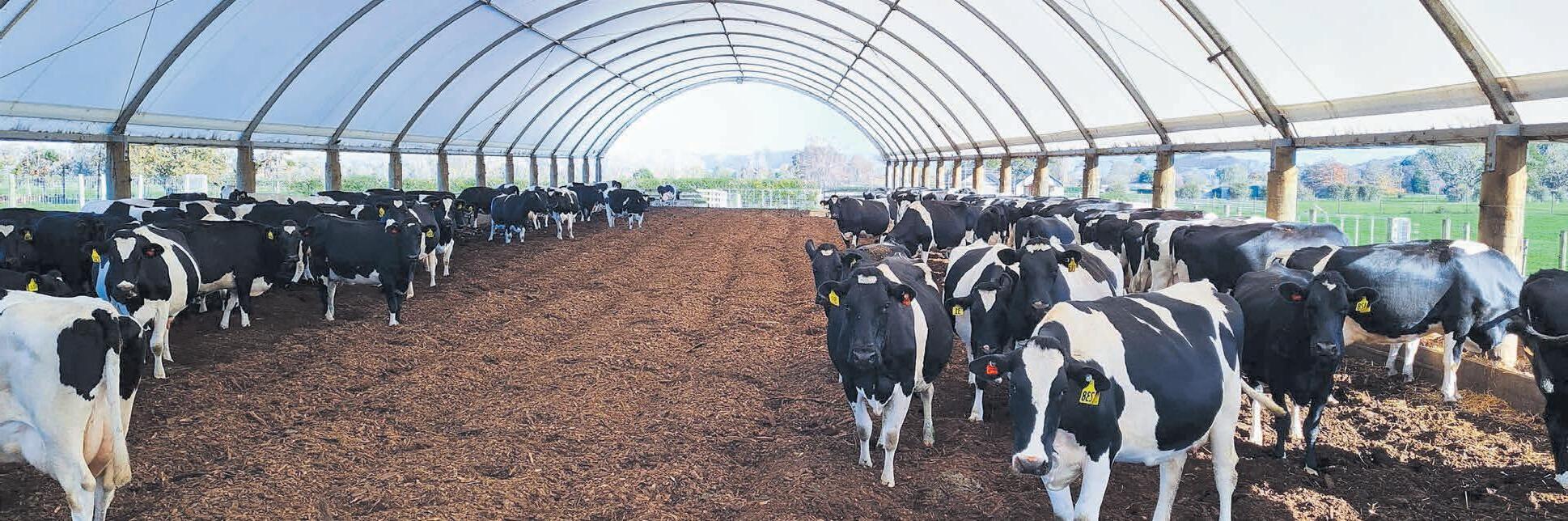
NEW Zealand dairy farmers will finish the 2025-26 season on a rising plane of milk production with the prospect of a third consecutive $10/kg milksolids season to begin.
Before May 31 the industry will have maximised the export earnings from high world commodity prices by producing a season-record 2 billion kilograms of milksolids.
In calendar 2026 the industry will pump more than $23 billion into regional economies through the bank accounts of 10,000 dairy farms.
Dairy products have been sold forward four months and shipments are avoiding the Middle East conflict zone.
Cristina Alvarado
Dairy Insights
The momentum of milk in warm and wet autumn months is hovering around 10% higher than in 2025 as cows have been milked for longer and fed more.
The seasonal milk collection will end 4% higher than in 2024-25,
on top of 3% increase the previous season.
Cow productivity is up 15% and the current 4.6 million cows in milk in the national herd exceed what 5 million produced a decade ago.
Older cows are in hot demand for either stocking some 30 startup dairy farms in Canterbury to begin the new season on June 1 or culling for manufacturing beef exporting.
Despite a $7/kg schedule and some $8 winter contracts available, the slaughter rate is 100,000-head behind last season and the five-season average.
It is down 26% in the North Island and 17% in the South Island, AgriHQ senior analyst Mel Croad reports.
Cull cow value is around $1500 a head but recent saleyard values have been $2500 average with a peak over $3000.
Dairy industry analysts have 2026-27 farmgate milk price forecasts as high as $9.98/kg, versus the current season Fonterra range $9.40 to $10. Fonterra will release its first projection for next season on May 28.
Analysts are using a springboard powered by good buyer demand, the low NZ dollar and dairy exporters hedging their earlyseason sales.
Farmers are making good use of
Continued page 3
Canty conversion ready for hefty herd
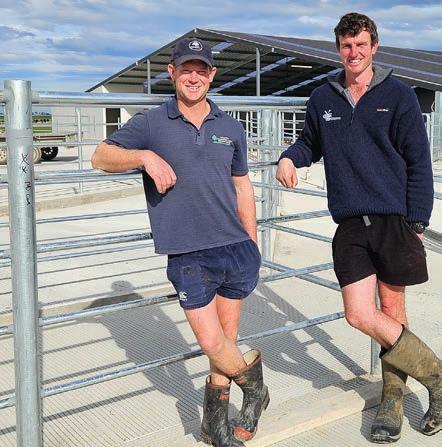
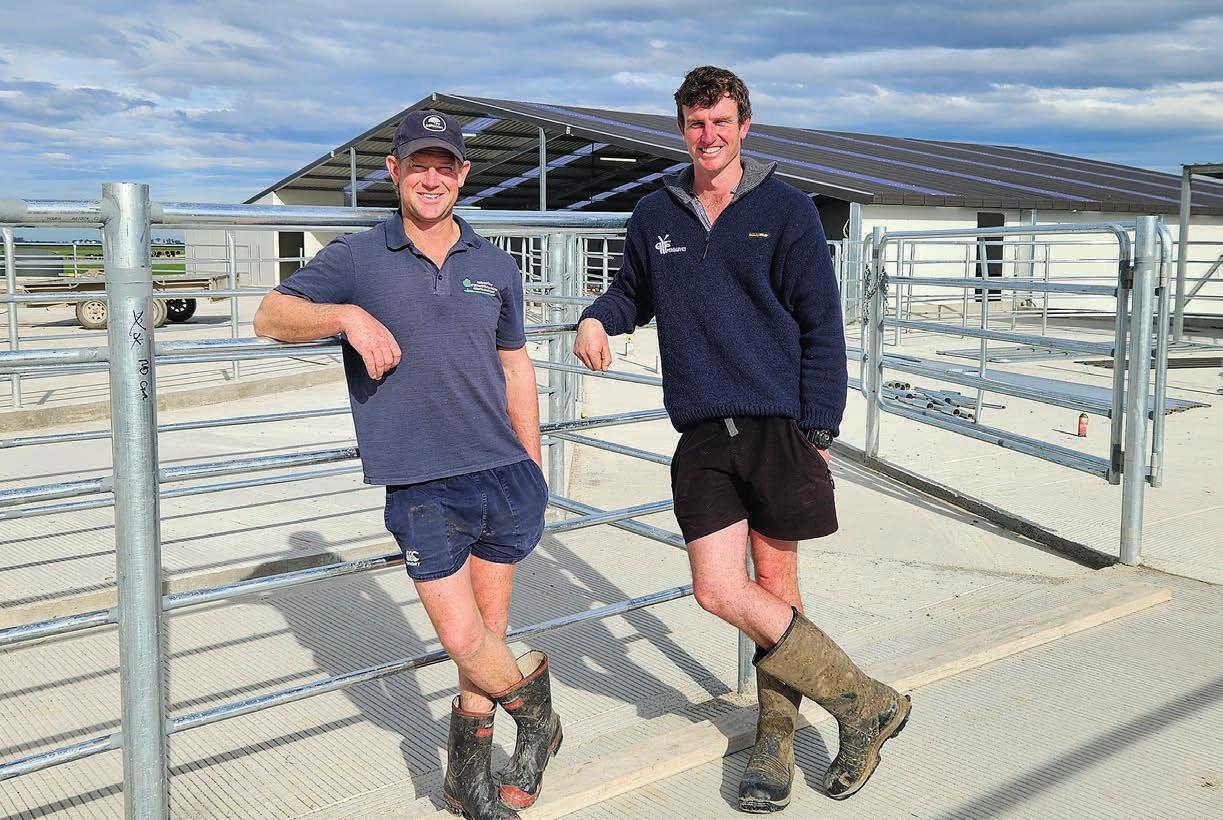
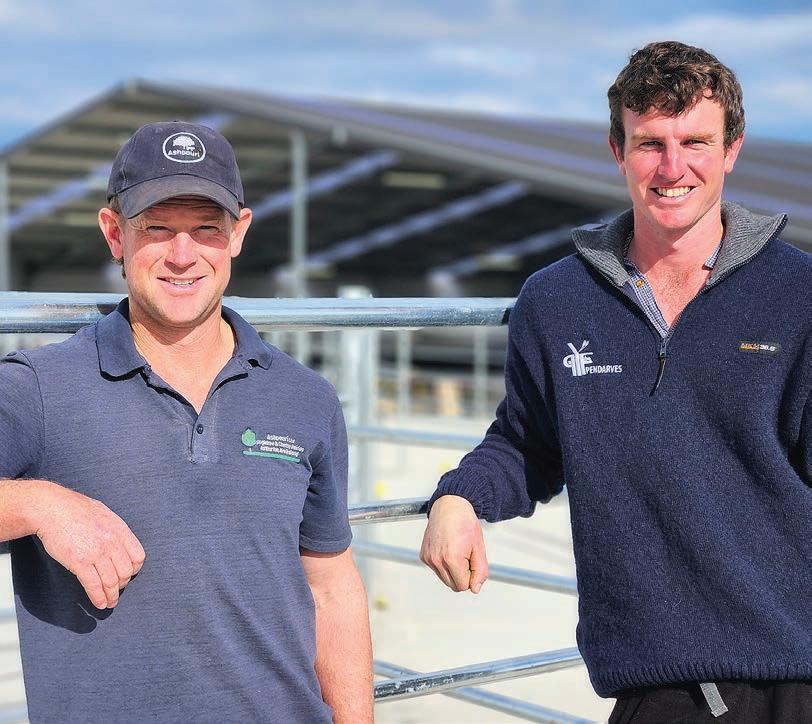
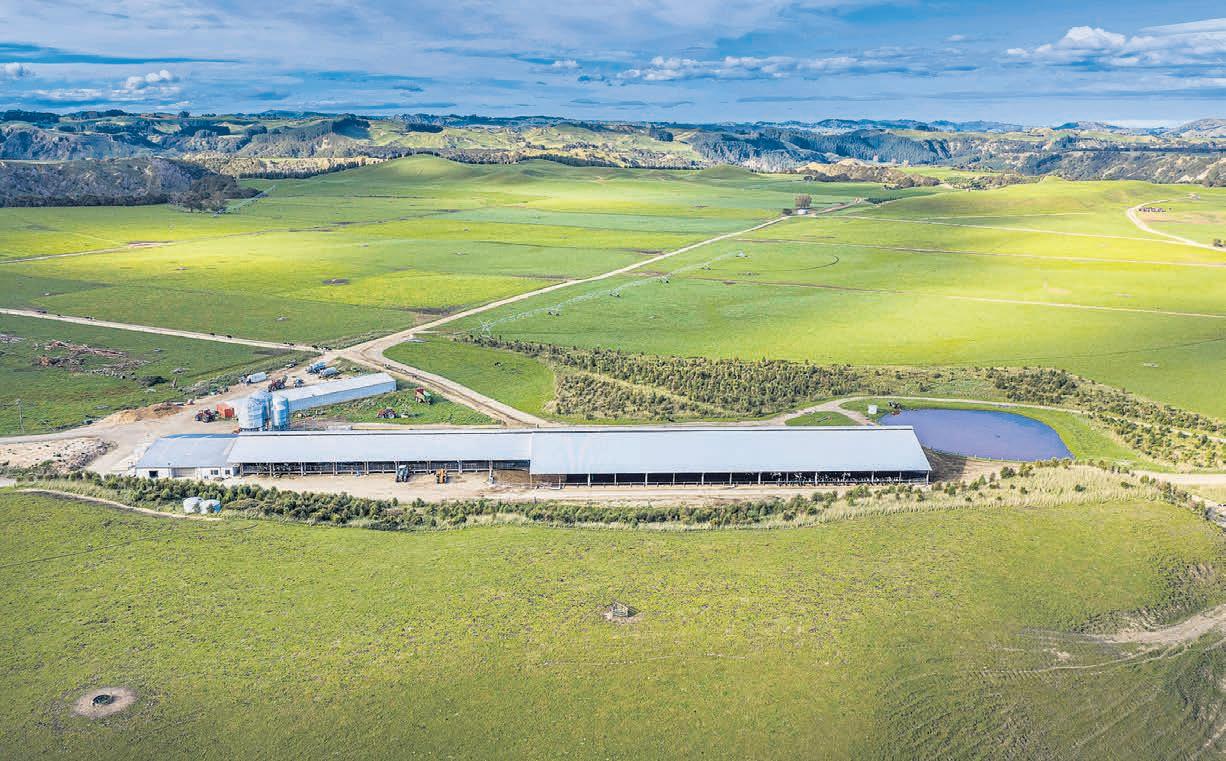
A 420 hectare former Canterbury arable and dairy support property has been converted into a large-scale dairy operation set to milk 1700 cows through an 80-bale rotary shed. Will Grayling, left, and Peter O’Connor have teamed up with Jim van der Poel in a threeway equity partnership.
Annette Scott NEWS 5
Meat exporters confused by trade signals coming out of the US.
NEWS 3
Imported dairy put to the test
A Farmers Weekly blind taste test compares imported and NZ-made butter and cheese. Can you spot the difference?
NEWS 13
Frequent highway closures costing growers and businesses millions.
NEWS 4
Raw material the key to meatworks profits, writes Allan Barber.
OPINION 21
Photo:
Hugh Stringleman NEWS Dairy
Get in touch
EDITORIAL
Bryan Gibson | 06 323 1519
Managing Editor bryan.gibson@agrihq.co.nz
Craig Page | 03 470 2469
Deputy Editor craig.page@agrihq.co.nz
Claire Robertson
Sub-Editor claire.robertson@agrihq.co.nz
Neal Wallace | 03 474 9240
Journalist neal.wallace@agrihq.co.nz
Gerald Piddock | 027 486 8346
Journalist gerald.piddock@agrihq.co.nz
Annette Scott | 021 908 400 Journalist annette.scott@agrihq.co.nz
Hugh Stringleman | 027 474 4003
Journalist stringleman@outlook.co.nz
Richard Rennie | 027 475 4256
Journalist richard.rennie@agrihq.co.nz
Gerhard Uys | 027 239 4388
Journalist gerhard.uys@agrihq.co.nz
Nigel Stirling | 021 136 5570
Journalist nigel.g.stirling@gmail.com
Isabella Beale | 027 299 0596
Multimedia Journalist isabella.beale@agrihq.co.nz
PRODUCTION
Lana Kieselbach | 027 739 4295 production@agrihq.co.nz
Andrea Mansfield | 027 602 4925 National Livestock Manager livestock@agrihq.co.nz
Real Estate | 0800 85 25 80 realestate@agrihq.co.nz
Word Only Advertising | 0800 85 25 80 Marketplace wordads@agrihq.co.nz
PUBLISHERS
Dean and Cushla Williamson Phone: 027 323 9407 dean.williamson@agrihq.co.nz cushla.williamson@agrihq.co.nz
Farmers Weekly is Published by AgriHQ PO Box 529, Feilding 4740, New Zealand Phone: 0800 85 25 80 Website: www.farmersweekly.co.nz
ISSN 2463-6002 (Print) ISSN 2463-6010 (Online)
SHRINKAGE: Professor Richard Shaw says the two-party combined vote is slipping away from National and
Richard Wyeth has resigned as CEO of Synlait.
Wyeth was appointed to the position in March last year and will remain with the company until June 30. Leon Fung was appointed acting CEO from last Thursday. Fung’s 30-year career includes senior executive leadership roles, including CEO of NIG Nutritionals Limited, and operations director for Danone Oceania.
News in brief Wyeth resigns German purchase
Dawn Meats has acquired Alliance Group’s largest German red meat importer and retailer, Alexander Eyckeler.
Niall Browne, chief executive of Dawn Meats – the majority shareholder in Alliance – said the purchase of Alexander Eyckeler supports the company’s ongoing integration with Alliance and strengthens its ability to serve customers in-market. Alliance’s relationship with the Eyckeler family spans almost 40 years.
Bremworth extension
Bremworth and its intending purchaser, the Floorscape subsidiary of multinational Mohawk Industries, have agreed to extend the proposed scheme implementation arrangement until August 7.
The extension is in response to the Commerce Commission giving itself until May 29 to rule on clearance of the takeover by the floor coverings giant Mohawk, which already owns Bremworth’s main New Zealand and Australian competitor, Godfrey Hirst.
Butterick steps up
Mike Butterick has been confirmed as an associate agriculture minister.
Key areas of responsibility across the primary sector have been delegated to him, including the organics sector, water security and storage, the arable sector, Māori agribusiness and catchment groups. Agriculture Minister Todd McClay said Butterick brings a deep understanding of farming and rural communities to his new role.
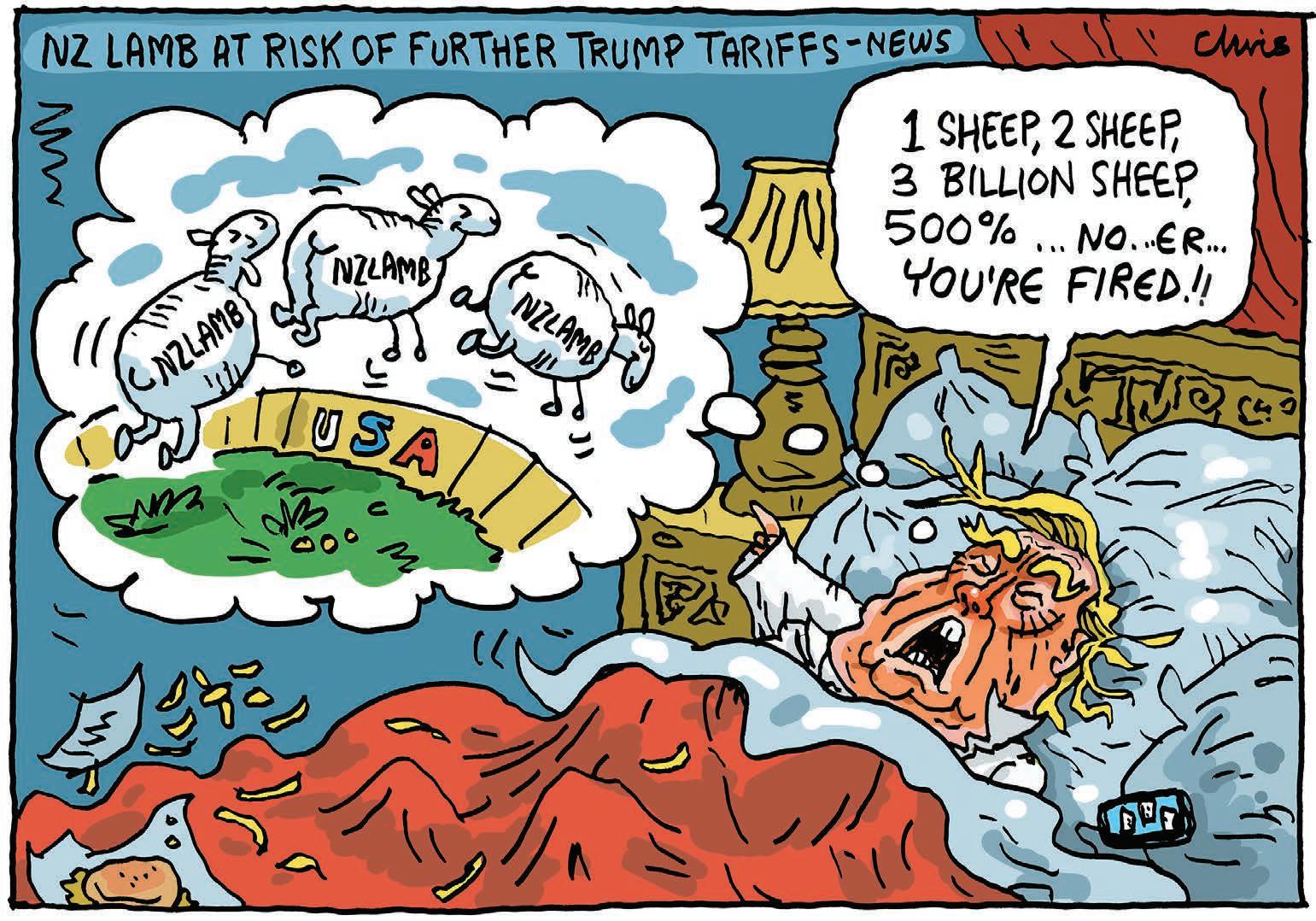
US tariff-go-round keeps exporters guessing
MEAT exporters are working to decipher confusing trade signals coming out of the United States.
There was speculation last week that US President Donald Trump would sign an executive order temporarily suspending tariffrate quotas on beef imports to ease prices for US consumers, but that did not happen. Exporters continue waiting for the US government to decide if it will agree to a request from US sheep farmers to investigate claims that lamb imports from NZ and Australia are harming the US market.
This request from the American Sheep Industry has been hanging over NZ exporters since last November.
The US emerged last year as New Zealand’s largest red meat market, with exports of beef totalling $2.1 billion in 2025, up 17% on 2024, and sheep meat $685 million, 10% greater.
AgriHQ senior analyst Mel Croad said Trump indicated he would act to reduce tariff-rate quotas on beef but less than 24 hours later those plans were delayed, with
Continued from page 1
Fonterra’s Fixed Milk Price offers and the SGX-NZX milk price futures market.
The May FMP was $9.68 for the standard fixed price and $9.20 to $10.25 for the price range option.
Milk price futures contracts for September 2027 delivery are selling at $9.80.
NZX head of dairy insights Cristina Alvarado said dairy products have already been sold forward into June, July, August and September delivery and that NZ shipments are avoiding the Middle East conflict zone.
the US that could impact NZ meat exports to its largest market, says chair Kate Acland.
officials citing some adjustments to any potential executive order were required.
“The reason he was looking to do that was to make it easier for more beef to be imported into the USA to lower prices for consumers,” Croad said.
Tariff-rate quotas allow a specific quantity of product to be imported at lower duty rates.
Her milk price forecast computer model predicts $9.73 for the season just ending and $9.98 for the one to come, based on a US58c value for the NZ dollar.
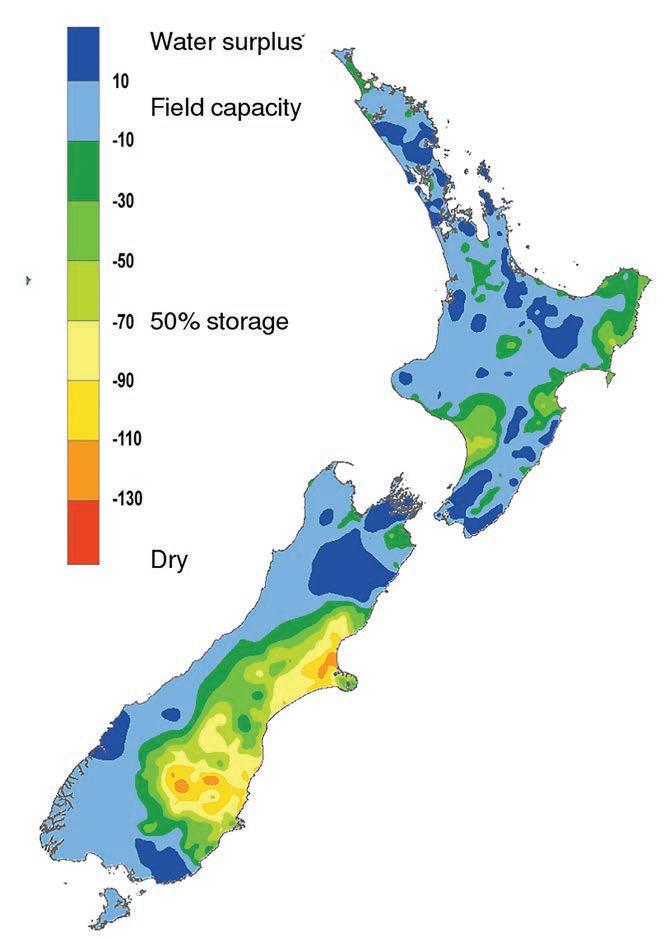
“The first months of the new season look to continue the favourable pasture growth conditions but further out a developing El Niño, supplementary feeding and higher input costs for fuel and fertiliser must be factored in.
“The industry is doing well and we expect the numbers of farmers and their cows to be steady, including that higher per-
According to the Forbes publication, US beef prices rose 16% in the past year with ground beef reaching US$6.75/lb, the highest on record.
Should Trump amend tariff-rate quotas, Croad said, this is likely to apply for the rest of 2026 and be of significant benefit to Brazil.
Brazil fulfilled its share of a small US beef quota in early January with
cow productivity,” Alvarado said.
Westpac economists said that the Iran conflict and low NZD will keep commodity prices higher for longer.
Last week they lifted the 202627 season milk price forecast by 30c to $9.50 and had previously lifted the 2025-26 forecast 40c to $9.80.
ANZ agri economist Matt Dilly said NZD exchange rates are staying down for longer and that will underpin the 2026-27 milk price forecasts. His current forecast of $8.70 has some upside room, he said.
imports above that attracting a 26.4% tariff, but demand and soaring prices meant the tariff has not restricted imports.
Croad said removal of the tariff could see a further significant increase in imported beef, which would impact NZ and Australia.
The competitive position against the likes of NZ and Australia beef will change.
Mel Croad AgriHQ
“The competitive position against the likes of NZ and Australia beef will change.”
Croad said US beef prices are being driven higher due to supply and demand.
The size of the domestic US herd is at levels last reached in the 1950s yet global demand for protein has remained high, evident in high NZ farmgate prices.
The other factor impacting global beef markets is China’s import safeguard, in terms of which Croad said Australia and Brazil could exceed their permitted imports from July-August and face a 55% tariff.
That beef could be redirected to the US.
Croad said US Department of Agriculture data shows US producers are showing no signs of expanding flock numbers, despite the record lamb returns.
“Sheepmeat production has been steady for the last few years but is forecast to decline in 2026,” she said.
“Given the strength of demand for lamb, import product has helped offset the decline in domestic production without eroding lamb returns.”
In a letter in January to US Trade Representative Jamieson Greer, the American Sheep Industry singles out Australia and New Zealand for taking advantage of “relaxed barriers” to increase imports by 45% in the last five years.
Beef + Lamb New Zealand chair Kate Acland said she is aware of reports that the US could launch a global safeguard investigation into lamb imports.
“We’ve been closely monitoring developments and have been preparing for this possibility.”
Nathan Guy, independent chair of the Meat Industry Association, said it is too early to comment but the association is in close contact with NZ officials, US partners and customers.
“Herd-i provides the daily data to allow farmers to keep on top of post-calving BCS loss”
Krispin KannanVeterinarian, Farmfirst Veterinar y
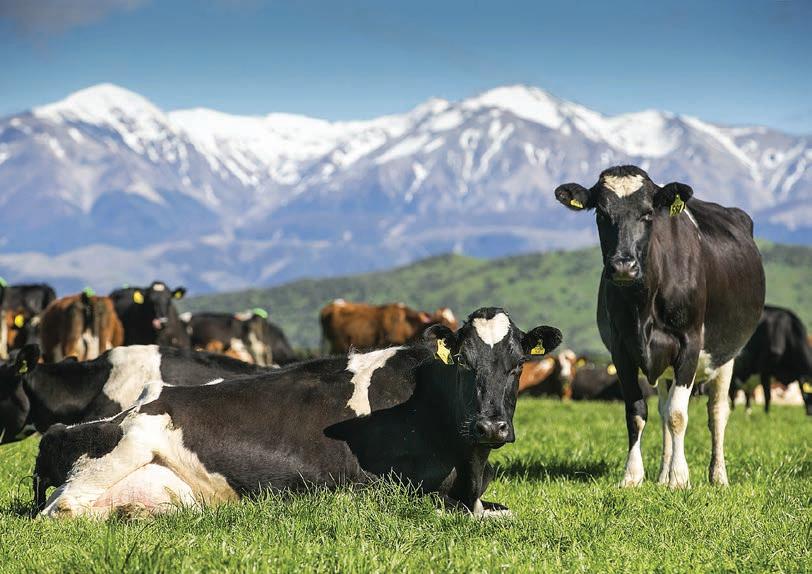
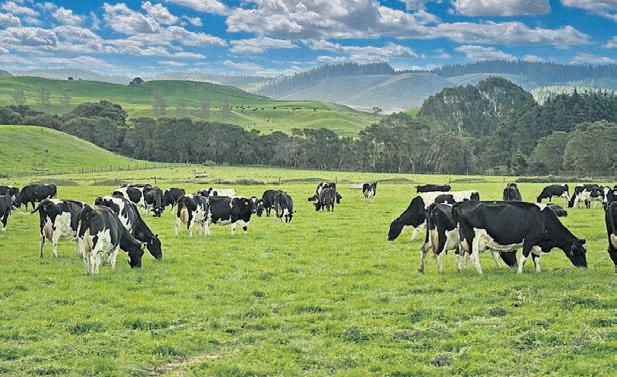
PRODUCTIVITY: Cow productivity is up 15% and the current 4.6 million cows in milk in the national herd exceed what 5 million produced a decade ago.
KEEPING WATCH: Beef + Lamb New Zealand is closely monitoring political decisions in
Neal Wallace MARKETS Politics
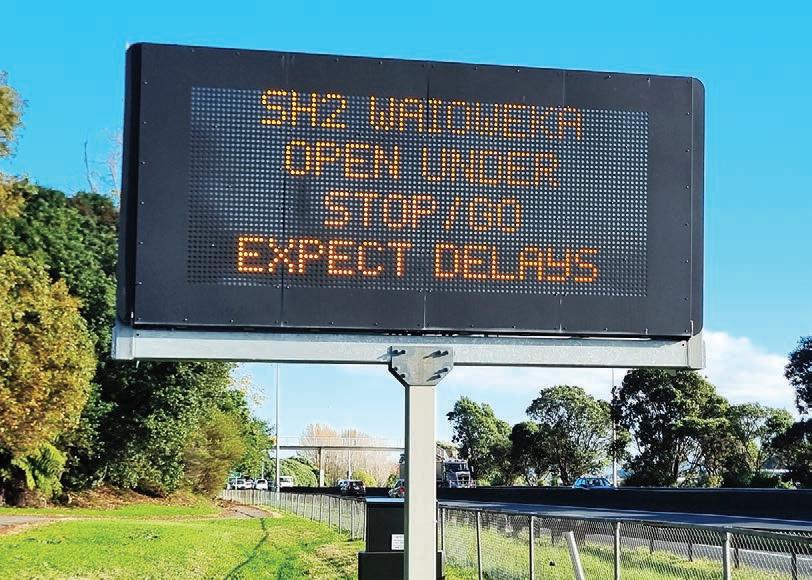
Waioweka highway stalling Gisborne growth
MILLIONS of dollars a day in costs and lost income are being incurred by growers and businesses from the increasingly frequent closures of the Waioweka Gorge highway between Tairāwhiti Gisborne and Ōpōtiki.
The losses are raising questions about the ability of Gisborne to grow its horticultural base, and generating doubt in the minds of potential investors about the region’s future access reliability.
The primary sector and local mayors of both districts are pinning their hopes on a highlevel meeting with Minister for Infrastructure Chris Bishop later this month, aiming to gain more assurance over improving the route’s resilience.
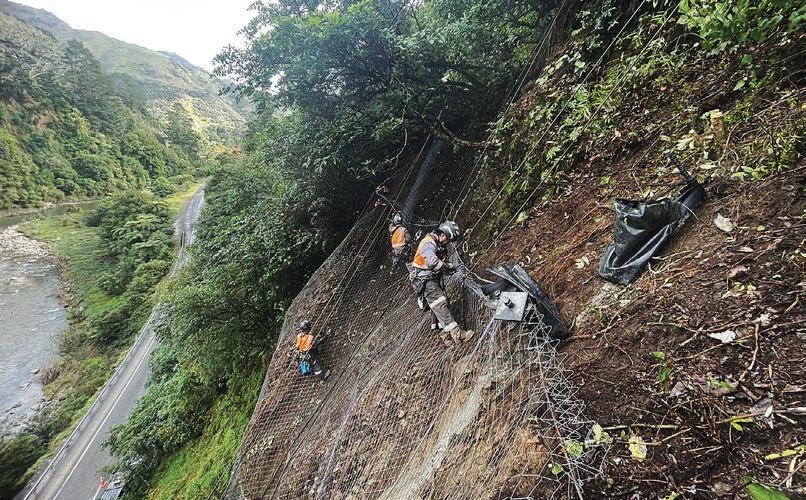
The fragile 48km State Highway 2 gorge road has been hit by repeated closures due to flood damage since Cyclone Gabrielle, including 300mm of rain in January just as growers were preparing for peak harvest season.
Forty slips require repair and the road remains on stop-go traffic management.
Ōpōtiki-based kiwifruit grower Doug Brown has investment in Gisborne SunGold orchards, and a family-owned packhouse in Ōpōtiki.
He told Farmers Weekly there have been times when SH35 around the coast, the SH2 Waioweka Gorge road, and the Napier-Taupō highway have all been out of action, completely isolating Gisborne.
“In terms of regional resilience, this road is critical and future growth is challenged if it can’t be relied upon.”
Joe Williams, business and innovation manager for Trust Tairāwhiti, said multiple businesses have been impacted by cancelled orders, price rises and drops in revenue since the January closure.
Trust data shows the average cost of having to use alternative routes out of Gisborne during a Waioweka closure is $450,000 a day across all vehicles.
An Infometrics report on the horticulture supply chain in January said the gorge route carries $112 million of produce a year. It is one of two highly vulnerable produce routes in New Zealand.
The entire Gisborne region generates $368m of produce a year, the fourth highest nationally.
In terms of regional resilience, this road is critical and future growth is challenged if it can’t be relied upon.
Doug Brown Ōpōtiki
And Brown said it is not only produce shipments out of Gisborne that are vulnerable to Waioweka closure.
“If there was a fruit fly incident at Port of Tauranga, the entire port zone would be shut down. If that happened at the start of kiwifruit harvest, fruit needs to be shipped, and Waioweka access to port of Gisborne would be vital.”
NZ Kiwifruit Growers Incorporated CEO Colin Bond wrote to Minister Bishop in January to highlight the route’s importance, coming after the storm’s devastation wreaked havoc with early-harvest, high-value Red and Gold fruit delivery.
Bond pointed to the east coast’s reliance upon facilities to pack
fruit on the Ōpōtiki side of the gorge, and the extended impact closure would have on the $100m of kiwifruit the region produces a year.
Richard Burke spent 30 years working for NZ’s largest fresh vegetable supplier, Leader Brand, in Gisborne.
He is calling for bolder action to address the route, even suggesting a tunnel between Ōpōtiki and Gisborne.
“We need to look 50 years ahead at what we want the region to become. It’s not just about horticulture, it’s about tourism, and general access to the population bases north of Gisborne.”
He said a tolled route that
combines central government, local government and private equity demands consideration.
Gisborne District mayor Rehette Stoltz said the road’s closure costs the region $8m a day.
“We may not be the economic powerhouse Auckland is, but we grow a lot of the food that city needs.
“We want the minister to recognise that importance.”
NZTA mulls plans to address highway woes
OPTIONS for improving the Waioweka route’s resilience have been identified, says New Zealand Transport Agency Waka Kotahi regional manager Lisa Faulknor.
“The work currently being carried out as a result of this year’s weather events has been focused on restoring full access through the gorge as well as drainage and culvert improvements to better prepare for future heavy rain and storm events,” she told Farmers Weekly.
REPAIR: NZTA was presented with three options for Waioweka’s repair, ranging from $70 million to $200m.
A Waioweka Gorge resilience business case has been developed to look at the 48km section through the gorge, with future investment subject to funding approval. She said the case is complete and can be implemented once funding is approved.
There were three options presented and as at 2024 they ranged in value from between almost $70 million to nearly $200m.
The recommended option would focus on multiple higher-risk projects completed within this stretch of road.
According to the business case, completing this option would result in a 53% reduction in closures but it would not fully eliminate the consequences of weather events or the subsequent closures.
She said the findings will be considered in “due course” by NZTA in determining future gorge resilience work.
STALLED: The main Waioweka SH2 route has been plagued by storm damage that is costing the east coast region millions a day when it is shut.
Richard Rennie NEWS Infrastructure
Richard Rennie NEWS Transport
Hefty herd gathers for Canty conversion
Annette Scott NEWS Dairy
DRIVEN by the challenge of getting the dairy conversion profitable,
Peter O’Connor is excited for the future as he prepares for the start of milking this season.
Having grown up on a dairy farm on the West Coast, O’Connor has long wanted to one day have his own dairy operation.
That vision has come to reality and the scale is huge.
The runner-up in the Young Farmer of the Year 2023, a Dairy Trainee of the Year, and an inaugural graduate of the Grassroots Dairy Management Programme, O’Connor is now the equity manager on one of Canterbury’s biggest dairy conversions, set to start milking this 2026 season.
The $44 million project has converted a 420 hectare former arable and dairy support property into Ashmount Farm, a large-scale dairy operation set to milk 1700 cows through an 80-bale rotary shed.
The operation takes in major shareholder Jim van der Poel, a
Milking
Annette Scott NEWS Dairy
prominent New Zealand dairy industry leader, former chair of DairyNZ and strong advocate for dairy farmers; equity sharemilkers Will and Kim Grayling, who manage two farms with 3000 cows near Ashburton, and are also involved in two additional equity
partnerships totalling another 3000 cows; and O’Connor and his partner Lydia Shirley.
The Graylings have been dairy farming for 17 years, 13 of which have been in equity partnerships with the Van der Poel family.
Beyond the farm gate, the
couple are founding members and organisers of the Grassroots Dairy Management Graduate Programme, helping 34 young people grow and succeed in the dairy industry.
After completing a Bachelor in AgScience at Lincoln University, O’Connor spent time working on Canterbury dairy farms before heading abroad, where he worked in Australia and the United Kingdom, eventually returning home to manage 1000 cows for the Graylings, who he had connected with through the dairy management programme.
“It’s been a full circle but now I am excited by the challenge of this farm, excited by the opportunity to buy into it and to grow it, and the opportunities it presents to get good scale to be efficient and profitable for all of us involved,”
O’Connor said.
An early challenge has been building the 1700 cow crossbred herd, work that started in May 2025.
Cows were sourced over a 12-month period from 20 lines of animals spread from Northland to south Canterbury, with the average cow price at $2660 and the most expensive $3300.
“It’s been difficult in a pricey
This is not all about land, cows and grass for us. It’s about confidence in a big-picture future.
Will Grayling Sharemilker
market, but we are quite happy with what we have landed on, we have got good value.
“The shed is on track to be finished in June, calving in July and into milking.”
Ashmount Farm will be supplying Fonterra and at its peak times employing nine staff.
“Effectively Pete and Lydia will be in control with provision for support; it’s got good scale, enough to go around once we generate money instead of sucking it up,” Will Grayling said.
“Farming is ultimately a business with a built-in lifestyle. It’s all about confidence in the industry and, yes, we are in a purple patch.
“This is not all about land, cows and grass for us. It’s about confidence in a big-picture future; growing the opportunities for future generations that are not a given or expected, but earned,” Grayling said.
it: Mainland goes all in for dairy farms
than double, with one consulting company telling Farmers Weekly it has received conversion inquiries out to spring 2028.
CANTERBURY could end up with at least 25,000 more dairy cows over the next few years as interest in dairy conversions continues to ramp up.
Data from February 2026 showed Canterbury could have 12,500 more dairy cows following a fresh round of dairy-related consents in the previous six months.
However, just eight weeks on, those figures are predicted to more
ECan reported that 12 consents tied to dairy conversions for
If you’d been in conversation two years ago about what’s coming up you would have no idea this would be going on.
Luke Palmer Tambo NZ
2026 accounted for 10,700 cows, with another 1750 cows tied to a further 10 consents enabling herd increases on existing dairy operations.
These figures were an upper limit rather than a forecast as not every consented farm will necessarily proceed at full scale.
Word is out now of 26 farms currently under conversion for start-ups in spring 2026 and 2027, with the average conversion size at 800 cows.
Luke Palmer, a director of Canterbury-based consulting firm Tambo NZ, said the demand is
“unprecedented, it’s been running flat-out for spring 2026 and we’re into planning for spring 2027 looking to be even busier, with people in contact now forward planning to spring 2028”.
“My gut feeling is at this point shed-building capacity is running out. If you haven’t got a shed builder lined up then it won’t be long before there’s no capacity available for 2027.
“There’s a lot of extra demand on what was a bit of a limited resource pool a few years ago, so everyone is trying to get back up to meet the demand.
“Those looking at 2028 are transitioning out their own farms, so not yet through the consent processing systems.
“There’s an element of some dairy farms that were milking off additional land having split up units, but also cases of genuine arable converted to dairy and the most common theme is those in the dairy support space going into milking.
“I would say the lion’s share is the existing dairy supportmixed cropping set-ups as the biggest group of those that are converting.”
TEAM: Will Grayling and Peter O’Connor have teamed up with Jim van der Poel, a prominent New Zealand dairy industry leader, in a three-way equity partnership.
Photo: Annette Scott
KEEPING FARMERS FARMING.
India deals may come with costs for hort
ANigel Stirling MARKETS Horticulture
PPLE exporters could be facing “user pays” charges if they want to share in the benefits of market access gains achieved under the India free trade agreement.
India has agreed to slash tariffs on New Zealand apples from 50% currently to 25% for up to 32,500 tonnes in the agreement’s first year, rising to 45,000t over six years, well above NZ’s current apple exports to India.
NZ Apples & Pears Inc chief executive Danielle Adsett said the industry-good body had suggested to NZ negotiators that they offer technical cooperation agreements as a potential bargaining chip in exchange for lower tariffs.
“This is the first FTA that India has signed that has included apples in the deal,” Adsett said.
“Apples are a sensitive topic in India and we knew we couldn’t just turn up asking for apples to be included.
“We needed something to reciprocate with.”
Adsett said there are “hundreds
of thousands” of apple growers in India but productivity severely lags their NZ counterparts.
Average production was just 6t per hectare compared to 60t in NZ orchards and up to 100t per hectare for newer varieties.
“Their industry is needing to transition to increase supply,” Adsett said.
Apples are a sensitive topic in India and we knew we couldn’t just turn up asking for apples to be included.
Danielle Adsett NZ Apples & Pears Inc
“So moving to higher-density trees, trees on root stocks to increase that production from 6t per hectare.”
The NZ industry has experience working with Indian growers going back to the days of single-desk marketer ENZA in the 1990s.
More recently there has been involvement in World Bank-sponsored projects in the Himachal Pradesh region in northern India.
The FTA includes a five-year Apple Action Plan, which was
still being worked on when negotiations concluded late last year.
Chapter 14 of the FTA calls for cooperation between NZ researchers and Indian growers to improve pest and disease control, climate resilience, productivity and orchard and harvest management, all with the long-term objective of opening a “high-density Apples Centre of Excellence” in India.
The FTA also calls on NZ to work on improving India’s post-harvest performance and to help develop regulations to enable “introduction of high-value, globally developed intellectual property protected plant varieties into India”.
Technical cooperation agreements have featured in previous free trade agreements but the India FTA is the first time they had been tied to market access. Cooperation agreements for kiwifruit and honey have also been included in the India-NZ FTA.
The agreements will be reviewed every six months by a committee of NZ and Indian officials.
Should NZ fail to live up to its obligations, India has the right to request consultations. If those fail to resolve the issue India can reinstate the previous tariffs.
Bill takes aim at agrichem red tape tangle
Richard Rennie NEWS Agrichem
LONG-awaited steps to speed up access to new pasture and crop treatments have been taken, with the Hazardous Substances and New Organisms Amendment Bill entering Parliament this week.
Environment Minister Nicola Grigg said the Bill intends to remove unnecessary barriers and improve efficiency to put New Zealand business on an even playing field with its competitors.
The Bill addresses grower concerns over the slow pace of
new product approvals, which have grown in recent years.
A Sapere report released in late 2023 laid out the significant delays NZ was experiencing and the slow progress in approvals compared to its agricultural competitors.
An Official Information Act request by Farmers Weekly last year highlighted the level of frustration and concern agrichem companies had at accessing the NZ market with new products.
The world’s second largest agrichem company, Bayer Crop Science, announced last year it was withdrawing from its research and
Carlos Bagrie, 2024 Nuffield NZ Farming Scholar
trial farm facility in Hawke’s Bay, citing the regulatory landscape as a key reason for the decision.
The Bill aims to adopt recommendations made to the government after a 2024 review that recommended streamlining the approvals process.
It also intends to adopt the recommendation that duplication can be reduced by making better use of overseas’ countries assessments, allowing for NZ-specific protections when needed.
Once through its first reading the Bill will be debated, then pass to the Environment Select Committee for review and submissions.
Sector takes the stage
Isabella Beale NEWS Events
CHRISTCHURCH will host two major primary sector conferences this week, bringing together farmers, agribusiness leaders, innovators and industry experts to discuss the future of New Zealand’s food and fibre sector.
Out the Gate: A Sector Fit for the Future will run from May 19-21, followed by E Tipu: The New Zealand Food and Fibre Summit on May 21-22.
Held at Te Pae Christchurch Convention Centre, both events will explore how the primary sector is responding to shifting consumer demands, emerging technologies, global market pressures and sustainability challenges.
Hosted by Beef + Lamb NZ, Out the Gate will focus on practical issues facing sheep and beef farmers, alongside conversations around diversification, market outlooks and future farming systems.
Speakers include Sheep
Producers Australia chief executive Bonnie Skinner, Ministry for Primary Industries director-general Ray Smith and Global AgriTrends analyst Simon Quilty.
E Tipu, hosted by FoodHQ, will take a wider food and fibre industry view, with discussions centred on innovation, investment, consumer behaviour and emerging technology.
While Out the Gate focuses more heavily on farm systems and production, E Tipu will explore longer-term industry trends, future consumer demands and how businesses can respond to disruption in global markets.
Featured speakers include Fonterra board director Alison Watters, Innovation Gamechangers Australia CEO Angeline Achariya and Norsewear CEO Tim Deane. Farmers Weekly senior reporters Neal Wallace and Richard Rennie will also speak at E Tipu, sharing insights from their Meeting the Market travels.
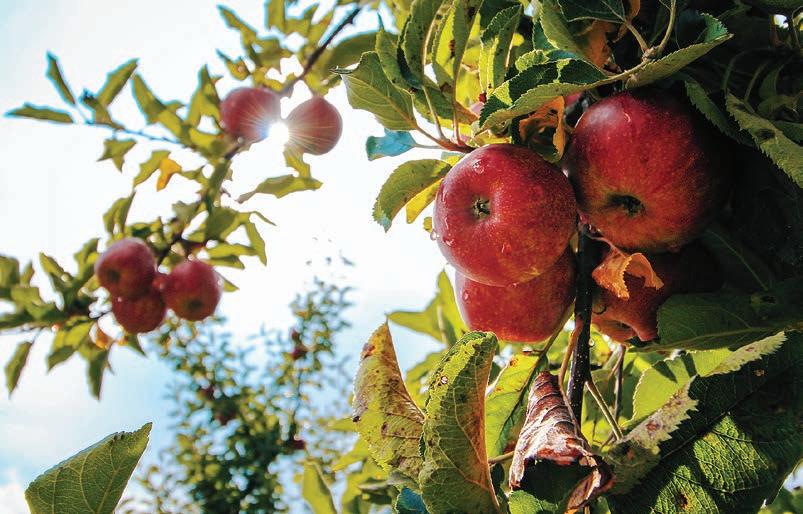
SLASHED: India has agreed to slash tariffs on NZ apples from 50% currently to 25% for up to 32,500 tonnes in the agreement’s first year.
Govt seeks law change to halt GHG claims
Gerald Piddock NEWS Climate change
THE government’s stated intent to change the Climate Change Response Act to stop courts from ruling on liability for damages caused by greenhouse gas emissions has received both praise and condemnation from impacted people and groups.
The move will affect current and future court cases, including the high-profile Smith vs Fonterra and Others, set to return to the High Court next year.
That case is between activist Mike Smith and Fonterra, Genesis Energy, Dairy Holdings, NZ Steel, Z Energy and BT Mining.
It was brought after a 2024 Supreme Court ruling said Smith had the right to sue those companies for the damage their greenhouse gas emissions had caused him.
Fonterra managing director for
co-operative affairs Matt Bolger said the co-op looks forward to reviewing the amendment when it is available to understand its implications.
“Our view has always been that regulation of greenhouse gas emissions requires a sophisticated, economy-wide regulatory response and Parliament is the appropriate place to determine such widereaching public and economic policy on matters of significant public interest such as climate change.”
Dairy Holdings could not be reached for comment.
A Genesis spokesperson said it was their consistent position that the Climate Change Response Act is the primary mechanism for addressing climate change.
“Our view is that it is the role of government, not the courts, to develop policy and legislation needed to transition Aotearoa New Zealand to a lower carbon economy.
“Consistency of direction
is important to underpin the long-term investment decisions necessary to support a successful transition to net zero 2050.”
Justice Minister Paul Goldsmith said this ongoing litigation is “creating uncertainty” in business confidence and investment that must be addressed.
The government said the new legislation will amend the Climate Change Response Act 2002 to prevent findings of liability for tort for climate change damage or harm caused by greenhouse gas emissions in both current and future proceedings before the courts.
“Our response to climate change is best managed by the government at a national level and not through piecemeal litigation in the courts,” Goldsmith said.
A tort is a civil claim brought in private law in situations where the conduct of one person causes harm or invades the interests of another. It is primarily developed through common law.
Smith told RNZ the government’s decision is unprecedented and outrageous.
“It’s an affront to democracy,” he said.
“If Parliament can cancel a live court case, then no legal claim is secure at all, once it becomes politically inconvenient.”
The Environmental Law Initiative (ELI) said the changes would remove the fundamental right of people to have their day in court.
ELI’s senior legal adviser, Eliza Prestidge Oldfield, said at its core, this is about democracy and the rule of law.
“When you take away people’s ability to go to court, you take away a fundamental check on power. That should concern every New Zealander.”
Lawyers for Climate Action acting executive director Laura MacKay said they were appalled that the government had decided to prioritise this issue.
Mid Canty names its first female Feds president
Annette Scott PEOPLE Federated Farmers
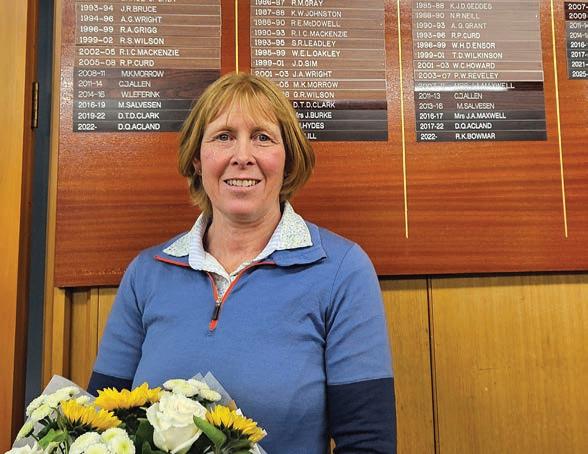
ASHBURTON high-country farmer Kerry Harmer is making history as she takes up the top seat for Mid Canterbury Federated Farmers.
Harmer is the first female provincial president of the Feds’ Mid Canterbury organisation, which dates back 81 years to 1945.
“It is an honour and there are some big names to follow, and to be honest I never really gave it a thought that I would the first woman provincial
president, but clearly others did,” Harmer said as she was presented with flowers to mark the occasion.
“And I’m guessing this hasn’t been done before either then,” she said.
Harmer said while there’s some “good positive stuff” going on there’s plenty ahead to keep abreast of.
“It’s generally been a positive year but we have got to keep a foot on the pedal.”
Harmer cited the RMA reform, school buses and NZ Post as key current issues.
“We have got to remember some of our more remote communities just don’t have
any other options, we all need to keep working together.”
Harmer is not short of experience. Farming with her family on Castle Ridge Station, she is chair of the Ashburton Lakes catchment group, Feds high-country chair, a trustee of the Mid Canterbury Feds Charitable Trust, a member of the Land Information NZ high country advisory group, on the committee of the Mid Canterbury Community Catchment Collective, and a member of the Merino NZ ZQ grower reference group.
Meanwhile in his final address as Mid Canterbury president, David Acland said
it had been “an interesting four years and a steep learning curve”.
“It takes time to connect all the dots that have brought Mid Canterbury to where it is today and I thank all those groups for the shared effort that has gone in to trying to shape the regulatory landscape to the benefit of both the rural community and the environment.
“At a national level it is one of waiting and secondguessing what government’s proposal around the RMA and Local Government are going to be, a watch-this-space and keep at it.”
HANDS TIED: A proposed amendment to the Climate Change Response Act will prevent courts from ruling on the liability damages caused by greenhouse gas emissions.
ON THE BOARD: Kerry Harmer stands beneath the honours board about to bear her name as the first female provincial president in Mid Canterbury Federated Farmers’ 80-year history.
Photo: Annette Scott
Can National defend its provincial strongholds?
Hugh
Stringleman
POLITICS Elections
THE National Party goes into the General Election on November 7 with a near complete set of rural and regional electorates won in the 2023 election.
It has 31 of the 33 seats, missing only Palmerston North and Nelson as narrow retentions by the Labour Party.
The state of the major parties in city electorates is evenly balanced, 13 each for National and for Labour, plus bridgehead wins by the Green Party (3) and ACT Party (2).
Labour also holds one Māori electorate, Ikaroa-Rāwhiti, having lost the other six to the Māori Party.
National’s strength outside the four main cities is a collective majority of 280,000 votes, which is 10% of the total votes cast last time.
Boundary changes are mostly in city seats, including a name change for Bay of Plenty to Maunganui, where Sam Uffindell had a 9370-vote majority. He is one of the relatively comfortable National Members of Parliament as 20 of the 45 non-list MPs had vote majorities under 10,000. Nine were fewer than 6000.
Should there be a swing to
Labour of 6% in the party vote, about half of National’s gain in 2023, statistically, these seats are at most risk of changing: Northland, Hamilton West and East, East Coast (now East Cape), Whanganui, Wairarapa, Ōtaki (now Kāpiti), West Coast-Tasman and Banks Peninsula.
Fourteen rural and regional seats were won by National from Labour last election when National gained 12% in the party vote.
However, the 2020 election should remind the National Party that rural and regional voter support cannot be taken for granted.
The 2017 election delivered National the same provincial dominance it now enjoys – 31 of 33 seats, except West Coast-Tasman and Napier.
Jacinda Ardern’s Labour in 2020 scored a landslide victory that delivered the first majority government since MMP began in 1996.
That victory was followed by the worst defeat by a sitting government in 30 years in 2023 when Labour was on the receiving end of a total 23% swing.
National gained 12%, NZ First 3.5%, ACT 1%, Greens 3.8% and Māori Party 2%.
National’s winning MPs were: East Coast, Dana Kirkpatrick; Hamilton East, Ryan Hamilton; Napier, Katie Nimon; New Plymouth, David MacLeod;
Northland, Grant McCallum; Ōtaki, Tim Costley; Rangitata, James Meager; Rangitīkei, Suz Redmayne; Tukituki, Catherine Wedd; Wairarapa, Mike Butterick; Waitaki, Miles Anderson; West Coast-Tasman, Maureen Pugh; Whanganui, Carl Bates; and Whangārei, Shane Reti.
Pugh and Reti have already announced their retirement from Parliament when their current terms end.
In West Coast-Tasman the National candidate is Katie Milne, former president of Federated Farmers, up against teacher Rory Paterson for Labour and former Buller mayor Jamie Cleine for NZ First.
In Whangārei real estate agent Lloyd Budd has been selected for National, against emergency department doctor Gary Payinda for Labour.
Among the Labour candidates announced so far, Jo Luxton will relocate to East Cape after losing Rangitata in the last election, and Damien O’Connor will contest his 12th general election, this time across the Southern Alps in Waitaki instead of his homeland on the West Coast.
Both have been ministers in previous Labour-led governments and are currently on the party list – Luxton the spokesperson on agriculture and O’Connor on trade.
Already selected as a new candidate for National in the Port
because he is moving to the South Island and will seek a place on the National Party list.
This week’s poll question:
Has National done enough to retain its rural seats in this year’s election?
Have your say at farmersweekly.co.nz/poll
Waikato electorate is Matthew Paul, an environmental and landscape consultant who is also co-chair of the special interest group Bluegreens for National. Incumbent Port Waikato MP Andrew Bayly will not contest
South Auckland MP Judith Collins, a former National Party leader with 24 years’ experience and eight successful elections, has retired from the Papakura seat and that will be fought for National by Emma Chatterton.
She is a senior adviser to Education Minister Erica Stanford and unsuccessfully contested Remutaka in 2023, losing to Labour leader and then-prime minister Chris Hipkins by 8859 votes.
Labour had a 3087-vote majority in Palmerston North, where MP and party spokesperson for local government Tangi Utikere will be challenged by businessman Ankit Bansai.
In Nelson, Labour MP Rachel Boyack will defend the second smallest majority in the country, at 26 votes, against second-time candidate Blair Cameron for National.
Voter volatility in the provinces is here to stay
Hugh Stringleman POLITICS Elections
VOTER volatility in provincial New Zealand is now a fact of political life that the coalition government must handle, Massey University Professor of Politics Richard Shaw says.
Labour won 11 rural and regional seats from National in 2020 and National won back 14 in 2023.
“For the past two or three decades it has been the slowly increasing number of people who are not voting either National or Labour,” Shaw said.
“Their shares of the combined two-party vote are dropping.
“Polls show them barely breaking 60% together and if that occurs on November 7 it opens all sorts of possibilities for the other parties.
“We shouldn’t be calling them minor parties any more because of
their influence on the formation of a government.”
Shaw thinks it very unlikely that the ACT Party and NZ First will win provincial electorates, but their increased party votes will affect the balance of power in the coalition.
Tactical voting, or split voting, is now up to 30% of all votes cast.
In 2023 National won power, with the help of NZ First and ACT, with only 38% of the votes cast,
the lowest share any National government has had.
National’s share slippage is getting close to the combined weight of NZ First and ACT.
Depending on how many rural and regional seats National retains, it might have few or no list MPs, a worrisome prospect for Finance Minister Nicola Willis.
The unpopularity of Prime Minister Christopher Luxon is likely to encourage more tactical
voting, Shaw said.
Big legislative changes being introduced by the government have the potential to fragment voting in the provinces, especially local government amalgamation with a rates cap.
“The government has mandated service delivery without the funding,” he said.
“In parts of provincial NZ there is quite a lot of resistance and ill-feeling.”
TRUE BLUE: National leader Christopher Luxon benefited from a 12% swing in rural and regional electorates in the 2023 General Election.
Cut cos t s . Take control.
Power your far m sm ar ter with Far mlands FLEX
For many farming busine s se s , energy is no longer a simple overhead I t ’s one of the bigge s t long-term cos t s on the balance sheet , and one of the mos t critic al input s to daily operations From irrigation and milking she ds to cool s tore s , workshops and on-farm housing , reliable power underpins produc tivit y, and profitabilit y
S olar energy promise s relief from rising elec tricit y price s , yet too of ten farmers are sold a sys tem that looks good on ins tall day and slowly disappoint s there af ter Panels get put on the roof, monitoring da shboards are hande d over, and the original ins taller become s le s s available The sys tem generate s power, but no one is ac tively ensuring it continue s to deliver real value year af ter year
That ’s where Farmlands FLE X is fundamentally dif ferent I t ’s built to cut energy cos t s , give farmers total control , and deliver long-term confidence
Not jus t Solar Farmlands
FLE X is a fully managed end-to - end energy solution
Farmlands FLE X s t ar t s from a simple truth: energy is now a s trate gic f arm input , not a pa s sive utilit y Tre ating it that way re quire s more than panels alone
O ur solution c ombine s solar generation on-f arm bat ter y s torage, and the Farmlands FLE X optimis ation plat form into one inte grate d sys tem de signe d to work with how f arms ac tually op erate Ins te ad of exp or ting exc e s s p ower at low value s or drawing exp ensive p e ak ele c tricit y when demand spike s , Farmlands FLE X helps you manage when energy is generate d, s tore d, and use d The re sult is not jus t solar p ower – but c ontrol
Farmlands FLE X give s cus tomers a cle arer view of how energy is use d acros s the f arm
B y sur f acing high load p erio ds , se a sonal change s , and t arif f impac t s , the plat form helps identif y opp or tunitie s to improve sche duling shif t demand and get more value from solar, bat ter y, and grid energy
Run- of-the-mill solar sys tems are s t atic Farmlands FLE X sys tems evolve
Farms are not suburban home s Loads are larger demand is more variable and out age s c an have re al c onse quenc e s That s why Farmlands FLE X sp e cialise s in thre e-pha se, f arm-sc ale energy sys tems , de signe d to handle the c omplexit y of mo dern rural op erations
B at ter y s torage adds another critic al layer D uring out age s or high- demand p erio ds ,
s tore d energy ke eps key op erations running D uring normal op eration bat terie s absorb surplus generation and re deploy it when grid ele c tricit y is at it s mos t exp ensive
This c apabilit y isn’ t ab out cha sing trends , it ’s ab out re silienc e When p ower mat ters , f arms ne e d c er t aint y, not hop e
The Farmlands FLE X difference: Ongoing optimisation
Perhaps the bigge s t dif ferenc e b et we en Farmlands FLE X and t ypic al solar providers is what happ ens af ter ins t allation
Mos t sys tems are de signe d with a s sumptions ba se d on to day s us age and to day s t arif f s
But f arms change Milk pric e s fluc tuate O p erations expand Ele c tric al e quipment is upgrade d Tarif f s shif t E xp or t rate s drop What made sense in ye ar one may b e sub - optimal in ye ar f ive
Farmlands FLE X is de signe d for the long game
The Farmlands FLE X plat form c ontinuously monitors sys tem p er formanc e and helps cus tomers unders t and changing demand pat terns over time It highlight s p e aks , sur f ac e s are a s for improvement , and supp or t s informe d de cisions ab out how the sys tem c an work harder for the f arm
This is not pa s sive monitoring It ’s ac tive management , aligne d to delivering me a surable outc ome s
Confidence backed by 25 years of suppor t
A solar sys tem is not a shor t-term inve s tment and neither is Farmlands FLE X Ever y Farmlands FLE X sys tem is supp or te d for up to 25 ye ars , providing f armers with c onf idenc e that their inve s tment will p er form a s exp e c te d over it s full life span
This long-term c ommitment set s us apar t from ins t allers fo cuse d on volume rather than value B acke d by 25 ye ars of c ontinue d supp or t and p er formanc e monitoring f armers c an inve s t with genuine c onf idenc e
O ngoing supp or t me ans:
Per formanc e a s suranc e, not gue s swork
Pre dic t able outc ome s ins te ad of de clining returns
A par tner who remains ac c ount able l ong af ter ins t allation
For f armers , this translate s to p e ac e of mind Knowing that some one is watching, optimising, and s t anding b ehind the sys tem , fre e s up time and ment al energy to fo cus on running the busine s s
Real outcomes that matter
When energy is manage d well, the b enef it s c omp ound
Farmlands FLE X cus tomers exp erienc e me aningful, sus t aine d c os t re duc tions rather than shor t-live d s avings They gain re silienc e during out age s prote c ting live s to ck , infra s truc ture, and op erations when the grid f alters And they build a future-re ady energy foundation c apable of supp or ting ele c trif ic ation , automation , and grow th for de c ade s
This isn’ t the or y, it ’s the prac tic al outc ome of aligning te chnology, exp er tise, and long-term ac c ount abilit y
Why “cheaper ” solar of ten cos t s more
The tempt ation with solar is to c ompare pric e s upfront But the che ap e s t sys tem on day one is rarely the b e s t inve s tment over 20 or 25 ye ars
Without optimis ation , sys tems underp er form
Without bat terie s , f arms remain exp ose d to p e ak pricing and out age s Without long-term supp or t , problems sur f ac e when warrantie s are hard to honour and ins t allers have move d on
Farmlands FLE X exis t s to remove those risks
B y inte grating de sign te chnology and ongoing management , we shif t the c onvers ation from “ how much do e s solar c os t ? ” to “ how much value do e s my energy sys tem deliver over time? ” Cho osing Farmlands FLE X me ans cho osing c er t aint y in an incre a singly volatile energy landsc ap e It me ans inve s ting in a solution that is ac tively manage d, c ontinuously optimise d and supp or te d for the long haul
For f armers who se e energy a s a s trate gic advant age, not jus t an exp ense, Farmlands FLE X of fers something dif ferent
A smar ter sys tem A
Kane Murdoch
South Island farmer
Cloudy Peaks Station
Mackenzie Basin
Kiwi shoppers put imported dairy to the test
IMPORTED butter and cheese products are becoming more common on New Zealand supermarket shelves, competing alongside local brands such as Anchor, Mainland and Kāpiti as households look more closely at grocery prices.
Consumers are questioning why imported butter, particularly from the United States, is appearing on supermarket shelves at lower prices than premium NZ-made butter.
The differences between imported and New Zealand-made dairy products are not always immediately clear, with packaging, labelling and pricing often appearing similar regardless of country of origin.
To understand how buyers view value, quality and origin in the dairy aisle, Farmers Weekly conducted a blind taste test comparing imported and NZ-made butter and cheese. Participants, ranging in age from their mid-20s to over 50, were asked to estimate prices, identify product origins and assess the factors influencing their purchasing decisions.
The tasting included everyday and premium butter, as well as aged Cheddar-style cheese, Gouda and Brie.
One of the clearest differences identified during the tasting was colour difference in the butter samples, particularly between US-made Burtfield’s & Co butter and NZ-made Anchor butter.
Participants noted that the NZ butter was significantly yellower than the pale imported butter.
Taste differences were also noted between the butters, with participants describing the imported sample as sweet and artificial tasting and the NZ-made butter as more flavourful and real.
All participants said they had noticed the change in butter prices in the past few years, and it was something most said played a role in buying decisions.
“I definitely do notice it when I’m buying it ... it’s a lot more expensive than it used to be,” said taste-tester Mariah Clark, from Manawatū, who shops for herself and her partner.
However, many said they reach for familiar NZ brands when shopping.
“When I’m buying butter, I go for known New Zealand brands that I’ve always bought,” said Mike Clark from Palmerston North, who buys butter for himself and his family.
In contrast to butter, participants found it harder to tell the difference between NZ and imported cheeses, particularly in Brie samples.
When I’m buying butter, I go for known New Zealand brands that I’ve always bought.
Mike Clark Palmerston North
Differences in the colour and intensity were the main distinguishing factors, with the imported cheese being described as paler and stronger in taste, and NZ cheese as richer, deeper in flavour and familiar.
“There’s a taste to it that I don’t have words to describe but it tastes like home,” said Kiri Clark, speaking about the Cheddar, Across all butter and cheese samples, participants said
their purchasing decisions are decided more by habit and brand recognition.
“With cheese, I have a brand that I like, I get the specific brand every single time,” said Clark.
“I definitely stick to the same brand with both cheese and butter.”
While flavour differences were noticeable, participants were less confident when estimating value.
Asked to estimate the cost, participants frequently misjudged both imported and NZ products, with imported products being sometimes assumed to be more expensive than they were.
Charlie Williamson, business development manager at AgriHQ, which publishes Farmers Weekly, guessed that a 10-pack of sliced Gouda cheese would cost $7 for
the NZ-made cheese and $8 for the German-made version. In reality, NZ Gouda retailed for $5.50 and German Gouda cost $6.49. Mike also overestimated the price of everyday butter, guessing $7 for the US product and $10 for the NZ. The actual prices were $5.99 for the imported butter and $7.69 for the NZ-made product. All participants said they trusted NZ products more when buying dairy products.
In New Zealand, dairy labelling terms can help consumers understand where a product comes from and how it was made.
• “Product of New Zealand” is the strongest claim, meaning the product is mostly made from locally sourced ingredients and processed in New Zealand.
• “Made in New Zealand” means the product has been substantially processed locally, although some ingredients may be imported.
• “Produced in New Zealand” is less specifically defined, while “Packed in New Zealand” simply means the product was packaged here, even if the contents were imported.
Findings from the blind taste test suggest buying decisions may be influenced more by branding, familiarity, country of origin and price perceptions than flavour alone, even as imported dairy products become more common in supermarkets.
Government’s carbon market approach finds favour
Neal Wallace NEWS Carbon farming
PLANS by the government to support the launch a voluntary nature and carbon market appear to have conditional support.
Businesses and academics appear generally supportive of the voluntary initiative that allows landowners and managers to earn income credits off carbon reduction nature-enhancing
initiatives that they can then sell to businesses.
Associate Environment Minister
Andrew Hoggard said the government’s support of the scheme’s principles will give buyers and landowners confidence in what they are investing in.
The government is recognising accredited international credit markets and is endorsing the establishment of a domestic credit scheme that rewards verifiable evidence of carbon reduction or
environmental stewardship.
Hoggard said it is an opportunity for farmers, land managers, community groups, the QEII Trust and public conservation to be financially rewarded for enhancing or improving the environment.
Federated Farmers vicepresident Colin Hurst welcomed the initiative, saying anything that creates more opportunities to support biodiversity protection and restoration on private land is positive.
“Farmers and rural landowners are already doing a huge amount of wetland restoration, native planting, habitat protection and changes to reduce methane emissions,” he said.
While supportive in principle, academics have reservations about the fact that private funding is being used to fill in a public funding shortfall in environmental management, and that credit markets need to be credible.
Jennifer Campion, a senior
lecturer at Waikato University’s Faculty of Law, said globally, voluntary carbon markets have faced credibility concerns about whether claimed emissions reductions are real, durable and would not have happened without the credits.
Dr Marie Doole, an independent researcher, consultant and director of Mātaki Environmental, said sustained funding through credits could be helpful for groups and she believed there would be a large supply of credits.
Isabella Beale NEWS Food and fibre
COMPARISON: Burtfield and Co’s butter is significantly paler than NZmade butter. Photo: Isabella Beale
South Island farmers sweep NZ Dairy Awards
IT WAS a South Island sweep at the 2026 New Zealand Dairy Awards with the top prizes going to farmers from one end of the Mainland to the other.
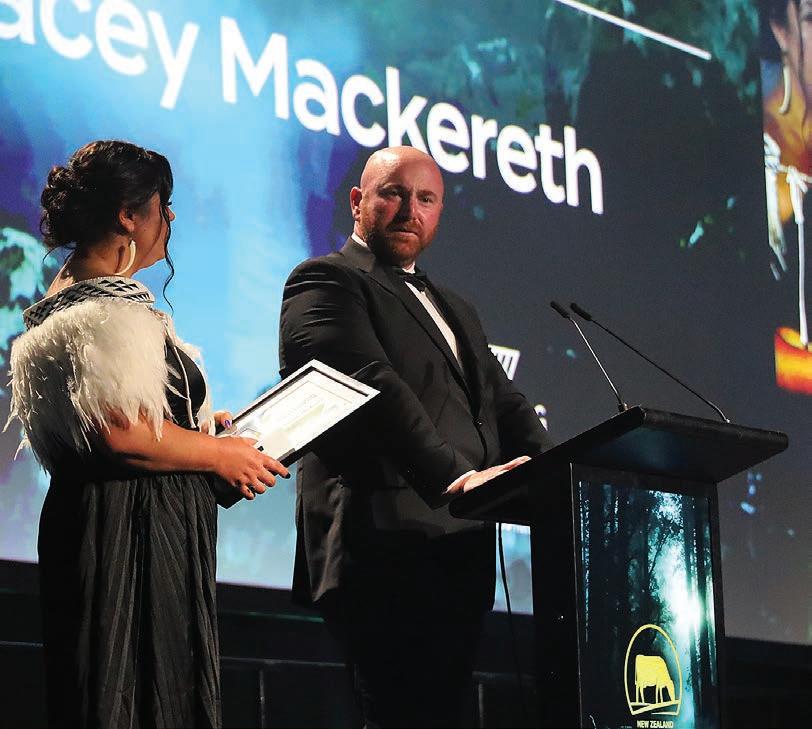
Scott and Stacey Mackereth from Southland/Otago were named this year’s New Zealand Share Farmers of the Year, Lauren McConnachie from Canterbury/north Otago is New Zealand Dairy Manager of the Year and Mark Ready from West Coast/Top of the South is the 2026 New Zealand Dairy Trainee of the Year.
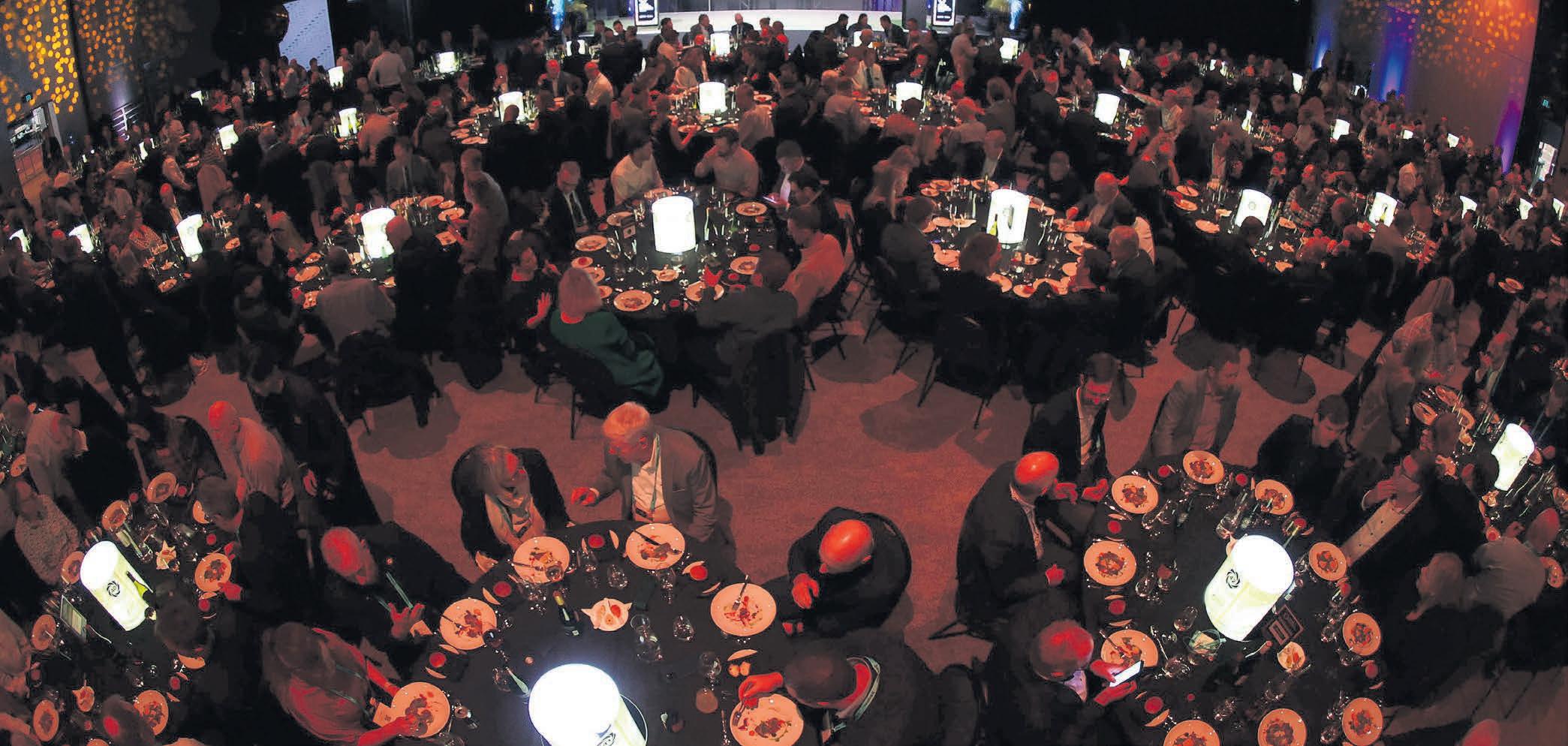
More than 640 people celebrated the event at the Energy Events Centre in Rotorua, with the winners receiving prizes from a pool worth over $1,000,000.
Scott and Stacey Mackereth are contract milking for Fortuna Group at Edendale, milking 1400 cows on 464 hectares.
Scott said the high standard among the other contestants highlighted the depth and capability among the dairy industry.
“To be standing here is a huge
honour and, to be honest, pretty humbling. When you look around the room and the people involved, this recognition isn’t just about us, it reflects the people who work alongside us, the people who have challenged us and the environment that’s helped us improve.”
The role that Stacey plays in their business and the influence it has on their business, people and culture is massive, he said.
To be standing here is a huge honour and, to be honest, pretty humbling.
Scott Mackereth
Share Farmer of the
Year
“This is a reflection of her hard work.”
He said their children put things in perspective and remind them that what they do every day needs to stand the test of time.
He also thanked their wider family and the Fortuna Group for their support with the latter providing an environment that fostered them to think, challenge, improve and be accountable.
“That combination allows people
to support at a high level.”
The award reflected what is possible in the industry. The dairy industry is world-class because of the mindset of the people within it and their mindset of being willing to adapt, improve and keep lifting the standard, he said.
“We also see a responsibility that comes with being here. It’s not just about the individual performance, it’s about representing the industry well, supporting others and helping to lift the standard across the board because a stronger dairy industry is, as a whole, a better one.”
Winning Share Farmer of the Year was not an end point, he said.
“It’s motivation for us to keep growing, to keep challenging ourselves and to keep contributing to the industry in a positive way.”
Glenn and Georgie van Heuven from Waikato were named runners-up and Karl and Jess Wood from Manawatū placed third in the National Share Farmer of the Year.
Dairy Manager of the Year Lauren McConnachie is Rob and Jenine Screen’s farm manager for Theland Farm Group at Purata, Rakaia, milking 2170 cows on 563ha.
Runner-up in that category was Taranaki’s Miriam Lauridsen, and Waikato’s Annie Gill was placed third.
The Dairy Trainee of the Year, Mark Ready from the West Coast/ Top of the South, is a farm manager for Michael Shearer on the Inch Family’s 130ha farm at Maruia, milking 250 cows.
A very close runner-up in the Dairy Trainee of the Year was Sam O’Neill from Canterbury/north Otago, and Conor Attrill-Mundt from Hawke’s Bay/Wairarapa was third.
In other awards given out on the night:
• Alvaro Luzardo and Ximena Puig from Hawke’s Bay/Wairarapa won the 2026 ASB Alumni of the Year award.
• The 2026 Fonterra & ASB First Farm Award winners were Johno and Tania Burrows, and Jonathon & Stacey Hoets, both from Canterbury/north Otago, and Marc and Nia Jones from Waikato.
• Tony Dodunski from Canterbury/ north Otago won the Fonterra Responsible Dairying Award.
“I’m here to be a sounding board, someone to talk through a problem and help find the right direc tion.”
Scott Armer – CEO, Armer Group and First Farm mentor Sam and Michael McGiven – First Farm owners and mentees
WINNERS: Edendale contract milkers Scott and Stacey Mackereth are this year’s Share Farmers of the Year.
Gerald Piddock PEOPLE Dairy
Tomorrow’s per formance star ts with what you feed your herd today From custom dair y blends and pellets , to tailored on farm advice, we deliver nutrition with measurable benefits Talk to your Nutrition Specialist now to build your plan for the season ahead, then lock in your requirements at Fieldays® Call 0800 2 87 32 5 and a sk for your local Nutrition Specialist .
UBCO sees bike path back to farm market
Richard Rennie NEWS Transport
UNDER new ownership, electric bike brand
UBCO is ready to double down on making Kiwi farmers one of its priority target markets again.
UBCO’s chief operating officer, Grant Payton, said the previous company’s move into receivership 18 months ago was an exceptionally tough time, coming just as it was enjoying a successful 175-bike trial with Australia Post.
“We were enjoying good feedback from the posties using the bike, they did not want to go back to petrol bikes and we were in discussions about an extended order.”
However, there were significant financial challenges at the same time with supporting the business without the certainty of a larger order.
“We were fortunate, after considerable efforts, to find sufficient support to retain a core team and allow us to continue
the trial. UBCO has since emerged under new ownership to remain a majority NZ-owned company after its assets were bought from receivers by Utility Fleet Vehicles Limited.”
After much reassurance, Australia Post ultimately stuck with the trial and kept the door open and in March this year, UBCO delivered their 1000th bike.
The receivership experience instilled some good learnings to make us a more focused and disciplined company.
Grant Payton Ubco
“It made a big difference to where we are today.”
UBCO has retained its roots in Tauranga, where it started, and employs 23 staff in development, design, sales and customer support, with assembly done through a long-standing partner in China.
“The receivership experience instilled some good learnings to make us a more focused and disciplined company,” said Payton.
The focus in New Zealand is firmly on the core market of farmers, and particularly dairy farmers.
“Our bike has always been popular with those who bought it for that purpose, they are ideal for sitting behind cows, quiet and low cost to run. But we have also listened to those customers and made some significant changes in response.”
Braking capability was a concern raised by the market, as was the bike’s front shocks performance, both which now have retrofit replacements available, and are standard on new bikes.
Development is also underway for a new model incorporating other design changes based on customer feedback. It will be launched in New Zealand first later this year
Doubling down on the NZ farmer market comes at a time when mainstream motorbike manufacturers are stepping away
ASB partners with Wool Impact
Annette Scott NEWS Wool
A NEW partnership between Wool Impact and ASB has secured crucial financial backing to support the resurgence of New Zealand’s strong wool industry.
ASB is the first bank to partner with Wool Impact to support the future of New Zealand’s strong wool sector, with the partnership the latest demonstration of ASB’s commitment to helping drive growth across NZ’s food and fibre sector.
“We see the potential for significant gains to be made in farm returns by
improving its [strong wool] market relevance.
“Wool Impact has been making great strides over the past three years, and we want to help accelerate that momentum,” ASB general manager rural Aidan Gent said.
“Strong wool is a natural, renewable fibre with significant potential, and teaming up with Wool Impact will allow ASB to back practical initiatives that support rural communities, sustainable land use and long-term sector growth.”
Wool Impact chief executive Andy Caughey said ASB has signed on at an important time.
“There is a real opportunity for strong
from farm-focused two-wheeled petrol-powered bikes. The stalwart Suzuki Mudbug is no longer listed, nor the DR200 Trojan.
“Meantime quad bikes are getting increasingly expensive to buy, run and maintain.
“Farmers are looking for something that is stock-friendly, low maintenance and comfortable to ride.”
UBCO has also taken a closer look at its dealer network, aligning with 42 local bike dealers and service agents throughout the country.
wool products to improve wellbeing in a range of products, particularly in interior spaces where architects and designers are seeking ways to improve building quality for occupant health and productivity, and to reduce the environmental toll of construction.
“Partnerships like this give us the confidence and capability to keep investing in the initiatives that will help unlock that value.
“We produce around 100,000 tonnes of wool per year in NZ. Over the past 12 months we’ve seen average prices for strong wool increase by over $2/kg.
Sustaining that increase means an extra $200 million into rural communities.”
“We now cover 90% of the country and have been quite selective about what dealerships we work with. Our brand will be part of their wider brand portfolio.”
The popularity of hunting with many NZ farmers also plays well into UBCO’s sharper rural focus.
Payton said UBCO customer feedback has not only been about suggestions to improve the bike, but also overwhelmingly positive about the company’s salvation, and that it remains here in NZ.
RECHARGED: The new Ubco bike enterprise has refocused and doubled down on making a bike that appeals particularly to dairy farmers, says chief operating officer Grant Payton, right, with national sales manager Chris Glazewsky.
TIMING: Wool Impact chief executive Andy Caughey says ASB has signed on at an important time.
Payroll is in your hands
Farming isn’t always straightforward, but payday can be PaySauce is designed to give you peace of mind and make payroll the least of your problems
Simply visit paysauce.com to get started
Mystery unmasked on foreign farm deal
Richard Rennie NEWS Agriculture
THE mystery property deal whose details were withheld by the Overseas Investment Office can now be revealed.
In April Farmers Weekly reported that the office’s monthly schedule of sales published in late March had listed an investment in an unnamed property by an overseas identity under the “benefit to NZ” farmland test.
In an exceptionally rare move, no other details of that deal were released by the office – not who the buyers were, the property’s location or its value. The OIO cited commercial and personal detail protection under the Official Information Act as reasons for withholding details.
Farmers Weekly initiated a request under the Official Information Act (OIA) for further details on the sensitive farm land deal.
Following the Weekly’s OIA request and the conclusion of the sale, Lammermoor Station in central Otago has been revealed as the property in question.
The OIO confirmed the case relates to an investment in Lammermoor by French fashion house Chanel, establishing a joint venture (JV) company with the Elliot family, the property’s owners.
Publication of the information prior to completion of the transaction would have been likely to cause unreasonable commercial prejudice to the applicant.
Overseas Investment Office
The joint venture will supply fine wool to Chanel, while the Elliots retain ownership of two areas of current station business, and continue to live and work there.
The deal had also received and has been granted an exemption from having to locally advertise the securities in the joint venture. This was on grounds it was based on an existing relationship between the parties and not genuinely available to third parties.
It states Lammermoor’s owners will incorporate a NZ company to act as an investment vehicle for the JV and then sell between 51% and 60% of the new company’s shares to Chanel.
Chanel will obtain an interest in the land, livestock, equipment and crops from the Elliott family. However, the OIO decision does not reveal the extent of the French fashion house investment into Lammermoor’s land holding.
The OIO noted the interest in the land is available only as an indirect interest, held through the JV and was not available for sale separately to the JV.
The reasons given for the deal and applicant’s details being withheld were that the transaction had not been completed at the time of the OIO’s publication of the decision in late March.
In written correspondence with the Weekly, the OIO stated that in Land Information NZ’s (LINZ)’s view, publication of the information prior to completion of the transaction would have been likely to cause “unreasonable commercial prejudice” to the applicant, and in particular prejudice negotiations with the vendor.
It stated LINZ determined the temporary withholding of details was not outweighed by other considerations that render disclosure desirable in the public interest.
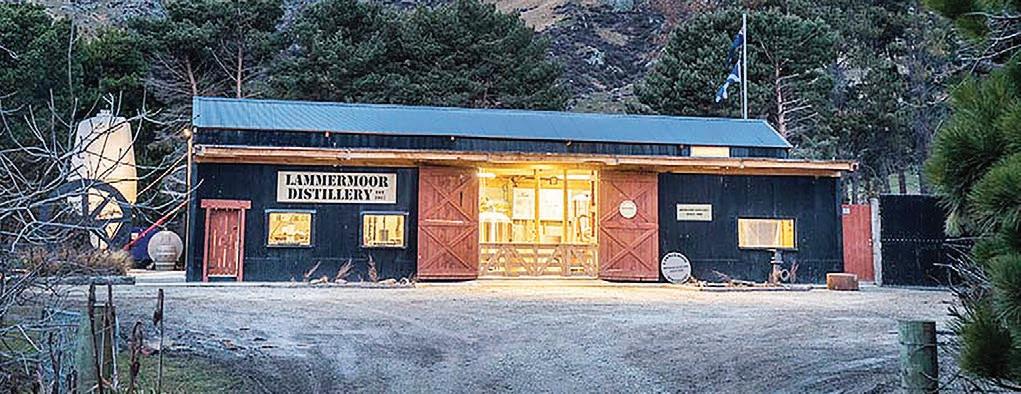
The 5200ha station also has a whisky and gin distillery using its grain. The OIO approval notes it is seeking to become the first fine wool-producing farm in the world to build on its organic status and gain a regenerative organic certification.
In late April Land Information Minister
Mike Butterick said Lammermoor’s regenerative organic status would boost the station’s fine wool value further, calling it a win-win for Chanel, Lammermoor and NZ.
Moving Day is around the corner. With so much to do, let’s get on to NAIT early.
Remember the basics:
• if you’re transporting animals, register their movements in NAIT
• update your NAIT location if you’re moving farms
• make sure your contact details are up to date in NAIT. Visit ospri.co.nz
BOUCLÉ UP: Details of the Lammermoor Station deal between owners John and Susan Elliot’s family and French fashion house Chanel were initially withheld. The 5200ha station also has a whisky and gin distillery using its grain.
From the Editor
Primary sector flying high
Neal Wallace Senior reporter
AS THE wider economy struggles for traction, the primary sector is in growth mode, with Farmers Weekly reporting about $1 billion of new investment in recent weeks.
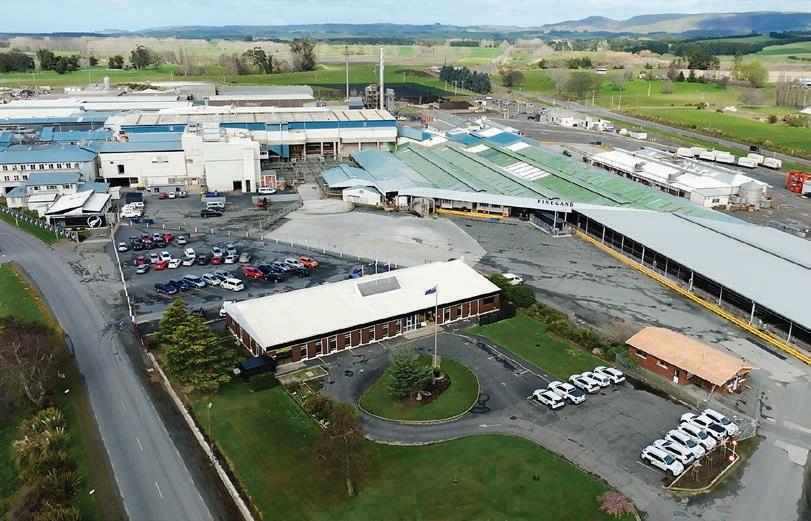
Silver Fern Farms is spending $100 million rebuilding its Finegand plant in south Otago, investors are pouring more than $500m into 460 hectares of new kiwifruit orchards, and dairy is expanding in Canterbury.
As we report this week, Environment Canterbury has consented 12 new dairy conversions for the coming season and another 10 approvals for herd increases, equating to about 12,500 extra dairy cows for the new season.
This investment appears to be more than a one-off, with interest in additional dairy conversions and herd increases for the 202728 season.
It appears investors, cashed up following Fonterra’s capital return, have found willing land sellers among Canterbury arable
farmers frustrated by two consecutive poor harvests.
Zespri’s latest auction of commercial kiwifruit licences attracted sales for 50ha of Red80 variety and 416ha of Gold. Every 400ha of new kiwifruit orchard costs about $500m.
Many of these investors are retired farmers, former growers and dairy farmers looking to diversify their portfolio.
SFF has announced an almost complete rebuild of its Finegand plant, easily the biggest investment by a meat company in several decades, and a welcome boost for a sector that has struggled with low profitability.
Contrast this buoyancy and confidence in rural communities and the wider South Island with Wellington or Auckland, where visitors report an air of apprehension and gloom.
Iran war, growing global production and some consumer resistance.
However, even the lower farmgate prices touted would five years ago have brought a smile to the face of any farmer.
The world’s appetite for animal protein persists, driven by consumers’ desire for simple, healthy and nutrient-dense food.
An example of that demand was last week when Middle East meat distributor Al Tayeb chartered an aircraft to freight 90 tonnes of chilled SFF red meat from Auckland to Abu Dhabi in the United Arab Emirates to avoid the contested Strait of Hormuz.
New Zealand’s economy is as reliant on exporting protein as it has ever been, which raises the question of how we avoid future boom and bust price cycles.
There have been suggestions we need a national food strategy, but to be meaningful it would require buy-in from famously independent meat, dairy and horticultural companies.
LAST WEEK’S POLL RESULT
Almost 92% of those who took the poll think the government should be doing more to ensure wool is used in new construction work carried out by government agencies.
“This is an obvious answer,” said one voter. “Why government has to always be prompted by the public to do the right thing is beyond me. Why make policy in the interest of all of NZers but then not follow it through to the end drives insecurity amongst voters.”
Another said: “It was disconcerting to attend the opening of the beautiful new Omakere School in central Hawke’s Bay where most livelihoods depend on sheep farming, and have the experience ruined by synthetic carpet tiles.” Many voters also pointed to the environmental benefits of wool.
Of the 8.3% who did not think the government should intervene, most felt wool producers should earn the right to compete in the open market: “If it’s a superior product then it will sell itself. If it can’t compete on price then focus marketing on its other qualities but don’t expect legislation to compel people to use a commercially less successful product if that is the truth.”
Last week’s question: Should the government be pushing its agencies harder to ensure wool is used in new construction jobs?
What those cities wouldn’t give for $1bn of new investment.
The primary sector is enjoying a golden period of elevated prices for meat, dairy and kiwifruit, so the degree of optimism and associated investment is understandable.
Forecasts for the next few months are for dairy and meat prices to ease slightly from recent highs due to repercussions from the
Global consumers desire our grassfed, antibiotic-free, natural production systems, which provide exporters with a marketing advantage at a time when global production of pasture-based dairy and meat is declining.
This should help smooth price extremes – but it requires exporters to constantly remind consumers of the attributes of NZ food.
The primary sector is enjoying a golden era, but it requires work for that prosperity to endure.
Raw material the key to meatworks profits
Meaty matters
Allan Barber Meat industry commentator: allan@barberstrategic.co.nz, http://allanbarber.wordpress.com
IN OVER 30 years working in and observing the New Zealand red meat sector I have seen exporters go through several cycles, veering between loss-making downturns and occasional periods of profitability.
At least that has been the pattern among those exporters that report their financial results.
Since the 1990s there have been company collapses – Fortex and Weddel – and near misses. There have been takeovers and ownership changes: PPCS, now Silver Fern Farms, acrimoniously took over Hawkes Bay’s Richmond, which had already bought Lowe Walker; Talley’s bought out AFFCO’s minority shareholders; ANZCO is now wholly owned by Japanese meat company Itoham; SFF had to sell half the cooperative to China’s Bright Meats; and most recently Ireland’s Dawn
Meats acquired 65% of the Alliance co-operative.
Meanwhile several plants have closed, reflecting both the age of the facilities and steadily declining livestock numbers. The only sizeable meat exporters that still report their annual results are SFF, ANZCO and Alliance. And, while all these companies have produced profits when times are good, notably during the pandemic, results have been inconsistent, with some large losses being incurred in difficult years. This suggests when margins tighten the procurement cost and the level of overheads remain too high.
None of the big three has been able to achieve an acceptable return on investment over the past 20 years, which begs the question as to whether the red meat processing sector is permanently condemned to underachievement.
Alternatively are those other companies that fly under the radar somehow making good profits. What is their magic formula? I have no inside knowledge that would provide the answer, but it seems logical to assume the owners of these private companies are determined to make profits and achieve a satisfactory rate of return.
I suspect their overheads are kept low enough to generate a profit even in a bad year, while employee numbers are kept under control and processing facilities well maintained.
There are many moving parts in the red meat industry, but the principles are quite simple: buy the raw material at an affordable
price, process it as efficiently as possible and sell it to the best returning markets.
Livestock procurement has long been the area of greatest volatility, more because of excess processing capacity than for any other reason. Processing depends on plant efficiency, which is largely dictated by capital investment, process design and throughput. Sales and marketing are a matter of choice – complexity of the product range and overheads required to extract the best margins.
SFF CEO Dan Boulton confirmed to me the latest year’s improved result demanded very tight cost control, capacity adjustment to match livestock flows, and overall discipline within the business.
Market conditions required a significant reduction in staff numbers, as was demonstrated by a reduction of $18 million in employee costs.
Boulton effectively acknowledged the company’s underperformance at the AGM when he spoke about the need to improve SFF’s resilience from better working capital management, scale and profitability.
The goal is to achieve cumulative earnings before depreciation of $1 billion by 2030, equivalent to $200m per year, and annual revenue of $5bn. This ambitious target compares with combined EBITDA of $147m in the past two years and revenue of $3.05bn last year.
Although the market remains strong, boosted by a shortage of protein globally and a decline in the United States beef herd, the
The announcement of a $100 million upgrade of the
likely cost inflation from the war in Iran will make these targets extremely tough, especially as SFF will need to perform more than twice as well as it has historically.
Some of the targeted improvements would have to come from an increase in throughput at the expense of its competitors in the face of lower livestock numbers. As history proves, this would cause a procurement war where the strongest come out on top. The only other sources of meaningful profit are dramatically improved processing efficiency, overheads and product margins.
The announcement of a $100m upgrade of the Finegand plant signals the intention to increase efficiency, but nowadays that may not be enough to bring an old plant up to industry-leading standards.
I imagine the major competitors, including the more consistently profitable ANZCO, highly efficient AFFCO, Alliance under new ownership, Greenlea, Ovation and Wilson Hellaby with its refurbished plant, would be reluctant to allow their market
share to be cannibalised without a firm response.
It is worth remembering what happened in the 1990s when PPCS upped the price of lambs at the low point of the season, forcing Fortex to pay more than was economically viable to honour the union agreement at its new plant on PPCS’s back doorstep. The result was fatal.
Dawn Meats won’t have invested $270m for two-thirds of Alliance to continue achieving the previously poor return. The fact it means serious business has already been demonstrated by the swift termination of CEO Willie Wiese’s employment and the hands-on involvement of Dawn CEO Niall Browne.
It is encouraging to see the amount of investment being applied to making the red meat processing sector more efficient and competitive, ensuring choice and expertise for farmers and customers alike. I just hope there is enough livestock to give all the companies the chance to make a decent return on their investments.
Women who hunt are good for hunting overall
In my view
MORE women are getting into hunting, and that is good for the women involved – and for the hunting community overall. It means more people are discovering the physical and mental wellbeing benefits of time outdoors, the challenge of learning new skills, and the satisfaction that comes from harvesting healthy wild meat for their families. It also means the hunting sector is becoming broader, stronger and more representative of New Zealand’s communities. Hunting is about much more than harvesting meat. It is about self-reliance, resilience and connection with the environment, with the food we eat, and with the people we hunt with. Those benefits are recognised by women across New Zealand, and more are now stepping behind the rifle. The increase in the number of
who hold a firearms licence do so for the purposes of hunting.
This is something that as a country we should welcome and encourage.
More women hunting means more people embracing the values that underpin our hunting culture – self-responsibility, practical skills and respect for the animals and environment.
As a woman hunter myself, I have found that hunting offers something that is increasingly hard to find elsewhere in life. It provides challenge, adventure and time away from the noise and pressures of other parts of my life.
women taking up firearms use is not marginal. It is a significant trend.
Data from the Firearms Safety Authority shows that women currently make up 8.7% of all firearms licence holders in New Zealand – but among first-time licence holders, that figure basically doubles, to 17.7%. We also know that a majority of those
Hunting teaches you to slow down, pay attention to what you are doing and the world around you. Hunting is also incredibly empowering. There is something deeply rewarding about sourcing your own free-range protein and knowing exactly where it has come from. That has real appeal for many women, particularly those who want to provide for their families and be more connected to the natural world.
Just as important, hunting can
be a shared experience. For some women it is about hunting with their family or friends. For others it is about building confidence independently, learning to navigate the outdoors alone and proving to themselves what they are capable of. Women hunters I know speak about the sense of independence and achievement hunting gives them.
One of the biggest barriers for new female hunters has always been access to knowledge. The good news is that there are now more pathways into hunting than ever before.
If you did not grow up around firearms or hunting, it could be hard to know where to begin. We are making a big effort to change that. In 2023, the Game Animal Council launched Better Hunting, New Zealand’s only fully free online hunter education platform. With modules covering everything from backcountry survival to navigation and weather forecasting to firearm use, hunting techniques and animal behaviours, Better Hunting helps make learning the basics more accessible.
We are also seeing more womenfocused hunting initiatives and communities emerge. Programmes and groups such as the Fiordland Wapiti Foundation’s Wāhine and Wapiti, Wild Chix NZ, Coach Tui, NZ Women Hunters, Daughters of the Wild and HuntHer are helping to create supportive entry points for women who are curious about hunting and keen to build their confidence. These initiatives matter because they make the pathway into hunting less daunting.
Women’s growing participation in hunting is something we should all celebrate. It reflects the fact that the benefits of hunting are being recognised more widely and that more people are seeing a place for themselves in it. The greater the range of people participating positively in hunting, learning how to do it well, and valuing the role hunting plays in New Zealand, the better off the whole sector and the country will be.
STANDARDS:
Finegand
Corina Jordan
Jordan is CEO of the New Zealand Game Animal Council
APPEAL: Chief executive of the NZ Game Animal Council Corina Jordan says more women are getting into hunting and that’s a good thing.
SHOWCASE:
Trading nation polishes its shop window
FIELDAYS CEO Richard Lindroos is banking on a rural economy buoyed by high commodity prices to keep the tills ringing at the southern hemisphere’s largest agricultural event.
As the war in Iran drags on and input prices stay elevated into the new season, confidence remains high among exhibitors.
The New Zealand dollar is also trading at a level that is ideal for exports at around 59 cents for
the US dollar and 89 cents for the Australian dollar, he said.
“The noise I’m getting from exhibitors is that they’re excited to exhibit, it’s positive and they’re resilient.”
With the event set to run from June 10-13, exhibitor sites are close to 99% sold out. There has also been a positive response to ticket purchases since they opened in late April.
“I know it’s a very early indicator but we’re up on all previous years of ticket sales,” Lindroos said. So far, fuel is a price rather than a supply issue and Fieldays management may bring in extra buses for the public if costs creep
up or there is a sudden fall in supply.
Around 14,500 people used the service last year and Lindroos expects that number to grow over time.
Fieldays is one of New Zealand’s true mega events. Preparations are already ramping up on-site, with the venue taking shape ahead of opening day, he said.
Upgrades include resealing roadways and pothole repairs, and work has started on the 400 square metre Rural Living marquee, which is now under construction.
“Mystery Creek Events Centre is a hive of activity. In the lead-up to the gates opening, we will have
over 14,794 contractor induction entries onsite,” he said.
The site is looking wellmanicured with the summer work around installing new water infrastructure completed and the grounds are in excellent condition as exhibitors start erecting their sites in the coming weeks, he said.
More than 1200 exhibitors will showcase their products and services. Visitors can expect a diverse and engaging experience, from cutting-edge agritech and advanced farm machinery to artisan food and new-to-market vehicles. A strong lineup of feature areas will give visitors the opportunity to explore emerging
technologies, career pathways, sector insights, and the latest developments shaping the future of agriculture and rural industries. These are showcased across the Fieldays hubs, including Innovation, Careers and Education, Forestry, Hauora Taiwhenua Health & Wellbeing, Rural Advocacy, and the Drone Zone.
Several key features are also reaching important milestones, with the Fieldays Hauora Taiwhenua Health and Wellbeing Hub celebrating its 10-year anniversary and the Fieldays
Continued next page
Gerald Piddock MARKETS Fieldays
Forestry Hub marking five years as part of the Fieldays programme.
The Village Green area has been revamped following the removal of the old hub building. It will now act as a function centre for business and political events during Fieldays, seating around 240 people, 100 more than previously.
“It’s allowed us to host larger events and more of them,” Lindroos said.
It will be the venue for some of Fieldays’ biggest events, including the Innovation Awards and a trade lunch hosted by the European Union on June 11. That will be a sought-after event to get to,
particularly during an election year, Lindroos said.
“They are doing that with a purpose because it’s a good opportunity to engage and connect with New Zealand businesses and with New Zealand ministers and opposition leaders.”
The EU knows that hosting such an event at Fieldays is a more effective venue than hosting it in one of the country’s major cities.
That networking and deal-making side of Fieldays is now as big as and as important as its sales element.
“We’re a trading nation and this is a really effective way to promote our products, our people and our technology.”
It is also very cost effective
for these delegations to conduct their business because it brings them, politicians and businesses together. It also provides a vehicle for people and groups to have meaningful discussions at an informal setting.
“We really are a trade event. We’re not just a retail and exhibition event; deals are getting done and people are meeting. It might not all happen at Fieldays but it’s where they introduce and meet and greet,” he said.
The informality means people get to converse with government officials and Crown ministers in a way they cannot outside the event.
These meetings involve not just the Ministry for Primary Industries but, increasingly, NZ Trade and Enterprise as well.
“We have 10 Indian delegations coming here on the back of the FTA plus other delegations.”
Fieldays programme manager
Steve Chappell said so far there are 60 international exhibitors, with more still to be confirmed.
They include Enterprise Ireland, Incredible India, the German Pavilion, the EU’s “Enjoy It’s from Europe”, and Shandong Province, China.
Delegations so far are also coming in from the United Kingdom, China, India, Chile, Brazil, the US, Australia, Poland, Ghana, Canada, and more to be registered via NZTE and the Ministry of Foreign Affairs & Trade.
Ambassador registrations are
Hungry to lock in bulk feed or CMR agreements?
We’re a trading nation and this is a really effective way to promote our products, our people and our technology.
Richard Lindroos Fieldays
also coming in and he expects numbers to eclipse last year’s in all areas.
Competition regulars are back, including the Tractor Pull and the Fencing and Excavator competitions. These continue
to celebrate capability, skill, and a strong sense of grassroots entertainment.
Families can take a break at the Fieldays Family Fun Zone or check out the Heritage Village, home of the historic church, the old Kihikihi jail, and the National Dairy Museum. The Village also houses the Fieldays Creative Space, offering visitors a chance to slow down and engage with the creative side of rural life.
General admission tickets are priced online at $36 for a one-day adult pass and $18 for a one-day child pass, with free entry for children under five. A family pass is available for $108.
It’s that time again. G et planning your calf and dairy feed requirements for the up coming season so you secure the b est pricing come June.
Order in store or talk to your rep.
CONFIDENCE: The stage is set for this year’s Fieldays with high commodity prices across the board fuelling confidence among site holders, Fieldays CEO Richard Lindroos says.
TICKETS: There has been a positive response to ticket pre-sales since they opened in late April.
Thread of sustainability runs through event
Staff reporter MARKETS Fieldays
FIELDAYS is one of New Zealand’s pioneers in sustainable event organisation at scale.
Since 2012, it has worked with external reporting company Instep and holds certification for the international ISO 20121 standard for sustainable event management.
It is a unique platform to lead by example by incorporating sustainable initiatives into the four-day event and to integrate the insights and innovations of exhibitors, New Zealand National Fieldays Society community and sustainability executive Janine Frohlich-Monk said.
For visitors looking for practical advice, Fieldays Tent Talks feature 20- to 40-minute “drop in” sessions on topics including sustainability in the food and fibre
sector, solar energy, regenerative practices and more.
For those seeking information on sustainability regulations, the Fieldays Rural Advocacy
Hub provides a space for farmers to stop by for a chat or share thoughts and concerns on farming-related issues.
Beyond the hubs, the expertise
shared by exhibitors provides a valuable opportunity for conversations that can lead to practical, on-farm solutions.
By taking the free bus or using Fieldays park and ride options, visitors can also help reduce the event’s carbon footprint.
As public transport becomes an increasingly appealing topic amid the fuel crisis, organisers expect increased use of their free bus services that run daily during the four-day event.
“It’s a simple way to reduce traffic congestion, lower emissions, and make travel to the event smoother for everyone,”
Frohlich-Monk said.
For exhibitors, the Fieldays Sustainability Awards provide a platform for exhibitors to gain recognition for their efforts.
The awards are supported by a practical Sustainable Exhibitor Framework, which forms part of the awards entry process.
That framework acts as
a scoring guide, helping exhibitors understand what good sustainability practice looks like onsite at Fieldays and how different actions contribute to a stronger entry.
Exhibitors can use the framework to identify simple changes that improve both their Fieldays site and their award score.
“A positive example of this is where an exhibitor introduced reusable cutlery for use on their Fieldays site after seeing how it was recognised in the framework and later took that change back into their wider business operations.
“This is exactly the type of practical, behaviour-focused learning the awards are designed to encourage,” Frohlich-Monk said. Awards finalists will be announced before Fieldays starts, giving entrants the chance to promote their sites as finalists. Winners will be announced on June 12, during Fieldays.
McClay to anchor Rabobank panel discussion
Staff reporter MARKETS Fieldays
RABOBANK will be holding a special breakfast panel discussion for invited guests at its site, featuring Trade and Agriculture Minister Todd McClay.
Rabobank New Zealand general manager for country banking Bruce Weir said the event, on the morning of June 11, will aim to help attendees “make sense of the changes shaping the environment we’re all operating in”.
“We’re expecting a full house for the event.
“With global dynamics shifting rapidly, we’ve invited the minister along to take part in a panel discussion which will look at
geopolitics, trade flows, and how these impact New Zealand’s food and agriculture sector.
“The event will be moderated by our CEO Todd Charteris and Minister McClay will be joined on the panel by Rabobank’s senior market strategist Ben Picton.” Weir said Rabobank is looking forward to welcoming clients and other guests to its marquee at Fieldays.
It provides a fantastic opportunity for Rabobank to repay some of the hospitality shown to bank staff when they are out visiting clients’ businesses, he said.
“Our country banking team spend a lot of time out visiting clients on their farming operations, and I know our staff really appreciate the hospitality that’s shown to them on these visits.
“So it’s really nice for us to do the hosting at Fieldays, and to provide clients with a space where they can catch up with our team and enjoy a drink and bite to eat.”
Weir said Rabobank’s Fieldays menu will feature produce supplied by a number of its food and agri clients.
“Across recent years, we’ve made a real effort to showcase our clients’ produce at Fieldays and we’ve had great feedback on our lunch offering,” he said.
“This year, client produce will again be front and centre, with produce supplied by Verkerks, Silver Fern Farms, Barkers, Fonterra and Mr Apple all set to feature on the RaboCafé menu.”
A number of Rabobank staff will be attending the Rural Support Trust Fundraising Dinner on June 10 as a partner of the trust.
“This year we’ll be donating a spot on the 2027 Rabobank Farm Managers Programme (FMP) which can be bid on in the Rural Support Trust’s silent auction,” he said.
TASTE: Rabobank’s Fieldays menu will feature produce supplied by a number of its food and agri clients.
“The FMP is a highly regarded, week-long residential programme developed for progressive primary producers, and we’re hoping this auction item will attract plenty of interest.”
LARGE BUSINESS: Hydroflow Distributors Ltd, winners of last year’s Fieldays Sustainability Awards, in the Large Business category.
SUPPORT: Fieldays’ volunteers are the reason the event has been running for 58 years.
Volunteer squad supplies the event’s secret sauce
Staff reporter NEWS Fieldays
FIELDAYS has a vital force of volunteers who work closely behind the scenes with the wider event team to ensure the event runs smoothly over the annual four-day event.
Last year, 151 volunteers contributed their time to Fieldays, and the New Zealand National Fieldays Society is looking for new volunteers to join their returnees for this year’s event at Mystery Creek on June 10-13.
Fieldays Society people & culture executive Beth Jobin said their volunteers are the reason they have reached 58 years.
“Their commitment and passion are what keep the tradition alive. Every year, we look for new faces to join us and become part of something truly special.”
Peter Fisher, a retired seed industry specialist, has volunteered for seven years.
He began volunteering in 2018 at the 50th anniversary Fieldays event, helping in the New Zealand International Business Centre, and now supports the mobility parking space.
“I had always enjoyed coming to Fieldays during my working life and wondered what it would be like to
volunteer. I had good knowledge in the seed industry and an interest in agriculture and felt I could add value.
“I enjoyed meeting many people from across the world, all coming to Fieldays at the bottom of the world to do business.”
Fisher loves meeting and working with a great group of people.
“Volunteering is a good social thing to do, enabling you to give back to the community. You make lifelong friends.”
Anita van Beek’s connection with Fieldays began in the early 2000s when she was a carpark attendant with New Zealand Young Farmers. It wasn’t until 2014 that she signed up to become a volunteer with the society, volunteering for the full four days.
“Those first few years were fullon, helping in the site services team.
“I would start on Gate 2, welcoming exhibitors, then move on to deliveries, then helping with the vintage tractor parades, and then either roaming or area-specific exhibitor assistant, and of course, afternoon traffic management.”
Over the past 12 years, she has filled several roles, last year driving the visitor shuttle.
“I enjoyed chatting with people, asking about their plans for the day or how their day had been so far.”
‘Fieldays fever’ keeps volunteers coming back
Gerald Piddock MARKETS Fieldays
IT’S “Fieldays fever” that has kept Kerry Clarkin coming back to volunteer at the event, and after 55 years, that passion hasn’t dimmed.
He said 1971 was his first year of involvement, when he was just a “snotty nosed little kid”. He had great people who mentored him through the society, allowing him to sit in on meetings so he could see how it was run.
John Davison and Alan Sharp are two volunteers who were volunteering at the first Fieldays in 1969 and are still active onsite.
“I’m the next one down the line in 1971,” Clarkin said. He was 18 and was a member of the Newstead Young Farmers Club when he was first asked to help out. Two years later he was asked to run the event’s car parking, which he did for the next 10 years.
In 1984 he was made chair of Fieldays’ exhibits committee, which at the time ran the event.
In 1991, he was made Fieldays chair and in 1999-2001, served as Fieldays president.
In 2008-2018, Clarkin became Fieldays membership coordinator, which provided pastoral care for volunteers and Society members as well as making sure they knew what their jobs were during the event.
These days, he helps out where he’s needed.
Looking back, he has seen it grow into a corporate juggernaut that brings hundreds of millions of dollars into the economy and showcases the primary sector to the world.
He remembers that in those earlier days, the volunteers did everything.
“I spent months painting and chopping ragwort, we all did in those days.
“Why do we do it, it’s a passion, it’s Fieldays fever and we all had a passion and a drive for the organisation because we could see that it was becoming so important to New Zealand.”
The comradeship of Fieldays
We all had a passion and a drive for the organisation because we could see that it was becoming so important to New Zealand.
Kerry Clarkin Fieldays volunteer
also keeps him coming back and as a farmer, volunteering gave him the opportunity to mix with people, he said.
“I’ve made some fantastic friends out of the organisation.” Fieldays’ evolution from being a hands-on, volunteer-run event where the organisers all participated in decision-making to it being professionally run with governance and staffing was necessary as it grew. But it has not diminished the importance and necessity of those volunteers to ensure Fieldays runs seamlessly, he said.
“It’s a totally different animal to what it used to be but it has still got that passion.
“I was talking to a volunteer last week who lives in a retirement home, and she comes out and she loves the work she does out there and meeting the people.”
GOING BACK: Kerry Clarkin has been involved in every Fieldays since 1971.
Scanning tool almost ready for its close-up
Wallace TECHNOLOGY Livestock
ACCURATELY measuring the weight of cattle could soon be as easy as taking a picture on an iPhone.
Dan Bull, the chief executive of Raglan-based company, said after two years of development, the commercial release of his 3D and artificial intelligence technology is months away.
Scanabull, which will have a stand at Fieldays, is a marriage of Bull’s earlier career in data and computer science, agtech and artificial information, and an upbringing working on his family’s Te Akau sheep and beef farm in Waikato.
“I was involved with working on the family farm and weighing cattle on scales, which seemed a bit archaic,” he said.
Two years ago he was chatting with bidr manager Liam Beattie about the possibility of using saleyard cameras to calculate
animal weights, but found the technology inadequate.
What was needed was a 3D camera, which is used in iPhones.
The Scanabull system uses a telephone app and the iPhone’s 3D camera.
It takes 30 images a second of an animal and works off 100,000 data points, which it then segments with the information processed by artificial intelligence and algorithms to calculate the weight of the cattle beast.
Ideally it needs to be 3m away from the lens, but it also works for animals 4m away.
A second technology is a weigh point, a camera mounted in a paddock with its own animal recognition system.
Bull said once a cattle beast walks passed the camera, the system remembers it, allowing it to calculate and track the individual animal’s weight.
The technology is so far averaging about 95% accurate.
Bull said the “sweet spot” for the technology could be calves, which are often difficult to put
Weighing cattle on scales seemed a bit archaic.
over scales. Scanabull’s ease of use allows quick and regular assessment of calves’ weight.
While it works on dairy cows and two-day-old calves, they are working with several dairy farmers and DairyNZ to access more weight data and improve its accuracy.
Bull believes the technology would appeal to agents and
farmers – and those using virtual fencing.
By installing a weigh point in a paddock, cattle condition can be tracked and those that were a bit light can have their collar reprogrammed so they can access better quality feed.
The next stage of development is calculating carcase weight and body condition score measurements, which Bull said will assist with animal health and stock management.
He said he set up the company in 2024 and later that year joined the Sprout business incubator, which gave him insight into how venture
capital works and, importantly, opened up a network of contacts.
Bull said friends, family, Silver Fern Farms and numerous farmers who have assisted or tested the technology have helped get Scanabull to where it is now.
The company recently raised $1.1 million after a bid led by Sprout Agritech, with support from Enterprise Angels and Callaghan Innovation’s Deep Tech Incubator programme.
There was already interest from farmers in Japan and the United Kingdom, where, Bull said, cattle are a lot quieter and therefore were easy to measure.
ACCURATE: New camera technology is proving on average 95% accurate in assessing the weight of cattle.
Neal
MERGING: Scanabull chief executive Dan Bull has combined farming and artificial intelligence to create technology that weighs cattle.
Dan Bull Scanabull
“ We we
“We more than doubled our production per hectare to 380kg carcass weight per hectare on hard hill country, and we more than doubled our gross farm income per hectare.”
Fiona and Jon Sherlock
“We always thought there was more we could do - more precision, more performance. We’d heard great things but we weren’t sure it’d make that much difference But by day three, we could already see it changing the way we farm ”
Lizzy and Cameron Te Brake Dairy, Waikato
Beef, Waikato
Bronya and Shane Wainwright Dairy, Canterbury
Bioeconomy scientists lay out genomics gains
Staff reporter
THE Bioeconomy Science Institute Maiangi Taiao will be part of the Ministry for Primary Industries’ Science for Farmers stand (E38) at this year’s Fieldays, presenting research that delivers practical benefits for New Zealand’s primary industries.
Visitors will gain insight into how the Bioeconomy Science Institute’s science is supporting on-farm decision-making, productivity and sustainability.
The exhibit will highlight two key areas of research – genomics and farm system resilience.
For more than 30 years, DNA and genomics research has helped drive major gains in the productivity and resilience of New Zealand’s plants and animals.
New Zealand’s national sheep
flock is now around half the size it was in 1990, yet the country continues to produce similar volumes of lamb. Production per ewe has increased by 114% since 1990, while carcase weights have risen by at least 28%.
These gains reflect decades of genetic improvement research and breeding technologies developed by the Animal Genomics Team at the Bioeconomy Science Institute, with GenomNZ commercialising these tools and delivering them to the sector.
As the commercial arm for these genomic technologies, GenomNZ enables breeders to select animals for traits including weaning weight, feed efficiency, meat quality, parasite resistance and greenhouse gas emissions per kilogram of product.
GenomNZ now holds around 70% of the national sheep genotyping market. The estimated net present benefit of these
Genomic approaches developed through the institute’s research are now being applied across more than 140 species spanning livestock, aquaculture and plants.
programmes is $1.11 billion, with a benefit cost ratio of 5.47 to 1. Genomic approaches developed through the institute’s research are now being applied across more than 140 species spanning livestock, aquaculture and plants. With rising temperatures and more frequent hot days affecting livestock welfare and productivity, our researchers are investigating practical solutions for farmers to drive farm system resilience.
One such solution is the strategic integration of trees into farm systems. While incorporating
trees into farm landscapes requires careful planning, the benefits can be significant.
These include improved animal welfare through shade, potential gains in productivity, diversified income streams, and reduced environmental impacts.
Field trip just the ticket for students
Staff reporter MARKETS
TEACHERS are being encouraged to register school groups for Fieldays with a 45% discount offered on student tickets for groups of 10 or more.
The event at Mystery Creek on June 10-13 provides opportunities designed to connect classroom learning with real-world careers across New Zealand’s primary industries.
The Careers & Education Hub will be the central starting point for school visits, supported by a Careers Trail on the Fieldays App that helps students explore training and employment pathways across the event.
The Hub has engaging exhibitors and thought-provoking seminars and panel discussions.
More than 70 sites across Fieldays are part of the Careers Trail, bringing together training providers, support organisations
and employers keen to connect with future talent.
Halter is an inaugural participant at the Hub. Halter marketing and events specialist Lily FooteCaughey said they are excited to be part of the Hub this year.
GAINS: One of the focuses at the Bioeconomy Science Institute’s stand at this year’s Fieldays will be DNA and genomics research, which has driven productivity gains on New Zealand farms for over 30 years.
Ongoing research is exploring how shade influences pasture growth and quality, how tree placement affects nutrient losses and redistribution, and how integrated systems can support more resilient farming in a changing climate.
“At Halter, we believe the future of farming is being built right now, and we want students to know there’s a place in it for them.”
Fieldays Society programme manager Steve Chappell said each year more schools are choosing Fieldays because it gives their students a practical window into future careers and real-world learning.
“From hands-on pathways into agriculture and related industries, through to science, technology and sustainability-focused roles, students can meet the people behind the work and see what those jobs look like in practice.”
Alongside the Careers & Education Hub, points of interest for students include the Fieldays
From handson pathways into agriculture and related industries, through to science, technology and sustainability-focused roles, students can meet the people behind the work and see what those jobs look like in practice.
Steve Chappell Fieldays Society
Forestry Hub, the Fieldays Innovation Hub, the Fieldays Drone Zone, and Fieldays Tent Talks.
Schools can register on the Fieldays website to access their group booking discount and plan their visit.
BEGINNING: The Careers & Education Hub will be the central starting point for school visits.
Starring role for nature’s recyclers
Staff reporter MARKETS Fieldays
TE KUNENGA ki
Pūrehuroa Massey
University will showcase at Fieldays how science is helping to shape the future of the food and fibre sector through regeneration, sustainability and practical on-farm solutions.
A key feature of its site at PE51 in the main pavilion is Massey’s work on circular bioeconomy innovation, finding ways to treat waste as a resource.
With around 30% of food lost or wasted across the agrifood chain, researchers are demonstrating how organic waste can be repurposed using black soldier fly larvae.
Visitors will be able to see the larvae in action as they break down food scraps, converting waste into nutrient-rich fertiliser and highvalue protein. The demonstration highlights the potential of nature’s recyclers to reduce landfill pressure and close nutrient loops.
Cutting-edge environmental monitoring technology will be
another key feature, with live demonstrations of the LI-COR LI7820 portable trace gas analyser.
Researchers will show how the device measures nitrous oxide emissions in real time across different soils, crops and conditions.
This work supports a better understanding of agricultural emissions and helps inform
practical mitigation strategies tailored to New Zealand farming systems.
The Whenua Haumanu programme, New Zealand’s most comprehensive regenerative and pastoral agriculture research partnership, will once again be featured on the Ministry for Primary Industries Science for Farmers stand.
Now midway through its sevenyear journey, the programme is generating insights into how farming practices influence soil health, biodiversity and wider ecosystem outcomes, while maintaining productive and resilient pastoral systems. Stop by to hear what’s new after another year of research.
Members of Massey’s team will
also be sharing their expertise during several MPI Science for Farmers panels.
Professor Danny Donaghy will speak on resilient pastures and climate modelling for the future on June 12 at midday and Professor Lucy Burkitt will present on freshwater and catchment solutions at 1pm the same day. Visitors can hear Nutrition Lab manager Kelly Coxhead speak on the Wāhine toa o te Whenua panel on June 11 at 1pm, when she will join other emerging female leaders to share insights into their experiences and the diverse career opportunities in the food and fibre sector.
Innovation in sustainable materials will be on display through Te Aho Tapu Hou, which is transforming harakeke (flax) muka fibre into high-value textiles.
Combining mātauranga Māori with modern fibre science, the project is developing new pathways for sustainable, Māoriled enterprise and showcasing natural fibre innovation. There will be on-site demonstrations.
Where DairyNZ’s science emerges in on-farm tools
Staff reporter MARKETS Fieldays
FIELDAYS 2026 is a valuable chance to get off farm, connect with fellow farmers, learn from rural professionals, and sharpen your farming skills.
DairyNZ will be front and centre this year, showing how its farm systems expertise and research are helping farmers prepare for future challenges, backed by strong sector partnerships.
Its site at PC44 in the main pavilion focuses on turning science into practical on-farm solutions, including:
• Getting more from your homegrown feed.
• Lifting value from your herd through the Dairy Beef Opportunities Programme – a joint initiative between the dairy and beef industries and the government to grow the dairy-beef sector.
• Measuring farm performance and profitability.
• Driving greater on-farm efficiency to improve performance and profitability.
There will also be the chance to meet DairyNZ specialists, board members and leaders, and learn how DairyNZ is collectively investing in the future of dairy.
DairyNZ is also working with other sector organisations to showcase the breadth of its work, supporting farmers on farm, across
the industry, and into the future.
DairyNZ will feature in other sites, including Dairy Training Limited, located behind its main site in the pavilion.
This will showcase its free, NZQA-accredited practical training to upskill farm owners and their team.
The Ministry for Primary Industries Science for Farmers site at E38 will show work helping to shape the future of dairy farming, including innovation designed to support on-farm productivity, sustainability and resilience.
The Farmers Advocacy Hub at D70 in the Gallagher Building will highlight DairyNZ’s advocacy with ministers and MPs on key issues affecting the dairy sector.
PASTURES: Professor Danny Donaghy presenting at Fieldays in 2025. This year he will speak on resilient pastures and climate modelling at one of the MPI Science for Farmers panels.
SCIENCE: DairyNZ’s site in the main pavilion focuses on turning science into practical on-farm solutions.
Envelope pushed, game changed at this hub
Staff reporter MARKETS Fieldays
THIS year’s Fieldays
will see 58 individuals, companies and startups exhibit their ideas and cutting-edge solutions in the Fieldays Innovation Awards.
The inventions and innovations will feature a wide mix of ideas, from AI and automation to safety, monitoring, and diagnostics, and plenty of ‘Why didn’t I think of that’ smart solutions that make life on the farm, orchard, or rural block easier and more efficient.
Fieldays programme manager Steve Chappell said the awards look different from 10-15 years ago, because of the breadth of entries, and the evolution of technologies.
“But as we near the 60th year of the awards, I’m pleased that they
still showcase the new, bold, and practical solutions they always have.”
The programme connects participants to the innovation ecosystem in New Zealand, where they can engage with a panel of expert judges and tap into a wider network of mentors and partners to help refine, fund and amplify their innovation.
The event also serves as a direct line to the primary industries audience, allowing innovators to engage with farmers to validate their concepts and gain honest, invaluable feedback.
“Fieldays is where start-ups can move from a viable concept to international impact.
“It’s nice to see entrants working their way through the categories again this year and being inspired by the success stories of previous awards entrants,” he said.
Award participants are divided
into the three main stages of development: 27 in the Prototype category, 18 in the Early-Stage category and there are 13 in the Growth & Scale category.
Five participants are also in the running for the Young Innovator of the Year award for entrants aged 19 and under.
The awards continue to evolve, and serve as a marker for progress in New Zealand, he said.
“We’ve seen a marked increase in AI-based solutions this year, which was expected, and we’re looking forward to looking at the awards structure after this year’s Fieldays to see how we need to shift to make sure we adapt to change while remaining true to the traditional heart of the award and the practical solutions.”
Participants are hoping to win a share in a total prize package of cash, services, and products worth more than $75,000 to help get
Fieldays is where start-ups can move from a viable concept to international impact.
Steve Chappell Fieldays
their ideas off the ground or accelerate their path to market.
The People’s Choice Award also returns in 2026, with King St as sponsor, giving Fieldays visitors
the chance to have their say by voting for their favourite innovation.
All entrants are eligible, with the top-voted innovator receiving a $2000 cash prize, while one participating voter will win a $500 voucher. Voting will be open throughout the event at the kiosk inside the Fieldays Innovation Hub.
The Innovation Awards ceremony will be live on Fieldays’ Facebook and YouTube channels on June 11 at 5:30pm.
Waikato University insights, innovations on show
Staff reporter MARKETS Fieldays
FROM AI-powered blueberry harvesting technology to expert discussions on the future of New Zealand’s economy and food production, the University of Waikato will showcase innovation and insight at this year’s Fieldays.
The university’s Innovation Awards entry in the Innovations Hub features student research into artificial intelligence-powered harvesting technology aimed at helping blueberry orchards improve efficiency and fruit quality. The project explores automation technology for mechanical harvesters using cameras, AI and
real-time monitoring to help machines make smarter harvesting decisions.
The system is designed to improve harvesting efficiency, reduce plant damage and minimise unripe fruit loss, helping growers get more value from every harvest.
Continuing the conversation
from the annual New Zealand Economics Forum hosted by the Waikato Management School, this year’s Fieldays Tent Talks – sponsored by Waikato University – will feature panel sessions examining the challenges and opportunities facing New Zealand exporters and farmers in a rapidly
RAPIDLY CHANGING: The Fieldays Tent Talks will feature panel sessions examining the challenges and opportunities facing New Zealand exporters and farmers in a rapidly changing global landscape.
changing global landscape. Topics include:
• Feeding the World in a Fractured Landscape: Thursday June 11, 10am. Learn how New Zealand exporters are navigating an increasingly complex global environment. The panel will discuss how shifting geopolitical alliances are changing New Zealand’s role as a food producer on the world stage.
• Dollars and Dirt: The Economic Outlook: Thursday June 11, 11am. Hear what macroeconomic trends mean for the 2026/27 season and examine the financial realities facing farmers today.
The New Zealand Graduate School of Medicine at the University of Waikato, which broke
ground in December, will feature in the Fieldays Hauora Taiwhenua Health and Wellbeing Hub.
Improving access to healthcare across New Zealand, particularly in rural and regional communities, is a key focus of the New Zealand Graduate School of Medicine. Visit the university’s Division of Health team in the Fieldays Health Hub to learn more about the programme’s strong focus on rural and regional healthcare and its community-based approach to medical education.
Visitors can also explore plans for the new Health Precinct and experience some of the digital tools and technologies that will support future-focused teaching and learning.
DISPLAY: There are 58 entries in this year’s Fieldays Innovation Awards, which will be on display in the Innovation Hub.
Help us fill the whiteboard.
If you’re attending Fieldays this year, the Rural Advocacy Hub should be on your list.
There’s a lot to be grateful for in this sector, but there’s also no shortage of issues – and the many organisations tasked with addressing them need to hear from you.
It’s an election year, which makes it even more important that the hard-working people who make up this sector are well represented.
And that’s one of the reasons you should come and see the Farmers Weekly team. We want to hear what issues
matter most to you, so we can ask the right questions of those seeking to represent the rural sector.
Head to site D70 in the Advocacy Hub and meet the team. There you’ll find a whiteboard where you can write down what matters most this election year. And we’ll make it our promise to help you see who’s best placed to address those issues at the ballot box.
Dean Williamson. CEO and publisher. 027 323 9407 | dean.williamson@agrihq.co.nz
Support us with a voluntary annual subscription to Farmers Weekly. $120 for 12 months. This is a voluntary subscription for you, a rural letterbox-holder already receiving Farmers Weekly every week, free, and for those who read us online.
Scan the QR code or go to www.farmersweekly.co.nz/donate
Email your name, postal address and phone number to: voluntarysub@farmersweekly.co.nz and we’ll send you an invoice.
Call us on 0800 85 25 80
Note: A GST receipt will be provided for all voluntary subscriptions.
Federated Farmers President Wayne Langford addresses attendees at the opening of the Fieldays Rural Advocacy Hub in 2024.
Tech has a growing role in succession
Staff
BEYOND getting the right legal structures in place with a focus on asset transfer, one of the hardest parts of succession can be shifting decision-making.
The day-to-day calls about stock, pasture, feed, animal health, compliance and risk can often sit with one person, and passing on that knowledge is not always straightforward.
According to Rabobank New Zealand, agriculture is heading into its largest-ever intergenerational transfer of wealth, with more than half of farm and orchard owners expected to reach retirement age within the next decade.
Across the sector, there is increasing recognition that succession planning needs to go beyond ownership and focus on how decision-making is shared and sustained over time.
Technology is starting to play a role, not by replacing experience, but by making it visible.
Those farmers starting to think
SYSTEM: Gallagher Animal Management business development manager Mark Maitland says farmers looking at succession should adopt new technologies in a way that provides a view of the whole farm system.
about farm succession should consider adopting connected and open technologies to make the decision-making transfer easier when the time comes, said Gallagher’s eShepherd virtual fencing regional lead for Australasia, Caitlin Barnett. “Technology doesn’t replace lived experience but can help make that lived experience visible and transferable, so the farm isn’t
reliant on one person holding all the knowledge in their head.
“When you can show the impact of a decision with data, it makes the conversation with the next generation easier. It respects Mum and Dad’s gut feel, while supporting it with evidence.”
Gallagher Animal Management business development manager
Mark Maitland said the opportunity for farmers looking
Pull up a plate with Ravensdown
Staff reporter
RAVENSDOWN will once again bring the hospitality that shareholders know and appreciate to Fieldays this year, with a strong focus on how technology is shaping the future of the co-operative.
Ravensdown’s Fieldays site is a welcoming space for shareholders to meet up and chat, and also showcases the support available to their farming businesses today, alongside the innovations driving the co-operative forward. That site is located at F107, near
the North Entry Gate at Mystery Creek. Chief sales and marketing officer Daniel Pranic said that focus remains firmly on the cooperative’s core purpose.
“Our responsibility is to deliver value for farmers. Fieldays is one of the most important opportunities we have to demonstrate how we are doing that, both in the work we do today and the tools and technologies we are developing for the future.”
At this year’s event, Ravensdown’s site will offer a wide range of food and beverage options, including coffee from 8am and hot food from 10am to 3pm. Shareholders will move through
two key areas of the site. The first focuses on Ravensdown’s central activities, including supply chain capability, agronomy support, and environmental work. The second looks ahead, with interactive displays highlighting developments in areas such as precision agriculture, spreading technology, and laboratory technology
The co-operative said it remains focused on giving back to, engaging with, and supporting its loyal shareholders, with a clear emphasis on helping drive better farming outcomes for both sustainability and productivity, and delivering long-term value.
at succession is not simply to add technologies, but to adopt them in a way that provides a view of the whole farm system.
“When our team is talking to farmers, the tech conversation has shifted from ‘Should we use it?’ to ‘How do we use it well without overwhelming the business?’
“Farmers are telling us they don’t want technology for technology’s sake.
“They want tools that solve a real problem, back up decisions with data, and give the whole team visibility, especially as the next generation steps up.”
The questions they are hearing most from farmers are practical ones: What data will help make better decisions? How to integrate new tools with what is already being used? How can the whole family be brought along on the journey?
Getting the decision-transfer part of farm succession right has wider implications.
“The deep knowledge our older dairy, sheep and beef farmers have represents a lifetime of learning and hard graft. Their intrinsic know-how fuels the success of our primary industries. If
these farmers’ decision-making knowledge walks off the farm, that’s not just an individual farm risk, that becomes a risk to our communities and our wider economy.”
Technology doesn’t replace lived experience but can help make that lived experience visible and transferable.
Caitlin Barnett eShepherd
Maitland said the next few years are a pivotal window for the sector.
“The sustainable success of our primary industries depends on getting the decision-making transfer right alongside asset transfer. And that requires adoption of open and connected agritech to be at the heart of the farm succession discussion.”
Gallagher Animal Management will hold a panel discussion on the topic of agritech adoption and decision-making transfer and its role in succession planning at Fieldays.
and
REFUEL: Ravensdown’s site will offer the same hospitality experience shareholders have come to expect, with a wide range of food
beverage options.
n
n
n
n
n
•
•
Melvin
• Most popular model: DK-AL 3218/35
• Unsurpassed quality and specification
• Electro-hydraulic, 6,000kg rated ram
• Side and rear tipping
• 3,500kg GVM (2,500kg payload)
• 3.25m x 1.8m deck
Not at National Fieldays this year but ring us for a Fieldays special.
• Removeable 350mm aluminium sidewalls
• Other trailer types and sizes available to order
• Germany’s #1 horse float & trailer brand
• Exclusive NZ distributor for 15+ years
$17,995+GST
www.boeckmann.co.nz
robert@boeckmann.co.nz
021
Young keen to help make a difference
ONE of the most fulfilling aspects of joining Rural Women New Zealand for Georgia Young has been knowing she’s part of an organisation that makes a difference to so many people.
The first time this became really evident to her was soon after joining the Waikato branch when, following a major flooding event in the area, one of the committee members suggested organising something for a local who’d been severely impacted.
“We put together some care packages and groceries to take a load off their plate at that time of need,” says Young, who’s one of RWNZ’s younger members, having joined at 25-years-old.
“It opened my eyes to the fact that there’s a lot more to what Rural Women does - that it’s not just about getting together, it’s about all trying to support each other.
“It was really fulfilling knowing that the little thing we did hopefully made the world of difference in that time for them.”
As a regional feed partner for an animal nutrition company, Young’s work involves visiting farms, so she witnesses first-hand the issues impacting rural communities, such as access to healthcare, connectivity and, more recently, the rise in fuel prices.
“A lot of farmers are really feeling the pinch at the moment so being part of an organisation like Rural Women that advocates with policy makers for issues that matter to those of us living rurally is really important to me.
“I hadn’t realised that Rural
Women was involved in this way.”
Now aged 27, she’s been surprised at how many other younger members there are.
“Before I joined I kind of thought it was maybe an older person’s thing,” says Young, whose great grandmother was involved in RWNZ, also in Waikato.
“I would tell anyone though that honestly you’re never too young to join, and the sooner you do, the more likely you are to make new friends and expand your network, to help benefit where you are now, and where you want to go. It took me a little bit to wrap my head around the fact that there wasn’t an age restriction on joining.”
She signed up to RWNZ after moving for work to Hamilton and wanting to meet like-minded people.
I would tell anyone though that honestly you’re never too young to join, and the sooner you do, the more likely you are to make new friends and expand your network.
Georgia
Young Rural women member
“I’d grown up on a sheep and beef farm and gone into dairy farming before I started work for the animal nutrition company, so I’ve been involved in the ag sector my whole life. I’d heard about Rural Women through my cousin, who’s also a member, as she’d posted something about it saying that it was a good thing to join.
“Being in the organisation made me aware of other people
in the area that I had things in common with, professionally and personally, either with similar roles or similar areas of life. I was in Young Farmers as well but since I was still finding my feet in the region, knowing I was part of Rural Women and having a wider network around me definitely helped me feel settled more quickly.”
Missing her rural roots, Young found that having the connection with RWNZ helped fill the gap she felt while living in a more urban environment.
“The fact that you don’t have to be a farmer was great and I felt like I was being welcomed in, no matter where I was living.”
She was briefly on the committee of the Waikato RWNZ branch, before taking a promotion at work that involved moving to Southland, where she now lives on a lifestyle block. Knowing she would be part of the RWNZ branch in her new region, and that it would help her feel like part of the community quicker, helped with her decision in moving islands.
“I’m still in good contact with some of the Waikato women, but it’s also been good to join down here and meet more people as a result. I’ve been really surprised to find out the number of people involved in Rural Women – many more than I was originally aware of.”
Although life’s been busy since the move south, she’s keen to get more involved in opportunities on offer.
“Once I get a little bit more time in my schedule, I’d like to try and do something like the Leadership Programme because I’m trying to make sure I continue
my learning and self-development.
“It’s good to have the Rural Women magazine as an extra way of seeing what’s going on so that you don’t miss out even if it’s not possible to go along to the local meetings, because there are so many opportunities - there’s so much going on.”
One of the events she particularly enjoyed attending was the Waikato centenary celebration, held in September last year.
“It was amazing to see how much Rural Women New Zealand had done in the 100 years and also learn more about what the next steps are. It was so nice meeting people there who’d been involved their whole life, and looking
at the memorabilia on display that showed the changes the organisation had been involved in. It also made me so much more aware of the determination of members in making life better for women and rural communities, something we benefit from now.
“Members have achieved all sorts over the century, and hopefully we can continue that going into the future.”
MORE: Rural Women New Zealand has been advocating for, connecting and supporting rural women and communities across the country for 100 years. Visit ruralwomennz.nz and become a member today.
MOVE: Georgia Young signed up to RWNZ after moving for work to Hamilton and wanting to meet like-minded people.
Fiona Terry
FEDERATED FARMERS
Vol 4 No 19, May 18, 2026
Leaders warn against ‘super region’ bodies
Federated Farmers is warning against the creation of ‘super region’ councils as pressure builds on local authorities to come up with reform proposals.
Central Government has given councils a three-month deadline to come up with a credible plan for the future of local government in their regions, prompting ‘get cracking’ calls from Feds provincial presidents.
“The starting pistol has been fired and there’s now real urgency here to get this right,” says North Canterbury Federated Farmers president Bex Green.
“This is our community’s best and only chance to land a locally driven solution that will actually work for Canterbury. We simply can’t afford to let that opportunity pass us by.”
Green says the worst-case scenario for provincial Canterbury would be a ‘super region’ centred around metropolitan Christchurch.
“Environment Canterbury has been a dysfunctional, divided shambles since its inception, but a super region would be even worse. It would amplify the problems instead of fixing them.
“Urban and rural communities have different needs and priorities. When you put them at the same table, it dilutes the voices of the communities they represent.”
Federated Farmers favours two or three unitary councils representing distinct communities across the Canterbury region.
“It makes sense to have one unitary authority – a metropolitan council – focusing on managing urban growth pressures and changes in Christchurch city.
“And then we want to see one or two other unitary councils that focus on the unique needs, challenges and priorities of rural Canterbury.”
Further up the country, Bay of Plenty Federated Farmers president Brent Mountfort has similar concerns about a Tauranga-dominated super council.
Rural communities and towns don’t want to be paying for city projects that deliver little benefit to them.
Brent Mountfort Bay of Plenty Federated Farmers president
“Our councils here need to get around the table and get on with the job, or Wellington will end up making those decisions for them.
“If it’s taken out of our hands, that decision could be a single council for the entire region, one that would be dominated by Tauranga.”
Tauranga City Council has the second highest rates take per household of New Zealand’s 10 metropolitan councils, and the highest debt as a percentage of rates revenue.
“Rural communities and towns
don’t want to be paying for city projects that deliver little benefit to them,” Mountfort says.
The Government wants to abolish regional councils in favour of unitary councils that perform both city/district and regional council functions.
Federated Farmers agrees – but only if there are separate unitary councils for cities and for provincial/ rural areas.
“Tauranga has different needs and priorities than the region’s rural areas, and it’s big enough to justify its own council,” Mountfort says.
“The Western Bay, Whakatane, Kawerau and Opotiki District Councils serve communities with plenty of common interest and together could form a very effective unitary council.
“Rotorua Lakes District Council would need to decide whether to join that merger, or form its own unitary council.”
Federated Farmers RotoruaTaupo president Braydon Schroder also worries a one council model including Tauranga would dilute Rotorua’s voice and sideline the priorities of people outside urban boundaries.
“Our communities rely on local leadership that understands rural realities, from land use to infrastructure and environmental management.
“If decisions are made without proper rural input, we risk creating
policies that don’t fit or support the needs of Rotorua’s farming families and rural businesses,” Schroder says.
In Southland, Federated Farmers has consistently argued for reducing the region’s four existing councils into two unitary authorities.
“Our view is simple – we want one unitary authority for Invercargill, and one for the rest of Southland,” Feds provincial president Chris Dillon says.
“That’s the proposal Southland District Council put to the Local Government Commission. The Gore and Invercargill councils should back it and get it in front of the Minister now for approval.
“The rural council could then focus on the needs and priorities of provincial communities.”
Dillon says moving to a unitary model would also help streamline decision-making and improve environmental management.
“It would remove unnecessary duplication by replacing the regional council model and giving each council responsibility for environmental management in their own areas.
“That’s more efficient and accountable, and it means clearer responsibility for outcomes.”
Green says getting local government reform right in Canterbury –and across the country – is crucial.
“Council leaders now have three months to present a credible and workable solution, so we all need to get around a table quickly and get on with the job.
“Feds is swinging in behind our provinces to come up with solutions that works for provincial communities.
“We’ll back our mayors that show strong leadership on behalf of their farmers and provincial townships.”
PRESSURE: North Canterbury Feds president Bex Green says council leaders need to show some urgency or they’ll miss the opportunity.
Farmers stunned by science cuts
Alarm bells are ringing over a deep cut in funding for primary industries-focused science, with farmers fearing the loss of core research.
Federated Farmers meat and wool chair Richard Dawkins says the drop in funding is of huge concern to farmers and deserves much more scrutiny.
“There’s certainly a case for more funding for advanced technologies such as AI, robotics and synthetic biology.
“But this shouldn’t be at the expense of science and research that underpins farming, horticulture and forestry.
“The food and fibre sector is the backbone of our economy, and it’s madness to launch changes that will slash projects and scientists without a great deal more informed debate than we’ve seen.”
The Government recently ‘reprioritised’ $839 million of its total $1.7 billion spend on science, innovation and technology.
Under four new funding pillars, Technology and Prosperity gets $122 million more – an 88% jump to $260 million by 2029.
That’s at the expense of Primary Industries and Bioeconomy science, which takes the heaviest cut of $56
million (-22%) to $195 million.
Environmental Sustainability and Resilience loses $18 million, and Healthy People and a Thriving Society $37 million.
“It seems as if businesses have captured the decision-makers,”
Dawkins says.
“The Government is moving towards widgets and products that people create for IP, and perhaps eventually sell.
“Halter collars keep getting held up as the agribusiness example, and the innovation and potential of that sort of technology is great for farming and for New Zealand.
“By all means, focus on new technologies and their commercial potential but not at the expense of the research that provides vital guidance to our producers and earners behind the farm gate.”
Dawkins says much of New Zealand’s primary production relies on extension from science research bodies and professionals on better management of pasture, crops and livestock.
Farmers and growers need to be able to keep up with everchanging climate, pest, disease and sustainability challenges.
Another farmer who’s concerned is Ian Strahan, Federated Farmers
Manawatū-Rangitikei president.
He says the farming sector was outraged over cuts to AgResearch’s parasitology team last year.
“That’s a good example of impacts from short-sighted science funding decisions.
“The team had been doing internationally recognised research on drench resistance, which leaves sheep, and increasingly cattle, vulnerable to parasites.
“We’re also seeing more lungworm as temperatures rise.
Strahan says it’s very disappointing to see a squeeze on science and research that underpins primary industries.
“Decision-making middle bureaucrats were way off the mark when they cut funding for that worm parasite research.
“Now it looks like we’re seeing it again – but on a much bigger scale.
SHOCKED: Otago University’s Professor Hugh Campbell described the cut to primary industries science as “a jaw-dropper”.
“Wormwise, which helps farmers combat drench-resistance, warned there were still gaps in our knowledge.
“And yet more than 40 animal biotechnology roles were discontinued.”
It’s madness to launch changes that will slash projects and scientists without a great deal more informed debate than we’ve seen.
Richard Dawkins Federated Farmers meat and wool chair
“This major funding re-allocation could stall the long-term, niche research that keeps New Zealand’s pasture-based systems globally competitive.”
He says this core science isn’t necessarily exciting, but it keeps the engine going.
“Every funding cycle, it’s harder to retain stable investment as governments always want the new and shiny things.
“I’d also ask when consultation at the coalface happened. Were our established sector groups even asked about this?”
Speaking to Rural Exchange, Otago University’s Professor Hugh Campbell described the cut to primary industries science as “a jaw-dropper”.
It’s claimed New Zealand government investment in research and development is 1.5% of GDP against an OECD average of 2%,
local teams have first-hand experience and knowledge to understand what you’re going through, and are here to listen to whatever ’s on your mind
DON’T CUT THE CORE: There’s nothing wrong with an increasing focus on new technologies and their commercial potential but not at the expense of the research that underpins what producers and earners get done behind the farm gate
but that counts the billions spent here on universities, which do some research.
Campbell argued the true level of state R&D investment here is only 0.4% of GDP, just one-fifth of the OECD average.
The funding re-allocations come hard on the heels of changes last year that saw seven Crown Research Institutes become three new Public Research Organisations.
“The toll was 400 to 500 scientists left to go overseas. The New Zealand Association of Scientists says we’re now down by up to 700 – and it’s not that big a sector,” Campbell said.
“We are degrading our capability in a lot of areas where we have been strong. One that worries me is the baseline work on biosecurity.”
Dawkins says it’s an unsettling time for the science community and it makes it hard to recruit new blood and retain our best and brightest.
“I acknowledge the Government views AI, robotics and new technologies as a multiplier of primary industries output, rather than as a competitor.
“Farmers argue a tech focus is good, but we need ongoing investment in core stewardship science and biosecurity as an insurance policy.”
Entry standards ‘through the roof’
From a billion-dollar apple brand to grassroots rural leaders, this year’s Primary Industries New Zealand Awards (PINZ) finalists reflect a sector overflowing with talent.
Three finalists in each of nine categories have just been announced, with the winners to be named at an awards ceremony in Auckland on 23 June.
Respected agricultural commentator Alan Emerson, a judge in multiple PINZ awards, says he was deeply impressed by the calibre of this year’s nominations.
“The standard has always been incredibly high, but this time it feels like it’s gone through the roof.
“In a number of categories, nominations were so strong, they could have been split into two or three further categories and it would still be justified honouring people in each,” Emerson says.
“That was particularly so with the new Rural Woman of the Year Award, and in categories such as the Champion and Agricultural Communicator of the Year awards.”
The awards night, a highlight of the PINZ Summit at Cordis Hotel on 23-24 June, will celebrate the leaders, producers, scientists, research teams and innovators who shift the dial for farmers and the wider primary sector.
Two awards given out by the Guild of Agricultural Journalists and Communicators have been brought into the fold for the first time this year.
Broadcasters Jamie Mackay and Dom George, along with former Special Agricultural Trade Envoy Hamish Marr, are Agricultural Communicator of the Year finalists.
RNZ journalist Alexa Cook, Riley Kennedy of BusinessDesk, and Richard Rennie and Neal Wallace of Farmers Weekly are in the running for the Excellence in Agricultural Journalism Rongo Award.
2026 PINZ Award finalists
Agricultural Communicator of the Year
Dom George – Rural Exchange (REX)
Hamish Marr – former Special Agricultural Trade Envoy
Jamie Mackay – The Country
Champion Award
Dianne Schumacher – Dairy Companies Association of NZ (DCANZ)
Mike Casey – Rewiring Aotearoa
Neil Bateup – Rural Support Trust
Emerging Leader Award
Ben Purua – Farm Up NZ
Danielle Hovmand – Federated Farmers
James Robertson – Fonterra
Excellence in Agricultural Journalism Rongo Award
Alexa Cook – RNZ
Richard Rennie & Neal Wallace – Farmers Weekly
Riley Kennedy – BusinessDesk
Food, Beverage & Fibre Product Award
Topflite
Mamaku Blue
T&G Global
Guardianship & Conservation (Kaitiakitanga) Award
Parininihi ki Waitōtara
Gordon Williams – Pamu Landcorp Farming
Pokaiwhenua Catchment Project
In a time when around the world people might be struggling to find stories of success, these award nominations show our sector is thriving.
Justin Courtney Primary Industries NZ Awards judge
Another veteran PINZ Awards judge, Justin Courtney of Dawn Chorus Consulting, says it’s a sound move to incorporate these two awards into the sector celebration.
“We should be recognising the storytellers who shed light on our industry.
“These journalists, communicators and broadcasters also have a real passion for our sector.
“They do a great job passing information back to the farming community and the wider public, so people have a deeper understanding of what makes us tick,” Courtney says.
Finalists in the inaugural Rural Woman of the Year Award are Beef + Lamb NZ chair Kate Acland, Federated Farmers national board member Sandra Faulkner, and Sarah Donaldson of the East Coast Rural Support Trust.
Finalists for the Food, Beverage & Fibre Product Award also underline the calibre of this year’s nominations.
Bucking a tradition of importing all of New Zealand’s bird seed requirements, the Webster and Mitchell families of North Otago formed Topflite, building a business from just two hectares of sunflowers into an enterprise growing and supplying 1600 tonnes of bird and small animal seed each year.
Topflite is up against pioneering blueberry growers, artisanal winemakers and gourmet product innovators Mamaku Blue, and T&G Global’s premium ENVY apple enterprise, the nation’s first billiondollar apple brand.
Team & Collaboration Award finalists include the WaterForce team, which showed exceptional speed in restoring irrigation infrastructure after severe winds
Rural Woman of the Year
Kate Acland – Beef + Lamb New Zealand
Sandra Faulkner – Federated Farmers of NZ
Sarah Donaldson – East Coast Rural Support Trust
Team & Collaboration Award
Sow the Seed Advisory & the Horticulture & Agriculture Teachers Association
WaterForce
A Lighter Touch
Technology & Innovation Project Award
Bioforce
The Sustainable Vegetable Systems project
Prism Earth
in Canterbury last October.
They’re up against A Lighter Touch, a 13-stakeholder collaboration driving agro-ecological crop protection and other innovations, and Sow the Seed, which secured agricultural and horticultural science as a valid, standalone secondary school subject.
“In a time when around the world people might be struggling to find stories of success, these award nominations show our sector is thriving,” Courtney says.
“That’s off the back of a massive effort from people featuring in these nominations for the way they look after the land, the products they put into the market, or the science and research efforts that help drive that progress.
“They’re all a credit to New Zealand.”
As is tradition, there are no finalists for the Outstanding Contribution to New Zealand’s Primary Industries Award – but a winner will be revealed on the night.
SUCCESS STORIES: Federated Farmers president Wayne Langford speaking at last year’s Primary Industries New Zealand Awards night in Christchurch.
Immigration plan bad for farmers
Federated Farmers says the Act Party’s new immigration policy is poorly written and will deliver very few benefits – but many downsides.
Earlier this month Act leader David Seymour announced a sixpoint plan, which includes stronger English language requirements, a daily charge of $6 for temporary work visas, and tightening up the definition of ‘skilled migrant’.
It’s bad policy that will only make life harder for farmers, says Federated Farmers dairy chair and immigration spokesperson Karl Dean.
“We know that immigration has become a bit of a hot-button issue overseas, but it’s disappointing to see political parties turning immigrants into a political football here in New Zealand.
“Act is making a play for votes, but it’s poor policy with negligible benefits and a whole lot of downsides.
“Our farmers, particularly in dairying, aren’t hiring foreign workers for the joy of it – they’re doing it because the local labour isn’t available.
“We need people on farm, particularly during calving, for animal welfare, health and safety, and mental health reasons.
“Making it more challenging for people to come here – and stay here – is only going to make it even harder on farms.”
He says Act’s proposal to bring in a $6 per day infrastructure surcharge on temporary work visas, on top of existing charges, is nothing more than a new tax.
“It’s very strange to see Act proposing a $2200 employer tax for farmers. We don’t need new taxes – what we need is less government spending.
“You can’t say rural migrants are adding to pressure on housing, because the homes they live in are typically on-farm or in rural towns.
“Their impact on local infrastructure is negligible.
“And, of course, immigrants do
already pay for infrastructure, just like everyone else. If they fill up their car, they pay fuel excise. If they live in a house, they pay rates or water charges.”
Federated Farmers’ most recent Farm Confidence Survey, in January, shows farmers’ ability to recruit skilled and motivated staff worsened compared to six months earlier.
Of the more than 600 responses, 23% of farmers said they’d found it harder and only 3% easier.
Dairy farmers experienced the sharpest deterioration on this issue.
Dean says the dairy sector continues to rely on a flow of migrant workers to maintain staffing and production.
Latest data shows between 1400 and 2000 migrant workers are approved for dairy-specific jobs in New Zealand each year to fill employment gaps.
“Our dairy farmers face stiff competition for their migrant workforce needs, particularly from Australia and Canada.
“We really want the prime candidates to come here, but putting more roadblocks in the way is going to put them off.
“If you’re weighing up whether to come to New Zealand or somewhere else, you’ll go with the best and easiest option.”
It’s very strange to see Act proposing a $2200 employer tax for farmers. We don’t need new taxes – what we need is less government spending.
Karl Dean Federated Farmers dairy chair
Dean says dairy farm employers want certainty and permanent staff, with a firm residency pathway if the worker shows they have the skill and attitude to add value to the sector.
The issue is particularly relevant in the dairy sector right now, because
hundreds of visas are coming up for renewal.
“Under Act’s policy, those migrant workers who’ve responded to the training and experience available here, and who’ve stepped up their skill level, might have more issues renewing their visa at a higher position level,” Dean says.
“That’s a real worry.”
Federated Farmers is currently working on its key ‘asks’ of political parties as they work on their policies for the November election.
That list of policy priorities will be launched at the National Fieldays in June.
Dean says Feds will be engaging with Act – and every other political group – as part of that process.
“We’ll certainly be making it clear that farmers need fewer obstacles for migrant workers – not more of them.
“We hope this poorly thoughtthrough plan from one of the coalition partners, isn’t adopted – or at the very least, is not applied to the agricultural sector.”
ESSENTIAL: Kiwi farmers, particularly in dairying, aren’t hiring foreign workers for the joy of it – they’re doing it because the local labour isn’t available, Karl Dean says.
Farming numbers
Manawatū farmer Ian Strahan discusses growing up with an All Black dad, running a 100% finishing operation, and building a system based on detail and constant improvement.
on Spotify, Apple & other
CERTAINTY: Karl Dean says dairy farm employers want certainty and permanent staff, with a firm residency pathway if the worker shows they have the skill and attitude to add value to the sector.
Scale dairy unit with carbon, hunting and fishing
Located 50km west of Hastings the sale of Kaweka Dairy Limited provides a fantastic opportunity to
scale with potential to continue lifting production beyond the 632,000kgMS peak This diversified, low cost operation boasts a 350ha consent to irrigate, cut and carry lucerne stands, as well as a 400 cow feed yard and composting barn Consented to milk 1,600 cows with a winter milk contract to supply 1,000kgMS per day A 60 bail rotary is set up for the large Friesian cows, with cup removers, in shed feeding and the latest cell sense technology Other farm improvements include a large calf rearing complex four large feed silos four hay barns supporting implement sheds and multiple accommodation 59ha of mainly Pinus radiata planted sidelings registered in the ETS also provide great cashflow A must view for the discerning dairy investor bayleys co nz/2854499
Heenan 027 599
Hawke's Bay 500 Willowford Road, Waiwhare
Ngongotaha Valley, 151 Tarukenga Road
Luxury Lifestyle with Lake Views
Welcome to 151 Tarukenga Road, a truly exceptional lifestyle estate offering luxury living on a grand scale, with uninterrupted panoramic views across Lake Rotorua Set on approximately 13 03 hectares of premium land, this remarkable holding provides space, privacy, and versatility, with around 15 well-fenced paddocks suitable for grazing, equestrian use, or lifestyle farming pursuits At the heart of the property sits a substantial, residence designed to embrace its elevated position and breathtaking outlook Expansive living areas flow seamlessly outdoors, creating an effortless connection to the landscape and ever-changing lake vistas This is a home defined by quality, comfort and refined design Infrastructure is a standout feature with a large high-stud shedding complex offering exceptional versatility for storage, boats, camper vans and, workshop use, or rural operations In addition, there are two further skyline sheds and sheep drafting yards, supporting the property’s functional rural capability This is a rare opportunity to secure a landmark estate that combines prestige living, productive land use, and outstanding infrastructure in one of Rotorua’s most sought after locations only 10 minutes from town Perfect for tradesmen or retiree farmers A property of this calibre delivers scale, lifestyle, and views in perfect harmony Plus GST (if any)
Your agent may suggest you advertise in their brand publication. We suggest you remind them that this is the publication you, and every other farmer you know, reads.
Call 0800 85 25 80 realestate@agrihq.co.nz
4 B 3 C 1 D 2 I
Deadline sale (not sold prior): Thursday 4th June at 4:00pm
Paula Paul 027 822 4466
paula.paul@harcourts.co.nz
PONGAKAWA 778 Maniatutu Road Gold Kiwifruit, Green Thinking!
Organic G3 production block of 10 canopy hectares on a single freehold title of 11.4110ha. The block holds organic licence (not conventional) and has been developed using organic principles to a very high standard. The property is north-facing, and benefits from full irrigation/fertigation systems and plenty of shelter. This is a real un-cut diamond, a property bursting with potential and ready to be taken to the next level by its new owners. The property is for genuine sale and can be sold with or without this years crop. You choose!
TOURS
Bring your own 4X4 on a guided tour to discover more of the South Island.
Tour 1: Molesworth, St James, Rainbow and other stations. Meet other farmers, great accommodation
Dates: Feb 10-13, Feb 26-March 1, March 11-14, March 22-25, April 5-8
Tour 2: Central Otago historic trails, local guides to unique places. Meet other farmers, great accommodation Dates: March 4-8, March 16-20
Quick shade for stock
Paulownia Elongata, bare rooted saplings for sale.
Sizes from 2m to 6m – fast growing. Spring flowering, leaves suitable as stock feed. Qualify for ETS. Leafy shade from year 1.
We Deliver – T&C’s apply Contact Graham 027 621 4091 Email miraka1@outlook.com paulownianz.co.nz
•
•
•
LEASE LAND WANTED
ARABLE LEASE LAND wanted. Mid/Sth Canterbury. Any size considered. Please phone Angus 027 366 0944 or angus@wairunafarm.nz
LIVESTOCK FOR SALE
WILTSHIRES-ARVIDSON. Self shearing sheep. No1 for Facial Eczema. David 027 2771 556.
EXPERIENCED MATURE Auckland-based hunter looking to secure farm access Central North Island to help with any deer problem. Contact Murray on 027 284 3787 or email binzone332@gmail.com WE BUY MILK! Got rejected milk or surplus milk? Call us today on 027 871 5075. We collect within 1.5 hours drive from Te Awamutu. Farrelly Calves Limited.
PERSONAL
Kawakawa Road, Feilding. Phone 027 458 2727.
BOOKS FOR SALE
HUNTING BOOKS. Email us for a catalogue at hindsightbooks@outlook.
co.nz
DOGS FOR SALE
GOATS WANTED
FERAL GOATS WANTED. Pick-up within 24 hours. Prices based on works schedule. Phone Vicky Le Feuvre 07 893 8916 or 027 363 2932.
HUNTAWAY PUPS. Born 1st March. 5 bitches 1 dog. Vaccinated and wormed. Parents good yard dogs. Invercargill area. Phone 027 273 1492. GOATS WANTED. All weights. All breeds. Prompt service. Payment on pick up. My on farm prices will not be beaten. Phone David Hutchings 07 895 8845 or 0274 519 249. Feral goats mustered on a 50/50 share basis.
HORTICULTURE
NZ KELP. FRESH, wild ocean harvested giant kelp. The world’s richest source of natural iodine. Dried and milled for use in agriculture and horticulture. Growth promotant / stock health food. As seen on Country Calendar. Orders to: 03 322 6115 or info@nzkelp.co.nz
EASYGOING LADY. Petite at 5’4 with captivating blue eyes and a happy nature is hoping to find a partner. Enjoys walks, fishing, music and classic home cooking. Seeks a loving genuine gentleman. Call 0800 446 332 today. Quote code 61
HIGH PRESSURE WATER PUMPS, suitable on high headlifts. Low energy usage for single/3-phase motors, waterwheel and turbine drives. Low maintenance costs and easy to service. Enquiries phone 04 526 4415, email sales@hydra-cell.co.nz
SALE TALK
MY HUSBAND, being unhappy with my mood swings, bought me a mood ring the other day so he would be able to monitor my moods. We’ve discovered that when I’m in a good mood, it turns green and when I’m in a bad mood, it leaves a big red mark on his forehead. Maybe next time he’ll buy me a diamond.
TREES FOR SALE
LARGE VARIETY of natives for sale for the 2026 planting season. Pick up Wairoa. Phone Jan 027 278 7033.
BOOK AN AD. For only $3.30 + gst per word you can book a word only ad in Farmers Weekly Classifieds section. Phone 0800 85 25 80 to book in or email wordads@agrihq.co.nz FOR ONLY $3.30 + gst per word you can book a word only ad in Farmers Weekly Classifieds. Ph 0800 85 25 80.
SAWN SHED TIMBER including Black Maire, Matai, Totara, Rimu, Mac, Redwood, Western Red Cedar etc. Also buying salvaged native logs. Phone Richard Uren. NZ Native Timber Supplies. Phone 027 688 2954. WANTED TO BUY
WHAT’S SITTING IN your barn? Ford, Ferguson, Hitachi, Komatsu, JD. Be it an excavator, loader or tractor, wherever it is in NZ. Don’t let it rust. We may trade in and return you a brand new bucket for your digger or cash for your pocket. Email admin@loaderparts.co.nz or phone Colin 0274 426 936.
Advertise your birth, death and family notices with us
Contact Julie 027 705 7181
Angus
RETIRING VENDOR HERD SALE MORRINSVILLE SALE YARDS
THURSDAY 21ST MAY 2026 – 11am
NZ Farmers Livestock have the privilege of offering:
110 x M/A Frsn/JsyX Dairy Cows
On A/c: Dodunski Family
Our Vendor is exiting the Dairy industry due to health reasons.
BULL SALE
FRIDAY 29TH
THURSDAY
Colvend Shorthorns established in 2000. Successes at Beef Expo 3 Supreme Champion bulls and 2 Reserve Champions.
ALAN & VAL PARK
Located off state highway 4. 841 Tapuiwahine Valley Road, Ongarue, Taumarunui 3997.
p: 07 894 6030
e: colvendfarm@gmail.com
Colvend Shorthorn & Angus Stud
The Herd will come forward to Auction to be sold at the Morrinsville Sale Yards on Thursday 21st May at 11am.
110 x M/A Frsn/JsyX Dairy Cows
Due 20th July calving
AB 4.5 weeks CRV
Tailed with Jersey Bulls
13 x In Calf Frsn/JsyX Dairy Heifers
DTC 20th July – Mid September
TB C10, EBL Free, SCC 180, Milk Solids 340/Cow
20 Plus years of CRV Breeding
Contact: Steve Emile 027 224 3880
FOULDEN HILL GENETICS BULL
FRIDAY 22ND MAY
Anton, Liz & William Gibson Viewing 9.30am, Commencing 11am
Helmsman Auction to be held On Farm at ‘Foulden Hill’, 706 Moonlight Road, Middlemarch > 16 Hereford Bulls > 4 Santa Gertrudis Bulls > 1 Braford Bull > 1 Charolais Bull
Catalogue available via contact details below or on the Hazlett
Store cattle sales busy in some regions as farmers make their final offloads in preparation.
Suz Bremner MARKETS Livestock
DUCK-shooting season has started, frosts are hardening off the autumn feed and stock are taking off their summer coats and putting on a warm winter one. All that can mean only one thing –winter is on the doorstep.
For farmers, that means checking in on feed budgets and preserving feed for the colder months ahead, and most will now be at winter stocking rates or close to. In some regions, that has meant the store cattle sales have been busy, as farmers make those last final offloads in preparation.
And the last of the old season lambs are also heading out the farm gate onto mainly flatter pastures on low-lying country.
Masterton was one saleyard to finish the selling season on Wednesday, May 6.
Though the day was originally calendared as an in-calf heifer and cow fair only, the weather gods wreaked havoc around the day set aside for younger stock, which meant that sale had to be postponed, creating the opportunity for a combined day to tidy up cattle pre-winter.
Volume accumulated to just over 1000-head, which provided a good enough number to get people there on the ground, but also a keen following online via bidr. Bidr has been used several times at the Masterton yards and each time the system has been improved.
The challenge at these yards is the lack of a weighbridge and scales, PGG Wrightson Wairarapa area manager Andrew McKay said.
“To accommodate the online buyers all lines of cattle are either truck-weighed or weighed on farm, and the weights are displayed on the card, along with other information like what agent weighed them, the date they were weighed and how long they were off grass, etcetera.”
McKay said that the process involves a lot more work but is worth it at this stage as “it gives the buyers as much transparency as possible. We have worked hard to provide accurate weight information to purchasers over several sales now and confidence in using the platform for our sale is growing.
“The success of this sale using bidr has presented a strong case for installing scales in the future, so watch this space.”
In the store section of the Masterton sale, the focus was consignments of R2 and R3 traditional steers and online proved the place to purchase these as lines headed to Manawatū and the South Island via this method. R3 Angus, truck-weighed at 516583kg, sold for $4.75-$4.89/kg while most of the younger class of the same breed sold from $5.10/kg to $5.25/kg for 400-430kg.
Lamb numbers around the country are starting their seasonal downward trend, and the market has found another gear again as finishers look to secure the last of the numbers.
Dose all dogs travelling near sheep or goat grazing areas with Praziquantel least 48 hours before arriving, to prevent sheep measles.
Lamb numbers around the country are starting their seasonal downward trend, and the market has found another gear again as finishers look to secure the last of the numbers.
The higher values are backed by strong schedules as processors up the ante to secure lambs. There is a procurement battle looming for finished lambs as
the annual gap between old and new season is in the back of processors’ minds.
Some processors will close for maintenance for a short period, but there is still a void that will need to be tackled. Mutton will go some way to filling holes, but again there is still limited supply available, and for a short time frame between scanning and lambing.
Last year, as competition lifted and prime lambs approached finishing, they started pushing past the $300 per head mark
from August onwards. There is no such race to that level this year, though, as it was reached as early as January at the Feilding saleyards, and has been a semiregular occurrence until recently. To date, the highest price paid for prime lambs is $316 for a line of mixed-sex.
While good demand is evident for top stock and will continue to be, the winter woes will always have an impact on lesser quality, off-bred and longer-term stock, and markets are already showing that resistance.
POPULAR: The bidr platform is growing in popularity at saleyards. Olivia Manley, lower North Island territory manager, managed the virtual buying gallery for the most recent sale at Masterton.
Photo: Emma Gardiner, PGG Wrightson
Cattle Sheep Deer
Weekly saleyard results
These weekly saleyard results are collated by the AgriHQ LivestockEye team. Cattle weights and prices are averages and sheep prices are ranges. For more detailed results and analysis subscribe to your selection of LivestockEye reports. Scan the QR code or visit www.agrihq.co.nz/livestock-reports
Frankton | May 12 | 1089 cattle
Weaner traditional steers, 215kg
Weaner dairy-beef heifers, 175kg
Prime dairy-beef steers, 640kg
Prime dairy-beef heifers, 485kg
Boner Friesian cows, 505kg
Boner crossbred cows, 465kg
Boner Friesian heifers, 475kg
Frankton | May 13 | 678 cattle
heifers, 405kg
Weaner dairy-beef bulls, 145kg
Weaner dairy-beef heifers, 160kg
Boner Friesian cows, VIC, 525kg
Boner Friesian cows, 490kg
Boner crossbred cows, 460kg
Cambridge | May 12 | 316 cattle
R3 traditional heifers, VIC, 515kg
R3 dairy-beef heifers, VIC, 550kg
Aut-born 3-year dairy-beef heifers, VIC, 490kg
R4 traditional cows, VIC, 505kg
R4 dairy-beef cows, VIC, 510kg
Mixed-age traditional cows, VIC, 570kg
Mixed-age dairy-beef cows, VIC, 595kg
Dannevirke | May 7
R3
Store wether lambs, shorn, all
Store mixed-sex lambs, shorn, all 166-194
Store mixed-sex lambs, woolly, all 175-192
Store Halfbred mixed-sex lambs, all 170-189
Prime ewes, most 160-278
Prime lambs, most 182-268 Canterbury Park | May 12 | 491 cattle, 3136 sheep
R2 dairy-beef steers, 425kg
Weaner dairy-beef steers, 160kg
Weaner dairy-beef heifers, 175kg
Prime traditional cows, 605kg
traditional steers, 525kg
dairy-beef steers, 540kg
Prime traditional heifers, 495kg
Prime dairy-beef heifers, 475kg
Store ewe lambs, shorn, all
Store mixed-sex lambs, shorn, all
Store mixed-sex lambs, woolly, all
Models hint at winter El Niño transition
Philip Duncan NEWS Weather
HIGH pressure is certainly the theme at the moment, bringing another dry or mainly dry week ahead for New Zealand with light winds in most places.
This set-up means colder nights and mornings, frosts and fog patches, and for some regions brilliantly sunny weather.
Showers and cloud along eastern parts of NZ, especially the eastern North Island, will start to break and clear as we go through this week but may not entirely clear for all until the weekend, when high pressure should finally slide further over the North Island, ushering in a west to northwest flow from the lower North Island southwards.
By late week/the weekend West Coast and Southland cloud, rain or showers are likely to develop as high pressure slides further off the North Island.
If this happens it will bring sunnier and slightly warmer weather back to the eastern North Island. While it’s a long way out, long-range models expect lower pressure to move back
to NZ next week, possibly bringing another wintry change to the South Island with some alpine snow, and wet weather crossing NZ moving in from the south and the west. Beyond that, long-range modelling suggests more high pressure.
There have been quite a few highs lately, bringing large dry areas, and the soil moisture deficit is creeping back to drier around parts of the country, with Canterbury and Otago drier than usual, and a few pockets in the lower and eastern North Island also starting to lean a little drier.
The El Niño-Southern Oscillation is still in ‘neutral’ but there remain signs of El Niño development.
The forecast above doesn’t paint a picture of a lot of rain, but that next lower-pressure zone next week (not locked in at the time of writing this) may bring some wet weather into those drier areas.
The El Niño-Southern Oscillation (ENSO) is still in “neutral” but there remain signs of El Niño development. According to Australia’s Bureau of Meteorology, atmospheric indicators
such as trade winds, pressure and cloud patterns in the tropical Pacific remain consistent with neutral conditions but there are signs of things warming up further in the zone north and northeast of Tahiti and that’s the area where El Niño is measured.
All models forecast the tropical Pacific to continue warming in the coming months, with El Niño thresholds likely reached by early winter.
But it’s not just sea temperatures in the tropics that are measured. For El Niño to be considered established there also needs to be a matching atmospheric response and the bureau still says there is uncertainty in the strength of this potential El Niño.
Global modelling does suggest this El Niño event will likely be at least moderate in strength, with the possibility of a strong event.
A strong El Niño in the Tahiti region does not necessarily always directly affect NZ’s climate, as we still have the Southern Ocean and localised weather events that can buck this wider trend – but the dry spell at the moment is definitely worth monitoring closely as it may well be linked to what is forming in the tropics.
WELL PLACED: Some dry areas are creeping in, but many regions are still in a good place soil moisture-wise heading into late autumn.
Accurate heat detection, including silent heats
Automated reports and real- time group insights for transition, reproduction, rumination and more
Essential health alerts
No subscriptions and no data fees, payment terms available
Collar or Ear Tag options
G et insights you never knew you needed with Tru-Test Active Tag wearables. Ever wondered what's going on under the hood?
Image: Earth Sciences NZ Deficit at 9am on 12/05/2026