
Frugal years deliver plump ag prospects

ARennie
DECADE’S fiscal discipline and solid debt repayments have put farmers in a good position to seek out new technologies and energy options at this year’s Mystery Creek Fieldays.
Balance sheets are in better shape than a decade ago thanks in part to banks’ enforcing debt paydown. This comes when commodity prices are firm, leaving farmers cautiously optimistic despite global turmoil inflicting near-record high energy, fuel and fertiliser prices upon farm business bottom lines.
Those positive cash balances are providing a means for farmers to consider adopting new technology straight out of cash reserves, rather than borrowing.
Interest has been high in alternative energy options like farmbased solar systems to add to farm resilience, and in wearable collar technology to lift per-head animal production.
ANZ’s managing director of

business Lorraine Mapu told Farmers Weekly that farm business balance sheets had been reset to get farms through tighter seasons that included lower payouts and poorer red meat returns.
“Rural debt has stablised around $61 billion for the last few years and we are still seeing a reduction in overall debt,” she said.
She pointed to the fact that more than 80% of farm loans were interest-only over a decade ago. That figure has now fallen to 55%, according to Reserve Bank data.
Nowhere is the robustness of balance sheets more evident than in the dairy sector, where average debt per kilogram of milk solids has dropped from a peak of $22.17 in 2018 to today’s $17.47/kgMS.
Infometrics CEO Brad Olsen said the surge in new farm lending of $2.6 billion reported by the Reserve Bank in MarchApril made largely by dairy and horticultural operators may reflect those sectors confidently paying off existing debt, and re-financing on better terms before the new season kicks off.
Fonterra’s share cash and dividend injection, averaging $650,000 per farmer shareholder, has significantly boosted farm cash reserves, pulling many out of overdraft.
Rabobank’s GM for country banking, Bruce Weir, said the unused portion of his clients’ principal loan balance has never
page 4
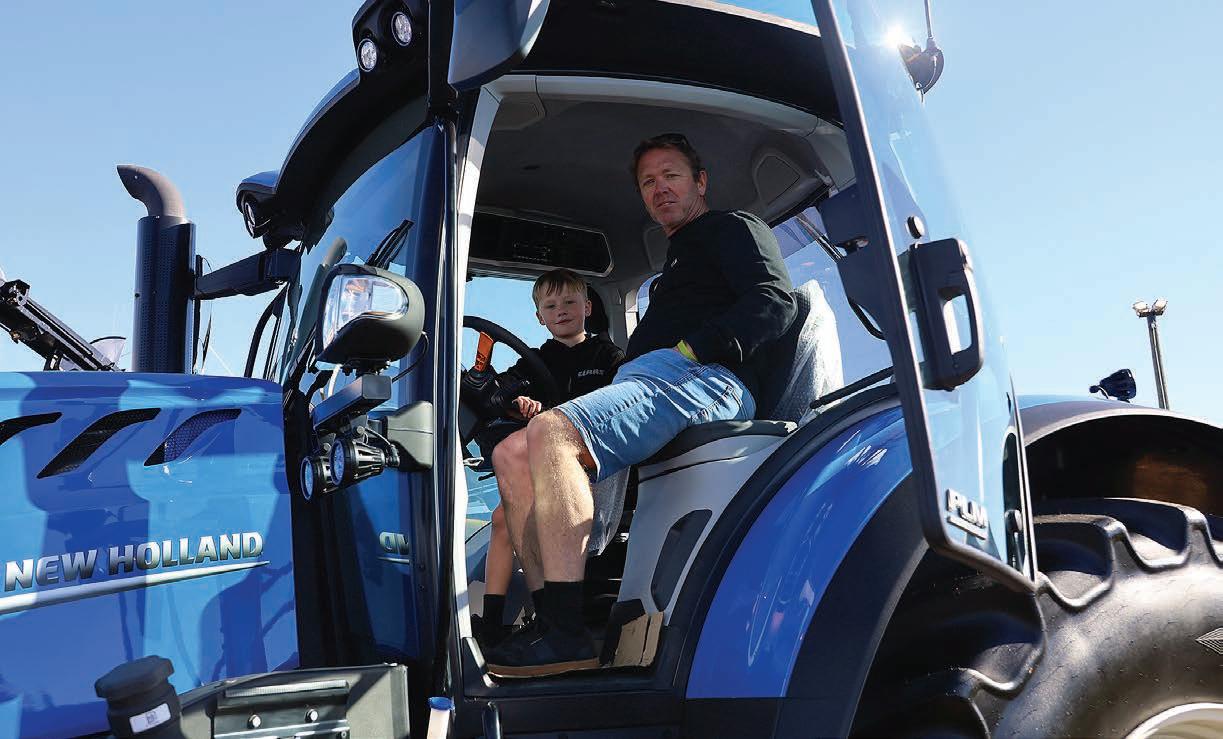
Trying it on for size
South Taranaki agriculture contractor Jason Holdem and his seven-year-old son, Curwin, take a closer look at one of the tractors on display at the New Holland site at Fieldays last week. Thousands of people flocked to the four-day event, which hosted 1115 exhibitors across 1335 sites.
Gerald Piddock

Kiwifruit collective wins Ahuwhenua Trophy
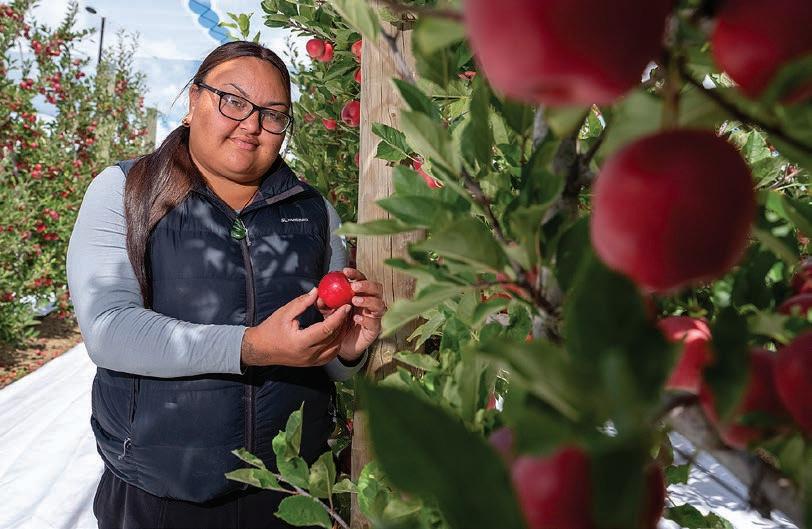
Mātai Pacific Iwi Collective has been named the winner of the 2026 Ahuwhenua Trophy, New Zealand’s most prestigious award for excellence in Māori horticulture. Chief executive Charles Russell says “we’re absolutely elated, really proud of our team”.

Photo:
Get in touch
EDITORIAL
Bryan Gibson | 06 323 1519
Managing Editor bryan.gibson@agrihq.co.nz
Craig Page | 03 470 2469
Deputy Editor craig.page@agrihq.co.nz
Claire Robertson
Sub-Editor claire.robertson@agrihq.co.nz
Neal Wallace | 03 474 9240
Journalist neal.wallace@agrihq.co.nz
Gerald Piddock | 027 486 8346
Journalist gerald.piddock@agrihq.co.nz
Annette Scott | 021 908 400 Journalist annette.scott@agrihq.co.nz
Hugh Stringleman | 027 474 4003 Journalist stringleman@outlook.co.nz
Richard Rennie | 027 475 4256
Journalist richard.rennie@agrihq.co.nz
Gerhard Uys | 027 239 4388
Journalist gerhard.uys@agrihq.co.nz
Nigel Stirling | 021 136 5570
Journalist nigel.g.stirling@gmail.com
Isabella Beale | 027 299 0596
Multimedia Journalist isabella.beale@agrihq.co.nz
PRODUCTION
Lana Kieselbach | 027 739 4295 production@agrihq.co.nz
ADVERTISING MATERIAL
Supply to: adcopy@agrihq.co.nz
SUBSCRIPTIONS & DELIVERY 0800 85 25 80 subs@agrihq.co.nz
PRINTER
Printed by NZME
Delivered by Reach Media Ltd
Advertise
SALES CONTACTS
Andy Whitson | 027 626 2269
Sales & Marketing Manager andy.whitson@agrihq.co.nz
Janine Aish | 027 300 5990
Auckland/Northland Partnership Manager janine.aish@agrihq.co.nz
Jody Anderson | 027 474 6094
Waikato/Bay of Plenty Partnership Manager jody.anderson@agrihq.co.nz
Palak Arora | 027 474 6095
Lower North Island Partnership Manager palak.arora@agrihq.co.nz
Andy Whitson | 027 626 2269
South Island Partnership Manager andy.whitson@agrihq.co.nz
Julie Hill | 027 705 7181
Marketplace Partnership Manager classifieds@agrihq.co.nz
Andrea Mansfield | 027 602 4925 National Livestock Manager livestock@agrihq.co.nz
Real Estate | 0800 85 25 80 realestate@agrihq.co.nz
Word Only Advertising | 0800 85 25 80 Marketplace wordads@agrihq.co.nz
PUBLISHERS
Dean and Cushla Williamson Phone: 027 323 9407 dean.williamson@agrihq.co.nz cushla.williamson@agrihq.co.nz
Farmers Weekly is Published by AgriHQ PO Box 529, Feilding 4740, New Zealand Phone: 0800 85 25 80 Website: www.farmersweekly.co.nz
ISSN 2463-6002 (Print) ISSN 2463-6010 (Online)

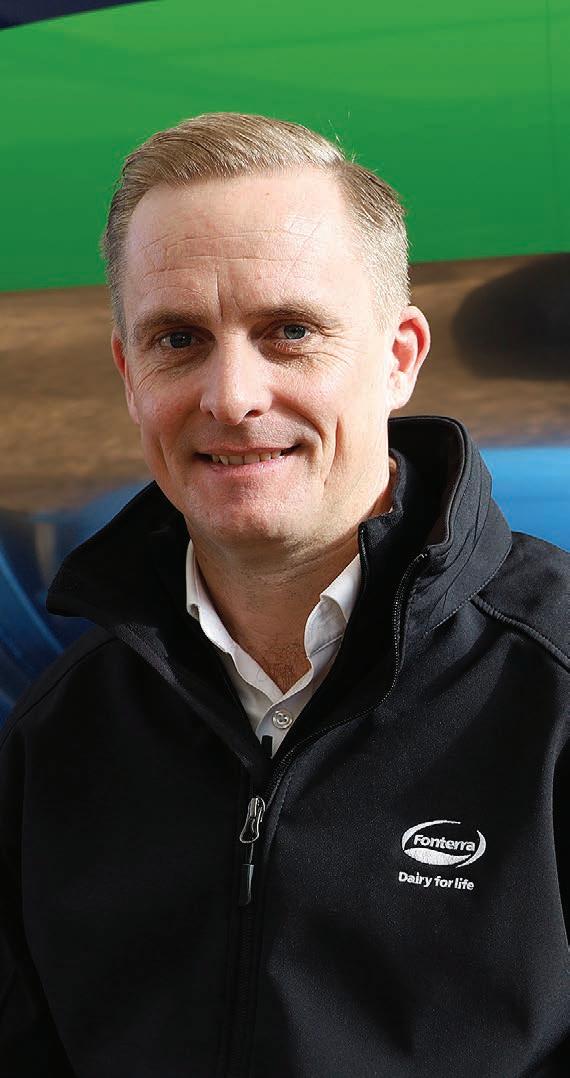
TAILOR MADE: New Fonterra CEO Richard Allen says the global shift towards more natural and nutritious products gives him huge cause for optimism, with New Zealand’s pasture-raised dairy well positioned to meet this demand.
News in brief
End in sight
The Environment Court has released its final decision on Waikato Regional Plan Change 1, directing the Waikato Regional Council to make 20 specific changes to the document. Once the court confirms the amendments meet its intent, the plan will be finalised.
Waikato Regional Council chief executive Chris McLay said the decision marks a significant milestone in the 13-year process of the plan’s development.
Scott Tech growth
Listed food technology company Scott Technology has reported new contracts in Europe and North America worth over $12 million.
They are with Dutch vegetable processor Bakker, a frozen potato facility in Canada and a major poultry processor in the JBS Group in Georgia in the United States. The Bakker contract extends an existing multi-line automation project through the installation of central pallet conveyor systems connecting multiple production zones.
US deal
Animal parasite diagnostic business Techion is to start analysing faecal egg samples for one of the world’s largest animal health companies. Techion founder and managing director Greg Mirams has signed a deal with Merck Animal Health, known as MSD Animal Health outside the United States and Canada, to support its Safeguard cattle treatment programme in the US.
Disaster survey
A University of Otago study aims to determine how well rural people are prepared for natural disasters.
The research was initiated following extreme windstorms last year that caused widespread damage in South Otago and Southland. Caroline Orchiston, the deputy director at the Centre for Sustainability Research at the University of Otago, said a survey will be sent to 5000 farmers, households and business that were impacted by the storms.



El Niño stalks hopes for a bumper season
said the Manawatū-Hawke’s Bay regions are light on pasture cover, and crops are looking only “okay”.
SOARING fuel and fertiliser costs could leave farm businesses extra vulnerable if a predicted El Niño event starts to bite from early spring.
NIWA has a 95% chance for El Niño conditions emerging over June-August, becoming more apparent later in spring and possibly blooming to a significant impact this summer.
An El Niño event will typically deliver higher rainfall in the west, while large blocking high pressure systems create long dry spells to eastern and northern regions. Spring is often marked by strong southwesterly winds.
Manawatū-based farm adviser
Gary Massicks told Farmers Weekly his clients are enjoying a period of optimism, having had two years of solid returns and prospects for another good year ahead.
However, he has also been tempering that optimism with caution around what the implications of a serious El Niñoinduced feed deficit could mean in later spring-summer.
Much of the North Island experienced a very dry May, and he
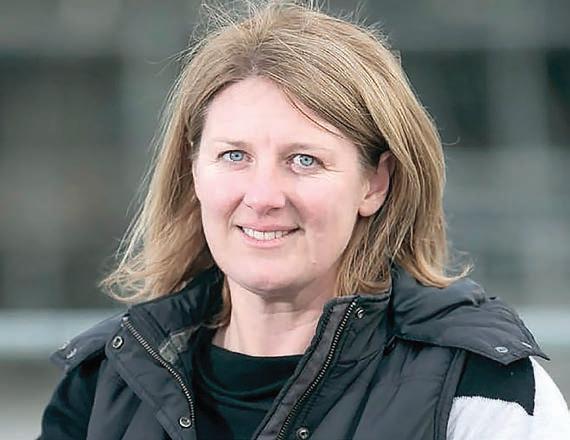
TOPSY-TURVY: Past weather events have been volatile enough for Canterbury consultant Charlotte Glass to feel confident about farmers’ ability to manage an El Niño event.
With maize silage looking to be significantly more expensive as a supplement, and almost all fertilisers at near record high price levels, he is urging clients to stay well on top of their feed and finance figures.
“It is easy to get blasé when you see that prime steer at $10/kg but it only takes another hike in the likes of super or urea, and you easily lose that margin.”
Gisborne farmer Toby Williams said experience with El Niño and numerous other events on the coast has taught him to have a clear line in the sand on making decisions about destocking to preserve feed, should the need arise.
Heading into winter this year he is grateful for a summer-autumn period that delivered the region good growth into winter, making it easier to respond to an El Niño event.
“We have cattle putting on 1kg each per day and we have bought forward mobs that are going to the works.
“We have everything going a month ahead of when we planned. The tail enders will go Septemberearly October, and it will take the pressure off the summer.”
Built for the people who are up before the sun.
The best par t of the day is yours to enjoy
Warm, sheltered, and right where you are
Archgola outdoor rooms and outdoor blinds are designed to fit your home and handle New Zealand conditions, so you can sit back, whatever rolls in
It works Season after season
Installed by local exper ts, nationwide Get in touch for a free consultation
For his sheep, he has reverted to terminal sires this year, and will be killing more lambs, reducing numbers carried into summer.
“If the Hawke’s Bay, Waikato and King Country go dry pre-Christmas there are always a lot of store lambs, but we are taking a punt on finishing and killing, versus battling that market.”
North Waikato farmer and Rural Support Trust chair Neil Bateup is familiar with El Niño’s drought implications. He said he has already had conversations with his sharemilker on options, should El Niño prevail.
“We may consider some palm kernel earlier on to ensure our silage lasts longer. It is always easier to do in high-payout year compared to a low-payout year.”
He said the El Niño risk is firmly on Rural Support Trust’s radar and is on the agenda for the next meeting of the adverse event group.
But Bateup also pointed to farmers being more capable of adapting to such events than in the past.
“The 2008 drought was a real wake-up call. Since then, farmers have taken a more cautious approach towards these events and are more prepared.”
Charlotte Glass, director and founder of Agri Magic consultants in Canterbury, said her region has had most of what nature could throw at it in the past five to seven years.
“We had a high-country group we worked with that had floods, fires and low prices.
“I was waiting for the locusts to come next.”
She said the volatility has tempered farm planning and preparedness beyond what would have been found 15 years ago.
Some southern farmers are preparing for an El Niño weather
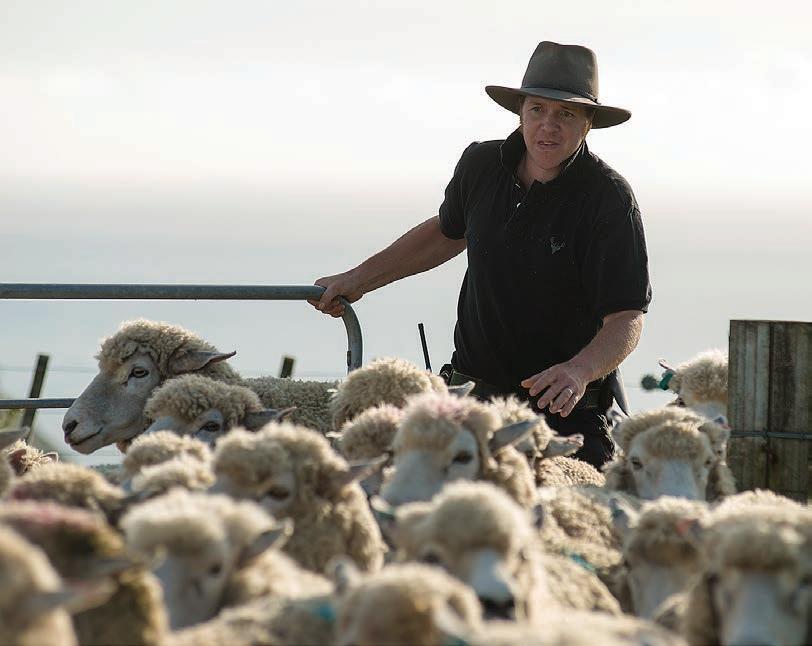
DECISIVE: Gisborne farmer Toby
and
other
We have everything going a month ahead of when we planned.
Toby Williams Gisborne
pattern but most have an abundance of crops and plenty of feed heading into winter.
Consultants say Otago and Southland farmers pumped the abundant summer and autumn feed into their animals, but feed budgets for the coming seasons generally have a buffer.
Dean Carson of Agribusiness Consultants in Southland said winter crops have established well,
and grass growth has persisted into June.
“Most people are pretty well set up.”
Some of his clients have bought additional baleage as a contingency.
AbacusBio consultant Simon Glennie said it is a similar story in Otago with some Central Otago farmers building up feed buffers and planning their irrigation use to maximise its availability.
Other farmers are looking at the merits of summer crops to provide some versatility.
Glennie said the impact of an El Niño can differ in the south, with southerly systems bringing rain onto the southern end of the east coast.
Are you preparing your farm business for an El Niño event this year?
Richard Rennie and Neal Wallace NEWS Weather
Williams says experience with El Niño
numerous
events on the coast has taught him to have a clear line in the sand on making decisions about destocking.
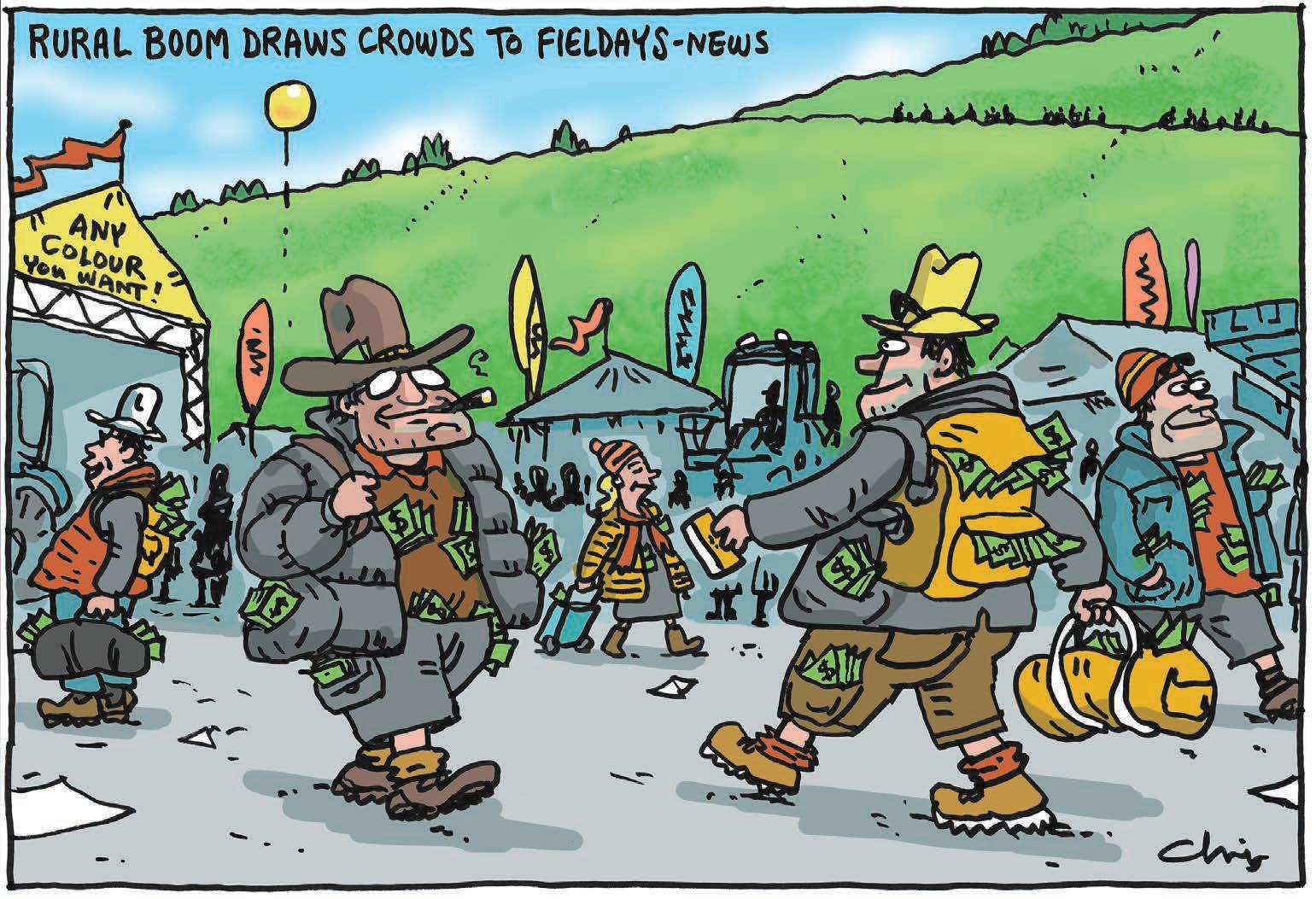
Sunny mood and open wallets at Fieldays
Maitland said farmers showed interest in both new technology as well as purchases related to farm maintenance and projects that had been on hold.
THE combination of fine weather and a booming rural economy saw thousands of people flock to Fieldays at Mystery Creek, south of Hamilton, to hunt for bargains and see the latest in farming innovation.
The four-day event hosted 1115 exhibitors across 1335 sites, offering everything from farm machinery and implements to vehicles, emerging technology and knowledge hubs.
Howard Morrison, who farms drystock in Bay of Plenty and Southland, said he came to Fieldays to “look around and see the things” and bought some implements.
“There are some things that I’d love to buy, but you’ve got to think strategically around what you want and what you need.”
Prompted further about what he was looking for, he said: “Innovation.”
Exhibitors and stallholders were smiling at the end of a busy first day. Gallagher animal performance and traceability business development manager Matt
Continued from page 1
been as large as it is right now.
He said a benign autumnwinter season generating good growth, and positive revenue has instilled a welcome new level of confidence among all clients.
“Those positive cash balances are providing a means for farmers to consider adopting new technology like wearables straight out of cash reserves, rather than borrowing.”
He said this was something simply not considered a few years ago when some were fighting simply to stay in business.
Collar tech companies are proliferating and new Gallagher CEO Rob Clayton told Farmers Weekly the surprise surge in his company’s tech demand has come from beef farmers.
“It [the tech] has long been thought of as a dairy product but they are now enjoying success in that remote beef space helping better manage pasture grazing,
“A lot of that has come to fruition.”
Maitland said there were definitely signs that farmers were spending and it had been a positive start to Fieldays.
“There’s people on the shop floor buying a reasonably large basket of goods at 8.30 in the morning, whereas previously it might have been 10.30.”
There were also fewer farmers wanting quotes – which had been common practice at previous Fieldays – meaning instead of comparing prices from different businesses, they were committed to buying, he said.
Giltrap AgriZone managing director Andrew Giltrap said it had been a very busy day for the farm machinery dealership.
“We have had a lot of foot traffic, lots of inquiry – and we’ve sold a few tractors.”
But that was tempered by farmers showing caution with their spending because of the uncertainty in global markets, he said.
“It’s cautious optimism.”
Halter’s head of South Island Josh Townsend said they had an
waterway access and lifting perhead productivity.”
Tumultuous weather combined with soaring electricity prices have prompted more farmers to consider on-farm solar energy systems.
Farmlands CEO Tanya Houghton said the farmer owned co-op has sold 110 solar power systems, most significantly larger than initially anticipated. While there has been no escaping fertiliser price hikes, which experienced double digit lifts just prior to Fieldays, farmers have not yet pulled back on application budgets.
Neither of the two big farmerowned fertiliser companies, Ballance and Ravensdown, are reporting less demand despite the hikes.
Ballance CEO Kelvin Wickham told Farmers Weekly his company has enjoyed a recordsetting autumn for aerial applications, despite the big increases in costs for such a service.
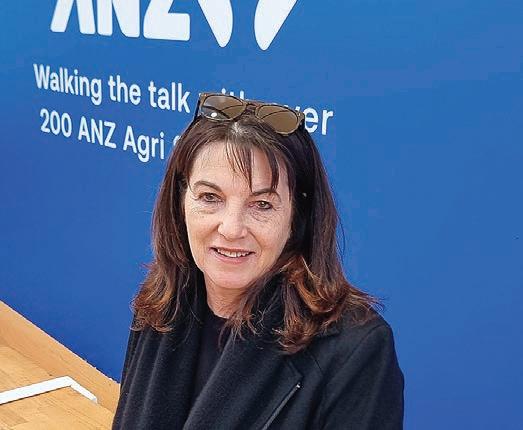
REDUCED: ANZ’s Lorraine Mapu says interest-only farm loans have fallen significantly in recent years and farmers have reset balance sheets, putting them in a good position to weather recent input price hikes, and consider farm purchases.
incredibly busy first day and it felt busier than last year, buoyed by the good weather.
There were a lot of South Islanders at their site – people who were looking at the technology and seriously wanting to get it on farm, as well as existing customers.
“There was also huge interest in the beef product now that we have gone to satellite and [farmers] wanting to put it on their properties.”
At the Ford site, Fairview Motors dealer principal Andrew Collett says it had been a typical hectic start to Fieldays.
“The volume of people is still the same and there’s definitely buyers among them. There’s deals been done.”
They had sold vehicles off the stand, he said.

While the Iran war is causing caution among farmers, there are some buyers, he said.
“There’s still farmers coming in and saying, we need a diesel ute, there’s an additional cost, we understand – but we’re buying. It’s causing caution, but we’re still doing business.”
We have had a lot of foot traffic, lots of inquiry – and we’ve sold a few tractors.
Another record year for food and fibre exports

Gerald Piddock NEWS Exports
IT’S another record year for food and fibre exports, with the sector forecast to reach a record $64.3 billion in the year to June 30.
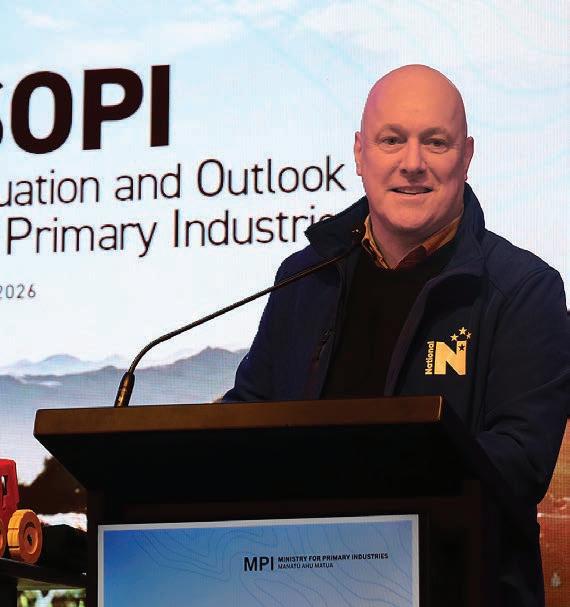
That is expected to build to $70.1bn a year by 2030, according to the latest Situation and Outlook for Primary Industries (SOPI) report from the Ministry for Primary Industries released at Fieldays.
Prime Minister Christopher Luxon said it was 6% up on last year.
“It’s incredibly remarkable given everything else that’s going on in the world.”
Two-thirds of global economic growth is occurring in the IndoPacific region and by 2030, two-thirds of the world’s middle class will be in that region. That provides a huge opportunity for exporters, he said.
Agriculture Minister Todd McClay said he has seen a lot of farmers smiling at Fieldays.
“That tells me they are feeling proud again and they deserve to.”
He called it a strong result in a challenging global environment.
That environment is shaped by the Middle East conflict and trade policies in key markets that have disrupted supply chains and raised inflation and input prices.
MPI director-general Ray Smith said if last year’s result was a blockbuster, this year’s result was another commanding performance.
He said the result speaks to the strength, skill, and determination of New Zealand’s farmers, growers and other producers.
Dairy export revenue lifted 5% to reach a record $28.6bn, meat and wool export revenue jumped 14%
to $14.1bn, horticulture export revenue lifted 7% to reach $9.5bn and processed food and other products export revenue increased 5% to $3.5bn.
“Kiwi food and fibre businesses continue to manage and adapt to supply chain disruptions from the Middle East conflict to ensure product reaches markets. This includes diversifying markets to build resilience against future price swings and demand shocks,” the report said.
Looking ahead, export revenue is forecast to dip 1% to $63.9bn to the year to June 30, 2027, before bouncing back the following year.
The report cited the Middle East conflict as bringing uncertainty to the medium-term outlook for global growth and for the supply and demand of commodities relevant to the New Zealand food and fibre sector. It is expected to impact export revenue in 2026-2027.
Demand across New Zealand’s core export markets is expected to remain firm through the first half of 2026.
RECORD: The latest Situation and Outlook for Primary Industries shows that food and fibre exports are forecast to hit a record $64.3 billion for the year ending June 30, up 6% on last year, Prime Minister Christopher Luxon said.
This reflects strong commodity prices prior to the Middle East conflict, particularly for animal proteins, where market supply remains constrained.
Looking ahead to the second half of 2026 and into 2027, disruptions stemming from the Middle East conflict are expected to weigh on food demand.
Higher food production and distribution costs are likely to flow through to food prices and, in some cases, support export returns.
In a broader inflationary environment, rising prices across goods are expected to erode purchasing power and reduce demand for many products, it said.
Infometrics economist Brad Olsen said it is important to keep a “third eye” for those future challenges – and this is something the primary sector does very well.
The sector is already adjusting how it approaches costs, he said.
“That’s something I have noticed at Fieldays – the focus on how we become more resilient has shown through strongly.”
SPEND: Gallagher’s Matt Maitland says farmers showed interest in both new technology as well as purchases related to farm maintenance and projects that had been on hold.
Gerald Piddock and Isabella Beale MARKETS Fieldays
Andrew Giltrap Giltrap AgriZone
Supply solid but prices spiky for fert
Richard Rennie NEWS Fertiliser
FERTILISER pricing for springtime is far from certain as the Iran war continues to squeeze global prices for most nutrient types.
The CEOs of the two big farmer owned co-operatives told Farmers Weekly at this year’s national Fieldays that it is price, not supply, that is the heaviest of their concerns for the new season. They were speaking after both co-ops announced significant lifts in their list fertiliser prices.
For Ballance those price lifts were as low as 3% on serpentine super, ranging to a high of 23% on its Sulphurgain 90S product. Following a 14% increase, DAP now tops out at an eye-watering $1878 a tonne.
“Our spring supply is either on the water, in stock, or due to be loaded onto ships, at which time the price will be set and paid by us, and there is still some price information to come yet,” Ballance CEO Kelvin Wickham said.
While unsure about what pricing levels would be in months to come, he was certain the price impact of the war is set to linger.
Other industry experts have
confirmed that infrastructural damage to the likes of gas plants in the Gulf are likely to take months and even years to rectify.
The sulphur component of fertiliser has been hit particularly hard, with almost 50% of the world’s sulphur coming from refinery activity in the Gulf.
“Prices are now fourfold what
Prices are now fourfold what they were this time last year and double what they were when the war started.
Kelvin Wickham Ballance
they were this time last year and double what they were when the war started. But supply is not the issue, it is price and it flows into other fert products that rely on sulphur, like DAP that requires sulphuric acid, for example.”
Garry Diack, CEO of Ravensdown, said issues around sulphur supply have been exacerbated in an unexpected way by the war, with the chemical being used in munitions production as well as fertiliser.
China’s recent release of 2 million tonnes of urea onto the

VOLATILE: Ballance CEO Kelvin Wickham says fertiliser prices will continue to remain volatile, and likely higher than before the Iran war.
market after prohibiting export was welcomed, but Wickham said it is likely much of this will be consumed by India.
For Ravensdown, Australia is playing a key part in supply sources for phosphate coming from the Mt Isa and Ardmore phosphate mines. When it is commissioned, a new urea plant in Australia will also provide product.
Both CEOs were relaxed about potassium (K) supplies globally, with Canada continuing to be a key supplier.
Interest will be strong among farmer shareholders this year as to whether either co-op will be offering them per-tonne rebates as shareholders. Neither has paid a rebate for three years.
Both leaders were frank in their
assessment on the challenges that had prevented past rebates, and the possibility of one this year.
“We are seeking to make a 10% shareholder return. We have to hit that target and then decide how much to pay back and how much debt reduction we need to make.
“Our ambition is to get down to holding only working capital debt. We just need to chip it down and get to 65-75% equity,” Wickham said.
He said this had been made more challenging after the Iran war kicked off, with inventory costs doubling.
A board decision on rebate payment is likely next month.
Diack said Ravensdown is in a position to pay a rebate, but it will still be subject to a board decision later this year. He said concerns remain over what will be paid for fert supplies post-spring, an unknown until the day the ship is loaded.
“But I do feel, and speaking for both co-ops, that the co-operative model has done a lot to buffer the impact of the Iran war on fert prices. You appreciate this when you compare NZ to Australia. “Farmers there were hit really hard by price and lack of supply, thanks to a far more corporate environment they buy in.”
Government commits $59m to ag productivity projects
Gerald Piddock NEWS Agriculture
THE government has launched a $143 million partnership with the primary sector aimed at lifting the industry’s growth and productivity.
Called Land Use Flexibility, it involves an initial investment in six commercial projects in dairy, sheep and beef, horticulture, forestry, whenua Māori and aquaculture, with the government
allocating $59m and the sector contributing $84m.
Speaking at Fieldays, Prime Minister Christopher Luxon said the projects were chosen to showcase to farmers how the sector can get more value, produce more and utilise land use flexibility.
“Together, these projects matter because they will demonstrate, on real farms and orchards, what is possible when innovation, capital and ambition come together.


“This is about building confidence for our farmers and producers, rural lenders and investors to show proof that innovation can deliver growth.
“At its heart, Land Use Flexibility is a simple proposition: it’s the idea that farmers, growers and landowners should have more freedom to adapt, to grow and to modify their businesses.”
It will give farmers more ability to make decisions behind their farm gate, he said.
Agriculture Minister Todd
McClay said the projects were pulled together by the private sector. It is a way to take great ideas and prove them on farm as a concept.
One of the six projects involves organisations from the dairy, banking and tech sectors, along with the Ministry for Primary Industries, on a $45.85m, sevenyear endeavour (with an $18.34m contribution from taxpayers) to show how farm system solutions along with technology can be used to operate dairy farms with


better environmental outcomes.
Another is a Pāmu-led project called the Livestock Innovation Farming Transformation (LIFT) programme, which aims to adopt and develop virtual-fencingenabled grazing systems on hill country sheep and beef farms.
The MPI is investing $3.55m in the five-year $8.47m project in partnership with Pāmu, Halter, ASB, ANZCO Foods, Silver Fern Farms, FARMAX/FarmIQ, Beef + Lamb New Zealand, AgFirst, One NZ, and BakerAg NZ.



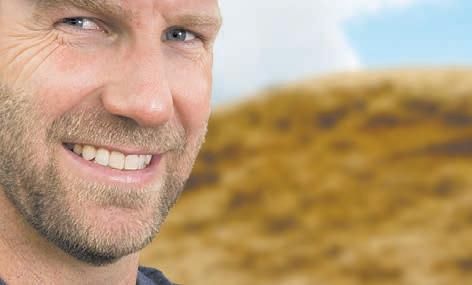




Richard Allen: simplicity and focus the watchwords
Gerald Piddock PEOPLE Dairy
IT’S been a month since Richard Allen took over as Fonterra CEO and he says it’s already given him a new perspective on the dairy cooperative.
It has also given him a heightened sense of accountability and responsibility, thanks to being answerable to Fonterra’s farmers and shareholders and the scrutiny that comes with the role.
“It’s a different lens when you get into the role and you do see things differently,” he told Farmers Weekly.
For now, he is focusing on the opportunities out there for Fonterra, growing value from its farmer’s milk and investing in its assets.
“It’s a relatively simple formula,” Allen said.
“In regard to wider scrutiny –honestly, I’m not concerned about that. My main concern is doing a great job for our farmers in New Zealand.”
He took over the reins of New Zealand’s largest company from Miles Hurrell in May, with the co-op in a very good space from a balance-sheet perspective.
“It’s a great time to start as a CEO because we are right in the middle of starting out our plans for next season and working that through with my team and the board.
“It’s a great opportunity to shape what that next two or three years will look like.”
And four weeks into the role, he said, he is well and truly getting on with it.
“We have a great team, a great set of plans, two great businesses in ingredients and foodservice. I’m excited about what’s to come.”
Asked about the CEO appointment process, he said he had been in ongoing discussions with Fonterra’s board and senior management around his own career development with the understanding that at some point the role might become available.
“I’ve been in those discussions; they are very common in large organisations in terms of creating a pool of potential candidates.
“When Miles resigned, I was asked to formally interview for the role.”
That interview was in front of a full board, where Allen pitched his vision for the future of the co-operative.
What he told the board was simple, he said.
My main concern is doing a great job for our farmers in New Zealand.
Richard Allen Fonterra
“We have done the hard work to build a very strong foundation. Now is the right time to focus on how we can continue to drive value and growth for our farmers’ milk.”
That will come through a combination of innovation, technology and investing in Fonterra’s existing assets to ensure it produces a valuable product.
Allen was a participant in Fonterra’s graduate programme, joining the co-op in 2008, fresh out of Auckland University.
He spent two years in that programme, learning different aspects of the co-op, a process he said was “super valuable”.
From there, he spent time in the co-op’s engine room, focusing on the optimisation of dairy: where Fonterra sends its milk,
what it is turned into, its factory infrastructure and its wider global network.
He has had a diverse range of roles across the co-op, including with MyMilk, and running Fonterra’s foodservice channel in China. Allen was group director of Farm Source at the lowest point in the co-op’s existence, when it reported a loss for the first time. That was in 2018, and “I took a lot from that”, he said.
Allen moved to the United States to head Fonterra’s Atlantic division, which included North America and Europe.
It was a business that until then had been largely overshadowed by Fonterra’s China market, he said.
He then headed Fonterra’s global ingredients division, before being made CEO. It’s a background that has given him a comprehensive view of how Fonterra’s value chain works, he said.
“I’ve seen what doesn’t work and I’ve seen that ...when you fuel the right areas, keep things simple and keep things really focused, you can really drive some significant performance and value for farmers’ milk.”
What “doesn’t work” for Fonterra is when it strays too far from its core – and there have been numerous examples of that in Fonterra’s history, he said.
“Where we get distracted and do things that are too far from the core in areas where there is no internal core capability, that’s typically where we are less successful.”
As Fonterra begins its first season with its new-look business following the sale of its consumer arm, Allen said the global shift away from ultra-processed food to more natural and nutritious products gives him huge cause for optimism.
New Zealand’s pasture-raised dairy is “right smack in the middle” of where these consumers are moving to.
“We need to keep evolving the products that we make and we do that through innovation, and we have done that over the last 70 years very successfully.”
Maintaining that innovation edge means Fonterra has to keep investing in its asset base across its ingredients and foodservice businesses.
“We see some great demand opportunities out there as a result of this underlying trend towards the fact that consumers want more natural and less processed food.”
Now in his 40s, Allen lives in Auckland with his wife and three children.
Looking further ahead, Allen said he defines success as fulfilling
TAILOR MADE: New Fonterra CEO Richard Allen says the global shift towards more natural and nutritious products gives him huge cause for optimism with New Zealand’s pastureraised dairy well positioned to meet this demand.
Fonterra’s vision to be the source of the world’s most valued dairy.
Achieving that means continuing to invest in ways of growing the value of the milk it collects.
“When I think about success, I ask myself, ‘Are we able to do that – are we able to deploy our farmers’ capital and ultimately have a return on that capital and their milk and grow that return?’
“I haven’t set any fixed targets around that. We have our guidelines for 10-12% return on capital and ensuring we are retaining a strong balance sheet.
“That’s important to me – that we go after growth, but we don’t sacrifice the strength of our balance sheet because a strong balance sheet is really important for a co-operative – for me that’s an ‘and’, not an ‘or’.









Getting on: average age of Kiwi farmers nears 50

THE average age of farmers is inching towards 50, with the number of those aged 65 and over growing 66% between 2013 and 2023, according to data from Stats NZ.
The latest available data shows the median age of all farmers in 2023 was 49.8, up one year from 2018, but kept low by the median age of dairy farmers at 41.
In comparison, the median age of sheep farmers was 55.8 and beef 62.2, with the median age for all employed people 41.9.
There were 13,881 farmers aged 65 and over in 2023, the single largest group of the six decadelong segments measured by Stats NZ.
The next largest decade group, 55-64, numbered 13,002 farmers.
Paul Spoonley, an emeritus professor at the College of Humanities and Social Sciences at Massey University, said the rapid increase in the 65 and older group raises the question of who will buy their farms.
“The Baby Boomers (born 1945-
1964) have built up equity and ownership over a long time and as is the case with a lot of other occupations in NZ, the size of the Baby Boomers and ownership of assets is a striking feature.”
There was significant growth in the number of farmers aged 35-44, from 11,715 in 2018 to 12,642 in 2023, which Spoonley speculated could be the children of the 65 and older group.
He also questioned whether the amount of equity and capital these farmers have invested is making it difficult to exit farms.
Last year Rabobank calculated that in the next decade an estimated 17,320 farmers and growers, owners of half the country’s farms and orchards, will be aged 65.
At land values at the time of the report, it made a conservative estimate that $150 billion in farming assets would need to transfer to new owners.
It’s what I do, I love farming.
Spoonley said a recent JBWere report estimated ownership of $1.6 trillion of historic intergenerational wealth in NZ would be transferred between now and 2050.
Unless they leave their farms, Spoonley said, within the next decade those Baby Boomers will
Farmers by age, 2013–2023 Censuses
Age
25–34
35–44
45–54
and over
Source: Stats NZ
Spotlight shines on women in farming

RESEARCHERS from Massey and Lincoln universities are calling on women living and working on farms across New Zealand to share their experiences of mental health and wellbeing in a major new survey.
The New Zealand Women in Farming Wellbeing survey aims to address a significant gap in research and data on rural women, a group whose contributions to the agricultural sector are vital but often underrecognised, according to the researchers.
Research team spokesperson Professor Nicky Stanley-Clarke from Massey University’s School of Social Work said the survey comes at a critical time for the sector.
“With the government’s recent consultation on the Draft Mental Health and Wellbeing Strategy 20262036, a renewed call for a focus on rural wellbeing, and national Fieldays underway this week in Waikato, this survey fills a
knowledge gap about the wellbeing needs of women in farming.
“We know women are balancing multiple roles, from farm work to family responsibilities and often off-farm employment, but there is very little NZspecific data capturing what this means for their wellbeing.”
The initiative aligns with growing national and international recognition of women’s roles in agriculture, with 2026 being the United Nations International Year of the Woman Farmer.
Despite increasing numbers of women entering farming and agricultural study, much of the existing research, services and policy focus has centred on male farmers.
Stanley-Clarke said this has created a blind spot in understanding the pressures facing rural women – the “triple burden” of managing farm work, caregiving and household responsibilities, often leaving women with little time to prioritise their own wellbeing.
The researchers believe

be aged in their seventies and eighties, creating a wealth transfer challenge.
“The crux is rapidly approaching. Who is going to buy these Baby Boomer-owned farms?”
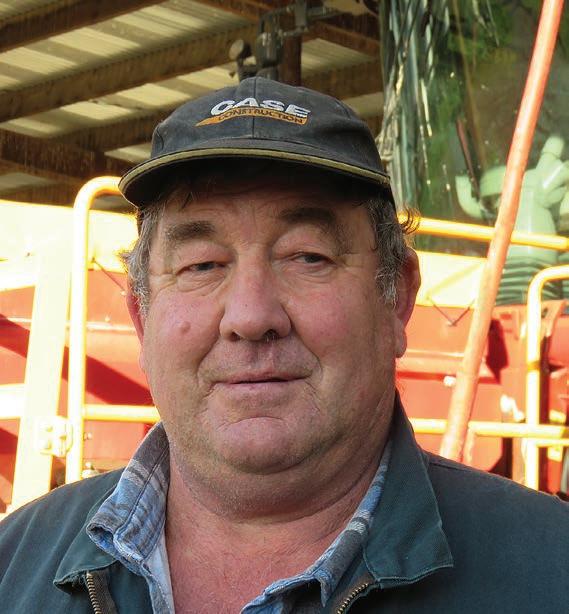
Canterbury arable and sheep farmer Syd Worsfold, 67, describes himself as “the odd job boy”.
An accident 12 years ago slowed him down, but Worsfold still loves farming – even if son Earl now runs the property.
“It’s what I do, I love farming. I could move away but I’m not sure what I’d do.”
He drives tractors and shifts sheep but quickly learnt his physical limits following his accident.
Worsfold said he knows of several farmers close to or in their
it’s vitally important to undertake the study, alongside farming women and industry partners who are already doing work in this space.
“There are some great farming organisations supporting farming women, such as Dairy Women’s Network, Rural Women NZ and Agri-Women’s Development Trust, but to our knowledge there is no NZ academic research, and no current data capturing the wellbeing needs of this sector.
“We hope the survey results will create a comprehensive national picture of women’s wellbeing in farming, providing evidence to inform future services, policy and
community initiatives.”
The survey builds on previous work in rural mental health, including programmes such as WellMates and SafeMates, which are peer-led mental health programmes for agriculture students.
“Our earlier research showed just how important rural women, especially mothers, are in supporting mental health conversations, reducing stigma and helping young people thrive.
“This survey is about acknowledging that role and ensuring women themselves are better supported.”
Strong participation is essential to ensuring meaningful outcomes.
nineties still working on farms.
Some of his arable neighbours are converting or have already converted their farms to dairying to help with succession and generate income while retaining family ownership of the land.
Canterbury farmer Mark Copland, also 67, retired and left his farm for a smaller lifestyle block about a year ago.
His son now runs the property, and Copland says farmers should not delay making the shift.
“You want to be able to do the things that you want to do,” he says.
It also gives the next farming generation space.
“All you do is put a handbrake on the next generation and that is the last thing they need.”
Search for top rural businesswoman narrows
Staff reporter NEWS Agribusiness
RURAL Women New Zealand has announced the category winners for this year’s NZI Rural Women Business Awards.
The awards celebrate the innovation, community impact and business excellence of women who build thriving businesses in rural communities.
There are eight categories with a supreme winner to be announced in July.
They are:
• Rural Health and Wellness Excellence: Anna King, AnnaFit
• Love of the Land: Karen McGrath, Southern Alp Sprouts
• Creative at Heart: Kate McDonald, Davaar
• Innovation: Kathryn Jackson, Career Balance
• Emerging Enterprise: Kylie Dorr, Southern Reproductive
• Young Businesswoman: Millie Aitken, Bar M Custom Tack
• Rural Champion: Philippa Cameron, What’s for Smoko
• Experience Rural: Sonia Minnaar and Liz Henderson, Canopy Camping
The businesses are a credit
to the amazing women who run them, Rural Women New Zealand national president Heather Sorensen said.
“We had a tough job as judges and were extremely impressed with the quality of entrants.
“It is fantastic to see these dedicated businesswomen from across the country leading such successful enterprises.”
Sorensen acknowledged all those who entered. It took time and effort to enter the awards, and she appreciated the investment those entrants made.
“Going through each application was an absolute privilege and the depth of talented rural women in New Zealand never ceases to amaze me.”
NZI EM agencies & schemes Christina Chellew said the awards recognise the vital role women play in the success of rural businesses and communities.
“This year’s entries were of an exceptionally high calibre, reflecting the depth of capability in rural, womenled businesses across New Zealand.
The winners will be celebrated at a gala dinner in Parliament on July 23, where the overall supreme winner will also be announced.
KEEP ACTIVE: Canterbury farmer Syd Worsfold has slowed down but is still helping on the farm.
Neal Wallace NEWS Trends
Syd Worsfold Canterbury
Annette Scott NEWS Wellbeing
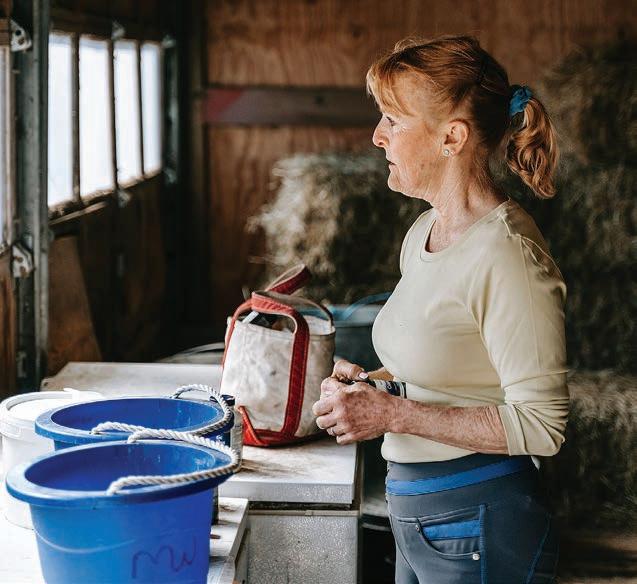
INFORMED: A NZ Women in Farming Wellbeing survey aims to address a significant gap in research and data on rural women.
Photo: Pexels

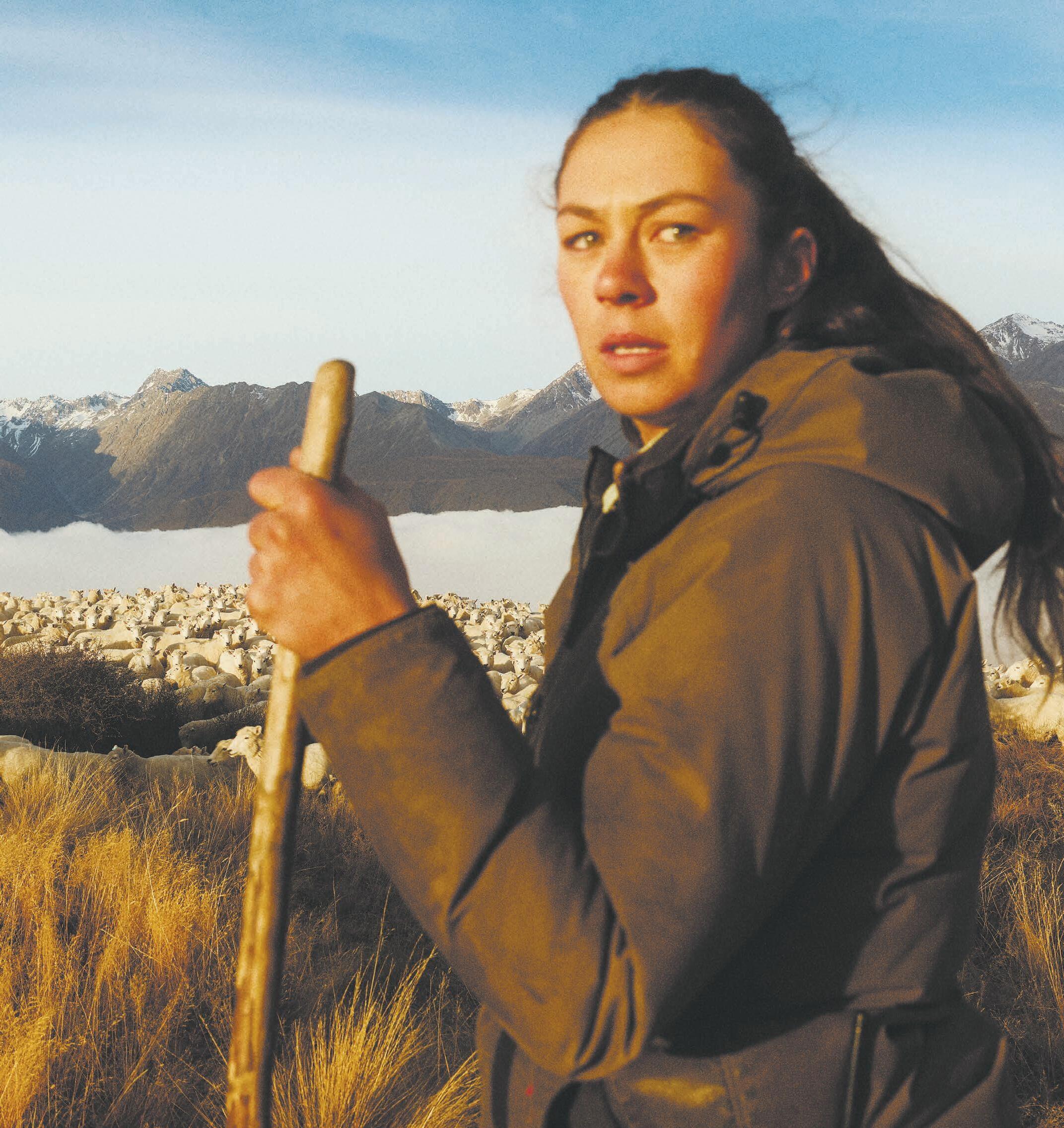





Out here, there’s no off switch The day starts well before the sun rises, and work carries on long after it goes down And you wouldn’t have it any other way. Because progress doesn’t wait. Ideas don’t stay still And tomorrow doesn’t come with an instruction manual We get it Because we ’ re rural, too
Farmlands is 100% owned by farmers and growers –always has been So no matter what’s keeping you up, what’s sending you down to the paddock, whatever plan you have for your business, we’ll be right there with you, because rural never rests.



Kiwifruit collective wins Ahuwhenua Trophy
Staff reporter NEWS Awards
ĀTAI Pacific Iwi
MCollective has been named the winner of the 2026 Ahuwhenua Trophy, New Zealand’s most prestigious award for excellence in Māori horticulture.
As Zespri’s largest Māori shareholder, the collective has grown its combined asset value beyond $130 million since 2018,
embodying kotahitanga as a commercial force.
“We’re absolutely elated, really proud of our team and it’s an honour and a privilege to stand alongside Otama Marere and Ngāti Hine Forestry Trust on this occasion,” Mātai Pacific Iwi
Collective chief executive Charles Russell said.
“Our whakatauki is ‘one orchard at a time’... that’s where we exercise our mana motuhake and our rangatiratanga.
“We’ve grown this land for
Report shows red meat has economic muscle
Staff reporter
ECONOMIC activity from the red meat sector supports 120,580 jobs and generates nearly $49 billion in annual spending, research says.
The study on the 2025 season by BERL and commissioned by Beef + Lamb New Zealand and the Meat Industry Association, found the sector generates $12.8 billion in export earnings a year but a multiplier effect that sees $133 million a day being spent across New Zealand.
More than half of that contribution happens beyond farm gates and processing plants, flowing through supply chains, local services, and household spending, particularly in rural and regional areas.
BLNZ has set itself the goal of growing the sector’s export returns to $23bn by 2035.
Nationally, direct expenditure from the sector in 2025 was $23.5bn with an additional $25.3bn flow-on spending.
Direct employment was 48,250 full-time equivalent employees (FTEs), while the flow-on effect was another 72,330 FTEs.
The Otago-Southland region has the largest meat industry, generating $3bn in GDP and supporting 21,722 FTEs.
The Canterbury meat sector
generations and if we go back to our roots I’m sure that’s where the prosperity is.”
The announcement was made at the awards dinner in Whangārei attended by more than 700 guests from across the primary sector, the government and Māori communities.
The award was announced by Māori Development Minister Tama Potaka.
“All finalists set a remarkable benchmark,” Ahuwhenua Trophy Management Committee chair Nukuhia Hadfield said.
“You could not have separated the standard of operations by passion or purpose but Mātai Pacific Iwi Collective rose to the top. What they collectively represent for Te Ao Māori and the sector is something every New Zealander should take pride in.”
The 2026 competition – now in its 93rd year – was contested by three finalists: winner Mātai Pacific Iwi Collective (Te Puke), Otama Marere Trust (Paengaroa), and Ngāti Hine Forestry Trust (Kerikeri).
Public field days were held earlier in the competition cycle, drawing hundreds of visitors across Northland and the Bay of Plenty.

whānau as a 15-year-old.
What they collectively represent for Te Ao Māori and the sector is something every New Zealander should take pride in.
Nukuhia Hadfield Ahuwhenua Trophy
The evening also saw Te Rina Joe (Ngāti Pāhauwera, Ngāti Kahungunu) from Pakuratahi Orchard for Ngāti Pāhauwera Commercial Development Ltd named the 2026 Ahuwhenua Young Māori Grower. Joe began picking fruit with her
She has since built a career grounded in purpose, working for her iwi, on their land, overseeing teams of 40-60 workers across a 55 hectare apple operation.
“Horticulture is such a big part of my life, and just having the chance to be part of the competition has been an amazing experience. To my peers, Larissa and Rob, who were also finalists, it has been a pleasure going through this journey with you,” Joe said.
The award was presented by Te Tumu Paeroa’s Sonya Rimene with each finalist receiving a $5000 cash scholarship, and the winner receiving an additional $5000.
generates $2.9bn in GDP and supports 19,127 FTEs while it contributes $2.5bn in GDP to Taranaki and Manawatū and supports 19,337 FTEs.
BLNZ chair Kate Acland said the survey confirmed the red meat sector is an economic powerhouse for New Zealand, contributing to jobs, communities, and the wider economy well beyond the farm gate.
“On average, our farmers and processors spend $64 million a day in communities and industries across New Zealand.
“When indirect impacts are included, that rises to $133 million a day flowing through the New Zealand economy.”
MIA independent chair Nathan Guy said the research found every $1m of direct expenditure in the red meat sector in 2025 supported about five jobs across the wider economy.
“Māori and Pacific people form an important part of the sector’s workforce. Of the 42,000 individuals directly employed in New Zealand’s red meat sector, 25%, 10,578, are Māori and 11%, 4788, are Pacific people.
Guy said the red meat sector is determined to grow its economic contribution further.
“Despite the high degree of uncertainty we face over geopolitical risks like the conflict in the Middle East, there is strong demand for the natural high-quality protein our sector produces.”
Wool scouring capacity ‘at critical risk’

Gerhard Uys NEWS wool
NEW Zealand wool and textile manufacturing is at critical risk if the sector’s scouring capacity fails, says Ryan Cosgrove.
Cosgrove, who is head of sourcing and material at Mons Royale, said the ability to scour wool locally is not just critical for current processing, but has a ripple effect into research and development, product development, and downstream innovation.
Cosgrove told Farmers Weekly an increasing proportion of New Zealand wool is leaving the country greasy rather than scoured.
“Year-on-year greasy exports have gone from 33.2% in 2025 to 46.2% in 2026.
“Since November 2025, approximately 12.7 million kilograms of wool has been exported to China in greasy form, compared with only 4.2 million kg exported scoured.
“If sustained, that shift places pressure on the last remaining
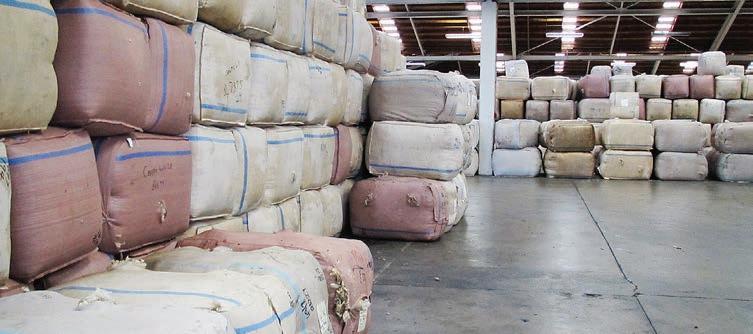
large-scale wool scouring infrastructure in New Zealand.”
He said China has more than 100 wool scourers.
If New Zealand loses scour capacity, research will possibly shift to the farm gate only and downstream processes could be neglected.
“A keystone piece of infrastructure doesn’t care if it dies on purpose or by accident.”
A keystone piece of infrastructure doesn’t care if it dies on purpose or by accident.
Ryan Cosgrove Mons Royale
Cosgrove said everyone in the industry agrees a scour is a keystone piece of infrastructure, but often their behaviour does not support that.
Anyone sending product offshore to be scoured should attempt to have that process done locally first, he said.
“Wool scouring is a true, single
point of failure for NZ wool product manufacturing. It is effectively irreversible.”
CEO of WoolWorks Ventures, Rosstan Mazey, said Australia is an example of what happens if the industry’s critical infrastructure is neglected.
Australia has a wool clip of about 255kg million, with only a single operating scourer able to scour a fraction of that, and over 90% of Australian wool sent greasy to China, he said.
Four years of trying to turn that around has failed, he said.
Traceability, origin and the certifications that run alongside that are important to the market and having wool scoured offshore means the connection to the farm and traceability is compromised, Mazey said.
If New Zealand loses local, traceable wool, it undermines domestic manufacturing innovation.
Wool is a fundamental ingredient for whatever people in New Zealand might want to do with it, Mazey said.
PRIVILEGE: Mātai Pacific Iwi Collective chief executive Charles Russell says their whakatauki is ‘one orchard at a time’.
Photos: Alphapix/John Cowpland
YOUNG TALENT: Te Rina Joe (Ngāti Pāhauwera, Ngāti Kahungunu), from Pakuratahi Orchard for Ngāti Pāhauwera Commercial Development Ltd, was named the 2026 Ahuwhenua Young Māori Grower.
RISK: New Zealand wool and textile manufacturing is at a critical risk if keystone scouring capacity fails, says Ryan Cosgrove.
McClay in the fray on US lamb manoeuvres

WITH lamb prices for United States farmers surging past NZ$600
recently, Trade Minister Todd McClay is questioning the grounds for an investigation into New Zealand and Australian lamb imports.
McClay spoke to Farmers Weekly before he flew out for an OECD trade ministers’ meeting in Paris, where he expected to discuss the matter again with US President Donald Trump’s Trade Representative Jamieson Greer.
The American Sheep Industry Association (ASI) requested the investigation last October, but it appeared to have made limited progress through the US trade bureaucracy.
However, a February ruling by the US Supreme Court that Trump’s Liberation Day tariffs were illegal appears to have changed that.
“They are looking to put the tariff wall back in place and are looking at all different ways to do it,” McClay said.
“I have spoken to [Greer] about it previously and he has told me not to expect anything before the end of the year.
“It is not a fast process.”
Under Section 201 of the Trade Act, the US International Trade Commission can investigate whether imports are causing “serious injury” to US industries.
It can recommend import restrictions lasting up to eight years to give local industries “time to adjust” to increased imported competition. Restrictions could include higher tariffs or quotas or both.
I have been very clear with [Greer] that the price has come up and demand has grown because we are there.
Todd McClay Trade Minister
The ASI’s petition cited a 45% increase in imports between 2020 and 2023, causing local producers’ share of the market to drop by nine percentage points. Australia and NZ accounted for 99% of imports.
However, McClay said rising
imports are not displacing US production and US sheep farm incomes are rising, too.
National weekly slaughter prices in the US have headed skywards in recent weeks, pushing past NZ$600 for a 29kg CWT lamb last week.
For the same lamb NZ farmers would have received NZ$319.
On a per-kilogram basis, US farmgate prices hit NZ$23 in mid-May – up 77% on a year ago – compared to $10.70-$10.80 per kg in late May in NZ, according to analysis by Agri-HQ.
“I have been very clear with [Greer] that the price has come up and demand has grown because we are there,” McClay said.
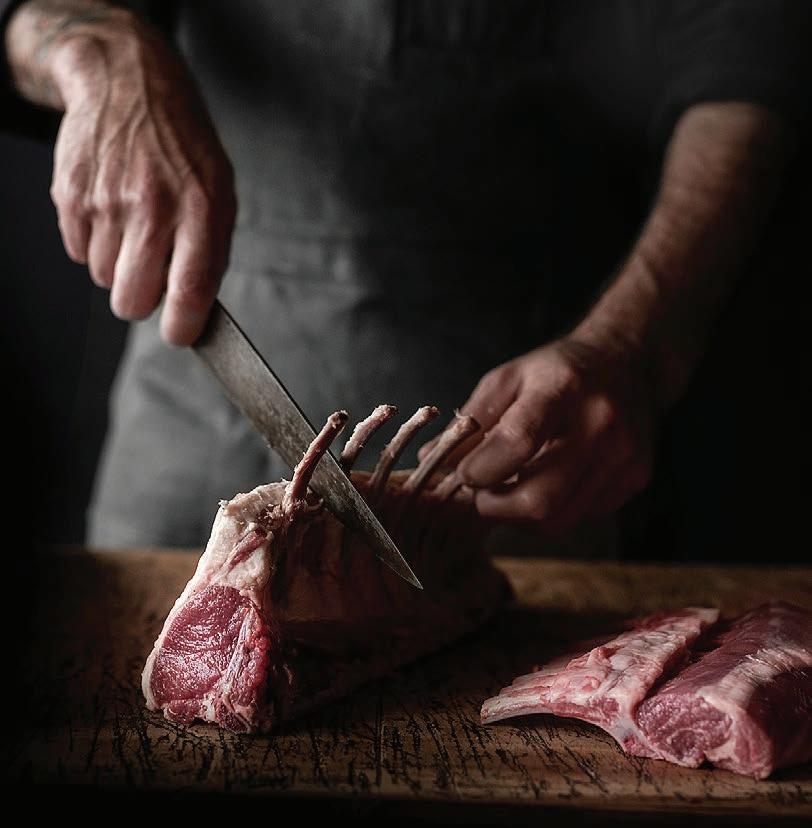
Imports are underpinning rising prices by keeping lamb on supermarket shelves in the US at a time of surging demand for protein.
“The reason their percentage is falling is because the market is growing and they cannot supply it,” McClay said.
The tariff on Australian and NZ lamb currently sits at 10% but is on track to rise to 12.5% after another tariff announcement from the administration this week.
Hiking tariffs again is unlikely to
do much to help rebuild US sheep numbers, McClay said.
“The tariff rates don’t make it rain,” he said.
“There have been droughts and that is why there is not as many animals over there.”
McClay said it is difficult to judge whether NZ’s arguments will hit home with the administration. It is under pressure ahead of November’s midterm elections,
and hiking tariffs on food is not a natural vote winner.
But the cost of lamb is not as politically sensitive as beef, which people in the US consume in much greater quantities.
“It is not a huge amount of meat going in there so why would they bother, you could argue
“Equally it could be that it is an easy thing to give some sheep farmers a win on,” McClay said.
BENEFIT: Imports are underpinning rising prices by keeping lamb on supermarket shelves in the US at a time of surging demand for protein, says Trade Minister Todd McClay.
Nigel Stirling MARKETS Sheep and beef
Charolais set breed record price down south

Hugh Stringleman MARKETS Livestock
SILVERSTREAM Charolais and Herefords of Banks Peninsula has made a Charolais breed record
$70,000 for Lot 1 auctioned at its new selling centre.
The successful bidder for Silverstream Viceray V226 was Rimu Charolais, Taumarunui.
Silverstream sold all 58 Charolais bulls, averaging $17,414, nearly $5000 ahead of last year. The Fisher family also sold all 16 Hereford bulls, averaging $15,529, with a top of $23,000 for Pute Valkyrie V66.
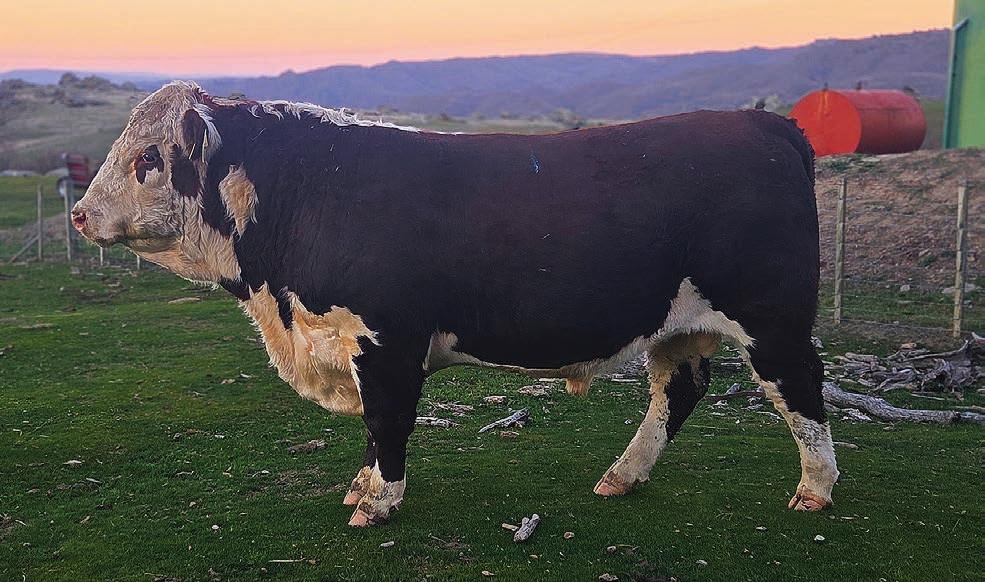
Earnscleugh Herefords, Alexandra, had a top price of $65,000 paid by Koanui Herefords, Hawke’s Bay, which also paid $25,000 for second bull.
The top bull is Earnscleugh Gunsmoke 244700 by Gunslinger 211654 and has been used in the stud already.
The Earnscleugh average price was $13,733 for 30 sold out of 31 in the catalogue.
For the Earnscleugh Angus bulls there was a full clearance of 37 with an average of $14,491 and for the composite bulls all 40 sold, averaging $10,475.
Umbrella Range Angus, Waikaia,
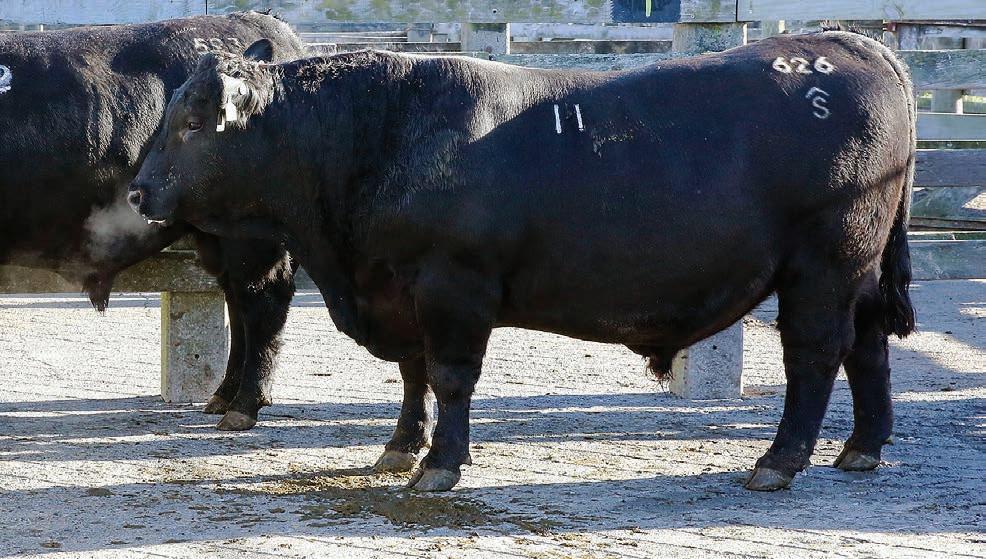
PROFITABLE:
The first trip to Stortford Lodge saleyards for Shamrock Angus bull, Lot 11, produced $18,500, paid by a commercial farmer.
had a top price of $42,000 paid by Albert Hill Angus, Lumsden for Lot 51 Umbrella Range 20533.
The average price for 49 bulls sold was $18,250, more than $5000 ahead of last year.
The Sherriff family at Pine Park Angus, Marton, sold all 37 bulls, averaging $14,750 with a top price of $42,000 paid by a commercial farmer.
Hallmark Angus, Tutira, sold 63 of 64 with an average price of $16,063, and a top price of $28,000 made twice, one by Sudeley Genetics, Irwell, and the other by Kiwikawa Angus, Hawke’s Bay.
Ranui Angus, Whanganui, sold all 47 bulls, averaging $13,000 with a top price of $29,000 paid by DJ and DL Sloan Partnership.
Wilencote Polled Herefords, Gisborne, sold all 33 bulls with an average price of $15,212 and a top price of $25,000 paid by Matariki Herefords, Kaikoura.
Mokairau Herefords, Gisborne, had a full clearance of 29 with an average price of $10,074 and a top price of $17,000 paid by Waimaha Station, Gisborne for Lot 6.
Orari Gorge Herefords, Geraldine, sold 25 out of 30 with an average of $10,586. The top price was $22,500 paid by Limehills Herefords, Roxburgh.
Grassmere Herefords, Cheviot, had a full clearance of 15 with
an average of $11,666 and a top of $17,500. At the same sale, Riverlands J Angus sold all 20 bulls with an average of $10,050 and a top of $15,500 twice.
Maungahina Stud, Masterton, sold all 38 Hereford bulls with an average of $17,197 and a top price of $29,000 to a commercial buyer and transfers to Te Puna Herefords, Northland, at $27,000 and to Charwell Herefords, Manawahe, at $22,000.
In the Speckle Park offering Maungahina sold all 14 bulls averaging $9000 with a top of $15,000.
Kincardine Angus, Queenstown,
sold 22 of 24 with an average of $14,522. Top price was Lot 8 at $26,000 bought by Westholm Angus, Tapanui, and Riverlands J Angus also paid $17,000 for Lot 3.
Shamrock Angus, Kereru, sold all 18 bulls with an average of $12,222 and a top of $18,500 made twice by commercial buyers, for lots 9 and 11. It was the first auction for Shamrock and was held at Stortford Lodge.
Hinewaka Beef Shorthorns, Masterton, sold 17 from 20 averaging $9910 with a top price of $21,000.
Iparua South Devons, Aria, sold all 20 offered, averaged $8675 and had a top price of $16,500
Rolling Rock Angus, Te Akau, sold all 23 bulls offered with an average price of $13,465 and a top price of $23,500.
Nearby Twin Oaks Angus sold 48 from 51 with an average of $15,693 and a top price of $31,000 for Lot 24, Twin Oaks V141.
Totaranui Angus, at Pahiatua, had a full clearance of 37 with an average of $13,550 and a top of $25,000 paid for Lot 5 Totaranui V235.
Also at Pahiatua, Glanworth Angus sold all 26 bulls, averaging $12,540 with a top of $30,000 paid for Lot 2, Glanworth Waigroup 24171.
Martin Farming, Nelson, sold
SOUTHERN SKIES: Earnscleugh Hereford’s Lot
all 37 Angus bulls for an average $11,135 and a top of $18,000. It also sold seven of nine Herefords averaging $11,357 with a top of $27,000.
Mt Possession Angus, Ashburton Lakes, sold all 26 bulls with an average of $12,711 and a top price of $26,000 for Lot 1.
Mt Mable Angus, Woodville, sold all 34 bulls averaging $16,606, with a top price of $35,000 paid for Lot 14.
Elgin Angus, Elsthorpe, had an excellent average of $19,360 for a full clearance of 25, which was $6000 over last year’s average. Top price was $26,000 made twice.
Dandaleith Angus, Dannevirke, sold all 31 bulls with a great average of $18,403 and a top price of $28,000.
Beechwood and Richon Herefords, Amberley, reached a top price of $37,000 for Beechwood On Side 13 when selling 16 from 18, while Richon sold 10 from 13 and made $11,000 twice.
Glen R Angus, Darfield, sold 36 of 39, averaging $8585 with a top of $13,000.
Aywon Angus, Stratford, sold 17 from 18 with a top price of $20,000 and an average price of $10,265. Te Kupe Angus, at the same venue, sold all six, averaged $10,500 with a top of $18,000.


1, Gunsmoke, made $65,000, paid by Koanui stud in Hawke’s Bay.
Photo: Duncan Campbell
Photo: Andrea Mansfield
NZ firms shrug off SE Asia’s biggest food fair
Bangkok MARKETS Food and fibre
ALACK of interest from exporters meant New Zealand was not one of the more than 22 countries to have a pavilion at southeast Asia’s largest food and beverage fair last week.
Close to 90,000 people visited the 3300 exhibitors at the five-day THAIFEX Anuga fair in Bangkok.
New Zealand Trade & Enterprise’s Trade Commissioner to Thailand, Suzy Fewtrell, said having explored the possibility of a country pavilion with exporters, there was insufficient interest.
“Instead, several New Zealand exporters chose to participate
alongside their local partners,” she said.
Fewtrell said NZTE and 15 exporters hosted a NZ pavilion at April’s Food Hospitality Asia fair in Singapore, which attracts people from the ASEAN and South Asia region.
At THAIFEX, countries as diverse as Great Britain, Spain, Germany, Poland, the United States and Canada had pavilions alongside individual business exhibitors.
NZ exported $1.69 billion
worth of goods to Thailand in the year to December 2025 and the government has a goal of tripling two-way trade by 2045.
Prime Minister Christopher Luxon recently said that by 2030 two-thirds of the world’s middleclass population will live in the Indo-Pacific region, generating two-thirds of global economic growth.
Thailand has a population of 70 million and while NZ exports of food and beverages grew 13% between 2024 and 2025, it does not have a high profile in restaurants and supermarkets.
Olivia Smith, the commercial manager at Spring Sheep Milk Company, was part of a business delegation to Thailand arranged by the Sprout Agritech accelerator last week.
She saw opportunities for NZ exporters given the growth of the Thai economy and low profile of NZ food products.
The Thai government operates a milk in schools programme but further market opportunities for dairy would require education on its merits, said Smith.
Sprout chief executive Dr Sandhya Sriram said Thailand has strength in food product innovation, processing and packaging services and provides access to the wider southeast Asia.
“We don’t need to do it all but can partner with the right Thai company,” she said.
Michael Lakeman, the chair of Aotearoa New Zealand Seaweed, said Thailand has a “let’s innovate and try things attitude”.
He noted food and beverage products were sold not on provenance but on “quality, brand, health properties ... so that was a really big eye-opener”.
Dairy accounts for about half of all NZ exports to Thailand and increased 20% in recent years.
Between 2024 and 2025 exports

of fruit and nuts grew 9%, wood 18% and meat 12%, but the big mover was wine, which has increased 172% since 2021, albeit off a low base.
Thais drink just 18 litres/capita/ year of milk compared to the 89 litres/capita/year drunk by New Zealanders, but Dairy Australia estimates two-thirds of Asians are lactose intolerant, which explains the proliferation of plant-based milk and cheese.
Thailand has a small dairy
industry, milking about 300,000 dairy cows each year, producing about 1.4 million tonnes of raw milk annually.
Most of the milk is consumed as UHT or flavoured milk, which, like many food and beverage snacks, doubles as a vehicle to provide consumers with additional protein, amino acids, B12 or calcium.
• Wallace’s visit to Thailand was made possible by support from Sprout and AGMARDT.
Protein builds growth in Thai demand
TMARKETS Trade
HAI consumers are seeking diets containing greater volumes of protein and nutrients, providing more opportunities for New Zealand exporters.
Suzy Fewtrell, New Zealand’s Trade Commissioner to Thailand, said NZ exports to the secondlargest southeast Asian economy grew 10% to $1.69 billion in 2025 compared to 2024.
Dairy accounts for about half of all exports and continues to grow rapidly as free trade terms apply, increasing 20% over that period after having doubled in value in the previous decade.
Fewtrell said the growth in exports of NZ primary produce
between 2024 and 2025 dwarfs the 2% economic growth achieved by the country of 71 million.
Exports of NZ fruit and nuts grew 9%, wood 18% and meat 12%, but the big mover was wine, which has increased 172% since 2021, albeit off a low base.
Food and beverage sales grew 13% between 2024 and 2025.
The often-touted growth in the southeast Asian middle class and subsequent demand for higher quality, healthy food is evident in the purchasing habits of Thais.
Covid and an ageing population have made them more healthconscious, increasing demand for food that improves their health and wellness and contains protein and vitamins.
“Since covid the focus has been on preventative care and wellness,” Fewtrell said.
Thais are also moving to the
cities, which has boosted their incomes and driven demand for premium quality food.
Thailand is NZ’s 16th largest export destination but our 10th largest trading partner by virtue of the $3bn in vehicles, mechanical and electrical machinery, travel, and plastics NZ imports each year.
The NZ-Thailand Closer Economic Partnership free trade agreement is now fully in force and Fewtrell said a dispute over tariffs on dairy is close to being resolved.
Fewtrell said there is also potential for exports of NZ agritech but with the average dairy farm having only about 20 cows, technology has to be affordable and the equipment able to be serviced locally.
The Thai market is changing with businesses adopting a strategy of dealing more directly with suppliers, reflecting the
importance of relationships in the Thai culture.
She said while Thailand has potential, exporters need to have a plan before seeking out markets, something NZ Trade and Enterprise can assist with.
Thailand also promotes itself as a service and manufacturing hub
with quick and easy access to 3 billion people in southeast Asia.
Prime Minister Christopher Luxon recently said that by 2030 two-thirds of the world’s middleclass population will live in the Indo-Pacific region, which will generate two-thirds of global economic growth.

Neal Wallace in Bangkok
Neal Wallace in
GROWTH: Suzy Fewtrell, New Zealand’s Trade Commissioner to Thailand, said NZ exports to the second largest southeast Asian economy grew 10% to $1.69 billion in 2025. Photo: Pexels
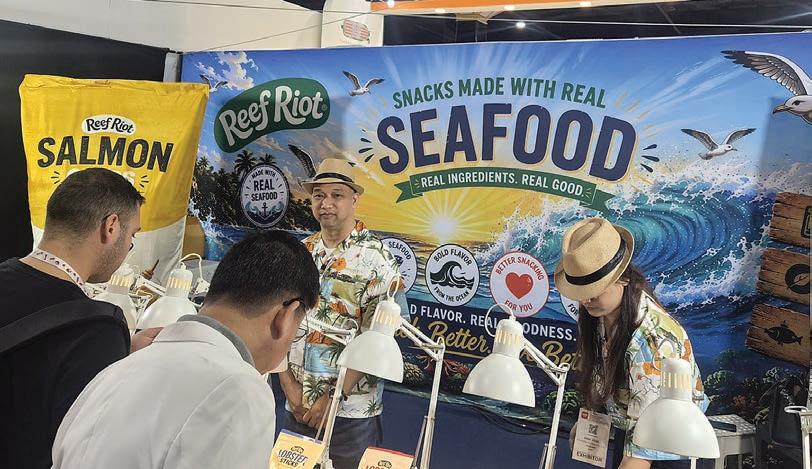
FINE FOOD: A Japanese chef cooks Wagyu beef at the THAIFEX food and beverage fair in Bangkok.
INNOVATION: An example of the variety of food on show at the THAIFEX food and beverage fair in Bangkok.
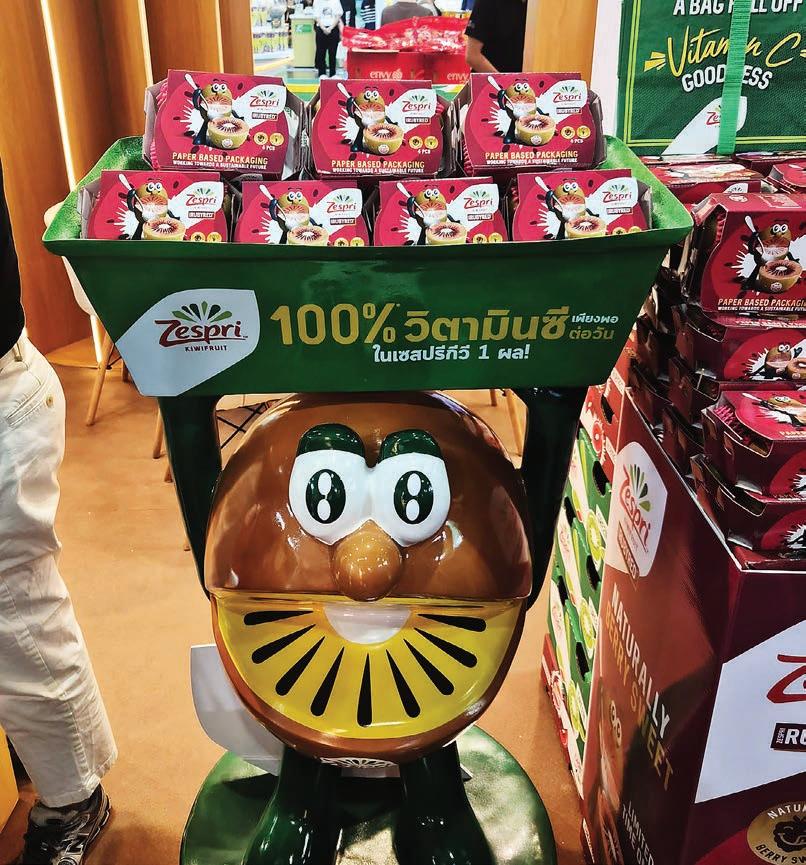
SLICE OF NZ: Kiwifruit was one of the few New Zealand products on show at the THAIFEX food and beverage fair in Bangkok.
Thailand has a let’s innovate and try things attitude.
Michael Lakeman
Aotearoa New Zealand Seaweed












From the Editor
What happened to the dam water?
Neal Wallace Senior reporter
IT WAS too much to hope that we would have a repeat of the exceptional growing conditions of the past year.
It taxes the memory to recall when virtually every region in the country enjoyed a once-in-a-generation season of unbelievably bountiful growth, arable farmers aside.
As we have previously reported, those same damp conditions that had dairy and dry stock farmers trying to manage abundant summer pasture were a nightmare for arable farmers.
But the 2025-26 summer is rapidly being consigned to history with indications that a “significant” El Niño weather system is forming, in what will be a complete reversal from La Niña conditions just ended.
Earth Sciences NZ meteorologists have for six months been monitoring the El Niño system forming in the tropical Pacific Ocean.
This system generally means highpressure systems anchor themselves over Australia, bringing southwesterly flows over New Zealand.
This may mean increased rainfall for Otago, Southland and western-facing
areas, primarily of the South Island, but dry conditions especially in the east of both islands and possibly the upper North Island.
Of concern to farmers is that Earth Sciences has said there is a greater than 60% probability that the event will be classified as “strong” by spring, with the potential to intensify further later in the year.
We have been here before, with winter El Niño systems occurring in 1972, 1977, 1982, 1987, 1993, 1994, 1997, 2002 and 2015.
As we report this week, farmers are generally well prepared with healthy winter crops, full silage pits and hay barns and, unfortunately for arable farmers, an abundance of feed-quality grain.
Some farmers have taken heed of the warnings and bought extra supplements, and others have sown summer crops.
As happens in most dry years, demand will test the resilience of some irrigation systems, which raises the question: What happened to the National Party’s policy to extend water storage capacity, which it promoted at the last election?
“Unleashing investment in water storage” was a key plank of the party’s Primary Sector Growth Plan, which noted that red tape was making “it all-but impossible to build new water storage”.
There would be few who disagree.
The policy was to make water storage a permitted activity by introducing a National Environmental Standard for Water Storage, which meant farmers would not need resource consent to build large-scale water storage schemes on their land.
The policy would also require consent decisions to be made within two years and consents permitted for at least 30 years.
It appears that implementing this policy has been delayed as attention turns to reforming the Resource Management Act (RMA) which, it is widely accepted, has hindered progress on projects such as water storage.
Reform of the RMA is desperately needed.
As an example, the closure of vegetable processors in Hawke’s Bay has added to the need for more and reliable irrigation as the region’s farmers search for higher-value replacement crops.
The Tukituki Water Security Project, formerly the Ruataniwha Water Storage Scheme, shows how difficult that has been.
To achieve the government’s goal of doubling the value of primary sector exports by 2034 requires not only a shift from business as usual but, as we are witnessing, investment in systems that provide some resilience against extreme weather conditions.
business
LAST WEEK’S POLL RESULT
Wool is back and sheep farmers shouldn’t hesitate to cash in.
That is the view of 73% of those who took part in last week’s poll. Many believe wool’s sustainability will ensure its future.
“The prices will continue at a much slower rise. India has just come back into the market and as new innovations in wool kick in they will sustain higher prices. Eventually some products that can’t price leverage will have to reevaluate their options. Technology will improve poorer wool to a more usable standard,” said one voter.
Another said: “We will soon see reductions in the use of fossil fuels as we try to combat climate change. This will limit the production of synthetic materials and wool will become mainstream along with cotton and bamboo.”
Of the 27% who voted no, several believed the rise in wool prices was an aberration and would not last.
“It’s only because of oil supply issues. If wool was developed into value-added products then I’m all for it because I love wool,” said one.
“It’s an unproven aberration in the market and too far below an economic price. This market lives on hope and cost.”
Last week’s question: Should sheep farmers put more emphasis back on wool now that prices are rising?




Let’s dance
Eating the elephant
WHEN someone asks how things are going, our default setting is autopilot. We say it out of habit: “Good, good, busy.” It’s the standard facade we put up, whether things are genuinely flying or tracking slightly off-line.
I’ve been thinking about that response since reading Rebecca Hyde’s “Who is running this farm?” (June 8). Becs beautifully captured the chaotic, muddy reality of day-to-day parenting in the yards.
Her piece also made me reflect on the broader culture we build
around our businesses, and how often we use operational busyness to deflect what’s actually happening.
Recently, I broke script. Someone asked how the start of the year was treating me, and instead of the usual deflection, I let the guard down. I heard myself say: “It’s been a bit of a shit start to the year, if I’m honest.”
It wasn’t a cry for help, things hadn’t been that bad, just a brief moment of unvarnished honesty. We all face good times and bad; it’s just the nature of the game. Like any business, life moves in seasons. Sometimes you get a brilliant spring, and sometimes a gritty, challenging autumn.
The best bit about dropping that standard stoic front, though, was the response. They didn’t default to easy topics like weather patterns or commodity markets. They knew me well enough to look past the macro noise, asking a single question of trust: “And how are your kids?”
“Fantastic,” I said. And absolutely meant it.
“Actually, never better.”
Unlike the autopilot “good, good” from the start of our conversation, this wasn’t a defensive shield. It was the absolute truth. That question cut straight through the noise.
It made me realise that while the adults are busy navigating a tough

season, the kids are thriving. It also made me realise I’d been looking at my target audience all wrong. If Becs is right and the kids are running the day-to-day farm, then strategically, they are also our primary customers. The principles we obsess over in corporate strategy – trust, consistency, resilience – are exactly what our children require from the home culture we build right now.
Sitting at the E Tipu agri-summit recently, listening to fashion designer Karen Walker speak, that connection clicked into place. In fashion, success is defined by seasons. You don’t design one collection and sit on it forever; you move with the weather, adapt, and constantly prepare for what’s next. She dropped a phrase that stuck
in my head: “Dance with your customers.”
For her, it means staying intensely connected, moving in sync with her people, and reacting to their rhythm as the seasons shift. It hit me that we often treat our lives and our farms like an operational checklist rather than a dance.
But the truth is, you don’t dance just to get to the other side of the room; you dance to enjoy yourself. It’s true in business, it’s true with family, and it is profoundly true in that relentless, beautiful dance with the seasons that is farming. If we spend all our energy just trying to survive the rhythm, we miss the point of the music entirely. True connection isn’t a performance; it’s about reading
the room, reacting to each other and having fun – the daily, intentional stuff I easily lose sight of when I’m stressed.
Reframing the kids as the primary customer doesn’t mean we take our foot off the gas. If anything, it forces us to look at our own flaws in managing time. When there’s a hard deadline waiting at the back door every afternoon, it cuts through procrastination. We have to make the call, execute and move.
Modern farming is a dual-career partnership. Our partners are out there kicking arse in their own professional lives, and as rural men, we have to stop hiding behind the excuse of “farm work” to avoid the hard work at home. Getting home earlier isn’t a soft option or a distraction from the business; it’s about choosing where we want to invest our energy. We aren’t “helping out” with the parenting or stepping in as a favour – we are co-captains of the house. Matching the rhythm and pace of my wife means being present enough to actually share the load, choosing to be part of the music with our son and daughters.
The markets will always do what the markets do, but the real customers are waiting. For a bloke with two left feet and a lifelong reluctance to use them, I’d better get my boots off. It’s something my wife and I don’t do nearly enough of. Taylor Swift will be blasting for the girls, Zach Bryan for my son, and the whole crew is at the back door. Let’s dance.
Climate may be awry, but policies mustn’t be
Meaty matters
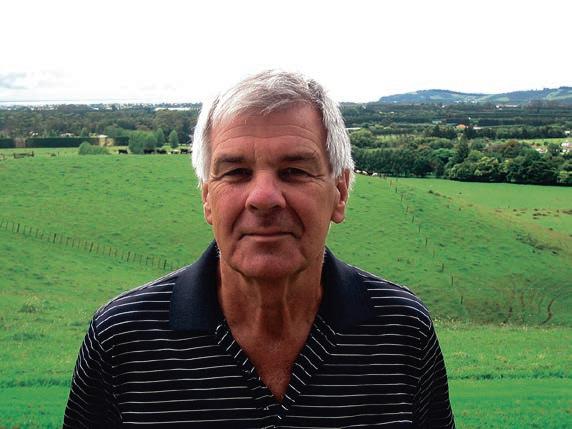
Allan Barber
Meat industry commentator: allan@barberstrategic.co.nz, http://allanbarber.wordpress.com
BEEF + Lamb New Zealand has released updated research into climate change policies in countries around the world, which indicates a widening competitive gap between New Zealand and its competitors.
The updates build on a 2024 report and analyse the developments since then in agricultural greenhouse gas targets, strategies and policies in international jurisdictions.
The research indicates NZ agriculture still operates in an unsubsidised policy framework that requires it to meet a series of still quite stringent emissions targets, while most of the competitors are still focused on large-scale public funding to incentivise and subsidise farmers to meet environ-
mental outcomes. Some countries have even pulled back from their previous climate change targets.
As the general election approaches, with the possibility of a change of government, agriculture faces the threat of yet another change in climate change policies and emissions targets.
Far from reducing the identified competitive gap as it currently stands, there is a strong possibility NZ agriculture could face more severe penalties in comparison with our competitors.
Decisions since the 2023 election have seen common sense responses to several policy settings, including a reduction of the methane target, limits on land use conversions to forestry, removal of agriculture from the Emissions Trading Scheme and the decision not to put a price on agricultural emissions.
These changes have brought NZ more into line with overseas jurisdictions. It is also worth noting the Australian Labor government stated last year that it had no intention of pricing agricultural emissions.
The BLNZ report shows that any reversal of these decisions by a future government is not necessary and would simply signal a desire to appear more virtuous than the rest of the world. The added danger would be a worsening of the competitive position of this country’s economic engine room instead of maintaining an already disadvantaged status quo.
The only major agricultural competitor still pricing emissions is Denmark, which also pays its farmers large subsidies in compensation (in many cases representing more than the price) to encourage research into alternative climate change reduction methods.
The international competitor whose policies are closest to NZ’s is neighbouring Australia, which has relatively similar targets since our target was reduced from the previously unachievable 24-47% set under the Labour government when James Shaw was the responsible minister to the current 14-24% reduction by 2050. NZ’s net zero target for nitrous oxide was left unchanged.
Australia, too, applies very few subsidies and is consequently the country most comparable to NZ. It does not have specific agricultural emissions targets, but its recently finalised Agriculture and Land Sector Plan aims to stabilise emissions by 2030, reduce emissions intensity by 2035, and aim for a reduction of gross emissions from 2040 with a targeted reduction of 28% of all agricultural emissions, including energy, by 2050.
A major proviso in the plan is the intention to maintain food production and export competitiveness. I get the distinct impression some of NZ’s political parties are unaware of the importance of achieving both these points when setting climate change targets.
The Australian plan sets out the
Australian government’s strategy for reducing emissions from agriculture while maintaining food production and export competitiveness. The key points are:
• Continued expansion of the Australian Carbon Credit Unit (ACCU) market, including projects related to soil carbon, vegetation management and methane abatement from livestock and manure management.
• Continued investment in methane-reducing technologies and practices, including feed additives, genetics and improved manure management, supported through government research and industry programmes.
• Ongoing implementation of voluntary environmental markets and private-sector carbon projects, allowing farmers to generate revenue from emissions reductions and carbon sequestration.
• Additional public investment in carbon farming support, including AU$27.8 million over four years from 2024-25 to expand the Carbon Farming Outreach Programme, which includes AU$17.5m in grants to upskill farm advisers and land managers. This support is largely aimed at integrating trees into farms, and Australia has a law that requires the minister for agriculture to approve any purchase of a whole farm for conversion to forestry.
California has introduced a range of incentives and grants to subsidise biodigesters and to
pay carbon credits for the biogas produced, while Canada is also looking at similar schemes. BLNZ does not seek any reversal of NZ’s long-established policy of having almost no agricultural subsidies. Instead of reconsidering pricing, which would put our sector at an even worse competitive disadvantage, BLNZ is encouraging consideration of a more creative approach.
Examples of the type of incentives that could apply include rebates on the adoption of new technologies, allowing credits through the ETS for on-farm practices and technologies that reduce emissions, better access to bank credit for emissions reduction actions, recognition through the ETS for biodiversity benefits from the sequestration of natives, and grants for pest management of native vegetation areas.
Agriculture in NZ is in a very buoyant space at present because of high global demand for protein. It is also being hit with higher input costs that will remain high even if or when income falls. It is critically important that government policies recognise at all times agriculture’s immense contribution to food production and the economy. This requires a sensible rather than ideological approach to measures designed to mitigate climate change.

RHYTHM: You don’t dance just to get to the other side of the room; you dance to enjoy yourself. It’s true in business, it’s true with family, and it is profoundly true in farming, says Phil Weir. Photo: Pexels
Phil Weir Weir is an associate trustee of AGMARDT and a Beef + Lamb New Zealand farmer-elected director
Silly mug or not? You decide.
Good morning Dean
You sent us a mug in the post because we subscribed to Farmers Weekly. That subscription is made because we enjoy the publication and look forward to it being in the letterbox each Monday, along with other rural publications.
However, what are you thinking wasting that hard-earned money buying, packaging and posting a silly mug to us that we will never use? That money would be far better used to post the next six months of Farmers Weekly to us. If you want to say thank you, an email would suffice. Where we do not believe our subscription (or donation as it is since we would get the paper anyway without subscribing) is spent wisely we may well reconsider subscribing in the future.
We will visit your stand at the National Fieldays and return the mug. Please do not send us any more promotional material. All we want is the Farmers Weekly in the letterbox each Monday.
Otherwise, keep up the great work. Farmers Weekly is the best rural publication for us especially with the weekly saleyards and meat schedule reports being we are beef farmers.
Regards Brett

Hi Dean
Ha thanks for the reply. Perfect and I do understand. We will continue to support the publication and we are Fed Farmers members too.
Hopefully I get a chance to chat at the Fieldays and tell you a bit of my history and why I understand your plight.
Cheers, Brett
Good morning Brett
It’s a juggling act and I’ll try to explain the rationale.
But first, we’re thankful for your support, and your appreciation of the paper in your mailbox every Monday.
Our subscriptions have topped out at around 1200. We’re still getting new subscriptions, but some people are not resubscribing, so we’re only treading water.
We’re aiming for 8000 to make the business sustainable, so we have a long way to go.
We ask people why they’re not resubscribing, and many say they get nothing ‘extra’ for it. You made your point well: you subscribed solely to receive Farmers Weekly in your mailbox every week. But that has only won us 1200 subscriptions.
I wish there were more farmers like you.
We took a look at what others do to build a community. Ideas have come from the team here, our farming friends, and our clients. We settled on a promotion featuring a good-sized, practical, classic enamel smoko mug. The mug will last a lifetime, serves as a talking point, encourages collecting a set (prompting year-after-year subscriptions), and pairs well with the paper (grab a cuppa and read it).
Like you, I thought delivering the paper free to 74,000 farmers every week would attract the support we need, but we’ve been proven wrong. Hopefully this initiative will get us to where we need to be.
I look forward to meeting you at Fieldays. I’ll be on the stand in the Federated Farmers Advocacy Hub all four days.
I hope I can convince you to keep the mug, and even better, I’d like to use your feedback in a way that will help win us more subscriptions. I agree with you...the paper should be enough, but unfortunately, most people take it for granted.
I am determined to maintain the quality of Farmers Weekly – we’re incredibly proud of it every week and I’m determined to keep the team and support the sector as we do. But it’ll take more reader support.
So thank you for your support, and for your email. I look forward to meeting you next week.
Kind regards, Dean
In next week’s issue we’ll let you know if Brett kept his mug. In the meantime, start your voluntary subscription and we’ll send you one.
I'm a subscriber

Scan the QR code or go to www.farmersweekly.co.nz/donate Email your name, postal address and phone number to: voluntarysub@farmersweekly.co.nz and we’ll send you an invoice. Call us on 0800 85 25 80
Note: A GST receipt will be provided for all voluntary subscriptions.


Sector Focus
Pathfinder opens way for women in seed
Annette Scott PEOPLE Arable
CHARLOTTE Connoley recalls the time she entered the New Zealand grain and seed industry, when “being female felt quite unique”.
The first woman on the board of Seed and Grain NZ (SGNZ), formerly the NZ Grain and Seed Trade Association, Connoley has been a trailblazer for women in the industry.
Having grown up on a farm in south Canterbury and now living in the Bay of Plenty, Connoley is general manager and coowner with her husband Rob of Kings Seeds NZ, an e-commerce seed company supplying home gardeners and wholesale customers nationwide.
Her appointment to the SGNZ board in 2018 made her the first female executive in the association’s 100-year history.
After chairing the vegetable business group for five years, she took up the chair of the association in 2023 and is currently on the executive as the immediate past chair.
Connoley initiated Women in Seed, a forum developed for professional women in the grain and seed industry to create opportunities for networking, information sharing and

professional development.
At Women in Seed 2026, SGNZ chief executive Sarah Clark acknowledged Connoley’s initiative and its success.
“We are very proud of the Women in Seed forum for the way it has connected women in the industry.”
Clark said it’s important the industry has a pipeline of women to participate and thrive in the seed and grain industry.
While women are increasingly visible in leadership roles across agriculture, Clark said, a gap remains in gender diversity on
Malt makers join NZ Grown Grains push
Scott NEWS Arable
CANTERBURY malt makers Doug and Gabi Michael have joined the early adopters of the arable industry’s NZ Grown Grains push. The couple’s Gladfield Malt business at Dunsandel celebrated in style recently with 300 grower-suppliers and industry stakeholders joined by Prime Minister Christopher Luxon and Selwyn MP Nicola Grigg.
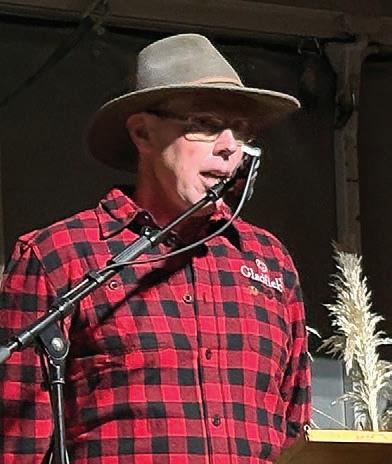
Founded by the Michaels, Gladfield Malt turns malting barley into a key ingredient in beer making, now supplying malt products to breweries throughout NZ as well as overseas.
Coming from a fifth-generation family of barley growers, the couple also receive crops from 200 contracted growers.
The crops are processed to produce more than 50 types of malted grains ranging from base malts ale, pilsner and lager to roasted malts with specialty colours and flavours such as chocolate and supernova.
“We started 22 years ago, and it was never meant to get as big as this,” Doug Michael said.
With complementary skills the couple had it sorted.
“I made it and Gabi sold it.”
Gladfield Malt uses 100% NZgrown malting barley, prompting the sign-up to the NZ Grown Grains branding initiative, which makes it easier for consumers to identify domestically grown products.
“We need to tell the world about the importance of looking after local. The arable industry is undervalued in NZ. We are going to change that.
All my staff were men and much older than I was; being female felt quite unique.
Charlotte Connoley Women in Seed
we eventually ended up with a reasonable staff of women within our team and it wasn’t targeted; it was always about the best people for the job.
“Personally, it is important to me that females within our industry feel supported to take roles at any level throughout their organisations that they are qualified for.
agricultural governance boards. Connoley said she had been in the seed industry since she graduated from university.
“From my own journey and a female perspective it was a little solitary because generally speaking, I graduated from university a real anomaly,” Connoley said.
“I got a job in seed sales at South Pacific Seeds in Pukekohe and was made general manger at 23 [years old]. All my staff were men and much older than I was; being female felt quite unique.
“Just through recruitment
“Demand for knowledgeable primary sector employees is always strong in NZ with an ag-hort based economy, and so the challenge remains for the seed industry to be an attractive employer of diverse talent.”
The first Women in Seed forum was held in 2019 with 40 attendees. Seven years on the event attracts up to 140.
Connoley has encouraged women to participate on the board and was instrumental in two further initiatives that have created opportunities for women – an associate councillor position on the executive board to provide an opportunity for young people to get a start on their governance
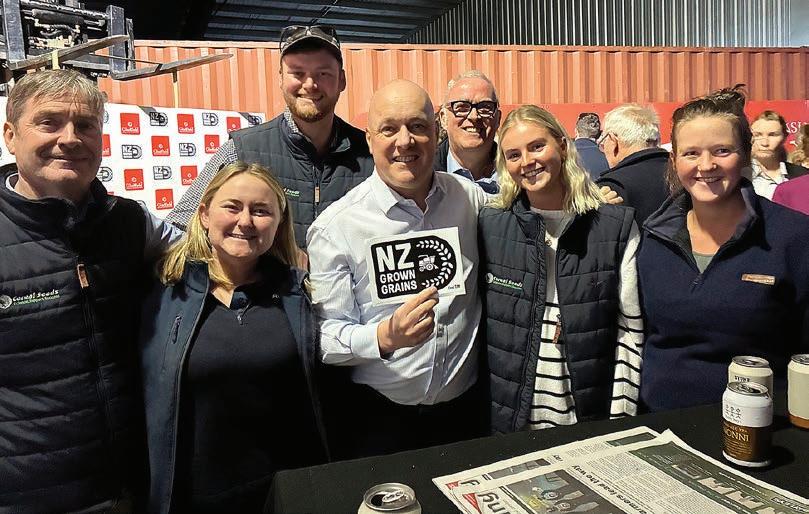
“Growing and processing crops is expensive. Shipping crops around the world is even more expensive. So, food security is more important than ever,” Michael said.
On top of domestic sales, Gladfield Malt also exports to China, Japan, India, Australia and the Pacific.
The co-founder and head brewer of Hamilton-based Good George, Brian Watson, said the first thing he would be doing when he got back to the office was to sign up for the NZ Grown Grains branding.
“We need to put that on our cans. Brewers cannot exist without growers producing malting barley.”
While he has a relationship
with hop growers, malting barley growers had been “faceless” until now.
“So, it is great to meet you,” Watson said at the celebration.
When Good George started 15 years ago it initially used imported malt.
“However, I realised we were suddenly getting 20% extra beer out of the malting barley and the difference was the Gladfield Malt supply.”
Good George has sourced all its malt from Gladfield Malt ever since, despite offers of cheaper product from overseas.
“Relationships with people you work with through the supply
journey and the SGNZ Young Radicles group for under 35s in the industry to connect and participate.
“With a pathway, women are taking more interest, and we are growing numbers; it’s not about quota or box ticking, we still want really good people across the board, but women do think differently.
“We interact with people differently, we approach problems differently, and that diversity of being and thinking is where the magic happens.
“It’s important for everyone to step out of their day job from time to time to gain some new perspectives, and Women in Seed offers that.”

chain are just as important as your customers.”
Foundation for Arable Research general manager business operations Ivan Lawrie said since the launch of the NZ Grown Grains’ logo in October 2025, “support has been massive”, with 25 companies signing up to use the branding on their products.
It is now appearing in bakeries and on supermarket brands including Harraways’ oats, The Good Oil edible oils and Otis oat milk.
“This makes it easier for consumers to identify and purchase NZ-grown produce.”
Luxon also lent his support to the campaign.
“As arable growers it is not easy, with the ups and downs of weather events, commodity prices and rising costs.”
The free trade agreement with India would reduce tariffs on malt by up to 33%. This is a huge opportunity, Luxon said with the middle class in India growing from 440 million now to 750 million by the end of this decade.
“As their country gets wealthier, they want better quality food and beverages, and we can sell this to them.
“The thinking that we are a long way away from markets is no longer the case. Instead we are in the middle of the most dynamic region in the world.”
Annette
GROWTH: The first Women in Seed forum in 2019 had 40 attendees. Seven years on the event attracts up to 140.
Photo: Izzy Tyer, Cashmere High School
PROMOTION: Prime Minister Christopher Luxon promotes the NZ Grown Grains logo with arable growers and industry people during a visit to Canterbury.
DIVERSE: Charlotte Connoley says the challenge for the seed industry is to be an attractive employer of diverse talent.
LOCAL: Gladfield Malt founder Doug Michael is proud to use only New Zealand-grown grain.



Lockdown venture now paying dividends
DAIRY farmer Dani Harrison hadn’t planned to start her own separate on-farm business, but the busy mum was inspired by the needs of her children – and then by other parents who quickly cottoned-on to her skills.
It was after the birth of her second child, Lilly, now six-yearsold, that Dani first decided to make farm clothing for her baby girl.
“I had her three weeks before lockdown and she was coming out on the farm with us and I wanted her to be warm,” says the mum of three, who lives on a 120ha farm in Balclutha.
“I was talking with my husband Shane about how cute it would be if we could get some camo gear for her for going hunting, and being on farm, so I bought some fabric and made a pair of pants and a hoodie.”
Before she knew it, Dani was busy making garments for friends’ kids who’d admired her creations, having spotted them on social media posts.
With encouragement she then started advertising on a Facebook page designed to help small businesses during lockdown.
“At the time I was on maternity leave from my job as a coordinator for a home-based healthcare provider, and they’d asked me to go back to work early,” says Dani, whose older daughter, Pagan, was 14 at the time.
“I didn’t want to put Lilly into daycare and really wanted to stay at home with the kids, and although I feed the calves, I also wanted to earn an independent income. It was Shane who suggested making a business and seeing how it went. He’s my biggest supporter and loves what
I make. He’s got so many hoodies I’ve made him, and he wears them all the time.”
Dani called her business Antler Apparel. To start with she offered four colour options of kids’ fleece pants and then branched into hoodies, using Facebook as her shop window. Her focus was on affordable, quality, durable, handmade garments that would be warm and comfortable. Her range has now extended, partly in response to her own kids’ needs, but also to requests from customers, to include waterproof overalls, hi-vis garments, and adult options too.
Her breastfeeding fleece hoodies and tees are particularly popular. She was inspired to make these during a cold calving season while feeding her third child, baby Hunter.
“I knew there would be other farming mums who need them,” says Dani, who has four sewing machines, her most prized of which was gifted to her by her grandmother.
“It turned out there were quite a few!”
A significant game-changer in the business’ development was taking part in the Rural Women New Zealand (RWNZ) Activator Programme in 2023, she says.
“I applied because I really needed a push with my business.
I’d built a brand I was really proud of, but I was hitting a wall because I’m quite introverted, so putting myself out there and promoting has always been quite tricky.
“One of the biggest things holding me back was I didn’t have a website.
“At the Activator session, they helped me by troubleshooting the issues I was stuck on, breaking down the steps, and giving me clear direction and goals to work towards. We covered marketing,
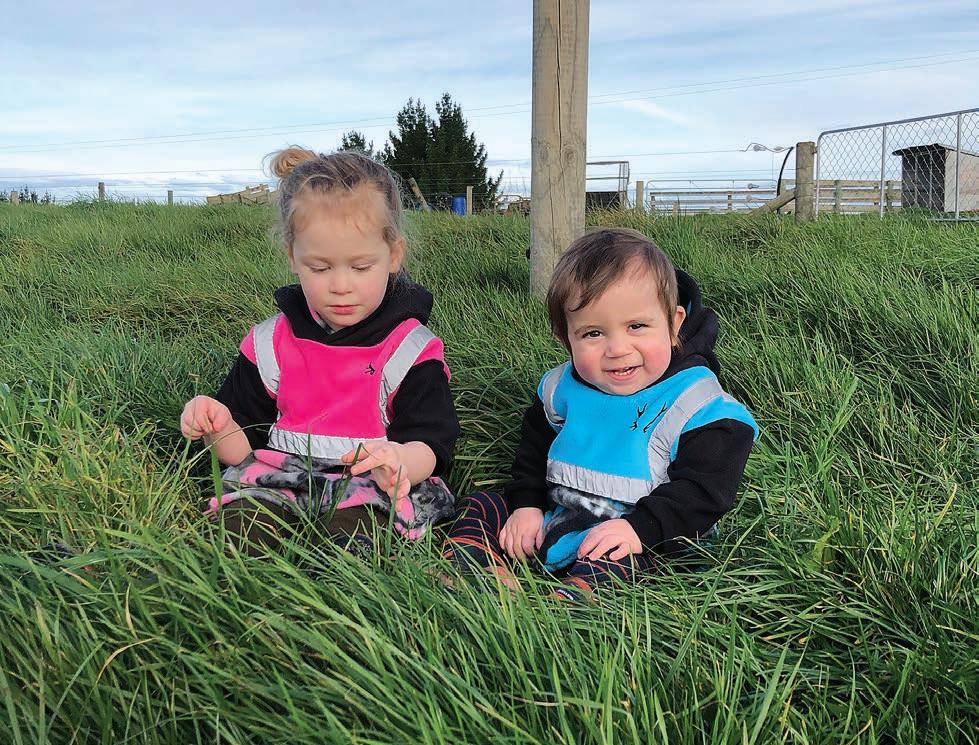
I didn’t want to put Lilly into daycare and really wanted to stay at home with the kids, and although I feed the calves, I also wanted to earn an independent income.
supported. I know I could contact any of the people overseeing the event if I have a question.”
Since setting up the website, Dani’s seen a huge surge in sales.
“I wish I’d done it earlier because it’s so much easier for people to order now.”
too, like the sleeveless options and tops without hoods.”
Dani now prints the designs directly onto the fabric, having bought a heat press.
Hunter, now three years old, was inspiration for the waterproof and hi-vis range.
Dani Harrison Antler
Apparel
growth, financials, next steps and loads more.
“It gave me that push to get out of my comfort zone and I came away from it feeling so happy, encouraged and motivated.”
And the support didn’t end there, she says. “They sent me emails afterwards with everything I needed to focus on to move forward. Over the following months they also did a couple of Zoom lessons. I still get emails from them and feel really
She’s now exporting to Australia and knows of some customers who’ve purchased garments to send to family as far as Canada and Ireland.
Having left school at 16 to do a fashion design course, Dani would never have imagined she’d go on to start her own business.
After having her first daughter at 18, she continued fashion at Christchurch’s D&A College but needed to leave early due to the pressures of being a single mum.
“I’m so glad I use those skills now. My customers love that everything’s handmade and can be personalised with colours and logos, and I’m always getting new ideas inspired by their requests
“He’s an explorer and a runner and I needed to be able to see him, especially when I was calf feeding, so if he’s in bright yellow or orange I can spot him straight away.
“I also made waterproof fluoro overalls for him because he was constantly getting disgustingly dirty. They’ve saved me so much washing!”
Dani’s grateful Antler Apparel has a higher profile too since being listed on RWNZ’s directory of businesses The Country Women’s Collective, which has brought more new customers.
“The feedback I’ve had about the quality is humbling,” she says. “It’s so nice to know people genuinely love the stuff!”

Fiona Terry
BRIGHT SPARKS: Lily and Hunter Harrison model some of mum
Dani’s clothing creations. Photo: Supplied
FEDERATED FARMERS
4 No 23, June 15, 2026

Feds welcomes QEII funding pledge
Doubling funding for the QEII National Trust would be the best bang for buck conservation investment the next Government could make, Federated Farmers says.
“More funding would mean more farmers can voluntarily protect important biodiversity and natural habitats on their land for future generations,” Federated Farmers president Wayne Langford says.
“Doubling the trust’s funding has been a long-standing priority for Federated Farmers because it’s a model that is well-proven.”
Demand for new covenants has been growing rapidly but government base funding has remained largely unchanged for more than a decade
“More and more landowners want to covenant special areas on their properties, but QEII simply hasn’t had the resources to keep pace,” Langford says.
The National Party announced this month it will double the trust’s funding if it’s part of the next government.
“We’re now calling on other political parties to get in behind the National Party’s pledge and make this a cross-party priority and commitment,” Langford says.
The QEII Trust provides the covenant legal paperwork and expertise on how best to protect native bush, wetlands and other special habitats.
Farmers voluntarily commit the land and their hard work putting in fences and tackling pest animals and plants.
A Waikato University study found for every dollar of QEII money, farmers and other landowners put in $6 to $7 in foregone production from the land, and ongoing work to protect the habitat.
Former Federated Farmers Otago president Simon Davies is involved with a potential covenant languishing on QEII’s waiting list for investigation. Like other farmers, he’s very keen to see the National Party’s funding pledge confirmed by the next government.
“There are so many farmers and other landowners willing and ready to protect the environment for future generations, but the QEII trust’s hands are tied on meeting that demand.”
Davies already has 39 hectares of regenerating bush under QEII covenant on his own farm at Toko Mouth, south of Dunedin, and counts it as very fortunate to gain that protection last year for a wetland on another farm block he leases.
“Despite the trust’s budget squeeze, that covenant for what is a regionally significant wetland got through in the last funding round as a partnership involving the landowner, QEII and Otago Regional Council.
“The QEII trust’s expertise and advice is key to getting these sorts of initiatives across the line.”
Davies chairs the South Otago River Care catchment group, which is looking to achieve covenant protection for 7 hectares around Kaihiku Falls, south-west of Balclutha.
“Kaihiku Stream and the small,
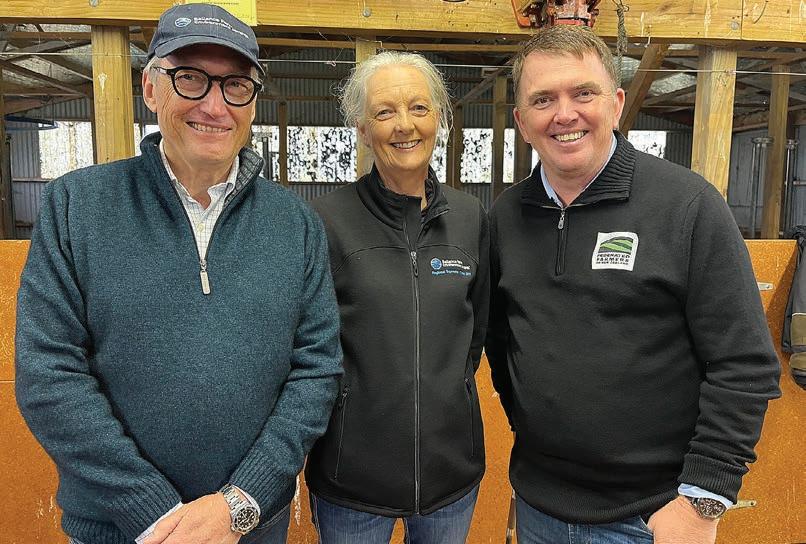
COMMITTED COVENANTORS: The woolshed on Shirley-Ann and Rick Mannering’s sheep and beef farm bordering the Hunua Ranges, south of Auckland, was a fitting place for National to make its QEII funding boost pledge. Federated Farmers president Wayne Langford was also there to acknowledge the 148 hectares the Mannerings have put under multiple QEII covenants over the years.
More and more landowners want to covenant special areas on their properties, but QEII simply hasn’t had the resources to keep pace.
Wayne Langford Federated Farmers president
tiered waterfall are historically significant to Māori as a traditional site for catching kanakana (lamprey) and it’s a popular local swimming spot.
“Our catchment group is putting in $30,000 towards new planting and
a landowner has fenced one side of the site.
“It’s another example of a project that QEII Trust involvement could really spur along – but that’s unlikely to happen without that lift in the trust’s core government funding,” Davies says.
More than 5400 QEII covenants now protect almost 190,000 hectares of privately owned land across New Zealand, with the vast majority located on farms.
If all QEII covenants were combined, it would be New Zealand’s fourth-largest national park-sized protected area.
With Government base funding static since 2015, and other one-off
funding streams drying up, QEII Trust
CEO Dan Coup says this year’s new covenant target is just a quarter of what was achieved in 2024.
“It’s the first time we’ve had to ration what we’re doing really tightly.
“That means some covenant opportunities will be lost forever as people stuck on our waiting list pass away, lose faith or sell their property.”
Coup says the funding shortfall doesn’t just hit new covenant rates.
“These farmers and landowners are facing increasing challenges looking after their native bush and wetlands with more extreme weather events, more feral animals and more weeds, including wilding pines.
“We want to be able to provide a bit more advice and support for those 5400 property owners who are already doing this good work.”
Coup says the trust is very grateful to the National Party for its leadership and acknowledgement of what the trust does.
“This is not a politically contentious cause so we hope other parties will take a similar view.”
Langford says the success of QEII demonstrates why voluntary, incentive-based conservation approaches are more effective than heavy-handed regulation.
“Farmers have shown time and again that when they’re supported and empowered, they’ll step up.
“QEII is one of the best examples of conservation success in New Zealand, and the next government needs to lock in this funding increase to allow even more landowners to be part of that story.”
Kiwi farmers lagging as delays bite
New Zealand farmers are getting left in the dust when it comes to their access to the latest agricultural and horticultural products, Federated Farmers says.
Arable chair David Birkett says New Zealand has fallen from being a leader in agricultural innovation to one of the slowest countries for approving new products and technologies.
“A decade ago, New Zealand was at the front of the pack. Global companies were trialling new products here because they saw us as an innovative agricultural nation,” Birkett says.
“But as our approval processes have become slower and more difficult, many of those big companies – like Bayer – have got frustrated and simply stopped investing in New Zealand.
“Why would they conduct trial work here if there’s no certainty they’ll ever be able to get a product registered?”
One of Federated Farmers’ policy priorities for the next government is to make it faster and easier for farmers to access new technologies. That includes agrichemicals, animal health treatments, vaccines, and other innovations critical to modern farming.
Federated Farmers says the Environmental Protection Authority (EPA) has too often acted as a barrier to innovation rather than an enabler.
The consequences are being felt directly on the land, where farmers and growers are increasingly unable to get their hands on tools available overseas.
“A really clear example is grass grub, which is one of our most damaging agricultural pests,” Birkett says.
“Right now, farmers are at serious risk of being left without effective, affordable control options because one key chemical is being phased out and another is due to be banned.
“We know there are new products sitting in the approval queue, but we need the EPA to prioritise them now or we’re going to be left high and dry.”
Birkett says farmers need every tool available if New Zealand wants to remain competitive and keep improving productivity and environmental outcomes.
“Agrichemicals are one part of that picture, and so are veterinary medicines and vaccines.
“These aren’t luxuries either. They’re critical tools for protecting animal health, managing pests and diseases, and strengthening our biosecurity defences.”
Birkett says farmers are hearing reports the EPA is making internal improvements and working through approval backlogs.
“That’s definitely encouraging to
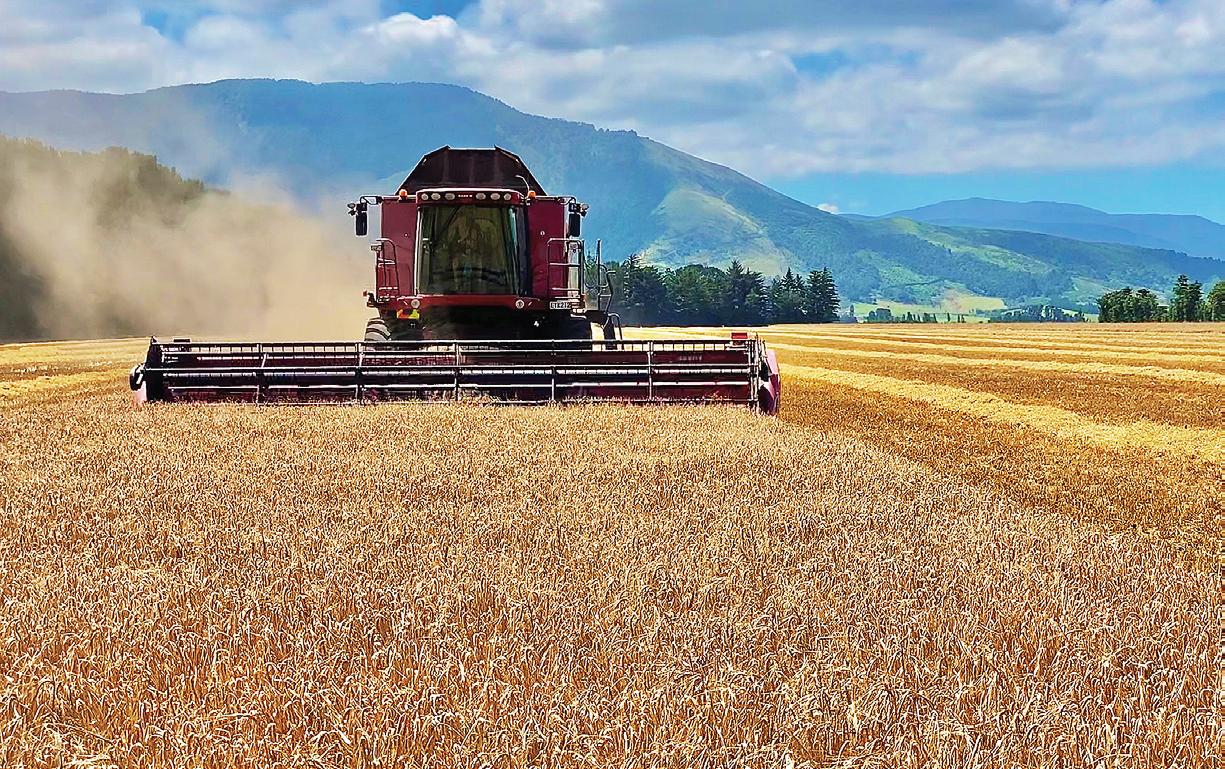
hear, but we’re just not really seeing it on the ground.
“A lot of the products being approved are existing products with new labels or additional uses.
“What will make a genuine difference to New Zealand’s economy is seeing entirely new products and technologies coming through the pipeline.”
A formal review of agricultural and horticultural product approvals last
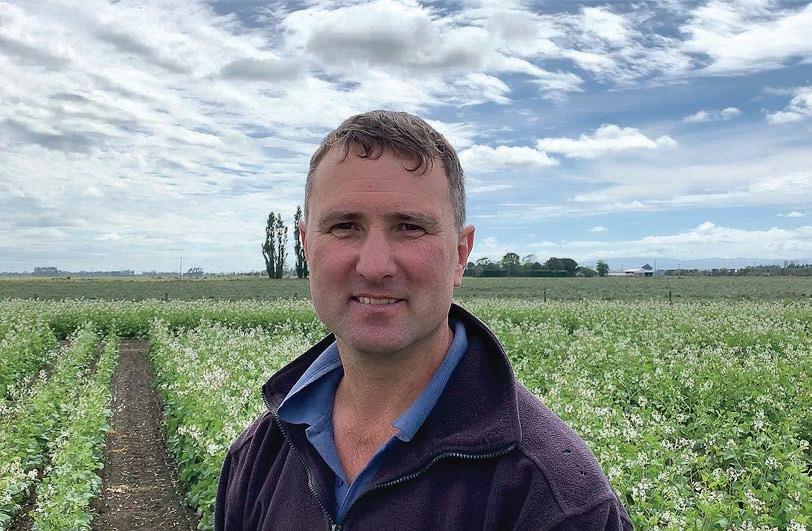
Taranaki dairy farmer
Federated Farmers sharefarmer chair

year identified a range of problems.
These included duplication between approval systems, long processing times, resourcing constraints, and insufficient use of trusted overseas science.
The Government has since introduced amendment bills to implement many of the review’s recommendations.
Birkett says those reforms are welcome, but more work remains.
“The proposed law changes are a big step forward and address many of the concerns farmers have been raising for years.
“But there are still recommendations that haven’t been completed, and we need the next government to commit to finishing the job.”
Federated Farmers wants the next government to complete the remaining recommendations, rebalance EPA resources towards new approvals and product innovation, and streamline approval processes with clear performance targets.
The organisation says faster approvals don’t mean compromising on safety.
“No one’s asking for corners to be cut,” Birkett says.
“What we want is a science-based system that assesses risks properly, but at the same time doesn’t waste years duplicating work that’s already been done by reputable regulators overseas.
“It’s totally do-able to speed this process up safely.”
Birkett is also questioning a proposed levy on hazardous substances.
“We won’t support a levy unless it’s tied to measurable improvements in approval timeliness, transparency, and overall system performance.
“Otherwise, it’s effectively nothing more than a tax, and the resulting costs would likely just be passed on to end users, farmers and consumers.”
At the end of the day, improving access to innovation isn’t just good for farmers, Birkett says.
“I think it’s pretty clear that our farmers and growers are key to New Zealand’s growth.
“When farmers are doing well, all Kiwis benefit. but if we want a thriving farming sector, we really need a regulatory system that keeps pace with innovation.
“Right now we’re falling behind – and the next government has an opportunity to change that.”
DELAYS: Federated Farmers says the Environmental Protection Authority has too often acted as a barrier to innovation, taking too long to approve new tools like crop chemicals for pests and diseases.
TOOLS: David Birkett says farmers need every tool available if New Zealand wants to remain competitive and keep improving productivity and environmental outcomes.
Federated Farmers
‘Sleight of hand’ robs pest funding
Federated Farmers says the Government needs to keep faith with New Zealanders over money collected from international visitors for conservation and tourism infrastructure.
“When the International Visitor Levy (IVL) was introduced in 2019, the very clear implication to New Zealanders – and tourists – was that it would add to, not replace, existing funding in those two areas,” Federated Farmers meat and wool chair Richard Dawkins says.
“Instead, the lion’s share of the new money is being siphoned off to replace Department of Conservation and tourism base funding.
“This sleight of hand frees up room in the Crown budget, but it shortchanges efforts to get on top of pest animals and weeds coming out of the DOC estate and on to productive farmland.
“This issue is so important that we’ve made it one of our 2026 election priorities, calling for the next government to use 100% of the IVL for conservation and tourism projects.”
A $35 IVL was introduced in 2019 to ensure tourists – and not just taxpayers and ratepayers – shoulder some of the costs of regional infrastructure and maintaining the conservation estate.
It nearly tripled to $100 per visitor crossing our border in 2024.
While $90 million a year is being dedicated to new spending by DOC to protect biodiversity and improve visitor facilities ($55m), and to MBIE to enhance tourism/hospitality initiatives ($35m), another $139 million of IVL money swaps out baseline funding to those two departments.
“That all just goes into general Crown coffers, even though everyone acknowledges DOC is starved of enough money to properly deal with growing deer, pig and pest weed problems,” Dawkins says.
“If this money is just going into the general kitty for use on anything, that’s not a levy – it’s a straight-up tax.”
According to Crown estimates, IVL revenue from 2019 until 2029/29 will total more than $1.19 billion. Of that, $785 million will be diverted for swapping out DOC and MBIE core funding.
“That’s a massive amount of money collected from visitors to go towards infrastructure they use, and protecting the natural vistas that draws them here, that instead is going to other purposes,” Dawkins says.
“Farmers would be even more annoyed over this if the Government
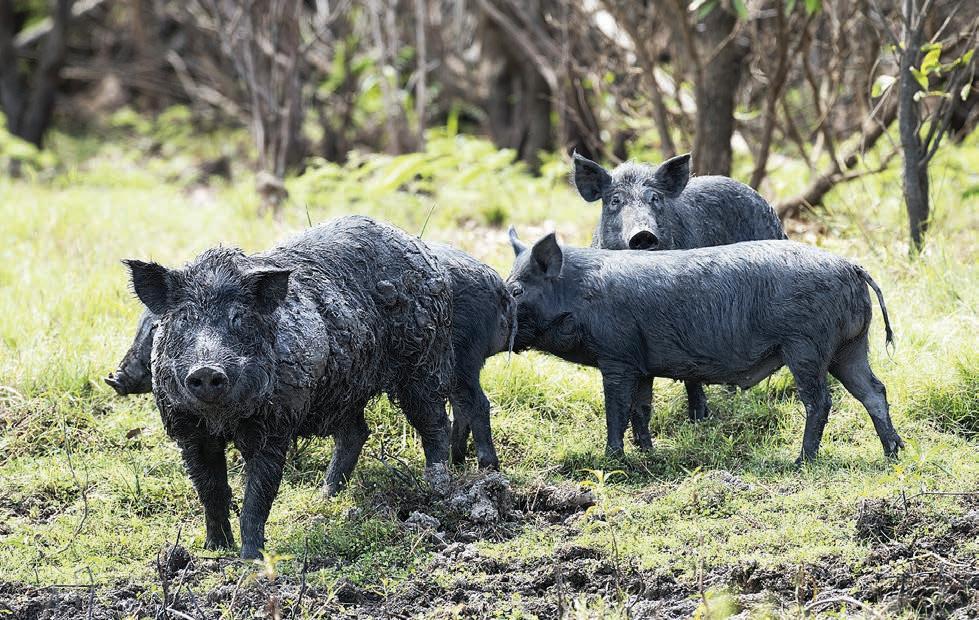
hadn’t recently announced an extra $79 million for wilding pine control over the next three years, with a portion of that being IVL money.”
This is on top of the just over $7 million of IVL money dedicated to wilding eradication in 2023/24, $3.5 million the next year, and $3 million in the current year.
“These are substantial sums, and while they fall short of the $50 million per year we argue is needed, we appreciate the Government is giving attention to this destructive and persistent tree.
“For the first time, we’ll see a
serious effort to tackle some of the country’s worst seed source areas, like Branch Leatham in Marlborough, which has long fuelled the wider South Marlborough infestation,” Dawkins says.
Wilding pines fuel more intense and dangerous wildfires, choke out native vegetation, and deplete groundwater supplies.
Even a small number of wilding pines can spread seed over vast distances on the wind.
GIVE AND TAKE:
Richard Dawkins says that if the IVL is just going into the general kitty for use on anything, it’s not a levy – it’s a straight-up tax.
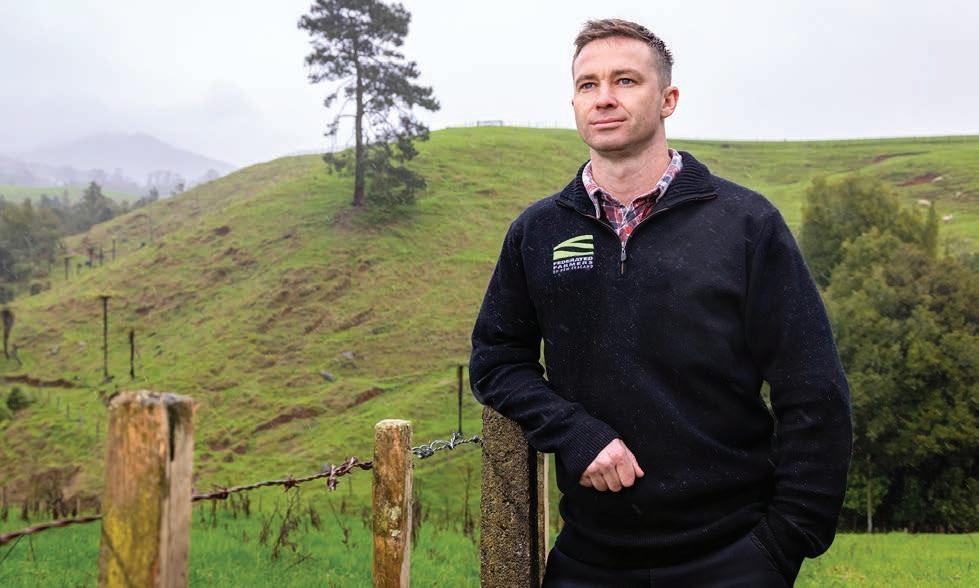
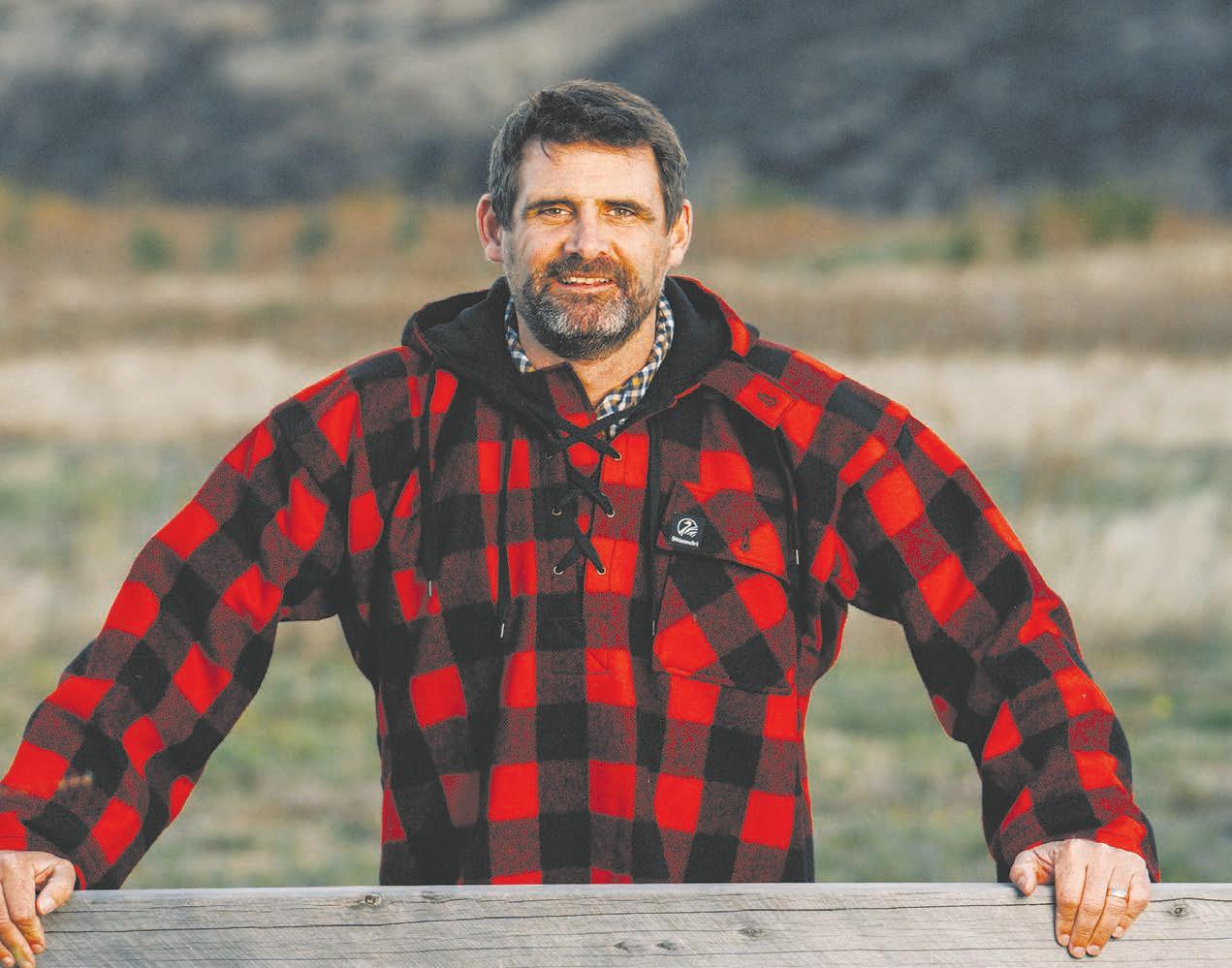


Just as pressing is the need for more funding to reduce feral animal pests, which cost farmers more than $200 million a year.
IVL money is also being used to drop 1080 in DOC’s 8000-hectare Mt Nimrod conservation reserve in a bid to control wallaby numbers.
This sleight of hand frees up room in the Crown budget, but it short-changes efforts to get on top of pest animals and weeds coming out of the DOC estate and on to productive farmland.
Richard Dawkins
Federated Farmers meat and wool chair
FUNDING RAID:
DOC is starved of funding to tackle feral pigs and deer in the Crown estate, and would make faster progress if IVL money wasn’t offset by corresponding cuts to their base funding.
Federated Farmers High Country co-chair Matt Simpson says this work is immensely important to the South Canterbury farming and conservation communities.
“Our point is that we could be making faster progress on these kinds of serious issues if existing DOC and MBIE budgets weren’t being raided, and IVL money used as the offset,” Dawkins says.
IVL money was also to be earmarked for tourism infrastructure.
Federated Farmers agrees with councils in areas such as central Otago, the West Coast and Northland that central government is falling short on responsibility for co-funding public toilets, sewage treatment, road upgrades and other infrastructure in these tourism hotspots.
“The entire burden of these costs otherwise falls on ratepayers – and that means a disproportionate share on farmers due to the flawed property value-based rating system,” Dawkins says.
“As we head into an election later this year, our message to the political parties is that every cent collected through the International Visitor Levy must be directed back into the purpose it was collected for, without corresponding reductions in DOC and MBIE base funding.”

Emerging leaders to help others thrive
Seizing opportunities, even if they’re outside your comfort zone, is a trait the three finalists in the Primary Industries New Zealand 2026 Emerging Leader Award have in common.
“Just say ‘yes’, and figure out how to do it afterwards,” is how James Robertson, who at age 29 is Fonterra’s chief of staff, puts it.
“It’s about making the most of what’s thrown your way. Once you’re up there, you get a bit of support and you’re away and laughing.”
He was speaking about being roped in as MC at this year’s Zanda McDonald Award ceremony, but it’s a theme that applies in other aspects of his life too.
I want to be a beacon of hope to others who have come from the same sort of background I have.
Ben Purua Dairy farm manager and Emerging Leader finalist
Getting involved and stepping up are also hallmarks of his fellow Emerging Leader finalists – Federated Farmers Waikato sharefarmer chair Danielle Hovmand, and dairy farm manager and 2024 Ahuwhenua Young Māori Farmer of the Year (Dairy) Ben Purua.
There are nine categories in the eighth annual Primary Industries NZ (PINZ) Awards to be held on 23 June.
The Emerging Leader winner announcement is one Federated Farmers president Wayne Langford is particularly looking forward to.
“These young go-getters are our future.
“The level of their achievements at a relatively young age is an eyeopener,” Langford says.
“It bodes very well for agriculture that this is the calibre of leader coming through, especially their willingness to help others see the opportunities in farming, and to help
them on their way.”
Robertson grew up on a 200-cow Waikato dairy farm and was the youngest-ever winner of the FMG New Zealand Young Farmers of the Year in 2019.
After gaining a Bachelor of Agribusiness at Massey University, his farming roots and expertise in trade strategy put him on promotion fast-track at Fonterra.
He was Fonterra’s Trade Strategy Manager for Asia, based in Shanghai, and in 2024 the NZ-China Trade Association named him an Emerging Leader in Business. He was also a Zanda McDonald Award finalist himself in 2021.
That mix of farming nous and international exposure goes down well when he gives talks to Massey alumni and secondary school students.
“Agriculture was never really talked about as a degree when I was at school. If you were somewhat academic, you were steered down the path of being a doctor, lawyer or accountant.
“I like doing my bit to show today’s students there are big opportunities in agriculture.”
Robertson is thriving in the corporate world in Auckland but likes nothing better than getting back to the family farm.
“Anything that gets the sweat on,
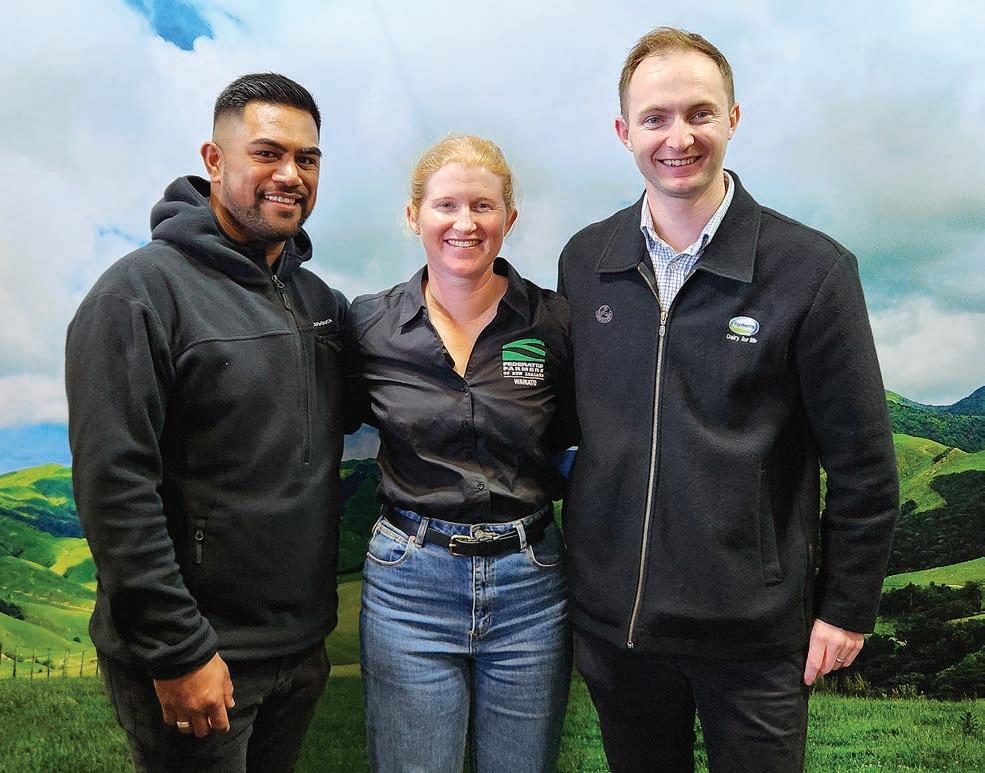
or your hands dirty, is my happy place.”
Dani Hovmand says it’s pleasing to be recognised as an emerging leader and sees the nomination as encompassing all the people who have helped her along the way.
“There are so many people who have created my journey and allowed me to be in leadership roles, and to achieve things.”
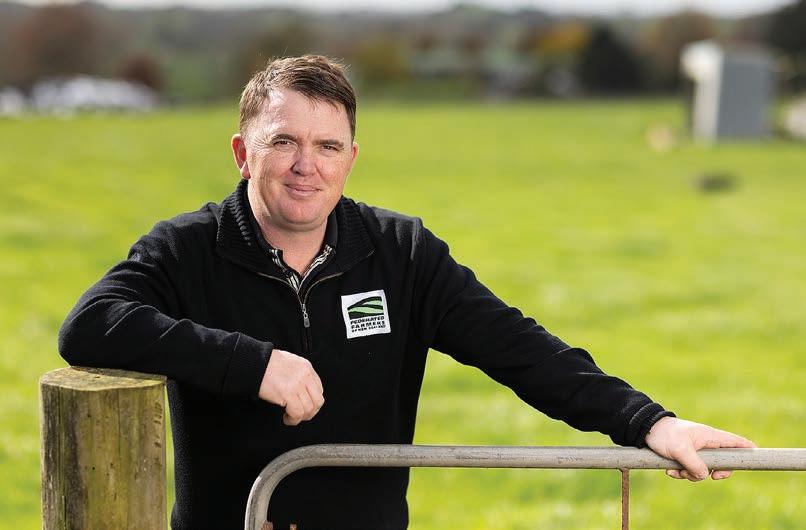
A driving force in the Morrinsville Ngarua Young Farmers Club and projects that raised tens of thousands of dollars for local charities, she was the AucklandHauraki Share Farmer of the Year in 2022 and a finalist in this year’s ASB Alumni of the Year.
That same drive saw her take on the role of sharefarm section chair at Federated Farmers Waikato – the organisation’s largest province by membership.
She’s pushed hard for practical agreements and better support for sharemilkers and contract milkers, including fronting the Federated Farmers campaign for young farmers to better access their KiwiSaver funds for capital to start in those roles.
She’s also done a stack of podcasts and interviews aimed at helping industry newcomers find their feet.
In the words of her nomination: “Dani’s not just participating – she’s actively helping shape a strong future for New Zealand’s primary industries.”
Ben Purua is another emerging leader who goes out of his way to
FIELDAYS SNAP: Giving back to farming, a sector in which they’ve all excelled, is high on the list for PINZ 2026 Emerging Leader Award finalists,
help others step up the agricultural ladder.
His story is one of resilience and redemption. Growing up in an environment marked by violence, addiction, gangs and trauma, he was behind bars at age 16. But while serving time at Waikeria Prison, he discovered farming through a work programme.
After his release in 2016, he rapidly progressed in the dairy industry from farm assistant to where his is now –farm manager at a high-performing 540-cow system 5 dairy farm near Tirau.
Among other accolades, he’s the 2024 Central Plateau Dairy Manager of the Year, and an ambassador for the farmer-backed charity Meet the Need.
His mission to showcase agriculture and get other young people into the industry includes mentoring roles and a high profile on social media.
“A lot of rangatahi are drawn to my story,” he says.
“I want to be a beacon of hope to others who have come from the same sort of background I have.”

FUTURE: The Emerging Leader winner announcement is one Federated Farmers president Wayne Langford is particularly looking forward to.
from left, Ben Purua, Dani Hovmand and James Robertson.
Waotu 468 Mountain View Lane
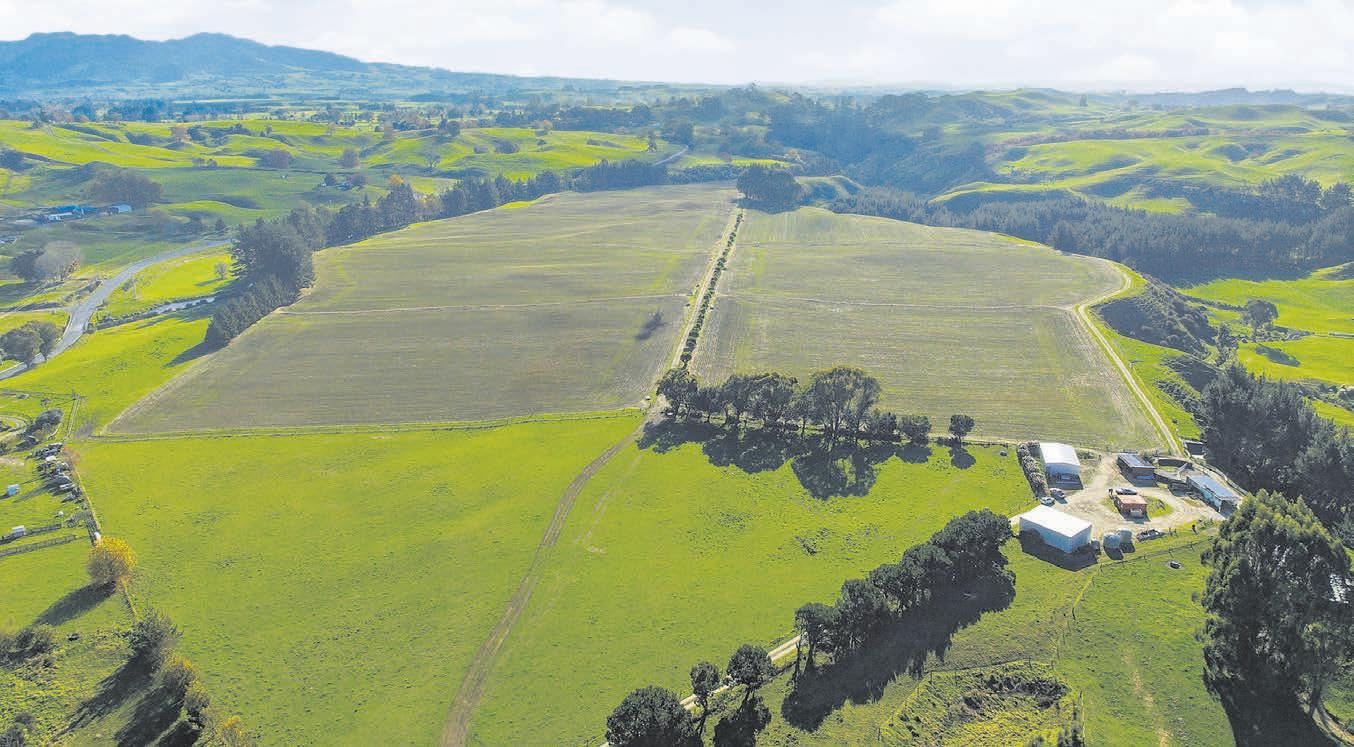
Space to farm, build and grow
Set on 78.25 ha (MOL), this rural property offers opportunity, scale and the foundations for a productive farming operation. With approximately 35 ha of effective land suitable for growing maize, 468 Mountain View Lane presents options for those looking to expand, invest or secure a strong grazing and cropping block. The property is well equipped with practical farming infrastructure including cattle yards and vet race, making day-to-day operations easy and efficient. Calf rearing has also been well catered for, with both a four bay and two bay calf shed already in place. One of the standout features of this property is the fresh water springs, providing a reliable natural water source and adding to the appeal of the land. With plenty of potential house sites across the property, there is opportunity here to add value should you wish (subject to council approval).
Tender closes 4.00pm, Thu 2nd Jul, 2026, Property Brokers, 81 Tirau Street, Putaruru View Thu 18 Jun 12.00 - 1.30pm Web pb.co.nz/PTR229446


Scott Mathis M 027 298 3318 E scott.mathis@pb.co.nz
Ian Morgan M 027 492 5878 E ian.morgan@pb.co.nz
Book a personalised proper ty appraisal for your rural, lifestyle or provincial residential proper ty during May, June or July and you will go in the draw to win one of two HOOGA outdoor fireplaces!
Scan
and







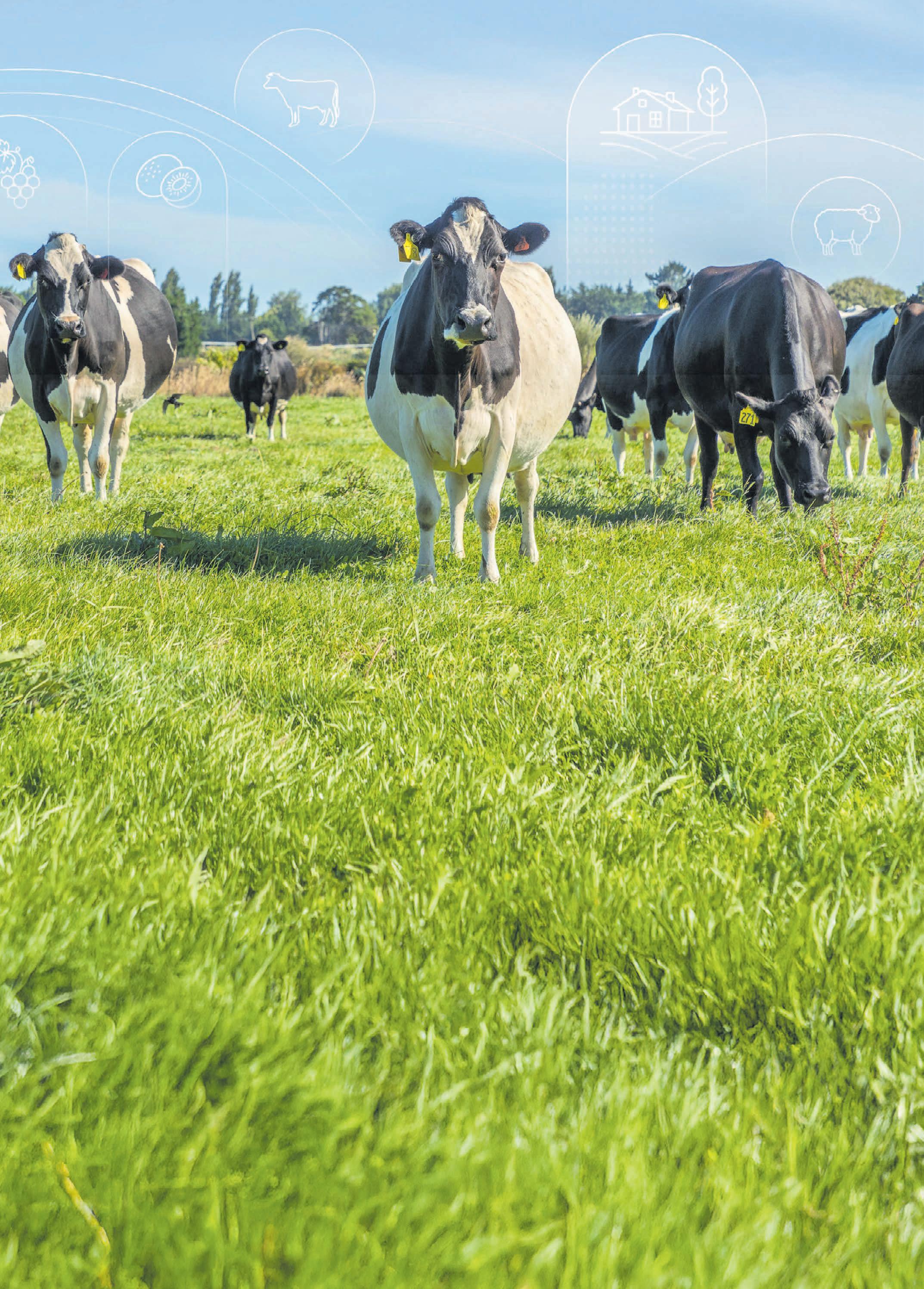

























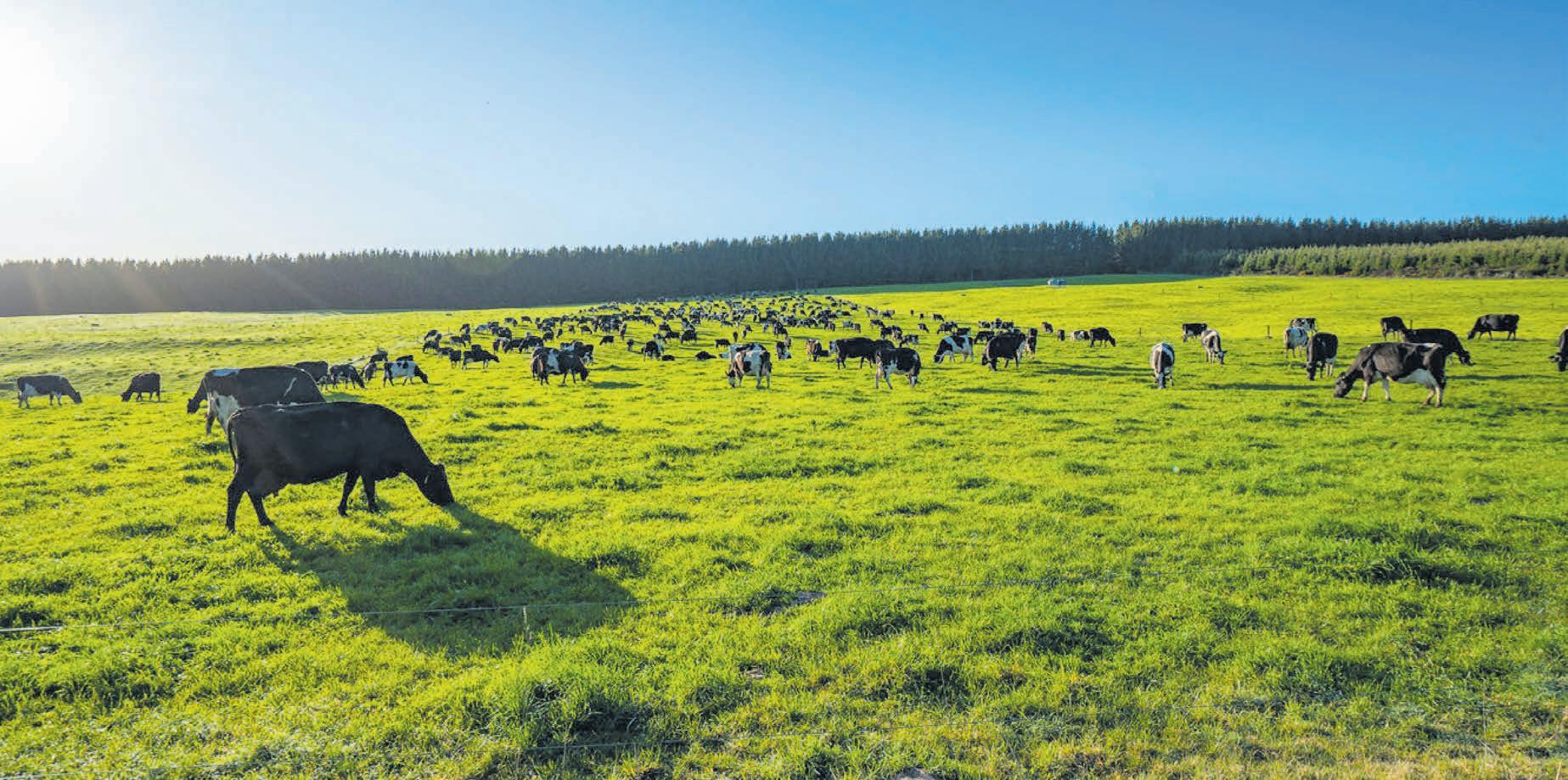
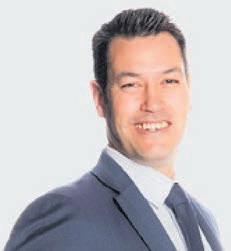
N ew Ze a l a n d ’s p ri m a r y s e c t o r h a s b e e n
b l e s s e d wi t h b u oya n t , p o s i t ive p r o s p e c t s
t h a t a r e p l ayi n g we l l i n t o t h e n ew
fa r m i n g ye a r a n d b eyo n d I t i s t h a n k s t o
a co m b i n a t i o n o f g l o b a l d e m a n d f o r r e d
m e a t t h a t i s p r ov i n g t o b e i n s h o r t e r
s u p p ly, g r e a t e r awa r e n e s s o f t h e h e a l t hy
a t t ri b u t e s o f f r u i t l i ke k iwi f r u i t a n d a
n e e d f o r q u a l i t y p r o t e i n i n f o r m u l a t i o n s
d a i r y c a n a m p ly p r ov i d e .
B e h i n d th e o pti m is m a n d s tro n g b e at it is g ivi n g th e r u ra l p ro p e r t y m a r ket is
a l eve l of re a lis m a b o ut retu r n s a n d l a n d i nve s tm e nt ’s c a s h g e n e rati n g a b ilit y T h is
h a s a d d e d a b a l a n ce d , fo cu se d vi ew o n va l u atio n s f ro m th ose m a k i n g p ri m a r y se c to r l a n d i nve s tm e nt s
I n d a i r yi n g we a re se e i n g a lif t i n co nve r sio n s of i r rig ate d a ra b l e a n d su p p o r t b l o c k s to m il k i n g p l at fo r m s i n C a nte r b u r y, a n d g re ate r co n so li d atio n of s m a ll e r Wa i kato p ro p e r ti e s i nto l a rg e r f a r m s B ut i nve s tm e nt is n ot th e r u s h witn e s se d i n th e e a rly 2 0 0 0 s P u rc h a se d e cisio n s a re se a so n e d co n si d e re d a n d co m e with so li d e q u it y l eve ls b e h i n d th e m
1,700 SALES AND LEASING TRANSACTIONS #1 RURAL REAL ESTATE BRAND IN NEW ZEALAND $ 3 . 6 B I L L I O N OF RURAL & LIFESTYLE PROPERTY SOLD OR LEASED Based on unconditional cleared sales 1 April 2025 to 31 March 2026 D U N C A N R O S S N AT I O N A L D I R E C T O R R U R A L SALESPEOPLE 120+ Rura l market offers upsides for entr y and ex it refe e e o tra h i se
T h e p u s h to co nve r t h a s n ot s te p p e d o ut i nto Ti e r t wo o r th re e l a n d , with p u rc h a se r s wa nti n g g o o d q u a lit y, co n sis te ntly p ro d u ci n g l a n d M e a nti m e th e p ositive i m p a c t of h ig h e r b e ef a n d s h e e p m e at retu r n s h a s b e e n to ret a i n th e at tra c tive n e s s of th e d r y s to c k se c to r, re d u ci n g th e i n ce ntive fo r l a n d u se c h a n g e to d a i r y
I n d e e d , th e h ig h e r retu r n s b e i n g g e n e rate d a c ros s th e p a s to ra l se c to r h a s p ut p re s su re o n th e vo l u m e of p ro p e r ti e s
co m i n g to m a r ket with p ote ntia l ve n d o r s
o pti n g to s t ay i n to p ro fi t f ro m b et te r
ti m e s
T h e ris k fo r th ose wh o m ay u lti m ate ly
wa nt to exit o n g ro u n d s of a g e , su cce s sio n is su e s , o r oth e r wise is th ey
m is s wh at co u l d b e th e i r o n e o p p o r tu n it y to m a xi m ise c a p it a l va l u e to m ove o n a n d
b e eve n m o re co mfo r t a b l e i n th e i r n ex t
life -s t a g e
Fo r b uye r s of d r y s to c k p ro p e r ti e s , th e va l u e of s to c k i n g th e p ro p e r t y h a s a lso
co m e i nto s h a r p fo cu s , with ve r y h ig h
c a p it a l s to c k va l u e s n ow a c ritic a l p a r t of
a ny f u n d i n g d e cisio n
I n th e h o r ticu ltu ra l se c to r Ze s p ri ’s
e ff o r t s i n c re ati n g a tr u e f r u it b ra n d a re
p ayi n g o ff a n d is re fl e c te d i n g rowe r
co n fi d e n ce at re ce nt S u n G o l d a n d Re d 8 0
lice n ce a u c tio n s
T h e se s aw S u n G o l d retu r n to n e a re r it s
2 024 va l u atio n wh il e Re d 8 0 ’s va l u atio n
re fl e c t s a h ig h l eve l of o pti m is m i n
th e n ewly co m m e rcia lise d va ri et y th at p ro m ise s b et te r size a n d ke e p i n g q u a lit y
th a n th e e a rli e r m atu ri n g Re d 1 9 va ri et y
Li ke d a i r yi n g , th e se c to r is witn e s si n g
a p r efe re n ce fo r h ig h q u a lit y Ti e r o n e
p ro p e r ti e s i n e s t a b lis h e d , re p ut a b l e
g rowi n g zo n e s
A lso li ke d a i r yi n g , o rc h a rd va l u atio n s a re b a se d o n re a lis tic rate s of retu r n with S u n G o l d o rc h a rd s t yp ic a lly fetc h i n g
f ro m $ 1 1 m illio n to $ 1 3 m illio n p e r
c a n o py h e c t a re
A p p l e o rc h a rd s th at h ave b e e n we ll
m a i nt a i n e d a n d h ave h a d re - i nve s tm e nt
i nto n ew va ri eti e s a re a lso m e eti n g g o o d
d e m a n d Fo r th e viticu ltu ra l se c to r th e
p a s t ye a r h a s p rove n to b e th e to u g h e s t
I t is o n e th at h a s im p a c te d vi n eya rd
va l u atio n s , m e a n i n g m a ny a re p rice d at a l eve l th ey p rovi d e a g o o d e ntr y
p o i nt fo r i nve s to r s co m m it te d to N ew
Ze a l a n d ’s p rove n re p ut atio n fo r g rowi n g
q u a lit y wi n e Va l u atio n s h ave f a ll e n ,
a n d vi n eya rd s th at a re we ll m a i nt a i n e d
o ff e r exce ptio n a l o p p o r tu n iti e s fo r ke e n e ntra nt s
O ve ra ll , th e r u ra l l a n d m a r ket is
b e n e fi t ti n g f ro m a “ risi n g ti d e ” e ff e c t
a c ros s th e m a i n se c to r s o ff e ri n g
o p p o r tu n iti e s fo r th ose wh o m ay wa nt to exit , wh il e th ose wa nti n g to exp a n d
f a r m a n d o rc h a rd o p e ratio n s h ave
co n fi d e n ce m a r ket co n d itio n s h ave so m e
f u n d a m e nt a l so li d it y b a c k i n g th e m , a l b e it with i n so m e vo l atil e g e o p o litic a l co n d itio n s
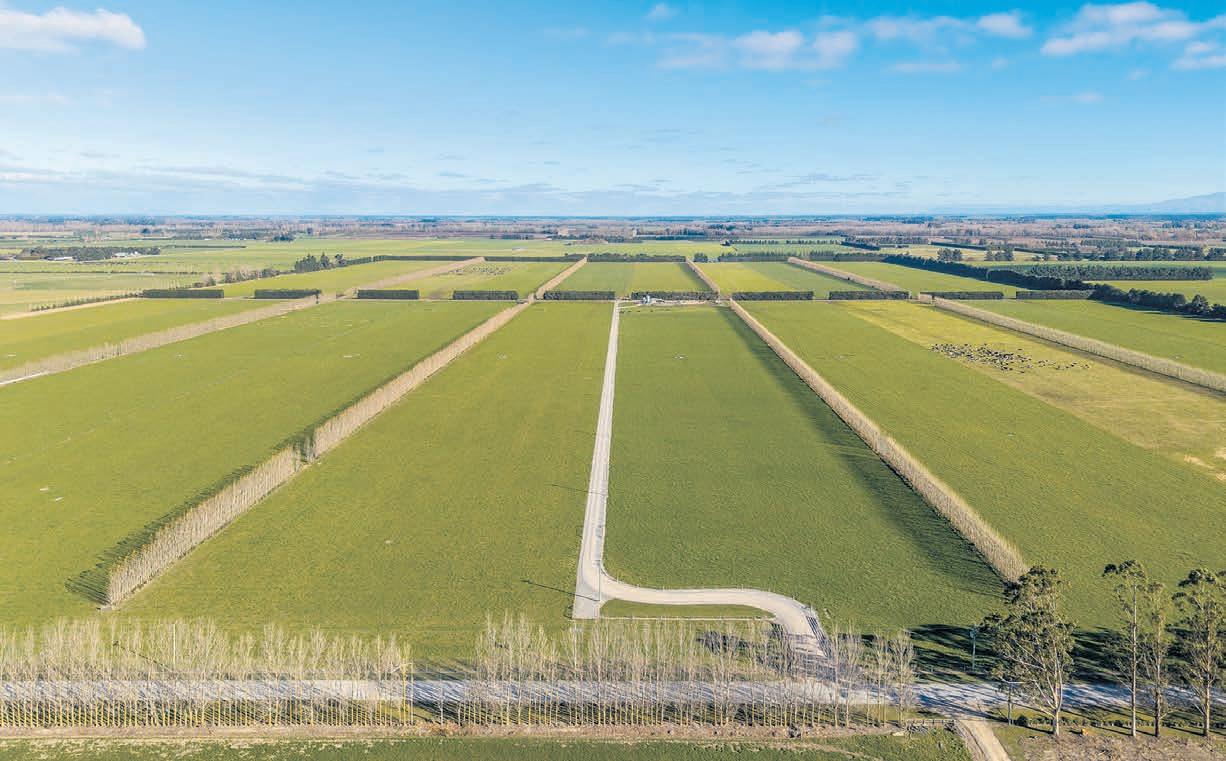
Reliable and ready to perform dairy unit
This 154ha (more or less) dairy farm presents a compelling opportunity to secure a proven operation in a soughtafter dairying district Milking approx 550 cows the farm produces approx 270 000kgMS annually The 40-bail rotary dairy shed features Read plant, automatic cup removers and in-shed feeding, supporting efficient management Irrigation is primarily via RotorRainer systems, with the balance covered by long-line sprinklers Water security is a key strength, supported by the Ashburton Lyndhurst Irrigation Scheme Accommodation includes a main home and two staff houses, making the property well suited for family living and farm staff With strong production quality infrastructure and reliable water supply this farm is in great shape and ready for a new owner to step in with confidence Contact us today to register your interest ahead of auction day bayleys co nz/5530743
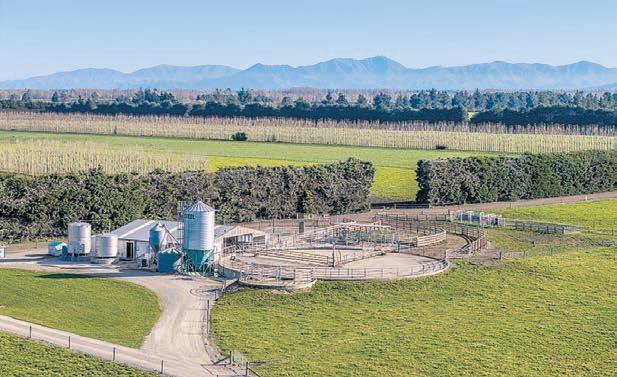
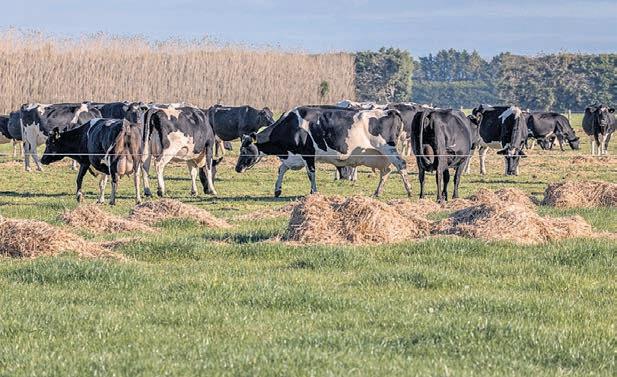
(unless sold prior) 11am, Thu 16 Jul 2026 View by appointment
Ben Turner 027 530 1400
ben turner@bayleys co nz
Craig Blackburn 027 489 7225
craig blackburn@bayleys co nz
Mike Preston 027 430 7041
mike preston@bayleys co nz
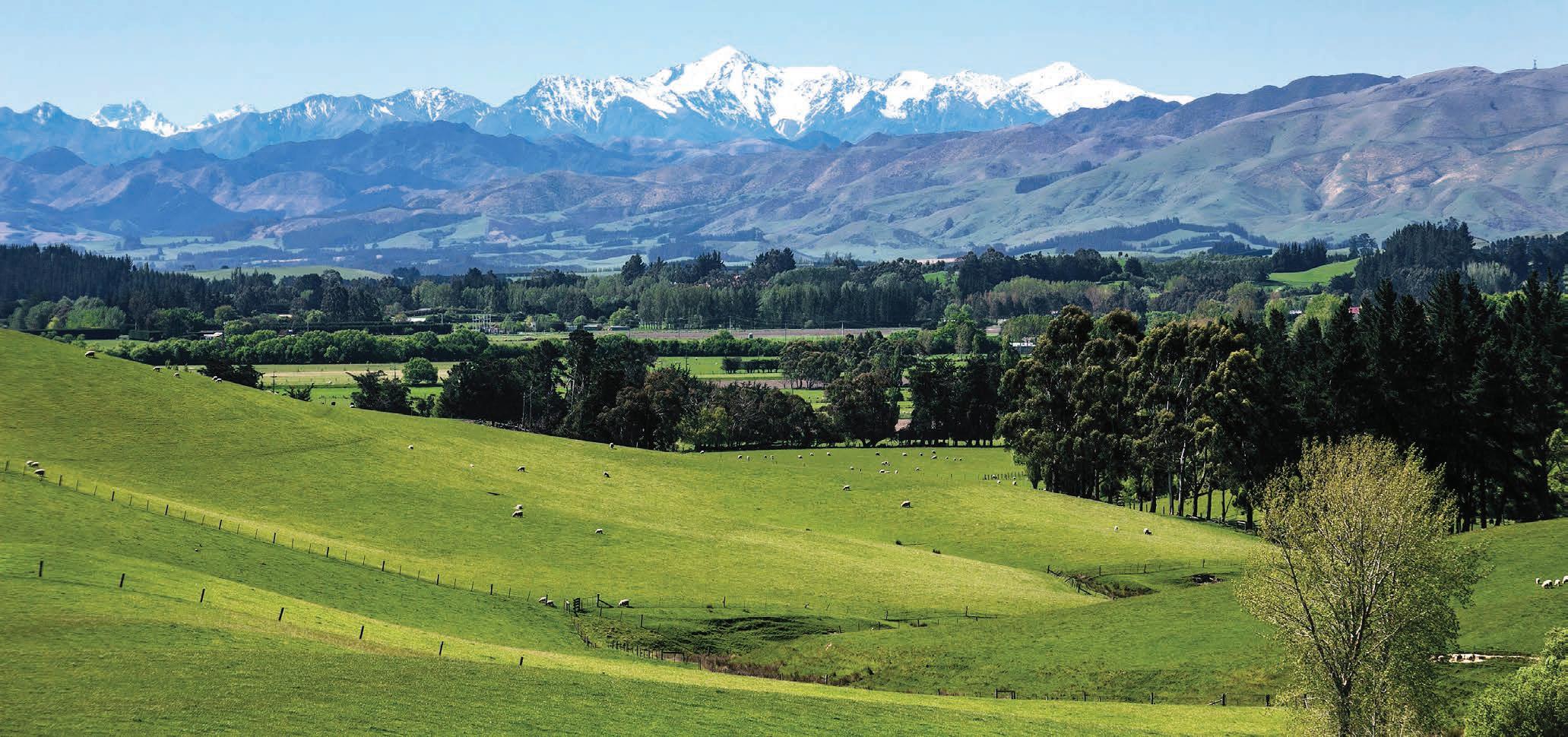




BOARD OBSERVER POSITION AVAILABLE
Develop your governance capability in the rural sector
• Gain hands-on experience in rural governance
• Open to Farmlands’ shareholders
As part of our commitment to building governance capability across the rural sector, the Farmlands Board offers a Board Observer Programme – a unique, hands-on opportunity to learn directly from an experienced Board
– the programme is similar in style to the NZ Institute of Directors’ “Future Director” programme and is designed to help build the next generation of rural governance capability.
Apply online: https://careers.farmlands.co.nz/jobs/ 7801613-board-observer


Join the team!
Marketplace Partnership Manager
We’re looking for a motivated, organised, customer-focused person to join our growing sales team as Farmers Weekly Marketplace Partnership Manager.
Based at our Feilding Head Office you’ll love connecting with our current clients, prospecting new ones, and responding to incoming sales enquiries, turning leads into loyal customers.
You’ll be responsible for the very part of the paper you’re reading this ad in – the Farmers Weekly Marketplace – as well as our healthy Real Estate portfolio.
A minimum of three years sales experience is required.
If you love selling over the phone and being part of a vibrant office culture, we’d love to hear from you!
To request a full job description and company application form, please email hr@agrihq.co.nz
Applications close Wednesday 17 June 2026, 6pm.
Chief Executive
• Lead the evolution of a trusted national rural media and data brand
• Drive audience growth, digital engagement and commercial performance across a unique platform
• Based in Manawatū, at the heart of NZ’s agricultural sector with strong lifestyle appeal
Lead the voice of rural New Zealand. Build what comes next.
AgriHQ is one of New Zealand’s leading providers of agricultural market intelligence, data and rural media, with more than 20 years of heritage and a deeply trusted position across the primary sector. The business is now entering a pivotal phase, transitioning from founderled management to a governance-led structure, with clear ambitions to accelerate growth and expand its influence.
We are seeking an outstanding Chief Executive to lead this next chapter. This is a rare opportunity to take the helm of a respected national brand at the intersection of marketing, communications, media and data by strengthening its voice, expanding its reach and unlocking new commercial growth.
AgriHQ sits at the centre of New Zealand’s rural ecosystem, engaging farmers, processors, corporates and government through its data, insights and media platforms, including Farmers Weekly. The opportunity is to elevate its marketing and communications capability by deepening audience engagement, enhancing digital channels, and leveraging trusted content and data to grow subscriptions, partnerships and influence.
You will lead the shift toward a more integrated, data-driven and digitally enabled business, while safeguarding the independence, credibility and authenticity that underpin the brand.
This role offers significant sector exposure and influence, with access to key stakeholders across the agricultural landscape. Success will come from combining strategic leadership with commercial delivery by diversifying revenue, building partnerships and strengthening customer engagement.
Equally, you will lead a passionate and highly connected team, building on a strong, values-driven culture while guiding the organisation toward a more scalable, enterprise-ready model
Based in Feilding, Manawatū, the role places you in the heart of New Zealand’s agricultural community, close to customers, industry participants and the organisation’s operational base. It offers a compelling lifestyle choice alongside a nationally significant leadership opportunity.
This is more than a Chief Executive role. This is a chance to shape the future of a trusted industry platform. With a strong foundation, loyal customer base and clear growth pathways through digital products, data services and marketing innovation, AgriHQ is well positioned for its next phase.
Applications close 22nd June 2026.
Apply now
Please email your CV to tony@swr.nz or tim@swr.nz quoting reference no. 4038288. For further information in strictest confidence, please contact Tony Walsh on 029 271 1101 or Tim Rosenberg on 029 273 2264.
You must be a New Zealand
or have
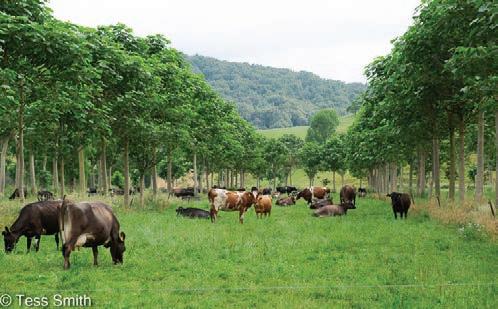
Quick shade for stock
Paulownia Elongata, bare rooted saplings for sale.
Sizes from 2m to 6m – fast growing.
Spring flowering, leaves suitable as stock feed.
Qualify for ETS. Leafy shade from year 1.
We Deliver – T&C’s apply
Contact Graham 027 621 4091 Email miraka1@outlook.com paulownianz.co.nz
• Most popular model: DK-AL 3218/35
• Unsurpassed quality and specification
• Electro-hydraulic, 6,000kg rated ram
• Side and rear tipping
• 3,500kg GVM (2,500kg payload)
• 3.25m x 1.8m deck
• Removeable 350mm aluminium sidewalls
• Other trailer types and sizes available to order
• Germany’s #1 horse float & trailer brand
• Exclusive NZ distributor for 15+ years $17,995+GST Boeckmann 3-way tipper


www.boeckmann.co.nz
robert@boeckmann.co.nz 021 02255648















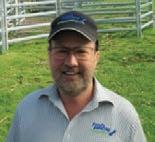
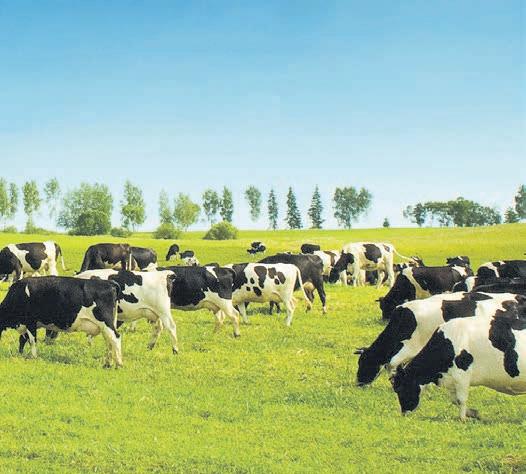





















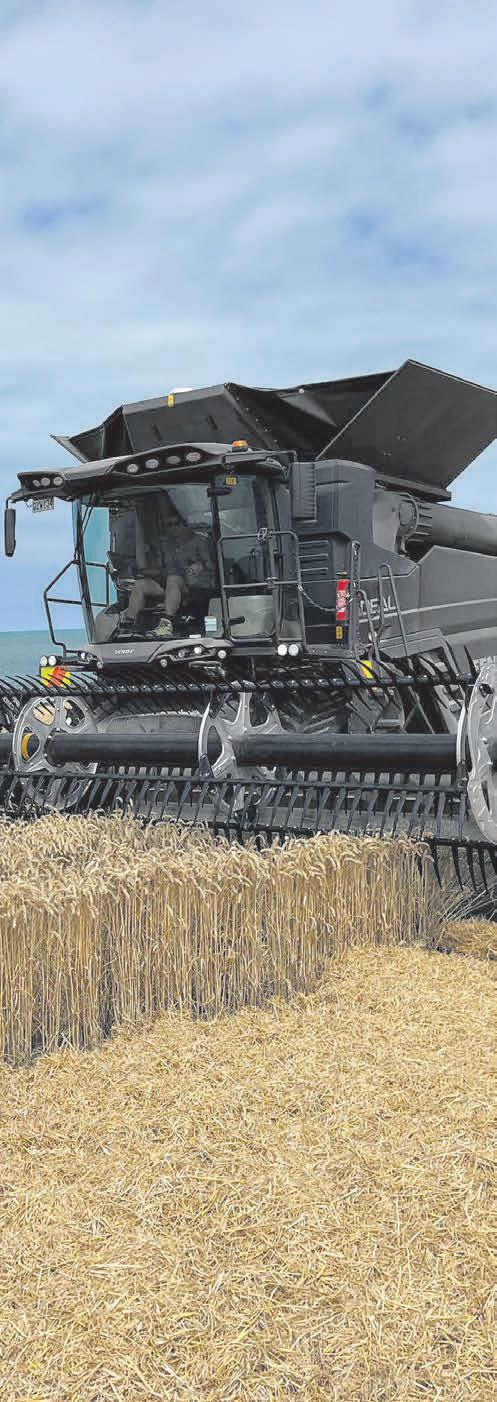





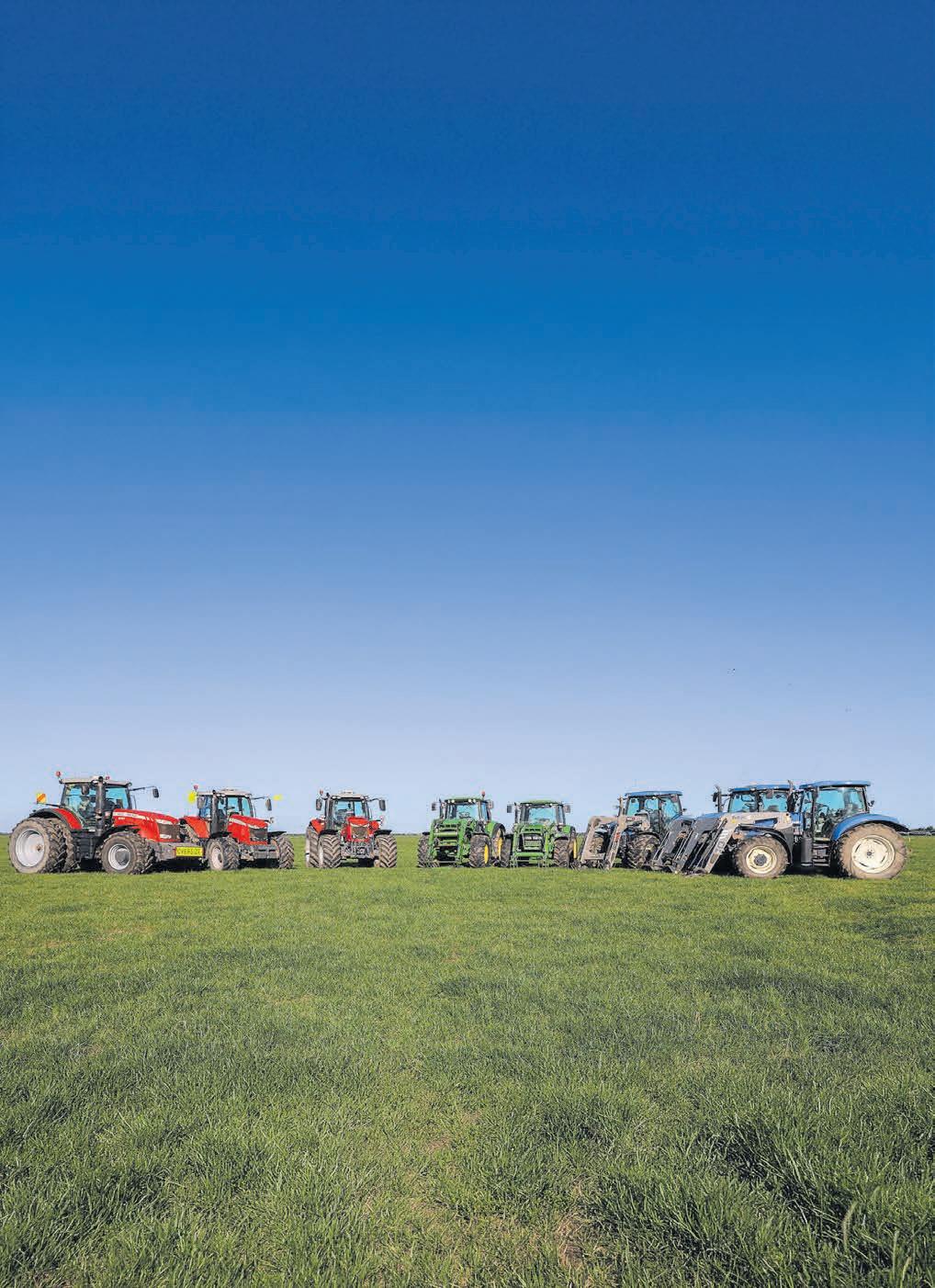








Market signals as first in-lamb
ewes
There’s an opportunity to assess conditions as the first significant consignments are sold in saleyards.

IQuarrie MARKETS Livestock
T IS still early days for the in-lamb ewe season but as the first significant consignments have sold in saleyards, it seems like a good time to assess the conditions this year.
There is no doubt that schedules have continued to head in the right direction, but the areas where traders often dabble in oneyear ewes have experienced a dry autumn.
Over the past four years of AgriHQ data, there have been between 17,000 and 21,000 scanned-in-lamb ewes sold in North Island saleyards each year. While a few early samples are sold in May, the bulk are usually spread evenly between June and July.
As at June 10, the North Island has seen almost 3000 sold in the 2026 season so far and most of these have, unsurprisingly, been at Stortford Lodge.
It is still too soon to say whether supply will be up or down, but there are concerns among potential buyers that fewer farm sales and expired leases will narrow the options.
The early lambing ewes from

Hawke’s Bay typically earn a premium as traders aim to wean and move ewes on before schedules ease and processing space for ewes gets tight. For this reason, the results from these earlier examples at Stortford Lodge usually signal the top of the range for returns.
Even so, the $300-plus returns at the June 10 store sheep sale have set the tone. The key consignment, almost 1000-head of 5-year Romney ewes, were scanned twins to Suftex and due to lamb from early August.
PGG Wrightson agent Jamie Hayward explained that the Wairoa-sourced ewes are “normally sold in spring with lambs-at-foot but had been shifted early to make room and capitalise on the strong market”.
The condensed two-cycle lambing, terminal sire and good condition of the ewes were all drawcards, which contributed to the $300-$306 price tags.
Hayward said that “there was interest from a few different areas but in the end the first pen went to a Martinborough-based buyer while the second pen was split between two local buyers”.
Other in-lamb ewes at that sale, excluding Wiltshire, traded from $250 to $302.
Scanned ewes at Feilding have
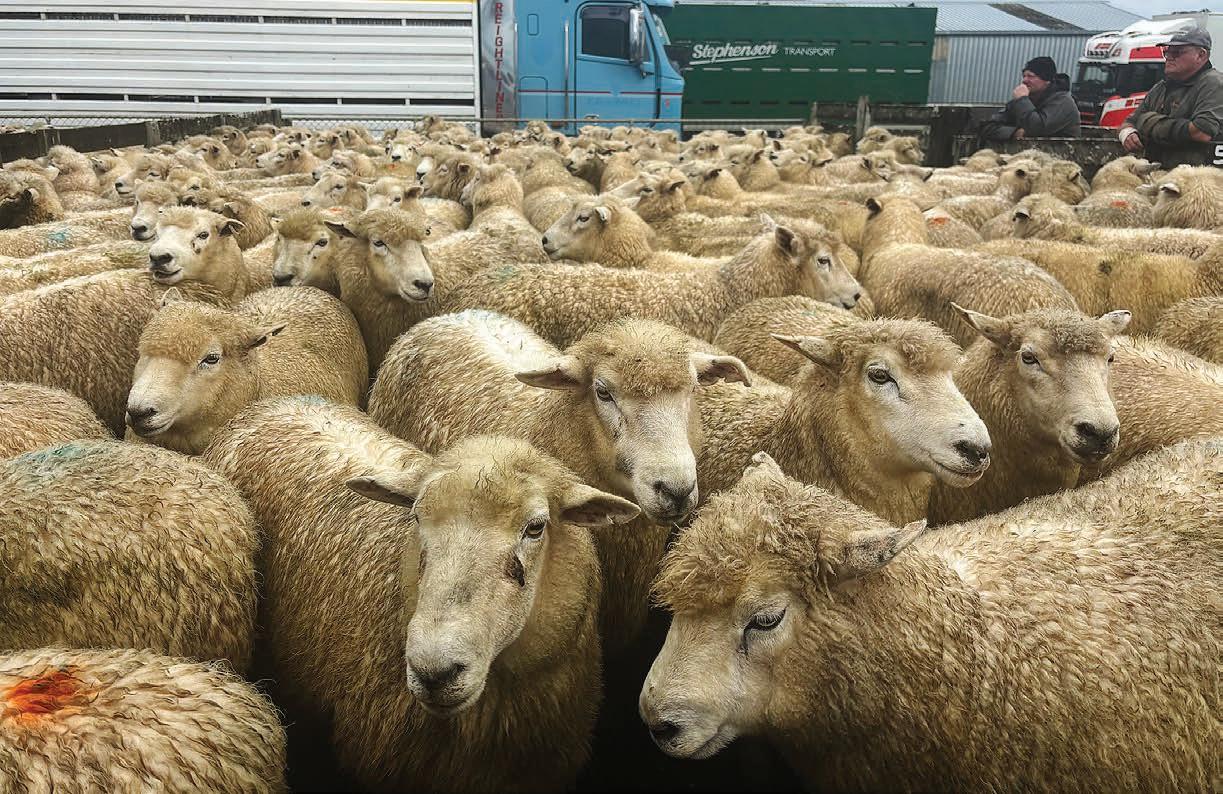
been limited so far and good benchmarking lines of terminalsired, early lambing Romney are even rarer.
The June 5 store sheep sale did offer a line of five-year Romney that had scanned at 175% to Suftex, but they were set to lamb at the end of August and could have carried slightly more condition. They made $260.
The main drivers for this market are obviously the lamb and mutton schedules and confidence in these going forward. Current indications are that traders needn’t worry about significant downside in these areas and so the simple equation of potential weaning value of lambs per ewe usually gives a ballpark figure to work with.
The graph is a good demonstration of the correlation between schedules and in-lamb
ewe values using 4- to 6-year Romney ewes as benchmark. While this year’s figures currently have ewe values as inflated compared to normal, it is fair to expect that $290-per-head average to slip as the season progresses.
The question is, will it come back as far as the $230 suggested by normal trends?
The other influencing factor in the equation is feed. As mentioned, there are some areas that have just come out of a dry autumn and the response to recent rain is slow due to cooler temperatures. Confidence in the ability to feed in-lamb ewes now, let alone with the potential impacts of El Niño, could dampen demand.
A location t hat does
t he heavy lifting








BUYERS CHASE THE TOP: The in-lamb ewe market often produces a wide range of returns based on ewe quality, lambing date and sire. These 5-year Romney ewes from Eketahuna sold at Feilding on Friday, June 5.
Scanned at 175% to a Suftex ram and due to lamb towards the end of August, they were the pick of the day and earned $260 per head.
North Island in-lamb Romney ewe price vs lamb and mutton schedule
Fiona
Cattle Sheep Deer

Weekly saleyard results
weekly saleyard results are collated by the AgriHQ LivestockEye team. Cattle weights and prices are averages and sheep prices are ranges. For more detailed results and analysis subscribe to your selection of LivestockEye reports. Scan the QR code or visit www.agrihq.co.nz/livestock-reports
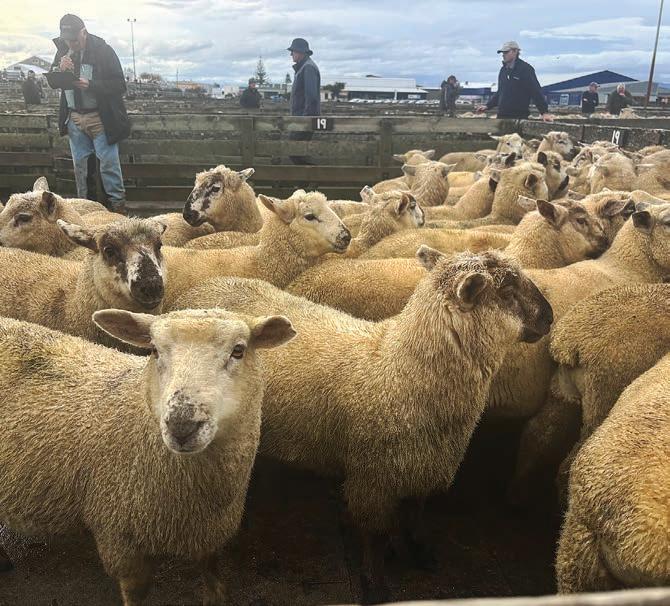






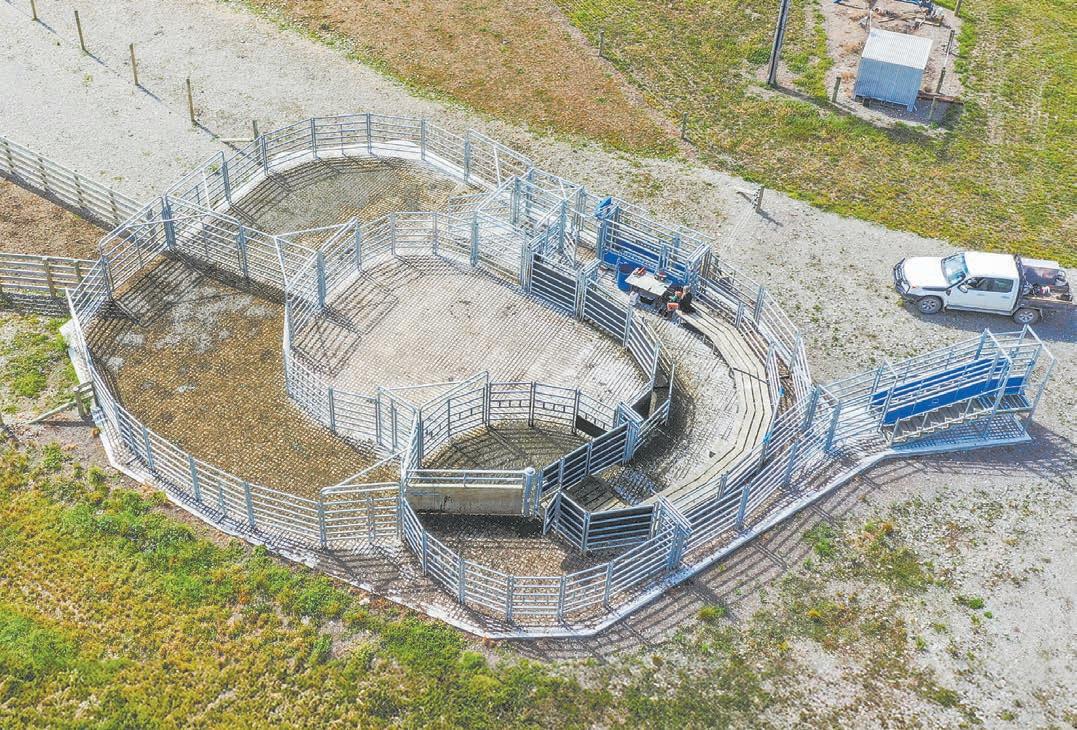


IT UP, LADS: Forward male lambs made steady returns at Feilding on
June 5. These Perendale-blackface cryptorchid lambs from Aokautere fetched $240.
Stortford Lodge | June 10 | 130 cattle, 6243 sheep
or $/hd
R1 traditional steers, 195kg 1380
R1 traditional heifers, 260kg 1360
4-5-year Romney ewes, SIL, all 291-302
5-year Romney ewes, SIL, most 300-306
Mixed-age Wiltshire ewes, SIL, all 185-199
Store cryptorchid lambs, all 221-249
Store male lambs, all 202-257
Store ewe lambs, all 160-230
Dannevirke | June 4
or $/hd Store lambs, all 126-187 Prime ewes, all 160-266 Prime lambs, all 155-320 Feilding | June 5 | 611 cattle, 9519 sheep
R3
R2
R1 dairy-beef steers, 210kg 1190
R1 traditional heifers, 220kg
5-6-year ewes, SIL, all 234-260
2-tooth Romney ewes, RWR, all 178-276
Mixed-age ewes, RWR, all 244-249
Store cryptorchid lambs, most 204-244 Store ewe
Store ewe lambs, most
Store mixed-sex lambs, most
Prime ewes, most
Prime lambs, most
Canterbury Park | June 9 | 293 cattle, 2094 sheep
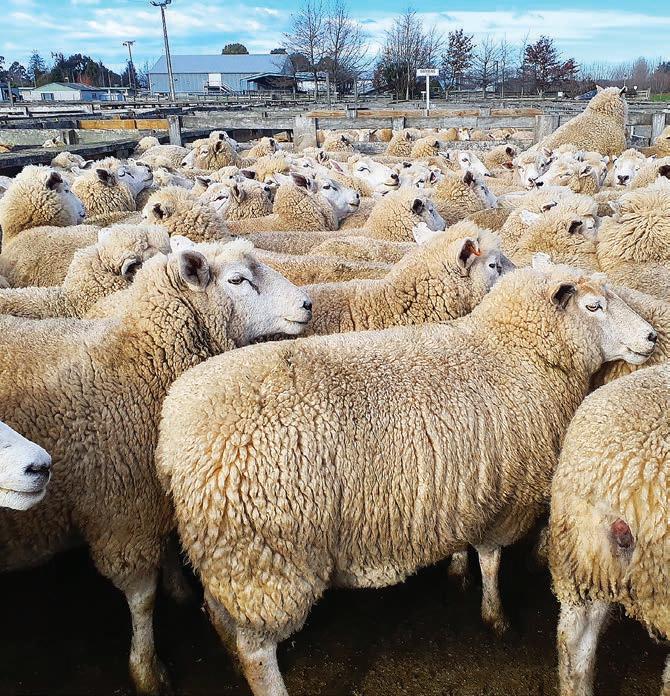
Prime dairy-beef heifers, 575kg
ewes, RWR, all
Store ewe lambs, most
Store mixed-sex lambs, most
Rongotea | June 9 | 98 cattle, 17 sheep
| June 4 | 284 cattle, 1594 sheep



For the long haul: El Niño’s effects on NZ

WAITING for El Niño to develop is like watching a heavy truck drive up a mountain highway. You know it’s on the way, but it’s slow going. For us in New Zealand there are two ways to look at El Niño. There is the global view, where we look at the entire Pacific Basin and judge whether or not El Niño will be moderate, strong or severe, then there is the local New Zealand view, where we work out what this means for us weatherwise.
Most of the headlines you’re seeing are from the Pacific-wide point of view and because NZ is a couple of mountainous islands halfway in the Roaring Forties belt of weather, which circles Antarctica, it is harder for us to be specific about what this means for NZ.
At the time of writing this we are still in a neutral weatherpattern, but in the tropical Pacific El Niño edges closer.
Australia’s Bureau of Meteorology (BoM) says that “sea surface temperatures in the central tropical Pacific now exceed El Niño thresholds, while atmospheric indicators are also starting to align with an El Niño state.
At the time of writing this we are still in a neutral weather pattern, but in the tropical Pacific El Niño edges closer.
“This suggests some coupling between the ocean and atmosphere may be occurring.
“Should this be sustained, an El Niño event is likely to become established.”
In its fortnightly Southern Hemisphere update BoM says: “Atmospheric indicators, such as
trade winds, pressure and cloud patterns are trending towards an El Niño state.
“Some uncertainty remains in the likely strength of this El Niño event.
“Models indicate it will be at least moderate in strength, with the possibility of a strong event, based on the extent of warming in the central tropical Pacific.”
As I’ve pointed out in previous weeks, as has BoM, a strong El Niño north of Tahiti does not always mean a big shift to Australia’s climate, or New Zealand’s, but the recent uptick in high pressure since late April may well be a sign of what is developing in the tropics.
NZ has had a lot of high pressure, which has lead to a widespread drying out of regions across New Zealand.
NZ has a couple of cold fronts this week, but our weather is still mainly dominated by high pressure.
By Monday of next week longer-
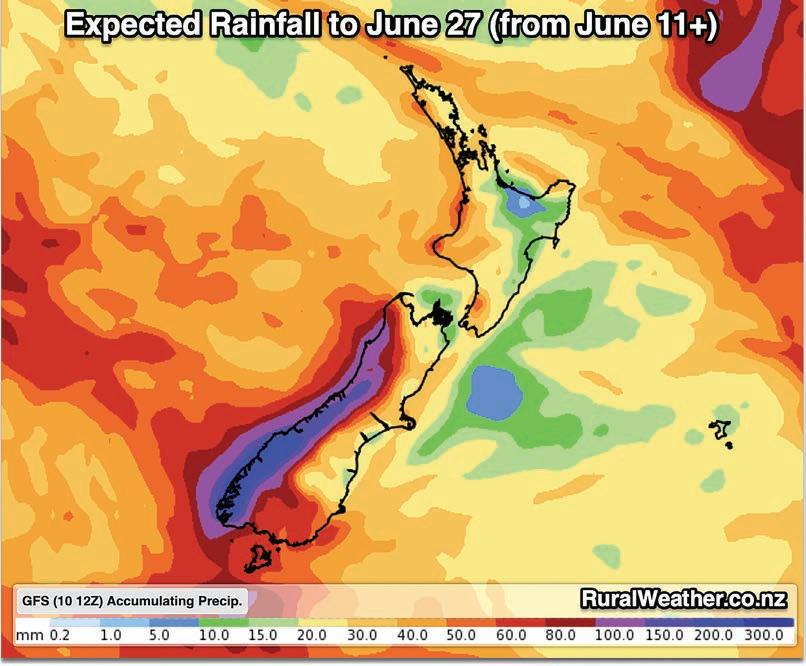
range modelling was suggesting a bigger cold front spreading up NZ with polar air – but it’s worth noting this may be caused by yet another very large and strong high-pressure zone around Tasmania. Strong highs west of NZ and placed over Tasmania with the right shape help dredge up our coldest airflows, but even when those southerlies bring in
some northern and eastern wet weather they do tend to push most of the rain on to the West Coast.
Because we’re still technically in a “neutral” pattern we’re still getting some variety in our weather, but the forecast rain maps continue to show most rain falling on the West Coast, with limited rain for the North Island and eastern South Island.









Shared insights, stronger herds.























































That’s the value of a co-operative.





When farmers support farmers, we all move forward Shared data, shared knowledge and generations of experience.


















































































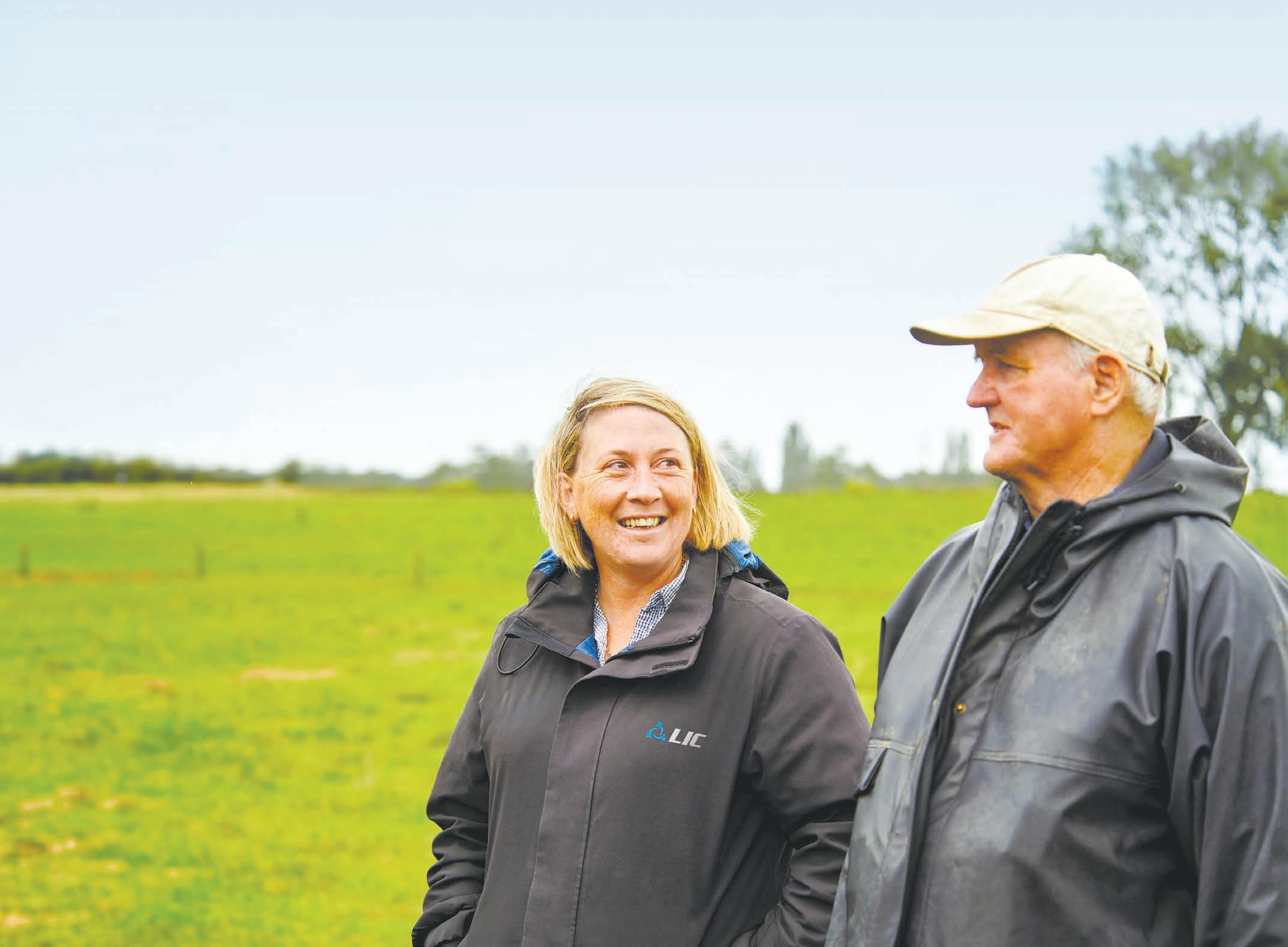

Philip Duncan NEWS Weather
TRUE TO TYPE: Long-range rain forecast maps are looking more like El Niño. Image: RuralWeather.co.nz