1
20 Survey shows pests at crisis point Vol 24 No 33 | August 24, 2026
View online at farmersweekly.co.nz
$5.25 Incl GST
GDX: farmers on the hook for millions Annette Scott
NEWS
L
Livestock
IQUIDATORS of the failed live export company Genetic Development (NZ) Exports Limited Partnership have won a High Court case allowing them to chase up insolvent transactions involving millions of dollars. All parties initially believing to be secured creditors, including 96 farmers who were paid in full – involving around $9 million in total – will now be issued notice of repayment letters.
We will be requesting payment from all the farmers, so they’ll be getting correspondence from us in the next week or two. Malcolm Hollis Liquidator The High Court of Hamilton ruled in favour of the liquidators’ claim against Southern Dairies Ltd (SDL) for $266,570, actioned by the liquidators as a representative case. Liquidator Malcolm Hollis of Teneo Advisory Services NZ, (formerly PwC) said the court ruling now enables the liquidators to legally reclaim all monies paid out at the time of the liquidation to listed secured creditors, plus statutory interest from the time
of the liquidation of Genetic Development (NZ) Exports Limited Partnership (GDX LP) on September 5, 2022. The liquidators are also entitled to costs. The monies involved will likely include the $630,000 commission fee paid to Irish-based Purcell Brothers SPV (Purcell Exports, Australia), which brokered a financial arrangement with Allied Irish Bank (AIB) that enabled the voyage of the Ocean Ute shipment of live cattle to China in May 2022. “SDL was essentially a test case to determine what we believed were insolvent transactions and therefore voidable under the Companies Act as applied to limited partnerships and I understand that about 50-odd farmers joined behind SDL to support their defence,” Hollis said. Overall about 140 farmers were involved in the shipment with 20 companies and 96 farmers listed as secured creditors in the initial report at the time of the liquidator’s appointment. A further 47 farmers were left out on a limb in the pool of more than 100 unsecured creditors owed about $11.3 million. Among the secured creditors with transactions now declared voidable transactions that unfairly occur when a company is unable to pay its debts are livestock companies, farming businesses and feed and service suppliers. Continued page 3
Smart tech for a smarter herd. Trusted by tens of thousands of farmers managing more than 8 million cows worldwide, Nedap SmartTags deliver accurate, 24/7 insights into reproduction, health and behaviour. Smarter herd management helps you streamline operations, make more informed decisions and lift performance across your entire farm every day.
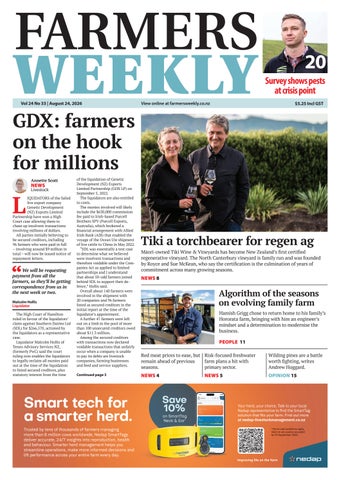
Tiki a torchbearer for regen ag Māori-owned Tiki Wine & Vineyards has become New Zealand’s first certified regenerative vineyard. The North Canterbury vineyard is family run and was founded by Royce and Sue McKean, who say the certification is the culmination of years of commitment across many growing seasons.
NEWS 8
Algorithm of the seasons on evolving family farm Hamish Grigg chose to return home to his family’s Hororata farm, bringing with him an engineer’s mindset and a determination to modernise the business.
PEOPLE 11 Red meat prices to ease, but Risk-focused freshwater remain ahead of previous farm plans a hit with seasons. primary sector.
Wilding pines are a battle worth fighting, writes Andrew Hoggard.
NEWS 4
OPINION 15
NEWS 5
Save 10%
on SmartTag Neck & Ear*
Your herd, your choice. Talk to your local Nedap representative to find the SmartTag solution that fits your farm. Find out more at nedap-livestockmanagement.co.nz *Terms and conditions apply. Valid on any quotes accepted by 30 September 2026.
Improving life on the farm
2
New Zealand’s most trusted source of agricultural news and information
Get in touch
Advertise
EDITORIAL
SALES CONTACTS
Bryan Gibson | 06 323 1519 Managing Editor bryan.gibson@agrihq.co.nz
Andy Whitson | 027 626 2269 Sales & Marketing Manager andy.whitson@agrihq.co.nz
Craig Page | 03 470 2469 Editor craig.page@agrihq.co.nz Claire Robertson Sub-Editor claire.robertson@agrihq.co.nz Neal Wallace | 03 474 9240 Journalist neal.wallace@agrihq.co.nz
Janine Aish | 027 300 5990 Auckland/Northland Partnership Manager janine.aish@agrihq.co.nz Jody Anderson | 027 474 6094 Waikato/Bay of Plenty Partnership Manager jody.anderson@agrihq.co.nz
Gerald Piddock | 027 486 8346 Journalist gerald.piddock@agrihq.co.nz
Charlie Williamson | 027 510 0430 Lower North Island Partnership Manager charlie.williamson@agrihq.co.nz
Annette Scott | 021 908 400 Journalist annette.scott@agrihq.co.nz
Andy Whitson | 027 626 2269 South Island Partnership Manager andy.whitson@agrihq.co.nz
Hugh Stringleman | 027 474 4003 Journalist stringleman@outlook.co.nz Richard Rennie | 027 475 4256 Journalist richard.rennie@agrihq.co.nz Gerhard Uys | 027 239 4388 Journalist gerhard.uys@agrihq.co.nz Rebecca Greaves | 027 320 9111 Journalist rebecca.greaves@agrihq.co.nz Nigel Stirling | 021 136 5570 Journalist nigel.g.stirling@gmail.com Isabella Beale | 027 299 0596 Multimedia Journalist isabella.beale@agrihq.co.nz
PRODUCTION Lana Kieselbach | 027 739 4295 production@agrihq.co.nz
ADVERTISING MATERIAL
Supply to: adcopy@agrihq.co.nz
SUBSCRIPTIONS & DELIVERY 0800 85 25 80 subs@agrihq.co.nz
PRINTER Printed by NZME Delivered by Reach Media Ltd
Julie Hill | 027 705 7181 Marketplace Partnership Manager classifieds@agrihq.co.nz
News . . . . . . . . . . . . . . . . 1-13 Opinion . . . . . . . . . . . 14-15 Sector Focus . . . . . . . 17-18 Rural Women . . . . . . . . . . 19 Federated Farmers . 20-23
Marketplace . . . . . . . 27-28
Dairy commodity supply uncertainties around European droughts and potential El Niño effects pushed the latest Global Dairy Trade results higher, led by milk powders and cheeses. The overall GDT price index rose 2.3%, the biggest single-event lift in the market since March. Skim milk powder rose 7.6% and whole milk powder by 3%. At US$3502/tonne, SMP prices are only $90 lower than WMP. Mozzarella was up 6.1% and cheddar rose 0.6%.
Livestock . . . . . . . . . . 28-31 Markets . . . . . . . . . . . 32-35 Weather . . . . . . . . . . . . . . . 36
No Synlait takeover Dairy company Synlait says it is not involved in any discussions with The a2 Milk Company or Fonterra regarding a take-private transaction. In an announcement on NZX, it “notes” media reports regarding a potential transaction involving third parties. “Synlait confirms that it is not involved in any discussions with The a2 Milk Company or Fonterra regarding the matters referred to in those reports.”
Word Only Advertising | 0800 85 25 80 Marketplace wordads@agrihq.co.nz
PUBLISHERS Dean and Cushla Williamson Phone: 027 323 9407 dean.williamson@agrihq.co.nz cushla.williamson@agrihq.co.nz
ISSN 2463-6002 (Print) ISSN 2463-6010 (Online)
Increasingly Rare. As more New Zealand meat processors move into overseas ownership, AFFCO remains proudly 100% New Zealand owned and operated. That means our focus stays firmly on Kiwi farmers. Through continued investment in our people, plants and operations, we’re building a stronger business and a stronger future for New Zealand’s red meat industry.
The Commerce Commission has cleared ANZCO’s $800 million purchase of fellow beef processor Greenlea Group. In June, ANZCO applied to buy Greenlea’s beef processing sites in Waikato, in a move it expects will create a more resilient North Island beef processing business. ANZCO operates sheep and beef processing in both islands but has beef plants in Taranaki and Manawatū and Greenlea has plants at Hamilton and Morrinsville.
GDT on the rise
Real Estate | 0800 85 25 80 realestate@agrihq.co.nz
Farmers Weekly is Published by AgriHQ PO Box 529, Feilding 4740, New Zealand Phone: 0800 85 25 80 Website: www.farmersweekly.co.nz
Purchase approval
Real Estate . . . . . . . . 24-26
Andrea Mansfield | 027 602 4925 National Livestock Manager livestock@agrihq.co.nz
100% NZ Owned.
WAVJ201624
Contents
News in brief
Scott expansion
LOW: Rural people are receiving lower rates of radiation therapy for cancer than those in urban centres, says Rebekah Doran, the clinical director of Rural Health Network. STORY P12
Scott Technology has secured three material handling contracts in North America and Europe worth $20 million for a leading frozen potato producer, alongside two extension projects in the snack food and fresh produce sectors. “The contracts build on strong FY26 momentum, with Scott expanding across North America, Europe and Australia and increasing its exposure to fast moving consumer goods verticals including potatoes, dairy, snacks, meat and bakery,” the company said.
3
News
3
FARMERS WEEKLY – farmersweekly.co.nz – August 24, 2026
Farmers hail regional Plan Change reprieve Gerald Piddock
NEWS
Regulation
W
AIKATO and Manawatū farmers are celebrating after the government granted them a reprieve from regional council plan changes while it passes new legislation overhauling the country’s resource management system. In Waikato, the intervention came following a public meeting at Mystery Creek, asking the government to put Waikato Regional Plan Change 1 (PC1) on hold. The change will see farm plan and consent requirements that are triggered by PC1 being made operative now being deferred until December 31, 2032. Until then, farmers and growers currently operating under PC1’s permitted activity rules will continue to do so without needing to prepare and implement a PC1 farm plan or get a PC1 resource consent. Controls on land-use change and intensification through resource consent will still apply. These activities have been regulated Continued from page 1 The court had to determine whether payment made by Purcells and AIB was payment by GDX. It found that the assignment of proceeds was a critical part of the arrangement agreed between GDX, Purcells and the livestock vendors – and therefore GDX remained the seller under the export contract, remained responsible for the shipment and participated directly in the
“We’ve been saying for months that it made no sense to force farmers into a new set of rules when the government is in the middle of overhauling the [Resource Management Act], freshwater rules and the farm planning system. “Farmers will be hugely relieved to now have some breathing room, and that’s exactly what we were asking for.” RMA Reform Minister Chris
Bishop said PC1 had arrived at the moment the new planning system is replacing the RMA. “Without action, Waikato farmers face duplicative consenting requirements colliding with the new system: rules written under a law being repealed, old farm plans layered on new farm plans, and consents that may be redundant within a few years.” In Manawatū, the government also changed some of the requirements in Horizons’ Plan Change 2 relating to prescribed nitrogen discharge reductions and consenting pathways. This plan change had also been likely to become operative during the transition to the new system, causing chaos and uncertainty for farmers and growers in ManawatūWhanganui, Bishop said. Federated Farmers Tararua president Aaron Passey said it is great news. “It gives 167 farming families a controlled consent pathway that is much more straightforward than what they faced under an Environment Court ruling.” Both Waikato and Horizons regional councils acknowledged the announcement, saying they are examining its details.
Waikato Regional Council chair, Warren Maher said, “While it is good to finally have clarity on the government’s intentions as we work to set our future budgets, we are disappointed discussions were had with a number of parties, but our advice or input was not sought.” Chief executive Dr Chris McLay said while the devil will be in the detail, based on the information released so far, the signalled deferral of consenting and farm plan requirements relates only to some PC1 provisions. “Until we have seen the legislation, we’ll be unable to provide clarity for those in the catchments.” The announcement does not
impact the Environment Court and High Court processes, he said. Horizons Regional Council chair Nikki Riley said its officers will analyse the detail of the announcement, including the relevant legislation once it is available, and implement PC2 as legally required. “Officers will now consider the impact of incoming legislation on implementation of the plan change.” Both sets of proposed changes will be progressed through an Amendment Paper at the next stage of the Planning and Natural Environment Bills, expected later this month.
arrangements for the vendors to be paid. The court gave particular weight to correspondence showing that the payment mechanism had deliberately been structured so that the funds would bypass GDX because of concern they might be used to pay other debts. Justice Rachel Sussock held that SDL could not rely on a “no reason to suspect insolvency” defence when suspicion about GDX’s financial position was effectively the reason for struc-
turing the payment mechanism that way. The decision is also significant for creditors who deliberately structure payments so that funds bypass a financially distressed debtor. Hollis said there’s still a process ahead but the way the voidable transaction regime works is that creditors need to repay the money and then they can claim as creditors in the overall liquidation. “SDL was a representative cred-
itor across the entire group. There was a number we could have chosen as exactly the same and many of them were represented at the time by livestock companies, but advice we had was to go back to the creditor or the farmer that received the money. “We have met with our lawyers and the starting position for us is we will be requesting payment from all the farmers, so they’ll be getting correspondence from us in the next week or two,” Hollis said.
“There will be calculation of cents on the dollar for everybody and I have no sort of perception of what outcome that could be – 10 cents, 20 or 90c on the dollar. “If any have sold their businesses and paid out their money then there will be ramifications around that. “If they have dissolved their companies without dealing with this contingent labiality, which they have known about, they might have a problem in that context as well.”
since 2016, when PC1 was notified. Waikato Federated Farmers president Chris Woolerton said it is a really positive step for farmers and a direct response to the concerns raised. “PC1 threatened to burden thousands of Waikato farmers with new consenting and farmplanning requirements.
PC1 threatened to burden thousands of Waikato farmers with new consenting and farmplanning requirements. Chris Woolerton Federated Farmers
Your Property Investment Partner | www.silverfin.nz | WHOLESALE INVESTORS ONLY
8% 3%
P.A. PRE-TAX INCOME DISTRIBUTION PROJECTED TO 31/03/2027
RELIEF: Waikato Federated Farmers president Chris Woolerton says the government’s decision to defer PC1’s consenting requirements until 2032 is a huge relief.
P.A. PRE-TAX CAPITAL REPAYMENT PROJECTED TO 31/03/2027
INVEST IN LAND +
TREES + CARBON
HILLERSDEN CARBON FOREST SCHEME
• The scheme consists of two established Pinus Radiata forests: 208.2-hectares in Wairau Valley, Marlborough, and 70.5-hectares near Fairlie, Mackenzie. • Fully ETS-registered, providing immediate entry into New Zealand’s carbon market. • Financial returns based on a carbon price of $55/NZU. • Government auction floor price of $71/NZU bodes well for potential future NZU appreciation. Carbon price in the secondary market as at 31/07/2026 is $55.85/NZU. • 100% equity-funded, meaning no exposure to bank debt or interest rate volatility. • Interests currently available for $49,665.
To request a copy of the Information Memorandum, visit www.silverfin.nz or contact MILES: 021 887 274, miles@silverfin.nz or TYLER: 027 387 3877, tyler@silverfin.nz This offer is limited to persons who are wholesale investors for the purposes of the offer in terms of clause 3(2) or 3(3)(a) of Schedule 1 of the Financial Markets Conduct Act 2013. The projected p.a. pre-tax cash return until 31 March 2027 is a projection only. The actual returns paid may differ. This investment is subject to risk, and is not guaranteed. Investors are advised to read the Information Memorandum, and seek independent financial advice.
4
4
FARMERS WEEKLY – farmersweekly.co.nz – August 24, 2026
News
BLNZ survey shows beef cattle muscling sheep aside Neal Wallace
NEWS
Livestock
EASING: New-season prime sheep and cattle prices are expected to ease from current highs, but to still be above recent values.
Red meat market set to cool its jets Neal Wallace
MARKETS
N
Processing
EW-season red meat prices are expected to ease slightly from current extremes but are likely to still be comfortably ahead of previous seasons. Based on current market signals and a significantly higher earlyspring peak, AgriHQ senior analyst Mel Croad is forecasting lamb to still average above $11/kg from mid to late spring. Beef prices are expected to also soften due to pressure from product relocated to other markets as quota access to China is filled. Croad said consumer resistance to high lamb prices is growing, especially in Europe, while Australian and Brazilian beef diverted from China to the United States as quotas were filled is putting pressure on that market. While lamb prices are unlikely to show sustained upside through spring as they did last year, there is no suggestion they will collapse, and she expects prices will still be above previous years. “It’s more of a message that for the last two springs we have seen the farmgate prices lift well heading into November. “We are not forecasting that this year.” She said beef prices, especially for cows and bulls, are softening. “We are not seeing a correction in beef, but we are seeing more of a softening in prices.” Current farmgate prices for lamb are at record levels, about $12/ kg or slightly above, which Croad said is due in part to a shortage of stock, with significant numbers believed to be coming forward from next month. A line of Poll Dorset ram lambs from Dick Frahm from Oxford recently sold at Coalgate in Canterbury for $460. Frahm, a Poll Dorset breeder, estimates the lambs were about 80kg liveweight and said he knows prices are high. “Prices are good – I just hope they are sustainable.” Croad expects farmgate values to ease from October through
to Christmas, before trending lower as the seasonal stock flows increase. “There appears to be less appetite for export values to continue to lift beyond what we are seeing, especially as our own supplies seasonally increase,” she said. Forecasting global beef prices is more complex, given the influence of Chinese quota restrictions causing Australian and Brazilian beef to be redirected to other markets once their quota is full. The US herd is still recovering from decades-low cattle numbers, but the volume of imports has put pressure on pricing in what was a contrast to a year earlier. In recent weeks some companies have lowered their bull schedules, and cow schedules have eased by up to 15c/kg due to softer US grinding beef prices, while prime beef prices are mostly stable. “The market is reverting to its normal trends but is not falling to those old pricing levels,” Croad said. Jarrod Stewart, the chief supply officer for Silver Fern Farms, said there is short-term pressure on US manufacturing beef prices, which have softened from what he called “exceptional highs seen earlier this year”. “Increased volumes from major exporters to the US, elevated inventories and reduced access for other countries’ exports to China under safeguard measures have all contributed to weaker export pricing in recent weeks.” Steward said underlying supply and demand remain favourable in historic terms. “We expect market conditions to remain influenced by seasonal supply patterns through the coming months. “However, the broader outlook remains supported by ongoing constraints in global beef supply and continued consumer demand across key markets.” Stewart said demand fundamentals for lamb remain favourable but there is some consumer resistance to pricing. “Therefore, we are expecting a softening of farmgate pricing as we move towards Christmas.”
FARMERS are carrying more beef cattle, at the expense of sheep. Beef + Lamb New Zealand’s latest stock number survey, for the year to June 30 2026, shows that in the past year beef cattle numbers have risen 3.3% to 3.96 million and sheep numbers fell 2% to 22.78 million. BLNZ chair Kate Acland said forecasts are for a relatively steady lamb crop. Increased beef cattle numbers reflect strong returns, feed availability, and farmer preference for trading and finishing cattle, she said. “Despite fewer sheep, the lamb crop is forecast to be broadly stable at 19.75 million head, down just 0.3%, supported by an estimated ewe lambing percentage of 132.3%.” Final numbers are dependent on spring lambing conditions. The livestock survey reveals beef cattle numbers in the North Island increased 3.2% to 2.71 million, with Taranaki-Manawatū recording the largest increase at 6% followed by the East Coast, which grew 2.9%, and NorthlandWaikato-Bay of Plenty, which was 2.3% higher. The South Island beef cattle herd increased 3.6% to 1.25 million, with numbers in Southland growing 6.7%, driven by more weaners and trading cattle on finishing farms. Marlborough-Canterbury beef numbers increased 3.6% and Otago 1.3%.
The survey showed that nationwide breeding ewe numbers fell 1.9% and hoggets by 4.5%. The North Island sheep flock shrunk 3% to 11.14 million and the South Island 1.1% to 11.64 million. Northland-Waikato-Bay of Plenty had the largest regional decrease, dropping 6.3%. An increase in retained hoggets offset a decline in breeding ewes in Marlborough-Canterbury, which had a small drop in sheep numbers of 0.5%. Otago numbers fell 0.8% and Southland by 2.4%. Acland said these changes reflect
This shows the continued strength of a sector that ... keeps spending flowing through regional New Zealand. Kate Acland Beef + Lamb NZ
a longer-term structural shift in the livestock mix and land use. Total sheep numbers have fallen 46% since 2000-01, from 42.26 million, while beef cattle were still 5.6% below 2000-01 levels, despite increasing in each of the past three years. “The long-term decline in sheep numbers reflects cumulative land-use change and changing farm policies, including dairy conversion, forestry and native planting, retirement of grazed land, urban development, and farmer decisions around labour, succession, and relative livestock returns,” said Acland. Research for BLNZ and the Meat Industry Association reveals the red meat sector generates $48.7 billion in spending across the economy each year and supports one in every 20 jobs. It found the sector generates $12.8bn in export earnings annually, with a multiplier effect that sees the sector spend $133 million a day across the country.
STEADY: Beef + Lamb NZ chair Kate Acland says forecasts are for a relatively steady lamb crop.
Shareholders get a taste as Ballance bounces back Hugh Stringleman
NEWS
Fertiliser BALLANCE Agri-Nutrients has returned to underlying net operating profit in the 2026 financial year, up 126% to $86.7 million before asset impairment and site closure costs. After three years’ absence, shareholder returns through a rebate of $17.55 per eligible tonne have been reinstated. This will total $18.2m. The net profit before rebate and tax of $52.8m was after $34m of one-off asset impairment and closures costs associated with ceasing manufacturing at Mount Maunganui. Ballance also wrote down its Kapuni gas-to-urea plant in Taranaki by $87.5m in the previous financial year, FY25. Revenue was up 17.7% before rebates to $1.14 billion. Chair Duncan Coull said the cooperative balanced direct returns to shareholders with retaining
strength to invest in the future. The balance sheet showed total equity of $510.8m at financial year end, May 31, with loans and borrowings that increased $39m, reflecting higher yearend inventory values for spring supply. Debt will reduce during FY27 as inventory values normalise and core debt is paid down, he said. Chief executive Kelvin Wickham said the year demonstrated the value of the co-operative model during a period of significant global supply pressure. “Geopolitical events continue to create uncertainty across global nutrient, energy and shipping markets. “Our job is to perform financially, and to do everything we can to secure supply and have cost-effective nutrients available when and where our farmers and growers need them. “That means taking a longer-term view and balancing shareholder returns with invest-
ment in supply security, local manufacturing, our distribution network and the services our customers rely on. “During the year, we maintained flexibility in our global sourcing, secured gas for Kapuni through to the end of 2026 and continued to firm up orders to support spring demand.” The share value is a nominal $9, and the $17.55/tonne rebate represents 6.5% return on the quota shareholding. Those fully shared for the tonnages they purchased will be paid at end September while those under-shared will have the rebate retained for share purchasing. The $9 reflects the net asset value of the business and ensures that new shareholders contribute towards the assets built by previous generations, Wickham said. The minimum shareholding is low and there is a pathway to share ownership that is not onerous.
5
News
5
FARMERS WEEKLY – farmersweekly.co.nz – August 24, 2026
Focused new farm plan a hit with industry Neal Wallace
NEWS
C
Environment
ERTIFIED and audited freshwater farm plans will only be required on areas of farms where high risk activity occurs, under changes proposed by the government. In terms of the proposal, plans would be required for activities such as dairy farming, pig grazing, commercial vegetable growing and stock on feedlots. Intensively wintered stock or more than 50 hectares of irrigation would trigger the need for a plan for those parts of the property. Federated Farmers and Horticulture NZ have both welcomed the move, saying it reduces pressure on growers and clarifies the rules. In a joint statement, Agriculture Minister Todd McClay and Associate Environment Minister Andrew Hoggard announced other changes to the initial regulations, including removing mapping requirements for farms and streamlining reporting. The proposal also clarifies the competencies of certifiers and auditors and simplifies farm audit grading to either a pass or fail.
Farmers and industry organisations will have five years from when the system begins to develop freshwater farm plans and have them certified or declared to councils. Re-certification of a plan will be required every six years, up from the current five-year cycle, with an audit required only once in that six-year cycle.
We’re particularly pleased that not every farm will require certification and auditing. Colin Hurst Federated Farmers “All farms that meet the threshold will still need to prepare and hold a farm plan, and declare it to their council, but they will not need it certified or audited if they fit into the lower risk category,” said McClay. Federated Farmers national president Colin Hurst welcomed the principle that farm plan requirements should be proportionate to risk. “We’re particularly pleased that not every farm will require
Hard work pays off in record Pāmu result
YEARS: Pāmu CEO Mark Leslie says the state-owned farmer’s financial result for the 2026 year reflects several years of hard work across its farms.
NEWS
Mark Leslie Pāmu Pāmu’s debt was reduced by $36m, continuing to strengthen its balance sheet. Pāmu CEO Mark Leslie said the result reflects a sustained lift in farm performance across the organisation. “This is a fantastic result for Pāmu, and it belongs to our people. It reflects several years of hard work across our farms and teams, improving how we farm, making good decisions every day,
This week’s poll question: Will the changes to freshwater farm plans make life easier for farmers? Have your say at farmersweekly.co.nz/poll
Shearing family gathers to honour Laurie Keats PEOPLE
Agriculture
This is a fantastic result for Pāmu, and it belongs to our people.
RISK: Requirements for freshwater farm plans should be based on risk, says Agriculture Minister Todd McClay.
Gerald Piddock
Staff reporter
BETTER farm performance and careful cost management have helped Pāmu achieve a record financial result for 2026, it says. Its net profit after tax (NPAT) was $160 million, compared with $120m in 2025, and will pay out $25m in dividend payments with a further $15 million to be paid in early 2027. The state-owned farmer’s return on equity was 9%, up from 7.3% in 2025, and net operating profit was up 131% from $49m last year to $113m.
certification and auditing, and where certification is required, it’ll generally apply only to the higherrisk activity that triggers it, rather than the whole farm.” Hurst described that as “a really big win for farmers”, especially those who have small areas subject to intensive winter grazing or irrigation. “Under the previous approach, that could have dragged the whole farm into certification.” Clarifying that certifiers and auditors need practical farm system knowledge was also supported by Hurst, saying it was necessary, given farmers are expected to have their first plans in place within five years. “We need people doing this work who understand farming in the real world, not just people who understand compliance.” Horticulture NZ chief executive Kate Scott said the changes increase the threshold for who needs a freshwater farm plan to 50ha of orchards and 5ha for all other horticultural land uses. She also welcomed clarification that industry organisations such as HortNZ can provide certification and audit services for members through existing farm planning programmes.
keeping a close eye on costs, and getting more from the land and animals in our care.” While stronger commodity prices contributed to the outcome, Leslie said the result was about much more than pricing. “Price has certainly helped, but our progress goes well beyond the market cycle. Over the past three years we’ve seen stronger production, improved cost control, a sharper focus on safety and wellbeing, continued progress in reducing emissions, and a stronger connection between our strategy and what happens on farm every day.” Its dairy farms produced 15.8 million kg MS, a 1.8 million kg MS increase since 2025 at a cost of production of $7.06/kg MS, down 4% on 2025 but up 8% since 2023. On the meat and wool side of the business, it produced 22 million kg of product including wool and velvet converted to carcase weight – a 0.1kg increase since 2025. Its livestock cost of production was $4.91/kg LW, up 7% on 2025 and down 14% since 2023. Pāmu’s production gains
over the past three years have contributed to an increase in revenue of 56% compared with 2023. Continued growth in Pāmu’s beef-on-dairy production and supply saw 72% of all dairy calves born reared, up from 65.5% in 2025 and 49% in 2023. Farm environment plans are also in place across 100% of farms. It has embedded its second year of Pāmu apprentices, expanded dairy sharemilker and contract farming opportunities, welcomed its first livestock equity partners, and invested in growing capability across the business, while maintaining a strong focus on safety and the management of critical risks. Looking ahead, Pāmu is forecasting a net operating profit for 2027 in the range of $77-$87m. This reflects continued strength in underlying farm performance, while recognising ongoing tensions and instability in the Middle East, alongside forecast El Niño conditions, which are expected to increase costs and create productivity challenges.
Shearing
IAN Laurie Keats has been farewelled at the Masterton War Memorial Stadium, home of the Golden Shears – the event he helped to put on the global shearing map. Known as the Father of the Golden Shears, Keats died on August 11, aged 92. Wairarapa sheep and beef farmer Roger Barton opened the service last Wednesday, saying Keats had been a “true friend”, and testament to that was the large number of people who had come to pay their respects. Barton went to school with Keats’ late son Evan and had known him for 54 years. “So who and what was Laurie? Farmer, shearer, district councillor, debater, Young Farmers advocate.” He was also a comedian, a stud breeder and show judge, author, tramper, search and rescuer and a mentor to many, he said. The service was also livestreamed with people watching from Australia, the United Kingdom, the United States, Norway and the Falkland Islands. Keats’ coffin was placed on top of wool bales and covered with a fleece and a treasured golden handpiece given to him by Sunbeam Australia. Only three were made, with the other two given to former Australian prime minister John Howard and Queen Elizabeth II. Gavin Tankersley delivered the eulogy. His family farmed poultry a few kilometres away
from Auchreddie, the farm on which Keats grew up in the Opaki-Mikimiki area, north of Masterton. He described Keats as a kind, generous man with a big smile. He recalled how the Golden Shears came to be and how the idea was first aired during a Young Farmers bus trip that Keats was involved in. It led to a shearing and woolhandling demonstration in 1960 in an empty garage in Masterton. “It was so successful the whole of the townspeople turned out, and it was surprising the number – just to see a shearing competition.” Before that, shearing was something only seen in the woolshed, he said. The success of it caught the attention of the Federated Farmers president at the time, Bob Chamberlain, who raised £2000 to sponsor the first Golden Shears held that same year. “As we can say, the rest was history and we are sitting in the stadium to prove that fact,” Tankersley said. The event is now recognised worldwide. Not many people could help establish something with such international recognition, he said. Keats was elected Golden Shears president in 1978 and in 1980 became chair of the Golden Shears World Council when it was formed in Euroa, Australia. It was to bring another four of its 20 World championships to the town, the latest in March this year, and another to New Zealand, in Invercargill.
6
News
7
7
FARMERS WEEKLY – farmersweekly.co.nz – August 24, 2026
Seed companies need an attitude shift: Feds Annette Scott
NEWS
N
Arable
EW Zealand seed companies competing against each other in the market space are playing against a struggling arable industry, Bevan Lill says. The Mid Canterbury Federated Farmers arable chair said the latest Arable Industry Marketing Initiative (AIMI) further spurs the urgency for an attitude shift in the sector. While reporting a drop in harvest tonnage for the past season, compounding the previous season’s drop, the report also highlights a further decline in planned plantings for the coming season. “The arable industry continues to be under pressure; land-use change is accelerating and the finger-pointing has begun,” Lill said. Lill said the Seed and Grain NZ manifesto recognises that central government has a constructive role to play in the success of the industry, but he pointed a finger at the seed companies. “We need first to look at the
things we can change together right now without needing to involve government, and that is an attitude shift in the seed companies, and that’s not the reps coming up the driveway, it’s executive management. “Without that shift we’ve got a real industry problem when we have NZ companies fighting with each other, actively competing to secure business both overseas and in the local market. “They are negotiating on our behalf and setting prices with no consultation and little regard to us as suppliers; they secure a margin for their own business and present what is left to the arable grower saying it is the best they could do. “They are not willing to first understand the on-farm costs. Farmers are being ignored.” With arable farm cost structures trimmed to the bone, there is no fat within the farm gate. “The on-farm cost structure and agronomic performance is not the problem. If it was, we could fix it to create profitability.” Lill said Feds has long endeavoured to engage meaningfully in a constructive manner with the grain and seed companies.
“At what point does a more assertive approach become necessary for those of us who want to continue to produce arable crops?” The loss of an arable industry would have significant consequences for other industries. “Out interconnected relationships will unravel. “It’s ironic that grain and seed companies have more to lose than we as arable farmers do. “We will continue to farm, while likely not arable, and almost definitely be more profitable, whilst they will no longer have ability to sell grain and seed as we change land use. You’d think they would listen. “There needs to be an immediate lift in all contract prices. Next autumn is too late.” Lill urged farmers to take a stand. “Should we consider a single desk, negotiating NZ seed production to prevent companies competing against each other overseas? “This would need farmers’ support to succeed by farmers only signing contracts negotiated via this pathway. “Farmers need to learn to say no.
JUST SAY NO: Bevan Lill says farmers need to say no, understand their costs and not sign contracts that will make a loss. Understand your costs and don’t sign up to making a loss. “With the livestock and dairy industries on a high and El Niño predicted, there is no better time than now to say no.” Meanwhile the July AIMI reports a 3% drop in harvest tonnage compared to the previous season, with a lower harvest area of 3,700 hectares. Unsold stocks of grain saw a decrease of 13,300 tonnes across the board driven by lower unsold stocks of feed wheat and malting barley.
The on-farm cost structure and agronomic performance is not the problem. If it was, we could fix it to create profitability. Bevan Lill Federated Farmers Harvest hectares for 2027 are forecast to drop about 14%, from 94,300ha to 81,400ha, with some growers still questioning what to sow this spring.
TAKE CONTROL WITH BIONIC ® PLUS Save time and save money with Bionic® Plus - the 100 Day* controlled release combination anthelmintic with minerals capsule for sheep. Worm control with Bionic® Plus can reduce drench inputs1, aid in control of dags and associated flystrike2, and slow the development of resistance. Farmers and veterinarians can be confident when they choose Bionic® Plus.
For more information, visit:
futureproducers.co.nz PROUDLY AVAILABLE FROM YOUR LOCAL PARTICIPATING VETERINARY CLINIC *With a range of 85 to 115 days worm control. See product label for full claim details and directions for use. ACVM Registration No. A011825. BIONIC® is a registered trademark of Boehringer Ingelheim Vetmedica GmbH, used under license. © Copyright 2026 Boehringer Ingelheim Animal Health New Zealand Limited. All rights reserved. NZ-RUM-0032-2026. Ref: 1. Data on file. 2. See product labels for full claim details and directions for use.
8 NI/SI split
8
News
FARMERS WEEKLY – farmersweekly.co.nz – August 24, 2026
Tiki winery first in NZ to get regen certificate
Gerhard Uys
MARKETS
Horticulture
Gerhard Uys
NEWS
Viticulture
M
ĀORI-owned Tiki Wine & Vineyards has become New Zealand’s first certified regenerative vineyard. Founder and managing director of Tiki Wine & Vineyards Royce McKean said the certification is the culmination of years of commitment from the vineyard and winery teams across many growing seasons. The North Canterbury vineyard is family owned, founded by Royce and Sue McKean. McKean said they are grateful for growers, researchers and organisations who have openly shared their experience to help others make the transition to regenerative farming. He said initiatives such as the Regenerative Viticulture Foundation’s One Block Challenge give growers a practical way to trial regenerative practices in a
Zespri seeks refund of Trump tariff costs
REGEN: Māoriowned Tiki Wine & Vineyards is New Zealand’s first certified regenerative vineyard.
single vineyard block, learn from the results and build from there. The head of Māori export customers at New Zealand Trade and Enterprise, Jeremy Gardiner, said they are “seeing increasing global demand for products that reflect consumers’ values, including sustainability”. “Tiki Wine & Vineyards is a great example of an exporter that has responded to this demand, building a brand that stands out in markets where values-led production is increasingly sought after.”
The vineyard was certified by A Greener World (AGW), which identifies, audits, certifies and promotes practical, sustainable farming systems. Certification requires an independently audited regenerative plan, with progress measured and verified over time. Regional executive director at AGW Wayne Copp said the vineyard has demonstrated a clear commitment to measurable and continuing improvement across its vineyard operation.
The certification will support Tiki Wine & Vineyards in sharing its regenerative journey through its Tiki, Maui and Waiata wine brands in markets around the world. McKean said global interest in regenerative agriculture continues to grow, with documentaries on regenerative farming, such as Kiss the Ground, and Groundswell, narrated by Woody Harrelson and Demi Moore, bringing the story of regenerative farming to a mainstream audience.
ZESPRI is looking to recover costs incurred with the imposition of trade tariffs by the administration of United States President Donald Trump. A Zespri spokesperson told Farmers Weekly, “Zespri is following the Consolidated Administration and Processing of Entries process established by US Customs and Border Protection to reclaim eligible tariff costs”. Any allocation of refunded tariffs will be determined through an appropriate process once the total tariff costs recovered are known, the spokesperson said. Following a US Supreme Court ruling in February, thousands of companies worldwide are looking to reclaim tariff costs. US Customs and Border Protection told the Court
of International Trade in early August that it had refunded about US$100 billion, or roughly 60% of estimated International Emergency Economic Powers Act tariff collections In November last year Farmers Weekly reported Zespri CEO Jason Te Brake as saying that as much as 90% of last season’s sales for the kiwifruit marketer in the US were hit by Trump tariffs, starting with 10% in April last year before they were hiked again in August, to 15%. Up until November Zespri had paid $40 million in tariffs to the US government. Te Brake said the kiwifruit marketer had been able to recover some of that through price increases over the course of the year, with some of the costs carried by growers. In June new tariffs were announced by Trump but kiwifruit exporters dodged those.
The biggest job requires the best solutions To love and succeed in farming you have to enjoy solving problems. The next potential setback is never far away. Fortunately we now have better solutions than ever before and with our ongoing investment in R&D both here and around the world, we look forward to partnering with you for many years to come. The challenge is big, but so too is the appetite for success.
For the love of farming
#TheBiggestJobOnEarth
Scan here for more information or call us on 0800 558 399 ALWAYS READ AND FOLLOW LABEL DIRECTIONS. ACVM Registration Nos: Belanty P009798, Polyram DF: P002062, Delan WG: P003507, Sercadis: P008977 & Regalis Xtra: P008734 © Copyright BASF 2026 ® Registered trademark of BASF. BASFNZNA0005 0826
NI
9
News
9
Agritech charts way to rural prosperity Hugh Stringleman
TECHNOLOGY
N
Trends
EW Zealand’s skill set and proud record in agritech have the potential to revitalise rural regions with talent, investment and young families, a new report says. The Helen Clark Foundation has published a discussion paper titled Growing Innovation: The next wave of agritech for rural New Zealand. It says the country has a record of agricultural innovation and growth, and evolution in agritech that can drive economic expansion and environmental sustainability. Agritech can use data to improve decisionmaking, reduce costs, and enhance outcomes in areas including animal welfare, irrigation, fertiliser efficiency, emissions reduction, herd management, and product quality and safety. “The technology reshaping our $65 billion food and fibre export sector is at a crossroads,” the report summary says. “Get the policy settings right and it draws talent, investment and young families back to the regions; get them wrong and it deepens the hollowing-out of rural communities.” The authors of the paper came up with five critical themes: • Preserve and enhance intergenerational farming knowledge • Transform the workforce • Unlock value from agricultural data • Design homegrown technologies for global scalability • Create innovation-enabling conditions. In practical terms it suggests a “living
knowledge bank” to capture the unwritten expertise of experienced farmers – including mātauranga Māori – before it is lost. The data platform needs to be open so farmers, not just tech firms, benefit from the data they generate. A farmer-in-residence programme would place experienced farmers inside agritech firms and research institutes to share their practical wisdom. A co-funded “adoption fund” and a regulatory “sandbox” would share risk and fast-track safe trials of new technology. The agricultural and horticultural science curriculum needs modernisation with agritech, digital and artificial intelligence skills. Farming is a social network that requires trust for agritech adoption and sharing relatable success stories can accelerate uptake, making technology adoption a collective journey rather than an isolated decision. Less than 20% of farmers and growers identify themselves as first adopters of new technology. The discussion paper says there is currently no consensus on who should own data within the agritech ecosystem. Some participants advocate for a data sovereignty approach, arguing that since farmers capture the data, they should benefit directly from the value it creates. Others view data as a commodity, owned by those who receive and use it. The senior researcher was Sarah Bell, employed by the Helen Clark Foundation. The NZ Rural Land Company was a sponsor and Deloitte conducted interviews and produced a first draft.
Halter continues to fix collar issues on farms Gerhard Uys
TECHNOLOGY
Livestock
HALTER says it is continuing to work on resolving reliability problems with collars across the country as some farmers have endured weeks of disruption. Last month Halter said it had to replace collars on some farms. A dairy farmer who did not want to be named told Farmers Weekly he could not use his collars for weeks, with batteries running flat. He had to resort to using fences again. He also said Halter made settlements with some farmers. Halter’s New Zealand country director, Josh Townsend, said there have been some hardware issues related to earlymodel collars that did not have as long a shelf life as hoped. There have been collar swaps with affected farms throughout New Zealand. “We have commercial arrangements which compensate for time and labour taken to perform those swaps,” Townsend said. He said some disruptions came in winter when cows were on crops, with farmers having to go back to the old way of managing animals. He said Halter is proactive, offering support with swaps.
Kevin & Nicole Oppert Contract milking 750 cows Bay of Plenty
Partnering with farmers like the Opperts to build a dairy farming legacy. Kevin and Nicole Oppert are passionate about farming, family and creating opportunities for the future. As Bay of Plenty contract milkers, they’re focused on growing a profitable business while working towards their ultimate goal of farm ownership. By combining hard work, strong partnerships and FIL’s dairy hygiene and teat care solutions, they’ve achieved measurable improvements in herd health and shed efficiency.
STRESS TEST: Halter’s thermal chambers simulate collar lifetime by cycling between extreme low and high temperatures. Townsend said there weren’t settlements, but Halter had concessions if farmers could not use collars for a period of time, with Halter helping to offset disruptions caused. The vice-president for product and engineering on Halter’s executive team, Andy McLaren, said reliability is key in new collar development. “[Halter has] over a million collars out there, there’s a lot that we are able to learn [about] the stresses it experiences in the field and the different ways it can fail.”
Now that’s what we call a successful partnership. Discover how FIL is supporting the Opperts on their journey. Scan the QR code to read more about their story or visit FIL.co.nz
10
10
News
FARMERS WEEKLY – farmersweekly.co.nz – August 24, 2026
SI cheesemaking family find success, cubed Gerhard Uys
NEWS
Dairy
W
HEN the worldwide dairy price slump hit in 2014, a Southland dairy farming family asked themselves how they could diversify. The answer was not one you’d expect. Julie Guise said she and husband Roger, being Christians, went to church and said, “Lord, what can we do?” Not long after, someone they know from church tapped them on the shoulder and asked us if they had milk he could use to make paneer. “We said, what’s that? We’d never heard of it,” said Julie. “He came out to the farm and we made paneer on the kitchen table. “He said you can’t buy quality
paneer in New Zealand, and I said you must be able to, we’re the land of dairy.” Today, however, you can buy it here, locally made in Mossburn by the Guise family. Paneer is essentially a pressed curd, and is a non-melting cheese used in vegetarian Indian cooking. Jordan Brockman, who is married to Roger and Julie’s daughter, Isabelle, said you can use paneer anywhere you’d traditionally use meat. By itself paneer has a mild dairy flavour, but keeps the flavour of any sauce or seasoning. Back then most available paneer was imported, often as a frozen product, and was gritty and rubbery. Good Guise supplies Costco in Auckland, and have just done a run of paneer cubes for Pizza Hut, among other clients. Their first customer was Bombay
FAMILY: From left, Jordan Brockman with baby Mabel, Isabelle, Julie and Roger Guise.
Palace in Invercargill, who changed their whole menu once they got a hold of Good Guise paneer. “It was completely left field for us, a lot of people doubted the move.” The team started with Julie and Roger, but Isabelle and Jordan are now also on board full time. Isabelle has been part of the Good Guise team since the start. She used to ice skate competitively and represented New Zealand internationally in ice dance. When she was younger her payment for Mum and Dad paying for ice skating was helping out in the factory. She met Jordan in the United States at church while staying there for ice skating training. Jordan is fitting right into Southland, saying he hits the Aparima River for fishing on the way home, and loves rural life. Jordan and Isabelle have both completed HACCP training, and Jordan takes the lead on HACCP compliance and operations-related matters. Isabelle looks after admin and logistics, and between them they run daily operations. Roger is in charge of milk reception, as well as maintenance, and his engineering skills have proven invaluable for the business. His farming background also gives him a deeper understanding of milk and its quality, with Julie as CEO in the background. They have an independent director with a background in exports Up until earlier this year the family farm supplied their milk, but they have since sold the farm
CURDLED: Paneer is essentially a pressed curd, and is a non-melting cheese used in vegetarian Indian cooking. Here freshly curdled milk, not the end product, is managed by Nicole Woodford. and now source milk from the outside. Jordan said their cheeses were developed at the kitchen table. As Good Guise grows they don’t want to compromise on the homemade quality that got them to where they are now, with product quality and integrity being one of their most important values.
It was completely left field for us, a lot of people doubted the move. Julie Guise Good Guise There are no additives or preservatives, just milk and vinegar. Milk composition is closely linked to quality. Using farm-fresh milk, as opposed to standardised milk, is a big plus. “A lot of it has to do with how we handle our milk,” said Jordan. “We are intentional, we don’t cut corners in order to make production faster.”
Julie said with the paneermaking process not known in New Zealand they have had to draw up their own quality guidelines. Their marketing campaign has been simple: they have none. “People walk up to me in the street and ask me if I am the cheese lady,” said Julie. Word of mouth and customers who love the product and spread the word does the trick. Jordan said when they took part in a business accelerator, people asked him and Isabelle for tips on getting into Costco. “I had none; we didn’t approach them, they approached us.” When Costco first approached them they had paneer sent to Sydney for testing. Costco’s feedback was that it stayed soft after heating. This is a win for consumers, with Good Guise paneer still good the day after for leftovers. What does the future look like? Well, eight-month-old Mabel has baby booties on the ground in the factory when Mum and Dad are at work, so the next generation seems to be on board already.
Exporters lobby for helpful trade settings Neal Wallace
POLITICS
Exports
THE value of New Zealand’s annual exports has hit $100 billion for the first time, despite every major global barrier worsening for exporters. In this environment, Export NZ has launched its election manifesto, warning that resilience alone will not deliver the next phase of export growth. “While New Zealand remains a strong advocate for free trade and the rules-based international system, businesses are navigating a world where trade policy, economic security, industrial policy and geopolitics are increasingly intertwined,” the document states. The Export NZ DHL Export Barometer found that 45% of exporters increased their international sales in the past year, while 57% expect further growth in the year ahead. Yet for the first time in the survey’s history, every major
ENVIRONMENT: Exports are growing despite challenging environmental conditions, says Export NZ executive director Joshua Tan. export barrier worsened, creating a much more complex operating environment. Non-tariff barriers are becoming more prevalent, digital trade is transforming commerce, and competition for investment, talent and innovation is intensifying.
A survey of exporters found that while market access and free trade remain critical issues, domestic settings are considered equally important. “Reliable infrastructure, affordable energy, efficient regulation, skilled people and coordinated
government support increasingly determine whether businesses can compete internationally,” the document states. In a joint statement, Export NZ executive director Joshua Tan and chair David Boyd acknowledged that NZ cannot control the global environment, but said it can control the settings governing how businesses respond. “Our ability to compete globally increasingly depends on getting the settings right here at home,” the document states. Trade agreements and market access remain critical, but so does the need for reliable infrastructure, affordable energy, skilled people, access to capital and an environment that supports innovation. It also includes efficient regulation “and a government that understands the realities of competing internationally”. Export NZ wants political parties to take a more coordinated, long-term approach to international competitiveness
and to have a shared goal of creating and capturing more value from exports. “Our exporters are ready to leverage new opportunities, invest and grow. “We now need the long-term policy settings to enable them to do so,” the document states. Export NZ highlighted 14 policy areas. They include the government championing rules-based international trade, investing in trade programmes and tackling non-tariff barriers. It wants an increase in the Research and Development Tax Incentive from 15% to at least 25% to improve NZ’s international competitiveness, and a review of capital investment settings. Export NZ also wants accelerated energy investment and a long-term national strategy that provides affordable, reliable and low-emissions energy and it supports progressing of the Gene Technologies Bill by taking a science-based, risk-proportionate regulatory framework.
News
11
11
FARMERS WEEKLY – farmersweekly.co.nz – August 24, 2026
Algorithm of the seasons on Hororata family farm Olivia Caldwell
TECHNOLOGY
A
Farm management
FTER earning a degree in chemical and process engineering, Hamish Grigg could have pursued a career almost anywhere. Instead, he chose to return home to his family’s Hororata farm, bringing with him an engineer’s mindset and a determination to modernise the business. As the sixth generation of the Grigg family to farm and the fourth generation on the Hororata property, Hamish has balanced tradition with innovation.
His background in chemical and process engineering, meant data analysis has been a big part of what he has brought to the farming operation. The family bought the land in 1925, and each generation has added something new. It started as a sheep farm under great-grandfather Gilbert. Grandfather Tom continued and
added more stock, and Hamish’s father, John, changed sheep breeds, cut the numbers back and planted crops. Severe droughts in the late 1990s prompted John to explore irrigation. The first well was drilled in 2002 to supply a 165 hectare pivot system, and within six years irrigation had grown to 550ha via six pivots and a small, long-line area. The cropping programme expanded into hybrid radish, peas, red beans, onions, potatoes, carrots, corn salad, bunching onions, Chinese cabbage, red beet and spinach. The sheep transitioned from Corriedale to Borderdale. The farm has been grazing dairy cattle for 23 years and has 19 different types of crops across 844ha. Growing up on the family farm, Hamish said, farming always felt like his natural path. “I sort of love all aspects of farming. Being outside, doing stuff, problem solving. We’re very fortunate with our farm that we’re very diverse in what we do,” he said. “As soon as I could drive, I was helping Dad move sheep, breaks, and then was cultivating on the tractor by about eight.”
In the nine years since Hamish came home, he has introduced technology that has streamlined operations, improved efficiency and reduced costs. His background in chemical and process engineering, meant data analysis has been a big part of what he has brought to the farming operation. The farm now uses self-steering machinery across its tractors, sprayer and fertiliser spreader, alongside crop-tracking software to better manage crops and inputs. Hamish and his brother Jack, who works for a technology company in London, developed their own GPS and data collection software, creating a system tailored to the needs of their farming operation. The homegrown software keeps track of farming records, irrigation pivots and soil moisture levels, while allowing the Griggs to retain ownership of their data. It has slashed costs by eliminating third-party subscription fees of around $150 a month, along with a $9000 technology and integration package previously required for each pivot. “The main goal for this is to collect all well data (flow rate, depth, runtime), irrigator data, water monitoring data and
DIVERSE: Hamish Grigg uses data and technology to help manage the family’s diverse 844ha cropping and livestock operation at Hororata.
TECH: Sixth-generation farmer Hamish Grigg has brought his engineering background back to the family’s Hororata farm, developing technology to improve efficiency and cut costs. Photos: Supplied anything else we wanted to add in one place,” said Hamish. The system links the farm’s six irrigators and four pump sheds through a private intranet network, consolidating operational data into a single platform. Hamish said the software was developed solely for the family business, with no plans to commercialise it. While a range of commercial apps offer similar capabilities, he said each comes with its own subscription cost. As those fees accumulate, Hamish said they can quickly outweigh the value the software delivers, making an
in-house solution a more practical and cost-effective option. The app is still a work in progress, but he said it is already proving its worth – having the information readily available allows the family to make quicker, better-informed decisions and spot trends that would otherwise be difficult to see. “For us it was more the monitoring side of things. We can still programme the pivot and stuff. So currently my brother is actually trying to write up a programme that we can do the same thing through the pivot but using our own software.”
PLATFORM: Homegrown software gives Hamish Grigg and his family a single platform for monitoring irrigators, wells and soil moisture while retaining control of their farm data.
Kiwi Crunch probed for possible insolvency trading Neal Wallace
NEWS
Horticulture LIQUIDATORS are investigating whether produce company Kiwi Crunch Exports Ltd traded while it was insolvent. The Hawke’s Bay-based company was placed in both liquidation and receivership on August 11. In their first report, liquidators Raymond Cox and Gareth Hoole from ECOVIS KGA, said they are investigating whether Kiwi Crunch traded while insolvent. “The liquidators have considered whether the company has traded under insolvent circumstances. “The fact that the company has not been able to honour all its commitments to its creditors as they have fallen due would indicate that it may well have
traded insolvently at times in the past,” the report said. An assessment of Kiwi Crunch’s financial position on the date liquidators were appointed shows assets with a book value of $57,637,424 and liabilities of $47,982,842. The largest asset was related party receivables at just over $41m. The largest liabilities were secured creditors, $21.4m and unsecured creditors, trade, and other creditors, at $26.4m. The liquidators noted that due to the firm’s insolvency status, recovery of related party receivables is unlikely. About 60 creditors have been initially identified. The report noted a feeling of dissatisfaction among creditors about the manner in which the company was managed. “However, to date no concrete
evidence of significant corporate malfeasance has been presented, but should any such evidence be presented, the liquidators will investigate all allegations.” The report’s authors noted the company had experienced difficulties meeting commitments to trade creditors as a result of cash flow difficulties. “The cash flow difficulties were caused through a combination of the general economic downturn, high operating costs and the effects of adverse weather events.” A Kiwi Crunch subsidiary, Crasborn Fresh Harvest Limited, was placed into liquidation by the High Court under petition by the Inland Revenue Department, which is owed $19m. Receivers were appointed shortly after by the ASB Bank, the principal secured creditor.
LIQUIDATION: Kiwi Crunch Exports’ cash flow problems were attributed by liquidators to the effects of an economic downturn, high operating costs and adverse weather events.
12
12
News
FARMERS WEEKLY – farmersweekly.co.nz – August 24, 2026
Rural patients get less cancer treatment Neal Wallace
NEWS
R
Health & wellbeing
URAL people are receiving lower rates of radiation therapy for cancer than those in urban centres, new research has shown. The University of Otago research compared access for rural and urban New Zealanders to radiotherapy for breast, prostate and lung cancers, compared with their urban counterparts and found a gap. They found significant locality and equity differences with rates of people receiving radiotherapy lower for women with breast cancer aged over 75 living in small towns, and for rural non-Māori women aged 45 to 64. Rural Māori aged 75 and over
with lung cancer also received curative radiotherapy at a rate 66% lower than their urban counterparts. Rebekah Doran, the clinical director of Rural Health Network, says having identified the problem, the next stop was to go out to those communities to determine what those obstacles were.
The best people to ask are those who live there. Rebekah Doran Rural Health Network “The best people to ask are those who live there,” she says. The network would be happy to assist finding those reasons which she says could be cost, access to transport, time off work or
needing accommodation during treatment. A solution could be to extend the network of radiotherapy centres to provide better access for cancer sufferers. The research’s lead author Dr Stephen Withington of Otago’s Centre for Rural Health, says accessing radiation therapy was a challenge for rural cancer patients. “One third of people with cancer in New Zealand are treated with radiation, but radiation therapy centres and specialist oncology services are generally located in major urban centres, which adds the burden of travel and being treated away from whānau onto patients.” The study found that some rural people received radiotherapy treatment at rates higher than their urban cousins. This included rural men with
prostate cancer, 47% higher, and rural men and women with lung cancer, both about 90% higher. “This may represent personal choice in the case of prostate cancer, or greater need from higher incidence of cancer and later diagnosis in the case of lung cancer, but more research is required,” says Withington. Radiotherapy rates for Māori women aged under 45 with breast cancer were lower than their nonMāori counterparts in the same geographical zone and age group. This was especially true in the most remote areas where rates were 50% lower. He says lower radiotherapy rates in breast cancer generally correlate with higher rates of total mastectomy as opposed to breast conserving surgery which is generally accompanied by radiotherapy.
HEALTH GAP: Why rural people are not accessing radiation therapy needs to be determined, says Rebekah Doran, the clinical director of Rural Health Network.
Sold-out Molesworth book goes into reprint Annette Scott
NEWS
Community
PRIMED: Polished to perfection are the Trans-Tasman 2026 Wayleggo Cup NZ team manager and NZ judge Pat Coogan, Mark Copland and Don, Ben Millar and King, Lloyd Smith and Guide, Scott Hunter and Lucy.
Team raring to round up Wayleggo Cup Annette Scott
NEWS
Skills
THE countdown has begun as New Zealand’s top sheepdog triallists prepare to contest the annual Trans-Tasman rivalry for the coveted Wayleggo Cup. Introduced in 1994 by the NZ Sheep Dog Trial Association (NZSDTA) and named after the Kiwi command “wayleggo”, shorthand for “come away and let go,” the cup hasn’t come the way of NZ for a couple of years. “The cup has been bouncing between the two countries in the past few years and we are focused on bringing it back home this year,” team manager Pat Coogan said. The competition, held on a specifically designed course that blends elements from both countries’ trialling rules, is contested annually, one year in NZ and the next in Australia. The team leave for Brisbane on August 26, headed to Stanthorpe, Queensland, for the first of the three-day test series, with Day 2 on August 29 and Day 3 on August 30. “It’s always a tough challenge. We will be up against Aussie’s best dog trial competitors but our team is up for it, they are the best here,” Coogan said. “You can have all the skills and experience lined up but if the sheep decide to play their own game, then that adds to the challenge and can effectively dictate the result; it’s the luck, or not, of the draw when the sheep run out.”
Leading the NZ team in the head-tohead test series is Ashburton farmer and veteran dog triallist Mark Copland with eight-year-old heading dog Don. Veteran dog triallist, 73-year-old Lloyd Smith from North Otago, is no stranger to the game having been trialling for 43 years. He has achieved 72 Island and NZ placings, including five NZ titles, all with 25 different dogs. He is teamed this time with seven-year-old station and work dog Guide, who has his own credible record of successes over the past four years. Smith’s son-in-law Scott Hunter is also in the team. Hunter hails from Omarama, where he manages Berwen Station. He has been competing at national level for the past 20 years and this will be his second time with Lucy in the NZ test team travelling to Australia. Lucy is an eightyear-old bitch who recently won the South Island Long Head Championship and placed third in the Short Head in Te Anau this year. Capping off the four-strong team contingent and the youngest member of the team is Ben Millar from Darfield, Canterbury. Millar is the son of wellknown NZ dog triallist Stuart Millar, who he works alongside on the family’s hill country property in the Rakaia Gorge. Millar has been trialling for six years and this year won the NZ Short Head championship. He teams up for his third time in the NZ test team with six-year-old King. The non-travelling reserve is Southlander Brian Dickinson with Jake.
THE book Molesworth – Heartbeat of the High Country is once again available, in partnership with Brain Tumour Support New Zealand. Launched in June by photographer and author Vicky Simpson, the 500 books sold out in a week. Simpson said she was driven to tell the story of life in the high country from the perspective of members of the Molesworth team. Growing up on South Island high country stations and spending her early adult years shepherding in both NZ and Australia, Simpson first stayed on Molesworth Station in 2004. Two years later she was invited to join the young cattle muster. That week on horseback sparked a friendship with then managers Jim and Tracey Ward, and a deep connection to Molesworth. “Little did I know how this would go on to shape not only my photography career, but also my personal Molesworth journey with ER Imaging Photography that spanned 18 years.” Simpson has partnered with Brain Tumour Support NZ (BTSNZ) to manage the printing and distribution of a reprint of Heartbeat of the High Country. BTSNZ is also the charity recipient from proceeds of the original print run. Chief executive Sarah Verran said the “enthusiasm for this book has been remarkable”. A reprint of 600 copies are now available for purchase. “We feel incredibly honoured and privileged to support Vicky in bringing this much-loved project back to the many people who missed out on securing a copy the first time around,” Verran said. In the first two days of the reprint launch 258 books were sold. The initial print raised $10,000 for BTSNZ with all funds raised across both prints focused on children and their families. More than 1000 people a year are diagnosed in NZ with brain tumour cancer that causes the most deaths of any childhood cancer, being responsible for
42% of all cancer deaths in children aged 14 and under. Through its BTSNZ Kidz programme, the organisation provides dedicated Brain Boxes for children. These include an education guide designed to help students transition back to school, along with wellness items, toys and activities tailored to their age and needs. BTSNZ also provides support boxes free of charge to people diagnosed with a brain tumour and to their caregivers throughout NZ. Funds raised through sales of the Molesworth book will help support the Brain Box for Kidz programme and other services for children and families across NZ affected by a brain tumour diagnosis.
MORE:
To order the book go to https://www. braintumoursupport.org.nz/molesworth-book
CHILDREN: Brain Tumour Support NZ chief executive Sarah Verran says funds raised through sales of the Molesworth book will help support the Brain Box for Kidz programme. Photo: Supplied
13 ADVERTISEMENT
Enter the Ballance Farm Environment Awards
Next generation brings new enthusiasm Fifteen years after first entering the Ballance Farm Environment Awards, the Stewart family returned with their sons alongside them – discovering that the greatest value wasn‘t the recognition, but the conversations it created around the dinner table.
F
By Alice Scott
or James and Debbie Stewart, dairy farming has always been about more than production and profit. It’s about family, succession and creating opportunities for future generations. Today, three generations of the Stewart family live and work together on their Manawatū farm. James’ parents, Dave and Jan Stewart, remain closely involved in the business, while James and Debbie’s sons Robbie and Sam have returned home and now work as herd managers alongside their parents. The Stewart family has been farming since 1886, with five generations contributing to the legacy that today includes Stewart Dairylands, the dairy arm of the wider Stewart Group. The Stewarts first entered the Ballance Farm Environment Awards back in 2009 and returned in 2024 to have another go. The return of Robbie and Sam brought fresh energy and renewed purpose to the business, making the family’s involvement in the 2024 Awards particularly meaningful. James said their reasons for entering again were very different. “In 2009 we were in the early years of our farming journey, we wanted to set a benchmark for ourselves and get a fresh perspective on our farming practices. We were given some great feedback and advice. “By 2023 we had achieved a lot of the goals
Three generations of the Stewart family are shaping the future of Stewart Dairylands. From left: Robbie, James, Debbie, Dave and Sam Stewart. The family says returning to the Ballance Farm Environment Awards in 2024 provided a valuable opportunity to reflect on their journey and look ahead to the next generation of farming.
we had set ourselves. We had carried on with extensive riparian planting, invested in a new milking shed with automation and technology, including solar, and made a lot of improvements across the farm,” he said. The family doesn’t necessarily see itself as environmentalists. “A lot of what we do is simply common-sense farming,” James said. “We’re always looking for efficiencies and good business decisions that also deliver environmental benefits.” Being part of the Awards programme in 2009 helped them set a high bar for how they presented their farm. “We are very visible with our proximity to Palmerston
Growth starts outside your comfort zone. The Ballance Farm Environment Awards give you access to experienced judges who take a deep dive into your business. Fresh perspective. Honest feedback. New opportunities.
Our entrants say the insights alone make entering worthwhile.
ENTER NOW
ENTER your region’s Awards or NOMINATE someone who should. bfea.org.nz
North so keeping things tidy and well presented is important. If we are doing new development, it will always come with a planting plan,” Debbie added. Winning the Horizons Regional Supreme Award in 2024 provided recognition for years of steady progress and it created an opportunity for reflection at a pivotal time for the family. With Robbie having recently returned home, the Awards became a valuable way to involve him in the wider business. “For Robbie, it was a great way to understand all the different parts of the farm business and what drives our decisions. It gave him a
snapshot of where we are today as we start passing responsibilities on,” James said. “It was a really nice way for us to reflect on the family business,” Debbie adds. “We could look back on what had been achieved and at the same time think about where we wanted to go in the future.” Robbie believes the impact has extended well beyond the Awards themselves. “The programme made us look at succession planning and where we are heading. It was probably one of the key things that accelerated a lot of the change that has happened over the past 18 months.” For Sam, who returned soon after the Awards, it is reassuring to know the business is ahead of the game with its systems and processes. “It’s really good to know where the bar is and to keep striving for improvements,” he said. The judging process encouraged valuable conversations and challenged the family to examine their business from new perspectives. “Having outside people come onto the farm and ask questions about why and how you do things makes you look at your operation differently,” James said. “We were getting free advice from experienced people.” It was also a welcome distraction from some of the negativity that was happening in the rural sector at the time. “Farming had been pretty ho-hum in 2023. It was nice to have something outside of the farm gate to think about and opportunities to network with other positive people in the rural industry,” James said. The Stewarts’ story shows the real value of the Ballance Farm Environment Awards often lies in the conversations they spark, long after the judging is done.
Story supplied by the New Zealand Farm Environment Trust. Bfea.org.nz
14 Editorial
14
FARMERS WEEKLY – farmersweekly.co.nz – August 24, 2026
Opinion
This week’s poll question (see page 5):
Will the changes to freshwater farm plans make life easier for farmers? Have your say at farmersweekly.co.nz/poll
LAST WEEK’S POLL RESULT
From the Editor
Taking risks to make change Gerhard Uys
Senior reporter
B
EHAVIOURAL change is a strange thing. Some people are good at it, others not. There are whole industries out there helping you to sleep better, eat better, exercise more, impress people when you meet them, and be better at everything you desire. In farming it’s the same. You have consultants for every little thing – better fertiliser use, new tech, precision, leadership, consents, you name it. But change only happens if we buy in to the fact that it needs to happen. AgFirst CEO James Allen recently said of its annual financial survey for Waikato and Bay of Plenty dairy farmers that a 5% increase in production coupled with a 5% cut in costs could net dairy farmers in those regions a 35% increase in profit. Achieving that lift would mean focusing on better pasture and crop use, targeted supplementary feeding, smarter fertiliser planning, improved labour efficiency, and
the use of agritech and data to support decision-making, he said. If it’s so easy, why aren’t we all capturing that 35% profit? Allen said some farmers are not using enough tech, feed “rubbish” silage and are inefficient with fertiliser use. A comment by a farm consultant in a conversation recently said plenty about behaviour change. The consultant said after conducting soil tests and working out nutrient budgets for the year on farms, they found many farmers used more fertiliser than the nutrient budget indicated was necessary.
In an unsure world, sticking to what has traditionally worked makes sense. The reason? A visit from their fertiliser representative had convinced them they needed more. In an unsure world, sticking to what has traditionally worked makes sense. It gives you control. Change creates friction because new ways require new learnings, and mistakes can be costly. Our environment also influences changes. If no one else is changing, why should I? And then there’s the science. For years science has been focused on maximum production. Today science is looking not only at
profit, but at water quality, environmental outcomes, animal welfare and more, and it seems to be saying change is imminent. How do we decide when we make changes? A precision agriculture consultant mentioned recently that they had struggled to get traction with precision ag among farmers until someone in the community bought into it. They showed the benefits to their mates, who then bought in, saving themselves money and improving nitrogen losses on land. The farmers in the area first needed to get to know the consultant and then see proof of concept. How do we become the person to take the first step, to trust someone who has a good idea? How do we stop holding onto the old, and stop fighting for our patch of understanding? The Balfour Catchment Group, supported by Thriving Southland, is the sort of entity to take that first step. Its catchment has been mapped, it knows where water flows, what soils have leaching potential, and how one neighbour’s practice affects the next. The members of the group seem to be open to tests, trials and new ideas, and seemingly embrace innovation and revel in change. Many catchment groups appear to be changemakers – making one change, seeing it’s not so bad, and little by little stepping up to alter their behaviour, together.
More than 77% of those who took the poll think landowners should be made to pay for spreading wilding pines. Minister for Biosecurity Andrew Hoggard raised the possibility at the recent Wilding Pines Conference 2026 in Invercargill, suggesting part of a National Pest Management Plan should be ensuring that trees are planted in the right place. “That is appropriate,” said one voter. “As a landowner with gorse, this is my responsibility and cost to control. Wilding pines are no different.” Another said: “Like anything else, if you damage someone else’s property you pay for it. Ratepayers are fed up with infrastructure damage caused by forestry. I have lived near the Esk for more than 50 years and seen it all.” “So long as the original source is clear – sometimes there are potentially multiple sources and there is a high risk of litigation where the source is ambiguous,” said another. Of the 22.5% who did not think landowners should pay, several said the onus should be on the government. “They originally came from government plantings and never controlled so now it’s a government problem. All funding to come from them unless a farmer is totally responsible for the spread.” Last week’s question: Do you support Andrew Hoggard’s plan to make landowners pay for eltiT trahC spreading wilding pines?
22.5%
77.5%
3
2
Yes
1
No
Best letter WINS a quality Victorinox Hiker Knife N E W E P I S O D E S W E E K LY
farmersweekly.co.nz/podcasts
Send your letter to the Editor at Farmers Weekly P.0. Box 529, Feilding or email us at farmers.weekly@agrihq.co.nz
Opinion
OpEd
15
FARMERS WEEKLY – farmersweekly.co.nz – August 24, 2026
Red meat exports quarter the globe Meaty matters
Allan Barber
Meat industry commentator: allan@barberstrategic.co.nz, http://allanbarber.wordpress.com
A
CLOSER look at export destinations for beef and lamb reveals how diverse the markets are. From the United States, China, the United Kingdom and European Union at the top of the list, to American Samoa, Suriname, Palau, Micronesia and the Solomon Islands at the bottom, our exporters sell lamb to 99 countries and beef to 84 markets. It is obviously not cost-effective for exporters to visit every country on the list, with the smallest markets being covered by agents, traders or importers. Most major exporting companies have their own parent-company relationships, importers and sales offices in market, such as the Silver Fern Farms, Alliance and ANZCOowned Lamb Company, now
Greenstone Meats, in Canada and the US, Silver Fern Farms in China, ANZCO in Japan, and Alliance in the UK and most recently in Ireland. Conversely, other exporters, notably AFFCO, have chosen an alternative route to market, preferring not to set up costly overseas offices. AFFCO’s strategy of adopting a low-overhead approach while maintaining close contact with its customers appears to have been very successful. The inconsistent profit performance of Alliance and SFF in particular means the jury is still out on a strategy that focuses on paying farmers a premium for individual carcase traits with the objective of attracting a higher end price. The contrasting market prices for both beef and lamb prove the main variations arise because of the differing products preferred by individual markets. For example, China, which is the second-largest market by tonnage, pays the lowest average price for both beef and lamb, whereas the US pays among the highest prices for them. But what this proves conclusively is that both markets are indispensable to the overall fortunes of the red meat sector. Without either one of them, there would be a surplus of product, not all of which could be sold for its full value. The meat industry may be more complex than most others, given the infinite number of cuts and co-products, but it is no different
VOLUME: Sheepmeat, mainly lamb, has shown no volume growth, but the value has risen markedly in the past year. from any other industry: anybody can command a good price for a premium product, but it’s how much is earned from the lesssought-after cuts and co-products that determines the final profit from each carcase. The perpetual volatility of global trade has been very obvious during and since the covid pandemic, but especially during the last year with the imposition then withdrawal of tariffs, shipping problems because of the Iran war and terrorist activity. At least New Zealand, unlike Australia and Brazil, has not had to deal with one of its largest beef markets, China, imposing a 55% tariff on shipments for the last five months of the year because it has filled its quota. The effect of this is not yet clear, although Australia may seek to send more product into the US, which could well apply downward pressure on the beef price. On a
positive note, the UK has become a useful destination for beef since the free trade agreement was signed and is now worth half as much as lamb exports to the UK, a situation completely inconceivable less than five years ago. Also demonstrating how circumstances change in a relatively short period, 15 years ago China was taking very little beef, but has since grown to be our second-biggest market, while lamb exports to China rose to number one by volume over a four year period during and after covid. Other solid and growing markets contributing to the grand total include southeast Asia and the Gulf States, which are certain to benefit from the recently signed FTA. Sheepmeat, mainly lamb, has shown no volume growth, but the value has risen markedly in the past year. The EU countries offer the best returns, but after some
Wilding pines are a battle worth fighting In my view Andrew Hoggard
Hoggard is Minister for Biosecurity and Food Safety and Associate Minister of Agriculture and for the Environment
I
SPENT a morning recently with a room full of people who chase wilding pines off farms, out of native tussock, and away from lake edges and coastlines. If you have never watched a hillside disappear under selfseeded conifers, it is hard to grasp the scale of it. If you have, you already know why this fight matters. Wildings are not just a scenery problem. They choke out farmland, crowd out native species, and soak up water that should be feeding rivers, energy and pasture. Watching how fast unmanaged conifer spread has fuelled wildfires in parts of Europe this year, I do not think we can leave this for the next generation to sort out. It is a risk sitting on our land, right now. In May I stood on Queenstown Hill with the prime minister and the deputy prime minister to
announce $109 million over three years for the National Wilding Conifer Control Programme. That is a serious number, and I will not pretend it fell out of the sky. Every Budget round is a scrap for space at the table, and wilding pines do not shout as loud as the big-ticket items. Getting this funding across the line meant making the case, over and over, that this is not a nice-to-have; it is core infrastructure for protecting our land, our farms and our economy. I am also realistic about where this sits in people’s minds. Most New Zealanders are, quite rightly, more focused on whether they can get funded cancer drugs, whether their kids’ schools are performing, and whether they can keep up with the grocery bills, than on Christmas trees taking over a hillside. I do not expect wilding pines to top everyone’s list of concerns. That is exactly why every dollar of this $109m has to be spent well. When the competition for funding is cancer treatment and classrooms, there is no room for waste, and I take that responsibility seriously. If anyone out there sees this
money being spent poorly, I want to hear about it directly. Some of that money has a specific story behind it: $30m comes from the International Visitor Levy, and another $9m from Department of Conservation funding, thanks to Conservation Minister Tama Potaka backing this as directly as I did. It is a practical way of putting visitor money to work protecting the landscapes people actually travel here to see. Innovation will also be key here, with drone technology surely playing a bigger role. I have talked with people building tools that could change how we find, track, and control wildings at a scale boots and chainsaws alone will never reach. This Budget locked in the base funding we need now. Backing that innovation properly is unfinished business, and I intend to keep pushing on it. A problem this size needs national coordination and consistency across regions, which is where the National Pest Management Plan (NPMP) comes in. I was asked about funding it, and who should contribute, at the conference, and a couple of the resulting headlines missed the
growth over 10 years, the volume shipped there has been flat for the past two years due to the difficult economic situation in Europe. The UK has also been flat for the same reason. North America has recently been the bright spot, although the US trade representative’s investigation into lamb imports from New Zealand and Australia may result in a higher tariff being imposed, which will hurt our exports. The American love for hamburgers at a time of lower herd numbers has cushioned New Zealand from the imposition of tariffs, which means the US exceeds every other market for revenue and volume by a huge margin. Canada, the UK and north Asian markets are the next largest customers for our beef, although each has different characteristics and demands. This large diversity between markets, coupled with satisfying customer needs, enables NZ’s red meat exporters to capture the best value possible from every head of livestock. This contrasts significantly with what may have been true 50 years ago when lamb was exported mainly frozen and in carcase form and beef exports were smaller, mainly because the dairy herd was nowhere near as big as it is today. The removal of subsidies brought pain to the whole sector, but the end result is a more efficient and customer-focused industry.
PLANTED: Eightyfive percent of wilding pines are on Crown land, and the Crown was responsible for planting many of them in the first place, says Andrew Hoggard. Photo: Otago Regional Council
nuance I gave in person. Under an NPMP, funding can come from beneficiaries, exacerbators, or both. Take TBfree: roughly two-thirds of its funding comes directly from farmers, who benefit from possum control and herd management. The remaining third comes from the government, which is itself both a beneficiary, through the productivity gains that flow from disease control, and an exacerbator, since many disease vectors live on Crown land. The same principle applies to wildings. Eighty-five percent of wilding pines are on Crown land, and the Crown was responsible for planting many of them in the first place, so it is an exacerbator too. Going forward, the Crown has a responsibility to be a good neighbour and do its bit to stop the spread from its own land, just as private landowners will, whether that is a forestry company
or someone with a hillside of old contorta shelterbelts. Then there are the beneficiaries: our tourism sector, hydro power generators, and irrigators far from the hills being smothered in pines, along with the farmers whose land the seed lands on. How much each of those parties contributes is still to be worked through, but it is the discussion we need to have in the next two years. This funding lets us get on top of some of the worst-affected areas and make real progress on the seed sources driving the spread. But we cannot leave the job to whatever the next government’s budget allows. Direct and indirect beneficiaries, from tourism operators to hydro generators, need to be part of that funding conversation too. More of your favourite opinion pieces now online farmersweekly.co.nz/opinion
16
He 'gets it', and so do 1264 others, but we need 8000. While other publishers cut their content, we continue to employ a newsroom full of journalists – see the list of Farmers Weekly reporters on page two. Add the analysts at AgriHQ. They’re a great team. They work hard for you, publishing 10-15 stories online every day, and filling your paper every week.
There are many weeks when our costs exceed our income, and there are times when we wonder why we do it.
As well as in-depth news and opinion, we also continue to publish market information and insights, sale reports, advocacy organisation news, beef and lamb, dairy, horticulture and arable sector news, weather and so much more. Then we deliver it to you every week. It’s one heck of a beast to feed.
No longer can you take Farmers Weekly for granted. Join our voluntary sub team today, and we’ll send you a classic enamel mug to say thanks.
Hands up those farmers who have supported Farmers Weekly with a voluntary subscription. My hand is up but unfortunately only 1264 others out of 74,000 have joined me. Very poor form, to say the least. FW is the ONLY paper I read EVERY week.
Dean Williamson CEO
I get informed updates on all things rural on a weekly basis and Dean and his team do an excellent job of making it all happen. I don’t want to have to deal with an unreliable internet for my farm news. I would rather shoot up to the mailbox on a Monday, have a quick look at lunch and finish the rest during breakfast each day until the next edition magically arrives. So guys, lose the apathy and get those hands up to help preserve what we can’t really afford to be without.
LK0124812©
Why? Because I am guaranteed it’s rural speak and not contaminated by some urban-focused wannabe journalist who knows very little about the subject material at the farming coalface.
But then we get another few voluntary subscriptions and another letter like this one. Keep them coming, and we’ll keep delivering. Thank you, Graham, and everyone else on the team who ‘gets it’.
SUBSCRIBER TARGET
8000
Support us with a voluntary annual subscription to Farmers Weekly.
6000
$120 for 12 months. This is a voluntary subscription for you, a rural letterbox-holder already receiving Farmers Weekly every week, free, and for those who read us online.
4000
1265
BECOME A VOLUNTARY SUBSCRIBER
2000
I'm a er b su scrib
1. Scan the QR code or go to www.farmersweekly.co.nz/donate 2. Email your name, postal address and phone number to: voluntarysub@farmersweekly.co.nz and we’ll send you an invoice.
3. Call us on 0800 85 25 80 Note: A GST receipt will be provided for all voluntary subscriptions.
Scan here
Hort focus 17
Sector Focus
Horticulture
Bees a crucial partner in kiwifruit surge Richard Rennie
NEWS
B
Horticulture
EEKEEPERS attending the Project 2030 industry seminar on honey and hive production were given sobering insight into the vulnerability of their insect charges when it comes to pollinating high-value kiwifruit crops. Shane Max, a Zespri technical consultant for almost 25 years, outlined the results of a survey he led to try to identify how effective bees have been in pollinating Bay of Plenty orchards. “We know Hayward [Green] pollination is always more challenging for bees and we were trying to understand if we needed to put more emphasis on its pollination,” he said. Using a relatively simple survey method that hand-pollinated half the blossoms and left the rest to the bees, his team identified only one orchard that achieved 100% pollination. The pollination challenge is
exacerbated by the fact that Green blossoms are not a bee’s first choice, being high in proteinbased pollen but low in sweet nectar. The variability across kiwifruit orchards was highlighted when comparing the flower-to-fruit conversion rate, with some orchards’ vines achieving only in the 35-50% range for conversion. But even hand pollination was not a sure-fire approach, with some also as low as 55-65%.
We know that coveredover netting compromises bee navigation, but they are becoming more of a reality. Shane Max Zespri “This is all a bit of a worry, and we do have concerns over what is happening with hive quality. If we are going to keep growing, we are going to need more good quality hives.”
As an industry the kiwifruit sector intends to grow by at least 1500 hectares between now and 2030, requiring a significant increase in hives to help pollinate the new crop area. This may require as many as an additional 15,000 hives, coming as hive numbers in NZ have plummeted in recent years due to low returns. Hive health has been increasingly on the agenda of both beekeepers and the horticultural industry, partly thanks to work by beekeepers like Richard Klaus championing the cause of having more “bee friendly” environments around orchards. Max pointed to some increasingly common orchard practices that are doing little to encourage more successful pollination on modern orchards. “We know that covered over netting compromises bee navigation, but they are becoming more of a reality with larger scale corporate type developments. “Estimates are about 50% of Red orchards are now covered and 30% of Gold.”
To aid bee navigation and survival rates he recommended rolling up or removing the sides of the sheltered cover, opening the roof panels and rotating hives out after two to three days if under nets. While it may compromise hail protection, removing an entire
strip of roof paneling down the length of the orchard at regular intervals also works well. Meantime, to ensure orchardists are getting the quality of hives and healthy bees they need, he is keen to see a robust hive certification scheme developed in coming seasons.
Minister hears concerns on plant approvals
Challenging onion season eating into export trade
Richard Rennie
NEWS
Horticulture
Gerhard Uys
NEWS
Horticulture A DROP in onion exports is expected this season with challenging growing conditions and an oversupply from other countries impacting the market. The chair of the Onions NZ market access committee and export account manager at onion grower Balle Bros, Simon Vale, told Farmers Weekly there are a number of reasons for reduced exports. Onion plantings were down last year, partly because of poor returns to growers, Vale said. In a market update Vale said the onion export season will likely finish earlier this season, due to fewer good-quality onions in stock around the country. “At the end of week 27, total exports from New Zealand were 118,000 tonnes, which was a reduction of 11% from the five-year average,” he said. “This season nearly 35,000t of onions were exported to Europe and the UK, which was 24% less than the average of the last five years. “Despite a reduced volume, the markets have been weaker than expected for two reasons: the old-season local onions have been available for longer at very low prices, and the recent heat waves have caused harvesting of the local new season crops to start a couple of weeks earlier than normal. “Sales for New Zealand onions had a
SWEETER: Zespri kiwifruit pollination expert Shane Max says Green kiwifruit are not overly popular with bees, and their job can be made even harder with modern orchard design.
ONIONS: A reduction in onion exports is expected this season with challenging growing and an oversupply from other producing countries impacting the market. very limited window,” he said. It is possible that there will be reduced plantings again this year due to the ongoing oversupply of onions in the northern hemisphere and poorer market values. “Indonesia, New Zealand’s main southeast Asia market, performed well this season, taking onions earlier than in the past few seasons, with exports nearly 35% higher this season than the average of the last five years.” Exports to other southeast Asian destinations, such as Malaysia and Singapore, have been a lot less than normal, due to a larger supply of lowerpriced northern hemisphere onions. Vale said there is a lot on the horizon for growers. The Ministry for Primary Industries is negotiating with its counterpart in China to open the Chinese market to onion exports from New Zealand. If El Niño hits the northern hemisphere hard then it potentially creates a market for New Zealand growers, but El Niño’s effect in New Zealand will also have to be dealt with, he said.
MINISTER for Biosecurity Andrew Hoggard agrees with orchardists that New Zealand’s plant import system is broken and in urgent need of fixing. A delegation of commercial plant breeders and horticultural representatives met with Hoggard to highlight concerns over what they described as a crisis of confidence in the plant importation programme. Delays and costs in importing new plant variety material were reported by Farmers Weekly a year ago, but industry leaders maintain little progress has been made in speeding the process or lowering the costs. Paul Paynter, MD of the Yummy Fruit Company, said he appreciated the opportunity to take the issues direct to the minister. However, he fears changes proposed by the Ministry for Primary Industries amount to tinkering, when a wholesale overhaul of the system is needed. He held up Australia’s plant material importing process as an example NZ could emulate. It can cost a plant breeder as much as $200,000 to bring a new potential commercial variety to NZ through quarantine, and take three years to gain clearance. He said in contrast Australia’s system can have plant material pass through within a year and cost $8000-$20,000 to be cleared. He said it would not be difficult to look across the Tasman at the Australian system and adopt it here. NZ continues to fall behind on what fruit varieties growers can plant here. Paynter cited the pear industry, which comprises only 300 hectares, compared to over 10,000ha of apples.
“A big part of the reason is because we have not had a new pear variety planted in NZ for years. We are stuck with two old Victoria varieties. “If NZ is to double its exports, and this fruit would be capable of doing that, we need to do it with something more innovative than fruit from the Victorian era.” The lack of new entrants is due to NZ lacking an import health standard (IHS) for pears, something he labelled absurd. Hoggard said outdated rules mean NZ has had to stop importing several types of plants because the biosecurity risk for them is no longer managed effectively. “Even the ones we can import need to be faster and cheaper,” he said. He said he is progressing work to redevelop import rules, pushing Biosecurity NZ to move as fast as possible. But growers have pointed out that five years ago the cabinet approved $29.5 million paid over four years for MPI to accelerate development of IHS for wider varieties of fruit. Five years on, only two standards have been completed. Persimmons, passionfruit, blackcurrants, garlic and multiple minor crops all lack IHSes. “For that fruit you can bring in, we are the most expensive country in the world to do so, and take the longest to get it in,” said Paynter. The MPI is currently consulting widely on changes, but sector business leaders fear the 300-plus opinions that have been sought will only result in minor changes. “Our goal is to make importing live plant material much easier and cheaper than it is now, but it has to be science-led. “I won’t prejudge whether the changes go far enough until I’ve seen the outcome of the work underway,” Hoggard said.
18 Hort Focus
18
FARMERS WEEKLY – farmersweekly.co.nz – August 24, 2026
Horticulture
Kiwifruit growers blown away by China visit Richard Rennie
MARKETS
A
Horticulture
WHIRLWIND grower visit to China has Waikato Red kiwifruit grower Zane Marsh doubly committed to his industry, and keen to expand his orchard to make the most of what he witnessed on his trip. Marsh was one of a dozen Red kiwifruit growers to recently visit Hong Kong, Shenzhen and Shanghai on an intense six-day trip providing an insight to the burgeoning variety’s commercial potential. Travelling with his partner Jess Passey, Marsh said the trip had opened his eyes not only to the sheer scale of the Chinese retail market for the fruit, but to the significant headway Zespri has made in getting the relatively new fruit on the shelf with major retail outlets. He grows nine hectares of the earlier Red 19 variety and four hectares of the recently commercialised, later maturing, Red 80. He is also director of orchard development company Growtech. On his first trip to China, Marsh
said he was impressed with the quality of the fruit on offer, even as it neared the end of its viable shelf life. “What really hit me was how SunGold can command an additional premium when it comes as a gift box. “We saw how fruit could go upwards of $12 per kiwifruit for the larger ones in gift boxes. You can’t imagine paying that much at home, but that’s the value they place on giving fruit as a gift.” He appreciated the auspiciousness of the colour red for Chinese consumers and how that has helped the new fruit command shopper attention and purchases. He said he was blown away at the quality of the retail display, and the capability of merchandising staff in marketing fruit to shoppers in supermarkets. “You could really see those who were most effective at not only talking about the fruit, but also converting people to actually buying some of it.” During the Zespri-managed trip, which growers paid for themselves, they also got insights into the marketers’ logistics and fruithandling facilities.
Marsh said he was particularly impressed with the company’s enormous state-of-the-art cool store facility in Shanghai. The 3 million-tray cool store facility ensures the controlled release of shipments to market, keeping supply tension and retaining price margins as volumes ramp up through the season. The biggest revelation he took from the trip was the need to become a Zespri shareholder to fully participate in the returns he sees the fruit generating in markets like the ones he visited. He maintains it is vital, so shareholders and growers are aligned when it came to fruit quality and global supply. Zespri’s shareholding has historically been misaligned with actual tray production, with around 46 million trays grown by producers who own no shares at all. Share alignment has become a key focus of the marketer, targeting 80% of growers being shareholders by 2035. The current number is 65%. “The trip reinforced to me how important branding is and being a shareholder in that. “There is a need to get our act together to grow the fruit globally
GOLDEN: Zane Marsh and his partner Jess Passey were part of a kiwifruit grower group visiting key retail outlets in Hong Kong, Shenzhen and Shanghai in late May. and keep it on the shelf all year round. If we don’t, a competing brand will come in under us. Growers need to be shareholders, to think bigger and more globally about the fruit they supply.” He was reminded on the trip that
China has 90 cities with over 1 million people, of which SunGold Gold kiwifruit is only in 33. “We are not even halfway there yet .We need to lose the mindset that we can only grow fruit from NZ.”
Call it what you like. Then call your advisor. Keep resistance management top of mind.
Your pests aren’t calling it resistance either…
keepwhatworksworking.co.nz
No? They’re just calling it Tuesday.
Time to talk resistance management, I guess…
Rural women 19
Helping Kiwis recharge ahead of time India Grigson
K
ATHRYN Jackson is challenging the way New Zealanders think about their health, starting by encouraging people to recharge before they reach breaking point. As a behavioural coach, Kathryn helps people rethink their relationship with stress, productivity and resilience, supporting healthier ways of living and working that help prevent burnout and build stronger, more sustainable communities. “The innovation in the work that I hope I’ve done is to help people to think about recharging differently. It’s not a sign of weakness and it’s not selfindulgent. It’s actually what keeps us strong.” That’s the philosophy behind Kathryn’s wellbeing programme, The Great Recharge, which won the innovation category at this year’s NZI Rural Women Business Awards. The idea was born from an experience that changed the course of her career. “I sort of think about my career in terms of before the Christchurch earthquakes and after,” Kathryn says. Prior to the earthquakes, Kathryn was a leadership development coach helping corporate organisations understand how people work and what drives performance. But at the time of the earthquakes, she was employed in the construction sector as a leadership coach. “At the start of the rebuild for the city, the health and safety team got together and crunched all the numbers. They realised that during the rebuild of Christchurch at least two people would die, not as a result of the earthquakes, but as a
result of people being exhausted and leading teams who were exhausted,” Kathryn said. “The construction teams got together and said, look, rather than leave health and wellbeing to chance, let’s research it. Let’s look at how to intentionally build wellbeing into the culture.” Kathryn became one of five coaches selected to help translate the latest wellbeing research into practical resources. “I was working with places like the New Zealand Institute for Wellbeing and Resilience, the New Zealand Red Cross and the University of Canterbury, taking academic research and translating it into really simple frameworks, resources and messages.” she said. “It wasn’t just bubble baths and choosing healthy food. It was understanding more about the science of the brain and what happens to it when we’re under stress and pressure.” When the rebuild ended, Kathryn kept going. “What we learned seemed to land really positively. A lot of sectors got in touch because they liked the message,” she said. “It wasn’t about waiting until you hit rock bottom and then reaching out for support. It was about preventing yourself from reaching rock bottom in the first place.” One of those sectors was veterinary, where high levels of stress and poor mental health outcomes are well documented. “Instead of focusing on what goes wrong with us when we’re under pressure, I wanted to focus on the people who somehow stay steady. “What different choices did they make? How did they show up differently in life? That’s the work that became The Great Recharge.” After losing their home in the
CAREER: Kathryn Jackson says her wellbeing programme, The Great Recharge, was born from an experience that changed the course of her career.
It wasn’t just bubble baths and choosing healthy food. It was understanding more about the science of the brain and what happens to it when we’re under stress and pressure. Kathryn Jackson The Great Recharge earthquakes, Kathryn and her family relocated to rural North Canterbury. “We bought a bare block of land and spent 14 years turning it into our lifestyle dream. The Great Recharge was literally designed in our shed.” Many of the messages Kathryn teaches now resonate strongly with rural communities. “The farming analogy I always use is that if a yellow light comes on in your equipment or your machinery on the farm, you don’t just ignore it and say, ‘oh, I’m sure it’ll be fine’. You look into what’s causing it and take steps to fix it. “Yet our approach to health is often to ignore the warning
lights and keep pushing through. Too many of us wait until life conditions are perfect before we recharge.” For rural communities in particular, social connection plays a critical role. “What I’d love people to notice is who their people are, and to spend more time with those people who help them feel like they’re charging back up.” Winning the Innovation award has also helped validate years of work. “In a world where wellbeing has become very crowded, awards like this give me confidence that what I’m doing matters.” Kathryn is already looking ahead. “I don’t just want to invent and run workshops that make workplaces healthier. I want to transform the way we understand and approach health across New Zealand.” And after recently attending an event with the North Canterbury branch of Rural Women New Zealand, she’s also found a community that aligns closely with that vision. “I feel like I’ve found my people. There’s just something
beautifully uplifting about that group, really supportive and really encouraging.” Malcolm Galloway, partner at Gibson Sheat Lawyers and category sponsor, was proud to see Kathryn acknowledged. “Kathryn’s work is a powerful example of innovation making a real difference in people’s lives. By translating evidence-based wellbeing research into practical tools that help workplaces thrive, she is challenging traditional thinking and creating lasting impact.” Heather Sorensen, RWNZ’s National President, says the judges were impressed with Kathryn’s approach to The Great Recharge. “She saw a need and has been proactive in addressing it to support people towards improved wellbeing. Once again, we saw an idea that started out in the shed and has grown successfully to benefit so many rural communities.”
MORE:
For more information on this year’s winners, and to see photos from the Gala Dinner, head to www.ruralwomennz.nz
FEDERATED 20 Feds
FARMERS Vol 4 No 33, August 24, 2026
fedfarm.org.nz
More spending – but more pests
A
new survey shows New Zealand’s pest problem has reached crisis point, with farmers spending more money and effort controlling pests – but still going backwards. The findings come from Federated Farmers’ second National Pests Survey, which shows pest numbers are increasing faster than they were two years ago, and farmers are calling for a coordinated response across public and private land. Federated Farmers pest management spokesperson Richard Dawkins says farmers are already doing plenty, but individual efforts can only go so far when pests keep reinvading from neighbouring land. “We’ve spent years trying to tackle this species by species and property by property. The numbers tell us that approach isn’t working. “We can’t keep asking farmers to win a landscape-scale battle one boundary fence at a time. “New Zealand needs a properly funded national pest management strategy that sets clear responsibilities for farmers, forestry, councils and the Crown,” Dawkins says. The survey estimates pests are costing farmers around $466 million a year through direct control costs and lost production. Two-thirds of farmers now report pest numbers have increased over the past five years, up from around half in 2024. Farmers are spending an average $6.18 per hectare each year on pest control, up around 13% in two years. Recreational hunting is already
ESCALATING: Deer numbers are rising despite increased control efforts, with farmers reporting them as one of New Zealand’s most damaging pests. deeply embedded in pest control on New Zealand farms. Farmers, their families and staff undertake control on more than nine in 10 farms, with other recreational hunters also assisting on around half. “Those numbers should put this issue in perspective,” Dawkins says. “There’s already a huge amount of hunting happening across rural New Zealand, and pest populations are still increasing. “We are not going to shoot our way out of this problem one weekend at a time.” Despite that extra effort, nearly
one in three farmers are having to reduce their stocking rates because pests are consuming so much pasture, compared to only one in nine in 2024. Dawkins says the costs extend well beyond lost pasture. “There’s also a financial hit from crop damage and reduced yield, damage to fences and gates, as well as losses from diseases spread by pests.” One farmer reported losing around $100,000 after a leptospirosis outbreak caused widespread abortions in ewes and heifers, which they believed was linked to wild
pigs coming from neighbouring properties. The survey found farmers consistently identified neighbouring forestry and Crown land as the main sources of pest reinvasion, rather than other farms. “If farmers are expected to control pests, then so should lifestyle block owners, forestry owners and those managing Crown and conservation land, with regional councils monitoring and enforcing compliance,” Dawkins says. “Pest control in mature forests can be difficult, but that doesn’t remove responsibility. “Farmers should not be left carrying the cost when deer and pigs spill across the boundary.” The survey also found the number of deer culled per hectare has more than doubled since 2024, while the proportion of farmers actively managing deer has risen by 13%. Deer now ranks third nationally for overall impact but is named the single worst pest by more farmers than any species except possums. Dawkins says any national strategy needs clear, independently set population targets based on the damage pests are causing. “We also need to be clear about whose interests these targets are supposed to serve. “Eighty-three percent of pest managers in our survey said the pest species on their farm had no economic value to them. “This means deer numbers need to be managed around the damage they are doing to farms, forests and native vegetation, not around how
many animals somebody would like left in the hills. “We don’t need any one interest group setting the target and then marking its own homework.” Deer are not the only species heading the wrong way, with wild pigs, Canada geese and wallabies also increasing. Possums are another looming concern. For years, TB control programmes helped suppress possum numbers across large parts of rural New Zealand.
We are not going to shoot our way out of this problem one weekend at a time. Richard Dawkins Federated Farmers pest management spokesperson As those programmes are wound back, farmers are seeing possums build up again. “We can’t spend decades knocking possum numbers down, declare victory over TB, then simply walk away and let them come roaring back,” Dawkins says. He says coordinated programmes have shown pest numbers can be brought down, and the results reinforce the need for a national approach. “We’ve been calling for a national pest strategy for some time. These results show why it can’t sit on the to-do list any longer. “We’ve diagnosed the problem to death. It’s time to actually treat it.”
Thousands of Kiwi farmers are members. Are you one of them? Become a member today! 0800 327 646 FFNZ-Farmers Weekly Ads_Jan 2026.indd 2
fedfarm.org.nz 14/01/2026 9:56 AM
Federated Farmers
21
21
fedfarm.org.nz – August 24, 2026
Canada geese eat into farm’s bottom line “When I’ve asked them to do their part, I always just get met with a ‘Yeah, nah, it’s not a priority for us’.” Haine also believes farmers need to work together rather than tackling the problem farm by farm. “I think if we all had a really good, coordinated crack at the geese together and just stayed at them, we’d get the numbers down. “I’m thinking about organising some kind of cull where we all hit them at the same time. “But again, unless DOC takes part, the wetland will be a safe haven for the geese.” He says they also shoot around 800 possums on the farm each year, and he’d like to see DOC doing more work to control them in the wetland too. Haine’s experience mirrors the findings of Federated Farmers’ latest National Pest Survey, which shows farmers across the country are increasingly dealing with pests taking a bite out of farm productivity. Canada geese were reported on 32% of farms surveyed, making them one of the more widespread agricultural pests.
They were present on 36% of dairy farms and were actively controlled on 60% of farms where they were present. The survey also found evidence of the scale of the problem, with farmers reporting 18,572 Canada geese culled over the previous 12 months. For Haine, the problem is particularly frustrating because he’s put considerable effort into looking after the land. He’s completed more than 30 kilometres of boundary fencing – in conjunction with DOC and Waikato Regional Council – as part of extensive riparian fencing work. “I’m not complaining about that because it needed to be done. “But the point is that if us farmers are doing our bit to look after the land and environment, others like DOC need to do the same.” Just north of Haine, Waikato Federated Farmers dairy vice chair Jimmy Cleaver doesn’t see as many geese on his Meremere farm but knows they’re a major hassle for others. “I’ve got about two hectares that they hammer, but that’s not as bad
OVERUN: These Canada geese shot on Todd Haine’s farm are among the roughly 18,500 Canada geese culled by farmers nationwide over the past year. as a lot of people around here. “I know one guy right on the lake in Te Kauwhata and pretty much his whole farm gets hammered by geese.
TEAM EFFORT: Waikato Federated Farmers dairy vice chair Jimmy Cleaver would like to see farmers and Fish & Game working together to organise a weekend early in the year when everyone can get out and shoot the geese.
“They’d go out and shoot 200 in a night, and then do the same a week later, and still wouldn’t make a dent in it.” Cleaver, who’s also the Feds North Waikato branch chair, agrees with Haine that DOC “don’t do anything about the geese” in the wetland. He’d like to see farmers and Fish & Game working together to organise a weekend early in the year when everyone can get out and shoot the geese. “They do that down south, having pre-season duck shooting weekends to keep the numbers under control, and I think we should do the same for geese up here. “I reckon you’d get keen duck shooters who’d love to come out and help alongside the farmers. It would really bring the whole community together. “If everyone’s after geese for a weekend, anywhere they go they’ll get shot.”
AI PUTS CATTLE WEIGHING AND BCS IN YOUR POCKET CATTLE MANAGEMENT has traditionally relied on weighing scales, visual assessment and experience. While scales remain an important tool, they are not always available or practical. HerdScan is bringing AI technology into the paddock, using a photograph taken with a smartphone to provide an instant estimate of cattle liveweight. Designed for both beef and dairy operations, HerdScan can also provide information on animal growth rate and breed, while dairy farmers can use the app to assess Body Condition Score (BCS). For large-scale operations, HerdScan provides a quick way to check animal weights without the time and logistics involved in weighing every animal. For smaller farms without scales, it provides access to an estimated liveweight using equipment already in the farmer’s pocket – a smartphone.
ADVERTISEMENT
An integrated AI Consultant provides additional information and support, while PDF reporting allows results to be saved and shared. The potential value is illustrated by NZ lifestyle beef farmer Tony Gee, who sells around 15 cattle a year. Tony had eight cattle offered for sale at an agent-estimated average of 360kg. He scanned them using HerdScan in the paddock, which estimated an average liveweight of 396kg. The sale was ultimately agreed at 390kg average. The result? An additional $1,725 return from that one sale. HerdScan is helping farmers make faster, more informed livestock decisions — directly from the paddock. HerdScan is available on iOS and Android, with a 7-day free trial. Subscriptions are $30 monthly or $300 annually.
For more information visit www.herdscan.ai
LK0125144©
F
or Te Kauwhata farm manager Todd Haine, Canada geese are more than a nuisance – they’re forcing him to carry fewer cattle and eating into his livelihood. Haine farms 350 hectares bordering the Whangamarino Wetland in North Waikato, with the wetland covering about 98% of the farm’s boundary. He estimates between 250 and 300 Canada geese are coming onto his farm from the wetland, grazing pasture and fouling waterways and grassland. “We’re looking at 30 or 40 hectares that the geese have eaten down to lower than sheep pasture, which is a significant part of our farm not getting grazed,” Haine says. “If we could farm that part of the property, we’d probably be able to run another 100 cattle. “This is a huge cost to our business – the geese are trashing grass we need for our grazing stock.” Haine, who’s primarily finishing bull beef, estimates that just six birds eat as much as one cattle beast. When hundreds of geese are competing for pasture, the damage quickly adds up. The birds’ grazing pressure is compounded by the fouling they leave behind, making affected pasture less desirable for livestock. He wants the Department of Conservation to take a more active role in controlling geese in the wetland, where he believes the birds can escape pressure from farmers and continue breeding. “At the end of the day, if there’s a big wetland for them to hide out in, that’s going to make it difficult,” he says. “I can go out and shoot a bunch of geese on this farm, but the others will just fly straight back into the wetland, which is DOC’s responsibility. That’s where we need DOC to step up.
22
22
Federated Farmers
August 24, 2026 – fedfarm.org.nz
Good news on gravel and farm quarries
I
ntroducing national standards for river gravel extraction and onfarm quarries will cut costs, delays and uncertainty for farmers, Federated Farmers says. Colin Hurst, Federated Farmers president, says the National Party’s announcement on 14 August delivers on two of the 10 national permitted activity standards Feds called for in its 2026 Election Platform. “We asked for a set of nationwide rules for everyday farming activities to get rid of needless red tape and cost, and this announcement is a significant step in the right direction,” Hurst says. “Gravel extraction and farm quarries are both practical issues that farmers deal with regularly, so having clear national rules would make a real difference. “Farmers shouldn’t have to navigate an expensive and time-consuming resource consent process simply to access gravel they need for a farm track, or to remove gravel from a river where it has built up and increased flood risk.” Under the proposed national standard for river gravel extraction, gravel removal would be a permitted
OPTIONS: Colin Hurst says a national standard does not mean imposing identical rules on every river.
activity where farmers meet a set of standard conditions. Hurst says this is particularly important for rural communities that can be badly affected when rivers are not properly maintained. “New Zealand has always had to manage its rivers. Gravel is constantly being washed down our catchments, and if it builds up unchecked, riverbeds rise and the risk of flooding increases. “Recent flooding in North Canterbury and Wairarapa has shown just how serious the consequences can be for rural communities when rivers aren’t maintained effectively. “Gravel extraction is one of the tools we have to manage that buildup, while also providing a valuable source of aggregate for construction and infrastructure.” Hurst says a national standard does not mean imposing identical rules on every river. “There should absolutely be strong environmental safeguards, and the rules need to recognise that rivers and catchments are different. “A national standard can set different conditions for different types of rivers and catchments, and there can still be places where extraction is prohibited. “The important thing is that if you meet the rules, you know you can get on with the work without being dragged through a costly, longwinded resource consent process.” Federated Farmers has also long advocated for simpler rules around small-scale quarries on farms. Many farmers have historically sourced gravel, sand or stone from their own properties for farm tracks and other essential infrastructure, but consenting requirements can make that uneconomic. “Farmers need aggregate for their tracks, gateways, stockyards and to protect areas where livestock movement can damage the soil,” Hurst says. “Many farmers have perfectly good sources of aggregate on their own farms, but the cost and uncertainty of getting a resource consent can
mean they’re forced to buy material from somewhere else, which makes absolutely no sense. “If a farmer can safely extract a limited amount of aggregate from their own property while meeting clear environmental conditions, they should be able to do that without unnecessary consenting costs.” The proposed national standard would set conditions such as maximum extraction areas and volumes, while retaining the ability to restrict or prohibit quarrying in sensitive locations. Hurst says the two announcements – made at the South Island Election Conference – show the value of moving towards national rules for routine farming activities.
This is exactly the sort of practical reform we want to see more of. Colin Hurst Federated Farmers national president “We’ve been saying for a long time that farmers need certainty and sensible rules, not a different consenting regime depending on which side of a council boundary they happen to be operating on. “This is exactly the sort of practical reform we want to see more of.” Hurst says Federated Farmers wants to see the same approach taken in eight other areas: farm plans, vegetable growing, on-farm water storage, drain maintenance, effluent management, fertiliser application, wetland restoration, and small- and medium-scale solar. “The great news is that the National Party has also already committed to making small-scale solar projects a permitted activity if re-elected to Government in November. “We want to see the same approach applied across the other areas now, because that’s how we can start taking real cost and complexity out of farming while maintaining strong environmental standards.”
FLOOD RISK: Recent weather events in North Canterbury and Wairarapa have shown what happens when gravel builds up in rivers, despite clear warnings from farmers.
Christopher Luxon unscripted For our 100th episode, we sit down with the Prime Minister for a candid conversation about the man behind the job — no politics.
EP 100 FFNZ-Farmers Weekly Ad_Podcast100.indd 1
Listen on Spotify, Apple & other platforms 10/08/2026 2:02 PM
Federated Farmers
23 fedfarm.org.nz – August 24, 2026
23
Common ground on Canty council shake-up
T
he Government threw down the gauntlet on streamlining councils and Canterbury rose to the challenge, Jimmy Emmett says. “With the days of regional councils like Environment Canterbury numbered, change was inevitable,” the Federated Farmers South Canterbury president says. “Our councils and local communities put their big kids’ pants on and engaged early. “It was clear that if we didn’t help write our future, the Government would dictate it, so we didn’t waste time debating why. “We homed in on the how’s: How do we make things work better? How do we preserve strong rural representation? “There’s lots more work to do on the financials and other details, but I think we’ve landed in a good place.” Ten reorganisation proposals covering 27 South Island councils were submitted by the Government’s 9 August ‘Head Start’ deadline. No district council was keen to merge with the Christchurch urban behemoth. With around 419,000 residents – that’s roughly three in five of all Canterbury residents – the fear was that city interests and priorities would dominate. Waimakariri and Hurunui District Councils teamed up to propose a new combined North Canterbury unitary council. Kaikōura district chose to look north to Marlborough, reasoning they had shared tourism economy, transport corridor and coastal and marine interests. The mayor and councillors of Selwyn district opposed splitting out their inland rural areas from fast-growing towns like Rolleston, Lincoln and Prebbleton, and seek to be a standalone unitary council. To the south, Timaru, Mackenzie, Waimate and Waitaki districts
“
proposed merging, and Ashburton district could well end up in that fold too. Emmett says the southern councils combo, covering an area with a combined GDP of close to $10 billion, is an economic powerhouse. “We’re predominantly a rural region, and that helped the discussions. “Timaru knows who butters its bread, and there was keenness all around to get out of Christchurch’s shadow.
The Government has an opportunity to design something better. They shouldn’t waste it by simply creating bigger councils and calling that reform. Bex Green Federated Farmers North Canterbury president “There was always an understanding that not everybody was going to get exactly what they wanted, but championing the rural voice was to
the front of people’s minds. “Those were the factors that got everyone talking the same language.” Farmers and other South Canterbury residents took a close interest, Emmett says. “Timaru District Council had nearly 3000 people watching one of their meetings online. “There were probably 150 people at the Geraldine community meeting and Waimate’s was well-attended too. “There was strong buy-in for us to step up and tell the Government what matters to us.” Emmett says Ngāi Tahu’s idea for five unitary councils in the South Island, based on extended catchments, has broad alignment with the Canterbury council plans. “Partnership with iwi and rūnanga going forward will be vitally important and it comes down to exactly that – partnership. It’s not an us versus them thing.” Mid-Canterbury Federated Farmers president Kerry Harmer is also pleased with the way Canterbury’s Head Start discussions have shaken out.
ALONE: North Canterbury provincial president Bex Green says Selwyn was an outlier in wanting to go it alone.
I’m a member of Federated Farmers because the work they do today means I can keep farming tomorrow.
JIMMY CLEAVER NORTH WAIKATO DAIRY FARM OWNER Help protect the future of farming. Join Federated Farmers today.
0800 327 646
fedfarm.org.nz/join
STRONG BUY-IN: Canterbury’s provincial residents have been engaged in council reform debates and put preserving rural representation and decision-making at the top of their priority list, Feds South Canterbury president Jimmy Emmett says. She acknowledges the hesitation around Waitaki district, which includes Oamaru, joining the southern combination. “Those four councils together cover nearly 21,000 square kilometres. “That’s a big jurisdiction for a merged council and some would look at the Waitaki river as a natural boundary.” Harmer also understands why Ashburton District decided not to enter a proposal but signalled willingness to remain an active participant in the reform process. “Their message to the Government said that after two rounds of community consultation and plenty of discussion with neighbouring councils, no clear amalgamation option was supported by most of their community, and they weren’t yet ready to commit. “There’s nothing wrong with that. They still have options going forward.” Ashburton District Council is not an urban council, and any reform model must recognise the nature of provincial people, communities and the rural economy. “They called for a future model
that balances local representation, environmental management, economic productivity, financial sustainability and regional co-ordination. “I think that’s spot on,” Harmer says. North Canterbury provincial president Bex Green says Selwyn was an outlier in wanting to go it alone. “But it shouldn’t become the piece of the puzzle everyone else has to build around. “For Canterbury farmers, the test of any new structure is pretty straightforward: will decisions still be made close enough to the people affected by them? “Will rural communities retain a meaningful voice, and will regional functions that genuinely need to operate across boundaries still work effectively? “The Government has an opportunity to design something better than what we have now. “They shouldn’t waste it by simply creating bigger councils and calling that reform,” Green says. “I hope they listen to the proposals put forward, while keeping an open mind about what will ultimately deliver the best outcome for Canterbury as a whole.”
24 Real estate
Western Bay of Plenty 225D Woodland Road, Katikati
Exceptional by design, extraordinary by nature
30.2162 ha
Situated high above the coastline with panoramic views across the Pacific Ocean, Mayor Island and Tauranga Harbour, this exceptional 30.2ha estate borders the spectacular Kaimai Forest Park.
Tender (unless sold prior) Closing 4pm, Thu 17 Sep 2026 247 Cameron Road, Tauranga View by appointment Steve Low 027 285 7313 steve.low@bayleys.co.nz
The award-winning 296sqm home has been architecturally designed to blend seamlessly with its surroundings, offering a refined yet relaxed lifestyle. Completing the package, rolling grazing land, native bush, 14 sheltered paddocks, quality shedding, stock yards and well-formed access tracks. All sizes are approximate.
SUCCESS REALTY LIMITED, BAYLEYS, LICENSED UNDER THE REA ACT 2008
bayleys.co.nz/2505926
Boundary lines are indicative only
Hawke's Bay 717k Puketitiri Road, Puketapu
Location, scale, contour and development potential
716.6 ha
Located just 7.0km from the suburbs of Napier, Brooklands provides an exceptional 716ha landholding which combines economic scale farming, location and future development potential. In four titles, the farm has over 40ha of Class 1 fertile flats with consent to irrigate 24ha, and large portions of tractor country, providing the ideal conditions for winter beef and lamb premiums. Only minutes from an excellent country school, pub and city amenities. There is good clean water from streams, dams and excellent springs which have potential to supply an extensive system of troughs. Farm workability is enhanced by a central laneway. Improvements include three low maintenance dwellings, an historic five stand woolshed, a very large four bay implement shed and workshop complex with a contained office, all topped off with station sized sheep and cattle yards.
Auction 12pm, Fri 25 Sep 2026 15 Havelock Road, Havelock North View by appointment Tony Rasmussen 027 429 2253 tony.rasmussen@bayleys.co.nz James Macpherson 021 488 018 james.macpherson@bayleys.co.nz
bayleys.co.nz/2854613
EASTERN REALTY LTD, BAYLEYS, LICENSED UNDER THE REA ACT 2008
bayleys.co.nz
Real Estate
25
25
FARMERS WEEKLY – farmersweekly.co.nz – August 24, 2026
LIST WITH BAYLEYS’
COUNTRY Secure your space in the upcoming Bayleys’ Country portfolio, New Zealand’s multi-channel campaign showcasing the latest rural and lifestyle properties for sale with unmatched digital reach.
Get in front of motivated buyers through Bayleys’ powerful combination of precision digital targeting, extensive buyer databases and nationwide rural expertise. Country puts your property in front of more qualified and engaged audiences – driving stronger enquiry and better outcomes within a highly costeffective model. We’re New Zealand’s #1 rural real estate brand – so invest in Country to get the best result for the sale of your property.
Call 0800 BAYLEYS or visit bayleys.co.nz/country LICENSED UNDER THE REA ACT 2008
Residential / Commercial / Rural / Property Services
FINAL NOTICE
Waianakarua 74 Frame Road Auction
Ashburton 671 Hinds Lismore Road Prime irrigated dairy support After 53 years our Vendors present their farm to the market offering to the new owner a property that has the ability to secure grazing for cows and young stock, silage, cereals and straw for supplements using the diverse Lismore soils and the desirable Mayfield Hinds Irrigation Scheme water which is applied by two centre pivot irrigators. Irrigation water is stored in an on-farm pond and pumped under pressure for efficient use and cost management capable of running both pivots simultaneously.
bayleys.co.nz/5531031
157.39 ha Auction (unless sold prior) 11am, Thu 3 Sep 2026 3 Deans Avenue, Chch View by appointment Mike Preston 027 430 7041 mike.preston@bayleys.co.nz WHALAN AND PARTNERS LTD, BAYLEYS, LICENSED UNDER THE REA ACT 2008
74 Frame Road, Waianakarua Receivership Sale - Ideally located just 1km from State Highway One, this low-altitude property enjoys an extended growing season. 165.5 ha (more or less). Well-fenced paddocks are serviced by the Hampden/Herbert Water Scheme, with an allocation of (3 units). Mature shelter belts are thoughtfully established to provide excellent protection for livestock while enhancing pasture performance. The property is divided by a railway line, offering distinct grazing areas and management options, property in 2 titles with Frame Road going to one part of the farm and Bluff Hill Road going to the other end. So many options. Property Brokers Ltd Licensed REAA 2008 | pb.co.nz
Auction 2.00pm, Tue 22nd Sep, 2026, Moeraki Hall, 2pm View By appointment Web pb.co.nz/OMR234251
Stephen Heffernan M 027 255 9927
26
26
FARMERS WEEKLY – farmersweekly.co.nz – August 24, 2026
Accelerating success.
Accelerating success.
Three Unique North Canterbury Properties with a Range of Quality Infrastructure and Land Use Potential
“Wai-iti” and “Kintail”
For Sale
For Sale
782 Glasnevin Road, Waipara
78.17 hectares in 5 titles
Real Estate
Resource Consent for 21 Litres per Second
colliers.co.nz/p-NZL67041353
100 Georges Road, Broomfield 283 McRaes Road, Waikari, North Canterbury
For Sale by Deadline, closing 2pm Thursday 10th September 2026 (unless sold prior) 101.27 hectares
Resource Consent for 14.18 Litres per Second
colliers.co.nz/p-NZL67041355
590 Georges Road, Broomfield
104.40 hectares in 3 titles
Resource Consent for 35 Litres per Second
colliers.co.nz/p-NZL67041356 Deadline Sale closing 12pm, Friday 4th September 2026
George Fox | 027 614 3763
Andy Poswillo | 027 420 4202
Agri Realty Limited, Marlborough Rural Realty Limited T/A Colliers. Licensed REAA 2008
“Kintail” 456 Ha (more or less)
Purchase as a whole or in two separate blocks
248 sqm 5 bedroom homestead
Colliers proudly presents a substantial 738.7273 ha freehold hill country farming property in the Hurunui District. The property is available for purchase as a whole or in two separate blocks, providing flexibility for purchasers seeking either a complete farming operation or an additional grazing and finishing unit.
George Fox 027 614 3763
Mick Sidey 027 229 8888
colliers.co.nz/p-NZL67041850
SELLING YOUR FARM? Your agent may suggest you advertise in their brand publication. We suggest you remind them that this is the publication you, and every other farmer you know, reads. Call 0800 85 25 80 realestate@agrihq.co.nz
“Wai-iti” 282 Ha (more or less)
Agri Realty Limited Colliers Licensed REAA 2008
Marketplace
27
FARMERS WEEKLY – farmersweekly.co.nz – August 24, 2026
SOLAR & OFF GRID POWER
30% O
FF FOR M O OF AU NTH GUST
CORK OAK TRUFFLE TREES
Hooftrimmers - Dehorners - Ear Markers - Zon Birdscarers
Keeping your farm running and your homestead bright.
NEW AND RE-SHARPENING OF ALL MAKES OF EAR MARKERS
Trees produce truffles at around year 7, producing up to 1kg a year by year 15. Great stock shade and shelter with 0% loss of grazing land. Fantastic stock feed which is low tannin and high in carbohydrates.
Call us today
03 365 9712
Extremely resilient. Add value far into the future.
For tree availability Call 021 327 637
electro-tek.com HIGH COUNTRY JOURNEYS
For a cost effective portable steel solution to your stock handling needs.
Ph: 027 22 88 190
• Self drive your own 4WD from Blenheim to Cardrona in Central Otago including Molesworth through a network of high country tracks with a 7 day 8 night tour • Stay in comfortable farmstays, lodges & historic hotels • Travel at a quieter pace with smaller, fully guided tour groups NOW TAKING BOOKINGS FOR 2027
www.highcountryjourneys.co.nz Or contact John Mulholland Mobile 027 228 8152 lnfo@highcountryjourneys.co.nz
LK0124844©
fredsfencing.co.nz
Drive from station to station and experience the majestic South Island High Country
LK0124775©
Contact Fred today
BEEF FARM TRAINEE MANAGER An opportunity for a younger person with beef farming experience and management potential to progress towards a beef farm manager role over the next 12 to 24 months. We farm a typical beef unit situated in Kaipara region about 10km from Ruawai township and can offer full time employment, two-bedroom housing and on the job training. Applicants must • be fit and healthy and of cheerful disposition • be a New Zealand permanent resident • have good tractor skills on rolling to hilly country • be competent in livestock handling in paddocks and yards • have fencing skills well beyond putting up break tapes The owners are at retirement age and wish to progressively step back from running the farm over the next few years. For more information or to apply: alan.jill.cotter@gmail.com
jobs
List your job with us Call Julie Hill 027 705 7181 classifieds@agrihq.co.nz farmersweeklyjobs.co.nz
CONNECTING RURAL EMPLOYERS AND JOB SEEKERS
LK0125180©
Deliveries Nationwide!
Ph: 06 357 2454 electro-tek@xtra.co.nz
SH124770©
or visit 021garden.co.nz/truffles.nz
TRUSTED IN CANTERBURY FOR 34+ YEARS
LK0125138©
Increase Farm Diversification
Marketplace 27
Your Data. Your Farm. Your Voice.
Digital tools are becoming part of everyday farming in Aotearoa, and farmers’ voices are essential in shaping how farm data is used, protected, and governed. Massey University is running a 10 minute anonymous survey to understand how farmers across all sectors feel about digital tools, data use, privacy, and future governance.
Heartland High Country Spring Tour
Why take part?
15-22 October
Your insights will help: • Build fair and trusted data governance frameworks • Strengthen farmer rights around data ownership and privacy • Identify what supports or limits digital agriculture • Ensure farmer perspectives guide industry and policy decisions
Tours include: ♦ 2 nights at Mt White Station ♦ Silverstream Clydedales ♦ All meals & accommodation
For info and itinerary contact Wayne P: 0800 425 772 • E: info@alps2ocean.co.nz www.alps2ocean.co.nz
Contact Dean Shaw CALL 027 403 3960 marineindustrial.abequipment.co.nz
All farmers — dairy, sheep & beef, arable, horticulture, viticulture, pigs, mixed farming, Māori land enterprises, and both family and corporate operations. • Anonymous — no names or identifying details collected • Quick — around 10 minutes • Flexible — skip any question
Take the survey
Massey University wants to know how farmers feel about digital tools and data use. Complete our short anonymous survey
Questions?
Dr Albert Boaitey | a.boaitey@massey.ac.nz
LK0125008©
About the survey
(since 1970)
Buyers and importers of Heavy Machinery for Farmers, Earthmoving, Civil and Quarrying Since 1970 We specialise in buying to order for our clients. Rotochopper MP2 – Turn Pellets & Wood Waste into Animal Bedding and inspec Hog Fuel Year 2017, Hours 4429, Fully Serviced by Terra Cat. Production up to 100cbm/hr depending on feed material. CAT C9 350hp.
POA Call Netta 027 466 6874 or Ross 027 445 2070 netta@crusherdealer.com • ross@crusherdealer.com
LK0124616©
Sincro 16 to 93 kVA Inmesol 40 to 360 kVA
LK0125206©
Small tour groups – max 10 • Starts/finishes Christchurch
Who can participate?
Leading Provider of Generator Sets Nationwide
♦ 2 nights at Mt Cook station ♦ The iconic Mesopotamia Station ♦ Experienced driver/guide 35 +years
28 MPlace-LStock
Marketplace
28 Made in Germany
CLASSIFIEDS
CRAIGCO SHEEP JETTERS. Sensor Jet. Deal to fly and Lice now. Guaranteed performance. Unbeatable pricing. Phone 06 835 6863. www.craigcojetters.com
• Most popular model: DK-AL 3218/35 • Unsurpassed quality and specification • Electro-hydraulic, 6,000kg rated ram • Side and rear tipping • 3,500kg GVM (2,500kg payload) • 3.25m x 1.8m deck • Removeable 350mm aluminium sidewalls • Other trailer types and sizes available to order • Germany’s #1 horse float & trailer brand • Exclusive NZ distributor for 15+ years LK0125221©
$16,995+GST
GET YOUR POTHOLES, RUTS & CORRUGATIONS SORTED
Up to 90% cheaper
FLY OR LICE problem? Electrodip – the magic eye sheepjetter since 1989 with unique self adjusting sides. Incredible chemical and time savings with proven effectiveness. Phone 07 573 8512 w w w. e l e c t ro d i p. c o m
ATTENTION FARMERS WE BUY MILK! Got rejected milk or surplus milk? Call us today on 027 871 5075. We collect within 1.5 hours drive from Te Awamutu. Farrelly Calves Limited.
DOLOMITE
than traditional methods
NZ’s finest BioGro certified Mg fertiliser For a delivered price call ....
FAST, EFFICIENT & RELIABLE
Servicing Greater Manawatu and Taranaki
LK0125222©
0800 436 566
Contact today - Stu Carey 022 522 7887 Info@countryruts.nz
80¢ BALES / 70¢ FADGES per kg for dags. Replacement woolpacks. PV Weber Wools. Kawakawa Road, Feilding. Phone 027 458 2727.
DOGS WANTED 93-YEAR-OLD FARMER wants two older dogs. Both voice-trained: one heading, one head and hunt or huntaway with good bark. Phone Joan Sutherland 06 342 7774.
FLOOR COATING HIGH-IMPACT POLYUREA. Seamless floor coating, chemical resistant bonds to multiple surfaces. Closedcell spray foam ideal for large sheds and warmer drier buildings. Phone 021 217 4428.
GOATS WANTED FERAL GOATS WANTED. Pick-up within 24 hours. Prices based on works schedule. Phone Vicky Le Feuvre 07 893 8916 or 027 363 2932. GOATS WANTED. All weights. All breeds. Prompt service. Payment on pick up. My on farm prices will not be beaten. Phone David Hutchings 07 895 8845 or 0274 519 249. Feral goats mustered on a 50/50 share basis.
HORTICULTURE NZ KELP. FRESH, wild ocean harvested giant kelp. The world’s richest source of natural iodine. Dried and milled for use in agriculture and horticulture. Growth promotant / stock health food. As seen on Country Calendar. Orders to: 03 322 6115 or info@nzkelp.co.nz
BOOK AN AD. For only $3.30 + gst per word you can book a word only ad in Farmers Weekly Classifieds section. Phone 0800 85 25 80 to book in or email wordads@agrihq.co.nz
PUMPS HIGH PRESSURE WATER PUMPS, suitable on high headlifts. Low energy usage for single/3-phase motors, waterwheel and turbine drives. Low maintenance costs and easy to service. Enquiries phone 04 526 4415, email sales@hydra-cell.co.nz
SALE TALK A CITY GIRL named Amy, marries a Colorado rancher. One morning, on his way out to check on the cows, the rancher says to Amy. “The insemination man is coming over to impregnate one of our cows so I drove a nail into the 2x4 just above where the cow’s stall is in the barn. Please show him where the cow is when he gets here, OK?” The rancher leaves for the fields. After a while, the artificial insemination man arrives and knocks on the front door. “I came to inseminate the cow,” he said. Amy takes him down to the barn. They walk along the row of cows, and when Amy sees the nail, she tells him, “This is the one right here.” The man, assuming he is dealing with an airhead blonde, asks, “Tell me, lady, ‘cause I’m dying to know. How would YOU know that this is the right cow to be bred?” “That’s simple,” she said. “By the nail that’s over its stall,” she explains very confidently. Laughing rudely at her, the man says, “And what, pray tell, is the nail for?” The blonde turns to walk away and says sweetly over her shoulder, “I guess it’s to hang your pants on,” she replied
SPECIAL ENTRIES COMING TO CAMBRIDGE SALE NEXT TUESDAY!
RIVERINA JERSEYS 3RD ANNUAL RECORDED JERSEY BULL SALE A/C Riverina Jerseys Ltd Warren, Louise, Jordan and Liam Berry
Tuesday 25th August, 12:30pm
Wednesday 9th September 2026, 12pm 873 Owairaka Valley Road, Te Awamutu or online via Looking for quality, well-grown, high-index yearling bulls this mating? Don’t miss this outstanding line-up of 52 fully recorded J16 Jersey bulls going to auction this September. Riverina Jerseys is a well-established stud delivering top-performing genetics nationwide. Their proven success includes Riverina Castro ET, ranked 1st on the Jersey RAS list in October 2025 and currently sitting 3rd, with a BW of 519 (19/06/26). Marketed through ST Genetics, his daughters are already making an impact across the country. Sale bulls average 329 BW (up to 421) and include a mix of mainstream, overseas, polled, and unproven sires, offering options to suit all breeding goals. Herd Averages: 227BW, 252PW, RA99% Scan the QR code to view the full sale catalogue ENQUIRIES CONTACT: Mike McKenzie – 027 674 1149 Luke Gilbert – 027 849 2112
www.carrfields.co.nz
Cambridge saleyards & online via
A/C Koura Pastures 54x Autumn Calved, Unmated &
In-Milk, Strong Crossbred Cows BW155, PW234, LW235
Excellent conformation. Top quality line of Autumn calved cows presented
In-milk and ready for spring mating. Herd tested in May, averaging 2.10kg/MS/cow
50x Exceptionally Well-Grown Autumn Weaner cattle 5x Angus bulls
3x Angus steers
14x Charolais bulls
6x Murray Grey bulls
13x Charolais Heifers
7x Murray Grey heifers CONTACT:
Ben Deroles 027 702 4196
Contact us 0800 141 545
angus GENUINE BULLS FROM GENUINE HILLS Great constitution with added calving ease and performance
50 top 2-year-olds 72 yearlings selected for heifer mating
WANTED TO BUY WHAT’S SITTING IN your barn? Ford, Ferguson, Hitachi, Komatsu, JD. Be it an excavator, loader or tractor, wherever it is in NZ. Don’t let it rust. We may trade in and return you a brand new bucket for your digger or cash for your pocket. Email admin@loaderparts.co.nz or phone Colin 0274 426 936. SAWN SHED TIMBER including Black Maire, Matai, Totara, Rimu, Mac, Redwood, Western Red Cedar etc. Also buying salvaged native logs. Phone Richard Uren. NZ Native Timber Supplies. Phone 027 688 2954.
Advertise with us Call 0800 85 25 80 wordads@agrihq.co.nz
ON FARM SALE
MONDAY SEPTEMBER 21ST, FROM 11.30AM Fraser Crawford 07 828 5755 • 0272 85 95 87
LK0124486©
Boeckmann 3-way tipper
ARVIDSON WILTSHIRES Annual ram auction Taupo Saleyards 24th November. On-farm sales available. Phone David 027 277 1556.
LK0125217©
2018 TE PARI HD3 sheep handler. Trailer model with T20 scale indicator. $26,000 incl gst. Whanganui. Phone 027 246 5976.
LIVESTOCK FOR SALE
LK0125216©
ANIMAL HANDLING
www.boeckmann.co.nz robert@boeckmann.co.nz 021 02255648
Livestock
Livestock
Livestock 29
29
FARMERS WEEKLY – farmersweekly.co.nz – August 24, 2026
HEREFORDS & ANGUS STOCK REQUIRED Ewes with LAF R1YR Fries Bulls 170-250kg Dairy Beef x R2YR Hfrs & Steers (cheaper end types) 340-400kg R2YR Steers & Bulls 400-500kg FOR SALE Friesian Bull Calf Contracts >105kg Nov or 150kg in Dec/Jan 1YR & 18 Mth Sim & Char x Hfrs TBD into weights 250–400kg info@dyerlivestock.co.nz
Ross Dyer 0274 333 381
ANNUAL ON-FARM BULL SALE Thursday 3rd September 2026 @12.30pm
Friday 28th August 2026 @12 noon - ON FARM
282 Trig Road North, Waihi 3681 and online with
Quiet High calving ease bulls with growth, carcase & fertility
ENQUIRIES: GRAEME & RACHEL BROWN P: 021 037 2350 • E: maranui.stud@xtra.co.nz
PHILIP SHEPHERD
Otengi Polled Herefords M:021 526 009 E: philip@otengiherefords.co.nz
PAUL SHEPHERD
Waimaire Polled Herefords P: 09 405 0294 M:021 893 644 E: paul@waimairehereford.co.nz Twin Oaks Tank
Sale at: 800 WAINUI RD, KAEO 0478
Maranui Fireball
28 Hereford & 15 Angus Performance & Pedigree Recorded Yearling Bulls
craigmore
AllAll bulls are ready bulls are readytotoperform! perform!
polled herefords
We’ve done done the forfor you! We’ve thework work you! • Polled gene tested • Polled gene tested • BVD tested • BVD tested • Semen tested SPECIAL
YEARLING BULL SALE YEARLING BULL SALE
OFFERhased the
ll,purc For every bu Craigmore has been breeding Hereford s ceive a bonu re ill w r On farm bull salebull plussale online at bidr buye On farm plussale online sale at bidr s w cattle for over 50 years! Craigmore has been breeding Hereford cattle for over 50 years! ra semen st package of 10 250 for use Sign upSign at www.bidr.co.nz up at www.bidr.co.nz 23 havethat bullswill thatsuit will beef suit beef dairy farmers We haveWe bulls andand dairy farmers of Craigmore Monday 14th September 2026, at 2023, 12.30pm Monday 11th September at 12.30pm in commercial and www.craigmoreherefords.co.nz www.craigmoreherefords.co.nz LuncheonLuncheon available available dairy herds. For further information inspection, please contact: For further information or or inspection, please contact: On A/C D.BOn & A/C S.E Henderson D.B & S.E Henderson Vendors: David 021 166 1389 and Daniel 027 753 6669 or the selling agents: Vendors: David 021 166 1389 and Daniel 027 753 6669 or the selling agents: At the studAtproperty: Rukuhia RD 2, Ohaupo the stud429 property: 429Road, Rukuhia Road, RD 2, Ohaupo PGG Wrightson: Vaughn Larsen 4599, Cam Heggie 8182 PGG Wrightson: Vaughn Larsen 027027 801801 4599, Cam Heggie 027027 501501 8182 100+ registered well grownwell bulls 100+ registered grown bulls
Annual Yearling Bull Sale Friday 4th September 1PM 39 Williams Road, Glenbrook
Easy Calving - Low-Moderate Birth Weight - High Fertility - Fast Growth
60 bulls available including Grandsons of Beechwood Irish Eyes, Injemira Robert Redford and Colraine Tyson
Waimaire Irish Eyes 35
Viewings always welcome Phil Jackson 021 178 3053 hello@bluffherefords.co.nz
Hoobees Elysium 2311
Okawa Holyfield 220015
bluffherefords.co.nz
LK0124886© LK0116191©
All bulls are: All bulls are: • Performance recorded for 55 years • Performance recorded • Craigmore has genomic tested • Genomics tested to improve >200 cattle per year since 2018 accuracy of EBVs
30
30
FARMERS WEEKLY – farmersweekly.co.nz – August 24, 2026
HEIFER MATING HEREFORDS
High Performance Beef Bulls For Dairy Heifer & Cow Mating
Mahuta Hereford Stud
Key: Dairy
Matariki Performer P24
Other
Paeroa Saleyards Comprising • 8 x Recorded 2 year Bulls • 30 x Recorded Yearling Bulls • 5 x Recorded XBred Bulls
Friday 25 Sept
THE CHOICE IS
Annual Yearling Bull Sale
On-farm & online auction
30 Yearling Bulls
on farm, Glen Murray, Waikato
Friday 11th September 2026 Open Day – 28th August
✔ ✔ ✔ ✔
300 BULLS AVAILABLE
65
LK0124689©
57
MIKE CRANSTONE 027 218 0123 crannyandcath@outlook.com SALE Thursday 17 Sept, 12noon Riverton Herefords, Wanganui
LK0125152©
WILL MORRISON 027 640 1166 SALE Tuesday 22 Sept, 12noon Morrison Farming Ezicalve, Marton ardofarm@xtra.co.nz
Carcase weight
Auctioneer: Cam Heggie 027 501 8182 Local Agent: Stephen Hickey 027 444 3570 Enquiries contact: John Allen 027 440 7504 or jvmeallen@xtra.co.nz Manager: Paul 027 306 3792
Sheep
Friday 11 September | 11.30am
• Short gestation length, calving ease & low birth weight • High growth rate & high carcase • Quiet temperament guaranteed
Mahuta Sale bull performance compared to breed average Calving BW 600-day ease growth Mahuta Sale bull average 17 1.5 +87 Tans Tasman breed average 5.5 3.6 +83
Cattle
THAMES VALLEY GENETIC LEADERS HIGH BW JERSEY BULL SALE
Bulls For Heifer Mating
Offering specialist bulls for heifer mating – beef and dairy
Livestock
Genomic & semen tested Quiet temperament High calving ease Good growth & low birth
Maximise your heifer mating returns with reliably high indexing genetics. Find your next bull: Chris: 027 4888 635 Jen: 027 4777 637
Average BW 361 Top BW 468 Deferred payment until 20th October 2026 Our 2 vendors have supplied numerous bulls to the AI industry (Crescent & Little River) over many years siring tens of thousands of daughters around NZ. Many of the bulls on offer are bred from or closely related to these highly regarded cow families who have supplied these AI sires. The bulls are well grown owner bred and reared so tick all the health security boxes. These G3 profiled bulls are ideal for keeping replacement heifers from. You can purchase with confidence from this outstanding offering. TB C10, BVD tested and vaccinated. Online bidding available via BIDR Catalogues available visit www.agonline.co.nz
Contact: Kent Stove 027 224 0999 Andrew Reyland 027 223 7092 Bill Moore 027 825 7505
NZ’s Virtual Saleyard bidr.co.nz
www.koanuiherefords.co.nz
Helping grow the country
NEW FOR 2026
RAM SALES SHOWCASE
INTRODUCING THE FARMERS WEEKLY RAM SALES SHOWCASE REACHING 73,000 SHEEP, BEEF & DAIRY FARMERS NATIONWIDE • Presented in a lift-out format and inserted into Farmers Weekly • Packed with a season preview, industry news, insightful breeder editorials, and promotional content from breeders and industry partners • Premium placement meets national reach in print and online
E SECURAD YOURCE! SPA
RAM SALES SHOWCASE Publishing October 5th Advertising deadline Friday September 4th
To see an example of the Farmers Weekly Livestock Showcases visit farmersweekly.co.nz/bull-sales
To ensure that your marketing is reaching your target audience contact me today! Andrea Mansfield National Livestock Manager, Farmers Weekly p. 027 602 4925 e. livestock@agrihq.co.nz
By investing in the Farmers Weekly Livestock Showcases you are leveraging a medium that fosters deep engagement, builds trust, and provides lasting visibility for your brand.
Livestock
31
31
FARMERS WEEKLY – farmersweekly.co.nz – August 24, 2026
Specialising in Ease of Calving g and Heifer matin
120 YEARLING ANGUS BULLS at our Annual On Farm Sale and Hybrid Auction
ANNUAL BULL SALE
1st Sept 2026, at 12pm
8th September 2026 at 12pm on farm 85 Yearling Bulls For Sale
Chris & Karren Biddles, RD1, Te Kopuru, Northland P: 09 439 1589 m: 021 795 929 e: chris@teatarangi.co.nz
LK0125219©
Enquiries & Inspection Welcome in the Bay of Islands:
John : 027 474 3185 | Phil : 027 426 3072 waitangiangus.co.nz
YEARLING AND TWO-YEAR-OLD BULLS BY PRIVATE TREATY
Traditional moderate animals bred for exceptional temperament, enhanced carcass quality, and hill country resilience Elevate your herd with proven genetics today.
LK0125182©
Bulls available are sired by Matauri Reality, Black Rock of Stern, Tangihau Topgun and Millah Murrah Rembrandt
DICKIE SANSOME: 0274 888 629 475 Wilton Collieries Road, Glen Massey
NINTH ANNUAL YEARLING BULL SALE
10th annual
Friday 11th September 2026 at 1pm Open Day 2nd September 12pm
HILL COUNTRY CATTLE BRED TO LIFT YOUR CATTLE PERFORMANCE AND YOUR BOTTOM LINE
MCFADZEAN CRUIZY CALVE
100% Registered Angus Positive for calving ease Short gestation Positive fats & good growth Suited for heifer mating
MCFADZEAN SUPER ANGUS
At least 7/8's Angus Moderate framed hill country cattle Excellent growth rates and superior muscling Positive fats & high IMF % Strong milking & maternal traits
MCFADZEAN MEAT MAKER Superior weaning weight % Instant impact on calf size, growth & muscling Higher carcass yields High EMA scores Strong milking & maternal traits
48 Years of Proven Performance • Top Quality Yearling Bulls
216 Wiltons Road, Carterton www.mcfadzeancattlecompany.co.nz Johnie McFadzean 0274295777
nday 7th September 2026 11.30am Mo
Richard and Christine Lansdaal and Family 200 Luck at Last Road, Karapiro, Cambridge Sale Held under cover with lunch and a free coffee van on site
This year’s offering includes: Sold by Link Livestock • Lots 1–30: R2 Jersey bulls up to BW 416 • Lots 31-84: Elite R1 Jersey bulls up to BW 436 Sold by New Zealand Farmers Livestock • 155 x R1 Jersey bulls All bulls have been double vaccinated for Lepto and BVD, and TB tested. They come from a closed herd, so you can buy with confidence. BULL PLAN E FINANC BLE AVAILA
Join the auction online
Quality, Well Grown, High BW, Low Risk Delivery every Wednesday with prior arrangement until 14th October 2026. Bulls staying will be at purchasers risk
Catalogue available soon on mylivestock.co.nz and http://www.linklivestock.co.nz/upcoming-sales/ Enquiries to: Richard and Christine 027 353 5693
LINKING BUYERS AND SELLERS
Darryl Houghton 027 451 5315
Ross Riddell 027 211 1112
LK0125155©
“WE WEIGHED OUR SPRING WEANERS IN FEBRUARY AND THE STEERS AVERAGED 329KG AND HEIFERS 308KG AND WE’VE BASICALLY JUMPED 100KG PER ANIMAL SINCE USING MCFADZEAN GENETICS”. WENDY & DEAN LUPTON
32 Markets
Markets Take lamb export bump with a grain of salt Proudly sponsored by
Growth is showing up in value, not volume – and there are several drivers of that. Alex Coddington
MARKETS
E
Lamb
XPORT lamb volumes in July were broadly unexceptional, tracking close to both last year and the five-year average – but preliminary results suggest average lamb export values may have undergone a significant lift. However, the prices being achieved today aren’t necessarily coming from total demand surging across the board, especially when considering most processors are reporting pushback in most of our major markets. Rather, it would appear that more of the lamb we are exporting is finding its way into markets that tend to return stronger values. Returns are also being driven by relatively tight supply in key overseas markets. The United Kingdom stood out in July, with shipments close to double the five-year average and around 1300 tonnes higher than July last year. For most of this current season, total lamb exports to the UK had been softer than the previous two years. However, stronger demand over the past three months has gradually closed that gap, with May, June and July all showing signs of stronger than usual demand. Combined with exports to the European Union, the data
paints an even clearer picture of sustained demand from higher-value markets. The UK and EU accounted for 41% of New Zealand’s total lamb export volume in July, compared with just 31% last year. Including the United States, our third-highestpaying major market, takes that share to 52%. In other words, more than half of our lamb exports in July went to three key high-value markets. That is a significant change from the past three years, when the combined share going to the UK, EU and US was generally closer to 30-40%. This shift in market composition helps explain why average lamb export values have continued to firm despite the broader headwinds facing exporters. There are still significant challenges ahead. UK demand for New Zealand lamb has remained relatively strong recently, suggesting gaps in UK supply, particularly as the UK continues to push more sheepmeat into the EU. UK sheepmeat exports to the EU were up 13% year on year through May and represented record demand from that market. However, UK domestic lamb prices have fallen from a high of around £9.50/kg to £7.24/kg this month. While still above the same period last year, the speed and direction of the decline have created a more testing
GAPS: UK demand for New Zealand lamb has remained relatively strong recently, suggesting gaps in UK supply. environment for New Zealand exporters supplying both the UK and EU. UK slaughter numbers for new season lambs are also increasing, helped by weather pressures. This suggests both the domestic UK market and its export market into the EU could be relatively well supplied in the near term. The key question is whether demand can hold, and at what price.
For New Zealand, the immediate risk is that import prices follow domestic UK prices lower. The US presents a similar story, and the incoming investigation into potential damage to the domestic industry adds another layer of risk. The biggest risk is what happens if these markets weaken at the same time as New Zealand supply seasonally increases.
NZ lamb exports to UK (tonnes) 6.0k 5.0k 4.0k 3.0k 2.0k 1.0k 0.0k
Oct Dec 5-yr ave
Feb 2024-25
Apr 2025-26
Jun
Aug
Source: B+LNZ
More broadly, it is important to remember that higher lamb returns are not being driven solely by a lack of overseas supply. Currency and inflation add another layer of risk. The NZD/USD, currently around 0.59, has been climbing, which is already on the radar of processors trying to protect margins. It remains well below the 0.67 level the government is targeting. A stronger exchange rate would immediately create a more challenging environment for exporters. July’s export data provides a useful reminder that headline volumes and values do not tell the whole story. For now, the export market is doing a good job of supporting lamb returns. But there are enough moving parts beneath the surface to suggest the current strength should not be taken for granted.
Join us for a free BrunCh AT A LOCATiON NeAR yOu
Brunch on us
Waikato
Mid CanterBury
Gordonton: 25 August Aka Aka: 26 August Ngatea: 27 August Onewhero: 28 August Tatuanui: 1 September Mangatangi: 2 September Pollok: 3 September Otorohanga: 4 September Te Awamutu: 8 September Putaruru: 9 September Piopio: 10 September Reporoa: 11 September Tirohanga: 15 September Ngakuru: 16 September Matamata: 17 September Tokoroa: 18 September
Lowcliffe Hall: 25 August Dorie Hall: 27 August Clucas corner: 1 September Lauriston Hall: 3 September
Bay of Plenty
0800 787 254 rural-support.org.nz
Paengaroa: 25 August Rerewhakaaitu: 27 August Waihi: 1 September KatiKati: 3 September Kaharoa: 8 September
otago Henley: 11 September
southland Gorge Road: 2 September Wyndham: 3 September Mabel Bush: 9 September Drummond: 10 September Clifden: 16 September Mossburn: 17 September Willowbank: 23 September Waikaia: 24 September Dipton: 30 September
for more, visit our website:
rural-support.org.nz
rural CoMMunity, all-seCtor, get together
suPPorted By:
33
Markets
33
FARMERS WEEKLY – farmersweekly.co.nz – August 24, 2026
Cattle
Sheep
Deer
Beef
Sheep Meat
Venison
Slaughter price (NZ$/kgCW)
Last week
Last year
North Island P2 steer (300kg)
9.95
8.75
North Island M2 bull (300kg)
9.90
8.40
North Island M cow (190kg)
7.95
7.05
South Island P2 steer (300kg)
9.90
8.45
South Island M2 bull (300kg)
9.70
7.70
South Island M cow (190kg)
8.05
7.05
Last week
Last year
North Island AP stag (60kg)
11.10
10.10
5.20
South Island AP stag (60kg)
11.10
10.10
12.05
9.95
8.10
5.10
Fertiliser Last week
Last year
DAP
1874
1519
Potash (MoP)
947
922
Super
622
507
1427
995
June
Last year
China
1,447,867
1,476,564
Rest of world
332,852
196,846
Carbon price (NZ$/tonne)
Last week
Last year
54.8
56.5
Last week
Last year
North Island lamb (18kg)
12.00
9.95
North Island mutton (25kg)
8.10
South Island lamb (18kg) South Island mutton (25kg)
US imported 95CL bull
13.20
12.31
US domestic 90CL cow
16.91
16.10
NOTE: Slaughter values are weighted average gross operating prices including premiums but excluding breed premiums for cattle.
Steer slaughter price ($/kgCW)
China lamb flaps
12.59
10.64
13-Aug
Last year
Crossbred fleece
6.16
3.66
Urea (Coated)
Crossbred lamb
6.60
3.66
Forestry
Courtesy of www.fusca.co.nz
Exports NZ Log Exports (m3)
13.0
10.0
11.0
9.0 8.0
NZU
9.0
7.0 Aug
Oct Dec North Isla nd
Feb Apr South Island
Jun
Aug
7.0
Source: AgriHQ
Aug
Oct Dec North Isla nd
Feb Apr South Island
Jun
Aug
Source: AgriHQ
Stag Slaughter price ($/kgCW) 12.0 11.0
NZ lamb & mutton slaughter (thous. head)
NZ cattle slaughter (thous. head)
NZ average (NZ$/tonne)
(NZ$/kg clean)
Lamb slaughter price ($/kgCW)
11.0
Slaughter price (NZ$/kgCW)
Fertiliser
Export markets (NZ$/kg)
Wool
Export markets (NZ$/kg)
6.0
Slaughter price (NZ$/kgCW)
100
500
10.0
80
400
9.0
60
300
40
200
20
100
0 09-May
09-Jun 09-Jul 09-Aug 5-yr ave This year
09-Sep 09-Oct Last yea r
8.0
0 09-May
09-Jun 09-Jul 09-Aug 5-yr Ave This year
Aug
Oct Dec North Isla nd
Feb Apr South Island
Jun
Aug
Source: AgriHQ
Data provided by For more visit www.agrihq.co.nz
09-Sep 09-Oct Last yea r
Disclaimer: Data published on these pages is licensed and may not be redistributed, republished, or used for commercial purposes without the written permission of the data owners.
Dairy
Data provided by
Milk price futures ($/kgMS)
Listed Agri shares
Canterbury feed wheat & feed barley ($/tonne)
Company
Close
YTD High YTD Low
ArborGen Holdings Limited
0.068
0.132
0.062
The a2 Milk Company Limited
8.23
11.9
6.25
Comvita Limited
0.79
0.79
0.505
Delegat Group Limited
4.29
4.73
3.6
Fonterra Shareholders' Fund (NS)
6.98
8.539
6.138
Foley Wines Limited
0.49
0.63
0.43
Livestock Improvement Corporation Ltd (NS)
1.05
1.22
1.0
NZ King Salmon Investments Limited
0.24
0.255
0.189
PGG Wrightson Limited
2.28
2.4
2.0
Rua Bioscience Limited
0.033
0.042
0.028
600
10.5 10.0
550
9.5
500
9.0
450
8.5 8.0
Grain
Aug
Oct
Dec
Feb
Sep-2026
Apr Sep-2027
Jun
Aug
Source: NZX
Aug
Oct Dec Feed Wheat
Feb
Apr Jun Aug Feed Barley Source: NZX
Waikato palm kernel & maize ($/tonne)
Dairy Futures (US$/t) Nearest contract Last price*
400
Prior week
4 weeks prior
600
Sanford Limited (NS)
7.0
8.17
6.75
WMP
3500
3470
3415
550
Scales Corporation Limited
6.79
6.89
5.59
SMP
3355
3240
3170
500
Seeka Limited
5.1
5.55
4.4
AMF
6410
6515
5930
450
Synlait Milk Limited
0.43
0.66
0.35
Butter
5195
5195
5200
400
T&G Global Limited
2.38
2.79
2.17
Milk Price
9.75
9.76
9.79
350
S&P/NZX Primary Sector Equity Index
16717
16821
15511
S&P/NZX 50 Index
13930
13997
12702
S&P/NZX 10 Index
13745
13786
12194
* price as at close of business on Wednesday
300
Aug
Oct
Dec PKE
Feb
Apr Maize
Jun
Aug
Source: NZX
34
34
FARMERS WEEKLY – farmersweekly.co.nz – August 24, 2026
Markets
Weekly saleyard results These weekly saleyard results are collated by the AgriHQ LivestockEye team. Cattle weights and prices are averages and sheep prices are ranges. For more detailed results and analysis subscribe to your selection of LivestockEye reports. Scan the QR code or visit www.agrihq.co.nz/livestock-reports Frankton | August 19 | 410 cattle
Kaikohe | August 19 | 393 cattle
$/kg or $/hd R2 steers, 442kg R2 heifers, 379kg
Taranaki | August 19 | 285 cattle
$/kg or $/hd R2 dairy-beef steers, 445kg
5.23
R2 dairy-beef steers, 440kg
5.17
4.97
Aut-born weaner dairy-beef bulls, 110kg
1000
Aut-born weaner dairy-beef heifers, 105kg
850
R2 dairy-beef heifers, 355kg
4.70
Prime dairy-beef heifers, 530kg
5.11
R1 dairy-beef steers, 255kg
5.10
Boner Friesian cows, RWB, 565kg
3.72
Boner Friesian cows, 560kg
3.63
Boner Friesian cows, 535kg
3.63
Boner crossbred cows, 465kg
3.44
Wellsford | August 17 | 511 cattle
$/kg or $/hd R2 dairy-beef steers, 455kg
5.04
R2 dairy-beef heifers, 430kg
5.08
Aut-born yearling dairy-beef heifers, 350kg
4.73
R1 dairy-beef steers, 215kg
6.32
R1 dairy-beef heifers, 220kg
5.89
Prime dairy-beef heifers, 510kg
4.98
Boner Friesian cows, 540kg
3.32
Tuakau | August 13 | 467 cattle
$/kg or $/hd
120-289
$/kg or $/hd
258-341
R2 dairy-beef steers, 420kg
5.28
Prime ewe lambs, all
283-292
R1 dairy-beef steers, 245kg
6.16
Stortford Lodge | August 19 | 1354 cattle, 3696 sheep
Prime dairy-beef steers, 620kg
5.12
Prime dairy-beef heifers, 495kg
5.07
R2 traditional steers, 460kg
5.68
Boner Friesian cows, VIC, 565kg
3.55
R2 traditional heifers, 430kg
5.22
3.85
R1 traditional steers, 315kg
6.26
R1 exotic-beef steers, 255kg
6.07
R1 traditional heifers, 245kg
5.57
R1 exotic-beef heifers, 270kg
5.49
Boner crossbred cows, 440kg
R2 dairy-beef heifers, 446kg
4.98
Taupo | August 17 | 203 cattle
R1 dairy-beef steers, 258kg
6.15
R1 dairy-beef heifers, 253kg
5.38
R3 traditional steers, 545kg
5.15
Aut-born weaner dairy-beef heifers, 109kg
870
R2 dairy-beef steers, 395kg
5.19
Aut-born weaner dairy-beef heifers, 125kg
950
Boner Friesian cows, 525kg
3.71
$/kg or $/hd Store lambs, most
140-170
Prime ewes, most
160-242 240-289
Tuakau | August 19 | 274 cattle
$/kg or $/hd Prime dairy-beef steers, 650kg
5.14
Prime dairy-beef heifers, 505kg
5.07
Boner Friesian cows, 570kg
3.68
Boner crossbred cows, 560kg
3.64
Frankton | August 18 | 434 cattle
$/kg or $/hd
$/kg or $/hd Prime male lambs, all
5.52
Tuakau | August 17 | 700 sheep
Stortford Lodge | August 17 | 354 sheep Prime ewes, all
Rangiuru | August 18 | 197 cattle, 57 sheep
R2 dairy-beef steers, 484kg
Prime lambs, most
$/kg or $/hd
4.99
$/kg or $/hd
Te Kuiti | August 14 | 1476 cattle
$/kg or $/hd
$/kg or $/hd
Mixed-age Romney ewes & lambs, all
162-180
Store Romney cryptorchid lambs, all
270-286
Store ewe lambs, all
163-249
Feilding | August 14 | 711 cattle, 1783 sheep
$/kg or $/hd
Aut-born yearling dairy-beef steers, 380kg
5.60
Aut-born yearling dairy-beef heifers, 355kg
4.95
R2 traditional steers, 495kg
5.72
R1 traditional steers, 265kg
6.48
R2 dairy-beef steers, 480kg
5.39
R1 exotic-beef steers, 325kg
6.18
R2 dairy-beef heifers, 480kg
5.17
R1 dairy-beef steers, 275kg
5.87
R1 traditional bulls, 210kg
5.37
R1 dairy-beef steers, 270kg
5.99
R1 traditional heifers, 220kg
5.65
R1 dairy-beef bulls, 265kg
5.68
R1 exotic-beef heifers, 290kg
5.35
R1 Friesian bulls, 275kg
5.35
R1 dairy-beef heifers, 250kg
5.48
R1 dairy-beef heifers, 235kg
5.23
Aut-born weaner dairy-beef bulls, 120kg
1005
Mixed-age ewes & lambs, all
171-186
Matawhero | August 14 | 325 sheep
Aut-born yearling dairy-beef heifers, 335kg
4.84
R1 dairy-beef heifers, 235kg
5.26
Prime ewes, all
166-273
Mixed-age ewes, most
252-310
Aut-born weaner dairy-beef bulls, 110kg
895
Prime mixed-sex lambs, all
200-300
Store male lambs, most
180-287
Prime dairy-beef heifers, 490kg
4.98
Store mixed-sex lambs, all
177-235
Store ewe lambs, most
193-243
$/kg or $/hd
For you, the right information changes everything. AgriHQ livestock reports keep you across store, slaughter, and export markets, including forecasts and widespread saleyard coverage. Make every decision count, visit agrihq.co.nz
LIVESTOCK REPORTS
35
Markets
35
FARMERS WEEKLY – farmersweekly.co.nz – August 24, 2026
Feilding | August 17 | 190 cattle, 1266 sheep
Charlton | August 13
$/kg or $/hd
$/kg or $/hd
Hereford-Friesian (black) bulls, all
400-500
Charolais-dairy bulls, most
180-440
Prime traditional cows, VIC, 625kg
4.05
Store lambs, all
148-197
Hereford-Friesian (black) heifers, all
120-320
Prime traditional cows, 555kg
3.92
Prime ewes, all
135-140
Charolais-dairy heifers, all
90-340
Prime ewes, most
140-272
Prime lambs, all
150-365
Te Awamutu | August 13 | 743 cattle
Prime male lambs, most
268-369
Lorneville | August 18
Prime mixed-sex lambs, most
184-380
Coalgate | August 13 | 168 cattle, 1826 sheep
$/kg or $/hd
$/kg or $/hd $/kg or $/hd
Friesian bulls, all
10-180
R2 dairy-beef steers, 475kg
5.01
Hereford-Friesian (black) bulls, most
180-410
R1 Friesian bulls, 167kg
770
Hereford-Friesian (red) bulls, all
150-200
Prime traditional steers, 465kg
5.33
Boner cows, 490kg
3.50
Prime dairy-beef steers, 545kg
5.31
Hereford-dairy bulls, all
80-250
Store lambs, most
160-200
Prime dairy-beef heifers, 515kg
5.36
Charolais-dairy bulls, most
90-480
Prime ewes, most
140-245
Boner Friesian cows, 525kg
4.09
Angus-dairy bulls, all
215-190
Prime lambs, most
230-325
Store mixed-sex lambs, most
130-235
Hereford-Friesian (black) heifers, all
110-360
Store Halfbred ewe lambs, all
200-260
Feeder Calf Sales
Hereford-Friesian (red) heifers, most
30-205
Prime ewes, most
188-293
Hereford-dairy heifers, all
20-180
Prime lambs, most
200-460
Charolais-dairy heifers, all
105-285
Angus-dairy heifers, all
25-290
Canterbury Park | August 18 | 229 cattle, 2367 sheep
$/kg or $/hd R2 traditional heifers, 335kg
5.34
R2 dairy-beef heifers, 385kg
4.87
Prime traditional cows, 505kg
4.15
Prime traditional steers, 530kg
5.41
Prime dairy-beef steers, 560kg
5.21
Prime traditional heifers, 520kg
5.38
Store mixed-sex lambs, most
130-268
Store Corriedale wether lambs, all
100-180
Prime ewes, most
173-270
Prime lambs, most
210-390
Temuka | August 17 | 394 cattle, 3051 sheep
$/kg or $/hd
Tuakau | August 17 | 641 cattle
$/kg or $/hd Friesian bulls, all
15-190
Hereford-Friesian (black) bulls, most
190-510
Hereford-dairy bulls, all
170-285
Charolais-dairy bulls, most
170-410
Angus-dairy bulls, most
80-355
Hereford-Friesian (black) heifers, all
250-335
Hereford-Friesian (red) heifers, all
95-170
Hereford-dairy heifers, all
50-140
Charolais-dairy heifers, all
180-360
Angus-dairy heifers, all
100-180
Paeroa | August 17 | 301 cattle
$/kg or $/hd Friesian bulls, all
10-90
Hereford-Friesian (black) bulls, all
300-490
Hereford-Friesian (red) bulls, all
115-180
Prime dairy-beef steers, 570kg
5.21
Prime traditional heifers, 585kg
5.22
Angus-dairy bulls, all
170-280
Prime dairy-beef heifers, 535kg
5.03
Hereford-Friesian (black) heifers, most
120-270
Boner Friesian cows, 530kg
3.46
Frankton | August 18, 19 | 1522 cattle
Store mixed-sex lambs, most
180-230
Prime ewes, most
210-270
Friesian bulls, all
Prime mixed-sex lambs, most
240-300
Balclutha | August 19 | 465 cattle
$/kg or $/hd R2 dairy-beef steers, 410kg
4.89
Tirau | August 19 | 838 cattle
$/kg or $/hd Friesian bulls, all
20-200
Hereford-Friesian (black) bulls, most
255-480
Hereford-Friesian (red) bulls, all
120-270
Hereford-dairy bulls, all
90-250
Charolais-dairy bulls, all
120-480
Angus-dairy bulls, all
110-450
Hereford-Friesian (black) heifers, all
70-300
Charolais-dairy heifers, all
70-335
Angus-dairy heifers, all
85-280
Reporoa | August 13 | 584 cattle
$/kg or $/hd Friesian bulls, all
35-200
Hereford-Friesian (black) bulls, all
360-475
Charolais-dairy bulls, all
140-435
Hereford-Friesian (black) heifers, all
70-175
20-230
Charolais-dairy heifers, all
100-185
Hereford-Friesian (black) bulls, all
190-440
Feilding | August 13, 17 | 689 cattle
Charolais-dairy bulls, all
110-420
Angus-dairy bulls, all
120-310
Friesian bulls, all
50-280
Hereford-Friesian (black) heifers, all
120-340
Hereford-Friesian bulls, all
100-690 150-320
$/kg or $/hd
$/kg or $/hd
R2 traditional heifers, 370kg
5.13
Charolais-dairy heifers, all
120-330
Charolais-dairy bulls, all
R2 dairy-beef heifers, 445kg
5.16
Angus-dairy heifers, all
70-270
Angus-dairy bulls, all
120-520
R1 traditional steers, 215kg
6.14
Cambridge | August 18 | 715 cattle
Hereford-Friesian heifers, all
80-370
R1 traditional heifers, 215kg
5.93
$/kg or $/hd
Charolais-dairy heifers, all
60-270
R1 dairy-beef heifers, 230kg
5.15
50-260
Angus-dairy heifers, all
100-430
Friesian bulls, most
Subscribe from $35/month**
agrihq.co.nz/livestock-reports *PRICES *PRICES ARE ARE GST GST EXCLUSIVE EXCLUSIVE
36
Weather
In partnership with ruralweather.co.nz
Icy August thaws with arrival of westerlies Philip Duncan
NEWS
Weather
M
ANY parts of New Zealand have shivered through a colder than usual August, especially the eastern North Island, which was over a degree below normal, including Hawke’s Bay, Gisborne and Northland, while Coromandel Peninsula was just over half a degree below normal. Manawatū and Tararua are between 0.5 and 1.2 degrees colder than usual so far this month. Following years of warmer than usual winters, the colder weather lately has been especially felt in the upper half of the North Island, which has had limited frosts in previous years, but an uptick in them this month and last. The polar vortex (the coldest of the air circling around Antarctica) has a messy shape to it this year, causing the polar boundary to slide right over the entire country week after week. Some years
it barely makes it north of Taranaki. If the upper North Island is feeling the cold then the rest of NZ certainly is. Not everywhere in NZ has been colder than average this month, though. The West Coast has benefited from a number of airflows that have brought the sun out, reducing rainfall and lifting temperatures. Other than one area around Haast (which has been half a degree below normal so far this month), the rest of the Coast leaned warmer than average. Around Greymouth it was about half a degree warmer than usual. Up around Karamea it was about a degree warmer than usual. Fiordland was almost 2degC warmer than usual but on the eastern side of those mountains Southland and Otago were half a degree below normal thanks to all the southerlies. Canterbury has the most variety for one region, with North Canterbury nearly one degree colder than normal, but further south, coastal
areas around Timaru were almost a degree above normal according to Earth Sciences NZ and their climate maps. With the colder air have come a lot of southerly and southeasterly airflows. The southeast flow was particularly felt in the North Island, bringing those below-normal temperatures to the east coast but that flow also making for spectacular, often cloud-free, days further north in Waikato, King Country, Bay of Plenty and Auckland, where it’s been especially sunny. In fact those regions, along with Central Plateau and Whanganui, have enjoyed 115125% bright sunshine hours compared to August norms, making for beautiful days after cold starts. In the South Island the bright sunshine hours were also above average right along the entire West Coast (105% to 130%+) and much of Southland and Otago. Cloudier than usual were Northland (thanks to a number of northern lows), the eastern side of the North Island (East Cape to southern
Wairarapa), thanks to all the southeast flows, Canterbury and the very eastern coastline of Southland – all of these areas received only 85% of normal bright sunshine hours so far in August. You would have felt the westerly change over this past weekend – some might call it a sign of spring’s weather pattern now showing up, especially because the westerlies are expected to linger this week, then high pressure next week and even subtropical airflows potentially for the first week of September. High-pressure zones are strong to powerful at the moment (as they often are in August and September) and the polar boundary doesn’t appear to be finished with NZ just yet, with more cold snaps expected next month and an elevated chance of frost and snow this spring due to the polar vortex being a bit bent out of shape. But I think we’ve probably passed the coldest part of the year now.
ANOMALIES: This Mean Temperature Anomaly map shows the eastern North Island cold this month, but western South Island mostly milder than usual. Image: Earth Sciences NZ
Stronger seasons start with you.
Every season is a chance to build something stronger. Our role is to help you do it – with trusted relationships, greater certainty, strong demand and a commitment to keeping our promises. Plan your Spring with confidence. silverfernfarmer.co.nz