1
11 PGW surfs wave of rural returns Vol 24 No 32 | August 17, 2026
View online at farmersweekly.co.nz
$5.25 Incl GST
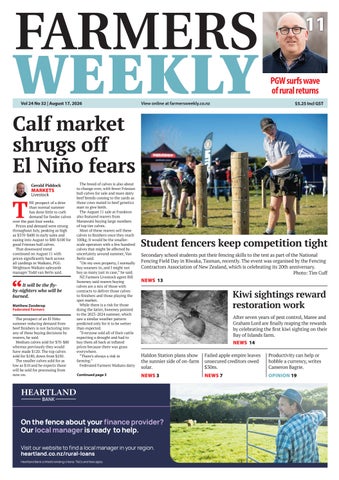
Calf market shrugs off El Niño fears Gerald Piddock
MARKETS
T
Livestock
HE prospect of a drier than normal summer has done little to curb demand for feeder calves over the past four weeks. Prices and demand were strong throughout July, peaking as high as $370-$400 in early sales and easing into August to $80-$100 for good Friesian bull calves. That downward trend continued on August 11 with prices significantly back across all yardings in Waikato, PGG Wrightson Waikato saleyards manager Todd van Berlo said.
It will be the flyby-nighters who will be burned. Matthew Zonderop Federated Farmers The prospect of an El Niño summer reducing demand from beef finishers is not factoring into any of these buying decisions by rearers, he said. Medium calves sold for $70-$80 whereas previously they would have made $120. The top calves sold for $180, down from $250. The smaller calves sold for as low as $10 and he expects those will be sold for processing from now on.
The breed of calves is also about to change over, with fewer Friesian bull calves for sale and more dairy beef breeds coming to the yards as those cows mated to beef genetics start to give birth. The August 11 sale at Frankton also featured rearers from Manawatū buying large numbers of top tier calves. Most of these rearers sell these calves to finishers once they reach 100kg. It would be the smallerscale operators with a few hundred calves that might be affected by uncertainty around summer, Van Berlo said. “On my own property, I normally buy weaners in, and I might not buy as many just in case,” he said. NZ Farmers Livestock agent Bill Sweeney said rearers buying calves are a mix of those with contracts to deliver those calves to finishers and those playing the spot market. While there is a risk for those doing the latter, Sweeney pointed to the 2023-2024 summer, which saw a similar weather pattern predicted only for it to be wetter than expected. “Everyone sold all of their cattle expecting a drought and had to buy them all back at inflated prices because there was grass everywhere. “There’s always a risk in farming.” Federated Farmers Waikato dairy Continued page 3
Student fencers keep competition tight Secondary school students put their fencing skills to the test as part of the National Fencing Field Day in Riwaka, Tasman, recently. The event was organised by the Fencing Contractors Association of New Zealand, which is celebrating its 20th anniversary. Photo: Tim Cuff
NEWS 13
Kiwi sightings reward restoration work After seven years of pest control, Maree and Graham Lord are finally reaping the rewards by celebrating the first kiwi sighting on their Bay of Islands farm.
NEWS 14 Haldon Station plans show the sunnier side of on-farm solar.
Failed apple empire leaves unsecured creditors owed $30m.
Productivity can help or hobble a currency, writes Cameron Bagrie.
NEWS 3
NEWS 7
OPINION 19
On the fence about your finance provider? Our local manager is ready to help. Visit our website to find a local manager in your region. heartland.co.nz/rural-loans Heartland Bank Limited’s lending criteria, T&Cs and fees apply.
2
New Zealand’s most trusted source of agricultural news and information
Get in touch
Advertise
EDITORIAL
SALES CONTACTS
Bryan Gibson | 06 323 1519 Managing Editor bryan.gibson@agrihq.co.nz
Andy Whitson | 027 626 2269 Sales & Marketing Manager andy.whitson@agrihq.co.nz
Craig Page | 03 470 2469 Editor craig.page@agrihq.co.nz Claire Robertson Sub-Editor claire.robertson@agrihq.co.nz Neal Wallace | 03 474 9240 Journalist neal.wallace@agrihq.co.nz
Contents News . . . . . . . . . . . . . . . . 1-17 Opinion . . . . . . . . . . . 18-19
Janine Aish | 027 300 5990 Auckland/Northland Partnership Manager janine.aish@agrihq.co.nz Jody Anderson | 027 474 6094 Waikato/Bay of Plenty Partnership Manager jody.anderson@agrihq.co.nz
Gerald Piddock | 027 486 8346 Journalist gerald.piddock@agrihq.co.nz
Charlie Williamson | 027 510 0430 Lower North Island Partnership Manager charlie.williamson@agrihq.co.nz
Annette Scott | 021 908 400 Journalist annette.scott@agrihq.co.nz
Andy Whitson | 027 626 2269 South Island Partnership Manager andy.whitson@agrihq.co.nz
Hugh Stringleman | 027 474 4003 Journalist stringleman@outlook.co.nz Richard Rennie | 027 475 4256 Journalist richard.rennie@agrihq.co.nz Gerhard Uys | 027 239 4388 Journalist gerhard.uys@agrihq.co.nz Rebecca Greaves | 027 320 9111 Journalist rebecca.greaves@agrihq.co.nz Nigel Stirling | 021 136 5570 Journalist nigel.g.stirling@gmail.com Isabella Beale | 027 299 0596 Multimedia Journalist isabella.beale@agrihq.co.nz
PRODUCTION Lana Kieselbach | 027 739 4295 production@agrihq.co.nz
ADVERTISING MATERIAL
Supply to: adcopy@agrihq.co.nz
SUBSCRIPTIONS & DELIVERY 0800 85 25 80 subs@agrihq.co.nz
PRINTER Printed by NZME Delivered by Reach Media Ltd
Julie Hill | 027 705 7181 Marketplace Partnership Manager classifieds@agrihq.co.nz
Sector Focus . . . . . . . 21-26 Rural Women . . . . . . . . . . 27 Federated Farmers . 28-31 Real Estate . . . . . . . . 32-33 Marketplace . . . . . . . . . . . 34 Livestock . . . . . . . . . . . . . . 35 Markets . . . . . . . . . . . 36-39 Weather . . . . . . . . . . . . . . . 40
Andrea Mansfield | 027 602 4925 National Livestock Manager livestock@agrihq.co.nz
Word Only Advertising | 0800 85 25 80 Marketplace wordads@agrihq.co.nz
PUBLISHERS Dean and Cushla Williamson Phone: 027 323 9407 dean.williamson@agrihq.co.nz cushla.williamson@agrihq.co.nz
ISSN 2463-6002 (Print) ISSN 2463-6010 (Online)
Record revenue Scott Technology expects to report record revenue and earnings in its FY2026 results to the year ended August 31. The guidance is for revenue of $290 million to $296m compared with $275m in FY25, and for operating earnings before interest, tax, depreciation and amortisation of $34m to $36m, compared with $31.5m. Results will be released on October 22.
Robinson appointed Dairy Holdings has appointed Blair Robinson CEO following the retirement of Colin Glass. Robinson joined Dairy Holdings in 2018 as its chief operating officer. Over the past eight years, he has led Dairy Holdings’ dairy farming and support operations, developing a deep understanding of its business, people and the opportunities ahead.
Bremworth takeover? The largest shareholder in Bremworth has moved into position for a takeover by securing lock-up deeds with 13 other shareholders amounting to 32% of the ordinary shares. David Ferrier’s Mangawhai Collective is a 19.7% shareholder, and with the lock-up deeds could exercise over 50% of Bremworth. The lock-up deeds are for 90c a share for 22 million shares, should Ferrier want them, which values the potential partial takeover at $20 million. Bremworth directors said they have not yet received notice of Mangawhai’s intention.
Real Estate | 0800 85 25 80 realestate@agrihq.co.nz
Farmers Weekly is Published by AgriHQ PO Box 529, Feilding 4740, New Zealand Phone: 0800 85 25 80 Website: www.farmersweekly.co.nz
News in brief
Shearer convicted
PRIORITIES: A recent trip to Brazil brought home to LIC CEO David Chin the importance of efficiency over scale in the New Zealand dairy industry. STORY P13
A Palmerston North shearer has been placed on six months’ community detention, along with 12 months’ supervision, for physically abusing three lambs while shearing them. The Ministry for Primary Industries said in December 2024 animal rights organisation People for the Ethical Treatment of Animals provided the MPI with 560 hours of video footage of sheep being abused by shearers. Dylan George Manthey, 30, was sentenced on three charges of ill-treatment of sheep under the Animal Welfare Act.
HELPING NZ FEED THE GLOBE SUSTAINABLY Scholarships close on 1 September 2026 for the 2027 academic year SCAN THE QR CODE TO FIND OUT MORE
Study Agriculture, Horticulture, Agribusiness or Animal Science in 2027 Study full time, part time, on campus or online.
Find out more:
massey.ac.nz/aghort | contact@massey.ac.nz | 0800 MASSEY
3
News
3
FARMERS WEEKLY – farmersweekly.co.nz – August 17, 2026
Station plans show sunnier side of solar Neal Wallace
TECHNOLOGY
A
Solar
320 hectare solar farm to be built on Haldon Station will make the Mackenzie Basin station more sustainable, says long-term manager Paddy Boyd. Electricity generated will help drive the centre pivot irrigators he installed to finish stock and prevent wind-blown loss of topsoil, while income from hosting the panels will help fund control of rabbits and wilding conifers. Approval was this week granted to Lodestone Energy to develop the farm on the 22,000ha station on the shores of Lake Benmore, with construction likely to be complete in about 18 months. Boyd said he spent three years investigating solar farms, visiting several in Australia to see how they fitted into the landscape, something that had to work in the picturesque Mackenzie. He chose a site away from public view but close to transmission lines and would not change his choice. “It is a large area but it’s not conspicuous so it will not be a blight.” New Zealand is about to have an influx of solar farms. There are currently about 350ha of solar farms in the country with an estimated 2000ha of additional land consented for expansion
POWERED UP: A concept image of the 320ha solar farm approved for construction at Haldon Station in South Canterbury’s Mackenzie Basin. The solar panels are in the darker area. Image: Lodestone Energy
It is a large area but it’s not conspicuous so it will not be a blight. Paddy Boyd Haldon Station – and a further 10,000ha under consideration. Federated Farmers has raised concerns about the scale of the growth, because these farms are also being built on Class 1 and 2 land. The need for utility-sized solar farms would be negated if farms and homes installed their own solar panel systems, said a solar advocate.
Continued from page 1 chair Matthew Zonderop said it will be business as usual for larger-scale rearers, who will be well prepared for any turn in conditions and have the enough scale to adapt. “They can roll with the punches. “It will be the fly-by-nighters who will be burned.” In the past he has reared nonreplacement calves but will not be doing so this season because the risk
Mike Casey, the chief executive of Rewiring Aotearoa, said if every farm installed solar, there would be a 60% increase in renewable energy and not the need for utility-scale solar farms. “For every solar panel installed on a dairy shed or roof top, ultimately it means a panel does not need to be installed at a utility-scale solar farm.” The country needs to double its electricity generation in the decades to comes, and solar will be a major source, he said. The challenge is not the technology, but implications for people, and he said he understands concerns about the impact of large utility-scale solar farms. Casey said a benefit from locally
is too high. The costs for rearing his replacement calves to 100kg is $450-$500, which is similar to last year. Rearers who might decide to rear a couple of hundred calves for the spot market may struggle, especially if feed costs start to climb after Christmas. “It is February-March, if it does hit us, when it will bite because supplements will be needed for them.”
generated electricity is that it does not require a massive network of wires and poles, the cost of which contributes about 50% of household electrical bills. Boyd said since arriving on Haldon he has tried to make the dryland farm sustainable. In the first few years he battled constant dust storms from winderoded topsoil. Pivot irrigation was installed to stop that soil loss but access to single phase power meant the irrigators had to be driven by diesel motors. “Here we’re saying we want to be sustainable but having to use fossil fuels to drive our pivot irrigators.” Income generated from the solar farm will also allow him to invest
It could present a similar issue for dairy graziers who may charge farmers more to ensure they have enough feed to grow those weaned calves. What finishers will do this spring will be “the million-dollar question”, he said. “It will come down to the individual operator who is prepared, who knows their farm.”
MORE:
See page 8
in rabbit and wild conifer control. Danny Donaghy, a professor of dairy production systems at Massey University, said researchers have found pasture growth under solar panels fell by 80%. Between the rows of panels, the structure have a protective effect, reducing moisture loss and offering wind protection, which means growth stays longer into spring and summer. Pasture growth between panel rows fell about 5%. If panels are installed on lowproducing land, Donaghy said, the impact on a farm would be minimal. Massey researchers intend putting collars on sheep in solar farms to monitor their behaviour.
REARERS: Demand from rearers was generally strong for calves at Frankton in July.
4
4
SI conversions head north for dairy cows NEWS
Gerhard Uys
Convervation
Livestock
IVESTOCK agents and farmers are having to buy North Island cows to make up the herds of newly converted South Island dairy farms because of the lack of cattle on the market for sale. PGG Wrightson technical manager for livestock Rod Whale said there are no signs that a significant number of cows might become available in the South Island. “Everyone is pretty confident that the source of cows is going to have to come out of the North Island to supply this growth. “In-calf heifers will definitely be short and very probably, cows.” This is the highest demand he has seen at this stage of the season in his 15 years in the livestock industry, Whale said. “We’re earlier and up a notch on last year’s pricing.” Whale oversees the herd purchase contracts on livestock sales for PGG Wrightson, with cows from these completed sales delivered to the farm on June 1 next year. For next June, the company has 10 such contracts. Prices are up at least $200 on 12 months ago. In-calf heifers are selling for $2900-$3000 and adult cows are making $3200-$3400. It has pushed the cost of buying and transporting the cattle to their new farms by as much as $12,500 a hectare. There are no signs of demand easing, with some of the new dairy sheds not scheduled to be built until 2029, Whale said. In May, Farmers Weekly reported that Canterbury could end up with at least 25,000 more dairy cows
DoC takes fresh look at grazing on its land NEWS
Gerald Piddock
L
News
FARMERS WEEKLY – farmersweekly.co.nz – August 17, 2026
SUPPLY: Tight South Island dairy cow supply has meant agents and farmers are turning to the North Island to secure cattle for newly converted dairy farms in Canterbury.
We’re earlier and up a notch on last year’s pricing. Rod Whale PGG Wrightson over the next few years as interest in dairy conversions continued to ramp up. ECan reported that 12 consents tied to dairy conversions for 2026 accounted for 10,700 cows, with another 1750 cows tied to a further 10 consents enabling herd increases on existing dairy operations. There are 26 farms currently under conversion for start-ups in spring 2026 and 2027, with the average conversion size at 800 cows. One of those converting farmers, Peter O’Connor, told Farmers Weekly that building the1700cow crossbred herd had been a challenge, with work starting in May 2025.
Cows were sourced over a 12-month period from 20 lines of animals spread from Northland to south Canterbury, with the average cow price at $2660 and the most expensive $3300. “It’s been difficult in a pricey market, but we are quite happy with what we have landed on, we have got good value,” he said. The farm is in its first season of operation. Waikato-based NZ Farmers Livestock agent Bill Sweeney confirmed they are taking inquiries from South Island buyers looking for North Island cows both for the current and next season. “That market looks like it’s going to be pretty good.” It has “definitely” pushed up prices with cows making $3100$3450 a cow. “The price would not be where it is if it were payout driven. It would not be at that level. It’s a combination of both supply and demand and payout that has created it.”
THE Department of Conservation is reassessing some of its current grazing concession settings to better account for land transferred to the department through tenure review. Tenure review was a voluntary process run between 1998 and 2022, through which some high country land became public conservation land with the goal of protecting conservation values and enabling sustainable land use, while productive land could be freeholded to leaseholders. Speaking at the Wilding Pines Conference held in Invercargill, the technical advisor with DoC’s biosecurity and weeds team, Connor Hines, said the project focuses on what DoC can do to improve the management of the land involved, within finite resources.
The project aims to review and test situations where grazing can deliver conservation outcomes. Connor Hines DoC It is “reassessing current grazing settings to better capture ex-tenure review land with paired monitoring to assess the impact of these reassessments”. “The project aims to review and test situations where grazing can deliver conservation outcomes, particularly across former tenure review land, which
covers over 555,000 hectares, and other modified high country environments.” It’s also testing more consistent and practical grazing concession conditions with the aim of identifying situations where grazing provides net conservation benefit while protecting indigenous biodiversity. “Currently applications are assessed on a case-by-case basis. Concessions generally don’t capture ex-tenure review land, though there are some exceptions to this,” Hines said. The question the trial is trying to answer is, “When and where is grazing on public conservation land appropriate, and when and where is it not?” Currently the department has 467 active grazing concessions covering approximately 350,000ha, he said. Hines said another trial in the Mackenzie Basin is looking more intensely at sheep grazing as a tool to suppress wilding conifer re-invasion on public conservation land, without negatively impacting conservation values. For this trial, monitoring was centred on 50 metre transects containing 1m by 1m square plots. Transects are arranged in five groups of four, each containing two grazed experimental transects and two ungrazed control transects. Initial results showed Merino wethers were in good nick after grazing in fairly hard country. The trial also showed grazing did suppress wildings, but the palatability of different species was different, leading to differing browsing results.
MORE:
See page 9
News
5
5
FARMERS WEEKLY – farmersweekly.co.nz – August 17, 2026
Food and fibre curriculum move welcomed Neal Wallace
NEWS
A
Education
NEW industry-driven secondary school course on the primary sector is being greeted as an opportunity to expose students to the field. The government announced last week that food and fibre has been included as one of nine industryled subjects to be available for Year 12 and 13 students, from 2029.
Any additional agriculture and horticulture courses are a good thing. Rex Newman Horticultural and Agricultural Teachers Association While supportive of the intent, horticulture and agriculture teachers said they are yet to see the details. “Any additional agriculture and horticulture courses are a good thing,” said Rex Newman, the agricultural president of the Horticultural and Agricultural Teachers Association (HATA).
Newman said student interest in primary sector subjects is growing and he hopes HATA will have input into the curriculum content and that it is available to all students. Coadette Allan, the curriculum designer at St Kentigern College’s Wilson Bay Farm in Auckland, also said she welcomes any initiative that introduces students to the primary sector. “The more opportunities our young people have to be exposed to horticulture and agriculture, the better it is for NZ.” Antony Harvey, the business operations manager with the Ministry of Education, said the primary sector is already served by Agricultural and Horticultural Science and Business Studies. The updated National Curriculum includes subjects that either include or are specifically about Agriculture and Horticultural Science, such as Year 11 Science, Years 12-13 Agricultural and Horticultural Science From 2029, Years 12-13 will be taught Food and Fibre systems with curriculum specifics to be developed by industry, employers and education sector experts over the next 18 months. Harvey said all industry-led subjects are expected to teach
industry-relevant knowledge and practical skills. In announcing the subject change, Economic Growth Minister Nicola Willis and Education Minister Erica Stanford said they have been developed with industry so that they know young people are building the skills and knowledge needed for work, trades or university. “The subjects will have parity of esteem with traditional subjects such as English and Maths and count towards students’ secondary school qualifications, and support pathways into university, trades, training or the workforce,” said Stanford. Food and fibre is seen as having strong alignment with employment prospects, introducing students to apprenticeships and entry-level training through to specialist, operational and management roles. Federated Farmers also welcomed the initiative, describing it as a major win for NZ’s farming future and helping to address a shortage of staff. “The way we farm is constantly evolving with new technology and improved practices,” said spokesperson Richard Dawkins. “That’s why we need young people joining our sector with
INTRODUCTION: Auckland teacher Coadette Allan says she welcomes any initiative that introduces students to the primary sector. relevant and practical skills.” It meets the federation’s call for practical and industry-led vocational training, enabling rural schools to teach agriculture, and for practical industry experience, work-based learning to
be built into vocational education. The formation of the Industry Skills Board after the nationwide Te Pukenga was disestablished was a significant development for vocational education and training.
BLNZ leads four-year low-methane beef study Staff reporter
NEWS
Emissions A NEW research programme aimed at developing breeding tools for more feed-efficient beef cattle has been unveiled. Led by Beef + Lamb New Zealand (BLNZ) and funded by the Ag Emissions Centre, the four-year Cool Beef programme will generate the science and data needed to better understand the relationship between feed efficiency, methane emissions
and production traits in beef cattle. The programme, launched at Te Mania Angus in north Canterbury, will support future genetic evaluation for these traits, providing beef breeders and commercial farmers with another option when making breeding decisions that suit their farming systems and business goals. The programme builds on earlier industry research, including data generated through the Informing New Zealand Beef programme and its Beef Progeny Test.
BLNZ chair Kate Acland said the programme is about building the knowledge needed to support future breeding decisions. “Farmers are focused on breeding productive animals that perform well in their farming systems. Cool Beef will help build our understanding of the relationship between feed efficiency, methane emissions and production traits, giving breeders better information to support future decisions.” Ag Emissions Centre executive director Dr Naomi Parker said
the programme demonstrates the value of bringing together government investment, scientific expertise and industry leadership. Over the next four years, the programme will measure at least 2000 beef cattle for methane emissions and feed intake, with a further 1000 methane measurements collected from cattle directly off pasture. The research includes Angus, Hereford and crossbred cattle from collaborating beef breeders across NZ and will contribute to the development of future Estimated
Breeding Values (EBVs) for these traits. Methane measurements are currently being collected using Portable Accumulation Chambers developed by the Bioeconomy Science Institute with the possibility that other methane measuring technologies will be used over the coming years. Participation in the programme is voluntary, providing breeders with the opportunity to contribute to research that may support future breeding options for more efficient cattle.
Lookiing for new financial pastures?
You know better than anyone that strong assets need to work hard all year round. PMG takes the same active management approach to our commercial properties, ma aking your investment work harder over time. With a $700m+ po ortfolio, the Pacific Property Fund is New Zealand’s largest diversified unlisted commercial property fund and d is now open for investment - offering investors access to more than 29 high-quality largeformat retail, indusstrial and office properties across New Zealand. The Fund also operates within a PIE structure, which may be tax-efficient depending on individual circumstances. Join thousands of Kiwi investors who are seeking to grow their wealth by investing alon ngside a trusted manager with 34 years of experience in commercial p property investment and management.
Download a copy of the Product Disclosure Statement at pmgfunds.co.nz/invest
This is an offer of shares in Pacific Property Fund Limited (Fund) (the issuer). A Product Disclosure Statement (PDS) is available free of charge from pmgfunds.co.nz. Any information provided to prospective investors is general only and does not constitute financial advice. Prospective investors should seek advice from a licensed Financial Advice Provider, who takes into account the investor’s personal circumstances. PMG Property Funds Management Limited (PMG) (as provider of management services to the Fund) and its Investor Relationships team do not provide financial advice. Like any investment, an investment in the Fund comes with risks and there is a chance you may lose some or all of your money. Prospective investors should seek advice from a licensed Financial Advice Provider. PMG and its Investor Relationships team do not provide financial advice. Past performance is not a reliable indicator of future performance. Returns are not guaranteed and investments involve risks, including the potential loss of capital. Total return since inception reflects historical gross cash returns and capital growth between 2014 and 2026. These metrics reflect the merger of the Fund and PMG Generation Fund, and are based on the assumption that the capital raise offer under the PDS proceeds, and an additional property investment is acquired (amongst other factors). These metrics are indicative only and are subject to change. Details on the risks associated with an investment in PPF are set out in the PDS, which is available free of charge on PMG’s website, pmgfunds.co.nz.
6
7
News
7
FARMERS WEEKLY – farmersweekly.co.nz – August 17, 2026
Losses mount for Hawke’s Bay apple mogul Richard Rennie
NEWS
T
Horticulture
HE failure of a Hawke’s Bay apple empire has left unsecured creditors owed over $30 million, the liquidator’s report reveals. The first report on the state of Crasborn Fresh Harvest, a subsidiary of apple-growing company Kiwi Crunch – owned by ex-accountant Wade Glass – has confirmed initial losses are likely to be steep, with the IRD also owed $19m. Kiwi Crunch was also placed in receivership in July. The liquidators also identified $3.4m owed to secured creditors. Overall, there is a $15m shortfall between the company’s book value of its assets, valued at $40m, and its debt. More than 20 secured creditors and 30 unsecured creditors are listed. Unsecured creditors extend to businesses from as far north as Auckland, and south to Christchurch. Farmers Weekly has confirmed one supplier alone is owed several hundred thousand dollars for services, and PGG Wrightson’s annual result recorded that the company made a $4.5m provision for amounts owed to subsidiary Fruitfed Supplies by insolvent
orchard companies, mainly Kiwi Crunch. The liquidation and receivership of the companies have highlighted the complex and interrelated web of Glass’s business empire. Companies Office data shows he is either a current director and/ or a shareholder in 53 companies, the majority of these comprising himself as sole shareholder. Over past decades he has been active in almost 100 companies. Glass has his residential home registered with the Companies Office as his Kiwi Crunch director’s address. Farmers Weekly has learnt the property is now on the market. It is also the registered address for his business partner, Natalie Jean Watson. The five-bedroom home located in the wealthy eastern Auckland coastal suburb of Glendowie is listed for sale at $5.97m with Bayleys, with a One Roof valuation of $4.48m. The agent overseeing the sale confirmed Glass is quitting the home as he looks to downsize, while continuing to own another home in a coastal location. Despite the receivership in New Zealand, Glass has pushed on with efforts to settle on a South Australian orchard. NBR reported as recently as last week that an ASX listed agricultural company, Duxton
BUST: The liquidation of Hawke’s Bay apple company Crasborn Fresh Harvest has revealed the company has book value assets of $40 million, against debt claims of $53m in secured and unsecured creditors.
Despite the receivership in New Zealand, Glass has pushed on with efforts to settle on a South Australian orchard. Farms, was still optimistic it would sell the property for NZ$11m to Glass, despite settlement being overdue. This has echoes of a deal that was due to be done on the Otago orchard business CAJ Apples,
owned by the Van der Voort family. Glass and business partner Paul Southam were due to purchase the 400 hectare company late last year, but the deal sunk early this year, with only part of that orchard
being on-sold by Glass, to NZ Rural Land Co. Forty-eight-year-old Glass has a business history that includes time spent with accounting firm Staples Rodway as a director. Back in 2008 he headed up an initiative to invest in Russian farmland as part of a joint venture with Russian investors to engage NZ dairy farmers wanting to expand their land holdings. He tried unsuccessfully to put together a venture to invest in a large feedlot operation comprising 25,000ha, aiming to build up to 20,000 cows and requiring US$10m at the time. At the time farmers were cautious, conscious of uncertain investment circumstances in Russia, and the venture never proceeded. Glass’s ventures have included sawmill operations, forestry ownership, car parts sales and even investment in the longestablished soft furnisher Harvey Furnishings. In 2013 in an article in Auckland lifestyle magazine Verve, Glass recounted how he had left the accounting trade after 20 years to invest in forestry and sawmilling through RHT and Claymark Group. This was later followed by investment in Harvey Furnishing in North Island and Millers in the South Island.
Supporting Healthy Futures Starts pre-Mating. Help support hormone production and reproductive performance with Horizon InjectaMin or InjectaMax Multi-Mineral Injections. Available from your local rural retailer.
Registered to the Pursuant ACVM Act 1997. Nos. A011926 & A011925.
Zn
+
Mn + Cu
Zinc
Manganese
Copper
+
Se
B12
Selenium
InjectaMax also includes Vitamin B12
8
8
FARMERS WEEKLY – farmersweekly.co.nz – August 17, 2026
News
‘El Niño doesn’t mean the end of farming’ Annette Scott
NEWS
Trends
W
HILE appreciating increased accuracy from weather forecasters, farmers say they don’t need the doomsday narrative that accompanies a lot of the news about El Niño. “There’s a lot of doom and gloom out there and that doesn’t really help,” said North Canterbury farmer and Hurunui Adverse Events Committee chair Dan Hodgen. “Just clear, honest facts of what forecasters are seeing is all we need. We don’t need all the bloody spin and narrative about why it’s happening, it’s information overload. “The forecasters are saying there’s a strong El Niño coming, but it’s not going to be the end of farming. We adapt, we tweak our systems, we have plans. “You can’t make decisions now on what the forecasters are saying. We’ve had this before and it’s not happened. Not saying it’s not going to happen this time, but you’ve got to be sensible about it.” The Hurunui Adverse Events
Committee was formed as a drought committee during the severe drought of 2014-2016. “Our job now has changed, with so much advice that farmers can access and most of them have got a fairly good handle on what’s going on if they have clear space to keep making decisions. “Farms are a business, droughts are a business risk for us. We have had plenty of warning this time, could argue possibly too much,” Hodgen said.
We don’t need all the bloody spin and narrative about why it’s happening, it’s information overload. Dan Hodgen North Canterbury “There’s a lot of good resources out there, but you still can’t beat the hands-on experience.” After 25 years farming in the region, Hodgen said, every time is different. “Experience is good, but I wouldn’t say I’m an expert in managing the dry, I probably make as many mistakes as anyone. “If you are farming on the east
coast and you haven’t got an eye on a dry spring and dry summer, if you haven’t got plan in the back of your mind, you are playing Russian roulette, because you are going to get one and it’s probably not too far away.” Hodgen said there is some “good stuff” on the way, with a drier winter helping feed utilisation, and with stock generally in good condition. “Looking back in the 2016 drought, we were selling store lambs for $40. “If this is a traditional El Niño coming, we have still got areas that get rain, Southland, West Coast, so if we do have to destock stores there is hopefully good markets. “Export prices are high so with a bit of luck you will be able to chuck a one in front of those $40 and get through financially.” The top five strongest El Niño events were recorded in 1972, 1982, 1991, 1997 and 2015. At the very least, forecasters expect the pending El Niño to rival the intensity of these historical top five with considerable potential to exceed them all. Farming in the Scargill district, North Canterbury, Andy Fox
POSITIVES: Dan Hodgen says El Niño may even bring some ‘good stuff’ for New Zealand farmers. has experienced several severe drought years. “Every time you get the longterm weather, we’re bombarded with the bad around the corner; the end of the world is coming. Well, it’s not. “We appreciate the increased accuracy of our weather forecasters these days but still they are not always correct and sometimes El Niño actually brings rainfall to much-needed regions, so it’s not always bad.
Stronger seasons start with you.
Every season is a chance to build something stronger. Our role is to help you do it – with trusted relationships, greater certainty, strong demand and a commitment to keeping our promises. Plan your Spring with confidence. silverfernfarmer.co.nz
“It’s where we farm, we are not complaining. “We walk a fine line and together being positive we can make the best of what we can do as awkward situations strike. “As agricultural businessmen we are a lot better than back in the ’80s when I started farming – a lot more technologies, more options to consider within our businesses. We just need to put the negativity aside and walk positively together.”
9
News
9
FARMERS WEEKLY – farmersweekly.co.nz – August 17, 2026
Foresters do their sums on wilding pines Gerhard Uys
NEWS
T
Conservation
HE right tree in the right place is not just a line used by politicians – it makes sense in the fight against wilding pines, say experts at the Wilding Pines Conference in Invercargill.
EARLY INTERVENTION: Regional manager for Matariki Forests in Southland and Otago Hamish Fitzgerald says early intervention is better.
Former president of the NZ Farm Forestry Association Neil Cullen said as an association promoting the wise use of trees, members also have to face the negatives arising from the practice. The association is educating members on the causes of wilding pines, and on management decisions that can prevent future problems. “Wilding spread is predictable and therefore manageable, but that management must be planned for and continued over generations,” Cullen said. Members should be aware of which species have high spreading risk and make plantation decisions accordingly. Hybrid trees are less risky than, for example, Douglas fir, with native trees also being trialled. Environmental manager at New Zealand Forest Owners Association Rachel Millar said in 2005, members spent $3.2 million controlling wildings. But over the past five years that spend has been higher, roughly $13m over roughly 52,000 hectares. The association is pushing for certification bodies to change their position on GMOs.
“A sterile Douglas fir tree would make a huge difference,” Millar said. Regional manager for Matariki Forests in Southland and Otago Hamish Fitzgerald said they run about 20 forests, with around 33,000 stocked hectares. Tree choice, especially hybrids, makes a difference to wilding spread, he said – and there are better alternatives than Douglas Fir. “By 2018 we were in a position to make the strategic call to no longer deploy Douglas fir in our southern forests.” The company is busy liquidating the oldest Douglas fir in some of its forests and will replant hybrids. It has looked at whether it makes more economic and environmental sense to continue ongoing wilding control at ever-increasing levels or to progressively remove the Douglas fir source 10 or 15 years earlier than scheduled. A question examined internally at Matariki Forests is if retaining the Douglas fir to a conventional harvest age of about 40 to 45 years, versus removing a 200-metre
GMO: Environmental manager at New Zealand Forest Owners Association Rachel Millar says the association is pushing for certification bodies to change their position on GMOs – sterile trees would be game changing. plus boundary early and then re-establishing that in hybrids, is best. With costs of production, log prices and anticipated wilding control costs modelled over a 60-year period, the results found
that earlier intervention delivers stronger longer-term financial outcomes, but with a short-term hit to cash flow the next year and a better environmental outcome than the status quo, Fitzgerald said.
Wilding offenders must pay, Hoggard says Gerhard Uys
NEWS
Conservation MINISTER for Biosecurity Andrew Hoggard says landowners should not spread wilding pines to other landowners and those who do should foot the management bill. Speaking at the Wilding Pines Conference 2026 in Invercargill, Hoggard said part of a National Pest Management Plan should be ensuring that trees are planted in the right place. He said the National Policy Statement needs to have an element in it ensuring production – and that carbon foresters
manage the effects of wilding pines. Speaking with his ACT Party hat on, Hoggard said that, as a party that fundamentally believes in property rights, it includes not spreading your problem to someone else’s property. “If you’ve got seed source blowing from your land to your neighbours, you are imposing a cost on them,” he said. It should be part of the National Pest Management Plan that not only beneficiaries should contribute to the wilding pine problem, but “exacerbators should also help fix the problem”. Hoggard said he wants
responsible and efficient use of the Budget 2026 allocation of $109 million over three years to the National Wilding Conifer Control Programme, and if someone sees this is not the case, they should contact him. He said there are politicians and members of the public seeing that money not spent on, for example, cancer or additional policing, and the funding therefore carries a responsibility with it. The general public are not aware of the effects of wilding pine and need to be made aware of the consequences of not stopping wilding spread.
Asked by an audience member whether the restructuring of local government could mean that wilding conifer and other biosecurity work will become fragmented, Hoggard said he hopes to have the role of councils embedded in the Biosecurity, Natural and Built Environment and the Spatial Planning Acts. He said money will also have to be spent on innovation to control wilding pines. The government has allocated $1m over two years from the wilding conifer funding specifically for community-led projects, Hoggard said.
This week’s poll question:
Do you support Andrew Hoggard’s plan to make landowners pay for spreading wilding pines?
Have your say at farmersweekly.co.nz/poll
ASK YOUR LOCAL SEED RETAILER IF THE CLEANCROPTM BRASSICA SYSTEM IS RIGHT FOR YOUR FARM GET THE ADVANTAGE
E F E N CE D T S E B E H T O F F E N CE I S A GO O D
10
10
News
FARMERS WEEKLY – farmersweekly.co.nz – August 17, 2026
Demand renders beef tallow more profitable Neal Wallace
NEWS
T
Agribusiness
HE trend of people returning to using natural products could see the $14 billion global tallow industry double in the next decade. So says a study by market research and consulting company Grand View Research, which said there is growing demand for tallow for cooking, skin care and novel products such as biofuels. South Canterbury farmer Jo
FLAVOUR: Demand is growing from consumers seeking the flavour they get from using tallow, says Tauranga butcher Jason Pears.
Bradford uses tallow in her Hearth & Hide skincare range and said skincare lines are increasingly using tallow. “There is definitely more demand for tallow,” she said. “A lot of people are going back to what their parents have done.” Consumers are attracted because tallow replicates desirable fatty acids, retains skin moisture and is a source of vitamins A,D,E and K. “It is the closest to our own fatty acids. What we are putting on our skin is what we lack as we get older.” The best tallow is made from
fat around the kidneys, which is where nutrients are the most concentrated. It is whiter and not as oily. Hearth & Hide uses tallow from cattle raised on Cloudy Peaks Station in the Mackenzie Country, owned by Kane and Marie Murdoch, and from Cloudy Peaks butchery in Timaru. Bradford and her partner Mark Baynes are stock managers of the property. Making tallow is a complex, time-consuming process, said Bradford. She cooks it for six hours on a low temperature, a precise process so the end product is not tainted with the smell of beef or lamb. The resulting liquid is drained six times through cheese cloth, and the temperature carefully monitored as it cools. Starting with 5kg, she ends up with just 1kg of tallow, which is then processed with oils being added. Tauranga butcher Jason Pears said when he started making tallow, he sold 20-30 400 gram bottles a month. Today he sells 3040 bottles a week. Demand is growing from consumers who see it as healthy
NATURAL: Jo Bradford of Hearth & Hide says consumers are returning to natural products.
Tallow is the closest to our own fatty acids Jo Bradford Hearth & Hide and seek its flavour profile when cooking. Pears, who operates Kiwi Fresh Meats, said prices for tallow are increasing, which is in part due to high cattle prices. Mike Teen, the Alliance Group’s global director of co-products, said although international market conditions are volatile, global demand is firm, driven by interest from producers of renewable fuel, and long-standing industrial users. Tallow is sought after as a low-
carbon feedstock for renewable diesel and aviation fuel, while also being used in oleochemicals, or natural chemical compounds derived from plant oils and animal fats, and in soaps, detergents and cosmetics. “Its importance to the red meat industry has grown as renewable fuel production, sustainability policies and competition between feedstocks have influenced demand,” Teen said. Grand View Research found some United States fast-food chains are converting from cooking in seed-based oil to tallow. It also found tallow from cattle had 46% of the market share in 2024, but tallow from sheep and goats is expected to have the fastest rate of growth in the coming decade.
TAKE CONTROL WITH BIONIC ® PLUS Save time and save money with Bionic® Plus - the 100 Day* controlled release combination anthelmintic with minerals capsule for sheep. Worm control with Bionic® Plus can reduce drench inputs1, aid in control of dags and associated flystrike2, and slow the development of resistance. Farmers and veterinarians can be confident when they choose Bionic® Plus.
For more information, visit:
futureproducers.co.nz PROUDLY AVAILABLE FROM YOUR LOCAL PARTICIPATING VETERINARY CLINIC *With a range of 85 to 115 days worm control. See product label for full claim details and directions for use. ACVM Registration No. A011825. BIONIC® is a registered trademark of Boehringer Ingelheim Vetmedica GmbH, used under license. © Copyright 2026 Boehringer Ingelheim Animal Health New Zealand Limited. All rights reserved. NZ-RUM-0032-2026. Ref: 1. Data on file. 2. See product labels for full claim details and directions for use.
News
11
11
FARMERS WEEKLY – farmersweekly.co.nz – August 17, 2026
PGW surfs wave of rural returns Hugh Stringleman
NEWS
Agribusiness PGG Wrightson has posted a strong set of financial results for FY2026, including revenue of over $1 billion for the first time since its seeds division was sold in 2019. Operating revenue was up $99 million or 10% to $1.1bn, when compared with FY2025. Operating earnings before interest, tax, depreciation and amortisation were $64.3m, up $8.2m or 15%. Net profit after tax was $15.5m, up $4.9m or 46%. Cashflow from operating activities was $52.6m, a gain of $40m.
Earnings per share were 20.6c, up 6.5c, and directors declared a fully imputed final dividend of 5.5c, bringing the full-year dividend to 10c. Chief executive Stephen Guerin said the revenue boost for PGG Wrightson came mainly from farmer buying demand through retail stores and increased livestock commissions. “Demand was strong for fencing supplies, animal health products, fertiliser and seeds, while for agricultural chemicals it was a little more subdued,” he said. Irrigation products also sold well through the Water division, replacing existing older pipes, upgrading technology and making
DEMAND: Chief executive Stephen Guerin says the revenue boost for PGG Wrightson came mainly from farmer buying demand.
Funding appeal as hunting charity takes off
GROWTH: Steve Hill, left, and Adam Kreisel started Hunters4Hope four years ago, and the charity has since grown to around 30 employees supplying venison to over 50 food banks and community groups in the South Island.
Isabella Beale
NEWS
Community HUNTERS4HOPE has launched a new fundraising campaign to help cope with rising demand for the venison it supplies to community groups. The Canterbury-based charity accepts donations of surplus venison from local and visiting hunters. Volunteers process and distribute the meat to more than 50 community groups across the South Island. Working primarily through the Hope Community Trust in Rangiora, Hunters4Hope’s network stretches from central Otago to Nelson, with most recipients in the upper South Island. “On the first Thursday of every month we rock up to the Hope Community Trust with generally around 2000 kilos of venison mince. And within about an hour and a half it’s all been distributed,” said Steve Hill, cofounder of Hunters4Hope. The charity has had significant growth in the past four years. In its first year it donated 2100kg of venison mince, 7000kg in its second, 14000kg in its third and it is targeting 20,000kg in 2026. “It started off with two [volunteers] and now it’s about 30,” said Hill.
conversions to dairy farms. Horticultural markets were buoyant, especially kiwifruit and premium apples, while grape growing and wine making have been challenging because of lower alcohol consumption. PGG Wrightson made a $4.5 million provision for amounts owed to subsidiary Fruitfed Supplies by insolvent orchard companies, mainly Kiwi Crunch. Guerin said the inventories of retail supplies for the spring trading months are healthy with some tightness around tanks, troughs and other plastics because of the Middle East oil disruption. He said the FY2027 trading year has started well but returns for September and October will be needed before the directors can issue an earnings guidance. Geopolitical tensions, supply chain disruption, elevated input costs, and the potential impact of El Niño conditions present risks. In addition, election-year dynamics may contribute to a degree of caution in parts of the rural economy, particularly the rural property market. Viticulture and arable farming are also expected to remain challenging in the near term.
PROBLEMS: Concerns over labour payments and invoices have been simmering in the kiwifruit sector for years.
Dodgy kiwifruit operators in IRD sights Richard Rennie
NEWS
A
Horticulture
RARE Inland Revenue alert on dodgy payment practices in the horticultural sector has been welcomed by the kiwifruit sector, a key target for the action. The alert, specifying noncompliance in the horticultural sector, outlines the IRD’s concerns over several practices relating to payments to staff through subcontractors, resulting in incorrect or no tax payments being made. The IRD has been made aware of false invoices being created and used to obscure the true nature of transactions, often resulting in the under-reporting of GST and PAYE.
Generally, contractors are compliant and action is taken on the few times when contractors are not. “It was really just an idea, a concept and from that it’s sort of grown to a bit of a beast.” Hill said the cost of living crisis has caused a direct increase in demand from community groups and foodbanks wanting to be included on the Hunters4Hope distribution list. “Through Hope Community Trust, Hunters4Hope are supplying over 50 foodbanks and community groups with venison on a regular basis, and we have a waiting list of other groups asking for any spare.” Hill said the charity has received no central or local government funding since it began, relying instead on corporate, personal and philanthropic donations. Hunters4Hope is entirely volunteer-run, with no wages, administration or consultancy fees paid from the funds raised. Donations go towards operational costs and processing more venison for distribution to
communities in need. “Hunters4Hope has grown to the point that our supply and the demand that we’re fulfilling has increased to the level that some of our overheads ... what used to be enough to keep the power on and keep things going now just doesn’t quite cover the bills,” said Hill. As a result Hunters4Hope has launched Livestock Lifeline, a campaign that allows farmers and landowners to donate surplus livestock, with the proceeds going to cover the charity’s day-to-day operational costs. Farmers and landowners can reach out to their preferred meat processor buying agent, or local Progressive Livestock agent, to make arrangements on their behalf. They would need to fill out a separate ASD (Animal Status Declaration) form for the donated stock. Hunters4Hope is also accepting cash donations.
Spokesperson Seeka This involves issuing invoices for the supply of labour where the entity did not perform the work. Cash payments to orchard workers have also been identified as an area of concern, with the use of cash giving rise to money laundering and the risk of worker exploitation. The practices have allowed suspect operators to effectively “double dip”, claiming income tax and/or GST input deductions based on false invoices, while also not deducting tax from wages paid to labourers. The kiwifruit sector, with its complex network of orchard contractors, sub-contractors and seasonal workforce, has been an area of concern relating to all these practices for some years. Initial investigations by Farmers Weekly two years ago indicated widespread concern in the sector over labour payments.
Claims at the time included labour contractors paying staff cash out of funds kept in the boot of vehicles, no filing of ACC or PAYE payments, and the filing of fraudulent tax returns. However, despite direct accounts of these activities, no parties were prepared to comment on record about the practices. One operator claimed to fear for his and his family’s safety should he raise a flag on the issue. Most recently, IRD spokesperson Toni Morris told RadioNZ that IRD suspects it is missing out on tens of millions of dollars in the kiwifruit sector alone. Colin Bond, CEO of NZ Kiwifruit Growers Incorporated, said NZGKI supports the IRD’s efforts to ensure compliance, particularly given industry bodies’ limited enforcement ability. “While the vast majority of growers and contractors work hard to meet their tax and employment obligations, it is important government organisations proactively lead in this space and utilise their power when necessary,” he said. In a statement to Farmers Weekly Seeka, the country’s largest grower and producer, said it took proactive steps some time ago to deal with the issues. The company has ensured labour operators are not able to subcontract to a non-Seeka certified contractor, noting that at times it is difficult to know if a worker on an orchard is directly employed or not. “Generally, contractors are compliant and action is taken on the few times when contractors are not.” Zespri did not wish to comment on the IRD’s announcement. IRD has opened over 100 investigations in the year to June 30 2026 into horticulture business, involving $7.2 million in discrepancies, with 45 cases still open. So far three people have been sentenced to home detention during the year on tax evasion charges.
12 ADVERTISEMENT
Enter the Ballance Farm Environment Awards
Opening their gate to growth
F
By Alice Scott
or Ben and Rebecca Trotter, entering the Ballance Farm Environment Awards was never about winning trophies. It was about opening their farm gate, challenging themselves, and learning how to build an even better business. In just seven years, the couple have transformed their 135-hectare property located at Luggate in Central Otago into a highly diverse and innovative operation that combines intensive bull beef finishing, strawberry production, hydroponic herbs, retail products and agritourism. The judges recognised the Trotters for their ability to identify market opportunities and move quickly to capture them, from valueadded strawberry products to integrating waste back into the farm system. For the Trotters, the experience offered things that are less tangible, but equally valuable - perspective and connection. “So much of our working week is spent inside our own little bubble just getting stuck into what needs to be done,” Ben says. “The Awards got us out networking with likeminded people. We made new friends and reconnected with old ones.” Rebecca adds that the judging process challenged them to think about leadership and personal growth and following the judges’ feedback, the couple have established an external advisory group to help guide future strategy. “It can be a lonely place growing a business. Every decision we make on this property is by us and us alone. For better or for worse,” she says, laughing. “Having outside perspectives has been hugely valuable.” Ben says entering the awards is something
For Ben and Rebecca Trotter, the greatest value of entering the Ballance Farm Environment Awards wasn’t a trophy – it was gaining perspective. The judging process challenged the Central Otago couple to think differently about their business, while connecting them with like-minded farmers and fresh ideas. “It can be a lonely place growing a business,” says Rebecca. “Having outside perspectives has been hugely valuable.”
that he knew they would want to get involved in at some point. “We had both
some useful feedback.”
always followed the Awards when we were
Like many farming families, the Trotters did
working as rural professionals,” he said. “It
initially wonder whether entering would add
had been on our radar for some time, but
another task to an already full life with four
we never really felt like we were ready. Then
children under six. But they say the value of
someone suggested we enter and we
the experience has more than justified the
thought we might as well give it a go.”
effort.
For Rebecca, the value of the Awards was in
“We just felt that it was worthwhile because
the process, not the outcome.
of the value we knew we could get from the
“It was about utilising what was essentially
experience,” Ben says.
free advice to sharpen what we are doing
Rebecca laughs that her first thought when
here. The judges took a deep dive into our
Ben suggested it was, “Oh! But we’re not
business, the challenges we face and the
recycling enough”, but the experience
Growth starts outside your comfort zone. The Ballance Farm Environment Awards give you access to experienced judges who take a deep dive into your business. Fresh perspective. Honest feedback. New opportunities.
Our entrants say the insights alone make entering worthwhile.
ENTER NOW
opportunities ahead and provided us with
ENTER your region’s Awards or NOMINATE someone who should. bfea.org.nz
taught her the Awards are about much more than environmental practices alone. “It’s the people management, community involvement and business systems that are looked at as well.” Their message to others considering entering is simple: “I think growth happens when you’re prepared to go outside your comfort zone,” Rebecca says. “If growth is something you’re serious about in your farming business, then these Ballance Farm Environment’ Awards are for you.”
Story supplied by the New Zealand Farm Environment Trust. Bfea.org.nz
13
News
13
FARMERS WEEKLY – farmersweekly.co.nz – August 17, 2026
Student fencers keep competition tight Fiona Terry
PEOPLE
T
Skills
EAMWORK and camaraderie were the name of the game at this year’s Secondary Schools Fencing Challenge. Nine teams gathered to compete in the event, which was held as part of the National Fencing Field Day organised by the Fencing Contractors Association New Zealand (FCANZ). The competition not only gives students taking Primary Industry as a subject at school a chance to test their skills, but encourages some who’d never considered it as an occupation to give it a go. With so many professionals at the field day there was plenty of opportunity for tips and tricks to be passed on from those with years of experience, too.
The winning team was from Geraldine High School – Thomas Lamb, 17, and Tom McKeown, 17. They narrowly pipped Angus Leary, 16, and Harry O’Connell, 15, also of Geraldine High School, to the post, by just two points. Leary, who also competed with O’Connell at the Fieldays NZ U21 Silver Staples event earlier this year at Mystery Creek, coming fourth, said one of the things he enjoys about fencing is being involved in something where it’s possible to appreciate the final
It’s really important to have a competition like this to help bring on the next generation in fencing. Phil Cornelius FCANZ
HEATS: Marlborough College students Theo Large, left and Jonty Mason during the heats.
product. The boys are part of the Primary Industry Academy at Geraldine High School. Competing in the final involved the six qualifying pairs constructing five lines of wire, with marking by the judges taking into account a number of features, including wire tension, uniformity, attention to detail, and compliance with safety factors. Geraldine fielded four teams at the event – which was held near Motueka in Tasman – with four also visiting from Marlborough Boys’ College, and one from Motueka High School. Their audience included some of the exhibitors and fencing contractors who’d travelled from across the country to attend. “It’s great to see the kids involved in this way,” said Phil Cornelius, president of FCANZ. “Competition is only a part of what’s happening here – some teams have helped others, and at the end, the judges talk them through how they could improve. “It’s really important to have a competition like this to help bring on the next generation in fencing. “Some hadn’t had any experience before, so it’s good they’re giving it a go, and those with more experience are helping the others out, which is great to see.” One of those assisting others was 16-year-old Maisie Hancox, who is in Year 12 at Geraldine High School. “I enjoy these competitions and I’m excited to be here today – I was really keen to get amongst it and am giving it my best shot. “It’s been good fun and I’ve
MEASURING: Maisie Hancox measures and marks in the final. Photos: Tim Cuff enjoyed helping the other teams,” she said. One of the youngest participants was Year 10 Marlborough student Jonty Mason, 14, who teamed up with best friend Theo Large, 16. While Large had once helped with fencing at his nanna’s rose nursery business, the team’s only other knowledge of fencing prior to the event was gained through watching TikTok and YouTube videos about technique. They were also lucky to get a quick tutorial in the morning from one of the fencing pros attending. “We’ve had a bit of help, too, from the teams from Geraldine, which has been much appreciated,” said Mason. The coordinator of the school event, Sarah Foley of Geraldine
Kiwi dairy stacks up on efficiencies Gerald Piddock
NEWS
Dairy
A RECENT trip to Brazil brought home to LIC CEO David Chin the importance of efficiency over scale in the New Zealand dairy industry. These efficiencies in pasture utilisation, genetics, productivity per cow and data usage for decision making are where New Zealand’s competitive advantage is, he said. “The average New Zealander is maybe a step ahead and has a better system to work in.” Chin was in Brazil in July meeting with farmers, distributors and customers. The trip included a major dairy conference, a farmer open day with producers from Brazil and Argentina, and visits to several farms, including pasturebased operations managed by the New Zealand Wallace family. South America is LIC’s largest market by geography and it has
a presence in Chile, Uruguay, Argentina and Brazil. “In that area of the world, there’s been a strong and long association with LIC grazing genetics and the New Zealand style of farming,” he said. The country is the fourth-largest dairy producer in the world and has a mix of both intensive feedlot and pasture-based farm systems on which its 16-17 million dairy cows are farmed. About 50% of the world’s embryo transfer in dairy cows is done in Brazil, he said. “They go from very large scale and sophisticated 2500-cow dairies down to – and the majority – three-cow farmers. You have a big spectrum of very low tech to very sophisticated and high tech.” New Zealand’s efficiency gains are something Brazilian farmers wish to learn from. New Zealand has about 147 cows for every full-time employee. In Brazil, a 35-cow farm would have six people working it, he said.
High School, said it had been great to have support from FCANZ and from sponsors Strainrite Fencing Systems, Hautapu Pine, and Summit Steel and Wire, to enable the event to take place. She was also pleased to see students stepping up to pass on their knowledge. As part of the field day, which marked FCANZ’s 20th anniversary celebrations, demonstrations were given by experts in the industry. A strategically placed post and rail provided the perfect vantage point on which to lean, watch on, and have a yarn with others attending. Materials for the competition were auctioned off afterwards, together with other donated items, raising $5000 for the Lean on a Gate campaign.
They really like the New Zealand style of cow and adding heat tolerance to that would be a really big bonus for them. David Chin LIC
COOLING OFF: Cows in Brazil under a sprinkler system on the feed pad ahead of the afternoon milking. Heat management is the biggest challenge Brazilian farmers face, and it is faced every day. Heat influences cow fertility, causing the animal’s reproductive performance to fall if it suffers from heat stress. It was 28degC in winter when Chin visited; in summer, the heat is an animal welfare issue. “Heat, especially in a grazing context, drives a lot of what they are trying to overcome.” For a company such as LIC this
opens up opportunities around improving efficiencies through better genetics around traits such as heat tolerance. “They really like the New Zealand style of cow and adding heat tolerance to that would be a really big bonus for them.” Chin said his biggest takeaway from Brazil is that the future of dairy farming is not a choice between productivity and breeding resilient, heat-tolerant animals. “I think the opportunity is
combining both. You can have productivity and genetics, and I think our approach to genetics, data and heat tolerance is becoming a really important conversation for us. “If I think about this super El Niño we might be walking into in the next six months, we need resilient farming operations and resilient animals in those sorts of future conditions and we need productivity.” The trip also made him appreciate how far advanced New Zealand’s data systems are within the industry. “A lot of the farmers overseas look longingly at what we do with MINDA and how we collect data, how we store it and how we use it to make decisions and how it is available to all farmers.”
14
14
News
FARMERS WEEKLY – farmersweekly.co.nz – August 17, 2026
Kiwi sightings reward restoration work Rebecca Greaves
NEWS
Conservation
W
HEN Maree and Graham Lord bought their Bay of Island farm, Ruakiwi, the bush blocks were deathly silent. Now, after seven years of pest control, they are celebrating their first on-farm kiwi sighting. The kiwi, who they have named Tahi, was captured on a trail camera – a long-held dream coming true. The next step will be getting kiwi to numbers where they can successfully breed. The 446 hectare sheep and beef farm near Paihia has two regenerating native forest blocks, one at 182ha and a smaller 30ha area. It shares a boundary with Opua State Forest, which is home to kiwi. “I’ve always had a big interest in the forest,” Maree said. The couple bought the property seven years ago as a semiretirement move for Graham. One of their first tasks was to fence off the forest blocks and waterways to exclude stock. A contractor was employed to carry out a toxin programme to knock down the pesky possum population, and trapping began in earnest. “It was deathly silent in the bush when we started. It struck me, when you walked in, just how quiet it was,” Maree said. “I’m interested in trying different traps, lures and methods. We have a great support network with Bay Bush Action, Kiwi Coast and the Northland Regional Council (NRC). They have all been great for sharing knowledge and experience, and swapping ideas.” All three groups have contributed traps and lures to the Lords’ project, allowing them to get trapline coverage over the whole forest. The couple targeted a range of
AT HOME: Tahi the kiwi, captured on a trail camera on Maree and Graham Lord’s Bay of Islands farm.
It was a brilliant moment. You feel like you are getting actual results for your work. Maree Lord Bay of Islands pests, from rats and hedgehogs to stoats, weasels and possums. Pigs are also a problem. Numbers are low now, but there is a constant threat of reinvasion from Ōpua Forest. “We have to keep at it. Bay Bush Action, which looks after Ōpua, does an amazing job, they are the best neighbours. Pest control is constantly evolving, moving traps, changing lures, changing technology to get the wily ones and keep numbers low.” Since trapping began, tomtits, pīwakawaka and kererū have flourished in the bush. Berries are back and new growth in the bush is a common sight. The Lords installed trail cameras 12 months ago to monitor the results of their labour, and were thrilled to capture Tahi the kiwi on camera.
“It’s amazing. At first, I couldn’t work out what it was. The first shot it was really close to the camera. A few days later it picked up the whole kiwi. It was a brilliant moment. You feel like you are getting actual results for your work.” They knew there were kiwi in the area, as kiwi listening is carried out at Ōpua, and a neighbour had also reported hearing one, but they
had never seen any sign of kiwi on their farm. Maree is hopeful that Tahi is not the only one. “We put out three listening devices in three different spots and got a positive result in every location. Either Tahi is an endurance athlete, or we have more than one. I think, in low numbers, we have got more than one.”
DISCOVERY: Farm caretaker Bob Campbell, left, who first reported hearing kiwi on the farm, with farm owners Maree and Graham Lord.
For Maree, it’s the recovery of the bush that she is most proud of. “You never used to see berries, the rats were eating them, and the possums would annihilate any fresh growth on the trees. Seeing and hearing the birds, the results are there. When you’re in the bush and the kererū are flying over and the tomtits keep you company, that feels like payment for the work. “As farmers, I think we owe it to the land to take care of it as best we can. The nice thing about this is it shows it can happen. To actually achieve kiwi here shows what is possible. It’s given us heaps of hope.” Predator Free New Zealand Trust chief executive Jessi Morgan said it is something out of a dream to have kiwi show up on your property. “It’s a reminder that nature and wildlife aren’t just ‘over there’ on offshore islands and national parks. Given the chance, where we do predator control, wildlife will return to the places we live and work.” Morgan said New Zealand’s wildlife doesn’t recognise humancreated boundaries, and neither do introduced predators. Rats, stoats, feral cats and possums roam freely across the landscape, which means predator control is far more effective when neighbours work together. Ruakiwi farm’s efforts, alongside Waitangi Iwi Kiwi Project and Bay Bush Action, are helping to create a connected landscape where kiwi and other animals can safely expand into new habitat, she said. “That’s what Predator Free 2050 is about, really. The goal isn’t to just protect pockets of nature, but to connect them so native species can thrive across the entire country. Landowners, iwi, and community groups help make that happen. Their predator control lays the foundations for the largerscale eradication efforts yet to come.”
Walking the talk with generations of expertise Talk to us about how we can prepare your farm for the future.
ANZ Bank New Zealand Limited
H261204_ANZ_Agri_FarmersWeekly_W262xH120mm_v1FA.indd 5
09/12/2025 8:28 am
15
You don’t have to do it alone. With local advice, science-backed support and the products you need when you need them, Ravensdown helps keep your plans on track. From the everyday decisions to the unexpected moments, you’ve got a trusted team right by your side.
Call 0800 100 123 or talk to your agri manager today.
262 x 380 Print - Do it alone.indd 1
7/08/2026 12:00:51 pm
16
The Card that never clocks off, even at home. Whether it’s a spruce indoors or getting outdoors, put it on your Farmlands Card - the easiest way to get more value from your spending.
The Card that never runs out of places to shop, with ns. 7000+ partner locations Put it on your Farmlands Card. Farmlands Card – The Card that never rests
T&Cs apply
Put it on your Farmlands Card. Use your Card instore or online today with any of our partners Scan code to view all offers
17
News
17
FARMERS WEEKLY – farmersweekly.co.nz – August 17, 2026
Memoir hits high notes of a life in opera, dairy Hugh Stringleman
PEOPLE
Skills
F
ORMER dairy farmer, dairy genetics marketer and opera singer Everett Thorburn has written a biography of his richly varied life, having retired in South Auckland, where he was born. Thorburn’s great, great grandparents William and Francis Ralph came to Auckland in 1863, driven from Ireland by the potato famine, and settled at East Tamaki on a small farm they called Firmount. On what is now Ormiston Road near Te Irirangi Drive, the small farm grew oats and potatoes before the soil fertility declined and the Ralphs turned to dairying at the end of the 19th century. “William Ralph was also an agricultural trader, potato grower, engineer, horse breeder, flax mill owner, goldmine investor and dairy farmer – a man of many accomplishments,” said Everett. Initially various dairy products were made at East Tamaki, including cheese, butter and condensed milk, before the Auckland Milk
Company began to collect, bottle and deliver bulk town milk in the 1950s. Everett and Phyllis Thorburn leased the farm at East Tamaki during 1964 to 1977 from the family trust owners, in which they were 30% shareholders.
I was unconsciously in the right place at the right time to promote the excellence of NZ dairy farming systems and principles. Everett Thorburn Author When the property sold they auctioned their cows before taking their young family to London to pursue opera careers, as recommended by two of New Zealand’s international opera and theatre directors. Everett had attended Otāhuhu College in the 1950s and began solo singing in Gilbert & Sullivan operettas. In his early 20s he played senior
grade rugby for Otāhuhu alongside future All Blacks Mac Herewini and Waka Nathan, when the club won successive Auckland championships. Everett and Phyllis Thorburn both came from musical families and worked in musical theatre in Australia and NZ before starting their family and returning to the home farm. While struggling for income in the UK in the 1980s Everett was fortunate enough to read in a UK farming magazine about the FAO Polish Trial comparing 10 major dairying countries’ artificial breeding programmes for their dairy cow populations. In 1983 the Thorburns formed NZ Cattle Semen Imports (UK) that successfully promoted NZ’s high position in that trial in Europe and got a lot of agricultural press attention. With support from the National Bank of New Zealand and Lloyds Bank, they negotiated a loan of £43,000 to purchase all of the bull semen stocks owned by the NZ Dairy Board that were held in storage by the UK’s Milk Marketing Board.
TROUPE MEMBERS: Phyllis and Everett Thorburn left dairy farming in South Auckland to be opera singers around the world. The entrenched opposition were traditional cattle breeders and their lifelong clients who cared far more about the phenotype and colouring of cows than they did milk production and reproduction. But the message got through to UK and European scientists, farm advisers and forward-thinking dairy farmers and their farm staff. “I was unconsciously in the right place at the right time to promote the excellence of NZ dairy farming systems and principles,” he said. “In setting up my business I was fully supported by two remarkable men in the NZ dairy industry, Jeff Stichbury and Jim Thwaites.
“They trusted my attempts to educate UK farmers on the value of using breeding indices.” The NZ Dairy Board was very supportive in the period before Livestock Improvement Corporation took over exporting in 1989-90, and the UK remains a leading market for NZ semen. Thorburn has deeply researched and chronicled the farming history of South Auckland and its recent urban development.
MORE:
His self-published book Sunrise over Whitford Hills is available from the author via evsworld.co.nz.
Food banks find new clients amid hard times Staff reporter
NEWS
Community MEET the Need’s 2025-2026 Impact Report paints a sobering picture of the growing demand for food support across Aotearoa. Over the past 12 months, the charity delivered 1.2 million mince and milk meals through foodbanks nationwide, taking the total number of meals provided since its launch in 2020
to more than 4.2 million. Food insecurity is affecting more New Zealand households than ever before. Recent figures show one in three households experienced food insecurity over the past year, with 68% of those households saying they had only begun struggling to afford enough food within the past 12 months. The organisation is seeing a significant shift in who is asking for help, Meet the Need general manager Zellara Holden said.
“These aren’t just the families people might traditionally expect to need food support. They’re working families, rural households and people who have never had to ask for help before. “The cost of living continues to put enormous pressure on household budgets, and nutritious protein is often one of the first things families stop buying. That’s why the work we do has never been more important.” On top of the milk and
mince meals, it supported 148 foodbanks across New Zealand, up from 135 the previous year. Demand continues to outpace supply. Foodbanks across the country report increasing numbers of firsttime users, longer waitlists and growing demand for protein. “The reality is that while we’ve increased our impact, the need has grown even faster,” Holden said. “This report is a celebration of
THE ULTIMATE PROTECTION for you and your livestock
Be prepared with this reversible, water resistant, hi-vis vest FREE* with qualifying ECLIPSE products. We’re proudly partnering with Farmstrong to ensure your wellbeing is a priority. Sign up to receive helpful fortnightly Toolbox tips. Do Farmstrong. Be Farmstrong.
For more information visit
futureproducers.co.nz PROUDLY AVAILABLE FROM YOUR LOCAL PARTICIPATING VETE ERINARY CLINIC See product labels for full claim details and directions for use. ACVM Registration t ti N Nos. A011151 A011151, ® A009270, A010640. ECLIPSE is a registered trademark of Boehringer Ingelheim Vetmedica GmbH, used under license. © Copyright 2026. Boehringer Ingelheim Animal Health New Zealand Limited. All rights reserved. NZ-RUM-0056-2026. *Promo runs 1st Aug - 30th Sept 2026. While stocks last.
what we’ve achieved together, but it’s also a reminder that our work is far from over.” Meet the Need chair Nick Fisher said collaboration across the agricultural sector continues to be critical. “New Zealand grows enough food to feed everyone. The challenge isn’t supply, it’s connection. Meet the Need exists to bridge that gap, ensuring quality New Zealand protein reaches families who otherwise couldn’t afford it.”
18 Editorial
18
Opinion
FARMERS WEEKLY – farmersweekly.co.nz – August 17, 2026
This week’s poll question (see page 9):
Do you support Andrew Hoggard’s plan to make landowners pay for spreading wilding pines? Have your say at farmersweekly.co.nz/poll
LAST WEEK’S POLL RESULT
From the Editor
Improving the solar outlook Neal Wallace
Senior reporter
T
HE United Kingdom countryside, immortalised over the centuries by renowned landscape painters, is undeniably beautiful. Nowadays that distinctive landscape is being transformed by a renewable energydriven push for solar and wind farms that, while angering locals, has overwhelming public support. According to the UK solar industry, there are already more than 1300 solar farms, with more planned. In Lincolnshire alone, 6400 hectares of solar farms have been proposed. According to a recent BBC report, three proposed farms in Norfolk will cover 95ha, 1619ha and 1133ha. Solar now supplies just over 6% of UK electricity needs, and a governmentcommissioned survey shows solar is the most popular source of renewable energy, with 84% of the public in favour of it. This dropped to 46% when respondents
were asked how happy they would be to have a solar farm built nearby. There never has been and never will be an ultimate use of land. For much of past century the best use of land in New Zealand was transforming it from scrub, wetland and bush into pasture, primarily for sheep. By the 1990s that focus had shifted to converting sheep farms to dairy and, more recently, from sheep and beef to forestry. The food basket of Pukekohe, Waikato and Tauranga has seen vegetable farms and orchards paved over for housing. Most of those land-use changes have been driven by economics and, understandably, landowners are protective of their right to sell to whoever they wish. It’s a cornerstone of a free and open economy.
Support dropped to 46% when respondents were asked how happy they would be to have a solar farm built nearby. The profitability and land value of dairying has meant that, apart from urban encroachment, it has largely been immune from competing land uses. Now the economics of solar farms are competing with dairying, with a dairy farm in Taranaki and another in south Canterbury being converted.
As reported in Farmers Weekly last week, an estimated 2000ha of land has been consented for solar farms with a further 10,000ha under consideration by investors. New wind farms are also being built and, like solar farmers, are creating angst among neighbours who are having their landscape altered. Federated Farmers is leading the charge for some control on the expansion of renewable energy, using arguments similar to those invoked for forestry, the loss of food producing land, rural jobs and infrastructure. The federation has to walk a fine line between advocating for rural communities and respecting property rights. But there is an alternative. Rewiring Aotearoa chief executive Mike Casey says New Zealand needs to double its energy production in the coming years, and the easiest way to avoid construction of large-scale solar farms is to install solar systems on farms, in businesses and homes. Just 4% of New Zealand homes have solar, compared to nearly 40% in Australia, which Casey says is why the wholesale electricity price collapses in the middle of the day when energy production is at its maximum. Renewable energy projects are only going to increase in the coming years, drawn to the most appropriate sites and proximity to the transmission network. And as with previous land-use changes, locals will have limited influence.
Almost 78% of those who took the poll think consideration should be given to which type of land solar farms can be built on. “Yes, or we will see rich companies taking over productive land that is used for growing food. We don’t want to see a monopoly of solar farms like has happened with pine trees,” said one voter. Another said: “All large industrial buildings should have solar panels, not arable land that grows food. Once again, short-sighted strategy to fix a long-term problem.” Several voters lamented the loss of quality farm land to solar farms: “Good productive land is being lost. Along with jobs, the associated contractors, and business will be lost. Property values will also be affected. There is no consultation with the community.” Of the 22.1% of people who did not think restrictions were needed, many believed it should be up to landowners to determine what is best for their farm and businesses. “It is the most intensive productive profitable use of the land, which we usually applaud. So why get in the way.” Last week’s question: Should there be restrictions on the type of eltiT trcan ahCbe built on? land solar farms
22.1% 77.9%
3
2
Yes
1
No
Best letter WINS a quality Victorinox Hiker Knife N E W E P I S O D E S W E E K LY
farmersweekly.co.nz/podcasts
Send your letter to the Editor at Farmers Weekly P.0. Box 529, Feilding or email us at farmers.weekly@agrihq.co.nz
Opinion
OpEd 19
19
FARMERS WEEKLY – farmersweekly.co.nz – August 17, 2026
Productivity can help or hobble a currency Straight talking
Cameron Bagrie
Managing director of Bagrie Economics and a shareholder and director of Chaperon
T
HE New Zealand dollar vis-à-vis the United States dollar remains an important economic crutch at present, supporting export returns and farm incomes. I’m still in the camp that thinks the NZD will be farmer friendly for a while. There are a lot of factors that drive currencies. Commodity prices. Interest rate differentials. Relative inflation rates. Relative productivity – if you are more productive you can sustain a higher currency, implicitly a message that you are wealthier. Risk aversion, current accounts, debt ... they all come into the mix. Expectations as to what central
banks will do tends to dominate. At present New Zealand’s official cash rate (OCR) is 2.5%. The US equivalent or Fed funds rate is 3.63%. Theirs is expected to rise about 50 basis points over the coming year. Ours 100 basis points. Okay, New Zealand’s is lower so maybe “normalisation” means our rises more because a 2.5% OCR is abnormal (low). Every central bank is looking at core inflation. Core inflation strips out temporary one-off jumps such as food and fuel. They are also looking at inflation expectations (where people believe inflation will be in the future), cognisant of actual inflation. New Zealand, for instance, has not seen inflation below 2% (the middle of the 1-3% target zone) since 2021. It is now 2026. Inflation numbers in the US are key. The most recent figures offer some cause for hope that the inflation genie will be put back in the bottle. The headline consumer price index fell from 4.2% to 3.5%. Core inflation remains sticky, though. The central bank is very clear: inflation remains elevated relative to the committee’s 2% goal. Three members of the Federal Reserve (committee) wanted to hike in July. Expect that chorus to grow in number by September. Roll together a well-performing economy, cost shocks flowing
through the system and pricing power, and the recipe being baked is not 2% inflation. Productivity growth in the US (output divided by hours worked) is up 2.2% on a 12 months ago. That is hardly a number that undermines your currency. Of course, there are reasons people are cautious about the USD. Government debt has passed 100% of gross domestic product. Central banks are diversifying their USD holdings. Questions are being asked about whether the USD will remain the world’s reserve currency. Point me in the direction of a viable alternative is my answer. There isn’t one. We know from history that currencies move in cycles. You spend time higher than expected and then the reverse takes place. Eventually the laws of economics kick in. The laws of economics are still undermining the NZD. Yes, we have an export-led recovery, but you need more than that. Productivity resides at the epicentre of an economy and society; it defines living standards. The currency is a reflection of that, akin to the share price of NZ.Inc. A country where productivity growth has averaged 0.3% per year for the past decade is hardly an endorsement on a strong share price/currency. Great for exporters but not great if you are taking an overseas holiday.
PRODUCTIVITY CHALLENGE: Cameron Bagrie says there is no point building things if there is no capacity or ability to manage them. The productivity story in New Zealand is turning. It is partly cyclical. Productivity leads economic recoveries. The most recent unemployment statistics (where the unemployment rate rose to 5.6%) reflect that. Growth is being driven by efficiency, not just adding more labour input/ employees. The deeper story for productivity is structural. How do we change the trend? Enablers here are infrastructure, education, competition policy and common sense economic reality. The better taking and managing of risk. How do you double exports (the aspiration) without improving water access to grow apples, improve the roading infrastructure around Tauranga, or Port of Tauranga’s capacity to export more? The supply side is more important than demand, yet we get
caught in a demand (who is going to buy) narrative. There is no point building stuff (for instance, more roads) if you do not have the capacity or ability to manage it. Capital productivity, which is how efficiently a business or the New Zealand economy uses its capital to produce output, is a negative number, yet no one talks about it. Build stuff. Mis-manage it. Rinse and repeat. We need to change that. Economists focus on a lot of indicators. The most important one needs to be productivity, and its calculation can be hazy. Yet it goes right to the heart of living standards and wellbeing. Get that performance up and the NZD will have firm legs to stand on. At present the interest rate differential and productivity story backs the USD, not the NZD. That will turn but the question is still when.
Here’s how my team reduces harm on farm In my view Tom Slee
Slee is FMG Young Farmer of the Year for 2026
E
VERY dairy farmer knows we’re heading into one of the busiest times of the year. We milk 1100 cows through a 70-bail rotary on a 420 hectare dairy farm in Southland, managing that workload across me and four full-time staff. For me, it’s not just about getting the work done – it’s about making sure everyone gets home safe at the end of the day. And with the spring calving underway, this message is even more important for dairy farmers to hear. The days are long, the workload ramps up, and it’s easy to fall into the trap of just pushing through. But that’s often when things go wrong. ACC accepted more than 17,000 agriculture work-related injury claims last year, and almost onethird of those were from dairy farmers. A fair amount of these injuries happen in August and September. Early starts are a part of the job,
RISKS: Tuatapere contract milker Tom Slee, 29, says farming will always have risks, but no job is so urgent that it’s worth someone getting hurt.
but when you’re tired, stressed, and running low on sleep, your judgement isn’t as sharp as it should be. We run a five and two roster most of the year and a six and one during calving. All staff get two one-hour breaks during the day. Breaks are a pretty important part of managing fatigue, so people come back feeling refreshed and ready to do tasks safely. The pressures of farming don’t stop when you’re off the clock either. Research shows that 58% of injured farmers linked their injury
to stress associated with farm work. Things like exhaustion, lack of sleep, financial pressure, bad weather, being away from family and mates, or feeling like you can’t take a break, all add up. Before you know it, you’re not thinking as clearly as you normally would. One thing I’ve learnt is that checking in with your team matters. I schedule one-on-one chats with my staff and check in weekly. On their rostered days off, I try to encourage them to do something they enjoy, whether
that’s visiting family or friends, going down to the local rugby club, surfing, or attending Young Farmers. Good communication is another big one. We have radios, WhatsApp, whiteboards, and we also use Resolution, a farm management software tool used to record, store and share farm information. Everyone knows what they’re doing and where they’re supposed to be. The reality is that we are working with cows and bulls and driving motorbikes and tractors every day. But, where we can, we try to mitigate those risks. We try to mix tasks up throughout the day so that no one is doing any one thing for extended periods. No one milks more than 500 cows in one go. It’s a long time on your feet and due to the repetitive nature of milking, it can lead to overuse-type injuries to your wrist and back. I remind my staff to slow down and take their time completing tasks. If you try to cut corners to save a bit of time, that’s often when an injury can happen. We also have a bit of a buddy system. We have two people rostered every day. The rule is that they go home at the same time and
that way we always know everyone has got home safe. I’ve been fortunate not to have to manage too many injuries myself or with my staff on farm. When I was 18, I broke my neck in a car accident and ended up off work for a while. I was working on a sheep and beef farm at the time and the most difficult part about it for me was having to sit at home on the couch. When I started getting back into work, it wasn’t straight back into full days. At first, I spent time just being around the yards and with the dogs, but even that was massive for me mentally – getting some fresh air in the lungs, the camaraderie of being back with the team, and getting moving again. If I have someone injured on the farm, I follow a similar plan. I keep them connected and ease them back into work when they’re ready and it’s safe to do so. At the end of the day, farming will always have risks, but no job is so urgent that it’s worth someone getting hurt. This calving season, take the break, have the conversation, slow down when you need to and look out for everyone. More of your favourite opinion pieces now online farmersweekly.co.nz/opinion
20
Keep the mugshots rolling in! It’s been great seeing a few more mugshots come in from our voluntary subscriber community recently. From left to right we have Ben Thomas from Whanganui overlooking Mt Ruapehu, along with Tony and Pattie O’Boyle, champion farmers from Wairarapa, and Bushy on the right.
Enjoy your mug. Work it hard. Take it outside, on the bike, in the ute, on the tractor or on the boat. And to all of you who aren’t yet subscribing, get a voluntary subscription underway to get your Farmers Weekly mug. Details are below. Charlie Williamson Community Manager
LK0124811©
Bushy mentioned they have some well-used enamel mugs that they’ve had since they bought their farm 54 years ago, and so the new Farmers Weekly mugs were a timely addition.
And with the recent spell of cold weather across the country we hope they’ve been a timely addition to all your morning smokos.
SUBSCRIBER TARGET
8000
Support us with a voluntary annual subscription to Farmers Weekly.
6000
$120 for 12 months. This is a voluntary subscription for you, a rural letterbox-holder already receiving Farmers Weekly every week, free, and for those who read us online.
4000
1282
BECOME A VOLUNTARY SUBSCRIBER
2000
I'm a er subscrib
1. Scan the QR code or go to www.farmersweekly.co.nz/donate 2. Email your name, postal address and phone number to: voluntarysub@farmersweekly.co.nz and we’ll send you an invoice.
3. Call us on 0800 85 25 80 Note: A GST receipt will be provided for all voluntary subscriptions.
Scan here
Dairy focus 21
Sector Focus
Dairy
Solar shines through Southland storm Olivia Caldwell
TECHNOLOGY
T
Solar
HINK of farming in Southland and the mind quickly tracks to hard winters, frosts and feeding out winter feed for months at a time. The region receives an average of only 1600-1700 hours of sunshine a year, far less than the national average of 2000-2100 hours. So when one solar energypowered dairy farm rode out one of Southland’s toughest storms at the end of last year, it was taken as proof that solar power can thrive in the harshest of conditions. Michael Farmer is the day-today manager of what was Panasonic’s pilot for a solar dairy shed on that farm, Fairbank Farms in Drummond. The dairy shed powered through the 2025 storm, which knocked out power across the province and left many dairy farms unable to milk off their traditional generator sheds. With its 200kW large battery system, it has enough capacity to power all the equipment at once. Running off a single ICP, the system can charge batteries for the morning milking using cheaper night electricity rates. Daytime solar re-charges the batteries for the afternoon milking, and any excess can be sold back to the grid for 12-17 cents per kilowatt. “We’re running an automated 64-bar rotary. Over the first 12 months, we’ve had an 85% energy cost reduction,” Farmer said. “We can run everything on the farm simultaneously. Milk chilling, effluent pumping, irrigating, fencing units – everything’s going.”
Now in its fifth season, the farm increased its herd to 950 and installed the solar panels last July. Having spent around $180,000 at the time on the installation, Farmer predicts they save approximately $35,000 a year. EECA provided $75,000 co-funding support towards the chiller and battery components, through the Technology Demonstration Fund. A typical 100 kW dairy installation costs approximately $200,000. The farm no longer has a generator at all, but did have some early adjustment issues. When the 64-bale rotary shed started simultaneously, the initial power draw was too large, because the original 100kW setup did not feature enough panels to optimise generation during lower-light periods. The original battery storage capacity was also insufficient to comfortably ride out major prolonged grid outages. To fix the early teething issues, they upgraded to 200 panels, doubled the battery storage to 200
CUT COSTS: Fairbank Farms owners Chris Stewart, left, and Michael Farmer say the Southland dairy farm’s solar and battery system has reduced energy costs by about 85% while improving resilience. Photos: Supplied kW, and expanded the inverter capacity to 50 kW. “Over the summer that afternoon milking was basically free,” he said. “Then you’d build the batteries
SHED: Fairbank Farms’ 64-bale rotary dairy shed in Drummond is powered by a solar and battery system capable of running the farm’s key operations, including milking, milk chilling and irrigation.
up and say the batteries got to 75% charge come 11 o’clock at night, then they would draw night power off the grid at the cheaper rate.” Rates off the night grid, for
example, are around 18 cents compared to 34 cents during the day. Farmer said several farmers nationally have shown interest in what they are doing. “It’s taking off. I think there’s a lot of people talking about it. I’ll get phone calls from all sorts of people wanting to know about it.” Fairbank Farms is not the only solar panel powered dairy farm in the country, nor the most prolific. The Barrett family farm in Taranaki, where the All Black duo of Beauden and Jordie Barrett originate, installed a 50-panel setup with a 25 kW inverter and 40kWh battery to support their organic dairy operation. A similar sized farm of 900 cows, Kaiwaiwai Dairies in Wairarapa, successfully integrated solar in 2021. They installed a 54 kW ground-mounted solar PV system consisting of 144 panels feeding two 27 kW inverters. The $110,000 solar investment at Kaiwaiwai Dairies has saved the farm between $17,000-20,000 annually.
BATTERY: Fairbank Farms upgraded to 200 solar panels and a 200kW battery system after expanding its original installation, enabling the farm to store solar energy and reduce reliance on the electricity grid.
22
Tomorrow’s herd starts today: Why calf meal is more than just another cost By Simon Butler, Nutrition Extension Specialist, SealesWinslow. We know the calf is the future of our herd, but what does that actually mean? It can be challenging to consider expenses associated with calf rearing as investments when the return isn’t realised for another two years. However, recent research continues to strengthen our understanding of how achieving key developmental milestones directly influences lifetime productivity and farm profitability. Our long-standing industry liveweight targets are 30% of mature liveweight at six months of age, 60% at mating and 90% at first calving. This describes a growth trajectory that maximises the development of systems associated with milk production and fertility, while limiting the partitioning of energy during lactation towards growth that should have already occurred. The result is a two-year-old animal that produces milk at a rate that rivals its more mature peers and remains in the herd long enough to contribute efficiently to profitability. The cost of missing these targets is significant. A 2016 Massey University study suggested that a heifer reaching only 50% of mature liveweight at mating, instead of the 60% target produced, on average, 30 kgMS less over her first three lactations—assuming she is able to get in calf not just once, but at subsequent matings too. On the average New Zealand dairy farm milking 451 cows with a 22% replacement rate, that equates to $84,858.75 in lost annual revenue at a $9.50 milk payout. The growth trajectory of a calf is not a straight line. While seasonal challenges can impact growth rates in R1s and R2s, the first six months represent one of the greatest opportunities for effective management, as nutrients are utilised more efficiently and key systems are developing at an accelerated rate. Recent work from the Bioeconomy Science Institute found that every additional 100 g/day of pre-weaning average daily gain was associated with approximately 20 kgMS more milk production during the first lactation, highlighting the lasting value of early-life nutrition.
What is a calf meal for? A key process during calf rearing is transitioning calves off milk and onto forages while maintaining high average daily weight gain. The post-weaning period is particularly important because rumen microbes are developing, while pasture quality is often declining. To maintain growth, calves need a sufficiently developed rumen capable of supporting high dry matter intakes.
That process begins at birth. Carefully limited hay, water and starter meal all play distinct roles in developing the immature rumen. Hay stimulates rumination behaviour and mechanically develops the foregut, while grains and water create the environment needed for microbial fermentation to begin. Starter meal provides highly fermentable carbohydrates (starches) that fuel both microbial growth and the production of butyrate, the volatile fatty acid which is responsible for driving development of the lining of the rumen. As milk allowance decreases, the meal must also provide highly digestible, amino acid-rich protein sources such as soya bean meal to replace nutrients previously supplied through milk.
Looking beyond crude protein A common conversation I have with farmers is one around crude protein, because it’s one of the easiest things to get wrong when comparing calf meals and focusing on the crude protein percentage alone. While protein level is important, where that protein comes from is equally critical. Highly digestible protein sources rich in essential amino acids support the growing calf far more effectively than simply increasing crude protein through lower-quality ingredients. Likewise, calf meals should not contain high levels of plant fibre (NDF). Young calves digest fibre poorly, and unlike long hay, finely ground fibre provides little functional benefit for rumen development. Energy concentration also deserves careful consideration. While energy is important, it reflects the sum of the meal’s ingredients rather than any one nutrient. High fat inclusion can increase calculated energy values, but fat levels above around 5% can begin to negatively affect rumen function. When we’re formulating a calf meal, we’re constantly balancing starch, protein quality and fat inclusion. It’s possible to make a meal analyse well on paper by lifting fat or crude protein, but that doesn’t necessarily produce the rumen development or intake we’re trying to achieve.
The numbers worth asking for Specification
Targets
NDF (fibre)
Below 20%, ideally 15–18%
Fat
Under 4%
Starch
35% and above
Crude protein
Around 20%, from highly digestible sources such as soya bean meal or canola meal
SEALESWINSLOW.CO.NZ
TOMORROW’S PERFORMANCE, STARTS TODAY. 0800 287 325
No single number determines the quality of a calf meal. The best formulations balance starch, digestible protein, fibre and fat to support rumen development while maintaining growth through the transition from milk to forage. Looking beyond the label and understanding how those nutrients work together is what separates a meal that simply analyses well from one that performs in the paddock.
Closing Calf meal is only one part of a successful rearing programme, but its role in transitioning calves from milk-fed pre-ruminants to fully functioning ruminants makes it one of the most important nutritional decisions a rearer will make. We only get one opportunity to develop that calf properly. If we can build a healthy rumen early and keep growth on track through weaning, we’ve given her the best chance of becoming the sort of cow every farmer wants in the herd. Those formulation principles are the reason SealesWinslow formulates CalfMax the way we do.
23
Dairy
FARMERS WEEKLY – farmersweekly.co.nz – August 17, 2026
23
Firmer footing as buyers look beyond current supply Sector perspective
Cristina Alvarado
Alvarado is NZX head of Dairy Insights
G
LOBAL dairy markets entered August on a more balanced footing, with improving demand and growing uncertainty around future milk production providing support to prices despite comfortable current supply. The shift in sentiment has been particularly evident in milk powders, where buyers have become more active in securing product for later in the year. New Zealand remains a key source of supply. June milk production reached a record 25.4 million kgMS, 5.6% above the same month last year and 14% above the five-year average. The rolling 12-month total was also up 4.4% year on year (YoY), highlighting the strength of production entering the new season. Favourable farming conditions and higher herd numbers have supported output, although growth is expected to moderate as the season progresses. The broader global supply picture also remains constructive. June milk production increased
2.3% in the United States, 1.6% in Argentina and 11.6% in Uruguay, while Australian collections rose 5.4% in May and European Union production increased 2.4%. China remains the main exception, with domestic milk production falling 5.8% YoY in June. However, the market is increasingly looking beyond today’s supply. Heatwaves and dry conditions across parts of Europe and North America have raised questions about production through the northern hemisphere summer, while the potential development of El Niño later this year is creating another layer of uncertainty. For New Zealand, the timing is particularly important, as any significant weather impact in October and November could occur during the peak of the seasonal production curve. This changing risk profile was reflected in the latest Global Dairy Trade auctions. After the sharp 4.9% decline in the GDT Price Index at Event 407 in early July, Event 408 rebounded 1.5%. Event
409 on August 4 was much more subdued, with the index edging up just 0.1% to an average winning price of US$3,778 a tonne. However, the result was more significant beneath the headline number: WMP increased 0.2% and SMP rose 1.2%, while butter and AMF declined 2.3% and 0.8%, respectively. The latest GDT Pulse auction on August 11 provided further evidence of this divergence. WMP prices increased around 2% from Event 409, with regular-grade New Zealand WMP settling at US$3510 a tonne. SMP was stronger again, with New Zealand medium-heat SMP reaching US$3335, up 2.9% from the previous GDT event and 5.5% from the previous Pulse auction. By contrast, AMF remained under pressure, with regular and premium-grade prices falling 2.5% and 3.4%, respectively, from Event 409, while unsalted butter was broadly stable at US$5230 a tonne. The Pulse auction cleared 2985 tonnes of the 3200 tonnes offered. The improvement in powder
FALLING: Domestic milk production in China fell 5.8% YoY in June.
RISK: If El Niño develops as expected and significantly affects production during October and November, the current comfortable supply picture could tighten more quickly than markets anticipate.
For NZ farmers, the key question will be what happens later in the year. prices is consistent with signs of stronger demand. New Zealand dairy export volumes increased 16.5% YoY in June, while export values rose 20.9%. Stronger shipments of SMP, butter, cheese, and infant formula more than offset weaker WMP demand from China. China’s total dairy imports increased 11.4% YoY, signalling a recovery in purchasing activity following an extended period of subdued demand. Meanwhile, dairy exports from the United States and Argentina increased 14.3% and 33.1%, respectively, in May, providing further evidence that international dairy trade remains resilient. Buyer behaviour is also increasingly focused on the months ahead. At GDT Event 409, purchasing was concentrated in October and November, with north Asia accounting for 38% of total purchases, compared with 27% at the previous event. The region was the largest buyer
LESS FEED LESS ILLNESS = HAPPY COWS With a SmartShelters Composting Barn proven on hundreds of farms around New Zealand
C R E AT E A S A F E , H E A LT H Y & C O M F O R T A B L E E N V I R O N M E N T F O R Y O U A N D Y O U R A N I M A L S . M A D E I N N Z T O M E E T O U R R I G O R O U S N Z B U I L D I N G C O D E S A N D E X C E E D Y O U R E X P E C T AT I O N S .
MAKE A SMART CALL 0800 501 064 SMART CALL 0800 566 126
smartshelters.co.nz
of WMP and butter, highlighting its renewed importance in the auction. This suggests buyers are becoming more comfortable securing forward coverage despite ample product availability in the near term. The market therefore appears to be moving towards greater balance rather than a decisive bullish phase. NZ production is still expected to increase through the coming months, limiting the scope for sustained price gains in the immediate term. Yet improving demand, forward purchasing and uncertainty over northern hemisphere production are providing a stronger floor under prices. For NZ farmers, the key question will be what happens later in the year. If El Niño develops as expected and significantly affects production during October and November, the current comfortable supply picture could tighten more quickly than markets anticipate. Until then, dairy prices are likely to remain caught between strong seasonal production today and growing uncertainty about supply tomorrow.
24
24
Dairy
FARMERS WEEKLY – farmersweekly.co.nz – August 17, 2026
Small changes can bulk up the bottom line Gerald Piddock
NEWS
A EFFECT: Lifting production and decreasing costs by 5% each could lead to a 35% lift in profit on Waikato and Bay of Plenty dairy farms, James Allen says.
Productivity
5% increase in production coupled with a 5% cut in costs could net Waikato and Bay of Plenty dairy farmers a 35% increase in profit. The size of that prize was an additional $900 a hectare cash surplus, AgFirst CEO James Allen said at the company’s
presentation of its annual financial survey for Waikato and Bay of Plenty dairy farmers. “That equates to $123,000 per farm and imagine if every farmer in the region did it, that’s an extra $490 million.” The figures were based on the farm model based on 22 farms that AgFirst creates to represent the 4100 dairy farms in the two regions. Achieving that lift would mean focusing on better pasture and crop use, targeted supplementary feeding, smarter fertiliser planning, improved labour efficiency, and the use of agtech and data to support decision-making, he said. The push for greater farm efficiency comes as farmers feel the pressure of rising costs from feed, fertiliser and fuel. In the past 12 months palm kernel has gone up $100 (31%) a tonne to $420 and both superphosphate and urea have increased 22% and 50% respectively to $599 a tonne and $1396/t. The price of fuel has also increased, he said. If a farm is growing 13.6 tonnes of drymatter a hectare, lifting that by 5% to 14.3t equates to an additional 90t of drymatter for the farm and an extra 7166kg MS.
That equates to $123,000 per farm and imagine if every farmer in the region did it, that’s an extra $490 million. James Allen AgFirst
Emollient that doesn’t take a season off. Active Teat Conditioner boosts the emollient level in your teat spray with quality skincare ingredients like Aloe Vera and Mānuka honey. To keep your teats soft, healthy and resilient through changing weather, contact your local FIL Area Manager on 0508 434 569.
FIL.co.nz
Of the 22 surveyed farms, the top 20% by profitability are eating more pasture and supplementary feed and have a slightly higher stocking rate and better feed conversion efficiency. That leads to better per-cow production and improved emissions intensity. Their farm working costs are under control and overall profit is significantly higher, he said. On the cost side, reductions are potentially possible in feed, minerals, power and fertiliser. Those costs come to just over $53,000 using AgFirst’s farm model, he said. More expensive supplementary feeds are being used on farms – costing as much as $800 a tonne. Allen questioned whether this is justified. Some farmers also use bale over bulk silage and while that decision can be farm specific, it is an avoidable cost. Better crop yields could also lead to cost savings as these yields affect a farm’s cost structure, and returns. Allen questioned whether farmers are making the most of technology to maximise crop yields on the farm and whether farmers are doing a good job of making silage. There is an enormous range in the quality of pasture and maize silage being made, with Allen calling some of it “rubbish”. “Some of that silage being made, I wouldn’t give it to my dog for bedding – and we’re trying to feed our cows with it.” Allen also questioned how efficient fertiliser usage has been. More soil testing, taking the time to customise fertiliser plans, using precision applications, being smarter with effluent spreading and using nutrient budget tools such as Overseer could all help achieve that 5% reduction. Other costs that could be addressed include labour efficiency, on-farm vehicle usage, reducing power costs by using solar, and reviewing the farm’s repairs and maintenance spend.
Dairy
25
25
FARMERS WEEKLY – farmersweekly.co.nz – August 17, 2026
Building a family and a farming business overview of everything, really. And just helping my wife out with the run-off when she needs help. And yeah, just trying to put quality milk in the vat.” Like many in dairy farming, their perspective shifted once children came along.
Staff reporter
PEOPLE
Dairy
K
EVIN and Nicole Oppert of Opportunity Farming are milking 760 cows in the Bay of Plenty, building something that’s as much about family as it is about farming. What with contract milking back to an equity partnership and running a 91 hectare run-off block down the road while raising three young children, life is certainly busy for the Opperts. For Nicole, farming is about more than running a business; it’s also about creating a childhood for their kids that mirrors her own. “What I love most about dairy farming is being able to take the kids along with us on our journey,” she said. “Just being outside and in the environment, helping me rear calves and being around the cows: I loved doing that as I was growing up, so it’s nice to see them do the same.” Her role on farm shifts with the seasons. Through spring, she works full-time rearing calves and managing young stock and heifers at the run-off. She also keeps the business ticking behind the scenes, handling office admin and filling in wherever she’s needed. Kevin, meanwhile, focuses on the
What I love most about dairy farming is being able to take the kids along with us on our journey. Nicole Oppert Opportunity Farming
FUTURE: Kevin and Nicole Oppert have their sights set on farm ownership. bigger picture while managing a team of three full-time staff. “I’m here daily making
important decisions for the farm, whether that’s farm and feed products for the farm, just an
“Me and Nicole always say we don’t want our kids to be dairy farmers because you work 365 days a year,” Kevin said. “But it’d be quite cool to see a legacy come through and I love farming because you can spend time with family.” That same mindset of valuing people and partnerships extends to how they run their business. Three years ago, they made the full switch over to FIL dairy hygiene after being impressed by both the teat care products and the service they had received from their local area manager. For Kevin, the relationship with FIL area manager Leighton
Hammond has been a key part of that success. “I credit everything that we’ve done with FIL to Leighton, and his service and his knowledge of the product.” The support has delivered measurable results. The farm’s average somatic cell count has dropped from around 300,000 before they took over to approximately 120,000 over the past two seasons. Kevin also credits FIL’s teat care range, including Iodoshield Active, Active Teat Conditioner and the Intelliblend mixing system, for helping maintain healthy teat condition. “All of those products are fantastic because they’ve all got mānuka honey in them,” he said. “We’re all about keeping the teat ends and the condition of the udders in tip-top shape.” Looking ahead, Kevin and Nicole have their sights firmly set on farm ownership. “We are in an equity partnership at the minute, but eventually we’d like to take that string out on our own. And probably building up our milk solids per cow. Get to that at least 500kg MS per cow mark,” Nicole said. “It’s the end goal for us to own our own herd. And Nicole’s got a passion for genetics, and I’ve got a passion for getting milk out of a cow.”
ADVERTISEMENT
www.smaxtec.com
Better Decisions. Better Results.
Clear Guidance for the Whole Team For Wayne and Sarah Neilson, who manage 340 cows in South Taranaki, smaXtec data has become part of the farm’s daily routine: “Twice a day, our staff check the data, identify cows, draft
them, perform rapid tests, and is able to follow the decision tree to determine the next steps.” By delivering precise data and concrete recommendations, smaXtec creates greater clarity around both animal health and farm operations. Teams can structure workflows more effectively, use their time and resources more efficiently and approach everyday management decisions with greater confidence.
Earlier Detection, More Efficient Management The benefits can be seen across the entire operation. Earlier detection supports healthier animals and preventive health management. Clear to-do lists and straightforward recommendations simplify organisation and help staff complete tasks in a more targeted and structured way. Farmers can also see whether their measures are having the desired effect and identify where further potential
can be unlocked. Hayden Lawrence, who manages 430 cows in Taranaki, describes how easily smaXtec fits into existing farm protocols. His team spends five minutes reviewing data trends before morning milking and another five minutes before afternoon milking. According to Lawrence, this routine has saved the farm a significant amount of time.
Technology Supported by Professional Guidance smaXtec offers more than technology. Dairy farms also receive professional support to implement and continuously improve their management practices. This partnership helps turn insights into concrete measures that move both the herd and the farm forward. For farmers responsible for their animals, their teams and the long-term success of their business, smaXtec provides a reliable foundation for stable, predictable and proactive herd management.
Make a decision that truly pays off and learn more about smaXtec today: https://www.smaxtec.com/en/precision-that-pays-off-nz/ Or contact smaXtec Country Manager Jeff Hill directly: 021 199 2737
LK0123419©
F
or dairy farmers in New Zealand, rising costs, limited time and increasing day-to-day demands make well-informed decisions more important than ever. smaXtec provides insights directly from inside the cow and transforms them into practical recommendations for action. This helps local farmers make informed decisions, implement measures with confidence and improve the profitability of their farm. Experiences from dairy farms from throughout New Zealand show how smaXtec can support daily routines, more efficient workflows and earlier insights into animal health, heat detection and nutrition.
26 ADVERTISEMENT
Knowledge is power for pasture resilience
When it comes to pasture, not all grass species are created equal. Throw into the mix changing weather patterns, soil types, and pasture management techniques, and farmers can encounter huge variations in production, profits and efficiency. Across the Upper North Island, 15 farms are putting alternative pasture species to the test, helping provide the rural sector with more robust information on how they perform on farm and which establishment and management practices support success. The trials are part of Resilient Pastures, a large-scale joint initiative between DairyNZ, government, and sector partners to address one of New Zealand agriculture’s most important challenges: declining pasture persistence and productivity. It brings farmers and other sector parties together to identify species and management practices better suited to climate variation and extreme weather events, with solutions that are practical, profitable, and environmentally sustainable. Farms across Tai Tokerau Northland, Waikato, and Te Moana a Toi Bay of Plenty are involved in the research – regions that have been
particularly impacted by adverse weather events including floods and drought. Each trial farm has planted three to five species mixes and is monitoring pasture persistence and productivity. At the same time, DairyNZ’s research team at Scott Farm is examining how different grazing management approaches commonly used on North Island farms affect the persistence, productivity and quality of tall fescue pastures. DairyNZ senior scientist Dr Elena Minnee says farmer and industry response has been incredibly positive. “The strength of this programme is that it’s designed to stay responsive to what farmers are telling us they need. But it’s also about
connecting with farmers who have been testing different approaches and having success.”
identify practical ways to build pasture systems that can better withstand variable climate conditions.
Launched in 2025, the sevenyear programme focuses on understanding the climates that pastoral farming must adapt to, identifying climateresilient pasture species and management techniques, optimising farm systems, and building collaborative networks to co-develop solutions and support widespread adoption.
Farmers and rural professionals interested in participating or learning more about the Resilient Pastures programme should contact DairyNZ for further information or visit: dairynz.co.nz/resilientpastures
Over the next year, priorities include increasing farmer engagement through events, field days, discussion groups, workshops, expanding data collection across network farms, and continuing to
Resilient Pastures is a joint initiative between DairyNZ, Ministry for Primary Industries, through the Primary Sector Growth Fund, Beef + Lamb New Zealand, TR Ellet Agricultural Research Trust, Barenbrug, Fonterra, Hine Rangi Trust, and Northland Dairy Development Trust.
Renew pasture with confidence Pasture renewal guide
nt ishment and manageme Your guide to the establ tent new pastures of productive and persis
Get more from your pasture spend with the pasture renewal guide. Evidence-based checklists you can put into action Guidance to help target and prioritise paddocks Practical tips to support pasture persistence
Download the guide
Rural Women 27
Glamping enterprise built on friendship India Grigson
S
ONIA Minnaar and Liz Henderson have been best friends for over 30 years and business partners for the past 14. Together, the two have built Canopy Camping Escapes, a Kāpiti-based travel and accommodation business that connects people with curated glamping stays. Recently, the pair were recognised at the NZI Rural Women Business Awards, taking home the Experience Rural category. “We were thrilled and announced it to the team . . . and we all felt really proud,” Sonia said. Over a decade ago, the two friends noticed a large gap in the glamping market within New Zealand, with many kiwis not even knowing what the term meant. This insight paired with a growing need for work that aligned with their lifestyles led Sonia and Liz to establish Canopy Camping Escapes in 2012. Now, with a network of more than 220 independently owned escapes, guests are connected with unique stays that showcase the best of NZ’s rural communities. “Our core purpose is enriching lives. That’s really what our business is about,” says Sonia. “It’s enabling hosts to make money from their land and share their beautiful piece of paradise. For guests, it’s about providing something magical and special. It’s an opportunity to get closer to nature, understand rural life and connect with the people they’re travelling with. For the past 14 years, Canopy Camping Escapes has experienced exceptional growth. Along the way, Sonia and Liz have helped rural landowners tap into the growing
trend for authentic rural New Zealand experiences. “By directing visitors into regional communities, we help generate economic activity for local cafés, producers, activity operators and rural businesses. Many of our escapes are also lowimpact or off-grid, encouraging sustainable tourism and thoughtful land use,” she said. “We know what we’ve created enriches our hosts’ lives and our guests’ lives, and that’s really satisfying for us.” Something that sets the business apart from competitors is the genuine connections Sonia and Liz have built with each of their hosts. “One of the things we’re most proud of is the impact we have on our hosts’ lives. We’ve worked with hosts who have faced significant challenges, from serious injuries to health issues. Being able to support them and make the business side of things easier has been incredibly rewarding,” Sonia said. “There are also those unexpected situations that happen on rural properties. Whether it’s a personal crisis, a natural disaster or an emergency, we’ve often been able to step in, communicate with guests and take a lot of stress off our hosts’ shoulders.” When the two friends first dreamed up Canopy Camping Escapes, they never imagined quite how big it would become. “When we first started, we did projections about how big we thought the business might become. It has grown bigger and better than we anticipated.” But with growth comes challenges, and Sonia is quick to point out that building a business has required patience. “We definitely made mistakes, but when we look back now, we see those as part of the learning
OPPORTUNITY: Sonia Minnar and Liz Henderson noticed a large gap in the glamping market within New Zealand, with many kiwis not even knowing what the term meant.
Our core purpose is enriching lives. That’s really what our business is about. Sonia Minnaar Canopy Camping Escapes process and part of the journey,” she said. “It definitely takes longer than you think. Everybody says that about starting a business, but somehow you still think you’ll move faster than you do.” The pair stepped into the spotlight with their win at the NZI Rural Women Business Awards. “We’ve been head down and busy for 10 years. More recently we’ve built capacity within the team, which has given us the opportunity to look outward a little more. “[In entering the awards] We wanted to raise our profile, connect more broadly across industries and test ourselves. We
wanted to see how other people viewed the business, where we stacked up and what we could learn from the process.” Sonia’s advice for other rural businesswomen is simple: just start. “You’ll never feel like your business is 100% ready. You’ll always think there’s something else you need to improve,” she said. “But that’s always going to be the case. You’re constantly learning and growing. Just do it. The process itself is valuable, and you’ll learn a lot along the way.” Through every challenge and achievement their friendship has only grown stronger. “Liz and I . . . we’re incredibly lucky to have our business partnership,” she said. “I can’t imagine doing this on my own. We’ve been friends for more than 30 years, and without a doubt we’re each other’s biggest support and biggest inspiration.” Kate Frewen, Area Sales Manager at Alltech and the
category sponsor passed on her congratulations to the pair. “I know you are all about enriching lives; for your hosts, the guests and your team. As sponsors we are proud to align with your kaupapa, and with all those putting their energy into businesses that make positive, sustainable impacts on rural communities, helping them thrive and prosper. Very deserving winners!” Heather Sorensen, RWNZ’s National president, was impressed with what the two had created. “What stands out about Sonia and Liz is not just the success of their business, but the way they have brought rural communities along with them. Their commitment to enriching the lives of hosts, guests and local businesses is truly inspiring.”
MORE:
For more information on this year’s winners, and to see photos from the Gala Dinner, head to www.ruralwomennz.nz
FEDERATED 28 Feds
FARMERS Vol 4 No 32, August 17, 2026
fedfarm.org.nz
Farm spreading needs a smoother flight
F
ederated Farmers says it’s time to get practical, consistent national rules for aerial spreading off the ground. The organisation is teaming up with the NZ Agricultural Aviation Association to push for simpler rules for spreading fertiliser and agrichemicals from the air. “Farmers, agricultural aviation operators and other spreaders are sick of a regulatory patchwork that can see the rules for spreading fertiliser and agrichemicals change every time they cross a council boundary,” Federated Farmers Hawke’s Bay executive member Jim Galloway says. “We need a clear, simple permitted activity standard that sets out what air and ground operators can do without having to navigate a maze of different council rules and resource consent requirements.” Galloway, who’s also chair of the Fertiliser Quality Council, says unnecessary red tape isn’t just frustrating – it adds directly to the cost of food. “Fertiliser and agrichemicals are vital to quality pasture and producing food. “When you add to farmers’ input costs, you’re adding to the costs Kiwi families pay to put food on the table and undermining the competitiveness of our exporters.” As part of its 2026 election platform, Federated Farmers is
calling on whoever forms the next government to deliver 10 national permitted activity standards. The standards would set clear, consistent conditions for activities that, if met, would not require resource consent. Feds says the standards should cover such things as farm plans, vegetable growing, on-farm water storage, effluent management – and fertiliser application.
We’re struggling with some councils that set conditions for spreading fertiliser and agrichemicals that are aspirational – but unachievable. Tony Michelle NZ Agricultural Aviation Association New Zealand Agricultural Aviation Association (NZAAA) executive officer Tony Michelle says current regional and district plan rules covering his members are a bureaucratic nightmare. “They vary significantly from district to district, and some of them are totally impractical.” The agricultural aviation industry comprises about 55 fixed wing aircraft and 240 helicopters, plus a growing number of drone operators. As well as spreading fertiliser
and agrichemicals on farms, these operators play a big role for foresters, and in biodiversity and conservation by dropping bait to control possums, rabbits and wallabies, and chemicals to kill weeds and wilding pines. “They’re frequently crossing district boundaries, and run up against completely different rules and restrictions,” Michelle says. “For example, part of Molesworth Station is covered by Environment Canterbury and the other part by Marlborough District Council. “We’re struggling with some councils that set conditions for spreading fertiliser and agrichemicals that are aspirational – but unachievable. “One example is the Northland Regional Plan, which has 17 risk assessment items that must be considered. “One rule is that, for agrichemicals, you must measure and record wind speed and direction at the height of release. “So, if a helicopter is spraying from 30 feet above a target, that’s where you have to measure it. Michelle says there’s no technology in the world that can achieve that. “Why they insist on that defies logic,” he says. “It’s not only problematic for the applicator – the council also has to devise some sort of work-around or you’re depriving the region of an important tool for primary production and conservation.” In Kaipara’s Proposed District
GROUNDED IN COMMONSENSE: Consistency and practicality around rules on spreading fertiliser and agrichemicals will help keep food costs down, Fertiliser Council chair Jim Galloway says. Plan, there’s a proposed rule that a farm fertiliser bin on a rural air strip can only be used for 28 days in a calendar year. “There was no evidence basis of the need for that rule. It was simply something they plucked out of the air,” Michelle says. Another frustration is variation in how restrictions are applied by council officers and consultants. “I can read a proposed district plan and without going into the section 32A report weighing effects, I’ll know which acoustic engineer they’ve engaged. “Up until August last year, 40-50% of my time was dealing with regional and district plan changes. “You fight the same battle with 74
councils each time they get round to a review, and it all starts again from ground zero. There’s no consistency.” Jim Galloway says the Fertiliser Quality Council sees the same issues with ground-spreaders of fertilisers and chemicals. “The industry knows there has to be rules and protections, but they need to be practical and consistent. “I know of a council that tried to enforce only four airplane movements a day out of a rural airstrip. When you’re need to spread 200 tonnes of fertiliser that’s just silly,” Galloway says. “A national permitted activity standard will go a long way to achieving something that works and saves costs.”
Thousands of Kiwi farmers are members. Are you one of them? Become a member today! 0800 327 646 FFNZ-Farmers Weekly Ads_Jan 2026.indd 2
fedfarm.org.nz 14/01/2026 9:56 AM
Federated Farmers
29
29
fedfarm.org.nz – August 17, 2026
Fix own house first, leaders urge
G
overnment support and smart policy settings could help get New Zealand’s arable industry thriving again but there are significant internal issues that need to be fixed as well, Federated Farmers says. “It’s no use pretending the key solutions lie in the hands of government,” David Birkett says. “Our industry generally, and seed and grain merchants in particular, need to look in the mirror and make changes too. “Risk needs to be more fairly spread, contracts need to recognise grower realities and there needs to be a review of who is clipping the ticket, and by how much, between farm gate and end consumer.”
Our industry generally, and seed and grain merchants in particular, need to look in the mirror and make changes too. David Birkett Former Federated Farmers arable chair Birkett, the Federated Farmers arable chair before Southland’s Chris Dillon took over in June, says there are some sound recommendations in Seed and Grain New Zealand’s (SGNZ) recently released manifesto, aimed at political parties vying for election in November. SGNZ, which represents seed and grain merchants, researchers and processors, says the industry generates $340 million in annual seed export sales and $1.2 billion in direct farm-gate sales. It supplies the seed, grain, feed and genetics that support dairy, sheep, beef and horticultural production across New Zealand. But the sector is struggling. Rising costs, climate-related disruption, the regulatory burden and the ongoing loss of productive arable land to dairy conversion are
“
eroding long-term resilience, the manifesto says. SCNZ wants Government action, including strengthening support for plant breeding and genetics research, better research and development incentives, and investment in freight and infrastructure. “We’d back all of those things, especially dealing with the Cook Strait freight bottleneck and costs,” Birkett says. “But we’re annoyed SGNZ went ahead with this document without talking to anyone else in the industry, and with the impression it gives that the Government can fix it all.” Federated Farmers’ May banking survey found the sector was near crisis, with arable farmers reporting declining profit expectations and rising debt on the back of higher costs, weak returns and competition from lower-cost imports. Birkett says it’s generally agreed by everyone along the arable value chain that around 75% of the headwinds are happening at international scale – surging costs for fuel, machinery and fertiliser; climate change disruptions, and stagnant, globally tied grain prices. “Federated Farmers is working with Seed and Grain, FAR and others on the 25% of domestic factors we can do something about – including those issues raised in the SGNZ manifesto.” Canterbury arable farmer David Clark, a former Federated Farmers provincial president, recently pointed out in a CountryWide interview that grass seed retails in New Zealand for around $15 a kilogram. The grower’s share is just $2.80-$3, yet the farmer pays the certification costs, the seed cleaning costs and often even for labelling on the bags the seed is packed in. Clark recognised that industry players also faced rising costs but said there’s an over-inflated expectation of return on capital by some others in the value chain. “Growers can’t continue to bleed our own equity to grow these crops.
COST CRISIS: Feds arable chair Chris Dillon is welcoming recent evidence of improved contracts for growers. ‘Quite frankly, if these better offers aren’t accelerated, it’s going to be too late,’ he says. “Virtually every arable farmer I interact with is actively and urgently searching for an offramp, or they’ve already gone into dairy grazing, fattening cattle, lambs, full dairy conversion or growing maize.” Chris Dillon says the issues aren’t new but many arable farmers are now at breaking point. “Federated Farmers hasn’t been sitting around on these issues. “We took a leading role with the Arable Food Industry Council in developing a voluntary industry code of conduct, launched in January. “It replaces traditional handshake deals with written standards to bring clarity, fairness, and dispute prevention to the sector, including standardising storage fee increments. “We also brought in four new contract checklists to help growers navigate negotiations with merchants, seed companies and buyers.” Dillon says flexible contracts
I‘m part of Federated Farmers s because I want to help build a better future for the next generation of farmers. DANIELLE HOVMAND WAIKATO 50/50 SHAREMILKER Backing the next generation starts now. Join Federated Farmers.
0800 327 646
fedfarm.org.nz/join
that can be adjusted according to market and cost changes midseason, and which spread risk, are needed. Interim payments to contracted growers should be investigated, he says. “For instance, I planted vegetable seeds in spring, and harvested in autumn. “I then paid to transport it to a seed dresser in Ashburton. Because of late harvests and their busy schedule, that line didn’t go into the seed dresser until the first week in August. “They pay on the dress percentage, which might be 80%. “All the risk and the waiting for a return is on me. You don’t know what you’re going to get paid until that seed is finally across the dressing machine.” Dillon and Birkett agree there are signs merchants and buyers recognise the threat from the industry losing critical mass. Of late, some growers are being
BREAKING: Chris Dillon says the issues aren’t new but many arable farmers are now at breaking point. offered higher priced contracts. “There is a bit more of that going on,” Dillon says. “But quite frankly if these better offers aren’t accelerated, it’s going to be too late.”
30
30
Federated Farmers
August 17, 2026 – fedfarm.org.nz
Rural councils write next chapter
F
ederated Farmers congratulates those councils that seized the chance to help steer local government reorganisation that works best for their districts and ratepayers. “Change on the scale the Government is pursuing is necessary and overdue – but it’s nevertheless unsettling and challenging for councillors, and for those they represent,” Feds local government spokesperson Sandra Faulkner says. “Federated Farmers encouraged councils to put in high-level proposals before the 9 August ‘Head Start’ deadline. “These big decisions, especially when opinions among residents are split, take courage. “But it’s far better for councils to hold the pen and help write the next chapter of their future than leave it to the Government to call all the shots,” Faulkner says. In multiple regions, including the Waikato, Canterbury, Wairarapa, Otago and Southland, plans have been submitted. They include options for a significantly reduced number of new unitary councils, separated along metropolitan and provincial lines. “This is the blueprint Federated Farmers has consistently backed,” Faulkner says. “City and provincial areas have different needs and priorities. “This model allows each council to focus their efforts and maximise savings and gains, without seriously diluting provincial representation and residents’ connection with their council. “Federated Farmers now strongly urges the Government to recognise the logic of that separation, honour those councils’ wishes, and work with them as we enter the detailed design phase.” Federated Farmers applauded the Government announcement last year that New Zealand’s 11 regional councils would be disestablished from 2028 in a drive to eliminate duplication, improve efficiency and reduce costs.
To speed up council discussions on forming new unitary councils, Ministers Watts and Bishop set the clock ticking three months ago by naming 9 August as the deadline for merger proposals. “Councils that failed to propose streamlined arrangements would be put into a post-2028 backstop, with the Government deciding their future. “That backstop could well be mega councils covering the entire boundaries of current regional councils, and leaving provincial areas outvoted and sidelined by the big cities,” Faulkner says. Several Head Start proposals from the Waikato were tabled. Hauraki, Matamata-Piako and Thames-Coromandel agreed to form a Waihou-Piako-Coromandel Unitary Authority. Waitomo and Ōtorohanga proposed a new King Country Unitary Council. This leaves Taupō as a potential new unitary and question marks over the future of the lower Waikato. Waikato Federated Farmers supports a disaggregated model with new unitary councils for the
POSITIVE: Sandra Faulkner says it is positive so many rural councils have taken the initiative and proposed new unitary councils based off rural communities of interest.
STAND ALONE: The needs of Hamilton, serving a population of more than 190,00, would completely dominate decision-making if the city was lumped in with any of the surrounding provincial districts, Sandra Faulkner says. King Country and Waihou-Piako,” Faulkner says. “Added to this would be a new unitary that combines the current Waipa and Waikato districts, and a standalone Hamilton City Unitary. “The needs of Hamilton, serving a population of more than 190,00, would completely dominate decision-making, to the detriment of the districts. “A city of that size deserves its own council at any rate.” In Bay of Plenty, a three-unitary council set-up – Western (Tauranga and Western BoP), Central (Rotorua alone) and Eastern (Whakatāne, Kawerau and Ōpōtiki) – has been proposed. “Federated Farmers has strong misgivings about Western BOP being lumped in with Tauranga,” Faulker says. “Again, in line with that metroprovincial split, Federated Farmers backs the proposal from Stratford and South Taranaki districts to form a new unitary, leaving New Plymouth as a separate council.” Federated Farmers also supports the bid from Masterton and Carterton District Councils for a union with South Wairarapa District.
“A Wairarapa unitary council serving that large catchment makes far more sense than the Wairarapa being totally overshadowed by the huge new Wellington/Hutt Valley/ Porirua metro to the south.” Reorganisation in Canterbury is shaping up in a way that works for provincial/rural interests, Faulkner says.
It’s far better for councils to hold the pen and help write the next chapter of their future than leave it to the Government to call all the shots. Sandra Faulkner Federated Farmers local government spokesperson “Hurunui and Waimakariri districts want to form a new North Canterbury unitary; Timaru, Mackenzie, Waimate, Waitaki and Ashburton could form a new southern council. “Christchurch City and Selwyn could be stand-alone councils.” Meanwhile, Otago’s rural councils
favour a new unitary comprising Central Otago, Queenstown Lakes and Clutha councils. In Southland, Federated Farmers continues to back the call for Invercargill to form one unitary, and the rest of the province another. The Government is due to announce which Head Start proposals it accepts ‘in principle’ in September, with work continuing by councils on detailed design. Final proposals are due to be submitted in March next year, with the Government – if it survives the November election – confirming proposals in May 2027. “It is really positive so many rural councils have taken the initiative and proposed new unitary councils based off rural communities of interest. “Federated Farmers will be calling on Government to approve these proposals. “Whatever shape local government ultimately takes, Federated Farmers isn’t going anywhere. “We’ll keep on working constructively with councils, through the transition and beyond, making sure the voices of rural communities are heard every step of the way.”
Christopher Luxon unscripted For our 100th episode, we sit down with the Prime Minister for a candid conversation about the man behind the job — no politics.
EP 100 FFNZ-Farmers Weekly Ad_Podcast100.indd 1
Listen on Spotify, Apple & other platforms 10/08/2026 2:02 PM
Federated Farmers
31 fedfarm.org.nz – August 17, 2026
31
Government must halt Horizons’ PC2
F
ederated Farmers is calling on the Government to intervene before farmers in the Horizons region are forced into an expensive and uncertain consenting process. After years of legal wrangling, Horizons Regional Council is expected to make Plan Change 2 (PC2) operative soon, possibly as soon as 24 August. The plan is intended to provide a consenting pathway for 167 dairy farmers who’ve been unable to obtain nitrogen discharge consents since an update to the Overseer farm modelling system in 2015. Manawatū-Rangitikei Federated Farmers president Ian Strahan says PC2 is setting farmers up to fail.
We need to raise the tide somehow – but PC2 is not the way to do it. Ian Strahan Manawatū-Rangitikei Federated Farmers president “Farmers will have only 12 months to get their consent applications in once PC2 kicks in. “Anyone who’s dealt with the RMA knows these things don’t happen overnight. It can take a long time and cost a lot of money to get all the information together. “And if farmers miss that 12-month window, they lose the automatic pathway, and their applications will become discretionary activities rather than controlled activities. “That puts an enormous amount of pressure on farmers, and it’s simply not fair.” Even to qualify for approval, farms will need to achieve either a 20% reduction in nitrogen loss
from their 2012 baseline, or reduce nitrogen loss to the 75th percentile for their catchment – whichever is lower – within two years of receiving consent. The bar is even higher for commercial vegetable growers, who’ll have to achieve a 35% reduction relative to their 2012/2013 baseline growing season. Strahan says the Government should step in now, just as it signalled it will consider doing with Waikato’s Plan Change 1. “Not only is the Horizons plan not going to work, but we’re also about to get a new resource management system that could make PC2 obsolete anyway. “The whole thing needs to be paused, at the very least, until we have that new system from the Government. “We’ve seen the Ministers signal that they intend to take action on PC1 up in Waikato, and they should do the same thing here.” The Environment Court released its final decision on PC2 in June, following more than 20 years of back and forth over nitrogen discharges in the region. Strahan says PC2 is fundamentally flawed because it still relies on a modelling tool that’s unsuitable for regulatory purposes. “One of the main problems is farmers are being asked to waste time and money navigating a flawed consenting process that relies on Overseer. “Overseer has been shown to be no good for this purpose. If we’ve ruled that Overseer is no good, then it’s no good.” An independent science advisory panel’s 2020 review identified significant concerns with using Overseer as a regulatory tool.
NONSENSICAL: Tararua Federated Farmers president Aaron Passey says it’s crazy to continue with Plan Change 2 while the Government is replacing the Resource Management Act.
FAIL: Manawatū-Rangitikei Federated Farmers president Ian Strahan says PC2 is setting farmers up to fail. The Government committed to addressing its shortcomings, but progress has since stalled. Strahan says Federated Farmers advocated strongly for a simpler, riskbased approach that would better target environmental outcomes.
“We put a lot of work into alternatives because we knew this was going to be a problem, and we gave them a really good alternative to Overseer, but it got ignored. “Fonterra is already leading the way with a risk-based approach in a lot of these priority catchments. “Those documents are really detailed. The council wouldn’t be able to do that to the same standard.” Tararua Federated Farmers president Aaron Passey says the situation facing affected farmers is absurd. “These farmers haven’t suddenly started farming differently. “One software update drastically shifted the goalposts, and suddenly farmers were discharging substantially more N overnight without changing any practices on farm. “There should be no way land use rules can get changed by a software update. That’s just ridiculous.” Passey is critical of the council requiring evidence from farmers to validate their 2012 baseline. “That was 14 years ago and a lot of farms in the Tararua have changed hands since then.
“It’s unfair to expect farmers to provide evidence supporting this when, for a lot of current farmers, they weren’t even on the property at that stage. “They won’t even have access to data from 2012.” Passey agrees it makes little sense to continue while the Government is replacing the Resource Management Act. “It’s crazy to put these farmers through another costly and uncertain consenting process just as the system itself is being replaced.” Strahan says farmers are not asking for free rein. “No rules aren’t the answer either. “We need to keep getting better at our environmental stewardship. “We need to raise the tide somehow – but PC2 is not the way to do it. “It’s clunky, it’s outdated, and it goes completely against the Government’s goal of lifting production and doubling exports. “We need some intervention, but we also need a workable alternative that actually delivers better environmental outcomes.”
32 Real Estate
NEW LISTING
Boundary lines are indicative only
Hawke's Bay 717 Puketitiri Road, Puketapu
Location, scale, contour and development potential
716.6 ha
Located just 7.0km from the suburbs of Napier, Brooklands provides an exceptional 716ha landholding which combines economic scale farming, location and future development potential. In four titles, the farm has over 40ha of Class 1 fertile flats with consent to irrigate 24ha, and large portions of tractor country, providing the ideal conditions for winter beef and lamb premiums. Only minutes from an excellent country school, pub and city amenities. There is good clean water from streams, dams and excellent springs which have potential to supply an extensive system of troughs. Farm workability is enhanced by a central laneway. Improvements include three low maintenance dwellings, an historic five stand woolshed, a very large four bay implement shed and workshop complex with a contained office, all topped off with station sized sheep and cattle yards.
Auction 12pm, Fri 25 Sep 2026 15 Havelock Road, Havelock North View by appointment Tony Rasmussen 027 429 2253 tony.rasmussen@bayleys.co.nz James Macpherson 021 488 018 james.macpherson@bayleys.co.nz
bayleys.co.nz/2854613
EASTERN REALTY LTD, BAYLEYS, LICENSED UNDER THE REA ACT 2008
NEW LISTING
Boundary lines are indicative only
Te Kauwhata 50 Swan Road A place where family life takes centre stage Discover a lifestyle property in Te Kauwhata offering generous proportions, contemporary comfort, and convenience. Designed for family living, this 312sqm (more or less) home features four well-appointed bedrooms, including a spacious master suite with ensuite, two substantial living areas, and a family bathroom. Across the road, Waikare Golf Club adds to the appeal, with Lake Waikare and the Waikato River nearby. Schools, cafés, shops, sporting facilities, and New World are close by. Pukekohe is 30 minutes away, Bombay 27 minutes, Hamilton 40 minutes, and Auckland's area around an hour's drive.
bayleys.co.nz/2630266
bayleys.co.nz
Hastings 1303 Tomoana Road 5,010 sqm
4
Auction (unless sold prior) 11am, Thu 10 Sep 2026 96 Ulster Street, Hamilton View 12.45-1.15pm Sun 23 Aug Karl Davis 0508 83 83 83 karl.davis@bayleys.co.nz Brendon Pulman 022 530 0902 brendon.pulman@bayleys.co.nz SUCCESS REALTY LIMITED, BAYLEYS, LICENSED UNDER THE REA ACT 2008
NZ Post new build, 12 year lease • NZ Post’s (SOE) brand new regional courier and sorting facility • 12 year + 4 x 4 year lease (final expiry 2054) • Significant taxation benefits under NZ Government’s Investment Boost tax incentive A substantial, solid looking, brand new industrial steel and concrete building, strategically located for NZ Post's requirements with excellent access to transport routes. The state-owned enterprise’s (NZ Government 100% shareholder) long term lease provides future rental growth with annual CPI (min 1%, max 3%) and market rent reviews on the initial $750,000 p.a. rental. This is a stand-out investment proposition.
bayleys.co.nz/2853974
8,288 sqm
4,271 sqm
For Sale by Deadline Private Treaty (unless sold prior)
4pm, Wed 9 Sep 2026 15 Havelock Road, Havelock North Mike Houlker 021 945 927 mike.houlker@bayleys.co.nz Rollo Vavasour 021 650 210 rollo.vavasour@bayleys.co.nz BAYLEYS REAL ESTATE LTD, AUCKLAND CENTRAL, LICENSED UNDER THE REA ACT 2008 EASTERN REALTY LTD, BAYLEYS, LICENSED UNDER THE REA ACT 2008
Real Estate
33
Clarkville 38 Madeleys Road Landmark horticultural business in prime location • South Island's largest producer of Telegraph cucumbers • Approx. 1.6 million cucumbers produced annually • Approx. 16,000sqm of protective growing facilities • Established supply chain and proven commercial operation • Six climatic growing zones plus an additional propagation house • Excellent potential for crop diversification and future growth • Modern 300sqm four-bedroom family home
33
FARMERS WEEKLY – farmersweekly.co.nz – August 17, 2026
Ashburton 671 Hinds Lismore Road 4.0539 ha
Prime irrigated dairy support
157.39 ha
Deadline Sale (unless sold prior) 4pm, Thu 8 Oct 2026 251-253 High Street, Rangiora View by appointment Tom Gilroy 0274 380 966 tom.gilroy@bayleys.co.nz
After 53 years our Vendors present their farm to the market offering to the new owner a property that has the ability to secure grazing for cows and young stock, silage, cereals and straw for supplements using the diverse Lismore soils and the desirable Mayfield Hinds Irrigation Scheme water which is applied by two centre pivot irrigators.
Auction (unless sold prior) 11am, Thu 3 Sep 2026 3 Deans Avenue, Chch View by appointment Mike Preston 027 430 7041 mike.preston@bayleys.co.nz
WHALAN AND PARTNERS LTD, BAYLEYS, LICENSED UNDER THE REA ACT 2008
bayleys.co.nz/5531281
Irrigation water is stored in an on-farm pond and pumped under pressure for efficient use and cost management capable of running both pivots simultaneously.
WHALAN AND PARTNERS LTD, BAYLEYS, LICENSED UNDER THE REA ACT 2008
bayleys.co.nz/5531031
Accelerating success. Three Unique North Canterbury Properties with a Range of Quality Infrastructure and Land Use Potential
For Sale
SELLING YOUR FARM?
782 Glasnevin Road, Waipara
78.17 hectares in 5 titles
colliers.co.nz/p-NZL67041353
100 Georges Road, Broomfield
101.27 hectares
Your agent may suggest you advertise in their brand publication. We suggest you remind them that this is the publication you, and every other farmer you know, reads.
Call 0800 85 25 80 realestate@agrihq.co.nz
Resource Consent for 21 Litres per Second
Resource Consent for 14.18 Litres per Second
colliers.co.nz/p-NZL67041355
590 Georges Road, Broomfield
104.40 hectares in 3 titles
Resource Consent for 35 Litres per Second
colliers.co.nz/p-NZL67041356 Deadline Sale closing 12pm, Friday 4th September 2026
George Fox | 027 614 3763
Andy Poswillo | 027 420 4202
Agri Realty Limited, Marlborough Rural Realty Limited T/A Colliers. Licensed REAA 2008
34 Marketplace
34
Marketplace
FARMERS WEEKLY – farmersweekly.co.nz – August 17, 2026
GET YOUR POTHOLES, RUTS & CORRUGATIONS SORTED
Heavy duty, long lasting incinerators
Up to 90% cheaper
than traditional methods
ANIMAL HANDLING FLY OR LICE problem? Electrodip – the magic eye sheepjetter since 1989 with unique self adjusting sides. Incredible chemical and time savings with proven effectiveness. Phone 07 573 8512 w w w. e l e c t ro d i p. c o m
ATTENTION FARMERS
FAST, EFFICIENT & RELIABLE
Phone 021 047 9299
Servicing Greater Manawatu and Taranaki
LK0125053©
LK0124727©
Three sizes available
CLASSIFIEDS
Contact today - Stu Carey 022 522 7887 Info@countryruts.nz
irontreeproducts.co.nz
80¢ BALES / 70¢ FADGES per kg for dags. Replacement woolpacks. PV Weber Wools. Kawakawa Road, Feilding. Phone 027 458 2727.
DOGS WANTED
jobs
List your job with us
MAINSTAY HUNTAWAY. Young, hill country, yards, noise and power. Phone 027 568 5656.
For a cost effective portable steel solution to your stock handling needs.
Contact Fred today
fredsfencing.co.nz
CONNECTING RURAL EMPLOYERS AND JOB SEEKERS
Ph: 027 22 88 190
BOOK AN AD. For only $3.30 + gst per word you can book a word only ad in Farmers Weekly Classifieds section. Phone 0800 85 25 80 to book in or email wordads@agrihq. co.nz LK0125154©
Call Julie Hill 027 705 7181 classifieds@agrihq.co.nz farmersweeklyjobs.co.nz
FLOOR COATING HIGH-IMPACT POLYUREA. Seamless floor coating, chemical resistant bonds to multiple surfaces. Closedcell spray foam ideal for large sheds and warmer drier buildings. Phone 021 217 4428.
FORESTRY WANTED NATIVE FOREST FOR MILLING, also Macrocarpa, Redwood and Western Cedar, NZ wide. We can arrange permits and plans. Also after milled timber to purchase. NEW ZEALAND NATIVE TIMBER SUPPLIES (WGTN) LTD. 027 688 2954 Richard.
WASTE NOT
GOATS WANTED. All weights. All breeds. Prompt service. Payment on pick up. My on farm prices will not be beaten. Phone David Hutchings 07 895 8845 or 0274 519 249. Feral goats mustered on a 50/50 share basis.
LIVESTOCK FOR SALE ARVIDSON WILTSHIRES Annual ram auction Taupo Saleyards 24th November. On-farm sales available. Phone David 027 277 1556.
SALE TALK AN AMERICAN LAWYER invited a Czechoslovakian friend to stay with him in his mountain cabin. Early in the morning, the lawyer and his Czechoslovakian friend went out to pick berries for their morning breakfast. As they were picking blueberries, along came two big Bears - a male and a female.The lawyer, seeing the two bears, climbed a tree.His friend wasn’t so lucky and the male bear caught him and swallowed him whole. The lawyer drove his car to town as fast has he could to get a policeman. The policeman took his gun and ran to the berry patch with the lawyer.Sure enough, the two bears were still there. “He’s in THAT one!” said the lawyer, pointing to the male.The policeman looked at the bears, took careful aim with his gun, and SHOT THE FEMALE.” What did you do that for!” shouted the lawyer, “I said he was in the other bear!” “Exactly,” answered the policeman. “Would YOU believe a lawyer who told you that the Czech was in the Male?”
LK0123623©
HB & Rotary Feed Systems
Beat the rush – book your system in for 2026
WE BUY MILK! Got rejected milk or surplus milk? Call us today on 027 871 5075. We collect within 1.5 hours drive from Te Awamutu. Farrelly Calves Limited. SHARPENING AND REPAIR ear markers and footrot pliers. Phone 021 259 8973. Or send to PO Box 1406 Taupo.
GOATS WANTED FERAL GOATS WANTED. Pick-up within 24 hours. Prices based on works schedule. Phone Vicky Le Feuvre 07 893 8916 or 027 363 2932.
With a small deposit confirm your system now www.pppindustries.co.nz | sales@pppindustries.co.nz Engineering precision since 1962
0800 901 902
4X4 TAGALONG TOURS Bring your own 4X4 on a guided tour to discover more of the South Island.
Tour 1 Molesworth, St James, Rainbow and other stations. Meet other farmers, great accommodation. NEW ITINERARY Dates: Feb 8-12, Feb 24-28, Molesworth Cycle Tours for group bookings by arrangement March 20-24, April 3-7
Ph: 0274 351 955
E: info@southislandtoursnz.com • www.southislandtoursnz.com
LK0125092©
Tour 2: Central Otago historic trails, local guides to unique places. Meet other farmers, great accommodation Dates: March 4-8, March 16-20
Advertise with us Call 0800 85 25 80 wordads@agrihq.co.nz
Livestock 35
Livestock
35
FARMERS WEEKLY – farmersweekly.co.nz – August 17, 2026
Specialising in Ease of Calving g and Heifer matin
3 IN-MILK HERDS FOR DELIVERY OCT/NOV 2026
STOCK REQUIRED
Key: Dairy
Sheep
Other
STORTFORD LODGE SALEYARDS
HERD 1
250 ELITE JERS & XBRED G3 COWS BW 299 PW 354
Wednesday 19 August | 11.30am
HERD 2
375 A2 JERS & XBRED G3 COWS BW 201 PW 211
HERD 3
FOR SALE
Friesian bull Calf Contracts >105kg Nov or 150kg in Dec/Jan
JEFFERSON POWDRELL, Putere • 170 R1 Angus & Angus Hereford x Steers • 130 R1 Angus & Angus Hereford x Heifers
info@dyerlivestock.co.nz www.dyerlivestock.co.nz
TE WERA STATION, Te Wera • 100 R1 Angus Steers
Our vendor is looking to exit the dairy industry and offers the above with delivery (Oct/Nov) 2026 or by negotiation.
Ewes with LAF R1YR Fries Bulls 170-230kg Dairy beef x R2YR Hfrs & Steers (cheaper end types) 340-400kg R2YR Steers & Bulls 400-450kg
PGG Wrightson will offer 1155 Cattle including the following special entries:
MANGATAWHITI STATION, Ohuka • 115 R1 Angus & Angus Hereford x Steers
275 JERS & XBRED 40% G3 COWS BW 152 PW 189
Call to discuss options Ross Dyer 0274 333 381
120 YEARLING ANGUS BULLS at our Annual On Farm Sale and Hybrid Auction
1st Sept 2026, at 12pm Chris & Karren Biddles, RD1, Te Kopuru, Northland P: 09 439 1589 m: 021 795 929 e: chris@teatarangi.co.nz
A Financing Solution For Your Farm www.rdlfinance.co.nz
SHANNON STATION, Ohuka • 70 R1 Angus & Angus Hereford x Steers BRIGHT & WALLACE, Ardkeen • 40 R1 Angus Steers
Herd history dates back to early 1980’s, the past three seasons they have genomically screened all their in-calf heifers and changed their selection policy for entry into their herds.
KARAMU LTD, Awamate • 30 R2 Angus & Angus x Steers • 40 R1 Angus & Angus Hereford x Steers PUHORO STATION, Ruakituri • 40 R1 Angus & Angus Hereford x Steers • 30 R1 Angus & Angus Hereford x Heifers
The last decade they have also carried out Embryo transfers on their elite cows as a result up to 20 elite heifers are being introduced into the elite herd each year.
RANGIMOE STATION, Kereru • 30 R1 Angus Steers • 60 R1 Angus Heifers RIVERMERE HOLDINGS, Fernhill • 75 R1 Angus & Angus Hereford x Heifers
These cows are milked on steep hill country and will shift extremely well.
Advertise with us Call Andrea 027 602 4925
Enquiries: Neil Common 027 444 8745 LK0125158©
Expressions of Interest please phone Bill Sweeney 027 451 5310
Cattle
For a full list of entries visit our website: stortfordlodgesaleyards.com or PGG Wrightson Livestock – Hawkes Bay Helping grow the country
You work hard to get the stock right. We help you get the timing right. AgriHQ livestock reports turn market data into trusted insight. See the signals early at agrihq.co.nz Subscribe from $35/month*
agrihq.co.nz/livestock-reports
HARWOOD FARMS
CLEARING SALE TRACTORS • FARM IMPLEMENTS
THURSDAY, 27 AUGUST,12PM 704 FOUNTAINES ROAD, HINDS CANTERBURY BID ONLINE WITH SCAN CODE FOR PRE-REGISTRATION & CATALOGUE
*PRICES ARE GST EXCLUSIVE
LIVESTOCK REPORTS
DYLAN FORDE • 027 255 4627
36 Markets
Markets
Proudly sponsored by
Feilding Marton Hogget Fair flies the flag
CONSISTENT: The Feilding Marton Hogget Fair provided consistent lines of heavy and forward-store hoggets at a time when quality at the weekly store sale has been mixed.
Farmers well rewarded for carrying hoggets to heavier weights rather than being tempted to offload at earlier sales. MARKETS
A
Livestock
HIGHLIGHT on the calendar every year for the Feilding saleyards is the Feilding Marton Hogget Fair. Held in the same week every year, the Wednesday sale has progressively grown in throughput and interest over the past five years. This year was no exception. This year’s fair penned up just over 18,400 hoggets, with a large portion from the Dannevirke and Manawatū regions. This was the largest offering since 2019 and throughput has been on the rise since a significantly smaller fair in 2022, where the tally slipped to just under 6500-head. The fair is always competitive and supports a great cause, the Cancer Society. This year there were also a number of raffles in honour of the late Phil Transom, a PGG livestock auctioneer and representative who was a great supporter of the fair. Leading up to the fair, it was always assumed prices were going to be strong. Not only is it a good place to secure large tallies of heavy lambs, but the sale has also always offered high quality
and genetics that command a premium. It also goes without saying that there has been a terrific leadup to the fair in terms of lamb prices, both at the store level and finishing end. Therefore, farmers who waited for the fair and carried hoggets to heavier weights, rather than being tempted to offload at earlier sales, were well rewarded. Last year, hoggets averaged $240, or $5.01/kg and 48kg across just over 11,700-head.
Not only is it a good place to secure large tallies of heavy lambs, but the sale has also always offered high quality and genetics. Average weights since 2023 have been steady at 47-48kg, a reasonable lift from the wet and muddy season of 2022 where hoggets averaged just under 43kg. This was far from the story this year, with most regions having a slightly improved season and some impressive weights recorded. The additional volume was easily absorbed, with numerous buyers in the small gallery carrying large orders. The sale provided
consistent lines of heavy and forward-store hoggets at a time when quality at the weekly store sale has been mixed. The strength of demand was highlighted by returns being around 20c/kg higher than the previous Friday’s store sale, despite the heavier average weights. Male hoggets (cryptorchids, rams, wethers) made up 8722-head. Those that had recorded weights averaged 53.2kg and $312/head, or $5.86/kg. Heavy males over 55kg remained a major part of the yarding, and the 55-71kg types generally traded around $5.73-$5.84/kg, although there was a wide range depending on quality. Lighter males attracted stronger per-kilogram returns, including 38kg shorn cryptorchids that fetched $7.01/kg. The ewe hogget section accounted for just over half of the total yarding and ewe hoggets averaged 41.3kg and $255/head, or $6.18/kg. There was renewed interest from buyers looking for breeding replacements, including buyers from Hawke’s Bay, reflecting improved confidence in the sheep industry, although they faced
Feilding Marton Hogget Fair tallies (head) Thousands
Sara Hilhorst
25.0k 20.0k 15.0k 10.0k 5.0k 0.0k
2012
2014
2016
2020
2022
2024
2026
Feilding Marton Hogget Fair prices (ave. $/hd) 350 300 250 200 150 100
50 0 2012
2014
2016 2018 Male hoggets
strong competition from finishers and were not always successful. The sale showed strong underlying demand, good
Your milk's worth too much to be wasted. Your backup generator experts, trusted by farmers nationwide for many years. TALK TO US, OUR EXPERT ADVICE IS FREE
2018
2020
2022 2024 Ewe hoggets
2026
buyer depth and particularly encouraging competition for ewe hoggets, while heavy males continued to provide solid returns.
37
Markets
37
FARMERS WEEKLY – farmersweekly.co.nz – August 17, 2026
Cattle
Sheep
Deer
Beef
Sheep Meat
Venison
Slaughter price (NZ$/kgCW)
Last week
Last year
North Island P2 steer (300kg)
9.95
8.65
North Island M2 bull (300kg)
9.90
8.40
North Island M cow (190kg)
8.05
7.05
South Island P2 steer (300kg)
9.85
8.35
South Island M2 bull (300kg)
9.70
7.65
South Island M cow (190kg)
8.10
7.05
Last week
Last year
North Island AP stag (60kg)
11.10
10.10
5.20
South Island AP stag (60kg)
11.10
10.10
12.05
9.90
8.10
5.05
Fertiliser Last week
Last year
DAP
1874
1519
Potash (MoP)
947
922
Super
622
507
1427
995
June
Last year
China
1,447,867
1,476,564
Rest of world
332,852
196,846
Carbon price (NZ$/tonne)
Last week
Last year
54.8
56.5
Last week
Last year
North Island lamb (18kg)
12.00
9.90
North Island mutton (25kg)
8.10
South Island lamb (18kg) South Island mutton (25kg)
US imported 95CL bull
13.65
12.25
US domestic 90CL cow
17.13
15.53
NOTE: Slaughter values are weighted average gross operating prices including premiums but excluding breed premiums for cattle.
Steer slaughter price ($/kgCW)
China lamb flaps
12.59
10.53
30-Jul
Last year
Crossbred fleece
6.24
3.59
Urea (Coated)
Crossbred lamb
6.35
3.53
Forestry
Courtesy of www.fusca.co.nz
Exports NZ Log Exports (m3)
13.0
10.0
11.0
9.0 8.0
9.0
7.0 Aug
Oct Dec North Isla nd
Feb Apr South Island
Jun
Aug
7.0
Source: AgriHQ
NZU
Aug
Oct Dec North Isla nd
Feb Apr South Island
Jun
Aug
Source: AgriHQ
100
9.0
400
60
12.0
10.0
600
80
Stag Slaughter price ($/kgCW)
11.0
NZ lamb & mutton slaughter (thous. head)
NZ cattle slaughter (thous. head)
NZ average (NZ$/tonne)
(NZ$/kg clean)
Lamb slaughter price ($/kgCW)
11.0
Slaughter price (NZ$/kgCW)
Fertiliser
Export markets (NZ$/kg)
Wool
Export markets (NZ$/kg)
6.0
Slaughter price (NZ$/kgCW)
8.0
40
200
20 0 02-May
02-Jun 02-Jul 02-Aug 5-yr ave This year
02-Sep 02-Oct Last yea r
0 02-May
02-Jun 02-Jul 02-Aug 5-yr Ave This year
Aug
Oct Dec North Isla nd
02-Sep 02-Oct Last yea r
Feb Apr South Island
Jun
Aug
Source: AgriHQ
Data provided by For more visit www.agrihq.co.nz
Disclaimer: Data published on these pages is licensed and may not be redistributed, republished, or used for commercial purposes without the written permission of the data owners.
Dairy
Grain
Listed Agri shares
Milk price futures ($/kgMS)
Canterbury feed wheat & feed barley ($/tonne)
Company
Close
YTD High YTD Low
10.5
600
ArborGen Holdings Limited
0.066
0.132
0.062
The a2 Milk Company Limited
8.2
11.9
6.25
Comvita Limited
0.75
0.77
0.505
Delegat Group Limited
4.18
4.73
3.6
Fonterra Shareholders' Fund (NS)
7.06
8.539
6.138
Foley Wines Limited
0.49
0.63
0.43
Livestock Improvement Corporation Ltd (NS)
1.09
1.22
1.0
NZ King Salmon Investments Limited
0.245
0.255
0.189
PGG Wrightson Limited
2.26
2.4
2.0
Rua Bioscience Limited
0.033
0.042
0.028
Data provided by
10.0
550
9.5
500
9.0
450
8.5 8.0
Aug
Oct
Dec
Feb
Sep-2026
Apr Sep-2027
Jun
Aug
Source: NZX
Aug
Oct Dec Feed Wheat
Feb
Apr Jun Aug Feed Barley Source: NZX
Waikato palm kernel & maize ($/tonne)
Dairy Futures (US$/t) Nearest contract Last price*
400
Prior week
4 weeks prior
600
Sanford Limited (NS)
7.08
8.17
6.75
WMP
3470
3500
3405
550
Scales Corporation Limited
6.7
6.89
5.59
SMP
3240
3260
3200
500
Seeka Limited
5.0
5.55
4.4
AMF
6515
6385
5930
450
Synlait Milk Limited
0.37
0.66
0.35
Butter
5195
5150
5180
400
T&G Global Limited
2.33
2.79
2.17
Milk Price
9.76
9.76
9.79
350
S&P/NZX Primary Sector Equity Index
16629
16821
15511
S&P/NZX 50 Index
13738
13997
12702
S&P/NZX 10 Index
13495
13786
12194
* price as at close of business on Wednesday
300
Aug
Oct
Dec PKE
Feb
Apr Maize
Jun
Aug
Source: NZX
38
38
FARMERS WEEKLY – farmersweekly.co.nz – August 17, 2026
Markets
Weekly saleyard results These weekly saleyard results are collated by the AgriHQ LivestockEye team. Cattle weights and prices are averages and sheep prices are ranges. For more detailed results and analysis subscribe to your selection of LivestockEye reports. Scan the QR code or visit www.agrihq.co.nz/livestock-reports Kaikohe | August 12 | 426 cattle
Taranaki | August 12 | 316 cattle
Frankton | August 11 | 592 cattle
$/kg or $/hd
$/kg or $/hd
$/kg or $/hd R1 dairy-beef steers, 240kg
6.67
R1 dairy-beef heifers, 215kg
4.85
Prime dairy-beef heifers, 535kg
5.02
Boner Friesian cows, 520kg
3.60
R2 heifers, 380kg
4.73
R1 dairy-beef steers, 225kg
6.01
R1 steers, 266kg
5.26
R1 Friesian bulls, 255kg
5.42
R1 bulls, 274kg
4.96
R1 dairy-beef heifers, 220kg
5.15
Aut-born weaner dairy-beef bulls, 110kg
1035
Aut-born weaner dairy-beef heifers, 110kg
925
$/kg or $/hd
Prime traditional cows, VIC, 520kg
4.23
R2 dairy-beef steers, 465kg
5.02
Prime ewes, all
160-291
Prime dairy-beef heifers, 530kg
5.21
Aut-born yearling dairy-beef steers, 360kg
4.93
Prime 2-tooth ewes, all
201-240
Boner Friesian cows, 485kg
3.85
Aut-born yearling dairy-beef heifers, 400kg
4.83
Prime ewe lambs, all
260-298
R1 dairy-beef steers, 235kg
6.31
R1 traditional heifers, 290kg
5.14
R1 dairy-beef heifers, 235kg
5.49
Aut-born weaner dairy-beef heifers, 120kg
895
R1 heifers, 172kg
6.03
Wellsford | August 10 | 788 cattle
Tuakau | August 6 | 675 cattle
$/kg or $/hd R2 dairy-beef steers, 466kg
5.25
R2 dairy-beef heifers, 361kg
5.15
R1 dairy-beef steers, 284kg
5.81
R1 traditional heifers, 257kg
4.82
Aut-born weaner dairy-beef heifers, 110kg
900
Frankton | August 12 | 332 cattle
$/kg or $/hd
Stortford Lodge | August 12 | 167 cattle, 3973 sheep
$/kg or $/hd
$/kg or $/hd
Aut-born weaner dairy-beef bulls, 120kg
1085
Mixed-age Friesian cows, 512kg
Prime dairy-beef steers, 630kg
5.20
R1 South Devon steers, 355kg
Boner Friesian cows, 555kg
3.83
Mixed-age Romney ewes & lambs, all
Boner crossbred cows, 485kg
3.52
Rangiuru | August 11 | 251 cattle
$/kg or $/hd R1 dairy-beef steers, 265kg
5.73
R1 dairy-beef heifers, 225kg
5.66
Te Kuiti | August 7 | 824 cattle
$/kg or $/hd
3.85 6.62 160-167
Store male lambs,shorn, all
187-245
Store wether lambs, woolly, all
217-277.50
Store ewe lambs, all
173-266
Feilding | August 7 | 858 cattle, 5182 sheep
$/kg or $/hd R2 dairy-beef steers, 495kg
5.43
R2 traditional heifers, 410kg
5.09
R2 dairy-beef heifers, 435kg
4.99
R3 traditional steers, 630kg
5.34
Aut-born yearling dairy-beef steers, 455kg
5.29
R2 traditional steers, 490kg
5.39
R1 traditional steers, 245kg
6.65
Tuakau | August 10 | 550 sheep
$/kg or $/hd
Stortford Lodge | August 10 | 522 sheep
Store lambs, most
136-172
Prime ewes, most
145-200
R2 exotic-beef steers, 490kg
5.45
R1 dairy-beef steers, 235kg
6.65
Prime lambs, most
246-298
R2 dairy-beef steers, 490kg
5.32
R1 Friesian bulls, 280kg
5.11
R2 traditional heifers, 400kg
5.21
R1 traditional heifers, 235kg
5.47
R1 dairy-beef heifers, 245kg
5.53
5-year Romney ewes, SIL, all
250-306
Store male lambs, most
191-268
Store ewe lambs, all
180-242
Tuakau | August 12 | 306 cattle
$/kg or $/hd
R2 dairy-beef heifers, 420kg
5.05 5.53
Prime traditional steers, 595kg
5.31
Aut-born yearling Charolais-beef steers, 455kg
Prime dairy-beef steers, 650kg
5.19
Matawhero | August 7 | 942 sheep
Prime dairy-beef heifers, 520kg
5.15
Boner Friesian cows, 600kg
3.91
Store male lambs, all
148-256
Boner crossbred cows, 500kg
3.44
Store ewe lambs, all
148-250
Prime ewes, all
120-291
Boner Friesian heifers, 485kg
4.68
Store mixed-sex lambs, all
140-190
Prime male lambs, all
222-367
$/kg or $/hd
Feilding | August 10 | 47 cattle, 2236 sheep
$/kg or $/hd
For you, the right information changes everything. AgriHQ livestock reports keep you across store, slaughter, and export markets, including forecasts and widespread saleyard coverage. Make every decision count, visit agrihq.co.nz
LIVESTOCK REPORTS
39
Markets Prime cryptorchid lambs, all
320-366
Prime mixed-sex lambs, most
200-377
Feilding | August 12 | 18,405 sheep
$/kg or $/hd Store cryptorchid lambs, all
260-364
Store male lambs, all
267-376
Store ewe lambs, short wool, all
161-300
Store ewe lambs, woolly, all
39
FARMERS WEEKLY – farmersweekly.co.nz – August 17, 2026
217-307
Coalgate | August 6 | 163 cattle, 2080 sheep
$/kg or $/hd Store dairy-beef heifers, 425kg
5.01
Prime dairy-beef heifers, 530kg
5.06
Store ewe lambs, all
236-244
Store mixed-sex lambs, all
188-232
Prime ewes, most
121-266
Prime ewe lambs, all
235-279
Prime mixed-sex lambs, most
229-340
Canterbury Park | August 11 | 141 cattle, 1703 sheep
$/kg or $/hd
Lorneville | August 11
$/kg or $/hd
Charolais-dairy bulls, all
180-470
Hereford-Friesian (black) heifers, all
155-270 100-190
R2 dairy-beef steers, 510kg
5.39
Charolais-dairy heifers, all
R1 dairy-beef steers, 185kg
5.16
Te Awamutu | August 6 | 675 cattle
Boner dairy cows, 590kg
3.80
$/kg or $/hd
Store lambs, most
150-220
Friesian bulls, all
20-350
Prime ewes, most
226-320
Hereford-Friesian (black) bulls, all
250-410
Prime lambs, most
236-299
Hereford-dairy bulls, all
85-360
Charolais-dairy bulls, all
150-450
Angus-dairy bulls, all
160-380
Hereford-Friesian (black) heifers, all
140-310
Charolais-dairy heifers, all
125-260
Angus-dairy heifers, all
110-270
Feeder Calf Sales
Tuakau | August 10 | 658 cattle
$/kg or $/hd Friesian bulls, all
50-200
Hereford-Friesian (black) bulls, all
320-460
Hereford-dairy bulls, all
180-210
Charolais-dairy bulls, all
255-395
Angus-dairy bulls, all
110-250
Hereford-Friesian (black) heifers, all
170-290
Prime dairy-beef steers, 540kg
5.20
Hereford-dairy heifers, all
100-110
Prime traditional heifers, 490kg
5.03
Charolais-dairy heifers, all
220-260
Prime dairy-beef heifers, 480kg
5.12
Store crossbred ewe lambs, most
153-226
Angus-dairy heifers, all
145-200
Store crossbred mixed-sex lambs, most
181-223
Store Corriedale mixed-sex lambs, most
185-215
Store Halfbred mixed-sex lambs, most
170-190
Prime ewes, most Prime lambs, most
Paeroa | August 10 | 337 cattle
$/kg or $/hd
Tirau | August 12 | 780 cattle
$/kg or $/hd Friesian bulls, all
15-225
Hereford-Friesian (black) bulls, all
290-460
Hereford-Friesian (red) bulls, all
200-300
Hereford-dairy bulls, all
80-180
Charolais-dairy bulls, all
150-500
Angus-dairy bulls, all
150-340
Friesian bulls, all
40-160
Hereford-Friesian (black) heifers, all
60-260
170-296
Hereford-Friesian (black) bulls, all
360-440
Charolais-dairy heifers, all
60-280
210-240
Hereford-Friesian (red) bulls, all
150-330
Reporoa | August 6, 10 | 632 cattle
Charolais-dairy bulls, all
160-370
Simmental-dairy bulls, all
295-370
Friesian bulls, all
30-210
Hereford-Friesian (black) heifers, all
70-340
Hereford-Friesian (black) bulls, all
215-465
Hereford-dairy heifers, all
65-215
Charolais-dairy bulls, all
195-470
Hereford-Friesian (black) heifers, all
90-200
Charolais-dairy heifers, all
75-125
Hereford-Friesian (black) heifers, all
90-200
Temuka | August 6 | 739 cattle
$/kg or $/hd R2 traditional steers, 465kg
5.72
R2 dairy-beef heifers, 400kg
5.52
R1 traditional steers, 260kg
6.37
R1 dairy-beef bulls, 220kg
5.35
R1 dairy-beef heifers, 245kg
5.60
Temuka | August 10 | 657 cattle, 4077 sheep
$/kg or $/hd
Frankton | August 11, 12 | 2099 cattle
$/kg or $/hd Friesian bulls, all
10-210
Hereford-Friesian (black) bulls, all
200-510
Prime dairy-beef steers, 565kg
5.20
Charolais-dairy bulls, all
150-470
Prime Friesian bulls, 505kg
5.13
Angus-dairy bulls, all
80-330
Prime traditional heifers, 545kg
5.16
Hereford-Friesian (black) heifers, all
40-280
Boner Friesian cows, 550kg
3.66
Store mixed-sex lambs, most
140-190
Charolais-dairy heifers, all
20-290
Prime ewes, most
200-278
Angus-dairy heifers, all
20-200
Prime mixed-sex lambs, most
260-336
Feilding | August 6, 10 | 758 cattle
$/kg or $/hd Friesian bulls, all
10-310
Hereford-Friesian bulls, all
100-500
Charolais-dairy bulls, all
50-530
Angus-dairy bulls, all
250-400
$/kg or $/hd
Hereford-Friesian heifers, all
50-300
Friesian bulls, all
10-240
Charolais-dairy heifers, all
50-540
Cambridge | August 11 | 1000 cattle
Charlton | August 6
$/kg or $/hd
$/kg or $/hd
Store lambs, all
122-180
Hereford-Friesian (black) bulls, all
290-520
Angus-dairy heifers, all
50-330
Prime lambs, all
172-415
Hereford-dairy bulls, all
115-205
Murray Grey-dairy heifers, all
10-280
Subscribe from $35/month**
agrihq.co.nz/livestock-reports *PRICES *PRICES ARE ARE GST GST EXCLUSIVE EXCLUSIVE
40
Weather
In partnership with ruralweather.co.nz
High pressure is on the uptick again Philip Duncan
NEWS
T
Weather
HIS week is kicking off with a southerly flow that arrived over the weekend with another shot of polar air. The polar portion lingers until about Wednesday, although the southerly air flow doesn’t really fade out until late in the week. To our west, over the Tasman Sea, lies a mountain of high air pressure which has just exited Australia. The high will weaken this week but its placement to our west – and then eventually over northern NZ by this weekend – means we have a fairly dry week on the way. Showers clear to mostly dry weather, although with colder air and lighter winds coming we can also expect frosts to return for a while. By Monday next week that same high-pressure zone should be northeast of NZ and in a weaker state, but the next anticyclone will be over New South Wales in
Australia and will also likely track out over the Tasman Sea and towards NZ. It’s a fairly settled second half to the month, a month that is notorious for being unpredictable and can often surprise us – either with snow and winter weather, or with warmth and early spring. Southern Australia and New Zealand have had a run of much colder air events over August and much of July. In winter a few light showers can leave the ground wet for days, giving us a feeling that it is wetter than it really is. But rainfall numbers in some parts of NZ are showing signs of dropping and this week’s highpressure belt will only encourage more of that drier trend (although heavy rain did fall in parts of the upper North Island these past seven days). For now we don’t have a lot of low pressure around either New Zealand or Australia, although low pressure does lie near the Chatham Islands. Around August/September we get some of our most powerful high-pressure zones, so it’s not
APPROACHING: New Zealand (inside white box) has colder southerlies this week and high pressure approaching from the west. Image: WeatherWatch.co.nz
If the highs over NZ and Australia connect together more it will limit our rainfall further going into spring. uncommon to get decent settled periods around now. But what can change – and without many days’ notice – is a sudden low ramping up and
bringing us rain, or a winter blast. Long-range data shows there is still a bit of a “low pressure factory” north of NZ, way up in the tropics around the Solomon Islands and Vanuatu. We’ve seen lows forming there for weeks, which isn’t always the case in winter or during El Niño. Outside of that and most of the forecast low pressure zones are south of us, over the Southern Ocean. The longest-range map I had
when I wrote this column went out to Saturday, August 29. That map, when zoomed out to look at our side of the southern hemisphere, shows three large highs, one over the Indian Ocean, the other over the Great Australian Bight, and the third northeast of the North Island. In between these highs are cold fronts but without low pressure – but there are gaps between the highs, which can always encourage some wet weather. There is also a direct connection between what is going on at the equator north of Tahiti and what is going on with the weather pattern south of NZ and Australia. El Niño tends to encourage a stormier pattern south of us, producing more westerlies and southerlies and – historically – that has affected NZ’s weather. We’ve likely been getting a taste of that over the past fortnight with the polar changes we’ve been getting. If the highs over NZ and Australia connect together more it will limit our rainfall further going into spring, which is something to monitor.
INVEST IN THE
4,795
$ ONLY
EXC GST
FIND OUT MORE
HONDAMOTORBIKES.CO.NZ Available while stocks last at participating Honda dealers only.