
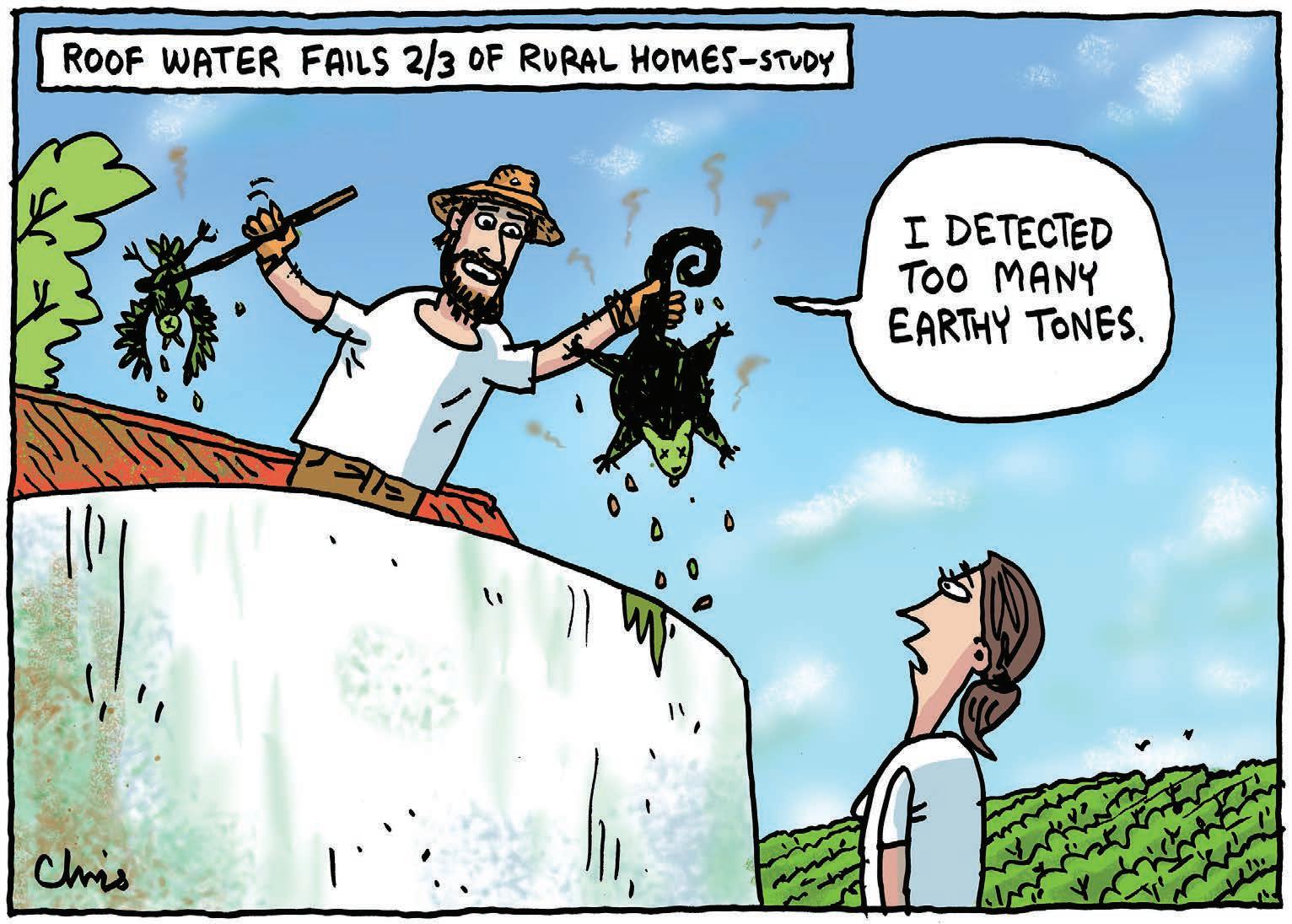
E coli through roof in rain water runoff

ARESEARCHER has described the quality of many domestic rural water supplies as confronting and surprising for a country as developed as New Zealand.
University of Auckland postdoctoral researcher Aayush Raj Joshi’s recent thesis on domestic self-supplied water quality has revealed two-thirds of the 800,000 people relying upon it in NZ have water exceeding safe E coli bacterial levels.
The study, the first of its kind for over two decades, highlights how the poor state of domestic rural water supply is often driven by roof-harvested rainwater introducing a host of quality problems to the water supply.
To find the results we did was quite confronting.
“E coli is the main indicator of water quality, but we also found 86% of households surveyed also exceeded limits for enterococci bacteria, and 58% failed on pH guidelines,” he said.
Now working for the World Bank in his native Nepal, the Manaaki New Zealand scholarship recipient
said the results caught him by surprise.
He said coming from a lesser developed country with its own range of infrastructure and health challenges, Nepalese people tend to look to NZ as having a high standard.
“To find the results we did was quite confronting.”
His study evaluated the water quality of domestic self-supplied households across four regions – Northland, North Auckland, Gisborne and Taranaki.
The study found some aspects of where the water was held, and its immediate environment, heavily influenced its quality.
“A big one was proximity to trees. The more trees over a roof collecting water means more birds, and with that more contamination off that roof.”
Tank type also has a role to play.
Metal tanks and tanks with lower water levels are likely to be the most contaminated.
The region with the worst E coli levels in its water was North Auckland at 78%, and Taranaki the lowest of those studied, at 58%.
New Zealand has long reported gastrointestinal infections above the global average, with between 5000-6000 cases notified annually for the likes of campylobacter, norovirus and salmonella, resulting in about 600 hospitalisations a year.
While institutional outbreaks
Continued page 5
Farmers’ wool as good as gold
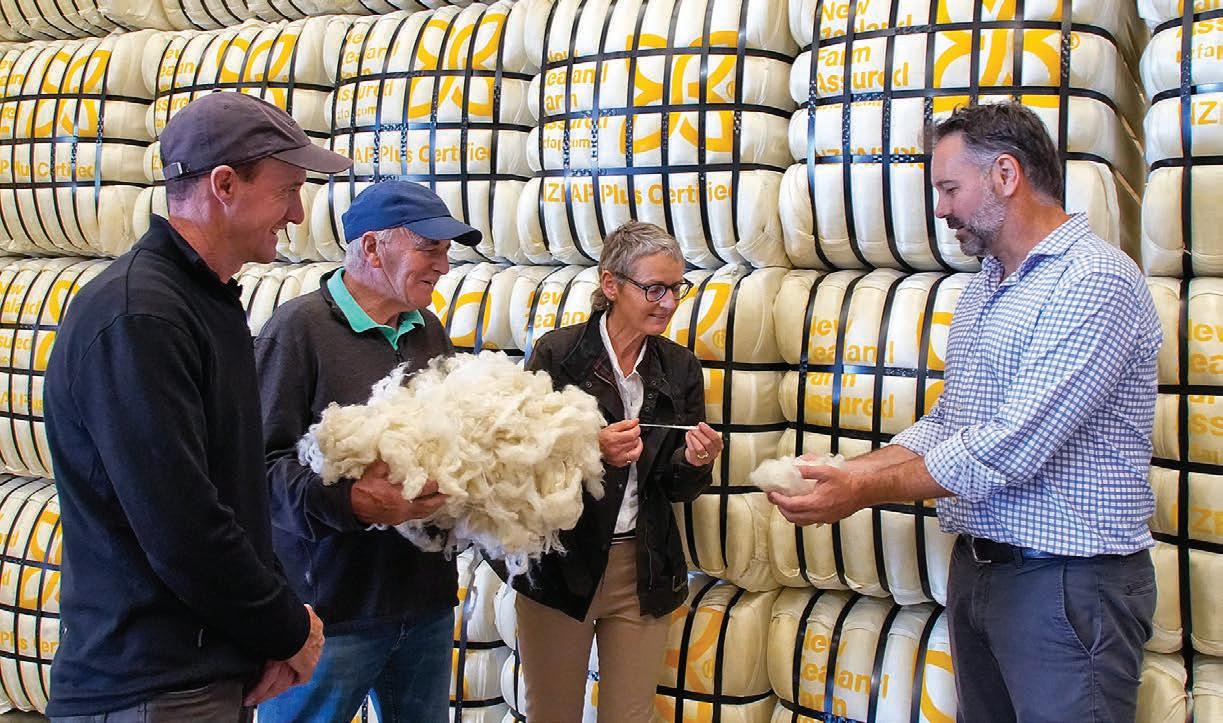
Barewood Station’s Hamish McClean, left, and Russel McClean with Jane Montgomery from Wainui Farm and WoolWorks group CEO Rosstan Mazey check out NZFAP Plus Gold audited wool which was scoured in Timaru recently. The audit gives assurance to international customers that the animals are well cared for, and strong standards are being met across people, environment and biosecurity.
NEWS 10

SFF is back in black, recording a $70 million financial turnaround. NEWS 5
Utes and yarns as station opens gates
Southland’s Glenaray Station opened its gates to the public for the first time “in recent times” for the Federated Farmers High Country Field Day.
NEWS 9
Fuel stockpiling leaves truck refuelling stations running dry. NEWS 7

Time to lose the defensive crouch and stand tall, writes Phil Weir.
OPINION 15



Photo: Gerhard Uys
Richard Rennie NEWS Health
Aayush Raj Joshi
Auckland University















Get in touch
EDITORIAL
Bryan Gibson | 06 323 1519
Managing Editor bryan.gibson@agrihq.co.nz
Craig Page | 03 470 2469 Deputy Editor craig.page@agrihq.co.nz
Claire Robertson
Sub-Editor claire.robertson@agrihq.co.nz
Neal Wallace | 03 474 9240
Journalist neal.wallace@agrihq.co.nz
Gerald Piddock | 027 486 8346 Journalist gerald.piddock@agrihq.co.nz
Annette Scott | 021 908 400 Journalist annette.scott@agrihq.co.nz
Hugh Stringleman | 027 474 4003 Journalist stringleman@outlook.co.nz
Richard Rennie | 027 475 4256 Journalist richard.rennie@agrihq.co.nz
Gerhard Uys | 027 239 4388 Journalist gerhard.uys@agrihq.co.nz
Nigel Stirling | 021 136 5570 Journalist nigel.g.stirling@gmail.com
Isabella Beale | 027 299 0596
Multimedia Journalist isabella.beale@agrihq.co.nz
PRODUCTION
Lana Kieselbach | 027 739 4295 production@agrihq.co.nz
ADVERTISING MATERIAL
Supply to: adcopy@agrihq.co.nz
SUBSCRIPTIONS & DELIVERY 0800 85 25 80 subs@agrihq.co.nz
PRINTER
Printed by NZME
Delivered by Reach Media Ltd
SALES CONTACTS
Andy Whitson | 027 626 2269
Sales & Marketing Manager andy.whitson@agrihq.co.nz
Janine Aish | 027 300 5990
Auckland/Northland Partnership Manager janine.aish@agrihq.co.nz
Jody Anderson | 027 474 6094
Waikato/Bay of Plenty Partnership Manager jody.anderson@agrihq.co.nz
Palak Arora | 027 474 6095
Lower North Island Partnership Manager palak.arora@agrihq.co.nz
Andy Whitson | 027 626 2269
South Island Partnership Manager andy.whitson@agrihq.co.nz
Julie Hill | 027 705 7181
Marketplace Partnership Manager classifieds@agrihq.co.nz
Andrea Mansfield | 027 602 4925
National Livestock Manager livestock@agrihq.co.nz
Real Estate | 0800 85 25 80 realestate@agrihq.co.nz
Word Only Advertising | 0800 85 25 80 Marketplace wordads@agrihq.co.nz
PUBLISHERS
Dean and Cushla Williamson Phone: 027 323 9407 dean.williamson@agrihq.co.nz cushla.williamson@agrihq.co.nz
Farmers Weekly is Published by AgriHQ PO Box 529, Feilding 4740, New Zealand Phone: 0800 85 25 80 Website: www.farmersweekly.co.nz
ISSN 2463-6002 (Print) ISSN 2463-6010 (Online)
1-13
14-15
18
Farmers . 19-22
News in brief
Behrent resigns
Murray Behrent, one of the Alliance Group’s longest serving executives, has resigned after 36 years with the company. Behrent, the manager of livestock and shareholder services, joined the meat company in 1990 and became part of Alliance’s leadership team in 2007. Wayne Shaw, Alliance’s manager of safety and processing, will assume the day-to-day livestock responsibilities.
Synthetic to stay
25-27
28-31

GREY: Environmental lawyer Johanna King says farmers awaiting consents defined by Overseer limits may find themselves in the grey if the software system goes offline.
P12
Supporters of the All Blacks will have to keep wearing synthetic beanies this winter after Norsewear was unable to persuade NZ Rugby to switch to a locally made woollen alternative.
Last year, Norsewear owner Tim Deane wrote to the rugby governing body, questioning why All Black supporters were wearing synthetic beanies rather than wool. Deane said NZ Rugby is locked into a contract with global sportswear giant adidas as its official headgear supplier.
Jelicich appointed
New Zealand Winegrowers has appointed Anishka Jelicich chief executive officer. Jelicich brings more than two decades of leadership experience across New Zealand, the United Kingdom and Europe, in a career in the global wine industry. She will leave her role in Paris with Pernod Ricard, where she was global director responsible for marketing and sales.
Ospri feedback
Ospri wants feedback on proposed updates to the National Animal Identification and Tracing accreditation standards.
The programme supports data accuracy and animal traceability by ensuring information providers and entities working with cattle and deer are equipped to deliver reliable NAIT services. Feedback will help it make the programme more practical and sustainable.





SFF fights its way back into the black

Neal Wallace NEWS Production
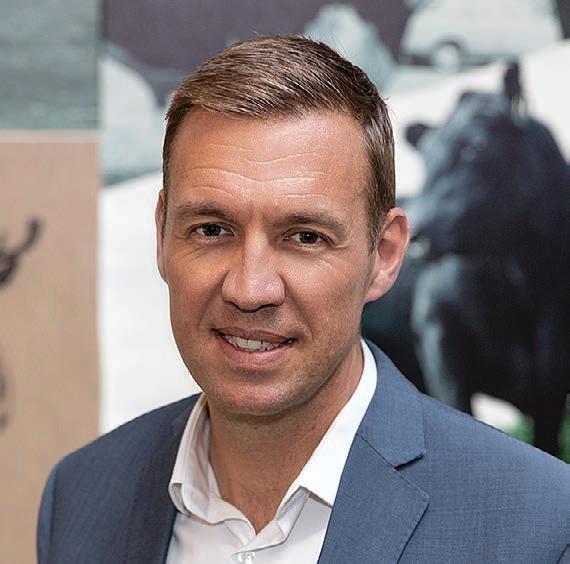
SILVER Fern Farms Ltd is back in the black, overcoming falling stock numbers and higher procurement prices to record a $70 million financial turnaround for the 2025 financial year.
Chief executive Dan Boulton described the $41m net profit before tax for the year to December 31 2025, as “hard fought”.
This compares to a $29.7m before-tax loss for the 2024 financial year. The transformation to profitability was attributed to more confidence across the red meat sector, improved farmgate returns and stronger global demand.
The net profit after tax was $29.1m, compared to a $21.8m loss in 2024.
One of its two joint shareholders in SFF Ltd, Silver Fern Farms Coop, reported a $14m profit before tax compared to an $11m loss for 2024.
Continued from page 1
affect dozens at a time, a study released last year from University of Otago’s public health department indicated rural populations also report rates twice that of urban.
The researchers found that Waikato, Taranaki, Canterbury and Southland were at greater risk for infections.
Joshi said his team had asked households informally if they had been sick with such diseases.
“But in many cases they did not use the water directly for drinking; they would filter it –there was awareness there.”
An area he is keen to explore further when he returns to NZ is the elevated levels of PFAS
The net profit after tax was $14.2m ($10.9m loss).
The other shareholder in SFF Ltd is Bright Meat Group from China.
Boulton told Farmers Weekly that the result reflects a major turnaround in performance in which the company had to contend with a 6% reduction in the national kill, disrupted stock flows and higher procurement prices.
Compared to 2024, Boulton
(per-poly fluroalkyl substances) or “forever chemicals” proven to be harmful to the environment and people and found in water supplies.
“Even rainwater cannot be considered clean today as it contains PFAS chemicals that are dangerous even in small amounts. It is an area I would like to examine further.”
He points to a gap in NZ’s water legislation that means domestic home-supplied water sources are not subject to the same regulated standards as council-supplied households.
“But there are 800,000 people in NZ sourcing water this way and the failure rate against council-supplied water is high.
says numbers are growing again and there is a potential production boost from dairy-beef cross cattle.
said, SFF last year paid 32% more for every animal it bought for processing.
Trading for the first quarter of the 2026 year was on budget despite uncertainty from the Iran war, which has affected shipments to the Middle East through the Strait of Hormuz.
Boulton said some production for those markets has been paused while the conflict is unfolding, but the company has been able to

continue servicing some markets in the region by finding alternative ports.
Gulf markets take 12% of SFF’s lamb and 5% of its beef.
SFF Ltd reported revenue for the 2025 year of $3 billion, ($2.6bn for 2024), while earnings before interest tax, depreciation and amortisation (EBITDA) was $114.2m ($32.7m) and equity rose $38.6m to $743m.
Boulton said no dividend would be paid due to the working capital commitment from high procurement prices and the need for capital investment.
During the year SFF Ltd deferred some capital expenditure but still spent $70m on priority projects.
This week’s poll question:
Are you confident that the water your family drinks is safe?
Have your say at farmersweekly.co.nz/poll
“There is a real need there for the government to extend that to all households.”
Boulton said the result shows the benefits of its branded and added-value strategy, which gives access to high paying markets while creating relationships with customers that are more enduring and beyond transactional.
While cattle numbers have been low for a few years due to herd rebuilding, Boulton said, numbers are growing again and there is a potential production boost from dairy-beef cross cattle.
He also hopes sheep numbers will increase on the back of renewed confidence.
a
that is looking ahead again’.
Success for me will be seeing sheep increasing in numbers in the coming years.
Dan Boulton SFF
“Success for me will be seeing sheep increasing in numbers in the coming years.”
Global production of sheepmeat and beef is declining, which he said should strengthen demand and give farmers confidence.
“Fundamental demand is strong and supply is short, which gives me confidence into the future.”
Silver Fern Farms Co-operative chair Anna Nelson also hopes improved confidence will arrest declining stock numbers so exporters can meet customer demand and thrive rather than simply survive.
“Conversations across farms, field days and communities reflect a sector that is looking ahead again, driven by renewed optimism about the long-term prospects for New Zealand’s grass-fed red meat,” said Nelson.
“Our shared ambition is for the red meat sector to move decisively back into a growth mindset.”
HEADS UP: Silver Fern Farms Co-op chair Anna Nelson says conversations across farms, field days and communities ‘reflect
sector
BOOST: Silver Fern Farms chief executive Dan Boulton
Another WTO summit ends with little gained

ANigel Stirling POLITICS Trade
DEAL to rein in a trillion dollars in farm subsidies is no closer after the World Trade Organisation wrapped up its latest meeting of global trade ministers with little achieved.
Trade ministers representing the organisation’s 166 member countries meet every two years to hammer out deals to free up global trade.
New Zealand was represented at the latest meeting in the Central African country of Cameroon last month by Trade Minister Todd McClay and Labour’s trade spokesperson, Damien O’Connor.
The Geneva-based organisation has long been touted as the best forum for achieving a global deal for reining in trade-distorting agricultural subsidies and tariffs. But there has been little to celebrate since the mid-1990s when its successful Uruguay negotiating round slashed
tariffs on industrial products while achieving smaller cuts for agricultural products.
Hopes had been raised slightly ahead of the Cameroon meeting after the United States arrived touting a list of reforms to pull the WTO out of its decades-long slump.
Most countries there acknowledged that ... ad hoc trade interventions are disastrous for some countries in the short term and for all of us in the long term.
Damien O’Connor Labour trade spokesperson
However, the meeting followed a familiar path with India standing alone among members to block a deal to streamline global investment rules.
The Investment Facilitation Agreement had been promoted by the US and others as a
circuit-breaker for deadlocked negotiations.
As a so-called plurilateral deal it would apply only to signatory countries.
But WTO rules meant it needed sign-off by all 166 members before it could take effect.
A similar deal to tackle subsidies linked to the depletion of global fisheries has also been held up by a small minority of members.
O’Connor said the meeting had again proven the organisation’s founding principle of consensusbased decision-making had run its course.
“The reform of the WTO was very much part of the discussion [and] is what needs to happen if we are to prevent this blocking [of deals] that kills dead some of these really good initiatives,” he said.
O’Connor said agricultural negotiations remain “stuck” following the latest meeting.
He said the Cairns Group of 20 major agricultural exporting countries including NZ could form the basis of a future plurilateral deal.

But under current WTO rules it is a non-starter.
“That kind of progress can be made with people who share the same objectives, but the reality is subsidies are a very sensitive issue for others including the EU and India,” he said.
US President Donald Trump’s Trade Representative Jamieson Greer launched a blistering attack on WTO members after Turkey and Brazil blocked a USled moratorium on tariffs on e-commerce transactions.
Greer said the Cameroon
meeting confirmed for the US that the WTO will play “only a limited role in future global trade policy”.
O’Connor said he was not surprised by Greer’s comments, which mirrored the Trump administration’s view of other global bodies, like the World Health Organisation.
“Most countries there acknowledged that the alternative that we have seen of ad hoc trade interventions is disastrous for some countries in the short term and for all of us in the long term,” he said.
With Mainland behind it, Fonterra sets new course

THE sale of Mainland Group by Fonterra to Lactalis has been completed, setting the cooperative up for growth in the future, chair Peter McBride says.
“With the divestment complete, Fonterra can return capital to its owners and focus on growing further through its core business as a New Zealand farmer-owned global B2B dairy provider,” he said.
Fonterra has a target of returning earnings to FY25 levels
by FY28, offsetting the Mainland Group divestment through focused execution of its strategy.
Mainland Group comprised the global consumer businesses and brands, excluding China, where Fonterra will still own the Anchor brand.
Fonterra now turns to growing ingredients and foodservice businesses worldwide under the NZMP and Anchor Food Professionals brands.
“We can now focus our resources, R&D spend, and farmers’ capital on continuing to grow these businesses, which generate the

greatest return for farmers’ milk,” chief executive Miles Hurrell said.
“The completion of the sale also signals the start of our longterm partnership with Lactalis, which becomes one of our most significant ingredients customers, as we continue to supply milk and other products to the divested businesses.”
The raw milk sale agreement is for 10 years plus automatic renewal, and ingredients like bulk cheese for six years minimum.
From the proceeds of the Mainland sale Fonterra will make a capital return of $2 a share to
its milk suppliers and its unit investors, totalling $3.2 billion.
The record date for that capital return eligibility is 5pm on April 9 and payment will be made on April 14.
A trading halt will apply from April 8 to 10 inclusive to ensure trades have settled before the record date and giving time for Fonterra to update its share register.
Farmers-only Fonterra supply shares are trading slightly above $6, some one-third higher than a year ago, while Fonterra Shareholders Fund units are
We can now focus our resources, R&D spend, and farmers’ capital on these businesses, which generate the greatest return for farmers’ milk.
Miles Hurrell Fonterra
around $8.20, more than 40% higher, in the run-up to the capital return and interim dividend payment on April 14.



REPRESENTATION: New Zealand was represented at the latest meeting in Cameroon by Trade Minister Todd McClay and Labour’s trade spokesperson, Damien O’Connor. Photo: World Trade Organisation
Hugh Stringleman NEWS Fonterra
Diesel stockpiling a headache for truckers

THE stockpiling of fuel has led to truck stop refuelling stations around New Zealand running dry, causing immense frustration for commercial transporters.
Livestock transport drivers at Hawke’s Bay-based rural transport company Stephenson Transport found themselves unable to fill up at stops around Gisborne.
CEO Todd Stephenson said it was occurring across the country.
“As far as fuel running out, it is happening, there’s no doubt.” It had not happened to a driver with a truck filled with stock, he said.
Drivers were also hitting their daily limit of fuel on their company fuel card more frequently because of the spike in fuel prices, he said.
The scarcity of fuel has meant their supplier could no longer supply Stephenson Transport’s depot in Waipawa.
Instead, fuel suppliers are concentrating on main supply lines.
“We’re pretty much taking it day by day at the moment.”
National Livestock Transport & Safety Council chair Derek Foley said the truck stops running dry is a demand issue, caused by people constantly topping up and in some cases stockpiling.
“That’s what’s putting pressure on the supply chain.”
Foley said the spike in fuel prices has pushed this input from being around 26-28% of business costs to 35%.
Fonterra said it has established an incident management team to monitor the impacts nationally and globally for its farmer owners. This includes fuel for its fleet of more than 500 milk tankers.
“We are in close contact with our fuel suppliers and are considering what the impact may be under each of the government alert levels. Fuel security is an integral part of doing business for farmers and the co-operative,” the co-op said.
“We have not made any changes to rostering or remote work settings and will be guided by government settings.”
Transporting New Zealand CEO Dom Kalasih said their members have reported “stock-outs” (a dry











pump) in Taranaki, Cromwell, Invercargill and Christchurch.
He has also heard of issues across other regions.
“The number of stock-outs is higher than normal.”
It is concerning and adds a lot of stress for operators, he said.
Kalasih recently met with representatives from Z Energy, who he said told him the biggest issue was demand spikes caused by people stockpiling diesel.
Most truck stops typically store around two to three days of fuel, but the extraordinary demand seen in the past week has made it very difficult for all of the stops to have fuel in them all the time.
As a result, Z is trying to rationalise its truck stop network at a regional level and be more strategic in deciding what stops to keep fuelled up.
Kalasih said the industry is already acting at an unofficial Level 2 setting of the government’s national fuel plan.
This phase has seen homes, businesses and the public sector encouraged to conserve fuel.
Level 3 would see fuel prioritised for life-preserving services and Level 4 would see stricter intervention in fuel distribution.






He said he is wary of Level 3 prioritisation as it would lead to Transporting New Zealand being its de facto enforcer.
Kalasih said one potential solution is increasing the payload capacity for heavy vehicles,
which would improve fuel efficiency and reduce diesel cost pressures.
He has written to New Zealand Transport Agency Waka Kotahi, asking the agency to amend the rules to allow this to happen.



Formulated to provide ultimate parasite protection and performance for your cattle ECLIPSE offers the ability to withstand the elements, ensuring reliability in all conditions, much like this 90 L Gear Bag yours with qualifying purchases of ECLIPSE products this season
Gerald Piddock NEWS Transport
DRY: Volatile prices and fears of shortages are causing people to stockpile diesel, resulting in truck stops running dry in regions across the country.
Photo: Pexels



Utes and yarns as fabled station opens gates

GLENARAY Station in Waikaia opened its gates to the public for the first time “in recent times” for the Federated Farmers High Country Field Day in Southland.
The station covers 68,000ha, spanning 84km as the crow flies at its longest point, and 40km at its widest point.
It recently mated 36,500 ewes, put bulls over 3500 cows, and put 4500 hinds to stags.
It has 22 staff and runs more than 100 dogs.
The station is owned by W Pinckney Ltd, and run by a board on which owner Dave Pinckney sits.
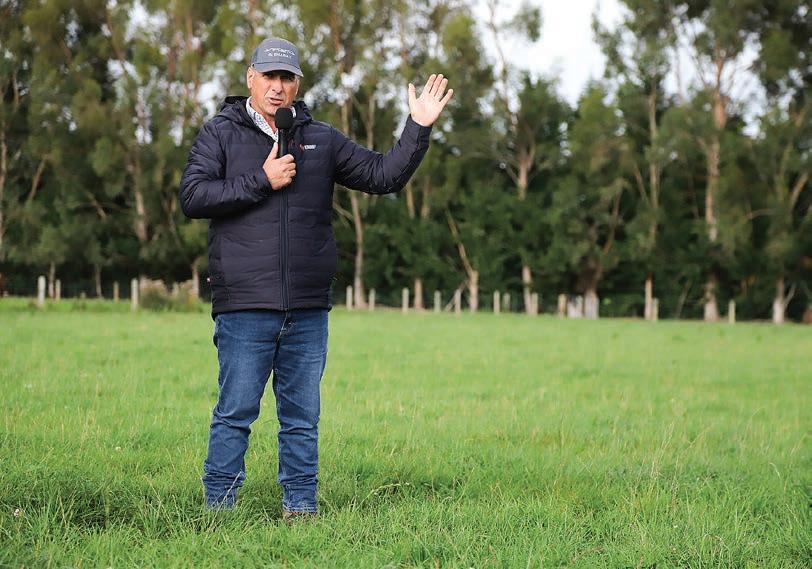
Chair John Tavendale told the visitors on the field day – about 280 of them, roaming over the station in roughly 80 utes – that the board was established in 1982 after Pinckney’s parents were killed in a helicopter crash and his uncle, George, asked their accountant to set up a management system that could take the station forward.
Pinckney was 18 years old at
the time and his youngest sister was 11.
Simon Lee is general manager. He told people attending the field day that staff are the pillar he leans on and there is continual development for all team members.
The farm takes on, for example,
Telford students for work experience.
External trainers, such as veterinarians, do seasonal training with staff, and block managers are trained in aspects such as animal health.
There are also off-farm trips to expose staff to relevant topics.
“They are the future of the industry, they need opportunities,” Lee said.
Lee said it takes a lot to manage such an expansive property, and not only is there the station to think of but there is a campsite, and fishermen access rivers from various points on the property. All that has to be managed.
The farm uses technology to improve production.
Every morning at 5:15am Lee gets an email that tells him what the weight gain on their finishing cattle is.
The station has been using a lot of new technology lately, including Halter, and Optiweigh, a device that weighs the front threequarters of animals and then tells you what their daily weight gain is, and a Bluetooth-enabled drench gun.
Halter is used on finishing cattle and on cows in hill country.
From the Optiweigh data Lee sees weight gain, but also whether there is an issue with water and hydration and if cattle are underfed.
Pinckney comes down every three weeks from his base in Christchurch, with Lee saying Pinckney is actively involved, and has been seen on handpieces shearing or drenching.
Spring and winter are dangerous and every shepherd has a side-byside, used for versatility and safety.
Lee said they do have horses but use them less than they’d want to.
The station plants radiata in weed-invested gullies; the trees are in the Emissions Trading Scheme.
W Pinckney Ltd is a shareholder
The station faces the same threats as other stations, such as wilding pines.
Lee said Glenaray identified wilding pines as a threat three years ago, with seeds spreading from seed banks 20km away.
The station spends $270,000 per year on gorse and broom control and $100,000 on thistle control.
“If wildings got away from us it would be tenfold.”
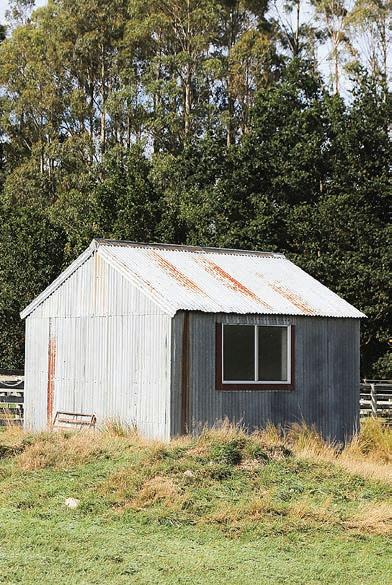
The station has a number of historical huts which are being restored because of the heritage value. Some of the huts were home to mustering gangs in the 1800s.



















WIDE: Glenaray Station general manager Simon Lee says it takes a lot of work to manage such an expanse of land. Photos: Gerhard Uys
in an abattoir in Dunedin and the operation shoots wild deer from the station, which is processed and exported.
Gerhard Uys NEWS Agriculture
HISTORY: The station has a number of historical huts, which are being restored because of their heritage value. Some of the huts were home to mustering gangs in the 1800s.
McClean green farm credentials are golden
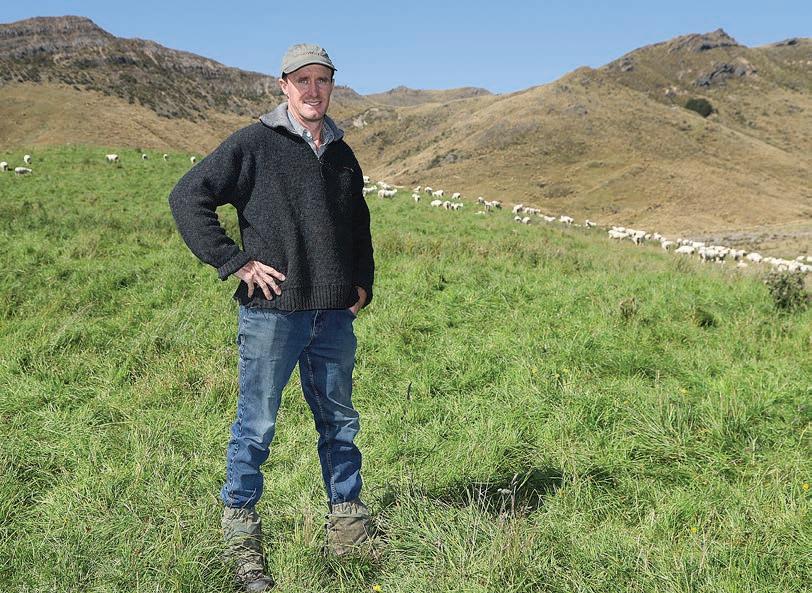
HAMISH McClean from Burwood Station is one of two farmers who just had the first commercial batch of NZFAP Plus Gold audited wool scoured.
The wool from McClean’s operation, along with wool from Wainui Farm, was scoured at WoolWorks scouring plant in Timaru.
The 55 tonnes of 34-37 micron greasy wool will make up about 40 tonnes of premium wool that will likely go to India to make highend rugs.
Burwood Station, between
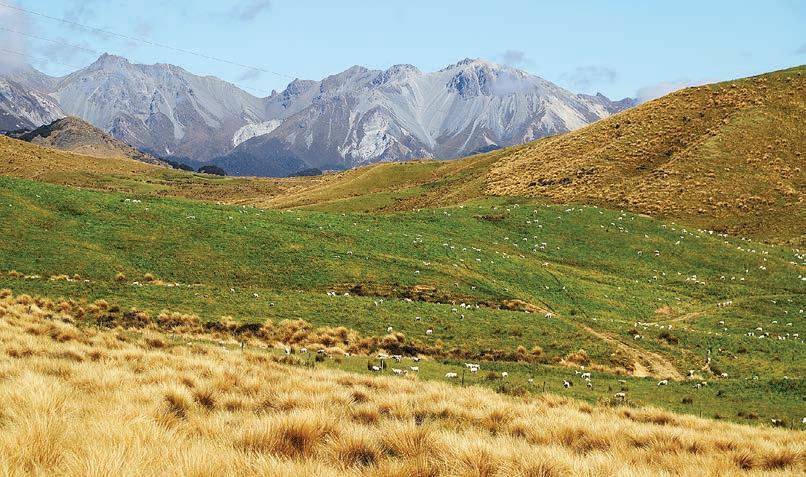
Te Anau and Mossburn, covers 3800 hectares, running 15,500 Headwaters breeding ewes and 600 breeding cows.
Headwaters is a stabilised composite breed that evolved from a four-way cross of Finn, Texel, Romney and Perendale genetics. They are bred with high levels of fat purposely to thrive in the New Zealand hill country, and supplied to Lumina for top-quality eating.
McClean said he could have gone for the standard NZFAP audit, but decided to go full tilt so he could open up opportunities in good markets, not only for meat but also for his wool.
Taking care of the land has always been the culture at Burwood, with McClean saying he
had not had to change much in his approach to farming since he was audited for NZFAP Plus Gold.
However, being audited means he has fine-tuned operations and is recording a lot more of what he does.
“We were already fencing waterways, looking after people and protecting biodiversity.”
For example, red tussock on the land has been protected for decades.
McClean said now that everything is documented he has plans to keep building on what they already have, such as more strategic fencing, and looking after that tussock hill country.
He now also monitors waterways more, with eDNA samples taken once a year to see what’s present in water, and nitrogen levels monitored more often.
Testing proves to him that what they are doing is working.
Audits look at the environment and waterways inputs, such as fertiliser use, people management, biodiversity, wildlife, pest control, traceability, greenhouse gas numbers and more.
Staff are also interviewed during auditing.
WoolWorks group CEO Rosstan Mazey said the two NZFAP Plus Gold farms supplying the wool to be scoured at WoolWorks through their Grower Direct programme have detailed annual carbon
Fuel hikes no bar as interest in Fieldays heats up
Fieldays
RISING fuel and associated costs have done little to curb Fieldays exhibitor demand with 97.8% of the sites filled more than two months out from the event.
There are 18 spaces left to fill among the estimated 1200 sites and waiting lists in several areas for this year’s event, which runs from June 10 to 13.
“This is the furthest along we have been in site allocations in recent history,” Fieldays Society event producer Karina Missen said at a media event at its Mystery Creek site.
Exhibitor demand has also led to the pantry, rural living, heavy equipment and motor vehicle areas expanding in size.
Fieldays Society CEO Richard Lindroos said the demand highlights that while external factors are influencing the wider economy, agribusiness remains strong.
“April 14 is the payday for Fonterra and obviously they’ll pay back some debt, but also they’re investing in kit, and I think in terms of outdoor agri machinery it will be a very successful Fieldays for people.”
International interest has also
not waned, with exhibitors coming from Italy, China, Ireland, the Netherlands, Germany and for the first time, India.
There were also government officials and delegations coming from China, the United Kingdom, the European Union, India and the United States.
Ticket prices have increased to $36 for adults and $18 for children.
Lindroos said he is looking to increase the public transport on offer to and from Fieldays in the wake of soaring fuel prices and he is expecting at least 20,000 people to use this service.
Missen said this year’s event will focus less on introducing new things and focus on making the existing programme better.
All of the hubs – forestry, innovation, health and wellbeing, the drone zone and careers – are back, as are the regular competitions and tent talks.
Improvements are underway after the Society secured a $1.35 million loan from the government’s Regional Infrastructure Fund to upgrade the site’s ageing water system.
Work started on this $3.2m project late last year, the balance being paid by the society. It is expected to be finished in time for this year’s Fieldays.
directly to a GHG data from WoolWorks scouring processes.”
We were already fencing waterways, looking after people and protecting biodiversity.
Hamish McClean Burwood Station inventories that outline the emissions impact of their farming operations.
This, coupled with Timaru’s decarbonised scouring process, means the scoured wool reaches the factory exit gate with a very low product carbon footprint figure.
“For the first time, we’re able to connect real GHG farm data
Global textile manufacturers increasingly want measured carbon data rather than just environmental sustainability statements, Mazey said. These scourments are proof that NZ is more than capable of positioning into that premium evidence-based market, he said.
Megan Mounsey-Smith, general manager of New Zealand Farm Assurance Incorporated, which oversees the NZFAP programmes, said there’s growing momentum in NZFAP across the industry, as many farmers, processors and exporters recognise the value of independently verified standards.
Strong field for Dairy Woman of the Year
Staff reporter PEOPLE Awards
Lindroos said Fieldays is a national strategic asset, and the site needs to be a fit-for-purpose venue to keep hosting the event. The assets on the site have to be improved if it is to attract people wishing to hire the site for an event and that upgrade is a 15-year event.
TWO dairy farmers from Taranaki and a Bay of Plentybased Māori farming leader have been chosen as the finalists for this year’s Fonterra Dairy Woman of the Year award.
Finalist LeAnne Blakelock is a dairy farmer, sharemilker and chartered accountant based in Inglewood, Taranaki.
Rachel Short owns two certified organic dairy farms near Opunake alongside her husband and parents.
Te Tawa Kaiti Lands Trust general manager Hinehou Timutimu leads a dualenterprise farming model combining dairy and maize in the Bay of Plenty.
The award recognises an outstanding woman who has contributed to the dairy sector with passion, drive, innovation and leadership.
The recipient of the Fonterra Dairy Woman of the Year award will receive a scholarship to be part of the Kellogg Rural Leadership Programme.
The scholarship covers the programme fee, travel and accommodation, mentoring and access to Dairy Women’s Network (DWN) and Fonterra platforms to share research. DWN trustee and head judge Jenna Smith said the calibre of
this year’s finalists reflects the depth of leadership emerging across the sector.
“Each finalist brings a distinct perspective and a clear commitment to shaping the future of dairying in Aotearoa,” Smith said.
“What stood out this year wasn’t just capability, it was clarity.
“These women are clear on what matters, clear on the role they can play, and they’re already getting on with leading.”
The award’s five judges include representatives from DWN, Fonterra, Rural Leaders, Ballance Agri-Nutrients and a previous Fonterra Dairy Woman of the Year recipient.
Finalists are assessed on a range of factors including commitment, drive and passion for the dairy sector.
They will need to be a positive role model for women in dairying and a strong performer who is recognised by her peers as a potential leader, demonstrating leadership within her community, and with a wider circle of influence than her local community, holding or having previously held leadership positions on regional or national dairy organisations.
The Fonterra Dairy Woman of the Year award will be announced on May 5 at the Gala Dinner of the DWN Conference 2026 in Christchurch.
FIRST: Hamish McClean from Burwood Station is one of two farmers who had the first commercial batch of NZFAP Plus Gold audited wool scoured at the WoolWorks Timaru plant.
Photos: Gerhard Uys
Gerald Piddock MARKETS
FILLING UP: Exhibitor sites at this year’s Fieldays at Mystery Creek are 97.8% filled just a few months out from this year’s event, says Fieldays Society CEO Richard Lindroos.
Gerhard Uys NEWS Wool
FOOTPRINT: Being audited to the NZFAP Plus Gold standard means the environmental footprint of a farm is continually audited and there is continual improvement.
Nutrition for next season
Andy Davis Te chnical Manager Hor ticulture
I m m e d i ate l y p o s t h a r ve s t
i s t h e f i r s t a n d a rg u a b l y m o s t
i m p o r t a n t o p p o r t u n i t y to b e g i n n ext s e a s o n ’s n u t r i t i o n p ro g ra m m e i n b ot h a p p l e s a n d k i w i f r u i t .
Once fr uit is remove d, the plant undergo e s a critical physiological shift from crop filling to re s erve building. During this window, leave s remain active, ro ots often undergo a late s eas on flush, and nutrients are actively translo cate d into buds, p ermanent wo o d, and ro ots prior to leaf s ene s cence. In a high p erforming apple or kiwifr uit orchard, p o st-harve st nutrition is not ab out pushing growth, but ab out replenishing re s erve s that will drive budburst, flowering, and early canopy development in the following spring
Similar principle s als o apply in other p erennial crop s such as grap e s and summerfr uit, where early s eas on growth is heavily dep endent on store d nutrients. Two micronutirents that re sp ond well to p o st harve st applications are zinc (Zn) and b oron (B) B oth are e s s ential
for bud development, flower fer tility and p ollination, fr uit s et, and early growth.
Re s earch shows that when Zn and B are applie d while leave s are still healthy, b oth nutrients are remobilis e d into buds during s ene s cence. This make s p o st harve st one of the mo st reliable timings to lift bud nutrient status An effe ctive option for applying p o stharve st B and Zn is Biolchim NutraG emma @ 2-3L/Ha NutraG emma will supply B and Zn in a highly available form.
By loading buds in autumn, reliance on spring uptake, which is often limite d by co ol springs, is significantly re duce d Po st harve st nitrogen (N) is often under utilis e d due to concerns ab out exce s sive vigour or s oft fr uit, yet re s earch consistently shows that p o stharve st applie d N is store d, not expre s s e d as growth
N is store d as amino acids and proteins in the plant and plays a key role in floral bud strength, early sho ot growth, and consistent fr uit s et In the early spring, although the demand for N is high, s oil temp erature s are low and ro ot uptake is slow and inconsistent
Due to the s e conditions, applying p o stharve st foliar N is often more efficient than applying it on the s oil as there is no leaching, uptake through leaf is quick, and there is rapid translo cation into storage tis sue s. This means that N is readily available at bud break and for early canopy development
For p o st-harve st applications, timing do e s matter. L eaf and tis sue re sults colle cte d during the s eas on should guide p o st-harve st programme s S eas onal conditions, hot, dry years versus co ol, wet s eas ons, strongly influence nutrient drawdown and replacement ne e ds. Applying the s ame programme every year risks under or over supplying nutrients. Cr ucially, foliar nutrition must b e applie d imme diately p o st harve st while leave s are gre en and functional Once yellowing and leaf drop b egin, uptake efficienc y falls sharply.
Yield and quality p otential for the coming s eas on is often determine d in the we eks after harve st Strategic p o st-harve st nutrition in apple s and kiwifr uit sits at the top of the list for building strong re s erve s, improving spring p erformance, and delivering consistent re sults year on year
Potential legal tangles in Overseer failure
Richard Rennie TECHNOLOGY Regulation
ALEGAL expert has highlighted the risk that Overseer falling into commercial jeopardy may raise challenging legal issues for farmers who rely on it to prove compliance, and for councils tasked with enforcing their planning rules using it.
Johanna King is an environmental lawyer and senior associate with national law firm Tavendale and Partners. She has extensive experience working with farmers and developers, navigating Resource Management Act (RMA) requirements.
Overseer management has commissioned a PwC report to identify new income sources for the cashstrapped software service, coming after three years of six-digit losses and a rapid burn through of remaining cash reserves.
King said should Overseer go offline it would present an
interpretation challenge for councils who have incorporated it into their regional plans and resource consents.
“The courts are already trying to figure out how to use it fairly and reliably in regional plan changes, given its limitations and the impact new versions can have.
“But if it disappeared entirely then that’s a different headache for those plan changes going through the court process, and for the existing plan rules and consents that already incorporate it.”
Overseer is currently embedded in the regulatory framework of eight regional councils in NZ in varying ways.
This is despite a 2021 independent review finding it has limitations as a standalone tool for estimating total nitrogen losses, and a 2016 technical guidance report warning that version changes could cause issues in applying planning rules if not adequately drafted for.
Some in the sector have main-
tained that a commercial model established in 2016 as Overseer Limited was less than ideal for a system crossing over between private farm business application and a regional council enforcement tool.
Farm consultant Dr Alison Dewes said it has struggled since its commercialisation, partly a result of high licence fees and a lack of public investment to lift its accuracy as a modelling tool.
“Meantime you have some councils wielding it too exactingly. Unfortunately, it is being used as the primary measure.”
Should Overseer disappear, King said, other yardsticks could potentially be relied on in the interim to regulate nutrient losses, until regional plans are altered. She said arguably those who have already been granted consents may have more certainty, because their operations likely had other quantifiers in the context of their consent they could fall back on to prove de facto compliance. These could include herd size,
Chequebooks open for herd

Gerald Piddock MARKETS Livestock
ONE of the country’s top dairy herds has gone under the hammer with the sale of Phil and Sandra Wright’s Jersey cows and heifers on the farm they sharemilk near Rotorua. The sale of the 500-cow herd capped 35 years of dedicated breeding and selection by the Wrights, with 106 registered buyers and 45 purchasers eager to own some of New Zealand’s best dairy genetics.
NZ Farmers Livestock agent
Michael Conwell said the cows averaged $4315 with the best of them making $10,000. The top price for a heifer was $12,600 and they averaged $3610.
Conwell said the prices were around $1000 above what current top herds in the market are selling for.
The buyers were from all over the country, with 100 of the cattle heading to the South Island and the rest headed to Whangārei, Taranaki, Waikato, Bay of Plenty, Central Plateau, Manawatū and King Country. Buyers included commercial




hectares used for irrigation or winter grazing, and crop types.
Farmers relying on permitted activity rules, or still awaiting to apply for consent under rules that may not be as clear-cut without the Overseer component, would find themselves more “in the grey”.
“But each situation depends on the wording of the regional plan or the consent conditions. If Overseer goes offline completely, or farmers are left with only static copies of their prior reports, what that gap
farmers and pedigree Jersey breeders.
Phil Wright said he and Sandra were really happy with the sale and the prices that the cows and heifers were sold for.
“I thought I had it all together and there was a big build-up before the auction and when the first pen was in, I did get emotional, and I found it pretty hard throughout the sale,” he said.
He said next year they plan to sell 180 of the rising oneyear-old heifers they kept, 19 of which are contracted to LIC.
GREY: Environmental lawyer Johanna King says farmers awaiting consents defined by Overseer limits may find themselves in the grey if the software system goes offline.
looks like – and the context it sits in – is crucial.”
She anticipated the risk of councils prosecuting farmers in the event Overseer went offline would be unlikely.
“As long as operators are playing with a straight bat – but at the end of the day, it depends on the facts and effects.
“However, under the RMA, third parties do have the ability to initiate enforcement by applying to the Environment Court.”
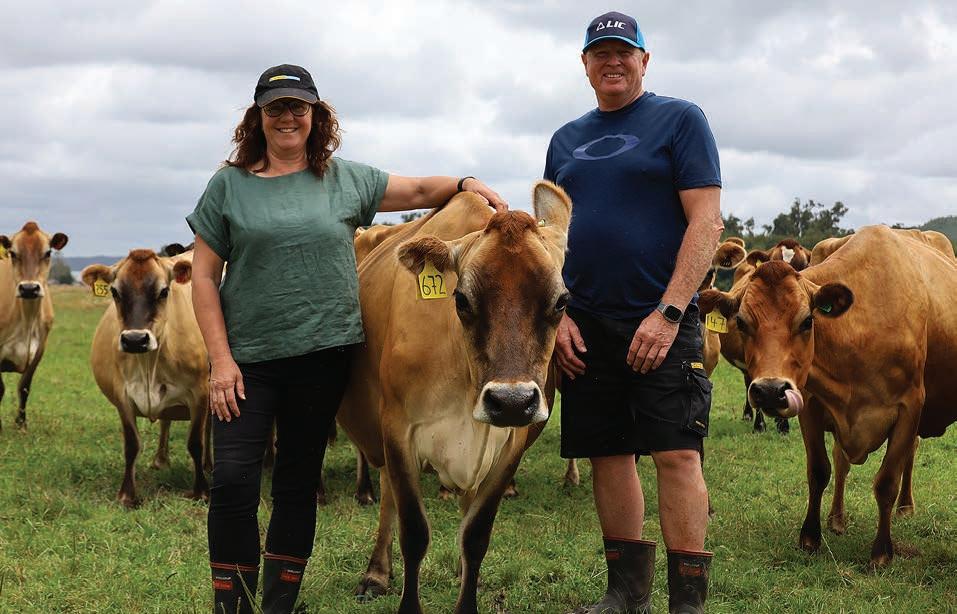
SELECTION: The sale of Rotorua dairy farmers Phil and Sandra Wright’s jersey herd capped 35 years of careful breeding and selection.



Real results come from real know how
Here’s how Mark Guscot t is t ackling drench resist ance
There’s a lot of talk about parasite resistance, and no wonder, because it’s a huge issue and has put farmers under big pressure
Thank fully, with a bit of new management, all that pressure can be eased.
In fact, there’s a growing number of farmers who are star ting to make real inroads into the problem by managing the situation differently than they have in the past
So, in order to share what’s working well to combat resistance, we caught up with a bunch of these for ward-thinking farmers to get a dose of the good oil.
Because we figure what’s working for them will likely work out for other farmers too
Take Mark Guscot t
For over 20 years, Mark and his wife Susannah have run their six th- generation family farm in the Wairarapa, supplying high-value product to the likes of Atkins Ranch
Their 140 0 -hectare operation balances breeding stock, finishing lambs and cat tle, and arable farming, while also leveraging tourism as a profitable side business
If you ask Mark what he’s changed most in the past two decades on his Wairarapa farm, it’s not just the drench cupboard, it’s the thinking too
“At the moment we’ve probably got about 40 to 45% of our feed demand from capital stock and that stock never gets drenched. We haven’t drenched a ewe here for probably 10, 12 years probably ”
That’s not neglect, it’s strategy, much like his policy to find replacement ewes from known sources
“ We impor t the parasites that we know we can kill ”
Meaning the triple drenches that once worked so well are no longer the only go -to
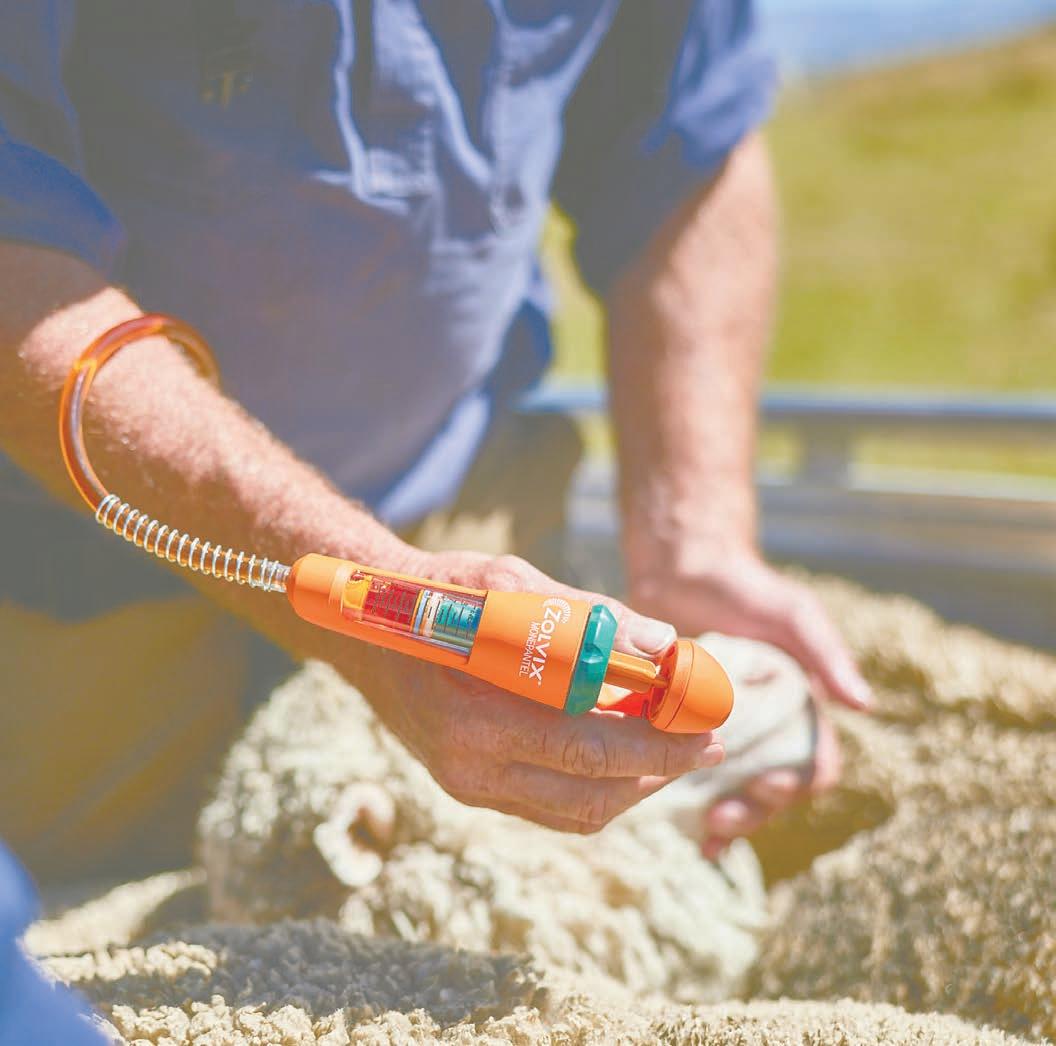
“They’re only sor t of 60% effective for us nowadays, so it’s not a great place to be ”
But rather than accept the situation, Mark’s programme constantly evolves with Zolvix Plus as one solution in the mix
“Now we go matrix or triple, triple, Zolvix Plus, triple, triple, Zolvix Plus ”
And Mark’s cr ystal clear, drenching is only one lever
“ We feed them high protein feeds all the time, chicories and rakes and kales and that sor t of stuff ”
He calls it “ Vitamin G ( Vitamin Grass) ”
“My vision of food is the bet ter we can feed our stock, the less inter ventions the bet ter ”
And just obser ving can play a huge role in helping form the right strategy
“Scales are par t of it, but there’s a bit of ar t to it too You know, you can just smell things or you can just see things ”
Mark reaches out for suppor t as well, where and when he needs it, and his team includes a couple of sharp, late twenties farmers who grew up with resistance as par t and parcel of farming
“They just come in and they go, something’s not right and I want to do this or I want to do an egg count and invariably they’re right ”
The seasons mean adapting and changing the response too
“Just a while ago we had two months of really dr y hot weather, then it’s just pissed with rain for the last three weeks so we have to change just on that ”
Testing, learning and adapting means the resistant parasite issue has become a problem that can be solved pragmatically
“I don’t think you can farm if you want to stick with that whole we’re going to do the same thing ever y year It just doesn’t work ”
Mark’s also a big fan of exper t research
“ What’s been actually really good is we got involved with a woman called Anne Ridler So she’s a researcher at Massey You know, you just got ta understand more about how it works, so she was really good. I mean she’s a vet, but she’s a vet on steroids really ”
So now there’s no doom and gloom in how Mark talks about resistance but more of a ‘business as usual’ issue
“ We’re never totally screwed, that’s the wrong at titude I want to keep our business in a healthy state and making money ”
And Zolvix Plus?
It’s one tool, used deliberately in a bigger management picture
“It’s that whole holistic t ype thing as well.”
For Mark, overcoming parasite resistance wasn’t and still isn’t about finding a silver bullet, more about changing the habits that no longer work and replacing them with those that do
Educating himself Backing his team Using the right tools at the right time
“You know, I’m a lot of things, but I’m not a quit ter So we just sor t of got into a whole change mode and turned the whole farm system around.”
To get the full stor y on how more and more farmers are overcoming parasite resistance, visit ‘Stories from the front line’ at f a r m a n im a l e l a nc o.c om /nz /s tor i es-f r omt h e -f r ont-li n e or scan the QR code to listen to Mark’s podcast
Brought to you by Zol v i x Pl u s and E l a nc o Proud to back Kiwi farmers on the front line against parasite resistance
From the Editor
Sector cheer another casualty of Iran war
Neal Wallace Senior reporter
FEBRUARY 28 was not that long ago. In the weeks leading up to that day, confidence within the primary sector was palpable, with a few exceptions, due to forecast record or high dairy, meat, kiwifruit and apple export prices.
But, as with many good things in life, it all proved too good to be true.
On February 28 news broke that the United States and Israel had attacked Iran, throwing into disarray global order, fuel prices and supplies and supply chains.
The unprecedented optimism across multiple primary industries was replaced with concern and fear after Iran threatened to attack ships accessing or leaving the Persian Gulf via the Strait of Hormuz, through which 20% of the world’s oil and key fertiliser products pass.
Subsequently, fuel prices have soared, shipping supply chains have been disrupted,
LAST WEEK’S POLL RESULT
exporters face a war surcharge and there are concerns about the relocation of containers and access to cold storage should the war be prolonged.
Fortunately, exporters have something of a playbook from the covid crisis and are starting to plan for various disruption scenarios.
Farmers Weekly has reported that there has been a sharp spike in diesel prices and some rural retailers have run out of fuel, but the country’s fuel stocks appear broadly in line with normal levels.
The government last week announced that with fuel already in the country or scheduled to arrive within the next three weeks, New Zealand has 59.3 days of petrol and 54.5 days of diesel.
Situated as we are on the last stop on the supply chain, our only option is to be agile and to adjust.
It just costs substantially more.
As if that wasn’t enough to dent sector optimism, in the past few weeks it emerged that a significant portion of the country’s processed vegetable sector would be shut down by the withdrawal of McCain and Heinz Wattie’s.
Although not as significant as the Iranian war, it is devastating to Hawke’s Bay and Canterbury, affecting 320 growers along
VOTERS resoundingly supported the development of a national food strategy, with almost 95% voting in favour of the concept.
Many who backed the idea thought letting other New Zealanders share the high-quality food we produce was vital.
“Profit before people needs to change, we export our quality food overseas and import crap food to eat ourselves – it’s so wrong,” one voter said.
Others highlighted the threat posed by our isolation and size.
“We are a very small country on the back end of the world. When large scale events happen globally, NZ is at very real risk of being dropped off shipping routes and supply chains. Our government should be very motivated to develop a sustainable national food strategy that ensures NZ continues to survive and thrive during global upset.”
Among those who opposed the concept, the prevailing view was that we are part of a global food system and that the market should dictate how we operate.
“The market will dictate our food system – not another quasi-government organisation or co-op. They are a false economy.”
with contractors and employees, and is a blow to food security and land use options.
Politicians and economists are frantically trying to calculate the impact of the war on the New Zealand economy, replacing relatively upbeat and positive forecasts a bit over a month ago with something a lot more gloomy.
ASB chief economist Nick Tuffley has lowered economic growth for the coming year by 1.6 percentage points due to higher fuel costs.
The bank is picking inflation this year to rise in the near term and peak at about 4%, which will put pressure on the official cash rate just as households were starting to feel some relief.
There is a general expectation interest rates will rise this year as the Reserve Bank tries to curb inflation.
The cause of this global disruption is beyond our control and, situated as we are on the last stop on the supply chain, our only option is to be agile and adjust.
Primary sector exporters say the strong market demand that unpinned their earlier optimism largely remains, albeit returns are being trimmed by higher fuel and shipping costs.
It is unfortunate that events far from our shores are removing the gloss from what would have been an exceptional year, but at least international prices are at such a level as to not be disastrous for farmers and growers.
Last week’s question: Should the government prioritise developing a national food strategy?
Letters of the week Cutting back on excellence
Prof Jon Hickford
Former president of the NZ Institute of Agricultural and Horticultural Science LINCOLN University is in the news again after Vice-Chancellor Professor Grant Edwards asked for over 40 staff redundancies. Facts and figures are being bandied about, but in short the books aren’t good.
It could take pages to explain this in detail, but excessive capital expenditure over many years, all of which needs to be depreciated, has been at the expense of staffing and maintaining a healthy balance sheet.
Put another way, when diesel prices rise, farmers don’t dash out and buy a new ute. They think very seriously about their use of fuel, trim costs elsewhere and keep the old Hilux for another year.
Balance this against the announcement on March 26 that Lincoln has been rated by Quacquarelli Symonds, an organisation that rates universities, as being 82nd globally in the Agriculture and Forestry category. Achievements of this kind should be celebrated because they underpin our land-based primary industries and wealth creation.
To be fair, Massey University scored a very credible 49th place in this ranking system. They are brilliant at what they do, and while competition between our two “agricultural universities” keeps everyone on their toes, New Zealand would be worse off without the contribution they make. Who are the competition? Well neither university is close in overall rating to first place holder Wageningen University & Research (WUR). The Dutch know how to do agriculture well, as does second-place holder, the University of California, Davis. We Kiwi agricultural and horticultural scientists dream of having the budgets they have! We are globally recognised for what we do, and the quality we maintain in research does affect how well we teach. Together this helps make New Zealand agriculture and horticulture world-leading.
All this, yet the axe is hanging over all staff at Lincoln. This includes our world and locally recognised agricultural and horticultural scientists, about 30 academic staff in total. One has to question Lincoln’s leadership, because a smart vice-chancellor and university council wouldn’t kill the golden goose.
Send your letter to the Editor at Farmers Weekly P.0. Box 529, Feilding or email us at farmers.weekly@agrihq.co.nz

This week’s poll question (see page 1): Have your say at farmersweekly.co.nz/poll Are you confident that the water your family drinks is safe?
We’re winners, not victims
Eating the elephant
AFEW weeks back, a blown-out culvert on Corcoran Road sent a torrent of floodwater tearing across our place, wiping out the water pump and leaving a land remediation headache. We sorted the pump and started the clean-up, but there is always a hangover after the chaos. I noticed it over the following days.
I hesitate to use the term PTSD with a farming audience. When we hear “post-traumatic stress disorder”, we picture the shell shock of soldiers. But reality is rarely that cinematic. Often,
the heaviest burden on farm isn’t an explosive crisis; it is the psychological wear and tear of chronic, relentless pressure, what doctors call allostatic load. It’s a decade of grinding away until the brain’s alarm system gets stuck “on”.
For many of us, this hypervigilance rarely manifests as fear. It masquerades as anger. Psychologists call anger a “secondary emotion”, a false armour worn because admitting we feel overwhelmed is deeply uncomfortable. Rage provides a temporary illusion of control. It’s the irrational flareup when a gate sticks, snapping at the kids, or blowing up at a business partner. I’ll put my hand up: I see that short fuse in myself when operating on a fried nervous system.
But an entire sector can get caught in this exact same loop. When an industry spends decades defending its right to exist, its collective alarm system gets stuck. It enters permanent survival mode, paralysed by caution and unable to recognise when the danger has passed.
Look at dairy. Mention “waterways” and watch the collective flinch. It’s a conditioned, defensive response born of the old “dirty dairying” campaigns and 60 Minutes exposés.
But it is time to drop the
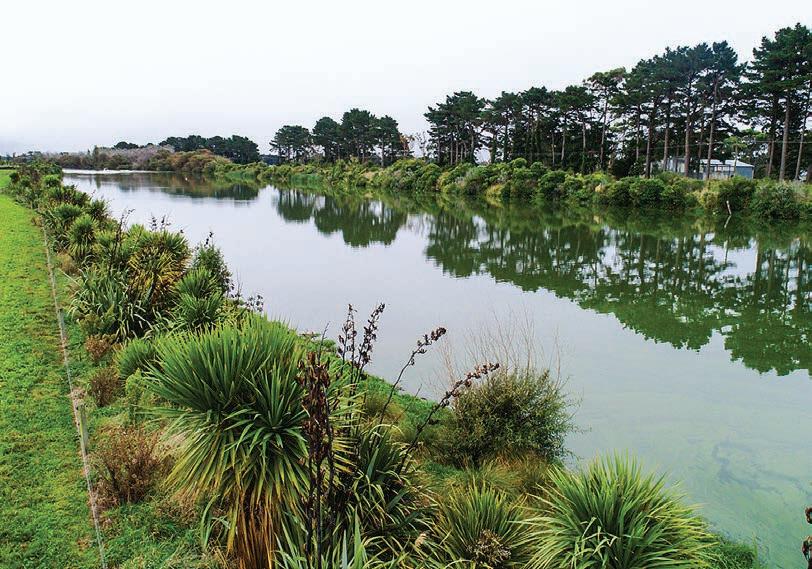
ACHIEVEMENT: New Zealand dairy farmers have voluntarily fenced over 25,000km of waterways, more than half the circumference of Earth. That isn’t just compliance; it is a monumental environmental achievement.
defensive crouch and look at the actual scoreboard.
The blunt reality is that New Zealand dairy farmers have voluntarily fenced over 25,000km of waterways, more than half the circumference of Earth. That isn’t just compliance; it is a monumental environmental achievement.
Then there’s sheep and beef. We’ve just been handed forecasts of record profitability, a 50-year high. Yes, chronic unprofitability left a hangover, but we need to let ourselves get genuinely excited. We are achieving phenomenal genetic gains, and wearable technology is transforming pastoral farming. Furthermore, while diesel will always be critical to keep the wheels turning, our grass-based system largely runs on
sunshine, not imported crude. We are remarkably resilient. Yet, a chronically stressed brain suffers from “negativity bias”, filtering out good news because dropping our guard feels dangerous. Zoom out, and you see this reactionary anxiety nationally. When the government rolled out its National Fuel Plan, our collective stress flared. Suddenly, we’re hoarding 91 octane like it’s 2020 dunny paper. Switch on talkback radio, and callers are raging about “that last lot” in government. We lose our “internal locus of control” and start believing we are helpless victims. This anxiety stems from a modern lack of perspective. The media hyperventilates over the Middle East. As a trading nation, we rely on stable global markets; we ultimately want peace. But
acting like the sky has never fallen is historical amnesia. In my 42 years, we’ve had the Gulf War, Bosnia, Iraq, Ukraine and Gaza. Boomers would add Korea, Vietnam, and the Cuban Missile Crisis. Conflict is a constant. We can do nothing to change the past or control the geopolitical present. So, how do we turn off the alarm? If we spend all our energy bracing for the next crisis, we freeze. There is a Japanese concept called misogi – undertaking one brutally hard, voluntary challenge to reset your baseline for stress. Maybe the realisation we need is that farming itself is our misogi. We chose this life. It will never be easy, but there is a profound difference between suffering through the daily grind because you feel trapped, and embracing that exact same grind because it is your chosen work.
Ultimately, an entire primary sector operates a lot like a farm after a major weather event. The water might recede quickly, but the thick mud and shit holding you back take a hell of a long time to clear. You can never truly move forward until you consciously acknowledge the mess that is stuck to your boots.
But if you commit to cleaning up your farm and your attitude with that same stubborn determination, the shift is profound. We have so much to be genuinely proud of right now. We are not a sector of victims; we are innovators and grafters leading the world. It is time to step out of the defensive crouch, shake off the mud, and stand tall as the winners we actually are.
Overseas buyout can spell doom for NZ plants
Meaty matters
Allan Barber
Meat industry commentator: allan@barberstrategic.co.nz, http://allanbarber.wordpress.com
THE recent decisions by Heinz Wattie’s and McCain Foods to close business units follow last year’s closure of Oji’s Kinleith mill. Nobody willingly closes a profitable operation and, in these cases, none of these businesses was performing well enough to escape the axe.
But it is hard to escape the conclusion overseas investors buy a well-known New Zealand business for its brands but then decide after a few years the market is too small, so it is absorbed into a bigger Australian operation. The next step is to run the marketing from across the Tasman and when that doesn’t work, close the factory.
People assume these decisions are reached because of excessively high energy prices, but I suspect it is more a question of scale. The business is no longer profitable enough and it requires too much investment to restructure.
At the same time, local market size, poor governance and management, inadequate capital expenditure, changing demand patterns, and world events may combine to make closure the easiest option.
The frozen produce category is predicted to experience substantial growth globally over the next six years, driven by the growth of the middle class in China and India, technological innovation and the demand for fresher food.
Sales increased by 19% between 2019 and 2025 and are forecast to grow by another 44% by 2032. So why can’t they be sourced and processed here?
It is hard to accept that Wattie’s and McCain frozen vegetables will no longer be processed and packed in Hastings where Wattie’s started in 1934 to take advantage of the plentiful local produce.
The sad fact is New Zealand is a tiny market at the bottom of the world and without the scale to supply global markets efficiently, while Wattie’s and McCain are both owned by international giants driven by growth objectives.
Pulp & paper is a different case,
being part of a global market that has experienced huge overcapacity in recent years and is undergoing structural transformation to meet evolving environmental, labour, energy and consumer demand trends.
Closures have occurred across the United States and Europe, so New Zealand is not alone. But in meat, dairy and pulp & paper production, scale and access to large markets are essential to efficient plant operation and capital investment in modernisation.
Overseas acquisition of a NZ business is generally the first step down a path leading eventually to closure.
Dairy and red meat have been central pillars of the agricultural sector and New Zealand’s economy for well over 100 years. In each case the industry has undergone huge restructuring, ownership changes and substantial capital investment. Farmer or grower involvement is a desirable component of a viable agricultural sector, but 100% co-operative ownership poses problems with raising sufficient capital, profit allocation and global strategy development.
The red meat sector has moved on from the days when NZ was Britain’s tame farm with British-owned meat works. Cooperatives have not ultimately been successful with AFFCO, Silver Fern Farms and Alliance the only survivors under new ownership structures.
All of them had an excess of inefficient capacity, designed for an earlier age, but inadequate financial strength to replace it without new capital.
Because of the nature of the dairy industry with a stable seasonal supply pattern, the cooperative ownership structure has proved ideal for most of the sector with a single co-op replacing many smaller regional dairy companies.
This hasn’t necessarily led to innovation, but to the acceptance brand building is not Fonterra’s strength, hence the sale of Mainland to Lactalis.
Innovation has come from smaller dairy companies such as Tatua and a2 Milk, which has built a successful business based on a differentiated product that Fonterra decided was too small to be profitable, a similar case to Mainland.
Apples and kiwifruit have benefited from innovation from new varieties that differentiate them from their competitors. They have also enjoyed coordinated
marketing, which has succeeded in building a uniform brand with sufficient scale.
Other industries to have achieved global competitiveness are mostly limited to the results of technology, where location is less important than vision and innovation such as Fisher & Paykel Healthcare, Xero, Rocket Lab, Gallagher and Halter.
To be successful, companies like this generally need outside capital and may also have to establish a base offshore, although Gallagher is an exception.
My conclusion is that 100% overseas acquisition of a NZ business is generally the first step down a path leading eventually to closure.
Notable exceptions to this rule include Japanese-owned ANZCO and Chinese-owned Westland Milk, which have committed longterm owners.
Coincidentally both are owned by Asian corporations, which take a much longer view of investments than the North American and European perspective.
It is regrettable NZ companies often struggle to attract local investment because of a shallow pool of capital or reluctance to take the risk.

Phil Weir Weir is an associate trustee of AGMARDT and a Beef + Lamb New Zealand farmer-elected director
Sector Focus
Kiwifruit positive amid turmoil in Gulf

Richard Rennie NEWS Horticulture
EARLY indications for this year’s kiwifruit returns are aligning closely with last season in Zespri’s initial guidance to growers for seasonal revenue budgets.
Zespri CEO Jason Te Brake confirmed Green kiwifruit is estimated to earn about $10 a tray this season, while SunGold could expect to come in at $11.70/tray.
Meantime the early-harvested RubyRed fruit is expected to fetch $15.86 a tray.
With these forecast returns in line with the 2025 season, Te Brake said harvest had also started well, with early progress supporting a large crop of about 220 million trays.
“And it is still possible, judging by what is coming in off orchards, this may also be revised up by a few million trays yet.”
Fruit size for SunGold and RubyRed is good, while Green is back slightly on last year.
With the season’s start coin-
ciding closely with the Iran war kicking off, Te Brake said Zespri is carefully monitoring fuel costs for charter ships and the impact on freight costs in coming weeks.
“With our charter vessels the fuel cost calculation is done at the time of load-out. Looking at longer term pricing beyond April has fuel pricing dropping rapidly, suggesting markets’ view is this remains a shorter-term issue.”
However, he also acknowledged it remained a “million-dollar question” if this would be the case.
The troubled Strait of Hormuz is not used by Zespri for wider shipping access. However, some small markets exist in the Gulf for Zespri fruit, including a collaborative marketing effort between Zespri and Māori Kiwifruit Growers Incorporated, who sent their first shipment to the United Arab Emirates last year.
Data from Kiwifruit NZ collaborative marketing records indicate last season Mr Apple was the main collaborative partner with Zespri to the Middle East, exporting about 900,000 trays there.
This included 223,000 trays of Green, with the majority going to the UAE.
SunGold exports were significantly more, at 655,000 trays.
Of this, 357,000 SunGold trays were exported to Saudi Arabia, making that market the second-
Learning to trust the process through highs and lows

Isabella Beale NEWS Awards
KARN Dhaliwal has experienced the highs and lows of farming first hand.
After Cyclone Gabrielle wiped out his crops and put his young horticulture business under significant pressure, the Waikato grower rebuilt from scratch, making his recent Zanda McDonald Award win especially significant.
Based in Te Hoe, Waikato, Dhaliwal built Ohinewai Harvest Ltd and Dhaliwal Agriculture Ltd, an orchard and cropping business, from the ground up.
The award recognises emerging leaders in agriculture across New Zealand and Australia. Dhaliwal won the award alongside Australian Bryce Neyland from Gol Gol, New South Wales.
Dhaliwal, who was recognised for his innovative approach to horticulture and business, said he “was admiring what they [the other finalists] were doing and their experience, so when my name got called out I did not expect it”.
“For me, it’s an absolute honour,” he said Dhaliwal.
Raised in a small dairy farming family, he witnessed many of the challenges and realities of farming. His parents never encouraged him to go farming or growing; however, he had a real passion for business and for the primary sector.
After completing a Bachelor of Agri-Commerce, he worked as a farm productivity and fertiliser representative with Ballance, before moving to ANZ as a rural manager, where he built a deeper understanding of farm performance and financial systems.
That experience led him to establish his own business in 2020, initially growing blueberries before expanding into RubyRed kiwifruit.
Cyclone Gabrielle dealt a major setback, wiping out his crops and placing significant financial pressure on the business.
Undeterred, Dhaliwal rebuilt within 90 days, diversifying both crops and growing locations to strengthen resilience.
A focus on processes and systems has underpinned his approach to business. He credits a lesson from his dean in high school on how to study for shaping that mindset, and he went from failing to the top of the class as a result.
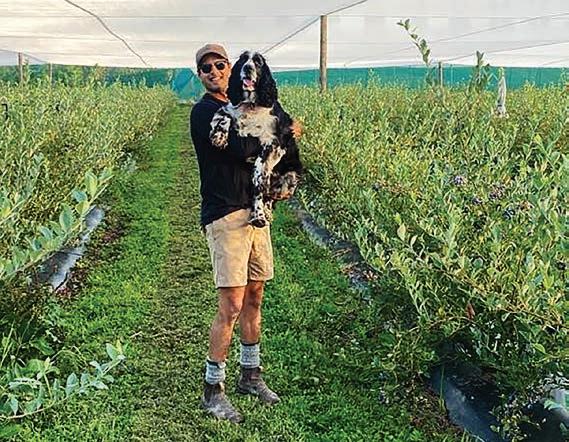
GROWING: Karn Dhaliwal has been growing his business in Te Hoi, Waikato, for the past six years.
Photo: Supplied
“I was still the same person, but I was just applying a process. So ever since that age, I’ve always stuck to processes, and I think a lot of my career success has come from that.”
Looking ahead, Dhaliwal is assessing how to best grow the business, including a potential addition of dairy milking, while continuing to build his leadership capability in the primary sector.
“Because I’ve built up all of this expertise around business leadership, strategy, execution, I really want to now take that out into a rural business and apply that to really bring some genuine skill set into the industry that’s had a few dents in its armour.”
As part of the award, both winners will receive a tailored professional development package which includes $10,000 towards further education or training, media coaching, and ongoing networking opportunities, along with a mentoring trip across Australia and New Zealand.
largest collaborative SunGold market after Thailand.
Te Brake said it will be determined depending upon shipping conditions if they could continue.
“There are difficulties there, but it is a small piece of our total market.”
Longer term pricing beyond April has fuel pricing dropping rapidly, suggesting markets’ view is this remains a shorter-term issue.
Looking out over the next few months, he said container shortages due to shipping disruptions and diversions could prove to be an issue.
Zespri ships about half the crop via container, with the other half going on chartered refrigerated ships.
“We do have the ability to put more into charter ships if required.”
He said the March guidance is a preliminary forecast, with forecasts updated through the year when there is a firmer view of fruit and market performance, and on the scale and duration of the conflict in the Middle East.
LeaderBrand rolls out new laser weeder
Staff
reporter TECHNOLOGY Horticulture
LEADERBRAND has welcomed the world’s latest technology in weed control to its Gisborne farm.
The new Carbon Robotics G2 Laser Weeder uses highresolution cameras, artificial intelligence and laser technology. It detects and removes weeds as tiny as the top of a ballpoint pen, without disturbing the soil or impacting the crops.
This is a first of its kind to be used on salad leaf production of this scale, here in New Zealand.
Gordon McPhail LeaderBrand
The new technology, introduced with funding support from the Ministry for Primary Industries under the Primary Sector Growth Fund, will help the farm reduce carbon emissions, improve soil health, increase productivity, and produce a more consistent quality of crops, which will ultimately help Kiwis have more access to affordable leafy greens, the company said.
LeaderBrand’s general manager of farming, Gordon McPhail, said that reducing emissions, better soil management, as well as finding new ways to farm sustainably with cutting-edge technology are important focus points for the team.
“We’re always looking for different ways we can be more sustainable, and soil health is a key driver.
“This new weed management technology is another step in the right direction. This is a huge milestone for us.
“This is a first of its kind to be used on salad leaf production of this scale, here in New Zealand. There is no doubt this technology will revolutionise the way we farm, and it’s not often that we get to say that, let alone experience it right here in Gisborne,” said McPhail.
LeaderBrand is currently facing significant weed burden issues, impacting the ability to produce reliable quality salad greens, from both indoor and outdoor growing.
“It has a flow-on effect to our production facility and ultimately our customers.
“This new weed killer tech will significantly improve our efficiency, increase our rotations, reduce waste, and lessen environmental impact. It really is a win-win for our team and Kiwi customers,” he said.
FUELLED: Zespri CEO Jason Te Brake says shipping fuel remains a big cost component, with fuel pricing indicating hopes for an early resolution to the war in Iran.
Jason Te Brake Zespri
Testing times for ag’s stand-out sector
Staff reporter NEWS Horticulture
NEW Zealand’s horticulture sector
remains one of the country’s stand-out performers, but a combination of global supply chain disruption and domestic setbacks is creating a more challenging and uncertain outlook for growers.
Horticulture New Zealand (HortNZ) chief executive Kate Scott said the sector’s recent positive performance reflects years of investment, innovation and strong global demand for highquality produce.
However, she said recent events highlight how quickly conditions can shift.
“Like many businesses, growers are feeling the impact of global supply chain disruption as a result of the Middle East conflict.
“Rising fuel, fertiliser and energy costs are putting pressure on margins, and those pressures are flowing through to growers in real time.”
At the same time, domestic developments are adding further strain, particularly for vegetable producers.
“The recent retreat by processors Wattie’s and McCain Foods will have a direct impact on hundreds of growers.
“There are crops already in the ground where the processing pathway is now unclear. That creates financial risk for growers and uncertainty for the rural and regional communities that rely on those businesses.”
A run of severe weather in several growing regions has compounded the challenge, testing both on-farm resilience and wider supply chains.
The Ministry for Primary Industries forecast horticulture export revenue to reach $9.2 billion in the year to June 2026, but Scott said stronger export
earnings “do not always flow through to the farm gate. Growers continue to face significant cost pressures, which can limit the impact of higher returns.
“For the sector to grow and invest with confidence, horticulture businesses need to be profitable. Ensuring growers are able to capture value is essential to the long-term strength and sustainability of the industry.”
She said the current environment is also prompting a closer look at how value is distributed across the supply chain.
“At a structural level, this is highlighting wider issues in the grocery and supply chain system.
“The announcements by McCain Foods and Wattie’s reinforces the need to back our growers and New Zealand-grown produce.
“It really adds weight to calls for a stronger ‘Buy Kiwi Made’ focus, ensuring New Zealand-grown produce is supported here at home as well as offshore.
“We’re continuing to speak up for growers with government officials and ministers including highlighting our calls set out in our manifesto about the importance of fair trade settings and greater margin transparency reporting.”
The combination of global instability and domestic disruption points to a period ahead where volatility is likely to remain and margins may tighten.
“That makes it even more important that policy settings support, rather than hinder, the sector.
“Growers need confidence to invest, whether that’s in new plantings, infrastructure or technology. Consistent and practical policy settings are a key part of that.”
She said certainty will be particularly important as resource management reforms continue.
“Growers need to know the
For
the sector to grow and invest with confidence, horticulture businesses need to be profitable.
Kate Scott HortNZ
rules they are investing under will remain broadly stable. Frequent changes create uncertainty and can delay progress.”
Scott also pointed to the importance of strong biosecurity settings, access to crop protection
tools, and reliable water supply as climate variability increases.
“Reliable access to water is fundamental to productive horticulture, and biosecurity underpins everything we do.”
Labour remains a key issue, with the Recognised Seasonal Employer scheme continuing to play an important role in supporting the workforce needed across the sector.
Infrastructure and supply chain resilience are also critical, particularly for highly perishable products.
“We rely on efficient transport networks and port systems to get
INVESTMENT: HortNZ chief executive Kate Scott says the sector’s recent positive performance reflects years of investment, innovation and strong global demand for highquality produce.
produce to market quickly and in good condition. Any disruption has immediate consequences.
Despite the immediate challenges, the sector’s long-term outlook remains positive.
“The opportunity for horticulture in New Zealand is significant. We can continue to grow, support regional economies and provide healthy food for New Zealanders and consumers around the world.
“But the next phase of growth depends on getting the fundamentals right and ensuring growers have the confidence – and the returns – to keep investing.”
Fruit and nut ingredients get $1.2m boost
Gerhard Uys TECHNOLOGY Horticulture
CELLULAR horticulture startup
Forever Harvest has raised $1.2 million to accelerate development of cultivated fruit and nut ingredients.
The Bioeconomy Science Institute said the investment is led by Sprout Agritech, with support from the BSI and Callaghan Innovation’s Deep Tech Incubator programme.
Forever Harvest is based in
Christchurch and is already engaging with several multinational food and ingredient companies exploring commercial applications of its technology.
Cellular horticulture involves growing specific fruit or nut cells in a lab.
This means cultured cells with defined nutrient profiles or flavours can be developed, the BSI said.
Forever Harvest works with food and flavour companies to develop a year-round ingredient supply, hoping to address risks to
crop quality linked to disease and climate variability.
Co-founder Dr Jan Grant said their approach requires minimal land and water, removes seasonality, and eliminates the need for agricultural inputs such as pesticides or fertilisers.
Co-founder Mick Riley said the funding will support pilot activity and further engagement with customers, and the expansion of fruit and nut cell lines, pilot-scale production, and collaboration with commercial partners over the coming year.

Photo: HortNZ


Transport cuts will hit rural disabled people
Anna-Grace Somerfield
WHEN Margaret’s* vision started to go, she also lost her rural life.
Managing a farm alone was no longer viable, so she moved to a retirement village in Hamilton, bringing with her a need for reliable transport support.
For years, Margaret, a Rural Women New Zealand member living with low vision, has relied on the Total Mobility Scheme to get around. Without it she said, “I’d be totally lost.”
“It helps me stay connected with the wider world, and helps me stay connected to friends and community events and things that I wouldn’t get to otherwise.
“The sense of loss would be huge if I lost my mobility card,” she said.
Margaret is one of around 120,000 New Zealanders registered with the Total Mobility scheme, a government-subsidised programme that helps people with disabilities and older New Zealanders who may be unable to use buses, trains or ferries independently access taxis and other transport at a reduced cost.
The government has announced it will reduce the fare subsidy from 75% to 65% from 1 July 2026. Regional fare caps, the maximum amount that can be subsidised per trip, will also be lowered by around 10%. Those decisions are final.
What is still being decided is a separate set of proposed changes, including introducing caps on the number of trips users can take, and regular assessment of eligibility to prove they still need the scheme. The Ministry for Transport
consulted on these proposals, with consultation closing on 20 March.
Rural Women New Zealand submitted on the consultation, arguing the proposed changes would hit rural and disabled communities hard, communities that are often underserved by the scheme.
“In rural New Zealand you don’t have options,” said Sandra Kirby, CEO of Rural Women New Zealand.
“When there’s no bus, no rideshare, nothing else, Total Mobility is it.
“Putting a cap on trips isn’t just limiting a service, it’s limiting how much someone gets to be part of their community.”
If you have low vision, you really can’t get anywhere independently other than a family member or a taxi scheme.
This gap is not new. Cain Richardson, Policy Analyst at Blind Low Vision NZ and former dairy farmer said, “The scheme is a bit of a geographic lottery in the first place.”
Many rural areas don’t have access to the scheme. In small towns that do, that can mean only one taxi company that does not operate on weekends. For those living further out, even a subsidised fare does not make a long-distance trip affordable.
“If you have low vision, you really can’t get anywhere independently other than a family
member or a taxi scheme,” said Richardson.
The proposed trip caps would force users to choose between competing needs Richardson said.
“If you don’t get the trip cap you want, you would have to make choices between going to work, going to a medical appointment, visiting friends or family, or going to a community activity. It would force hard life choices into a sort of uniform box that supposedly fits everyone when these people live quite complex lives,” he said.
The proposed reassessment requirements have also drawn criticism, particularly from those with permanent conditions living in rural areas where getting to a specialist is not straightforward.
Margaret, who is registered with Blind Low Vision NZ, is direct about what reassessment would mean for people like her.
“For blind and low vision folks, to be reassessed would be a complete waste of time and resources. Because if we’re registered with Blind Low Vision, our eyes aren’t going to get any better,” she said.
To Kirby, the issue is also one of rural practicality.
“In a lot of rural communities, getting to a doctor is already a half-day mission, and asking someone to do that just to prove they need transport support feels like the system hasn’t really thought through what rural life looks like,” said Kirby.
For Margaret, who has no family in Hamilton and depends on friends and the scheme to get around, it is the difference between participation and isolation. She runs a support group in her retirement village for

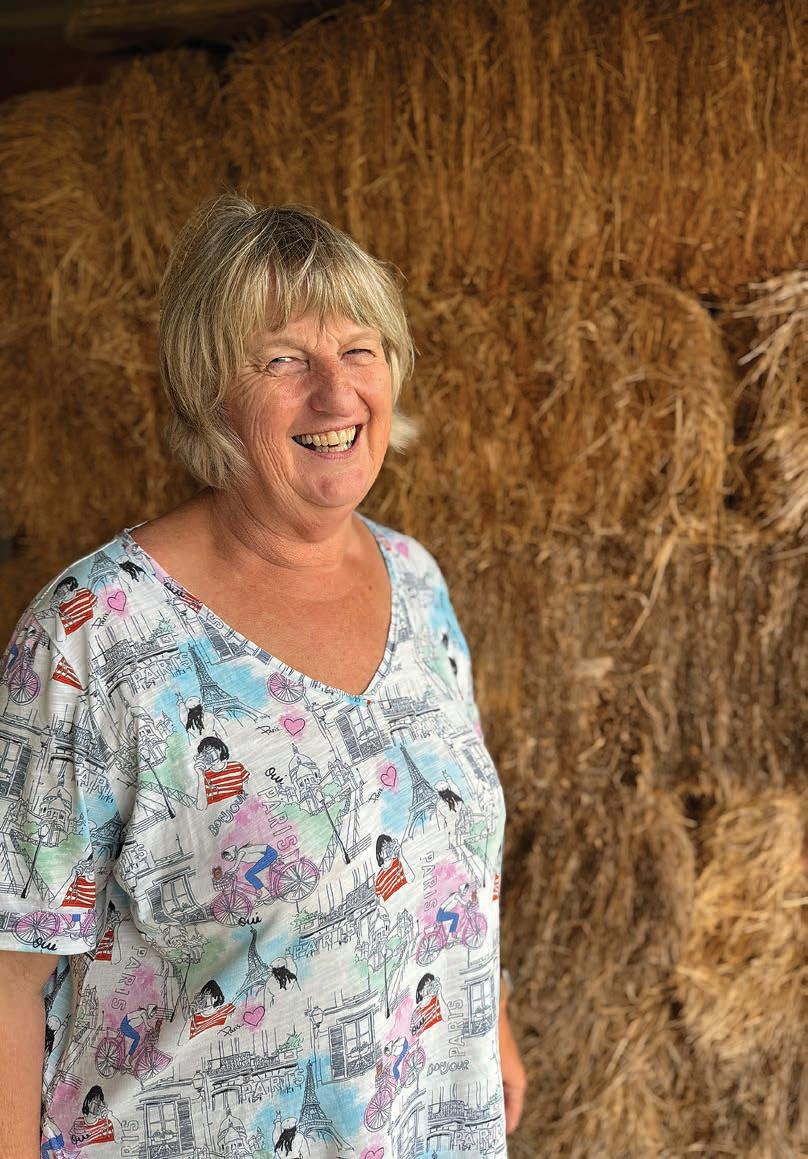
residents who are living with low vision, and has directed around a dozen people to the Total Mobility scheme.
Had she stayed on the farm, she said she “would have become totally isolated”.
“It just helps me stay connected. Even just to go and have a coffee with a friend that I don’t see very often… I go by taxi using my mobility card,” said Margaret.
“For people like Margaret, the Total Mobility scheme is not a nice to have, but a lifeline. As the
government looks to cut costs, it must reckon with what those decisions will cost the people who have nothing else to fall back on,” said Kirby.
# To protect her privacy, Margaret* asked not to use her real name.
MORE:
Interested in adding your voice to our advocacy? Or have experience that could help guide our work, visit ruralwomennz.nz and become a member today.

LIMITS: Rural Women New Zealand CEO Sandra Kirby says ‘putting a cap on trips isn’t just limiting a service, it’s limiting how much someone gets to be part of their community’.
Cain Richardson Blind Low Vision NZ
FEDERATED FARMERS
Dog laws need more bite – but not for farm dogs
Federated Farmers says any overhaul of dog laws must come down hard on roaming and dangerous dogs, while protecting the rights of farmers to defend their livestock.
Northland president Colin Hannah says the ability to destroy a dog that is rushing or worrying stock is non-negotiable.
“Under the current laws, farmers can act immediately without needing a court order, and that must not be watered down,” Hannah says.
“While stronger rules like compulsory de-sexing and microchipping could help, the focus must stay on irresponsible owners –not working farm dogs.
“Farm dogs are not the problem, and we won’t stand for extra costs being loaded on us when farmers already get little value from paying dog registration fees.”
The Government recently ordered a review of the Dog Control Act to crack down on roaming and uncontrolled dogs, after a number of attacks.
Although the changes being talked about are targeted at feral dogs and out-of-control pet dogs, Hannah believes farmers should take an interest in the process.
“We’re seeing more and more dogs from towns and cities being abandoned in rural areas by their owners.
“I presume that’s because they can’t afford to keep them or can’t be bothered looking after them, but it’s a big problem for us.”
The SPCA has been lobbying for changes to the Dog Control Act for a decade.
The death of Mihiata Te Rore, 62, killed by a pack of three dogs at Kaihu in Northland in February, sparked huge outrage – and finally some action.
She’s the third person to be killed by dogs in Northland in the last four years, with a four-year-old boy also fatally attacked in the Bay of Plenty last year.
In 2024, dog-related ACC claims totalled $18.5 million, an 80% increase on five years earlier.
The issues are particularly severe in the Far North, where packs of feral, abandoned or wandering dogs have led to massive livestock losses.
It’s also resulted in urban people being afraid to walk in their neighbourhoods, and parts of Te Araroa Trail being closed because hikers have been bailed up by aggressive dogs.
Northland farmer Finn Cook told RNZ in February that more than 250 of his family’s sheep have been killed by roaming dogs.
He’s thinking of quitting sheep farming if the killing can’t be stopped.
“It’s pretty disgusting to walk out there and see sheep half chewed on, still alive, can’t move on the ground. Especially in the heat with the flies and stuff,” he said.
Hannah says dogs have got into pine forests in the Far North.
“There’s plenty of possums in there, so they’re not short of food.
“People have been seen abandoning dogs and driving away. They’re breeding like flies and we need to get on top of the problem to stop it getting even worse.”
While 8000 dogs are registered in the Far North, officials estimate the true number – including many unrecorded, wandering dogs – could be as high as 30,000.
Wairarapa sheep and beef farmer Roger Barton is a former Federated Farmers board member who led the charge against working farm dogs being included in compulsory microchipping rules.
He agrees farmers should take an interest in the review of dog laws.

“Farmers get little or no value from the registration fees they’re forced to pay, but tougher rules for owners of roaming dogs, fencing requirements and so on, would work for us – if it’s matched by stronger enforcement by councils, and the Courts taking a hard line.
“There’s plenty of problem dogs and owners in peri-urban areas bordering farmland, and in small rural settlements. When they get in among livestock, we pay the price.”
Barton is sceptical about the benefits of microchipping, but says it proved its worth when a dog wandered onto his farm.
Using his cattle wand, he was able to read the chip and, with help from animal control, reunite it with its owner.
He says he’d “fight to the end” a
proposal limiting exemptions from compulsory de-sexing to registered breeders.
“A casual shepherd’s dog might be four or five years old before you recognise it could produce something special if you put it over a bitch you owned.
“Breeding sheep dogs isn’t a clinical science in terms of judging a Cavalier King Charles Spaniel against specs in some textbook.
“So sure, let’s review dog legislation but let’s also remember whose dogs are causing all the problems.”
Local Government Minister Simon Watts has ordered a comprehensive review of the Act but meanwhile he wants councils to fully use existing enforcement powers, including involving police if there are significant safety risks.
GOOD BOY: Farm dogs are not the problem, and Federated Farmers Northland president Colin Hannah says the organisation won’t stand for extra costs being loaded on farmers when they already get little value from paying dog registration fees.
Photo: NZ Story
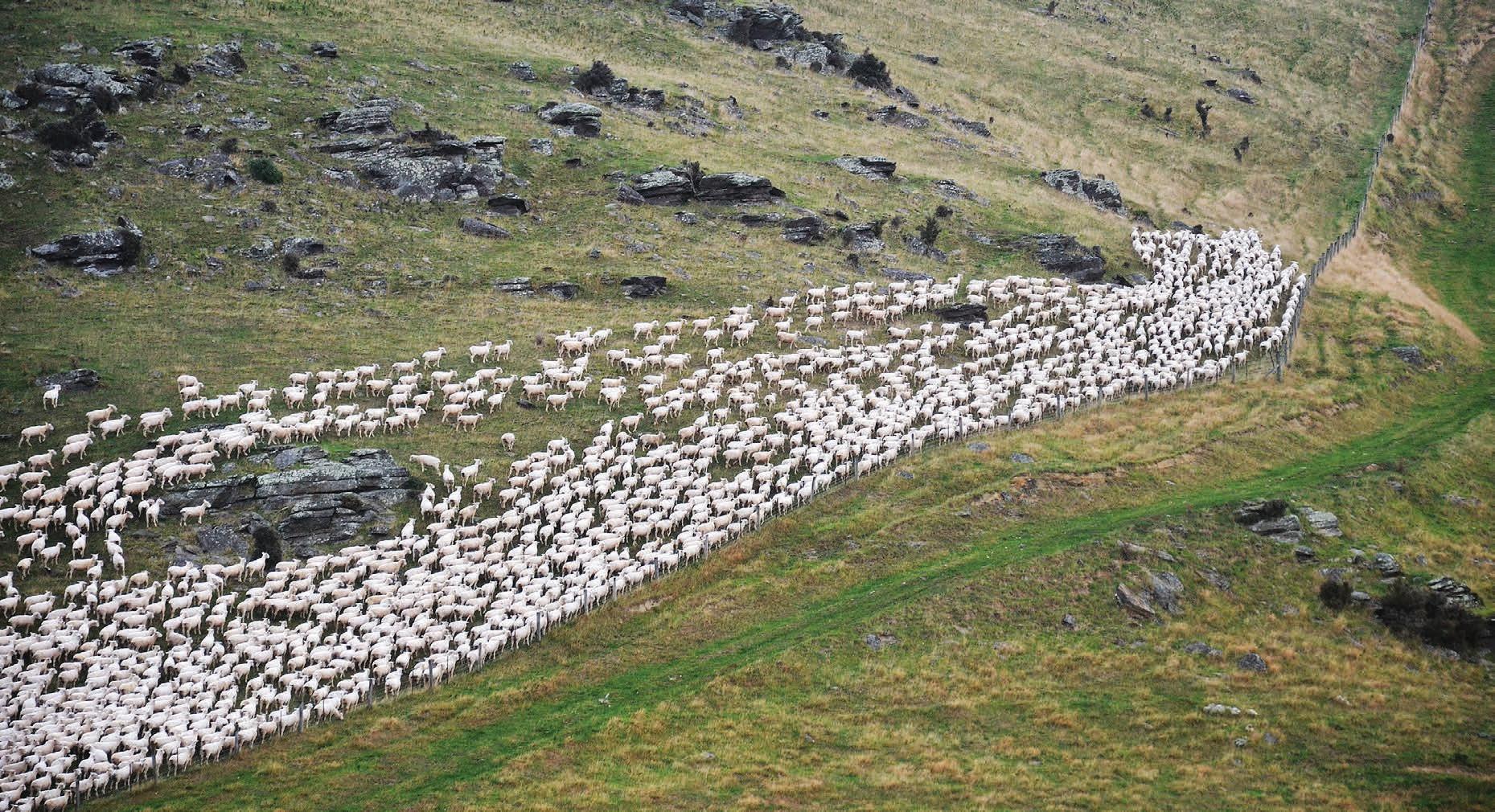
Glenaray Station shines on a perfect ‘Southland stunner’
It was only fitting that Southland turned on a picture-perfect day to showcase one of New Zealand’s finest properties at the 2026 High Country Field Day.
Around 300 attendees gathered at Glenaray Station on March 27 for a tour of the stunning a 68,000-hectare sheep, beef and deer property in northern Southland.
Station manager Simon Lee admits he was a little nervous about the day, concerned the weather or logistics might pose a problem.
“I was thinking about the forecast for rain, whether the portaloos would show up, all the little things
you worry about,” he says with a laugh.
“But the weather turned out amazing, the group was fantastic, and the feedback has been great.
“People were full of questions and genuinely interested in how we operate. That’s what it’s all about.”
Owned by the Pinckney family for nearly 130 years, Glenaray Station is considered a high-country gem – albeit one that many have never seen.
Farmers from across the country gathered alongside three Cabinet Ministers and several MPs to tour the property, enjoying 360-degree views of fertile river flats, rolling mid-
altitude pastures, and steeper highcountry tussock. Jim Ward, Federated Farmers High Country co-chair, says there was plenty of discussion about the
The special nature of this type of property is that it brings people together. When we have an open day or field day, people are interested or compelled to come along.
David Pinckney Glenaray Station owner
challenges facing high-country farmers, from resource consents and winter grazing to the threat of wilding pines.
“It was really good to talk about those issues, and I thought there were a lot of excellent questions asked.
“Having the MPs there was so important too. Getting them to see exactly what we’re dealing with –and hear directly from the people with their boots on the ground –that’s when it really hits home.
“There are some really scary stories about the processes farmers are dealing with, and those are stories that should be told nationwide.
VAST: Glenaray Station is considered a high-country gem but many have never seen it.
“Days like this help everyone understand the complexity of highcountry farming.”
But despite the challenges, it was the innovation and team culture at Glenaray that truly stood out, Ward says.
“The theme for the day was culture and innovation confronting the challenges, and no one is doing that better than these guys, led by Simon Lee.
“The thing that really created a buzz for a lot of people was the way they approach staff buy-in.
“Everyone has input – they’re all involved, they support each other.
“They use a lot of technology and
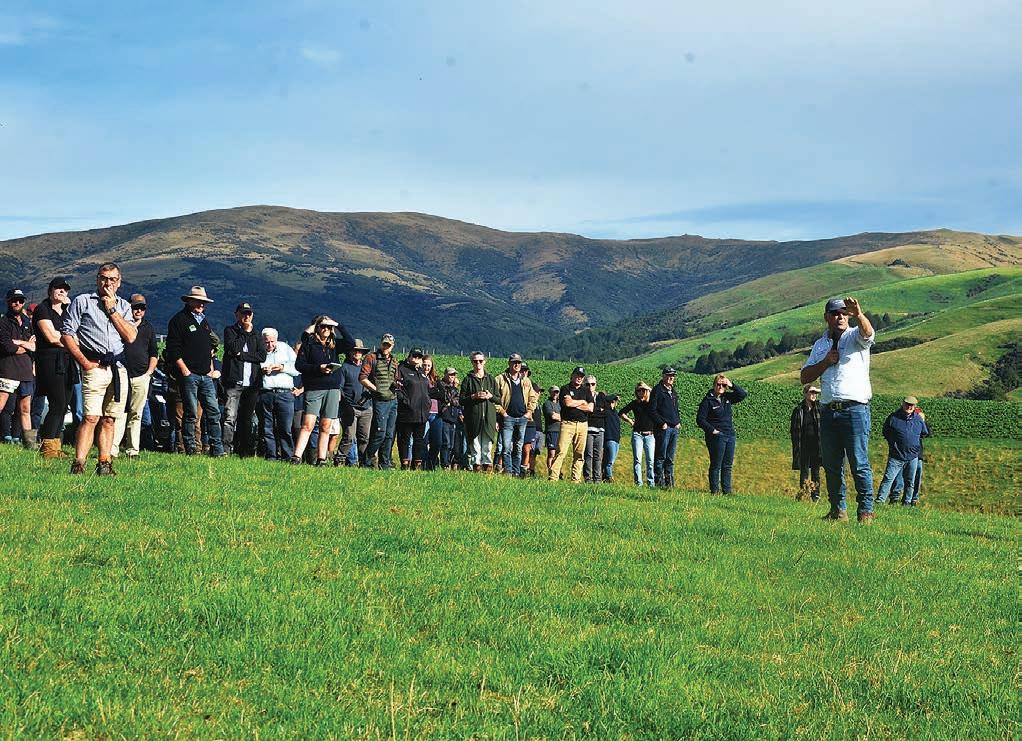
they’ve got systems in place where, if there’s an incident, six people are notified immediately via email.
“It’s a very special place that’s really turning heads.
“Every person who attended this field day will have left feeling incredibly impressed by what’s being achieved at Glenaray.”
Attendees saw first-hand how Glenaray combines technology with traditional farming knowledge.
Halter is being used on trading steers, and the station’s weighing system tracks cattle growth with remarkable precision.
“At five o’clock every morning they can see the average weight gain from the day before,” Ward says.
“On a property of that size and at that altitude, what they’re achieving is impressive – 134% lambs weaned to ewes mated. That’s outstanding.”
High Country co-chair Matt
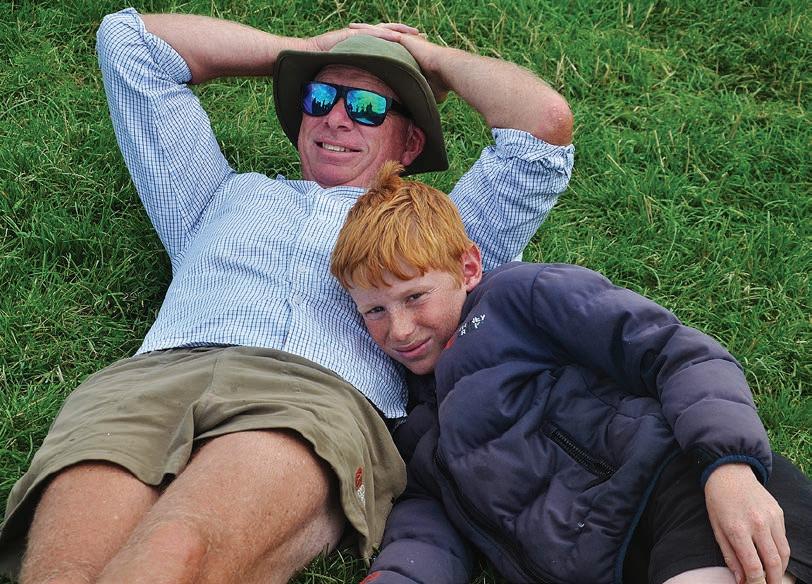
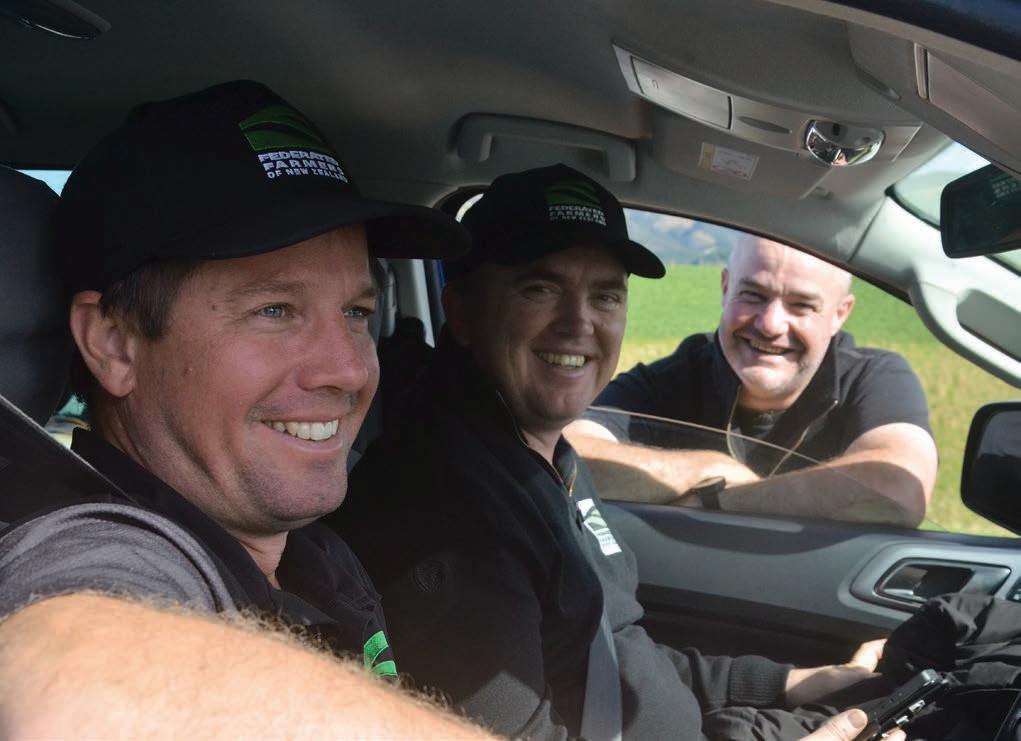
Simpson echoed the sentiment.
“It was a tremendous day – a Southland stunner.
“It was so good to have so many like-minded people in the same paddock.
“The scale, the systems, the innovation – it’s a fantastic model – a classic example of how to get it right.”
Simpson also praised the Pinckney family, the board and staff
for their generosity in opening the property.
Visitors saw how the station tackles challenges from deer management to crop losses from possums, and the threat of wilding pines.
Panels and discussions covered consent processes, winter grazing, pest management, and the value of grazing on conservation land.
“We got to see the technology, the land management, the animal
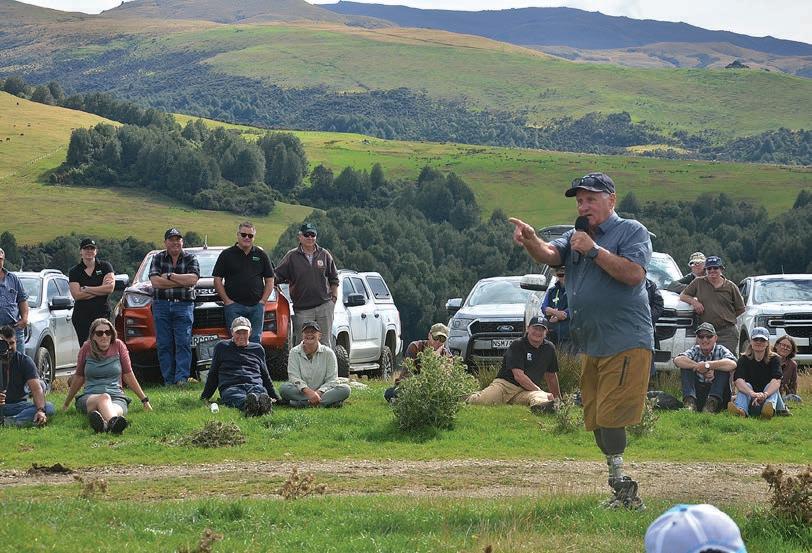
LEGEND: As well as sharing his story, guest speaker Mark Inglis –mountaineer, Paralympian, scientist and winemaker – spoke about the negative impacts of destocking high-country land.
welfare practices, and the culture all working together,” Simpson says.
Owner David Pinckney says the field day was as much about showcasing people as it was land.
“The special nature of this type of property is that it brings people together.
“When we have an open day or field day, people are interested or compelled to come along.
“There’s been a lot of really valuable conversations, ideas and discussions. I think relationships have been nurtured and that’s what it’s all about.”
MC Jamie Mackay, host of The Country, paid tribute to board chair John Tavendale for his stewardship of the property over many years.
“What a great contribution to one of the greatest farms in NZ.”
For those on the tour, it was both an eye-opener and a celebration –a chance to see solutions in action, ask questions, and leave inspired about the future of high-country farming.
Ward says days like this are crucial.
“We’ve got to keep running these kinds of events. We need to showcase the good things, but we’ve also got to be upfront about the things that aren’t so good.”
INQUISITIVE: Station manager Simon Lee says attendees were full of questions about the station’s operation.
GOOD DAY: Federated Farmers Otago president Luke Kane, president Wayne Langford, and Southland president Jason Herrick.
TIME OUT: Steve Berge and son Fletcher take a break while listening to speakers at the field day.
Blocking imports on welfare grounds would backfire
Restricting imports of meat, dairy and other livestock products from countries with lower animal welfare standards would backfire on Kiwi farmers and our economy, Karl Dean says.
Calls for New Zealand to impose those restrictions are completely understandable, but Federated Farmers does not support them, the organisation’s dairy chair and animal welfare spokesperson says.
“Kiwi farmers take enormous pride in the way we look after animals, and our welfare standards are among the best in the world.
“Achieving those standards doesn’t come for free. Farmers invest heavily in infrastructure, systems, and dayto-day management to make sure animals are well looked after.
“That’s why it’s understandably frustrating to see imported food produced under lower standards competing on price.
“However, blocking those products at the border would be a dangerous road to go down.”
Dean says New Zealand is one of the most trade-dependent economies in the world.
“If we start putting up barriers based on how other countries produce their food, we can expect the same treatment in return.
“That’s a risk our export-focused farming sector simply can’t afford.”
Dean’s comments come in response to lobbying by Fair for Farmers and Animal Policy International for changes to New Zealand’s trade rules.
Greens MP Steve Abel also has a Member’s Bill in the ballot seeking similar changes.
His Animal Products (Closing the Welfare Gap) Amendment Bill would require imported animal products
sold in New Zealand to meet our domestic animal welfare standards, regardless of where they’re produced.
While much of the campaigning has focused on pork products, it also extends to poultry, eggs and other meats.
Dean says it’s a complex issue but restricting access to our market on animal welfare grounds would ultimately be self-defeating.
Measures to restrict overseas products on animal welfare grounds will result in retaliation from the likes of the USA and European Union on our biggest export earners, dairy and meat.
Karl Dean Federated Farmers dairy
chair
“Whether it’s through country-oforigin labelling, production method transparency, or regulation, it risks being interpreted as a trade barrier.”
Federated Farmers has a longstanding commitment to open, rules-based trade.
“New Zealand exports around 90% of our agricultural products, so our farmers’ prosperity depends on secure access to overseas markets.”
Measures that restrict imports based on criteria like animal welfare are seen by trading partners as nontariff barriers.
“That’s even when they’re framed as simply aligning with the rules Kiwi farmers already follow.”
Dean says New Zealand is particularly at risk from measures that use trade to regulate animal welfare, as many of our farming systems differ materially from those in other countries.
“For example, our predominantly outdoor lambing systems contrast
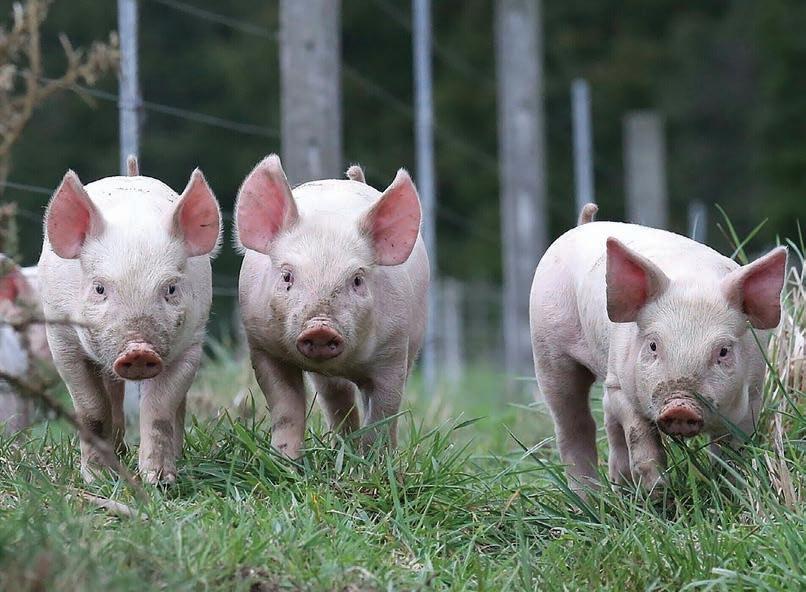
STANDARDS: In 2022 New Zealand’s four largest countries of origin for pork were Spain, Germany, USA and Canada – not countries known for relaxed animal welfare standards.
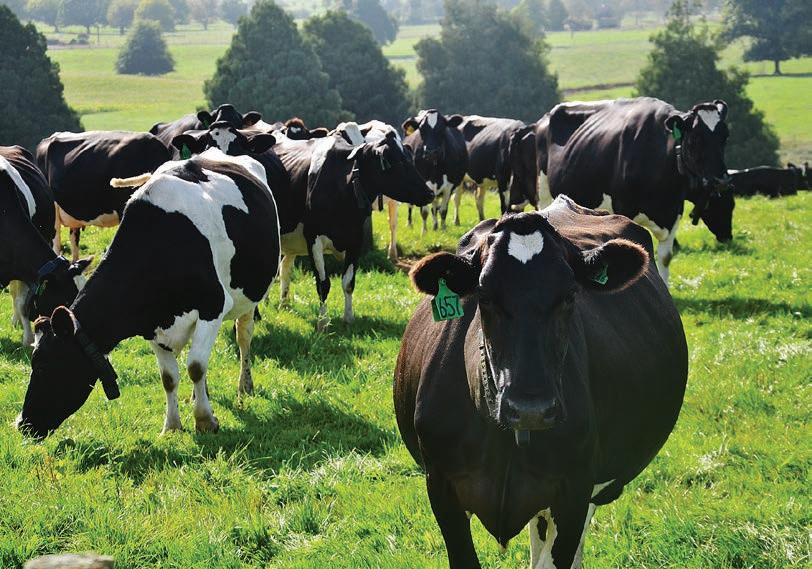
SELF-DEFEATING: To insist that food products from other countries must meet our own high animal welfare standards will likely be viewed as a non-tariff barrier, potentially sparking restrictions on our exports.
with more intensive, housed systems used elsewhere.
“Imagine if a European country claimed NZ dairy and beef is farmed to lower animal welfare standards because we don’t shelter our cattle in winter – and argued their farmers shouldn’t have to compete against us.
“Likewise, rules around transporting surplus dairy calves vary internationally.
“We could even be taken to task on effluent management rules, minimum wages or any number of other factors,” he says.
“If New Zealand starts imposing production-method equivalence on imports, it’s likely we’ll see our trading partners respond in kind, using their own welfare standards or frameworks.
“That would create massive risk for our red meat, dairy, and other primary exports.”
While lower standards overseas are often blamed for putting our farmers at a competitive disadvantage, the numbers tell a slightly different story.
In 2022 New Zealand’s four largest countries of origin for pork were Spain, Germany, USA and Canada – not countries known for relaxed animal welfare standards.
Less than 3% of imports came from non-OECD countries.
A key difference between New
Zealand and these countries is the local price of grain and access to a large local market.
“In other words, when you look at which countries are most competitive for poultry and pork, animal welfare rules are not a dominating factor,” Dean says.
He says Federated Farmers is highly aware of the pressures domestic producers face from imports.
“But we’re convinced that measures to restrict overseas products on animal welfare grounds will result in retaliation from the likes of the USA and European Union on our biggest export earners, dairy and meat.
“They’re also unlikely to address the issues that lead to imports of pork and poultry.”
Dean says Federated Farmers supported NZPork through the recent review of the Code of Welfare – Pigs, and recognised the significant obligations our pig farmers operate under.
“These standards carry real cost and operational implications for producers – and that’s also true for other farming systems too.
“But there’s nothing gained by cutting our noses off to spite our faces.
“As a country reliant on agricultural exports, we have to approach trade policy settings with a whole-ofsector lens.”

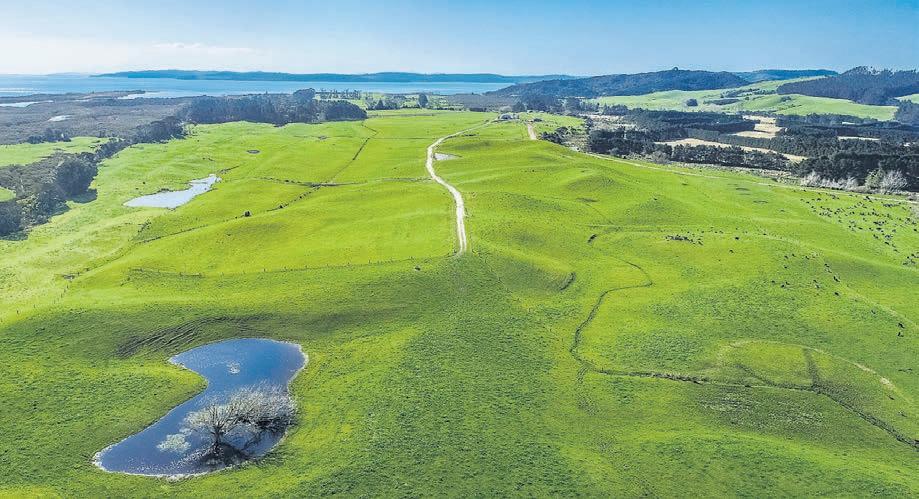
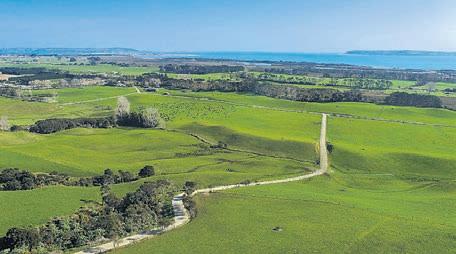
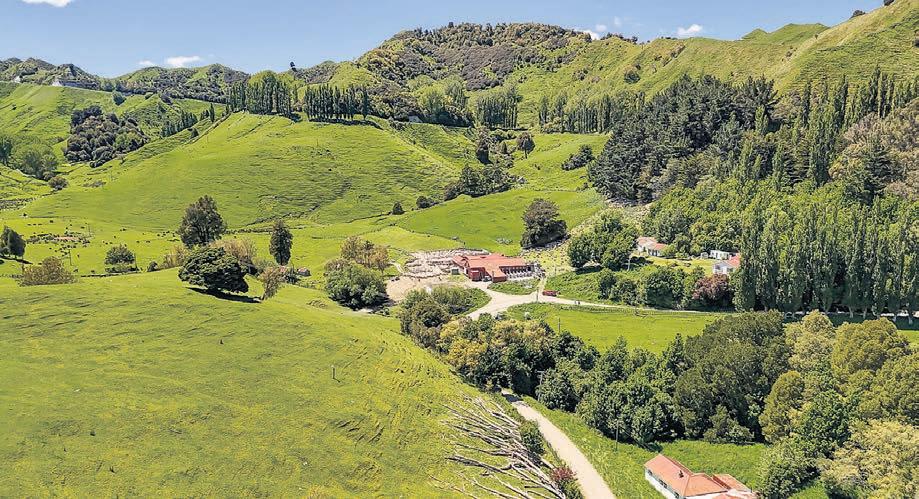
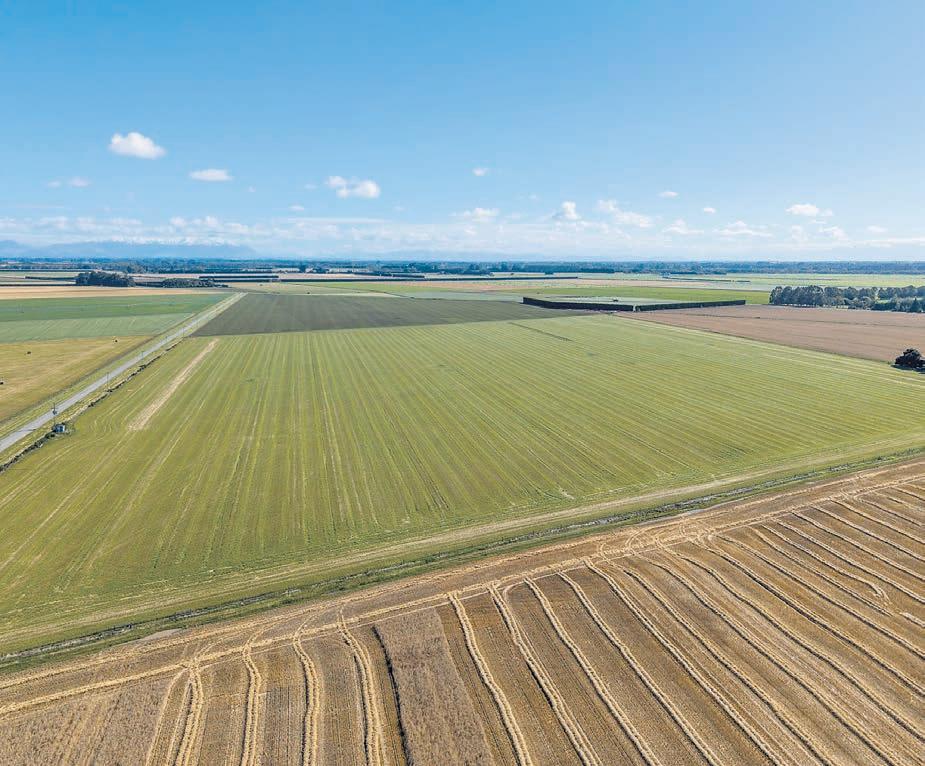
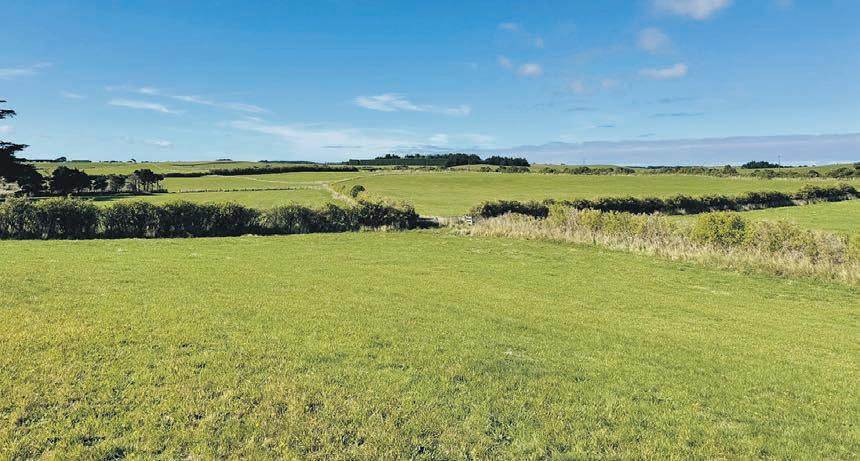

•
•
•
•
•
•
•
•
•
•


Experienced
Taking
www.boeckmann.co.nz
n
n
n

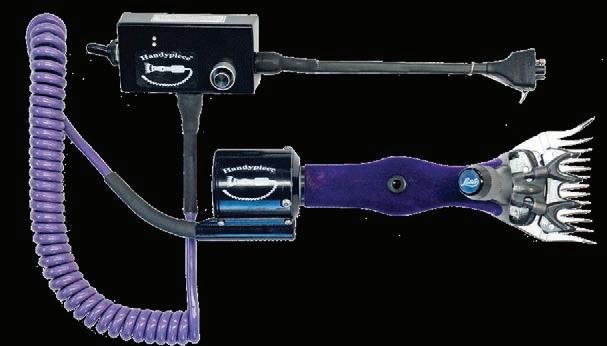

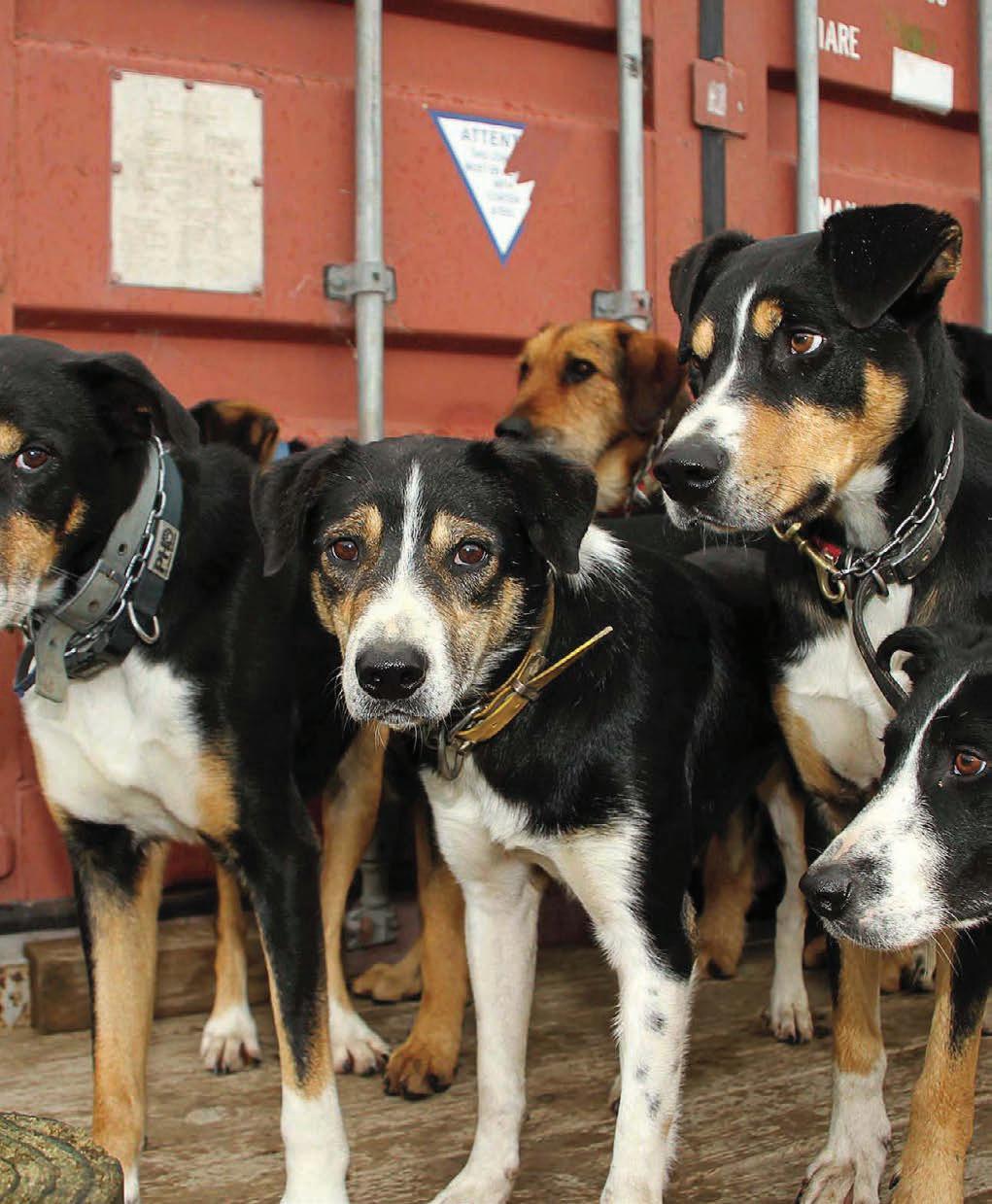













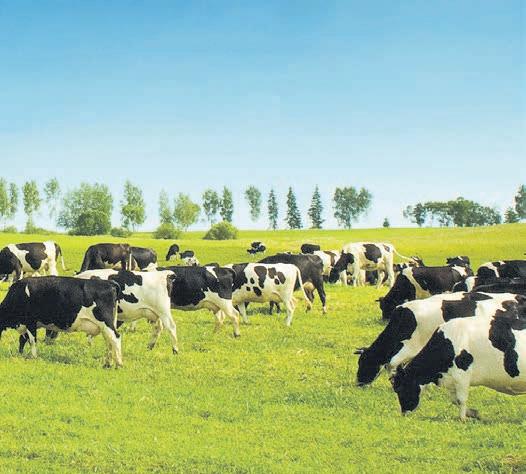








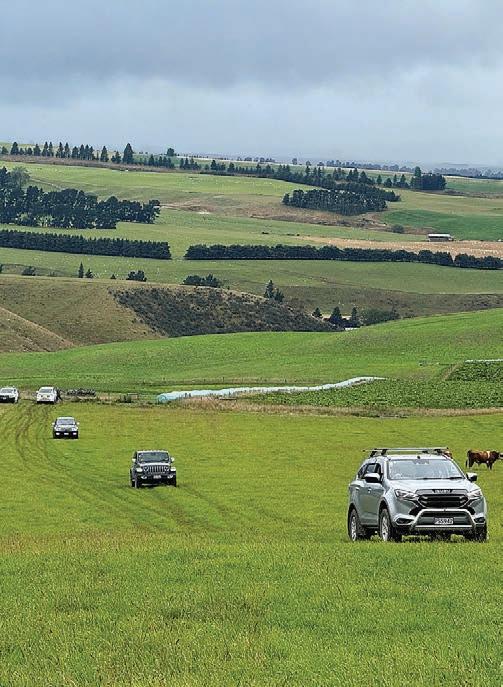
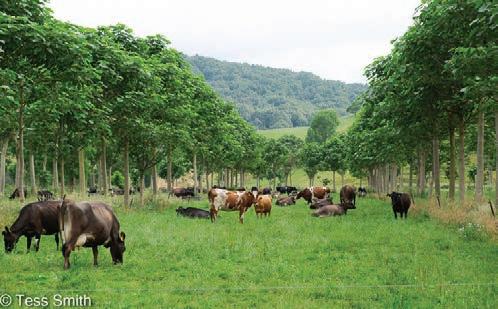
80c BALES / 70c FADGES per kg for dags. Replacement woolpacks. PV Weber Wools. Kawakawa Road, Feilding. Phone 027 458 2727.
GOATS WANTED FERAL GOATS WANTED. Pick-up within 24 hours. Prices based on works schedule. Phone Vicky Le Feuvre 07 893 8916 or 027 363 2932.
PUMPS
HIGH PRESSURE WATER PUMPS, suitable on high headlifts. Low energy usage for single/3-phase motors, waterwheel and turbine drives. Low maintenance costs and easy to service. Enquiries phone 04 526 4415, email sales@hydra-cell.co.nz
RAMS FOR SALE
SOUND TERMINAL SIRES
Suffolk Southdown X and Southdown rams for heavy lambs. Suit ewes or hoggets. $300 - $600. Phone 021 133 7533.
HILL COUNTRY 2-tooth Perendales. Quality sires. Good wool and easy care lambing. $300 - $600. Phone 021 133 7533.
SALE TALK
MORRIS, an 82 year-old man, went to the doctor to get a physical. A few days later the doctor saw Morris walking down the street with a gorgeous young woman on his arm.
A couple of days later the doctor spoke to Morris and said, “You’re really doing great, aren’t you?” Morris replied, “Just doing what you said, Doc: Get a hot mamma and be cheerful.” The doctor said, “I didn’t say that. I said, ‘You’ve got a heart murmur. Be careful.”
TREES FOR SALE
LARGE VARIETY of natives for sale for the 2026 planting season. Pick up Wairoa. Phone Jan 027 278 7033.


share basis.
HORTICULTURE
NZ KELP. FRESH, wild ocean harvested giant kelp. The world’s richest source of natural iodine. Dried and milled for use in agriculture and horticulture. Growth promotant / stock health food. As seen on Country Calendar. Orders to: 03 322 6115 or info@nzkelp.co.nz
LEASE LAND
FATHER -DAUGHTER fencers looking for a block of land. King Country. Genuine and honest. Referees available. Phone 027 489 4778.
LIVESTOCK FOR SALE
WILTSHIRES-ARVIDSON. Self shearing sheep. No1 for Facial Eczema. David 027 2771 556.
SAWN SHED TIMBER including Black Maire, Matai, Totara, Rimu, Mac, Redwood, Western Red Cedar etc. Also buying salvaged native logs. Phone Richard Uren. NZ Native Timber Supplies. Phone 027 688 2954. WANTED TO BUY
WHAT’S SITTING IN your barn? Ford, Ferguson, Hitachi, Komatsu, JD. Be it an excavator, loader or tractor, wherever it is in NZ. Don’t let it rust. We may trade in and return you a brand new bucket for your digger or cash for your pocket. Email admin@loaderparts.co.nz or phone Colin 0274 426 936.
MACROCARPA AND PINE TREES. Plantations, Shelterbelts, Farm lots, Big or small, Lower North Island, Good $$$ paid. No obligation free quote. Call Grant 021 246 4329 HSF Ltd.
Acc R & J LANGEVELD
Canal East Rd, Waitakaruru, Ngatea
Big Production Friesian Cows
MONDAY 4th MAY 11:00AM
400 Aut Inmilk Friesian Cows
130 MT Spr Inmilk Cows
TUESDAY 5TH MAY 11:00AM
400 Spr Calving CRV Friesian Cows 95 R2 I/C CRV Heifers, 95 R1
STOCK REQUIRED
Shorn Store lambs 30-38kg
18mth Ang & AX Hfrs 300-380kg
18mth Angus Steers 340-380kg
2YR Beef Bulls 530-600kg FOR SALE
18mth Fries bulls 470-520 kg
55 MA – Older Angus Cows VIC Ang 18th Dec
info@dyerlivestock co nz www dyerlivestock co nz Ross Dyer 0274 333 381 A Financing Solution For Your Farm www rdlfinance co nz
BROWN SWISS ON FARM IN-MILK AUCTION
A/C White Gold Dairy Farms Ltd. Tuesday 14th April 12-noon
366 Yankee Rd, RD3 Rotorua – DN 78867
COMPRISING
105 x Incalf In-milk Cows
D.T.C 29th July to Friesian & Brown Swiss
6 x MT In-milk Cows
• 28 x R2yr In-calf Heifers
D.T.C 29th July to Jersey
3 x MT R2yr Heifers
• 27 x R1yr Heifers
TB C10 as at 16.3.2026. Lepto vaccinated. BVD undetected. Herd consistently produces 380-400kgms farmed on System 3 being milked OAD. R2yr Heifers are very well grown and have great temperament.
R1yr Heifers are Sired predominately by Friesian being a great first cross.
This is a top quality Brown Swiss Herd and replacements with great temperament which has been bred to Samen & Semex Swiss Genetics for 21 years. 50% of the Herd are registered with the Brown Swiss Association. A rare opportunity for the passionate Brown Swiss Breeder to secure some excellent Capital Stock. The cows will be sold as in-milk with immediate delivery or 1st June by prior arrangement.
VENDOR: Gerben Sterkenburg 027 209 9006
NZFL AGENT: Michael Conwell 027 226 1611



Catalogues available online or by contacting your local NZFL Agent. The sale will be livestreamed on MyLivestock. Please ensure your registration on MyLivestock 72hrs prior to the sale or call us on 0800 MyLiveStock (0800 695 483) for help with registration.
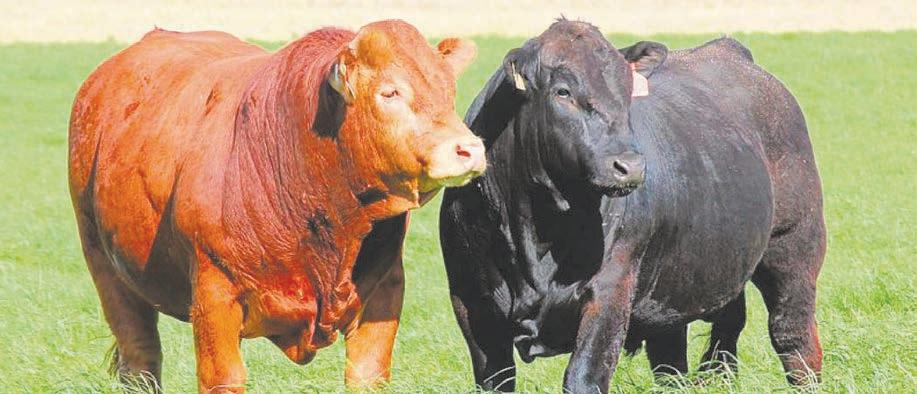


290 Southdown

• 103 FrFrx Carryover Cows
BW156 PW255 Young Cows Calving 25/7 to Angus
• 49 Jersey X Carryover Cows
BW 157 PW249
Cows Calving 25/7 to Angus
• 96 Outstanding Fr Incalf Heifers
BW 155 PW 161
CRL Calving to Jersey 20/7
540kg Liveweight now
• 124 Crossbred Incalf Heifers
BW115 PW124
Calving 20/7 to Jersey
CRL Very well grown
All enquiries:
Tim Rodwell 0274 845 316 RODWELL LIVESTOCK LTD


Tuesday 21st April
12 Noon Start at the Taupo Saleyards
Comprising
470 Mixed Age Angus Cows
6 to 8yr old VIC to Angus Bull
Calving from late Sept for 2 Cycles
20 M/a Angus Sire Bulls
170 18mth Angus Heifers (Empty)
360 Weaner Angus Heifers
C10 Status Farmed at 850 m
Buyers will have the option of runouts Cattle will be sold over scales
Holding paddocks to work in with trucking
Rebate to purchasing agents by arrangement
For all enquiries contact:
Shane Scott: 027 4956031 Pat Lacy: 027 4953564



10th Annual In-Calf
Female Production Sale Wednesday 29th April 2026 1pm

David Giddings 027 229 9760 giddingsfamily@xtra.co.nz
George Giddings 027 656 3323 george@yourbid.org

ELITE GENUINE JERSEY/CROSSBRED HERD, YOUNG STOCK AND MACHINERY DISPERSAL
A/c Wainaki Trust (Chris and Helen Brown)
Date: Friday 10th April 2026
Address: 325 Taukoro Road, Morrinsville
Start Time: Machinery & Sundries 10:00am, Cows 11:00am will be available for online bidding (stock only)

COMPRISING:
A complete herd of 250 x XBred/Jersey In-Milk Cows, DTC 16th July BW211, PW251, BWs up to 563 PWs up to 864, 17 x owner bred Carryover cows BW 247 PW 331, 8 x In-Milk empty cows BW 191 PW 228, 63 x CRL In-Calf Heifers BW 262 PW 249 DTC 10th July to Jrsy bulls. R1 Yr Heifers, 22 x Split 1 BW299 PW284, 22 x Split 2 BW289 pW 268, 21 x Split 3 BW289 PW 286
DETAILS:
A genuine Xbrd/Jrsy herd and young stock bred over 20+ years by Chris & Helen Brown under a proven breeding and management programme, milk OAD this season due to winter/spring conditions, a low empty rate, sound udders; previous milked TAD. Rotary shed milked, with a strong age profile including 145 rising 2-3yr olds and 222 cows aged 5yrs and under. TB C10 and BVD negative. 2025-born heifer weights available pre-auction.
MACHINERY:
Sam 10m3 silage wagon, side feed with scales, Milkbar 50 teat mobile cafeteria, Honda 2024 XR 150 motorbike 5700km, Claas Disc 2.5m silage mower, 500 L calf milk tanker trailer with pump, 3 x Milkbar 12 teat calfeterias, 3 x 6m x 500mm culvert pipes, Giltrap 5T single axle tip trailer, Pearson 1.5m Silage Grab, Giltrap quick hitch carryall, 8T Sumitomo Digger, tilt bucket & digging bucket 6154 hrs, Croplands 800L spray unit, 8m boom, 50m hose, Deutz Agro farm 100 tractor, 4WD, open roll cab, 4000 hrs with Agrolift 3rd service FEL & bucket 100hp. All in very good order, plus numerous farming items, standards, reels, calf equipment etc.
PAYMENT TERMS:
14 days for stock, machinery and sundries for approved Carrfields account holders. Sale day payment required for non-account holders (EFTPOS available).
DELIVERY:
No delivery sale day. Deliveries from Sat 11 April. R1 heifers 1 May or earlier by arrangement. 1 June deliveries available by prior arrangement.
CARRFIELDS LIVESTOCK AGENTS: Jack Kiernan 027 823 2373 or Stewart Cruickshank 027 270 5288






2ND ANNUAL ELITE HEIFER & COW SALE
2
•
(150 are home bred, Ave BW 338, PW 361)
BW ’s to 474, PW ’s to 474
• 43 Friesian & Friesian X Incalf Cows
BW ’s to 414, PW ’s to 677
29 Heifers offered contracts to CR V or LIC, with a high hold rate to AI.
43 Carr yover cows some carr ying embr yos from contract heifers
Approx 10 have 2026 contract interest
All these animals are Incalf to AI or DNA profiled bulls
Stop the Press
Possibly the largest selection of high index heifers on offer anywhere this autumn
Unique oppor tunity to purchase heifers that have been farmed in a large herd environment, the ver y best 2024 heifers from a 1100 cow herd They exhibit all the qualities you’d expect, udder conformation, capacity fer tility with great feet and legs
Presented in excellent health and condition with great temperament A considerable propor tion of the heifers are genomically tested, and are sold on their genomic BW ’s Feedback from last year ’s sale animals was ver y positive
If you after top indexed heifers, or perhaps a future star per former, look no fur ther Available in singles, matched pairs and trio’s
Catalogues available, please visit w w w.agonline.co.nz/upcomingsales OPEN DAY – Thursday 2nd April | 11:00am On Farm – 243 Tait Road, Woodbur y, Geraldine
Contact: Andrew Reyland 027 223 7092 Bill Moore 027 825 7505 Bernie Cox 027 477 0551
Thursday 23rd April | 11:30am
On Farm – 516 Otorohanga Road, Te Awamutu
Comprising
• 22 Incalf Friesian Heifers
• 36 High Performing Young Friesian Cows BW’S to 469, PW’S 848
Due to industry progression Woodcote (Andrew) and Full-on (Gordon) offer for sale a high-quality selection from some of their best cow families Woodcote and Full-on farms are renowned for breeding high producing, functional,
360 Friesian/Friesian X Inmilk Incalf Cows
• 40 Friesian/Friesian X Young MT Cows
• 240 Friesian/Friesian X Inmilk Incalf Cows
250 Friesian/Friesian X Incalf Heifers
Incalf cows have been evenly split over both days
Comprising:
• 600 Friesian/Friesian X Inmilk Incalf Cows, BW 104, PW 123, RA 99%
• 250 Friesian/Friesian X Incalf Heifers, BW 164 PW 140
40 Friesian/Friesian X Young Empty Cows, BW 128, PW 138
up to 687 At the 8/02/2026 Herd Test, cows were producing 2.03 M/S per cow and year to date 608 M/S per cow with an average SCC of 98,000 Last season s
with Hereford Bulls Bulls removed 20th December Vetted to dates Herd TB C10, Lepto Vacc, EBL Free, BVD
Free, Rotar y Shed
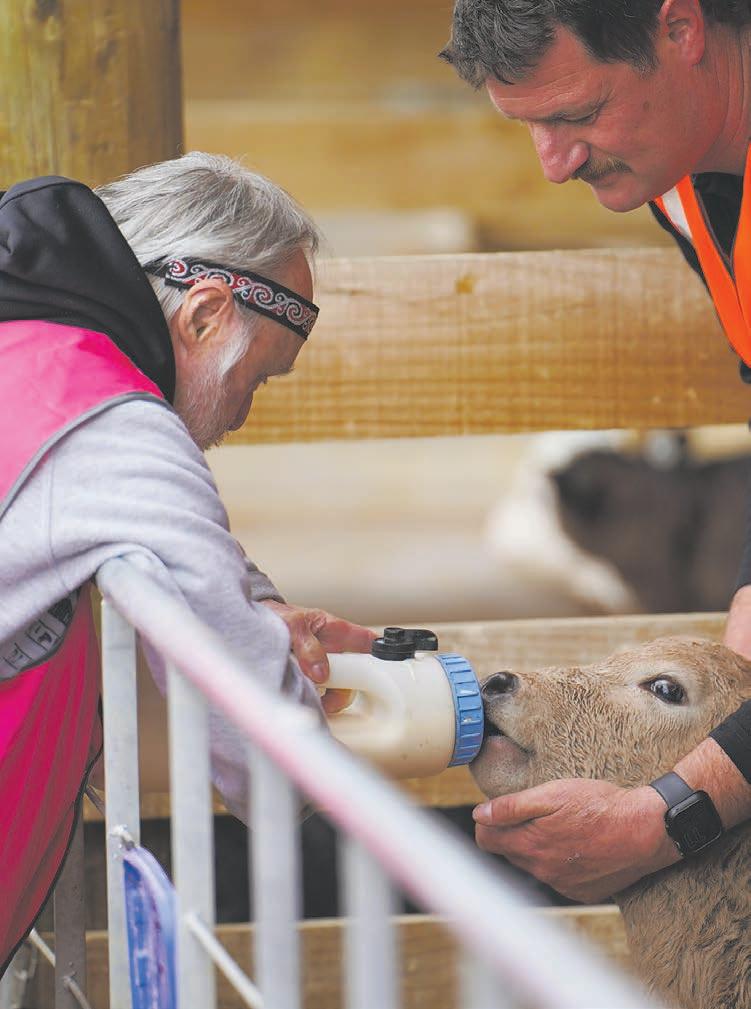

Catalogues





Moore 027 825 7505
QUALITY FRIESIAN/FRIESIAN X INCALF COW & HEIFER 2 DAY DISPERSAL
Markets
Proudly sponsored by
Processing season finally kicks into gear
Pricing and other pressures start to build as lines get moving.
Neal Wallace MARKETS Livestock
SHEEP and beef farmers could face delays getting killing space for stock as one of the slowest processing seasons in decades finally kicks into gear.
The beef kill from January to the end of March was 18% behind last year and lambs 12%, but companies have ramped up staffing levels and are working overtime as stock flows increase.
Silver Fern Farms chief executive Dan Boulton said pressure on space is building and backlogs for sheep and cattle could develop. If that is the case, preference will be given to suppliers who are full shareholders, he said.
We are currently seeing schedule pricing corrections across all stock classes after livestock shortages earlier in the season kept livestock prices above sustainable levels for processors.
Nigel Stevens AFFCO
AFFCO chief executive Nigel Stevens said it has been a balance between livestock flows and plant capacity.
“We are currently seeing schedule pricing corrections across all stock classes after livestock shortages earlier in the season kept livestock prices above
sustainable levels for processors.”
Most export markets remain relatively strong but returns have been assisted by a weakening New Zealand dollar.
Stevens said pricing pressure is emerging as increased volumes become available and pockets of consumers resist current price levels.
While AFFCO has storage available, Stevens is aware of concerns about potential shipping disruption.
Wayne Shaw, Alliance Group’s manager of safety and processing, said plants are operating at or near full capacity and overtime is being added where required.
“The season is tracking later than usual, largely due to a wetter summer and strong pasture growth across many regions.”
Volumes are now building steadily, which is expected to continue in the coming weeks, he said.
AgriHQ senior analyst Mel Croad said farmgate prices are starting to fall as company procurement pressure eases and farmers start offloading prime stock they have retained to put on extra weight and control surplus grass.
Prices for some classes of beef cattle have reduced 15c/kg since mid-February and lamb 35c/kg in the last month.
Lamb prices are still historically high at about $10.65/kg.
Croad said AgriHQ is reviewing its forecast winter prices, given the growing global uncertainty and the current reduction in farmgate prices.
Higher fuel costs are also impacting meat companies, given

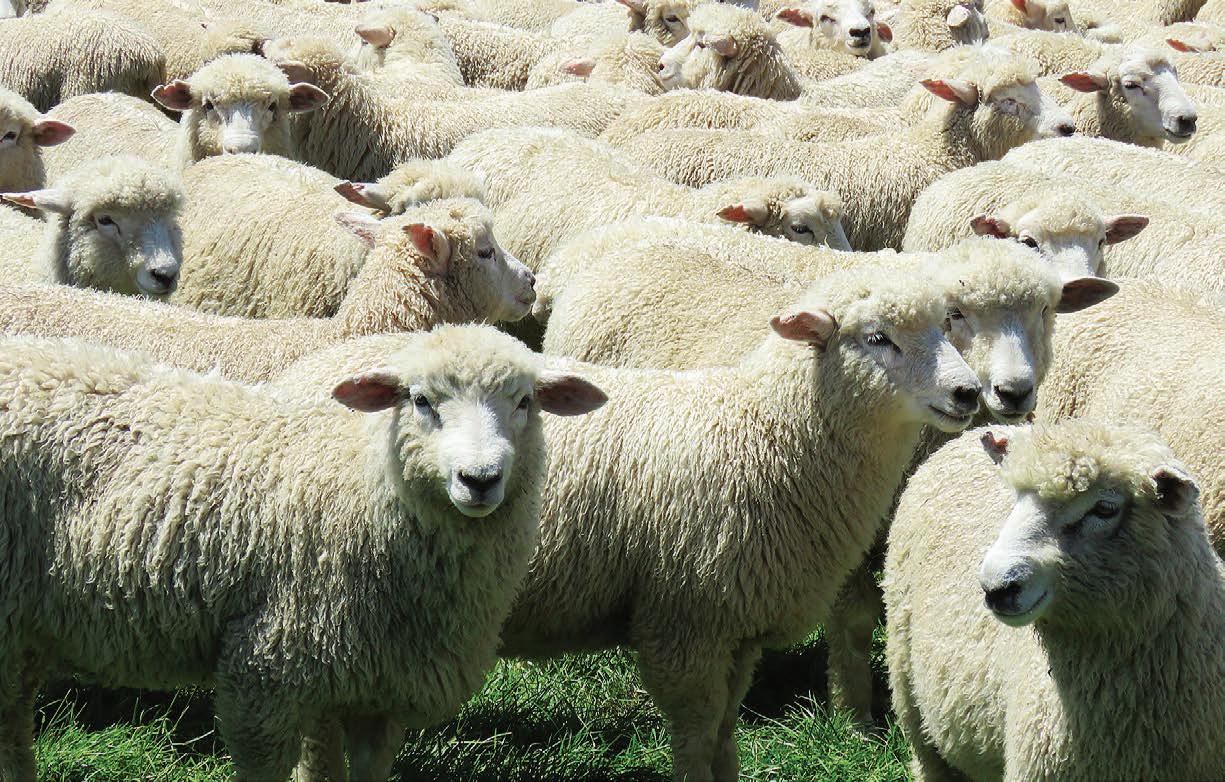
that most pay for transporting stock from farms to processing plants.
The cow kill from October 1 has been at historic lows on the back of fewer cull dairy cows. The peak season for cull dairy cows is early May.
Beef cow numbers have been low due to several years of herd rebuilding, a trend Croad expects to continue.
Croad said some exceptional prices were paid for store lambs in January and February for winter supply, but global uncertainty and higher fuel costs are likely to see forecast winter prices fall below earlier expectations from livestock traders of $12-$12.50/kg.
Prices in Europe have recently dropped slightly.
Shaw said Alliance is monitoring global supply chains given the disruption from the Middle East conflict.
“The cost of getting product to market has increased, driven by freight rates, route disruptions and extended transit times,” he said.
“Despite these challenges, we’re confident in our cold storage position across the network.”
Boulton said company managers are planning for various scenarios that could play out in the next three to six months, such as shipping schedule disruption, fuel availability and access to packaging material.
“We cannot control geopolitics, but we can control how prepared and disciplined we are,” he said.


FALLING: AgriHQ senior analyst Mel Croad says farmgate prices are starting to fall as company procurement pressure eases and farmers start offloading prime stock they have retained to put on extra weight and control surplus grass.
OVERTIME: Wayne Shaw, Alliance Group’s manager of safety and processing, says plants are operating at or near full capacity and overtime is being added where required.
Cattle Sheep Deer

Weekly saleyard results
These weekly saleyard results are collated by the AgriHQ LivestockEye team. Cattle weights and prices are averages and sheep prices are ranges. For more detailed results and analysis subscribe to your selection of LivestockEye reports. Scan the QR code or visit www.agrihq.co.nz/livestock-reports
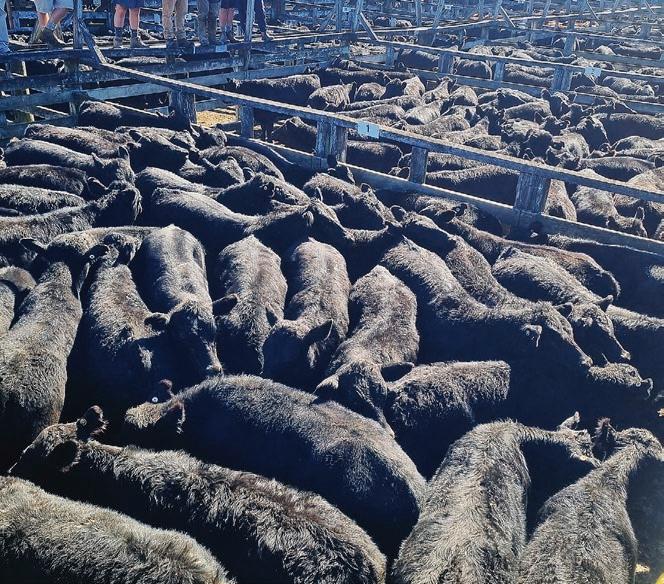

AND THEY’RE OFF: Weaner fairs kicked off at Matawhero on Tuesday, March 31 with a yarding of steers and bulls. The pen in the foreground held 284kg Angus steers that made $2000.
Coalgate | March 26 | 352 cattle, 3364 sheep
1.5-year
Boner Friesian cows, 630kg
Boner crossbred cows, 490kg
Boner Friesian heifers, 470kg
Charlton | March
lambs, all
Prime ewes, most
Prime lambs, most
Lorneville | March 31
1.5-year exotic-dairy steers, 436kg
1.5-year dairy-beef
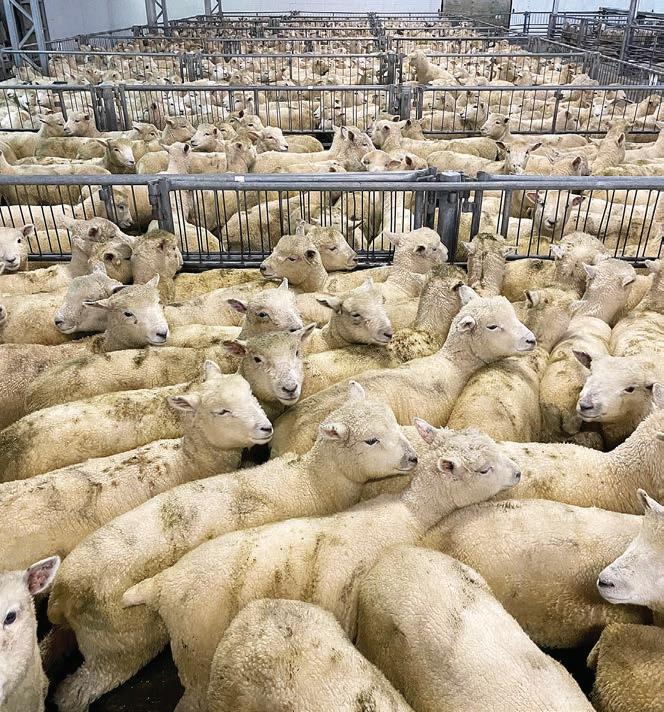
1.5-year
Matawhero | March 31 | 2346 cattle
Temuka | March 26 | 1261 cattle
1.5-year traditional steers, 380kg 4.90
1.5-year
Cheviot | March 27 | 1231 cattle

PRESENTATION KEY: A large consignment of shorn Romney and Romney-Southdown store lambs from Glenroy was yarded at Canterbury Park on March 31. These RomneySouthdown ewe lambs collected $150.
Photo: Stu Uren, PGG Wrightson
La Niña ends and neutral begins

Philip Duncan NEWS Weather
LA NIÑA is officially over and we’re back in neutral. It seems incomprehensible that it is April already, yet here we are in the second month of autumn and now officially on the winter side of things since we passed the equinox a couple of weeks ago.
As our nights continue to get longer and our days shorter we will start to get more hints of Southern Ocean weather.
We’ve had some colder days and mornings in the mix, but there hasn’t been a lot of frost so far this year with some parts of the lower South Island even having warmer spells in recent weeks.
It can be tricky preparing a longer range forecast (a monthly outlook, for example) at any time of the year in New Zealand, but April to October is the half of the year that it usually gets more difficult.
Weather is about pattern and chaos, and usually from now on we get a bit more regular chaos. The biggest change to our
weather pattern that is slowly underway is a breakdown in high pressure zones. They aren’t as uniform as they were even just a month ago. By that I mean, rather than a series of highs linked together in a line – like several trucks driving on a road – they are now different shapes and sizes and spaced out further, with lows, rainbands and more instability between them.
That’s why we’re seeing a low pressure zone form around New Zealand this week with some localised heavy rain possible in the north, and why also a tropical cyclone has formed (or is about to) well north of NZ in the tropics.
Australia just had a significant cold event bringing frost and snow to alpine areas – a cold event that reached NZ early last week and wasn’t too much to talk about.
Last year Australia had many more cold blasts than NZ did and this year they have beaten us to it with the wintry stuff (for now, anyway).
At the time of writing this column (a little earlier than usual due to Easter, so forgive me if anything changes) Australia’s southeast was getting another
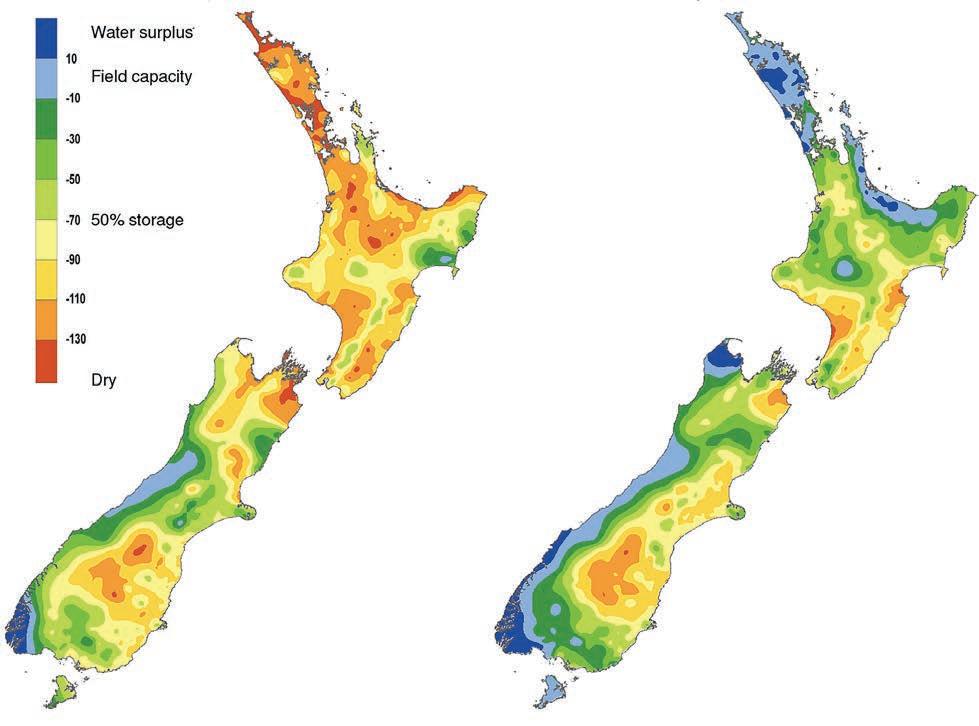
Deficit at 9am on 30/03/2025
wintry dose this coming Thursday while potentially a tropical cyclone was hitting Queensland. In between these two systems in eastern Australia is a blob of high pressure keeping NSW dry. What is happening in Australia sums up the general weather pattern right now: The tropics is
Deficit at 9am on 30/03/2026
active to our north. We have more highs coming in from our west, but they are broken up more, and the Southern Ocean weather pattern to our south is sliding northwards slowly as we inch towards winter. What does this all mean for NZ’s weather going forward? Westerlies! Despite some places
kicking off this week with easterlies or northerlies, we see an uptick in westerly-driven weather over the first half of April. There is high pressure in the mix too, but not as orderly.
Now that we’re back in neutral, expect the prevailing westerly to wake up a bit more.




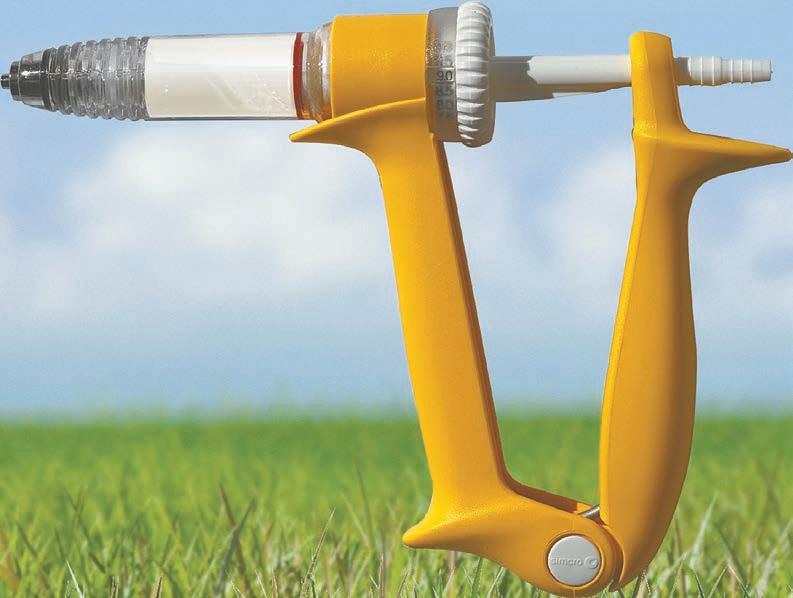


COMPARE: The soil moisture deficit map from March 30, 2025, compared to March 2026.
Image: Earth Sciences NZ