Land change gutting rural NZ – study

RURAL communities are being gutted of people and services by the conversion of farmland to exotic forestry, a researcher says.
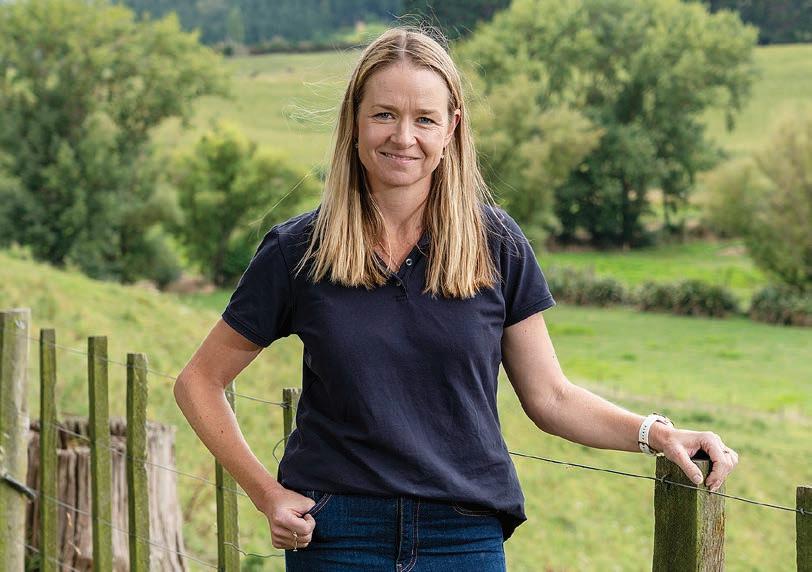
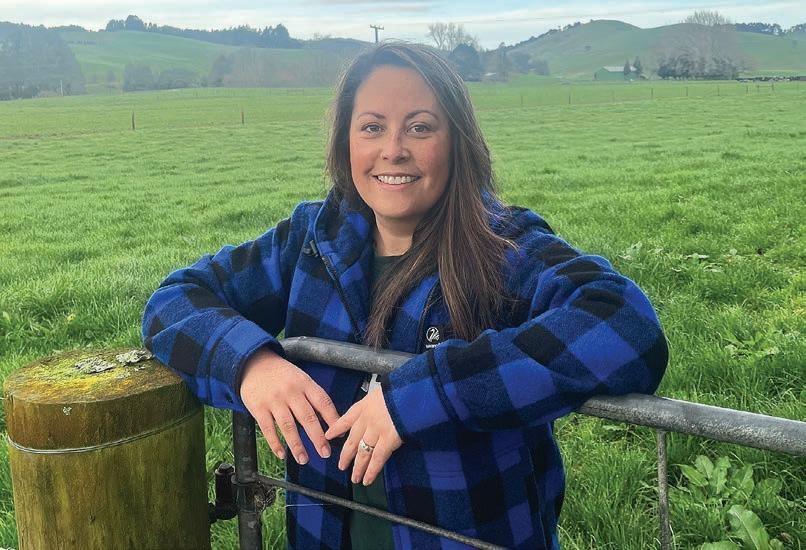
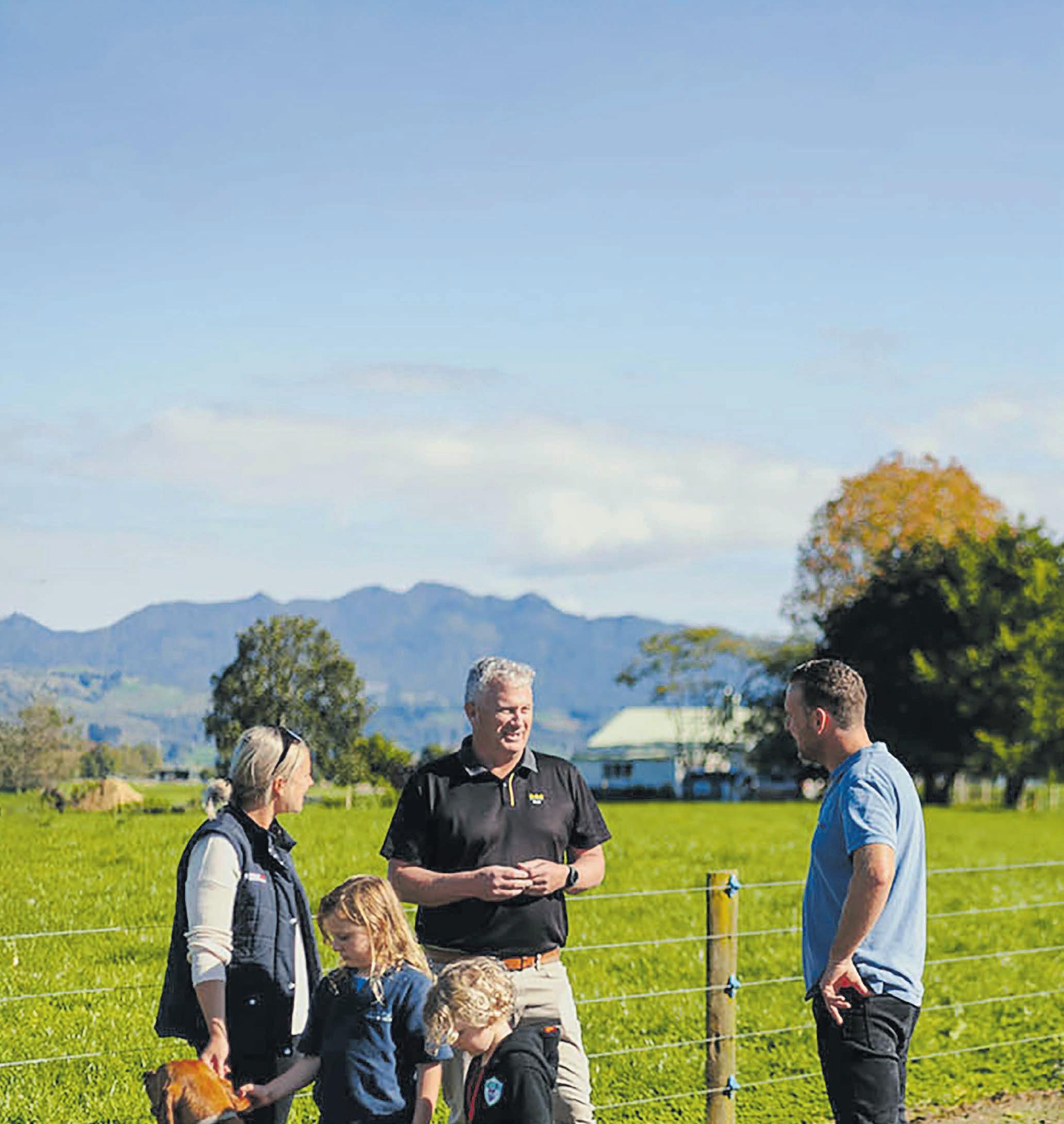
Kathryn Wright, a rural mental health counsellor who works in rural social services, is studying the social effects on rural communities where farmland is converted to forestry as part of her University of Otago doctorate.
She urged forestry companies to listen to the concerns of rural communities where farmland is being converted, saying the impact from the loss of people and services is real.
“Engage, engage, engage and take people’s concerns seriously,” she said.
During her research she heard of cases where forestry companies failed to fulfil promises to meet communities and discuss their concerns about issues such as fire control and pest management.
“I’m not painting all forestry companies like that, but this is what people have told me,” she said.
Since 2017 at least 300,000 hectares of farmland have been converted to forestry, with the loss of 2 million stock units, land that is unlikely to be converted back to pasture, she said.
This has changed the dynamics of those rural communities.
Fewer pupils could mean schools lose teachers, businesses that service farms and retailers have closed or refocused their business, sporting and servicing clubs are struggling for members and the changes have exacerbated mental health and rural loneliness issues.
Clubs are predominantly filled by those working in the farming sector but many clubs are struggling as people leave once farms are sold.
Another issue is that forestry contractors come from outside the community, meaning lost farmrelated jobs are not being replaced.
“There is indeed a flurry of activity around planting and harvesting with more people in the area, but this is only every 30 years or so.”
Community institutions provide rural people with a social link where they can meet, interact and develop connections.
Wright compared two similarsized Otago towns, Lawrence –which has had an influx of forestry conversions – and Omakau, which has not.
Both communities are on cycle trail routes.
She interviewed 25 people and conducted an anonymous questionnaire among rural people in Otago and Southland which attracted 400 replies, a much
Continued page 3
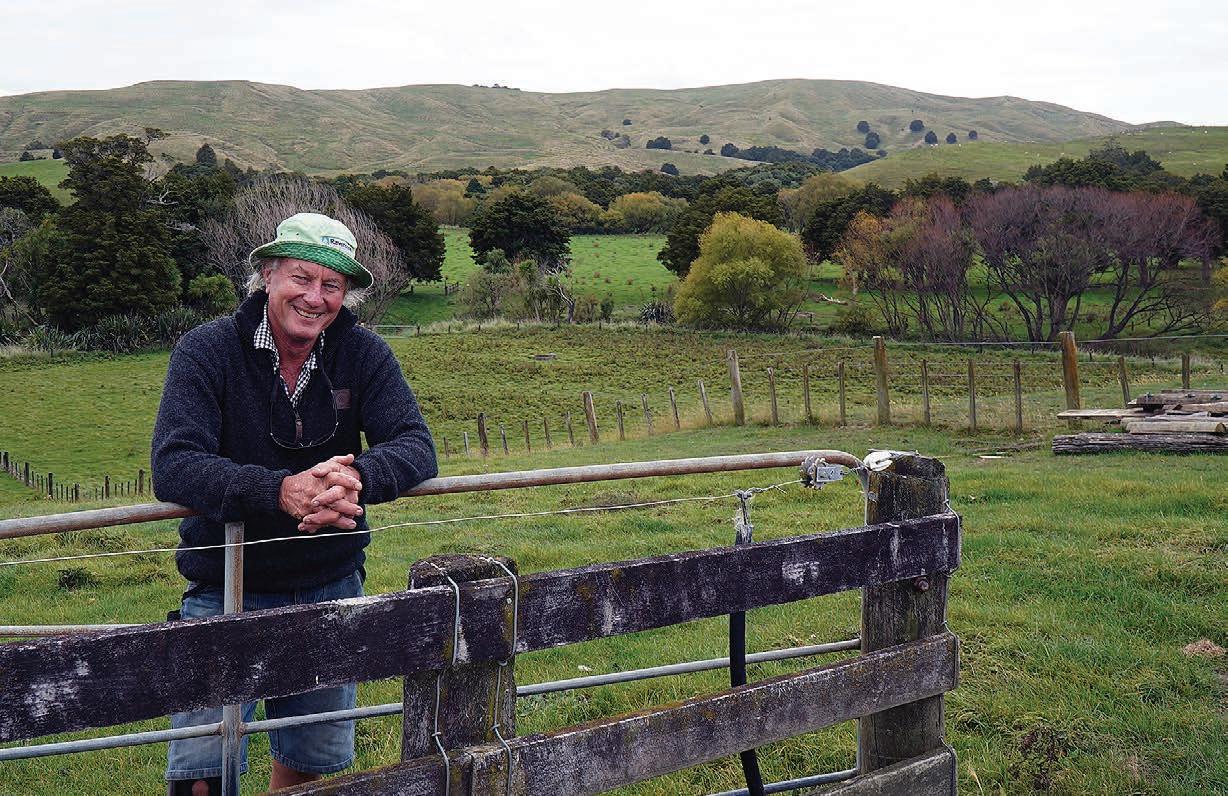
Fire fears as forestry moves in
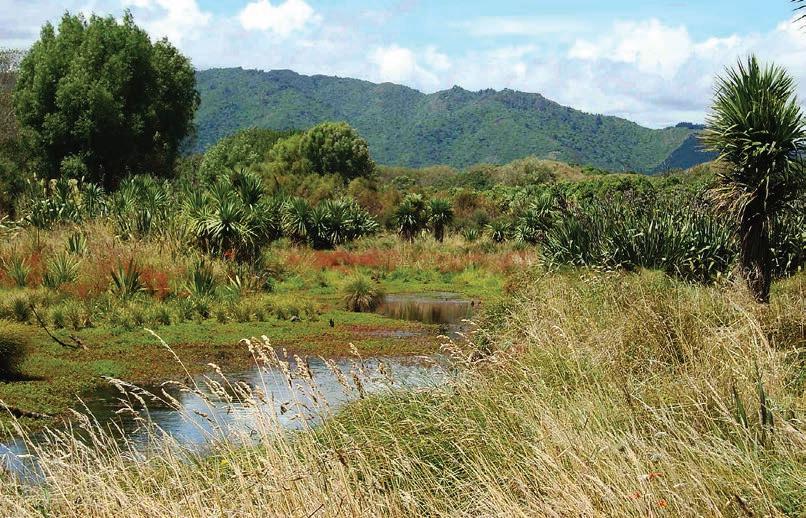
Central Hawke’s Bay farmer James Hunter has spent decades nurturing the native plantings and wetlands at Rangitoto Station, but he fears that work could disappear if fire were to rip through the region.
SPECIAL REPORT 8
Iran war expected to add $35m in costs for SFF. NEWS 3
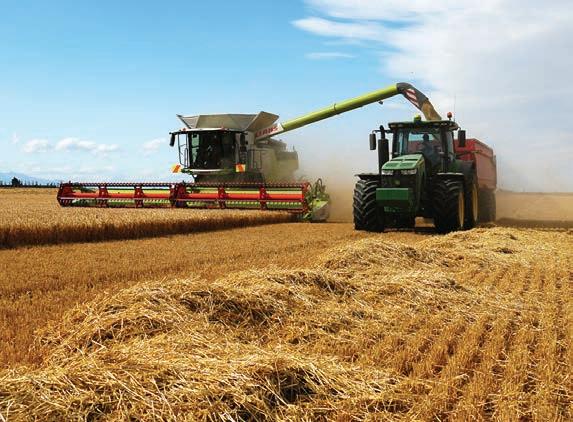
NZAB director Andrew Laming says the future for arable farming is not about one difficult harvest, it’s about what type of arable business will remain resilient in a more volatile environment.
ARABLE 19-20
Fonterra farmers’ windfall unlikely to be repeated. NEWS 4

Farmers need a different skillset, says Mark Guscott.
OPINION 17

Photo: Bryan Gibson
Neal Wallace NEWS Forestry
Get in touch
EDITORIAL
Bryan Gibson | 06 323 1519
Managing Editor bryan.gibson@agrihq.co.nz
Craig Page | 03 470 2469
Deputy Editor craig.page@agrihq.co.nz
Claire Robertson
Sub-Editor claire.robertson@agrihq.co.nz
Neal Wallace | 03 474 9240
Journalist neal.wallace@agrihq.co.nz
Gerald Piddock | 027 486 8346 Journalist gerald.piddock@agrihq.co.nz
Annette Scott | 021 908 400 Journalist annette.scott@agrihq.co.nz
Hugh Stringleman | 027 474 4003 Journalist stringleman@outlook.co.nz
Richard Rennie | 027 475 4256 Journalist richard.rennie@agrihq.co.nz
Gerhard Uys | 027 239 4388 Journalist gerhard.uys@agrihq.co.nz
Nigel Stirling | 021 136 5570
Journalist nigel.g.stirling@gmail.com
Isabella Beale | 027 299 0596
Multimedia Journalist isabella.beale@agrihq.co.nz
PRODUCTION
Lana Kieselbach | 027 739 4295 production@agrihq.co.nz
ADVERTISING MATERIAL
Supply to: adcopy@agrihq.co.nz
SUBSCRIPTIONS & DELIVERY 0800 85 25 80 subs@agrihq.co.nz
PRINTER
Printed by NZME
Delivered by Reach Media Ltd
Advertise
SALES CONTACTS
Andy Whitson | 027 626 2269
Sales & Marketing Manager andy.whitson@agrihq.co.nz
Janine Aish | 027 300 5990
Auckland/Northland Partnership Manager janine.aish@agrihq.co.nz
Jody Anderson | 027 474 6094
Waikato/Bay of Plenty Partnership Manager jody.anderson@agrihq.co.nz
Palak Arora | 027 474 6095
Lower North Island Partnership Manager palak.arora@agrihq.co.nz
Andy Whitson | 027 626 2269
South Island Partnership Manager andy.whitson@agrihq.co.nz
Julie Hill | 027 705 7181
Marketplace Partnership Manager classifieds@agrihq.co.nz
Andrea Mansfield | 027 602 4925 National Livestock Manager livestock@agrihq.co.nz
Real Estate | 0800 85 25 80 realestate@agrihq.co.nz
Word Only Advertising | 0800 85 25 80 Marketplace wordads@agrihq.co.nz
PUBLISHERS
Dean and Cushla Williamson Phone: 027 323 9407 dean.williamson@agrihq.co.nz cushla.williamson@agrihq.co.nz
Farmers Weekly is Published by AgriHQ PO Box 529, Feilding 4740, New Zealand Phone: 0800 85 25 80 Website: www.farmersweekly.co.nz
ISSN 2463-6002 (Print) ISSN 2463-6010 (Online)
Contents
News in brief FTA backed
Major primary industries are among those behind an open letter published in newspapers urging political parties to back the government’s free trade agreement with India.
Negotiations with India concluded in December but the agreement does not yet have the Parliamentary majority needed. The letter, signed by 28 major companies and industry groups, says the agreement is the country’s “best opportunity to secure meaningful access to one of the world’s most important growth markets”.
Back to the future
The Canterbury A&P Show will return to its original Wednesday-to-Friday format this year.
The decision restores a format that served the show for more than 160 years, and reflects feedback from the farming community, rural exhibitors, and agricultural businesses. For 2026, that places the show on Wednesday 11 to Friday 13 November.

Crisis averted
Farmers and growers have waved off Cyclone Vaianu’s impact as a “light spanking” instead of the full body blow they had been expecting as it bore down on the country.
Initial expectations were for possible Gabrielle-like consequences along the length of the North Island’s east coast. Federated Farmers Hauraki-Coromandel provincial president Robert Craw said the region took only a “light spanking” from the cyclone, escaping serious damage.
Parasite test
A new diagnostic test has been created to give farmers and veterinarians earlier, more accurate information about parasite infections in stock.
The DNA-based test, Fast Worm ID – GIN PCR, identifies parasite species directly from faecal samples, with results available in under three working days.



Primary sector starts to count cost of war
Neal Wallace NEWS Trade
THE war on Iran will add about $35 million in extra costs for Silver Fern Farms in the next six months, chief executive Dan Boulton says.
He said that the situation in the Persian Gulf is changing regularly, but an assessment of the impact of rising fuel and petrochemical costs reveals that to be the minimum impact.
“While we’ve still been able to access our customers in the Middle East through alternative ports, like everyone, we’ve been concerned about the impacts of fuel shortages, something I’m sure everyone will be seeing back on farm as well.”
Boulton said SFF is working with the government on its fuel response plan, stressing the importance of ensuring fuel is available across the food production supply chain, from farm production to getting product into markets.
A Fonterra spokesperson said the global geopolitical situation remains fluid, but in an earnings update late last month, it warned the conflict could potentially
Continued from page 1
higher response than she expected.
The findings, which she said are applicable to all of rural NZ, raised concerns about the impact of that land conversion on communities, the threat of fire, the impact on water supplies, and the intrusion of pests, wilding pines and slash.
“Of the people I’ve spoken to, everybody was worried by at least one of these issues.”
A common concern was the greater fire risk and the reality that the ranks of volunteer fire brigades to fight those fires are being gutted by the loss of rural jobs.
As communities shrink or
increase inventory levels and costs in the second half of this year, while global commodity prices could be volatile.
Shipping schedules are being disrupted and freight costs increasing.
“Neither impact is expected to be material due to the alternative shipping options Kotahi [Fonterra’s logistical partner] has been able to provide, and an expectation that a reasonable portion of the higher costs will be recovered from the market in the short term.
“Furthermore while we are experiencing cost pressures, our hedging policies mitigate much of the short-term cost impact.”
Rabobank senior protein analyst Jen Corkran said it has not tried to quantify the costs of the war on the primary sector given events are rapidly changing.
She said the economic fallout so far is being felt in high costs and squeezed margins rather than changes in global demand for food.
Lamb prices are still 40% above the five-year average and beef 60% higher, and while there is some seasonal easing in those prices, market demand and returns prices are holding up.
Corkran said this is in part due to the fact that the full impact of higher fuel and supply chain
struggle to grow, Wright said, there is a risk that health and other services decline.
She said the demographics of Lawrence are changing as people with traditional rural servicing jobs are replaced by people choosing a quiet lifestyle and to work remotely.
Previous research has found that for every 1000ha of farmland converted, 7.8 full-time equivalent employees (FTE) lost their jobs.
Carbon farming employs 0.6/1000ha FTE and production forestry 2.5/1000 ha.
It is wrong to blame landowners for selling to forestry companies as the reasons vary from economic,
You’ve improved the farm. Now improve how you live on it .
The work’s done The view’s earned
Now make it usable, year round
Archgola outdoor rooms and outdoor blinds are designed to fit your home and handle New Zealand conditions, so you can sit back, whatever rolls in
It works Season after season
Installed by local exper ts, nationwide
Get in touch for a free consultation
We’re better set up to make decisions but that doesn’t make it any easier.
Jen Corkran Rabobank
costs are not yet being reflected in consumer prices.
She said higher diesel and fertiliser prices – especially for urea, which has increased more than 50% in a month – will
to personal reasons such as mental burnout, physical injuries and weariness about adhering to regulatory compliance.
She said the average age of sheep and beef farm owners is about 65 and decades of manual labour have taken a physical and mental toll on many.
“Put yourselves in their shoes and ask what would you do?”
Some sellers have been isolated by the community but others have been understood and supported.
She spoke to some people who no longer travel roads adjacent to new forestry planting, saying the transformation of the landscape is too raw.
eventually flow through to higher consumer prices.
Should the conflict end, she said, there will be a lag before input prices fall.
New Zealand’s pasture-based system also offers cost-conscious options for farmers such as strategic use of nitrogen in spring to keep the volume used and costs down.
Corkran said the sector is fortunate to have high product prices at a time when inflation is lower than it has been. Also,
in times of global unrest, food security becomes a priority and this benefits food producers.
“We’re better set up to make decisions but that doesn’t make it any easier.”
Economist Cameron Bagrie said SFF’s $35m minimum cost assessment from the conflict represents an economic impact of 1.7% on its $2 billion turnover.
“The number sounds big but it’s not so big when you realise it’s 1.7% on $2bn turnover,” he said.
He predicts New Zealand’s inflation rate will reach 4.5% later this year, largely due to pressure from the rising price for fossil fuels.
Global research shows global food inflation in March reached 2.5% as higher fuel costs starting flowing through to global food prices.
“It is a forewarning that something is coming across the broader food complex.”
Bagrie stressed that should fuel rationing be required, access for farming and heavy transport should be a priority given its economic importance.
ANZ Bank is forecasting the Reserve Bank to lift the official cash rate three times this year, taking it from 2.25% currently to 3% as it seeks to control inflation.
This week’s poll question: Have your say at farmersweekly.co.nz/poll Do you think NZ has the right regulatory settings to ensure sheep and beef farming and forestry can both thrive?
SQUEEZED: The war in Iran is increasing costs and squeezing margins, says Rabobank senior protein analyst Jen Corkran.
April showers of cash for Fonterra farmers

Hugh Stringleman NEWS Dairy
EACH Fonterra farm has been paid on average $650,000 by the cooperative in April by way of a huge capital return, two dividends and the regular monthly milk advance payment.
The capital return was $2 a share and totalled $3.2 billion from the recent sale of Mainland Group to Lactalis, the world’s largest dairy company.
The two dividends were 24c fully imputed from the FY2026 interim results and 16c from Mainland’s earnings until the day it was sold.
The milk payment for March production, paid in April, was $1.5bn in total and an average $180,000 per farm at the advance rate of $7.95/kg milksolids.
Fonterra’s super payout over two days, April 14 and 15, was $5.4bn and easily the biggest cash payment in New Zealand’s economic history.
For perspective, the government’s fortnightly payments on all social security, welfare and
national superannuation come close $2bn, assuming all types are paid on the same day.
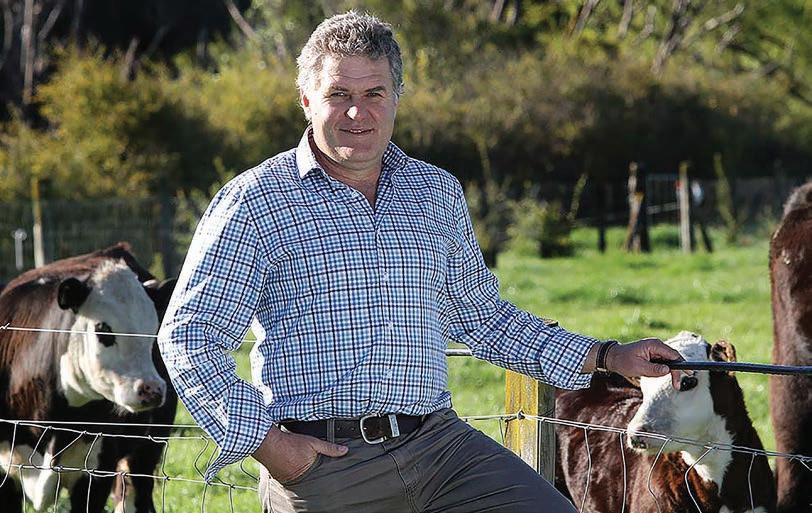
MyFarm chief executive Andrew Watters said the total payments by Fonterra were historic and unlikely to ever be repeated to the same scale.
Investors in each of the MyFarm mature and well-capitalised dairy syndicates would receive their share of the proceeds.
Watters has published an analysis of the inflation-adjusted milk price over the past 20 years to illustrate his point that $9.50 to $10/kg is upper quartile but is well below 2007-08 in purchasing power.
“Those payouts had 15-20% more purchasing power than today’s because input costs have risen faster than milk prices over most of the past 20 years.
“History reminds us that the downside is brutal and we have more tools to manage price risk with fixedprice offers, milk price futures and options, and blended strategies that lock in margins while preserving upside.”
ANZ agri economist Matt Dilly said dairy farmers are in a good
place presently, mostly with no urgent need to repay debt, although some will be repaid.
Investment and spending decisions will include on-farm or off-farm items, varying widely across the country.
“Farmers will put some of this payout into cash reserves.”
The Middle East conflict must be considered, with the price of diesel having doubled and fertiliser and other inputs expected to follow.
History
reminds
us
that the downside is brutal and we now have more tools to manage price risk.
Andrew Watters MyFarm Investments
“The $2 capital return is from farmer’s investments in their dairy company over years, even generations.
“There were times, not so long ago, when they might have considered that [Mainland] investment not a very good use of their funds.”
When pondering the size of the April payouts, Dilly draw some comparisons with Fonterra’s formation from NZ Dairy Co, Kiwi Dairies and the Dairy Board and possible government financial assistance during Covid 19.
Lincoln University senior agri lecturer Nic Lees said this is a once-in-a-generation capital event rather than a normal income event and the key risk for farmers is treating it like income.
“The more likely behaviour is balance sheet repair first, then deferred maintenance and selective investment.
“The impact on the rural economy should be real, but gradual rather than a sudden spending surge.”
Lees said the farms that use the capital return to reduce debt, address deferred maintenance, and strengthen resilience will get the most lasting benefit.
Fonterra’s supply shares, tradable only among farmers, have fallen in price from $6.18 to $4.40 after the capital return.
Fonterra Shareholders Fund units fell from $8.40 to $6.15 postdividend and payout.
This means that Fonterra’s market capitalisation went down $2.5bn and is now similar to that of A2 Milk at $7bn.
Lees said much of the apparent “loss” in value has simply been transferred from Fonterra’s balance sheet into farmers’ bank accounts, rather than destroyed.
Pāmu passes its Fonterra windfall to government
SPECIAL DIVIDEND: Pāmu is paying a special $10m dividend to the government, chief executive Mark Leslie has announced.
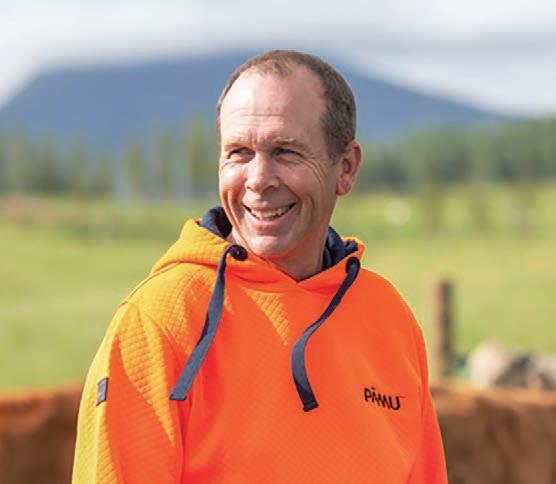
Staff reporter NEWS Agriculture
THE government is to receive a $10 million special dividend from Pāmu, reflecting a strong business performance and the $9.5m capital repayment the state farmer received from Fonterra following the sale of to co-op’s Mainland consumer business.
Including this special dividend, Pāmu will have paid the Crown $25m in dividends for the 2025-26 financial year.
A half-year net operating profit of $26m was recently reported, with Pāmu forecasting a record full-year profit of between $97m and $107m.
“As we reach the midpoint of our five-year reset, this performance has given the board confidence to make this payment,” Pāmu chief executive Mark Leslie said.
“Over the past three years we have been focused on lifting onfarm performance, improving productivity, and running a tighter, more disciplined business.
“The results we’re seeing reflect the commitment and hard work of
our teams across the country.”
The special dividend represents the pass-through of non-operating capital and is separate from the Pāmu ordinary dividend policy and operating results.
Pāmu has 51 dairy farms producing about 165 million litres of milk a year.
The $9.5m capital return Pāmu received from Fonterra was its share from the $3.2 billion that French company Lactalis paid for Mainland Group. Fonterra distributed to eligible shareholders and unit holders at $2/share.
UNIQUE: MyFarm chief executive Andrew Watters doesn’t expect Fonterra’s windfall to recur anytime soon.
Churn not an issue on dairy farms: survey

Gerald Piddock PEOPLE Dairy
DAIRY farm employees remain positive about the sector, according to survey results showing over 80% intend to stay in the industry.
The annual Dairy Farm Employee survey by DairyNZ explores what dairy farm employees value most at work.
The biggest reasons for staying in the industry are working with animals and lifestyle – at 21% and 20%, respectively.
Working outdoors, the skills gained and the ability to progress all sat within 15-16%. The home that comes with the job was just under 9% and other reasons made up the balance.
These same factors also play a role in retaining people, alongside opportunities to build new skills and progress their careers within the industry.
DairyNZ has run the survey every year since 2019 and this year it had 374 respondents. Since it
began, the survey has had 5559 employees respond.
It was encouraging to see the high level of people looking to stay in dairy, DairyNZ senior people specialist Jane Muir said.
“The results showed that people of all ages and stages of their careers are passionate about dairy and see it in their long-term plans.
“It is particularly encouraging to see young people feeling positive about the sector, though we can be doing more on farm by supporting early career leadership and training and ensuring workable rosters.”
There are also a lot of good employers in the industry, and some of the responses in the survey on questions where the reply was optional included: “I could not ask for a better boss” and “My boss treats me like family”.
“They are not the exception,” Muir said.
“It shows their engagement with the sector and that they are wanting to help us understand.”
The opportunity for the sector is to move everyone up to that level, she said.
Insufficient pay (31%,) lack of time off (15%) and poor relationships with management or fellow staff (28) were cited as the main reasons for leaving.
Improving those numbers remains a long-term goal, Muir said.
“Everyone will never be happy,
Natural wetlands fencing rules set to
come down
threatened species, regardless of farming intensity.
CHANGES to stock exclusion rules mean farmers will, in most cases, no longer have to fence natural wetlands to keep out livestock.
The government has announced the change to regulations it described as inflexible and a one size-fits-all approach that, in some areas, was disproportionate to the environmental benefit.
It is amending the Resource Management Act, which previously required all stock to be excluded from natural wetlands supporting
The change means the fencing requirement no longer applies to beef cattle and deer that are not being intensively grazed.
The blanket fencing requirement was part of the previous government’s freshwater reforms, many of which have been dismantled.
These include limits on soil pugging, dates by which winter crops have to be resown and winter cropping restrictions based on paddock slope.
“We’re making it easier for farmers to farm by replacing
a one-size-fits-all rule with local decision-making based on local risks and conditions,” said Agriculture Minister Todd McClay.
Regional councils and unitary authorities remain responsible for managing and enforcing stock exclusion rules so may adopt stock exclusion requirements in their regional plans.
Associate Environment Minister Andrew Hoggard said lowintensity grazing near wetlands can provide continuous natural weed control, removing the need to use chemicals.
“The costs of protecting the area could be out of proportion to the
although that would be ideal, but it does show that the sector is doing a lot of good things.
“What it also shows is that most of how employees feel is within an employer’s control.”
The strongest drivers on farm for employee wellbeing are around leadership and communication
appreciated.
Jane Muir DairyNZ
– and this was backed up by past survey data, Muir said.
“What people value is leadership quality and feeling valued and appreciated. We thought pay would come to the top of it, but it’s not. Pay is in that list but the top drivers around what people want to see improved are around leadership and communication.”
The results come as the 2026 Dairy Farm Employee survey opens.
This year’s survey will have a focus on training because there is a strong correlation between access to training, career progression and intention to remain in the sector, Muir said.
New Zealand dairy farm employees can access the anonymous survey at dairynz.co.nz/2026-survey.
environmental gain.”
He said this is an example of regulations tailored to on-farm
and catchment risks, rather than a one-size-fits-all regulation decided by Wellington bureaucrats.

SLOW CHURN: DairyNZ’s Dairy Farm Employee survey for 2025 found that 80-86% of respondents across all roles and farm types intended to stay in the industry. Photo: DairyNZ
REFORMS: The blanket fencing requirement that is being removed was part of the previous government’s freshwater reforms, many of which have been dismantled.
‘Afforestation footprint still at 2005 levels’
Neal Wallace NEWS Forestry
FORESTRY’S footprint is unlikely to expand much further due to changes to the Emissions Trading Scheme and tighter government rules on land use.
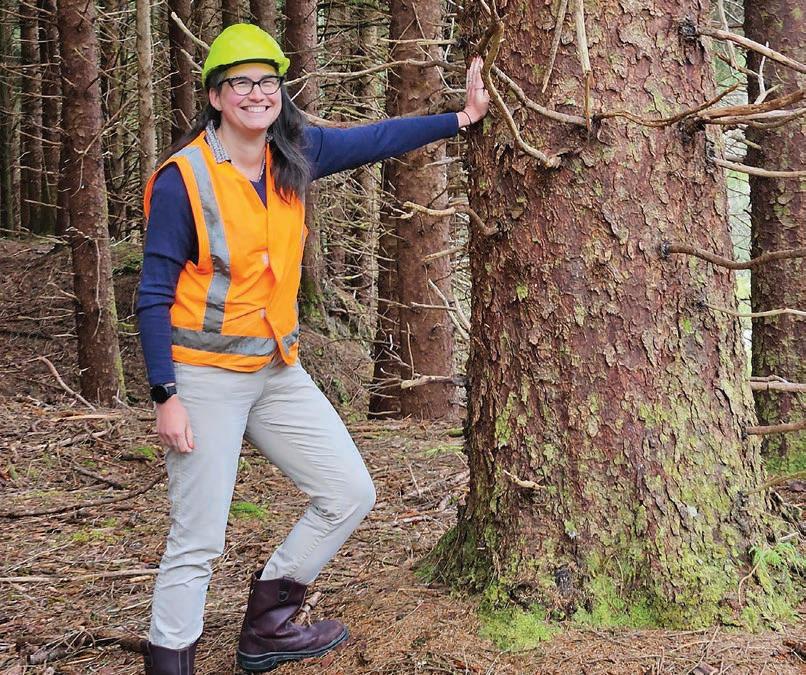
So says Forest Owners Association chief executive Dr Elizabeth Hegg, who said the country’s area of afforestation is currently about the same as in 2005 at 1.8 million hectares, or 7% of New Zealand’s productive land area.
“Is forestry’s footprint at a national level expanding? That is unlikely,” said Hegg.
While afforestation may appear intense at a local level, nationally it is not large.
She said negativity towards the sector ignores land use and cashflow benefits.
December’s Ministry for Primary Industries Situation and Outlook report stated that for the year to June 30 2025, forestry generated $6.170 billion in receipts, of which logs accounted for $3.2bn with sawn timber and sleepers $1.1bn.
China bought 53% of all forest exports, including 89% of New
Zealand’s logs and 34% of its pulp.
Last November the government introduced legislation restricting exotic forests from entering the Emissions Trading Scheme, to protect the Land Use Capability (LUC) Class 1-6 land, New Zealand’s most productive soils.
The law change gave exemptions to Māori landowners, allowed farmers to plant and register 25% of their land in forestry, and set up a system whereby two annual ballots will enable the planting of up to 15,000ha of new forestry on LUC 6 land.
Hegg said constant changes to the ETS have already made it difficult to convert land to forestry, as land use is evolving. She noted that recent high stock prices have improved the viability of livestock faming.
Any future investment of converting farmland to forestry would be based on timber value.
Communities have criticised forestry for accentuating pests and weeds and increasing the fire risk, but Hegg said it is in the best interests of owners to manage pests, weeds and the fire risk.
It is also in the interests of owners to maintain strong relationship with neighbours
and communities, something her association advocates.
The association works with Federated Farmers and Fire and Emergency NZ, Hegg said, but noted that fires often start outside forestry blocks.
Owners are also part of a pilot pest control project involving Federated Farmers, Ministry for Primary Industries and the NZ Game Animal Council, and she agreed there needs to be a better co-ordinated approach to control.
Pest control is of personal interest to Hegg, who studied feral pigs for her Master’s degree, and she said forest owners faced issues of vandalism, poaching and hunters relocating wild pigs.
As for the impact on rural communities from the loss of people and services when farmland is converted to forestry, Hegg said forest owners are part of rural communities as are contractors and ancillary industries such as wood processors.
There is mutual benefit, Hegg said, noting that rural exports rely on wooden crates, pallets and packaging, and products such as wood chips for calf rearing.
investors cannot own carbon-only forests.
Is forestry’s footprint at a national level expanding? That is unlikely.
Dr Elizabeth Hegg Forest Owners Association
It would be disappointing if all the blame for people leaving rural communities were to be levelled at forestry, as the sector wants to be part of and valued by those communities, she said. Hegg also addressed claims about carbon farming, saying the MPI has calculated 80% of the trees in the ground will be harvested and that foreign
Foreign investors were particularly active until 2022, when the government tightened criteria.
Applications made prior to the legislation were still processed, and in the 2023 calendar year Overseas Investment Office approval was granted for 30 transactions involving foreign entities for the purchase of 42,800ha a mix of existing trees and land for conversion.
Hegg said many of these foreign entities had NZ partners, many of them Māori landowners.
Forestry creep slowed, not stopped: Acland

CHANGES to forestation rules may have slowed farm to forestry conversions, but Beef + Lamb NZ chair Kate Acland says more needs to be done to put the brake down harder.
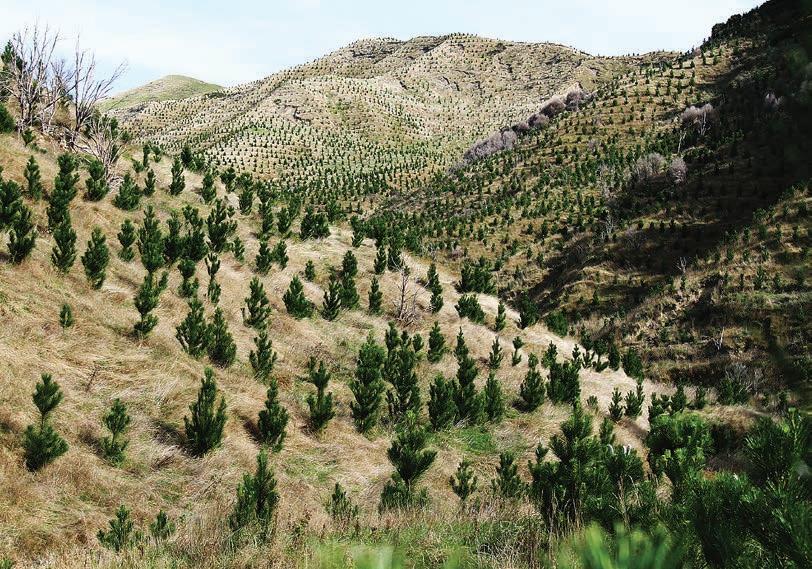
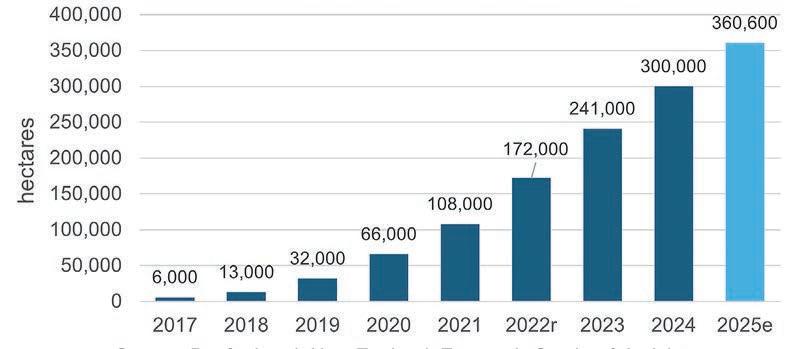
BLNZ has been tracking farm to forestry conversions since 2021, and estimates at least 350,000 hectares have been sold for forestry plantings since 2017.
Of today’s 1.82 million hectares in production forest, this amounts to 19% and brings NZ’s forested area back to the highs of the early 2000s.
The government tightened rules around farm to forest conversion last year with a new set of rules limiting land type conversion.
We are not antiforestry, it is an important industry and has a big role to play in the rural economy. But we are against carbon farming.
Land use capability (LUC) categories 7 and 8 could continue to be converted to forestry for ETS, while only 15,000ha of LUC 6 land would be permitted, and a temporary restriction was placed
on conversion of LUC 1-5.
Farmers were permitted to convert up to 25% of their LUC 1-6 land to exotic forest and register it with the ETS.
Acland said anecdotally it appears this has taken some of the momentum out of land conversions.
“But we are still seeing larger farms sold for forestry planting, remembering the restrictions are only applying to forests going into the ETS.”
She said it prompts the suspicion that companies still buying are gaining credits offshore, rather than in NZ.
“And once they are planted, they can’t be un-planted.”
She said BLNZ’s concern is the changes have not gone far enough to limit the planting of carbon forests, and if anything may exacerbate their planting.
“The LUC 7-8 land is less likely to be harvested and the rules still allow for the planting on 15,000ha of LUC 6 country, which is still very good farming country, and 25% of any land type still amounts to a lot.”
The agency’s data suggests the loss of 50,000ha a year remains possible, and aligns with Ministry for the Environment estimates that a million hectares will be lost to trees by 2050.
Acland acknowledges farmers’ property rights should dictate
what they do with their own land and said BLNZ has a tricky narrative to negotiate with its levy paying farmers.
“We are not anti-forestry, it is an important industry and has a big role to play in the rural economy.
“But we are against carbon farming. When you add carbon on top of forestry income, you see land being planted that should not be.”
Some in the primary sector have pointed to ongoing low rates of return on sheep and beef operations as a driver behind forestry conversions, sometimes making the land use option a valuable exit for farmers wishing to retire.
Retired Lincoln University honorary professor Keith Woodford has pointed to the sector’s sub-2% returns on assets as a barrier to land remaining as a pastoral operation into the next generation.
But Acland said the top 20% of sheep and beef operators are capable of out-earning carbonforestry returns.
“So the job is not done. We need to push profitability higher as an industry, getting the poorer performers further up.
“But that artificial price support carbon provides, it is like a subsidy, no different to when price support for red meat production was provided.”
BLNZ has pointed out NZ is one of only two countries in the world to provide unlimited 100% carbon offset payments to planted forestry. The other country is Kazakhstan.
Acland said BLNZ would also like to see a moratorium on wholesale farm plantings, and ETS allowance for native plantings, with carbon payments loaded up front to allow for the high cost of establishment.
BENEFITS: Forest Owners Association chief executive Dr Elizabeth Hegg says negativity towards the sector ignores land use and cashflow benefits.
Richard Rennie NEWS Forestry
PUSHBACK: BLNZ chair Kate Acland says the new regulations aimed at limiting land to be planted in trees may only slightly slow the rate of afforestation in rural NZ.
New afforestation area cumulative ha
Source: Beef + Lamb New Zealand Economic Service & Insights Te Uru Rākau
Kate Acland BLNZ
Forests need a proactive pest approach
Richard Rennie NEWS Forestry
ANECDOTAL evidence of increases in game animal numbers from greater forestry plantings have been reported in the past few years to assorted councils and authorities across the country.
However, both regional and national authorities have emphasised that the reports are anecdotal and come amid a general rise in the number of pets reported across all land use types.
Plantation forestry has nonetheless increasingly been in the firing line for generating new reservoirs for pest animals, particularly possums, deer and pigs.
Corina Jordan, CEO of the NZ Game Animal Council, told Farmers Weekly that the council has received no complaints regarding issues around ungulates originating from commercial forestry.
“But we are hearing anecdotal concerns about increasing deer and pig populations adjacent to forestry, with media coverage on this.”
Last year reports from Otago farmers linked an increase in lamb losses to higher wild pig numbers
in adjoining forestry plantation blocks.
Jordan said there are a range of regulations relating to pest control in forests, but they may not be consistently enforced.
“Aside from this, there is no national legal requirements for management of game animals on private land,” she said.
Lessons from a recently announced pilot programme in two catchments for deer management are also to be used for approaches in other areas.
Aside from this, there is no national legal requirement for management of game animals on private land.
Corina Jordan Game Animal Council
She noted many landowners, including commercial forestry companies, are very proactive in pest management but a wholecatchment approach is necessary for all landowners to work together on the problem.
She said initiatives to provide practical advice on pest control to landowners including forestry are being developed, and due for release in coming months.
Department of Conservation wild animals manager Mike Perry acknowledged there is an opportunity to better co-ordinate wild animal management efforts, and a national co-ordination group now includes forestry owners and Federated Farmers.
He said deer are an immediate priority and the programme will bring all land users and hunters together to better manage browsing animals.
He confirmed DoC could not compel landowners on private land to control wild animal populations.
Hawke’s Bay Regional Council biosecurity catchment manager
Matt Short also confirmed an increase in anecdotal reports of greater deer numbers out of forestry.
“It could be just due to greater awareness of these pests. But like other pests, they are a problem no matter where they are, regardless of forestry existing or not.”
When it comes to possums, he said, landowners with residual trap counts of greater than 4% will often point to adjoining forest blocks as the source. He confirmed forests are also monitored for possum numbers and trap residuals.
“If residuals are greater than 5%, we can engage with them and apply compliance through the Biosecurity Act.”
He noted most forestry companies have been quick to fix possum issues.
“But they do tend to button off with management after six years, unless it’s a species in our regional plan over which we can apply compliance rules.”
These include possums, deer, goats, rats and mustelids.
“It would be unfair to point all the blame at forestry for pest populations. Numbers fluctuate across the landscape regardless of what it is used for.”
In Otago, Otago Regional Council environmental manager Libby Caldwell said there is no clear evidence of a regionwide increase in reports directly
attributable to increased afforestation.
She said the council hears from some landowners about feral animal numbers rising.
“Some landowners consider nearby forestry a contributing factor, while others identify different drivers such as proximity to conservation land, change in climatic conditions or changes in neighbouring land management practices.”
She confirmed all landowners have obligations under the Biosecurity Act and the regional pest management plan to control pests and are not limited to a specific period, such as the first five years after planting.

















UNIFIED: Game Animal Council CEO Corina Jordan says there is a need for a more unified ‘whole catchment’ approach to dealing with wild animals – one that includes foresters.
Farmer fears for land as forestry arrives

Bryan Gibson NEWS Forestry
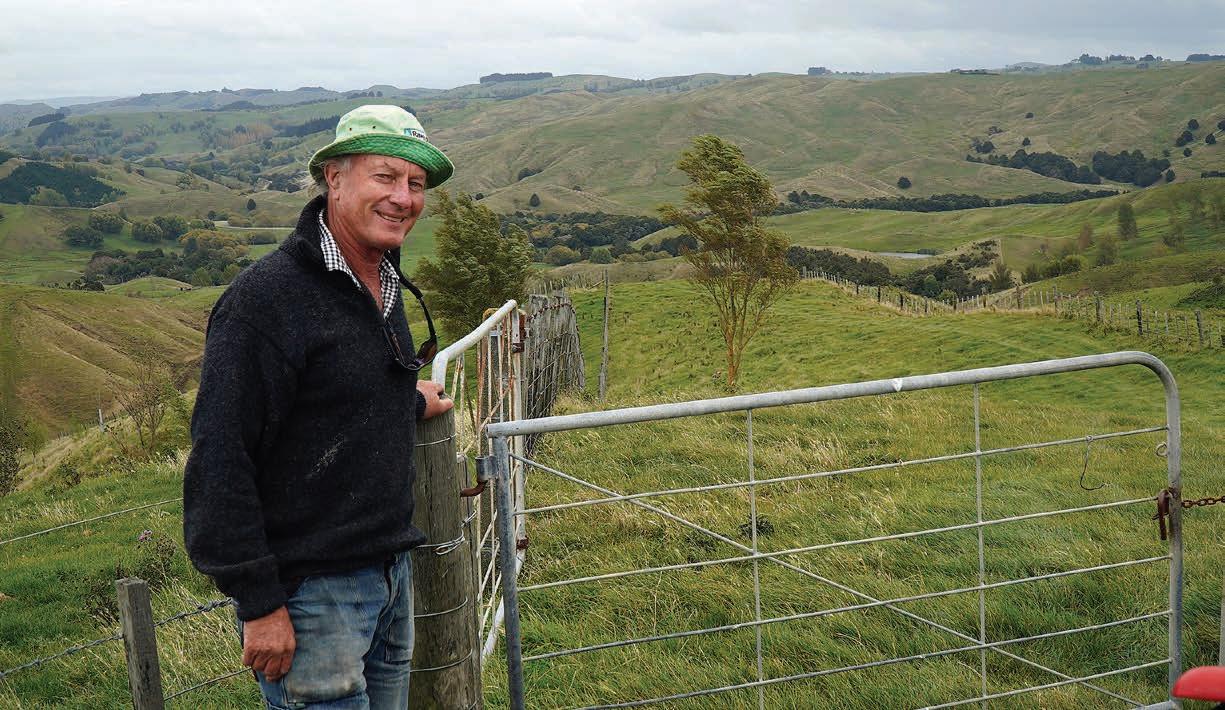
CENTRAL Hawke’s Bay farmer James Hunter has spent decades nurturing the native plantings and wetlands at Rangitoto Station, but he fears that work could disappear in minutes if a fire were to rip through the region.
Over the past few years, more and more of the high country east of Waipukurau has been planted in pine trees and Hunter is concerned fire plans will come up short if called upon to be executed.
Hunter is also worried about the pests that pine forests typically bring. His farm is home to a range of native species, including the rare Australasian bittern, spotless crake and dabchick.
Having written to the managers of neighbouring pine forests to seek assurances they will manage the pest and fire risk, Hunter said he still has major concerns.
“Fire is the big one,” he said.
“We’re on the [eastern] side of the forest and in a westerly wind, we’re at risk.
“I’ve asked for some sort of guarantee that my interests will be looked after, that I won’t be burned out.
“The winds here are different from further north. Pōrangahau has a reputation for strong winds, as does Pongaroa.
“During the last fire down here, they couldn’t fly because of the winds. If those had been mature trees, and that had been February, who knows where it would have stopped.”
Some of the forestry fire plans Hunter has seen show his water supplies will be relied upon to fight any fire, which would impact his farm in a dry year.
“I believe they should have to put in a water supply so that you, me and everyone else in New Zealand doesn’t have to cover the cost.”
Hunter also worries that the small towns in the region would
I’ve asked for some sort of guarantee that my interests will be looked after, that I won’t be burned out.
James Hunter
Hawke’s
Bay
be overrun by a fire if it wasn’t contained early.
With 50 hectares of land under QEII convenants, Hunter is also concerned that forests will create
habitats for deer and pigs to thrive.
He said farmers in other regions have seen pig populations grow as pine plantings increased.
“I’d like some sort of assurance that they will control the pigs. If pigs are coming out of the forest I don’t need all of this [native planting] rooted up, or my pasture eaten up.”
Many of the birds Hunter has created habitats for are ground nesting and would be devastated, he said.
Hunter is also concerned that while regulations direct foresters
to manage wilding pines in nearby significant natural areas and prohibit planting within 10m of a boundary, there’s no accounting for the shade the trees create, which encroaches onto his property.
In the end, Hunter said, it is time for New Zealanders to have a conversation about what it wants the landscape to look like, produce and support, before it is too late.
“The investors in these pine forests are making multimilliondollar profits, but not caring about the communities that are there.”
Farming and forestry not mutually exclusive
Richard Rennie NEWS Forestry
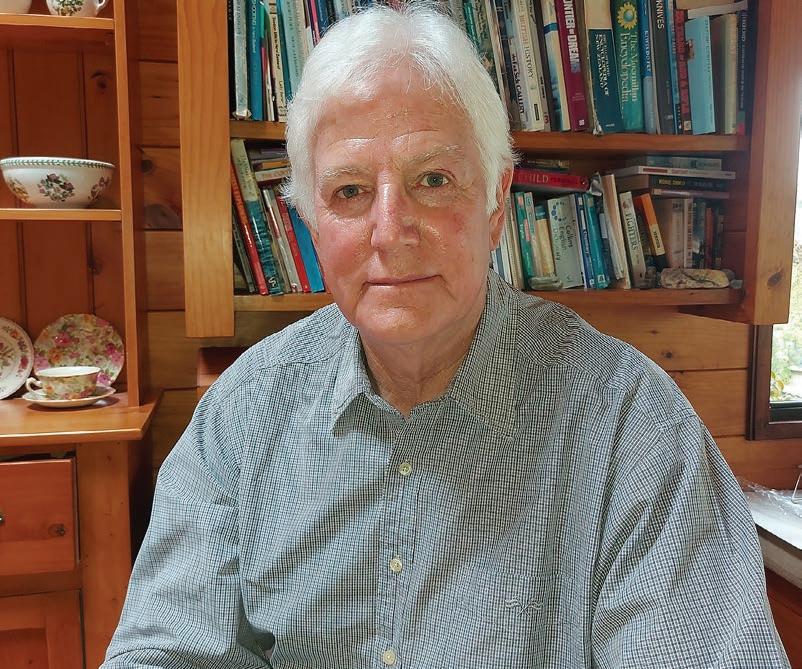
A ‘DECENT chunk” of New Zealand farmland is held by its owners as forestry woodlots, and for many it has proven something of a saviour in years of low farm income, says longtime farm forester and past Farm Forestry Association president Graham West.
“We have had members say it has been only thanks to their forestry woodlots and carbon
income some years they have kept their pastoral farm going.”
It is a valuable buffer sitting behind many pastoral operations, easily forgotten when protein returns have gone the way they have.
“If you multiplied up the, say, 25,000 farms nationally and said generally most farms have 3040 hectares of land that is less than ideal for farming and okay for planting, that is a significant amount nationally.”
The Exotic Forest Survey results to April last year indicated that of
New Zealand’s 1.8 million hectares of exotic plantings, a full 14% or 250,000ha is held across woodlots smaller than 40ha.
While exact ownership is hard to determine, West agrees the bulk of these are likely to be woodlots on privately owned farmland.
Longtime forestry manager Dave Janett has worked with many farmers, converting some of their farm to woodlots and retaining the best for pastoral.
He also has multiple examples of farming families who converted
some of their property to forestry and have thanked him for it as they struggled to generate true profitability over years of consistent very low single-digit returns.
But he also sees forestry as offering only a partial solution to hill country farming’s inability to generate bankable returns. Janett concurred with Keith Woodford, who last year expressed concern that the hill country sheep and beef model does not present a viable opportunity for next-
generation farmers.
“Real estate agents have told me, ‘If your farm is not suited to dairy support, next tier, there is no interest, no one wants to go there.’”
Graham West acknowledged current pastoral returns are high but cautioned that should not defer a deeper question NZ Inc needs to ask.
“That is, have we got the balance of exports right?
Continued next page




HABITAT: James Hunter’s farm is home to a range of native species, including the rare Australasian bittern, spotless crake and dabchick.
Photo: Bryan Gibson
Tough times eased by forestry cash flow
Richard Rennie NEWS Forestry
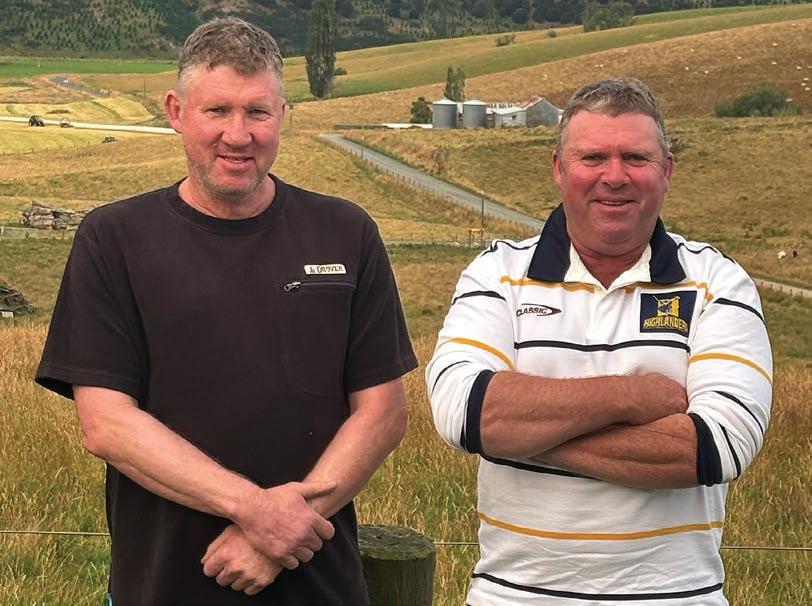
FOR Otago farmer Roger Cotton, forestry has been a recent and welcome addition to the family farming business, coming after having to seriously rethink the farm business model.
The 1200 hectare station converted 300ha to pine and Douglas fir, including 260ha of this to carbon forestry, four years ago when he and his brother opted to downscale the livestock commitment as they approached their mid-50s.
He is looking forward to Emissions Trading Scheme payments starting to kick in this year. The brothers planted their estate more extensively than usual, enabling continued pasture growth and grazing to continue.
“The day will come in a few years when the trees block the light, meantime it’s still good grazing and a means of reducing our fire risk.”
Continued from previous page
“Some would say NZ pastoral farming has plateaued, and NZ needs another new multibilliondollar earning industry. We have 20 million tonnes of raw logs a year going out.
“Very few countries have a resource like that they could develop further to generate more export value.”
He suggested pastoral lobbying has proven more effective in garnering resources than forestry has managed.
“Where is the support for mills? There is the potential here for a $20 billion industry in timber. NZ’s current export earnings from forestry are $6bn, with about half as raw logs.”
He acknowledged some farmland loss to forestry, but in the context of NZ’s total pastoral area, he said,
Also a district councillor, Cotton is more conscious than most of the tensions and potential conflicts that have been at the interface of farming and forestry, particularly as areas planted in trees have increased in recent years.
3% of the total is minuscule.
West also pointed to the highvalue opportunities that exist for small woodlot owners in growing species other than pine, including redwoods, cypress and eucalyptus.
Real estate agents have told me ‘If your farm is not suited to dairy support, next tier, there is no interest, no one wants to go there.’
David Janett Retired forestry manager
“The moment you switch to pruned cypress, for example, you can be looking at three times the value of pines.”
“I would not say we were really keen to get into forestry. But four to five years ago we really had to look hard at our business model, things were very tight. The carbon thing came up, and it made sense. It’s also a bit less work in your
become increasingly important to retain a realistic margin as harvest and management costs continue to rise for foresters.
Dave Janett said even for wholesale forestry conversion, much of the heat has left the market, leaving some farmers who may want to exit without that option before them now.
For farmers who may still be considering some forestry on their property, Janett said it’s not too late, and he still believes the Emissions Trading Scheme will hold up as a means of valuing and trading carbon.
later fifties, and it’s about being a bit smarter about how we use our land.”
Along with Hawke’s Bay, the Otago-Southland region has been one of the highest growth areas for forestry plantings in recent years.
Since 2019 the area in forestry has grown from 130,000ha to 150,000ha, now accounting for eight percent of the nation’s total exotic forest plantings.
When it comes to dealing with pests, the brothers have built a good relationship with a group of hunters keen to access their property for pig hunting.
“Our forestry, along with our neighbours means we have been able to let a group of five or six hunters come regularly and they seem to be keeping them well under control, to the point we do not see a lot of pigs, compared to four or five years ago.”
He said it had not been difficult to find people keen to come and hunt in their blocks.
He acknowledged the tensions that have accompanied increased forestry in farming districts.
I would not say we were really keen to get into forestry. But four to five years ago we really had to look hard at our business model. Things were very tight.
Roger Cotton Otago
“But it does seem to have died down a bit more around here lately. A lot of properties around our area have now planted trees and are trying to get their area in trees up higher.”
Pest management by large forestry has also been one aspect of that tension. The Cotton’s have a corporate forestry block across the road from them.
“I feel the big companies are working at it [pest control], it’s not that they have deliberately ignored it, they just did not realise the impacts these pests can have.”

He said higher value species will
He also suspects that – despite earlier pushback from some in the pastoral sector – age, economics and demographics are compelling them to recognise forestry’s value as a land use opportunity to exit the sector, albeit one that may have already passed many by.



DIVERSIFY: Farm forester Graham West says forestry demands better representation, helping NZ diversify its reliance upon protein-based, pastoral food production.
NECESSITY: Otago farmer and forester Roger Cotton, left, says forestry was not a first choice for him and his brother Stuart, but it has provided a valuable additional income stream for their family farm.
Farmers learn to post, like and share the job
Gerald Piddock NEWS Communication
SOCIAL media matters because it bridges the gap between farmers and the public, building transparency and trust.
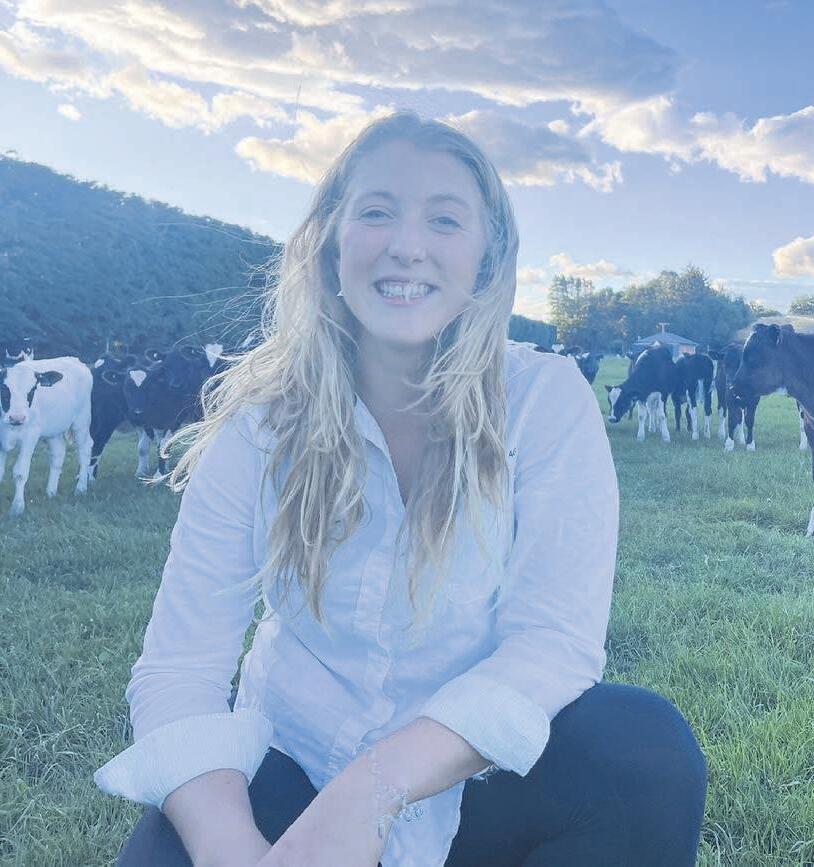
It also reduces isolation and helps to connect farmers, north Waikato dairy farmer Amber Carpenter told the South Island Dairy Event (SIDE) at Lincoln University.
Carpenter and north Canterbury dairy farmer Allie King led a workshop at SIDE on how dairy farmers can use social media to promote themselves and the wider industry.
Carpenter is also the owner of digital marketing company Grass Roots Media.
“If we don’t tell our stories, who’s going to – someone else, and do you think they can tell our stories as good as us?
“We don’t need thousands of followers, we don’t need to go viral, we don’t need to be influencers, we just need the right people and that happens when you’re telling your story authentically.”
Explaining the reality of farming to people outside the industry can be groundbreaking if those people turn around and become supporters, she said.
This is happening more and more because farmers are being brave and authentic in telling their story.
It is an incredible tool to show the masses what farmers do.
“Everything we do which seems so mundane to us is so extremely interesting to other people.”
That could be something as simple as tractor work or cropping, she said.
When it comes to managing social media content, especially for farmers with staff, Carpenter’s advice was simple: have a policy around not bringing the farm
business into disrepute and have clear conversations with staff around those expectations.
It also requires a level of trust from the employer, she said.
“Share your journey. We need to be showing the job that we do and the way that we do it.”
Farmers should also remember why they are doing it. If an online post changes the perception of farming held by just one person, it is worth it.
It can also be a huge tool that farmers can use whether they are just starting out in their careers, at a mid point or are well established.
“It is very common for people to google employees these days –what is showing up in your social media, how are you promoting the industry, how are you promoting yourself?
“It has become a huge tool on your own personal brand.”
King said her involvement with social media was born out
of the fact that her family and friends from town had little understanding of what farming involved.
“I realised I was in this privileged position to be able to educate people and give our perspective to them. I just started posting out of love of what we do.”
King said her biggest passion is highlighting her lifestyle to people in towns, reaching people who do not understand farming, do not understand the work involved in
jobs such as feeding calves, King said.
Fonterra’s regional head for Canterbury Tasman Marlborough, Matt Cullen, said too often, the reality of dairy farming does not get through to the non-farming public.
Instead, what is often seen is an over-simplified narrative. However, the most trusted voice in agriculture is the farmer’s, he said. “It’s about confidently sharing the truth of what you do,” he said.
Merino undies having their day in the sun

Gerhard Uys NEWS Wool
BOXERS, bras, long johns –whatever you need, there’s a Merino underwear product for every occasion, and the options are growing.
A LinkedIn post by the Woolmark Company Australia recently said inquiries into wool swatches for “next to skin” and intimates at its Wool Lab grew about 50% between 2023 and 2025.
Head of sales & success at Zentera Wool Natalie Norman, spoke to Farmers Weekly from the United State after attending the Functional Fabric Fair in Portland.
Norman said this year they had significant increases in queries about Merino for nextto-skin, with specific interest in fine Merino fibres for underwear products.
She said underwear brands that traditionally use synthetic products want to bring certified wool into their range, and outdoor brands want to diversify their product offering.
Demand is driven by three main factors:
• Increasing consumer awareness of the health impacts of the fibres worn next to the skin.
• Eco-conscious consumers who want sustainable products and see wool as a sustainable solution.
• Alignment with changing
business values and brands wanting to have tangible things they do in the supply chain to reduce their negative impact on the planet.
Norman said spinning and
IN BRIEF: Devold New Zealand general manager, Craig Smith, says there are more underwear products in Merino than ever before.
knitting technology has changed and there are wider ranges of products that brands can offer consumers.
Devold New Zealand general manager Craig Smith said there

are now more varieties of products on shelves for men and women in Merino wool, in all shapes, sizes and colours, and for every occasion, from long johns to bras.
He said Devold uses Merino wool with an average of 17.5 micron for products that are worn against the skin.
Consistency in fibre softness used for underwear products is key, otherwise consumers will not have a good experience, he said.
Wool was previously seen as something worn only in winter but Merino products are now worn in summer also as consumers become more aware of their breathability characteristics and the ability of the fibre to be processed into cool, thin fabrics.
LIKEABLE: If an online post changes the perception of farming held by just one person it is worth it, says North Waikato dairy farmer Amber Carpenter.
Don’t let autumn growth go to waste. We got you.
Tap into Farmlands agronomy exp er tis e to ensure autumn growth do esn’t go to waste. G et the right herbicides, fungicides and ins e cticides to make the most of your s oil, pasture and crops. Shop offers in store, online, FarmlandsPRO, or with your rep.
Fonterra CEO will chart new course for co-op
Gerald Piddock PEOPLE Dairy
FONTERRA’S appointment of Richard Allen as CEO indicates that the co-op wants someone who understands its strategic direction after its consumer divestment, says Fonterra Co-operative Council chair John Stevenson. What’s more, Allen has the skill to implement it.
Farmers are pleased to see an internal candidate come through. The council has no input in making the appointment, but in the past it has made it clear the role has to be with someone they connect with.
Allen has an extensive background in working in both customer and farmer-facing aspects of the business, he said.
The appointment comes less than a month after Miles Hurrell announced he was stepping down after eight years as Fonterra CEO. Stevenson said he is comfortable with the speed at which the appointment was made. Having
an internal candidate made that process a lot shorter than it normally would be. It also takes uncertainty out of the business.
“I’m confident through discussions I have had with the board chair that it was a really comprehensive process.”
I’m committed to maintaining the momentum in our performance, focused delivery of strategy and financial discipline that has been developed over recent years.
Richard Allen Fonterra
Fonterra chair Peter McBride has spoken of the importance of succession and talent development within the co-op and it being an ongoing process that the board looks at both internally and externally, Stevenson said.
The role of Fonterra CEO requires someone capable
of dealing with markets and customers while at the same time being able to meet and communicate with shareholders and farmers.
“We’re quite demanding as well and we expect someone that can front up and can understand and connect with farmers as well.
“It is an important time for the co-op and we move into [the new era] with a real focus on ingredients and food service.”
Allen said he is incredibly humbled to be appointed CEO and feels great pride to be leading the co-op.
“I’ve built my career with Fonterra and understand the important role the co-op plays both for farmers here in New Zealand and our customers around the world.
“I’m committed to maintaining the momentum in our performance, focused delivery of strategy and financial discipline that has been developed over recent years.
“Fonterra has a strong platform to build from and I’m excited by our prospects as we move forward

as a New Zealand farmer owned global B2B dairy provider.”
Allen will step into the CEO role on May 1, with Hurrell staying with Fonterra in an advisory role until September to assist with the leadership transition.
McBride said Allen is an exceptional leader who will bring to the CEO role a strong connection with farmershareholders and customers, and a deep knowledge of Fonterra’s global operations and markets.
“Richard is passionate about our co-operative. His most recent role is president global ingredients,
Envy is NZ’s first billion-dollar apple
Gerhard Uys NEWS Horticulture
T&G Global’s Envy apple brand has surpassed $1 billion in global retail sales, a first for a New Zealand apple brand.
Shane Kingston, T&G’s managing director of apples, said the milestone marks a significant moment for the company, its growers and NZ’s horticulture sector.
Kingston said surpassing $1bn in global retail sales is a major milestone for Envy apples and
a reflection of T&G’s long-term strategy to build global premium brands.
“It shows what’s possible when you combine world-class genetics, outstanding growers and a globally connected system that consistently delivers for customers and consumers.”
Hawke’s Bay apple grower Gus Lawson told Farmers Weekly he has been growing Envy for 11 years.
“Envy is not an easy apple to grow, but if you have all your ducks in a row then it is rewarding,” he said.
The apple is expensive to
grow, but pays back due to its yieldability.
Lawson has finished harvesting, saying he had a dry harvest window, which makes a difference in quality.
Envy was bred in 1985 by the Bioeconomy Science Institute and exclusively commercialised globally by T&G.
It is now grown in more than 13 countries across both hemispheres and sold in over 55 markets.
T&G partners with more than 100 growers in NZ and over 1000 grower partners globally to ensure year-round supply.
Kingston said that, with a strong export focus, Envy represents a significant piece of New Zealandgrown intellectual property, scaled successfully on the world stage. Global apples continue to shift towards premium offerings.
Between 2024 and 2035, the premium segment is expected to grow at 7.6% annually, compared to 4.4% for mainstream apples.
Across Asia, Envy apples hold top-three positions in key markets, including No 1 in Vietnam, No 2 in Thailand and No 3 in China, with strong recent growth in China, Singapore, Vietnam and Malaysia.
responsible for Fonterra’s Ingredients sales, optimisation, risk management, trading and global manufacturing.
“He joined Fonterra as a graduate in 2008 and since then his career has spanned our global supply chain. He led our farmer facing business Farm Source for five years, has worked in China as vice-president of our foodservice business, was the founding CEO of MyMilk, and more recently served as president Atlantic based in Chicago, responsible for relationships with a number of our global key accounts.”



ideas that grow is a Rural Leaders Podcast in association with


NEW CEO: Richard Allen will take up the role of CEO at Fonterra on May 1.
ENVY OF THE WORLD: Envy is not an easy apple to grow, but if you have all your ducks in a row then it is rewarding, says Hawke’s Bay apple grower Gus Lawson.
BACKING FARMERS FROM PADDOCK TO PORTFOLIO.
Farming is built on resilience and planning beyond the season ahead . At ASB, we back farmers to make confident decisions on-farm and bring that same disciplined, long-term mindset to investing .
ASB Investment Funds are first for 12 month returns in the Conser vative fund categor y.
This result reflects the strength of our local insight, combined with global exper tise through our world-class par tner, BlackRock.
Speak to an ASB Rural Manager about how we can help suppor t your hard-earned gains on-farm, to build long-term wealth for you and your family.




Bridge still out, 3 years after Gabrielle

MORE than three years after a flooded Hikuwai River destroyed the Pauariki Bridge during Cyclone Gabrielle, residents in the Upper Hikuwai Catchment are still relying on makeshift crossings to access their properties.
With no replacement bridge underway, daily life remains disrupted, affecting farm operations, emergency response times and basic access for residents and their businesses.
Locals continue to depend on a tractor, ute and flying fox to cross the river, options that are heavily dependent on water levels and weather conditions.
What was once a short drive has become a daily logistical challenge, with residents saying the situation continues to put both livelihoods and safety at risk.
Around 7400 stock units graze north of the river, alongside rural businesses including an orchard, an apiary and the Hikuwai Rd Honey Company, all of which rely on consistent access.
For many in the local community, crossings are a daily necessity to meet school buses, carry out farm work and maintain normal routines. However, access is often unreliable.
Resident Rob MacKenzie said weather conditions can prevent vehicle crossings for extended periods.
“And the weather then can be quite fluky. It’s a problem here. And it just costs money,” he said, noting ongoing costs from thousands of dollars in vehicle damage caused by repeated river crossing use.
The risks of access have also been highlighted in emergency situations. In June 2023, MacKenzie’s wife Anne collapsed at home while the river was
high and a medical helicopter was grounded due to weather conditions. Assistance was delayed until the following morning.
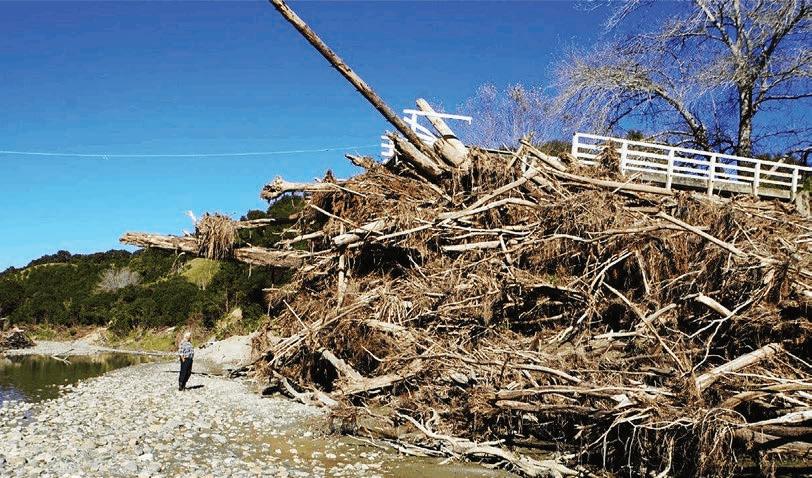
The bridge, built in the 1960s, was destroyed in the early hours of February 14, 2023, after a significant build-up of logs, woody debris and sediment flooded down the river during Cyclone Gabrielle.
Residents are questioning why the rebuild has taken years to progress.
Concerns have centred on both communication and delays in the design and approvals process.
Residents said there was little formal communication from Gisborne District Council in the first 18 months following the cyclone, despite technical reports being completed during that time.
In February 2024, residents formally raised concerns about the lack of a clear timeline and requested official council reports.
A community meeting with council leaders was held on March 18, when council representatives said they supported the rebuild but did not have sufficient funding secured.
Frustration has continued into 2025 and 2026, with residents still waiting for certainty. At a community hui on March 31 2025, locals were told Wilson’s Solutions Ltd had been contracted to manage the roading recovery programme. The company later advised that while investigations and initial funding work were completed by mid-2024, “design and consent have stretched into
late 2025 and early 2026”.
As of early 2026, the bridge design is around 50% complete, with construction yet to begin. Earlier projections indicated completion could be as late as mid-2027.
Gisborne District Council said progress remains dependent on funding approval from NZ Transport Agency Waka Kotahi (NZTA).
Recovery manager Naomi Whitewood said the council has been “actively and diligently working to secure funding and progress a solution”, acknowledging the “real and ongoing impact” on affected whānau relying on temporary access.
In February, the council confirmed to residents it was compiling additional information requested by NZTA. The agency told Farmers Weekly in late March that it had now received the final documentation and will consider the application for funding.
The council said the process has involved “detailed technical design, economic analysis and further information being provided back and forth” as part of NZTA’s assessment, and noted that any timelines signalled so far are “indicative only” and subject to approval.
A spokesperson added that, given the direct impact on residents, they would not comment further publicly until organising a hui with those affected. The meetings are expected to take place on April 26, and a further hui with the NZTA board in June.
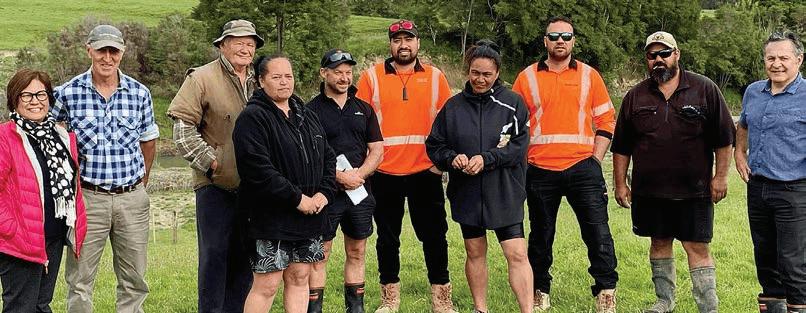
DISRUPTION: Affected residents of the Upper Hikuwai Catchment Group’s daily lives and routines are still disrupted in 2026.
Rural GPs
to be trained in ‘planned care’ skills
Staff reporter NEWS Healthcare
NEW funding is set to upskill the rural health workforce so that general practitioners can deliver planned care and more people can receive care closer to home, the government says.
Associate Health Minister Matt Doocey announced $1 million in funding to train rural GPs while also increasing access to support for people living in rural areas, which will reduce the need for hospital visits.
“Planned care is traditionally delivered in hospital settings and organised ahead of time,” said Doocey.
“Too often currently, people in rural areas are having to travel long distances or wait longer than necessary for this type of care. This will help reduce the need for travel.”
Training will focus on skills such as assessing and treating heavy or unusual bleeding and removing and examining
skin lesions, along with other planned care priorities.
He said more than 100 rural communities rely on rural general practitioners to provide their local healthcare.
“Strengthening rural GPs’ planned care skills will help people receive treatment sooner and closer to home, prevent conditions from worsening, and reduce unnecessary travel and wait times,” said Doocey.
The funding will cover training costs and cover for GPs while they train and will be targeted to ensure it has the greatest impact for rural communities.
“For some New Zealanders, the nearest hospital is hours away and specialist care is not always nearby.
“Now more patients will be able to access planned care locally, without having to travel long distances or wait longer than necessary.
“Rural communities can have confidence that care will be there when they need it.”

Isabella Beale NEWS Infrastructure
FLATTENED: Logs and debris from the river took out the Pauariki Bridge in 2023 following Cyclone Gabrielle.
Photo: Supplied
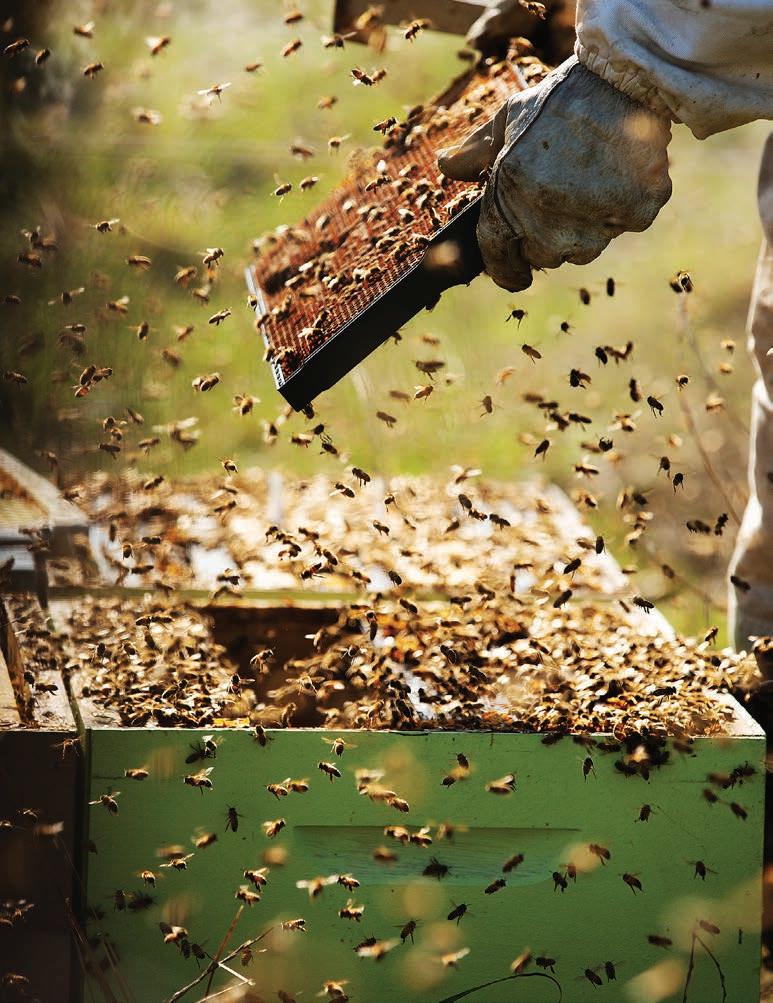
STING: Waikato beekeeper and honey producer Jane Lorimer says varroa continues to creep through hive populations, in part aided by variable treatments applied by different beekeepers.
Bees stung with new spike in hive losses
Richard Rennie NEWS Apiculture
CONSISTENT decline in winter
Abeehive losses has reversed with a sharp spike in reports on numbers lost last winter as varroa mite becomes more entrenched in hive populations.
The latest Ministry for Primary Industries New Zealand colony loss survey on beehive numbers and health has reported a loss of 63,435 hives last winter, amounting to 12.8% and a jump up from 10.8% losses reported in 2024.
After peaking at 13.6% losses in 2021, the industry had been welcoming a steady decline to 2024’s low of 10.8%.
Across the country the region with the worst level of hive losses was the Southland-Otago region at 19.2%, with the lowest losses reported from the TasmanMarlborough region at 8.9%.
The report is based on a survey of almost 2000 beekeepers with 148,000 bee colonies, representing about 30% of the total beekeeping industry.
In noting the colony loss increase, the report’s authors also point to them still being lower than the 2021 peak, which came when hive numbers were near a historical high, approaching 1 million hive colonies. Latest data indicates hive numbers are just below 500,000 as multiple beekeeping operations retreat in response to declining profitability in recent years.
Varroa mite’s insidious creep through national hive populations is reflected in the data, with the mite accounting for 7% of health healthy colony losses last winter.
There was, however, a significant difference reported between hobbyist beekeepers and commercial beekeepers who experienced losses due to varroa. Hobbyists reported a 25% higher rate of varroa losses in hives.
This has been attributed to non-treatment of varroa by hobbyists between spring 2024 and winter 2025, and not rotating between
different treatments to reduce resistance risk developing.
Waikato beekeeper and honey producer Jane Lorimer confirmed varroa continues to creep through hive populations, in part aided by variable treatments applied by different beekeepers.
“In theory it would be good to have a unified strategy. But you have multiple beekeepers across every part of the country, and to compound that all have different income streams with varying timing in terms of harvest and ideal treatment times.
“And because of the low honey returns in the last few years, a lot of beekeepers have not been able to afford to put in all the treatments they would normally use.”
She agreed better management of varroa by hobbyist beekeepers could be a good start.
We have one customer who comes back every year for a new hive because their last one collapsed from varroa.
Jane Lorimer Beekeeper
“We have one customer who comes back every year for a new hive because their last one collapsed from varroa. They tend to rely on treatment to the hive put in prior to them taking it on, and don’t do enough else after that.”
As honey prices have plummeted in recent years there has also been a pronounced move back to providing hives for pollination services, with 44% of beekeepers providing services in 2025, up from 37% the year before.
Lorimer said this was in response to greater kiwifruit plantings and she expects to see this demand only increase as horticultural plantings continue to rise in coming years. Kiwifruit accounts for almost 70% of the total crop pollination demand, with avocados a distant second at 25%, and an average bee colony pollinating 1.4 crops.







Smart tech for a smar ter herd.
Whether your farm suits neck or ear tags, Nedap SmartTags give you the freedom to choose - with no compromise on reliability, durability or performance Trusted by tens of thousands of farmers managing more than 8 million cows worldwide, Nedap SmartTags deliver accurate, 27/4 insights into reproduction, health and behaviour Smarter herd management helps you streamline operations, make more informed decisions and lift performance across your entire farm every day
Your herd, your choice. Talk to your local Nedap representative to find the SmartTag solution that fits your farm. Find out more at nedap-livestockmanagement.co.nz
Reproduction Health Herd
From the Editor
Playing politics with primary prospects

TNigel Stirling Senior reporter
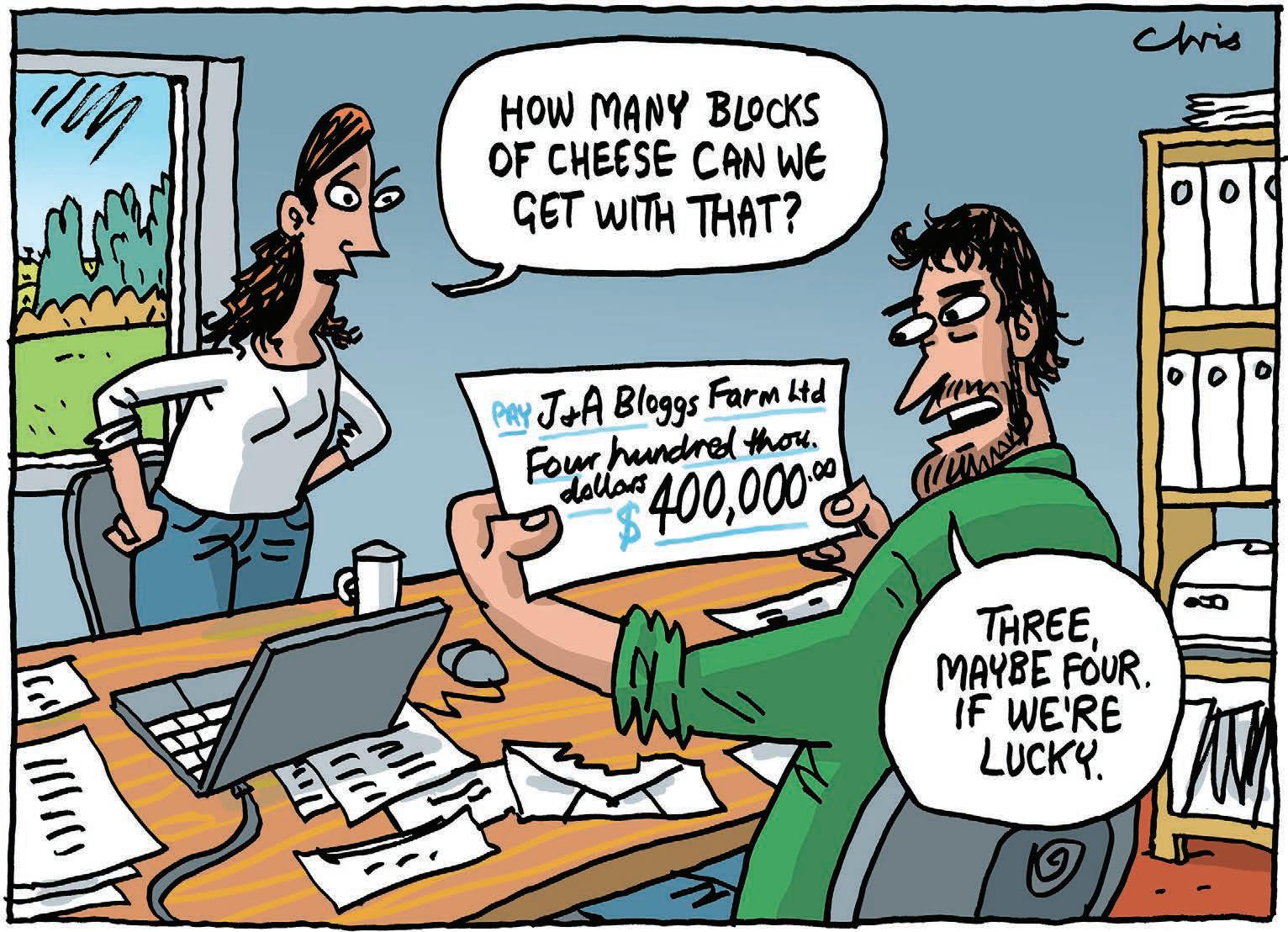
HE Labour Party’s lengthy scrutiny of the India-New Zealand free trade agreement is starting to stretch credulity.
A Parliamentary majority is needed for the deal to pass and tariffs reductions to begin.
With coalition partner NZ First out early, and the Greens and the Māori Party showing no signs of coming to its rescue, the government needs Labour’s votes.
Speaking to Farmers Weekly shortly after the agreement was announced on December 22, Labour’s trade spokesperson, Damien O’Connor, declared it a “significant step forward”.
O’Connor said he had exchanged text messages with Labour leader Chris Hipkins, who he said agreed that the deal “seems positive” for exporters.
Since then, Labour has found shadows to box against.
After a brief attempt to revive its Trade
LAST WEEK’S POLL RESULT
for All agenda, the party raised concerns about immigration, and a pledge by the government to promote US$20 billion of investment by NZ firms in India over the agreement’s first 15 years.
This month Hipkins said he had written to Prime Minister Christopher Luxon asking for legal advice relating to the investment pledge. By Farmers Weekly’s count, this is the fourth time the Labour leader has written to Luxon with similar requests.
Trade Minister Todd McClay says he and his officials have already briefed Labour MPs “seven or eight times”.
Labour’s drawn-out due diligence has clearly exhausted the patience of a large section of the primary sector.
Now 28 major companies and business groups – including significant primary sector players – have called on politicians to “uphold NZ’s bipartisan approach to trade by supporting the agreement”.
For those groups there will be uncomfortable echoes of the lead-up to the 2017 election when Labour sided with the Green Party against another large agreement, the Trans-Pacific Partnership (TPP).
Labour ended up backing it, but not before appearing to abandon the decades-long agreement between the two main parties that trade agreements benefit NZ.
New Trade Minister David Parker finally rolled over at a key TPP ministers meeting in Vietnam just days after the election – but not before negotiating exemptions for NZ with 80% of the countries involved from
More than 70% of those who took the poll believe the Labour Party has done the right thing by questioning the immigration aspect of the FTA with India.
“Our population is increasing more than our country can keep up with already. We need to get our infrastructure in place before we allow more people into NZ regardless if what our exporters want,” said one voter.
Another said: “Clarification is needed but if the questioning is just politicking then they should stop and support it. I am disappointed at the lack of support from the dairy industry too. Myopic!”
“It’s important that we don’t get people coming into NZ who will not fully provide needed inputs. Numbers are not necessarily the answer but quality is always required,” one said.
Another believed the FTA should be about trade, not immigration. Of the 28.3% who noted no, only one person chose to comment: “They [Labour] need to recognise the “big picture” and support this agreement. Not to do so is the same as treason.”
lawsuits possible under the agreement’s Investor State Dispute System. Without the changes, NZ could have been sued for tobacco control measures designed to reduce harm from smoking, with more lawsuits to follow, some lawyers argued.
So far, it is hard to discern threats of a similar scale from the India deal.
Trade Minister Todd McClay says he and his officials have already briefed Labour MPs ‘seven or eight times’.
NZ’s US$20bn investment pledge is unlike a similar one made by Switzerland which leaves its government open to being sued by India if it falls short.
Labour worries the deal sets the scene for exploitation of immigrant Indian workers.
It wants National to commit to funding more workplace inspectors. That can be easily addressed by a future Labour government if the current one can’t or won’t.
For now, the FTA timetable remains on track – with enough time for Parliament to pass enabling legislation before November’s election.
But the longer Labour hesitates, the more it looks like it is playing politics, risking delaying the date from which many exporters can get a foot in the door of the world’s most populous market for the first time.
Last week’s question: Do you think the Labour Party is right to question the immigration clauses in the proposed FTA with India?
Letters of the week
Let’s get positive
Donald Aubrey South Canterbury
I WRITE in support of Phil Weir’s column “We’re winners, not victims” (April 6). It seems good news is out of fashion in some media circles. For example, TVNZ is canning its “Good Sorts” segment after 16 years. It was often the only positive message following repeated negative bulletins featuring our economic and social demise. So what are we going to do about it? Well, my challenge, along with Phil Weir, is that readers (yes, that’s you) share with us a success story that you have experienced. Let’s get positive.
Misleading representation
Barbara Frazer Amberley
THE front page article in your April 6 edition, “E coli through roof in rain water runoff’, is a misleading representation of the statistics in Aayush Raj Joshi’s thesis. The article states the thesis “revealed that two-thirds of 800,000 people relying upon it in New Zealand have water exceeding safe E coli bacterial levels”.
Actually the thesis only reports on samples from 242 sites. Testing water from 78 households in Northland, 46 in North Auckland, 87 in Gisborne and 31 in Taranaki is not a large enough sample to predict the results from 800,000 households all over New Zealand.
Meet their needs, too
Judith Yeatman Darfield
I’D LIKE to see the Meet the Need appeal for farmers’ donations not only mention the food needs of poor children and families in an effort to pull at heart strings, but to also include other people in our society, like our senior citizens, many of whom are equally needy but perhaps more likely to fly under the radar and more easily ignored and forgotten about – people who are just as much in need of dignity as children and families and just as worthy of receiving mention, respect and help.
Best letter WINS a quality hiking knife
Send your letter to the Editor at Farmers Weekly P.0. Box 529, Feilding or email us at farmers.weekly@agrihq.co.nz
Do you think NZ has the right regulatory settings to ensure sheep and beef farming and forestry can both thrive?
This week’s poll question (see page 1): Have your say at farmersweekly.co.nz/poll
Get out of the bloody way
Eating the elephant
Mark Guscott
Mark and Susannah Guscott farm 1400ha of sheep, beef, arable and tourism near Martinborough in Wairarapa with a team of three
RIGHT around our country and indeed the world, farms are getting bigger and more complex as farmers search for margin in a difficult environment. That’s the reality of the continual squeeze between price and the cost of production. It’s not going away anytime soon.
One of the consequences of bigger farms is simple: there are more people.
More people involved in the dayto-day operational work, and more people involved in management. That means the skillset required to run a good farming business is changing. The traditional technical skills are still important, but they’re no longer enough on their own.
And no, AI isn’t going to solve all of this.
Added to the list now are people skills, also called soft skills. It’s a broad term, but at its core it’s
about how you work with, lead, and get the best out of others. Being a good people leader isn’t based solely on how good a farmer you are, or how much you pay someone.
It starts with knowing yourself.
There’s a school of thought that says self-awareness is the most powerful business tool you have. If you understand your own strengths and weaknesses, you can build a team around you that complements those gaps and ultimately makes the business perform better. If you can do that, why wouldn’t you?
I’ll pull back the curtain a bit.
I know that when I get under pressure, I become aloof and a bit of a lone wolf. My communication dries up and I just keep going, trying to sort things myself. That’s usually when I should be asking for help. I’ve also learnt that my opinions aren’t that helpful when I force them on others.
That kind of self-analysis can be confronting. But over time it’s helped our business, because I can now (hopefully) recognise those patterns as they’re happening and choose to do something about them.
Most farmers don’t need a lecture on this. We’re a pragmatic bunch. We know when we’ve
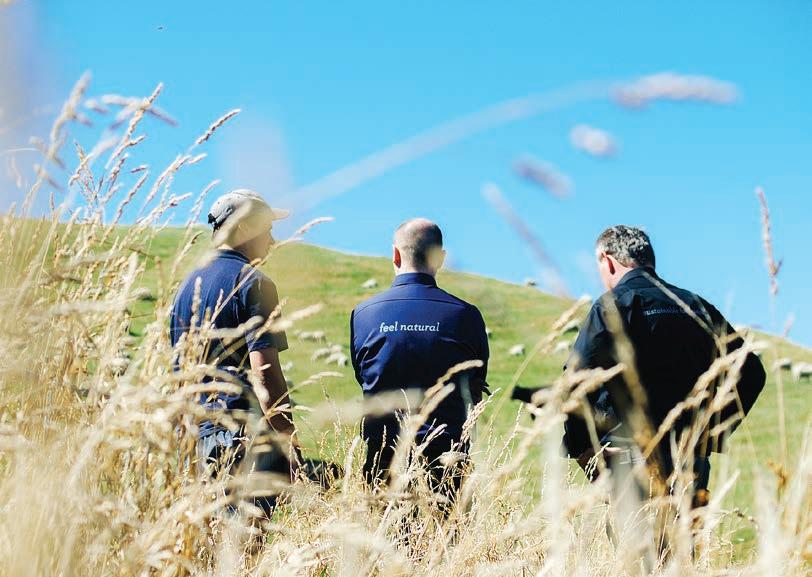
DELEGATE: As farms get bigger, owners and managers have to let go of things if they want to grow,
your own Kodak moment when you become obsolete.
Some people are just very good with staff. Those are the modern good farmers.
snapped at someone or been a grumpy bastard unnecessarily. If that’s happening often, or if you’re always looking for new people to work with you, it’s probably worth asking whether you might be part of the problem.
Another angle on this is the old line, “I’ve always done it that way.” I catch myself saying it occasionally. What it really means is nothing has changed since the last time something worked, and we still assume it’s the best way. Say it too often and you’ll have
Micro-management is another big issue. Standing over someone’s shoulder and continually telling them how to do their job is tiring, for them and you. It has its place when someone is learning, but once they’re competent, they shouldn’t need that level of oversight. Nothing wears people out faster than being told how to do something they already know how to do.
As farms get bigger, owners and managers have to let go of things if they want to grow. You can’t do everything yourself.
The biggest trap is often those first one or two employees. At that point, you can still just about do it all, but only by working 25 hours a day, and that’s not
sustainable. Eventually you start missing things, or doing too many things poorly, and you become the weakest link in the business. Once you make the decision to employ someone, the job changes. Set clear targets. Give people the tools they need to achieve them. And then get out of the way. They need space to do what they’re good at. If they’re constantly hearing “that won’t work” or “I’ve always done it this way”, frustration builds pretty quickly. Done well, a team makes the business more profitable and more resilient. It’s no longer just about the boss’s decision-making. A group of people will often come up with better solutions than one person on their own. Sometimes the new person has better ideas and maybe the best thing the boss can do is step back and let them get on with it.
The days when a “good farmer” was judged solely on how well they fed their stock or looked after their land are mostly gone. Those technical skills still matter, no doubt. But they’re only part of the picture now.
Some people are just very good with staff. They don’t sweat the small stuff because they understand mistakes happen. They’re able to get the best out of people, and that lifts the whole business.
Those are the modern good farmers.
And if farms are going to keep getting bigger, as they almost certainly will, then that’s the direction we need to head.
Pāmu CEO makes strong case for status quo
Meaty matters
100 years more than 20,000 farms were established.
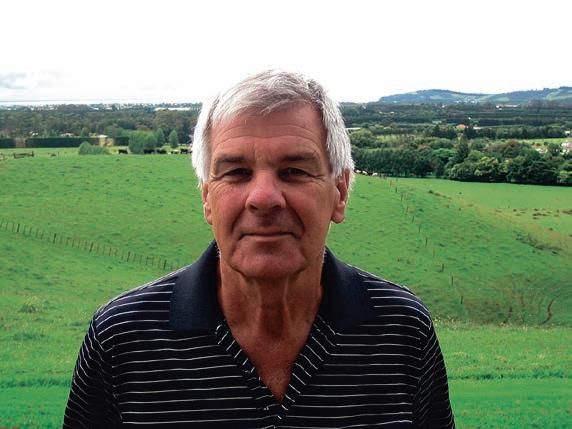
Allan Barber Meat industry commentator: allan@barberstrategic.co.nz, http://allanbarber.wordpress.com
MY MUSINGS a few weeks ago about the justification for selling Pāmu to raise $2 billion attracted interest from the SOE in question and resulted in a detailed interview with CEO Mark Leslie.
Unsurprisingly, he is in favour of retaining the Crown-owned farming organisation and he provided some compelling reasons to support the status quo.
First a bit of history. By 1886 the government of the day had recognised the central importance of agriculture to the development of the country’s economy, as settlers sought land to build farms. It asked the Department of Lands and Survey to lease or sell land to enable farming, and over the next
Schemes supported pioneers, returned soldiers and young farmers, later through a ballot system. By the mid-1970s the Crown’s focus was changing to the recognition of historic land loss and it began the process of returning land to iwi and hapū to meet Treaty of Waitangi claims. Former Lands and Survey farms became part of this transition involving carefully managing land subject to Treaty settlement negotiations.
In 1987 Landcorp Farming was established as an SOE with the mandate to transform land, enhance natural capital, and earn a financial return for New Zealand, while supporting the Crown’s Treaty obligations.
Landcorp, now trading as Pāmu, currently has, either under Crown ownership, lease or management arrangements, 112 properties covering some 360,000 hectares, having sold or transferred ownership of more than 20,000 farms during its 140 years as steward of half the country’s farmland.
Leslie makes the point that the present farm portfolio is not necessarily what a buyer would choose to spend $2 billion to acquire. More than half the land is Class 6 and 7 land, while land leased by the Taupō-Rotorua highway, which used to be in forestry, is at the most 15 years into dairy conversion. Soil
condition has not yet recovered to allow optimum productivity.
An important factor is Pāmu’s capacity to take a whole-ofportfolio perspective rather than treating each farm separately. In this way one farm can specialise in breeding, with lambs being transferred to another farm for finishing. This capacity provides the opportunity to improve the organisation’s overall performance.
In response to my question about how well Pāmu’s performance compares to a set of industry benchmarks, Leslie said he is confident the livestock farms compare well, based on comparisons between its own farms as well as data Pāmu sources from Beef + Lamb NZ and agricultural consultants.
The Canterbury dairy farms and the organic dairy Moutoa complex outside Palmerston North perform very well, but there are significant opportunities for improvement on the West Coast and particularly the Taupō dairy farms where the grass growth is still poor.
Given the scale, size and profile of the land under Pāmu’s control, Leslie envisages about 15% of the pastoral land being in forestry. The objective is to make logical decisions about what land should be devoted to livestock and commercial forestry and what should be retired to protect the broader ecosystems. A percentage of the farmland is already
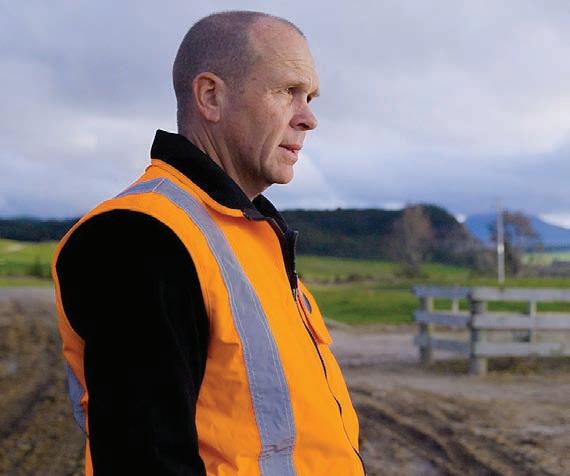
protected by QE2 covenant.
The question whether Pāmu should be retained or sold obviously depends on the perspective of the government of the day, but Leslie agrees the financial performance is a nonnegotiable, requiring a dividend to the Crown and growing the business.
But a sale of the business would not be entirely straightforward because many of the South Island properties would be subject to a first right of refusal under a Treaty settlement, while others are already potentially part of a settlement negotiation.
Rangitaiki Station, east of Taupō, is Pāmu’s largest property at 9500ha with 85,000 sheep, cattle and deer. It is valued at about $100 million. It would also not be an easy sale process – its size ideally demands it be sold as a single unit, which may cause problems,
PORTFOLIO: Pāmu
CEO Mark Leslie says the present farm portfolio is not necessarily what a buyer would choose to spend $2 billion to acquire.
especially if an overseas buyer were to be the highest bidder. Other factors to be considered in an evaluation of Pāmu’s sale or retention include the effect on partnerships with science providers and iwi, the role of New Zealand Inc in maintaining food security, apprenticeships and share-farming opportunities to encourage the next generation of farmers.
Leslie convinced me Pāmu is carrying out its mandate to be a responsible steward of the Crown’s farms, delivering dividends while gradually improving the condition of the land and meeting the Crown’s Treaty obligations. It is hard to see how disposal of these assets would achieve the same outcomes.

Mark Guscott says. Photo: NZ Story
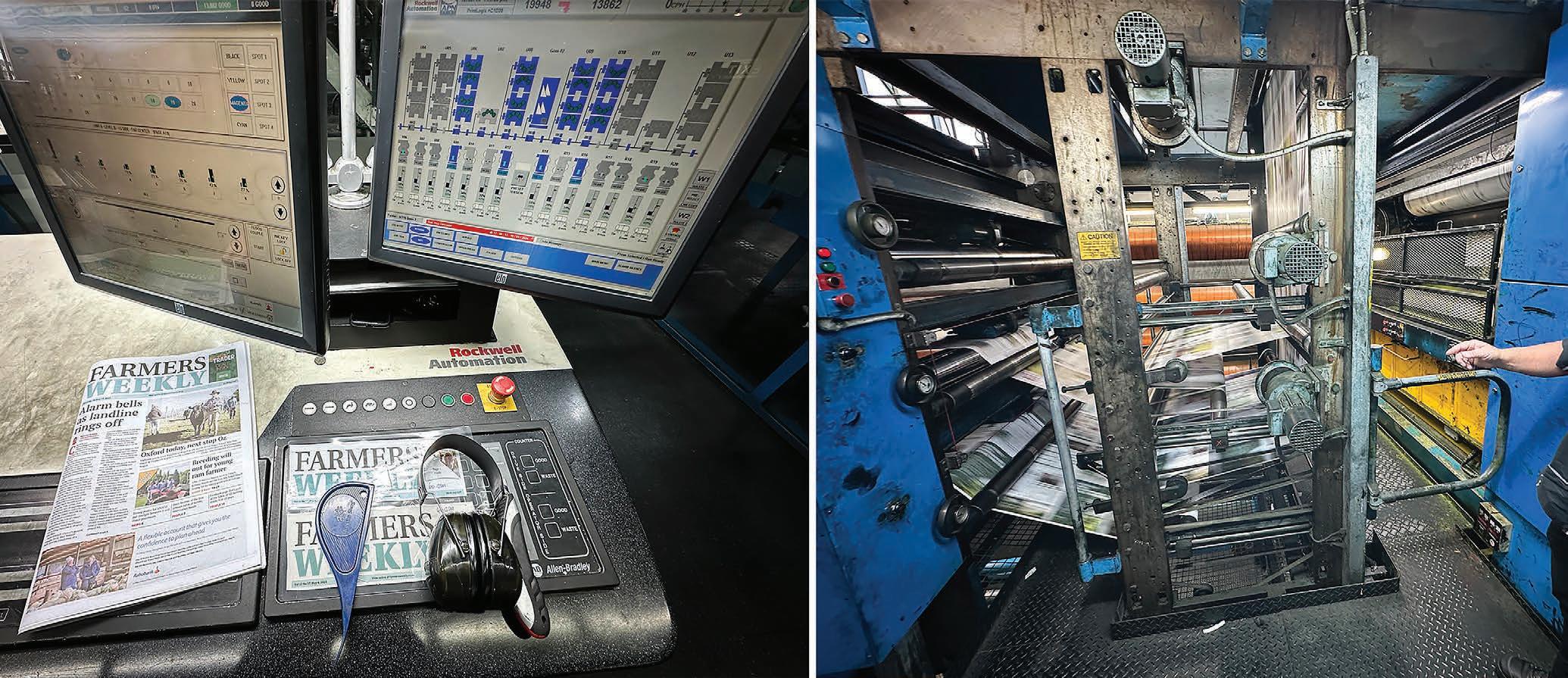
You can bank on our support.
We’re banking on yours.
We have over 1200 voluntary subscribers who all believe $10/month is worth it.
They’re incredibly valuable supporters and we’re incredibly grateful for their support. 1200 is a great foundation, but we’re aiming for 8000.
Whether you read this newspaper, or Farmers Weekly online, or both, you’ll appreciate the quality of the content. That’s something we’re determined to deliver every day of every week.
You’ll also appreciate that our work isn’t free. It’s accessible but not free.
There are no barriers and paywalls. We’re real people writing real stories for you – New Zealand farmers producing real food and fibre for the world.
Please support the easy access to quality journalism you enjoy, by starting your Voluntary Subscription today.
Our promise to you is that Farmers Weekly will remain independent and available to every farmer and industry player in the country, and we will always support your work in every way we can.
It’s time to stop ‘thinking about supporting this service’ and do it now.
Joining details below, or call me directly at any time.
Have a great week!
Dean Williamson. CEO and publisher. 027 323 9407 | dean.williamson@agrihq.co.nz
SUBSCRIBER

Support us with a voluntary annual subscription to Farmers Weekly. $120 for 12 months. This is a voluntary subscription for you, a rural letterbox-holder already receiving Farmers Weekly every week, free, and for those who read us online.
Scan the QR code or go to www.farmersweekly.co.nz/donate
Email your name, postal address and phone number to: voluntarysub@farmersweekly.co.nz and we’ll send you an invoice.
Call us on 0800 85 25 80
Note: A GST receipt will be provided for all voluntary subscriptions.


Sector Focus
Hard choices as arable charts new course

Annette Scott NEWS Arable
PRESSURE on New Zealand’s arable sector prompts a call to “acknowledge the pain and look at how to grow out”, an industry investment leader says.
“While many growers are coming off a tough season, it would be misleading to conclude that arable farming is in decline because that is not what is actually happening on the ground,” NZAB co-founderdirector Andrew Laming said.
“The pressure on NZ’s arable sector is real, but full of possibility.
“There’s no point pretending the pressure is a one-off because a meaningful part of it is real, structural and unlikely to disappear quickly.
“Feed grains continue to operate under a pricing ceiling set not just by domestic demand but by imported alternatives.”
What the 2025-2026 season has exposed is a sector under tension, where the spread between strong outcomes and poor ones has widened materially and, increasingly, success is not just about yield and price but about how well the business manages the intersection of multiple variables.
“This is not a story about one difficult harvest; it’s a story about what type of arable business will
remain resilient in a more volatile environment.
“It is important to step back and understand what is actually at stake.”
The arable industry is a significant part of New Zealand agriculture and while its export profile, at around $350 million, appears modest compared to dairy or meat, Laming said that understates its true economic contributions.
Arable production feeds directly into both the human food chain and the livestock sector.
“When domestic grain is displaced by imports, that value leaves the country rather than circulating within it.”
In total the sector contributes close to $1 billion in GDP and drives over $2bn in direct and indirect economic activity.
“In that sense arable is not just another farming category. It is part of the economic infrastructure of NZ agriculture.
“And yet it is operating in an environment where margins are tightening and variability is increasing. That combination is what makes the current moment important, because while external pressures are largely outside the control of individual farmers, how businesses respond to them is not.
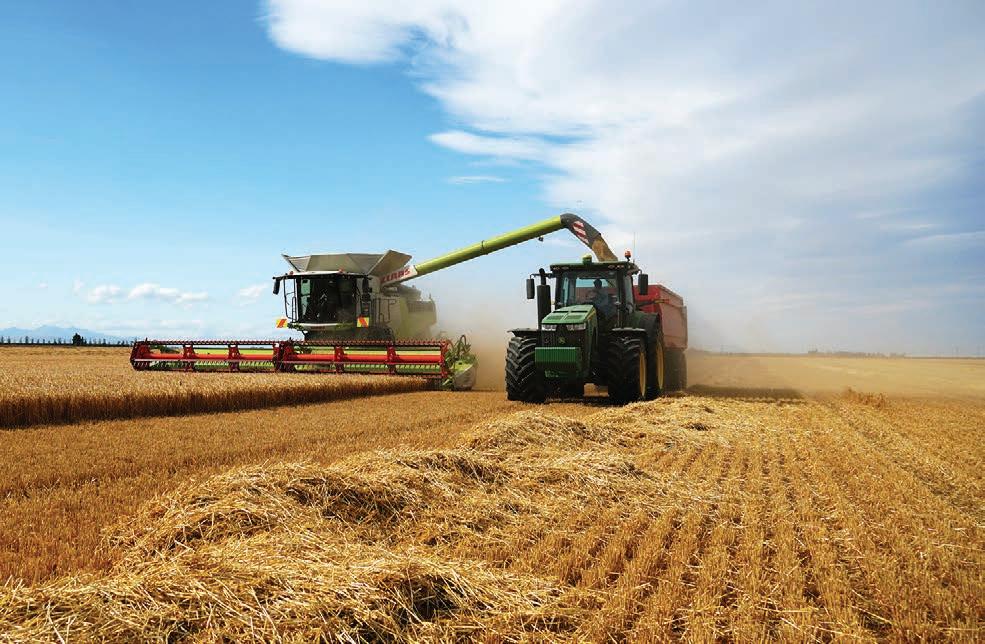
Despite the pressure, arable is not a sector without opportunity. It is a sector that is evolving.
Andrew Laming NZAB
“The shift now required is from focusing primarily on production to thinking more deliberately about business strategy, capital and long-term positioning.”
The season, particularly in Canterbury, has been a harvest that split outcomes, not just yields, and will be remembered for its variability rather than its outright failure.
While pricing is largely set by
global markets, invariably capped by imported alternatives, the real issue is what those crops are worth relative to what they cost to produce.
“The recent season is increasingly representative of a pattern of tighter operating windows and more variable conditions.
“After a season like this the real pressure is not just what happened in the paddock but it what means for the business and the confidence to act.”
One of the biggest risks is that decisions are made under pressure rather than design.
“The relationship with the bank becomes more important as in
RESILIENT: Andrew Laming says the future is not about one difficult harvest, it’s about what type of arable business will remain resilient in a more volatile environment.
many cases situations are more workable than initially assumed, particularly where the bank has confidence in both the operator and the direction of the business.
“Where that confidence is absent or communication is delayed, the range of options can narrow quickly.
“The sector has adapted before and it will adapt again. It still has strong fundamentals with global relevance in key categories.
“Despite the pressure, arable is not a sector without opportunity. It is a sector that is evolving.
“The critical point is that doing nothing is unlikely to be the winning strategy.”
Major weed management study gets underway
Annette Scott TECHNOLOGY Weeds
A LARGE-scale research project is underway to establish a diverse and sustainable toolkit of weed management strategies for cropping farmers in the face of rising rates of herbicide resistance.
The $2.6 million Integrated Weed Management in a World of Herbicide Resistance project is being led by the Foundation for Arable Research (FAR) and partfunded through the Ministry for Primary Industries’ Primary Sector Growth fund.
The four-year project involving both arable and vegetable growers is also jointly co-funded by the Seed Industry Research Centre (SIRC) and Vegetable Research and Innovation Board.
The programme involves researchers from FAR and weed experts from the Bioeconomy Science Institute.
FAR researcher Matilda Gunnarsson said reliance on chemicals is high in cropping systems, but research shows declining herbicide effectiveness because of herbicide resistance.
There is also a growing risk of importing herbicide resistant weeds, such as highly invasive black grass.
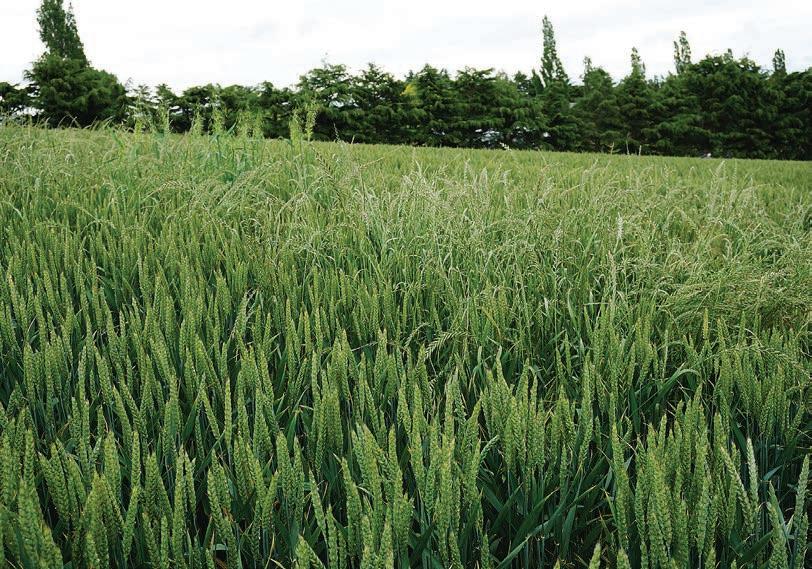
“We need to shift toward a more integrated approach rather than relying solely on herbicides as the main solution.
“It’s about understanding all the tools available and choosing the ones that best fit your farm and your system,” Gunnarsson said.
“Weeds will adapt and eventually overcome any single method of control, not just herbicides, so the key is building as much diversity into the system as possible.”
While seven years ago growers were reluctant to acknowledge they had a problem, the stigma
of having herbicide resistance has fallen away as the scale of the problem in New Zealand has become apparent.
In a 2021 FAR crop production survey, cropping farmers identified that weed management remained their primary agronomic challenge.
In conjunction with researchers and the wider industry, growers are now actively and openly seeking ways to manage the problem.
A 2019-2023 herbicide screening programme showed that south Canterbury recorded the highest
levels of herbicide resistance, with 71% of farms surveyed recording at least one instance of a herbicide resistant weed.
Of mid Canterbury farms surveyed, 60% recorded herbicide resistance while Southland recorded 59% and Waikato 61%.
As part of the new project, this is being repeated, with farms in north Canterbury and the Selwyn district also now included.
“These surveys are also testing for pre-emergence herbicides in addition to the post-emergence herbicides covered in the earlier surveillance programme.
“Weed samples have been taken from fence lines to monitor for glyphosate resistance as this is where resistance to this widely used herbicide is most likely to start.”
Growers have also responded to a call to send in weeds growing in their crops, for herbicide resistance testing.
The most common resistant weed is ryegrass with just five ryegrass plants per square metre reducing wheat yields by 5%.
Regions often have their own difficult-to-control weeds.
“Regions where we grow a lot of ryegrass and have shorter rotations is where we have the bigger problems.”
FAR general manager
research, development and extension Andrew Pitman said the programme will help farm businesses to maintain market access and profitability while ensuring the sustainability of weed management practice by reducing the risk of herbicide resistance.
The funding is enabling FAR to expand on the research work it is already doing in this area, including long-term research trials and large-scale on-farm trials.
INTEGRATED: FAR researcher
says growers need to shift toward a more integrated approach, rather than relying solely on herbicides as the main solution.
WEEDY: A research trial with wheat treated for weeds in the foreground and a weedy untreated plot behind. Photos: Supplied
Matilda Gunnarsson
Food br ands sign up for homegrown logo
Some of New Zealand’s best-loved food brands have been quick to sign up for a new campaign which reinforces their home-grown status
Harraways’ oats, The Good Oil edible oils and Otis oat milk are among the first to sign up to the New Zealand Grown Grains branding initiative, guaranteeing to consumers that the grains and seeds in their food is New Zealand-grown The new grain mark logo is expected to appear on these products’ packaging in coming months
Other food producers are already using the logo which makes it easier for consumers to identif y and seek out food and drink products made from domestically-grown grain and seed
The arable industr y hopes the logo will lif t awareness, tapping into a strengthening desire by consumers for locally-sourced food, as well as reducing reliance on impor ted grain
The cer tification trademark for products made with New Zealand-grown grains is the initiative of growers via their lev y organisation, the Foundation for Arable Research (FAR)
FAR general manager of business operations Ivan L awrie, a driving-force behind the logo’s development, says that about 25 companies have signed-up to date, including
NZ G rown G r ain licensees
Harr aways
Harraways chief executive Henr y Hawkins says the Dunedin-based company is proud to be put ting the New Zealand Grown Grains logo on its products
“Any way we can promote New Zealand grains is ver y impor tant to us ”
Oats, sourced from Southland and South Otago growers have been sold under the Harraways’ name since 1867 Harraways offers a range of milled oats from steel cut to traditional rolled oats used to make porridge and smoothies or as an ingredient in baking Harraways, which also expor ts, is undergoing an $11 million investment to upgrade its facilities which will lead to capacit y grow th in coming years
flour millers, bakers, pasta makers and animal feed suppliers,, with a steady stream of new applications arriving Together these use a wide range of crops including wheat, barley, oats, oilseeds and quinoa
A New Zealand Grown Grains website nzgrowngrains nz has just been launched which will showcase the companies including bakers Griz zly (Christchurch), Bellbird (Christchurch), FlourBro (Invercargill), Wild Wheat (Auckland), Big Score (Nelson) and eckh ( Timar u)
How do I sign up?
Companies interested in using the NZ Grown Grains cer tification trademark must apply for approval Please email details of your company and product to nzgrowngrains@far org nz and they will provide a draf t license agreement for consideration
What does it cost ?
The NZ Grown Grains cer tification trademark is granted free of royalt y on the condition that users comply with the requirements of the license This includes record keeping to provide proof of provenance
How do I k now which companies are involved?
All companies who are licensed to use the NZ Grown Grains trademark are listed on the website Visit nzgrowngrains nz
Humble Flour Co
Co-founded by Hawkes Bay grower Simon White and Hamish Glendinning, Humble Flour Co supplies ar tisan bakeries and retail outlets throughout the Nor th Island Wheat is grown in Ōtāne, Central Hawkes Bay using low-input practices and milled to order in small batches at its local mill




Growing and milling in the Nor th Island makes sense given this is where most flour is consumed - reducing transpor t miles and cost at a time when both mat ter more than ever, says Hamish Glendinning “The food system is broken We are a nation of growers yet we continue to impor t so many of our food staples Our mission is to help build a more resilient and sustainable food system in Aotearoa”
Pure Oil NZ



Founded in 2018, Otis produces a plant-based milk alternative using oats produced in the crop’s traditional growing areas of Southland and South Otago Otis oat milk is available in some leading New Zealand, Middle Eastern and South East Asian cafes and supermarkets
Our customers and consumers value the provenance stor y of Pure Oil NZ’s home-grown seed oils, and we are delighted to promote the NZ Grown Grains trademark with FAR, says Pure Oil managing director Nick Murney The trademark will be added to our brands, The Good Oil cold-pressed ex tra virgin rapeseed and sunflower oils For our food manufacturing customers our New Zealand-grown status is becoming more valued, as international supply chains come under pressure yet again with the Middle East war and related fuel crisis
“Our founders grew up on farms, in rural communities These communities are the lifeblood of our economy New Zealand just so happens to produce some of the world’s best oats L argely thanks to our ideal g rowing conditions down at the 46th parallel with rich soil, ample rain and long sunlight hours At Otis, we’re proud to par tner with around 70 diverse farmers The oats they grow play a crucial role in balancing their farm rotation systems,” says Otis co-founder Tim
Ryan
“The NZ Grown Grain mark is a natural evolution of this work - a co-operative of growers and brands pulling in the same direction to future proof our industry ”


Award recognises women behind forestry scheme
AFORESTRY block run by Southland women has just received a Community Service Award for decades of service and charity.
The Rural Women New Zealand Forestry Scheme (Southland) Incorporated, owns and operates the 90ha forestry block and 12ha wetland near Dipton.
Since 1996 over $800,000 has been donated to the community from the scheme. The award was presented by the Southland District Council at the Athol Hall in Northen Southland.
Southland Mayor Rob Scott said he was honoured to recognise the “incredible dedication” of those involved.
“These ladies work tirelessly as volunteers getting things organised and done, without claiming recognition – all for the benefit of our Southland community.
“This honour bestowed extends far beyond the current members and is testament to the efforts of many since its inception 78 years ago,” he said.
The land for the forestry block was gifted to rural women in 1948 by the Hamilton Brothers, by 1950 rural women slowly began planting pine trees.
Income from the trees is distributed to 15 Southland Rural Women branches, who then fund community services from swimming pools and lessons, Coastguard, Hospice Southland, Ronald McDonald House Southland, St John and health shuttles to name a few.
Every year four boarding scholarships are also awarded to Southland Girls and Southland Boys students, with over $75,000 in bursaries being awarded over the years.
Treasurer and Rural Women New Zealand member Heather Smith said the scheme is run by local Rural Women members as a committee and they employ a forestry manager.
“Rhonda Symons chairs our group and has done for the past eight years, she stays in good contact with the manager, keeps us well informed and runs our meetings. At the moment we’ve got about eight different age groups of pines. The different age group approach is so we can log at different times and be giving profits back to community as we go.”
Heather highlights how dedicated the group is to ensuring the forestry block is a success.
“We want to keep giving back, making sure we can keep generating money to send back to the Southland community, that’s what the Hamilton Brothers wanted.
“We are thinking about succession always and looking for the next generation of women to carry this project forward.”
She has been actively involved since 2012 and regularly drives the three hour round trip to help maintain and plant the wetland area.
“Ann Irving and I were out there on the Sunday, and although it’s an hour and a half drive from my house I view it as just another part of the garden to care for. We take a packed lunch, listen to the birds and deal to the weeds, it’s a good day out.
“Since the award we’ve had some amazing feedback, but for me being involved has always been about giving back,” said Heather.
Ninety hectares is planted in pines for milling, and a 12-hectare
wetland area is protected within QEII.
Rural Women New Zealand
Chief Executive Sandra Kirby said the hugely successful scheme is a credit to the dedicated volunteers who run it.
“This is a pioneering group of women who have dedicated hours of service to a forestry scheme that has given so much to Southland.
“As we celebrate our centennial year it is really important to acknowledge these local heroes who have created and nurtured initiatives that enable their communities to thrive,” she said.

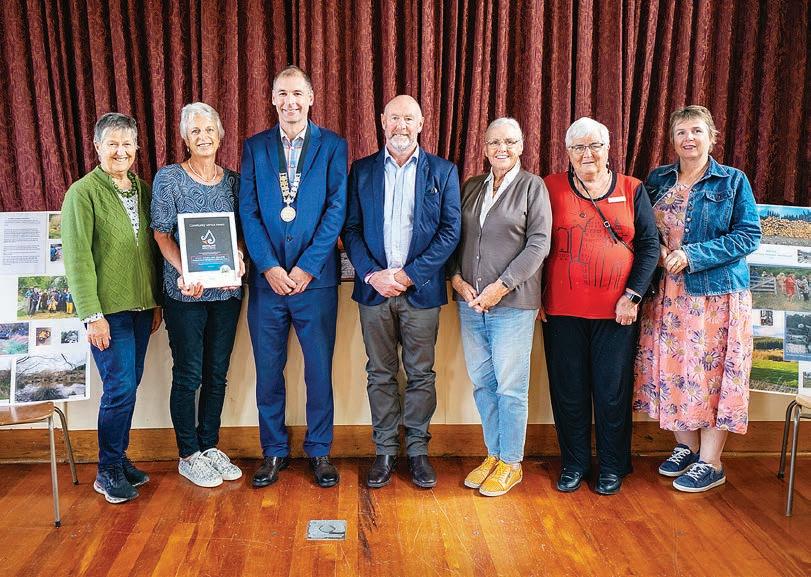
Rural Women celebrate 100 years
RURAL Women New Zealand’s region four wrapped up its centennial celebrations with a weekend of history and charity in Whanganui.
Over 40 members attended the weekend events, alongside Whanganui MP Carl Bates, Mayor Andrew Tripe, RWNZ interim chair Nicole Oliver, and descendants of the Polson and Lilburn families.
Florence Polson and Rosamund Lilburn were founding members of Rural Women New Zealand when
the organisation began as the Women’s Division of the Farmers Union.
Lower North Island regional leader Pauline Masters said it was a great weekend.
“It was great fun, a wellorganised weekend filled with camaraderie,” she said.
Masters said the weekend’s schedule was packed with visits to important historical sites and a river cruise.
“We got around on Neville
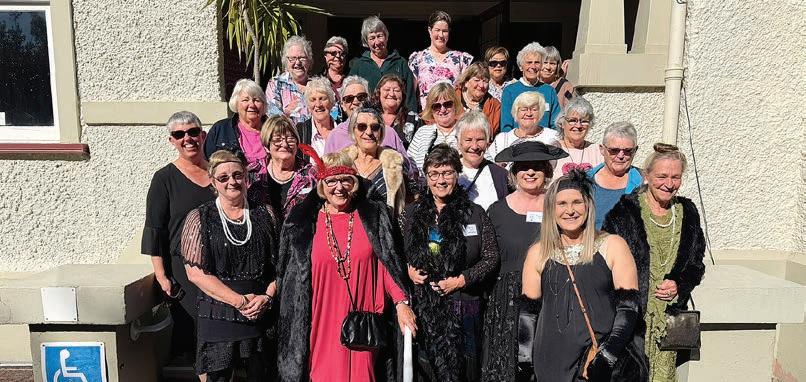
Gorrie’s iconic double decker bus, visited the Wicksteed St villa previously owned by the Whanganui Provincial Branch from 1964 -1987, visited artist studios, had lunch at Tarapuruhi and went on a cruise down the river on the Waimarie. During the cruise, our Rose Committee was presented with the Lady Blundell Tray – a national award for an outstanding project,” she said. Members Paula Vincent and Clare Adkins with help from quilter Christine Bristol handmade four quilts. The first quilt was donated to the Kowhainui Hospice for the Rural Women room, and the three others will be given to the Hawke’s Bay, Wairarapa and Manawatu hospice care.
Rural Women New Zealand’s 100-year celebrations have been running across the country since July 2025, with each region holding different events to mark the occasion. The centennial year ends in July with a final event to be held at Government House.
SERVICE: The women behind the Rural Women New Zealand Forestry Scheme have been recognised with a community service award. Pictured are Ann Irvine, Heather Smith, Southland Mayor Rob Scott, Northern community board chair Greg Tither, Pam Booth, Eunice Roberts and Sarah Baldwin.
PARTY TIME: More than 40 Rural Women New Zealand region four members took part in the recent centennial celebrations.
FEDERATED FARMERS

Why Feds is cautious on gene-tech
Federated Farmers’ stance on gene technology has attracted criticism from both sides of the debate in recent weeks.
Some say we’ve been too cautious, while others say we’ve gone too far. The truth is we’ve landed where a democratic, grassroots farming organisation should: reflecting the diverse views of our tens of thousands of members.
Gene technology is a complex issue that raises all kinds of questions about productivity and environmental gains, consumer trust, export markets and the future of farming.
Federated Farmers needs to represent everyone from dairy farmers and sheep and beef through to organic arable growers and highcountry stations.
This isn’t just about the use of gene tech to improve farm production either. Its use in health, conservation, pest management and other aspects needs to be considered.
It would be naïve to assume every farmer sees this the same way, which is why we haven’t taken a top-down approach or rushed to a conclusion. Our policy position on the use of gene technology hasn’t been dictated to us by the Beehive, pencil-pushers in Wellington, or commentators shouting from the outside.
It’s been set by our National Council, a group of democratically
elected farming leaders from across the country who represent every province and farm type.
After robust discussion, it was agreed Federated Farmers should support reviewing the current legislation and exploring the potential benefits of gene technology. However, this support was conditional. We wanted to see strong and non-negotiable safeguards in place to protect a farmer’s right to choose – and we stand by that. What that means is our position moved significantly to also account for those farmers who don’t want to see gene tech in New Zealand and to make sure their voice is heard too. They need protections.
In 2024 we commissioned independent research of 1000 farmers, both Federated Farmers members and non-members.
It found 60% supported allowing use of gene technologies in agriculture, 23% were opposed, and 17% were neutral or unsure.
That’s why the ‘right to choose’ principle matters more than anything else to us.
Some farmers want access to gene technologies if they can help solve real on-farm challenges, like increasing production, improving drought resilience, or managing pests and diseases.
Others want nothing to do with gene technology and want to protect their land, production systems and market premiums.
They’re also worried about the significant cost that could be imposed on their businesses to prove they’re GE-free.
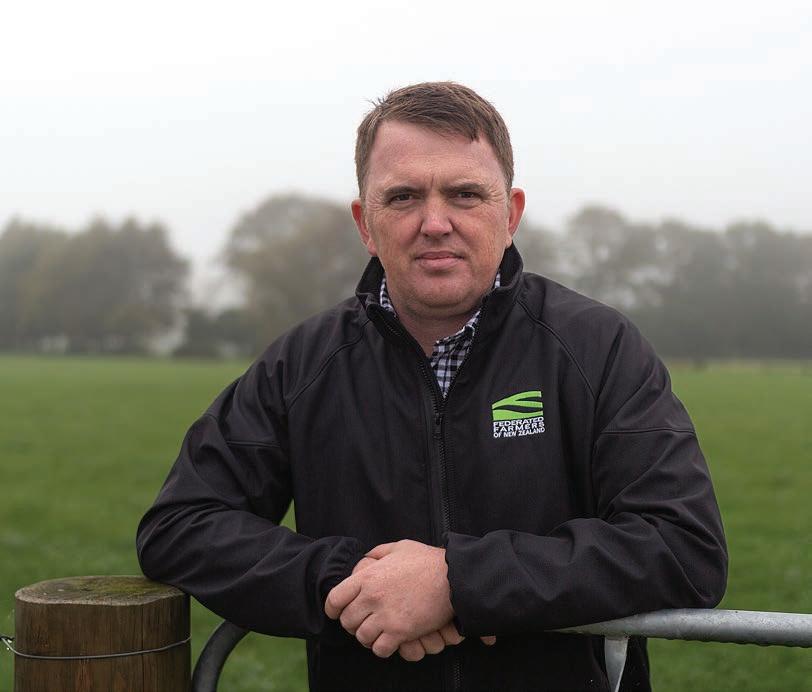
Our job isn’t to tell farmers what they should think; it’s to ensure all farmers have a voice, and that no one’s forced into a system that doesn’t work for them.
We think both views are entirely valid.
Our job isn’t to tell farmers what they should think; it’s to ensure
all farmers have a voice, and that no one’s forced into a system that doesn’t work for them.
That’s why Federated Farmers’ support for reform is cautious, conditional, and a case of breaking the bill down into its different parts.
Any reform must be sensible and science-based, and give Kiwi farmers access to tools available in many competing countries.
At the same time, we believe practical systems must be in place to protect farmers who choose to remain GE-free – and that’s where the real work needs to happen.
The Gene Technology Bill is the
start of a conversation, certainly not the end of one.
We need to carefully work through how a right-to-choose framework would operate in New Zealand’s unique farming systems, climate and geography.
We’re also investigating how it seems to be working in places like Australia to see if it could work in our context.
Gene technology may offer benefits in some areas but that doesn’t mean throwing the doors wide open. Federated Farmers isn’t asking for a free-for-all.
We’re asking for a very careful approach, where the system is tested and reviewed often to ensure it’s delivering for all farmers and growers – if that’s even possible.
Of course, trade implications are a big consideration.
New Zealand’s global reputation matters, but so does the ability of farmers and the companies they supply to make decisions based on what their customers want.
A right-to-choose framework means individual farmers can weigh up whether the premium from staying GE-free outweighs the potential benefits of adopting new technology.
Whichever side of the debate you’re on, I hope you can see Federated Farmers has listened carefully and tried to find a balanced pathway forward.
Feel free to criticise us but do so knowing you’re criticising a democratic organisation that’s worked incredibly hard to reflect the views of thousands of Kiwi farmers.

Wayne Langford
Federated Farmers national president
BALANCED: Wayne Langford says Feds’ position on gene technology is careful, conditional and driven by farmers.
Wayne Langford
Federated Farmers national president
Farmers
Rural school buses at a crossroads
Richard Dawkins Federated Farmers rural education spokesperson
For many rural families, the school bus isn’t just a convenience – it’s the difference between making farm life work or not.
Right now, that lifeline is at a crossroads as the Ministry of Education reviews its school transport assistance policy.
The Ministry says the review is about efficiency, but for families down gravel roads and across hill country, it’s about something much more basic: can our kids actually get to school? Can we continue to live and work in our communities?
An efficient rural route costs around $12 per student per day, with the total spend amounting to more than $200 million annually. A boarding allowance is also available for families where the only practical option is to send children to boarding school.
The bus system must allow for common-sense tweaks that can have a big impact – like picking up a few extra kids along an existing route.
Richard Dawkins Federated Farmers rural education spokesperson
That sounds like a lot until you realise it’s less than 2% of the Ministry’s total yearly spend. What matters more is how those dollars are used – and who misses out.
School transport is based on a ‘demand-driven appropriation’, meaning services are provided where students meet eligibility criteria, rather than being capped by a fixed budget.
The aim is to improve efficiency by focusing on those who qualify under the rules.
But while many families are well served under the current system, others are missing out on what is effectively essential infrastructure that underpins workforce participation and keeps rural communities viable. Currently, decisions are made centrally, based on rigid criteria, and with little room for local input.
That can result in routes being cut at short notice, leaving families frustrated and without a Plan B.
We’re also seeing cases where children miss out on a bus over just a few kilometres.
It might not sound like much in the city, but out here, that distance can be the difference between independence and a daily two-hour round trip for mum and dad.
The time spent driving can take a huge toll, cutting into farm productivity, off-farm work and family life.
Of course, there must be a line somewhere because busing every child to any school of their choice could increase costs toward $1 billion, which is not realistic.
At Federated Farmers, we believe there is a middle ground on this issue.
One option is a co-payment model, where families outside the eligibility criteria contribute to the cost of
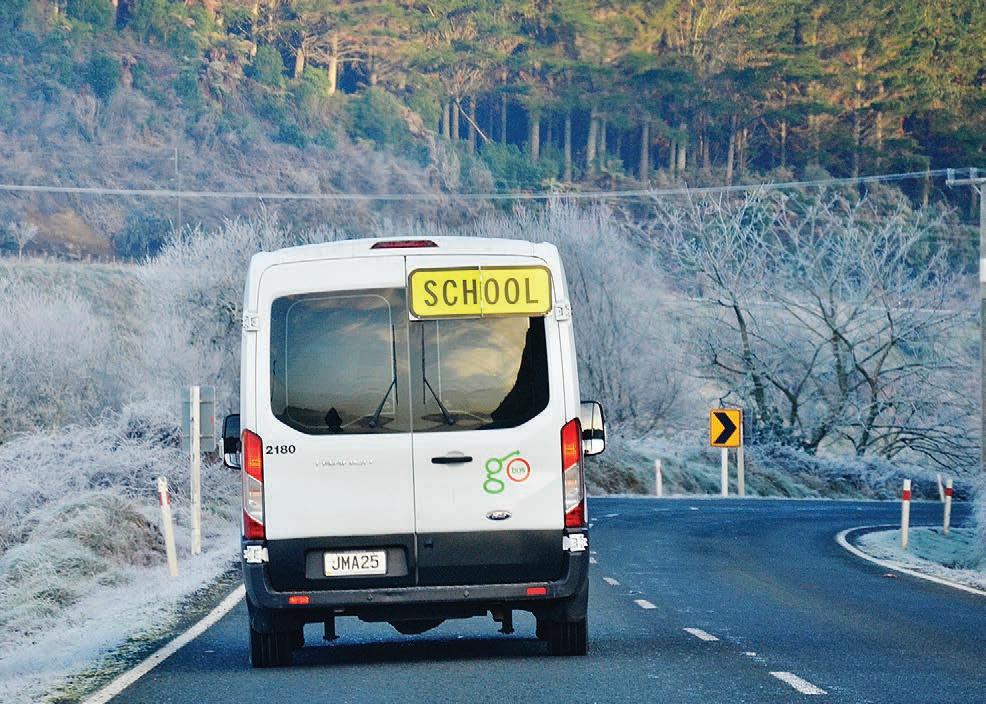
accessing existing routes, including travel to a preferred school. This already exists in some areas but it relies on negotiations between parents and bus providers. Limitations from the bus provider – drive time limits, bus seating capacity, etc. – mean it isn’t happening a lot.
A clearer co-payment model could give families more options without blowing the budget.
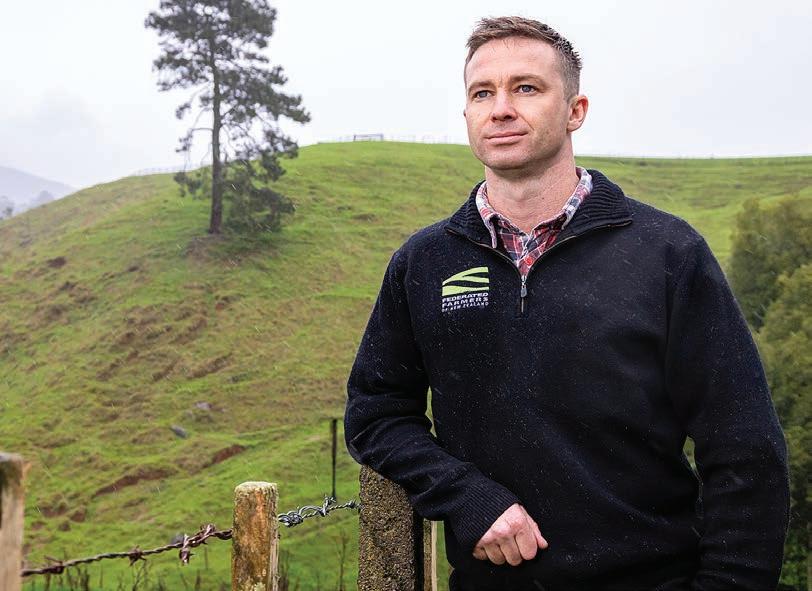
Another idea is giving schools the funding to manage transport themselves.
It’s been tried before, with mixed results, but it does show there’s appetite for local solutions.
For areas currently without a bus service at all, families can receive a conveyance allowance, paid where a child is eligible for transport but no bus is available.
In practice, it falls well short of the actual cost. A family driving one child 10km to a bus stop gets just $4.72 a day, a rate that hasn’t changed since 1985 and doesn’t come close to covering fuel, let alone time.
So, what’s the answer?
We believe it starts with certainty. We need a clear, stable national baseline of routes that families can rely on – not ones that shift every time enrolment numbers change.
Around that, there should be greater flexibility to reflect local conditions. Rural communities aren’t all the same, and the bus system must allow for common-sense tweaks that can have a big impact –like picking up a few extra kids along an existing route.
Local advisory groups could help
the Ministry make those decisions.
We also need a more pragmatic approach to the ‘nearest school’ rules, especially where kids are being left off buses over just a few kilometres, even when a route runs nearby.
In many cases, picking those students up would add little cost or time but make a big difference to the families.
Tendering arrangements also need revisiting. Bundling multiple routes into a single contract suits big operators but shuts out smaller, local providers who often know these roads and communities best.
The outdated allowances need urgent attention too because they simply don’t reflect the real cost of getting rural kids to school. This policy review can’t just be about trimming dollars.
The real risk isn’t inefficiency – it’s the unintended consequences that hit rural families and businesses hardest.
The Government needs to think in terms of return on investment: what this system delivers for rural productivity and the long-term sustainability of rural communities.
ROI: Richard Dawkins says investing in better school bus networks will be worth it.
LEFT BEHIND: For rural communities, losing a bus route hits far beyond the school gate.
Champion of conservation leaves lasting legacy
New Zealand has lost a practical, deeply committed advocate for protecting natural areas and tackling pests with the passing of Alan Livingston.
A Waikato farmer, former Waipā mayor and regional council chairperson, Alan joined the QEII National Trust board in 2020 and was appointed its chair in 2023.
The trust is dedicated to helping landowners – most of them farmers – to permanently protect special areas of native forest and wetlands through covenanting.
In the six years Alan was on the board, the number of finalised covenants grew from 4729 to more than 5400, despite Covid interruptions and battles for more government funding.
“He was a helluva good guy to work with,” QEII chief executive Dan Coup says.
“He was very passionate about this cause, which is why I think this was one of the few governance jobs he was still doing. He believed in it and pushed very hard at every opportunity to further QEII’s mission.”
Alan served two terms as a Waipā councillor, then was elected mayor in 2001 and held the role for four consecutive terms.
He was later councillor, then chair on the Waikato Regional Council (WRC), wrapping up an impressive 24-year career in local government in 2019.
Alan, who was made an Officer of the NZ Order of Merit, was also a Crown appointee to the Waikato River Authority, a trustee of Sport Waikato and of the Maungatautari Ecological Island Trust.
WRC chief executive Chris McLay says Livingston brought a calm, considered approach to leadership and was known for taking the time to listen.
Coup says the QEII Trust benefited hugely from that skillset and personality.
“He was such a pro in terms of governance skills and experience. He knew how to pull all the strings that a good chairman needs to know –the people to call, how to engage.
“Alan could interact with anyone – from a Minister, to members of a Select Committee through to someone checking traplines in the bush.
“You could give him a few talking points and he’d nail a speech in front of a room with five people, or 500 people.”
In recent years, Alan and Federated Farmers were closely aligned – firm in their view that the QEII Trust delivers exceptional bang for buck on conservation and deserves a significant boost in baseline government funding.
While the trust has been grateful for one-off funding injections, the base annual grant has been stalled at $4.27 million since 2015.
As a result, the number of new covenants QEII can pursue each year is running at less than a quarter of what was achieved in 2024.
This was a theme Alan returned to when Federated Farmers’ communications team visited the family farm on the slopes of Mount Pirongia at Te Pahu earlier this year.
His parents began running sheep and beef on the property in 1953, with Alan and his wife Janet later taking over, before handing the farm on to their daughter Megan and her husband Phil Weir in 2017.
As a youngster, Alan and his brother Guy would catch the train to the South Island after each school holiday to resume boarding at Waitaki Boys’ High School.
Alan gained an Agricultural Commerce degree at Lincoln, met and married Janet, a nurse, and then worked for the Rural Bank in Masterton and Whangārei.
His interest in environment protection sharpened during that time in the Far North.
“I was dealing with land development encouragement loans and guys up there were developing bush that contained Kiwi. No-one complained about it; it was just accepted,” he told us during the February visit.
“It was marginal land at best. I’ve always thought bush blocks and gullies are aesthetically an integral part of farms. They’re not going to produce much, so fence them off.”
When he came back down to take on the family farm at Te Pahu, he put a particularly nice block of native bush under QEII covenant.
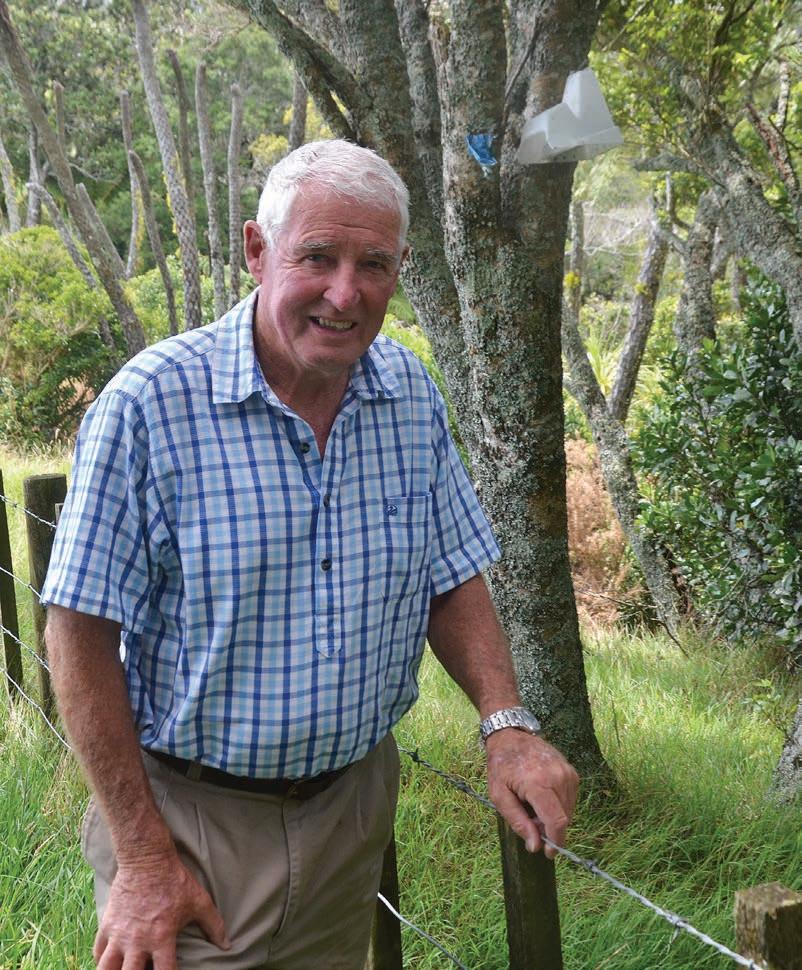
“I think it’s covenant No 97 – so very early days when not many were doing it.”
Now there’s another covenanted area on the farm, and other stands of native trees and bush have also been fenced off.
As Waipā mayor, Alan carried that
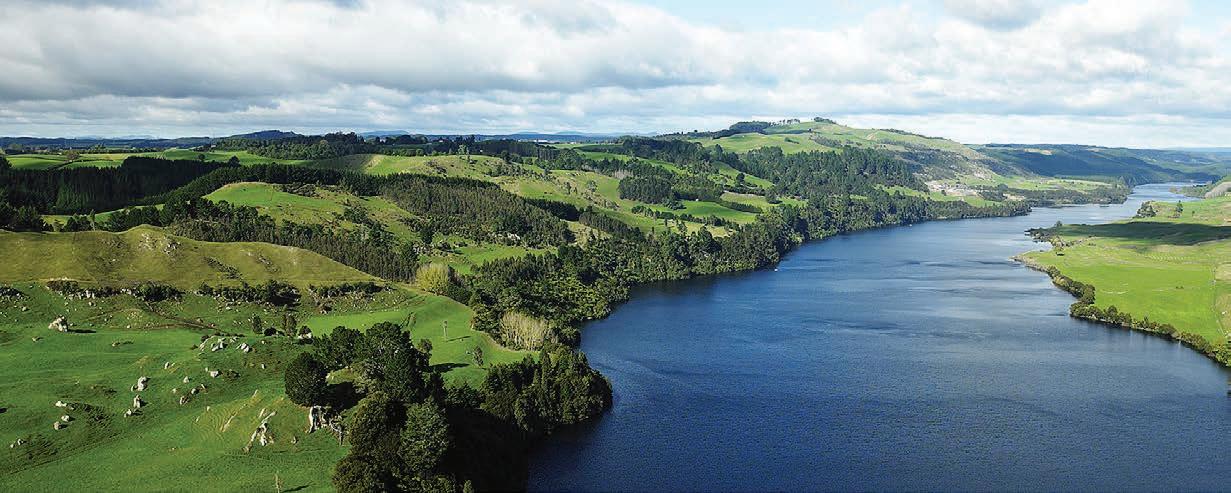
thinking into policy – continuing rates relief for covenanted areas and introducing transferable titles for farmers who placed significant areas under permanent protection.
Alan’s message to politicians this election year was a reminder of a Waikato University study showing that every dollar of government funding for the QEII National Trust returns $6–$7 in farmer spending on fencing, maintenance and pest control.
As a huge supporter of sport and Cambridge’s identity as ‘Home of Champions’, it’s fitting that Alan’s funeral service was at the rowing centre at Lake Karapiro.
His work helping to protect the best areas of nature outside of our national parks is an incredible legacy to his three children, nine grandchildren – and generations to come.
Alan passed away at home in Te Pahu on 12 April.


A LIFE LIVED WELL: Alan Livingston at the family farm in Te Pahu, with the native forest he put under QEII covenant behind him.
DEDICATED: Alan Livingston was a Waipā councillor and chaired the Waikato Regional Council during his 24year career in local government.
Couple’s win adds to strong Otago Feds record
Luke and Nicole Kane’s recognition as environmental leaders maintains both a proud family farming tradition and exceptional track record for Federated Farmers Otago.
The couple, who run a 700-cow dairy farm near Tapanui, have been named Otago’s Supreme Winners in the 2026 Ballance Farm Environment Awards.
It’s the seventh time a member of the Feds Otago leadership team has taken out the top provincial title in the last 20 years.
“We’re pretty chuffed with the recognition, and to be part of awards that showcase how hard farmers work to be good stewards of the land,” says Luke, the current Feds Otago president.
“It means a lot to read the judges’ comments that our farm business is honouring its 100-year legacy, while at the same time securing its future through innovation and looking after the environment.
“Anna Gillespie has hounded us a bit over the last couple of years to get our paperwork together and enter. I’m glad she did.”
Anna, Federated Farmers Otago vice president, and her husband Ben won the same title in 2020.
Other current and former Otago leaders to take out the title include Tracey and Andrew Paterson (2025), Logan Wallace and his parents Ross and Alexa (2018), Stephen and Rhonda Korteweg (2009), Richard and Sarah Burdon (2008), Simon and Camille McAtamney (2007).
The Kane family’s farming roots in West Otago go back to 1929 when Luke’s great grandparents bought
300ha by the Pomahaka River.
His grandad Murray and father Robert added additional land, and with Luke’s mother Mary-Anne also playing a key role, developed a Hereford and Angus stud breeding and cattle, eventually replacing sheep entirely.
At boarding school in Dunedin, Luke recalls strong rivalry between sons of sheep and beef farmers like himself, and lads off dairy farms.
“I was a pretty stubborn teenager and I vowed I’d never be a dairy farmer,” he jokes.
But he shelved his plans to go to university when he found work for a contractor building dairy farm infrastructure through the dairy boom.
“We could see there was good money in dairy, and that it would
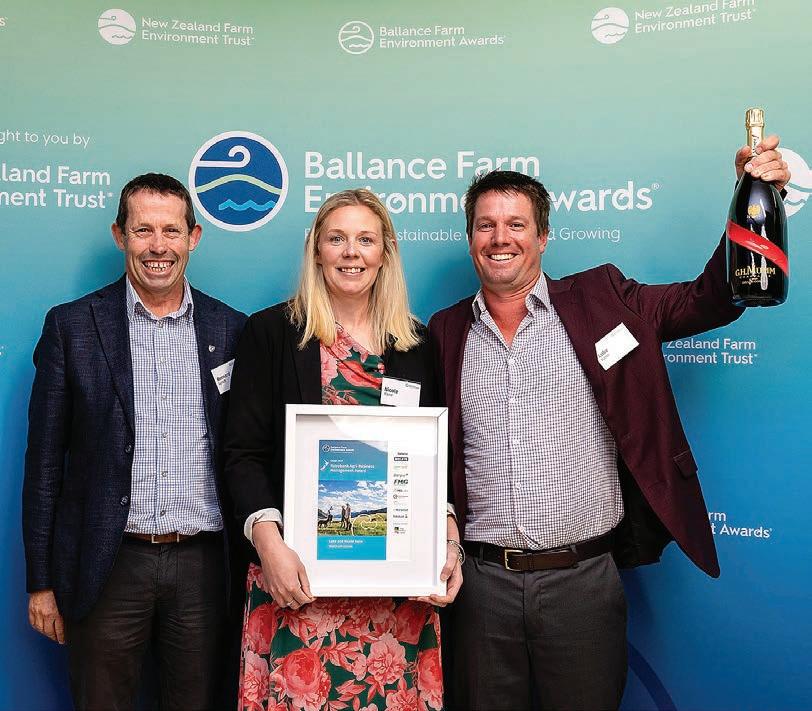
suit our family farm, which goes from flood plains through to steeper rolling hills,” Luke says.
“So, we started the transition to dairying as part of a wider family succession plan.”
Luke proposed to Nicole, who originally came to the farm as a calf rearer, and they now own and run the dairy business called Westholm Dairies.
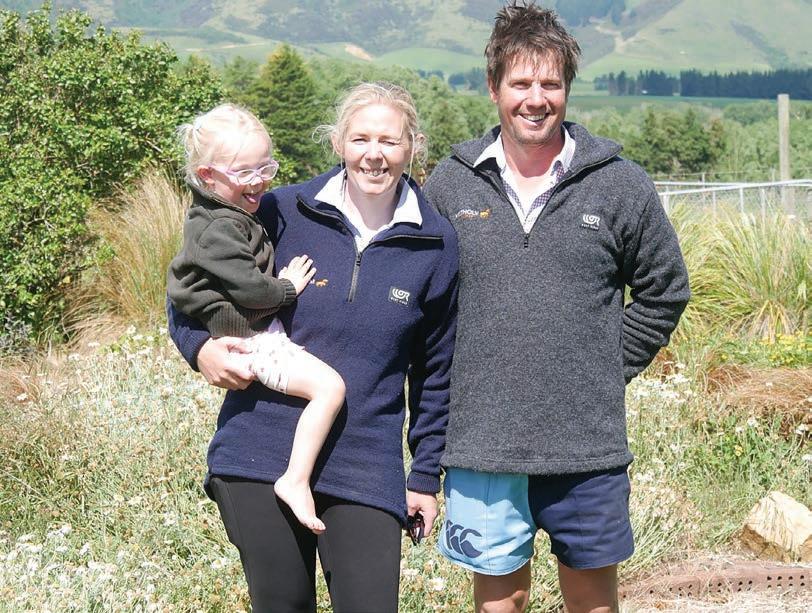
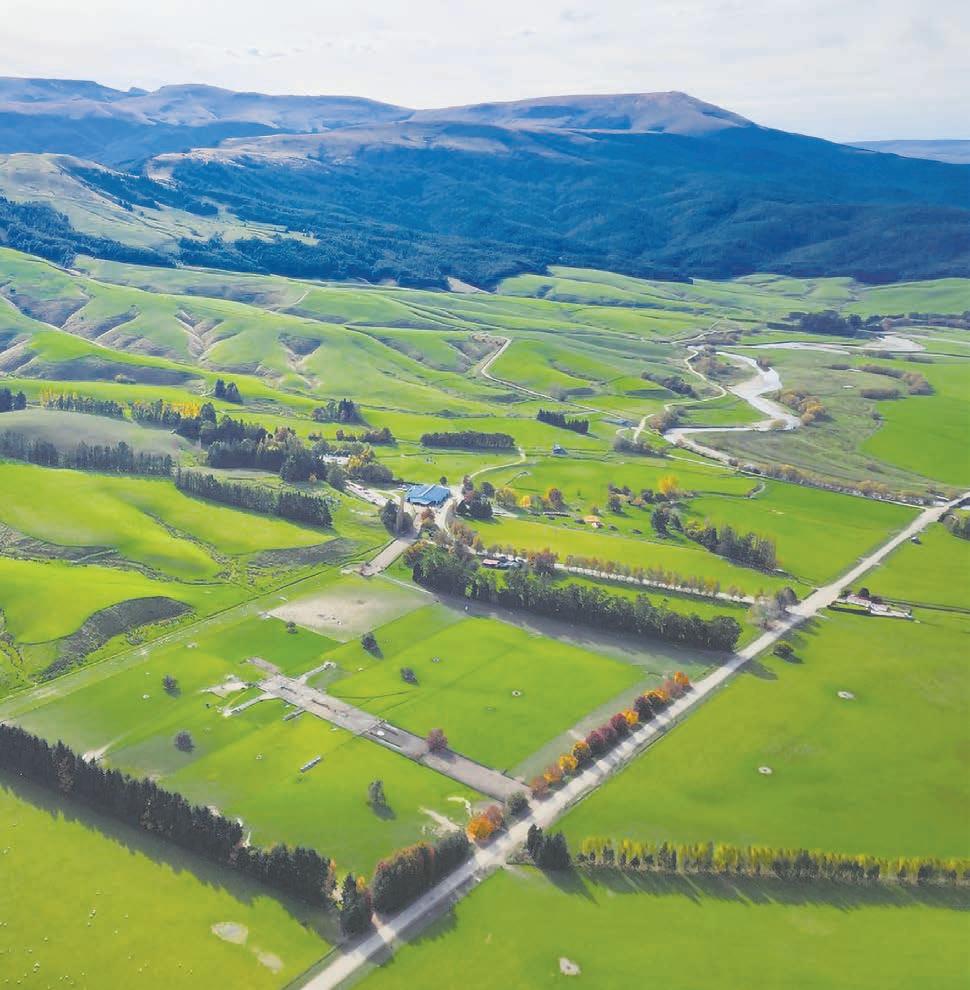


The Ballance Award judges were particularly impressed by the couple’s sophisticated, data-driven approach.
“From meticulously analysing gross margins to precision soil testing and fertiliser application, the business is built on a foundation of analytics,” their report said.
“Smart technology is leveraged across the dairy herd to monitor health and performance, which significantly increases efficiency while slashing waste.”
The Kanes’ environmental stewardship is treated with the same level of discipline – for example, the farm has a highly organised winter grazing plan.
Blocks are pre-mapped and grass bales strategically placed to eliminate unnecessary tractor movements and protect soil structure.
The Ballance Award recognises more than environmental performance – it also considers community involvement, financial viability and production efficiency.
“It all dovetails,” Luke says.
“A lot of the environmental gains come by default, by not wanting to waste money on excessive amounts of fertiliser, placing it incorrectly, and things like that.
We’re pretty chuffed with the recognition, and to be part of awards that showcase how hard farmers work to be good stewards of the land.
Luke Kane Federated Farmers Otago president
“The cost analysis we do on feed and other inputs comes with wanting to scale up the business but also the realisation we can’t be hands-on every day.
“With the Feds role, I haven’t been on-farm for a full week since before December.
“Data makes it easier for staff, and us, to monitor how things are going. There’s still intuition and farming skill in there but it helps everyone be across that whole system.”
Luke says he and Nicole get a lot of satisfaction from the fact they’ve taken teenagers fresh out of school and put them on a path to agricultural careers.
One lad, who started with them at age 14, is now the farm manager and they’re looking to get him into contract milking or an equity partnership.
While involvement with Federated Farmers and other community causes takes time off-farm, Luke acknowledges advantages too.
“To be able to ease back on that day-to-day, hands-on farm management, you’re forced to delegate, and put together a tight set of policies and procedures on a whole lot of stuff.
“And in Feds, you end up rubbing shoulders with a bunch of people who are going through similar things.
“You make some bloody good contacts, you get good insights on how they manage their time and their farm, and you pick up on the best of it.
“The Feds Otago AGM is on 6 May, a chance for new leaders to put their hand up for election. It would be fantastic if it turned out the next Ballance supreme winner was among them to keep up the province’s record.”
Glenaray Station manager Simon Lee and owner David Pinckney share
SUPREME FEELING: Otago Ballance Farm Environment Award winners
Nicole and Luke Kane mark the win on awards night with Bernard Lynch, agribusiness manager with sponsor Rabobank.
AT HOME: Luke and Nicole Kane, with daughter Poppy, at their dairy farm near Tapanui. Photo: NZFET
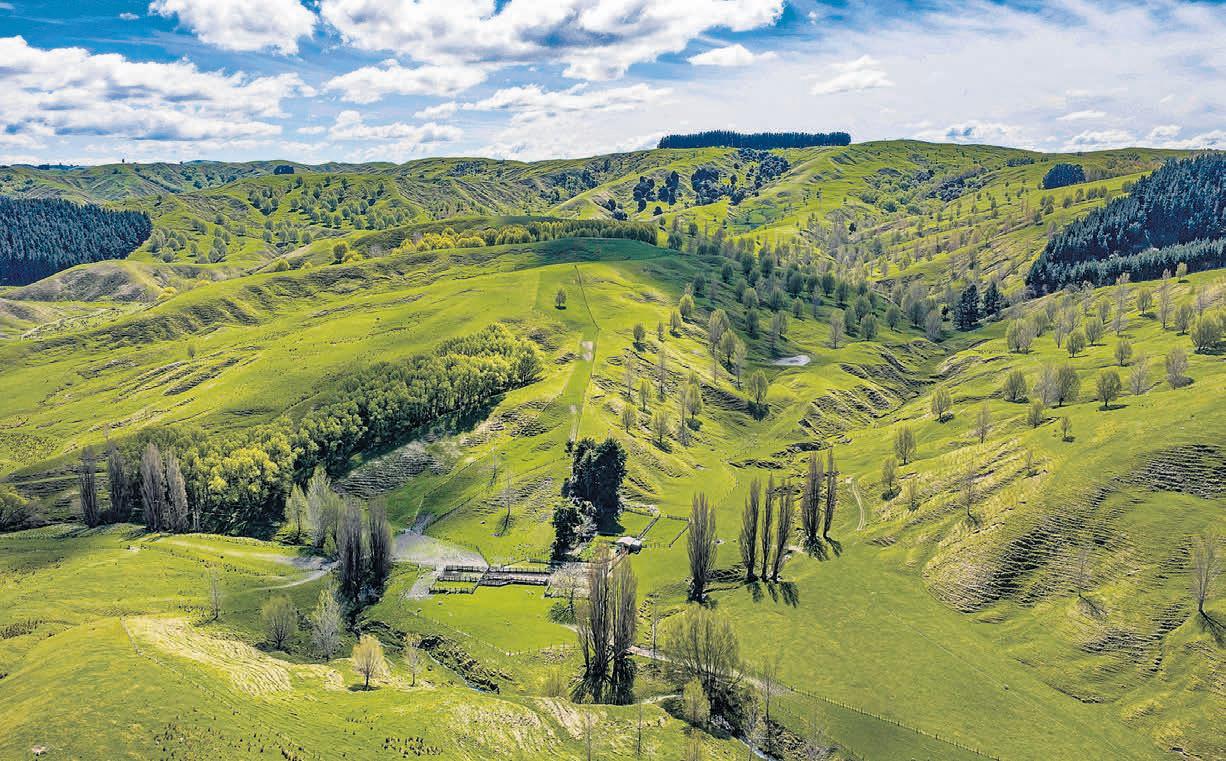
913 hectare breeding/finishing property
The Estate of AW Parsons offers a genuine sheep and beef breeding /finishing property Situated 37km southeast of Waipukurau with the school bus at the gate, only 24km to Flemington Primary School Currently run as one unit, the estate is split into two separate blocks The main landholding of 869 5ha provides the easy to medium/steeper breeding platform with a very good standard of fencing subdivision and laneways Three dams form the source of the extensive reticulated water system Improvements include the four bedroom manager’s residence staff accommodation and a four stand woolshed complex The 43 5ha bottom finishing block of flat to easy contour includes cattle yards bayleys co nz/2854191
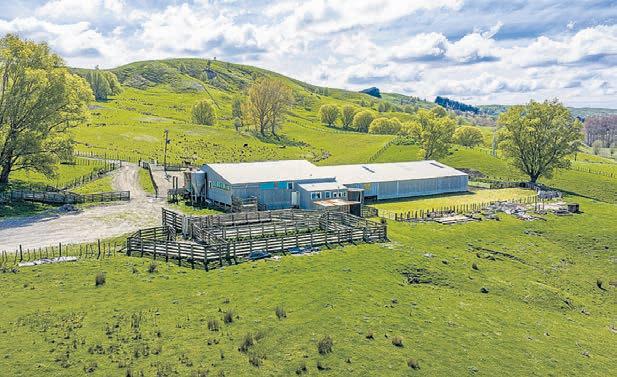
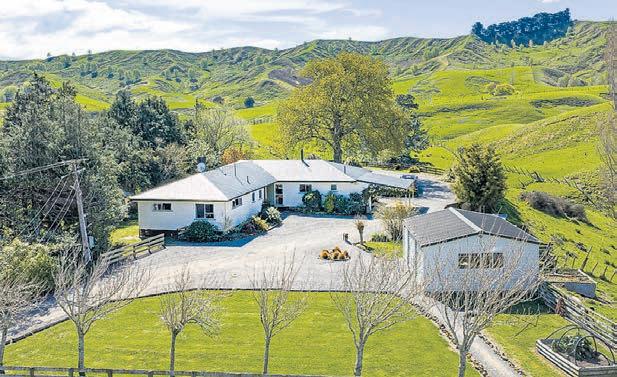

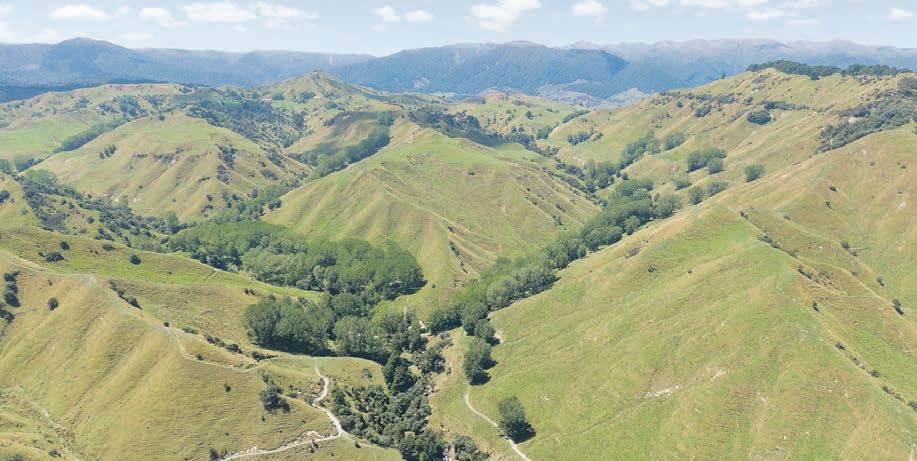
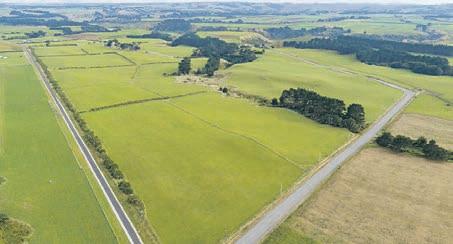
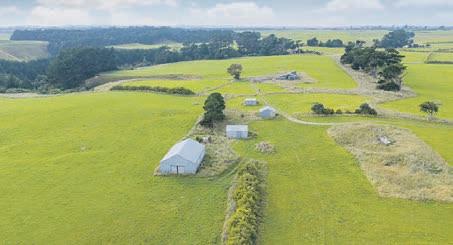
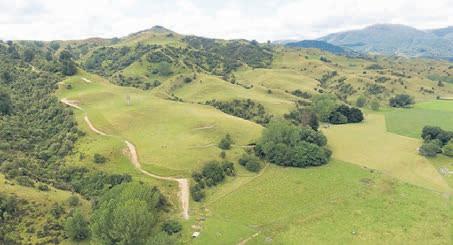
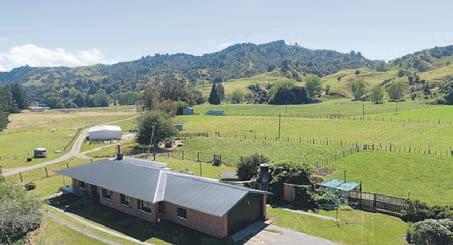
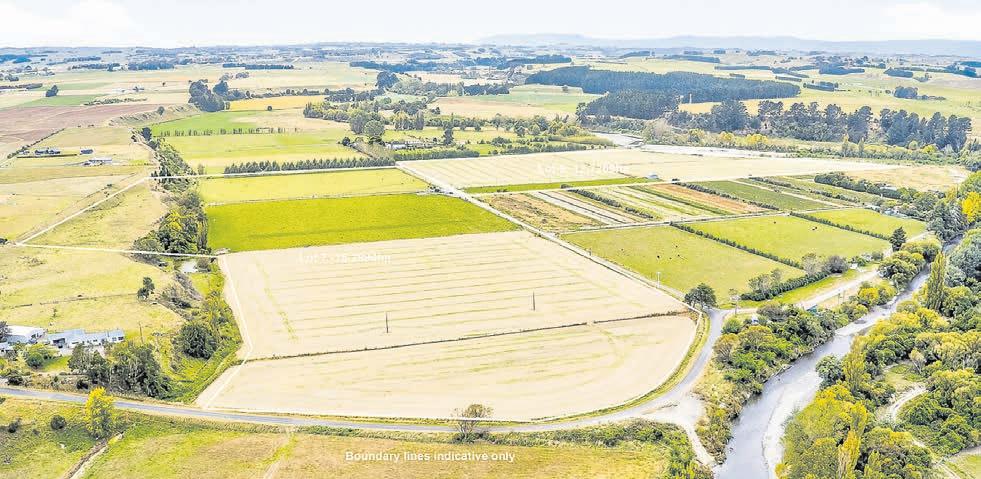
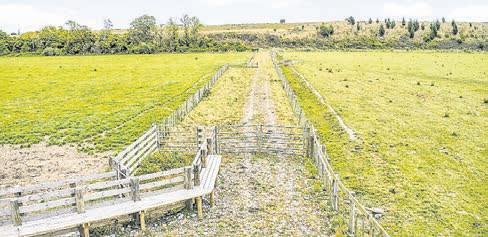
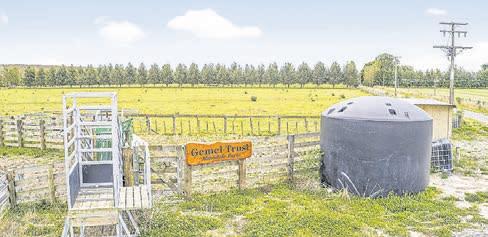
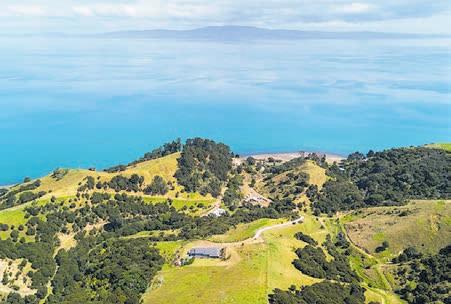
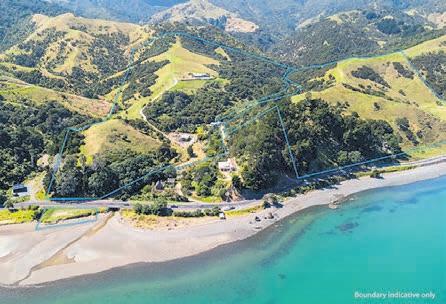


Located along the iconic Thames Coast Road, 998 Thames Coast Road comprises 35 28 hectares (more or less) of rolling coastal land offering a versatile lifestyle opportunity with a balance of productive pasture, native bush, and a picturesque stream The property is well set up for grazing with ten paddocks, reticulated water, and cattle yards The elevated three-bedroom main home captures expansive views across the Firth of Thames featuring open-plan living, a sunroom, and wraparound decking Additional improvements include a high-stud garage, carport, and substantial water storage A second upgraded three-bedroom dwelling and well-equipped wool shed accommodation provide flexibility for extended family, guests, or income potential Just 3km from the Waikawau boat ramp and within easy reach of Thames township, this unique coastal holding offers lifestyle, income, and future potential in a sought-after Coromandel location For those looking to downscale from a larger farming operation without losing their connection to the land, or for buyers seeking a coastal base with exceptional fishing on their doorstep, this property presents a compelling and highly desirable next move
For Sale by Deadline Private Treaty Closing 4pm, Thursday 7th May 2026 (unless sold prior) Clint Brereton 027 897 1161




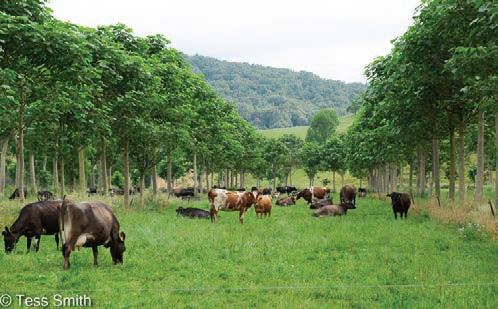
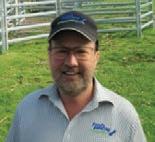
in Germany
• Most popular model: DK-AL 3218/35
• Unsurpassed quality and specification
• Electro-hydraulic, 6,000kg rated ram
• Side and rear tipping
• 3,500kg GVM (2,500kg payload)
• 3.25m x 1.8m deck
• Removeable 350mm aluminium sidewalls
• Other trailer types and sizes available to order
• Germany’s #1 horse float & trailer brand
• Exclusive NZ distributor for 15+ years $17,995+GST






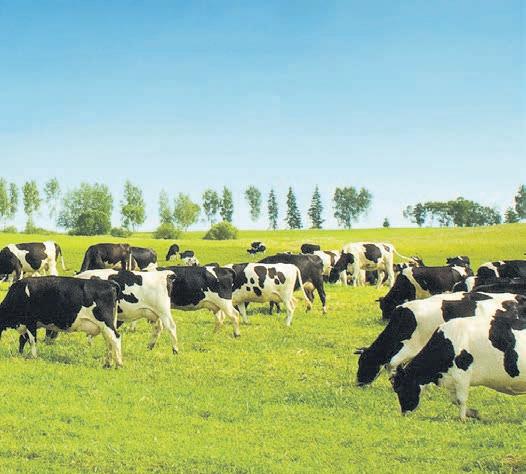












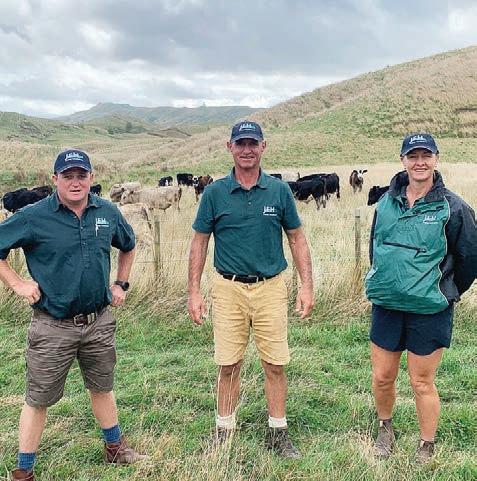



FOR SALE
Self shearing sheep. No1 for Facial Eczema. David 027 2771 556.
The chief says “That indeed is big magic. You are free to go. My people will take you to where you can be rescued by your people.” Later the chief’s #1 son says “Dad, we’ve seen Zippo lighters before. Why did you let the man go this time?”
Chief says “Yes son, we have seen Zippo lighters many times before. But never one that lights first time!”
STOCK FEED
BALAGE $95. Lucerne balage $110. Very good quality. Unit loads available. Phone 021 455 787.
TREES FOR SALE
LARGE VARIETY of natives for sale for the 2026 planting season. Pick up Wairoa. Phone Jan 027 278 7033.
WANTED TO BUY
WHAT’S SITTING IN your barn? Ford, Ferguson, Hitachi, Komatsu, JD. Be it an excavator, loader or tractor, wherever it is in NZ. Don’t let it rust. We may trade in and return you a brand new bucket for your digger or cash for your pocket. Email admin@loaderparts.co.nz or phone Colin 0274 426 936.
SAWN SHED TIMBER including Black Maire, Matai, Totara, Rimu, Mac, Redwood, Western Red Cedar etc. Also buying salvaged native logs. Phone Richard Uren. NZ Native Timber Supplies. Phone 027 688 2954.
MACROCARPA AND PINE TREES. Plantations, Shelterbelts, Farm lots, Big or small, Lower North Island, Good $$$ paid. No obligation free quote. Call Grant 021 246 4329 HSF Ltd.
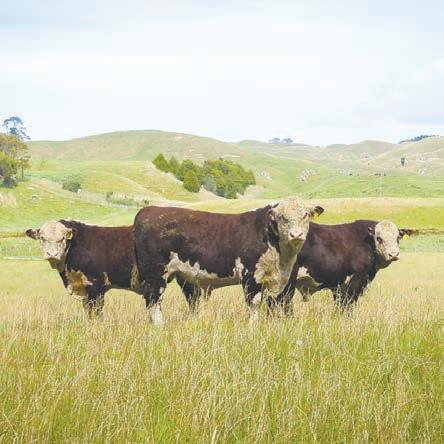

HIGH INDEXED - EARLY CALVING JERSEY IN-MILK COWS & HEIFERS
A/c Dave and Lea Moodie - Leadamoo
Sale Date: Wednesday 29th April, 11am
SPRING CALVING IN-MILK AUCTION
A/c Faraway Ltd (David Van Bysterveldt)





Address: 1081 Morrinsville – Walton RD Morrinsville will be available for online bidding
COMPRISING:
154 Jersey mixed age in-milk & in-calf cows 56 Jersey in-calf R2yr heifers
COW DETAILS: BW251, PW256, LW273. Calving 5th July to AB Jersey LIC premier sires for 5-weeks, tailed Angus bulls (out 27th Dec). Additionally for sale, 23 Jersey I/M mixed age MT cows.
HEIFER DETAILS: BW294, PW252, DTC 8th July to Jersey bulls (out 18th Dec), weighed 391kg on 14/03/26.
EMBRYOS: 8x frozen embryos from elite cows.
AUCTIONEERS NOTE: This is a great opportunity to purchase outstanding Jerseys from passionate and well respected vendors exiting the industry. These owner milked cows will come forward in great condition and display excellent temperament and conformation. So many positive attributes with this herd - herd indexes boast up to BW414, PW799, and heifer indexes boast up to BW398, PW365. In the top 5% of LIC herds in NZ, early calving, RA100%, 445kg/ MS, 1500MS/ha, SCC116, System 3, HB shed, BVD bulk milk tested, Lepto vaccinated, TB C4.
PAYMENT TERMS: Payment due 14 days from sale. Immediate delivery in-milk or by prior arrangement before sale day with Vendor.
CARRFIELDS LIVESTOCK AGENTS: Matt Hancock 027 601 3787 Luke Gilbert 027 849 2112
Date: Wednesday 22nd April 2026
Address:
Matamata Sale Yards Dairy Pavilion
Start Time: 11:30am will be available for online bidding
COMPRISING:
370 x Mixed Breed & Age Spring In-Milk Cows
(A portion are dry and dry-cow treated)
DETAILS:
Features 80 high indexed cows
BW 257, PW 470
Balance of cows are above average. Approx 60 Jersey, 120 Crossbred, 190 Friesian. TB tested. DTC from 15th July to 6 weeks AI Charolais, no bulls used.
AUCTIONEERS NOTE:
A strong, well selected line of mixed breed carryover cows sourced from quality Waikato and northern herds.
Milked through and mated for spring calving. Cows will be presented in forward condition All cows guaranteed sound and in-calf by the vendor.
PAYMENT TERMS:
14 days after the auction, Immediate delivery OUR VENDOR: David Van Bysterveldt 021 189 9888
CARRFIELDS LIVESTOCK
www.carrfields.co.nz Contact us 0800 141 545




A/c: R & J LANGEVELD
253 Canal East Rd Waitakaruru, Ngatea – D/N 70627
Monday 4th May – Start 11:00am
400 Aut Inmilk Friesian Cows
130 MT Spr Inmilk Cows
Tuesday 5th May – Start 11:00am
400 Spr Calving CRV Friesian Cows
Due 10th July to Nominated CRV Frsn 5 weeks tailed Hereford last cow due 18th Sept vetted to dates
95 R2 I/C CRV Heifers, 95 R1 CRV Heifers
Heifers due 10th July to Jersey – removed 7th Dec
NZ Farmers Livestock are privileged to offer the above stock on behalf of Rene & Julie. Both herds and young stock have not been offered for sale in the paddock. The herd has been owned since 1993, and breed to CRV genetics since then. Nominated semen has always been used with a focus on type and confirmation particularly on udders being mindful of the big production being achieved. They consistently produce 550-600ms/Cow & 1800-2000ms/ha. C10, BVD bulk milk clear, HB shed.
When Rene has brought in extra stock for the Aut. herd he has been extremely vigilant with the type of animal purchased and paid accordingly. I have personally inspected all the stock and can say they are extremely quiet with excellent confirmation and type. The young stock are outstanding with the best of the R2’s well over 500kgs. If you are after capacious Frsn cows and young stock that will produce, you should not miss these sales.
Payment 2nd June and stock can stay on farm for new sharemilkers or shifting farm owners till end of May. Rebate available to recognised companies by prior arrangement only. Prior inspection welcome by appointment.
Online bidding via mylivestock.co.nz
Please ensure your registration on MyLivestock 72 hours prior to the sale
Or call us on 0800MyLivestock (0800 695 483) for help with registration.
Photos and videos on mylivetock.co.nz
Catalogues available online or by contacting your local NZFL Agent. Agents: Bill Sweeney 027 4515 310 or Ed Reynolds 027 669 3577

REQUIRED
Store lambs 30-37kg
GAP Store lambs 30-38kg
18mth Ang & AX Hfrs 300-380kg
18mth Angus Steers 340-380kg
18mth Fries or Beef Bulls 400-450kg
2YR Beef Bulls 530-600kg FOR SALE
200 R3YR Ang, Ang Fries, Exotic x Steers 500–550kg info@dyerlivestock co nz www dyerlivestock co nz Ross Dyer 0274 333 381

A/c: Longhill Farms
For convenience of clients Morrinsville Saleyard Dairy Pavilion Thursday 23rd April 2026 – 11am start
Comprising: 95 x M/A Frsn & Frsn Cross Jersey & Jersey Cross Cows BW 224 PW 283 RA 100%. BW’s to 529 PW’s to 1006 LW’s to 1798
Due 15th July 2026 – Scanned to dates. Nominated 6 weeks LIC (88% incalf to AI).
Tailed with Charolais and short gestation. TB C10, EBL free, Lepto innoc. BVD bulk tested neg. All DNA profiled, all one code. 71 Cows are A2A2.
“HERE IT IS”
Milked on the same farm by family over 100 years. A truly magnificent herd. Index, type, production, on a tough farm. A long history of nominated LIC with selected breeding programme. Cows are in good milking condition, consistently producing 325 m/s on challenging, difficult Northland farm. Ave SCC for the season 148,000. Extremely good uddered herd milked OAD. Contact: NZFL – Darryl Houghton 0274 515 315 BYL – Jason Roberts






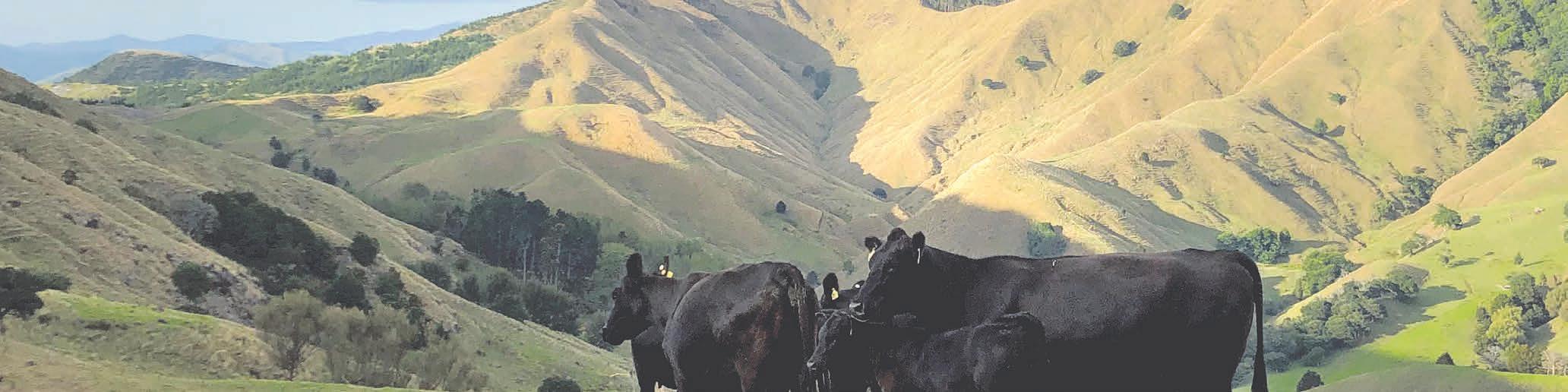









Choppy global seas for red meat exports
The war on Iran is playing out pretty much as predicted for NZ exports – as something of a nuisance.

MARKETS Trade
IT HAS been roughly seven weeks since fighting broke out in the Middle East, and despite some fears that this would rattle New Zealand’s red meat export markets, there’s not been much change from what was forecast beforehand.
The main direct impact over these weeks has been on sales, specifically into the Middle East. Near the beginning, containers of New Zealand product were stuck in limbo as access to key ports was cut off while in transit. However, the majority of these containers were eventually landed via alternative routes through the Red Sea and Suez Canal.
Trading into the Middle East is continuing, though in a reduced capacity as shipments to this part of the world incur a steep “war fee” per container, in addition to general shipping costs rising. Luckily for New Zealand, this isn’t a massive market. Over the past 12 months, it’s accounted for 2.7% of our beef exports by value and 4.6% for both lamb and mutton.
Another key nuisance for red meat exports has been shipping
challenges. Increased costs are one part of this, but the timing of the war couldn’t have been more annoying either, as it’s coincided with the peak apple and kiwifruit export months.
This is making finding shipping space for red meat even more difficult than usual over the short term.
Shipping times for trading to Europe have been extended as well. Chilled product is being sent via the Panama Canal and frozen product routed past South Africa’s Cape of Good Hope, rather than through the Suez Canal.
But in terms of overall export market dynamics, trends are largely similar to what was developing in February.
United States imported beef prices have edged backwards slightly as offerings from New Zealand have increased, while supplies from Australia and South America have remained well above last year in recent weeks. But US domestic beef shortages aren’t going away anytime soon, especially while their herd rebuilding efforts have been slow, and may stay limited due to expanding drought conditions.
The main question mark for beef is what happens when Australia
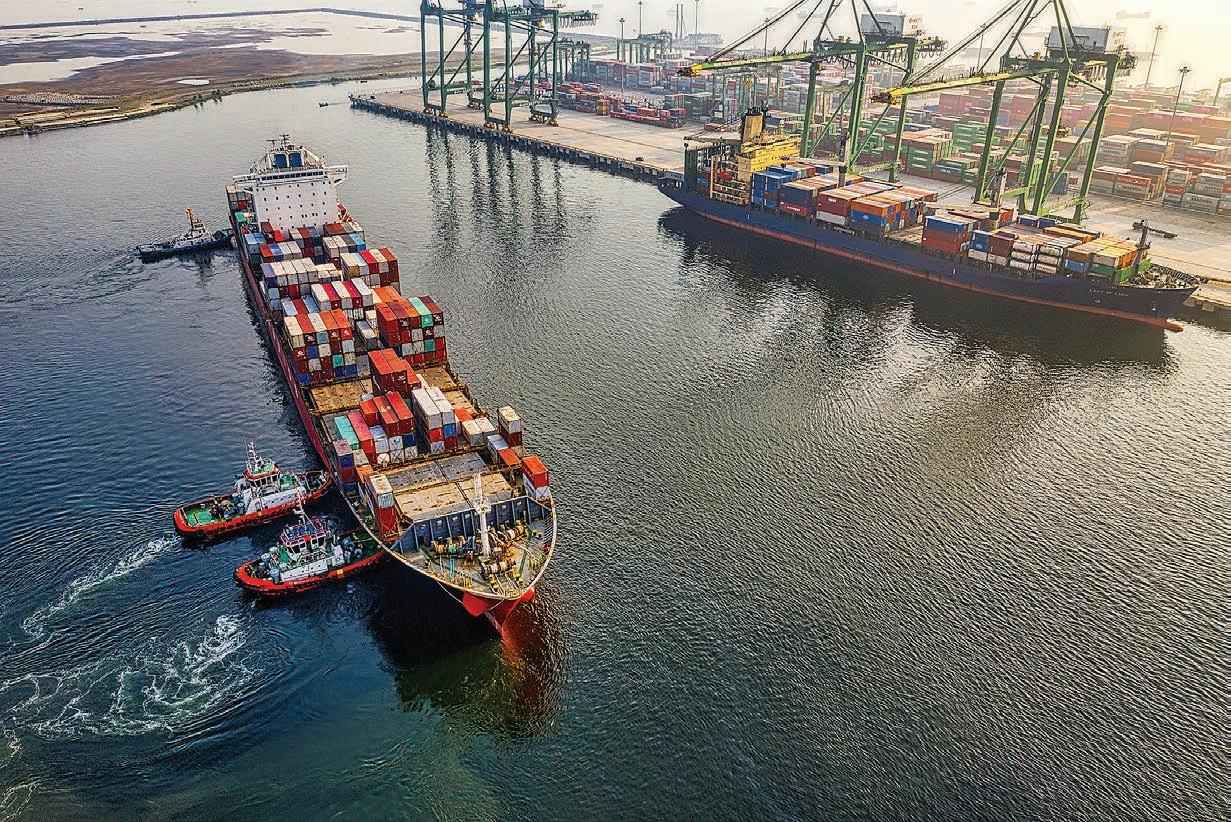
Trading into the Middle East is continuing, though in a reduced capacity as shipments to this part of the world incur a steep ‘war fee’ per container, in addition to general shipping costs rising.
and Brazil exhaust their annual quotas into China? For both, this is expected to happen around mid-year, after which their beef will face a 55% tariff. On one hand, this will likely push more beef into the US and therefore temper prices. On the other, it could open up market space in China for New Zealand beef.
For lamb, the main area to watch is the European Union. Lamb legs have been a tougher sell there over the past two months, though some of this is seasonal as new orders have been for late spring/ early summer deliveries, when EU consumption of roasting cuts slows.
In comparison, middle cuts such as shortloins and frenched racks have been stable, though those account for a smaller portion of a lamb carcase.
Other lamb markets are effectively stable, except China, where buyers have become more price competitive since the back of last month.
Price gains for the bulk of products have only been minor, but they are slowly shifting nearer to the level of other markets, providing more of a cushion
should we see more pushback from Europe in the months ahead.
With that said, market fundamentals will need to be monitored over the coming months as China’s pork market has crumbled since the Chinese New Year.
Last week, wholesale pork prices had fallen to a 16-year low, down 22% since mid-February and 30% below on a year ago, mainly caused by a continued oversupply of domestic pork since the latter months of last year.
Nearly 60% of meat consumed in China is pork, so while it does not compete directly with New Zealand beef and lamb, it does have indirect impacts, as we saw when African Swine Fever created pork shortages, which sparked the Chinese buying craze through the early 2020s.


Reece Brick
TIME: Shipping times for trading to Europe have been extended. Chilled product is being sent via the Panama Canal and frozen product routed past Cape Town, South Africa, rather than through the Suez Canal.
Photo: Pexels
Cattle Sheep Deer

Weekly saleyard results
These weekly saleyard results are collated by the AgriHQ LivestockEye team. Cattle weights and prices are averages and sheep prices are ranges. For more detailed results and analysis subscribe to your selection of LivestockEye reports. Scan the QR code or visit www.agrihq.co.nz/livestock-reports
AgriHQ Livestock Outlook forecasts beef and lamb prices up to six months ahead, so you can plan your season with confidence. Predict the market. Plan with certainty. Be ready before the rest.
Prime traditional cows, 640kg
Weaner traditional bulls, 215kg 1630
Weaner exotic-beef bulls, 250kg 1750
Aut-born yearling dairy-beef heifers, 315kg 1765
Weaner traditional heifers, 205kg 1255
Weaner exotic-beef heifers, 230kg 1395
Weaner dairy-beef heifers, 155kg 895
Stortford Lodge | April 14, 15 | 3076 cattle
Temuka | April 13 | 661 cattle, 6182 sheep
Boner Friesian cows, 515kg
Store cryptorchid lambs, most
Store mixed-sex lambs, most
Prime ewes, most
|
$/kg or $/hd
Weaner traditional steers, 245kg 1745
Weaner exotic-beef steers, 265kg 1840
Weaner traditional bulls, 230kg 1485
Weaner exotic-beef bulls, 250kg 1565
Weaner traditional heifers, 220kg 1350
Weaner exotic-beef heifers, 245kg 1485
Feilding | April 9 | 630 cattle
Weaner traditional heifers, 220kg 1385
Weaner exotic-beef heifers, 255kg
Sue Joe & Sons | April 15 | 766 cattle
or $/hd
dairy-beef steers,
lambs, most
Beef weaner fairs/calf sales
Taupo | April 13 | 674 cattle
Weaner traditional steers, 230kg 1740
Weaner Hereford bulls, 245kg 1860
Weaner Friesian bulls, 195kg 1135
Weaner traditional heifers, 210kg 1285
Weaner dairy-beef heifers, 150kg 870
Te Kuiti | April 9, 10 | 2165 cattle
or $/hd
Weaner traditional steers, 225kg 1665
Weaner exotic-beef steers, 260kg 1815



A large, lazy low lingers

Philip Duncan NEWS Weather
GET used to low pressure sticking around. For the week ahead New Zealand is stuck under a depression, with more lows on the way. It marks a shift from where we were in March with increased high pressure over the country. The low that we kick off with this week moved onto the country on Saturday and is not expected to depart NZ until this coming Saturday, seven full days of influencing our weather. It’s a large low too – and large lows are often broken up into pockets of rain and wind, and dry and calm. So it won’t be stormy all week; instead it means instability, changeable weather and more than likely a fair bit of rain for some regions.
While next week does see some high pressure briefly return, there are more low pressure zones forming to see out the rest of the
month with perhaps the next big high not arriving over NZ until early May.
To be honest, this is the autumn weather pattern – and we can get lows like that in winter too.
I remember a couple of years back writing a column for Farmers Weekly talking about the month ahead being “the month of big” – big lows that were slow and brought rain and showers and a fair amount of complaints from people.
But the following month was “another month of big” and that month was dominated by high pressure. It’s a timely reminder of the small size of our nation, and how some months we can easily be swamped by a lot of rain makers, or a lot of high pressure.
The incoming lows will generate a mixture of warmer and colder air as they move in and then out. As this week wears on, the winds may swing more northerly, pushing up temperatures further.
The large lazy low will encourage colder nights in the south, but
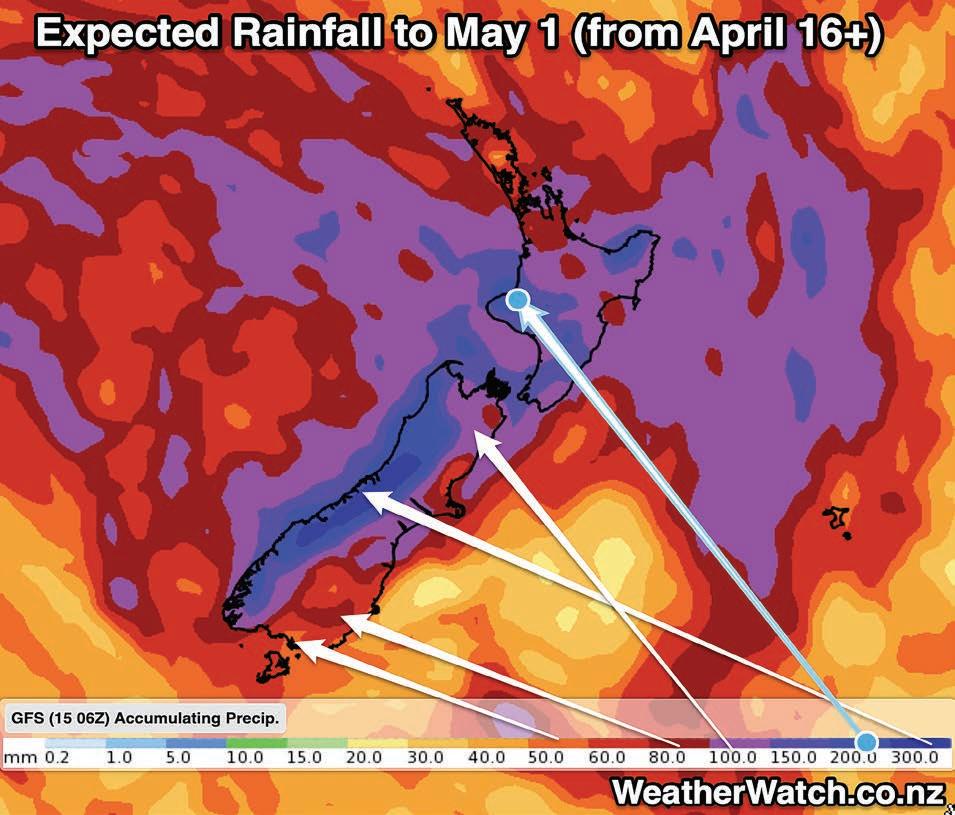
frosts look mostly light and well inland or at higher elevation. Before (or as) the next strong high arrives (maybe in early May based on long-range modelling), we might get a more wintry change. We’re actually seeing our autumn pattern similar to last spring.
I say that because while we’re missing out on major polar blasts, Australia’s southeast is getting
them frequently. Our neighbours over in Tasmania have had at least three snowy events so far this autumn (the type of southerlies that would see snow close to Queenstown and snow on the hills around Southland and Otago and the Canterbury ranges), although so far those pulses of cold have missed much of NZ.
It’s a sign that winter’s cold is
DAMP: The expected rainfall forecast for the second half of April suggests most places will get rain.
building but simply hasn’t been able to escape into the NZ area very much, at least not compared to Australia.
From a rainfall perspective, we see all of New Zealand getting rain and showers for the rest of this month – in fact some regions may still have over a month’s worth of rain yet to fall in just the rest of April.