












Hugh Stringleman MARKETS Livestock
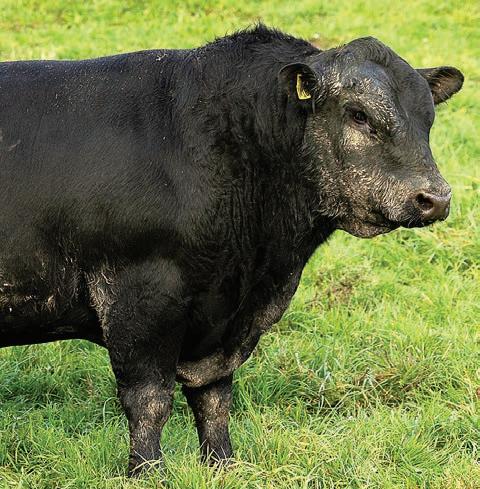
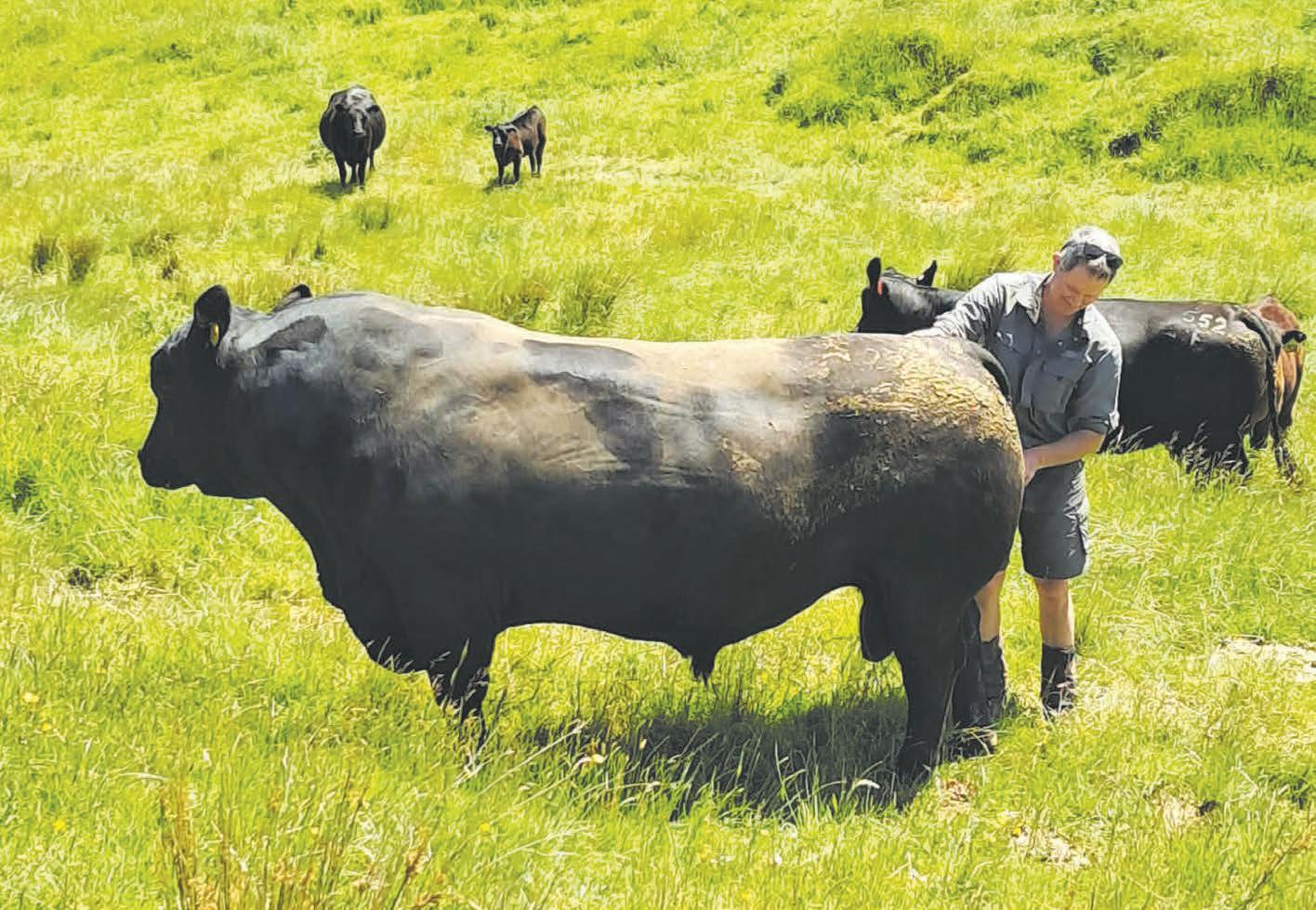
BEEF cattle breeders are confidently awaiting the autumn bull selling season with expectations that buyer demand will be good and prices will remain high.
Angus NZ immediate past president Mike Smith, who has the Kincardine Angus stud in Queenstown, said calf sales in autumn had set an amazing benchmark for the pricing of sires.
“It is great to see commercial beef farmers getting good returns on their investments and long may it last.
“Sustained schedule prices from the meat industry show that commercial farmers are getting their rewards at the slaughter end of the value chain.
“When that occurs they seek better genetics to improve their herds.”
After Angus studs set some New Zealand price records for bulls last year, Smith said he is waiting with interest to see the first crop of calves from those pace-setters.
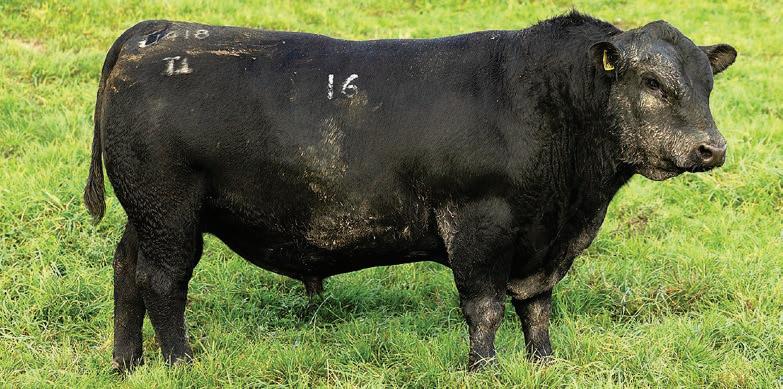
Tangihau Angus, Gisborne, set a new Angus bull price record with Tangihau U418 selling for a massive $161,000 to Oregon Angus, Masterton.
Cricklewood Angus stud, at Wairoa, Hawke’s Bay, held the record for the highest priced Angus bull for only one day after Cricklewood U909 sold for $156,000 to Puke-Nui Angus in Taumarunui.
Simmental NZ president
Jon Knauf said all the factors pertaining to bull sales are positive and the breed is helping to put more kilograms of beef out the farm gate.
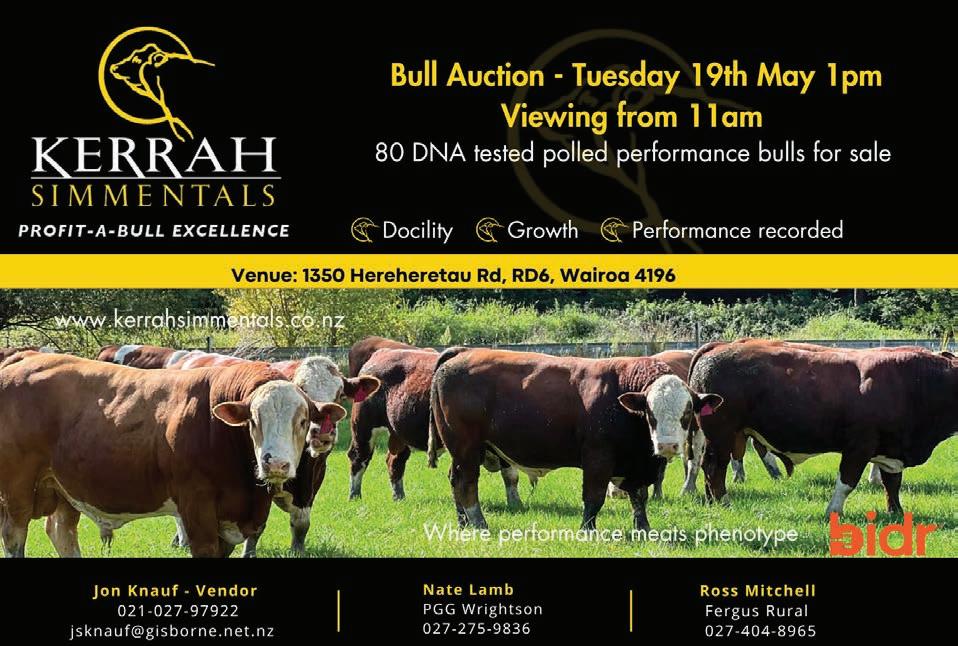
He will be offering 80 bulls at Kerrah Simmentals on May 19 at Wairoa, midway through a season of nine sales for the breed, three in the South Island and six in the north.
Kerrah averaged over $12,000 with full clearance last year and Knauf said he would be delighted to get close to repeating that outcome.
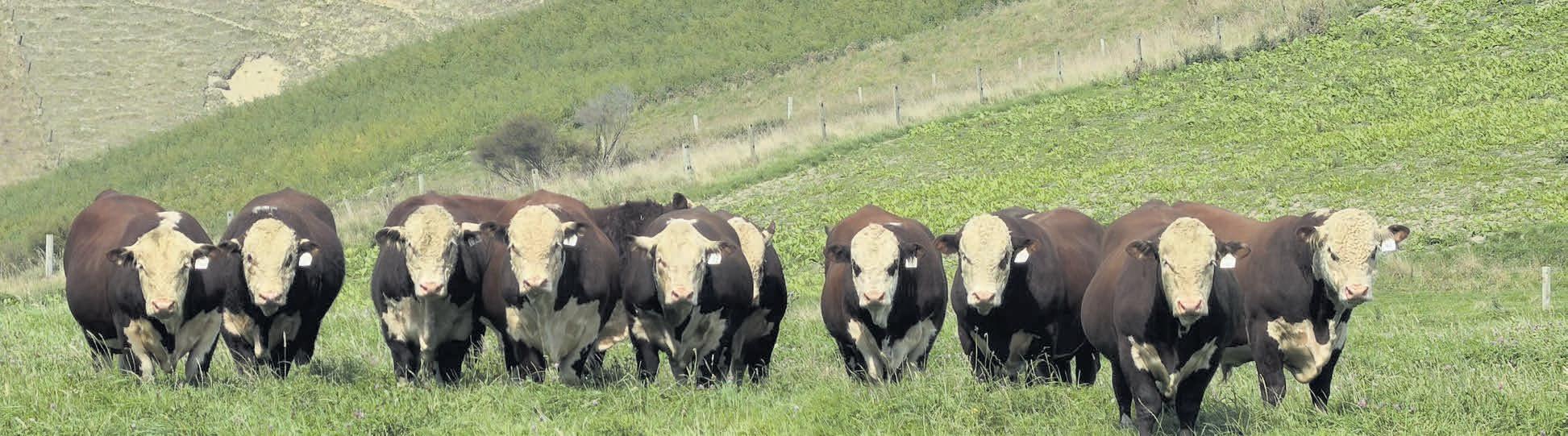
Hereford NZ president Robert Peacock, from Orari Gorge in South Canterbury, said most factors are positive for beef farming at present and that good beef prices should stay around for longer than in the normal price cycle.
“Bull buying tends to be the last decision of the farming financial year and is guided by weaner prices, lamb prices, even wool prices.
“That bull you buy is going to have a strong influence in your
herd for 10 years.”
Carrfields North Island livestock manager Phil Young, in Waikato, said vendors had significant rises in weaner sale prices this year of $300 to $500 and that confidence level should flow on into bull prices.
“I can’t see any reason why not, as all the market factors look to be positive,” he said.
Perhaps the numbers of hill country beef herds have stabilised because the carbon credit and forestry plantings have eased off and the increased cattle values are encouraging for farming again.
The condition of bulls to be offered by breeders looks to be good after a favourable summer season for rainfall and pasture growth, Young said.
Factors working in favour of a good bull selling season include positivity among sheep and beef farmers, high schedule prices and good calf prices and all-round feed conditions, PGG Wrightson national genetics manager Callum McDonald said.
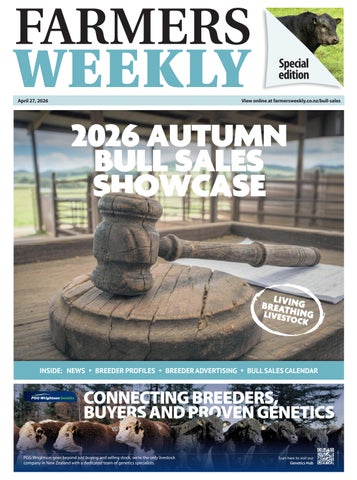
WITH autumn bull sales fast approaching, it is our pleasure to bring to you the first of the three Livestock Showcases we will be publishing over 2026. I would like to begin by thanking everyone who has taken part. Your support is what makes these Showcases possible, and on behalf of our team and our readers, a special thank you to all involved.
Bringing together industry news, breeder articles, our popular bull sales calendar, and promotional content from breeders and industry partners, this season’s Showcase provides a comprehensive resource to assist with your preparations for the season ahead.
In the coming months, breeders will share updates on their open days and sale dates via our weekly Livestock section in the newspaper, online at farmersweekly.co.nz, and our bull sales eNewsletters, so be


sure to keep checking in regularly. To all who have contributed, thank you once again. And to our readers, thank you for taking the time to engage with this season’s Showcase – we trust it will prove to be a valuable and informative guide across the season.
I wish you all very best for the season ahead and look forward to bringing our Bull Sales eNewsletter to you soon.





Hugh Stringleman TECHNOLOGY
Sheep and beef
INTENSIVE rotational grazing of hill country through livestock wearables will deliver a step change in the performance and sustainability of hill country farming, Kellogg scholar Natasha Cave says.
Te Kuiti farmer Cave comanages Rotowai Farms and serves as the catchment coordinator for the Whanganui Region Catchment Collective. She was one of the two recipients of the inaugural 2025 Beef + Lamb New Zealand Leadership Advancement Scholarships and attended a Kellogg course in 2025.
Her Kellogg report is titled Beef on the Brink of a Tech Revolution: Wearables on NZ hill country. It is published on the Rural Leaders website.
Cave said her report only touches the surface of the potential benefits of wearables for hill country farming.
What have long been seen as
limitations in hill country grazing around subdivision have now been lifted with the invention and commercialisation of virtual fencing technology.
Intensive rotational grazing and improved pasture use are key factors in the success.
Higher stocking rates, reduced labour and supplementary feed costs and improved protection of waterways and sensitive areas are positives, along with improved farmer wellbeing and outlook.
“Many of the farmers using wearables that were talked to, had major concerns about the future viability of their farm businesses prior to investing in wearable technology. They were now excited about the future and farming again.”
Among the risks are poor management of system change and negative animal welfare and environmental outcomes.
“One of the biggest challenges to the success of wearables on beef is going to be farmer mindset and their ability to have an open mind, remove the current constraints of their farming management, take the blinkers
off and embrace change,” Cave said.
Among her recommendations for the revolution to be a success are the need for upskilling in pasture management, investment and innovation in water infrastructure and industry support to manage knowledge gaps.
Cave called for new research into the long-term impacts of wearables on hill country farming, including effects on pasture sward composition, soil fertility, emissions, water quality, and greenhouse gas emissions.
In-depth financial analysis is also needed to be available to farmers and their consultants. Cave did not carry out a costbenefit analysis as part of her Kellogg programme.
There are also knowledge gaps regarding the long-term impacts of intensive grazing on soil fertility, water retention, nutrient cycling, and greenhouse gas emissions in hill country environments.
“While the outlook for wearables on beef is optimistic, this is recent innovation, and
ongoing evaluation is required to determine their sustained benefits and limitations.”
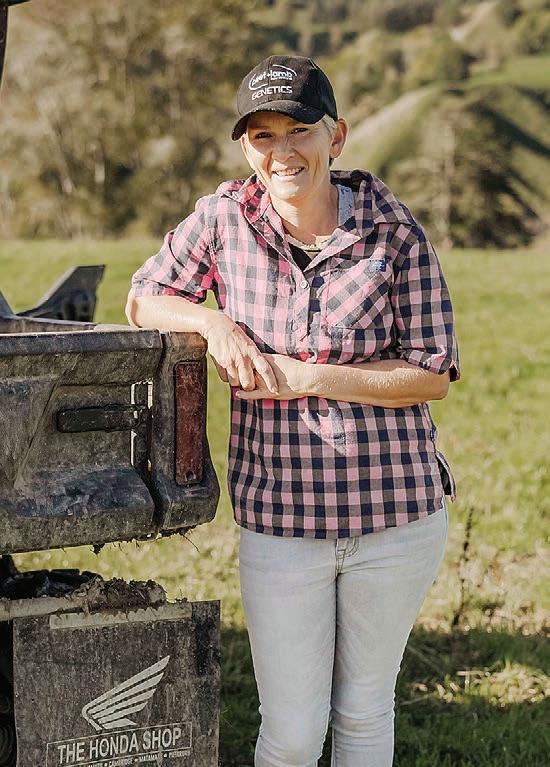
Cave and her husband Alan have used Halter collars on breeding cows and finishing stock for the past two years, enabling a 20% lift of cattle numbers on Rotowai.
Advice was received from former BLNZ chair James Parsons, an early adopter, and the contract with Halter now extends to 330 collars.
The report has generated some
EARLY ADOPTER:
interest and Cave has been asked to attend farmer meetings and share her findings, forecasts and recommendations.
“How do we support farmers to get the best out of this technology and who’s responsible – farmers themselves, consultants, the tech companies, or our industry bodies?
“More of this technology is going to come at us and I think it is a Team Ag approach to how we manage to get the best outcomes.”

Gerhard Uys TECHNOLOGY Livestock
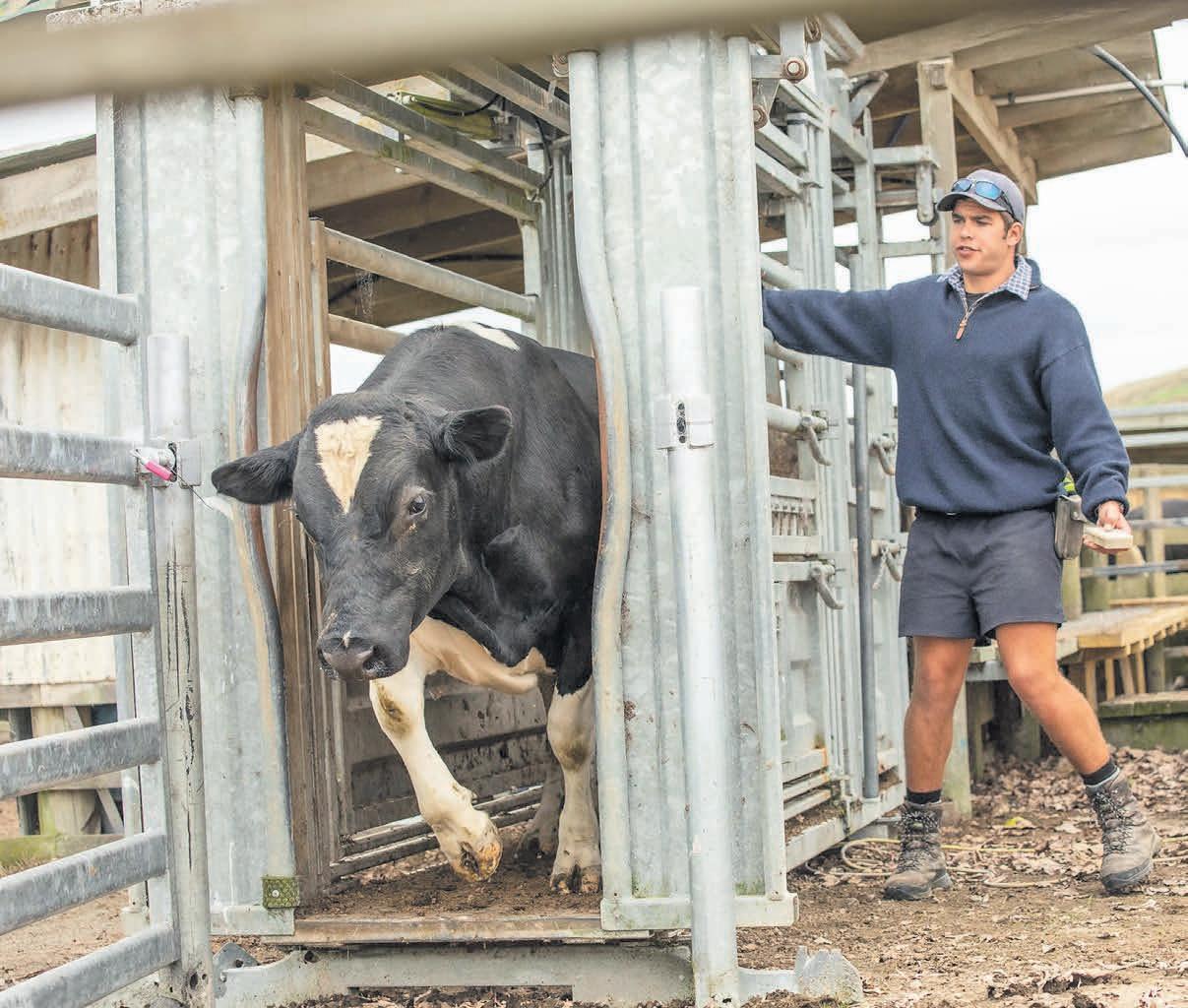
AGRITECH start-up Scanabull has developed a system that estimates cattle weight using a 3D camera on a phone and AI processing.
Scanabull co-founder and CEO
Dan Bull said the app means there’s no need for a crush or
guesswork, with the technology providing meat processors and farmers with accurate real-time data about on-farm production.
The company just raised $1.1 million after a bid led by Sprout Agritech, with support from Enterprise Angels and Callaghan Innovation’s Deep Tech Incubator programme.
The tech uses the LiDAR sensor on an iPhone.
It captures a 3D scan of the animal and processes it using proprietary neural networks run directly on the device.
Scanabull has two systems, a phone app that works on an iPhone Pro and a custom camera called the Scanabull Weigh Point that weighs animals automatically in the paddock.
The phone app allows a quick
measure of animal weight, whereas Weigh Point allows better measurement of growth trends.
The technology generates a detailed 3D point cloud of an animal and processes the data using a deep neural network that analyses the animal’s shape and structure to accurately estimate its live weight.
The model processes spatial
data around 30 times per second, allowing the system to deliver a weight estimate in roughly one second.
The system is currently over 93% accurate on individuals, and much more accurate at the mob level.
Bull said Scanabull is working with industry partners including Silver Fern Farms, with trials underway across New Zealand.
NEW Zealand Beef
Shorthorn has reached a milestone for the breed, recording positive results at the completion of the first cycle of its Beef Recording Programme.
Since 2023, 350 cows have been mated annually on Bevan and Mary Proffit’s Whanganui farm using Shorthorn, Angus and Hereford sires.
Leading the programme is Bevan’s brother and Raupuha Shorthorns principal Russell Proffit, with assistance from Beef + Lamb New Zealand.
He said the programme is being done to show that the breed can match other breeds on the commercial stage regarding growth rates and estimated breeding value (EBV).
“It’s to prove that Shorthorn cattle can perform if not better then equally to those other breeds in New Zealand.”
The programme has allowed
the benchmarking of Shorthorn sires under commercial hill country conditions, translating to real-world data, he said. The first contingent of raw carcase data from the processing of 125 rising two-year-old Shorthorn-AngusHereford cross steers has been collected.
It measured growth, carcase and hip height, alongside the kill data collected for Silver Fern Farms’ Eating Quality programme.
It confirmed that Shorthorn are standing alongside the country’s leading beef genetics.
Additionally, the data, which has been analysed as in part of Beef + Lamb New Zealand’s Informing NZ Beef programme, showed that the carcase traits, growth rates and high-quality traits, particularly in marbling and yield, are reflective of their EBVs.
The early data shows that these bulls are performing as their EBVs suggested they would.
It shows the Shorthorn breed competes well with other beef breeds and can be used as a sire
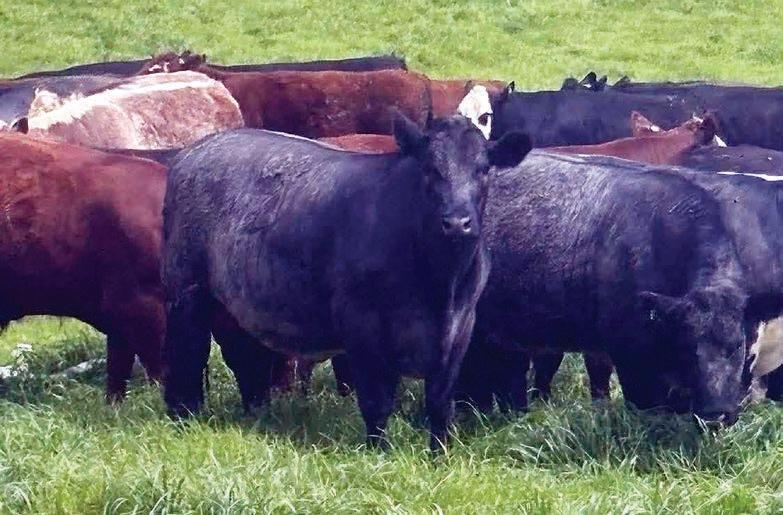
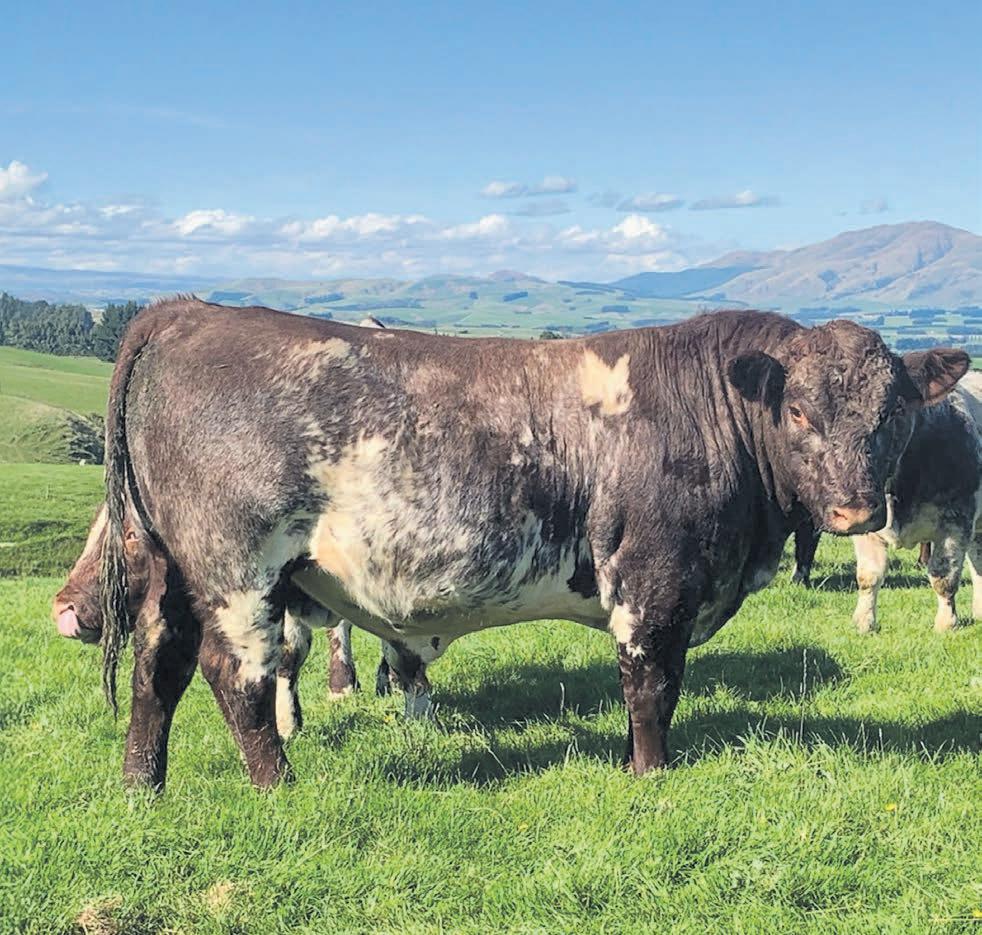
UP THERE: The carcass data from rising two-year-old Shorthorn-AngusHereford cross steers confirmed that Shorthorn are standing alongside the country’s leading beef genetics.
across multiple breeds, Proffit said.
This reliability is important so that farmers feel confident in their purchasing decisions. The cross-breeding benefits will add dollars to the bottom line of most businesses.
“As a farmer, you need to add value, and cross breeding is a renowned advantage and I don’t
think the cattle industry has used it as much as the sheep industry.”
The carcases are also reaching premium grades at processing plants, proving it is not the colour of the animal’s skin that matters when it comes to breeding, he said.
“That’s what we as farmers want to be rewarded for.”
An additional 250 steers are
up to 5% productivity gains, the company said.
companies to bring their worldleading innovations here.
AGRIZERONZ is to invest $5.1 million into Australian methane mitigation company Rumin8 to help support its approval process into the New Zealand market.
Rumin8 is developing products using a compound that reduces methane emissions in livestock.
Trials with beef cattle showed an average 82% methane reduction after consuming Rumin8’s feed additive, as well as indications of
Rumin8 is aiming to develop a range of products including a feed additive, water additive, mineral supplement and slow-release capsule.
Investing in Rumin8 aims to give New Zealand farmers access to a range of emissions reduction tools, AgriZeroNZ CEO Wayne McNee said.
“New Zealand’s a relatively small market on a global scale, so our investment is critical to push New Zealand pastoral farming systems up the priority list and support
“Most of our major export customers have set ambitious emissions reduction targets which cover their entire value chain, including the New Zealand farms which produce the milk and meat they buy.
“Being able to show credible progress matters to maintain our market access and reputation as a world-leading producer.”
Rumin8’s goal of developing products for grass-fed animals and its progress to date make the company a welcome addition to
AgriZeroNZ’s portfolio, he said.
scheduled for carcase scanning and analysis over the next two years. These will be killed and analysed in 2026 and 2027.
While the male progeny is tested on carcase traits, all of the heifers’ key EBV traits are measured in the programme while being retained to track their fertility and rebreeding, he said.
“In the beef industry, that’s our biggest wastage – in between the first and second calf. We want to figure out, what is this wastage and what drives it and what role do genetics play?”
This is done so that the trial includes real world commercial testing of the breed.
The last of the data will be recorded in March 2028. By then, Shorthorn breeders will have the data they need to show that the breed can more than compete with other beef breeds.
“By combining historic marbling excellence with modern, data-driven growth metrics, the Shorthorn is carving out a vital role in the future of the New Zealand beef industry,” Proffit said.
Rumin8 co-founder and CEO David Messina said AgriZeroNZ’s investment has brought its focus on New Zealand forward several years.
“We’re now planning animal trials in New Zealand this year to support our application for regulatory approval.
“These trials will test the safety of the feed additive as well as its effectiveness in local conditions.”
Approval for Rumin8’s initial product will help facilitate registration of other related products which are more suited to grass-fed systems.
RANGE: AgriZeroNZ



Alex Coddington MARKETS Livestock
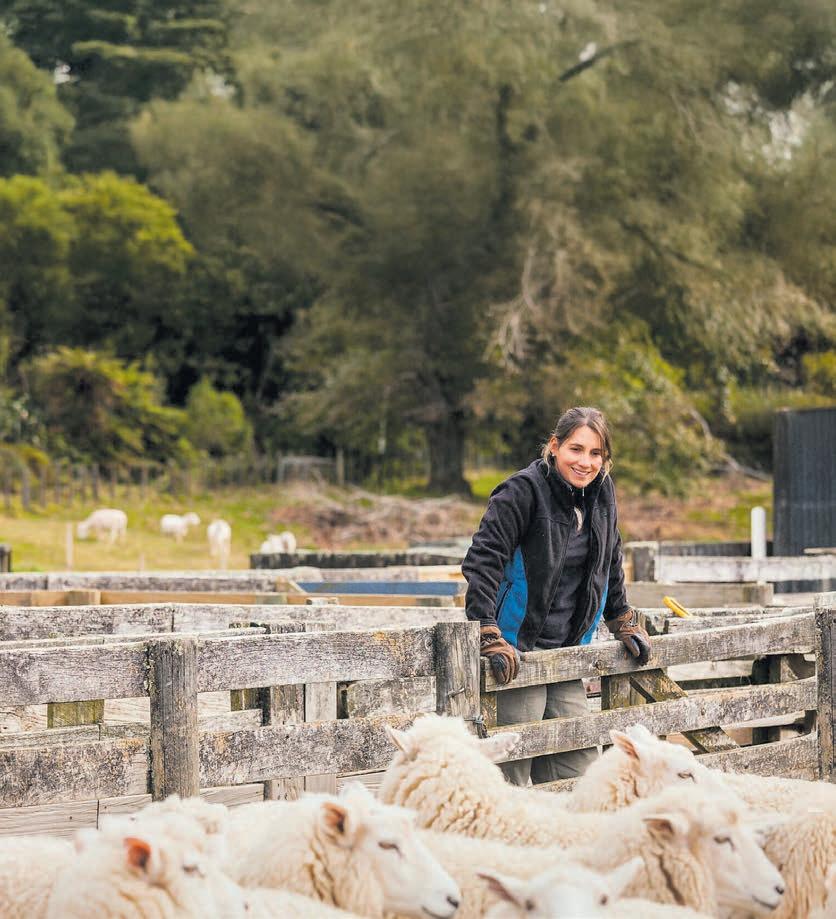
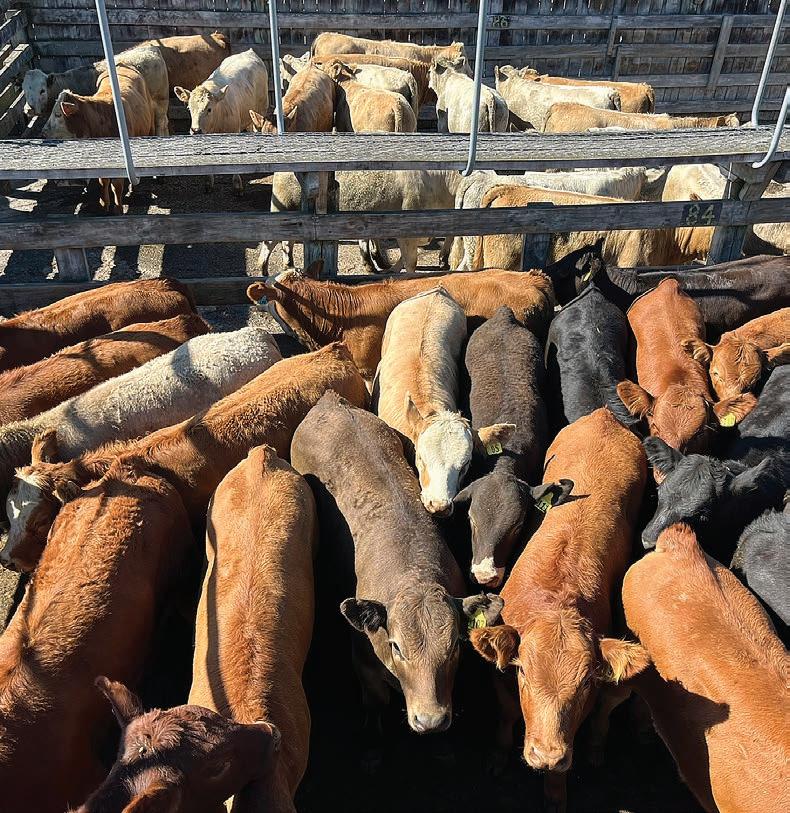
THE average price of weaner beef calves in March is typically a reflection of several key market factors that go on to set the tone for the rest of the beef selling season.
Current farmgate prices for finished beef form the foundation of price expectations, while climatic conditions play a significant role in how prices will meet or fall short of that standard.
The icing on the cake will always be the level of confidence in the beef market, overall farmer sentiment acting as the final influence on average returns for weaner cattle.
The 2026 selling season will stand out as a remarkable year, with all three of these critical market drivers aligning in favour of higher prices. Record farmgate returns left cattle traders well positioned, with cash in hand to re-enter the market.
A wet end to summer drove a strong grass market nationwide, while confidence in beef markets reached new highs due to tightening global supply and strong demand from key export markets.
The combined effect of these factors pushed weaner values to unprecedented levels this year, well beyond initial expectations.
The early market dynamics quickly exceeded these already bullish projections.
Historical benchmarks help put the scale of this shift into perspective. AgriHQ data dating back to 2010 shows that traditional and exotic weaner steers sold in March have historically traded at around 69-70% of schedule when grass allows for strong demand. Applying this ratio to current record farmgate prices would suggest that 250kg traditional steers should have been valued at
approximately $6.65/kg, around $1660 per head.
However, in reality, the early market dynamics quickly exceeded these already bullish projections and confidence in export prices drove values to $7.00-$7.50/kg for 250kg traditional steers, equating to roughly $1760 per head in the early North Island sales.
Looking at weaner prices by breed across the country, exoticbred steers have consistently been heavier in March than traditional types, typically averaging between a consistent 230-260kg range since we started recording data in 2008.
As a result, they have often achieved higher per-head prices. This year, the average price per head for traditional steers through all of March was $1710, compared to $1840 for exotics. However, traditional steers have consistently returned higher cents-per-kilogram values, despite the volatile fluctuations in average weights. In some years, traditional steers have averaged
HISTORY: AgriHQ data dating back to 2010 shows that traditional and exotic weaner steers sold in March have historically traded at around 69-70% of schedule when grass allows for strong demand.
weights as low as 210kg in March, only recently returning to the upper end of the range (around 240kg).
Despite this variability in weight, traditional bred steers have generally maintained higher cents-per-kilogram values than exotics.
This year, traditional steers averaged 34 c/kg more than exotics, $7.25/kg compared to $6.90/kg, but it was the exotic cattle vendors that on average would take home the bigger pay cheque with a $1840 return on weaner steers that were on average 30kg heavier.

Mel Croad MARKETS Sheep and beef
FARMGATE beef prices have softened through autumn as supplies within New Zealand lifted amid drying conditions in some regions and a jittery global backdrop.
Prior to this softening, beef prices had enjoyed record returns, following gradual upside that
began back in April 2025. This was the result of soaring export demand and much tighter beef production in New Zealand.
The United States remains a significant market for New Zealand beef, particularly with prices lifting to all-time highs.
US lean beef prices eclipsed US$4/lb earlier this year, which compares with US$3.20/lb last year and a five-year average of US$2.87/lb.

The shortage of beef in the US combined with robust consumer demand has enabled this surge in prices.
While NZ has strengthened its focus on this market, so have other market players. US imports of Australian and Brazilian beef have surged this year, leading to a recent tempering in imported prices.
US beef demand seasonally ramps up through April and
May, which may absorb some of this additional supply, but how well prices hold up will be worth watching in the months ahead.
Not only have we seen the US strengthen but the likes of China, Canada and the United Kingdom have also remained active, ensuring a vital spread of markets.
The conflict in the Middle East didn’t have any immediate impact on beef demand or pricing
within key New Zealand markets through March.
However, the reality is it’s likely to have lasting economic impacts globally, and that could potentially dim demand.
The outlook for beef returns remains favourable with farmgate prices forecast to remain above long-term averages. However, these current global challenges add another layer of complexity to navigate in the short term.

Gerhard Uys PEOPLE Livestock
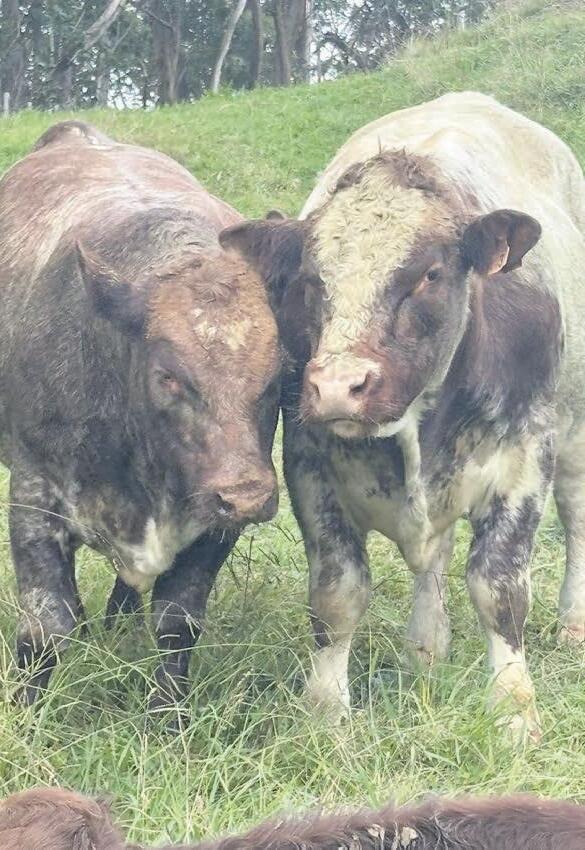
SHORTHORNS, says Russell Proffit from Raupuha Shorthorns, are a bit like a lolly scramble – you never know what you’re going to get in terms of colour. Their ever-changing colour palette and the heap of character these cattle have are two reasons Russell and wife Mavis keep loving Shorthorns.
They run an 85 Shorthorn cow stud near Mahoenui on their sheep and beef operation, which includes 2200 recorded ewes and 1000 other cattle, with the majority being Shorthorn or Shorthorn cross.
Russell says Shorthorns are in his blood. His family have had Shorthorns for nearly 55 years, with his parents also running a stud.
He and brother Bevan started their own Shorthorn studs as teenagers. A lot has changed since then – for one, Russell now has Gallagher’s e-Shepherd on 400 animals.
The collar means cattle can be controlled on hill country, and
they are moved every day of the year for 365 days onto new breaks of grass.
Russell has been impressed by how the calves are looking this year with their ability to creepfeed in front of the cows
“It’s good for the paddock, soil and cattle,” Russell said.
Shorthorns were also quite leggy at some stage, likely from American genetics, but Russell said that has been corrected after they focused on bringing them down a frame score.
The breed as they are found on his farm are now “good solid animals, like good front rowers”.
The traits that make Shorthorns a “whole package” remain the same: good mums, easy calving, good milkers, beautiful cattle to handle and work with, a good quality carcase and intramuscular fat that translates into good eating.
Russell’s annual sale is on May 26.
This year he has Aaron and Amanda Harris along for the sale, a younger couple who are giving new life to the society.
“They’re keen young people, which is always good in our industry.”
Husband and wife operators Aaron and Amanda, from Mill Valley Shorthorns and Wiltshires, run a sheep and beef operation on about 2000ha in the eastern Taranaki hills.
Amanda said she and Aaron mostly run the farm by themselves, and with them not employing labour they need docile animals to work with, and Shorthorns are just that.
The pair grew up in the region, Aaron on the farm they are currently leasing from his family, and Amanda 30 minutes down the road, also on a sheep and beef operation.
Aaron’s parents ran Shorthorn and he has fond memories of the breed.
The pair began breeding Shorthorns in 2016.
Amanda said when they decided to scale up the Shorthorn society embraced them, with Russell in particular being instrumental in helping them grow their herd with his contacts to dispersal sales.
The Harrises farm on steep hill country, with only 60ha, of almost 1200ha effective, being flat country.
Amanda said their Shorthorns
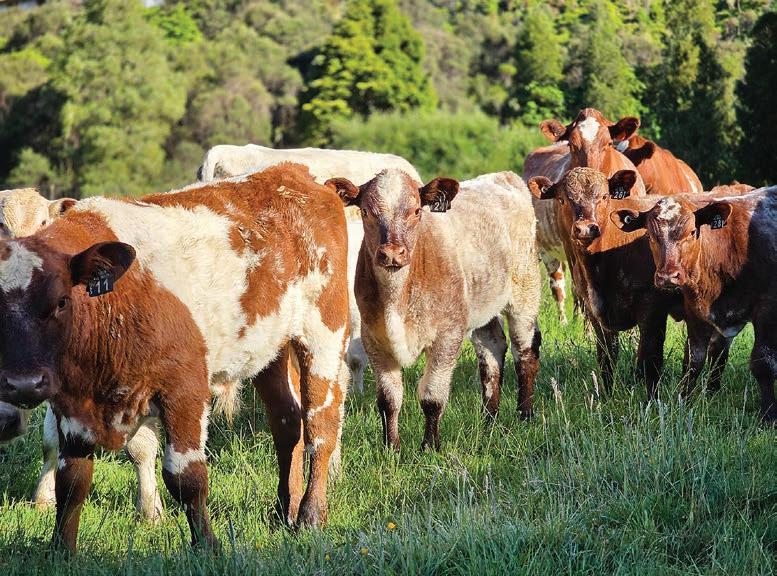
that live on hard hill country shift well, and easily adapt to any place in the country.
A tell that Shorthorns do well in tough conditions is that most of their animals have been sold to farms within a half an hour drive of their farm.
Shorthorns have not traditionally been crossed with dairy cattle, but the Harrises recently sold 20 straws to a
dairy farmer, with calving ease, low birthweight and cows who don’t need much intervention during calving appealing to dairy farmers.
The Harrises’ commercial herd is primarily Angus x Friesian, but they are slowly progressing that to a self-replacing herd, keeping Shorthorn cross heifers to a point where they’ll be pure bred in future.


TUESDAY 26TH MAY
Gerhard Uys PEOPLE Livestock
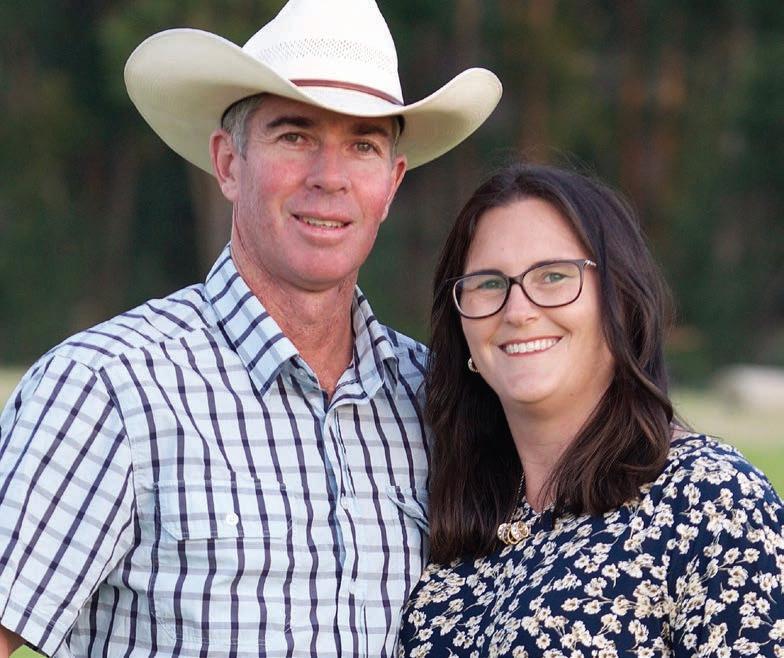
THE excitement of seeing last year’s breeding decisions hit the ground is a real highlight for Eileen and Alistair McWilliam from Te Taumata Herefords.
And the results are decades in the making.
Alistair has been farming at Te Taumata for most of his life. He worked alongside his father, Jim, and his uncle after leaving school and went into partnership with Jim in 2003, after buying out his uncle’s share of the farm business.
Eileen grew up on a stud Simmental ranch in Oregon in the United States and has farmed in New Zealand with Alistair since 2000.
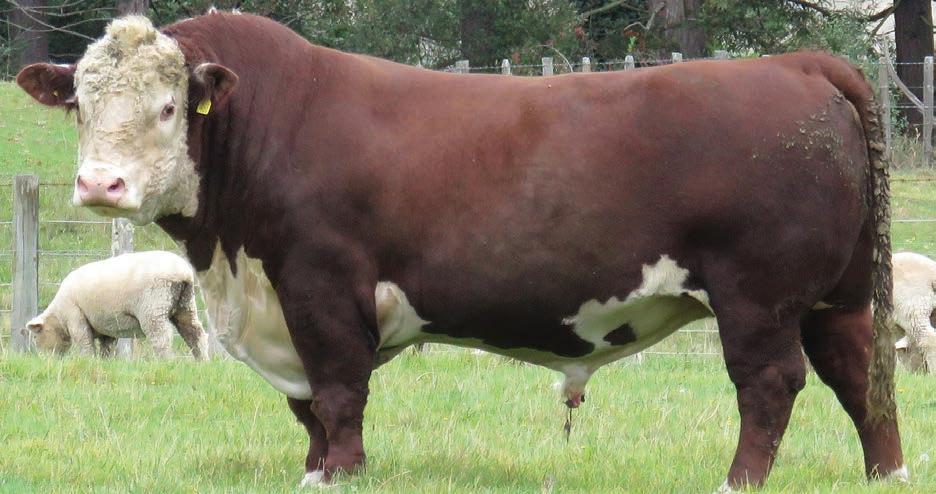
Alistair is the third generation at Te Taumata Poll Herefords, with the stud established in 1962 by his grandfather, also Alistair. He and Eileen farm 450
hectares effective, summer dry farmland in Gladstone, Wairarapa, with a good balance of high quality flat and rolling clay country moving up into steeper limestone Class 6 hill country.
Winter stock numbers are around 4100 stock units, which include over 400 head of cattle, 1500 sheep and 160 velveting stags.
Stocking rate rises steeply in August and September when lambs and calves are born. They currently calve 180 cows.
Their Herefords cope with the heat and the cold and the wind, being thicker skinned, and graze hillsides evenly right to the top. They love the rough grass and do well on our winter-wet and summer-dry hill country.
“Hereford cows are very maternal with great fertility and will produce a heavy steer with a quality carcase.”
Alistair said their job is to produce bulls and rams “that will help make our clients profitable”.
“We take a very practical approach to breeding. Get the
basics right first: fertility and calving ease, good udders, good structure so the cattle have longevity on the hills, growth and carcase quality, bone and fleshing ability so they can withstand environmental challenges.
“We look to make genetic improvements across the board without any big dramatic changes in any one single area. If you focus too heavily in one area alone you can very quickly create a problem in another.”
He said clients who knock on their door are buying top beef genetics from a herd that has been breeding and selling Wairarapa hill country bulls for 64 years.
“They buy bulls that work in the paddock and on paper.
“More than that, though, they are buying bulls from a breeder that is committed to the genetic progress of the Hereford breed and the key role Herefords will play in the future production of the national cattle herd. They are buying production, genetics, passion, integrity and
commitment to the future.”
Besides producing good animals that make money for clients, relationships and integrity are extremely important to Eileen and Alistair.
“We believe a real strength of our operation is the good relationships we have with the rural services that provide advice and support our business, from our stock agents and vet to our grass seed rep and accountant.
“We value the relationships



and Border Leicester
January.
we have with our clients and strive to produce the very best genetics for their businesses.”
Eileen says the farm is their home and their passion.
“It is an amazing life for our family of six, and the kids really appreciate all the experiences and opportunities they’ve had growing up on a farm.
“We look forward to the next generation one day taking the reins and providing that experience for their children.”
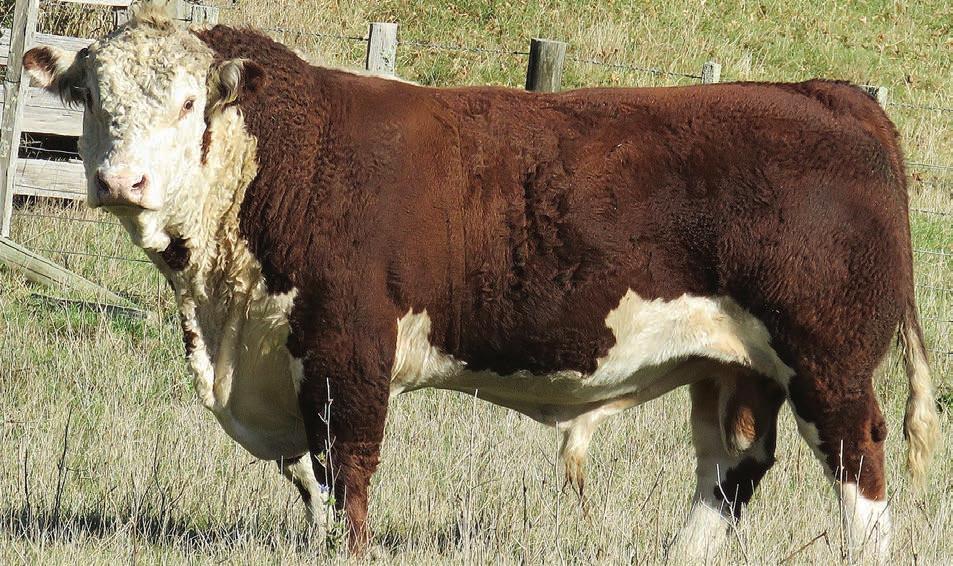

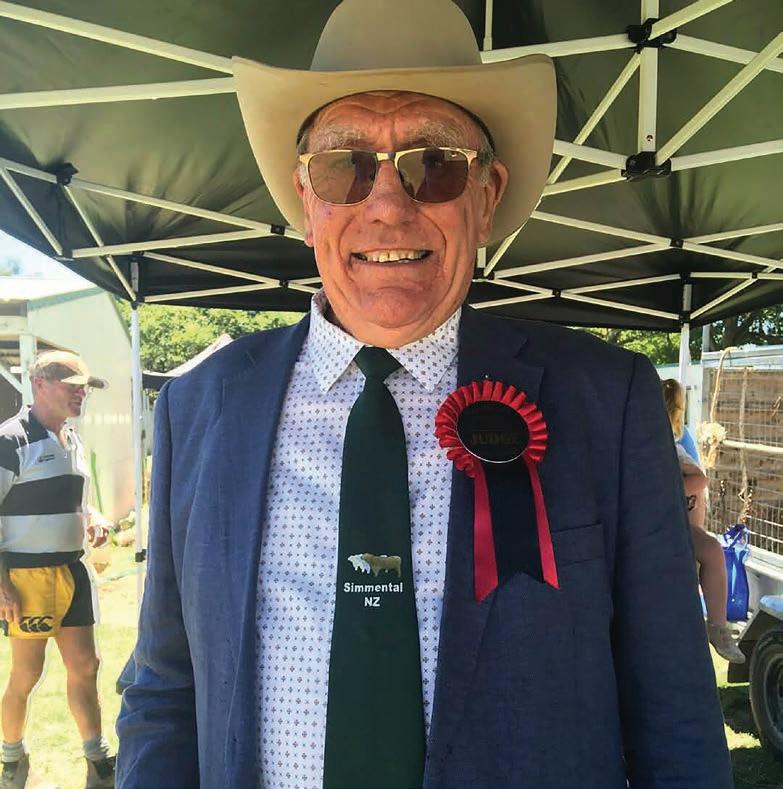
TRAVELLING through Europe while studying at Cambridge University, Tony Thompson was introduced to Simmental cattle. He fell in love with the breed and that ignited a lifetime passion for breeding and showing Simmentals.
Thompson’s name is synonymous with Simmentals in New Zealand, not only as a stud breeder, but as a veterinarian too – he made a valuable contribution to the introduction of embryo transfer, helping shape the future of the breed here.
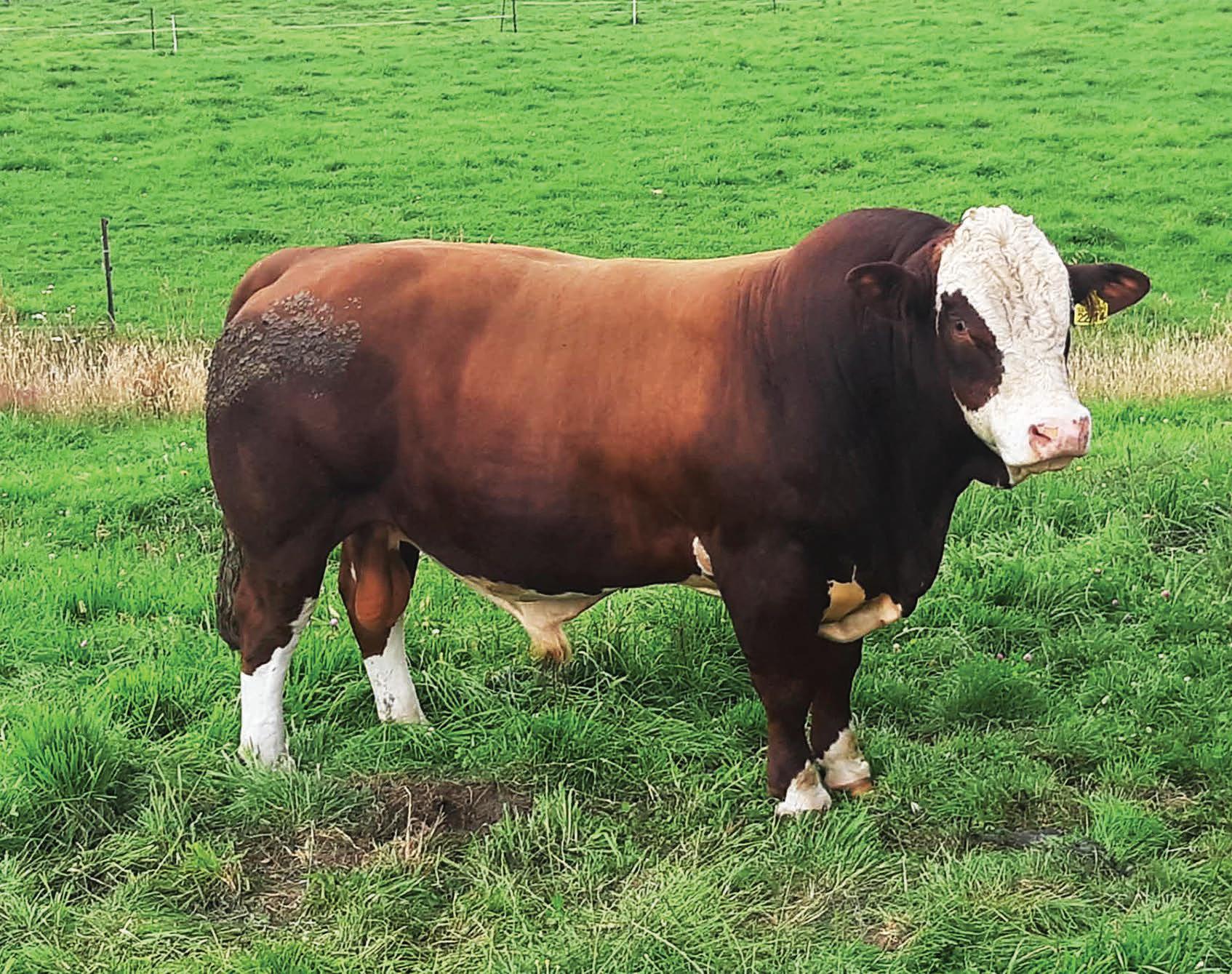
Now in his eighties, Tony is nearing retirement, but he’s not quite done yet. He still loves breeding cattle on his 96 hectare block at Waipukurau, central Hawke’s Bay, but his dream would be to pass his stud, Glen Anthony Simmentals, on and see it continue.
As a young man, Thompson
grew up on a sheep and beef farm in the back blocks of Whanganui. He was a shearer by trade, then graduated from the first ever intake of the veterinary school at Massey University in 1967.
Newly married, Thompson and his wife saved their pennies and travelled by ship to the United Kingdom, where Thompson gained a scholarship to study at Cambridge University from 19681970. He studied embryology and was introduced to the early stages of the technology that would be used in embryo transfer.
While overseas, the couple travelled through Europe, and when Thompson laid eyes on the Simmental cattle, it was love at first sight.
The couple returned to New Zealand and Thompson went into a vet practice in Matamata, at a time when exotic breed cattle were just starting to arrive in New Zealand. Thompson didn’t have to think twice when offered the opportunity to purchase a purebred Simmental cow.
“When we moved down to
Waipukurau in 1974 and bought this farm where we are now, we gradually built our herd over the years,” he said.
“I felt the training in veterinary science and my practical stock skills were a marvellous combination when it came to stud breeding.”
These days, the stud is down to a manageable 70 cows. This year’s May 15 sale will be their 38th on-farm bull sale. They sell about 20 rising two-year-old bulls annually.
Thompson built a reputation for showing cattle, often taking up to 20 to a show. It was an excellent
way to promote both the breed and his stud.
Covid put a halt to cattle at many shows but, while he no longer shows cattle, Thompson established a reputation for himself by supporting the Royal Agricultural Society (RAS) movement over many years.
Thompson could be termed “old school” in that he has relied on his skill as a cattleman and a sense of stockmanship to shape and develop his stud, rather than computerised data.
“My breeding programme is based on 50 years of selection, ensuring each generation upholds my commitment to structural soundness, temperament, performance and excellent beef qualities.”
Thompson’s skill and dedication have been recognised over the years, including with a Gold Medal from the RAS and life membership from the Simmental Cattle Breeders Society of New Zealand.
“To be acknowledged for your service to the breed, those things stay in your memory. Our bull sale in 2022 was also a highlight, we had the best Simmental bull sale that year.
“I’m in my retiring years, but I get a lot of satisfaction out of keeping going. You can’t go forever, but it’s been a privilege.”
KOANUI Polled
Herefords has one of New Zealand’s largest registered Polled Hereford herds, and the Chesterman family have plans to grow even more.
Based at their home farm in Maraetotara, Hawke’s Bay, the Chestermans have recently expanded their farming business with the purchase of Pukekura Station near Poukawa.
They say Pukekura has tremendous potential as a substantial breeding and finishing unit under Glen Chesterman’s management.
Brother Hugh Chesterman has
returned home from overseas and is supporting development at Pukekura as well as marketing Koanui stud cattle.
The aim is to rebuild Koanui to 800 registered females and 200 commercial cows.
“A larger herd allows tremendous scope for greater selection pressure, the opportunity to progress diverse Koanui bloodlines and maximise market opportunities,” stud principal Chris Chesterman said.
“Our goal remains producing quality cattle with high performance and calving ease that work in any market.”
In 2025 Koanui reintroduced its spring yearling bull sale. The sale produced a full clearance of 34 yearling bulls averaging $6347
and the top price for a Hereford yearling bull for the season of $29,500 for Koanui Diamond 240342, to Maranui Herefords at Waihi.
In last year’s autumn sale Koanui sold all 50 two-yearold bulls, averaging $11,730, an increase of $3000 on the averages of recent years.
This year the autumn sale has been moved forward three weeks to avoid clashing with National Fieldays and to allow time for the farm to reset before calving.
On May 21 65 two-year-old bulls will be up for auction at the Koanui Sale Shed on
Maraetotara Road, Havelock North.
“We are confident that the bulls are ready for sale, and we look forward to seeing you on May 21 with our usual hospitality,” said Chris.
“We are very happy with this year’s line of bulls; they have consistency from first to last lot.
“They possess the structure, phenotype and docility that we believe is so important.
“Rigorous culling over the past few years has improved our breeding herd’s consistency in these areas.
“We are extremely proud of

our cow herd and have enjoyed showing the herd to overseas breeders recently.
“The functionality and productivity that our cow herd provides is the strength behind every Koanui bull in this year’s sale,”
Chris said.
Koanui was founded in 1972 by Fred Chesterman and his wife, the late Annette Chesterman.
In the 1980s and early ’90s, after completing secondary school, their son Chris travelled regularly to North America and Australia to learn about selection of beef cattle and breeding.
In 1992 Chris’s wife Jennifer joined the Koanui team, coming from a role in bovine genetics and information management at Breedplan International in Australia.
Chris and Jennifer have four children, Hugh, Glen, Gerard and Allie.
Farm purchasing over the years in Manawatū has given the stud climatic diversity, which assists management in coping with adverse weather events.
They have also bought Hayland in Canterbury to expand into once-bred heifer and trade cattle finishing. The latest Pukekura acquisition nearer home will enable the stud expansion plans under the management of the next generation of Chestermans.

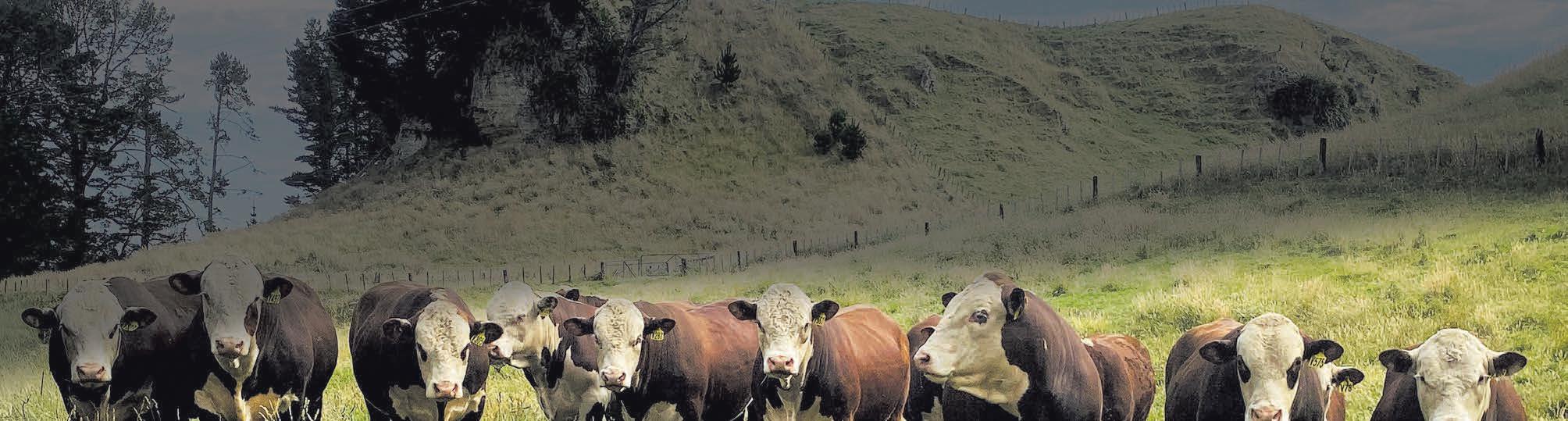
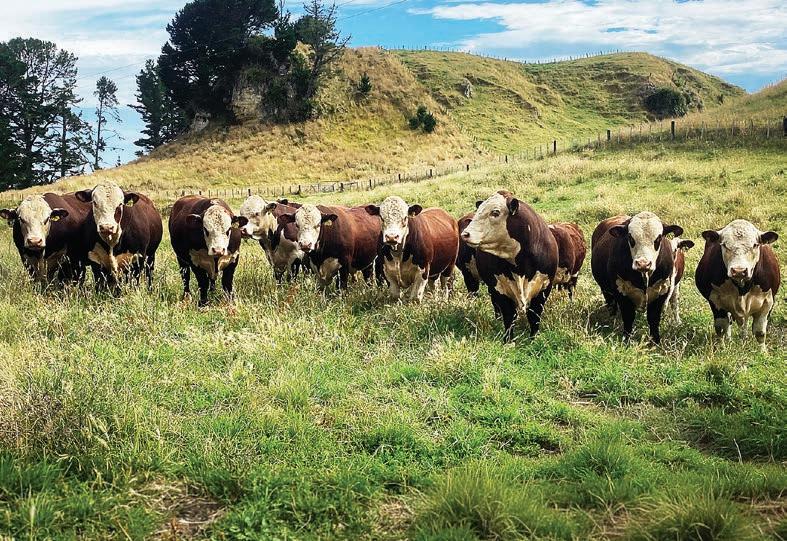
Genetics – best of the best.


Our sale bulls have proven func�onality and maternal power.
Reliable Gene�c Es�mates (EBVs), Genomics tested and analysed, Service and Semen tested, Fer�le, Sound, Quiet, BVD nega�ve and vaccinated
Rest easy knowing that we’ve put the work in and that all bulls are backed by our sa�sfac�on guarantee See you on sale day!
Key reference sires of the 2026 sale bulls:
Koanui Energizer Q129 (0216190129)
Koanui Diamond R326 (0216200326)
Koanui Milton S420 (0216210420)
Koanui Sizzler R039 (0216200039)
Mahuta Skywalker 2034 (0828222034)
Matariki Nock Out (0281200133)
Yavenvale Rainmaker R464 (AUYAVR464)
Hugh Stringleman PEOPLE Livestock
NORTHLAND’S Snake Gully Limousins is to feature rising twoyear-old bulls from imported semen, bringing new genetics to New Zealand.
David and Natalie Roberts have been among the largest importers of Limousin semen, continuing the breeding programme that began in the 1980s by Natalie’s parents, the late Dannie O’Shea and his wife Bethley.
Featured sires for Snake Gully’s 32nd annual sale on Friday, June 12, on the hill country property near Maungakaramea, will include sires imported from the United Kingdom, United States and Australia. Imported semen progeny include Fenrir, Romn Tow Truck 111T, Flemington Legend, Shalone Westwood and Ulster 1 Rainman.
A long-serving secretary of the Limousin Beef Breeders Society of New Zealand, Natalie has managed Snake Gully since 2008. She puts docility at the top of her breeding objectives.
“Most of the time I am working
the cattle alone so having confidence and trust in these animals is a must,” she said.
The selection of 18 bulls from about 30 candidates for the sale will include Full French, Pure and Polled, Apricot and Black bloodlines, a range to cater for the preferences of all buyers. Homozygous polled are sought after, so that has become a breeding objective for Snake Gully.
“This stud has a wide genetic base and we will continue to expand the genetic diversity to give satisfaction to our buyers and promote the Limousin breed,”
Natalie said.
Bulls in the offering will all be fertility tested and confirmed negative through blood tests for BVD.
Limousin are known for their efficiency, calving ease and high growth rates. Recent studies have
Ma x i m i s e eve r y
b l ad e of g ra s s
eve n o n h i l l s
“We’re intensively farming on our whole farm, which we’ve never been able to do before We’ve already seen the ability to convert pasture to kilograms of liveweight gain to a level more than double a traditional farming system ” Jon and Fiona Sherlock – Otorohaea, Waikato
The sale averaged around $5500 in 2023 and 2024 jumped $1500 to $7140 in 2025, including the top price of $11,700 paid by Waikura Station, East Cape.
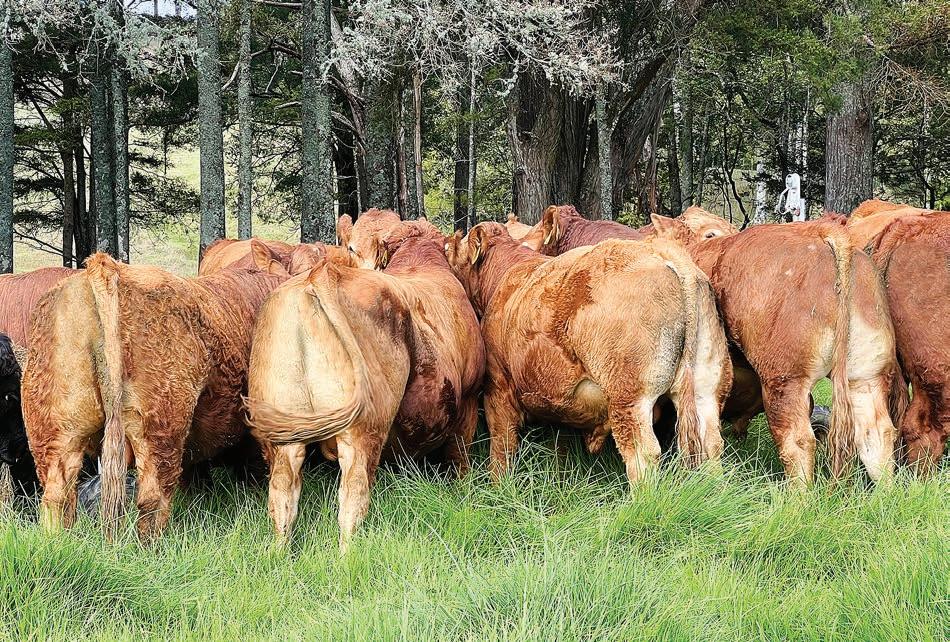
EFFICIENCY: Snake Gully Limousins have proven efficiency, calving ease and high growth rates.
shown the Limousin cattle have the capacity to reduce methane gas by upwards of 30%. The Limousin breed achieved this result on a consistent basis, well above the prominent breeds.
Snake Gully has 75 registered cows and 20 heifers mated as yearlings to be herd replacements.
In recent years Snake Gully had full or near-full sale clearances and strong repeat buying demand.
Among the repeat buyers has been Kivlean Limousins, Cambridge, a registered stud and commercial beef business managed by Peta Lean and her son Anton Kivell.
They now have 100 registered Limousins after a neighbouring farm purchase and accelerated stud expansion over the past three years.
Peta is passionate about the breed and is chair of the North Island Limousin Breeders.
The Kivlean “signature” beef cattle are quiet, mediumframed, quick-growing, wellfleshed and polled, with good eye muscle area and intramuscular fat.
Kivlean sells autumn-born and spring-born bulls to both Waikato beef farmers and dairy farmers.
Demand for yearling bulls is growing as dairy farmers seek to make informed dairy-beef decisions and rear more of their calves that are not wanted as herd replacements.
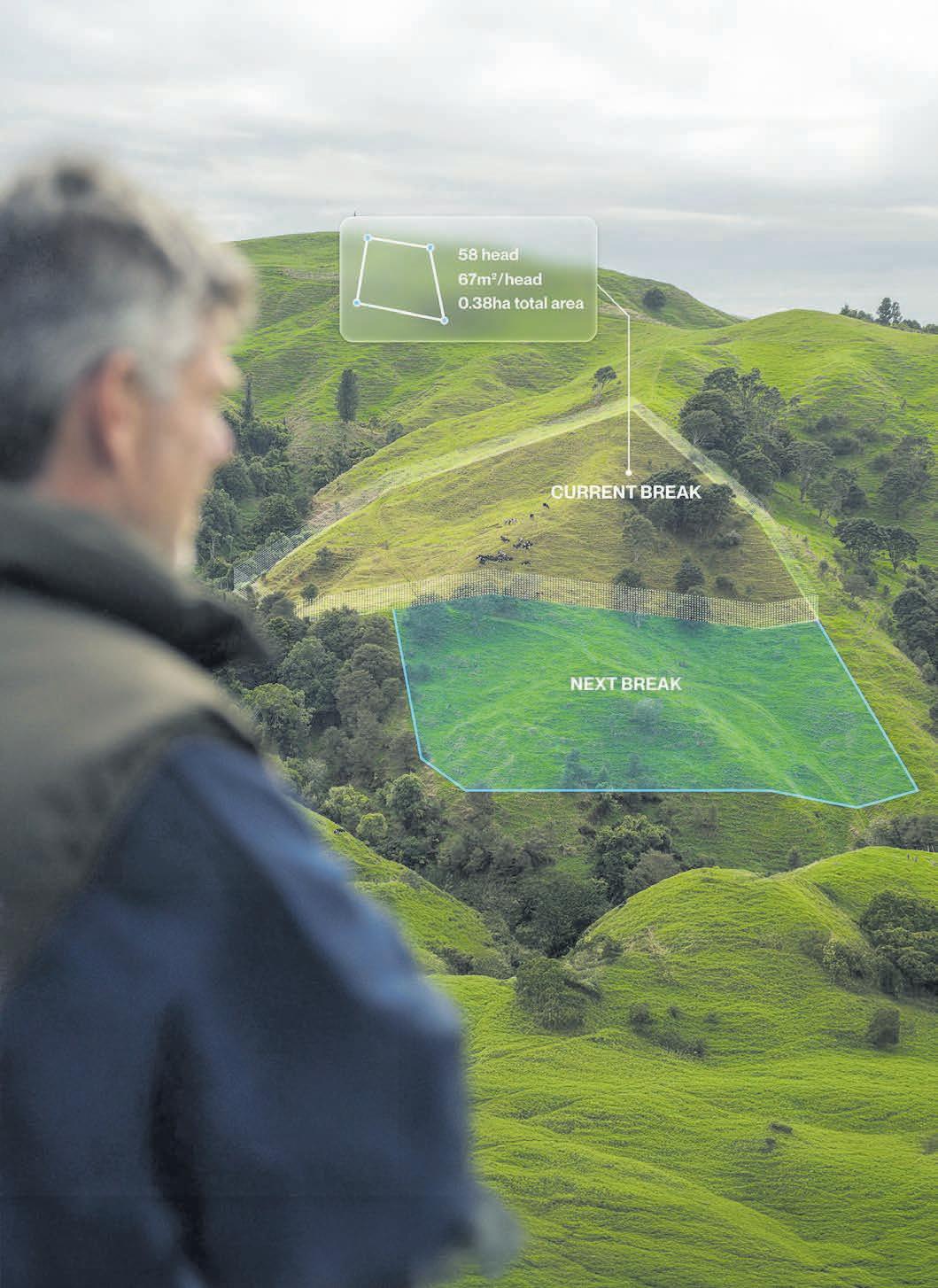





Rebecca Greaves PEOPLE Livestock
ALIFELONG interest in breeding and improvement spurred Hawke’s Bay farmers
Harold and Rachael O’Grady to take the plunge and start their own Angus stud.
Starting in 2018 with nine cows acquired from the Springdale dispersal sale, Shamrock Angus has grown to 100 registered stud cows today, and the couple will hold their first rising twoyear-old bull auction in June at Stortford Lodge saleyards.
Finding it increasingly difficult to source the sort of bulls they were looking for, the O’Gradys decided they could breed the type of bull they sought out for their hill country farm.
“It was something we had thought about for a long time. I
had a desire but never really had the opportunity. I’ve always liked cattle and an Angus base, even in a crossbred herd, is the best in my opinion. I just like improving,”
Harold said.
“When we got married and went out on our own that passion and desire to get into the stud game increased year by year,” Rachael said.
“Harold has a passion for breeding, whether it’s dogs, cattle, sheep, even horses.”
Harold was born and raised at Kotemaori, where the couple started farming on their own account in 2003, before moving to Kereru under the Ruahine Ranges in Hawke’s Bay in 2021.
Rachael’s background is in teaching, particularly science and maths, and she has previously lectured in teaching at Massey University.
After purchasing the initial foundation stud cows from
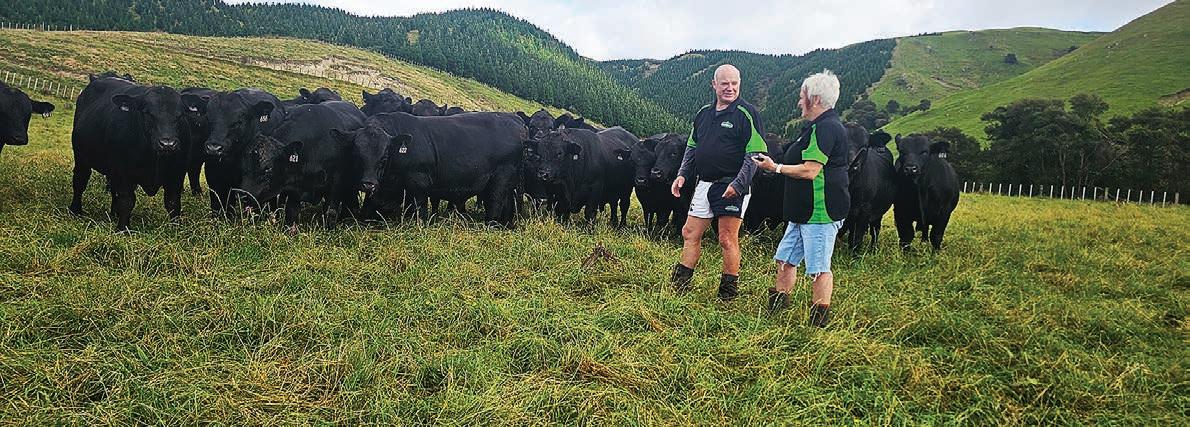
DEMAND: Hawke’s Bay farmers Harold and Rachael O’Grady’s drive was to breed a bull they would like for themselves, and one they believed others wanted, too.
Springdale, they had an opportunity to buy some heifers from Kaharau Angus. They then purchased further cattle from the Rangatira dispersal sale, and those cattle form the main base of the stud today.
The drive was to breed a bull they would like for themselves, and one they believed others wanted, too.
They set about breeding a structurally sound animal with all the traditional traits Angus are famed for. Easy calving and a quiet temperament are nonnegotiables for the O’Gradys.
The two of them are a real team – they do all the farm work themselves and are hands-on in everything they do. While she didn’t come from a farm
originally, Rachael enjoys being able to apply her science background to breeding, and trusting and believing in their shared vision.
Figures and data are useful tools, but at Shamrock Angus they are big on visual appeal and trusting your eye for an animal.
“The structural soundness of traditional Angus is important. Cows that last a long time on hill country, they have to have good feet and legs,” Harold said.
One thing they are particularly proud of is how quiet their cattle are, something that is often remarked on by visiting technicians. Their 10-year-old grandson can be in the yards with Harold, happily helping draft bulls.
“People all comment on what a pleasure they are to work with, and that’s something we are proud of.”
This year they will offer 20 bulls for sale on Monday June 8 at Stortford Lodge.
“It’s a central location and it gives everyone an opportunity to come and have a look and make up their own minds.”
With the tagline “Shamrock Angus – you can’t go wrong”, Harold said that buying a Shamrock bull adds value, not problems.
“We’ve never had anybody come back with an issue. They’re structurally sound bulls with great temperaments, good fertility and a focus on growth rates.”
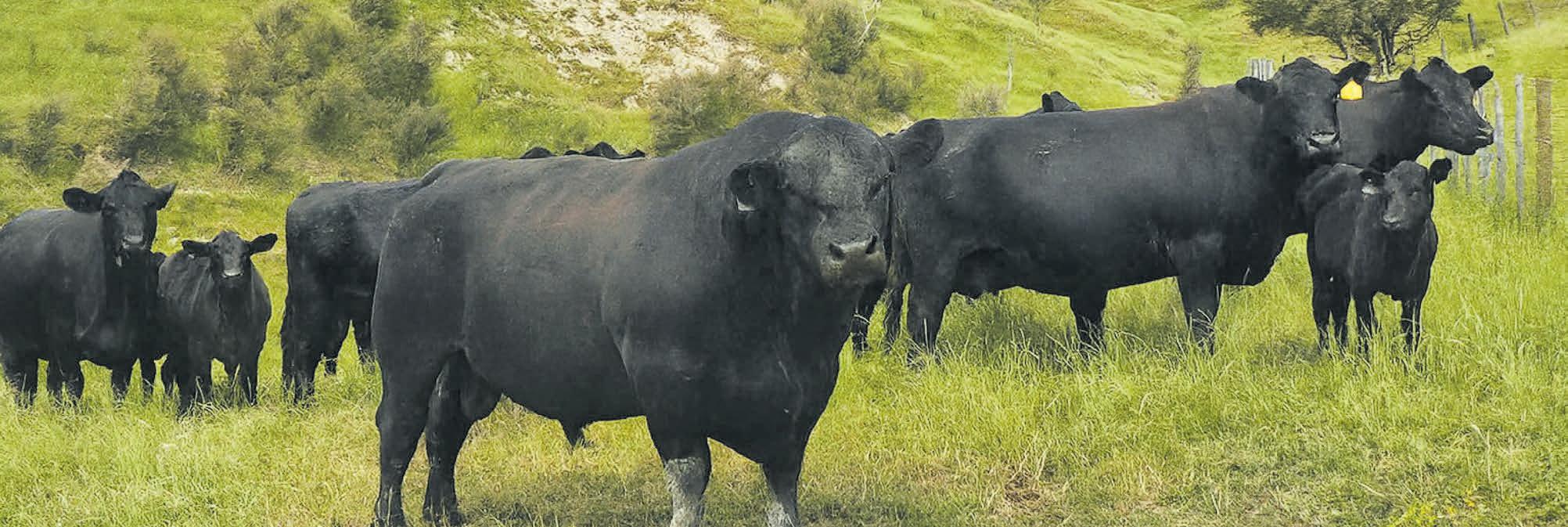
Harold and Rachael O’Grady
Gerhard Uys PEOPLE Livestock
SOUTH Devons are something of a homecoming at Ipurua, and it all traces back to a single bull.
Tim Foss arrived in New Zealand from South Devon, England, in 1955.
A few years later he bought a South Devon bull named Harold, that he crossed with Angus cows. This decision put in place the foundations of what would become a long-standing stud operation.
Tim and Jenny, Peter Foss’s parents, bought their first registered females in the mid ’70s. Today, that legacy continues at Ipurua Genetics, in the King Country, where Peter and Caroline Foss run the 530ha hill country property.
At the core of the operation are 200 pedigree South Devon cows. Alongside them are about 1900 ewes, including 700 SIL-
recorded shedding ewes and 1200 crossbred ewes, plus young stock.
The tagline on the Ipurua South Devons logo is Breeding Hill Country Cattle, and when the Fosses say hill country, they mean it.
“Of the 530ha we might have 50ha that you could top if you were a daredevil on a four wheel drive tractor,” said Peter.
That terrain has shaped the type of cattle they breed.
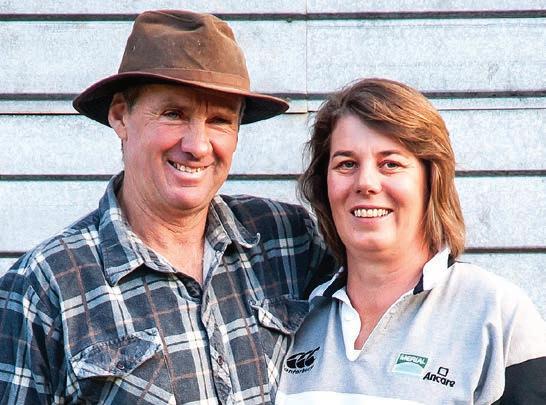
Ipurua South Devons are more moderately framed than the traditional type, sitting around 700kg liveweight, compared to a standard of about 900kg.
Cows that are too big don’t do well on too steep hills, he said.
Instead, the focus is on cattle that can handle the pressure of hill country farming while still delivering performance.
“A lot of our bulls are used for cross breeding, putting terminal sires over Angus cows. Others are used as maternal crosses.
“Those cows have to be bred to be able to withstand life on the hill.
“Big framed cows with no meat on them or no constitution don’t last in the hill country.”
When Peter returned to the farm after completing a four-year Agricultural Science degree at Lincoln, the stud was relatively small.
“We had 30 recorded pedigree South Devon cows and 130 Angus cows, with South Devon used as a terminal sire over the Angus cows.”
From there, he made a deliberate shift.
“At that point, I made the decision to record everything, and so graded all the commercial cows up to purebred over the next 30 years, and built numbers to 200 cows.”
The breeding philosophy has remained grounded in practicality.
“We’re selling bulls into the hill country and expecting them to survive.”
Peter said their breeding approach is built around efficiency rather than size, with a focus on animals that convert
well from liveweight to carcase.
He said hitting a 300kg carcase at 18 months is achievable without carrying unnecessary liveweight, and questions the value of heavier animals if they are less efficient on the hook.
Instead, slightly smaller-framed cattle tend to yield better, require less maintenance feed, and are easier to manage through winter.
Alongside helping with cattle, Caroline plays a key role across the farm.
Originally from the South Island, she moved north in 1993 for a teaching position, met Peter, and stayed.
Her work now spans everything from spraying and yard work to health and safety, compliance, and environmental management.
Planting waterways sparked an unexpected passion in Caroline and has grown into a hands-
on propagation effort using a greenhouse and native plant collection from ungrazed bush areas.
Mānuka, flaxes, cabbage trees, kōwhai, native grasses and the odd large tree – you name it, she propagates it.
Peter said a story from years ago showcases the temperament of South Devons the best.
When their children were around five years old they could walk through a pen of 100 South Devon weaner calves without any problems, not something that can be said for all breeds, he said.
Through it all, the stud’s direction remains consistent, and clients who come to them get cattle that will shift, cattle that will survive in the hill country environment, and follow-up service to boot, they say.





Gerhard Uys PEOPLE Livestock
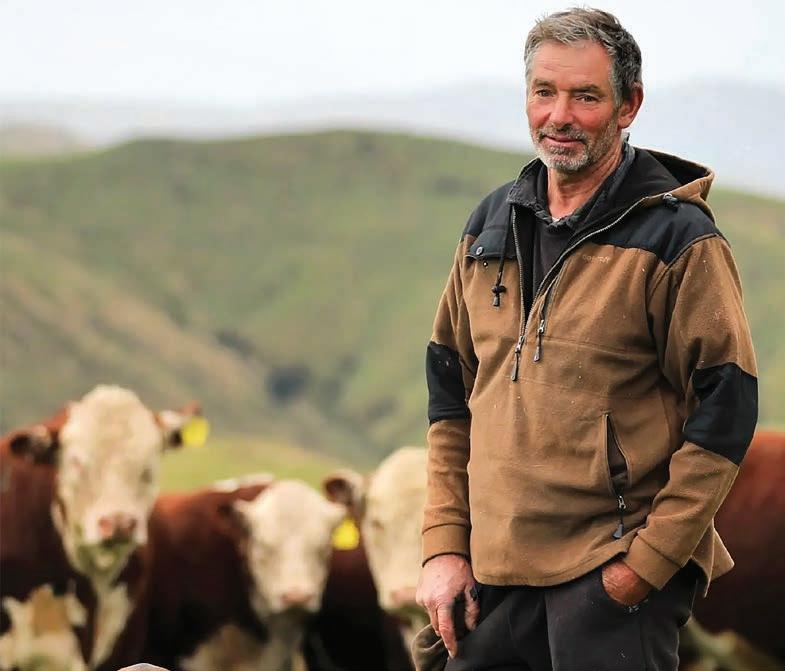
HEREFORDS bred on the steep, unforgiving hill country of Eketāhuna have to be tough, and at Otapawa Polled Herefords, that’s exactly the point.
For James Robbie, who farms alongside his father Stuart, mother Maria and sister Anna, resilience is bred into every animal that leaves the property.
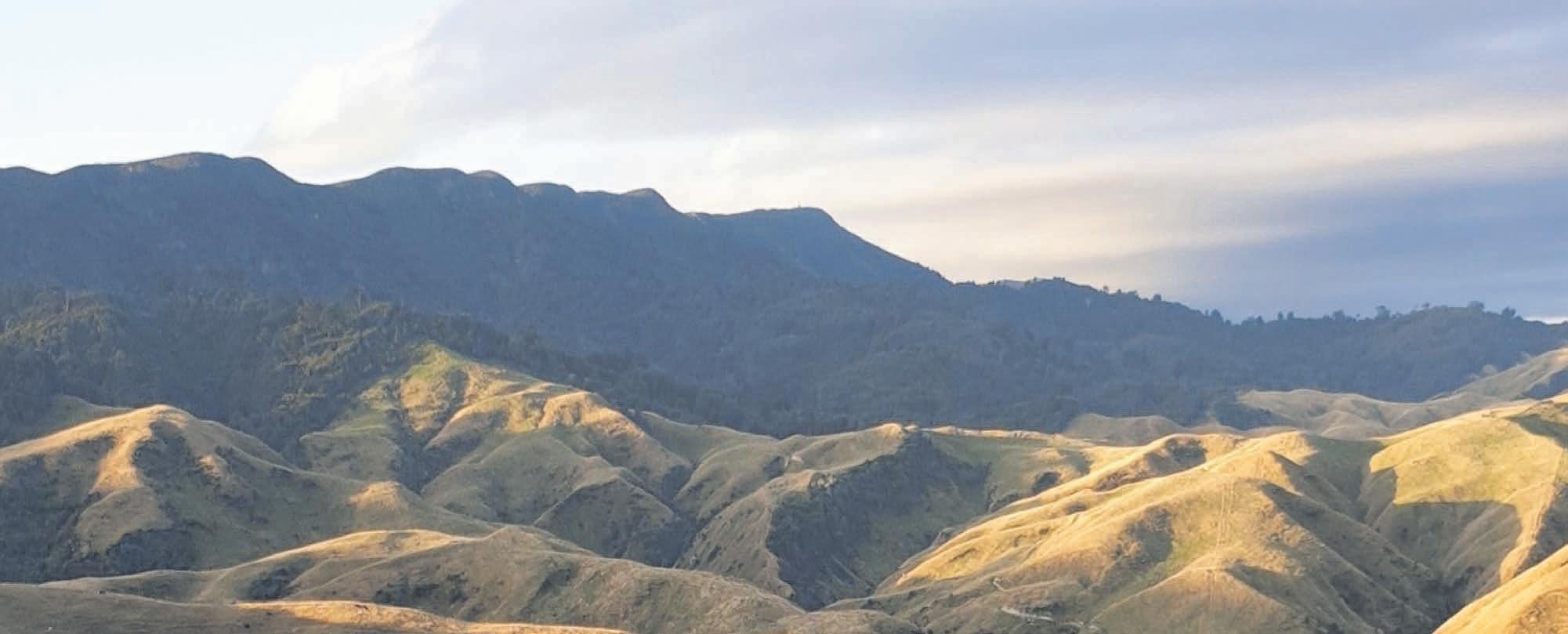
“Our cattle are run in a pretty harsh environment,” he said.
“Steep hill country, cold winters and plenty of weather. They’ve got to perform here first.”
Despite the conditions, the cattle deliver strong growth and carcase performance, something increasingly reflected in results being achieved by commercial clients.
Among them are Waipukurau farmers William and Mark Wallace, who are in their fourth year of using Hereford genetics
over their Angus cow herd.
Running a mixed operation across 300 hectares on the Pukeora hills and a 650ha finishing block, the Wallaces said the Hereford influence has become a defining part of their system.
“The Angus cows are tried and proven. The Herefords are tried and proven. Together, it’s the hybrid vigour that gives us the growth we need.”
The shift to Herefords came after studying bull catalogues and performance data, where Otapawa bloodlines, including progeny of American sire TH Frontier, stood out.
“We liked Frontier’s spread of low birthweight and big 600-day weight,” Mark said.
For William, the results have backed up the figures.
“We’re getting superior growth, and they’re killing at huge weights at a young age.”
Temperament has also been a key driver.
“Quieter to move, quieter in the yards, and we lose nothing as far as weight goes.
“We’re getting smaller calves, but they grow.”
The Hereford-cross progeny averaged 630kg at 18 months this season, with top truckloads reaching close to 400kg carcase weights and consistently high yields.
Back in Eketāhuna, those kinds of results are exactly what the Robbie family is breeding for.
The 350-cow stud is part of a wider 3500ha operation running
about 11,000 ewes and 2000 cattle, producing around 50 stud bulls each year.
Otapawa’s roots stretch back to 1969, when Stuart’s father first introduced Herefords to the farm, drawn to their temperament and reliability.
That focus has carried through the generations, with Stuart and Maria expanding the stud, and now James and Anna helping drive it forward.
“It’d be a pretty lonely affair if
it was just Maria and me,” Stuart said.
While James is focused on the day-to-day farming, Anna leads branding, social media and client engagement, helping connect the stud with farmers across the country.
Those relationships are central to the business.
Their longest-standing client has been buying bulls for 55 years, with many others returning for decades.
Otapawa bulls are now used across a wide range of environments, from the central North Island through Whanganui, Taihape and Rangitīkei, to more challenging hill country.
Recent client results include weaner sales averaging $2200, outcomes Stuart said give confidence the breeding programme is delivering.
For the Robbies, the job doesn’t end at the sale.
“The client’s achievements are our achievements,” Stuart said.
Rather than simply selling bulls, the family works alongside farmers to ensure their genetics are meeting commercial goals.
“They’re buying a sire they can trust,” James said.
“We back ourselves as well and we’re there to help make sure those bulls improve their breeding programme.”

“With our Prime Steers the Whiteface are first out the gate.”
- Patrick Henderson HINAU STATION

“The decision to cross breed with Otapawa Herefords was a no brainer, seeing the results I couldn't be happier . “

- Justin McCarthy DUNLOE TRUST FARMS
The difference between the Otapawa Hereford bred Progeny and the straight Angus is huge.” - Mark Wallace WALLACE FARMING

TUESDAY















Greaves PEOPLE Livestock
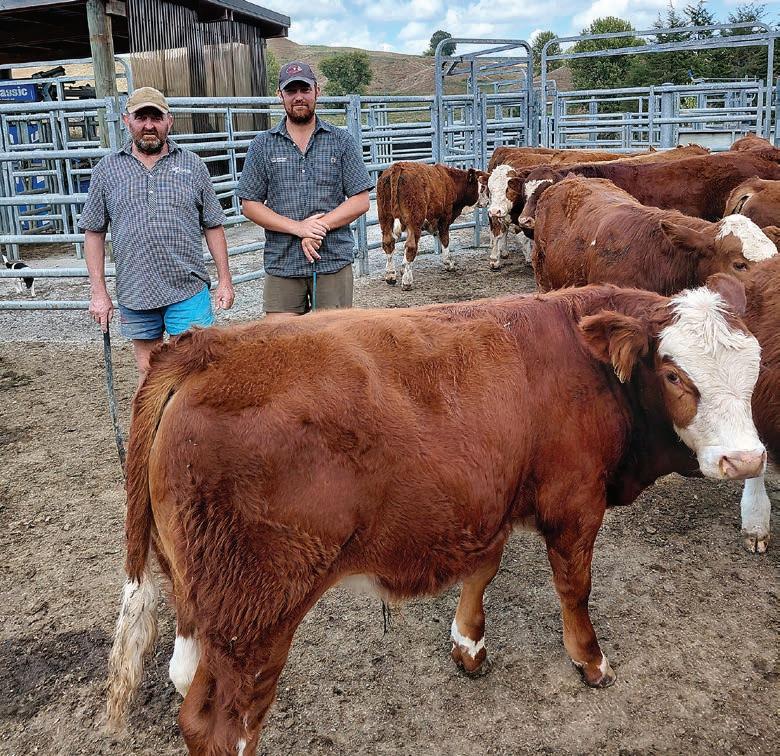
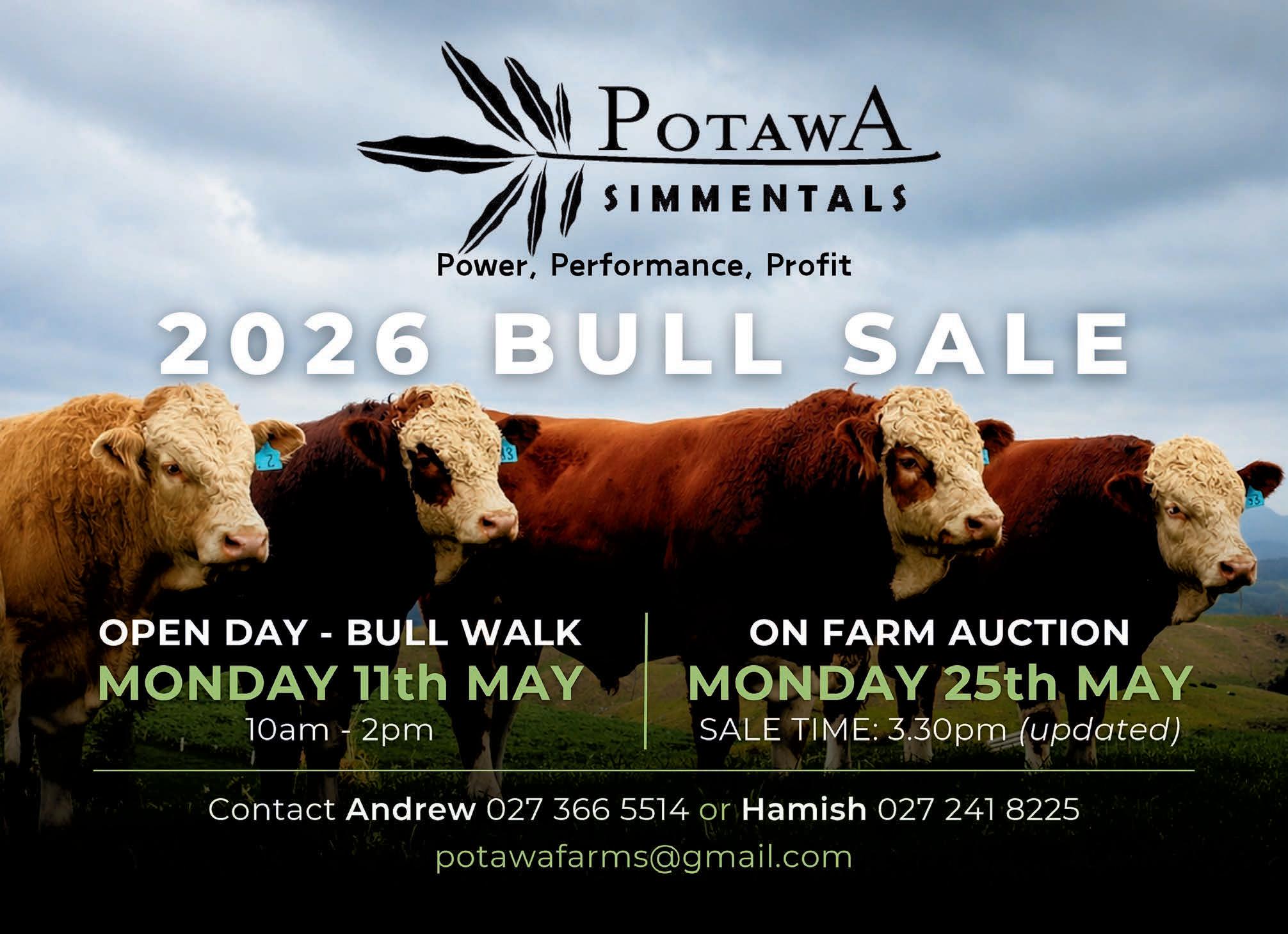
THE next generation is taking the reins at Potawa Simmentals in King Country, with Hamish Neal taking over the Piopio farm from his parents, Andrew and Tracey.
The farm is about 630 hectares (550ha effective) of medium to rolling limestone hill country and is home to a flock of 2000 breeding ewes, along with 130 stud cows.
Hamish Neal usually buys in about 200 heifers and steers as weaners, which are taken through to 15 or 18 months. Steers are sold store from August through to January, depending on the season and market. Heifers are killed from March through to the end of winter.
“We try to buy Simmental cross, but that can be challenging due to lack of numbers, most Simmental cross breeders are also finishers,” Neal said.
Docility and excellent growth are hallmarks of Potawa cattle, and stud cows are expected to perform in a commercial environment.
“We run the stud side pretty commercial; they have to fit in and are treated like a commercial cow would be on any other farm.
Our cows winter with the ewes in a big mob.
“We try not to pamper them too much and the top ones always shine through.”
In recent times, they have focused more on fat figures across the herd.
“We have had cows with massive growth figures but a bit lean on the fat and eye muscle area side of the Estimated Breeding Values. We mainly buy on confirmation, growth figures and temperament; everything else follows that.”
Neal and his wife Kate came home about two years ago and recently welcomed their first child, Harriet, who is the fifth generation of Neals to live on the farm.
“It’s an inter-generational property, one of few around left in the original family that broke it in from bush in 1910 to now. It’s cool to keep that going.”
The Neals are in a transition process at the moment.
“When I came home Dad was in charge but it’s slowly tipping the other way. Dad and Mum still run the stud and I run the commercial side.”
Potawa was started by his parents in 2002 when they purchased the nearby Misty Moor stud, and set about increasing numbers.
“I’ve never known any different. I was born just before they purchased the stud. I’ve been all around the country with them, viewing and buying cattle, and I’m really keen to continue it on and keep adapting and trying to improve,” Neal says.
“The stud has come a long way in 24 years in terms of quality and we are not culling so hard now. They have definitely made the stud what it is today.”
Neal enjoys the people involved
in stud breeding, and loves to see good cattle, good bulls and a quality calf born that will grow into a nice heifer or bull.
Potawa holds an annual rising two-year-old bull sale on farm at the end of May and will sell between 20 and 25 bulls at auction.
“All breeds have their good points. Simmental, I think – the right mix of a good cow with a
Simmental bull – people can see they are hard to beat from a growth point of view. Simmental guys in New Zealand have really focused on temperament and growth.”
Looking to the future, Neal hopes to explore the use of technology advances, like embryo transfer and artificial insemination to inject some overseas genetics, to benefit the stud.




















































Rural New Zealand is doing it tough Ever y day, The Salvation Army s t ands alongside rural communities , providing:
• Food suppor t
• Emergenc y a s sis t ance when crisis s trikes
• Financial mentoring and budgeting advice
• Wellbeing and communit y suppor t .