Edited by Katie Jones Katie.Jones@agriconnect.com 07786 856 439
Regenerative Farming Special
What regen means in practice and how the theory shapes farming businesses and the future of food production. 41
TAKE A BREAK 42 DA BYW KitKat trials regenerative wheat
Rethinking how we produce food
44 SOIL HEALTH
Ayrshire suckler farm from the ground up
48 ARK SUMMIT
What resilient farming looks like
50 MORE WITH LESS
The role of biologicals
Farmer Verity Megginson tells this year’s Soil to Slice Conference how a psychoanalytical approach helped her manage a new regenerative system. Mia Willemsen finds out more.
Would you eat the food you grow?
F
armers at the Soil to Slice Conference at the Great Yorkshire Showground, Harrogate, were told how 134 hectares (330 acres) of conventional farmland in Yorkshire turned regenerative after its new owner realised she did not want to eat the food she was growing. Verity Megginson, of Kirkburn Manor Farm, told the conference, hosted by the Green Farm Collective, how after applying chemicals, disrupt-
ing the soil and seeing the lack of life above and below ground, she no longer felt proud of her farm or the food she was producing. “I was definitely growing food that I would not want myself or my children to eat,” she said. Ms Megginson, who started farming in 2021, spoke about how she brought her knack for finding the root cause of an issue – a skill which she learned from her years spent working as a physiotherapist – into farming.
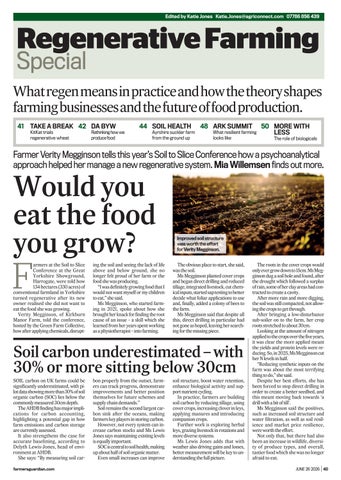
Improved soil structure was worth the effort for Verity Megginson.
The obvious place to start, she said, was the soil. Ms Megginson planted cover crops and began direct drilling and reduced tillage, integrated livestock, cut chemical inputs, started sap testing to better decide what foliar applications to use and, finally, added a colony of bees to the farm. Ms Megginson said that despite all this, direct drilling in particular had not gone as hoped, leaving her searching for the missing piece.
Soil carbon underestimated – with 30% or more sitting below 30cm SOIL carbon on UK farms could be significantly underestimated, with pilot data showing more than 30% of soil organic carbon (SOC) lies below the commonly measured 30cm depth. The AHDB finding has major implications for carbon accounting, highlighting a potential gap in how farm emissions and carbon storage are currently assessed. It also strengthens the case for accurate baselining, according to Delyth Lewis-Jones, head of environment at AHDB. She says: “By measuring soil carfarmersguardian.com
p040 June 26 R (hold for indexy bits).indd 21
bon properly from the outset, farmers can track progress, demonstrate improvements and better position themselves for future schemes and supply chain demands.” Soil remains the second largest carbon sink after the oceans, making farmers key players in storing carbon. However, not every system can increase carbon stocks and Ms Lewis Jones says maintaining existing levels is equally important. SOC is central to soil health, making up about half of soil organic matter. Even small increases can improve
soil structure, boost water retention, enhance biological activity and support nutrient cycling. In practice, farmers are building soil carbon by reducing tillage, using cover crops, increasing clover in leys, applying manures and introducing companion crops. Further work is exploring herbal leys, grazing livestock in rotations and more diverse systems. Ms Lewis Jones adds that with weather also driving gains and losses, better measurement will be key to understanding the full picture.
The roots in the cover crops would only ever grow down to 15cm. Ms Megginson dug a soil hole and found, after the drought which followed a surplus of rain, some of her clay areas had contracted to create a cavity. After more rain and more digging, the soil was still compacted, not allowing the crops to get through. After bringing a low-disturbance sub-soiler on to the farm, her crop roots stretched to about 30cm. Looking at the amount of nitrogen applied to the crops over the five years, it was clear the more applied meant the yields and protein levels were reducing. So, in 2025, Ms Megginson cut her N levels in half. “Reducing synthetic inputs on the farm was about the most terrifying thing to do,” she said. Despite her best efforts, she has been forced to stop direct drilling in order to create a better seedbed, and this meant moving back towards ‘a drill with a bit of till’. Ms Megginson said the positives, such as increased soil structure and water filtration, as well as soil resilience and market price resilience, were worth the effort. Not only that, but there had also been an increase in wildlife, diversity of produce types, and overall, tastier food which she was no longer afraid to eat. JUNE 26 2026 | 40
24/06/2026 16:03