rice county
October 2019
Breast Cancer
Faribault Daily News Northfield News
Awareness
Debunking common myths associated with breast cancer
(Metro) Cancer claims the lives of millions of people across the globe every year. But the fight against cancer is anything but hopeless, as the World Health Organization notes that between 30 and 50 percent of all cancer cases are preventable. Learning about cancer is one of the best ways for people to protect themselves from this deadly disease. Researchers continue to learn more about cancer everyday and routinely discover that information once thought to be accurate was actually off-base. Despite researchers’ best efforts, some myths about cancer still prevail. Some of these myths are about cancer in general, while others refer to specific cancers, including breast cancer. Myths about breast cancer can be as harmful as accurate information is helpful, so learning the truth and debunking those myths can be an important part of women’s
preventive approach to breast cancer. • Myth: Drinking milk increases your risk for breast cancer. The American Cancer
Society notes that early studies raised concerns that drinking milk from cows treated with hormones could increase a person’s risk for breast cancer. However,
ensuing research failed to find a clear link between the two. In fact, a 2002 study published in the International Journal of Epidemiology found no significant
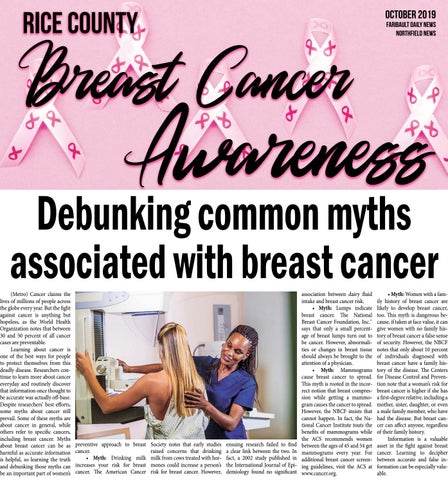
association between dairy fluid intake and breast cancer risk. • Myth: Lumps indicate breast cancer. The National Breast Cancer Foundation, Inc.¨ says that only a small percentage of breast lumps turn out to be cancer. However, abnormalities or changes in breast tissue should always be brought to the attention of a physician. • Myth: Mammograms cause breast cancer to spread. This myth is rooted in the incorrect notion that breast compression while getting a mammogram causes the cancer to spread. However, the NBCF insists that cannot happen. In fact, the National Cancer Institute touts the benefits of mammograms while the ACS recommends women between the ages of 45 and 54 get mammograms every year. For additional breast cancer screening guidelines, visit the ACS at www.cancer.org.
• Myth: Women with a family history of breast cancer are likely to develop breast cancer, too. This myth is dangerous because, if taken at face value, it can give women with no family history of breast cancer a false sense of security. However, the NBCF notes that only about 10 percent of individuals diagnosed with breast cancer have a family history of the disease. The Centers for Disease Control and Prevention note that a woman’s risk for breast cancer is higher if she has a first-degree relative, including a mother, sister, daughter, or even a male family member, who have had the disease. But breast cancer can affect anyone, regardless of their family history. Information is a valuable asset in the fight against breast cancer. Learning to decipher between accurate and false information can be especially valuable.
PAGE 2
BREAST CANCER
October 2019
Breast cancer signs and symptoms
(Metro) Breast cancer is a formidable foe. According to the World Health Organization, an estimated 627,000 women lost their lives to breast cancer in 2018. But women are not helpless in the fight against breast cancer, as the WHO notes early detection is critical and could potentially save thousands of lives each year. A proactive approach is a key component of protecting oneself against breast cancer. While the National Breast Cancer Foundation, Inc.¨ notes that many breast cancer symptoms
are invisible and not noticeable without a professional cancer screening, women can keep an eye out for certain signs of breast cancer they might be able to detect on their own. Monthly selfexams can help women more easily identify changes in their breasts. During such self-exams, women can look for the following signs and symptoms and are advised to report any abnormalities they discover to their physicians immediately. • Changes in how the breast or nipple feels: The NBCF says nipple tenderness or a lump or
About 85% of breast cancers occur in women who have no family history of breast cancer. These occur due to genetic mutations and life, in general. 700 Railway St S Dundas 507-645-4106
thickening in or near the breast or underarm could indicate the presence of breast cancer. Some women may notice changes in the skin texture or an enlargement of the pores in the skin of their breast. In many instances, skin texture has been described as being similar to the texture of an orange peel. Lumps in the breast also may indicate breast cancer, though not all lumps are cancerous. • Change in appearance of the breast or nipple: Unexplained changes in the size or shape of the breast; dimpling anywhere on the breast; unexplained swelling or shrinking of the breast, particularly when the shrinking or swelling is exclusive to one side only; and a nipple that is turned slightly inward or inverted are some signs and symptoms of breast cancer that can affect the appearance of the breast or
nipple. It is common for women’s breasts to be asymmetrical, but sudden asymmetry should be brought to the attention of a physician. • Discharge from the nipple: The NBCF notes that any discharge from the nipple, but
particularly a clear or bloody discharge, could be a sign of breast cancer. The NBCF also advises women that a milky discharge when they are not breastfeeding is not linked to breast cancer but should be discussed with a physician.
Learning to recognize the signs and symptoms of breast cancer can increase the likelihood of early diagnosis, which greatly improves women’s chances of surviving this disease.
rice county
Breast Cancer
Awareness
A special project of the Faribault Daily News 514 Central Avenue, Faribault, MN 55021
A special project of the Northfield News 115 5th Street W, Northfield, MN 55057
Publisher CHAD HJELLMING
Publisher CHAD HJELLMING
Rice County Breast Cancer Awareness, October 2019 is distributed to subscribers and readers of the Northfield News and Faribault Daily News at no additional charge. All advertising contained herein is the responsibility of the advertisers. All rights reserved. ©2019.
October 2019
BREAST CANCER
PAGE 3
Potential treatment options after a breast cancer diagnosis
(Metro) A breast cancer diagnosis is something no one wants to receive. But the burden of breast cancer is substantial. In fact, the World Health Organization notes that breast cancer is the most commonly occurring cancer in women worldwide. Thankfully, breast cancer survival rates are high in many parts of the world, particularly in developed countries such as the United States, Canada and Japan. While survival rates are lower in developing countries, it is encouraging to know that the
in which the tumor and a small amount of surrounding tissue is removed, and mastectomy, in which all of the breast tissue is removed. Chemotherapy: Chemotherapy is used to treat various types of cancer and involves the administration of special medicines to shrink or kill existing cancer cells. Breastcancer.org notes that chemotherapy is sometimes administered prior to surgery in an attempt to shrink the cancer.
Hormonal therapy:
Estrogen makes hormone-receptorpositive breast cancers grow, and hormonal therapy, which may be referred to as ‘anti-estrogen’ therapy, aims to reduce the amount of estrogen in the body and block its action on breast cancer cells.
Targeted therapies: These therapies, which Breastcancer. org notes are generally less likely than chemotherapy to harm normal, healthy cells, target specific characteristics of the cancer cells. Radiation therapy: Radia- Cancer cells can have many chartion therapy aims to kill cancer acteristics, so there are various cells using high-energy rays that types of targeted therapies. are similar to X-rays. Sometimes Breast cancer treatments referred to as ‘radiotherapy,’ radiation therapy is overseen by a can be highly effective in the radiation oncologist who spe- fight against breast cancer, parcializes in this type of treatment. ticularly when the disease is caught in its early stages.
average five-year survival rates are as high as 90 percent in some nations. That suggests that the strategies used to successfully fight breast cancer in developed nations may one day prove as effective in developing nations, potentially leading to a sharp decline in global breast cancer deaths. Upon being diagnosed with breast cancer, patients will be educated about a host of potential treatment options. The Centers for Disease Control and Prevention note that breast can-
The following are some treatment options doctors may discuss with breast cancer patients.
cer is treated in several ways, and the course of treatment a doctor recommends will depend on the kind of breast cancer and how far it has spread. In addition, according to Breastcancer.org, breast cancer is made up of many different kinds of cancer cells, which often necessitates the use Surgery: Breastcancer.org of various types of treatments to notes that surgery is typically the get rid of the cancer. first line of attack against breast cancer. The CDC says the goal of surgery is to cut out cancer tissue. Some common breast cancer surgeries include lumpectomy,
Supports research of cancers that affect women. The Mary Kay Foundation • Awarded $1.3 M in cancer research grants • Donated $412,000 to Cancer Care Your donation or purchase of Mary Kay products gives financial assistance to organizations that help fight women’s cancers and domestic violence. Thank you for your support.
Jean Wakely
Independent Beauty Consultant for Mary Kay Cosmetics
507-663-9085 • www.marykay.com/jeanwakely The Mary Kay Foundation is a 501©3 non-profit organization
PAGE 4
Signs and Symptoms (Metro) Though women may notice various signs and symptoms that could be indicative of breast cancer, breast pain is generally not one of them. The National Breast Cancer Foundation, Inc.¨ notes that there are various harmless causes of breast pain, such as puberty, menstruation and child birth, but that breast pain is not commonly a symptom of cancer. However, in rare instances breast pain may correlate with cancer. For example, breast tumors may cause pain, but cancerous tumors are not generally reported as painful. Though it may not be linked to breast cancer, breast pain should still be reported to a physician immediately, advises the NBCF.
BREAST CANCER
October 2019
Why it’s important to discuss cancer screenings with your doctor
(Metro) Cancer affects people from all walks of life. The American Cancer Society says that, in 2019, there will be approximately 141,000 cancer cases diagnosed and about 103,000 cancer deaths in the United States. Breast cancer, lung cancer and prostate cancer are some of the most common cancers, although just about any area of the body can be affected by the cell mutations that lead to cancer. There is no cure for cancer, although billions of dollars are spent each year researching the disease and potential cures. Until a cure has been found, individuals must rely on screenings and prevention methods. Cancer screening tests are designed to find cancers in their earliest stages, when the disease is most treatable. Many cancer screening tests have been found to lower the death rate from particular cancers, according to the health and wellness resource site MedicineNet. The Centers for Disease Control and Prevention supports various cancer screening tests as recommended by the U.S. Preventative Services Task Force. The average person should discuss with their physicians their risk for certain cancers. By considering individual medical history, family health history and/ or prior screening results, doctors can develop a screening plan
to reduce patients’ risk of cancer. cervix that may turn into cancer. Early detection of cervical cancer Breast cancer: Mammo- increases survival rates. grams can help find breast abnormalities early on when they Lung cancer: Yearly lung are easier to treat and can pro- cancer screening with low-dose duce a very good success rate. computed tomography for those with a history of smoking, parColonoscopy/sigmoid- ticularly heavy smoking, is often oscopy: These tests help de- recommended. tect colorectal cancer early on and also may help prevent the Prostate cancer testing, indisease. These tests can find ab- cluding blood tests and a digital normal colon growths that can rectal exam, used to be the norm. be removed before they become However, Cancer.org says expert cancer. groups no longer recommend routine prostate cancer screenCervical cancer: A Pap ings because many of these cantest can find abnormal cells in the cers are not deadly and early
1 in 8 women will be diagnosed with breast cancer in her lifetime. There are 3.1 million breast cancer survivors in the US today. Everything you do makes a difference. Find a way to join in the fight to defeat this devastating disease.
Mary Jo Winter (Survivor)
detection has not been shown to reduce the chances of dying from prostate cancer. Some people may still ask to be screened for prostate cancer as well as cancers of the ovaries, pancreas, testicles, and thyroid even though screenings have not been shown to reduce deaths from those cancers. Some cancer screenings are recommended to help catch cancer early and prevent the disease from progressing. People are urged to speak with their doctors about which tests are best for them.
SUPPORT THE FIGHT
612.701.2079
Text or call mj@maryjowinter.com
NMLS #638054
428 Central Avenue | West Faribo Mall Branch | Faribault & Prior Lake | www.tsbf.com