FALL 2019 • ISSUE 3
$2.00
Fleur-de-lis
Local Picks
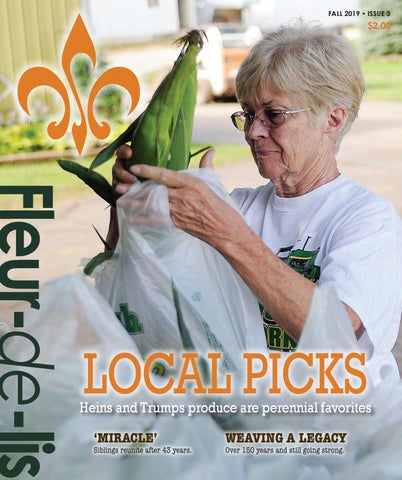
Heins and Trumps produce are perennial favorites ‘Miracle’
Siblings reunite after 43 years.
Weaving a legacy Over 150 years and still going strong.
contents 6 St. Luke’s Church
Who knew? St. Lucas Evangelical Church has ties to city’s health care history.
8 Picked fresh
If you have good produce people will find you.
12 ‘Miracle’
Separated by war, siblings reunite after 43 years.
16 Kid stuff
Faribault Early Childhood raises the bar for district’s youngest learners.
20 Scenes of summer, 2019 edition Flower, fireworks and a few fine festivals.
26 Weaving a legacy: Loomed in the Land of Lakes
150 year in the making – and still going strong.
32 Faribault’s royalty
Faribault’s Frank Berry House serves as an icon of trailblazing architecture.
36 Natural Beauty Dedicated crew work diligently to keep
grounds and facilities in pristine shape.
on the cover:
During late summer, the Heins spend much of their time bagging, delivering and selling corn. (Nick Gerhardt photo)
This young man selected a great spot to watch soccer practice. (Photo courtesy of Richard Rein)
Fall 2019
3
Black-eyed Susans welcome visitors to the city’s White Sands dog park and trailhead. (Suzanne Rook/Faribault Daily News)
publisher:
This issue of Fleur de Lis is delivered to all subscribers of Faribault Daily News for the low cost of $1.00 per issue, deducted upon delivery from your account balance. If you decide it’s not for you, you can opt out of future issues by contacting customer service at 507-333-3111 or crolling@ faribault.com. Non-subscribers can purchase copies of Fleur de Lis for $2.00 each.
Chad Hjellming
managing editor:
Volume 2, Issue 3
Fleur-de-lis 2019 Published Fall 2019 by: Faribault Daily News 514 Central Avenue Faribault, MN 55021 faribault.com ©
regional director of advertising: Mark Nelson
media consultants: CariAnna Chaney Allison Davis
designer:
Fall 2019
Suzanne Rook at Fleur-de-lis srook@faribault.com
Suzanne Rook
Kate Townsend-Noet
4
Send story ideas to:
All advertising contained herein is the responsibility of the advertisers. This publication is copyrighted by the Faribault Daily News and no content can be reproduced without permission.
Nordmeier Bros.
celebrating our 63rd anniversary
Snapper Dealer since 1965
power lift recliner with power headrest only
599
$
Was $949
20+ Leading the Future of Retail, Proud to be a part of Faribault
Lawn · Garden · Snow Sales · Service · Parts
The hearT of The home
Providing pharmacy, vision, tire lube express, on-line ordering with same day pick-up, grocery and general merchandise. 150 Western Ave. NW | (507) 332-0232
walmart.com
others in-stock
30 5th St. NW Faribault
www.nordmeierbros.com Morristown since 1926
507-685-4155
(507) 334-4364
erickson-furniture.com Store Hours: M-T-W-F 9am - 5:30pm, TH 9am - 8pm, SA 9am - 5pm
EMPODERATE. ENERGIZATE. INVOLUCRATE.
EMPOWER. ENERGIZE. ENGAGE. AWOOD. FIRFIRCOONI. ISDHEXGAL.
Faribault Public Schools is dedicated to providing a safe, welcoming learning environment and a comprehensive educational experience to all our students. Our exceptional staff, committed parents and supportive community encourage a successful academic pathway that inspires learning, growth and future success for our students.
Start hearing life EvEry Falcon EvEry Day. #raisingthEBar
Free Hearing evaluations & Hearing aid Cleaning
• Art, music, technology & phy-ed offered at every grade level • 1:1 iPad initiative for middle & high school students • College level and exploratory classes – world languages, engineering & automotive programs • Afterschool activities for all grade levels – athletics, academic & special interest clubs • Programming for all ages – birth through adult
FARIBAULT PUBLIC SCHOOLS | 507-333-6000 | www.faribault.k12.mn.us
Jayne Bongers
Owner/ MN. Certified
507.412.9813
1575 NW 20th Street - Faribault Ask about our Rechargeable Batteries We are now a Health Partners and Blue Cross Blue Shield provider!
advantagecarehearingcenter.com
Fall 2019
5
Church plays a major role in city’s health care history
From the Daily News archives April 2011
A
window on Faribault 100 years ago would have shown a new evangelical church congregation that would play a significant role in the health care history of the city. The congregation of St. Lucas German Evangelical Church — today called St. Luke’s Church — celebrated its centennial in 2011. The cornerstone for its current church building at 1100 SW Ninth Ave. was laid in 1969, said Lila Schmidtke, who started attending St. Luke’s services in 1946. “I came to Faribault that year to start nurses training with the Deaconess Sisters at Faribault at St. Lucas Hospital, so I started attending this church because the congregation got the hospital started,” Schmidtke said. People who live in town today don’t know that this church started St. Lucas Hospital, Faribault’s hospital before District
6
Fall 2019
One Hospital opened, or that the hospital had a nursing school run by the Deaconess Sisters,” she said. The Deaconess Sisters of St. Louis, The cornerstone from Evangelical St. Lucas Hospital was placed in 1908. (Suzanne Rook/ Missouri, is a Faribault Daily News) sisterhood for women of the German Evangelical Church who dedicated themselves to nursing and welfare causes. The group flourished in the 19th century and the first half of the 20th century. “I think there are very few women who belong to it today. But
Evangelical St. Lucas Hospital in Faribault was built in 1908 and served the community for 51 years. (Image courtesy of Brian Schmidt)
the Deaconess order was quite strong when I went to nursing school and the sisters were the ones who taught us and supervised nurses at the hospital,” Schmidtke said. St. Lucas Hospital opened its doors in 1908 on Faribault’s east side (500 First St. SE) and served the community for 51 years. Today the newer part of the former facility is incorporated into the assisted-living section of St. Lucas Care Center, an elder care and nursing home. The care center and The Emeralds at Faribault (formerly Deaconess Tower Assisted Living) were sold in February 2019 to Monarch Healthcare Management. Back when the hospital started, Schmidtke said, the Rev. William Meyer was the church minister and the superintendent of the hospital. The practice of the minister also serving as hospital superintendent continued until 1941. Then the hospital got its own board, Schmidtke said. The same year the name of the church was changed to St. Luke’s Evangelical and Reformed Church, she said. Over the years the name was changed several other times until it finally became simply, St. Luke’s Church. Schmidtke said the congregation rented space to meet at first, but built its first church in 1909. It was at the corner of Eighth Street and Fifth Avenue Northwest.
A large portion of 111-year-old Evangelical St. Lucas Hospital on First Street SE is now part of The Emeralds assisted living. While the ornate roof structure no longer stands, the distinctive brickwork remains. (Suzanne Rook/Faribault Daily News)
That church building became the home for Faribault Evangelical Free Church when St. Luke’s built its current church. A few years ago, the Evangelical Free Church moved to a new building on St. Paul Road and the old church was sold and remodeled into private residence. Unique to the current church building are the 17 faceted glass windows created and installed by the Hauser Studies of Winona. The artist group used contemporary materials of faceted glass and epoxy resins to create abstract scenes of the life of Christ. “All the symbols in the windows were first pencil designs by Pastor A. M. Guthmiller, Schmidtke said. Guthmiller was minister of the congregation at the time the new church was built. Included in the 17 windows are ones that are scenes of Jesus’ trial before Pilate, his crucifixion, and his resurrection, which Easter celebrates. Schmidtke said women will wear hats to this year’s Easter services in recognition of the church’s 100th anniversary. “Back a century ago, all women wore a hat to church or to formal occasions,” she said. St. Luke’s had special activities throughout 2011 to commemorate the centennial, Schmidtke said. “Each window has a message and tells its own story, she added, but together they tell of the life of Jesus, which is the basis of Christian faith.
Editor’s Note This story, written in April 2011 by then Daily News reporter Pauline Schreiber, has been updated to denote the current name/owner of the former St. Lucas Care Center.
St. Lucas Hospital can be seen in the distance in this undated photo of the Faribault viaduct.
Fall 2019
7
Picked fresh
For locals, Hein and Trump produce can’t be matched
I
Story By Nick Gerhardt
f you have good produce people will find you. These days it’s an algorithm that directs people to the good stuff, but they’re still getting there and those old visual clues that it’s sweet corn season or time to pick apples still work just as well, just ask the Heins and Trumps in Faribault. They both run farms entering into fourth generations and they’re two of the better known spots to go for premier produce. When the Heins started out selling sweet corn
people first sensed delicious kernels were soon on their way to plates when the wagon appeared on the Heins’ lot. The Trumps have so many people curious about their sweet-tasting apples they wait to turn the business line on so they don’t get distracted from the work that needs to be done to prepare for the busy months. It seems like there’s still no better advertising than word of mouth, but having computer-aided technology certainly helps too. The Heins see how a Google search helps them all the time
ABOVE: Patriarch Pete Hein took over the sweet corn business from Howard Bode 22 years ago. (Nick Gerhardt photo)
8
Fall 2019
The Hein children, and now grandchildren, have helped on the farm since the family took over the business in 1997.(Photo courtesy of the Heins)
during sweet corn season. “A lady googled the best place to find good sweet corn and said this is where they took me,” said Jeanne Hein. About 10 years ago Hy-Vee got word about the sumptuous sweet corn and asked to sell the Hein’s Extra Sweet Corn. Now they haul to Hy-Vee every day and even then people will wait until the Hein’s corn gets stocked, said patriarch Pete Hein, who took over the sweet corn business from Howard Bode 22 years ago. The sweet corn will travel too. From truckers pulling over to those on a cross-country road trip, people from all over have stopped at the stand. Not only that, people from Alaska to New Mexico have requested the sweet corn shipped to them. Of course, they can always get car-side service by heading out to the farm. The Hein family has quite the spot to shell out corn by the dozen with a circle driveway with two big shade trees to stand under while the load up cars. The driveway already had a great shade tree in TOP: Hein’s Extra Sweet Corn is a favorite among southern Rice County the middle of the circle but Jeanne planted a maple tree residents. Jeanne Hein jokes that the corn is so delicious because she mixes sugar in with the soil. (Nick Gerhardt photo) on the east side of the driveway on a whim. Now the two trees have grown together to provide the perfect canopy Three boxes of Hein’s sweet corn doesn’t last long. (Nick Gerhardt photo) for long summer days. And they can be long days but the Heins get plenty of help from the family. Son David and his children log many hours “I put sugar in the planters,” Jeanne joked. together picking and packing corn. They’ll start picking at 6 or 7 The secret might just be consistency. Pete has used the same in the morning and start selling after a short break. Grandsons seed for 22 years and has kept proving friend Larry Bennett, who Carson and Blake are there most days and granddaughter Carly had the sweet corn operation before Bode, wrong. comes down on weekends to lend a hand. Family friend Phillip “He always kidded us that we weren’t going last,” Pete said. Koslosky also helps out at the stand and picking For the first year the Hein family kept a sign by the wagon “I like doing it,” said Blake, 27, who started picking at 12 years “Formerly Bode’s” to help keep the previous customers. It seemed old. “I like this part of farming, interacting with the people. We to work and the 18 acres the family works for sweet corn keep put a lot of hours in, seven days a week, 10 hours a day.” So what makes Hein corn so special? CONTINUES ON PAGE 10 u u u
Fall 2019
9
Apple picker Umberto in September 2017 helps pluck the fruit from the rows and rows of trees at Trumps Orchard. (Daily News file photo) CONTINUED FROM PAGE 9
strong, even though the occasional crop rotation in the field gets people worried they won’t have corn in the summer. But sweet corn lovers shouldn’t fret in Faribault since the five signs the Hein family puts out every year will guide you to sublime sweet corn.
Take a bite
AN APPLE A DAY Since the apple-breeding program began at the University of Minnesota in 1888, nearly 30 apple varieties have been released. Those currently available for purchase are: • Beacon • Centennial Crabapple • First Kiss • Rave • State Fair Apple
10
Fall 2019
• SweeTango • Zestar! • Chestnut Crabapple • Red Baron • Sweet Sixteen • Honeycrisp • Honeygold • Haralson • Frostbite • Regent • SnowSweet • Fireside/Connell Red • Keepsake • Prairie Spy
A hop, a skip and a climb up the hill in another part of Faribault, Scott Trump is the third generation of Trumps lead Trumps Orchard. Trumps Orchard has operated since 1954 and in that time become almost a rite of passage for Faribault youth to take a trip to the orchard with the annual Faribault preschool tour. Preschoolers from Faribault, Northfield, Owatonna, Medford and the surrounding areas travel to Trumps Orchard for an hour-long tour around the property during a twoweek period each September. Trumps Orchard opened this year in late August for people to pick University of Minnesota apple varieties like First Kiss, Sweet Tango, Honeycrisp and Haralson. “The place is like a beehive four days a week Thursday, Friday, Saturday, Sunday,” Trump said. “It’s a place to come with your family.” That’s what it’s been for the Trumps, starting when Herman opened the business out of his garage with Visitors to Trumps Orchard can either bur pre-picked apples or enjoy time in the orchard picking their own. (Daily News file photo)
PICK SOME UP • Faribault Hy-Vee sells Hein sweet corn. If you’d rather get yours at the farm, visit the Heins at 1383 250th St., Faribault. Call 507-334-8562. • Trumps Orchard opened in late August. Find the orchard at 1020 St. Paul Ave., Faribault. Call 507-334-5167.
Workers in September 2017 scoop up apples from the line at Trumps Orchard in Faribault. (Daily News file photo)
his wife Eileen. Scott’s father Todd and mother Joyce took over and these days it’s Scott and his wife Chrissy running things along with their children Brendan, Damon and Kaitlyn when they’ve got time. Brendan and Damon have gone off to college and Kaitlyn is entering her freshman year of high school. “I’ve always been here,” Scott said. “I grew up in the orchard, whether it was mowing grass in the orchard or pruning trees in the wintertime. I went and did my own thing for a few years and then we ended up back here. It’s a great place to raise a family. I know I liked growing up in the orchard and I know my kids do also.” The family runs four orchards, which total around 80 acres now. But it’s not all apples at Trumps Orchard. There are pumpkins, grapes, plums and even pears at the orchard. “One of my grandpa’s big things was being diversified,” Scott said. When the orchard opens it’s full-steam ahead when they’re open Monday through Saturday from 8:30 a.m. to 6 p.m. and from 9
a.m. to 6 p.m. on Sundays for people to check out fresh cider, caramel apples, pies and crisps. For Scott, what makes the orchard fun is getting to see the improvements in how they farm. “Being able to grow the business and farm things in a new way is interesting,” Scott said. “Constantly improving things and making mistakes, that’s all part of it , too.” Some of those improvements have been building the warehouse in 1989 and planting smaller apple trees to increase growing capacity. A majority of the produce that comes from Trumps Orchard finds it way to the grocery store but 35 percent of the produce still gets bought by customers at the orchard. Just like with dining, the experience can be everything when finding produce and in Faribault, the experiences at Trumps Orchard and Hein’s Extra Sweet Corn make the extra effort to find produce more satisfying. Nick Gerhardt is a freelancer journalist based in Northfield.
Just as these students in fall 2015 enjoyed getting to taste fresh apples during a tour of Trumps Orchard, today’s students find its apples equally delicious. (Daily News file photo) Fall 2019
11
‘Miracle’
Separated by war, siblings reunite after
S
Story By Anne Kopas
43
ambath Ouch hadn’t seen his sister, Chum, in 43 years. Decades later, Sambath, 55, and Chum, 60, talk easily, sitting outside Sambath’s Faribault home. In the yard, his granddaughters run around in brightcolored dresses. Two lapdogs lounge in the shade. The scene looks nothing like the circumstances of war and loss that separated the siblings. Looking back, Sambath
years
views the reunion and his very survival as a miracle. The story begins far from Faribault, in mid-1960s Cambodia. Before Sambath turned 5, his mother had died in childbirth and his father had gone off to fight in the Vietnam War, leaving older sisters to feed and care for the family. After his father remarried, the family had a total of nine children. Four are still alive. Since his father wasn’t going to be around to care for everyone, he sent Sambath to live in a Buddhist temple, where the child attended school and knocked on doors to beg for rice. Once a month, he crossed a
ABOVE: A South Vietnamese soldier walks down the main street of Tonle Bet, Cambodia, June 1, 1970, shortly after the area was heavily damaged during fighting between Cambodian troops and Viet Cong/North Vietnamese forces. Fighting such as this forced Sambath and Chum Ouch and their family to leave their home for a Cambodian refugee camp and later, the country. (AP Photo/ Henri Huet)
12
Fall 2019
Chum, left; Dan, center, and Sambath, pictured as children. Chum is now 60, and Sambath 55. Dan died of cancer in the 1980s. (Photos courtesy of Sambath Ouch)
Sambath and Chum’s father, Soy Chea, is pictured with their stepmother, Nom. (Photo courtesy of Sambath Ouch)
Chum Ouch and her daughter visit the Eiffel Tower in Paris in 1980. (Photo courtesy of Sambath Ouch)
length of jungle alone (about the distance between Faribault and Northfield), swimming across a river during monsoon season, to see the rest of his family. Compared to later experiences, he said, living with the Buddhists wasn’t bad, even with the monthly trek. “They took care of me really well, that’s what I believe. They taught me some good. They gave me everything,” said Sambath. But as the war moved closer to their home, Sambath was sent back to his family for good. Cambodia became a violent place where Sambath and Chum lived in constant fear, especially after communist soldiers killed an older brother. “You grow a garden, but you can’t pick it or they’ll cut your hands off. You can’t call anyone’s name, just sister, brother,” Sambath said of the soldiers. “They brainwash you so you don’t know who your family is.” At an age when most American children are starting kindergarten, Sambath fled in the night to a refugee camp in Thailand with some of his siblings. To get by, an older sister “rented” Sambath and Chum to Thai families to clean, work
in the fields, babysit or do whatever jobs needed doing in exchange for a single bag of rice. “I was 5 or 6 years old, working in the fields,” said Sambath. “It was a pretty rough life, but we had to do it to survive.” Since Sambath and Chum were rented to different Thai families, they couldn’t see or talk with one another until United Nations workers came and took them to a refugee camp. After a waiting period, United Nations workers arranged for Sambath, Chum, and other older brother, Dan, to leave Thailand. Twelve-year-old Sambath was set to go to the U.S. with Dan and another older sister. To keep the family together as much as possible, Sambath changed his last name and posed as the older sister’s son. Chum, then 16, had married a 35-year-old who promised to take her to France. That was the last they saw each other until this past July.
CONTINUES ON PAGE 14 u u u
Fall 2019
13
CONTINUED FROM PAGE 13
Life in America Life in Faribault wasn’t much easier for Sambath. Sambath’s older sister and her mother-in-law were abusive, each struggling with alcohol and gambling problems. Sambath was placed into sixth grade at the Faribault High School. Learning English was a challenge, especially since bilingual teachers were mainly trained in Spanish, not Khmer (Cambodian). The family moved to California for a few years before coming back to Faribault. In California, Sambath was placed into ninth grade, which set him back even further. Classmates in both states constantly used racial slurs against him and saw him as unintelligent due to his poor English. “At home, I had no place to sleep. That was a hard time; you get picked on at school, you come home and you have nothing,” he said. It was his brother Dan’s encouragement that kept Sambath going through these years, even after Dan’s death from cancer in the mid-80s. After the return to Faribault, it wasn’t – Sambath Ouch long before Sambath came home one day to find his sister had abandoned him to move in with a man in the Twin Cities, taking her mother-in-law with her. Struggling to get back on his feet with no family, he met a Faribault woman who would later become his partner for 25 years, and they had five children together. Sambath went back to vocational-technical school, but the going remained tough. He was working full-time while struggling to pay rent and care for his family — and since he didn’t have a car, he had to spend time and money taking a taxi every day to his welding job. He credits his vo-tech degree to a teacher who was willing to work with Sambath before school and on weekends to help him get his grades up. Despite the extra work, Sambath refused to give in. “I had to do whatever it takes, because that’s what the Lord brought me here for, to learn everything. I wanted my kids to have a future and go to college,” he said. But the pressure had some negative side effects. To cope with stress, Sambath found himself going to bars, getting drunk and high, and looking for fights. It didn’t help that others in the family also used drugs. The habits landed him
‘I had to do whatever it takes, because that’s what the Lord brought me here for, to learn everything. I wanted my kids to have a future and go to college.’
14
Fall 2019
time in jail, a rock bottom that forced him to rethink his life. “When I was in jail, and I looked at myself, and I was like an animal. My mother and father didn’t bring me into this world to be who I (was),” he said. So he separated himself from the family, taking refuge in a
Sambath Ouch, 55, and Chum Ouch, 60, reunite at Sambath’s Faribault home after 43 years of separation. The siblings fled Cambodia during the Vietnam War, spending a few years as refugees in Thailand before Sambath came to the United States and Chum went to France. (Anne Kopas/Fleur-de-lis)
new job at Northern Tool, where he now works, along with a newfound faith in God. Along the way, he also met Sarin Chouy, now his wife. They have four children together, along with Chouy’s son from a previous relationship. In total, Sambath has nine children, three stepchildren and 10 grandchildren.
A “once in a lifetime” reunion Meanwhile, Chum was living in France with her second husband — her first husband had been abusive, forcing her to leave him. She later remarried, and now has four children and six grandchildren of her own. During those decades, as Chum lived a life thousands of miles away from her Cambodian origins, she couldn’t forget her younger brother in America. In 2005, Chum traveled back to Cambodia to reunite with a younger sister. She also managed to reconnect with her oldest brother’s widow and daughter, who still had a photo of Chum and Sambath. These family connections, along with the photo, were the key to finding one another. One day, Sambath received a call from his niece bearing the news: “We’ve found your sister,” she told him.
Sambath Ouch, far right, is pictured with family outside his home. Back, from left, Sarah, Charlie, Adrian, Billy; wife Sarin; sister Chum; Sasha and Raylan. Front, Iraya, Liliana, Ariana and Alexa. (Anne Kopas/Fleur-de-lis)
Sambath and Chum began talking via Facebook Messenger. Chum spoke of a childhood memory only the two had shared, of when they went into an empty house and thought they saw a ghost. That’s when they knew they’d found the right person. “I knew I had to try hard to see everyone before I died,” said Chum in Khmer, translated by Sambath. “I would do whatever it takes.” The siblings spent months messaging back and forth between France and Faribault. In July, Chum flew to America to stay with Sambath for several weeks, finally completing the reunion in person. Chum’s first-ever flight to America was tearful, she said, and navigating American airports to find her way to Minnesota was difficult since she doesn’t speak English. Now, she describes finding Sambath and meeting her nieces and nephews as a “miracle.” “This is a once in a lifetime opportunity,” she said. “It’s just amazing how the Lord can bring us together.”
Always peace Next year, Sambath plans to visit Chum and meet her family in France. As a current lawful permanent resident of
the U.S. (green card holder), he also hopes to gain citizenship. “America gave me everything: life, education, opportunity. Without this country, I would have nothing. Without American people’s help, I would have nothing,” he said. These days, Sambath takes great joy in his work, faith and spoiling his grandchildren. Though they’re young, he knows the value of passing his story on to them, and to subsequent generations, so the history is not lost. It’s a history that could have left Sambath cynical, downtrodden — and for years, he struggled with the aftermath of childhood trauma. But instead, he presents – Chum Ouch an attitude of optimism and forgiveness. “I meet good people everywhere. It’s amazing to me,” he said. “You’ve just got to open your heart. Everywhere I go is peace, always peace, always positive.”
‘I knew I had to try hard to see everyone before I died. I would do whatever it takes.’
Reach Reporter Anne Kopas at 507-333-3148. Follow her on Twitter @NFNanne.
Fall 2019
15
T Story By Misty Schwab 16
Fall 2019
he days when preschool was offered strictly to 4-year-olds, and only in one setting, are long gone. These days, Faribault Public Schools’ Early Childhood program offers opportunities for newborns, parents, and any child under 5. Offerings are extended to children with special needs and those who speak English as a second language. And it’s not just in the classroom — it’s practically anywhere. Cindy Magnuson, who has directed Early Childhood programs for several districts, including Faribault, believes Minnesota values Early Childhood programming more than any other state. “The state provides lots of funding, not just to kids who walk through the doors, but also so teachers can go to them,” said Magnuson. Early Childhood home visits in particular helped Faribault parent LaTisha Koziolek. When her adopted son, Ray, was only 6 months old, ECFE teacher Lisa Engbrecht and physical therapist Sherri Ernste began making home visits. Concerned about her son’s motor skills and overall development, Koziolek received support from Engbrecht and Ernste every couple of weeks, coordinating with her work schedule. “They talk about everything with you, lay out a plan, and every time I had a question about the best way to do something, they gave me so many ideas,” said Koziolek.
Ray began attending preschool at McKinley two days a week as a 2-year-old and adjusted to the new environment after recognizing Engbrecht in the building. Now, as a 3-year-old, he can’t wait to go to preschool half days Monday through Thursday. “One of his biggest challenges has been in speech, and since starting at school, I can’t even keep up with everything he can say now,” said Koziolek. “… I think it’s going to benefit him greatly in the long run because he’s slowly acclimating, getting better at being around a larger group of kids.”
From the community to the classroom Four large programs exist under the umbrella of Early Childhood in Faribault: Early Childhood Family Education (ECFE), Early Childhood Screening, Help Me Grow
and Falcon’s Nest preschool. Within these areas, there are opportunities for musical and artistic expression, family outings and ever expanding community partnerships. According to Magnuson, Faribault Early Childhood Family Education has especially become more community-based. At River Bend Nature Center, outdoor programming is available to young children as the naturalists become teachers. Through a program called Mother Goose Time, made possible by Northfield Healthy Community Initiative, daycare providers in Faribault receive boxes full of educational material each month and have an opportunity to make optional teacher visits. Allina Health and Rice County Public Nursing partner with ECFE for Baby Stop, which offers guidance to parents with infants 0 to 8 weeks old. ECFE also partners with Faribault Community School for parenting talks and STEAM (science, technology, engineering,
art and math) classes. Later this winter, Buckham Memorial Library children’s librarian Deni Buendorf will help introduce ECFE at the library. With these opportunities, Early Childhood reaches families in a variety of ways, in a variety of places. All these offerings, said Magnuson, ultimately aim to prepare children for a scholastic setting.
Social and emotional development At Falcon’s Nest preschool, offered at McKinley Early Childhood Center, Roosevelt and Jefferson Elementary schools and the Faribault Education Center, children CONTINUES ON PAGE 18 u u u
PHOTOS LEFT TO RIGHT: (Photos courtesy of Faribault Public Schools) At the water table and sensory table, Early Childhood students play together while developing their own motor skills. Whether it’s art, music, or running around, Faribault Public Schools’ Early Childhood programs involve all sorts of hands-on activities. Early Childhood programs are available to children birth to 5 years old. No matter their age, teachers and paraprofessionals meet the students where they’re at. Faribault Early Childhood Falcons’ Nest preschool programs are about more than learning ABC’s and 123’s. The bigger focus for teachers is equipping students with social and emotional tools to prepare them for kindergarten. Much of that happens when students interact with other children as they play. Fall 2019
17
CONTINUED FROM PAGE 17
learn more than letters and numbers. By learning how to behave in a classroom, share toys and manage anger, children become better prepared for kindergarten. “We have to give them skills to interact with other kids, then the social and academic skills always come,” said Sheryl Tinaglia, 22-year Faribault Early Childhood employee who currently teaches all-day preschool for 4-year-olds. Tinaglia said she gets positive feedback from kindergarten teachers who easily identify which children attended preschool before starting elementary school. Aligning much of its curriculum with the Faribault elementary schools’, Early Childhood educators introduce phrases for redirecting behavior that children will continue hearing as they move into grade school. Some examples include “Eyes are watching,” “Bodies are calm,” and “Ears are listening.” Academics remain an important part of
the Early Childhood curriculum. Tinaglia said teachers use a multi-domain to help students gain literacy, math, social studies and science as well as fine-motor skills. A program called Handwriting Without Tears gives children the proper vocabulary to describe the letters they write. Play is essential for these young learners too, said Tinaglia. Especially for children in the all-day classes, the school day includes a full hour of free play. Since teachers arrange their classrooms in a way that promotes learning in every corner, every game and toy introduces opportunities for children to better understand the world around them as well as they develop new skills. Through state funding, Magnuson said Early Childhood staff members receive Pyramid Model training, which shows them how to set up a classroom environment that allows children to cultivate
social/emotional skills. In a calming corner, for example, it might help a child articulate his needs by holding an “I’m angry” card. “It’s great the state recognizes that need, and there’s financial backing,” said Magnuson. “A large number of schools are doing it … to have that is a real gift.” As teachers, paraprofessionals and therapists observe the children play, they introduce new learning games when appropriate, said Magnuson. For example, if it’s evident a child doesn’t understand the concept of rhyming, the teacher might expose him or her to a rhyming game or book. Another unique aspect of the Early Childhood program, Magnuson noted, is that children become exposed to large vocabulary words. Instead of learning from flashcards, their engagement in activities naturally introduces new words. This goes for English Learner students as well, who at the preschool level easily learn English as a second language by simply becoming immersed in their environment.
LEFT: Children in Falcon’s Nest preschool operate at various levels of development, but while many receive individual attention from paras and therapists, there’s always time for group activities. (Photo courtesy of Faribault Public Schools) RIGHT: Early Childhood staff members make sure their students have time to choose their own playtime activities during the day. (Photo courtesy of Faribault Public Schools)
18
Fall 2019
Special education Many social and emotional expectations apply to students receiving special education as well. Falcon’s Nest special education teacher Wendy Susen said she helps her students accept “no” as an answer, take turns and hang up their coats among other tasks that encourage them to practice independence. “And I do think our children enter kindergarten with those skills that help make them successful,” said Susen. “Actually, I know they do. Our teachers work really, really hard.” Melding Early Childhood with special education began in the late 1990s and early 2000s, Susen recalls. Treating each child in the special education department as an
ACCESSIBLE TO ANYONE
individual, staff meet with students who have identified developmental needs at home and/or in the classroom, depending on their circumstances and parents’ preferences. The beauty of Early Childhood, she said, is that even when students come together to participate in the same activity, there still have opportunities for personal growth within the inclusive setting. At a sensory activities table, for example, Susen might help one child develop his hand strength as another learns to follow directions. Within the 3- to 5-year-old population at Falcon’s Nest preschool, teachers, paras and therapists use an observational tool on each child in the room. That way, the educators in the room can attend to any child who needs attention. “There isn’t a ‘them’ or ‘us’ — these are all our children,” said Susen. “It is seamless. You never know the discipline area of the staff in the room; what you know is these adults are interacting with all the children. Whoever is working with the child, if there is something that needs to be supported, that teacher does it.”
Changing times Tinaglia has observed that what was expected of kindergartners many years ago has since become criteria for preschool students. It comes down to meeting the Minnesota standards, called Early Childhood Indicators of Progress. One major change in the way children
children to preschool through Pathway One Scholarships, which families acquire because they have a specific Faribault Early Childhood works need. McKinley works with a third-party administration to eliminate as many barriers services if families choose to as possible to make programs use this scholarship with Early accessible to all families Childhood. On the contrary, regardless of their income. parents come directly to the Some families send their school to apply for a Pathway
learn, which has made teaching easier in some ways and more difficult in other ways, is the use of technological devices. Tinaglia believes children’s attention spans have become shorter with the evolution of technology. Over the years, she said she and other staff members have “gotten smarter” about teaching their students to listen and focus. Susen pointed out that most of her students already played with their parents’ cell phones or used an iPad before joining her class for 3-year-olds. Since students likely spend enough time in front of screens at home, she instead focuses on hands-on activities like building and dramatic storytelling. On the Early Childhood level, each classroom has five to six iPads. Use of these devices is limited to less than 10 minutes per day. Some teachers have Smartboards in their classrooms, but even these devices are coupled with activities that promote movement. Recognizing that children need downtime, Tinaglia finds it fortunate that her all-day preschool students still have time to play as making time for play has become more of a challenge for kindergarten teachers. How to allow more playtime for kindergartners while meeting state expectations is an ongoing conversation for teachers, she said. According to Susen, everything in Early Childhood is an ongoing conversation. “The greatest thing about education is we’re always changing, always learning, always reflecting on what we’ve done,” said Susen. “I’m really impressed with how things are. It’s a journey. But when you have good people looking at what’s best for children, the work is rewarding.” Reporter Misty Schwab can be reached at 507-333-3135.
qualifies for Voluntary PreKindergarten, allowing all School Readiness Scholarships families to access Falcon’s Nest are also available to children preschool. Since fall of 2016, with transportation barriers or a state funding has supported sick parent. Voluntary Pre-Kindergarten for Because Faribault’s Early the Faribault District. Funding for Childhood program has the 60 slots becomes available received four-star parent biannually, so parents and staff ratings and gives constant advocate for the program to training to the staff, McKinley keep the slots secure. Two scholarship.
Fall 2019
19
20
Fall 2019
A gorgeous blue sky and field filled with Queen Anne’s lace and miniature daisies make a beautiful summer image. Queen Anne’s lace, also called wild carrot, is considered an invasive species by the Minnesota Department of Natural Resources. (Suzanne Rook/Faribault Daily News)
Scenes of
SUMMER, 2019 edition
ABOVE: A hungry beetle finds these leaves a delicious treat. (Photos: Suzanne Rook/Faribault Daily News) FAR LEFT: Members of Faribault’s GROWS club are responsible for tending the gorgeous flower-filled gardens at Central Park. LEFT: This Black-eyed Susan turns its face toward the morning sun.
Flowers, fireworks and a few fine festivals Photos By RITCH REIN, SUZANNE ROOK & HANNAH ROERICK
CONTINUES ON PAGE 22 u u u
Fall 2019
21
22
Fall 2019
previous page: Storm’s ‘a comin’. (Photos courtesy of Richard Rein) Even from a distance, the city’s Fourth of July fireworks never disappoint. Fireworks: arguably the best part of celebrating our nation’s founding.
this page: ABOVE: Mohamed Khalif, 1, attended the Buckham Night to Unite celebration Aug. 6 with his mother, Sabrah Omar, and sister, Ikran Khalif, 16. (Suzanne Rook/Faribault Daily News) LOWER LEFT: Chad Roehrick had fun throwing out freezies and can koozies in the Heritage Days parade Aug. 1. The parade, cancelled due to storms, was held weeks after the May event this year. (Photo courtesy of Hannah Roehrick) LOWER RIGHT: Whether it’s practice or games, the fields at the Faribault Soccer Complex are often full. (Photo courtesy of Richard Rein) CONTINUES ON PAGE 24 u u u
Fall 2019
23
THIS PAGE: ABOVE: The weather may have been iffy for this year’s Blue Collar BBQ and Arts Festival, but kids almost never feel that way about playing on inflatables. (Photos by Suzanne Rook/Faribault Daily News) Hanhley Emery, 7, of Medford, shows off the rainbow butterfly painted on her face, while Ella Bettner, 7, of Faribault finishes her creation. NEXT PAGE: TOP: According to history.com, fireworks were first used to celebrate Independence Day in 1777, a recommendation a year prior by founding father — and later president — John Adams. (Photo courtesy of Richard Rein) LEFT: Afternoon sun reflecting in the straight river along a trail in River Bend Nature Center. (Photo courtesy of Scott Noet) ABOVE RIGHT: Phlox in bloom on Willow Street. (Suzanne Rook/ Faribault Daily News) LOWER RIGHT: Faribault lineman push the blocking sled during position group drills at practice. (Mike Randleman/Faribault Daily News)
24
Fall 2019
Fall 2019
25
26
Fall 2019
W By Grace Brandt
hen Paul Mooty walked into the Faribault Woolen Mill in March 2011, it was like stepping into a documentary that had frozen mid-frame. After a 145year history, the mill had abruptly shut down during the Great Recession. There was little warning; employees were simply told to stop what they were doing one day and leave. Desks were still covered in scattered papers and cold cups of coffee. Machines had been shut down mid-cycle. Raw materials lay in piles on the floor. “When they closed, they just said, ‘Everybody leave. We’re done. We’re leaving. Whatever you’re doing, stop,’” Mooty said. “That’s the way it looked — like they’d just got up and left. It was kind of a frozen-in-time image.” CONTINUES ON PAGE 28 u u u
PREVIOUS PAGE: The Faribault Woolen Mill shop is located at the mill, at 1500 Second Ave. NW, Faribault. It’s open from 10 a.m. to 5 p.m. Monday through Saturday. (Daily News file photo) TOP LEFT: The Faribault Woolen Mill at about 1895. Surrounded by mill employees, at center is then owner A.F. Klemer. (Photo courtesy of Faribault Woolen Mill Co.) TOP RIGHT: Office of Faribault Woolen Mills, founder Carl H. Klemer standing to right of bicycle, 1897. (Photo courtesy of Faribault Woolen Mill Co.) LOWER RIGHT: Davis & Furber carding machines detangle the woolen fibers that make up Faribault Woolen Mill Co. products. While it’s well-known for its blankets, the mill also produces scarves, pillow covers, caps and mittens. (Photo courtesy of Faribault Woolen Mill Co.)
‘Weaving is weaving. The process of making yarn is the same. If it works, we’ll keep it working.’ – Paul Mooty, CFO of Faribault Woolen Mill Co.
Fall 2019
27
come up with a plan to purchase the mill and reopen its doors. Paul Mooty would be its CFO, while Chuck Mooty will take over as CEO. By July 5, 2011, the mill was back in business. Now, the Faribault Woolen Mill continues to weave a legacy 150 years in the making — and still going strong.
A long history The Faribault Woolen Mill was founded in 1865 by Carl Henry Klemer. Originally operated as a wool carding factory, A Woolen Mill employee weaves a blanket in the company’s popular revival stripe pattern. turning local wool into wool (Photo courtesy of Faribault Woolen Mill Co.) batting, and was powered by horse. By 1872, Klemer had CONTINUED FROM PAGE 27 expanded into offering cloth, flannel and woolen blankets. This period was a good time to start a wool mill. While Mooty was at the mill at the request of a friend, who had most woolen goods in the U.S. were imported before the asked him if he was interested in purchasing the business. Civil War, customers began wanting more “American-made” A Minnesota native, Mooty had experience with other busimaterials starting in the late 1860s. The Industrial Revoluness ventures by this time, but he wasn’t sure if he wanted tion helped make wool manufacturing more cost-effective to take on such a decrepit, behemoth of a business. In fact, and efficient within the country, while the Tariff Acts of as he reached the bottom of the stairs and his tour guide, 1867 made domestic wool more competitive with internalong-time mill employee Dennis Melchert, warned him not tional wool. to touch anything because of chemical residue after a flood, The company began advertising itself as the “Faribault he just wanted to leave — but he couldn’t, since he had Woolen Mill” in 1878 (though it didn’t officially incorpocaught a ride with someone else. rate as the Faribault Woolen Mill Co. until 1905). In 1882, “I thought, ‘What am I doing here? You’ve got to be kidit moved locations to a stone building on the Straight River. ding me,’” he recalled. “It was incredibly messy and unatHowever, three fires within 10 years ended with the mill’s tractive.” complete destruction, so the Klemers moved to a new loca But two hours later, as the tour ended and Mooty walked tion on the Cannon. There, they began building a fireproof back into the sunlight, something had changed. His tour brick building, which was finished in 1894, and two years guide, who had worked at the mill for more than 40 years, later, they replaced their wooden dam with a stone dam to had shared stories with him about the impact it had had on power operations. the community and the place it had carved in Faribault’s Carl Klemer died in 1904, and other family members history. took over operating the business. The company continued “I got there with some interest, and then I had zero to grow, seeing massive success when the U.S. Army apinterest,” Mooty recalled. “By the time I was done, [our proached it in 1917 to supply 100,000 blankets for soldiers. guide] caused us to see beyond the mess that was there and Since then, the Faribault Woolen Mill has continued to supunderstand the story and the history of the mill and why it ply blankets to soldiers, sailors and other service members. was important. That night, I said to my wife, ‘Wow, there’s During the Great Depression, other mills struggled to stay something really special down there. I don’t even know in operation, with the number of woolen mills in the U.S. where you begin. I don’t know how anything works … [But] dropping from 800 to 80 by 1937. But this wasn’t the case what a special story. What a special place.’” with the Faribault Woolen Mill. Instead, by the late 1930s, Within weeks, Mooty and his cousin, Chuck Mooty, had nearly every major department store was carrying Faribault
28
Fall 2019
Commissioners from nine state agencies went on a September 2017 tour of the Faribault Woolen Mill after hearing from executives from Faribault Foods and the Faribault Woolen Mill. After the discussion, they were guided through the entire blanket-making process at the Faribault Woolen Mill. (Daily News file photo)
Commissioners from nine state agencies visited the Faribault Woolen Mill for a tour in September 2017. (Daily News file photo)
blankets. The mill also continued supplying blankets for the Army during World War II, with most of the mill’s production going toward these blankets, as well as soldiers’ sleeping bags. After the war, the Faribault Woolen Mill expanded with new, innovative practices. It became the first company to introduce the Pak-A-Robe, a wool sports throw, and also the first to offer moth-proofed, thermal woven and
washable woolen blankets in the 1950s. While blankets were still 90 percent of its production, it expanded into other accessories, such as scarves and mittens. By the 1970s, the mill had more than 175 employees and produced more than half of the blankets made in America.
CONTINUES ON PAGE 30 u u u
Fall 2019
29
WIDESPREAD ATTENTION The Faribault Woolen Mill Co. has received its share of attention in recent years, including: • In 2014, when Minnesota made a bid to host SuperBowl LII, the bid committee sent Faribault blankets to NFL owners as its one authorized gift for the bid package • In 2015, when the Ryder Cup came to Hazeltine National Golf Club in Chanhassen, Gov. Mark Dayton handed out Faribault blankets to Ryder Cup captains • In 2017, the Faribault Woolen Mill Co. was invited to represent Minnesota at the White House as part of its “Made in America Product Showcase” • Earlier this year, the Faribault Woolen Mill’s heather gray, navy blue and red cabin wool blanket was displayed on Amazon Prime’s show, “The Marvelous Mrs. Maisel.” Faribault blankets showed up on each of the beds in the sixth episode of the show’s second season
THE MILL Faribault Woolen Mill Co. 1500 Second Ave NW Faribault, MN 507-412-5510 www.faribaultmill.com Find Faribault Woolen Mill Co. on Facebook
30
Fall 2019
(Photo courtesy of Faribault Woolen Mill Co.) CONTINUED FROM PAGE 29
An unexpected change Throughout the next 20 years, the Faribault Woolen Mill started facing new competition from foreign exports. It was purchased by North American Heritage Brands, but still managed by the Klemer family, until that company went bankrupt. In 2009, the mill closed its doors, its equipment tagged to ship out to Pakistan. That’s where Paul and Chuck Mooty came in. Intrigued by the mill’s expansive history, the cousins decided to purchase it and reopen. “This was not a super-deep analysis,” Paul Mooty said. “It was a little more of a gut reaction. Why did we do it? You don’t come across a company with a 145 years of history, in the location that it’s been, in the town it’s been for its entire existence… Everything was there: the history, the story, the community, the people who had worked there. The challenge was, can we build enough of a business to make this sustainable? To try and pull something out of the ashes and rebuild it, it’s a big project, and it’s one you need to go into with a lot of patience.”
For Mooty and his cousin, the key to reestablishing the Faribault Woolen Mill Co. was to take it back to its roots. Many of the mill’s original designs for its blankets could still be seen in preserved catalogs, so workers were able to bring those back into existence. And instead of competing internationally or trying to outproduce other wool mills, they focused on the mill’s long history and quality products. The emphasis was on their blankets’ “comfort and quality.” “One of our labels says, ‘purveyors of comfort and quality,’ and to me, that’s really who are we,” Mooty said. “We make a blanket, but we’re purveyors of comfort and quality — not just in the sense of it keeps you warm, but somehow blankets have a special meaning to people in a lot of ways. I’m amazed at the number of people who know the brand of their blanket.” This perspective was a change from how the company had operated in its declining years, before it shut its doors; back then, the Faribault Woolen Mill Co. had incorporated acrylic yarns and spread out its production. But now, Mooty and his team were committed to doing everything themselves. As of now, the mill is one of only three woolen mills in the country that manufactures its
change. While things have been done the same way forever, products completely in-house, starting with a bale of wool, we have to be constantly looking and thinking about, ‘How dying it, spinning it, cutting it and weaving it. The mill also are we doing it now, and how could we do it better and takes care of its own sales, marketing and shipping. more efficiently?’ We’re always keeping an open mind to “We’re a vertical mill,” Mooty explained. “All levels of innovation and change. That doesn’t necessarily mean you production happen at our location. We do the whole thing. have to get a new piece of equipment. It’s a mix of both. We’ve got to do it all, end to end.” Weaving is weaving. The process of making yarn is the Within a few months, they had hired nearly 40 employees, many of whom were former employees who had worked at the mill for decades. Only months after the doors reopened, the mill received an order from JC Penny that shot it back into the market in a big way. By the end of 2012, blankets were being sold in all 50 states. That same year, the Faribault Woolen Mill Co. building was listed on the National Register of Historic Places. Now, nearly 10 years later, it is one of the few remaining woolen mills in the country and one of Minnesota’s oldest businesses. Meanwhile, the number of employees has increased to about 75, depending on workload. Although the Faribault Woolen Mill Co. is still best known for its blankets, it also manufactures pillows, matCousins Chuck and Paul Mooty stand arm-in-arm near their favorite spot in the mill: By a tresses, pads, throws, scarves window that overlooks the dam. The two were named Faribault Daily News 2012 Citizens of the Year. (Daily News file photo) and more. It sells its merchandise at its own location, where it also offers tours, and sells online and through wholesalers such as Crate & Barrel and same. If it works, we’ll keep it working.” West. In addition, the mill still does contract work for the The company is also keeping its eye out on new products U.S. Army, the U.S. Navy, the U.S. Air Force and West Point that would fit its merchandise offerings, whether that’s Military Academy. partnering with outdoor companies to supply the lining for winter jackets or exploring the appeal of dog beds and more types of clothing. “You can’t just sit still,” Mooty said. “If we were making Looking ahead 8-track players, we’d be out of business. You’ve got to con As Mooty looks towards the future, it’s a mixture of traditinue to innovate.” tion and innovation. The foundation will always be the But for Mooty, the biggest thing is continuing to share same — a commitment to American-made quality — but the story of the mill: its history, its employees, its quality new practices and new technologies are constantly offering products and its values. new opportunities. “We have a great story to tell,” he said. “It’s just us con “At this point, the equipment we have is able to do all tinuing to find ways to get the word.” the work we need it do,” he said. “We’re always continuing to look at things. One of our core values is to be open to Grace Brandt is a freelance writer based in Mankato.
Fall 2019
31
Faribault’s Royalty Frank Berry House
F
By Andrew Deziel
aribault’s Frank Berry House serves as a showcase of one of the great architects of the turn of the 20th century, Swedish immigrant Olof Hanson, a trailblazing deaf architect who called Faribault home for the prime of his career. The Berry House, on Third Street NW, was completed in 1896 for Frank Berry, his wife Elizabeth and their family. Berry came to Faribault in 1866 and soon established
himself as a leading businessman and investor who helped to build Faribault. Among the companies Berry helped to found were a lumber yard, a real estate and insurance company, two creameries and a foundry. In 1903, Berry was elected president of the Citizens National Bank of Faribault. Due to Berry’s series of business successes, the family was able to afford an ornate, spacious home, completed for the then-princely sum of $6,000. Architect Olof Hanson was a Swedish immigrant whose family initially settled on a farm near Willmar. After he became fully deaf in 1875, Hanson’s learning was limited for
ABOVE: One of the city’s most majestic homes, the Frank and Elizabeth Berry House, can easily be overlooked due to its location near two other historic structures: the Rice County Courthouse and the Congregational Church of Faribault. (Suzanne Rook/Faribault Daily News)
32
Fall 2019
Given the garland hung over the entryway photo of the Frank and Elizabeth Berry House on Third Street NW, this 1989 photo was likely taken around Christmas of that year.
several years to reading Swedish books and newspapers. Hanson’s family heard about Faribault’s School for the Deaf through a family friend. He soon enrolled in the school at the invitation of Superintendent Jonathan Noyes, and graduated in 1881. After earning his bachelor’s degree from Gallaudet University (then known as the National Deaf Mute college), Hanson worked for three years as a draftsman for a Minneapolis architectural firm. Hanson traveled to Europe to study architecture and culture for 10 months. Upon his return to the U.S., Hanson again worked as an architect, but found himself out of work amid the economic crisis of the early 1890s. Hanson returned to Faribault after being offered a teaching position at the School for the Deaf. In 1895, Hanson established his own private architectural firm in Faribault. Before and during his time in Faribault, he drew up plans for no less than 54 buildings: 24 residences, 18 stores/hotels, 10 schools/institutional buildings, and two churches. Hanson’s heyday as Faribault’s leading architect coincided with a time of great cultural and economic prosperity for the city. The construction of three railroads through Faribault in 1865, 1882 and 1901, combined with the presence of
This image shows one side of the Frank and Elizabeth Berry House.
numerous state and religious institutions made the city a natural hub for the growing region. A 1987 report from the National Register of Historic Places attempts to describe the unique atmosphere of Faribault that has enabled fine architecture to flourish, especially in the later half of the 19th century. “The built environment of Faribault represents the desire of Faribault residents to forge a physical setting that would speak a visual language of civic pride for the self-proclaimed ‘Athens of the West,’” the report states. “That language would articulate Faribault’s appreciation of education, professionalism, prosperity, culture and beauty.” Hanson’s time as a full-time architect in Faribault would last just six years. He accepted a business partnership from Mankato architect Frank Thayer, and the two moved their business to Seattle a year later. Thayer soon fell ill and was forced to retire, and Hanson struggled to find projects in Seattle. He later worked as a draftsman and later landscape architect for the University of Washington. In his later years, Hanson’s focus increasingly shifted toward his work as an activist and spiritual leader within the deaf community. While continuing to work for the University, he began a bible
Olof Hanson
HISTORIC REGISTER Two other Faribault structures designed by Olof Hanson are listed on the National Register of Historic Places. They are: • Jonathon L. and Elizabeth H. Wadsworth Noyes House at 105 First Ave. NW, 1896 Queen Anne/Shingle Style house. • Episcopal Rectory at 112 Sixth St. NW, 1897 frame Colonial Revival rectory
CONTINUES ON PAGE 34 u u u
Fall 2019
33
Vinework motifs provide an decorative theme throughout the home. CONTINUED FROM PAGE 33
class from the deaf and was ordained as an Episcopal deacon in 1924 and priest in 1929. Hanson served as President of the National Association of the Deaf from 1910 to 1913, advocating for an end to discrimination against deaf persons.
A look inside Hanson’s house designs showcase his deep knowledge of European architecture,
34
Fall 2019
artistic sensibilities and stylistic flexibility. He richly rendered and mixed a variety of popular styles of the time including Queen Anne, Shingle and Colonial Revival. Those with knowledge of historic architecture are likely to spot an abundance of prominent Queen Anne just viewing the handsome burgundy Frank Berry House from the outside. Among these distinctive Queen Anne features are an asymmetrical facade, dominant front-facing gable, patterned shingles, and a porch containing
the front entrance area framed by stately classical columns sitting on limestone piers. Hanson included even more exquisite Queen Anne details throughout the interior, with finely detailed woodwork and stained glass windows that remain staples of the house’s interior to this day. A vinework motif first appears on the gable of the front porch, and subsequently reappears in woodwork, in stained glass windows and in stenciling (some of which was subsequently added) throughout the home. Likewise, the classical columns that frame the front porch, as well as the street view from the window in the front bay area, are also repeated throughout the home, most prominently in a fireplace frame constructed of warm cherrywood. A front parlor is closed off from the front entrance by heavy oak pocket doors, a common feature of Victorian-era homes. High ceilings are a feature of each of the house’s floors, including the cavern-
The home retains the typical Victorian feature of a front parlor, closed off from the front entrance hall by heavy oak pocket doors. (Faribault Heritage Preservation Commission photo)
ous stone basement. The east side of the building has a two-story bay with three windows — another feature frequently incorporated into Queen Anne style homes.
Back to life Over the years, the stately house went through a series of owners and for a time served as senior citizens home. By the time Art and Wanda Roberts owned the home in the 1980s, the building had fallen into severe disrepair. The Roberts set out to restore the home to its former glory and get it on the National Register of Historic Places. In the process, they tuckpointed the home’s abundant stonework, replaced rotting wood on the porch and freshened up the interior with paint and replaced worn out surfaces. The Roberts’ first attempt to add the home to the Historic Register was denied, but another attempt succeeded in 1990. The elaborate stonework was cited by the Minnesota Historical Society as a feature distinguishing the house from other Hanson works around Faribault, and as good reason to place the house on the register. The designation was approved at a time when the Historical Society was looking to preserve Hanson’s remaining works in semi-original form. Many of the commercial buildings
enabled the dining area to be moved to the former kitchen area. Rob and Kristy Kruchoski are the latest occupants of the Berry House, having moved into it just last year. The Kruchoskis soon realized that the house’s heating bills were massive even by the standards of such a cavernous residence. A thermal scan revealed that the house had very little insulation. Subsequently, the Kruchoskis have focused on adding have focused on insulating it in addition to replacing the roof and repainting many of the walls. While being listed on the National Register of Historic generally requires that the building in question has not undergone significant alterations (especially to the exterior), it doesn’t restrict the Kruchoskis from making alterations to the residence. However, like the Roberts and other previous owners, the Kruchoskis are focused on preserving and freshening the house while maintaining historical detail to the maximum extent possible. Because to their efforts, one of the
Hanson designed during his time in Faribault have been modified extensively, costing them much of their historical value. By contrast, most of the residences Hanson designed have undergone far fewer modifications. While the Berry House has had many owners, few substantial modifications have been made to the floor layout and furnishings. As a result, the Berry House’s interior is still laid out and furnished much the same as it was when the house was Queen Anne homes also often featured multi-sided bays. Here a bay on the east side of the home is viewed from a bedroom interior. (Faribault built. The largest Heritage Preservation commission photo) modification that has taken place finest examples of Olof Hanson’s architecto date was the dramatic expansion of tural genius is likely to shine well into the the kitchen, complete with commercial future. grade stoves. In a rare deviation from the original floor plan, the kitchen today sits where the woodroom used to sit, which
Reach Reporter Andrew Deziel at 507-333-3129 or follow him on Twitter @FDNandrew.
Fall 2019
35
S
By Mike Randleman
t. Louis’ famed 630-foot stainless steel arch is deemed the Gateway to the Midwest. The Whitney Memorial Arch at Shattuck-St. Mary’s is a gateway to one of the Midwest’s more picturesque schools. A certain feeling envelopes those connected to the SSM community when breaking the iconic threshold. “I’ve always liked the arch. That’s something that’s always impressed me about this campus, coming through that arch and seeing the main building’s frame,” said Grounds Supervisor Paul Olson. “It gives you an awesome
pus established in 1858. Shumway Hall has been around for almost the entire ride. It sits in the middle of campus as the center of activity for students and faculty alike. The students’ dining and recreation area within Shumway is aptly named the Hub, and was renovated for the 2019-20 school year. Athletic facilities flank campus to the north and south with the inflatable dome peeking across the horizon. Residential and educational buildings are adjacent, and form the 250-acre main campus. A mix of classic and modern architecture is emblematic of the school’s desire to push forward while honoring its past. Large clusters of trees on either side cover the outer
feeling.” Part of the allure of passing through the arch is seeing what comes next. An array of classic, historic, sand-colored stone structures align to form the heart of the boarding school cam-
edges and fill spaces in between. The campus is adorned with acres of green space, gardens and foliage that stand out in all four seasons. Working diligently to keep grounds and facilities in pristine shape is a dedicated crew.
36
Fall 2019
‘We want people on this campus, we want people to see what we’re doing, we want them to be proud of this school that’s in their community.’ – Shattuck-St. Mary’s Head of School Matt Cavellier
A mass of grass The summer of 2019 was a relatively cool, wet summer. Hopefully the seats on SSM’s mowers are comfortable. “I guess the main thing is keeping up with the mowing in the summer because there’s a lot of mowing to do,” Olson said. “We mow 200 acres, I think, weekly. I have two fulltime staff and in the summer I have three kids working with me, usually. High school or college-level kids. Sometimes they are (SSM students), but they don’t have to be.” Olson also credited staff from Legacy Golf, an extension of SSM, in assisting with the copious mowing duties. Gardening is also a prominent role for grounds staff. Flowers surround a campus visitor at every twist and turn. “We plant a lot of flowers. “It’s probably over 300. That’s annuals. And we have perennials to take care of, too,” Olson said. “We have a lot of new gardens coming up all the time.” SSM naturalist John Blackmer began facilitating maple tree tapping, recruiting students to help collect the sweet syrup while learning a thing or two. Some towering trees have stood tall for over a century. “We have a lot of very old trees on this campus,” said Head of School Matt Cavellier. “We recently started a program where we have our own nursery of trees on the St. James campus (located a half mile north) so that we can, when they are sized right and as these ones
start to fall apart, which they’re starting to do, we can replace the trees that are from the trees that we had here.” The campus also features the rare and endangered dwarf trout lily wildflower species, which is known to grow only in Minnesota’s Rice, Goodhue and Steele counties. At SSM, it runs from off campus at River Bend Nature Center to the ravine on campus. Maintaining campus from May to August does not go without an audience. While most of the school’s students are back home, over 2,000 campers attended an SSM summer camp this year.
Always building “I’ve been here for 14 years and there’s been a lot of things happening since I got here,” Olson said. “I guess when I first started the construction was kind of a surprise, but you get used to it after a while.” Recent projects at SSM include a new ice rink, field house, classrooms and upgrades to athletic facilities. Fundraising is underway for planned upgrades to the performing and visual arts center. Something’s always brewing at the school, which had 501 students in grades 6-12 in the 2018-19 school year. That’s where Tim Cox comes in. “I take care of the facilities. I have painters, carpenters, electricians, plumbers. I keep all the nuts and bolts moving so it’s looking halfway decent CONTINUES ON PAGE 38 u u u
PREVIOUS PAGE: The stone arch, a gift from the class of 1922, signals the main entryway to Shattuck-St. Mary’s School campus. (Daily News file photo) LEFT: The season’s colors are always on full display on the neatly manicured grounds of Shattuck-St. Mary’s School. (Daily News file photo) Fall 2019
37
‘I guess the main thing is keeping up with the mowing in the summer because there’s a lot of mowing to do. We mow 200 acres, I think, weekly.’ – Shattuck-St. Mary’s School’s Grounds Supervisor Paul Olson
An aerial view of Shattuck-St. Mary’s main campus. CONTINUED FROM PAGE 37
and try to maintain,” Cox, SSM’s Facilities Manager, said humbly. SSM also employees a general contracting company to work on major projects. Upkeep and maintenance falls on Cox and his staff, who also help prepare facilities for hundreds of events throughout the year. Worlds intertwine between maintenance and grounds staff in order to keep the campus looking its best. “What I think is great about Paul’s team and it’s essential is that they all have their own roles and individual things that they’re responsible for, but in order to get everything done there’s quite often times when everybody has to come together and help each other out,” Cavellier said. “In the winter, taking care of this campus, I don’t know which is harder, summer or winter, but in the winter, the rest of our facilities pitch in to keep the streets clean as much as possible.”
be able to move around. We have 40 or 45 families on campus and they take care a lot of our front lawns and back lawns, too.” Keeping streets and sidewalks clear is priority number one during the winter months. Or spring. Or fall. Really, whenever a storm can strike, SSM staff is ready. “It’s not a typical 9-to-5 job,” said Director of Marketing and Communications Jackie Vos of the intrepid staff. The SSM Sabre community collectively hopes for snow to stay away for a pair of the school’s biggest events of the year. “Some of the biggest challenges might be not so much what it’s like during the winter, but that short change from getting to the winter to getting ready for graduation because we have high expectations not just for graduation but when we can be outside for the Easter egg hunt,” Cavellier said. “We open up our doors to the whole Faribault community and we want them to see it looking beautiful.”
Let it snow
Open doors
In the summer, the operative word is “mow.” In the winter? “Snow.” “...if the snow falls on Saturday night to the tune of three feet, they’re here Sunday morning,” Cavellier said. “The kids have to
SSM has made a greater push in the last decade-plus to open up more to the Faribault community at large. The Christmas walk in early December and the Easter egg hunt are among the most
38
Fall 2019
popular annual events. “I think over the last 15 years, at least, we’ve really worked to try to be increasingly more and more open,” Cavellier said. “We want people on this campus, we want people to see what we’re doing, we want them to be proud of this school that’s in their community.” Joggers are welcome to criss-cross through campus or, in the winter, to circle around the Dane Family Fieldhouse dome during open sessions in the morning. The dome has recently opened up for occasional Friday night drone flying sessions. The Fesler-Lampert and Acoustic Roots Performing Arts Series brings in an eclectic mix of outside entertainment from dance, to comedy, to music. The annual figure skating show put on by SSM athletes is a popular favorite. Athletic competitions, including the world-renowned hockey teams, are free and open to the public. “They work really hard to keep campus looking the way it does, and it’s not easy,” Cavellier reflected on the grounds and facilities employees. “They should be commended. Anyone would be lucky to have the staff we have.” Reach Sports Editor Mike Randleman at 507-333-3119 or on Twitter @fdnmike.
Come Explore With Us…. We are a
Looking for something to do this fall in the Faribault area?
K-8 public charter school Watch for OUR NEXT issue PUBLISHING IN DECEMBER
with an Emphasis on Science, Technology, Engineering and Math.
HAVE AN IDEA OR SUGGESTION? Contact Suzanne Rook at srook@faribault.com
YouthConnect! is a free online directory of youth programs designed to make it easy for kids, teens or parents to find and connect with Faribault area activities!
TO ADVERTISE: Contact Mark Nelson at mnelson@faribault.com
Get Connected Today!
Advertising Deadline is
NOVEMBER 8
faribaultyouthinvestment.org/youthconnect 1800 14th St. NE, Faribault MN
507-331-7836 (STEM)
www.cannonriverstemschool.org
Best 20
7TH ANNUAL
19
of
SOUTHERN Minn
• Arts & Culture • College/Career Prep • Educational Success
• Recreation & Sports • Enrichment • Leadership & Volunteering
SEPTEMBER
19 20 27 28
Taste of Faribault at Faribault American Legion
Car Cruise at Faribault Harley Davidson Takin’ it to the Limit - Eagles Tribute at Paradise Center for the Arts Night at the Museum at the Rice County Historical Society
OCTOBER
5 11 11-13 12
Fall Festival and Chili Cook off downtown Faribault Reina del Cid at Newhall Auditorium at Shattuck-St Marys Studio ARTour
New and Emerging MN Music Showcase at Paradise Center for the Arts
t l u a b i r a F MINNES
O TA
Experiencing American Stories Like us on Facebook facebook.com/FaribaultTourism/
visitfaribault.com