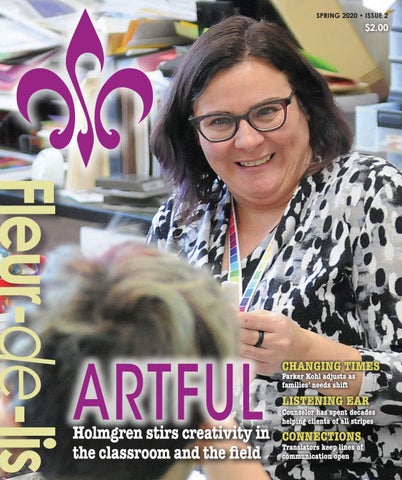
SPRING 2020 • ISSUE 2
$2.00
Fleur-de-lis
Artful
Holmgren stirs creativity in the classroom and the field
Changing times Parker Kohl adjusts as families’ needs shift
Listening ear
Counselor has spent decades helping clients of all stripes
Connections
Translators keep lines of communication open
contents
5 The advocate
Longtime therapist, mental health advocate marks 30 years of changing lives.
8 You be the judge
This woman may have stopped an uprising after police killed Sitting Bull
12 Vital links
Interpreters, cultural liaison bridge language gaps in the community.
16 Winter in all its glory
Taking time to notice the beauty of the season, despite the cold.
24 Life & death
Parker Kohl Funeral Home adjusts to clients’ changing needs.
28 Whirling around in art
Roosevelt Elementary’s Holmgren leads students through art.
on the cover:
Roosevelt Elementary School art teacher Wanda Holmgren smiles during class. Holmgren helped create the Virtures Trail with an Artists on Main Street Grant. (Nick Gerhardt/Faribault Daily News)
The Cathedral of Our Merciful Saviour is gorgeous any time of the year, but the blue skies and snow-covered church roof are a sight on a cold winter’s day. (Suzanne Rook/ Faribault Daily News)
Spring 2020
3
As night settles in, a wet, heavy Feb. 17 snowfall perfectly highlights the Rice County Courthouse, shown here from Fourth St. NW. (Suzanne Rook/Faribault Daily News)
This issue of Fleur de Lis is delivered to all subscribers of Faribault Daily News for the low cost of $1.00 per issue, deducted upon delivery from your account balance. If you decide it’s not for you, you can opt out of future issues by contacting customer service at 507-333-3111 or tzernechel@faribault.com. Non-subscribers can purchase copies of Fleur de Lis for $2.00
publisher: Chad Hjellming managing editor: Suzanne Rook regional director of advertising: Mark Nelson media consultants: CariAnna Chaney designer: Kate Townsend-Noet Send story ideas to:
Suzanne Rook at Fleur-de-lis srook@faribault.com Volume 3, Issue 2
Fleur-de-lis 2020 Published Winter 2020 by: Faribault Daily News • 514 Central Avenue • Faribault, MN 55021 • faribault.com ©
A leaf, sprinkled with textures, sits in a snowbank along the road in North Alexander Park. (Michelle Vlasak/Faribault Daily News)
4
Spring 2020
All advertising contained herein is the responsibility of the advertisers. This publication is copyrighted by the Faribault Daily News and no content can be reproduced without permission.
T
The advocate Longtime therapist, mental health advocate marks 30 years of changing lives
F
Story By Anne Kopas
or more than 30 years, Eric Lundin has changed the course of countless lives based on a single belief: every person deserves to be seen and heard. It’s a belief that drives Lundin’s work as an outpatient psychotherapist for the county, where he’s worked since July 1989. Since earning his licensure early in his Rice County career, he’s worked with clients of all ages and in numerous capacities, from people seeking help for depression to those making their way through the county’s treatment court program (also known as drug court). Thirty years of therapy work is especially impressive for someone who originally intended to become a music educator. After
growing up in Escanaba, Michigan, Lundin studied music at Northern Michigan University. But a personal experience with therapy led to the discovery that not only was Lundin fascinated by the process of learning about himself, but he also wanted to lead others through the same journey. This led him to a graduate degree in psychology, which turned into a job in residence halls at St. Olaf College and opportunities to work in the counseling department. After three years, Lundin jumped at the chance to take an open therapist position with Rice County and earn his licensure. He continued to live in Northfield with his wife, Cindy, and two nowadult children. Today, he sings in two local choirs, gives tennis lessons, participates in open-water swimming races and enjoys camping, hunting and fly-fishing. CONTINUES ON PAGE 6
uuu
Rice County Social Services Mental Health Supervisor James Marthlaer, front left, congratulates Eric Lundin on his 30 years of service with Rice County at a December Rice County Commissioners meeting. Lundin, he said, is the go-to person not just for clients, but for staff who need advice or a listening ear. Also pictured are Social Services Director Mark Shaw and County Commissioners Galen Malecha and Jake Gillen. (Daily News file photo) Spring 2020
5
Rice County Treatment Court, a voluntary alternative sentencing program for clients with chemical dependencies and have a high risk of reoffending. The county’s program was founded in 2014, based on statewide research showing that by allowing nonviolent drug offenders with diagnosed substance use disorders to enter a treatment court rather than going to jail or prison, they are less likely to end up in prison later. Clients spend anywhere from 18 months to two years in the program, completing a series of coursework and counseling focused on positive reinforcement.
Eric Lundin’s clients run the range of mental health concerns, including depression, anxiety and substance use disorders. Many of his clients are uninsured or face other barriers to mental health treatment, making the county’s services vital. (Anne Kopas photo) CONTINUED FROM PAGE 5
Throughout his work in Rice County, where he splits his time between Northfield and Faribault locations, Lundin has served as a generalist, which means he has to know “a little bit of everything,” he said. Depending on the client, this might mean marital, parental, family or individual counseling, as well as work with chemical dependency issues. Or, as is quite common, Lundin’s clients face several interacting concerns. Most of Lundin’s clients face barriers to treatment that lead them to county offices; many lack insurance or have high deductibles that make therapy unaffordable, or they’re undocumented immigrants. Clients with more secure health insurance situations, he said, typically seek help outside the county’s services. Some are referred by the social services or corrections departments. “The county has done a good job of creating a system of care that meets most of the needs of the clients in the community,” he said.
6
Spring 2020
Lundin sees about 30 clients a week, most dealing with depression, anxiety, post-traumatic stress disorder or personality disorders. For some clients, these overlap with chemical dependency. These concerns, said Lundin, are often tied to the challenges of poverty — though he can’t fix these external factors, he can give clients the tool to deal with these stressors. With all clients, Lundin’s most important job is building a relationship where the other person knows there’s someone available and willing to listen. “Every therapist will say it’s something else, that it’s the technique or philosophy or therapeutic bent, but in the end, the thing that changes clients is your relationship with them,” said Lundin. “They have to know you’re on their side at all times. They have to know you believe in them and you hold hope for them; that’s the most critical part.”
Commitment to Treatment Court One of Lundin’s major roles lies with the
“Every therapist will say it’s something else, that it’s the technique or philosophy or therapeutic bent, but in the end, the thing that changes clients is your relationship with them. They have to know you’re on their side at all times. They have to know you believe in them and you hold hope for them; that’s the most critical part.” – Eric Lundin As one of the court’s founding members, Lundin serves as a mental health counselor; other team members include a probation officer, judge, treatment coordinator, attorneys and others involved in both the health and legal aspects of a case. “The treatment court is another avenue in which we’ve been able to serve clients in a way that no one even thought about 10 years ago,” said Lundin. It’s a testament, he said, to the increasing attention to mental health within the corrections system. Rather than simply sending people to prison as punishment, the focus is on working with clients to address issues and giving them healthier tools with which to function in society. When people lack the tools to process difficult emotions, they are more likely to turn to drugs or other substances as coping mechanisms. The treatment court continues to
Rice County Social Services Mental Health Supervisor James Marthlaer, front left, congratulates Eric Lundin on his 30 years of service with Rice County at a December Rice County Commissioners meeting. Lundin, he said, is the go-to person not just for staff who need advice or a listening ear. Also pictured are Social Services Director Mark Shaw and County Commissioners Galen Malecha and Jake Gillen. (Daily News file photo)
expand, offering support for an oftenoverlooked population. Lundin’s early advocacy was crucial to the program’s current success, according to Yvette Marthaler, a social worker who also serves on the team. “Many participants would really say they value their work with Eric and his role in their success,” said Marthaler. In addition to providing diagnostic assessments along with both individual and group therapy for participants, Lundin serves as an all-around mental health resource and sounding board for the treatment court team, said Marthaler. The program, and other s like it, lead participants to spend less time in the criminal justice system, rand have been shown to significantly decrease recidivism rates. While mental health treatment is a significant component that’s vital to preventing a relapse, participants also benefit from being surrounded by a team of professionals to advocate for them and connect them to other county services. “I think the county as a whole made a commitment to treatment court, and it’s seen as a success throughout the state and nation. It takes a really big commitment from team members to go beyond their typical roles in the community, and Eric is certainly an example of that,” said Marthaler.
tions, jobs or other stressors and directing them toward the things they can control, like communication or conflict resolution styles. The key is that a client has to be ready and willing to change, said Lundin, before their lives can improve. As with any therapist, they must meet Lundin halfway before his work can take hold. Not everyone is ready for change, he said. Some may take weeks or months to reach a point where they’re capable of turning their lives around. All Lundin can do is let the person know — either verbally or through his friendly, accepting demeanor — that in his office, they’re truly seen, heard and valued. “I’m laying in the weeds. I’m waiting for them to be ready to talk about something, and you sometimes have to be very patient about how long to wait. As long as they’re coming back, something good is happening,” he said. Anne Kopas is a freelance writer based in Northfield.
‘Laying in the weeds’ As Rice County’s needs continue to shift, so do its services — and Lundin’s work. When he first earned his license, most clients were self-referred. Today, he said, most make their way to his office through other agencies like HealthFinders or the county’s corrections systems, largely due to increasing awareness of the mental health challenges faced in the county. Still, Lundin’s work is never finished. Abuse of opiates and methamphetamine continues to be a problem within the county, and the area still lacks access to the number of psychiatrists needed to prescribe medications to clients with serious mental health disorders. Lundin would also like to see a full-time parenting specialist added to the team to give extra attention to at-risk families. Regardless of his clients’ concerns, Lundin’s therapy is centered around affirming the strengths a person already possesses and teaching them the skills to think and act to effectively address their problems. This might mean practice with goalsetting, mental flexibility, expectation management and other cognitive skills. Sometimes, it’s a matter of helping clients recognize that they can’t always control the circumstances of their family situa-
TRUCKING & EXCAVATING Demolition Landfill Screened Black Dirt Scr Decorative Rock • Boulders • Mulch Excavating • Site Preparation Final Grade • Basements Demolition Work Septic Design & Install • Bobcat Work Mini Excavator Work 507.685.2222 www.timmstrucking.com 24366 Holland Ave Morristown, MN 55052
Spring 2020
7
Marie McLaughlin
This woman may have stopped an uprising after police killed Sitting Bull Story By Curt Eriksmoen
8
Spring 2020
Sitting Bull
D
id Marie McLaughlin, the niece of Alexander Faribault and an Indian agent at Standing Rock, prevent a major uprising in the early 1890s? I will lay out what happened and then let you be the judge. On the morning of Dec. 15, 1890, 39 Indian police officers approached the house of Sitting Bull to arrest the spiritual leader of the Hunkpapa Sioux. The police were sent on this mission by James McLaughlin, with
Chief Gall
the explicit order, “You must not let him escape under any circumstances.” At first, Sitting Bull agreed to go with the policemen, but then appeared to change his mind. A gunfight between the police and supporters of Sitting Bull took place, and a number of people from both sides were killed, including Sitting Bull. “The Sioux in the village were enraged” about the death of their spiritual leader, and 200 members of the Hunkpapa band left the reservation. Both the military and a large number of Native Americans believed that open hostilities would soon occur. Two weeks later, overzealous officers and soldiers of the 7th Cavalry Regiment, under the command of Col.
James McLaughlin
CONTINUES ON PAGE 10 u u u
BACKGROUND PHOTO: Standing Rock Reservation and Fort Yates.
Spring 2020
9
Sitting Bull (L) and Major James McLaughlin (R) at 1886 dedication of Standing Rock Agency. Standing Rock is named for a rock shaped like a woman with a child on her back. Photo from http://grantmcl.tripod.com/ James McLaughlin - Indian Agent
CONTINUED FROM PAGE 9
James Forsyth, massacred 300 Indians near the Wounded Knee Creek, on the Pine Ridge Indian Reservation in present-day South Dakota. Over 200 of the Indians who died were women and children. However, a large uprising on the part of the Sioux/Dakota never materialized, which was documented by a report from Valentine McGillycuddy, the former Pine Ridge Indian agent. A month after Sitting Bull died, he wrote, “No citizen in Nebraska or Dakota has been killed, molested, or can show the scratch of a pin, and no property has been destroyed.” To launch an uprising that had any modicum of success during the early portion of it would need a strong leader who could unify the rebelling Indians. Chief Gall was such a leader at the Standing Rock Reservation. Sitting Bull had been his mentor and “he had been Sitting Bull’s chief lieutenant.” Reportedly, there had been efforts made by disgruntled Sioux to recruit Chief Gall, and he was considering it. According to Mary Collins, a teacher and congregational church missionary on the Standing Rock Reservation, Marie McLaughlin confronted Gall. She told him, “Gall, I am fairly disgusted with you. You have known me for over 10 years now and did I ever tell you a lie? And you hear about Agent McLaughlin and all those things runaway Indians tell, and you feel half inclined to join them yourself.”
10
Spring 2020
Marie concluded by cautioning Gall not to fall in with those who would make more trouble. Chief Gall, out of his deep respect for Marie, may have taken her advice and remained loyal to the McLaughlins. It was later written, “Gall became James McLaughlin’s favorite Indian leader at Standing Rock. He adopted many of the white man’s ways, serving as a district farmer and a judge on the Court of Indian Offenses.” Marie, who was one-quarter Sioux, was a great asset to her husband on the reservations where he served as agent. She spoke the Sioux language fluently, assisted in carrying for the ill, taught the women many domestic skills and even adopted a Native American child who had lost her parents. She “had become a mother to the Indians because of her warmth and personality.” It was also written, “Sitting Bull’s groups affectionately referred to Marie as mother, or Ina, a clear indication that they viewed her as a relative and thus a good Dakota.” Marie Louise Buisson was born on Dec. 8, 1842, in Wabasha, Minn., to Joseph and Lucy Nancy (Graham) Buisson. Marie’s father, Joseph, along with her maternal grandfather, Duncan Graham, founded – Marie McLaughlin Wabasha and named it after Chief Wapasha I, grandfather of Graham’s wife. In 1815, Graham established a trading post along the shores of Devils Lake and was the first white person to live in the area. Marie’s mother, Lucy, was about 7 years old at the time and had many memories to share with her daughter about her experiences there. Little did Lucy realize that, over 50 years later, she would once again be living in the area of her childhood. In the mid-1840s, Joseph Buisson went to work for the American Fur Co., headquartered in Mendota, Minn., and he moved his family there. When Marie was 14,
“Gall, I am fairly disgusted with you. You have known me for over 10 years now and did I ever tell you a lie? And you hear about Agent McLaughlin and all those things runaway Indians tell, and you feel half inclined to join them yourself.”
she was sent to school at Prairie du Chien, Wis., and after graduation, she returned to Mendota. In 1863, Marie met James McLaughlin, who was born and raised in eastern Ontario, and was working odd jobs in the Mendota area. James and Marie fell in love and were married on Jan. 28, 1864. The McLaughlins lived in Owatonna for four years and then in Faribault for three years, where James went into business as a blacksmith. While there, they learned that William Forbes, who was married to Agnes (Faribault) Forbes, one of Marie’s cousins, had been named Indian agent for the Devils Lake Indian Reservation. Since the agency would need a blacksmith, James was hired. Another cousin of Marie’s, George Faribault, Agnes’ brother, was hired by Forbes to be the agency farmer. In July 1871, the McLaughlin, Faribault and Forbes families, along with Lucy Nancy Buisson, journeyed to Devils Lake, where they were met by Antoine and Mary Jane Buisson, two of Marie’s siblings. Marie was quickly accepted by all of the Native Americans living on the reservation. In 1875, William Forbes died, and James was named as his replacement. With Marie’s assistance, James became one of the most respected agents in the country. In 1880, Chief Gall, one of the Indian heroes at the Battle of the Little Bighorn, brought 250 of his starving followers down from Canada, where they had fled to after the battle, and surrendered. They were transported to the reservation at Standing Rock on May 21, 1881, and the Commission of Indian Affairs knew they needed an extraordinary agent to oversee these once hostile followers. The commission reasoned that if they chose James, Marie would be assisting him, so they offered him the position. In June, the McLaughlins eagerly accepted the offer. Gall and his followers feared that they would be treated as prisoners at the reservation, but because of the kindness and concern shown by Marie, many indicated that they felt like returning prodigal children. Gall was so impressed with the treatment his followers received that he encouraged his people to follow all of the instructions given by the McLaughlins, and he also converted to Christianity. Later in 1881, Sitting Bull and his followers also surrendered and, eventually, were also placed at Standing Rock. Sitting Bull’s followers also appreciated the way they were cared for by Marie. Largely because of the unexpected, relative tranquility that followed the killing of Sitting
Chief Gall
Bull, James was promoted to Inspector for the Indian Department, within the Department of the Interior in Washington, D.C. Since James would be traveling most of the time, Marie believed she would be the happiest and most productive remaining with the Native Americans, the people she knew, trusted and loved, so she remained on the Standing Rock Reservation. In 1916, she wrote the book “Myths and Legends of the Sioux,” and she died on Aug. 5, 1924. “Did You Know That” is written by Curt Eriksmoen and edited by Jan Eriksmoen of Fargo.
View of Sioux Chief Sitting Bull’s camp at the Standing Rock Agency south of Fort Yates, in Sioux County, North Dakota. 1880s. Photo by D.F. Barry. Source - Denver Public Library.
Spring 2020
11
Vital links
Cultural liaisons at Faribault Public Schools are pictured at the Faribault Education Center from left: Abdi Abdullahi, high school cultural liaison; Kuresha Dolal, FEC cultural liaison; Jaime Lizola, cultural liaison; Zulema Nieves, middle school cultural liaison; Sam Ouk, district multilingual and equity coordinator; and Dora Mata, REC cultural liaison. Not pictured: Mohamed Mohamed, cultural liaison. (Misty Schwab/Faribault Daily News)
Interpreters, cultural liaisons bridge language gaps in the community
F
aribault is diverse in the sense that not everyone speaks English. Some are fluent in American Sign Language, particularly on the Minnesota State Academy for the Deaf campus. Others, many of them immigrants, are fluent in languages like
Somali and Spanish. For these residents, communicating
12
Spring 2020
Story By Misty Schwab often requires jumping through a series of hoops most English speakers may never have considered.
A conceptual language Most spoken languages are linear, but Minnesota State Academies Superintendent Terry Wilding, who is deaf, explained via interpreter that ASL is more of a conceptual language. Translating ASL to English, he said, is like trying to describe what’s
happening in a movie scene without the listener looking at the screen. What’s tricky is not everyone would describe the scene in the same way. “When you play piano, each key changes the meaning of music,” Wilding explained. “One facial expression can mean something different, so one word doesn’t equal one sign.” To ensure an interpreter uses the right words to translate ASL to English, they often work as a team of at least two. That
way, the main interpreter has someone to provide a second opinion, if needed. Working in groups also allows an interpreter a break; if a conversation lasts a while, they can take turns. Otherwise, Wilding explained, interpreters can experience burnout. Being an interpreter requires more than fluency in ASL. Historically, Wilding explained that many interpreters were children of deaf parents who grew up knowing the language. These days, most interpreters go through training and obtain a four-year bachelor’s degree. In his own experiences, Wilding recalls times when English-speakers have underestimated the skill set required of interpreters, which not all ASL users have. If someone who simply knows ASL is asked to translate, it could lead to disastrous consequences, like legal documents inscribed incorrectly. All seven MSAD interpreters are nationally certified, and has a code of ethics to follow. All of them, said Wilding, do the full range of interpreting jobs on campus while some may specialize in hospital settings. It’s extremely important, Wilding explained, that interpreters only take jobs on or off campus if they feel equipped to sign in that setting. Wilding said it’s also pertinent for interpreters to receive prep material before
Jeff Prail of UbiJobs demonstrated how an UbiDuo device works at an MSAD Deafopia event in 2019. For short conversations, sometimes an UbiDuo is a preferred tool for deaf individuals. (Misty Schwab/Faribault Daily News)
interpreting meetings, and for them to schedule buffer time. When translating English to ASL, an interpreter needs time to first hear the message and then sign it. For that reason, a deaf person attending a meeting among hearing individuals may receive a message a few seconds after everyone else in the room. When interpreters know the message in advance, they stay organized and ensure everyone can ask
questions and participate equally in the group discussion. If both deaf and hearing individuals are present at a business meeting, Wilding said a company is legally responsible to provide a translator. Not everyone is aware of this, said Wilding, so he and other members of the deaf community often find themselves educating others about this requirement. In any translated conversation, Wilding emphasized the importance of making eye contact with the signing person, not the interpreter. The role of an interpreter is not to “help” a deaf person communicate, he added, but to translate.
Cultural liaisons
Minnesota State Academies Superintendent Terry Wilding presented, through an interpreter, to the Minnesota Senate Capital Investment Committee about the facilities bonding requests from the Academies for the Blind and the Deaf in 2018.(News file photo)
At Faribault Public Schools, where the English Learner population has grown exponentially in recent years, specific staff members have been hired to not only close the language barriers but to create understanding between differing cultures. Dora Mata and Kuresha Dolal are two cultural liaisons employed at the Faribault Education Center. Mata speaks both Spanish and English while Kuresha is fluent in both Somali and English. In her work as in interpreter, Mata doesn’t translate word for word but instead conveys the message using the appropriate terms. With experience and practice it CONTINUES ON PAGE 14 u u u
Spring 2020
13
Representatives from Sorenson Communications showed 2019 Deafopia attendees how a Sorenson Video Relay Service works at MSAD. (Misty Schwab/Faribault Daily News)
in some cases fight back tears. “You’re part of the conversation, so you know what’s going on,” said Mata. “You feel sorry for [the families], but at the same time, you learn so much.”
Bridging cultures The role of a cultural liaison is about more than just translating one language to another,but to help two differing cultures form an understanding. In fact, over the years, “translator” has become more of a correctly. CONTINUED FROM PAGE 13 secondary role for both Mata and Dolal. Both try to use familiar words for the Sam Ouk, Faribault Public Schools’ families to understand, and if they have comes easily, she said, particularly when multilingual and equity coordinator, said questions, the parents often call Mata or relaying information about the schools, cultural liaisons work some of the longest Dolal to verify they which she’s heard repeated many times hours in the understood the mesbefore. What’s more difficult is translating district. They sage. subjects less familiar to her, like courtroom not only spend Mata said when terminology. time on campus she began working Dolal added that, before translating but make house as an interpreter, it a written document, she talks with staff visits and anwas especially hard in a group to make sure she uses the best swer calls from to translate difficult words. She also talks with teachers before parents in the family situations. She translating information to Somali families evening hours had to be strong, and to make sure she understands the message and over the weekend. “It goes beyond academic support,” said Ouk. “These two – Kuresha Dolal and the rest of the liaisons do it all.” Mata has lived in Faribault for 25 years and worked in the district over seven years. She sees families at school, church and also pays visits to their neighborhoods not just to assist them in crisis situations, but to celebrate their cultures with them. A goodly portion of her work involves scheduling doctors’ appointments. Dolal started as a volunteer with the Somali community at Faribault Public Schools. The district needed someone fluent in Somali to serve as an interpreter, so she’s been a part of the district for around 15 years. Programming has expanded for minority groups over the years. Faribault High School students Part of Dolal’s role as a cultural liaison have worked with adult English language learners at the Faribault Education Center, helping is not only to interpret language but to them learn to use their electronic devices. (Photo courtesy of Faribault Public Schools)
“We also have diversity training once in a while. Staff want to know more about other cultures so they understand better. Sometimes we go in depth to provide conflict/ resolution.”
14
Spring 2020
Cultural Liaison Dora Mata believes there are more opportunities than in previous years for minorities to celebrate their cultures in Faribault. One such example is the Know Your Neighbors festival held annually in Central Park. (News file photo)
educate Somali families about U.S. culture. She arranges transportation for families, provides them with resources to the appropriate medical or financial services, and helps schedule appointments. She also also informs families of school closings in the wintertime and encourages parents to become more active in their child’s education.
TECHNOLOGY’S ROLE In the 1970s, the TTY (TeleTYpe) system was invented as a means for deaf and hard of hearing individuals to communicate. Users could type messages, which would then go through a coupler to a phone.
“What both bring is personal experiences, and they educate staff as well,” said Ouk.
Relating to their clients Mata moved to Texas from Mexico when
to communicate using video equipment instead of typed text. Video calls through this service are free of charge, and once a caller dials in, an interpreter becomes available to relay the conversation.
More recently, Video Remote Interpretation (VRI) has become more widely used as a communication tool for deaf and hearing individuals in the same location. An interpreter In today’s world of becomes available by way of technological advances, more computer, using a webcam. devices than ever before While a hearing person may serve as communication tools view a VRI as a quick and easy for deaf individuals. While way to communicate with these devices are useful, someone who is deaf, Wilding Wilding explained they aren’t appropriate for every occasion. said a VRI doesn’t always match the need. For example, A Video Relay Service (VRS) when his dad, who is also deaf, allows those who are deaf came out of surgery, he wasn’t
as an 18-year-old, but she said transitioning from Texas to Faribault in 1995 was more difficult. Her brother already lived in Faribault at the time, but few community members shared her Mexican heritage. She recalls the difficulty of finding a grocery store, a church and a bank.
able to look at the VRI screen. A live interpreter would have been the preferred service in that instance. A large group discussion is another situation better served with a live interpreter, not a VRI. Another device, the UbiDuo, is a two-way communication system used for face-to-face interactions between deaf and hearing individuals. Working as a quicker alternative to pen and paper, the device has a split screen so users can read both sides of the conversation in real time. The UbiDuo, said Wilding, works well for 10- to 15-minute conversations, but an eight-hour session could fatigue the eyes. Technology like Google Translator has played a role in
CONTINUES ON PAGE 31 u u u
Dora Mata and Kuresha Dolal’s work as cultural liaisons. Mata said the service has improved in recent years and laughs as she recalls how horrible it was at first. In worst case scenarios, the translator would turn an innocent sentence into something offensive. Dolal agreed Google Translator “still needs work,” but it’s improved from before. When Mata and Dolal translate written documents, they first use Google Translator and then edit the material. This saves both of them time they didn’t have before Google Translator. Mata also likes that today’s technology allows her to send group texts to families rather than calling each household individually.
Spring 2020
15
Winter in all its g Taking time to notice the beauty of the season, despite the cold Story By Suzanne Rook
16
Spring 2020
Photos By Michelle Vlasak, Suzanne Rook & Tim Madigan
s glory
I The sun casts a wispy shadow of a tree along the bank of the Cannon River as a group of swans floats by. (Michelle Vlasak/Faribault Daily News)
supposed I was always destined to write. And live in a place with plenty of snow. After all, my very first published piece came in 1967, when I was just 6 years old. My school — or its Parent Teach Organization — in central New Jersey held some sort of writing contest in which students submitted their work and several were chosen for publication. My poem was one of those published in a newsletter to parents. Of course, my mother saved that page. Now yellowed, it’s carefully tucked in a “School Days” scrapbook on a shelf in my family room. If I try really hard, I can almost smell the blue ink from the ditto machine. My topic? Snow, of course. Snow is fun. Snow is white. You can play in snow tonight. I don’t remember writing that three-line ditty, but I sure do remember how big of a deal my parents made about being published, even if it CONTINUES ON PAGE 18
FAR LEFT: A Least chipmunk, the smallest of all chipmunks, sits and waits next to its underground burrow. (Michelle Vlasak/Faribault Daily News) LEFT: A Least chipmunk peeks out of its underground burrow that consists of dried grass, bark, fur, feathers and soft vegetation. (Michelle Vlasak/ Faribault Daily News)
Spring 2020
17
ABOVE RIGHT: A bald eagle sits atop a tree along Highway 60 east of Faribault. (Michelle Vlasak/Faribault Daily News) NEXT PAGE BOTTOM: A female Downy woodpecker searches for food in a tree trunk. The downy woodpecker is the smallest species of woodpeckers in North America. (Michelle Vlasak/Faribault Daily News) CONTINUED FROM PAGE 17
only went to a few hundred parents in central Jersey. Why I chose to write about snow, I’ll never know for certain, though I’m guessing it was written following a sizable snowfall, one in which my brothers and I likely made snow angels and built forts to ward off the invaders (neighbor kids) that might amble CONTINUES ON PAGE 20 u u u
18
Spring 2020
Spring 2020
19
CONTINUED FROM PAGE 18
down Dogwood Court. It was a simpler time, a time when my biggest worry was which of my four younger brothers might decide to crash my tea party. But it was also a time when I didn’t jump from my car at Fareway to take a photo of snow falling on the courthouse, the street lights illuminating its beauty. When I didn’t revel in the blue skies; the evergreen branches hanging heavy from the prior evening’s snow; looking as if someone had painted them with frosting or wish call my mother just one more time to tell her how gorCONTINUES ON PAGE 22 u u u
TOP: An 8-inch snowfall Feb 9 made River Bend Nature Center’s trails just about perfect for cross-country skiers the following morning. (Photo courtesy of Tim Madigan)
20
Spring 2020
Hoarfrost collects on a branch Monday, Feb. 10. According to Accuweather, “frost and hoarfrost can only form when the air and objects are at or below freezing.” (Suzanne Rook/Faribault Daily News)
TOP: The snow-laden branches of these evergreens nicely frame a home on Fifth Street NW. (Suzanne Rook/Faribault Daily News) An American crow balances on a piece of snow. Some crows migrate short distances, but many remain on their territories throughout the winter months. (Michelle Vlasak/Faribault Daily News)
MIDDLE: A small, but mighty twig stands among many layers of snow and ice on the ground in South Alexander Park. (Michelle Vlasak/Faribault Daily News) BOTTOM: Snowmobile tracks create a walking path for visitors along the grounds of South Alexander Park. (Michelle Vlasak/Faribault Daily News) Spring 2020
21
SHARE YOUR PHOTOS
ABOVE: Tony Langerud, back right, reacts excitedly during a game of heads or tails at the Feb. 15 Ruth’s House of Hope Hearts Gala. The event raised $122,000 to help operate the shelter and to make repairs and enhancements to the historic property. (Suzanne Rook/Daily News file photo)
If you’ve got a great photo of local people or places, we’d love for you to share it with us for the spring edition of Fleur-de-lis, set to publish in early June.
RIGHT: Amy Ford, left and Kim Halvorson, made their bids on a couple of desserts donated and put up for auction at the Ruth’s House of Hope Hearts Gala Feb. 15. (Suzanne Rook/Faribault Daily News)
To do so, send high-resolution jpgs to Editor Suzanne Rook at srook@faribault.com by May 8. Be sure to include your name and a description of the photo.
geous southern Minnesota looks all covered in white. In journalism there’s always somewhere to be, some story to tell. Slowing down isn’t in my nature, but I’m working on letting my 6-year-old self remind me about priorities.
22
Spring 2020
CONTINUED FROM PAGE 20
ABOVE: Seeds of a tree adorn the gray January skies on Shattuck St. Mary’s campus. (Michelle Vlasak/Faribault Daily News) LEFT: Patches of snow stick to the side of a brick wall along the road leading through the Shattuck St. Mary’s campus by Fayfield Hall. (Michelle Vlasak/Faribault Daily News)
Spring 2020
23
Parker Kohl Funeral Home adjusts to clients’ changing needs
T
Story By Nick Gerhardt he Parker Kohl Funeral Home is like many in the country that are experiencing a change in how people think of funeral services. The Parker family’s involvement in the funeral home business goes back to the 1870s, first as the Ray Funeral Home, which was later taken over by David Ray’s daughter, Flora Ray Parker, and her son John. The Faribault funeral home also dates to the
24
Spring 2020
1870s while the Kohl family’s presence in Faribault dates to 1943. The Kohls, Ed and Gert, arrived from Blooming Prairie where they ran a funeral home starting in the 1930s. They moved to Faribault in 1943 and purchased the McCarthy Funeral Home, where Unity House now stands on Second Street. Ed and Gert’s son, Jim, joined the family business in 1965 and in 1978 purchased the Parker Funeral Home. Now brothers John and Steve run the Parker Kohl Funeral Home and Steve’s son, Jake, became the fourth generation of the family to join the business. The Kohl family, with a fourth generation of family working for the business and the family has worked to adapt to the changing industry.
Changing nature of funeral homes According to the state Health Department, there are only about 1,000 morticians around the state. In the past five years, around 150 morticians have left the business. The University of Minnesota is the only school in the state that has a mortuary science program and class sizes have dwindled to around 25 a year. The Kohl family got proactive back in 2016 when they started planning for a new funeral home that they opened in 2017 at 1725 Lyndale Ave. in Faribault. “When John and I first got started, more of our funerals were traditional funerals,” Steve said. “By traditional I mean casket and burial. Cremation has become more popular. You’re doing all sorts of ceremonies. I think the term celebration of life has become more common in explaining a type of service a family wants to have. It’s not traditional as much any longer. All kinds of different services families want, it could be at a funeral home, it could be at a park, it could be at a social hall, a restaurant, it’s really what families want to do. That’s why we saw the need for our building. We could see that our business was changing. We needed to be able to offer that facility so families could do what they wanted.”
The McCarthy Funeral Home is original funeral home the Kohl family purchased in Faribault back in 1943. The Kohl family has remained in the funeral home business since. (Photo courtesy of Parker Kohl Funeral Home)
The Kohls say cremations make up around 40-45 percent of their business these days. Statewide, cremations make up closer to 70 percent of services, Jake added. When the Kohls constructed their new building, they added more space for a reception area, for their service area, they created a multipurpose space that can be expanded or contracted to fit the needs of the service. “Now with cremation, it’s more, ‘What did your mom or dad like to do?’” John said. “There are a lot of video tribute slides we produce for families.” The family also added a pet cremation
service for families in the new building and have seen an increase in people wanting to say goodbye to their pets in a more formal way. But much of the business remains the same and maintaining quality relationships with the community. “The thing you have to remember is you’re dealing with families at their most vulnerable time,” Steve said. “Helping them make good decisions is probably the best thing we can do. It’s not a cookie cutter business by any means. It’s different every time. You just have to be sensitive to CONTINUES ON PAGE 26 u u u
TOP PREVIOUS PAGE: Steve Kohl, far left, Jake Kohl, center, and John Kohl, right, are the third and fourth generation of the family to work in the family business. Brothers Steve and John run the business now. (Nick Gerhardt/Faribault Daily News) LOWER LEFT PREVIOUS PAGE: Photos from the Kohl and Parker families line a wall at Parker Kohl Funeral Home. The Kohl family retained the Parker name even after moving the building in 2017. (Nick Gerhardt/Faribault Daily News) Spring 2020
25
CONTINUED FROM PAGE 25
(the families”) and help them say goodbye in the way that they want to.”
Getting into the family business Steve knew he wanted to get into the family business by the time he entered his senior year of high school. John ventured into the financial world before returning to Faribault and the family business. Jake attended Gustavus Adolphus University and got a degree in athletic training degree before attending mortuary school at the University of Minnesota. “Our dad never expected us to do this
26
Spring 2020
and I think that’s added to the value of what we do here because we’ve wanted to do it,” John said. “So many generational businesses people are forced to do it and they hate it and they leave or the business goes bad. With that in mind, our dad let us choose which direction we wanted to go.” All three noticed differences in the time they spent at mortuary school: smaller class sizes and a shifting demographic. When Jake graduated in December 2017, he said the 2018 class had around 18 students and of that, 70 percent were female students. When John went to mortuary school, it was 60 percent male and for Steve, it was closer to 90-95 percent male back in 1987. “We’re in a field where you can get a job anywhere,” Steve said. “There’s a demand,
there’s a shortage of funeral directors. It’s going to be an issue at some point. It’s going to be something that needs to be addressed.”
Not a 9 to 5 job As the most recent family member to join the business, Jake sees the hours being a drawback for younger people. It is a 24-hour-a-day, seven-day-a-week job because you never know when a phone call is going to come. Growing up in that environment helps teach what that really means. “He was coming and going all the time,” John said. “This is part of the life. A lot of weekends and nights. He did everything he
ABOVE: The chapel at Parker Kohl Funeral Home can hold up to 200 people. (Daily News file photo) LEFT: Parker Kohl Funeral Home’s reception area is equipped with a kitchen, a fireplace and a larger space to host up to 150 people. (Daily News file photo) The Kohls, John, left, Jake, center, and Steve, right, have remained in the family business of running the Parker Kohl Funeral Home in Faribault. Jake is the fourth generation Kohl family member to join the business. (Nick Gerhardt/Faribault Daily News)
could to be there. He knew he was being called somewhere else. That’s the toughest part of this business is the time.” John and Steve also saw the respect the community showed him when they were out in public. “Growing up, seeing our dad, we
TIMES THEY ARE A CHANGIN’ Some 150 morticians have left the profession in the last five years alone, mostly to
knew what he did but every once in a while, you’d get a glimpse of how he’d talk with families,” Steve said. Reach Sports Editor Nick Gerhardt at 507-8355447 or follow him on Twitter @WCNSports. Minnesota Public Radio News’ John Enger contributed to this report ©Copyright 2020 APG Media of Southern Minnesota. All rights reserved.
retirement, according to the state Health Department. Currently, there are about 1,000 morticians in Minnesota.
in the 1980s and ‘90s when the U graduated more than 50 morticians a year. Now, it’s about half that.
The University of Minnesota, the only school in the state with a mortuary science program, isn’t producing enough students to keep up. Enrollment peaked
Turning that around means recruiting and winning over young people to a vital but difficult vocation, one that society seems to value only in
its darkest hour. It’s an especially hard challenge in rural Minnesota, where the work involves responding to middle-of-thenight calls and long drives in sometimes-treacherous weather.
Spring 2020
27
art around in
Roosevelt Elementary’s Holmgren leads students through art
R
28
Spring 2020
Story By Nick Gerhardt oosevelt Elementary School art teacher Wanda Holmgren is a maestro, conducting a flurry of activity each day in her classroom. It’s a brief symphony as classes rotate in and out
every half-hour throughout the day but it’s a brilliant one as students experience different aspects of art. Leading an elementary school arts class can mean some corralling and prodding but it’s also rewarding for teacher and pupil. “Arts are an outlet for kids so they can express things that are going on in their lives or things that they don’t get to verbalize,” Holmgren said.
Holmgren has taught for 22 years, with the past five years in the Faribault district. Every day in the classroom is a little different for Holmgren and with eight half-hour teaching sessions, so is each class at the kindergarten through fifth grade school. This year the amount of classroom time shifted so Holmgren implemented seven different studios for students to work in each day. The studios involve an aspect of art, like the fibers studio where students work with yarn or weaving or sewing. The idea stemmed from a movement in the art education world, “Teaching Artistic Behaviors,” and it fits in Holmgren’s classroom. “It’s giving the kids more choice in what they make,” Holmgren said. “As we get further into it, they’ll come up with
Wanda Holmgren, an art teacher at Roosevelt Elementary School in Faribault, speaks with students in her classroom. Holmgren has spent the 22 years as an art teacher. (Nick Gerhardt/Faribault Daily News)
their own ideas and try to make them. If they fail, they remake them and get feedback from others.” One of Holmgren’s favorite sayings in the classroom is “We can do hard things.” In a way, it challenges students to try different things, especially things they aren’t necessarily geared to do well.
“It’s giving the kids more choice in what they make. As we get further into it, they’ll come up with their own ideas and try to make them. If they fail, they remake them and get feedback from others.” – Wanda Holmgren “I think the kids are more engaged because they don’t all have to do the same thing,” she said. “They’re learning in different ways. A kid is not going to be successful in every place in this room. That’s important for them to understand, too.” Outside of the regular classroom hours, Holmgren teaches Falcons After School, a program designed for students who need additional support. On Tuesdays and Thursdays she holds Arty Party where students can do different art activities to help express themselves.
Holmgren also got involved with The Virtues Project-Faribault and designed 20 signs for the Virtues Trail in Heritage Park through an Artists on Main Street grant. It was her first venture into public art after beginning as a large-scale oil painter. The trail, which runs along the Straight River, features 10 posts with 20 virtues emblazoned on them. Those walking along the trail can see themselves in a mirror along with a different virtue. The virtues are written in English, Somali and Spanish. “The Virtues thing was my first foray into public art and it has more of a social purpose,” Holmgren said. “I really enjoyed that project.” Fifteen artists received an Artists on Main Street Grant through the Faribault Chamber of Commerce, which was one of three communities to receive the Artists on Main Street grant, a partnership between the Preservation Alliance of Minnesota, and Springboard for the Arts with support from the Bush Foundation. Holmgren’s proposal stood out to the panel of Faribault Chamber of Commerce Main Street Coordinator Kelly Nygaard, Paradise Center for the Arts’ Julie Fakler and city of Faribault employee Kim Clausen because it fit in to the “perceptions” initiative the panel conceived with the public art displays. “It was bright and it was colorful and it was going to be tri-lingual,” Nygaard said. “It really resonated so well with what we outlined it seemed like a natural fit.” The project had to overcome some barriers because it needed approval from the Economic
TOP: A student learns the color wheel by painting different colors on a worksheet in Wanda Holmgren’s art class. Holmgren has different studios set up in her classroom for students. (Nick Gerhardt/Faribault Daily News) ABOVE: Students work on constructing items during a class in Wanda Holmgren’s Roosevelt Elementary School classroom. Holmgren has taught art for 22 years. (Nick Gerhardt/ Faribault Daily News) PREVIOUS PAGE: Artist Wanda Holmgren with her “determined” post at the Virtues Trail opening at Heritage Park. (Daily News file photo)
CONTINUES ON PAGE 30 u u u
Spring 2020
29
Students in Wanda Holgren’s art class at Roosevelt Elementary School in Faribault work on creating different items. Students rotate through different studios throughout the week. (Nick Gerhardt/Faribault Daily News)
Art, music, physical education and media teachers put on the first Flashlight Reading Day at Roosevelt Elementary School. Pictured from left to right, John Scheil (physical education), Jillian Specht (physical education), Wanda Holmgren (art) and Brenda Gare (music). (Daily News file photo) CONTINUED FROM PAGE 29
Faribault elementary art school teacher Wanda Holmgren helped with art with the Faribault Virtues Trail. The pieces were installed in 2018. (Nick Gerhardt/Faribault Daily News)
30
Spring 2020
Development Authority and concerns about the maintenance of the installations. Still it came in on time and on budget, Nygaard said. “I think Wanda had a lot of passion for the project,” Nygaard said. “I know it’s inspired other projects and take that back to their own community.” Holmgren’s taken time to display students’ artwork in different venues like helping to create the Roosevelt Fine Arts Night, where each student in the school had their artwork dis-
played in the gymnasium. Money raised from the event went to the Parent Teacher Organization to help pay for field trips or other events. Her work with students has gone outside of the art world, too. In the past she helped take part in Flashlight Reading Day at Roosevelt where students got to read in a campsite-like setting in the school gymnasium. Specialist teachers read to students and older students read to younger students during the event. Reach Sports Editor Nick Gerhardt at 507-835-5447 or follow him on Twitter @WCNSports. ©Copyright 2020 APG Media of Southern Minnesota. All rights reserved.
CONTINUED FROM PAGE 15
expanded programming and resources. “We also have diversity training once in a while,” said Dolal. “Staff want to know more about other cultures so they understand better. Sometimes we go in depth to provide conflict/resolution.” Since moving to Faribault, Mata said she’s noticed the community offering more opportunities to celebrate cultural differences, whether it’s through holidays like Cinco de Mayo or Dia de los Reyes (Three Kings Day). “The community is doing more, giving us opportunities to come together in celebrations,” said Mata. “It’s nice to see all cultures get together in celebration of food and dancing.” One way Somali parents are becoming more involved in the larger community is by providing ethnic dishes to share at parent teacher conferences, said Dolal. The plan is to eventually bring Somali parents to the existing PTA meetings so their voices can be heard and they can start to feel integrated in the community. At the district, Ouk pointed out the schools celebrate surface-level cultural differences more than before, with a henna
Those first five years in Faribault were difficult, Mata admitted. She felt like an outsider, unsure how to get to know people and interact with another culture. After 2000, Faribault became home to more residents from Spanish-speaking countries. Mata could then celebrate familiar traditions with others. Now, Faribault is home for Mata. She doesn’t see herself moving again. Dolal had already learned English in Kenya before emigrating to the U.S., but those who came before her still helped her know where to find help. In her own experience of living in the metro area before moving to Faribault, Dolal recalls taking a city bus for the first time without knowing she needed coins — not bills — to pay for the service. As another surprise, she received a large bill from a clinic; she had thought the visit would be free. Over the years, the Faribault School District has needed to adjust to the needs of its student population with not only more multilingual staff members but also
“I always learn something new every day, either with families, meetings or trainings. It’s a great job. I really love to do it because I care for these families.” – Dora Mata
club and a K-Pop club at the high school. But, he thinks there’s more work to be done to get to the deep level of understanding from one culture to another. “I always learn something new every day, either with families, meetings or trainings,” said Mata. “It’s a great job. I really love to do it because I care for these families.” Reporter Misty Schwab can be reached at 507-333-3135. Follow her on Twitter @APGmisty. ©Copyright 2020 APG Media of Southern Minnesota. All rights reserved.
Come visit southern minnesota’s best performanCe venue! WE'RE HERE ALL YEAR AT TAX TIME, OR ANY TIME.
WE UNDERSTAND YOU DON'T THINK ABOUT TAXES ALL YEAR - BUT WE DO.
Enjoy live theater, concerts and visual arts in Historic Faribault’s beautifully restored 1890s opera house.
At H&R Block, we're available year-round to discuss the tax implications of your life-changing events. From wedding bells, babies and new homes to medical issues and natural disasters, we're here to put our expertise to work for you.
AVAILABLE AT PARTICIPATING OFFICES.
Paradise
A
Center Cent er rts for or the
15-485
320 4TH ST NW, FARIBAULT, MN 55021 507-334-8888
507.332.7372 HRBLOCK.COM OBTP# B13696 ©2015 HRB Tax Group, Inc.
321 Central Ave N Downtown Faribault
www.paradisecenterforthearts.org Spring 2020
31
t l u a b i r a F O MINNES
TA
Crafting American Stories
MARCH
28
Jivin’ Ivan and the Kings of Swing – Signature Bar and Grill
APRIL
17 24 25
Bruce Burniece –
Vintage Escapes Winery
Walter Salas-Humara
– Paradise Center for the Arts
Elisha Marin
– Paradise Center for the Arts
MAY
2 2 2 29
Maple Syrup Fun Run – River Bend Nature Center
Big Hats Big Hearts – Paradise Center for the Arts
Old Country Boys – Channel Inn
Annie Mack – Paradise Center for the Arts
Like us on Facebook facebook.com/FaribaultTourism/
visitfaribault.com