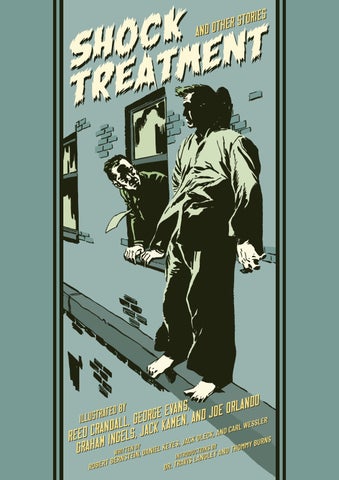
Shock Treatment And Other Stories

Page 1


AND OTHER STORIES AND OTHER STORIES

SHOCK TREATMENT

SHOCK TREATMENT

ILLUSTRATED BY

ILLUSTRATED BY

REED CRANDALL, GEORGE EVANS, GRAHAM INGELS, JACK KAMEN, AND JOE ORLANDO

REED CRANDALL, GEORGE EVANS, GRAHAM INGELS, JACK KAMEN, AND JOE ORLANDO

WRITTEN BY

ROBERT BERNSTEIN, DANIEL KEYES, JACK OLECK, AND CARL WESSLER WRITTEN BY

ROBERT BERNSTEIN, DANIEL KEYES, JACK OLECK, AND CARL WESSLER

DR. TRAVIS LANGLEY AND THOMMY BURNS INTRODUCTIONS BY DR. TRAVIS LANGLEY AND THOMMY BURNS INTRODUCTIONS BY

JACK SHOCKS THOMMY BURNS

It

has long been shorthand EC history that the Picto-Fiction line was introduced after the collapse of EC’s New Direction comics line as a way to avoid the Comics Code.

While the Picto-Fiction magazines did indeed avoid the Code’s censorship, that simplified timeline is misleading. As Roger Hill points out in the Shock Illustrated volume of The Complete EC Library (Gemstone Publishing, 2006), “Shock Illustrated , EC’s first magazine in the PictoFiction format, was cover-dated October 1955, a full four months before their last comic book, Incredible Science Fiction 33, which was coverdated February 1956.” Shock ’s cover date also closely aligns it with the fourth and final issue of Psychoanalysis, which is dated September–October 1955.

(Actually, that first issue’s title was simply “Shock ,” as per the indicia on its inside front cover, despite “Shock Illustrated” being emblazoned on the cover and the inside front cover. A minor point, perhaps, but indicative of how hastily the magazine was put together. In an interesting historical sidenote, EC created a new logo for its Picto-Fiction titles, eliminating the word “Comic” — “An Entertaining Creation.” Since the Picto-Fiction stories were not comics, a new “EC” permutation made sense (the first ECs were “Educational Comics”). The “Entertaining Creation” logo appeared prominently on the contents pages of the Picto-fiction titles, and despite legally establishing a companion company as “E.C. Creations, Inc.,” EC never used it again.)

As I mentioned earlier, Shock #1 is essentially the fifth issue of Psychoanalysis. It shares the same creative team as the comic book, with Jack Kamen doing all the art while Robert Bernstein and Daniel Keyes share the writing. Evelyn Kamen, Jack’s wife (credited with “Production”), pasted up all of the text needed to complete each page. The Psychiatrist is the same character, and the subtitle of the first issue is “Adult Psychoanalytical Tales.” (With the second issue, it was formally renamed Shock Illustrated , and the subtitle was changed to “Adult Crime Stories.”) The biggest difference between the comic book and magazine versions,

aside from the storytelling format, is the subject matter. Freed from Code restrictions, EC was able to explore much more shocking material. It also showcased what is arguably Jack Kamen’s best work for the publisher.

“The Needle” (p. 257) opens with a dramatic splash panel of a wholesome-looking teenage girl in a police station who is jarringly reminiscent of Natalie Wood in the opening scenes of Rebel Without a Cause, which was released almost exactly two months after Shock hit the newsstands. We learn in the first sentence of the story that the girl, Peggy, has been booked “on charges of theft, possession of narcotics, and prostitution.” Any thoughts of Shock following the bland path of “People Searching for Peace of Mind” in Psychoanalysis are banished immediately!

Peggy is a heroin addict, hooked by her boyfriend at age 14, neglected by her parents, ignored by her older brother. Through

psychoanalysis, she is able to overcome hysterical paralysis in her right arm by confronting the multiple causes of it she used her right arm to paint and to masturbate, she witnessed her brother masturbating with his right hand, and she injected heroin into her right arm, creating a confused web of subconscious guilt that our affable Psychiatrist untangles. More shocking than the comic book, indeed!

“Switch Party” (p. 277) stands as the most outrageous and daring revelry in EC’s newfound freedom from censorship, as it explores (and exploits) the subject of wife swapping. While “swinging” itself is a known social phenomenon, “key parties” are likely a (sub)urban myth, as there appear to be no documented firsthand accounts, if Wikipedia is to be believed. Key parties are usually described as consensual gatherings of married couples where the wives are required to blindly draw house or car keys from a hat and then pair off with the keys’ owners (the other husbands present), solely to have sex. In this story, the active roles are reversed, and it’s the husbands who draw the keys. As an expression of suburban malaise, the heyday for this game came in the 1970s, if popular culture references are a reliable measure. Dr. Albert Ellis mentioned it as early as January 1965 during a lecture sponsored by the League for Sexual Freedom. So, EC was well ahead of the curve “exposing” it in 1955! The story

begins with a salacious depiction of suburban spouse-switching, then makes its own switch to focus on the study of one husband’s fear of impotence. Guided by our friendly Psychiatrist, it culminates in a too-pat happy ending.

“The Jacket” (p. 291) introduces, in a splash page expertly rendered by Kamen, a teenage boy in the uniform of the mid-1950s juvenile delinquent (black motorcycle jacket and cuffed blue jeans) standing on the ledge of a building as he contemplates suicide. The Psychiatrist (he never did get a name!) visits the teen, Frankie (later “Frank”), in the psychiatric ward after his suicide attempt. Upon his release, Frank seeks out The Psychiatrist for further sessions.

EC had explored the phenomena of juvenile delinquency and its causes previously in Shock SuspenStories, notably in the Wallace Wood–illustrated “…So Shall Ye Reap!” (Came The Dawn And Other Stories, Volume 2 in this series), which laid the blame squarely on the delinquent’s parents. In “The Jacket,” it is Frank’s father whose negative influence turns him bad, but psychoanalysis goes deeper. After witnessing his father molesting another young boy in a movie theater, Frank fears becoming a “fag” and adopts a tough-guy persona as a foil. Unable to deal with his inner turmoil, he thrill-kills a drunk in a park who reminds him

of his father and then seeks out the doctor for one last session. Unlike the first two stories in Shock #1, this one does not have a happy ending. Readers’ letters were overwhelmingly favorable. First-generation EC fan Fred von Bernewitz gushed that it was the best thing “E.C. has done since its inception by Bill Gaines’s father,” and declared, “I have never seen Jack Kamen in better form.”

But sales were dismal, so EC switched gears with the second issue and returned to the crimefocused snap-ending stories of their comic book days, illustrated by multiple artists. Though absent from the second issue (after drawing the entire first issue by himself, he deserved a rest!), Kamen returned to illustrate single stories in the third and unpublished fourth issues.

The stories in Shock #1 are much closer in style and tone to the four issues of Psychoanalysis than anything else in the Picto-Fiction line, easily warranting their inclusion here. It’s not a stretch to consider that first issue of “a new form of Adult Entertainment” to be a bridge between the two EC eras of the New Direction and Picto-Fiction, and, as previously posited, the honorary fifth issue of Psychoanalysis making this book the first complete collection of Jack Kamen’s foray into Freudian therapy!

Finally, a note on the cover of Shock Illustrated #1. As you will see on page 267, it was printed at the time in just two colors — black with red highlights. But when all of the PictoFicton titles were reprinted in a box set in 2006, publisher Russ Cochran commissioned EC color editor Marie Severin to color it as she might have done it back in the day. We present her fullcolor version of the Shock #1 cover on page 266.

Now, as Dr. Langley promised, the time has come. The doctors are ready to see you …

THOMMY BURNS is the founding administrator of the EC Fan-Addict Club on Facebook. He often writes about EC for Fantagraphics and other publishers. He lives in California.

Turn static files into dynamic content formats.

Create a flipbook