NOW’s the Time to Sign Up for FREE Fall VPK!
This is the time of year to register 4 year olds for FREE
Fall VPK!
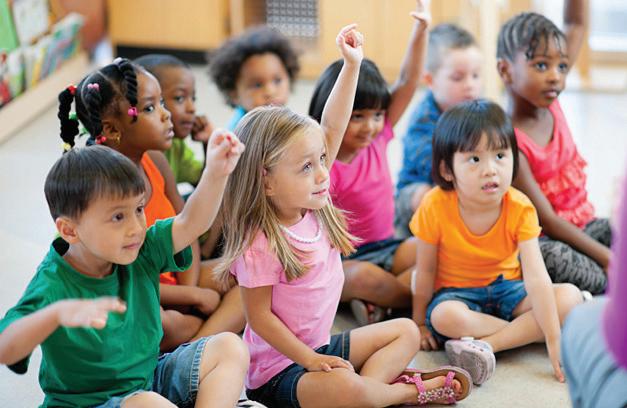
Voluntary PreKindergarten, better known as VPK, gives children a jump start by preparing them for school and enhancing their pre-reading, pre-math, language and social skills. By developing the skills children need to become strong readers and students at an early age, children are more likely to be successful in school. VPK classrooms offer highquality programs that include high literacy standards, developmentally appropriate curricula, manageable class sizes and qualified teachers.
If you live in Florida and have a child who turns 4 years of age by September 1, 2024, your child is eligible for Florida’s FREE VPK program. Your child can attend
one of the two programs offered annually. The school-year program includes 540 hours of instructional time and begins in August. The summer program consists of 300 instructional hours and can begin as early as May 1st.
Back in the day (November 2002 to be exact) Floridians voted to change the constitution to require that high quality prekindergarten be made available to all four year olds in the state. In January 2005, after a couple of bumps in the road, VPK legislation was signed into law. By August of 2005, thousands of four years olds were signed up for the first VPK programs.
Why do it?
Well, first off, did you know that the most important time for the growth
and development of a child’s brain happens before the age of five? That’s right, the early years are the learning years. VPK will get your four year old ready for school. When they start kindergarten, they will be better at just about everything! Like communicating (language skills), doing better on tests (who doesn’t want that?), and they will get along better with other kids and teachers (social skills) with fewer behavior problems.
How do I choose the right VPK for my child?
Basically, you can choose the VPK program that meets your child’s needs the best. You can pick a preschool or day care center, a faith-based school (like in a church, temple or mosque), a family child care home (as long as it’s licensed) or even a private or public school. All of them must meet the high standards required by law.
What are
some of the rules?
There are lots of them, but first off, there has to be one instructor for every 10 kids. During the school year, there can’t be more than 18 kids in a class and
during the summer there can only be 10 kids in a class. All VPK instructors must have a minimum of an associate degree in child development and during the summer, the minimum is a bachelor’s degree.
What is the VPK Provider Readiness Rate?
It sounds complicated, but it really isn’t. It measures how well a VPK provider prepares your child for kindergarten. The Florida Department of Education came up with VPK standards describing what four years olds should know and be able to do by the end of VPK. All kids are screened during the first 30 days of kindergarten by their teachers. Teachers observe and determine what kids know and are able to do by watching them as they work, build, solve problems and interact with their classmates.
Based on the screening results, kids are considered to be Above Average, Low Risk, Medium Risk or High Risk. VPK providers are measured by the numbers of their kids determined Ready for Kindergarten, divided by the number of all kids screened. That calculation gives them all a score, or the VPK Provider Readiness Rate. Obviously, some score better than others, so it’s important to look it all up on a computer. All the scores for all the VPK providers are posted.
VPK kids test better!
The Florida Department of Education (the guys in charge) studied the Readiness Rate scores and found out that kids in VPK programs scored higher on the Florida Kindergarten Readiness Screener (FLKRS). Their study also showed that kids who completed VPK programs scored higher on the FCAT and were less likely to be retained in third grade. That’s major! And it’s an important reason that ALL parents sign their kids up for VPK!
What if my child is in a VPK and doesn’t like it?
Don’t assume that all VPKs are the same. Like we said before, some are better than others. Let your child know that you’re allowed to switch one time during the year to another VPK program.
What if I decide to sign up later?
When is it too late?
You can sign up any time up to a certain point in the year. You can also go to VPK during the summer. If you know where you want to go, call the school and find out. As long as you can get in 540 hours during the school year, or 300 hours during he summer, you’re good to go, Just don’t wait too long or you won’t be able to catch up!
OK, I’m convinced! How do we get started?
STEP ONE:
Complete the VPK Child Application online. Go to www.VPKPinellas. net or call 727.400.4405.
STEP TWO:
Submit the Supporting Documents. You will need to show proof of residency (like a recent electric bill or driver’s license with current address) and your child’s Birth Certificate or Proof of Age (like a birth record, certificate of arrival in the US or an immunization record). When the application is complete you will receive a CertificateofEligibility voucher by email.
STEP THREE:
Register with a VPK provider. You can call CCR&R (Child Care Resource and Referral) at 727.400.4419 for a list of certified VPK providers.
Do your homework and select the perfect VPK program for your child! Once you’ve made your choice, give your CertificateofEligibility voucher to the VPK provider you’ve chosen.
For more information or to register in person, call the Early Learning Coalition of Pinellas County at 727.400.4405 or visit www.VPKPinellas.net.
An Inside Look at a Graduating VPK Class
As 23 four and five year olds stood solemnly on the stage, clad in little red gowns with red mortars balanced precariously on their heads, a few used their rolled up diplomas as telescopes. Others were searching the crowded audience for a familiar face, a few shyly waved, while others occasionally hammed it up for the camera. Like so many other Voluntary Prekindergarten Programs across Pinellas County, First United Methodist Church Preschool graduated their VPK class.
The children have had a busy year. They have explored our world through the alphabet, discovered the wonderful state of Florida, took trips to the library and post office and climbed way too high in the trees at the park. They made scarecrows and were wrapped up like mummies in toilet paper. They dressed like Pilgrims and Indians for a Thanksgiving Feast, hunted for leprechauns, made stone soup, wrote the President and the Queen, enjoyed watermelon ice cream and wondered why they couldn’t have a camp out every Friday!
They learned the real Christmas story you don’t see on TV, washed feet like Jesus, and discovered that the fruit of the spirit is not a coconut. They’ve read and sung and glued and colored. They know their ABC’s and 123’s and how to bow their little heads and open up their precious hearts in prayer.
The teachers have had a busy year, too! They were the creators and controllers of chaos both of their own making and of the children’s. They have kissed away hurts and mended broken hearts. They have rescued lizards from harm and
saved butterflies from being “over loved.” They’ve prayed for a rainy day so projects could be finished and complained when it rained for too many days because the natives were getting restless. They’ve learned that the first part of the school year moves too slowly and the end comes too quickly. They have come to love the little chairs, the hand sanitizer, and to wear cake batter as a badge of honor that was slung by an overzealous preschooler making pineapple upside down cake. They answer to Ms., Mom, Teacher, and Hey You!
Most importantly, they’ve come to know and love 23 unique children, what makes them happy or sad, what they like to read and sing, their favorite centers and how they learn best. They look forward each day to their smiles, their laughter, their stories, their hugs and “I love you’s.”
The end of preschool may seem like an insignificant event to many. However, it’s not insignificant to those of us who are invested in early childhood education.
We realize this is the end of a child being identified as part of his or her parent, and the beginning of independence and self-identity. Children who have the advantage of being part of a quality early childhood education program will have greater success academically and in life.
Quality programs ensure that the whole child is being developed. The children learn through play and experiences. They discover the natural world by watching a caterpillar eat its way through leaves, spin a cocoon and then almost as if by magic, emerge as a new creation in the form of a butterfly.
Children learn about the magic of books as teachers read stories with silly voices and act out the parts of characters. Phonological awareness and print knowledge is everywhere from the environmental print on the walls to the labels on every item in the classroom. Critical thinking skills are honed by asking, “What do you think?” and “What if...” The love of math and engineering is fostered by providing different tools for children to build, design and manipulate.
Even more important is the social, emotional development and “soft” skills, such as communication, teamwork, adaptability, problem solving, critical observation and conflict resolution.
It’s easy to see that choosing the right preschool is just as important, if not more important, than choosing the right college.
So take your time and choose a VPK program with care...
Take a tour. Ask questions. Be involved.
The choice is yours.
Just so you know... This story was submitted 15 years ago by a retiring preschool director. It’s so good, we run it every year in June!