E M
EE
KE TA
FR M O H
E
IN THIS ISSUE
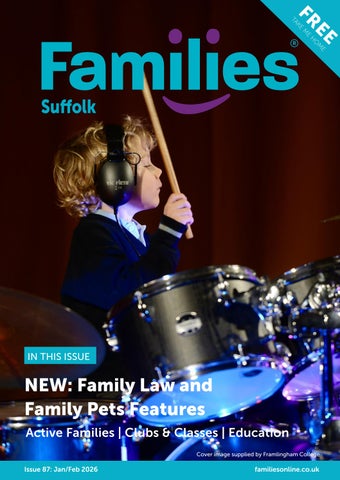
NEW: Family Law and Family Pets Features Active Families | Clubs & Classes | Education Cover image supplied by Framlingham College
Issue 87: Jan/Feb 2026
familiesonline.co.uk
1 Families Suffolk: Issue 87 familiesonline.co.uk
2 Families Suffolk: Issue 87
familiesonline.co.uk
WELCOME & CONTENTS Reg. Charity 1086565
Take a walk on the wild side
CONTACT US EDITOR Stacey Phillips T: 07951 946736 E: editor@familiessuffolk.co.uk Design: Stacey Phillips Printed By: Buxton Press Next Issue: Mar/Apr 2026 12,000 copies of the magazine are distributed throughout Suffolk. To request copies please contact the editor.
Welcome
Suffolk Owl Over 70 Owls and Birds of Prey • Sanctuary Flying displays & Nature Centre
scan me for info
Welcome to our first issue of 2026. I hope you had a wonderful Christmas and wish you a happy and healthy year ahead.
Armadillos • Porcupines • Meerkat Mob • Red Squirrels S.O.S. Safari for kids • Open Daily 10-5
I’m delighted to introduce two new regular features launching this year. We’re pleased to welcome Ellison Solicitors as our Family Law experts, who will be sharing helpful advice and guidance for families. We’re also excited to have Gladwells Pets and Country Stores supporting our new Family Pets feature, offering tips and insights for animal-loving households.
Stonham Barns Park, Stonham Aspal IP14 6AT 03456 807 897 • www.owl-help.org.uk
and Nature Centre
You’ll also find our brand-new Clubs & Classes Directory in this issue. If you’re looking to try something new or find activities for your family, be sure to turn to page 6. I hope you enjoy the issue. Best wishes,
Stacey Phillips
IN THIS ISSUE: 5
Active Families
6-7
Clubs & Classes
9
NEW: Family Law
NEW: Family Pets 10 12-16 Education Feature To subscribe to our FREE online edition, please visit: www.bit.ly/2XolhJe. PRINT DISCLAIMER: Families Suffolk Magazine is part of Families Print Ltd, a franchise company. Families is a registered trademark of LCMB Ltd, Remenham House, Regatta Place, Marlow Road, Bourne End, Bucks SL8 5TD. The contents of this magazine are fully protected by copyright and none of the editorial or photographic matter may be reproduced in any form without prior consent of Families Print Ltd. Every care is taken in the preparation of this magazine,but Families Print Ltd, the distributors, franchisees and LCMB cannot be held responsible for the claims of advertisers nor for the accuracy of the contents,or any consequence thereof. familiesonline.co.uk
Families Suffolk: Issue 87
3
Explore and play in a multi-sensory and inclusive environment designed by artists for children. Developed after a period of working with students at Thomas Wolsey School, Ipswich. Free to attend, open on Saturday mornings in January and weekdays during half term. Suitable for children in wheelchairs. Booking required – www.suffolkarchives.co.uk Access facilities at The Hold: Changing Places toilet, wheelchair access and disabled parking. Funded by: Arts Council England, Councillor Sam Murray at Suffolk County Council and Thomas Wolsey School.
P L AY SCULPTURES
New Exhibition coming soon Beyond Labels: Celebrating Disability in Suffolk will shine a light on the lives, achievements, and challenges of people with disabilities across Suffolk – past and present. The project will collect and preserve personal stories, alongside the histories of organisations, schools and charities to create a record that celebrates disability while sparking conversations about inclusion, accessibility and equality. The exhibition will be co-curated with local communities and will celebrate the stories collected through the project and encourage greater awareness and empathy. Join us for a programme of multi-sensory play, inclusive talks, walks, cinema club, family crafts and creative activities.
4 Families Suffolk: Issue 87
@suffolkarchives
familiesonline.co.uk
ACTIVE FAMILIES
Move More Together This New Year: Why Family Fitness Matters A new year always brings a sense of possibility, and for many families, it’s the perfect moment to reset routines and build healthier habits. One of the most straightforward – and most rewarding – changes you can make is to move more as a family. Not only does it boost physical fitness, but it strengthens bonds, builds confidence, and creates positive memories that last far beyond January.
This January, consider swapping one family movie night for a family movement night. Try a new class, find your local parkrun, explore a local trail, or simply dance around the kitchen while dinner cooks. Whatever you choose, the important thing is doing it together. Small steps made as a family can lead to big, lasting changes – and a healthier, happier year ahead.
Staying active doesn’t have to mean hours at the gym or structured training sessions. In fact, the most effective routines are the small, everyday moments of movement. A brisk family dog walk, dancing in the living room, a bike ride to the park, or a friendly game of football in the garden all count. When activity is fun and inclusive, it becomes something everyone looks forward to rather than a chore to tick off. Children who are active with their parents are more likely to develop healthy habits that follow them into adulthood. Being active together shows young people that fitness is enjoyable, achievable, and something the whole household values. It also boosts their mood, improves sleep, and helps them burn off the stresses of school and screen time. For adults, moving more with the family can be a brilliant motivator. It turns exercise into shared time rather than something squeezed into an already busy schedule. Many parents also find that being active together helps them reconnect with their children, especially as they grow older and spend more time online. Those small conversations during a walk, or the laughter during a family swim, are often where the best memories are made. There are also powerful wellbeing benefits. Being active increases energy levels, supports mental health, and helps reduce stress for both adults and children. Outdoor activity, in particular, is known to lift mood and encourage mindfulness – something many families crave after a busy year. familiesonline.co.uk
Families Suffolk: Issue 87
5
WHAT'S&ON CLUBS CLASSES
Clubs & Classes Directory Little Kickers give your children a positive introduction to sport by teaching high quality football skills in a friendly, pressure-free environment. There are four different classes tailored to the needs of children between 18 months - 8yrs
Find out more and sign up to a local class.
Mini-First Aid classes are designed to be relaxed, accessible, and confidence-boosting, giving you the knowledge and skills to act in a medical emergency. Sessions are available for the whole family, including parents, grandparents, carers, and children from 3yrs,
Find out more and sign up to a local class.
Mamba Martial Arts have Karate, Boxing and Kickboxing classes which are all great for self-defence and self-confidence. Mini Mamba classes are also available for children aged 3 to 6 year olds. The classes are fun, fast moving and great for children's learning process.
Find out more and sign up to a local class.
babyballet Suffolk South offers magical pre-school dance classes for little stars aged 6 months–6 years. Move, sing, and play while building confidence, coordination, and social skills in our fun, inclusive, welcoming classes.
Find out more and sign up to a local class.
Free parent & baby exercise classes where you can move, chat and feel supported. Safe workouts for all fitness levels, space for babies to play, and a welcoming community where no parent should navigate parenthood alone.
Find out more and sign up to a local class.
Building Confidence, Creativity and Community. The UK’s largest youth musical theatre company provides unique opportunities for young people aged 7 to 21 who love to perform. We help them build confidence, master new skills, make friends for life and shine in their own way.
Find out more and sign up to a local class.
6 Families Suffolk: Issue 87
CDC Street Dance has a wide range of different classes for all ages and abilities in lots of different areas. We also offer a tots group, birthday parties, workshops, fun days, exams, competitions, shows, rewards, progression and confidence building!
Find out more and sign up to a local class.
Jo Jingles provides fun, music and movement classes for babies and pre-schoolers across Suffolk. Classes are suitable for children aged from three months to five years
Find out more and sign up to a local class.
GET IN TOUCH TO FEATURE YOUR CLUB OR CLASS IN OUR DIRECTORY Email: editor @familiessuffolk.co.uk Call: 07951 946736 familiesonline.co.uk
CHRISTMAS CLUBS SHOW & CLASSES GUIDE
familiesonline.co.uk
Families Suffolk: Issue 87
7
WHAT'S HEALTH PUBLIC ON
Are you looking to make a difference? Become a volunteer and help change lives At Home-Start Suffolk, we believe families should have the right support at the right time, helping their children to thrive. As a volunteer you can help us ensure families and children are given the support they need to thrive. Your volunteering journey will offer a rewarding experience where you can learn new skills and meet new people, all while contributing to your local community. Your time, skills and kindness could make a difference to Suffolk families.
FULL TRAINING PROVIDED Contact us today to find out more homestartinsuffolk.org 01473 621104 volunteer@homestartinsuffolk.org
8 Families Suffolk: Issue 87
familiesonline.co.uk
FAMILY LAW
Protecting the Grandparent Grandchild bond after separation Family Law advice from Elizabeth Burns, Solicitor, Ellisons Family Department
Grandparents often hold a cherished place in family life, offering love, wisdom and stability across generations. When family relationships break down through separation, divorce or conflict, their ability to maintain contact with grandchildren can suddenly become uncertain. of changes in their circumstances. The strength of the grandparent and grandchild relationship is an important part of this assessment. Where grandparents have lost contact because of difficulties between the parents, and one parent is also being refused contact, this does not prevent grandparents from making an application. However, the court will usually prioritise restoring the child’s relationship with their parent before considering wider family contact. In more complex situations, it is especially important to seek specialist legal advice.
U
nlike parents, grandparents do not have automatic rights to spend time with their grandchildren, even if they have been a constant and central figure in a child’s life. Losing contact, particularly when a close and meaningful bond already exists, can be deeply distressing for both grandparent and child. If a parent refuses contact, it is important to explore all possible ways of rebuilding communication before considering an application to the family court. Family counselling may help address the issues that led to the breakdown in communication. Mediation is another useful option, providing a structured environment in which everyone can express their concerns and explore solutions. A solicitor may also be able to assist by communicating directly with the child’s parent or parents to encourage an agreement. These steps can often prevent tensions from escalating and may avoid the need for court involvement, which can sometimes be viewed as confrontational. If reconciliation is not possible, grandparents may consider applying to the family court for a Child Arrangements Order. Grandparents do not have an automatic right to make this application, except in limited circumstances such as where a child has lived with them for at least three of the last five years. In most cases, the court must first grant permission for the application to proceed. When deciding whether to grant permission, the court will consider the existing relationship between the grandparent and the child, the nature and quality of that relationship and whether the application is likely to support the child’s welfare. If permission is granted, grandparents can then apply for a Child Arrangements Order to spend time with their grandchildren. When considering any application, the court’s primary concern is the welfare of the child. To reach its decision, the court uses what is known as the welfare checklist. This includes factors such as the child’s wishes and feelings depending on age, their physical, emotional and educational needs, any risk of harm and the likely impact
At Ellisons, our experienced Family Law solicitors understand how emotionally challenging these situations can be. We provide sensitive, tailored support to help families navigate disputes and work towards a positive outcome. If you would like further advice on any of the issues raised above, please contact Ellisons specialist Family Law team.
EXPERTS IN LAW SINCE 1764
ELLISONS’ FAMILY AND DIVORCE LAWYERS — SUPPORTING YOU THROUGH DIFFICULT TIMES. We’re in your corner, with clear and compassionate advice. Trusted across Suffolk and Essex.
Francesca Easter Suffolk Partner, Solicitor
01473 945614 francesca.easter@ellisons.com
CONTACT US FOR A FREE EXPLORATORY CONVERSATION Ellisons is a trading name of Ellisons Legal LLP. Ellisons Legal LLP is authorised and regulated by the Solicitors Regulation Authority (SRA Number 8001031).
familiesonline.co.uk
Families Suffolk: Issue 87
9
WHAT'S PETS FAMILY ON
FEATURE SPONSORS:
The benefits of having a family pet Welcoming a pet into your home can be one of the most rewarding choices a family makes. Whether it’s the wag of a dog’s tail, the comforting purr of a cat, or even the gentle chatter of a small animal, pets bring warmth, joy and a sense of companionship that enriches everyday life. One of the most significant benefits of having a family pet is the emotional support they offer. Animals have an incredible ability to help children and adults alike feel calmer and more secure. Stroking a pet has been shown to reduce stress and anxiety, while their unconditional affection boosts overall wellbeing. For children, this bond can be particularly powerful, helping them develop confidence, empathy and emotional resilience. Family pets also play a valuable role in building responsibility. Feeding, walking, grooming or cleaning out a pet’s space teaches children important life skills. These simple daily routines help young people understand commitment and routine, while giving them a sense of pride in caring for another living being. Pets also encourage families to be more active and connected. Dog walks become shared adventures, offering fresh air, exercise and an opportunity to explore Suffolk’s
10 Families Suffolk: Issue 87
Introducing Digby, our new family pet.
beautiful countryside together. Even smaller pets prompt screen-free moments as families observe, play and interact. In addition to the physical and emotional benefits, pets often become the heart of the household. They bring laughter, create memories and help unite family members through shared care and affection. For many families, a pet isn’t “just an animal” — they’re a beloved companion who makes the home feel complete. Whether you’re considering your first pet or adding to your furry (or feathered!) family, the rewards of pet ownership are plentiful. A family pet doesn’t just change your routine, they enrich your lives in the most wonderful ways.
familiesonline.co.uk
PUBLIC HEALTH
Supporting children and young people to feel confident, happy and healthy As parents and carers, we all want our children to grow up healthy, confident and full of energy. Sometimes, though, it can be hard to know where to start, or how to keep going, when healthy routines feel overwhelming. That’s where the Suffolk Healthy Living Service comes in. This free service is here to support children, young people and their families to build healthier habits that last. Whether you’re looking for guidance around food, activity, or general wellbeing, the team offers practical, evidence-based help designed to fit real family life.
Who the service is for
Fussy Eating Workshops
The Healthy Living Service supports families with children aged 0–19 (or up to 25 for young people with SEND) who may be above a healthy weight. If you’re unsure whether your child might need support, you can check using the NHS BMI calculator.
Got a little one who’s picky at the table? Parents and carers of children aged 1–5 can join monthly virtual workshops (available daytime or evenings) for reassurance, practical tips and simple ideas to help make mealtimes less stressful.
How the service can help your family Raising a healthy, happy child isn’t always straightforward, and you don’t have to figure it all out alone. The service offers a range of friendly, down-to-earth support, including: • One-to-one sessions with families • Small group sessions and workshops • Fun community activities and healthy lifestyle events • Free digital tools and resources • Infant feeding support from pregnancy onwards Everything is designed to help make everyday choices, mealtimes, routines, activity, feel easier and more manageable.
Get in touch If you’d like advice, more information, or help deciding what support is right for your family, the team would love to hear from you
healthylivingservice@suffolk.gov.uk | 01473 263700 familiesonline.co.uk
Families Suffolk: Issue 87
11
WHAT'S ON EDUCATION
Spot, Support, Refer: the role of schools in children’s mental health By Erin Miller Children’s mental health needs have increased sharply in recent years. According to NHS data, around one in five children ages 8 to 16 now has a probable mental health disorder, up from one in nine in 2017. Symptoms include anxiety, low mood and eating difficulties. While schools are often the first to notice when something is wrong, many have limited resources to meet emotional needs. So, what are your child’s school’s obligations in relation to child and adolescent mental health? Understanding what falls under the umbrella of mental health can be confusing. Mental health refers to a person’s emotional, psychological and social wellbeing - how they think, feel and cope with life. Not every instance of behavioural change is a diagnosable mental health condition: temporary stress and friendship issues are normal ups and downs of growing up. Ideally, schools and parents should work together to identify patterns of behaviour, rather than one-off instances. While schools have a duty of care to safeguard pupils and promote wellbeing, this does not extend to diagnosing or treating mental health conditions or offering clinical-style interventions. Their legal duties focus on noticing, recording and referring concerns to services such as GPs, Child and Adolescent Mental Health Services (CAMHS) or educational psychologists. Under the Equality Act 2010, schools must make reasonable adjustments if a mental health difficulty amounts to a disability and under safeguarding laws, they must act if a child’s safety is at risk. Where needs are long term and significantly affect education, these can be recognised through an Education, Health and Care Plan (EHCP), which sets out the support the school and local authority must provide.
To receive an EHCP, it must be shown that the child’s needs have a clear impact on learning and require additional support beyond what the school can usually offer.
What schools are NOT legally obligated to do State-maintained schools are not legally required to provide clinical treatment, counselling or employ mental health professionals. They are also not obliged to have a separate mental health policy and they are not responsible for managing or funding long-term clinical care or replacing NHS services. Schools don’t have to tailor the entire curriculum for mental health reasons unless a child’s needs amount to a disability or are formally set out in an EHCP. Finally, schools are not required to automatically authorise absences due to anxiety, low mood or other emotional distress without supporting medical evidence.
What great practice looks like While schools are not legally required to provide counselling or mental health programmes, many demonstrate exceptional practice by embedding wellbeing throughout school life. Great schools create a whole-school culture of care, where emotional health is valued alongside academic progress. Staff are properly trained to recognise early signs of distress and to respond with sensitivity and consistency. Pupils feel safe to speak up and parents are treated as partners rather than bystanders. Strong practice often includes a named mental health lead, clear referral routes to specialist services and close collaboration with external professionals such as school nurses, educational psychologists or CAMHS teams. Schools may offer drop-in wellbeing sessions, peer-support schemes or access to qualified counsellors on site.
12 Families Suffolk: Issue 87
Although many of these examples are not statutory duties, you could still suggest some of them if you are providing feedback to your child’s school. Keep in mind that effective schools succeed by building an inclusive, compassionate environment where wellbeing is embedded in the culture for students, staff and the wider school community. Erin Miller is a teacher with a keen interest in how research can be used in the classroom to improve learning.
When and where to get help If you have raised your concerns about your child’s mental health but feel your child’s school is not taking them seriously, start by meeting with the class teacher or pastoral lead to explain your worries. If the issue continues, contact the SENCO, headteacher or governing body. You can also seek advice from your local authority, the Parent Partnership, SENDIASS service or organisations such as Mind. CAMHS offers assessments and treatment for children up to the age of 18 for a variety of mental health problems. Start by speaking to your GP about the issue and requesting a referral to CAMHS or community services. CAMHS assesses and treats problems such as anxiety, depression, eating disorders and the effects of trauma. It offers a range of support which can include individual, group, or family therapy sessions, creative therapies, medication management, and, in some cases, inpatient hospital care. Some CAMHS teams also specialise in conditions like ADHD and autism. Crucially, remember you are not alone and support is available.
familiesonline.co.uk
EDUCATION
Character Education at Finborough’s Early Years and Prep School
and games. Weekly outdoor sessions at Forest School allow youngsters to explore, play, and grow in a natural setting. Finborough pupils benefit from green spaces, complete with a treehouse, as a living classroom. Through seasonal exploration, imaginative play, storytelling and hands-on science, pupils build resilience, teamwork and independence. Forest School sessions, in particular, help children develop practical problemsolving skills, curiosity, and a strong connection with nature which are all valuable aspects of their character development and emotional wellbeing.
At Finborough School, character formation begins from the very first classroom, in Nursery, Pre-Prep and Prep, as part of a deliberate commitment to raise not only capable students, but compassionate, confident and resilient young people. The school’s Early Years and Prep curriculum blends strong academic foundations with a broader “whole-child” ethos. From Reception onwards, children at the Pre-Prep level not only learn reading, writing and maths, but are also encouraged to develop empathy, kindness, and emotional awareness. In everyday activities, whether circle time, story sessions, play or lessons, children are invited to reflect on how they treat others, to share ideas, to help friends and to build a sense of community. That same care extends into their learning process: pupils are encouraged to talk about their thinking, recognise their feelings, and approach challenges with curiosity and confidence. This early nurturing of self-awareness and independence lays the groundwork for lifelong learning and personal growth. Finborough’s curriculum for early years offers breadth and variety. Alongside core academic subjects, children enjoy specialist-led classes in Music, Drama, P.E. and Tennis, and even begin learning French from Reception, through songs, stories
UMMA NITIMUR AD S
As pupils progress into Prep School, this foundational character work evolves into a more mature, structured framework. The school’s philosophy, taken from the “Seven Habits of Highly Effective People” offers a common language of behaviour, responsibility and respect across all ages. This ensures continuity, enabling children to grow in self-confidence, empathy and leadership as they move up the school. At Finborough, character education isn’t an add-on. It’s embedded in every lesson, every activity, every interaction — from the earliest days in Reception, through Prep, and beyond. In doing so, the school aims to prepare children not simply for exams, but for life: to be kind, thoughtful, resilient citizens who are ready to contribute positively to the world around them. We warmly invite you to see the Finborough difference for yourself. Join us at our whole-school Open Morning on Saturday 17th January, from 9.30 am. Book online Friday 7th November 9am to 11am at www.finboroughschool.co.uk or email admissions@ finboroughschool.co.uk
Independent, Co-educational Day and Boarding School, plus Nursery Rated ‘Excellent’ in all areas by the Independent Schools Inspectorate, Finborough School offers a unique character focused approach to education from its nursery all the way through to its sixth form. With an abundance of learning opportunities both inside and outside of the classroom that includes our magical Forest School programme, our Pre-Prep department is a very special place to be!
Whole School Open Morning, Saturday 17th January 9.30am to 11.30am Scan the QR code to find out more and pre-register
The Hall, Great Finborough, Stowmarket, Suffolk, IP14 3EF | admissions@finboroughschool.co.uk | 01449 773600
familiesonline.co.uk
Families Suffolk: Issue 87
13
WHAT'S ON EDUCATION
C O L L E G E
P R E P
S C H O O L
W H E R E E V E R Y P U P I L C R E A T E S T H E I R O W N S T O RY
JOIN US AT OUR
free
Valentines Themed Stay and Play Session on Saturday 07 February 2026
Sign up for our Valentines Craft themed Stay and Play session (ages 2 -7) where you can come and experience our Nursery. An opportunity to play together, enjoy some stories, arts and craft and go on some outdoor adventures. The session will run from 09:30 - 11:30 in our purpose-built Early Years Building at Framlingham College Prep School, IP13 7AH Free of charge | Siblings welcome
Scan the QR code to book or go to framlinghamcollege.co.uk/stayandplay Summer Stay and Play dates now booking. See website for details.
Let’s see who you are... Framlingham College Prep School invites you to explore the exceptional opportunities for pupils from Nursery Scan to book on to our Open Morning
age to Year 8 at our next Open Morning
Friday 06 February 2026 | 10:00 - 13:00
admissions@framlinghamcollege.co.uk
|
01728 684112
14 Families Suffolk: Issue 87
|
framlinghamcollege.co.uk familiesonline.co.uk
EDUCATION
Celebrating the Individual One of Suffolk’s leading independent schools, Framlingham College, explains why an individualised ethos is vital in shaping children’s successful futures.
A
t Framlingham College, there is no typical Framlinghamian, no singular path that our pupils take: we are academics, actors, musicians, expeditioners, sports stars, innovators, linguists, scientists and artists. Often, we are many things within one, each with our own story to create. As one of the region’s top independent schools, our ability to offer flexibility in the curriculum, and the freedom to tailor to individual ambitions, means that the success of every child’s achievements here are the result of learning in a supportive, ambitious, and aspirational environment. Louise North, Principal of Framlingham College, said: “At Framlingham, we are all about individuality. From the moment we meet your child, we are passionate about getting to know them. Our individualised ethos allows every child to develop their interests, pursue their passions and take the initiative in learning, all done in the context of preparing them for their next steps. “All our pupils are individual, and they all bring with them a plethora of different passions. I like to say we have around
600 ‘free spirits’ across our Prep and Senior School and ultimately, it's our job to nurture them, find out what makes them tick, provide opportunities and guide them on their individual educational journeys to ensure that when they leave us, they leave as young adults ready for their next chapter.”
Our individualised ethos allows every child to develop their interests, pursue their passions and take the initiative in learning. Head of Framlingham College Prep School, Simon Roche, said: “Our academic staff use adaptive teaching to tailor and correctly respond to each individual pupil while also instilling resilience, perseverance and challenge in each child.
“Our individualized approach, targeted intervention and strong support network – such as our award winning pastoral care, group booster lessons and additional 1-2-1 sessions – is not just about bolstering pupils results, it’s about stretching the top and igniting self-belief in every pupil to achieve more than they thought possible.” An individualised ethos not only ignites every pupil’s passion and self-belief, but it also builds confidence and unearths self-discovery, it encourages schools to evolve, adapt and innovate the curriculum for the future, it creates a supportive and respectful atmosphere between pupils, and it bolsters the realisation and determination that we can all achieve beyond what we think possible so when our pupils do leave, they leave knowing who they are and equipped with the knowledge, confidence and empowerment to take on their adult world. Discover Framlingham College during an open morning, taster day or a private visit. Email admissions@ framlinghamcollege.co.uk and let’s see what your child’s story will be!
familiesonline.co.uk
Families Suffolk: Issue 87
15
Li Li Li
Li Li Li
ttle Jo
’s
’s
ttle Jo
ttle Jo
’s
’s
ttle Jo
ttle Jo
’s
’s
ttle Jo
Bright Futures Begin at Little Jo’s Set in the stunning grounds of St Joseph’s College, our nursery offers flexible, all-day care for 2–4 year olds, designed to fit busy family life. We’d love to show you around.
• 8am–6pm. All year (50 weeks) • Specialist provision: music, dance, sport, art & Spanish • Fresh, nutritious meals cooked onsite daily • New sleep room & sensory space • Outdoor learning, 65 acre site • Caring and friendly staff • Early Years (30 hours) funding available
Book a visit today and discover why Little Jo’s is the right choice for your family! admissions@stjos.co.uk | 01473 694576 | stjos.co.uk 16 Families Suffolk: Issue 87
familiesonline.co.uk