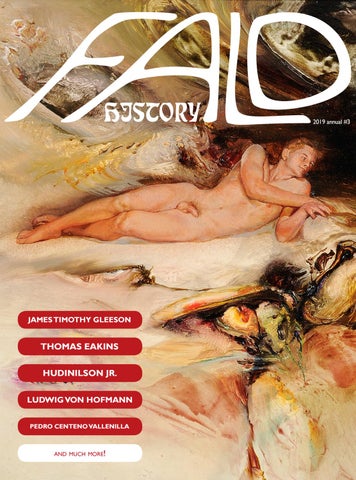
HISTORY
2019 annual #3
1
JAMES TIMOTHY GLEESON
THOMAS EAKINS HUDINILSON JR. LUDWIG VON HOFMANN PEDRO CENTENO VALLENILLA
and much more!
2
3
Phalloscope [Plastic], by Manuel BerlĂn
FALO ART© is a annual publication. january 2020. ISSN 2675-018X version 30.01.20
editing, writing and design: Filipe Chagas editorial group: Dr. Alcemar Maia Souto, Guilherme Correa e Rigle Guimarães. cover: Psychoscape, oil on canvas by James Timothy Glesson (197-).
Care and technique were used in the edition of this magazine. Even so, typographical errors or conceptual doubt may occur. In any case, we request the communication (falonart@gmail.com) so that we can verify, clarify or forward the question.
Editor’s note on nudity:
Please note that publication is about the representation of masculinity in Art.There are therefore images of male nudes, including images of male genitalia. Please approach with caution if you feel you may be offended.
Rights and Commitment:
This magazine is committed to artists retaining copyright of their own work. All rights are reserved and therefore no part of this magazine may be reproduced mechanically or digitally without the prior written permission of the artist. We have been careful to ensure that the images used in this publication have been provided to us by the creators with copyright permission, or are copyright free or are being used under the “fair usage” protocol shared over the internet (images are low resolution, attributed to their creator, not for profit and used only to illustrate a relevant article or story). If, however, you feel your image has been used by us unfairly and your copyright breached, please contact us at falonart@gmail.com and we will proceed in the best way possible.
Submissions:
If you are interested in participating in the magazine either as an artist, model or journalist, please contact us via e-mail falonart@gmail.com.
FC Design R. Mario Portela 161/1603 C, Laranjeiras Rio de Janeiro – RJ 22241-000 Brazil
Editorial
S
omeone once said “Those who cannot remember the past are condemned to repeat it”. There’s no more perfect sentence for our days, when extremists are getting power to destroy freedom of being, freedom of expression. That makes this third annual a necessary publication because Art History is its essence. We need to know the ones who came before us. We need to know what they did, what they went through, what they left for us. There is so many important lessons to learn... The artists here are from all over the world. They have not only Art in common, but also the fight to be understood, to be approved, to inovate, to express themselves the way they feel comfortable and capable of. No matter the sexual orientation some were called “degenerate”. And that is a heavy word in Arts. It’s connected to one of the darkest moments of humankind: the rise of Fascism/Nazism. Here you will learn a little about this. You will also read about another bad moment for Arts: the Catholic persecution of the penis. Broken statues, covered phalluses, re-painted masterpieces...
Summary James Timothy Gleeson Everything to control something there is no control. Like masturbation. The church tried to rule it. Even the medicine started in a wrong way. Here you will see the importance of playing with yourself with NO GUILT AT ALL. And to show how religions treat some subjects differently, the afro-Brazilian religions give us a new perspective over the phallus. This magazine also brings the “most infamous” painting for our days: The Origin of the World, by Gustave Courbet, and a big article about the nude on the theater, specially in Brazil because 2019 completed 30 years from the first nudes on the scene. As you might know for now, the endpapers have another two phalloscopes from Manuel Berlín. But the moNUments are very special. First you will see a couple contemplating the greatness of Nature, being involve by it. Second you will see a Cilhean artist and his work (HIV/AIDS Sculpture) made with more than 1000 boxes of retroviral medicine. On both men share with Nature and Art the creation, the greatness, the respect. 2019 was big year... For the goods and the bads. Hopefully you will enjoy the annuals and be patient for 2020! Learn and have fun! Thank you! Filipe Chagas, editor
6
Thoms Eakins
16
Hudinilson Jr.
28
Ludwig von Hofmann
44
Pedro Centeno Vallenilla
58
SPECIAL The origin of the world PHALLORRHAGIA Between fig trees and castrations PHALLORRHAGIA Masturbation PHALLORRHAGIA The nude on the scene PHALLORRHAGIA Exu’s ogó moNUments
68 72 80 88 102 110
Summer, oil on canvas (1966).
6
James Timothy Gleeson 1915 - 2008 by Filipe Chagas
7
W
hile at school Australian James Timothy Gleeson (1915-2008) met Nicolas Poussin, El Greco, Pieter Bruegel and William Blake. He became interested in the classical figure and mythology, together with a concern for humanity that was deeply impacted by the Depression of 1929 and the rise of fascism in Europe that led to the Second World War. Inspired by the works of Salvador Dalí, Max Ernst, André Masson, Sigmund Freud and Carl Jung, Gleeson experienced surrealism from 1938 onwards. He used poetry, dreams and elements of chance as material to explore the human condition beyond visible reality and limitations of the senses. His paintings, collages and drawings evoked human nature in an atmosphere of uncertainty and tension, almost apocalyptic. For example, his reinterpretation of Jean-François Millet’s The Sower (1850) presents a devastated landscape dominated by a central conglomerate figure, whose displaced members express 20th century humanity. In 1993, Gleeson reflected on the genesis of surrealist painting as a reaction to the traumas of war:
8
The sower, oil on canvas, 1944.
I think there was always hope that it could influence the way people thought about the war and its horrors to prevent it from happening again. I was born during World War I and my first experiences were with people who were in that war or remembered it vividly, and then, just when I was starting to paint, World War II started.The war has become a type of terror lurking.
Untitled, oil on canvas, 1958.
9
Seeking to make surrealism better understood in Australia, Gleeson wrote and taught during the 1940s. At the end of this decade, he traveled through Europe studying the masters. In the next two decades, he changed to a more symbolic perspective. From 1960, he started to create psychedelic combinations made with the surreal technique of decalcomania as a background, suggesting a landscape and ending with the addition of a small male nude painted – some inspired by his partner, Frank O’Keefe. He developed a series on a large scale in which geological formations are mixed with parts of crustaceans and mollusks, symbolizing a macabre and erotic subconscious described by Freud. Called Psychoscapes, they show the liquid, the solid and the air coming together and directly allude to the interface between the conscious, subconscious and unconscious mind. Gleeson’s later works incorporate the human form less and less in its entirety, being represented in his landscapes by suggestions, an arm, a hand or just an eye. 10
Crater wtih ghost, oil on canvas, 1966.
11 Constructors, oil on canvas, s.d. Hercules wounds the centaur Nessus, oil on canvas, 1964.
Psychoscape, oil on canvas, 197-.
12
Untitled, oil on canvas, s.d.
13
The release, oil on canvas, s.d.
14
From the 1970s onwards, he also worked as a prominent critic, writer and poet, writing for Australian newspapers and publishing seminal studies on other artists. He was intimately involved with the formation of collections from various art institutions, being recognized as the most important surrealist painter and poet in Australia. In 2005 he created an investment fund for Australian modern art. He worked on his art every day of his life until his death in 2008. 8=D
15
Landscape with self-portrait in parenthesis, oil on canvas, 1994.
Arcadia, oil on canvas (1883).
16
Thomas Eakins 1844 - 1916 by Filipe Chagas
17
T
homas Cowperthwait Eakins is now widely recognized as one of the most important artists in the history of American art at the turn of the 19th to the 20th century. However, his work received little official recognition during his lifetime because of behavior considered controversial.
His father had been a master of writing and a successful teacher of calligraphy. Eakins watched his father at work and, at the age of twelve, already demonstrated drawing skills with precise lines, perspective and the use of a structural grid to trace a careful design. He studied drawing and anatomy at the Pennsylvania Academy of Fine Arts from 1861 and attended courses in anatomy and dissection at Jefferson Medical College for two years. His scientific interest in the human body led him to consider becoming a surgeon.
Standing male nude with pipes, photoshoot study for Arcadia, c. 1880.
18
For a while, he followed his father and was listed as a “writing teacher”. However, in 1866, Eakins went to study art in France with the realists Jean-Léon Gérôme and Léon Bonnat and this determined his professional course, confirming his admiration for the realism of artists like Diego Velázquez on a later six-month trip to Spain. In 1869, when he tried a large oil canvas outside the studio, he dealt for the first time with the complications of outdoor painting. Despite this, he was enchanted by the possibilities of shapes, colors and movements in the presence of sunlight. Although he failed to enroll in a formal degree program and did not show any of his work in European salons, Eakins was successful in absorbing the techniques and methods of European masters to formulate his artistic vision. His first works after the return from Europe included rowing scenes, which was a shock to academic artistic conventions. The choice for a contemporary sport comes from his athletic youth, in which he practiced numerous activities and then instigated his students to do the same in the name of the movement and the human figure.
Portrait of Dr. Samuel Gross (The Gross clinic), oil on canvas, 1883.
19
20
Double jump, stroboscopic photograph, 1885.
Throughout his career Eakins worked on the human being as a thematic center. He painted hundreds of portraits – usually of friends, family members or people prominent in art, science, medicine and the clergy –, which together give an overview of Philadelphia’s intellectual life in his time. He made clear his interest in the realistic painting of the human figure, with emphasis on the male nude, in an 1868 letter to his father:
Female nudity is the most beautiful thing in the world, except for a naked man, but I have never seen a study published... It would be a godsend to see a good male model painted in the studio with bare walls beside of smiling wax goddesses [...]. Eakins was also interested in the new technologies of motion photography by Eadweard Muybridge, even working with the photographer. He made his own movement studies, usually involving the naked figure, and even developed his own capture technique: while Muybridge’s system relied on a series of cameras activated to produce a sequence of individual
photographs, Eakins preferred to use a single camera to produce a series of exposures superimposed on the same negative as he was more interested in a single precise image to translate a movement into a painting. In his search for precision, Eakins used devices similar to a light table to make a detailed transcript of reality. As a teacher Eakins became a highly influential presence in American art. He began teaching in 1876 and came to the board of the Pennsylvania Academy in 1882. His teaching methods were controversial because they ignored the academy’s classic precepts: there were no copies of old works; students received only a quick introduction to charcoal study, followed quickly by their initiation into painting, in order to understand subjects in real colors as soon as possible; and held unauthorized winning competitions. In his interest in instructing all aspects of the human figure, Eakins invited sculptors to make plaster pieces from dissected parts of human bodies (and animals) for assistance in class. It also encouraged students to use photography as a tool to understand anatomy and the study of movement.
Man walking, stroboscopic photography, 1880.
21
The swimmers, oil on canvas, 1885. This work presents Eakins’ most successful realization of the nude in an exterior image. The figures are from his friends and students and include a self-portrait (first figure on the left). Although there are photographs of Eakins related to painting, the pyramidal composition of the image and the sculptural conception of individual bodies are completely different pictorial resolutions. The work was painted on commission, but was refused and remained with the painter.
22
23
The so-called Naked Series, which started in 1883, were pictures of nude students and professional models that were taken to show real human anatomy from various specific angles and were often hung up and displayed for study at school. Later, less disciplined poses were taken inside and outside the studio, by men, women and children, including his wife. The most provocative, and the only ones that combined men and women, were nude pictures of Eakins and a female model (next page).
24
Since he believed that women should “assume professional privileges� like men, he allowed access to male models (wearing loincloths and accompaniment) in traditional poses, even though women and men had separate classes. However, in 1886, he was removed from the board when he took off the loincloth from one of the male models in a class for women. This was just one of the scandals that hindered Eakins’ success. It is said that, on one occasion, a student would have asked about the movement of the pelvis. He took her to his studio, undressed and explained in the best way he knew how: showing himself. Even with a damaged reputation, several
Students swimming, photographs, 1883. Study for The swimmers, oil on cardboard, 1884.
students dropped out of school after Eakins left because they believed in his innovative way of teaching. He went on to teach in New York and Washington, but gradually withdrew from teaching in 1898, after having returned to Philadelphia in 1895 to be fired again for the use of a naked male model.
Bill Duckett naked at the Art Students’ League of Philadelphia, photography, 1889.
25
His unorthodox attitudes as an educator and his constant interest in the male body were responsible for questioning not only his sexuality, but also for a long time denying his work. Eakins continued to paint portraits of friends and sports scenes (mainly of fights), looking beyond the realism of the figure, the personalities and psychological intensities (which, for many, bring him closer to Degas). He died at the age of 71 – already considered the most prominent artist after the Civil War (18611865) to portray American life. In 1964, an art critic from the New York Times wrote:
Salutat, oil on canvas, 1898.
26
As a supreme realist, Eakins seemed heavy and vulgar to an audience that thought of art and culture in general, largely, with graceful sentimentality. Today he seems to us to have preserved the essence of an American life that seemed beautiful beyond the need for idealization. 8=D
Wrestlers, oil on canvas, 1899.
27
28
Hudinilson 1957 - 2013 by Filipe Chagas
n Jr.
Performance record Exercise to see myself II, at MAM/RJ (1982).
29
H
udinilson Urbano Júnior (19572013) was one of the pioneers in the use of xerographic art (process of reproducing images and/or text using the photocopying machine) in Brazil, but he is also considered a multimedia artist identified with underground culture, marginality and homoerotic art. In 1984, he declared to Interview magazine that “an artist, first of all, has to be versatile in his media”.
30
Hudinilson began his artistic apprenticeship in the film art sessions shown at the Lasar Segall Museum in the early 1970s, during high school. There he carried out experiments with woodcut and photography, using collage as a construction system: his woodcuts used photographic image decals and his late 1970s collages used photographs of appropriate nudes from American magazines the bodies usually appear without identity and in relation with objects, dry leaves and roots, textures. He entered the technical college of the Institute of Art and Decoration (IAD) of São Paulo and, between 1975 and 1977 studied fine arts at the Armando Álvares Penteado Foundation (FAAP), where, after mastering the conventional techniques of drawing, painting and engraving, he decided to experiment with new creative languages coming from advanced technologies of imagery representation. He then explored postal art and xerography together with the repetition and fragmentation of the male body, a recurring theme in his work.
Woodcuts and collages with mixed materials from the late 1970s.
31
Postal art, 1980.
From 1979 to 1982 he was part of the group 3Nós3, with artists Mário Ramiro and Rafael França, who performed interventions in the city of São Paulo, as in the action Ensacamento (1979), where they hooded monuments of the city center during the Military Dictatorship and became a reference of independent art of the time. With the graphic artist Alex Vallauri, he was part of a group of graffiti artists and, in his first experiences with graphite, the linearity of his drawings was integrated with writing and stencil as instruments of image production. In an interview for Itaú Cultural in 2015, Mário Ramiro said that “although Hudnilson did not enter the digital age, he was a great image editor”.
32
In 1981 he executed the series Exercise to see myself, which consisted of xerographic reproduction of parts of his own body by simulating a sexual act with a copying machine, placing it as a co-creator of the work and himself as an object. Working alone with the machine outside office hours, his idea was to explore the xerography characteristic of omitting and highlighting details, turning it into an ephemeral instrument of speculation and formal abstraction. Once, in an interview for Folha de São Paulo, he declared: I have things cataloged in my head, I suddenly think about their uses (...). The collage is quick but well cared; the ephemeral is due to the street garbage becoming a luxury of art. Xerox is crazier, sometimes it runs faster than myself, giving incredible results. I believe that from now on I will start to integrate the two things, it is my natural path.
33
Performance record Exercise to see myself II, at MAM/RJ (1982).
the BODY always as a principle collage, mail art, photography, XEROX THE XEROXED BODY
34
– use the BODY as a matrix, from the creation of a special relationship of working on the physical contact between idea and the mechanical process; leaning over and lying completely on the XEROX display, thus composing shapes/textures. XEROX recreates the BODY in its own way, destroying details and valuing others, resulting in images that approach abstraction, in an exercise in reading/viewing. – the BODY (my/male) contained in the space of a XEROX copy, becomes a module that juxtaposes or overlaps in a sequence. – the continuous experimentation of the values offered by the XEROGRAPHIC process, will define the individual values of each proposal. understand the limits imposed by the machine and expand its resources, master these limits, thus reversing the relationships, making the machine a vehicle and co-author of this work. OR YET
Giant phallus, xerographs, 1980.
BODY always as a principle collage, mail art, xerox, PHOTOGRAPHY THE PHOTOGRAPHED BODY – the transposition of the media, always using the same matrix, the BODY (my/male), increasingly exhausting the subject. – the particular difference(s) of each machine; the texture and layout of xerographic media as opposed to the image of PHOTOGRAPHY. – the BODY contained in the space of each frame, focused on the viewfinder of a common machine and without the appropriation of greater resources/special effects, becomes a module that juxtaposes or overlaps in a sequence. – the portrait is self-portrait; PHOTOGRAPH myself looking for myself through the viewfinder, not using other resources, such as mirrors; look for myself, frame myself and “hit” the plate; how far my eye, through this mechanical viewfinder, can see me; fragment me, divide the parts of the body, this division still in counterpoint with the form of division of the xerography, and after the photo, copy it by the xerox, and thus oppose the different copies; my transmuted BODY. Hudinilson Jr., 1981, São Paulo.
35
Xerographs from Exercise to see myself I series, 1981.
36
37
Loving position and Tension zone are two other works with an aesthetic concern that intended to remove mere erotic appeal. They are records of humanity’s encounter with technology, of the real with the virtual. Therefore, the visual impact of his multiple graphic interpretations of the human body question the original equation work vs. copy. For Hudinilson each copy that was re-xeroxed changed itself slowly, becoming new images.
38
Between 1982 and 1984, he performed the performance Exercise to see myself II (1982), with the xerographic machine at the Museum of Modern Art (MAM/RJ), and performed the individual Xerox Action (1983) at the Museum of Contemporary Art (MAC/ USP). For the Art in the Streets event, held in the same year, Hudinilson prepared a billboard that was a detail of his Xeroxed body and enlarged in gigantic proportions. Aracy Amaral, curator of the event, demanded that it be covered with a red stripe, which got even more the attention of those passing by. The fact was highlighted in Isto É magazine, which classified him as a controversial artist. Hudinilson declined this title, because for him “the artist is lonely and supportive”. In Narcisse/Study for self-portrait (1984), he began to investigate his own visual identity through xerography and x-rays. Excellent archivist and methodical to the extreme, in his Reference Books (there are more than 100), the figure of Narcissus unfolded with the obsessive and analytical exposure of the male nude. In the same year, he participated in the 1st Havana Biennial and curated the exhibition Arte Xerox Brasil, at the Pinacoteca. Despite having participated in the 18th Bienal de São Paulo in 1985, the artist’s production remained discreet in the 1990s. In April 1987, a criticism in the Estado de São Paulo newspaper (The feast of the self, by journalist Leonor Amarante) seemed anticipate the future of the artist when describing his work: Phallus, xerographic collage from Loving position series, 1981.
39
Dick can’t campaign, xerography, 1980.
Art in the Streets billboard, 1983.
40
Narcisse, xero
ographs, 1986.
41
42
While the world is concerned with the neoafter-all, Hudinilson Jr. copies himself.With Narcissus’ eyes he bends over the copy machine and records the parts of his body. In a sensual act, he separates trunk, legs, arms, sex, and then, in a single act, join them or work each part on a support that can be collage, object, graphite or even photocopy. (...) Hudinilson started looking for himself, in the projection of the other (...) Like a child who discovers the pleasure of playing with the mirror that gives him back his image, Hudinilson Jr. plays with the images with Narciso as a central pulse. (...) Dark, long before the movement started in Brazil, he always remained parallel to the circuit. A sustained imposition in the name of what is not known. Perhaps, it still belongs to the pack of a Robert Malaval, the irreverent French artist, who only after the tragic death in 1980, the door of the Paris MAM opened. Or of a Klaus Schwarz, a Berliner transsexual, author of the best German performances today, but who can only show them in underground bars”. In the early 2000s, he exhibited for the first time in Europe, but never left the country. In 2013, his mother found him dead in his apartment with poor health due to alcohol. Gallery owner Jacqueline Martins told Select magazine on the death of the artist that he was genuinely marginal: Everything about him is true, his crises, his temperament, an entire production without tricks, without fads, he did not open concessions and paid for all his choices. Hudinilson spent his life as a “cursed artist”, living on favors and seeking to be legitimized by the institutions of Art. However, after he died, his works quintupled in value and became involved in collection disputes: in 2012 he sold only two works in a gallery, while in 2014 a large exhibition was held in Scotland. Today Hudinilson’s work has been rediscovered in times of non-stop selfies, body worship and gender studies. 8=D
Collage of photographic contacts and a page of one of his reference books.
Plastic surgery for you! Dr. Alcemar Maia Souto CRM 5246681-1
+55 21 97395 8000
alcemarmaiasouto@gmail.com
43
Bathing place, oil on canvas (1925).
44
Ludwig von
45
n Hofmann 1861 - 1945 by Filipe Chagas
L
udwig von Hofmann (1861-1945) was a German painter who became involved with Europe’s modern and avant-garde movements. Son of an important Prussian statesman, he began his studies in fine art in 1883 at the best schools in Dresden and Karlsrhue. He spent the year 1889 studying at the Académie Julian de Paris – a preparatory school to enter the École de Beaux-Arts, which allowed women students even in living model classes – and, in 1890, he was already a freelance painter in Berlin, doing part of the so-called Elves’ Group, which brought together German Symbolists and Impressionists, such as Max Klinger, Max Liebermann, Lovis Corinth and Franz Skarbina.
46
Jovens em uma costa rochosa, óleo sobre tela, 1890.
From 1894 to 1900, Ludwig traveled through Europe based on a Florentine village, where he began to appreciate the idea of Arcadia, a kind of paradise of ancient Greek that reverberated throughout his work through young nude figures in bucolic landscapes. From 1895, he collaborated with illustrations for the magazine Pan, a German art nouveau publication and, in the following year, he joined both the Berlin Secession (group of artists now considered to be post-impressionists) and Deutscher KĂźnstlerbund (association of artists who sought to break free from restrictions imposed by cultural authorities in the name of modernity). In the early 20th century, Ludwig became a teacher in Weimar and Dresden and remained involved with various artistic groups.
Influenced by the pastel tones of the French painter Pierre Puvis de Chavannes, his work combined the naturalistic forms of art nouveau with the spiritual narratives of Symbolism to present man and nature in a context of utopian harmony. Despite being considered monothematic by some scholars, he synthesized the tradition of idealistic German painting with impulses from French painting - at that time radically opposed by some - as if it were a bridge between Romanticism and German Expressionism, approaching Fauvists. He also made woodcuts and lithographs for books that expressed the young, dynamic and free spirit that conquered the Empire. German citizens found a new self-confidence embodied in wild nudity.
Boys on the beach, pastel on grey paper, 1895.
47
48
Fishermen and naked children on the green coast, oil on canvas, 1900.
Five children on the rock, oil on canvas, 1900.
Young bathers, oil on canvas, 1905.
49 Bathers, pastel on paper, 1912.
Bathers, oil on canvas, 1908. Defense, oil on canvas, 1910.
50
51
Young people on the rock, oil on canvas, 1917.
52
Mountain stream, oil on canvas, 1912.
Breakdown, oil on canvas, 1918.
53
However, the First World War affected him emotionally and artistically: he expanded his artistic range with tragic motives and with stylistic expressionist medias, however, between the 1920s and 1930s, he remained ostracized. His “arcadian fantasies” no longer belonged to the world of war and he went on to say:
I feel humble about nature, I don’t want to violate it. In 1937, some of his works were considered “degenerate art” by the Nazi regime, which turned out to be a great paradox since his work previously considered the height of German youth was, in some cases, rejected due to the age of the figures and the male nudity. His landscapes, then, ended up occupying a central position in his late work and continued to be exhibited in Berlin without much appeal. After his death in 1945, his widow and great-nephew took care of locating his estate. 8=D
54
Bathers on black rock, oil on canvas, 1930.
Degenerate art
was the term given to the modern avant-garde of the early 20th century during the Nazi government in Germany. All works of art that were not in accordance with the German ideal of art (Deutsche Kunst) received this title brought from biology, because “degeneration” was a nomenclature used to characterize modified beings that were no longer recognized as part of a species. Therefore, impressionists, fauvists, expressionists, futurists, cubists, dadaists and Crucifixion, de Emil Node (1912). surrealists works, in addition to – obviously – those made by Jewish artists, were removed from museums and public or private collections because they depart from the standard of pictorial naturalism. Some artists were either forbidden to work or forced to emigrate – which, in fact, was the best option, as they were at risk of torture and death. Not even the German expressionists in evidence at the time escaped: Emil Nolde, for example, had more than a thousand works confiscated. The starting point for the attack on artistic influences defined as “non-German” was in 1927, in the essays published by Alfred Rosenberg. Gathered under the title Der Sumpf (“The Swamp”), the National Socialist thinker accused the avant-garde aesthetic of representing an imbalance of the soul and the alienation resulting from the paradoxical conjugation between capitalist money and mass culture handled by communists. In 1930, a law against black culture was passed, and in 1933, the Nazi cultural defamation policy began. The best-known facts are the burning of books in the public square (which happened in the same year in Berlin and 21 other German cities) and the closing of Bauhaus, an avant-garde German school of art and design. Even some musical styles and composers (mainly Jews) were considered degenerate. Nevertheless we can go back until 1907 when an 18-year-old Adolf Hitler was not accepted at the Vienna Academy of Fine Arts to understand some motivations. He still tried it the following year, after his mother’s death, but was again rejected for lack of talent. Hitler continued in Vienna selling amateur watercolors for his livelihood until he left for Munich in 1913 and began his military career.
One of Hitler’s watercolors (1910).
55
And it was in Munich, in 1937, that he ordered the traveling exhibition called “Degenerate Art” (Die Ausstellung “Entartete Kunst”) with 650 confiscated works from 32 German museums that toured several German cities, as well as schools and political associations.
56
Photo of the exhibition opening.
Goebbels visiting the exhibition.
Intentionally messy, it was a didactic exhibition, with rooms dedicated to “Offense to Religion”, “Insult to German Soldiers, Women and Farmers” and “Jewish Artists”. Adolf Ziegler, president of the Third Reich Chamber of Plastic Arts and organizer of the show, exhibited works by Van Gogh, Picasso, Segall, Matisse, Kandinsky, Klee, Mondrian, among others, alongside photos of crazy and/or crippled people, with offensive slogans and bad lighting to arouse disgust and uneasiness among visitors, relating them to some type of physical and mental disability. If every thing they gave birth to was the result of an inner experience, then they are a public danger and must be under medical supervision. If it was pure speculation, then they must be in an institution suitable for deception and fraud. — Hitler This presentation of “sick”, “decadent”, “absurd” art served to legitimize political and racial ideals and the apprehensions to works of art increased exponentially. According to the final report, in 1939, over a thousand paintings and three thousand illustrations were burned, while another three hundred paintings and sculptures and three thousand illustrations were sold abroad. However, the return was different than expected: more than two million people visited the “degenerate art” exhibition for the sake of marketing, while the Nazi art exhibition (Große Deutsche Kunstausstellung), set up at the same time, had 420 thousand spectators. Perhaps because Joseph Goebbels, Minister of Nazi Propaganda, was a fan of German Expressionism… Needless to say, the consequences were irreparable. Or, that any resemblance to the present day is no coincidence. 8=D
57
On the cover of the exhibition catalog, the sculpture The new man, by the Jew Otto Freundlich (who would later die in an extermination camp). The sculpture was lost, probably destroyed.
Pedro Centeno Vallenilla
58
1899 - 1988 by Filipe Chagas
59
Narcissus.
P
edro Centeno Vallenilla (1899-1988) was born in Barcelona, in the state of Anzoátegui,Venezuela. Despite being a Doctor of Law from the Central University of Venezuela, he began his art training at the age of nine at the Academy of Fine Arts in Caracas with important names in Venezuelan art such as Álvarez Garcia, Antonio Herrera Toro and Almeida Crespo. At the age of 16, he already exhibited his first works. In 1917, at the age of 19, his work “The agony of Jesus” was blessed by the Archbishop of Caracas.
60
Adam and Eve.
61
Narcissus Complex.
Many of his works done before moving to Italy in 1923 express formal and ideological contents of the symbolist movement. In the same year, Centeno was appointed civil attachĂŠ of the Legation of Venezuela in Rome, where he settled and dedicated himself to the study of Italian Renaissance art, mainly to the work of Michelangelo. His stay in Italy coincided with the rise of fascism and the type of figurative art he advocated, with the cult of heroic and naked male figures. In 1926 he exhibited for the first time in Rome and returned to Venezuela for a few months to exhibit 13 works at the National Museum of Fine Arts. In mid-1927 he returned to Italy and began to explore the combinations of American and European types in his works.
In 1929 he was appointed secretary of the Venezuelan legation at the Vatican. The king of Italy,Victor Manuel III, at the request of the head of government, Benito Mussolini, named him knight in the crown of Italy. In 1931, Centeno held his first solo exhibition in Europe: twenty drawings at the Casa da Espanha in Rome. He served as a diplomat in Paris in 1932. During this period, critics took turns to say that his technique was an impeccable heritage of the Italian masters but did not give importance to the total composition of the work, ignoring landscapes and backgrounds in a difficulty to overcome his need for pictorial cleanliness.
62
In 1940, the headquarters of the Venezuelan Embassy in Washington was inaugurated with works by Centeno. He then moved to New York and remained in the USA until 1944, where he majored in Political Science. His work suffered numerous influences from American art decó, especially in the radicalization of sculptural forms and in compositions that went from the symbolic to the allegorical. However, during World War II, critics said that Centeno’s work had gained bitter and dramatic tones from a bleak look. His brushstroke remained dense and textured, but the atmospheres became melancholy and oppressive, while the bodies were fragmented into living statues. Some historians say that Centeno also came into contact with the work of George Quaintance (19021957), who established a homoerotic aesthetic from the male body.
The defeat of the sphinx.
The twins of the myth (photo of the work, 1942).
Gods of Olympus.
63
64
The art of sport (1949).
Following the “symbolic nativism� that dominated Latin American art in the 1940s, Centeno returned to Venezuela in 1948 and made portraits of local chiefs, illustrated books on indigenous myths, painted athletes and opened the Estudio Centeno in Caracas, a free space for art teaching. He was also one of the founders of the Venezuelan Association of Independent Plastic Artists (also called Los Independientes), which offered an alternative to those rejected from official salons, much like the French Impressionists.
Centeno painting The Olympic echo (1950).
The passing of the torch (photo of the work, 1945).
65
Discobolus movement study, graphite (1950).
Two athletes (1950).
Fertility, unfinished mural (1943).
66
After the rise of the Venezuelan military government, Centeno played a leading role in consolidating historic iconography. He made the first murals of the Federal Capitol (1953) and for the Armed Forces Circle (1956), and designed coins with national emblematic figures. It ended up going twenty years without a formal exhibition. In the 1980s, he made some retrospectives, where the power of his drawing was very close to the Renaissance forms and loaded with an American symbology where the racial and the mythical are expressed through sculptural figures of male and female nudes idealized in an allegory of tropical sensuality. The curator and art critic Manuel Díaz says that “homoerotism and sexual plurality were so elegantly incorporated into the works of Pedro Centeno Vallenilla that they invite the viewer to reflect without taboos on the sexual desires of our indigenous peoples, without the intervention of these social prejudices that today they have already disappeared ”. There is no information about his personal life or political inclinations. The painter was found dead in his studio in Caracas at age 89 by a nephew – two days after his death, as he had forbidden anyone to interrupt him in his artistic work. He left for the present and future generations the trail of a valuable and historical artistic legacy that fuses classicism with native Venezuelan art. 8=D
Editor’s note: There is very little information about the artist on the internet. For this reason, the subtitles of the works are incomplete.
67
SPECIAL
The origin of the world by Filipe Chagas
The explicit representation of the genitals – regardless of gender – still has a disturbing effect on the majority of society, as if the confrontation with their own sexuality was a losing battle for the moral censorship of archaic times that remains rooted and irrigated by religious ideologies. In the midst of 19th century puritanism – very similar to today – the painting “The origin of the world” (L’Origine du monde, 1866), by Gustave Coubert (1819-77), came to shock: sex in close of a woman lying on a bed.
68
This framework provoked the academic rules in force that tolerated only the nudes inscribed in the contexts of the great mythological, dreamlike or exotic scenes, without directly confronting the reality in its most extreme crudity. The work had been commissioned by Turkish diplomat Halil Serif Pasha – known as Khalil Bey –, an erotic art collector who wanted to eternalize his lover, the Paris opera dancer, Constance Quéniaux. During the period that the painter was alive, the painting remained clandestine. The canvas passed through the hands of the psychoanalyst Jacques Lacan, before finally reaching the Museu d’Orsay, in 1995, where it is on display (and it is the second best-selling postcard). Considered pornographic, Courbet actually wanted to make the most accurate representation of the origin of the world, the origin of life as we know it, following the precepts of French Realism. The artist said:
When I die, it must be said of me: he did not belong to any school, to any church, to any institution, to any academy, especially to any regime, other than freedom. In 1989, the French artist ORLAN – Mireille Suzanne Francette Porte (1947-), known for her forays into body art and her feminist political position –, created her version of Courbet’s painting, in which she shows a male torso with an erect phallus, intitling it, significantly, as “The origin of the war”. His idea was to oppose the genitalia of the paintings and, thus, to attribute to women the creative power, while to men the burden of destructiveness remained. With the blunt title, ORLAN removed the conventional meaning of the phallus as a symbol of fertility and opened up the machismo violence. More current, impossible.
69
70
In 2009, books whose covers reproduced Courbet’s work were confiscated by the police in Portugal and Facebook pages that displayed it were taken down in 2011. It is clear that Art remains facing the prejudices of its time, struggling to represent what it is considered unacceptable. In this way, it is permanently expanding the limits and boundaries of morality and knowledge. We begin to reflect on the prohibited contents to demystify them and return them to their real dimension. Recently, the Russian artist Alexandra Rubinstein decided to produce her versions of The Origin of the World, following the line of deconstruction of patriarchy by ORLAN. In her three canvas, small differences in male bodies may go unnoticed, but the titles keep provocation and reflection: The origin of all problems (2017), The origin of privilege (2018) and The origin of anxiety (2019).
71
In 2018, the Brazilian artist Rafael Dambros suffered intense homophobic persecution because of some phalluses that appeared in his works. It came to be compared to Courbet’s work as pornography, proving that the struggle of Art continues after more than a hundred years. Then, his reinterpretation with a ballpoint pen, Self-explanatory image (2019), mirrors the model and ends up bringing us this look at the objectification of bodies in the 21st century, opening up the guilt and desire proposed by the new gender identities. One painting, several reinterpretations, many years and the same discussion about nudity and, mainly, the exposure of the genitalia. If Art is to be a space for discussion and reflection, we need to invert this: many paintings and several reinterpretations in one year. 8=D
PHALLORRHAGIA
Between fig trees and castrations by Filipe Chagas
72
Cut the heads! Oh... wait... better put a leaf, right?
W
e know that the size of male genitals in Greco-Roman statues had a reason: to demonstrate civility. But why do so many statues have their phalluses broken or covered by a leaf? The problem lies in a structural conflict in Western culture: the clash between Hellenic art rediscovered in the Quattrocento and the conception of the medieval Christian world that ended up translating into the difficulty of accepting the human body and sexuality. Since Adam and Eve were expelled from the biblical Paradise, the fig leaf has become the main way to cover the male and female sexual organs in art and literature. Over time artists used their creative freedom and represented the leaf in a variety of ways – to the point that titled botanists and biologists got confused in front of works like those by Lucas Cranach or Albrecht Dßrer. As fig leaves are usually very small, it may be that the vine leaf has become the biggest reference. And the man and his wife were without clothing, and they had no sense of shame. (Genesis 2, 25) And their eyes were open and they were conscious that they had no clothing and they made themselves coats of leaves stitched together. (Genesis 3, 7) And he said, Hearing your voice in the garden I was full of fear, because I was without clothing: and I kept myself from your eyes. And he said,Who gave you the knowledge that you were without clothing? Have you taken of the fruit of the tree which I said you were not to take? (Genesis 3, 10-11) And the Lord God made for Adam and for his wife coats of skins for their clothing. (Genesis 3, 21)
The fig leaf that opens this article was used to cover the phallus of a copy of a statue of David when a female member of the royal family visited the Victoria and Albert Museum in London.
Adam and Eve, oil on canvas. Above by Lucas Cranach (1528), below by Albrecht Durer (1507).
73
74
Donatello’s David next to Michelangelo’s famous.
This began to change at the beginning of the Italian Renaissance, around 1400, when it turned to the Greco-Roman valorization of the human body and the nude was once again represented in art. Donatello’s bronze David (1432) is cited by some scholars as the first naked figure since classical antiquity. The work inspired Michelangelo to make his David on a larger scale. However its physical attributes were not well received by the Florentine clergy when the statue was unveiled in Piazza della Signoria in 1504. It was quickly ordered that its member be covered with a bronze fig tree garland.
The fig leaf became a symbol of sin, sex and censorship as a result of the religious reforms of the Council of Trent in 1563, a reaction to Luther’s Protestant Reformation. In order to ensure faith and ecclesiastical discipline, the meeting issued the greatest number of dogmatic decrees that restructured the Catholic Church and ended up establishing some censures, such as the doctrine of original sin, clerical celibacy, an index of banned books (the Index Librorum Proibitorum, with works by Machiavelli, Newton and Copernicus, being extinct only in 1966) and the return of the Inquisition (Holy Office Tribunal). In the effort to impose its ideals, the Church transformed art into a dogmatic instrument: through the Baroque style, art and architecture placed themselves as ravishing believers. The following year, this moralistic “counter-reformation” spread throughout Europe and reached Michelangelo again, even after he died: his Last Judgment, which illustrates the ceiling of the Sistine Chapel in the Vatican, had leaves, handkerchiefs and veils applied over the nudes by one of his disciples. This practice gave birth to a new profession: covering genitals. Pictures and sculptures, with or without biblical scenarios, started to be “complemented” in the name of Christian decency and morals in the so-called Fig Leaf Campaign. In 1650 Pope Innocent X ordered the “shame” of his Greek sculptures to be covered, either with fixed appliqués of marble in the form of leaves (causing irreparable damage to the works) or with veils accidentally fallen on the sexual organs of the statues. Around 1760 Pope Clement XIII ordered the application of fig leaves and veils throughout the Vatican’s nude collection – and Michelangelo’s Last Judgment was again targeted.
Title page of the Index Librorum Proibitorum published in 1564.
75
76
The Last Judgment, Michelangelo’s fresco for the Sistine Chapel,Vatican (1541).
In 1857, even though Pope Pius IX was a great patron of Art and Archeology, he ordered a large penis mutilation in the Vatican and hundreds of sculptures were castrated and covered with plaster or bronze fig leaves. Believe it or not, rumors indicate that a drawer of castrated pieces exists somewhere in the Vatican. Also in the 19th century, the “purge” of inappropriate texts (whether religious, sexual, political or racial) occurred, which were edited to make them suitable for women and children. “Catholic castration” was a common practice and is believed to have started in the 4th century with eunuchs in the corals of the Byzantine Empire. It is said that, during the pontificate of the conservative Paul IV (1555-1559, the same that created the index approved at the Council), women were forbidden to sing in church choirs, so the boys were “sopranized”, meaning that they had their testicles cut by barbers between seven and twelve years old (some did it in themselves to have the honor of serving God). The Vatican banned the practice in 1902 and the last castrato died in 1922.
Part of the Ghent Altarpiece (oil in wood by Van Eyck, 1432), which shows angels singing, is a representation of the castrati.
77
78
The Vatican did not always have an easy life. This statue of a Roman fertility god had a huge erection that lifted his robe. Therefore, the sculptor-censor was asked to transform the erection into a bouquet of fig leaves.
However, both the fig leaf and the unrestrained castration ended up having the opposite effect since they created an erotic connotation that did not exist in art. For example, in southern Germany, in 1860, King Louis II of Bavaria, to suppress his homosexual desires and remain faithful to the Catholic faith, ordered the manufacture of bronze fig leaves to cover the sculptures of an exhibition (were only superimposed or fixed with metal wires). But the public stole the leaflets, either for fetish or for the value of the metal. Thefts were so many that they were replaced by simple paper covers. Hiding or removing genitals was a dynamic that continued until the 20th century. Until the 1930s, London museums kept bronze leaves in readiness in case a female member of the royal family wanted to contemplate Greek statues. In the USA the leaf was only abolished after the Second World War, when the director of a museum decided to remove it from the statues. What was his surprise and indignation when he discovered that most of them did not have genitals. The director commissioned the museum where the statues came from to reconstruct the lost penises, however, she was called at customs to explain a box full of plaster phalluses. In the second half of the 20th century, several works were restored – including the Sistine Chapel – in order to honor its original versions. But the phallus continues to suffer from the repression of false religious morals (we cannot speak only of Catholic) both in the arts and in society as a whole. Minimum bikinis and swimwear are allowed, but underwear and lingerie are prohibited. Nudity as a sin has persisted since the Middle Ages and the internet, with all its power of liberation through knowledge, is, in fact, fueling both the censorship of art and the eroticization of the body. 8=D
The expulsion of Adam and Eve, before and after the restoration of Masaccio’s fresco in the Brancacci Chapel (15th century), showing the subsequent application of leaves in the original nudity.
79
PHALLORRHAGIA
Justice with your own hands by Filipe Chagas
80
Have you peeled the banana today?
I
t is quite possible that you have already touched yourself reading this magazine.Yes, I know it. But without remorse or regret, ok? Let’s end this taboo! Nothing more normal than excitation leads to “stimulation of the genital organ – manually or with objects – to obtain pleasure, whether or not followed by orgasm and ejaculation”. So the idea is to know a little more about this nonpenetrative sexual practice (therefore, without changing body fluids).
Non-penetrative sex is a sexual activity without vaginal, anal or – depending on the situation – oral penetration, which is opposed to sexual intercourse, however, can serve as a preliminary to it.There is no intention to exchange body fluids, being considered a practice of safe sex as well as contraception. There is no single male masturbation technique, because there are countless variables, ranging from position to location, from penis size to its curvature, from the dominant hand to the individual’s body structure.To reach orgasm, with or without ejaculation, it is necessary to rub the glans – the head of the penis and commonly its most sensitive area.This can be done with the foreskin itself, with the hands, the feet, with a pillow, with a water jet, with sex toys or with a simulacrum of another sexual organ, that is, something where you can stick your penis (a fruit, a fleshlight etc). Ideally, it should be done with a lot of lubrication (natural or artificial) so as not to hurt the glans. Some men reach orgasm and ejaculation without touching the penis itself, through the stimulation of other erogenous zones, such as the nipples, the perineum or the prostate, or with erotic dreams (nocturnal pollution).The act of a masseuse masturbating a client, either as part of the massage itself or directly after it, was called “manual relaxation” (handjob) or “happy ending”.
TYPES Individual, mutual or collective masturbation, being different in circumcised and uncircumcised men because of the friction of the foreskin on the glans. 8=D Licking external to the genitals or anus. 8=D Footjob: masturbation of the penis with the use of the feet. 8=D Tribadism: friction of vulvas (can be undressed or dressed). 8=D Frot or Frottage: friction of penis (can be undressed or dressed). 8=D Docking: insertion of the penis in the partner’s foreskin. 8=D Interfemoral or thighs sex: insertion of the penis between the partner’s tight thighs. 8=D Sumata: Japanese technique of inserting the penis between the groins. 8=D Spanish job: insertion of the penis between the female breasts. 8=D Virtual sex, whether by phone or new audiovisual technologies. 8=D Some BDSM activities. 8=D
81
82
Masturbation has been observed in many species of mammals – especially in the great primates – and, in the human species, it is common in both sexes and in a wide age group, beginning at puberty, or even during childhood without the erotic load. Some early inscriptions from the Paleolithic Era showed that Homo sapiens masturbated alone, collectively or as part of nature’s fertility rituals. For the Sumerians, the god Enki created the Tigris and Euphrates rivers from his postmasturbation ejaculation. For this reason, masturbation was considered a way to enhance fertility. Men used an oil with iron ore to increase friction. The sacralization of masturbation occurred in a similar way in Ancient Egypt with the god Atum having created the universe from his ejaculated sperm. Thus, annually the pharaoh was responsible for masturbating in a sacred ceremony to pour his fluids into the river, which
would follow its course of fertilization on the banks. Other collective rituals were practiced in shrines. Some women, when they died, were mummified with the phallic objects used by them, a kind of clay dildo. Among the Filipino tribe of the Aetas, the rite of passage to masculinity involved the first ejaculation of a boy by the hands of a tribal elder in a public ceremony. The ejaculated semen was saved in a wad of animal skin and used later to help conceive children. Both the Indians and the Chinese had the belief that masturbation caused a loss of vital energy and therefore avoided the practice in order to feel stronger. Sperm was considered the elixir of life and should be kept inside the body as long as possible. While masturbation was a waste that left people weak (and could lead to death), intercourse was seen as an exchange of energy and thus encouraged.
In Ancient Greece, masturbation was a trivial sexual act seen naturally by young people and members of the commoners, since a man of a higher class would not need to masturbate due to the sexual alternatives he had between young men, slaves and prostitutes. The representation of adult satyrs masturbating in public festivities, showed that the practice already had some content of civic morality involved. In the military structure of the Roman Empire, masturbation was a sign of weakness. Among the ancient Hebrews, any sexual modality that did not result in children was condemned. In ancient Hebrew, there was not even a word for lonely sex: touching one’s own genitals was forbidden to men even when it was time to urinate. In the Jewish tradition, the penis is already born impure and, therefore, it would be necessary to take a piece of it (circumcision). With the arrival of Judeo-Christian culture in the West, a process of moral repression for religious reasons began. In the 13th century, the theologian Saint Thomas Aquinas intentionally interpreted the biblical passage of Onan as proof that the voluntary waste of sperm – meaning, without reproductive purposes – was a serious sin against God (read in the box below as it was much more a cum shot, also called withdrawal, than a masturbation). Another
Image of a faun masturbating in a Greek amphora.
Now at that time, Judah went away from his brothers and became the friend of a man of Adullam named Hirah. And there he saw the daughter of a certain man of Canaan named Shua, and took her as his wife. And she gave birth to a son, and he gave him the name Er. And again she gave birth to a son, and he gave him the name Onan.Then she had another son, to whom she gave the name Shelah; she was at Chezib when the birth took place. And Judah took a wife for his first son Er, and her name was Tamar. Now Er, Judah’s first son, did evil in the eyes of the Lord, so that He put him to death.Then Judah said to Onan, Go in to your brother’s wife and do what it is right for a husband’s brother to do; make her your wife and get offspring for your brother. But Onan, seeing that the offspring would not be his, went in to his brother’s wife, but let his seed go on to the earth, so that he might not get offspring for his brother. And what he did was evil in the eyes of the Lord, so that He put him to death, like his brother. (Genesis 38:1-10)
83
84 Ilustração de Paul Avril (pseudônimo de Édouard-Henri Arvil), fim do séc. XIX.
biblical passage used to punish masturbation is the Sermon on the Mount, Jesus’ speech of morality. In it, when speaking of adultery, Jesus would have said: Anyone who looks at a woman with impure intent in his heart has already committed adultery with her. If your right eye causes you trouble, take it out and put it away from you; because it is better to undergo the loss of one part, than for all your body to go into hell. And if your right hand causes you trouble, cut it off and put it away from you; because it is better to undergo the loss of one part, than for all your body to go into hell. (Matthew 5: 28-30)
However, it was not convenient for the clergy to be rigid in suppressing lonely sex, since, although it was not openly admitted, it was an outlet for the sexual tension that hung in the corridors of the monasteries. Ironically, the “vice of the priests” was one of the arguments used by the anti-masturbation patrol that would appear in the 18th century. Thus, onanism – a term created in 1716 by a Belgian theologian – was even a crime punishable by the death penalty in some communities. The discovery of spermatozoa in 1677 motivated Medicine to join the Catholic Church to qualify masturbation as a moral evil, since spermatozoon came to be considered as a miniature baby. Then masturbation was seen as a disease that caused
stomach disorders – such as loss of appetite or voracious hunger, vomiting and nausea –, weakening of the respiratory organs (cough, hoarseness), paralysis or weakening of the genitals to the point of causing impotence, lack of sexual desire and incontinent ejaculations. In 1758 the Essay on diseases arising from Onanism says that “this disease attacks young and libidinous people and, although they eat well, they lose weight and consume their youthful vigor”. In 1797 Kant determined that masturbation was a violation of moral law, since “a man gives up his personality when he uses it only as a means to the satisfaction of an animal unit”. During the 18th and 19th centuries, antiscientific myths were created, aiming to discourage the act in young people in psychosexual development, leading to many cases of guilt complexes, fears and repressions. The medical literature of the time spoke of vegetarian eating, chastity belts, circumcision, shock treatment and, ultimately, cauterization or castration as cures for masturbation, an evil capable of things like increased acne, the growth of hair on hands, baldness, infertility, tuberculosis, blindness or epilepsy. Finally, in the transition to the 20th century, scholars like Havelock Ellis and Sigmund Freud emerged with new lines of thoughts that led to a different view of masturbation. Ellis, for example, made his first studies in 1898, on homosexuality and transgender people without addressing them as a mental illness and expanded masturbation within the scope of autoeroticism. The practice was defended as essential for the self-knowledge of erogenous zones and the exercise of controlling sexual fantasies, as long as there was no excess or obsession.
Medieval chastity belt used as an anti-masturbatory accessory.
85 The jugum penis (or pollutions ring) consisted of a steel clip with serrated teeth that were attached to the penis to prevent unwanted erection and, consequently, masturbation. It was developed in 18th century England.
The work of sexologist Alfred Kinsey during the 1940s and 1950s (most notably The Kinsey Reports) insisted that masturbation was an instinctive behavior for both men and women, a complementary sexual practice for all ages without any complications and independent of any emotional involvement. However, only in 1972 did the United States declare masturbation as a normal procedure. Gradually it was understood as a healthy and fundamental practice for evolution by releasing spermatozoa with low motility from the male’s genital tract. So, the next ejaculation will contain spermatozoa that are more likely to reach conception during sexual intercourse. If more than one male has sex with a female, the sperm with the most motility will compete more effectively.
86
With the advent of academic expertise on human sexuality, masturbation has become part of a person’s normal sexual development. Recently, studies have shown that masturbation can prevent prostate cancer, improve blood circulation, strengthen the immune system, relieve some symptoms of depression and low self-esteem and improve sleep. Several sexual orientation programs that publicize sexual abstinence propose masturbation as an alternative for the prevention of AIDS and other sexually transmitted infections.
“An orgasm a day keeps the doctor away” british slogan in 2009 Even though it is not a disease or causes disease, the historical negative weight and sinful burden of this activity still prevails over some people, inhibiting them from fully experiencing their sexuality or even delaying their natural psychosexual development. The Catholic Church still classifies it as “moral disorder”,
Onanism, copper engraving by Hungarian Mihály Zichy (1911).
being condemned by many evangelical churches. An American survey in 1994 emphasized that almost half of men and women feel guilty after masturbation (similar to post-coital depression or post-sex dysphoria). So, in 1995, an American erotic toy company decided to create the National Masturbation Day on May 28th. This date not only expanded internationally, but in some countries, the entire month of May is celebrated as Masturbation Month. Some currents of psychology believe that the continued practice of individual masturbation can harm future married life, when a young person gets used to the rapid sexual satisfaction, preferring it as the only form of pleasure or ignoring the partner’s pleasures. Compulsive masturbation can be more than an anxiety relief and become a case of addiction with public exposure, requiring psychological monitoring. Mutual masturbation, on the other hand, can
improve the marital relationship, since the partners get to know their pleasure centers better. The frequency is determined by several factors related to situations of arousal and hormonal levels, starting with the explosion of puberty and decreasing in andropause (male hormonal drop from 60 years). A 2007 British study confirmed the results of sexologist Alfred Kinsey’s research in the 1950s: approximately 90% of men and 60% of women have masturbated in their lifetime. The highest frequency is among men aged 16 to 44 years old, regardless of whether or not they are involved in affective-sexual relationships (70% of married men masturbate). In other words, you, your friend, your father, your uncle and – perhaps – your grandfather continue to play with yourselves. In fact, five is the ideal amount of weekly masturbation for medicine to prevent prostate cancer, being a minimum three a week. In general, a man should masturbate 12 to 20 a month to keep the region healthy. Now you can confess: do you owe the month or are you over the quota? 8=D
TERMS AND EXPRESSIONS The origin of the term masturbation is uncertain. It may have come from the Latin expression manusturbare, “to disturb with one hand”. However, human creativity generated numerous terms and expressions for the activity, like handjob, fap, wank and jerk off.
87
PHALLORRHAGIA
The nude on the scene by Filipe Chagas
88
The first male nude in Brazilian theater was Raul Cortez’s ass! (Source: Internet).
1969
was not just the year that man stepped on the moon or when Stonewall and Woodstock happened. 50 years ago nudity appeared in the Brazilian theater for the first time: Ítala Nandi was the first female nudity in the play Na Selva das Cidades (text by Berthold Brecht in a play by Teatro Oficina), Raul Cortez (1932-2006) was the first man nude in the play O Balcão (text Ítala Nandi, on the left, moments before the rape by Jean Genet) and the Brazilian production of scene where she was naked. Source: Internet. Hair (homonymous to the 1967 off-Broadway musical) featured 20 seconds of collective nudity, with Antonio Pitanga, Antonio Fagundes, Aracy Balabanian, Ney Latorraca and Sonia Braga, among others. The period was very troubled: in December 1968 the Military Dictatorship had established Institutional Act 5 (AI-5), which resulted not only in the closure of the National Congress but also in the censorship of the press and of any musical, audiovisual or theatrical work by random motives. This scenario made every artistic manifestation a political act of resistance. The Counterculture movement broke out in the country to question the values established in the most different cultural spheres and inaugurated a behavioral criticism that had as a reference the Teatro Oficina Uzyna Uzona (or simply Teatro Oficina, founded by Amir Haddad, José Celso Martinez Corrêa – Zé Celso, current director – and Carlos Queiroz Telles, in 1958, in São Paulo). As early as 1967, the company’s setting up for O Rei da Vela – a text written in 1933 by Oswald Andrade (1890-1954) – brought an huge scenographic phallus and costumes that highlighted sexual compulsions. Nudity was incorporated into the identity of the theatrical group as a scenic resource of political and ideological conception, close to the proposals of the Anthropophagic Manifesto, also written by Oswald, in 1928.
89
Nude scene in the Brazilian montage of Hair (1969). Source: Internet.
ANTHROPHOGICAL MANIFESTO [part] Only anthropophagy unites us. Socially. Economically. Philosophically. Only law in the world. Masked expression of all individualisms, of all collectivisms. Of all religions. Of all peace treaties. Tupi, or not Tupi that is the question. [...] I only care about what is not mine. Law of man. Law of the man-eating. We are tired of all the suspicious Catholic husbands put in drama. Freud put an end to the woman puzzle and other scares of print psychology. What trampled the truth was the clothes, the impermeable between the inner world and the outer world. The reaction against the dressed man. American cinema will inform. Children of the sun, mother of the living. Found and loved fiercely, with all the hypocrisy of nostalgia, by the immigrants, the trafficked and the touristes. In the country of the big snake. [...] We want the Caraíba Revolution. Bigger than the French revolution. The unification of all effective revolts in the direction of man. Without us, Europe would not even have its poor declaration of human rights. [...] Before the Portuguese discovered Brazil, Brazil had discovered happiness. [...] Joy is the acid test.
90
The struggle between what would be called Incriado and the Creature – illustrated by the permanent contradiction of man and his Taboo. Daily love and capitalist modus vivendi. Anthropophagy. Absorption of the sacred enemy. To turn it into a totem. The human adventure. The earthly purpose. However, only the pure elites managed to carry out carnal anthropophagy, which brings with it the highest meaning of life and avoids all the evils identified by Freud, catechist evils. What happens is not a sublimation of the sexual instinct. It is the thermometric scale of the anthropophagic instinct. From carnal, he becomes elective and creates friendship. Affective, the love. Speculative, the science. It deviates and transfers. We come to debasement. The low anthropophagy agglomerated in the sins of catechism – envy, usury, slander, murder. Plague of the so-called cultured and Christianized peoples, we are acting against it. Man-eating. [...] Against the social reality, dressed and oppressive, registered by Freud – the reality without complexes, without madness, without prostitutions and without penitentiaries of the matriarchy of Pindorama. OSWALD DE ANDRADE
At Piratininga Year 374 of the swallowing of Bishop Sardinha. (Revista de Antropofagia,Year 1, No. 1, May 1928)
Unlike television or cinema, where the viewer is separated from nudity by technological protection, away from any physical contact*, the theater is able to put the audience face to face with nudity so that all the actions of the characters are experienced. Teatro Oficina defined that the exhibition of naked bodies on stage should distance themselves from mere aesthetic contemplation or simple eroticism. The use of the body in the theater needed to bring about a more symbolic than literal perspective in search of a differentiated energy, an impact, a rethink and reconstruction.
* The film of the play Hair was released in 1979 – 40 years ago – but the nudity combative of mass consumption, with a strong meaning of breaking with the so-called bourgeois society, was ironically removed in the name of capitalism, morals and good customs.
DIONYSUS AND THE ORIGIN OF THE THEATER In the reinterpretation of Eurípedes’ text from 405 BC, Teatro Oficina extended its conceptions to sex and to audience participation (happening). The play As Bacantes, in 1996, made an anthropophagic mixture of Carnival and candomblé (afrobrazilian religion) with the myth of the Greek god Dionysus. In addition to the bacchanal scenes in which nudity appeared with an explicit sexual connotation, stripping was also used as satire. Critics of the play split between pornography and homage to the origins of the theater. Those involved in the production, on the other hand, saw nudity as a release from the coercive modesty that society (still) imposes on us, as if professional construction required the execution of the nude and the subversive status of art was the only possible environment for this. This corroborates the Antonin Artaud Theater of Cruelty Manifesto which placed the stage as a space in which the normal rules of the flow of everyday life can be rethought, and therefore, socially permitted for nudity.
Son of Zeus and the mortal princess Semele, Dionysus was the last god accepted on Olympus. He was represented as the protector of those who do not belong to conventional society, thus symbolizing everything that is chaotic, dangerous and unexpected, everything that escapes human reason. This attribute is believed to come from an outbreak of madness imposed on the god by Hera, wife of Zeus. Dionysus would have wandered the world with nymphs, dryads and satyrs until he met the goddess Cybele in Phrygia and was healed. There he learned mystical rituals, how to create substances from herbs and grow grapes to produce wine. He became, then, the Greek god of nature, of the fertility of the land and man, of religious rites, of wine and, above all, of the drunkenness that leads to contact with the divine. At his ceremonies (called Dionysias), participants danced and sang naked, in some cases wearing masks to represent specific roles. Over time, the songs became recited texts and the characters took on individualized roles, taking the first steps towards what we now call theater. In Rome, Dionysus became Bacchus, a god linked almost exclusively to wine and festivities. The ceremonies in his name, the bacchanals, were orgiastic events that went against the civilizing ideals of the Romans and, therefore, the god lost his place in Olympus to Vesta, goddess of homes.
91
Etruscan statue of Dionysus in marble. (2nd century BC)
TO BE OR NOT TO BE… NAKED: THAT IS THE QUESTION!
Scenes from the set of Os Satyros for the 120 days of Sodom, in 2008. (Photos: Lenise Pinheiro. Source: Internet.)
92
Nudity was denaturalized as a state of not being: being naked is not being dressed. In the English language, nudity has two forms: be naked (“absence”, “needy”, “deprived”, “without clothes”) and be nude (17th century term to value nudity as a state of natural harmony). Clothing has become a demarcation of humanity and the taboos of nudity are broken down with the time of the scene, when viewers start to see the performance itself. Zé Celso used to say that “the best theater costume is the naked body”, is the fullness of man’s natural condition. In 1989 – 30 years ago – Rodolfo Garcia Vazquez founded the theater group Os Satyros with the play Sades ou Noites com os Professores Imorais, an adaptation of the 120 Days of Sodom by Marquês de Sade (1740-1814), written in 1785. The director understood that constant nudity would act as a factor to give more impact to the sufferings of the victims who were humiliated by his libertines and would deepen the metaphors to the Brazilian reality. During rehearsals, nudity was not necessary and initially taking off clothes still caused some discomfort. However, several actors involved in the most recent production of the play said that nudity became natural when studying the text to create a greater connection with the character without gratuity in the absence of clothes. For them, the text also helped, since the body was celebrated the way it is in its imperfections. The actor and psychologist Carlos Arruza, in an e-mail conversation, said that he once took his mother and his godmother to the Leopard Show (a go-go boys show), and, at first, the attention was focused on the physical attributes of the boys. Minutes later, they were already commenting on facial expressions and thinking about how they dealt with that whole exhibition.
Scene of the show Aquilo de que somos feitos. (Source: Dance Company’s Facebook.)
The Companhia de Dança Lia Rodrigues took its dancers to a process of discovering the potential of their bodies in the award-winning show Aquilo de que somos feitos (2000). During the construction of the work everyone was dressed, however, at a given moment, there was a perception of the importance of stripping, in order to make visible things that were not visible with clothes. The body was understood as a technical object, as the first natural instrument of man, exposed in all its vulnerability. One of the actors in the show democratically accepted the group’s decision, but was against the proposal of nudity. Its justification highlights a cultural system that establishes models of conduct: I have no problem with nudity or with my body, but I have no desire to live it on the scene. I had never been naked on the scene... I didn’t want to be naked, but everyone did. And it’s very crazy, because being naked on the scene is not a comfortable thing...We don’t walk naked on the street. It is not a socially accepted thing.
The English protagonist of the play Fedra (2009) said that her nudity on stage started in an embarrassing way in rehearsals and ended as an empowerment on stage, as she felt a certain control over the audience. For actor and professional model Juliano Hollivier, nudity on the scene is more than empowerment: It is generosity, it is the transforming vehicle through which information reaches the public, guiding them to an infinite range of perceptions and understandings. If the actor does not understand this, he will not get the real state of nudity and will probably divert his audience’s attention to superficial understandings.
93
Uruguayan choreographer Tamara Cubas, from the show Multitud – where 60 dancers undress – considers the nude to be “something anatomical and natural” that should not be a concern of the artist: How the public relates to nudity is each one’s problem.The public has to make themselves responsible for their reading and their own neuras and possibilities for dialogue. Otherwise, it would be a spectacle for them to consume, approve or not approve. And this is not the case. This difference in discourse spells out two conflicts: the first is between those who expose themselves on the scene and those who stay behind the scenes; and the second between professional commitment and personal difficulties arising from social conditioning. Rafael Guerche, director of the show Meninos também amam (in circuit since 2013), in a WhatsApp conversation, revealed that he learned to deal with the nudity of the other along with gay magazines and social networks, which altered the public perception of the male body towards pornography. So, for him it was necessary to demystify nudity with artistic references, approaching sexuality with great respect and sensitivity:
94
Scenes from Meninos também amam. (Photos: Mateus Capelo)
It is very intimate to strip. In rehearsals, I establish a relationship of trust with the other’s body, bringing different possibilities from the sexual, without any ritual. On stage, the naked body becomes a tool of communication with the viewer. I need to build a path for the public to see, that goes beyond physical comparison and enters the poetic dimension.
By e-mail, the English artist Colin Ginks added that the theater is also an important tool of acceptance and identification for both those who act and those who watch. Being naked on the scene is still not easy for him because he feels “conditioned by the stereotype of British restraint” that reinforce his insecurities already exacerbated by standards of beauty that he considers aggressive. However, in a deeper reflection, he concluded that this tension makes him better as an artist. Other artists immerse themselves in the identity of the characters to distance from themselves and to be able to get naked in front of an unknown audience every day. But Hollivier believes that “to distance oneself from facing oneself or to encourage oneself to be naked in front of the audience, relying solely on the character, is perhaps not to understand the role of nudity in the staging”. In conversation with the magazine, he proclaimed it essential to know the purpose of nudity to be able to afford it as honestly as possible: When nude in the scene, there is no lie that can be told for a long time in front of people we don’t even know.Therefore, the need to be in agreement with your bodily reality and not lose even a second of yourself, so that you can add the physical and emotional states of the character’s genesis. For Arruza, the theater is a place to “live without fear or embarrassment” and reinforced the importance of a team that deals with the matter naturally, without childish curiosity, as it is “the story that justifies taking off your clothes”. Actor Hugo Bonemer, also by e-mail, completed this statement, echoing the Uruguayan choreographer with the fact that the context changes the way of looking at nudity itself, even if the public’s desire is uncontrollable: In a men’s locker room, nudity can mean intimacy; in the middle of the street is moral shock; during torture, it is an absence of dignity; running in the rain is freedom...When I did Hair (2010) I was the only one who was not naked when everyone undressed in protest against the Vietnam War. Even though I was in the lead, I believe my father was one of the few who was actually looking at me. Meanwhile, my grandmothers commented on anatomies.
Hair montage actors (2010). Below, the protagonists Hugo Bonemer and Igor Rickli in the rehearsals. (Photos: Disclosure)
95
PUBLIC AND COMMERCIAL TRIAL The naked body remains a ban on public contexts in general, whether it is “open to the public” (where anyone can enter, even under conditions) or “exposed to the public” (wanton place that allows an undetermined number of people to see). Even within the theatrical space, nudes are often accused of pornography and indecent exposure, becoming a subject of discord and great social repercussion when approaching art to a criminal practice. Articles 233 and 234 of the Brazilian Criminal Code illustrate the rules that aim to protect public modesty in situations that may constitute embarrassment to people in public places. It is very important to make it clear that the law does not specifically regulate nudity, but allows it to
96
fall into the category of obscene act if the agent wants to offend morality, that is, when he uses nudity intentionally in order to cause scandal. Zé Celso usually defends Teatro Oficina with the argument of “poetic questioning of the taboos of sex and nudity”. In 2008, the actor Pedro Cardoso publicly declared his repudiation of the excess of nudity of women on Brazilian television and extended his aversion to the theater, because he defined that nudity exposes the actor and takes away the character. He also criticized the entertainment market that exploits free exposure of the body as a marketing tool, since the forbidden becomes economically advantageous.
CÓDIGO PENAL BRASILEIRO CHAPTER VI: FROM PUBLIC OUTRAGE AT MODESTY Obscene Act Art. 233 - Perform an obscene act in a public place, or open or exposed to the public: Penalty - imprisonment, from three months to one year, or fine. Obscene writing or object Art. 234 - Making, importing, exporting, acquiring or keeping under your custody, for the purpose of trade, distribution or public display, writing, drawing, painting, printing or any obscene object: Penalty - imprisonment, from six months to two years, or fine. Sole Paragraph - Same penalty for anyone who: I - sells, distributes or displays for sale or to the public any of the objects referred to in this article; II - performs, in a public place or accessible to the public, theatrical representation, or obscene cinematographic exhibition, or any other show, which has the same character; III - performs, in a public place or accessible to the public, or by radio, hearing or recitation of an obscene character.
97
Within this matter, it is worth remembering that in 2007 the actor Daniel Radcliffe, known internationally as the Harry Potter of cinema, decided to show that he was ready for more adult roles and accepted to be the protagonist of the English play Eqqus, where he appeared completely naked in a scene. This boosted ticket sales (reached almost £ 2 million in a 4-month season) and a transfer to Broadway from an advertisement focused on “The Naked Harry Potter Play”, which left director Thea Sharrock well bothered. Daniel went so far as to declare that he felt very courageous because he was 17 years old and was aware that “a large part of the audience was just going to look at my dick every night”. The Brazilian version (2012) of Eqqus with actor Leonardo Miggiorin had a different public view on nudity, since, in the popular Brazilian imagination, a consecrated actor would not need to show his body to be successful as if showing the body was a low trick from those who have no other talents. In all interviews, Miggiorin had to respond to this and maintained a discourse consistent with the theatrical universe:
Image of the play Eqqus with Daniel Radcliffe. (Source: Internet)
The only fear was that nudity would be free and vulgar.What is far from that.The text creates a whole basis for the nude to happen.This is a requirement of the text.
98
Leonardo Miggiorin in the Brazilian version of the play. (Source: Internet)
Cast of the Brazilian montage of The full monty (2015): Sergio Menezes, André Dias, Mouhamed Harfouch, Claudio Mendes, Carlos Arruza and Victor Maia. (Source: Disclosure)
Bonemer points out that the presence of renowned artists in pieces such as Eqqus, allows nudity to be seen with the naturalness it deserves. Hollivier, on the other hand, expands this discussion to nudity in spaces of great exhibition, as, for example, when he participated in the Amor & Sexo TV Show (Rede Globo, 2018) to talk about the living model profession. The British comedy The full monty (1997) also explored the relationship between nudity and money in a plot with six unemployed, uninteresting and desperate men who decided to do a striptease show to solve their financial problems. The reason for the show’s success in the film is the protagonists’ decision to do full frontal nudity, challenging the fragility of the male body on display and placing the penis revelation as the major attraction differential. However, in the film, no genitals at all. In the assembly of Broadway (2000) or in Brazil (2015), male frontal nudity was attractive and came to occur: for exactly 2 seconds. At the time, the director of the Brazilian montage, Tadeu Aguiar, declared that he understood the physical nakedness of men as the main attraction for viewers to follow the characters’ emotional undress and identify themselves. Arruza, one of the actors in the play, reiterates:
The nude is fascinating because of the mystery. Once unraveled, what holds the attention is the human.
99
THE PHALLUS IN THE CONTEMPORARY SCENE The butt is practically not nudity, whether it in the theater, on TV, in the cinema or on the beaches. Even implicit sex scenes have already become commonplace in the media (winning the name of soft porn). So, it seems that the weight of the taboo fell on the frontal nude. But not any frontal nude… In a macho society, female nudity has been exploited for centuries and, therefore, already causes less reaction than the appearance of a penis – see the cases of the imprisonment of the performer Maikon K and the “virtual lynching” of the performer Wagner Schwartz, both in 2017 and who were triggers for the creation of this magazine (read more about this in the Falo History 2018 edition).
100
Hollivier, Ginks and Arruza have similar speeches that point to a society run by men (white, Christian, cis-heteros) that intends to hide their real desires and intentions and the phallus is direct, objective and determinant, “without half words”. About this phallocentrism, Arruza said: A penis will never be just a penis. It carries the full load of imposing power in size and rigidity.The exposed front nude is almost a fingerprint of the male’s soul. Both for those who exhibit and for those who watch. Male frontal nudity is shown as a total undressing, more than physical, also emotional and general, as if the social constructions around all men were brought into focus, as if only one actor represented everyone and, thus, needs be at its best (heteronormative white). Bonemer revealed that he relied on history to make his first and only frontal nude on the scene (in the musical Yank, 2018): I didn’t do [the nude] at the beginning of the season. My fear was that exposing my penis, without an erection, in its most vulnerable state, would not help to tell the story. But it was a torture scene and I felt it was essential to undress completely.Today that fear no longer exists.
Scene from the performance Terrário, by Maikon K. (Photo: Disclosure)
Shows with nudes, which during the dictatorship were “a cry for freedom”, in the last ten years have also started to serve to “disengage” a conservative audience and update discussions of gender and sexuality. Os Satyros group decided to redefine banalized nudity by technological and media resources, using erotic and metaphorical potential in front of any desire to nudge the public that no longer has the same effect as before. Guerche, on the other hand, confirms the naturalness of nudity in the show Meninos também amam, where he makes a manifest poem that is scenic and political to address issues related to homophobia with a group of LGBT actors remaining naked on the scene. However, he still sees the theatrical nude as a way of transgressing social taboos, especially in relation to affection between men, opposite the reality that goes beyond desire. Though, in opposition to the exponential emergence of new identities and spaces of physical and emotional exposure, a worldwide censorship similar to that of the dictatorial period explodes all over the world, increasing the pressure of social and cultural constructions. Vanity appears as a regulator, which the theater tries to incorporate into its contextual particularities so as not to be held hostage by the media and critics. For example, the magazine Veja São Paulo, on the occasion of the play The full monty, focused on a text that warned of “ordinary actors, with normal bodies, or overweight, or older… far from having the physical attributes to a strip tease show that you would pay for”. Arruza took the criticism as a compliment, since he nailed the purpose of the play:
Scene from Meninos também amam. (Photo: Disclosure)
Those “ordinary men” give their bodies meanings, transforming them into an object of desire outside the standard is a great invitation to reflection. Not fitting into this or that territory forces you to open a new one. Hollivier and Guerche remember that the theater reproduces patterns, however, it is able to assist in the democratization of the so-called different bodies to cause a transformation of thinking about the body, which would cease to be a container to be recognized as a proponent of infinite meanings and mediations. Even if the market needs the forbidden nude by religion to sell products, the theater will always be timeless on any issue. Arruza closes saying that “creativity is expected to eliminate the sense of JewishChristian sin and that the theater continues to find ways to show the human body increasingly aware of its potency, with creativity and good taste”. 8=D
For this article, the following were interviewed by email and/or Whatsapp: actor and psychologist Carlos Arruza, English artist Colin Ginks, actor Hugo Bonemer, actor and live model professional Juliano Hollivier and actor and director Rafael Guerche.
101
PHALLORRHAGIA
Eshu’s ogó by Filipe Chagas
102
Larôye!
E
shu is the orisha (divinity) of creation and communication. The word Èsù, in Yoruba, means “sphere”, therefore, Eshu is the orisha of the movement. He receives several surnames, according to his function or qualities: Elegbá or Elegbará, Bará or Ibará (the one who has unlimited power, title granted by Olorum), Alaketu (Orunmilá assistant who, through a ruse, managed to be the king of the region, becoming one of the kings of the nation), Àkeró or Akessan (head of a mission, responsible for supervising the market activities of the king of Oyó), Ijelu (the one who governs the birth and growth of everything that exists), Baraketu (guardian of the gates), Lonan (guardian of the paths) and Iná (revered in the opening ceremony). In Angola, it is called Aluvaiá (communication, human body and community), Pambu Njila (paths and crossroads, associated with pombajira). In Ifé he was called Eshu Obasin, Odudua’s companion.
103
Son of Olodumaré and brother of Ogum and Oxóssi, he is the guardian of Axé. He receives this energy from his father and makes it available to everyone, whether for men or for orishas, multiplying and individualizing. Its staff or cane, the ogó, has a phallic shape, made of wood and gourds that make reference to the anatomy of the penis and symbolize its concentrating and sowing power. Like its carrier, the ogó is multimedia and multiplatform, possessing immense powers, such as, transporting the orisha to distant places in seconds, since Eshu needs to be in all acts, in all domains. Eshu participates in the creation of the world and of himself, therefore, the phallic form of the ogó also symbolizes the power of creation capable of perpetuating life.
Eshu, photo by Bauer Sá. (Source: photographer’s website)
The phallus represents the vital desire, the drive.The hard on is the contraction that exists before anything is reproduced, it is the flow of living blood, it is the very movement of life. Felipe Zúñiga, astrological orixality researcher
A myth about a duel between Eshu and Ossaim reveals other powers of the ogó: [...] Ossaim went to consult his fortunetellers fearing death.The fortunetellers told Ossaim to make ebó (magical ritual) and not face Eshu, as he was a very strong man. Ossaim replied saying that Eshu had only wisdom, while he was a great magician and powerful sorcerer. So Ossaim decided to meet Eshu at a three-pointed crossroads (oritá). Once there Eshu and Ossaim exchanged provocations, each saying that one was stronger than the other. So Eshu said:
— If I push that tree, it will fall on you! Eshu pushed the tree, but Ossaim managed to dodge. Eshu said: — If I touch my ogó on you, you will be burned! Eshu touched Ossaim with it and he didn’t burn, just smoke. So Ossaim said: — Eshu, what you saw are my protections, which is why you can’t harm me. Eshu became more angry and said:
Eshus, illustrations by Felipe Caprini
104
— Ossaim, if I hit my ogó on the ground, water will sprout and surround you.
— If I kill you now, you will never know the value of my strength, however, I will punish you.
And so Eshu did and the water began to surround Ossaim. Even though he saw that Eshu’s strength was greater than his, Ossaim physically fought with him.
With the ogó he hit Ossaim’s head, who lost his speech. Ossaim got up in fear and was as quick as he could find his fortunetellers to see if he could find relief from his suffering. However, they tell him:
After some time, Ossaim realized that he was not going to beat Eshu and begged for forgiveness. Eshu said he would not apologize as Ossaim had disrespected him, and broke his leg with a blow from the ogó. So Eshu said:
— You went to fight with Eshu Òdàrà, who is stronger than you. Didn’t you know that he is the leader of the oríshas? There is no deity that challenges Eshu. Because of this, we can do nothing. [...]
105
In Candomblé, Eshu is the one who should receive the offerings first in order to ensure that everything goes smoothly and his function as a messenger between Orun (the spirit world) and Aiye (the material world) is fully realized. Then he is greeted (“Larôye!” which means “the good speaker and communicator”) before all the orishas, before any ceremony or event. In every candomblé house there is a room for Eshu, always separate from the other orishas, usually seated at the entrance as guardian. The Yoruba worship Eshu on a piece of porous stone called yangi, or make a mound grotesquely modeled in human form with eyes, nose and mouth made from conches. Or they also represent him in a statuette adorned with rows of conches with small gourds in his hands where he carries several powders of earth elementals used very precisely in his works. Monday is the day of the week devoted to Eshu and its colors are red and black. In Umbanda, eshus are entities of disincarnated people who, for reasons of spiritual evolution, returned to earth to fulfill this mission with their followers. These entities are confused with the Eshu from candomblé, but they are not a deity, just spirits capable of incorporation. 106
African statue of Eshu. (Source: MASP)
It was syncretized to Archangel Michael in the Center-South region of Brazil, with Santo Antônio in Bahia and São Bartolomeu in Pernambuco. It is associated with Papa Legba in Haitian voodoo. In the 16th century, during European colonization in Africa, Eshu was associated with the Christian devil, due to his irreverent, playful, provocative, cunning and sensual style. However, this is a huge mistake, since in African theological
Installation Rebuilding Eshu, by Alexandre Furtado and Leopoldo Tauffenbach. Photo: Danilo Menezes.
construction he is not in opposition to God, much less is he considered an embodiment of evil because there are no entities charged solely with bad things. In Yoruba mythology (and Candomblé), each of the deities has its positive and negative portion as the human being himself. Therefore, Eshu can both provoke disputes and bring calamities for the people who are at fault with him and help those who treat him well. It can make the mistake turn right and the right turn error, being considered the most human of the orishas.
Although he introduces disorder and confusion in the divine plan, Legba also paves the way for a new, more dynamic order. For the Fon people, Legba is a troublemaker, who disturbs harmony and sows confusion, but he is also revered as a transformer and not seen as an evil. It is said that both Eshu and Legba have a charm, a sex appeal, which gives them a “boorish” character. Characteristics that only someone who knows how to use his ogó has. 8=D
In West African Candomblé jejê, he is associated with Legba, a voodoo precursor of good and evil, a trickster entity. Like Eshu, Legba is invoked before any ceremony, as it is he who opens the way for the other voodoo and ensures the calm and smooth running of the ritual. It is usually seated at the entrance to the villages to ward off evil spirits like a mound of earth with an enormous erect phallus. Its priests, the legbasi, are dressed in a raffia skirt dyed purple with gourds and small phallic sculptures hanging. They also carry a phallus carved in wood (like Eshu’s ogó) that they rub on people’s noses at public parties. Guardian of the temples, villages and private houses, Legba is considered a male collective entity (Agbo-Legba), but a female Legba (AssiLegba or Legbayonu) who protects women and children in the community is still known. Legba’s wife is Awovi, whose name means “daughter of deception”, symbolizing accidents and unplanned births. It is represented by a clay figurine with a feminine aspect bigger than Legba, without head and with eyes in place of breasts, and mouth at the height of the vagina. Minona (divinized representation of the magical power attributed to women) and Ayizan are considered either wives, or Legba’s mothers.
Legba statue in a sacred forest in Benin.
107
SHOP ONLINE falo-magazine.redbubble.com 108
109
moN Um e n t s
110
Models: Alberon Lemos e Paulo Pinheiro. Photo: Ibsen Vasconcellos.
111
Model: Marcelo Rivera Fuenzalida. Photo: selfie.
112
Phalloscope [Play], by Manuel BerlĂn
113
114
ISSN 2675-018X
falonart@gmail.com