ART
2025 annual #1
1
EDILBERTO SOBRINHO PAULO JORGE GONÇALVES
JOÃO PAULO ALESSANDRO FLORES O SANTO INIMIGO DO MAL and much more!
FALO ART© is a annual publication. january 2026. ISSN 2675-018X version 10.01.26
Editorial
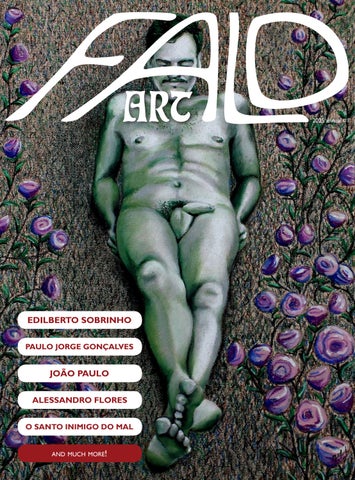
editing, writing and design: Filipe Chagas editorial group: Dr. Alcemar Maia Souto and Marcos Rossetton. website: Pedro Muraki cover: Naked garden n.3, oil pastel on paper by João Paulo, 2017.
Care and technique were used in the edition of this magazine. Even so, typographical errors or conceptual doubt may occur. In any case, we request the communication (falonart@gmail.com) so that we can verify, clarify or forward the question.
Editor’s note on nudity:
Please note that this publication is about the representation of masculinity in Art.There are therefore images of male nudes, including images of male genitalia. Please approach with caution if you feel you may be offended.
Rights and Commitment:
This magazine is committed to artists retaining copyright of their own work. All rights are reserved and therefore no part of this magazine may be reproduced mechanically or digitally without the prior written permission of the artist. We have been careful to ensure that the images used in this publication have been provided to us by the creators with copyright permission, or are copyright free or are being used under the “fair usage” protocol shared over the internet (images are low resolution, attributed to their creator, not for profit and used only to illustrate a relevant article or story). If, however, you feel your image has been used by us unfairly and your copyright breached, please contact us at falonart@gmail.com and we will proceed in the best way possible.
Submissions:
If you are interested in participating in the magazine either as an artist, model or journalist, please contact us via e-mail falonart@gmail.com.
FC Design R. Mario Portela 161/1603 C, Laranjeiras Rio de Janeiro – RJ 22241-000 Brazil
I
n 2025, Falo looked to Brazilian art as a way to connect and reconnect. Therefore, this was the year with the most Brazilian artists featured on its covers and pages. By prominently showcasing genuinely Brazilian production, the magazine aims to continue its efforts to reveal the country’s potential within its essential theme and demonstrate that it is on par with what is being done elsewhere. It is through similarities and differences that we achieve convergence and a sense of belonging. However, this also brings a great challenge. We are living through the consequences of extreme political actions that violently interfere in international relations, with nationalist sentiments spreading in the form of xenophobia, fascism, and terrorism. Launching an annual in English becomes a step towards uniting rather than separating. With a focus on the parts and the whole, may we be more persevering – Together. Filipe Chagas, CEO
Summary Edilberto Sobrinho
4
Paulo Jorge Gonçalves
20
João Paulo
34
Alessandro Flores
o Santo inimigo do mal
PHALLUS IN FOCUS Giuseppe Petrilli
PHALLUS IN FOCUS Francesco Brunetti
moNUment
46 60 82
88
94
Edilberto Sobrinho by Filipe Chagas
The magic of 3D cinema (2018).
I
t is very difficult to separate the History of Art from the Power of Religion. It is believed that prehistoric representations had possible ritualistic functions, and even the pharaohs understood the dogmatic force of Art. During the Middle Ages, the Catholic Church established itself as the greatest patron of Art and came to control the pictorial production of the West. This system lasted until the 17th century, and with the possibility of creation free from religious influence, Art proliferated in varied themes, even moving from the sacred to the secular and, sometimes, the profane. In some cases, religious oppression had been so great that the response came with opposing force… as in the work of Edilberto Sobrinho.
Born into a family from Piauí, Sobrinho was a Jehovah’s Witness for almost all of his adolescence, and his sexuality was aggressively repressed. Over time, he resolved his personal issues and found his place; however, the damage done by religion led him to mix sacred symbolism with gay pornography as “a catharsis to put on paper all the anger felt when confronted with religious fundamentalism in politics and around.”
6
Sacred art influences me in general, but there are two great artists who are not of this style and who, even so, have greatly shaped my current productions: H. R. Giger, father of “Alien,” from whom I learned that it was possible to put penises in my drawings; and Laurie Lipton, who makes gigantic and extremely detailed drawings using only graphite pencils, being the main reason for me to start delving deeper and insisting on this material as my main working tool. Since college, Sobrinho has drawn macabre penises as a form of defense against bullying (“several of my persecutors started to think I was a ‘psychopath’ and distanced themselves”) and as an important tool for building his self-esteem (“some people liked it, and even strangers said I was good at something”). He reveals that, shortly before starting with this horror theme, he even had difficulty looking at himself in the mirror, but the drawings helped him externalize the anger that wasn’t his own, but rather that of the religious fanaticism around him. In 2017, this path established itself as his artistic identity, leading to his selection for a residency, the creation of an art collective, and participation in exhibitions.
Above, The mural of immorality (2017). Below, Our Lady of Misfortune (2018).
The transformation of water into a dick (2025).
7
8
The portal (2017).
9
The torment of Saint Sebastian (2021).
10
New Brazilian currency (2019).
11
It’s certain that, amidst sexualized compositions laden with provocations against religious institutions, erections will be present more frequently than flaccid penises (“the normal penis, however large it may be represented on paper, loses some power”). His creative process is spontaneous – whether from random events or reacting to everyday occurrences – when he begins to search for diverse images (“it’s like I’m making a collage, but instead of cutting and pasting, I do everything in pencil”). His research always delves into images that may challenge the religious and/ or political universe. The artist also sees his work as a manifesto of representation.
12
When we think of satanic art, of horror art, we immediately imagine demonic monsters tearing apart bodies and bathing in blood in hell, and when this type of art talks about sex, it’s almost always heterosexual, with women being submissive to male demons. My drawings are different because I don’t highlight gore* or misogyny. It’s like looking at a terribly wrong religious painting in your grandmother’s house. And I insist on including male bodies and gay sex not only as an affront to the religious people who make me so angry in this country, but also as a way of representing myself, of representing us in a type of art that is not... It’s common for us to find ourselves in this situation.
* Gore (or Splatter) is a subgenre of horror cinema that deliberately focuses on graphic depictions of blood and violence. The term was coined by George Romero. In recent years, the combination of graphic violence and sexually suggestive imagery in some films has been labeled torture porn or “gorn”, a fusion of gore and porn.
There’s an imposter among us. (2021).
Our Lady of Showw-off (2021).
13
The new adventures of Weenie the Pooh or the wonders of the public domain (2024).
14
15
16
17
The garden of delights (2023).
The Elephant Man (2019).
18
Above, A film dedicated to Satan:The destruction of man by the Barbie movie. (2024). On the side, Self-portrait on the autopsy table (2020).
Sobrinho sees a greater acceptance of the body and sex in art, but he also sees the opposing reactionary conservative force that directly affects social media and, consequently, increases censorship in dissemination. Therefore, he affirms that maintaining his essence – personal, professional, and artistic – is the best way to face difficulties and remain sane. 8=D
19
Paulo Jorge Gonçalves by Filipe Chagas
20
Surprise, oil and bitumen on canvas, 2021.
A
s a child, Paulo Jorge Gonçalves loved his felt-tip pens and drawing paper most of all, opening a natural path to art. From a very young age, he collected clippings from magazines and newspapers about art and exhibitions, also seeking inspiration in film, theater, and music – especially rock. He soon began buying painting supplies and taking advanced courses. He graduated in Pedagogy, holds a degree in Arts with a specialization in Art Therapy, and today – in addition to working in art education – he does painting, embroidery, printmaking, photography, and much more.
21
Incidentally, photography entered his creative process after a period of inner exhaustion: I explored art extensively, I had a very different kind of work. I dabbled in playfulness, in graphic design, themes that flirted with Neoconcretism. After a break, I bought a camera and went out into the streets of Rio de Janeiro’s suburbs. Motorcycle taxi drivers, skaters, street kids… I let my passion guide me. I realized that much of what I photographed worked in other media, and I started using the photos as inspiration for paintings and embroidery. Currently, I also use images chosen from WhatsApp groups, social media, and magazines. At times, I’m more of a “photographer,” at others, a painter. And when I want a more political message, I pick up a needle and thread and embroider designs and words.
Next page: Cannibalism without guilt, embroidered with voile and ribbon on fabric, c. 2021. Satisfaction, embroidery with trims and lace on fabric, 2022. Alliance, ribbon embroidery on fabric, 2021. Below: BV3 and BV2, photographies from the Boys series, 2015.
22
23
The lamp 2, oil on paper, 2024.
24
25
BR I 2, photography from the Boys series, 2024.
Within his diverse forms of exploring creativity (“I can’t stick to a single medium”), male beauty has always been a constant – with a certain Caravaggio influence. He understood the political power of placing the male body as the protagonist, not only to embrace his desires and fantasies, but also to raise the queer flag.
26
Accepting it hurts less, embroidery with lace and trimmings on fabric, 2022.
This is me, and this is how I like it, this is how I do it. I have the right to be free.
27
The cousins, photography from the Boys series, 2019.
His first queer artistic productions came from urban photographs (the Boys series), where spontaneous models were photographed in action with objects given by Gonçalves, such as tools, fabrics, and geometric pieces. One of the models suggested that the artist work with male escorts, and after a complicated start (“I didn’t know how to approach them, and the boys didn’t understand that there was no sex”), he managed to put together the concept for the series, flirting with pornography.
Jazz 1, photography, 2017.
28
My photographs are not saintly.They are offerings of the body.The entire naked body without fear, shame, without restrictions, frontality. I also like the magic of facial expressions amalgamated with the naked body. Faces of astonishment, neediness, insecurity, depravity, offering…
Above, BCB3 (2019) and BSI (2016), and, below, BA2 (2019) and BD6 (2016). Photographies from the Boys series.
29
Just come, oil on paper, 2024.
30
Just come 2, oil on paper, 2024.
31
32
Big Phallus BR I, photography from the Boys series, 2015.
Gonçalves knows the compositional power that the penis possesses as a totemic object, whether at rest or erect, and how much it provokes diverse reactions (“I like how it affects the observer”). He reveals that his art attracts the attention of many cisgender heterosexual women, however, censorship is recurrent in his career, and he laments that the “fear of the phallus” prevents people from admiring the plastic and poetic richness of male nudity. For this reason, he recognizes the importance of using his art as a platform for resistance, for reconstructing social thought and overthrowing patriarchal fascism (“my art is cited in several monographs and studies”). Continuing to produce and find spaces for visibility is Gonçalves’ goal, always being true to himself and driven by a need of the soul. 8=D
33
The flyers Suruba Neoconcreta (Neoconcrete Orgy) and Putaria Antropofágica (Anthropophagic Debauchery) (2022), the artist and, above, the felt embroidery Blowjob (2021).
João Paulo by Filipe Chagas
A 34
t five years old, João Paulo was already drawing and painting. At eleven, he asked his mother for paints, brushes, and canvases. He reveals that he was always interested in “aesthetic, delicate, beautiful, artistic, and unconventional” issues, idolizing Rita Lee, Ney Matogrosso, Elke Maravilha, and Maria Alcina. That’s how, at eighteen, he moved into theater – graduating in Performing Arts – where his life transformed and the artist began to find himself.
35
36
In 2006, the call to painting was stronger, and João Paulo returned to the practice. Focusing on learning and experimenting (“I’m practically self-taught”), he explored various mediums and techniques without concern for style or narrative, but always focusing on the figurative, on people, on the economy of scenery.
Over the years, other paths and needs emerged, such as commissions and participation in art exhibitions. However, João Paulo did not feel artistically satisfied, as if something was missing. Until, in 2017, he spontaneously created the painting “Pause in the Studio,” in a very personal way, and:
It was a mixture of curiosity, pleasure, and answers.The great masters (Michelangelo, Caravaggio, Almeida Jr., Edward Hopper), contemporary artists (Lucian Freud, Nelson Leirner, Alair Gomes), and visits to museums… have always been part of the research, the process.
The equation was complete. Everything was there: the style, the color palette, the narratives… my passions, my desires, my feelings, my anxieties, my pains, my orientation, my political act… my existential meaning. It was a mirror.
On the opening page: This is not a naked man, acrylic on canvas, 2018. The painting is a response to the censorship episode of the Queermuseu exhibition at Santander in Porto Alegre, 2017.
On the side: Pause in the studio, acrylic on canvas, 2017, from the series Desire Need Will.
From then on, he completed parallel works to honor commitments and focused on his poetic identity, where homosexuality and all that it implies – desire, passion, pleasure, struggle, body – became inspiration. Whether through intuition, practice, or some expressive trigger, the artist uses images from the internet or his own photographs for his creations, which can take days or months from idea to digital formatting, analog transfer, and gestural process.
Likely summer romance n.1 and n.2, both acrylic on canvas, 2018, from the series Desire Need Will.
37
Watercolor from the series Around here... them, summer, love, 2022.
38
39
Watercolor from the series Around here... them, summer, love, 2022.
Watercolor from the series Around here... them, summer, love, 2022.
40
41
Safe sex, acrylics on cotton canvas, 2025.
Complete nudity is important to João Paulo because he believes in the importance of deconstructing the centuries-old predominance of heteronormativity through visuality (“killing people’s desire to see the naked body”). Depicting the phallus is, therefore, “orgasmic” for the artist, as it confronts and naturalizes the main symbol of patriarchy, leading to reflections on body and gender diversity, ageism, religion, and art. It is within this line of thought that he opts for the representation of the penis at rest, which offers a wider range of interpretations or, as he says, “there are many wonderful hard penises out there, but the interpretation is more restricted, with erection being a symbol of power that I question with my art.”
42
43
Acrylics on canvas from the series I paint, pleasure to show, 2020-24.
Since the dissemination of art featuring nudity on social media has become increasingly difficult, João Paulo sees the acceptance of this theme as slow, both within the closed art circuit and among the general public. However, specific exhibitions are gaining ground and enabling exchanges. Therefore, he suggests: When you have narrative, style, technique, and passion, you’re already halfway there. Just breathe and go for it. 8=D
44
Above, Yes, him! n.2 (watercolor and PVA on paper, 2024) and, below, Yes, her! n.2 (watercolor on paper, 2025). Both from the TRANSpira series.
Plastic surgery for you.
Dr. Alcemar Maia Souto CRM 5246681-1
45
+55 21 97395 8000
alcemarmaiasouto@gmail.com
46
Alessandro by Filipe Chagas
A
fascination with the human figure has always been a certainty in Alessandro Flores’ trajectory, both artistically and personally, as it served as a “coming out” when his family discovered his drawings. A graduate in Visual Arts from the University of Pelotas, the artist produces illustrations, prints, and comics, using watercolor as his main technical language due to the layered painting process that offers him transparency and freedom (“initially I used washes with acrylic paints, but they couldn’t be corrected”).
47
Flores
Harness Boy, watercolor, 2022.
Influenced by contemporary artists (such as Alson Castro, Félix D’Eon, and Blake Gildaphish) and manga artists (such as Hiroriko Araki and Yoshikata Amano) and bara (gay manga), Flores scours the internet for reference poses for his sketches. Noticing the almost omnipresence of white models with a standard aesthetic, he decided to “blacken” [sic] the figures.
I recognized myself as an artist from the moment I began reading about racial issues. It was a necessary eyeopening experience, because until then, I wasn’t seeing results from what I was proposing. I didn’t know where to go.
48
Angel of Twilight, watercolor, 2024.
* The Latin adverb sic (in full: sic erat scriptum), an expression translated as “thus it was written,” is a marker placed on a quotation that has been transcribed exactly as found in the original text.
Blessed, watercolor, 2023.
49
50
Esu, watercolor, 2024.
Against the tide, watercolor, 2023.
51
Showing the Black body became a matter of representation and, by inserting it into an erotic context, an aspect of his identity (“a way of seeing myself in these forms”). Nudity becomes relevant to go beyond mere fetishization: it is a record of desire and the composition that the artist wants to create. I really like the pelvic region from the angle where we can see the penis, the anus, and the soles of the feet together. It’s a hypnotic region. If I portray an erect penis, I want to show pulsating life.Without an erection, I remove the penis from focus, and the viewer moves through other areas of the representation.
Lyrical self, watercolor, 2023.
52
Getted, watercolor, 2023.
53
Darren Aesthetic III, watercolor and ink on paper, 2023.
54
Daddy in bed, watercolor and ink on paper, 2024.
55
56
Above: Astral Energy (2025) and Stallion Among Clouds (2024). Below: Daddy with Towel (2024) and Bathtub (2025). All watercolor on paper.
57
Uncle Josias in the chair, watercolor and ink on paper, 2024.
However, Flores is affected by the homophobic and conservative structure: he has already had to withdraw a work from an exhibition because it had an erection. This makes him unable to see many changes in the process of acceptance of contemporary nudity in art. It seems that heteronormativity contradicts itself: one moment it presents the penis as an instrument of power; the next it hides and oppresses the individual who wants to have rights over their desire.The violence that should have more restrictions is more accepted.There should be more awareness of oppression in the most popular social strata, which are the majority in Brazil, instead of not being able to express what one loves.We still have a long way to go.
58
Above, Reader (2024), and, below, Singer (2018). Both watercolors.
This does not prevent Flores from wanting to be in exhibitions without censorship of his content. Today he aims at the area of education without ceasing to insist on showing who he is and that the Black body is the protagonist of its history. 8=D
Alessandro making the self-portrait Pulp Fiction (2024) in oil pastel.
Join us at TSM: The art of expression. The art of community. The art of swim briefs. The art of being yourself
Artwork by TSM Community Member Brian Fisher
59
o Santo inimigo do mal by Filipe Chagas
60
00580 (modernist hyperrealism), from the Manufactures series, concrete, 2025.
C
reativity is intrinsically connected to libido and desire. It is lust that initiates the creative process of o Santo inimigo do mal*. Linear reasoning becomes erratic extrapolations – “infidelities,” as he calls them – that activate his will to subvert signs, just as the great masters did, whether through painting, sculpture, performance, video, or other forms of expression.
61
* The translation for “o Santo inimigo do mal” is “the Saint enemy of evil,” but in Portuguese there is an ambiguity that makes the translation also “the Holy enemy of evil.”
O Santo inimigo do mal is a personal, performative, and life project of the artist Saint Clair Cerqueira Araújo from Goiás. He states that he constantly finds new poetics and positions in relation to daily life, while simultaneously undergoing his healing and organizing himself to be in the world. I sustain the discomfort of not knowing what my next step is, and I leave that to the Santo. He deals the cards, and I’m always surprised by how interesting and exciting those cards are. [laughs]
62
Above, Astronaut (2019) and Universal Waters (2023), photographs with digital intervention from the Body Universe series. To the side, Adas and Glowing Bitch, digital art from the series The Key:The Sacred and the Proving, 2022.
63
Oil paintings on canvas from the series The List of Astral Whores on Grindr: The work of art in the age of its technical reproducibility (2024); Hairspray Lady (2024); Hetera of Dionysus (2024); Good heterosexual (2024); Soccer player (2024); Newby 18 (2024); Transparent (2024); e Obsidian-Oblivian (2025).
64
Cross Selfie 0001, oil on canvas, 2022.
65
Cross Selfie 0015, oil on canvas, 2023.
His interest in painting began in school, leading him to take a course at a cultural center in his city. He flirted with sculpture, but three-dimensionality only began to become a great passion during his undergraduate studies in Architecture at the Federal University of Goiás and Portland State University in the United States. What connects all the artistic languages he practices is his visual exploration of the explicit in an autobiographical tone.
66
The artist has been blending traditional symbols with contemporary constructions to provoke masculinities as a tool for creating and understanding the world (“the crosses between mystery and concrete”). The portrait – of himself and others – used as communication and connection of desire appears frequently in his work, which is inspired by his erotic-spiritual adventures. His manifesto reveals that he tends to offer both particular and plural perceptions, which allow for the expansion and sacralization of the obscene. Whether sculpting concrete, composing images, or writing words, I operate with precision and intention, like someone who engraves meanings on bodies. My technique is not merely manual skill, but a gesture of inscription: marking presence, eroticizing the sacred, giving form to the invisible. I materialize in pornography, as pornography, and for pornography. I am the one who transforms pain, desire, and delirium into language. Just as in orgasm, just as in life.
Cross Selfie 0012 (2023), Cross Selfie 0002 (2022) e Cross Selfie 0020 (2023), oils on canvas.
67
Fragment 006, concrete in architectural fragment, from the series No prick was injured, 2021.
This connection with pornography, with the explicit, comes from childhood. Santo recalls that since seeing his first penis, he was curious about its textures and differences and had difficulty understanding why he needed to hide it instead of flaunting it as an aesthetic mark (“then Freud and Bataille came along and explained why [laughs]”). Placing oneself nude within the artistic context – “and not only there!”, as he insists on stating – is to validate the diversity of bodies and penis shapes, confronting the saturation of physical stereotypes in a homogenizing consumer society.
Fragment 003, concrete and glass in an architectural fragment, from the series No prick was injured, 2021.
68 Fragment 010, concrete and glass in an architectural fragment, from the series No prick was injured, 2021.
Fragmento 001, concreto e vidro em fragmento arquitetônico, from the series No prick was injured, 2021.
69
Stagnation IV (landing), from the Pleasure Blocks series, concrete, 2020.
70
Stagnation VI (fragmentation), from the Pleasure Blocks series, concrete, 2020.
Stagnation V (standard), from the Pleasure Blocks series, concrete, 2020.
Tales of Gilgamesh (version E), from the Sumerian Porn series, concrete and iron, 2024.
The use of concrete is a hallmark of Saint Clair’s architecture that is realized in Santo’s artistic work. It follows the precepts of Brutalism – an architectural style that emerged after World War II, peaking between the 1950s and 1970s – which valued exposed materials. It is in this idea of the “truth of materials” that Santo anchors his choice and engages with the obscene, with pornography. Concrete is the stone I can mold. It symbolizes our urban nature that I can transform. It is my architectural pleasure. It’s not common to think about the technique of modeling in concrete, but the artist knows that, by working with the material’s curing times, it’s possible to sculpt it manually. For him, making a phallus out of concrete is the ideal combination: both speak of rigidity, imperfections, and rawness. Some of his pieces even have small internal reinforcements emulating the reinforced concrete used in civil construction.
72
73
Stagnation II (weight), from the Pleasure Blocks series, concrete, 2020.
His first depictions of the phallus were made on the last pages of his school notebooks, and he recounts that one time, one of his drawings excited him and he decided to tear out the page to keep it in his pocket and look at it from time to time (“that’s when I started to realize there was something”). Despite this libidinal orientation, heteronormative masculinity was not his goal:
I always had an aversion to groups of normative males.They reproduced so much nonsense and had certain validation rituals and some vulgarities… Only later did I come to understand what it really means to be a man and, above all, a human being; also to be beyond these performances. It was and is contact with sensitive men that has been healing my wounds.
74 Above, Taboo: Censoring the prick and, on the side, Totem:The face and the prick (2023), both from the series The inspiration is transformational, concrete and brick, 2022.
Heterosexual keychain, concrete, 2021.
Norte but things went South, from the Manufactures series, concrete, 2025.
75
00584 (rupture), from the Manufactures series, concrete, 2025.
76
77
Various angles of the concrete sculpture Tales of Enkidu (Worship version), from the Sumerian Porn series, 2024.
Detail of the concrete sculpture Tales of Masculinity (Cerrado’s dirt version), from the Sumerian Porn series, 2024.
78
Santo envisions changes. He considers the growing development of erotic art as “a belated response to the Victorian era that underpinned a widely normalized, unhealthy morality.” Seeing art being used to critically review structural problems, he understands its mission to provoke, to “create spaces for the soul to breathe,” using his body and his history as a field of symbolic crossings. Without aiming to please or teach, Santo affirms that self-legitimization is what leads to the experimentation and subversion necessary to disturb and transform. 8=D
Photos from the performance Pornotactile, held at the 4th Vórtice Festival, in São Paulo, 2025.
79
80
Don’t get caught up in stereotypes.
Research on penile anatomy 81 conducted with the participation of over 100 readers/ followers, fully illustrated.
PDF | 140 pages | $
Please contact us via email falonart@gmail.com
Phallus Focus in
The artist, illustrator and photographer Giuseppe Petrilli is self-taught and categorical: I am an erotic artist. I consider eroticism a great engine of life because, as a concept, it does not ignore intelligence; indeed, it presupposes it. So I always try to create a connection with those who will see my works, playing with them in an irreverent and provocative way.
82
Through various techniques, Petrilli explores all perspectives of eroticism, including the male nude – even though the female nude is his main theme –, which is being published here for the first time! Although he believes that the torso is the part of the body capable of arousing certain sensations, he knows that the provocative and explicit aspect of his work is to give what the viewer wants: the penis. However, he also knows that nudity, regardless of gender, is still difficult to propose, so it is necessary to represent it in the most natural way possible, knowing that “eroticism pleases everyone and whoever does not admit it is lying”. 8=D
83
84
85
86
87
Phallus Focus in
Milo Manara and Guido Crepax are well-known for their works, which frequently feature female characters – usually nude – in both ordinary and surreal, even grotesque, settings. The freedom and sensuality they portray inspired fellow Italian Francesco Brunetti to bring the same energy and expressiveness to his male characters in graphite and watercolor illustrations. Tom of Finland also shaped Francesco’s production, especially since in Naples – his hometown – homoerotic art was rare, unlike the ubiquitous and widely accepted art of Manara and Crepax.
88
As long as I live, I will be captivated by men, and I want to create something sincere and unique to honor this sudden and honest emotion. I openly share my fantasies with the viewer so that my work is seen as ironic, sensual, and provocative… or a combination of all three. Fascinated by the male figure, Brunetti is aware of the taboos surrounding nudity and, therefore, focuses his work on images that explore a raw, almost voyeuristic and spontaneous vulnerability of the male body. He enjoys challenging people’s expectations, even in his choice of depicting the flaccid penis: It feels like a prelude, an invitation to imagine what could come next. I want the viewer to dream, to anticipate. I refrain from portraying heightened arousal, favoring instead the quiet tension of what remains suspended in possibility. Whether through imagination, personal preferences (which ultimately create similar physical characteristics), photographic references, or AI tools that aid in composition before sketching, the artist remains true to his own desire, his own process, and thus offers something unique to their fictional characters: a soul. 8=D
Smelling flowers, watercolor, gouache and pencil on paper, 2025.
89
90
Above, Riding in LA (2025), Chocolate (2025) and Stairs (2025). All in pencil on paper.
Below, Bookshop (2024), DTLA (2024) and Gas Station (2024). All in pencil on paper.
91
92
Public restroom, pencil on paper, 2025.
93
Above, Blue Alley (oil on canvas, 2025) and, below, Surfboard (watercolor, gouache and pencil on paper, 2025) and Apple (gouache and pencil on paper, 2025).
m oNUm en t
94
Model: Pekka. Photo: self-portrait.
95
BE MORE. Falo Magazine has as its main principle the knowledge for free. It was always thought that way through online platforms, where the reach could be maximum and timeless.
96
The work is hard. A single person is the editor, the reporter, the researcher, the writer, the translator, the proofreader, the designer, the marketing advisor, the social media manager, the janitor etc etc ... without any financial gain. The advantage is that the cultural, social and personal gains are immeasurable. However, it is necessary that the magazine become self-sustainable and can invest in itself. You are already our collaborator just because you access the magazine, the social networks and have made it this far. If you want to collaborate a little more to leave quality material as a cultural and social legacy, click the logo to donate!
Thanks to you who believe in the magazine and the transformative power of Art! Alcemar Maia, Daniel Caye, Estevão Sena, Marcos Rossetton, Maria da Graça, Paulo Cibella, Paulo Mendes, Silvano Albertoni, Valfredo Portella, Christopher Norbury, Daniel Tamayo, Eduardo Filiciano, Fabio Ibiapina, Felipe Migueis, Marcos Resende and anonymous benefactors.
97
CLICK THE LOGO TO SHOP
98
ISSN 2675-018X
falonart@gmail.com