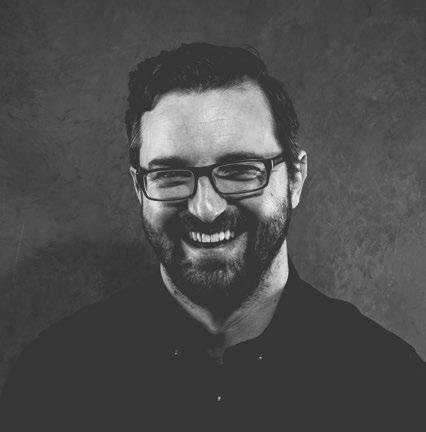
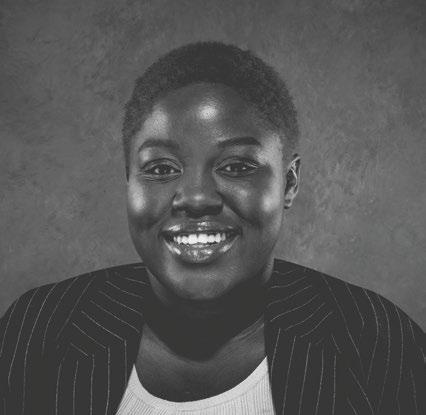
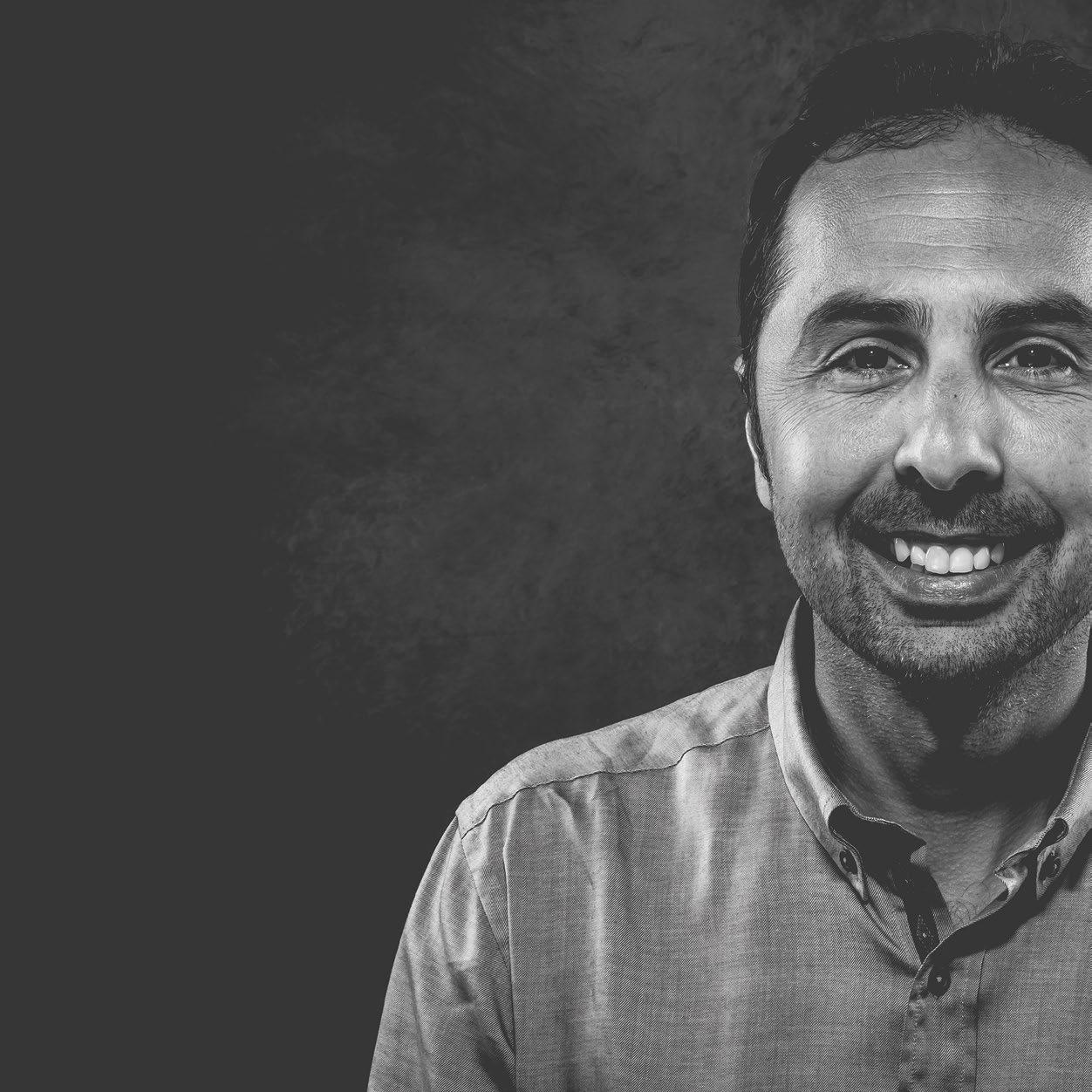
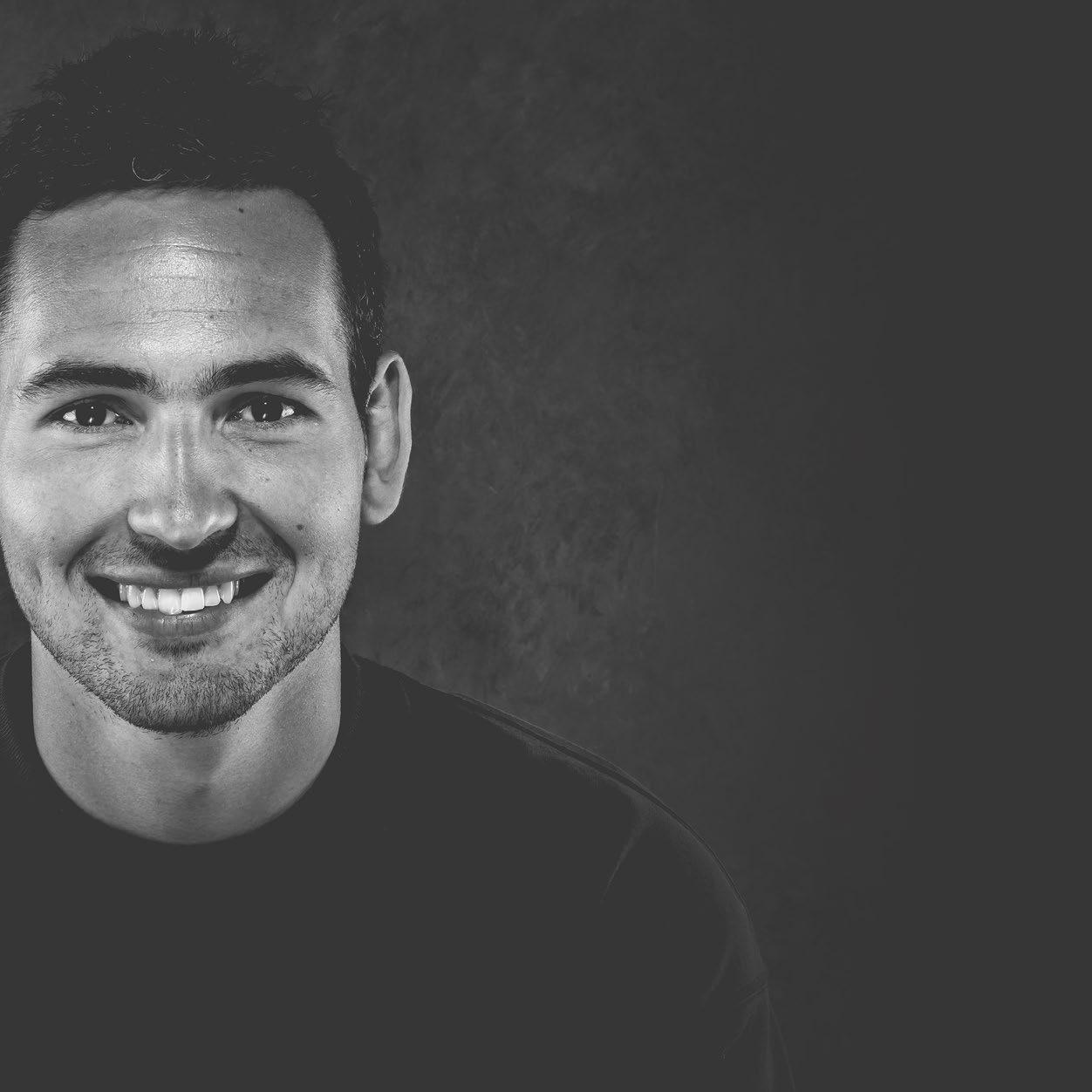
Top line, left to right: Andy Neal, Senior Lecturer: Graphic Design; Danielle Barrios O’Neil, Course Co-ordinator: English & Writing; Will Griffin, BA(Hons) Business Entrepreneurship
Middle line, left to right: Elisia Bott, Business & Innovation Projects Officer; David Smithers, Technical and Facilities Manager: the School of Film & Television; Sarah Benney, Gardener
Bottom line, left to right: Laurence Mesropians, Designer; Fadzai Kadzatsa, BA(Hons) Fashion Design
FALMOUTH IN 2030
In 2030 Falmouth University has become what we set out to be twenty years before, a creative innovation hub. A place full of clever people. Original and courageous thinkers, who feed the future of the creative industries, not its past.
We look different and we work differently - in different places, in different ways and with different people. Everything we do, is done with partners. Not only does this keep us learning, but it brings our knowledge and skills into other high growth sectors.
Creativity has become a commodity in high demand. We know it’s a word that belongs as much to science and technology as art. This is why we work across so many disciplines. Co-creating new interfaces, new products, new narratives, new images, new environments, new business models. Using innovative thinking designed to change lives.
And we are Doing it for Real. Producing future-proofed entrepreneurial graduates. People who excel both as employers and employees. Complex problem solvers and multi-disciplinary team players. Shaped through partnering with industry and by our intensive needs based approach to learning.
We’ve put real world, real market challenges at the heart of everything we do. We’ve learnt how to capitalize our abundant raw student talent. We have created the next generation of entrepreneurs. Our approach to design thinking and open innovation has changed us forever. It has magnified our impact in Cornwall and helped us take Falmouth and Cornwall Global.
The next twelve pages of this Strategy explain how we challenged ourselves to do it and introduces the three sub-strategies that underpinned our journey to 2030.
OPEN INNOVATION
This is the defining cultural approach we use to deliver our 2030 Strategy. A significant shift in approach that changes the way we look at ourselves and our environment.
It starts by cooperating with partners outside our sector, other disciplines, other businesses, other markets and of course end-users. All bringing added value in the creation of new products and solutions.
It means recognizing that not all good ideas come from within our own disciplines. That the 2030 economy will not be shaped within firm sectoral boundaries.
Open Innovation challenges traditional HE structures, methods and roles. It heralds the value of design thinking.
It underpins the urgency to be more porous and to use transdisciplinary models that stimulate invention and disruptive thinking.
It encourages our staff and students to actively seek and exploit synergies. To capitalize our originality and creativity for first mover advantage. This enables us to meet the 4th Industrial Revolution head on.
Kamran Harandy
External Funding Project Officer, engaging with academic and industry partners to develop new research and innovation projects.
STUDENTS
Our students’ future career success is at the heart of our teaching, curriculum and support services. This means preparing our students for the future economy and new types of employment. The 2030 Portfolio Strategy will ensure that graduate career prospects drive every aspect of the academic experience at Falmouth.
STAFF
We have developed a new 2030 People Strategy setting out our commitment to recruiting, developing and nurturing staff, across teaching, innovation, research and professional services. We are breaking down the barriers and distinctions that separate academic and professional services staff, and increasing our agility as an organisation by simplifying staffing structures.
TEAMS
We are building cross-institutional teams to prepare the ground for new interdisciplinary, challenge-based programmes and collaborations. We are investing in new training and development programmes to enable students and staff to build great careers, and achieve their highest potential at Falmouth.
TOOLKITS
Our 2030 People Strategy is underpinned by a Toolkit with detailed advice and output-based annual objectives, tied directly to the delivery of the 2030 Strategy.
RECOGNITION
To reflect our commitment to ‘doing it for real’, we are developing new ways to incentivise and reward staff as stake-holders and share-holders for making significant contributions to the University’s success.
2030 TARGETS
in self-employment 15 months after graduation PERCENTAGE OF GRADUATES
BASELINE 2015/16: 28%
*2016 - six months after graduation
NUMBER OF NEW COMPANIES STARTED
BASELINE 2015: 6
NUMBER OF JOBS CREATED THROUGH START-UPS TARGET 2030: 33% TARGET 2030: 111
BASELINE 2014/15: 19
TARGET 2030: 1575
Riko Sekiguchi
BA(Hons) Illustration graduate and winner of the 2018 Carmelite Picture Book Prize.
2030 TARGETS
STUDENT NUMBER GROWTH
BASELINE 2016/17: 5428
TARGET 2030: 15500
Rob Sanders
Launchpad graduate and co-founder of Glas Data, delivering innovative solutions for the agri-tech sector.
DOING IT DIFFERENTLY
By 2024, our recruitment to collaborative provision programmes will overtake recruitment to on campus programmes. By 2030, 8500 students will be studying primarily off campus, and 6500 on campus.
To deliver this growth we have developed a new 2030 Portfolio Strategy, which sets out our approach to delivering a portfolio that is ‘doing it for real’. This approach that recognises applicant choices are changing and that employers increasingly demand multiplatform skills.
Falmouth enjoys many advantages which help us stand out from a crowded Higher Education sectorour subject specialisms, high standards, unique location, central role in the regional economy, and our approach to innovation and business incubation. We are capitalising these advantages and accelerating our portfolio diversification into new markets, new modes and new subjects.
We are developing new models of content distribution, driven by cutting edge intelligence, market demand and the national future skills agenda, and the rapid growth in demand from emerging economies.
We are doing it collaboratively, working with high quality educational partners around the world to build upon existing markets and open up new ones. Our course portfolio is expanding and diversifying through: •
• Incubation-led teaching and research models
Interdisciplinary programmes
Accelerated Degrees
New types of Apprenticeships
Industry co-designed/co-delivered courses
Online and blended programmes
INCOME FROM INNOVATION, RESEARCH AND COMMERCIAL VENTURES
BASELINE 2016/17: £2.8m TARGET 2030: £70.2m
Tracy Pritchard
Director of the Fashion & Textiles Institute and the School of Architecture, Design & Interiors, building new collaborations and partnerships across the globe.
TAKING CORNWALL GLOBAL
Falmouth University is a recognised anchor institution in Cornwall, fully engaged with the County’s economic, skills and enterprise agendas. We are a major player in delivering higher skills to the County, alongside well documented employment and economic benefits.
The expansion of the University in the early part of the 21st Century was driven by the need to increase the provision of higher level skills in the County, and we retain our commitment to widening participation, and ensuring fair access to our University for people from Cornwall.
We are unwavering in our mission ‘to help grow Cornwall’, but in our next phase the University will also help take Cornwall Global. To do this we will continue to build and populate the pipeline of new high growth, high value companies headquartered in Cornwall trading around the world. Ambitious plans set out in our new 2030 Research & Innovation Strategy.
To achieve this we are working in concert with Cornwall Council, the Cornwall & Isles of Scilly Local Enterprise Partnership, local partners and industry to join up strategies for economic growth and increasing access to higher skills.
We will continue to attract staff and students from around the world, and work with global education and research partners, to increase our international reputation for teaching, research and innovation, and deliver our targets for student growth and income diversification.
BEING SUSTAINABLE
As an anchor institution in Cornwall we recognise our responsibility for the environment, and the impact of our activities and interactions with the wider community.
Falmouth University educates future global innovators, business leaders and entrepreneurs. We influence our students through our actions, through our curriculum, and through the stewardship of our physical environment.
Our Governance structure includes regular reporting on our 2030 plans and targets, including our Environmental Sustainability Policy.
We will seek out, utilise and share environmental best practice and look to drive transformational change wherever we can across the institution.
At a time when student expectations and competition are demanding increased capital investment, we will ensure that our resources are utilised to maximum effect so that we deliver the best value for the institution and our students.
Andy Smith Lecturer
in Creative App Development and co-founder of Joint Effort Studios, producing creative video and digital content for business and industry.
BEING GOLD
Underpinning our 2030 Strategy is an absolute commitment to the highest professional standards across the University’s operations, and to retaining and strengthening our place in the top tier of the UK’s Higher Education providers.
In 2017 Falmouth achieved the highest ranking of ‘Gold’ in the UK Government’s first Teaching Excellence Framework - confirmation that we meet the highest standards for teaching quality, student retention, and graduate outcomes.
This commitment is a critical component in staying competitive in the global Higher Education market, and attracting the highest quality education and investment partners.
BASELINE 2016/17: GOLD
TARGET 2030: Vanessa Hastings BA(Hons) Fashion Photography student and intern at Vogue magazine.