2024-25 Annual Environmental Sustainability Report
p1 INTRODUCTION
p2 THEME 1: LEARNING & TEACHING
p4 THEME 2: RESEARCH & KNOWLEDGE EXCHANGE
p6 THEME 3: PEOPLE & PLANET RANKING
p14 THEME 4: PEOPLE & BEHAVIOUR
2024-25 Annual Environmental Sustainability Report
p1 INTRODUCTION
p2 THEME 1: LEARNING & TEACHING
p4 THEME 2: RESEARCH & KNOWLEDGE EXCHANGE
p6 THEME 3: PEOPLE & PLANET RANKING
p14 THEME 4: PEOPLE & BEHAVIOUR
In July 2024, new Environmental Sustainability Commitments with supporting SMART targets were approved by the University Executive Board and published on the Falmouth University website. This approach drives our efforts across:
• Theme 1: Embedding environmental sustainability across learning & teaching.
• Theme 2: Implementing environmental sustainability as a core function across Research & Knowledge Exchange.
• Theme 3: Integrating environmental sustainability & achieving net zero emissions across our physical estate & operations.
Our approach is designed to meet industry best practice through utilising toolkit and framework guidance led by the EAUC (Environmental Association for Universities & Colleges) and progress towards external league table rankings.
Goal 1: Application across our entire curriculum of a published, peer reviewed evaluation framework to determine the level of environmental sustainability embedded at the course level – (on track).
All 14 undergraduate courses reviewed in the 24/25 academic year embedded at least three of the nine key environmental sustainability themes, 13 of the courses evidenced at least six themes and nine courses evidenced all nine themes. Data was analysed using our established textual/environmental sustainability curriculum ladder methodology.
1 The nine key sustainability themes
Personal/Human Health, Wellbeing & Happiness
Circularity
Citizenship Social Equality & Justice
& Authenticity
Figure 2 Sustainability theme embeddedness for the 13 courses analysed in 2023/24
The most frequently evidenced themes across all courses are ‘future thinking’ (104 instances), ‘solving the climate & ecological crises’ (101 instances), and ‘interrelationships & interdependence’ (96 instances).
Goal 2: Establishing evaluative evidence of at least three environmental sustainability themes in every course we deliver, based on target 1 data – (on track).
A total of 80 courses (58%) of our portfolio have evidenced environmental sustainability in some way by including at least one theme.
There were 731 individual references identified to our core environmental sustainability themes.
Goal 3: Evaluate student ‘learning gains’ at the course level, in environmental sustainability awareness and knowledge/skill acquisition using established OfS guidance – (yet to start).
An approach for measuring learning gains is under development with discussions ongoing to define a methodology, steps to implementation and progress definitions.
This goal will require reframing due to the live Office for Students consultation around the new methodology for evaluation of Teaching Excellence (TEF), which proposes the removal of learning gain from TEF. If this does happen, we should consider pivoting this goal to articulate learning gain through a “skills” lens, for practical alignment with the governmental direction of travel and Skills England agendas.
Goal 4: Implement curriculum-based enhancement of authentic learning related to education for environmental sustainability through assessment and projects (including partners and industry) – (on track).
The methodology for data collection has been finalised and will focus on collating all quantitative data relevant to environmental sustainability across all courses. Our aim is to open a data collection window four times per year to capture both qualitative and quantitative data. There will be a focus on identifying case studies which can be presented through our annual environmental sustainability reporting, website and intranet articles.
Goal 5: Adopt an audit and improvement approach to action planning within and across faculties to ensure circularity is embedded into our academic infrastructure – (yet to start).
Identifying resource and a clear methodology is required to further progress with auditing how environmental sustainability has been integrated into student understanding. Various opportunities and challenges exist with this target, predominantly the parameters around measuring impact.
One proposed approach for this goal involves a survey, to facilitate peer-to-peer capturing of feedback. This method offers a way to close the loop on ensuring the effectiveness of goals 1 to 5 in promoting environmental sustainability and circulatory by assessing the understanding of the students who have participated in this learning. This approach is still subject to challenges within the parameters of impact measurement, such as ensuring a representative cross-section of students is analysed, with ongoing discussion necessary to determine the most effective approach. This goal is scheduled to begin measurement in December 2025 and is currently on track. Future planning might look to amalgamate goals 3 and 5 based on regulatory headwinds.
Goal 6: To develop a project-level environmental sustainability tool that will ensure environmental impact is a key consideration in our approach to research design and delivery and to embed the tool across Research & Knowledge Exchange (RKE) planning processes – (on track).
The first version of this tool was created within the Research & Knowledge Exchange team and was published internally in September 2025. The ‘research design doughnut’ provides a framework for ensuring that the benefits of our work outweigh its ecological costs, always aiming to expand these positive impacts inside the doughnut while minimising the negatives outside.
Goal 7: To create a central intranet repository of guidance on environmental sustainability in research and knowledge exchange by January 2025 – (complete).
A central repository has been created on our internal intranet site to act as a bank of resources and tools to help navigate the integration of environmental sustainability in research and knowledge exchange. Research and knowledge exchange is not only focused on delivering impact at a national and international scale but also creating benefit for the communities we serve. Our research will actively contribute to the generation of new ideas and innovations that contribute to fighting the causes of, and adapting to the effects of, climate change and biodiversity loss, while our knowledge exchange leverages our resources and expertise to support evidence-based, positive action for change across business and society.
Goal 8: To annually audit current environment-related RKE activity via departmental RKE plans to map against external benchmarks including United Nations Sustainable Development Goals, UK Research and Innovation and People, Place and Planet – (complete).
Research projects were captured in the Summer Research & Knowledge Exchange Committee (RKEC) as planned. The department/faculty Research & Knowledge Exchange plan template for 25/26 includes section 2.5 ‘Environmental Sustainability Commitment’ where academic departments can outline sustainability activity; this includes:
The Faculty of Creative Arts and Communication (FCAC) has a faculty research theme ‘Environment Futures’ which draws staff together to collaborate on research that addresses key environmental challenges.
The Academy of Music & Theatre Arts (AMATA) has a research theme ‘Compassionate Social Practice (Art-Making for Ethical, Healthy and Sustainable Communities)’ explicitly dedicated to sustainability.
The School of Architecture Design & Interiors (SADI) environmental sustainability commitment is met through the research themes that speak directly to climate change impacts, circular economy, biobased materials and health and wellbeing. Doctoral research briefs have been written to specifically address the themes and are linked to United Nations Sustainable Development Goals (SDGs), supported by a successful Doctoral Focal Award focused on healthy people, place and planet.
A follow-on paper is due to be presented in 2026, with assessment of depth and rigour delivered from a research review. Our aim is to monitor our growing track record in this area to encourage collaboration and increase visibility.
Goal 9: Achieve net zero scope 1 & 2 (energy) emissions by 2040 – (on track).
This year we exceeded our annual plan target of 1,984 tCO₂e in absolute energy emissions (scope 1 &2) across our campuses recording emissions of 1,898 tCO₂e.
In line with sector practice we also review our carbon emissions based on gross internal area (CO₂e per m2) against a 2005/2006 baseline. Using this measure, Penryn Campus has now seen a 63% reduction and Falmouth Campus a 69% reduction. This means the energy efficiency of our buildings is continually improving as we continue to modify them.
Key projects delivered as part of our energy decarbonisation plan include:
• Eco-Block Pilot – A pilot project to convert Glasney Village. Block A into an ‘eco-block’ utilising an air sourced heat pump system, Solar Photovoltaic (PV) panels and a building management system (BMS). Automatic monitoring and targeting have also been incorporated to generate energy efficiency.
• Sub-metering – Upgrades were delivered focusing on resolving legacy issues to ensure all sub-meters are accurately recording and transmitting data. This includes phasing in how we can install additional sub-meters in Glasney Village to capture more detailed energy data across residential blocks.
• Lighting efficiency – All corridors and main room lights were replaced with LED’s in Glasney Parc phase one to reduce energy use, lower maintenance needs, and improve lighting quality – contributing to carbon savings and a better living environment.
• Solar Power – Infrastructure for new Solar Photovoltaic (PV)’s has been installed on top of the Daphne De Maurier (DDM) building to allow replacement of existing arrays. The new system will provide 215.1 kWp of installed capacity, generate an estimated 193 MWh annually and deliver carbon savings of around 40 tCO₂e per year.
Goal 10: Achieve net zero scope 3 emissions by 2050 (Not on track).
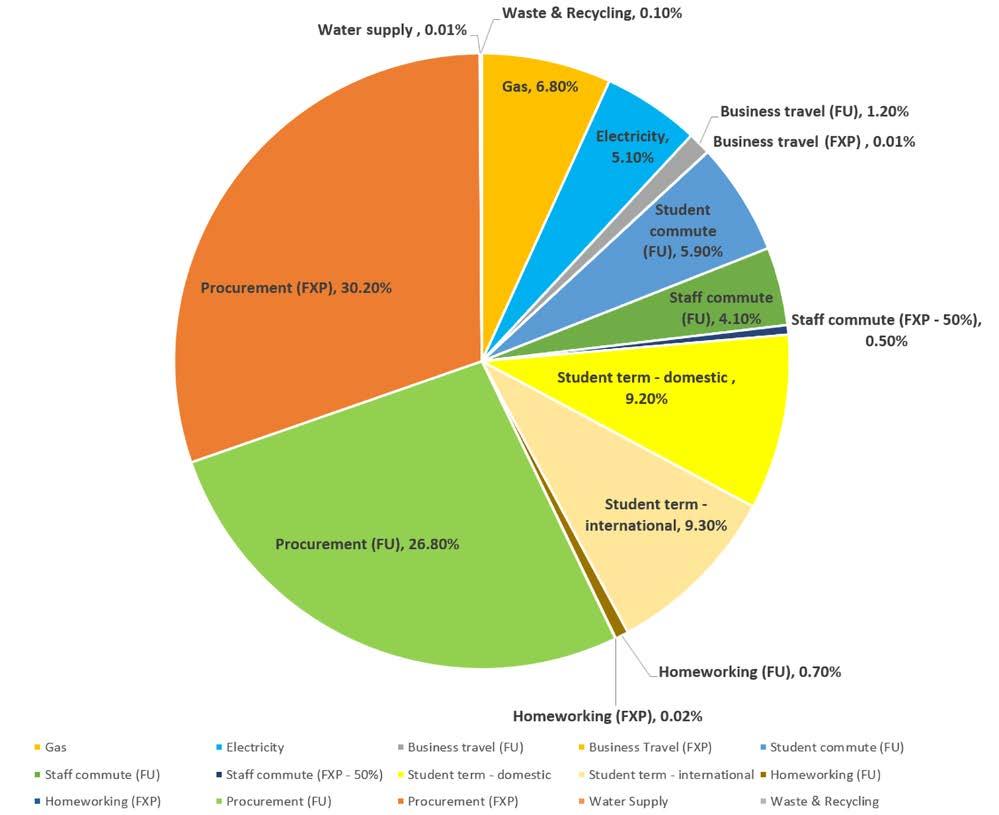
In 2024-25 we recorded scope 3 absolute energy emissions of 14,100.7 tCO₂e against our annual plan target of 12,749. This was largely due to a 34% increase in procurement related emissions deriving from updated central government determined emission factors being applied and increases in procurement spend.
Other notable areas of increased scope 3 activity included a 43% increase in student campus commuting emissions and the inclusion of staff homeworking emissions to the figures. These amendments in reporting follow an improved data and survey analysis method in alignment with the EAUC standardised carbon emission frameworks (SCEF) to ensure our emission accounting methodology meets the preferred industry guidelines.
Goal 11: Broaden our Responsible Procurement Strategy triple bottom line approach focusing on: i) expanding our local supply chain, ii) supply chain carbon reduction and iii) social value integration – (complete).
All of our procurement activities are captured by the Responsible Procurement Strategy which launched in 2022 and aims to establish a triple bottom line across our supply chain that benefits environmental outcomes, the local economy (Cornwall & Devon) and social value. These goals are reviewed within quarterly supplier meetings to ensure we achieve continuous improvement together.
Within our tender criteria, 20% of the overall scoring process is attributed towards responsible procurement activity. This has resulted in:
• 92% of our core suppliers now holding a social value strategy.
• 87% of our core suppliers having a carbon reduction policy.
• 94% of our core suppliers joining our NETPositives supplier engagement platform this year. This portal enables suppliers to submit or create their own environmental sustainability action plans. Our aim is to achieve 100% for the 2025/2026 academic year.
• 37% of our suppliers being based in Cornwall or Devon with 54% of supplier spend also based in the two counties.
The Responsible Procurement Policy and strategy are due for revision and renewal for the 25/26 academic year. The aim is to have these published before the end of the academic year and to be publicly available.
Goal 12: Publish a new Sustainable Commuting Travel Plan that establishes sustainable and active travel modal shift in alignment with our scope 3 emission targets through annual surveys – (on track).
In 2024-25 our total student and staff (including a 50% split of FX Plus staff travel and homeworking) campus commuting emissions dropped by 4.8% to 1,684 tCO₂e compared to the previous year while the end of term student domestic and international travel came to 2,965 tCO₂e – a 3.7% increase from the previous year. As per industry standards we have now included staff homeworking emissions which has added 116 tCO₂e to our overall emission profile.
Over the course of the year, improvements have been made in three key areas:
Pillar 1 (infrastructure improvement planning):
• Works completed on installing four e-bike personal charging units (total of eight charging points) in Glasney Village for students and staff. This follows the launch of a campus lithium battery policy which prohibits any electric bikes or batteries from entering campus buildings due to fire safety protection.
• On Penryn Campus, the Old Lane lighting has been completely rewired and updated with low level bollard lights having been extensively renewed. These features support campus commuters walking or cycling to and from campus.
Pillar 2 (service level improvement):
• We engaged with Sustrans for a total of eight events over the course of the year. This specialist service offered free bike repair, maintenance, security marking and consultation for all campus users. Over the course of the year, 128 bikes were repaired, 60 bikes were security marked, and 132 individual consultations were held where travel advice/information was provided.
• This year, the sustainability team established a working group with transport liaisons at Cornwall Council and First Bus to provide a platform for communicating the impact on students and staff when changes are made to services and/or subsidies.
Pillar 3 (engagement & communications):
• We received the Cycle Friendly Employer Gold Award, and this has been integrated within the wider sustainable travel plan in preparation for re-accreditation in 2027.
• 250 free Beryl Bike codes were procured and distributed across the campus community, promoting the community e-bike hire scheme.
• We promoted the annual staff and student commuting travel survey more actively, receiving an improved response of 268 students and 190 members of staff (Falmouth University, FX Plus and Student Union). Survey feedback has helped to inform how we can improve travel commuting modal services, infrastructure and emissions data collection.
Goal 13: Deliver an Updated Business & Field Trip policy that aligns with our scope 3 emission targets – (on hold).
Business travel emissions equated to 203 tCO₂e or 1.3% of our total institutional emissions. These emissions are predominantly accounted for by our recruitment teams travelling for public events and off campus stakeholder meetings.
Publishing a new business and field trip travel policy is on hold whilst we concentrate our resources on targeting areas of greatest impact.
Goal 14: Increase recycling provision in alignment with our scope 3 emission targets with zero waste going to landfill: i) reduce general waste by 1% per year and, ii) 5% increase in food waste recycled per year – (complete).
This year, we reported a 13.2% (136.6 tonnes) reduction in general waste and 23.4% (97.7 tonnes) increase in recycling & food waste collection compared to the previous academic year across our campuses. This is largely attributed toward cleaner waste separation and more widely available recycling streams. Specific project delivery last year included:
• New food bins were introduced to some areas previously without provision, such as Penryn Nursery and AMATA. Food waste recycling has increased in 24/25 because of extra bins and awareness promotion.
• New smaller bins with improved signage were introduced throughout Glasney Halls of Residence which has proved successful at reducing pest incursions (and subsequent spreading of litter around the waste compounds).
• Tetra-pak recycling has increased again in 24/25, with retail outlets doing an excellent job of recycling empty soya milk and oat milk cartons.
• Recycling of hard-to-recycle items such as medicinal blister packs, pens and toothpaste tubes has increased significantly in 24/25. These are turned into items such as planters, chairs and picnic benches.
• The installation of a new compactor together with existing has led to an 80% reduction in transport-related emissions for waste and recycling removal from the site, while also delivering substantial cost savings.
Goal 15: Integrate at least three circular economic initiatives across the institution each year – (complete).
To meet this goal the following three circular economic initiatives were identified:
• Eight free bike repair and maintenance service events were organised, helping to extend the lifecycle of student and staff bikes.
• The on-campus Swap Shop and British Heart Foundation donation points were delivered throughout the year, helping to achieve life extension for products and avoid the integration of new material and products.
• An on-campus buy-back scheme for reusable coffee mugs was delivered to reduce the number of disposal takeaway coffee cups being used.
Goal 16: Audit, measure and record water consumption to develop a water saving policy and delivery plan – (on track).
Water management is a new area of focus as part of the SMART target framework. This year we recorded across our campuses 53,658m3 of water (10.2 tCO2e) was consumed which equates to an 8% reduction from the previous academic year.
With this new focus, our plan is to establish a water management policy which will focus on:
i) Sustainable water conservation and measures across campuses,
ii) Improving water conservation infrastructure, and
iii) Ensuring hazardous incidences are avoided in alignment with our environmental compliance risk scoring.
Goal 17, 18 & 19: Catering, Retail, Hospitality & Events: 17) embed a sustainable hospitality, retail and food policy that focuses on sourcing, environmental and societal factors, 18) integrate environmental sustainability across campus events and Cornwall Plus and 19) remove single use plastic packaging across commercial outlets and operations (Goals 17 & 18 – on track, Goal 19 – on hold).
Several initiatives have been delivered through the Campus Services and Student Union teams over the year aimed at meeting these goals. Examples include:
• A collaboration with the Falmouth and Exeter Students’ Union to deliver a two-day Environmental sustainability Fair across the Penryn and Falmouth campuses. Attracting over 200 attendees, the events showcased a diverse range of environmental sustainability-focused local businesses, grassroots organisations, SU societies and talented student crafters.
• The expansion of the reusable coffee cup buy-back scheme, aimed at reducing packaging and general waste.
• In partnership with Minor Figures, the catering team hosted a complimentary plant-based oat coffee sampling event at the Sustainability Cafe in May, serving a total of 376 hot and iced oat coffees.
• Meat Free Mondays were trialled in March-25 at The Stannary, in collaboration with the Falmouth and Exeter Students’ Union, with the aim of gaining insights into consumer preferences. Following the trial, it was decided not to implement Meat Free Mondays permanently but to develop a sustainable catering, retail and hospitality policy that will establish objectives for campus services to meet across all campus outlets.
Goal 20: Deliver an environmental net-gain program across our campuses based upon our 2023 baseline – (on track):
Our planned campus biodiversity project delivery continued focusing on further enhancing nature and ecology across campuses. Key highlights include:
• For the eighth consecutive year, Penryn Campus was awarded the Green Flag award, one of just five locations to be recognised across Cornwall. Campus grounds and gardens are managed with environmental sensitivity on a day-to-day basis, enhancing natural habitats and boosting biodiversity on campus.
• 290m2 of wildflower turf was secured and planted across appropriate sites on Penryn Campus to further advance campus biodiversity. This includes 100m2 of turf that was planted in April on Penryn Campus following a collaboration project with the Falmouth University Launchpad team.
• Alongside the turf, 3,358 wildflowers were planted across campus as part of our day-to-day biodiversity enhancement of campuses. 120 trees were also planted across select areas of Penryn Campus.
• A Green Space survey was launched in collaboration with the University of Exeter sustainability team to gather insights and understand how to use and enhance green spaces across our campuses.
Goal 22: Maintain our environmental compliance programme so that all aspects are compliant within UK environmental legislation – (on track).
An environmental compliance and risk matrix has been developed to enable us to record and monitor all applicable legislation and any changes to the requirements under this legislation.
Six environmental compliance incidents were reported in 2024-25 which included noise complaints, water and drainage incidents. These incidents were dealt with under our established processes and response plans and recorded under our annual Health & Safety report.
Goal 23: Report and measure the energy and carbon impact of our digital programmes, assess potential solutions to inform a decarbonisation digitisation policy and implement short-term behaviour change initiatives – (on track).
A newly created working group with our IT team has begun identifying project opportunities. Focusing on a cradle-to-cradle approach, the aim is to:
I. Capture emissions and impact data from campus digital activity in alignment with our Responsible Procurement Policy.
II. Ensure all suppliers we engage with have environmental sustainability and decarbonisation at the core of their business.
III. Ensure that all on-campus digital technology including servers and data capturing systems supports energy efficiency measures.
IV. Explore routes to extend the lifecycle of campus digital equipment through in-kind donations.
Goals 24 & 25: Ethical Investment Policy – apply and use the new Ethical Investment Policy in the process of identifying potential investment opportunities (on track) and within one year, implement a review of the environmental sustainability impacts of the investment portfolio and disclose this publicly, and every two years thereafter – (on hold).
An Ethical Treasury Management Policy has been drafted and is currently making its way though our internal approval process
Goal 26: Deliver events/engagements with the campus and wider off-campus community. Each year we aim to: i. organise at least 20 environmental sustainability/climate related engagements with the campus community (students and staff) ii. organise at least five environmental sustainability/ climate-related events with the wider off-campus community – (complete).
Our engagement programme provided 42 events with our on-campus student and staff community. We also delivered five events for the local off-campus community. These included events such as free bike repair stalls during Community Day on Falmouth Campus, climate anxiety workshops, the RSPB Big Bird Watch, on and off-campus litter picking, community bike rides etc.
A total of 11 environmental sustainability focused social media posts were shared across internal and external Falmouth University channels. These included student projects focusing on environmental sustainability as well as wider campus initiatives such as bike repair services, bus ticket information and eco anxiety workshops.
A total of 39 environmental sustainability focused posts were shared across internal and external FX Plus channels. These predominantly focused on campus environmental sustainability initiatives, such as bus price information, wildflower space implementation, travel survey promotion and campus volunteering.
Our efforts across the year saw Falmouth University rising to 93rd (up 14 places) in the People & Planet League Table. Actions which improved our ranking include:
Publishing a new institutional environmental sustainability policy and SMART target blueprint.
• Referencing updated decarbonisation plans.
• Linking to our responsible procurement plans to improve our sustainable food category scoring.
• Improvements in energy sources, waste & recycling and carbon reduction categories evidenced through the Higher Education Statistics Authority (HESA) Estates Management Record (EMR) return.
Key areas of focus for the coming year to improve our ranking further include publishing a new sustainable food policy with a supporting framework, approving and implementing the ethical investment policy and updating sustainable infrastructure plans.