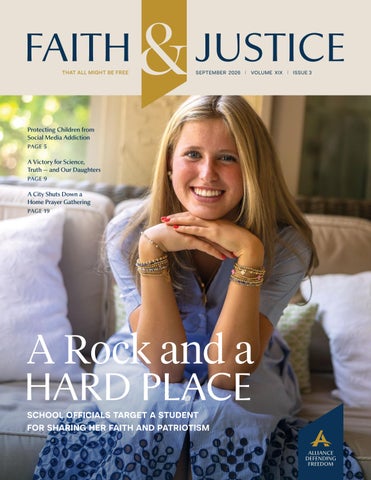
FAITH THAT ALL MIGHT BE FREE
&
JUSTICE SEPTEMBER 2026 | VOLUME XIX | ISSUE 3
Protecting Children from Social Media Addiction PAGE 5
A Victory for Science, Truth — and Our Daughters PAGE 9
A City Shuts Down a Home Prayer Gathering PAGE 19
A Rock and a
HARD PLACE SCHOOL OFFICIALS TARGET A STUDENT FOR SHARING HER FAITH AND PATRIOTISM
Contents
Cover Story
September 2026 Vol. XIX, Issue 3
11
Editor
A ROCK AND A HARD PLACE
North Carolina high school student Gabby Stout
School Officials Target a Student for Sharing Her Faith and Patriotism
Columns 2
MINUTES WITH KRISTEN Among the Brave
Art Director Jonathan Marshall
Senior Photographer Bruce Ellefson
5
Contributors
SPECIAL FEATURE
Karla Dial Daniel Grand Erin Hawley Matt Kaufman Kristen Waggoner
We Must Protect Our Children from Social Media Addiction
Donate
CASE UPDATE
ADFLegal.org/FJ-donate
Supreme Court Clears Path for Pregnancy Center’s Free-Speech Fight
8
ALLIANCE PROFILE Amanda Achtman
9
OPINION A Huge Win at the High Court
19 NEWS & QUICK TAKES Case Updates from Around the World
MY VIEW I Just Wanted to Pray with My Neighbors. The City Said No.
21
Q&A Seriously Funny: Seth Dillon and Kyle Mann
1
Senior Writer Chris Potts
7
3
Karen Kurtz
Questions or comments on this issue? Email Editor@ADFLegal.org
AllianceDefendingFreedom @ADFLegal AllianceDefendingFreedom AllianceDefends
15100 N. 90th Street, Scottsdale, AZ 85260 ADFLegal.org 800-835-5233 Referral to websites not produced by Alliance Defending Freedom is for informational purposes only and does not constitute an endorsement.
MINUTES WITH KRISTEN
Kristen Waggoner speaks to a crowd of 1,100 allies at ADF’s annual Summit in July. July.
Among the Brave B Y K R I S T E N WA G G O N E R , C E O , P R E S I D E N T & C H I E F C O U N S E L
F
or a lot of us, summer is a time of travel. Mine took me around the world, but two moments stayed with me long after I came home. In June, I stood at the remains of a World War II concentration camp in Germany, where, amid the remembered horrors, I was especially moved by a marker dedicated to one man who refused to bow to the tyranny of his time. It cost him his life. Standing there, I wondered: Would I have shared his courage? In the face of all that engulfed his country — its politics, laws, and culture — could I have stood for Christ’s love and truth? A few weeks later, I was in California at ADF’s annual Summit, surrounded by 1,100 allies from around the world, each carrying a different story but the same courage. Backstage, an array of leaders and ADF clients prepared to share their own stories of contending for truth in this civilizational moment — that all might be free. And right then, I knew exactly where I stood. Among the brave. I thought of the remarkable colonists who fought and won the great independence we had celebrated just a few days before. They, too, carried a complex combination of personalities into the fight, struggling together to surmount the awesome, intimidating challenges of their day — challenges not so different from ours. No, they did not face gender ideology in its current strain. Their children did not see the world through
Instagram and chatbots. But the question was the same: Can the Lord and His Word prevail in our time? Recently, Jude’s clarion call for believers to “contend for the faith that was once for all delivered to the saints” has lingered on my heart. I love that word, contend. To struggle, to fight for something precious.
I love that word, contend. To struggle,
TO FIGHT FOR SOMETHING PRECIOUS.
A
t ADF, we contend — for Genesis 1, for free speech, for life, for our rights as parents and people of faith. We contend, not in our own power, but by abiding in Christ. Yes, we see all around us the loss of our spiritual foundation, laid on truths that were once “self-evident” to all: in a generation taught to scorn their country, to resent their bodies, to censor or even use violence against their opponents, to search for meaning without God. But you and I are called to contend for truth — to keep the door open for the Gospel in a world desperately thirsting for it. Every courtroom victory. Every policy win. Every act of courage. Every kitchen table conversation. Each one makes His truth ever more “self-evident.” Each one gives others the courage to stand. And each one moves us closer to the day His Word prevails in our time. What a blessing to contend with you … for our Lord, and among the brave.
2
News & Quick Takes Case Updates from Around the World WASHINGTON
Gady Youmans
GEORGIA Gady Youmans, director of a Christian education program, has sued a Georgia school district for violating his First Amendment rights to free speech and free exercise of religion. For more than a decade, Sweet Onion Christian Learning Center provided optional off-campus religious instruction to students at Vidalia High School. But school officials canceled the program after Youmans criticized a proposed city tax increase on his Facebook page. They also claimed his instruction was not presented in a “neutral or well-balanced manner,” based on a parent’s decision to remove her child from the program because it did not exclusively use the King James Version of the Bible. ADF attorneys filed a federal lawsuit on Youmans’s behalf, explaining that the First Amendment protects both his right to criticize the tax increase and to teach the Bible from his religious perspective. 3
On behalf of Kallie Keeler, a teenage female wrestler, ADF attorneys have filed a lawsuit against Washington state officials. A male wrestler sexually assaulted Keeler in December 2025 during a high school girls’ wrestling tournament, an event sponsored by the Washington Interscholastic Activities Association. Keeler and her mother, Stephanie Brown, are suing state officials because no one told Keeler or her mother that she was about to wrestle a male. The officials then waited 53 days to report the sexual assault to law enforcement, violating a mandatory 48-hour reporting law. Keeler and her mother are asking the court to protect their rights and the rights of all girls in Washington not to be forced to compete against male athletes unaware.
OREGON A licensed counselor won a legal battle after ADF attorneys appealed his case to an Oregon appellate court. The Oregon Board of Licensed Professional Counselors and Therapists fined Frank Canepa nearly $90,000 because he explained to a client, after repeated inquiries for his personal view, that he could not personally affirm same-sex relationships. During the nearly three years Canepa had been seeing the client, he never brought up his own views. But after she repeatedly pressed him for them, he felt that, for the sake of the counseling relationship, he should answer. The board ruled that Canepa’s response violated state regulations and the American Counseling Association’s Code of Ethics by “imposing” his values on the client; it ordered him to complete six hours of continuing education in addition to paying the fine. After ADF attorneys appealed, the board withdrew its disciplinary action without explanation.
“Washington state officials insist on pushing gender ideology at all costs — even at the expense of GIRLS’ SAFETY AND PRIVACY.” ADF Senior Counsel Kate Anderson Kallie Keeler
“ NO STATE SHOULD HAVE THE POWER TO permanently assign a person’s religion.” ADF Director of Advocacy for Global Religious Freedom Kelsey Zorzi
IRAQ
Christian faith and sets a precedent for religious minorities across the region.
EGYPT Augustinos Samaan of Egypt was sentenced to five years in prison and hard labor for sharing YouTube videos about his Christian faith. He was charged under the country’s blasphemy laws, which criminalize speech deemed offensive to Islam. Samaan was first arrested in October 2025 for his videos seeking to answer common questions about Christianity. Some of his videos, The Denardi family
An Iraqi court has ruled in favor of a young woman, allowing her to change her religious status to Christian in the national database. Though raised in a Christian household, Maryam (not her real name) and her sisters were automatically registered as Muslim while still minors after their mother separated from their father and remarried a Muslim man.
Iraq’s National Card Law requires that minor children “follow the religion of the parent who has converted to Islam.” Once she reached adulthood, Maryam filed a legal claim to change her registration to Christian. The court ruled in her favor in May 2026. ADF supported her case. The ruling restores Maryam’s ability to live in accordance with her
BRAZIL
which are largely academic, explore the differences between Christianity and Islam, often including philosophical and theological criticisms of Islam. His channel has drawn more than 100,000 subscribers. Samaan’s case is part of a wider crackdown on online content deemed by authorities to be offensive to Islam. He is one of dozens of religious minorities who have been criminally prosecuted and imprisoned for posting allegedly blasphemous content on social media since August 2025 alone. Samaan is appealing the court’s conviction with ADF’s help.
A Brazilian judge sentenced parents Adauto and Ieda Denardi to 50 days in prison for homeschooling their daughters, ages 15 and 11. The judge convicted the couple of “intellectual neglect,” citing their failure to include stateapproved content on gender, sexuality, tolerance, and diversity in their home curriculum. During an April hearing, the prosecutor concluded that the parents had not neglected their children and recommended acquittal. But the judge rejected this request and instead doubled down and blamed the parents for “using their daughters as pawns in an ideological struggle, subjecting them to a form of unregulated education.” The Denardis began homeschooling their daughters in 2020 after observing shortcomings in the public education system during pandemic-era remote learning. Since they started homeschooling, they have seen significant improvement in their daughters’ academic performance. The Denardis are appealing the ruling with the legal support of ADF. Their prison sentence is currently suspended while the appeal proceeds. 4
SPECIAL FEATURE
We Must Protect Our Children from Social Media Addiction Three States Have Passed the Stop Harms from Addictive Social Media Act. It’s Time for Others to Do the Same.
I
magine a company whose staff record children at the local playground, including the children’s conversations, interactions, and responses. The company uses that information to tailor products and advertising to each child. And the more they record the children, the better they become at targeting them and addicting them to the company’s products. Moreover, they do all of this without the parents’ knowledge or consent. Parents would rightfully be outraged and frightened. Yet the degree of monitoring, recording, and exploitation by large social media platforms is far more intrusive and revealing than a playground video camera. And social media is dangerously addictive to vulnerable kids whose brains are still developing. This is why the states of Idaho, Minnesota, and South Carolina recently passed the Stop Harms from Addictive Social Media Act (SHASM). Based on a model bill developed by Alliance Defending Freedom, SHASM confronts the root cause of
5
harm to children online by stopping social media companies from addicting kids for profit. It protects young users by keeping children off social media by default, restoring parents’ authority when access is allowed, and eliminating addictive features and targeted advertising from children’s accounts. The result is a common-sense, constitutionally sound solution that puts children’s mental health and family control ahead of corporate incentives.
Social media has become deeply embedded in everyday life, ESPECIALLY FOR CHILDREN AND ADOLESCENTS.
WHY SOCIAL MEDIA ADDICTION IS A GROWING THREAT
S
ocial media has become deeply embedded in everyday life, especially for children and adolescents. And platforms like Facebook, Instagram, TikTok, and YouTube are intentionally designed to maximize attention and engagement — and ultimately hook users. One study showed that sixth graders picked up their phones an average of more than 100 times per day,
most often to check social media apps. In another study, 35% of teens reported that they were on social media “almost constantly.” But no amount of social media usage has proven safe for children, says Chelsey Youman, senior counsel for ADF’s Center for Public Policy. “Even when parents impose time limits or content controls, social media displaces activities essential to healthy development, including sleep, physical activity, face-to-face interaction, and sustained attention,” she says. Addictive social media features contribute to rising rates of anxiety, depression, self-harm, and social isolation among children and adolescents, she says. These harms are not accidental — rather, they are the byproduct of business models that profit from attention, personal data, and prolonged screen time. “For social media platforms, an addicted user is a profitable one,” Youman says. The longer a child stays plugged in, the more data is collected and the more valuable that child becomes to advertisers. As a result, addictive social media features such as infinite scrolling, auto-play videos, and constant notifications keep kids hooked. “Children are not experiments,” she says. “And their private information is not a commodity.”
addiction. Children can access information, create content, and follow accounts they choose. SHASM simply blocks the engineered features designed to keep children hooked. It stops targeted advertising using children’s data. A child’s online behavior cannot be exploited for profit. Platforms may not use data such as activity history, communication with friends, photos, and behavioral patterns for targeted advertising. It gives families legal remedies to protect their kids. Parents can bring civil actions and other relief against platforms that break the law. And state attorneys general are also empowered to enforce the law.
HOW ADF BECAME INVOLVED
B
efore SHASM, several states had already tried to legislate against social media addiction. ADF’s policy team studied those earlier efforts and developed SHASM specifically to protect minors through measures designed to survive constitutional scrutiny — relying on age estimation rather than digital IDs or other identityverification systems that could later be used to track or silence people based on what they post online. HOW SHASM PROTECTS KIDS As ADF began working with individual states, the FROM ONLINE ADDICTION pushback was immediate. “Many of the Big Tech companies came out very HASM addresses the harms of addictive design and strongly against this bill,” says Youman, who helped lead profit incentives while respecting free speech, the effort. This wasn’t surprising. privacy, and parental choice. “These social media companies make a pretty large profit,” she says. It keeps young children off “It’s a multibillion-dollar profit off social media by default. Social children every single year. And this media platforms must use agebill would impact that.” estimation technology to identify Legislators, though, were any user who is 15 or younger and supportive. “This was a rare instance must remove that user’s account where we saw a lot of unity across the unless a parent gives permission aisle — lots of bipartisan effort. for the child to have it. “They really ended up resonating with the bill and the reasons why we It puts parents back in control. needed it to be the way it is,” she Chelsey Youman Parents can choose to allow their says. “We would leave those child to use social media through committee hearings with unanimous verifiable parental consent. When a child’s account is committee votes, which they say does not happen often.” approved, parents have the ability to set time limits and Idaho enacted SHASM in April, becoming the first restrict access during certain hours. Privacy settings are state to regulate social media use to protect minors. installed by default. Minnesota and South Carolina followed in May. “These bills are the first of their kind in the nation It removes addictive design features. When parents to push back against social media companies in a allow their child to have a social media account, platforms constitutional way,” Youman says. “These children deserve must protect the child from features known to drive to be protected.”
S
“ CHILDREN ARE NOT
EXPERIMENTS.
And their private information is not a commodity.”
6
Aimee Huber, executive director of First Choice Women’s Resource Centers
CASE UPDATE
moment it was issued, Gorsuch wrote, not just when it would be enforced — because the threat of exposure chilled donors’ willingness to associate with the group.
Supreme Court T Clears Path for Pregnancy Center’s Free-Speech Fight
I
n a 9-0 decision on April 29, the U.S. Supreme Court ruled that First Choice Women’s Resource Centers, a New Jerseybased pro-life nonprofit, can challenge a state subpoena for its donor records in federal court — without first waiting for the subpoena to be enforced. The decision, written by Justice Neil Gorsuch, is a win for First Choice in its yearslong fight against the state’s pro-abortion officials. The case began in 2023, when the attorney general issued a sweeping subpoena demanding that First Choice turn over vast amounts of information, including the names and contact information of its donors, despite not producing a
single donor or client complaint against the ministry. Aimee Huber, executive director of First Choice, saw the silver lining in New Jersey’s harassment of the pregnancy center. “I knew this was bigger than us,” she said. “And I knew that if we didn’t stand up, other pregnancy centers would be harassed and targeted, and I couldn’t let that happen.” Representing First Choice, Alliance Defending Freedom filed a federal-court action to block the state’s efforts. But lower courts said First Choice hadn’t been harmed enough to sue, stating that the subpoena didn’t carry the force of law until a state court ordered it to comply. The Supreme Court disagreed. The subpoena did its damage the
he ruling may help not only First Choice, but others facing similar harassment. Any advocacy group — political, religious, or otherwise — facing similar investigative pressure from hostile state officials could invoke this ruling. That may explain the unusually broad coalition of supporters behind First Choice, including the ACLU, a taxpayer group, and religious organizations. The ruling, too, transcended ideological differences, with all nine justices ruling for First Choice — a sign this case’s relevance reaches well beyond the abortion debate. For First Choice, the fight isn’t over. The case now returns to federal district court, where the organization will argue the subpoena itself violates the pregnancy center’s constitutional rights — a question the Supreme Court didn’t decide, only that First Choice has the right to bring it before a federal judge. Still, the ruling matters well beyond this one case. By opening the federal courthouse doors immediately, rather than after enforcement, the Court has put a meaningful check on how state officials can use subpoena power against groups whose views they oppose.
“I knew that if we didn’t stand up, other pregnancy centers WOULD BE HARASSED AND TARGETED.” 7
ALLIANCE PROFILE
Amanda Achtman B Y M AT T K A U F M A N
“That’s where I found my personal mission,” she says. “That’s where I made an all-in commitment to focus on this project of cultural renewal.” The next year, Dying to Meet You was born.
S
A
sk Amanda Achtman what she does, and you’ll get an unusual answer. “I prevent euthanasia and encourage hope,” she’ll reply. “I say that to everyone — Airbnb hosts, Uber drivers, anyone who asks. It’s led to some really interesting conversations.” In 2023, the young woman from Calgary founded Dying to Meet You — a project dedicated to building a culture that supports and cares for those affected by euthanasia. That’s badly needed in Canada, where roughly 5% of deaths involve Medical Assistance in Dying (MAID) — Canada’s term for euthanasia and assisted suicide. In 2016, Parliament legalized the practice for people whose deaths were “reasonably foreseeable.” In 2021, legislators expanded eligibility to those with disabilities. A further expansion to include mental illness as a sole condition has been passed into law but repeatedly delayed, with implementation now pushed to March 2027. Achtman had a close-up view of the 2021 disability expansion: As an assistant to a pro-life Member of Parliament at the time, she tried to stop it. But she didn’t confine her efforts to the political front. On New Year’s Day 2021, she resolved to blog every day that year about death — how to think about it, how to deal with it, how to support those facing it. As the year passed, she heard from a growing number of people who appreciated her posts and shared their personal stories. That response carried into 2022, when Achtman attended Areté Academy, ADF’s international training program to prepare young leaders to impact law and culture. She credits it with helping her find her calling — and equipping her to act on it.
ince then, Achtman has traveled across Canada and around the world, engaging audiences in what she calls “life’s big questions of suffering, death, meaning, and hope.” Recently, her work has focused on warning the United States and other countries about Canada’s euthanasia experiment. Achtman also makes sure the voices of people impacted by MAID are heard, often through video vignettes featuring those who’ve felt pressured to choose death over care. Some of those videos have reached a wide audience — none more than the story of Miriam Lancaster, an 84-year-old woman who was offered MAID soon after she arrived at a Canadian hospital with excruciating back pain. She refused, recovered fully, and went on to travel to Cuba, Mexico, and Guatemala. Her story was picked up by outlets ranging from Canada’s National Post to London’s Daily Mail to People magazine. “I learned a lot from ADF about the power of testimonies,” Achtman says. “It’s one of many aspects of Areté Academy that I’ve transplanted into my work.” Since she first attended Areté, she has returned three times as a speaker. She’s thankful for the chance to pay it forward. “I’d begged God for a task through which I could make a gift of myself and live in more ardent dedication to Him,” she says. “This is a mission He has given me. It’s a joy to do meaningful work.”
“I’d begged God for a task through which I could make a gift of myself.
THIS IS A MISSION HE HAS GIVEN ME.”
8
OPINION
A Huge Win at the High Court A Victory for Science, Truth — and Our Daughters B Y E R I N H AW L E Y
I
n a landmark ruling, the Supreme Court upheld Idaho’s and West Virginia’s commonsense laws reserving women’s sports for women. That decision reflects basic biological reality — that women and men are different — and that those differences matter in athletics. The Supreme Court’s ruling that neither the Constitution nor Title IX prevents states from protecting women’s athletic opportunities will allow generations of girls to compete on an equal playing field. Title IX was enacted in 1972 to promote equal academic and athletic opportunities for young women. My mom was an early beneficiary. Her rural New Mexico school had limited opportunities for women’s sports. Title IX changed that. For the first time, she and other female
Nearly half of states allow MEN TO COMPETE IN WOMEN’S SPORTS. athletes were allowed to play basketball her senior year. Things weren’t perfect — administrators insisted on a half-court 6-on-6 format because they viewed the traditional game as too taxing — but female athletes were allowed to compete and to win. Title IX worked. Female participation in high school sports has exploded, growing by more than 1,000%. Generations of young women have discovered the gifts of discipline, teamwork, and resilience. They’ve competed, and they’ve won. Yet all of those gains are under threat.
N
ADF attorneys with three of the female athletes they represent, at the U.S. Supreme Court on January 13. From left: Jim Campbell, Mary Kate Marshall, Madison Kenyon, Lainey Armistead, John Bursch, and Chris Schandevel. Top Right: Advocates for women’s sports gather outside the Court ahead of its ruling on Title IX.
9
early half of states allow men to compete in women’s sports. And when West Virginia and Idaho chose to protect women’s sports, the ACLU sued them, alleging that they were violating Title IX and the Equal Protection Clause. Never mind that when male athletes who identify as women compete in women’s sports, girls lose. They lose podium spots. They lose records. They lose scholarships. They lose the chance to push their bodies to the limit and be the best. That is why the Supreme Court was correct to hold that neither Title IX nor the Constitution requires states to allow men in women’s sports. The science is clear. Justice Brett Kavanaugh’s opinion for the Court emphasized that boys and girls have “inherent physical differences relevant to athletic performance.” Those differences include “height, weight, strength, speed, endurance, and jumping ability” — advantages that create significant safety risks for female
athletes competing against male athletes in contact sports. Those advantages often remain when males take puberty blockers or testosterone suppressors. And these physical differences “undermine competitive fairness.” That’s why schools have typically had separate men’s and women’s teams. And that’s why Title IX allows separate sports teams.
T
his is not an abstraction. In Connecticut, female runners who trained for years to compete at the highest levels finished behind male competitors who took 15 titles at the state championships. Some female athletes lost the chance even to compete in the state meet to a male athlete. B.P.J., the plaintiff in the West Virginia case, has displaced more than 470 girls competing in track and field over the course of just a few years. And despite puberty blockers, B.P.J. recently won the girls’ state Class AAA shot put championship with a personal best of nearly 39 feet. The second-place girl finished more than two feet shorter. As ADF attorney Suzanne Beecher observed, “the developments from the state meet ... underscore the fact that no amount of testosterone suppression or intervention can undo the very real differences that males have over women.” Crucially, in its landmark ruling affirming that states may protect a fair and safe category for female athletes, the Supreme Court held that the term “sex” in Title IX means “biological sex” — not gender identity. For those of us who hold a biblical worldview, this common-sense ruling is welcome. Genesis tells us that God created human beings male and female. That is not a cultural artifact or a relic of patriarchy. It is the foundational reality of who we are. As none other than the late Supreme Court Justice Ruth Bader Ginsburg once recognized, the differences between men and women are not only enduring, but a cause for celebration.
sex satisfied those tests. States, for example, have important “interests in safety and competitive fairness,” which they promote by “limiting women’s and girls’ sports to biological females.” Despite the tremendous victory for women’s sports and common sense, the fight for fairness in women’s sports is not over. Approximately 21 states currently fail to protect women’s sports. What do we say to the girl in Washington who trained for four years and finished second — to a biological male? What do we say to the teenager in Vermont who quit her sport rather than share a locker room with someone she did not feel safe around? What do we say to a young woman who lost a college scholarship because she couldn’t beat biology? These are the women Title IX was enacted to protect.
GOD MADE US MALE AND FEMALE. The Court has confirmed the law may say so. God made us male and female. The Court has confirmed the law may say so. Now the work continues — to protect every girl who laces up her cleats, dives into a pool, or steps onto a track, trusting that the contest is fair.
Erin Hawley is a wife, mom of three, of counsel at Alliance Defending Freedom, and a law professor at Regent University School of Law. This is adapted from an article that originally appeared in WORLD on July 2.
O
n the Equal Protection claim, Kavanaugh explained that because the Idaho and West Virginia statutes limit women’s sports to biological females — and thus make a distinction based on sex — the states must show that the sex-based classification achieves an important government objective. The Court had no difficulty concluding that separating sports based on biological
ADF client Adaleia Cross, a West Virginia student athlete, discusses standing up against boys competing in women’s sports at ADF’s 2026 Summit in July, joined by ( from left) CEO, President & Chief Counsel Kristen Waggoner and ADF clients Soleil Hoefer and Madison Kenyon.
10
11
COVER STORY
A Rock and a Hard Place School Officials Target a Student for Sharing Her Faith and Patriotism BY C H R I S P OT TS
I
t’s terrible, the far-reaching damage one gunshot can do. It’s been six decades since a generation of young people watched their heroes — two Boston brothers and a Baptist pastor from Georgia — shot down in the prime of life, at the height of their national influence. The impact of those assassinations has echoed on and on, in our culture and campaigns, shadowing our hopes as a people and our optimism as a country. Last year, a new generation experienced that pain, as another shooter took out another young man whom a growing number of high school and college students looked to as a hero — for his courage, his faith, and his bold willingness to speak piercing truth to their age group. Gabby Stout was one of those young people. “Charlie Kirk became really popular for teenagers like me,” she says. “He was very smart. I’d see him on social media, or watch him as he went to campuses, speaking to the students, and think, ‘Wow, he’s talking about God, talking about the Bible.’ “I liked what he said. He spoke truth to campuses. He wanted people to be able to defend their faith and what they believe in. He debated students, but he’d welcome them, even if they weren’t from the same background or didn’t agree with him.” “I don’t think people understand the impact he had on this generation,” says Gabby’s mother, Kristin. “To have someone invest their time going to speak to students, and he did it in a very respectful way.” She says Gabby’s
enthusiasm for Kirk began in middle school, when she joined her two older sisters in following his videos and podcasts for Turning Point USA. “She really, really loved watching him,” Kristin says. “That day he died, when we saw the assassination and just the horror of it all, she right away said, ‘I need to do something.’” “I was really distraught,” Gabby says. “I’d never seen someone assassinated. And many other students were so obviously sad. “I wanted to give people hope that, even though Charlie Kirk died, he was defending what he believed in. And he went up to heaven because of his faith in Christ. I wanted to share that message of truth Gabby Stout and hope with people.” Her parents could understand that. “We said, ‘Figure it out. Come back to us,’” Kristin remembers. “‘We’ll support you 100% in whatever you want to do.’ And that’s how the rock came about.” The rock … and a persecution more swift, painful, and unreasonable than anything Gabby could have imagined.
“ I WAS REALLY
DISTRAUGHT. I’D NEVER SEEN SOMEONE ASSASSINATED.
And many other students were so obviously sad.”
12
T
he “spirit rock” is a sizeable (seven feet high, 10 feet wide) boulder placed near the entrance of Ardrey Kell High School in Charlotte, North Carolina. It has been available over the years for students wanting to paint messages for their peers — celebrating team wins or special occasions, teacher appreciation or general encouragement, and, from time to time, even messages of a more political nature. (In recent years, administrators reportedly removed pro-Trump messaging but allowed pro-Biden and Black Lives Matter slogans.) In the days immediately after Kirk’s assassination, a number of communities across the United States and internationally offered tributes: marquees and vigils, memorial services, public statements by officials, flags hung at half-mast. Charlotte, though, did nothing, as far as Gabby could tell. That sparked an idea: “I want to paint the rock,” she told her parents, “and set up a memorial so other people will come and honor him.” “I thought, ‘What could I paint that told what Charlie Kirk also stood for?’” Gabby remembers. “I wanted to paint something patriotic.” That became an American flag and the words “Freedom 1776.” “I also painted ‘Live Like Kirk,’ because he stood for God, family, country, and defended what he believed in.” Finally, she painted the reference, “John 11:25,” which says, “I am the resurrection and the life. Whoever believes in Me, though he die, yet shall he live.” A message of hope, Gabby says, “that Charlie Kirk died, but he’s still living eternally in heaven.” Now knowing what she wanted to say, Gabby decided she’d better be sure she could say it. Was there a fee for painting the rock? A form to fill out? A review of the school’s website revealed nothing, but just to be sure, her parents suggested calling the school office to ask permission. They listened as the woman Gabby spoke with assured her there was no fee, no form. “That would be very nice,” the woman said after Gabby explained her plans. So, on the Saturday afternoon following Charlie Kirk’s death, Gabby, her parents, and two of her friends braved the hot summer sun for two hours, painting her message. Gabby set a bouquet of flowers at the base of the rock, hoping they might inspire a few other memorial bouquets. That didn’t happen. Almost before the paint finished drying, most of her message was gone.
The Ardrey Kell High School spirit rock features — briefly — Gabby Stout’s tribute to Charlie Kirk.
“Gabby’s not into politics. She loved Charlie’s message, how he loved his country. She liked that someone was STANDING UP FOR CHRIST.” Kristin Stout
13
Left: The spirit rock shows a Black Lives Matter message supported by school officials. Right: A social media user celebrates the removal of Gabby’s painted message.
Gabby at her school’s spirit rock, no longer displaying her Charlie Kirk tribute
N
ot all of Gabby’s work vanished — just “Live Like Kirk” and “John 11:25.” A friend texted to say she’d seen school officials painting over those words. Gabby and her dad, Steven, drove back to the school; sure enough, there was a patch of gray where her message had been. Gabby was surprised “and a little hurt.” When someone had painted over a Black Lives Matter message years before, the school had quickly repainted it and warned students about covering up any messages on the rock. Now, not only was her message half-erased, but school officials themselves seemed to have erased it. Why? “We didn’t think it was controversial in any way,” Steven says.
“This is a 17-year-old girl,” Kristin says. “She’s not into politics. She loved Charlie’s message, how he loved his country. She liked that someone was standing up for Christ.” Although Gabby knew not everyone agreed with Kirk’s views, “I thought a lot of people would probably have empathy,” she says, “that this man — a father and a husband — got shot, no matter what side they were on.” Sunday afternoon, she found out otherwise. Every Ardrey Kell family received an email from the principal. “We are aware that the spirit rock in front of our school was painted this weekend with a message that was not authorized or sponsored by the school or the district,” the email read. “Acts like these are considered vandalism to school property and are in violation of the CMS [CharlotteMecklenburg Schools] Code of Student Conduct. Law enforcement has been contacted and we are cooperating with the investigation.” Reading the email, Steven and Kristin gasped. “This is a huge mistake,” they thought, urging Gabby to reach out at once to the principal. She did, with an email explaining everything. No reply. Tears and fears welled up rapidly, as she dreaded what she might be in for the next morning. A hefty fine? Long-term suspension? Criminal punishment? It didn’t help that the story aired that night on local news stations — none of which contacted the Stouts for comment. Still, “once these people hear our side of the story, it’s going to get all cleared,” Kristin kept telling her daughter … and herself. Unfortunately, that wasn’t true.
14
I
n many ways, life has been especially kind to Gabby. A talented athlete who’s not ashamed to admit she’s “really, really good” at field hockey, lacrosse, and pickleball, she’s the third of three sisters who do what they can to make their younger brother’s life difficult. The close-knit family enjoys movies, cards, and swimming after church on Sundays. An excellent student, Gabby is taking the tests for in-state universities and looking toward a future in business or real estate. Then, a month before the rock-painting, she was diagnosed with Crohn’s disease. Weeks of great pain, serious illness, and a major surgery short-circuited some of her teenage carefreedom. She was just recovering enough to plunge into the joys of her junior year when her would-be tribute to Kirk threatened to bring the roof down on everything. The roof — and Gabby — were already trembling by the time she reached school Monday morning. There, several of her usual comrades told Gabby and her fellow rock artists they wouldn’t be walking into class with them that day. “We had to walk in alone,” Gabby remembers. “We were so scared as it was.” The desertions hurt. So did the stares, glares, and murmurs from her classmates, less than an hour later, as a teacher ordered her to report to the front office. An assistant principal coldly ushered her into an empty conference room, where a pen and notepad were lying on the table. “Write down what happened,” she said. “I was shaking,” Gabby says. “I couldn’t even hold the pen.” She managed to scribble down the story behind the painting and what she’d written there. The administrator looked over the paper, then pushed it back. “You forgot to add what else you wrote.” Still shaking, Gabby stared at
“I was shocked that people had so much hate in their hearts … THAT IT HAD GOTTEN THIS FAR AND BIG.” Gabby Stout her blankly. Looking back down at the paper, she realized she’d forgotten to include “John 11:25.” “Yeah,” the administrator said, cryptically. “I think that’s the most important thing.”
G
abby had never been called to a principal’s office in her life. On her way back to class, she paused at the girls’ bathroom and cried. She hadn’t been back at her desk long when the same administrator walked into the classroom, demanding to see her again — with her cell phone. Back in the office, she third-degreed the girl, while another administrator ordered Gabby to surrender her phone so she could scan through it. Terrified and confused, it never occurred to Gabby to ask to talk to her parents. She knew she hadn’t done anything wrong — surely, at some point, school officials were going to see that. But as the interrogation dragged on, she and her two friends (each enduring the same treatment) began to realize that wasn’t true. One school administrator told Gabby, “You need to learn from this,” while another claimed Gabby’s message was political. Not one school administrator asked Gabby or her friends why they’d painted the message in the first place.
Gabby and her sisters, Emma (left) and Isabella display a patriotic cake they baked and decorated.
15
and didn’t like, I guess, the reference to Kirk and the Bible verse.” “I started feeling very sick to my stomach,” Kristin says. “I realized, ‘They don’t care what her intent was. They’re out to get her, and they’re going to go after her hard. They want to make an example of her.’” A conference call that afternoon with the principal gave them a moment of hope. She seemed genuinely interested in learning the truth. “We’ll get this all resolved,” she promised.
M
Steven, Gabby, and Kristin enjoy a neighborhood walk.
About that time, Kristin and Steven arrived, after seeing negative messages on social media directed to Gabby. An assistant principal had called, wanting to ask them some questions; she mentioned that Gabby had been forced to write out a statement. Alarmed, they hurried to the school to check on their daughter. “Oh, my goodness,” Kristin thought, “what has she written out? She’s under a criminal investigation. Are they going to use this against her in a court of law?” In the office, she and Steven demanded a copy of the statement and a meeting with Gabby herself, now “white as a ghost,” Kristin remembers, and a puddle of tears. “I was just so overwhelmed with what was happening,” Gabby says. “My mom said, ‘Do you want to come home?’ And I wanted to, but I said, ‘I don’t want to look like I’m running away from this. I didn’t do anything wrong.’”
eanwhile, the school district was scrambling to rewrite the rules on student expression. Tuesday night, the school put out a revised spirit rock speech code that explicitly forbade painting “political” or “religious” statements or symbols on it. Instead, the school would require all messages to “reflect positive school spirit and uphold inclusive values,” to express “school-spirit and good news,” and to be in “good taste.” None of those terms were in any way defined — they would be open to the interpretation of administrators, on a message-by-message basis. Between her phone records and the school’s, administrators soon knew that Gabby had not vandalized anything, nor intended to … nor had she been trying to make a political statement. The criminal investigation was closed, but no one made an announcement at school, or sent another email to parents, or contacted local news stations to clarify the girl’s innocence. Instead, the school issued false public statements, claiming they’d never investigated Gabby for anything. Her presumed guilt hung in the air as friends avoided her, strangers stared, and Instagram and Facebook hummed with slurs and even death threats. Kristin warned her to keep an eye on the rear-view mirror while driving home. “I was really scared,” Gabby says. “I didn’t know if these people knew where I lived. I was shocked that people had so much hate in their Kristin Stout hearts … that it had gotten this far and big.” Her parents, meanwhile, kept pressing school and district administrators, demanding their daughter be cleared. “We just slowly went up and up and up and up the ladder,” Steven says, until the superintendent bluntly told them that Gabby’s innocence was never going to be acknowledged, announced, or clarified. “That’s when we said, ‘OK, we’ve been trying to play nice. Now, ADF is getting involved.’”
“I realized, ‘They don’t care what her intent was. They’re out to get her, AND THEY’RE GOING TO GO AFTER HER HARD.’”
C
learly, school officials didn’t agree. “She made a mistake,” the assistant principal said. “And hopefully she learns from this.” “I really don’t think they cared what Gabby meant by what she wrote,” Steven says. “They viewed it in their way
16
T
he Stouts had been praying about that decision, and “we felt that God was calling us to be bold and not to live in fear,” Kristin says. “It would have been easy to remain silent, but, like Paul says in Romans 1:16, ‘I am not ashamed of the Gospel.’ That’s what led us to take action.” Still, they left the final call up to Gabby. She didn’t hesitate. “I didn’t want this to happen to another person,” she says. “If calling a lawyer would prevent it, then I was ready to take those steps.”
standards at all,” marvels Travis Barham, senior counsel with the ADF Center for Academic Freedom. “You’d think these administrators were trying to violate as many constitutional rights as possible, as quickly as possible.” School officials, he says, repeatedly, blatantly violated the First Amendment — not only by censoring Gabby’s message and silencing her religious expression, but by adopting overnight a new, viewpoint-based speech policy — one giving the school itself power to approve messages its administrators liked and to nix messages they didn’t. They also violated the Fourth Amendment by failing to read Gabby and her two friends their rights before forcing them to write confessions and by searching Gabby’s cell phone, Barham says. What’s more, the forced confessions violated the girls’ Fifth Amendment protections against self-incrimination. “It was just a litany — a veritable parade — of unconstitutional actions,” he says. “The school district is without excuse.” The district’s attorneys apparently figured that out once ADF attorneys filed the Stouts’ complaint. “They wanted to settle very, very quickly,” Barham says. “More quickly than I’ve ever seen in any other case.”
ADF attorney Travis Barham with Gabby, Kristin, and Steven
The family contacted ADF attorneys, who immediately agreed to represent them in a lawsuit against the CMS district. But a funny thing happened on the way to litigation: Ardrey Kell administrators did a spectacular high dive into a pool of hypocrisy. Only two months after putting Gabby through an ordeal over what she had painted and issuing a new speech code outlawing “political” statements, administrators threw their support behind a schoolwide protest against Immigration and Customs Enforcement operations in the Charlotte area. Not only did Gabby’s principal formally approve a mass student walkout, she sent an announcement to all parents, assuring them she was working with the student leaders of the protest to ensure its success. “We are proud to support your right to expression,” she told the protesters. An estimated 21,000 students across the CMS district skipped school as a result of the ICE operations. Many joined the ICE protests that school officials helped promote and facilitate, and none were penalized for expressing their political viewpoint. “If it weren’t for double standards, that school district wouldn’t have any
W
ithin months of the rock incident, district officials agreed to issue a public statement clearing Gabby of any wrongdoing, apologized for what they’d put her and her family through, and adopted a new, constitutionally valid student speech policy. They also agreed to pay $95,000 in damages and attorney fees. “People don’t pay $95,000 as ‘go-away money,’” Barham says. “These officials don’t have a leg to stand on. Hopefully, this will be a lesson to the district and to other schools that these kinds of ‘mistakes’ are very expensive. “Gabby wasn’t trying to pick a fight. She was just expressing her views. That’s what Americans do: we speak our minds — freely. We have the constitutional protection to do that. These school officials reacted poorly, and Gabby and her family did exactly what they needed to do, which was to say, ‘You can’t treat us this way. You have to obey the laws of the Constitution just as much as everybody else does.’
“It was just a litany — a veritable parade — of UNCONSTITUTIONAL ACTIONS.”
17
ADF Attorney Travis Barham
Left: The Stout family draws strength from their faith — and each other. Below: Gabby’s courage is grounded in her lifelong commitment to God’s Word.
“This has strengthened our family. YOU DON’T KNOW WHAT YOUR FAITH IS UNTIL IT’S TESTED.” Kristin Stout “I wish more families and more students had the boldness of Gabby,” Barham says. “She’s obviously willing to speak out on the issues near and dear to her heart. Yet she does so in such a winsome way. She’s the proof that courage is its own reward.”
T
his has strengthened our family,” Kristin says. “You don’t know what your faith is until it’s tested. I prayed all night long over this child, for months at a time. Just prayed. We said, ‘Lord, You love her more than we do, so You need to protect her through this.’ And He did.” But He not only showed the Stouts more of Himself in this crisis, her parents say. He showed them more about Gabby, too. “Gabby is our goofy child,” Kristin says. “She loves to make people laugh. I didn’t realize how strong she is, until her sickness last summer, and then going through this with the rock. We’re amazed. Watching your child go through something traumatic as this … I just had so much fear because of the crazies that are in our world. “But multiple times, Gabby would say, ‘Mom, God’s got this. It’s all OK. He’s going to deliver us.’ To have my child say that to me … wow. Her faith is strong in the Lord. When I was weak, she was very strong.” “She’s not little Gabriella anymore,” Steven says.
“She’s much more than that.” Several times over the last few months, Gabby says, her mother has asked, “Do you regret painting the rock?” “No, I don’t,” Gabby told her each time. “I would do it again. I’ve been through a lot, but it’s worth it for God — and Charlie Kirk, to honor him.” Still, there were low points. At Christmastime, Gabby was sitting alone in the school gym, thinking too much about too many things. Suddenly, a teacher — one she didn’t even know — appeared beside her. She handed Gabby a gift. “I want to let you know,” the woman said, “that many of us are watching you. You just need to stay strong in your faith.” She turned to walk away. “Keep fighting the fight,” she said. The gift turned out to be a necklace, inscribed with Jeremiah 29:11: “For I know the plans I have for you, declares the LORD, plans to prosper you and not to harm you, plans to give you hope and a future.” Gabby Stout has both. What’s more, she’s taught a lot of people some hard things about freedom — and courage — they never really grasped before. Charlie Kirk would’ve understood. Some people … you just have to paint them a picture.
18
MY VIEW
I Just Wanted to Pray with My Neighbors. The City Said No. B Y D A N I E L G R A N D , A S T O L D T O M AT T K A U F M A N
T
he last thing I expected that day was an emergency phone call from the mayor. It was a Thursday afternoon in January 2021 when Michael Dylan Brennan — then mayor of University Heights, Ohio — left a message on my phone to call him back regarding an “urgent matter.” Within 15 minutes — before I’d had a chance to call back — I received an email with a cease-and-desist order from the city directing me to stop using my home as a “place of religious assembly.” I was shocked. The day before, I’d emailed about a dozen friends who lived nearby, inviting them to my house for a small prayer gathering for the upcoming Sabbath. I had no idea how the mayor knew about this, let alone why he’d care.
I received an email with a cease-and-desist order from the city directing me to stop using MY HOME AS A “PLACE OF RELIGIOUS ASSEMBLY.” But when I spoke with Brennan, he was emphatic. “You are under no circumstances allowed to have any type of religious gathering in your home without first obtaining a special-use permit,” he said. If I violated the order, he warned, “the city will take all legal means available to it.” I understood this to be a threat of criminal prosecution. I called off the prayer meeting. That was the start of an ordeal that’s lasted over five years. It has since grown into a legal battle now headed to the U.S. Supreme Court, where I’ll soon take a stand for the rights of all Americans.
19
I
’m an Orthodox Jew. According to my faith, I am required to pray three times a day (morning, afternoon, and evening) with a minyan — a quorum of at least 10 men. This includes holy days and the weekly Sabbath (Friday sunset through Saturday nightfall) — periods when we are forbidden to drive. Those who live within walking distance of a synagogue generally gather there, but those who don’t often need other options. Some of my friends and I live on the outskirts of town. The synagogue closest to my house is three-quarters of a mile away. To attend faithfully on the Sabbath — with services Friday evening, Saturday morning, Saturday afternoon, and Saturday evening — requires four round trips, totaling six miles. For many people, these longer trips are difficult — especially for the elderly, the physically challenged, or those (like me) with young children we want or need to bring along. In winter or peak summer, it’s even harder. So I decided to host a minyan in my home on the Sabbath and Jewish holidays. I knew it would benefit several of my friends who lived near me. And it wouldn’t inconvenience any of my neighbors. There would be no signs, no noise, and certainly no parking issues. Who could object? But someone did. As I found out later, a resident who lives nowhere near me and had heard of my plans contacted the mayor, asking him to “put a stop to this.” Over the next few weeks, things got ugly.
T
he city told me I couldn’t have a prayer group in my home without a special-use permit. So I started the application process. Meanwhile, Brennan and others were whipping up opposition.
A public hearing for my permit was scheduled — a formal proceeding that would normally be attended by the applicant and a handful of residents directly impacted by the application. But Brennan arranged for residents he knew opposed my application to be notified of the hearing. The result was a hostile, shouting crowd that vehemently expressed its opposition for over an hour. Before the hearing, I had submitted a petition with more than 200 signatures in support of my application to the City Planning Commission. But Brennan prevented me from mentioning it during the hearing. Soon afterward, I learned that if the permit were granted, it would legally convert my home to an institutional place of worship — and my family and I would no longer be able to live there. So I withdrew my application. And then things got even uglier. The mayor publicly urged neighbors to monitor my house and to report anything that looked to them like a religious assembly. Police were ordered to make “frequent drive-bys.” One neighbor set up multiple surveillance cameras directed at our home. Brennan later reviewed video footage from the invasive cameras. The hits kept on coming. Trash collectors regularly skipped my home. The city prosecutor launched housingcode investigations, issuing bogus violations not found in the actual zoning code. My certificate of occupancy and
tax abatements were withheld, costing me many thousands of dollars. After more than a year of harassment, I filed a civil-rights suit in federal court. The court dismissed it for lack of “ripeness,” ruling that it couldn’t proceed until I finished the permit process so the city could make a final decision.
The problem wasn’t just that I had trouble getting the permit but that the city
DEMANDED I GET ONE IN THE FIRST PLACE.
T
his ruling missed the whole point of my suit. The problem wasn’t just that I had trouble getting the permit but that the city demanded I get one in the first place. If my next-door neighbor invited friends over for a weekly poker night or Book of the Month Club meeting, the city wouldn’t require a special permit. They shouldn’t require one for a prayer meeting, either. I appealed to the federal appeals court but got the same result: My case was dismissed again. There was one venue left. In February 2026, I asked the U.S. Supreme Court to review my case and reinstate my lawsuit. That’s when the tide started to turn. Several legal firms and groups that learned of my case expressed interest in representing me. After looking over my options, I chose attorneys with Orrick, Herrington & Sutcliffe and Alliance Defending Freedom. In June, I Daniel Grand learned that the Supreme Court justices had agreed to hear my case. I’m grateful for this development. Across the country, zoning laws have been used against people of faith far too often. City officials need to learn they’re not all-powerful. The Constitution has the final say. And God is in charge. It’s been a long road so far, and there is still a long road ahead. I’m asking the Court to let my case proceed in a lower court because my constitutional rights were violated the moment the city told me I couldn’t pray in my home with my friends. But I’m encouraged that the justices chose to hear my case, and I’m determined to see it through as long as it takes. God calls us to stand up for His name. Until He takes me off the earth, I’m not going to stop being faithful to that call.
20
Seth Dillon (left) and Kyle Mann speak with ADF team members about free speech, censorship, and the power of satire.
Q&A
Seriously Funny Seth Dillon and Kyle Mann BY K AREN KURTZ
T
he Babylon Bee is a popular Christian humor website that uses the tone of traditional news reporting to satirize current events and public figures. For example: “Joel Osteen Sails Luxury Yacht Through Flooded Houston to Pass Out Copies of Your Best Life Now” and “Nation Erupts in Celebration as Government Finally Shuts Down.” Seth Dillon, the Bee’s CEO, has become a prominent voice in the battle for free speech after his firsthand experience with censorship. Kyle Mann, editor-in-chief, has written thousands of Bee headlines and articles and authored or coauthored several books, including The Babylon Bee Guide to Wokeness (Salem Books, 2021). Both men speak at events across the country on the power of humor and the dangers of censorship. Alliance Defending Freedom has successfully represented The Babylon Bee in two lawsuits challenging state laws that censor online content. ADF recently hosted Dillon and Mann for a questionand-answer session with its team members. This Q&A was adapted from that conversation.
ADF: The Babylon Bee began with a strong focus on church culture humor. How did the site get its start? KM: A gentleman named Adam Ford read an Onion headline and disagreed with the point that the headline was making, it being a very liberal point. But he really respected the humor. He said, “Why don’t we have anything like that on our side?” He launched The Babylon Bee in March 2016. I sent a headline on day one, and it got published the next day. It became our first viral article, and I eventually ended up doing it full-time. ADF: Seth, you came into the picture when Adam Ford decided to sell the Bee. Tell us how that came to be. SD: I grew up in church. When I first encountered the Bee, I saw these church jokes that, if you grew up in that culture, are really funny to you. I saw it as really refreshing, like, “This is what the world needs.” So, I reached out to Adam as a potential investor, saying, “Look, if you need help to build this into a business, I would love to get involved.” And he said, “Well, do you want to buy it?” He loved The Babylon Bee, but he had speech concerns. He was starting to get some fact checks. He felt like there was so much power from [social media] platforms to enforce ideological conformity, and so much resistance to the Bee’s message — the truth that we’re communicating through this humor — that the site was going to die soon. I ended up taking it over because I felt like this was a tremendous opportunity. I said, “Let’s bring it on. Let’s have that fight — because this is comedy and it’s free speech.” ADF: What does it say about the power of satire that you can write obviously fake headlines and yet so-called responsible news sources are “fact-checking” you?
“I often joke that the difficult thing about our job is to write jokes that are FUNNIER THAN WHAT THE LEFT IS DOING IN REAL LIFE.” Seth Dillon 21
“We hit ‘Send tweet,’ and next thing you know, we got a notice in our inbox SAYING THAT OUR ACCOUNT WAS LOCKED.” Seth Dillon They wanted us to admit that we did something wrong. That felt like subjugation to me. We decided, “We have to stick by this joke. If we don’t take a stand and we just go along with it and everyone always does that, then nothing will ever change.” So, we stood our ground, and we were stuck in “Twitter jail” for a significant period of time.
ADF: Then you heard from a reader with a surprising offer to help. KM: Humor has a unique power to communicate truth. The Left had been doing humor and satire for so many years, and it was never an issue. And all of a sudden, two guys that are more conservative are telling jokes in their basements, and we’re getting fact-checked by [factchecking website] Snopes and we’re getting censored by Facebook and Twitter and Instagram. ADF: The conflict came to a head in 2022, when you saw a USA Today headline recognizing then-assistant health secretary Rachel Levine — a man who identified as a woman — as one of its “Women of the Year.” How did you respond? SD: I often joke that the difficult thing about our job is to write jokes that are funnier than what the Left is doing in real life. This is a great example of that. You’ve got a man who’s being named Woman of the Year. That’s absurd enough, right? One idea that was pitched was, “What if we just named Rachel Levine our pick for Man of the Year?” We knew that could be funny, but it could come at a cost. When you refer to someone as something other than their [chosen] identity, that’s an enforceable policy violation on these platforms now. KM: I said, “If you publish this headline, we’re going to get kicked off Twitter.” Then — prophecy fulfilled. SD: We hit “Send tweet,” and next thing you know, we got a notice in our inbox saying that our account was locked. They said, “You need to delete this tweet and check a box admitting that you engaged in hateful conduct in order to restore access to your account.”
KM: I got a call from Elon Musk. He hadn’t heard we were banned. He said, “Hey Kyle, I haven’t seen a lot of Babylon Bee jokes in my feed lately.” So, I told him the story of what happened. He finished the conversation by saying, “Well, maybe I should just buy Twitter.” About a week later, the purchase was announced. SD: He sent me a message the morning he took it over. It was 4 a.m. He said, “Do you want The Babylon Bee restored? There will be no censorship of humor.” [Musk reinstated the Bee’s account almost immediately.] ADF: Not long after, you began bringing — and winning — lawsuits. What made you decide to start suing? SD: A lot of the speech laws that we started seeing were trying to crack down on the spread of “misinformation” or “hate speech” — unconstitutional stuff. We were in a unique position as a comedy site. The fact that we have so many followers put us in a position where we could hopefully win some of those fights … not just for The Babylon Bee, but for freedom-loving Americans. That’s why we’ve partnered with ADF on a lot of these things. KM: We never thought we’d be in a place like this. We wanted to spread jokes and joy in the world. But because of the state of society, we found ourselves thrust into these battles. Eventually we had to defend the free-speech rights that were dwindling. We probably wouldn’t have a voice today in a lot of ways if it wasn’t for everything ADF has done for us. We keep fighting the fight with joy, with humor, and the full confidence that God is in control.
22
“Let the favor of the Lord our God be upon us, and establish the work of our hands…” PSALM 90:17 ESV
Make Freedom
YOUR LEGACY JOIN THE PILLARS OF FREEDOM COMMUNITY
God has entrusted much to His people. One way to steward that trust is through a legacy gift — keeping the door open for the Gospel for the generations who come after us. Pillars of Freedom is our community of Ministry Friends who have included Alliance Defending Freedom in their will or estate plan. Whether you are still considering a gift or have already made this commitment, we would be honored to walk with you in the next steps.
TO EXPLORE YOUR NEXT STEP Visit JoinADF.com/LegacyGift, call our Legacy & Planned Giving Team at 480-444-0020, or email GiftPlanning@adflegal.org.