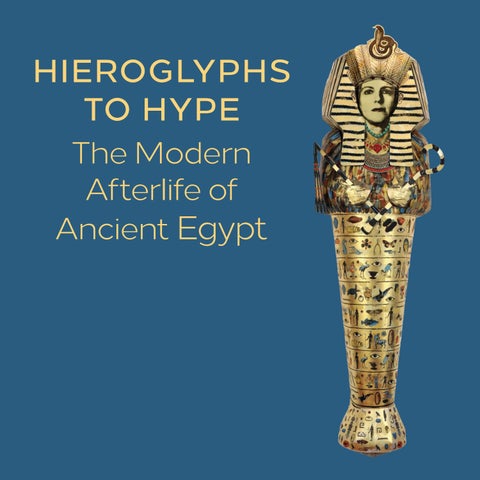
HIEROGLYPHS TO HYPE The Modern Afterlife of Ancient Egypt
Cat. 5
2
HIEROGLYPHS TO HYPE The Modern Afterlife of Ancient Egypt September 18 - December 12, 2026
2
Director’s Foreword Last year, the Fairfield University Art Museum commemorated the 250th anniversary—or semiquincentennial—of the founding of the United States. We presented three exhibitions designed to highlight this historic occasion and surrounded them with associated programs that helped us to reflect on our nation’s complex history, culture, and artistic legacy. This fall, our special exhibitions take us to the Mediterranean to explore ancient Egypt, Greece, and Rome with James Welling: Cento in the Museum’s Walsh Gallery and Hieroglyphs to Hype: The Modern Afterlife of Ancient Egypt, in the Museum’s Bellarmine Hall Galleries. We are extremely pleased to present Museum Registrar Megan Paqua’s curatorial debut in the form of this outstanding exhibition, which explores the enduring fascination with ancient Egyptian art and culture (dubbed “Egyptomania” by 19th-century Europeans) through a selection of paintings, prints, photographs, and decorative art ranging from the early 19th century through the present day. These objects, from the humble to the refined, from the shamelessly commercial to the Afrofuturist, represent the range of artistic responses to—and misconceptions about—ancient Egyptian visual culture. Paqua’s efforts should be particularly applauded as she created and installed this exhibition, while simultaneously managing all of the registrarial details of our previous exhibition For Which It Stands…, the largest loan exhibition in the Museum’s history and our most complex curatorial endeavor to date. We are deeply appreciative of the financial support of this exhibition by Michael T. Vigario ’08, and for the gift of his painting Along the Nile (cat. 8) by Charles-Theodore Frère. Thanks also to Wealthspire for their additional generous support of the exhibition, and to Westport Journal for being the media sponsor. Please see the list of lenders in the back of this catalogue, without whose generosity this exhibition would not have been possible. Thanks as always go to the exceptional Museum team for their hard work in bringing this exhibition and its programming to life: Michelle DiMarzo, curator of education and academic engagement; Megan Paqua, museum registrar (doing double duty!); Heather Coleman, museum assistant; and Elizabeth Vienneau, museum educator. We are grateful for the additional support provided across the University by Kiersten Bjork, Ed Ross, Jackie Bertolone, and Dan Vasconez, as well as by our colleagues in the Regina A. Quick Center for the Arts, the Media Center, the Center for Arts & Minds, Design and Print, and the carpentry team from the University’s Facilities Department. ~ Carey Mack Weber Frank and Clara Meditz Executive Director
3
Cat.. 45
4
Hieroglyphs to Hype: The Modern Afterlife of Ancient Egypt If we know one thing about the ancient Egyptians, it is that they spent a great deal of time contemplating the afterlife. This was not (as is popularly misunderstood) an obsession with death so much as an obsession with eternity—particularly one spent in a more perfect version of life on earth. Accordingly, remembrance of the dead and preparation for the afterlife were not platitudes to the ancient Egyptians; they were a cornerstone of their culture for more than five thousand years. This exhibition explores a different type of afterlife: the afterlife of the civilization itself and the way that it has, in true ancient Egyptian fashion, been reborn and resurrected endlessly across time and space. The fascination with ancient Egyptian art and culture was dubbed “Egyptomania” by 19thcentury Europeans, despite the practice having its origins among the ancient Greeks and Romans. This exhibition traces that fascination through more than 50 works of art, ranging from the early 19th century through the present day. These objects, from the humble to the refined, from the shamelessly commercial to the Afrofuturist, represent the range of artistic responses to—and misconceptions about—ancient Egyptian visual culture. The exhibition is organized thematically, beginning with the most famous mascot of ancient Egypt, King Tutankhamun (whose tomb’s discovery in 1922 sparked one of the most significant waves of Egyptomania), represented in Terry Adkins’ Aten as well as Howard Koslow’s Agatha Christie cover illustrations. Next, the exhibition turns to consumer products created from the late 19th through the early 20th century, represented by objects as varied as a cigarette box, silver candlesticks, and a scarab pendant, which illustrate the powerful appeal of Egyptianizing motifs as publications such as the Description de l’Égypte (1809–1829) and Owen Jones’ The Grammar of Ornament (1856) made ancient Egyptian designs widely accessible to manufacturers. Ancient Egyptian funerary beliefs have been of interest to many artists (no surprise, given that this forms the basis of our popular understanding of their culture). Artists whose works explores this include Jane Hammond’s Spells + Incantations and Audrey Flack’s Isis. Cleopatra VII (“the” Cleopatra you’re thinking of) is represented in several works that challenge her legacy as merely an infamous seductress, including Audrey Flack’s Lux Eternal, which is juxtaposed against Esmeralda Kosmatopoulous’ I want to look like Cleopatra (Elizabeth Tayor). Cleopatra is not the only ancient queen represented in the exhibition, as her Amarna Period counterpart Nefertiti appears in works such as Lorraine O’Grady’s Sisters, from the “Miscegenated Family Album.” O’Grady is among several Black American artists who have drawn upon Egyptian royal iconography within an Afrofuturist 5
framework. Fred Wilson similarly engages this visual tradition in Pharaoh Fetish, which uses the imagery of pharaonic power to examine the place of ancient Egypt in Black cultural memory and imagined futures. The lure of the Nile is considered through a group of works of and by travelers to Egypt, starting with Charles-Théodore Frère’s ca. 1870 painting Along the Nile to Philip Pearlstein’s print The Sphinx from 1979. Egyptomania has helped preserve interest, and in some cases knowledge, of ancient Egypt. However, this has been done through a centuries-long game of telephone, much of which took place while the language of the ancient Egyptians themselves remained untranslatable. Egyptomania has been fed by successive archaeological discoveries and new knowledge nearly as much as it has consumed and erased scholarly facts in popular imagination, leaving room for aliens and conspiracy theories to take root in public conversation. The same phenomenon that has made ancient Egypt relatable to audiences outside of Egypt has also given rise to the impression that the world may all lay equal claim to the ancient Egyptian culture—especially its most contested artifacts. Paradoxically, in other words, our global enthusiasm for Egyptian symbols and motifs has contributed to the erasure of the ancient Egyptian people themselves, as their beliefs and customs became exoticized in popular memory. The artworks in this show, reflecting the phenomenon of “Egyptomania” during the last two centuries, often rely on over-simplified or stereotypical narratives. The exhibition places these in conversation with current archaeological understanding about ancient Egyptian culture. The exhibition cannot undo the effects of Egyptomania on the cultural memory of ancient Egypt, but it can make those effects visible and invite audiences to reconsider the assumptions they have inherited. The examination of this phenomenon is also personal. My path to academic Egyptology did not begin from reading a well-researched textbook chapter analyzing the sculptural program of the Amarna Period, or even with a trip to the Egyptian wing at the Metropolitan Museum of Art (although those would come later), but from early encounters with ancient Egypt preserved in the popular culture around me. In the same way, when I teach Fairfield University undergraduates about the art history and archaeology of ancient Egypt, elements that have been echoed in contemporary fiction, film, or music prove to be some of the best means of engaging the class. This is not because the ancient material is lacking, but rather because it is too familiar—I haven’t had a single student admit to never having heard of the Pyramids, King Tut, or Cleopatra. Once this understanding is unlocked by memories of Steve Martin skits and Elizabeth Taylor’s eyeliner, it’s far easier to connect to and care about the more niche aspects of ancient Egypt. It’s this function of Egyptomania—as doorway from the modern world to the ancient one—that I wanted to explore in this show.
6
In her summary of one of the most impactful studies of how ancient Egypt is displayed in museums, Sally MacDonald observed that to the average visitor, “Ancient Egypt is a concept. It is not only a country. It is not purely history. It is not just a tissue of myths and artefacts. It is an amalgam of all of these; a magic terrain where myths may be real. The concept is created by school, media, archaeology, myths and museums, and is completely self-contained and satisfying.” 1 In myriad ways, the works in this exhibition map out this “magic terrain”: a familiar, distorted geography which nonetheless invites the viewer to explore the extraordinary history and afterlife of ancient Egypt. ~ Megan Paqua Exhibition Curator
Cat. 2
1 Sally MacDonald, “Lost in Time and Space: Ancient Egypt in Museums” in Consuming Ancient Egypt, eds. Sally MacDonald and Michael Rice (New York: Routledge, 2003), 88.
7
Cat. 40
8
Exhibition Checklist 1. Unknown Egyptian Artist [Miniature Footed Bowl], Late Period, ca. 715-330 BCE Faience ⅞ x 1 ⅞ inches Fairfield University Art Museum, Gift of Benjamin Ortiz & Victor P. Torchia Jr., 2026
1 x ¾ inches Lent by Benjamin Ortiz & Victor P. Torchia Jr. 6. Gotham Sterling Silver Company [Egyptian Revival Lotus Spoons], 1865 Sterling silver Dimensions variable (spoons approximately 5 x 1 inches each) Lent by Benjamin Ortiz & Victor P. Torchia Jr.
2. Unknown Artist [First Empire Egyptianizing Candle Holders], ca. 1800-1810 Silver 10 7/8 x 4 ½ inches (each) Lent by Benjamin Ortiz & Victor P. Torchia Jr.
7. James Henry Haseltine (American, 1833-1907) Cleopatra, ca. 1868 White marble Inscribed J.H. Haseltine F.R. on the reverse 24 x 18 inches Lent by Jack and Mary Ann Hollihan
3. David Roberts (British, 1796-1864) General View of the Ruins of Luxor from the Nile, 1838 Published London: F.G. Moon and Co., 1846 Hand-colored lithograph on paper 14 x 19 ¼ inches (image) Private collection, Massachusetts
8. Charles-Théodore Frère (French, 1814-1888) Along the Nile, ca. 1870 Oil on panel 6 ½ x 9 ½ inches (sight) 11 ½ x 14 ½ inches (framed) Fairfield University Art Museum, Gift of Michael T. Vigario ’08, 2023 (2023.11.01)
4. David Roberts (British, 1796-1864) The Hypostyle Hall of the Great Temple of Abu Simbel, Egypt, 1849 Oil on panel 14 ½ x 21 ½ inches (panel) 22 ½ x 28 ¾ inches (framed) Yale Center for British Art, Paul Mellon Collection
9. Doulton Ceramic Factory [Egyptian Revival Vessel], ca. 1880-1889 Stoneware 7 x 7 x 5 inches (overall) Lent by Benjamin Ortiz & Victor P. Torchia Jr.
5. Unknown Artist [Victorian Scarab Pendant], 19th c. Glass, paste stones, gold plated metal 9
Cat.. 7
10
Cat.. 9
11
ca. 1910 Commercial color lithograph 3 5/8 x 3 x ¾ inches Lent by Benjamin Ortiz & Victor P. Torchia Jr.
10. Elihu Vedder (American, 1836-1923) Gebel Silsileh Egypt, January 16, 1890, 1890 Pastel on blue paper 8 x 12 7/8 inches (sheet) Lent by the Jack Shear Collection
16. Boch Frères [“Scarabee” Cup and Saucer], ca. 1920-1929 Ceramic 2 x 2 x 2 inches (cup) ½ x 4 ½ inches (saucer) Lent by Benjamin Ortiz & Victor P. Torchia Jr.
11. Elihu Vedder (American, 1836-1923) Dekkeh, Nubia, February 19, ca. 1890 Pastel on blue paper 11 3/8 x 7 7/8 inches (sheet) Lent by the Jack Shear Collection 12. Elihu Vedder (American, 1836-1923) Nile Scene, April 3, 1890, 1890 Pastel on blue paper 12 7/8 x 8 inches (sheet) Lent by the Jack Shear Collection
17. Unknown Artist [Ironstone Gravy Bowl with Egyptian motif], ca. 1920-1930 Ceramic 3 x 7 x 2 ½ inches Lent by Benjamin Ortiz & Victor P. Torchia Jr.
13. Francis Garat (French, 1853-1914) Untitled (View from the EgyptianFountain, Paris), ca. 1890/1900 Pencil, watercolor on paper, signed lower right 16 x 20 inches (framed) 10 x 14 ½ inches (sheet/image) Lent by Benjamin Ortiz & Victor P. Torchia Jr.
18. Unknown Artist [Tin Container], 20th c. Painted tin 10 inches (height) Lent by Benjamin Ortiz & Victor P. Torchia Jr.
14. Edmond Lachenal (French, 1855-1948) [Pair of Egyptian blue crackle glazed vases], ca. 1890-1920 Ceramic 9 x 4 ¼ x 4 ¼ inches (each, overall) Lent by Benjamin Ortiz & Victor P. Torchia Jr.
19. István Szilágyi Nagy (Hungarian, 1900-1954) The Death of Cleopatra + Snake Bite, ca. 1930-1940 Porcelain 10 x 5 x 4 inches Lent by Benjamin Ortiz & Victor P. Torchia Jr.
15. Egyptian Ideal Cigarette and Tobacco Works [Vintage Helmar Turkish Cigarette Box], 12
20. Claude Jacoby (German, 1916-1964) The Pyramids, outside Cairo, are probably the world’s best known tourist attraction, ca. 1953-1958 Vintage ferrotyped gelatin silver print on paper 6 5/8 x 7 ½ inches (sheet/image) Fairfield University Art Museum, Gift of anonymous benefactors, 2025 (2025.35.294)
25. Fritz Scholder (Luiseño, 1937-2005) The Sarcophagus (State I), 1979 Four-color lithograph on Buff Arches Cover 30 1/8 x 22 ¼ inches Fairfield University Art Museum, Museum purchase, 2025 (2025.28.01) 26. Philip Pearlstein (American, 1924-2022) The Sphinx, 1979 Etching and aquatint in colors on BFK Rives paper 28 1/2 x 40 1/2 inches (overall) Private collection, Connecticut
21. Paul Almásy (French, born in Hungary, 1906-2003) Tourist on camel, Giza, Egypt, ca. 1960 Vintage ferrotyped gelatin silver print on paper 11 11/16 x 10 5/8 inches (sheet/image) Lent by Private Collection, NY
27. Howard Koslow (American, 1924-2016) Egyptian, 1987 Acrylic on paper 10 x 11 inches Courtesy of Perry Meyer and Kathi (Koslow) Meyer, Meyer Fine Art Inc.
22. John McDermott (American, 1919-1977) Sumer, n.d. Tempera on paper 8 5/8 x 6 7/8 inches (each) Westport Public Art Collections, no. 147, Gift of Ruth Connell, wife of the artist
28. Howard Koslow (American, 1924-2016) Study for Egyptian, 1987 Graphite on tissue paper 8 x 10 ½ inches Courtesy of Perry Meyer and Kathi (Koslow) Meyer, Meyer Fine Art Inc.
23. Paul Camacho (Puerto Rican, 1929-1989) Nefertiti, 1965 Watercolor on paper 15 7/8 x 11 7/8 inches (sight) Westport Public Art Collections, no. 1047, Gift of Mr. and Mrs. Ted Gluckman, 2007
29. Lorraine O’Grady (American, 1934-2024) Sisters, from the “Miscegenated Family Album”, 1980/1988 Silver dye bleach photograph (Cibachrome) 27 ¼ x 38 1/8 inches (framed) Cibachrome print, ed. 4/8, 3 AP The Wadsworth, Hartford, CT. Gift of the Peter Norton Family Foundation
24. Harold Allen (American, 1912-1998) Marble Sphinx, Brunswig Pyramid, Metairie Cemetery, 1978 Gelatin silver print on paper 12 x 15 ½ inches (image) Fairfield University Art Museum, Museum purchase, 2025 (2025.30.01) 13
Cat.. 19
14
Cat.. 15
15
30. Oda Mayumi (Japanese, born 1941) Cleopatra, 1981 Silkscreen 31 ½ x 24 inches (sheet) Yale University Art Gallery, Gift of Mary and Norman Tolman in honor of Allison Tolman, BA 1981
35. Audrey Flack (American, 1931-2024) Egyptian Rocket Goddess, 1990 Gilded and painted bronze 42 inches (height) Edition of 6 Courtesy of the Audrey Flack Foundation 36. Fred Wilson (American, born 1954) Pharaoh Fetish, 1993 Plaster, paint, leather, cotton, wood, glass, amethyst, copper alloy 36 ½ x 15 x 16 ¾ inches (figure size) 68 ½ x 15 x 18 ½ inches (installed size with pedestal) The Frances Young Tang Teaching Museum & Art Gallery, Skidmore College, Saratoga Springs, New York
31. Audrey Flack (American, 1931-2024) Isis, 1983 Oil on canvas 60 x 60 inches Courtesy of the Audrey Flack Foundation 32. Rhonda Wall (American, born 1956) Mummy No. 2, 1985 Acrylic on foamcore 58 ¼ x 12 inches Housatonic Museum of Art, Gift of Hanford Lang
37. Jane Hammond (American, born 1950) Spells + Incantations, 2007 Lithograph and screenprint in colors with Chine-collé and gold leaf 58 x 17 x 11 ¼ inches Fairfield University Art Museum, Museum Purchase 2024 (2024.30.01)
33. Patrick Nagatani (American, 1945-2017) Mummified Porsche, From the Area of the Tomb of Horemheb, Saqqara, Egypt (R3/+), 1986 (negative), 2001 (print) Gelatin Silver print 6 x 7 15/16 inches (image) 8 x 10 inches (sheet) From the series Ryoichi Excavations Hood Museum of Art, Dartmouth: Gift of Harley and Stephen C . Osman, Class of 1956, Tuck 1957, PH.2004.77.13
38. Kimiko Yoshida (Japanese, born 1963) Painting (Nefertiti-“The Beautiful One has Arrived”-Queen of Ancient Egypt), Self Portrait, 2010 Archival pigment photo on canvas 56 x 56 inches Edition of 5 Courtesy of the artist and Holden Luntz Gallery
34. Joachim Schmid (German, born 1955) Archiv #085, 1989 Collage on paper 15 ¾ x 19 ¾ inches (sheet) The Frances Young Tang Teaching Museum & Art Gallery, Skidmore College, Saratoga Springs, New York 16
39. Adam Helms (American, born 1974) Untitled (900 Years), 2011 Charcoal and pastel on rice paper 36 x 28 inches Collection of Matthew Day Jackson & Laura Seymour
everybody’s neck. It’s magic, baby! P O N Y ! 1 7 9 1. Pharaoh of New York. Bonnie Prince Johnnie. Conqueror of the Dutch in North America and selfstyled Liberator of the Lenape. Crown ruler of the Lower Hudson. Or, a ruthless thug, out for self, snatching cribs and paper on the fly, looking cool in his finery, 2014 Acrylic, paper, ink, coffee, and tea on canvas 36 x 29 inches The Wadsworth, Hartford, CT. Alexander A. Goldfarb Contemporary Art Acquisition Fund
40. Serge Clement (French, born 1933) and Marina Kamena (French, born in Yugoslavia, 1945) Hieroglyphs Jar, 2011 Acrylic on canvas mounted on wood 18 ⅞ x 12 ¾ inches (panel) Lent by the artists 41. Terry Adkins (American, 1953-2014) Aten, 2013 Offset lithograph on paper 36 x 24 inches (image) Fairfield University Art Museum, Partial gift of the Brandywine Workshop and Archives and Museum Purchase with funds from the Black Art Fund, 2023 (2023.08.01)
44. Esmeralda Kosmatopoulos (Greek, born 1981) I want to look like Cleopatra, 2020 Archival pigment print Edition of 5 35 ¼ x 26 ½ inches (coin portrait) 17 ¼ x 12 inches (letter) Courtesy of the artist
42. Awol Erizku (Ethiopian, born 1988) Malcolm x Freestyle (Pharaoh’s Dance), 2019-2020 Digital chromogenic print 20 x 25 x 1 inches (overall) Collection of Glenn and Amanda Fuhrman NY, Courtesy of the FLAG Art Foundation
45. Audrey Flack (American, 1931-2024) Lux Eternal, 2022 Acrylic and mixed media on canvas 40 x 30 inches Courtesy of the Audrey Flack Foundation 46. James Welling (American, born 1951) Portrait of an Egyptian Woman, 2022 Oil on laser print 17 1/8 x 11 3/8 inches (image) Edition 1 of 2, 1 AP Courtesy of the artist and Regen Projects
43. Frohawk Two Feathers (American, born 1976) On losing the love of your life to treachery, fighting, a guerrilla war against a numerically superior foe, and still managing to keep your feet on 17
47. Sara Sallam (Egyptian, born 1991) I Prayed For The Resin Not To Melt, 2022 Video Courtesy of the artist 48. Serge Clement (French, born 1933) and Marina Kamena (French, born in Yugoslavia, 1945) The Connoisseur, 2024 22 x 17 x 12 ¾ inches Mixed media, epoxy, acrylic paint Lent by the artists
Cat.. 35
18
Cat.. 4
19
Timeline: Egyptomania This timeline traces the long history of Egyptomania, highlighting the discoveries, expeditions, design trends, and pop culture movements that repeatedly revived interest in ancient Egypt.
• ca. 450 - 420 BCE: Herodotus writes his Histories; volume 2 details his trip to Egypt
• ca. 4th - 5th c. CE: The so-called “Hermetic texts” written by a mysterious figure named Hermes Trismegistus are written. These texts would go on to be foundational to Hermetism, a philosophical and religious tradition associated with hidden, divine wisdom, which would in turn inspire modern groups like the Freemasons
• 3rd c. BCE: Temples to Isis established in Greek and Roman cities, showing spread of ancient Egyptian religious beliefs • 1st c. BCE -1st c. CE: Nilotic scenes and other Egyptian motifs become popular designs in Roman interior design and decorative arts. These reproductions did not always faithfully reproduce Egyptian iconography or hieroglyphs, as seen in objects such as the Mensa Isiaca
• 639 - 642 CE: The Arab Conquest of Egypt ends Roman (Byzantine) Rule of the country. This resulted in Egypt becoming isolated from the West
• 30 BCE: Octavian conquers Egypt after defeating Cleopatra VII and Mark Antony at the Battle of Actium in 31 BCE
• 1095 -1291: Crusades result in an increase in religious tourism from Europe to Egypt, with an interest in linking Egyptian sites to Biblical stories
• ca. 12 BCE: The Pyramid of Gaius Cestius is constructed in Rome; this will become the model for future Egyptian-style tombs in the West
• ca. 1251: The Arab historian Muhammad al-Idrisi publishes a volume on the pyramids and tries to translate hieroglyphs, correctly identifying them as a relative of the Coptic language
• 130 -131 CE: Hadrian goes on his imperial tour of Egypt, beginning in Alexandria and sailing down the Nile as future “Grand Tour” tourists would do in the 19th and 20th centuries. His villa at Tivoli featured classical statues with Egyptian accessories or design elements, which would later become a model for Europeans depicting Egyptians throughout the Renaissance
• ca. 1364 -1442: Egyptian historian AlMaqrizi writes first account of the Great Sphinx losing its nose (400 years before Napoleon supposedly shot it off) • ca. 15th c.: Early explorations of Roman sites such as the Isaeum Campense, a 20
• 1717: The Jesuit Claude Sicard (1677–1726) produces the first modern map of Egypt
major temple of Isis in Rome, become
sources of information about the ancient Egyptians
• 1768: Josiah Wedgwood begins producing Egyptian-style ceramics in England
• 1527: The Roman Mensa Isiaca is rediscovered and becomes an influential source for artists (who don’t realize the hieroglyphs on it are inaccurate!)
• 1769: Giambattista Piranesi publishes Diverse maniere d’adornare i cammini (“Various ways of adorning fireplaces”), including influential Egyptian-style interiors and fireplaces
• 1585-1590: Pope Sixtus V re-erects several obelisks in Rome
• 1791: Mozart’s Masonic opera Die Zauberflöte (“The Magic Flute”) presents an imagined Egyptian setting associated with initiation and enlightenment
• Mid-17th c.: The Jesuit scholar Athanasius Kircher (1601/1602–1680) becomes one of the most influential interpreters of ancient Egypt. Although he could not accurately translate hieroglyphs, he copied them more carefully than many predecessors, wrote extensively about Egyptian religion and occult knowledge, and assembled an important collection of Egyptian and Egyptianizing artifacts
• 1798: Napoleon invades Egypt with French troops and scholars, the “savants” • 1799: The Rosetta Stone is discovered by French troops in Rashid, Egypt • 1806-1809: The English architect John Soane popularizes the term “Egyptomania” in a series of lectures criticizing its influence on architecture
• Mid-17th c.: A revival of interest in Renaissance hermeticism inspires groups such as the Freemasons to promote what they believed to be “esoteric” knowledge from the ancient Egyptians
• 1809-1829: Description de l’Égypte (“Description of Egypt”) is published following Napoleon’s expeditions in Egypt
• 1650s onward: Egyptian-style obelisks, sphinxes, pyramidal tombs, and funerary monuments become increasingly common in the West
• 1812: William Bullock’s Egyptian Hall, an early example of Egyptianizing architecture that would influence later buildings in England, opens in London. It housed London’s first major exhibition of Egyptian antiquities
• 1667: Bernini’s elephant-and-obelisk monument is erected in the Piazza della Minerva in Rome in front of the church of Santa Maria sopra Minerva, built on the foundations of a temple to Isis
• 1822: Jean-François Champollion announces the decipherment of hieroglyphs using the Rosetta Stone 21
• 1831: Mount Auburn Cemetery opens in Massachusetts with prominent Egyptianizing funerary architecture
• 1893: The World’s Columbian Exposition in Chicago features Egyptianizing architecture and inscriptions
• 1839: Egyptian Avenue is constructed at Highgate Cemetery in London
• 1922: Tutankhamun’s tomb is discovered by an excavation team lead by Howard Carter
• 1854: The Egyptian Court opens at the Crystal Palace in London, reproducing Egyptian architectural designs and color schemes inspired by those recorded in the Description de l’Égypte
• 1932: Boris Karloff stars in The Mummy, one of the most famous examples of “mummies” being reinterpreted as Hollywood monsters
• 1856: Owen Jones publishes The Grammar of Ornament, a design sourcebook inspired by Jones’ work as an architect for the Egyptian Court and other buildings created for the Crystal Palace Exhibition
• 1972-1981: An international exhibition, Treasures of Tutankhmun, creates a major new wave of Egyptomania and helps establish the modern “blockbuster” museum experience. It opens at the National Gallery of Art in Washington in 1976. The Metropolitan Museum of Art hosts the exhibition in 1978
• 1867: The Paris Exposition Universelle features an Egyptian temple designed by Auguste Mariette, founder of Egypt’s Department of Antiquities, alongside recently excavated ancient Egyptian objects
• 1981: Raiders of the Lost Ark premieres, featuring references to the ancient Egyptian capital city of Tanis and emphasizing the connection between ancient Egypt and the story of Exodus
• 1869: The opening of the Suez Canal helps launch a new wave of Western tourism to Egypt, with Thomas Cook & Son becoming the leading provider of guided tours
• 1986: The Bangles release the pop song “Walk Like an Egyptian,” unwittingly educating the modern public about the use of composite view in ancient Egyptian art
• 1878-1881: Cleopatra’s Needles, a pair of ancient Egyptian obelisks (originally made during the New Kingdom, later relocated to Alexandria) are separately re-erected on the Victoria Embankment in London (1878) and in Central Park in New York (1881) as gifts from the Khedivate of Egypt
• 1994-1995: The exhibition L’Égyptomanie examines Egyptomania as a historical subject in its own right, opening at the Musée du Louvre (Paris), National Gallery of Canada (Ottawa), and Kunsthistorisches Museum (Vienna)
22
Cat.. 38
23
Exhibition Programs Events listed below with a location are live, in-person programs. When possible, those events will also be streamed on Arts & Minds Live and the recordings posted to the Museum’s YouTube channel. Opening Night Event: Hieroglyphs to Hype: The Modern Afterlife of Ancient Egypt Thursday, September 17, 5:30 p.m. Exhibition Curator Megan Paqua in conversation with Curator of Education Michelle DiMarzo, PhD Dolan School of Business Event Hall and streaming on Arts & Minds Live
Art in Focus: David Roberts, The Hypostyle Hall of the Great Temple of Abu Simbel, Egypt, 1849 Thursday, October 8, noon and 1 p.m. David Roberts, The Hypostyle Hall of the Great Temple of Abu Simbel, Egypt, 1849, oil on panel. Yale Center for British Art, Paul Mellon Collection, B1981.25.534. Image courtesy of Yale Center for British Art Bellarmine Hall Galleries and streaming on Arts & Minds Live
Reception: Hieroglyphs to Hype: The Modern Afterlife of Ancient Egypt Thursday, September 17, 6:30 p.m. Bellarmine Hall Galleries and Great Hall
Gallery Talk: Fred Wilson and the Reception of Ancient Art Wednesday, October 28, noon Marice Rose, PhD (professor of art history & visual culture) Bellarmine Hall Galleries Space limited and registration is required
Art in Focus: Audrey Flack, Lux Eternal, 2022 Thursday, September 24, noon and 1 p.m. Audrey Flack, Lux Eternal, 2022, acrylic and mixed media on canvas. Courtesy of the Audrey Flack Foundation © Audrey Flack Foundation Bellarmine Hall Galleries and streaming on Arts & Minds Live
Lecture: “New Media, Old Tropes? The Rebirth of Ancient Egypt in Video Games” Thursday, October 29, 5:30 p.m. Kate Minniti, PhD (Pratt Institute, visiting assistant professor, History of Art and Design Department) Part of the Edwin L. Weisl, Jr. Lectureships in Art History, funded by the Robert Lehman Foundation Dogwood Room, Barone Campus Center and streaming on Arts & Minds Live
Gallery Talk: Wrapped for Eternity: Ancient Egyptian “Mummies” Thursday, October 1, 5 p.m. and Tuesday, November 17, noon Exhibition Curator Megan Paqua Bellarmine Hall Galleries Space limited and registration is required
24
Lecture: “‘Would You Like an Obelisk or, Perhaps, a Temple?’: Egypt’s Curious History of Gifting Archaeological Monuments” Thursday, November 5, 5:30 p.m. Elizabeth Macaulay, PhD (professor of liberal studies, anthropology, classics, Middle Eastern studies & digital humanities, The Graduate Center, The City University of New York) Part of the Edwin L. Weisl, Jr. Lectureships in Art History, funded by the Robert Lehman Foundation Dogwood Room, Barone Campus Center and streaming on Arts & Minds Live
Art in Focus: Jane Hammond, Spells + Incantations, 2007 Thursday, November 12, noon and 1 p.m. Jane Hammond, Spells + Incantations, 2007, lithograph and screenprint in colors with Chine-collé and gold leaf. Fairfield University Art Museum, Museum Purchase 2024, 2024.30.01. © Jane Hammond Bellarmine Hall Galleries and streaming on Arts & Minds Live
Visit our website:
Cover: Cat. 37 Inside cover: Cat. 5 25
Cat.. 39
26
The Museum acknowledges with gratitude the many generous lenders (and donors of artworks) without whom it would not have been possible: Serge Clement and Marina Kamena Audrey Flack Foundation The FLAG Art Foundation Esmeralda Kosmatopolous Mary Ann and Jack Hollihan Hood Museum of Art Housatonic Museum of Art Matthew Day Jackson Holden Luntz Gallery Ben Ortiz & Victor P. Torchia Jr. Private Collection, Massachusetts Sara Sallam Jack Shear Collection Frances Young Tang Teaching Museum The Wadsworth Westport Public Art Collection Yale Center for British Art
Cat.. 32
27
Cat.. 38
28
Cat.. 1
Photographic Credits Cover, cat. 37: © Jane Hammond Page 4, cat. 45: © Audrey Flack Foundation Page 8, cat. 40: © Clement Kamena Page 18, cat. 35: © Audrey Flack Foundation Page 19, cat. 4: Image courtesy of Yale Center for British Art Page 23, cat. 38 © Kimiko Yoshida Page 26, cat. 39 © Adam Helms Page 28, cat. 32: © Rhonda Wall. Image courtesy of the Housatonic Museum of Art 29
Thank You! The Fairfield University Art Museum is deeply grateful to the following corporations, foundations, and government agencies for their generous support of this year’s exhibitions and programs. We also acknowledge the generosity of the Museum’s 2010 Society members, together with the many individual donors who are keeping our excellent exhibitions and programs free and accessible to all and who support our efforts to build and diversify our permanent collection.
30
Cat.. 10
31
Cat.. 16
Cat.. 17
32
Cat.. 14
33