




























Dr.
“When patients feel confident in their smile without feeling overdone, that’s when I know we’ve done it right.”

balanced, and timeless.The clinic’s modern, calming environment reflects the same philosophy: thoughtful and patient-focused. From your first consultation to your final result, the focus is on comfort, clarity, and outcomes that feel like you, just more confident. At McAllister Dentistry, cosmetic dentistry is approached with intention. Founded by Dr. Jessie McAllister, the Ottawa-based clinic is known for conservative smile design that enhances what’s already there rather than overcorrecting it.
With more than 15 years of experience, Dr. McAllister specializes in minimal-prep porcelain veneers, composite bonding, Invisalign, and cosmetic dentistry rooted in long-term oral health. Every treatment plan is customized, carefully considered, and designed to look natural,















P.38
Fabian Zetterlund
Fabian Zetterlund on adjusting to Ottawa, building chemistry in a new locker room, and embracing the city’s hockey-first culture.
P.50
Drew Seeley
Drew Seeley on his Canadian beginnings, Disney-era fame, and the work that continues to resonate 20 years later.
P.68
Bill Carroll
Bill Carroll reflects on ten years at News Talk 580 CFRA, a decades-long broadcasting career, and what still drives his curiosity.
P.85
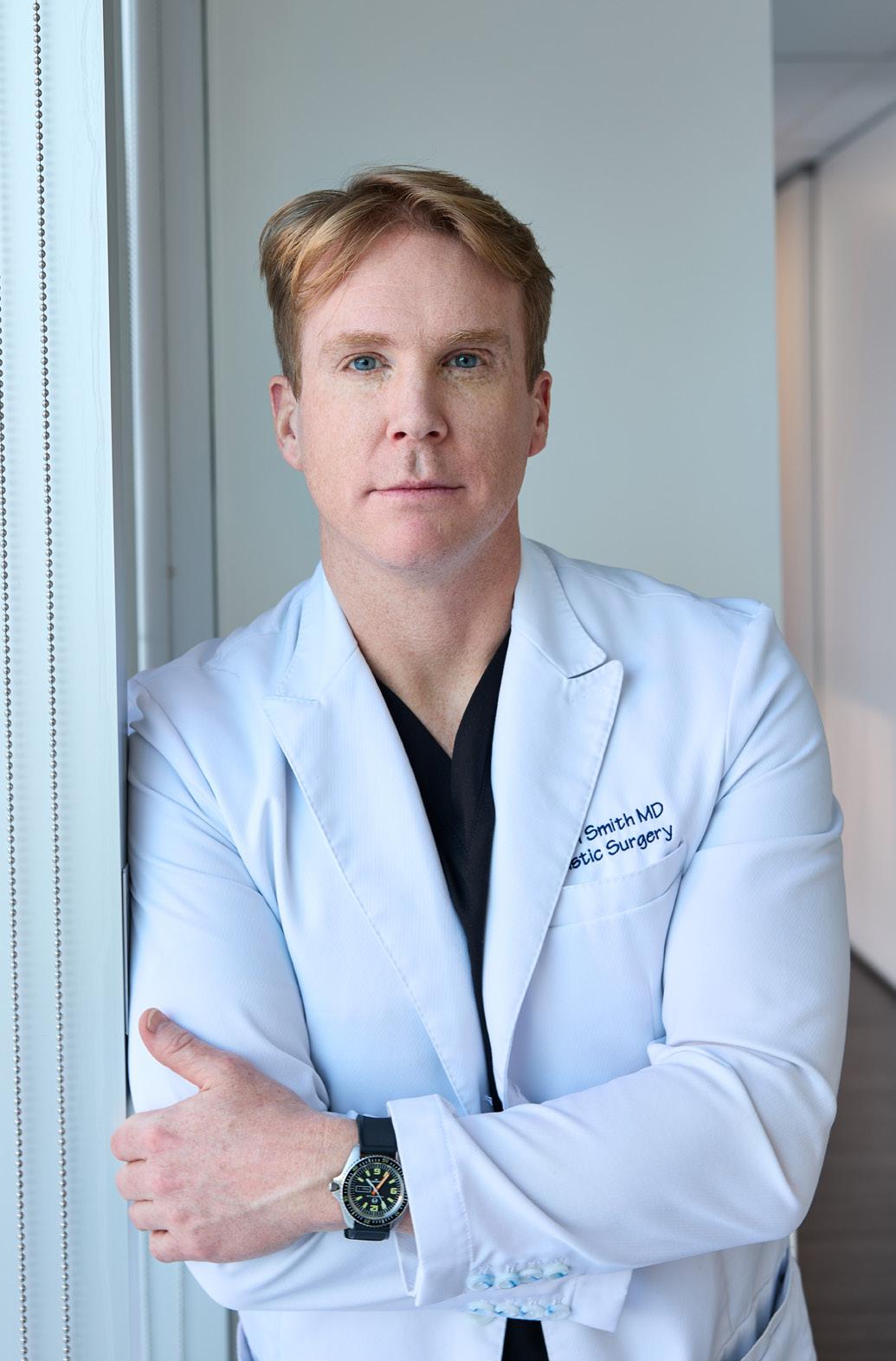
Dr. Sean Smith
Dr. Sean Smith explains how thoughtful consultations and continuity of care shape the patient experience at The Ottawa Clinic.



P.48
From clean-lined architecture to softened textures, a look at the interior shifts shaping early spring spaces.
P.57
Based on City of Ottawa collision data, we break down the three intersections with the highest number of reported crashes, and why these high-traffic junctions continue to cause problems for drivers.
P.64
A closer look at the world’s most valuable fish, and why it continues to shape luxury dining.
P.66
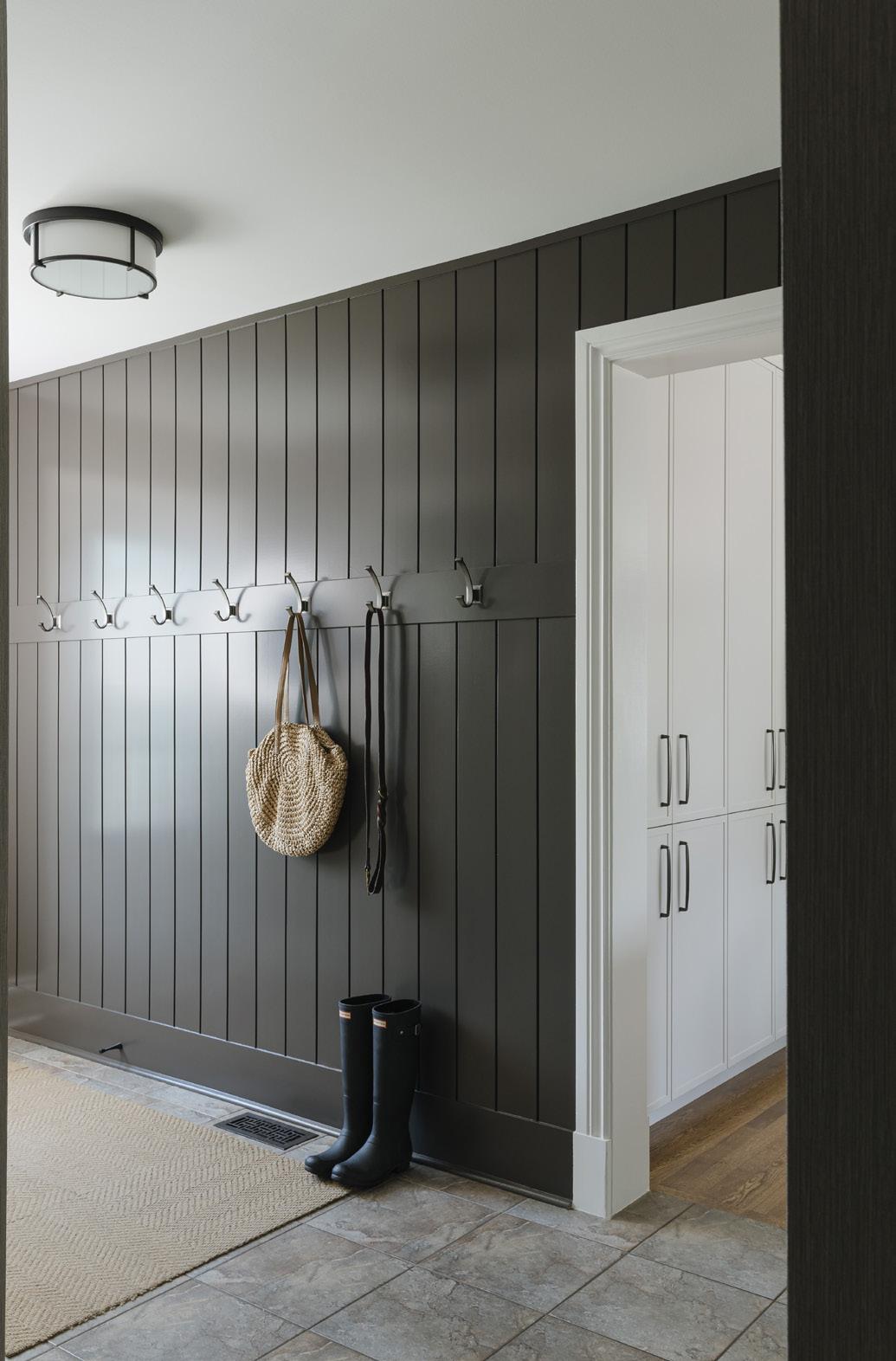
Inside a Manotick home reimagined for modern living.
Faces Magazine is distributed bi-monthly and offered free at select locations across Ottawa and in cities across Eastern Ontario. Full issues are also available online.
Faces Magazine is a non-traditional print medium with a strong brand presence on social media.

info@facesmag.ca

facesmag.ca/awards
To request our event sponsorship packages, please email info@facesmag.ca
For all other information regarding our events, please call or visit our event website facesmag.ca
Suite 101-105 Schneider Road Kanata, ON | K2K 1Y3
echilderhose@facesmag.ca
Editor In Chief
Evan Childerhose
Publisher
Justin MacKinnon
Hank’s Paw Publishing (A Division of 8624771 Canada Inc.)
Creative Director
Catheryn Wheeler
Accounting/Finance
Linda Zhang
Managing Editor
Alex Feeney
Sales Manager
Quinn Valters
Steve Warne
Dan Lalande
Orion Taylor
Alex Feeney
Michelle Li
Jordan Palleck
Corey Stone
Christopher Lord
Molly Burke
Garry Thom
Mark Steele
Ryan Bova
Eric MacIsaac
Kenzie Murphy
Jamie Brown
Robert Smith
Kate Wright
Meaghan Vincent
Guillaume Dubois
Connor Khonick
Todd Hamilton
Marc Paul
Lindsay Risto
Morris Miller
Hugo Tremblay
Neil Jeffrey
Michael Smith
Daniel Harrison
CONTRIBUTING PHOTOGRAPHERS
Cover: Sean Sisk
Nicolai Gregory
Jessica Thomas
Lenz Studio
Chris Tanouye
John E. Sokolowski
Jana Chytilova
David Maman
Leah Huebner
Andre Ringuette
Connor Armstrong
Taylor Condon
Peter Wright
Yana Klaiz
Makeup:
Alyssa Morden-Hayley


The National Franchise Show
February 28th - March 1st EY Centre
St. Patrick’s Day Parade
March 7th
Wellington West & Downtown Ottawa
Journey: Final Frontier
March 7th
Canadian Tire Centre
Candlelight Concert Series: Tribute to Fleetwood Mac
March 7th & 14th
Knox Church
Queen of Soul: A Tribute to Aretha Franklin with the NAC Orchestra
March 12th - 14th NAC
International Film Festival of Ottawa
March 11th - 26th
Ottawa Art Gallery & ByTowne Cinema
The Ottawa Home & Garden Show
March 19th - 22nd
EY Centre
Dueling Pianos: Jeff Rogers & Mellow Dee
March 24th
Manor Lounge

The Rock Orchestra By Candlelight
March 20th TD Place
Footloose: The Musical
March 26th - 29th
Hard Rock Hotel & Casino Ottawa
Laugh For The Cure
March 26th
The Westin Ottawa


Dirty Dancing in Concert
April 4th
Southam Hall
Goo Goo Dolls
April 6th
The Price is Right: Live Stage Show
April 21st - 22nd
Hard Rock Hotel & Casino Ottawa
Old Dominion: How Good Is That World Tour
April 24th Hard Rock Live
Ottawa Cottage Life & Backyard Show
April 10th - 12th EY Centre
United Boxing Promotion Presents: Live Championship Boxing
April 11th Hard Rock Live
Canadian Tire Centre 11


Ottawa Travel & Vacation Show
April 11th - 22nd Rogers Centre
Originals Spring Craft Show
April 16th - 19th EY Centre

Orleans Poutinefest
April 24th - 26th Centrum Plaza




When Fabian Zetterlund was traded from the San Jose Sharks to the Ottawa Senators last March, it was something of a culture shock, both on and off the ice.
In San Jose, the weather was hot, but the team was cold and struggling in the standings. The trade forced Zetterlund to pack his bags and head for frigid Ottawa, where the situation was entirely different. The Senators were pushing toward their first Stanley Cup Playoff appearance in eight years, while the Sharks sat at the very bottom of the NHL standings.
Then there was the challenge of adjusting to a new locker room, surrounded by unfamiliar faces in Ottawa. But as it turned out, that was one thing he never needed to worry about.
“It was like stepping right into a big family,” Zetterlund recently told Faces. “Everyone was so kind and took care of me really well. And I also got to live with Timmy (Stützle), which was really nice. And he helped me through a lot that I didn’t know. The team is really close and most of the guys are still here this season. So it’s great to build on. We build every day and we’re gonna keep doing that.”
The 26-year-old, who was born and raised in Karlstad, Sweden, admits that he certainly didn’t mind being able to wear shorts and a t-shirt to the rink in San Jose. But he also appreciates Ottawa’s winter, chilly as it may be.
“I lived in New Jersey before. For me, hockey is winter. So when I got to Ottawa, I wasn’t mad about the weather. It’s just when there’s a snowstorm and the roads are getting bad, that’s all. But as long as the sun is up, then it doesn’t matter to me how cold it is. I like the cold, crisp weather, which is hockey and winter for me.”
Zetterlund got off to a slow start in Ottawa last spring, and another slow start this fall, but finally caught fire with five goals and 10 points in 14 games in the month of December. Zetterlund seems to be on the same page as Senators head coach Travis Green, who preaches to his players that if you stick to the process and play the game the right way, the results will come.
“I always worked hard and I always wanted to be the best version of myself every day,” Zetterlund said. “And just at the beginning here, the puck didn’t really go in. But I always had in my bag that if I work hard and do the right things every day over and over again, everything will take care of itself. So I like to just stick with that and keep it going and the goals and the points and the wins will come too.”
Senators GM Steve Staios has never had anything but faith that Zetterlund would be a good player for Ottawa. To get him from San Jose, Staios gave up forwards Zack Ostapchuk and Noah Gregor, along with a 2025 second-round pick. Then he doubled down by signing Zetterlund to a three-year contract last summer with an average annual value of $4.275 million.
“I ALWAYS WANTED TO BE THE BEST VERSION OF MYSELF EVERY DAY.”
“THE TEAM IS REALLY CLOSE, AND MOST OF THE GUYS ARE STILL HERE THIS SEASON. SO IT’S GREAT TO BUILD ON.”
No one who saw Zetterlund’s summer training video would ever question the value of his work ethic. The video made the rounds on social media last year and features Zetterlund deadlifting an insane 600 pounds. After the successful lift, he excitedly ran to the back of the gym to ring a bell, a tradition at the facility when someone hits a personal best.
But he wanted to clear the air on that. It’s not like he deadlifts pickup trucks all summer. “I don’t really do those kinds of weights in the summer that much. The program we have is for power and speed. I just do one max lift every summer to see if I lost any strength or gained any. And of course, I gain, which means I’m trending in the right direction, which is nice. So no, the deadlifts are just once in a while in the summer.”
Summers for Zetterlund mean more than just training. He returns home in the offseason every year, which means a chance to visit with family. He grew up in a household of four with his father, Patrik; mother, Jenny; and younger sister, Frida. He says the best piece of advice his parents gave him was to be himself every day.
“I’m so thankful for all of them. They helped me a lot. My dad used to coach me and started taking me to the rink when I was two years old. I loved it right away and I started playing on a team when I was four. He was my coach until I was maybe 13 or 14. My mom always picked me up too and always had food ready when I got home.
“And the best part about it is they never pushed me into anything. It’s like I always wanted to drive myself in whatever it could be, winning on the street, playing something like basketball, street hockey, whatever it is, I wanted to win every single point.
“But, no, it’s been great and I’m so thankful I have them. And now they get to see me play in this league. It’s obviously nice too when they get over here. My mom hasn’t missed one game on the TV yet. So that’s really good too.”
As a kid, the NHL was never the dream for Zetterlund. He cheered for his hometown Karlstad in Sweden’s top pro league, and that was where he hoped to play one day.
“But then I got drafted in the NHL (2017 Draft, New Jersey, 63rd overall), and then you’re kind of thinking, I’ve got a shot to go over and play here. That’s when I started to realize I might have a chance to play in the NHL, which was really nice and really cool.”
One of Zetterlund’s great NHL supporters as he entered the pro ranks was Minnesota forward Joel Eriksson Ek, who also grew up in Karlstad. Joel’s younger brother, Olle, was Zetterlund’s teammate all through junior.
“(Joel) has always been there for me, supporting me. I took the same road as him, so I ask him questions every day about stuff. And he’s a pretty good player right now. And in the sum-

Fabian Zetterlund , a Karlstad-born Swedish winger, joined the Ottawa Senators following a trade from San Jose, marking his next chapter in the NHL after stops in New Jersey and California.

“IF I WORK HARD AND DO THE RIGHT THINGS EVERY DAY OVER AND OVER AGAIN, EVERYTHING WILL TAKE CARE OF ITSELF.”
mer too, we do a lot of stuff together. It’s nice to be able to talk to someone who’s going through the same things, and wants the same goal and everything. So for sure he’s been great.”
As with a lot of good young Swedish hockey players, like Daniel Alfredsson for example, Zetterlund was an excellent soccer player. But in his teens, he had to make a decision on one over the other.
“I realized how much better I was at hockey, and how much more time it took for my soccer practices and stuff. So I had to quit soccer. I couldn’t just play games. But I think it’s great for kids to have different sports when they grow up and play.”
While playing hockey beat out soccer, watching hockey did not.
“I watch a lot of Premier League soccer. Manchester United is my team. So I’m cheering for them a lot, and I would say I’m a bigger soccer watcher than hockey.”
That’s not to say Zetterlund doesn’t watch hockey at all. His old Swedish team plays at around 1 pm, so he watches them when he can. After that, his free time in Ottawa is pretty quiet and casual.
“I like to walk around a lot. It could be going to the shopping mall or whatever. When I have visitors here, I just had my family over, my sister too. I like to show them around town, the Canal and everything, and a few dinner spots too.”
And that’s another thing that’s different about Ottawa. Being quickly recognized by fans when he’s out and about has been something entirely new.
“I would say it’s a whole different world. I mean, I played two years in San Jose and got recognized like four times on the street the whole time I was there. I got here and the first week, five or six people came up to me.
“No, it’s great when they come up and they talk to you about hockey and want a photo, autograph, or just to talk. I’m always open to doing that stuff, which is really nice. So, yeah, I’m enjoying it here.”
Whether it’s embracing our winter, fitting in with the team, or earning the trust of its fan base, Zetterlund seems to have found his footing. What started as a culture shock a year ago now looks a lot more like a perfect fit.

Ottawa travellers will soon have a direct connection to British Columbia’s Okanagan Valley, as Porter Airlines is launching nonstop service between Ottawa International Airport and Kelowna International Airport
starting May 13, 2026. The new flights, operating five times weekly, expand westbound options and make it easier to explore Kelowna’s wineries, outdoor recreation, and year-round travel appeal.

The City’s heritage committee has given the green light to expand the Byward Market’s Andaz Hotel with a 17-storey tower next to the existing property. The proposed addition by Claridge Homes would add 154 new rooms and amenities to the hotel, supporting
downtown tourism and local jobs while maintaining design compatibility with the historic district. With committee approval secured, the proposal now heads to city council for final sign-off before construction can proceed.

$12.3 Million in Unpaid Photo Radar Tickets
The City of Ottawa is still trying to collect on more than 81,000 unpaid photo radar tickets, totaling $12.3 million in outstanding fines, according to data shared with CTV News Ottawa. The figure does not include tickets currently tied up in court
through appeals or extensions. The backlog follows the province’s November decision to ban automated speed cameras, which led the City of Ottawa to deactivate 60 devices across school zones, community safety areas, and major corridors.
Enjoy the convenience of having all your business solutions in one place, with the expert advice you need to keep your business thriving. We offer more than insurance for your business.

For your business
Our business solutions protect against property damage, liability, equipment breakdown, loss of income, cyber threats, commercial auto and more. We also offer specialized coverage for co-operatives and for non-profits.
For your employees
Add Group Benefits and Group Retirement plans to support the health and financial well-being of your dedicated staff.
For you
Access personalized saving and investing options, insurance policies (including Life, Home, Auto and Travel) and advice to build the desired succession plan for your business.


Ottawa has been ranked the most livable city in North America in the latest Quality of Life Index, placing first across the continent and 28th globally among more than 300 cities analyzed. The ranking evaluated practical, day-to-day factors including cost of living, purchasing power, housing affordability, safety, healthcare access, commute times, pollution levels, and climate comfort. Ottawa finished ahead of major cities such as Toronto, Vancouver, New York, and Los Angeles, reinforcing its reputation for balance, stability, and overall quality of life.

A recent international streaming and media analysis shows Canadians rank among the top audiences globally for true-crime content, consistently streaming crime documentaries and investigative series at higher rates than many other countries. Platforms report strong interest in cold cases, courtroom dramas, and real-life investigations, suggesting Canadians have a deep fascination with justice, mystery, and what really happened.
Canada ranks as the third most stressed country surveyed, according to a new Statista Consumer Insights study. The data shows 42% of Canadian adults reported feeling stressed or anxious in their everyday lives over the past year, placing Canada behind Argentina (49%) and Finland (45%) and ahead of the United States (39%), Japan (37%), and Germany (28%). Researchers point to cost-of-living pressures, work-related stress, and ongoing economic uncertainty, noting that stress often becomes a constant background feeling rather than something people actively identify.




As early spring approaches, interiors begin to shift in tone and energy. Spaces feel lighter, more fluid, and thoughtfully composed, reflecting the season’s move toward clarity and renewal. Clean architecture is softened with warmth, texture, and personal detail, creating rooms that feel balanced and considered.
In early 2026, interiors are embracing clarity over clutter. Clean-lined architecture, full-height glass doors, and slim black framing create structure without visual heaviness. Storage becomes part of the room’s design rather than something to conceal, allowing spaces to feel open, organized, and quietly refined. It’s a pared-back approach that still feels warm, modern, and intentional.


Texture continues to play a starring role in spring design. Curved furniture silhouettes, bouclé and woven fabrics, and layered materials merge to create spaces that feel both tactile and comfortable. Spring interiors lean into surfaces that invite touch, from textured ceramics to organic materials paired with smooth metals.
Powdery blues and sky-inspired hues are among the most talked-about color directions for spring. Farrow & Ball’s Parma Gray, a muted blue with classic elegance, is gaining traction as a versatile backdrop that works in bedrooms, living spaces, and even bathrooms. These cool tones feel calming and transitional, bridging winter’s depth with spring’s emerging light.


After years of warm metals dominating interiors, silver is resurfacing as a key finish in 2026. Unlike stark chrome, silver offers a softer reflective quality that pairs well with both contemporary and heritage styles. Expect this cool-toned metal in accessories, lighting, and accent pieces, especially when balanced with wood, stone, and soft textiles.


Photography by Leah Huebner
For a generation that grew up on Disney Channel, Drew Seeley’s voice is instantly familiar. In the mid-2000s, as High School Musical became a cultural phenomenon, Seeley was its sound. He was the singing voice of Troy Bolton, delivering the songs that carried the film far beyond the screen and into everyday life, from school gyms and talent shows to car rides and bedrooms across North America. That success placed Seeley firmly within Disney’s top tier during one of the network’s most influential eras. In a short span of time, he became a familiar presence across Disney projects, recording music, starring in multiple films, and touring internationally as High School Musical took on a life of its own. While others were front and centre on screen, Seeley’s voice became inseparable from the franchise itself.
The story begins closer to home. Seeley was born in Ottawa and grew up in Ontario, spending his early years in Almonte and Whitby before his career eventually took him to the United States. Long before Hollywood sets and global audiences, his foundation was built through Canadian theatre, training, and a deep commitment to performance from a young age.
Now, in 2026, High School Musical celebrates its 20th anniversary. Two decades later, its impact remains unmistakable, with a new generation discovering the film alongside those who grew up with it. For Seeley, the milestone has become a moment of reflection and renewed attention on a chapter of work that continues to circulate.
Tell us about your childhood. How much time did you spend in Ottawa before moving to Toronto? Any memories of the city?
I was born in Ottawa and grew up between Almonte and Whitby. I actually got to come back to Ottawa a few years ago to shoot the Hallmark film A Christmas for the Books with Chelsea Kane. While I was there, I toured the RCMP stables and somehow ended up at an air guitar world championship. It was quite a trip.
When did you first fall in love with performing? Who were some of the people that inspired you?
Gene Kelly and Fred Astaire were huge inspirations for me. Another defining moment was being part of the original cast of Show-


“I wanted to create something that felt fresh but still nostalgic, as a way of saying thank you to the fans who are still there 20 years later.”
boat at the then Ford Center in North York in 1993. I was one of the kids in the ensemble for about a year, and that experience completely changed the trajectory of my life.
Tell us about moving from Canada to the U.S. as a young teen. What do you remember from that time?
I was around 12 or 13, and moving to Florida felt pretty scary at first because it was so far away. But I found my people fairly quickly. There was a growing music scene and a lot of sunshine, which made it hard to stay angsty for very long.
Tell us about your first major role after getting to L.A.
I did a handful of student films and smaller roles, but things really shifted when I started providing vocals and writing for High School Musical. That was the moment where everything began to turn.
Your High School Musical journey is well documented. What was it like recording “Get’cha Head in the Game” and becoming the singing voice of Troy Bolton?
At the time, I was recording a lot of music and trying to make it as an artist, so I didn’t think much of it. It just felt like another fun session. I couldn’t have imagined what it would eventually become.
Why do you think High School Musical became such a major success and remains beloved by a generation?
I think a big part of it is that it wasn’t cynical. It encouraged kids to step outside of preconceived boxes. In a lot of ways, it was that generation’s Grease, just Disney-fied.
This year marks 20 years since its release, and you’ve released new music to commemorate the milestone. Tell us about your new song, “In This For Life.”
I wanted to create something that felt fresh but still nostalgic, as a way of saying thank you to the fans who are still there 20 years later. High School Musical was such a meaningful milestone in my career, and this felt like a fun excuse to reconnect with a lot of the cast. I also wanted to let the fans be the stars this time around, which is really the idea behind the video for the song.
You’ve balanced multiple career paths as an actor, artist, and songwriter. Why was that important to you?
I’m happiest where those three disciplines overlap. The projects where I’ve been able to contribute in all three ways have always been the most meaningful to me. Each one fulfills a different urge, and I’m grateful I’ve had the freedom to explore all of it.
In recent years, you’ve moved away from Disney and taken on very different roles, including playing villains. What was that shift like?
There aren’t many murderers on Disney, so I had to branch out (laughs). It’s fun playing against type. I don’t get those opportunities very often, so when they come along, I really lean into them. We all have light and dark sides, and it’s interesting to tap into that, as long as you don’t take it home with you.
Looking ahead, what’s next for you?
I have a lot of music, both new and throwback, that I plan on releasing this year. There’s also a new movie musical called Saturday coming out at some point. I play the teacher this time, and the young cast is incredible. I could honestly see it becoming some version of this generation’s High School Musical.
What do you like to do in your downtime?
I love hiking and running. I’m running the L.A. Marathon on March 8. I also enjoy going to the theatre and travelling to new places, especially if it means trying weird, amazing food.
Any favourite spots when visiting Ottawa?
Anywhere I can get a good Beavertail. Do those still exist?
Lastly, what’s your best piece of advice for aspiring actors?
The best advice I can give is to be authentically yourself, because that’s what draws people to you and helps you stand out. Focus on a niche you genuinely love. Ubiquity is nearly dead, and fame should never be the goal, only a possible byproduct. Believe in yourself and use your gifts to make the world just a little bit better.



Magenta Ex terior Solutions has a strong reputation for siding and rooong contrac ting ser vices on residential and commercial projec ts across the Greater O ttawa Area. With our dedicated team, we’ve taken a comprehensive approach to projec t management, providing clients with a range of ser vices to cover their projec t needs.
Hunt Club and Riverside is one of Ottawa’s biggest signalized intersections, with heavy commuter traffic from all directions. Multiple turn lanes, long lights, and frequent merging create lots of chances for conflicts. In 2024, this location saw 96 reported collisions, the most of any intersection in the city, mainly from rear-end and turning crashes.

Carling and Kirkwood sits on a busy commercial stretch with steady through traffic and frequent turning movements into side streets and driveways. That mix makes it a common spot for minor collisions. In 2024, it had 69 reported crashes, many involving rear-end and sideswipe contact as drivers approached or left the intersection.
Ottawa is known for its oneway streets and constant construction, but some of the biggest challenges for drivers happen at its intersections, according to reported collision data from the City of Ottawa and Ottawa Police.
The numbers point to three intersections where crashes occur most often, highlighting locations that consistently cause trouble for drivers across the city.
West Hunt Club and Woodroffe is a sprawling suburban junction with long crossing distances and fast-moving approaches. The broad layout and lane shifts can make lane choice and timing tricky, especially in peak travel times. It recorded 60 collisions in 2024, placing it among Ottawa’s top collision locations.
In Canada in 2026, tipping isn’t just about appreciation anymore. Once limited to the end of a sit-down meal, gratuity prompts now follow us everywhere: cafés, grocery checkouts, even self-service kiosks. The result? A national conversation about etiquette and fairness in a world of rising costs.
For decades, Canadians accepted tipping as a way to reward good service in sit-down restaurants, where 15 – 20 percent of the bill is still broadly seen as standard. Point-of-sale terminals now push defaults of 18 – 20 percent or more, especially in urban centres, pushing overall gratuity expectations higher than some customers feel comfortable with.
But in March 2025, a major national survey found 94 percent of Canadians say tipping “has gotten out of hand,” and 90 percent think gratuities are too high. The same study found people’s idea of a fair tip is much lower; closer to 9 percent on average, and about 13 percent specifically for servers, well below typical prompts on digital readers.
The same Research Co. poll shows that more than half (53 percent) of Canadians still say they tip “all the time” at sit-down restaurants — but once you leave that setting, behaviour changes sharply: only 37 percent always tip at bars, 15 percent for take-out, and single digits at fast-food or coffee shops.
Part of the frustration isn’t just percentage points — it’s where gratuity requests show up now. A whopping majority of Canadians disapprove when online retailers or coffee shops prompt for tips at checkout, and many feel the ubiquity of digital tipping has made what used to be a choice feel like an obligation.
For many, this is more than etiquette fatigue. It’s an economic tension: most Canadians (around 88 percent in one survey) believe tipping has shifted from rewarding good service to subsidizing low wages, with employers relying on customers to make up the difference.


Part of the frustration around tipping in Canada comes from comparison. Unlike the United States, where tipped workers can earn a lower base wage and gratuities are essential, most Canadian provinces now require servers to be paid the general minimum wage. Yet tipping expectations increasingly mirror U.S. norms, with digital prompts regularly starting at 18 to 25 percent.
In much of Europe, service is typically built into menu prices, with tips left sparingly, if at all. In Japan, tipping is uncommon and sometimes discouraged, as good service is considered part of the job, not something to be incentivized. Canada sits awkwardly in between: full wages, rising menu prices, and mounting pressure to tip on top of it all.




Karan Sharma, founder of the Karan Sharma Team, ranked #1 in Ottawa and top 20 nationally within Royal LePage.
Photography by Nicolai Gregory
When Karan Sharma arrived in Canada in 2013 as an international student, he came with ambition and a clear sense of purpose.
He began his life here in Barrie, Ontario, studying computer programming. Like many newcomers, Canada represented opportunity; education, stability, and the chance to build something lasting. Those early years were formative, shaping both his discipline and independence.
After completing his studies, Sharma moved to Toronto for an internship at RBC’s downtown office at Queens Quay. For a young immigrant still establishing himself, it was a meaningful milestone. It validated years of long nights, financial pressure, and the uncertainty that comes with starting over in a new country.
He continued working in tech after graduation, eventually joining another company. Toronto was home. His family and social circle were there, and Ottawa was not on his radar.
That changed with an unexpected phone call.
An Ottawa-based tech company invited him to interview. After phone rounds with the CTO and HR, they asked him to come in person. Sharma recalls opening Google Maps to check the distance. It was the first time he had seriously considered Ottawa.
He hesitated. Then the company offered to fly him in.
“I thought, maybe they see something in me,” he recalls. “Maybe this is a sign.”
He took the flight, accepted the offer, and relocated to Ottawa.
While building his career as a software developer, Sharma lived conservatively. Evenings and weekends were spent delivering pizzas to supplement his income. His approach was simple: spend modestly, save aggressively, and think long-term.
At 23, that discipline led to the purchase of his first home in Barrhaven for $400,000. Two years later, he leveraged the equity from that property to purchase a second detached home valued at $700,000, with minimal outof-pocket cost. It was a turning point.
“You don’t control the timing. You control the effort. You control the discipline. You control your integrity. God handles the rest.”
He began to see real estate not simply as homeownership, but as a financial tool for accelerating wealth and changing lives.
At the same time, his tech career continued to advance. He moved from developer to team lead and eventually to software development manager. By conventional measures, he had achieved stability. But still, he felt drawn toward something bigger.
In January 2021, Sharma entered real estate while still working full-time in tech. The early days were demanding. Fifteen-hour workdays were common, with tech during the day and real estate at night. He focused on fundamentals. Calling contacts, attending community events, posting consistently, and building relationships one conversation at a time.
Within the first three months, he completed 38 transactions. Not through momentum or visibility, but through consistency before results were guaranteed.
He did not start with significant resources. What he had was discipline and a long-term view.
Over the following years, his business scaled rapidly. What began as a solo practice evolved into one of Ottawa’s fastest-growing real estate teams. Through market downturns, rising interest rates, and one of the most
challenging periods in recent real estate history, his team remained focused on steady execution and ethical practice.
The result was a #1 ranking in Ottawa and #20 nationally within Royal LePage, a rare achievement for an Ottawa-based team.
Today, the Karan Sharma Team includes 18 agents and administrative staff, completing hundreds of transactions each year and working with some of Canada’s largest builders.
For Sharma, however, success is not defined solely by rankings.
It’s measured in trust earned, decisions guided, and work done quietly behind the scenes. It’s measured in the risk of boarding that first flight to Ottawa and committing fully to an unfamiliar future.
Reflecting on his path, one principle remains consistent.
“You don’t control the timing,” he says. “You control the effort. You control the discipline. You control your integrity. God handles the rest.”
It’s a perspective shaped not by overnight success, but by years of deliberate, patient work. And it continues to guide how he builds, not just homes, but a life rooted in consistency.

Few foods occupy the same strange intersection as bluefin tuna. It is at once one of the most prized ingredients in fine dining and one of the most scrutinized proteins in the world. Revered by sushi chefs, auctioned for headline-making sums, and governed by international quotas, bluefin tuna represents both culinary perfection and ethical tension.
In 2026, bluefin is no longer just a symbol of excess. It has become a case study in scarcity, sustainability, and how luxury food adapts when the spotlight refuses to fade.


Bluefin tuna are apex predators built for endurance, capable of crossing oceans at remarkable speeds. Unlike other tuna species, they can regulate their body temperature, which contributes to their dense, fatty flesh.
Three species dominate the market: Atlantic, Pacific, and Southern bluefin. Atlantic remains the most valuable and heavily regulated. What truly sets bluefin apart, however, is fat distribution. Its intramuscular marbling creates the texture and richness that chefs seek.
Cut matters. Otoro comes from the fattiest part of the belly and is pale, marbled, and soft. It’s rich and best enjoyed in small portions. Chutoro offers balance, sitting between lean and fatty, and is often considered the most versatile cut. Akami, the deep red loin, is leaner and more mineral-driven, forming the backbone of traditional sushi service.
These distinctions explain why pricing can vary dramatically within a single fish.

Bluefin grows slowly, migrates widely, and requires strict management to avoid overfishing. International quotas limit supply, while demand remains high.
Add in rapid global transport, precise handling, and the cultural theatre of auctions, and bluefin’s price reflects more than the fish itself. It reflects the infrastructure built to protect and preserve it.
For many diners, bluefin remains unmatched in texture and depth. But its value today lies in how it’s treated. When sourced responsibly and served thoughtfully, bluefin earns its place not as spectacle, but as intention.



At the core of CPI Interiors is a belief that good design begins with understanding how a home is actually lived in.
Led by President and Lead Designer Natalie Cox alongside CEO and Director of Design Megan Patterson, the women-owned firm is known for spaces that feel considered, functional, and enduring.
“We spend a lot of time listening before we design,” says Cox. “Understanding how our clients move through their home is what allows the final result to feel natural, not forced.”
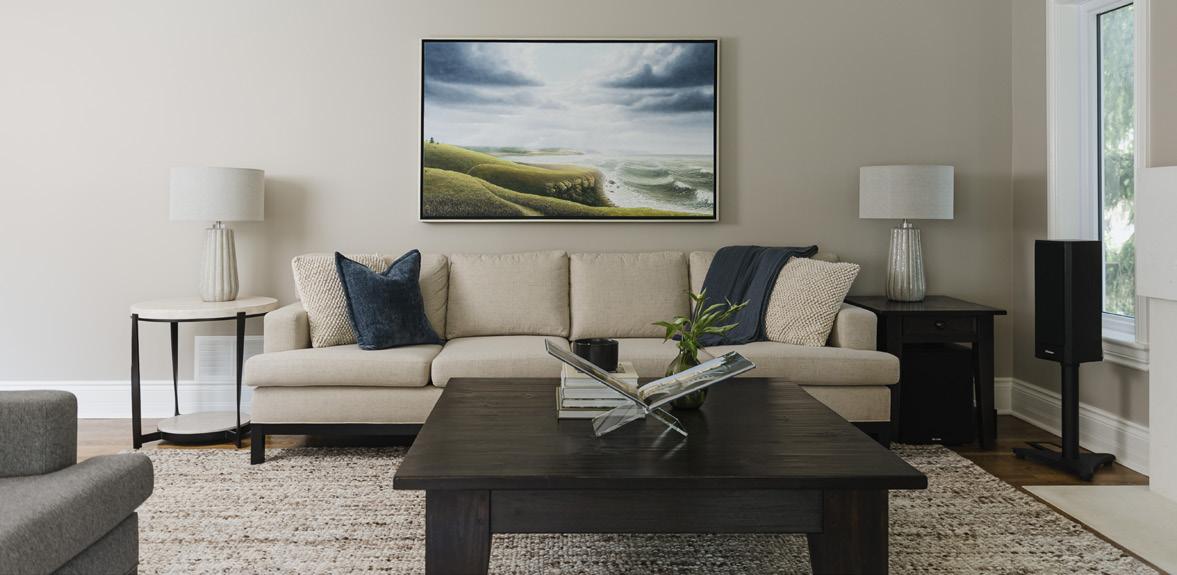
It’s an approach well suited to homes with history, like this traditional colonial in Manotick, where the homeowners were looking to update how the space functioned without losing what made it feel like home. A recently renovated, modern fireplace had already introduced a more contemporary note to the main floor, creating an opportunity to thoughtfully bridge old and new. The kitchen felt dated and no longer supported daily use, the open laundry room lacked storage and sound control, and the family room required a cohesive refresh to tie together an updated fireplace and existing artwork.
Rather than treating each space in isolation, CPI Interiors approached the renovation as a connected main-floor update. “Our goal was to create continuity,” Patterson explains. “Each space needed to work on its own, but also make sense as part of the whole.”

The kitchen became the starting point. A slim shaker door profile was selected to bridge traditional and contemporary styles, paired with warm white perimeter cabinetry and a rich brown island. The waterfall quartz countertop grounds the space and quickly became its central gathering point. Layout refinements, including relocat-

ing the refrigerator to a side wall, improved circulation and opened up the cooking area.
In the laundry room, a pocket door was added to control sound, storage was increased, and a sink was incorporated, a detail the homeowners now consider essential. The adjacent hallway received shiplap finished in the same deep brown as the island, reinforcing visual continuity across spaces.
The family room was updated with a custom sofa, a textured wool area rug, and an oversized chair positioned behind the coffee station, creating a comfortable place to read, relax, or spend time with friends.
For the homeowners, the experience was as important as the outcome. “Natalie and her team were a pleasure to work with from consultation through execution,” they shared. “She took the time to understand what mattered to us, simplified the decision-making process, and delivered spaces that are both beautiful and functional. We are absolutely delighted with the result.”
The finished home feels cohesive, practical, and thoughtfully resolved, a clear reflection of CPI Interiors’ ability to respect architecture while designing for modern living.





Bill Carroll, a Scotland-born broadcaster raised in smalltown Ontario, has spent more than four decades shaping talk radio across major markets including Toronto, Los Angeles, and Ottawa, where he now hosts the morning show on Newstalk 580 CFRA.
By Dan Lalande Photography by Sean Sisk
“I’m just a natural gossip,” admits
Bill Carroll, the talk radio legend celebrating ten years as the host of The Morning Rush on Newstalk 580 CFRA.
“At 18, I was already just like that 81-year-old talking to his neighbour over the fence, wanting to be the first to break the news about everything and everybody.”
He’s been doing just that, and more, for over forty years now, sharing major developments, dissecting their implications, and asking others to weigh in in major markets like Toronto and L.A. Ottawa’s been home for a while now, though, affording him and his family a nice break from the personal and professional pressure of life in bigger cities.
“When we moved to Ottawa,” Carroll reflects, “we were warned that we would find a closed community unwelcoming to strangers. That
certainly wasn’t our experience. People were very welcoming—until they heard my first shows.” Their reaction? “They hated me!”
Not an uncommon experience. In almost every market Carroll’s found himself in, it’s taken listeners time to adjust to his style (“I’m definitely an ‘acquired’ taste,” he concedes). But on each occasion, the results have been the same: within months, he’s out of the death spiral that was giving his producers white-knuckle syndrome and soaring beyond the ratings barriers they bargained on breaking upon hiring him.
Carroll’s hardware includes an RTDNA (Radio Television Digital News Association) Lifetime Achievement Award and an equally prestigious distinction named after broadcasting deity Edward R. Murrow.
Not bad for a shy kid (yes, you read that right) born in Scotland and raised in small-town Ontario who just wanted to share the pop tunes that he loved with fellow aficionados. After being rejected by every music station he
“With opinion-based talk radio, there’s one thing you always must do: be authentic. People know a phony when they hear one.”
approached, Carroll fell into a new, developing format: talk radio. Not only did this intimate, dialogue-based form of audience engagement force him out of his shell, but it also helped him develop a persona, kept him on top of politics and popular culture, and afforded him a first-person education in the tricky art of establishing and growing a following. Sounds like a facelift—but according to Carroll, it was more of a refinement than a reinvention. “With opinion-based talk radio,” he advises, “there’s one thing you always must do: Be authentic. People know a phony when they hear one.”
While Carroll has crossed swords with countless listeners, he’s rubbed shoulders just as many times with the rich and famous.
“I have met and interviewed so many incredible people,” he marvels. “I’ve talked to world leaders, renowned scientists, rock stars, movie stars, even people who have been to the moon.”
As for his favourite conversation…
“I had an opportunity to speak to an American truck driver when I worked in L.A.” (at station KFI, after a long stint at Toronto’s CFRB). “He was being held on bogus charges in a foreign prison. We managed to get a phone smuggled into his cell. I was terrified for his safety the entire time we spoke. He eventually got home, and I believe our interview helped facilitate that process. Or maybe it was the courageous Pakistani Prime Minister
Benazir Bhutto just before she was assassinated. Or that time with Phil Collins...or…” Carroll could go on, of course—after all, that’s his stock in trade. “Actually,” he confesses, “I don’t have an opinion on everything. I’m just curious about everything and everyone. I will likely die while Googling about a new thing I just heard about a minute before. Otherwise, I’m very uncomfortable being the centre of attention—until someone puts a microphone or camera in my face.”
‘RA has been doing that for a decade now, connecting him with one of the most unique listening bases he’s ever had. “Every time I leave my house in Manotick or our studios in Ottawa, I’m approached by our listeners. They always apologize for intruding before sharing their views about the show. I love it!”
As for Carroll’s next ten years, they’re as filled with promise as his head is with knowledge.
“This decade hosting the morning show at News Talk 580 CFRA is the longest I have ever been in the same job. My kids are now young adults, and life is changing very quickly around me. I’m getting itchy feet. I am looking for a new challenge. I hope this amazing job will still be part of that future, but I need something more. If you aren’t growing, you’re shrinking. That’s not my idea of living.”
Hey, Bill—now you’re talking!

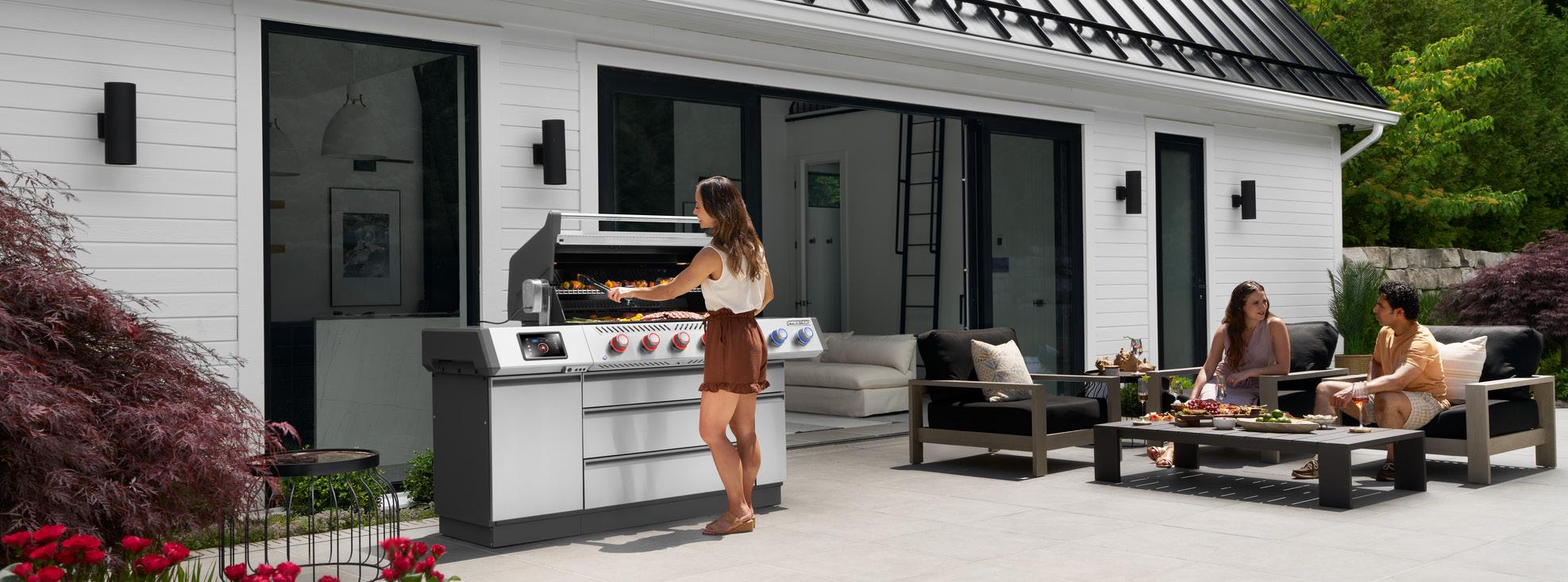
Introducing Connected Grilling. Precision, confidence, and control come standard. Recreate your best cook with a single tap, or switch to smart mode and let intelligent gas automation do the work. From weeknight burgers to your most ambitious recipes, guesswork disappears and great results show up every time.

Smart mode grilling with intelligent gas and automation.

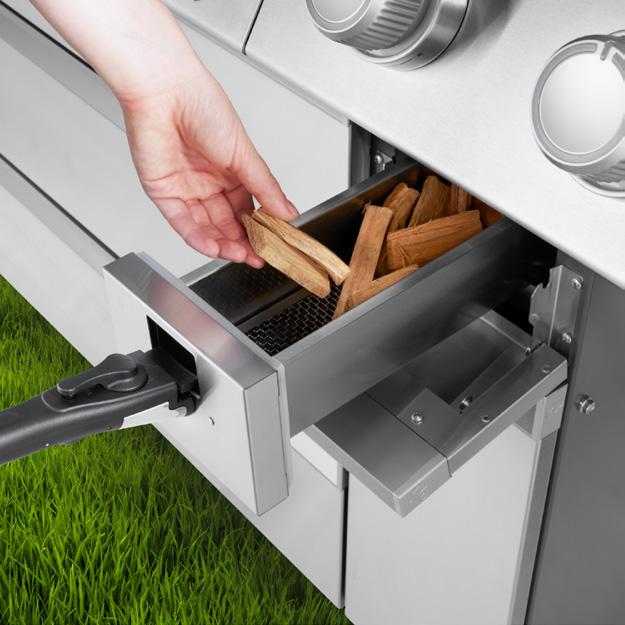
Add wood chips or chunks without opening the lid.
The Sizzle Zone heats up to 1800 °F in less than 30 seconds.

Every chef’s dirty little secret? Cooking the perfect steak is easier than you think. You only need one thing, a thermometer. Our advice, none is easier to use or pair with your phone than Meater.

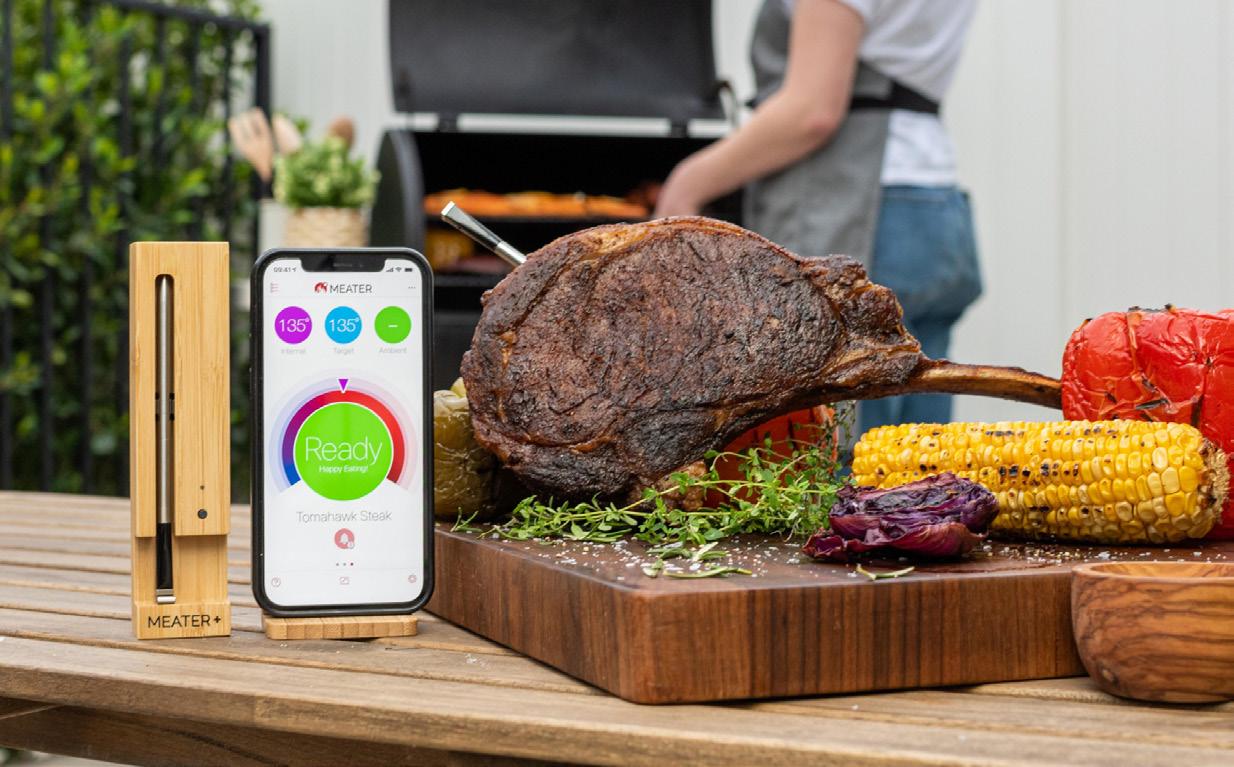

1. Preheat your grill to 250–300°F for indirect cooking by lighting the two outside burners.
2. Season the steak thoroughly on both sides with your favourite seasoning.
3. Fill a smoker box or tube with wood chips.
4. Place the steak between the lit burners with the smoker box over a burner and cook indirectly for about 1.5 hours, until steak reaches just under the desired doneness.
5. Fire up the sizzle zone on high and sear each side of the steak about 1–2 minutes per side.
6. Slice and serve hot with your favourite sides.

BBQ


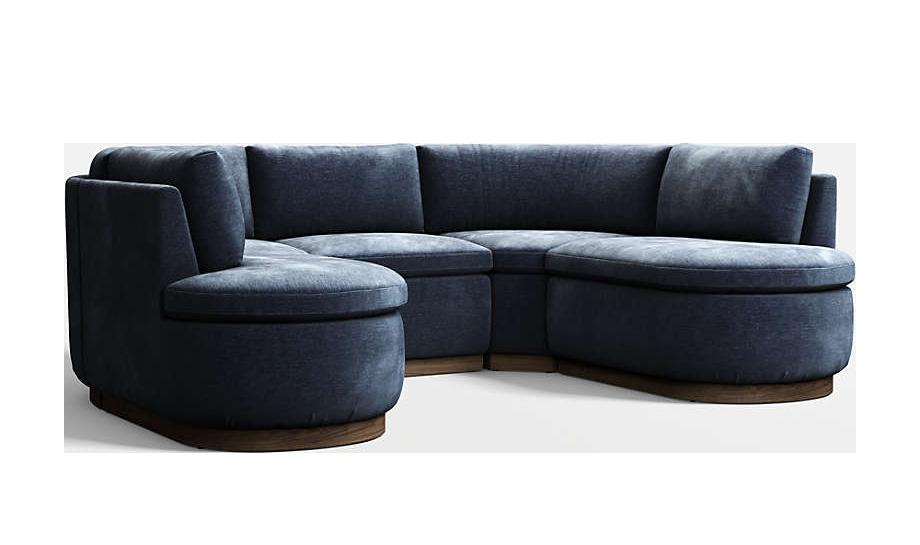
A short list of standouts for the season, selected for their shared emphasis on soft curves, warm finishes, and understated design. From lighting to décor, each piece reflects a shift toward homes that feel lighter, calmer, and more intentional heading into spring.
1. Devialet Phantom Ultimate 98db Speaker, $2,400; 2. Crate&Barrel Nest by Patrick St. Germain 40” x 50” Framed Wall Art Print, $1,399; 3. Matiere Premiere Rose De Mai Grasse Candle, $155; 4. Lachlin Brass Table Lamp 24” $449; 5. Edendale Blue Upholstered U-Shaped Storage Dining Banquette, $10,394; 6. Assouline From Louis To Vuitton, $360.





Noun.

IXt’s the popular office culture philosophy that’s easy to emblaze on a coffee station shingle, difficult to subscribe to as a work model:
Teamwork makes the dream work.
One company, though, epitomizes it so perfectly, they might have inspired the phrase: Ottawa Moving Logistics.
OML, as it’s known, is a one-stop shop for small and large residential and commercial relocations. Serving Ottawa, the surrounding area, and other geographic touchpoints across Ontario and Quebec, the company manages its clients’ entire move. Whatever packing, dismantling, lifting, transporting, storing, or installing is required, OML has the finely coordinated staff to handle it.
“At Ottawa Moving Logistics,” explains company founder and CEO Rosie Rowe, “ownership, management, and crews operate as a united force”. Rowe sets the company’s vision, strategy and fosters a
culture of trust and respect. Management turns that vision into action by organizing schedules, coordinating logistics, and ensuring every detail is handled efficiently. The moving crews, with their hands-on skill and dedication, bring the plan to reality—carefully packing, transporting, and delivering clients’ belongings with professionalism.
“Each group takes ownership of their role and communicates openly. Challenges are solved quickly, customers are satisfied, and the company thrives. It’s this seamless collaboration that transforms hard work into shared success.”
Small wonder the reputable OML attracts skilled, experienced, and passionate industry professionals and employees….eager to be associated with a trusted and respectful brand.
Ensuring the quality of OML’s staff is one of the many responsibilities of a caring management team, led by Rowe. The dynamic gatekeeper with an extensive background in the supply chain and logistics discipline. Rowe’s steady hand keeps
By Dan Lalande
Photography by Sean Sisk

Rosie Rowe, founder and CEO of Ottawa Moving Logistics, built her company after a lifetime of relocating and a 15-year career running other people’s businesses, recognizing a gap in Ottawa’s moving market and turning hands-on experience into one of the region’s most trusted residential and commercial relocation firms.

OML on the road to continued growth and long-term viability. Her tasks are innumerable, from visionary responsibilities—strategy, offerings, pricing, and expansion—to workaday concerns: budgets, scheduling, upgrades, and safety. Rowe does it all, fostering a company culture of across-the-board professionalism and customer satisfaction.
General manager and big talent on the ground is Adam Rosebush. Rosebush manages day-to-day activities such as scheduling moves, coordinating crews, and ensuring vehicles and equipment are maintained and ready for use. Beyond operations, Rosebush focuses on customer satisfaction, resolving issues, maintaining quality standards, and ensuring moves are completed on time and with care. Adam Rosebush recruits, trains, and motivates staff, fosters a safe and positive work environment while ensuring compliance with industry regulations and safety protocols. Ultimately, acting as the bridge between the company’s strategic goals and the hands-on work that gets customers successfully moved.
Commercial Sales and Business Development is the domain of Trina Stark-Ducheneaux, the driven force responsible for generating and managing business-to-business relocation projects. Stark-Ducheneaux identifies potential clients, prepares detailed proposals, negotiates contracts, and coordinates with OML’s operations teams to blueprint a smooth and efficient move.
That’s where Commercial supervisor Robert Carrise comes in. Carrise is the bridge between strategic planning and hands-on execution, ensuring that each assignment is completed on time, within budget, and to the highest possible standard.
Together, this braintrust oversees the master plan that motivates the core of the company: its movers. OML’s hardworking, detail-oriented crews are legendary, packing, loading, and lifting everything you can name in a safe and timely manner. They play the most hands-on role in providing a professional, respectful,
“I love moving. I enjoy everything about it: the planning, the packing, the unpacking, the setup. I love the many hats I have to wear managing this business. There is never a dull day.”
and stress-free experience, always willing to go the extra mile, to make things as untroubled as possible.
With such a diverse infrastructure handling such complicated tasks, it might be easy to fall into such industry traps as mass miscommunication or interpersonal friction. But at OML, all of the players are not only in constant touch but are happily reveling in each other’s company.
“Camaraderie is the heartbeat of everything we do,” says Rowe. “We operate not just as co-workers, but as a close-knit family. There’s an unspoken trust that each person will step in when needed, share a laugh when the day gets tough, and celebrate every successful move together. It’s a bond that goes beyond the job, built on mutual respect, shared goals, and the genuine care we have for one another.”
They all do it to serve another culture they consider family: their customers.
“Ottawa Moving Logistics is known for treating customers with care, delivering reliable service, and maintaining high ethical standards. Word-of-mouth from satisfied clients and current employees builds Ottawa Moving Logistics’ credibility, making OML a desirable workplace where people feel proud to contribute. This positive image not only draws in experienced movers but also motivates them to stay. They’re part of a team that’s well regarded in the community and deeply appreciated internally.”


Collagen plays a critical structural role in the body, supporting connective tissue, joints, bones, and cartilage. According to Chett Binning, Nutrition and Health Coach, former competitive athlete, and Scientific Specialist and Educator with ATP Labs, collagen supplementation is supported by strong research. Studies show collagen is either broken down into amino acids or absorbed as bioactive peptides that circulate to tissues such as cartilage, bone, and connective tissue.
While collagen can be obtained from foods like bone broth, chicken skin, fish skin, and bone marrow, very few people consume these regularly. As a result, most diets provide insufficient collagen and glycine, one of its most important amino acids. Glycine is required for collagen synthesis, creatine production, glutathione formation, bile conjugation, and neurotransmission. Research suggests at least 10 grams of glycine per day is needed to meet basic requirements, yet typical high protein diets provide very little.


Collagen is not a complete protein and should not be used for muscle protein synthesis. However, pre workout collagen intake may support connective tissue health. Exercise increases blood flow to working tissues, potentially improving delivery of collagen building blocks to joints, tendons, and ligaments. Research has shown increased collagen synthesis when gelatin is taken before exercise, particularly for individuals managing joint or tendon stress.
Most collagen supplements contain hydrolyzed collagen types I and III for general connective tissue support. For joint pain and osteoarthritis symptoms, undenatured type II collagen works differently by interacting with the immune system to reduce cartilage inflammation rather than being absorbed directly.
ATP Labs offers targeted collagen options, including Syner Collagen, which combines hydrolyzed collagen with patented undenatured UC II and essential cofactors. These products are available in store at Popeyes Supplements locations, making it easier to choose a collagen that matches your health goals.


Skincare is moving away from overload. Today’s most effective routines are built around ingredients that support how skin actually works. Think barrier repair, cellular communication, and long-term resilience. According to recent consumer research, over 60% of skincare buyers now prioritize “skin health” over anti-aging claims, and demand is rising for products that are dermatologist-backed, multi-functional, and easy to layer. The result is a return to a few proven categories, updated with better science and smarter formulations.


Peptides act as cell-signaling ingredients, helping skin communicate more efficiently and supporting collagen, elasticity, and repair without irritation. Their rise in popularity reflects a shift toward preventative skin health, especially as peptides are well tolerated by sensitive and compromised skin barriers. Look for peptide serums from brands like The Ordinary, Medik8, or Paula’s Choice for formulas designed to layer easily under moisturizers.
Once misunderstood, facial oils are now recognized for their role in reinforcing the skin’s lipid barrier, especially in dry, cold, or over-treated skin. Lightweight oils such as squalane and marula help seal in hydration without clogging pores when used correctly.
Canadian Grace Vitamin E Face Oil
This lightweight elixir combines 70,000 IU of natural d-alpha Vitamin E with a blend of seven cold-pressed organic oils to support the skin’s moisture barrier and comfort dry, stressed skin. It absorbs without heaviness, leaving skin soft and radiant.







Plastic surgery is often framed in terms of “before and after” outcomes. At The Ottawa Clinic, the focus begins much earlier, with how decisions are made and how patients are guided through each step of the journey.

BY CATHRYN WHEELER
PHOTOGRAPHY BY NICOLAI GREGORY


Top: Dr. Sean Smith at The Ottawa Clinic on Baseline Road, where he operates his private practice, Smith Plastic Surgery. Bottom: Dr. Sean Smith with Patient Care Coordinator Sarah, who works closely with him to guide patients from consultation through recovery.
Dr. Sean Smith distinguishes his practice by placing structure, judgment, and continuity at the centre of patient care. Rather than viewing surgery as a single event, he designs the experience to unfold deliberately, from consultation through recovery, with careful thought at every stage.
“At Smith Plastic Surgery, patient care is grounded in clarity, restraint, and long-term results,” Dr. Smith says. “Surgery is never treated as a procedure-based transaction. Every recommendation is based on anatomy, function, and durability over time.”
That philosophy is most evident during the consultation. Many patients arrive feeling uncertain, often carrying a mix of online research, outside opinions, and emotional hesitation. Dr. Smith’s approach is to slow the process down.
“The right surgery at the wrong time is still the wrong surgery. Emotional readiness and life timing matter as much as the surgery and technical precision.”
“Before discussing anatomy or procedures, I ask patients what has been bothering them, how long they’ve been thinking about it, and what they hope will feel different afterward,” he explains. “Understanding their goals, not just their physical concerns, allows the consultation to begin with alignment rather than assumptions.”
From there, the conversation becomes diagnostic rather than procedural.
“We define the structural issue first, whether that’s tissue descent, volume loss, proportion imbalance, or something else entirely, before we ever talk about procedures,” he says. “Clarity comes from understanding the problem correctly. Once that’s established, the decisions become logical.”
Transparency is central to the process. Before any decision is made, Dr. Smith outlines what surgery truly involves.
“Every procedure comes with trade-offs,” he says. “Scars, recovery, and long-term planning are part of the conversation, not afterthoughts.” Ultimately, he adds, patients need to feel confident that the overall experience will be “overwhelmingly net positive.”
He is equally candid about aging.
“Surgery cannot stop time; it can only restore balance at a given moment,” Dr. Smith explains. “Patients will continue to age, but from a new setpoint.”
Timing, he emphasizes, matters just as much as technique.
“The right surgery at the wrong time is still the wrong surgery,” he says. “Emotional readiness and life circumstances are as important as surgical precision.”
This emphasis on readiness and continuity extends beyond the operating room. At The Ottawa Clinic, care does not begin and end with surgery.
Patient Care Coordinator Sarah plays a central role in guiding patients from consultation through recovery. She provides a consistent, knowledgeable point of contact, helping to reduce confusion and anxiety throughout the process.
“After consultation, patients are often processing a great deal of information,” Sarah says. “My role is to help them revisit details, answer logistical

questions, and ensure they understand timelines and expectations.”
That space between decision and surgery is where confidence is built.
“I remain available to answer questions, provide written information, coordinate scheduling, and prepare patients for each phase of their journey,” she says. “Patients should never feel unsure about what comes next.”
Together, Dr. Smith and Sarah have created a care model that feels cohesive rather than fragmented. Communication remains steady. Expectations are reinforced. Patients are supported at each stage of recovery.
Beyond surgical outcomes, Dr. Smith believes the clinic is defined by judgment.
“Patients come to us not only for technical skill,” he says, “but for thoughtful guidance.”


Revisiting the world’s most enduring cocktail.

The gin and tonic is often treated as a default order, something chosen out of habit rather than intention. The drink’s origins are practical, its structure is precise, and its staying power comes from balance rather than simplicity. Born in the 19th century, the combination of gin, quinine tonic, and citrus has endured because it works.
At its core, the drink is about contrast: bitterness and brightness, botanicals and carbonation, restraint and refreshment.
When built properly, it is one of the most technically honest cocktails behind the bar.
The gin & tonic ranks as one of the top three most popular cocktails in the world, with roughly 28 per cent of cocktail drinkers naming it their go-to choice in a recent industry survey.
The gin and tonic did not begin as a social drink. It emerged in the 19th century alongside quinine, a bitter compound widely used to prevent and treat malaria, particularly among British forces stationed in tropical regions.
To make quinine drinkable, it was dissolved in water with sugar, creating tonic water. Gin was added to give the bitterness structure and aroma. Carbonation helped further soften the edges.
At its foundation, a gin and tonic is a fixed system rather than a flexible one. Gin provides botanical complexity and backbone, tonic water contributes bitterness and length through quinine, and carbonation lifts both elements so the drink never feels heavy. There is no redundancy in this structure. When the drink fails, it is almost always because one element overwhelms the others. Ratio matters more here than in many cocktails: too much tonic dulls the gin, too much gin sharpens the bitterness. The drink only works within a narrow balance, which is why it appears simple but behaves precisely.
Tonic water isn’t filler. Historically and structurally, it is the defining component of the drink.
Quinine provides bitterness and length. Sugar controls how that bitterness lands. Modern mass-market tonics tend to be high in sugar and low in quinine, shifting the drink away from its original dry, bracing profile. This softens the drink, but it also erases its tension.
Gin is not interchangeable in this structure. Its botanicals interact with quinine, giving the drink backbone and dimension, while neutral spirits leave the bitterness exposed. Classic London Dry gins perform best not out of tradition, but because their profiles are built to stand up to bitterness and carbonation.
The gin and tonic hasn’t endured because it reinvented itself. It has endured because its structure works.
It is one of the few drinks where ingredient quality, temperature, and ratio matter more than technique or presentation. In a cocktail culture often driven by excess and novelty, it remains a benchmark.
Not a trend. A constant.





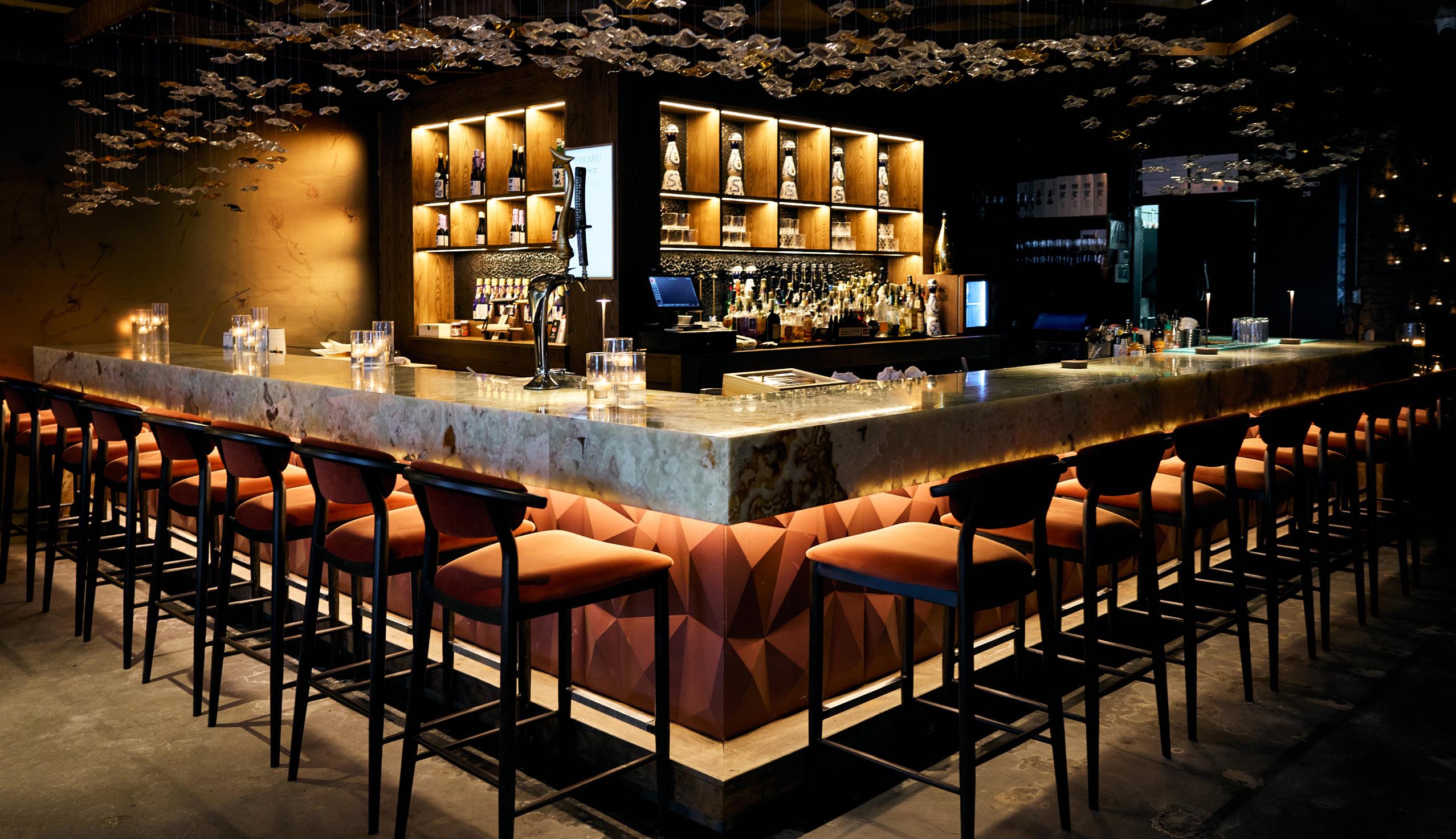
By Cathryn Wheeler
Photography by Nicolai Gregory
Inside the philosophy behind TOMO’s elevated Japanese dining room and omakase experience.
For more than a decade, TOMO has been a fixture in the ByWard Market, a destination where sushi, eclectic small plates, and vibrant late-night energy converged under one roof.
That energy hasn’t disappeared. What has changed is how it is expressed. Under Executive Chef Daniel Ken Miyamoto, TOMO has evolved from a broad, high-energy izakaya into something more focused and intentional. The menu today is leaner and more precise, guided by a deeper commitment to technique and ingredient quality.

“We wanted to pay homage to Japanese culture while reflecting everything I’ve learned from years of cooking and travelling,” Miyamoto says. “The new menu is more intentional. Fewer ideas, executed at a higher level. Instead of doing many things, we’re concentrating on doing the right things with more precision, more care, and more clarity.”
The timing, he explains, came from confidence rather than necessity. “TOMO already has deep roots in Ottawa and a very loyal following.
“This wasn’t about reinventing the restaurant, it was about evolving it.”
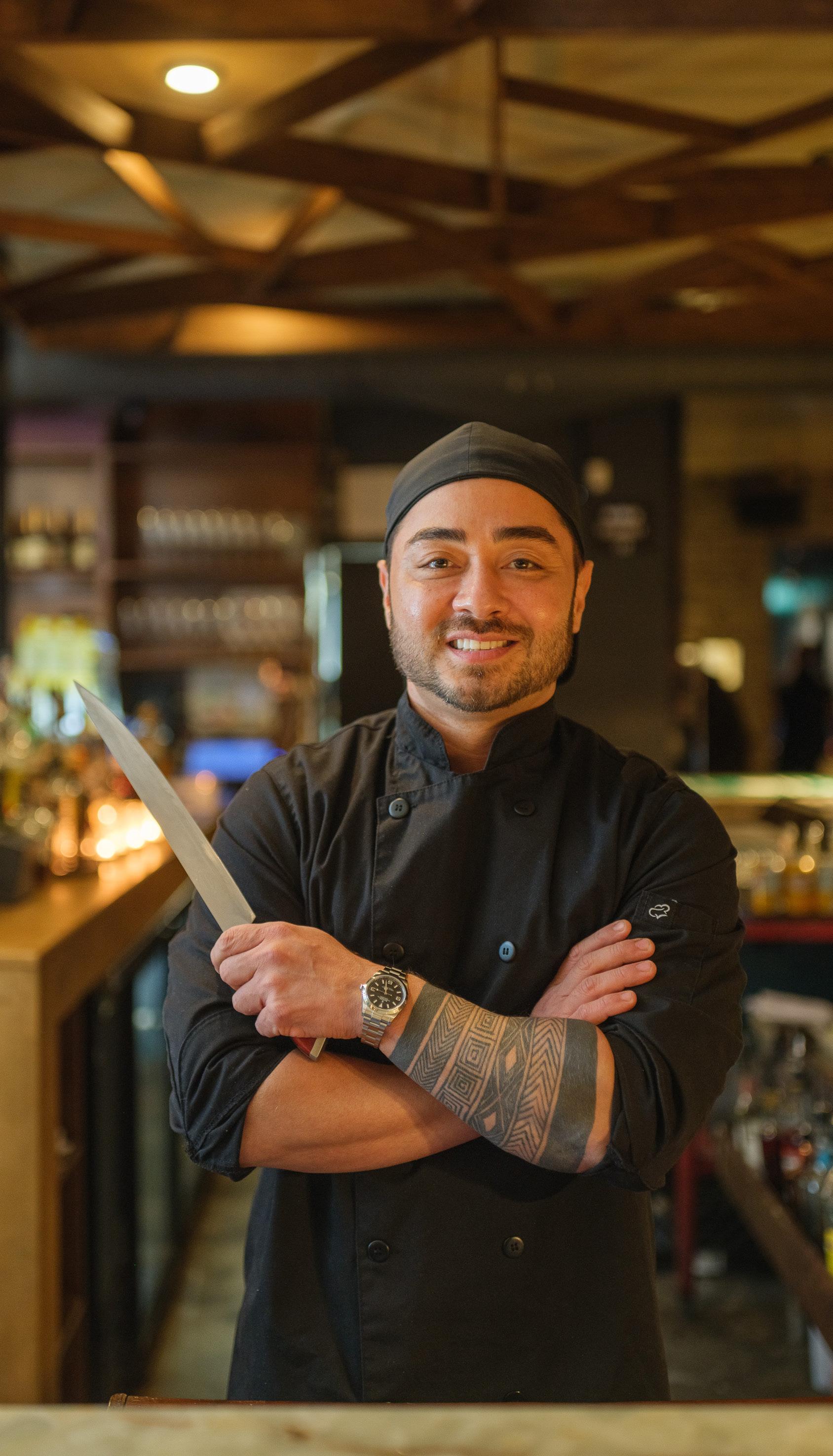

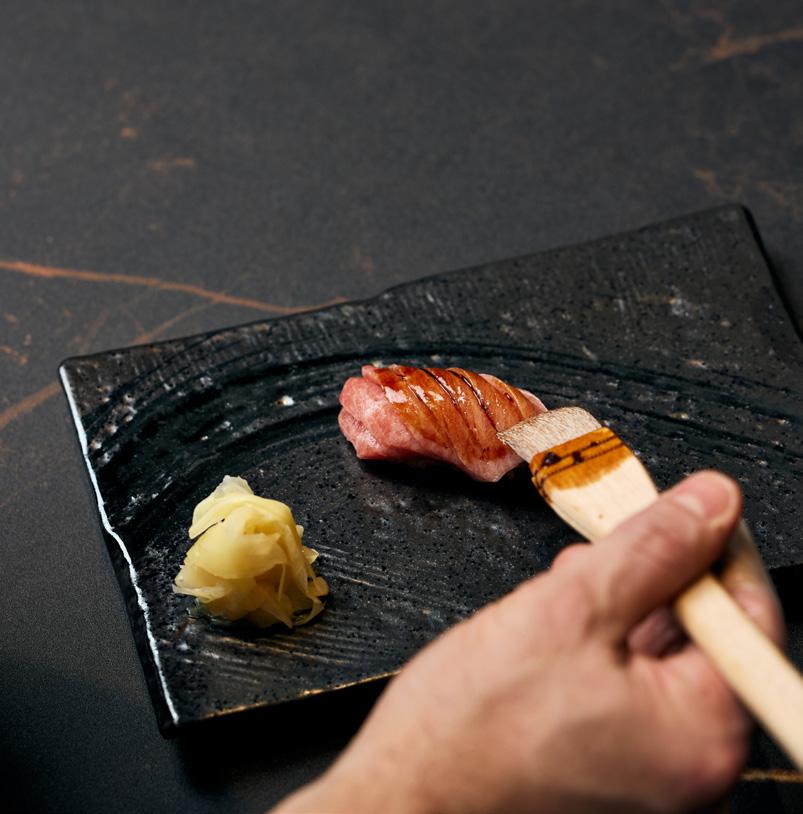
That evolution begins with sourcing. Premium rice from Uonuma in Niigata. Kinsho vinegar. Fresh wasabi root. Wild-caught bluefin tuna. “The focus was simple: quality and taste,” Miyamoto says. “Every good dish begins with great ingredients.”
The philosophy is restraint over ornamentation. Plates are not layered with excess. Instead, the elevation comes through knife work, temperature control, balance, and detail. “We believe in letting the ingredients speak for themselves,” he says. “We elevate through technique rather than complexity.”
Tradition remains the foundation, but not a limitation. “We respect Japanese technique and philosophy, but we also allow subtle creativity,” Miyamoto explains. “Ottawa diners value authenticity, but they’re also curious. Our goal is to honour tradition while keeping the experience fresh and relevant.”
As the cuisine has matured, so has TOMO’s role in the city. “TOMO began as more of an izakaya, energetic and casual,” he reflects. “Today, it’s a place where guests come to celebrate milestones.” The atmosphere remains welcoming, but the sourcing is more deliberate, the execution more refined, and the experience more composed.
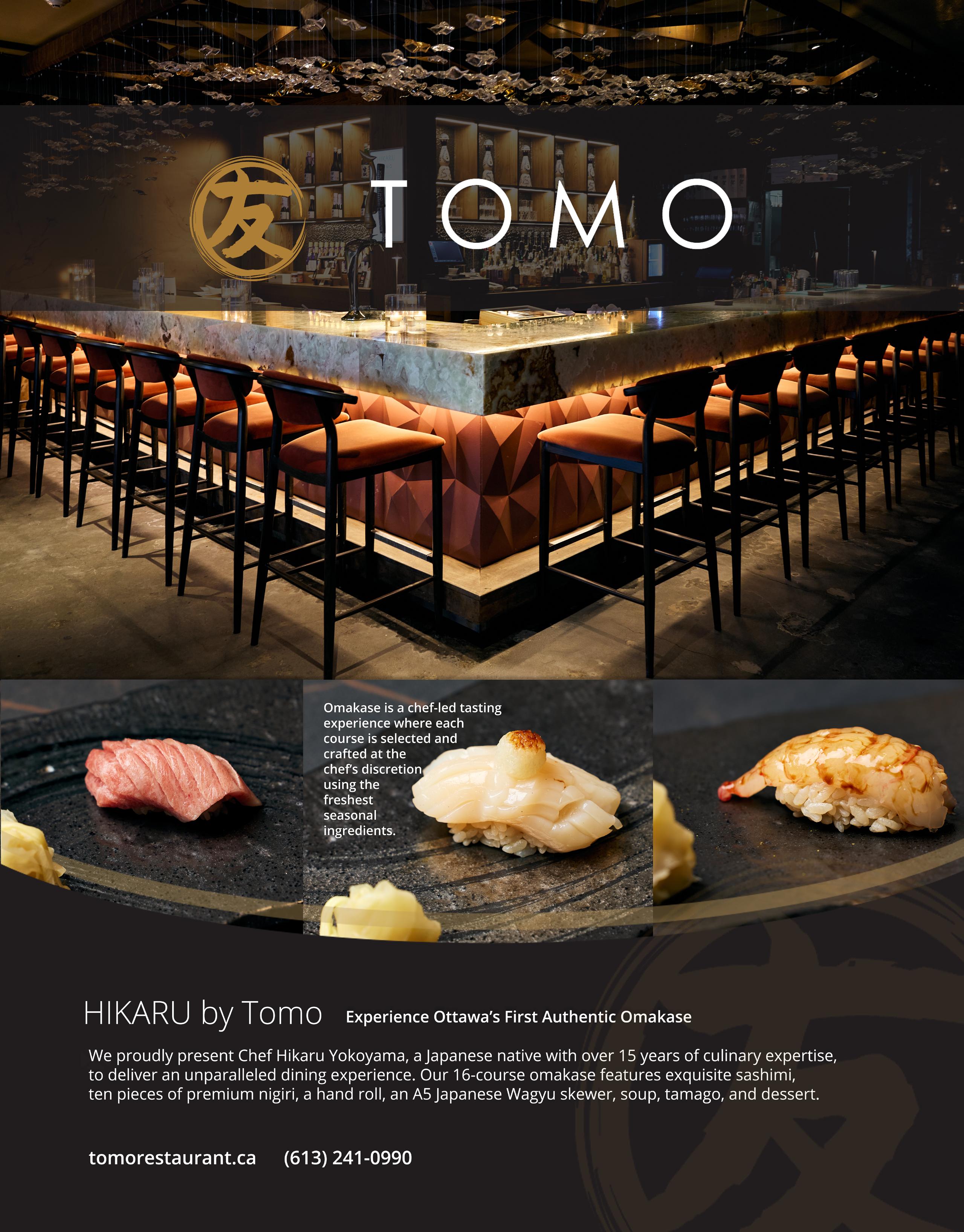
That evolution is expressed through two complementary offerings. In the main dining room, Miyamoto’s menu explores Japanese cuisine with subtle international influences, reflecting his global training and perspective. At the sushi counter, the focus narrows. The omakase experience, led by Chef Hikaru Yokoyama, unfolds as a chef-guided tasting served course by course. Omakase, meaning “I leave it up to you,” places trust in the chef’s hands. Seasonality, rhythm, and craftsmanship dictate the progression. “The omakase is where we focus deeply on Japanese tradition,” says Miyamoto. “Together, the two menus represent different expressions of the same philosophy.”

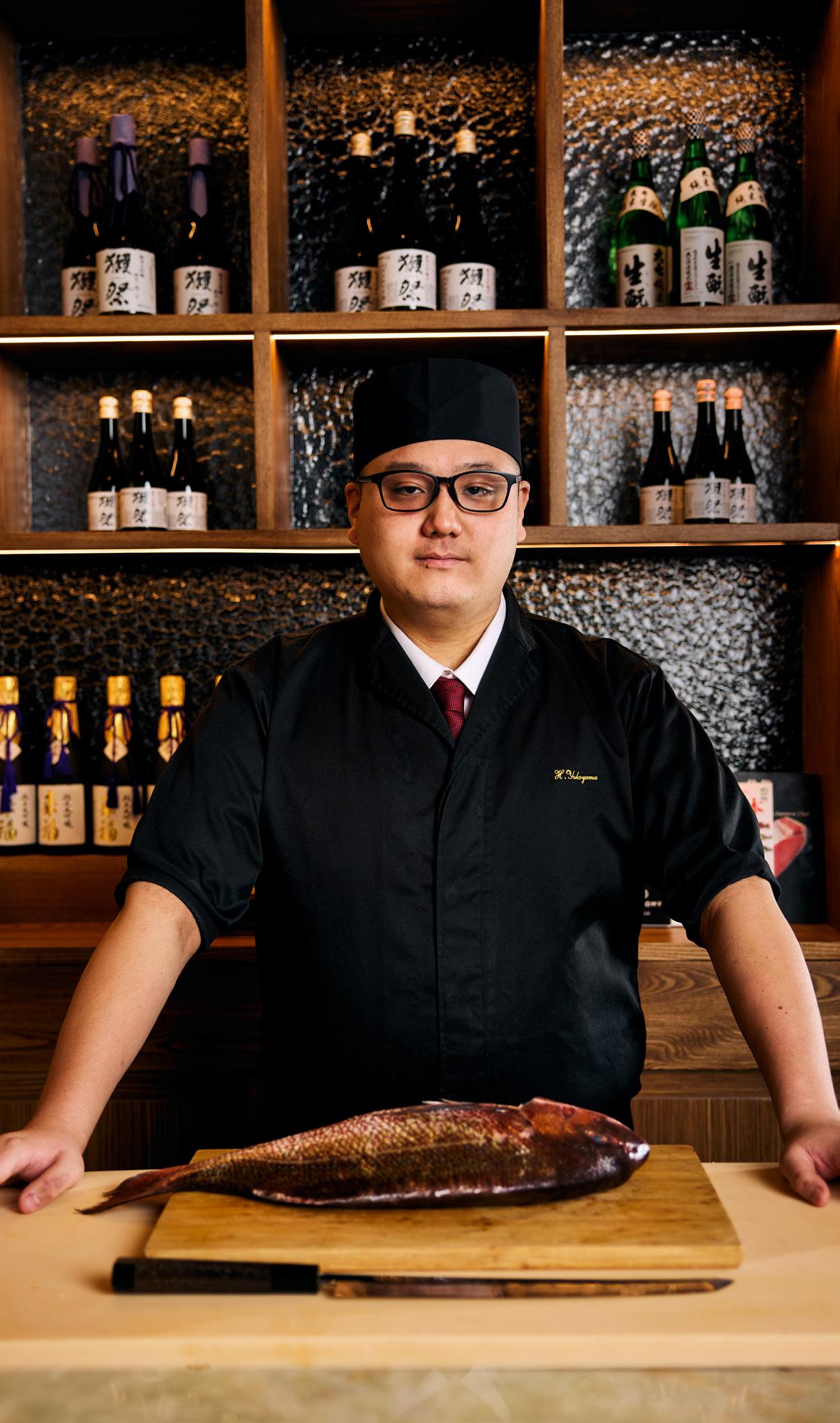
For Chef Hikaru, authenticity begins with restraint. “I don’t believe in bold seasoning,” he says. “True sushi respects the natural flavour of the ingredient. My role is not to cover it, but to bring it forward.” Each of the 16 courses is part of a larger narrative. “An omakase is not just a series of dishes,” he explains. “It is a carefully guided journey.” Pacing is deliberate. Timing matters. Silence matters. The progression of flavours builds gradually and intentionally.
Respect underpins everything. “The most important tradition for me is respect,” Hikaru says. “Respect for the ingredients, for the craft, and for the guests who place their trust in us.” Humility is equally essential. “In Japanese sushi culture, the chef is never the star. The food is.”
At the counter, that philosophy becomes tangible. Guests sit just feet away, watching the quiet discipline behind each movement, the angle of a blade, the shaping of rice, the pause before a piece is placed forward. “The counter creates a direct connection,” he says. “Guests can see the care and precision behind each piece.”
For Hikaru, words are secondary. “If guests leave with a deeper appreciation that subtle flavours can be powerful without being loud, and if they can feel the care and discipline behind each piece, then I am happy.”
For first-time diners in the main room, Miyamoto suggests starting with the Chef’s Choice Nigiri. “It allows guests to experience the quality of the fish we serve and understand our philosophy in its purest form,” he says.
At TOMO, the energy that built its reputation remains. What defines this chapter is the discipline behind it and the quiet confidence with which it is now expressed.

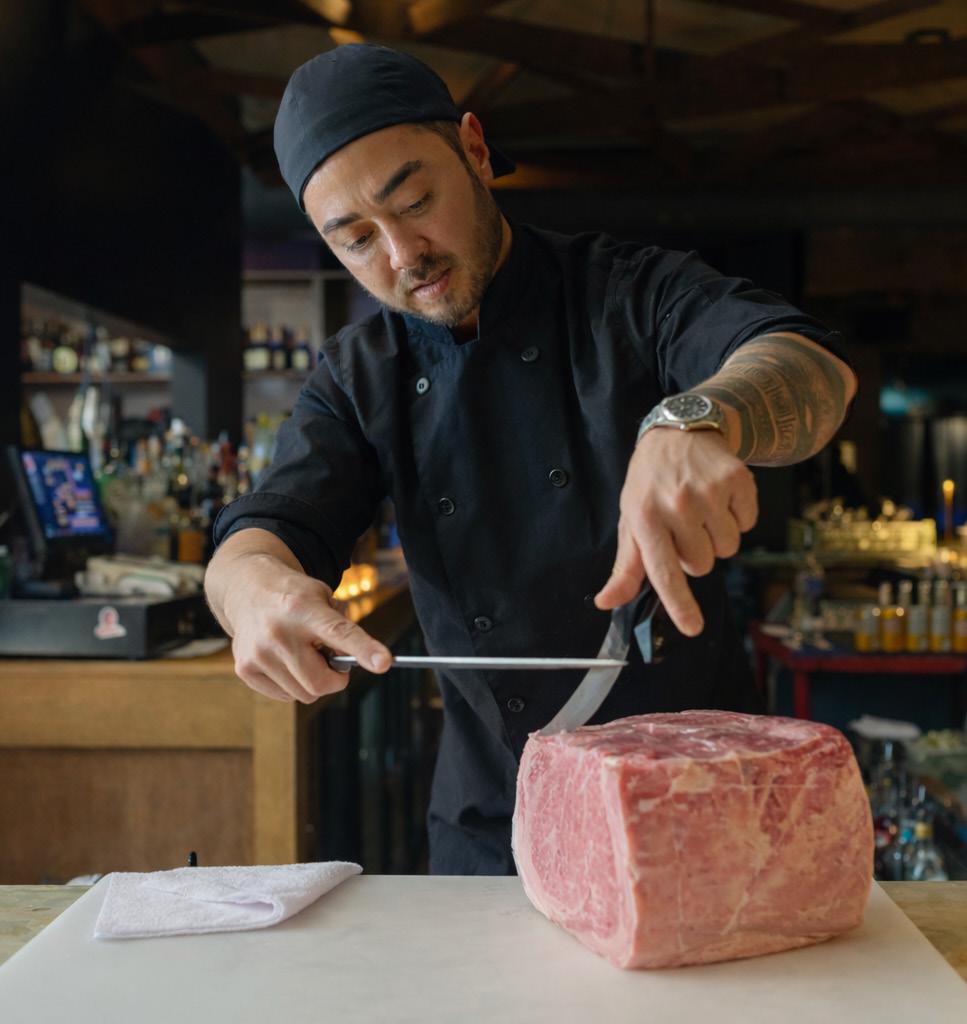
As the menu has matured, so has TOMO’s role for its guests. “TOMO began as more of an izakaya, energetic and casual,” Miyamoto says. “Today, it’s a place where guests come to celebrate milestones.” The sourcing is more thoughtful, the execution more refined, and the overall experience more elevated, while still feeling welcoming.
That balance is expressed through two distinct but complementary dining experiences. The main dining room menu allows for Japanese cuisine with subtle international influences under Chef Miyamoto. The omakase experience, led by Chef Hikaru Yokoyama, moves with a different focus. Omakase, meaning “I leave it up to you,” or “I trust the chef,” is a chef-led tasting experience served course by course at the sushi counter, where guests sit directly in front of the chef. The menu unfolds in real time, guided by seasonality, technique, and the chef’s judgment.
“The omakase is where we focus deeply on Japanese tradition, seasonality, and craftsmanship. Together, they represent two sides of the same philosophy,” says Miyamoto.
For Chef Hikaru, authenticity begins with restraint and a return to fundamentals. “I don’t believe in bold seasoning. True sushi respects the natural flavour of the ingredient. My role is not to cover it, but to bring it forward.”
The omakase unfolds as a carefully structured experience. “An omakase is not just a series of dishes,” he explains. “It is a carefully guided journey.” Flow and pacing are essential. “Authenticity lives in the rhythm. The timing of each piece and the progression of flavours. Everything has intention.”
Respect is central to his approach. “The most important tradition for me is respect,” Chef Hikaru says. “Respect for the ingredients, for the craft, and for the guests who place their trust in us.” He also emphasizes humility. “In Japanese sushi culture, the chef is never the star, the food is.”

Research from the University of St. Andrews found that couples who paused arguments to eat resolved conflicts faster and with less hostility. The study showed that low blood sugar increased irritability and impulsive reactions, while eating helped restore emotional regulation and patience. Researchers concluded that many relationship conflicts escalate not because of the issue itself, but because people are simply hungry.
Research from Warwick University found that employees who performed small acts of kindness showed a measurable increase in productivity. In the study, happier workers were up to 12% more productive, while unhappy workers were significantly less productive.
Research-backed hacks to boost life and work.


A 2021 study published in Frontiers in Neuroscience found that warmer sleeping environments are linked to more intense dream recall. Participants sleeping at 26°C (79°F) reported dreams that were 28 percent more vivid than those sleeping at 18°C (64°F). Researchers observed that higher body temperature altered REM sleep patterns, producing shorter but more intense dream cycles.




Four lesser-known benefits of Omega-3 supplements that go beyond heart health.
Omega-3s have long been framed as a “heart supplement.” Helpful, respectable, and a bit boring. But current research suggests their real value may lie elsewhere, particularly in how they support the brain, nervous system, and longterm cellular health.
Here are four lesser-known benefits that explain why omega3s are quietly becoming one of the most foundational supplements in modern health.
Omega-3s support the structure of brain cell membranes, helping signals travel more efficiently. Research links adequate intake to improved autonomic balance, meaning fewer exaggerated stress responses and better baseline calm.
DHA plays a role in how brain cells produce and use energy. Low levels are associated with mental fatigue and brain fog, making omega-3s relevant for focus and cognitive endurance without acting as a stimulant.
DHA is highly concentrated in the retina and supports visual processing. Regular intake may reduce screen-related eye strain and support contrast sensitivity long before vision noticeably declines.
Higher DHA levels have been associated with slower agerelated brain volume loss. It’s a cumulative benefit that supports brain structure over time rather than offering immediate effects.

How Duava developed his sound and built Pathway Music Group in Ottawa
Ottawa-based artist Duava has been making music since his early teens, long before he ever considered where it might take him. Born in Sri Lanka and raised in Ottawa, his work reflects a life shaped by family, culture, and the city he has called home for most of his life. Over the years, Duava has built a reputation for music that draws directly from lived experience, rather than trends, while remaining deeply connected to the local community. Today, his work spans solo releases, film and television placements, and the growth of Pathway Music Group, a collective focused on building opportunities for artists from Ottawa and beyond.
What are some of your favourite memories from your childhood?
I grew up in Sri Lanka, a beautiful place full of colour and rich culture. I really loved the feeling of being a kid in a tropical country, with amazing food and a tight-knit family atmosphere. Although we had less, I never felt like we were missing anything. Despite the conflicts the country went through, the strength, love, and sense of connection were always evident in every person you met.
When did you know that you wanted to pursue a career as an artist? Were there any people who inspired you?
From a young age, I knew I wanted to do music. My mom bought my brother a keyboard, but I ended up being the one playing it, replicating music I’d heard, which amazed my family. That was when I realized I had the capability. By age 12, I discovered platforms like SoundCloud and DatPiff and started releasing beats online. By 14, I was connecting with the Ottawa music scene, recording local artists at home, and building relationships that fully integrated me into the community.
How and why did you pick the name Duava?
I went through several names before landing on Duava. At one point, I wanted to call myself “Guava,” inspired by the fruit in my kitchen. My mom laughed and said people would just find a fruit online, not my music. She suggested swapping the “G” with the “D” from Daluwatte, and that was it. Now it feels so natural that close friends even shorten it to Duav.
You’re known for blending Sri Lankan pop and R&B. How did you find your sound?
Finding your sound is a lifelong process. I don’t even think it’s about “finding” it. Your sound is always with you. It evolves with your life experiences. The music that naturally comes out of you in the present moment is your sound for that time. In 20 years, my music may sound different, and that’s okay. What matters is authenticity in the moment.
Photography by: Sean Sisk


Looking back on your first releases, what’s the biggest change between then and now?
I started at 12, and now at 26, my perspective has completely changed. My music reflects real life now, not hypothetical scenarios. My technical ability has grown massively, and I’ve evolved as an artist, instrumentalist, and vocalist. I’m more versatile, open-minded, and creatively free.
What was it like having your song “All Over” featured in the film Worth the Wait?
That song came together very quickly. My friend and producer Mandrazo from Italy sent me the beat, and I didn’t prioritize it at first. After some pushing, I recorded it in about 30 minutes. I honestly wasn’t a big fan at the time, but it landed in a film. That experience opened the door to more film and TV opportunities, which I’m incredibly grateful for.
You’ve worked closely with Ottawa artist Xav. How did that collaboration begin?
I co-founded Pathway Music Group with my longtime engineer Joey “Tekika” Boyer. Through a series of sessions, I connected with Xav, and the chemistry was immediate. We signed him, and now we have a lifelong friendship. I write and produce his music, while Joey handles engineering. We’re very grateful to have him as part of the team.
You recently performed at the 27 Club to a sold-out crowd. Why was that night important?
We wanted to prove that you can build something meaningful from Ottawa. There’s a narrative that the city doesn’t support talent, and we’ve shown that isn’t true. PMG Live is about building something local that grows nationally and internationally. This isn’t a one-off, it’s the foundation for something bigger.
Tell me about the song “OTTAWA.” What inspired it?
Ottawa welcomed my family when we first arrived in Canada, and over time it became home. I know every street and neighbourhood. The song came together organically in my home studio, blending a club-style beat with the emotion I associate with the city. It’s often underrated, and I wanted to highlight its beauty and sense of belonging.
“Your sound isn’t something you find. It’s always with you, and it evolves with your life.”
What’s your favourite part about your work?
Life itself is my biggest inspiration. Every experience becomes material for music. I’m grateful to have an outlet that lets me process, express, and connect with others.
Outside of music, what do you enjoy doing?
Spending quality time with people I consider family, whether that’s talking, watching movies, playing basketball, or just being together.
What’s something people would be surprised to know about you?
People often assume I’m very serious, but I actually have a big sense of humour. I’m laid-back and approachable, which surprises people when they meet me.
What’s next for you?
I truly believe what I’m about to put out has the potential to stand the test of time... something that people will remember. This song makes me feel like I’m in a stadium, and it’s one of my biggest dreams, to perform in stadiums around the world. If I had to define the genre, I’d say it’s pop, but it’s so much more... powerful, dramatic, and explosive. The song is called “I’m Addicted,” and it has this energy that just stays with me.
Lastly, what advice would you give aspiring artists?
Draw from your own life. Don’t fabricate. Speak your truth. Be patient, work hard, respect your peers, uplift others, and stay authentic.








From your first home to your forever home to your anywherein-between, we build for a world that’s all yours. Mattamy has established plenty of communities in and around Ottawa, including Barrhaven, Kanata and Orléans, offering a variety of home options to complement your lifestyle.
With no shortage of vibrancy, culture and access to nature, Ottawa is a place where you’ll be perfectly at home.
LEARN MORE