April 2026 Volume 53
Recognition
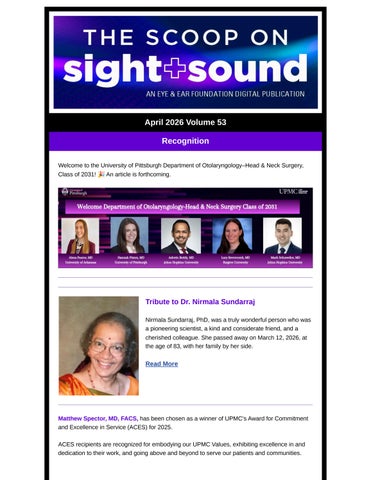
Welcome to the University of Pittsburgh Department of Otolaryngology–Head & Neck Surgery, Class of 2031! �� An article is forthcoming.


Tribute to Dr. Nirmala Sundarraj
Nirmala Sundarraj, PhD, was a truly wonderful person who was a pioneering scientist, a kind and considerate friend, and a cherished colleague. She passed away on March 12, 2026, at the age of 83, with her family by her side.
Read More

Matthew Spector, MD, FACS, has been chosen as a winner of UPMC’s Award for Commitment and Excellence in Service (ACES) for 2025.
ACES recipients are recognized for embodying our UPMC Values, exhibiting excellence in and dedication to their work, and going above and beyond to serve our patients and communities.


WTAE's Elena LaQuatra: How a cochlear implant
helped new Pittsburgh morning anchor rise to the top
WTAE’s new Pittsburgh morning anchor, Elena LaQuatra, is featured for her remarkable professional journey and resilience. A Mt. Lebanon native, Elena lost her hearing in childhood due to bacterial meningitis. With the support of a cochlear implant, she has built a distinguished career in broadcast journalism and now anchors one of the region’s most-watched morning newscasts.
We are proud to recognize Elena’s service on the Board of Directors for the Eye & Ear Foundation of Pittsburgh, where she contributes to advancing research, education, and patient care in vision and hearing.
Read More
20 Years of Interviews, Pt. VI

The Pittsburgh Quarterly team has interviewed many of the most interesting and noteworthy people in Pittsburgh. The number of interviews that have appeared in this magazine reaches well into the hundreds. As a special 20th anniversary issue treat and a tribute to the greatness of the light and lives that course through Pittsburgh, we’ve put together a compendium of thoughts from a fraction of these interviews.
A quote from José-Alain Sahel, MD, is featured.
Read Here


Congratulations to Andrew Williams, MD, who was selected for the Association of University Professors in Ophthalmology (AUPO) Academic Leadership Development Program, after

Caregiver Health Literacy in HNC
The Department of Otolaryngology-Head & Neck


Surgery is excited to share its latest study exploring how caregiver health literacy impacts the mental health and well‑being of head and neck cancer (HNC) caregiver–patient pairs. In a cohort of 100 HNC dyads (2020–2021), we examined how caregivers’ health literacy—measured with the Health Literacy of Caregivers Scale–Cancer (HLCS‑C)—relates to levels of depression, anxiety, perceived stress, and quality of life for both caregivers and patients. Our findings shed light on the role caregivers play in cancer care and on how supporting their understanding of health information may improve psychological outcomes for both the caregiver and the patient.
Title: Caregiver health literacy in head and neck cancer and its relationship with caregiver and patient psychological distress
Authors: Nana-Hawwa Abdul‑Rahman, Jymirah Morris, Stephen Glass, Katie Carlson, MPH M., Aileen Z. Cui, Kelly Tan, Jonas Johnson, Angela Mazul & Marci Lee Nilsen, PhD, RN, CHPN, FAAN.


Collaboration with NVIDIA Improves
Result Times
NVIDIA post on LinkedIn: What if you were able to get results faster and receive more precise care after surgery?
Detecting residual cancer in days instead of weeks is now possible with Droplet Biosciences, Inc’s lymph‑based liquid biopsy tests powered by NVIDIA Parabricks.
From weeks to days – lymphatic fluid is collected 24 hours after surgery instead of 4–6 weeks in traditional blood tests
⚡ 12x faster alignment and 10x faster variant calling – alignment cut from 36 hours to just 3 and variant calling from 10 hours to 1 hour
"We're excited and honored to share this collaboration and case study with NVIDIA. Using their Parabricks software and GPUs shaves days off genomic analysis timelines!" - José P. Zevallos, MD, MPH, FACS, Scientific-Co-founder of Droplet Biosciences and Chair of the Department of Otolaryngology-Head & Neck Surgery

Survivorship Care Before Radiotherapy
The Department of Otolaryngology-Head & Neck Surgery posted: What happens after we cure people? Survivorship is no longer a posttreatment footnote. It IS the dominant trajectory of cancer care. For HPV-positive head and neck cancer survivors — often younger, with more favorable long-term survival — the stakes are especially high. Most will live for decades, but studies show many experience late and long-term treatment effects that affect swallowing, voice, pain, sleep, and quality of life. These are the norm, not rare complications. So what can we do earlier? That is what we explored at EUROGIN. Our data show that when patients visit a multidisciplinary survivorship clinic *before* radiotherapy begins:

They are 52% less likely to have non-adherent radiation completion (OR 0.48)
They report significantly higher physical and social-emotional QOL at one year
They experience less depression, anxiety, dysphagia, insomnia, and neck disability
Swallowing prehabilitation and exercise rehabilitation during treatment show similar promise.
The opportunity is clear The gap in access is just as clear. Structured survivorship care remains out of reach for far too many. Future work must prioritize equity, scalable models, and prospective designs to ensure all HNC survivors have a chance to not just survive — but live well.


Amber D. Shaffer, PhD, has been appointed Section Editor for the Otolaryngology section of the Cleft Palate–Craniofacial Journal, a leading publication dedicated to advancing research, clinical practice, and innovation in cleft and craniofacial care.


Hampton runner sees clearer path to Olympic trials via new laser surgery
Frustrated with glasses getting in the way of her training, a Pitt grad student opts for a newer corrective procedure.
Read More


UPMC Division of Facial Plastic Surgery Adds Clinic
The UPMC Division of Facial Plastic Surgery is expanding its footprint by adding a new clinic in Sewickley
Read More


Single Port Robotic Platform Added to Head & Neck Surgical
Suite

Precision Surgery, Compassionate Care
Now that she has been discharged from their care aside from routine follow-up imaging, Carla Runco is going to miss her surgical team. “Who misses their surgeon?” she asked. When Carla shares her story, however, it is evident why she feels this way.
Read More

Living Eye Drop
A study in Cell Reports by Anthony St. Leger, PhD, continues to be covered in the news. It is about how researchers have developed an early-stage, experimental “living eye drop” that uses naturally occurring eye bacteria to support corneal wound healing.
Bioengineer.org
Pittsburgh Tribune-Review
UPMC
University of Pittsburgh School of Medicine
As part of the Head and Neck Division’s move to Shadyside, a single port (SP) robotic platform has been added to its surgical technology suite. While this is not novel, it is the only one approved for head and neck and expands Pitt’s transoral robotic surgery (TORS) capabilities, enabling broader access to minimally invasive treatment options for patients with head and neck cancers.


