OTOVATION, April 2026

Page 1


April 2026

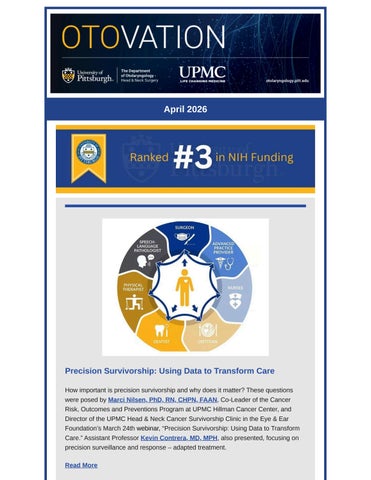
Precision Survivorship: Using Data to Transform Care

How important is precision survivorship and why does it matter? These questions were posed by Marci Nilsen, PhD, RN, CHPN, FAAN, Co-Leader of the Cancer Risk, Outcomes and Preventions Program at UPMC Hillman Cancer Center, and Director of the UPMC Head & Neck Cancer Survivorship Clinic in the Eye & Ear Foundation’s March 24th webinar, “Precision Survivorship: Using Data to Transform Care.” Assistant Professor Kevin Contrera, MD, MPH, also presented, focusing on precision surveillance and response – adapted treatment.

Caregiver Health Literacy in HNC

The Department of Otolaryngology-Head & Neck Surgery is excited to share its latest study exploring how caregiver health literacy impacts the mental health and well‑being of head and neck cancer (HNC) caregiver–patient pairs. In a cohort of 100 HNC dyads (2020–2021), we examined how caregivers’ health literacy—measured with the Health Literacy of Caregivers Scale–Cancer (HLCS‑C)—relates to levels of depression, anxiety, perceived stress, and quality of life for both caregivers and patients. Our findings shed light on the role caregivers play in cancer care and on how supporting their understanding of health information may improve psychological outcomes for both the caregiver and the patient.

Title: Caregiver health literacy in head and neck cancer and its relationship with caregiver and patient psychological distress

Authors: Nana-Hawwa Abdul‑Rahman, Jymirah Morris, Stephen Glass, Katie Carlson, MPH M., Aileen Z. Cui, Kelly Tan, Jonas Johnson, Angela Mazul & Marci Lee Nilsen, PhD, RN, CHPN, FAAN

Collaboration with NVIDIA Improves Result Times

NVIDIA post on LinkedIn: What if you were able to get results faster and receive more precise care after surgery?

Detecting residual cancer in days instead of weeks is now possible with Droplet Biosciences, Inc’s lymph‑based liquid biopsy tests powered by NVIDIA Parabricks.

From weeks to days – lymphatic fluid is collected 24 hours after surgery instead of 4–6 weeks in traditional blood tests

⚡ 12x faster alignment and 10x faster variant calling – alignment cut from 36 hours to just 3 and variant calling from 10 hours to 1 hour

�� Faster care, more cost savings – 30% reduction in total computation cost

"We're excited and honored to share this collaboration and case study with NVIDIA. Using their Parabricks software and GPUs shaves days off genomic analysis timelines!" - José P. Zevallos, MD, MPH, FACS, Scientific-Co-founder of Droplet Biosciences and Chair of the Department of Otolaryngology-Head & Neck Surgery

Survivorship Care Before Radiotherapy

The Department of Otolaryngology-Head & Neck Surgery posted: What happens after we cure people? Survivorship is no longer a post-treatment footnote. It IS the dominant trajectory of cancer care. For HPV-positive head and neck cancer survivors — often younger, with more favorable long-term survival — the stakes are especially high. Most will live for decades, but studies show many experience late and long-term treatment effects that affect swallowing, voice, pain, sleep, and quality of life. These are the norm, not rare complications. So what can we do earlier? That is what we explored at EUROGIN. Our data show that when patients visit a multidisciplinary survivorship clinic *before* radiotherapy begins:

They are 52% less likely to have non-adherent radiation completion (OR 0.48)

They report significantly higher physical and social-emotional QOL at one year

They experience less depression, anxiety, dysphagia, insomnia, and neck disability.

Swallowing prehabilitation and exercise rehabilitation during treatment show similar promise.

The opportunity is clear The gap in access is just as clear. Structured survivorship care remains out of reach for far too many. Future work must prioritize equity, scalable models, and prospective designs to ensure all HNC survivors have a chance to not just survive — but live well.

Single Port Robotic Platform Added to Head & Neck Surgical Suite

As part of the Head and Neck Division’s move to Shadyside, a single port (SP) robotic platform has been added to its surgical technology suite. While this is not novel, it is the only one approved for head and neck and expands Pitt’s transoral robotic surgery (TORS) capabilities, enabling broader access to minimally invasive treatment options for patients with head and neck cancers.

Read More

To schedule an appointment call 412-647-2100

A Vital Partner

The Eye & Ear Foundation of Pittsburgh, an independent 501(c)(3) organization, was founded in 1985 to foster philanthropic support for the Departments of Ophthalmology and Otolaryngology-Head & Neck Surgery at the University of Pittsburgh. The goal is to keep moving forward, expanding EEF’s support network, and helping the Departments achieve unparalleled distinction in research, education, outreach, and patient care.

OTOVATION is produced in partnership with UPMC

Eye & Ear Institute | 203 Lothrop Street | Pittsburgh, PA 15213 US

Unsubscribe | Update Profile | Our Privacy Policy | Constant Contact Data Notice

Turn static files into dynamic content formats.

Create a flipbook