
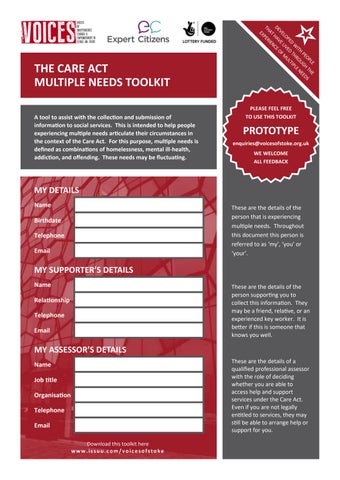

These are the details of the person that is experiencing multiple needs. Throughout this document this person is referred to as ‘my’, ‘you’ or ‘your’.

These are the details of the person supporting you to collect this information. They may be a friend, relative, or an experienced key worker. It is better if this is someone that knows you well.
These are the details of a qualified professional assessor with the role of deciding whether you are able to access help and support services under the Care Act. Even if you are not legally entitled to services, they may still be able to arrange help or support for you.
What do we mean by multiple needs?
There may be many definitions of multiple needs. Therefore, it is important for us to be clear what we mean.
In this context, multiple needs means combinations of homelessness, mental illhealth, addiction, and offending behaviour.
People experiencing two or more of those needs too often find it difficult to access the care and support services that they need.
Perhaps as a result, people experiencing multiple needs are often high frequency users of emergency ‘blue light’ services.
To find out more about the impact of multiple needs and improving access to services, see our report entitled “Hard Edges in Stoke-on-Trent”.
You can find it on our ISSUU publication webpage here: www.issuu.com/voicesofstoke
Our intention for this toolkit is to help people with multiple needs and their support networks to articulate their circumstances in the context of the Care Act. We do not intend for this document to in any way replace the formal assessments of professional social workers. Rather, our wish is to ensure that people with multiple needs can record and communicate their needs as effectively as possible so that they are clearly available for consideration.
People with multiple needs face specific challenges in accessing services. Some of these can be characterised as barriers related to the formal systems of assessment or diagnoses. Others relate to informal aspects of systems such as the cultures, attitudes, and values of organisations and society more generally.
Our view is that the Care Act represents a genuine opportunity to reframe how people with multiple needs are considered for access to care and support services. We want to focus on the impact that the experience of multiple needs has on people’s ability to achieve outcomes in their dayto-day lives and the limitations placed on the choices that are then available.
We recognise that people with multiple needs often present quite specific challenges to care and support assessment systems. These challenges may be philosophical, for example, relating to people’s lifestyle
choices and their autonomy to make impulsive or damaging decisions.
Other challenges are more practical. For example, simply finding someone that is rough sleeping or otherwise living in a chaotic way so that the necessary assessment can take place.
Similarly, people with multiple needs often experience fluctuations in their condition on a day-to-day basis. This perhaps makes it more likely that, when an assessment does take place, it is based on an snap shot that may not be representative of their general life experience.
Therefore, our hope for this toolkit is that it helps people with multiple needs, their support networks, and social care professionals to release the potential of the Care Act to help improve access to care and support services.
This toolkit is intended to inform, rather than replace, a thorough professional assessment.
is one of 12 projects funded by the National Lottery through the Big Lottery Fund as part of a strategic investment called Fulfilling Lives: supporting
with multiple
working with people experiencing multiple needs and the organisations providing the care and support services they need. In doing so, we are experimenting with different ways to improve service access for people with multiple needs by promoting systems change.
www.voicesofstoke.org.uk
Expert Citizens are a group of people with lived experience of multiple needs. Their insight and vision is central to our systems change objectives.
Expert Citizens are partners in a co-production that places lived experience at the centre of systems change.
www.expertcitizens.org.uk
An assessment is how a local authority decides whether you need care and support to help you live your day-to-day life. The assessment must be carried out by an appropriately trained assessor, for instance a social worker, who will consider a number of factors. The aim is to get a full picture of you and what needs and goals you may have.
After carrying out an assessment, the local authority will then consider whether any of the needs identified are eligible for support. Because not all care needs are met by the State, the local authority uses an eligibility framework to decide which needs are eligible to be met by public care and support. Local authorities must undertake an assessment for any adult with an appearance of need for care and support, regardless of whether or not the local authority thinks the individual has eligible needs or of their financial situation.
Wherever you express a need, or any challenges and difficulties you face because of any condition (or conditions) you may have, the local authority should ensure that it has established the impact of that on your day-to-day life.
The local authority must also consider whether your needs impact upon your wellbeing beyond the ways identified by you. For example, where you express a need regarding your physical condition and mobility, the local authority must establish the impact of this on your desired outcomes; and must also consider whether your needs have further consequences on your wider wellbeing such as on your personal health or the suitability of your living accommodation.
Local authorities must consider at this stage if you have a condition as a result of either physical, mental, sensory, learning or cognitive disabilities or illnesses, substance misuse or brain injury. The authority should base their judgment on an assessment and a formal diagnosis of your condition should not be required
In practical terms this means using a person-centred approach to talk with you, within the formats deemed most appropriate, to understand together the outcomes you wish to achieve in your day-to-day life. Examples include:
A face-to-face assessment between the person and an assessor.
A supported self-assessment, where you complete the assessment yourself and the local authority assures itself that it is an accurate reflection of your needs.
An online or phone assessment may be appropriate if there are no communication needs.
A joint assessment where agencies work together to avoid you undergoing multiple assessments. For example, social work and occupational therapist assessments, or housing and social work.
A combined assessment, where your assessment is combined with a carer’s assessment.
It is important to consider which practitioner is best placed to carry out the assessment? Is there an organisation or person that knows you and your needs well that can carry out or contribute to the assessment?
Note that any one of these methods may be appropriate to your circumstances. However, using a mix of these approaches may also be necessary. Practitioners should be sensitive to your needs and avoid you having to tell you story again and again.
Do your needs arise from or relate to a physical illness?

My physical needs
MY

My supporter’s view of my physical needs MY

My assessor’s view of my physical needs
Determining whether needs arise from or are related to physical or mental impairment or illness should be simple. Your assessor should not interpret this test to mean that your GP must be consulted or that a formal diagnosis is required.
It may help the assessor to consider whether the person would likely have been able to achieve a given outcome, if they did not have a physical or mental impairment or illness
The information gathered about needs and outcomes can be extracted through conversation with you, and other people if it seems necessary. The assessor should take care to consider any fluctuating or underlying needs you may have. It is important for local authorities to conduct the assessment in such a way that they can establish the links between the individual’s needs, their desired outcomes and the eligibility outcomes set out in the Care Act and make an assessment of the impact these have on the person’s wellbeing.
Do your needs arise from or relate to a mental impairment or illness?
What do you need to consider?
Wellbeing is a broad concept applying to several areas of life.
Therefore, you can expect a holistic approach to ensure a clear understanding of your views, which is vital to identifying and defining your wellbeing.
• personal dignity
• physical and mental health
• emotional wellbeing
• protection from abuse and neglect
• control over your day-to-day life
• participation in work, education, training or recreation
• social and economic wellbeing
• domestic, family and personal domains
• living accommodation
• contribution to society
My mental health needs
My supporter’s view of my mental health needs
My assessor’s view of my mental health needs
Do your needs arise from or relate to any other illness?
My other needs
MY
My supporter’s view of my other needs MY
My assessor’s view of my other needs
Self-neglect is a potentially significant challenge. It can express itself in different ways as an unwillingness or inability to care for yourself or your environment.
This includes, for example:
• neglect of hygiene, nutrition, hydration or health which endangers your safety and wellbeing
• failing to care for your environment leading to squalor and/or hoarding
• refusal of services that would mitigate the risk of harm to you or others
Statutory guidance to the Care Act 2014 (from the Department of Health) introduces significant change by including selfneglect in the list of circumstances that constitute abuse and neglect.
Therefore, self-neglect should be considered in the context of your care and support needs and its impact on your wellbeing.
Do your needs fluctuate over time?
do you need to consider?
The Care Act requires local authorities to take into account the full range of needs of adults with care and support needs. This must take into account any fluctuation in your needs.
Consideration of fluctuating need ensures that assessment is not simply a ‘snapshot’ of your care and support needs on the day of an assessment. Local authorities must consider your care and support needs over a suitable period of time to gain a complete picture of those needs.
This includes the frequency, duration, and severity of fluctuation.
For example:
• How good or bad does it get?
• What does a bad day prevent you from doing?
• How often do things change?
• Who helps you on a bad day?
• What helps you on a good day?
My fluctuating needs
My supporter’s view of my fluctuating needs
My assessor’s view of my fluctuating needs
Do your needs have a significant impact on the desired outcomes that you want to achieve in life?
Impact on my desired outcomes
MY SUPPORTER
My supporter’s view of the impact
What do you need to consider?
You should consider the outcomes that you wish to achieve in order to lead your day-to-day life in a way that maintains or improves your wellbeing.
These will vary from one person to another because you will have different interests, relationships, demands and circumstances within your own life compared to someone else. These are the outcomes that an assessment should focus on.
Therefore, it is worth discussing what you want to achieve in life and considering how your needs impact on your ability to achieve those outcomes.
MY ASSESSOR
My assessor’s view of the impact
When you are found to have care and support needs following a needs assessment, the local authority must determine whether your needs are at a level sufficient to meet the ‘eligibility criteria’. The eligibility decision-making process for adults with care and support needs involves the consideration of the following criteria:
• Whether your needs arise from or are related to a physical or mental impairment or illness
• Whether, as a result of your needs, you are unable to achieve two of ten outcomes
1 Unabletoachieveit withoutassistance
2 Abletoachieveitwithout assistancebutdoingso causesyousignificantpain, distress,oranxiety
3
Abletoachieveitwithout assistancebutdoingso endangersorislikelyto endangerthesafetyofyou orofothers
4 Abletoachieveitwithout assistancebuttakes significantlylongerthan wouldnormallybe expected
5
Abletoachieveitwithout assistanceandinatimethat wouldbeexpected
• Whether, as a consequence there is, or is likely to be, a significant impact on your wellbeing
• For the purposes of this regulation you would be regarded as being unable to achieve an outcome if you are:
• unable to achieve it without assistance
• able to achieve it without assistance but doing so causes you significant pain, distress or anxiety
• able to achieve it without assistance but doing so endangers or is likely to endanger the health or safety of you, or of others, or
• able to achieve it without assistance but take significantly longer than would normally be expected
And
• Where your level of need fluctuates, in determining whether your needs meet the eligibility criteria, the local authority must take into account your circumstances over such period as it considers necessary to establish accurately your level of need
Use the ‘KEY TO OUTCOMES’ on the left to estimate what you are able to achieve in relation to each of the following eligibility outcomes. Your supporter and assessor can do the same. This will enable your assessor to better understand your circumstances in the context of the Care Act.
As well as estimating your ability to achieve the outcomes using the appropriate number, you can provide a brief example or description. Your supporter and assessor can do the same. It is important to remember that they may have a different opinion than you or they may not agree with each other.
How well do you manage and maintain your nutrition?
(Read the key on page 10 before making your selection)
(tick one)
What do you need to consider?
Do you have access to food and drink to maintain nutrition and are you able to access, prepare and consume food and drink?
Examples of circumstances affecting your ability to achieve the outcome:
• If you are eating a restricted or unhealthy diet (e.g. only eating toast)
• You may have difficulty in getting to the shops to buy food
• You may be able to prepare food but have swallowing problems
How well do you maintain your personal hygiene?
(Read the key on page 10 before making your selection)
What do you need to consider?
What is your ability to wash yourself and launder your clothes?
Examples of circumstances affecting your ability to achieve the outcome:
• If you cannot reach to wash yourself all over, this is not hygienic
• If you do not have access to a washing machine and your mobility is poor, clothes and linen may not be properly clean
• If you cannot buy cleaning products, or cognitively understand how to operate a washing machine, your clothes and linen may not be properly clean
How well do you manage your toilet needs?
(Read the key on page 10 before making your selection)
(tick one)
What do you need to consider?
Are you able to access and use the toilet and manage your own toilet needs?
Examples of circumstances affecting your ability to achieve the outcome:
• If the toilet is no longer accessible due to mobility problems
• If it takes you too long to get to the toilet
• If you are unable to maintain your night-time continence, you may not be managing from a dignity-of-life point of view
How well do you manage clothing yourself appropriately? (Read the key on page 10 before making your selection)
Are you able to dress yourself and be appropriately dressed, that is, in relation to the weather or the activities you are undertaking, which could include work or volunteering?
Examples of circumstances affecting the ability to achieve the outcome:
• If you cannot put on or fasten your clothes, you are unlikely to be appropriately dressed
• If you cannot acquire new clothes when needed, you may not be appropriately dressed; e.g. for the change in seasons
• You may be able to dress yourself in casual clothes unaided but may not be able to dress yourself in more formal work clothes
e.g. put on a tie, zip up a dress or clean your shoes, and so would not be appropriately dressed for your circumstances
• If you are severely visually impaired, for example, you may be able to dress yourself but not know if clothes are appropriate or clean
How well do you manage making safe use of your home? (Read the key on page 10 before making your selection)
(tick one)
Are you able to move around the home safely, including climbing steps, using kitchen facilities and accessing the bathroom/toilet?
This includes your immediate environment; e.g. access and steps to the home.
Examples of circumstances affecting your ability to achieve the outcome:
• If you cannot reach certain rooms, they may not be using the home safely or be unreasonably confined e.g. having to spend all day in bed
• If you cannot get in or out of the front door (e.g. because you cannot manage the steps), you are unlikely to be using the home safely or have proper access to it
• If you are unable to use home appliances properly and safely (e.g. cooker, heater), you may not be meeting this outcome
How well do you maintain a habitable home environment? (Read the key on page 10 before making your selection)
Is your home sufficiently clean and maintained to be safe, including essential amenities? Do you require support to sustain the home or maintain amenities such as water, electricity and gas or to pay your rent or mortgage?
Examples of circumstances affecting the ability to achieve the outcome:
• If you are unable to pay your rent or utility bills (e.g. due to mental or physical incapacity), you will not be able to sustain your home
• It may not be a habitable home environment if:
• your home is damp or in very poor repair
• you are unable to clean your kitchen, leading to infestation
• you are hoarding excessively
NOTE: hoarding per se does not determine eligibility; however, the impact of excessive hoarding your ability to achieve outcomes, and thereby on your wellbeing, will affect eligibility.
assessor’s view of my home environment needs
How well do you develop and maintain family or other personal relationships?
(Read the key on page 10 before making your selection)
(tick one)
Are you lonely or isolated? Do your needs prevent you from maintaining or developing relationships with family and friends?
Examples of circumstances affecting your ability to achieve the outcome:
• Your physical or psychological state may prevent you from making or maintaining relationships e.g. mental illhealth, autism.
• If you are unable to communicate easily and regularly:
• you may not have, or be able to use, a phone or computer
• you may be unable to leave your home safely
• you may be unable to communicate successfully or interact with others and
• This prevents you from maintaining or developing relationships with family, friends and others
How well do you access and engage in work, training, education or volunteering?
(Read the key on page 10 before making your selection)
Do you have the opportunity and / or wish to apply yourself and contribute to society through work, training, education or volunteering?
This includes physical access to any facility and support with participation in the relevant activity.
Examples of circumstances affecting your ability to achieve the outcome:
• If you are unable to leave your home safely, or communicate successfully, or interact with others, you may not be able to access work, training, education or volunteering
• If you are unable to access information about opportunities available to you, you are unlikely to be able to engage in activities
How well do you make use of necessary facilities or services in the local community including public transport and recreational facilities? (Please read the key on page
My needs in accessing services (tick one)
Are you able to get around in the community safely and able to use facilities such as public transport, shops and recreational facilities?
This includes the need for support when attending health care appointments.
Examples of circumstances affecting your ability to achieve the outcome:
• If you are unable to walk, or to use public transport unattended or to organise alternative transport (e.g. someone giving you a lift); or
• you do not have money for a taxi, you may not be able to access services locally
• As well as formal appointments, e.g. health care appointments, this could include informal appointments
How well do you carry out any caring responsibilities you have for a child?
(Please the key on page 10 before making your selection)
What do you need to consider?
Do you have any parenting or other caring responsibilities; e.g. as a parent, step-parent or grandparent?
Examples of circumstances affecting your ability to achieve the outcome:
• If you are not able to take care of others, or feel overwhelmed because of your condition, you may not be able to carry out your caring responsibilities for a child
My needs in relation to caring for a child (tick one)
assessor’s view of my needs
A given situation could have a significant impact on one individual but not on another. Therefore, professional judgement and analysis of the information gathered in the assessment are crucial to establishing whether there is indeed ‘significant impact’ on the individual’s wellbeing. A ‘significant impact’ could be:
• a consequence of a single effect: meaning you are unable to achieve two or more outcomes that affects at least one of the areas of wellbeing in a significant way
• a consequence of a cumulative effect: meaning that you have needs across several of the eligibility outcomes, perhaps at a relatively low level, but as these needs affect you in various areas of your life, the overall impact on you is significant
• a consequence of a domino effect: meaning that currently you may have needs in relation to few eligibility outcomes, but it can be anticipated that in the near future other outcomes will be affected, causing a significant impact on your wellbeing
An individual has identified needs around their inability to maintain relationships with their family and in making use of facilities or services in the local community, but currently does not have any problems with managing and maintaining their nutrition, personal hygiene, toilet needs or a habitable home environment.
However, the individual is depressed, affecting their ability to interact socially. As a result, their emotional situation is decreasing further to the extent that it is clear that in the near future they also will not be able to manage or maintain nutrition, personal hygiene, toilet needs or a habitable home.
Therefore, the impact on the individual’s wellbeing is significant.
An adult is struggling to manage and maintain their nutrition, personal hygiene and toilet needs as their standards are reducing due to low social interaction and decreasing mobility around their home. The adult is consequently very close to becoming unable to meet most of the outcomes.
Wellbeing is a broad concept. It is described as relating to the following areas in particular:
• your personal dignity (including treating you with respect)
• your physical and mental health and emotional wellbeing
• protection from abuse and neglect
• your control over your day-to-day life (including over care and support provided and the way they are provided)
• your participation in work, education, training or recreation
• your social and economic wellbeing
• domestic, family and personal domains
• suitability of your accommodation
• your contribution to society
As a consequence of what has been described previously in this document, is there (or is there likely to be) a significant impact on your wellbeing?
What do you need to consider?
Wellbeing is a broad concept. It is described as relating to the following areas in particular:
• your personal dignity (including treating you with respect)
• your physical and mental health and emotional wellbeing
• protecting you from abuse and neglect
• your control over your day-to-day life (including over care and support provided and the way they are provided)
• your participation in work, education, training or recreation
• your social and economic wellbeing
• domestic, family and personal domains
• suitability of your accommodation
• your contribution to society
supporter’s view of my wellbeing
assessor’s view of my wellbeing
Do your needs have a significant impact on your ability to achieve two or more of the eligibility outcomes described?
Impact
My supporter’s view of my ability to achieve MY
My assessor’s view of my ability to achieve
What do you need to consider?
Your need to consider the following three related factors with your supporter and assessor:
• Do your needs arise from a physical or mental illness, impairment, or other condition
• Do your needs mean that you are unable to achieve two or more of the listed eligibility outcomes?
• As a result, is there a significant impact on your wellbeing?
Wearegratefultoawiderangeof peoplefortheirsupportincluding:
BrunoOrnelas
DarrenMurinas
RacheleHine
SimonWhittaker
DrMichelleCornes
AndyMeakin
Wehavedrawnheavilyonthe followingresourceswhichare influencingthisworkandourthinking throughoutthedevelopmentprocess ofthistoolkit:
“EligibilitydeterminationfortheCare Act2014”,SocialCareInstitutefor Excellence,January2015.
“Self-neglectpolicyandpractice: researchmessagesforpractitioners”, SocialCareInstituteforExcellence, March2015.
Neither VOICES nor Expert Citizens offers any warranty or accepts any liability for losses of any kind incurred as a result of using this toolkit. Use of the toolkit is permitted on the understanding that this is entirely at your own risk.
This document is a prototype. This means that it is a work in progress. We would very much welcome any feedback you have about the toolkit. Please email any comments or suggestions to us at: enquiries@voicesofstoke.org.uk