Participation framework
Involving people with lived and learnt experience: Towards new commissioning paradigms in health and social care.

September 2023
Andy Meakin BA(HONS) MBA
Sophia Fedorowicz BSC MSC
Introduction
This document is not intended to be a comprehensive ‘how to’ guide for public participation within the commissioning cycle. Instead, it is intended to provide an overview and useful signposts for further investigation or learning. That is the nature of a framework. However, there are two areas where we encourage readers to think carefully. Firstly, we present some constructive criticisms of how current commissioningpracticemitigatesagainstcommunityparticipationandsomesuggestionsforimprovement. Secondly,withinthosesuggestions,wealsoadvocateforanappreciativeinquiryapproachasaconstructive means to drive continuous improvement through active public participation. These two things together could become a new commissioning paradigm. Our hope is that you find this framework both useful and provoking of positive action towards improvement. Of course, we would be happy to help if you are interestedin learningmore orcollaborating on aspecific project.
What is participation?
Itis important to define what we mean to establish a language of participation for some of the key terms in this document. Others may use different terms, but this is what we mean for the purposes of this framework. Thishelps ustobe clear and confidentof our meaningwhen we discuss participation.
Participation
Participationisanumbrellatermthatencompasses a broad spectrum of involvement in decisionmaking processes and activities. It refers to the active engagement of individuals, communities, services, and other stakeholders in shaping the policies, programmes, and services that affect them. Participation takes various forms including community directed or controlled, co-production, and consultation. It emphasises inclusivity, transparency, and accountability by enabling people affected to have a voice, influence outcomes, and contribute their lived and learnt experiences. Participation is intended to promote more democratic governance, strengthen social cohesion, and enhance the effectiveness and legitimacy of public policies, programmes, and services.
Community directed (or controlled)
Community directed or controlled participation refers to the highest level of involvement and decision-making power given to people in shaping policies, programs, or services that directly affect them. It emphasises the principle of selfdetermination, where communities have the authority and autonomy to identify their own needs,set priorities,and designsolutions. Under a community-directed approach, community members lead and direct the planning, implementation, and evaluation of initiatives. This form of participation aims to enhance community ownership, build social capital, and encourage sustainable and contextually appropriate solutions.
It acknowledges the diversity and specific needs of different communities and ensures that decisions are made collectively, reflecting the unique aspirations and priorities of the people directly affected. The affected community holds the power to make decisions and the commissioning organisation has the roleofenablerandfacilitator.
Coproduction
Co-production refers to a collaborative approach where people (such as the public, service users, or service providers) actively participatein the design, delivery, and continuous improvement of public services workingalongside agencies such as a Local Authority. Theaimistocreatebetteroutcomesthat enhance the overall value and impact of public services. In co-productions public agencies and stakeholders plan and/or act together, often building on existing strengths. While decisionmaking authority remains with the commissioning organisation, the affected communities and stakeholders have a central role in informing key decisions.
Consultation
Consultation refers to situations where decisions have already been formulated to some extent and the primary purpose is to gather people’s views and insights. It involves seeking feedback, opinions, and perspectives from individuals, communities, services, or other relevant stakeholders. These may refine or modify a proposed course of action. Decision-making authority remains with the commissioning organisation. Affected communities andstakeholdershaveaperipheral role
Participatory cube
Thisisauseful wayof thinkingaboutthedifferentdimensionsof participation(seeFigure1). Itistaken frommodelsdevelopedforonlineparticipationplatformsandoutlinesthreedomainsinwhichtomake decisions when planning community participation.
These are:
• Who participates? And at, what
• Stage(s) of participation? And at, what depth on the
• Ladder of participation?
Domain 1
Ladder of participation
Community directed / control
Adaption of:

Co-production
Consultation

None

Domain 3
Categories of participation are independent of the policy, project, or initiative.

Figure 1: Participatory cube
Domain 1: Who participates

Who participates Commissioners

Learnt experience

Lived experience

General public

Evaluation

Delivery

Procurement

Design

Stages of participation
Roberts, T. (2022) The Participation Cube and Digital Affordances for Participation [online] Available at: www.participatorymethods.org/resource/participation-cube-and-digital-affordances-participation. [Accessed May 2023]

The appropriate participants depend on the policy, project, or initiative.
Domain 2
The stage(s) of participant involvement depend on the policy, project, or initiative.

Deciding who participates is crucial to the perception of inclusivity and legitimacy of the outputs. Consideration should be given to involving people from diverse backgrounds and communities with lived experience affected by the policy, programme, or service in question. Consideration should also be given to involving people with learnt experience such as practitioners, subject experts, academics, and other stakeholders thatcan enhance the quality of discussions and decision making particularly in the organisation and contextualisation of the outcome It is alsoimportant to consider the human and other resources that will be necessary to support meaningful stakeholder engagement to avoid the perception of participation as a tick-box exercise which could lead to mistrust Balance is required betweenthe resources availableforparticipation,thenumberofparticipants,the capacityto facilitate productive discussions where everyone’s voice is heard, appropriate participatory techniques for different audiences, and the availability of compensation for the time and input of people with lived experience Care is needed in considering compensation levels particularly the potential impact on welfare benefits for people experiencing hardship.
Domain 2: Stages of participation
Participation can take place at every stage of a process or at specific stages. This includes selecting and planning the form of participation. Determining at what stages individuals or groups should participate in context is an important decision It involves identifying the specific points or phases in a project, program, or policy development where participation is deemed most appropriate and effective. Factors such as the complexity of the issue, the levelof expertise required,and the potential impact of participation should be considered to determine how and when individuals or groups are involved. Thegoalistoensurethatparticipationismeaningful,inclusive,andcontributestotheoverall objectives. The decision regarding the stage of participation seeks to strike a balance between early involvement to shape the agenda and late involvement to provide feedback and review emerging outcomes and impacts. This stage of the participation model aims to facilitate the integration of diverseperspectives,enhancelegitimacy,anddeliverasenseofownershipandcollectiveresponsibility throughout the decision-making process.
Domain 3: Ladder of participation
There are several frameworks or ‘ladders’ outlining different levels or depths of public engagement in the development of services and systems. Figure 2 combines two of these to add some nuance.
Community directed or controlled
This level involves giving decision-making authority to the community. The community takes the lead in identifying issues, developing plans, and implementing solutions. The purpose of this levelis to empower the communityto take ownership of the process and the outcome. Decision-makers may still provide support and resources to the community, but the community retains ultimate decision-making authority.
Coproduction
Acting together
At this level,the publicand decision-makers work together to implement a plan or proposal. The public is actively involved in decision-making and has a say in how the plan is implemented. The purpose of this level is to work collaboratively to achieve a common goal.
Planning together
Thislevelinvolvescollaboratingwiththepublicto develop a plan or proposal. The public's input is central to developing the plan or proposal, but decision-making authority still rests with the decision-makers. The purpose of this level is to work with the public to develop a plan that incorporates their ideas and concerns
Community directed People in control
Coproduction
Consultation
Acting together Planning together
Consulting people
Informing people
Increasing participation
Adapted from: Arnstein (1969) Figure 2: Ladder of participation
Consultation
Consulting people
At this level,the publicis asked for their opinions, ideasorfeedbackona project, policy,or decision However,the decision-makers still retain the final say and are not obligated to act on the public's input. The purpose of this level is to gather input from the public to help inform decision-making.
Informing people
This level involves providing the public with information about a project, policy, or decision, without actively seeking their input or feedback. The purpose of this level is to inform the public about what is happening, but not necessarily to involve them in decision-making.
Appreciative inquiry
Appreciative inquiry is a problem-solving and change management approach that focuses on identifying and leveraging an organisation's strengths, positive experiences, and future possibilities (Cooperrider & Srivastva, 1987). It is often used in organisational development, team building, and strategic planning. Here are some of the key tools and techniques commonly (or at least sometimes) associated with appreciative inquiry that can be used in the context of evolutionary continuous improvement in a collaborative commissioning context to promote community participation (see: Figure 6). Appreciative inquiry can be summarised as a focus on what’s strong rather than what’s wrong
The appreciative inquiry process consists of five stages:





Discovery
In this stage, the focus is on identifying the positive qualities and strengths of the service or system including its history, achievements, and values. This involves collecting stories, experiences, and perspectives from a diverse range of stakeholders.
Dream
In this stage, stakeholders engage in a process of envisioning and imagining the future they want. This involves exploring possibilities and aspirations that align with the strengths and values of the service or system.
Design
In this stage, stakeholders work together to create a plan for achieving their shared vision of the future. This involves identifying concrete steps, strategies, and actions that will help the service or system move towards its desired state.
Destiny
In this stage, stakeholders take action to implementtheirplanandbringtheirvisiontolife. This involves testing, e.g., through a working prototype or pilot project, and refining the plan
as needed while adjusting along the way based on feedback and new information.
Delivery
In this stage, the focus is on sustaining the positive changes that have been made and ensuring that the service or system continues to thrive over time. This involves ongoing evaluation and reflection to identify areas for improvement and opportunities for shared learning.

Figure 3: Appreciative inquiry stages
Figure 4: Appreciative inquiry as a cycle
Discovery Dream Design
Destiny Delivery
Discovery
Dream
Participatory techniques of appreciative inquiry
Appreciative inquiry requires the application of participatory techniques at every stage of the process to codesign improvement initiatives that can be implemented within service specifications and structures,e.g.,incremental,orevolutionaryimprovements,butalsotoidentifyopportunitiesforstepchange or revolutionary improvement. The latter usually being more suited to implementation through a commissioning and procurement process (as shown in Figure 6)
Conversational interviews
Conductinginformal conversational interviews is a fundamental technique in appreciative inquiry that may require specific skills for particular people The purpose is to gather stories and experiences that highlight the organisation's successes, positive attributes, and potential These can be conducted one-on-one or in a group setting, with flexible open-ended questions designedtoelicitvaluableinformationandinsights that are largely driven by the participants insights and priorities
Appreciative interviews
Appreciative interviews are semi-structured interviews that focus on exploring positive experiences and successful outcomes. These interviews seek to uncover the core values, strengths, and assets of individuals or groups within the organisation. They often involve questionslike,"Canyoushareatimewhenyoufelt most engaged and fulfilled in your work?"
Storytelling
Storytelling is an essential component of appreciative inquiry It involves sharing narratives and anecdotes that illustrate positive experiences and outcomes. These stories help create a shared understanding of the organisation's strengths and provide inspiration for future possibilities. Stories can make a powerful emotional connection through, for example, poignancy, a sense of pride, or humour.
Positive core
The positive core is a technique used to identify and articulate the organisation's core strengths, values, and positive attributes It involves analysing the collected data from interviews and other sources to distil the key themes and characteristics that contribute to the organisation's successes
Visioning
Visioning is a technique that helps individuals or groups envision a desirable future for the organisation It involves creating vivid and inspiring descriptions of whatthe organisationcan become based on its strengths and positive potential. This technique encourages participants to think beyond existing limitations and develop a shared vision of success.
Appreciative provocation
Appreciative provocation is a technique that challenges individuals or groups to explore new possibilities and break free from conventional thinking It involves asking thought-provoking questions or presenting provocative statements that challenge assumptions and encourage innovative ideas.
Designing and co-creating
Appreciative inquiry often involves collaborative design and co-creation sessions, where participants come together to develop action plans and strategies based on the insights gained from the process These sessions leverage the collectivewisdomandcreativityoftheparticipants to design a future that aligns with the organisation's positive core.
Simulations and role-plays
Simulations and role-plays can be used to explore and test new ideas and possibilities in a safe and controlled environment. These techniques allow participants to experience and envision potential future scenarios and their implications, helping to refine and validate strategies.
Appreciative feedback
Appreciative feedback is a technique that focuses on providing positiveand constructivefeedback to individuals or groups. It emphasises recognising and appreciating strengths and accomplishments while offering suggestions for improvement and growth.
Appreciative inquiry summits
Appreciative inquiry summits are large-scale events where individuals from across the organisation or systemcome togethertocelebrate achievements, share success stories, and collectively envision the future. These summits help build a sense of shared purpose and commitment, fostering a positive and proactive culture within the organisation.
World café
World Café involves setting up a series of small, intimate café-style conversations around tables or in small groups with a positive and inclusive atmosphere. Participantsengageindiscussionson a particular topic or question, typically rotating to different tables or groups after a fixed period. As participants move between conversations, they carry forward insights and ideas from previous discussions, building on the collective wisdom of the group. The emphasis is on developing meaningful connections, collective intelligence, and generating new insights through diverse perspectives. Conversationscanberecordedusing creative methods to allow space for different forms of expression.
Appreciative walk
This technique involves taking a guided walk through the organisation or community or system to observe and appreciate its positive aspects, strengths, and potential. It encourages participants to notice and reflect on what is working well and generates insights for further exploration.
Open space technology
Open space technology is a self-organising meeting format that allows participants to create their own agenda and engage in discussions around topics of their choice. It fosters collaboration, creativity, and the emergence of innovative ideas.
Future search conference
Afuturesearchconferencebringstogetherdiverse stakeholders to collectively explore the past,
present, and future of an organisation or system. Participants engage in large-group discussions, strategicplanningactivities,andactionplanningto shape future direction.
Appreciative journaling
Participants are encouraged to keep journals to document their positive experiences, reflections, andinsights throughout the process. Appreciative journaling helps individuals focus on the positive and capture valuable learnings and inspirations to share learning.
Strengths-based interviews
Like appreciative interviews, strengths-based interviews focus on identifying and understanding individual and collective strengths within the organisation. These interviews highlight the skills, capabilities, and resources that contribute to success.
World of possibilities
This technique involves creating a visual representation of the organisation's future possibilities. Participants use drawings, collages, or other artistic mediums to depict their visions and aspirations,encouraging creative thinking and imagination.
Positive deviance
Positive deviance involves identifying individuals or groups within the organisation who have successfully overcome similar challenges or achieved exceptional results. Their strategies and behaviours are studied and shared with others to inspire innovative solutions.
“Planning for Real”
Planning for real is a participatory technique in community development and urban planning. It involvesco-creatingaphysicalmodelandengaging people in workshops and activities to identify issues, propose improvements, and visualise their future vision, to influence decision-making. This technique was developed in the context of buildings and capital developments but can be adapted creatively to other contexts such as the design of publicservices.
Appreciative inquiry is an approach that focuses on strengths, positive experiences, and future possibilities. The techniques described above encourage meaningful conversations and knowledge sharing. They allow participants to engage in informal feeling but focused discussions, promoting diverse perspectives,and co-creation of solutions. Thematicanalysisis crucialin appreciativeinquiry's coproduction process, uncovering strengths and values. Shared understanding emerges through
techniques like the World Café, enabling dialogue and alignment to aide sense-making in the interpretation of data, construction of knowledge, and the rationale for actions. These elements facilitate co-creation aligned with an organisation's strengths and aspirations. By embracing appreciative inquiry, organisations can collaborate, tap into collective intelligence, and drive positive change.
The public and community
The community of stakeholders, “the public”, refers to a diverse and inclusive collective of individuals, groups, organisations, and institutions involved in the development, commissioning, and delivery of publicservices. Itencompassespeoplewithlivedexperience,whosedirectencounterswith theissues being addressed bring unique insights and perspectives. These individuals have personally encounteredandnavigatedthechallengesandopportunitiesrelatedtothepublicservicesinquestion.
People with lived experience
The meaningful inclusion of people with lived experience is vital. It acknowledges that the legitimacy and effectiveness of the entire participatory process are undermined if the perspectives, needs, and aspirations of those directly impacted by public services are not meaningfully incorporated.
Livedexperienceisabroadtermmeaningdirectly relevant personal exposure. It may be that participants have personal experience of the service under discussion. However, lived experience also extends vicariously to people with insight because of witnessing the impact of social issues or services in a non-professional capacity. This could include, for example, the parents or partners of people with direct experience. Meaningful inclusion of lived experienceensuresthatdecisionsandactionsare informed by a deeper understanding of the reallife implications and outcomes for the individuals and communities being served.
Withtheseexperiencescomeaspecifictype of ‘lived expertise’, a knowledge and wisdom that is grounded in the insight gathered through lived experience (Sandhu, 2017).
People with learnt experience
Additionally, the community includes individuals with learntexperience, who bring professional or academic expertise, knowledge, and insights derived from specialised training, research, or practice in relevant professional fields. It is also important to remember that some people bring both learnt and lived experience with them even if they choose not to declare it.
Practitioners
Providers of services are also central participants
Their contributions are valuable in providing context, evidence-based approaches, and positive practices This includes housing officers, support workers, charity workers, and volunteers as well as professional practitioners such as medicalprofessionals,policeofficers,andfireand rescue officers, etc., as well as their operational and senior managers.
Pressure groups and funders
The community involves stakeholders beyond individuals, including philanthropic funding trusts, the National Lottery, trade organisations, and campaigning groups. These entities represent specific interests, expertise, and resources, playing a crucial role in shaping the narrative and influencing public services.
Councillors
Local politicians receive a great deal of contact from the public and may have valuable insight that can help identify affected communities and enhance participatory processes.
Wider democratic legitimacy
Many argue that public participation in the design, commissioning, and delivery of public services is fundamental to modern conceptions of democracy (e.g., Beck, U. 2006; Beck, U., Giddens,A. & Lash,S. 1995). Elections tend to be conducted on the broad-brush issues without much detail.
Participation in the design, delivery, and continuous improvement of public services can move towards filling that gap and begin to address a clear democratic deficit
In summary,the concept of "community" in the context of public participation encompasses a diverse range of stakeholders, with equal importance placed on people with lived experience, those with learnt experience, and other relevant or influential actors However,the legitimacy and efficacy of the participatory process are contingentupon the meaningful inclusion of lived experience, which ensures the responsiveness and relevance of public services to the needs of the communities they serve
Developing a participatory culture
The purpose of a participation framework is to support an environment or culture where individuals, communities,andstakeholdersactivelyengageinthedecision-makingprocess,collaboratewithpublic sector organisations, and contribute to shaping and improving public services. It is characterised by inclusivity, transparency, collaboration, and shared accountability.
Active participants
Consumers of public services are not passive recipients of services but active participants who havea voiceand agencyin influencingthedesign, delivery, and evaluation of those services. They are involved from the early stages, providing input and co-creating solutions that align with their needs and aspirations. This involvement encourages a sense of ownership, empowerment, and a stronger connection between the publicand the services they receive.
Engaging stakeholders
Designing public services in a participatory culture involves engaging stakeholders in identifying strengths and problems, setting priorities, developing, and refining solutions. It promotes the use of co-design methodologies, where diverse perspectives are considered, and users of services are involved in the creative process. This ensures that the services are usercentred, responsive, and better aligned with the real needs and preferences of the community.
Collaboration and accountability
Delivery of public services in a participatory culture involves collaboration and shared accountability between commissioners, service providers,and the public. It embraces the idea of coproduction, where people with lived experience of using services are actively involved in the implementation and improvement of services. This collaboration helps build trust, enhance service quality, and increase the effectiveness and efficiency of service delivery.
Impact and outcomes
Evaluation of public services in a participatory culture emphasises the involvement of stakeholders in assessing the impact and outcomes of services. It includes gathering feedback from people using services, engaging in participatory monitoring and evaluation processes, and utilising user-driven data. This participatory evaluation ensures thatservices are continuously improved, and decisions are informed by the lived experiences and insights of those affected by the services.
A participatory culture promotes a sense of ownership, collaboration, and shared responsibility. It recognises the expertise and value that people and communities with lived experience bring to the table, fostering a more responsive, equitable, and effective public service delivery system. A participatory culture places lived experience on an equal footing with learnt experience and uses an appreciative inquiry approach using a strengths-based approach. A participatory culture is open to novelty and innovation, but it does not see novelty and innovation as an objective or as necessarily good for its own sake.
Participatory ethics
The ethics of public participation and coproduction encompasses principles and values that guide the process of engaging individuals, communities, and stakeholders in decision-making and the cocreation of public services. It recognises the importance of inclusivity, transparency, equity, and accountability, with the goal of promoting more democratic governance, empowering people, and democratising the development, delivery, and evaluation of public services.
At its core, participatory ethics emphasise the following key principles:
Inclusivity and diversity
Public participation and coproduction should actively seek the involvement of diverse individuals and groups, ensuring that voices that maybemarginalisedbycommissioningprocesses of the past are heard and considered. It recognises the value of multiple perspectives, experiences, and expertise in generating innovative and inclusive solutions. However, it recognises that full representation is difficult to achieve and proceeds even when imperfect while considering how to improve along the way.
Transparency and access to information
There should be a commitment to providing timely, accurate, and accessible information about thedecision-makingprocess,its outcomes, and the opportunities for participation. Transparency fosters trust and enables informed engagement.
Equity and fairness
Public participation and coproduction should be conducted in a manner that ensures fair representation, equal opportunity, and the avoidance of discrimination or exclusion. It seeks to address power imbalances and promote social justice by actively engaging marginalised communities and prioritising their needs Accommodating diverse expressions, even if unconventional, fosters inclusivity and encourages a broader range of perspectives.
Collaborative and empowering
Participatory ethics emphasise collaboration, cooperation, and the sharing of responsibilities between agencies, services, and the public. It seeks to empower individuals and communities to actively contribute their knowledge, skills, and resources, thereby nurturing a sense of ownership, localism, co-creation, and shared accountability.
Deliberation and respectful dialogue
Ethical public participation encourages open and respectful dialogue that allows for the exchange of diverse perspectives and constructive deliberation. It values active listening, empathy, and mutual understanding, aiming to reach decisions that reflect the collective wisdom and shared values of the participants.
Adaptive and learning-oriented
Participatory ethics recognise the importance of continuous learning, adaptation, and improvement in the process of public participation and coproduction. It acknowledges that decisions and services should evolve based on feedback, evaluation, and ongoing engagement, ensuring responsiveness to changing needs and contexts. Participatory processes are themselves imperfect but recognise that learning by doing is preferable to inaction.
By following this ethical framework, public participation and coproduction become more than just processes; they become transformative opportunities to strengthen democracy, enhance trust, and improve the quality and legitimacy of public decisions and services. This helps build communities where people are actively engaged, feel empowered, and have a meaningful say in shaping their own lives and services.
Commissioning cycles
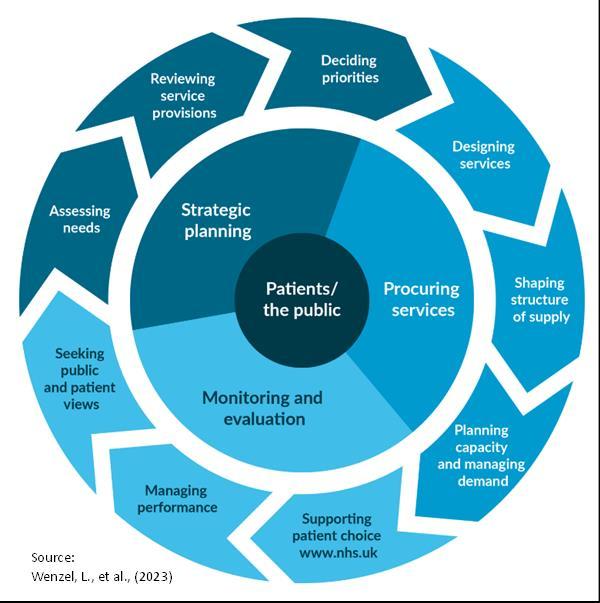
The commissioning cycle is intended to be a systematicprocess that involves planning, procuring, and monitoring services to meet the needs of the population. It typically begins with a comprehensive assessment of the local health and social care needs, identifying gaps and priorities. Based on this analysis, commissioners develop a strategic plan and set objectives for service provision. Subsequently, they engage with potential service providers through a procurement process, seeking competitive bids for contracts. Once services are in operation, ongoing monitoring and evaluation occur to promote effectiveness and efficiency Feedback from service users and stakeholders is crucial to inform improvements and adjustments to service delivery. The commissioning cycle is iterative, facilitating continuous improvement and responsiveness to evolving (see Figure 5) However, this rendering of the process of commissioning tends to compartmentalise public participation and direct efforts against criteria that matter to the commissioners and policy makers rather than people using public services
Strategic planning
Atthestrategicplanningstage,thequestionsareset by the strategic interests of statutory agencies desire to understand the nature and scale of demand, often referred to as the ‘need’ and often falselyconflatedwithwhatserviceusers‘want’,and whatscopeorleveloftheidentifieddemandcanbe met through the resources available in the current policy context. Excluding the broader perspectives of people with lived experience overlooks valuable insights about the psychosocial experience of peopleseekingtoaccess or deliver services.
The omission of these dynamics at this stage helps to skew the procurement, delivery, and monitoring and evaluation of services towards the interests of policymakers. Ignoringthehuman factorsinvolved
in people’s experience, such as whether they feel welcomed or listened to (i.e., valued) ultimately hinders the potential to maximise successful outcomes, efficiency,and effectiveness.
Procuring services
The procurement stage is too often reliant on open and closed tendering processes. These processes limit the opportunities for the involvement of potential service providers and people with lived experience. By excluding their participation in shaping the development of services through the procurement process, valuable perspectives on service quality, accessibility, and gender or cultural sensitivity can be easily overlooked. Consequently, this limits the potential for delivering tailored and person-centred services, undermining the overall effectiveness, appropriateness, and ability of the service to operate in a psychologically informed context.
Monitoring and evaluation
Monitoring and evaluation frequently focus on a conformance to specification model of quality. As discussed earlier, too often that specification has had too little input from people with lived experience or the frame of reference for that input merely reflects the interests of policy makers and commissioners. Similarly, quantitative measures of performance typically reflect the priorities of the statutory agencies involved and pay too little attentiontothesubjectiveexperiencesandinsights ofpeopleusing the servicesand those delivering.
The next section discusses the impact of that oversight and why commissioning practice is critical to movementtowards a resolution.
Figure 5: The commissioning cycle
Criticality of commissioning
Thecommissioningprocessinthecontextofservicesforhealthandsocialcaretendstoadoptadeficitbased approach, perpetuating a power asymmetry between the clients and contractors while also serving to marginalise the voice of people using services Throughout the cycle, from strategic planningtoprocurementandmonitoringandevaluation,the exclusionofpeoplewithlivedexperience results in a narrow focus on policy-driven criteria and predetermined priorities. This approach overlooks valuable insights into the psychosocial aspects of service provision, such as how services promote the feeling of being welcomed, listened to, and valued Consequently, services may not fully address the unique needs and preferences of the population they serve and miss key opportunities for both incremental and step change improvement.
Less than positive practice
Moreover, procurement practices favouring closed tendering processes limit the opportunities for the involvement of potential service providers and those with lived experience, potentially undermining the development of tailored and person-centred services.
In the monitoring and evaluation phase, the emphasis on conformance to specifications and quantitative measures disregards the subjective experiences and perspectives of service users, providers, and other key stakeholders.
This perpetuates the power dynamics between those receiving and delivering services and reinforces the disconnect between policy objectives and the realities of service delivery.
Too little time to collaborate
Perhaps attempting to overcome the weaknesses set out here, commissioning organisations tend to offer short-term agreements. This shortens the time between opportunities to reset the specification considering any learning and gives an illusion of certainty for both client and contractor.
However, frequent retendering takes up valuable resources that could be dedicated to developing collaborations that help to deliver outcomes.
Instead, those potential relationships are often undermined by the competition and uncertainty caused by tendering processes for provider organisations,forexample,asstaffleaveforother employment due to the increased awareness of job insecurity.
To address these deficiencies, a paradigm shift is required, where the commissioning process actively includes people with lived experience in decision-making, policy development, and throughout the commissioning process. This shift can empower service users and providers, ensuring that the commissioning cycle is more responsive to the diverse needs and aspirations of the population it serves. Advancing meaningful engagementand participatory approaches, the commissioning process cantransformintoamoreinclusive, effective,and person-centredsystemthatultimately increasesthe likelihood of improved health and social care outcomes and satisfaction with public services from all sections of the community.
Towards a new participatory commissioning paradigm
To address the previous criticisms and implement a more effective and inclusive commissioning process, a new paradigm can be proposed, grounded in the following key characteristics (also see Figure 6):
Long-term collaborative contracts
Embrace long contracts that allow for sustained collaborations between commissioners, service providers, people with lived and learnt experience, and other key stakeholders. This approach encourages mutual investment in capital infrastructure, such as IT systems and buildings, enabling service providers to innovate through efficiency and optimise service delivery over time to deliver improved value.
Participation throughout the cycle
Ensure active and meaningful participation from individuals with lived, learnt, and practice experience throughout the commissioning cycle. By involving these key stakeholders in the design, delivery, evaluation, and continuous improvement of services, the process gains valuable insights and aligns services more closely with real-world needs. Collaboration enables gaps to be identified and filled creatively while helping to identify and resolve unhelpful gaming behaviours.
Diversify procurement processes
Broaden the range of procurement procedures employed, moving beyond ridged service specifications using the traditional methods of open and closed tenders. In many contexts in health and social care there is no obvious technical solution to the problems identified. Usually, there is no single service provider with the resources and knowhow to deliver all the required outcomes. In most cases, the open and closed procedures, which are more suited to procurement of physical goods or consumables like tables or paper, are unsuitable for complex services in multiagency settings.
Utilising approaches like competitive dialogue or the alliance model, provide opportunities for people with lived,learnt,and practice experience to be involved throughout the design, procurement, delivery, evaluation, and improvement process. This promotes flexibility and encouraging a better fit between services andtheneedsof thepopulation. Commissioner’s primary role becomes to identify then define problems and bring people together to work on
improvements. In the current model, commissioners are expected to provide solutions in the form of the service specification.
Step change improvement
Emphasise a critical and accountable analysis of the context and performance of systems during infrequent tendering in the strategizing phase of the commissioning cycle. This approach seeks to drive significant and transformative improvementstoaddresschangesin thestrategic landscape such as identified shortcomings, policy change, or significant changes in the level of resourcesavailablewherenoagreementcouldbe reached within the existing terms of the contract
Appreciative inquiry
Develop a culture of incremental improvements inspired by an appreciative inquiry model. By involving both service providers and individuals with lived experience throughout the contract period, this approach encourages ongoing learning and development to capture opportunities for evolutionary change that builds on strengths and adaptations to any changes in the wider strategic environment.
Effective collaboration and 360 feedback
Encourage service providers engaged in partnership to collaborate effectively. Facilitate 360-degree feedback on performance, with the active involvement of people with lived experience. This ensures a well-rounded assessment that reflects the needs and experiencesofthose receivingtheservices,those delivering services, and people with learnt experience who may be able to identify useful learning from academic or practice-based research to implement locally
By adopting a new paradigm, commissioning can move towards a more collaborative, agile, and responsive process. Embracing long-term collaborations, active participation, and diverse procurement procedures will contribute to the creation of services that adapt to the changing needs of the population and policy makers. Additionally, by focusing on both step change and incremental improvements, the commissioning process can pave the way for positive transformation while continuously learning from successes and challenges alike. The involvement of individuals with lived experience throughout the process ensures that services are not just effective but also considerate of the unique perspectives and aspirations of those they serve.
COMMISSIONING CYCLE

As








COMMISSIONING CYCLE








6: Delivering evolutionary and step change continuous improvement

APPRECIATIVE INQUIRY
As
Figure
References and further reading
Arnstein, S. (1969). A Ladder of Citizen Participation. Journal of the American Institute of Planners, 35(4), 216224.
Bagnall, M., South, S. R., & Cummins, J. P. (2011). Planning for Real: A Community-Based Approach to the Development of Health Promotion Interventions. Health Promotion Practice, 12(6), 824-833.
Beck, U. (1992). Risk Society: Towards and new modernity. Sage Publications.
Beck, U. (2006). Power in the Global Age: A New Global Political Economy. Polity Press.
Beck, U., Giddens, A. & Lash, S. (1994). Reflexive Modernisation: Politics, tradition and aesthetics in the modern social order. Polity Press.
Buckingham, M., & Clifton, D. O. (2001). Now, Discover Your Strengths. Free Press.
Bushe, G. R., & Kassam, A. F. (2005). When Is Appreciative Inquiry Transformational? A Meta-Case Analysis. Journal of Applied Behavioral Science, 41(2), 161-181.
Checkland, K., & Harrison, S. (Eds.). (2011). Commissioning in Health and Social Care: What's the Evidence? Open University Press.
Cooperrider, D. L., Whitney, D., & Stavros, J. M. (2008). Appreciative Inquiry Handbook: For Leaders of Change (2nd ed.). Berrett-Koehler Publishers.
Cooperrider, D. L., & Srivastva, S. (1997). Appreciative Inquiry in Organisational Life. In P. Holman & T. Devane (Eds.), The Change Handbook: Group Methods for Shaping the Future (pp. 125-146). Berrett-Koehler Publishers.
Cooperrider, D., & Srivastva, S. (1987). Appreciative Inquiry in Organisational Life. Research in Organisational Change and Development, 1(1), 129-169.
Fung, A., & Wright, E. O. (2003). Deepening Democracy: Institutional Innovations in Empowered Participatory Governance. Politics & Society, 31(1), 73-103.
Grol, R., & Wensing, M. (2004). What drives change? Barriers to and incentives for achieving evidence-based practice. The Medical Journal of Australia, 180(S6), S57S60.
Hammond, S. A. (2013). The Thin Book of Appreciative Inquiry (3rd ed.). Thin Book Publishing.
Lash, S., Szerszynski, B. & Wynne, B. (Eds.). (1996). Risk, Environment & Modernity: Towards a New Ecology. Sage Publishers.
Ludema, J. D., Cooperrider, D. L., & Barrett, F. J. (Eds.). (2000). Appreciative Inquiry: The Power of the Unconditional Positive Question. Kluwer Academic Publishers.
McCormack, F., & Fedorowicz, S. (2022). Women, homelessness and multiple disadvantage in Stoke-on-Trent: The need for safe places in the context of wider health and social inequalities. Local Economy, 37(8), 655-675.
Marsh, D. R., & Schroeder, D. G. (2006). The Positive Deviance Approach to Improve Health Outcomes: Experience and Evidence from the Field. Food and Nutrition Bulletin, 27(3 Suppl), S3-S11.
Owen, H. (2008). Open Space Technology: A User's Guide (3rd ed.). Berrett-Koehler Publishers.
Pateman, C. (2012). Participation and Democratic Theory (New Edition). Cambridge University Press.
Percival, J. (2007). Children as partners in urban planning: A case study of the Planning for Real process. Children's Geographies, 5(3), 297-312.
Roberts, T. (2022). The Participation Cube and Digital Affordances for Participation [online] Available at: www.participatorymethods.org/resource/participationcube-and-digital-affordances-participation [Accessed May 2023]
Sandhu, B. (2017) The Value of Lived Experience in Social Change: The Need for Leadership and Organisational Development in the Social Sector. The Lived Experience. Available at: https://www.thelivedexperience.org/wpcontent/uploads/2017/07/The-Lived-Experience-BaljeetSandhu-VLE-summary-web-ok-2.pdf
Srivastva, S., & Cooperrider, D. L. (1999). Organisational Generativity: The Appreciative Inquiry Summit and a Scholarship of Transformation. In D. L. Cooperrider, P. F. Sorensen, Jr., Jr. F. J. Barrett, & S. Srivastva (Eds.), Handbook of Transformative Cooperation: New Designs and Dynamics (pp. 13-26). Stanford University Press.
Watkins, J. M., & Mohr, B. J. (2001). Appreciative Inquiry: Change at the Speed of Imagination. Jossey-Bass/Pfeiffer.
Weisbord, M. R., & Janoff, S. (2010). Future Search: Getting the Whole System in the Room for Vision, Commitment, and Action (3rd ed.). Berrett-Koehler Publishers.
Wenzel, L., Robertson, R., & Wickens, C. (2023). What is commissioning and how is it changing? The Kings Fund. Retrieved from: https://www.kingsfund.org.uk/publications/whatcommissioning-and-how-it-changing
Whitney, D., Trosten-Bloom, A., & Rader, K. (2010). Appreciative Leadership: Focus on What Works to Drive Winning Performance and Build a Thriving Organisation. McGraw-Hill Education.
Young, I. M. (2000). Inclusion and Democracy. Oxford University Press.
About the authors
Andy Meakin BA(Hons) MBA
Director
Andy has a wide experience in designing, commissioning, and delivering local public sector services including the contexts of adult education, employment programmes, and support services for people experiencing social disadvantages.
Andy worked as a senior manager in local government commissioning and contract managing support services for people experiencing social disadvantage for ten years. He led multiple redesign projects during that time and worked as the Supplier Relationship Senior Manager in adult social care for a portfolio of services assisting around 20,000 people valued at £70m Andy also served as Director of the VOICES project which was a large eight-year multi-agency partnership made possible by the National Lottery Community Fund Working in the third sector he led on delivering a wide range of services for people experiencing complex needs as part of a test and learn programme Andy was also lead author in a successful multi-agency bid to secure nearly £4m in funding to embed learning from that programme into the wider local system.
As well as his work with Expert Citizens CIC, Andy is also an independent management consultant and a Research Fellow at Staffordshire University’s Centre for Health and Development. Andy is passionate about the value of people with lived experience taking a leading role in service design, delivery, evaluation, and continuous improvement. He is a twice graduate of Keele University and holds a BA degree in Politics and an MBA. Andy is also a Prince2 Practitioner. andy.insight@expertcitizens.org.uk

Sophia Fedorowicz BSc MSc
Insight Research and Evaluation Lead
Sophia Fedorowicz is a PhD researcher and research associate with the Centre for Health and Development at Staffordshire University. She holds a BSc Psychology (First) and an MSc Applied Research (Distinction) both attained at Staffordshire University.
Currently Sophia works with Expert Citizens CIC as the research and evaluation lead. This role involves working closely with the Expert Citizens membership whose experiences of multiple social disadvantages underpin all the work carried out. Sophia uses her own experiences of severe and enduring mental health challenges to inform her work both at Expert Citizens and her PhD, which focuses on suicide prevention in primary care settings.
sophia.insight@expertcitizens.org.uk