
GP Registration Evaluation Toolkit
Accessing Primary Health Care
For People with “No Fixed Abode”



“People who are homeless have particular health needs and often suffer some of the worst outcomes. Both the BMA and NHS England are committed to ensuring homeless patients receive the same level of care as those with permanent addresses”.
“The same obligation on practices regarding identity and proof of address apply to homeless patients as a population group. Homeless patients are entitled to register with a GP using a temporary address which may be a friend's address or a day centre. The practice may also use the practice address to register them”.
“CQC expects practices to register people who are homeless, people with no fixed abode, or those legitimately unable to provide documentation living within their catchment area who wish to register with them”.

— British Medical Association (BMA) Cited 2019
Foreword Acknowledgements
This research was funded by VOICES, made possible through funding from the National Lottery Community Fund.
We would like to acknowledge and thank the 5th Year GP Students, our partners – VOICES, Healthwatch Stoke-on-Trent, Keele University, and Expert Citizens community in supporting us with this research and co-producing this toolkit.
Finally we would like to thank all GP surgeries in Stoke-on-Trent who were apart of this research.
We, at Expert Citizens believe that everyone should have the same rights to access primarily health care Nationally.

Darren Murinas Chief Executive — Expert Citizens C.I.C.

1 Introduction
Expert Citizens C.I.C.
We are a non-profit Community Interest Company established in 2016. All our staff and volunteers have experienced multiple needs – combinations of mental ill-health, homelessness, addictions and offending behaviour. We all have powerful stories to tell about our experiences and we use these, and the skills we have, to be a voice for others, providing insight to influence systems change.
We listen and learn from experiences and share our findings and ideas with services locally and nationally. We use our voice to raise awareness of multiple needs, to reduce stigma and to challenge stereotypes. As ambassadors of lived experience, we encourage decision-makers to listen, learn and then to lead systems change to ensure fair and equal access for all and to make our current services even better. Our work to date has featured on BBC, ITV, the Guardian, Huffington Post and across social media. We offer a variety of services including.
• Consultancy
• Guest Speaking
• Research and Evaluation
• Customer Consultation
• Bespoke Learning Opportunities
• Workshops
Healthwatch Stoke on Trent
Healthwatch Stoke-on-Trent promotes the involvement of local people in the commissioning of health and care services locally. It monitors the standard of provision of care services and produces reports and recommendations as to how these services ought to be improved. Healthwatch Stoke-on-Trent is the voice of local citizens, well embedded in the community to ensure that it is well placed to listen and make the views on services heard.
Why we are sharing the toolkit
Research described in this toolkit was conducted in Stoke-onTrent. However, we are aware that the issues identified in our research are not isolated to this community, and that difficulties experienced are similar throughout the country. We are now working with Healthwatch England and seek to better understand the scale of the problems we identified. Therefore, using the methods and templates within this toolkit, we are inviting you as a partner agency, to conduct a comparable project within your region. By sharing your results with us you will be contributing to a national evaluation of Fair and Equal Access to Primary Health Care in the UK.

Purpose
It is important to understand that our research and this toolkit do not seek to name, shame or blame GP surgeries; but rather to.
• Celebrate and share good practice
• Raise awareness of barriers, gaps, rights and responsibilities
• Measure the scale of problem(s)
• Encourage GP surgeries to better help people to access primary health care
• Equip GP surgeries with correct information and NHS guidelines in relation to registering a person experiencing homelessness
• Support GP surgery administration staff to be better informed of processes to register people who have no home and / or no identification
• Ensure that people experiencing homelessness understand that they do have a right to register with a GP
Products
Editable GP Registration Cards
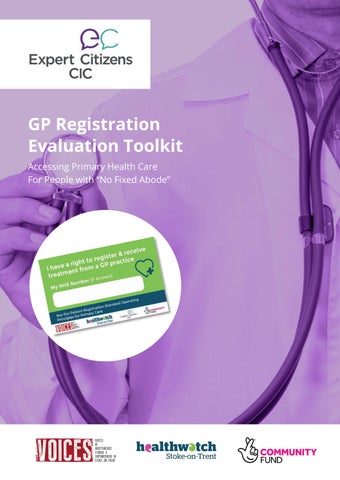
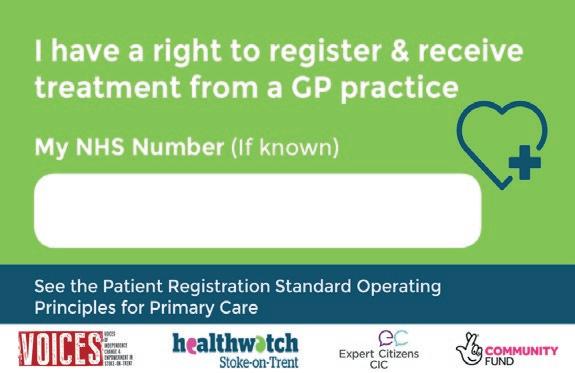
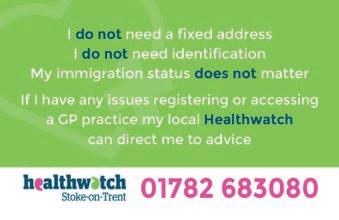
We designed pocket sized cards to distribute to customers and services. The cards provide facts about a person's right to register with a GP.
GP Registration Guidance Poster
We have co-produced an information poster to be displayed in all staff areas of GP surgeries.
GP Registration Refusal Letter
If a person is refused registration at a GP surgery, they should be provided with a letter from the surgery to explain the reason(s) why.

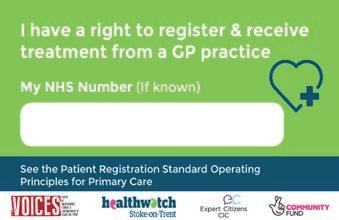
Examples of these products are included in Resources section p16. *GP Registration Cards (2016) Web address to download http://www.voicesofstoke.org.uk/ publications-2/

2 Background
Why we did this research
Expert Citizens became informed about the barriers faced by people of no fixed abode1 (NFA) when attempting to seek medical care by registration with a GP in Stoke on Trent. Through volunteering and Peer Mentor activities within a local programme supporting people who experience multiple needs, barriers and gaps within the system were identified and it was apparent that cases were not isolated. Customers, even when accompanied by a Service Representative, were still experiencing difficulties in accessing primary health care through a GP. In partnership with VOICES, Healthwatch Stokeon-Trent, and later Keele University, we set out to measure the scale of this problem.
What did we achieve?
This toolkit is an output from a project developed to better understand issues faced by people of no NFA when attempting to register with a GP. We began our research in 2016 and cocreated a mystery shopping project2. Our findings resulted in the design and distribution of our GP cards. In 2017 and 2018 we hosted two cohorts of Year 5 GP students from Keele University on their final year placements and supported them to conduct the mystery shopping project; the aim was to measure any ‘shift’ in the number of GP surgeries registering people experiencing homelessness3
Our
Findings
In 2016 our results demonstrated that just 26% of GP surgeries within Stoke-on-Trent would register a person of NFA without conditions. In 2018 our results demonstrated that 27% of GP surgeries within Stoke-on-Trent would register a person of NFA without conditions.
Our findings highlighted common reasons why a person of NFA may have difficulty registering with a GP. We compared NHS Guidance with responses received from the GP surgeries and identified that many GP surgeries are not aware of or do not follow the NHS guidelines, leading to potential patients and people who support them being mis-informed about the criteria to register with a GP.
Findings have been shared with North Staffordshire Clinical Commissioning Group and Stoke-on-Trent Clinical Commissioning Group at several meetings and at a citywide Practice Learning Time event.
in 2016
26% of GP surgeries would register a person of NFA without conditions.
in 2018
27% of GP surgeries would register a person of NFA without conditions.


The Toolkit
This project is not about the ‘hidden homeless’ i.e. sofa surfing, night shelter access etc. This is in no way to discount individuals from being included – Expert Citizens C.I.C. recognises that temporary shelters of any form are not a sustainable home and, therefore, the person(s) are still experiencing homelessness. However, in these circumstances the person is able to provide a ‘care of’ address, which in many GP surgeries is enough to be able to register with a GP. This project is designed to capture and raise awareness of the barriers faced when attempting to register with no such criteria. For the purpose of this project, the subject cannot provide a ‘care of’ address, is unable to provide identification, and is of no fixed abode.

Stage 1: Information Gathering
In order to start the process, you will need to create a list of contact details for ALL GP surgeries within your area (your local Healthwatch may be able to provide this for you). This list should include the name of the practice, address, e mail address and telephone contact number.
Stage 2: Creating a Response Log
For each surgery that you will contact it is important to record every response that you receive accurately. It is crucial that your team understands the differences between conditional and unconditional responses.
Example Response Log
Example Responses


ConditionalResponse



Stage 3: Preparing Your Team
It is important to invest time in preparing team members to conduct the project. Ensure that someone is appointed as lead who can coordinate, support and provide guidance to team members and who can also ensure that the project is completed within a set timescale. The team should be provided with.
• An introductory session to explain the purpose, the process and the findings
• A copy of this toolkit and GP registration cards
• Several sessions to practice the set Script* – see page 12. We recommend role play and ‘internal’ practice calls to ensure that the team members who will be contacting the GP surgeries sound both genuine and confident.
• A session overview of recording responses
• An overview of appreciative inquiry – this helps to identify best practice
• A session overview of Analysis and presenting findings
• A session for questions and concerns
As a guide Expert Citizens C.I.C. completed two projects – each over a three-month period – this included report writing and presentations of findings. If you feel that you would like support with preparing your team Expert Citizens C.I.C. can provide all the above at a venue that suits you – see Training page 15.
Stage 4: Telephone Mystery Shopping
It is time to begin your research. Before you make any calls meet with your team and decide how you will divide the list of GP surgeries for each team member to contact. Once this is established you can begin to make your calls. It is worth noting that the calls should be made from a quiet room in which team members will not be disturbed or distracted. This will help to ensure that responses are recorded accurately.
The team should begin making their calls on the same day, if possible, with an aim to contact all GP surgeries on the list within a 1-week period. Patience will be required at this stage as it’s not unusual to experience long waiting times for calls to be answered. If a call is not answered the team member should make a note and try again later / on another day. Note – research will be incomplete unless every GP surgery on your list has been contacted. If calls fail 3 times or more it may be worth e mailing the surgery to get your response – in such cases the script should still be followed. If a team member is confident enough and able to remember the script and responses, they may wish to conduct their mystery shopping exercise face-to-face within the surgery.
It is crucial to the analysis that all responses are recorded immediately and inputted to the Response Log as soon as possible.

The Script

It
Hi, my name is ______________________ and I work at ______________________
I’m ringing to see if it would be possible to register someone I am currently supporting who is homeless?
Yes, with some ID
Yes, with a proof of address/letter etc
I’m sorry, they don’t have any. What do you recommend that I do?
They don’t have any. Are they able to use the surgery as care of address?
Log the answer and any advice given
No, sorry. Log answers
Yes, certainly No, sorry
Ask if they are required to bring anything in terms of ID, etc
Sorry, we are not taking on any new patients at the moment
Ok, could you recommend anywhere please?
Could you please tell me the reason for that
Yes, they can. Log answers
Ok, thank you, goodbye
Thank you, I will check with the customer and be in touch. Goodbye
No, they do not require anything to register. Log answer
Log answer and advice given
Remember: If you receive a response from a GP surgery stating, “Yes, we will register somebody of no fixed abode…. BUT…” followed by ‘conditions’ that the person would need to meet – such as photo ID / proof of residence etc. these responses should be recorded as a ‘NO’ in your response log. This is because it is very unlikely that a person of NFA is going to be able to meet those conditions and this type of response is not one that follows NHS guidance*. If you receive a response with a condition that you believe can be met this should be recorded as a ‘Maybe’ – it cannot, however, be classed as a ‘YES’ response because it was conditional. Therefore, only a ‘YES’ without conditions should be counted as a ‘YES’ in your response log.
Recording comments in your log is as important as recording the responses – these provide further insight to the cause of registration refusals. As an example, Expert Citizens received this response from one surgery they contacted, “No – we do not take ‘that sort’ here”. Clearly here, the issue is more than not following guidance, but one of stigma also. This better informs us of what is needed to overcome the barriers experienced by people of NFA.
When you have contacted and recorded responses from all GP surgeries in your area you will be able to work out the percentage of each of the following:
% of GP surgeries said YES
% of GP surgeries said NO
% of GP surgeries said MAYBE
In your overall evaluation you can include the figures for ‘MAYBE’ but these should not be added to your ‘YES’ responses. Once you have worked out the above, you should read through all comments and record them, as said, in a WORD document. You are not required to name any GP surgeries or individuals.
Stage 6: Sharing the Learning
Submit your results with brief project overview to insight@expertcitizens.org.uk
You can also consider sharing your findings at a local level to raise awareness of the barriers experienced and to remind surgeries of the NHS guidance.
“We expect practices to register people who are homeless, people with no fixed abode, or those legitimately unable to provide documentation living within their catchment area who wish to register with them.” — CQC
“Inability by a patient to provide identification or proof of address would not be considered reasonable grounds to refuse to register a patient.”
NHS England

You are free to use the resources in this toolkit to train your team and to complete the project. If you would like help with training and / or to complete the project, Expert Citizens C.I.C. can offer the following:
Option 1: Expert Citizens C.I.C can be commissioned to deliver a 2-day training package to equip the researchers with skills necessary to complete the project – see below
Option 2: Expert Citizens C.I.C can be commissioned to complete the project within a given geographical area*. This option includes data analysis and report writing.
For all training enquiries, contact insight@expertcitizens.org.uk
1 Day 2

Editable
GP Registration Cards
• Download the template
• Insert your local Healthwatch Telephone number
• Distribute to local services who can reach people experiencing homelessness
• Issue to customers, explaining the purpose and informing them to contact Healthwatch should they be refused registration with a GP
• If known, add the persons NHS number – this helps the GP surgery to find medical records
Related website information
Expert Citizens Website
http://www.expertcitizens.org.uk/
Gatekeepers Report (2016)
http://voicesofstoke.org.uk/publications-2/
Access to Primary Care Services Report (2018)
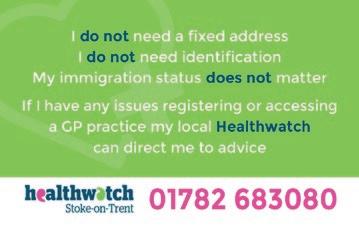
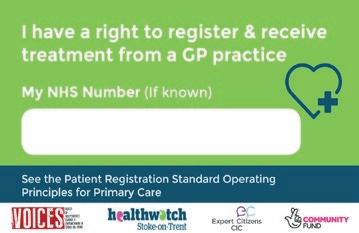
*GP Registration Cards (2016)
Web address to download
http://www.voicesofstoke.org.uk/ publications-2/ Refusing Registration Log
http://voicesofstoke.org.uk/wp-copntent/uploads/2018/08/29495-Access-to-Primary-Care-Services-Booklet-2018.pdf
Editable Registration Cards
https://www.healthwatchstokeontrent.co.uk/wp-content/uploads/2018/08/GP-Cards.zip
Printable Script
https://healthwatchstokeontrent.co.uk/wp-content/uploads/2018/09/Gatekeepers-Toolkit-Crib-Sheet.docx/
NHS England Patient Registration Standard Operating Principles for Primary Medical Care (General Practice) https://www.england.nhs.uk/south/wp-content/uploads/sites/6/2018/01/patient-registrations.pdf
CQC Guidance on looking after Homeless Patients
https://www.cqc.org.uk/guidance-providers/gps/nigels-surgery-29-looking-after-homeless-patients-general-practice
BMA Guidance for Patient registration for GP Practices
https://www.bma.org.uk/advice/employment/gp-practices/service-provision/patient-registration-for-gp-practices
Healthwatch Stoke-on-Trent Website
https://www.healthwatchstokeontrent.co.uk/
Healthwatch UK Website
https://www.healthwatch.co.uk/ VOICES website http://www.voicesofstoke.org.uk/
“If a practice refuses any patient registration then they must record the name, date and reason for the refusal and write to the patient explaining why they have been refused, within a period of 14 days.”
— NHS England (2015): Patient Registration
Standard Operating Principles for Primary Medical Care (General practice)


CQC intend to include compliance with NHS England guidance as part of monitoring visits – this will include review of the registration refusals log.
Expert Citizens C.I.C. Recommendation
If a surgery refuses registration to a person of no fixed abode and, therefore, does not have an address that the refusal letter can be sent to, we recommend that surgeries have a standard template that can be completed quickly and handed to the individual whilst they are on site. We have created a draft refusal letter template that can be distributed to GP surgeries for this purpose.

Joe Bloggs
123 Generic Street
Stoke-on-Trent ST1 1AA

Dear Mr Bloggs,
Re: Refusal of registration at [PRACTICE NAME AND ADDRESS].
You applied to join the register of the above practice on [DATE]
However, your application to join the register has been refused because [REASON]
We are required to write to you and explain the reasons for refusing your application by our commissioners. If you are dissatisfied with the explanation above, you can appeal this decision by writing to the practice manager who is [NAME]. of [CORRESPONDENCE ADDRESS].
You can contact your local Healthwatch on [TELEPHONE], Clinical Commissioning Group on [TELEPHONE], or NHS England on [TELEPHONE] for advice and assistance on how and where to register with another GP practice.
Yours sincerely
Practice Manager
Practice Manager