
Co-production Guidance
Day Centres
Co-production Guidance Day Centres
Contributors:
The 999 Club
Forest Churches Emergency Night Shelter
NEWway Project
RESTART LIVES
The Passage
Written by: Expert Link
Published: November 2024
Acknowledgements
This guidance has been co-produced. We are grateful to everyone who contributed to this guidance, clients, volunteers, and staff.





Introduction
Chapter One: What is Co-production?
Chapter Two: Why do Co-production?
Chapter Three: Co-production in Action
Case studies
Boundaries (The Passage)
Embedding Co-Production Culture (NEWway Project)
Involving Lived Experience at a Strategic Level (The 999 Club)
Involving Lived Experience in Recruitment Process for Staff or Board Roles
Client Support Volunteering Project (The Passage)
Mental Health Support Service (The 999 Club)
Employing Peer Coaches (Forest Churches Emergency Night Shelter)
Women’s Sanctuary (The 999 Club)
Setting up an Action Group (RESTART LIVES)
Involving Lived Experience at a Strategic Level (The Passage)
Recruiting Peer Coach Roles: An example of a job description that has been developed for a Peer Coach role (The 999 Club)
Chapter Four: Organisational Culture
Chapter Five: Involving and valuing people with Lived Experience
Chapter Six: Evaluating and Monitoring Co-production
Afterword
Introduction
“If every frontline worker knew how to do it. And they did it.. I reckon it’s a game changer.”
Welcome to your journey with co-production in day centres!
This guidance is designed to empower clients, staff, and stakeholders to work together as equal partners in creating effective, responsive, and inclusive services. At the heart of this is the belief that those with lived experiences of homelessness have invaluable insights that can shape policies and practices.
In a world where traditional models often leave voices unheard, co-production fosters a sense of community and collaboration. By actively involving clients in decision-making, we not only enhance the quality of support but also create an environment where everyone is valued and empowered.
Within these pages you will find practical examples of coproduction in action, reflective case studies, and tools to help your organisation on its journey. What is right for one day centre may not be right for another, so this coproduced guidance is one you can return to again and again as you continue on your co-production journey.
Together we can redefine what it means to empower individuals experiencing homelessness and create a system that truly reflects their needs and aspirations.
This guidance has been informed by regular discussions all day centres have participated in and a peer research project carried out by all of the day centres. Any learning or suggestions have come from a wide range of perspectives from each day centre, having taken part in training, discussions and peer research over the last 3 years.
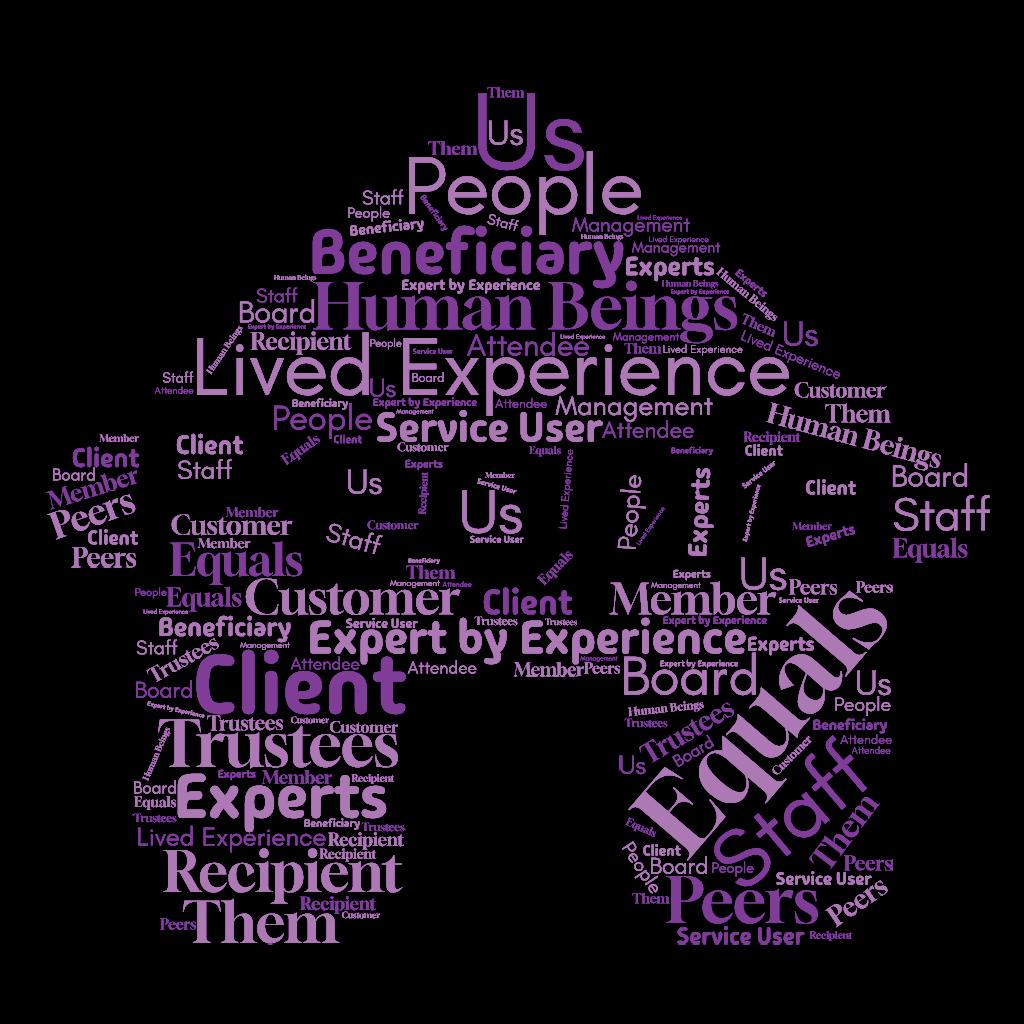
“We all have a slightly different method, we all have slightly different language, but ultimately what we care about is people.”
Chapter One: What is Co-production?
Co-production is a way of working, where the people who provide a service, collaborate with the people who use the service to achieve collective outcomes.
It means sharing ideas, decision-making, and responsibilities to improve services and outcomes for everyone involved.
Co-production is often a very broad and abstract term that doesn’t feel tangible and often feels like a difficult stage to reach.
With organisations using the word co-production to mean different things it is important to break down what it means when it comes to day centres and what it can look like in practice, as well as on paper.
It is important to acknowledge that not every day centre would be in a position to incorporate all types of co-production, all the time.
“You’re probably already doing it in one way or another, we didn’t even realise!”
To embed co-production, day centres felt that it is more than just doing co-production, it is about a culture, and for it to work really well, that culture should be embedded at every level of the organisation.
“The top brass have invested in it quite heavily, and are really, really behind it.”
Co-production can often be used by organisations as a reflective and accountability tool. Organisations embarking on co-production journeys often feel nervous around this, but members of staff within the day centres felt that this was a huge positive as it leads to better transparency and improvements to the service and enables accountability and learning opportunities. It was common that when day centres started involving people with lived experience that it was not negative, as staff were expecting. Part of this was thought to be down to the values organisations hold.
Co-production is a journey for people with lived experience and for organisations embarking on embedding co-production to their services.
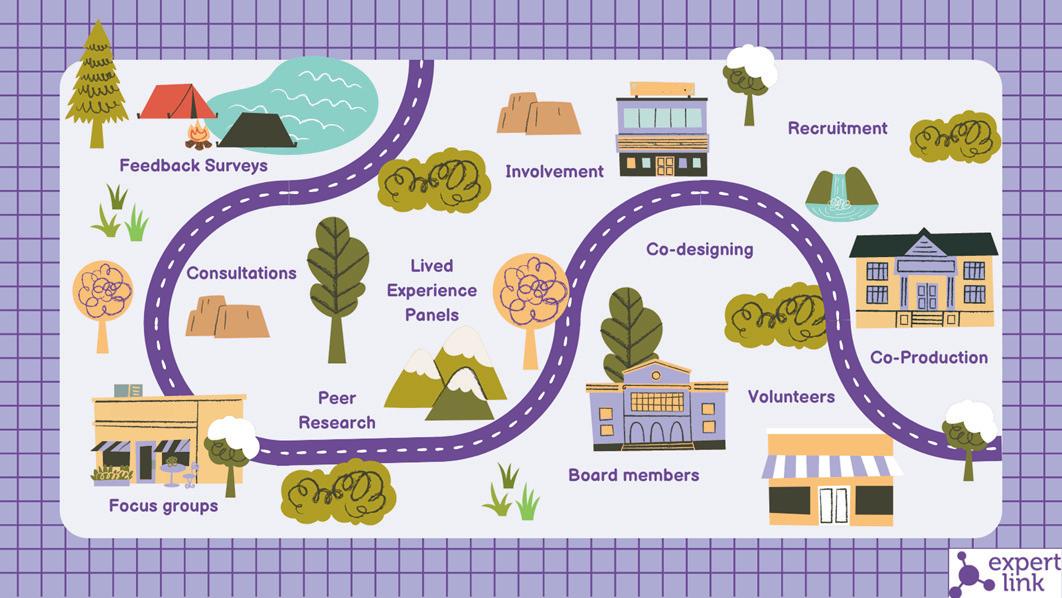
Most people will describe co-production as a journey. Often this journey starts with listening, then involvement, then moves further towards embedded co-production.
As with all journeys, it is good to see where you are, where you could be headed and to revisit and reflect on the places you’ve been.
A common visual for co-production is the co-production ladder. However this was felt too restrictive for many involved and also encouraged a negative attitude towards the ‘lower rungs’ on the ladder (see image to side).
Many organisations felt that it created a culture of, if it is just involvement, or if it is just educating or consulting, then it was not worth doing.
As well as an ultimate destination, individual activities can of course still be included under co-production.
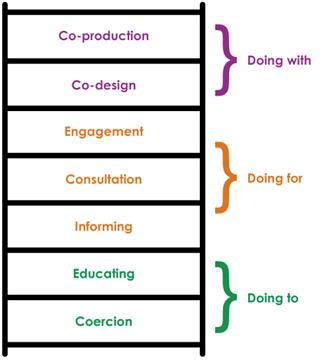
Whereas in practice, starting off with the more manageable and easier co-production activities can set a good ground base for genuine co-production, which takes time and work in to relationship building.
Something to be aware of is that not every client will want to participate in co-production activities. Many people with lived experience will also surprise us with wanting to be more involved than we initially thought. Limiting our assumptions of what people with lived experience may want or not want to do, is particularly important as it allows for growth and learning. Managing and being realistic with our own expectations for any co-production activity we are doing means we can be realistic with barriers and outcomes.
“I think that the co production journey is going to be different in each of those organisations.”
The 999 Club created this spectrum of what co-production is and use this instead of the typical ladder.
When discussing the journey of coproduction it is vital that we discuss power at the same time.
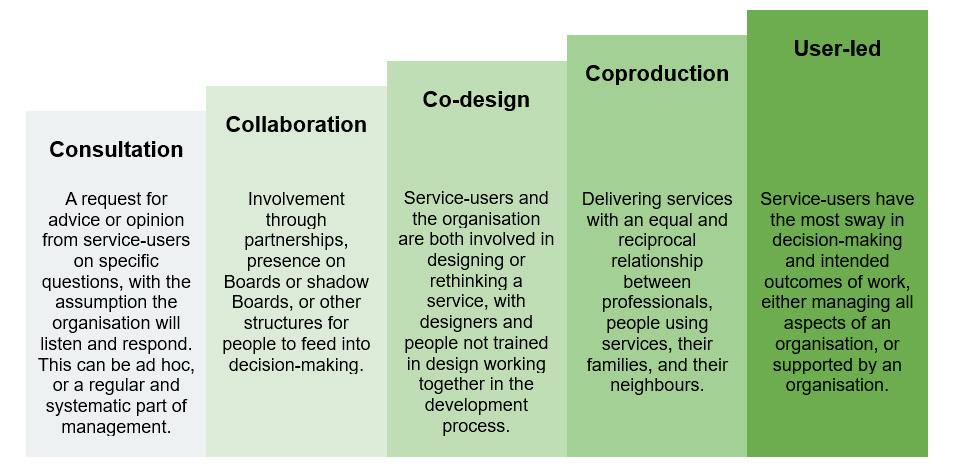
In an organisation that has no form of co-production at all, the power structure is simple; Trustees at the top, CEO, Senior Leadership, Staff, Volunteers, Clients. In an organisation where any form of authentic co-production is taking place, power is shared.
Day centre staff acknowledged that fear was a main barrier when discussing or starting coproduction within their centres. This is in part due to the power dynamics being shifted slightly. If you are genuinely collecting clients opinions on your service, you’re giving them the power to praise the service, but also to criticise the service. With something like a survey, that power is then back to the collector to action.
Chapter Two: Why do Co-production?
“Why do co-production? I think it's something that you need to do. It sounds like it's an outcome... It's not an outcome. It's something to be intentional about.”
Co-production offers significant personal benefits to individuals as it fosters a sense of ownership and empowerment in personal and organisational journeys. By involving clients in the decision-making process, day centres create an environment where individuals are valued and heard. This engagement not only enhances their self-esteem and confidence but also allows them to share their unique perspectives and experiences, shaping services that are more relevant to their needs and aspirations.
As a result, individuals are more likely to feel connected to their community, leading to increased satisfaction and well-being. Ultimately, co-production transforms day centres into spaces where people can thrive, actively contributing to their own development and the collective experience of the group.
1. Empowered Clients
Co-production significantly boosts confidence and self-esteem in clients. This empowerment leads to:
More active participation in service delivery
Improved outcomes as clients take ownership of their progress
Positive word-of-mouth, enhancing your organisation's reputation
Empowered clients become your organisation's strongest advocates, driving growth and impact
“I'm trying to use language which is as positive and supportive as I can, but people are going to have good days and bad days and people are going to have triggers and it's about understanding that and trying to put things in place to be able to support them and lift them up. That's one lesson, really important lesson.”
2. Improved Service Quality
Co-production leads to services that are more aligned with clients’ needs and expectations. By involving service users in all aspects, including the design and delivery process, you ensure:
Greater relevance and effectiveness of services
Increased user satisfaction and loyalty
Continuous improvement driven by real-time feedback
Services that clients genuinely care about, enhancing organisation's reputation and impact
“I feel valued and heard.”
“It makes me feel mentally, emotionally and physically better.”
3. Staff Retention and Employment benefits
Co-production creates a wider pool of employees and fosters improved staff retention. Benefits include:
Access to diverse skill sets and perspectives
Increased employee engagement and job satisfaction
Reduced turnover and associated costs
By broadening the involvement, you create a more responsive and adaptable team that can change as the organisation changes and develops
“It’s the big cultural shift that's … [about] seeing the value in everyone”
4. Investment into your Organisation
When everyone is involved in co-production, everyone becomes more invested in the organisation's success. This increased buy-in results in:
Greater commitment to organisational goals
Enhanced collaboration across departments (e.g. outreach and policy or inreach and volunteers)
Staff retention
“I felt so rooted... having really active, lived experience voices in the room and it just feels so much more rounded as an organisation”
5. Measurably Improved Outcomes
Higher success rates in achieving organisational objectives
Increased efficiency and cost-effectiveness
Greater social impact and community benefit
These improved outcomes not only justify the investment in co-production but also strengthen your organisation's position in the sector.
“Contributing allows me to feel much more part of the organisation.”
“It's easier to design our service around a trauma informed way of working. It gives our whole team a better understanding of the issues faced by individuals that make us more compassionate.”
6. Enhanced Funding Opportunities
Co-production opens doors to diverse funding streams. By demonstrating collaborative approaches and community engagement, organisations become more attractive to:
Government grants focusing on community-driven initiatives
Corporate sponsors seeking socially responsible partnerships
National charities looking for people centred approaches
This expanded funding base can significantly improve your organisation's financial stability and growth potential, as well as increase opportunities for staff development and client well-being.
“Having people with lived experience inform our work, is vital to ensure that our services and staff support as many people as they can, in as well a way as possible.
People with lived experience have a level of expertise and insight that others don't and this allows them to contribute important ideas and make all our work better.”
As senior leaders, embracing co-production is not just about improving services — it is about setting your organisation up for long-term success and sustainability. By utilising the wisdom of lived experience and resources of clients you create a more reactive and impactful organisation.
“Itkeepsme situationabovetheIam innow.” member“Avaluedofthe teamandfreeto expressmy views” “More empowered”
“Feelsgoodto beableto makea change” contribute“WhenIitfeelsrighttodosoas organisations learnfrom everybody's contribution.”
Chapter Three: Co-production in Action
“…it's really important that we understand that each of these projects has their own identity and has their own culture and their own way of doing things, and that's fine and we're not going to dictate it.”
Boundaries
Clear boundaries help ensure that everyone involved understands their roles and responsibilities, which can prevent misunderstandings and conflicts. When boundaries are welldefined, it becomes easier to manage expectations and keep co-production focused on achieving shared goals.
Additionally, clear boundaries protect both the individuals with lived experience and the organisation from potential emotional strain. Working closely with sensitive issues can be challenging, and having set limits helps manage the intensity of these interactions. It ensures that personal experiences are respected while also providing a structured framework for professional engagement. This balance helps maintain a respectful and supportive environment, reducing the risk of burnout or discomfort for everyone involved. It reduces retraumatising clients.
Ensuring boundaries are in place also helps maintain the integrity and effectiveness of the coproduction process. They ensure that contributions from individuals with lived experience are valued and integrated in a meaningful way without causing confusion or overlap with other roles.
The Passage created a 6 page document, a section below highlights some key important factors where boundaries needed some clarification:
“As a Client Support Volunteer you will be in a unique position to help our client group settle into using the Resource Centre and access our services. We want people to feel safe and welcomed, and by having a team of Client Support volunteers on hand, people will be able to speak to someone who truly understands their situation.
In addition to the Code of Conduct which we expect all Client Support volunteers to adhere to, we have also outlined some information and guidance below which will help you navigate some of the situations and dynamics that you might encounter whilst volunteering with us.
Arriving on shift
Your support outside of the shift
Personal Boundaries
Language & body language
Personal details
Money, cigarettes and donations
Safeguarding & Confidentiality
Giving advice
Health and Safety
Adding to the guidance document”
Embedding Co-production Culture (NEWway Project)
We wanted to join the Co-production program from Expert Link because we wanted to improve the involvement of our guests in our services.
Our charity was established as a winter night shelter and was a community response to raising numbers of rough sleepers in London Borough of Newham. Based on our guests’ feedback, a year later, we opened a day centre of purpose and belonging. Activities and professionals involved in running the day services were selected upon the needs of the beneficiaries. We listened to them carefully and observed what they struggled with, what they found useful, where they saw gaps in provision, and we tried to respond to those requests through different partnerships and specific funding.
In 2018, the day centre was commissioned and we have stayed in partnership with Newham since then. It meant a more structured response to rough sleeping, following guidance and meeting key performance indicators. Although we kept the person-centred approach and journeyed with each individual guest, we were unsure how our coproduction was happening at our services.
“Working alongside other day centres made us realise that co-production comes in different shapes and forms”
At one of the first meetings, the representatives from five different day centres in London led by David from Expert Link discussed what the co-production is. We were surprised (and relieved) that what we thought was just a natural way of leading a charity was, in reality, a co-production process. David explained to us that the way we allow our guests to lead their cases and decide on key points in their support plan is actually giving them their voices back. We also recognised that co-production happened when our guests participated in different sessions and shaped the activity by deciding what they would like to do each week, who would cook the weekly lunch and what would be served. When we could offer an outing, our guests get to choose the destination.
Working alongside other day centres made us realise that co-production comes in different shapes and forms, and can depend on charity’s size and internal structure. Coproduction can mean forming consultancy panels, working groups, providing peer support sessions, creating employment opportunities, and writing user-friendly policies and procedures. What we learnt is that some ideas can work in one charity but may not work somewhere else.
Participating in the Expert Link programme prompted us to make some improvements; they included a recruitment of a trustee with lived experience, and taking on traumainformed training. We also strengthened our volunteering pathways, encouraging our guests to ‘own’ the services we offer to them. All of that led us to have a deeper understanding of people’s stories and to form stronger relationships with our guests.
The whole program was positive and reassured us that co-production is embedded within our culture. It comes with our charity’s values and is at the heart of what we do on a daily basis. We may not have used the same language to call it, and we may not even have been fully conscious of it, but we are grateful for this opportunity to be able to distinguish those elements in our work and learn about other options of developing it further.
Involving Lived Experience at a Strategic Level (The 999 Club)
The Members Committee is a group of members (service-users) and ex-members who have received support from the 999 Club and wish to contribute to the strategic development of the charity, drawing from their own experiences.
Essentially it’s the service-users version of the Board of Trustees. They work alongside the Board of Trustees and provide direct input on the strategic decisions that shape the future of the organisation.
The committee have quarterly meetings that are synchronised with the Board of Trustee meetings to ensure all sources have been consulted when major organisational decisions are made. There is 2-way communication with the Board. One trustee sponsors the Committee and attends the quarterly meetings. They act as an envoy that communicates between the Members Committee and the Board of Trustees.
The Committee feedback on areas such as strategy, policies or matters arising. Advice is sought on potential projects or service adaptations being considered. They help us review and feed into our approaches. They sign-off on major organisational decisions, as well as feedback on our work or matters arising. Moving forward they will also be responsible for evaluating and auditing our Coproduction work annually.
We made a conscious decision to keep the two groups (Board of Trustees and Members Committee) separate. Taking service-users and placing them in a board-room setting immediately shifts the balance of power towards those who are comfortable in those settings (board members) and can stifle engagement, discussion and confidence in those who aren’t used to the setting and the formalities.
“This gives them confidence to voice their opinions and to lead the discussion where they feel is important. It is their space.”
It’s not always enough to offer equal power, as in reality service-users rarely come close to holding an equal share. So in some situations it’s important to give them more power.
We do this by holding the Members Committee in a space that they are comfortable in, they have control over that space and are familiar with it. They also outnumber the Board of Trustees (5-1 or 6-1) who in the quarterly meetings are represented by just one person. She steps into the service-user’s world, giving them the larger share of power.
This gives them confidence to voice their opinions and to lead the discussion where they feel is important. It is their space.
The 999 Club recently made major changes to its access rules for our day-centre. We were considering moving from being open-to-all, to only allowing access to those who were ‘un-housed’. Staff members were anxious over these changes, fearing there would be huge resistance from our members (service-users). There was an unease, disagreement and nervousness as we strategised if we should, and how best to go about, make the changes.
It was on the agenda for the Members Committee, who ended up being even more firm and restrictive on what they felt the new access rules should be. When the minutes were passed to the staff there was a collective sense of relief.
Staff members had more confidence in implementing these changes as they had been endorsed by the people using the service. It was like getting a stamp of approval and it resulted in more agreement by all, that the decisions we were making were the right ones for us. (There was a similar outcome when we refreshed our Member’s Code of Conduct Agreement).
It can be difficult keeping voices fresh in the Committee. The instinct is to hold on to individuals who are actively engaging because they have so much valuable insight.
However, it is vital to continually refresh the voices heard, else the danger is of only representing the views of a handful of individuals, not the voice of the people who use your service.
To combat this challenge we will be introducing ‘Terms of Service’ which will give everybody who serves on the Committee a finite period of time to serve as a member.
We have also set up a Consultation group. The Consultation group feedback on ad-hoc and current issues that require immediate response. This format is more flexible than the Members Committee with individuals free to contribute to matters that are relevant/important to them or conducive to their current availability. The group can be utilised by all teams that are working on particular projects and require immediate feedback or sign-off from those with lived experience.
This means those insightful voices are not lost forever and they can continue to contribute to the development of the service in a more flexible manner.
“Recently one of the members of the Committee applied to become a member of the 999 Club’s Board of Trustees and
was successful!”
Involving Lived Experience in the recruitment process of Staff or Board roles:
Clients can play a key role in staff and board recruitment by getting involved in several ways:
Participating in interviews: Clients can help interview potential candidates, offering their perspective on what skills and qualities are important for the role, this could include clients asking pre-arranged questions or on the spot questions. In some day centres, there has been a separate interview held with only people with lived experience.
Providing feedback: Clients can give feedback on the job descriptions and candidate profiles to ensure they align with their needs and expectations.
Sitting in on hiring panels: Clients can be part of the hiring panel that makes final decisions, bringing their unique insights into the selection process, with a more listening role but with their say having weight.
Helping design the recruitment process: Clients can help create or review assessments and tests used during the recruitment process to make sure they effectively measure the right skills, attitudes and morals.
Sharing Experiences: Clients can share their experiences and what they’ve found works well, guiding the recruitment team on how to attract and select the best candidates.
Tours: Clients can give a tour of the services and get a ‘feeling’ of the candidate in a low pressure environment, feeding back their opinion to the recruiting staff.
Client Support Volunteering Project (The Passage)
This project by The Passage is a co-produced project with an experts by experience group.
Engaging individuals with lived experience to inform project design and implementation, ensuring their insights shape the outcomes.
Facilitating ongoing consultation and collaboration between service users and staff to foster a shared understanding and commitment to project goals.
Implementing pilot studies to test ideas on a smaller scale, allowing for adjustments based on feedback before wider rollout.
Aimed to embed client volunteering within the service
Consultation and collaboration with both clients and staff were crucial in developing the client volunteering project, ensuring buy-in and support from all levels of the organisation.
The project was piloted on a smaller scale to identify potential challenges and develop mitigation strategies before full implementation, allowing for adjustments based on feedback and experiences.
Flexibility was emphasised in the volunteering roles to accommodate the varying needs and circumstances of participants, fostering a supportive environment that encourages engagement without pressure.
Heavy consultation with staff and managers for buy-in
Heavy consultation with staff and managers is crucial for securing buy-in for new projects.
It fosters a sense of ownership and accountability among staff, ensuring they feel involved in the decision-making process.
Consultation helps identify potential challenges and mitigations early on, leading to a more robust and well-supported project implementation.
Pilot project run for up to a year
Pilot projects allow organisations to test new ideas or initiatives on a smaller scale before full implementation.
They provide valuable insights and data that can inform future decisions and strategies.
Pilot projects help to identify potential challenges and risks, allowing for adjustments to be made prior to a wider rollout.
“So we're co-producing with our service users, but also co-producing with staff and managers around what this should look like.”
Mitigation strategies developed for potential issues
Identifying potential issues through thorough consultation and brainstorming sessions with staff and service users.
Implementing training programs to prepare volunteers for handling sensitive situations, such as safeguarding disclosures.
Establishing clear expectations and timelines for volunteer roles to prevent misunderstandings and ensure accountability.
Project implementation took approximately six months
Project implementation involved extensive planning and consultation with both staff and service users.
The process included developing job descriptions and training materials to ensure readiness for the volunteers.
Regular reviews and feedback sessions were conducted to refine the project and address any challenges encountered.
Resulting in an evidence base for changing policy and procedure
Developed a comprehensive review of the client support volunteering project to assess its effectiveness and outcomes.
Utilised feedback from participants and staff to identify areas for improvement and best practices.
Established a foundation for future policy changes by demonstrating the positive impact of client involvement in decision-making processes.
Mental Health Support Services (The 999 Club)
The Bridge is our mental health support service which operates in the evenings and weekends at the 999 Club. The service is a safe space where those who feel unable to cope, emotionally or mentally can be supported by our dedicated staff team. Together our Peer Mentors (ex-clients), staff and the graphic designer coproduced an infographic to inform others about the service.
Peer Mentors are volunteers with Lived Experience that have graduated from the Bridge (ex-service-users). Peer Mentors ensure the Bridge service is co-produced in design, delivery and development. They support and deliver workshops. They also feedback on processes, literature and materials in a constant adaptation and redevelopment of the service offer.
We held workshops where the peers led on the design of the infographic. The peer group broke down their experiences of being clients of the Bridge. They highlighted the things that were important to them, their experiences and what would have been useful for them to know before coming to us. What was their experience of accessing the service? what would they have liked to have known before coming?
They collectively decided on the information that was important to convey and drew up a prototype for the infographic (see below).
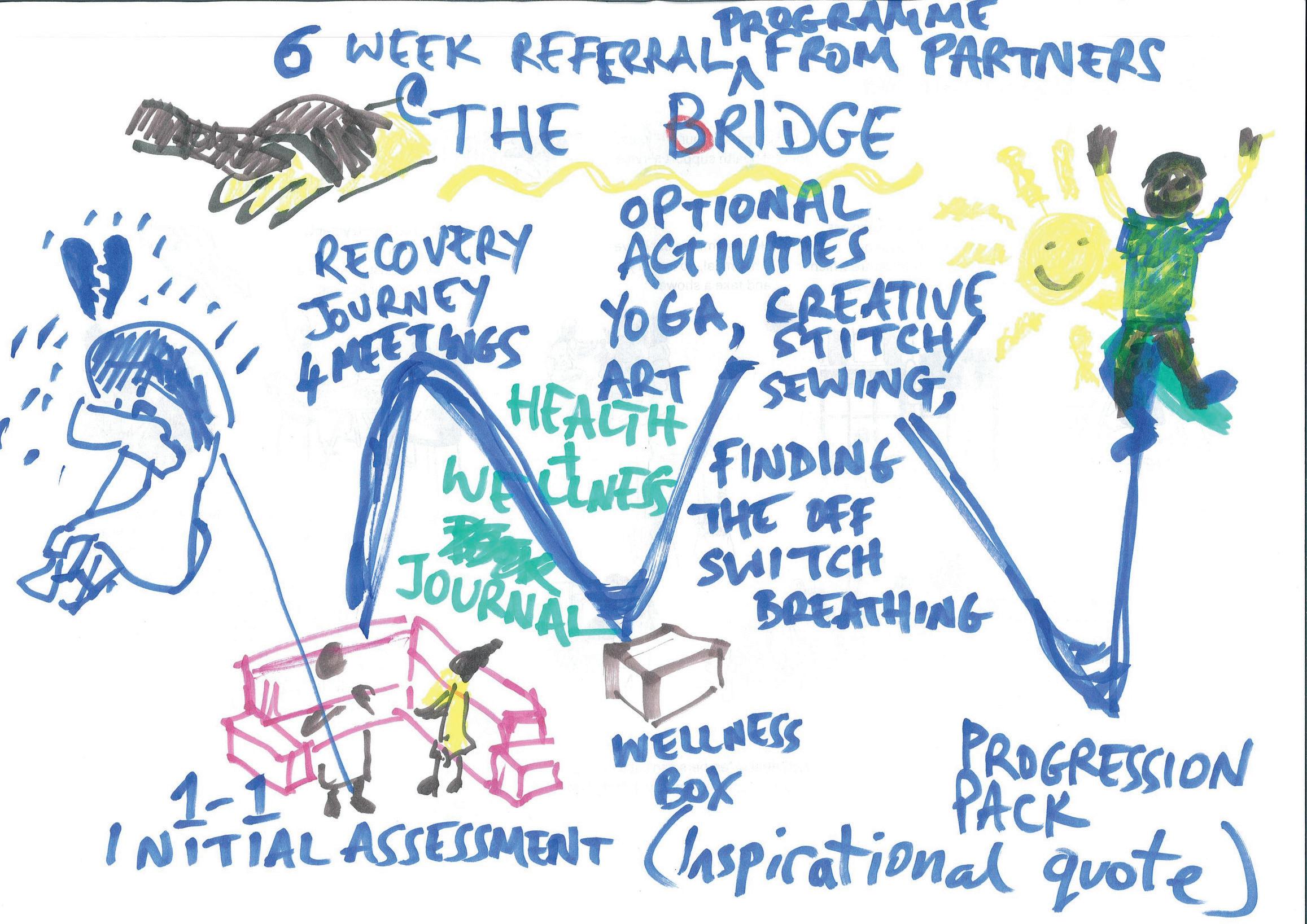
This information was collated and there was a back-and-forth with the graphic-designer turning the prototype design into the finished infographic (see below) which the group then signed off on.
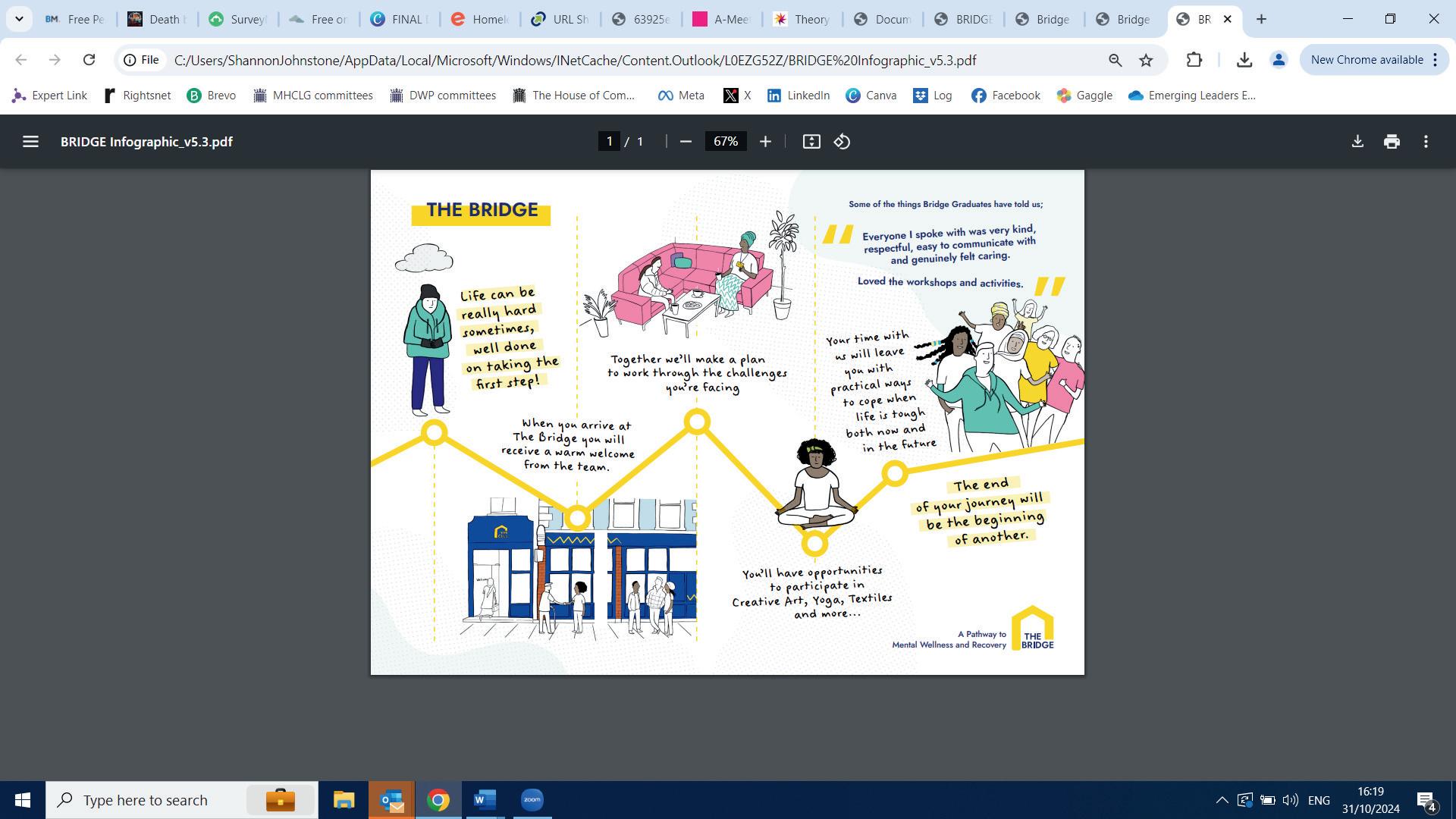
It can be a struggle trying to get into the head of people that access our services. What would they appreciate knowing before accessing the service? What would help them understand it? How was their experience of the service? What was important to them?
Staff can go back and forth with ideas for weeks trying to get it right. Then commonsense kicks in and you realise we don’t need to try and get in their heads, we can just involve them in the process, and they can input directly into the project themselves. No filtering, no assuming, straight from the people who matter most, those who have lived experience.
It gives the staff team confidence as well, knowing that the finished product has been codesigned and endorsed by the people they have been working with and ultimately who they are there to support.
A quote via email from somebody involved:
“Thank you for your lovely, enthusiastic email. It was a pleasure to be part of the focus group in July co-producing the infographic with other clients. I am especially flattered and proud that you have chosen to use my drawing as a starting point for the finished result, which looks great. I am pleased that you kept my original humour and multi-cultural positivity, down to details like my initial meeting with [Name] on the big pink sofas!
It is good to be able to give something back to a really helpful resource, delivered by a great, friendly team who each provide valuable advice and support to equip clients with a toolkit to get back on track to cope better with life’s challenges.”
Employing Peer Coaches (Forest Churches Emergency Night Shelter)
Context and Aims
In April 2023, Forest Churches Emergency Night Shelter secured funding from NHS Social Prescribing to enhance co-production through training for staff and volunteers. This initiative involved collaboration with four other Day Centres, supported by Expert Link and Trust for London.
A FCENS lived experience group was formed and met monthly. The group agreed three core aims:
1) To empower people with lived experience of homelessness, through access to training, social events and co-production activities at FCENS.
2) To inform best practice at FCENS and to co-design development of our service.
3) To influence key stakeholders and decision-making bodies in Waltham Forest, to improve lives for people with experience of homelessness in our Borough.
“I just feel so much more confident, the organisation as a whole, knowing that we've got that lived experience voice in the room, as part of the employed team.”
Peer Coaches
After the initial development of the Lived Experience Group, it was agreed to advertise for a part-time Peer Coach to join the team. The job description for this role was similar to the scheme developed by The 999 Club. This was advertised in December and interviews took place in February 2024. Two strong candidates were interviewed and both candidates were appointed on an initial four-month contract.
The purpose of the role is to provided peer support for guests at FCENS, and to lead on developing the lived experience group work.
Peer Coaches are heavily involved in co-designing and co-producing their own programme of work. Each of them is mentored by a Caseworker, and they co-work with guests to partner for peer support. This has been effective in providing rounded support to people while they stay at the shelter.
Caseworkers provide specialised support for housing and advocacy. Peer Coaches provide support to encourage guests with activity focussed on well-being. This partnership develops a positive culture that helps guests feel involved and respected in their journey.
Peer Coaches are also involved in fundraising for ongoing activities for the lived experience group and have organised a sponsored walk for guests through Walthamstow Marshes. A variety of activities have been led by Peer Coaches.
All guests staying at FCENS since March have benefitted from contact with Peer Coaches. Lived experience sessions are open to clients within other organisations too and clients from other charities have taken part in this.
Observations so far
Peer Coaches have a positive impact on the team serving at FCENS.
Their lived experience directly influences trauma-informed approaches to our work.
Peer Coaches help to build positive and deep relationships with beneficiaries / guests.
Employing Peer Coaches create clear boundaries between staff and guests.
As an employer, it has been positive to pay lived experience staff for their work in leading the lived experience group.
The Lived Experience Group has been difficult to sustain a consistent membership. Supermarket vouchers have been very helpful and appreciated by participants taking part. This has helped to value people and their time. Some have contributed well to sessions. There is a risk that guests attend just to receive the voucher.
Boundaries & Well-being for Peer Coaches & Lived Experience Group
Co-production work with people with lived experience of homelessness necessarily means engaging with and valuing people who have experienced trauma and often have continuing complex and varied needs. This process is messy and there is no one size fits all. We have valued employing people with lived experience. Other services on the Day Centres group prefer volunteer programmes.
It has been important to be flexible in our approach to employment. Working hours need enough flexibility to accommodate bad days and changes of circumstances. We check in regularly with our Peer Coaches to review working conditions to ensure that their needs are met consistently.
“This process is
messy and there is no one size fits all.”
The work of the Peer Coaches requires them to develop relationships with guests to provide well-being support. Maintaining appropriate boundaries in these relationships is challenging and requires training. Mentoring support from Caseworkers in this area has helped. It has been important for Peer Coaches to have working hours, work emails and a work phone, to ensure personal contacts and personal time is protected.
We have learned to avoid facilitating personal contact between members of the lived experience group. The group initially set up a WhatsApp group to share ideas and for planning; in hindsight this was a bad idea as it allowed the group to see and share contact details of other members. This had a negative impact on at least one member who has since left the group.
Progress towards aims
We are making very good and measurable progress towards aims 1 and 2 (to empower people; to inform best practice and co-design services). Progress towards aim 3 (to influence key stakeholders) is slow and depends on further collaboration with external bodies. We are open to engagement with local groups who are ready to engage with lived experience voice.
Contracts have been extended to March 2025 for both Peer Coaches. Roles will be reviewed at that time.
Women’s Sanctuary (The 999 Club)
The Women’s Sanctuary at the 999 Club is a safe and welcoming space exclusively for women. We provide a safe, supportive environment, both physically and emotionally.
We’re building a community where women can socialise, share knowledge, compassion and support. We offer workshops, events and activities. The Sanctuary is part of a wider network of support where women can access advice, links and referrals to further focused support and services (e.g. Athena/Refuge).
Many projects decide to set-up a service or project and then bring in the service-users at that stage to co-design it. Consultation, co-design and service-user involvement all have a distinct beginning and end to the process. Co-production is a continual process always in motion: a cycle of ideas, co-design, delivery, evaluation, adaptation and then fresh ideas.
The Women’s Sanctuary is an example of including service-users at every stage, including inception. The idea itself to create a safe space for women came from speaking to the women who were currently using our service, as well as those who were not. The feedback we received was that women didn’t feel comfortable in a male-dominated space. They expressed a need for a safe space exclusively for women.
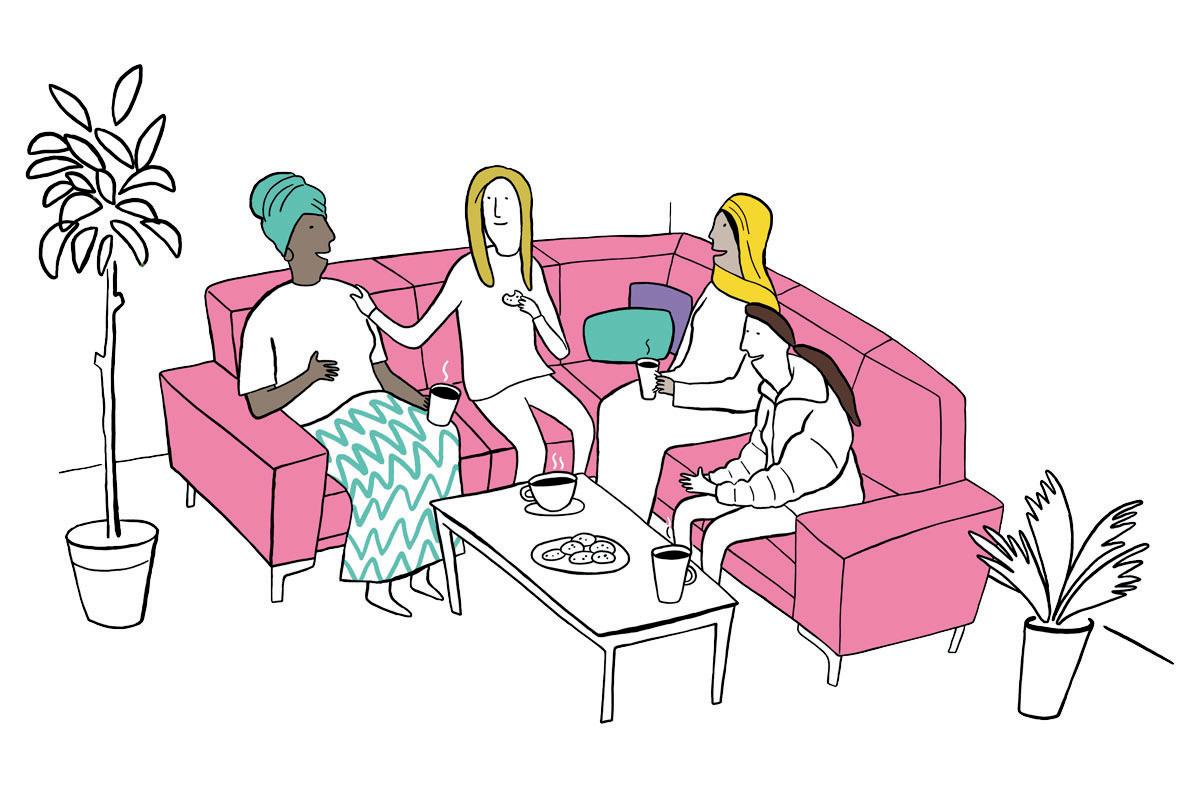
We began co-designing and planning the space, involving as many women with lived experience in the process as we could. It was a collaborative effort, the women deciding on everything; from the name of the space, to the colour we painted the walls, to the type of furniture and decorations within, to the services, groups, activities and workshops we would provide. We even had some of our members (service-users) help us paint the space during the decoration phase. This active participation created a sense of ownership of, and investment in the space.
We also enlisted women with lived experience to help deliver the services within the Sanctuary. The space and services within continue to grow and develop through the community of women that use the Sanctuary, going beyond co-production at times into ‘user-led’ territory.
One of our members (service-user) who had been involved in the development of the Sanctuary became a volunteer delivering workshops and discussions in the space. These proved so successful we hired her as a seasonal worker (self-employed) to expand upon these activities. They had been out of work for some years and were anxious about the prospect of returning to work so this middle ground helped them to develop confidence at a gradual pace. Her confidence grew even more and she applied for the role of Peer Coach in our Move+ service where she has now been employed for over a year.
A challenge was letting go of the initial vision we had in mind for the future, resisting the temptation to steer the development of the Sanctuary in a set direction. We really wanted the women who used the space to lead where it went after it was set up. It can be difficult to let go of those visions and trust in the process that the project will develop organically in the direction it needs to go.
When you see the success of letting go of that power however, its extremely motivating.
You see the power of co-production in action.
When allowed to breathe in this manner a project almost becomes a living entity, growing on its own.
Setting up an Action Group (RESTART LIVES)
RESTART has been on a journey with co-production over the past couple of yearssoaking up all the fruitful learning and training with Expert Link, through to brainstorming and active discussions with our guests. We’re at a juncture right now where we’ve managed to nurture a positive culture as much as possible across and within our services which has paved the way for a small coproduction ‘action group’ (between guests and staff) to be forming. We’re excited about the future and have Expert Link and the partner charities part of the project to thank.
Something that has worked especially well is knowing the right time and moments to bring in key or influential figures into the project. It’s all a balancing act but showing that all levels/roles/people in the organisation are playing a part has helped us. In August of this year (2024), we were lucky enough to have David join us in a chat group/session where he gave interested guests a better understanding of what co-production is and laid the foundations with us to help guests feel confident enough to take their ideas, feedback, suggestions to the next level (into an ‘action group’).
Having David with all the wisdom, knowledge and passion he possesses be present at this time made a huge difference because the conversation was really able to open up - in a way that might have been trickier if it was solely led by RESTART. We think often in our work how can we create really safe and comfortable spaces for people to feel they don’t need to phrase things especially carefully, just be themselves and have a truly open discussion. And in this instance, the answer was in collaboration.
So I think I would suggest this to anyone just setting out and embarking on co-production - think carefully about the formation of a group and how you can lean on, be supported by and involve others in the right moments. Just mixing up who leads a session or is present can really set things off and inspire a conversation that you may not be able to predict.
In this case, we heard from guests about all sort of topics like how queuing for our dropin was affecting them, the want for more (relaxing and learning) sessions before our dropin/meal service and the appreciation of time away from the busier drop-in environment to talk privately/confidentiality/in a quiet place with staff.
An element that we perhaps want to continue refining is the continuity of our ‘offer’ of co-production opportunities. For example, we’re very aware at RESTART not to bite off more than we can chew for fear of not being able to deliver a really good quality service for people. This may be just fear and anxiety but also it is an important core value to us to make people feel supported and that we are a constant, not something short term or fleeting.
“...it
is an important core value to us to make people feel supported and that we are a constant, not something short term or fleeting.”
Our solution to this has been lots of consultation across the whole organisation around values, refreshing our aims, objectives, mission statement this year; gentle intros into coproduction to help guests feel comfortable with what it is in action (and feed in from the very start) and a simple nurturing of what we are already good at as a charity in terms of co-production (rather than creating a plan or project which is not reflective of our work, guests, staff size/capacity/evolution, funding and focus).
Barriers in our way may be formalising the natural co-production that exists (guests feeding in frequently into their support and casework and playing significant part in the make-up and delivery of our services) and making it more of a clear-cut opportunity that someone can ‘apply to’ or rather step up to and acknowledge they are doing. We feel we could make more time, space, statement, acknowledgement and celebration to guests that are taking on and acting out co-production in our setting on a daily basis.
We hope we have or are on the cusp of overcoming this and have achieved that with the help and support from Expert Link and the supportive group of partner charities who offer perspective, encouragement and positivity at all times.
Involving Lived Experience at a Strategic Level (The Passage)
The Passage have set up a Lived Experience Assembly which is a new group sitting alongside senior management:
Focus on ensuring that the voices of those with lived experience influence strategic decisions within the organisation
Regular meetings facilitate collaboration and consultation between lived experience representatives and senior management, enhancing trust and transparency
Consulting on major strategic decisions
Consulting with lived experience groups can enhance the relevance and effectiveness of strategic decisions by incorporating diverse perspectives.
Engaging with these groups fosters trust and transparency within the organisation, ensuring that decisions reflect the needs and experiences of those directly impacted.
Regular consultations can lead to innovative solutions and community-driven initiatives that align with the organisation's mission and goals.
Starting small with proof of concept approach
Starting small allows for manageable implementation and reduces risk of failure.
A proof of concept helps to validate ideas before scaling, ensuring they meet the needs of stakeholders.
Repeatedly gaining feedback from initial trials can guide adjustments and improvements for future phases.
“Now the impact and taking things slowly, has meant that there are other committees and our board are now seeing this and how it can work.
So again, this idea of trialing something in a contained way, where it can have its own impact, where it is making a difference, it’s not just saying, right, let's get a lived, experienced person on every single board and every single panel.
Walk before you can run right!”
Meeting frequency increased due to success
Meeting frequency increased from quarterly to every three weeks due to positive outcomes.
Increased engagement from senior management in consulting with the lived experience group.
Demonstrated proof of concept led to greater trust and momentum for ongoing collaboration.
As this governance project has been such a success in its current form, The Passage are looking to expand its reach/grow at the end of the pilot.
Recruiting Peer Coach Roles: An example of a job description that has been developed for a Peer Coach role (The 999 Club)
We are looking for someone who is passionate about empowering and motivating others. Previous experience is not necessary, we value lived experience and attitude. If you have a positive, pro-active approach take a look at the Job Description / Role Profile. If you think you can match what’s required send us your CV and a supporting statement telling us, in no more than 500 words, why you’re the right person for this job.
The ideal candidate will have:
• Great people skills, the ability to communicate effectively with a compassionate, non-judgemental approach
• A proactive approach, always looking to support the team in achieving positive outcomes
• A genuine interest in people, their innate strengths and their capacity to change
• A positive, ‘can do’ attitude and above all, a good sense of humour to survive our fast-paced environment
• Lived experience of homelessness and an ability to use this experience in a positive and appropriate way
Chapter Four: Organisational Culture
“Do you genuinely want to start this journey and are you ready for it? Because don't start something, bring people on board, tell them you're giving them some power and influence, if actually you aren't going to be able to. And actually, if there's something much smaller that you can start to start that process, then do that.”
Organisational motives can significantly influence the effectiveness of co-production efforts. When organisations are driven by genuine co-production and service improvement, coproduction tends to be more successful. Motivations rooted in a genuine desire to address service needs, rather than purely financial or reputational gains, help build trust and engagement among all involved.
A clear, thought out and co-produced vision that prioritises lived experience and inclusivity can guide how effective and deep rooted co-production can become. Embracing co-production as a core strategy means an organisation is more likely to invest in the necessary resources, training, and support systems to facilitate co-production. An unclear vision can hinder expectations from both senior management and clients, not only making it difficult to achieve meaningful outcomes but also potentially traumatising those involved.
Values underpin the way co-production is conducted. Organisations that prioritise transparency, respect, and mutual benefit are more likely to build strong, productive relationships within and outside of the organisation. When values such as co-production are embedded in the organisational culture, they promote an environment where diverse perspectives are valued and integrated into the processes of the service.
“People will buy into it if they believe it, and they will only believe it, if the organisation believe it and commit to it.”
Authentic co-production requires careful planning and consultation to ensure that the voices of those with lived experience are genuinely heard and integrated into decision-making processes. Building trust and transparency between management and those with lived experience is crucial for meaningful collaboration, as it helps to mitigate potential barriers that may arise during the co-production journey.
Organisational commitment to co-production is vital for creating an inclusive environment where all stakeholders feel valued and heard. A strong commitment to co-production not only builds trust between staff and service users but also encourages ongoing engagement and participation, which are crucial for long-term success.
To facilitate effective co-production efforts, having a dedicated lead is highly recommended. This individual ensures accountability and focus on co-production initiatives, driving consistent progress and engagement. A dedicated lead enhances communication and collaboration among stakeholders, allowing for the identification and proactive addressing of barriers. This ensures that co-production processes remain inclusive and meaningful for all participants.
Honesty and clear communication about what is achievable plays a significant role in fostering trust and strengthening relationships between staff and individuals with lived experience. By managing expectations and providing context for decisions, organisations can prevent disillusionment and encourage meaningful participation. Validation of ideas is equally important; open discussions about feasibility and potential challenges should be encouraged to ensure diverse perspectives are considered in the decision-making process. Setting clear expectations about what can realistically be implemented helps maintain trust and engagement among all stakeholders.
Creating a culture of co-production requires a commitment to authentic involvement, clear communication, and the validation of ideas. By prioritising these elements, organisations can create an environment where the insights of lived experience significantly contribute to all areas of an organisation, including strategic development, ultimately leading to more effective and impactful outcomes.
“I think that organisations need to think about the skills that you need to have if you want to do co-production on a big scale. But then also not putting people off to say, ‘well, let's make a small start somewhere over here.’
If it's a case of literally sitting some residents down and saying, here's the budget, what does the food menu need to look like for the next month? It can be small like that.
If we're talking about governance and big, big, big change, you need to really make sure as an organisation, you're committing to it, whether that's with money, capacity or skills, 100%.”
Culture Change at Forest Churches Emergency Night Shelter
FCENS has long wanted to involve people who have stayed at the night shelter, but it previously struggled to engage people with lived experience in service delivery, management and governance.
Working with Expert Link and the Co-Production Day Centres, FCENS team started from the ground up to create a new culture of co-production.
Guests (service users), staff, volunteers, management and trustees, all joined coproduction training sessions, starting with 'Essential Nuts & Bolts of Co-Production' and 'The Wealth Within'.
A lived experience group was formed and this quickly had an influence on events, activities and service delivery.
The role of Peer Coach was added to the staff team and two part-time Peer Coaches were employed to support casework, peer support and lived experience networking in Waltham Forest.
This had an immediate impact on the culture in the workplace, informing support plans and development work with guests. Peer coaches are now involved in co-designing a new shelter for FCENS, which it is hoped will become the new long-term base for the charity and its work.”
Chapter Five: Involving and valuing people
with Lived Experience
Involving people with lived experiences of homelessness and multiple disadvantage within day centres brings significant benefits to both the organisation and the clients. Individuals with lived experiences have a deep understanding of the challenges and barriers faced by those in similar situations. Their personal insights can make the support and services offered more relevant and effective, as they can provide practical advice and empathetic understanding that goes beyond theoretical knowledge.
When you employ people with lived experience into any role, it can also foster a more authentic and trusting environment within the day centre. When clients see staff who have faced similar struggles, they may feel more comfortable and open, knowing that their experiences are understood and validated. This can enhance engagement and improve the overall effectiveness of the support provided.
Employing individuals with lived experience can bring a unique perspective to the day centre’s operations and decision-making processes. Their first-hand knowledge can help shape programs and services to better meet the needs of clients, ensuring that the day centres approach is both practical and compassionate. Overall, integrating people with lived experience into employment not only enriches the support offered but also promotes a more inclusive and understanding atmosphere within the day centre. It adds a layer of value to lived experience contributions.
“So those professional versus personal boundaries are really important to protect for lived experience people.”
It is essential to recognise that everyone brings unique assets to the table, particularly those with lived experience. These individuals possess invaluable insights that can significantly enhance the effectiveness of an organisation.
Unlike traditional qualifications, lived experience offers a deep understanding of the challenges and nuances that a degree alone may not convey. This perspective fosters a richer dialogue and drives more meaningful solutions. By viewing lived experience as a valuable asset rather than a potential risk, organisations can cultivate a more inclusive environment that taps into diverse viewpoints for collective benefit.
Integrating individuals with lived experience into an organisation fosters a culture of inclusivity and respect. It demonstrates a commitment to recognising and valuing diverse backgrounds, ultimately enriching the services provided, staff culture and organisational outcomes. By seeing every person as a useful asset, organisations can tap into an abundance of creativity and resilience, ultimately transforming their practices and achieving greater impact in their communities.
“If we're talking about co-production, the definition of co-production is that everyone is an asset and has something to offer in some way.”
When organisations have their clients involved in using their lived experience for the benefit of the organisation we have some top tips:
Consider a recruitment process, even if the role is voluntary
This enables you to see the client for more than just their lived experience, it also gives the client autonomy and ownership over their application, and interview. This in turn provides a deeper investment from both the organisation and the client as more time and work has gone into the process.
Budget to cover expenses, and vouchers if appropriate
Everyone’s time is valuable, this should be compensated where possible, even if it is in the form of expenses only. Many organisations use vouchers as remuneration and a payment policy is recommended to ensure clients have transparency around any affects on benefits and to protect the organisation.
If meeting in person, we highly recommend providing food and drinks too. Culturally, food brings us all together and creates a comfort, safety and fun within a meeting that can bring together all those in a room. (Pizza has been a staple at many of our meetings.)
Discuss and evaluate any training needs for all who are involved
Training is crucial to meaningful engagement from all when on a co-production journey.
It’s beneficial for organisations to attend training sessions together, this not only aids with bonding any group together but also identifies further strengths that might not have been picked up on in earlier recruitment processes. It also helps to identify any areas where individuals may like to develop further in.
“He
values the time people put in, the same way you would any other consultant.”
Chapter Six: Evaluating and Monitoring CoProduction
Evaluating how well co-production is going is crucial for any organisation because it helps ensure that the collaborative efforts are truly making a difference.
Many funders who fund work with lived experience and co-production will understand that normal metrics aren’t always realistic in this sector – however there are still ways you can monitor the effectiveness of your co-production and funders will often still ask for project goals and achievements.
Reflective practice is essential when carrying out co-production because it helps professionals and clients understand and learn from their experiences. By regularly taking a step back to evaluate what’s working and what’s not, everyone involved can identify strengths, address challenges, and adjust strategies for better outcomes.
This ongoing reflection fosters a deeper connection and mutual respect among participants, allowing for more effective communication and problem-solving. It’s not just about evaluating successes and setbacks but also about continuously growing and improving the relationships, making the process more inclusive and responsive to everyone’s needs. Reflective practice ensures that co-production efforts remain engaged and impactful, which in turn leads to more meaningful and successful outcomes for all involved.
“So we were celebrating success, strategically planning for the future and also exploring what was difficult and what did we learn from it. And that was quite raw actually, because it's hard, isn't it, going over things when they've gone wrong. But it was important to do.”
Below is a non exhaustive list of ways you could evaluate and monitor your co-production:
1. Gathering Feedback: Ask people with lived experience to share their thoughts on how coproduction is working. This can be done through surveys, interviews, or informal conversations.
2. Monitor Participation: Track how often and in what ways individuals with lived experience are involved in decision-making and activities at the centre.
3. Assess Impact: Look at the outcomes of projects or changes made with their input. Check if these changes are improving services or meeting the needs of the people they serve.
4. Review Meetings: Evaluate how well meetings and planning sessions include and address the input from people with lived experience. Ensure their voices are heard and valued.
5. Regular Check-ins/Check-Outs: Have regular reviews or check-ins with participants to discuss what’s working and what can be improved in the co-production process. Checking in with clients at the start and the end of the meeting has been something that has been particularly meaningful for clients.
Using these methods helps ensure that day centres are effectively involving people with lived experience and making meaningful improvements based on their insights.
“When we evaluate ourselves, you need to get outside perspective to do it as a whole evaluation right?”
Afterword (About the Project)
Expert Link was funded by Trust for London to work with homelessness day centres across London to develop their ways of working so that people accessing the services are treated as equal partners in strategic decisions within them.
A key aim was for those accessing services will also be empowered to collectively influence key Government policies affecting rough sleepers in London.
Expert Link delivered a training programme for day centre staff across the four day centres to support them begin the process of meaningfully engaging people accessing the service.
We targeted attendees with key influence over initiating or embedding co-production within their service. The training covered topics identified as key learning for everyone involved, such as: incentivising colleagues and beneficiaries, connecting as equals, understanding roles and responsibilities and keeping groups motivated.
Holding monthly conversations gathered people involved in the project to have conversations to address key challenges and best practices. Through gathering and summarising all learning from check-ins, training and monthly conversations all project participants has had a role in coproducing this guidance.
People involved in the project also were able to reach out to each other independently for advice and potential collaboration. It became a real community.
Everyone involved in the project has access to guidance, blogs and vlogs which build on the experiences from our large network of key factors involved in this sector.
Please share this guidance with colleagues across the sector. It can also be found online with an additional resource hub here: https://expertlink.org.uk/co-productioncentre/daycentreguidance
If you have any feedback, or would like to feed in to further iterations of the guidance, please contact Expert Link on: info@expertlink.org.uk
“I probably would have quit actually, I'd have been just like that. But coproduction I was interested in. It’s been inspiring and motivating”
“It's been so valuable to me to have you guys there as a sounding board for ideas”
“Building up steam and motivation to influence further and wider beyond our organizations. I think that's really exciting”
Useful Resources
There will be a resource hub at the end of our guidance online, the resources will be continually added too. Please go here to find an updated list of resources: https://expertlink.org.uk/coproduction-centre/daycentreguidance
Co-Production Collective at University College London’s, The Value of Co-Production Research Project: https://tinyurl.com/2ma8mcxb
Expert Link’s, Co-production Centre: https://expertlink.org.uk/co-production-centre/ Groundswell’s, It comes before Your name: Exploring lived experience roles and stigma in the homelessness sector report and research: https://groundswell.org.uk/wpcontent/uploads/2024/09/Groundswell-LESR-v1.4-Stigma-report.pdf
Healthwatch Westminster’s, Homeless, not Hopeless, Community Engagement Report: https://tinyurl.com/3rcbezww
Homeless Link’s Co-Production Toolkit: https://homeless.org.uk/knowledge-hub/coproduction-toolkit/
MIND’s, Influence and participation toolkit: https://www.mind.org.uk/workplace/influence-andparticipation-toolkit/
Oasis Community Housing’s YouTube video, What is Co-production: https://www.youtube.com/watch?v=bIQgVqJ8LrE
Single Homeless Project’s Co-Production Toolkit: https://www.shp.org.uk/wpcontent/uploads/2024/09/FL-Co-Production-Toolkit-May-2022.pdf
The Knowledge and Learning team at The National Lottery Community Fund’s, A Meeting of Minds: How co production benefits people, professionals and organisations: https://www.tnlcommunityfund.org.uk/media/A-Meeting-of-Minds_How-co-productionbenefits-people-professionals-and-organisations.pdf
The Social Change Agency’s, Payment for Involvement Playbook: https://thesocialchangeagency.org/resources/payment-for-involvement-playbook/ Think NPC’s, Make it count: https://tinyurl.com/5n9aftsx
Think NPC’s, The spectrum of user involvement approaches https://www.thinknpc.org/blog/the-spectrum-of-user-involvement-approaches/ Young Women’s Trust, Working inclusively with young women toolkit https://www.youngwomenstrust.org/wp-content/uploads/2020/11/Working-inclusively-withyoung-women-toolkit.pdf