Applyingsituationalanalysistoexamine theimpactofVOICESonpeople
experiencingmultipledisadvantage
KonstantinosSpyropoulos,ChristopherJamesGidlow,FionaMcCormack,AndyMeakin,
RacheleHine and SophiaFedorowicz
Abstract
Purpose – Thispaperreportstheuseofsituationalanalysisasasystemsmethodologytoevaluatethe voicesofindependencechangeandempowermentintheStoke-on-Trent(VOICES)partnershipproject.
Design/methodology/approach – Usingsituationalanalysisanddrawingonarangeofsecondarydata sources,athree-stageconceptualmappingprocessprovidedadetailedpictureofboththenon-linear interlinkageandcomplexityofthelocalsystemthatVOICESwasworkingtoinfluence,aswellasthe processesthatshapedtheexperiencesofthosewhoactwithinthesituation.
Findings – DatahighlightedthesystemicchallengesfacingVOICEScustomers(e.g.stigmaand marginalisationandlackoflegalliteracy),progressmadebyVOICESineachoftheirpriorityareasandan overarchingthemeofVOICESpromotingequity(ratherthanequality)toaddressfailuredemandinthe systemofsupportforpeoplewithmultipleneedsanddisadvantage.
Originality/value – Theauthorspresentthenovelapplicationofsituationalanalysistodemonstratea substantialimpactofVOICESwhiledemonstratingthevalueofthismethodologyforcomplexsystems thinkingresearchandevaluation.
Keywords Multipledisadvantage,Situationalanalysis,Fairaccess,HousingFirst,Systemsthinking, Failuredemand
Papertype Researchpaper
Introduction
Multipledisadvantage
Multipledisadvantagehasbeendefinedas“experienceoftwoormoreofhomelessness, offending,substancemisuseandmentalillhealth”(Lamb etal.,2019,p.5).Similartoterms suchas“severeandmultipledisadvantage”(Bramley etal.,2015)or“multipleandcomplex needs”(Harland etal.,2022),multipledisadvantageisusedtodescribeapopulationatthe extrememarginsofsocialdisadvantage(Bramley etal.,2015).Underthesecircumstances, peopletendtohavemuchworsehealthandqualityoflifecomparedwithotherlow-income andvulnerablepeopleandcanplacedisproportionatedemandsoncertainpublicservices (e.g.emergencyhealthcareandthecriminaljusticesystem),withconsiderablesocietal costs.
AkeyfocusoftheNationalFulfillingLivesprogrammewasonchangingsystemsthatcan enablesustainableimprovementsinthelivesofpeopleexperiencingmultiple disadvantage.Thesesystemscanbeconsideredacomplexnon-centrallycontrolled systemofinterdependent,autonomouspartsthatareexpectedto(butoftendonot) functionasacoherentwhole(Rutter etal.,2017).Throughtakingasystemsfocus,Fulfilling Livesrecognisedthatmultipledisadvantageislessaproductofanindividual’sbeliefsand
KonstantinosSpyropoulos, ChristopherJamesGidlow andFionaMcCormackare allbasedattheSchoolof Health,Scienceand Wellbeing(CHAD), StaffordshireUniversity, Stoke-on-Trent,UK.
AndyMeakinisbasedat theVOICESStoke-on-Trent, Stoke-on-Trent,UK.
RacheleHineisbasedat theExpertCitizensCIC, Stoke-on-Trent,UK. SophiaFedorowiczis basedattheSchoolof Health,Scienceand Wellbeing(CHAD), StaffordshireUniversity, Stoke-on-Trent,UK.
Received1February2022
Revised22April2022
Accepted27May2022
Thisresearchwasfundedby TheNationalLottery CommunityFundthrough VOICES.Theauthorswouldlike toacknowledgeallthosewho contributeddirectlyor indirectly,including:Sharon Sharmanandothermembersof theVOICESteamfortheir support;ExpertCitizens;the evaluationSteeringGroup members;VOICESPartnership Board;andotherlocal stakeholdersandindividuals whocontributedtotheprojects andactivitiesthatwere consideredhere.
attitudesandmoreafunctionofthesystemthatshouldsupportthem,i.e.behaviourof institutions,policydecisions,publicattitudesandculturalnormsperpetuatesocial problemsthatkeeppeopleinastateofdireneed(Abercrombie etal.,2015).
Systemschangehasbeendescribedasthe“intentionalprocessdesignedtoalterthe statusquobyshiftingandrealigningtheformandfunctionofatargetedsystem”(FosterFishman etal.,2007,p.197).Socialsystemsareoftencomplexandcomprisemany componentsofdifferenttypes(e.g.people,services,policiesandpractices).Therefore,to effectlastingchangerequiresalteringunderlyingstructuresandmechanismsthatmakethe systemoperateinacertainway(e.g.policies,practices,relationships,resources,power structuresandvalues)(Abercrombie etal.,2015).Thisdemandsactionandsupportfrom differentsectorsandorganisationswithinthelocalsupportsystem(NicholsandDoberstein, 2016),ultimately,improvingthecircumstancesandlivesofthosewithmultiple disadvantage(Fowler etal.,2019).
Setting
Thispaperpresentsasituationalanalysisundertakenaspartofasummativeevaluationof voicesofindependencechangeandempowermentinStoke-on-Trent(VOICES),aneightyearlocalimplementationoffulfillinglives(2014–2022).VOICEStargetedsystemschange effortsinthreepriorityareas:
1. Ensuringfairaccesstoservices – inadditiontocaseworkandservicecoordinationto facilitateaccesstoservicesforVOICEScustomers,arangeofVOICESactivitieswithin thisworkstreamaimedtoaddresssystemicbarrierstocustomersreceivingthesupport theyneeded.TheyincludedtheMulti-agencyResolutionGroup(MaRG),embedding specialistwelfareadvisorsinfrontlineservicestohelpcustomersaccessthebenefitsto whichtheywereentitledandconductingresearchtobetterunderstandcommon barriers,suchasdifficultyregisteringwithaGP,aswellaspooroutcomesfollowing prisonreleaseorhospitaldischarge.
2. HousingFirst – followingthetrialofahousing-ledintervention2014–2018(similarto HousingFirst),VOICESworkedtoembedaHousingFirstprogramme,whichadhered totheprogrammeprinciples(HomelessLink,2016),throughapilotimplementation (2018–2022).VOICESsupportedthroughvariousroles:ServiceCoordinator,Landlord LiaisonOfficerandTenancySustainmentOfficer,inadditiontofundinga12-month extension(2021–2022)andanindependentprogrammeevaluation(Gidlow etal., 2021a, 2021b).
3. Makingserviceusersleadersinservicedesignandcommissioning – VOICESworked withandsupportedExpertCitizens,puttingcoproductionwithlivedexperienceatthe heartofitsactivitiesandhelpingwithExpertCitizens’developmenttobecomean independentcommunityinterestcompany(CIC).
Situationalanalysis
Advancedmethodologiesarerequiredtostudythistypeofcomplexsystemchange,where traditionalapproachesgroundedinlinearmodelsofcauseandeffectareinappropriate (Martin etal.,2016; Rutter etal.,2017).Weneededamethodologythatembraced fragmentation,instability,diversity,contextandpositionalities,suchassituationalanalysis (Clarke etal.,2018),whichisdesignedtounpickknowledgefromcomplexinquiries(Wulff, 2008).
SituationalAnalysiswaswell-suitedtoexploringhowandtowhatextentVOICEShad impactedthe“situation”ofthewidersystemofsupportforpeopleexperiencingmultiple disadvantageinStoke-on-Trent,forseveralreasons.Firstly,itisaniterativeanddata-driven methodology.Thiswasappropriateaswedidnothavepredefinedhypothesesandwere
guidedbythedatatounderstandthecomplexityofthesituation(Clarke etal.,2018; Meadows,2008).Asdetailedsubsequently,discoursesandissuesidentifiedwerefurther exploredthroughrevisitingmaterialsorseekingconfirmationorclarificationthrough alternativesources;thus,allowingkeydiscoursestodevelop.Secondly,situationalanalysis isaflexiblemethodologythatcanaccommodatearangeofsecondaryandprimarydata sources,suchasreports,interviews,fieldnotesandminutes,givingequalcredenceto writtenandverbalevidence(Clarke etal.,2018).Thisenableduseofthewealthofexisting evaluations,reportsandotherexistingdataaccumulatedthroughoutVOICES,withfollowupworkshopstoverifyemergentthemes.Thirdly,situationalanalysisisoneofthefew methodologiesthatputscontext(“situation”)attheheartoftheinvestigation(Clarke,2005). Here,thesituationwasthewidersystemofservicesandsupportforpeopleexperiencing multipledisadvantageinthecity,whichisdistinctfromothersettingsandpopulationtypes andneededtobefullyunderstood.
Someresearchershavesuggestedthatthesekeypropertiesalignsituationalanalysiswith complexityinquiryandsystemsthinking(Martin etal.,2016).Thepresentstudytakesthis alignmentastepfurther,usingsituationalanalysisasanevaluationtooltoidentifysystemic barriersthatpreventpeoplewithmultipledisadvantagefromaccessingsupportiveservices andhowVOICESworkedtoaddressthem.
Method Design
Acasestudydesignwasused,whichdefinedtheboundariesofthesituationofinquiry:the widersystemofsupportforpeopleinStoke-on-Trentwhoexperiencemultiple disadvantage.Thethree-stageprocessofsituationalanalysis’conceptualmappingwas applied,asoutlinedbelow.Thisaimedtoprovideadetailedpictureofboththenon-linear interlinkageandcomplexityofthelocalsupportsystemstructures,aswellastheprocesses thatshapedtheexperiencesofthosewhoactwithinthesituation(Martin etal.,2016).
Data
Datasourceswereprimarilyexistingmaterials,includingcompletedandongoingVOICES reportsandprojectsandassociatedevidence(includinginterviewsandcasestudies),field notesandminutesofmeetings(Appendix),withadditionalcontextualinformationfrom stakeholderworkshopstoexplorespecificdiscourses.
Threestagesofsituationalanalysis
Thefirststageinvolvedthecollationanddetailedreviewofallmaterials,todevelop situationalmapsthatidentifiedall-importanthumanandnonhumanelementsofthesituation (e.g.keyindividuals,technologies),includingkeydiscoursesorissues.Inthesecond stage,socialworlds/arenasmapsweredevelopedtolocateandanalysethecollective actionoforganisationsintheir“socialworlds”andtheirrolewithrespecttothekey discoursesinthesituation(arena).Inthethirdstage,positionalmapsunpackedall positionsthatemergedfromdatarelatingtokeydiscoursesorissuesthatwererelevantto eachofVOICES’threepriorityareas.PositionalmapswereintheformofCartesianmaps, oneforeachmajordiscourse/issue,whereaxespresenttheissuesofconcernor controversy(Clarke,2005).
Assituationalanalysisdictatesnothingwastakenforgranted,especiallyonissuesthat seem“normal”withinthesituationand,therefore,havebecomeinvisible.Minordiscourses orissuesweregivenequalconsiderationtomoreprominentissuesbecauserelative prominencecanbeindicativeofpowerimbalances.Deviationsfromthenormwerenot treatedasexceptionsbutasboundariesofthesituation.Finally,athoroughinvestigation
wasusedtoidentifyallrelevantactors/actants,includingthoseusuallyhidden,silencedor onlytangentiallypresent,astheycanhelptoimproveourunderstandingofthesituation (Clarke,2005).
Findings
Thissectionpresentsthefindingsfromeachstageofsituationalanalysis.Positionalmaps fromStage3representthemaindiscoursesandissuesinrelationtoeachVOICESpriority areaforsystemschange.OutcomesfromStages1and2arepresentedtoshowthe process,whichisreportedinmoredetailelsewhere(Gidlow etal.,2022).
Stage1:situationalmaps
Processessetoutby Clarke etal. (2018) werefollowed.Afterthoroughlyreadingand memoingallwrittenmaterials,“messy”mapswereproduced,followedbyaseriesof orderedmaps,whichsetoutallhumanandnon-humanelementsofthesituation.Wealso begantoidentifymajorissuesanddiscoursessuchasthe“stigmaandmarginalization”and “equityissuesinhealthcareprovision”,whichlateron,wereusedtofocusthesituational analysis.Thefinaloutcomeofthisstageofanalysiswasthecreationofthreesituational relationalmaps,oneforeachofthethreeVOICES’priorities,toillustraterelationships betweentheelementsofinterestandotherelementsinthesituation,inasystematicand coherentway.
Stage2:socialworlds/arenasmaps
Therelationalmapsgeneratedquestionsthatwerefurtherexploredthroughthree workshops(oneforeachpriorityarea)thateventuallyledtothenextphaseofsituational analysisandthecreationofthesocialworlds/arenasmap(Figure1).Thismaprepresents thekeysocialactiveplayers(socialworlds)andthefield(arena)inwhichtheyinteract.As Clarke etal. (2018,p.150)stressed,itmapsthe“relationalecologicalformoforganizational analysisdealingwithhowmeaningmaking,andcommitmentsareorganizedand reorganizedagainandagainovertime”.
FivedifferentsocialworldscomprisedtheVOICESpartnership:thirdsectorhousing associationsthatsupporthousingneeds;voluntarysectorchampionswhosupportthose whorequireandusehealthcareservices;localpublicsectoragencies,mostlylocal authority(e.g.housingandMaRG)andtheNHS;legaladvisers’socialworld,whichwas dominatedbythethirdsectorwelfareadvisers;ExpertCitizens,whoactedasambassadors oflocalpeoplewithlivedexperienceofmultipleneedsanddisadvantage.
TheremainingsocialworldsalignedcloselywithVOICESobjectives(whilenotbeingpartof theVOICESpartnership)suchaslegislation,thecriminaljusticesystem,healthcaresector andacademia.ThisvisualrepresentationoftheVOICESpartnershipshowsthecomplexity ofthesituation,butalsoillustrateshowVOICESprovidedthecommongroundformany organisationstotacklemultipledisadvantage.Thishelpedtoovercomecompetitive attitudesandpracticesfrompartnershipsofvoluntaryandpublicsectors.
Althoughthemainfindingsarepresentedinpositionalmaps(Stage3),someaspectsthat emergedfromthesocialworld/arenasmapareworthnotinghere.Followingthe“likewith like”approach(Clarke etal.,2018),agreeablerelationshipsbetweenorganisationsare representedbyputtingthembesideoneanother,whereasconflictingorganisationsare opposing. Figure1 depictsthepower-seekingrelationshipofExpertCitizensCIC,a pinnacleachievementofVOICESlegacy,relativetotheotherVOICESpartnership organisations.BypositioningExpertCitizensopposingotherpartnershiporganisations, indicatestheirmovetoindependenceinfuturedecision-makingprocessesregardingthe localmultipledisadvantagedpopulation.
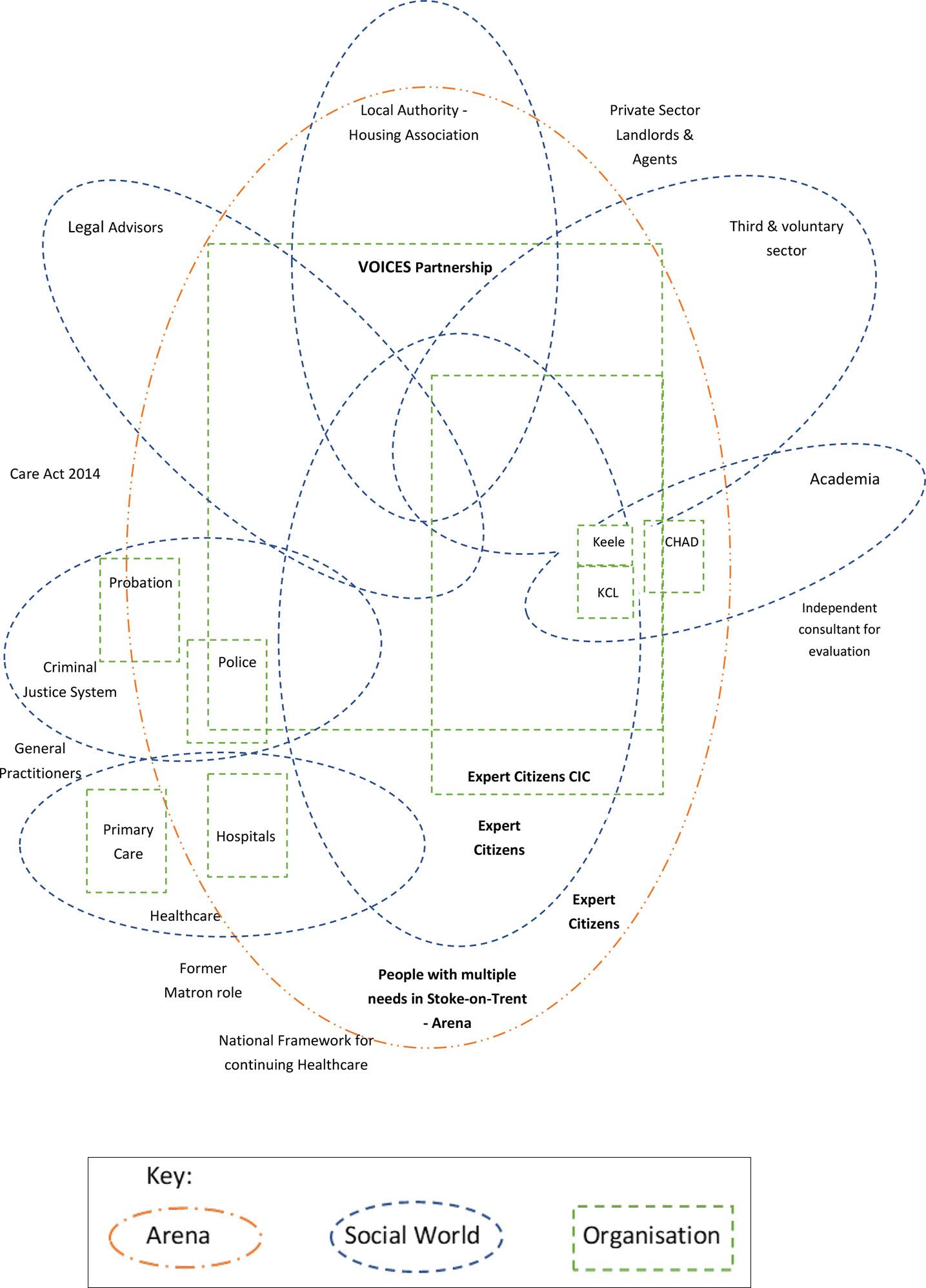
Moresubtly,thoughimportant,istheroleofacademia.Asawiderworkforcethatsupported VOICESefforts,academiawasplacedasanadjunctofthepartnership’sorganisation. Specifically,throughitsconsultancyandevaluatorrole,academiasupportedrigorous independentresearchandevaluationtoguidepracticeandpolicy(e.g.evidenceofprimary caregatekeeping;evidenceofineffectivehospitaldischargeprocessesforpeople experiencinghomelessness).
Finally,severalhumanelementshadanindirectroleinthesituation(referredtoas implicatedactors)butcriticallydidnotappeartohavedonesobeforeVOICES.For
example,generalpractitionerswererelevantthroughlegalobligation,butapparently resistanttosupportingpeopleexperiencinghomelessness,whichhasimplicationsforcrisis healthcareservices.Privatelandlordsandlettingagentswereimplicatedactorsthrough fillingthegapinhousingprovisioninHousingFirst,insomecases,creatingissuesin accommodationqualityandmaintenance.
Stage3:positionalmaps
Drawingonthewealthofmaterialconsidered,thefinalstageofanalysiselucidatedthe variouspositionstakenwithrespecttotheemergingdiscourses/issuesforthethree prioritiesunderinvestigation.Undereachofthesepriorityareas,thediscoursesreflectkey systemicissuesand/orhowVOICESwastryingtoaffectsystemschange.
Fairaccesstolocalsupportservicesofpeoplewithmultipleneedsand disadvantage
Threepositionalmapsarepresentedtohighlightthemajordiscourses/issuesthatcreated barrierstofairaccessandhowVOICES’workattemptedtoaddressthem[othermaps illustratinglessprominentdiscoursecanbefoundelsewhere(Gidlow etal.,2022)].
Stigmaandmarginalisation
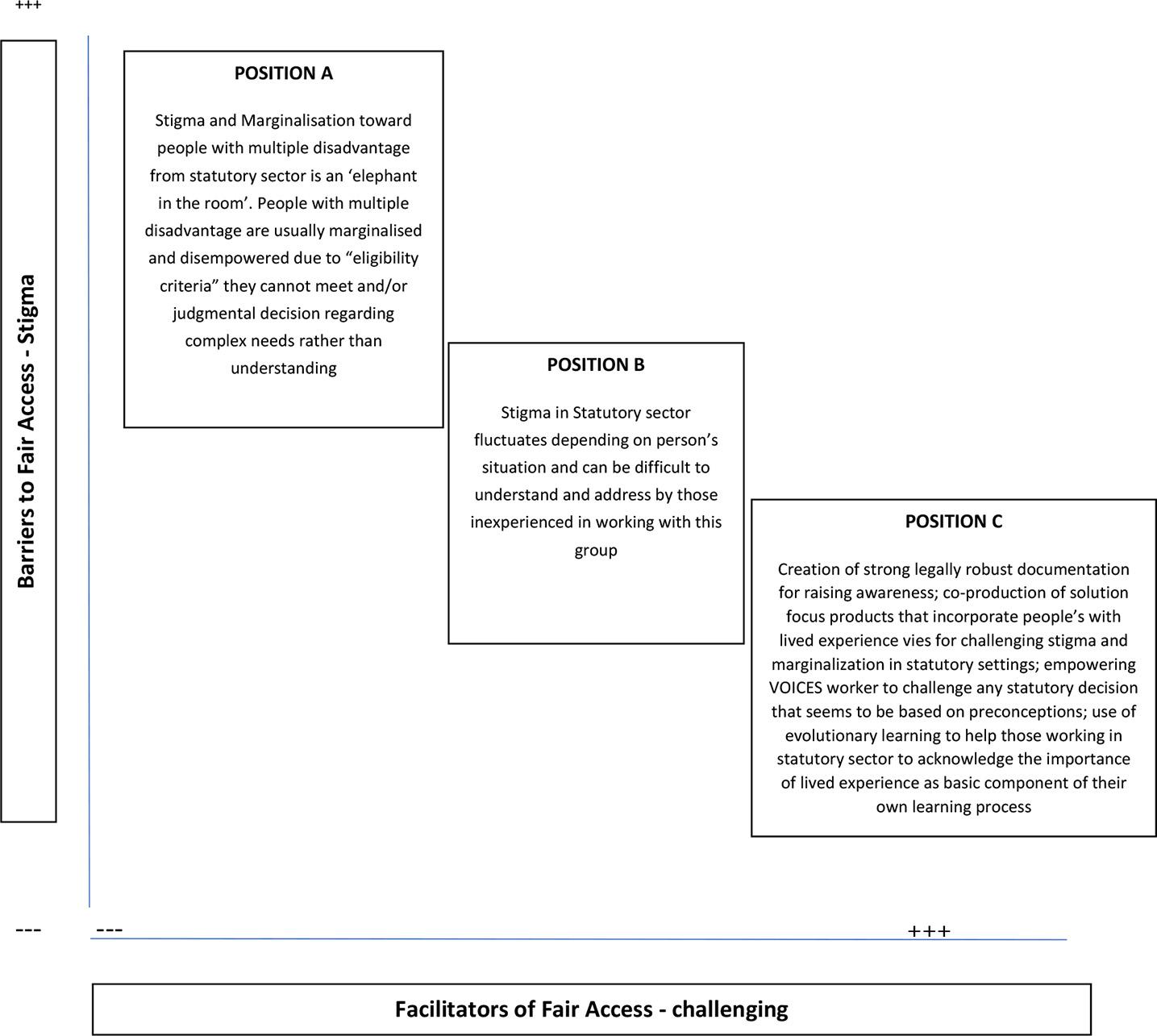
Stigmaandmarginalisationamongsomepersonnelinpublicsectorsupportservices emergedasafundamentalbarriertopeoplewithmultipledisadvantageaccessing services(Figure2).Describedbyonestakeholder,as“theelephantintheroom” (McCormack etal.,2019),whendiscussinghospitaldischargeprocessesforpeople experiencinghomelessness,itwasrecognisedthatstigmacanvarywiththeneeds/ situationoftheindividual(e.g.substancemisusevshomelessvsoffendinghistory).This createdproblemsforthoseseekingcareorsupport,aswellasthestaffwholackthe knowledgeandexperiencetodealeffectivelywithpotentiallychallengingbehaviouror situations.
PositionCin Figure2 illustratesVOICES’worktoaddressthis.VOICESproducedlegally informedmaterialsandrecommendationstoraiseawarenessofthetopicandroles/ responsibilities(e.g.toavoidgatekeepinginprimarycare).Theyco-producedproducts, oftenwithpeoplewithlivedexperience,thatchallengestigmaandmarginalisation,such asVOICESandExpertCitizen’smethodologies(e.g.INSIGHT)andtoolkits(e.g.Care Acttoolkit)toempowerfrontlinestafftounderstandpeopleexperiencingmultiple disadvantageandempoweredthemtochallengeunjustdecisions/processes.Also, thelearningprogrammethattrainedpublicsectorprofessionalstoacknowledgethe importanceoflivedexperienceasbasiccomponentoftheirownprofessional development.
Responsibilityandaccountabilitygaps
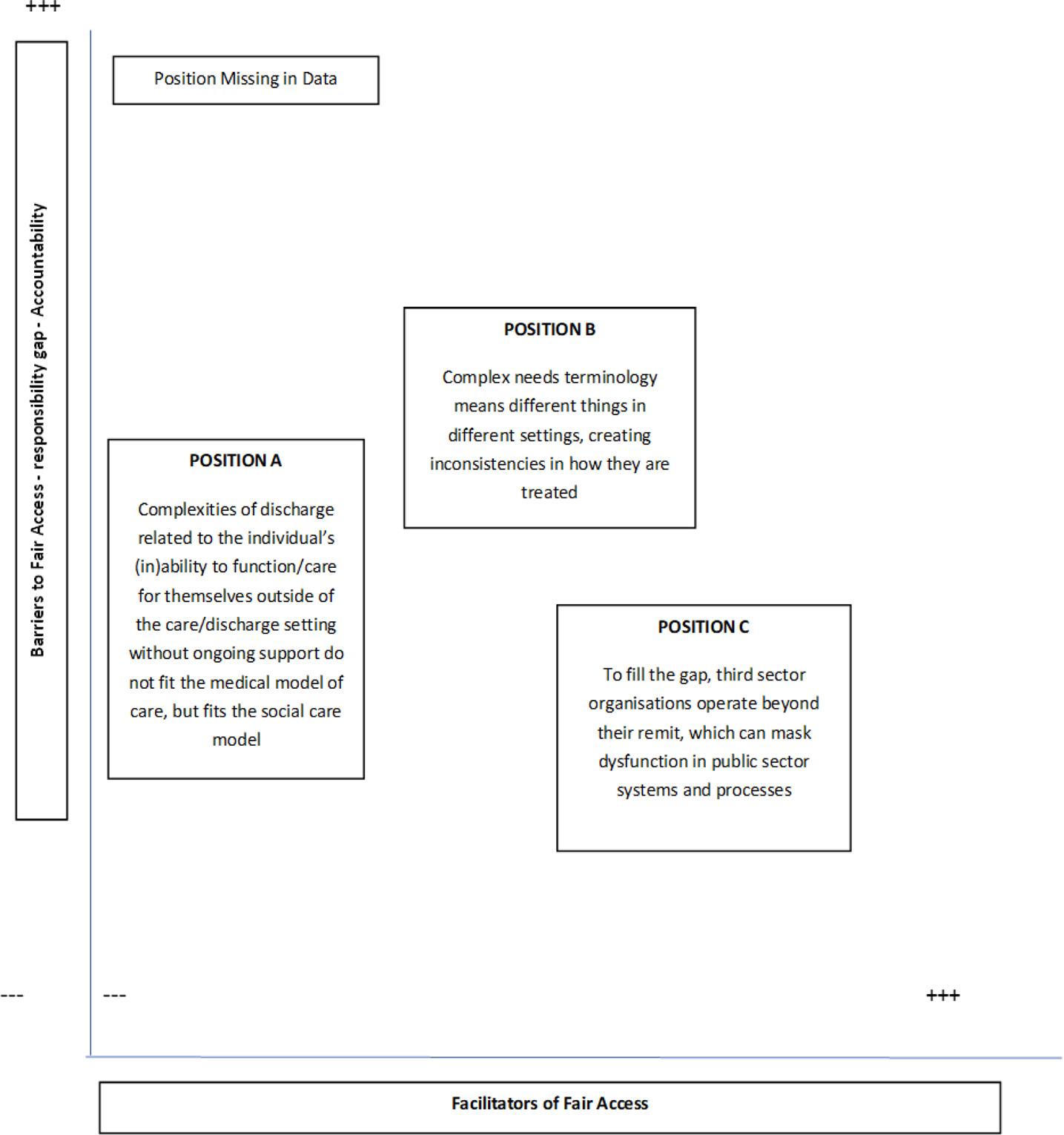
Gapsinresponsibilityandaccountabilitycanresultfromfragmentedsystemsandsilo working(Gidlow etal.,2022).As Figure3 illustrates,forpeoplewithmultipledisadvantage, thiswasevidentinthecontextofpeopleexitingcrisisservices(e.g.accidentand emergencytothelocalauthority),situationsthatdemandaclearunderstandingofthelegal responsibilitiesofeachorganisations(andassociatedstaff)toensureeffectivetransitions betweensettingsandcontinuityofcareorsupport.
VOICEShaveshownthelargegapsinprovision,particularlybetweenhealthandother services. Figure3 illustratessomeconflictingpositionsonthisissue,that:thoseleaving healthcarearetheresponsibilityofsocialcare(PositionA);thatthethirdsectorworks beyonditsremittocoverthisgap,whichcanmasktheshortcomingsofthesystem
(PositionC).However,sustainablesolutionswerelessclear,asidefromtheaddressingthe misunderstandingamongdifferentsettingsandsectorsregardingthemeaningof“multiple needs”,whichcouldavoidmisperceptionsthatindividual’sneedsdidnotfallwithintheir remit(e.g.thathomelessnesswasahealthissue,notonlyahousingissue;PositionB).
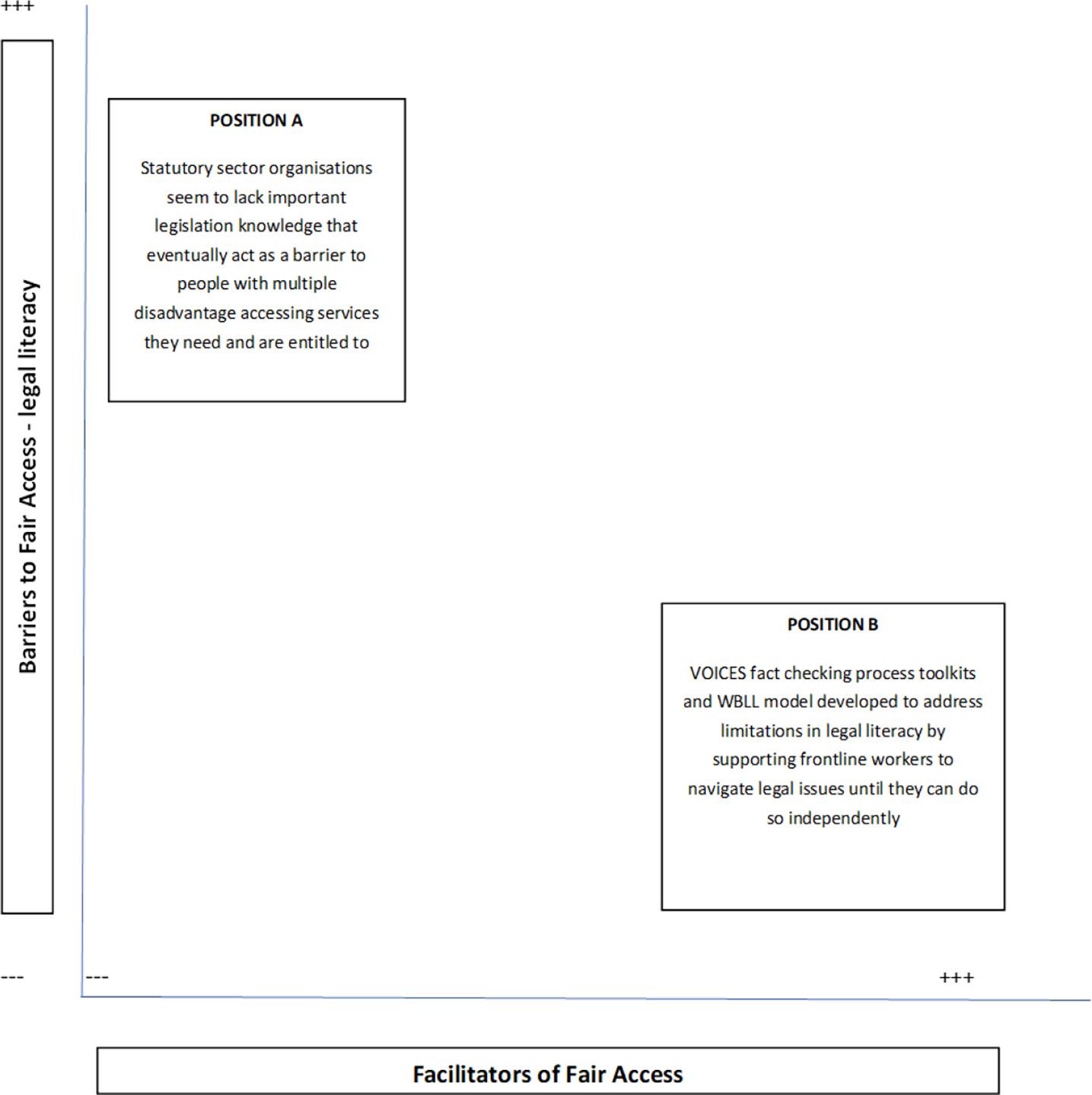
Legalliteracy
Dataindicatedthatlackoflegalliteracywasacommonfailureofthesystem,whichwas largelyunchallengedbeforeVOICES.Asrepresentedin Figure4,alackofknowledgeof someimportantlegislation(HomelessnessReductionAct 2017; CareAct 2014)inthepublic sector,createsseriousbarriersforpeoplewithmultipledisadvantageinaccessingthe servicestheyneedandtowhichtheyareentitled.Weobservedthepositionthatmanagers andfrontlinestaffworkingwithinsufficientknowledgeormisunderstandingsaround policies,passon“myths”andmisunderstandingstocolleagues,which,inturn,become enactedaspolicy(PositionA).Thisisa‘negativefeedbackloop’,inwhichorganisations lacktheincentivetoaddresstheproblemasdoingsocouldmeanhavingtodealwithmore situationsandpotentiallycomplexcases.
VOICEShelpedtoaddressthisproblemthroughdevelopingtoolkits(e.g.CareActtoolkit) andmodels(e.g.WelfareBenefitsLeadingandLearning[WBLL])andthelearning programmetofacilitatethedevelopmentofrelatedknowledgeandskillsinfrontlinestaff (PositionB).
Figure3 Positionalmapforresponsibilityandaccountabilitygapsasabarriertoaccessing services
HousingFirst Availabilityofsuitablehousing
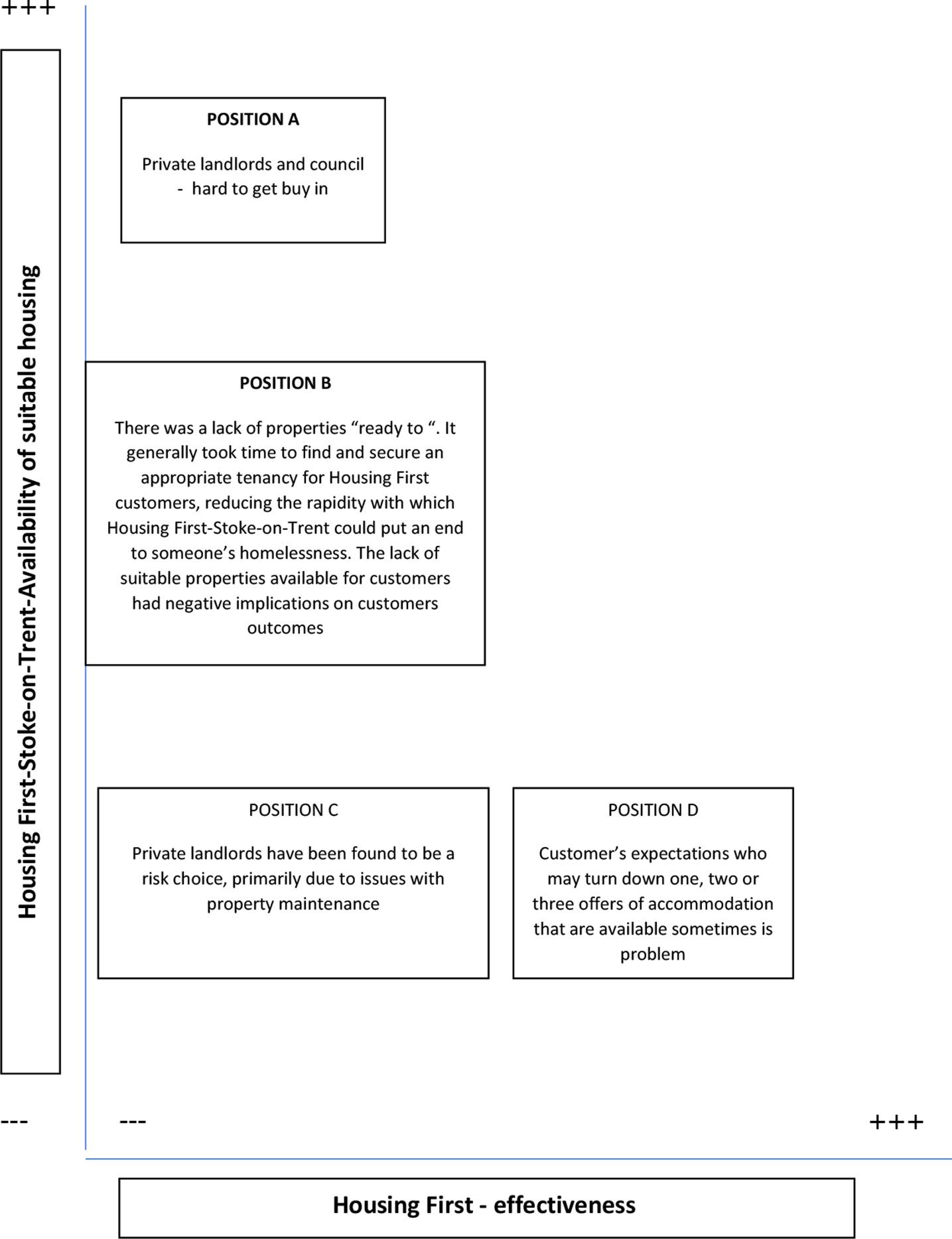
ThemajorissuewithHousingFirstinStoke-on-Trentwasthelimitedavailabilityofsuitable housing.Asshownin Figure5,therewereseveralrelatedpositionsinthedata,twoofwhich appearedtoreflectanissuethatpre-datedtheintroductionofHousingFirst(PositionsA andB)andjeopardiseditsprinciplesandeffectiveness:housingdemandexceeding supply,leadingtodelaysinHousingFirstcustomerssecuringtenancies(PositionB); inconsistentsupplyofsocialandcouncilproperties(PositionA).Thisresultedinareliance onprivatelandlordsandlettingagents,whichhadcreatedsomeissuesaround accommodationqualityandmaintenance(PositionC).
Finally,somestakeholderssuggestedthatunrealisticcustomerexpectationscouldbe barrierstoHousingFirst,citingexamplesofcustomersrefusingaccommodationoffers (PositionD).ThisneitherviolatesHousingFirstprinciplesnorsuggestsamainstream behaviourofHousingFirstcustomers.Thesolutiondoesnotnecessarilylieinaddressing thosecustomerexpectations.Rather,thispositionpointstoaneedtoaddressstakeholder
perceptionsoftheHousingFirstmodel.Again,itrelatestoalimitedsupplyofappropriate properties(primarilysingleoccupancy)thatleadstocompromise,wherebycustomershave tochoosebetweenaccommodationthatisunsuitable(basedonqualityorlocation)orwait (perhapsinthehosteloronthestreet).
SustainabilityofHousingFirstinStoke-on-Trent
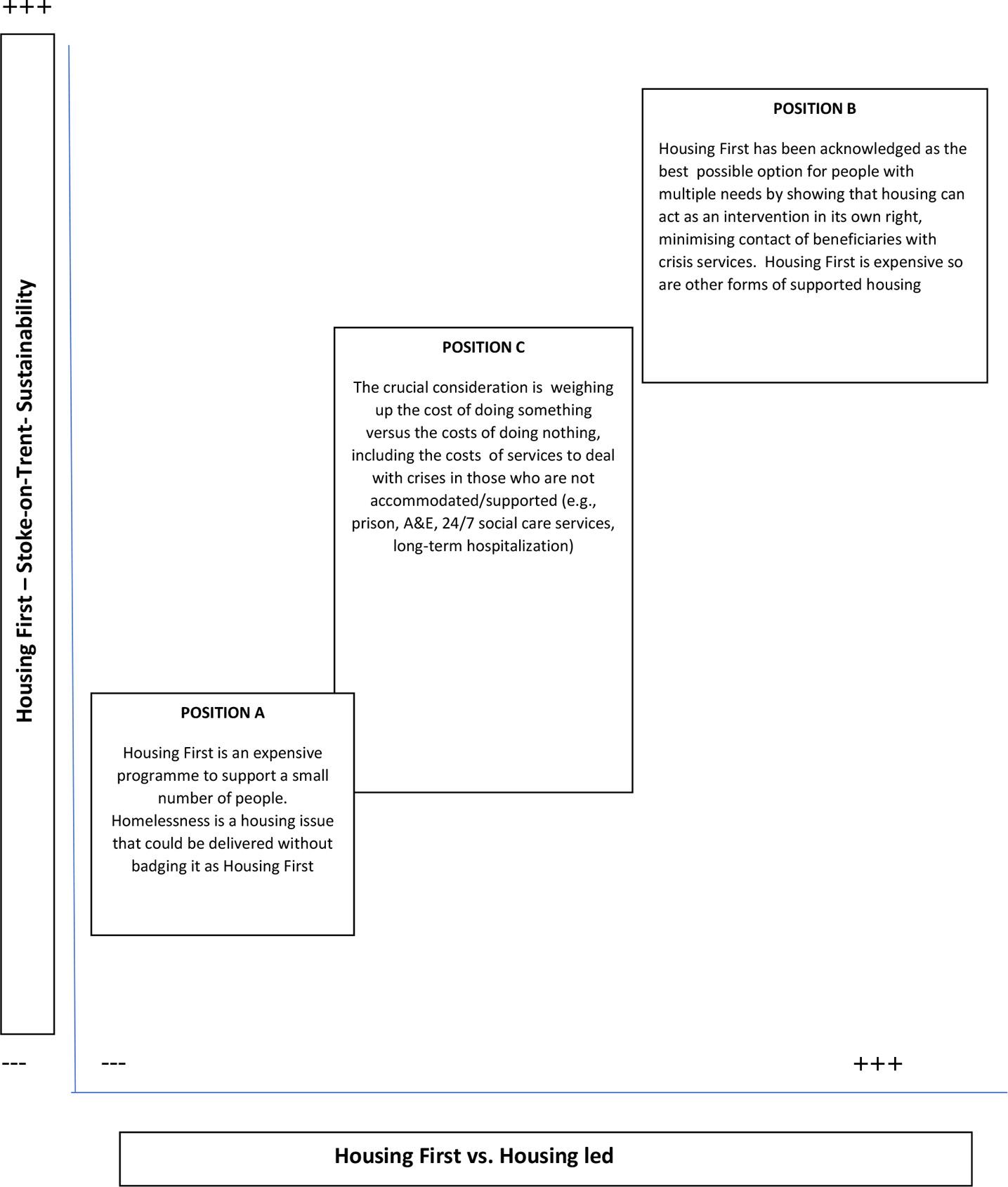
Figure6 illustratespositionsregardingthefutureofHousingFirstasasustainablelocalstrategy totacklechronichomelessness.TheirargumentpresentedHousingFirstasacostlyintervention witharelativelysmallnumberofbeneficiaries,andadvocatedforalessintense,housing-led intervention,whichdeviatesfromHousingFirstprinciples(e.g.finitesupport,tenancyconditional onengagementwithsupportservices;PositionA).Opposingthiswastheperceivedneedto maintainHousingFirstasthekeylocalstrategy,whichwasapparentlyendorsedthroughlocal approvaltoextendtheprogrammefor12monthsusingVOICESfunding(PositionB).Here,the costofHousingFirstwasrecognizedbutwithacounter-argumentthatnumerousothersupport servicesthatareevenmoreexpensive,andwitharelatedargument(PositionC)thatinaction costsmorethandoingsomething,especiallyasaneffectiveinterventionhaswiderbenefits throughavoidingthecostsofdealingwiththeconsequencesofinaction[e.g.incarceration, emergencyhospitalcareand24/7socialcareservices(Gidlow etal.,2021a, 2021b)].
Figure5 PositionalmapforavailabilityofsuitablehousingasabarriertoHousingFirst
Makingserviceusersleadersinservicedesignandcommissioning
ThethirdVOICESpriorityareaconcernedthegreaterroleforpeoplewithlivedexperience, who,throughVOICES,hadbecomeestablishedwithinthepoliticalagendaandcanbe consideredakeyrequirementforsystemschangeapproach.Twopositionalmapsare presentedtoillustratekeydiscourses/issuesforthistheme.
DevelopmentofExpertCitizenscommunityinterestcompany
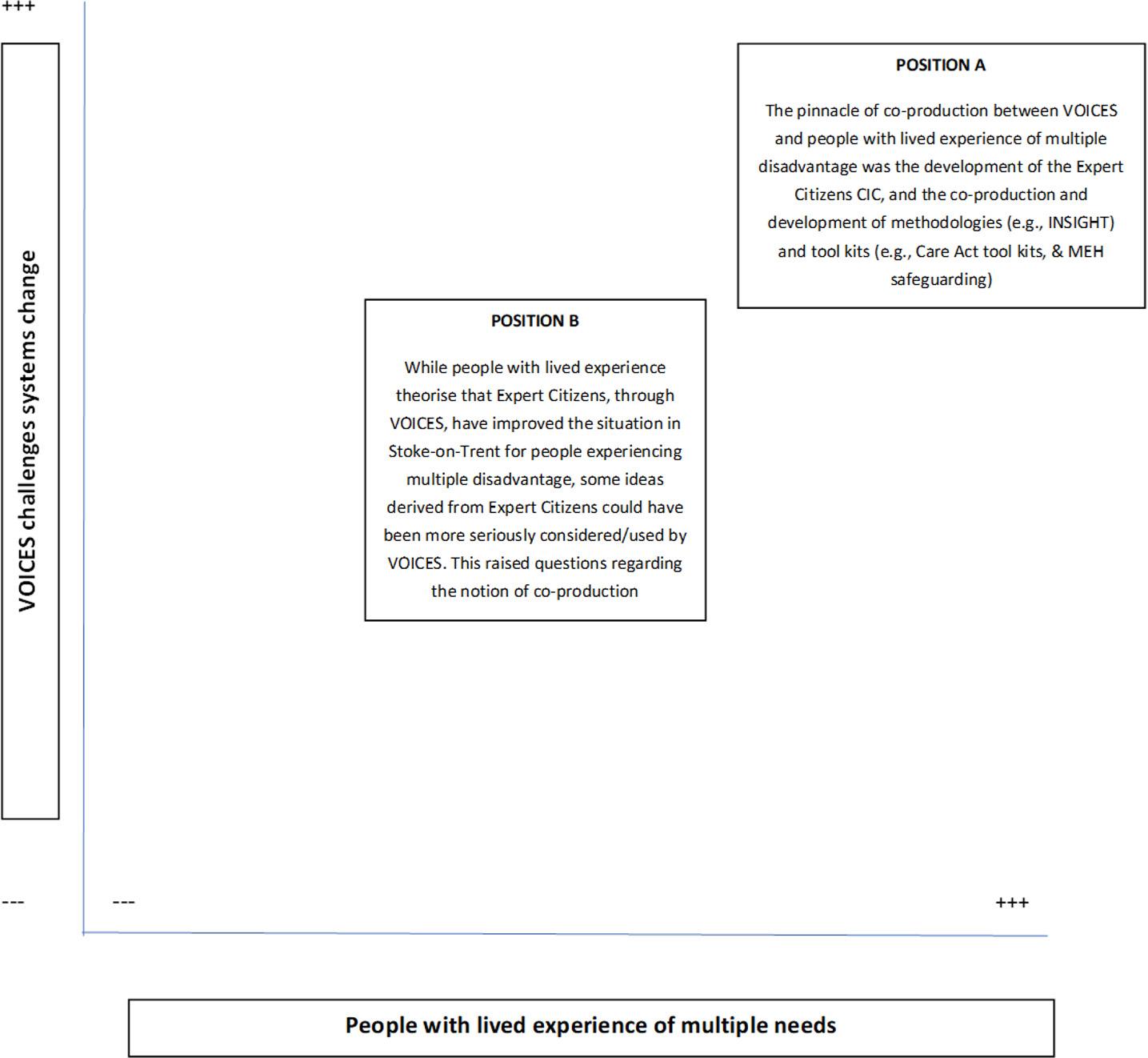
ThedevelopmentofExpertCitizensCICwasrecognisedasacornerstoneachievementof VOICES(PositionA),thepinnacleofco-productionbetweenVOICESpartnershipandlocal
peoplewithlivedexperience(Figure7).Despitethisco-productionandsubstantial contributionExpertCitizens,therewasasuggestionthatnotalltheirideas/suggestionshad beentakenintoseriousconsiderationoractionedbyVOICES(PositionB).
Peermentoring
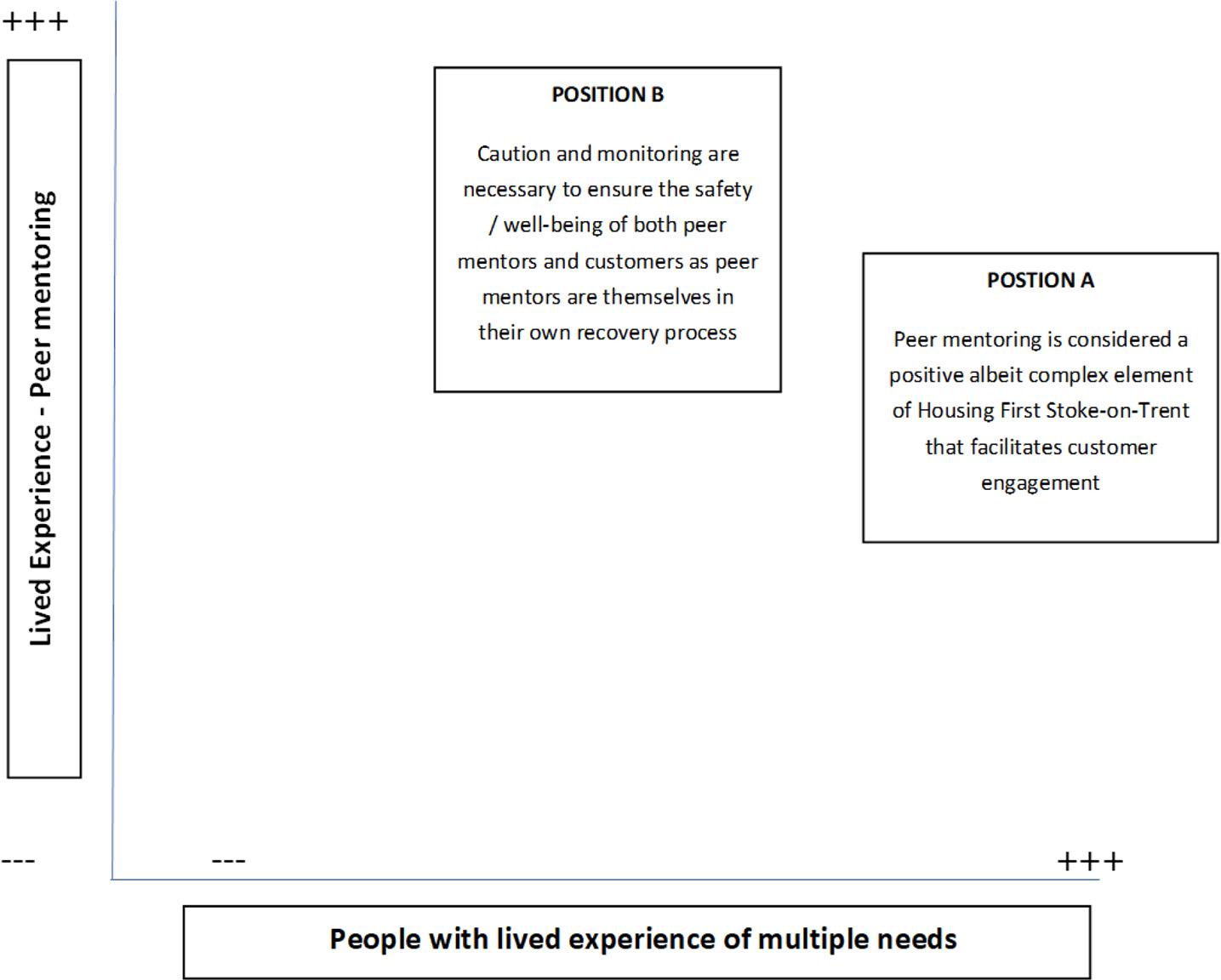
Peermentorswereindividualswithlivedexperienceofmultipleneedsanddisadvantage, whohadjoinedExpertCitizens,receivedtrainingandwerewillingtobeexemplarsto supportcurrentcustomers.TheywereusedprimarilyforHousingFirst.Therewasaposition thatpeersmentoringwasbeneficialforHousingFirstcustomers,helpingtobuildinformal relationshipswithcustomersandsupportwithactivitiesofdailylife,whileacknowledging thecomplexitiesandthatsuchsupportisnotarequirementofHousingFirstprinciples (PositionA).Therewasconcurrentconcernregardingthepotentialnegativeimpactonpeer mentors(PositionB);e.g.peermentorsfeelingobligedtoactbeyondtheremitoftheirrole
orfeelingoverburdened,withriskstopeermentors’mentalhealthandrecoveryprocesses (theirsandthecustomers’).Cautionandregularmonitoringwereproposedasonefeasible solution(Figure8).
Discussion
WereportevidencefromsituationalanalysisoftheVOICESpartnershipimpactonthewider systemofsupportforpeopleinStoke-on-Trentwhoexperiencemultipledisadvantage, acknowledgingthepostmodernconceptualalignmentofsituationalanalysismethodology tosystemsthinkingapproaches(Martin etal.,2016)
Throughtheconceptualcartographicmappingprocessforeachofthethreepriority areasinwhichVOICESaimedtoaffectsystemschange,situationalanalysismadetwo importantcontributions.Firstly,situationalanalysismaps,asother systemthinking approaches( Egan etal.,2019),suggestedanewtypeoflanguagethatshiftsnarration fromitsrelianceonthelinearandlogicalformationofwords(Meadows,2008)towards thedisplayofthediversepositionalitiesofthephenomenaunderinvestigation(Mathar, 2008).Secondly,theyprovokeasystemsthinkingexplanation,whichisnecessaryfor complexityinquiry(Martin etal.,2016 )andpermitresearcherstoembracethe heterogeneityofthesituation,whichisusuallyhiddenbypositivistmethodologiesof cause-and-effect( Williams etal.,2018)orevenexcludedby“whatworks”interventions (Abercrombie etal. ,2015).
Thus,despitebeinga“thickanalysis”methodology,situationalanalysis,alsoembraces abductionthinking(Clarke etal.,2018)thatpermitstheidentificationofahigherand abstractlevelofexplanation(thoughgroundedinthedata)ofthenon-linearrelationshipsof thesituationofinterest(Chapman,2004).
Thissectionprovidesexactlythat,areflectiononthelearningfromtheabovefindings, expandingonevidenceofVOICES’effortstoaddressthelocalsystem’sfailuredemand [“demandcausedbyafailuretodosomethingordosomethingrightforthecustomer” (Seddon,2003,p.26)]insupportingthosewithmultipledisadvantageandneeds. VOICESmadeconsiderableeffortstosupportlocalpeoplewithmultipledisadvantageand makepositivechangestoasystemthatoftenshiftsblametotheindividualfornonengagement/non-compliancewithtypicalprocesses.ThroughstudyingtheworkofVOICES withinthe‘situation’ofthesupportsystemsforthisgroup,itwaspossibletoidentifyseveral differentialpositionsbetweenthepartnershipandthepublicsector.Theseunderpinned manyoftheobservedfindingsandcanbeexplainedinthecontextoftheirdifferenttargets relatingtoequalityorequity,andtheirroleinsystem’sfailuredemand.Equalityapproaches fairnessastheprovisionofthesametreatment/supportopportunitiestoall(Takeuchi etal., 2018),whereasequityacknowledgesthepotentiallydifferentneedsandabilitiestoaccess servicesprovided.Thus,forequity,treatment/supportisallocatedproportionally(Duclos, 2006).Thisconceptualdifferencecanhavesubstantialimplicationsforthesupportthatthe peoplewithmultipleneedsanddisadvantagereceive(Chang,2002).Moreover,this providesanappropriatebasistoconsiderdifferencesinthissystemandresultingsupport beforeandduringVOICES(i.e.thedifferenceVOICESmade).
Accordingtotheevidenceconsideredinsituationalanalysis,supportservicesmorealigned withequalityweremostlythoseofthepublicsector.Thisisperhapsnotsurprisingasthe
commondeliveryfocusiscitywideandbasedonpopulationneeds,ratherthanbeing targetedortailoredtothosewiththemostextremedisadvantageandneeds(McCormack etal.,2019).However,inthissituation,itappearstohaveledtofailuredemand, exacerbatingsocialandhealthinequitiesbetweenthelocalgeneralpopulationandthose withmultipledisadvantage(Wilson etal.,2016).AseriesofexamplesfromVOICESwork showshowpeoplewithmultipledisadvantageandneedshavebeenexcludedfrom services,despitebeingeligibleandentitledtosupport.Forexample,theobservedlackof legalliteracyandmisinterpretationofthelegislation’sinclinationtowardsequityaffects manyservices,ultimately,excludingtheVOICEScustomergroupfromsocial,healthand financialservices.Inturn,thelackofresponsibility-takinginthepublicsectorforthosewith multipleneedsanddisadvantage,alongsidethereactiveanduntargetednatureofsome provision(e.g.prisonreleaseplans,hospitaldischarge),illustratedthecausesofthe revolvingdoorissue,wherebythosewiththegreatestneedsarecontinuallyin/outofthe samelocalsupportservice(oftenincrisis).Finally,theperpetuationofthetraditional treatmentfirstortemporaryhostelaccommodationpolicyisanotherindicationoffailure demandregardinghowchronichomelessnesshasbeenaddressedlocally.
Furthermore,theequalityprincipleandpoliciesfavourthosewithbettersocial,physicaland mentalhealth,ratherthanpeoplewithmultipleneedsanddisadvantageresultinginthe “competitiveexclusionprinciple”;agravitationalforcethatkeepspeoplewithmultiple needsanddisadvantageinthesamevulnerableposition(Chapman,2004).Eventually, whentheproblematicsituationbecomesunmanageableandoverburdensthesystem(in whatiscalleda“feedbackdelay”),theneedtoturntomoresystemsthinkingsolutionsis acknowledged(Meadows,2008).Inthiscase,suchsolutionswereattemptedthrough FulfillingLivesandVOICES.
VOICES’actionsreflectedaneedtofocusonequityasthemaintargetfortacklingthe socialgradient,inlinewithwhatMarmotcalledproportionateuniversalism,wherebythe intensityofthesupportwasproportionatetotheextremeneedofVOICEScustomers (Marmot,2010).Tothisend,VOICESaddressedsocialorhealthinequalityissues(e.g. appealsforbenefitclaimsorgatekeepingfromprimarycare)identifiedinsupportive services.Firstly,byinterveningandinitiating“verticalequity”;i.e.workingspecificallyto accommodateortailortheservicetoaVOICEScustomer’sneeds,and,secondlyby securing“horizontalequity”,bytailoringtheservicetoVOICEScustomerbase(Duclos, 2006).
Specifically,toapproachequityviasystemicthinking,VOICESimplementedaseriesof changestothesituationunderinquiry.Initially,theemergenceofExpertCitizensas ambassadorsforpeoplewithmultipleneedsanddisadvantageredirectedthefocusofthe localsupportsystem.Accordingtosystemthinking,changingoneelementcannot drasticallytransformthewholesystem.However,itcancausearedirectionofprioritiesifthe changeisaccompaniedbyanalogouschangesinnestedsystemicrelationships (Chapman,2004).Forexample,thiswasachievedthroughsupportingExpertCitizensnot onlytobecomeanindependentCICbutalsobyacknowledgingtheneedforskilful personnelwhoareaccreditedandtrainedtoparticipateequallyasco-designers(i.e.Care Acttoolkit),co-researchers(i.e.interviewingandcollectingdataatvariousVOICESreports) andco-evaluators(i.e.INSIGHT).Thisisexpectedtoprovidelong-lastingchangethatwill continuetohelptransformthefaceofthelocalsupportsystem.
Inparallel,VOICESgraduallyturnedintoatotallyco-producedproject,aninnovative, diverseandautonomouspartnershipandtookanevolutionarylearningapproach,which acknowledgedthecomplexityofthesupportsystemforpeoplewithmultipleneedsand disadvantage(i.e.thesituation).Forexample,thelearningprogrammeaimedtopromote workforcedevelopmentformoreeffectiveworkingwiththispopulation;WBLLaimedto improvelegalliteracy;researchandevaluationwerecommissionedtoinformpractice. Thesemeasuresalsoaimedtoovercomeprofessionals’assumptionsofwhoknowsbest,
acknowledgingtheimportanceoflivedexperienceasabasiccomponentoftheirown learningprocessandbeingopentoconstructivecriticismasopportunitiestolearnand adapt.
Finally,VOICESaimedtoeffectchangesinlocalsupportsystemforpeoplewithmultiple needsanddisadvantage.Thiswasattemptedthroughtheeffortstoreinstatelegislation’s inclinationtowardsequity,eitherbyraisingawarenessthroughlegallyinformed documentation(i.e.Gatekeepingreport;CareActtoolkit)orbyinterveningintheinternal structureoforganisationsviathemodel(s)ofspecialistwelfareAdviserandWBLLmodelto thefrontlineteamsorthroughthepilotHousingFirstprogrammeforimmediate,permanent andunconditionaltenanciesforcustomers,regardlessofcompliancewithservices (BrethertonandPleace,2016).
Conclusion
Thisnovelapplicationofsituationalanalysishighlightedanumberofissuesinthesystemof supportforpeoplewithmultipleneedsanddisadvantagesandthewaysinwhichVOICES hadimpactedthatsystem.DuringtheeightyearsofVOICES,therewasevidenceof progressagainstallthreepriorityareasforsystemschange,primarilytacklingthesocial andhealthinequities.Whereshortcomingsorfailurestomakealastingimpactwere observed,VOICES,commitmenttolearningandevaluationhasallowedthenew programmestosupportpeoplewithmultipledisadvantage,particularlyChangingFutures (DLUHCandMHCLG,2021),toincludemeasuresthatcanaddresstheproblems encountered.
References
Abercrombie,R.,Harries,E.andWharton,R.(2015), SystemsChange:AGuidetoWhatItisandHowto DoIt,LankellyChase,London,availableat: www.thinknpc.org/resource-hub/systems-change-a-guideto-what-it-is-and-how-to-do-it/
Bramley,G.,Fitzpatrick,S.,Edwards,J.,Ford,D.,Johnsen,S.,Sosenko,F.andWatkins,D.(2015), Hard Edges,MappingSevereandMultipleDisadvantage,LankellyChase,London,availableat: https:// lankellychase.org.uk/wp-content/uploads/2015/07/Hard-Edges-Mapping-SMD-2015.pdf
Bretherton,J.andPleace,N.(2016), HousingFirstinEnglandanEvaluationofNineServices,York: UniversityofYorkCentreforHousingPolicy.
CareAct(2014)“(c.23)”,availableat: www.gov.uk/government/publications/care-act-2014-part-1factsheets/care-act-factsheets
Chang,W.C.(2002),“Themeaningandgoalsofequityinhealth”, JournalofEpidemiology&Community Health,Vol.56No.7,pp.488-491.
Chapman,J.(2004), SystemFailureWhyGovernmentsMustLearntoThinkDifferentlyLearntoThink Differently,2nded.,Demos,London.
Clarke,A.(2005),“Situationalanalysis”, GroundedTheoryafterthePostmodernTurn,Sage,Thousand Oaks.
Clarke,E.,Friese,C.andWashburn,S.(2018), SituationalAnalysisGroundedTheoryafterthe InterpretiveTurn,2nded.,Sage,ThousandsOaks.
DepartmentofHealth(2012), NationalFrameworkforNHSContinuingHealthcareandNHS-Funded NursingCare,Vol.2012No.November,p.140,availableat: www.gov.uk/government/publications/ national-framework-for-nhs-continuing-healthcare-and-nhs-funded-nursing-care
DLUHCandMHCLG(2021),“Changingfutures”,availableat: www.gov.uk/government/collections/ changing-futures
Duclos,J.-Y.(2006),“Equityandequality”, HealthCareandPublicPolicy,doi: 10.4337/ 9781847207135.00011
Egan,M.,McGill,E.,Penney,T.,AndersondeCuevas,R.,Er,V.,Orton,L.,White,M.,Lock,K.,Cummins, S.,Savona,N.,Whitehead,M.,Popay,J.,Smith,R.,Meier,P.,DeVocht,F.,Marks,D.,Andreeva,M., Rutter,H.andPetticrew,M.(2019),“NIHRSPHRguidanceonsystemsapproachestolocalpublichealth evaluation”, Part2:WhattoConsiderWhenPlanningaSystemsEvaluation,NationalInstituteforHealth ResearchSchoolforPublicHealthResearch,London.
Fowler,P.J.,Hovmand,P.S.,Marcal,K.E.andDas,S.(2019),“Solvinghomelessnessfromacomplex systemsperspective:insightsforpreventionresponses”, AnnualReviewofPublicHealth,Vol.40No.1, pp.465-486,doi: 10.1146/annurev-publhealth-040617-013553
Foster-Fishman,P.G.,Nowell,B.andYang,H.(2007),“Puttingthesystembackintosystemschange:a frameworkforunderstandingandchangingorganizationalandcommunitysystems”, AmericanJournal ofCommunityPsychology,Vol.39Nos3/4,pp.197-215.
Gidlow,C.,Spyropoulos,K.,McCormack,F.andHine,R.(2021a), HardEdgesStoke-on-Trent:Reducing thecostsofmultipleneedstopeopleandservices:FinancialanalysisofVOICES,availableat: www. chadresearch.co.uk/wp-content/uploads/2022/02/42703-VOICES-Hard-Edges-Stoke-on-Trent.pdf
Gidlow,C.,McCormack,F.,Spyropoulos,K.,Fedorowicz,S.andHine,R.(2021b), Investigationof HousingFirstinStoke-on-Trent:Evaluationreport,availableat: www.chadresearch.co.uk/wp-content/ uploads/2021/09/HF-report-FINAL.pdf
Gidlow,C.,Spyropoulos,K.,McCormack,F.,Ellis,N.,Beddows,R.,Fedorowicz,S.Hine,R.(2022), “VOICESofstoke-on-trent:legacyevaluation”,availableat: www.chadresearch.co.uk/wp-content/ uploads/2022/04/43302-VOICES-Legacy-Evaluation-Digital-Version.pdf
Harland,J.M.,Adams,E.A.,Boobis,S.,Cheetham,M.,Wiseman,A.andRamsay,S.E.(2022), “Understandingthelifeexperiencesofpeoplewithmultiplecomplexneeds:peerresearchinahealth needsassessment”, EurJPublicHealth,Vol.32,pp.176-190,doi: 10.1093/eurpub/ckab142
HomelessLink(2016), HousingFirstinEngland:ThePrinciples,HomelessLink,London. HomelessnessReductionAct (2017),HMSO,London;2017. Lamb,H.,Moreton,R.,Welford,D.J.,Leonardi,S.,O’Donnell,J.andHowe,P.(2019),“Whatmakesa difference”, EvaluationofFulfillingLives:SupportingPeoplewithMultipleNeeds,TheNationalLottery, London.
McCormack,F.,Parry,S.andGidlow,C.(2019), HospitalDischargeandHomelessness:Local StakeholderPerspectives,CentreforHealthandDevelopment,StaffordshireUniversity,Stoke-on-Trent. Marmot,M.(2010), FairSociety,HealthyLivestheMarmotReview,StrategicReviewofHealthInequalities inEngland.
Martin,W.,Pauly,B.andMacDonald,M.(2016),“Situationalanalysisforcomplexsystems: methodologicaldevelopmentinpublichealthresearch”, AIMSPublicHealth,Vol.3No.1,pp.94-109. Mathar,T.(2008),MakingaMesswithSituationalAnalysis?Forum:QualitativeSocialResearch,Vol9, Art.4
Meadows,D.A.(2008), ThinkinginSystems:APrimer,Earthscan,London. Nichols,N.andDoberstein,C.(2016), ExploringEffectiveSystemsResponsestoHomelessness,Toronto Press,Toronto,Canada;2016.
Rutter,H.,Savona,N.,Glonti,K.,Bibby,J.,Cummins,S.andFinegood,D.T.(2017),“Theneedfora complexsystemsmodelofevidenceforpublichealth”, TheLancet,Vol.390No.10112,pp.2602-2604. Seddon,J.(2003), FreedomfromCommandandControl,VanguardPress,NewYork,NY.
Takeuchi,D.T.,Dearing,T.C.,Bartholomew,M.W.andMcRoy,R.G.(2018),“Equalityandequity: expandingopportunitiestoremedydisadvantage”, Generations,Vol.42No.2,pp.13-19.
Williams,P.E.,Russell-Mayhew,S.andIreland,A.(2018),“Disclosinganeatingdisorder:asituational analysisofonlineaccounts”, TheQualitativeReport,Vol.23No.4Art.9,pp.914-931.
Wilson,B.,Astley,P.,Cutts,J.,Hine,R.,McCall,K.andPerry,S.(2016), Gatekeepers:AccesstoPrimary CareforThosewithMultipleNeeds,Stoke-on-Trent,availableat: https://issuu.com/voicesofstoke/docs/ gatekeepers_voices_and_hw_stoke_rep
Wulff,D.P.(2008),“Research/therapy:areviewofAdeleClarke’ssituationalanalysis:groundedtheory afterthepostmodernturn”, TheQualitativeReport,Vol.13No.3,pp.31-34,availableat: http://nsuworks. nova.edu/tqr/vol13/iss3/16
CFEResearch,UniversityofSheffield,NetworkSCA(2020),VOICES’CareActToolkit:Improvingaccess tomentalhealthsupportforpeopleexperiencingmultipledisadvantage.CFEResearch,Sheffield.
Martineau,S.J.,Cornes,M.,Manthorpe,J.,Ornelas,B.andFuller,J.(2019), Safeguarding, HomelessnessandRoughSleeping:AnAnalysisofSafeguardingAdultsReviews,London:NIHRPolicy ResearchUnitinHealthandSocialCareWorkforce,ThePolicyInstitute,King’sCollegeLondon, doi: https://doi.org/10.18742/pub01-006
McIntyre,S.,Hewett,N.andMedcalf,P.(2015),“Inclusionhealthclinicalaudit2015-16”,London, availableat: www.pathway.org.uk/wp-content/uploads/2015/12/ED-Audit-2015-patient-report.pdf
Pollard,N.andRice,B.(2020),“TheVOICEScitywidelearningprogramme:sharedlearning opportunitiestoimprovesupportforpeopleexperiencingmultipleneeds”,StokeonTrent. https://issuu. com/voicesofstoke/docs/voices_learning_programme_evaluation_2020_final Rice,B.(2019), TheVOICESModelofUsingPersonalBudgetsinServiceCoordination,VOICES,Stoke onTrent.
Appendix.Resourcesforsituationalanalysis
Reports
LisaO’Conor(2019) TheWayfarerandotherjourneys www.issuu.com/voicesofstoke
VOICESandExpertCitizens(2017) Stoke-onTrent:CallforEvidenceonSocialAction www.issuu.com/voicesofstoke
VOICES(2020) CASESTUDY#1:VOICES’CareActToolkit:Improvingaccesstomental healthsupportforpeopleexperiencingmultipledisadvantage www.issuu.com/ voicesofstoke
VOICES&ExpertCitizens(2020) Stoke-on-TrentCommunityofPracticeGuide:How coffee,cakeandconversationcanpromotepreferredfutureswithpositivepractice http://www.issuu.com/voicesofstoke
VOICES(2016) PrisonReleaseSupport:Stoke-on-TrentCommunityofPractice @SotCoP http://www.issuu.com/voicesofstoke
FulfillingLivesinStoke-on-Trent:ProjectPlan2014-2022
RiceB.(2016) HardEdgesStoke-on-Trent:Reducingthecostsofmultipleneedsto peopleandservices:FinancialanalysisofVOICES www.issuu.com/voicesofstoke
RiceB,(2018) HardEdgesStoke-on-Trent:Reducingthecostsofmultipleneedsto peopleandservices:financialanalysisofVOICES www.issuu.com/voicesofstoke
Gidlow,C.,Spyropoulos,K.,McCormack,F.andHine,R.(2021a) HardEdgesStokeon-Trent:Reducingthecostsofmultipleneedstopeopleandservices:Financial analysisofVOICES www.issuu.com/voicesofstoke
Gidlow,C.,McCormack,F.,Spyropoulos,K.,Fedorowicz,S.andHine,R.(2021b) InvestigationofHousingFirstinStoke-on-Trent www.issuu.com/voicesofstoke RiceB.(2020) TheVOICESCitywideLearningProgramme:Sharelearning opportunities t improvesupportforpeopleexperiencingmultipleneeds.Independent EvaluationReport www.issuu.com/voicesofstoke
Stoke-on-TrentSafeCitypartnership(2021) Multi-agencyResolutionGroupStoke-onTrent:WorkingTogetherforYourCommunity Gidlow,C.,McCormack,F.,Riley,V.andSpyropoulos,K.(2021a) Multi-agency ResolutionGroup(MaRG):Evaluationreport www.chadresearch.co.uk/wp-content/ uploads/2022/01/MarG-report-final-version.pdf
CFEResearch,UniversityofSheffield,SystemsChangeActionNetwork(2020) Improvingaccesstomentalhealthsupportforpeopleexperiencingmultiple
disadvantageEvaluationofFulfillingLives:Supportingpeoplewithmultipleneeds www.issuu.com/voicesofstoke
RiceB.(2019) TheVOICESModelofusingPersonalBudgetsinServiceCoordination www.issuu.com/voicesofstoke
WilsonB.,AstleyP.(2016) Gatekeepers:AccesstoPrimaryCareforthosewithMultiple Needs www.issuu.com/voicesofstoke
McCormack,F.,Parry,S.andGidlow,C.(2019) HospitalDischargeand Homelessness:Localstakeholderperspectives www.issuu.com/voicesofstoke
SharmanSharon(2020) AnImprobableJourney:Exploringaprisonreleaseplan-Case Study www.issuu.com/voicesofstoke
McCormack,F.,Massie,R.,Machin,R.,Vincent,P.,Kurth,J,.Morton,J.andGidlow,C. (2016) CityCentreRoughSleepingandStreetActivity:ProjectReport www.issuu.com/ voicesofstoke
Ornelas,B.,Bateman,F.,Meakin,A.,Cornes,M.,Pritchard-Jones,L.(2020). Multiple exclusionhomelessness:asafeguardingtoolkitforpractitioners.Stoke-on-Trent: VOICES www.issuu.com/voicesofstoke
Rice,B.(2016) VOICES – VoicesofIndependenceChangeandEmpowermentin
Stoke-on-TrentStakeholdersurveyreport www.issuu.com/voicesofstoke
Rice,B.(2017) VOICES – VoicesofIndependenceChangeandEmpowermentin
Stoke-on-TrentStakeholdersurveyreport
Rice,B.(2018) VOICES – VoicesofIndependenceChangeandEmpowermentin
Stoke-on-TrentStakeholdersurveyreport (Draft)
Rice,B.(2019) VOICES – VoicesofIndependenceChangeandEmpowermentin
Stoke-on-TrentStakeholdersurveyreport
Rice,B.(2020) VOICES – VoicesofIndependenceChangeandEmpowermentin
Stoke-on-TrentStakeholdersurveyreport
RiceB(2017) IndependentevaluationofVOICES:systemschangereport www.issuu. com/voicesofstoke
MeakinA.(2020)VOICES:LegacyProjects:Initiationdocumentand plan
Meakin,A.andDurren,M.(2015) RightTimeRightPlace:AMultipleNeedsCharterfor Stoke-on-Trent2016-2022
FulfillingLives(2019) Changingsystemsforpeoplefacingmultipledisadvantage RiceB.(2018) AModelofSpecialistWelfareAdviceandAdvocacyatVOICES:How VOICESandCitizensAdviceStaffordshireNorthandStoke-on-Trenthaveworked togethertoprovidewelfarerightssupporttopeoplewithmultipleneeds VOICES, CitizensAdviceStaffordshireNorth&Stoke-on-Trent,BrighterFutures,cdas Stoke-on-Trent,CONCRETE(2020)WelfareBenefitsLeading&LearningEngaging, LearningandMakingProgressTogether:Year1Report2019-2020
Gidlow,C.,McCormack,F.,Riley,V.andSpyropoulos,K.(2021a) WelfareBenefits: LeadingandLearning(WBLL)modelinStoke-on-TrentEvaluationreport:Embeddinga specialistCitizensAdviceadviserinpartnerorganisations,toworkwithstaffand customersonbenefitsadviceforpeoplewithmultipleneeds
Mason,K.,Cornes,M.,Dobson,R.,Meakin,A.,Ornelas,B.,andWhitefordM.(2017) MultipleExclusionHomelessnessandadultsocialcareinEngland:Exploringthe challengesthrougharesearcher-practitionerpartnership. Research,Policyand Planning Vol.33No.1,pp.3-14
VOICES,ExpertCitizens92016) TheCareActMultipleNeedsToolkit
Cornes,M.,Ornelas,B.,Bennett,B.,Meakin,A.,Mason,K.,Fuller,J.,Manthorpe,J. (2018)IncreasingaccesstoCareAct 2014 assessmentsandpersonalbudgetsamong peoplewithexperiencesofhomelessnessandmultipleexclusion:atheoretically
informedcasestudy, Housing,CareandSupport,Vol.21No.1,pp.1–12,doi:10.1108/ HCS-09-2017-0022
ExpertCitizens,KeeleUniversity(2018) AccesstoPrimaryCareServicesforPatients with “NoFixedAbode”: Afollow-upofTheGatekeeper’sReport
NHSMidlands&Lancashire(CSU)(2019) Guidanceforconsideringtheneedsof peopleexperiencinghomelessnessincommissioninghealthservices
ExpertCitizens(2019) PortfolioofPositivePracticeSupportingPeopleExperiencing MultipleDisadvantageAshowcaseofoutstandingpracticethatprovideinsighttonew waysofworkingandideasforsystemschange
ExpertCitizens(2019) GPRegistrationEvaluationToolkitAccessingPrimaryHealth CareForPeoplewith “NoFixedAbode”
CFEResearch,UniversityofSheffield,SystemsChangeActionnetwork(2020) Improvingaccesstomentalhealthsupportforpeopleexperiencingmultiple disadvantageEvaluationofFulfillingLives:Supportingpeoplewithmultipleneeds
Murinas,D.andMeakin,A.(2020)Insightthroughexperience:HowExpertCitizensare celebratingthenicestpeople. People,PlaceandPolicy 14/1pp.24-34
CFEResearch(2020) Theroleoflivedexperienceincreatingsystemschange EvaluationofFulfillingLives:Supportingpeoplewithmultipleneeds
Websites
www.voicesofstoke.org.uk/ www.brighter-futures.org.uk/ www.fulfillinglivesevaluation.org/about/the-partnerships/voices-stoke-on-trent/ www.citizensadvice.org.uk/benefits/sick-or-disabled-people-and-carers/pip/appeals/ mandatory-reconsideration/ www.healthwatchstokeontrent.co.uk/about-us/ www.keele.ac.uk/socialinclusion/ourpartnerships/ www.expertcitizens.org.uk/ www.chadresearch.co.uk/
Minutesandpapersfrommeetingsof
VOICESLegacySteeringGroup
HousingFirstSteeringGroup
Correspondingauthor
KonstantinosSpyropouloscanbecontactedat: konstantinos.spyropoulos@staffs.ac.uk
Forinstructionsonhowtoorderreprintsofthisarticle,pleasevisitourwebsite: www.emeraldgrouppublishing.com/licensing/reprints.htm Orcontactusforfurtherdetails: permissions@emeraldinsight.com