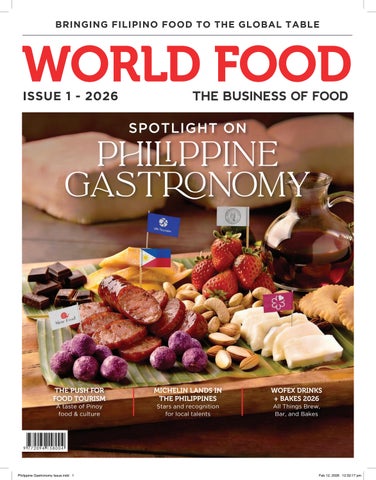
BRINGING FILIPINO FOOD TO THE GLOBAL TABLE
ISSUE 1 - 2026
SPOTLIGHT ON
Philippine Gastronomy
THE PUSH FOR FOOD TOURISM
MICHELIN LANDS IN THE PHILIPPINES
WOFEX DRINKS + BAKES 2026
A taste of Pinoy food & culture
Stars and recognition for local talents
All Things Brew, Bar, and Bakes
Philippine Gastronomy Issue.indd 1
Feb 12, 2026 12:32:17 pm
ARTICLE TYPE
We Bring Specialist Markets to Life 25 - 27 February 2026 World Trade Center Metro Manila
26 - 28 March 2026 Baguio Convention Center
16 - 18 April 2026 IEC Convention Center, Cebu City
21 - 23 May 2026 Atrium Limketkai, Cagayan De Oro
18 - 20 June 2026 SMX Convention Center, Davao City
17 - 19 June 2026 World Trade Center Metro Manila
24 - 26 June 2026 World Trade Center Metro Manila
24 - 26 June 2026 World Trade Center Metro Manila
24 - 26 June 2026 World Trade Center Metro Manila
23 - 25 July 2026 World Trade Center Metro Manila
23 - 25 July 2026 World Trade Center Metro Manila
29 July - 1 August 2026
11 - 13 November 2026 Waterfront Cebu City Hotel and Casino
11 - 13 November 2026 Waterfront Cebu City Hotel and Casino
24 - 26 February 2027 World Trade Center Metro Manila
17 - 19 March 2027 SMX Convention Center Manila
World Trade Center Metro Manila, SMX Convention Center Manila
Join our events! Contact our team for more information. 2
infoPH@informa.com
WORLD FOOD | PHILIPPINE GASTRONOMY ISSUE
Philippine Gastronomy Issue.indd 2
+63 2 8581 1911
www.informamarkets.com
Feb 12, 2026 12:32:19 pm
ARTICLE TYPE
WORLD FOOD | PHILIPPINE GASTRONOMY ISSUE
Philippine Gastronomy Issue.indd 3
3
Feb 12, 2026 12:32:20 pm
A WORD FROM THE PUBLISHER Publishers: Boydee P. Dizon Joel B. Pascual Randy O. Manaloto Joel A. Nuñez
PEPTarsus Corp.
Arriving
I think it is presumptuous to say that Filipino cuisine has arrived. Instead, with recent developments, I can confidently say that our food is now on its way.
517 Protacio St., Pasay City info@peptarsus.com 0999-888-5000 (02) 8281-8700 (02) 8929-7993
Sales Group: Russel G. Cacho Paulo S. Domingo Cyrus B. Judan Ria B. Lugtu
With that, I consider this special issue of World Food as a celebration. The past year has seen a frenzy of events that leads us to be highly optimistic that all past efforts to push Filipino cuisine to global mainstream is finally gaining much needed momentum.
Roxanne P. Moriones Geraldine M. Soliman Chari A. Zarcal
Admin/Finance Group:
“The next big thing” has been attached to our food ever since Andrew Zimmern in 2012 and Anthony Bourdain in 2017 made the bold prediction. Years since, there have been in-roads but they have mostly been modest. But in the last few years, we have witnessed a sharp upward turn.
Jolina D. Candano Ace D. de Guzman Ivory O. Espiritu Jolyn B. Enrile Melody Lim James P. Mendoza Michael R. Rabino Sharmaine E. Robielos Ricky D. Villanueva
Communications & Content Group: Cris C. Abiva
Paving the way are milestones from foreign soil. Filipino chefs winning James Beard Awards, being featured in US TV shows, and Filipino restaurants being included in the Michelin Guide. Then the floodgates opened for the local scene. Inclusion in Asia’s Best, the coming of the Michelin Guide, the staging of the first Terra Madre Asia & the Pacific of Slow Food, and the hosting of the United Nations World Tourism Organization’s World Gastronomy Tourism Forum are leaving indelible marks that positions the Philippines as a gastronomy destination.
James Antolin Laurent Dionisio
We at World Food are excited to bring you these stories.
Wilson Gicos Jayson E. Jardinero Harold Lu Kyle E. Roxas Rita Santiago
Not to be overlooked, however, is the steady contribution of MICE events towards this culinary push. For the past 25 years, WOFEX has long been a beacon in bringing in the latest trends and technologies that help push the culinary scene forward. WOFEX is most definitely an industry backbone.
In exclusive partnership with
Mode Devi Publishing:
With that, I invite our readers to catch WOFEX in Baguio, Cebu, Cagayan de Oro, Davao, and Manila in 2026. Let us build on the momentum and together push Filipino food forward and upward.
Ana Manansala – Publisher Cesar Cruz Jr. – Editorial Consultant Jaydee Chun – Layout Artist
Happy reading.
Kenneth del Rosario – Writer Rory Visco – Writer Mae Lorraine Lorenzo -Writer Melany Simbul – Editorial Assistant
Joel Pascual 2
WORLD FOOD | PHILIPPINE GASTRONOMY ISSUE
Philippine Gastronomy Issue.indd 4
Feb 12, 2026 12:32:21 pm
ARTICLE TYPE
WORLD FOOD | PHILIPPINE GASTRONOMY ISSUE
Philippine Gastronomy Issue.indd 5
5
Feb 12, 2026 12:32:22 pm
IN THIS ISSUE
COVER STORY
6-17
FILIPINO FOOD ON THE GLOBAL TABLE • DOT’s Push for Food Tourism • Pinoys Abroad
LOCAL FRONT
40-47
ILOILO’S GASTRONOMY MILESTONE • The Road to UNESCO • Iloilo Food Crawl
THE WOFE-X FACTOR
54-59
A SECOND SERVING OF BREW, BAR & BAKES 4
MICHELIN
18-27
THE GUIDE LANDS IN THE PHILIPPINES • Palm Grill & Chef Miggy Moreno • Lore & Chef Tatung Sarthou
THE POWER OF PARTNERS
48-51
BUILDING STRONG CONNECTIONS • Inspiring Stories • Advice from the pros
TEAM BUILDING
LOCAL FRONT
28-39
SLOW FOOD IN BACOLOD • The Slow Food Movement • Terra Madre Asia & the Pacific
THE POWER OF PARTNERS
52-53
BEHIND THE BAR WITH DBWY • Starting the Philippine Bar Scene • Award-winning Pinoy cocktail
60-61
CREATING SAFE SPACES FOR LEARNING
WOFEX STARTUPS 62-68 TURNING DREAMS INTO REALITY
WORLD FOOD | PHILIPPINE GASTRONOMY ISSUE
Philippine Gastronomy Issue.indd 6
Feb 12, 2026 12:32:26 pm
ARTICLE TYPE
Allegro Beverage Corporation Brewing New Opportunities
WHO WE ARE: Allegro Beverage Corporation (ABC) is your total coffee solutions partner. We offer: World-renowned coffee machines and grinders Premium beverage ingredients Technical support and machine maintenance Equipment Training and Coffee Consultancy We also offer nationwide services through our branches in Mandaluyong, Pampanga, Cebu and Davao, plus an extensive provincial dealer network.
Discover, Upgrade, Brew. Visit Allegro at WOFEX Drinks + Bakes 2026 Your beverage journey starts here. Taste what’s new, discover innovations, and explore what’s next in coffee. Follow us for live updates, experiences, and giveaways on beverage inspiration.
WORLD FOOD | PHILIPPINE GASTRONOMY ISSUE
Philippine Gastronomy Issue.indd 7
7
Feb 12, 2026 12:32:26 pm
COVER STORY
Filipino Food on the
Global Culinary Table By Rory Visco and Cris C. Abiva
Filipino food is no longer just home-style nostalgia – it’s shaping the global culinary conversation.
6
WORLD FOOD | PHILIPPINE GASTRONOMY ISSUE
Philippine Gastronomy Issue.indd 8
Feb 12, 2026 12:32:29 pm
COVER STORY
F
or decades, Filipino cuisine lived in a paradox. At home,
Filipino Restaurants & Chefs on the World Stage
every dish is generous, instinctively cooked, anchored
The global rise of Filipino restaurants is a visible marker of
in memory, and infused with love—the love of cooking
this evolution. In cosmopolitan cities like New York, Chicago,
itself. Abroad, Pinoy dishes quietly thrived in diaspora
Los Angeles, London, and Paris, Filipino-led concepts now
kitchens and neighborhood eateries, offering comfort to
span fine-dining tasting menus to inventive casual kitchens,
homesick communities, yet rarely commanding
all rooted firmly in local flavors.
attention on the global culinary stage. Critics dismissed them as too pungent, too brown, or
Kasama in Chicago, run by husband-and-wife team
too complex. Yet in that complexity lay a cuisine
of Tim Flores and Genie Kwon, won acclaim in
waiting to be understood rather than simplified.
2022 by being the first Filipino restaurant to earn a Michelin star. A café/bakery by day and fine-
Today, Philippine gastronomy has leapt beyond
dining restaurant offering a tasting menu by night,
nostalgia and novelty. Filipino food is being
their modern interpretation of Filipino cuisine saw
studied, plated, awarded, exported, and, most
Kasama elevated to Two Michelin stars in 2025.
importantly, celebrated. From Michelin-recognized restaurants and a UNESCO gastronomy designation
More Filipino chefs and restaurants are making it
to the international rise of native ingredients and Pinoy
big not just in the U.S. but also in Australia, Europe, the Middle
talents, the cuisine has blossomed into a cultural, creative, and
East, and other parts of the world, building on what was
economic force—both at home and abroad.
started by the likes of James Beard Awardee Tom Cunanan
Reframing the Filipino Palate
Purple Yam, Alvin Cailan of Eggslut, Margarita Lorenzana
Overseas, Filipino food was long seen through the lens of
Manzke of Republiqué, Nicole Ponseca of Maharlika, and Leah
immigrant home kitchens: comforting, rich, and often adapted
Cohen of Pig & Khao, to name a few. Chefs Lord Maynard Llera
of Bad Saint, Amy Besa and Romy Dorotan of Cendrillon and
to available ingredients. While this preserved
of Kuya Lord in Los Angeles, Musang’s Melissa
culinary tradition, it also limited perception.
Miranda, Australia-based tandem of Princess
Filipino cuisine was often dismissed as “ethnic”
Anne Uy and Marc Nacua, Chris Mauricio of
comfort food rather than a cuisine with its own
Harana Market, Aaron Verzosa of Archipelago in
techniques, regional diversity, and logic.
Seattle, and Philippine Culinary Cup-winner Miko Aspiras now based in Australia, are just some
That perception shifted with a new generation
in the long-list of top chefs working for global
of Filipino chefs—many trained in Western
recognition of Pinoy cuisine.
kitchens abroad—returning home with a mission to rediscover local flavors. Rather than softening taste profiles,
In the last decade, Filipino restaurants have slowly but
they amplified them. Sourness, fermentation, bitterness,
surely been making it to the list of top dining places.
and funk became points of distinction. Rustic dishes were
In 2015, Antonio’s by Tony Boy Escalante, was the first
reframed as sophisticated expressions of history, geography,
Filipino restaurant to be included in the list of Asia’s 50 Best
and survival.
Restaurants. Of late, Gallery by Chele and Toyo Eatery have also made the list. Last year, the latter also won the Gin
The transformation was not driven by chefs alone.
More Art of Hospitality Award aside from being listed in
Cultural workers, academics, food writers, and
the top 50. A posthumous Icon Award was also given to
policymakers recognized gastronomy
Margarita Fores, Asia’s Best Female Chef of 2016, for her
as a tool of soft power. Food festivals,
work in elevating Filipino cuisine globally. The
culinary exchanges, chef residencies,
Philippines has also made it to the list of Asia’s
and research-driven cookbooks
50 Best Bars, with The Curator consistently
repositioned Filipino cuisine as
being listed since 2016.
a subject to engage with intellectually and emotionally,
Filipino chefs were also honored in the
not just consume.
Best Chef Awards last year. Jordy Navarra of Toyo Eatery and Chele Gonzales were granted two knives while Aaron Isip of WORLD FOOD | PHILIPPINE GASTRONOMY ISSUE
Philippine Gastronomy Issue.indd 9
7
Feb 12, 2026 12:32:33 pm
COVER STORY Kasa Palma, Bruce Ricketts of iai, and Hapag’s Kevin Navoa
pancit molo to kansi, bibingka, and heritage pastries, Ilonggo
and Thirdy Dolatre received one knife each. One
cuisine demonstrates how food heritage can fuel tourism,
knife means Excellent, Two is for World Class,
entrepreneurship, and civic pride. Inspired by Iloilo, other
and Three Knives means The Best. More
cities are mapping food ecosystems, supporting culinary
recently, Filipina barista, Jane Cabusas
heritage, and positioning gastronomy as a driver of
Espante was declared the 2026 Cezve/
sustainable development.
Ibrik World Champion at the World Coffee Championship in Dubai.
A Growing List of Global Honors Beyond Michelin and UNESCO, Filipino food and
Filipino Ingredients That Travel
its advocates are gaining recognition on international
If one ingredient symbolizes Filipino cuisine’s
platforms. Chefs appear on global rankings, cookbooks win
global ascent, it’s none other than ube. Once confined to
prestigious awards, and artisans find export markets eager
provincial desserts and kakanin, it has captivated chefs,
for distinctive Filipino products. These milestones reflect
pastry makers, and social media audiences worldwide.
a maturing ecosystem where cuisine intersects with
Ube has seen such high demand of late, that countries that
research, education, sustainability, and creative industries.
are not traditional growers have gotten into the action – but nothing comes close to our local ube, in taste, color,
Several Filipinos have made it as winners and semifinalists
and texture.
to the James Beard Awards, considered the Oscars of the culinary world. In 2024, Llera of Kuya Lord won Best Chef:
But ube is only the most visible ambassador, other Filipino
California. The year 2023 was a great year for Filipinos as
ingredients are following suit: calamansi in cocktails and
Kasama’s Flores and Kwon won Best Chef: Great Lakes while
vinaigrettes, coconut vinegar prized for complexity, longganisa
Republique’s Manzke won as Outstanding Pastry Chef.
inspiring reinterpretations, and indigenous souring agents
Content creator and chef Erwan Heussaff got the Broadcast
like batuan and kamias and Filipino artisanal salts gaining
Media Award for the Social Media Account category for his
international attention. As these ingredients cross boundaries,
work on FEATR while pastry chef Abi Balingit got the
they carry stories of regions, seasons, and traditions, making
Emerging Voice Award for her cookbook, Mayumu:
Filipino flavors familiar without losing identity.
Filipino American Desserts Remix.
Global recognition paved the way for historic milestones
Today, Philippine gastronomy sits at
at home. The Michelin Guide’s arrival in the Philippines
a unique intersection: culture on a plate,
marked a watershed moment for the local dining scene.
memory in a bowl, and a tool for livelihood,
The awarding of stars and recognition was more than an
tourism, and economic strategy. Food-
accolade but an affirmation of the rightful place of Filipino
driven experiences attract travelers seeking authenticity
cuisine in the global stage. It validated the commitment of
and context, turning regional dishes into gateways for
chefs and restaurateurs to local sourcing, authentic flavors,
cultural engagement. Heritage cafés, ancestral bakeries,
best culinary practices, and storytelling. It elevated diner
innovative dessert makers, and contemporary kitchens alike
expectations, deepened engagement with regional cuisines,
communicate the Philippines to the world.
and sparked conversations about Filipino excellence.
A Cuisine Still Becoming Iloilo and the Power of Place
Philippine gastronomy continues to negotiate space between
While restaurants drive visibility, cities sustain culture.
tradition and innovation, everyday cooking and haute
In 2023, Iloilo City became the Philippines’ first UNESCO
cuisine, local pride and global ambition. One thing is clear:
Creative City of Gastronomy (see related story on page 40),
Filipino food is no longer on the sidelines. It is claiming
anchoring the national food narrative in place, community,
space, earning respect, and inviting the world to the table—
and continuity.
not just to taste, but to understand. In this act of sharing across borders, generations, and histories, Philippine
Iloilo’s recognition underscores that Philippine
cuisine reveals its truest strength: deeply
gastronomy exists beyond fine dining. It thrives
rooted, confidently evolving, and finally,
in generational bakeries, market stalls, home
fully seen. wf
kitchens, and local eateries. From batchoy and 8
WORLD FOOD | PHILIPPINE GASTRONOMY ISSUE
Philippine Gastronomy Issue.indd 10
Feb 12, 2026 12:32:35 pm
Philippine Gastronomy Issue.indd 11
Feb 12, 2026 12:32:35 pm
COVER STORY
THE DEPARTMENT OF TOURISM ON SHAPING THE FUTURE OF PHILIPPINE GASTRONOMY
Talk about Philippine gastronomy today will not be complete without the work that the Department of Tourism (DOT) is doing in its preservation, recognition, and promotion. World Food touched base with the Department and obtained answers to some of the most relevant issues on the matter.
ON THE PUSH FOR GASTRONOMY TOURISM: Why was gastronomy/food tourism chosen as the focus of the tourism roadmap for 2029?
What strategies are in place to ensure continued growth and global recognition for Philippine gastronomy, while remaining true to its unique identity and culinary traditions? • Through the development of the Food and Gastronomy Tourism Roadmap (2024–2029) and implementation of
Food and Gastronomy Tourism is one of the key tourism
initiatives under the plan. These tell the stories behind
products of the Philippines with a specific roadmap.
dishes and ingredients, honoring centuries of regional
The DOT recognizes it as a vital gateway to highlight an
diversity and tradition.
important facet of Philippine culture. Under the 2023–2028 National Tourism Development Plan, Food and Gastronomy is identified as a key product under Living Cultural Experiences.
The DOT views food culture not merely as a supporting attraction, but a powerful cultural narrative that reflects our history, traditions, communities, and way of life.
The DOT is developing culinary zones and food circuits that extend beyond major cities to include markets, farms, and heritage food communities. • The Department utilizes Slow Food principles, supporting ecological production, and food that is good, clean, and fair, as evidenced by partnerships like Terra Madre Asia & Pacific, which celebrate indigenous ingredients and community-based food heritage to develop
Through food, visitors are able to connect more deeply with local stories, heritage, and identity. This perspective positions gastronomy as an essential element in enriching and diversifying the country’s tourism portfolio.
sustainable offerings to tourists and support farmers and local economies • DOT is also leveraging hosting of international events like the UN Tourism First Regional Forum on Gastronomy Tourism, Terra Madre Asia & the Pacific, the arrival of the
By linking food tourism with farm tourism and other aspects
Michelin Guide to the Philippines, and now the upcoming
of cultural tourism linked to festivals, heritage and historical
UN Tourism World Gastronomy Forum to elevate awareness
sites, indigenous communities, and Muslim-friendly tourism,
on Filipino gastronomy while ensuring that the narrative
the DOT is highlighting the authenticity and depth of visitor
centers on authentic experiences and cultural sustainability.
experiences. The focus on gastronomy also supports the goal
distinctly Filipino
How is the DOT working to showcase the diversity of our cuisine beyond the promotion of the most popular local dishes?
identity.
The DOT showcases the diversity of Philippine cuisine
of anchoring tourism products on our
through programs like the flagship Philippine Experience Program (PEP), particularly its “Salo-Salo” component. 10
WORLD FOOD | PHILIPPINE GASTRONOMY ISSUE
Philippine Gastronomy Issue.indd 12
Feb 12, 2026 12:32:35 pm
COVER STORY
Salo-Salo highlights communal dining, homegrown recipes, and food traditions deeply rooted in local history and everyday life.
ON THE MICHELIN GUIDE FOR THE PHILIPPINES
In this program, food is presented not as a standalone attraction but as part of a complete cultural tourism journey. Instead of focusing only on food tourism experiences to activate yet another way of experiencing the
How did the MICHELIN Guide Manila and Environs & Cebu 2026 come about?
country…this time through the sense of taste and the palate.
The MICHELIN Guide Manila and Environs
iconic dishes, the program features and highlights interesting and unique
& Cebu 2026 was a strategic, long-term Farm tourism and Slow Food travel are other tourism products that are
initiative by the DOT to position the
inextricably linked to Food and Gastronomy tourism, bringing attention
Philippines as a world-class gastronomy
to local produce and natural terroir as well as to farmers, fishermen, local
destination. Beyond recognition, the Guide
producers, and purveyors of local food culture.
was envisioned to provide a platform to escalate awareness and interest in the
What has been the impact of Bacolod hosting the first Terra Madre Asia & Pacific?
Philippines as a veritable food tourism destination to a wider international audience.
• Established the Philippines as a regional leader in the Slow Food Movement and sustainable gastronomy tourism. • Brought together 25 countries and around 2,500 delegates, highlighting strong international participation.
The idea is to develop food tourism as another motivation to travel to the Philippines. Aligned with Michelin Guide, the Philippines is poised
• Featured 107 Street Food exhibitors, drawing 50,000 visitors to the
to highlight the many dining experiences that
Street Food area and 25,000 additional visitors within the Lagoon
are worth a stop, worth a detour, and worth
grounds.
a trip. There are exceptional food experiences
• Advanced the DOT’s national agenda on sustainable food and
at great value and good food all around.
gastronomy tourism by highlighting culinary heritage, community producers, and regional food experiences as tourism drivers. • Launched the Negros Island Region (NIR) as the first Slow Food Travel
It is expected to attract high-value, foodmotivated travelers, increase tourism
destination in Asia-Pacific, setting a benchmark for community-based
expenditures, and encourage longer stays.
gastronomy tourism.
The Guide also stimulates local supply chains,
• Strengthened Bacolod’s reputation as a capable host of large-scale, culturally grounded international events. • Expanded market exposure for 18 regional food enterprises, increasing MSME visibility and engagement. • Generated new economic opportunities through B2B sessions,
connecting farmers, fishers, and MSMEs to premium markets, while promoting sustainable and high-quality ingredients. For chefs and hospitality workers, it incentivizes upskilling and the professionalization of the
resulting in partnership leads and broader market access for Slow
food tourism industry, harnessing global
Food Communities.
competitiveness while providing visibility
• Post-event tours translated event visibility into actual destination exposure for agritourism sites, producers, and heritage culinary spaces. • Economic Impact:
and investment opportunities for smaller establishments through Bib Gourmand and MICHELIN Selected recognitions.
• Generated PHP 46,586,200 in total sales, including: • Slow Food Travel Tours – PHP 1,500,000
What has been the impact, so far, on local tourism and the F&B industry?
• Restaurant Takeovers – PHP 1,441,200
The MICHELIN Effect – this refers to the
• Taste Workshops – PHP 360,000
transformative outcomes that recognition
• Bar Takeovers – PHP 260,000
from the Guide, whether a MICHELIN star, Bib
• Slow Drinks – PHP 225,000
Gourmand, or Selected listing, can bring to
• Street Food Exhibitors – PHP 42,800,000
• Media & Visibility Impact: • Achieved PHP 351,361,968 in media value. • Delivered a combined ROI of PHP 397,948,168, reflecting strong reach, visibility, and overall event impact.
establishments and their communities: • SURGE IN BUSINESS AND REVENUE: Restaurants receiving MICHELIN recognition typically experience immediate WORLD FOOD | PHILIPPINE GASTRONOMY ISSUE
Philippine Gastronomy Issue.indd 13
11
Feb 12, 2026 12:32:36 pm
COVER STORY increases in reservations and customer traffic, sometimes by 40% to over 100%, particularly for starred establishments. • PRICING POWER: Recognized restaurants gain the ability to command premium pricing, as diners are willing to pay more for the prestige, pleasure, and social value associated with All images taken from tourism.gov.ph are used with permission from DOT.
dining at a MICHELIN-rated venue. • BOOST IN TOURISM: MICHELIN-starred establishments become destinations in themselves, attracting food-focused and high-value travelers. This generates wider economic benefits for local hotels, transportation, and other businesses, enhancing the city or region’s reputation as a world-class hospitality destination. • ENHANCED REPUTATION AND TALENT DEVELOPMENT: The recognition elevates the global profile of chefs and restaurants, helping attract and retain top culinary talent while encouraging innovation and professional growth within the industry.
The MICHELIN Effect has already demonstrated tangible benefits for selected Philippine restaurants following the inaugural MICHELIN Guide Manila and Environs & Cebu 2026. Within just two weeks of the announcement, establishments reported significant increases in bookings, guest traffic, and service volumes: • Helm (2 Stars): Fully booked until July 2026 • Celera (1 Star): Extended operating days and introduced a lunch menu to accommodate increased demand. • Palm Grill (Bib Gourmand): 40% increase in walk-in customers. • Morning Sun Eatery (Bib Gourmand): 300% surge in service volume. • Kumba (Bib Gourmand): 50% increase in non-local, community-based diners, including domestic tourists. These early outcomes illustrate the MICHELIN Effect: boosting revenue, attracting new customers, enhancing visibility, and positioning these restaurants as culinary destinations. Beyond individual businesses, this impact strengthens the local culinary ecosystem, driving tourism, promoting regional ingredients, and elevating the Philippines’ reputation as a worldclass gastronomic destination.
How can we strategically leverage the international validation that Michelin gives to also promote everyday dining experiences beyond those that can be had in restaurants and cafes? One important development in the country’s food tourism scene is the recognition of various destinations in the Philippines for food and gastronomy that are drawing attention to Filipino food culture in general, including everyday food tourism experiences. Iloilo was named a UNESCO Creative City for Gastronomy. Bacolod is the Slow Food Hub for Asia & the Pacific and the host of the very first edition of Terra Madre Asia and the Pacific. Angeles City in Pampanga has also been recognized as Asia’s Best Emerging Culinary City Destination in 2024 by the World Culinary Awards. The country’s selection as venue for the UN Tourism Regional Forum on Gastronomy Tourism for Asia Pacific in 2024 in Cebu has paved the way for global recognition. This year, the United Nations Tourism has again given the Philippines the distinct opportunity to host the World Gastronomy Tourism Forum. The hosting of these global events will certainly augur well for positioning the Philippines as an emerging gastronomy tourism powerhouse in Asia. wf 12
WORLD FOOD | PHILIPPINE GASTRONOMY ISSUE
Philippine Gastronomy Issue.indd 14
Feb 12, 2026 12:32:37 pm
WE KNOW YOU’VE MISSED IT… SO WE’RE BRINGING BACK WORLD FOOD’S CULINARIAN ISSUE! LET US KNOW WHO YOU THINK SHOULD BE ON THE LIST. WATCH OUT FOR IT THIS AUGUST 2026! info@peptarsus.com WORLD FOOD | PHILIPPINE GASTRONOMY ISSUE
Philippine Gastronomy Issue.indd 15
15
Feb 12, 2026 12:32:37 pm
COVER STORY
PINOYS ABROAD
FILIPINO RESTAURANTS DRAW PRAISE By Joel Pascual
In my travels, while I always try to immerse myself in the local culture through its cuisine, whenever possible, I also try to visit a Filipino or Filipino chef-led restaurant just to see how our food translates — and triumphs — far from home.
I
still remember my early foray into trying Philippine food was in the 80s in Los Angeles and was limited to eating at Point Point Junction (turo-
turo style), Goldilocks (a famous local chain), Via Mare (a Filipino icon),
and even Aristocrat of the Orient (a knock-off of the original). At that time, these restaurants were patronized only by fellow Filipinos. Fast forward to the last decade, I have become more discerning in my choices - seeking establishments that are making headway and putting Pinoy food in the culinary map. Here are some of the restaurants I’ve tried over the years, and why I believe they matter:
KUYA LORD
Los Angeles, California CHEF: LORD MAYNARD LLERA WHAT IT IS: A straightforward, proudly Filipino kitchen in LA where the food tastes exactly like how families actually eat in the Philippines — unpretentious, comfort-forward, and intensely flavorful. What stood out to me was how simple preparations (perfect adobo, clean sinigang, soulful viands on rice) are presented with reverence rather than flash. WHY IT MATTERS: Llera was named California’s Best Chef in 2024 by the James Beard Foundation, a milestone that was a moment of pride for the Filipino community. It’s the kind of recognition usually reserved for haute or trend-forward concepts but awarded here to a chef for his culinary ode to the humble dishes of home. That the same food you’d share at a family table can be honored internationally is a powerful reminder of cuisine as culture and memory.
14
WORLD FOOD | PHILIPPINE GASTRONOMY ISSUE
Philippine Gastronomy Issue.indd 16
Feb 12, 2026 12:32:38 pm
COVER STORY
RANG’S COCINA MODERNE
MANO MODERN CAFÉ Chicago, Illinois
CHEF: RANG TAN
WHAT IT IS: A neighborhood counter-service café serving
WHAT IT IS: An intimate, chef-driven spot
Filipino classics alongside coffee and breakfast/lunch fare. Think
Las Vegas, Nevada
that blends Western techniques with Filipino
CHEF: MELVIN REYES
straightforward, well-executed staples — lumpia, longganisa, hearty
flavors and ingredients. Tan trained and then
rice plates — presented for daily life rather than spectacle.
ran her own catering company in Manila before
WHY IT MATTERS: Mano Modern is exactly the kind of place that
packing everything up and opening her own restaurant in Vegas. On the menu you’ll find Filipino-inflected offerings like Lengua Salpicao,
Binagoongang Pork Belly with Coconut Risotto and bistek alongside European-style plates. Her culinary style is described as tradition
keeps communities fed and travelers grounded. Reyes and the cafe exemplify how Filipino home cooking adapts to a café format while retaining the comforting, nostalgic flavors that define the cuisine. It’s the sort of spot you stop in for repeat visits because the food is reliable, familiar, and undeniably Filipino.
reimagined, flavor redefined and blends Filipino, Spanish, Italian, and Asian influences. WHY IT MATTERS: Rang’s has earned international acclaim and awards, including the 2024 Rising Star of the Year by the Nevada Restaurant Association’s Culinary Excellence Awards, Tripadvisor’s Travelers’ Choice 2025, and recognized by Yelp as the highest-rated woman-owned restaurant in the U.S. The restaurant has a fierce loyal following — locals repeatedly call it a hidden gem and praise the inventive, comforting food. It’s a great example of how Filipino identity can be expressed via cross-cultural technique without losing its heart.
TRADISYON New York, New York CHEF: ANTON DAYRIT
WHAT IT IS: A fast-casual, fast-beating tribute to Filipino home cooking — bowls and plates that read like what you’re eating at a turo-turo or mom-and-pop spot in Manila, but built for New York’s pace. The founders’ mission is to make traditional Filipino food accessible and familiar to a wide audience. WHY IT MATTERS: Tradisyon manages to walk the fine line between authenticity and approachability: the food feels close to home for Filipinos and readable for first-timers. During my visit I noticed a steady stream of non-Filipino customers picking up takeout — a small signal that the place has earned habitual, repeat business beyond the Filipino community. The team behind Tradisyon has also expanded into related projects, reflecting broader appetite for Filipino flavors in the city. WORLD FOOD | PHILIPPINE GASTRONOMY ISSUE
Philippine Gastronomy Issue.indd 17
15
Feb 12, 2026 12:32:40 pm
COVER STORY
PIG & KHAO New York, New York CHEF: LEAH COHEN
WHAT IT IS: This restaurant is a bold, boundary-pushing restaurant that blends Filipino and Southeast Asian flavors with a modern, urban edge. Known for unapologetically rich dishes—crispy pork, funky sauces, and vibrant spices—it celebrates the kind of food meant to be shared and savored. Rooted in Cohen’s Filipino heritage, Pig and Khao brings street-food soul into a contemporary dining experience that’s loud, flavorful, and proudly unrefined. WHY IT MATTERS: Cohen trained at the Culinary Institute of America and worked in top kitchens and has received the Star Chefs Rising Stars Award. She traveled across Southeast Asia to deepen her understanding of the region’s flavors that became the heart of Pig & Khao’s bold menu, which draws on Filipino, Thai, Malaysian, and Vietnamese influences. After gaining national exposure on Top Chef (Season 5), the restaurant has earned praise from major publications including The New York Times, New York Magazine, and The Huffington Post for its inventive food and lively atmosphere.
REYNA Paris, France CHEF: ERICA PAREDES
WHAT IT IS: A compact, stylish Parisian restaurant where Paredes brings Filipino and Southeast Asian flavors into a French-dining context. Dishes lean on Filipino ingredients (calamansi, bagoong, coconut, kinilaw-style preparations) while using classical French techniques and a seasonal approach. Reyna is queen in Filipino, and is her way of paying tribute to her grandmother and all the women who raised and nurtured her. She recently opened her second restaurant in Paris called Mischief at Rue Gravilliers. Here she offers a menu that revolves around indulgence and fun, where she can showcase her rebellious and creative side. It is said to be the next stage in her evolution as chef. WHY IT MATTERS: Paredes has been noticed by major food press, with Reyna’s cited in Bon Appetit’s Best Restaurants in Paris list in 2024— a sign that Filipino flavors can be translated into an elegant, modern dining language without losing identity. It was lauded for the “melding of Filipino and French techniques and flavors.” If you’re traveling through Paris and want a taste of Filipino cooking elevated through technique and seasonal French sensibility, Reyna, and now, Mischief, will be two brilliant stops.
Photos courtesy of Joel Pascual 16
WORLD FOOD | PHILIPPINE GASTRONOMY ISSUE
Philippine Gastronomy Issue.indd 18
Feb 12, 2026 12:32:41 pm
COVER STORY
SPECIAL MENTIONS
My story won’t be complete without mentioning Purple Yam of Amy Besa and Chef Romy Dorotan, who are widely acknowledged for their work in bringing recognition to Filipino cuisine in the U.S. We featured Amy in a past Culinarian issue and also did a side-byside story on Purple Yam New York and Purple Yam Malate. I was lucky enough to have enjoyed the unique dishes of Chef Romy and am saddened by the restaurant’s closing. Despite this, the couple continue their work to promote and bring recognition to Filipino cuisine and culture. A few years ago, we dined at Dix-Huit in Paris where Chef Aaron Isip served as chef de cuisine. His French cuisine with subtle Filipino/ Asian influence garnered him the prestigious Gault et Millau’s Chef Espoir recognition in 2015. He has since returned to the Philippines and has just gotten a Michelin star for his Kasa Palma restaurant.
Chef Romy Dorotan of Purple Yam We also visited Chef Tom Cunanan’s PogiBoy in Washington D.C., a Filipino fast casual restaurant that was finalist in the Hottest Sandwhich Spot of the Rammy Awards. Their signature Tocino Burger also landed on the cover of Food & Wine magazine in 2022. Sadly, the establishment has recently closed. And then, of course, there is Jollibee, now a global powerhouse and is proudly Filipino. We’ve lent our support for the Filipino brand in places like Rome, LA, New York, Dubai ,and London not only to check out its consistency but also to quickly “bring us home” when homesickness starts setting in.
Sharing a bucket of Chickenjoy in Rome!
Finally, any list like this would be remiss without the mention of Kasama in Chicago, the first Filipino restaurant awarded a Michelin star. I can’t say I did not try to get in but the lines were simply too long. I might not have been able to try out the food but I still came away with intense pride not only for its Michelin triumph but, more importantly, on how widely accepted it has been as a restaurant of choice.
FINAL THOUGHTS
Of all the places I visited, I am proudest of the restaurants that served the food exactly as how the Filipino would eat it at home – no fusion, no pretenses, no finessing. For such food to find a global audience is indicative that the Filipino cuisine is indeed ready for the global stage. We may no longer be just “the next big thing” as earlier predicted by both Chef Anthony Bourdain and Chef Andrew Zimmern, with the above Filipino chef trailblazers, we might already be at the doorstep. wf
WORLD FOOD | PHILIPPINE GASTRONOMY ISSUE
Philippine Gastronomy Issue.indd 19
17
Feb 12, 2026 12:32:43 pm
MICHELIN
MICHELIN GUIDE PHILIPPINES 1.8.25.74 Michelin has landed in the Philippines and the numbers above indicate the number of stars and recognition they awarded to deserving Filipino chefs and eating establishments. Helm by Chef Josh Boutwood received Two Michelin Stars while eight restaurants got One Michelin Star each. The Bib Gourmand roster got a boost with the addition of 25 Filipino dining places and a whopping 74 made it to the Michelin Selected list.
TWO MICHELIN STARS Helm by Josh Boutwood
ONE MICHELIN STAR • Asador Alfonso • Celera • Gallery by Chele • Hapag
• Inato • Kasa Palma • Linamnam • Toyo Eatery
MICHELIN GREEN STAR Gallery by Chele
SPECIAL AWARDS • Young Chef Award – Don Patrick Baldosano (Linamnam) • Service Award – Erin Recto (Hapag) • Exceptional Cocktails Award – Benjamin Leal (Uma Nota)
WHAT ARE MICHELIN STARS? These are annual recognition given to restaurants that offer outstanding cooking. Anonymous Michelin Guide Inspectors travel across the globe to visit restaurants to taste the food and evaluate the experience based on five universal criteria: ingredient quality, harmony of flavors, the mastery of culinary techniques, how the chef’s personality shines through his cuisine, and consistency across the entire menu and over time.
ONE MICHELIN STAR is given to those that “use top-quality ingredients and prepare dishes with distinct flavors to a consistently high standard.”
TW0 MICHELIN STARS go to restaurants “where the team’s personalities and talents shine through in expertly crafted dishes.”
THREE MICHELIN STARS, the highest accolade, is awarded to restaurants, not chefs but according to the guide, these establishments “tend to have chef’s at the peak of their profession, where the cooking elevates the craft to an art form, with some dishes destined to become classics.” 18
WORLD FOOD | PHILIPPINE GASTRONOMY ISSUE
Philippine Gastronomy Issue.indd 20
Feb 12, 2026 12:32:43 pm
MICHELIN
BIB GOURMAND
MICHELIN SELECTED
IN MANILA & ENVIRONS • Bolero • Brick Corner • Cabel • COCHI • Em Hà Nôi • Hálong • Kumba • La Pita • Lampara • Los Tacos • Manam at the Triangle • Morning Sun Eatery • Palm Grill (Diliman) • Pilya’s Kitchen • Sarsa • SOME THAI (Quezon City) • Taqueria Franco • The Underbelly • Your Local
• 12/10 • Abli • Aida’s Chicken • Antonio’s • ATO-AH • Aurora • Automat • Ayà • Benjarong • Blackbird • Butcher Boy • Cantabria by Chele Gonzalez • Canton Road • Carmelo’s Steakhouse • Chie Chie’s Pancit Batil Patung • China Blue • Cirkulo • COCO • Cru Steakhouse • Deo Gracias • DIP • El Poco Cantina (Malate) • Ember • Enye by Chele Gonzalez
IN CEBU • Abaseria Deli & Café • CUR8 • Esmen • Lasa • Pares Batchoy Food House • The Pig & Palm
• Esmeralda Kitchen • Fong Wei Wu • Fresca Trattoria • Ginza Nagaoka • Gordon Ramsay Bar & Grill • Goxo • House of Lechon • Iai • Juniper • Kamakura • Kei • Kodawari (Salcedo) • Lantaw (Compostela) • Locavore (Taguig) • Lola Helen • Lore • Lusso • Mamacita • Man Ho • Maya • Metiz • Mireio • MODAN • Now Now • Oak & Smoke • Offbeat • Old Manila
• Origine • Osteria Antica • Pablo • Papillon • Pares Pares (N. Escario Street) • People’s Palace • Ramen Ron • Sala • Seva • Sialo • Socarrat • Spices • Steak & Frice • Summer Palace • Super Uncle Claypot • Tandem • Taupe • Terraza Martinez • The Test Kitchen • Txanton • Uma Nota • Umu • Yamazato
BIB GOURMAND is a special distinction for restaurants that serve high-quality food at great value. This was introduced in 1977 and highlighted eateries that have simpler styles of cooking but produce good food at great value.
GREEN STARS are awarded to restaurants at the forefront of sustainable practices.
MICHELIN SELECTED, on the other hand, is a recognition for restaurants that offer quality, consistent dining experiences. These are not awarded stars but meet the professional standards of the guide. WORLD FOOD | PHILIPPINE GASTRONOMY ISSUE
Philippine Gastronomy Issue.indd 21
19
Feb 12, 2026 12:32:44 pm
MICHELIN
CHEF MIGGY CABEL MORENO FIGHTS FOR TAUSUG CUISINE WITH PATIENCE, MEMORY, AND FIRE By Kenneth M. del Rosario
On a quiet street in Diliman, there is a kitchen where time slows down on purpose. Coconut meat is burned until it turns black and fragrant, spices are ground by hand, and stocks are left to simmer until their natural oils rise and settle into the dish. It is a deliberate, time-intensive process with no shortcuts and no substitutes, one that asks patience from both the cook and the diner. The food that comes out is unfamiliar to many Filipinos, yet deeply Filipino all the same. This is Palm Grill, and this is how Chef Miggy Cabel Moreno has chosen to tell his story.
Photo credit: Raymond Abad Lee
20
WORLD FOOD | PHILIPPINE GASTRONOMY ISSUE
Philippine Gastronomy Issue.indd 22
Feb 12, 2026 12:32:46 pm
MICHELIN politician in Sulu who helped establish the Sulu Museum and Library. His grandfather, an Ilocano doctor assigned to Sulu, founded the Sulu Public Hospital. “They dedicated their lives to preserving culture and serving the community,” he said. “I’m continuing that legacy through food.”
SLOW FOOD, SOUTHERN MINDANAO, AND A MENU THAT ASKS DINERS TO LISTEN At Palm Grill, that legacy takes very specific forms on the menu. Among the must-try dishes are pianggang manok, the Tausug blackened chicken cooked with burnt coconut and spices; tiula itum, a deeply savory black beef soup; and a rotating selection of sambal and korma dishes that highlight Southern Mindanao’s spice-forward but balanced flavor profile. These are not crowd-pleasers designed for instant familiarity. These are dishes meant to be learned, understood, and remembered. Photo courtesy of Chef Miggy Moreno
One of the most distinctive techniques behind these dishes is the use of burnt coconut, a practice unique to Tausug cooking and rooted in pre-colonial tradition. Burning coconut meat
M
oreno, the chef-owner of Palm Grill and Cabel
alone can take one to two hours, while preparing the house
Filipino Heritage, was born in Jolo, Sulu, raised
spice blends, known locally as pamapa, can stretch across
in Zamboanga City, and trained not in a culinary
two full days, a pace that defines the kitchen’s rhythm. It is
school at first, but in the kitchens of his grandmother and
slow food by nature, long before the term existed.
mother. He is Tausug, and he says that plainly, without qualifiers. His food does the same. In 2025, Palm Grill and
That philosophy aligns naturally with farm-to-table
Cabel each earned a Bib Gourmand from the Michelin Guide,
practices. Palm Grill sources from local farmers and relies
making Moreno the first chef from Mindanao to receive a
on time rather than additives to draw out flavor. Bouillon
Michelin distinction, and the only Tausug chef to earn two
cubes and artificial enhancers have no place here. The
in a single year.
result is food that is bold but grounded, assertive without being overwhelming.
The awards came after nearly nine years of doing things quietly. “I didn’t open Palm Grill to chase awards,” Moreno
Spice levels can be adjusted, but Moreno is unapologetic
said. “I opened it to introduce dishes from where I come from,
about the default. “We educate the palate,” he said. “That starts
and to change the way people think about Mindanao.”
young. What you feed your children shapes how they eat.”
COOKING AS INHERITANCE, NOT REINVENTION
Moreno’s second restaurant, Cabel Filipino Heritage, sits
A registered nurse who once worked in Abu Dhabi, he made
Visayas, and Mindanao. The name Cabel comes from his
a surprising decision upon his return to the country in 2016.
mother’s maiden name, a deliberate choice that honors her
Moreno enrolled in culinary school so he could open his own
family line and the love story between his grandparents,
restaurant. It would focus on Southern Mindanao cooking,
an Ilocano man and a Tausug woman. The restaurant brings
particularly dishes from the Zamboanga, Basilan, Sulu, and
those two worlds together on one menu, reflecting Moreno’s
Tawi-Tawi corridor. It would avoid shortcuts, resist dilution,
belief that Filipino cuisine is not singular, but regional,
and respect the culture it represents, down to the decision to
layered, and collaborative.
beside Malacañang Palace and serves dishes from Luzon,
exclude pork entirely from the menu. “Filipino cuisine is the regional cuisines,” he said. “It’s not That sense of responsibility did not come out of nowhere.
just adobo or sinigang. It’s kansi in Bacolod, pakbet in Ilocos,
Moreno’s grandmother was an educator, historian, and former
pianggang in Sulu. All of that is Filipino food.” WORLD FOOD | PHILIPPINE GASTRONOMY ISSUE
Philippine Gastronomy Issue.indd 23
21
Feb 12, 2026 12:32:49 pm
MICHELIN
WHAT RECOGNITION CHANGES, AND WHAT IT SHOULD NOT When the Michelin Guide arrived in the Philippines, Moreno made a conscious decision not to let it alter the way Palm Grill operated. There was no reworking of recipes, no pressure placed on the kitchen, and no attempt to cook differently for inspectors. Instead, the team was asked to stay steady, protect the process, and cook exactly as they had for years. For Moreno, consistency mattered more than anticipation. The recognition, when it came, felt less like a turning point and more like confirmation. “It validated the work,” he said. “More than that, it amplified our voice.” That amplification was immediate and measurable. Before the award, a significant portion of Palm Grill’s guests were foreigners. After it, locals began filling the tables. “Filipinos are careful,” Moreno said. “We hesitate to try unfamiliar food. For regional cuisines, that validation helped us be heard.”
Palm Grill saw a sharp increase in business after the Michelin announcement, with sales rising by roughly 40% 40 % in the months that followed.
With increased demand came operational pressure. Staffing had to grow, supply chains had to adjust, and service had to scale, all while protecting what the Bib Gourmand stands for. Prices could not be raised simply because demand was higher, and quality could not be compromised to serve more plates, a balance Moreno describes as both the challenge and responsibility of the recognition.
A LEGACY BUILT ONE TABLE AT A TIME For Moreno, success has little to do with numbers alone. It shows up in quieter, more human moments. One that stays with him happened after the awards, when a woman celebrated her 60th birthday at Palm Grill. Decades earlier, she had worked as a teacher in Jolo, Sulu, and had not returned since. As the dishes arrived, familiar aromas filled the table, and she broke down in tears. The food brought back memories of her life there, of students she once taught, of a place she thought she had left behind. Her family watched as the meal turned into a homecoming. Moments like that, 22
WORLD FOOD | PHILIPPINE GASTRONOMY ISSUE
Philippine Gastronomy Issue.indd 24
Feb 12, 2026 12:32:50 pm
MICHELIN
Moreno said, explain why he does what he does. “That’s what food is for,” he said. “To bring home closer. To create memories.” Looking ahead, Moreno has plans beyond Palm Grill’s upcoming NAIA Terminal 3 branch. He is developing a fine dining concept focused entirely on Tausug cuisine, a degustation-style experience that explores the culture in depth. It is a professional challenge he has long wanted to take on. “I want to level up,” he said. “Not to impress, but to tell the story properly.” Moreno often calls himself a modern-day warrior. Historically, Tausugs were known for resisting colonizers. Today, his battles are fought with flavor. He shares knowledge freely, encourages other Mindanao chefs to open their own restaurants, and rejects gatekeeping outright. “If you want something to grow, you share it,” he said. At Palm Grill, that belief is cooked into every dish, patiently, deliberately, and with purpose. wf WORLD FOOD | PHILIPPINE GASTRONOMY ISSUE
Philippine Gastronomy Issue.indd 25
23
Feb 12, 2026 12:32:53 pm
MICHELIN
AT LORE, MICHELIN’S QUIET NOD SIGNALS A TURNING POINT FOR FILIPINO CUISINE
By Mae Lorraine Lorenzo
The Michelin Guide did not arrive in the Philippines with a drumroll. There were no sweeping declarations, no sudden reinvention of the dining scene. Instead, its first appearance for the 2026 Philippine guide unfolded quietly—much like Lore, the Bonifacio Global City restaurant that would soon find itself among Michelin’s inaugural Selected establishments.
Photo credit: Rey Veloira
24
WORLD FOOD | PHILIPPINE GASTRONOMY ISSUE
Philippine Gastronomy Issue.indd 26
Feb 12, 2026 12:32:56 pm
MICHELIN
F
or Chef Tatung—Michael Giovan
Guide’s Philippine debut arrived with
When asked if a specific dish may have
Sarthou III—the recognition was
little transparency for chefs.
tipped the scales, he is unequivocal.
neither chased nor staged. It came
“We can only guess,” he says. “We’ll
to a restaurant that had never tried to
“You’re not even aware they’re
never really know which dishes they
be loud.
there,” Sarthou says. “The first
focused on.”
time, we just got a letter asking “I have to admit, Lore isn’t really the
about our philosophy.” The second
A DIRECTION, NOT A SIGNATURE
kind of restaurant that gets overhyped,”
correspondence was an invitation
Sarthou believes it the direction of
he says. “We’ve always just been here
to the Michelin ceremony but still
Lore—regional Filipino cuisine—that
in BGC, in a quiet corner, doing our
without guarantees.
was noticed. The menu draws from
thing.” That quiet persistence, rooted
across the Philippines, foregrounding
in storytelling and regional Filipino
lesser-known regional dishes while
cuisine, is precisely what Michelin appears to have noticed.
RECOGNITION WITHOUT REINVENTION Before Michelin, Lore was steady— never empty, never overwhelming. It did not rely on spectacle or viral appeal, serving diners who came for curiosity rather than clout. But the Michelin Selected distinction shifted perceptions. “When Michelin gave us the recognition, people started looking at Lore differently,” Sarthou says. “Like, ‘Wait, maybe there’s
something here.’” The change was measurable, though not disruptive. “I have to admit, sales changed,” he says. “What really became stronger was the lunch crowd, especially on weekdays. Weekends were already strong.” With more diners came a need for structure. Reservations—once flexible— became recommended, even for lunch.
“They tell you during the briefing that
resisting nostalgia for nostalgia’s sake.
Some services now fill completely.
you don’t really know what you’re
Equally important, he says, is the
going to get,” he recalls. “When your
experience beyond the food.
“We try to accommodate as many
name is called, that’s when you
people as we can,” he says. “But you
find out.”
“It’s not just about the dishes,” he explains. “It’s the total experience.”
also have to pace yourself. I don’t want to overextend or go crazy just because
While he sensed something might
That includes service, pacing,
of the recognition.”
come—“you already have a feeling
and atmosphere—elements often
you’ll get something”—the moment
overlooked when conversations fixate
never felt like validation. “Whatever
solely on technique.
NO STAR-CHASING, NO SCRIPT Unlike cities where Michelin
it is, you’re grateful,” he says. “It’s not
speculation becomes a sport, the
about proving anything.” WORLD FOOD | PHILIPPINE GASTRONOMY ISSUE
Philippine Gastronomy Issue.indd 27
25
Feb 12, 2026 12:32:58 pm
MICHELIN Lore’s dining room echoes the menu’s
From there, the menu moves into
sensibility—whimsical but grounded.
Sabaw, Alaala, Sigla—broths that feel
“It’s inspired by folklore—like stepping
warming, restorative, and deeply
into a storybook,” he says. “It’s dream-
personal. Kansi na baka is sharpened
like, but still Filipino.”
with batwan, its sourness gently
Rather than leaning into overt
manok follows, fragrant with ginger
symbolism, Lore opts for subtle
and chili leaves, offering comfort
references. “Contemporary, but still
without excess.
coaxing the palate awake. Tinolang
rooted,” Sarthou says.
REFRAMING AUTHENTICITY
FOOD AS STORYTELLING
At the heart of Lore’s philosophy is
“We wanted a concept that could
a refusal to treat authenticity as
communicate Filipino cuisine to that
fixed or rigid.
audience, that’s why we chose Lore, from folklore.”
Sarthou says, “I have a very loose interpretation of authenticity.
For him, Filipino food is inseparable
Authenticity itself is very loose.”
from narrative.
Filipino food, he notes, exists in countless forms—shaped by region,
“It’s not just recipes or ingredients,”
family, migration, and circumstance
he explains. “It’s how dishes evolve
and what he does in Lore is his
through people’s lives.”
own perspective.
That belief now finds its clearest
That perspective becomes most
expression in Lore’s new menu,
apparent in Kalan at Paghilom, the
which reads like a love letter to the
stews that form the emotional core
archipelago. Structured to mirror the
of the menu. Adobo sa pula glows
rhythm of a Filipino gathering, each
with annatto and garlic, familiar yet
course unfolds like a shared meal at
unmistakably reinterpreted.
home—lively beginnings, comforting
A Mindanaoan rendang whispers of
middles, and sweet farewells.
burnt coconut and patience, unfolding slowly on the palate. Each dish feels
The meal comes to a close with Tamis
The experience begins with Simula
both instructional and soothing—proof
at Gunita, where dessert becomes
ng Salu-salo, small plates designed to
that the Filipino palate remembers
memory.Biko at mangga arrives with
awaken both appetite and memory.
even what time tries to erase.
house-made langka ice cream, sticky
Crisp okoy shrimp fritters arrive paired
rice meeting fruit in quiet harmony.
with aged sukang tuba, their sharpness
Sarthou believes that reinterpretation
Inutak is rich with ube and brûléed
cutting through nostalgia. Fiery
is not about dilution, but translation
salted-egg custard, indulgent but
chicken satti skewers from Zamboanga
and what matters is honesty. “When
precise. A slice of Chocnut cake—
bring heat and smoke, while kinilaw
you go to a chef’s restaurant, you go for
layered with chocolate and caramel—
na tuna glows with pomelo and native
his point of view,” he says. “That’s the
feels like childhood, carefully wrapped
chili, bright and bracing, like the first
beauty of food—it carries one’s story.”
and handed back.
He offers a reminder that feels both
“We can modernize our food without
“The journey of the dishes here is seen
humorous and profound: “You don’t go
losing its soul,” Sarthou claims. “Lore is
through the lens of my own journey,”
to your friend’s house and criticize their
my panata to that idea—that progress
relates Sarthou.
mother’s adobo.”
means remembering where we
conversation at the table.
came from.”
26
WORLD FOOD | PHILIPPINE GASTRONOMY ISSUE
Philippine Gastronomy Issue.indd 28
Feb 12, 2026 12:33:00 pm
MICHELIN
LETTING THE FOOD SPEAK
MICHELIN AND A GLOBAL FREQUENCY
A SEAT EARNED QUIETLY
Lore sources ingredients from various
For Sarthou, Michelin’s presence in the
Participation in the Michelin
regions, but without obsession over
Philippines is less about hierarchy and
conversation, he believes, is an
rarity or excess narrative. “We’re not
more about language.
intentional commitment. “You don’t
obsessed with being exotic,” he says.
do it for validation,” he says. “You do it
“Too much storytelling can actually rob
“I see it as us finding our voice in
because you want a seat at the table.”
the experience.”
a global language,” he says. “It does
At Lore, that seat was not claimed
not mean Filipino cuisine is suddenly
through spectacle or ambition,
Food, in his view, should stand on
better—or worse—than others. We’ve
but through patience, perspective,
its own. “Why watch a movie if you
just tuned into a frequency the global
and respect for Filipino food as
have to explain everything before
community understands,” he explains.
living culture.
The responsibility now lies with
The Michelin Selected distinction
and after?” he asks. “The food should express itself.”
chefs and restaurateurs to articulate
may be subtle—but in a country whose
Sustainability also guides those
their work clearly. “It’s a challenge to
cuisine has long waited to be heard
choices. “Some ingredients aren’t
communicate on that frequency,” he
on its own terms, that quiet nod
sustainable long-term,” he says. “That
says. “Not by changing who we are, but
speaks volumes. wf
has to be part of the conversation.”
by explaining who we are.” WORLD FOOD | PHILIPPINE GASTRONOMY ISSUE
Philippine Gastronomy Issue.indd 29
27
Feb 12, 2026 12:33:06 pm
LOCAL FRONT
The Slow Food Movement, from Protest to Practice By Cesar Cruz Jr.
In March 1986, a quiet rebellion unfolded at Rome’s Spanish Steps. Italy’s first fast-food outlet was about to open nearby, and journalist Carlo Petrini, with a handful of allies, decided to respond— not with slogans or banners, but with bowls of steaming penne pasta. “We don’t want fast food. We want slow food,” they chanted. Their gesture was simple, almost whimsical, yet carried a profound message:
food is not just sustenance— it is culture, pleasure, and time.
28
WORLD FOOD | PHILIPPINE GASTRONOMY ISSUE
Philippine Gastronomy Issue.indd 30
Feb 12, 2026 12:33:07 pm
LOCAL FRONT
T
hat small act of protest ignited
such as the University of Gastronomic
Filipino cuisine, Slow Food lets each
a movement. By 1989, delegates
Sciences, Gardens in Africa, and
region tell its own story—through
from 15 countries met in Paris
Indigenous Terra Madre embedded
rice varieties, artisan salts, fermented
to sign the Slow Food Manifesto,
agroecology and cultural knowledge
condiments, spirits, and seafood. The
proclaiming the right to food that is
into daily food practices, proving that
result is a decentralized but deeply
good, clean, and fair. What began as
Slow Food was not just a philosophy but
connected network rooted in place
a local response to globalization and
a practical movement.
rather than trend.
idea, celebrating flavor, tradition, and
Slow Food in the Philippines
dignity at the table.
Decades after that pasta protest in
Negros Island: A Slow Food Travel Milestone
industrialized food became a global
Rome, Slow Food found fertile ground
Nowhere in the Philippines is Slow Food
Slow Food quickly evolved from concept
in the Philippines. Today, about 35
more upbeat than in Negros Island,
to action. In 1996, the Ark of Taste was
active Slow Food communities span
officially certified as the Philippines’
launched at Turin’s Salone del Gusto,
the archipelago, from northern Luzon to
first Slow Food Travel destination in
cataloging endangered foods—from
Mindanao. These groups work to protect
November 2025. Long celebrated as
rare cheeses to heirloom grains and
regional ingredients, empower small-
the country’s Organic Capital, Negros
traditional breads. Three years later,
scale producers, and safeguard culinary
boasts fertile volcanic soil, thriving
the Presidia program began, supporting
heritage in a rapidly modernizing world.
coastal ecosystems, and food traditions shaped by both land and sea. Slow Food
farmers and producers in preserving threatened food traditions. By 2004,
Communities document endangered
Travel transforms tourism from passive
Terra Madre created a platform for
ingredients, organize tastings, conduct
consumption to active participation:
chefs, academics, and advocates from
farm visits, and hold workshops on
visitors meet farmers, learn traditional
more than 130 countries to connect,
sustainable agriculture and traditional
techniques, plant cacao, coffee, or
exchange knowledge, and collaborate
techniques. Collaborating with local
mangroves, and see firsthand how
on sustainable food systems. The
governments, they push for recognition
biodiversity and culture intertwine.
ethos—good, clean, and fair—was
of regional food heritage, advocate for
formalized in 2006, linking enjoyment
fairer value chains, and ensure that
Slow Food International General
of food to environmental stewardship
small producers can thrive. Rather
Director Paolo Di Croce describes
and social responsibility. Initiatives
than imposing a singular vision of
Negros as “an encounter with the people WORLD FOOD | PHILIPPINE GASTRONOMY ISSUE
Philippine Gastronomy Issue.indd 31
29
Feb 12, 2026 12:33:07 pm
LOCAL FRONT who preserve its identity.” Tourism Secretary Christina Garcia Frasco emphasizes that the designation highlights the Philippines’ commitment to sustainable, communitycentered tourism. Even the destination’s visual identity— crafted from archipelagic landscapes and handmade clay textures—speaks of resilience and connection, ideas that resonate across island nations.
Terra Madre Asia & Pacific 2025 Bacolod hosted the first Terra Madre Asia & Pacific (TMAP) last November 19–23, 2025, building on the momentum of Slow Food Travel. More than 2,000 delegates from across the Asia-Pacific region gathered to exchange ideas, celebrate local food, and collaborate on sustainable food systems. Supported by national agencies, local governments, and international partners, the event addressed urgent challenges—climate vulnerability, fragmented supply chains, and the erosion of culinary traditions. Terra Madre became part marketplace, part classroom, and part reunion, where solutions were shared face-to-face, hands-on, and heart-forward.
A Movement That Moves Slowly—On Purpose Slow Food is not about nostalgia. It is about choosing pace with intention—whether a bowl of pasta on a Roman staircase, a cheese made by hand in Laguna, or a bottle of vinegar rescued from obscurity. In Bacolod, at WOFEX, and across the Philippines, Slow Food proves that slowing down, listening, and caring can make a world of difference. wf
WOFEX and the Slow Food Movement Chit Juan of Echostore, was the first to talk to me about
support the local movement’s activities including the first
Slow Food nearly a decade ago. At that time, the concept
Terra Madre Asia & Pacific in Bacolod last year.
was unfamiliar to many yet its advocacy resonated deeply and was compelling enough to warrant support. Every year
In 2016, I was able to join the Philippine
since, Slow Food has become a permanent fixture of
contingent at the Terra Madre Salone del
WOFEX, the country’s biggest expo, helping
Gusto in Turin and it reaffirmed my
the public appreciate the need for food
belief in Slow Food as a cause worthy
that is good, clean, and fair.
of WOFEX’s support. This 2026, I look forward to
From a small exhibition space
returning to Turin, to once
attended by a handful of
again be part of the unique
participants and a modest
vibrancy of the global food
conference, we have seen
communities who participate
the group gain in numbers,
and to celebrate the success of the
institutional support, and
movement. Joel Pascual
visibility. We are proud to 30
WORLD FOOD | PHILIPPINE GASTRONOMY ISSUE
Philippine Gastronomy Issue.indd 32
Feb 12, 2026 12:33:10 pm
LOCAL FRONT
QUICK TALK WITH
PAOLO DI CROCE Director General of Slow Food International Di Croce reflects on why Bacolod hosting TMAP matters, the urgency of transforming global food systems, and how local cultures, producers, and everyday choices can help shape a more sustainable future.
Q How important is it that the Philippines is hosting TMAP? A It is absolutely crucial for the future of our organization. The challenge we face today is global: changing an unfair food system that exists almost everywhere in the world. There is a real sense of urgency. The Philippines is an ideal host because of its extraordinary food diversity, rich heritage, and deep-rooted food traditions, as well as the government’s strong interest in promoting local food. We saw here the same opportunity we saw in Italy many years ago when Slow Food began. This event is only the first step of a much longer process—not just to grow our network, but to improve the food system in the Philippines and, ultimately, across the continent.
Q Why is it important that the Slow Food movement continues to grow globally and in the Philippines? A We believe this is the only way to guarantee a future for the next generation. Changing the food system is essential if we want to feed the planet sustainably and address the social, climate, and economic crises facing the world today. Our vision is food that is good, clean, and fair. This challenge exists everywhere, and we need countries that can become champions—places where others can learn, adapt, and replicate successful models according to their own culture and identity. Supporting local producers and communities is at the heart of that mission.
Q What is your message to the Department of Tourism, one of the key partners of this event? A First of all, congratulations. I am aware of the Department of Tourism’s strategy to position the Philippines as a food destination, and I believe it is an excellent approach—not only for tourism, but for society as a whole. This strategy has the power to improve people’s lives by attracting visitors while simultaneously strengthening local communities and improving livelihoods. It is one of the smartest choices a government can make, and it is exactly the kind of support we need. I am very happy with the DOT’s policies at both the national and regional levels.
Q What is a good starting point for someone who wants to embrace Slow Food, especially those used to fast food? A The first step is realizing that food is central to our lives. We are what we eat. Most of us eat two or three times a day, so food deserves more attention and respect. We need to understand where our food comes from and make more conscious choices. Changing the way we eat—toward something more sustainable—is essential.
Q Can Slow Food be accessible cost-wise compared to fast food? A It’s actually the opposite of what many people think. This is not about time or money—it’s about culture and choice. Eating a lowquality sandwich or a good-quality sandwich takes the same amount of time. The real challenge is choosing to eat better: healthier food, better quality ingredients, and locally sourced products.
Photo credits for Bacolod Stories: Joel Pascual, Cesar Cruz Jr., Cris C. Abiva
WORLD FOOD | PHILIPPINE GASTRONOMY ISSUE
Philippine Gastronomy Issue.indd 33
31
Feb 12, 2026 12:33:11 pm
LOCAL FRONT
Experiencing Terra Terr a Madre Asia & Pacific 2025 By Cesar Cruz Jr.
A first-hand journey through heritage ingredients, terroir-driven drinks, and the people keeping Slow Food moving
I
n a fast-moving world, Terra
illustrated terroir—how soil, climate,
of Trade and Industry, and The
Madre Asia & Pacific (TMAP) in
and culture shape flavor. Tasting these
Technical Education and Skills
Bacolod posed a simple question:
products made it clear that flavor and
Development Authority (TESDA).
What happens when we slow down
sustainability are inseparable.
Local leadership from the Slow Food
long enough to take responsibility for
Watching producers and chefs present
Community in Negros, led
their craft made me reflect: Is this
by Reena Gamboa and Chin
something I would serve my children?
Chin Uy, ensured the event
Held from November 19 to 23 at the
What impact does it have on health,
reflected culture, knowledge,
Provincial Capitol Lagoon, the event
community, and the environment?
and sustainable practices.
carried the theme “From Soil to
Supporting Slow Food doesn’t require
Sea: A Slow Food Journey Through
grand gestures—it begins with
A visit to the Slow Drinks tent
Tastes & Traditions,” highlighting
conscious, intentional actions in
had us learning about Australian
the connection between land, water,
whatever role you play in society.
bushtucker teas under the guidance
what we serve?
culture, and culinary heritage.
of Dale Tilbrook. We sampled tisanes TMAP had so much to offer – from
made from different varieties of myrtle
Being there, surrounded by passionate
public talks and conferences, taste
– lemon, cinnamon, and anise – all
practitioners, made the philosophy
workshops and cooking demos to
soothing, refreshing, and laden with
tangible. Heirloom rice from upland
exhibits, hands-on learning, and slow
medicinal and health benefits.
farms sat alongside native cacao
drinks. The Street Food was packed
transformed
with curious and hungry visitors while
into tablea.
the Organic Farmers’ Festival beckoned
Ark of Taste
with its wide array of produce.
ingredients such as
Faces of the Movement
batuan,
Behind Slow Food are the people who
kadyos,
make it real. The event was brought to
artisanal
life by Slow Food International, the City
muscovado sugar,
Government of Bacolod (Mayor Greg
tultul from Guimaras,
Gasataya), the Provincial Government
and asin tibuok from Bohol were
of Negros Occidental (Governor Bong
showcased, each a testament to local
Lacson), and key partners including
knowledge and care. Rice wines,
the Department of Tourism,
fruit ferments, and heritage coffee
Department of Agriculture, Department
32
WORLD FOOD | PHILIPPINE GASTRONOMY ISSUE
Philippine Gastronomy Issue.indd 34
Feb 12, 2026 12:33:13 pm
LOCAL FRONT
W
e caught the public talk on “Slow Food
exchanges and build networks that strengthen, rather
Travel,” with Slow Food International’s Paoli
than isolate, local communities.
di Croce, DOT VI Regional Director Crisanta
Rodriguez and Helen Javier Arguelles, the Tourism
Food travel is not elitist and its true value lies in
Officer of Sagay City.
meaningful interaction. While communities benefit economically, tourists often gain deeper insight into local
The discussion focused on rethinking how tourism
food systems, culture, and ways of life.
engages with local communities. Rather than operating from a position of hierarchy, the speakers emphasized
Respect, the panelists stressed, must be reflected in fair
working with communities as co-equals. When
compensation. When tourism ensures that value flows
communities are placed at the center of tourism planning
directly to communities, slow food travel becomes an
and management, development becomes more sustainable
expression of equity rather than exclusivity. With cooks
and inclusive. This approach also shapes the relationship
and producers at the center—sharing their food and
between hosts and visitors, grounded in kapwa—a shared
knowledge—slow food travel is defined not by luxury,
ethic of respect, care, and mutual responsibility.
but by intention.
Exchange was identified as a core principle of slow food
The discussion ultimately linked slow food travel
travel. Every destination has something to learn and
to the broader challenge of reforming
something to offer, like Negros Occidental can draw
a global food system shaped by inequality and
lessons from other regions and vice versa. Field visits—
misinformation, underscoring the need for
whether within the country or across borders—help foster
education, awareness, and continued dialogue.
We met local advocates who had
Filipino. At Terra Madre, his tastings
much to share. Chef Gel Salonga
provoke surprise, recognition,
Datu of Slow Food Laguna describes
and concern. “It’s a dying art,”
her group as “young, but deeply
he said simply.
rooted.” Founded in 2025, it brings
Chef Gel Salonga-Datu
together organic farmers, weavers,
Kalel Demetrio, CEO of Alab Distillery
and cheesemakers from Santa Cruz,
and a founder of Slow Drinks
home of kesong puti—handmade from
Philippines, joined Slow Food through
carabao milk, without machines,
its ingredients-first philosophy. Where
a living culinary tradition. The group
early Terra Madre events focused
helped pass a municipal resolution
mostly on food, he introduced cocktail
recognizing the cheese as cultural
hours, tastings, and full Slow Drinks
heritage. “We don’t just promote,” she
showcases. In Bacolod, indigenous
says. “We work with the LGU so these
spirits like lambanog were treated
communities can prosper.”
not as novelties but as cultural expressions deserving care
Cookbook author and restaurateur
and attention.
Angelo Comsti, of Michelin Selected Offbeat, arrived in Bacolod guided
A Feast for the Senses
by curiosity. “This is where all the
Over 2,000 delegates from over 20
chefs are—the farmers, the producers,”
countries attended. Chefs showcased
he said. His research on sukang
terroir-driven menus, while Slow
sasa, vinegar made from nipa palm
Drinks leaders demonstrated how
fruit, began while documenting local
beverages express place as vividly as
traditions for his cookbook Also
any dish. One highlight was WORLD FOOD | PHILIPPINE GASTRONOMY ISSUE
Philippine Gastronomy Issue.indd 35
33
Feb 12, 2026 12:33:15 pm
36
WORLD FOOD | PHILIPPINE GASTRONOMY ISSUE
Philippine Gastronomy Issue.indd 36
Feb 12, 2026 12:33:16 pm
WORLD FOOD | PHILIPPINE GASTRONOMY ISSUE
Philippine Gastronomy Issue.indd 37
37
Feb 12, 2026 12:33:17 pm
LOCAL FRONT
Chele Gonzales and Ige Ramos share their expertise
Angelo Comsti talked about Sukang Sasa
Kalel Demetrio
a demonstration of bir pletok,
blend from Kalinga, the grains impart
Being in that space drove home the
a traditional spiced non-alcoholic
a natural rich taste and color when
stakes of the Slow Food mission.
brew from Jakarta. As the ginger,
cooked into a porridge. The other was
lemongrass, pandan leaves, and spices
a more upscale version called Heirloom
TMAP made one truth clear: Slow Food
combined, a warm aroma filled the
Rice “Champorado,” made with
is not anti-industry—it is pro-future.
pavilion. While sipping, I could almost
Balatinao sticky rice from Banaue and
From the flavors I tasted to the people
topped with macapuno, coconut milk,
I met, I left with a renewed sense of
coconut ice cream, and banana slices.
responsibility: to act with intention,
The Street Food was a hive of activity
Still another rice-inspired dish worth
accountability, and respect for
– there was so much food to enjoy. It
mentioning is the mango ice cream
the next generation—one
was ‘hunger satisfied’ after feasting on
topped with tapol rice from Antique –
ingredient, one menu, one
grilled meats, fresh seafood, all types of
a cool and refreshing take on suman
decision at a time. wf
skewers, and wonderful native dishes.
at mangga.
taste the history and culture.
Two styles of champorado caught our eye and palate. One was basic -
The Capitol Lagoon, framed by
too basic, in fact, as it does not even
international fast-food chains, hosted
need cocoa or chocolate. Made from
conversations about food systems
organically grown Unoy champorado
that resist standardization and excess.
36
WORLD FOOD | PHILIPPINE GASTRONOMY ISSUE
Philippine Gastronomy Issue.indd 38
Feb 12, 2026 12:33:18 pm
LOCAL FRONT
“This is for our farmers.“ farmers.“ — Reena Gamboa
World Food was able to get a few words from Reena Gamboa, Executive Director of TMAP. It was just the second day but according to her, “It has been overwhelming. I didn’t expect these many people would come. The talks are packed, the taste workshops are sold, the kitchen takeover collaborations are well-attended, and Slow Drinks is also full.” Gamboa and Ramon “Chin Chin” Uy, Slow Food Councilor for Asia & Pacific, were instrumental in getting things going. “Bottom line is that Slow Food International saw how active Slow Food Negros has been,” she says. In 2022 and 2024, they led the organization of the Philippine booth at the Salone del Gusto in Turin. Their efforts and with the help of DOT and the public sector led to the founding of more Slow Food communities in Western Visayas and Negros Island region. Their experiences in Turin led the group to think of how they can make the farmers feel the advocacy without having to go to Italy. Their work is, after all, for the benefit of the farmers and food producers. They presented to Slow Food International that they can do a regional event in Negros as it has the top organic farmers in the country and is an example of all the local agricultural areas. “They know our capacity and our capability to get things done,” Gamboa states. Putting the event together took a lot of hard work. At first, they thought there would only be Filipino delegates. But when they opened it to the international communities, 400 delegates wanted to join at once. In the end, the final count was over 2,000 delegates and 75,000 visitors! As farmers are the stars of the event, the group had to make arrangements to have them present. This meant finding sponsorships for their fare and accommodations. In turn, all sponsored farmer delegates had to do talks or taste workshops based on their experiences in line with the Slow Food advocacy. It’s a win-win situation for them as they get to share what they know and also learn new things from other delegates. When asked what has been the most fulfilling aspect of TMAP, Gamboa says, “When I see all the farmers so happy that they are given importance. It’s not even the money because that comes after, it is more the dignity you give them.” She expressed thanks to everyone who made the event possible. “We can’t complain,” she smilingly says, “even the weather is cooperating!”
WORLD FOOD | PHILIPPINE GASTRONOMY ISSUE
Philippine Gastronomy Issue.indd 39
37
Feb 12, 2026 12:33:21 pm
LOCAL FRONT
Our Amazing Salts
is ideal for salt production, and yet we heavily import
Since reading Mark Kurlansky’s book “Salt” years ago, I
salt. Traditional salt production is said to be a dying
have been fascinated by salt and the important role it has
craft as the process is time-consuming, the demand is
played in history, civilization, and in molding traditions
low, and it can only be done at certain times of the year.
and food practices. So, in 2015, when Chef Alvin Ong told
But it is good to see that interest in it continues to grow
me about a unique salt he saw in Albuquerque in Bohol,
not just among sustainability advocates but also with
we just had to feature it in World Food. We documented
professional chefs and the general public.
its production through an interview with asindero, Florencio Bitoy.
The Ark Of Taste Three Filipino artisanal salts can be found in The Ark of
Ten years later, while strolling thru the Street Food area of TMAP in Bacolod,
Taste – a catalogue of endangered heritage food that are linked to the culture and traditions of a community under
I was happy to see asin tibuok
the Slow Food Foundation for Biodiversity. Its purpose
continuing to garner people’s
is to bring attention to the products and take action to
attention.
ensure their continued existence. The three salts are
asin tibuok, budbod, and tultul. To date, there are 119 Filipino artisanal salts are
Philippine products in the Ark of Taste.
something we should be proud of. With
The salt’s name is a description of its form – as tibuok
a coastline of
means whole or unbroken in Bisaya. Last year, tibuok
approximately
was inscribed on the UNESCO List of Intangible
36,289 kilometers,
Cultural Heritage in Need of Urgent Safeguarding,
the Philippines
the first Philippine traditional food process to ever be
INTERACTIVE LEARNING AT ITS BEST The Foodways of Asia & Pacific Education Programme was one of the many interesting and
learned about their uses that are not limited to the
fun events we were able to experience at TMAP. The
were also presented, there was even a demo on
area is designed to offer interactive learning through
threshing and separating the grains from the stalks.
sensory activities and hands-on experience guided by
You can actually try your hand at pounding the grains.
kitchen. Many rice variants from Asia & the Pacific
professionals. It offered a firsthand experience of the food biodiversity in Asia and the Pacific, particularly
Moving past the displays is the area where experts
as it relates to four distinct pathways: South Asia
show how the ingredients are prepared and cooked.
(focusing on spices), East Asia (focusing on legumes),
And at the end is an area where visitors can sample the
Southeast Asia (focusing on rice), and Australia & the
dishes that were prepared for the day. The programme
Pacific (focusing on taro).
offered a complete journey of how food groups shape culture, identity and ecosystems around the region.
On display were rice, taro, soy beans, and
38
spices, their numerous variants and food
It was a fascinating way to learn – using one’s senses
products made from them. Traditional
while also immersing oneself in the storytelling,
implements used in their preparation
engaging with growers, tasting unique flavors and,
were also displayed. There were
even, making use of the selfie corner to take the much-
different spices from India and we
needed photo to complete the visit.
WORLD FOOD | PHILIPPINE GASTRONOMY ISSUE
Philippine Gastronomy Issue.indd 40
Feb 12, 2026 12:33:22 pm
LOCAL FRONT
included. It is in recognition of the laborious production
is made in ponds that are used to grow prawns (sugpo)
involved and to celebrate the artistry and craftsmanship
during the rainy season and salt in the dry season,
of Albuquerque salt potters.
accounting for the unique color and flavor. Asin sa buy-o of Botolan, Zambales is sea salt that is packed in
The tultul of Guimaras caught my eye at TMAP. It’s the only
cylindrical woven nipa leaf pouches (called buy-o), that
salt in the country that’s made with coconut milk. The
resemble wine bottles. Tedted is sea salt from Ilocos Norte.
blocks of salt are packaged in woven boxes, ready for gift-
It is a by-product of draining excess water from coarse salt
giving. Tultul, also called duldul or dukduk, can simply be
so is shaped like elongated drops of liquid or stalactites.
grated then eaten with rice. These traditional salts are slowly but surely making their The budbod or bamboo salt continues to be produced in
way to the local and global markets thru online stores,
the shorelines of Antique and Iloilo but the process in
specialty stores, food bazaars, and food events. In March
Miag-ao involves the addition of an extract of balunos,
2024, the President signed RA 11985 – Philippine Salt
a mountain vine. Budbod means “to sprinkle” and refers
Industry Development Act, which aims to strengthen
to the process of sprinkling sea water numerous times
and revitalize the salt industry, attain an increase in
over the prepared area. The brine is poured into split
production, achieve salt-sufficiency, and eventually for
bamboo nodes and dried until salt crystals are produced.
the country to become an exporter of salt. It includes
More Filipino Artisanal Salts
artisanal salts and the importance to document the unique techniques and practices employed in their
Aside from those already in the Ark of Taste, there are
production. With government support, the traditional
other traditionally-made Pinoy salts that are worth
methods will hopefully be preserved, continued, and
mentioning. Sugpo asin of Pangasinan is making a name
recognized for their exemplification of Filipino heritage.
for itself due to the complex intensity of its flavor. It
Cris C. Abiva
WORLD FOOD | PHILIPPINE GASTRONOMY ISSUE
Philippine Gastronomy Issue.indd 41
39
Feb 12, 2026 12:33:23 pm
LOCAL FRONT
Photo credit: Johngaje92
HOW ILOILO COOKED UP GLOBAL FAME ON ITS PATH TO UNESCO By Cesar Cruz Jr.
Lea Lara, Iloilo City MICE Center Director, recounts the city’s journey to earning UNESCO recognition
O
n October 31, 2023, Iloilo City became the first Philippine city to earn a UNESCO Creative City of Gastronomy designation, a milestone that positioned the city on the global map of
culinary excellence and innovation. The announcement, made on World Cities Day, placed Iloilo among 55 newly admitted cities to the UNESCO Creative Cities Network, now comprising over 350 cities across more than 100 countries. The designation reflects years of planning, coordinating, community engagement, and industry partnerships, demonstrating that gastronomy can drive not only cultural pride but also economic growth, tourism development, and international visibility.
FROM CRISIS TO STRATEGY Iloilo’s journey toward the UNESCO designation began in 2021, with backing from national agencies and local institutions. Early initiatives included community kitchens and mobile commissaries delivering meals to barangays during the pandemic - programs that provided vital support while reinforcing food as a pillar of social and economic life. “Those programs were born out of crisis,” Lara recalls. “But they revealed the community’s instinct to gather around food. Looking back, they became essential in defining who we were.” 40
Photo credit: Patrick Roque
WORLD FOOD | PHILIPPINE GASTRONOMY ISSUE
Philippine Gastronomy Issue.indd 42
Feb 12, 2026 12:33:25 pm
LOCAL FRONT An initiative born out of crisis evolved into a deliberate strategy, placing gastronomy at the center of the city’s development agenda.
THE MOMENT OF RECOGNITION The official announcement marked the culmination of years of coordinated effort. “It felt like waiting for bar exam results. I kept refreshing the website until I saw ‘Iloilo City.’ Right away, I called the mayor: ‘Sir, we made it,’” Lara shares. Beyond the excitement, the designation validated the contributions of government, chefs, hotel partners, and community stakeholders who had collaborated to document and showcase Iloilo’s rich culinary heritage.
A RIGOROUS NATIONAL PROCESS The Philippines followed a structured framework for Creative City nominations, with the application reviewed by national cultural and tourism agencies. Cities are assessed on creative excellence, community involvement, sustainability, and alignment with UNESCO’s objectives for cultural and urban development. A country can only nominate one city per creative field, making the process highly competitive. Iloilo’s submission highlighted initiatives that strengthened local food systems, preserved indigenous culinary practices, and engaged stakeholders across the hospitality and tourism sectors. Endorsements from chefs’ associations, caterers, and hotel groups underscored the city’s commitment and capability.
BEYOND THE TITLE The designation is not a one-time achievement, it also carries obligations. Cities are expected to participate in international exchanges, contribute to network activities, and maintain programs that link creativity with sustainable urban development. Iloilo continues to engage with the Creative Cities Network while monitoring the effects of its gastronomy initiatives on tourism, local businesses, and community resilience. “People often think it’s just about dishes or restaurants,” Lara notes. “But UNESCO Creative Cities is about how a community uses creativity—in our case, food—to drive identity, economic opportunity, and international collaboration.” At last year’s International Gastronomy Forum in Macao, Lara proudly presented the Iloilo City Gastronomy Book, a sterling record of the province’s food heritage that includes well-loved Ilonggo recipes. Gastronomic Expressions of Our City: Iloilo Nature, Culture, and Geography, published in 2024 was named Best in the World at the 31st Gourmand World Cookbook Awards last year, in the UNESCO City of Gastronomy Book category (B25 Publishers Series). More than just a recipe book, it also offers an academic, historical, and cultural look at the foodways of Iloilo. Iloilo’s journey shows that strategic investment in gastronomy can deliver both global and local gains. By blending culinary heritage, local production, and community engagement, the city has expanded tourism, strengthened industry partnerships, and turned its love for food into a platform for growth and global visibility. Its story demonstrates that with vision, collaboration, and passion,
EVERY DETAIL COUNTS To qualify as a Creative City of Gastronomy, the application must address specific criteria established by UNESCO’s Creative Cities Network. These include: • Well‑developed gastronomy that is characteristic of the urban center and/or region; • A vibrant gastronomy community with numerous traditional restaurants and/ or chefs; • Indigenous ingredients used in traditional cooking; • Local know-how, traditional culinary practices and methods of cooking that have survived industrial and technological advancement; • Traditional food markets and traditional food industry; • A tradition of hosting gastronomic festivals, awards, contests and other broadly targeted recognition; • Respect for the environment and promotion of sustainable local products; • Nurturing public appreciation, promotion of nutrition in educational institutions, and inclusion of biodiversity conservation programs in culinary curricula. Iloilo’s programs and partnerships aligned with these criteria, presenting what UNESCO describes as a robust and sustainable gastronomy ecosystem.
a city’s culture can truly shine on the international stage. wf WORLD FOOD | PHILIPPINE GASTRONOMY ISSUE
Philippine Gastronomy Issue.indd 43
41
Feb 12, 2026 12:33:25 pm
LOCAL FRONT
A Food Crawl Through
Iloilo, the Heart of the Philippines By Cesar Cruz Jr.
I
longgo cuisine is rooted in history and family stories, and a culinary stop in the province is an absolute must. What better way to experience Iloilo than thru a food crawl specially curated for us by Ms. Lea Lara, director of the Iloilo City MICE Center.
From the moment we arrived, we were filled with curiosity, excitement, and hunger — not just for food, but for the stories behind each dish. The streets themselves tell tales: Spanish colonial architecture and American-style landmarks, like the Iloilo City Hall, stand side by side, setting a backdrop that is both historical and dynamic. We quickly dive into the tour, starting off with a serving of Pancit Molo.
KAP ISING’S PANCIT MOLO
1
2
PAT-PAT’S KANSI
Humble Comfort, Timeless Flavor
A Distinct Ilonggo Signature
Multiple branches; main residence branch at
125 Seminario Road, Jaro,
Barangay South San Jose, Molo, Iloilo City
Iloilo City
VILLA DE
We started off with the simplicity and authenticity of Pancit Molo. The clear, rich chicken broth that was simmered from fresh chicken bones and the delicate dumplings stuffed with a mixture of pork, chicken, and shrimps captured the essence of home-cooked comfort. We sampled the molo soup at City Hall, delivered personally by Kap Ising.
Puto, empanada, and lumpia are available at his restaurants to enjoy alongside the soup, but for now it was savoring the dish in its understated form. It was
Named after owner Christine
endearing to see Kap Ising happily finishing his bowl of soup – yes, he still eats
Servando’s daughter, Patricia,
a bowl, or two, every single day!
Pat-Pat’s Kansi offers a soup that truly stands out in Iloilo.
Meeting owner, Eliezer Villanueva the low-profile yet highly successful
During our visit, we spoke with
former barangay captain, was humbling. He is very hands-on in the business,
her niece, Sharmen Uytieppo,
personally buying all raw ingredients and overseeing preparation, cooking,
who shared that Christine would
and serving. Over the years, the price has changed significantly: what once
travel to Bacolod to enjoy kansi
sold at Php 10 for four dumpling balls now costs Php 100 for five, reflecting both
before eventually developing
inflation and the ingredient quality.
her own recipe. The restaurant began humbly in their home,
42
From door-to-door deliveries to banks and government offices, the business
with bamboo chairs and
has grown to seven thriving branches. But the recipe stays the same – from
tables, and has grown into a
the dumpling wrappers made by hand to the flavorful filling and rich broth.
local favorite. There is just one
It is staying true to one’s beginnings and honoring the traditions that brought
branch in Iloilo and it opens from
success.
breakfast onwards.
WORLD FOOD | PHILIPPINE GASTRONOMY ISSUE
Philippine Gastronomy Issue.indd 44
Feb 12, 2026 12:33:25 pm
LOCAL FRONT
Get ready for a flavorpacked adventure when you visit Iloilo, the country’s first UNESCO City of Gastronomy!
5 3
JARO
4
2 LA PAZ
MANDURRIAO
6
9 LAPUZ
1
7
8 CITY PROPER
VILLA DE AREVALO
MOLO
3
ILOILO BIBINGKA Street Food With Soul Right behind Jaro Cathedral Right behind the Jaro Cathedral, we
Kansi is a unique cross between sinigang
chanced upon Mila Rosada, who
and bulalo. It is basically a soup of rich,
has been selling bibingka for over
beef broth, soured with batuan, and a beef
20 years. Watching her work openly
shank with bone marrow, but without the
and graciously was inspiring — every
usual Tagalog bulalo vegetables. Diners can
step was visible, from scooping the mixture of sticky rice and
customize their experience with sawsawan
buko into banana leaf-lined molds, made from the cut-off ends of
made of fish sauce, soy sauce, and kalamansi,
evaporated milk cans, to putting them in the makeshift wood-fired
adding siling labuyo, if desired. Tapping the
oven. True to the common description of how this type of bibingka
marrow out of the bone is half of the fun but
is cooked, the ovens are fired from the bottom and on top.
if you want to skip that part, then there are other ways to enjoy the kansi like the Kansi
This bibingka is different from the cake-like versions common in
Unod for just beef with no marrow, deboned
Luzon as it is thin but dense and hearty. They are also small, so
versions, Sizzling Kansi with mushroom gravy,
are sold in brown bags of ten pieces for Php 50. The aroma and
or even Kansi Flakes reminiscent of adobo.
taste transported our group, reminding everyone why street food is so cherished: authenticity, simplicity, and flavor that lingers in
Touring the spotless kitchen, we appreciated
memory. It is also good to know, that the cakes are sold all-year
the care that goes into every preparation,
round and not just during Christmas season. Even better, this was
ensuring each bowl reflects both tradition and
an unplanned stop that underscored how food is deeply woven
the family’s culinary ingenuity.
into the city’s daily life.
WORLD FOOD | PHILIPPINE GASTRONOMY ISSUE
Philippine Gastronomy Issue.indd 45
43
Feb 12, 2026 12:33:34 pm
LOCAL FRONT
4
ORIGINAL BISCOCHO HAUS
AGATONA 1927 MUSEUM CAFÉ
5
Dining Through Heritage
Pasalubong Perfected
Plaza Rizal Street, Jaro, Iloilo City
8 Lopez Jaena Street, Jaro, Iloilo City Original Biscocho Haus has long defined Iloilo pasalubong (souvenir treats) culture. Company president, Gery Guadarrama, a Mechanical Engineering graduate from the University of the Philippines, has deliberately kept the brand local to preserve their unique novelty. “Pasalubong has to stay local,” he says, “that is a huge part of its attraction.” The business started with his parents, Dr. Carlos Guadarrama and his wife, Therese in 1975 at their home in Jaro. From biscocho, the product line has grown to include 25-30 SKUs that include among others butterscotch, merengue, bañadas, pulceras,
kinihad, caramel tarts, toasted mamon, barquillos, galletas, and seasonal items like Masapan de Pili. Much like other food businesses in Iloilo, their products have stories to tell. Like how their Banana Marbles were first made using excess bananas that were paid by a patient to Dr. Guadarrama and how their patadyonginspired packaging is a tribute to Jaro’s timeless tradition of weaving ‘hablon’ patterns. It’s pasalubong that truly feels like bringing Iloilo home with you. “Since Iloilo was recognized as a Creative City of
t
u Iloilo witho Can’t leave ocho! Bisch
Gastronomy, more tourists have been coming to the province and buying pasalubong. It’s great for both
Delightful di shes in family mem anchored ories
business and promoting our local flavors,” shares Guadarrama. While you can order online, the joy of picking up
pasalubong for your loved ones in person is truly part of the Iloilo experience. Each bite reflects the care and tradition behind the brand — and you definitely cannot leave without trying their iconic biscocho and butterscotch bars.
Photo credit: Joel Pascual
One pour, instant flavor 44
Fun Fact: These little bibingkas? Shaped in recycled evaporat ed milk cans.
WORLD FOOD | PHILIPPINE GASTRONOMY ISSUE
Philippine Gastronomy Issue.indd 46
Feb 12, 2026 12:33:39 pm
Ad
d
haped s.
LOCAL FRONT
Step into a bygone era at Agatona
Known for her dedication to her
and cakes, but guests kept looking
1927 Museum Café, an ancestral
family, faith, and community, her
for more dishes. The menu eventually
home turned into a dining space and
home has been lovingly preserved to
evolved into a collection of favorite
repository of family heirlooms. The
honor her memory and the family’s
recipes – with each dish and drink
Jalandoni-Montinola ancestral house
Ilonggo roots.
fashioned from family stories and
is a well-preserved landmark in Jaro,
fond memories. While the menu may
located right across the plaza and
Her descendants have carefully
offer casual dining, the setup exudes
Jaro Cathedral. The café is run by
selected what can be viewed in the
high-end sophistication, perfectly
a group of 11 cousins led by Chef Carlo
museum but say there are so many
complementing the ancestral home’s
Jalandoni and Candy Jalandoni
more things in storage they have to
old-world charm. We enjoyed
Garcia, who each have roles in
sort out. Guided tours reveal unique
heirloom dishes like pineapple-basil
balancing culinary expertise with
artifacts like the rare Papal Bull
drinks, classic dinuguan, chicken
heritage preservation.
permitting masses to be held on-
sandwiches, and frozen caramel or
site, situating food within a broader
leche flan – all with familial stories
historical narrative.
behind them. Tasting these dishes felt
The café is named after matriarch, Doña Agatona Arguelles de
like traveling back in time, connecting
Jalandoni, who’s 161th birthday
The plan for the café started simple –
is being celebrated this year.
the cousins just wanted to serve coffee
past and present.
6
NETONG’S BATCHOY Classic La Paz Noodle Soup Unit 10 & 11, Shops at Atria, Donato Pison Avenue, Brgy. San Rafael, Mandurriao, Iloilo City (with multiple branches) No food crawl in Iloilo is complete without La Paz
Batchoy, and Netong’s Original La Paz Batchoy remains a true institution. The business traces its roots to 1948, when Leonito “Netong” Guillergan began selling cooked food near the train station. A Chinese man selling noodles taught him how to
ival Admire the Romanesque Rev ral. hed Cat o Jar of le sty
make the noodle soup, which he later enhanced by adding meat scraps from his family’s meat business. The result was a hearty dish perfect for travelers passing through the train station. Today, third generation owner, Patrick Guillergan runs the restaurant and safeguards the recipe. He learned the ins and outs of their business, by helping out since he was in grade 4. Despite also being busy as a nursing instructor and running a non-food business, he ensures that every bowl remains true to the original recipe, a dedication that sets their batchoy apart from others. Rich broth, springy miki noodles, savory meat bits, and crispy toppings all follow the same method and proportions from day one, giving diners a taste of history with every spoonful. Their toppings of homemade toasted garlic and chicharon also spell the difference. Guillergan credits Iloilo’s City of Gastronomy designation with the continuous influx of tourists to their establishment and he lends his support in its promotion in trade shows both here and abroad. Lara happily informs us that Netong’s pop-ups in MICE events consistently draw long lines.
a Paz, Born in Lrywhere loved eve
Philippine Gastronomy Issue.indd 47
WORLD FOOD | PHILIPPINE GASTRONOMY ISSUE
45
Feb 12, 2026 12:33:42 pm
LOCAL FRONT
7
Delight in the rich history of Panaderia
baking; it’s about keeping our family’s
de Molo, established in 1872, making
story alive and sharing a piece of Ilonggo
it Iloilo’s oldest panaderia. Dr. Kristin
heritage with everyone who comes
Treñas, whose grand-aunts, the Sanson
through the door,” says Dr. Treñas. They
sisters, started the business, continues to
choose to still be traditional, as she says,
use the original recipes that rely on lard
“Doing it any other way will make the
for that distinct flavor. While modern
products lose their soul.”
twists like garlic toast and barquiron
PANADERIA DE MOLO Baking as Stewardship Avanceña Street, Molo, Iloilo City
have been introduced, the bakery
Dr. Treñas is also deeply involved in
proudly maintains its original varieties of
heritage preservation, working with the
biscuits that include kinihad, kinamonsil,
Department of Education in programs
biscocho de caña, biscocho principe,
to create cultural awareness in young
rosquetas, and broas.
people, and playing a key role in projects of the Heritage Council, like
Though they have transitioned
the Carpenter Bridge refurbishment,
from wood-fired ovens to gas for
truly embodying the Ilonggo pride she
environmental reasons, the essence
advocates for. She says, for their family,
of their craft remains. Their galletas,
Panaderia de Molo is more than just
hojaldres — which they are the only
a business, it is a responsibility they will
ones to make — and bañadas are iconic
uphold as stewards of Ilonggo food
pasalubong. “For us, it’s not just about
and culture.
Cool down with a scoop of innovation
beetroot-spiced strawberry with coconut
at Happy Endings Creamery, where
anise cream; Kapre — smoked Assam tea
Catherine and Tajen Sui craft unique
with pecan brittle; Panaming — ginger
local ice cream flavors. The signage says
and turmeric for protection; and Duwende
it all, “What’s your story?” – a reflection
— truffle with honeycomb shards. For the
of their vision to be part of everyone’s
holidays, they offered a Noche Buena line
“happy ending.”
consisting of Queso de Bola, Buko Pandan,
8
Pineapple Hamon, and Calamansi It all started when the couple bought
Leche Flan.
a secondhand churner during the pandemic and began experimenting
Sui shares, “We always keep in mind to
- building on skills they honed while
balance creativity with the practical side
volunteering in Gawad Kalinga kitchens.
of things, with traditional recipes still
They showcase local ingredients and
religiously followed when it comes to
traditions: BayeBaye, Banana Turon
local flavors.” More than just a business,
(topped with banana chips), KBL (Kadyos,
she says there is a sense of provenance,
Buko, Langka), and Batwan.
“From the start it was clear that we
HAPPY ENDINGS CREAMERY Innovative Local Flavors Molo Mansion Garden Grounds, Donato Pison
Pasalubon g oldest b
Avenue, Molo, Iloilo City
had to embrace where we are, to build
46
They also launched seasonal collections,
something from what’s around us, to offer
including a successful Halloween line-up
something that the locals will be proud
featuring imaginative flavors: Tikbalang
of.” It truly is more than a scoop of ice
— beer-infused ice cream with salted
cream, it’s a celebration of local flavors,
chocolate ganache; Manananggal —
stories, and joy.
The WORLD FOOD | PHILIPPINE GASTRONOMY ISSUE
Philippine Gastronomy Issue.indd 48
Feb 12, 2026 12:33:43 pm
LOCAL FRONT
9
MADGE COFFEE SHOP
THE HEART OF ILOILO’S GASTRONOMY What made this crawl unforgettable wasn’t
Coffee as Community
just the dishes, but the people and stories
Shops at Atria, Donato
behind them — from first-generation owners
Pison Avenue,
to the new stewards of family legacies.
Brgy. San Rafael,
Each stop reflected continuity, with family
Mandurriao, Iloilo City
businesses sustained across generations and
Founded in the 1940s at the La Paz Market, Madge Coffee Shop is now managed by its fourth generation, under owner Magdalena dela Cruz. We appreciated the strong local coffee culture here, with beans sourced from northern Iloilo and Guimaras, offering an authentic Ilonggo coffee experience. Regulars have their own mugs, which double as décor,
newcomers working within tradition and not against it. Every bite carried pride, heritage, and love for Ilonggo cuisine, perfectly illustrating why the UNESCO recognition is so meaningful. The tour wasn’t all eating, as we also got
adding character and a sense of belongingness.
to see some of the iconic areas of the city.
A variety of breads and cakes are sold at the counter,
We traveled through Calle Real to see the
perfect compliments to the coffee. The café was full
historic downtown area with its colonial
and bustling, attracting government employees,
buildings. We passed the La Paz Market,
friends catching up, and couples on dates. It showed
where the batchoy eateries are traditionally
how the coffee culture is deeply woven into Iloilo’s
found. By the time this issue comes out, the
social and culinary identity, showing that simple, wellcrafted beverages can resonate across generations.
market would have re-opened after a few months of renovation. Other sights we saw were the Jaro Cathedral (National Shrine of Our Lady of the Candles), Molo Church (St. Anne Parish), the Iloilo River Esplanade, the Molo Mansion, and the Iloilo Business Park. In a few short hours, we were able to see how cuisine, history, and urban life intersect. It is a food crawl we recommend local and foreign tourists to experience, one we would
rprises eamery scoops su Happy Endings Cr secake & Baye Baye like Batwan Chee
asalubong fro oldest bakm Iloilo’s ery!
happily do again. Our warmest thanks to everyone at the Iloilo MICE Center, specially Ms. Lea Lara, Ms. Dannah Nilay, and Ms. Gretchen Legara for the memorable Iloilo food experience. wf
ur
yo to start off y a w t s e b e Th awl. Iloilo food cr
Philippine Gastronomy Issue.indd 49
Step into Agatona Mthe past at useum Café .
WORLD FOOD | PHILIPPINE GASTRONOMY ISSUE
47
Feb 12, 2026 12:33:48 pm
THE POWER OF PARTNERS
BUILDING STRONG CONNECTIONS By Cris C. Abiva
WOFEX will not be WOFEX without our loyal and supportive exhibitors, who year in and year out, join us in bringing buyers and sellers together and in providing not just products and services but also learning opportunities and professional advice. In this issue, we share invaluable advice and insights on taking part in food trade shows from top executives of three companies that have been our loyal partners.
E
UROBLADE TRADING has been a consistent WOFEX exhibitor for many years.
committed to delivering high-quality equipment and dependable service.”
A highly trusted food and meat
Euroblade has made a name for itself
processing expert, the company
in the industry as a trusted and reliable
supplies high-quality, heavy duty
supplier, dedicated to providing high-
machines and equipment made in Italy
performance quality products. The
– like bonesaw machines, grinders,
company takes pride in its “European-
meat slices, vacuum sealers, knives,
style” after sales service, focusing not
and cleaning tools. Their products can
just on delivery of products but offering
be found in numerous restaurants and
reliable technical support. Company
hotels, meat shops, and supermarkets
top brass regularly travel overseas to
across the Philippines.
work directly with manufacturers to adjust product specifications for the
Mikel de Keijzer, company president,
Philippine market.
talks to World Food about their WOFEX journey. “We first joined WOFEX over
The company has also been part of the
a decade ago. Our goal was to gain
regional shows not just WOFEX Manila
broader exposure in the market by
- joining not just one show in particular
introducing high-quality, yet affordable,
- but all of them! “Every client matters—
technological solutions. We have not
regardless of size (of business).
looked back since.”
Participating in regional shows allows us to stay close to our customers and
We have seen how the company has
provide them with the best possible
grown in its reach and in reputation
support,” de Keijzer affirms.
and we are proud to have them join us for all WOFEX shows. De Keijzer
A major reason for their joining is the
says, “We’ve participated almost every
chance to interact directly with people.
year since we first joined. WOFEX has
According to de Keijzer, “Despite the
played a vital role in strengthening our
rise of digital platforms, we believe
image as a total solutions provider—
the human connection still plays a
48
WORLD FOOD | PHILIPPINE GASTRONOMY ISSUE
Philippine Gastronomy Issue.indd 50
Feb 12, 2026 12:33:48 pm
THE POWER OF PARTNERS
growth.”
G
What is his advice for companies thinking
Peter Limquiaco, says, “We
of joining WOFEX as exhibitors? Be humble,
chose to be part of this premier
he says. “Stay within your area of expertise.
event because it was the
And always invest in quality—both in your
largest and most influential
team and in your technology. That’s the
gathering of the food and
key to long-term success.” Reminiscing
beverage industry, bringing
about Euroblade’s memorable moments in
together renowned brands
WOFEX, De Keijzer says winning the Best
and highly engaged industry
Booth Award was most definitely a highlight.
professionals and clientele
But more than that, he says, “The most
in one venue.” The show, he
meaningful moments are when clients visit
says, provided them with the
us and share how our products and support
ideal platform to showcase
helped them grow their businesses. That’s
their portfolio alongside the
our greatest reward.”
most trusted names in the
crucial role in building lasting relationships. Face-to-face interactions remain essential to nurturing strong partnerships and sustainable
LOBAL PACIFIC DISTRIBUTION NETWORK CORP. has been a proud WOFEX partner since 2010. President and CEO,
industry and to connect directly with key decision-makers in the In closing, de Keijzer congratulates WOFEX
foodservice sector.
on celebrating its silver anniversary last year, saying, “WOFEX has been a consistent
A trusted food solutions partner in the F&B industry, Global
platform for growth and connection. Keep
Pacific offers a diverse line-up of high-quality cooking and baking
up the great work—and thank you for your
essentials, dairy products, frozen food, fats and oil, chocolates,
continued support.”
beverage essentials, and so much more. Global Pacific participates not just in WOFEX Manila but also the regional shows in Visayas and Mindanao. “As a nationwide brand serving clients across the Philippines, it is important for us to bring our product experience closer to our customers wherever they are. Being in the regional shows allow us to connect more personally with our clients and serves as our way of thanking them for their continued trust and patronage. Beyond reaching new and potential customers, it gives us the opportunity to reconnect with long-time partners and further strengthen the relationships we’ve built over the years,” Limquiaco explains. They make good use of their time at the WOFEX shows by providing a hands-on experience of their brand offerings through the live demos by chefs. Here, clients can see, taste and understand how the products perform in real kitchen applications. Limquiaco says, “WOFEX provides a valuable face-to-face platform for meaningful conversations, allowing our clients to engage with our team directly, experience our products firsthand, and make more informed decisions before committing to purchases.” To ensure a successful participation, he says, “Prepare your team to engage visitors, anticipate questions, and showcase your brand’s unique value. Avoid last-minute scrambling, underestimating WORLD FOOD | PHILIPPINE GASTRONOMY ISSUE
Philippine Gastronomy Issue.indd 51
49
Feb 12, 2026 12:33:49 pm
THE POWER OF PARTNERS logistics, or overlooking simple touches that can make
opportunity to learn alongside other industry players, gain
B
insights into trends, and engage directly with a highly-targeted
it was one of the major trade shows
audience,” Limquiaco expounds. He says more than just
in the country. It was a venue for us
a marketing activity, it is a worthwhile investment that will
to connect with different customers
strengthen your brand presence, while also allowing your team
in the coffee industry,” says company
to grow professionally through real-world industry experience.
president, Rolando Villanueva.
In the 15 years that Global Pacific has been part of WOFEX,
He says that ever since that exposure,
Limquiaco says there have been a lot of standout moments. In
they have been able to grow their
particular, he cites their participation at the Drinks Experience
industry network and expand their
Hub in during last year’s first WOFEX Drinks + Bakes, where the
customer base, while also using the
Global Pacific’s barista ambassador was able to share industry
event as the platform to offer new
knowledge and practical insights to F&B professionals and
products. Blu Coffee is not just
entrepreneurs. He says, “Seeing customers and peers actively
a premier supplier of espresso
listening and engaging reaffirmed that our value goes beyond
machines, coffee equipment,
carrying renowned brands, it also lies in the competence,
ingredients, and supplies, it also offers
credibility, and expertise of our team.”
barista training, recipe development,
a lasting impression.” For Global Pacific, joining WOFEX is valuable not just for brand exposure, but also for team development. “It’s a unique
LU COFFEE DISTRIBUTORS CORP., first joined WOFEX in 2013, the same year the
company started. “We joined because
and machine support and maintenance. Blu Coffee proudly says they are here to help people realize their coffee shop dreams by offering world-class products and professional service and assistance. They treat their clients as partners and are committed to their success, from the first shop they open up to the succeeding ones. This is why the company is favored supplier of top coffee shop chains, hotels, restaurants, and the like. Villanueva says he highly recommends joining food trade shows, like WOFEX. His advice for first-timers, “Start small and focus on your customers. You cannot be a jack-of-all-trades - so it’s essential to start simple, showcase your products and services that can address a need or a problem in the market, then innovate along the way.” The years of being part of WOFEX has taught them a lot of things. Villanueva
50
WORLD FOOD | PHILIPPINE GASTRONOMY ISSUE
Philippine Gastronomy Issue.indd 52
Feb 12, 2026 12:33:49 pm
THE POWER OF PARTNERS
says, “We’ve participated in the
people behind the brand. They are
regional shows in Baguio, Cebu,
looking for long-term relationships.
Davao, Iloilo, and Cagayan de Oro
Grow your customers by building
in the last two years. It’s important
a brand that empowers employees
for us to be there to grow our brand
who will be the ones to look after
presence especially in regions
your customers.”
where customers are prominently based and there is growing
Asked about their memorable
expansion. At the same time, we
WOFEX moments, he says the year
are able to gauge product demand,
2019 was one, as Blu Coffee won the
identify trends, and measure
“Best Booth Award” and the visitors
industry growth in the areas.”
loved the impressive flairtending in the DaVinci Gourmet booth.
How to make the most out of your
He says, doing things that
presence in the show? He says,
attract crowds and draw people
you need to understand your target
in their booth are worthwhile
market, “You should know what
thinking about when planning for
they like, showcase what they
participation in a highly-attended
are looking for, and be ready to
event like WOFEX. He adds,
show what you can do for them
“WOFEX Manila 2025 was also
WOFEX has helped us build strong
when they come to your booth.”
very memorable because when we
relationships with customers in the
Villanueva adds, “But beyond the
looked back from when we began
industry and helped us establish
products, people are really looking
and to where we are now, we truly
our brand’s credibility and visibility
for good service and to meet the
see that we have come a long way.
in the market.” wf
WORLD FOOD | PHILIPPINE GASTRONOMY ISSUE
Philippine Gastronomy Issue.indd 53
51
Feb 12, 2026 12:33:49 pm
THE POWER OF PARTNERS
Behind the Bar with
THE FAB FIVE. (L-R) Niño Cruz, Mic flores, Aaron Aw, Glenn Talavera, Rian Asiddao
Drinks Be With You Photos courtesy of DBWY
In 2023, WOFEX, the biggest and most effective trade show on F&B launched the Philippine Bar Scene (PBS) at WOFEX Manila. Designed as a bar-focused trade show, it was met with much success. In 2025, it evolved into a new, separate show christened, WOFEX Drinks + Bakes. All these were made possible with the partnership with Drinks Be With You (DBWY).
“Y
It started small. Glenn Talavera and
to how bars shape visitor experiences.
By Cesar Cruz Jr.
Rian Asiddao were experimenting
Soon after, DBWY was curating
with pop-ups, Aw added his own, and
the Philippine Bar Scene (PBS) of
52
ou’re already part of us if
soon Mic Flores and Niño Cruz joined
you’re in the bar world,”
in. Aw laughs recalling the early days:
says Aaron James Limpe-
“At some point, every pop-up stopped
Aw, brushing off the idea that DBWY
being just a bar. It became an industry
is a formal association. As EVP of
meet-up.”
Destileria Limtuaco, Aw knows spirits and bars like the back of his hand. Yet
Even the first batch of merchandise—
for him, membership forms and titles
originally a joke—became a subtle
have never mattered. “We don’t need
badge of belonging. It wasn’t about
rules to make an impact,” he says.
profit; it was a sign: this was a community, moving together.
The collective is composed of
Brands noticed and interest came fast,
bartenders-turned-educators, brand
but DBWY stayed firm: bartenders
strategists, and consultants. Many no
shouldn’t have to pay. “If anyone’s
longer sling drinks daily, but keeping
paying, it’s the brands,” Aw says. That
a foot in the scene lets them collaborate
neutrality, he adds, became a hidden
across brands without stepping on
strength in a sponsorship-heavy world.
toes. “We work with brands, not for them,” Aw says, his tone matter-of-fact,
The pandemic forced reinvention.
almost playful.
Speaking at a Department of Tourism
From Pop-Ups to a Movement
(DOT) webinar, he pivoted the conversation from culinary heritage
WORLD FOOD | PHILIPPINE GASTRONOMY ISSUE
Philippine Gastronomy Issue.indd 54
Feb 12, 2026 12:33:50 pm
THE POWER OF PARTNERS
WOFEX – from getting the brands in, setting up a pavilion reminiscent of an actual bar scene, developing seminars and demos on bar topics for WOFEX University, and making sure the crowd is engaged, electrified, and happy to purchase. By the second year of PBS in 2024, when the spaces sold out, he says, “That’s when we knew the concept worked.” The spin-off, WOFEX Drinks + Bakes was going to cover not just bar drinks but also coffee, tea, other beverages, and baked products. It’s eventual success, proved a drinksfocused trade show could stand on its own.
Teaching the Business of Bars The bar component of WOFEX Drinks + Bakes may spotlight on showcasing top suppliers of bar beverages, ingredients, bar equipment, tools, machines, and supplies but it also has another important component – education.
a proudly pinoy cocktail DBWY shares with us the award-winning lambanogbased cocktail recipe of Jedrick Devesa of Kinse Kinse in Lucban, Quezon that was chosen as the Filipino Food Month Cocktail of the Year. Thousand Colors combines San Juan lambanog with a Davao cacao nib infusion, Ilocos balikutsa syrup, and a touch of passionfruit cordial. He presented the drink with a crushed balikutsa rim. Devesa says it is inspired by the beauty of our islands, “Lambanog represents the artistry of the region, Davao cacao stands for the majesty of the mountains, Ilocos
balikutsa echoes our rich culture, passionfruit captures the essence of Filipino cuisine, and the asin
tibuok saline solution reflects the mesmerizing beauty of the Philippines’ vast ocean.”
Aw says, “We focus on the business side of bars and that means equipping people with the necessary knowledge and skills.” He says they want to go beyond just doing seminars on basic bartending, mixology, and drinks appreciation. In fact, at the last PBS, they offered a class that discussed the various aspects of commercial bar operations. “This year, we will be conducting seminars about alcohol control inventory, designing profitable cocktail menus for weddings and events, and staff training,” he says. The sessions will be led by top bar experts.
Catching the Competition Bug WOFEX Drinks + Bakes 2026 is poised to once again be a lively hub of competition this February 25-27 at the World Trade Center - with bar, brewing, baking, and cake decorating contests taking place. DBWY is on tap to stage bar competitions that include the University Flair, National Bartending Competition, and Coffee Cocktail Challenge. For DBWY, competitions are must-haves for shows they support, as these mirror their philosophy of practicality, inclusiveness, and usefulness. The movement is spreading. What started in Manila now reaches regional communities, strengthened by quickresponse initiatives like pandemic-era fundraisers for typhoon-hit bartenders. Despite its growing presence, DBWY refuses formal structure. Flexibility, Aw insists, is the real power. It allows the collective to move, adapt, and keep
THOUSAND COLORS 45 ml San Juan Lambanog 30 ml Davao cacao infusion 15 ml Ilocos balikutsa syrup 15 ml Lucban passionfruit cordial 3 drops Albuquerque tibuok saline solution Garnish of passionfruit slice or cacao nib rim (optional) 1. Chill glass. 2. Add base and infusions in a mixing glass with ice. 3. Stir gently to combine flavors without overdiluting. 4. Strain into the chilled cocktail glass. 5. Add passionfruit garnish and saline droplets. 6. Serve and enjoy the layers of Philippine terroir.
reshaping the bar industry from the inside. wf WORLD FOOD | PHILIPPINE GASTRONOMY ISSUE
Philippine Gastronomy Issue.indd 55
53
Feb 12, 2026 12:33:50 pm
THE WOFE-X-FACTOR
A SECOND SERVING OF
By Cris C. Abiva
The launch of our brand-new show, WOFEX DRINKS + BAKES, was a huge success. It was warmly received by the niche market we targeted and affirmed our belief that there is a lot of potential for growth in vertical shows.
T
his 2026, we are bringing back the unique show to
will be more cheering as our partners, Cake Fiesta Manila
once again showcase all things brew, bar, and bakes.
(CFM), Drinks Be With You (DBWY), and the Filipino Coffee
More than just a second edition, there will be more to
Institute (FCI), turn on the fun and excitement with intense
see, experience, and savor in terms of competitions, learning
competitions in cake decorating, bartending, and brewing.
opportunities, and events on the expo floor. CFM will again amaze expo visitors with the largest display WHAT’S NEW?
of cake entries in various categories that include Wedding
The first Philippine Bake Off will feature live and display
Cakes, Buttercream Cakes, 2-Tier Novelty Cakes, Sculpted
competitions, with talented bakers vying for medals.
Cakes, Hyper-Realistic Cakes, Celebration Cakes, Themed
Powered by the Philippine Pastry Cup, this event will see
Cookies, Non-Tasted Cupcakes, Sugar Model/Figure, and
them competing in live events at the BakeWars and show
Sugar Flowers. It will also, once again, be cakes and cupcakes
their artistry at the Bread Pastry Showpiece category. Much
of all shapes, sizes, and forms as far as the eye could see,
like in the Philippine Culinary Cup (PCC), the honors at stake
filling the World Trade Center Lobby with bursts of color, eye-
are gold, silver, and bronze medals plus the much-coveted
catching designs, and Instagram-worthy presentations.
Gold with Distinction. Cake Wars will continue its fierce battle for honors in three BakeWars will have two events - individual competition
team categories – Facebook, Sugar Figure, and Buttercream.
in the Rolled Sponge Cakes category and team competition
The display and live contests will be judged by industry
in the Healthy Cupcakes & Muffins category. The latter
experts from here and abroad.
will entail the teams preparing sweet cupcakes and savory muffins. For the Bread Pastry Showpiece, contestants will
In the same light, DBWY is bringing back the National
need to create artistic renditions using bread that will be
Bartending Competition, University Flair Challenge, and The
judged on technique, presentation, and expert work, among
Ultimate Coffee-Cocktail Challenge. These will surely be fun
others.
and full of energy as the stage is set-up like an actual bar and the crowds actively get in the thick of competitions.
MORE HONORS AT STAKE In last year’s event, the crowds really got into the thick of
WOFEX has again partnered with the FCI to hold the
the action as they cheered on the participants in the barista,
prestigious brewing competition known as the Philippine
bar, and cake decorating contests. This time around there
International Coffee Competition. Up for grabs are top honors
54
WORLD FOOD | PHILIPPINE GASTRONOMY ISSUE
Philippine Gastronomy Issue.indd 56
Feb 12, 2026 12:33:51 pm
ARTICLE TYPE
WORLD FOOD | PHILIPPINE GASTRONOMY ISSUE
Philippine Gastronomy Issue.indd 57
57
Feb 12, 2026 12:33:52 pm
T D
THE WOFE-X-FACTOR
in the International Espresso Championship, International
Café Brewing Battle, and the International Coffee Roasting Challenge. The contests will see baristas showing their skills in precision espresso making, mastery in manual brewing methods, and coffee roasting. Top international and local baristas are set to judge who among them will be worthy to crown champions. DOUBLE DOWN ON LEARNING The show will not be complete without the various learning opportunities visitors can take part in. There will be much to learn from the free demos onstage and in the booths of the exhibitors, from conversing with industry professionals, and from enrolling in the seminars of WOFEX University. Our education arm is fully loaded with seminar tracks that cover drinks, baking, coffee, and cakes, all led by top industry experts. Designed for business owners and potential entrepreneurs, the discussions will cover a diverse range of topics related to managing a bar, coffee, and bakery business, cake design, baker’s math, and trends. Also included is the Self-Development Track that will cover the topics, Building High-Performing Teams and PurposeDriven Strategies. The second WOFEX Drinks + Bakes promises to be another huge hit as the coffee, bar, and baking industries are poised to continue their upswing as people can’t get enough of all things brew, bar, and bakes. wf 56
WORLD FOOD | PHILIPPINE GASTRONOMY ISSUE
Philippine Gastronomy Issue.indd 58
Feb 12, 2026 12:33:54 pm
TheArtofElevated Dining
ARTICLE TYPE
WHERE PRECISION, PASSION, AND CREATIVITY MEET ON EVERY PLATE
At the heart of Luxent Hotel’s dining philosophy is a commitment to excellence, led by Executive Chef Allan Vale, whose culinary vision transforms every meal into an inspired experience. Drawing from both local heritage and global influence, Chef Allan brings precision, passion, and creativity to every plate. His approach honors the finest ingredients, blending farm-to-table integrity with internationally inspired techniques to create flavors that are refined and memorable.
Under his direction, Luxent Hotel becomes a culinary sanctuary beyond the city’s bustle, where every dish is thoughtfully crafted, every moment intentional, and every plate a testament to the art of fine cuisine.
Where every plate tells a story and every taste leaves a lasting impression. Croque Monsieur
Grilled Shrimp Risotto
Steak & Eggs Breakfast
Classic Italian Lasagna
Mare e Monte (Surf & Turf)
Scan here to reserve your table
WORLD FOOD | PHILIPPINE GASTRONOMY ISSUE
59
Lux ‘s Grilled Chicken Salad
Philippine Gastronomy Issue.indd 59
Feb 12, 2026 12:33:55 pm
THE WOFE-X FACTOR
FROM SUGAR TO BLOOMS
– The Art Of Sugar Flowers Here’s a teaser of what WOFEX University offers – a quick look that will hopefully inspire, encourage, and get you to check out the different learning tracks that are offered during WOFEX shows.
CHEF JERIEL ENCARNADO is an accomplished pastry chef and cake artist who has been competing and consistently winning gold medals mostly in Wedding
We start off with one of the most-attended sessions in our regional and Manila shows – the art of making sugar flowers by award-winning pastry chef, Jeriel Encarnado.
S
ugar flowers have long been
to an overall sense of luxury, making
celebrated in the world of cake
cakes adorned with sugar flowers refined,
decorating, sugar arts, and high-
exclusive, and truly unforgettable.
level culinary competitions, where
Cakes and Chocolate
craftsmanship and creativity take center
Creating sugar flowers is a rewarding
Showpiece categories in
stage. These edible works of art captivate
craft but you need to be ready to learn
both local and international
audiences with their beauty, often leaving
continuously, to work patiently, to be
competitions, like the PCC,
people in awe of how closely they resemble
willing to adapt, and be able to work well
Cake Fiesta Manila, and
real flowers.
with different types of clients. Invest in honing your skills and knowledge, getting
Food Hotel Asia Singapore. He represented the country
The level of detail and effort adds
updated on trends, marketing your creative
in the Coupe du Monde de
significant value to a cake, as handcrafted
works, and maybe, even take the challenge
la Patisserie 2025 (World
elements are not easily replicated nor
of joining a competition like the Philippine
Pastry Cup) in Lyons, France.
mass-produced. The time, precision, and
Culinary Cup (PCC) of WOFEX.
He graduated with a degree
passion invested in every petal contribute
in International Hospitality Management from the Lyceum of the Philippines University Laguna where he also serves as a culinary instructor. Chef Jeriel is also a chocolatier for Grand Hyatt Manila.
58
WORLD FOOD | PHILIPPINE GASTRONOMY ISSUE
Philippine Gastronomy Issue.indd 60
Feb 12, 2026 12:33:55 pm
THE WOFE-X FACTOR
5 GET SMART TIPS! 1. Don’t rush the process. Techniques and execution can be learned over time but starting with the basics is an important first step. Avoid rushing to master everything at once.
2. Take time to ideate. Mood boards are a great way to get started on conceptualizing – using images, color palettes, and floral arrangements as inspiration. These visual guides can greatly Different types of flower pastes can be used for crafting sugar flowers. The choice can depend on the intended use, familiarity with the technique involved, the working environment, and the preference of the sugar artist. Gumpaste is widely used due to its flexibility and ability to dry firm, making it ideal for detailed and realistic flowers.
help in refining and curating the craft.
3. Recipe flexibility is important. A wellbalanced and adaptable recipe can maximize an artist’s creativity. Choose what works best for your working style.
4. Tools and equipment are key. Having the right tools is essential as these can influence the output. Be ready to invest in items that can
BASIC INGREDIENTS NEEDED: • Fine powdered sugar
• Tylose - a key ingredient
• Cornstarch
that gives the paste its
• Egg whites
strength and elasticity
make the work efficient and the end-products outstanding.
5. Create a good workspace. Humidity is important as sugar is hygroscopic and
These are carefully combined to create a smooth, pliable
easily absorbs moisture from the air. Choose
dough that can be rolled extremely thin without tearing.
an area with the right humidity, lighting, and ventilation and where you can work comfortably.
REALITY CHECK AKA how to make the flowers look real • Study the anatomy of real flowers, breaking them down petal by petal, to understand their natural structure • Scrutinize the minutest of details – from the precise curve and size of each petal to the subtle variation in color, shape, and even, delicate veins. • Meticulously recreate each detail to create a high level of realism The work will require not just advanced technical skill but also patience, creativity, and deep appreciation for nature. But the rewards are definitely worth it, as excellently-made sugar flowers are not just valued for their artistry but also handsomely rewarded monetary-wise. Photos courtesy of Chef Jeriel Encarnado WORLD FOOD | PHILIPPINE GASTRONOMY ISSUE
Philippine Gastronomy Issue.indd 61
59
Feb 12, 2026 12:33:56 pm
TEAM BUILDING
Creating Safe Spaces for Learning
Ang kabataan ang pag-asa ng bayan. The youth are often called the nation’s hope – a role that comes with the responsibility to support them, especially in education.
By James Mendoza and Jolina Candano
L
ast October 29, 2025, PEPTarsus Corp. reinforced its commitment to community development through the School Library
Enhancement Program at Bagong Nayon 1 Elementary School. The initiative aimed to create a welcoming, organized, and conducive learning environment, reflecting the company’s dedication to education as a cornerstone of community growth. Armed with paints, brushes, mops, rags, brooms, and loads of energy, the team arrived in Antipolo early in the morning, ready to clean, paint, and repair the school library. 60
WORLD FOOD | PHILIPPINE GASTRONOMY ISSUE
Philippine Gastronomy Issue.indd 62
Feb 12, 2026 12:33:57 pm
TEAM BUILDING
With guidance from Principal Ferdinand B. Millan and the faculty, the day began with a discussion on the project’s significance. The staff emphasized the importance of a functional, engaging library in fostering students’ love for reading and learning, particularly for journalism students. Millan noted that “a well-organized library can spark creativity, encourage independent thinking, and serve as a safe space for children to explore knowledge.” The team, together with PEPTarsus President, Mr. Joel Pascual and VP for Finance, Mr. Randy Manaloto, quickly
the neatly arranged shelves, discovering new titles that
cleared and cleaned the area. Walls, bookshelves, tables, and
sparked curiosity.
chairs were repainted, and books were organized to ensure a tidy, accessible environment for students and teachers.
The day ended with a surprise marching band performance by the students—a heartfelt gesture that underscored the
By midday, the team was sweaty and happily messy from
impact of the program. Their energy and joy highlighted the
painting, with streaks of blue and yellow paint on hair and
value of giving back to the community.
arms, yet spirits remained high. Laughter and camaraderie filled the library as the PEP staff laboriously worked.
Through the School Library Enhancement Program,
Though the project was not completed in a single day,
PEPTarsus reaffirms its commitment to initiatives that
the transformation was evident within hours. What was
empower communities, inspire the youth, and strengthen
once a simple space became a refreshed, organized hub
education. The company plans to extend similar support to
for learning. Students noticed the changes and explored
other school libraries in the near future. wf WORLD FOOD | PHILIPPINE GASTRONOMY ISSUE
Philippine Gastronomy Issue.indd 63
61
Feb 12, 2026 12:33:58 pm
WOFEX START-UPS
Turning Dreams Into Reality WOFEX START-UPS 2025 was meant to be a stepping stone for deserving food business entities. We touched base with the entrepreneurs who were chosen, to find out the latest developments post-WOFEX.
L
ast year, we launched an
From Left to Right: Michael Cristobal, KV Golamco, Erica Urquiga, Jessa Navaja, Mylene Menez, Joel Pascual, Miguel Mejia, Brian Acosta, and Romar Rosales
CocoPure Karl Vincent “KV” Golamco and his
on the promise of our products.” After
wife, Noelle, are the proud owners
the show, they consolidated all the
of CocoPure. Their two products are
information they were able to gather
coconut chips, positioned to be
and got down to serious work.
a healthier snack choice and flavored coconut water, a healthier alternative
About their WOFEX experience he says,
to sports drinks. Developed in their
“The best part was the opportunity to
home kitchen, 90% thru self-study,
showcase our products in a world-class
Golamco says they are proud of the
food and beverage expo at no cost. This
uniqueness of their coconut products.
platform gave us significant visibility, helped us build brand awareness, and
initiative meant to help local He is happy to share that they followed
opened doors to meaningful business
needed exposure, an opportunity
up on the leads generated during the
discussions. We are extremely thankful
to showcase their products, and
show and are in negotiations with
for the opportunity.”
get a feel of the market. The eight
key accounts (two big supermarket
enterprises (CocoPure, Filipino Ube
chains). They are hopeful that their
Golamco says they are also grateful to
House, Honey Queen, Maja Doughs &
products – coconut chips and flavored
all the mentors they met for providing
Donuts, Mr. Tango, Sardinas Fiestas,
coconut water - will be out on the
insights and guidance. He says the
Tanteo Foods, The Chimney Cone)
shelves by first quarter of this year.
most valuable lesson he learned is
start-up businesses get much-
“The importance of perseverance.
were given free booths at WOFEX Manila and for four days were able to
Golamco says they tried out for WOFEX
To keep going, stay committed, and
present their case to the public, so to
Start-Ups to get a feel of the market
continue pushing forward even during
speak.
and to see who will be interested in
difficult times. This was consistently
distributing their products. “We were
emphasized by all the mentors.”
We were very pleased to learn about
blessed and humbled by
the significant and exciting changes
the feedback we received.
that have come about since then and
We know we have to work
we are proud to share these with you.
hard to be able to deliver
62
WORLD FOOD | PHILIPPINE GASTRONOMY ISSUE
Philippine Gastronomy Issue.indd 64
Feb 12, 2026 12:34:00 pm
WOFEX START-UPS
Filipino Ube House (FUH)
Mr. Tango
Miguel “Migs” Mejia says FUH’s dream is for
“Why the name Mr. Tango?”, we asked Jessa Navaja, who started the
the Philippines to become the ube capital of
business with her husband, Justin, in 2019. Her reply is quick – it’s
the world – that is how passionate they are at
because it takes two to tango and their product embodies the happy
revoluationizing a culinary heirloom. A food
energy you get when you dance. She is the perfect spokesperson for her
technology graduate with a Master’s degree
unique line of dessert drinks – eager to share their story and happy that
in agribusiness, he is proud to pioneer the
she’s making people happy!
country’s first farmer-led value chain for ube, producing powdered and sliced ube.
“The best thing about our WOFEX experience was the credible visibility and strategic connections it delivered. It helped us engage with
During WOFEX, he
industry decision-makers, generate solid reseller leads, and gain early
told us about meeting
retail and corporate interest that validated our business model.” Navaja
up with French
says they were able to establish relationships with suppliers who are
lawyers who came to
now part of their growing ecosystem and that the exposure sparked
the Philippines looking
long-term opportunities.
for ube suppliers. He said he was working on
“The most valuable things we learned from the mentors were refining
his organic certification
our business structure, scaling operations efficiently, and strengthening
and was getting in touch
supplier partnerships for long-term sustainability.” She especially
with an organic distributor in France. Post-
appreciates learning that scaling is not just about selling more – but
WOFEX he happily informs us that FUH has
about designing systems that can grow without breaking.
closed deals for export of their conventional and organic ube powder to France. The buyer
She says they are grateful for the advice of Mr. Mike Crisologo of Papel
paid for the organic certification and their
na Liempo on product consistency, smart sourcing, and proper brand
facility, the first ube farm and processing plant
positioning. “One key advice from him was to explore ways to extend
in the country, has passed the audit by the
our product’s shelf-life. This prompted us to take concrete steps so we
European Union (EU) certifying body. Great
coordinated with DOST for guidance.”
news, indeed! The couple say the exposure opened a lot of doors for them – securing Unfortunately, though, the two strong
strong leads that were converted into partnerships that will bring
typhoons that hit the Visayas last year
their products into new areas and wider customer segments. They
impacted on their harvests. They had to pivot
are now proud partner merchants of National University, which will
by actively expanding their operations to
see their carts in the different campuses. If, before, they were just
Luzon and Mindanao just to meet the demand.
in community bazaars, now they have secured spots in the annual
This minor setback, however, will not deter his determination and will only push him to work harder.
calendars of different bazaar groups. They are looking into catering for BPO firms. All these, while continuing to work on developing new lines and flavors of beverages.
Mejia says the best thing about his WOFEX experience was, “Sharpening my personal sales skills, getting a preview of how big the market is for ube in various forms, seeing what other companies are up to, and understanding how to position our company to differentiate ourselves.” He says all his expectations from joining were met on day one. “It was great to be around mentors of such high caliber. It’s an encouragement to perform at a high level because their success is clear evidence that anything is possible,” he adds.
“WOFEX didn’t just bring leads — it proved our model works.” WORLD FOOD | PHILIPPINE GASTRONOMY ISSUE
Philippine Gastronomy Issue.indd 65
63
Feb 12, 2026 12:34:01 pm
WOFEX START-UPS
Queen Honey For Mylene Menez, honey is more than
local and foreign exhibitors who purchased
just a product to sell. A firm believer in
our honey, affirming it’s world-class quality.
its healing powers, she put up Philippine
And we were excited to tell people about
Wild Raw Honey Corp. to offer a rare honey
Philippine forest honey,” she says.
gathered by katutubo from indigenous tribes in Mindanao. These honey-hunters gather
Menez says, “The mentorship provided more
what is classified as honeydew or forest
than just advice – it gave us a blueprint
honey – an untreated, wild honey with
for impact. The most valuable takeaway
many health benefits.
has been the power of connection and the duty to lift others. Mr. Joel Pascual not only
“The energy, exposure, and validation at WOFEX were unparalleled.”
She was eager to try out for Start-Ups but
inspired us to continue the journey but also
procrastinated until the last minute. She
spurred our commitment to give back. We
laughingly says it took 25 takes to get the
are now driven to actively connect with other
video requirement done. Menez was hoping
businesses and share our experience with
that the expo would open new doors for her
fellow micro-entrepreneurs to, hopefully,
Queen Honey line, and she got more than
create a ripple effect of success.”
what she wished for. “The experience at WOFEX was a true “Our WOFEX journey taught us that
launchpad for significant business growth
commitment to quality and a heart for
and exciting collaborations for us,” she
collaboration can transform local dreams
avers. After the expo they were able to secure
into global realities. We were glad to meet
a strategic distribution collaboration that will
Tanteo Foods Erica Urquiaga’s face lights up when
platform to test our bulad dip. You
ups and the Department of Agriculture.
talking about bulad. She named her
can’t put a price on that experience.”
She tried to jot down every little bit of
company, Tanteo, which is Spanish
information she could gather in
for trial and error or guesswork, as it
According to Urquiaga, “Straight after
a notebook and says she continues to
describes her style of cooking – by
WOFEX, we needed a solid week of
revisit those notes. It has become her
chamba. Her first attempt was far
recovery! It was such an adventure.”
go-to reference guide as she continues
from perfect, but she knew she was on
After that, it was back to consolidating
her entrepreneurial journey.
to something big.
data, research, going to DTI and DOST for guidance, then back to the kitchen
She started Tanteo Foods just last
to further refine the products.
year, after coming back home from living in Australia for 24 years. It
She has since launched an improved
was always in her plans to return
Bulad Timplador and a Tanteo Foods
to her hometown of Dipolog and do
storefront that will also carry her
something for the people there thru
Spanish-Style Dipolog Chorizo as well
a social enterprise.
as other products from people she met during WOFEX.
The stint at WOFEX was highly appreciated. She says, “The instant
Urquiaga says she is grateful to Mr.
feedback from people tasting the
Joel Pascual, Atty. Joel Nuñez, and
product, watching their reactions,
Ms. Chari Zarcal for all the invaluable
answering queries, having real-time
advice, care, and support she received,
interactions – it was the perfect
as well as those from the other start-
64
WORLD FOOD | PHILIPPINE GASTRONOMY ISSUE
Philippine Gastronomy Issue.indd 66
Feb 12, 2026 12:34:02 pm
WOFEX START-UPS
see their honey exported to Micronesia,
The Chimney Cone
marking their first major export. They
The success of his venture, The Chimney Cone, did not come
are also working on an initiative that will assist fellow micro-entrepreneurs in creating a reliable, global distribution pipeline. And if that is not enough, Menez is also embarking on an ambitious project to get her products pass the stringent and aesthetic preferences of the Japanese market. Just before the year closed, Menez proudly shared that they were finally able to get their Halal certification. It’s something she has been working very hard on so she can bring her honey to Indonesia, Malaysia, and Singapore. In fact, she was banking on her sales at WOFEX to help bankroll the costs of the certification. We are very happy for her and to know that our local forest honey is on its way to conquer the globe!
without its heartaches. But as Michael Cristobal tells it, the missteps are what brought him to where he is now. Young couple Michael and Anne wanted to get into business despite still being gainfully employed. He stumbled on a concept that was very interesting and highly unusual – a chimney cone. Further research convinced him this was an idea worth pursuing. Once they had the product, they proceeded to work on a store. With a product that is experiential, it was important for them to have an actual place so people can see how it’s made and where they can enjoy it immediately. It took three bad turns before they found their happy place. It is admirable how Cristobal is very open about his bad experiences with contractors and how he acknowledges the mistakes they made. These are, after all, learning experiences, albeit with an expensive ‘tuition.’ The couple were excited to be chosen for Start-Ups. Cristobal says, ”WOFEX is a big part of our story because it was here that we finally found the contractor meant for us.” He says they knew he was legit because they knew of the reputation of WOFEX specially when it comes to exhibitors. Of their experience, he says, “It’s a blessing to be able to participate even though we didn’t have the budget to join. We
She adds, “Here’s a fun story – I also
were honored to be chosen, knowing that WOFEX was a major
incorporated feedback from Chef Waya
reason why we were able to start our business. We were also
Araos-Wijangco into the new packaging.
able to meet important industry people like Mr. Joe Magsaysay
I met her during a WOFEX U class in Cebu
of Potato Corner.” It was during the event that they
and when I spotted her at World Trade
announced that they are opening their brand to
Center, I may have chased her down!
franchising.
It was the best decision ever, as her insights were fantastic. Thanks Chef!”
Cristobal says, post-WOFEX, they are taking advantage of all opportunities of
“Honestly, I couldn’t have asked for a better first expo experience. It was the kind of adventure that reminds you exactly why you started this journey!”
exposure, be it on television, social media, or face-to-face events to showcase their product. They have, even, developed a partnership with the Embassy of Hungary to participate in their events. The chimney cone is, after all, a modern innovation of a traditional Hungarian pastry. The dream he says is to go national – to be in every city in Metro Manila.
WORLD FOOD | PHILIPPINE GASTRONOMY ISSUE
Philippine Gastronomy Issue.indd 67
65
Feb 12, 2026 12:34:02 pm
WOFEX START-UPS
Maja Doughs & Donuts Architect Romar Rosales and his
be considered an exhibitor. Rosales
wife Mary Jane, say they tried out
says, “The mentorship, exposure, and
for Start-Ups because, “We wanted to
support elevated us in ways we never
tell our story.” Much like other would-
imagined.”
be entrepreneurs, their momentum was stalled by the pandemic. Rosales
He says one of the lessons that struck
decided to take his family and crew to
him the most came from Mr. Joel
Biñan and see what they could do there.
Pascual who reminded him to always
It was hand-crafted donuts that gave
understand the value of his business
them hope and it is these same donuts
to his community. As they became
that continue to bring them success.
known as Biñan’s handcrafted donut café, they try to find meaningful
Of their Start-Ups experience, he says,
purpose by working with civic
“The best part is the hope it gave us,
organizations in town.
the kind of hope that empowers small
“As an architectturned-aspiring restaurateur, WOFEX has been the closest thing to a professional ‘graduate school’ for me and an educational platform I can share with my team.”
start-ups like ours to dream bigger and
He says another humbling but powerful
pursue bolder steps,” says Rosales.
insight he got from Pascual, was not to
Looking back, he says their WOFEX
Dome Champorado, even if it was born
journey feels like a timeline of growth.
in their café. While he says it’s easier
In 2023, they came as trade visitors
said than done, he does understand the
looking for suppliers. Come 2024,
value of looking beyond a single product
A strategic step they are taking this
he brought his managers to attend
and focusing more on developing
year is the opening of a combined
seminars at WOFEX U so they can all
their donut franchise program with
commissary and restaurant in Quezon
learn more about managing a food
long-term vision. He is also grateful
City. This will allow them to serve
business. In 2025, they were lucky
for the help of Ms. Diana Uy in getting
future franchisees more efficiently and
enough to have been chosen for
them connected with the Philippine
fully maximize the gains and mileage
Start-Ups and he was elated to now
Franchise Association.
that WOFEX has provided.
cling too tightly to the fame of their viral
We extend our congratulations to the first batch of Wofex Start-Ups. Truly with determination and hard work - anything is possible. The good news they shared with us strengthens our commitment to helping other food businesses through the trade shows that we hold. This 2026, we are happy to have partnered with JCI Manila, one of the most prominent and historic local chapters of JCI Junior Chamber International in the Philippines. JCI Manila engages in projects and programs that promote leadership, community service, civic engagement, and positive social impact across a range of sectors. The partnership between WOFEX and JCI Manila kicks-off at WOFEX Drinks + Bakes with WOFEX Start-Ups: Where Businesses Lead Beyond. The chosen F&B start-ups will once again be provided with a dedicated space in the expo where they can meet industry players, buyers, distributors, and decision-makers while fostering valuable professional connections. They will also be exposed to entrepreneurship experts who will provide practical feedback, insights, and mentorship. What’s more is that, even after WOFEX, they will continue to receive support through a JCI Manila-lead community focused on ongoing mentorship, peer learning, training, and industry discussions, ensuring long-term growth beyond the show. The collaboration will continue on to WOFEX Manila, this coming July 29 to August 1, 2026. Cris C. Abiva 66
WORLD FOOD | PHILIPPINE GASTRONOMY ISSUE
Philippine Gastronomy Issue.indd 68
Feb 12, 2026 12:34:03 pm
ARTICLE TYPE
WORLD FOOD | PHILIPPINE GASTRONOMY ISSUE
Philippine Gastronomy Issue.indd 69
69
Feb 12, 2026 12:34:04 pm
PINOY PRIDE
Pinoy Silog is the perfect comfort food, especially when you
are abroad and have a craving for a Filipino home-cooked meal. Should you find yourself in LA —a must-try are the Kuya Trays offered by Chef Lord Llera at Kuya Lord. The Long Tapsilog comes with grilled sweet or savory longganisa, grilled beef short ribs tapa or sweet tocino, sunny side-up eggs, java rice, pickled green papaya, and a pint of Chami noodles. Truly a taste of home!
Photo credit: Joel Pascual
68
WORLD FOOD | PHILIPPINE GASTRONOMY ISSUE
Philippine Gastronomy Issue.indd 70
Feb 12, 2026 12:34:05 pm
Philippine Gastronomy Issue.indd 71
Feb 12, 2026 12:34:05 pm
ARTICLE TYPE
72
WORLD FOOD | PHILIPPINE GASTRONOMY ISSUE
Philippine Gastronomy Issue.indd 72
Feb 12, 2026 12:34:06 pm