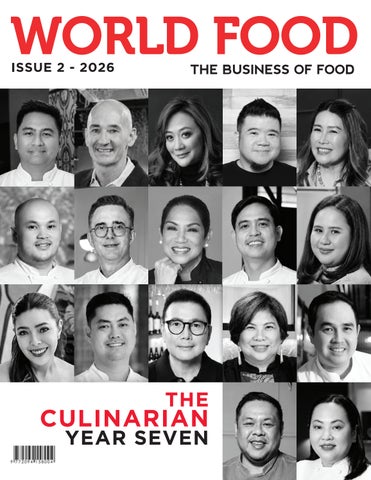
ISSUE 2 - 2026
THE
CULINARIAN
YEAR SEVEN
WORLD FOOD | CULINARIAN 7
3
A WORD FROM THE PUBLISHER Publishers: Boydee P. Dizon Joel B. Pascual Randy O. Manaloto Joel A. Nuñez
PEPTarsus Corp. 517 Protacio St., Pasay City info@peptarsus.com 0999-888-5000 (02) 8281-8700 (02) 8929-7993
Sales Group: Russel G. Cacho Paulo S. Domingo Cyrus B. Judan Ria B. Lugtu Roxanne P. Moriones Geraldine M. Soliman Chari A. Zarcal
Admin/Finance Group: Jolina D. Candano Ace D. de Guzman Ivory O. Espiritu Jolyn B. Enrile Melody Lim James P. Mendoza Michael R. Rabino Sharmaine E. Robielos Ricky D. Villanueva
Communications & Content Group: Cris C. Abiva James Antolin
Return of The Culinarian
It’s finally back! This issue of World Food Magazine marks the official return of our most successful series, The Culinarian. The multi-faceted world of food goes beyond tastes and flavors. More often, the people behind the food and the stories they carry are what pushes a cuisine from the ordinary to the extraordinary. As you go through the pages of this issue, be inspired by the stories of professional chefs, farm-to-table advocates, champions of Filipino cuisine, culinary educators, artisans, and entrepreneurs. There is much to be learned from their individual stories, their culinary journeys. We also pay tribute to one of the country’s culinary jewels, Chef Margarita Forés. We celebrate the exceptional career she had that transcended our own borders, raising the Philippine flag throughout the world. Gone too soon, her indelible legacy will forever serve as inspiration to generations of culinarians. On another note, despite the brewing chaos in and out of the country, we at World Food continue to be inspired by our WOFEX clients who remain unperturbed. We see them fighting to keep business going, even thriving amidst the adversities.
Laurent Dionisio Wilson Gicos Jayson E. Jardinero Harold Lu Kyle E. Roxas Rita Santiago
In exclusive partnership with
So, we ask our dear readers to continue supporting the foodservice industry by visiting any of the WOFEX editions throughout the year. In 2027, WOFEX Nationwide will be held in Clark, Cebu, Iloilo, Davao and two editions in Manila - WOFEX Drinks + Bakes and WOFEX Manila. In 26 years of doing World Food Expo (WOFEX), we find truth in the old adage that when the going gets tough, the tough get going! Happy reading!
Mode Devi Publishing: Publisher – Ana Manansala Editorial Consultant – Cesar Cruz Jr. Layout Artist – Jaydee Chun Editorial Assistant – Melany Simbul Marketing Associate - Jennilen Bayas Digital Assistant - Joanna Garingarao Social Media Associate - Patricia Malicse
2
WORLD FOOD | CULINARIAN 7
Joel Pascual
WORLD FOOD | CULINARIAN 7
5
IN THIS ISSUE
PINOY CUISINE ADVOCATES
PINOY CUISINE ADVOCATES
6-17
LTB CHEFS
18-33
Promoting the Filipino Culinary Professional
Vanguards of Local Food and Culture
FARM2TABLE
SPECIAL FEATURE 36-39
FARM2TABLE CAMPAIGNERS
40-48
Championing Sustainability and Local Ingredients
A Giant Paella for a Worthy Cause
PINOY ARTISANS
CULINARY ICON
34-35
Remembering Chef Margarita A. Forés
CHEF EDUCATORS CHEF EDUCATORS 49-56
Mentoring Culinarians of the Future
VENUE PARTNERS FOR PICTORIALS: • Enderun Extension - Enderun Design & Innovation Campus 2/F Estancia Mall, Pasig City • Sheraton Manila Hotel Andrews Avenue, Newport World Resorts, Pasay City • Ikomai Tochi ACI Group Building, 147 H.V. dela Costa, Makati City PHOTOGRAPHERS: Paolo Banal, Christian dela Cruz, Renjie Tolentino FOOD STYLISTS: Pauline Miranda, Joel Navarro, Jerome Tamayo
PINOY ARTISANS
57-68
Creating Food Products Uniquely Filipino WORLD FOOD | CULINARIAN 7
5
PINOY CUISINE ADVOCATES
6
WORLD FOOD | CULINARIAN 7
HOW FILIPINO FOOD STAYS WITH US For Chef Reggie Aspiras, preserving Filipino food begins with knowing where it comes from.
WORLD FOOD | CULINARIAN 7
7
S
he has never seen Filipino food
One familiar question has stayed
consulting, yet she has never spoken as
as something to be catalogued
with her through the years …
though she built that career on her own.
or kept behind glass. It belongs
“Kumain ka na ba?”
Every recipe, she believes, reflects the
where it always has—in family kitchens,
work of those who came before it—from
around crowded tables, at neighborhood
Most Filipinos hear it almost every
home cooks and farmers to market
gatherings, and in the routines that
day. For Aspiras, it has never been
vendors and elders who kept traditions
naturally hold everyday life together.
just another greeting. On the surface,
alive simply by practicing them. She has
Over the years, she has returned to the
it asks whether someone has eaten.
remained a willing student throughout
same belief: If you want to understand
More often, it is another way of asking
her career, convinced that everyone she
Filipinos, pay attention to the meals they
how that person is doing. It offers
meets has something to teach her.
prepare, the tables they gather around,
concern without making a fuss.
and the memories those meals carry.
Sometimes a simple meal says what
That openness has allowed her to move
“I believe that people of this generation
conversation cannot.
comfortably between classical culinary training and lessons learned in Filipino
should know our roots, where we came from, who we are, through what we eat,”
Another idea she often returns to is
homes. She sees no reason to place one
Aspiras observes.
ginhawa. She describes it as more
above the other.
than comfort. It is the feeling that She says it plainly, without trying to
settles in after eating something
The same outlook shapes the way
make it sound profound. To her, food
familiar, something that eases both
she teaches. Passing on knowledge
is more than a reflection of culture.
body and spirit. Those lessons never
matters more to her than asserting
It is one of the places where culture
came from recipes or classrooms. They
authority. Every new interpretation of
naturally takes shape.
grew out of everyday life—one shared
Filipino cuisine, she believes, should
meal after another.
acknowledge the traditions that came
That belief comes to life through
before it.
the Philippine Heritage Kitchen, the
Even when her father served as
platform she founded to celebrate
Secretary of Tourism, the family’s dining
The same philosophy guides the advice
regional cooking and the stories built
table remained the easiest place to
she gives restaurants. Rather than
around it. Rather than searching for
welcome visitors. Guests from overseas
urging them to follow a single formula,
a single definition of Filipino cuisine, it
often found themselves sharing a meal
she encourages them to understand the
embraces the country’s many culinary
before any formal discussions began.
story behind every dish. Place matters. Memory matters. Knowing why a recipe
traditions. Every province contributes something different. Every family
“Food always made people comfortable.
exists is often just as important as
cooks in its own way. Together, they tell
It allowed people to talk, to settle things,
knowing how to prepare it.
a story far richer than any single dish
to laugh,” she reminisces.
Adobo is a good example … “Adobo is
or recipe ever could. Years later, she found herself seeing
collective. It is ours.”
She learned that lesson long before food
much the same thing while working
became her profession.
with embassies and international
Every household has its own version.
organizations. Many foreign guests
Some are darker, some lighter. Some
Growing up, her family’s kitchen was
arrived with only a passing knowledge
lean toward vinegar, others toward
where people naturally gathered. Pots
of Filipino cuisine. They often left
soy. None of that troubles her. Those
simmered on the stove while relatives
surprised by its depth after tasting
differences are proof that Filipino food
wandered in and out. Lunch stretched
dishes rooted in different regions,
has always belonged to the people who cook it.
into merienda, and visitors rarely left
prepared with local ingredients and
without eating. Whether it was
shaped by family traditions. Rather than
a birthday, an ordinary weekend, or
trying to persuade them, Aspiras simply
Her work has also reached beyond
an unexpected visit, life somehow
allowed the food to speak for itself.
restaurants and television. After Typhoon Yolanda, she joined volunteer
found its way back to the table. Nobody announced that food
Her work has taken her through
kitchens preparing meals for displaced
mattered. It simply did.
publishing, television, teaching,
families. Under those circumstances,
restaurant kitchens, and food
food was no longer about presentation
8
WORLD FOOD | CULINARIAN 7
or technique. It offered comfort and restored a sense of routine, reminding people they had not been forgotten. Whether developing products or documenting regional recipes, the principle remains the same: Food makes the most sense when it stays connected to the people and places that shaped it. She also challenges the notion that Filipino cuisine is defined only by rich or heavy dishes. To her, the country’s culinary identity is far more varied, shaped by regional traditions, the ingredients available in different places, and generations of cooks who have kept those traditions alive.
Photo credit: Stan Ong
For Aspiras, preserving Filipino food begins with knowing where it comes from. Once that connection is kept alive, recipes can continue to evolve without losing the character that made them worth passing on. Families will adapt them in their own kitchens, and younger cooks will leave their mark in time. That is simply how Filipino food continues from one generation to the next.wf Cesar Cruz Jr.
Photos courtesy of Chef Reggie Aspiras The recipe she is sharing is from her forthcoming book with Ige Ramos - Savoring Sunshine: Key Concepts in Philippine Gastronomy. “Bamboo or buho (young bamboo) as a cooking vessel lends its natural sweetness, herbaceous, green, fresh and earthy characteristics to the dish. Cooking it on an open fire adds another distinct layer of flavor – smokey, woody… delicious!”
SINAING NG MANOK WITH GINGER FLOWER SAUCE 1 large-sized buho 1.5 kilo chicken ¼ cup patis 1 pc. sayote 4 stalks lemongrass 20 grams ginger Torch ginger, slivered (optional) 1 teaspoon whole peppercorns Rice washing, chicken stock or water
Ginger Water: 3 tablespoons grated ginger ½ cup water ½ teaspoon salt 1 pc. scallion 20 grams ginger 1 tablespoon torch ginger, slivered (optional) Condiments: Patis Kalamansi Siling labuyo
1. Cut one side of the buho open. 2. Wash the chicken and cut into medium-sized pieces, then marinate in patis. 3. Peel and cut sayote into medium pieces. 4. Bruise the stalks of lemongrass, peel the ginger and slice into thin strips. 5. Layer buho alternately with lemongrass, ginger, torch ginger, chicken, sayote, torch ginger and peppercorns. 6. Pour enough rice washing, chicken stock of water to the level of the ingredients inside the buho. 7. Roll banana leaves to the thickness of the buho’s opening. Push leaves down as you would a cork on a wine bottle to seal. 8. Cook top-side up on an open fire for 45 minutes to an hour, turning every so often to even out the cooking. 9. For the dipping sauce, combine ingredients in a bowl and mix well. Serve with the Sinaing na Manok. WORLD FOOD | CULINARIAN 7
9
He can be unconventional in his ways, choosing the path less traveled. But for Chef Sharwin Tee what matters most is what he is able to accomplish— and how it can benefit others.
10
WORLD FOOD | CULINARIAN 7
THE ONE DISH THAT I CAN EAT EVERY SINGLE DAY IS
MY 3 MUST-HAVE COOKING/ BAKING UTENSILS ARE:
FOR A POTLUCK, I WOULD BRING
W
atching the cooking show,
Coming home, he worked his way up
Filipino dining offering pop-up events
Wok with Yan, at age
in the industry—working at the Tower
here and in the U.S.
six made Tee dream of
Club, running The Quirky Bacon—his
becoming a chef. “I was fascinated with
own restaurant, doing consultancy
He has just finished an eight-month long
the idea that you can entertain and
work, demos, and seminars for top
pop-up stint at BGC where he offered
hold an audience mesmerized just by
brands, and working as personal chef
the first-ever Tsinoy tasting menu, titled
cooking,” he says. In hindsight, he says,
and caterer. He really made his mark,
“Progress.” It included what he describes
he was most likely dreaming of being
however, as a chef on TV.
as ‘every dish a Tsinoy ate growing up.’
a TV chef and not a “chef” per se.
It’s a walk down memory lane, with the It started with him winning the reality
stories told through food.
As it is, things turned out better than
show Clash of the Toque-en Ones. The
expected. He eventually found himself
prize was getting to do his very own
Tee is focused on putting Tsinoy cuisine
as a real chef, and, as we know now,
show. Titled Curiosity Got the Chef,
on the culinary map, even possibly
a chef on TV as well.
Tee’s show ran successfully for several
getting it into the Michelin stage.
seasons. The show gave him Culinary school in Canada was not easy,
a reputation for adding his own quirky
What is Tsinoy? He helps us understand.
he says, and at one point he questioned
twists to local dishes.
The first part is the descriptor while the
his decision to study to be a chef. “The
second part is the noun, the English
work wasn’t glamorous, it was a lot of
Tee thrived in this milieu, parlaying
teacher in him says, thus Tsinoy is
peeling potatoes and grating blocks
the show into his first cookbook of the
Filipino with Chinese heritage. Tsinoy
of cheese,” he muses, but the rigorous
same title. He has since authored two
food is Chinese food cooked in the
training made him realize he was on the
more books titled, So You Want to Be
Philippines, ever evolving and growing.
right path. The light bulb moment came
a Chef? and The Gospel of Food. He has
It’s Filipino with Chinese influences. Tee
when he saw how the customers in the
hosted other shows since, is active on
says it’s just like our regional cuisines
restaurant were enjoying their food.
social media, and continues to indulge
but with no specific region as Tsinoys
That’s what being a chef is he realized—
his love for writing. All these has not
are spread all over the country.
preparing and serving food that people
stopped him from putting up his own
will enjoy—and that’s what made him
personal venture, Little Grace Dining,
He says it isn’t easy to define or
want to be one.
described as progressive Chinese-
categorize, that there is still a lot of WORLD FOOD | CULINARIAN 7
11
confusion as to which dishes are actually Tsinoy, that assimilation can be confusing because of the centuries-long relationship between the Chinese and Filipinos. “I want to keep working with historians to define clearly what Tsinoy food is,” Tee expresses. What was the verdict of Tsinoys on his degustacion? He happily relates that the meal was well-received and he got the highest compliments from grandparents who said, “It’s not bad.” While many may think that’s not exactly complimentary, Tee says for Tsinoys, that actually translates to “It’s great.” So, he is happy. This has been his most challenging work to date, he says, as he targets to achieve three things: give diners a unique dining experience while also learning about Tsinoy culture, to give Tsinoy cuisine a fine-dining feel, and to be able to donate to charity. Tee says, “My life has been pretty great so I want to give back, but I don’t want to just ask people for money.” He decided that the best way he knew to go about it was to provide a service, get paid, then donate to worthy causes. This is why a portion of his pop-ups’ earnings is donated to projects that benefit indigenous communities. The last frontier, as he calls it, is to find a permanent home where Little Grace can continue highlighting Tsinoy cuisine. An old home of a Tsinoy family would be perfect, he says, as Tsinoy food is tied to family. “This is my eternal work,” he says,
“hindi matatapos. There is still so much to learn and discover.” This is why he relishes talking not just with historians, but also family elders who have so many stories to share. “Little Grace will never stop telling stories about Tsinoy culture and Tsinoy cuisine,” he vows. wf Cris C. Abiva 12
WORLD FOOD | CULINARIAN 7
ROJAK-STYLE SALAD 1 block firm tofu 2 small cucumbers 1 small singkamas (jicama) 1/3 small pineapple 2 tablespoons crushed roasted peanuts Cilantro leaves for garnish 1-2 pcs. siling labuyo Dressing: 6 pcs. calamansi 2 tablespoons bagoong (sweet or spicy) 3 tablespoons muscovado sugar 1 tablespoon sukang Iloko 1. Slice the tofu into small cubes. Deep-fry until golden brown. 2. Slice the cucumbers, singkamas, and pineapple into medium chunks. 3. To make the Dressing: Juice the calamansi. Add the rest of the ingredients and blend well. 4. In a bowl, combine the vegetables and pineapple. Add as much dressing as you like and toss together. Add in the tofu cubes. 5. On a shallow bowl or plate, lay some lettuce leaves. Top with the tossed salad. Sprinkle with peanuts and garnish with cilantro and siling labuyo.
SOURCED FOR CHEFS Trusted by chefs. Proven in professional kitchens. Consistent in every service.
CHEF BRUCE LIM Sunny Farms Culinary Partner
YOUR TRUSTED FOOD SOLUTIONS PARTNER
W
alk into one of Chef Happy Ongpauco-
homes where time is short. The concepts differ in style
Tiu’s businesses and you could come away
because they were never meant to compete. All together,
with different impressions of Filipino
they diversify how Filipinos connect with their cuisine in
food. One visit might begin with heirloom recipes at
everyday settings.
Pamana. Another might center on a cup of rich tablea at Tsokolateria. On another day, Filipino flavors appear as
This approach has as much to do with Ongpauco-
frozen meals, catered celebrations, or desserts that recall
Tiu’s upbringing as it does with business. She grew
childhood afternoons. Each concept offers a different way
up around restaurants established by her parents, Rod
to experience Filipino food.
Ongpauco and Liberty Ilagan, where hospitality was simply how life was lived each day. There were guests
14
Her Happy Concept Group is a collection of restaurants
to welcome, kitchens that rarely stood still, and recipes
founded on a collection of ideas. Some preserve family
that had already earned the trust of generations. Those
recipes, while others reinterpret familiar dishes or
experiences gave her an understanding of restaurants
shape new occasions to enjoy them. While one extends
long before she thought seriously about owning
hospitality into private celebrations another reaches
one herself.
WORLD FOOD | CULINARIAN 7
Photos courtesy of Chef Happy Ongpauco-Tiu
A Life Built Around Filipino Food
While studying at the Culinary Institute of America,
kitchens. It offers guests a way to revisit one of the
she spent her days learning techniques from different
country’s best-known dishes without pretending there
culinary traditions. Instead of pulling her attention away
has ever been only one way to prepare it.
from home, everything she learned brought her back to it. Guests often begin talking about the adobo they grew “Being exposed to different cuisines made me appreciate
up eating. Many compare it to a parent’s recipe or recall
the depth, diversity, and stories behind Filipino food,”
relatives who insisted theirs was the only correct
she says. “That’s when I felt a responsibility not only to
version. The conversations are rarely about technique.
continue what I inherited, but also to contribute to its
They are about people—their preferences, their histories,
evolution and introduce it to a new generation of diners.”
their recollections.
That realization explains why none of her restaurants feels like a copy of another.
Those moments reaffirm something she has learned over years in the business: Restaurants do more than
Pamana—aptly meaning “inheritance”—keeps heirloom
serve food. They give people reasons to reconnect with
cooking as its center because she believes some recipes
experiences they thought had faded, often through
deserve to be passed on exactly as families remember
memory, conversation, and shared experience.
them. Tsokolateria revisits Philippine cacao beyond the dessert course, reminding diners of an ingredient with
For her, that understanding eventually extended beyond
a long history in local kitchens. Dear Happy plays with
the dining room.
familiar sweets without losing the flavors people grew up with. She also runs Le’Chon, Bento Box, and Mom Made.
Several years ago, she started the Pangkabuhayan
The restaurants may wear different faces, but they
livelihoods of their own. Every month, two team
speak the same language. That same philosophy guides
members receive support and guidance to launch small
how Ongpauco-Tiu decides whether a traditional dish
businesses. One participant began with a modest mami
should be kept true to its histories, or tweaked to be
cart. Over time, it expanded into four branches, giving the
better appreciated.
family not only a steadier income, but also the confidence
Project, an initiative that helps employees build
that came with building something independently. For “It always starts with respect,” she says. “If the essence of
her, that success belongs in the same conversation as
the dish remains intact, then I feel comfortable exploring
any of her new restaurant openings. Hospitality, in her
new presentations, techniques, or flavor combinations.”
view, should improve lives on both sides of the table, not
She does not see tradition and innovation as opposing
just for guests but for employees as well.
forces. One gives the other something worth building on, or protecting for all time.
After nearly three decades, Ongpauco-Tiu still believes Filipino cuisine deserves greater regard from Filipinos
Adobo illustrates the point best. Like many Filipinos,
themselves. “We don’t need to compare ourselves with
she once regarded it as an ordinary dish, something
other cuisines to appreciate our own,” she says. “Filipino
so familiar it rarely invited closer attention. Working
food has a rich history, incredible ingredients, and unique
on Pamana changed that assumption. Conversations
flavors that deserve to be celebrated.”
with cooks, families, and diners revealed something she had overlooked: Almost everyone carries a different
Looking across everything she has built over time, one
version of adobo in their memory, and each version feels
realizes that none of her concepts were created to simply
completely authentic to the person telling the story.
add another restaurant to the market. Each was designed to respond to a different moment in Filipino’s lives while
The recipe changes from household to household. The
celebrating a cuisine that is ours, that is familiar—and
attachment to that quintessential dish does not.
that is very comforting. Ongpauco-Tiu suggests that preserving our food is not about freezing it in time. It is
That discovery eventually found its way onto Pamana’s
about ensuring it continues to find a place at today’s table
menu through the Three-Way Adobo. Rather than
whatever form that table takes, across changing daily
arguing for a definitive version, the dish acknowledges
routines and settings.wf Cesar Cruz Jr.
that Filipino cooking has always evolved inside family WORLD FOOD | CULINARIAN 7
15
PALITAW MOCHI WITH PANUTSA ICE CREAM As a Filipino chef, I have always believed that our local desserts deserve the same recognition as the world’s finest pastries. This dessert reimagines one of the Philippines’ most nostalgic merienda favorites – Palitaw – by elevating it into a contemporary plated dessert while preserving the flavors that generations of Filipinos have grown up with. A soft coconut-infused glutinous rice dough wraps around homemade Coconut Panutsa Ice Cream and is finished with warm Panutsa Caramel, Toasted Bicol Pili Nuts, Coconut Chantilly Cream, fresh young coconut, and a delicate Annatto Tuile Crisp. Coconut Palitaw Mochi: 1 ½ cups glutinous rice flour 1 can (400ml) coconut milk ½ cup coconut milk ½ cup white sugar ½ can sweetened condensed milk Homemade No-Churn Coconut Panutsa Ice Cream: 250 ml coconut cream 80 grams panutsa, finely grated 500 ml heavy whipping cream, chilled 1 can (300ml) sweetened condensed milk 1 teaspoon vanilla extract ¼ teaspoon fine sea salt Annatto Tuile Crisp: 80 grams water 30 grams vegetable oil 10 grams all-purpose flour ½ teaspoon annatto powder or annatto oil Pinch of salt Panutsa Drizzle: 100 grams panutsa 60 ml coconut cream 20 ml water Pinch of sea salt Toasted Pili Nuts: 100 grams pili nuts Pinch of sea salt Coconut Chantilly Cream: 250 ml heavy whipping cream, chilled 100 ml coconut cream, chilled 35 grams powdered sugar 10 grams coconut milk powder (optional) ½ teaspoon vanilla extract Pinch of fine sea salt 16
WORLD FOOD | CULINARIAN 7
1. To prepare Coconut Palitaw Mochi: In a mixing bowl, combine glutinous rice flour, coconut milk, sugar, and condensed milk. Whisk until completely smooth and free of lumps. Heat a non-stick pan over low to medium-low heat. Pour the mixture into the pan. Stir continuously using a silicone spatula. Cook for 8-10 minutes until the mixture thickens into a smooth, elastic dough that pulls away from the sides of the pan. Transfer onto a clean tray and allow to cool for 20 minutes. Portion into twelve 40 gram pieces. 2. To prepare Coconut Panutsa Ice Cream: In a small saucepan over low heat, combine the coconut cream and grated panutsa. Stir until panutsa has completely dissolved. Remove from heat and cool completely.
In a chilled mixing bowl, whip the heavy cream to medium-stiff peaks. In a separate bowl, combine the cooked coconut-panutsa mixture, condensed milk, vanilla extract, and sea salt. Gently fold the whipped cream into the coconut mixture in three additions until fully incorporated. Transfer into a freezer-safe container and cover tightly. Freeze for at least 8 hours or overnight. 3. Before assembling, allow the ice cream to soften for 2-3 minutes. Portion into twelve 35 gram scoops and return to the freezer. 4. To prepare the Annatto Tuile Crisp: Whisk all ingredients until smooth. Heat a non-stick pan over medium heat. Pour approximately one tablespoon of batter into the pan. Allow bubbles to form and completely disappear. Continue cooking until crisp and lightly golden. Remove and drain on paper towels. Cool completely before storing in an airtight container to maintain crispness. 5. To prepare the Panutsa Drizzle: Combine all the ingredients in a saucepan. Cook over low heat until smooth and glossy. Stir continuously to prevent scorching. Remove from heat and allow to cool slightly before serving.
6. To prepare the Toasted Pili Nuts: Toast the pili nuts over medium-low heat. Stir continuously until lightly golden and fragrant. Season with sea salt. Cool completely. Roughly chop before serving. 7. To prepare the Coconut Chantilly Cream: Chill the mixing bowl and whisk attachment for at least 15 minutes. Combine all the ingredients in the chilled bowl. Whip until medium to stiff peaks form. Transfer to a piping bag fitted with a large star tip. Refrigerate until ready to use. 8. To Assemble: Flatten one portion of Coconut Palitaw Mochi into a thin round disc. Place one scoop of Coconut Panutsa Ice Cream at the center. Carefully wrap the dough around the ice cream until completely sealed. Smooth the surface gently. Freeze immediately until firm. 9. For Final Plating: Place a coconut shell slightly off-center on a plate. Spread freshly grated young coconut inside the shell. Place the frozen Coconut Palitaw Mochi at the center. Sprinkle with toasted pili nuts. Drizzle warm panutsa caramel over the dessert. Pipe rosettes of Coconut Chantilly Cream beside the mochi. Insert the Annatto Tuile vertically for height. Garnish with freshly grated young coconut wedges. Serve immediately. WORLD FOOD | CULINARIAN 7
17
18
WORLD FOOD | CULINARIAN 7
A Force to be Reckoned With She was all set to follow in the footsteps of her grandfather and father, an ambassador and military attaché, respectively. But the kitchen beckoned.
WORLD FOOD | CULINARIAN 7
19
W
orking almost ten years
teaching and representing the school
high-performance kitchens churning
in high-stake jobs in
in competitions like the Philippine
out thousands of meals daily.
Singapore has certainly
Culinary Cup (PCC). She had her first
toughened Chef Mia Yan. But more
taste of international competition at
It was tough work but she proved
importantly, it proved that her decision
FHA Singapore in 2010, where she took
herself. The struggle was real. It was
to become a chef was one of the best
home a silver medal in the Individual
day in and day out of battling being
she has ever made.
Display category. She is grateful for
a foreigner, a female at the top of the
the support given to her by Chef Ariel
totem pole, earning a bigger paycheck
She had finished her degree in
Manuel and his wife Mia. Yan says,
than locals, missing family and friends.
International Studies when a friend
“I realized it was hard work. Mahirap
It helped that she had her son with her.
told her about CCA (Center for Culinary
pala, you need to be well-prepared.”
“My son and I both grew up,” she says of
Arts Manila). She had always been
The experience lit a fire in her and she
the decade stay.
interested in cooking—always tagging
continued to vie and win in local and
along with her mom on her catering
international contests. In 2016, she was
By 2024, her son had finished school
jobs. It was a pull she just couldn’t
part of the victorious National Team
and she felt ready to come home. “When
resist, so she wrote to her father saying,
Philippines that won Best Culinary
you’ve done all you can, when you’re no
“Pops please send me to school again—
Establishment at FHA in Singapore.
longer happy, then it’s time to go home.”
Today, she finds herself on the other
Upon her return to Manila, she took
side of the table—a judge instead
on the job as Executive Sous Chef of
In culinary school, Yan says, “I
of competitor. As a WACS (World
Chef J Gamboa’s Tsukiji. It’s a smaller
immediately felt that this was what
Association of Chefs’ Societies)
operation than she’s used to but it keeps
I wanted to do.”
Continental judge, she has been a jury
her busy and she is happy. Being here
member at major culinary competitions
also gives her more time to be active
She followed in her mother’s footsteps
in South Korea, Thailand, Indonesia,
with LTB Philippines Chefs Association,
and went into catering. Yan would later
Maldives, and the Philippines.
where she’s part of the Board of Trustees
culinary school.” Perhaps he sensed she was on the right path, so he acquiesced.
find herself at MIHCA (Magsaysay Institute for Hospitality & Culinary Arts)
and to serve as advisor for PYCC Having spent almost ten years working
(Philippine Young Chefs Club), the
abroad, Yan is no stranger to the
youth arm of LTB Phils.
culinary scene in Asia. In 2016, she was given the opportunity to work in
Being part of PYCC is especially exciting
Singapore. The job required her to go
for her as she enjoys working with
there for a trade test—an audition, if you
the young chefs thru the caravans
will. So, she got her competition ‘maleta’
and university partnership activities.
ready and hauled it to the Lion City. She
“This is one of the ways I can give
landed the job and she credits it to her
back, because once upon a time a lot
preparedness for the trade test. “It was
of people also helped me.” Her advice
an aha moment,” she muses, “that all
for upcoming culinarians “You need to
the things I learned while preparing for
study, to learn the discipline of going
competition was leading to this.”
to work every day, to learn the proper techniques, and the value of having
Looking back, she says it was the
mentors. Attitude is important in our
perfect opportunity for her and her son,
line of work, it’s not all talent and skills.”
who wanted to study abroad. Yan is back for good, in a smaller
20
WORLD FOOD | CULINARIAN 7
She worked her way to the top in
kitchen where she can do the most
the highly competitive institutional
good. She is free to do what she wants—
catering industry, with companies like
be it judging, mentoring, or competing.
the Compass Group and Smorgasbord
She welcomes each day with a smile
International Pte. Ltd. She rose to head
because she knows this is where she is
chef and chef manager, commanding
meant to be. wf Cris C. Abiva
THE ONE DISH THAT I CAN EAT EVERY SINGLE DAY IS
GIVEN A CHANCE, THE CHEF I WOULD LIKE TO COOK FOR IS
FOR A POTLUCK, I WOULD BRING
PAN-SEARED TOFU STEAK WITH KATSUOBOSHI CROWN, KAIWARE & ONION JULIENNE 1 (300-400 grams) block firm tofu 2-4 tablespoons cornstarch, for coating Any neutral oil, for pan-frying Radish kaiware Julienned onions Katsuoboshi Mirin Glaze: 2 tablespoons soy sauce 1 tablespoon mirin ½ teaspoon cornstarch 1 teaspoon water 1. Pat tofu with paper towel until very dry. Cut into 2-inch thick steaks. 2. Coat lightly with cornstarch, shake off any excess. 3. Heat a thin film of oil in a nonstick pan over medium-high heat. Fry until golden brown and crisp, 3-4 minutes per side. 4. To make the Mirin Glaze: In a saucepan, combine soy sauce and mirin and bring to a simmer. Disperse cornstarch in water to make a slurry. Add to the saucepan and cook for 2-3 seconds until glossy. 5. Arrange the fried tofu on a plate. Spoon over the mirin glaze. 6. Top with radish kaiware and julienned onions. Crown with the katsuobushi. 7. For added richness, finish off with a fine drizzle of Japanese mayo (optional).
WORLD FOOD | CULINARIAN 7
21
LIVING HIS DREAM 22
WORLD FOOD | CULINARIAN 7
He describes his work as “very fun,” and from the twinkle in his eyes, you know that he is having the time of his life.
C
hef Sonny Mariano knew he
a restaurant consultant advising
things just don’t work with certain
wanted to be a chef since he
business owners on management
clients. “I tell them that maybe I’m
was a young child watching
aspects like costing, kitchen layout,
not the consultant for them. I don’t
cooking shows on TV. After culinary
inventory management, kitchen
like wasting both our times, so I am
school, he knew exactly what kind
training, and the like.
honest with them,” he says. Mariano
of chef he wanted to be. “I always
even recommends other consultants,
wanted to be a chef consultant, gusto
He is currently working on 18 projects!
if needed. He never burns bridges and
ko iba-iba ang ginagawa,” he says.
Each project can run from two to
always keeps things professional.
He did, however, work his way first
three months with each one requiring
through hotels and restaurants to gain
the development of several recipes—
He is happy as a clam with his line of
experience and hone his skills.
ranging from about 45 to over 100
work—fully enjoying the perks of being
recipes, depending on the type of
able to manage his own time and being
It is not the first time Mariano is
operations. Clients are lucky because
able to choose what projects to work
gracing the pages of The Culinarian—
Mariano can cover savory, pastry,
on and whom to work with. He is still
it’s actually the third time. The first
desserts, up to beverages.
thrilled to see his recipes in menus all
time was when he was a new chef
over town and still excited to keep on
navigating the world of culinary
His client list is impressive, he has
developing new flavors for Selecta Ice
competition and the second time
worked with chain restaurants,
Cream, eight years running.
was in 2019 as one of the top
established brands, new concepts,
gold medal winners of the
restaurant groups, foreign brands,
The heavy demands of his R&D work
Philippine Culinary Cup (PCC).
celebrity-owned establishments, you
have not stopped him from doing demos
name it. He enjoys the work because
and workshops, collaborations with
He has become an old hand at
it is never the same. “Doing the same
other chefs for pop-ups, and taking
competition—skilled and seasoned. His
thing, day in and day out, is not for
part in the activities of LTB Philippines
younger self may have made missteps
me,” says Mariano. He is challenged by
Chefs Association.
which could have cost him medals,
the varying needs of his clients, by the
but he learned to be calmer, more
palates that he has to please, by how to
measured and prepared, to the point of
convince owners to his way of thinking,
being even analytical.
and how to think outside the box.
These same traits are what has made
With so many clients and so many
him effective as the chef consultant he
recipes that need to be developed,
always wanted to be.
doesn’t he run out of ideas? He says he just has to find ways to continuously
What does he do exactly? He is
stimulate his creativity—like eating
primarily a product development chef,
out, going online, or traveling. Asked
developing concepts, menus, and
about other challenges of his chosen
recipes for clients. He is also
line of work, he says that sometimes
THE ONE DISH THAT I CAN EAT EVERY SINGLE DAY IS
MY 3 MUST-HAVE COOKING/BAKING UTENSILS ARE:
MY FAVORITE REALITY COOKING SHOW IS
WORLD FOOD | CULINARIAN 7
23
He is tireless and constantly on the
Talking about his work as consultant
What’s next for him? More recipes
go. But one thing he has learned
gave him pause. Sometimes, he
and menus to develop, as his client
through the years is how to delegate
says, he still can’t believe that he
list continues to grow. Maybe open his
and trust. “I was doing everything
has achieved his dream. “I had a lot
own restaurant in the future. Travel to
when I started—from conceptualizing,
of anxiety before, daming iniisip.
more places to savor unique flavors.
to marketing, cooking, and cleaning
Pinagdadasal ko ito dati pa pero hindi
Continue to vie for gold medals in
up,” he relates. Today, he works with
ganito kalaki. Minsan naiiyak ako
international competitions. Maybe,
a team and has a full-time sous chef.
when I realize na sinagot ng Diyos ang
even, find himself being watched
Having a team means more work can
mga dasal ko.”
on TV by a young child dreaming of
be done and faster. It also leaves him
becoming a chef … one day.
time to pursue his other interests.
wf Cris C. Abiva
ALIMASAG AT KALABASA 50 grams Ginataang Kalabasa puree 3 pcs. spring roll tubes 45 grams Alimasag Salad 6 grams orange ebiko 3 grams spring onions Malunggay leaves, for garnishing Ginataang Kalabasa: 15 grams minced red onions 10 grams minced garlic 30 ml cooking oil 500 grams cubed kalabasa (squash) 100 ml coconut cream 1 gram white pepper 15 grams patis 250 ml shrimp stock Alimasag Salad: 450 grams alimasag (crab) meat 120 grams white onion, minced 3 grams salt 1 gram white pepper 150 grams mayonnaise 90 grams Dijon mustard 1. To make the Ginataang Kalabasa: Sauté red onions and garlic in oil. Add kalabasa, coconut cream, white pepper, patis and shrimp stock. Simmer until kalabasa is soft. 2. Puree the cooked mixture. Transfer to a piping bag. 3. To make the Alimasag Salad: Combine all the ingredients in a bowl and blend well. 4. To Assemble: Pipe the kalabasa puree inside the spring roll tubes. Arrange on a plate. Top with Alimasag Salad, ebiko, spring onions and malunggay leaves. 24
WORLD FOOD | CULINARIAN 7
Knowing what you want is half the battle. Working hard to get it will win you the war.
Destined for
Great Things A
rvi-Christopher Agra, or AC as he is more commonly called, has fond memories of watching cooking
shows with his mom—from age five. “I grew up watching Cooking with the Dazas and the shows of chefs Fernando Aracama and Jackie Ang-Po,” he muses. It is no wonder that he always wanted to be a chef. After graduating with a degree in Hotel & Restaurant Management, he tried to get work in a cruise ship, but only entry level positions were open to those with no work experience. He thought about going to culinary school to learn to do what he has always loved. His mom told him, “Pag-ipunan natin.” One day, after taking his mom to the doctor for a check-up, they decided to drop by Global Culinary and Hospitality Academy. “Akala 26
WORLD FOOD | CULINARIAN 7
MY 3 MUST-HAVE COOKING/ BAKING UTENSILS ARE:
GIVEN A CHANCE, THE CHEF I WOULD LIKE TO COOK FOR IS
MY FAVORITE REALITY COOKING SHOW IS
ko magtatanong lang kami, but they enrolled me
Not one to choose the easy path, he took on
already.” He didn’t know that his parents had been
another big challenge when tasked with the role of
saving up for his tuition. That day, he cried all the
executive sous chef for the restaurant operations
way home.
of the Sydney Football Stadium and Sydney Cricket Ground—each holding a maximum capacity of
At Global, he found what he was looking for. He
45,000 people. Agra was in charge of a team of 150
took to it like a duck to water. He had read the entire
chefs and 100 kitchen hands. A year later, he was
Professional Cooking textbook by Wayne Gisslen
hired as executive chef of The Goodsline, a café of
even before classes started and applied himself to
hospitality veteran, Jack Hanna. There, he was able
learning everything he could. His mom bought him
to apply his fine-dining touch to a café set-up.
all the books that he needed, and more, and through it all, they both continued their TV watching
Agra lived in Australia for almost eight years before
ritual—adding the shows of Gordon Ramsay to
deciding it was time to come home.
their list of favorites. He returned to the Philippines in 2023 and found Agra earned his stripes working in local
a home at Chef Tonyboy Escalante’s Antonio’s
establishments before finding work abroad. In
Group of Restaurants. As corporate executive
2016, he was told about a job opening in Australia.
chef he handles the various concept restaurants
Out of the 24 Filipinos who had applied, two were
of the company including Antonio’s, Breakfast at
hired—he was one of them. He started as a commis
Antonio’s, Balay Dako, and Azela by Balay Dako.
assigned to peeling potatoes for two months. After
Antonio’s was the first Filipino restaurant to be
six months he was moved to fine dining as chef de
named in Asia’s 50 Best Restaurants back in 2015
partie. He was sous chef in a year’s time, a senior
and this year was lauded as a Michelin-Selected
sous chef in his second year and by his fifth year
establishment. With Agra’s vast experience, he
became head chef of Bathers Pavilion Restaurant,
is perfectly suited to helming the multi-awarded
a two-hat fine dining establishment in Sydney.
group of restaurants.
“Pinaghirapan ko ito,” he says. There is another facet to Agra’s culinary life Adjusting to a new environment can be difficult,
though, and that is his love for competition. His
but anyone who is serious about advancing one’s
first foray in the Philippine Culinary Cup (PCC)
career must learn to adapt, be open to learning, and
in 2010, as part of the team from Lyceum of the
be ready to jump into the fray. Agra says, “I needed
Philippines University, earned him a highest gold
to learn about the seasonality of ingredients so I
in the Filipino Cuisine category. In the succeeding
could design menus based on what was available.
years, he would continue to vie in various local
I visited the markets to learn about ingredients
and international competitions. As competitor or
that were unfamiliar to me. I had to learn different
coach, he would rack up medal after medal. At the
culinary styles, as Australia’s food scene is defined
2019 PCC, he took home seven medals. In 2023,
by a ‘no boundaries’ approach.” He is grateful for
he earned the highest gold at the Global Chef’s
the great help and support he got from his French-
Challenge Vegan Asian Finals. The following year
Canadian boss.
he competed in Singapore for the World Finals of WORLD FOOD | CULINARIAN 7
27
FLAT IRON STEAK WITH CHOY SUM, CARAMELIZED CAULIFLOWER AND SLOW-COOKED ONIONS 200 grams flat iron steak Salt and pepper, to taste Oil 10 grams butter 1 clove garlic 1 sprig rosemary
the same competition and won a silver medal. The year 2025 saw him coaching the team of Antonio’s at PGA to three highest golds, one gold, and one silver medal. He continues to be excited about competing as he says, “With every mistake, you learn and become better.” This highly-decorated chef, a proud member of LTB Philippines Chefs Association, says he plans to work for the promotion of modern plant-based cuisine in the country and to mentor and develop young local talents as his way of sharing what he has learned through the years.. wf Cris C. Abiva
28
WORLD FOOD | CULINARIAN 7
Cauliflower Puree: 20 grams butter 100 grams cauliflower 30 ml cream Salt and pepper, to taste
Choy Sum and Slow-Cooked Onions: 2 pcs. choy sum 10 ml olive oil 1 small white onion 50 ml beef sauce
1. To make the Flat Iron Steak: Season steak with salt and pepper. Heat a cast-iron pan. Add some oil. Sear the steak on both sides until well-caramelized. Add butter, garlic and rosemary. Baste steak with butter until cooked to medium. 2. To make the Cauliflower Puree: Melt butter in a pan. Add cauliflower and cook until browned. Add cream. Season with salt and pepper. Puree in a blender until smooth. 3. Blanch the choy sum in boiling water. Season with olive oil, salt and pepper. 4. Sear the onion in a hot pan, cook until soft. Season with salt and pepper. 5. Plate the steak with the cauliflower puree, choy sum, cooked onions and beef sauce.
A CHEF ON A MISSION
Maverick Javier is living up to his name—fearless and trailblazing like the film character he was named after and willing to push the envelope to achieve his goal.
I
n 2024, he wrote on his Instagram page, “Today, I am finally able to tick off that coveted item from my bucket list.” That item was his wish to win Best
Chef in the Philippine Culinary Cup (PCC), an award he finally won after nine years of participation that saw him earn 12 golds, 5 silvers, and 10 bronze medals in total. He, is Chef Maverick Javier, a gifted chef determined
to carve his own niche in the industry. “Cooking runs in my family,” he says. His grandmother used to run a carinderia while his father worked as a cook, first in a local restaurant then later aboard a cruise ship. While he knew he loved the kitchen, he chose to finish college first. Armed with a degree in Mass Communications, he worked for six years with one dream in mind—to save enough money for culinary school. When he had enough money saved, he enrolled at Global Culinary & Hospitality Academy, finally ready to realize his dream of becoming a chef. He was very excited and eager to start this new chapter, then quickly found that it 30
WORLD FOOD | CULINARIAN 7
wasn’t going to be a walk in the park. He
numerous and varied. That lit a spark
These do not, however, mean that he
immersed himself in his studies—pored
in him. He started competing at the PCC
has closed the doors on competing.
through the books, bought ingredients
in 2015 and in the succeeding years
and practiced the recipes at home,
would continue to practice and improve
In 2024, he was tasked to represent
honed his skills studiously, and learned
his skills. He says he started dreaming
the country at the Worldchefs Global
all he could from his chef instructors.
of winning chef of the year in 2015,
Chefs Challenge Finals in Singapore. It
inspired by Chef Kenneth Cacho. “I said
was his first international competition.
After his internship at Mama Lou’s he
to myself that one day my name will be
The following year, at the Worldchefs
was hired as a line cook and eventually
called for that award and I would go up
Global Chef Challenge Asia in Malaysia
rose through the ranks to become an
the PCC stage to receive it,” he recalls.
he earned a silver medal. He plans to
area kitchen manager. In 2021, Javier
continue on this path to gain more
found himself working for world-
He got his wish in 2024. With his family
experience in global competition, to
famous furniture retailer, IKEA, which
in the audience, Javier was crowned
earn recognition for the country, and to
had opened its biggest store in the world
Chef of the Year (COY) after earning four
continue to challenge himself.
at the MOA Complex. Here he was the
highest golds plus one gold, two silvers,
kitchen production team leader, a stint
and one bronze medal. He later wrote on
With his talent, competitive spirit, and
that taught him a lot about business
his social media post, “It took me nine
dedication there is no doubt that more
management. But there seemed to be
challenging years filled with doubts
international wins are in store for him.
something missing. “What else can I
and disappointments … the road to
As he said in his post after winning COY,
do?” he pondered. He needed an outlet
reach the goal was long and winding …
“I do not intend to rest on my laurels …
for creative pursuits.
heartbreaking at times … but it was also
Onward to the next impossible dream.”
beautiful, humbling, and inspiring.” It is easy to dream, but you need to work
Doing consultancy work paved the way for him to challenge his creativity and
“I’ve been blessed,” he says, “and I am
hard to make it happen. This maverick
versatility, particularly in R&D. He had
thankful to everyone who mentored
chef certainly knows that, and is ready to meet the challenge. wf Cris C. Abiva
previously worked with Chef Pauline
me.” He is paying it forward by doing
Benedicto of Mr & Mrs B restaurant in
the same for younger chefs. Rather
Davao and he would eventually be back
than competing himself at PCC, he now
in the company fold through Rekado
coaches. How does it feel to be in the
Global Food Solutions. The company
thick of competition but have to stay
is involved in industrial-scale meal
in the sidelines? He laughingly says
production, food service management,
he still needs to learn patience and
and commissary operations. Javier is
not let the stress levels frustrate him.
currently the corporate executive chef
Still another hat that he has donned
and is focused heavily on R&D.
in the realm of culinary competition is as a judge. Javier is a member of LTB
Culinary competition was another
Philippines Chefs Association and
arena he focused on to test his mettle
is currently a rookie judge for WACS
as a chef. Here, the challenges where
(World Association of Chefs’ Societies).
MY ALL-TIME FAVORITE COMFORT FOOD IS
MY 3 MUST-HAVE INGREDIENTS ARE:
IF I WERE NOT A CHEF, I WOULD PROBABLY BE A
WORLD FOOD | CULINARIAN 7
31
PORK BELLY HUMBA WITH MANGO CILANTRO SALSA & FRAGRANT HERB RICE PILAF Braised Pork Belly Humba: 700 grams boneless pork belly Salt and pepper, to taste 2 tablespoons cooking oil ¼ cup liquid seasoning 3 tablespoons white vinegar ¼ cup banana ketchup 2 pcs. star anise ¼ teaspoon ground cinnamon 10 cloves garlic, minced 3 stalks lemongrass, bruised 2 pcs. bay leaf ¼ cup brown sugar 2 tablespoons pre-cooked black beans 20 grams banana blossom Mango Cilantro Salsa: 1 pc. ripe mango, diced 3 pcs. red tomato, seeds removed and diced ¼ cup diced, seeded cucumber ½ pc. red onion, diced 1 pc. siling labuyo, thinly sliced (optional) 1 tablespoon cooking oil Salt and pepper, to taste 3 tablespoons chopped fresh cilantro Fragrant Herb Rice Pilaf: 1 tablespoon coconut oil 1 clove minced garlic 2 pcs. shallot, minced 2 teaspoons grated ginger ¾ cup white rice ½ cup coconut milk 1½ cups water 2 pcs. kaffir lime leaf 2 stalks lemongrass, bruised 2 pcs. pandan leaf Garnish: Fried garlic Spring onions, thinly sliced Cilantro, chopped
32
WORLD FOOD | CULINARIAN 7
1. To make the Braised Pork Belly Humba: Season pork belly with salt and pepper. Set aside. Set a large pot over medium-high heat. Add oil. Sear the pork belly until brown on all sides. Remove the pork from the pot. Add the remaining ingredients. Stir until sugar is dissolved. Add back the pork, skin-side up. Bring to a quick boil. Lower the heat and simmer partially covered. Cook until pork is fork-tender. 2. Remove pork from the pot. Cool before slicing. 3. Continue simmering the sauce until it thickens. Taste and adjust seasoning, as needed. 4. To make the Mango Cilantro Salsa: In a large bowl, put the diced mango, tomatoes, cucumbers and onions. Mix well. Add siling labuyo, if using. Dress the salsa with oil then season with salt and pepper. Add cilantro and mix well. Chill the salsa for at least an hour. 5. To make the Fragrant Herb Rice Pilaf: Set a pot over low-medium heat. Add oil. Sweat garlic, shallots and ginger until fragrant. Add rice, mix well so the rice grains are coated with oil. Pour in coconut milk and water. Give a quick stir. Add kaffir lime leaves, lemongrass and pandan leaves. Cover the pot and simmer until rice is cooked. Once done, remove the leaves. Fluff the rice grains with a fork to release steam. 6. Transfer rice to a serving dish and garnish with fried garlic, sliced spring onions and chopped cilantro. 7. Arrange sliced pork belly on a plate. Glaze with the sauce and serve with salsa and rice pilaf.
We Bring Specialist Markets to Life 25 - 27 February 2026 World Trade Center Metro Manila
26 - 28 March 2026 Baguio Convention Center
16 - 18 April 2026 IEC Convention Center, Cebu City
21 - 23 May 2026 Atrium Limketkai, Cagayan De Oro
18 - 20 June 2026 SMX Convention Center, Davao City
17 - 19 June 2026 World Trade Center Metro Manila
24 - 26 June 2026 World Trade Center Metro Manila
24 - 26 June 2026 World Trade Center Metro Manila
24 - 26 June 2026 World Trade Center Metro Manila
23 - 25 July 2026 World Trade Center Metro Manila
23 - 25 July 2026 World Trade Center Metro Manila
29 July - 1 August 2026
11 - 13 November 2026 Waterfront Cebu City Hotel and Casino
11 - 13 November 2026 Waterfront Cebu City Hotel and Casino
24 - 26 February 2027 World Trade Center Metro Manila
17 - 19 March 2027 SMX Convention Center Manila
World Trade Center Metro Manila, SMX Convention Center Manila
Join our events! Contact our team for more information. infoPH@informa.com
+63 2 8581 1911
www.informamarkets.com
A Tribute to
Chef Gaita A. Forés Margarita “Gaita” Araneta Forés has left an indelible mark on Filipino culinary history. Many know her as a chef and restaurateur, but she was more than that.
T
rained in Italian cuisine by chefs in Rome, Milan, and Florence, she always acknowledged all that she also learned from watching ordinary Italian families prepare and cook
food. In 1997, she opened the first Cibo in Glorietta, a modern
caffe-paninoteca offering traditional Italian food. To date, there are 32 Cibo branches, including those in Cebu and Bacolod. She opened other restaurants thereafter, namely, Lusso, Grace Park, and Alta. Lusso is an elegant European-Italian chain described as ‘Old World Cuisine Meets Filipino Warmth.’ Chef Gaita missed seeing Lusso make it to the 2026 MichelinSelected List of the first Michelin Guide Philippines. Grace Park is a farm-to-table restaurant that features heirloom recipes while Alta is an upscale dining concept located at the Ascott BGC. Chef Gaita had many interests—many of them notably starting with the letter “F,” like her surname. She was in finance, fashion, food, and florals. She graduated magna cum laude with a double degree in Accountancy and Management and eventually became a Certified Public Accountant (CPA). She worked in the fashion industry in New York for the couture house of Valentino before the pull of food brought her to Italy. After finding her calling as a chef, she built a business anchored on catering, Cibo di M, and restaurant chains. Her success in 34
WORLD FOOD | CULINARIAN 7
catering gave birth to
Photo of Chef Gaita on cover is from cibo.ph Additional photos from the Margarita Forés Photo Archive
another business, Margarita Floralscapes which today is called Margarita Florals. Chef Gaita had the perfect personality for a culinary travel show with her fondness and wide knowledge on the two subjects. Her first show was called Harvest with
Margarita Forés, a 4-part series aired on CNN. She also hosted My Italy with
Margarita and The Crawl. Her last television appearance was as guest in the Manila episode of the Netflix show,
Somebody Feed Phil. Though she was well-known for her excellent Italian dishes and love for Italian food and culture, Chef Gaita was a proud Filipino first. She advocated for Filipino cuisine and local ingredients, supported the government in promoting Filipino culinary culture both here and abroad, and brought attention to sustainable agriculture and the plight of local farmers and fishermen. She was a co-author of the book Kulinarya: A Guidebook
to Philippine Cuisine with Glenda Barretto, Jessie Sincioco, Myrna Segismundo, Conrad Calalang, and Claude Tayag.
authentic Italian cuisine abroad.
Chef Gaita played a key role in
civilian honor bestowed by the
the country’s hosting of the first
Italian Republic.
This is the second highest
Madrid Fusion Manila in 2015. She and fellow chef, Myrna Segismundo, were the
In 2019, she was appointed United Nations World Trade
first Filipino chefs to present at the Madrid
Organization (UNWTO) Ambassador for Gastronomy and
Fusion congress in Spain. Their presentation
last year, Chef Gaita was posthumously conferred the
included a talk and demonstration on kinilaw.
Presidential Medal of Merit by President Ferdinand
This led to the congress being staged for the
Marcos, Jr. for services in the culinary field.
first time in the Philippines and the first time in Asia. It was followed by two more editions.
Chef Gaita will be missed, but her legacy will live
A very accomplished chef, entrepreneur, and
has touched. Her culinary stronghold is in the
on in the hearts of all the people whose lives she advocate, she has received top honors for her work. In
safe hands of her son, Chef Amado Forés, who is also
2016, she was named Asia’s Best Female Chef as part
making a name for himself with his own establishments—
of the Asia’s 50 Best Restaurant list—the first Filipina to
A Mano, Ramen Ron, and Steak & Frice. She will forever be
be honored as such. In 2018, she received the Cavaliere
remembered for her culinary and entrepreneurial skills, her
dell’Ordine della Stella d’Italia, or Order of the Star of Italy with the rank of knight for championing
selflessness, her love for country, and her unique style. wf Cris C. Abiva WORLD FOOD | CULINARIAN 7
35
SPECIAL FEATURE
FROM SAN SEBASTIAN TO TAGAYTAY – A JOURNEY OF FOOD AND LIFE Life has been good to Mikel Arriet, and he is sharing his blessings by paying it forward.
G
rowing up in one of the world’s most celebrated gastronomic destinations— San Sebastian in the Basque Country—
young Mikel would watch people as they cook and it made him want to be a chef. His father wanted him to choose another path but the stubborn son was set on this one. He trained at the Escuela Superior de
Hosteleria de San Sebastian then went on to work in notable places in Spain like Ibiza, Canary Island, Barcelona, and Cantabria. In 2004, his good friend, Alfredo Roca, invited him to come to the Philippines to promote Spanish food for the Spanish embassy. “I was looking for a change, so I said, yes,” he recalls. He has been here since. Arriet has found a second home in the Philippines, working for a management group that manages first-rate hospitality properties. Since 2018, he has been the General Manager of Anya Resort Tagaytay, a splendid retreat that is acclaimed for its elegant accommodations, excellent service,
36
WORLD FOOD | CULINARIAN 7
SPECIAL FEATURE and superior culinary offerings, that include Samira by Chele Gonzalez. Anya is a member of the Small Luxury Hotels of the World (SLH). His title may be GM but Arriet is a chef at heart. While management tasks may take most of his time, he will always answer the call of the kitchen. He will step in when the resort kitchens are short of hands, will work on developing recipes when needed, will cook a giant paella whenever he is called upon! Last February, he and fellow LTB Philippines Chefs Association members trooped to Bacolod to cook the biggest paella for the benefit of the Kalipay Negrense Foundation. It was the second Gigante Paella they did in Bacolod. It took 100 kilos of rice and 150 kilos of other ingredients (all from donations), and the combined hands of 20 chefs and culinary students. It was a spectacular vision that spoke of shared culinary culture, camaraderie, collaboration, and love for others. Arriet has been supporting the work of Kalipay for 17 years,
Photo credit (Chef Mikel and food shot): Joel Pascual
ever since his friend Alfredo introduced him to its president and founder, Anna Balcells. “The moment I arrived and stepped inside the house, what I saw were beautiful smiling children.
moving on. “I always come back to help because I believe in
Each child looking for a hug, looking for a little contact, just two
what they are doing,” he avers.
minutes of attention,“ he says. They did get his attention and he vowed to return and visit regularly.
On kids moving on, he says, “To say goodbye is an achievement.” A poignant statement of reality and acceptance.
Kalipay Negrense Foundation is a nonprofit working for the
It is one that will soon test him even more.
causes of disadvantaged children – homeless, abandoned, neglected, malnourished, physically and sexually abused,
Though he has been based here for more than 20 years, he
victims of child labor and trafficking and foundlings. They
goes back to Spain once a year to visit his family. His next visit
rescue children and give them shelter, food, education, health
will be a bit different as this time around he and his son, Jon,
care, and counseling. It was started in 2007 by Balcells and
will be scouting for a university – a good school where he can
some friends in Negros Occidental. Kalipay is Visayan for joy or
study computer science.
happiness, which is what Balcells hopes to bring to the rescued children’s lives.
Jon is his adopted son, placed with him when he was just four years old. It took nine years to legalize the adoption. It
The foundation houses about 170 children today, from infants
wasn’t easy, Arriet says, what with all the requirements, tests,
to teens below 18 years of age.
evaluations, and monitoring. “I wanted to be a father,” he says, “even more so after meeting Jon.” The two are inseparable, with
The work is never done, as even when the older children move
Jon patiently waiting as his dad cooked and was photographed
on to college or to live independently, there are always more
for the magazine. They are a family with their three dogs and
children needing help. Through his years of involvement with
two cats.
Kalipay, Arriet has seen two of his sponsored children move on. He is currently sponsoring two more children.
While work may take most of his schedule, Arriet will always make time to help when called upon, especially for a very
Doing the Gigante Paella is just one of the ways he continues
worthy cause – even if it means cooking an even larger paella
to support the foundation. He is there for fund-raising events,
than the last one! What better way to pay it forward than with
always ready to tell people about the work the foundation
a dish that best exemplifies him, the paella of his native land
does, and tries to be there for other special moments like kids
adapted to the flavors of his adopted land. wf Cris C. Abiva WORLD FOOD | CULINARIAN 7
37
SPECIAL FEATURE
CHOPITOS & JAMON PAELLA 3 tablespoons olive oil 100 grams Parma ham 150 grams chopitos (baby squid) 1 onion, diced 2 cloves garlic, diced 2 fresh tomatoes, grated 1 tablespoon sweet paprika 100 grams paella rice Water or chicken stock 100 grams edamame Salt to taste 1. Heat oil in a paella pan and sauté half of the ham and half of the chopitos. Add the onion and garlic. Cook slowly until softened. 2. Add the grated tomatoes and paprika. Cook until the tomato liquid has evaporated. 3. Add the rice and stir to combine with the other ingredients. Increase the heat. 4. Pour in water or chicken stock using a 2:1 ratio of stock to rice. Boil for 3 minutes, then lower heat. Add half of edamame. Simmer until cooked or finish the cooking in a preheated oven. Season with salt, as needed. 5. Before serving, top with remaining ham, chopitos and edamame. 6. Serve paella with aioli and lemon wedges.
MY ALL-TIME FAVORITE COMFORT FOOD IS
A DISH THAT REMINDS ME OF MY CHILDHOOD IS
38
WORLD FOOD | CULINARIAN 7
MY 3 MUST-HAVE INGREDIENTS ARE:
SPECIAL FEATURE
PAELLA GIGANTE BACOLOD 2026 Last February 28, 2026, for the second time in Bacolod, LTB Philippines Chefs Association cooked the biggest paella in the Philippines (11-foot diameter pan for 1000 portions) for the benefit of the Kalipay Negrense Foundation. In it was over 300 kg of Spanish olive oil, garlic, onions, peppers, chorizo, chicken, prawns, squid, mussels, rice and 250 liters of stock! This event took place at Villa Olivia in Talisay City, Negros Occidental. Consul General of Spain, Ignacio Sanchez Taboada was on hand and personally participated in the cooking of the giant paella. He praised the organizers and the attendees for continuing to support the foundation’s mission and cause. Special thanks to Chef Richard Ynayan and the culinary students of the Institute of Culinary Arts - De La Salle Bacolod who helped in the preparation and cooking of the paella. The LTB Professional Members who participated included: Mikel Arriet, Jerome Valencia, JA Ventura, J Gamboa, Fernando Aracama, Margarita Marty, Sito Senn, Mia Yan, Cherrie Uy-Tan, Alejandro Lazaro III, Anton Abad, Rommel Hinlo, OJ Gomez, Louie Vincent Chua, Sherwin Estrella, Ramona Olga Ko, Reyman Gapas, and Jeffry Sayo. Kalipay Negrense Foundation Inc. is a non-profit organization dedicated to helping disadvantaged children — those who are homeless, abandoned, neglected, malnourished, physically and sexually abused, victims of child labor and trafficking, and foundlings. The foundation is accredited by the Philippine Certified NGO Council (PCNC). For more information about Kalipay Negrense Foundation, you may check out their website at https://kalipay.org or contact them at +63917 700 2345. (Source: LTB Philippines Chefs Association website)
WORLD FOOD | CULINARIAN 7
39
FARM2TABLE
40
WORLD FOOD | CULINARIAN 7
BEFORE THE MENU
PRACTICE WHAT YOU PREACH IS SOMETHING SHE LIVES BY, AND BY DOING SO, SHE IS ABLE TO HELP UPLIFT OTHERS.
C
hef Waya Araos-Wijangco rarely starts with a recipe. She starts by understanding a place. “I
always go to the market first. Before the menu, before anything—I need to understand the place,” she relates, all bright-eyed. Whenever she visits a new destination, her first stop is the public market, where farmers unload freshly picked vegetables, fishermen sort the day’s catch, and vendors know exactly which produce is in season. She walks the aisles without rushing, asking about unfamiliar ingredients while paying attention to what people actually buy. Before planning a menu, she wants to understand the community and how people eat. That habit has shaped her career, whether she is running Gypsy Baguio by Chef Waya or consulting for restaurants around the country. Rather than arriving with a fixed concept, she looks for what already defines how a community eats. She pays attention to the ingredients and the people behind them because they often reveal what makes a place’s food unique. The palengke is only the first step. Wherever she travels, Araos-Wijangco also makes time for the neighborhood’s carinderia. These modest eateries rarely appear in travel guides, yet she considers them among the best places to understand regional cooking. “Carinderias [sic] are repositories of regional cuisine. That’s where you really taste where you are,” the chef explains. WORLD FOOD | CULINARIAN 7
41
Unlike restaurants that constantly
In Vietnam, Malaysia, and Indonesia,
for appearance. “Farm-to-table is not
reinvent themselves, a carinderia
she encountered ingredients that also
just a label. The real question is: How
cooks for regular customers who
grow in the Philippines but are used
much of the farmer’s harvest are you
come back because the food tastes
differently. Torch ginger flower, for
actually willing to take—and use?”
familiar. Recipes survive through
instance, appears regularly in everyday
she challenges.
repetition rather than reinvention.
cooking across Southeast Asia, yet
A stew simmering since morning or
to many Filipinos, it is an unfamiliar
For Araos-Wijangco, supporting local
vegetables prepared the way local
ingredient. She noticed that same
agriculture means more than buying
families have cooked them for years
pattern with wild greens growing along
nearby. It means recognizing value
can reveal more about a region than
roadsides and farms. In neighboring
beyond cosmetic perfection. Once
an elaborate tasting menu.
countries, they are harvested and
vegetables are chopped, roasted, or
cooked. In the Philippines, many are
folded into a dish, few people can tell
This same approach guides her
overlooked because the people do not
whether they started out perfectly
consulting work. Before discussing
recognize their value.
shaped. Choosing only the most
food cost or menu engineering, she
attractive produce leaves behind food
watches how people eat. She looks at
During one visit to a farm in Benguet,
that is actually good enough to eat, yet
which ingredients are abundant and
Araos-Wijangco noticed edible shoots
goes to waste.
what dishes keep customers coming
that farmers routinely pulled out and
back. She also pays attention to how
tossed because they were considered
That is one reason she encourages
home cooks make the most of what
weeds. Curious, she cooked them
chefs to think beyond recipes. Every
is available. Those observations help
without disguising what they were.
purchasing decision affects the
restaurant owners build an identity
The farmers who tasted the dish came
farmers and workers who produced
rooted in local ingredients and eating
back for seconds. It was the same
those ingredients.
habits, instead of one borrowed from
“weed” that was habitually discarded,
somewhere else.
but she managed to change how people
Her advice to aspiring restaurateurs is
viewed it.
equally practical. Many of them dream of opening a restaurant because they
Years of traveling across Southeast Asia have reinforced this practice.
Experiences like that deepened her
enjoy cooking. She reminds them that
concern about food waste. Diners
the profession demands much more
usually see only the vegetables
than creativity over the stove. “You
that reach markets and restaurant
stop being just a cook. You become HR,
kitchens. They seldom see perfectly
maintenance, logistics, everything,” she
edible produce left behind because it
teaches. The point is simple: culinary
is crooked, undersized, or blemished.
talent alone is not enough. Running
Farmers call these “class B harvests”—
a restaurant demands as much attention
rejected not for taste or nutrition, but
to operations as it does to cooking.
THE ONE DISH THAT I CAN EAT EVERY SINGLE DAY IS
GIVEN A CHANCE, THE CHEF I WOULD LIKE TO COOK FOR IS
42
WORLD FOOD | CULINARIAN 7
MY 3 MUST-HAVE COOKING/BAKING UTENSILS ARE
Her respect for local food extends to ingredients that have quietly endured despite changing tastes. Philippine artisanal salts such as
asin tibuok and tul-tul, along with traditional vinegars from different regions, remain an important part of Filipino cooking, despite receiving far less attention than imported seasonings. The same thinking shapes how Araos-Wijangco talks about
kinilaw in Mindanao. Rather than describing it by comparing it with foreign dishes, she believes it should be appreciated on its own terms. Ingredients such as tabon-tabon, lanzones
CHẢ CÁ LÃ VỌNG 500 grams firm white fish (lapu-lapu, maya-maya, tilapia or catfish), cut into 1½-inch pieces 4 tablespoons cooking oil Salt and pepper 30 grams spring onions, cut into 1-inch pieces 50 grams dill, coarsely chopped (thick stems removed) Marinade: 15 ml oil 10 grams garlic, grated 10 grams ground turmeric 15 grams galangal, grated 15 ml patis 10 grams sugar 5 grams salt
Dipping Sauce: 75 ml water 60 ml freshly squeezed lime juice 30 grams sugar 30 ml patis 5 grams garlic, minced 5 grams red chili, chopped 10 grams cilantro, chopped Accompaniments: Cooked vermicelli noodles ¼ cup whole perilla leaves, no stems ¼ cup whole mint leaves, no stems ¼ cup whole Thai basil, no stems Sliced red radishes Sliced cucumbers
bark, and regional souring agents give kinilaw flavors unique to the communities where the dish developed. Recipes vary from one place to another, but each remains rooted in local tradition. For Araos-Wijangco, preserving Filipino food is not about chasing novelty. It begins with understanding local ingredients and acknowledging the people who produce them. That approach has guided her work for years, and it continues to shape the way she cooks, travels, and advises restaurants. . wf Cesar Cruz Jr.
1. Place marinade ingredients in a bowl or bag, making sure ingredients are mixed well. Add fish, cover the dish or close the bag and place in the refrigerator 30-45 minutes. 2. Mix the ingredients for the dipping sauce until sugar is dissolved. Set aside. 3. Boil vermicelli according to package directions. Drain and rinse with cold water. Set aside. 4. Remove the fish from the marinade. Place on paper towels and pat dry. 5. In a large nonstick pan, heat the cooking oil over medium-high heat, until oil is shimmering. 6. Gently add fish to the pan. Cook until golden brown and cooked through. Transfer to a plate 7. Add the spring onions and dill to the pan for about 30 seconds. Remove from pan and transfer to a bowl. 8. Serve fish family-style for small or large groups: 1 bowl with vermicelli (at room temperature), 1 bowl with perilla, mint, and Thai basil leaves, 1 bowl with fish, spring onions, and dill and 1 bowl with dipping sauce. 9. Or plate and serve in four bowls: serve in the same order as above. WORLD FOOD | CULINARIAN 7
43
THE KITCHEN WAS ONLY THE BEGINNING Chef Dino Datu says initially, his love for food was limited to just cooking. That thinking has definitely changed through the years. 44
WORLD FOOD | CULINARIAN 7
A
t the beginning of his culinary journey, he saw food in straightforward terms. Cooking was the goal, and the kitchen seemed like the obvious destination.
That interest started early. Like many aspiring chefs, he learned by watching cooking shows and helping out in the kitchen at home. Formal training eventually gave structure to that curiosity, turning enthusiasm into discipline and instinct into technique.
Formal culinary training was never
Datu is head of operations for Ted’s
part of the plan. After graduating
Hospitality Group, which includes
from Ateneo de Manila University, he
Ted’s Kitchen/Aurora Filipino Cuisine,
found himself uncertain about what
Teds Bed and Breakfast, and Ted’s
came next, except for one thing—he
Warehouse Events Venue. The
wanted work that was food-related. He
business was started by Chef Day
spent a little over a year in corporate
Salonga and his sister, Gel, who is
work before enrolling at Le Cordon
Datu’s wife. They met when Datu was
Bleu London, where he discovered
still working for Cook Magazine.
THE ONE DISH THAT I CAN EAT EVERY SINGLE DAY IS
GIVEN A CHANCE, THE CHEF I WOULD LIKE TO COOK FOR IS
that learning to cook meant far more than mastering technique. the school
He got into magazine work as
emphasized the connection between
a freelance contributor but soon found
cuisine and place. Students learned that
himself immersed in the various
ingredients and recipes are shaped by
aspects of the work. “That’s where I
geography, climate, and local tradition.
discovered that there’s another world
“You’ll learn basic techniques and
to food,” he said.
MY FAVORITE REALITY COOKING SHOW IS
then regional cuisine,” he explained. “In Provence, it’s olive oil, tomatoes,
Being part of the magazine exposed
oregano. Then you move to another
him to possibilities he had never
region and everything changes.”
considered. Publishing showed him
Writing, however, remains part of his
that food knowledge could travel in
life. He used to do a weekly column
The lesson stayed with him. Years later,
many directions. Recipes still had
for The Daily Tribune then moved to
he would notice a similar shift taking
to be tested for photo shoots, but the
Business Mirror, where he now covers
place in the Philippines as more people
audience was different. Instead of
golf. For the past three years, he has
became interested in the origins of
serving diners, he was helping readers
written about courses, equipment, and
ingredients and the traditions behind
recreate dishes in their own kitchens.
industry developments, allowing him
them. Foods that once attracted
He eventually became full-time food
to stay connected to another interest
little attention were beginning to be
editor and when longtime Editor-in-
outside the kitchen.
appreciated differently. A bottle of
Chief Nancy Reyes-Lumen retired, he
vinegar, a jar of bagoong, or a regional
succeeded her.
The kitchen gave him his start. What followed showed him that a life in
delicacy carried a story about the people who made it and the place it
After the magazine ceased publication,
food could reach far beyond it.
came from. For Datu, that growing
he devoted his time running their
wf Cesar Cruz Jr.
appreciation matters because it can
hospitality group. He and his wife
help preserve traditions that might
are also actively involved in efforts
otherwise disappear.
to promote and celebrate the rich culinary heritage of Laguna, to support
“But if you give value to artisanal
sustainability efforts in Sta. Cruz, and
products, you support the family, and
continue to tell the stories of local food.
the next generation won’t hesitate to continue it.” It is why, he and his wife, Chef Gel, are active in the promotion of Laguna artisanal products, particularly the local kesong
puti. They not just use local produce and products in their restaurant but also take part in various activities that can bring attention to them. WORLD FOOD | CULINARIAN 7
45
Keeping Heritage at the Table For Chef Maria Angela “Gel” Salonga-Datu, preserving heritage begins with listening.
B
efore creating desserts inspired
That place is Ted’s Kitchen, a restaurant
local producers, artisans, and cultural
by Laguna, she spent time
she and her brother, the late Chef Day
advocates. The experience reinforced
speaking with the people who
Salonga, opened in 2012 in honor of
something she had already begun to
knew the province best. She visited
their father. She was actually working
discover in the kitchen: food cannot be
homes and shared meals with elderly
abroad, but decided to come home
separated from the people who grow it,
residents, asking about the food they
when Day was diagnosed with an
make it, and keep its traditions alive.
grew up with—what was commonly
autoimmune condition. Together,
available, what appeared on family
they worked to make it a success and
tables, and what flavors defined
today, she continues to run it with her
to know were the makers of kesong
daily life in Santa Cruz long before
husband and fellow chef, Dino Datu.
puti in Santa Cruz. Earning their trust was not immediate. “They were very
dining trends and social media began influencing local tastes.
Among the communities she came
“When I came back to Laguna, I didn’t
guarded.” Rather than asking for recipes
know how to bake.” She spent time
or techniques, she spent time getting to
Those conversations shaped how
beside her mother in the kitchen,
know them. As relationships developed,
she works. Instead of relying only on
repeating recipes until they felt
the cheesemakers became more willing
recipes, she paid closer attention to
natural, adjusting as she learned how
to share their knowledge and eventually
the stories behind them. They brought
ingredients behaved. Ted’s Kitchen
agreed to participate in demonstrations
back memories of family gatherings,
began with comfort food inspired
and events in Manila—something many
seasonal ingredients, and cooking
by American and Western classics
had never done before.
methods that had quietly faded from
before expanding to embrace Southern
everyday use. In many cases, they
Tagalog cuisine and Laguna’s own
revealed ways of cooking that had
culinary traditions.
never been written down. Her interests gradually reached “I would talk about what they used to
beyond the restaurant. Through the
eat when they were young, what the
Slow Food movement in Laguna and
ingredients available were. From there,
initiatives supporting Laguna tourism,
I would build the food of our place.”
she began working more closely with
THE ONE DISH THAT I CAN EAT EVERY SINGLE DAY IS
THE CHEF WHO INFLUENCED ME THE MOST IS
A DISH THAT REMINDS ME OF MY CHILDHOOD IS
46
WORLD FOOD | CULINARIAN 7
Those efforts later aligned with broader initiatives, including the formation of a cheesemakers’ association and programs that continue to raise the profile of kesong puti within Laguna. For her, these developments are encouraging, but they also point to a larger concern. “The generation of cheesemakers is already old.” Her concern is not simply preserving recipes. It is whether younger people will continue making them. Traditions survive because someone chooses to practice them. Beyond kesong puti, dishes such as
minanok and cachuela continue to tell the story of Santa Cruz. Built around ingredients that were readily available, these dishes reflect the habits and resourcefulness of earlier generations. What once served everyday needs has gradually become part of the town’s identity. Santa Cruz itself, she says, is not known for beaches or mountain resorts. Visitors come away remembering something else: the food, the people behind it, and the small businesses that continue to keep local traditions alive. For her, heritage is not preserved by documentation alone. It survives because people continue to cook, make, teach, and share what they know. Every conversation with an elder, every visit to a producer, and every dish served at Ted’s Kitchen becomes another way of ensuring those traditions remain part of everyday life rather than memories of the past. In the end, preservation is not anchored in written records alone. It lives in what people continue to practice and pass on before it fades. It begins not with recipes, but with conversations.. wf
Cesar Cruz Jr.
WORLD FOOD | CULINARIAN 7
47
CACHUELANG KANDULI 2 tablespoons vegetable oil 1 red onion, sliced thinly 4 cloves garlic, chopped 1 ripe tomato, quartered 8 pcs. fresh kamias, sliced into thin rounds 2 pcs. large kanduli, cleaned and sliced into sections (hito, dalag or bangus may be substituted) 1 tablespoon kasubha 1 liter hugas bigas water 1 tablespoon patis 1 bunch mustasa (about 8-12 leaves) Ginisang Miso Paste: 2 tablespoons vegetable oil 1 tablespoon chopped onion 1 tablespoon chopped garlic 1 ripe tomato, seeded and chopped ½ cup miso 1. In a large pot, heat oil then sauté onion, garlic and tomatoes. Add the sliced kamias and sauté for 3-4 minutes, or until soft. 2. Add fish to the pot. 3. Add kasubha and hugas bigas water. Simmer for 10 minutes or until fish is completely cooked. Season with patis. 4. Just before serving, add the mustasa leaves. 5. To make the Ginisang Miso Paste: Heat oil then sauté onion, garlic and tomatoes. Add miso and a splash of water or soup, to loosen the paste. Continue cooking over low heat for a minute. 6. Serve Cachuelang Kanduli with miso paste on the side. Diners may add as much or as little miso to their individual soup bowls as they please.
48
WORLD FOOD | CULINARIAN 7
CHEF EDUCATORS
WORLD FOOD | CULINARIAN 7
49
F
or Chef Marc Chalopin, culinary education begins before a student ever picks
up a knife. It starts the moment they step into a kitchen they are still learning to read—how they pause at the entrance, how they process instructions delivered in quick succession, how they react when nothing feels familiar yet. Technique comes later. As executive chef of École Ducasse
Manila at Enderun Colleges, he leads faculty training, curriculum direction, and alignment with culinary standards shaped by the philosophy of Alain Ducasse. His background spans decades in Michelin-starred kitchens in Paris, though in teaching, it rarely takes center stage. His approach is shaped less by background than by method:
HE IS TASKED TO SHAPE THE NEW GENERATION OF CULINARY PROFESSIONALS AND HE IS MEETING THE CHALLENGE HEAD-ON
TEACHING BEYOND THE TECHNIQUE 50
WORLD FOOD | CULINARIAN 7
how students are introduced to repetition, corrected without interruption, and observed until movement holds under pressure. A principle from Ducasse often frames his thinking, “The older I get, the more I think I know nothing.” In practice, it keeps students from leaning on certainty too early. Even basic tasks are treated as something still being rehearsed, not something already mastered. That mindset carries into how he speaks to students in the kitchen. “Do not be frozen in your mind. Be open.” Before any cooking begins, students must spend time observing. They stand at the edge of the kitchen and watch how stations operate, how orders move, how space tightens during
service. Entry into actual production is delayed. Awareness of structure comes first. The early phases are repetitive by design. The same movements are repeated until hesitation disappears— when memory takes over. Chalopin watches for small inconsistencies—someone rushing a step, skipping sequence, or breaking timing under pressure. These are corrected through repetition, not extended explanation. Some lessons are deliberately withheld. “If I showed you that at the beginning, you wouldn’t understand,” the master likes to reiterate. Inside the classroom kitchen, instruction stays minimal. Focus remains on proportion, timing, and placement rather than decoration or excess detail. Plating is reviewed first as structure, then as compositions. Students are trained to see balance before execution. Even within this structure, he is direct about what cannot be rushed, claiming, “The difficult part is to make a tasty plate. Taste and emotion are difficult.” Chalopin teaches that technique can be broken into steps. Taste, on the other hand, develops differently. It comes from repetition, correction, and exposure to service conditions where timing and judgment cannot be rehearsed. Students today arrive at culinary school with a strong familiarity shaped by constant exposure to global cuisine online. Recognition often precedes practice. He does not resist this, but it changes the starting point of training.
MY 3 MUST-HAVE COOKING UTENSILS
French culinary foundations remain the focal point at École Ducasse Manila. While students must also work with what is available in Philippine markets—adjusting technique to variations in quality and availability—some ingredients are non-negotiable and must be imported. However, ingredients do change daily, and students must be able to adapt. Over time, some students move into kitchens abroad, others
GIVEN A CHANCE, THE CHEF I WOULD LIKE TO COOK FOR IS
stay in local restaurants, and a few return to teach. Chalopin does not measure progress through titles or position. He looks instead at whether habits remain once instruction is no longer present.
MY FAVORITE REALITY COOKING SHOW IS
He also extends training beyond the school through programs with Tuloy Foundation and the Don Bosco community, offering professional culinary instruction to students who could not otherwise enter professional kitchens. WORLD FOOD | CULINARIAN 7
51
Some of these students later moved on to established restaurants. Even after years of teaching, Chalopin’s method remains unchanged: observe closely, correct when necessary, and let repetition do most of the work. In the kitchen, he moves between stations without interruption, checking details as service unfolds. Instruction is brief and practical, delivered in passing rather than explained at length, then absorbed through—once again—repetition. Service ends without ceremony. Stations are cleared and tools put away. The kitchen settles, waiting for the next class. wf Cesar Cruz Jr.
52
WORLD FOOD | CULINARIAN 7
SCRAMBLED EGG FOAM, LAPU-LAPU GRAVLAX, LATO & PICKLES Lapu-Lapu Gravlax: 200 grams lapu-lapu fillet (skinless and boneless) 300 grams salt 150 grams sugar Scrambled Egg Foam: 6 eggs 80 grams cream Salt and pepper, to taste 90 grams Greek yoghurt
Garnish: 100 grams lato (seaweed) 2 pcs. lemon 50 grams pickled red onion 100 grams pickled cucumber 30 grams garlic flowers Olive oil
1. To make the Lapu-Lapu Gravlax: Cover the fillet with a mixture of the salt and sugar. Cure under refrigeration for 6 hours. Rinse, dry and slice thinly. 2. To make the Pickles: Slice red onions and cucumber. Place in a bowl with light vinegar and some salt and sugar. Keep refrigerated until ready to use. 3. To make the Scrambled Eggs: Cook the eggs gently with the cream while stirring constantly until creamy. Season with salt and pepper. Add Greek yoghurt. Blend until smooth then pass through a chinois. Transfer mixture into a siphon and charge with 2 gas cartridges. 4. Roll the thin slices of gravlax with lato and a few drops of lemon juices at the center. 5. To plate: Dispense the scrambled egg foam on a plate. Top with rolled gravlax. Add the pickled onions and cucumber. Finish with lemon zest, garlic flowers and a drizzle of olive oil.
WHEN THE KITCHEN BECOMES THE CLASSROOM
M
ike Yap did not set out to become a chef educator. At one point, he was preparing
to migrate to the U.S. and viewed teaching as little more than a temporary stop along the way. The plan was simple: Keep busy while waiting for his immigration process to move forward, then leave. That plan never materialized. “I remember telling my first boss, honestly, this is a temporary thing for me. I’ll probably stay one, one and a half years. And then, as fate would have it, that plan of going to the U.S. did not push through. I discovered that I had a knack for teaching.” What began as a placeholder eventually became a profession. Years later, Yap remains in academia, drawing on experience from professional kitchens in the Philippines and abroad while helping train future chefs. The transition did not lessen the excitement that first attracted him to the culinary world. It simply changed where he found it. Professional kitchens thrive on urgency. Every service demands focus and execution under pressure. Teaching, he discovered, carried a different kind of energy. “As I transitioned to teaching, you also get that same adrenaline rush
Chefs don’t always have to be in the kitchen and teachers don’t always have to be in a classroom. 54
WORLD FOOD | CULINARIAN 7
MY ALL-TIME FAVORITE COMFORT FOOD IS
IF I WERE NOT A CHEF, I WOULD PROBABLY BE A
THE CHEF WHO HAS INFLUENCED ME THE MOST IS
remaining before the competition, Yap’s
you’re much better than you were
frustration boiled over.
then.” Improvement, in his view, comes through repetition. That is why he
There was little reason to expect what
spends more time discussing technique
followed.
than recipes. While food trends change, and menus change, techniques remain.
when you have a classroom or kitchen
On competition day, the same student
full of aspiring chefs who are eager to
delivered his strongest performance
Rather than encouraging students to
learn. And that somehow translates to
and earned the highest gold medal in
follow recipes, Yap encourages them
my personal eagerness to share as well.”
his category against competitors from
to understand the methods behind
around the world. For Yap, it remains
them. The ability to sauté properly, for
For Yap, the classroom became another
a reminder not to judge a competitor by
example, applies whether someone is
place where skills, habits, and hard-
a single practice run.
preparing Filipino, French, Chinese, or
earned knowledge could be put to
Japanese food.
use. Some of those lessons came the
The experience also reflects one of the
hard way. Before attending culinary
realities of teaching. Students do not
Competition coaching has reinforced
school in the U.S., he completed an
always progress in a straight line,
another lesson. One of the hardest
apprenticeship at Tagaytay Highlands.
and coaches do not always know
parts of training students is resisting
During that period, he mishandled
when a lesson has finally taken hold.
the urge to step in and solve problems personally. The objective is not to
a cleaver and cut his left middle finger. The scar remains visible today. He has
One misconception he regularly
demonstrate what he can do. The
never repeated the mistake.
addresses is the assumption
objective is to prepare students to
that culinary school graduation
perform on their own when it matters.
Over the years, Yap has coached
automatically turns someone into
That approach extends beyond
numerous students in competitions,
a chef. Whenever he speaks to
competitions and into the
but one experience from 2011 remains
graduating students, he reminds them
classroom itself.
especially memorable.
that professional titles are not awarded by ceremony alone. In the culinary
Throughout the years, students have
He was preparing a student for the
industry, experience remains the
introduced him to family recipes,
Hong Kong International Culinary
ultimate credential—a practicality that
unfamiliar techniques, and questions
Classic. This involved weeks of
often also inspires when students begin
that send him back to do the research.
research, development, and practice
questioning their own abilities.
He readily admits that he does not
sessions. Then, during one of the final
always have immediate answers.
rehearsals, everything seemed to
“That’s why you’re here, to learn. There
When that happens, he investigates and
unravel. Components were overcooked,
is no shortcut or fast track to learning.
returns to the discussion later.
seasoning was inconsistent, and the
It’s all baby steps. If you aim to improve
performance fell far below expectations.
even by just a centimeter every day, look
“I learn as much from them. Sometimes
With only one practice session
back after 365 days and you’ll realize
somebody shares a family recipe or WORLD FOOD | CULINARIAN 7
55
SEAFOOD ADLAI CALDO
a technique, and that is learning as well. Even a question thrown by a student is an opportunity to learn.” Yet, the students change every term. The questions are rarely the same, and many of those questions still send him searching for answers after class. Years after entering academia, Yap still finds himself doing work he never saw as part of his future. He teaches technique, discipline, and the realities of professional kitchen life to aspiring chefs preparing for careers of their own. Years after taking what he thought would be a temporary job, Yap remains in the classroom, teaching what once came from kitchens he only expected to pass through. wf Cesar Cruz Jr.
56
WORLD FOOD | CULINARIAN 7
Combination of shellfish (shrimps, clams, mussels, squid, etc.) Oil 1 tablespoon grated garlic 1 tablespoon grated ginger Spring onions Calamansi oil 10 grams julienned ginger (for fried ginger hair)
Adlai Caldo: 1 tablespoon cooking oil 1 tablespoon grated ginger 1 tablespoon minced garlic 80 grams adlai, rinsed 350 ml chicken stock 1-2 teaspoons taba ng talangka (optional) Patis, to taste Salt, pepper and turmeric, to taste
2.5 grams thinly sliced spring onion, for garnish 2.5 grams spring onion batons, for garnish Calamansi Oil: 5 tablespoons neutral oil (canola or grapeseed) 5 pcs. calamansi, zest only (no white pith) 1 teaspoon grated ginger 1 tablespoon calamansi juice Pinch of salt
1. To prepare the shellfish: Heat a tablespoon of oil in a pan. Add garlic and cook briefly until aromatic. Add mussels, clams, grated ginger and some water. Cook until the shells open. Discard those that remained closed. Add the remaining shellfish and cook through. Finish with a sprinkling of spring onions and calamansi oil. 2. To make the fried ginger hair: Heat some oil to medium. Fry julienned ginger until crisp and golden. Drain. Keep light and frizzled. 3. To make the Adlai Caldo: In a pot, sauté ginger and garlic in hot oil until aromatic. Add adlai and toast lightly. Pour in chicken stock and simmer for 35-40 minutes until mixture is creamy and porridge-like. Add taba ng talangka, if using. Season with patis, salt, pepper and turmeric to taste. 4. To assemble: Spoon hot adlai caldo into a bowl. Top with cooked shellfish, fried ginger hair and garnishes. 5. To prepare the Calamansi Oil: Heat oil, in a small saucepan, on low just until warm not hot. Infuse the aromatics – calamansi zest and ginger. Turn off heat. Let steep for 15-20 minutes. Once oil is lukewarm, whisk in the calamansi juice. This will keep the citrus bright and prevent bitterness. Season lightly with salt. Strain. Store in a squeeze bottle or small jar.
PINOY ARTISANS
WORLD FOOD | CULINARIAN 7
57
A BUDDING ENTREPRENEUR AT AGE NINE, PO DIANA ANG UY HAS PROVEN THAT, IN BUSINESS, AGE DOES NOT MATTER.
BUSINESS IS IN HER BLOOD A
s a young girl, she would purchase soft drinks and instant
Her quiet grace and warm smile belie an undeniable strength
noodles to sell to the workers at their garment business.
of will. “I am no stranger to sleeping in the kitchen,” she
Come pay day, armed with her Little Twin Stars notebook
says. She has never shied away from hard work—be it
and matching Little Twin Stars money box, she would collect
going around Farmer’s Market buying meat and vegetables,
payment. “I wanted to have extra money. I had my allowance
washing dishes the day after a catering job, scouring
but I wanted to earn my own money,” Uy says.
the streets for an ice cream cart to rent, driving to the supermarket to purchase supplies, serving guests, or being
Earn she did. Decades later, she is still earning her own
the calm and gracious host despite turmoil in the kitchen.
money by selling food, albeit on a much bigger scale.
Uy says, “When you love what you do, it’s not work.”
Uy started her catering business right after finishing Hotel
It’s the same sentiment she has for the bottled tuyo that she
& Restaurant Management. It was a fairly easy decision to
started making 20 years ago. Simply Delish Crispy Tuyo
make as she comes from a family that loves to cook and
Flakes is as unique as its name. It is flaked dried fish that’s
entertain. The family kitchen became her base as it was
fried to a crisp and steeped in premium olive oil. How does
well-equipped with the what she needed, their home garden
the tuyo stay crisp in the oil? Magic, she says.
was a perfect party venue, but more importantly, she had her family and friends to help her out.
It is artisanal, meticulously made by hand, a true labor of love. Made in small batches, with a nod to sustainability as
Po Diana Catering Service debuted in 1991. The first event
the bottles are reusable and the fish locally sourced, it is the
was the dinner at her cousins’ Junior-Senior prom. “I served
taste of home—familiar and comforting.
baked chicken, but made a mistake in computing the amount needed for 300 guests. We ended up having to eat baked
“This is God’s gift to me. That’s why making it came easy.
chicken for a whole week,” she laughingly recalls. Still,
This is my baby,” she proudly proclaims, “The star of my
it was a success and they ended the night joining in the
business.” Last year, she came out with Relish Tuyo Flakes,
dancing. The next years saw her business grow and evolve,
a version made with minced vegetables, that proved to be
transitioning into Simply Delicious Catering Food Corp.,
another hit. In the works, is the spicy variant of her Crispy
specializing in corporate catering, institutional foodservice
Tuyo Flakes.
management, concessionaire operations, and handcrafted food products.
There is more up her sleeve, as Uy is all set to launch her line of frozen food products that include her specialties like beef
Like other businesses, catering can have its pitfalls. Through
belly tapa, salpicao, and gambas. Like her bottled products,
it all, Ms. D, as her clients call her, says she has learned to
these use only the best ingredients, are handmade with care,
take things in stride. Her advice: Learn from your mistakes
and proudly Pinoy in flavor.
and don’t repeat them. You must have presence of mind and address issues at once.
Despite her busy schedule, Uy has carefully balanced her life with children, Matthew and Nicole and their fur baby, Frosty, a Bichon Frisé who is the apple of their eye. Though
58
WORLD FOOD | CULINARIAN 7
THE ONE DISH THAT I CAN EAT EVERY SINGLE DAY IS
MY 3 MUST-HAVE COOKING/BAKING UTENSILS ARE:
MY FAVORITE REALITY COOKING SHOW IS
not working directly for the family business, they support her in their own way. Matthew, who has a PhD in Clinical Psychology, advises his mother on the financial aspects of the business while Nicole, who is also a photographer and food stylist, aside from being a teacher, helps prepare their marketing materials. “I am blessed to have wonderful children,” Uy says. They are her inspiration. If a measure of success is one attaining what one envisioned one’s business to be, then Uy has certainly passed the test. She has often said, “Food has always been my way of bringing people together and creating memorable moments … to share a taste of home and Filipino tradition.” She’s accomplished all that and isn’t stopping any time soon. wf
Cris C. Abiva WORLD FOOD | CULINARIAN 7
59
PASTA AGLIO OLIO WITH SIMPLY DELISH CRISPY TUYO FLAKES 300 grams spaghetti Water Salt 5-6 tablespoons olive oil 5-6 cloves garlic, thinly sliced ¾ teaspoon chili flakes (adjust to taste)
Black pepper, to taste 4-5 tablespoons Simply Delish Crispy Tuyo Flakes ¼ cup green olives, sliced ¼ cup black olives, sliced Fresh basil leaves, torn
1. Cook pasta in well-salted boiling water until al dente. Reserve aside ½ cup pasta water then drain the cooked pasta. Set aside. 2. Heat olive oil over low-medium heat. Sauté garlic until lightly golden. 3. Add chili flakes and black pepper. 4. Toss in cooked pasta, adding a little pasta water to loosen the pasta strands. 5. Add crispy tuyo flakes and olives. Mix gently. 6. Turn off heat then add fresh basil. Adjust seasoning, as needed.
60
WORLD FOOD | CULINARIAN 7
BEHIND THE
SCENES
WORLD FOOD | CULINARIAN 7
61
World-Class Filipino Chocolate Made By A World-Class Filipino Chef
H
e was making pandesal at age 13. After school and during summer breaks, he would work at their
family bakery, not because he had to, but because he wanted to. He knew then that the kitchen was what he was destined for. After completing his college degree in Leyte, Salar was hired by the confectionery shop in the U.S. where he did his on-the-job training. “I missed my graduation because I had to report to work,” he remembers. “I felt sad, but I was thinking that the point of studying was for me to get a job—so I should actually be happy.” After his stint at the confectionery shop in the U.S., he worked as a barista in Dubai then as dining supervisor for a French restaurant in Singapore. He then decided to try his luck in Canada and ended up working there for 10 years. Gaining experience and wisdom from every job, Salar rose to the top of the pastry ladder. Certified as a journeyman baker and Red Seal Chef, he worked hard to earn his place as executive pastry chef, first for Delta Hotels by Marriott then for the 62
WORLD FOOD | CULINARIAN 7
Cacao farmer. Chocolate maker. Chocolatier. Entrepreneur and pastry chef—Ely Salar is committed to putting filipino cacao on the world stage.
Hotel Arts Group, both in Calgary. The
Farms, as well, as other farms and
Aside from Patisserie Le Choux-
unassuming young man who always
cooperatives across the country.
Colat and Aton Cacao, Salar also
wanted to be a pastry chef had at last achieved his dream.
runs Chocolatier’s Lab, an artisanal
Aton is Waray for “ours”—so this is
chocolate and pastry studio, where he
cacao that is proudly Pinoy. It is small-
conducts masterclasses and training
On to the next big dream: Having his
batch craft chocolate couverture with
sessions. With this school, he seems
own business. This meant coming back
variants that include 58% Luzvi dark
to have gone full circle—from planting
to the Philippines, to his beloved Leyte,
chocolate, 38% Mariete milk chocolate,
cacao to manufacturing his own
32% Misamis white chocolate, tablea,
chocolate, to using the chocolate to
a unique ube chocolate, and the 64%
create recipes of delightful pastries
He invested his savings on a farm
Samar dark chocolate. He proudly says
and confections to sell in his shop and
planted with 1,500 calamansi trees.
that cacao from Calbayog, Samar has
teach in the school. No one can doubt
With no concrete plans yet, he decided
been named to the Top 50 Best Cacao
his passion for chocolate.
to sell his harvest. He would be at
Beans in the World.
to see what the future held for him.
the market at 5 a.m., rent a table for PHP 20, sell calamansi, and earn from
Like other pastry chefs, he used to rely
PHP 20–30,000 pesos per harvest.
on imported European chocolates. Today, he only uses his own chocolate
To make better use of the land, he
for all his products. Aton Cacao is
decided to plant cacao. Having worked
starting to make waves—they are
often with chocolate in his years
already being used by chefs in hotels
abroad, he thought it would be the
and cafés and are being sold in retail.
perfect crop for him to invest in. With
Salar also collaborates with other
his knowledge of processing cacao
chefs to promote his local chocolate.
into chocolate, then using chocolate to
The goal is to get more and more chefs
make exquisite chocolates and pastries,
to use Aton Cacao home-grown, top
it seemed the perfect fit.
quality chocolate.
Salar, with his wife, Jiannina, started
“I believe that our local chocolate
selling his signature pastries in 2020,
can be world-class and we want it to
after pandemic restrictions had eased.
be recognized globally,” he says. He
Patisserie Le Choux-Colat started small
continues to perfect his local chocolate,
but grew faster than they had expected.
to develop and share unique recipes
He happily found himself inundated
using them, and to find ways to better
with cake and chocolate orders that
help the cacao farmers. “We need to
they eventually needed to get a bigger
help equip them with the technology
space. His travel cake—Gateau de
needed to grow good quality cacao so
Voyage—became very popular with
we can make good quality chocolate
people who were missing the taste
that is competitive with global brands.”
of pastries they enjoyed while abroad. He was even noticed by luxury fashion brands, like Louis Vuitton
MY ALL-TIME FAVORITE COMFORT FOOD IS
and Gucci, looking to have bespoke chocolates made.
IF I WERE NOT A CHEF, I WOULD PROBABLY BE A He is unique in that he is both a chocolate maker and a chocolatier. He is able to do this through Aton Cacao Philippines, his bean-to-bar chocolate
A DISH THAT REMINDS ME OF MY CHILDHOOD IS
manufacturing company that sources cacao from his own Elfortunella Cacao WORLD FOOD | CULINARIAN 7
63
It seems all his life’s work has been leading to this moment. He is reaping the rewards from his years of working abroad and his knowledge of cacao gained through his consultancies and actual farming experience. He considers himself fortunate
UBE CHEESECAKE PETIT GATEAUX Biscuit Génoise: 300 grams whole eggs 120 grams sugar
90 grams all-purpose flour
Mairete Chocolate Crunch: 105 grams Aton Cacao Mairete Milk Chocolate 38 grams unsalted butter, melted
15 grams dulce de leche 75 grams feuilletine
Vanilla Custard: 6 grams gelatin powder 30 grams cold water 60 grams sugar 60 grams egg yolk
4 grams vanilla paste 112 grams full-cream milk 112 grams 35% fat cream
to be able to indulge his creativity while working on his mission to make Filipino chocolate globally recognized for its outstanding quality. He is happy, but knows his work is not done. He is, however, okay with that because he knows he is on the right path. wf Cris C. Abiva
64
WORLD FOOD | CULINARIAN 7
No-Bake Cheesecake: 500 grams 35% fat cream 275 grams cream cheese 150 grams ube halaya 30 grams egg yolk
125 grams sugar 50 ml lemon juice 10 grams gelatin sheets (bloomed) 2 drops violet food color
Violet Mirror Glaze: 16 grams silver gelatin sheet 100 grams water (for syrup) 150 grams sugar 150 grams glucose syrup 150 grams Aton Cacao Halaya White Chocolate (White Couverture Chocolate) 106 grams condensed milk 60 grams neutral glaze Violet food color 1. Preheat oven to 180°C. 2. To prepare the Biscuit Genoise: In a mixing bowl, whip the eggs and slowly add the sugar. Whip on high for 2 minutes. Reduce speed to medium and continue whipping until mixture is pale, thick and reaches the ribbon stage, about 8-10 minutes. Sift flour then fold into the egg mixture, in 2-3 additions. Spread on a 13 x 18-inch baking pan. Bake for 10-12
minutes, or until sponge is light golden and springs back then touched. 3. To prepare the Mairete Chocolate Crunch: Melt the chocolate and butter together. Add dulce de leche and blend well. Stir in feuilletine until evenly coated. Roll and spread to 2mm thickness on a baking sheet. Freeze then cut into discs. 4. To prepare Vanilla Custard: Bloom the gelatin in water. Prepare an ice bath. Make a crème anglaise by combining sugar, egg yolk and vanilla paste. Boil the cream with the milk then temper the egg yolk mixture and cook to 82°C. Stir in the gelatin. Cool down in an ice bath. Pour into a round silicon mold or pour into a baking tray. Freeze then cut into round discs for insert. 5. To prepare No-Bake Cheesecake: Whip cream to soft peaks and set aside in the chiller. Whip cream cheese and ube halaya together. Set aside. Cook the egg yolk, sugar and lemon juice in a double boiler to 75°C. Add bloomed gelatin and the cream cheese mixture. Process with an immersion blender until smooth. Fold in whipped cream. Transfer to a piping bag. 6. To Prepare Violet Mirror Glaze: Soak the gelatin in ice water until softened. Squeeze out excess water then set aside. In a pot, bring the water, sugar and glucose syrup to a boil (103°C/219°F) then add the drained gelatin. In a bowl, put the chocolate. Pour in the hot mixture and emulsify. Stir in condensed milk and neutral glaze. Mix with an immersion, adding food color as desired. Keep in the chiller for at least 6 hours or overnight. 7. To assemble: • Cut the biscuit génoise into 1.5-inch rounds using a pastry cutter. • Ensure the Mairete Crunch and Vanilla Custard inserts are fully frozen and cut to the appropriate size. • Using a 2-inch silicone mold, pipe a layer of the prepared cheesecake mousse, ensuring the mousse is evenly spread up the sides of the mold to avoid air pockets. • Place the frozen Vanilla Custard insert at the center of the cheesecake mousse then pipe additional mousse to cover. • Add the frozen Mairete Crunch insert. Place the genoise on top, pressing gently until level with the mold. • Cover with plastic wrap and freeze for a minimum of 6 hours or until completely firm. 8. Reheat the purple mirror glaze in the microwave to 31°C. Blend with an immersion blender until smooth, avoiding the incorporation of air bubbles. 9. Remove the cheesecakes from the freezer and unmold. 10.Place the cheesecakes on a glazing rack and glaze evenly with the purple mirror glaze. Allow excess to drip off before transferring to a serving board or cake base. 11. Finish by placing the prepared chocolate decoration on top.
WORLD FOOD | CULINARIAN 7
65
A “
friend gave me like 25 boxes of queso
de bola,” he recalls.
Unsure what to do with the unexpected surplus, Gonzales began making pimiento spread. He brought it to the office, shared it with colleagues, and soon found himself fielding requests for more. The spread eventually became one of the products offered through Ronskyeats, alongside a growing selection of creations inspired by familiar Filipino flavors. The episode reflects a pattern that has followed Gonzales throughout much of his life. By his own description, he is someone who always needs a project. Once he learns one skill, his attention often shifts to another challenge. Over the years, that instinct has led him into different creative pursuits. Food became one of the most rewarding outlets
THE IDEA BEFORE THE RECIPE
for that curiosity. Although many people now know him through his food products, Gonzales still considers himself a writer first. He approaches ideas much the same way
TWENTY-FIVE BOXES OF QUESO DE BOLA WOULD OVERWHELM MOST HOUSEHOLDS. FOR WRITER AND FOOD CREATOR RON MOJICA GONZALES, THEY BECAME AN OPPORTUNITY TO EXPERIMENT.
he approaches ingredients— with a willingness to see where they might lead. Whether working on a story or experimenting in the kitchen, he is drawn to possibilities more than formulas. Long before he began selling food, Gonzales enjoyed
66
WORLD FOOD | CULINARIAN 7
recreating dishes he encountered in
which he found too structured,
He appreciates its straightforward
restaurants. If he liked something, he
cooking gives him room to improvise.
nature and the way it fits naturally into
would try making it at home. Friends
Experience has taught him to trust his
gatherings. A meal does not need to be
often became willing taste-testers.
senses more than measurements.
elaborate to be memorable. Some of the
Eventually, however, reproducing
meals he remembers most fondly are
recipes became less interesting than
Ingredients are adjusted according to
also among the simplest—shared with
exploring what else could be done with
taste, texture, and aroma. Recipes serve
friends and family around a table.
the ingredients themselves.
as guides rather than strict instructions. The process is experimental, but it is
Asked about meaningful food
That mindset is evident throughout his
also informed by years spent cooking
experiences, Gonzales does not discuss
work. A queso de bola pimiento spread
for family and friends. The goal is not
recipes. Instead, he talks about people
became the filling for a lumpia that
necessarily to be precise, but to create
sitting together, enjoying a meal
offered a richer take on the familiar
something that feels right.
and each other’s company. Whether
cheese stick. Tinapa found its way into
preparing food for a large gathering or
preparations beyond the usual serving
Many of Gonzales’ products begin with
a simple meal shared among friends,
suggestions. Familiar ingredients
ingredients that Filipinos already know
what stays with him is the experience
became starting points, rather
well. Queso de bola, tinapa, and garlic
of eating together.
than limitations.
appear repeatedly in his work because
When asked how ideas such as Queso
they offer flavors that people recognize
“I really like feeding people,” he says. wf
and enjoy—and that he enjoys as well.
Cesar Cruz Jr.
de Bola Aligue Pasta come together, Gonzales offers a characteristically
“I like cooking Filipino food because
simple answer.
it’s simple and it’s not pretentious,” he explains.
“I just think of something that’s like, That preference shapes the identity
this might work.”
of his creations. While the The remark sounds casual, yet it
combinations may be unexpected,
captures the way he approaches food.
they remain approachable. The
Rather than beginning with a detailed
ingredients are familiar, even when
plan, he often starts with a possibility.
presented in a different form. People
An ingredient catches his attention.
may encounter a flavor pairing they
A flavor combination comes to mind.
have not tried before, but there is
The next step is simply to try it and see
usually something recognizable and
what happens.
often, delightfully surprising.
His cooking style follows the same
The appeal of Filipino food, for
instinctive approach. Unlike baking,
Gonzales, goes beyond ingredients.
THE ONE DISH THAT I CAN EAT EVERY SINGLE DAY IS:
GIVEN A CHANCE, THE CHEF I WOULD LIKE TO COOK FOR IS
FOR A POTLUCK, I WOULD BRING
WORLD FOOD | CULINARIAN 7
67
RECIPE TRIO FROM RONSKYEATS 1 ALIGUE PASTA: 1 jar Ronskyeats Quezo de Bola Aligue Spread Pasta water 200 grams spaghetti, cooked al dente Cooking oil 1 tablespoon minced garlic 3-4 pcs. prawn, deveined
2 QUEZO DE BOLA TINAPA LUMPIA
3 TRUFFLE PASTA: 2 tablespoons butter 1 jar Ronskyeats Truffle Spread 250 ml heavy or all-purpose cream 1 cup sliced shiitake mushrooms 300 grams spaghetti or penne, cooked al dente Grated Parmesan cheese
Put some Ronskyeats Quezo de Bola Tinapa Spread on lumpia wrappers and roll into cylinders. Fry until golden brown.
Melt the butter in a pan. Add the truffle spread, cream and mushrooms. Simmer 2-3 minutes. Add cooked pasta and toss to combine. Serve topped with grated Parmesan cheese. You can serve this with sliced grilled chicken breast.
Put the aligue spread in a pan with some of the pasta water. Add the cooked pasta and toss to coat with the sauce. Set aside. In another pan, heat some oil then sauté garlic. Add prawns and cook until done. Arrange pasta on a plate and top with the cooked prawns.
2
3
1
68
WORLD FOOD | CULINARIAN 7