

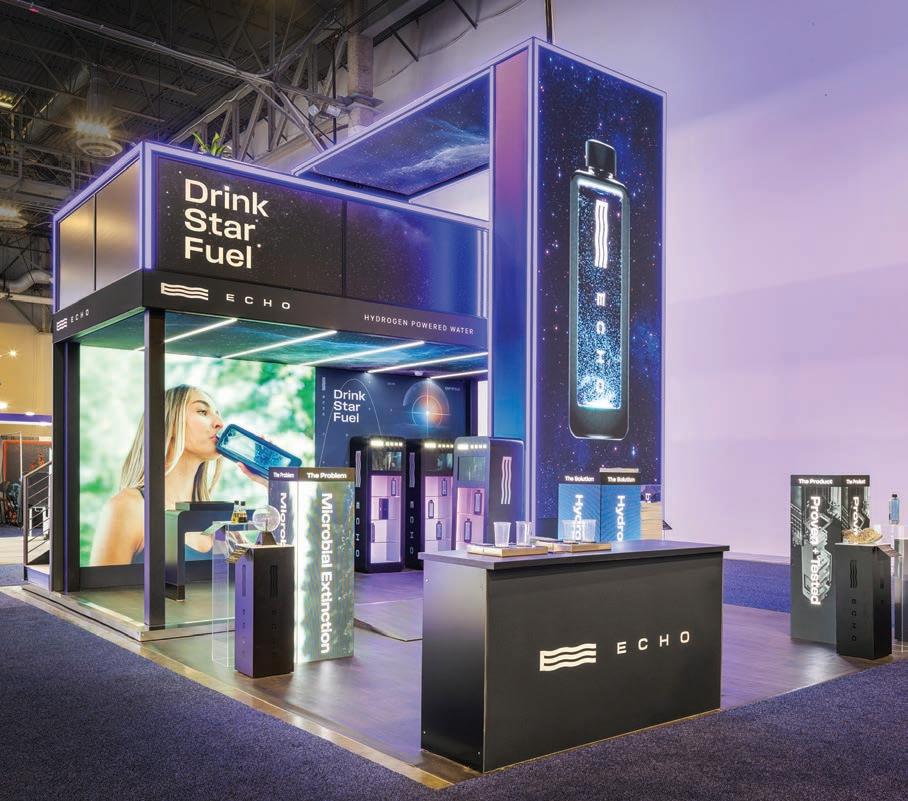
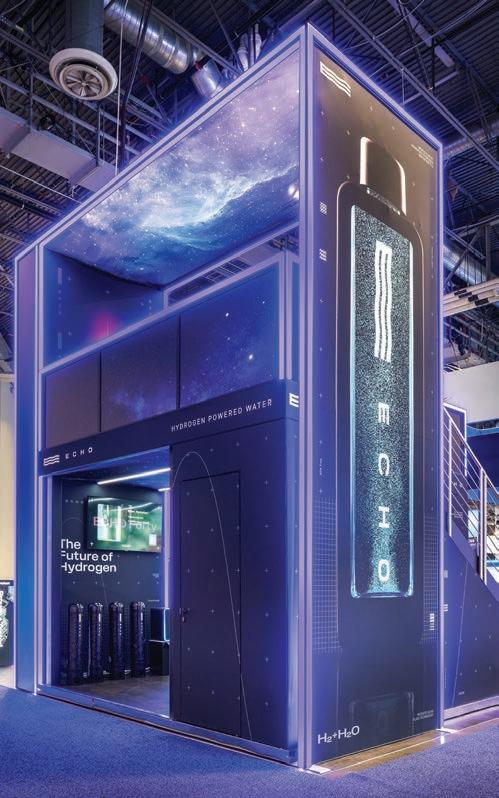
Echo Water needed an experienced partner to help them maximize their prime location and make a splash at CES 2026.
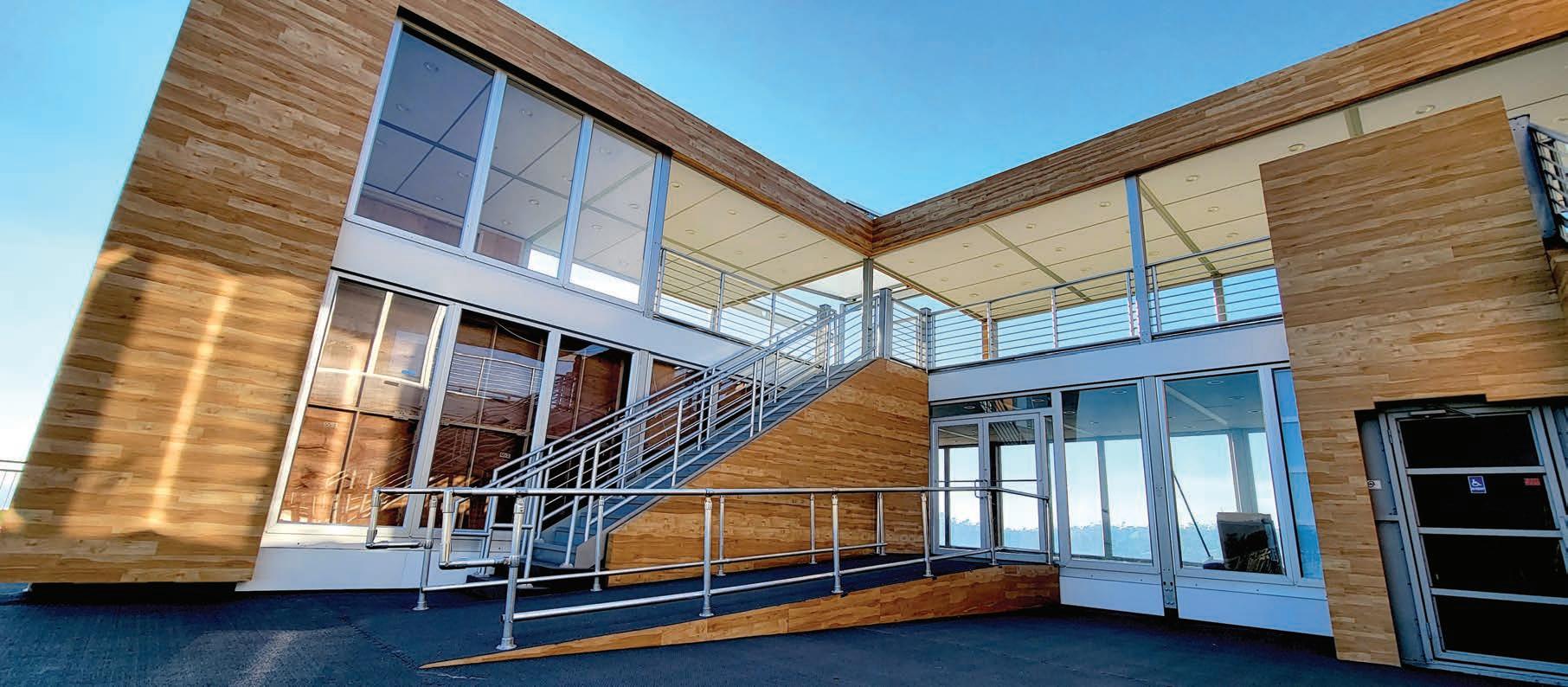
LV Exhibit Rentals strategically designed and built a modular booth that mirrored the brand’s vibe—infusing grandeur and wonder into combined structures grounded by expert knowledge.
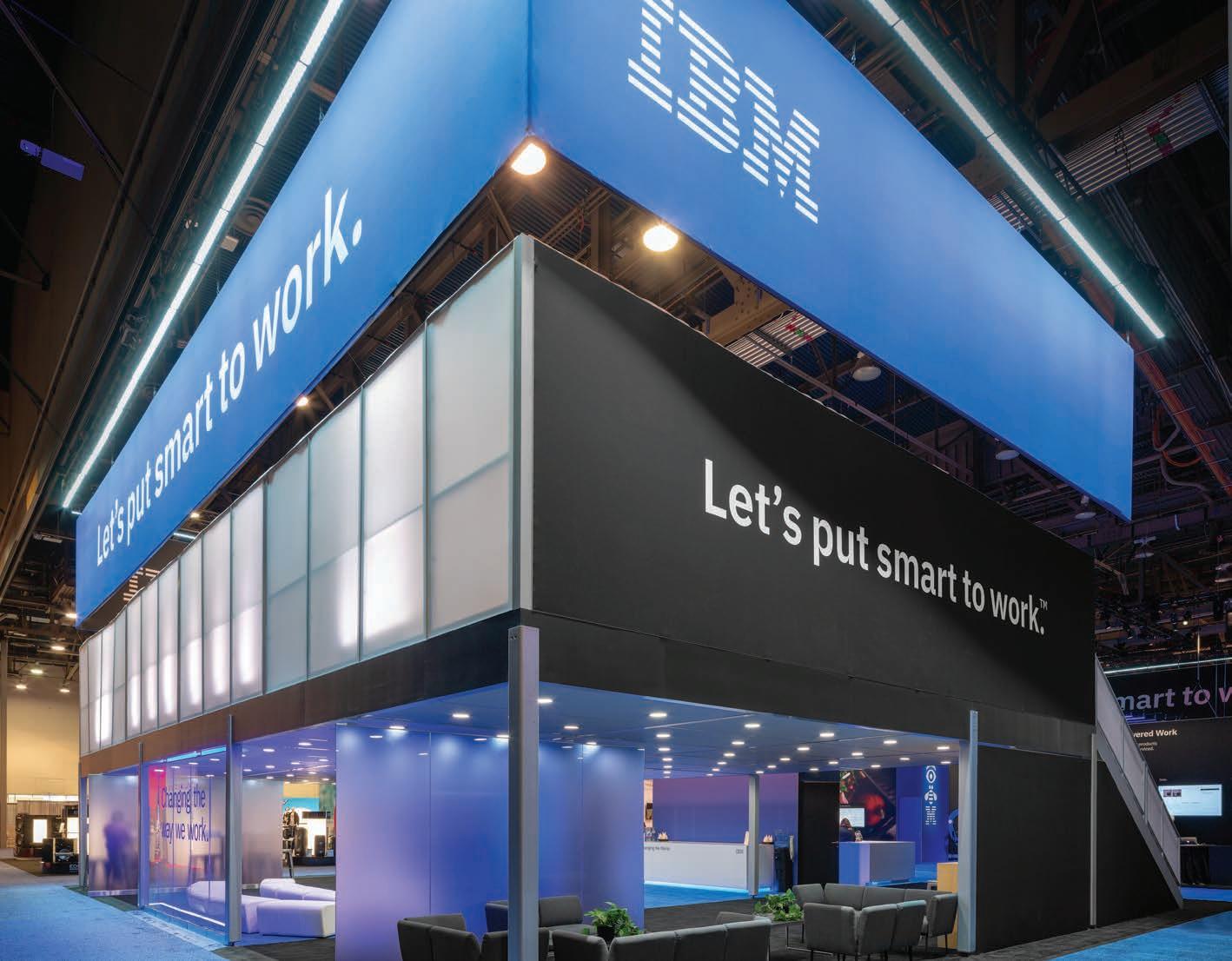
Through their vast inventory of Aluvision’s versatile, modular systems and LED solutions, attendees were mesmerized by stunning visual displays reflecting the brand’s “Drink Star Fuel” theme:
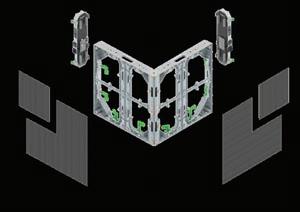
Cover & T-Bright Corner LED Line

how harnessed Aluvision’s modular magic.
inside this issue!
We want to set you up for success! Let's produce something great together.
Contact Us: Service@willwork.com




What the foor teaches you stays with you, even when the headlines change.
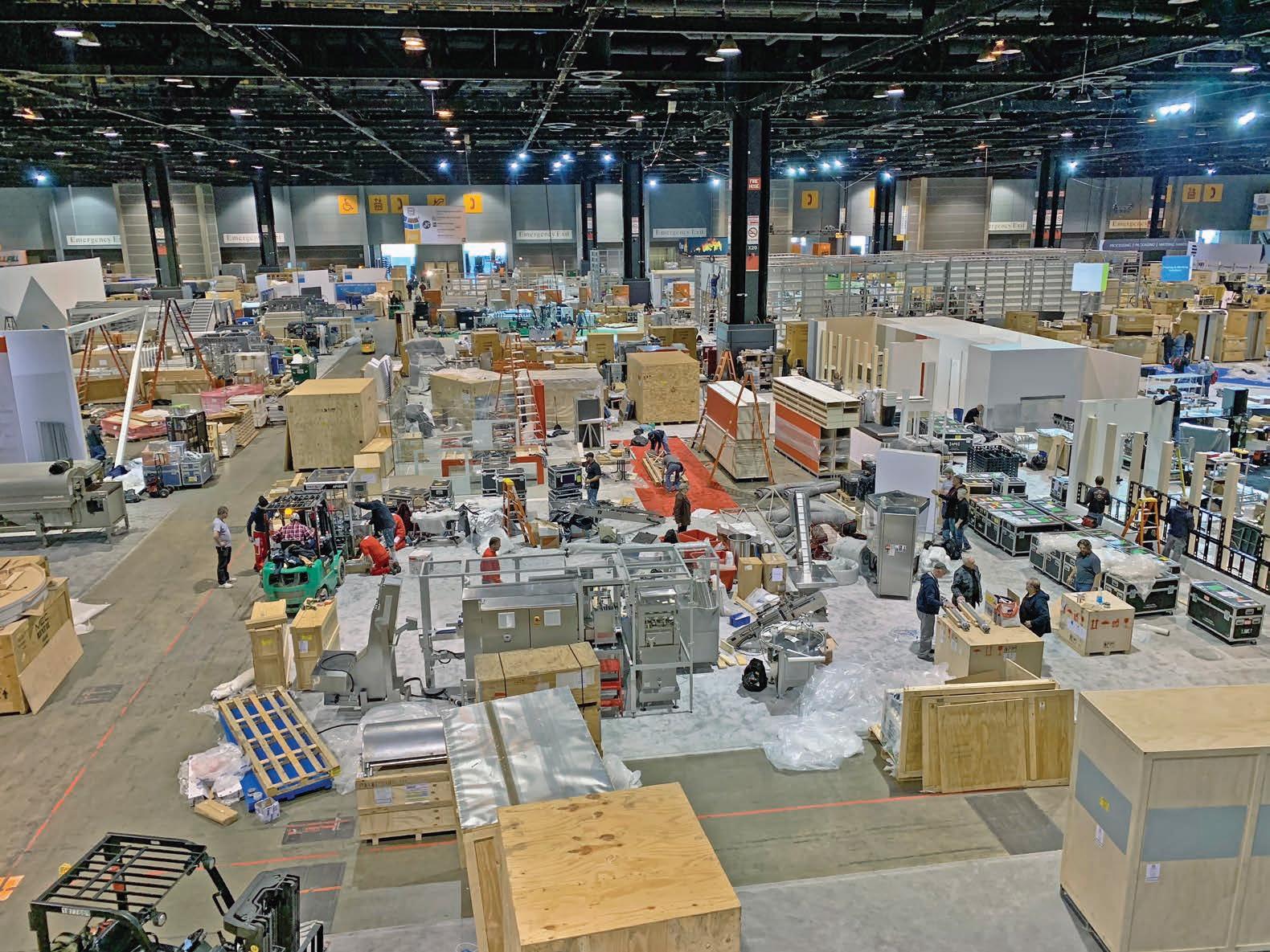
When I was a young guy in I&D, nobody handed you an iPad with a color-coded timeline. You learned by doing. A late truck blew up the schedule. ‘Almost ready’ became ‘doors in ten.’ You walked the space, fgured out the sequence, and got the critical pieces in, frst.
Most people never see the real job. It is physical, sure, but it runs on judgment. When something shifts on-site, you do not freeze. You make the call, solve the problem, and keep the crew moving.
This quarter, a lot of our pages focus on artifcial intelligence. AI is already showing up in planning, forecasting, logistics, content, and the work that eats up time. (It is also turning LinkedIn into show-foor cartoons. Fun, but mostly useless.) Our coverage shows what AI can streamline. It can support the plan, but it cannot replace judgment when the foor gets loud and the clock gets tight. That is why I always come back to I&D. Craft, pace, and people still decide the outcome.
You will see that in our labor and workforce reporting. We look at training

pipelines, where the gaps still are, and what it takes to keep skilled people in the trades. It is readiness, not theory. It is the diference between a clean handof and a long night.
We also spotlight leaders who stay close to the back of house, because success is built before the frst attendee walks in. And we include perspective that reminds us that this business has always been about creating experiences, then delivering them under real constraints.
I started publishing Exhibit City News 32 years ago, but I still remember cases rolling at dawn and tools fring up in an empty hall. That sound is the industry getting to work.
This issue is strong because it respects both sides of the future. Better tools, including AI. Better hands, including the people who build, solve, and deliver.
See you out there,
Don Svehla, Publisher/Founder
Questions? Suggestions? Comments about our content? We love feedback and hearing from you! Send me an email at dons@exhibitcitynews.com
PUBLISHER & FOUNDER
Donald V. Svehla Jr. (702) 272-0182 ext. 102 DonS@exhibitcitynews.com
MANAGING EDITOR
Marlena Sullivan digitaleditor@exhibitcitynews.com
EDITORIAL ADVISOR
Lisa Abrams LisaA@exhibitcitynews.com
ART DIRECTOR
Thomas Speak TomS@exhibitcitynews.com
SALES MANAGER
Christy Giambattista ChristyD@exhibitcitynews.com
NEW BUSINESS DEVELOPMENT
Taunya Mitchell TaunyaM@exhibitcitynews.com
SENIOR REPORTER
Mark Hebert MarkH@exhibitcitynews.com
EDITORIAL ASSISTANT
Elena Vazzo EditorialStaff@exhibitcitynews.com
SOCIAL MEDIA EXECUTIVE
Ashley Sou AshleyS@exhibitcitynews.com
COLUMNISTS
Paco Collazo, Glenn Hansen, Bob McGlincy, Jim Obermeyer
CONTRIBUTING WRITERS
Emily Bornt, Sven Bossu, Tommy Goodwin, Robert Johnson, Sam Ogren, Travis Stanton
STAFF WRITERS
Debbie Hall, Ray Smith, Kerstan Szczepanski
ADDITIONAL PROOFREADERS
Kerstan Szczepanski

When we think of change there are usually two types of reaction: radical acceptance or rejection. The strange middle ground between the two often feels like wading into uncharted water. Questions become riptides and fears become storms. It is easy to drown in the minutia and overwhelm. AI is exactly this type of change.
At the Exhibit Services and Contactors Association (ESCA) Summer Educational Conference 2025, ESCA members were given insight on how AI could help change their lives and the industry as a whole. Between the questions by Dasher Lowe and examples given by Julie Kagy, I was left with a few thoughts. Recent studies illuminate the ways AI is changing how individuals approach analyzing situations. How will that affect an industry built around problem solving? There are other studies that suggest that AI could change the way we communicate as well. How will that affect the way that we connect? Our industry is centered on communicating and bridging gaps between people and creating solutions. Could this not create an issue in our ecosystem in a way that is different from losing jobs or the loss of skills?
At Expo!Expo! in December, I had the chance to sit down and speak with experts about these topics. What can AI do, realistically? What can’t it? Will it disrupt the ecosystem built for people and by people? What happens when it does?
Our Q2 Issue for 2026 is, at its heart, about this question. Is embracing AI a



cognitive dissonance within the industry that will ultimately lead to our downfall? Or is it truly an acceleration of progress to bring the industry to new heights? Could it be both? The fall of what we know, in some ways, and the rise of something greater?
In the pages of this magazine, you will find introspections. We look at the way that AI is being tracked in studies (pg. 18) and how it is affecting design (pg. 38). We approach how people can adapt to AI (pg. 20) as well as attempt to quell the fear mongering with considerations that no, not all our jobs will be lost (pg. 34).
Furthermore, we address the people element to the story, we look at the way that change is consistently happening in this industry. From being determined in a work enviornment (pg. 94) to approaching mentorship the way one approaches jazz (pg. 98), we consider the fexibility and adaptability that those in tradeshows are known for.
Sometimes the uncharted waters are dark and scary. However, if we’re willing, there are those who are ready to teach us to swim. The tension does not have to drag us beneath the surface. It can become the current that carries us forward.
Marlena
Sullivan, Editor
Questions? Suggestions? Comments about our content? We love feedback and hearing from you! Send me an email at digitaleditor@exhibitcitynews.com



PARIS RESHAPED by
Mark Hebert

Nobody Sits Like the French: Exploring Paris Through Its World Expos by Charles
Pappas
Paris does not need another admirer; it needs an explanation. In Nobody Sits Like the French: Exploring Paris Through Its World Expos, Charles Pappas argues that the city most often praised for its beauty is better understood through the seven Universal Expositions that reshaped it between 1855 and 1937.
A longtime journalist covering the tradeshow industry for Exhibitor magazine, Pappas approaches the expos not as cultural curiosities, but as working systems that shaped infrastructure, taste, and daily life. Familiar landmarks appear, including the Eiffel Tower and Grand Palais, but the book’s most compelling moments focus on quieter legacies, from sewer systems and café culture to luggage design and massproduced furniture.
Written with precise language, vivid sensory detail, and restrained humor, Nobody Sits Like the French shows how exhibitions helped turn spectacle into permanence.
For the full book review please visit: https://exhibitcitynews.com/bookreview-expositions-worlds-fairs-inthe-beginning/
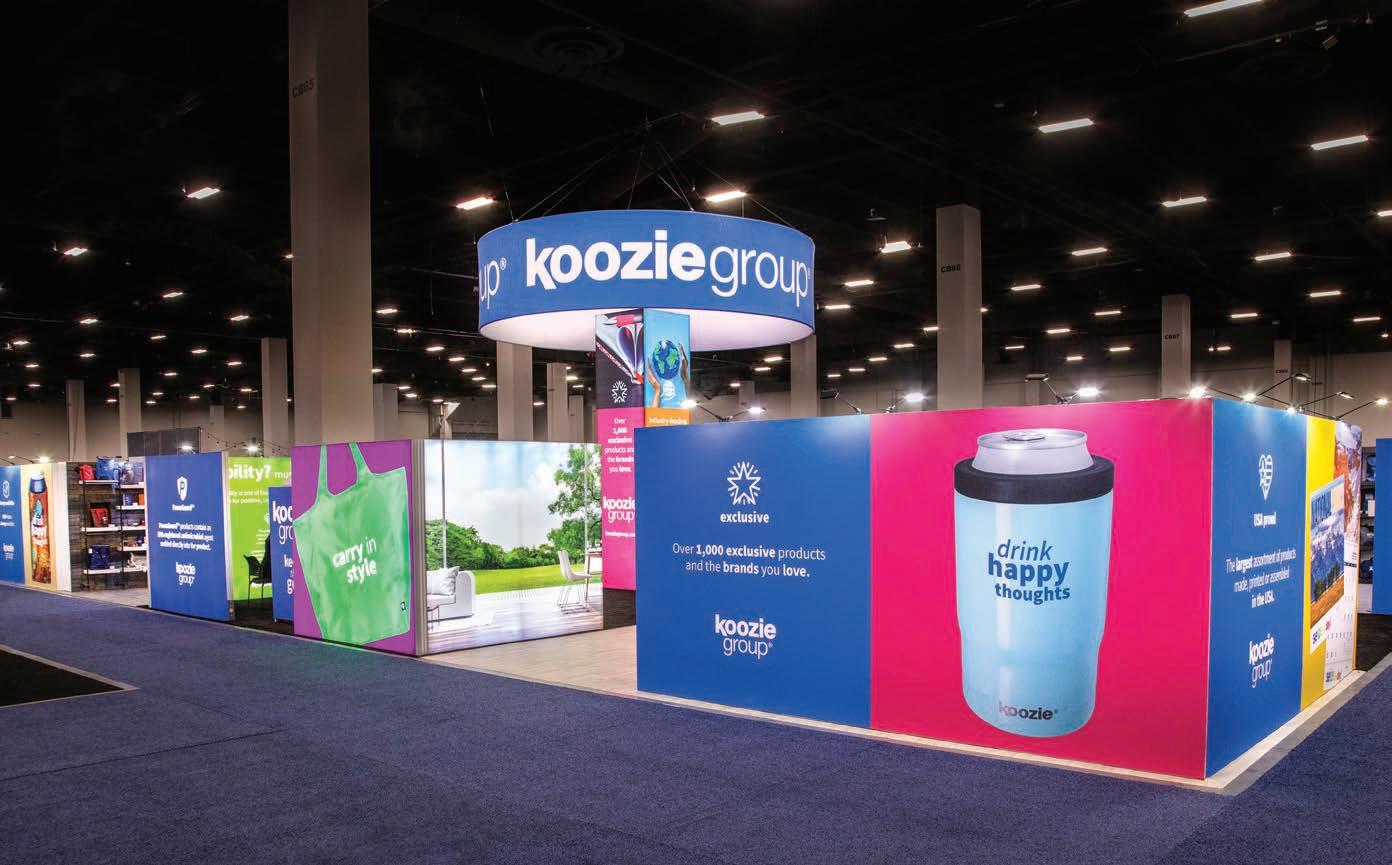
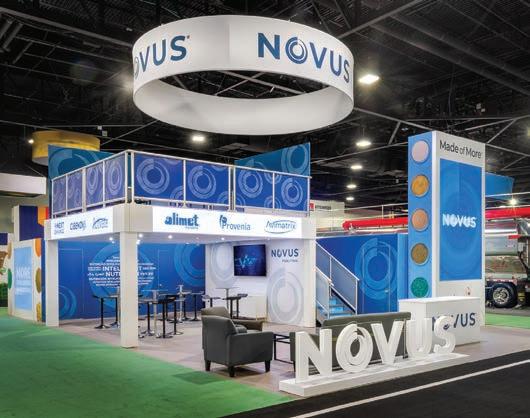
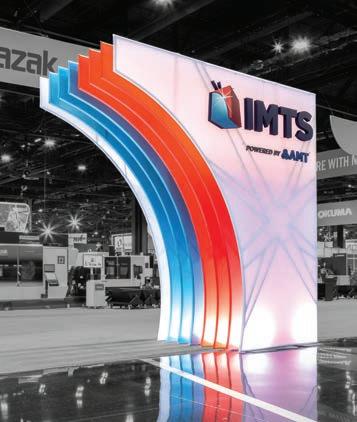
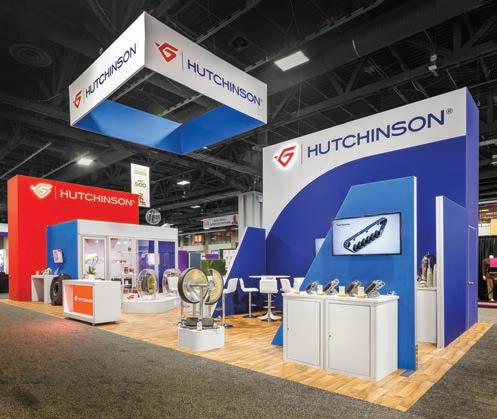
The Freeman Company (TFC) launched as a new parent company for a group of live experience brands, including 3D Exhibits, Alford Media, BaAM, Color Gamut, mdg, Sparks, and Studio Blue, along with Freeman AV Production and Freeman Events & Exhibit Services. Based in Dallas, TFC said the structure is designed to help clients manage complex, high-stakes events through one integrated partner or through specialized teams. The company also introduced a new logo and updated visual identity tied to Freeman’s blue brand heritage.
Jack Morton and Impact XM announced plans to merge, with the combined agency set to operate under the Jack Morton name. The transaction, backed by The Riverside Company, is expected to close in Q1 2026 pending customary approvals. Jared Pollacco will serve as CEO, Craig Millon as global president, and former Jack Morton CEO Josh McCall as executive chairman.
One Rock Capital Partners acquired a majority stake in American Furniture Rentals (AFR), a national furniture rental provider serving the tradeshow and special events markets. Founded in 1975 and headquartered in Pennsauken, New Jersey, AFR operates 28
distribution centers nationwide. Founder Neil Scholnick retained a stake and remained on the board.
The Vomela Companies acquired Moss Inc., merging its Fusion events business into Moss, which now operates as Moss, A Vomela Company under President and CEO Jason Popp. Riverside, which invested in Vomela in January 2025, supported the transaction.
ACCESS TCA acquired Orlando-based Top Shelf Exhibits, expanding fabrication capabilities and strengthening its portfolio across regulated industries.
Spiro, the experiential agency within GES, acquired London-based 2Heads, expanding its creative footprint across the UK and Europe.
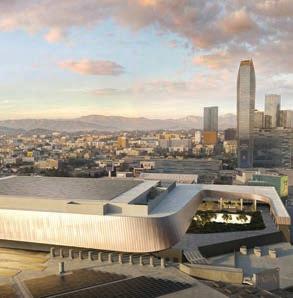
The $600 million renovation of the Las Vegas Convention Center was completed in time for CES 2026, unveiling a redesigned Central Hall grand lobby and upgrades across the North and South halls. Improvements include LED lighting, digital displays, modernized entrances, and an interior concourse connecting halls. CES occupied 2.6 million square feet this year and drew an estimated 140,000 attendees, underscoring the facility’s role in supporting one of the city’s most signifcant annual economic drivers.
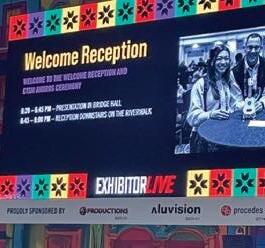
The International Association of Exhibitions and Events (IAEE) entered into a defnitive agreement to acquire Exhibitor Group, publisher of EXHIBITOR magazine and producer of EXHIBITOR LIVE. The move combines IAEE’s global association of organizers with Exhibitor Group’s exhibitor-focused education and events. STAR Exhibits & Environments CEO Mark Johnson, who acquired Exhibitor Group in 2022, supported the transition. The acquisition is expected to close by April 30, 2026.
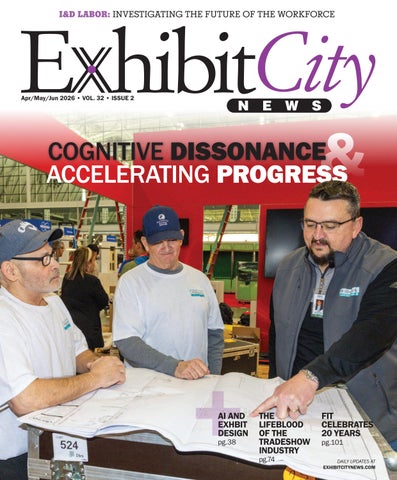
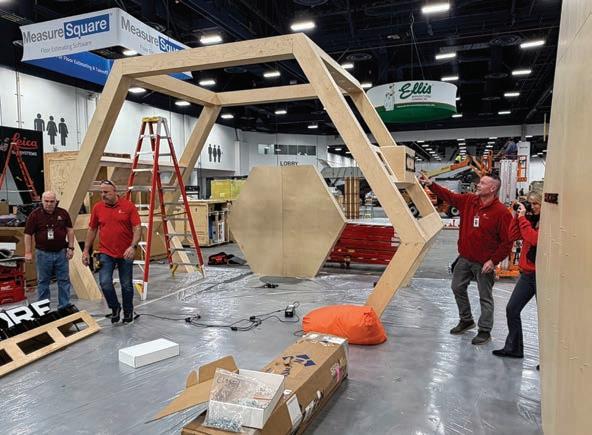
Installation and Dismantle (I&D) crews remain the backbone of the tradeshow industry, adapting to shifting labor demands, evolving regulations, and rapid technology changes. From workforce training and union programs to private equity consolidation and post-pandemic recovery, I&D companies continue to evolve. Leaders say long-term survival depends on agility, strong customer service, and investing in the next generation of skilled labor. Read more: pg.74
Artifcial intelligence is increasingly shaping creative industries, including exhibit design. While many frms use AI to speed concepting, visualize ideas, and streamline workfows, most stop short of letting it lead the creative process. Designers say AI can expand options and improve efciency, but human judgment remains essential for storytelling, feasibility, and show-foor impact. Read more: pg.38
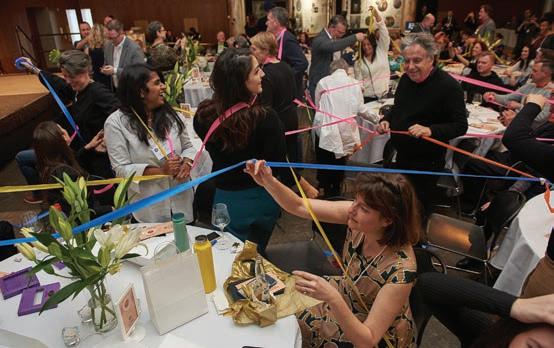
The Fashion Institute of Technology (FIT) Exhibitions & Experience Design program marked 20 years in 2025, highlighting its role in building the next generation of event and exhibit designers. Launched with support from the Exhibit Designers and Producers Association (EDPA), the program has graduated more than 100 students since its frst class in 2005. Leaders and alumni credited mentorship, studio-based learning, and industry partnerships for helping students move into careers across experiential design, museums, retail, and live events. Read more: pg.101
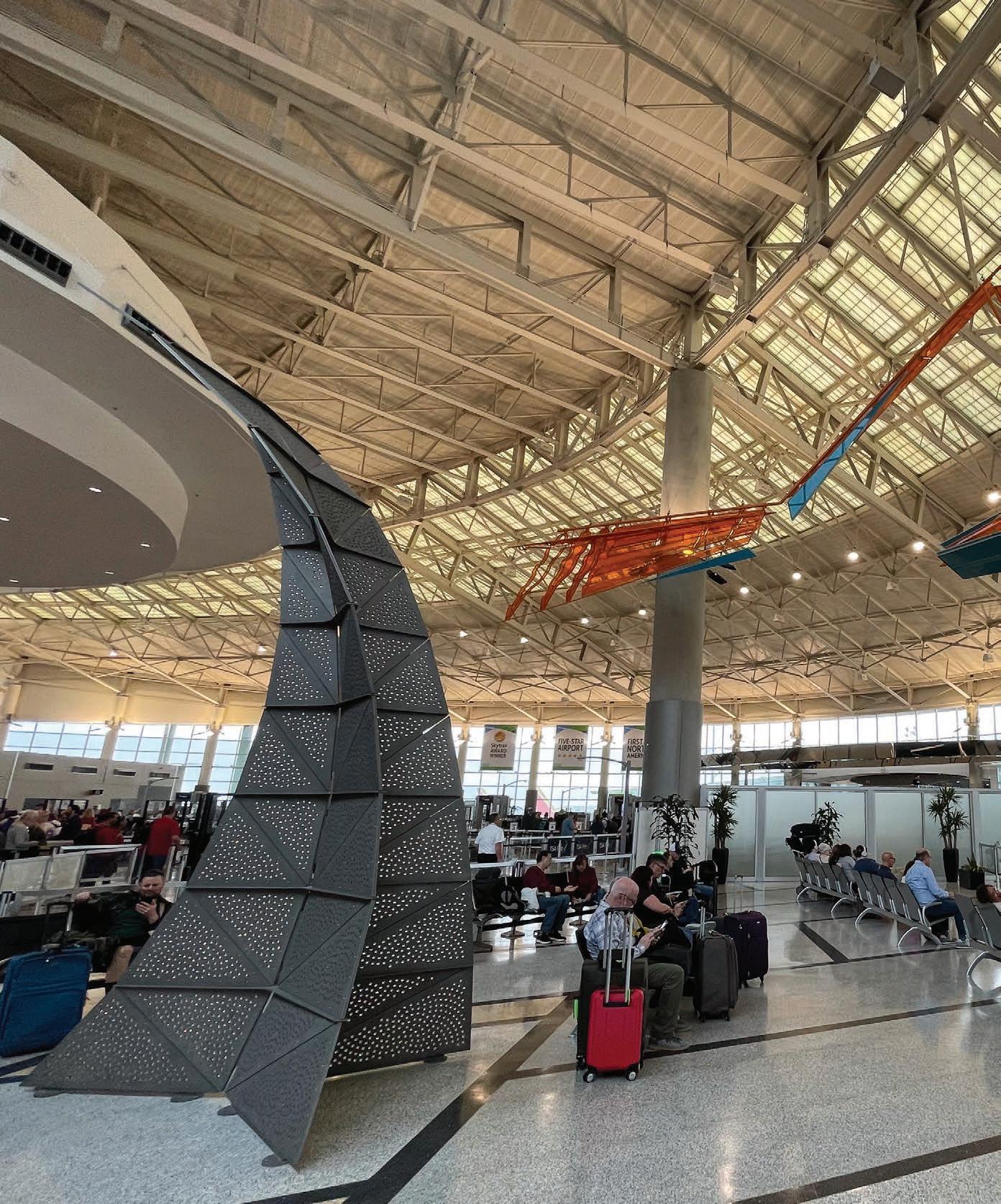
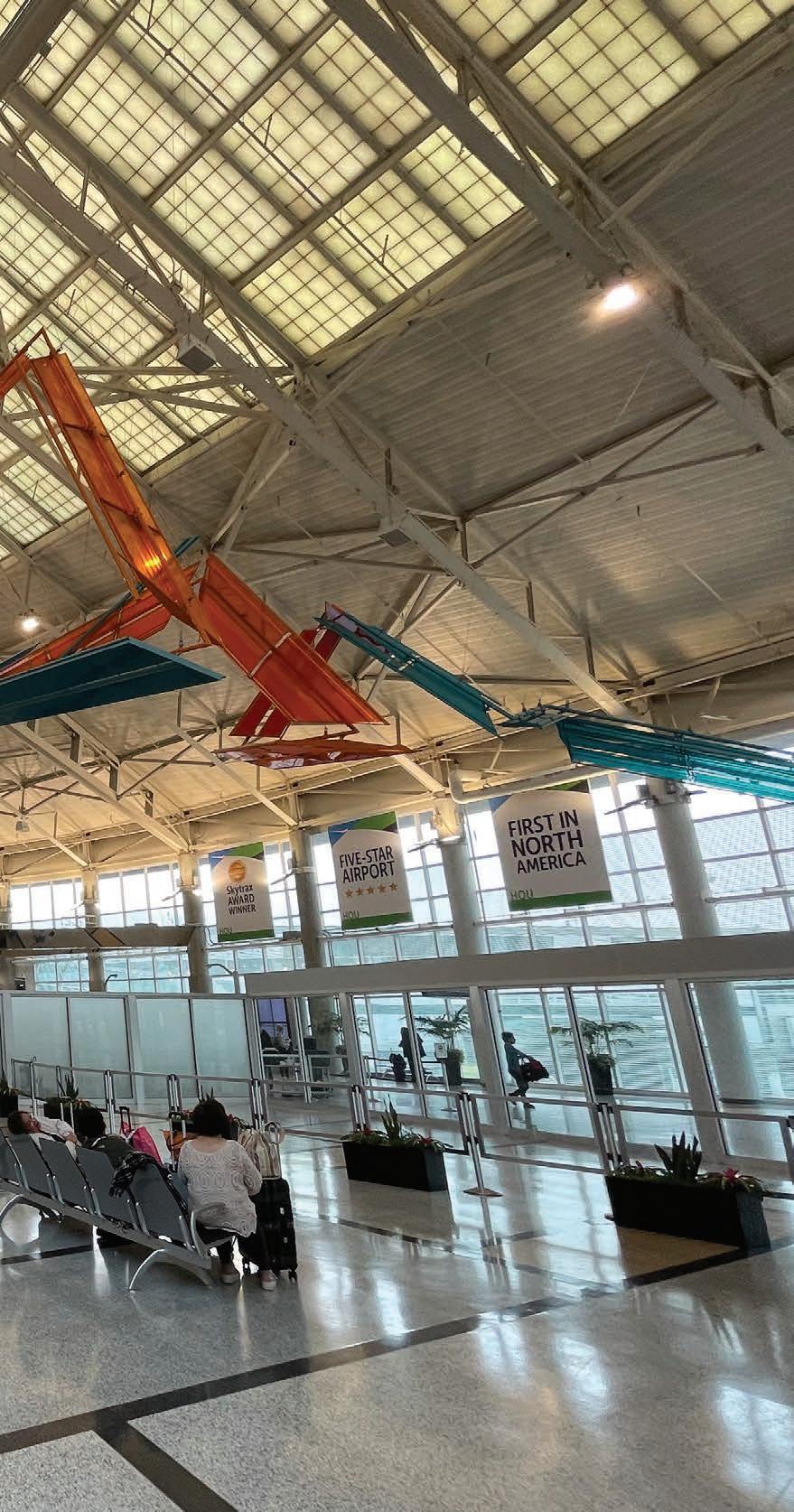
Airport Code: HOU
Location: 7800 Airport Blvd, Houston, Texas
Date Opened: 1927 (as Houston Municipal Airport, renamed in 1967 in honor of former Texas Governor William P. Hobby).
Size: 1,304 acres, with a single terminal serving both domestic and international fights. The airport has 30 gates and three runways.
Transportation: Uber, Lyft, and taxi services operate curbside, just outside the baggage claim area. METRO Bus Route 40 ofers direct service from Hobby to downtown Houston. Convenient access via I-45 (Gulf Freeway) makes it a straight shot to downtown and convention venues.
On-Site Facilities: Hobby is a modernized terminal with a full selection of food, drink, and retail options including both national chains and local Texas favors. There’s free Wi-Fi, charging stations, and comfortable seating areas, pet relief zones, nursing rooms, and accessible facilities for all travelers. With one terminal, one security checkpoint, Hobby is quick and easy for arrivals and departures.
Fun Fact 1: Houston’s airport system, Bush International Airport (IAH) and Hobby (HOU), makes Houston one of only a few U.S. cities with two airports ranked in the top 50 for passenger trafc.
Fun Fact 2: In 2015, Hobby became the frst airport in Houston to ofer international fights from a low-cost carrier with Southwest Airlines’ expansion into international service from a brand new concourse.
Website: www.fy2houston.com/hou
We need to have an honest conversation about “Cognitive Dissonance.”
In psychology, it describes the mental discomfort of holding two conflicting beliefs. In our industry right now, it describes the gap between the polished fantasy of Artificial Intelligence (AI) and the sweaty, chaotic reality of a tradeshow floor.
back. That isn’t design; that is a slot machine.
I am not an AI expert. I am a CEO. I am a producer. Like most high-level leaders, I don’t have the time to sit in a dark room and master 50 new tools every week. I have a business to run.

By Paco Collazo
Let’s be real: Most people claiming to be AI experts are lying. They are lazy. They write a simple prompt into Midjourney, get a cool image, and pat themselves on the
To truly leverage this technology, we probably need to hire someone whose sole existence is to play with it—someone who studies the algorithms while the rest of us are on a plane. However, there is a massive problem with that strategy, and it is the source of our industry’s coming dissonance.
The person who has the
time to master AI is usually stuck behind a screen. They aren’t on the show foor. They don’t know that the beautiful, seamless graphic they generated is going to be blocked by a rental sofa. They don’t understand that the “perfect” door they rendered actually opens inward and will smash the reception desk.
AI doesn’t experience gravity, union labor schedules, or human fow. It creates a vacuum-sealed fantasy. Real humans, however, have to move through these spaces. We have to walk, sit, and talk. When we rely too heavily on the “antisocial nerd” approach to design—where data dictates the visual—we lose the practical magic that makes face-toface marketing work. We risk building booths that look great on Instagram but feel dead in person.
Furthermore, AI has zero social capital. You cannot prompt an algorithm to
close a deal. You cannot ask ChatGPT to ask a favor of a show organizer when your freight is late. You cannot automate the charm required to get a union laborer to help you out of a jam fve minutes before the doors open.
Business is still closed by humans. It happens in the handshake, the shared joke, and the favor asked in a moment of panic.
So, here is the challenge: hire the experts. Use the tools. Let’s not be Luddites, but never let the algorithm drive the bus. The future of our industry isn’t about who writes the best prompt; it is about who can take that digital fantasy and actually build it in a convention center, where the doors stick, the cofee is lukewarm, and the connections are real.
Paco Collazo is the CEO of Happy Projects. For more info, visit www. happyprojects.com.


BY MARK HERBERT
Artifcial intelligence is showing up across the tradeshow industry, from early design work and planning to marketing and day-to-day operations. At the same time, recent research has raised concerns about how frequent reliance on these tools may afect problem solving, judgment, and independent thinking, particularly among younger workers who engage with them most often. For an industry built on adaptability, teamwork, and human connection, those concerns are not theoretical.
AI is here to stay. The real question is how the tradeshow industry uses it without dulling the skills that make live events successful. That requires a clear understanding of what these tools handle well, where they come up short, and how people respond to them in real working environments.
Much of the current discussion around artifcial intelligence focuses on expanding capability. Less attention is paid to the limitations that remain, especially in industries like tradeshows, where outcomes are difcult to quantify, conditions change constantly, and decisions are shaped by experience rather than fxed formulas.
Studies of current AI systems show they perform most consistently when results are easy to
verify, such as scheduling tasks, running calculations, or following defned rules. Performance declines in situations where success cannot be quickly measured. Tradeshow work often falls into this category. Design choices, layout compromises, and strategic adjustments made on the show foor rarely have a single correct answer and are often evaluated only after an event concludes.
Time presents another challenge. Many responsibilities tied to live events unfold over days or weeks, with decisions building on one another. During load-in, rehearsals, and show days, small missteps can escalate quickly. While AI tools can assist with individual assignments, they remain less dependable when asked to manage extended workfows without steady human supervision.
Environmental complexity adds another layer of difculty. Tradeshows operate amid shifting variables infuenced by human behavior, labor agreements, venue limitations, and last-minute changes. Research examining how AI performs outside tightly controlled settings suggests these systems struggle when faced with uncertainty and competing demands. That description closely mirrors the reality of most live events.
This gap between promise and performance has been acknowledged by leaders inside
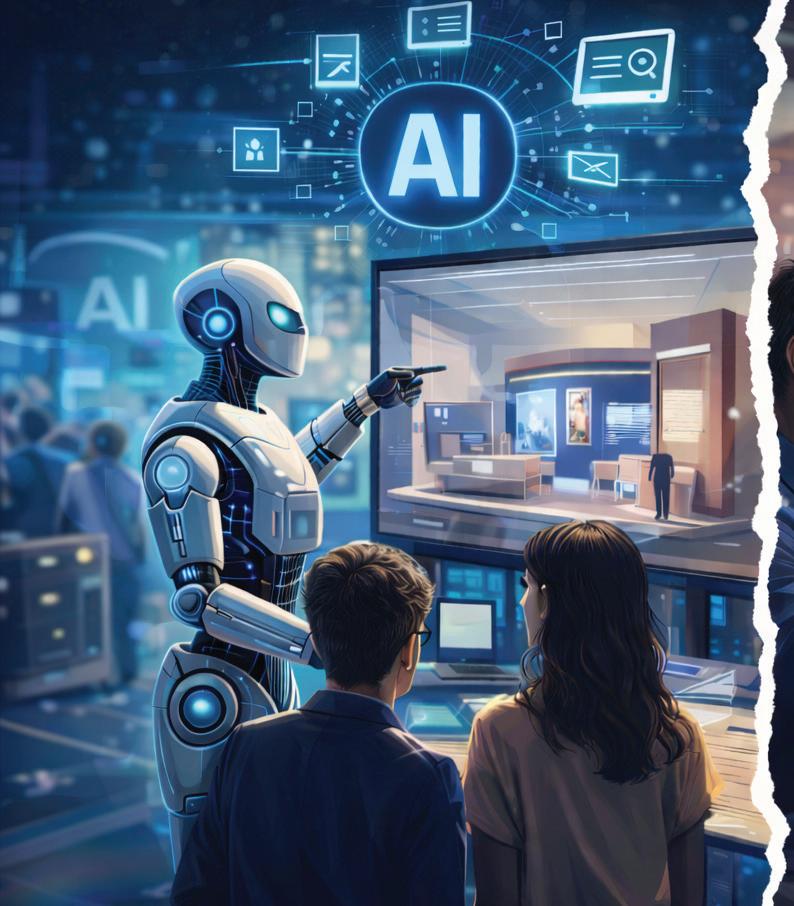
the AI industry itself. Andrej Karpathy, a former OpenAI researcher, recently described current AI agents as “cognitively lacking,” adding, “It’s just not working.”
Researchers also point to limits in original thinking. AI systems are efective at reorganizing existing information, but they tend to follow familiar patterns rather than produce new insight. This reduces their value in situations that call for intuition, creative judgment, or lessons drawn from frsthand experience.
Taken together, these fndings suggest AI works best as a support tool, not a substitute for human decision-making.
Beyond technical limits, researchers have also examined how people respond to AI on a social and cognitive level. Studies suggest users often treat conversational tools less
like software and more like participants in a discussion, even when they understand the distinction. Over time, repeated interaction can create familiarity and trust, subtly shifting how advice is weighed and when it is questioned.
In professional settings, that dynamic matters. Tools that communicate smoothly and respond predictably can infuence confdence and judgment, sometimes reducing the impulse to seek second opinions or collaborative input. For younger professionals still developing problem-solving habits, this infuence may be stronger.
In industries like tradeshows, where outcomes depend on teamwork, situational awareness, and shared responsibility, the impact extends beyond individual decisions. Leaning too heavily on any single system can narrow perspective instead of broadening it. This does not mean
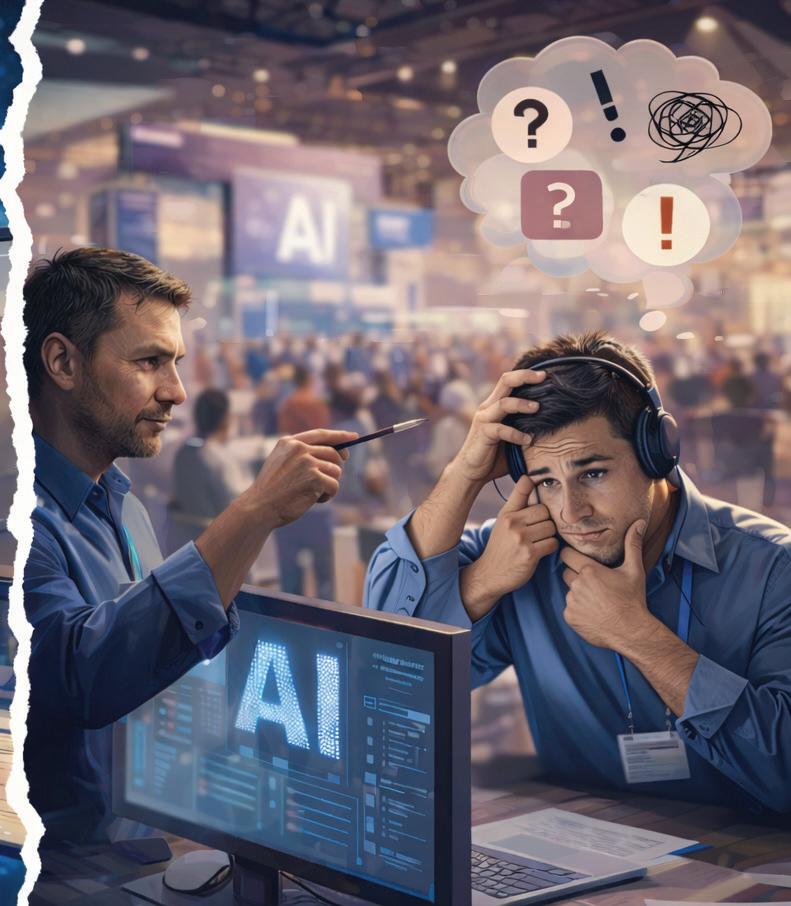
AI tools should be avoided. It highlights the need for clarity around their role and limits.
How AI afects thinking depends less on the tool itself and more on how it is used. When people remain actively involved, AI can support information gathering and organization without undermining independent judgment.
For the tradeshow industry, that distinction matters. AI can help users collect background details, compare options, or fag issues that might otherwise be missed. Used this way, the technology acts as a reference point rather than a shortcut, strengthening preparation and planning instead of standing in for experience. This approach is especially relevant as younger workers enter the industry. When AI supports learning rather than
Accountability is where the line becomes clear. When plans fail or conditions change, responsibility does not rest with software. It rests with people. This reality limits how much decision-making can reasonably be delegated in high-stakes environments. AI can assist with preparation and analysis, but fnal calls must remain with experienced professionals who understand the context and consequences.
replaces it, the tools can help build knowledge instead of eroding critical thinking skills. In practice, results depend on how deliberately they are applied.
Reliability remains one of the biggest obstacles to using AI in live environments. While these tools often sound confdent and polished, they still make mistakes. In a tradeshow setting, even small errors can carry immediate and costly consequences.
Live events operate on compressed timelines with little room for recovery. A single incorrect assumption about logistics, labor sequencing, or venue requirements can trigger delays, cost overruns, or last-minute workarounds that ripple across an entire show. When AI-generated guidance is accepted without verifcation, risks increase.
anticipate challenges. Once circumstances change, experience becomes the deciding factor. Knowing when to adjust a plan, when to compromise, and when to hold the line is learned on the show foor, not generated in advance.
Adaptability is often cited as a strength of artifcial intelligence, but in live environments it depends less on speed and more on experience. Tradeshows unfold in real time, with variables that shift quickly and decisions that rarely follow a script. Seasoned professionals rely on situational awareness built through repetition and exposure to unpredictable scenarios. They notice subtle cues, anticipate downstream efects, and adjust priorities as situations evolve. These judgments draw not only on information, but on familiarity with labor practices, venue norms, client expectations, and the realities of working with people under pressure.
That distinction has also emerged in business research.
Rembrand M. Koning, an associate professor at Harvard Business School, has noted that access to AI alone is not enough, asking, “Do they have enough judgment for the tasks that are required?”
AI tools can support preparation and planning by helping teams explore options or
Artifcial intelligence is already part of the tradeshow ecosystem, and its role will continue to expand. The question facing the industry is not whether AI belongs, but how it is used. When applied with intention, AI can streamline routine tasks, support planning, and surface relevant information. When used without clear boundaries, it can narrow perspective and weaken collaboration.
The most efective approach treats AI as a support tool rather than a decision-maker. Responsibility, judgment, and accountability must remain with people who understand the pace, pressure, and consequences of live events. Tools can assist the process, but they cannot assume ownership of outcomes.
The tradeshow industry has long thrived on problem solving, creativity, and relationships. Those strengths remain its greatest advantage, even as technology evolves. Integrating AI in ways that reinforce human expertise allows the industry to move forward without compromising what makes live experiences successful. Technology may change how tradeshows are planned and managed. It does not change what makes them work. That continues to be people.

BY RAY SMITH
Sometimes we wonder how people ever survived the 1800s without electricity, cell phones, computers, 7-Eleven and Starbucks, for God’s sake. Children of the next century may contemplate what life would have been like without artifcial intelligence (AI). As much as we might like to ignore it, this AI fad doesn’t appear to be going away anytime soon. The trendy source for accessing universal knowledge of anything and everything
has already surpassed the era of bell-bottom trousers, mood rings, and platform shoes.
We must accept it. So, how do we adapt? Just ask AI Overview.
“Adapting to AI requires shifting to a mindset of continuous learning, curiosity, and experimentation, treating AI as a collaborative tool rather than a replacement. Embrace it by integrating AI into daily workfows for efciency, developing critical soft skills (like prompt en-
gineering and ethical judgment), and staying fexible as technology evolves.”
We should not fear artifcial intelligence, just as we shouldn’t fear robotics, as a total replacement for human involvement. Henry Ford’s assembly line was revolutionary in hastening automobile production in the early 1900s, and still, Ford Motor Co. remains today among the largest employers in Detroit.
The internet is loaded with
consultants and academicians ofering guidance on how to use AI to your advantage, how to adapt and harness its power and potential. AI solutions are provided for business models, fnancial investment, legal advice, medical procedures, data analysis, logistics, any problem that needs to be solved, any question that needs to be answered. It can predict the Super Bowl winner, but don’t bet on it. AI is a pretty massive topic, assesses Brian Baker, vice
president of Highmark Tech Systems in Fort Wayne, Ind. Its use depends on who you are and what you need. A designer will use AI in a different way than a student or writer, and the regular Joe’s use may be entirely diferent.
“AI is exploding right now,” Baker tells Exhibit City News in a phone interview. “There’s not a job function anywhere that isn’t being afected by AI in a general way and in specifc ways.”
ChatGPT is the most common AI tool, but Google AI is also good, says Baker, who professes that he’s by no means an expert, though he uses AI in many applications as Highmark’s VP. He might receive an 85-page request for a proposal that can be summarized in ChatGPT, with specifc information on budget and time constraints and a table with due dates.
Josh Abelson, co-owner and general manager of The Industrial event space in Las Vegas, says, “It is so intertwined with how we do things nowadays, I would highly recommend you get on board and learn how it afects you and can help you or you will be left behind.”
Embrace the ineluctable automation. That’s clearly the frst step. Don’t close your eyes and wait to see what happens. The best approach is to satisfy your curiosity, wiggle your way into the future. At the very least, you may fnd that AI saves you time, accomplishing repetitive tasks, freeing you up for more important activities and higher priorities.
...there are sometimes where using your own brain works out better.”
cases and there are sometimes where using your own brain works out better. I think of it as more of a tool as opposed to it taking over. The real power of AI is yet to be seen.”
We’re presented with so many choices, but we can’t do it all. Selecting an AI trial app to see if it’s right can take you down a rabbit hole, tinkering around and getting nowhere. Test some AI initiatives to validate your assumptions, identify challenges, and fne-tune strategies before taking on larger projects.
creators to users–to bring transparency, accountability and fairness to AI systems.
“First and foremost, don’t be afraid of AI. Second, be afraid of AI,” Baker contradicts. “AI is just another tool, and it can be useful for just about any professional. It’s also frequently wrong and it will answer you with tremendous confdence as if it’s the gospel truth, and then you confront it and ChatGPT says, ‘You’re absolutely right. I’m sorry.’”
“AI can be used for general and niche-specifc tasks. There’s AI that can be designed for anything you want,” Baker says. The trick is with the “prompting,” or the parameters that you set for your AI tool. You want to be specific about what you need.
“I don’t want to tell it to analyze my fnances. I want to say, ‘Listen, here’s my spreadsheet. Analyze my fnances to identify a specifc thing,’” Baker notes.
Don’t be intimidated by AI. Think of it as augmented intelligence. Our brain is packed with information, developed with empirical and esoteric knowledge acquired throughout our lives, and like a stufed garage or attic, something has to be discarded to bring in something new, though it can sometimes be retrieved by a jogging of memory. AI enhances our intelligence.
“It still is in its early phases, so it is not 100 percent perfect,” Industrial’s Abelson points out. “There are great use
Attend forums and conferences to learn about the latest trends, research and best practices in AI. “There are a lot of YouTube and tutorials about how you can incorporate AI in your daily life. My advice is to jump in and start playing around with it,” Abelson promotes.
Collaboration with other people is essential. Exchange information between people. Stay in touch with people in your feld of interest; it’ll keep you in the loop. Seek out AI experts and industry professionals who can help you optimize models, make informed decisions, and avoid potential pitfalls.
Humans have provided data sets and research for AI systems, which thereby can be inherently infuenced by human biases. This raises ethical concern about the validity and accuracy of information used to make decisions that can afect a person’s life. It’s a shared responsibility–from
It cannot be refuted that AI has cost some people their jobs. Many of today’s jobs involve not just using computers but learning diferent programs and AI capabilities on the fy. That doesn’t mean you need to train for an entirely new career to remain relevant. Learning the technical and soft skills that allow you to excel in your current role or specialty will put you ahead of the curve, at least for the time being.
While 96 percent of employees said they believe AI can help them in their current job, 60 percent are afraid it will eventually automate them out of work, according to a survey by Oliver Wyman Forum. Employees will need training and support to create sensible and intuitive processes alongside this technology.
“By engaging in active listening, demonstrating understanding, and addressing concerns, organizations can channel the capabilities of generative AI into constructive progress,” the Wyman report states.
Over a year ago, in my January ’25 column, titled The Future of Tradeshows, I wrote:
1. NHCAA, Nov 18-21, Nashville. The National Health Care Anti-fraud Association is an annual training conference using AI to detect and prevent fraud.

“The Department of Defense began funding AI research in the sixties. Today, AI enhances communication and accelerates analysis and content production. It can impact all phases of a tradeshow: from improving security and event planning, to logistics and production. From speeding registration and attracting crowds, to infuencing networking and designing exhibits. AI is quick, but not always accurate. AI will eliminate some jobs and create others. It can provide more insight, but at a cost of bias, occasional mistakes, and less privacy.”
transforming the retail industry with Agentic AI.
By Bob McGlincy
2. Neural PS, December 2-7, San Diego. This academic conference focused on computational neuroscience and machine learning. Interestingly, a recent study by GPTZero determined that over 100 accepted papers at the show had “AI hallucinated citations”— meaning the actual studies cited did not exist, or the citations included meaningful and inaccurate changes. Funny.
3. Global AI, December 8-9, Abu Dhabi. This international conference discussed the commercial adoption of AI across a wide spectrum of industries.
4. The AI Summit New York, December 9-10, Javits Center. A conference with real-world applications “where commercial AI comes to life.”
Other shows this year to monitor AI activity and demos include: HumanX April 6-9, San Francisco; Momentum AI New York April 27-28, 2026; AI & Big Data Expo May 18-19, San Jose; QCon AI Boston, June 1-2; Auto. AI June 29-July 1, San Francisco; Ai4 August 4-6, Las Vegas; World AI Summit, October 7-8 Amsterdam.
Historically, new technology has thrilled, shocked, entertained, amazed, disappointed, under-performed, and in some cases, even scared people. This has been true since the days of the invention of the frst printing press, and the frst steam engine—both of which were displayed at trade fairs and changed the future of the world.
Is AI ready for prime time?
What I didn’t specifcally say at the time was AI is a killer at research and data analysis. And what I left unsaid, but I think most people intuitively understand: AI will impact our future, in both expected and unexpected ways. So, that was what I said then. Here is what AI had to say when I asked ChatGPT earlier this year:
“AI is revolutionizing tradeshows by personalizing attendee experiences, streamlining planning (content, logistics, outreach), boosting engagement with chatbots and matchmaking, and providing data-driven insights for better ROI, from generating booth concepts to automating lead follow-ups, making events smarter, more efcient, and more impactful for exhibitors and attendees alike.”
Moving beyond hype, AI is now more visible at many shows and conferences. The list below is not a random sampling, but it is also not an all-inclusive one.
5. CES January 6-9, 2026. Las Vegas. From keynotes to seminars, to displays and presentations in exhibits, AI was everywhere. Robots were seen dancing, fghting, talking, playing ping pong, dealing cards, serving customers, and much more. Caterpillar demoed AI embedded machines that improved safety (without direct human interaction).
6. NRF January 11- 13, 2026. Retail’s Big Show demonstrated how AI is
Maybe not yet. Joanna Stern wrote in a Wall Street Journal article on December 18, 2025: “We Let AI Run Our Office Vending Machine. It Lost Hundreds of Dollars.”
AI is not self-conscious or self-aware; it needs human direction. AI mines data; humans create emotional connections. AI computes. Humans think.
Some experts believe AI will become self-aware in the next decade; others state it will never happen. I personally believe AI needs human supervision and direction. And I do not see that changing in the foreseeable future.
What are your thoughts?


When you combine the right skillsets with the right mindset, amazing things happen. That’s what HIAT training is all about. A unique commitment between the venue and labor partners formed to deliver a truly next-level experience.

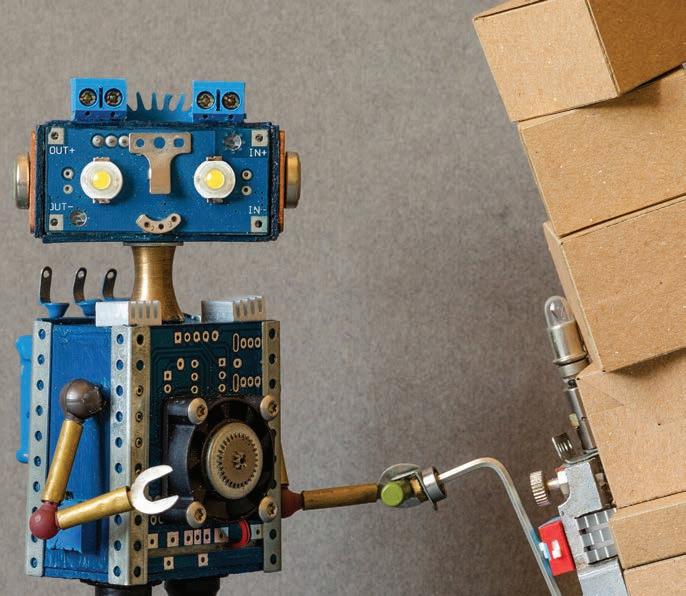
by Sven Bossu, the Chief Executive Ofcer (CEO) of the Association of International Convention Centres (AIPC)
The potential use of AI in convention centers touches on many areas: from predictive maintenance to enhanced protection against cyber-attacks. Marina Bay Sands Singapore is using robots for back-of-house deliveries, and the Kuala Lumpur Convention Center uses a digital twin to enhance operations and customer excellence. But the most important advantage of AI will be that the efciency gains will allows us to focus on what matters most: the human experience.
AI has been high on the agenda of every industry event I attended this year, and the message varied from extremely positive (with a focus on efciency gains or enhanced customer experience) to outright negative (this is the beginning of the end type of message). Now, the business event industry has historically not been the fasted mover when it comes to innovation. But the digitalization pushed by the COVID-19 period and fast-growing application of AI in a wide range of domains has—fnally—released the genie out of the bottle. Personally, I am a big believer of the value AI can bring to the AIPC community. Take the case of the robots at Marina Bay Sands in Singapore (MBS). MBS was facing a massive challenge when it came to back-of-house deliveries. The number of deliveries continued to rise, putting a strain on their staf. They took the decision to invest in a feet of 12 robots who each carry 400 kg and carry the chairs, tables, etc. autonomously to the room where they are needed. The strain on staf was reduced by 35 percent. Having seen the robots move
around personally, I found it quite impressive how fast they learnt to do their job.
The same goes for the customer-facing. Salespeople in a B2B environment typically spend 30 percent to 39 percent of their time on selling activities. This includes prospecting, generating sales orders, and building relationships with customers. The remaining time is often consumed by tasks such as administrative work, data entry, and meetings. Here again, AI can take away a (big) part of that burden, allowing the sales force to focus on what they are good at: selling, an art which I believe will be very difcult to replace by AI.
Which brings me to a very important point. The efciency gains that AI brings us will free up time, an efect that can be used in two ways: cost cutting or enhancing the customer experience. The cost cutting is straightforward. If you have a sales staf of fve and AI allows an efciency gain of 20 percent, you let go of one salesperson, reducing the fxed staf cost. The other option is to keep the full team on board but make them focus on better understanding their customer
needs, by spending more time with the customer, creating a higher level of engagement and partnership, resulting into higher human connectivity and loyalty. Potentially, this could even lead to higher revenues by up- or cross-selling, given the better joint understanding of objectives.
Sometimes, it’s not even about higher revenues but spending the money more wisely. Imagine a very high-level event, used to serving a 3-course seated lunch for 2,500 persons during four days, wines included. While this is a great customer experience, the level of waste that goes with it is considerable and not at all in line with the sustainability objectives of the organizer. So, the hosting convention center came up with a completely diferent concept: high standard street food. The delegates would line up a food-trucks, each ofering their own specialty and by using crowd management AI, queues would be limited to two persons maximum.
The quality of food would still be there, but there would be more diversity, it would allow for natural networking (best way to meet somebody: stand in a queue) and the food waste would be drastically reduced. The organiser accepted.
This is the type of partnership AI can not achieve. This requires people talking to each other, being able to express their needs and concerns and, in this case, willing to take the jump into the unknown together.
AI, in my view, is an enabler. It will allow convention centers to focus on what it their core business: bring communities together and make them grow. There is a reason why convention centers are “purpose built” and this is exactly it. As my good friend and convention center manager Marc Rodriguez tends to say, “my convention center is a fve-star hotel without rooms.” Having been there for many times and for all types of events—I can only agree with him.

- Mike Morrison
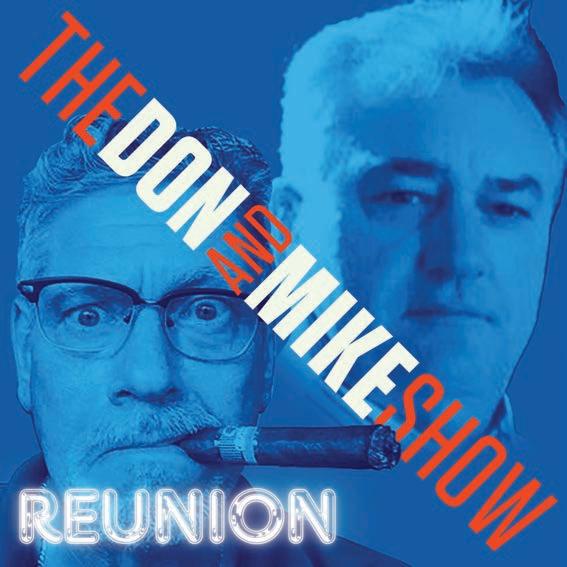

by Elena Vazzo
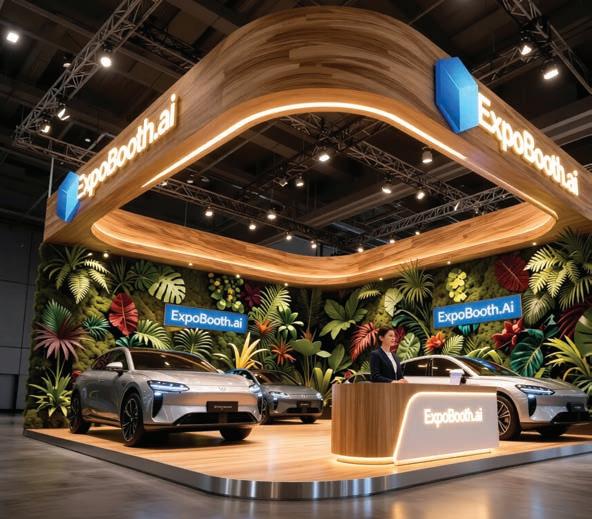
ExpoBooth.ai launches an AI-Powered Service that allows agencies, stand builders, and exhibitors to generate tradeshow booth designs, 3D Renders, and immersive walkthroughs. This solution speeds up the design process, lowers costs, and ensures consistent branding. expobooth.ai
Exhibitus, based in Los Angeles, launched EXstudios, a dedicated experiential strategy and creative ideation studio that formalizes and expands the experiential work the company has been delivering to clients. EXstudios represents a focused evolution of Exhibitus’ existing capabilities, designed to place greater emphasis on front-end strategy, creative development, and experiential storytelling across a wider range of face-to-face marketing channels. For more than 30 years, Exhibitus has delivered award-winning experiential strategy and immersive design across B2B events, brand activations, and live experiences. EXstudios, based in Los Angeles, builds on that foundation by pro-
Orbus unveils its new lineup of innovative display products, including the Vector Fast Frame, Blaze Light Box, Formulate Cube, Vector Fast Frame Banners, Light Boxes, Backwall Kit, and Zoom A Frame Outdoor Billboard. orbus.com

Michael Taylor, CEO and founder of WC Exhibits, shared an exciting preview of the company’s 50,000 sqft fabrication facility expansion plans. The Las Vegas move strengthens WC Exhibits presence in the world’s tradeshow capital while ensuring faster builds and stronger execution. wcexhibits.com
viding a dedicated focus on experiential strategy and creative ideation for clients looking to engage audiences beyond the traditional trade show foor.
EXstudios will be led by Richard Sears, Vice President of Experiential at Exhibitus. “As our clients’ experiential needs have evolved, so has the way we support them,” said Brad Falberg, President of Exhibitus. “EXstudios is not a departure from what we do. It’s a natural extension of the strategic and creative work we’ve been delivering for years. By giving this capability a dedicated focus under Richard’s leadership, we’re better positioned to help clients shape meaningful brand experiences with their target audience.”
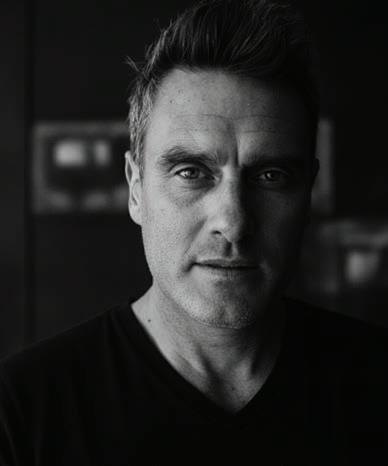
by Robert Johnson
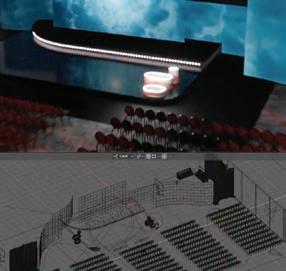
The last thing an event planner wants is to walk into a ballroom general session build and fnd the stage design is not what they envisioned during planning. Moving stage or LED screen components after setup can trigger overtime labor, delay rehearsals, and strain already tight budgets. Not everyone can easily translate a 2D drawing into a fully realized stage environment. Instead, partner with an independent audiovisual provider with advanced previsualization capabilities and virtually “walk through” your 3D event design before resources are committed. Using programs like Vectorworks Spotlight with Cinema 4D, non-venue AV companies can create immersive virtual reality walkthroughs that give clients a near-real sense of the fnal environment before the build begins.
Design vectorworks.net/ spotlight
www.maxon.net
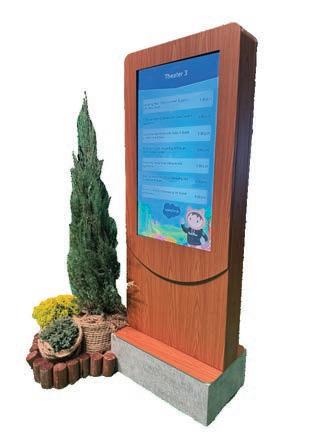
Even in today’s high-tech environments, many digital signage systems are still updated manually, one screen at a time. What happens when a session room changes or an emergency message needs to be shared instantly? Can your signage system keep up? Centralized digital signage platforms are changing that. Systems like MVS Marquee from Mountain View Staging allow event teams to control signage across an entire networked venue from a single interface. With one command, signage can instantly update to direct attendees to the general session, highlight sponsors, or communicate urgent safety information. Digital platforms can also replace printed demo kiosk signage that often becomes outdated before the show even opens. Even better, the software runs on any iOS device and can be managed remotely, giving planners fexibility and peace of mind.
MVS Marquee mvstaging.com
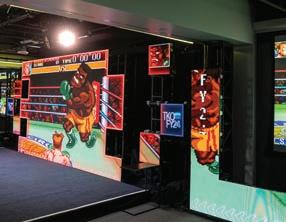
When approaching LED, content challenges include low-resolution videos, vertical phone footage, or legacy media that wasn’t created for today’s ultra-wide LED pixel spaces.
Traditional scaling methods simply duplicate pixels, which results in soft images that look out of place on large displays. New AI-powered upscaling tools analyze footage and intelligently reconstruct detail, sharpen edges, reduce noise, and even extend backgrounds to better ft modern display formats. Topaz AI is one of the best options currently and for open source users Real-ESRGAN is a tool that can be trained and is fully customizable. Adobe Creative Suite also has options including their new Firefy Boards feature. Runway and Canva also have features to support image scaling.
Topaz AI topazlabs.com
Real-ESRGAN github.com/ xinntao/Real-ESRGAN Adobe Firefy adobe.com/ products/frefy Runway runwayml.com Canva canva.com
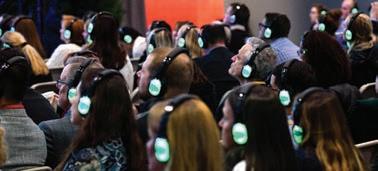
Breakout rooms have long been a conference staple, but many modern events are rethinking that model by integrating education spaces directly into the expo foor. Keeping sessions on the expo foor helps attendees stay engaged and reduces wayfnding challenges, but it introduces one major issue: competing audio from surrounding booths.
To address this, AV teams have experimented with solutions ranging from directional speakers to mobile apps, often with mixed results. A newer solution, Silent Disco headphones, adapted from live music and festival environments, allows attendees to select audio channels while the surrounding space remains quiet. This technology translates well to busy expo environments, making “classrooms without walls” both practical and comfortable for attendees. It also enables large stages to be divided into smaller learning zones without the need for physical barriers.
Suggested resources:
Headphones with AV support mvstaging.com
Headphone rentals only quiteevents.com
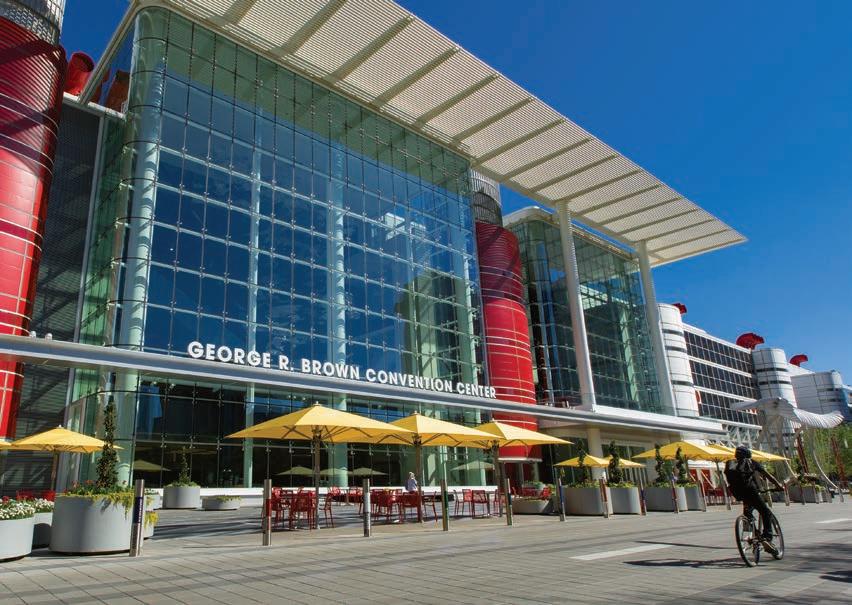
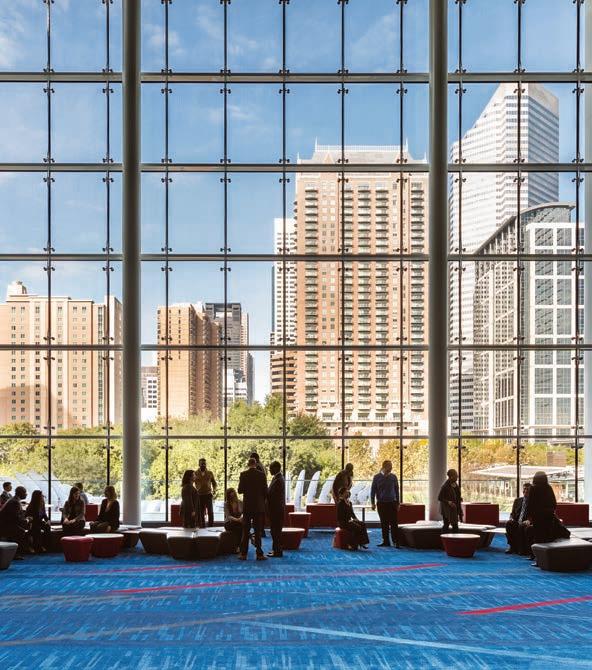
Laying in the heart of downtown Houston, George R. Brown Convention Center (GRB) (1001 Avenida de las Americas) was named after Houston entrepreneur, philanthropist, and civic leader, George R. Brown. The Texas Eastern Transmission Company (of which Brown was an investor) donated over half the real estate needed to build the center, which opened in September of 1987. It replaced the old Albert Thomas Convention Center.
At 1.8 million square feet the GRB has 850,000 square feet of exhibit space, over 100 meeting rooms, the 3,600 seat General Assembly Theatre, and ADLA Plaza, a nearly 100,000 square foot outdoor, pedestrian space. As one of the top 10 largest convention centers in the nation, the facility has become a cornerstone of Houston’s convention and tourism industry, drawing millions of visitors annually.
The facility’s layout was designed by HNTB Corporation, with later renovations by WHR Architects and Powers Brown Architecture, incorporating advanced acoustics, fexible layouts, and sustainable materials. The center’s LEED Gold certifcation in 2022 under-
By Kerstan Szczepanski
scores its commitment to environmental responsibility, with energy-efcient lighting, smart water management, and recycling initiatives integrated throughout its operations.
Historically GRB has hosted Houston’s Comicpalooza, the Houston Auto Show, the FIRST Robotics Championship, and the Ofshore Technology Conference. It was a refugee shelter during Hurricane Katrina and hosts numerous high school and university graduations every year. Adopted Houstonian George H.W. Bush held his presidential victory celebration at the venue in 1988, and Super Bowl LI located its media hub there.
Finally, cultural and entertainment oferings abound nearby. The Toyota Center hosts the Houston Rockets, the Astros play at Daikin Park, attendees can visit the Museum District, Discovery Green, and the House of Blues centered Green Street, a three block retail and entertainment complex, and much, much more. With so much to see, do, and experience, George R. Brown Convention Center is truly a vital centerpiece to Houston tourism and hospitality.
Grotto Downtown (1001 Avenida de las Americas) lies in the Avenida Houston district and is conveniently connected to the George R. Brown Convention Center, just outside Hall A (northern-most end of the convention center). Italian cuisine with craft beers, wine and one of the largest grappa collections in Houston. Website www.grottorestaurants.com.
In the Marriott Marquis Houston, you’ll find Xochi (1777 Walker St). Chef Hugo Ortega’s award-winning Oaxacan restaurant showcases authentic southern Mexican flavors, all made from scratch. They have cheeses, salsas, exotic moles, tortillas, and even cacao beans roasted and ground in house for true authentic Mexican chocolate. Website www.xochihouston.com.
Speaking of the Marriott Marquis Houston (1777 Walker St), the 1,000 room hotel is directly connected to the convention center by sky bridge. Famous for its Texas-shaped rooftop lazy river. The Marriott Marquis has multiple restaurants, a full-service spa, and panoramic city views. It also has over 150,000 square feet of its own event space, should you want to organize your own event without even leaving the hotel. Website www.marriott.com.
Hilton Americas–Houston (1600 Lamar St), also connected to the convention center via skybridge. With 1,200 guest rooms, a Starbucks, the R24 rooftop bar, 1600 Bar & Grille and an infinity edge lap pool, and over 90,000 square feet of its own event space, the hotel is ready to be a convention center of its own. Website www.hilton.com.
What about Discovery Green (1500 McKinney St)? The park sits directly across from the convention center, offering 12 acres of art, live music, and community programming year round. From yoga sessions to outdoor movies, it’s the city’s urban oasis. Website www. discoverygreen.com.

by Matchpoint
From generative design tools to predictive analytics, AI is embedded in how events are planned, marketed, and measured. But amid the excitement, event professionals are grappling with a nuanced question: How do we use technology to enhance human connection, not replace it?
Nowhere is that question more important than in networking.
Networking has always been the emotional core of live events. It’s where value is felt most deeply and where disappointment lingers if connections fall fat. While AI can analyze attendee data and predict who should meet, it can’t replicate the energy of a great conversation or the spark that turns an introduction into a relationship. Technology can guide the moment, but people still create it.
That balance—between intelligent systems and human experience—is exactly where MatchPoint operates.
At its core, MatchPoint is built on a simple truth: meaningful connections are the lifeblood of successful events. The platform uses AI to match the right people, at the right time, with the right context.
But the goal is never to showcase the technology. The goal is to create moments that feel natural and human.
By combining attendee input, behavioral signals, and event goals, MatchPoint reduces the guesswork that defnes networking. Instead of relying on chance encounters, attendees receive thoughtful guidance that helps conversations begin with purpose. The result is more productive interactions.
What makes this approach distinct is restraint. The algorithm doesn’t take over the room. It doesn’t dictate conversations or force interactions. It sets the stage.
As AI becomes prevalent in events, organizers are rightly cautious. Automation can streamline operations, but it can also create distance if it overrides human judgment. MatchPoint was designed with that tension in mind.
Event organizers remain in control of the experience. The technology exists to reduce logistical friction so teams can focus on the parts of events that require human intuition. Instead of managing spreadsheets or felding attendee complaints about “missed connections,” organizers gain
clarity and confdence that networking is working.
Attendees, meanwhile, experience enough structure to feel supported, while enjoying the freedom to explore and connect organically.
Across the industry, there’s a shift toward people-frst technology. Organizers are prioritizing solutions that solve attendee pain points without overwhelming the experience.
Networking is one of the most emotionally charged parts of events and people often struggle to start conversations or ensure their time feels worthwhile. Tools that make networking feel intuitive rather than transactional are becoming essential.
This is where AI, when applied thoughtfully, adds value. It can remove friction without removing humanity and help ensure that attendees leave events feeling connected and satisfed.
AI also brings new opportunities for measurement.
Engagement patterns, participation rates, and post-event insights ofer organizers valuable data. But even as metrics grow more sophisticated, the true measure of success remains remarkably human.
What people say after the event still matters most:
“I met someone who changed my perspective.”
“I found a partner I wasn’t expecting.”
“I left with connections that
actually matter.”
That’s the human ROI— something no dashboard can fully capture, but every organizer understands.
MatchPoint operates quietly in support of that outcome. It doesn’t seek attention. It works behind the scenes, reducing friction and improving fow so attendees can stay present and engaged with one another.
As the events industry looks ahead, the conversation around AI must include not only what technology can do, but also what it shouldn’t do. Empathy, intuition, and shared experiences still belong to people. Those elements can’t be automated. And they shouldn’t be.
The most efective event technology will be the kind that knows when to step forward and when to step aside. Tools that fade into the background while enabling genuine connection will defne the next era of events.
And when attendees walk away remembering conversations, not platforms, that’s how we’ll know we got the balance right.
MatchPoint helps organizers do more than facilitate better connections. It turns networking into a value driver, enhancing the attendee experience while unlocking new revenue opportunities.
To learn more, visit thematchpoint.com/partnerships.



With respect to the “weight of the lift,” audio and visual (A/V), staging, and lighting have the most immediate efect on cost efciency for a supply chain. It makes sense that this element of the event supply chain were early adopters even if they did not realize they were being more sustainable. Nonetheless, it is good to refresh steps the meeting planner or exhibit manager can take to ensure a highly sustainable solution. Looking at the guidance provided by the Net Zero Carbon Events (NZCE) initiative’s Better Stands program, Experiential Designer and Producers Association’s (EDPA) “From Build to Breakdown: Sustainability in Exhibitions,” Event Industry Council’s (EIC) Sustainable Event Standards, and The Exhibitor Advocate’s (TEA) Sustainability Sourcing Compass, here are things we should be doing.
be reuseable.


By Glenn Hansen
The EDPA echoes the call for reusability and adds LEDs should be used instead of incandescent bulbs and electronic display equipment (monitors, projectors, equipment, appliances) should meet Energy Star guidelines. Whenever possible, opt for units with serviceable, non-custom parts to maximize their lifecycle and ensure sustainability. Although digital signage is the rage, the EDPA recommends considering the lifespan of such and the environmental impact of its production. If there is an alternative with less environmental impact, it should be used.
The EIC advises limiting power consumption during rehearsals, of-show periods, and any time when audiovi-
sual or lighting equipment is unnecessary. It also recommends reducing scenic materials by ofering scenic component rentals versus one-time builds, using reusable sets, or alternatives such as stage mapping or stage projection. There should also be greater use of rechargeable batteries and recycling of batteries at their end of life. All e-waste should be donated by suppliers for recycling with a tracking mechanism in place to support reporting and verifcation.
The Compass calls for users to ask A/V and staging providers to issue a post event report to include measurements of the freight in and out of the event to include weight and distance along with the transportation of staf and crew to be on-site at the event. To reduce the emissions of these, suppliers are asked how much local labor and local equipment sourcing will be used as well as asking if emission ofsets will be purchased.
Reusability is the key word. A/V, lighting, and staging are purpose built to be reused. The Better Stands initiative wants displays, LED walls, TV and A/V equipment, and all lighting in booths and showcases to be reused to attain their bronze medal. To move up to their silver status, all rigged structures, lighting gantries, product display cabinets and lightboxes must
The Exhibitor Advocate assists event planners and exhibit managers by providing direction with the Sustainability Sourcing Compass. Organizations are encouraged to review their sustainable procurement policies (or lack thereof) on an annual basis. Are the suppliers to the events industry asking their supply chains what they are doing to be more responsible and eco-friendlier? The Compass calls for suppliers to describe their policy for purchasing environmentally and socially preferable consumables with post-consumer recycled, biodegradable, or locally sourced content.
With respect to waste, suppliers are asked if packing materials are eco-friendly. Instead of shrink-wrap are Polyolefn or bio-based materials used? What is the reusability of packing crates, boxes, and other containers?
Regarding move-in and move-out, suppliers are expected to reduce freight emissions by consolidating shipments, minimizing partial truckloads, and sourcing locally with preference to regional warehouses. They are also asked to think smarter about load-ins. Suppliers should plan for efcient dock scheduling. Pre-rig where allowed to reduce lift time and reduce overtime.
A/V, lighting, and staging are the highest-impact places to cut emissions without hurting show quality. Most audiences never notice the diference, but the clients will appreciate the power bill and carbon footprint.
Sustainability creates conversations between exhibitors and service providers. From these conversations we learn what clients care about. They want lower power costs, faster load-ins, less heat on stage, less waste to landfill, lower carbon emissions and clear and clean sustainability reporting. Check out the referenced sources and put them to work for you to ensure a more sustainable event.
BY KERSTAN SZCZEPANSKI
From its origin the tradeshow industry has introduced technological advancements that have not only revolutionized modern society but the industry itself. From pop up displays to LEDs, telephones and radio to smartphones, the industry has been at the forefront of advancement. But few, if any, technologies have created excitement and apprehension in the industry and the world at large more than artifcial intelligence (AI). AI arouses anxiety over loss of jobs for people even as it stirs creative possibilities. Yet, not all AI is the same.
As co-founder and CEO of Markus AI, Max Gabriel knows a thing or two about AI. “AI has been here for a while,” he observes. “It’s just that the whole generative AI wave is the loudest and the fastest growing at the moment.” But agentic AI is the tradeshow new hotness. For Markus AI, agentic AI is an all-encompassing assistant, rather than a simple tool that eliminates a worker. “The way we built Markus,” Gabriel explains, “it is a group of agents, as we call them, and they’re your personal event crew of agents; because to do your planning, you need an
agent, to summarize your notes, you need a diferent agent, to measure the event performance, you need a diferent agent. And what we have made is Markus for attendees, Markus for sponsors, Markus for organizers. What do they need to do pre-event, at the event, and post-event, all three stages of the workfow? We emphasize the pre-event as much as possible, because if you plan better, you’re going to get better results during the meeting and after.”
A week before an event Markus would contact users and ask what would make their visit successful, what are three things that they want to accomplish. “It’s literally constructed as an interview,” Gabriel says. “So that they can be very open-ended about what they’re thinking about, and we take that to create a personalized plan.”
Planning the visit is just the start. When the user meets fellow attendees, exhibitors, and sponsors at the event, it can be recorded and the AI takes notes and summarizes those meetings, which gets folded into the plan. This continues across the two or three days of the visit. But the end of the event isn’t where Markus stops.
“When they leave the event, all the meetings they’ve had
are organized in one place,” Gabriel says. “The users then get the actions, the follow-ups they need to do. All that they need to do, all of that, is taken care of by Markus.”
Gabriel says this method of follow-up gets the biggest reaction from users. Many people fnd the trip home from an event to be the worst part. “The fight right back, you’re dreading about the number of actions you need to follow up; the notes you took, the cards you collected, everything,” he says. “With Markus, all that is organized as if you have your own EA walking around, taking notes, sorting it out.”
The typically exhausting event post-mortem is left to Markus, so the user can relax and build enthusiasm upon seeing the success, the results, and the actions to be taken when they return home. Gabriel’s tagline: “We want the fight right out to be as exciting as fight right in.”
Other companies are taking a similar approach from diferent angles. “Tradeshow business is 10,000 little things,” says Shawn Pierce, president, Strategic Events, Meetings & Incentives at MCI USA. “None of them are individually hard, but each one has to be done at the right time, in the right

order to get the crescendo that is a beautiful event.” AI can help with that.
But frst, as Pierce says, MCI turned inward and asked how they would use AI themselves. “If we could automate tasks on our own side for our customers for ourselves, what would we do? Clearly, customer service. Every email and message we get could be from 10, 20, 50,000 attendees. That was the frst thing we looked at: How can we make our customer service much more efective? 24 hours a day, seven days a week, in any language. That’s AI for us. That was a good, easy, understandable win to start with. And the results speak for themselves, MCI USA now handles over 66 percent of every attendee interaction through AI.”
But Pierce hasn’t forgotten the heart and soul of the tradeshow industry. “We don’t want to lose the human side,” he stresses. “We are in the face-to-face business. I believe you, and you believe me, because I look you in the eye.

I want to buy your product, believe in your service, your message. A lot of things can be done using AI. The only thing it will never replace is human connection, and the events industry provides the best platform for that connection.”
From pre-planning the show to registration, assembling data, analyzing that data, realizing day to day questions and answers just leading up to the event. That’s the AI approach for MCI. “Users have an agent that reads their email,” Pierce says, “That reads their team’s messages, their project planning schedule—anything that comes into their inbox about that event, It gives the user a summary at the start of the day, every day. Like a 24 hour, seven-days-a-week assistant, AI can take care of the multitude of small tasks so users can focus on the larger ones. “You want people spending their time being less tactical and more strategic.” But even with that assertion, Pierce still calls
show. Which makes for happier exhibitors. Which makes for happier shows.”
for the human element: “Someone still needs to have that oversight to make sure everything is safe and humanized.”
The conversation comes down more and more to data. Don Kline, CEO of Map Your Show, says it outright: “What we see in the use of AI is what it can do on the data side.”
“We’re focused on activating the show organizers’ data to help the exhibitor, and the attendee to have a better experience.” With AI, Map Your Show asks what are attendees and exhibitors looking for, and gets them together with more efciency and depth.
“We look at the exhibitor data and what they’re interested in selling,” Kline says. “We look at the behavior of the attendees, what interests them in the event. It’s looking at the intent of both, exhibitors and attendees, and then help match those individuals in those companies, so that the attendee has the best possible experience at the end of the
In a way, Kline is actually demonstrating how AI humanizes the tradeshow experience in a very individual way. “You leverage this data to deliver a more personalized, a hyper personalized experience, for that attendee.” Yet, Kline is not just talking about improving the individual experience. Map Your Show’s AI goal is to help the tradeshow industry as a whole. “We can actually transform the industry and the industry experience with the data that we know, the data that we know about the exhibitor, the data that we know about the attendee’s behavior. We can create a better overall experience.”
Wendi Jacobs, marketing + account development manager for Acer Exhibits & Events, is cautiously optimistic. “On the horizon, I think we will see an increase in AI use but we need to tread carefully. The industry’s backbone is understanding our clients’ brands and conveying those through the authenticity of face-toface marketing connections. An over-reliance on AI could cheapen the value of the bespoke design and custom solutions that we produce.”
Where Acer Exhibits is concerned, AI fulflls many back of house functions: analytics, ROI calculations, data management. There it is again—data. “Presentation prep, researching clients, and planning are prime areas for AI use to streamline our operations and save us time,” Jacobs says.
But there is room on the
design side. Ideation, mood board development, AI can offer creative kickstarts. “When a client gives us keywords of ‘modern, colorful and techy’ what does AI think that looks like?” Jacobs says. “It’s a check-in point for the designer and account executive to be sure we’re getting the client aesthetic right and to generate some design cues.”
She doesn’t see using AI to create full designs any time soon though. Once again, the human element counts. “Our design team and their understanding of client brand nuances, tradeshow rules, and spatial and functional considerations are too valuable to our process and product.”
The Future AI agents, the digital executive assistants. Helping plan, register, and execute, helping assess, analyze, and evaluate. AI will allow people to throw themselves into a tradeshow with clarity, focus, and anticipation. The anxiety that generative AI stirs overshadows agentic AI’s sheer power and versatility that’s at the beck and call of people everywhere. But industry insiders are confdent that AI is a tool that can enhance the human experience, rather than diminish it. As Jacobs says, “I think AI will enhance how exhibitors are able to understand and respond to their audiences, allowing them (somewhat ironically) to provide even more relevant in-person experiences.”
Gabriel agrees, “I hope it gives us all time to be more human together.”
BY RICK KOSTOPOULOS, CEO/PRESIDENT, NEWGEN BUSINESS SOLUTIONS
Logic, logic, and a bit more logic. But wait? What if I want to change my thoughts on something, what happens?
Logic is determined through facts, either good facts or bad facts. If you have seven systems with bad data sets, that is considered bad facts, and therefore bad logic.
Not tooting my own horn, but I was fortunate to almost triple major in school in accounting, management information systems (MIS), and in logic-based electronics.
The one thing I learned through those disciplines is that there is no easy way around the decades of thought behind them.
I would like to put the “AI will fgure everything out” myth to bed, at least for the foreseeable future.
Accounting is “the language of business.” Debits and credits are derived from accounts receivable, accounts payable, invoices, purchase orders, sales orders, inventory markups and markdowns, payroll, fxed asset purchases, and fxed asset sales. It might feel overwhelming (or boring), but the numbers guide every business decision.
Then consider management information systems—that’s the layer that is industry specifc—it is the logic that helps events professionals do their jobs correctly, whether a General Service Contractor, an Exhibit House, or a Venue.
Each industry role has a specifc set of business processes but struggles to apply

normalized accounting practices. Combine them with an accounting system like the one found in ConventionSuite, built atop NetSuite’s world-leading AI cloud-based ERP system, and they’re of to the races.
The icing on the cake: AI. Yes, AI. Lots of bits and lots of bytes. Lots of sugar and lots of spice. (Sorry, I couldn’t resist.)
When you study “logic-based electronics,” you quickly realize why the server farm (data warehouse) down the road is fve times larger than the wind farm on Old Man Johnson’s 1,000-acre ranch down “them there road.” That thing is big.
Folks, if you have seven systems, and try to link them using AI, you’re the reason why that server farm needs a nuclear power plant to operate it. Managing this industry is hard enough with one normal-
ized data set; adding six more is crazy.
The lights are dimming as I write.
Here’s an example: You have a car that uses simple logic to track lines on the right and left side of the car to stay in its lane, but a paving guy paves over one of those lines, which causes the car to lose all sense of direction, and of the road it goes.
So, what do we do? We add ten more systems to the car. A system to track gaps, a system to track surrounding cars. Another to track what’s a mile ahead, which satellites are above, what follows behind. You get it. Each system adds more data, more data storage, and bigger server farms to process the data.
Now take that thought and apply it to the disjointed systems currently used in the market today. The AI consultant walks in the door and says, “You know
what I’m going to do for you? Do you remember Old Man Johnson’s ranch down the road? Did you know they dismantled the wind farm and built a server farm on it? Well, you’re in luck, that server farm powers my new, super, duper, ERP AI Business Process Fixer, and it’s going to straighten this mess out.”
The only issue is that the “server farm” does not know the event services industry. The business processes can’t be that much diferent, can they?
It’s going to be like that.
One thing to learn from this now is to fx your data, or you will be left behind very quickly. A full- featured ERP with an MIS built for your industry is a lot easier (and less energy-consuming) for AI to fgure out than seven disjointed systems working against each other. It might seem very painful to get organized and eliminate data redundancy, but it’s the frst step to controlling your own destiny.
It may be fve, ten, or 15 years down the road before AI understands MIS event services workfows, plus all the ERP system logic needed to run them. Will your business survive that long on incomplete logic, high energy-consumption servers, and the AI experts’ fx-all solutions? The lights dim as AI asks seven diferent systems that question.
One more thing—I’m not knocking on AI. It does some great “icing on the cake” things. AI thrives on logical, non-redundant data. It’s pretty smooth when there are no bad facts or bad logic.
But when there are bad facts and bad logic, they are consistently bad, which makes you and your team consistently bad. That’s when we step in with the solution, clean up your data and establish good logic with one unifed system that leverages AI to amplify your potential (not duct tape it).
Say no to massive server farms (data centers) and yes to non-redundant
I would like to put the ‘AI will figure everything out’ myth to bed...”
factual data. The farm animals will appreciate it!
Rick Kostopoulos is an ERP expert with over 28 years in the industry. He is the founder, President, and CEO of NewGen Business Solutions, and the creator of ConventionSuite, the only NetSuite-powered ERP built for the events, venue, and tradeshows industry. Email sales@newgennow.com for more information. conventionsuite.com
BY TRAVIS STANTON, DIRECTOR OF STRATEGY, STORYLINK CREATIVE
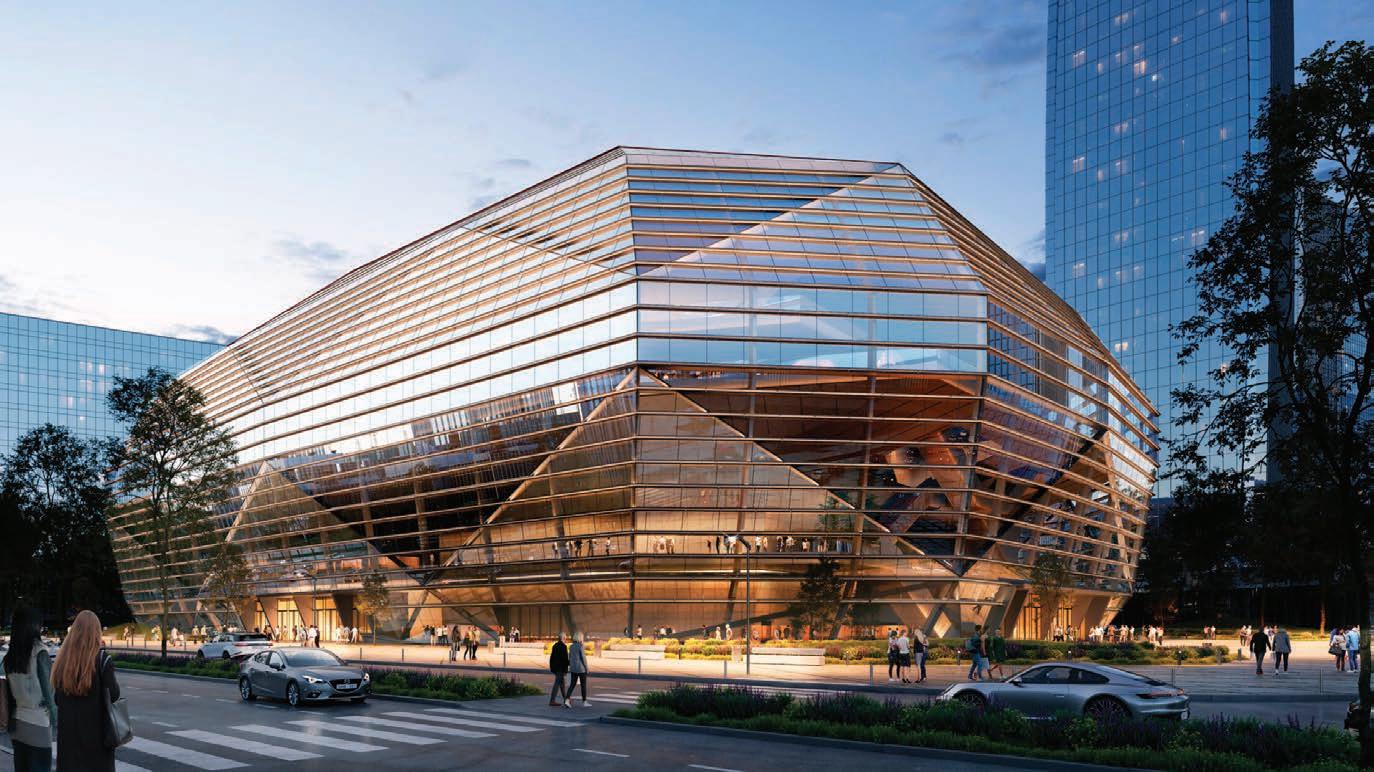
Artifcial intelligence is no longer a fringe experiment reserved for Silicon Valley labs or sci-f think pieces. It is actively reshaping industries that once seemed immune to automation—creative felds included. Architecture frms are using generative design tools to explore thousands of structural options in minutes. Fashion brands are testing AI-generated collections. Filmmakers are de-aging actors, resurrecting dead voices, and storyboarding scenes with synthetic talent. And headlines rippled through the global design community when a massive new convention center sprang up in China, reportedly designed using AI-driven
architectural modeling.
To be clear, China’s West Bund Convention Center wasn’t designed by AI, despite what the headlines might imply. Rather, a team from Skidmore, Owings & Merrill (SOM) used AI to optimize circulation, energy efciency, and spatial planning at a pace and scale few human teams could match. In the words of SOM Communication Manager Francisco Lopez de Arenosa, “Our team used an AI-assisted workfow to explore a wider range of design options more efciently, allowing designers to resolve multiple challenges in parallel.”
AI didn’t have a vision. It didn’t sketch the frst idea on a
napkin. It didn’t walk the site, talk to stakeholders, or debate the emotional impact of the atrium. It simply did what machines do best: crunch options, identify patterns, and accelerate decision-making.
Still, if AI can help design a convention center, the question facing our industry is unavoidable: What role, if any, should it play in designing the exhibits that fll those halls?
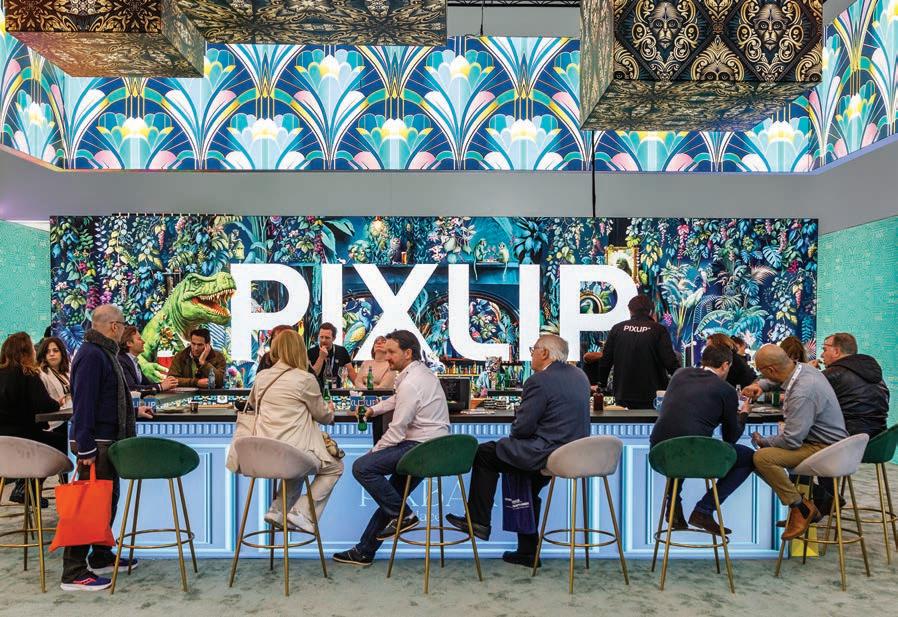
Three years ago, at EuroShop 2023 in Düsseldorf, German exhibit house Pixlip presented what it billed as “The frst tradeshow stand designed by AI.” And while the exhibit itself received mixed reviews, it stood as proof of concept. And, much like
SOM’s convention center, it wasn’t exactly designed by AI.
“We used generative systems to explore visual directions, moods, and thematic elements, which helped accelerate brainstorming and inspire new creative ideas,” said Pixlip COO Daniel Liba. “Ultimately, the concept emerged from an internal meeting, and AI served as an additional tool to expand the range of possibilities during the design process.”
So, it’s not surprising the exhibit-design community finds itself at a crossroads— equal parts curious, cautious, and conflicted. According to The Experiential Design Authority’s recent report, The Role of AI in Exhibit Design, 59 percent of respondents say they currently use AI during the exhibit-design process, while 41 percent do not. That split reveals an industry still feeling its way
forward, unsure whether AI is a creative accelerator, a potential liability, or something in between. Or, to put it more bluntly: Is AI a tool or a Trojan horse?
In architecture and product design, AI has gained traction largely because of its ability to process complex variables quickly. Generative design tools can optimize structures for airfow, daylighting, materials usage, and sustainability metrics. In urban planning, AI is being used to simulate pedestrian fow and predict congestion patterns. These are data-heavy challenges—fertile ground for algorithms.
Tradeshow exhibits, however, live in a more nuanced space. They are temporary, brand-driven environments that must balance storytelling, functionality, budget, logistics, emotion, and the unique parameters created by show organizers, convention centers, and union regulations— all within a relatively small footprint and a few precious seconds of attendee attention. That complexity may explain why AI adoption in exhibit design has been slower and more selective.
While TEDA’s survey found a majority of respondents already use AI in the exhibit-design process, the depth of usage varies widely. Roughly one-third describe moderate usage, turning to AI regularly, but not habitually. Another 25 percent use AI more sparingly, only for specifc tasks, and only after human alternatives have been exhausted.
“AI enables us to generate
initial concepts, layouts, and visualizations faster, allowing us to explore more design options in less time and support better-informed client decisions,” said one anonymous respondent. “It also helps automate repetitive tasks and supports technical checks. By using AI to review brand and construction guidelines, we can interpret and apply requirements more consistently, ensuring designs meet both brand standards and technical feasibility before production.”
Interestingly, 69 percent say their organizations already use AI for non-design purposes, such as marketing (46 percent), client communications (48 percent), or project management (31 percent). In other words, resistance to AI isn’t ideological—it’s contextual. Many frms are comfortable with AI in the background, just not yet at the creative core.
When asked about the benefts of AI integration, over half of respondents cited heightened creativity and improved ideation as the top advantages, followed by increased efciency (31 percent) and shortened project timelines (23 percent). Only 9 percent reported seeing no benefts at all, suggesting skepticism often stems from philosophical or practical concerns rather than a lack of measurable upside. Translation: Most people who try it don’t hate it. They just don’t trust it. Yet.
Catalyst or Copycat?
Among frms that are using AI, most are treating it as a support tool rather than a lead designer. Casey Baron, Senior Director of Creative at
Storylink Creative, sees AI as a way to widen the creative funnel—not replace it.
“We occasionally use AI during the concept phase to get more ideas or help visualize ideas,” says Baron. “But I fear designers are beginning to rely too heavily on AI as the fnal creative execution. While AI can be a powerful tool for ideation, it should never replace human intuition or our ability to think diferently about how an audience truly experiences a design.” That sentiment is echoed by many respondents: AI is valuable early, dangerous late.
Others are deploying AI for highly tactical needs. Steve Deckel, CEO of Deckel & Moneypenny, uses tools like Topaz Gigapixel AI to enhance client-supplied imagery and Gemini to turn still images into motion graphics.
“AI can help once you know the creative direction, but it seldom recommends a solution we would recommend,” Deckel explains. “Our job is to communicate in an unexpectedly charming way, not the obvious, predictable way. And just as great jokes don’t work once they’ve been diagrammed, design is difcult to quantify and explain.”
Deckel’s analogy is telling. Creativity, like humor, doesn’t survive dissection. You can analyze it, optimize it, reverse-engineer it—but the magic lives in the messy, human part. That may be why, for four-tenths of the industry, AI remains at arm’s length. And the reasons are rarely technophobic.
Some designers feel AI threatens the very craft they’ve spent decades refning. Kristof
Van Leughenhagen, owner and designer at Standideas, puts it bluntly: “I became a designer to design, not to type prompts. Every brief is diferent, so every design is unique.”
Others worry about feasibility. Jef Kisko of Octanorm points out that AI-generated concepts can create unrealistic expectations. “It will sometimes produce ideas that are not feasible. If a customer sees this, it may lead to confusion or frustration.”
That concern is already playing out in real time. Several respondents noted clients bringing AI-generated booth concepts into RFPs— designs that look compelling on screen but collapse under the weight of budgets, timelines, rigging points, freight realities, union labor rules, or even the basic laws of physics. In short: AI doesn’t know what it doesn’t know.
Wendi Jacobs of Acer Exhibits raises a deeper concern: perception. “The creativity of our designs is one of the foundations of our business. I’d hate to see that lose value to clients who think they can create a design with AI and expect us to build it.”
One anonymous respondent voiced a more existential anxiety: “I worry about the amount of spec design we create and put out into the universe, as well as the fact that all our old work is being used by AI to create derivative solutions. We’re feeding a monster that’s trying to take our jobs.” And that’s not paranoia. It’s math.
AI models are trained on vast libraries of existing content—much of it created by the very designers now
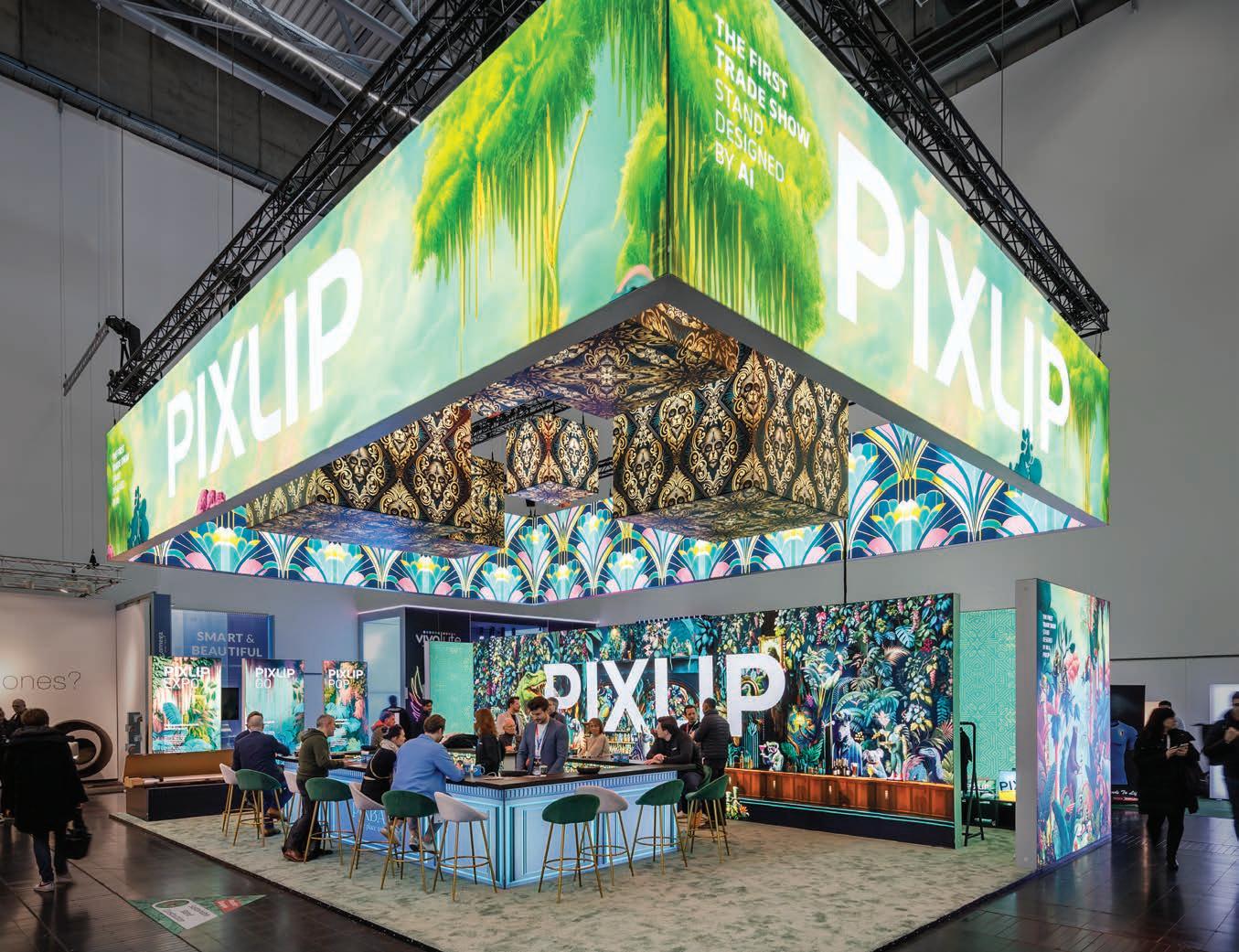
worried about being replaced. Which raises an uncomfortable question: Are we teaching the machine how to imitate us or how to eliminate us?
Another issue is that AI doesn’t do a great job of distinguishing between temporary tradeshow exhibits and, say, permanent museum installations or retail architecture. As such, the primordial ooze from which these automated renderings are emerging is already tainted by impractical ideas and irrelevant inspiration.
That’s one reason Jacobs considers AI more of a device than a designer. If a client
asks for a traditional, techy, bright, open booth, Acer might use those words in a prompt and see what AI generates. In theory, this can help ensure clients and designers are speaking the same language when discussing design styles. But as Jacobs puts it:
“Just like a chatbot can’t fully replace a human conversation—at least not from the consumer end—I don’t think AI design can replace human design. Assist it, yes. Do the whole job? No.”
Similarly, Liba reports that Pixlip again used AI to help design the stand it’s debut-
ing at EuroShop 2026. The company has even launched an AI-based confgurator where customers can input their website and receive initial stand design suggestions aligned with their corporate identity — concepts then refned by Pixlip’s design teams. But Liba stops short of seeing AI as an alternative to human design. “For us, AI is not a replacement for creativity. It’s a new creative instrument. When used thoughtfully, it can help designers move faster, explore more options, and bring fresh ideas into physical spaces.” Bottom line: AI may
be a powerful intern. But it’s not the creative director.
Linchpin or Liability?
Perhaps the most revealing data point from the TEDA survey is this: 39 percent of respondents are unsure how their clients feel about the use of AI in exhibit design. Only 15 percent report that clients actively encourage or support it, while another 8 percent say clients discourage or prohibit it outright. The rest fall somewhere between indiference and uncertainty.
That ambiguity may explain why disclosure practices are
inconsistent as well. Just 11 percent say they always disclose AI usage to clients, while 34 percent do so only if asked, and 10 percent say they never disclose it at all. That reluctance seems to say, “we’re already using AI—we’re just not sure we want anybody to know it.” That tension refects where the industry is today: experimenting without surrendering control.
So, is AI the future of exhibit design? When asked to look ahead, 48 percent believe AI is a trend—powerful for some, unnecessary for others. Another 44 percent say it’s the future and everyone will use it. Only 8 percent dismiss it as a fad. The more telling question may be this: Is it a liability
not to use AI? Only 15 percent answered yes outright, while 39 percent said maybe. On the other hand, 8 percent believe the opposite—that using AI is itself a liability.
One of the main concerns is privacy and intellectual property. As one respondent put it: “When using AI tools to generate visuals or concepts, there is often uncertainty about what happens to the data you upload. When entering client names, brand assets, logos, or confdential project details, it is not always clear whether this information is stored, reused for training, or exposed outside the project environment.” That concern suggests the near future of AI in exhibit design won’t be
about replacement. It will be about restraint.
AI’s most realistic role in exhibit design may be as a creative amplifer—expanding ideation, accelerating workfows, and improving communication—without supplanting human judgment. It can help designers pressure-test ideas. Visualize aesthetics faster. Translate vague brand language into tangible mood boards. Streamline production tasks. Catch errors. Generate variations. Provide a second (or third, or fourth) opinion. What it cannot yet do—at least not well—is understand context, emotion, or the lived experience of a show foor. It doesn’t know why a conversation matters. It doesn’t
feel the energy of a crowd. It doesn’t notice the subtle hesitation before a prospect steps into a booth. As one respondent noted, AI can reinterpret the past, but it struggles to invent the unexpected. In an industry built on surprise, storytelling, and human connection, that distinction matters.
The frms that will thrive, it seems, won’t be the ones that reject AI outright—or blindly embrace it—but those that defne clear boundaries for its use. AI may soon be ubiquitous behind the scenes. The magic, however, will still happen where it always has: at the intersection of insight, intuition, and imagination. And for now, at least, that intersection remains distinctly human.


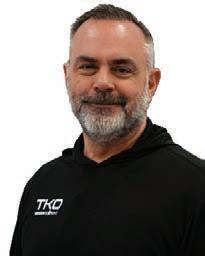
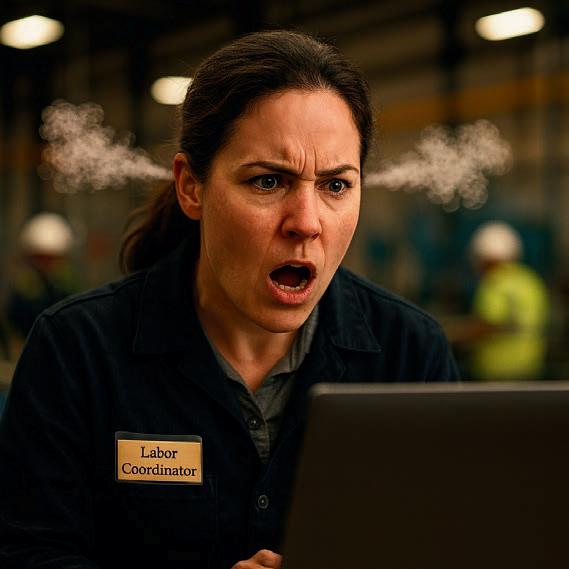

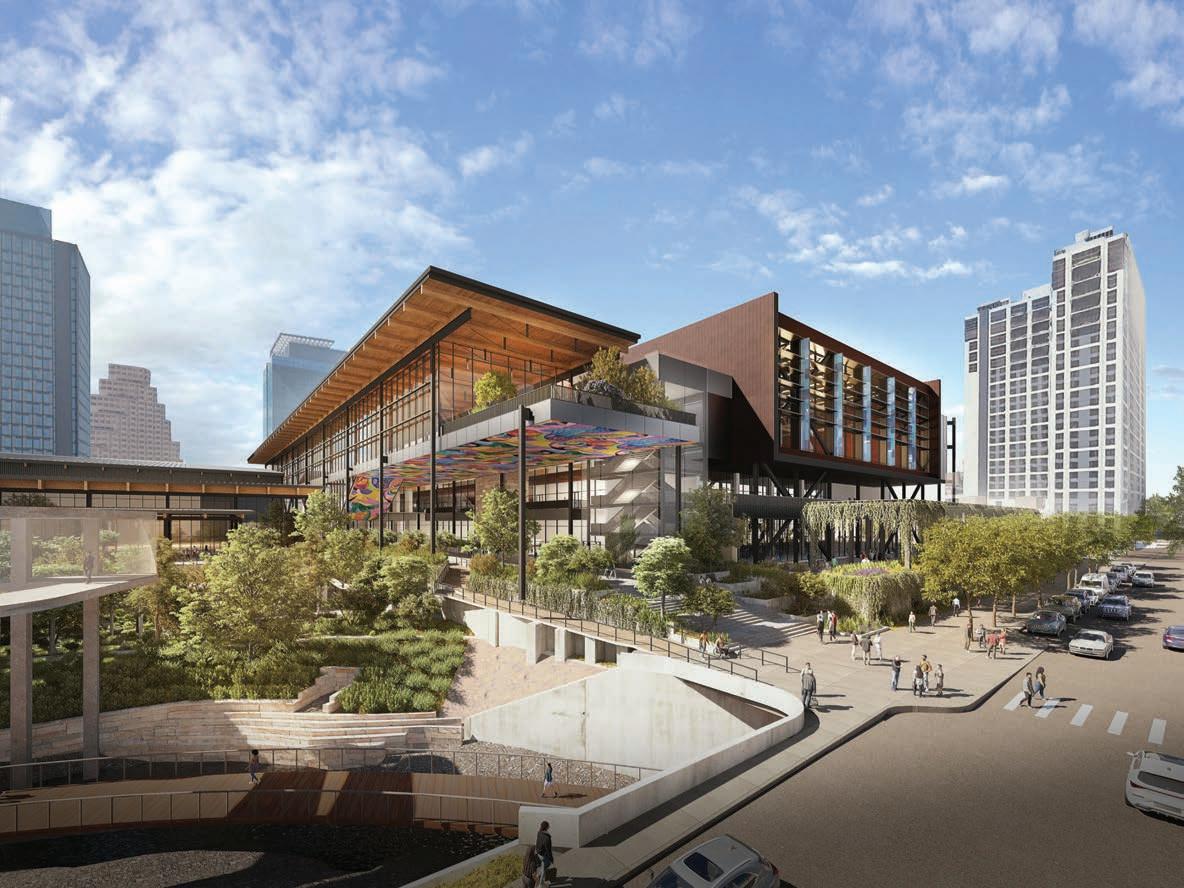
By Kerstan Szczepanski
In keeping with Texas’ expansion and redevelopment of convention centers (see our Dallas CC Spotlight) Austin is revamping the Austin Convention Center (500 E. Cesar Chavez Street), but in a typically Texas big way: the old Austin Convention Center was demolished to make way for an entirely new venue due to open in September of 2029 (just in time for South By Southwest). The project’s named Unconventional ATX and plans to create a bigger, newer convention center with the latest in tech, amenities, and more.
The 1.6 billion dollar investment will be funded through the Hotel Occupancy Tax (HOT), convention center revenue, and Texas’ Project Financing Zone. Established in 2013, these zones allow municipalities to designate a three mile radius around eligible convention centers or arenas to receive a
30 year rebate of state hotel occupancy taxes, supporting venue improvements. 17.7 million dollars will be dedicated to public art, involving 10 local artists. For the center itself, the square footage will nearly double to over one million square feet with rentable space growing from 365,000 to 620,000 square feet. It’s planned to be the world’s frst zero carbon certifed center, running on 100 percent renewable energy. Even the old center will contribute to sustainability: some 75 percent of the demolition materials will be recycled or reused. This even includes salvaged structural steel trusses that will be used in the new building. Estimated to boost the annual economy by 285 million dollars, Unconventional ATX will lead to more than 1,600 new jobs in the hospitality and tourism sectors, and 13 million dollars in additional tax revenue annually.
With three years to go before opening, it would be hard to accurately cite what Eat, Sleep, Play there will be around the new Austin Convention Center, but ECN can offer some general ideas.
New dining and retail options are in the works for the new convention center, but nothing specific has been announced. But that doesn’t change Auston’s surrounding food scene, with street-style tacos, smoked meats, and Tex-Mex dishes. Thousands of restaurants exist in downtown Austin, so there will be plenty of eating during your visit.
While the old convention center had a hotel directly connected to it, due to costs the new center will not. But the Hilton Austin, which was connected to the old center, will still be nearby. Just like the old venue, the new convention center will have some 14,000 hotel rooms within a one mile radius.
Here we can be a little more certain. Home of the PBS television series Austin City Limits, ACL Live at the Moody Theater is a major live music venue and will be just over a 15 minute walk to the new center. If you stay at the W Hotel, you’ll find it is connected to the theater. With over 30 clubs and a pedestrian only weekend access between I-35 and Brazos St, Austin’s Sixth Street District has restaurants and bars galore. Just minutes away from the old convention center site, the “Dirty 6th” is a center of college nightlife with pubs, dive bars, food trucks, and, of course, live music. For a more upscale scene with dinner, craft beers, shopping, sport events, and dance clubs, West 6th Street is the place to be. And East 6th Street provides a more hipster scene, with a variety of nightlife in the gentrified East Austin area. Over 250 venues host live music nightly. If live music is your jam, any convention at the new Austin Convention Center will be your dream.



American Solutions for Business in 2021 is Rocket Fuel for out already Award-Winning level of Service & Resources to the Print Marketplace. When a client requires a project in a single market or in every city across the U.S., Horizon is poised to meet national, regional, and complex requirements at an unprecedented caliber of efciency and intelligence.
We Specialize In:
• Traditional Forms
• Promotional Products
• Tags & Labels
• Large Format Printing
• Commercial Printing
• Specialty/Unique Items
• Stationery
• Logoed Apparel
Services We Offer:
• Graphic Design
• Mailing Solutions
• Ez-Net Online Ordering
• Warehousing/ Product Management
• Kitting Fulfillment Services
• EZ-Net: Online Ordering & Proofing
• Collateral Management & Distribution: Move projects & Packages... with your mouse.
• Direct Mail Solutions: Ongoing effort or one time campaign


by Elena Vazzo
Align Exhibits, a national leader in tradeshow exhibit solutions, is making waves with its recent growth, innovative services, and commitment to clients’ success. Founded in 2025 by six industry veterans, with a clear purpose of establishing partnerships, transparency, and costumer service through the simplifcation of exhibit building. Troy Trice, the Founder & CEO, Lisa Venegas, the Director of Sales, Chris Ybarra, the Director of Creative Strategy, Abby Georgacopoulos, the Director of Marketing & Integration, Kelly Sheldon, Director of Client Experience, and Cathi Seibert, the Accounting & HR Specialist, reunited with a new shared goal: to generate a company with the perfect blend of culture, service, and talent. This “dream team” isn’t just colleagues working together, but friends who treat each other like family.
“About fve years after the pandemic, I was intentional about bringing together a leadership team I’ve worked with and trusted for years. People who’ve been tested under pressure and know how to lead in complexity. I jok-
ingly call them the Avengers of tradeshows, but in reality, they’re leaders who show up, own outcomes, and protect the culture that makes consistent execution possible, ” explains Troy Trice.
Recently, Align relocated to a larger, more strategically positioned facility near Cedar Park, Texas. With expanded space for nationwide clients, their aggressive growth strategy fourishes. Trice emphasizes, “For a company that’s just one year old, Align has moved quickly, but intentionally. In our frst year, we completed two acquisitions, established new headquarters in Cedar Park, TX, and grew from six founding members to a team of 38 and counting. At the same time, we’ve built a national platform, aligned experienced leadership, and put systems and culture in place that allow us to scale without losing accountability.” This new space focuses on their clients, helping to deliver a high-quality service across the country.
Align’s HQ is strategically located to support the Texas triangle, one of the busiest areas in the country for events.
Austin expects to open a brand new massive convention center in 2028, and a largescale expansion of the airport is already underway. The city also hosts South by Southwest (SWSX), Austin City Limits (ACL), and F1 racing.
As of July 15th, 2025, Align acquired Xtreme Xhibits, an independent dealer based in Austin, Texas. This strategic acquisition strengthened Align Exhibits’ position in the industry by combining the talents, creativity, and resources of both companies.
Additionally, as of February 13th, 2026, Align acquired Suncoast Displays. They see this addition as a powerful step forward allowing them to strategically expand into the Florida market.
Align introduced Alignment 360, their innovative approach to exhibit asset management. This comprehensive system standardizes every step of the process. From detailed inspections and precise packing to careful staging before shipping, they ensure exhibits arrive ready to make a lasting impression. The unique beneft of Alignment 360 is the guarantee of fxed labor and freight costs, giving clients peace of mind by eliminating
surprise expenses. “We ofer fxed costs to clients so they’re not going to get slammed with that surprise bill,” explains Abby Georgacopoulos. “It’s doing things the right way the frst time so that we don’t have to redo things, especially on the show foor.” Meticulous care, transparent pricing, and efcient logistics enable Alignment 360 clients with consistent, high-quality service.
At its best, Align Exhibits is more than just exhibits. It’s about relationships. They continue to align goals with clients and master at top quality service, succeeding in creating trust and relationships in the tradeshow industry. By ofering fxed costs, detailed project management, and a driven service approach, Align provides a no-surprise experience that empowers exhibits to show up confdently and consistently. Whether you’re a long-serving exhibitor or new to the tradeshow world, Align ofers a trusted partner dedicated to making your event presence and exhibit seamless and successful. Their commitment to “doing things right the frst time” leads to fewer complications, smoother operations, and makes exhibits truly shine.
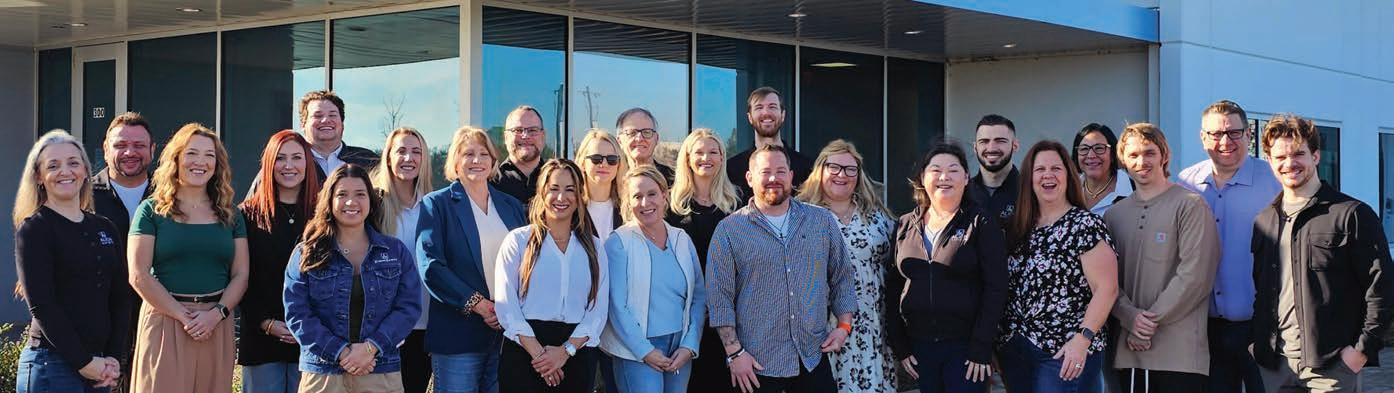
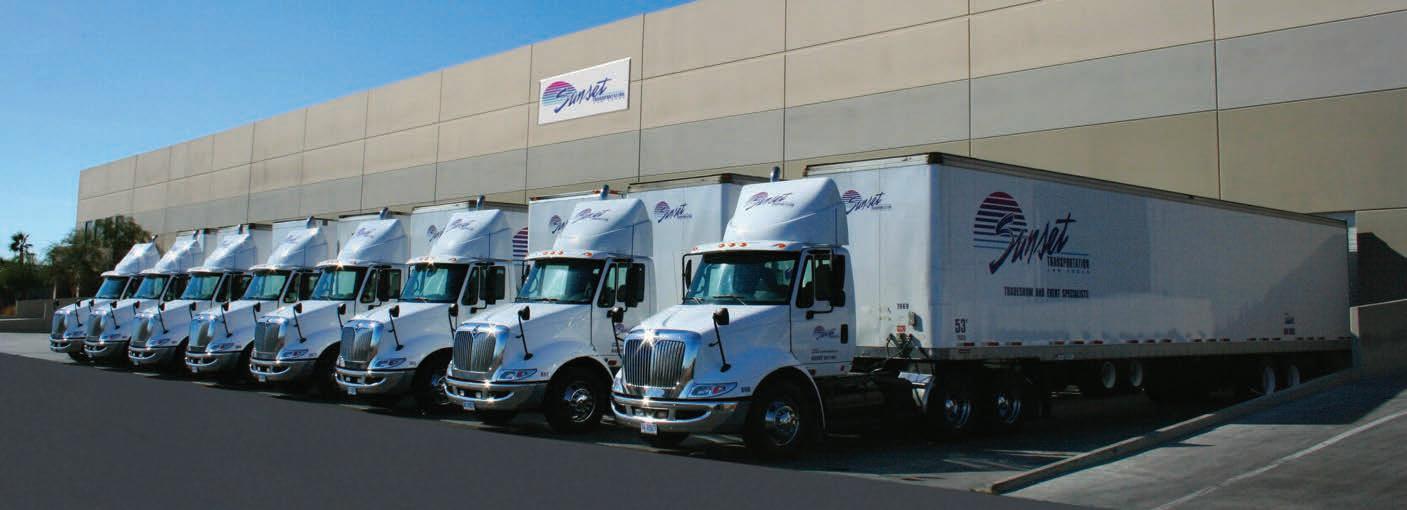
THAT SIMPLE.
As a unique Las Vegas based carrier, we are dedicated to one thing - trade shows . With over 30 years of experience we are highly trained, skilled and focused on providing you with flawless service handling your exhibit materials in and out of Las Vegas convention venues.
What makes us so great?
› 24/7 nationwide service - year round
› Warehousing & exhibit crate repair
› Customized account management
› Show-to-show coordination
› On site show floor representation
› Over 100,000 sq. ft. of booth storage
› Certified weight tickets/on-site truck scale
› Pad wrapping & color-coded show labels
› More than 100 vans, tractors & trailers solely serving the Las Vegas market

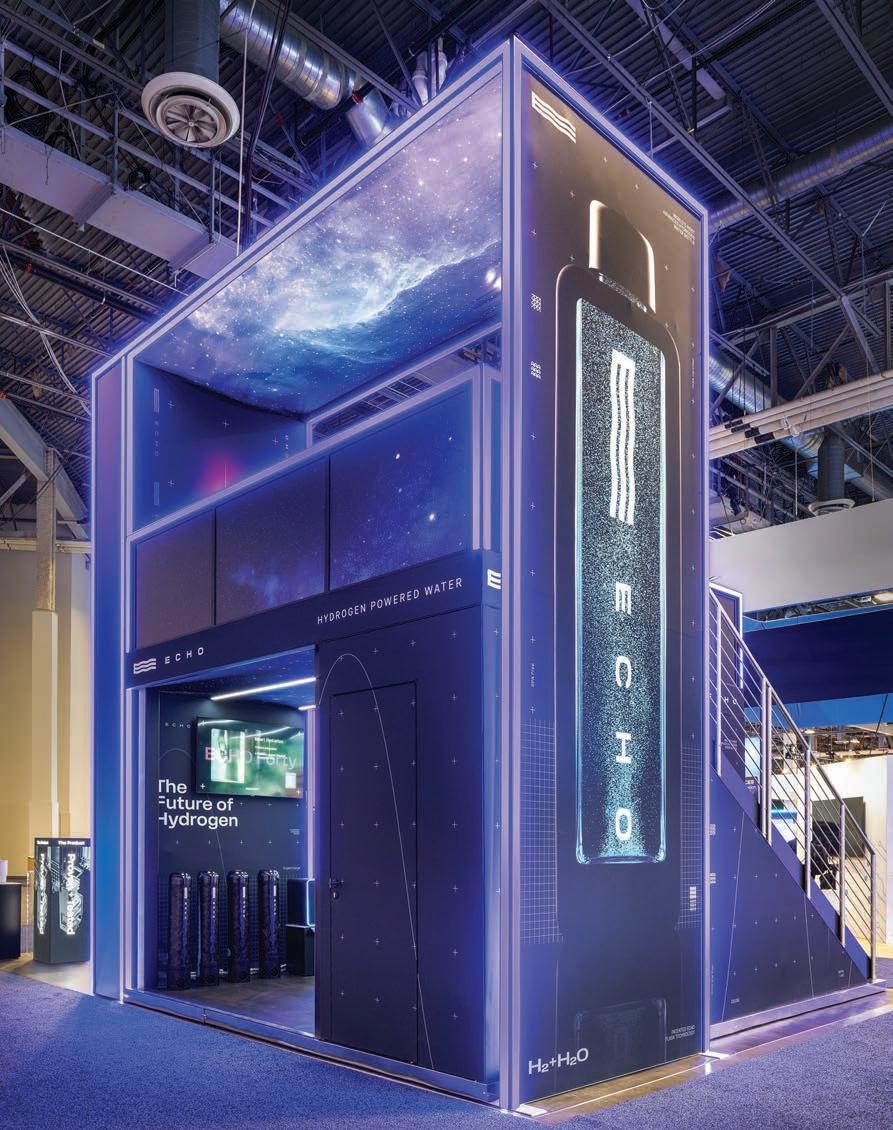
by Jillian Fafard, Director of Marketing, US, Aluvision
Photography by Exposures LTD.
Standing out at CES isn’t just a wish but a crucial requirement for success. And when you have a prime location at the entryway to the exhibit hall? The stakes are even higher.
It’s why hydrogen-infused water bottle brand, Echo Water, chose to work
with LV Exhibit Rentals for their 20x30 booth at CES 2026.
Echo Water’s goal was to make a splash while educating attendees on the science and health benefts behind their products that allow you to infuse regular drinking water with pure molecular
hydrogen. With such a stellar ofering, Echo Water also wanted to showcase their fltration systems in action with practical demonstrations, and to further highlight retail opportunities for their products.
They needed an experienced partner who could help them maximize their 600 sq. ft. space at the front of the Venetian Expo.
As LV Exhibits specializes in turnkey rental programs and modular exhibit design, they were more than ready for the challenge. Their vast inventory of Aluvision systems and LED solutions was the perfect ft for Echo Water’s ask for a booth optimized for foot trafc, private meeting space, and visual engagement.
Echo Water knew that integrating LED tiles into their booth was a musthave. They wanted to deploy eyecatching, curiosity-provoking LED displays throughout their space to compel attendees to stop at the first exhibit they saw walking into the show. (Not an easy feat!)
LV Exhibits strategically designed the booth to incorporate Aluvision’s Hi-LED P2.5 tiles throughout; from several standalone, 3D stacked LED cube activations, to a Times Square-esque display up the side of a central tower facing the entrance. To maximize their space, Echo Water asked LV Exhibits for a double deck solution that could ofer private meeting space as well as refect the impressive vibe of the hydrogen-infused water bottle brand.
LV Exhibits had just the modular system to seamlessly integrate into the scene— Aluvision’s Flexdeck. By enclosing one side of the double deck base, LV Exhibits created a third opportunity for dynamic display. They incorporated additional Hi-LED P2.5 tiles for a front-facing LED video wall that attracted attendees into the demonstration space nestled underneath.
LV Exhibits fnished the cutting-edge, contemporary look of Echo Water’s booth with Aluvision’s LED line RGBW edgelighting solutions.
From every angle, attendees were mesmerized by stunning visual displays refecting the brand’s “Drink Star Fuel” theme. Even the modular booth design mirrored the brand’s vibe—infusing grandeur and wonder into combined structures grounded by expert knowledge.
LV Exhibits used Aluvision’s Omni-55 frames for the double-sided tower structure strategically placed in front of and over the Flexdeck, creating a canopied efect for part of the upper foor which visually continued the brand’s celestial theme. It also served to ofer additional privacy for the top deck where only VIPs were invited. Aluvision’s Flexdeck was chosen as the double deck solution for its ease of use and adaptability, where more Omni-55 frames were integrated to create a separate space for the retail area plus a storage closet (complete with the Premium Omni-55 door). Aluvision’s Omni series is well known for accommodating both hard panel and SEG inflls, allowing Echo Water to achieve a solid yet warm and inviting atmosphere.
Unique to Aluvision’s Flexdeck, the double-deck solution uses Aluvision’s Constru profle for the railing, ofering brands the ability to customize their look with fully programmable, simple to control LED lighting by attaching our LED line covers. As all Aluvision’s modular systems are 100% compatible, the Flexdeck can be outftted for any type of infll: from hard panel to glass, unlit fabric and lightbox applications, to Aluvision’s award-winning Hi-LED tiles, and even our decorative wooden shutters and louvers. The top railings featured a custom infll using Aluvision’s ultrathin Basic-55 frames.
Along with the Constru LED line, LV Exhibits took advantage of our versatile, modular Omni-55 LED line covers and T-bright corner LED line profles to add to the bold outlines and visual glow of Echo Water’s booth. The T-bright corner LED line was especially advantageous for connecting ceiling panels underneath the double deck as well as providing light.
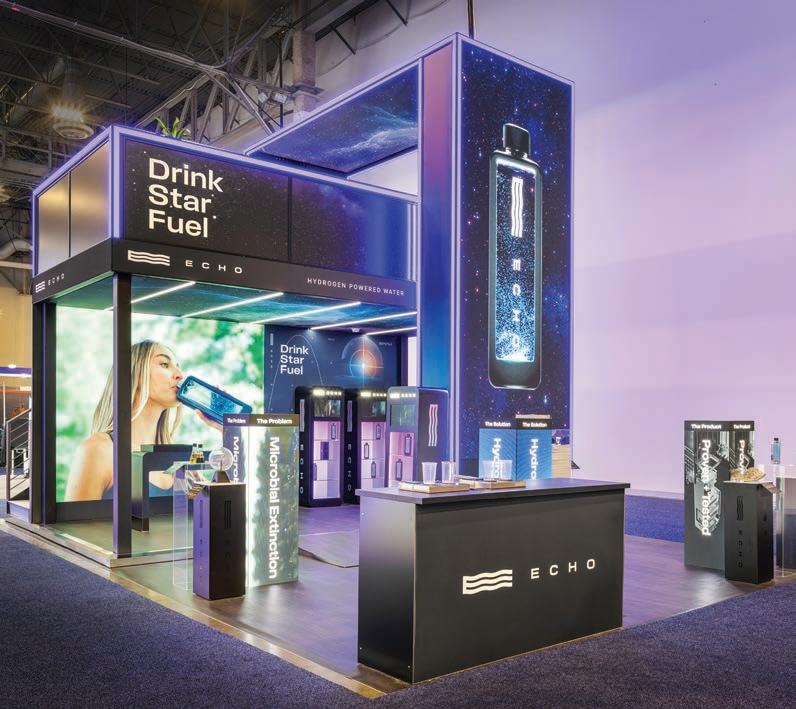
Known for our superior quality and precise engineering, Aluvision’s modular frames, Hi-LED tiles, and LED edgelighting solutions helped LV Exhibits provide their client with an efective, visually appealing design that wowed show attendees as well as Echo Water’s stakeholders. With toolless assembly and plug-and-play connection, the lightweight modular system simplifed I&D and created further opportunities for cost savings on shipping and drayage.
Echo Water was over the moon with their CES 2026 booth. The strategic design allowed them to host private meetings, separate retail demonstrations, and crowd-drawing product displays. The RGBW LED line perfectly complimented their brand’s color palette, beautifully adding a custom touch and personalization to their company, and the team saw success in the seamlesscornered, integrated LED that captivated attention and brought their brand to life.
Learn more about LV Exhibits: lvexhibitrentals.com Learn more about Aluvision: Aluvision.com
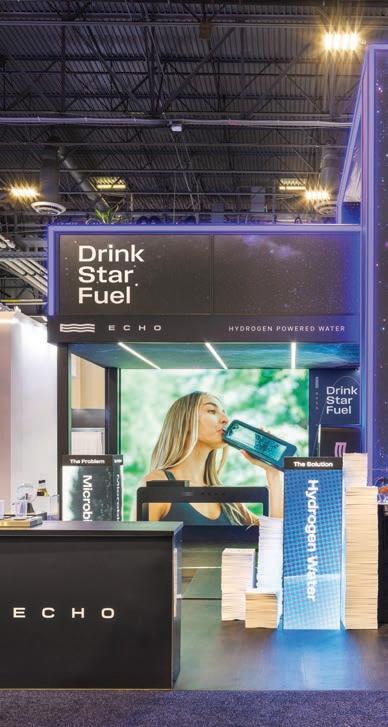
BY TRAVIS STANTON
CES 2026 wasn’t just another stop on the global tech tour—it felt more like a full-scale preview of how brands will connect with audiences for the next decade. Beyond the headlines about AI, robotics, and next-gen hardware, the real story unfolded on the show foor itself, where experiences were carefully engineered to inform, immerse, and persuade. For exhibit and event professionals, CES has become less about spotting gadgets and more about decoding the strategies, spatial thinking, and storytelling techniques that will shape experiential marketing in the years ahead.
As The Experiential Design Authority’s ofcial U.S. media partner, Exhibit City News once again collaborated with the organization to spotlight the most impressive environments at CES 2026. The annual BOSS Awards (Best of Show Stand Awards) honored 30 standout exhibits, ranked by a panel of 12 industry-leading designers, producers, and brand strategists. The fve exhibits featured here claimed the top spots, earning Gold Awards for their ability to transform complex technology into compelling, human-centered brand experiences. Meanwhile, two special awards were presented: Honorable Mention was given to the exhibit that did not make the top 10 but received the highest number of frst-place votes among fellow Bronze Award fnalists. That recognition went to the Caterpillar exhibit (designed by Outerkind with fabrication and installation by MC2). The People’s Choice Award went to the exhibit that earned the most votes from fans, friends, and followers who visited the BOSS Awards voting portal on exhibitcitynews.com. Earn-
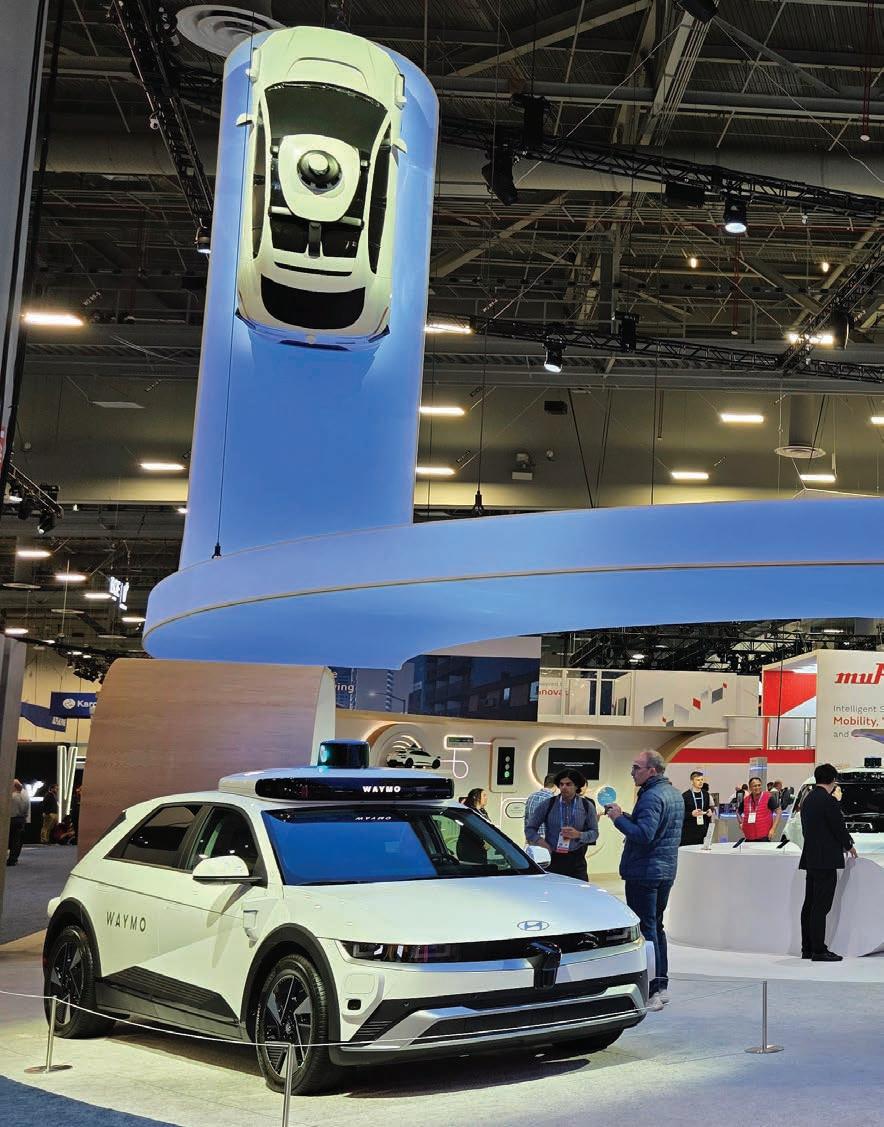
ing more than 1,200 votes, the winner was the exhibit for Oshkosh Corp. (designed and fabricated by 3D Exhibits with installation by 3D Exhibits and Nth Degree).
Design: NVE Experience Agency
Fabrication: DreamCraft Installation: DreamCraft, N-Expo, Freeman Assistance: USSI, Go Inspo, The Concourse Detail, Champion, Cognition, Mocean, Whalar
Sprawling across 7,000 square feet, the Waymo exhibit at CES 2026 felt less like a booth and more like a bold, kinetic
brand statement—one engineered to stop trafc before it ever started. The visual hook was undeniable: a 600-pound Waymo vehicle seemingly foating in midair, paired with a massive rotating logo that functioned as both beacon and brand manifesto. Animated exterior graphics traced a Waymo car through stylized cityscapes, telegraphing growth, momentum, and inevitability. From the curb, the message was clear: autonomous mobility isn’t coming someday. It’s already here, and Waymo intends to lead it everywhere.
Inside, the experience unfolded as a carefully choreographed progression
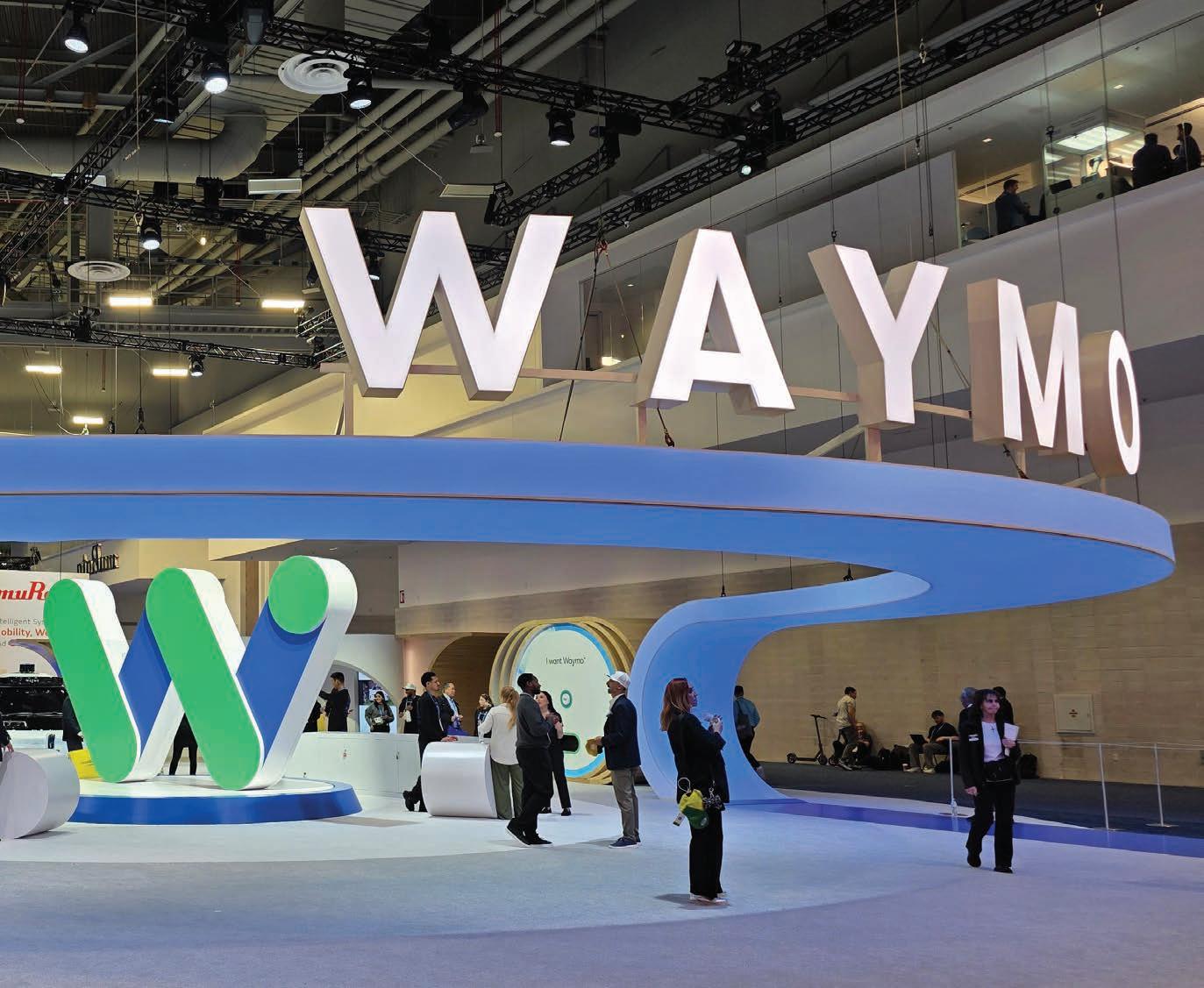
from fascination to fandom. Interactive touchpoints like the Waymo Map and The Waymo Driver translated complex AI and sensor technology into accessible, confdence-building narratives, while the immersive Watching Waymo Wall turned real-world driving scenarios into a theatrical, multi-sensory performance complete with fog, bubbles, and unexpected obstacles.
Celebrity-driven Fan-Dome Stories humanized the brand through authentic rider testimonials, and the cleverly simple “I Want Waymo” Button converted passive interest into measurable engagement. The emotional crescendo
came with See Yourself in Waymo, where guests climbed into the backseat of a Jaguar I-PACE to generate a digital postcard from future markets—a fnal, persuasive reminder that the future Waymo was selling wasn’t abstract or speculative. It was personal, tangible, and already waiting at the curb.
Judges applauded Waymo’s exhibit as a standout favorite, with many returning multiple times to experience its high-impact engagement and exceptionally clear technology demonstrations. The booth was praised for its simple yet powerful narrative structure: a feature-plus-beneft approach that felt refreshingly efective
and rare on the CES show foor. The open, road-inspired layout, suspended vehicle, and clean white architectural frame created a striking, fearless brand statement that felt both bold and approachable.
Judges also loved the informative teaching zones that explained how the AI navigates, the interactive badge feature that personalized updates by city, and the large-scale data visualizations that made complex systems easy to understand. Overall, the cohesive design, lighting, curved forms, and confdent storytelling delivered what judges described as a proud, forward-looking, and spectacularly executed brand experience for Waymo.
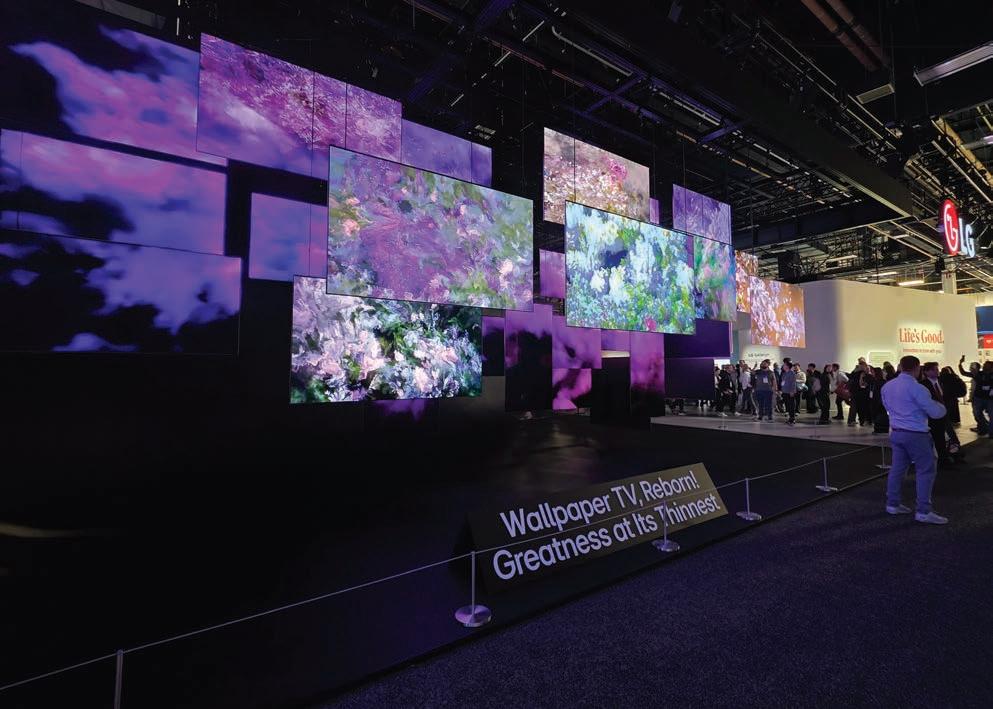
Design: HS Ad Korea
Fabrication/Installation: Czarnowski
The 110-by-300-foot LG Electronics exhibit was heralded by judges as a meticulously choreographed brand environment — one where ambition met operational discipline. Brought to life in partnership with Czarnowski, the space demanded absolute precision, translating LG’s expansive vision for the future into a physical experience that felt immersive and confdently executed. From the moment guests crossed the threshold, they were guided through a layered narrative of large-scale visuals and spatial storytelling, designed to distill complex innovation into moments that felt intuitive, human, and unmistakably LG. Behind the spectacle was a production efort defned by restraint as much as rigor. Every element, from structural systems to interactive touchpoints, was evaluated and optimized for efciency
and performance, allowing the creative intent to shine without friction. Interactive demonstrations and product-focused activations invited visitors to explore how LG’s technologies converge across home, work, and everyday life, while clear sightlines and deliberate pacing supported both discovery and dialogue. In an environment where the margin for error is razor-thin, the fnished exhibit stood as a case study in executional excellence—polished, intentional, and engineered to make complexity look efortless.
Judges were unanimous in praising the exhibit’s ability to stop trafc, with massive crowds lining both sides of the aisle to capture photos and videos of the next-generation displays, including a remarkably thin 9mm screen. The dramatic entry sequence—anchored by foating screens—was repeatedly cited as a powerful frst impression, setting the tone for what many judges described as a visually beautiful and emotionally engaging experience.
The exhibit positioned Doosan not as a single-product manufacturer, but as an integrated technology company focused on building a more sustainable future. Through a tightly curated mix of live presentations and working demonstrations—spanning Bobcat equipment, AI-driven robotics, and next-generation data center technologies—the booth reframed Doosan’s identity for a global audience, shifting perception from “parent company” to “platform for innovation.”
The media-clad architecture and transparent OLED installations blurred the line between digital art and physical space, while the Rube Goldberg–style wall stood out as a particularly clever and memorable fusion of storytelling and technology. Judges also highlighted the interactive AI-lifestyle zones, high-fdelity fabrication, and polished staf presence, reinforcing the sense that LG once again delivered an all-around impressive execution—from scale and design to content, integration, and unforgettable product demos.
Design: Oricom
Fabrication/Installation: D.Mods
Assistance: Zoom, IO Plan, Technical Director Shin Doosan arrived at CES 2026 with a clear strategic mandate: leverage its better-known Bobcat brand and assert itself as a global force in energy, robotics, and advanced infrastructure.
The experience leaned heavily into credibility through performance. Interactive kiosks translated complex systems into accessible narratives, while the Doosan AI Robotics “Scan & Go” activation delivered both spectacle and substance, with the technology earning two CES Innovation Awards, including a Best of Innovation honor. Media attention followed,
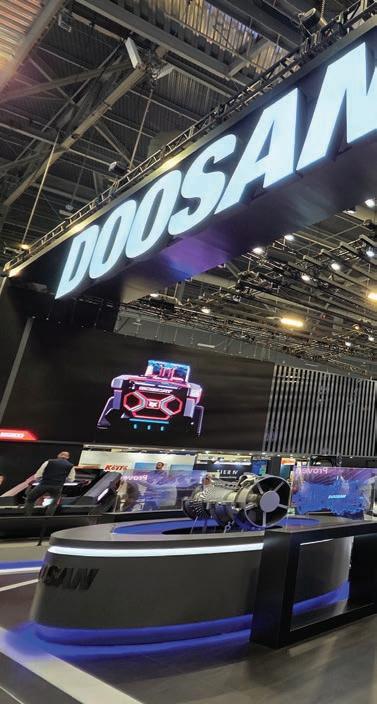
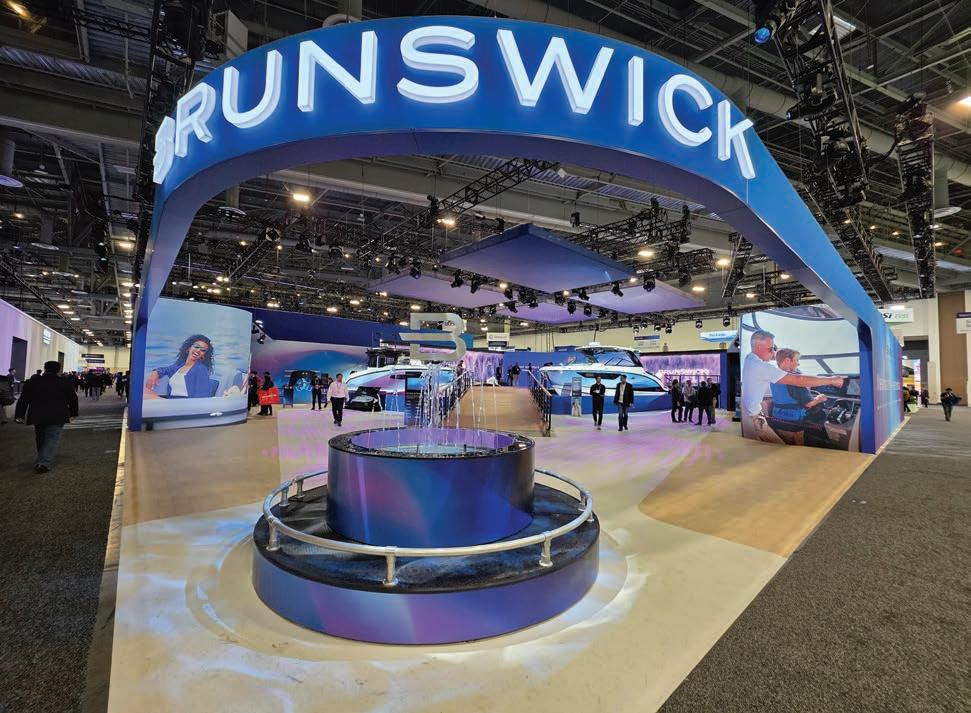
particularly around Doosan’s gas turbine technology, which emerged as a breakout topic and helped make the booth one of the most widely covered exhibits by both U.S. outlets and major Korean press. In classic CES fashion,
the win wasn’t just visibility— it was validation, positioning Doosan as a brand no longer content to power progress behind the scenes, but ready to claim center stage. Judges were impressed by the sheer scale and ambition
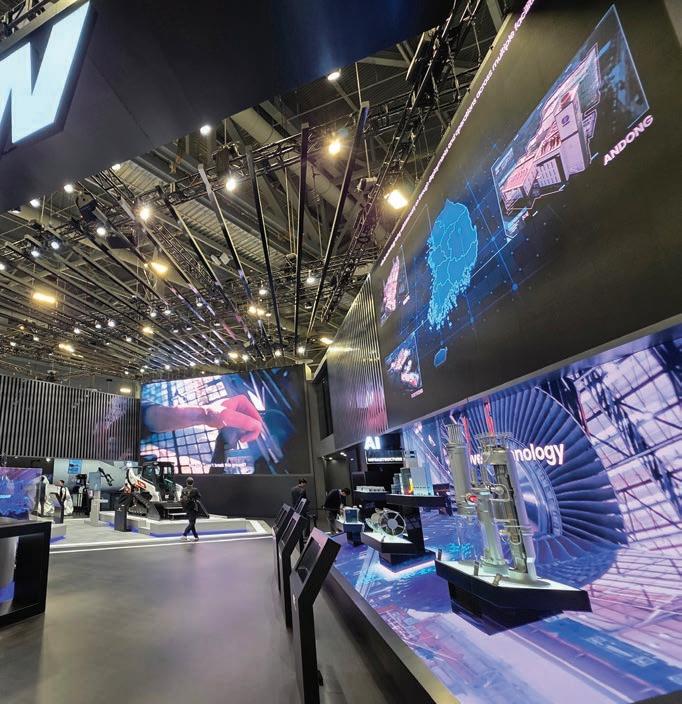
Design: Brunswick Corp.
Fabrication/Installation: Kubik Assistance: Merged, Spirit Event Productions, CCR Solutions
of the exhibit, noting how efectively it showcased a wide range of products within a cohesive, future-forward environment. Many highlighted the strong design concept and sophisticated metallic-gray aesthetic, which unifed multiple industrial sectors into a single, high-impact experience that felt both educational and inspiring.
The massive, well-distributed video walls and seamless transitions between diferent LED screens were praised for creating a classic yet modern showroom atmosphere that balanced large hardware displays with transparent, media-rich storytelling. Judges also pointed to the high level of attendee engagement and active conversations throughout the space, reinforcing the sense that the booth functioned not just as a display, but as a dynamic attraction— one that was impressive in scale, cleanly organized, and strongly aligned with the brand’s innovative image.
Brunswick Corp. made a compelling case for why CES has become the company’s most strategic stage—not just for product launches, but for brand unifcation. Unlike traditional marine tradeshows, where Brunswick’s portfolio of iconic brands typically stands apart, CES 2026 brought them together under a single, future-forward narrative. The debut of the Sea Ray SLX 360 marked the frst time Brunswick had ever launched a boat at CES, instantly reframing the brand alongside the world’s most infuential technology companies. Add in early buzz around Mercury Marine’s 808 Concept Engine and the award-winning Simrad AutoCaptain autonomous docking system, and the booth functioned as both a media magnet and a living proof point of Brunswick’s role as a serious technology innovator—not just a boat builder.
The guest experience leaned heavily into immersion, interaction, and aspiration. Visitors stepped into a literal on-water environment, greeted by a physical water feature before navigating hands-on simulators that let them captain virtual vessels, race Fliteboards, and explore advanced fshing and adventure boats equipped with solar power, live sonar, and autonomous navigation. The
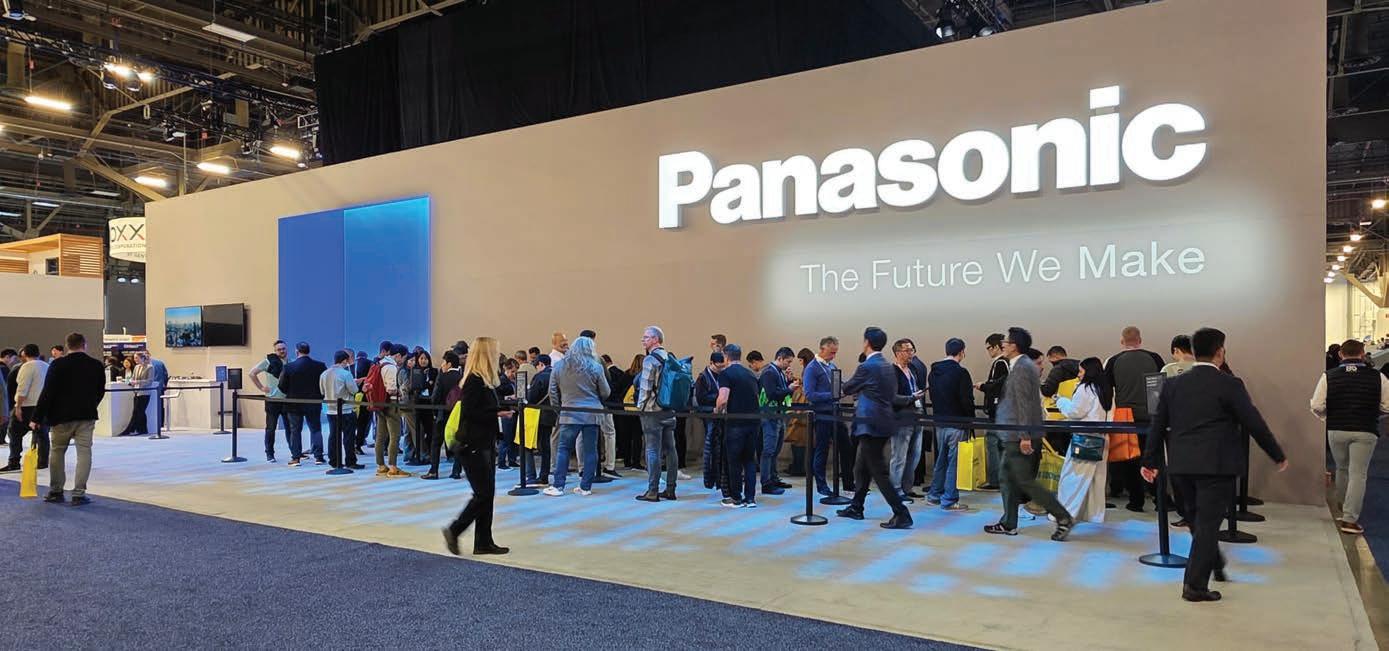
centerpiece Vision Theater—a massive 110-foot video wall— stitched these moments together into a cinematic brand story about how AI, automation, and integrated ecosystems are reshaping the future of recreation. Designed in part by Brunswick’s own Boating Intelligence Design Lab at the University of Illinois, the exhibit blurred the line between education and entertainment, ultimately delivering what few CES booths attempt: not just a showcase of innovation, but a fully realized lifestyle vision that made Las Vegas feel, if only briefy, like the open water.
Judges praised the booth for its immersive, story-driven approach, highlighting how the seamless blend of real-life boats, live water features, and high-tech simulators created a memorable and accessible way to experience the brand. Many appreciated the decision to reuse and reinterpret design elements from CES 2025, noting that this not only reinforced consistency and comfort in the brand identity,
but also positioned sustainability as a creative asset rather than a limitation.
The arching entrance and grand architectural scale made a strong frst impression, while interactive components and the dynamic digital back wall kept visitors engaged throughout. Judges also called the stand a “masterclass in immersive storytelling,” applauding the variety of hands-on demos and the thoughtful integration of physical and AV elements, which together made the exhibit feel unique, impactful, and highly efective.
Design: Panasonic, Czarnowski
Fabrication/Installation: Czarnowski
Assistance: Nomura, Fine Design, Flex Visual
CES 2026 became Panasonic’s platform to showcase its growing portfolio of business solutions, with particular emphasis on advanced energy-management and cooling technologies for data centers,
AI-powered supply-chain optimization via Blue Yonder, and emerging green-energy innovations like perovskite solar cells. The narrative was clear and confdently stated: Panasonic is no longer just building products for homes. It’s engineering systems designed to reshape how businesses operate, consume energy, and move toward a more sustainable future.
The guest journey was tightly choreographed, beginning with a short immersive flm that framed the experience before guests entered three clearly defned, content-rich zones. Each area ofered hands-on demonstrations supported by tiered messaging, allowing visitors to self-select how deeply they wanted to engage while knowledgeable staf guided the conversation.
Even the physical environment reinforced the brand’s values, with large portions of the exhibit constructed from repurposed materials sourced from previous shows. In that way, the space didn’t just
tell a sustainability story—it embodied it, proving that operational discipline and environmental responsibility can coexist with polished design, clear messaging, and a forward-looking brand vision. Judges gave this exhibit high marks for its exceptionally clean, elegant execution and the ease with which visitors could absorb content. Judges also applauded the sophisticated blend of warm wood textures with high-fdelity digital displays, which successfully humanized the brand’s sustainability mission and delivered a premium experience that felt both technologically advanced and environmentally responsible. The immersive theater and closed-of layout added a sense of exclusivity, while the overall organization, lighting, and material palette reinforced a polished, high-end environment that was described as welcoming, memorable, and beautifully executed.
For the full listing of this year’s CES BOSS Award winners, visit www. experientialdesignauthority.com.
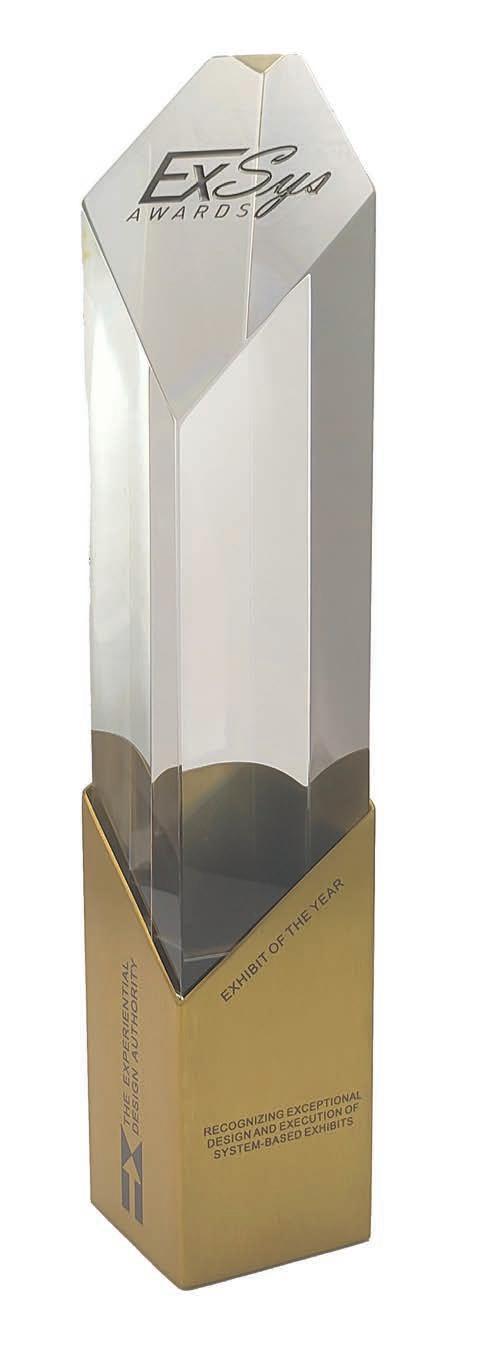
The ExSys Awards recognize excellence in systembased exhibits, showcasing projects that exemplify creativity, innovation, and superior design. These awards celebrate the ingenuity and creativity of designers and marketers who push the boundaries of modular and system-based solutions.
Finalists Announced 05/13/2026
People’s Choice Voting 05/13/26 thru 06/01/26
Awards Ceremony to be announced 05/13/26
For more information on the event please visit Exhibit City News. For more information on the ExSys Awards and future awards programs please visit the Experiential Design Authority’s website.
ExperientialDesignAuthority.com ExhibitCityNews.com /exsys-awards

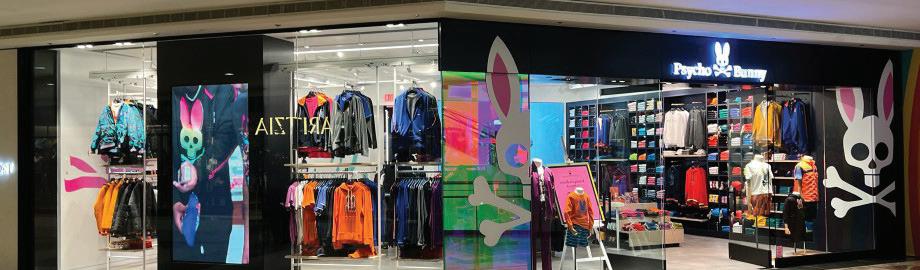
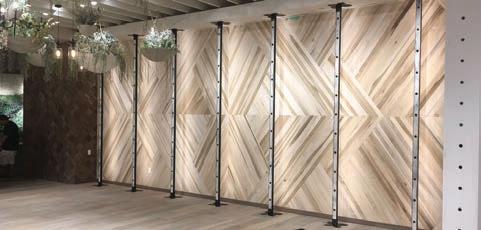
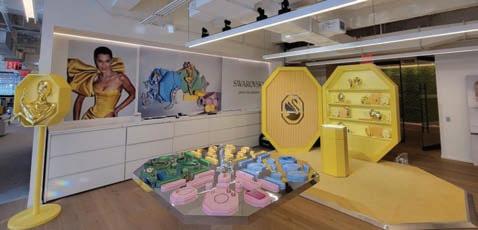
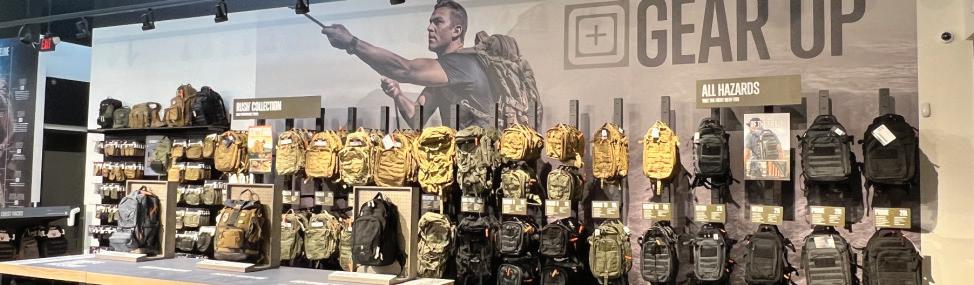
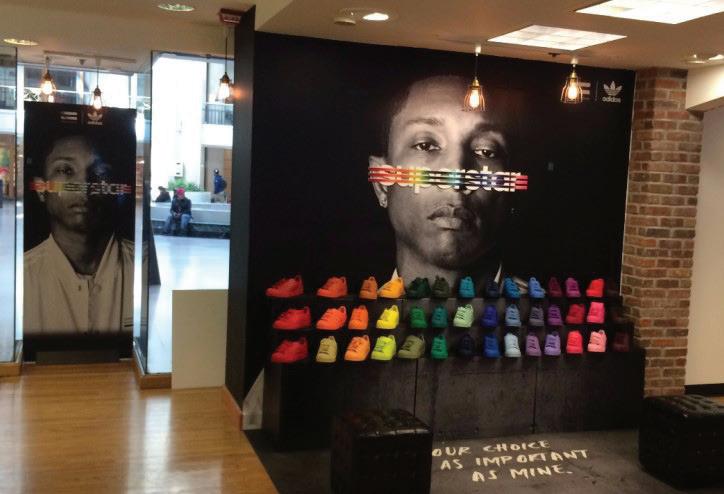
An In-Depth Look into Today’s World of I&D and Event Labor
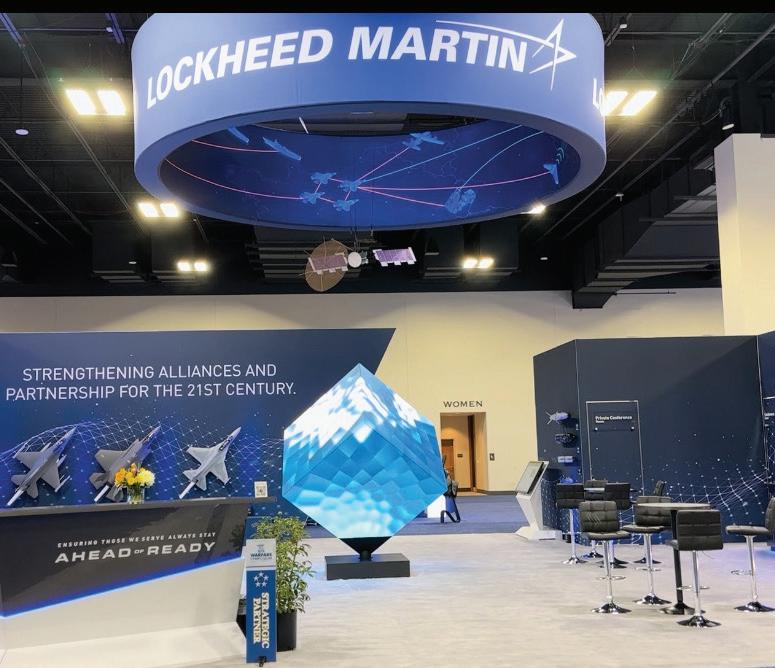
Lockheed Martin at AFA Warfare Symposium Pg. 56
Trident Diving Equipment by Wise Owl Productions at DEMA 2025 Pg. 58
by Chelsea Chavez
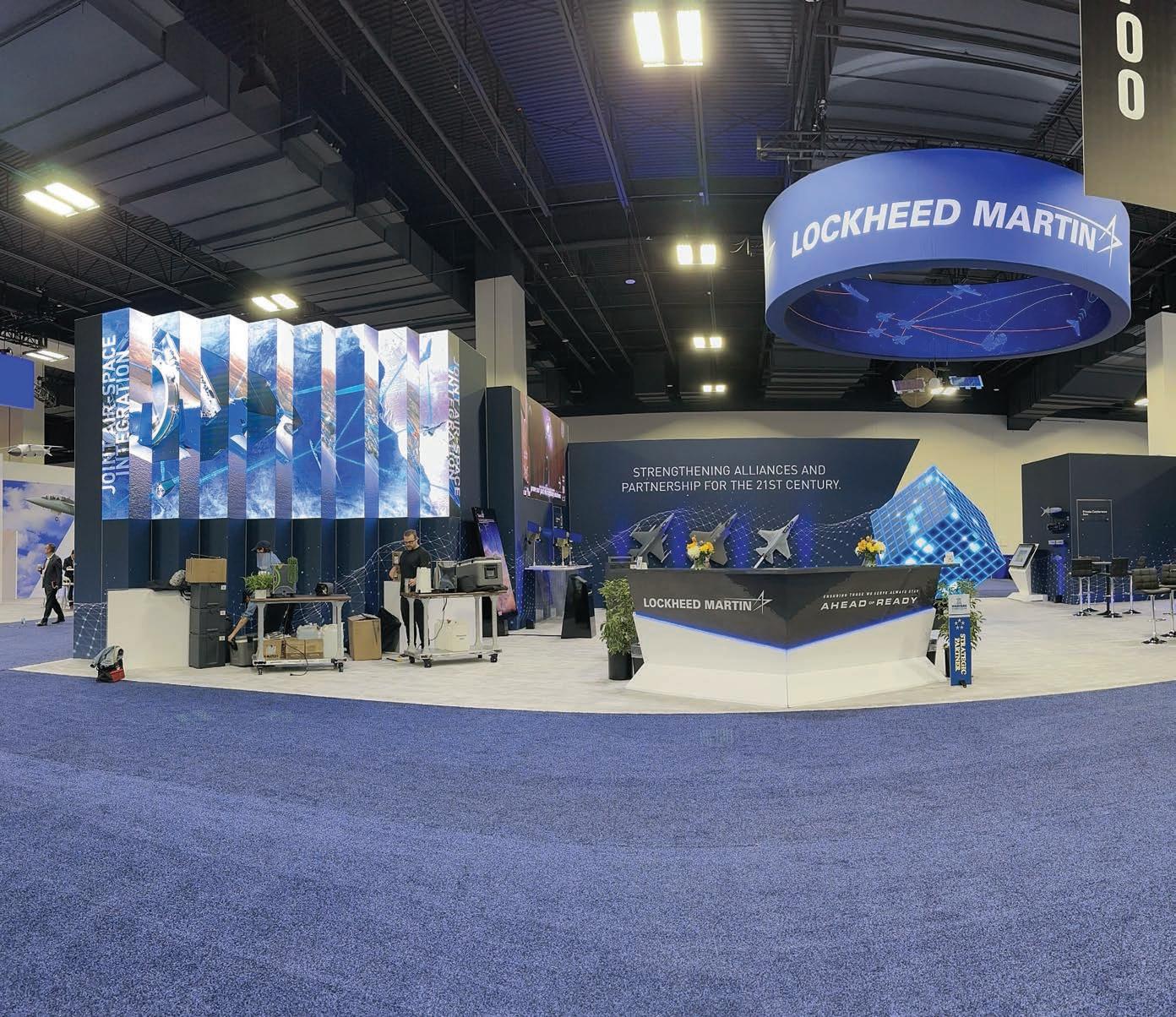
Booth Size: 40’ x 80’
LED Wall: beMatrix LEDskin 2.5P tiles 8 tiles wide x 4 tiles tall
LED Ticker: beMatrix LEDskin 2.5P tiles 10 tiles wide x 2 tiles tall
LED Cube: LED cube 1.5m on each side, standing 9’ tall
Lenticular 2.5P LED wall: 48 beMatrix LEDskin Perfect Corner frames with 96 2.5P LEDskin tiles, 16 tiles wide x 6 tiles tall
By Kerstan Szczepanski
Lockheed Martin returned to the AFA Warfare Symposium with a very specifc aim, to use audio/ visual (A/V) and LED in a meaningful way to captivate attendees and visually reinforce the brand’s innovation driven messaging. But the goal wasn’t to add technology for technology’s sake, it was to create a strong, intentional focal point that would stand out on a busy show foor while supporting the campaign narrative. Then Lockheed approached 4 Productions for the video solution. And the idea
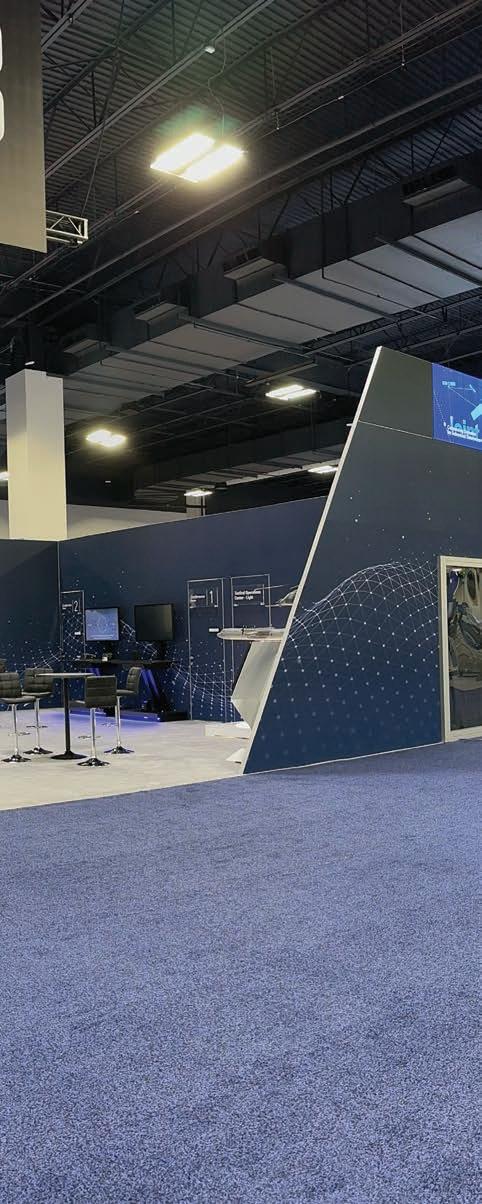
Exhibit Designer: Lockheed Martin
Graphic Design: Lockheed Martin
Fabrication: Lockheed Martin
Video Design: 4Productions in conjunction with Lockheed Martin
Audiovisual: 4Productions in conjunction with Lockheed Martin
Photography: Chelsea Chavez
came far from the show foor. 4 Productions Director of Sales Jorge Robles was standing in the TSA line at LaGuardia Airport when he noticed a series of unjoined lenticular panels overhead. That sparked an idea. Right then and there he called the shop, and by the next day, the team was already sketching out what would become just what Lockheed was looking for: a bold centerpiece that felt smart, intentional, and distinctly modern. The solution was a Lenticular 2.5P
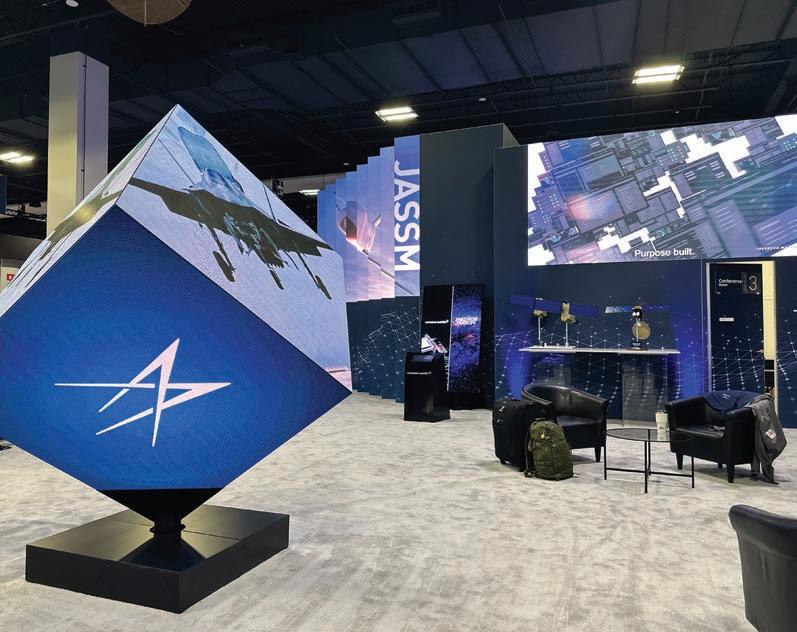
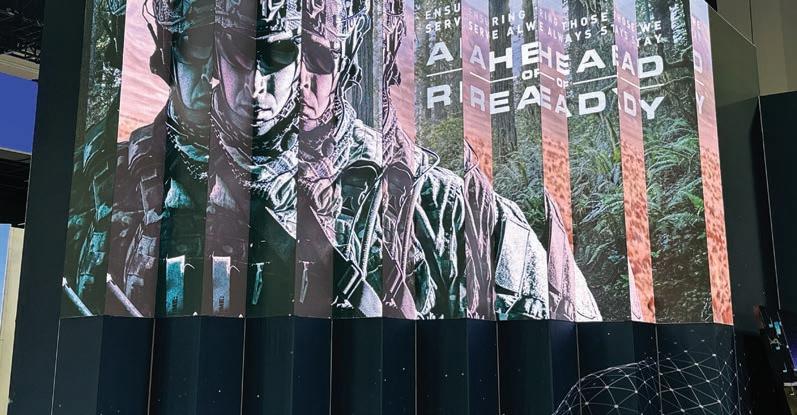
LED wall designed to shift and change as people moved past it. Built using beMatrix LEDskin Perfect Corner technology, the wall became the booth’s visual anchor. Instead of functioning like a traditional screen, it created the illusion of depth and motion, prompting attendees to stop, look twice, and engage from multiple angles.
The fnal build featured 48 beMatrix LEDskin Perfect Corner frames and 96 2.5P LEDskin tiles, confgured 16 tiles wide by 6 tiles tall. Carefully mapped content brought the lenticular efect to life, allowing visuals to transform based on the viewer’s position on the show
foor. The result was a dynamic display that felt alive, changing throughout the day as trafc fowed around the booth.
The wall demonstrated how beMatrix LEDskin can be used as a design and storytelling tool, not just a digital display. It delivered impact without overwhelming the space and reinforced Lockheed Martin’s forward-thinking message in a way that felt natural and engaging. At its core, the project is a reminder that when the right idea, the right team, and the right technology align, A/V can do more than support an exhibit—it can become the story.
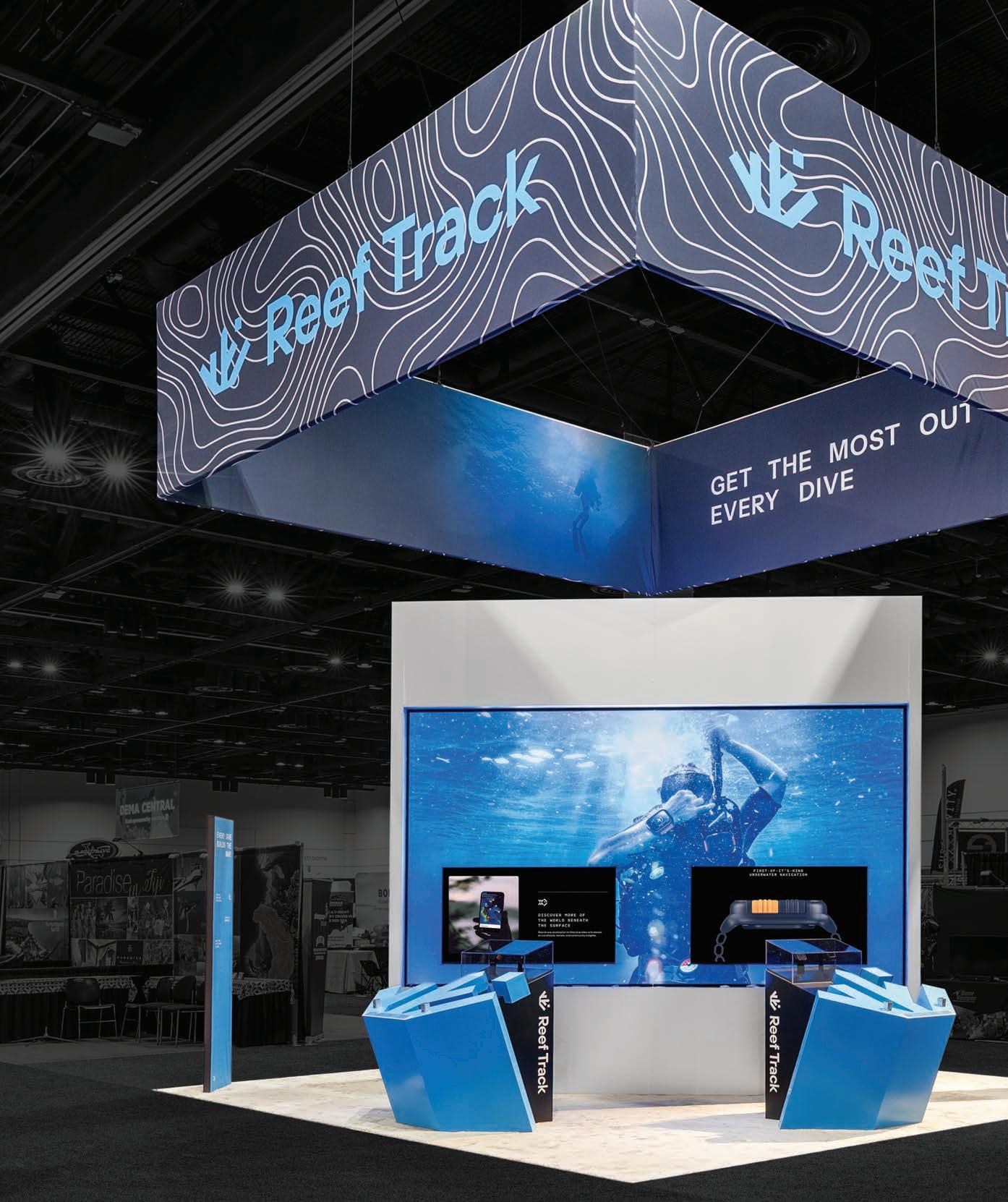
Booth footprint: 20’ x 20’
Hanging sign: 20’ x 20’x 6’
Center tower: 14’ x 3’x 14’
Lightbox (in tower): 13.5’ x 8’
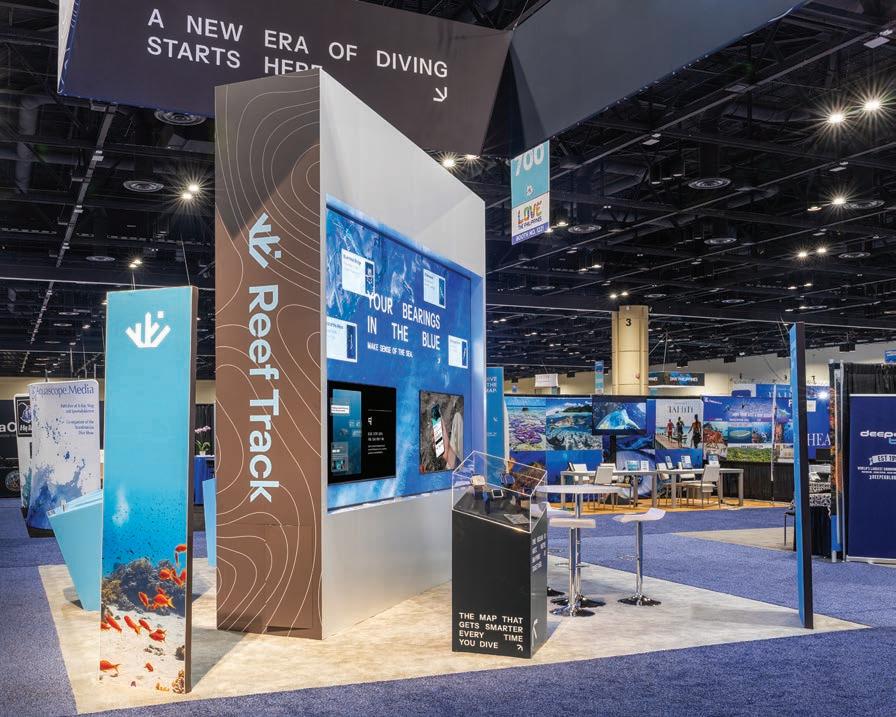
by Kerstan Szczepanski
Photography by Exposures Ltd.
Repeat utility was key in the design of the Trident Diving Equipment exhibit at DEMA 2025. With no enclosing walls, the booth can be of any number of sizes at future shows. Custom product displays included a larger than life dimensional logo tied into the cabinet base with 3D printed watch holders and
a Pantone matched paint fnish. The large hanging sign created a space seen from far away without closing the foorplan. The center tower emulating an aquarium was a principle design goal. This was achieved by wrapping the tower in brushed silver adhesive vinyl and incorporating a 13.5 foot long by 8 foot tall fabric lightbox. The moni-
Designer: Whipsaw Inc.
Builder/Engineering/
Exhibit Construction: Wise Owl Productions Flooring: Brumark Hanging sign and Graphics: Olympus Group
Photography: Exposures Ltd.
Exhibit I&D: Nth Degree
tors recessed in the lightbox provided a continuous loop of product information.
Wise Owl Productions biggest challenge with the booth was the construction and fnishing of the logo cabinets. Compound angles, multiple fnishes, acrylic enclosures all came together to create a standout demonstration area and product display.
by Mark Hebert
In the tradeshow and live-events industry, work happens under fxed deadlines and in temporary conditions. Crews arrive, build complex environments, and operate with little margin for error. In that context, preparation matters as much as execution. One way the United Brotherhood of Carpenters and Joiners of America (UBC) approaches readiness is through physical, hands-on environments that refect the constraints of the jobsite.
Rather than relying solely on classroom instruction, the organization emphasizes learning that happens in built space. Temporary structures, mockups, and demonstration areas allow members to work through jobsite conditions before they encounter them on a show foor or event site. The goal is practical familiarity, not theory.
“You cannot prepare people for deadline-driven work in the abstract,” says John Hagaman, regional manager and director of tradeshows for the Eastern Atlantic States Regional Council of Carpenters (EASRCC). “They need to work in physical environments that refect the conditions they will face on site. That is how consistency is built.”
Learning in environments that resemble the work
At union open houses, conventions, and training events,
exhibit-style displays and demonstration areas are used to present the tools, materials, and methods members encounter in the feld. These environments are temporary by design, assembled and dismantled within defned windows, and shared by large groups moving through them. That structure closely aligns with the conditions of tradeshows and live events.
Within these spaces, members work directly with equipment, layouts, and safety systems. The focus is not on presentation, but on execution. By running through processes in a controlled setting, carpenters sharpen judgment and reduce on-site adjustments once deadlines are in play.
“When people can see the work environment frsthand, it changes the conversation,” says Robert Smith, executive training director at the Eastern Atlantic States Carpenters Technical Centers (EASCTC). “It allows them to understand the quality of work expected and what it takes to perform at that level before they ever step onto a live jobsite.”
These environments also introduce real pressures. Multiple crews operate at once. Timelines are compressed. Changes must be made without disrupting surrounding activity. Those conditions are familiar to anyone involved in installation and dismantle work.
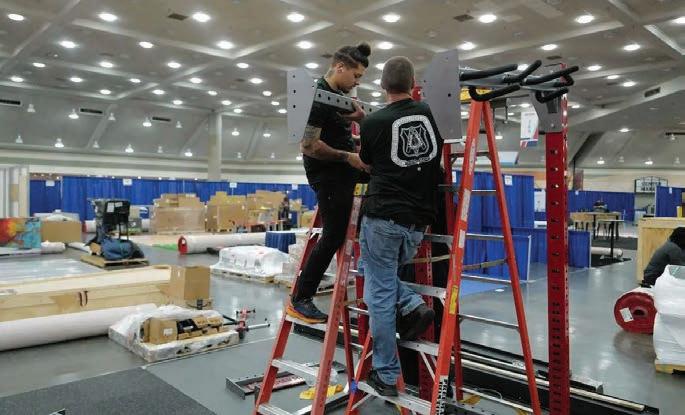
In-person environments serve more than a training purpose. They also support coordination across markets. When participants from diferent regions work through the same setups, they establish shared expectations around process, pace, and standards. That alignment carries back to local markets and becomes especially valuable when crews come together on large national shows.
“When people train and work through the same environments, expectations become consistent across markets,” Hagaman says. “That matters when crews come together on large-scale projects with no margin for error.”
For general contractors and show organizers, that consistency reduces risk. Teams unfamiliar with one another can still operate efciently under pressure, guided by shared norms established before they step onto a show foor together.
temporary
Temporary environments are only one part of the approach. Permanent training campuses extend the same hands-on model year-round, allowing for repetition, evaluation, and refnement away from the pressures of live production schedules.
More recently, the Carpenters Union announced plans for a new regional hub at the Philadelphia Navy Yard, intended to serve as an operational headquarters and future training site. While specifc programming for the facility has not yet been detailed, the investment reinforces a broader emphasis on physical space as a practical tool for workforce preparation.
What this means for the tradeshow industry
The takeaway is straightforward. Reliable execution depends on workers who have practiced under conditions that resemble the work itself. Whether those environments are temporary displays at conventions or permanent training facilities, the objective remains the same: readiness.
In an industry defned by tight schedules and temporary builds, preparation that happens in physical space remains one of the most efective ways to deliver consistent results.
The United Brotherhood of Carpenters and Joiners of America represents skilled carpenters and related trades across North America. Through training programs, hands-on learning environments, and regional infrastructure, the organization supports workforce readiness for construction, tradeshows, and live-event settings. For more info, visit https://www.carpenters.org.





by Debbie Hall
“AI works best behind the scenes. It’s great for early planning, brainstorming, data entry, organizing notes and handling simple exhibitor FAQs. It saves time, cuts costs and removes a lot of repetitive work.” — Aram Pajian, Director of Business Development & Sales, LUXX Exposition Services.
Artifcial intelligence (AI) is being used to shape how general contractors design foorplans, manage logistics, forecast budgets and execute strategy, highlighting its strategic role in the tradeshow and expo industry. From design tools to scheduling software, AI is demonstrating its current and future infuence.
However, studies highlighted in ScienceDirect and the Harvard Gazette are emerging that suggest a heavy reliance on AI among students may correlate with diminished critical thinking, reduced problem-solving stamina and cognitive atrophy. The implication can be uncomfortable for an industry that prides itself on ingenuity, adaptability and human-centered problem-solving.
“It’s something the industry should take seriously. Tradeshows rely on instincts, fast decisions and clear communication. When something goes wrong on-site, there’s no time to ‘ask AI.’ Someone has to step up and solve it and quickly,” explained Aram Pajian, Director of Business Development & Sales, LUXX Exposition Services.
Events still require improvisational
problem solving (reading the room) and these are skills that only developed through practice. The cost to setup the infrastructure, and getting the buy-in of attendees and users at the physical event have been the biggest hurdles in achieving greater connection. Relationship development will be aided by AI (connecting people in a more rapid manner with those that share their interests). However, the judgment that comes from experience are hard earned from reading the event energy on a human level.
In today’s exhibit ecosystem, AI is utilized as a tool of efciency and optimization. General contractors are using it to:
» Generate early-stage booth layouts based on space constraints, traffic flow data, and exhibitor goals
» Optimize material usage, reducing waste and controlling costs
» Predict labor needs, shipping timelines, and potential points of failure
» Analyze attendee behavior patterns to inform booth placement and experiential design
» Automate project management tasks such as scheduling, procurement tracking, and change-order forecasting
AI doesn’t replace problem-solving; it reallocates it.
AI has the potential to support deeper strategic thinking and future-facing applications may include:
» Scenario modeling for exhibiting ROI, allowing exhibitors to test strategies before committing capital
» Adaptive booth environments that respond to real-time attendee behavior without preprogrammed scripts
» Sustainability modeling that evaluates environmental impact alongside cost and logistics
» Knowledge preservation systems that capture expertise as veteran builders and designers retire AI is meant to be a collaborator.
“People First” Narrative
People want to engage with other people. They want to connect in ways that digital
interfaces cannot replicate. As AI becomes more prevalent behind the scenes, the industry’s responsibility is to oversee what happens in front of the curtain.
That means:
» Designing booths that prioritize conversation over spectacle
» Training staff to listen, not just pitch
» Valuing craftsmanship, storytelling, and hospitality as strategic assets
» Measuring success not only in leads captured, but in relationships formed
“Client relationships, real-time problem-solving and high-touch customer service still require people. That human layer is what makes events successful and events don’t happen without people,” added Pajian.
In an AI-enabled future, people-centric marketing is not anti-technology—it is intentional technology.
“We do need to prioritize human-led storytelling. You do this by making sure we have live testimonials, unscripted freside chats in the programming and show the behind-the-scenes. In a world of perfect content, imperfection is trusted because it’s human,” said event producer and CEO Valerie Bihet, VIBE Agency. “AI can simulate a smile, but only a human can make someone feel seen. It can help us design, but it’s still up to us to put the people at the forefront and use this as a tool.”
In this AI future (or not-so-distant future), AI handles segmentation and delivery, while people handle the story and the authentic connection. Industry professionals should use AI to identify who needs to hear from them, and keep the relationship building component to people.
The tradeshow industry has arrived at the intersection of creativity, logistics and human connection. If AI helps do those things better—without dulling the skills and empathy of the people in the industry—then, according to the general contractors, it has a place on the show foor.
The future is not AI-frst. It is people-frst, with better tools.
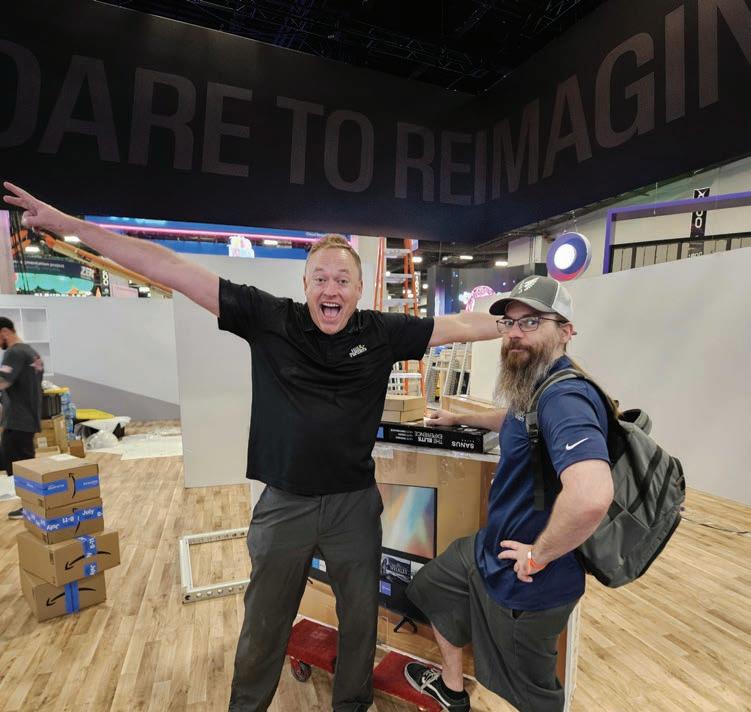

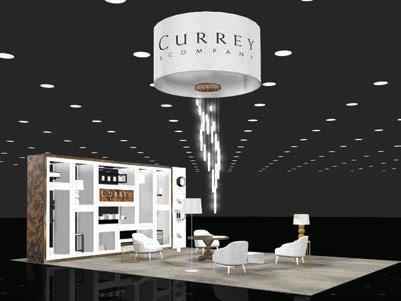
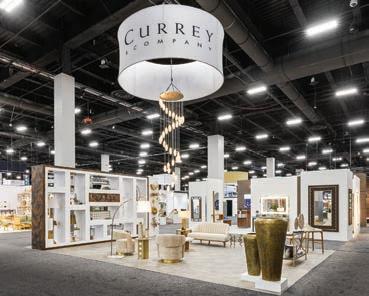
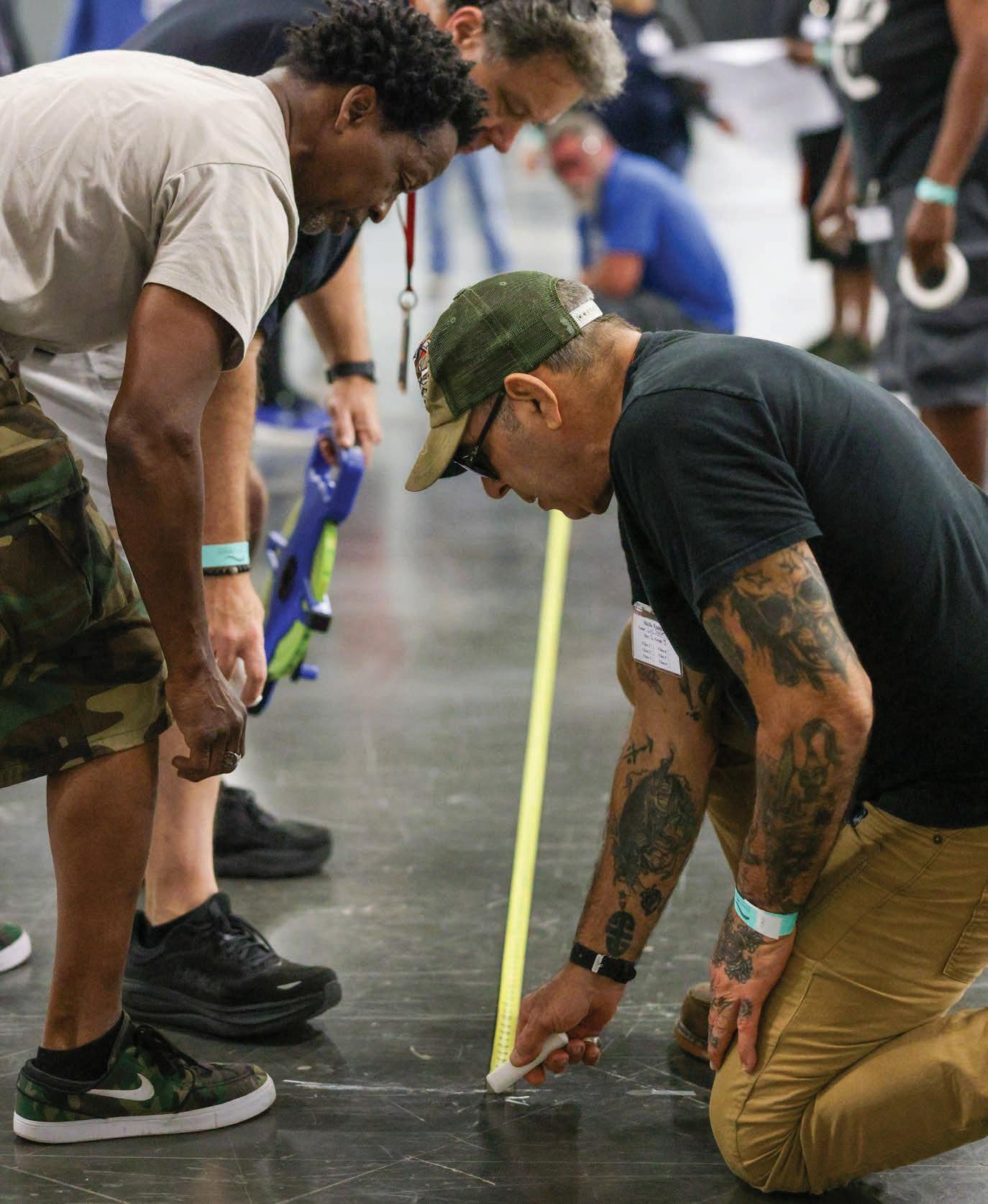
by Mark Hebert
The live events and tradeshow industry is operating at full speed again. What has not fully rebounded is the skilled labor force needed to support that growth. For the International Union of Painters and Allied Trades (IUPAT), the focus has been on building workforce stability rather than relying on short-term fxes.
Across the United States and Canada, IUPAT has concentrated on creating clear pathways into the trades, supporting members as they advance, and investing in leadership and long-term career security. The objective is straightforward. Ensure that skilled labor is available, prepared, and consistent as demand for live events continues to rise.
“When we talk about workforce development, we’re talking about sustainability,” says Juan Garcia, business representative for IUPAT Local 1175 for tradeshows. “The industry doesn’t beneft from quick solutions. It benefts from people who are trained, supported, and committed to staying in the trade.”
Building the Pipeline
Apprenticeship and journeyworker development remain the foundation of IUPAT’s workforce strategy. District councils across North America continue to graduate apprentices while supporting members as they move into journeyworker roles. In 2025, the union added more than 4,000 new members, refecting sustained recruitment at a time when many industries are struggling to replace experienced workers.
“We’ve made a conscious decision to invest in people early and give them a reason to stay,” Garcia says. “That means structured training, real opportunities for advancement, and a clear understanding that this can be a long-term career.”
The emphasis is not only on meeting immediate labor needs, but on preparing workers for careers that can adapt to the evolving demands of the tradeshow and live events industry.
In addition to technical skills, IUPAT has expanded its focus to include leadership development and steward training. Multi-council sessions bring together business representatives and stewards from multiple district councils to address contract administration, safety standards, and workplace accountability.
“Good leadership on the jobsite prevents problems before they start,” Garcia says. “When stewards and supervisors understand their roles, it creates consistency for contractors, venues, and event organizers.”
That consistency matters in high-pressure environments like convention centers and large-scale events, where coordination behind the scenes directly afects show outcomes.
“If you don’t get the back of the house right, the front of the house doesn’t happen,” says Freddie Peterson, general manager of the Miami Beach Convention Center. “It’s all about teamwork.”
IUPAT’s workforce strategy extends beyond training and leadership. The union provides members with pensions, health care, retirement plans, and additional support programs designed to promote long-term retention.
Scholarships are part of that investment. In 2025, IUPAT awarded funding through initiatives including the S. Frank “Bud” Raftery Scholarship and the A.L. “Mike” Monroe and Ralph D. Williams III Sports Scholarship. Recipients
represented locals across the United States and Canada.
“When members know the union is invested in their future and their families, that commitment goes both ways,” Garcia says. “Retention is not just about wages. It’s about stability and trust.”
As labor shortages persist across the skilled trades, IUPAT has also focused on expanding access to careers in the industry. Tradeswomen Build Nations remains a key component of that efort.
Tradeswomen Build Nations is described by the union as “the largest conference for tradeswomen in the world.”
The annual event brings together thousands of participants from across North America for education, networking, and leadership development.
“Expanding the workforce means expanding opportunity,” Garcia says. “If we want this industry to grow, we have to be intentional about who we invite in and how we support them.”
Demand for skilled tradeshow labor continues to grow as new facilities open and events increase in size and complexity. Garcia says preparation and collaboration will remain critical.
“Our jurisdiction has seen a 20 percent rise in shows,” he says. “Meeting that demand requires planning, communication, and a workforce that’s ready.”
For IUPAT, the path forward is built on consistency. Recruiting new members, developing leaders, supporting families, and planning for the long term remain central to ensuring the tradeshow industry has the workforce it needs for years to come.
Founded in 1887, the International Union of Painters and Allied Trades represents skilled workers across the United States and Canada, including painters, glaziers, drywall finishers, floorers, sign and display workers, and tradeshow professionals. For more info, visit www.iupat.org.
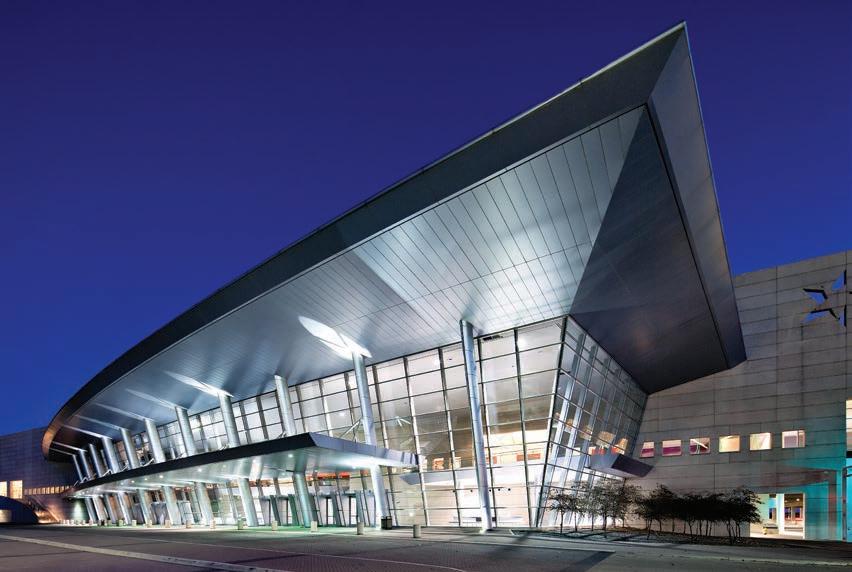
by Kerstan Szczepanski
Opening in 1957 as the Dallas Memorial Auditorium, the Kay Bailey Hutchison Convention Center (KBHCC) (650 S. Grifn Street) has gone through multiple expansions and a few name changes throughout the decades. Renamed the Dallas Convention Center in the 70s, the center’s fnal name came in 2013, in honor of former U.S. Senator Kay Bailey Hutchison. The venue is currently undergoing major changes as part of the Kay Bailey Hutchison Convention Center Dallas Master Plan, a renovation and reconstruction that will not involve just the convention center, but afect the whole of downtown Dallas’ retail, restaurant, and housing sectors.
With deconstruction ongoing, numbers for the facility are in fux, but as of this writing the website lists 622,814 square feet of exhibit space, two ballrooms, and 64 meeting rooms. The masterplan, expected to fnish in 2029, lists an impressive 2.1 million square feet total, with 750,000 square feet of exhibit space, 180,000 square feet of meeting rooms, and a 105,000 square foot ballroom. KBHCC is certainly aiming to be one of the largest
and most versatile convention centers in the nation.
Architecturally, the current center refects Dallas’s spirit of modernity and innovation. Its sweeping design and expansive glass façades ofer panoramic views of the downtown skyline. The venue connects directly to the 1,001-room Omni Dallas Hotel via a skybridge, giving attendees seamless access to accommodations, dining, and entertainment. The facility also features multiple LEED-certifed areas, refecting the city’s commitment to sustainable development and energy efciency.
Historically, the original auditorium, as well as the convention center, has hosted big events including the Beatles in 1964, the Jackson 5, Elvis Presley, Led Zeppelin, Queen, Prince (twice over 20 years), Madonna, and more. It has served as an emergency shelter for refugees of hurricanes Katrina and Harvey. This year KBHCC will be the International Broadcast Center for the FIFA World Cup and has been the home of Fan Expo Dallas since 2014.
As Texas grows as a state, Dallas refects and benefts from that growth, and KBHCC is just one great part of it. (And not just KBHCC, see our Austin sidebar).
Monarch (1401 Elm St), a wood fired, modern Italian restaurant, is less than 15 minutes’ walk from the convention center in The National, with incredible skyline views. Michelin-starred Chef Danny Grant delivers luxury dining with dishes such as handmade pasta dishes, wagyu beef, and fresh seafood. Website www.monarchrestaurants.com.
In Dallas’ historic West End, RJ Mexican Cuisine (1701 N. Market St) is less than a mile north of the convention center. This Dallas favorite handcrafted regional Mexican dishes, such as tequila lime chicken, brisket tacos, Mexican cheesesteak, and seafood enchiladas. Website www.rjmexicancuisine.com.
Famed for its LED lighting on the exterior facade, the Omni Dallas Hotel (555 S. Lamar St) is covered in more than 2,200 tubes, each of which houses three 3-foot-long LED fixtures (that’s four miles of lights). The hotel connects directly to the convention center via skybridge, making it the most convenient option for attendees. 1,001 rooms with floor-to-ceiling windows deliver plenty of views overlooking downtown. Website www.omnihotels.com/hotels/dallas.
Aloft Dallas Downtown (1033 Young St) offers boutique comfort in a repurposed Art Deco warehouse, just a short walk to the convention center. The hotel combines vintage charm with modern design, featuring open-loft rooms, 14foot ceilings, and a vibrant lobby bar. Website www.marriott.com/en-us/hotels/daldl-aloft-dallas-downtown.
Speaking of Pioneer Plaza (1428 Young St), the historic Texas exhibit is just across from the convention center. Home to one of the largest bronze monument installations in the world, you’ll see 49 bronze steers and three trail riders commemorating Dallas’s cowboy heritage. It’s a scenic, open air spot to relax and enjoy a break between meetings. Website www.visitdallas.com/directory/pioneer-plaza.
by
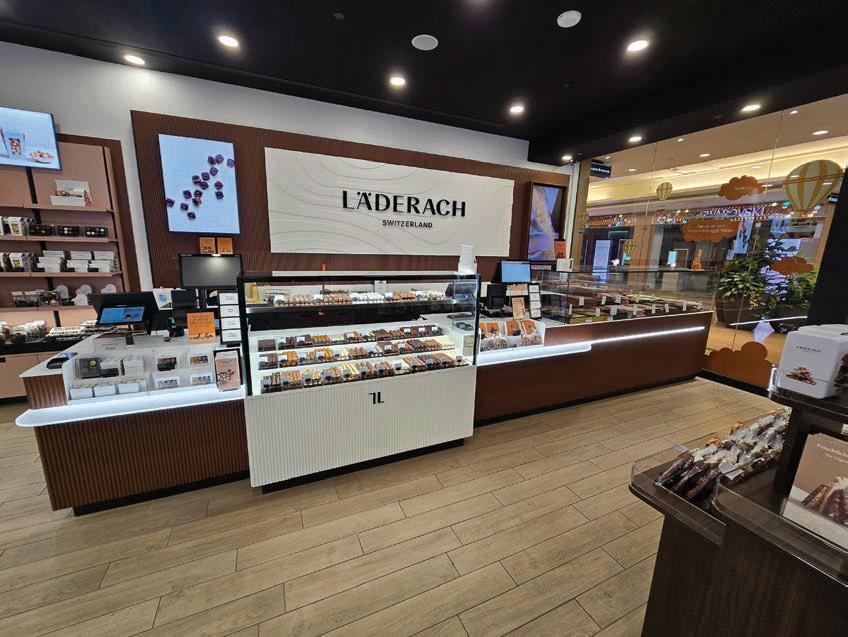

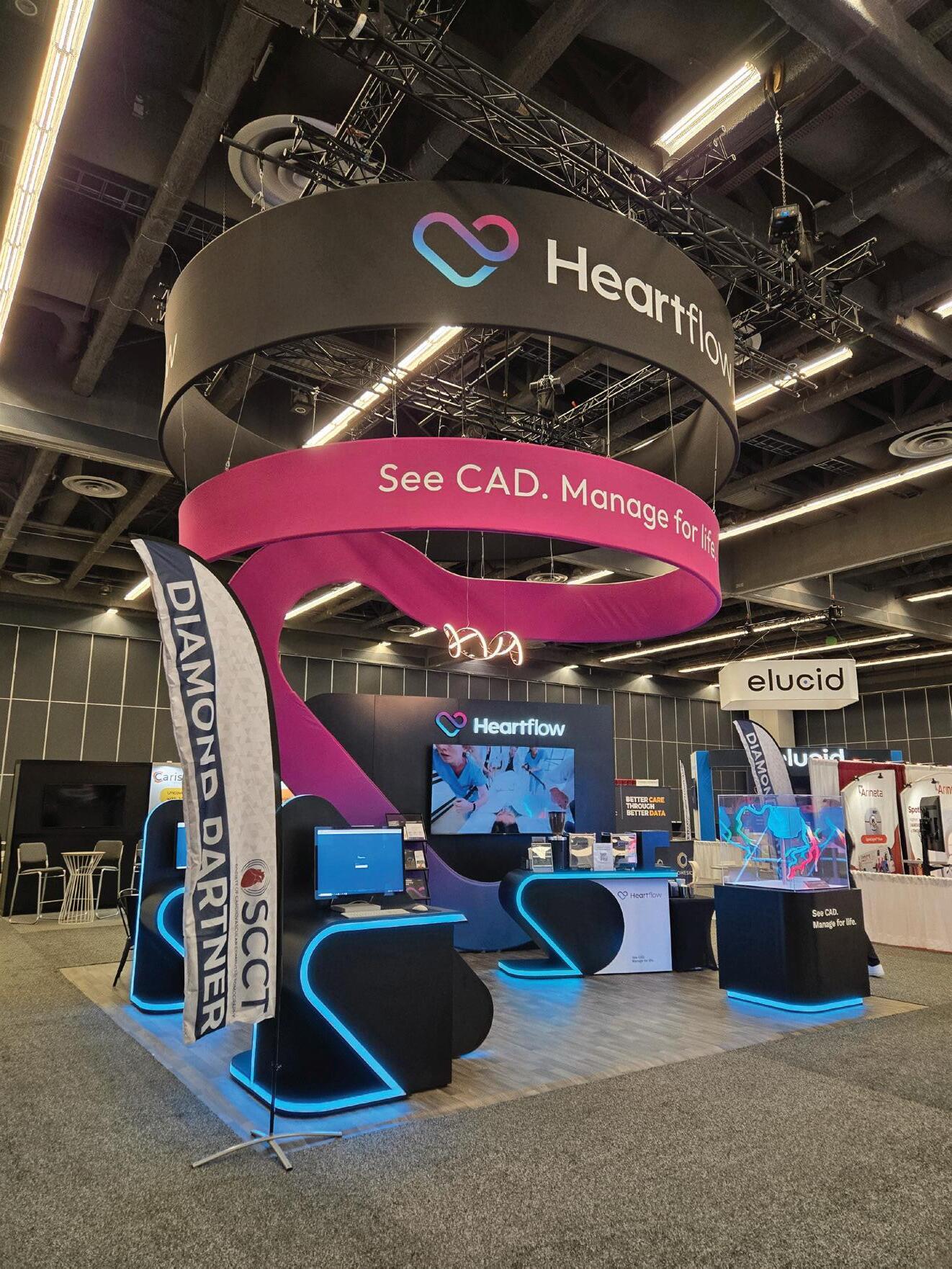
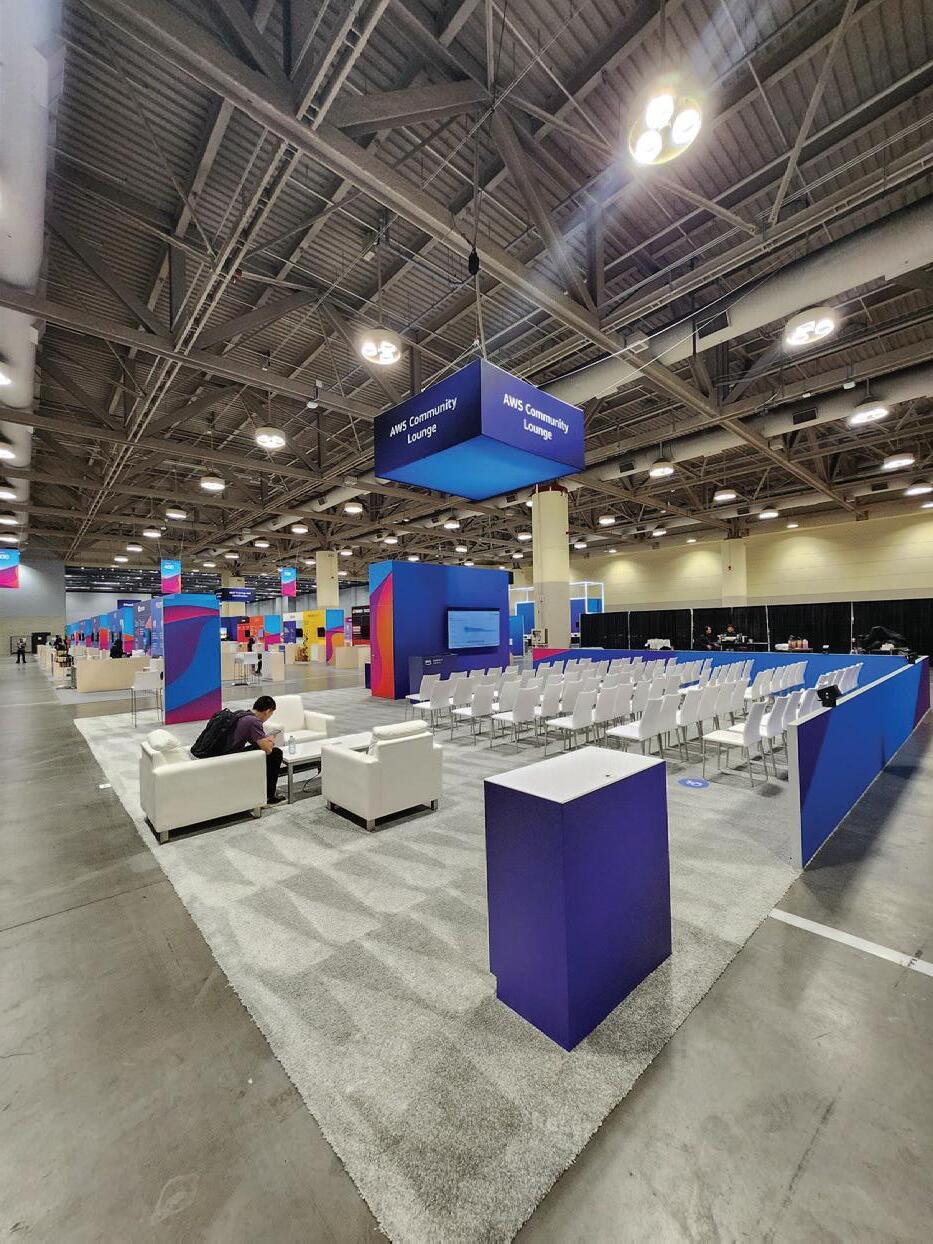

Tom Barcelona is a tradeshow expert with over 10 years of experience leading union-based large exhibit installations, ensuring safety, efciency, and client satisfaction. Outside of work, he enjoys family and nature.
Advance Order: An order for show services sent to the contractor before move in.
Bafe: A partition to control light, air, sound, or trafc.
Bone Yard: A storage area at tradeshow used by show management.
Build and Burn: A booth designed for one-time use.
Cherry picker: Equipment capable of lifting a person to a given height.
Cross Bar: A rod used for draping of support.
Cut and Lay: The installation of carpet.
Decorator: The union responsible for hanging all signs.
Dismantle: To take down or remove a booth.
Double Decker: Two foor exhibit.
Drayage: Moving of exhibit materials from dock to booth billed by weight.
EAC: Exhibitor appointed contractor.
Exhibitor Services Manual: Information sent to exhibitor for show rules and services.
Ofcial Contractor: Contractor appointed by show or building management.
FHC: Floor Plan
Floater: Workers used by foreman as needed.
Floor Plan: A map of booths.
Floor Markings: Method of marking boundaries of each booth on show foor.
Floor Port: A utility box recessed in a show foor.
Four Hour Call: The minimum work period for union workers.
I & D: Installation and Dismantle.
Island Booth: an exhibit with aisles on all four sides.
In-Line Booth: Exhibit booths side by side against a wall.
Infringement: Unauthorized use of foor space.
Johnny Box: A lockable metal box on wheels that contains tools and supplies.
Marshaling Yard: check point where trucks wait to be dispatched to convention center docks.
Masking Drape: A drape used to cover storage or installation areas.
Material Handling Order Form: A document establishing terms between The exhibitor (shipper) and carrier (transportation company).
Nth Degree Events is now a Rainfocus Certifed Reseller Partner, enhancing event customization and execution. Their experts will present at RainFocus INSIGHT 2026 in Salt Lake City.
Modular Exhibit: Exhibit constructed with interchangeable components.
No Freight Aisle: An Aisle that must be kept clear at all times.
Ofcial Contractor: General contractor or decorator.
Pipe and Drape: Tubing with drapes that separate exhibits.
Priority Point System: Method of assigning booth space based on seniority.
Pro Number: A number assigned by Freight Forwarder.
Rigger: A worker skilled at handling and assembly of machinery at tradeshow.
Set-up Prints: Scaled blueprints used to assemble booth.
Spotting: Placing freight or equipment in exhibitor’s booth.
Staging Area: Area where all shipments are in place to be delivered where they go.
Strike: Dismantle exhibits
Target Date: Move in date assigned to Exhibitors by show management.
Union Steward: On site Union Ofcial who supervises workers and show activities.
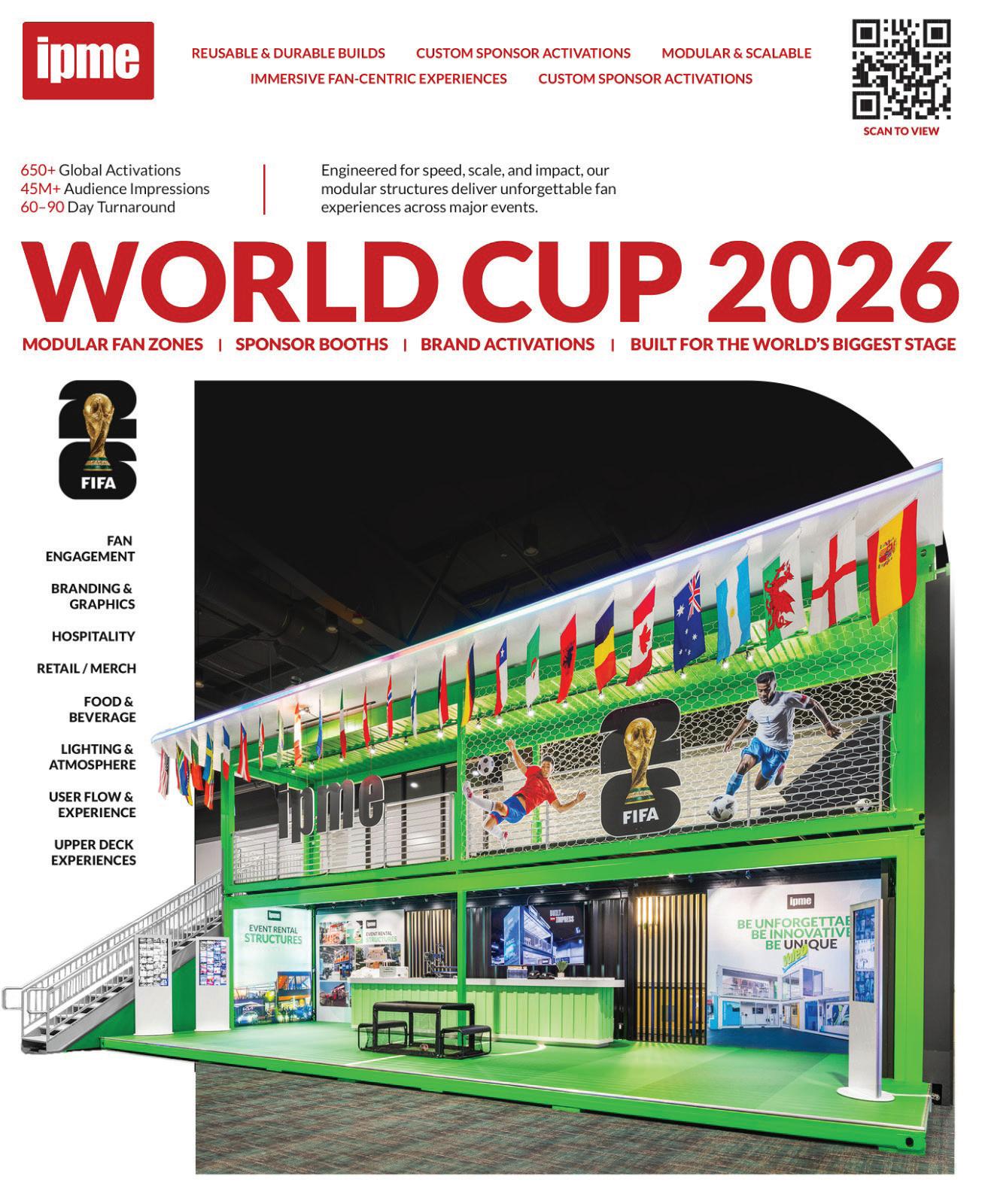
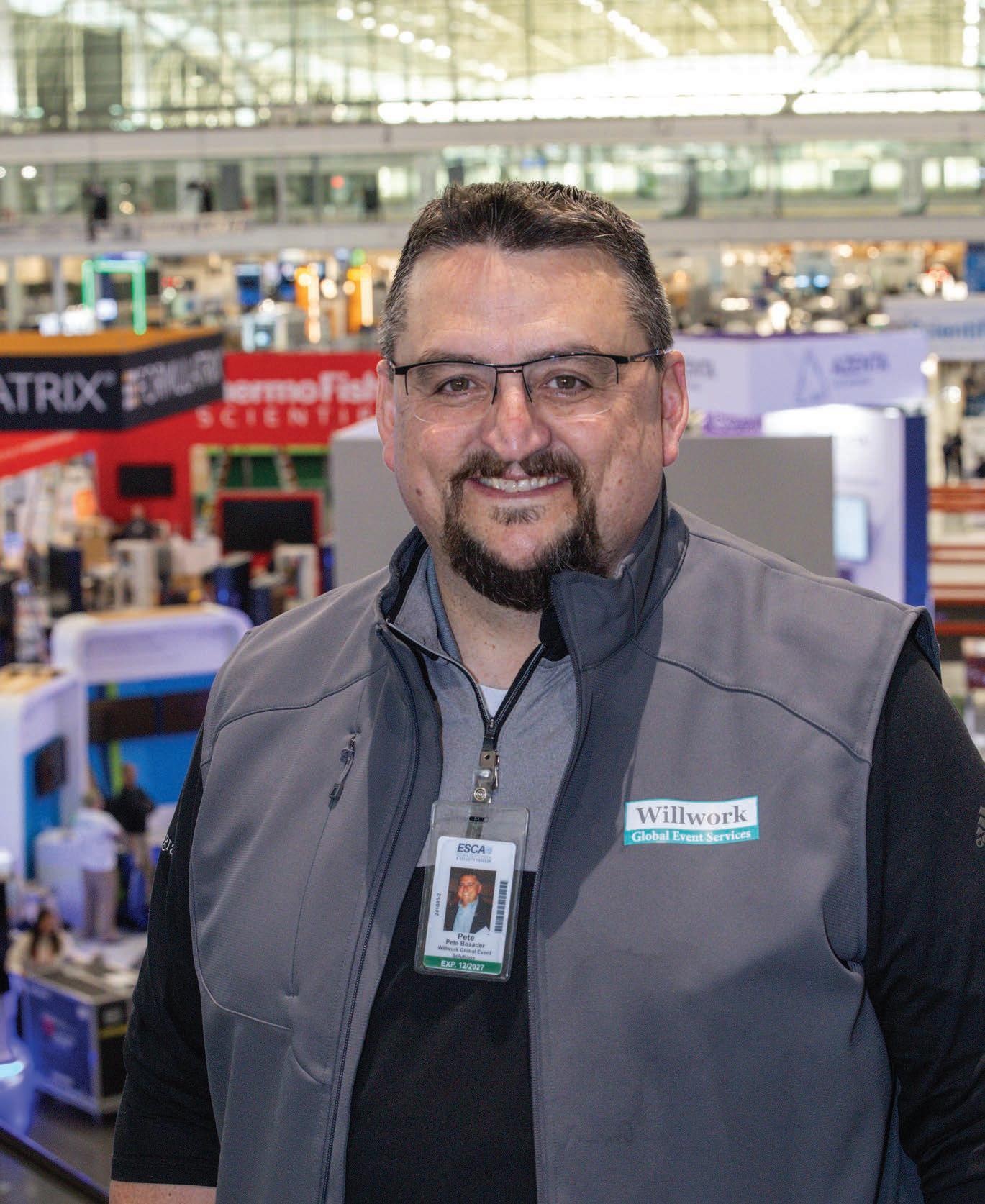
BY ELENA VAZZO AND LISA ABRAMS
Pete Bosader remains a pivotal fgure in the tradeshow industry, currently serving as Willwork’s Northeast Director of Operations, and wears many hats. He handles duties in operations, and business development. Bosader has been working in this industry since 1992, associated with Willwork for over 30 years. His relationship with Willwork’s CEO, Bill Nixon, entails a long history of collaboration and mentorship that has shaped Pete’s career and his leadership role.
In 1995, Pete joined Willwork as the director of sales and marketing, where he remained until 2004 when he left the industry to focus on his family, but returned just before the pandemic when Bill Nixon called him up. With his children having grown, and a longing to step onto the showfoor once more, Pete agreed. Pete returned to Willwork in 2019, bringing better focus to operations, sales, and especially labor and training in this country’s complex tradeshow
industry after the pandemic subsided. His primary job revolves around being the Director of Operations for New England but is certainly a jack-of-all-trades. He trains city managers for many markets including Boston. Boston is known as a unique and challenging city for tradeshows. It operates under one powerful Local 25 Teamsters union that governs nearly every aspect of labor. Other than rigging, the union controls all labor for tradeshows. By implementing strict rules, Pete understands that careful navigation is needed to succeed. In the tradeshow world, labor costs can greatly afect the bottom line, especially in Boston. It is integral to know and understand the landscape, which is where Pete focuses on a daily basis.
Pete mentions that “labor costs are signifcantly higher compared to the South, due largely to the regional wage scales and the city’s high cost of living.” While this can create sticker shock for clients,
Pete explains that the rates refect the realities of the market and the high level of expertise required.
As a Boston native, Pete understands the nuance of the “small town” city and it’s specifc needs when operating and working with the exhibit houses, union, and other general contractors. He loves working with the Teamsters, the City Managers, and the helping to train the future workforce. Engaging with the challenges and developing the new strategies for future shows brings him joy and a new found optimism for his job each day.
A primary concern for the Northeast region is the aging workforce in the tradeshow industry. Many seasoned veterans are nearing retirement. This creates a pressing need to attract and train younger individuals to share the same drive and ethics. Pete is personally involved with training programs that help provide and expose new workers to tradeshow operations. The work consists of unloading
for the intricacies of the Boston convention & tradeshow market.
Boston’s location creates strategic opportunities, as it is a hub for international businesses, attracting major medical and biotech shows. Pete states, “Because Boston is on the coast, it also attracts lots of international business, so the costs are higher, but the attendance numbers are always through the roof. Despite high costs, attendance numbers are usually relatively high, creating some of the busiest shows in the U.S.”
Looking ahead, Pete sees his future growing alongside Willwork. Guided by Billy Nixon, who continues to be a terrifc mentor for Pete in this business. Pete continues to progress and adapt to new ideas such as AI and other innovations. His commitment has also persuaded the next generation, his son, who is now involved in the tradeshow industry and works in the union. Altogether, Pete’s experience and dedication make him a key part of Will-
Boston's location creates strategic opportunities, as it is a hub for international business..."
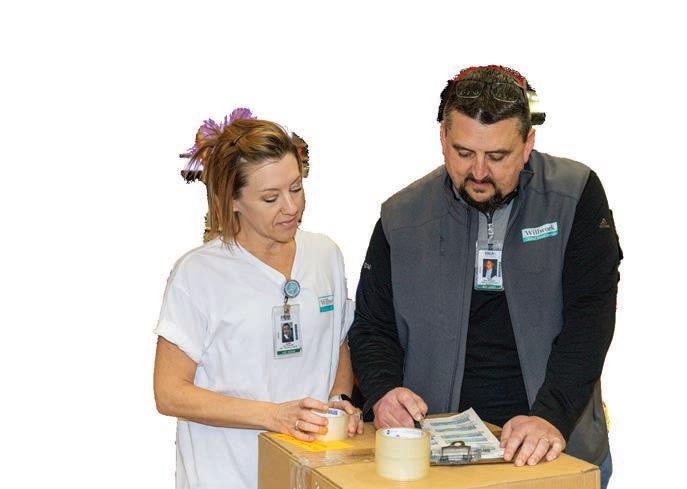
by Elena Vazzo
Since 1993, Sho-Link has been a trusted name in the events and tradeshow industry. Their main goal is to build relationships and excel as the go-to labor service provider for Sho-Link Co-Op members. For every exhibitor, they provide nationwide, high-quality installation and dismantling services. Exhibit City News sat down with three of Sho-Link’s passionate and inspiring regional leaders—Joe Terzi (West Regional Manager), Jerry Regep (Northeast Regional Manager), and Casey Burchak (Southeast Regional Manager)—to discuss and explore what sets this company diferent from others in the events industry.
Leading with Heart and Values
Joe Terzi has over 26 years of experience in installation and dismantling (I&D), dating back to 1997. He is dedicated to his work by making connections and, most of all, making clients’ dreams come true.
“Sho-Link is a company that I call home,” Joe shares. “We’re more of a family than just a workforce.” The sense of family is core to Sho-Links culture, where employees don’t just work–they belong. Especially in the tradeshows that require multiple skills, having people to guide and help you is what’s important. Joe’s pride in the company’s reliability is palpable, refecting their commitment to the industry.
This unwavering commitment to clients is evident in
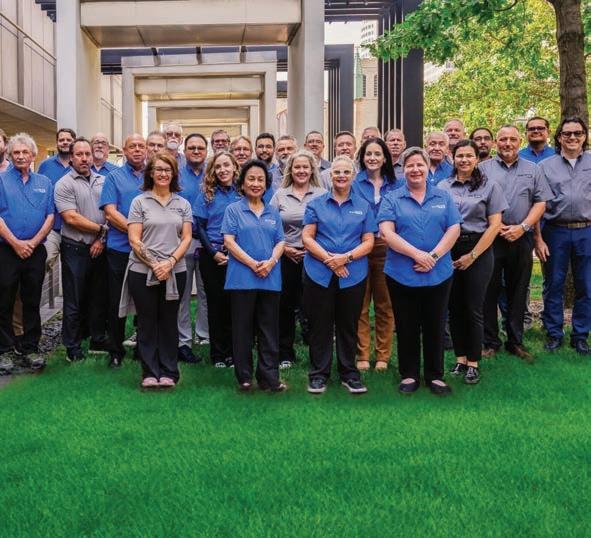
Sho-Link’s consistent performance. “In all of my years, we’ve never not had a booth not open,” Joe claims. This further shows Sho-Link’s reliability for exhibitors and event organizers alike.
From Checkers to Chess–Leading with Strategy
Jerry Regep, who has been in this industry for 23 years, has worked with high-profle clients, focusing on partnerships and winning goals. He describes his perspective on Sho-Link and the tradeshow industry in a strategic way.
“You have checker players that play one or two steps ahead, and then you have the chess players that play 9 or 10 times ahead. It seems like the chess players do much better in this industry,” Jerry emphasizes. Sho-Link isn’t just ahead
of the game; they’re the ones who fnish frst in the industry.
Jerry later talks about ShoLink’s programs and what they ofer to their employees. He explains, “We have an employee recognition program. The client writes a nice email with the crew members’ names, they go into an endof-the-month rafe, and so the name gets picked for the employee of the month.”
The way Sho-Link shows recognition to employees and notices their hard work is amiable and can be rare within the industry. Sho-Link values their clients and their employees, fostering strong relationships built on respect, trust, and mutual respect.
Rising with Sho-Link in a Family-Driven Culture Casey Burchak joined the
team in 2017 and brings eight years of experience with her. Although Casey might not be as experienced as her colleagues, she afrms that she is dedicated to her workplace and that as a woman it can be challenging in the industry.
“I don’t know of any other female who is a regional manager.” She says, “So, you’ve got to work hard to stand out, you know, because you’re a female.”
Especially for newcomers in the industry, you can sometimes feel out of place, luckily Sho-Link was diferent. “I see myself staying in Sho-Link, they’re like family.” Casey asserts. “They saw my value, they treat me very well, they’re a very kind company.”
What makes Sho-Link stand out is their supportiveness, kindness, and most of all, how they treat their employees like family. Sho-Link trusted Casey early on, trusting in her and the work she would be doing for the company.
What truly sets Sho-Link apart from other companies is how they value not only their clients, but also their workers. Sho-Link treats everyone like their own, they empower their employees and clients to grow and succeed. Through meaningful programs, transparent communication, and a supportive system, Sho-Link cultivates a workplace where everyone is valued and motivated to deliver exceptional experiences.

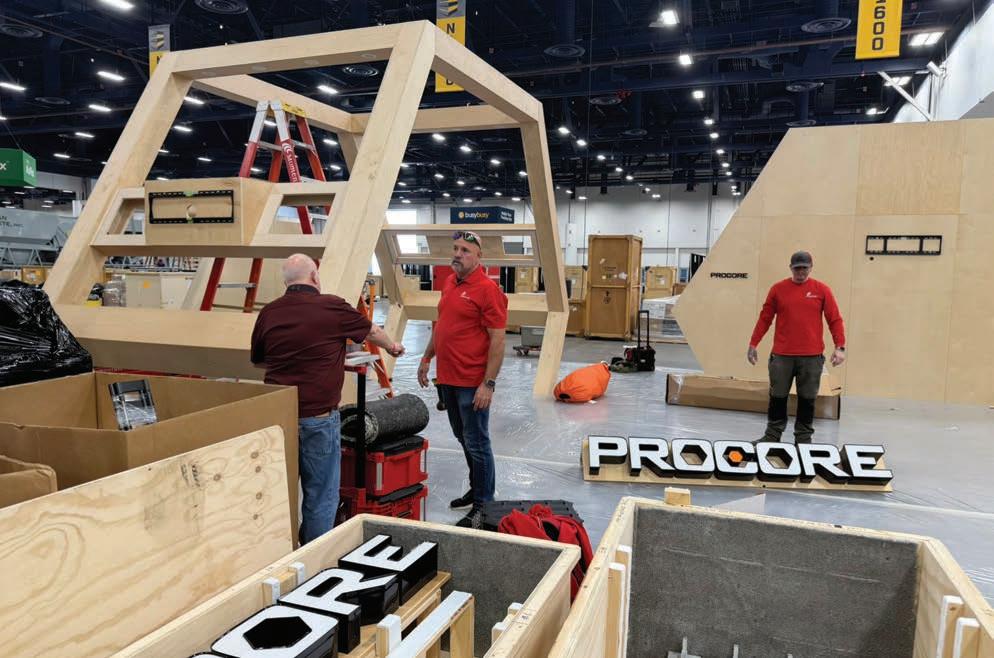
Turns out, this guy Darwin was on to something with his theory of evolution. If you’re going to survive in the ultracompetitive tradeshow Installation & Dismantle (I&D) world, you’ll learn to adapt to a constantly changing environment.
Building codes, safety regulations, labor standards, material costs, shipping rates are all subject to revisions and adjustments. Complicating matters, rules difer from show to show, city to city, venue to venue. It takes the DNA of a chameleon to make it through the day.
Jason Jenne, foor manager for Momentum Management in Las Vegas, sees change at almost every show.
“These guys are working for this company today,” Jenne says, pointing to his crew set-
ting up an exhibit for World of Concrete at Las Vegas Convention Center. “They may be working for someone else next week. If the price is right, they’ll be gone.”
The dog fght for skilled labor is one of a crate full of challenges Jenne faces on a show-by-show basis. It’s like any industry, he relates. “If you don’t adapt, you’re done, you’re left behind, so you have to keep up with what’s going on.”
Colleen Johnson, president of Sho-Link I&D labor services in Lake Forest, Ill., with more than 25 years in the industry, says she’s always in awe of how quickly it’s evolving.
“Above all else, we must be agile. Our ability to adapt is how we stay competitive, and we experience this every day. We are adopting new technolo-
CES and MAGIC, drawing as many as 150,000 attendees.
To facilitate this growth, a specialized workforce was required to install and dismantle exhibit booths. Thus, the birth of the I&D industry, a niche that emerged for cabinet makers, carpenters, electricians, and exhibit houses that design and build booths.
Organizations such as the Exhibitor Appointed Contractors Association (EACA) shaped training and certifcation programs for these workers who are crucial collaborators in live event logistics and scheduling. They haul freight, roll out carpet, hook up power, rig overhead signage, and set up structures that meet strict building specifcations and safety standards.
RAY SMITH
gies. We monitor and respond to shifts in clients’ expectations,” Johnson summarizes.
What started with World Fair exhibits and advanced in the 1930s to fancy department store window displays has evolved into elaborate, multilevel convention and tradeshow booths featuring an assemblage of audio-visual bells and whistles designed to lure customers into a space where products are sold and deals are done.
As America entered an era of post-World War II economic prosperity, large showrooms were dedicated to industries of special interest, such as automobiles, home entertainment, and fashion. Witness the growth of SEMA,
There are so many elements requisite for a company to provide I&D labor services and training is one key aspect, says Jim Wurm, executive director of EACA.
Training isn’t limited to various trades that provide workers for I&D contractors. While the Teamsters and Carpenters unions have excellent training centers in Las Vegas, as well as the Decorators (IUPAT) in Southern California, programs provided by I&D contractors are “signifcantly more sophisticated,” Wurm notes.
Labor trades primarily provide tool and booth training. They teach workers how to read blueprints and use the tools necessary to build displays. I&D contractors teach their unique service culture, operations and logistics, and the level of customer service required from crews.
“Erecting a display on a










tradeshow foor doesn’t happen in a vacuum,” Wurm lets you know. “Workers must collaborate with other service providers that aren’t part of the I&D contractor organization. They need to familiarize themselves and build relations with the general contractor’s material handling service so they can efectively and accurately plan the start time for their project based on when the freight is scheduled to arrive.”
He continues, “They must also initiate contact with rigging crew services and electrical services, as they’re generally a part of the install process and scheduling of these services must be well handled for efciency.”
Their responsibility extends to solving problems that inevitably arise on the show foor, everything from missing freight to damaged graphics and displays. The list of possible mishaps is endless, so it’s best to keep a bottle of Tylenol on hand.
Southern Nevada Teamsters Local 631 developed a two-year program that certifes workers in all facets of tradeshow labor. The class begins with a threeday “boot camp” to determine if applicants can handle the physical requirements of tradeshow work, which might involve pushing carts, lifting tanks, climbing ladders and moving crates with a J-bar.
In the frst year, they learn about exhibit booth I&D, design and repair, OSHA regulations, and beginner skills like operating a pallet jack. The second year teaches advanced forklift driving, advanced I&D, scissor lift, CPR and frst aid, and elective classes in bud-
geting, graphics and heavy rigging. The 70,000-squarefoot training center produces roughly 200 apprentices a year.
Jenne was a professional soccer player for the Las Vegas Quicksilvers in the 1990s when a Chilean teammate working for Freeman called to gauge his interest in an ofseason job ofer.
“Like everyone, it was someone I knew,” he says about getting his start in the industry. “I believe it was one of the best decisions I’ve made in my life, especially with the friendships I’ve made along the way. That’s the No. 1 thing for me. Relationships.”
Over Jenne’s 30-year career, Las Vegas skyrocketed from a few million square feet of exhibit space to an estimated 15 million to 20 million square feet. That’s exciting, but it presents challenges, like retaining the most productive workers.
Before Las Vegas added Mandalay Bay Convention Center, expanded Las Vegas Convention Center and MGM Grand, and Caesars Palace built 500,000-square-foot conference centers, companies like Momentum could hire a handful of people to cover all the shows. Now, with hotels from the Strip to the suburbs ofering meetings and events space, it’s a struggle to keep up with labor demand.
“If I worked 30 years ago, I would be working almost every show that came through the city,” Jenne says. “Now, I’m only seeing 50 (percent) to 60 percent of the shows, as most shows are overlapping due to the extra space and venues ofered. This afects multiple
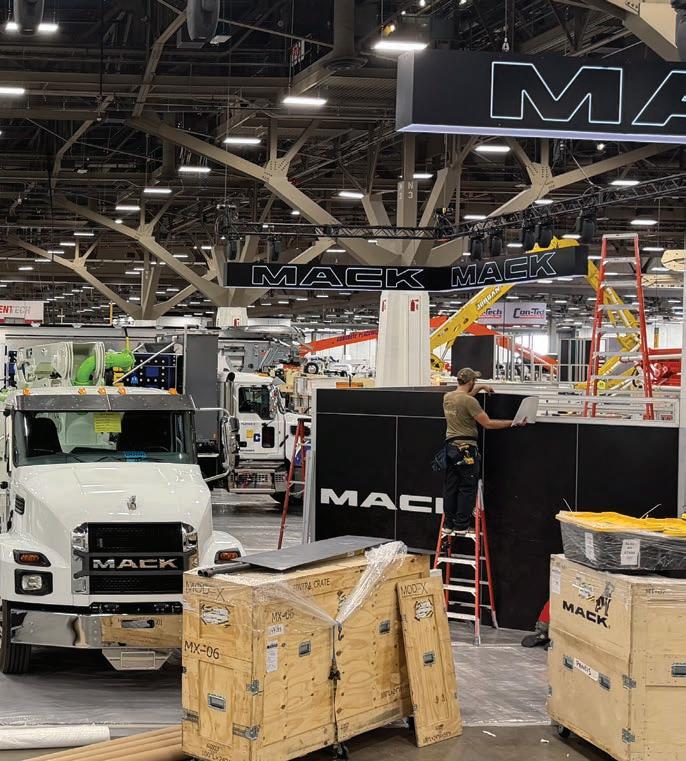
shows at a time due to not having enough quality labor.”
Jenne watched the rising tide of the tradeshow industry lift not only its labor force, but other sectors of the economy. Whereas maybe one food truck would stop by Las Vegas Convention Center during lunch time, he now sees half a dozen or more showing up, right on schedule.
Several rental furniture companies work with show general contractors, giving exhibitors a wide selection to furnish their booth. Graphics companies have doubled or tripled in size.
Of all the changes in the industry, telecommunications may be the most signifcant, Jenne believes. Certainly forever. Yellow Pages are history. Google is your new best friend. Exhibitors are going online to fnd vendors for their booth space, where
they might take clients for an evening of fne dining, what are the best shows in town.
And the cell phone? In the old days, Jenne carried a twoway beeper and equipped his crew leaders with beepers so they could communicate from booth to booth. With cell phone cameras, he can instantly send a picture of an exhibitor’s completed booth for approval.
“Years ago, after a booth was built, we had to use Polaroid cameras and we would have to mail the pictures to the clients so they could see what their booths looked like,” the I&D supervisor recalls.
The shift in technology has been nothing short of remarkable. Sho-Link’s Johnson feels like it was just yesterday that she relied on faxes, pagers, and hunting down a payphone to stay in touch.
“Now, everything happens in real time—messages fying back and forth at all hours,” the industry executive says. “In-


stant communication has been incredibly helpful, and it has also introduced new pressures. Staying ahead means evolving and making sure our entire team is on the same page.”
If ever there was a moment in history that showed the resilience of the tradeshow industry, it was the Great Shutdown. Conventions, tradeshows, meetings, and conferences were fourishing before the COVID-19 virus struck in early 2020. Then they closed the spicket. It was a costly pause. With 1.7 million exhibitors, the tradeshow industry brought $396 billion in direct spending to host cities in 2019, including $55 billion for hotels, $30 billion for restaurants and retail, and $29 billion for ground transportation, according to the National Trade Show Alliance (NTSA). It was time to clear out the losses and restart the engine.
Even as virus infections declined and pandemic restrictions were lifted, the industry was challenged to replace its workforce and reconnect with meeting planners, material suppliers, and trade unions.
“You have an industry that has to work on sustainability through workforce development,” Laura Palker, founder and president of NTSA, says in a 2022 interview with Exhibit City News promoting the organization’s Invisible Industry nationwide bus tour. “At the end of the day, we had a pandemic that was a blessing. It gave us a wake-up call to the importance of our workforce. If we don’t act now, in fve to
10 years, the majority of the workforce will (be retired).”
Once again, the industry adapted. A state of normalcy returned, even if it was the “new norm.”
“Flexibility, problem solving at any time, having a sense of purpose, and having to adapt to any situation is a must in this industry,” Jenne reiterates. “Key factors to having a successful company are to provide strong customer service to our clients and maintain a talented team of individuals who will and can provide that customer service.”
Vicissitudes of the tradeshow industry have led to a spate of mergers and acquisitions in recent years, strategic moves by companies looking to expand their footprint, consolidate operations, fatten their bottom line and move forward with growth.
Among major transactions: Nth Degree joining Fern Exposition Services; Riverside Companies acquiring Impact XM; Riverside investing in Vomela, which then acquired Moss; Corp Events New England acquiring Dame Associates; Truelink Capital acquiring GES.
The tradeshow and live events industry bounced back from COVID faster than expected, its value proven and even strengthened by the pandemic, according to JEGI Clarity. Opportunistic investors and private equity frms are jumping to access deals across the spectrum.
The global exhibition market has traditionally grown ahead of GDP, increasing 5 percent annually until it peaked with a value of $29 billion
in 2019, the investment bank reported. Growth was halted dramatically by COVID, with the market shrinking 69 percent to $10 billion in 2021.
“We see supply and demand with this industry on a daily basis,” Jenne comments, “and many times, smaller companies are acquired by larger companies as they may be getting too big themselves and cannot adapt to the increasing labor force, or any other reason for that matter, in which they’re having trouble adapting.”
Dennis Taylor and his son, Gabriel, owners of Black Ops show services in Las Vegas, are resisting the M&A movement. They don’t plan on selling their business or merging any time soon, or ever.
“Companies that value their own vision and true independence will never sell or merge because they have more fexibility from top to bottom,” Gabriel Taylor tells ECN. “Direct line of sight to the customer. Leverage. Bargaining power. The list goes on. We’ve shown that we have staying power, building our own table. We don’t need cosigns or permission.”
Dennis and Gabriel hear workers complain about being mistreated by large companies, along with a decline in customer service, especially in the last few years. “When they’re dealing with smaller companies like us, it feels more close-knit,” Gabriel confdes. “Better treatment overall, and the quality of execution is drastically higher.”
Consolidation makes it imperative to be more focused on customer service and support, Johnson postulates. Regardless of ownership struc-
If we don’t act now, in five to 10 years, the majority of the workforce will (be retired).”
ture, the goal for everyone is to elevate the experience created by the I&D company, to make sure exhibitors and attendees come away with real value, and support designers in realizing their concepts.
“The real challenge is when you are growing the business and absolutely refuse to sacrifce the quality and personal attention that got you here in the frst place,” Sho-Link’s president says. “That has taught me how essential it is to build a company culture that doesn’t just accept change but actually thrives on it. When your team is on board, you can take on new opportunities without compromising what makes your business special.”
Another area of constant change, rules and regulations defnitely serve a purpose for the tradeshow industry, but what matters most is keeping the exhibitor at the center of everything, according to Johnson.
“Whenever there’s talk of new fees or changing requirements, the question really should be: How will this afect the exhibitor’s experience and their ability to succeed?” she posits.
EACA does an excellent job communicating on this sub-
We want to set you up for success! Let's produce something great together.
Contact Us: Service@willwork.com
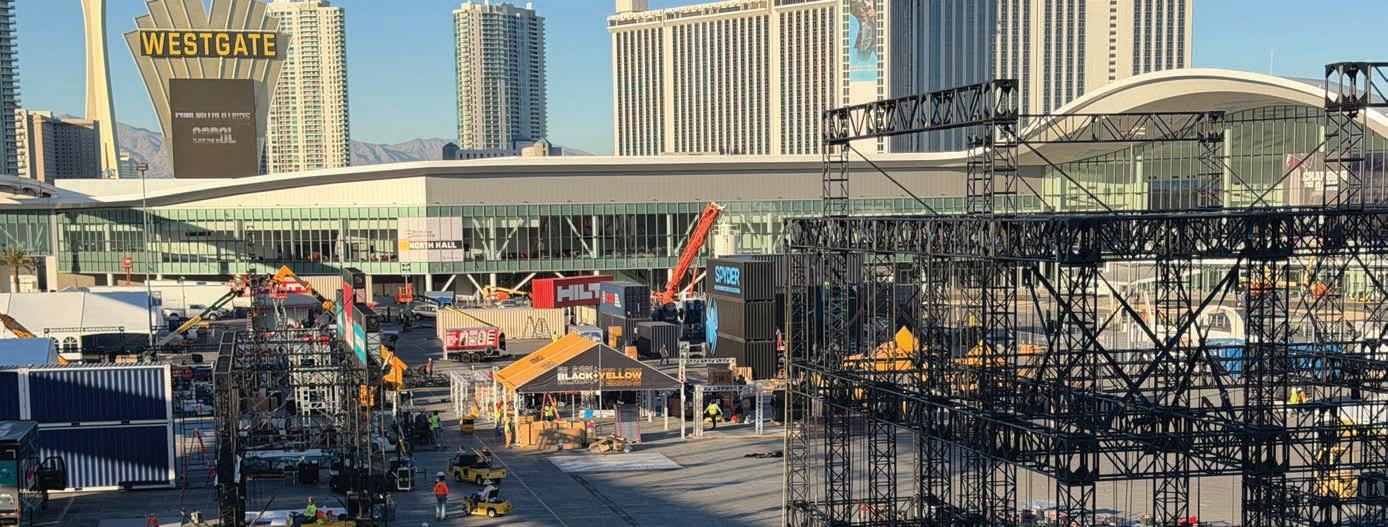
ject, one of the great advantages for contractors to join the association, Johnson notes.
Also, Exhibitor Advocate is “really moving the needle here,” making sure exhibitors have a voice and their needs are heard when decisions are made.
“Their work is all about helping exhibitors navigate the process, raising awareness, and ensuring that the industry continues to support the people we’re all here for. At the end of the day, our job is to make sure exhibitors feel supported and valued, no matter what changes come our way,” Johnson says.
Business prospects can get a little scary without deep-pocket fnancing that a larger corporation provides.
A few years ago, Black Ops was owed a signifcant chunk for an installation job, and the client was slow to pay. Dennis and Gabriel waited nearly a year and a half for full payment. That’s the sort of hiccup that can doom a small business.
Father and son were building booths mostly by themselves, with the help of a few friends, depending on the size of the job, and not drawing pay, which is expected when
starting any new business.
“At that time, we really couldn’t aford to take a hit like that,” Gabriel explains. “We were dealing with so much professionally and personally in our lives at that time. We couldn’t aford lawyers.”
They endured the dodging of phone calls and condescending attitude from the client’s account executive. They kept treading, laboriously, heads down, focusing on what they could control, trusting that things would eventually work out. And they did.
“We kept everything on a shoestring budget,” Gabriel says. “We got a lot of no’s in the beginning, a lot of laughs from the peanut gallery. We just said, ‘Watch this.’ Now they know this isn’t a game, and it never was to begin with. We’re playing for keeps.”
Then came the pandemic and everyone was fearing for their lives, never mind the future of the tradeshow industry. Who would risk attending a live event with the virus circulating in the air? Let’s Zoom, instead.
“I think everyone learned something from that situation that was vastly diferent from the 2008 fnancial crisis,” Gabriel relates. “One important
lesson was that, to a fault, we all have a natural human inclination, this insatiable sense of curiosity to feed our fve senses. That’s never going to change. Attendees want an experience and tradeshows fulfll that need. Kind of like a concert, it’s a once-in-a-lifetime thing where you just had to be there to see it for yourself.”
Even at tradeshows such as CES and World of Concrete, held every year, each show is diferent from year to year. New ideas emerge, new products are developed, and people are intrigued by what’s hot in the market.
“They want to interact with others in a bubble, so to speak, who share the same level of interest.” Gabriel says. “Human connection is what it all boils down to. We underestimate that sometimes.”
It’s true. The tradeshow industry has changed, transformed, consolidated, morphed, and survived over the years, linked by one common, positive thread.
“This is a people business and people will never go out of business,” Jenne proclaims. “One thing I’ve enjoyed over the years is being
able to work with several different companies and experiencing the diferentiations and ideologies of each company, as they are unique in their own way.”
For Johnson, a key factor to keeping the industry alive is increasing awareness about opportunity in the trades. I&D work is the backbone of the industry, but a lot of young people don’t even know these careers exist, she asserts.
She credits the Experiential Design and Producers Association (EDPA) for its recruiting eforts, showing how the industry ofers stability and growth for skilled tradespeople.
“It doesn’t stop at simply growing our talent pool,” Johnson adds. “We need to make sure we’re supporting them, not just with the work itself, but with helping them balance everything they have going on. There’s a lot on their plates. They’re often planning the next job while still in the middle of the current one and felding questions about a previous project.
“So, making sure our teams have the right tools and resources is extremely important in preventing burnout and keeping everyone engaged for the long haul.”
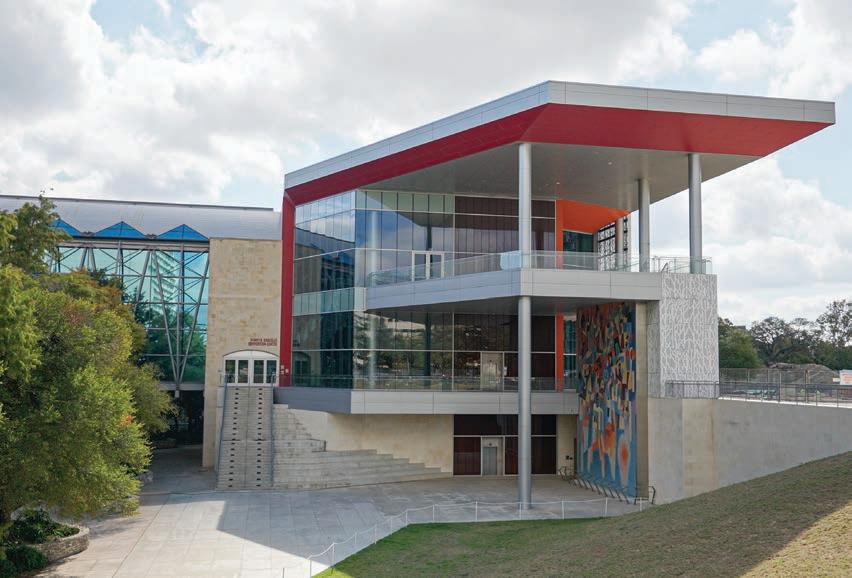
By Kerstan Szczepanski
Overlooking the scenic San Antonio River Walk, the Henry B. González Convention Center (HBGCC) (900 E. Market Street) stands as a centerpiece of the city’s vibrant downtown and one of Texas’s premier event venues. Built as the San Antonio Convention Center in 1968 for Hemisfair ‘68, its name was changed in 1977 to honor Congressman Henry B. González, a respected civic leader who championed the city’s development. Right from opening the convention center has been a cornerstone of San Antonio’s hospitality and tourism industry.
The venue has more than 1.6 million square feet of space, with over 514,000 square feet of contiguous exhibit space, 70 meeting rooms, and two elegant ballrooms, one being the 54,000-squarefoot Stars at Night Ballroom, one of the largest in Texas. A massive $325 million expansion and modernization project (the fourth expansion in the center’s history) was completed in 2016. The city’s largest capital project turned the facility into a state-of-the-art meeting destination with added modern meeting spaces, cutting-edge technology, and striking architectural elements.
Those elements combine contempo-
rary design with regional character. Glass walls and open-air courtyards provide gorgeous views of the River Walk, while the public art installations, with works by local and international artists, celebrate the city’s rich artistic tradition. Sustainability was also a core focus of the renovation, incorporating energy-efcient systems, natural lighting, and water conservation features that have earned the facility LEED Silver certifcation.
Right in the heart of downtown, the convention center is minutes from the Alamo, Hemisfair Park, and hundreds of restaurants, hotels, and entertainment options. The city’s famous River Walk is a relaxing, engaging way to explore the city’s historic landmarks between sessions. It is one of the most visitor friendly convention destinations in the country.
Each year, the HBGCC hosts a multitude of events, from major conventions like the Texas Music Educators Association Conference and PAX South (until its dissolution) to large-scale corporate meetings, tradeshows, and cultural festivals. As San Antonio continues to grow as a dynamic global city, the Henry B. Gonzalez Convention Center stands as both a symbol of its heritage and a testament to its future.
Sitting right on San Antonio’s famed River Walk, Boudro’s Texas Bistro (421 E. Commerce St) is less than 10 minutes from HBGCC. Come for its tableside guacamole and prickly pear margaritas and stay for the Texas style entrées like blackened prime rib and Gulf shrimp & grits. Website www.boudros.com.
Four minutes by car (about a 15 minutes’ walk) is Rosario’s ComidaMex & Bar (722 S. St. Mary’s St). Women and Latino owned, this vegetarian friendly location is regularly named best Mexican restaurant in San Antonio. With ceviche, enchiladas verdes, and their signature prickly pear margarita, you can’t go wrong. Website www.rosariossa.com.
If you don’t want to walk far to the convention center, you can’t do better than the adjacent Grand Hyatt San Antonio River Walk (600 E. Market St). The over 1,000 room hotel features a rooftop pool, 24-hour fitness center, an on-site Ruth’s Chris Steak House, and the live music providing Bar Rojo. Website www.hyatt. com/grand-hyatt-san-antonio-river-walk. Hotel Contessa (306 W. Market St), a luxurious 4-star all-suite hotel, sits directly on the River Walk just 10 minutes away. Rooftop swimming pool, a fitness center, and free Wifi are just part of what you’ll get staying in one of their suites. Website www.thehotelcontessa.com.
Adjacent to the convention center, Hemisfair Park (434 S. Alamo St), is a redevelopment of the site of the 1968 World’s Fair that offers green spaces, public art, and the landmark Tower of the Americas. Website www.hemisfair.org.
Mentioning San Antonio River Walk should tell you it is the city’s defining attraction. This city park and pedestrian street winds in and out of San Antonio culture and commerce, for an unforgettable immersion into the history of a city rich in both. Website www.thesanantonioriverwalk.com.


























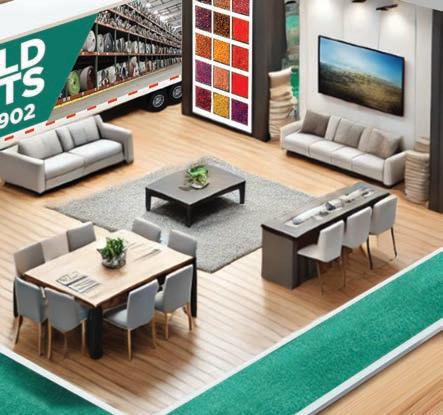











by Tommy Goodwin
In recent years, AI has transformed the business and professional events industry. No, not that AI. I am talking about an even more transformative AI: advocacy involvement!
For the past fve years, the Exhibitions & Conferences Alliance (ECA) has been the voice of Exhibit City News readers on Capitol Hill, inside
policymakers hear your voice.
And they have! With your support, ECA has repealed state taxes on exhibitors and helped secure $50 million to reduce visa wait times for would-be attendees and exhibitors. Just last year, the industry’s advocacy led to Pell Grants being expanded to provide skilled workforce training.
But in 2026, there is still more to be done. Much more.
ECA’s 2026 public policy agenda has identifed several priorities that would move our industry forward, help us create new jobs, reduce economic uncertainty, safeguard afordability for our small businesses and those we serve, and increase the competitiveness of the U.S. as the premier global destination for exhibitions, meetings, conferences, conventions, tradeshows, and more.
What does that mean for you?
ECA will continue to fght back against tarifs, which are taxes on event organizers, exhibitors, suppliers, venues, and attendees alike. We will also oppose state and local tax bills that unfairly target the industry and proposals that would make our sustainability eforts even more tangled.
Nobody tells the industry’s story better than you do. The ECA Advocacy Network has programs where you can contact your members of Congress, write an op-ed or letter to the editor of your local media outlet, and even host policymakers on the show foor for a behind-the-scenes tour.
That said, everybody knows there’s nothing like face to face. So why not come to Washington, D.C., and get involved?
On May 28, ECA will host our annual Legislative Action Day, which will bring industry leaders and advocates from across the country to Capitol Hill to meet with their elected ofcials about the issues that matter.
Last year, 170 industry stakeholders from 30 states joined ECA for a full day of advocacy, direct engagement with federal policymakers, and cross-industry networking opportunities.
the White House, and in city halls and state houses from coast to coast.
From reopening events and bringing back international attendees and exhibitors after COVID to leading the charge against tarifs and getting the government to help us attract and train our future workforce, ECA has been on the frontlines making sure that
ECA will support federal and state eforts to invest in our next generation of skilled workers, who are critical to our industry’s collective future. You will also fnd us supporting free trade agreements, government-backed terrorism insurance, and eliminating fees and policies that keep international participants away from U.S. events.
But we need your help. That’s where more AI—advocacy involvement—comes in.
As Fernando Fischer, Chair of the ECA Board of Directors and President, Americas for RX, puts it: “Legislative Action Day is more than a day on Capitol Hill—it’s a live demonstration of the power of in-person events and what can be achieved when our industry comes together with a shared purpose.”
Now that’s AI that can truly transform the industry!
Visit ECAadvocacy.com today and make plans to join us in Washington, D.C. this May.
Tommy Goodwin is Executive Vice President for the Exhibitions & Conferences Alliance, the unified public policy voice of the U.S. business and professional events industry.
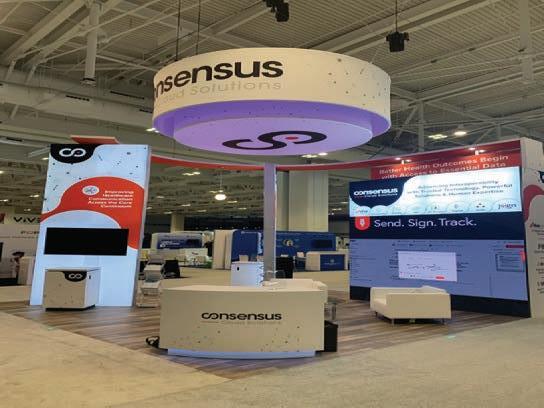
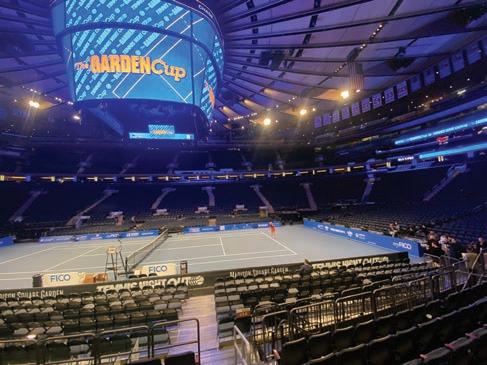
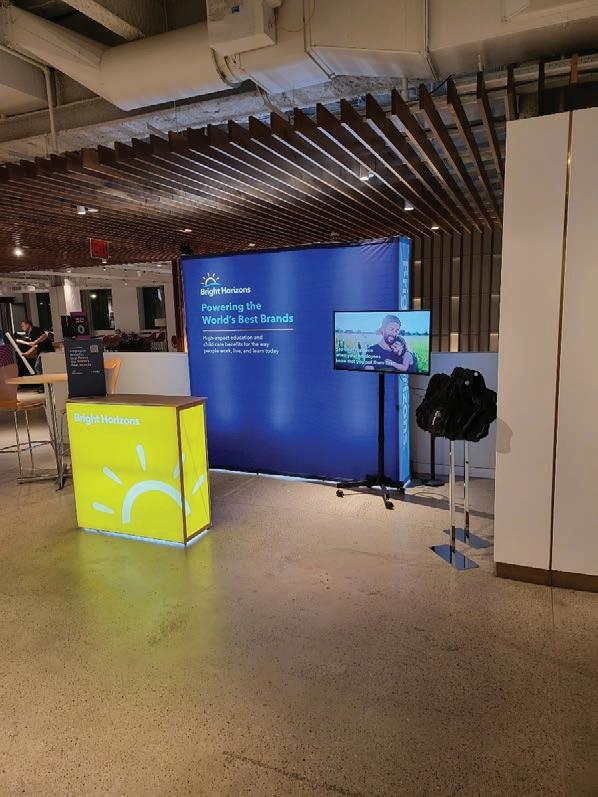

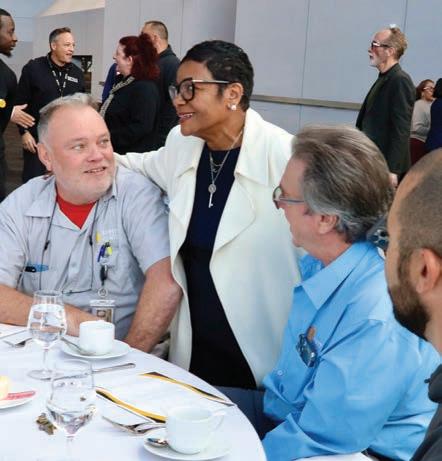
Joyce Leveston brings a depth of operational expertise and global perspective to her new role as the president and CEO of the Jacob K. Javits Convention Center (Javits Center) with more than three decades of experience in the convention center and venue management sector. Javits Center is a six-block venue on Manhattan’s West Side, right by New York City’s most up-and-coming neighborhood, Hudson Yards. As a model of reinvention, the center is a sustainability leader with a living green roof and urban wildlife habitat, as well as a national space where business, culture, and ideas intersect.
Leveston has defned her career by her mastery of facility operations, event logistics and large-scale venue execution. These disciplines remain the core of today’s increasingly complex exhibition and live event environments. Her extensive experience ensures strategic leadership to bring reliable, innovative event solutions. Her professional résumé, including her role as a former senior vice president at Oak View Group, refects a rare breadth of experience across some of the world’s most high-profle and logistically demanding events. Leveston’s precision planning and public-facing impact include the Big Games, NBA and MLB All-Star Weekends and Presidential Inaugurations. The Nuclear Security Summit for President Obama, the International AIDS Conference, and the White House State of Women are also part of her extensive résumé. Her recent appoint-
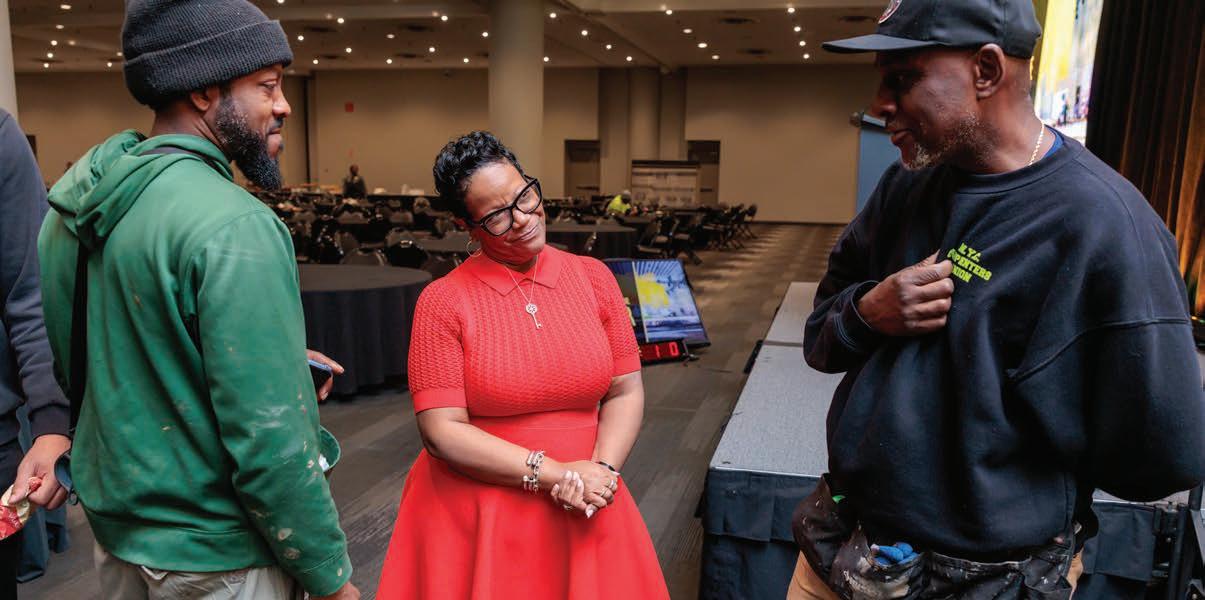
ment to the board of the Global Association of the Exhibition Industry (UFI) highlights her international infuence and her role in shaping the industry’s future worldwide.
As Leveston admits, there really is no typical day. “I meet with my chief of staf daily to make sure we are aligned with the vision and mission of Javits. I’m updated and briefed on any new afairs across the organization, from operations to administration. I have weekly and bi-weekly meetings with my direct reports, along with a bi-weekly executive leadership luncheon where we discuss more long-range projects.
“Whenever possible, I like to review any opportunities to meet and greet clients for site visits or customers setting up for a show. On any given morning or afternoon, Javits staf might encounter me walking the halls or in the back of house, visiting with our team and ensuring they have access
to their leadership. People will always be my priority, so I make sure I’m connected to the staf, seeing and hearing frsthand how we are accomplishing great things at Javits Center, allowing our team to shine.”
Being CEO is more than just a title for Leveston; it’s about ensuring that everyone in the company feels valued and connected. She believes that engaging directly with staf fosters respect and reassurance. “I take time to have individual conversations, both in the ofce and on the foor, so that we can build connections and community. My goal is to listen so I can support the team. Depending on the day or the week, you might fnd me wandering the lobbies, taking photos of the doors and elevators, or looking for gaps and things we might have missed.
“I live close, so the team can fnd me in the mornings around 10 a.m. as they
prepare to receive our guests. But often it happens between 7 p.m. and midnight, when people expect me to be gone for the day. It all depends on my schedule. I want to create an environment where everyone feels empowered and engaged, and that starts by making sure they feel heard and seen.”
Her leadership style is people-focused and collaborative, with open communication to build trust and inspire confdence. She encourages her team to share ideas and feel empowered to make decisions, fostering a supportive environment where everyone can contribute meaningfully. While Leveston is the decision maker, input from her team is integral to the process. “As a leader, this is probably the thing I have learned to embrace the most. I believe in providing opportunities for ambition to fourish. After 30 years in venue and convention management, I don’t proclaim to know everything.”
As for another new role, serving on the board of directors for UFI aligns with her vision of positioning Javits and New York City as the global hub for international B2B events. “This opportunity allows me to be in a room of my peers that respect North America as a true provider of innovation for exhibition venues and a place where exchange happens on an international scale in our industry. I’m proud to make an impact, both for Javits Center and for my personal legacy. My goal is to make Javits Center the place where stakeholders and world leaders gather, where history is made, and where the future of exhibitions lives. There is no place like New York, and I want to make sure that it is synonymous with Javits Center. That begins by getting out there and spreading the gospel about Javits Center.”
Have we as a culture really changed that much in 100 years?
Have we really advanced as a society? Has technology really had the great impact we think it has?



By Jim Obermeyer
Here I sit at Nashville airport waiting for my fight, one that has been delayed by 60 minutes, twice. Up and down the concourse, every gate is experiencing the same thing: weather-delayed travel.
It is an interesting study in social behavior to watch what people do with their newfound ‘free time.’ The bank of pay phones sit empty, but cell phone use is prolifc. Every other lap holds a laptop computer—people checking e-mail, surfng the internet or watching movies. There are a sprinkling of magazines and books being read.
How diferent is this from years and generations past? Forty-fve years ago, when I started traveling extensively for business, it was a little different. There were lines at the pay phones (no cell phones), lots of Daytimers and Franklin planners (no laptops), and a smattering of books and newspapers. But it was mostly the same: people waiting for weather-delayed fights.
I pause and scan up and down the aisle. As I do, my mind transforms this place

into a Greyhound bus station, circa 1960. Traveling salesmen (yes…mostly men) waiting for the next bus, delayed due to bad weather on the roads. There are lines at pay phones and lines at the news stand, people killing time in the bus station, waiting.
Again, I’m transported back in time, this time to a train station. It’s 1943. I see soldiers waiting for the train to take them to their point of departure to the war. The place is crowded with people, all waiting for trains that have been delayed by weather, all passing the time playing cards and reading their books and newspapers.
How far back does this go? Did people wait for delayed trains in Grand Central Station in New York in 1920? Surely, they did. Did people wait for stagecoaches in the Old West? Without a doubt. Depending on what part of the country they were in,
the exhibit industry. Wrong. What are we all about? We are all about the tradeshow…and getting everything to the show and ready for the show for the moment the show opens. Delays are not acceptable in our business. The show opening date doesn’t change just because your stuf (or people) didn’t get there because of some weather delay.
weather delays were nothing compared to potential delays or cancellations due to bad ‘diplomatic relations’ with the local Native Americans.
So, what’s really changed here? Stagecoach, train, bus, plane. Telegraph, telephone, cell phone. Newspapers and planners and laptops. Big deal. I’m still waiting. Just as my ancestors did. I’m still at the mercy of weather-related delays. All the technology in the world hasn’t changed this basic situation.
So, what will the future look like? Lines at space shuttle launch gates? Delays from meteor showers? Lines at the transporter station? Can weather delay it when I want you to beam me up, Scotty? What will we do in the future to kill time when we’re waiting? What new technology will we use to pass the time?
I realize that this train of thought appears to have absolutely nothing to do with
Over time, I have become acutely aware of my intolerance for delay. We work so hard to eliminate any chance of delay for our clients that it has become second nature to immediately begin looking at alternatives and plan B’s (plans B?) when faced with delays. We are paid to prevent delays. We are paid to make it happen when it is supposed to happen. It’s what we do well.
So, here I sit, waiting through this delay, powerless to change the circumstances. It is not in me to just wait. I am trained by experience to immediately work to fx this. It is a strange side efect of working in our industry, this intolerance for delay. It bleeds into all facets of life but is brought into the wide open in an airport terminal stufed with fellow travelers enduring the same pain.
Hey, if nothing else, I’ve just killed an hour writing this column, several weeks before it’s due! Hmmm…I wonder what I’ll do next time…
See you on the show foor.
Jim Obermeyer has been in the exhibits and events industry for over 45 years, both as a corporate trade show manager and exhibit house owner. He can be reached at jobermeyer903@gmail.com







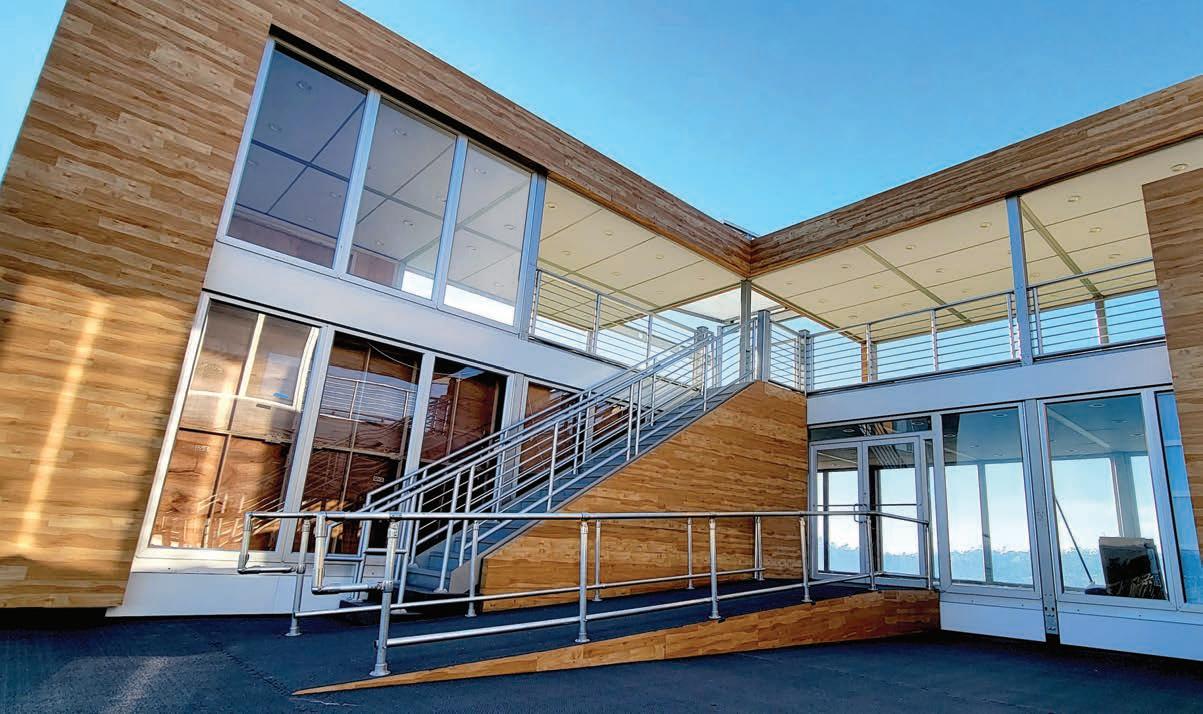
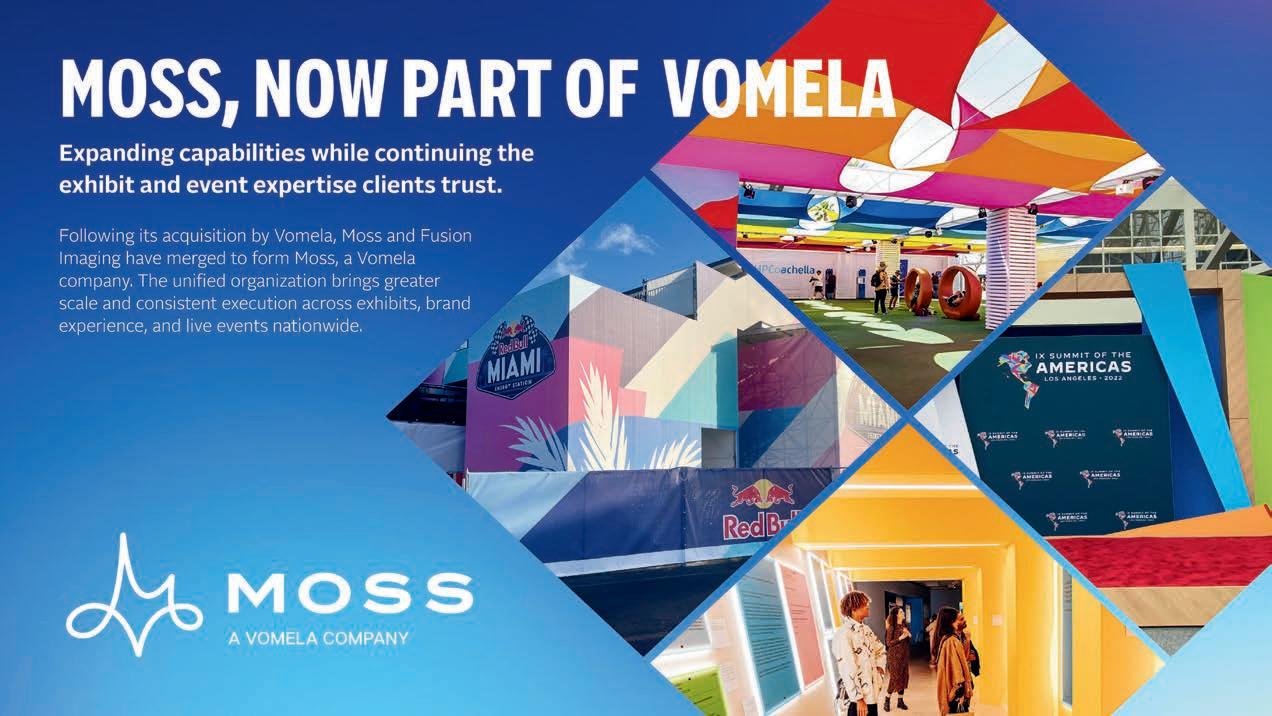
BY BOB MCGLINCY
Before Disneyland and Epcot Center, before travelling carnivals, local amusement parks, and modern-day convention centers, there was the great grandaddy of all entertainment destinations—the Midway Plaisance at the 1893 Chicago World’s Fair. The place was a mile long, 73 acres in size, and “midway” between Jackson Park (home to the Fair) and Washington Park.
Imagine entering this strange and wonder-flled world of foreign lands, a jampacked area teeming with exotic sights, sounds, and people. Walking the Midway, one would see:
Mosques, castles, and pagodas. Egyptian belly dancers. Foreign villages. Camels, ostriches, and reindeer. Bedouin warriors. Lions riding on horseback. Sword fghting. Human curiosities. Weddings. Street brawling. Roller-skating bears. “Hindoo jugglers.” A volcano. The Wild Man of Borneo. A movie theater. Harry Houdini. Scott Joplin. An ice-railway roller-coaster. An indoor swimming pool. An ice-skating rink (during the summer of 1893). A captive hot-air balloon ride. A giant rotating wheel.
The attractions were mind-blowing, but perhaps even more impressive was its
sheer size. The Midway was larger than the total exhibit space of any current convention center in North America. Picture the largest one with its 2.6 million square feet of exhibit space. Combine the multiple buildings there into one and move all the exhibit foors onto a single level. Add 20 percent more space. Now remove the ceilings and walls and visualize it as an open-air festival. That was the Midway. It was huge.
And the individual exhibits were just as impressive: The German Village was approximately 225 feet wide by 775 feet long with structures rising 20 to 30 feet in the air. This was one of 41 commercial areas that had to be constructed and installed. And just like any convention or carnival, these exhibits were temporary: after the show they were dismantled, and either destroyed or shipped to another location.
The Midway proved to be the money-maker of the Fair, far outgrossing the revenue generated at the entrance to the Exposition itself. While walking the Midway was free, admission to most of the
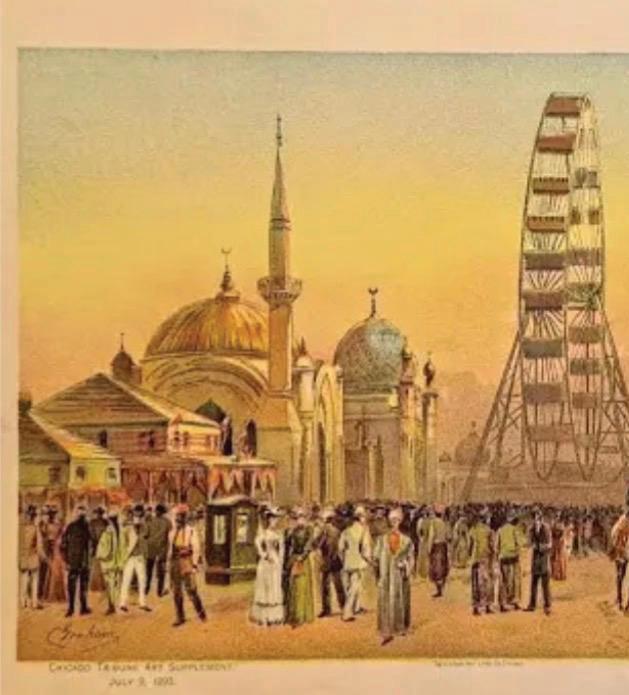
attractions was not. Some of the villages were original and authentic; others were contrived and purely commercial. Most sold food, drink, products, souvenirs, and entertainment. Many of the villages had exhibited at the 1889 Paris World’s Fair and were seen there by an advance team from Chicago. Show organizers charged participating companies 50 percent of their gross for the privilege of being present. Crowd numbers were not recorded, but the money was. Here are the top attractions, in order, in terms of revenue.
“The Street in Cairo” was a sensation in Chicago with 87,139 square feet of engaging exhibit space. It showcased a theater, a mosque, the Temple of Luxor (with imitation mummies) and over 60 cafes and shops. Egyptian men, women, and children worked
the street, sharing the area with dogs, donkeys, and snakes. Camels were available to ride, for a price, and it cost extra for photographs. There were sword fghts, weddings, brawls, and inside the theater, belly dancers. Cairo grossed $787,826.95 in 1893, equal to $28.37 million in 2026.
The Great Wheel stood 265 feet high in the center of the Midway. Show organizers wanted a landmark that would “out-Eifel the Eifel Tower” and George Ferris delivered an engineering marvel with 36 passenger cars. Fully loaded, the Wheel rotated 2,160 people 25 stories up into the air. Tickets cost 50 cents (about $18.00 today), the same as admission to the Fair itself. The Wheel grossed $733,086, not bad considering it didn’t open until June 21 (and had almost two

months fewer sales than the other attractions).
The German Village at 173,940 square feet was the largest space and the third highest in terms of revenue. It had representative architecture from diferent provinces featuring houses and shops, and a fortress exhibiting medieval weapons. Its most popular attraction broadcast live music in the boisterous beer garden.
Hagenbeck’s Animal Show announced its presence in advance with the wafting, sickly-sweet smell of manure. Lions, tigers, and bears performed tricks inside the 4,500seat auditorium. Panthers, parrots, leopards, monkeys, and dogs also amazed audiences. Libbey Glass showcased a twin-towered palace with a hundred-foot glass dome. The majestic building featured a
fully functioning factory with forty glass blowers providing live demonstrations. People paid 10 cents for the privilege to watch, and the admission fee could then be applied to souvenir purchases. The company grossed the equivalent of $17,659,000 in today’s money.
Old Vienna, occupying a space of 510 feet by 195 feet, replicated a 1740’s town square with cafes, taverns, a church, a city hall, and more than 40 diferent shops.
The Turkish Village had the highest population of any village and was one of the few attractions that did not charge an admission fee. It made money through sales from the 300 diferent vendors, many with men wearing red fezzes. The Sultan of Turkey donated an authentic Muslim mosque for this event.
The Moorish Palace housed a bazaar selling jewelry, Persian rugs, cofee, candy, curios and more.
The Vienna Bakery and Natatorium was separate from the Old Vienna village, but like the village, it attracted customers from Chicago’s German and Austrian immigrant population. The Natatorium was an ornate Moorish-style indoor swimming pool that was used for social gatherings.
The Algerian & Tunisian Village displayed a semicircle set of buildings, including a bazaar, a cofee house, café, and stalls. Street performers, jugglers, and snake charmers engaged tourists walking by. The village won a gold medal in Paris and rounded out the top ten money makers in Chicago, grossing the equivalent of $9.3 million.
There were dozens of other attractions, including two separate Irish Villages (the Catholic village replicated the Blarney Castle, and the Protectant Village built a Donegal Castle), a Persian Village plus a Persian Palace, the World Congress of Beauty, the Bedouin Camp, the Dahomey Village, the Siemen’s Electric Scenic theater, the Diamond Match Company, the frst commercial movie theater, and a 22-foot tall Eifel Tower.
A few of the foreign villages housed primitive populations. Diverse ethnic food was available in many diferent locations, but the most unusual restaurants were in an underground coal mine, and inside the base of a giant redwood. Bufalo Bill Cody presented his popular Wild West Show on land outside the Fairgrounds, because he did not want to pay the exorbitant 50 percent surcharge for the privilege of exhibiting inside the Fair. He generated over a million in proft (in 1893 dollars). Cody’s bottom line greater than the gross revenue of any single concession on the Midway.
Was the Midway the frst amusement park? Depends on one’s defnition. Early amusement centers in this country often originated as picnic areas or lakeside resorts. Lake Compounce in Connecticut opened in 1846, built a casino in 1895, then added a carousel in 1911. Coney Island opened its carousel in 1876, added a roller coaster in 1884; their Steeplechase Park added a Ferris Wheel and miniature railroad in 1897. Dorney Park in PA, opened in 1884 as a picnic area with trout ponds;
Imagine entering this strange and wonder-filled world..."
they began adding rides in the early 1900’s and their frst coaster in 1924. None of these places, however, could match the Midway in terms of size, excitement, or in the number of rides and attractions.
For many visitors to Chicago in 1893, the Midway was their most memorable experience. But it did more than simply create fond recollections. It demonstrated that Americans were willing to spend millions of dollars on entertainment.
Over the next two decades, nearly 100 small amusement parks popped up in the state of Illinois. The Midway lent its name to the 20th century carnival craze. It laid the foundation for entertainment centers at future fairs in the US. “The Amusement Zone” at the 1939 New York Fair was larger than the entire World’s Fair in Paris two years earlier. It was a precursor to Disneyland in California, and Epcot Center in Orlando.
Engaging audiences is a critical function for any type of business endeavor, whether it be a convention, a carnival, or a magazine. The Midway Plaisance performed this function amazingly well.
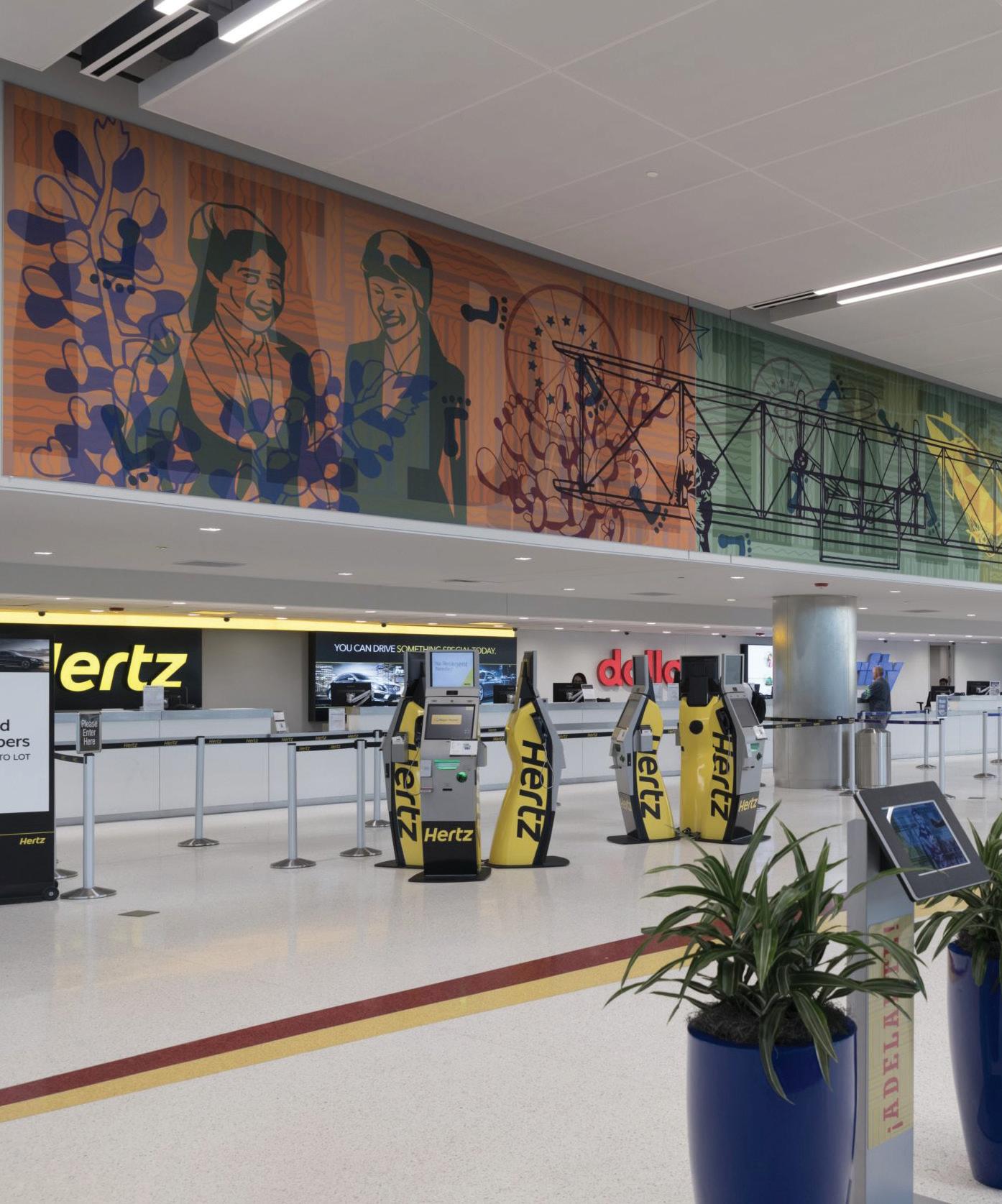
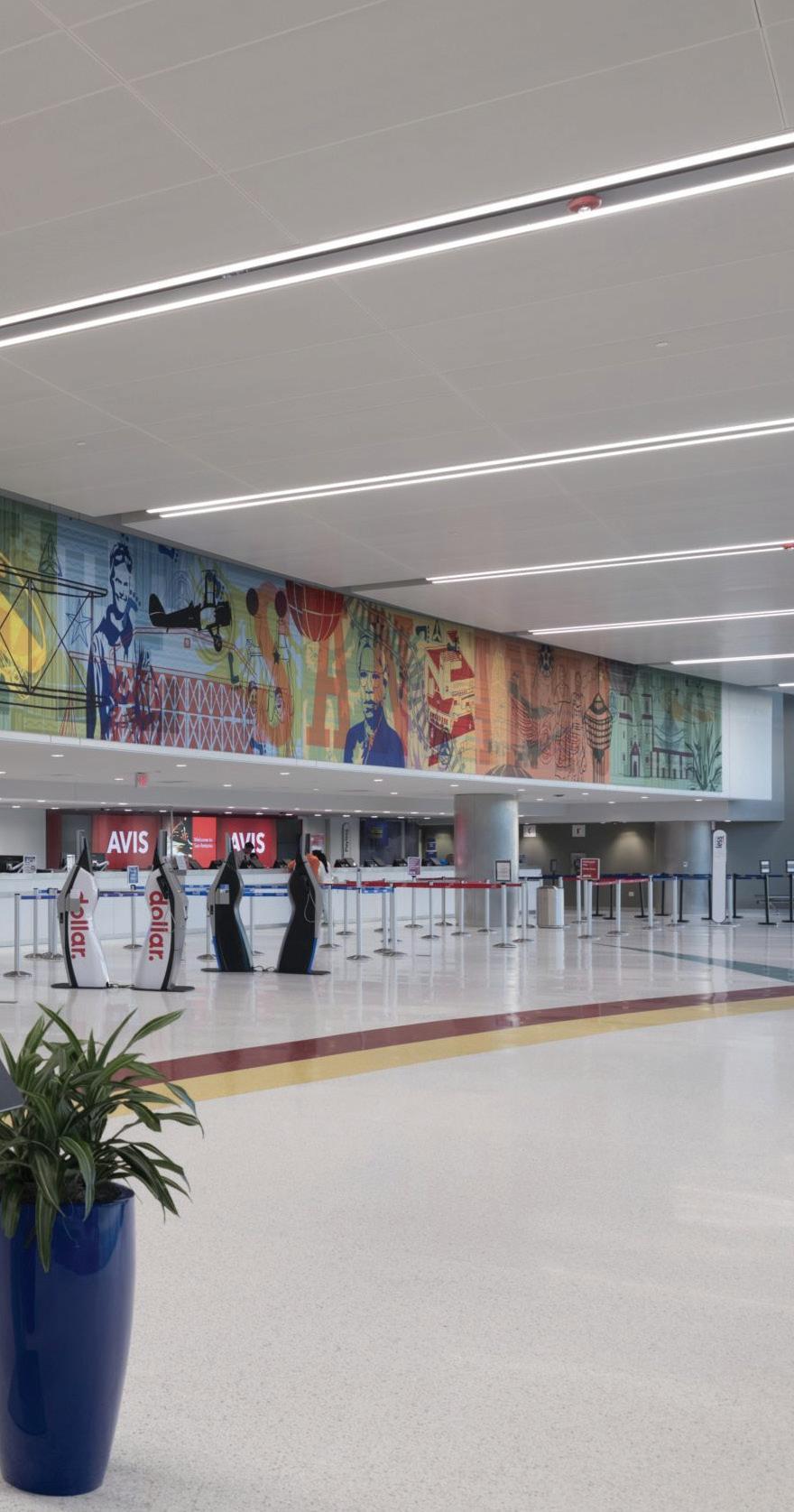
Airport Code: SAT
Location: 9800 Airport Blvd, San Antonio, Texas
Date Opened: July 1942 (originally established as Alamo Field, converted to commercial use in 1953).
Size: Over 2,300 acres, with three runways, and two main passenger terminals; Terminal A which has 17 gates, and Terminal B with 10. SAT ofers over 40 nonstop domestic and limited international destinations. Terminal C, a new terminal that’s part of a current expansion is expected to be completed in 2028.
Transportation: Uber, Lyft, and taxis are readily available at the outer commercial curbside of Terminal A. VIA Metropolitan Transit Bus Route 5 connects the airport to downtown San Antonio with a stop near the convention center. There is convenient access to US-281 and I-35.
On-Site Facilities: Dining options include local favorites, national chains, cofee shops, and bars. Retail options include newsstands, travel essentials, and Texas-themed gift shops. Business workstations, family restrooms, nursing suites, and pet relief areas, and free Wi-Fi throughout both terminals.
Fun Fact 1: Terminal A is the older of the two terminals, but both are undergoing upgrades as part of the SAT Strategic Development Plan, with a major terminal expansion project planned through 2028.
Fun Fact 2: SAT handled approximately 11 million passengers in 2024, which was a record year for the airport.
Website: www.fysanantonio.com.
How I’ve navigated identity and expectation behind the scenes
by Emily Bornt
As someone who has been working in this industry for over 20 years, I often get approached for interviews that focus on my experience being a woman in this industry. As much as I hate those questions, I feel obligated to answer them, to provide an example for the next generation so they feel like a career in touring or entertainment technology is possible for them. In reality, when I go to work, I leave my gender at the door and don’t see my gender in the mix of things. While it may not be the best way to approach it, I feel it has worked for me in a lot of ways given the times in which I came up.
Earlier in my career as a technician in warehouses, I was one of only a few women, and it felt like a safe environment. Sexual harassment wasn’t an issue, but being trusted with real work was. At frst, I had to fght for any real training so I could be trusted with more than painting lekos and sweeping the foor. I started teaching myself how to repair moving lights, for example, opening up a working light to poke around in. There was a shop tech who would occasionally point things out to me and try to help me, but there was some gatekeeping in the process. I got frus-
trated about a repair I couldn’t fgure out, and my boss saw my frustration and said, “Fixing lights is hard–that’s why we have [name of the guy who fxed lights].” I felt demeaned by this simple sentence. Eventually I left that job and went to another warehouse where I wasn’t only trusted to fx lights but was expected to do it. The department head made sure I had the resources I needed, taught me a lot, and made sure I knew how to do my job. It was an empowering experience early on, and I still look back and appreciate that support. I was the only female working in the repairs department, but I didn’t feel I was excluded from the team. A year later that shop was bought out by another one, and I was hired to repair moving lights there as well. It was a much larger warehouse, and I was one of two women in the moving light department. It was a very diverse staf that worked both in the warehouse and in the front ofces. It was another empowering experience that I learned a lot from, and a team that I felt like I was a part of.
While I was working in warehouses, I was also an IATSE stagehand working in local venues. There were some women in the union whom I learned a lot from, and my
union brothers were truly that—brothers. They looked after me when I had issues with crew that traveled through the venues. In the earlier years, I had to be more self-sufcient and prove I could pull my own weight and that I deserved a spot on the call sheet. When I was in college studying theatrical design, I applied for a summer job at a union venue, and they ofered me a job in catering, despite my experience working on stage. I often felt I was working twice as hard for half the pay, and a quarter of the recognition. When I began touring as a tech, things changed a lot. It was a lot more fending for myself and facing comments and lewd behavior from my coworkers. It was constant work trying to ft in and be a part of the team, and to gain the trust that I could do the job. I had crew members texting inappropriate pictures late at night on days of, and reaching in my pockets to borrow my wrench, snapping my bra straps, etc. I learned that there was a certain point in the night I should leave the bar because once they were drunk enough, certain people had more confdence that they could treat me in ways I didn’t want to be treated. I ditched my long hair and long nails, opting for sports bras, baggy shirts and cargo pants to blend in more and get taken seriously. There was one tour where I had an extremely short haircut, and security kept stopping me outside of the women’s bathrooms until I turned to face them and they could see I was indeed a female. There were many tours where I was the only woman on the lighting crew, and more
where I was the only woman on the entire crew. Getting along with my crew meant being “one of the guys.” It meant drinking beer, making dirty jokes, laughing at farts, going to strip clubs, and talking about sports/cars—typical guy stuf. It also meant not asking for help and being able to do a lot of hard work for long hours without complaining. It meant not talking about my feelings. I remember my frst crew chief encouraging me to stand up for myself, and how proud he was the frst time I told a coworker, “Go f*** yourself.” This was acceptable behavior and was expected behavior on tour. That was how disagreements were dealt with, and at the end of the day we all laughed about it and had a drink.
After two decades of networking, working in several corners of the industry, and pulling of some ambitious projects I feel my gender doesn’t play much of a role in how I get treated or considered for jobs; but I know this isn’t true for the generation coming up behind me or other women my age who had diferent exposures and experiences. While leaving my gender at the door worked for me eventually, times are changing and this can’t be the only way for women to get ahead.
As I mentioned before, I downplayed my gender and shifted how I appeared in order to blend in more. I don’t think I was being a false version of myself, but there was a lot that I left behind, and I wasn’t able to be my most authentic self for years. There were topics I avoided talking about, arguments I avoided,
relationships that were avoided or had privately. It wasn’t healthy and made me enjoy my job less and lose myself much more. Ditching my gender wasn’t only about ftting in and having friends. And it wasn’t always about obvious discriminations or trying to avoid the uncomfortable times when crew members would hit on me (sometimes aggressively). It was about not being excluded—which is not the same as ftting in. There are still plenty of times that my suggestions go unheard, and my input in solving an issue is ignored. I still get mansplained to every once in a while, or called “honey.”
It’s not any less frustrating now than it was back then. How I respond to it has changed. I tend to see it in the view of them just being rude or ignorant, and not that it’s because I am a woman. I’ve learned that it’s okay to assert myself and speak up. I’ve also learned that there can be a lot of power in silence, and not engaging with someone being argumentative is okay. I’ve learned to let people or projects fail, and that I don’t have to be the one to save it. I’ve learned that the best reaction to that failure isn’t “I told you so.” I’ve learned that talking to my Production Manager about issues isn’t the same as complaining, and that a lot of that is in how you present the issue. I’ve learned that community is important, not only for taking, but for giving. I’ve learned that asking for help or advice is the easiest way to solve a problem, learn, and grow. I’ve learned that approaching situations with
humility and honesty breeds the best results. I’ve also learned that my success has grown from my hard work and dedication to the craft and has nothing to do with my gender.
When I was coming up in the industry, there simply weren’t a ton of women doing this, and they weren’t highlighted as examples, so I had no idea who my predecessors were. It’s only been the past fve years or so that I began learning about some of the pioneers in generations before me, some of whom I have been lucky enough to meet and become friends with. I’m also lucky enough to have several female contemporaries who are good friends, so I have a strong community to turn to for advice on certain matters. I’ve also started a Facebook group that gathers women, transgender, and nonbinary members of the industry that celebrates over 1,000 members worldwide.
I was on tour as a lighting director, and one of the locals was so excited to meet a woman who was touring, and touring in such an elevated role. I felt inspired to make a place for people like her to see that she’s not alone, and that it is possible to excel, and to have a safe place to ask questions, make friends, fnd mentors, and network for jobs. I’ve also been connected with other groups such as Women In Lighting who work to highlight the work of women and create the conversations that need to be had.
So, what can we do to make things better? A lot of stereotypes still exist, and it’s still a predominantly male-domi-
nated industry, but progress is being made. There are more visible role models, there is more female-driven leadership, and a lot more open-minded thinking when it comes to stafng. While it’s everyone’s own choice to leave gender at the door, there are ways to help make room for everyone:
» Encourage your friends and coworkers to be themselves and respect their values.
» Speak up against any discriminations or microaggressions—even if you are witnessing them and not experiencing them yourself. Have those difficult conversations, because they need to happen.
» Mentor and create spaces where people can connect and support each other.
» Promote visible leadership by hiring qualified diverse candidates and give them the support and trust they need to do their job well.
» Let your actions speak louder than your words. If you respect or value a member of your team, make sure your actions let them know. If someone needs your support, be there for them. Ask how you can support them instead of assuming what they need.
» Be accepting that there are people who are different from you. This variety will add textures to a flat canvas and make it more enjoyable. It will open you to new conversations and experiences and viewpoints that you can learn and grow from.
I’d like to think that a lot has changed in the industry in the 20 years since I started freelancing. There’s a lot more visibility of female role models in these roles, and I love when someone mentions a female designer or director and I have no idea who it is, because it means
the circle is getting wider. More scholarships and programs are being provided to help provide education and opportunities to women as a minority in this industry. Social media has been a huge help in recent years, providing places where women can network and speak up and see that they aren’t alone. They can fnd mentorship from folks who are more accessible than we’ve ever been in previous years and see examples of people like them excelling and being celebrated.
“Leaving your gender at the door” might sound like a way to keep the peace or get ahead, but the industry loses out when people can’t be themselves. The best teams are those where everyone’s talent and perspective are valued— not just those of people who blend in. By listening, making changes, and supporting each other, our industry can become a place where people of all genders, races, religions, and abilities walk through the door and feel welcomed.
Emily Bornt is a Lighting Designer/ Director and Programmer based out of Las Vegas, specializing in concert touring. After earning her BFA in theatrical design on Long Island, she spent time as a freelance technician with venues and production companies in the tri-state area, eventually joining I.A.T.S.E and expanding her work load to include being a moving light technician in various warehouses, including PRG, and touring as a tech for vendors like VER. With a background in theater, fashion, and music she enjoys narrating vividly through lighting. When she isn’t working, she enjoys cinema, museums, reading, and volunteering in her community
by Debbie Hall
Anew generation of professionals is now part of the workforce alongside seasoned talent. The voice of the tradeshow and expo industry is evolving into one that is more collaborative, purpose-driven, and adaptive. Highlighting this evolution inspires confdence in the industry’s future and reassures professionals about ongoing progress.

Experienced management and staf contribute strategic discipline, operational structure and client-centric thinking shaped by sectors such as tech, hospitality and marketing. The younger workforce, comprised of Gen Z and Millennials, bring transparency, technological integration, sustainability and inclusivity to their roles.
Together, these perspectives are reshaping the industry. These changing dynamics are also infuencing how organizers and exhibitors approach the industry. There is a greater emphasis on hybrid engagement, data-driven decision-making, and yearround brand activation. In a competitive, rapidly shifting market, the evolving workforce is helping reposition tradeshows not just as events but as strategic platforms for connection, innovation, and business growth.
“The younger generation has a more aggressive approach to job searching. They enter a new company having researched the industry. They are able to sell themselves and showcase their transferable skills,” explained Bea Dorcena, human resources director at Exhibitus. “We have seen new entrants from a number of industries, particularly theatre kids from the technical side applying as creative designers. We are also seeing creative technology and engineering folks interested in the engagement side of the business. Our industry is aligned with what they’re after creatively.”
“Cross industry professionals have really been a catalyst to innovate across diferent facets of the organization, including our technology infrastructure and how we approach operations like security and sustainability,” added CEO of Javits Center, Joyce Leveston.
will always be the priority when working in the events industry. No matter what part of the industry they work in, businesses must prioritize their customers and the experience of their attendees to succeed. The sooner new entrants embrace that attitude, the farther they will go within the tradeshow industry. Organizational and project management skills, as well as efective communication practices, are also paramount in the fast-paced tradeshow industry. Any successful event professional knows the importance of multitasking and being detail oriented.”
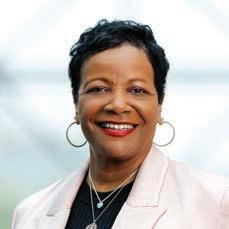
Leveston also acknowledges that cultivating a positive attitude and strong multitasking abilities will empower new entrants to navigate the fast-paced tradeshow industry with resilience. “People
in hospitality, especially while in high school or college, has a leg up on other professionals. One learns valuable communication, negotiation, and teamwork skills through the fast-paced battle that is surviving in the hospitality industry. This is even more important today than a few decades ago, since some, not all, of the younger generations are more comfortable behind a computer or phone screen.

“There’s certainly still a learning curve and so much to learn. The industry language and terminology, navigating labor and booth regulations hasn’t changed, if anything, it has only gotten more complicated. I feel that those entering our workforce are adapting more to the industry than the industry is adapting to them. The notable diference is remote work, more Microsoft Teams calls than phone calls, more texts than emails or working through an APP versus a website, but this is not industry specifc, it’s happening everywhere,” said Gina Porcaro, regional sales manager of Classic Exhibits.
Many in the industry agree that anyone who has worked
According to Dorcena, strong administrative and customer service skills are key to the level of communication they provide to their clients. “Our industry is fastpaced, deadline driven, and requires a team player attitude to succeed. New entrants have to stay focused, stay on task and respect very strict deadlines. This pace also requires consistent and continuous communication that keeps projects moving forward even when bumps in the road happen. This demands a team member attitude.”
Workforce challenges remain, particularly the ongoing need for skilled talent within the trades. Meaningful progress, through initiatives such as the Experiential Designers and Producers Association (EDPA) Future Workforce and other industry-led programs underscore that talent development will remain a constant priority. Emerging professionals are now engaging with peers across organizations, sharing
knowledge, ideas and best practices. In the past, competitors avoided such interactions. This shift is strengthening the industry as a whole while still maintaining the integrity of their proprietary expertise.
“I see a shift towards more collaboration between companies. Even between companies that would normally be categorized as competitors,” said Dana Esposito, EVP of strategy for BlueHive Exhibits. “If they are on good terms and have mutually benefcial goals, they will work together in diferent ways. This may be due to a combination of factors, such as the networking benefts companies gain through EDPA, it may be due to necessity of geographical locations, a younger, more collaborative group of professionals willing to foster and reap these types of relationships. As always, relationships built on trust are the most solid, that fact is timeless.”

in CAD or you’re a designer, you stay in design” attitude of previous generations,” explained Phoebe Mathius, creative designer and creative workforce development + advancement at Exhibitus. Three-dimensional designers in the exhibit and experiential space are most often architectural designers by training, but their role extends well beyond form and structure.
Today, designers must also be efective advocates for their work—fuent in marketing language and capable communicators who can articulate the value of a concept to clients. A successful design is visually compelling to be sold, justifed and aligned with brand objectives. In parallel, modern design packages are increasingly technical, integrating build feasibility, digital assets, and production constraints.
mindset that they will learn the skills needed to contribute meaningfully to the process.
The next generation is entering the workforce with unprecedented freedom to use AI tools. Younger designers often see AI as a default solution.
The older generation is diferent. Most seasoned professionals are learning and adopting AI, even while many are remaining cautious about its long-term implications. The younger generation thinks “I’ll just put it in AI.”
Companies have to ensure they understand the value of original work when it comes to client expectations as well as the company’s integrity. AI, while a tool, can not be the solution for all tasks. There is a human element necessary for adapting plans for the show foor.
empowered in this transition can foster a sense of innovation and confdence in their contributions.
Many in the industry feel frustrated because the current industry demands unrealistic expectations about timelines. For example, many don’t understand the lead time needed to start planning and to engage others. A custom or rental exhibit still requires months of planning, design, revisions, CAD engineering, fabrication, graphic and digital creation and shipping. Face-to-face marketing is large-scale events that take months to plan, so proper expectations and necessary timelines are constantly being re-explained.
Changes occur in communication styles, decision-making, and collaboration due to this generational and experiential diversifcation.
“The younger generation in general, like 40 years and below, don’t want or need to stay in their lane. The industry requires that many people wear multiple hats, especially on the creative side. Most of the creatives here can partake in every lane. It just depends on what is needed. And it’s challenging the “you’re CAD, so you stay
As a result, the long-standing notion of “right brain versus left brain” thinking has largely disappeared. The most competitive designers become multidimensional; blending creativity, strategy and technical profciency. This underscores the importance of developing multidisciplinary skills to remain relevant and efective. Emerging talent is entering the industry with this expectation already embedded. New designers are arriving either fully equipped with cross-disciplinary skills or with the

While being an AI savvy creative is important, human driven design takes into account safety, engineering and architectural requirements involved with bringing client goals to life.
This generational shift places new responsibility on companies to establish clear standards, ensuring teams understand the value of original work and human insight. The tradeshow and expo industry are working hard to protect creative integrity while meeting client expectations and safeguarding credibility. Encouraging emerging talent to feel
In summary, workforce transformation and the accompanying culture shift refect a generation of professionals eager to engage, contribute, and lead. They are willing to raise their hands, take a seat at the table, and question long-established practices to pursue better outcomes. The new voices entering the industry focus on efciency and results, motivating leaders to align strategies with this drive for tangible success. This brings fresh perspectives, challenges the status quo, and prioritizes efciency and results, with a clear focus on reaching the end goal faster and more efectively. For organizations, embracing this mindset is less about managing disruption and more about harnessing momentum to drive innovation, relevance, and long-term growth.
by Sam Ogren
“I’ll play it and tell you what it is later.” Miles Davis mutters these words into the microphone at the beginning of “If I Were A Bell” and I have never found a clearer explanation of what jazz is. It is what it is. That’s jazz. If you look at the sheet music, there are a few markings for key changes and modes, a little phrase the musicians wanted to remember, and not much else. There aren’t syncopated triplets and quarter rests, no step-by-step instructions to the song: there’s barely a plan. And it’s beautiful. It’s teamwork, creativity, and vulnerability in the key of F Major. That’s jazz. If you approach mentorship like Miles with his horn, you’ll create something beautiful too. Without a plan, how do you begin? Build your rhythm section. Drums, bass, piano—the beating hearts of the group. Identify partners in your company or industry who can contribute their time and expertise to provide a more complete experience for the mentee. Diferent perspectives in a brainstorming session unlock new themes. Expert opinions in a feedback session prompt a signifcant tonal shift. These moments can inspire and motivate both the mentee and the mentor. When we get ofbeat, they can pull us back with a reminder that we still haven’t invented anti-gravity exhibit signage. Mentorship is not a solo performance; it needs collaboration for creativity to fourish. Miles was a master among masters. Playing with John Coltrane and Julian “Cannonball” Adderley, Bill Evans and Wynton Kelly, Paul Chambers and Jimmy Cobb, he demolished the structures of musical thinking and defned a sonic era with Kind of Blue. Even without generational talent in every seat, creativity is key to good jazz and a successful men-
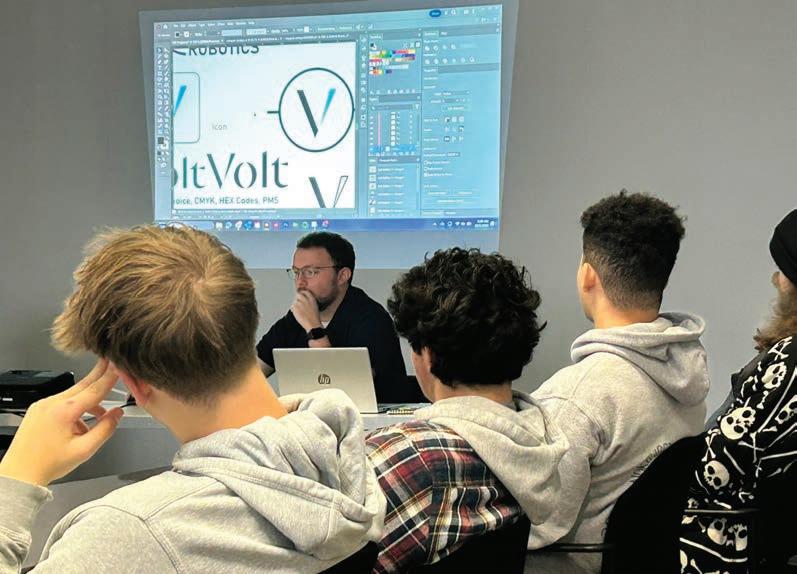
torship. Notes will be missed, someone will drop the beat, and project timelines will go out the window due to sickness or workload. How do you respond? Don’t get your tight black t-shirt and throw a chair à la Whiplash. Find the beat, feel the groove, and blow. Much of mentorship is about helping the mentee develop creative solutions through your own creative thinking. Play a few notes alongside them, run through the problems together, or try your hand at the design. Go back to the root of the chord and the theme of the project. Open up your experiences and knowledge and let your creative heartbeat along in time.
That heart. The emotion. Nina Simone. Ella Fitzgerald. Billie Holiday crying her words in “Strange Fruit,” or Sam Cooke singing about the coming change—their broken hearts are etched into the vinyl. It’s about being vulnerable and making them hear it. Without the context of “you,” the experiences and knowledge you share come out fat. No one wins awards for monotone—we can talk about Bob Dylan and storytelling another time—the winner is the one with soul. As we mentor someone, we shape them for the future. We don’t want to create a lifeless statue or an emotionless machine to work alongside us. We want a whole person, growing and improving, and we need to be an example for them. Talk
about expectations and where they might fall short. Teach them how to create an infallible plan and how to pick up the pieces when things go terribly wrong. Tell them about the times you failed; those moments are as important as the wins. Be yourself, all of you, and they’ll give every bit of themselves. That’s how you create something beautiful. That’s how you prepare a workforce for the future and everything it will bring.
If you asked 1,000 people to name the greatest jazz song of all time, you’d get 1,001 answers, and that’s the beauty of it. It’s personal. Beyond record sales or weeks at the top of the charts, it’s about how it touches your heart when you listen. It could change from day to day or hour to hour or reach back across decades to unlock memories. When I think back on my years of mentorship, I can see the growth in myself and my teammates. I get LinkedIn requests from past students, notifcations of their matriculation and new jobs, and I swell with pride. My last group just dropped of thank you letters. One is now considering universities with exhibit design programs. That was some beautiful jazz we made.
I can’t wait to listen to your debut.
“I hear babies cry. I watch them grow. They’ll learn much more than I’ll ever know. And I think to myself, ‘What a wonderful world’.” - Louis Armstrong.
























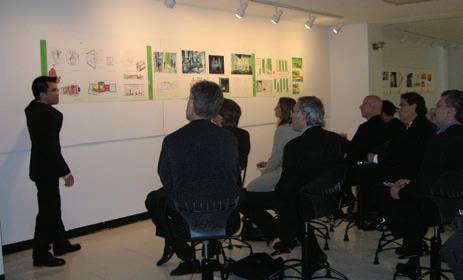
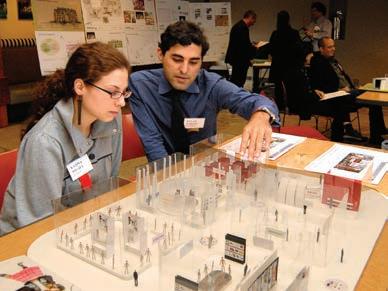
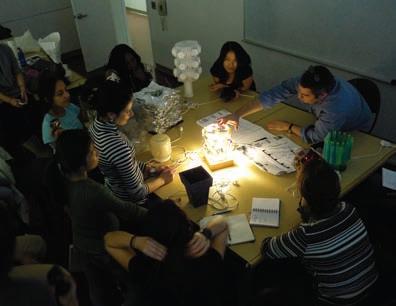
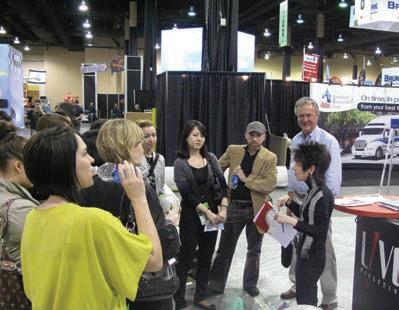
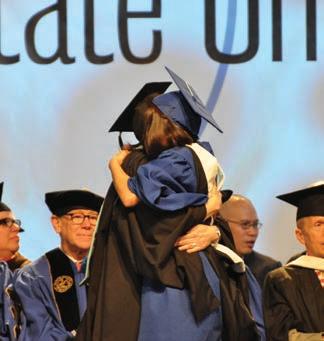
BY MARLENA SULLIVAN
Of the common questions asked in the tradeshow, exhibitions, and events industry the most asked is this: how do we let people know we exist? Furthermore, how do we inspire and help cultivate the community to help it grow? Education has often been the answer sought, whether that is in mentorship or training programs. Of these programs, one has stood out and in 2025 it celebrated a pivotal milestone.
For 20 years, the Fashion Institute of Technology (FIT) Exhibitions & Experience Design program has played a key role in providing mentorship and setting the standards of education for event design professionals.
Brenda Cowan, professor for the Exhibition & Experience Design program says, “The start of the program was so long ago and in some ways it all still feels so new, like we’re just getting started. It is an incredible, dynamic, living thing we created. I am always so grateful that I’ve been entrusted to join in its nurturance, with my incredible partner Christina [Lyons].”
Despite its legacy, there are many in the industry who may be unfamiliar with not only the Capstone Event but the masters program.
At the 2025, 20th Year Capstone Event, Ed Rodley, the co-founder and principal of The Experience Alchemists offered two queries and three advices to the students. While the ideas were given to the 2025 class, the sentiments themselves apply to the program overall and its impact on the events and exhibitions industry.
Query: What does evolution require of us to help the institutions that we love?
“The mindset, skills, and tools you uniquely bring to the table are experiences that many organizations need. What new things will you champion? What wisdom will you provide?” – Ed Rodley
In 2003, the program was conceptualized amongst Experiential Designers and Producers Association (EDPA) members Larry Kulchawik, Adam Beckett, Norm Friedrich, Stacy Barnes, Gwen Parsons, Mark Johnson, and Rob Cohen. Mark Johnson, CEO of Star, says, “Before the program formally launched, there were important early discussions that helped shape its direction. Those conversations were foundational in aligning industry needs with an academic partner that
could support a forward-looking, design-driven curriculum.”
FIT was chosen because it’s a public institution in New York City, which is one of the world’s culture zeitgeists with unmatched and unlimited access to design, culture, retail, community, and experiences that are all infuential on the experiential and event industry. As a public college, FIT aligned heavily with the EDPA’s mission to broaden access and opportunity to individuals across backgrounds. The school had a strong undergraduate program in interior design and spatial design with a heavy emphasis on retail, which meant it was already equipped with individuals who had the expertise to help shape the program in events.
By 2005, the frst class of seven students were accepted and graduated by 2006. Since its inception, the program has gained a robust following and support network. In a press release from October 1st, 2025, students have partnered with experts not only in the tradeshow and event industry but with museums and other public facilities including but not limited to, “the Smithsonian National Museum of the American Indian and National Museum of American History, The New York Public Library, Gotham
Park, the National Justice Museum, UK, and Wildlife Conservation Society.” (FIT Master of Fine Arts press release released October 1, 2025).
Advice: Recognize that the opposite of tradition is design.
“What tradition do you want to hold up and say, does this still ft our needs, or is it time to let things go? To break with tradition is to design new ways of being in the world.” – Ed Rodley
In the 20 years that the program has existed over 100 students have graduated. Some have pursued careers in museums, retail, flm, and art, but many have continued on to work in experiential and event design. Many alumni have went on to join companies who are members of the EDPA. Notable members of the second cohort include Katina Rigall of Classic Exhibits, who now acts as a member of the advisory board for the program.
Rigall moved from the west coast to NYC with two suitcases and a dream. She said, “The program was in its infancy, so I witnessed shaky frst steps
and incredible growth at the same time.”
Rigall built relationships with the EDPA and Society for Experiential Graphic Designers (SEGD) which she has maintained to today and thrived. She is only one of the many success stories of the program.
Joseph Delaunay, graduate of the 2022 cohort, works at Access TCA. He describes the program as unique, challenging, and rewarding. “I’ve been through a wide range of spatial design and fne arts classes, but this program has a special blend of multidisciplinary concepts. Each class felt like an open melting pot of ideas and perspectives. This created a healthy environment for expression and critique. It made the sleepless nights all the more worth it to bring my ideas to a welcoming cohort.”
Sven Johnson, graduate of the 2026 Cohort, recently accepted an ofer with Star Exhibits. He joined the program as a way to pivot from his previous career in architectural and interior illustration.
Excited to learn the ways that his background in architecture
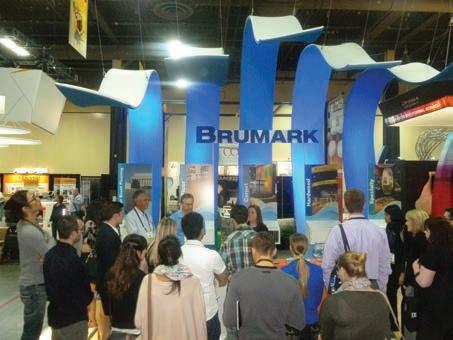
can be applied to tradeshows, Johnson says that the most important thing he learned in the master’s program was, “how experiences, activities, and objects that people connect to emotionally, have a real ability to create a story in a spatial environment-- one that people will deeply feel and remember.”
The program has gone on to foster lasting relationships and allows for students to advance not only their study but careers with a defned path.
Mark Johnson says, “For two decades, the FIT program and EDPA have shared a relationship built on trust, respect, and genuine care. The collaboration has produced not just graduates, but friendships, professional growth, and meaningful impact.”
Advice: Remember that everything is a designable surface.
“When I remember that everything is a designable surface, from meetings to problem solving, I gain the freedom to think. It drove the responsibility of design, because if everything can be de-
signed then the choice to do so is a conscious path towards change.” – Ed Rodley
The master’s program is a two year intensive where students are placed into a series of courses learning topics ranging from visual design to how to use the latest software. They are taught to conceptualize, market, and execute a design. Each student leaves the program with a technical tool kit and a portfolio highlighting their expertise and inspiration as a designer.
The curriculum has had to evolve to match the rapidly changing industry, design trends, and methods that audiences engage with exhibits and events. Despite this, some things have stayed the same. Students have studio work each semester and master 3D concepting and 2D graphics. They design a tradeshow exhibit, retail showroom, museum exhibition, and traveling exhibit. Then in their last year, they create a thesis project.
According to Rigall the 3D and 2D skills she obtained have been the foundation of every project she designed over the last 19 years. Ri-
gall said, “The program was incredibly practical, like an intensive bootcamp that propelled me into the design career I currently have.”
Classes are designed around advanced tools while looking closer to sustainability and business areas such as project management and business development. They ofer courses in social action as well as a course that looks into the psychology of experience and how people experience spaces.
“We run industry sponsored projects where students work directly with companies and sites where the students create a project with a real client, real brief and show hall regulations and parameters. Students are learning how to navigate site regulations, budgets as well as understanding materials and fabrication methods for the show site,” explains Christina Lyons, chair of the program.
Delaunay highlights that the most important thing he learned at the program was not a technical skill but what it meant to be an exhibition and experience designer. “I thought I knew due to my skills in
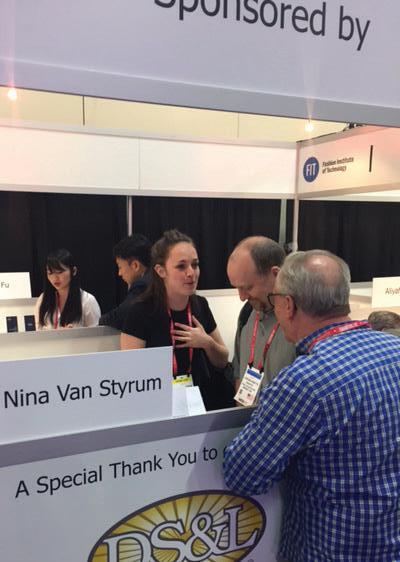
spatial design and the fne arts, but I was missing what made us diferent from architects. I learned to look at a space through the visitor’s journey as a human experience of emotion and storytelling.”
Students work as teams on projects with multiple designers while consulting with their instructors and outside mentors. For Delaunay this gave him confdence in a professional setting to discuss with designers in the feld and feel like an equal.
The diversity of the program in terms of backgrounds, world views, and skills allows students to grow in new ways.
Delaunay said, “It opened my mind to many perspectives and made me consider the iterative process of design with all its players.”
Mark Johnson further emphasizes this point as a foundational keystone of the program, “The program intentionally brings together students and faculty from multiple design disciplines, breaking down silos that often exist in our industry. This cross-pollination of ideas, tools, and approaches fuels
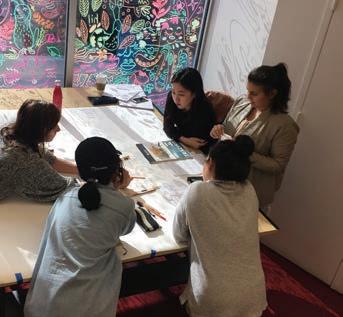
innovation and encourages experimentation—exactly what experiential design requires.”
Starting in 2026, the Master of Arts program will transition to a terminal Masters of Fine Arts degree. Transforming from a three semester program into a four semester program, the program will become more intensive and provide a variety of new experiences including enhanced studio experiences, additional internship opportunities, professional speaking engagements, publishing opportunities, grant acquisition assistance, and additional qualifcations for research and job positions. Students will be pushed to dive deeper into the perspectives surrounding design and expand not only their foundational knowledge but accomplish expanded research into their felds of interest.
Advice: Understand that it’s not what you know, but what you are willing to learn that will make your career.
“Being okay with not knowing, but moving ahead, is scary. Dreams cause anxiety, but that
How will you be a good ancestor?"
which scares you should not hold you back. Get over it and do it anyway.” – Ed Rodley
The FIT program is the only graduate program and one of three college level degrees in the country. While its impact on the industry cannot be understated, there is far more work to be done to develop more programs and more schools. Education is something that must be continuously pushed and advanced if the impact is to be increased. There is no easy way to become a viable and actionable career path to students, and it’s only by awareness and supporting programs like FIT
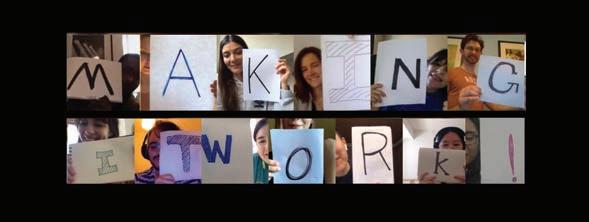
that the industry can be seen.
For FIT, the master’s program has not had it easy either. The partnership between the university and the EDPA has required ongoing funding and scholarship support, volunteers, mentors and advisors, speakers, and advocates. Despite these challenges, FIT and the EDPA have risen to the occasion. Additionally, each year at ExhibitorLIVE the students are supported in attending so that they may present their portfolio on the conference show foor, which has resulted in internships and future jobs.
The EDPA and FIT’s future is bright. Described as a “love afair” the two plan to continue their partnership and grow it together. Whether through mentors and funding or connections to the real-world, the relationship between the two organizations will take the students beyond and push them further.
Query: How will you be a good ancestor?
“Being a good ancestor is recognizing that design won’t always ft perfectly. It is being mindful about knowing where
things will end up. It is recognizing behavior and choosing not to behave badly. It is noticing the downstream efects of our actions and adjusting accordingly.” – Ed Rodley
Annually, the FIT Exhibitions & Experience Design program hosts its Capstone Event the second week of December. This networking event is an opportunity for industry professionals to scout out new prospective hires, while providing key insights and feedback to the masters students.
The event itself allows the community to get involved with the students in a more intimate way. Each new connection is one that allows the student to develop their network of support and grow as designers. Cowan says that these relationships and the EDPA scholarships, “drive admissions, keep students invigorated and supported throughout their studies, and attract new applicants to the program.”
At its core, however, the program and the Capstone Event center around one word: storytelling. Beyond technical work or introspections on design the students are nurtured
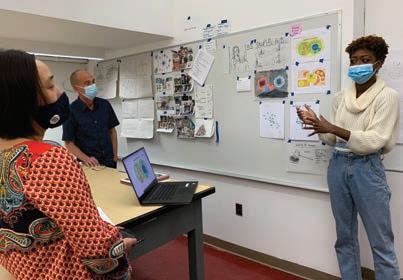
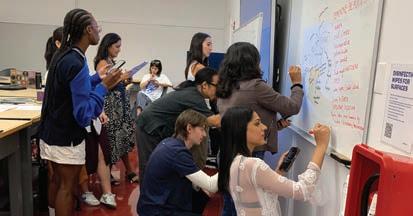
into storytellers. They are asked how design tells a story, how that story can be perceived, and, most importantly, how to leave a lasting impression on all those who interact with their designs.
There is a lot that can happen in 20 years. The entire world has changed, and it will once again in the future. Yet, with the continued support of the industry, programs like FIT can continue to grow and fourish. With each new voice, and each graduating student, the impact with continue to swell until it becomes undeniable. The program and ones like it will continue to assist in promoting and supporting the events and exhibitions industry, making sure that others know that it exists until it is no longer invisible.
As Ed Rodley suggested, the best lessons learned are not those that experts can impose but the advice paid forward by those who have been cultivated by the caring hands who helped them. When asked what they could tell future students, the former students became ancestors said this:
“Take advantage of living in New York, see all the sites,
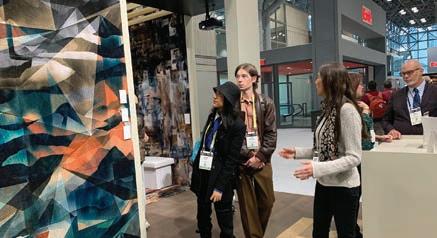
eat all the food, experience everything you practically can.” – Katina Rigall, MA 2007
“Have faith in your skills as a designer.” – Joseph Delaunay, MA 2022
“Consider your audience, specifcally in terms of what motivates you.” – Sven Johnson, MA 2026.
“[The industry has] seeded and cultivated a deeply connected and continuously relevant connection with FIT, that will outlive us all,” Dana Esposito, executive vice president of BlueHive Exhibits, says it best, “This program encourages education, networking, growth, support, future workforce, mentorship, and friendships and relationships built on trust. We have created the best kind of legacy.”
To help be a mentor, or fund the scholarships and students, contact your local EDPA chapter. To learn how to become a judge for the FIT Capstone Event or if you'd like to advance your education visit https://www.ftnyc. edu/academics/academic-divisions/graduate-studies/ exhibition-design/ or contact gradadmissions@ftnyc.edu.
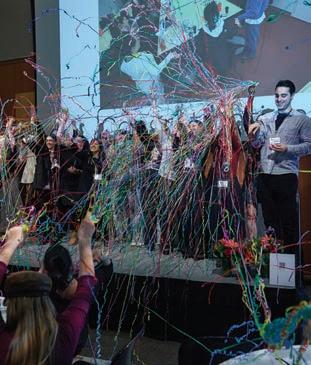
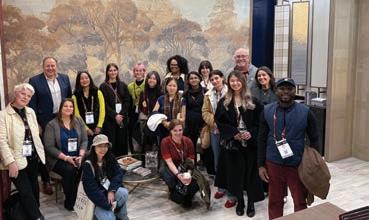

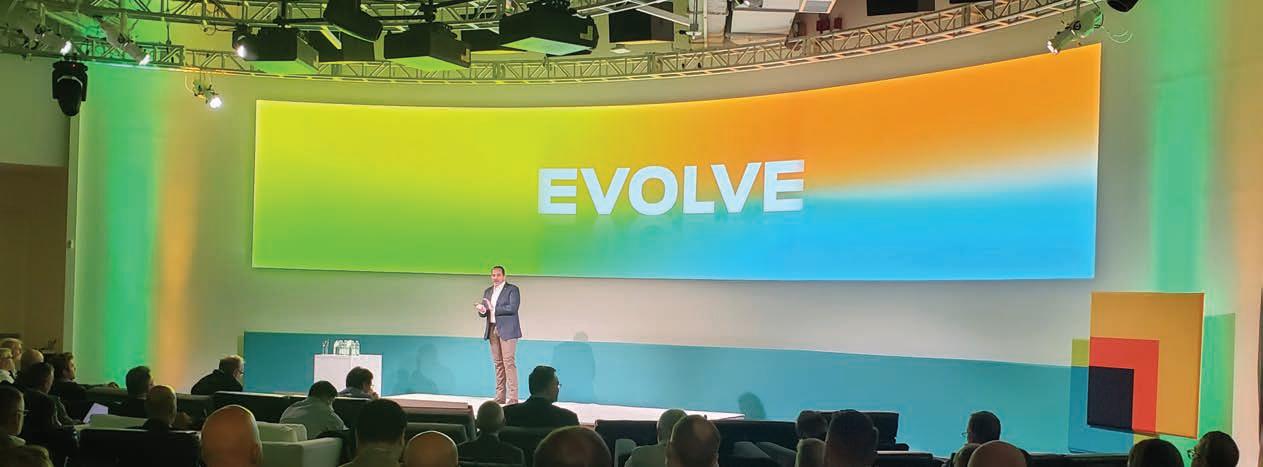
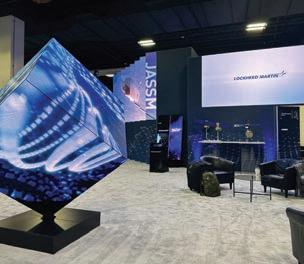
We are the architects of unforgettable moments that power meaningful connections between brands and their audiences using AV and LED technology. With a focus on innovation, we seamlessly blend cutting-edge equipment, heartfelt storytelling, and a touch of production magic to elevate your vision and leave a lasting impression. Let's craft extraordinary experiences together!
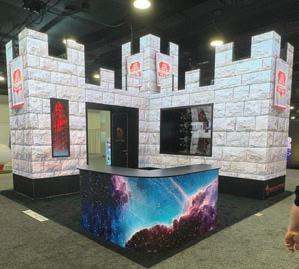
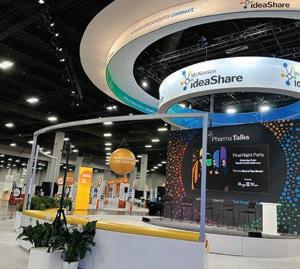


by Kerstan Szczpanski

Michael Freyer has joined Blue Sky EXP as co-owner and chief technology ofcer. Business ownership is nothing new for Freyer, as he was owner of Auburn Oak Ventures LLC from 2022 to 2025, and was co-founder and chief executive ofcer (CEO) of oveRNight RN Inc for six years prior.
CenterPoint announced that Jason Weddle has joined as chief operating ofcer (COO). Rising from entry-level positions to Warehouse Director, VP of Operations, COO, and ultimately CEO/ Owner, he has played a key role in shaping and executing strategic initiatives and leading teams.
Destinations International (DI) announced the contract extension of president & CEO Don Welsh through December 31, 2027. Welsh and the Executive Committee of the DI Board of Directors mutually agreed to extend the previous agreement, which had been set to conclude at the end of 2026.
Jef Quade (Above right) has been promoted to president at GES - Global Experience Specialists. Quade has been with GES for over 28 years. He started as director of sales for GES Portland at the beginning of 1994. He became general manager director of sales for Phoenix at the end of 1995 before fnally moving to Las Vegas as vice president global accounts four years later. There Quade served as executive vice president | exhibition sales and services before he was promoted to chief sales ofcer. He moved up to executive vice president, exhibitions in 2019 before becoming president GES ExhibitionsNorth America.
at Ogilvy & Mather, where she developed a strong foundation in strategic marketing, brand leadership, and client engagement. Soice joined Hamilton as an account director in 2017.
In 2024, she was promoted to chief marketing ofcer.
Legends Global announced that Josh Kritzler has been appointed president, North American Venues & Content. Most recently, he served as executive vice president, strategy and chief of staf, supporting enterprise-wide strategy and playing a central role in the Legends-ASM Global integration.
president of strategic events, she helped shape one of the industry’s most respected experiential portfolios.
Sparks announced the appointment of Melissa Levy (below left) as president. Levy will report directly to Janet Dell, CEO of The Freeman Company, and will lead Sparks’ creative, strategy, client services, operations, and production functions. Levy joins Sparks from Digitas, where she most recently served as president and chief client ofcer.

Bart McCollum, formerly integrator of Lime Media, has been appointed president, and Spencer Rose has joined the leadership team as chief people ofcer and head of teams & talent.
Mimo announced the appointment of Curtiss Singleton as executive vice president of global sales. Singleton brings more than three decades of AV sales experience and has held senior leadership roles with globally recognized brands including Bosch, Bose Professional, Kramer, Revolabs (Now Yamaha UC), and ClearOne.
The New York Convention Center Operating Corporation (NYCCOC) announced that Dr. Debonair Oates-Primus (below right) will join the leadership team at the Jacob K. Javits Convention Center as the new chief administrative ofcer. She most recently served as vice president of social impact and cultural engagement at Oak View Group.
Excel London has announced the appointment of Helene Sharrock as its chief people ofcer, a newly created executive role that reinforces the venue’s continued commitment to its people, culture, and long-term growth ambitions.
Expo Convention Contractors (EXPOCCI) has promoted Vishal Jaggernauth to chief digital ofcer & accountability coach, Miami.
IAEE welcomed incoming IAEE Chairperson Brian Pagel. Pagel, who served as 2025 Center for Exhibition Industry Research (CEIR) chairperson, is executive vice president at Emerald, and a seasoned senior executive with nearly 30 years of experience in the business-to-business (B2B) events and media industry.
Impact XM announced the promotion of Brittney Leeb to vice president of new business growth. This milestone marks a signifcant moment not only in Leeb’s career but also for the organization— as she becomes the youngest Vice President and the youngest female executive in the company’s history.
Hamilton appointed Courtney Soice (Above right) as president. Soice was formerly chief marketing ofcer. Dan Cantor will continue in his role as chief executive ofcer. Prior to joining Hamilton, she held a high-impact position
Pinnacle welcomed Michele Schneider as president of its San Francisco operation. Schneider joins Pinnacle after 15 years leading global experience strategy at Salesforce. As senior vice president of global workplace services and vice
Javits Center’s executive team saw two additional changes. Sonia Low has been promoted to senior vice president, chief legal ofcer and corporate secretary. Kenneth Sanchez has been promoted to senior vice president and chief operating ofcer.
Marianne Szczech was made chief
product ofcer at GES after three years as executive vice president products, marketing & services.
The Seattle Convention Center announced the appointment of Michael McQuade to senior advisor, commercial strategy, reporting directly to Jennifer LeMaster, president & CEO. Structure has appointed Dave Callahan (above right) as director of operations in Chicago.

Ivette Flower as their new vice president of sales. ColorCraft has announced the hiring of Maria Rivillo as CAD engineer. Patrick Reynolds is the new director of sales for Destination Rogers.
nounced that Bruce Powell has joined the team as account director.
Metro and the Metropolitan Exposition-Recreation Commission (MERC) announced that Cindy Wallace, who has been serving as interim executive director of both the Oregon Convention Center (OCC) and the Portland Expo Center, has accepted the permanent role of executive director for the two venues.
Christina Poole is the new director of account management at 760 Display. Align Exhibits announced the addition of Deb Rodriguez as senior account executive, Victoria “VC” Conti as senior account executive, Raluca Huelskoetter as senior account executive, and Tanner Holmes as account manager.
Aluvision welcomed Ben Hendrikse as regional sales executive, Midwest, Brice Shields as director of account services, Victoria Plotnikova as regional sales executive, southeast and that Travis Briggs has been appointed business development executive.
Eagle Management Group announced a leadership transition within its New Orleans operations. Russell Elliott has decided to step down from his position as city manager and will now serve as assistant city manager. Dennis Alley will move into the city manager role.
The Eastside Rooms has promoted experienced industry professional Vicky Howe as its new director of sales. Julian Mendoza has been promoted to director of tradeshows at EXPOCCI, Miami. Brandon Mitchell joined EXPOCCI as a sr. account executive, Las Vegas. Elena Vazzo (below left) has joined Exhibit City News as the publication’s editorial assistant.

ASAE announced that Marc Anderson has joined the organization. as managing director of ASAE Business Services, Inc. (ABSI). Atlanta Convention & Visitors Bureau (ACVB) announced the promotion of Bruno Njiensi to accounts payable manager, Logan Doctson to public relations manager, and Nicholas Jones to manager, technology user services.
Eric Shafer has joined Catalyst Exhibits as senior account executive. Hyatt Regency Clearwater Beach announced Ryan Reynolds as director of operations. Condit has announced
Oak View Group announced that Erik Hudson has been named general manager of the new Mobile Arena. Willie J. Williams has been appointed assistant general manager. J.T. Pedley has been promoted to director of sales and sponsorships.
On Location announced the addition of Jason Cornatzer as account executive, the appointment of John Thompson to the newly established role of sales & growth–branded environments, and named Cody Selvia regional manager of Indiana and Ohio.

Ottawa Tourism expanded its Business Events team with the appointment of Angela Jeferies and Orest Gawdyda , both as managers, business events. Ron Brunette (above left) has joined Procedes LLC as account executive.
Good Time Creative welcomed three new team members to its creative, operational, and marketing departments. Baylee Albano joins as experiential designer, Natalie Doyle as account manager, and Charlotte St. Raymond as marketing & business development coordinator.
Hill & Partners Brand Environments has promoted Kristi Rosnow (Knudsen) to senior environment designer. Huntington Place announced the appointment of Hassan Shahlaei as the new general manager of Sodexo Live! Impact XM has promoted Anneke Ellmann to solutions & estimating manager. Tom Barcelona has joined JL Exhibit Services as regional operations manager.
Shepard Audio Visual (AV) has announced Maci Moore as their new national sales manager. Sho-Link Incorporated announced the appointment of Jose Herrera as the new San Diego assistant city manager. Kari Valerius has joined Steadfast Displays as senior account manager. Structure Exhibits welcomed Ian Magdalik as their new director of client services. Lauren Gray has joined T3 Expo as their new vice president of client experience.
Jennifer Boujoukos has been promoted to director of client services at TRU Service Group. The Taylor Group has hired Greg Smith for marketing & communications. UFI announced the appointment of Raya Al Taher (left) as research coordinator.

The New Orleans Ernest N. Morial Convention Center has hired Jessica Barnes as the new national sales manager. NPARALLEL + Atomic Props an-
Visit Panama City Beach welcomed two new team members. Rhett Miller has joined as director of marketing services, and Erin Graham has been appointed artifcial reef coordinator and coastal resources manager. Neill Santos has joined Willwork Global Event Services as account manager.
September 14, 1960 – December 9, 2025
James S. Hanlon of Glen Ellyn, Illinois, died on December 9, 2025. He was born in Levittown, Pennsylvania.
James built a long career in the exhibit and experiential marketing industry, working across design and sales roles over several decades. He was part of the Chicago-area exhibit community during a period of signifcant industry growth and change.
At the time of his passing, James served as a senior account executive at Global Experience Specialists (GES), where he worked beginning in 1993. Based in the Greater Chicago Area, he spent more than three decades with the company supporting client programs and exhibit initiatives.
Earlier in his career, James worked as a designer at Kitzing from 1986 to 1993. His professional path refected a transition from design into sales, a trajectory shared by many exhibit professionals of his era. He was also associated with Exhibitgroup and Giltspur during his career.
James earned a Bachelor of Science degree in Industrial and Product Design from
the University of Wisconsin–Stout. His professional specialties included exhibit design, museums, tradeshows, and briefng centers.
James was preceded in death by his brother, Paul Hanlon. He is survived by his brothers Patrick Hanlon (Janet), Randolph Hanlon (Debbie), and David Hanlon. He is also survived by nine nieces and nephews and fourteen grand-nieces and grand-nephews.
“James, my friend, you were a joy to work and travel with during our years at Kitzing,” Chris Kappes wrote. “We sold many large exhibit projects together, and I always felt like your big brother. We shared many social outings, laughs, and memories. Your spirit will be missed, and those in heaven will enjoy the James we know. God bless you.”
A Mass was held Tuesday at St. Petronille Catholic Church, Glen Ellyn, Illinois. Burial was at St. Michael Cemetery, Wheaton, Illinois.
James’s passing is felt across his family, his colleagues, and the exhibit industry community in which he spent much of his professional life.
November 25, 2025
Andrew Christopher Larson of Bloomington, Minnesota, died on Saturday, November 15, 2025, at age 37. His passing was sudden and unexpected.
Andrew was a 2006 graduate of Bloomington Jeferson High School. He built a career that combined graphic design, 3D animation, warehouse operations, technical support, and customer service. His work spanned several Bloomington-area companies and refected the skills he developed across creative and operational roles.
At the time of his passing, Andrew served as warehouse manager and graphic designer at Total Displays in Bloomington. The company shared that he was an integral part of its operations and that he would be deeply missed by the team and by industry colleagues who worked with him. He supported the company’s customer support functions and contributed to daily warehouse and production needs. Andrew also worked in warehouse and logistics positions at Beckhof Automation USA. Earlier in his career, he spent eight years with CyberOptics and Laser Design. His roles there involved marketing production, technical support, engineering coordination, and work with scanning teams. His responsibilities included shipping and receiving, domestic and international documentation, project coor-

dination, and production work for tradeshows and product presentations.
Alongside his full-time positions, Andrew maintained an extensive freelance practice in 3D modeling, animation, motion graphics, and graphic design. His projects included video game assets, product videos, apparel graphics, branding, and motion graphics. He collaborated with clients across several industries and contributed visual and technical work to both digital and physical applications.
Andrew is survived by his wife, Michele Larson; their two young daughters; his mother, Susan Larson; his father, Steven Larson; his stepmother, Catherine Larson; his sisters, Jennifer Larson and Rachel Hochhalter; and his stepbrother, Hunter Helmes.
The memorial service honoring the life of Andrew Christopher Larson was held on November 29, 2025, at Washburn McReavy in Bloomington,
A GoFundMe created on November 17 supports his wife and daughters during this difcult time. Those wishing to help may visit www.gofundme.com/f/support-micheleand-daughters-after-loss.
Andrew’s passing is felt across his family, his friends, his coworkers, and the exhibit and design community in which he spent much of his career.
“My staffing experience using Christy was unsurpassed, she was able to find me quality, competent administrative assistants on an ongoing basis and a warehouse manager with 24 hrs. notice. As an owner of a tradeshow supply business relying on Christy allowed me to focus on my clients during the frenetic tradeshow season!”

Alison Wainwright Las Vegas Mannequins
By Kerstan Szczepanski
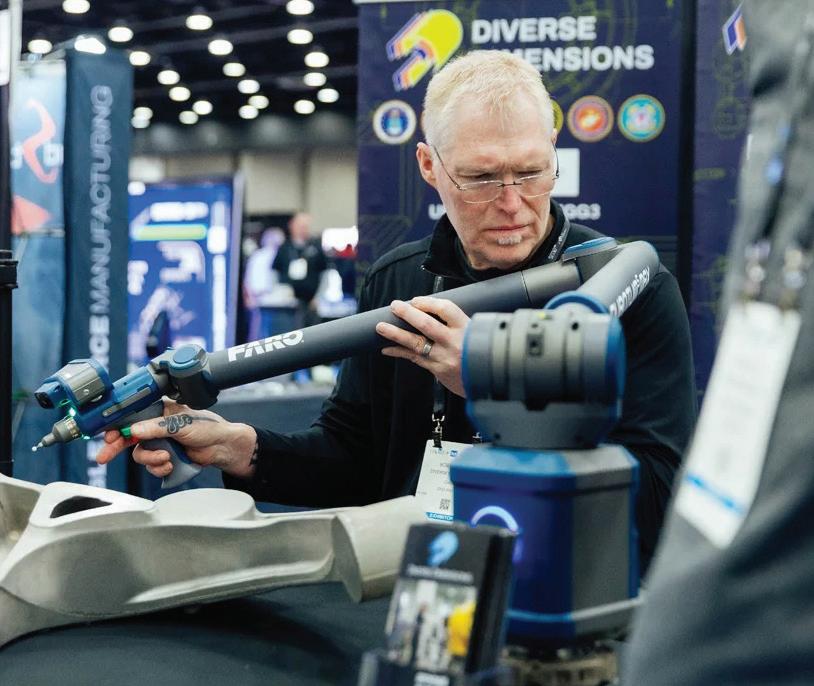
Northeast
BOSTON, MA
APRIL 13 – 16
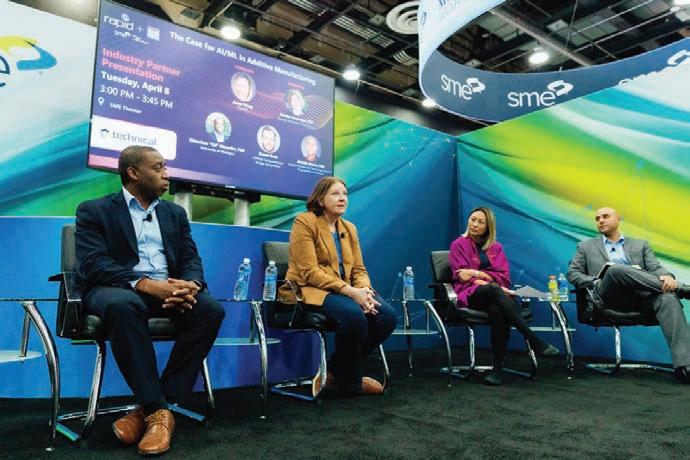
Boston’s Thomas M. Menino Convention & Exhibition Center will host Rapid + TCT, North America’s largest additive manufacturing (industrial 3D printing) conference and exhibit show this spring. Hands-on 3D printing exhibits from over 400 product and service providers will be featured. Every morning will feature the Executive Perspectives Keynote Series, where industry leaders candidly discuss the present state and future prospects of modern additive technology. With hundreds of exhibitors and a strong lineup of technical presentations, RAPID + TCT ofers attendees the opportunity to discover cutting-edge solutions shaping the future of manufacturing and prototyping. Website: www.rapid3devent.com
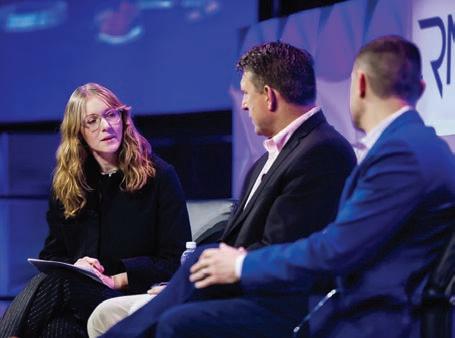
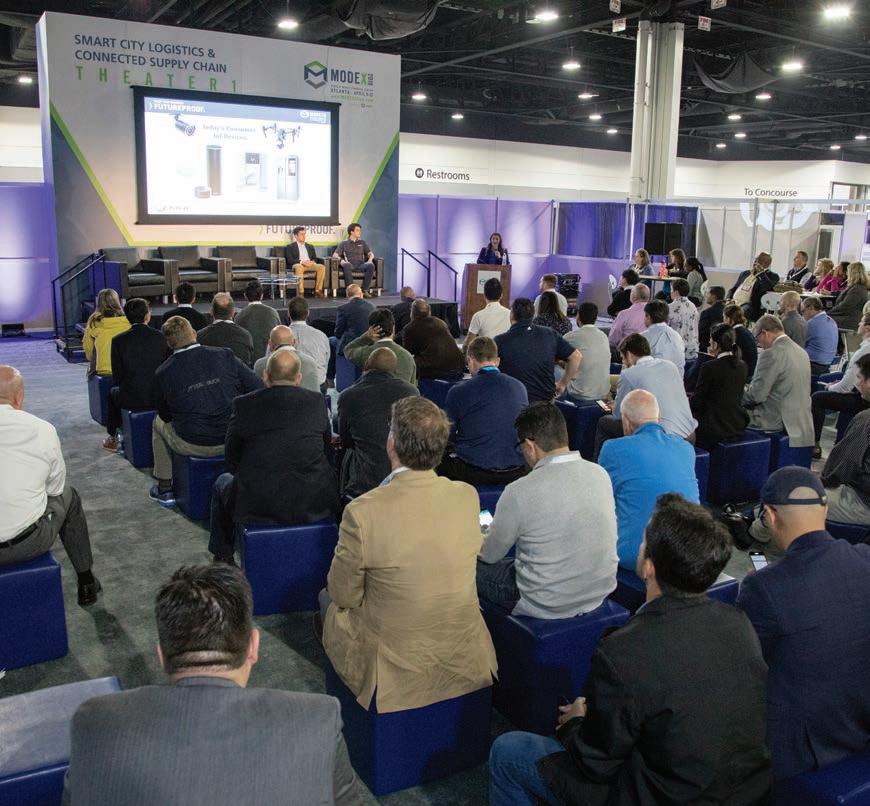
ATLANTA, GA
APRIL 13 – 16
Hosted at the Georgia World Congress Center in Atlanta, MODEX is the largest manufacturing and supply chain event. Showcasing supply chains from every angle, over 50,000 attendees will experience over 1,000 exhibits, 200 educational sessions, and four keynotes from important industry leaders. This is the can’t miss experience for the latest innovations in automation, robotics, and warehousing technology. Website: www.modexshow.com





Color Printing
• Rack cards
• Brochures
• Booklets
• Everything else
By Kerstan Szczepanski
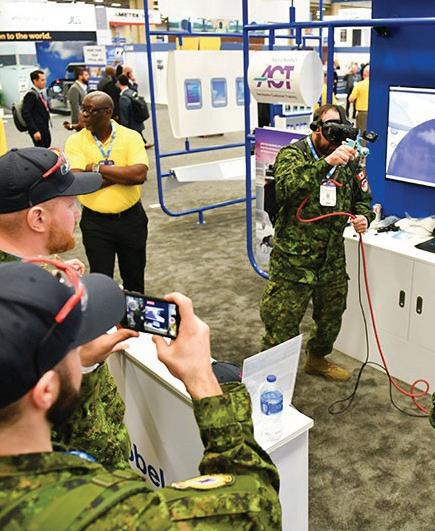
ORLANDO, FL
APRIL 21 – 23
Aviation Week’s MRO Americas is the leading aviation maintenance, repair, and overhaul event in the world. Taking place at the Orange County Convention Center in Orlando, the event attracts over 16,000 attendees and 900 exhibitors, including airlines, OEMs, and service providers. Ofcially celebrating its 30th year, MRO Americas will feature keynotes, panels, and training sessions, making it a must attend event for professionals in the commercial and defense aviation industries. Website: mroamericas.aviationweek. com/en/home.html
• Delivery in Las Vegas, FedEx/UPS to all cities
• Be a HERO use Horizon Print Solutions and make it EZ
• Everything for your show or event from a top quality 25 year supplier!
Meeting & Event Supplies
• Lanyards & Credentials
• Binders, Tabs and inserts
• Tote Bags & Inserts
• Tickets & Programs

Promotional Products
• Giveaways
• Table Drapes & Signage
• Branded Apparel
• Gifts & Awards
By Kerstan Szczepanski
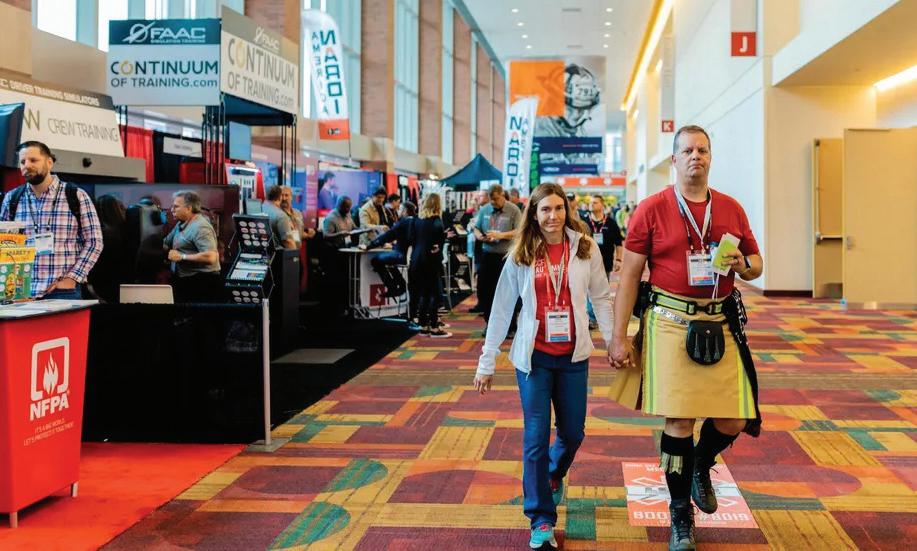
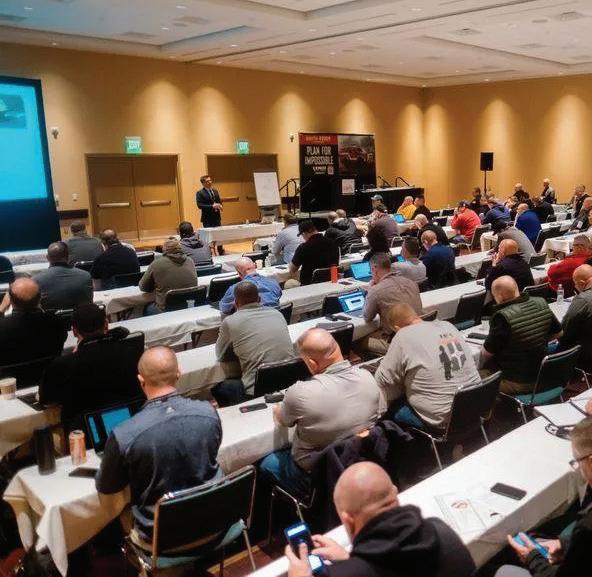
Midwest
INDIANAPOLIS, IN
APRIL 20 – 25
The Fire Department Instructors Conference (FDIC) International is the world’s largest fre and rescue conference and exhibition, held at the Indiana Convention Center and Lucas Oil Stadium in Indianapolis. The event draws well over 30,000 fre service professionals and over 800 exhibitors. FDIC features H.O.T. evolutions (hands-on training), workshops, symposiums, and product demonstrations, where frefghting professionals learn about the latest frefghting techniques, safety equipment, and leadership practices. Website: hwww.fdic.com
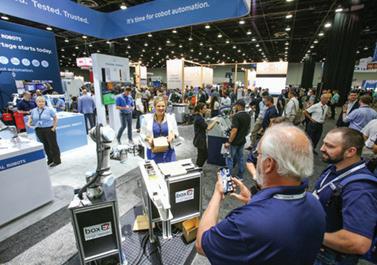
Midwest
CHICAGO, IL
JUNE 22 – 25
Automate is North America’s largest robotics and automation tradeshow, dedicated not just to robotics, but to AI, machine vision, and motion control. Held at McCormick Place in Chicago, the show attracts over 50,000 professionals from manufacturing, logistics, and technology industries. Attendees can explore innovations from more than 1,000 exhibitors, participate in educational sessions, and see live demonstrations of automation solutions driving the future of industry and productivity.
By Kerstan Szczepanski
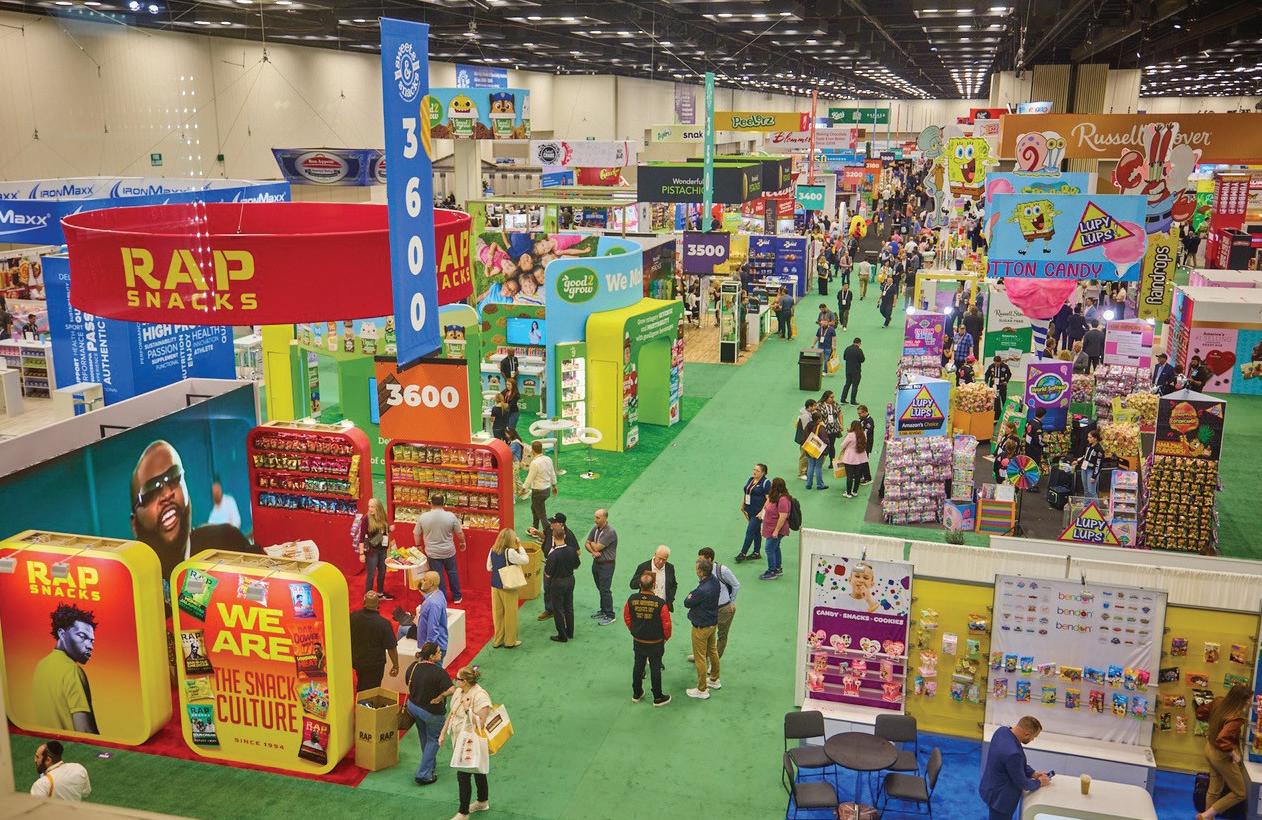
West
LAS VEGAS, NV
MAY 19 – 21 (SUPPLIER SHOWCASE
The Sweets & Snacks Expo is the premier event for the confectionery and snack industries, organized by the National Confectioners Association. For 2026, the event will be held at the Las Vegas Convention Center, bringing together more than 1,000 exhibitors and 16,000 attendees from around the world. The show highlights the newest product launches, favor trends, and retail innovations, ofering unparalleled networking opportunities for buyers, manufacturers, and distributors across the candy and snack sectors. Website: www.sweetsandsnacks.com
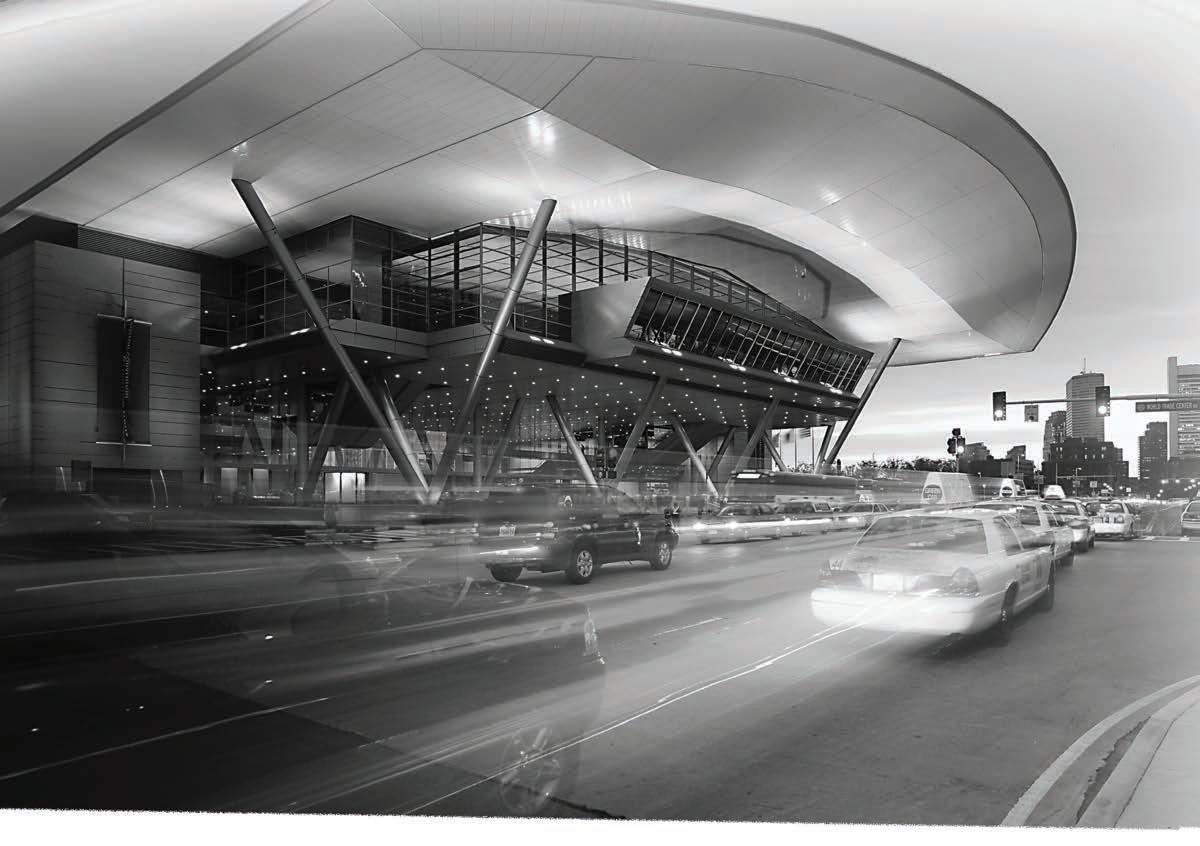


Based on reader feedback and industry trends, we’ve made the strategic decision to move the most comprehensive tradeshow calendar in the industry from our print edition to the web. This change will allow us to better serve our readers by:
» Remaining nimble in the current climate when show dates change
» Freeing up space in our print edition to give you the content you want: corporate profiles, trends and news you can use

YOUR TRUSTED MARKETPLACE FOR THE TRADESHOW & MEETING INDUSTRY
With three listing tiers—Basic (Free), Standard, and Premium—there’s an option for every business, from newcomers to industry leaders. Our goal is simple but ambitious: to build the most comprehensive, up-to-date business listing in the tradeshow and meetings world.
Print & Digital
• ExhibitorLIVE Preview
• Cutting and Saving Costs
• How To Pick Tradeshows
• Speak with Experts on Cost Savings
• Flooring
• Furniture
• Day in the Life
• Wow Booth Features
• Tradeshow Calendar & Service Guide
• Associations & Advocacy Features
Digital only
• Boss Awards
• Social Media and New Age Marketing
• Measuring Marketing Success
• Exhibitor Best Practices
• Tradeshow Marketing/Traffic
Focus Region: Canada
QUARTER 3 (JULY - SEPTEMBER)
Print & Digital
• Importance of a Brand
• Experiential Marketing
• Innovative Design
• Wi-fi
• Print/graphics
• Permanent Installs and Museums
• Retail Spaces
• Day in the Life
• Wow Booth Features
• Tradeshow Calendar & Service Guide
• Associations & Advocacy Features
Digital only
• Healthcare
• Security/Safety
• Randy Coverage
• Insurance/Legal/Contracts/Regulations
• Fall Show Updates
• Show Services
Focus Region: Southeast
*Content is subject to change
2 (APRIL - JUNE)
Print & Digital
• Design and Innovation
• Boss Awards
• AI in Tradeshows
• Retaining Talent
• Labor and Hiring Concerns
• Lighting
• A/V
• Day in the Life
• Wow Booth Features
• Tradeshow Calendar & Service Guide
• Associations & Advocacy Features
Digital only
• Sustainability
• Building an Industry Workforce
• New Faces in the Industry
• Recruiting for the Industry
• Budgeting Tips for Exhibitors
• Advocacy Updates
Focus Region: Central
QUARTER 4 (OCTOBER - DECEMBER)
Print & Digital
• Transportation Trends
• Warehousing/Material Handling
• Shipping and Logistics
• ExSys Awards
• Event Management Software
• Tradeshows and Events
• Day in the Life
• Wow Booth Features
• Tradeshow Calendar & Service Guide
• Associations & Advocacy Features
Digital only
• Industry Predictions
• Show Management
• Randy Coverage
• Post-Show Analysis
• Industry and Tradeshow Predictions 2027
Focus City: Northeast
Deadline / Space reservation: 8th day, or closest business day, of month prior to print issue. We would love to hear from you! Share the coverage you would like to see in future issues at newsdesk@exhibitcitynews.com
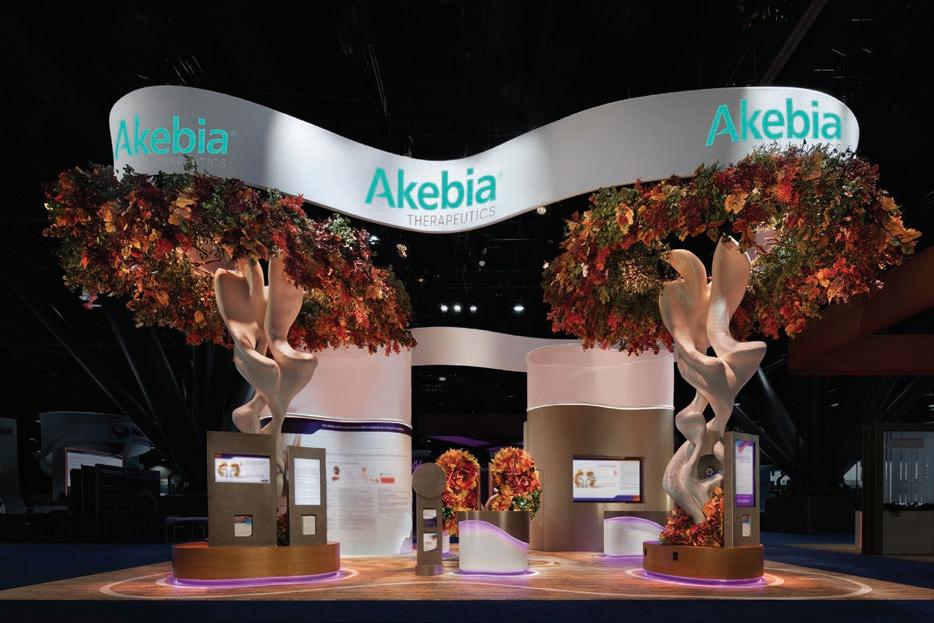
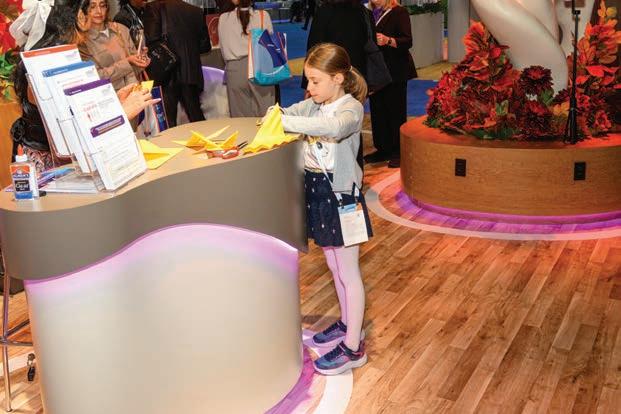
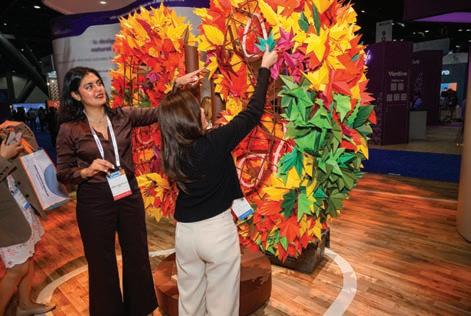
Akebia Therapeutics launched a new drug developed from Nobel Prize-winning science, targeting complications of kidney disease. Working with their agency, Access designers created an exhibit that featured tactile, organic elements. Instead of digital-screen overload, the result was a nature-inspired environment with curved, tree-like columns that symbolized both molecular science and natural growth. The trees had multi-colored leaves inspired by molecular imagery, connecting science and art that engaged attendees.
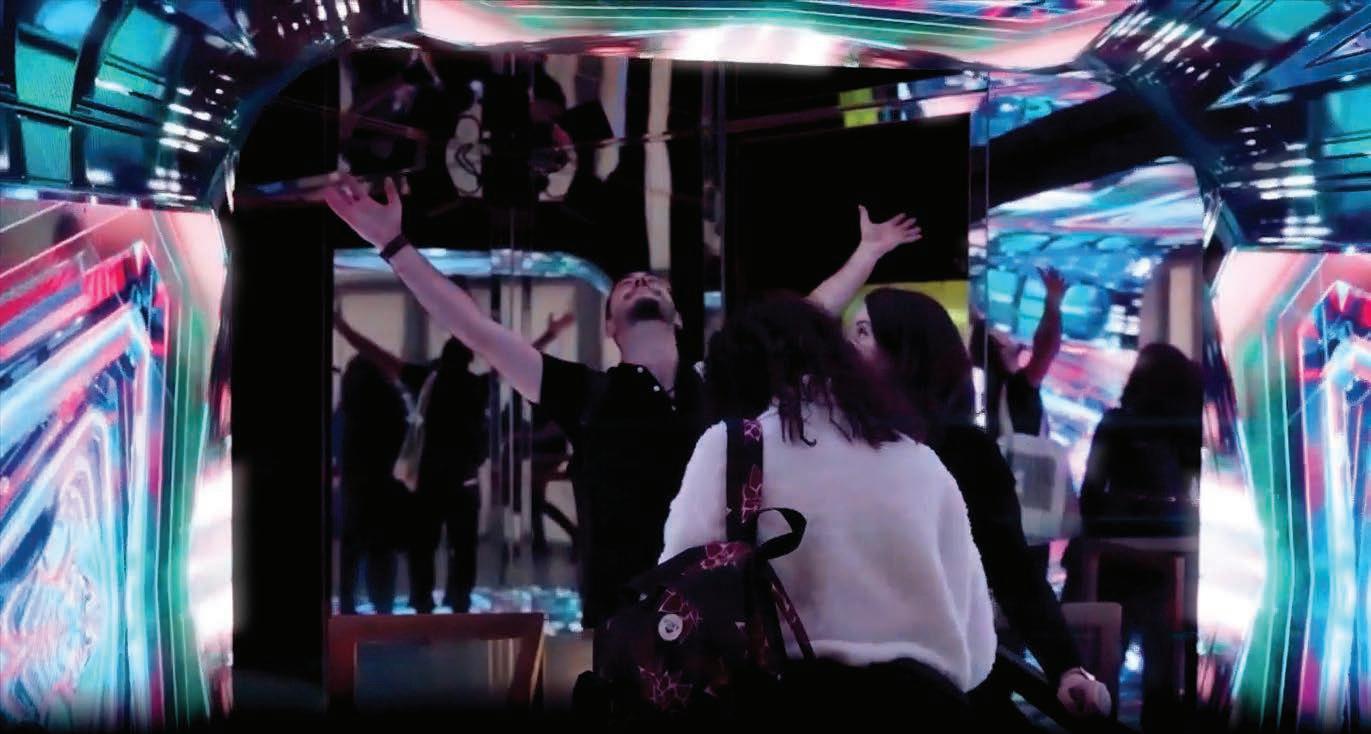
In a room filled with large builds, colorful signs, and countless distractions, your customers want something that can cut through the noise. They want something that will draw the attention of their audience. They want something that will make a statement. They want LEDskin®. And now, our LEDskin® just got even better thanks to our Perfect Corner LEDskin® panels.
Now you can make LEDskin® do more for you and your customers. Create unique activations through optical illusions, wrap-around content, and so much more!
Why LEDskin®?
Our latest P1.5 and P2.5 LEDskins® make just the statement you need. With improved viewing angles, better color accuracy, and our best contrast yet, our new LEDskin® panels will wow your
customers and their audience. These latest additions to our product line enable you to create high-quality and stunning displays while also being a worthwhile investment. These panels have stronger LED mounting techniques that make them last longer, perfect for an activation or the tradeshow floor.
Ready to get your hands on our latest innovations? Contact your Account Manager or reach out to us at CustomerService@bematrix.com.