THE UNIVERSITY OF EXETER’S INDEPENDENT STUDENT NEWSPAPER SINCE 1987
In conversation with: Alcohol Change UK News, Page 4
Cornell spotlights the complexities of reporting
Features, Page 8
Unpacking procrastination: it’s not just laziness Lifestyle, Page 16
In conversation with: Lacewings
Returning to Exeter as a mature student
Music, Page 20
Excetera, Page 24
In no cases are staff obligated to use AI in their marking and feedback
Image: Anthropic, Flickr
Exeter student pushes for clearer policy after finding AI disclaimer in academic feedback Beth Casey Editor-in-Chief
E
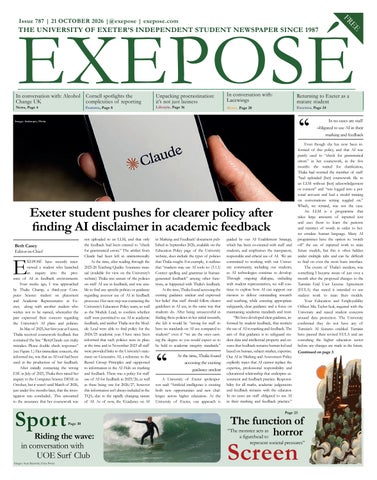
XEPOSÉ have recently interviewed a student who launched an inquiry into the presence of AI in feedback environments. Four weeks ago, I was approached by Thalia Champ, a third-year Computer Science student on placement and Academic Representative at Exeter, along with another student who wishes not to be named, whereafter the pair expressed their concern regarding the University’s AI plans and policies. In May of 2025, her first year at Exeter, Thalia received coursework feedback that contained the line “RetryClaude can make mistakes. Please double check responses” (see Figure 1.) Her immediate concern, she informed me, was that an AI tool had been used in the production of her feedback. After initially contacting the wrong ESE in July of 2025, Thalia then raised her inquiry to the Computer Science DESE in October, but it wasn’t until March of 2026, just under five months later, that the investigation was concluded.. This amounted to the assurance that her coursework was
Sport
not uploaded to an LLM, and that only the feedback had been entered to “check for grammatical errors.” The artifact from Claude had been left in unintentionally. At the time, after reading through the 2025-26 Teaching Quality Assurance manual (available for view on the University’s website) Thalia was unsure of the policies on staff AI use in feedback, and was unable to find any specific policies or guidance regarding assessor use of AI in feedback processes. Her next step was contacting the University’s Education Policy team, as well as the Module Lead, to confirm whether staff were permitted to use AI in academic feedback, and neither Thalia nor the Module Lead were able to find policy for the 2024/25 academic year. I have since been informed that such policies were in place at the time and in November 2023 all staff were provided links to the Univesity’s statement on Generative AI, a reference to the Russel Group Principles and signposted to information in the AI Hub on marking and feedback. There was a policy for staff use of AI for feedback in 2025/26, as well as there being one for 2026/27, however this information isn’t always included in the TQA, due to the rapidly changing nature of AI. As of now, the ‘Guidance on AI
in Marking and Feedback’ document published in September 2026, available on the Education Policy page of the University website, does include the types of policies that Thalia sought. For example, it outlines that “markers may use AI tools to: (3.1.1) Correct spelling and grammar in humangenerated feedback” among other functions, as happened with Thalia’s feedback. At the time, Thalia found accessing the existing guidance unclear and expressed her belief that staff should follow clearer guidelines in AI use, in the same way that students do. After being unsuccessful in finding these policies in her initial research, she felt it would be “wrong for staff to have no standards on AI use compared to students” even if “we are the ones earning the degree so you would expect us to be held to academic integrity standards.”
At the time, Thalia found accessing the existing guidance unclear A University of Exeter spokesperson said: “Artificial intelligence is creating both new opportunities and new challenges across higher education. At the University of Exeter, our approach is
guided by our AI Enablement Strategy, which has been co-created with staff and students, and emphasises the transparent, responsible and ethical use of AI. We are committed to working with our University community, including our students, as AI technologies continue to develop. Through ongoing dialogue, including with student representatives, we will continue to explore how AI can support our mission to deliver outstanding research and teaching, while ensuring appropriate safeguards, clear guidance and a focus on maintaining academic standards and trust. “We have developed clear guidance, informed by student feedback, that restricts the use of AI in marking and feedback. The aim of that guidance is to safeguard student data and intellectual property and ensures that feedback remains human-led and based on human, subject marker, expertise. Our AI in Marking and Assessment Policy explicitly states that AI cannot replace the expertise, professional responsibility and educational relationship that underpins assessment and feedback practice. Responsibility for all marks, academic judgements and feedback remains with the educator. In no cases are staff obligated to use AI in their marking and feedback practice.”
Even though she has now been informed of this policy, and that AI was purely used to “check for grammatical errors” in her coursework, in the five months she waited for clarification, Thalia had worried the member of staff “had uploaded [her] coursework file to an LLM without [her] acknowledgement or consent” and “was logged into a personal account and had a model training on conversations setting toggled on.” Which, we remind, was not the case. An LLM is a programme that takes large amounts of inputted text and uses them to learn the patterns and statistics of words in order to better emulate human language. Many AI programmes have the option to ‘switch off ’ the use of inputted work to train future models, but this is often hidden under multiple tabs and can be difficult to find on even the most basic interface. The events of Thalia’s incident, was something I became aware of just over a month after the proposed changes to the Turnitin End User License Agreement (EULA) that stated it intended to use student work to train their models. Your Education and Employability Officer Mia Taylor-Seal, inquired with the University and raised student concerns around data protection. The University confirmed they do not have any of Turnitin’s AI features enabled. Turnitin have paused their revised EULA and are consulting the higher education sector before any changes are made in the future. Continued on page 3
Page 23
Page 30
Riding the wave:
in conversation with
UOE Surf Club
Images: Sean Raistrick, Erica Potter
EE FR
EXEPOSÉ Issue 787 | 21 OCTOBER 2026 |@exepose | exepose.com
The function of “The monster acts as horror a figurehead to
Screen
represent societal pressures”
EXEPOSÉ Devonshire House, Exeter, Devon, EX4 4PZ Editors Print: Beth Casey and Charlotte Isbell Online: Orlando McKillop and Ria Brown-Aryee Print Deputy: Poppy Fellows Online Deputy: Isabella Brooks editors@exepose.com News Editors Print: Poppy Fellows news@exepose.com Features Editors Print: Janani Kandaramage features@exepose.com Climate Editors
Editorial We’re so excited to bring you the third issue of Exeposé this year, and we’ve got some really great collaborations going on across the sections. In honour of the upcoming holiday, we’ve also got some spooky easter eggs to look out for. In News, Poppy Fellows, Deputy Editor, interviews Ciaran Duggan about Sober October whilst Orlando McKillop, Online Editor-in-Chief, gives an insight into Exeposé’s time at the annual Conservative Party Conference. In Satire we discuss replacing pumpkin
carving with oranges to protect your budgets, Lifestyle speaks with the founders of Luna Café and Bar on Queen Street to hear about the venues’ dual night-and-day identity and how to craft a brand accordingly, whilst SciTech covers the announcement that a University of Exeter dementia study is to be part of an £80 government project. Screen reviews recent bookto-film adaptations (East of Eden, Verity and Sense and Sensibility), Sport covers the EURFC Varsity game against Durham and Comment questions
when political protest goes too far in the wake of France’s student riots. If you can't get enough of Exeposé, you can check out our website which is updated on a weekly basis. Thank you to all our editors, writers and general helpers who have worked hard to make this edition what it is! We hope you have an amazing reading week, and in the future, if there's something we've missed please email us at editors@exepose.com
BAT'S SURPRISING BIOLOGY Climate Page 10
Beth and Charlotte
Print: Freddy Purcell Online: Ella Clark climate@exepose.com Comment Editors Print: Isabelle Pearce comment@exepose.com Satire Editors
UOE WORK TO PROVIDE ADHD TOOLKITS Sci-Tech Page 28
BUDGET-FRIENDLY HALLOWEEN COSTUME IDEAS Lifestyle Page 17
Print: Sebastien Broom satire@exepose.com Lifestyle Editors Print: Rosa Terry and Sofía Tapia Online: Phoebe Andrews and Lucy Felton lifestyle@exepose.com Arts & Lit Editors Print: Erin Rose Morris and Lucy Cornwell Online: Amber Gordon artsandlit@exepose.com Music Editors Print: Cristina Ferrin Online: Amelie Marah and Eve Buckley music@exepose.com Screen Editors
Looking back: Exepose's print archives
Print: Beth Casey and Charlotte Isbell Online: Annabelle Atkins and Beth Donovan screen@exepose.com International Editors Print: Audrey Yuen and Suhaib Shaukat Online: Anna Tolkacheva and Lola Milroy-Tompkins international@exepose.com Sci-Tech Editors Print: Beth Casey and Charlotte Isbell Online: Julia Szewczyk and Sarah Hope sci-tech@exepose.com Sport Editors Print: Beth Casey and Charlotte Isbell Online: Lottie Townsend sport@exepose.com Social Media Executive: Sam Jordan Chief Photographer: Ethan Ford Podcast Producers: Melissa Swift and Sebastian Stanwell-Wise Proofers: Ella Clark, , Freddy Purcell, Eva Coombs, Harriet Jones, Sofia Tapia, Edward Torrens Cundle, Orlando McKillop, Poppy Fellows, Beth Casey and Charlotte Isbell
@exepose @exepose facebook.com/exepose issuu.com/exeposeexeter Advertising
editors@exepose.com The opinions expressed in Exeposé are not necessarily those of the Exeposé Editors nor the University of Exeter Students’ Guild. While every care is taken to ensure that the information in this publication is correct and accurate, the Publisher can accept no liability for any consequential loss or damage, however caused, arising as a result of using the information printed. The Publisher cannot accept liability for any loss or damage to artwork or material submitted. The contents of this, unless stated otherwise, are copyright of the Publisher. Reproduction in any form requires the prior consent of the Publisher.
U
PON becoming senior editors of Exeposé, we were granted access to a little media room in the corner of Forum, and four cabinets filled to the brim with old editions of the newspaper! We wanted to share these archives with our readers—what our predecessors were up to in the past, what they found exciting, what recommendations they had for students, and what they considered to be groundbreaking, boots-on-the-ground journalism! Our featured issue this week was taken from nearly eight years ago, on 29 October 2018. Since this particular edition, our little media room, and our troop of section editors have produced 98 newspapers for Exeter's enjoyment. In this edition, Online Features Editor, Chloe Edwards was in conversation with Owen Jones, a now renowned journalist, activist, and author of bookshop bestsellers including Chavs and The Establishment. Amelia Chisholm defends the 'slutty' Halloween costume, Will Evans discusses horror in live theatre, and Peter Syme talks Arthur Miller's The Crucible, applying works of witchcraft to contemporary politics, in a spooky-themed Exhibit. And in true Exeter-style, coverage of rugby Varsity made a feature—as it often does this time of year in Exeposé! Exeter University Women's Rugby Club made a debut at Sandy Park, "hammering" Bristol 85-10. These archives just prove that we always Bleed Green, and always will do. If you are interested in reading the paper in full, check out our website where you can find a link to pdfs of our old editions!
21 OCTOBER 2026 | EXEPOSÉ
3 NEWS
Continued from front page...
Figure 1: Claude disclaimer in Thalia’s feedback, Image: Thalia Champ
A message regarding this was circulated to all University staff and students in the week commencing 5 October 2026, and read: “AI features are not enabled as part of the University’s agreement and provision with Turnitin. The company has also confirmed no student data has been used to train its AI models. Based on this reassurance, the University of Exeter will use Turnitin during this academic year (2026/27) but will continue to monitor this issue.” The message went on to outline that “while the proposed changes do not apply to our agreement, Turnitin is now undertaking further consultation with the sector and has said no changes will be implemented for another 12 months at the earliest. Separately, we are currently undertaking a wide piece of work looking at the digital tools we
Thalia Champ, Academic Rep
use for assessments (including Turnitin) —in order to provide the best possible student experience. This review will include student and colleague feedback.” AI was first incorporated in the University’s plans and initiatives officially in July of 2023 when Exeter—and all the Russell group universities— signed the ‘Russell Group principles on the use of generative AI tools in education.’ This was not an official ‘act’ of Parliament, but rather a code of practice agreed by the 24 Vice-Chancellors of the Russell Group and developed alongside AI experts, aimed at adapting to its growing influence in educational settings, whilst maintaining institutional integrity and the value of academia. When discussing the events of her inquiry, the main impression I formed of Thalia was her vigor and initiative. It would have been easy to be frustrated and indignant about these occurrences, but outside of her anxieties and concerns, she was adamant that discussions of AI need not always lead to a doomsday narrative or an argument because “these can often distract from more current, pressing issues.” She notes, “it’s easy to feel slightly daunted but we’ve got to work together to mediate these conflicts and listen to both sides. Openness and transparency is what works really well.” In light of the feedback confusion, Thalia became an Academic Rep in her second year, so she could attend student-staff liaison committee meetings and “lobby for transparency and disclosure with AI use.” She informed
me this was received positively, and stated “students being in the room where these decisions are made is especially important as we always need a say if something is being changed that affects us.”
We’ve got to work together to mediate these conflicts and listen to both sides She described her progress until now to be “a good amount”, but added “there’s definitely more to be done.” One example of her efforts was that she “suggested mandatory responsible use of AI training for all staf—and that’s happening now.” Later, she added, “all Universities need to have a comprehensive AI policy that ensures it protects students from misuse and relevant training is implemented. Data protection training is given, so why not include mandatory responsible/ethical AI use and literacy training for both staff and students?”
[She] suggested mandatory responsible use of AI training for all staff Overall, she emphasised the need for conversation and interaction between staff and students and that the discourse needs to change: “One thing I found when researching staff perception on students’ use of AI and vice versa was that we don’t really listen to each other.” This was specifically in reference to
online discussions and “those small echo chamber bubbles online where people just complain.” Thalia feels “it’s valuable to bring both sides together to have constructive conversations because each side sees things the other can’t.” In their ‘Aligning AI with Strategy 2030 Vision Statement’ accessible on the University Website, Exeter lay out plans to ‘leverage AI to enhance operational effectiveness, streamline well-designed administrative processes.’ They also state they plan to ‘equip students and staff with the knowledge and competencies to effectively use, develop, and critically assess AI technologies, in order to promote responsible usage and AI readiness.’ As stated above, Thalia seconds this idea that in order for students to feel comfortable and trust their teaching staff ’s use of AI, there needs to be “proper training in place.” When I asked her why she felt this was so important, she said: “For me [it’s] a no-brainer. All staff complete information governance training when they are hired so this should be expanded to educate them on the importance of responsible AI usage too. They handle students’ work and data so they need to know what’s safe to put into these tools.”
They handle students’ work and data so they need to know what’s safe to put into these tools Going forward in her role as Academic Rep, Thalia is eager to ensure
students understand that they need not be blindsided by these sorts of administrative decisions, and that the University frequently sets up assemblies where conversations can be had before decisions are made, such as those led by Francis Steptoe, previous Education Officer in 2025. “Students should know that their input matters”, Thalia reminds, “and that it’s worth persevering to challenge something.” When I asked about what she aims to achieve in terms of the presence of AI tools in academia, she “wants more women and students from underrepresented backgrounds in computer science and tech” offering the observation that “if there’s only one kind of person building these tools that are publicly distributed and consumed, the tools will only really work for that kind of person.” Mia, your Education and Employability Officer, said, “AI shouldn’t be a barrier to your success at university. I’ve been listening to your feedback. Two things stand out: you deserve meaningful and personalised feedback, and a transparent process. This year, I’ve been lobbying the University to ensure your work is protected and remains yours. I’m leading a discussion with 300 University staff members and students on the breadth of different student experiences. I’m also pushing for the University to involve you when making future decisions about how your work is marked—including the use of systems such as Turnitin. We also understand that AI can be helpful during your studies. We want every student at Exeter to feel supported and well-equipped, and so I’m campaigning for all students to receive AI and digital literacy training that includes equitable use, informed decision-making and critical thinking skills. We want to guarantee a level playing field for everybody, no matter your background or previous experience.”
4 NEWS
21 OCTOBER 2026 | EXEPOSÉ
Exeposé take on Conservative Party Conference Orlando McKillop Online Editor-in-Chief
ments have underinvested in defence as a whole. Though the main parties continue to blame one another for the problems in defence spending today. The effects of new technology, the changing nature of the job market, and our uncertainty around our defence capabilities are becoming apparent by the day. On 28 October the Labour government will be announcing its annual Autumn budget, where the UK government’s main annual statement outlining its plans for public spending, taxation, and economic growth will be unveiled. Only here will we see if the government has been willing use political capital to address these present issues.
Image: Isabella Brooks
E
XEPOSÉ attended the Conservative Party Conference in Birmingham last week on media accreditation, one of the only student publications to do so, speaking to MPs about the party’s approach to AI, education, and defence (Labour did not get back to us about attending their annual conference). Ben Spencer, Shadow Minister for AI, speaking to Exeposé has said that “AI is a huge opportunity we have to seize” with its effect on the graduate job market still “unclear.” The conference ran from 4 to 7 October. Exeposé attended fringe events, panels, and interviewed MPs and other figures, including lobbyists and think tanks, during the four days. On artificial intelligence, Helen Whately, Shadow Minister for Work and Pensions, said that “AI is going to hugely change work and, like any other technological change, it’s going to be a disruptive period”. Though she is “ultimately an optimist about it”. This follows other lines that party members have taken. Speaking to Exeposé, many members spoke optimistically of AI, but some did note of the need to be wary of the speed it’s developing. This follows
the apprehension that other recent reports into the technology have taken. The Lancet Commission, part of The Lancet, an independent medical journal founded in 1823, cited artificial intelligence as one of the 17 threats to human health in its Lancet 17 report. Education was also a recurring theme. During the closing ceremony of the Conservative Party Conference, Kemi Badenoch, Leader of the Conservative Party, reiterated her party’s commitment to cutting interest rates on student loans. Speaking to Exeposé after Kemi’s final speech, Alex Burghart, Deputy Leader
of the Opposition, was “very pleased about the announcements previously made about student loans” also pointing to the announcements about cutting business taxes, which are designed to “help young people get back into work”. However, what was unclear was whether tuition loans would be affected, and if interest rate cuts would be made to Plan 5 student loans, which affect students beginning their courses after 2023.
Education was also a recurring theme
At an Armed Forces Reception, David Reed, MP for Parliament for Exmouth and Exeter East, who also serves as Shadow Minister for Defence, Security and Resilience, told Exeposé of his continued support for relationships between higher education and the armed forces. Attendees at the reception, whose names Exeposé did not record, voiced their discontent at defence being ‘neglected’ over the past decade. Analysts from institutes such as the Royal United Services Institute (RUSI), and parliamentary committees, have said successive govern-
...willing to use political capital to address these present issues Exeposé attended the conference to report on what the party is saying to, and about, young people, including students regarding Exeter. A deeper analysis on all of the content discussed can be found on our website (exepose. com) and Instagram (@exepose). If you’d like the opportunity to be part of our on-site journalism, participating in opportunities like this, then reach out to us editors@exepose.com.
A look at Exeter’s commitment to Sustainable Development Goals Ben King Contributor
A
S University of Exeter students, it is hard to enrol in a new module, check your emails, or walk around Forum without seeing the colourful icons of the UN Sustainable Development Goals (SDGs). And with the university being ranked joint 20th in the 2026 Times Higher Education (THE) Sustainability Impact Rankings, Exeter is clearly strongly committed to the goals. However, University World News recently reported that universities in general are not doing enough to address the SDGs. This message follows the webinar hosted on the 30th of September by the Higher Education Sustainability Initiative (HESI). HESI suggested that more must be done to promote multi-stakeholder coalitions, urging universities to include local government bodies, non-profit organisations, and environmental organisations in their conversations surrounding sustainable development. The movement is heavily focused on SDG 17—Partnerships for the Goals —and rightly so. The HESI highlights
that systemic change can be made more effectively through multi-stakeholder collaboration, allowing the expertise of different stakeholders to produce better results than one stakeholder alone.
The movement is focused on SDG – Partnerships for the Goals Luckily, this is something that the University of Exeter is already extremely focused on. Exeter frames all areas of students’ studies around the SDGs, and luckily SDG 17 is not neglected in this claim. Specific to SDG 17, the University co-created the Future 17 project, a 12week online project which allows students to work with lecturers and businesses to solve sustainability challenges. Alongside this, the university is also in a multitude of different coalitions supporting research and implementation of policy, such as the International Universities Climate Alliance, Worldwide Universities Network, and the Coalition for Capacity on Climate Action, among others. These partnerships and alliances display the University of Exeter’s continued commitment to prioritise SDG 17,
working across disciplines and industries to encourage sustainable development. And the university does not stop there—all the goals are considered when curating every programme at Exeter, including extra-curricular sustainable development programmes. Most noteworthy among these projects are Grand Challenges and the Green Consultants Programme. Grand Challenges is an annual oneweek programme which connects students to businesses and lecturers to support innovative solutions addressing a plethora of the SDGs. Over the week, students research the challenge and develop a potential solution. These challenges include climate, food insecurity, mental health, social inequality, and education innovation—spanning over half of the SDGs. An example of this programme’s success was the 2026 water-related team, Aquaguard, who worked alongside South West Water and SES Water to address water inefficiency. This project directly supported SDG 6, 12 and, of course, 17. Established in 2013, the Green Consultants Programme offers a slightly different experience to Grand Challenges. This involves training and sustainability projects, followed by paid
Image: University of Exeter
internships — all focused on supporting sustainability efforts. These are just two examples of the University of Exeter’s sustainability programmes open to students, proving that students can make real systemic change. Along with these interactive programmes, the University’s world-class sustainability research should not be ignored. The University of Exeter hosts researchers contributing to every SDG, with Professor Tim Lenton (climate tipping points), Professor Gail Whiteman (corporate sustainability), and Professor Peter Cox (climate modelling and carbon cycles) being amongst the most notable. Overall, it is clear to see that, despite the global call for increased
multi-stakeholder coalitions, the University of Exeter keeps SDGs at the backbone of its methodology— boasting world-class research and accessible programmes for students. Molly and Alex, your Sustainability Officers, said, “While the University has some brilliant initiatives that help it meet it’s sustainability promises, there is a lot more that needs to be done. This includes taking a closer look at it’s partnerships and ensuring they align with its sustainability goals and values. We want to see the University build on the positive steps it’s already taken and make meaningful changes that reflect its environmental commitments and views of its students.”
5
21 OCTOBER 2026 | EXEPOSÉ
In conversation with: Alcohol Change UK Poppy Fellows Deputy Editor CW for discussions of alcohol abuse and harm LCOHOL Change UK is a leading charity focused on reducing alcohol harm and raising awareness. Alcohol Change UK provides free information, advice, and digital support to help people cut down or cut out alcohol.
A
Alcohol Change UK provides free information, advice, and digital support I had a really enlightening experience talking with Ciaran, an alumni student of the University of Exeter, who began volunteering for Alcohol Change UK a few months ago, following his own personal experiences with alcohol abuse and alcoholism, and now following his recovery. During our discussion, we spoke about his extensive abuse of alcohol, the harm it caused him and others, and how he was subsequently banned from drinking socials for weeks due to his behaviour when intoxicated. For him, a sober lifestyle seemed an impossible reality. Now, he celebrates being four-and-a-half months sober. Ciaran identified alcohol marketing as a huge betrayal of trust, including major issues with false advertising. Alcohol Change UK is lobbying the government to change the ways alcohol is marketed. He says the way shops and restaurants promote and sell alcohol makes it seem okay and not harmful. This false advertising doesn’t promote the reality of what
happens—vomiting, headaches, acid reflux, how it dulls the senses, affects your sleep, slows your brain functioning, and can lead to internal bleeding, organ failure and damage including your brain. The risk of hospitalisation is high, and it can be financially crippling. Even small amounts can be harmful. In conversation with Ciaran, he shared a phrase he had been once told: “alcohol is poison disguised as beauty”. Sober October is one of the schemes run by Alcohol Change UK. They are challenging people to go sober for 31 days and to raise money. Currently, Alcohol Change UK has 3249 sign-ups for Sober October, and have raised £23,862. The money raised during this campaign will go to support Alcohol Change UK as a charity, providing them with the financial power to run other schemes and to raise their message in other ways. Ciaran hopes and expects the turnout for Sober October will continue to grow, and more people become inspired to get sober—especially in the long term. Alcohol shouldn’t be a taboo subject that we avoid talking about, especially knowing the real harm it can cause. It should be a subject we should discuss in order to change behaviours and lifestyle habits. I asked Ciaran about student lifestyles and how so much of the student experience is marketed as a drinking culture. According to the Mental Health Foundation, 47 percent of young people surveyed before going to university thought that students got drunk most of the time. This statistic shows that the preconceptions of student experiences are frequently centred on drinking cultures—the bustling nightlife, the hype surrounding Freshers’ Week and the drinking activities that are encouraged, and even at more formal affairs, such
as end of season dinners and Winter and Spring balls, with bottles of wine on tables and welcome cocktails. Even at the Exepose, we received tokens for free drinks at Wetherspoons to hand out to students— another layer of constituting a large drinking culture. Ciaran spoke about his own experiences as a student, how there was no desire to not drink—something that might resonate with students who feel they are unable to have ‘fun’ on a night out or partake in activities without drinking. We might also ask, is it because everyone is doing it? In the age of social media and the concept of ‘fear of missing out’, or more commonly ‘FOMO’, when so much of university societies is focused on pub crawls, socials that require you to frequent various bars and pubs, then going onto clubs, even a chill quiz night with friends is prefixed with the word ‘pub’, is it possible to even think about going sober—even just for the night? Ciaran believes it is much easier as a group effort. That is why schemes like Sober October, Dry January, and a new campaign to go 100 days sober run by Alcohol Change UK is so seminal to taking first steps towards sober lifestyles. Doing these campaigns and challenges with people around you, and supporting each other makes this process smoother. There is might in camaraderie and friendship.
Doing these campaigns and challenges with people around you makes the process smoother Ciaran also highlighted critical, healthy lifestyle changes that help him stay sober. Eating well, doing yoga, having a massage, getting exercise, and immersing oneself in nature.
He shared photos of him before and after recovery. In our discussion, we spoke about how lucky Exeter students are to have such fruitful access to natural beauty—passing time at the beach or in Dartmoor are perfect distractions from university that don’t involve drinking. Instead, focusing your mind and body in nature and connecting with yourself and friends. Alcohol Change UK has plenty of resources for cutting down and making the change to going sober. They emphasise they are not anti-alcohol, but stress how important it is to consume alcohol safely and healthily, without inducing harm to yourself and others. Going sober may not seem easy, and also may not seem common in a university context, but 78 percent of students say they do not have to get drunk to have a good night out, according to the Mental Health Foundation. More sober socials and a wider society commitment to foregoing alcohol may enable students to feel comfortable going sober—alongside greater awareness, which is empowered by Alcohol Change UK’s work to get the subject of alcohol into discussion. Much of the work that Alcohol Change UK conducts is concerned with lobbying the government. They are working towards changing laws surrounding alcohol marketing, especially in large chain supermarkets, with big names that households trust promoting alcohol, it Images: Ciaran Duggan becomes normalised to drink more. Furthermore, they are also lobbying governments at various levels to see what can be done about alcohol warning levels. In the same way that cigarettes have warnings about the
NEWS
Image: Alcohol Change UK
dangers of tobacco and nicotine, Alcohol Change UK believes that drink should come with the same precursors. Edie, your Communities and Student Life Officer, said, “We know that drinking can feel like a big part of university life, especially when it comes to socials and nights out. But no one should ever feel pressured to drink or worry about missing out because they choose not to. We’re passionate about making sure there’s something for everyone. We offer lots of alcohol-free events throughout the year, and many of our societies offer sober socials and activities. You can explore what’s on through our website. Whether you choose to drink or not, the decision is yours. If you’re heading out, look after yourself and your friends, plan how you’re getting home, and consider travelling together or using trusted taxis or public transport. For more tips on staying safe on a night out, check out our night safety article on the Guild website. If the issues raised in this article affect you or cause you any concern, you do not need to manage this alone. The University of Exeter Wellbeing Services provide confidential and non-judgemental support to students. For medical advice or concerns about your physical or mental health, please contact your GP or 111 for urgent support.”
6
21 OCTOBER 2026 | EXEPOSÉ
NEWS
Exeter professor offered grant to study medieval sport Ella Clark Online Climate Editor
E
XTREME medieval sports, a phrase which refers to jousting and mock battles (which can also be referred to as a melee), has been theme subject of fascination across films and books that cover medieval history. The events were amassed with public spectators, and were particularly popular between 11th and 16th centuries AD. Overtime these events evolved into rather spectacular affairs, with banquets and parties around the battles, and
vendors setting up shop in villages nearby. After the battle, defeated knights would sacrifice their horse and armour to their captor. Everyone would gather to watch the gallant warriors take part, as they were knights, squires, princes and sometimes even earls and lords. One famous example of these warriors, is Robert Dudley, Earl of Leicester, Queen Elizabeth I’s favourite. Trained in combat, he would dominate the tournament ground, adjourned with expensive armour. Dudley even had his own tournament ground built within the walls of Kenilworth Castle, a property he polished up to impress the queen.
Defeated knights would sacrifice their horse and armour to their captor The archaeology of its staging and impact in medieval sports has been rather unresearched, a fact which has helped inspire Professor Oliver Creighton from the University of Exeter, into conducting research into the medieval tournaments. Professor Oliver Creighton is Professor of Archaeology in the Department of Archaeology and History as well as Director of Research for the Ar-
chaeology department. The project is set to last for 30 months, and will be investigating locations and landscapes across England and Wales to understand why the events took place where they did. The locations will be connected to any medieval road networks, settlements and landscapes. The research is being funded by Leverhulme Trust, who are giving a grant of over £200,000. Leverhulme Trust aim to support scholars and their educational endeavours, as any research breakthroughs may benefit society. This excellent opportunity is perfect to engage with such a thrilling aspect of medieval history.
Image: GetArchive
CREWW work with South West Water to face water challenges Ryan Smyth Contributor
T
HE University of Exeter’s Centre for Resilience in Environment, Water and Waste (CREWW) has spent the past five years working with South West Water to find solutions to some of the biggest challenges facing the water industry.
The partnership’s research was highlighted in the International Water Association’s World Water Conference, which took place in Glasgow from third to the seventh of October. The event brought together people from across the water sector to discuss how water systems can become more resilient to environmental pressures. CREWW brings together university researchers and water industry
Image: The University of Exeter
specialists to explore issues including pollution, water quality, and ageing infrastructure. It aims to use scientific research to develop practical solutions
CREWW brings together university researchers and water industry specialists that protect the environment, and improve water and wastewater services. Examples of their work include a project investigating how groundwater enters sewer networks. Cracks and damaged connections can allow groundwater into pipes, increasing the amount of water that must be treated. This can place additional pressure on infrastructure and contributes to higher running costs and environmental risks. Researchers have used mapping technology and computerised modelling to identify areas where this problem is most likely to oc-
cur. Following an initial study in the Lower Otter catchment, the project expanded to include areas around Dawlish and Camborne. CREWW is also working with South West Water to identify old lead pipes using artificial intelligence. By combining existing records with other data, researchers hope to predict where lead pipes may still be present. This could help decide where replacement work needs to be prioritised. Other projects focus on microplastics, protecting waterways through catchment management and developing ways to predict and detect algal blooms in lakes and reservoirs. The partnership’s work also aims to make scientific research more accessible. Its Storying Water project uses audio storytelling to explore the science behind waterways and biodiversity, helping to communicate environmental issues to people outside the research community. In an announcement ahead of
the Glasgow congress, Professor Ed Keedwell, CREWW’s co-director at the University of Exeter, said the partnership had allowed researchers and industry specialists to work together on research and practical solutions. He also highlighted the event as an opportunity to share
...an opportunity to share knowledge and encourage further collaboration knowledge and encourage further collaboration across the water sector. As CREWW moves beyond its first five years, its work reflects the growing need to protect water supplies, improve infrastructure and respond to environmental challenges. The partnership’s long-term success will depend on how effectively it’s research can be put into practice, benefiting both local communities and the environment.
Image: Kyle Carter
Nottingham Trent University to offer degree in content creation Gracie Kelly Contributor
N
OTTINGHAM Trent University’s BA (Hons) Content Creation degree reflects the growing role of social media and digital marketing in the creative industries. Launched in 2022, the course aims to turn students creative interests into career opportunities, with the University describing its ambition as “turning that passion into a profession”. Combining practical content production with branding, storytelling, and audience analytics, the degree prepares students for careers in the creator economy.
...the degree prepares students for careers in the creator economy Students develop skills in shortform video production, photography, editing, and social media campaign management. The course also covers digital media ethics, studio-based production, and live projects with industry partners. Students are given the opportunity to produce their own content project and professional portfolio to showcase their work to potential employers. Graduates may pursue careers as content creators, social media managers, digital marketers, communica-
tions officers and influencer marketing executives, rather than relying solely on building their own online following. The degree is part of a wider range of university courses addressing digital content production. Leeds Beckett University also offers a BSc in Content Creation, reflecting the growing its presence and necessary skills in higher education. Such programmes aim to equip students with practical and strategic skills that organisations are increasingly using to reach audiences across digital platforms. However, for aspiring content creators hoping to build an online following, an important question remains: can going viral actually be taught? Whilst students can learn filming, editing, sto-
rytelling, and strategies for growing engagement, online success is difficult to predict. Algorithms change, audience interests shift, and a degree cannot guarantee followers or a sustainable income. Nevertheless, these skills can be applied to careers beyond influencing, particularly in digital marketing, brand communications, and content strategy.
An important question remains: can going viral actually be taught? The financial commitment is also considerable. For the 2026 entry year, NTU’s annual tuition fee for UK stu-
dents is £9,790, bringing the three-year total to £29,370 before living costs. Students must weigh the benefits of structured training, professional equipment, and industry teaching against alternatives such as independent learning and building a portfolio through personal projects. As digital platforms continue to shape how creators and organisations communicate with audiences, content creation is becoming an increasingly relevant area of professional training which may find value in higher education. The challenge for universities will be ensuring graduates gain transferable skills that remain valuable as platforms and the creator economy evolve.
21 OCTOBER 2026 | EXEPOSÉ
7
NEWS
8
21 OCTOBER 2026| EXEPOSÉ
Features
FEATURES EDITOR:
Janani Kandaramage
Cornell spotlights the complexities of reporting assault on campus Janani Kandaramage, Features Editor, explores the details of the case
T
Content warning: sexual assault HIS September, a former Cornell student, anonymised as Jane Doe, launched a civil lawsuit against the Ivy League University, asserting its failure to adequately support her after she was drugged and assaulted by seven men at a campus fraternity house in 2024. Doe explained that she had reported the incident to campus police a few weeks after the assault, who interviewed her, and passed the findings to local prosecutors. The Tompkins County District Attorney at the time, Matthew Van Houten defended his office by arguing that at the time, there was no legal evidence of rape under New York state legislation, calling it “voluntary, conscious, and consensual.” This triggered outrage amongst advocates who pointed out that he had not closely reviewed her 120-page interview transcript in which she had plainly stated that she had been raped for seven hours. Following uproars from global and national victim advocacy organisations, as well as students, Cornell scrambled to justify its actions in 2024. The university maintained that its investigation strictly aligned with Title IX, the federal civil rights law governing campus sexual misconduct and the way procedures are carried out. Authorities stressed that they issued sanctions, which included suspending and expelling the accused students, and permanently barring the fraternity from campus. However, the institute’s prioritisation of Title IX’s bureaucratic protocols over prompt action meant that the survivor had to navigate a draggedout, exhausting process until some steps were taken, delaying justice and healing from the traumatic event.
This raises wider questions around campus administration, questioning whether failures are due to poor transparency or a lack of follow-up by police authorities. Disclosing harassment is emotionally demanding, especially because survivors are expected to recollect and recount distressing events in vivid detail. According to CNN, Jane Doe had reportedly described the incident to her roommates although she did not initially identify it as assault. This state of disbelief and disorientation is common among survivors, often deterring them from reaching out to relevant actors immediately: as they struggle to process and come to terms with what happened to them.
A DRAGGED OUT, EXHAUSTING PROCESS UNTIL SOME STEPS WERE TAKEN, DELAYING JUSTICE AND HEALING The reactions to Doe’s situation remained unsympathetic, as the campus police locked in on the delay to doubt the credibility of her claims. According to CBS news, they even downplayed her assertions of non-consent, fixating on whether she had explicitly said “no,” or merely said “I’m tired.” These pressures, in addition to the preoccupation with how intoxicated she was, are a clear reflection of misogyny. This is because not only do they marginalise their silent sufferings, but they also shift blame onto the woman, while denying them transparency over the decisions affecting their own cases. Such an absence of accountability risks set-
ting a precedent in which women feel powerless, and fear reporting will only bring shame over support, discouraging them from stepping forward. The lack of information sharing between Cornell and Van Houten’s office then, also heightens the need for coordination between university disciplinary procedures and local law enforcement when investigating critical concerns like this. New York Governor Kathy Hochul condemned Cornell for not sharing the adequate interview transcripts and specific findings with the local D.A to make its conclusion. The university had also misled Doe into thinking they were building a criminal case when the DA had in fact dropped charges, creating a confusing map of guidelines that discourages victims. For students of University of Exeter, you can contact the Support and Report service for advice and support in issues surrounding sexual harassment or assault, and for immediate assistance/reporting you can contact the campus Estate Petrol via 01392723999. Devon Rape Crisis and Sexual Abuse Services also provide a similar platform and support. For mental health support you can make an appointment with wellbeing@exeter.ac.uk or Talkworks, Devon’s NHS talking therapies service. Edie, your Communities & Student Life Officer, said, “We know that speaking up about sexual assault or deciding whether to report can feel incredibly daunting. Whatever you’ve experienced, you deserve to feel heard, respected and supported. The decision to report is entirely yours, and you should never feel pressured to do so. If you do want to share your experience, there are different ways to receive support. The Univer-
Image: Socialist Alternative
sity’s Support and Report Tool offers a way to share your experience and access support tailored to your circumstances. You can also choose to report to the police or speak to a trained specialist through Rape Crisis England & Wales charity 24/7. Whatever you decide, we’re here to listen, understand and help you find the support that is right for you. Sharing your experience can help us and the University better understand the issues affecting students and identify where more support or improvements may be needed. That’s why we’re committed to building a community where sexual misconduct is recognised as unacceptable, and everyone feels safe, informed and supported. Last year, your 2025–2026 Student Living Officer, Kira, introduced mandatory consent training for students and bystander training for society committees, alongside working with the University to support the city’s Purple Flag accreditation and improve night-time walking routes. We know there’s always more work to do. Whether you choose to report or simply want someone to talk to, you deserve support that’s accessible, clear and free from judgement.”
Christa Pike’s failed execution exposes the cruelty of capital punishment
Rose Keen explores whether the death penalty is truly effective in restoring justice Content warning: discussions of violent crime
O
N 30 September 2026, Christa Pike was expected to complete her death penalty sentence for a crime that she had committed 31 years earlier. However, following complications this wasn’t seen through. On 12 January 1995 in Knoxville Tennessee, 18-year-old Pike and her boyfriend Tadaryl Shipp lured Colleen Slemmer to the woods, where they brutally tortured and murdered her. In court documents, the Tennessee Attorney General’s Office revealed the extent of the torture that Slemmer endured. “When Slemmer tried to flee, Pike sliced her stomach with the box cutter...As Slemmer begged for her life, Pike repeatedly kicked her in the face.
[IN] 1995, 18-YEAROLD PIKE AND HER BOYFRIEND LURED SLEMMER TO THE WOODS WHERE THEY BRUTALLY TORTURED HER
Image: Wikimedia Commons
Pike then cut Slemmer’s throat as she begged for mercy.” The following day, Slemmer’s body was discovered by a Tennessee Grounds Employee. Her body was so badly beaten that, at first, it was mistaken for an animal corpse. In 1996, after confessing to her crime, Pike was convicted of first-degree murder and sentenced to death. 31 years later, she was set to become the first woman executed in Tennessee in 200 years. Yet, after being administered with two lethal doses of the drug pentobarbital, Pike continued to breathe, appearing to
snore loudly as baffled journalists looked on in horror. Ten days after being rushed to a local hospital to receive emergency and life-saving medical care, Pike is reported to be conscious, walking and talking and has since been transferred back to prison at Debra K. Johnson Rehabilitation Centre. The failed execution has raised serious questions and concerns, regarding the reliability and ethics of using lethal injections to carry out the death penalty. In recent years, it seems that problems with lethal injections have occurred across multiple states. Notably, the botched execution of Clayton Derrell Lockett in 2014, as well as a similar incident befalling Kenneth Euguene Smith in Alabama in 2022. Professor Corinna Barrett Lain, notes that the “botch rate” of lethal injections is twice as high as that of other methods.” The reasons for this include: the drugs typically used to be of questionable quality, non-medical personnel typically administering the drugs, or simply the drugs being incompatible with patients with weaker veins. The incident has also highlighted the problem of accountability within the US justice system, as, despite the clear traumatic and unjust failure of the execution, the Tennessee Department of Correction has
continued to defend the method of lethal injection. Furthermore, in recent years Tennessee had cut its lethal injection execution protocol from 104 to just 44 pages, thus diminishing specific guidelines on the injection’s use and sourcing. The document also fails to detail a protocol for what happens if the second dose of the drug does not kill the inmate, which forced the state to give Pike life-saving treatment after both doses failed to end her life. We are compelled to question whether the death penalty is truly effective in restoring justice? For Colleen Slemmer’s family, they have waited 31 years only to still lack the justice that Colleen deserves. As for Christa Pike, she has faced an unethical and traumatic brush with death, whilst her future regarding her sentence remains uncertain.
COLLEEN SLEMMER’S FAMILY... HAVE WAITED 31 YEARS ONLY TO STILL LACK THE JUSTICE THAT COLLEEN DESERVES
21 OCTOBER 2026| EXEPOSÉ
9 FEATURES
Has Halloween become a performance in this day and age?
W
Harriet Jones, discusses whether Halloween’s commercialisation has overshadowed its origins
HEN we think of Halloween, we think of carving pumpkins, knocking on doors to fill baskets of sweets, and finally finding the perfect costume. But have we sacrificed tradition to put on one-night-only performances?
items are largely consumables and kids grow out of their costumes every year, meaning that both need to be purchased annually, making way for companies to make huge profits. He states: “Pop-culture trends help predict which costumes will be must-haves” informing companies which costumes to massproduce, further improving their profits.
Image: Flickr
HAVE WE SACRIFICED TRADITION TO PUT ON ONE-NIGHT-ONLY PERFORMANCES? As the decades pass, England makes way for the faith, teachings, and festivals of Christianity; one of which being “All Saints Day”. This was a day to remember those who had previously died for their beliefs, which was celebrated on the first of November. The evening of Samhain, therefore, came to be known as “all-hallows-eve,” and America brought us traditions like pumpkin carving. Eventually, this night became known as “Hollow Eve” which morphed into what we now call Halloween. As time goes on, history gets lost or misinterpreted and ultimately neglected. We still follow the traditions set out to us by the Celts and Romans but often with little understanding of its significance. Halloween is now the time of following viral Tiktok trends—such as monster make-up tutorials or transition videos with spooky sounds or picturing the perfect shot: the Instagram photo that will showcase weeks of planning for the perfect costume. We’ve become a generation that places importance on the aesthetics and performance we give online rather than the traditions, and I
POP-CULTURE TRENDS HELP PREDICT WHICH COSTUMES WILL BE MUST-HAVES It’s these reasons why I believe tradition and history have got lost within our generation and Halloween has become a performance to compete against one another to decide who looks best on the night. believe this can often prevent people from enjoying themselves or spending beyond their assigned budget due to the constant fear of needing to look ‘perfect.’ Rather than choosing scary costumes (like the Celts would, to ward off evil spirits), there is a rising emergence of overtly sexualised outfits, causing traditions to get lost.
or orange, making it easy to forget the true history behind the spooky season. The transition from small community festivals to a multi-billion-dollar commercial giant is almost the most successful transformation in retail history—second only to Christmas.
SPENDING BEYOND THEIR ASSIGNED BUDGET... NEEDING TO LOOK ‘PERFECT’
THE MOST SUCCESSFUL TRANSFORMATION IN RETAIL HISTORYSECOND ONLY TO CHRISTMAS
Not to mention, the big corporate conglomerates using Halloween as an opportunity to make a quick buck off anything black
In an interview for the New York Times, Professor Arnold (a finance professor and retail expert) cleverly points out that Halloween
Image: Wikimedia Commons
Why is society so drawn to the macabre?
N
Amy Miller discusses whether horror offers escapism from real world troubles
OW that summer is well and truly over, Halloween is approaching soon. The ghoulish tradition dates to an ancient Celtic festival called Samhain: back then, the evening was believed to weaken the boundary between the living and dead, which explains why animalistic masks were worn to deter unwelcome spirits. Although such costumes are now thought of as innocent fun, society’s obsession with Halloween’s macabre themes is not to be ignored.
mous philosopher Aristotle and his theory of catharsis, which implies that the function of tragedy is to arouse feelings of pity and fear: to essentially allow its audience to experience negative emotions in a safe environment.
This concept is easily applicable to horror which, despite originating long after Aristotle’s death in 322 BC, handles themes like those of classical tragedies. It is also relevant to in-person experiences like haunted houses: although we
ALLOW[S] ITS AUDIENCE TO EXPERIENCE NEGATIVE EMOTIONS IN A SAFE ENVIRONMENT
feel true terror when a mummified actor appears, we know deep down that they are harmless. This activity acts, therefore, as a kind of release. From a more modern sociological perspective, we might consider the impact of widespread disillusionment. Researcher Amitai Etzioni describes Halloween as a “tensionmanagement holiday” and argues that people
GHOULISH TRADITION DATES TO AN ANCIENT CELTIC FESTIVAL In the media, topics of supernatural violence and disaster seem to have risen in popularity recently. Note, for example, the exceptional success of recent film adaptations like Frankenstein, The Running Man, and Cold Storage, along with original horror movies such as Sinners; this last title earned a gross revenue of $371.6 million. The prosperity of these films implies that the public is majorly drawn to dark subject matter. The reason behind this morbid interest, though, is unclear. While searching for an explanation, I came across the work of fa-
partake in accepted rituals such as dressing up, trick-or-treating and carving pumpkins to relieve cultural anxieties. Such anxieties often arise from political and economic stability, and in a country that has had seven prime ministers over ten years, they are bound to prevail. It is therefore no surprise that English society has developed a keen interest in Halloween traditions, if only for the opportunity to express fright in a palatable context. Perhaps then, modern horror enthusiasts are seeking an Aristotelian catharsis to escape from worldly turmoil. Ultimately, Halloween as we know it is largely disconnected from its pagan origins and, consequently, is often associated with tacky supermarket costumes and buckets of sweets. On a more serious note, though, it seems to fulfil a different purpose than originally intended—while the Celts spent the evening warding off evil spirits, we welcome its darkness as a quiet distraction from the world around us.
LARGELY DISCONNECTED FROM ITS PAGAN ORIGINS Image: Wikimedia Commons
21 OCTOBER 2026| EXEPOSÉ
10
Climate
CLIMATE EDITOR:
Freddy Purcell
Bat research reveals more of their surprising biology Violet Stapleton investigates the anatomy and conservation of spooky season’s mascots
B
ATS, often associated with mystery and the gothic, are an incredibly diverse group of mammals, with over 1,500 species living worldwide. As a result, they account for more than one fifth of all living mammal species. The UK consists of 18 species of bat, all of which feed on insects. Bats are very important for the environment too, as they assist in pollination, seed dispersion, and manage insect populations which risk damage to crops.
BATS ACCOUNT FOR ONE FIFTH OF ALL MAMMAL SPECIES
Previously thought to have originated from Africa, Asia, or North America, recent studies, reported by the journal Nature, have identified that bats originated in Europe around 65 million years ago. As well as this, the wider project known as ‘Bat1K’ — aiming to order the genomes of the entirety of the living bat species — has discovered that some bat species exhibit genes with excessive immunity to disease. Many species of bat have been shown to harbour a range of viruses without being affected by them, rendering them resistant to many strains of disease. Some bat species also impressively present very few signs of ageing or cancer. Not only is this great news for the bats themselves, but it also means that by studying their genes, researchers may be able to use this information to develop
cancer treatments and care for zoonotic disease.
SOME BAT SPECIES EXHIBIT GENES WITH EXCESSIVE IMMUNITY TO DISEASE However, despite their impressive resistance to disease, there are many concerns surrounding their conservation in the UK and beyond. In fact, the International Union for the Conservation of Nature declared that 18 percent of bat species are regarded as under threat. Liliana Dávalos, a New York conservation biologist involved in this study, suggests that bats are suffering due to many factors, including the climate crisis, the loss of their habi-
tats, and bat hunting. Moreover, the fungal disease known as white nose syndrome has wiped out millions of bats across Canada and the United States, which poses a huge threat to their populations. In the UK, one of the most crucial dangers to bats is the loss of their habitat, which can be caused by intensive farming or conversions of land use. Images: Wikimedia Commons
Citizen environmentalists track sewage spills
Ted Strange covers a local project to protect the people and wildlife around Devon rivers
F
RIENDS of the Dart (FOTD), a local community group, have recently unveiled their pioneering new River Hub for the public to track the locations of sewage spills along the River Dart. FOTD’s ethos is clear: by providing communities with independently collected data, they can protect themselves from illegal sewage spills, as regulators have been unable to do so. Data about sewage spills has often been obscured by a weak regulatory process and institutional conflicts of interest. Released earlier this year, Channel 4’s mini-series Dirty Business highlighted the falsification of sewage overflow data and the regulations which allowed companies to self-monitor their behaviour. These failures have caused the development of resources such as Sewage Map UK and Surfers against Sewage. For instance, Sewage Map UK shows that there were two sewage spills near the Riverside Valley
Park in Exeter on the 7 of October alone. But the River Hub goes even further. By focusing on a smaller area with 31 data collection sites, they can provide micro level analysis to be used in tandem with services which present a national picture. FOTD argue that this should provide a model for the rest of the country, and they hope that all UK river groups develop similar systems in the near future.
A MODEL FOR THE REST OF THE COUNTRY The River Dart is a beautiful feature of the Devon countryside and many iconic species. Salmon, sea trout, otters, and kingfishers all call the Dart home, so it is no surprise that the area is popular for wild swimmers
and wildlife enthusiasts. But hobbyists no longer feel completely in its waters. In 2025, FOTD’s researchers found two E. coli samples per month at all 31 of their sites. At the Labour Party Conference, Andy Burnham argued that water privatisation is emblematic of what he believes is wrong with Britain. The government will soon present a new Water Bill to tackle this, proposing: a repeal of the ban on public ownership for water companies, tougher consequences for repeated offences, and a closure of loopholes in the ban of bonuses for water company bosses.
ment agencies, they believe that their actions should already be within the Environment Agency’s remit. FOTD and other community groups say they exist because of the agency’s long-term erosion of regulatory standards: “We are showing that these questions can be answered in the open, and that the regulator and water companies should be the ones answering them”. Images: Wikimedia Commons
... AN EMBLEM OF WHAT IS WRONG WITH BRITAIN Whilst FOTD work closely with govern-
Scottish islands set blueprint for sustainable fishing
After 10 years, Meredith Cloke, reveals how a dredging ban has boosted biodviersity around the Summer Isles
T
HE Summer Isles is one of many coastal areas that have started the fight against harmful large-scale fishing practices, specifically scallop dredging. Scallop dredging is a fishing practice that uses a trawler that digs up to 10cm into the seabed to upend scallops and catch them in a mesh bag. The practice is largely inefficient and regularly brings up rocks. The dredging is usually done by larger European ships instead of the smaller lo-
Images: Wikimedia Commons
cal fishermen, which shrinks the local economy. The Summer Isles ran a campaign against scallop dredging as it is incredibly harmful to repeatedly trawl areas, which was happening in the Summer Isles. Trawling creates a monoculture in their coastal region. This monoculture harms the local community by driving away other marine life, such as fish, that lose their food supply, which in turn pushes creatures like dolphins and whales elsewhere for food. This negatively affects the local community and smaller businesses that rely on the fish industry for tours and to run successful businesses. Open Seas suggests that scallop dredging is known to have the most severe ecological effect of all marine fisheries. This is because it harmfully affects the extremely vulnerable biogenic reefs, specifically maerl seaweed, which is a large part of the Summer Isles’ plant makeup. Long-term trawling can have a long-term impact on the ecosystem. Fundamentally chang-
ing the local marine ecosystem. Although the large-scale trawling operations create jobs in the area, it is important to weigh job opportunities up against the overall loss of marine life. Images: Wikimedia Commons
With the successful ban, the Summer Isles’ MPA (marine protected area) has seen a bounce back in the marine diversity in its waters. It has brought back crucial coral and vegetation. Locals have been able to spot dolphin pods and whales coming back to the area, which is a great
sign of its health. Local fisheries have been able to bring back a larger variety of seafood, increasing the money brought into local businesses. This successful ban does bring into question the sustainability of fishing practices around the world. Bans like this and wider attention created by documentaries like Ocean by David Attenborough brought to light the harmful issues that large-scale fisheries create in an ecosystem and make us question how we need to change our fishing practices to keep such fragile homes safe for the future of marine biodiversity.
QUESTION THE SUSTAINABILITY OF FISHING PRACTICES
12
21 OCTOBER 2026| EXEPOSÉ
Comment
COMMENT EDITOR Isabelle Pearce
Is Kemi Badenoch bringing Conservatism back?
O
Ben King reflects on the Tory party leader after the annual Conservative Party Conference
N 7 October, Kemi Badenoch declared herself a “classic old-school Conservative” in her keynote speech addressing the Conservative Party Conference. Paying homage to Margaret Thatcher’s famous quote, Badenoch stated that there is an upcoming “battle for the soul of this nation”. This messaging comes at a time of expansive social policy from the current Labour government, with policies such as the National Care Service being announced at the Labour Party Conference. This leaves voters inferring that the “battle” Badenoch refers to may be one of more traditional left versus right values than we have seen recently. Both major parties seem to be shifting away from the familiar battlefield of the political centre that we have become accustomed to post-New Labour.
For the Conservatives, this shift returns to the ‘New Right’ ideology of the late Thatcher. Badenoch aims to champion the goals of lowering taxes and empowering the individual whilst embracing a more Laissez-Faire economic approach. The Conservative leader has proposed the removal of inheritance tax on family homes, stating that people who work hard “should be rewarded”. This policy comes at a time where the reliance on inheritance in the UK is already being heavily criticised by the left. This policy is just one of many that follow the methodology of Badenoch’s new essay: “The Right Way”; an essay highlighting the Conservative’s new “common sense principles”. BBC report that the document seems to be a deliberate echo of Margaret Thatcher’s 1976 es-
say, “The Right Approach”—further highlighting Badenoch’s ideological affinity with Thatcher. The return of the ‘New Right’ seems timely, appearing as a direct response to Labour’s recent attempts to unite the left. If this really is the “battle” that Badenoch suggests, could it be that both sides are rallying troops for the 2029 general election? With the Conservatives preaching “The Right Way”, and Labour seeking the approval of Green voters through promises to strengthen ties with the EU; the political scene in the UK is appearing to become both more polarised and more unified, among the left, simultaneously. It may be that Badenoch’s return to Thatcherism represents more than nostalgia. Against the backdrop of a unifying left, and Reform UK’s challenge from
the right, she appears committed to establishing a distinct identity for the modern Conservative Party.
Image: Wikimedia Commons
When does political activism become alienating?
T
Ella Ferguson questions recent comments made by the Green Party
HE Green Party has passed a motion declaring that it is an anti-Zionist party, which many view as alienating and antisemitic. Zionism is a nationalist ideology that advocated for a Jewish autonomous state and the preservation of Jewish identity. The policy, which was voted 1022 to 813 on 4 October, states that Zionism should be “treated as any other form of racism”. A spokesperson for the Greens added that the party is “anti-racist” and has always “opposed the illegal occupation” of Palestine. The motion has sparked unrest within the organisation, with four out of five Green MPs “deeply saddened” by the verdict. There is contention that the motion was pushed by party new-comers via Greens
Image: Wikimedia Commons
for Palestine who “have no interest in anything else”. The policy is seen by some as anti-Semitic performative activism, but is it? Green Party leader Zack Polanski said “we know there is no conflict between supporting the rights of Palestinians and the rights of Jewish people” highlighting the distinction between Zionism and Jewish identity. I feel that to assume that all Jewish people identify with Zionism is a mistake and to criticise the immorality
of a colonialist movement is not anti-religious towards the doctrine in which it embeds itself. Zionism is, at its core, not racist. However, it has become synonymous with the state of Israel, a colonialist power that is actively dispossessing another ethnic group in the name of Zionism. No matter what Zionism means to any individual, on the world stage it is the core policy of a state that has been repeatedly criticised for its human rights violations. For many, Zionism has become a symbol for the ethnic cleansing of the Palestinians. Symbols grow out of shared experience; they are powerful but not arbitrary and participate in what they represent. From this it is reasonable for the Green Party to take this bold step in labelling Zionism as what it has become; a racist ideology that “privileges one eth-
nic group on the basis of the subjugation of others”.
ZIONISM HAS BECOME A SYMBOL FOR THE ETHNIC CLEANSING OF THE PALESTINIANS The policy is neither exclusionary nor anti-Semitic when we stop hiding underneath philosophical concepts of Zionism and recognise it as how it physically manifests itself as a racist initiative. Furthermore, to insinuate that all Jewish people are alienated from Green Party politics as a result of this policy is arguably racist in itself. Do Jewish people not have the right to their own self-determination that is not defined by colonialist violence?
What happens when politics becomes entertainment?
W
Isabelle Pearce, Comment Editor, explores the changing nature of American politics
HAT’S the first thing that comes to mind when you think of modern-day politics? Chances are your mind went straight to Donald Trump and his Make America Great Again (MAGA) campaign. Almost everyone has seen the red hats and the social media memes that are associated with the MAGA movement but far less people know the real dangers that Trump and MAGA pose to US democracy. Whilst memes such as Trump falling asleep during international conferences are undeniably entertaining to watch, it leads people to brush him aside as simply a ‘joke’. However, MAGA itself is no joke. Its controversy comes from its outspoken support for provocative topics: racism, misogyny and homophobia. Trump’s MAGA rallies are a breeding
ground for such hate speech, with guest speakers making incredibly racist comments offending multiple communities. A very integral part of Trump’s MAGA movement is its strong antiimmigration stance. Regardless of the fact that research shows that immigrants are less likely to commit crimes than those born in the US, Trump has repeated false comments from his advisors such as “they’re eating the cats, they’re eating the dogs” in reference to Haitian immigrants in Springfield, Ohio. Many people may have heard of this incident from a video which was turned into an internet meme on popular platforms such as TikTok. Whilst this comment went viral for both its absurdity and entertainment value, a majority of people are unaware of the real life consequences such hate speech has,
with more than thirty bomb threats being called in to schools within the community as a result.
UNAWARE OF THE REAL LIFE CONSEQUENCES SPEECH HAS It is not just Trump making these absurd statements – they’re coming from prominent figures within the wider MAGA community. Former Fox News host Tucker Carlson referred to Kamala Harris – Trump’s opponent in the 2024 presidential race – as a ‘SamoanMalaysian’ with a low ‘IQ’. Harris is of a Jamaican and Indian heritage, making Carlson’s remarks a misrepresentation of her back-
ground. His comments were delivered sarcastically, prompting laughter from the audience, but this raises a wider question about the role of humour in political discourse. By presenting personal insults and racial misrepresentation as entertainment, such rhetoric risks making prejudice appear more socially acceptable. Politics should be more than a source of entertainment. Whilst memes and viral clips can make political figures more accessible, they can also distract us from the real-world consequences of their words and actions. When prejudice becomes a punchline, we risk laughing at things we should be questioning. Perhaps the real danger is not that politics has become entertaining, but that we have become so entertained that we have stopped paying attention.
21 OCTOBER 2026| EXEPOSÉ
13 COMMENT
France’s Riots: When do political protests go too far? Isabelle Pearce, Comment Editor, investigates the role of violence in European protest culture
F
tions has differed considerably. This raises an uncomfortable question—do we condemn disruption consistently, or are we more willing to tolerate it when we sympathise with the cause?
RANCE has a long history of taking to the streets to demand political change, but recent school protests have raised fresh questions about the limits of resistance. Students frustrated by teacher shortages, overcrowded classrooms and deteriorating school facilities have taken matters into their own hands. Yet as demonstrations have escalated and incidents of violence have emerged, attention has increasingly shifted from what students are protesting to how they are choosing to do so. At what point does the fight for change go too far?
DO WE CONDEMN DISRUPTION CONSISTENTLY, OR ARE WE MORE WILLING TO TOLERATE IT WHEN WE SYMPATHISE?
AT WHAT POINT DOES THE FIGHT FOR CHANGE GO TOO FAR? France’s confrontational protest culture is rooted, partially, in a history of demonstrations that have successfully forced governments to reconsider their policies. In October 1990, there were protests after a fifteen-year-old girl was raped at school. This exposed wider concerns about school safety, staffing and underfunding. In 1998, around 500,000 French students took to the streets again with similar demands, pushing the government towards further investment in school facilities and additional staff. However, the most recent demonstrations have raised questions about the cost of maintaining public order. On 5 October, a fifteen-year-old boy in Lens lost his hand when a police stun grenade exploded during a protest. This incident has intensified scrutiny of police tactics and the use of force against young demonstrators. France’s response to protest also reflects a longstanding tension between the state’s responsibility to maintain public order and the public’s right to challenge those in power. This history of protest has potential to create a cycle in which protestors rely on disruption to
Image: Sprske Novine
secure attention, while authorities face pressure to restore normality. On 9 October, the government pledged to deploy 3,000 qualified teachers to schools most affected by staff shortages. This raises the question of whether the demonstrations have succeeded in forcing the government to acknowledge the problems students face, or whether such concessions will do little to address the deeper issues surrounding school conditions and resources. The challenge for the French government is therefore not simply to bring the demonstrations to an end, but to address the concerns behind them.
PROTESTORS RELY ON DISRUPTION TO SECURE ATTENTION Yet the debate surrounding the French
protests raises a further question: are all demonstrations judged by the same standards? Public sympathy for a protest often depends not only on the disruption it causes, but on the cause it represents and the people carrying it out. In Britain, climate activists from Just Stop Oil have faced widespread criticism for tactics such as blocking roads and disrupting public events. For example, on 2 September police arrested over sixty Just Stop Oil protestors outside Andy Burnham’s first Prime Ministers Questions. Furthermore, Pro-Palestinian marches over the war in Gaza have drawn large crowds with politicians questioning their timing, slogans and impact on public order. In November 2023, then-Home Secretary, Suella Braverman, described the demonstrations as ‘hate marches’ drawing considerable controversy. Both groups have sought to make their grievances impossible to ignore, yet the public response to their ac-
Ultimately, the ongoing protests in France raises important questions. What happens when civil disobedience turns into violence and anger? If people come to believe that conventional politics cannot deliver change, the consequences may extend far beyond the demonstrations themselves.
Image: Wikimedia Commons
Is Britain killing its own arts?
W
Eva Coombs explores the cultural changes Britain is currently facing
HEN was the last time you could fully immerse yourself for hours at a museum, the theatre or an opera? As someone whose mum worked for a theatre, I was shocked to find many of my university peers have never had the magical experience of going to a theatre show or visiting a museum outside that of a school trip. But it was clear that the free tickets she would gift to me and my friends from home gave me a bit of a head start. The Guardian recently reported that only around half of young people have visited a museum or cinema in the past year, the predominant concern being cost. With the cost-of-living crisis still raging on, alternative activities are much more appealing to families, as well as students —but does this mean we are limiting access to culture? Much of what makes cultural experiences truly immersive goes beyond the ticket price of a museum, perhaps a dress code? Not just for Pinterest, but to see the opera, the cost of buying food at the venue or taking the mental weight of having to prepare food much earlier.
ONLY AROUND HALF OF YOUNG PEOPLE HAVE VISISTED A MUSEUM
addresses one aspect: access, as national museums can only be found in cities, predominantly London.
THIS ONLY ADDRESSES ONE ASPECT: ACCESS
Image: Wikimedia Commons
Additionally, in the digital age, where watching a movie without distractions feels like a great success, people may question why should they attend a museum or theatre show? All the information or enjoyment which can be taken from culture can be found at our fingertips and in the comfort of our own homes. Moreover, continued investment from both the government and private sources into artificial intelligence further reinforces the message to artists across the globe that their position is more precarious than ever. It was only earlier this year that Academy Award winner, Timothee Chalamet sparked a debate about the value of arts when he
stated that he didn’t want to work in ballet or opera because “no one cares about this anymore”. This sparked outrage from performers worldwide as even jobs as seemingly comfortable as Hollywood actors can change at the drop of a hat. Many people continue to choose the ease of watching the latest blockbuster at home over full cultural immersion, especially when venue access is so difficult. However, the cost of culture is not fully offputting as the Department for Digital, Culture, Media and Sport confirmed that national museums are to remain free for everyone, continuing since its introduction in 2001. However, this only
This concentration of culture has led to a further imbalance of access with Arts Council England identifying that children and young people living in London were most likely to have visited a museum (63 percent) compared to the lowest in the West Midlands (39 percent). This higher burden of cost for those outside metropolitan hubs gives even more reason to stay cosy at home scrolling TikTok aimlessly. The issue of culture has further worsened beyond the more ornate opera theatres to the simple act of visiting the cinema with budget tickets not being an option for everyone, especially families where the financial burden for all tickets falls on one person. If you’re interested in learning more about Exeter however, the Royal Albert Memorial Museum and Art Gallery in Exeter is free and worth a visit for a cheap day out. However, local museums like these are becoming far and few between. So, when we find it in our student budgets to go and support cultural projects, like reading this newspaper, take it!
21 OCTOBER 2026| EXEPOSÉ
14
Satire
SATIRE EDITOR:
Sebastien Broom
Students to start herding animals to maximise protein
Sam Moor Contributor
A
SSUMING you have not been living under a rock then you will be aware of the current protein craze sweeping the nation. More young people are flooding into gyms than ever before, but the British farming industry simply cannot keep up with the youth’s desire to snack on the reddest of red meats to help them transform from mere regular people, to bulked up super humans (with human sized calves). So, students at our dear university have come up with a nifty solution, they’re turning their homes into micro farms. Yes, that’s right, this ingenious idea is saving students literal pennies as they discover the treasure trove of profits available to farmers in Brit-
ain amongst the cost-of-living crisis. One student commented that he loved his new human/animal living space because he no longer felt the urge to order takeaway, as he could simply wander downstairs when peckish and sink his teeth into Daisy for a cheap and easy steak. It’s not only students who are experiencing the benefits though, landlords are reporting that the pigs their tenants have been keeping have been eating up all the leftover food waste, spillages and crumbs that normally adorn the kitchen counters, tables and floors of their properties leaving them cleaner than ever. Moreover, the campus has never felt so alive as Old Lafrowda has taken on a new continental aesthetic with livestock roaming the grounds; it no longer gives off the vibe of a subsection of Exeter prison and now looks like a remote Italian village. We at Exeposé only hope that our student base soon discover the wonders of growing vegetables as well, to perhaps vary them away from this carnivore diet via the introduction of a green or two, and maybe even a bit of seasoning.
OLD LAF... NOW LOOKS LIKE A REMOTE ITALIAN VILLAGE
Andy Burnham to dress up as Keir Starmer this Halloween Fred Cox Contributor
L
EAKS from the special advisor to Number 10 North Kevin Lee, have surfaced, and provided evidence that the Prime Minister Andy Burnham plans to dress up as former Prime Minister, and former MP for Holborn and St. Pancras, Keir Starmer. However, when probed about how the Prime Minister planned to dress up as a person, he bears an almost uncanny physical resemblance to the advisor refused to answer, claiming it would ruin the surprise.
HE BEARS AN ALMOST UNCANNY RESEMBLENCE Conservative Leader Kemi Badenoch was the first to speak out against the Prime Minister, and stated that, “At least in order for me to dress up as my idol Jo Swinson, I have to change my suit, and anyway there is nothing scary about Andy Burnham dressing up as a failed politician anyway so I’m not even bothered”. We at Exeposé polled a large amount of
the student cohort and found 76 percent actually disagreed with Badenoch’s claim saying that they would in fact be terrified of a man in a suit if one knocked on their door. Exeposé attempted to reach Ed Davey, leader of the Liberal Democrats as to what he was planning on dressing up as, however the leader could not stop to answer, as he alongside his deputy Daisy Cooper, and Party President Josh Babarinde were carrying 72 inflatable TRex costumes off the back of an orange lorry and into the Lib-Dem party headquarters. Nigel Farage in a statement on both X (Formerly Twitter) and Truth Social “fully condemned” the time spent by the “mainstream parties” on “silly Irish traditions like Halloween”, this statement came half an hour after prediction market Polymarket released odds that Farage would partake in this event, and anonymous user “Tichard.Rice” placed a 72-Million-pound bet that Farage would in fact dress up for Halloween.
FULLY CONDEMNED SILLY IRISH TRADITIONS LIKE HALLOWEEN
Image:: FreePNGimg.com
Students to carve oranges this year due to economic plight Chris Lyndsay Contributor
T
Image: Seb Broom
“IT’S A ROUND ORANGE FRUIT. WHO CARES?” MORALE HAS CLEARLY NEVER BEEN LOWER
om g.c im NG eeP Fr e:: ag Im
HIS year, with Maryland cookies departing yet further from the sanctity of their £1 price tag, the economy for students has never been worse. It is so bad in fact, that many students this Halloween have ditched the classical pumpkin for something similar yet hip and, not to mention, wallet friendly. Most imp o r t a n t l y, it is also orange. T h a t ’s right. The freaks are carving oranges. “At the end of the day, it doesn’t really matter, does it,” said one teary eyed, in denial student. “It’s a round orange fruit. Who cares?” Morale has clearly never been lower. Elsewhere, students have had to engage in other substitutes for classic Halloween preparation. Instead of a pricy ghoul mannequin,
some more adventurous students have opted to display the malnourished corpse of a recently deceased flatmate. Others have also begun a trick or trick policy, even going as far as forgoing the act of ringing a doorbell entirely, and just robbing houses blind. Unfortunately for these ambitious entrepreneurs, robbing these houses will not yield any goods, let alone any Halloween sweets. What they will find is a new sweet substitute: lint, freshly supplied in hefty amounts from the communal washing machines. It might not be as mouthwatering, or sweet, or healthy... but its also not edible at all really. Just a bit grim. Still, absolutely worth it as long as you can still afford Snapchat+.
Image: WikimediaCommons.com
LIFESTYLE
ARTS & LIT
MUSIC
SCREEN
EXCETERA...
EXHIBIT Image frames: Rawpixel, Publicdomainpictures, Pickpik.
Images (left to right, top to bottom):Wikimedia Commons, Louise Mills, OpenClipart, Wikimedia Commons, Matthew Sapsed
16
MY BODY IS A HAUNTED HOUSE’ CREATIVE PIECE
19
THE LOST ART OF THE OPENING ACT
21
REVIEW: VERITY
22
RECIPE: FOCACCIA BREADSTICKS
24
STUDY BREAK
25
UNPACKING PROCRASTINATION
16 - 17
18 - 19
20 - 21
22 - 23
24 - 25
LIFESTYLE EDITORS Rosa Terry Sofia Tapía
ARTS & LIT EDITORS Erin-Rose Morris Lucy Cornwall
MUSIC EDITORS Cristina Ferrin
SCREEN EDITORS Beth Casey Charlotte Isbell
EXCETERA EXCETERA... The Senior Team Puzzles by Matthew
lifestyle Luna Café & Bar: the duality of a day & night business
O
Georgia Birkweiser shares her insightful conversation with a venue rooted in our student community
N 44 Queen Street, you can find a space radiating light and energy. Luna Cafe, indicated by the lilac sign out front, opened in June of 2025 and has been going incredibly strong. Here, owners Katie and Phil employ over 20 years of hospitality and whole-food experience into a venue boasting an impressive, holistic menu. The most surprising part? How much of a hit they’ve become with students. Featuring a mouth-watering 20 percent student discount, Luna Cafe welcomes students with open arms, quite a different demographic from traditional wellness spaces. In an interview, Katie reflected on her own time as a university student, excited to bring the beauty of healthy habits to a younger generation, “Helping younger people to prioritise their health and wellbeing is such a joy, and the very reason we created Luna Café.” It isn’t all about nutrient-dense smoothies, in-
dulgent oat combinations and trendy acai bowls over at Luna – although they are especially delicious; try the Dream Date smoothie! On some nights, just below the café, you may find clubbing events from a range of student-led groups.
IT ISN'T ALL ABOUT NUTRIENT-DENSE SMOOTHIES
time with the people you love - a very important part of wellness! I always say that Luna Café and Luna Bar together are like yin and yang. The perfect balance - and our take on a healthy, fun life.” Luna Café has recently won TripAdvisor’s Traveller’s Choice award and has achieved a lot in a fairly short time since opening. The gratitude, kindness and passion within continue to propel Luna as a welcoming, wholesome venue, whether you’re looking for an exciting Friday night or a rejuvenating Saturday morning.
Balance at Luna goes beyond the perfect recipe combining health and delicacy; it extends to the team’s philosophy in promoting a healthy, fulfilling life throughout all dimensions. “Luna Bar is a private-hire event space and cocktail bar; it's a place to let your hair down, dance, drink, laugh, connect and have a brilliant
THE GRATITUDE, KIDNESS, AND PASSION WITHIN CONTINUE TO PROPEL LUNA AS A WELCOMING VENUE Image: Luna Cafe
It just isn't autumn without cafés
Three Exeposé writers insist a go-to coffee shop as their seasonal non-negotiable, and build your perfect cosy café guide
When & why to go
A
S October rolls in, it is safe to say we are well and truly into Autumn. Whilst some can find the end of Summer to be a sad time, there is so much to look forward to and ways to keep positive as the days get shorter... Rosie McLaren
I
One essential that I find to truly capture the cosy feeling of Autumn would have to be a coffee shop. Whether its meeting friends, catching up with deadlines or a treat before lessons, a coffee shop is the perfect place to relax and warm up with a hot drink as the temperature drops.
Where to go
F you're looking for recommendations in Exeter, my favourites are The Undergrad for their food and for getting work done, The Common Beaver for their coffee and Alma for the best chai latte. Olivia Bates
K
NOWING all the best cafes can be a game changer. Luckily, Exeter is home to a plethora of amazing coffee shops from chains like Costa, Cafe Nero and Coffee#1 to independent shops such as Cathedral Cafe, The Sunset Society and Suki. Natasha Morissey
A
S an autumn lover, my number one essential has to be a go-to coffee shop. There’s nothing better than having a nice, warm drink in a coffee shop while watching rain lash down, wind biting the air. Coffee shops are a great place to catch up on assignments and lectures catch up with friends or a solo trip. Natasha Morissey
I
Having a go-to spot not only maximises autumnal cosiness but can be motivating to get some work done when being rewarded with a hot chocolate or coffee. Next time you feel an autumnal chill in the air, get a good playlist and go and find that goto coffee shop to your autumn that much better. shop to make your autumn that much better.
What to order
F you're anything like me, there's nothing that a trip to an independent local café can't fix. Although this applies year round, its perfection is particularly heightened in autumn. My personal go-to orders are an oat flat white or
a coconut cappuccino (it has to be a hot coffee at this cosy time of year), but a chai latte is also faultless in this weather.
Olivia Bates
Unpacking procrastination: it's not just laziness
Images: Easy-Peasy.AI
Harriet Jones outlines the science behind procrastination and how we can overcome it as deadline season looms
U
NIVERSITY'S back and so is that dreaded procrastination. As someone with ADHD, I consider myself qualified to give you the top tips on how I keep it at bay in the hopes of helping you too. Procrastination is defined as voluntarily delaying something you should do and it's estimated that 50 percent of students procrastinate. A common assumption about procrastination is that it is a result of poor time-management but that's not the case; Prof Fuschia Sirois (who has spent 20 years researching procrastination) argues there’s an emotional component that people neglect. She states “at its core, procrastination is about not being able to
manage your moods and emotions.” This statement helps to evidence a fact I am constantly fighting as someone who’s neurodiverse: procrastination isn’t just laziness. It’s not simply not wanting to do tasks but rather it is having that awareness that something needs doing yet not having the ability to start. Personally, I have the uphill battle of finding the motivation and focus to start tasks. I become blind to time, often thinking that I can “just do it later”. Despite this, Sirois also states “There hasn’t been any convincing scientific evidence to say procrastination is the result of poor time management” which is reassuring but ultimately, according to Sirois, those who make a habit of procrastination “have higher levels
of stress” and “greater numbers of acute health problems” so here are my top tips to avoid that fate: One of the main methods I use to prevent procrastination is “body-doubling”. This is where you study alongside someone but each do separate things. No group discussion or this may lead to impromptu gossip sessions. Next, don't plan unlikely study sessions when you know you won’t adhere to them. You will only de-motivate yourself making you more likely to procrastinate! When you do plan study sessions, keep them short and take breaks. I want to leave you with one final thought from Prof Sirois: “procrastinators, especially chronic pro-
crastinators, are extremely hard on themselves” and a study by her revealed a link between procrastination and low self-compassion. So, take three minutes to breathe, tell yourself you are good enough and remind yourself that you are not the problem. I battle everyday in an educational system that is not necessarily built for people like me but I have learned and adapted and I hope I can help others do the same.
TAKE THREE MINUTES TO BREATHE...YOU ARE NOT THE PROBLEM
EDITORS: Rosa Terry and Sofía Tapia
exhibit | lifestyle
How to make the most out of Reading Week Ben King shares some ways students can balance academics and fun during this week
F
ROM mid-term exams to lecture catch-up, it can feel like the world is against you during Reading Week. And with the autumn weather growing colder, many students find that the temptation to stay in bed watching Netflix overcomes them. So, what can we do to maximise Reading Week without succumbing to stress? Although the ideal Reading Week looks different for everyone, I think it is important to find a balance between academia, relaxing, and doing things you wouldn’t normally have time for.
[HOW] TO MAXIMISE READING WEEK WITHOUT SUCCUMBING TO STRESS? If you are anything like me, you may have a few lecture recordings or lengthy readings to catch up on by the time Reading Week comes around. I would recommend ticking these off your to-do list early. If you are staying in Exeter, why not make the most of the unusually quiet Forum Library for a lock-in session? Catch-up can feel particularly daunting if you travel home over Reading Week, surrounded by family and friends. How-
ever, it is important to remember that future you will be thankful! This will also free up time for some much-needed relaxation during the rest of the week. It is important to not let work take over your week. Reading Week is also a time to hang out with friends, binge TV, or read that book that has been on your TBR list for slightly too long —cosy-maxxing is 100 percent the way to go during Reading Week! And finally, remember to push the boat out and explore. We are lucky enough to go to university in one of the most beautiful areas of the UK, surrounded by national parks, National Trust properties, and the much-loved south-west coastline. Make sure to check out fellow Exeposé writer Lily Morris’ article in this edition if you are after some autumnal side-quest suggestions this Reading Week!
Image: Dries Buytaert
Lily Morris sheds light on the best places to visit and activities to experience this autumn
A
heads between pubs, ending in the town centre. This seventeenth century tradition transports you right back into the past for a night that is both eerie and exhilarating; give it a google, this event has great historical significance! So, prepare yourselves – Tar Barrels is a hugely popular occasion that attracts thousands of students year-upon-year; it is going to be a busy one — and cold!
FROM PUMPKIN PATCHES TO HALLOWEEN FUN, DEVON [OFFERS SO MUCH] In autumn, Pennywell gets even better with its annual Pennywell Pumpkin Festival. Running this year until 1 November, the Festival includes a pumpkin patch, pumpkin trail, marshmallow toasting, and live music nights. My top tip: give Pennywell Farm a follow on Instagram to see when new piglets are born – they get taken to “Piggy Cuddles” the very next day, making the experience even more magical! Another Exeter staple is Tar Barrels at Ottery St Mary: an annual event, taking place on the 5 November, where locals carry burning tar barrels over their
Budget-friendly Halloween costume ideas Tabitha Teague lists some creative Halloween customes that won't break the bank
W
ITH ‘Halloweekend’ quickly creeping upon us, and student finance even more quickly running away, I thought I’d share some fun Halloween costume ideas. They will serve all the spookiness without the scary price tag! This year’s Halloween lands right on a Saturday for the first time since 2020 (when going out was slightly on the back burner), so it’s already calling for a big night of celebrations, and even bigger outfits. For those who are organised, my top tip would be to swap your Tik Tok FYP for a scroll on Vinted. On there, you can secure a set of angel wings or some cat ears easily for under £5. However, for those slightly less prepared and wanting to get creative, here are some fun DIY ideas.
SWAP YOUR TIK TOK FYP FOR A SCROLL ON VINTED Firstly, a classic in most Exeter uni students’ wardrobe, dig yourself out a stripy top and your halfway there to becoming sailor. All you need then is a cute skirt or pair of shorts and a captain’s hat from Amazon, which will only set you back a few quid. Next, if uni life has been treating you
Enjoying autumn to its fullest: Exeter style!
UTUMN in Exeter is officially in full swing; from pumpkin patches to Halloween fun, Devon truly has so much to offer this cosy season! At this time of year, Pennywell Farm is an absolute must! Pennywell’s all-year-round experiences such as “Piggy Cuddles” and hand-feeding a range of farm animals easily make it one of the highlights of the university year if you are lucky enough to make the trip.
21 OCTOBER 2026 | 17
like a clown recently, whether that’s work or love life (or both), then you might as well commit and dress as one for Halloween. All you need is some eye liner, a cheap party hat and some hair bobbles. Take the eye liner and simply draw triangles above and below your eyes, make your smile wide, decorate your hat, part your hair into two pigtails, and you’re ready to join the circus! And lastly, for the laziest and the most last minute of us out there, boys and girls, Magic Mike is your friend. A backwards cap, white tank top and tie, boxers poking out of some denim, and you’ll be extra ready to hit that dancefloor on Saturday night.
[...] BOXERS POKING OUT OF SOME DENIM, YOU'LL BE EXTRA READY TO HIT THAT DANCEFLOOR
Getting better when you’re under the weather
Sofía Tapia, Lifestyle Editor, provides some advice on how to overcome illness whilst at uni
T
HINK you can't get 'freshers' flu' two weeks after fresher's week? Two weeks after having this thought, I was lying in my bed with a fever. Whilst it is true you are more likely to get sick during or right after freshers' — being in close proximity with hundreds of new people that week — freshers' flu doesn't stop there. Your friend who caught it might have sadly passed it to you the week after, just for you to then give it to your poor, unsuspecting classmate at your next lecture, and so on.
life out to wear one? Your fellow classmates also desire not to come into contact with your germs. On a similar note, if you are really ill, STAY HOME! I know at university, you feel like you're wasting time in bed when you could be either attending a lecture or going out with friends... but you won't eradicate the illness if you don't give your body the time and energy to do so. This is particularly important right now — the everchanging hot-and-cold weather will not do your immune system any good recovery-wise. If the lecture is recorded, watch it when you don't have a fever (how were you even going to concentrate?). TP Wednesdays might feel like the be-all and end-all, but you can survive missing one.
Image: PxHere
TP WEDNESDAYS FEEL LIKE THE BE-ALL AND END-ALL, BUT YOU CAN SURVIVE MISSING ONE
The virus cannot be eliminated if people keep passing it along, so tip number one: if you are sick, please try to keep yourself from spreading it to others. I know wearing masks might bring you back to the traumatic time that was the pandemic, and I get that they're also really uncomfortable. However, wouldn't you want the person in your lecture who's coughing their
Besides, the sooner you take rest seriously, the sooner you'll improve. Make sure you are well-equipped with everything you need to aid yourself to recovery, be it specific medicine you take, store-bought soup for when cooking isn't an option, some bags of lemon and ginger tea, or all of the above. If you are under the weather right now, I hope you soon get better!
Image: Wikimedia Commons
And finally, for the spookier among you, there are many haunted locations to explore in and around Exeter. My personal favourite has to be Berry Pomeroy Castle. Now this one is not for the faint of heart! Widely considered to be one of the most haunted castles in England, Berry Pomeroy is said to be home to many ghostly spectres. Information on these hauntings constitutes part of the English Heritage’s audio tour of the castle.
Image: Stockvault.net
arts & lit
Time of Death: Behind the scenes
D
Cristina Ferrin Pereda, Music Editor, speaks with Dr Richard Shepherd
EATH has become a form of entertainment. From ‘Silent Witness’ to the explosion of true-crime documentaries, audiences are fascinated by the science behind murder. But for forensic pathologist Dr Richard Shepherd, the reality is far removed from the neat conclusions of television dramas. Over a career spanning more than 35 years, Shepherd has carried out around 23,000 post-mortems. The success examining of his autobiography, Unnatural Causes, has since taken him from the mortuary to the stage. Speaking ahead of his Exeter appearance, Shepherd described the enjoyment of telling these stories to an audience beyond the courtroom. His upcoming show, Time of Death—More Unnatural Causes, draws on two cases from
his career. Shepherd explores how forensic pathologists assess the time of death—a process that, despite television’s portrayal, is rarely as straightforward as it might seem. While television dramas have helped fuel public fascination with forensic pathology, Shepherd is keen to distinguish fiction from reality. Having worked as forensic advisor on the hit crime drama Silent Witness, Shepherd wants people to know that “real life is much more collaborative”. Although police investigations and court appearances can be fascinating, the job is far less romantic than television suggests, with real people and families at the centre of difficult cases. Perhaps unsurprisingly, Shepherd himself prefers to watch something “mind-deadening, like Ice Road Truckers” than another crime drama.
Yet beyond the television portrayals and public fascination, Shepherd’s work has a far more personal impact on the people left behind. Forensic pathologists do more than establish cause of death; they can also help families understand what happened to their loved ones. Reflecting on a case involving a young girl who died from epilepsy, Shepherd explained how he came to recognise the importance of communicating with relatives in a way they could understand. For many families, finding answers can help them reach an “equilibrium” with their loss. He described this as one of the most rewarding aspects of his career. The emotional demands of the job, however, do not necessarily end when a working day does. “It’s very strange to have dealt with a murderer all day and then come back and try and read a
five-year-old a book and tuck them into bed”. With both his wife and daughter also working in the field, Shepherd has people close to him who understand the nature of his work, giving him an outlet to discuss cases and share experiences. Now retired from full-time work, Shepherd still takes on a small number of cases but has also found a more relaxing hobby in clock repair. After spending years taking things apart to establish how someone died, he now takes things apart in the hope of putting them back together again—an irony he clearly appreciates. For Shepherd, the appeal lies in sharing the twists and turns of real cases with an audience outside the courtroom. Exeter audiences can experience this firsthand when Time of Death—More Unnatural Causes comes to Exeter Northcott Theatre on Friday 6 November.
Gothic Literature Recommendations Phoebe Andrews on The Strange Case of Dr Jekyll and Mr Hyde
T
HE title The Strange Case of Dr Jekyll and Mr Hyde may bring up bad memories from boring GSCE classes. I, myself, had to study this text in a classroom environment so I understand why some may feel reticent to pick up this book again. However, I would definitely advise it, as in my opinion it is so heavily influential within the Gothic literary tradition and the Horror genre in general (as well as being an interesting and unique story!). I think everyone knows the main spoiler about the book, due to its common appearance in pop culture but don’t let that put you off if you are a new reader. The story also deals with common themes of Victorian literature such as creation, life and death and traditionalism and religion versus the new scientific discoveries that were occurring during that period. The separation of Dr Jekyll’s dual natures into the truly evil being known as Mr Hyde, the physical manifestation of the negative traits of humans, is examined very cleverly in the novella with sympathies changing regularly throughout. If you loved Frankenstein and The Portrait of Dorian Grey, I think you would also enjoy this novella due to the similar moody setting and dark thematic nature. It is also only ten chapters long, meaning you don’t have to invest a large amount of time into it, especially useful if you have uni work to be getting on with and just want a short moment of escapism.
F
Ben Sinkins on Frankenstein
Bethany Donovan on Rebecca
ew novels have as much of a hold over the spooky season than Mary Shelley’s Frankenstein does. Beneath the familiar monstrous façade lies a story far more human than its reputation suggests. Brought to life from a ghost-storytelling challenge in the summer of 1816, when Mary Shelley was just eighteen, Frankenstein is so much more layered and emotionally complex than many modern-day retellings would suggest. Far from the mute, lumbering caricature familiar in pop culture, the creature is eloquent, thoughtful and painfully aware of his isolation in a world that ostracises him for his appearance—making his gradual descent into hatred all the more heartbreaking. By making us sympathise with a creature capable of such cruelty, Shelley creates a morally complex narrative that explores the uncomfortable boundaries between victim and villain. Beyond the creature himself, Shelley weaves together questions of scientific ambition, moral responsibility, isolation and what it means to be human, challenging us to reconsider who we condemn as monstrous and why. If you’re a fan of classic literature and haven’t read Frankenstein yet, it’s a must! And even if classics aren’t usually your cup of tea (like me) please don’t be put off: Shelley’s prose is as emotionally affecting as it is readable, while the novel’s shifting narratives introduce new perspectives and philosophical questions, that keep the story engaging throughout. Plus, for audiobook lovers—Colin Salmon does a wonderful reading on Audible! Why not read the story behind one of the most recognisable symbols of the spooky season this Halloween! Image: NeedPix Image:NeedPix.com
WHAT’S ON IN EXETER
WORKSHOP: LIFE DRAWING @ EXETER PHOENIX 21ST OCT COMEDY: TOM DAVIS: SPUDGUN. @ GREAT HALL 1ST NOV MUSICAL: THE NECROMANCER @ BARNFIELD THEATRE 4TH NOV TALK: DR RICHARD SHEPHERD: TIME OF DEATH – MORE UNNATURAL CAUSES @ NORTHCOTT THEATRE 6TH NOV WORKSHOP: LEARN HOW TO BOOK BIND @ EXETER PHOENIX 7TH NOV THEATRE: KILN @ BARNFIELD THEATRE 7TH NOV ART EXHIBITION: LIVING LABYRINTHS: ART AND FUNGI @ THE RAMM 3RD OCT-21ST FEB
T
Image: NeedPix
W
HEN Daphne du Maurier wrote Rebecca, she took the familiar ingredients of a sweeping love story—a whirlwind romance, wealthy husband and a grand house - and twisted it into a tale of obsession, deception and jealousy. An iconic gothic thriller was born, and an unmissable read for any lovers of psychological suspense and mystery. At the heart of the novel is Manderley, a country estate haunted by the lingering presence of Rebecca, Maxim de Winter’s first wife. Though dead, her presence is impossible to escape. Mrs Danvers’ fanatical devotion to her former mistress, seen in the almost shrinelike preservation of Rebecca’s bedroom, keeps her memory alive and allows her to retain a powerful hold over Manderley and its inhabitants long after her death. I find the novel’s use of the gothic to explore female identity and belonging particularly fascinating. The unnamed narrator constantly compares herself Rebecca, a woman she never knew, yet whose reputation dominates every aspect of her new life. Rebecca’s absence makes her even more powerful, and so the narrator struggles to find her place in an unfamiliar world where she constantly feels like an intruder. Gothic literature is at its best when it makes the familiar feel frightening, and Rebecca does this brilliantly. Du Maurier takes the apparent security of marriage along with the beauty and grandeur of a country house and wealth, and slowly reveals the sinister within them. It’s a novel that proves you don’t need spookiness doesn’t just lie in the supernatural, sometimes the unveiling of past secrets is terrifying enough.
Harriet Jones on ACOTAR 6
he five-year-long wait is finally over for fans of Sarah J Maas’ famous ACOTAR series. The release of A Court of Splintered Harmony (ACOSH) is right around the corner on 27 October! The A Court of Thorns and Roses (ACOTAR) series follows Feyre as she uncovers secrets behind her new life in the faerie realm with the most recent book focusing on her sister Nesta. ACOTAR is a so-called ‘romantasy’ series—perfect for lovers of romance and fantasy genres. With two out of three sisters’ stories told, fans assume this next book will focus on the middle sister Elaine as she ad-
justs to life in Prythian. Some speculation of this has been eased by quotes released on Bloomsbury’s instagram page in the lead-up. ACOSH is the sixth instalment and Maas herself announced in an interview on the Call Her Daddy podcast “There will be two books within a very short span” and she posed the question “what if it took me more than 1000 pages to tell the story that needed to be told” so fans rejoiced knowing there is much more coming. Personally, I’m ecstatic about the announcement and SJM fans better be already completing any necessary re-reads in preparation! Image: Nordic.ign
exhibit
|
EDITORS: Erin-Rose Morris and Lucy Cornwell
arts & lit
21 OCTOBER 2026 | 19
Interview: Ghostlight Productions
Sofia Tapia, Lifestyle Editor interviews Millie Koplick, Co-Artistic Director of Ghostlight Productions
I
had the wonderful opportunity to sit down and talk to Millie Koplick, one of the artistic directors for Ghostlight Productions, ahead of their upcoming production Kiln, which is being shown at the Barnfield as part of the Elevate Festival. Millie recounted how her passion for directing was present from a very young age, as she “used to audition [her] toy figures and then make them act out and direct shows”. However, it was whilst studying drama at the University of Exeter that she was better able to gain experience, both in performing and making her own work. Millie explained it all began with a £500 prize from the drama department, with which they funded their show: “I was really lucky in my second year at uni: me and a group of friends ended up within
this production company that my friends created, which is Ghostlight Productions”.
IT ALL BEGAN WITH A £500 PRIZE FROM THE DRAMA DEPARTMENT, WITH WHICH THEY FUNDED THEIR SHOW: She was also quick to acknowledge the other resources that made the production company possible, namely opportunities available through guild societies: “The student theatre societies I’ll rave about until the cows come home, just because I think the opportunity and the access that they have because of support from the Guild is so fab […] also being able
to work alongside ExeTech […] and having the resources of the technical equipment”. When asked which particular experience at university helped shape Ghostlight Productions into what it is today, Millie stated that it would probably be when they “put on a show with the same team of Ghostlight with Yuko, the theatre society back in 2024 […] I think the opportunity to do Alice at the Exeter Northcott led us ultimately to meet each other really.” Thus, becoming an associate theatre company at the Northcott and performing during the Elevate Festival truly symbolised a full circle moment for Ghostlight. The opportunity opened doors to the former student theatre group, Millie explained: “we’ve had workshops and opportunities and experiences where we can meet other creatives within the South-
west”. She was quick to dismantle the idea that one can only make it in theatre by going to London / the West End, highlighting how important it is that “people keep creating and making work that centres around the Southwest and also happens in the Southwest”. Their own show, Kiln, is set in the backdrop of the Hunting of the Earl of Rone, an annual festival held in Combe Martin, Devon.
KILN IS ON AT THE NORTHCOTT ON THE 7 NOVEMBER 2026.
Review: Little Shop Of Horrors
E
Lucy Cornwell Arts & Lit Editor, reviews the Northcott’s Production
XETER Northcott has produced their first in-house full-scale musical in over 20 years with this month’s production of Little Shop of Horrors. As someone who’s only pre-existing knowledge of the show was the song ‘Suddenly, Seymour’ and the fact that it was about a plant, the Northcott’s production was the perfect introduction to this cult classic show! The musical follows an eclectic gaggle of characters living and working on Skid Row whose lives are transformed by a ‘strange and interesting’ plant that mysteriously appears after a total eclipse. Directed by Martin Berry, the Creative Director of the Northcott, the show was packed full of pitch perfect performances, campy humour, bloodthirsty plants and nostalgic 80’s references. Alongside the professional cast, which was helmed by Scott McClure as the bumbling
Seymour and Leigh Quinn as the ditzy Audrey, the ensemble was made up of members of the local community. This showcased the Northcott’s long running dedication to promoting arts opportunities to people of all ages in the South West. The ever-growing anthropomorphic Venus flytrap, Audrey II was brilliantly (and terrifyingly) voiced by Dashaun Vegas. A standout performance for me was Ross Clifton as the zany and slightly sadistic dentist Dr Orin Scrivello, who captured the audience’s attention every time he was onstage with his raucously funny physical performance, especially in the song ‘Dentist!’. The costumes were interesting and unique, with the Greek Chorus trio of street urchins decked out in outfits reminiscent of the girl groups of the 80s, with an otherworldly spin. Image:Scott McClure by Craig Fuller
The set design perfectly depicts the run-down flower shop where our story takes place. The design and puppeteering of the ever-growing Audrey II was phenomenal and left me in awe of how they achieved the tremendous practical effects. For a show focused on humans falling prey to a bloodthirsty non-human entity, it was disappointing that many of the prop signs were seemingly made using AI generated images, especially when contrasted with the excellent puppets used for Audrey II. The Northcott’s production of Little Shop of Horrors marks what is hopefully a new future of producing musicals, as this was certainly a production you wouldn’t want to miss. The brilliant performance left a lasting message to the audience: Don’t feed the plants!
My Body is A Haunted House by LF Mills My body is not a temple, it is a haunted house. My eyes are windows, dulled by years of grime. They reflect the last light of a setting sun. My skin is peeling wallpaper, dry and dusty, stained with time and ink. My knees creak as ghosts descending stairs. My heart beats slowly beneath the floorboards of my ribs. My body is a haunted house. And it scares no one but me.
Will no-one notice? Am I old, am I alone? Is it too late to polish and sweep the floorboards, to trim back the weeds? Is there time to stoke the furnace with coal and wood, instead of forcing myself to run on fumes? No. My body is like a haunted house. And I am the ghost that walks between the walls.
Illustration by Evie Andrew @evieandrew.art
Are my fingernails my own? They are long and broken. I do not recognise myself. My fingers are the tree branches tapping against my hollow walls. My veins are purple ivy, suffocating the very body that gives them a home. Shall I dig myself a grave in my own garden, pull the dirt down on top of me and wait to die?
MUSIC Lacewings: "soul sisters" making music in Exeter Amelie Marah and Eve Buckley, Online Music Editors, converse with the alternative-rock girl-band shaking up Exeter's music scene
L
ACEWINGS are an alternative rock band based in Exeter, comprised of students Tabitha Tinsley (vocals, tambourine), Nehal Tumia (guitar), Sali Morgan (guitar), Florence Rhodes (bass) and Dhiaan Bains (drums). Aptly naming themselves after The Clientele’s song "Lacewings", their sound reflects their eclectic fusion of 60s jangle, 70s funk and 90s grunge music. Despite forming less than a year ago, they are already making a real impact on Exeter’s music scene. The band draws on a variety of different inspirations, forming a unique pastiche of their alternative sound. Nehal cites Brian May as the "reason [she] got into playing guitar," whereas Dhiaan grew up with Punjabi music. She says that "my dad was a Punjabi musician, so I like to jump into stuff like that." The band are really enjoying "new wave indie bands like Horse Girl and Bella Lip Bombs" and their PJ Harvey-esque essence. "I think we’re really leaning into that for these new songs with the big riff and laid back for the vocal." These inspirations compensate for the lack of female musicians at the University
and in the local area more broadly. In Lacewing’s experience, it seems a few members of Campus Bands Society "don’t have respect for you until they know you’re actually in the band." As Nehal puts it, "we were kind of scared away from the society, it felt like Image: Lacewings the demographic of campus bands, especially last year was kind of White men. I feel like it is kind of hard paving the way as a girl." They think that this is a small part of an ongoing problem in the music industry stating that it "is quite backwards still." They highlight the necessity to sell yourself as well as your music as a female musician; Nehal describes it as a "feedback loop […] because if women don’t
feel comfortable putting themselves out there, they don’t get to develop as musicians." Despite these challenges, the band continues to love every second of playing together, describing themselves as "soul sisters." Furthermore, the opportunities this band has been given reflect their quality as musicians, playing a variety of gigs throughout Exeter; "I never thought we were going to play Cavern and we got asked to play four times." For bands here in Exeter, they are paving the way for emerging female musicians through Campus Bands Society and beyond. As Publicity Secretary, Nehal says she
"almost has to do it because you don’t see a lot of Arab Muslim women playing the guitar, so I feel like I have to do it for the other girls like me." Similarly, Dhiaan "want[s] a south Asian drummer to walk in and like find people she wants to make music with." Tabitha says, "I do feel like there’s an improvement" and jokes that "I think that started with Lacewings". We believe there is truth in her statement.
'I DO FEEL LIKE THERE'S AN IMPROVEMENT ...I THINK THAT STARTED WITH LACEWINGS' In terms of the future, Lacewings already have a busy calendar of gigs in Exeter, Bristol, and are hoping to play a London show soon. If their demos are anything to go by, this is a band to watch out for, and they are sure to make waves throughout the alternative rock scene in the Southwest and beyond.
Is "Thriller" the best Halloween music video of all time? Rose Keen explores one of Michael Jackson’s greatest works
W
IDELY known as one of the most memorable music videos of all time, Michael Jackon’s 1983 “Thriller” expertly combines supernatural and gothic aesthetics with the art of music and dance.
COMBINES SUPERNATURAL AND GOTHIC AESTHETICS The nearly 14-minute “music movie” is the epitome of Halloween, as it uses horror-inspired visuals to entice the viewer and to reflect the lyr-
ics of the song itself. The video stars Michael Jackson and model Ola Ray; depicting their moonlit date that takes an unexpected turn as Michael chillingly transforms into a werewolf. As it is revealed that the “real” Michael and Ola are watching the scene unfold in a movie theatre, the viewer is lured into a false sense of security, as they begin to question which scenes are reality and which are fiction. Perhaps the most iconic scene is Michael performing the renowned “Thriller” dance, surrounded by backup dancers characterised as zombies. From the set that presents a deserted and eerie street, to the undead makeup and ward-
robe of the dancers, the scene perfectly encapsulates key aspects of Halloween and Gothicism. MJ’s masterpiece came to be defined as a pop culture phenomenon that became the blueprint for the future of music videos, whilst simultaneously achieving decadelasting synonymity with the spooky season.
BECAME THE BLUERPRINT FOR THE FUTURE OF MUSIC VIDEOS
Do music videos still matter?
M
Bea Potts asks whether music videos are still the cultural events they once were
USIC videos were once a cultural and commercial opportunities. Yet it shows event, captivating audiences long after the dilemna which persists today as ambitheir release. A music video was not tious productions must be justifiable in cost. just an accompaniment to a song; it was the event. It is evident there is a clear decline in the Today, however, music videos aren’t as engag- traditional music video. The BBC reports that ing to viewers as before. With traditional music five MTV music channels in the UK have videos in decline and social media on the rise, one closed, showing a significant change in peoquestion remains: do music videos still matter? ple’s attitudes towards music videos. Yet the Michael Jackson’s "Thriller", directed by decline of these music channels does not John Landis, shows the importance of a music signify the extinction of the music video itvideo. The 13-minute production cost $900,000 self, rather a shift into a different direction. requiring a lot of thinking about its financing. Producers sold documentary rights to MTV and THERE IS A CLEAR Showtime, while Jackson covered upfront costs, DECLINE IN THE and his record label contributed $100,000. TRADITIONAL MUSIC According to The Guardian, the accompanying documentary attracted more than 100,000 VIDEO advance VHS orders. "Thriller" stood out from Image: Flickr a normal music video as it demonstrated how TikTok has transformed music promusic videos could create their own audiences duction, as 15-second videos have become
catchier to viewers. These clips can allow create a visual world around an album or a song. emerging musicians to grow a fan base with- For Taylor Swift in particular, she has turned her out a large-scale production. Whilst this in- videos into material for fan speculation, with aucreases the accessibility for upcoming art- diences scrutinising the costumes, and fans disists, a creative vision can be left unseen. covering hidden messages. A music video isn’t Financial pressures further complicate mat- just an extension of a song, but it shapes an artters. In a 2025 Guardian investigation, Jen- ist’s reputation and how fans perceive them. nifer Byrne, head of development at AcadMusic videos still matter, but their purpose has emy Films, explains that record labels are shifted. While TikTok is introducing a more accessispreading budgets across a growing number ble route for artists to share their music, the creative of promotional formats, rather than just in- vision can be lost. The challenge is not attracting viewvesting in a three-minute video. Director Iris Luz, ers, but convincing an industry under financial preswhose work includes videos from PinkPanther- sure that music videos are still worth investing in. ess, also describes how shrinking budgets can restrict simple creative ideas. This raises a question MUSIC VIDEOS of whether the industry can continue to fund the creative works that make music videos distinctive. STILL MATTER, BUT For artists such as Taylor Swift and Olivia THEIR PURPOSE HAS Rodrigo, music videos offer something that a SHIFTED short clip cannot replicate, the opportunity to
Im
EDITOR: Cristina Ferrin Pereda
exhibit | music
The lost art of the opening act
C
Meredith Cloke discusses the issue arising in the music world
ONCERTS have long been the favourite experience for many music lovers. Seeing artists from your playlist live is unlike anything else; live music offers a genuine connection that headphones can't replicate. One of the best aspects of a concert is the chance to leave the venue with a new artist to binge-listen to on the way home. The new artist that you had to Google on the way to the show—are we seeing this truly begin to change? Is the future of live music headed towards a world with no up-and-coming warm-up act, and instead a game of booking the most starstudded guests?
A GAME OF BOOKING THE MOST STARSTUDDED GUESTS? The opening act has been a quintessential concert experience forever; from Fleetwood Mac opening for Guess Who in 1975, it has been able to boost some of the biggest names in music to stardom. In 2022, I saw Griff open for Dua Lipa at the O2; I became quickly obsessed with her music, and in 2024 I was at the barricade at her concert at Alexandra Palace. It is experiences like this that are crucial to smaller artists. When I asked musician ZAIA how he feels about the ch a n g e i n
Image: Justin Higuchi, Wikimedia Commons
i
openn g
acts, he said: “I think obviously that shift will be detrimental to emerging artists as it takes the opportunity to be discovered by an existing audience away, but at the same time there are still many artists not at stadium level who have emerging openers… When an emerging artist forms a good relationship with a slightly bigger artist… they’ll invite them to work together pretty regularly.” With all this in mind, a newer issue is arising in live music: it is becoming incredibly expensive. Harry Styles Together Together Tour saw some seated tickets going for £466.24, and that’s before resale prices. With prices this high, there is an argument that having openers like Kylie Minogue makes the price of the ticket and the travel worth it. Right now, emerging artists have access to the largest crowds ever through social media. It is easier than ever to gain an audience for your music by simply uploading short videos to platforms like TikTok, which can make a song a viral sensation overnight. The musician Annabelle Dinda was making music in 2019 but found success after posting a TikTok of her song "The Hand" in 2025; it amassed millions of views in its first week. She is now supporting Noah Kahan on his North American Tour.
21 OCTOBER 2026 | 21
The Rocky Horror 'Music' Show
Beth Donovan, Online Screen Editor, argues the soundtrack suverts the status quo of Halloween soundtracks
H
ALLOWEEN soundtracks often rely upon eerie melodies, ominous sound effects and unsettling silence to evoke fear from their audience. However, The Rocky Horror Picture Show subverts these expectations. This 1975 cult classic combines rock music with camp theatricality and gothic imagery to instead create a soundtrack that celebrates the supernatural rather than fears it. Traditional horror often presents monsters as threats to be feared or defeated. In contrast, The Rocky Horror Picture Show places its unconventional characters at the centre of the narrative. “Sweet Transvestite” introduces Frank-N-Furter as a flamboyant figure whose theatrical performance transforms traditional horror conventions into a source of entertainment for both the film’s party guests and film viewers. The soundtrack gives the strange and monstrous a voice, inviting audiences to embrace rather than fear the unfamiliar. Additionally, the “Time Warp” invites audience participation through its simple dance instructions, encouraging audiences to become part of this strange world rather than observe it from a distance. Its upbeat melody and the use of a major key here contrasts with the minor keys of-
ten used in horror soundtracks to create tension and unease. This gives the song a playful, celebratory quality, transforming the supernatural from a source of fear into an opportunity for collective enjoyment. Meanwhile, “Science Fiction/Double Feature” pays homage to classic sciencefiction and horror cinema, referencing the films that shaped our fascination with monsters, gothic villains and the supernatural.
ENCOURAGES AUDIENCES TO BECOME PART OF THIS STRANGE WORLD The Rocky Horror Picture Show captures the spirit of Halloween by transforming the strange and supernatural into something joyful and communal. Through its combining of rock music with conventional musical theatre, the soundtrack encourages audiences to embrace the macabre. Its blend of horror and humour makes it an ideal Halloween soundtrack, reminding us that the season is not just for being frightened, but also about celebrating the supernatural, and bringing people together through a shared love of the unusual.
MAKES THE PRICE OF THE TICKET AND THE TRAVEL WORTH IT This then raises the question: are we seeing a great switch at all? With artists like Taylor Swift and Noah Kahan still taking smaller artists on tour, is Harry Styles just an anomaly? I hope we continue to see smaller artists lifted into the spotlight.
Image: Sebastian Dooris, Wikimedia Commons
Can art truly be separated from the artist? Ellen Kemmett dives into this contentious debate
I
N 1967, French literary critic Roland Barthes argued against the traditional method of interpreting literary works through the intentions and biography of the author. He instead emphasised the importance of the individual reader’s interpretation of the work. Ironically for Barthes, his essay did not provide a definitive answer to the age-old question of whether art can truly be separated from the artist, and readers of his work today still bring their own interpretations to the table. That being said, you do not need to be a reader of French literary theorists to provide your opinion on if art and its artists are distinct beings. In today’s hyperconnected and hyper-opinionated world, we are constantly being asked to form quick-fire judgements on actors, music artists, film directors, and authors whilst only being provided with half the story. Social media has abolished the barriers that once existed between art and artists to the point that we now know more about the artists than we do the art that they
create. But is this a bad thing? The mental contortion required maintain the separation between art and artist—to not think about Kanye West’s anti-Semitic comments while listening to his songs, or to not remember that Roman Polanski cannot return to the US because he will be arrested for the sexual assault of a thirteen-year-old girl—is simply too hard to justify anymore. When you delve deep into the dark histories of the numerous controversial yet still popular artists, it becomes clear that separating them from their work is not only hard to rationalise but also impossible.
SEPARATING THEM FROM THEIR WORK IS NOT ONLY HARD TO RATIONALISE BUT ALSO IMPOSSIBLE Take R. Kelly, for example. In 2025, Billboard ranked him the ninth greatest R&B
artist of all time and as of 2026, still maintains over five million monthly listeners on Spotify. And yet, he is currently in a federal prison serving a thirty-one-year sentence for multiple charges including sex trafficking and the sexual exploitation of a child. How can any of the five million listeners of Kelly’s songs hear lyrics describing receiving a “Fruit platter from a young maid every hour,” or asking, “How they gon’ say I don’t respect these women, when all I’ve done is represent / Take my career turn it upside down, ‘cause you mad I’ve got some girlfriends,” and not realise how they may refer to his numerous criminal charges? Kelly is not an isolated example of how the DNA of the artist inevitably bleeds into the art they create. As much as Roland Barthes wanted to argue that it is the reader who creates meaning in a work, art is inherently a human creation which expresses the feelings, ideas, and skills of the artist. Art is a product of the culture of the art-
Image: Wikimedia Commons
ist and the meaning the artist puts into their work cannot thus be ignored. Separating the art from the artist has become a comfort blanket so that we, as consumers, are not forced to reckon with the media that we blindly ingest and the economic implications of such. It is easy to think of artists as nameless or faceless beings—especially with the increasing production of artificially generated art—but it is important to consider the difference between simple human imperfection and genuine ethical breaches of human rights. The artist is, and always will be, the creator, beneficiary, and signifier behind art.
THE ARTIST IS, AND ALWAYS WILL BE, THE CREATOR, BENEFICIARY, AND SIGNIFIER BEHIND ART
screen
Review: Zoe Kazan’s East of Eden Amy Miller talks the limited series based on Steinback’s classic
E
AST of Eden is many things. All at once it is Steinbeck’s magnum opus, a biblical tragedy, and a harsh examination of human nature— this October, it takes the form of a limited series on Netflix. Created by Zoe Kazan, the series consists of seven episodes and stars Florence Pugh as the relentless Cathy Ames. Its first instalment, “Brothers”, opens with a battered Cathy crawling onto the doorstep of Adam and Charles Trask, played by Christopher Abbot and Mark Faist respectively; the visible distrust between the brothers stems from their late father,
Image: Wikimedia Commons
Cyrus, and, we soon find out, will be reflected in Adam’s twin sons, Aron and Cal. Importantly, all information given on screen is true to the novel—the main difference lies in pacing. East of Eden is a hefty book following the Trask and Hamilton families over a 56-year period, meaning any writer would struggle to embody its sprawling narrative on television.
Kazan’s struggle is most blatant in episode four, “Kate”, where Cathy almost immediately turns on her new boss Faye: in the book, the process appears much more drawn out.
soon becomes a key driver of the plot thanks to his extensive knowledge of the Bible. This is a breath of fresh air compared to the famous 1955 film, from which Lee was entirely absent.
ALL INFORMATION GIVEN ON SCREEN IS TRUE TO THE NOVEL —THE MAIN DIFFERENCE LIES IN PACING
ANY WRITER WOULD STRUGGLE TO EMBODY ITS SPRAWLING NARRATIVE ON TELEVISION
Kazan is spot on, however, in her characterisation of Lee, servant to the Trasks. Portrayed by Hoon Lee, he is first depicted reading academic material so that we are immediately aware of his intellectual ability; as in the novel, he
Overall, the newest adaptation of East of Eden is certainly worth a watch. Though it may not offer the same narrative complexity as its source material, it stands alone as an impressive family saga complete with accurate character profiles.
Review: Verity
A
Lily Morris discusses Colleen Hoover’s latest book-to-screen adaptation
FTER taking BookTok by storm back in 2021, Colleen Hoover’s Verity has now hit cinema screens worldwide and is already dominating the global box office, debuting with the top spot. Michael Showalter’s new adaptation features a starstudded cast with the two leading ladies being none other than Anne Hathaway and Dakota Johnson. Yet after watching the film, I cannot help but feel that such brilliant actresses were simply overqualified for these lackluster roles.
SUCH BRILLIANT ACTRESSES WERE SIMPLY OVERQUALIFIED FOR THESE LACKLUSTER ROLES Image: Wikimedia Common
From the Guardian claiming that the film script “needed a new draft”, to the New Yorker branding Verity as a “criminal waste of talent” with an “unbelievable” plot, it is safe to say that the film has opened to severe criticism. But in a year of brilliant cinema, what is it about Verity that has caused such antipathy? Firstly, the film’s cinematography and use of special effects are downright bizarre. The consistent close ups of unrelated objects—a cup of coffee, a showerhead—feel completely incoherent and disorientated. Tension dissipates as quickly as it is built, and pacing comes to a sharp halt as soon as it starts building momentum. It is unfortunate, but the nail-biting experience of reading Verity in the dark that so many of us shared upon the book’s release just does not translate in Showalter’s adaptation. Independently from the book, the film
still presents many flaws. From the beginning of Verity, when Johnson’s character Lowen washes the blood from her face in the sink yet manages to emerge with full Hollywood-glam, audiences are prepared for another film that is marked by the male gaze. The Hathaway-Johnson make out scene and what The Times call the “crude objectification” of Dakota Johnson disappointingly feel as if the film is trying to appeal to male audiences in what would otherwise be a very female-centric cinema.
Image: Wikimedia Commons
TENSION DISSIPATES AS QUICKLY AS IT IS BUILT AND PACING COMES TO A SHARP HALT AS SOON AS IT STARTS BUILDING MOMENTUM
Review: Georgia Oakley’s Sense and Sensibility
S
Isabella Procter praises the adaptation for its relevance and atmospheric visuals
ENSE and Sensibility, starring Daisy Edgar-Jones, Esme Creed-Miles, and George Mackay, is a reenvisioning of Austen’s classic novel of the same title. When the movie was announced, many (including myself) were sceptical; the 1995 movie is a very wellloved adaptation, and an incredibly high standard to live up to. Though I tried to go in with an open mind, I was wondering how the 2026 version would measure up. I am glad to say I was very pleasantly surprised. Sense and Sensibility follows two sisters, Elinor and Marianne, as they navigate sisterhood, romance, and Georgian society. Creed-Miles’ passionate performance as Marianne contrasts wonderfully with the soft, painful, more understated performance of Edgar-Jones as Elinor. While much of the plot obviously relies on the Georgian era’s patriarchal codes of honour (and what happens when they are broken), both love stories still hold up to modern emotions. CreedMiles’ performance as a disillusioned, heartbroken Marianne was particularly powerful—(it did make
me cry in the cinema). One of the greatest gifts of a good period drama is the ability to make a modern audience feel seen and understood, despite the hundreds of years difference in context. Although our lives now are almost unrecognisable from how people lived two hundred years ago, certain things remain unchanged: the gloomy English countryside, awkward dinners at the neighbours’ house, being manipulated by a man at a formative age, and believing keeping your love silent is easier for everyone involved.
THE GREATEST GIFTS OF A GOOD PERIOD DRAMA IS THE ABILITY TO MAKE A MODERN AUDIENCE FEEL SEEN AND UNDERSTOOD Another strength of the film is its visuals. There are frequent shots of the Southeast countryside,
Image: Wikimedia Commons, EC8 Au747 811s (B), Houghton Library, Harvard University
which help to set the mood of the sisters’ isolation, but also the film’s appreciation for quiet beauty. The sets also contribute to this, with low lighting, sumptuously laden dinner tables, and the contrast between small cottages in the country and the cold bus-
tle of London. Though the colour palette has come under some criticism, I thought it lined up nicely with the movie’s autumn release. Heavy tones of brown, grey and green may seem muted to some viewers, but as someone who grew up in the countryside, I saw the stormier beauty of rural England reflected in the colour grading. This movie is definitely one to be watched in the darker months, when you can join the Dashwood sisters in their journey through a carousel of revolving loneliness and comfort.
YOU CAN JOIN THE DASHWOOD SISTERS IN THEIR JOURNEY THROUGH... LONELINESS AND COMFORT
exhibit | SCREEN
21 OCTOBER 2026 |
EDITORS: BETH CASEY AND CHARLOTTE ISBELL
Social Psychology on Screen
N
Beth Sudgen discusses why we feel the need to create and consume this reflexive, self-aware genre
ETFLIX has recently announced that it will be airing a recreation of the infamous Stanford Prison Experiment, a classic psychological study in which a mock prison staffed by college students randomly assigned to be ‘prisoners’ or ‘guards’ devolved into violent authoritarianism within a week. The new show aims to test if the original study’s findings hold true—‘does power corrupt?’, the trailer asks. Although this is the latest of the reality TV shows which claim to provide an insight into human behaviour, a more popular example of this trend (The New Stanford Prison Experiment, or NSPE, has already drawn criticism online) is The Traitors, which sets a highly pressurised microcosm of human society in a castle and allows us to watch the fall-out. ‘Trickery, betrayal and backstabbing’ can be expected, according to the trailer—like the
NSPE, The Traitors is predicated on the idea that human nature, when pushed, shows a dark side.
THE TRAITORS IS PREDICATED ON THE IDEA THAT HUMAN NATURE, WHEN PUSHED, SHOWS A DARK SIDE But are these shows really providing an insight into the human psyche? As a Psychology student, I feel relatively confident in telling you that they are not. Even their reality-TV-ness is only the icing on the scientifically specious cake. The issue begins as far back as the original Stanford Prison Experiment, which has been accused of coaching its participants into their supposedly
All illustrations by Erica Potter
5k in likes or hikes?
Minty Cullinane compares short-form and long form content about extreme sports
I
T’S never been easier for athletes, professional or amateur, to document their experience training for all kinds of extreme physical challenges. However, when these challenges necessarily command so much time and grit to accomplish, does short form content on social media undermine the creator’s efforts? Or does the perspective offered by social media coverage allow a more personal take on extreme sports challenges than traditional documentaries? I’ll analyse examples of both and see how the old vs. the new forms of content measure up. The Channel 4 documentary Arctic Adventure: Ultimate Survival aired in January this year, covering four former SAS members as they compete in the Lapland Arctic Ultra, a race over 500km of frozen wilderness (I watched it recently in part because my dad actually competed in the 185km race there at the same time.) A major strength of the longform documentary format is its ability to maintain a consistent narrative thread: the conceit of Arctic Adventure is the idea that physical challenges naturally put an athlete in an emotionally vulnerable position, which the creators of the documentary use to stress the importance of peer support for (particularly men’s) mental health throughout the program. However, one of the drawbacks of the documentary style compared to social media is that it is comparatively less accessible, being less likely to feature previously unknown athletes (one of the central figures the documentary follows is ‘Foxy’ of SAS: Who Dares Wins fame.) Further, the documentary format allows these extreme physical challenges to be presented cinematically, which both contributes to creative industries and perhaps better captures the scope and impressiveness of these physical feats—and without contributing to an audience’s scrolling time, something many people are increasingly conscious of. However, you could see the less cinematic per-
spective of social media content as more personal, putting an audience more directly in an athlete’s psyche, especially if they create their content independently. The audience’s ability to follow an athlete long term on social media may allow them to see more of the everyday ‘brackets’ to a challenge than a traditional documentary’s runtime would allow for, as well as allowing interaction between the athlete and their audience. A good example of this recently is adventurer Ash Dykes, whose descriptions of his ongoing, and staggeringly dangerous, 435 mile journey in the Congo Basin caused his content to go viral in the weeks before he set off. From what I’ve seen this has triggered the more negative side of audience response, with many commenters taking the view that this is unnecessarily reckless. In other cases the audience’s ability to connect with the athlete is more positive: my favourite creators of this genre are @thruhikers, a couple of endurance hikers who make informative content about the logistics of sustaining themselves on their adventures, which frequently span several thousand miles. They are also a good example of how the short-form and long-form content worlds can work congruently. Though more well-known for their Tiktok and Instagram content, the couple also document their challenges through longer Youtube documentaries—however, it’s perhaps telling that their most viewed Youtube video is titled “Experience the Continental Divide Trail [4990km long] in 10 minutes!”
spontaneous, power-based acts of cruel- ty (Le Texier, 2019). If hamming it up was an issue in the original experiment, one can only imagine a camera crew and the promise of audience attention for dramatic behaviour won’t help. These programmes may feature real, unscripted people, but the situations are manipulated and the footage edited. This is entertainment, not science. One thing these programmes do show, though, is that people are interested in
social psychology—there is a hunger to understand ourselves better, and perhaps even to better ourselves through that understanding. But if you really want an insight into social psychology, stick to the textbooks. For a significantly more entertaining evening, though, The Traitors or The New Stanford Prison Experiment should do just fine. Watch and enjoy, if you want, just don’t expect to learn anything!
The Function of Horror Louise Mills explores the wider purpose of the horror genre as a commentary on wider society
W
HY do we, as a Western society, love being scared? Are we looking for a distraction or is the obsession with horror movies a sign there’s something deeply wrong with us? There are theories that propose horror serves a much healthier purpose than one might think. In “Nightmare and the Horror Film”, Noel Carroll suggests taking a psychoanalytic approach to horror where the unconscious is expressed through our desires and fears. Just look at the last few decades’ cultural obsession with vampires. From 2008’s Twilight to 2025’s Sinners, vampires have been popular in film, suggesting forbidden romantic desires and a hidden lust for control. The classic movie vampire is taken from the mythological creature of folklore, where returning from the dead to drink the blood of the living was a genuine fear. A psychoanalytic interpretation would suggest this represented the forbidden desire of a romantic reconciliation with a deceased loved one. A more modern interpretation instead implies a lust for the power and money these creatures display. Twilight features a ‘family’ of rich,
handsome vampires in loving relationships. Sure, they drink
blood, but who wouldn’t take that deal in exchange for ever-lasting love, companionship and fiscal security? In Sinners, the power struggle is racially overt and the vampires much more bloodthirsty. Yet we’re still drawn to the compelling nature of the vampires on our screens, simultaneously disgusted and enthralled. What about the horror films where we might not relate to the so overtly to the monster? Those who aren’t rich and powerful, what could they represent and why are we drawn repeatedly back to them? Cohen’s 1996 Monster ‘Theory’ suggests seven potential functions of the ‘monster’ in popular culture. I’ll talk about just one here and that is “The Monster’s Body is a Cultural Body”. Cohen suggests in these scenarios that the monster acts as a figurehead to represent societal pressures at the time. Looking at this year’s Resident Evil for instance, we could examine this from an apocalyptic perspective or, more minutely, from a zombie perspective. The movie represents our fear of a society crumbling under external pressures, but also the monsterisation of those around us who become flesh-hungry fiends as we fight to do the right thing. Of course then the ending isn’t that reassuring. I won’t spoil it, but it leaves us wondering what horror movies are really saying if they represent our worst fears about society and those fears t r i umpth in the end.
Excetera Excetera... Recipe: Focaccia Breadsticks
A
UTUMN means soup season is upon us and what better accompaniment than some homemade focaccia breadsticks. Ingredients: • 500g strong bread flour • 25 ml of olive oil • 10g salt • 7g instant yeast • 440ml lukewarm water • Topping suggestions: olives, sundried tomatoes, cheese, rosemary, or flaky sea salt
Method: 1. Whisk together the yeast and water. 2. Add the flour and salt and mix until fully combined into a sticky dough. 3. Drizzle over the olive oil, cover and leave to rest for 20 minutes. 4. Using the stretch and fold method, pinch the dough on one side and stretch across to the opposite one. Rotate the dough and do this four times. 5. Flip the dough over, cover and leave to rest for another 20 minutes. 6. Repeat the stretch and folds four times again. 7. Cover and rest for at least 1 hour. 8. Preheat the oven to 240°C 9. Flour the work surface and turn the dough out of the bowl onto it. 10. Flour your hands and the top of the dough and roughly shape into a rectangle. 11. Using a cutter or knife, slice the dough into 10 equal segments. 12. Place these onto a lined baking tray and press the toppings into the dough. 13. Drizzle with extra olive oil, cover, and leave to rest for another 15 minutes. 14. Bake for 12-14 minutes until golden in colour.
Editor’s Choice Check out our picks for this week! POPPY’S PICKS Reading: One by One in the Darkness by Deirdre Madden Watching: Sense and Sensibility (2026) Listening: “Marianne” by Fontaines D.C.
BETH’S PICKS Reading: House of Sky and Breath by Sarah J. Mass Watching: Slow Horses Listening: “Lyin’ Eyes” by The Eagles.
CHARLOTTE’S PICKS Reading: Hamlet by Shakespeare for my Renaissance Supernatural module! Watching: Slow Horses (to catch up with Beth!) Listening: “All I Need to Hear” by The 1975
Images: OpenClipart, Wikimedia Commons (Scissors)
Guess who’s back. Back (at the University of Exeter) again.
F
Louise Mills talks about her experience returning to Exeter for an MA in Magic and Occult Science
OR the majority of students 2012 seems like a million years ago. You were probably still in primary school, with thoughts of university at least a decade away. And where was I? Well, this ‘mature’ student was walking across the stage in the Great Hall to get their BSc after three long years of studying, partying and terrible student accommodation. We’re not so different, you and I. So, what’s a millennial of 35 years old doing here? Why am I rubbing elbows with Gen Z over fourteen years after my graduation? I came back to study magic, obviously. Yes, a career in financial services spanning eleven years, an MA in Creative Writing and publication of my first collection of short stories wasn’t enough. Despite being happily married and having a house, career and oneeyed cat called Chaos, I decided to mix up my life and come back to a city I hadn’t lived in for years. What’s different? Well, I was one of the last few students who only paid about £3k a year for one thing. The weather was a little less apocalyptically hot, although we still had huge end-of-theworld vibes in 2012 due to the Mayan calendar
panic. In my final year the Forum was completed (yes the previous two years were full of construction noise during exam time, thanks for asking) and the Queen herself came to the opening. But the biggest royal news that summer was Will and Kate’s wedding. What a time to be alive.
I WAS ONE OF THE LAST FEW STUDENTS WHO ONLY PAID ABOUT £3K A YEAR Sitting in a seminar or lecture now is only a little different. The accessibility and inclusion supports are above and beyond what was available the last time I was here. When I moved into my apartment just a few weeks ago, the place was infested with bugs – a representative of the Student Guild took me to a quiet room on campus and helped me complete an application for support with zero judgement. Their advice and guidance has been amazing as I battle my landlord for compensation. My ILP was put in place long
before my start date, and as someone who spent the last six or so years fighting for better representation and rights for neurodiverse workers at my company, it was a breath of fresh air. As for Gen Z, I kind of love you all. Sure the Gen Z ‘stare’ was a little off-putting at first, but I’m autistic and to be honest, not having a facial expression to try and read is refreshing. Then there’s the whole ‘Gen Z are rude’ myth. I believed this myself at first, you guys really like to keep to yourselves—but as one of my new course mates told me, “We make all of our friends online, why would we talk to someone new in person?”
ing appropriateness, I get it. The internet isn’t so much a safer place these days as much as young people have been forced to figure out the rules to survive it. Being addicted to your phone isn’t new, we were accused of the same thing. Well, it was ‘being addicted to online’ and we often had to use laptops to access Twitter before school, then log back on after. But what have I missed the most since 2012? Easy, Sidwell’s Fish & Chips after a late one in Arena. Oh, you don’t have Arena anymore? That’s fine, at my age I’ll just been heading straight to the chippy anyway.
THE ACCESSIBILITY AND INCLUSION SUPPORTS ARE ABOVE AND BEYOND WHAT WAS AVAILABLE THE LAST It’s the opposite of how we were raised, but as a member of the first generation to spend their evenings in chatrooms of varyImage: University of Exeter
exhibit | excetra excetra
EDITORS: Beth Casey, Charlotte Isbell and Poppy Fellows
CROSSWORD
TRIVIA CORNER THEME: SPOOKY 1. IN WHICH EUROPEAN COUNTRY DID LANTERN CARVING ORIGINATE? 2. TRUE OR FALSE: HALLOWE’EN IS THE CORRECT SPELLING? 3. ON AVERAGE, HOW FREQUENTLY IS THERE A FULL MOON ON HALLOWEEN? 4. DURING WHICH WAR WERE THERE RATIONING OF HALLOWEEN TREATS? 5. WHERE IS THE PUMPKIN PATCH FREQUENTED BY UNIVERSITY OF EXETER STUDENTS?
21 OCTOBER 2026 | 25
SUDOKU
Across
7 Mare (anagram) - (500) sheets of paper (4) 8 Added up (to) (8) 9 Strong coffee (8) 10 Bill of fare (4) 11 Region (4) 13 Ushered in (8) 14 (TV) current affairs transmission (8) 16 Young woman (4)
Down
1 Greek god (4) 2 Stain (literary) - erbium (anagram) (6) 3 Large body of matter (4) 4 To Macron (anagram) - a supporter of governance by one (8) 5 Hard tooth covering (6) 6 Caribou (8) 12 Eavesdrop (8)
17 US state (4) 18 Limitless (8) 21 Building heating device (8) 22 Quite - pretty (4)
13 Plant with a bell-shaped flower spike (8) 15 Coatis (anagram) - deep concave moulding (6) 16 Swiss city (6) 19 Work the land (4) 20 In two minds (4)
6. WHICH EXETER PUB IS ALLEGEDLY HAUNTED?
ANSWERS you to make a couple of changes, no articles will ever be rejected and we encourage writers to get involved regardless of previous experience. If financial hardship prevents you from getting involved, the Guild offers a Society Hardship Fund, aimed at any student awarded the University Hardship and Retention Fund or who is unable to take part in societies due to financial barriers. We can’t wait to see all the amazing writing you contribute!
Across: 7 Ream, 8 Amounted, 9 Espresso, 10 Menu, 11 Zone, 13 Heralded, 14 Newscast, 16 Girl, 17 Ohio, 18 Infinite, 21 Radiator, 22 Very. Down: 1 Zeus, 2 Imbrue, 3 Mass, 4 Monocrat, 5 Enamel, 6 Reindeer, 12 Overhear, 13 Hyacinth, 15 Scotia, 16 Geneva, 19 Farm, 20 Torn
All you need to do is visit the Guild’s society page in order to purchase your society membership. After that you can join our Exeposé Members 26/27 facebook group by emailing us at exepose@editors.com, where you’ll find content calls from section editors on pretty much any topic you can imagine! If you see a content call that takes your fancy, simply comment under the facebook post, write your article and send it to the editor. Whilst they may send you some feedback or ask
Trivia: 1. Ireland. 2. True. 3. 19 years. 4. World War Two. 5. Darts Farm. 6. The Turk’s Head.
How to write for us
21 OCTOBER 2026| EXEPOSÉ
26
International
INTERNATIONAL EDITORS:
Suhaib Shaukat and Audrey Yuen
Morocco appoints first female prime minister
M
Charlotte Richardson, analyses the impact of the appointment of the first female head of government
OROCCAN King Mohammed VI has appointed Fatima Zahra El Mansouri as new prime minister. El Mansouri will be the first Moroccan female head of government and only the third Arab female prime minister. This marks an extremely valuable historic event as it breaks out of the strict patriarchal norms within Morocco by placing a woman at the centre of government. Typically, women within Morocco follow extremely traditional lives which makes them responsible of the household. Historically, legal reforms to improve the lives of women have been hard to pass, which has kept them under the control of male relatives. This only accentuates the significance of El Mansouri’s rule. Apart from her gender, El Mansouri has the qualifications and experience to support her appointment. She received her law degree at the University of Mohammed V and then continued her education to France and Amer-
ica which enabled her to specialise in business and corporate law. She then began her political career at a local level and was the first female mayor in Morocco, elected mayor of Marrakesh in 2009. As well as this, El Mansouri became coordinator of the political group PAM’s (Authenticity and modernity party) collective leadership and has involvement within rehousing of those affected by the 2023 Al Haoz earthquake. El Mansouri describes her appointment as a “source of pride not only for me but for all Moroccan women,” as well as describing King Mohammed VI as “the biggest advocate for women,” according to Al Jazeera.
DOES THIS HISTORICAL EVENT ACTUALLY POSITIVELY IMPACT WOMEN IN MOROCCO?
This all indicates that the representation of women in Morocco is changing to include them within institutions they were previously blocked from. El Mansouri wants to send the message that this is a step forward for gender equality. However, how accurate is her message to the reality of women in Morocco? El Mansouri’s new role, although significant, is largely ceremonial. Given she has close ties to PAM, a group formed by a close advisor to the King, she shows no indication towards working independently from the palace. It is likely her role as the first female prime minister will struggle to turn the needle towards gender equality within Morocco’s conservative atmosphere. This election also saw the lowest voting turnout since 2009 which reflects boycotts and protests currently ongoing. It is clear El Mansouri’s government is facing an uphill battle but will attempt to answer socioeconomic grievances.
Image: Wikimedia Commons
The Conflict in Yemen, 12 Years On
C
Shagnick Bhattacharya , explores the conseuqences of the on-going war in Yemen
IVIL war has engulfed Yemen for well over a decade by now. Administratively a relatively new country at the time that had only been unified since 1990, the conflict began in September 2014 when Shiite insurgents (the Houthis)—who had already established links with Iran and had a history of conflict with the Sunni government—took control of Yemen’s capital and largest city, Sanaa, demanding lower fuel prices and a new government. The frustrations that the Houthis seemingly had with the government was one of broken promises in the aftermath of the Arab Spring which had brought about a transition of power in Yemen. President Abdrabbuh Mansar Hadi, who had replaced Ali Abdullah Saleh, had failed to bring down high corruption and unemployment.
ONE OF THE BROKEN PROMISES IN THE AFTERMATH OF THE ARAB SPRING The civil war quickly spread outside the country’s borders when, beginning in March 2015, a coalition of Gulf states led by Saudi Arabia launched a campaign of economic isolation and air strikes against the Houthi insurgents, with logistical and intelligence support from the US. Exeposé coverage from as far back as 2017 shows how back then it was
with ships from the US, UK and Denmark.
Image: Rawpixel
A MULTINATIONAL TASKFORCE LAUNCHING AIRSTRIKES AND A NAVAL BLOCKADE
“an unreported conflict” which faced “a glaring media silence” in our part of the world. By October 2018, Yemen had become the third country since the beginning of the 21st century where the UN had declared an active famine, following Somalia in 2011 and South Sudan in 2017. Eight million people (over a quarter of the population) were already dependant on emergency food aid. Mark Lowcock, the then UN’s under-secretary for Humanitarian Affairs and Emergency Coordinator (OACH), gave a briefing in which he had described the crisis in Yemen as “much bigger than anything any professional have seen in their life”. A third of the population was unemployed
by this point, and the Yemeni currency had lost its value by 75 percent since 2015. Just as a UNbrokered ceasefire in 2022 gave some breathing space, the Iran-backed Houthis soon pivoted their strategy towards the Red Sea, when they began firing missiles at and attempting piracy attacks on commercial vessels. Although Western intervention in the region wasn’t unknown—as the US and the UK had been selling weapons to the Saudi-led coalition for years, some of which had been used for the killing of Yemeni civilians—this did bring the West into direct conflict. ‘Operation Prosperity Guardian’ oversaw a multinational taskforce launching airstrikes and initiating a naval blockade in 2024,
As of the writing of this article, Saudi Arabia has just faced the third attack targeting its capital Riyadh’s airport in a single week. Killing at least 12 people and injuring over 300, this has been the deadliest strike inside the country since the early months of the conflict in May 2015. Following the recent wave of strikes, the King Khalid International Airport has been closed and all schools in the city have been moved online. The Saudi-led coalition has meanwhile retaliated by launching a renewed heavy air campaign targeting Houthi-held areas, including several targets in the Yemeni capital Sana’a which reportedly wounded six people.
Image: Wikimedia Commons
INTERNATIONAL
27
The Strait of Hormuz standoff: Iran’s latest move Ryan Smyth examines Iran’s latest move in the Strait of Hormuz
I
RAN’S continued restrictions on the Strait of Hormuz are threatening one of the world’s most important energy routes. Failed attempts to negotiate a reopening, have led to attacks on commercial shipping passing through the route, to continue. Six vessels were
Images: PICRYL
targeted on 11 October, including oil tankers and a container ship, as tensions between Iran and the United States remain high. The strait lies between Iran and Oman, connecting the Persian Gulf with the Gulf of Oman, and the Arabian Sea. Before the conflict, approximately 20.9 million barrels of oil passed through it each day, equivalent to around one-fifth of global petroleum liquids consumption. It is also a vital route for liquefied natural gas, making it essential to energy supplies across the world. The economic consequences are already becoming clear. Daily oil exports through the strait reportedly fell to just 2.9 million barrels on 11 October, compared with a peak of 15.5 million in September. This reduction is tightening global supplies, and increasing uncertainty within the energy market. The effects are being felt in the UK, where average diesel prices reached a
record £2 per litre earlier in October, according to the RAC. Although several factors influence fuel prices, disruption to energy supplies has added to the pressure on motorists and businesses.
DAILY OIL EXPORTS THROUGH THE STRAIT REPORTEDLY FELL TO JUST 2.9 MILLION The standoff is also a diplomatic struggle. Iran proposed reopening the strait within seven days if the United States met seven conditions, with Qatar helping to communicate between the two sides. However, on 11 October, Iranian security chief Mohsen Rezaei described Washington’s response as “insufficient”. Iran said it would not reopen the wa-
terway until its conditions were met, leaving negotiations at a standstill.Alternative routes via Saudi Arabia and the United Arab Emirates can bypass some of the Strait’s traffic, but they cannot match the volumes that it would normally transport. Continued disruption, therefore, threatens energy supplies, trade, and the cost of living, well beyond the Gulf.
Images: Srpske Novine
Japan reaches 100,000 people over 100
A
Sophie Gull, examines the what does it mean for ageing population to Japan
S of September 2026, the number of people living in Japan who are aged 100 or more has reached 107,677, according to the Japanese Health Ministry, this is compared to 153 in 1963. While this is a testament to Japanese lifestyle, this figure raises questions about the sustainability of aging societies. It is estimated that for Japan’s population to be sustainable, each woman would need to give birth to 2.1 children, the current fertility rate is nb1.14. The population is expected to decline by 30 percent by 2070.
THE POPULATION IS EXPECTED TO DECLINE BY 30 PERCENT BY 2070
Japan’s Prime Minister has referred to the decline as a “quietly advancing national crisis”. The aging population will place a huge strain on Japan’s finances, as age-related spending, such as social care and pensions, will rise, while the number of those in work and paying taxes will shrink. By 2040, Japan could be short of 11 million workers and initiatives to combat this have been put in place to encourage people to work for longer. Japan is now spending around one third of its national budget on social security as the demand for healthcare increases. Companies are developing new technologies to support older people as it becomes clear hospitals will not be able to provide the care they require alone. Japanese culture places a lot of value on caring for elderly family members, three generation households are widespread. However, a combination of increasing life
expectancy and a high demand for workers is making this option less viable. A lot of young people are now moving away from the countryside and into the cities for work. A result of this has been the introduction of nursing home by the government. It is though around 400 primary and secondary schools, which have closed due to a shortage of students, are reopening as nursing homes for elderly people every year.
JAPANESE CULTURE PLACES A LOT OF VALUE ON CARING FOR ELDERLY FAMILY MEMBERS. This changing family structure has led to
an increase in Kodokushi or lonely deaths, as a growing number of elderly people are living alone, a clear sign of the impact an aging society is having on traditional Japanese culture. The challenges currently facing Japan are a warning of what is to come for other nations facing an aging population. Several European countries, such as Italy and Germany, have aging populations not so far behind Japan’s and they have a lot to learn for the future.
THE CHANGING FAMILY STRUCTURE HAS LED TO AN INCREASE IN KODOKUSHI OR LONELY DEATHS
Brazil elections standoff
B
Ella Clark, Online Climate Editor, analyses the Brazil elections and the candidates involved
RAZIL is currently in the midst of a critical election period, with the first round taking place on 5 October. Latin-American politics have been slowly shifting towards right-wing views, with Brazil remaining on the left. However, the political position of Brazil is uncertain, as leftwing President Luíz Inácio Lula da Silva and right-wing Flavio Bolsonaro go head-to-head.
LATIN-AMERICAN POLITICS HAVE BEEN SLOWLY SHIFTING TOWARDS RIGHT-WING VIEWS. There were 12 candidates in the first election, however only Lula and Bolsonaro were able to reach double figures in the opinion polls which took place beforehand. President Luíz Inácio Lula da Silva is currently in his third term as president and has been generally liked throughout his leadership. Lula has defined his
Image: Srpske Novine
presidency with social welfare programmes aiming to bring millions of Brazilians out of poverty, with the help of cash-transfer programme called Bolsa Família, and through cutting down deforestation in the Amazon rainforest.
LULA HAS DEFINED HIS PRESIDENCY WITH SOCIAL WELFARE PROGRAMMES
However, environmentalists have criticised these actions after he allowed exploratory oil drilling in offshore waters near the mouth of the Amazon, and his party was attacked for corruption scandals, which led to Lula spending more than 18 months in prison from 2018 to 2019. Flavio Bolsonaro is the son of former President Jair Bolsonaro, who is currently serving a 27 year prison sentence for a failed coup attempt after losing the last election to Lula. Whilst Bolsonaro is considered less confrontation than his father, he aims to follow his father’s footsteps, making him extra appealing to voters. Bolsonaro says he will take a hard stance on crime, targeting terrorist organisations in particular as well as calling for longer sentences and laxer gun laws.
BOLSONARO SAYS HE WILL TAKE A HARD STANCE ON CRIME, TARGETING TERRORIST ORGANISATIONS
Image: Index on Censorship
One essential part of Bolsonaro’s campaign is his relationship with neighbour, President Donald Trump. Over recent years, Trump has taken an active interest in Latin-American politics, considering it a crucial step in his campaign to ‘Make America Great Again’. An increase in right-wingers in Latin America will make it easier for Trump to push through demands around security and migration. Bolsonaro has been actively courting Trump, and with his victory in the first round of elections on the 5th of October, it is intimidating to think what shape his presidency could take.
Sci-Tech 28
21 OCTOBER 2026 | EXEPOSÉ
SCI-TECH EDITORS:
Beth Casey and Poppy Fellows
University of Exeter work to provide ADHD toolkits
Joe Paddock discusses Dr Abby Russell's project to provide schools with extra support for students with ADHD
A
NEW online ADHD toolkit, designed to help primary school teachers with ADHD-diagnosed children, has been released by a collaborative team of University of Exeter staff and Tools for Schools Planning Group. Project Lead Dr Abby Russell from the University of Exeter Medical School said, “teachers can log into the toolkit…find basic information about ADHD…and there are activities to get to know the child...so you can tailor what you’re doing in the classroom”. This includes educational videos, quizzes for the child to take and an interactive portal where teachers can input the child’s difficulty, such as "no time awareness", and receive strategies to cope with the problem. This can be added to the individual child’s page to keep a record of how to deal with their particular learning difficulties.
AN INTERACTIVE PORTAL WHERE TEACHERS CAN INPUT THE CHILD'S DIFFICULTY Feedback from the feasibility study was positive. Rachel Hanna, Special Education
Needs Coordinator (SENDCo) in a Devon trust said, “it’s exciting to have a toolkit like this… something teachers can access quickly and easily”. Over 90 percent of teachers in the study reported using the toolkit, with all using at least one strategy frequently with their students. The videos, provided by Know Me, were found particularly helpful, with many teachers recommending them to parents so they could help their children at home as well. The research paper published stated, “teachers’ experiences with the toolkit often [showed] clear benefits for the children in the classroom”. Dr Russell said the strategies are developed with the whole class in mind, allowing a child with ADHD to continue to be with their peers rather than be forced to work separately, with teachers reporting benefits across the whole class in feedback. It must be noted that the results of this study are based largely off qualitative data, written feedback from teachers, parents and students, rather than quantitative data and measurable statistics. However, the results of the study do say that implementing this toolkit unguided is not feasible, due to issues around budgets and lack of staff with necessary training. Nonetheless, with positive feedback from testing, the FLEX toolkit aims to take advantage of upcoming government SEND reforms including “ex-
perts in hand” and Educational Psychologists, who can be drawn upon by schools to help implement these changes to their full effect. With ADHD diagnoses for under-25s nearly doubling in five years, new teaching tools like this could help keep children in the classroom and engaged with their education, prevent absenteeism (children with ADHD are four times more likely to be persistently absent), while also improving the quality of schooling for other students. As this study
goes into its future phases, Dr Russell and her team hope it brings meaningful change for teachers and students across the country.
WITH ADHD DIAGNOSES FOR UNDER25S NEARLY DOUBLING IN FIVE YEARS
Image: Promli
Graduate Opportunities
Charlotte Isbell, Editor-in-Chief, outlines some of the best post-uni openings for STEM graduates Check out Bright Network and the company career pages for more info on these opportunities!
CIVIL SERVICE
ASTRAZENECA
ROLLS-ROYCE
Civil Service: Science and Engineering Stream Company description: The Civil Service Fast Stream topped The Times' top 100 graduate employers list last year. Highly prestigious and extremely competitive, the stream accelerates graduates into positions of leadership within the UK government.
AstraZeneca: Biometrics Graduate Programme Company description: AstraZeneca are a major pharmaceuticals company based in Cambridge. With joint British and Swedish ownership, the business conducts research in centres across the globe.
The role: In a mix of operational and policy postings, you will help shape governmental science and technology policy as well as the opportunity for an interchange placement.
The role: This stream of AstraZeneca's graduate programme has "four key elements: experiential, learning, skills development, team work and leadership development, and a social network." The two-year scheme focuses on practical work including risk management, modelling and simulation.
Rolls-Royce: Engineering and Technology Graduate Company description: Rolls-Royce is an iconic manufacturing company and brand with core business divisions covering civil aerospace, defence and power systems.
Location: Varies year to year. Previous postings have included London, West Midlands, Southwest and the Humber.
Location: Canada, India, Poland, Spain, Sweden, UK and US.
Deadline: 5 November 2026.
Key application criteria: Varies for the different roles within this stream. Staticians: an MS/MSc in Mathematics or Statistics. Programmers: BSc in Mathematics, Statistics, Computer Science or Life Science. Information Scientists: BSC (Hons.) in Mathematics, Statistics, Computer Science or Life Science.
Key application criteria: have a postgraduate degree in science or engineering or be a chartered engineer or scientist.
Deadline: Not specified.
Images left to right: Flickr, Mordor Intelligence, FreePNGimg
The role: On the 24-month scheme you will be working on practical projects including "exploring Nuclear options for powering the UK's fleet of Naval Submarines" as well as using "data, technology and AI to improve environmental performance at power stations." Location: Derby, Bristol, Solihull. Deadline: Friday 13 November 2026. Key application criteria: a STEM degree or a joint honours degree combining STEM with related subjects such as business or economics. Ability to be flexible and travel to sites where necessary.
SCI-TECH
21 OCTOBER 2026 | EXEPOSÉ
29
The University of Exeter’s dementia study part of £80m government project Amelie Marah, Online Music Editor, discusses the projects’ innovations in diagnosing and research
A
UNIVERSITY of Exeter study on dementia called PROTECT has just been announced as one of nine projects chosen to move forward into real-world testing in the NHS as part of an £80 million government scheme. The study seeks to understand how healthy brains age and why people develop dementia with the aim of moving towards more efficient and accurate diagnoses. It is hoped that the project will ensure 92 percent of people will
be diagnosed within 18 weeks of a referral, a significant jump from around 60 percent today.
ONE OF THE NINE PROJECTS CHOSEN TO MOVE FORWARD INTO REAL-WORLD TESTING
Image: Flickr
The scientists behind the study, Professor Anne Corbett and Professor Clive Ballard, are aiming to research 50,000 participants aged 18+ using annual questionnaires over a 25-year period. These record details about the participants, including their health and lifestyle through a series of online tests like cognitive function tasks and brain training games that measure changes to brain function. All of this seeks to inform the development of a digital platform on the NHS that will enable people with Mild Cognitive Impairment to monitor changes in their cognitive health. This means patients would have a detailed record of mental deterioration through monitoring at home, helping detect dementia risks much earlier and cutting NHS waiting lists significantly. This project is just one part of a nationwide drive to improve dementia diagnosis, treatment and care. In a statement made on Prime Minister Andy Burnham’s social media on 9 October, he announced a £48 million partnership to support the BARBARA Alliance, which unites the government, researchers, charities and people with lived experience to face the challenges holding back dementia research. Furthermore, the Prime Minister wrote that The Health Data Research Service is making dementia one of their first priorities, improving clinical tri-
als and helping get new drugs to patients quicker. Burnham, partly motivated by the loss of his father to dementia, declared “I want to Britain to be the leading nation in dementia research, making the breakthroughs that change people’s lives.”
I WANT BRITAIN TO BE THE LEADING NATION IN DEMENTIA RESEARCH Given that dementia causes more death in the UK than any other disease and diagnosis can often take more than a year, the announcement Image: Wikimedia Commons of this research and funding will serve to renew hope among many patients and their families. If you or someone you know would like to get involved with the PROTECT study, visit their website, https://www.protectstudy.org.uk, to sign up and check if you are eligible.
ASOS hacking saga: what does this mean for cybersecurity?
I
Edward Torrens-Cundle reflects on online privacy after the store’s recent data breach
T is not completely unheard of for large companies to experience lapses in security. Nevertheless, this does not make them any less concerning. Websites and apps hold more of our personal data than ever before, which is often the target for many bad actors waiting in the wings. Much was the case for ASOS, a large clothing and fashion retailer, last Tuesday when users across the UK, Australia, France, Sweden, and Ireland received a notification that was titled “ASOS HACKED” and went on to read “Dear ASOS DPO and IT, we have fully compromised the Snowflake instance. Engage with us, or we will leak it” followed by a link from the infamous private-messaging platform Telegram—notorious for criminal activity. Snowflake, the US-based data storage service mentioned in the notification, has come forward to say it was not their fault.
SNOWFLAKE, THE US-BASED DATA STORAGE SERVICE... HAS COME FORWARD TO SAY IT WAS NOT THEIR FAULT As of 8 October, it is understood that the ASOS hackers were granted access to the search Image: histories and login details of millions of individWikimedia ual customers. This data leakage even extended
inImage: some cases to delivery addresses, emails, phone Flickr numbers, and names. ASOS have commented that the hacker likely impersonated an employee to gain access to their login credentials. Which leaves the very important question, do we put too
ASOS, claiming to have locked down all affected services before more harm could be done, have insisted that their website and app remain safe to use going forward. However, they have warned of users receiving messages
Image: Wikimedia Commons
much trust in these big companies to protect us? The ASOS scandal shatters the subconscious illusion society has developed: big companies are infallible in terms of security. How often are we asked for cookies on every site we click on? Each time, a server somewhere records, collects, and stores data on how you interact with their website. Not only is this inevitable and unavoidable, but it is clearly not a completely safe and trustworthy practice.
THE SCANDAL SHATTERS THE SUBCONSCIOUS ILLUSION.... BIG COMPANIES ARE INFALLIBLE
from third-party sources claiming to be ASOS. This incident isn’t simply a blip in cyberseImage: Flickr
curity, it is a reoccurring issue that, in our datadriven digital economy, becomes increasingly dangerous as the internet hoovers up more of our personal information. Even physical shops like the US home improvement firm Home Depot aren’t exempt in such attacks. In 2014, the retailer had upwards of 56 million shoppers had their debit/credit card details collected alongside their email addresses. Therefore, managing our online data must be treated with a much higher standard than is currently administered, for in an increasingly online world, online actions can often suffer physical consequences.
Sport
21 OCTOBER 2026| EXEPOSÉ
30
SPORT EDITORS
Charlotte Isbell and Poppy Fellows
STUDENT ATHLETE SPOTLIGHT: SURF Poppy Fellows, Deputy Editor, speaks to Society President, Sean Raistrick, and Social Secretary, Simon Aggett, about their experience of Exeter’s surfing community
W
ITH incredible access to the South West coast, it’s not surprising that the University of Exeter’s Surf Society has a membership of approximately 450 members. They run weekly surf trips, weekly socials, and have a BUCS team where one surfer recently won at the championships back in April. I had a really wonderful opportunity to speak to the President of Surf, Sean Raistrick, and one of their Social Secretaries, Simon Aggett, about why surfing is worth making the plunge. WHAT DOES UOE SURF CLUB OFFER ITS MEMBERS? RAISTRICK: We run two abroad trips a year, this year we are going to Morocco and Portugal, and weekly socials too! Simon can tell you a lot about that. Weekly surfing trips are £8 for members, taking surfers across Devon and Cornwall to amazing places like Polzeath, Fistral Beach, Newquay, and even St Ives (which is quite a bit further), but worth it if it is a nice day! AGGETT: Always pretty much Cavern after [the socials], with mega socials with societies including Windriders, Snowsports and Sailing. Boozy Bowling is very popular. Lots of sober socials too—bouldering and trips to Sunset Society. HOW LONG HAVE YOU BEEN SURFING? RAISTRICK: I live in Cornwall, so everyone expects me to say my whole life—but it’s actually since the summer before university that I started learning. Only when I learned to drive, that I started getting into it, and then only took it seriously when I started my third year. I’m a fourth year now, so just over a year that I learned properly. AGGETT: I came to Exeter to join Windriders, but then joined Surf Society as well. RAISTRICK: [laughs] He realised we are a lot better!
DID YOU FEEL AS BEGINNERS, THAT YOU WERE QUICKLY WELCOMED INTO SURF? BOTH: Oh absolutely. RAISTRICK: Majority of members are beginners. Unlike other sports clubs, not everyone is in BUCS. Out of 450 members, we have 23 on our BUCS team. If you’re a good surfer, its good to join, and it’s great to compete, but mostly people have come to Exeter from somewhere landlocked, and are on the coast now and would like to learn. We are also incredibly flexible— we don’t want members to have to feel tied into socials and surfing, or feel regimented. We want them to come and go when it works, and just try. WHAT ADVICE WOULD YOU GIVE TO NEW MEMBERS? AGGETT: “What advice would I give myself ?”— Go on as many surf trips as you can. It’s university! What else are you doing on a weekend? Why wouldn’t you go spend the weekend in Cornwall?! WHERE IS YOUR FAVOURITE PLACE TO SURF WHILST AT UNIVERSITY? AGGETT: Fistral, or Bantham. RAISTRICK: Fistrals overrated! [laughs]. Bantham is definitely up there, but I also like a place called Godrevy; that’s a bit further away. WHAT CAN MEMBERS LOOK FORWARD TO THIS COMING YEAR? AGGETT: Christmas dinners are so much fun, and the wave pool in Bristol. If you’d asked me before Freshers, I would have said the Baywatch social—I was so excited for that. (reflecting on Freshers’ Week) It’s nice—I feel the majority of people at our socials are Freshers. We have Surf ’s Got Talent in a few weeks, which I’m really looking forward to.
RAISTRICK: It’s nice because we feel we have given people the right impression about our society and the community we’ve established. WHAT DO YOU HOPE TO ACHIEVE AS COMMITTEE MEMBERS THIS YEAR? RAISTRICK: The society was great last year. I want to carry that on into this year. We are a close committee. It makes it easier to socialise with new members. We are proud that we are welcoming as committee members. HOW DO YOU FIND MANAGING UNIVERSITY ALONGSIDE BEING COMMITTEE MEMBERS—AND OF COURSE, FINDING THE TIME TO SURF? RAISTRICK: I feel very busy. But I like being a busy person. I like being sociable, being involved, and being President is quite rewarding. I’m very motivated to do things for the society, because this is my project. AGGETT: [Laughing] I’m quite behind on my second year work!
HOW DO COMPETITIONS WORK? RAISTRICK: It does feel a bit subjective. It works in heats, where you paddle out, and catch as many waves as you want, which will each be scored out of ten. They pick your two best scores which are combined, and if high enough get you through to the next round. AGGETT: The competitors are graded on criteria like power, style flow. RAISTRICK: And individual moves.
BUCS IS ON THE 17TH/18TH. WHAT CAN WE EXPECT? RAISTRICK: I don’t want to jinx it too early, but I think we will win this year. We have a fantastic team. We will definitely win the men’s side—Max Hudson, he’s won two out of the last three years. AGGETT: We have new members competing—freshers who have joined BUCS. RAISTRICK: Even though we don’t know who the freshers are coming from other universities, I think there’s going to be some easy wins. ARE YOU BOTH COMPETING? RAISTRICK: I will be. I’ve done Varsity a couple years ago, but that was low-level and I was a complete beginner at the time. There were no waves at the BUCS last year, and it got postponed—so it’s my first BUCS this year. I’m feeling okay at the moment. I’m confident that I will be okay, I know I have the ability to get through the first few rounds! There’s no expectation on me at all—I am going to go and have fun. It’s the best mindset to have. And looking forward to the night out after BUCS—its the best night out in uni! AGGETT: I’ll be at the bar, comfortably watching over everyone!
At the time of writing this article, we will not yet know the BUCS score! Following the Surf Society’s Instagram (@uniofexesurf) will let you know how it went down, and give you any more information you might want on joining the club! Images: Above: (Aggett - left, Raistrick right) Sean Raistrick, Left: Sean Raistrick
31
21 OCTOBER 2026 | EXEPOSÉ
SPORT
EURFC Varsity: Exeter win to secure top of table Lily Morris reports from a bustling Sandy Park
S
hill for the boys in purple. The second half was dominated by Exeter, with two tries being scored in the first five minutes of the half. Durham managed one last try but missed their conversion, solidifying their defeat.
TUDENTS made their way to Sandy Park on Saturday 7 October to watch the highly anticipated Clash of the Titans: Exeter versus Durham. The first Rugby Varsity of the year kicked off at 7.45pm to a sea of green under the lights of the Exeter Chiefs’ home stadium.
A SEA OF GREEN UNDER THE LIGHTS OF THE EXETER CHIEFS' HOME STADIUM Captained by Harrison Hall, Exeter took home the win with a full-time score of 43-19. This success marks their third of the British Universities and Colleges Sport (BUCS) Super Rugby season—winning all three of their matches so far. Durham took an early lead, scoring a try
IT WAS ALL DOWNHILL FOR THE BOYS IN PURPLE within the first three minutes of the game but soon found their match in Exeter. The first half of the game largely saw the two teams take turns in scoring tries with a highlight being Exeter winning a penalty in the 35th minute. But at the blow of the half-time whistle, it was Exeter in the lead with a score of 24-14. It was then time for the Exeter Emeralds’ half-time show, performed by their Pre-Season Squad. Performing to a sold-out crowd, the
Emeralds, led by Performance Captains Lucille Sutton and Zara Best, kept the ‘Bleed Green’ spirit high with a medley track of iconic songs including The Pussycat Dolls’ “When I Grow Up” and Ariana Grande’s “Into You”. The routine featured a range of impressive stunts and baskets, suggesting a promising season ahead for the cheerleading squad. Exeter then had the first try of the second half and from then on out it was all down-
With a full-time score of 43-19 to Exeter, the 23-man squad secured not only their success but also the top spot on the BUCS Super Rugby table at the end of Round three. It was Exeter’s Will Lane that received the Camper Coffee Man of the Match. For the five thousand students in attendance, the scramble for a bus home then began—many students being eager to make their club entry and celebrate Exeter’s win. Image: Lily Morris
Coming back from injury
Olivia Bates talks about her experience with injury this summer as a runner
I
T'S no secret that this summer was the prime time to take advantage of being in the scorching heat that England is rarely blessed with. As a regular runner, this was so exciting to me, after waking up for months on end to grey skies and forcing myself outside to complete a long run in icy temperatures. But these months of sun meant that whilst I was busy pacing up the River Thames in 25°C heat, I was rarely stepping foot into the gym, which led to every runner's worst nightmare—an injury. When you've been so consistent with a sport that you've loved for a long while, getting injured can feel as though you're required to stay still indefinitely. Having no choice but to rest and recover can feel like a punishment, when all you're being
fed on your social media feeds are people lacing up their trainers and getting outside. But I think it should actually be taken as a chance to reflect—on what you've been doing previously, and how best to prevent future injury from coming back to surprise you, especially in those times when you're about to tackle a race that you've had booked for months. In my case, this involved a whole lot of wishing I'd spent more time strength training, whilst making a mental note to my future self to incorporate this better into my exercise routine. As I had an Achilles injury, this also involved an obscene number of calf raises, in order to gain strength back in the tendon. But to be honest, the most important thing I did was just slowing down. A lot of the time,
it can feel as though it's necessary to be constantly on the go and keeping up with all of your fitness goals and aspirations, when in reality, it can be more productive to really just take some time to chill. Getting injured allowed me to really value the importance of having time to completely relax and rest my body, and before I knew it, I was back to running. I think there's three important factors to consider when you find yourself restrained by an injury. The first is obviously to spend enough time resting (if I haven't already emphasised that one enough!), as although it can be tempting to still try and do as much as you can without pain, no one wants their injury to last any longer than it has to. The second is to not rush too quickly back
into exercise—I have definitely been guilty of this one before, but it's so important that you stay clear of this urge. Lastly, once you do get back into exercise, ensure you really ease into it, to prevent reoccurrence of the injury.
ENSURE YOU REALLY EASE [BACK] INTO IT Being injured can feel pretty isolating and frustrating, but it really teaches you to be appreciative of what your body can do for you and what you'll be capable of as soon as you're able to go again!
Image: Olivia Bates
Here are three Exeter sport societies you've missed
R
Bethany Donovan highlights some lesser-known sport societies you can get involved in
UGBY, lacrosse and hockey may dominate Exeter’s sporting scene, but across campus, smaller societies are building communities, winning competitions and introducing students to sports they might never have considered. Here are three societies flying under your radar:
Image: UOE Korfball
Powerlifting Exeter’s Powerlifting Club combines elite competition with an inclusive, supportive community. Competing internationally under the International Powerlifting Federation, the club has represented Great Britain at the last four World University Powerlifting Championships. Image: Wikimedia ComFollowing their 2024 British Universities and Colleges Sports Championship victory, the club finished second in 2025 and became Southern University Champions. Members benefit from access specialist equipment, while those simply looking to build strength or find a gym community are equally welcome.
Riding Whether you’re a complete beginner or have been in the saddle since before you could walk, Exeter Riding Club caters to all abilities. With four BUCS teams and two friendly teams, there are plenty of opportunities to compete. Those who would prefer to ride recreationally can take discounted lessons locally at Oaklands Riding School. And if riding isn’t for you, volunteering with the local ‘Riding for the Disabled’ group or joining the club’s social netball team provides other ways to get involved
Korfball Described as “a mix between netball and basketball, played with mixed-gender teams”. Exeter has four teams competing in regional and local leagues, three of which also compete in BUCS. With three weekly training sessions, intraclub tournaments and players ranging from experienced competitors to many complete beginners, korfball offers an opportunity to try something a little different from your traditional team sports. The club has seen huge competitive success, being crowned BUCS national champions in 2023.
21 OCTOBER 2026| EXEPOSÉ
32
GET INVOLVED Write for us! Want to join Exeposé?
Purchase a membership from The Guild website. Message one of the senior editors with a screenshot of your membership and request to join the Exeposé Members 26/7 Facebook Group Chat. You are now free to write! We publish content calls every Sunday, rotating between our Online and Print publications. Membership does not mean commitment; you can write for us as much or as little as you’d like.
Have the chance to be recognised for your journalism at SPA’s National and Regional Awards.
OCTOBER BY-ELECTIONS VOTING ACTIVE We have just opened by-elections to fill missing committee and editorial roles this term, including print and online section editors, treasurer, welfare and social secs! Voting opened on Monday 19th of October, however closes Friday (23rd of October!)
If you are a member at Exepose you can vote for nominees via the guild website to elect the rest of your comittee!
GRAPHIC DESIGNERS AND ILLUSTRATORS After first advertising for graphic designers and illustrators in August, we are still on the hunt for talented artists to join our team. If you’re interested in having your art published in our paper, please send examples of your work or other questions to editors@exepose.com.
PHOTOGRAPHERS Works the same as writers—purchase a membership from The Guild website. Message one of the senior editors with a screenshot of your membership and request to join the Exeposé Members 26/7 Facebook Group Chat. When content calls are published, you can request to take or send in photos to go alongside relevant articles.
Scan for membership page
KEY CONTACTS Beth Casey, Print Editor-in-Chief (bc585@exeter.ac.uk) Charlotte Isbell, Print Editor-in-Chief (cmi204@exeter.ac.uk) Orlando McKillop, Online Editor-in-Chief (ovm201@exeter.ac.uk) Ria Brown-Aryee, Online Editor-in-Chief (rntb201@exeter.ac.uk) Editors email: editors@exepose.com
X: @Exeposé
Instagram: @exeposé
Scan for Exeposé Online
Facebook: Exeposé