Make Millions with Government Contracts
Interview with Maggie Adhami Boynton
Make Millions with Government Contracts
Interview with Maggie Adhami Boynton
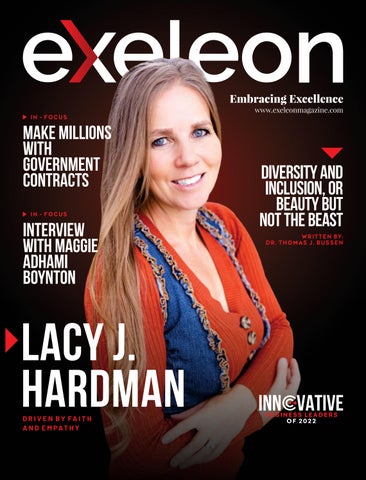
DRIVEN BY FAITH AND EMPATHY




Editor-in-Chief –
Art Director –
Managing Editor -
Creative Director –
Contributing Editors –
Content Curator –

Project Manager –
Marketing Manager –
Senior BDM –BDM –Embracing Excellence
Daryl Yeung (Story-Tailor)
Naomi Lam (Design Ninja)
Matt Reis (Wordster)
Adam Waring (Grafista)
Ian O'Shea, Matt Hale, &
John Riggs (Three Musketeers)
Cathy G. (Explorer)
Sales
Josh Wilder (Cultivator)
Mike Jackson (Marketeer)
Katherine Price (Sustainer)
Richard Dann (Facilitator)
For any advertising related information, please contact info@exeleonmagazine.com. Submissions as well as contributions to the magazine are welcome.
Take a moment and let us know about our magazine; whether it be about the design or a possible mistake, we would appreciate any feedback from your end. You can reach out to daryl@exeleonmagazine.com. 600

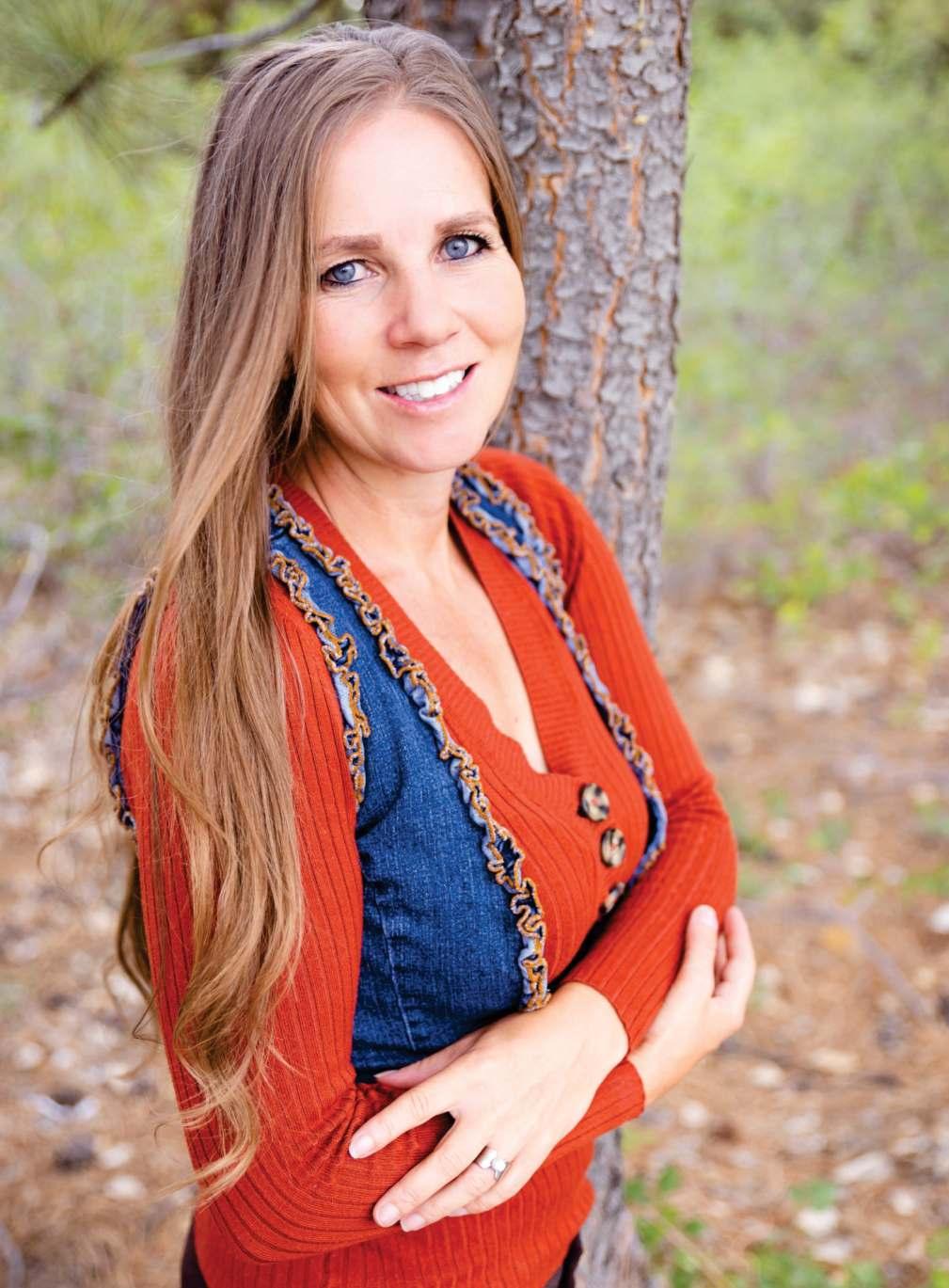
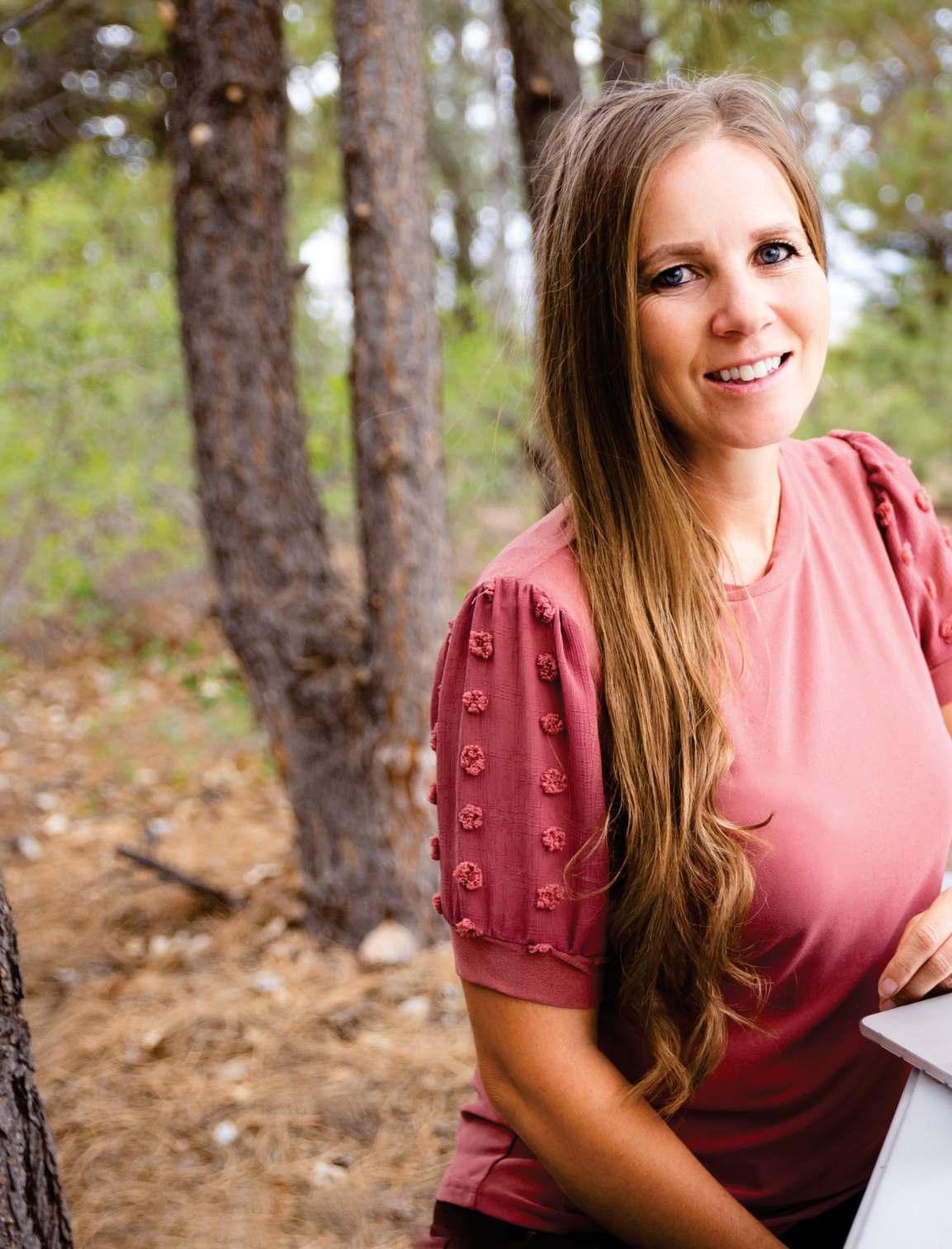
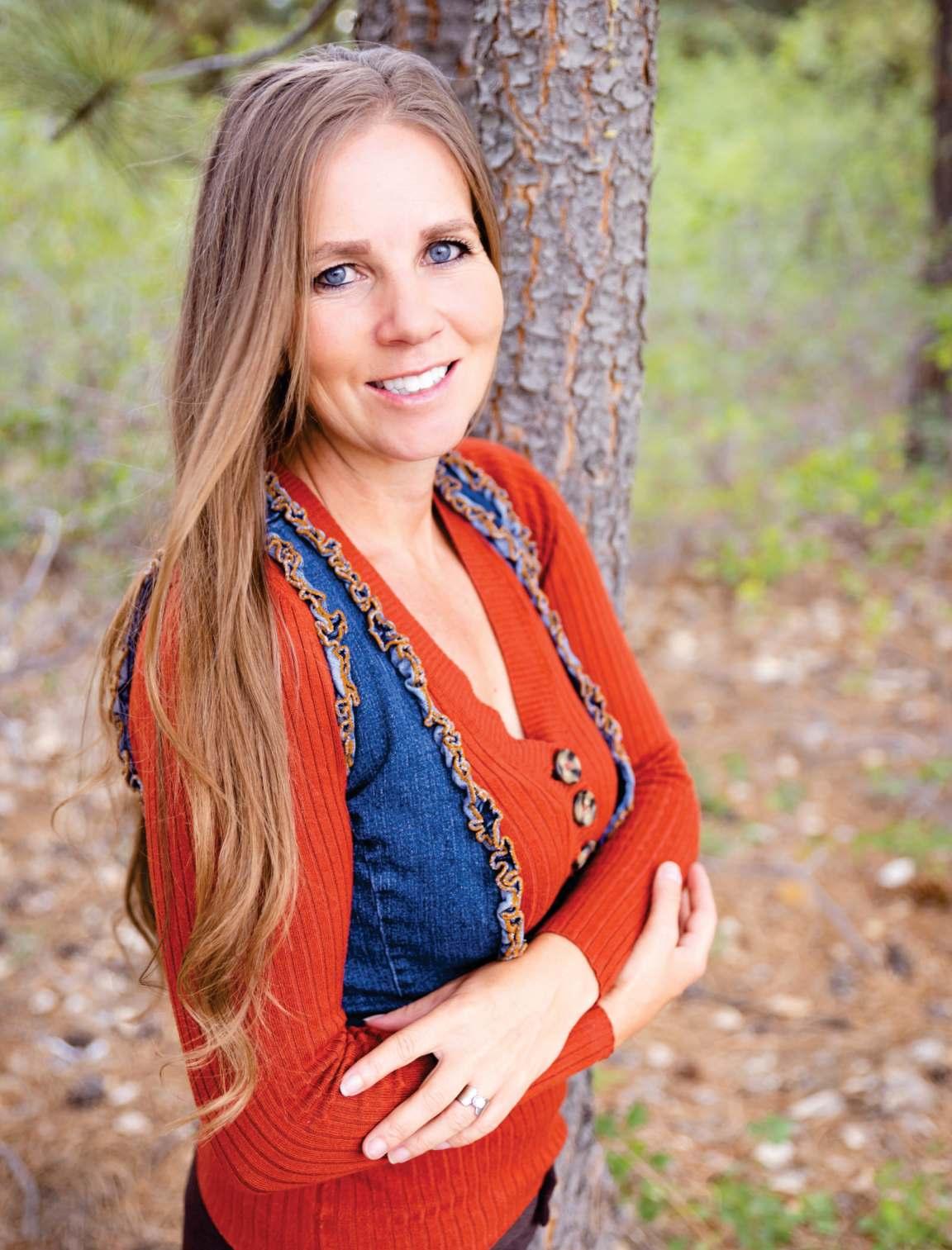
LACY J. HARDMAN
BUSSEN










There's something about
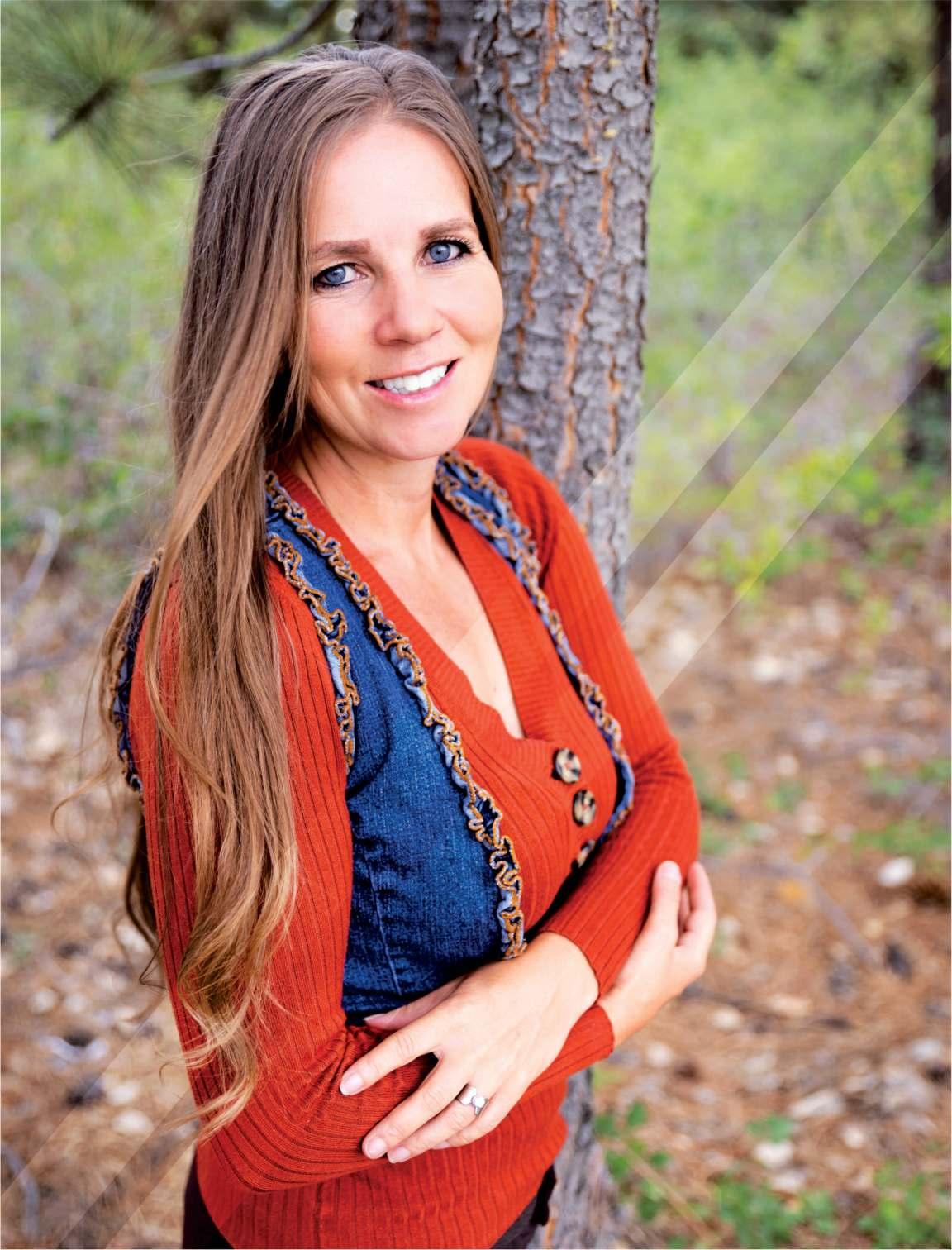
Lacy J. Hardman. It's not just her ability to courageously lead from her heart every day. It's more. It's her tenacity, ambition and intelligence that has helped her forge a momentous path as a new style of leader.
Lacy's steely resolve as a trailblazer is relected in every step of her robust leadership. Her driving force is what she describes as “Romans 8:31, if He is for you, who can be against you.” As a self-assured leader, she decided to pick up Christ's characteristics from the past couple of decades and strived to implement that sage advice into her leadership style.
According to her, a powerful woman is one who cherishes being in touch with her divine identity and obediently seeks to fulill her divine destiny — as a partner with God — sacriicing everything else and moving mountains to make miracles happen.
Interestingly, it is through this divine inspiration she stumbled upon something beautiful in her 20's. “I had a blessing bestowed upon me that encouraged me to hold Jesus Christ as my mentor,” she says.
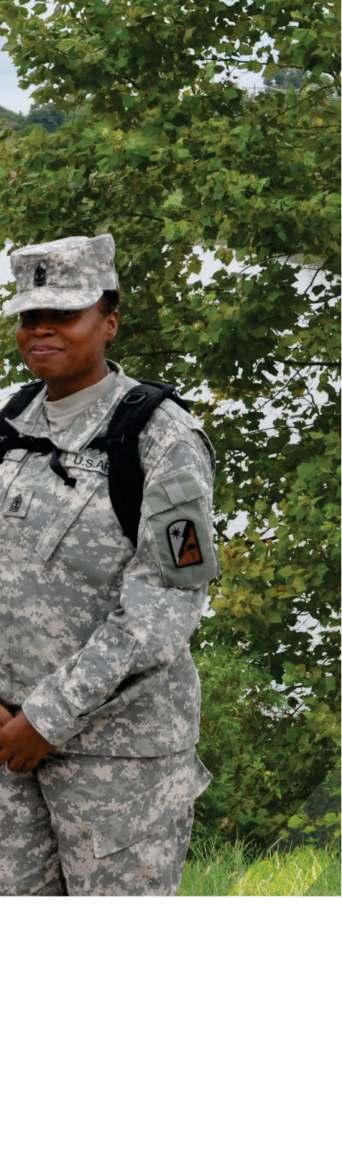
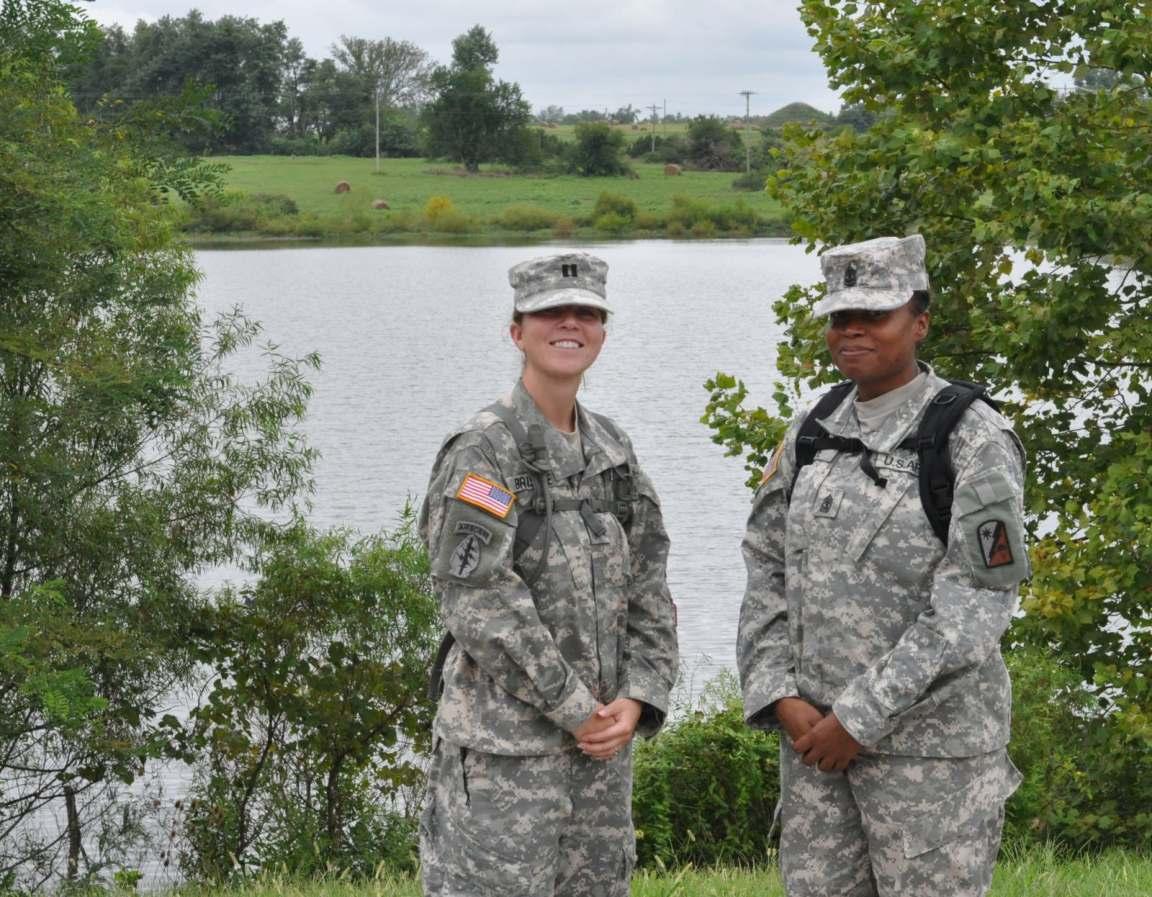
Apart from this, Lacy has graciously donned several roles in her life. As an Army Oficer, she was in the top 3% of her ield and a Combat Company Commander. She singlehandedly transformed a company of 200 Soldiers with a poor reputation into a solid performing group that excelled at their mission in Iraq.
As a Realtor®, she was awarded
Realtor of the Year, President of her local real estate association, and Top Producer each year. She also owns her brokerage irm and coaches her real estate agents to become six-igure Builder Agents.
But that's not all. At the Swell Retreat, she offers signiicant avenues to strengthen individuals, couples, families and corporations through recreation and principles of success. “Each of my leadership accomplishments came through stepping into the dark, trusting the Lord and acting on faith to follow my heart,” she shares.
Lacy's early involvement in the entrepreneurial world started from her younger years. She grew up playing monopoly with her dad on many hunting and ishing trips, which subconsciously planted a seed in her head.
Lacy recalls joining a network marketing program in high school that really opened her perspective towards leadership, selfdevelopment and entrepreneurial books—a world she loves. Soon, she realized she wasn't passionate about pursuing the network marketing business and found a way to explore her entrepreneurial spirit to provide solutions to problems.
“I remember being at one of the networking events and meeting a gentleman on the elevator. He exuded kindness, expertise, and carried himself in a way that I wanted to be. I wanted people to feel loved, yet know that I was an action-taker for making a difference

“Face each trial knowing that it is your opportunity to be refined into a better leader.”

“Each of my leadership accomplishments came through stepping into the dark, trusting the Lord and acting on faith to follow my heart.”


and an impact in the world,” she shares.
Ultimately, she really wanted to be a mom. But what does that have to do with real estate, one may ask? For Lacy's each deployment, she served with women who couldn't be physically present with their children. She really admired their ability to make such a huge sacriice but wanted something different for her years as a mother.
Lacy inds herself blessed to be able to live her dream as an army veteran, mother and an entrepreneur— all in one lifetime. She likes to call it as being a “mommy-vet-preneur”.
“I enjoy waking up early to recharge my batteries, read my scriptures, pray in gratitude, and meditate on my current trials and how to best navigate them with my favorite business partners, my Savior and my husband,” she says.
As an introvert, her morning recharge is vital so she can be at her best for her family, her team, and her clients. “Once my husband and kiddos are awake, we drive to the Swell Retreat to take care of our goats, donkey, pig, chickens, rooster, cats, dogs, long horns, and horses. I do 90% of Salty Peak Real Estate and Builder Agent Academy work with my computer, zoom, and phone, remotely,” she says.
Lacy ensures her team has the resources and things they need to accomplish her vision. “I actively built the Swell Retreat with my husband and kids into a premier destination for recreation and individual, couple, family and business success,” she shares.

“I had grown up in a single parent home, my mom worked 50–60-hour weeks, which meant taking care of myself and my little sister in many ways,” she says. After serving in the Army for 14 years, she felt it was time to focus on inding a lexible work environment that allowed her to be a present mom to her future children.
Later, she “interviewed” every real estate agent she met. Co-incidentally, a Realtor® in her church congregation was a very successful agent, mother, and leader. Lacy then asked for her advice, and she went way beyond that and invited her to tag along to some of her appointments. “It was so fantastic! I'm forever grateful for her kindness and leadership!” she recalls fondly.
Few years later, Lacy joined a business mentoring program called Pinnacle Global Network where she met some incredible business leaders that offered support, systems, and technology — that made business life easier.
Through her mastermind group, she was inspired by a business owner who created a curriculum for others based on her passion. Her example sparked an idea in Lacy's imaginative mind. This led to the creation of Builder Agent Academy and teaching other real estate agents the nuts and bolts of the business
including how to work for builders.
She invested several months learning from the world's best entrepreneurs, on their online platforms, to create her program that teaches agents to bridge the gap over the trench that she had been in for the past few years.
“Now our team gets Real Estate Agents trained and/or certiied to conidently work with a builder as a seller agent,” she shares conidently.
Lacy is determined to make an impact in not just her trainees' lives but also in her clients' experiences.
She believes and follows a simple approach to ensure peak client satisfaction: Never forget who you serve.
Infact, her signature program is a tailored system that offers a road map for each of her Builder Agent Academy students to successfully navigate an otherwise uncharted territory.
conidently work toward a sixigure income.
“It for sure isn't a get rich overnight program, but with diligent effort focused on the milestones I've set, they can be successful,” she shares.
Most agents that work for a builder just happen to be at the right place at the right time. But, with her training and certiication programs, she helps put the Real Estate Agent in the driver's seat so that they can
Lacy read Rich Dad Poor Dad at age 16, joined the Army at age 17, graduated from college, completed three deployments, and invested in real estate along the journey, inally sprouting that real estate seed.
But everyone's journey is different

and quality advice is a must-have in every entrepreneur's toolbox.



Lacy's advice to the budding women leaders and entrepreneurs is this: Reine your mindset to become a business owner, not just a solopreneur, allowing you to have balance and impact.
She also recommends hiring a personal assistant as soon as possible, allowing you to focus your time and energy on your clients, rather than mundane tasks.
Little did she know that some of the experiences she loved in her Army career would also be a fulilling part of her Real Estate career and her role as a mother.
“I loved serving, coaching and leading my Soldiers, now I get to serve, coach and lead my clients, real estate agents and children,” she says. Further, she loved an environment full of learning, implementing systems to overcome challenges.
Now, she continues to pursue her education as a real-estate expert and a coach for real estate agents. She also helps her clients through divine guidance and tools to overcome challenges.
“I loved creating operation orders to guide Soldiers to a successful mission and now having a business plan is just as vital. Every challenge I experienced and overcame in the Army has helped me be a better business owner and mother,” she says.

Creating a system that you continually ine tune or inding a coach with a proven system are game-changing decisions. “Face each trial knowing that it is your opportunity to be reined into a better leader,” she urges.
The innovative leader is excited to lead the new wave of possibilities with her team and deliver more exceptional services to her clients.


“We are working nationwide to train and certify 10,000 Real Estate Agents to be Builder Agents,” she shares with a beaming smile.
“In the competitive real estate industry, it is very important for agents to gain niche market education to help them be the expert for their clients through the buying, building and selling process. And adding goat yoga to Swell Retreat!” she concludes happily.





Written By: Dr. Thomas J. Bussen
The industrialist Andrew Carnegie once said, "Teamwork is the ability to work together toward a common vision. The ability to direct individual accomplishments toward organizational objectives. It is the fuel that allows common people to attain uncommon results.”
True, perhaps, but not always so. Teams can also lead otherwise productive individuals to wither and burn, to crack, break, and shatter. What distinguishes Carnegie's hopeful team's outcomes from the dreary and painful?
To be sure, teamwork is a complex, multi-faceted phenomenon, and so explanations for team outcomes bely a singular explanation. And yet, in an ever more global world, the diversity of teams – or its lack thereof – is a vital predictor of team success.
Does then diversity improve team performance, or does it harm team performance? Somewhat unfortunately, “yes” seems the best answer. Before exploring the ways in which diversity may both harm and help a team, a brief excursion to consider exactly what is meant by diversity is useful.












UT Austin's David Harrison and colleagues conceptualize diversity at the surface level and at the deep level. Surface level diversity is that diversity which is quickly and readily apparent. This is the diversity of the young and the wizened coming coming together, the accents of different ethnicities, the visible manifestations of gender or race.
By contrast, deep level diversity is rather sneakier – a team may exhibit very little surface level diversity but may over time come to recognize its differences across various psycho-social spectrums. You are an extrovert; I an introvert. His values differ from her values, her behaviors are at odds with his. These deep level differences may be invisible during early interactions, but the longer a team works together, the more familiar each becomes of the others' little peccadillos.
At irst glance it may appear that surface level differences ought to cause teams the biggest headaches. And indeed, they do. In the absence of signiicant deep level differences, however, the timeline is brief. Imagine that you and I come together with a kaleidoscope of surface level differences – differences in age, gender, nationality, religion, perhaps even different roles and responsibilities in the organization. The similarity-attraction theory holds that initially, we may not much take to one another.
This theory proposes that we humans tend to prefer that which is similar, and to disdain that which is different (lest we judge our species too harshly, sufice it to say that this preference has evolutionary roots, roots which arguably serve us less with each globalizing day).
But then imagine that as it happens, our surface levels differences mask deep level similarities. We both are big St. Louis Cardinals baseball fans; we support the same national politicians; our sense of morality overlaps; and heck, we both love cruise ships despite their icky reputation. Before long, the two of us are getting along splendidly, having long ago intuited that those surface level differences matter little amidst similarities that go


more to our senses of identity.
What really matters, therefore, are those surface level differences. Take the reverse situation. Initially two teammates seem to have much in common at the surface level. Similarity attraction bias acts to magnetically attract the two, and all assume a friendship or at least collegial relationship is fast budding. But as deep level difference after deep level difference rises to the surface, the relationship begins to fray.
The research offers us this, therefore: surface level differences initially disrupt team harmony, but over time matters less and less. By contrast, deep level differences initially matter little, but disrupt team harmony more over time
The takeaway may appear obvious: to avoid deep level differences. Alas, such a takeaway would ignore a vital strand of research. That while deep level differences do indeed tend to harm teams, they also tend to improve team outcomes much more than does surface level diversity.
All of that deep level diversity allows team members to learn from one another, to better explore decision making paradigms, and to exchange a greater quantity and quality of information. In and of itself, for instance, differences in team members' ages or ethnicities offer little; but when those differences in age and ethnicity lead to dramatically juxtaposing life experiences, or when other deep level differences do so, now the team has a rather more diverse set of opinions and ideas to view decisions from all perspectives.
The problem is that deep level differences may prevent the sort of communication needed to leverage such learning opportunities. Similarly, surface level differences may prevent team members from learning enough about one another to recognize that despite their surface level differences, and perhaps despite deep level differences, they also have deep level similarities.
The challenge for teams, therefore, is to avoid the potential conlicts arising from diversity, and to thereby gain access to the goldmine that is a

deeply diverse team. The SimilarityAttraction Bias offers insights as to how, exactly, we can do this.
I spoke to Doug Mattheus, the senior marketing executive at telecommunications company Cell C until 2019, and now an independent consultant and professor at Nelson Mandela University. He explained to me that while working for Firestone Tire in post-Apartheid South Africa, during the heady days surrounding Nelson Mandela's election to President, Firestone provided diversity training to its employees. Mattheus explains that a psychologist divided the group into partners based on surface level differences: this man with that woman, that white South African with that black South African, and so forth.
Then, the trainer asked the partners to converse and aim to discover what characteristics they held in common. While all of the partners engaged in the activity, Mattheus recalls two individuals in particular. These two individuals were overlowing with surface level differences: one male and one female, one a white and one a black South African, one a senior organizational member and the other a lowlevel worker. But now both were crying.
30-odd years later, Mattheus felt the goosebumps rising as he tells the story. It turned out that the partnered professionals were each the parent of a developmentally disabled child. Did their surface level differences matter in the face of this realization? Of course not. They now shared something, something deep , that far exceeded the import of such surface levels characteristics.
This is the similarity-attraction bias at work for us . Far from allowing the bias to manipulate us into a place of separation, that psychologist working for Cell C leveraged
the bias by helping trainees to identify similarities that would prove more important than differences.
The psychologist Jonathan Haidt, similarly, advised that surface level differences may be “drowned in a sea of similarities.” He was correct, in part. We ought indeed to highlight similarities, though to “drown” our differences may not quite hit the mark. Rather, we ought to highlight similarities, but use the similarity-attraction bias to create the space for embracing differences, too. Only then do we facilitate a working relationship that is based on mutual attraction, while also learning and beneiting from each other's differences.
While Mattheus' story is powerful, it is admittedly anecdotal. As researchers like to say, it has an n of 1 - a sample size of just one person, hardly suficient to generalize at large. Psychologist Jerry Burger tested this proposition, however, and his indings are perhaps even more provocative.
In the study, research participants complete a psychological survey, which they are made to believe is the focus of the study. The real study, however, came later – as participants were exiting the study, another would-be study participant working undercover for the researchers asked if the participant would be willing to read his 8-page essay, providing one page of feedback within 24 hours. Somewhat surprisingly, 48% agreed.
This represented the control group. A second group of participants were subjected to the same procedure, but during the purported psychological study were told that they shared a Type-E ingerprint with another research participant. This is not surprising, they were told; approximately 80% of the population has Type-E ingerprints. Leaving the research study later, lo and behold their ingerprint twin comes approaching – asking as before whether the participant would review his eight-page paper and return the notes

within 24 hours. This time, 55% agree – a slight increase but not a statistically signiicant one.
The real breakthrough came in study three. This time, the participant is again told that he shares type-E ingerprints with the undercover research participant, but now he is told that only 2% of the population has these same prints. Approached to review the essay by the ingerprint friend, now a full 82% agree to review the essay.
The study suggests that, as Wharton's Adam Grant once put it, we don't simply highlight commonalities. We highlight “uncommon commonalities”. Paired with Mattheus' story from Cell C, we might also seek to highlight important commonalities (which presumably the Type-E ingerprints were not).
In creating the terms by which team members may communicate and recognize uncommon commonalities, and important ones too, organizations play a key role. The risk is that employees never reach this vital place of communication, and this is most likely to happen when employees are too blinded by their prejudices and stereotypes to recognize the multitude of commonalities that all of us humans inevitably share.
Organizations, therefore, ought to play an active role in facilitating an environment not just of diversity, but of diversity and inclusion . An inclusive environment is one in which cultural and other differences are embraced; in which differences are seen as opportunities for learning, for personal growth, and for achieving excellence. By championing diversity, by ensuring employees recognize the potential value when opting into diverse teams, the foundation is laid for just the sort of breakthroughs seen by Mattheus, and in the Burger study.
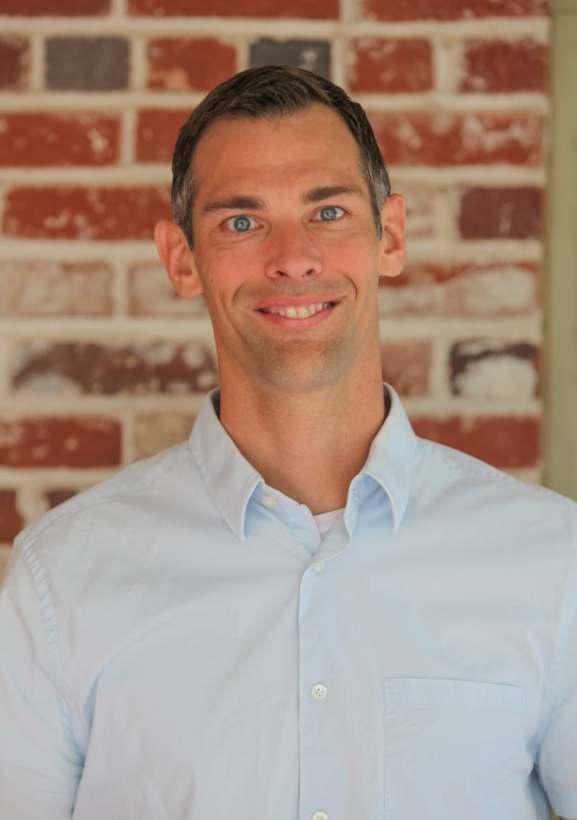
Dr. Thomas J. Bussen , with a Doctorate of Busines Administration, JD, and MBA, is an Assistant Teaching Professor at Miami University in Oxford, Ohio, and a cross-cultural management scholar. He is the author of several cross-cultural books, including Shaping the Global Leader (2019).
His latest book, Enlightened Self Interest: Individualism, Community, and the Common Good (coming in 2023, Georgetown University Press), makes the case for a more inclusive and globally minded professional ideology.



M a g g i e A d h a m i B o y n t o n
From selling goldish for
Iranian New Year to Mukluks, from entering the fashion space to building a one-of-a-kind live shopping platform –ShopThings, the journey of Maggie Adhami Boynton has been nothing short of fascinating. Read this exclusive interview to ind out more about this innovative leader.
What according to you makes one an innovative leader? How do you integrate the same thought into your leadership?
I believe that innovation comes in many forms and can really vary from one leader to the next. For me, innovation means that we are always pushing the boundaries and “breaking” everything. If we are not
breaking the process, the machine, the status quo, then we are not innovating.
I integrated this into my leadership style by encouraging a culture of failure and learning. If your team is not scared of being perfect and of failing, they can really think outside the box and try new ways of doing things.
What is your earliest memory as a leader / entrepreneur that you can remember?
My earliest memory of being an entrepreneur is at the tender age of 16, selling goldish at the local market for Iranian New Year. The thrill of “building a business”, even if it was just a seasonal business
that barely broke even, was addictive. That quickly turned into me opening an eBay store, selling Mukluks for the better part of my university years, while teaching me a lot about managing funds. My love for entrepreneurship was deinitely instilled in me by my mom, who has been a serial entrepreneur for as long as I can remember and has always encouraged me to do the same.
What prompted your interest and subsequently your foray into the tech and e-commerce space?
I have always been very ambitious and had a deep love of fashion. I was looking for ways to combine my fashion interests with my 15+ years of tech experience and saw


ShopThing as an amazing opportunity to challenge myself and change how consumers shop and sell with live video commerce.
What is live shopping and how did the idea / formation of ShopThing come about?
Think QVC, but on mobile, with an engaged audience that can participate. Typically done via video livestream or social media, hosts will present products to their audience, answer questions and provide recommendations in realtime.
Live shopping was already an existing retail format in Asia as long-form video, but I wanted to bring the experience to North America in a different way: curated events using short-video, that would resonate with this market.
The pandemic was a catalyst for us.
People missed in-store experiences and human connection, and live shopping was such a unique way to help solve for that loss. ShopThing audiences felt like they were out with friends and, even now that the world is opening back up, they continue to shop through us for its convenience and authority.
How did the platform leverage Inluencer Marketing to establish its brand presence?
Inluencer marketing is an integral part of our company model and has driven a lot of our success. We handpick our inluencers very strategically, ensuring that they're promoting brands that resonate with them and their audiences.
Our inluencers curate their own events to create an experience that is engaging and authentic, and that allows them to foster a connection with our users because they're
speaking to products and brands that they genuinely love.
Looking back at your journey, what would you have done differently if you were to start again?
I would have started the irst 4 businesses that I was too scared to start.
In my early days as a working professional, I was really unsure of my ability to start and operate a business. As I gained experience scaling a business, I became more conident in my abilities, ultimately leading to the inception of ShopThing.
If I could go back, I would tell my past self to just take the leap and learn as you go. Not all of them would have been successful, but there would have been invaluable learnings in each venture.
Finally, what does the future look like for ShopThing? On a personal front, where do you see yourself standing in the coming years?
The coming months and years will be very exciting for ShopThing! We're expanding into new markets, bringing on more inluencers and diversifying our product offerings.
We recently piloted our irst preloved event, which was a huge success with our audiences, so you can also expect much more to come there.






IC o l d p l a y

n 2019, Coldplay announced their
vision of a more sustainable touring footprint. With the simple intention of reducing environmental impact, Coldplay set out on this global mission.
However, turning this into a reality required the insight, knowledge, and foresight of a team of capable experts.
Frederic Opsomer, Director at PRG Projects, spearheaded this into a possibility and brought alive the vision of one of the biggest touring bands in the world.
In this Exclusive Interview, Frederic shares his journey, the Coldplay project, and the
various unknown challenges his team had to face.
What according to you makes one an innovative leader? How do you integrate the same thought into your leadership?
For me, an innovative leader is someone who tries to predict the future by looking ahead 20 years, then working to igure out how we can take steps to get there today. I try to integrate this into my leadership and work by developing new products and new technologies that help lead up to what the future will look like years from now.
What is your earliest memory as a
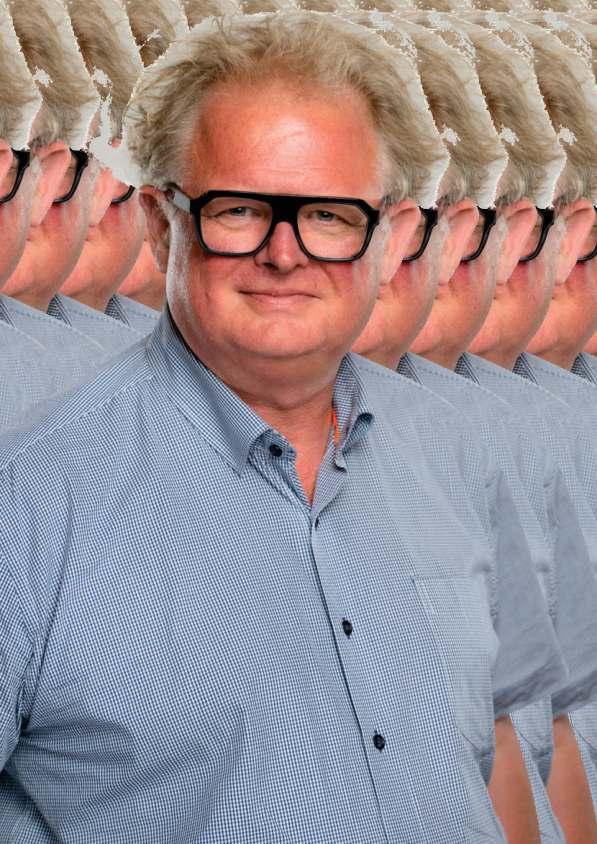

DIRECTOR, PRG PROJECTS
leader / entrepreneur that you can remember?
As early as 12 years old, I've been the person at school and with my friends who organized all of the activities, whether it was for school, sports activities, or parties. I always have been that guy that volunteered to be the spokesperson for those kinds of roles and took on those responsibilities.
Brief us about your role at PRG Projects as the Director and what it involves?
At Production Resource Group, I lead the PRG Projects division which I formed in 1993. This arm of the business builds truly unique proprietary solutions for the production and entertainment industry all over the world.
Our goal is to enhance the audience experience with a range of extraordinary visual spectacles. I have a long history of providing custom LED structures for touring artists like U2 and Coldplay whose creative vision informs the work we do. I'm closely connected with each
project and work alongside my incredible team on event design, installation, and LED innovation.
Talk to us about the vision with which Coldplay approached PRG Projects and the task at hand.
We actually approached Coldplay in January of 2020 after Chris Martin announced that he would only do his next tour sustainably and we had a lot of ideas on how to accomplish this.
The artistic set designer, Misty Buckley, made some initial sketches on what the stage would look like and from there, we began experimenting with different materials like bamboo, which is incredibly sustainable, to see how we could make the visions come to life.
This was very different from other tours because we really studied the materials we were using and were exploring many more avenues for each idea than we normally would. Not all of our ideas made it to the tour, but we played around with each idea in order to achieve the best results.
How did you and your team turn this vision into a reality? What were the techniques and methods used?
Chris Martin and Coldplay have been longtime environmental champions, so our mission was to make their desire for a more sustainable touring footprint a reality. To accomplish this for their current Music of the Spheres Tour, our team reduced the transportation size of the show's main visual element - four large

LED spheres that loat above the stage, 2 at 10' diameter and 2 at 15' diameter.
PRG Projects engineered a solution that allowed these spheres to be inlatable which meant that they travel in their delated state, minimizing the number of trucks required for transport. The framing and rigging for the LED spheres are minimal making it more eficient to dismantle and pack, and also reducing the required truck space. The lighting system is made up of low-energy LED sources so overall we're using about 50 percent less power as compared to Coldplay's previous tour, helping to make this outing as sustainable as possible.

What were the biggest challenges that you had to face during this entire project?
When we started this project at the beginning of the pandemic, supply chain issues were a real concern. We were dealing with a lot of parameters that we didn't have in the past, which made the risk factors higher and increased the potential to slow down the process. The process was much less predictable as well since everything leading up to concerts is normally as organized as possible, and the pandemic threw that off.
Many of our components are manufactured in China, which was locked down, but our team worked around the clock to make it happen on time with the production calendar. When it came to making the actual set design, one of our biggest concerns was transporting everything needed for the show in an environmentally friendly manner.
Using traditional construction techniques, the four spheres would have needed 6 trucks for transport. In order to minimize CO2 emissions, our engineers at PRG came up with the inlatable solution so that they would travel in a collapsed state and it in one truck, which has never been done before and required a lot of research and testing.
Ultimately, each sphere uses narrow strips of LED that are sewn into the skin, so we needed to be particularly mindful to make them robust enough to withstand not only the elements (outdoor shows) but also expanding and contracting every day.
There is a shifting inclination when it comes to the need for sustainability. What is your take on this shift across industries?
I agree that there is a shift towards sustainability and that it is necessary to make this adjustment across industries. Within what we do at PRG, we are very focused on sustainability and inding ways that we can go further. Compared to 1993, it would take nine trucks to move a 100-meter screen. Now with our advancements, we're able to move the same size screen with half a truck.
The next frontier of innovation for us is to continue inding ways for the actual installation of the equipment to become more sustainable. We're already making moves towards this by creating screens that the concert sound system can go behind instead of the sound systems sitting above each screen, which reduces the need for additional structure on tours.
Overall, across industries, the best way to move forward is to encourage collaboration between the different parties involved and to change procedures together to make an impact.
Finally, what does the future look like for PRG Projects? On a personal front, where do you see yourself standing in the coming years?
Personally, I will be spending more time in the US as I am moving from Belgium to Las Vegas. I'm helping our division here in the US set up the same division that is currently being set up in Europe that will allow artists who are touring internationally to not have to transport their touring equipment overseas. Instead, we will be able to supply their equipment on both continents. We're working on building a platform to accomplish this eficiently and that will also allow us to recycle 100% of the equipment we're using so that none of it ends up in a landill.
As for PRG Projects, we are continuing to strive for more sustainable projects, such as building this division, and to build upon our sustainable innovations as this remains a very important focus for us.


Angelo Ciaramello
Founder and CEO
The Funded Trader
Trading has always been an industry that offers a lot of opportunities of
growth and inancial success. However, the capital requirements to get started in the industry has always been a subject of concern for new and emerging players.
To address this situation, Angelo Ciaramello founded The Funded Trader. He explains, “I wanted to level the playing ield and give everyone a chance to achieve their trading goals, regardless of their inancial situation. That's why we created Funded Trader.”
Today, under the leadership of Angelo, the company is reaching heights of success and helping a wide range of people realize and achieve their trading goals.
In this Exclusive Interview, Angelo Ciaramello talks about his journey, trading, and much more.
What according to you makes one an innovative leader? How do you integrate the same thought into your leadership?
An innovative leader is someone who is willing to take risks, think outside the box, and challenge the status quo. In order to be an innovative leader, you must be open to new ideas, willing to experiment, and comfortable with change.
You must also be able to inspire others to think creatively and work together towards common goals. Integrating the same thought into your leadership means that you prioritize innovation and creativity in your work. You encourage others to think differently and come up with new solutions to problems. You are also willing to take risks yourself, which shows others that it is safe to take chances.

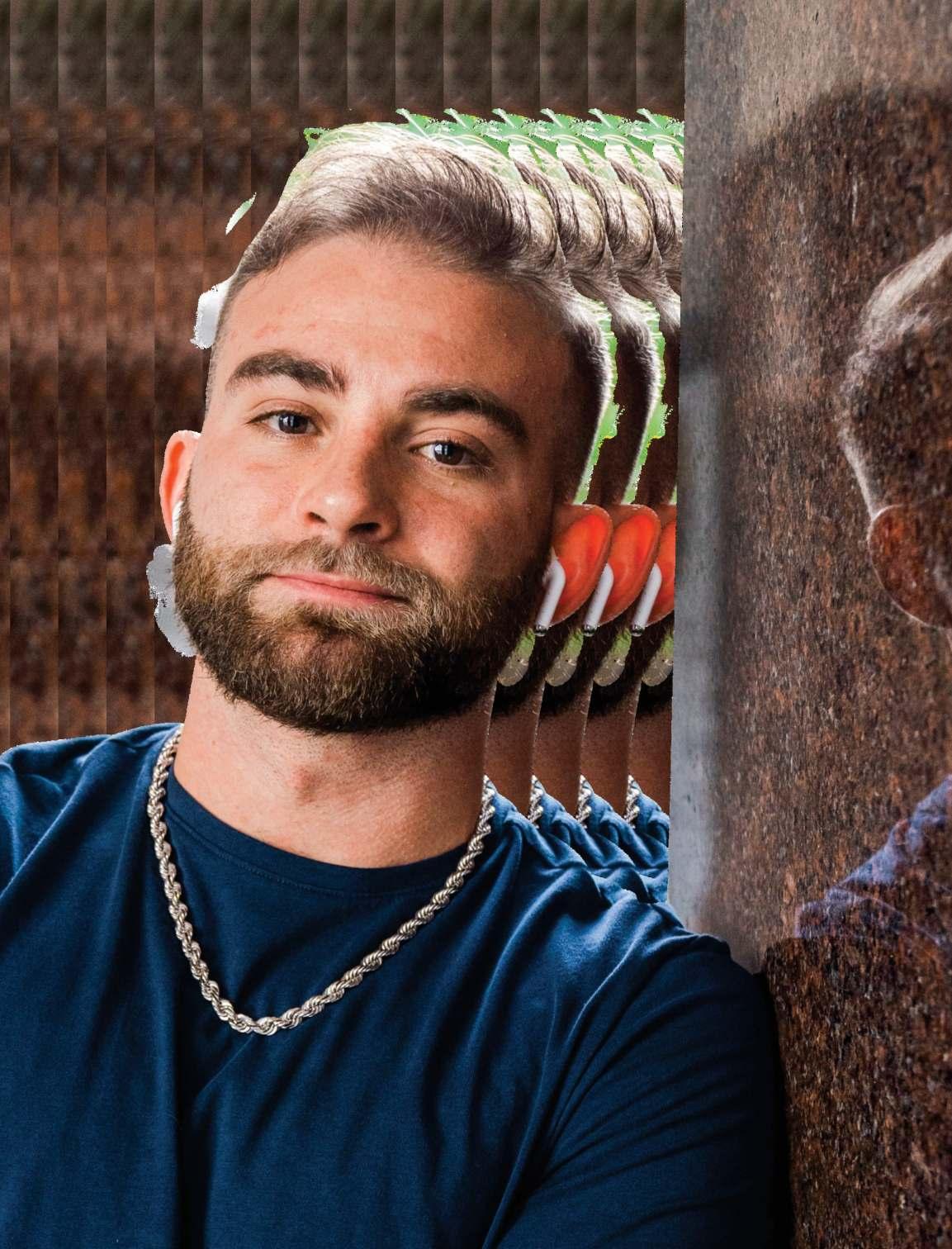
Ultimately, being an innovative leader means that you create an environment where new ideas are welcomed and encouraged. This can lead to better outcomes for your team or organization as a whole.
Talk to us about your growing up years. What is your earliest memory as a leader / entrepreneur that you can remember?
I grew up in a small town in New Jersey. As a child, I was always very interested in business and entrepreneurship. I can remember setting up a lemonade stand in my front yard and being so excited to make my irst sale. From that moment on, I knew that I wanted to be my own boss one day.
I also have fond memories of being involved in various extracurricular activities in school, such as student council and debate club. These experiences helped me to develop my leadership skills and taught me the importance of hard work and dedication.
In college, I started my own businesses and quickly learned the ropes of running a successful operation. Looking back, I am grateful for the experiences I had growing up, as they laid the foundation for my success as an entrepreneur.
What prompted your interest and subsequently your foray into the forex trading space?
I was initially introduced to forex trading by a friend who had been doing it for a while. He showed me how he was able to make money by
buying and selling currencies, and I was immediately hooked. After doing some research and taking a Forex course, I decided to open my own account and start trading.
Since then, I have enjoyed the challenge of trying to navigate the ever-changing forex market. While there have been some ups and downs, I am conident that my skills have improved over time, and I am looking forward to continued success in the future.
What was the idea that led to the start of Funded Trader? What was the pain point that you wanted to address?
The idea for Funded Trader came about when I was working as a day trader. I saw irsthand how dificult it was for people to get started in the industry because of the high capital requirements.
I also saw how many people with talent and potential were unable to pursue their dreams because they didn't have the money to do so. I wanted to level the playing ield and give everyone a chance to achieve their trading goals, regardless of their inancial situation. That's why we created Funded Trader.

Trader, my primary responsibility is to provide strategic direction for the company. I work with our executive team to develop longterm plans and ensure that we are meeting our inancial goals. I am also responsible for making major decisions, such as whether to enter new markets or launch new products.
On a day-to-day basis, I spend a lot of time meeting with traders, potential partners, and other stakeholders. I also stay abreast of industry trends and changes so that we can adapt our business strategy as needed.
In addition to my role as CEO, I am also the face of the company. I represent Funded Trader at industry events and in the media. And, when necessary, I make public statements on behalf of the company. As you can see, my role as CEO is both strategic and operational. I wear many hats, but ultimately my goal is to ensure that Funded Trader is a thriving and successful business.
Looking at your journey, what would you have done differently if you were to start again?
We provide prospective traders with the capital they need to get started, as well as the training and support they need to succeed. Our goal is to help people realize their trading dreams and reach their full potential.
As the Founder and CEO, what role do you play in the day-to-day proceedings of the company?
As the Founder and CEO of Funded
I was always interested in Forex trading, but I didn't start until a few years ago. I wish I had started sooner because it has been a great way to make money and learn about different cultures. If I were to start forex trading again, there are a few things I would do differently. First, I would make sure to have a solid plan in place. This plan would include my goals, risk tolerance, and strategies for entering and exiting trades. Without a plan, it is all too easy to get caught up in the

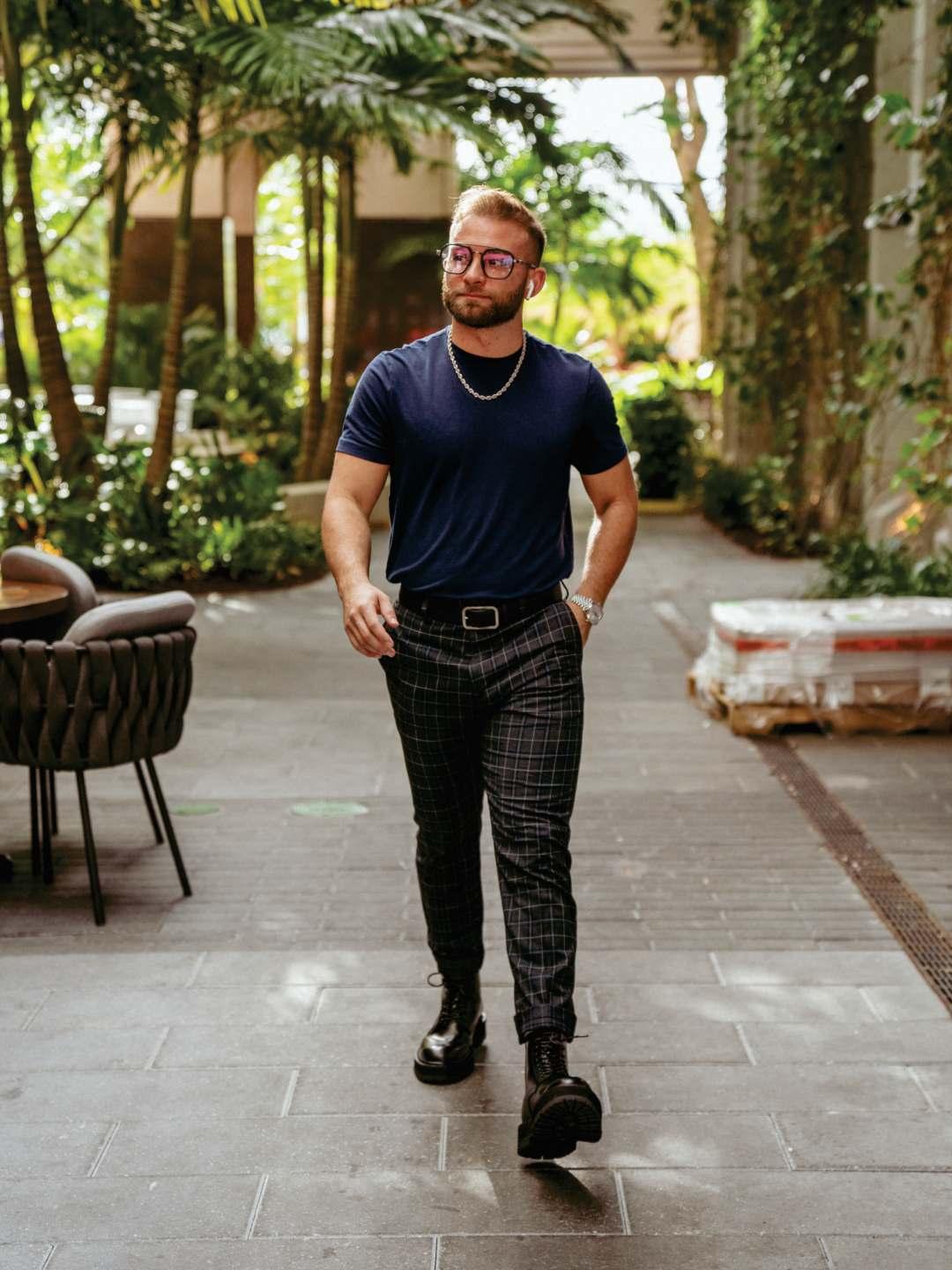
excitement of the market and make impulsive decisions that can lead to losses.
Second, I would make sure to educate myself thoroughly before starting to trade. There are a lot of resources available online, and it is important to understand the risks involved in forex trading before putting any real money at stake. Finally, I would start with a small account and only trade with money that I am prepared to lose. By following these steps, I would be better prepared to navigate the forex market and hopefully achieve success.
What according to you is the future of forex trading and how the integration of technology is bringing in new market players?
The future of forex trading looks bright, with the integration of technology bringing in new market players and making the process more accessible than ever before. In the past, forex trading was primarily the domain of large banks and inancial institutions. However, the advent of online trading platforms has opened up the market to a much wider range of participants. Today, anyone with an internet connection can trade forex, and the increased competition has helped to drive down costs and improve liquidity.
Looking ahead, the continued development of technology is likely to bring even more changes to the forex market. For example, the use of artiicial intelligence and machine learning could help to provide traders with real-time insights and analysis, making it easier to identify proitable
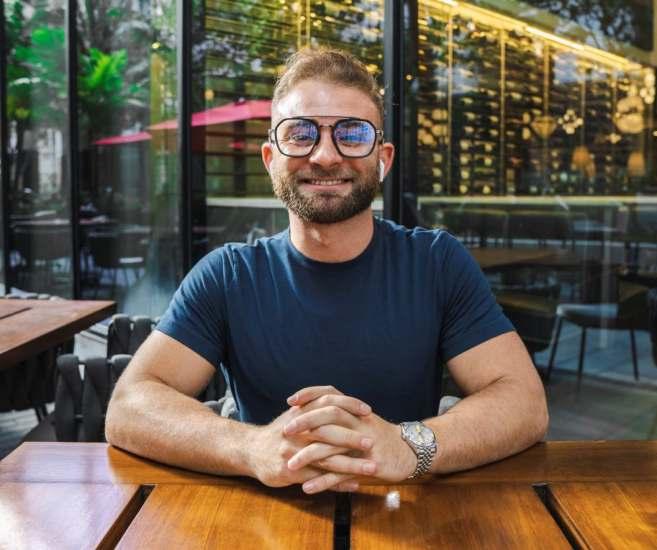
opportunities. Similarly, blockchain technology could help to streamline the process of settling trades and reduce counterparty risk. The one downside of this is that it may also make the market more volatile. However, this is something that experienced traders will be able to take advantage of. Overall, the future of forex trading looks very bright; with so many exciting developments on the horizon, it is only going to get better with time.
Finally, what does the future look like for Funded Trader? On a personal front, where do you see yourself standing in the coming years?
In the coming years, I see Funded Trader continuing to grow and expand its reach. We will continue to provide traders with the capital and resources they need to succeed, and we will keep improving our platform to make it even easier for traders to get funding and connect with banks.
On a personal front, I see myself continuing to lead the company and help it grow. I am passionate about what we do, and I strongly believe that we are making a difference in the lives of our traders. I am also committed to continuing to educate people and staying up to date on all the latest developments in forex trading.
In the future, I see myself continuing to invest in and support Funded Trader. I believe strongly in our mission of empowering traders, and I am excited to see what the future holds for us. Thank you for your support, and I look forward to continuing to work together to make Funded Trader the best it can be.


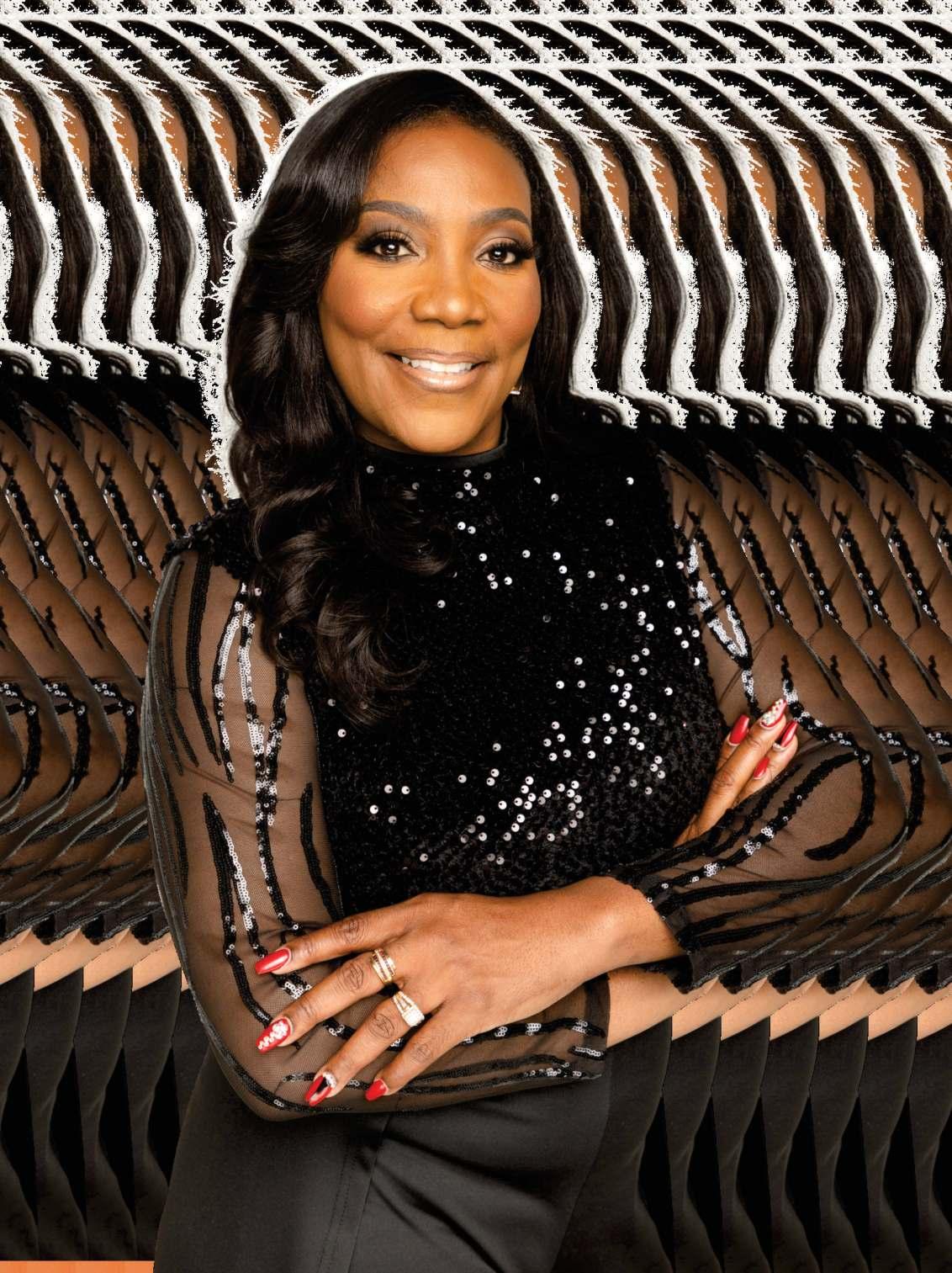
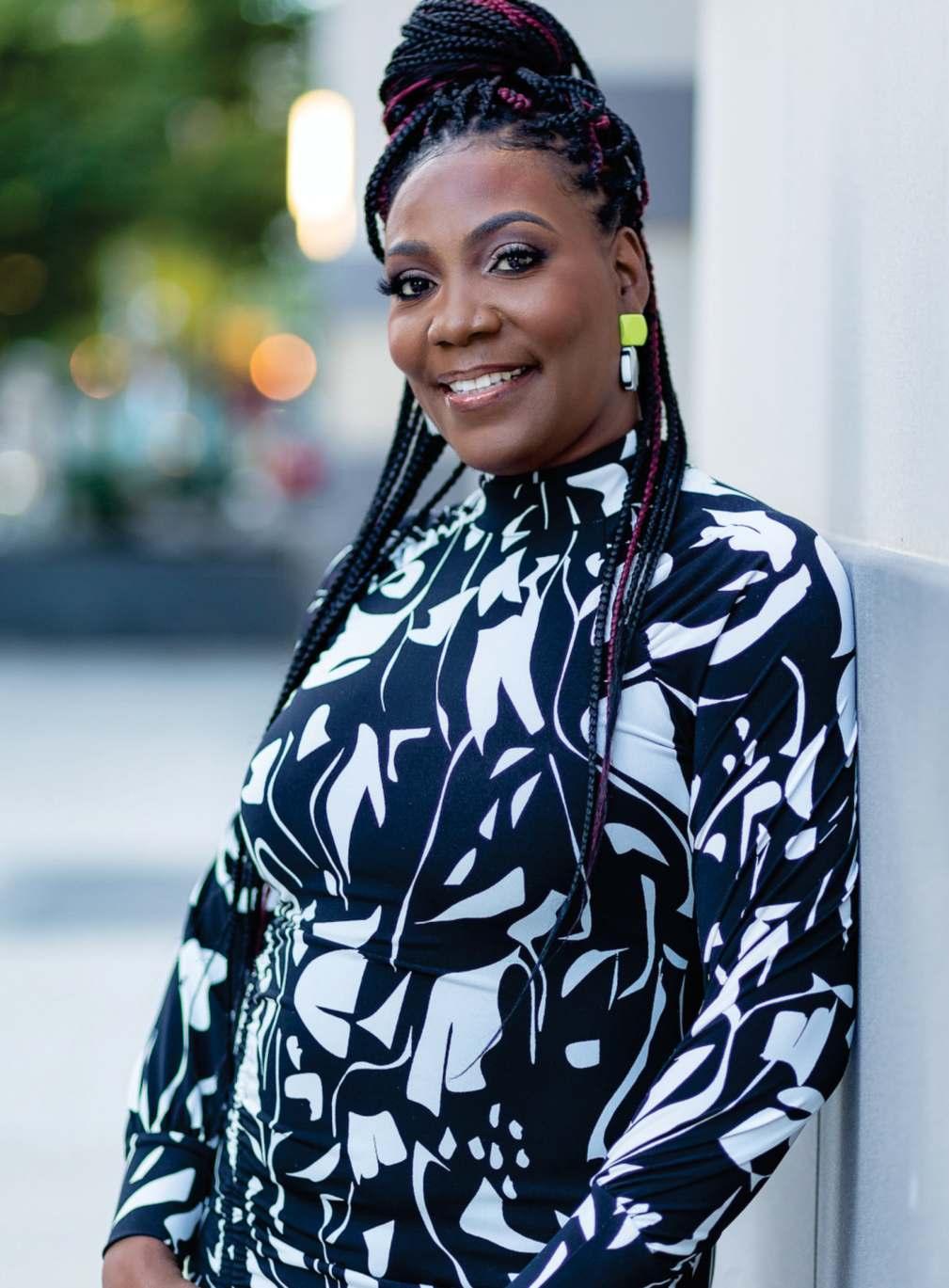
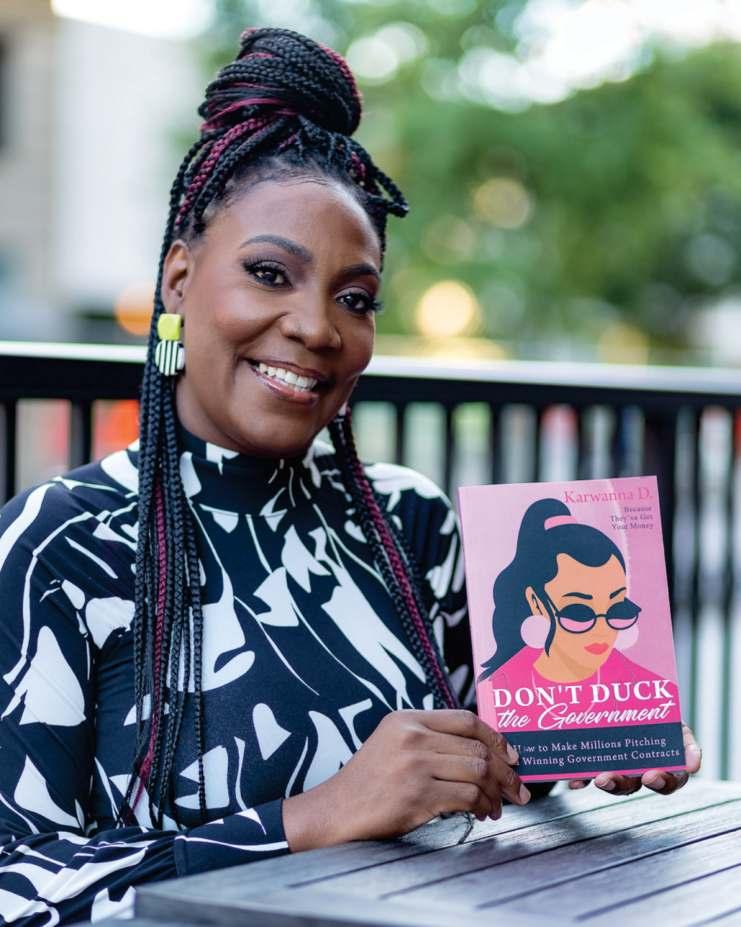
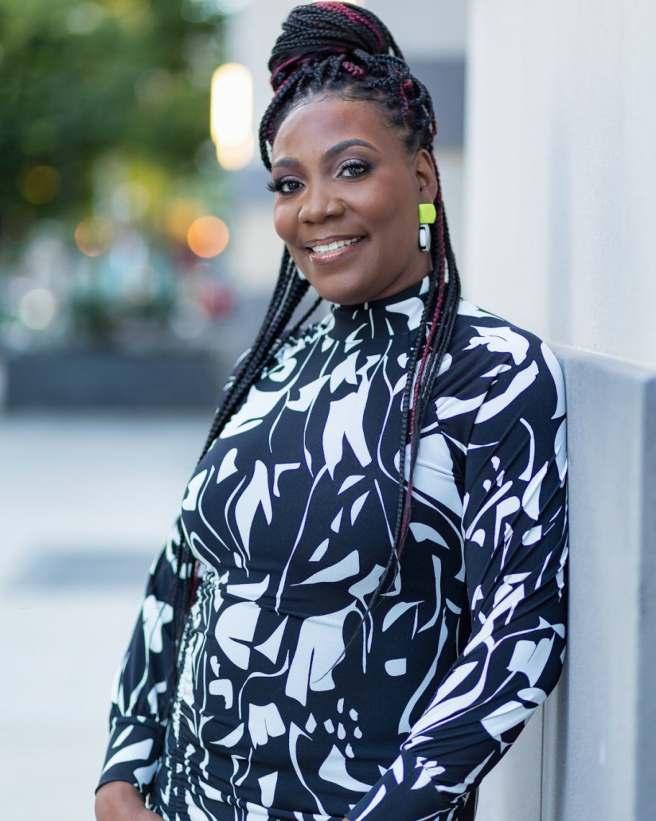
Growing up as a natural-born
leader, Karwanna D. always envisioned herself as someone who makes an impact on the lives of others.
For her, success was a collective endeavor, instead of an individual pursuit. With this same thought, Karwanna has impacted the lives of hundreds of entrepreneurs.
As a Government Contracts Strategist, Karwanna D. is helping businesses grow and scale by pitching and winning government contracts. Find out more about this impactful leader in this
Exclusive Interview.
What according to you makes one a powerful woman?
A powerful woman is one that is willing to do the work to achieve success or whatever they want to achieve.
How do you integrate the same thought into your leadership?
I was not born into success, I had to work hard, shift my mindset, and invest in myself to get to where I am now. And I always tell my clients, success doesn't just fall into your lap, you have to do the
work and put in the work because nothing comes for free.
“Free” doesn't just mean monetary. It also means time. There's always going to be a cost attached to success, whether it be time or money, or sometimes both.
What is your earliest memory as a leader/entrepreneur that you remember?
I remember I wanted to get up on the pulpit as an inspirational speaker and share my knowledge of scriptures as a minister in our church. It was made to be a joke as if I wasn't approved for leadership in that capacity. But yet there were boys as young as 10–12 years old who were praised for getting up on the pulpit to share their knowledge in scripture and leadership.
What I learned from that experience is that there is a time and place for everything, and it was just not the place nor the time for me to be great. I didn't let it deter me from developing into the leader I am today. Also, the conidence that I had as a little girl, made me realize now that I was a natural-born leader.
How are you helping entrepreneurs grow their business with government contracts?
Government contracting is the most untapped resource when it comes to growing and scaling a proitable business and I simply teach entrepreneurs the step-by-step process on how they can make millions pitching and winning government contracts as a small
business. By showing how businesses can play their cards right, they can easily add 5, 6, or even 7-igure income in just one contract alone - doing the things they are already doing with their business.
As a Government Contracts Strategist, what are the roles and responsibilities that you are needed to shoulder?
Many entrepreneurs spoil their success by not taking action on opportunities because they disqualify themselves by thinking that it's not for them or they think they just don't it the bill. Hence, my role as a Government Contract Strategist is to make sure that my clients have the tools, knowledge, and strategy to land a contract where they can do it themselves all they need to do is to take action.
I believe in the principle of teaching a man to ish so that they never starve again. While it's good to do all the work for someone on their behalf, that's not really a sustainable business model. That's why I always empower my clients to win contracts on their own, it actually helps them to grow and develop in their own professional space where the sky is the limit.
Being an established entrepreneur, what according to you are the most essential things when it comes to building a business?
1. Foundation
Like building a house, having a solid foundation is important. And I always talk about building a
business around government contracting and having the right foundation with your business will attract government agencies, which will open up a pool of opportunities for your business to land a lucrative contract.
2. Invest
You must plant seeds to reap a harvest. Many entrepreneurs think they have to save to get ahead and that it's better to get something for free or cheap rather than make a serious investment into something. This is the principle I've learned while building my business and it helped me to turn my struggling business into a multi-million-dollar empire.
Invest in yourself - get a coach. Invest in your business - build a website, buy that software, hire people or really anything that will elevate your business.
What have been the biggest challenges you have faced in your entrepreneurial journey?
I use to be very shy about sharing my success stories with others because I didn't want people to think that I was bragging, or they might get the idea that I was better than them. And this is one of the biggest challenges I had in my entrepreneurial journey.
So I have to overcome my own thought, change my mindset, and stand boldly in my greatness, and evolve into the philanthropist that I am now where I am impacting the world by sharing not only my knowledge as a government contract expert but also my success
“Success doesn’t just fall into your lap, you have to do the work and put in the work because nothing comes for free.”
stories knowing that somebody needs to hear my experience and be inspired by my story and transformation.
Looking back at your journey, what would you have done different when starting out?
I used to really undervalue myself and my business offer and I didn't ever see myself either making hundreds of thousands of dollars a year or generating millions of dollars as a solopreneur until I did the math. I realize that being goaloriented in business, especially when it comes to forecasting predictable income…. requires math as well as a roadmap to get there.
It was just a few short years ago, that I was at a conference full of motivated women entrepreneurs whose goal was to make their 1st million in business. The presenter broke down so clearly what was required to achieve that goal that it literally changed my life forever. She shared the million-dollar math. To make a million you have to sell a $1000 product or service 1000 times, or a $10,000 product or service 100 times, or a 100,000 product or service 10 times, and so on...
The more the premium price, the less hard you have to work, and that simple concept made my head spin off the wall. To sell at a premium price, you have to have a premium offer to sell to premium buyers and you know what? The government is a premium buyer! And so are corporations! So, this is deinitely something I could've done differently when starting out.
Finally, what does the future look like for you, both professionally and personally?
Professionally, I am looking to train more coaches to coach my clients with a team to run all the operations. Ultimately getting my business to run eficiently on its own.
Personally, I will continue to expand my reach as a philanthropist and
make a global impact. Write more books. And at the same time have more quality time with my family while we cross out more things on


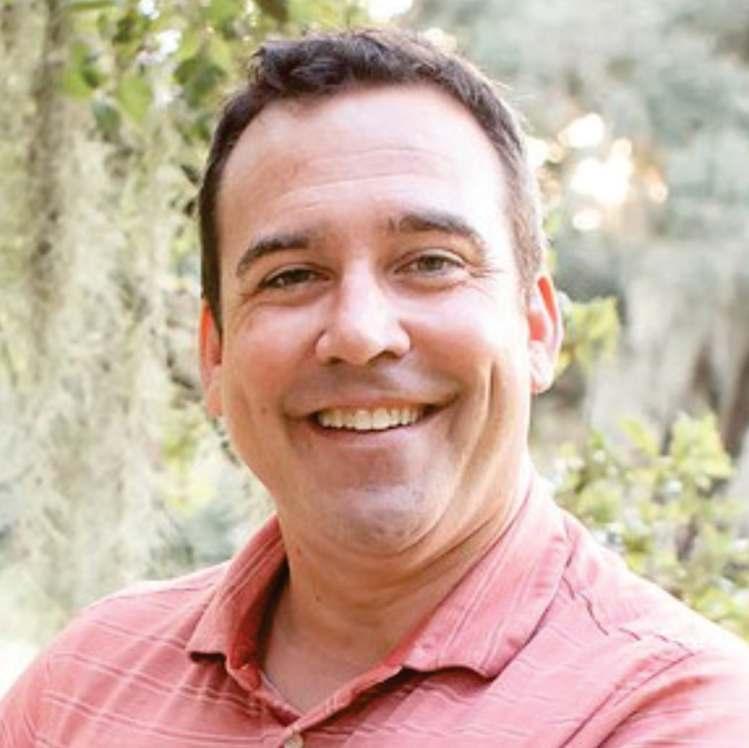
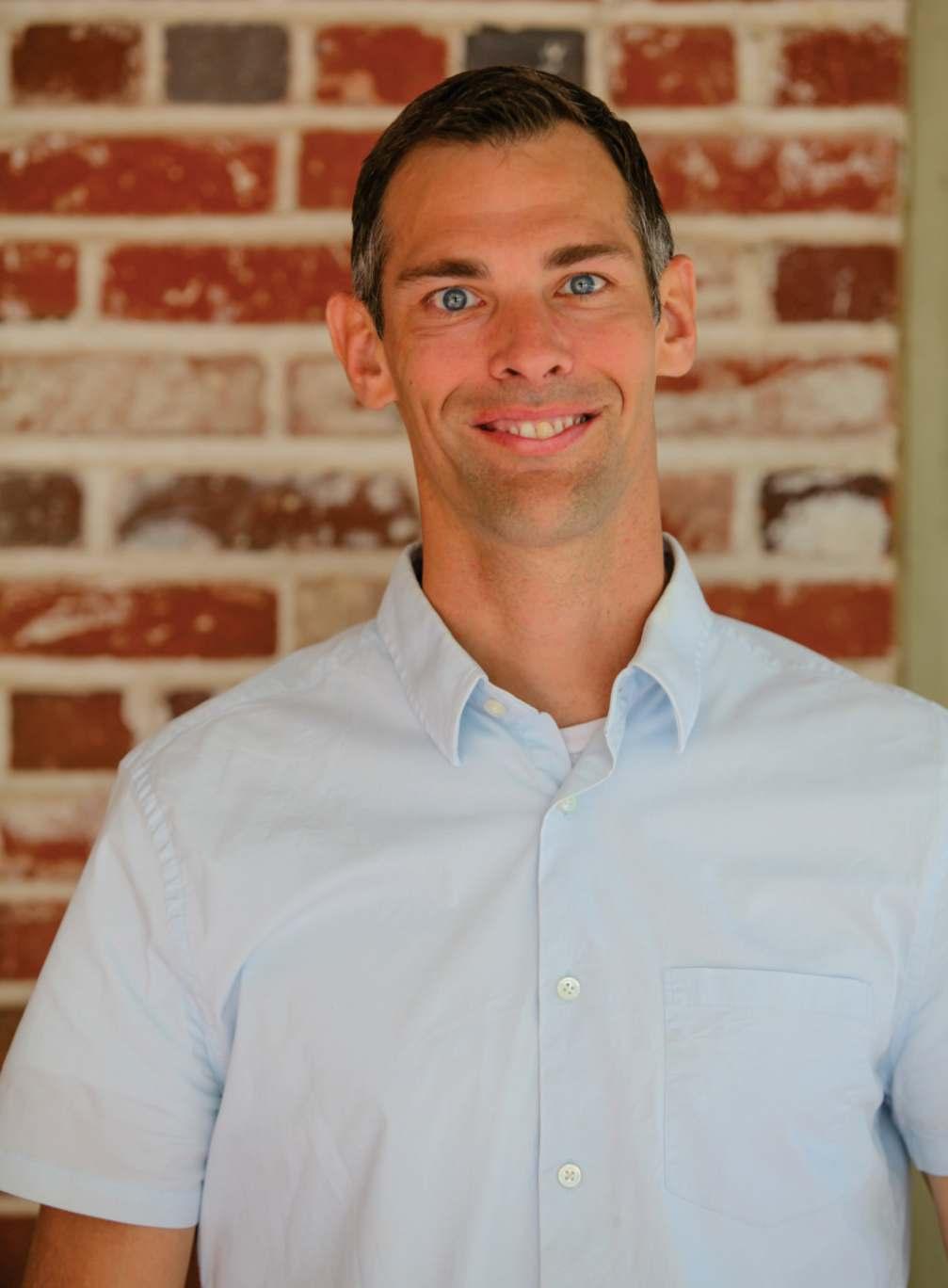
Jon Flaherty CEO | Revolent Group
Passion is the foundation of a
strong business, and for Jon Flaherty following his passion was critical in order to ind success.
He mentions, “Do what you're passionate about—which is something I didn't do at irst, I have to admit. But truly, that's what leads to success and happiness. This almost always involves taking chances, and talented people can sometimes be too risk averse, but it really is key when it comes to moving towards a meaningful experience of your working life.”
Today, Jon is the CEO of Revolent Americas, a cloud talent creation irm, and is one of the pioneers in the tech space. In this Exclusive Interview, Jon Flaherty talks about

his long journey from videogames to entrepreneurship.
What according to you makes one an innovative leader? How do you integrate the same thought into your leadership?
Innovation requires vision, clear goals, and focus. As the saying goes, talk is cheap—which costs money. So, while ideation and design can lead to a multitude of exciting ideas, what matters is the 1% of them that you can actually pursue and execute. From there, staying focused on the speciic goals you're pursuing is vital. Successful innovation also means being lexible and remembering that no rule applies all the time, as well as enabling your team to work however they work best. Like
scaling a business, you can't innovate solely as an individual.
Talk to us about your growing up years. What is your earliest memory as a leader that you can remember?
I got into tech work pretty early! I remember working as a SysOp on a bulletin board in my ZIP code at 11 years old and running a computer repair business when I was in eighth grade. It was called Helping Hand and I made something like $20 an hour, which was incredible. I also did some web design back then.
What prompted your interest and subsequently your foray into the technology space?

For me it was deinitely video games. I didn't have a Nintendo, but I did have a Commodore 64 and I remember having to manage its memory to be able to actually run the games on it. Later on, I got into the more creative side of things, working on my own games, and studying AI in college.
Talk to us about Revolent Americas and its approach in ensuring optimal client satisfaction?
What we're doing is really multifaceted, so it's vital that we tend to our relationships with both our tech professionals (Revols) and our clients. There has to be a little lex along with achievable goals, which for us is generally conversion— ideally, we want Revols to form long-term partnerships with the organizations we place them at. And as it stands, 83% of Revols do convert.
To make sure the placements of our Revols work out for our clients, we do a couple of things that I believe are unique to us at Revolent. Our Deployment Readiness Program, which includes activities like tests and mock projects, is designed to increase the likelihood that placements will prove successful. And our Revol Success Programme focuses on long-term support for Revols. This includes regular checkins, certiication pathways, and personal development planning. We also take in client feedback regularly so that we can respond effectively to industry shifts or the changing needs of a client's business.
As the CEO of Revolent Americas, what role do you play in the dayto-day proceedings of the
company?
The way I look at my role is that I need to be both broad and deep in scope. I oversee the relative health of every aspect of the business which includes sales, talent acquisition, and customer success. Keeping that overview in mind, I then calibrate depth based on where it's really needed.
I believe in giving people space and then I just dig in wherever something isn't working. So, it's identifying issues and then focusing there—that's where I like to be. I have direct experience in most aspects of the business, so getting more involved wherever I'm needed also keeps things interesting for me.
Looking back at your journey, what would you have done differently if you were to start again?
Career-wise, I'm not sure I would change anything because then I wouldn't be here now. I've learnt and grown at every step and that absolutely informs where I am today. As long as you're learning along the way, it's usually worthwhile.
What would be your advice for young and aspiring leaders in today's tech-driven world?
Do what you're passionate about—which is something I didn't do at irst, I have to admit. But truly, that's what leads to success and happiness. This almost always involves taking chances, and talented people can sometimes be too risk averse, but it really is key when it comes to moving towards a meaningful experience of your working life.
I also recommend seeking out people who are smarter or more experienced than you. Collaborate, ask for advice or mentorship, and don't shy away from asking questions. These are the kinds of relationships that hone your skills and knowledge, as well as your sense of what moves and motivates you.
I have some book recommendations, too! It's a classic, but Dale Carnegie's How To Win Friends And Inluence People is great for anyone starting out in business. I also particularly like Donald Asher's Who Gets Promoted, Who Doesn't, And Why which gets deep into things like timing, strategy, and corporate decision making.
Finally, what does the future look like for Revolent Americas?
It might be a cliché, but we're really only just getting started. There's a huge market opportunity to grow right now—the cloud talent gap currently stands at about 6.7million vacancies across all technologies.
Now we don't necessarily expect to ill every position out there, but we're popular with our partners because we're solving the talent gap by creating talent rather than just moving people around between companies and organizations. That traditional recruitment model doesn't address the wider problem but supporting the development of experienced recruits is a step towards a new tech landscape. We're already a leader in the space because our model is unique, so the future looks good and I'm excited to be part of that longer-term paradigm shift. .
Jon is a Technology and Operations executive with over 20 years of experience building, world-class teams, delivering customer success, and driving growth. He previously worked at PolSource—a platinum Salesforce SI—where he built the US team from the ground up to become one of the fastest growing and signiicant partners in the ecosystem. Jon has an undergraduate degree in Computer Science from Grinnell College and graduated top of his class with an MBA from Northwestern.
At Revolent—a cloud talent creation irm, Jon is helping to meet the growing business need while ensuring the best industry-led training for the company's Revols and the highest level of customer service for their growing client list in the US and beyond. He is also a member of the Forbes technology council.