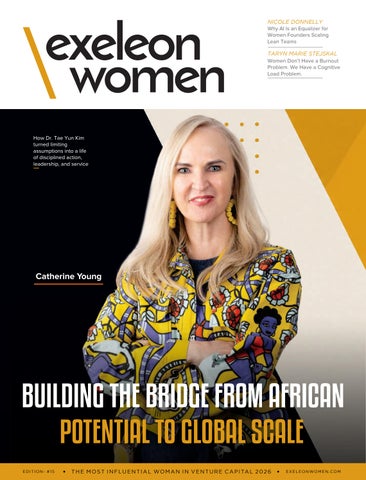
NICOLE DONNELLY Why AI Is an Equalizer for Women Founders Scaling Lean Teams TARYN MARIE STEJSKAL Women Don’t Have a Burnout Problem. We Have a Cognitive Load Problem.
How Dr. Tae Yun Kim turned limiting assumptions into a life of disciplined action, leadership, and service
Catherine Young
BUILDING THE BRIDGE FROM AFRICAN POTENTIAL TO GLOBAL SCALE EDITION- #15
T H E M O S T I N F L U E N T I A L W O M A N I N V E N T U R E C A P I TA L 2 0 2 6
E X E L E O N W O M E N .C O M
women EDITOR-IN-CHIEF DARYL YEUNG ART DIRECTOR NAOMI LAM MANAGING EDITOR MATT REIS CREATIVE DIRECTOR AKSHAY PANZADE CONTRIBUTING EDITORS JOHN RIGGS CONTENT CURATOR CATHY G. PROJECT MANAGER HITESH PATIL MARKETING MANAGER MIKE JACKSON SENIOR BDM RICHARD DANN BDM ROSHAN MAHATO
C O N TAC T U S For any advertising related information, please contact info@exeleonmagazine.com. Submissions as well as contributions to the magazine are welcome.
Take a moment and let us know about our magazine; whether it be about the design or a possible mistake, we would appreciate any feedback from your end. You can reach out to daryl@exeleonmagazine.com.
FOLLOW US @exeleonwomen
\ CONTENTS
10
CATHERINE YOUNG BUILDING THE BRIDGE FROM AFRICAN POTENTIAL TO GLOBAL SCALE
20 32
34 32
NICOLE DONNELLY
TARYN MARIE STEJSKAL
WHY AI IS AN EQUALIZER FOR WOMEN FOUNDERS SCALING LEAN TEAMS
WOMEN DON’T HAVE A BURNOUT PROBLEM. WE HAVE A COGNITIVE LOAD PROBLEM.
28
40
MAGGIE VO
CARRIE COLBERT
A TRAILBLAZER IN FINANCE AND VENTURE CAPITAL
A S T O R Y O F COLORS & MORE
MONSOON 26 EXELEONWOMEN.COM
10
CATHERINE YOUNG BUILDING THE BRIDGE FROM AFRICAN POTENTIAL TO GLOBAL SCALE
Across more than 25 years in corporate leadership, entrepreneurship,consulting, and venture capital, Catherine Young has remained focused on one enduring question: What does it take to turn a promising business into a sustainable, globally competitive company?
EXELEONWOMEN.COM
11
MONSOON 26
CATHERINE YOUNG’S
MONSOON 26
career has not followed a carefully mapped path. It has moved through large corporations, entrepreneurial ventures, consulting, business acceleration, investment, and board leadership. Yet when viewed as a whole, a consistent thread becomes visible.
EXELEONWOMEN.COM
12
She has always been interested in how businesses grow, why some achieve scale while others remain stuck, and what separates temporary momentum from sustainable enterprise value. Her early career included roles with Deloitte, Chevron, and SAP Ariba, where she developed a strong foundation in strategy, procurement, commercial discipline, people leadership, and operating at scale. These environments showed her how established organizations make decisions, manage complexity, and create systems capable of supporting growth. At the same time, Catherine found herself increasingly drawn to the entrepreneurs and smaller businesses operating around those corporate ecosystems. “I often say I lost my heart to entrepreneurship whilst I was still in corporate,” she shares. That connection eventually led her to establish
Thinkroom, an organization focused on helping entrepreneurs and small and medium-sized enterprises become more competitive and gain access to markets. From Thinkroom came deeper involvement with Grindstone, Grindstone Ventures, and ultimately Knife Capital, where Catherine moved further into venture investing and portfolio growth. She has since occupied nearly every seat around the entrepreneurial table. She has been the corporate executive, founder, consultant, accelerator operator, investor, and board member. This breadth allows her to understand both the ambition that drives founders and the complicated reality of turning that ambition into a viable company. It has also reinforced one of her central convictions: capital is important, but capital alone does not build a business. Bringing Corporate Discipline into Entrepreneurship Corporate life gave Catherine a close view of franchise networks, procurement, supplier development, and the challenges smaller businesses faced when trying to enter major value chains. She saw enormous entrepreneurial talent, but she also saw strong companies struggle because they lacked access to markets, networks, systems, capital, and practical guidance.
We do not have an ideas problem. We have a scaling problem.
EXELEONWOMEN.COM
13
MONSOON 26
When Catherine started building businesses of her own, she carried much of her corporate discipline into the entrepreneurial environment. She continued to value governance, nancial clarity, process, and accountability. Entrepreneurship, however, introduced lessons that large organizations could not teach in quite the same way. It required speed, humility, resourcefulness, and the ability to make consequential decisions without complete information.
supplier development, market access, technologyenabled learning, growth programs, and entrepreneurial ecosystem design. Catherine is now exploring how technology and articial intelligence can make high-quality commercial support more accessible and responsive. Her ambition is to move beyond delivering individual programs and create an operating platform that helps businesses grow continuously.
MONSOON 26
Africa Does Not Have an Ideas Problem
EXELEONWOMEN.COM
14
That combination continues to dene Catherine’s approach as an entrepreneur and investor. She is energized by possibility, but she is equally interested in the commercial path required to turn an idea into revenue, repeatability, and enterprise value. “I am entrepreneurial by nature, but I am also deeply commercial,” she explains. “I love possibility, but I want to know how we turn that possibility into revenue, repeatability and enterprise value.” The Missing Infrastructure Around Entrepreneurs The creation of Thinkroom began with Catherine recognizing that Africa did not suffer from a shortage of entrepreneurs. The continent had always been rich in people willing to identify problems, create solutions, and build businesses in challenging environments. What was missing was the infrastructure surrounding them. Too much entrepreneurial support ended with classroom training. A founder might complete a program, receive a certicate, or win a pitch competition, only to return to the same practical challenges the following Monday. The founder still needed customers, an effective pricing model, the right team, better systems, access to capital, and a realistic strategy for growth. “The gap I saw was not a shortage of entrepreneurs,” Catherine says. “Africa has never had a shortage of people willing to build. The gap was in the infrastructure around them.” Thinkroom was developed to address this divide between instruction and implementation. Its work encompasses practical growth support, enterprise and
Catherine sees extraordinary resourcefulness among African entrepreneurs. Many build in environments where infrastructure is uneven, markets are fragmented, and capital remains constrained. These conditions produce founders capable of adapting quickly and solving problems with limited resources. Yet the qualities required to start a company do not automatically provide everything needed to scale it. “We do not have an ideas problem,” Catherine says. “We have a scaling problem.” Addressing that problem will require deeper pools of follow-on capital, stronger access to corporate and government procurement, experienced growth talent, better routes into cross-border markets, and a more developed exit environment. It will also require investors and business leaders to stop discussing Africa as though it were a single market. Expanding between African countries can involve different regulations, currencies, cultures, customer behaviors, and infrastructure, making continental growth as complicated as expansion across other global regions. Catherine is equally focused on determining who receives the capital required to scale. She approaches diversity not as an act of charity, but as an essential part of investment discipline. Research referenced by Catherine found that representation among women in African technology is improving, yet access to funding has not increased at the same pace. Among more than 3,000 startups studied, 19.2 percent had at least one female co-founder, compared with 14.6 percent in 2023. More than half of
02 AFRICA HA A SCALING PROBLEM
03 CAPITAL IS ONLY THE BEGINNING
Catherine holds a Bachelor of Commerce degree, a National Diploma in Procurement, and a Venture Finance Certicate from Saïd Business School at the University of Oxford. She has co-authored books and contributed to entrepreneurship and investment conversations across Africa and internationally. Yet the achievement she values most is not represented by a qualication or title. It is the time she has spent close to entrepreneurs, helping them transform an idea or early-stage business into something stronger, more valuable, and more sustainable. She continues to gain energy from solving difcult business problems, just as she did at the beginning of her career. What has changed is the breadth of experience she can now apply to those problems and the scale of the ecosystem she hopes to inuence. Over the next decade, Catherine wants to see more African companies achieve global signicance, more founders create sustainable wealth, more women represented on both sides of the capital table, and a stronger bridge connecting entrepreneurship with institutional capital. Her journey has shown her that potential matters, but potential is only the starting point. Businesses create lasting impact when possibility is matched with commercial discipline, appropriate capital, access to markets, strong governance, and a partner willing to remain present through the difcult middle.
MONSOON 26
25+ YEARS OF LEADERSHIP
15 EXELEONWOMEN.COM
01
TURNING POTENTIAL INTO ENDURING VALUE
the funding within the Grindstone Ventures portfolio has been allocated to female founders. For Catherine, this outcome did not come from lowering expectations. It resulted from looking for excellence across a wider eld. “Balanced ecosystems do not choose diversity over excellence,” she says. “They create the conditions in which excellence is less likely to be missed.”
MONSOON 26
Writing the Cheque Is Only the Beginning
EXELEONWOMEN.COM
16
Catherine believes the most valuable role of a venture capital partner begins after an investment is made. The years following an investment are often the most difcult in a company’s development. Founders must convert potential into repeatable growth while simultaneously managing strategy, hiring, sales, pricing, governance, leadership, international expansion, and future capital requirements. “Writing the cheque is the beginning, not the job,” Catherine says. A strong venture partner must be able to challenge a founder without attempting to replace them. Founders do not need an investor behaving like another chief executive. They need someone capable of anticipating obstacles, opening appropriate doors, asking difcult questions, and remaining composed when growth becomes uncomfortable. Catherine describes the ideal relationship as an active partnership with clear boundaries. It is neither passive capital nor intrusive control. Much of her work at Knife Capital has focused on helping portfolio companies move toward value realization and successful exits. That experience has taught her that an exit cannot be treated as a nal-stage activity that begins only when a potential acquirer appears. “Exits are not an event you start preparing for when an acquirer arrives,” she explains.
The foundations are established years earlier through clean governance, defensible intellectual property, quality revenue, capable management, strategic positioning, and relationships with the markets and prospective acquirers that matter. Every commercial decision can therefore inuence a company’s future attractiveness. Building with an eventual exit in mind does not mean sacricing the organization’s current mission. It means creating a company with discipline, assets, and leadership required to remain valuable under greater scrutiny. Strengthening the Hard Middle Looking toward the next decade, Catherine wants African companies to be discussed less for their potential and more for what they have achieved at scale. “I want Africa to export companies, intellectual property and innovation, not only talent.” Her attention is increasingly directed toward what she describes as the “hard middle,” the critical space between a promising early business and an organization that is scalable, investable, sustainable, and ultimately ready for an exit. Considerable support exists for launching businesses and raising initial capital. Far less infrastructure is available to help founders through the demanding period when early traction must become durable growth. This is where companies encounter difcult questions about leadership, organizational design, systems, pricing, market expansion, and capital strategy. The different strands of Catherine's career now converge within this space. Knife Capital provides the investment, portfolio, and exit perspective. Thinkroom contributes an operating platform for entrepreneurial development. Grindstone supports founders during the decisive transition from early traction toward scale. Together, they allow Catherine to work across the wider company-building journey rather than addressing one isolated stage.
@catherine-young knifecap.com thinkroom.co @thinkroomconsulting
MONSOON 26
17 EXELEONWOMEN.COM
“
I want Africa to export companies, intellectual property and innovation, not only talent.
FEATURE IN
EXELEON WOMEN MAGAZINE WE BELIEVE IN THE POWER OF STORYTELLING TO IGNITE CHANGE, AND OUR PAGES ARE FILLED WITH AUTHENTIC NARRATIVES THAT UPLIFT AND MOTIVATE.
DO YOU HAVE A STORY TO TELL THE WORLD? REACH OUT TO US BY CLICKING THIS LINK AND POTENTIALLY FEATURING IN EXELEON WOMEN MAGAZINE.
FEATURE ME
w ww ww . ew x .eel xe eolnew oo nm wo em n . ec n o .m com
EXELEONWOMEN.COM
20 MONSOON 26
-Written By Nicole Donnelly
F
emale founders have always known how to do more with less. We have had to.
We are more likely to build with less funding, smaller teams, and fewer layers of support. Many of us are also carrying family responsibilities: children, aging parents, managing the home, and the emotional work of keeping everything moving. For years, this reality has put women at a disadvantage. Based on the data, it still does. In 2024, companies with all-female founding teams received only 1.9% of total U.S. venture-capital deal value and 6.5% of deals. Women-owned businesses generated an average of $1.6 million in annual revenue, compared with $3.2 million for male-owned businesses. Now we are standing at the beginning of an economic and technological shift that could help close that gap. But there is another gap we need to address rst: AI adoption. One study found that 50% of men had used generative AI in the previous 12 months, versus just 37% of women. I’ve seen studies with larger gaps in adoption too. If we do not intentionally bring women into AI now, this technology could widen the inequalities it has the power to reduce.
21 EXELEONWOMEN.COM
Why AI Is an Equalizer for Women Founders Scaling Lean Teams
MONSOON 26
\ I N - F O C U S
MONSOON 26
Why This Moment Matters to Me I have been an entrepreneur for over 20 years. I leveraged technology to build BabyLegs from a home business in 2005 into a global brand sold in more than 85 countries. From the early days, technology allowed my team to work from home when they had a sick kid and they’d VPN into our server and take home their VoIP desktop phones. Today, I help organizations adopt AI to improve operations, customer experience, employee joy, and protability. I have worked with AI operationally since 2015 and initially had to bribe people with lunch to listen to me talk about it. What excites me most about this moment is not the technology itself. It is the leverage. It is how much we can amplify the magic of our humans and lighten their loads with this technology.
22 EXELEONWOMEN.COM
AI gives us something especially precious: capacity.
AI can absorb some of that operational weight by turning meeting notes into action items, drafting proposals, summarizing feedback, and documenting processes that lived only in the founder’s head. That last one is especially important. A company cannot scale when the founder is the only person who knows how everything works. My highest-value role is not to be involved in every task. It is to provide the vision, make the decisions only I can make, develop relationships and create the ideas that move the company forward. When strong systems and a condent team can handle the rest, the business becomes stronger and I become freer. Every team member becomes freer. I want that freedom for every worker, from young women just entering the workforce to those of us who are “experienced” professionals.
It gives a founder with a clear vision the ability to research, create, analyze, and execute at a scale that once required a much larger team. It opens access to knowledge that used to be difcult or expensive to obtain. Women are especially crafty when it comes to being resourceful. AI helps founders preserve cash, test ideas faster, and compete with companies that have more people and funding.
We Are Using the Wrong Message to Invite Women In
AI does not eliminate the need for people, experience, or judgment. It gives capable people more capacity and women are extraordinarily capable. When we use AI well, we can get precious time back and direct it toward the work, relationships, and people that matter most.
That message is not going to bring more women in.
AI Can Help Close the Capacity Gap When a company is lean, everyone moves between strategic and tactical work. Founders sell in the morning, review marketing at lunch and solve a client issue before dinner. Growth becomes limited by the hours and decisions the team can carry.
Many women are apprehensive about AI. Young women have heard educators call it cheating. Experienced women may feel they have already missed their opportunity to learn. Others hear AI discussed as if its purpose is to remove as many people as possible.
We need to stop talking at women in tech-bro language. Yes, women can get technical too. Adoption begins with a more meaningful question: Why are we using AI? We are using it to give a working mother an hour of her evening back. We are using it so a founder can follow up with every promising lead, and so an employee can spend less time searching for information and more time helping customers. We are using it so an underfunded team can compete on the quality of its thinking and ability to be found in AI search instead of the size of its budget.
\ I N - F O C U S
AI and automation can help us be MORE human when we give the mundane work away and intentionally build systems of care for our clients and teams. How We Bring More Women Into AI First, lead with outcomes that matter to women: time, freedom, nancial independence, stronger businesses, and more meaningful work. Show what AI makes possible before teaching how the technology works. Want Fridays off? Let’s AI & automate that!
Finally, women must be involved in deciding how AI is built and used. We cannot shape systems of care, fairness, and human judgment if we are absent from the rooms where those systems are designed. AI is still extremely biased towards male voices and opinions, we need much more input in training AI by women. A Better Measure of Progress The best companies will measure more than return on investment, or ROI. They will also consider Return on Heartbeats, or ROH: Did this technology give people time back? Did it reduce frustration? Did it allow the team to do more meaningful work? Did it improve the customer’s experience? Did it make someone’s life better? Efciency matters. Humanity matters too.
MONSOON 26
Women tend to care deeply about the humans we work with and work for. We understand the relationships and emotional experiences that build trust. Those abilities are becoming more valuable in an AI-powered world.
Third, give women permission to use it. We must stop teaching young people that AI is automatically cheating and start teaching discernment: how to question it, verify it, and remain accountable for the nal work. Refusing to prepare them does not protect them; it puts them at a disadvantage.
AI will not erase every inequality women face in business. AND it can reduce the price of access, knowledge, execution, and scale. It can help women build stronger companies without sacricing themselves in the process. That is why women need AI and why AI needs women. If this technology is going to reshape work, women cannot simply adapt to a future someone else designed. We need to help design and lead it, and make sure it creates more human companies.
Nicole Donnelly is an award-winning entrepreneur, author, and AI adoption strategist who has worked with AI since 2015. A former professional snowboarder, she founded BabyLegs and grew it from a home business into a global brand sold in more than 85 countries. Today, as founder and CEO of AI Smart Ventures, Nicole helps leaders and lean teams use AI to create capacity, improve operations, and build more human companies.
EXELEONWOMEN.COM
23 Second, make AI education practical, accessible, and psychologically safe. Women need places to experiment, ask questions, and learn without judgment. Training should be built around real work and real life. Weekly collaborative labs are key to starting and maintaining momentum.
MONSOON 26
RESILIENT
EXELEONWOMEN.COM
26
Women Don’t Have a Burnout Problem. We Have a Cognitive Load Problem.
MONSOON 26
\ I N - F O C U S
- Written By Dr. Taryn Marie Stejskal
I
can still see myself standing in my kitchen in the early weeks of the pandemic, pouring cereal for my two little boys and ghting back tears. Only weeks earlier, I had left my executive role at Nike to launch my own company. Then, the world shut down. The speaking, coaching, and consulting engagements I had lined up evaporated. My boys, then ve and seven, came home from school and needed me to run their online learning from the dining room table. I was a single mother with a mortgage and a brand-new business generating virtually no income. What I remember most about that season isn't how much I had to do. It’s how much I had to hold in my head. How long could I cover the mortgage without revenue? Which clients should I call rst? How could I reinvent a business built entirely around inperson work? Had one of my boys logged into school? Did we have enough groceries? And underneath all of it, how was I going to guide my children through this unprecedented time? None of those questions appeared on my calendar, yet my brain was working overtime on every one of them.
Six years later, my circumstances couldn’t be more different. My company not only survived, it grew. I have a team, resources, and people to whom I can delegate. Yet success didn’t eliminate my cognitive load; it simply changed what I was carrying. The Work Beneath the Work Today, I lead the Resilience Leadership Institute, speak around the world, and oversee everything associated with a growing business, from proposals and project planning to pricing and evaluating product-market t, while also being a wife (I got married!) and a mother raising two boys. I have become far better at delegating, and there are people on the payroll who can book the ight, schedule the meeting, and prepare the materials. Still, I can be standing backstage moments before a keynote with my mind cycling through questions unrelated to the stage: Did the client receive the nal proposal? Who's following up on yesterday’s business development meeting? Is that mouthguard going to work with my son’s new braces? Should we get pet insurance? Beneath these thoughts is a feeling of dread that originates from one question: What have I missed?
EXELEONWOMEN.COM
27
MONSOON 26 EXELEONWOMEN.COM
28
A reasonable person might say I need to delegate more. I have! The problem was that although I had delegated the tasks, I hadn’t delegated ownership.
disproportionately women. How do we reward these people? We give them more to do and remember.
The Phone Call Isn’t the Cognitive Load
When Competence Becomes an Identity
Consider something as ordinary as scheduling a child’s annual physical. The visible task takes ve minutes. But long before that call, someone had to remember the physical was due, know which physician to call, nd a date that doesn’t conict with school, sports, travel, or work, and, eventually, remember that the appointment is tomorrow.
Competence can quietly become an identity. We become the one who remembers, the one who anticipates, the one who can always be counted on. Being that person feels good, right up until our usefulness becomes indistinguishable from our worth. People learn that we handle things, so they hand us more things to handle. Because we are conscientious, capable, and accustomed to delivering, we do.
The phone call isn’t the cognitive load. Owning the outcome is. Research conrms what many women already know in their bones. In a study of 322 mothers of young children, women reported carrying nearly 73 percent of their households’ cognitive labor, the largely invisible work of anticipating, planning, and remembering, compared with roughly 64 percent of the physical labor. The more cognitive labor a woman carried, the higher her stress and burnout and the poorer her mental health (Aviv et al., 2025, Archives of Women’s Mental Health). This doesn’t mean cognitive load belongs exclusively to women. What it does mean is that the way we distribute cognitive load deserves far more scrutiny because what happens at home rarely stays at home. Cognitive Load Is a Leadership Problem The same pattern shows up inside every organization I've worked with. A leader delegates the creation of a client presentation but remains the one who remembers the deadline, anticipates what the client will ask, notices what's missing, nudges the person responsible, and lies awake wondering whether it will get done. The task has been delegated. The ownership hasn’t. This is where cognitive load stops being a personal problem and becomes an organizational design problem. Look around your company. Who is the person everyone assumes will notice? Who remembers the deadline nobody put on the calendar? Who follows up when everyone else assumes someone else will? We call them indispensable. They may simply be overloaded. In my experience, they are
It's not always other people. For high-achieving women, sometimes nobody hands us everything we're carrying. We just keep picking things up. We call what happens next “burnout,” and we prescribe boundaries, meditation, sleep, or a vacation. Those things can help, but no amount of self-care permanently compensates for a system that continues to generate overload. Resilience Doesn’t Mean Enduring More I have invested more than two decades in studying resilience, and I have found that resilience becomes weaponized when it serves as a mechanism through which highly capable people, often women, are asked to tolerate unsustainable systems. There is a difference between navigating adversity and normalizing chronic overload. What is often overlooked is that resilience isn't necessarily about carrying more. Sometimes, resilience means putting things down. Delegation + Ownership Leaders need to distinguish among three kinds of responsibility: 1. Task delegation: Who does it? 2. Ownership delegation: Who is responsible for the outcome? 3. Cognitive ownership: Who remembers that it needs to happen in the rst place?
Dr. Taryn Marie Stejskal is the founder and CEO of the Resilience Leadership Institute and the #1 Wall Street Journal bestselling author of The 5 Practices of Highly Resilient People: Why Some Flourish When Others Fold. A former leadership development executive at Nike and Cigna, she has invested more than two decades in researching resilience and developing leaders to prevent burnout and navigate change. She holds a Ph.D. and completed NIH-funded predoctoral and postdoctoral fellowships in neuropsychology.
MONSOON 26
\ I N - F O C U S
True ownership delegation transfers not only execution but also the responsibility to notice, anticipate, decide, and follow through. The shift from delegation alone to ownership delegation is subtle in language and enormous in effect. Instead of, “Can you put these numbers into the presentation?” it sounds like, “Can you own getting the nal presentation ready for the client?” Of course, this requires something difcult for high achievers: allowing someone else to own something and approach it differently than we would. If I “delegate” and hand over responsibility but check every decision and quietly redo the work afterward, I haven't relinquished anything. I’ve simply become the manager of the task I supposedly delegated. So, here is the question I now use to locate cognitive
@drtarynmarie
ownership in my company and in my home: Who wakes up remembering this exists? Look at your calendar, and then look at everything that never makes it onto your calendar because you’re expected, or you expect yourself, to simply remember it. If you stopped thinking about it, would anyone else remember? If the answer is no, you're still carrying it. For decades, we’ve asked women to become more efcient, more organized, better at setting boundaries, better at delegating, and, yes, even more resilient. Yet no amount of resilience solves cognitive overload or prevents burnout. The question we need to stop asking ourselves and others is, “How much more can she carry?” The real question is, “Why is she still the one carrying it?”
www.resilience-leadership.com
@DrTarynMarie
EXELEONWOMEN.COM
29
EXELEONWOMEN.COM
MONSOON 26
\ I N - F O C U S
33
EXELEONWOMEN.COM
34 MONSOON 26
\ I N - F O C U S
\ I N - F O C U S
\ I N - F O C U S
EXELEONWOMEN.COM
39
MONSOON 26
\ I N - F O C U S
MONSOON 26
\ I N - F O C U S
EXELEONWOMEN.COM
44
How
Dr. Tae Yun Kim
turned limiting assumptions into a life of disciplined action, leadership, and service
Those experiences introduced Dr. Kim to a challenge that remains familiar to many women. Before their abilities are tested, assumptions may already have been made about what they can accomplish, where they belong, and how far they should aspire to go. Dr. Kim chose not to accept those assumptions as permanent truths. The philosophy that emerged from her journey, “He Can Do, She Can Do, Why Not Me!”, would guide her from martial arts into entrepreneurship, technology, writing, leadership, and philanthropy. It also became a practical invitation for women to question inherited limitations and act with purpose. For Dr. Kim, “Why Not Me?” is not a promise that achievement will be easy. It is a question that interrupts limiting beliefs and redirects attention toward what can be done next. Questioning the assumption Limiting assumptions often arrive as familiar messages: Be realistic. Do not take such a big risk. You do not have the right background. Someone else is more qualied. Wait until you feel ready. Repeated often enough, these messages can become an internal voice. A woman may begin rejecting her own possibilities before anyone else has the opportunity to consider them. Dr. Kim encourages women to examine that voice. Is the limitation a fact, or is it an expectation inherited from family, culture, experience, or fear?
45 EXELEONWOMEN.COM
Dr. Tae Yun Kim became a martial arts Grandmaster, entrepreneur, author, and technology leader, she was a young girl confronting a future that others had already tried to dene for her. Born in post-war Korea, she entered a culture in which sons were often valued more highly than daughters. As a rst-born girl, she experienced rejection early. When she expressed a desire to study martial arts, she encountered another rmly rooted belief: Taekwondo was not a suitable pursuit for a woman.
MONSOON 26
Long before
That question does not deny genuine barriers. Dr. Kim faced cultural resistance when she pursued martial arts, just as women continue to encounter limited representation and entrenched expectations in traditionally male-dominated elds. Recognizing an obstacle, however, is different from allowing it to determine the outcome.
MONSOON 26
“Why Not Me! is not about ego,” Dr. Kim explains. “It is about recognizing that every human being is created with God-given potential.”
EXELEONWOMEN.COM
46
She did not begin training because the culture around her changed. She began because she refused to accept that gender determined ability. Through faith, perseverance, and disciplined practice, she became a pioneering female Taekwondo Grandmaster. Moving before condence arrives Condence is often treated as something women must possess before taking action. Dr. Kim's experience suggests a different sequence: action comes rst, while condence develops through practice. Martial arts taught her that strength is built through repetition, correction, endurance, and a willingness to continue when progress feels slow. When Dr. Kim immigrated to the United States, she arrived with approximately $300 and could not speak English. She cleaned motel rooms and pumped gas while working toward opening a martial arts school. Without every resource or answer, she concentrated on the step directly in front of her. Before the school opened, the building was destroyed by arson. The loss could have conrmed every warning she had received about the impossibility of her dream. Instead, she refused to let the setback dene her future. She rebuilt and continued forward. “Our circumstances do not dene us. Our decisions do,” she says. Her experience does not minimize hardship or suggest that positive thinking alone can overcome injustice. It shows that purposeful action remains
possible even in painful or uncertain circumstances. Her condence grew because she continued taking the next step. Replacing permission with preparation Waiting for permission can become a subtle form of limitation. A woman may wait to be invited into an important conversation, selected for leadership, recognized for an idea, or reassured that she has earned the right to pursue a new direction. She may delay acting because she believes she must meet every qualication rst. “Why Not Me?” shifts the question from “Will someone choose me?” to “How can I prepare myself to act?” Women cannot control every decision made around them, but they can develop the knowledge, judgment, and skills needed to respond when opportunities arise. Dr. Kim carried this approach into business and technology, elds in which few expected to see a Korean woman leading. In 1982, she founded Lighthouse Worldwide Solutions, which grew into a global technology company specializing in real-time contamination monitoring systems. She applied principles shaped through martial arts, including focus, discipline, accountability, resilience, and respect for others. Her example reminds women that leadership does not require them to abandon their identity or imitate those who came before them. Turning setbacks into instruction Limiting assumptions often become strongest after disappointment. A rejected proposal, unsuccessful application, or professional mistake may appear to conrm the fear that a woman did not belong in the room. Instead of asking, “What is wrong with me?” Dr. Kim encourages women to ask, "What is this experience teaching me, and what can I do next?” The answer may involve improving a skill, changing a strategy, seeking guidance, or trying again with greater preparation. A setback may redirect the path without ending its purpose. This is where "Why Not Me?" becomes more than an expression of belief. It becomes a discipline practiced whenever fear or uncertainty returns.
\ I N - F O C U S
Connecting action with service Dr. Kim views “Why Not Me?” as a declaration of responsibility, not ego. Women sometimes feel uncomfortable acknowledging ambition because they have been taught that seeking inuence is selsh. Yet inuence guided by integrity and service can strengthen companies, families, industries, and communities.
Beginning with one step
47
Turning a limiting assumption into purposeful action does not require an immediate transformation. It begins by identifying one belief that has gone unquestioned. Is there a position a woman has not pursued because she assumes she will not be accepted? Is there an opportunity she has postponed because she does not feel ready? The next step may be small: requesting a meeting, enrolling in a course, developing a proposal, seeking a mentor, or submitting an application. “Never let anyone dene your future, not your circumstances, not your past, and not even your own fears,” Dr. Kim says. “He Can Do, She Can Do, Why Not Me!” does not guarantee an easy road or remove the need for preparation. It challenges women to stop treating inherited assumptions as permanent truths. When a woman questions the limitation, prepares herself with discipline, and acts with purpose, she does more than change her own direction. She makes the path more visible and more possible for the women who follow.
About
Dr. Tae Yun Kim Dr. Tae Yun Kim is a martial arts Grandmaster, entrepreneur, author, and founder of the TYK Group. As founder of Lighthouse Worldwide Solutions, she built a global technology company while advancing a leadership philosophy rooted in discipline, purpose, faith, and service. Her book, Seven Steps to Inner Power, encourages readers to overcome limiting beliefs and recognize their potential through her guiding principle: "He Can Do, She Can Do, Why Not Me!”
EXELEONWOMEN.COM
A woman might ask: If I step forward, who else might gain the courage to do the same? Who could benet if I fully developed and used my abilities? Purposeful action becomes more powerful when it reaches beyond personal achievement.
MONSOON 26
“Leadership is not measured by how many people work for you, but by how many people become stronger because of your example,” Dr. Kim says.
SCAN HERE TO LEARN MORE
WWW.EXELEONWOMEN.COM