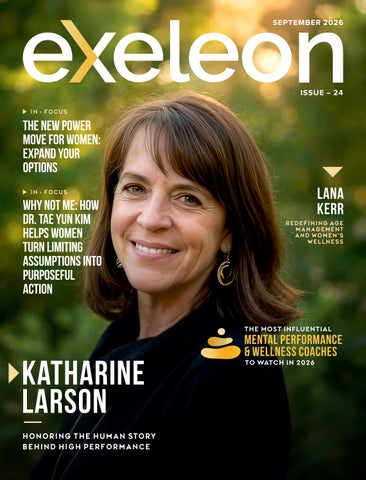
SEPTEMBER 2026
ISSUE – 24 I N - F O C US
The New Power Move for Women: Expand Your Options
Lana Kerr
I N - F O C US
Why Not Me: How Dr. Tae Yun Kim Helps Women Turn Limiting Assumptions into Purposeful Action
R E D E F I N I N G AG E M A N AG E M E N T A N D WO M E N ' S WELLNESS
THE MOST INFLUENTIAL
Katharine Larson H O N O R I N G T H E H U M A N ST O RY BEHIND HIGH PERFORMANCE
Mental Performance & Wellness Coaches TO WATCH IN 2026
exeleon_magazine
exeleon_magazine
exeleon_magazine
exeleon_magazine
exeleon_magazine
exeleon_magazine
FOLLOW ON INSTAGRAM
exeleon_magazine
exeleon_magazine
exeleon_magazine
exeleon_magazine
exeleon_magazine
Embracing Excellence 600 N Broad St 5 Middletown, DE 19709, United States +1 302-907-9110
Editor-in-Chief – Daryl Yeung Art Director – Naomi Lam Managing Editor - Matt Reis Creative Director – Adam Waring
Project Manager – Richard Dann Marketing Manager – Sofia Brown Customer Relationship – Natasha Green Business Development – Matt Hale, Josh Wilder, Anish Miller
For any advertising related information, please contact info@exeleonmagazine.com. Submissions as well as contributions to the magazine are welcome.
Take a moment and let us know about our magazine; whether it be about the design or a possible mistake, we would appreciate any feedback from your end. You can reach out to daryl@exeleonmagazine.com.
Copyright © Exeleon Media LLC. All rights reserved. The design, images, and content in this issue should not be reproduced in any manner or by any means, i.e. mechanical, electronic, recording, photocopying, or otherwise, without any permission from Exeleon Media.
MESSAGE from
THE EDITOR Shaping Stronger Minds and Healthier Futures
In a world dened by constant change, demanding environments, and growing expectations, mental performance and overall wellness have become increasingly important to personal and professional growth. Behind many journeys of transformation are coaches who help individuals understand their potential, build resilience, develop healthier habits, and approach challenges with greater clarity and condence. This special edition, “The Most Inuential Mental Performance & Wellness Coaches to Watch in 2026,” shines a spotlight on professionals who are contributing meaningful perspectives to the evolving elds of mental performance and well-being. Through their knowledge, experience, and dedication, these coaches are helping individuals and organizations explore new approaches to performance, balance, personal development, and sustainable success.
l l a W
Their work extends beyond conventional coaching. By combining evidence-informed practices, personalized strategies, and a deep understanding of human potential, they are encouraging people to become more intentional about how they think, perform, and live. Each journey featured in this issue reects a distinctive philosophy and approach to helping others move forward. Through insightful proles and engaging stories, we explore the experiences, principles, and contributions that dene these remarkable coaches. Their perspectives offer valuable lessons for anyone seeking greater self-awareness, resilience, and continuous growth. We hope this edition inspires our readers to invest in their potential, embrace positive change, and recognize the powerful connection between a stronger mind, meaningful well-being, and lasting achievement. Happy Reading!
Dyl Yeung
SUBSCRIBE NOW
CONTENTS
12 KATHARINE LARSON
CONTENTS
38 CITIZENS LIFE GROUP
CONTENTS
28 DR. TAE YUN KIM
Lauren Cohen
THE MOST INFLUENTIAL
Mental Performance & Wellness Coaches TO WATCH IN 2026
Katharine Larson LMFT · AGCS · CCTP · CBT-I SPECIALIST THERAPIST & PERFORMANCE COACH
Honoring the Human Story Behind High Performance Drawing on more than two decades of experience in mental health, trauma recovery, grief counseling, and therapeutic services, Katharine Larson helps individuals understand the inner barriers affecting their wellbeing and performance. Her work is grounded in empathy, resilience, and the belief that lasting success begins when people learn to recognize their vulnerability as a source of strength.
12 | SEPTEMBER 2026
E X E L E O N M AG A Z I N E
COVER STORY
W W W. E X E L E O N M AG A Z I N E . C O M
SEPTEMBER 2026 | 13
COVER STORY
L
ong before Katharine Larson became a therapist and mental performance coach, she was a teacher working with students from pre-K through high school. The classroom gave her an early understanding of motivation and the many factors that inuence a person's ability to succeed. Some students needed encouragement, while others needed help recognizing what they genuinely wanted. Many were capable of reaching their goals but were held back by internal doubts, external circumstances, or barriers they could not yet identify. Katharine naturally gravitated toward helping them nd their own reasons to move forward. Rather than simply instructing students on what to do, she encouraged them to explore their motivations, desires, and the obstacles preventing progress. This instinct eventually became a dening part of her transition into mental health and therapeutic services. Today, as a Licensed Marriage and Family Therapist, Advanced Grief Counseling Specialist, Certied Clinical Trauma Professional, and CBT-I Specialist, Katharine continues to apply that same curiosity to her work. She supports executives, athletes, government professionals, students, families, and individuals navigating signicant life transitions.
C R E D E N T I A L S
LMFT
Licensed Marriage and Family Therapist
AGCS
Advanced Grief Counseling Specialist
CCTP
Certied Clinical Trauma Professional
CBT-I
CBT-I Specialist
14 | SEPTEMBER 2026
E X E L E O N M AG A Z I N E
COVER STORY
S E C T I O N 0 1
Looking Beyond Performance High performance is often associated with discipline, condence, and visible achievement. Yet behind these outward markers, many accomplished individuals experience private struggles that are rarely acknowledged. Katharine frequently works with people who carry intense expectations of themselves and feel constant pressure to achieve or maintain a certain level of success. For executives, athletes, and professionals operating in competitive environments, achievement can become closely tied to identity and self-worth. Even after reaching an important milestone, they may question whether they can sustain their performance, meet future expectations, or continue proving their value. Katharine identies inner conict as one of the most common challenges among high-achieving individuals.
The desire to succeed may exist alongside self-doubt, fear of failure, exhaustion, or uncertainty about what achievement actually means. “Doubting one's ability to maintain a level of success has been frequently verbalized as a core stressor, particularly by clients working in high-pressure and competitive environments,” she explains. Her work creates an opportunity for clients to examine these conicts without judgment. Rather than focusing only on productivity or outcomes, she helps them consider the beliefs, experiences, relationships, and expectations shaping their behavior. This deeper exploration allows performance coaching and therapeutic care to complement one another.
S E C T I O N 0 2
A Systemic and Holistic Approach Katharine's work spans therapy, trauma recovery, executive wellbeing, and mental performance coaching. She does not view these disciplines as separate areas. Instead, she brings them together through a systemic and holistic approach that considers the complete person and the wider context of their life. A performance challenge may be inuenced by past experiences, workplace expectations, family relationships, grief, trauma, health, or an internal belief about what it means to be successful. Addressing only the visible
W W W. E X E L E O N M AG A Z I N E . C O M
concern may offer temporary relief, but lasting improvement requires understanding the factors beneath it. Katharine helps clients recognize both internal and external limitations while distinguishing between what they can and cannot control. This process can reduce the frustration that comes from trying to manage uncontrollable circumstances and redirect attention toward decisions, habits, and solutions within the client's inuence.
SEPTEMBER 2026 | 15
COVER STORY
B E L O W T H E S U R FA C E
“Doubting one’s ability to maintain a level of success has been frequently verbalized as a core stressor, particularly by clients working in high-pressure and competitive environments.” KAT H A R I N E L A R S O N
16 | SEPTEMBER 2026
E X E L E O N M AG A Z I N E
COVER STORY
S E C T I O N 0 3
Listening Before Leading Katharine's therapeutic approach integrates Cognitive Behavioral Therapy, Motivational Interviewing, Narrative Therapy, resilience-building techniques, and clientcentered care. However, she does not begin by selecting a method or imposing a predetermined framework. She begins by listening. During the initial rapport-building stage, Katharine gives clients the time and emotional safety to share their stories. She listens from an empathic, validating, and clientcentered perspective, recognizing that trust must be established before meaningful therapeutic work can begin. This stage allows her to understand not only the challenges a client describes, but also the beliefs, experiences, and patterns inuencing how the person interprets those challenges. From there, she develops a treatment plan
responsive to the individual rather than relying on a uniform approach. Cognitive Behavioral Therapy can help clients identify connections between their thoughts, emotions, and actions. Narrative Therapy provides space to examine the stories they have formed about themselves and consider whether those stories continue to serve them. Motivational Interviewing helps uncover the person's own reasons for change, increasing their sense of ownership over the process. When used together, these approaches can support observable and client-reported shifts in thoughts, feelings, and behaviors. Over time, these changes can strengthen self-worth and help clients see themselves as capable of making decisions that improve their lives.
T H E M E T H O D — T H R E E A P P R O A C H E S , O N E P E R S O N
01 02 03
COGNITIVE BEHAVIORAL THERAPY
Cognitive Behavioral Therapy can help clients identify connections between their thoughts, emotions, and actions. NARRATIVE THERAPY
Narrative Therapy provides space to examine the stories they have formed about themselves and consider whether those stories continue to serve them.
MOTIVATIONAL INTERVIEWING
Motivational Interviewing helps uncover the person’s own reasons for change, increasing their sense of ownership over the process.
W W W. E X E L E O N M AG A Z I N E . C O M
SEPTEMBER 2026 | 17
COVER STORY
S E C T I O N 0 4
The Courage to Sit with Discomfort Katharine believes the difference between short-term achievement and sustainable success often lies in a person's willingness to remain present through discomfort. Change rarely happens immediately, and the process of questioning established patterns can feel uncertain before it feels empowering. Throughout her years in therapy, she has observed that clients who are willing to sit with discomfort long enough to experience change often develop stronger condence in their ability to pursue longer-term goals. A small shift becomes evidence that progress is possible, and that evidence can gradually strengthen self-belief.
The skills developed through therapy and coaching can then extend into other areas of life. A person may become better equipped to establish healthy friendships, strengthen family connections, pursue fulllment in a career, or build more secure romantic relationships. Sustainable performance therefore requires more than pushing harder. It involves developing the patience to tolerate uncertainty, the awareness to recognize unhelpful patterns, and the courage to make choices aligned with long-term wellbeing.
S E C T I O N 0 5
Lessons in Human Resilience Katharine's appreciation for resilience was profoundly shaped by her experience as Intake Director at Reliance Health. During Superstorm Sandy, she accepted an invitation to volunteer as a member of the Disaster Behavioral Response Team, supporting people affected by widespread disruption and loss. The experience gave her a deeper appreciation for the resilience of the human spirit and the innate ability people possess to continue moving forward, even after circumstances have changed their lives. It also reinforced
18 | SEPTEMBER 2026
the importance of compassionate support during periods when individuals may feel overwhelmed by events beyond their control. Katharine has witnessed that same resilience throughout her therapeutic career. Being invited into a client's personal story and observing their transformation is a responsibility she regards as an honor. Each experience has strengthened her belief that people can develop new ways of understanding themselves, even when progress initially seems out of reach.
E X E L E O N M AG A Z I N E
COVER STORY
S E C T I O N 0 6
Building Skills for the Next Generation Katharine Larson's commitment to practical growth is also reected in her work with young adults. She developed a Life Skills Curriculum and facilitated a group for clients between the ages of 18 and 24. The program addressed motivation, success blocks, personal barriers, and mental performance tools for undergraduate and graduate students. Young adulthood often brings major decisions concerning
education, employment, relationships, identity, and independence. At the same time, many young people are still developing the emotional and practical skills needed to manage these responsibilities. Katharine's curriculum was created to help participants better understand their barriers and build tools they could apply beyond the program. This experience connected her earlier career as an educator with her current therapeutic work.
S E C T I O N 0 7
Redefining What It Means to Perform For professionals seeking to improve their mental wellbeing while sustaining a high level of performance, Katharine begins with a simple but demanding invitation: honor your story. She encourages individuals to acknowledge the experiences that brought them to their current stage of life and appreciate their humanness and vulnerability. These characteristics should not automatically be treated as weaknesses. When understood honestly, they can become trustworthy sources of strength. “Be ready to rewrite what you may have previously believed was 'good enough,'” she advises.
W W W. E X E L E O N M AG A Z I N E . C O M
Katharine also encourages people to dene what performance and achievement mean to them personally. Is the standard reasonable, challenging, healthy, and realistic? Does the goal reect personal values, or has it been inherited from external expectations? Is the pursuit strengthening the individual's life, or gradually diminishing their wellbeing? These questions help separate purposeful ambition from pressure driven by fear, comparison, or an endless need to prove oneself. Performing consistently at a high level does not require ignoring personal needs. It requires establishing a healthier and more sustainable relationship with success.
SEPTEMBER 2026 | 19
COVER STORY
T H E H U M A N S T O R Y
“A deeper appreciation for the resilience of the human spirit, and the innate ability people possess to continue moving forward.”
20 | SEPTEMBER 2026
E X E L E O N M AG A Z I N E
COVER STORY
S E C T I O N 0 8
Turning Experience into a Wider Impact As Katharine approaches her sixties, she is considering how the knowledge gathered throughout her career can reach a broader audience. She is currently in the early research and development stages of creating a motivational, mindfulness, and mental performance program for athletes, professionals, and the people who support and encourage them. Her long-term goal is to publish and share this program, making its principles available beyond individual therapy and coaching sessions. The project will bring together her experience as an educator, therapist, trauma specialist, grief counselor, curriculum developer, and mental performance coach.
W W W. E X E L E O N M AG A Z I N E . C O M
At the center of the program will be the philosophy that has shaped Katharine's journey: people are more than their performance, and their stories contain valuable information about both their struggles and their strengths. By helping individuals understand those stories, identify their barriers, tolerate discomfort, and redene achievement, Katharine is creating a more human approach to performance. It is an approach in which wellbeing does not have to be sacriced for success and vulnerability does not diminish strength.
SEPTEMBER 2026 | 21
Unlock Your DIGITAL SUBSCRIPTION! Ready to fuel your ambition and receive your dose of inspiration directly to your digital doorstep? Subscribe to Exeleon Magazine today, and enjoy the following perks:
Exclusive Extras Convenience at Your Fingertips Access each issue on your preferred digital device anytime, anywhere.
Dive deeper with bonus content, behind-the-scenes interviews, and special features reserved for our esteemed subscribers.
Community Connection Join a network of likeminded individuals, share your story or interview, and be part of a thriving entrepreneurial community.
S I M P LY S C A N A N D S U B S C R I B E
24 | SEPTEMBER 2026
E X E L E O N M AG A Z I N E
EXELEON SPOTOLIGHT
The New Power Move for Women EXPAND YOUR OPTIONS WRITTEN BY LAUREN COHEN
F
or years, women have been told that we need a seat at the table. I think we need something more powerful: options.
The option to stay or leave. To grow or pivot. To invest or hold back. To build a business without becoming trapped by it. To move across a border if opportunity or life calls for it. To make a decision because it is the right one, not because circumstances have left us with no other choice. To me, that is what real leadership looks like. I have spent my career at the intersection of law, entrepreneurship, immigration, investment, and real estate. I am also an immigrant and a single mother. If there is one lesson that ties all of those roles together, it is this: The strongest position you can create for yourself is one in which you have choices. Being a single mother has made that lesson especially real. When you are raising a child on your own, there is often no automatic backup system. No second parent to absorb the unexpected. No one else who can simply step in when a work emergency collides with a school obligation, when a child gets sick, when travel becomes complicated, or when life
W W W. E X E L E O N M AG A Z I N E . C O M
throws something at you that no calendar could have anticipated. You learn very quickly that exibility is not a luxury. It is infrastructure. That reality forced me to think differently about business, income, geography, and time. I could not afford to build a life that worked only under ideal conditions. I needed different ways to earn, different ways to work, different ways to solve problems, and enough professional and nancial independence to absorb the unexpected without everything falling apart. In many ways, single motherhood made me a better strategist. It taught me to ask not only, “Will this work?” but also, “What happens if it doesn't?” and “What other doors will this decision leave open?” That mindset has shaped almost every major decision I have made since. I moved from Toronto to the United States more than 25 years ago. That decision inuenced virtually every part of the life that followed: where I built my career, where I raised my son, the businesses I created, and the opportunities I was able to pursue.
SEPTEMBER 2026 | 25
EXELEON SPOTOLIGHT
What I understand much more clearly today is that major decisions rarely happen in isolation. Career decisions can affect where your family lives. A real estate purchase can become an investment strategy. A business can open a door to another market. An immigration decision can affect taxes, nancing, education, succession planning, and long-term nancial security. Women are often expected to consider all of these things simultaneously, and we do. Yet we are still frequently encouraged to evaluate opportunities one dimension at a time. Perhaps the most important question is this: What options will this decision create for me ve or ten years from now? That changes the conversation completely. Growth Isn't the Only Measure of a Good Decision Entrepreneurs are conditioned to chase growth. Bigger revenue. More clients. More locations. More employees. There is nothing wrong with growth. I am an entrepreneur, and I believe deeply in building and expanding. But growth without optionality can become another form of dependence. A business that relies almost entirely on one client is vulnerable. A professional whose income depends on one employer is vulnerable. A family whose wealth is concentrated in one asset or one market is vulnerable. An entrepreneur whose entire business depends on one country or economic environment is vulnerable. For a single mother, that kind of dependence can feel even more precarious because there may be no second income or built-in safety net in the background. You can look successful on paper and still have very few choices. Over the years, I have watched people wait until something changes, such as a downturn, political uncertainty, a family crisis, or a career disruption, before they begin creating alternatives. By then, they are reacting. Reacting almost
26 | SEPTEMBER 2026
always gives you fewer choices than preparing. Women should be thinking about optionality long before we believe we “need” it. Not because we should live in fear of what might happen, but because preparation creates freedom. Optionality Is a Leadership Strategy When I talk about creating options, I am not suggesting that every woman launch three businesses, buy property in another country, and completely reinvent her life. Optionality can be much simpler. It can mean developing an additional source of income so one paycheck does not determine every decision. It can mean investing outside the industry in which you work. It can mean maintaining credentials, learning new skills, or understanding where your expertise could transfer. It can mean building professional relationships beyond your immediate market. It can mean evaluating an opportunity not only for its projected return, but also for the doors it might open. Sometimes, it means considering geography. For entrepreneurs and professionals today, geography can be strategic. Technology and increasingly global markets have changed what is possible. Where we live, invest, and operate no longer has to be a decision made once and accepted forever. That does not mean you have to move. It means having the ability to move may itself have value. There is enormous power in knowing, I have another door I can open. Women Already Think This Way. We Just Don't Always Call It Strategy Women are accustomed to contingency planning. We think about our children. Our parents. Our careers. Our households. Our businesses. Our nances. We anticipate problems before they happen because, quite often, someone has to. For single mothers, that instinct can become almost constant.
E X E L E O N M AG A Z I N E
EXELEON SPOTOLIGHT
You learn to have Plan B, Plan C, and sometimes Plan D because there is no guarantee that someone else will be there to catch what falls through. But we do not always apply that same thinking to our own professional and nancial independence. We should. One of the most important questions a woman can ask herself is: Where am I overly dependent? One client? One employer? One income stream? One investment? One market? One person? Then ask: What would give me other options? You do not need to make a dramatic change tomorrow. You simply need to begin building alternatives before you desperately need them. That might mean putting money aside to fund future opportunities. Exploring a second market before expanding into it. Building another income stream while remaining employed. Diversifying investments. Developing a network in another location or industry. Understanding the opportunities available to your family before circumstances force you to investigate them. Small decisions made early can create enormous exibility later. Build a Life That Gives You Leverage My advice is to build a life that gives you leverage. A seat at the table is valuable. But a seat at someone else's table is still just one option. I want women to build their own tables and know they can walk away from one table and choose another when necessary. Or simply walk away.
It is leverage. It is the ability to negotiate from strength rather than necessity. It is being able to say yes because you want to, not because you have to. Equally important, it is being able to say no and walk away gracefully. My experiences as a lawyer, entrepreneur, immigrant, real estate professional, single mother, and woman who has had to build her own safety net out of necessity rather than choice have taught me that life rarely unfolds exactly according to plan. Markets change. Families change. Businesses evolve. Priorities shift. We cannot control every change. No one can. What we can do is create enough exibility that change does not control us. For me, that is the ultimate form of leadership: not simply earning a seat at the table, but building a life in which you are never dependent on just one table, one path, or one choice. About the Author Lauren Cohen, Esq., is an international lawyer, entrepreneur, real estate professional, and investment strategist who has spent more than 25 years helping individuals, families, and business owners navigate opportunities across borders and simplify otherwise complex processes. A Toronto native who immigrated to the United States, Lauren brings a personal perspective to the intersection of business, investment, global opportunity, and family. She is passionate about helping women build greater independence, resilience, and optionality.
That is not disloyalty. It is not indecision. And it certainly is not a lack of commitment.
W W W. E X E L E O N M AG A Z I N E . C O M
SEPTEMBER 2026 | 27
Dr. Sh aw
30 | SEPTEMBER 2026
E X E L E O N M AG A Z I N E
IN– FOCUS
wn Talbott
The World’s Fittest CEO on Food, Mood, and Human Potential
F
ew experts straddle the worlds of science, performance, and mental health as effectively as Dr. Shawn Talbott. A pioneer in nutritional psychology, Dr. Talbott has dedicated his career to exploring how food in luences mood, and how biochemical balance can drive human potential. With a PhD in Nutritional Biochemistry and entrepreneurial training from MIT, he's authored 14 books, developed over a billion dollars' worth of wellness products, and redeined ̀ how we approach mental itness.
From supporting Olympic athletes to turning personal loss into professional purpose, Dr. Talbott's work is both deeply scientiic and ̀ profoundly human. In this interview, The World's Fittest CEO relects on ̀ lessons from endurance sports, how resilience can be trained, and why the future of well-being lies at the intersection of nutrition, psychology, and lived experience.
W W W. E X E L E O N M AG A Z I N E . C O M
What irst drew you to the intersection of nutrition and psychology? Was there a speciic ̀ “aha” moment that launched your focus on psycho-nutrition? We all have experienced the intersection of nutrition (food) and psychology (mood), when a meal didn't “agree” with us – making us feel tired or bloated. Or a related experience of “stress eating” – where our hectic day seems to drive us toward comfort foods like pizza and cookies.
My PhD is in Nutritional Biochemistry, so I'm always trying to understand the underlying balance of neurotransmitters, hormones, and other biochemical signals that drive emotions, behavior, and performance. In the early part of my career, I was mostly a “sports nutritionist” – working with elite-level athletes and coaches at the US Olympic Training Centers, US Ski and Snowboard team, and US Track & Field.
SEPTEMBER 2026 | 31
IN– FOCUS
It was fun helping them get ready – mentally and physically – for the Olympics and championship events all over the world. But, at the end of 2001, my younger brother died of a drug overdose – and that completely changed the course of my research and everything that my work focuses on.
With the athletes, I knew that the ones standing on the top step of the podium with the gold medal weren't any “ itter” (physically) than their competitors, but they had the “mental edge” that enabled them to win. They had sharper focus, could manage stress better, bounce back from challenges quicker, and sleep more soundly – they were more “mentally it” – and ̀ that translated into superior physical performance.
My brother used drugs to self-treat his anxiety, depression, and ADHD – so I thought that maybe I could apply what we knew about mental itness in elite athletes – and try to “mainstream” those practices to help the average person to feel “less bad” (anxiety, depression, tension, fatigue) and feel “more good” (energy, mood, focus, resilience) in their everyday life.
This was more than 20 years – and 14 books – ago, but now we have an entire ield of research known as “Nutritional Psychology” where “Psycho-Nutritionists” and Certiied ̀ Mental Wellness Coaches (CMWCs) use overall dietary patterns as well as speci ic foods, nutrients, and supplements to help people feel their best and perform at their peak. You've competed in ultraendurance sports while
32 | SEPTEMBER 2026
conducting high-level research. How have your personal athletic experiences shaped your academic and professional path? Endurance sports teach you one thing very quickly: that your mindset is either your secret weapon or your weakest link. When you're 60 miles into a mountainous trail run, with another 40 to go and the sun is setting, your body/mind connection becomes a feedback loop of everything—nutrition, sleep, emotional state, resilience.
I began to view the body/mind connection as a real-time laboratory, which helped me reine ̀ my research lens toward real-world performance, not just statistical signi icance. I love “doing the research” – but even more than that, I love “applying the research” to a given real-life situation to see how well it works (or not).
This “real world” approach has made me more disciplined in how I approach science, business, and teaching: resilience isn't a character trait that you're born with, it's a trainable system that everyone can master – and the Food-MoodPerformance connection is underpinned by biochemistry that we can measure and manage and modulate. You've developed over a billion dollars' worth of products – how do you balance scientiic ̀ integrity with consumer appeal in product development?
It's a delicate dance between what's true and what sells – and I've found that the very best and most successful products live at the intersection of good science applied
to solve a real problem and with bene its that users can feel. I always start with the science: mechanism, ef icacy, bioavailability, sustainability. But then I ask, “How will this make someone feel? Will they notice a difference in 10 weeks, or 10 days or 10 minutes?” If they won't feel it, they won't keep taking E X E L E O N M AG A Z I N E
it—and if it doesn't work, they shouldn't.
The key is to translate complex science into felt experience, while respecting both the evidence and the intelligence of the end user. I always say that my best customer is an “open-minded skeptic” – the person who is curious about solving W W W. E X E L E O N M AG A Z I N E . C O M
the problem in a natural and scienti ically-valid way, but who also doesn't just believe everything that they hear. They listen to the science and reserve the right to say. “I'll be the judge of that” (by trying the product to see if the science matches up to their experience).
The result of “following the science”
is products that earn trust because they deliver biological truth with emotional impact – and that translates into a satisied user and a ̀ regular customer.
How has your background in both nutrition science (via Rutgers) and entrepreneurship (via MIT) shaped your approach
SEPTEMBER 2026 | 33
34 | SEPTEMBER 2026
E X E L E O N M AG A Z I N E
IN– FOCUS
to teaching, mentoring, or leading in your ield? My scienti ic training at Rutgers taught me to always keep looking for “root causes” by continuing to peel back the underlying biochemistry driving a condition or behavior (what a scientist would call “mechanism of action”). My MIT experience taught me that great ideas die without proper execution – and that good science without clear communication is just data.
So, I try to mentor students and teams to be “bilingual” – luent in ̀ both biological mechanisms and business models. Whether I'm in a lab, classroom, or boardroom, I teach from a “systems” perspective that encourages people to zoom in and zoom out, ask “why” over and over again.
This helps us build solutions that align science and strategy but also keeps in mind the emotional “soul” that enables people to connect the research and the product with solving their problem and improving some aspect of their life. My goal is to help the next generation become not just experts, but translators and changemakers.
What advice would you give to the next generation of students who want to work at the intersection of science, sports, and mental health?
The most important thing is to “stay curious” – because that will keep you engaged, moving forward, and humble. The next is to “get comfortable being uncomfortable” – because being on the “bleeding edge” where scientiic and business ̀ disciplines collide, is where you'll W W W. E X E L E O N M AG A Z I N E . C O M
ind all the people telling you how something can't be done.
Students need to learn enough science to hold their own with research colleagues – and that competence will enable them to stay curious enough to question the standard playbook. Spending time with people outside of your normal sphere of practice – with athletes, therapists, chefs, startup founders – is where the real insights are and where you'll start to see connections that nobody else has yet seen.
One last thing is – don't wait until you're “ready” (because you're never truly ready) – so start building something now, even if it's a little bit ugly and messy and undercooked. We don't need more perfect resumes. We need more people who can connect the dots and turn insight into impact.
You've been called the “World's Fittest CEO.” What does that title mean to you personally—and professionally?
It's lattering and funny, but I take it as a challenge, not a trophy. For me, itness – whether mental itness or ̀ physical itness – isn't about medals or Strava stats. It's about challenging yourself – it's a mentality of “you versus you” or “beat yesterday” – and encouraging others to do the same along the way.
Underlying all of that is the need to “practice what I preach” by being metabolically lexible, mentally sharp, and emotionally resilient. So professionally, my “hobbies” are also a proof point. I remember the original itness guru, Jack LaLanne ̀
joking that, “I can never die, it would ruin my image.”
In a similar way, I think it's fun to show people that while I'm building products or writing books that claim to unlock the secrets of human performance, I better be living that experiment myself – every day. Finally, what's one thing you've learned from your students or younger professionals that changed how you see your own ield?
That connection matters more than credentials. I have the pedigree – the fellowships – the academic and industry awards – but as the saying goes, “people don't care how much you know, until they know how much you care.”
Today's students aren't satisied ̀ just with being smart and gaining their own pedigree – they want to make an impact – they want to help others – they want to leave the world a better place.
My students are constantly reminding me that people don't just want better data, they want to feel seen, empowered, and transformed. That's why I now teach biochemistry not as a collection of pathways, but as a language of possibility and a means to unlock the best version of ourselves. Because when your internal biology is aligned, it works for you, and the rest of your life starts to work too.
SEPTEMBER 2026 | 35
EXELEON SPOTLIGHT
Why Not Me HOW DR. TAE YUN KIM HELPS WOMEN TURN LIMITING ASSUMPTIONS INTO PURPOSEFUL ACTION
D
r. Tae Yun Kim's life began in circumstances that appeared to offer few choices. Born in post-war Korea at a time when sons were often valued more highly than daughters, she experienced rejection as a rstborn girl. When she expressed a desire to study martial arts, she encountered another deeply rooted assumption: Taekwondo was not an appropriate pursuit for a woman. Those experiences introduced Dr. Kim to a challenge women still face today. Before a woman's abilities are tested, assumptions may already have been made about what she can accomplish, where she belongs, and how far she should aspire to go. Dr. Kim chose to question them. The philosophy that emerged from her journey—“He Can Do, She Can Do, Why Not Me!”—would guide her from martial arts into entrepreneurship, technology, writing, leadership, and philanthropy. It also became a practical message for women who doubt their potential or wait for permission before pursuing it. For Dr. Kim, “Why Not Me?” is not a promise that achievement will be easy. It is a question that interrupts limiting beliefs and redirects attention toward purposeful action.
38 | SEPTEMBER 2026
Question the assumption Limiting assumptions often appear as familiar messages: Be realistic. Do not take such a big risk. You do not have the right background. Someone else is more qualied. Wait until you feel ready. When repeated often enough, these messages can become an internal voice. A woman may begin rejecting her own possibilities before anyone else has the opportunity to consider them. Dr. Kim encourages women to examine that voice. Is the limitation a fact, or is it an expectation inherited from family, culture, experience, or fear? This does not mean denying genuine barriers. Dr. Kim faced cultural resistance when she pursued martial arts, just as women continue to encounter limited representation and entrenched expectations in traditionally male-dominated elds. Recognizing an obstacle, however, is different from allowing it to determine the outcome. “Why Not Me! is not about ego,” Dr. Kim explains. “It is about recognizing that every human being is created with God-given potential.”
E X E L E O N M AG A Z I N E
W W W. E X E L E O N M AG A Z I N E . C O M
SEPTEMBER 2026 | 39
EXELEON SPOTLIGHT
She did not begin training because the culture around her changed. She began because she refused to accept that gender determined ability. Through faith, perseverance, and disciplined practice, she became a pioneering female Taekwondo Grandmaster.
or reassured that she has earned the right to pursue a new direction. She may delay acting because she believes she must meet every qualication rst. “Why Not Me?” shifts the question from “Will someone choose me?” to “How can I prepare myself to act?”
Move before condence arrives Condence is often treated as something women must possess before taking action. Dr. Kim's experience suggests a different sequence: action comes rst, and condence develops through practice.
Women cannot control every decision made around them, but they can develop the knowledge, judgment, and skills needed to respond when opportunities arise.
Martial arts taught her that strength is built through repetition, correction, endurance, and the willingness to continue when progress feels slow.
Dr. Kim carried this approach into business and technology, elds in which few expected to see a Korean woman leading. In 1982, she founded Lighthouse Worldwide Solutions, which grew into a global technology company specializing in realtime contamination monitoring systems.
When Dr. Kim immigrated to the United States, she arrived with approximately $300 and could not speak English. She cleaned motel rooms and pumped gas while working toward opening a martial arts school. Without every resource or answer, she focused on what she could do next.
She applied principles shaped through martial arts: focus, discipline, accountability, resilience, and respect for others. Her example reminds women that leadership does not require them to abandon their identity or imitate those who came before them.
Before the school opened, the building was destroyed by arson. The loss could have conrmed every warning she had received about the impossibility of her dream. Instead, Dr. Kim refused to let the setback dene her future. She rebuilt and continued forward.
Turn setbacks into instruction
“Our circumstances do not dene us—our decisions do,” she says. Her experience does not minimize hardship or suggest that positive thinking alone can overcome injustice. It shows that purposeful action remains possible even in painful or uncertain circumstances. Her condence grew because she continued taking the next step.
Limiting assumptions often become strongest after disappointment. A rejected proposal, unsuccessful application, or professional mistake may appear to conrm the fear that a woman did not belong in the room. Instead of asking, “What is wrong with me?” Dr. Kim encourages women to ask, “What is this experience teaching me, and what can I do next?” The answer may involve improving a skill, changing a strategy, seeking guidance, or trying again with greater preparation. A setback may redirect the path without ending its purpose.
Replace permission with preparation Waiting for permission can become a subtle form of limitation.
This is where “Why Not Me?” becomes more than an expression of belief. It becomes a discipline practiced whenever fear or uncertainty returns.
A woman may wait to be invited into an important conversation, selected for leadership, recognized for an idea,
40 | SEPTEMBER 2026
E X E L E O N M AG A Z I N E
EXELEON SPOTLIGHT
Connect action with service
one belief that has gone unquestioned.
Dr. Kim views “Why Not Me?” as a declaration of responsibility, not ego.
Is there a position a woman has not pursued because she assumes she will not be accepted? or she has postponed because she does not feel ready?
Women sometimes feel uncomfortable acknowledging ambition because they have been taught that seeking inuence is selsh. Yet inuence guided by integrity and service can strengthen companies, families, industries, and communities. “Leadership is not measured by how many people work for you, but by how many people become stronger because of your example,” Dr. Kim says. A woman might ask: If I step forward, who else might gain the courage to do the same? Who could benet if I fully developed and used my abilities? Purposeful action becomes more powerful when it reaches beyond personal achievement. Begin with one step
The next step may be small: requesting a meeting, enrolling in a course, developing a proposal, seeking a mentor, or applying for an opportunity. “Never let anyone dene your future—not your circumstances, not your past, and not even your own fears,” Dr. Kim says. “He Can Do, She Can Do, Why Not Me!” does not guarantee an easy road or remove the need for preparation. It challenges women to stop treating inherited assumptions as permanent truths. When a woman questions the limitation, prepares herself with discipline, and acts with purpose, she does more than change her own direction. She makes the path more visible—and more possible—for the women who follow.
Turning a limiting assumption into purposeful action does not require an immediate transformation. It begins by identifying
About Dr. Tae Yun Kim: Dr. Tae Yun Kim is a martial arts Grandmaster, entrepreneur, author, and founder of the TYK Group. As founder of Lighthouse Worldwide Solutions, she built a global technology company while advancing a leadership philosophy rooted in discipline, purpose, faith, and service. Her book, Seven Steps to Inner Power, encourages readers to overcome limiting beliefs and recognize their potential through her guiding principle: “He Can Do, She Can Do, Why Not Me!”
W W W. E X E L E O N M AG A Z I N E . C O M
SEPTEMBER 2026 | 41
IN– FOCUS
Lana Kerr Redefining Age Management and Women's Wellness
ana Kerr is the visionary force behind Lumisque Skincare and the creator of CO2LIFT®, the world's irst ̀ professional-grade, non-invasive carboxytherapy gel. With more than two decades of experience in health and beauty, Lana has built a global reputation as a leader in aesthetics, age management, and women's wellness.
L
Her journey began with a successful chain of weight loss clinics, but it was her discovery of topical carboxytherapy in Japan that reshaped her mission toward clinical innovation. Introducing CO2LIFT® to the World
In 2016, Lana secured exclusive rights to this groundbreaking technology and launched CO2LIFT® in the U.S. What started as a single product quickly evolved into a portfolio designed for both medical professionals and consumers. Today, the CO2LIFT®
42 | SEPTEMBER 2026
PRO line is used in medical spas, dermatology clinics, and plastic surgery practices worldwide, while direct-to-consumer offerings bring clinical-level treatments into homes. Among these, the CO2LIFT® V has been a breakthrough in intimate wellness, offering the irst carboxy gel for vaginal tissue rejuvenation.
Championing Accessibility and Con idence
Through her “CARBOXIFY with CO2LIFT®” movement, Lana has made clinical innovation accessible without the need for invasive procedures, downtime, or stigma. Thousands of practitioners and an expanding consumer base now use CO2LIFT® as a trusted alternative for age management. Her approach combines scientiic rigor with ̀ compassion, empowering individuals, especially women, to embrace aging on their own terms.
Advocate for Women's Wellness and Equality Beyond her role as an entrepreneur, Lana is a strong advocate for women's health and equality. She uses her platform to challenge taboos, educate on intimate care, and encourage self-conidence ̀ without apology. Whether speaking on global stages or engaging her online community, Lana's message is clear: wellness should be inclusive, honest, and empowering.
To learn more about CO2LIFT® and Lana's mission, visit thelanakerr.com or follow her on Instagram and LinkedIn @thelanakerr.
E X E L E O N M AG A Z I N E
44 | SEPTEMBER 2026
E X E L E O N M AG A Z I N E
EXELEON SPOTLIGHT
The Future of Self-Care W
e live in a fast-paced world, where the days seem to ly by. Everyone seems to be always on the go and extremely busy. We want everything now, and our patience is quickly fading. Our phones have become an extension of us, and we live more online than we live in the present. Self-care has never been more vital, yet it often seems like a luxury that we can't make time for or can scarcely afford.
this is where technology and traditional wellness practices are starting to merge; because if you can't beat them, you have to join them. This merge is not just convenient, since we all seem to live on our phones these days, but it also makes it easily accessible and effective in bringing self-care back into your daily life. THE EVOLUTION OF WELLNESS From the beginning of time, selfW W W. E X E L E O N M AG A Z I N E . C O M
Merging Technology with Traditional Wellness Practices Wri en by Gina Casazza
care and wellness practices have deep roots in traditional forms of healing. The Romans used to spend hours at the Roman bathhouses engaging in a series of hot and cold baths, steam rooms, massages. Native Americans put on various physical and spiritual healing ceremonies for an entire day or half day, their entire village would participate. In Ancient China and still today, they practice Qigong and Tai Chi. Although both are very different, they require immense concentration, controlled breathing, and movement to help maintain health and spiritual balance.
Some of these practices, though effective, often require time, space, and a certain level of expertise to implement. However, in current times, we don't lack that time; instead, we have become more fastpaced and highly stressed. Because of this, it demands a more innovative solution where wellness
can be seamlessly introduced into our daily routine. TECHNOLOGY: THE NEW FRONTIER IN SELF-CARE
Merging technology and traditional wellness practices offers an innovative way to make self-care part of your daily routine. Having easy access through an application on your phone or a subscription on your TV or computer allows you to access it anytime, anywhere. Some wellness applications offer personalized meditations, guided breathing exercises, and workouts directly for the user. Plus, with products like wearable technology & smartwatches, technology has elevated our itness tools as they can now monitor our heart rate, track our steps, analyze our sleep patterns, record our stress levels & so much more all from our wrist! Even everyday jewelry is getting an
SEPTEMBER 2026 | 45
EXELEON SPOTLIGHT
upgrade! DiscoverOmnia.com a tech jewelry company founded by me, has created a crystal bracelet using NFC technology that connects you with a web application called Elevate.
Elevate is a wellness hub that offers over 200 pieces of self-care content like journals, breathing exercises, meditations, wellness exercises all tailored to the themes of their handmade crystal bracelets—Calm, Joy, Love, and Inspired. By tapping the NFC charm to your phone, users are connected to a resource that supports their emotional wellbeing, seamlessly integrating traditional healing elements with cutting-edge technology. Plus, Elevate can be accessed not just on the phone but soon the computer as well. THE PERSONALIZATION OF WELLNESS
One of the most popular advantages of merging technology with wellness is the ability to personalize self-care. Smartwatches that track your steps or remind you to stand up after sitting for too long are revolutionary in helping people stay healthy.
With the vast improvements in AI, we now receive customized recommendations for meditation and exercise. This saves us time searching for things we might like or dislike. Being able to interact with AI to get a customized nutrition plan or exercise routine based on our preferences and goals is groundbreaking. This level of personalization increases user engagement, keeps us motivated, and enhances the effectiveness of our wellness practices. 46 | SEPTEMBER 2026
THE CHALLENGES AHEAD With growth and evolution come new challenges. The most apparent is privacy concerns, mainly with companies collecting personal health data and selling it to other companies. Additionally, our reliance on technology, as previously mentioned, becomes an extension of us, leading to a disconnect from the real world.
Constantly being on our phones takes us away from the present moment, connecting with those around us, and engaging in critical forms of self-care like being outdoors and active, which could signi icantly decrease. We are already witnessing a serious decline in outdoor activities. Moreover, the way we communicate has shifted to be less face-to-face and more through our phones or computers. THE ROLE OF COMMUNITY
An often-overlooked aspect of wellness is the role of community. Humans are social beings who thrive on interaction. It energizes us, allows for the spread of ideas, fosters deeper meaningful connections, and gives us a sense of belonging, which fuels our life force. The upside of technology is that it allows us to connect with people across the globe.
Online forums, virtual wellness groups, and social media platforms foster a sense of community and bring support and inspiration to individuals pursuing their self-care and wellness journey. This is particularly bene icial for those who might live in areas without access to activities like Kundalini
yoga or breathwork classes. They get to explore their interests while also connecting with like-minded individuals, making them more likely to commit and stick with it. LOOKING FORWARD
It's clear that technology is here to stay, and the integration of self-care and wellness into various technological platforms will only continue to evolve. Innovations like those introduced by DiscoverOmnia.com mark a step forward in this journey, offering a glimpse into the future of self-care. Soon, we will add 360 meditations where you can hear sounds from all around you, not just from the right or left.
Gyms like Planet Fitness have introduced wellness pods where you can do breathing exercises and meditations while watching a video that transports you to another location, complete with scent sprays to immerse you fully into that reality. We'll see an increase in virtual reality meditations. The iPhone's latest update includes a journal application, another gamechanger for self-care. You can add photos or videos of your day, share entries with others, or follow the journaling prompts it offers.
By merging self-care with modern technology, we now face a future where self-care is not just a luxury but a seamlessly integrated part of our daily lives. It's easily accessible and something we can do anytime, anywhere, empowering us to live more balanced, healthy, and peaceful lives.
E X E L E O N M AG A Z I N E
EXELEON SPOTLIGHT
About the Author Gina Casazza is the founder of the tech jewelry ecommerce company DiscoverOmnia.com. She created the company after wanting a product to help her to control & regulate her emotions. She is also a children's author (You Really, Truly Do
W W W. E X E L E O N M AG A Z I N E . C O M
Belong), Podcaster (Mindset: Lessons from the Field) & Filmmaker. She is constantly bettering herself & lives by her company's slogan: Elevate Your Life.
SEPTEMBER 2026 | 47
IN – FOCUS
Dr. Akanni Salako Founder of The Wellness Lab
50 | SEPTEMBER 2026
E X E L E O N M AG A Z I N E
IN – FOCUS
Redefining Failure as the Foundation of Entrepreneurial Succes
H
ealth, for many high-achieving women, often becomes an afterthought. Leadership roles, professional ambitions, family responsibilities, and societal expectations converge to create a life of constant output. In that process, physical wellbeing is frequently sacriced, not intentionally, but gradually, and often without awareness until the consequences begin to surface. Dr. Akanni Salako has built his life's work around changing that pattern. As
a Doctor of Physical Therapy and the Founder of The Wellness Lab, Dr. Akanni Salako is leading a movement focused on restoring strength, metabolic health, and condence in women who have spent decades prioritizing everything except themselves. His approach goes beyond traditional tness coaching. It integrates clinical science, hormonal health, nutrition strategy, and behavioral systems designed specically for high-performing women in
W W W. E X E L E O N M AG A Z I N E . C O M
their 40s and beyond. Through The Wellness Lab, he has helped more than 100,000 women transform not only their physical health, but their relationship with their bodies, their identity, and their long-term wellbeing. His mission is rooted in both professional expertise and deeply personal experience, shaped by the women who raised him and the realities he witnessed growing up. In a conversation with Exeleon Magazine, Dr. Salako reects on the origins of his mission, the gaps in traditional wellness models, and his vision for reshaping how women approach health, strength, and leadership. A Personal Mission Rooted in Family and Observation Dr. Akanni Salako's commitment to women's health began long before his professional training. It started at home, where he witnessed rsthand the silent sacrices made by the women around him. “I grew up as the only male in my immediate family, raised by strong, driven women,” he explains. “I watched them pour into everyone else while quietly neglecting themselves. They built careers, carried
SEPTEMBER 2026 | 51
IN – FOCUS
families, pushed through stress, and normalized exhaustion.” Over time, he saw the consequences of that pattern unfold. “High blood pressure. Weight gain. Chronic pain. Medications stacking up. Condence shrinking,” he recalls. “What impacted me most wasn't just the physical decline, it was how normalized it became. As if sacricing your health was simply the cost of ambition.” That realization stayed with him. While physical therapy provided the clinical knowledge to understand the body, his mission took shape through observation and empathy. “Physical therapy gave me the clinical foundation to understand the body,” he says. “But my mission was born from watching powerful women slowly lose themselves because no one gave them a strategy that honored both their ambition and their biology.” Today, his work is driven by a singular purpose. “My work is about restoring strength, physically and psychologically, to women who were taught to prioritize everything except their own health.” Building The Wellness Lab: From Coaching to Movement The creation of The Wellness Lab was not driven by opportunity alone. It was driven by frustration with systems that were failing the very women they claimed to serve. “The Wellness Lab was built because I was tired of watching highachieving women fail on programs that were never designed for them,”
52 | SEPTEMBER 2026
he explains. Traditional tness programs often assume ideal conditions that do not reect real life. “Most tness advice is built around 25-year-old metabolisms, low stress lifestyles, or extreme dieting tactics that collapse under real-world pressure,” he says. But the women he works with live different realities. “The women I coach are nurses, executives, entrepreneurs, physicians, attorneys. They manage teams. They manage households. They manage millions in revenue. But they've never been given a structured, sustainable system for managing their own health.” What began as coaching has evolved into something far larger. “The Wellness Lab started as coaching. It has evolved into a movement,” he says. “We now serve women across the country with structured nutrition systems, strength programming, guthealth protocols, accountability frameworks, and leadership-level support.” The scale of impact is already signicant. “We've scaled to help over 100,000 women while maintaining personalization,” he notes. But the true vision goes beyond weight loss. “The vision has shifted from helping women lose weight to something bigger. Redening what powerful, high-performing, healthy women look like in their 40s and 50s.” Addressing the Gaps Traditional Wellness Ignored Dr. Salako identied critical aws in
conventional tness models that often leave women feeling frustrated, exhausted, and defeated. “Three major gaps,” he explains. “Hormones were ignored. Stress was underestimated. Sustainability was an afterthought.” The simplistic advice to “eat less and move more” often fails women experiencing hormonal changes, chronic stress, and metabolic shifts. “Crash dieting increases stress. Excess cardio increases inammation. Restriction leads to rebound,” he explains. Instead, his system focuses on structure and science. “No one was teaching women how to eat enough protein to protect lean muscle, strength train strategically, support gut health and inammation, manage blood sugar, and build systems around consistency,” he says. “So I built a system that merges clinical science with real life.” His philosophy is clear. “We don't do extremes. We do structure. That's the difference.” Transformations That Go Beyond Weight Loss While physical transformations are visible, the deeper changes often occur internally. Dr. Salako recalls one client whose journey represents the broader impact of his work. “Anique, a corporate professional with PCOS, came to us insulin resistant and pre-diabetic,” he says.
E X E L E O N M AG A Z I N E
IN – FOCUS
The Power of Consistency Over Perfection One of the most transformative concepts Dr. Salako teaches is the shift away from perfectionism. “Perfection burns out powerful women. Consistency builds them,” he says. High performers often fall into cycles of extremes. “High achievers tend to go all in or all out. They either follow a plan perfectly or abandon it completely the moment life gets chaotic.” He replaces that mindset with a sustainable framework. “I teach them something different. Win the week. Control the controllables. Stack small disciplined actions.” The psychological shift is profound. “They stop emotionally spiraling after one off-plan meal. They stop quitting after one missed workout. They stop dening themselves by a number on a scale.” Instead, they begin to see themselves differently. “They focus on identity. I am a woman who trains. I am a woman who prioritizes protein. I am a woman who honors her body. That shift changes everything.”
W W W. E X E L E O N M AG A Z I N E . C O M
SEPTEMBER 2026 | 53
IN – FOCUS
“She was doing strict keto, afraid of carbs, cycling through multiple medications, and taking ve different supplements just to manage her symptoms.” Instead of further restriction, his approach focused on rebuilding her metabolic foundation. “We implemented a wellbalanced nutrition strategy. We reintroduced carbs strategically. We increased her protein. We supported blood sugar stability. We focused on strength training and consistency.” The results were measurable and meaningful. “In just three months, she was 15 pounds down, two dress sizes smaller, no longer pre-diabetic, and reduced from multiple medications and supplements.” But the true transformation went deeper. “She was stronger. Clear-headed. Condent. In control of her body again,” he says. “The weight loss was powerful. But reclaiming her health, her clarity, and her condence, that was the real transformation.” Redening Representation and Cultural Context in Wellness As an Inuential Black Leader in the wellness space, Dr. Salako recognizes the broader implications of his work.
traditional metrics and systems fail to account for diverse populations.
successful coaching company. I want to build a standard,” he says.
“Take the BMI scale. It was developed in the 1800s using European male data, not Black women, not women with higher muscle mass, different bone density patterns, or culturally different body compositions,” he explains.
That standard includes changing how society views women's health and aging.
He also challenges cultural biases in nutrition. “Traditional wellness spaces often demonize culturally familiar foods while glorifying rebranded alternatives,” he says. “Health should not require cultural erasure.” His mission includes making wellness culturally relevant and accessible. “When women understand that they don't have to abandon their culture, their preferences, or their identity to become healthy, the mental overwhelm decreases immediately,” he explains. That clarity creates empowerment. “They stop thinking maybe my body is broken. And start realizing maybe the system I was following wasn't built for me.” Building a Legacy That Changes Generations
“Representation matters, especially in wellness,” he says.
Looking ahead, Dr. Salako's vision extends far beyond individual transformations.
He points out how many
“I don't want to just build a
54 | SEPTEMBER 2026
“A standard where women over 40 are not written off. Hormone weight gain isn't dismissed. Medication isn't the rst solution. Strength is normalized. Health is seen as leadership.” His denition of legacy is rooted in long-term impact. “If 20 years from now, women in boardrooms are stronger, more metabolically healthy, and more condent because of systems we created, that's legacy,” he says. And perhaps most importantly, his work aims to inuence future generations. “If my work helps a generation of daughters watch their mothers prioritize themselves instead of self-sacrice, that's impact.” Ultimately, his mission is about raising expectations. “At the end of the day, I want to be remembered as someone who raised the standard of what health looks like for high-performing women and built something that outlives me.”
E X E L E O N M AG A Z I N E
W W W. E X E L E O N M AG A Z I N E . C O M
SEPTEMBER 2026 | 55
OVER 3500+ BRANDS HAVE SHARED
Be the next brand to be p Because Your Jo
D THEIR STORIES ON OUR PLATFORM.
™
part of Exeleon Magazine. ourney Matters.
w w w. e x e l e o n m a g a z i n e . c o m