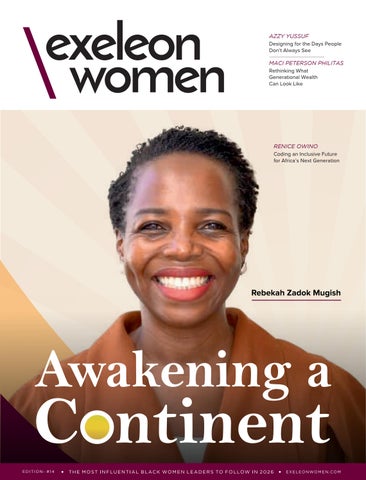
AZZY YUSSUF Designing for the Days People Don’t Always See MACI PETERSON PHILITAS Rethinking What Generational Wealth Can Look Like
RENICE OWINO Coding an Inclusive Future for Africa’s Next Generation
EDITION- #14
women EDITOR-IN-CHIEF DARYL YEUNG ART DIRECTOR NAOMI LAM MANAGING EDITOR MATT REIS CREATIVE DIRECTOR AKSHAY PANZADE CONTRIBUTING EDITORS JOHN RIGGS CONTENT CURATOR CATHY G. PROJECT MANAGER JOSH WILDER MARKETING MANAGER MIKE JACKSON SENIOR BDM KATHERINE PRICE BDM RICHARD DANN
C O N TAC T U S For any advertising related information, please contact info@exeleonmagazine.com. Submissions as well as contributions to the magazine are welcome.
Take a moment and let us know about our magazine; whether it be about the design or a possible mistake, we would appreciate any feedback from your end. You can reach out to daryl@exeleonmagazine.com.
FOLLOW US @exeleonwomen
\ CONTENTS
10
REBEKAH ZADOK MUGISHA THE REBEKAH ZADOK MUGISHA STORY
20 32
Azzy Y.
DESIGNING FOR THE DAYS PEOPLE DON’T ALWAYS SEE
26 MACI PETERSON PHILITAS: RETHINKING WHAT GENERATIONAL WEALTH CAN LOOK LIKE
32 RENICE OWINO CODING AN INCLUSIVE FUTURE FOR AFRICA’S NEXT GENERATION
EXELEONWOMEN.COM
MONSOON 26
Co-founder Malaika Path
10
\ C O V E R S T O R Y
11 EXELEONWOMEN.COM
Continent
MONSOON 26
Awakening a The Rebekah Zadok Mugisha Story
“
Africa’s greatest challenge is not a lack of talent but a lack of deliberate spaces for learning beyond formal education.
Governance
Mentorship
Legacy
Building trust through stewardship, not authority
Opening doors and pathways for others
Measuring leadership by lives transformed
“ MONSOON 26
Empowered women empower generations and transformations.
EXELEONWOMEN.COM
12
\ C O V E R S T O R Y
Leadership as Stewardship
“My career has never been about industries; it has always been about people,” she says. Whatever sector she found herself in, one question kept resurfacing: how do institutions create experiences that improve lives? That question became the thread connecting every chapter of her professional life, and it eventually shaped her into one of the continent's most respected voices on governance, customer experience, and institutional reform.
“Leadership is stewardship rather than authority,” she says. “Titles may grant responsibility, but inuence is earned through consistency, integrity, and the ability to develop others.” That commitment to stewardship and disciplined leadership has shaped Rebekah’s contribution across several governance roles. She currently serves as an Independent Audit Committee Member at Sanlam Allianz Uganda, Chair of the CXPA Africa Council, a member of the Advisory Council of the Africa CX Leaders Forum (ACXLF), and Chair of the ACXLF Citizen Experience Commission, where she works with leaders across the continent to advance customer and citizen experience through collaboration, thought leadership, and professional practice.
Each move across industries exposed her to different operating models, cultures, and leadership philosophies, but she noticed the same underlying challenge everywhere she went. “The underlying challenge remained the same, building trust,” she reects. That realization became the foundation of her passion for customer experience, institutional transformation, and leadership development, and today she views every role she has held as preparation for a larger conversation about how Africa can build institutions that are efcient without losing their humanity.
With more than fteen years of leadership experience behind her, Rebekah has arrived at a philosophy that runs counter to how many executives think about power and position. For her, leadership is not something granted by a title, and it never has been.
Governance, in her view, should never be reduced to a checklist of compliance requirements. “Good governance creates condence, sustainability, and better outcomes for citizens and customers alike,” she explains. Years of leading large teams and driving transformation programs have reinforced a conviction she returns to often: organizations thrive when their leaders stay curious, accountable, and willing to listen, and the best of them build environments where people can contribute meaningfully rather than simply follow instructions.
13 EXELEONWOMEN.COM
has spent more than eighteen years moving through some of the most demanding sectors on the African continent, from telecommunications to aviation, renewable energy to nancial services, yet she insists that none of those transitions were ever really about the industries themselves.
MONSOON 26
Rebekah Zadok Mugisha
\ C O V E R S T O R Y
A Movement Born From a Personal Conviction
MONSOON 26
Beyond her executive and advisory roles, Rebekah cofounded Malaika Path, a pan-African movement designed to awaken what she describes as the continent's critical, collaborative, and creative consciousness. The idea did not emerge from a market analysis or a strategic plan. It came from something far more personal.
EXELEONWOMEN.COM
14
“Malaika Path was born from a deeply personal conviction,” she says. Throughout her own career, she noticed that many of the lessons that shaped her growth, resilience, and leadership had never been taught in a classroom. They came instead from difcult conversations, failures, mentors, and moments of intentional reection, the kind of experiences that formal education rarely makes room for. Millions of young Africans, she realized, complete their schooling without ever encountering those transformative lessons. That gap became the question at the center of Malaika Path. “What if we intentionally created spaces where people could learn what truly works in life and leadership?” she asked herself. ‘What if we documented practical wisdom, distilled successful experiences, and made them accessible to anyone willing to learn?” The platform exists to answer that question, built on the conviction that Africa’s greatest challenge is not a shortage of talent, but a shortage of deliberate spaces for learning beyond the formal classroom. Across the continent, she points out, millions of young people nish school without ever having the conversations that shape judgment, critical thinking, creativity, collaboration, and responsible leadership. Malaika Path was built to close that gap. “We wanted to build a platform that awakens minds rather than simply transfers knowledge,” she says, and its ambitions stretch well beyond employability alone. She believes Africa’s future will belong to citizens who continually learn, unlearn, and relearn as the world shifts around them, and Malaika Path exists to provoke the kind of thoughtful conversations that nurture a generation capable of designing African solutions for African realities.
Rethinking What Makes an Institution Future-Ready Through her governance and advisory work, Rebekah has become a vocal advocate for a fundamental shift in how African institutions measure their own success. Activity, she argues, is not the same thing as impact, and organizations that confuse the two will struggle to remain relevant. “African institutions must move beyond measuring activity to measuring impact,” she says. Future-ready organizations, in her view, place citizens and customers at the centre of every decision rather than treating service as an afterthought bolted onto existing operations. Technology, however sophisticated, will not transform an institution on its own. “Technology alone will not transform institutions unless accompanied by cultural transformation,” she explains, arguing that boards and executives must invest as heavily in governance, leadership capability, ethics, and human-centered design as they do in new systems and platforms. The institutions built to last, she believes, are the ones willing to keep learning. “Organizations that continuously learn, adapt, and build trust with their stakeholders will remain resilient,” she says, while those that lean entirely on past success risk becoming irrelevant as the environment around them changes faster than their institutional habits can keep up. Carrying the Weight of Representation As one of the continent’s prominent women in governance and executive leadership, Rebekah is candid about the responsibility that comes with visibility. She does not treat her position as simply a personal achievement.
MONSOON 26 EXELEONWOMEN.COM
15
“Visibility carries responsibility,” she says. “Every woman who occupies a leadership position expands what is imaginable for the next generation.” For her, legacy is measured not by the roles a person accumulates, but by the doors they open for others along the way. Mentorship, sponsorship, and honest storytelling matter deeply to her because they normalize women’s leadership and give young professionals a version of themselves to look up to, something many never had growing up. “I hope my journey demonstrates that excellence and purpose can coexist,” she says, “and that African women belong not only in leadership conversations but at the tables where decisions shaping the continent are made.” It is a quietly ambitious statement, one built less on rhetoric than on the accumulated weight of nearly two decades spent proving it through her own work.
Advice for the Next Generation When asked what she would tell young African professionals hoping to lead with both purpose and impact, Rebekah’s answer is direct and largely unconcerned with the usual career advice about networking or credentials. “Invest in your mind before investing in your career,” she says. “Read widely, think deeply, ask difcult questions, and remain teachable.” She is equally blunt about the trade-off between ambition and character. “Do not chase titles at the expense of character,” she warns. “Competence may open doors, but integrity sustains inuence.” At the centre of her advice sits a conviction she returns to often: leadership is service, and the people who leave a lasting mark are the ones who commit themselves to solving problems larger than their own careers. “Africa needs thoughtful builders more than it needs celebrated personalities,” she says.
\ C O V E R S T O R Y
MONSOON 26
A Vision for What Comes Next
EXELEONWOMEN.COM
16
Looking ahead, Rebekah's ambitions for Malaika Path extend far beyond any single program or initiative. She describes her long-term vision in almost generational terms, a slow, deliberate reshaping of how an entire continent thinks. “My long-term vision for Malaika Path is to awaken the thinking of Africa, one mind, one conversation, and one community at a time,” she says. She does not believe lasting transformation begins with policy or institutions alone. It begins with how people think, and every individual who learns to think critically carries the potential to inuence others, creating a ripple effect that moves through families, workplaces, and communities until it eventually reshapes society itself. At Malaika Path, that mission takes the shape of documenting wisdom, facilitating meaningful conversations, and inspiring the kind of lifelong learning that equips Africans to become thoughtful leaders, innovators, and changemakers in their own right. “When individuals transform their thinking, they transform their
environments,” she says, “and when enough minds change, nations change.” Beyond the skills and frameworks, Rebekah hopes to help provoke Africa to raise a generation dened by wisdom, courage, integrity, and responsibility, one capable of building the stronger institutions and more resilient societies that transformation from within requires. Her life’s work, as she describes it, is ultimately about something larger than any title or boardroom seat: an Africa where learning becomes a way of life, where every individual recognizes their own power to shape the future, and where leadership is measured not by how much power a person accumulates, but by how many lives they transform along the way. @rebekahkmugisha malaikapath.org
FEATURE IN
EXELEON WOMEN MAGAZINE WE BELIEVE IN THE POWER OF STORYTELLING TO IGNITE CHANGE, AND OUR PAGES ARE FILLED WITH AUTHENTIC NARRATIVES THAT UPLIFT AND MOTIVATE.
DO YOU HAVE A STORY TO TELL THE WORLD? REACH OUT TO US BY CLICKING THIS LINK AND POTENTIALLY FEATURING IN EXELEON WOMEN MAGAZINE.
FEATURE ME
w ww ww . ew x .eel xe eolnew oo nm wo em n . ec n o .m com
Azzy Yussuf MONSOON 26
Designing for the Days People Don’t Always See
EXELEONWOMEN.COM
20
S
ome of the most frustrating problems are the ones that seem minor until you are the person dealing with them.
For Azzy Yussuf, one such moment happened while travelling. A rechargeable heating pad she depended on for comfort ran out of power during a ight. On its own, it might have seemed like an inconvenience. For someone navigating chronic illness and uctuating capacity, however, it exposed a larger design problem. What if products intended to provide comfort were actually designed around the realities of the people using them?
When Lived Experience Becomes a Design Brief Ìdẹ̀ra was not conceived around the idea of dening people by their health conditions. Quite the opposite. Azzy wanted to think about the whole person. Someone living with chronic illness still travels, works, socializes, laughs, rests, maintains relationships, and navigates responsibilities. Their capacity may change from one day to another, but their identity extends far beyond a diagnosis. That understanding became central to the brand.
That question would eventually help shape Ìdẹ̀ra by Azzy, the comfort-focused brand Azzy founded for people navigating chronic illness, invisible disabilities, and life’s more difcult days. It also reects an approach that runs throughout her career. Whether she is analyzing software, developing a product, improving a customer experience, or thinking about accessibility, Azzy is interested in what happens when something that is supposed to work for people does not quite work for them.
Rather than approaching comfort from a clinical perspective, Ìdẹ̀ra focuses on thoughtfully designed products, resources, and conversations that acknowledge what difcult days can actually look like. It is a distinction that matters to Azzy. Comfort, in her view, should adapt to people rather than expecting people to continuously adapt to products and environments that were not designed with them in mind.
EXELEONWOMEN.COM
MONSOON 26
\ I N - F O C U S
21
The Quality Assurance Mindset MONSOON 26
Entrepreneurship is only one part of Azzy’s professional life.
EXELEONWOMEN.COM
22
She has spent approximately eight years working in insurance, including the last several years in software testing and quality assurance. As a Quality Assurance Analyst, much of her job involves identifying problems before they reach the user, asking why something failed, and ensuring software performs as intended. At rst glance, insurance technology and a comfort-focused consumer brand may appear unrelated. In practice, Azzy sees considerable overlap. Quality assurance has taught her to think systematically. She looks for gaps, challenges assumptions, investigates inconsistencies, and considers how a user will actually move through an experience. Entrepreneurship requires many of the same instincts. At Ìdẹ̀ra, Azzy is involved across product development, manufacturing, compliance, customer research, e-commerce, and go-tomarket strategy. Her QA background inuences the way she approaches each stage. The guiding question remains remarkably consistent: How can we make this work better for the people it is meant to serve?
Ambition Without Ignoring Capacity Azzy’s experiences have also shaped how she thinks about professional ambition. Conversations about high performance often assume that people operate with relatively predictable levels of energy and capacity. For those managing chronic conditions or invisible disabilities, that assumption does not always reect reality. Someone can be ambitious and highly capable while also needing exibility. They can lead a business while experiencing difcult health days. They can deliver excellent work without following a rigid model of productivity. Azzy increasingly advocates for more thoughtful conversations around disability inclusion, accessibility, and sustainable performance in the workplace. Her perspective is not about lowering expectations. It is about reconsidering how people can perform at their best without treating exhaustion or physical sacrice as evidence of commitment. Culture, Fashion and Community Impact Ìdẹ̀ra is not Azzy’s rst experience as a founder. She is also behind Zzya Studios, formerly Zee Store, an Afrocentric fashion and accessories company inspired by African culture and contemporary self-expression. Azzy created the brand around her connection to African fashion and a desire to make culturally rooted pieces more accessible for people who wanted to express their heritage in everyday life.
\ I N - F O C U S
Through its Medication Support Program, the company directs support toward essential medication for people living with chronic illnesses across Africa. Fashion, in this context, becomes both an expression of cultural identity and a vehicle for community contribution. Making Systems More Human There is an interesting consistency across Azzy’s work. Quality assurance asks whether technology functions as intended. Ìdẹ̀ra asks whether products designed for comfort actually understand the people using them. Zzya Studios explores how business can connect culture, craftsmanship, and social contribution. Different industries, but a similar instinct. Look closely. Find the friction. Listen to the person experiencing it. Then improve what can be improved. For Azzy, entrepreneurship does not require separating personal experience from professional thinking. Some of her strongest ideas have emerged precisely because she understands problems from more than one perspective. She knows what it means to test a system professionally and to encounter systems personally that were never designed with every user in mind. That combination is shaping the kind of entrepreneur she is becoming. Through Ìdẹ̀ra by Azzy, Zzya Studios, and her wider work around accessibility and sustainable performance, Azzy is making a case for a more thoughtful approach to innovation, one where empathy is not an afterthought added to a nished product. It is where the design process begins.
“
Empathy is not an afterthoug ht added to a finished product. It is where the design process begins.
23 EXELEONWOMEN.COM
But Azzy has also connected the business to an issue that is deeply personal to her.
MONSOON 26
Zzya Studios works with artisans in Nigeria and produces its collections in small batches, combining traditional inspiration with contemporary styles.
MONSOON 26 EXELEONWOMEN.COM
26
Rethinking What Generational Wealth Can Look Like
M
aci Peterson Philitas has built her career around a question that appears in different forms across technology, investing, entrepreneurship, and family wealth: how do you give people more control over what comes next? In technology, that meant giving someone the ability to reconsider a message before it was delivered. In investing, it meant helping more Black women see themselves as owners and capital providers. In private wealth, it meant helping families think more intentionally about what they were building and eventually passing on. Today, through her work with founders, families, and young children, Maci continues to explore the same idea from different angles. An inventor, entrepreneur, former private wealth strategist, and platform builder, Maci has developed an uncommon understanding of both venture-backed innovation and long-term wealth creation.
Her career has taken her from launching a patented technology company to advising high-net-worth families, building investor communities, and creating tools that introduce children to money habits from an early age. Turning a Universal Mistake into a Technology Company One of Maci’s most recognized ventures began with an experience almost everyone knows: sending something and immediately wishing they could take it back. She co-founded On Second Thought (OST) around that simple insight, launching its mobile application in 2014. What initially appeared to be a consumer messaging solution eventually developed into something much larger. Maci led the company from an app into patented messaging infrastructure designed for use across
EXELEONWOMEN.COM
MONSOON 26
\ I N - F O C U S
27
EXELEONWOMEN.COM
28 MONSOON 26
\ I N - F O C U S
telecommunications, nancial technology, and enterprise communications. OST expanded its reach to more than 190 countries, raised over $1 million in investment capital, and developed technology that could be licensed by other platforms. The journey demonstrated an ability that would become central to Maci’s career: seeing beyond the immediate product to the system behind it. Rather than limiting the idea to a single application, she recognized that the underlying technology could serve a much broader market.
Maci later brought that entrepreneurial perspective into the world of private wealth management. As Vice President and Emerging Wealth Strategist at Bernstein Private Wealth Management, she worked at the intersection of wealth creation, entrepreneurship, and generational planning. She helped develop the rm’s Emerging Wealth strategy and contributed to initiatives focused on multicultural markets. Her work also involved one of the more complicated parts of wealth planning: helping families talk about money across generations. For Maci, wealth is not simply a question of accumulating assets. It is also about preparing people to understand, manage, and eventually transfer those assets responsibly. That perspective has helped shape much of the work she has pursued outside traditional nancial institutions. Changing Who Sees Themselves as an Investor Maci created I Look Like an Investor to address another dimension of ownership. The initiative was designed to help Black women see themselves not only as entrepreneurs or consumers, but as investors in startups and small businesses. It is a meaningful shift in perspective. Entrepreneurship is often discussed as a route toward economic empowerment, but ownership can also come from the other side of the table by deciding where capital goes and which businesses receive support. Through conversations, events, and community building, I Look Like an Investor sought to make that world more understandable and accessible. The underlying message was straightforward: investing is not reserved for people who t a traditional image of what an investor looks like.
29 EXELEONWOMEN.COM
From Building Companies to Building Wealth
MONSOON 26
Her work as an entrepreneur earned recognition including BBC’s 100 Women, Inc. Magazine’s 30 Under 30, and multiple 40 Under 40 honors. Yet the experience also gave her something perhaps more valuable: rsthand knowledge of what it means to build, nance, scale, and create ownership in a company.
\ I N - F O C U S
Teaching Wealth Before Adulthood
MONSOON 26
More recently, motherhood brought Maci’s work on generational wealth into an entirely different setting.
EXELEONWOMEN.COM
30
While helping her young son learn phonics, she began thinking about how early children develop other foundational habits. If reading is introduced through simple sounds, repetition, stories, and routines, she wondered why money was so often treated as a subject to introduce much later. That question inspired Eagle Rock Kids, a story-based nancial education company focused on helping young children develop their earliest money habits. Its approach reects Maci’s belief that nancial capability begins long before someone opens an investment account. Concepts such as patience, delayed gratication, decision-making, and understanding value can be introduced during childhood. For someone who previously helped wealthy families think about multigenerational nancial conversations, the move into children’s education represents a natural extension of her work. The audience changed. The underlying mission did not.
“
Wealth is not simply a question of accumulating assets. Building What Can Be Passed Forward
Across Maci’s career, technology, wealth management, investing, and nancial education may appear to belong to separate worlds. Look closer, however, and they form a consistent pattern. On Second Thought created greater control through technology. I Look Like an Investor expanded the conversation around who can own and invest. Her wealth management work focused on preparing families for generational transfer. Eagle Rock Kids brings nancial understanding to the very beginning of that journey. Today, Maci also advises founders, families, and capital platforms while exploring ways technology and ownership models can create lasting economic value. Her leadership suggests that generational wealth is not created through one transaction or investment. It is built through systems, behaviors, access, education, and opportunities for ownership. For Maci Peterson Philitas, legacy is ultimately about more than what someone manages to build during their lifetime. It is about whether what they build gives the next generation something stronger to build from.
EXELEONWOMEN.COM
34 MONSOON 26
Owino F
or Renice Owino, access to technology has never been simply about learning how to use a computer. It is about giving young people the condence to create, experiment, solve problems, and imagine a future in which they can participate fully. That belief sits at the heart of Code With Kids, the Kenyan STEM education initiative she founded to make coding, robotics, articial intelligence, and practical technology learning more accessible to children and young people.
35 EXELEONWOMEN.COM
Renice
MONSOON 26
\ I N - F O C U S
MONSOON 26
A Dream That Started
EXELEONWOMEN.COM
36
with One Laptop The idea began long before the organization took shape. As a teenager, Owino had a simple but ambitious dream: to create opportunities for children to experience STEM regardless of their social or nancial background.
websites and apps, create digital art, and explore science and engineering through hands-on projects.
In 2016, that idea became real when the rst Code With Kids session was held in Gatwekera with a single laptop.
That distinction is particularly important for learners in underserved communities, where access to devices, structured technology education, mentorship, and extracurricular STEM opportunities can remain limited.
What started with one device has since developed into a community-driven movement. Code With Kids has trained more than 3,500 students through STEM sessions, bootcamps, workshops, challenges, and schoolbased programs across Kenya and beyond. The scale matters, but the philosophy behind the work is equally important. Moving Children from Consumers to Creators Owino does not see technology education as an exercise in teaching children to memorize programming languages. Through Code With Kids, learners are encouraged to build games and animations, program robots, design
The goal is to help them understand that technology is something they can shape, not simply consume.
Creating More Space for Girls in STEM For Owino, inclusion also means ensuring that girls are given the space to participate, experiment, and lead. Code With Kids intentionally creates opportunities for girls to take visible roles in STEM activities, helping challenge the perception that technology and engineering are elds reserved for a narrow group of people. Her work reects a broader conviction that Africa's digital future cannot be truly transformative unless participation is widened.
EXELEONWOMEN.COM
MONSOON 26
\ I N - F O C U S
37
EXELEONWOMEN.COM
38 MONSOON 26
\ I N - F O C U S
Technology as a Tool for Social Development
Yet her leadership extends far beyond technical instruction. Building Code With Kids has required her to develop curricula, establish partnerships, coordinate volunteers, organize workshops and hackathons, work with schools and community centers, and nd ways to make programs accessible and sustainable. Its volunteer-led model creates another layer of impact by giving mentors and facilitators opportunities to develop their own leadership and teaching abilities. Learning Through Real-World Problems At the center of the program is a practical question: what happens when children are given the tools to solve problems they see around them? Instead of treating STEM as an abstract academic subject, Code With Kids encourages learners to connect technology with everyday challenges. Coding becomes a way to develop logical thinking. Robotics becomes an introduction to engineering and experimentation. Hackathons become spaces where teamwork, communication, creativity, and problem-solving come together. This approach helps young people understand that innovation does not have to begin in a large laboratory or technology company. It can begin in a classroom, a community center, or with a single laptop.
Owino’s larger ambition is to help create a generation of African young people who are prepared not only to enter a technology-driven economy, but to inuence what that economy becomes. That requires digital skills, but it also requires condence, curiosity, resilience, and the ability to collaborate. Her leadership offers a useful reminder that meaningful innovation is often built gradually. Code With Kids did not begin with extensive infrastructure or an abundance of resources. It began with an idea, one laptop, and a willingness to start. Preparing Africa’s Next Generation A decade later, that starting point has grown into thousands of learning experiences and a platform through which young people can see themselves differently. For Owino, the measure of progress can ultimately be found in those moments when a child moves from asking what technology can do to asking what they can build with it. That shift from user to creator is at the heart of her mission.. As articial intelligence, automation, robotics, and digital platforms continue to reshape economies, Africa will need more than access to technology. It will need young people who understand it, question it, build with it, and use it to address the needs of their communities. Through Code With Kids, Renice Owino is helping ensure that more of those young people get their rst opportunity to begin.
MONSOON 26
A front-end developer by profession, Owino brings her technical experience into the initiative. Her background in web development, open-source technology, and digital problem-solving has shaped the way she approaches STEM education.
Recognition, however, is not the end goal.
39 EXELEONWOMEN.COM
Building More Than a ST EM Program
The journey has also placed Owino among a growing generation of African entrepreneurs who view technology as a tool for social development.
MONSOON 26 EXELEONWOMEN.COM
42
Across Africa and beyond, Black women leaders are shaping industries, strengthening communities, creating new businesses, and challenging long-standing assumptions about who gets to lead, invest, innovate, and influence. Their impact can be seen across entrepreneurship, healthcare, marketing, technology, youth development, gender equality, and social enterprise. What connects them is not a single leadership style, but a willingness to take responsibility for difficult problems and turn ideas into action. From building companies and community organizations to advancing data-driven decision-making, preventive healthcare, youth readiness, and economic empowerment, these women are helping define what leadership looks like in 2026. Here are some of the most influential Black women leaders to follow this year, according to Exeleon Women Magazine.
INFLUENTIAL BLACK WOMEN LEADERS
Sonnia Agu Founder & CEO, Sapio Group Sonnia Agu is an entrepreneur and business leader whose work spans enterprise development, social impact, and economic empowerment across Africa. As Founder and CEO of Sapio Group, she oversees an umbrella organization that includes SapioWorks, SapioFoods, SapioClub, SA Consulting, and the G1st International Foundation, also known as God First International Foundation.
Abisoye SingingBee Strategist, Music Artist & Founder, SingingBee Agency Abisoye SingingBee has built her work around something often overlooked in business conversations: human relationships. A strategist, music artist, and entrepreneur, she is the Founder of SingingBee Agency, a relationship-driven surprise call agency with an ambitious mission to help make one million relationships better.
INFLUENTIAL BLACK WOMEN LEADERS
Dr. Marianna Nyokabi
MONSOON 26
General Practitioner & Wellness Advocate Based in Nairobi, Kenya, Dr. Marianna Nyokabi is a licensed general practitioner whose work focuses on preventive health, lifestyle medicine, and concierge healthcare. Through preventive healthcare and lifestylefocused guidance, Dr. Nyokabi encourages patients to think more proactively about their health.
EXELEONWOMEN.COM
44
Peace Monica Pimer Founder & Executive Director, Nile Girls Forum Peace Monica Pimer is a social impact leader working to improve opportunities for young women and girls in Uganda. As Founder and Executive Director of the Nile Girls Forum, she leads a nonprot organization focused on advancing gender equality through education, peace-building, sexual and reproductive health, climate action, and economic empowerment.
INFLUENTIAL BLACK WOMEN LEADERS
Eunice Olohirenuan Braimah CEO, IdeaZQution Consulting With more than two decades of experience across business strategy, integrated marketing, and organizational transformation, Eunice Olohirenuan Braimah has built a career helping organizations translate ideas into measurable growth. As Chief Executive Ofcer of IdeaZQution Consulting, also known as ZQ, she leads initiatives that connect strategic thinking with creative execution.
Rebekah Zadok Mugisha Co-Founder, Malaika Path Rebekah Zadok Mugisha is a customer experience and workforce-readiness practitioner focused on preparing Africa's young people and institutions for a rapidly changing future. She is the Co-Founder of Malaika Path, a purposedriven platform designed to equip African youth and workplaces with the mindset, skills, and exposure needed to thrive in the future of work.
SCAN HERE TO LEARN MORE
WWW.EXELEONWOMEN.COM