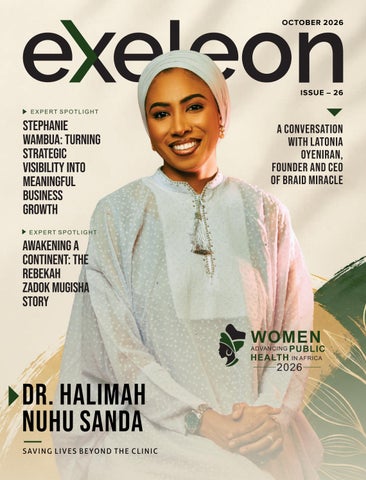
OCTOBER 2026
ISSUE – 26 EXPERT SPOTLIGHT
Stephanie Wambua: Turning Strategic Visibility into Meaningful Business Growth
A Conversation With LaTonia Oyeniran, Founder and CEO of Braid Miracle
EXPERT SPOTLIGHT
Awakening a Continent: The Rebekah Zadok Mugisha Story
WOMEN
ADVANCING PUBLIC HEALTH IN AFRICA
2026
Dr. Halimah Nuhu Sanda S AV I N G L I V E S B E YO N D T H E C L I N I C
_magazine
exeleon_magazine
exeleon_magazine
_magazine
exeleon_magazine
exeleon_magazine
FOLLOW ON INSTAGRAM
exeleon_magazine
exeleon_magazine
exeleon_magazine
exeleon_magazine
exeleon_magazine
LEADERSHIP SPOTLIGHT / BUSINESS INSIGHTS/ ENTREPRENEURIAL STORIES
600 N Broad St 5 Middletown, DE 19709, United States Ph: +1 302-440-3100 123, Gera Imperium Rise, Hinjewadi Phase 2, Pune 411057, India Ph: +91-8484980518
Editor-in-Chief –
Daryl Yeung
Art Director –
Naomi Lam
Managing Editor -
Matt Reis
Creative Director –
Akshay Panzade
Project Manager –
Richard Dann
Marketing Manager –
Sofia Brown
Customer Relationship –
Natasha Green
Business Development –
Roshan Mahato, Josh Wilder, Anish Miller
www.exeleonmagazine.com
Ed orial Note Public health is shaped not only in hospitals and laboratories, but also in communities, classrooms, policy rooms, research institutions, and the everyday decisions that determine who receives care and who remains overlooked. Across Africa, women have long carried much of this responsibility. They serve on the front lines, lead community interventions, inuence health policy, advance medical research, and build organizations that bring essential services closer to the people who need them. Yet their contributions have not always been matched by equal representation in leadership and decision-making. Exeleon Magazine’s Women Advancing Public Health in Africa 2026 edition recognizes women who are helping change that reality. These leaders are strengthening health systems while confronting challenges surrounding access, funding, workforce development, disease prevention, maternal health, technology, and public trust. Featuring on the cover is Dr. Halimah-Sa’dia Nuhu Sanda, whose journey reects the conviction, service, and leadership at the heart of this edition. Her story demonstrates that advancing public health requires more than technical knowledge. It calls for empathy, courage, collaboration, and a willingness to remain close to the communities behind every policy and statistic.
Daryl Yeung Editor-in-Chief
CONTENTS
12 HALIMAH SANDA
CONTENTS
22 STEPHANIE WAMBUA
CONTENTS
42 REBEKAH ZADOK MUGISHA
WOMEN
ADVANCING PUBLIC
HEALTH IN AFRICA
2026
Dr. Halimah
Nuhu Sanda Saving Lives Beyond the Clinic
For Dr. Halimah Nuhu Sanda, medicine begins with the patient, but meaningful public health must also confront the systems that determine who receives care, who remains invisible, and who gets the opportunity to thrive. Through her work as a physician, public health expert, advocate, and Founder of ROMZAIB Foundation, she is connecting women’s health, girls;’ education, and community leadership to create change that can endure.
12 | OCTOBER 2026
EXELEON MAGAZINE
C O V E R S T O RY
WWW.EXELEONMAGAZINE.COM
OCTOBER 2026 | 13
C O V E R S T O RY
Medicine taught... Dr. Halimah Nuhu Sanda to care for the person in front of her. Public health taught her to look beyond that individual and ask why she had become vulnerable in the first place. Was quality care within reach? Was a skilled health worker available? Could the referral system respond in time? Did the facility have essential supplies? Were leaders using reliable data to strengthen services? These questions gradually expanded Halimah’s understanding of what it means to save a life. “A good clinical decision can save one life, but a functioning health system can save thousands,” she says. Her transition into public health was therefore not a departure from medicine. It was an extension of the same responsibility. She moved from treating individual patients to strengthening the policies, institutions, and community systems that give women, newborns, and families a greater chance of surviving and thriving. That commitment makes her a fitting cover leader for Exeleon Magazine’s Women Advancing Public Health in Africa edition. STAYING CLOSE TO THE PATIENT Although Halimah’s responsibilities now span health systems, advocacy, education, and social development, she has not completely stepped away from clinical practice. Whenever her schedule allows, she provides pro bono clinical services at a teaching hospital in Kano. For several years, this was an almost weekly commitment. While the frequency has changed as her responsibilities have grown, the work remains an important part of her identity as a physician.
14 | OCTOBER 2026
Clinical practice keeps her close to patients and families. It also ensures that conversations about policy, data, and health-system reform remain connected to the realities experienced inside hospitals and communities. Maternal and newborn health has been particularly influential in shaping her work. Nigeria continues to carry a significant share of the global maternal mortality burden, while many women still give birth without a skilled attendant present. For Halimah, these figures reveal more than gaps in service utilization. They expose questions of trust, access, continuity, workforce availability, and whether health systems can respond when women need them most. “Behind every statistic is a woman, a newborn, a family, and a community,” she says. The consequences of a preventable maternal death extend far beyond one patient. Children, households, and entire communities carry the loss. PUBLIC HEALTH CANNOT BE DESIGNED FROM A DISTANCE Halimah’s early public health work focused heavily on HIV/AIDS, which was among Africa’s most prominent health concerns at the time. The experience gave her a foundation in prevention, community engagement, program implementation, and the use of data. As she spent more time working with communities, however, she began seeing a much wider health continuum. HIV could not be separated from sexual and reproductive health. Maternal health was connected to family planning, adolescent health, child survival, and access to skilled care. Each outcome was influenced by the strength of the primary healthcare system surrounding the individual. Her core professional focus subsequently evolved toward sexual, reproductive, maternal, newborn, and child health, alongside primary healthcare delivery and health-system strengthening. The communities she served also taught her to question interventions that appeared effective on paper but did not reflect how people actually lived, made decisions, or sought care.
EXELEON MAGAZINE
WWW.EXELEONMAGAZINE.COM
OCTOBER 2026 | 15
“
A good clinical decision can save one life, but a functioning health system can save thousands.
16 | OCTOBER 2026
EXELEON MAGAZINE
C O V E R S T O RY
Leadership and Recognition Founder and Chairperson, ROMZAIB Foundation Honorary Adviser to the Executive Governor of Kaduna State on Sustainable Development Goals Board Chairperson, Child Solidarity Group Member, Governing Board of Sterling Bank’s Health Workers Fund Maternal Health Ambassador, International Museum of Women Recognized among Opportunities Hub’s 100 Most Influential Young People in 2022 Conversationist, Reykjavík Global Forum Member, Board of Directors, Lugansk Medical University Volunteer Association
WWW.EXELEONMAGAZINE.COM
“A program can be technically sound and still fall short if it does not respond to how people actually live,” Halimah explains. Sustainable public health requires functioning institutions, capable health workers, reliable data, and quality services. It also requires relationships. Families, women, young people, traditional leaders, religious leaders, and community institutions must be able to participate in shaping the response. Halimah’s approach begins with listening, understanding context, recognizing existing strengths, and developing solutions that communities can own. REACHING THE GIRL BEFORE SHE BECOMES A MOTHER ROMZAIB Foundation emerged from Halimah’s conviction that professional expertise must eventually translate into practical impact. After years of observing how unequal access to healthcare and opportunity disproportionately affected women, girls, and children, she wanted to create a platform capable of responding directly at the community level. The Foundation works at the intersection of health, girls’ education, and empowerment. For Halimah, these areas cannot be separated. “We cannot talk seriously about maternal and reproductive health without also paying attention to the girl before she becomes a mother,” she says. Education can influence when a young woman marries, when she begins childbearing, how confidently she makes decisions about her health, and what economic choices become available later in life. Halimah is careful not to portray families in Northern Nigeria as indifferent to their daughters’ futures. In her experience, parents want their daughters to succeed. What is frequently missing is the means. A school may be too far away. Female teachers may be unavailable. Uniforms and learning materials may be unaffordable. Inadequate water and sanitation can cause girls to miss school during menstruation. Families may also struggle to see a credible pathway between completing school and securing a meaningful future. ROMZAIB works alongside families, schools, traditional institutions, and religious leaders to help close these gaps.
OCTOBER 2026 | 17
Turning Evidence into Practical Action One of the Foundation’s initiatives, Let it Flow, addresses period poverty as both a health and education issue. The program distributes reusable sanitary pads to girls attending schools in rural communities. The decision to use reusable products is deliberate. Disposable pads may solve the problem for one cycle, but they recreate the same financial burden the following month. Reusable pads provide support across several cycles while reducing household costs and disposal challenges. The objective is straightforward: a period should never cost a girl her place in the classroom. ROMZAIB has also established a midwifery scholarship initiative for girls from underserved communities in Kano. Approximately 95 percent of beneficiaries come from rural Local Government Areas. The scholarships address two connected gaps. They create educational opportunities for young women while helping develop skilled health workers who understand, and are more likely to remain within, the communities that need them. Nigeria faces a substantial shortage of midwives, particularly in rural and underserved areas. Training young women from those communities offers a locally grounded response. “A young woman trained from within her own community is far more likely to stay and practice there,” Halimah explains. ROMZAIB intends to expand the number of scholarship beneficiaries and eventually extend support into fields including medicine, engineering, journalism, and law.
The expansion demonstrated that a promising intervention could reach more people, but it also revealed the difference between proving an idea and building something sustainable. “What works in a pilot is not automatically ready for scale,” she says. A pilot may establish that an intervention is viable. Scale demands financing, supervision, reliable data, human resources, clear accountability, and the ability to adapt to different communities without sacrificing quality. Halimah is equally clear that the achievement belonged to a wider team. Managers, mentors, drivers, field teams, health workers, and community members all contributed to the outcome. The experience changed the questions she asks at the beginning of an intervention: Who will own it? Who will finance and supervise it? How will quality be protected? What evidence will show whether it is working? What happens when external support ends? “Scale is not simply about doing more,” she explains. “It is about building the partnerships, capacity, and systems that allow a good intervention to continue.” SEEING NORTHERN NIGERIA BEYOND ITS CHALLENGES Halimah believes outsiders often understand Northern Nigeria only through narratives of inequality, poor health outcomes, and limited educational access. The challenges are real, but they are not the whole story.. The region also possesses strong community structures, influential traditional institutions, significant human capital, and women and girls with ambition, resilience, and ideas.
TAKING A PILOT FROM FIVE COMMUNITIES TO FIFTY
“I am particularly cautious about narratives that portray Northern women and girls only as victims,” she says. “They face real structural barriers, but they also have agency.”
Among the formative experiences of Halimah’s public health career was helping scale Community Based Service Delivery from five pilot sites to 50 across Zamfara State.
Solutions cannot simply be imported and imposed. Sustainable change must be locally owned and informed by the religious, cultural, and social context of the communities involved.
18 | OCTOBER 2026
EXELEON MAGAZINE
C O V E R S T O RY
“
I want to contribute to a Nigeria where geography does not determine a woman’s chance of surviving pregnancy and where a girl’s potential is not limited by her circumstances.
WWW.EXELEONMAGAZINE.COM
OCTOBER 2026 | 19
20 | OCTOBER 2026
EXELEON MAGAZINE
C O V E R S T O RY This does not mean accepting every existing condition. It means understanding that change lasts when it travels through institutions and relationships that people already know and trust. Whether the objective is increasing skilled birth attendance, improving vaccination coverage, or keeping girls in school, the response must consider household decision-making, transportation, community norms, trust, and the influence of local leaders. The strongest solutions, Halimah believes, combine credible evidence with local wisdom. WHEN IMPACT BECOMES PART OF EVERYDAY LIFE Halimah defines meaningful impact as change that becomes part of people’s lives rather than remaining a successful project on paper. In public health, that means fewer preventable maternal deaths, healthier newborns and children, stronger primary healthcare systems, and access to quality services without financial hardship. For girls, impact extends beyond school enrollment. It means having the health, confidence, knowledge, and opportunity to determine the direction of their own lives.
“
My evolution into public health was not a departure from medicine. It was an expansion of the same responsibility. Yet the legacy Halimah seeks is not defined by titles. She wants to help create a Nigeria where geography does not determine whether a woman survives pregnancy, where a girl’s circumstances do not limit her potential, and where strong health systems are recognized as an investment in national development.
Over the next decade, Halimah wants ROMZAIB Foundation to demonstrate what locally driven investment in women, girls, and children can achieve across Northern Nigeria. She envisions the Foundation strengthening partnerships, contributing to evidence, and helping successful community interventions influence wider policies and programs.
“If, a decade from now, more women are alive because systems became stronger, more girls are educated because barriers were removed, and more communities have a meaningful voice in shaping the services they receive, I would consider that meaningful impact.”
Her own leadership will continue to sit at the intersection of clinical practice, reproductive and maternal health, health systems, policy, advocacy, and diplomacy.
For Dr. Halimah Nuhu Sanda, that is the true measure of leadership: not simply treating the consequences of inequality, but strengthening the systems, opportunities, and communities that can prevent those consequences from occurring.
She has already served in roles including Honorary Adviser to the Executive Governor of Kaduna State on the Sustainable Development Goals, Chairperson of Child Solidarity Group, and a member of the Governing Board of Sterling Bank’s Health Workers Fund. She was also recognized among Opportunities Hub’s 100 Most Influential Young People in 2022.
WWW.EXELEONMAGAZINE.COM
@hansboudib romzaibfoundation.org/
OCTOBER 2026 | 21
IN-FOCUS
22 | OCTOBER 2026
EXELEON MAGAZINE
Stephanie
Wambua
Turning Strategic Visibility into Meaningful Business Growth Founder & Lead Strategist, Beacova | Strategic Marketing & Brand Positioning Expert
F
or Stephanie Wambua, effective marketing has never been about simply getting a brand noticed. It is about reaching the right audience, communicating with purpose, and ensuring that every marketing effort contributes to meaningful business growth. With a career spanning multiple industries, including FMCG, hospitality, and investments, Stephanie has experienced rsthand how established organizations approach marketing and where growing businesses often struggle. These experiences eventually led her to establish Beacova, a strategic marketing business dedicated to helping growing companies build stronger brands, improve their visibility, and compete more effectively in the marketplace. Beyond her consulting work, Stephanie is a speaker, trainer, panel moderator, and corporate MC who believes in the
WWW.EXELEONMAGAZINE.COM
power of intentional communication and professional storytelling. She also mentors emerging digital marketing professionals, helping them develop practical skills and identify opportunities for growth. In this exclusive conversation with Exeleon Magazine, Stephanie reects on her entrepreneurial journey, the importance of strategic brand positioning, the relationship between visibility and credibility, and her vision for helping businesses and leaders across Africa realize their potential. Stephanie, your experience spans banking, FMCG, real estate, hospitality, education, and investments before building your own identity as a strategic marketer. Can you take us through that journey and what ultimately led you to establish Beacova? My journey into marketing really began with my rst role at
OCTOBER 2026 | 23
IN-FOCUS a fast-moving consumer goods company, and I often think about how much that experience shaped the marketer I am today. It gave me a 360-degree view of marketing. I was exposed to what different specialized agencies do, including ATL, BTL, digital marketing and research, and had the privilege of seeing how established brands work with experts in different areas to remain relevant, grow and stay strong in the market.
The original idea behind Beacova was to support growing businesses to win in the marketplace by helping them approach marketing more strategically. I had spent substantial time speaking to business owners, and I kept hearing similar sentiments: “I didn't see any results from marketing.” “I’ve worked with someone and it hasn't worked.” “We don't have a dedicated marketing team.” “We just post when we can.”
At the same time, I was working internally on marketing strategies, campaign ideas, activations and collaborating with R&D teams to understand the different products. There was probably no better way for me to have entered the marketing eld. As I grew in my career, I realized I wanted to become more hands-on with my skills, and that is where my interest in digital marketing started to develop.
What I noticed was that the problem was often deeper than the marketing activity itself. In many cases, marketing objectives were not aligned with business objectives, so it became difcult to see how the activities were contributing to the bigger picture.
At the time, I was also actively building my personal brand and began sharing what I was learning and experiencing on LinkedIn. My role exposed me to different activities, teams and markets across the country, and I realized I could document my experiences while learning from other people in the industry. That eventually led me into digital marketing, where I gained hands-on experience across content marketing, email marketing, social media management, paid advertising and promotions. Through that role, I also had exposure to hospitality before moving into investments, where I continued working in digital marketing at a deeper and broader level. Throughout that journey, I realized that I genuinely loved marketing, communicating with people, bringing brands to life and seeing what happens when a brand communicates clearly to the right audience. But as I interacted with more business owners and growing businesses, I noticed a gap. I had worked with established organizations that understood the role of marketing in their growth, while many growing businesses treated marketing as something to do when time and resources allowed. It was often sporadic, random and without a clear system. That ultimately led me to establish Beacova: to help growing businesses understand marketing differently, not as an add-on, but as something that can support their growth and help them compete and win in the marketplace. What was the original idea behind Beacova, and what gap did you see in the market between businesses that were simply “doing marketing” and those using marketing strategically to support growth?
24 | OCTOBER 2026
Established brands tend to understand the place of marketing within the business. They set aside budgets, have dedicated teams or specialists and establish performance indicators around what they want marketing to achieve. That is the gap I saw and the one I wanted Beacova to help address, helping growing businesses build more intentional and strategic approaches to marketing using the resources they have available. You often emphasize that being visible is not enough. A brand needs to be visible “to the right people, for the right reasons.” How do you determine who a brand actually needs to reach and what it should become known for? Being visible to the right people matters because, rst and foremost, you cannot serve everyone. Whether you are building a personal brand or a business brand, your target audience cannot be everyone. Once you say you want to serve everyone, you have probably missed the point already. The faster you become clear about who you are speaking to, why you are speaking to them and what you want them to do, the easier it becomes to build a meaningful relationship with them. Building relationships with customers and clients takes time. For me, determining who a brand is for and what it should become known for starts with dening the brand's goals and objectives. What should the brand achieve and who does it need to achieve that with? Once you are clear on that, you can ask how to reach those people, what matters to them and how you want the brand to be perceived.
EXELEON MAGAZINE
WWW.EXELEONMAGAZINE.COM
OCTOBER 2026 | 25
Visibility without that clarity can easily become noise. The goal is not simply to be seen by more people. It is to be remembered by the right people for the right reasons. As an African woman entrepreneur building a business around strategy, visibility, and inuence, what has your own journey taught you about claiming space and building professional credibility? I started building my personal brand while I was still in my rst corporate role, largely because that role gave me so much experience that I felt was worth sharing. That taught me something important: building a brand does not always require you to have everything gured out rst. You already have your experiences, your expertise, your personality,
26 | OCTOBER 2026
what you are learning and even the challenges you are navigating. Those can become part of your story. One of the biggest lessons my journey has taught me is not to overthink building a brand. The sooner you start, the faster it can begin to compound. It is the small, intentional steps you take consistently, such as sharing your story, sharing lessons, giving value, engaging with other people’s content and showing up consistently. I have also learnt that claiming space can start at whichever level you are currently at. It can start with the projects you are involved in, a volunteer opportunity or even an internship. Every experience has value if you are open to learning from it.
EXELEON MAGAZINE
IN-FOCUS Documentation is another thing I have come to appreciate. If you successfully complete a project, navigate a challenging situation, work with a team or learn something valuable, document it. Keep records of what you are doing and the lessons you are picking up. That becomes useful when you are building credibility because visibility creates familiarity, and familiarity can create opportunities. I have beneted from people recommending me, referring me to opportunities and remembering my name when an opportunity came up. That, to me, is what intentional visibility can do. Beyond consulting, you speak, train, moderate panels, and work as a corporate MC. What have these experiences taught you about communication and presence, and how have they inuenced the way you advise leaders on building trust with an audience? My experiences as a speaker, trainer, moderator and corporate MC have taught me that communication and presence are incredibly important. In my line of work, communication is one of the ways you bring your ideas, propositions and recommendations to life. One thing I have really come to appreciate is the importance of research. When you step in front of an audience, you need to understand the people you are speaking to. What matters to them? What do they value? What language will be clear to them? You cannot simply walk into a room with jargon and expect people to connect with what you are saying if you have not taken the time to understand them. That experience is very aligned with the work I do in marketing because the principles are similar: understand the people you are speaking to, do your research and take time to connect with them before asking anything from them. I have also learnt that giving value and consistency are important. Even showing up when you said you would or delivering what you committed to contributes to trust. Audiences need that same consistency from leaders. Another thing I have noticed with leaders is the importance of documenting their stories. There are leaders who have built an incredible wealth of experience and done remarkable work, but much of that story remains untold. It stays in reports instead of being shared. Your story can inspire other people, but it can also attract opportunities for you.
WWW.EXELEONMAGAZINE.COM
Looking ahead, what is your vision for Beacova, and how do you see the relationship between branding, personal visibility, AI, and business growth evolving over the next several years? I see Beacova becoming a trusted marketing partner for businesses across Africa, especially growing businesses that are working with the resources and budgets available to them, but are also responsive enough to understand that marketing is a growth engine, not an add-on. We want to help businesses bring their brands to life because every business has a vision, an idea and signicant effort behind it, and that deserves to be recognised by the right people in the marketplace. We are also keen on supporting leaders to build strong brands around their experience, expertise and skills. I would love to see Beacova support more leaders and businesses, starting in Kenya, expanding across the region and eventually across Africa. When it comes to AI, I see it as a tool that is making certain aspects of marketing and business growth more accessible and efcient. It allows us to access information quickly, brainstorm, ideate and build systems more efciently. I think the opportunity is to use these tools well while still being intentional about the strategy behind what we are building. I also see a growing role for founder-led marketing, particularly for businesses started by founders and solopreneurs. When leaders build strong personal brands and share their perspectives, experiences and journeys, that visibility can also help move the businesses they lead forward. Ultimately, I see branding, leadership visibility and strategic marketing working together to help businesses build trust, become recognized for what they do and grow.
@stephanie-wambua beacovamarketing.com
OCTOBER 2026 | 27
Unlock Your DIGITAL SUBSCRIPTION! Ready to fuel your ambition and receive your dose of inspiration directly to your digital doorstep? Subscribe to Exeleon Magazine today, and enjoy the following perks:
• Convenience at Your Fingertips • Exclusive Extras • Community Connection
EXELEON SPOTLIGHT
30 | OCTOBER 2026
EXELEON MAGAZINE
I Women Advancing Public Health in Africa
n a rural community, the person connecting a pregnant woman with antenatal care is often a woman. The nurse administering a vaccine, the midwife managing a difcult delivery, and the community health worker monitoring a child’s nutrition are also likely to be women. Their inuence reaches far beyond patient care. Women are leading disease surveillance programs, directing scientic research, designing health policy, managing emergency responses, training future professionals, and building institutions capable of addressing Africa’s most urgent health challenges. Public health across the continent is already being advanced by women. The question is whether health systems are prepared to recognize, support, and elevate them at the same scale.
From the Frontline to the Decision Table Women form the backbone of Africa's health workforce. Across clinics, laboratories, universities, ministries, and community programs, they are improving access to care and shaping the continent's response to disease. Yet the authority to determine health policy, financing, and institutional priorities remains unevenly distributed.
A Workforce Built on Women’s Labor Women account for approximately 72 percent of the health workforce in the WHO African Region. They represent about 94 percent of midwifery personnel, 79 percent of community health workers, and 73 percent of nursing personnel. Yet women account for only around 35 percent of medical doctors. The contrast becomes even sharper at the leadership level. WHO’s State of the Health Workforce in Africa 2026 reports that women hold only 33.1 percent of senior health leadership roles across the 22 countries with complete data. Lesotho, Malawi, and Seychelles were the only countries in that group to reach or exceed gender parity. In seven countries, women held fewer than 15 percent of senior positions. This creates a familiar imbalance: health care is largely delivered by women, while many of the most inuential decisions continue to be made without equal female representation. Those decisions determine which diseases receive funding, where facilities are built, how
WWW.EXELEONMAGAZINE.COM
OCTOBER 2026 | 31
32 | OCTOBER 2026
EXELEON MAGAZINE
EXELEON SPOTLIGHT health workers are paid, which research questions are prioritized, and whether community experience inuences national policy. Increasing women’s leadership is therefore not simply about improving representation. It is about ensuring that the people carrying much of the health system’s daily responsibility also have the authority to improve how that system works. The Last Mile Is the Health System Africa’s public health progress depends heavily on what happens outside major hospitals. Community health workers connect households with formal health services, support maternal and child health, monitor infectious diseases, promote vaccination, assist with health education, and increasingly contribute to the management of noncommunicable diseases and public health emergencies. Africa CDC estimates that there are approximately seven community health workers for every 10,000 people across the countries for which data are available. Four out of ve have received training, and most countries surveyed now have standardized curricula. However, only 25 percent of Member States offer community health workers a formal career path or opportunity for advancement. Women are widely believed to represent roughly 70 percent of this workforce in sub-Saharan Africa, although incomplete gender-disaggregated reporting makes the precise gure difcult to establish. Too many of these women remain poorly paid, informally employed, or expected to treat essential health work as an extension of their domestic responsibilities. That arrangement is neither fair nor sustainable. If community health workers are essential to disease prevention, maternal health, vaccination, and emergency readiness, they must be treated as an integral part of the professional workforce. That means reliable compensation, protective equipment, appropriate training, supervision, digital tools, and visible routes into more senior roles.
WWW.EXELEONMAGAZINE.COM
Africa cannot build resilient public health systems on women's underpaid or unpaid labor. Leadership That Has Already Changed the Landscape The case for women’s leadership is not theoretical. African women have already demonstrated what becomes possible when they have the authority to inuence institutions and policy. Dr. Matshidiso Moeti became the rst woman elected as WHO Regional Director for Africa and led the organization’s work across the region from 2015 to 2025. Her tenure began amid the West African Ebola crisis and later encompassed COVID-19, health system reform, universal health coverage, and the certication of the African Region as free of wild poliovirus. WHO’s review of her decade in ofce credits her Transformation Agenda with making the regional organization more accountable, responsive, and effective. In Rwanda, Professor Agnes Binagwaho spent two decades in public service, including ve years as Minister of Health. She helped advance policies centered on equitable access, particularly for poor and marginalized communities, before moving into health education and institution building through the University of Global Health Equity. In South Africa, epidemiologist Professor Quarraisha Abdool Karim has made major contributions to understanding HIV among adolescent girls and young women. Her work on the CAPRISA 004 trial provided proof of concept for a woman-controlled HIV prevention method, while her wider career has helped train hundreds of scientists across southern Africa. At Africa CDC, women such as epidemiologist Shingai Machingaidze are helping lead clinical research, scientic partnerships, and programs designed to strengthen the capacity of African researchers and institutions. In Zambia, Dr. Mazyanga Lucy Mazaba has combined public health communication, emergency risk engagement, and institutional leadership, including serving as the inaugural editor-in-chief of the country's public health bulletin.
OCTOBER 2026 | 33
These women work in different disciplines, but their careers share an important quality. They have not only delivered programs. They have helped build the systems, knowledge, and institutions through which public health advances can endure.
may understand why a program that appears sound at the national level becomes impractical at the household level. A female clinician may recognize how transportation, unpaid care work, income, safety, or social expectations affect whether a patient can follow medical advice.
Why Perspective Matters
These perspectives matter because public health is shaped by more than medicine. It is inuenced by employment, education, housing, nutrition, gender norms, infrastructure, conict, climate, and trust.
Women do not lead in one uniform way, nor should their value be reduced to the assumption that they will automatically prioritize women’s issues. Their importance lies in widening the experience, knowledge, and judgment represented in decision-making. A researcher studying HIV among adolescent girls may recognize behavioral and social risks that a narrow biomedical model overlooks. A community health leader
34 | OCTOBER 2026
The maternal health crisis demonstrates what is at stake. Sub-Saharan Africa accounted for approximately 70 percent of global maternal deaths in 2023. Although the region reduced its maternal mortality ratio by about 40 percent between 2000 and 2023, progress remains far too slow. WHO estimates that the annual rate of reduction would
EXELEON MAGAZINE
EXELEON SPOTLIGHT problem is that professional systems do not consistently convert talent into authority. Women may enter health professions in large numbers but face narrower promotion pathways, limited access to professional networks, unequal care responsibilities, workplace discrimination, safety concerns, and fewer opportunities to lead major programs or research. A rapid review of health workforce recruitment and retention in Africa found that gender inuences career trajectories, pay, training opportunities, access to technical resources, and participation in professional networks. It also identied occupational segregation, harassment, and discrimination as recurring barriers. Mentorship and leadership programs can help, but training alone will not correct institutional barriers. Women cannot be coached around systems that continue to reward them unequally. Organizations need transparent promotion criteria, equitable compensation, protection from harassment, family-supportive policies, access to research funding, and intentional sponsorship for high-responsibility assignments. Leadership opportunities must extend beyond maternal health and nursing into epidemiology, emergency response, surgery, health economics, digital health, biotechnology, and national health security. need to accelerate twelvefold for the African Region to meet the 2030 Sustainable Development Goal. Improving these outcomes requires more than expanding maternity wards. It demands stronger primary care, trained health workers, functioning referral systems, reliable transportation, access to reproductive health services, accurate data, and health nancing that does not leave women choosing between medical care and household survival. Women working across the health system often encounter these interlocking realities directly. Their knowledge should inform policy before programs are designed, not only after implementation fails. Building a Leadership Pipeline Africa does not lack talented women in health. The larger
WWW.EXELEONMAGAZINE.COM
The pipeline is beginning to strengthen. The Africa CDC Ko Annan Fellowship in Global Health Leadership has graduated 109 fellows from 34 countries across ve cohorts, providing executive coaching, mentorship, policy training, and practical leadership experience. WHO Africa and WomenLift Health have also formed a partnership aimed at expanding women’s leadership and inuence across the region’s health sector. The value of such initiatives will ultimately be measured by what follows: appointments, budgets controlled, institutions led, policies changed, and younger women brought into the next generation of leadership.
OCTOBER 2026 | 35
EXELEON SPOTLIGHT
From Participation to Power The next phase of women’s advancement in African public health must move beyond celebrating individual success stories. Recognition matters, particularly because visible leaders expand what younger professionals believe is possible. But representation becomes transformative only when it changes how institutions allocate power. That requires action in ve areas: • Formalize, compensate, and create advancement routes for community health workers. • Publish gender-disaggregated workforce, pay, promotion, and leadership data. • Invest in women-led research and African institutions that set their own scientic priorities. • Build transparent pathways into senior government, academic, clinical, and public health positions. • Include women meaningfully in health nancing, emergency preparedness, digital health, and local pharmaceutical manufacturing. A 2026 partnership between Africa CDC and UNFPA reects this broader direction. It includes commitments to data-driven decision-making, workforce development, responsible research, digital health, local manufacturing, and sustainable nancing for women’s, adolescent, maternal, and reproductive health. The emphasis on nancing is critical. Public health priorities do not advance through statements alone. They advance when governments and institutions place resources behind them. A Healthier Africa Requires Women’s Authority
Women have long sustained public health across Africa, frequently without the recognition, compensation, or institutional authority their contribution deserves. They have cared for patients, entered communities' others struggled to reach, generated scientic evidence, managed outbreaks, educated families, trained professionals, and helped rebuild health systems after conict and crisis. The next step is not to invite women into public health; they are already there. It is to ensure they can lead it.
36 | OCTOBER 2026
EXELEON MAGAZINE
WWW.EXELEONMAGAZINE.COM
OCTOBER 2026 | 37
OVER 3500+ BRANDS HAVE SHARED
Ad
Be the next brand to be p Because Your Jo
D THEIR STORIES ON OUR PLATFORM.
™
Ad
part of Exeleon Magazine. ourney Matters.
IN-FOCUS
42 | OCTOBER 2026
EXELEON MAGAZINE
WWW.EXELEONMAGAZINE.COM
OCTOBER 2026 | 43
IN-FOCUS
44 | OCTOBER 2026
EXELEON MAGAZINE
WWW.EXELEONMAGAZINE.COM
OCTOBER 2026 | 45
IN-FOCUS
46 | OCTOBER 2026
OCTOBER 2026 | 46
WWW.EXELEONMAGAZINE.COM
OCTOBER 2026 | 47
IN-FOCUS
48 | OCTOBER 2026
OCTOBER 2026 | 48
IN-FOCUS
50 | OCTOBER 2026
EXELEON MAGAZINE
F
or LaTonia Oyeniran, hair care has never been just about beauty. It is about culture, care, and creating something meaningful from lived experience. As the Founder and CEO of Braid Miracle, she has built a brand rooted in the realities of protective styling, addressing pain points many people quietly accept as normal. Shaped by her upbringing in an entrepreneurial family and deeply inuenced by her Nigerian heritage, LaTonia brings intention into every part of her work. Her frequent visits to Nigeria keep her connected to a broader community and a fast-growing beauty and entrepreneurship ecosystem that continues to inspire her vision. Through Braid Miracle, she blends clean innovation with social responsibility, using the brand as a vehicle not only for better braid care but also for real-world impact that helps survivors of human trafcking rebuild their lives through skill and opportunity. In this exclusive conversation with Exeleon Magazine, LaTonia shares about her journey, Braid Miracle, and the beauty industry.
WWW.EXELEONMAGAZINE.COM
You grew up in Texas working in your family's hair salon. What early lessons did that environment teach you about hair care, entrepreneurship, and serving people? Growing up around my family’s salon taught me early on that anything is possible. I watched ideas turn into reality simply because someone was willing to put in the work and take a leap of faith. That stayed with me. What also stood out was the trust that was exchanged. People willingly spent their hard-earned money because they believed in the service being provided. That taught me the value of excellence, integrity, and care. We weren’t just doing hair, we were serving people. And because I had access to all of the products and tools at the salon, I became creative with my own hair and learned to do it myself. That eventually turned into me braiding hair in college as a side hustle to support myself. Looking back, that environment quietly trained me in entrepreneurship long before I ever called it that.
OCTOBER 2026 | 51
IN-FOCUS
As the daughter of a Nigerian immigrant father, how did his entrepreneurial journey shape your mindset and approach to building a business of your own? My parents built their rst family business, a convenience store in Missouri City, Texas, and they let us be part of the process. From restocking shelves to watching them run the register, and sometimes even helping with checkouts, we were involved. That mattered. Most children play pretend, acting like adults in a grocery store or ofce, but I got to live that reality. I watched my parents pour everything they had into that business. It wasn’t until much later that I fully grasped what it meant for my father to leave Nigeria, come to America, and build a life for his family from the ground up. Because of him, entrepreneurship felt as natural to me as brushing my teeth every morning. He never
52 | OCTOBER 2026
settled for what was handed to him, and that mindset was passed down to us. That’s where my resilience comes from. It’s why I keep pushing forward when things are hard, and why I believe there’s always another level to reach. Braid Miracle was born from a very real pain point you witnessed rsthand. Can you walk us through the exact moment when you realized there was a gap in braid care that needed to be solved? I learned to braid my own hair early on, and braids became my go-to style. Now, I loved my braids, but I dreaded the process. It almost guaranteed pain, tightness, and scalp irritation; it felt like something you just had to endure. One night, I was watching Shark Tank with my dad when it hit me: Why does getting braids have to hurt? I searched for solutions and came up empty. Nothing on the
market addressed pain and scalp health in a clean, intentional way. That was the moment I realized there was a gap in braid care. I worked with a chemist to create what became our bestselling Braid Spray, a clean formula designed to relieve pain and tension during and after braiding. Braid Miracle was born from that very real need. You visit Nigeria often and maintain close ties to the culture and community there. How has staying connected to your roots inuenced the vision, values, and identity of Braid Miracle? Braids have deep roots in African culture, and over time they’ve become a powerful form of expression across many cultures. Because of my heritage, Braid Miracle has roots there too. Visiting Nigeria keeps me grounded. The culture, the sense of community, and the way people look out for one another all shape how I see the world and how I lead. It’s also where I'm reminded that many people are still
EXELEON MAGAZINE
struggling and simply need access, opportunity, or support. That’s why social impact is so important to our brand. Braid Miracle goes beyond hair. We truly care about our people and believe this need has been overlooked for far too long. We’re focused on creating pathways, especially for the most vulnerable, to build something better. The beauty industry is crowded, yet Braid Miracle stands out as a clean, braid focused brand. What was most challenging about launching a niche product in an already saturated market? It’s funny you ask that, because I actually believe being niche is our strength. We know our audience intimately because we are the audience. That level of understanding is something larger brands simply can’t replicate. The real challenge in my opinion comes from competing with massive corporations that have larger budgets and more resources. But I often think about David and Goliath, it’s not always the biggest that wins. Sometimes it’s the small but mighty. Our size allows us to be intentional, agile, and deeply connected to our customers, and that's what enables a brand like ours to stand tall in a crowded industry. Finally, when people think of Braid Miracle ve or ten years from now, what do you hope the brand represents beyond products on a shelf? I hope Braid Miracle is remembered as a brand that transformed something painful into something beautiful.
WWW.EXELEONMAGAZINE.COM
Beyond products on a shelf, I want people to see us as a turning point: a brand that genuinely cared for its customers and used its platform to create opportunity. Whether that's improving the braiding experience or helping vulnerable individuals build new lives, I want our legacy to be one of care, empathy, and lasting impact.
OCTOBER 2026 | 53
NEWSROOM
President Samia Leads African Union Roadmap Connecting Maternal Health with Investment 56 | OCTOBER 2026
EXELEON MAGAZINE
T
he initiative is led by Tanzanian President Dr. Samia Suluhu Hassan in her role as the African Union Champion for Maternal and Child Health. Its central commitments are described as the “Three Zeros”: zero home deliveries without appropriate medical support, zero preventable maternal and newborn deaths, and zero unvaccinated children. The challenge is substantial. Africa accounts for approximately 70 percent of global maternal deaths, nearly half of deaths among children under ve, almost half of stillbirths, and more than half of the world’s children who have received no routine vaccine doses. Signicantly, the roadmap treats maternal and child health as an investment and delivery challenge, not simply a socialpolicy objective. It calls for priorities to be tied to national budgets while strengthening domestic nancing, pooled procurement, African manufacturing, digitalized primary care, and workforce retention. All 55 African Union member states are expected to participate. Progress will be monitored through a presidential scorecard covering health outcomes, service readiness, and domestic nancing. For business leaders and investors, the roadmap creates opportunities across pharmaceutical manufacturing, medical technology, logistics, digital health, insurance, clinical services, and workforce development. It also establishes clearer expectations around accountability and measurable performance. President Samia's role reinforces the inuence women leaders are bringing to African public health. More importantly, it places health-system improvement within the wider conversation about economic resilience, productive workforces, local industry, and sustainable continental growth.
WWW.EXELEONMAGAZINE.COM
OCTOBER 2026 | 57
NEWSROOM
58 | OCTOBER 2026
EXELEON MAGAZINE
New African Union Health Roadmap Links Maternal Care with Financing, Manufacturing, and Digital Growth
A
frica CDC has released a continental roadmap for reproductive, maternal, newborn, child, and adolescent health that carries signicant implications for businesses across health care, technology, manufacturing, nance, and logistics. The 2026 to 2030 framework is supported by Tanzanian President Dr. Samia Suluhu Hassan in her role as African Union Champion for Maternal and Child Health. Its three headline goals are zero home deliveries without skilled care, zero preventable maternal and newborn deaths, and zero unvaccinated children. Reaching those targets will require more than clinical interventions. The roadmap calls for stronger primary health systems, predictable domestic nancing, digitalization, improved referral networks, pooled procurement, reliable product supply, and greater African manufacturing of medicines and health commodities. These priorities create potential opportunities for hospital groups, pharmaceutical manufacturers, diagnostic companies, telehealth providers, supply-chain businesses, insurers, infrastructure developers, and impact investors. The framework covers all 55 African Union Member States and is designed to strengthen existing national plans rather than create a separate implementation system. A seven-indicator presidential scorecard will track service readiness, maternal and newborn outcomes, immunization, and domestic nancing. Africa currently accounts for approximately 70 percent of global maternal deaths and more than half of the world's zero-dose children. Addressing this burden will require collaboration between governments and businesses capable of scaling practical solutions. For the private sector, the message is clear: improving maternal and child health is becoming closely connected to Africa’s wider priorities around local production, digital infrastructure, workforce capacity, and economic resilience.
WWW.EXELEONMAGAZINE.COM
OCTOBER 2026 | 59
NEWSROOM
60 | OCTOBER 2026
EXELEON MAGAZINE
Africa’s Health Leadership Gap Presents a Governance and Talent Challenge
T
he World Health Organization's State of the Health Workforce in Africa 2026 reports that women occupy only 33.1 percent of senior health leadership roles across the 22 countries that submitted complete data. Lesotho, Malawi, and Seychelles were the only countries to reach or exceed gender parity. Several others reported female representation below 15 percent, although WHO noted that some national data remain incomplete or may contain anomalies. For healthcare organizations and businesses operating across Africa, the ndings point to more than a representation problem. They reveal a potential weakness in leadership pipelines, succession planning, talent retention, and institutional decisionmaking. Women hold extensive operational knowledge across nursing, midwifery, community health, administration, research, and clinical care. When this experience does not progress into executive and governance roles, institutions risk losing valuable insight into workforce conditions, patient behavior, community needs, and service delivery. The report also found that only 29 percent of reporting countries had integrated investment plans for their health workforce strategies into national budgets. This underlines the need to connect leadership development with nancing and long-term workforce planning. Healthcare providers, insurers, pharmaceutical companies, investors, and public institutions all have a role to play. Transparent promotion criteria, executive development, mentorship, sponsorship, and stronger gender-disaggregated data can help convert women's participation in health care into greater inuence over how the sector is governed and expanded.
WWW.EXELEONMAGAZINE.COM
OCTOBER 2026 | 61
w w w. e x e l e o n m a g a z i n e . c o m