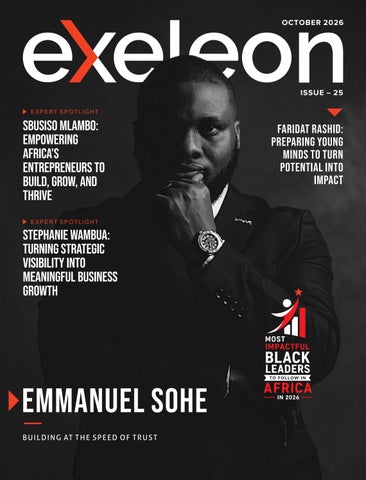
OCTOBER 2026
ISSUE – 25 EXPERT SPOTLIGHT
Sbusiso Mlambo: Empowering Africa’s Entrepreneurs to Build, Grow, and Thrive EXPERT SPOTLIGHT
Stephanie Wambua: Turning Strategic Visibility into Meaningful Business Growth
Emmanuel Sohe B U I L D I N G AT T H E S P E E D O F T R U S T
Faridat Rashid: Preparing Young Minds to Turn Potential into Impact
_magazine
exeleon_magazine
exeleon_magazine
_magazine
exeleon_magazine
exeleon_magazine
FOLLOW ON INSTAGRAM
exeleon_magazine
exeleon_magazine
exeleon_magazine
exeleon_magazine
exeleon_magazine
LEADERSHIP SPOTLIGHT / BUSINESS INSIGHTS/ ENTREPRENEURIAL STORIES
600 N Broad St 5 Middletown, DE 19709, United States Ph: +1 302-440-3100 123, Gera Imperium Rise, Hinjewadi Phase 2, Pune 411057, India Ph: +91-8484980518
Editor-in-Chief –
Daryl Yeung
Art Director –
Naomi Lam
Managing Editor -
Matt Reis
Creative Director –
Akshay Panzade
Project Manager –
Richard Dann
Marketing Manager –
Sofia Brown
Customer Relationship –
Natasha Green
Business Development –
Hitesh Patil, Josh Wilder, Anish Miller
www.exeleonmagazine.com
Ed orial Note
L
eadership across Africa is being dened not only by ambition, but by the ability to solve real problems, build trust, and create opportunities that extend beyond individual success. Exeleon Magazine’s Most Impactful Black Leaders to Follow in Africa in 2026 edition recognizes leaders whose work is strengthening businesses, communities, and institutions across the continent. Gracing the cover is Emmanuel Sohe, CEO of The Tonic Technologies, the company behind Cardtonic. His journey from data and business strategy to ntech leadership reects a distinctly human approach to technology. Under his leadership, Cardtonic is removing barriers between Africans and the global digital economy while serving more than 1.5 million users across Nigeria and Ghana. His belief that trust is ntech’s true product offers a valuable lesson for every leader building at scale. This edition also features insightful conversations with Sbusiso Mlambo, Stephanie Wambua, and Faridat Rashid. Although their experiences differ, each demonstrates how meaningful leadership is shaped by purpose, resilience, and a commitment to advancing others. Kimberly Massey further broadens the conversation through her expert opinion on ensuring more Black women reach the C-suite in America and beyond. Her perspective reminds us that representation requires more than recognition. It demands access, sponsorship, equitable systems, and accountability. Together, these voices reect leadership that is practical, courageous, and deeply connected to impact.
Daryl Yeung Editor-in-Chief
CONTENTS
12 EMMANUEL SOHE
CONTENTS
24 SBUSISO MLAMBO
CONTENTS
32 STEPHANIE WAMBUA
C O V E R S T O RY
12 | OCTOBER 2026
EXELEON MAGAZINE
Building at the Speed of Trust From studying populations and interpreting data to leading a financial technology platform serving more than 1.8 million users, Emmanuel Sohe has built his career around understanding people. As CEO of The Tonic Technologies, he is helping remove the barriers between Africans and the global digital economy while demonstrating what a bootstrapped African company can achieve.
WWW.EXELEONMAGAZINE.COM
OCTOBER 2026 | 13
C O V E R S T O RY
Data Analysis
Product Leadership
Chief Executive Officer
Turning information into insight
Solving real customer problems
Building a trusted African technology company
Before Emmanuel Sohe... became a technology executive, he learned to see the human stories hidden inside numbers. At Obafemi Awolowo University, Emmanuel studied Demography and Social Statistics, examining how populations live, move, earn, and spend. He graduated with rst-class honours as the best student in the Faculty of Social Sciences, supported along the way by scholarships from the Federal Government, Lagos State, and the MTN Foundation. The academic recognition was signicant, but the deeper value of his education came from learning how to understand society through data. “The real lesson wasn't the grades,” Emmanuel says. “It was learning to see a whole society inside a dataset.” That perspective would shape every stage of his career. It led him into data analysis, business development, consulting, product management, and eventually the leadership of one of Africa's growing consumer technology companies. TURNING DATA INTO DECISIONS After university, Emmanuel worked as an expert data analyst for international clients. His analytical background taught him how to identify patterns, test assumptions, and distinguish measurable reality from convenient narratives.
14 | OCTOBER 2026
EXELEON MAGAZINE
He also co-founded DataHUB_360, a research and data science training hub created to give young Nigerians greater access to practical skills and opportunities. Emmanuel had seen enough talent around him to understand that ability was not the issue. Access was. His career subsequently expanded into business development and consulting, including work with established institutions such as Ecobank and the Federal Inland Revenue Service. These experiences allowed him to move from interpreting information to applying it within complex organizations. “Data taught me what was true,” he explains. “Consulting taught me how to turn it into decisions people would actually act on.” Fintech became the place where those two capabilities met. When Emmanuel joined The Tonic Technologies in 2020, he entered as a Product Manager. The role placed him close to customer behaviour, product performance, and the everyday frustrations the company was trying to resolve. He quickly recognized that payments are not merely a technical concern. They inuence whether someone can access education, run a business, subscribe to an important service, receive value from international work, or participate in opportunities beyond their immediate market. “Payments is ultimately a human problem dressed up as a technical one,” Emmanuel says. His background ensured that the person on the other side of the transaction remained visible.
WWW.EXELEONMAGAZINE.COM
OCTOBER 2026 | 15
C O V E R S T O RY
16 | OCTOBER 2026
EXELEON MAGAZINE
Impactful
Leadership
GROWING INTO LEADERSHIP
WWW.EXELEONMAGAZINE.COM
Emmanuel's progression within The Tonic Technologies took him from Product Manager to Chief Product Owner and, in January 2025, Chief Executive Ofcer. When the appointment was announced, messages, calls, and advice arrived from across his personal and professional network. The response gave Emmanuel a clear sense of what the role represented. It was not simply an individual achievement. It was a responsibility entrusted to him by the people who had helped build the organization. “The moment felt less like a coronation and more like a responsibility handed over by people I deeply respect.” Because Emmanuel had grown within the company, he understood its products, culture, customers, and internal challenges. He had witnessed the groundwork being laid and believed the organization was ready for a more ambitious chapter. His rst message as CEO reected that condence: the groundwork is done, and the possibilities are limitless. He then established two immediate priorities. The rst was moving the organization from good to great. For Emmanuel, “good” can become dangerous precisely because it feels earned. Once a company has met its targets, won customer condence, and established its position, it can begin protecting what works instead of questioning what must work next. Comfort gradually lowers attention. Curiosity gives way to repetition, urgency softens, and yesterday's success begins setting today's standards. The thinking that carried a business to one level can become the ceiling on the next. To make the shift tangible, the company developed a Greatness Whitepaper. It gave its people, known internally as “Toniks,” a shared language for examining habits, decisions, and results against a higher standard.
OCTOBER 2026 | 17
C O V E R S T O RY
“
Data taught me what was true; consulting taught me how to turn it into decisions people would actually act on.
18 | OCTOBER 2026
EXELEON MAGAZINE
This philosophy also shaped Emmanuel's second priority: disciplined focus. He translated long-term ambitions into quarterly milestones and judged initiatives by whether they created value and moved the business forward. Greatness, in his view, is not intensity without direction. It is the discipline to remain uncomfortable with easy success and pursue what matters next. REMOVING BARRIERS TO PARTICIPATION Cardtonic’s story began with a form of exclusion familiar to many Nigerians. International payment restrictions meant ordinary ambitions could stall at the checkout page. A student might be unable to pay for a course. A freelancer could earn globally but struggle to use that income. A small business owner might have an advertising plan but no dependable way to pay for the tools needed to execute it. Emmanuel saw these moments as barriers to participation. If Africans were expected to compete in a global digital economy, they needed payment options designed around the realities of their markets. What began as a manually operated gift card marketplace has grown into a platform serving more than 1.8 million users across Nigeria and Ghana. Cardtonic now offers virtual dollar cards, gift card trading, bill payments, eSIMs, and access to gadgets through a wallet supporting Naira and Cedis. The scale matters, but Emmanuel remains focused on what each transaction enables. A user may be enrolling in a course, launching an advertising campaign, or staying connected while traveling. Cardtonic’s growth is therefore less about accumulating features and more about widening access. That distinction shapes Emmanuel’s approach to product leadership. Technology earns its place when it removes a real obstacle from someone’s life. Growth follows when the company solves that problem reliably for more people.
WWW.EXELEONMAGAZINE.COM
OCTOBER 2026 | 19
C O V E R S T O RY
TRUST IS THE REAL PRODUCT Financial technology requires users to place their money and personal information in the hands of a platform they may never physically see. In markets where consumers have encountered hidden charges, delayed payments, and unreliable services, that trust must be earned repeatedly. For Emmanuel, trust is not one feature among many. “In ntech, trust is the only real product; everything else is a feature.” Cardtonic earned condence through simple practices backed by operational discipline: paying users quickly, communicating rates transparently, and remaining reachable when problems arise. More than 1.8 million users and thousands of ve-star reviews represent small promises kept repeatedly. Speed signals reliability, but Emmanuel is clear that speed without security is reckless. The company would rather lose a transaction than compromise its safety standards, and it chooses clarity around rates and fees even when opacity might produce a greater short-term return. Cardtonic’s bootstrapped position has helped preserve that discipline. Without pressure to chase an external investor's growth expectations, the company can align its decisions more closely with the needs of its users. “We try to grow at the speed of trust,” Emmanuel says. BUILDING FROM AFRICAN REALITIES Emmanuel is optimistic about the next generation of African technology founders because many are creating products around problems they have personally experienced. They understand that infrastructure can be unreliable, income may be irregular, and customer condence can take time to establish. These constraints make company-building difcult, but they can also produce resilient founders and adaptable products.
20 | OCTOBER 2026
GLOBAL
Vision
“
The goal isn’t to build the ‘African version’ of something; it’s to build products so good the rest of the world adopts our version.
EXELEON MAGAZINE
WWW.EXELEONMAGAZINE.COM
OCTOBER 2026 | 21
“The best African products are designed by people who understand the realities of the markets they serve.” For more of these companies to compete globally, Emmanuel believes Africa requires patient capital that understands local conditions instead of forcing foreign models upon them. The continent must also continue developing technical and commercial talent while adopting world-class standards at every level. He rejects the idea that African companies should be treated as discounted versions of businesses created elsewhere. “The goal isn’t to build the ‘African version’ of something; it’s to build products so good the rest of the world adopts our version.” African ntech is already showing what is possible through innovations in mobile money, cross-border commerce, and digital wallets. For Emmanuel, the opportunity is not simply to catch up, but to inuence how the world approaches similar problems.
A WORLD-CLASS AFRICAN COMPANY Over the next ve to ten years, Emmanuel sees Cardtonic developing into an everyday nancial companion for tens of millions of Africans living both on the continent and throughout the diaspora. There is also a larger point Emmanuel wants the company to prove: an African business can remain bootstrapped, build enduring technology, achieve meaningful scale, and compete according to world-class standards on its own terms. His personal leadership ambition is quieter but no less signicant. Emmanuel does not particularly want to be remembered as a visionary CEO. He would rather be known as an honest builder who improved the company, its people, and the wider industry. That aspiration returns him to the lesson that began his career. A dataset can reveal how a society behaves, but its meaning comes from the lives contained within it. Similarly, Cardtonic's growth can be measured through transactions, users, products, and markets, but Emmanuel continues to see the people behind those gures. “I hope to be remembered as a leader who never forgot that behind every number is a real person trying to build a better life.”
Leadership Beyond the Ofce Emmanuel’s belief in access and development extends outside ntech.
From the lecture halls of Obafemi Awolowo University to the leadership of a platform serving millions of users, Emmanuel Sohe has remained focused on the connection between information and human progress.
His earlier work with DataHUB_360 reected his commitment to equipping young Nigerians with valuable research and data science skills. He is also an adviser and backer of Tonic FC, a local football club and community initiative.
At The Tonic Technologies, that focus is helping build a bridge between Africans and the global digital economy, one secure transaction and one promise kept at a time.
His own development has continued alongside these efforts, including completing an Executive MBA from the London School of Economics. Yet qualications and titles are not how he ultimately wants his career to be judged.
@emmanuel-sohe
22 | OCTOBER 2026
EXELEON MAGAZINE
C O V E R S T O RY
Credit: Florencia Tan Jun
“
In fintech, trust is the only real product; everything else is a feature.
WWW.EXELEONMAGAZINE.COM
OCTOBER 2026 | 23
Unlock Your DIGITAL SUBSCRIPTION! Ready to fuel your ambition and receive your dose of inspiration directly to your digital doorstep? Subscribe to Exeleon Magazine today, and enjoy the following perks:
• Convenience at Your Fingertips • Exclusive Extras • Community Connection
E X E L E O N I N T E RV I E W
26 | OCTOBER 2026
EXELEON MAGAZINE
Sbusiso Mlambo Empowering Africa’s Entrepreneurs to Build, Grow, and Thrive rom his beginnings in rural KwaZulu-Natal to founding Khalipa Business Mentors, Sbusiso Mlambo is working to make business knowledge, mentorship, and opportunity more accessible to entrepreneurs across Africa.
F
mission to bridge that gap. Guided by a philosophy rooted in wisdom, disciplined thinking, and purposeful action, the company supports entrepreneurs in navigating business formalisation, compliance, governance, nancial management, and sustainable growth.
For Sbusiso Mlambo, entrepreneurship is about more than starting a business. It is about creating opportunities, strengthening communities, and building enterprises capable of delivering lasting economic and social impact.
As Founder and CEO, Mlambo is particularly committed to helping entrepreneurs in rural, township, and disadvantaged communities build credible, competitive enterprises. His vision also extends into education, digital transformation, and emerging sectors, reecting his belief that meaningful economic development begins with empowering people through accessible knowledge.
Born and raised in Nondweni Village in KwaZulu-Natal, South Africa, Mlambo developed an early appreciation for leadership, education, and collective progress. His professional journey through corporate banking gave him rsthand exposure to the nancial systems that support businesses, while also revealing the challenges faced by entrepreneurs who lack access to structured guidance and practical business knowledge. In 2023, he founded Khalipa Business Mentors with a
WWW.EXELEONMAGAZINE.COM
In this exclusive conversation with Exeleon Magazine for its Impactful Black Leaders Edition, Sbusiso Mlambo discusses the experiences that shaped his leadership journey, the philosophy behind Khalipa Business Mentors, and his long-term ambition to build an entrepreneurial ecosystem that creates opportunities across Africa.
OCTOBER 2026 | 27
E X E L E O N I N T E RV I E W
Sbusiso, your professional journey began in corporate banking before you moved into entrepreneurship and business advisory. Can you take us through that journey and the experiences that shaped the leader and strategist you are today? I am 30 years old and was born and raised in Nondweni Village in Nquthu, KwaZulu-Natal. My leadership journey began at Ekukhanyeni Primary School, where I studied from Grade 1 through Grade 9. I served as the head of the school's Boys Scouts group, led teams and worked with other student leaders. Even at that age, my teachers trusted me with responsibility, and I began to recognise that I could bring people together, communicate clearly and lead with purpose. I continued my education at Langazela Senior Secondary School and was recognised among the strongest learners in my Grade 9 year. In high school, I often explained lessons to classmates and encouraged fellow learners to join study groups. Those experiences revealed my interest in teaching practical knowledge and helping people understand how systems work. Business Studies and Consumer Studies introduced me to nance, enterprise and the economy. After matric, at 19 in 2015, I joined FNB through a learnership. Although a permanent position was not available after the programme, it gave me a strong foundation. I joined Absa in 2016, developing experience in compliance, customer service, nancial products and professional conduct. In October 2018, I rejoined FNB and continued learning how nancial institutions contribute to the wider economy. Across those experiences, I saw how many businesses struggle not because they lack effort, but because they lack accessible business education, guidance and structured support. That insight became the foundation for Khalipa Business Mentors. My banking background taught me discipline and governance; my upbringing taught me resilience and the importance of inclusion. Together, they shaped my conviction that business knowledge must reach rural communities, townships, disadvantaged communities and entrepreneurs across Africa.
28 | OCTOBER 2026
“
Wisdom, in our context, means thinking beyond the transaction. EXELEON MAGAZINE
You founded Khalipa Business Mentors in 2023. What does “Khalipa” represent to you, and how does the philosophy of surpassing through wisdom and strategic thinking inuence the way you work with entrepreneurs? Khalipa is drawn from the praise name Khalipha associated with King Shaka iLembe and carries the meaning “be wise”. For me, it represents the idea that people can surpass their circumstances through wisdom, disciplined thinking and purposeful action. It is not a philosophy of shortcuts. It is a philosophy of understanding the terrain, making informed decisions and building with intention. That principle shapes the way Khalipa works with entrepreneurs. We do not view business registration as the end of the journey. It is the beginning of a structured process that can include compliance, accounting, marketing, governance, nance, technology and growth planning. We rst understand the entrepreneur’s goals, operating environment and constraints, and then develop a practical pathway around those realities. Wisdom, in our context, means thinking beyond the transaction. A certicate of registration is important, but it does not automatically create a sustainable enterprise. Our responsibility is to help entrepreneurs convert formalisation into capability, credibility and opportunity. A signicant part of your mission involves entrepreneurs from township, rural, and disadvantaged communities. What barriers do these entrepreneurs face beyond access to funding, and what kind of support do you believe is necessary to help promising businesses become sustainable? Funding is one of the most visible barriers, but it is rarely the rst. The barriers often begin with formalisation. Many entrepreneurs do not know how to register correctly, remain tax compliant, prepare nancial information, meet procurement requirements or present their businesses to banks and corporate buyers. They may be serving real markets, but remain invisible to the formal economy. There is also a serious network and mentorship gap. Entrepreneurs need people who can explain the rules, challenge their assumptions and help them avoid preventable mistakes. They need more than
WWW.EXELEONMAGAZINE.COM
motivational talks; they need practical systems that connect compliance, nance, marketing, governance and strategy. The support we believe is necessary is therefore integrated and developmental. A registered, taxcompliant, bankable and mentored business is better positioned to access funding and opportunities on its own merit. Sustainability is achieved when the entrepreneur understands the business deeply enough to operate and grow it without permanent dependence on the adviser. AI and digital systems are increasingly becoming part of your work with entrepreneurs. How can smaller African businesses use these technologies practically to become more competitive without simply adopting technology because it is fashionable? Technology should earn its place in a business by solving a real problem. I encourage small businesses to begin with their biggest bottleneck, not the trendiest tool. If quotations consume too much time, automate the quotation process. If bookkeeping is disorganised, introduce a suitable digital system. If customers communicate primarily through WhatsApp, build a professional and responsive process around that channel. At Khalipa, we use digital systems to onboard, track and support clients efciently. Since June, our EduTech work has supported learners through ongoing teaching, exam preparation, structured study guides and online classes. We introduce technology to strengthen learning, not simply to add devices. AI is an amplier, not a substitute for judgment, trust or mentorship. It can help a one-person business produce the output of a small team, but only when it is directed at a clear business need. My guiding principle is simple: adopt technology that saves time, reduces cost or prevents mistakes. Everything else should be evaluated carefully. You describe business as a tool for “freedom, dignity, generational wealth, and nation building.” What does that philosophy mean to you personally, and how has it shaped the type of entrepreneurs you want Khalipa to develop?
OCTOBER 2026 | 29
E X E L E O N I N T E RV I E W My name, Sbusiso, means “blessing”, and I believe a person becomes a blessing when they develop life not only for themselves, but also for the people around them. Business is one of the most practical vehicles for that purpose. A formal and sustainable enterprise can reduce dependency, restore dignity, create employment and build an asset that can outlive its founder. When thousands of businesses become healthy and sustainable, the impact extends beyond individual owners. Businesses create jobs, contribute taxes and local revenue, develop skills, support families and provide visible examples of what is possible. In that sense, enterprise development is also nation building. This philosophy shapes the type of entrepreneur we develop at Khalipa. We want to develop leaders, not only traders: people who understand governance, responsibility, legacy and impact. We encourage an employee-as-learner mindset, where working years become an apprenticeship for future enterprise. The goal is to move entrepreneurs beyond survival and towards ownership, stewardship and generational value creation. Looking ahead, what is your long-term vision for Khalipa Business Mentors? What would meaningful impact look like if you could signicantly expand the company’s reach across South Africa and eventually the wider African continent? Our long-term vision is to build Khalipa into a fullservice business development institution for Africa. We are developing capability across compliance, accounting, marketing, cybersecurity, construction advisory and EduTech so that our support can serve
thousands of entrepreneurs rather than a small number of clients at a time. Meaningful impact, to me, looks like thousands of formalised, tax-compliant, fundable township and rural businesses; a generation of learners taught to think entrepreneurially; and an ecosystem in which small businesses, delivery partners and professionals collaborate instead of operating in isolation. Africa does not lack talent or hunger. It lacks accessible structures. Khalipa intends to be one of those structures, beginning in South Africa and extending outward into the continent. Since June, our Khalipa EduTech programme has supported learners at Langazela Secondary School through Business Studies teaching, exam preparation, study guides and online classes. This ongoing work is an early expression of our vision, which we intend to grow through formal institutional partnerships. We are also exploring green energy and electric-vehicle charging infrastructure, while building productive ecosystems between technology suppliers, project companies and installation partners. The thread connecting all of this is our purpose: elevating businesses and empowering leaders. Looking forward, we are expanding our thinking into green energy and electric-vehicle charging infrastructure, while building productive ecosystems between technology suppliers, project companies and installation partners. Across every initiative, our standard remains the same: professional execution, ethical leadership, accessible knowledge and measurable impact.
The goal is to move entrepreneurs beyond survival and towards ownership, stewardship and generational value creation.
30 | OCTOBER 2026
EXELEON MAGAZINE
WWW.EXELEONMAGAZINE.COM
OCTOBER 2026 | 31
IN-FOCUS
34 | OCTOBER 2026
EXELEON MAGAZINE
Stephanie
Wambua
Turning Strategic Visibility into Meaningful Business Growth Founder & Lead Strategist, Beacova | Strategic Marketing & Brand Positioning Expert
F
or Stephanie Wambua, effective marketing has never been about simply getting a brand noticed. It is about reaching the right audience, communicating with purpose, and ensuring that every marketing effort contributes to meaningful business growth. With a career spanning multiple industries, including FMCG, hospitality, and investments, Stephanie has experienced rsthand how established organizations approach marketing and where growing businesses often struggle. These experiences eventually led her to establish Beacova, a strategic marketing business dedicated to helping growing companies build stronger brands, improve their visibility, and compete more effectively in the marketplace. Beyond her consulting work, Stephanie is a speaker, trainer, panel moderator, and corporate MC who believes in the
WWW.EXELEONMAGAZINE.COM
power of intentional communication and professional storytelling. She also mentors emerging digital marketing professionals, helping them develop practical skills and identify opportunities for growth. In this exclusive conversation with Exeleon Magazine, Stephanie reects on her entrepreneurial journey, the importance of strategic brand positioning, the relationship between visibility and credibility, and her vision for helping businesses and leaders across Africa realize their potential. Stephanie, your experience spans banking, FMCG, real estate, hospitality, education, and investments before building your own identity as a strategic marketer. Can you take us through that journey and what ultimately led you to establish Beacova? My journey into marketing really began with my rst role at
OCTOBER 2026 | 35
IN-FOCUS a fast-moving consumer goods company, and I often think about how much that experience shaped the marketer I am today. It gave me a 360-degree view of marketing. I was exposed to what different specialized agencies do, including ATL, BTL, digital marketing and research, and had the privilege of seeing how established brands work with experts in different areas to remain relevant, grow and stay strong in the market.
The original idea behind Beacova was to support growing businesses to win in the marketplace by helping them approach marketing more strategically. I had spent substantial time speaking to business owners, and I kept hearing similar sentiments: “I didn't see any results from marketing.” “I’ve worked with someone and it hasn't worked.” “We don't have a dedicated marketing team.” “We just post when we can.”
At the same time, I was working internally on marketing strategies, campaign ideas, activations and collaborating with R&D teams to understand the different products. There was probably no better way for me to have entered the marketing eld. As I grew in my career, I realized I wanted to become more hands-on with my skills, and that is where my interest in digital marketing started to develop.
What I noticed was that the problem was often deeper than the marketing activity itself. In many cases, marketing objectives were not aligned with business objectives, so it became difcult to see how the activities were contributing to the bigger picture.
At the time, I was also actively building my personal brand and began sharing what I was learning and experiencing on LinkedIn. My role exposed me to different activities, teams and markets across the country, and I realized I could document my experiences while learning from other people in the industry. That eventually led me into digital marketing, where I gained hands-on experience across content marketing, email marketing, social media management, paid advertising and promotions. Through that role, I also had exposure to hospitality before moving into investments, where I continued working in digital marketing at a deeper and broader level. Throughout that journey, I realized that I genuinely loved marketing, communicating with people, bringing brands to life and seeing what happens when a brand communicates clearly to the right audience. But as I interacted with more business owners and growing businesses, I noticed a gap. I had worked with established organizations that understood the role of marketing in their growth, while many growing businesses treated marketing as something to do when time and resources allowed. It was often sporadic, random and without a clear system. That ultimately led me to establish Beacova: to help growing businesses understand marketing differently, not as an add-on, but as something that can support their growth and help them compete and win in the marketplace. What was the original idea behind Beacova, and what gap did you see in the market between businesses that were simply “doing marketing” and those using marketing strategically to support growth?
36 | OCTOBER 2026
Established brands tend to understand the place of marketing within the business. They set aside budgets, have dedicated teams or specialists and establish performance indicators around what they want marketing to achieve. That is the gap I saw and the one I wanted Beacova to help address, helping growing businesses build more intentional and strategic approaches to marketing using the resources they have available. You often emphasize that being visible is not enough. A brand needs to be visible “to the right people, for the right reasons.” How do you determine who a brand actually needs to reach and what it should become known for? Being visible to the right people matters because, rst and foremost, you cannot serve everyone. Whether you are building a personal brand or a business brand, your target audience cannot be everyone. Once you say you want to serve everyone, you have probably missed the point already. The faster you become clear about who you are speaking to, why you are speaking to them and what you want them to do, the easier it becomes to build a meaningful relationship with them. Building relationships with customers and clients takes time. For me, determining who a brand is for and what it should become known for starts with dening the brand's goals and objectives. What should the brand achieve and who does it need to achieve that with? Once you are clear on that, you can ask how to reach those people, what matters to them and how you want the brand to be perceived.
EXELEON MAGAZINE
WWW.EXELEONMAGAZINE.COM
OCTOBER 2026 | 37
Visibility without that clarity can easily become noise. The goal is not simply to be seen by more people. It is to be remembered by the right people for the right reasons. As an African woman entrepreneur building a business around strategy, visibility, and inuence, what has your own journey taught you about claiming space and building professional credibility? I started building my personal brand while I was still in my rst corporate role, largely because that role gave me so much experience that I felt was worth sharing. That taught me something important: building a brand does not always require you to have everything gured out rst. You already have your experiences, your expertise, your personality,
38 | OCTOBER 2026
what you are learning and even the challenges you are navigating. Those can become part of your story. One of the biggest lessons my journey has taught me is not to overthink building a brand. The sooner you start, the faster it can begin to compound. It is the small, intentional steps you take consistently, such as sharing your story, sharing lessons, giving value, engaging with other people’s content and showing up consistently. I have also learnt that claiming space can start at whichever level you are currently at. It can start with the projects you are involved in, a volunteer opportunity or even an internship. Every experience has value if you are open to learning from it.
EXELEON MAGAZINE
IN-FOCUS Documentation is another thing I have come to appreciate. If you successfully complete a project, navigate a challenging situation, work with a team or learn something valuable, document it. Keep records of what you are doing and the lessons you are picking up. That becomes useful when you are building credibility because visibility creates familiarity, and familiarity can create opportunities. I have beneted from people recommending me, referring me to opportunities and remembering my name when an opportunity came up. That, to me, is what intentional visibility can do. Beyond consulting, you speak, train, moderate panels, and work as a corporate MC. What have these experiences taught you about communication and presence, and how have they inuenced the way you advise leaders on building trust with an audience? My experiences as a speaker, trainer, moderator and corporate MC have taught me that communication and presence are incredibly important. In my line of work, communication is one of the ways you bring your ideas, propositions and recommendations to life. One thing I have really come to appreciate is the importance of research. When you step in front of an audience, you need to understand the people you are speaking to. What matters to them? What do they value? What language will be clear to them? You cannot simply walk into a room with jargon and expect people to connect with what you are saying if you have not taken the time to understand them. That experience is very aligned with the work I do in marketing because the principles are similar: understand the people you are speaking to, do your research and take time to connect with them before asking anything from them. I have also learnt that giving value and consistency are important. Even showing up when you said you would or delivering what you committed to contributes to trust. Audiences need that same consistency from leaders. Another thing I have noticed with leaders is the importance of documenting their stories. There are leaders who have built an incredible wealth of experience and done remarkable work, but much of that story remains untold. It stays in reports instead of being shared. Your story can inspire other people, but it can also attract opportunities for you.
WWW.EXELEONMAGAZINE.COM
Looking ahead, what is your vision for Beacova, and how do you see the relationship between branding, personal visibility, AI, and business growth evolving over the next several years? I see Beacova becoming a trusted marketing partner for businesses across Africa, especially growing businesses that are working with the resources and budgets available to them, but are also responsive enough to understand that marketing is a growth engine, not an add-on. We want to help businesses bring their brands to life because every business has a vision, an idea and signicant effort behind it, and that deserves to be recognised by the right people in the marketplace. We are also keen on supporting leaders to build strong brands around their experience, expertise and skills. I would love to see Beacova support more leaders and businesses, starting in Kenya, expanding across the region and eventually across Africa. When it comes to AI, I see it as a tool that is making certain aspects of marketing and business growth more accessible and efcient. It allows us to access information quickly, brainstorm, ideate and build systems more efciently. I think the opportunity is to use these tools well while still being intentional about the strategy behind what we are building. I also see a growing role for founder-led marketing, particularly for businesses started by founders and solopreneurs. When leaders build strong personal brands and share their perspectives, experiences and journeys, that visibility can also help move the businesses they lead forward. Ultimately, I see branding, leadership visibility and strategic marketing working together to help businesses build trust, become recognized for what they do and grow.
@stephanie-wambua beacovamarketing.com
OCTOBER 2026 | 39
OVER 3500+ BRANDS HAVE SHARED
Ad
Be the next brand to be p Because Your Jo
D THEIR STORIES ON OUR PLATFORM.
™
Ad
part of Exeleon Magazine. ourney Matters.
IN-FOCUS
The Prepared Mind Initiative is built around helping young people move from potential to practical capability. What gap did you see in the way young people access mentorship, skills, exposure, and realworld experience, and how is PMI designed to address it? One of the biggest gaps is not necessarily information. Young people have more information available to them than ever before. The deeper challenge is knowing how to turn information into judgment, capability and action. There is a difference between knowing and becoming. You can listen to a leadership session without ever being given responsibility that requires you to lead. You can learn about networking without learning how to build relationships that are mutually valuable. You can hear that employers want experience without having an environment where you can actually develop it.
42 | OCTOBER 2026
PMI was designed to bridge that gap. Since launching, we have brought more than 16 speakers into the community, created opportunities for members to learn directly from people with different experiences, and developed practical projects that move members beyond passive consumption. We have also undertaken collaborative projects with international organisations and practical industry projects, giving young people opportunities to engage with work beyond the classroom. Through PMI, that exposure has extended into international collaboration. We've partnered with Practera on three (3) industry projects in collaboration with the University of Leeds. Perhaps more meaningful to me are the stories coming back from the community. We have a number of member success and testimonial stories reecting moments where people gained clarity, took action, discovered opportunities or
EXELEON MAGAZINE
experienced growth through their engagement with PMI. We deliberately want PMI to be more than a notice board or content platform. We want people to participate, build relationships, ask better questions, practise what they learn and leave with evidence of what they can do. You have also built The Elevate Network and Beyond Borders Network around career clarity, visibility, and access to opportunities. How do these platforms complement one another, and what larger ecosystem are you ultimately trying to create for students and young professionals? I see the three platforms as different parts of the same ecosystem. The Prepared Mind Initiative prepares the person. The Elevate Network helps people develop clarity, positioning and visibility. Beyond Borders Network helps connect people to opportunities and information beyond their immediate environment. That distinction matters because preparation, visibility and opportunity are interconnected. Preparation without exposure can remain hidden. Visibility without substance can become performance. Opportunity without preparation can be wasted. Beyond Borders Network, for example, has grown into a community of more than 2,400 followers, and we have received testimonials from people who discovered opportunities through the platform and went on to apply successfully. The Elevate Network has also developed its own community and success stories around career clarity, positioning and professional visibility. The larger ecosystem I am trying to create is one where a young person does not have to gure out every part of their development in isolation. I want them to be able to discover, prepare, position, become visible, access opportunity and ultimately create impact. At the centre of all of it is the same conviction: we should not only ask what young people can become; we should build better pathways for them to become it.
WWW.EXELEONMAGAZINE.COM
A recurring idea in your work is that potential alone is not enough unless people are prepared, visible, and able to act on opportunity. What do you believe young professionals most often misunderstand about becoming opportunity-ready in today’s world? I think many people confuse qualication with readiness. A degree can demonstrate that you studied something. It does not automatically demonstrate that you can solve an unfamiliar problem, communicate clearly, exercise judgment, work with people, take initiative or create value. I also think people underestimate the importance of evidence. It is easy to say, “I am a leader,” “I am a good communicator,” or “I am skilled in data analysis.” The more important question is: What can you show? What did you build? What did you improve? What problem did you solve? What responsibility did you carry? What changed because you were involved? I often return to a question that challenges me personally as well: If the opportunity you have been praying for arrived tomorrow, what evidence would you have that you are ready for it? Opportunity-readiness is therefore not just about certicates. It is about competence, judgment, character, communication, adaptability, credibility and the ability to act. Visibility matters too. I don't believe people should build merely to be seen. But if you have something valuable to contribute, learning how to communicate that value responsibly is part of preparation. Much of your work sits at the intersection of personal development, employability, digital visibility, and community. How are technology, AI, LinkedIn, and digital platforms changing the way young African professionals can build credibility and compete for opportunities beyond their immediate environment?
OCTOBER 2026 | 43
IN-FOCUS Technology has changed the geography of opportunity.
build structures that allow the work to grow beyond you.
A young African professional can now learn from someone in another country, join a global community, collaborate across borders, build a professional reputation on LinkedIn, use AI to accelerate research and problem-solving, and discover opportunities they may never have encountered physically.
PMI has taught me this very practically. What began as an idea has grown into an active community, with speakers, volunteers, collaborative projects, industry engagements, member stories and partnerships developing around it. We have also had to become more intentional about community quality; we have audited the community twice and removed inactive members because we want participation and meaningful engagement rather than numbers for appearance.
That is signicant. But access alone does not create advantage. Millions of people can access the same platforms and the same tools. The differentiator increasingly becomes how you think, what you can demonstrate, how clearly you communicate and whether people can trust the value you bring. I see AI as particularly powerful when used as an amplier rather than a substitute for thinking. It can help people research, analyse, learn, create and work more efciently. But judgment still has to belong to the person. The opportunity for young African professionals is enormous. But digital participation has to move beyond consumption. We need more young people using these platforms to build, document, communicate, collaborate and create evidence of their capability. Building initiatives while still developing your own professional journey requires a different kind of leadership. What have you learned about leading before you feel completely ready, building systems with limited resources, and earning trust from the communities you serve? I have learned that leadership rarely begins when you feel completely ready. There have been many moments when I have had to build while still learning, make decisions without having every answer, and create systems before having all the resources I would ideally want. That taught me to distinguish between condence and certainty. You do not always need certainty to take responsibility. Sometimes you need enough conviction to take the next step, enough humility to learn and enough discipline to
44 | OCTOBER 2026
That decision reects something I care deeply about: I would rather build a smaller community that is genuinely alive than a larger community that only looks impressive from the outside. I have also learned that trust is earned through consistency. People don't trust you because you have a title. They trust you when they see that you care, listen, take responsibility, keep learning and continue showing up. As a Christian, I also see leadership as stewardship. I believe the people, ideas, opportunities and platforms entrusted to me ultimately belong to God before they belong to me. That shapes how I think about ambition, responsibility and impact. Looking ahead, what is your vision for The Prepared Mind Initiative, The Elevate Network, and Beyond Borders Network over the next several years, and what kind of measurable impact would make you feel that these platforms have fullled their purpose? My long-term vision is to build systems that continue creating value beyond my direct involvement. For The Prepared Mind Initiative, I want to see a generation of young people who are not merely academically qualied, but thoughtful, purposeful, practically capable and prepared to contribute. The long-term ambition is to reach one million minds globally, beginning with the communities we can serve directly today. For The Elevate Network, I want to deepen the work around clarity, positioning, visibility and professional development so people can understand the value they carry and communicate it effectively. For Beyond Borders Network, I want to continue reducing information and access barriers by connecting people to
EXELEON MAGAZINE
opportunities they may otherwise never encounter. We already have partnerships and collaborations developing, and I am excited about what becomes possible when these platforms continue to connect with organisations, professionals and communities beyond their immediate circles. But numbers alone will never be my denition of impact. I want to see a young person make a better decision because of something they encountered through PMI. I want someone to apply for an opportunity they would previously have selfrejected from. I want someone to discover a capability they had underestimated. I want someone to build something because a community gave them the condence and structure to begin. Ultimately, I want the work to produce evidence of changed lives, increased capability, expanded access and multiplied impact. If these platforms eventually become bigger than my name, operate through strong systems, create opportunities for people I may never meet, and continue helping young people refuse to die with untapped potential, I will consider that meaningful success.
@faridat-rashid @the-prepared mind-initiated bit.ly/pmi membership-form WWW.EXELEONMAGAZINE.COM
OCTOBER 2026 | 45
BUILDING A PATHWAY FOR MORE
BLACK WOMEN TO JOIN THE C-SUITE - Written By Kimberly Hogg Massey
B
lack women make up 7.4% of the U.S. population, yet according to Lean In’s State of Black Women in Corporate America report, they hold just 1.4% of C-Suite positions and 1.6% of Vice President roles. At a time when diversity-focused hiring practices are being challenged, these statistics signal a signicant representation gap. Somewhere along the corporate ladder, talented Black women are being overlooked or left without the resources they need to rise into higherlevel roles. So, what can companies do to create more opportunities for Black women in the C-Suite? I’d recommend identifying and developing Black talent earlier, creating intentional mentorship and sponsorship programs, and being transparent about hiring and promotion processes. Identifying Your Next C-Suite Star If companies want to see more Black women in the CSuite, they can’t wait until an employee is already an executive to start thinking about their leadership potential. The pipeline starts much earlier. That means investing in young Black women before they even become full-time employees through scholarships
46 | MM 2026
and internships. These programs give students invaluable career exposure, sellable skills, and a foot in the door to land the rst role that will kickstart their careers. Once they’re in, companies should continue that initial investment. Think rotational programs that expose employees to different lines of business, tuition assistance to make advanced degrees more accessible, student loan repayment programs, and leadership development trainings or stretch assignments to give employees the chance to take on new responsibilities and prove they can operate beyond the scope of their current role. I’ve seen the impact of this mindset rsthand. Earlier in my career at PepsiCo, there was a real focus on identifying talent early and helping people understand where they could go within the organization. A new employee could start in sales, gain exposure to other departments, build their experience, take on new responsibilities, and eventually work their way toward a VP-level role. What stood out to me was the intentionality behind those programs. People weren’t necessarily handed a roadmap, but they could see the possibilities. There was an understanding that if you worked hard, developed your skills, and had the right people in your corner, there was a path forward.
EXELEON MAGAZINE
WWW.EXELEONMAGAZINE.COM
OCTOBER 2026 | 47
EXELEON SPOTLIGHT But creating the path is only part of the equation. Black women also need mentors and sponsors who can help them navigate it and open doors along the way.
difcult for employees to know how to position themselves for their next opportunity. When expectations are unclear, subjective judgments carry more weight.
Make Mentorship and Sponsorship Intentional Career development doesn’t happen in a vacuum. Skills and performance matter, but so do relationships. A mentor can be the person who answers a question you were afraid to ask. A sponsor can be the person who says your name when you’re not in the room. Both can have a meaningful impact on your career. When I was coming up in my career, being in the ofce meant I built relationships without planning to. Think grabbing coffee with someone after a meeting, sitting next to a senior leader, or striking up a conversation in the hallway. Those small interactions eventually became meaningful professional relationships. As companies shift toward remote and hybrid work, they must be more deliberate about creating those connections, particularly for employees who may not have regular access to senior leadership. Remote work formats lead to fewer spontaneous conversations and opportunities to build relationships outside of an immediate team. Add increasingly busy schedules and personal obligations, and it becomes easy for mentorship to fall by the wayside. That’s where companies can step in. Pair emerging talent with mentors. Encourage senior leaders to sponsor highpotential employees. Create leadership networks that give employees opportunities to interact with executives beyond their day-to-day responsibilities. It’s also on Black women to curate their support systems inside and outside of their organization. Access to mentors and sponsors shouldn't be something employees have to stumble into. Companies can and should cultivate those connections intentionally. Make the Path to Advancement Clear The nal piece is perhaps the most fundamental: employees need to understand what it takes to get ahead. If promotions are based on an undened idea of who is “ready” or what a leader “looks like”, it becomes
48 | OCTOBER 2026
Companies can change that by establishing clear promotion criteria, using structured interviews and performance evaluations, and dening what leadership readiness looks like at different stages of a career. Salary transparency across titles is important, too, particularly given the persistent gender and racial wage gaps Black women face. Transparency should extend beyond the formal promotion process. Who gets the high-prole project? Who gets invited into the room with senior executives? Who gets the opportunity to lead a new initiative or present to the C-suite? Those experiences build careers, too. Accountability matters here. Leaders should be thinking not only about who they hire, but who they are developing, advocating for, and preparing to be leaders. Closing the gap in Black women’s representation in corporate leadership won’t happen because of one mentorship program or one new hiring initiative. It requires looking at the entire journey, from a promising employee's rst day to years later in her career when she's ready for a VP or C-Suite position. In a time when diversity-focused hiring initiatives are facing increased scrutiny, companies shouldn’t lose sight of why these practices were established in the rst place. Creating a more equitable workplace isn't simply about hitting a hiring target. It’s about making sure talented people aren’t shut out of opportunities because they didn’t have the right connections, didn’t understand how to climb the corporate ladder, or weren’t identied as leadership material early enough. I’ve seen what intentional talent development can look like, and I’ve seen how much of a difference the right opportunities and relationships can make. The next generation of Black women leaders shouldn't have to rely on luck to nd those opportunities. Every talented Black woman deserves to know that there is a path forward and to have someone in her corner helping her nd it.
EXELEON MAGAZINE
About the Author Kimberly Hogg Massey is Head of Marketing & Growth Strategy at Strength of Nature, where she oversees marketing strategies across the company’s dynamic portfolio of multi-category brands. An alumna of Spelman College, Kimberly spent eight years of her early career in brand management and marketing strategy at PepsiCo.
WWW.EXELEONMAGAZINE.COM
OCTOBER 2026 | 49
NEWSROOM
African Financial Markets Show Progress as 21 Countries Improve Investment Conditions
frican nancial markets are showing encouraging signs of development, with 21 of the 29 countries assessed in the 2026 Absa Africa Financial Markets Index recording improved scores as economic conditions stabilize and nancial reforms gain momentum.
A
South Africa retained its position as the continent's leading nancial market, followed by Mauritius and Namibia. Cape Verde emerged as one of the most improved performers, climbing six places, while Ghana advanced amid easing ination and stronger nancial market performance.
Released in October, the tenth edition of the index, developed by Absa Group and the Ofcial Monetary and Financial Institutions Forum (OMFIF), recorded an average score of 56, its highest since the index was established in 2017.
The report also highlighted growing diversication in nancial products, including sustainable nance instruments and initiatives supporting more developed capital markets.
The ndings highlight improvements in ination management, foreign exchange reserves, nancial market infrastructure, and regulatory frameworks across several African economies.
52 | OCTOBER 2026
Despite these improvements, limited market liquidity remains a persistent challenge. In several countries, insufcient trading activity continues to restrict investment opportunities and the ability of businesses to access long-term nancing.
EXELEON MAGAZINE
The index evaluates countries across six areas, including market depth, access to foreign exchange, transparency, pension fund development, macroeconomic conditions, and legal and regulatory standards. For African businesses and investors, the results indicate progress toward more resilient nancial systems capable of supporting privatesector growth and infrastructure investment. However, continued regulatory reforms, stronger investor participation, and deeper domestic capital markets will be essential to turning these improvements into sustained economic opportunities. The ndings reinforce the importance of nancial market development in supporting African entrepreneurship, attracting investment, and strengthening the continent's long-term economic competitiveness.
WWW.EXELEONMAGAZINE.COM
OCTOBER 2026 | 53
NEWSROOM
African Development Bank and AXIAN Launch Financing Initiative for 34,000 Women-Led Businesses
T
he African Development Bank and AXIAN Group have launched a major nancial inclusion initiative aimed at expanding access to funding and business support for more than 34,000 women-led enterprises across ve African countries. Announced on September 2, 2026, the program seeks to address one of the most persistent barriers confronting women entrepreneurs across the continent: limited access to affordable and reliable nancing.
Supported by the African Development Bank's Afrmative Finance Action for Women in Africa (AFAWA) initiative and the Women Entrepreneurs Finance Initiative (We-Fi), the program will combine digital lending solutions with nancial literacy training, business development assistance, and digital inclusion initiatives. The services will be delivered through AXIAN Group’s nancial technology platforms, Mixx and Mvola, which provide mobile nancial services to consumers and businesses. Despite Africa having the world’s highest rate of female entrepreneurship, women-owned businesses continue to face substantial nancing challenges. According to the
54 | OCTOBER 2026
EXELEON MAGAZINE
African Development Bank, the estimated nancing gap for women entrepreneurs across the continent stands at approximately $49 billion. The new initiative aims to reduce these barriers by helping women entrepreneurs access formal nancial services, strengthen their business capabilities, and expand their commercial activities. Beyond access to capital, the inclusion of nancial education and business development services reects a broader recognition that sustainable entrepreneurship requires more than funding alone. Digital nancial platforms are also becoming increasingly important in reaching underserved businesses, particularly those operating outside traditional banking networks. For Africa’s entrepreneurial landscape, the partnership represents another step toward building a more inclusive nancial ecosystem. By combining development nancing with private-sector technology and business support, the initiative could help womenled enterprises strengthen their operations, create employment opportunities, and contribute more signicantly to economic growth across the continent.
WWW.EXELEONMAGAZINE.COM
OCTOBER 2026 | 55
NEWSROOM
Africa’s Most Inuential Women CEOs Take Center Stage in 2026 Leadership Report
W
omen executives leading some of Africa’s largest businesses have received renewed recognition through Africa.com’s 2026 Denitive List of Women CEOs, highlighting their contributions to corporate leadership and economic development across the continent. Unveiled in August 2026, the sixth annual report uses Bloomberg data to identify women holding senior executive positions at major publicly listed African companies. Researchers examined more than 1,500 companies across African stock exchanges, identifying women serving as chief executives and senior leaders of major corporations and multinational operations. Among the prominent executives featured are Mary Vilakazi, Group CEO of FirstRand; Mpumi Madisa, CEO of Bidvest Group; Mpumi Zikalala, CEO of Kumba Iron Ore; and Dr. Adaora Umeoji, Group Managing Director and CEO of Zenith Bank. The list also recognizes leaders including Jeanette Marais of Momentum Group, Jane Karuku of East African Breweries, and Ruth Zaipuna of NMB Bank. These executives represent diverse industries, including banking, mining, nancial services, consumer goods, and
56 | OCTOBER 2026
manufacturing, demonstrating the growing visibility of women in high-level corporate decision-making across Africa. Unlike recognition programs based on nominations or public popularity, Africa.com’s ranking uses nancial data and dened leadership responsibilities to assess executives. The report also brings attention to an important conversation surrounding gender representation in African business leadership. Although women continue to encounter barriers in accessing executive positions, their presence at the helm of major organizations demonstrates the contribution of experienced female leadership to corporate performance and strategic decision-making. For emerging entrepreneurs and professionals, these executives provide visible examples of leadership across industries traditionally dominated by men. The 2026 report ultimately highlights both the achievements of established women business leaders and the importance of creating stronger pathways for future generations to reach senior management and executive positions.
EXELEON MAGAZINE
WWW.EXELEONMAGAZINE.COM
OCTOBER 2026 | 57
w w w. e x e l e o n m a g a z i n e . c o m