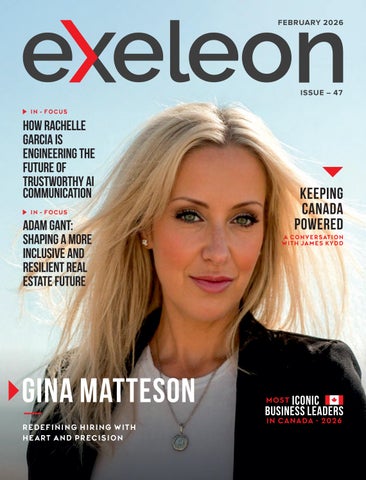
Most Iconic Business Leaders in Canada -2026 | Gina Matteson
Gina Matteson
exeleon_magazine
exeleon_magazine
exeleon_magazine
exeleon_magazine
exeleon_magazine
exeleon_magazine
exeleon_magazine
exeleon_magazine
exeleon_magazine
exeleon_magazine
exeleon_magazine
Embracing Excellence
600 N Broad St 5 Middletown, DE 19709, United States +1 302-907-9110
Editor-in-Chief –
Art Director –
Naomi Lam
Managing EditorCreative Director –Daryl Yeung
Matt Reis Adam Waring
Project Manager –Marketing Manager –
Customer Relationship –
Business Development –
Richard Dann Sofia Brown
Natasha Green
Matt Hale, Josh Wilder, Anish Miller
For any advertising related information, please contact info@exeleonmagazine.com. Submissions as well as contributions to the magazine are welcome.
Take a moment and let us know about our magazine; whether it be about the design or a possible mistake, we would appreciate any feedback from your end. You can reach out to daryl@exeleonmagazine.com.
How is Gina Matteson Redefining Hiring with Heart and Precision
Unlock Your DIGITAL SUBSCRIPTION!
Ready to fuel your ambition and receive your dose of inspiration directly to your digital doorstep?
Subscribe to Exeleon Magazine today, and enjoy the following perks:
Convenience at Your Fingertips
Access each issue on your preferred digital device anytime, anywhere.
Exclusive Extras
Dive deeper with bonus content, behind-the-scenes interviews, and special features reserved for our esteemed subscribers.
Community Connection
Join a network of likeminded individuals, share your story or interview, and be part of a thriving entrepreneurial community. SIMPLY SCAN AND SUBSCRIBE
Q: Can you give us a little more detail about your approach to building relationships with community members, landowners, and all the other concerned parties before beginning work on new energy projects?
Fighter pilot John Boyd's decision framework: Observe, Orient, Decide, Act. The winner isn't who makes perfect decisions—it's who completes the loop fastest. Amazon runs thousands of small experiments weekly while competitors plan quarterly. Boyd's insight: Speed of iteration matters more than quality of individual decisions when conditions are changing.
KEY METRIC
INSTANT TAKEAWAY
Compress your decision cycles. Run three imperfect experiments instead of one 'perfect' plan.
STRATEGY
Obliquity: The Indirect Path to Success
Complex goals are best achieved indirectly. ITC Limited wanted to help Indian farmers and created e-Choupal. Side effect: built a $8 billion supply chain. Patagonia focused on environmental mission, not profit—became a $3 billion brand. When you aim directly at profit, you often miss. Aim at purpose, profit follows.
KEY METRIC
INSTANT TAKEAWAY
Stop optimizing for the metric. Optimize for the underlying system that produces it.
The Medici Effect: Intersection Thinking
Breakthrough innovation happens where disciplines collide. The Medici family funded artists, scientists, poets, and philosophers in one place—triggering the Renaissance. Today: Apple = technology + liberal arts. Tesla = automotive + software + energy. Airbnb = hospitality + technology + trust networks. Stop deepening expertise. Start widening connections.
KEY METRIC
INSTANT TAKEAWAY
Hire from adjacent industries. Your next breakthrough lives at the intersection, not the center.
ORGANIZATIONAL
Conway's Law: Structure IS Strategy
"Organizations design systems that mirror their communication structure." Amazon's two-pizza teams ship features independently. Spotify's squads created their modular music architecture. Your org chart literally determines what products you can build. Want innovative products? Reorganize your teams first. Structure isn't bureaucracy—it's destiny.
KEY METRIC
DECISION-MAKING
Inversion: Solve by Avoiding Failure
INSTANT TAKEAWAY
Audit your org chart. It's a preview of every product you'll ship for the next three years.
Charlie Munger's secret: "Tell me where I'm going to die, so I never go there." Instead of asking 'How do I succeed?' ask 'How do I fail?' and avoid those paths. Bezos: 'What won't change in 10 years?' Warren Buffett: 'Rule #1: Don't lose money. Rule #2: Don't forget Rule #1.' Avoiding stupidity is easier than seeking brilliance.
KEY METRIC
INSTANT TAKEAWAY
Make your 'not-to-do' list before your to-do list. Subtraction beats addition.
Things that have been around longer will likely be around longer. A business operating for 100 years will probably survive another 100. A startup at 2 years might last another 2. Shakespeare is more likely to be read in 2100 than today's bestseller. Apply to: hiring (proven people over shiny resumes), strategy (time-tested over trendy), and technology (boring over bleeding-edge).
INSTANT TAKEAWAY
KEY METRIC
Favor the old and boring over the new and exciting. Time is the ultimate validator. 90-SECOND
You've co-founded and scaled several companies across different industries, from storage to inancial services to student housing. What was one of the most pivotal lessons you learned from building and exiting multiple businesses?
Apartfromhiscareerexperienceasareal estateinvestmentprofessional,AdamGantis alsoanauthor,mostfamousforthenovelhe co-authoredwithPatriciaNicholson, A House Shared.RecentlyAdamdiscussedthe signiicance,meaningandimpactofthis extraordinarybook.
Q: A House Shared has been described as a must-read for anyone seeking a deeper understanding of the modern housing
crisis. Many are surprised to learn that it's not a dry academic report, but a novel. What inspired you to choose this format?
Q: So it's a fun novel, but also a serious call to action.
Adam Gant: Yes,it'sagreatreadforthebeach orairplane,butwhenthereaderputsdown A House Shared,wedon'twanttheirstthought tobe,“thatwasentertaining”andthenforgot abouttherealreasonforthebook.Weseekto generatecriticalthinkingandinspirecritically neededaction.Andbythatwemeanworkingin thelocalrealestatemarkets,incommunities, andateverylevel.
In A House Shared,thereisahappyoutcome, butthat'snotalwaystrueintherealworld.Our tasknowistocreateabrighterfutureforthe millionswhodesperatelyneedit.
OVER BRANDS HAVE SHARED 3500+
In today's volatile business climate, the race to attract and retain top talent has intensified. Yet, many companies are still relying on outdated hiring methods, gut-based decisions, and manual HR processes—despite mounting evidence that artificial intelligence (AI) can dramatically improve workforce outcomes. For forward-thinking executives, there's a better way: apply the 80/20 principle throughAI-driven talent management.
The Pareto Principle tells us that 80% of results stem from 20% of efforts. In talent strategy, this means that a small number of hiring, retention, and engagement activities drive the majority of organizational success.AI can pinpoint, automate, and optimize those high-leverage actions—giving companies a decisive edge without overhauling their entire infrastructure.
WHYAI IN TALENT MANAGEMENT IS NOWA BUSINESS IMPERATIVE
By Dr. Denis Cauvier
Early adopters like Unilever and Hilton have already achieved tangible success. Unilever reduced time-to-hire by 70% and increased diversity by 16% using AI-powered assessments. Hilton, usingAI chatbots and candidate ranking algorithms, cut manual recruitment tasks by 40% and saw an 85% decrease in time-tointerview.
BREAKING THE BOTTLENECKS: HOWAI STREAMLINES THE TALENT LIFECYCLE
1. Attracting Top Talent:AI tools can write optimized job ads, identify high-potential passive candidates, and rank applicants in seconds. This increases, hiring efficiency by up to 60% while improving candidate quality.
2. Selecting the Right People: Predictive analytics now assess job fit, culture alignment, and future performance with 95% accuracy. Platforms like Pymetrics and Eightfold.ai bring scientific rigor to hiring decisions—eliminating guesswork and bias.
AI is no longer an HR trend—it's a business necessity. The World Economic Forum projects that by 2030,AI and automation will create 170 million new jobs while displacing 92 million, leading to a net gain of 78 million positions. That's a seismic shift. Companies that fail to align hiring and workforce planning with this new reality risk becoming obsolete.
based on role and personality. Later, it monitors engagement signals, predicts attrition risks, and supports real-time interventions. SHRM reports that 85% of companies using AI for onboarding have seen improved retention within six months.
OVERCOMING COMMON OBJECTIONS
Many executives hesitate to implementAI due to fears around cost, complexity, or compliance. These concerns are increasingly unfounded:
• Cost: Cloud-basedAI tools like ChatGPT Team or HireVue require minimal upfront investment and offer rapid ROI. Companies report recruitment cost reductions of up to 40%.
• Complexity:AI adoption doesn't demand a PhD in data science. Practical implementation can start with small wins—automating resume screening or using chatbots for FAQs.
• Ethics: EthicalAI is not an afterthought. Responsible companies use bias detection audits and inform candidates whenAI is in use, aligning with evolving global regulations like GDPR and the EUAIAct.
SCALING WITHOUT BREAKING THE BANK
Amajor misconception is thatAI is only for large enterprises. In reality, mid-size firms and startups are some
of the most agile adopters, leveragingAI to compete with larger players. The secret? Focus on high-impact areas.
For instance, creating a custom GPT-powered job description generator can improve clarity, consistency, and fit—boosting the success rate of new hires while saving recruiters hours per week. Multiply that across all roles, and you have a talent engine that gets smarter over time.
THE REALRISK: DOING NOTHING
According to PwC, companies not usingAI in HR experience 25% longer hiring cycles and significantly higher turnover. Worse, Gartner predicts that by 2026, these
companies will see a 50% drop in hiring efficiency. In short: inaction has a measurable cost.
EXECUTIVE TAKEAWAY
AsAI continues to evolve, the question for leaders is no longer if they should useAI in talent management—but how to use it effectively. By applying the 80/20 lens, executives can target the most impactful areas of the employee lifecycle, integrateAI incrementally, and realize transformational gains in performance, engagement, and ROI.
AUTHOR BIO
Dr. Denis Cauvier is a global talent management expert, futurist, and bestselling author of 27 books including his newly released The 80/20 AI Advantage. With over 36 years of experience advising Fortune 500 companies, government agencies, and start-ups in 60+ countries, Denis specializes in helping organizations future-proof their workforce. He is a former banker, serial entrepreneur, and trusted advisor onAI integration in HR.