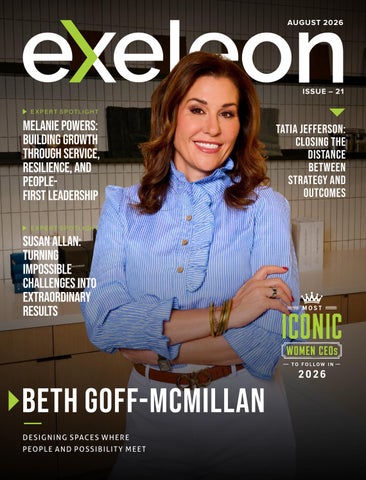
AUGUST 2026
ISSUE – 21 EXPERT SPOTLIGHT
Melanie Powers: Building Growth Through Service, Resilience, and PeopleFirst Leadership EXPERT SPOTLIGHT
Susan Allan: Turning Impossible Challenges into Extraordinary Results
Tatia Jefferson: Closing the Distance Between Strategy and Outcomes
exeleon_magazine
exeleon_magazine
exeleon_magazine
exeleon_magazine
exeleon_magazine
exeleon_magazine
FOLLOW ON INSTAGRAM
exeleon_magazine
exeleon_magazine
exeleon_magazine
exeleon_magazine
exeleon_magazine
Embracing Excellence 600 N Broad St 5 Middletown, DE 19709, United States +1 302-907-9110
Editor-in-Chief – Daryl Yeung Art Director – Naomi Lam Managing Editor - Matt Reis Creative Director – Akshay Panzade
Project Manager – Richard Dann Marketing Manager – Sofia Brown Customer Relationship – Natasha Green Business Development – Hitesh Patil, Josh Wilder, Anish Miller
Copyright © Exeleon Media LLC. All rights reserved. The design, images, and content in this issue should not be reproduced in any manner or by any means, i.e. mechanical, electronic, recording, photocopying, or otherwise, without any permission from Exeleon Media.
MESSAGE
from
THE EDITOR
L
eadership becomes iconic not through visibility alone, but through the ability to build something meaningful, challenge accepted thinking, and create opportunities for others to thrive. Exeleon's Iconic Women CEOs to Watch in 2026 celebrates women who embody these qualities while reshaping businesses, industries, and communities through purposeful leadership. The leaders featured in this edition bring different experiences, perspectives, and ambitions to the table. What connects them is their willingness to make difcult decisions, remain adaptable, and lead with conviction in environments that continue to demand more from those at the top. Their stories remind us that business success is not measured solely through growth or recognition. It is also reected in the cultures leaders create, the people they develop, and the inuence their decisions carry beyond the organization. Gracing the cover of this edition is Beth Goff-McMillan, CEO of SKG and Founder of FOLIO. Over more than 25 years in the commercial furnishings industry, Beth has helped elevate the conversation around workplace design by demonstrating how thoughtfully created environments can inuence people, performance, collaboration, and culture. Under her leadership, SKG has become one of Texas' largest womanowned commercial furnishings dealerships and one of the country's fastest-growing rms in its eld. Yet Beth's story is dened by more than business expansion. Her leadership reects curiosity, innovation, community involvement, and a commitment to developing future leaders, particularly women who may not yet recognize their own potential. As Beth enters a chapter where signicance matters more than success, her journey offers a timely reminder that leadership is not about possessing every answer. It is about asking better questions, trusting people, and creating the conditions in which they can ourish. We invite you to discover Beth's story and meet the remarkable women shaping what leadership will mean in 2026 and beyond.
Daryl Yeung Editor-in-Chief
CONTENTS
12 BETH GOFF-MCMILLAN
CONTENTS
26 MELANIE POWERS
CONTENTS
36 SUSAN ALLAN
C O V E R S T O RY
Beth GoffMcMillan Designing Spaces Where People and Possibility Meet
As CEO of SKG and Founder of FOLIO, Beth Goff-McMillan has spent more than 25 years challenging how organizations think about space, culture, technology, and leadership. Her journey shows that the most meaningful environments are not built around furniture, but around the people who use them.
12 | AUGUST 2026
EXELEON MAGAZINE
ICONIC WWW.EXELEONMAGAZINE.COM
AUGUST 2026 | 13
C O V E R S T O RY
Beth GoffMcMillan never planned to build a career in commercial furnishings. Her earliest interests were rooted in ne arts and a fascination with the ways physical environments inuence human behavior. She was drawn to the relationship between creativity, psychology, and design, particularly how a thoughtfully created space can affect the way people think, work, collaborate, heal, and connect. When she entered the commercial furnishings industry, however, she quickly understood that the work extended far beyond products, oor plans, and visual appeal. Workplaces were where organizations built their cultures, solved difcult problems, strengthened relationships, and pursued their missions. Hospitals, universities, public facilities, and corporate ofces were all environments where design could shape the experiences and performance of the people within them. That realization gave Beth a larger sense of purpose. She saw an industry with considerable expertise and inuence that was not always recognized as a strategic contributor to organizational success. Commercial furnishings rms were frequently viewed as supporting players rather than partners capable of improving culture, productivity, collaboration, and well-being. Beth set out to change that perception.
14 | AUGUST 2026
EXELEON MAGAZINE
WWW.EXELEONMAGAZINE.COM
AUGUST 2026 | 15
C O V E R S T O RY Over more than 25 years, she has built a career around demonstrating that space is not merely a backdrop to business. It can become an active part of how an organization operates and how its people experience their work. Today, as CEO of SKG and Founder of FOLIO, Beth leads with an understanding that has remained constant throughout her journey. “Looking back, the common thread throughout my career has never been furniture,” she says. “It’s always been people.” Growth Without Chasing Size Under Beth’s leadership, SKG has grown into one of the largest woman-owned commercial furnishings dealerships in Texas and one of the fastest-growing dealerships in the country. It serves Fortune 500 companies, healthcare systems, universities, and government organizations while operating as the exclusive Allsteel dealer across Austin, Houston, and San Antonio. The company’s growth has brought national recognition. SKG has appeared on the Inc. 5000 list for three consecutive years and has been recognized among the Best Places to Work in Austin and San Antonio. Beth was also named the Austin Business Journal's 2023 CEO of the Year. These achievements reect the company’s momentum, but Beth has never treated size as the ultimate measure of success. She believes growth should emerge from purpose, curiosity, and a willingness to reconsider established ways of working. “Growth has never been about chasing size for its own sake,” she explains. “Every major milestone has come from being willing to challenge conventional thinking.” Several dening moments in the company’s history required Beth and her team to pursue partnerships and opportunities that others believed were beyond their reach. Those decisions demanded more than ambition.
16 | AUGUST 2026
They required the discipline to invest in a long-term vision before success was assured, as well as the condence to move forward in uncertain conditions. This readiness to act before the path became obvious has helped SKG continually reinvent itself. Instead of waiting for changes in the market to dictate its direction, the company has sought to anticipate what clients and the wider industry will need next. A clear example is FOLIO, founded by Beth as the commercial furnishings industry’s rst SaaS platform. Its creation began with a practical question: How could technology better serve clients and modernize the industry? Rather than accepting familiar processes simply because they had always been used, Beth looked for a more intelligent and efcient approach. Innovation at SKG, however, does not depend upon a single leader or department. Beth has built a team whose members are encouraged to question ideas, think creatively, and take responsibility for results. Within that environment, authority does not determine whose contribution matters most. “I’ve always believed the best idea wins, regardless of where it comes from,” she says. Beginning Every Partnership with Curiosity Whether SKG is working on a corporate headquarters, healthcare facility, university, or government environment, the process begins with curiosity. Before proposing a product or design solution, the team seeks to understand the organization, its people, its culture, and its goals. What is the organization trying to accomplish? What barriers are keeping it from moving forward? What kind of experience does it want to create for employees, visitors, patients, students, or members of the public?
EXELEON MAGAZINE
TRUST
“
When individuals know they’re trusted, valued, and contributing to a purpose larger than themselves, extraordinary things happen.
WWW.EXELEONMAGAZINE.COM
AUGUST 2026 | 17
C O V E R S T O RY
“
Leadership isn’t about proving yourself. It’s about making it possible for others to thrive.
These questions allow SKG to examine a space through the perspective of the people who will experience it. The objective is not simply to deliver an attractive environment, but to create one that actively supports the work, relationships, and outcomes that matter to the organization. “The most impactful spaces don’t simply look beautiful,” Beth explains. “They intentionally shape how people connect, collaborate, innovate, and thrive.” This approach has also allowed SKG to build relationships that extend well beyond individual assignments. Many clients have worked with the company for years because its team consistently shows up, solves problems collaboratively, and operates as an extension of the client’s organization. For Beth, a successful project is not a
18 | AUGUST 2026
transaction. It is an opportunity to earn lasting trust. A Culture Built Through Daily Decisions The same human-centered thinking that guides SKG’s client work also denes its internal culture. Beth rejects the idea that culture can be created through slogans, posters, or occasional company retreats. It is built through the behavior that leaders demonstrate and the decisions they make each day. “One of the biggest lessons I’ve learned is that culture follows behavior, not intention,” she says. “As leaders, we have to model the values we expect others to embrace.” SKG has intentionally created opportunities for learning,
EXELEON MAGAZINE
mentorship, exibility, and well-being. Its culture is guided by employee-created principles that translate the company's values into everyday expectations. One of those principles, “Burn On, Not Out,” encourages employees to pursue meaningful and ambitious work sustainably while caring for themselves, their colleagues, and the communities they serve. Another, “Hand In Hand,” calls on people to lead with empathy, seek understanding before acting, and develop thoughtful solutions together. The principles recognize that high performance and personal well-being should not be competing priorities. Beth believes people do their best work when they know they are trusted, valued, and connected to a purpose larger than themselves. When that foundation
WWW.EXELEONMAGAZINE.COM
exists, employees are more willing to contribute ideas, take ownership, and help others succeed. This sense of responsibility extends into the community. Through its Culture Club and broader philanthropic initiatives, SKG supports organizations and causes including the Central Texas Food Bank, the Austin Women’s Fund, The Water Project, breast cancer awareness, women's heart health, and homeless outreach programs. The company also partners with Code2College to provide paid internships for underserved high school students and hosts interior design students from Texas State University for project presentations and professional mentorship. Its showrooms serve not only as business environments but as gathering spaces for nonprot organizations and community initiatives.
AUGUST 2026 | 19
C O V E R S T O RY
Reimagining Why People Come Together The changing nature of work has made Beth’s perspective on space increasingly relevant. Hybrid work altered the assumptions that guided workplace design for decades. Before the pandemic, organizations often evaluated the success of an ofce by how many employees occupied it. Today, Beth believes leaders must begin with a different question: Why should people come into the ofce at all? If focused individual work can be completed from almost anywhere, the workplace must offer something more meaningful. It should support collaboration, mentoring, creativity, relationship-building, and cultural connection. Instead of asking how many desks a oor can accommodate, organizations must ask what experiences they want people to have when they are together. The answer will differ across organizations, but the underlying purpose remains the same. A modern workplace should help people accomplish the work that happens best face-to-face. Technology and articial intelligence will continue to
automate routine activities and reshape professional roles, but Beth does not see these developments diminishing the importance of physical environments. She believes they will make human connection even more valuable. As repetitive work becomes automated, people will spend more time solving complex problems, exchanging ideas, mentoring one another, and building trust. “Great workplaces have always been about people,” she says. “The next generation of workplace design will reect that truth by creating environments that inspire connection, strengthen culture, and help people do their best work together.” SKG’s agship showrooms in Austin and San Antonio reect this direction, including the region’s rst Healing & Learning Center dedicated to restorative workplace design. These environments allow clients and communities to explore how design can support health, learning, connection, and well-being rather than merely lling a space.
CEO SKG
25+ years in commercial furnishings
Founder FOLIO
Henry Crown Fellow
First woman Chair of YPO Austin
Austin Business Journal’s 2023 CEO of the Year
20 | AUGUST 2026
EXELEON MAGAZINE
From Having Answers to Asking Better Questions Beth’s leadership has evolved alongside the company. Early in her career, she believed a leader’s responsibility was to possess the answers. Experience has taught her that leadership is often about asking better questions and creating the conditions in which other people can nd the answers. As SKG expanded into new markets, Beth became increasingly focused on developing capable leaders across the organization. She wants people to feel empowered to think independently, make thoughtful decisions, and lead condently without waiting for direction at every turn. Turning 50 prompted her to consider what creates lasting impact. For much of her career, she concentrated on changing how an industry understood its own value. That mission remains important, but it has expanded to include developing people, especially women who may not yet recognize their own leadership potential. “I’ve learned that leadership isn’t about proving yourself,” Beth says. “It’s about making it possible for others to thrive.”
WWW.EXELEONMAGAZINE.COM
AUGUST 2026 | 21
“
Building a great company has been an incredible privilege, but helping build great people is the legacy I hope to leave.
22 | AUGUST 2026
EXELEON MAGAZINE
C O V E R S T O RY
Choosing Significance Over Success Looking ahead, Beth wants SKG to be known not only for the spaces it creates, but also for its inuence on the people who experience them. The company will continue investing in innovation, technology, sustainability, and human-centered design so it can help clients prepare for future needs rather than merely react to current challenges. Her ambitions for the organization are inseparable from its responsibility to the communities it serves. She envisions SKG continuing to mentor emerging leaders, support nonprot organizations, create opportunities for employees to give back, and use its resources to strengthen the places in which it operates. For Beth, this stage of leadership is dened less by personal achievement and more by the impact she can help others create. “I’m entering a season where signicance matters more than success,” she reects. “Building a great company has been an incredible privilege, but helping build great people is the legacy I hope to leave.” That vision captures the philosophy behind Beth’s career. Spaces matter because people inhabit them. Businesses matter because they can strengthen communities. Leadership matters because it can open doors for others.
@beth-goff-mcmillan skgtexas.com @bethgoffmcmillan
WWW.EXELEONMAGAZINE.COM
AUGUST 2026 | 23
Unlock Your DIGITAL SUBSCRIPTION! Ready to fuel your ambition and receive your dose of inspiration directly to your digital doorstep? Subscribe to Exeleon Magazine today, and enjoy the following perks:
• Convenience at Your Fingertips • Exclusive Extras • Community Connection
IN-FOCUS
MELANIE POW Building Growth Through Service, Resilience, and People-First Leadership
F
or Melanie Powers, leadership has never been dened by following a conventional path. Her journey from studying interior design at Columbia College to becoming President and CEO of Goodberlet Home Services reects a career built on adaptability, technical curiosity, persistence, and a willingness to step into spaces where women have historically been underrepresented. Today, Melanie leads a growing home services company serving customers across greater Chicagoland and Indianapolis. Under her leadership, Goodberlet Home Services has expanded its capabilities across HVAC, plumbing, and electrical services while recording signicant revenue growth. Yet behind that growth is a leadership philosophy centered on something equally important: people. From supporting employees with exible schedules to creating opportunities for longterm professional success, Melanie believes that providing exceptional service to customers starts with building a workplace where employees feel supported.
26 | AUGUST 2026
Finding an Unexpected Path into the Trades Melanie originally studied interior design, but the career opportunities available when she graduated did not provide the nancial security or benets she was looking for. “The careers offered to people starting out in design, at that time, were low paid with no benets,” she recalls. “I needed to be able to support myself and I wanted benets like health insurance.” That realization led her into sales, eventually working with software and hardware products. While the move represented a departure from her original eld of study, Melanie quickly found herself drawn to the technical side of the work. Still, the building trades continued to interest her. Her opportunity eventually came when she accepted a position as an HVAC project manager, combining the technical sales experience she had developed with an industry she had long wanted to enter. That transition would prove to be pivotal.
EXELEON MAGAZINE
WERS
WWW.EXELEONMAGAZINE.COM
AUGUST 2026 | 27
IN-FOCUS
“
Growth at Goodberlet is not measured only through revenue or market expansion.
It gave Melanie an entry point into an industry where she would not only develop her technical expertise but ultimately grow into executive leadership. Creating Her Own Place in a Male-Dominated Industry Breaking into the trades was not straightforward. Melanie points out that many young women are simply not presented with careers in elds such as HVAC when they begin considering their professional options. “The rst challenge I faced was getting a path into the building trades,” she says. “As young women being presented with career options, these types of trade jobs are only offered to men.” Her technical sales background eventually helped open that door when someone in the HVAC industry recognized the value of her experience.
28 | AUGUST 2026
Getting into the industry, however, was only one part of the challenge. As an HVAC project manager, Melanie encountered customers who refused to work with a woman. She also faced assumptions from others within the industry who questioned why she was attending technical training or presumed that a male family member must own the company. Some asked why “the secretary” had been sent to a boiler installation class. Others assumed her father or husband must be behind her professional position. Rather than allowing those experiences to discourage her, Melanie focused on becoming increasingly knowledgeable about the industry. “I just kept pushing forward, working and taking as many classes as I could to improve my knowledge.” That commitment to learning became an important part of
EXELEON MAGAZINE
how she established credibility and continued progressing in her career.
company to provide a broader solution for homeowners rather than focusing on a single part of their mechanical needs.
Identifying the Opportunity for Growth The business also expanded geographically. When Melanie became President of Goodberlet Home Services, she saw an opportunity to expand the company by looking more closely at what its existing customers actually needed. At the time, Goodberlet already served HVAC customers, but many of those same homeowners also needed plumbing and electrical services. For Melanie, the opportunity was clear. “When I assumed the position as president at Goodberlet Home Services, I saw a gap in the services we were providing,” she explains. “Many of our HVAC customers also had plumbing and electrical needs.” Goodberlet began adding those services, allowing the
WWW.EXELEONMAGAZINE.COM
Its territory grew across Chicagoland and, more recently, into Indianapolis. These decisions contributed to substantial expansion, with Goodberlet Home Services experiencing 600 percent revenue growth under Melanie’s leadership. The strategy itself was not based on unnecessary complexity. It came from understanding existing customers, recognizing where the company could provide additional value, and expanding its expertise accordingly. Why More Women Belong in Home Services Melanie believes opportunities for women within
AUGUST 2026 | 29
IN-FOCUS HVAC and the broader home services sector are beginning to grow, supported in part by organizations focused specically on increasing female participation within the industry.
“We want our people to provide exceptional service to our clients, but to do that, they need to feel that they have work/life balance.”
But she also recognizes how much progress remains to be made.
Goodberlet therefore offers exible schedules designed to allow employees to make room for important family commitments.
According to the gure Melanie cites from the U.S. Bureau of Labor, women currently hold only around 1.5 percent of HVAC jobs. For Melanie, greater representation begins with making women aware that these career paths exist in the rst place. Her own experience demonstrates how easily someone with the right technical skills, curiosity, and willingness to learn can be overlooked simply because the industry has traditionally been associated with men. Her career also shows what can happen when someone is given that opportunity. From project management to executive leadership, Melanie has built her career by developing expertise and consistently proving that leadership in the trades does not belong to one demographic. Building a Company Around Its People Growth at Goodberlet is not measured only through revenue or market expansion. Melanie is equally focused on the kind of company employees experience every day. “Our company culture is family oriented,” she says. The nature of home services can make that culture difcult to maintain. HVAC, plumbing, and electrical professionals frequently respond to urgent customer needs, making schedules demanding and unpredictable. Melanie believes employees can only provide consistently excellent service when their own wellbeing is also taken seriously.
30 | AUGUST 2026
That could mean coaching a child's baseball team, attending a school play, or simply taking the time needed to manage responsibilities outside work. For Melanie, these policies are not separate from business performance. They support it. Employees who are trusted and supported are better positioned to take care of customers, build expertise, and sustain demanding careers over the long term. Growing Without Losing What Matters Looking ahead, Melanie wants Goodberlet Home Services to continue expanding its market share across greater Chicagoland and Indianapolis. The foundation of that growth remains the company's ability to offer homeowners reliable support across plumbing, heating and air conditioning, and electrical services. Its team brings decades of combined experience, something Melanie sees as central to Goodberlet's value proposition. At the same time, future growth will require the company to remain adaptable. Goodberlet plans to continue investing in customer service, staying current with new technologies, and ensuring employees have the tools they need to perform at a high level. “We intend to facilitate that growth by continuing on our path of excellent customer service, staying at the forefront of new technologies and providing our employees with the tools to succeed.”
EXELEON MAGAZINE
It is an approach that reects the same qualities that have dened Melanie’s own career. She entered an industry that did not always make room for women, built expertise through continuous learning, identied opportunities others could overlook, and helped turn those insights into signicant business growth. Today, as President and CEO, Melanie Powers is helping shape Goodberlet Home Services around a simple but effective combination: expand intelligently, serve customers well, invest in people, and keep building for the future.
“
I don’t see setbacks as failures anymore. I see them as learning and growing opportunities.
WWW.EXELEONMAGAZINE.COM
AUGUST 2026 | 31
WOMEN CEOS REDEFINING POWER Six leaders who broke through industries built without them in mind—and rewrote the rules of the corner office.
AUTO INDUSTRY
Mary Barra: From Assembly Line to GM's Corner Office Started at General Motors at 18, inspecting fender panels to pay for college. Rose through engineering and manufacturing for 33 years before becoming CEO in 2014—first woman to lead a major global automaker. Inherited a massive ignition-switch recall crisis in her first weeks. Steered GM toward electric vehicles, betting the company's future on EVs years before it was consensus. I M PAC T
THE LESSON
Deep operational knowledge built over decades became her edge in a crisis. Expertise from the ground up compounds.
CONSUMER GOODS
Indra Nooyi: The CEO Who Wrote Letters to Parents Led PepsiCo for 12 years, grew revenue by 80%. Championed 'Performance with Purpose'—healthier products, sustainability, talent development—when Wall Street only wanted quarterly numbers. Famously wrote personal letters to her top executives' parents, thanking them for raising great leaders. Immigrated from India with $500, became one of the most powerful CEOs in the world. I M PAC T
THE LESSON
Long-term purpose and short-term performance aren't enemies. She proved you can demand both simultaneously.
TECH FOUNDER
Whitney Wolfe Herd: Youngest Woman to Take a Company Public Co-founded Tinder, left after a difficult experience with harassment and a public lawsuit. Rebuilt from scratch—founded Bumble in 2014, flipping the script by having women message first. Took Bumble public in 2021 at age 31, becoming the youngest woman to lead an IPO in the US. Turned a personal setback into a platform reshaping how millions date. THE LESSON K E Y I M PAC T
34 | AUGUST 2026
Your worst professional experience can become the blueprint for your best idea. Rebuild the rules you were forced to follow.
EXELEON MAGAZINE
90-SECOND READS
E-COMMERCE
Falguni Nayar: Investment Banker to Billionaire at 50 Spent 19 years as a managing director at an investment bank before founding Nykaa at age 50—an age most consider too late to start a company. Built India's leading beauty and fashion e-commerce platform from scratch. Took Nykaa public in 2021, becoming India's wealthiest self-made female billionaire overnight. Proved career timelines are guidelines, not rules. THE LESSON I M PAC T
There is no expiration date on ambition. Her decades of experience became fuel, not baggage, for a late start.
BANKING
Jane Fraser: First Woman to Lead a Major Wall Street Bank Became CEO of Citigroup in 2021, the first woman to lead one of the major US banks in the institution's 200+ year history. Inherited a bank needing deep structural overhaul—led an aggressive multi-year transformation, exiting underperforming markets and simplifying operations. Trained as a McKinsey consultant, brought outsider precision to insider politics.
THE LESSON I M PAC T
Sometimes leadership means being willing to shrink strategically before you can grow sustainably.
A E R O S PAC E & D E F E N S E
Marillyn Hewson: Engineer Who Led Lockheed Martin's Turnaround Joined Lockheed Martin as an entry-level industrial engineer, worked her way up over 34 years to become CEO in 2013. Led the world's largest defense contractor through complex government contracts, budget cuts, and geopolitical shifts. Grew the company's market value by billions while consistently ranked among the most powerful women in business. Rarely the loudest voice in the room—known for meticulous, quiet execution.
LEAD WITH THIS I M PAC T
WWW.EXELEONMAGAZINE.COM
You don't need to be the most visible leader to be the most effective one. Consistency compounds louder than charisma.
AUGUST 2026 | 35
IN-FOCUS
Susan Allan Turning Impossible hallenges into Extraordinary Results or Susan Allan, success has never been limited to revenue, titles, or business milestones. Across a career that has moved from New York’s fashion industry to executive coaching, sales strategy, relationship transformation, and conict resolution, one question has remained constant: What prevents people from achieving the result they know is possible?
F
Today, as the Founder of The Sales Forum and The Marriage Forum, Susan has accumulated more than 75,000 coaching hours over 27 years, including thousands of pro bono sessions. Her work has taken her inside high-stakes business negotiations, stalled international ventures, leadership challenges, sales transformations, and deeply personal turning points.
A fth-generation entrepreneur, Susan built an international career in fashion before embarking on an entirely different professional chapter. Her work exposed her to markets and cultures across Asia, Europe, and the United States, shaping the cross-cultural perspective she would later bring to her coaching practice.
In this conversation, Susan reects on her entrepreneurial roots, the personal circumstances that redirected her career, the leadership lessons gained through decades of coaching, and why she believes commitment, more than potential, ultimately determines extraordinary results.
36 | AUGUST 2026
EXELEON MAGAZINE
Susan, before becoming a coach, you built a successful career in New York’s fashion industry. How did that entrepreneurial journey begin, and what did it teach you about business? I am a fth-generation entrepreneur on both sides of my family, and our history has been unchanged for centuries. My success in fashion was launched by helpful people who became mentors. My fashion company provided 57 trips to Asia and Europe. New York, New Delhi, Mumbai, Bangkok, and Hong Kong were melting pots, while Paris, London, Milan, Rome, Tokyo, Taiwan, and Los Angeles had cultural identities that
WWW.EXELEONMAGAZINE.COM
inuenced opportunities. My thinking became crosscultural, and when I founded The Sales Forum and The Marriage Forum, I created a worldwide clientele. My coaching modules have been used in 12 countries and by four cultural groups within the United States. After generating $750 million in wholesale product sales in fashion, what prompted you to leave fashion and begin an entirely new chapter in coaching? Throughout my life, the one constant has been a desire to understand how to transform suffering into success. I’m still at it.
AUGUST 2026 | 37
IN-FOCUS
“
Potential does not predict outcomes. Commitment does. 38 | AUGUST 2026
EXELEON MAGAZINE
Just as entrepreneurship was in my lineage, I inherited this calling to create a nonprot. My maternal grandmother was President of a nonprot for 25 years, raising millions to save families in dire straits. My father was a surgeon dedicated to his patients regardless of their nancial resources. I had built a successful fashion career but longed to show clients how to transform urgent situations and triumph over them. Then my husband began using steroids, my marriage became a disaster waiting to happen, and my attention shifted to survival. To save my own life, I developed tools and skills I never imagined I would need. Once safe, I realized I had pivoted into a second career that had meaning for me. I committed myself to sharing those tools and skills so no one would ever have to endure what I had, nor struggle alone. I founded The Sales Forum and The Marriage Forum, Inc., and began what became my 27-year coaching career, with 75,000 coaching hours completed so far, including 10,000 pro bono sessions. For me, showing a client how to double or 4x her income is as exciting as a huge deal or my client’s $11 million negotiation savings. Over 27 years and 75,000 coaching hours, what experiences have most shaped your approach to helping leaders achieve seemingly impossible results? I learned early never to predict success based upon apparent advantages or disadvantages. The hunger to succeed is essential to every entrepreneur, corporate founder, and employee. I coached two friends. One was beautiful, talented, charismatic, had an agent, and several small television roles. I remembered seeing her on television, and since she had been on camera for only three minutes, she seemed destined for stardom. The other had been in neighborhood plays but had no acting career. However, she possessed determination, commitment, and support. She was a hard, hard worker who committed herself to mastering every skill I taught her, day after day after day. Their family environments were different. The actress’s wealthy parents insisted she work in a
WWW.EXELEONMAGAZINE.COM
restaurant two nights each week, exhausting her and interfering with auditions. Although her boyfriend earned millions, she refused to ask him for money and eventually left acting. By contrast, the other young woman’s father was dedicated to her success. She worked hard every day, stayed in coaching for a full year until she married, and followed through. At my urging, she produced a short lm and submitted it to lm festivals, launching a lm career. Then she learned my Heartspace® relationship skills, discovered a man who was perfect for her and she for him, married, and had a baby. Area after area of her life transformed. We discover what prevents the desired outcome, identify overlooked opportunities, I provide the tools and skills, and we stay focused. One VP of Sales learned skills to align his partners who had refused to sell the company. Within a few months, they agreed to a $205 million acquisition offer because he learned how to motivate them. Two best friends were working on an international project that had been stalled for eight years before they hired me. Within four months, they secured the 28 required signatures and completed Phase 1 of their $1 billion international project. Potential does not predict outcomes. Commitment does. Almost everything is possible with the right tools, skills, and support. You’ve coached CEOs, founders, and C-suite executives through major business and personal transformations. In your experience, what separates leaders who achieve extraordinary results from those who remain stuck? Extraordinary results require mastery in four categories. A. Personal Mastery begins with self-soothing so leaders function optimally when pressure is greatest and remain consistent and persistent. B. Business Mastery means expertise in their industry, company, products, ideal customers or clients, unique selling proposition, and their role in the business’s success.
AUGUST 2026 | 39
IN-FOCUS C. Sales Mastery is essential because every company depends upon a customer or client saying “Yes.” Leaders must understand what others want, communicate value, create trust, recognize opportunities, and turn them into business. D. The fourth Mastery has two categories. For Entrepreneurs, it is Scalability: creating something distinctive with a unique selling point and a business that grows beyond their individual effort. For Corporate Executives, it is Corporate Mastery: knowing how to “dance between the raindrops” and work successfully with everyone from the Founder and CEO to the janitorial staff, plus every customer, client, organization, or joint venture partner. This requires understanding personalities, interests, agendas, expectations, power structures, and communication styles while producing results. Your work blends business strategy with communication, emotional intelligence, and conict prevention. How do these elements work together when you’re coaching a leader or organization? The problem a client brings me is not necessarily the problem we need to solve. My rst job is discovering what actually prevents the desired result. An apparent strategy problem may really be communication, an unresolved relationship, inability to persuade and inspire, or a missing skill. The international project that had been stalled for eight years required my offering the principals the communication and mediation skills required to motivate and inspire 27 essential decision-makers. We changed the conversations and, as a result, within four months, all signatures were secured, and Phase 1 of this $1 billion project was completed. Another client, a brilliant VP of Sales, had three partners who expected him to do all the lifting, heavy and otherwise. The only option was to sell the company, which all three had refused to do the previous year. However, when he learned motivation and mediation skills and adjusted his presentation, they agreed, and the company sold for $205 million during our coaching work. There was a different Founder who believed that his company had a sales problem. However, I discovered
40 | AUGUST 2026
“
I identify what stands between the client and the desired result, then provide the specific tools, skills, and strategy required. EXELEON MAGAZINE
that his “salesman” was a marketer who lacked sales skills and had closed no deals since joining the rm. I performed some HR functions and identied an ideal candidate with exceptional sales experience in his industry. We negotiated a substantial package dependent on salary plus commission. However, the “sales” problem was a personality clash that we discovered when the boss refused to accept a huge multi-milliondollar project because the buyer had been rude to him many years earlier. This eliminated a huge commission opportunity, and the talented new hire resigned. I had solved the apparent problem and uncovered the real one. The most brilliant strategy will fail unless those implementing it communicate, create trust, prevent and resolve conict, and maintain focus on the bottom line. I identify what stands between the client and the desired result, then provide the specic tools, skills, and strategy required to transform the situations that have been challenging. You’ve developed 100 proprietary tools and skills across your programs. Which ones do you nd yourself returning to most often when working with executives and entrepreneurs? Self-soothing saved my life. I offer six options and always teach Brain-breathing© and Selfempathy so leaders function optimally when pressure is greatest. Whole-Brain Thinking, based on my Herrmann Brain Dominance® training, allows clients to consider the ve essential aspects of every business: creation and development, production, operations, sales, and nance, rather than relying solely on their natural strengths. I teach The 6-Part Conversation© for Sales to everyone, not only sales teams, because motivating and inspiring cooperative outcomes is the cornerstone of every business. Part 6, The Close, provides the basics for mediating agreements, a necessity in corporate life.
WWW.EXELEONMAGAZINE.COM
What nal message would you like to share with entrepreneurs and business leaders who are facing a challenge that seems impossible? Almost anything is possible with the right tools, skills, and support. I have learned that the solution to a seemingly “impossible problem” is usually hidden behind something else. Once we examine the key issues, we discover what has been overlooked, whether it's a question no one has asked, a missing skill, or outsidethe-box thinking that pivots the trajectory of a business or a life. My purpose in offering a complimentary one-hour private Breakthrough Session is to allow everyone to see their career or personal life more clearly and identify how to solve a serious problem ASAP. I'm always excited when someone describes a challenge they haven't solved. Together, we look for solutions that are hiding or have been overlooked. Because I offer 100 unique proven tools and skills, I can provide clients in countless elds and companies with the specic solutions they need to create extraordinary success.
@susanallansalesforum www.themarriageforum.com @susanallanheart
AUGUST 2026 | 41
IN-FOCUS
F
organizations do not merely need to manage projects, they need to actively operate their portfolios.
or more than 25 years, Tatia Jefferson has worked at the intersection of strategy, investment, execution, and enterprise transformation. Across nancial services, healthcare, and technology, she has led complex portfolios exceeding $200 million while helping organizations navigate competing priorities, limited capacity, governance challenges, and the constant pressure to turn strategic ambitions into measurable results.
In this conversation, Tatia reects on the evolution of her career, the recurring challenges that inspired PortfolioOps™, the lessons she learned from leading large enterprise portfolios, and her vision for elevating portfolio operations into a recognized executive capability.
Today, as Founder and Principal Advisor of PortfolioOps™, Tatia brings those experiences together through an approach centered on a simple but often overlooked idea:
Tatia, you bring more than 25 years of leadership experience across nancial services, healthcare, and technology. How did your professional journey begin,
42 | AUGUST 2026
EXELEON MAGAZINE
Tatia Jefferson Closing the Distance Between Strategy and Outcomes
and what shaped your path into portfolio leadership? My career began much closer to the work itself, leading projects, solving operational problems, and helping organizations deliver complex change. Over time, however, I became increasingly interested in what was happening around the projects. Why were some initiatives moving forward while others were not? How were investment and prioritization decisions being made? Did leaders have enough visibility to understand what was happening across the portfolio? And,
WWW.EXELEONMAGAZINE.COM
perhaps most importantly, were all these projects collectively producing the outcomes the organization expected? Those questions gradually moved my career from project and program leadership into enterprise portfolio leadership. As my responsibilities grew, I had the opportunity to lead increasingly complex enterprise portfolios. At that scale, you quickly learn that portfolio leadership is about much more than overseeing a collection of projects. You are constantly connecting strategy, investment, capacity, risk,
AUGUST 2026 | 43
IN-FOCUS execution, and business outcomes while helping leaders make decisions across competing priorities. That experience fundamentally shaped how I think about portfolio leadership today. My career has really been an evolution from managing the work, to leading the portfolio, to helping organizations improve how the portfolio itself operates. That progression ultimately became the foundation for the work I do today through PortfolioOps™. What recurring challenges did you see between strategy and execution that ultimately inspired you to establish PortfolioOps™? Throughout my career, I repeatedly saw organizations with strong strategies, talented teams, established governance, and signicant technology investments, yet leaders still struggled to answer fundamental portfolio questions. What are we truly committed to? Are our highest priorities receiving the capacity and funding they need? Where are competing priorities creating risk? What decisions require executive attention? And are our investments producing the outcomes we expected? The challenge was rarely a lack of effort or information. It was that strategy, investment decisions, governance, execution, and executive visibility were not always operating as a connected system. The result was portfolio friction: competing priorities without clear trade-offs, teams stretched beyond capacity, governance focused more on status than decisions, and executives receiving more information without necessarily gaining greater visibility. The underlying challenge remained: organizations needed a stronger way to connect strategy with the portfolio decisions required to turn it into outcomes.
You have led complex enterprise portfolios exceeding $200 million. What experiences during this period most inuenced the leader and advisor you are today? Leading large enterprise portfolios taught me that complexity changes the nature of leadership. At that scale, no single person has all the information, and no individual team can optimize the portfolio on its own. You must create the conditions for good decisions to happen across the organization. One of the most important lessons I learned was that visibility is not the same as reporting. Leaders can receive extensive status information and still lack the insight they need to decide. I learned to focus less on how much information we could provide and more on whether we were making the right issues, trade-offs, risks, and decisions visible at the right time. I also learned that prioritization requires choices. Organizations will always have more good ideas than available capacity, funding, and leadership attention. Effective portfolio leadership means making those constraints visible and helping leaders understand the implications of their choices, not simply trying to t everything into the plan. Perhaps most importantly, those experiences taught me that my role as a leader was not to have every answer. It was to ask better questions, bring the right perspectives together, create clarity where there was complexity, and help people make informed decisions. That lesson continues to shape how I advise organizations today. I don't approach a portfolio assuming I already know the answer. I help leaders see the portfolio more clearly so they can make better decisions about what happens next. What does PortfolioOps™ offer organizations, and what makes your approach to portfolio operations different?
That realization became the foundation for PortfolioOps™. I created PortfolioOps™ to help organizations strengthen how their portfolios operate, improving visibility, governance, prioritization, and executive decision support while working with the teams and technology they already have. Strategy does not become an outcome simply because the work has been funded and launched. The portfolio has to be actively operated.
44 | AUGUST 2026
PortfolioOps™ is an executive advisory rm focused on helping organizations strengthen how their portfolios operate. We work with leaders to improve the operating capabilities that connect strategy to execution: portfolio visibility, governance and prioritization, nancial management, executive decision-making, and ultimately business outcomes. What makes our approach different is that we don't begin with the assumption that an organization needs another
EXELEON MAGAZINE
“
I help leaders see the portfolio more clearly so they can make better decisions about what happens next.
WWW.EXELEONMAGAZINE.COM
AUGUST 2026 | 45
IN-FOCUS
46 | AUGUST 2026
EXELEON MAGAZINE
technology platform, another layer of governance, or a replacement for its existing PMO. The opportunity is often to make existing people, processes, and technology work together more effectively. That is the thinking behind The Portfolio Operating System™, our approach to connecting the decisions, governance, information, and operating practices leaders need to actively manage the portfolio. PortfolioOps™ is intentionally technology-agnostic. We work with an organization's existing PMO, transformation teams, and technology environment rather than requiring them to replace what they already have. Ultimately, our role is to help leaders move beyond simply tracking whether work is being delivered and toward understanding whether they are investing in the right work, whether the organization can realistically deliver its commitments, where executive decisions are needed, and whether those investments are producing the outcomes the strategy intended. That is the difference between managing a collection of initiatives and operating a portfolio. How has your approach to leadership evolved as you moved from leading enterprise portfolios to advising executives and organizations? My approach to leadership has evolved from focusing primarily on driving execution to creating the conditions for others to make better decisions and lead effectively. When you're accountable for an enterprise portfolio, there is a natural tendency to want to solve the problem, to bring structure, establish the process, remove the obstacle, and keep things moving. Those skills are important, but experience taught me that sustainable improvement happens when leaders and teams understand not only what needs to change, but why it matters and how their decisions affect the broader portfolio. As an advisor, I spend more time listening, asking questions, and helping leaders see connections that may be difcult to recognize from within their individual areas of responsibility. My role isn't to walk into an organization and impose a predetermined answer. It's to bring an objective portfolio perspective, surface the issues and trade-offs that matter, and help leaders create clarity around what needs to happen next.
WWW.EXELEONMAGAZINE.COM
I've also become much more comfortable with the idea that good leadership does not always mean adding something. Sometimes the most valuable question is: What can we simplify? What can we stop? What decision are we avoiding? That evolution has made me a more thoughtful leader and advisor. I still care deeply about execution, but I've learned that the quality of execution is often determined by the quality of the decisions that come before it. Looking ahead, what is your vision for PortfolioOps™ and the impact you hope to create through your work? My vision for PortfolioOps™ is bigger than building an advisory rm. I want to help change the way organizations think about portfolio leadership. Portfolio management is often viewed through the lens of projects, reporting, and governance. But the portfolio is also where strategy becomes investment, where priorities compete for limited capacity, where executive decisions become commitments, and where organizations ultimately determine whether the outcomes they intended are being realized. I want PortfolioOps™ to help elevate that conversation. My goal is to make strong portfolio operations a recognized executive capability, one that gives leaders greater visibility into their investments, creates clearer decision-making and accountability, and helps organizations make more deliberate choices about where they commit their people, capital, and attention. I also want the impact of our work to remain after an engagement ends. Success isn't creating dependency on PortfolioOps™. It’s helping organizations build stronger operating practices, decision disciplines, and portfolio capabilities that their own leaders and teams can continue to use and evolve. Ultimately, I want PortfolioOps™ to help organizations close the distance between the strategy they articulate and the outcomes they achieve. If we can help leaders see more clearly, decide more deliberately, and operate their portfolios with greater intention, that is meaningful impact to me.
@efferson www.portfolioops.co
AUGUST 2026 | 47
OVER 3500+ BRANDS HAVE SHARED
Ad
Be the next brand to be p Because Your Jo
D THEIR STORIES ON OUR PLATFORM.
™
Ad
part of Exeleon Magazine. ourney Matters.
IN-FOCUS
IRINADUISI
“
How you deal with challenges is what makes you successful.
50 | AUGUST 2026
EXELEON MAGAZINE
IMBEKOVA Leading Across Borders, Building With Purpose
F
or Irina Duisimbekova, business has always been about more than transactions. Across more than 27 years as an entrepreneur, investor, and international business leader, her career has been shaped by relationships, cultural understanding, adaptability, and the ability to build trust across borders. Born in Moscow with Kazakh and Russian roots, Irina moved to France at the age of 15 before continuing her education in London. Her professional journey would eventually take her from helping French companies expand into CIS markets to establishing businesses across commodities, aviation, investment, technology, and wellbeing. Today, Irina is the Founder of SympathiQ and AeroJet Me and a leader at Licorne Gulf Holding, where she is involved in investments and strategic ventures across multiple markets. Her experience has also included negotiations alongside Gulf Royal Families, Sovereign Wealth Funds, and Fortune 500 companies, giving her a distinctive perspective on leadership and high-level relationship building. At the center of her work is a belief that sustainable success comes from creating long-term value, understanding people, and opening opportunities for others. In this conversation, Irina shares the experiences that shaped her leadership journey, the vision behind SympathiQ, her approach to investing and partnerships, and the impact she hopes to create in the years ahead. Irina, your entrepreneurial journey spans more than 27 years. How did it begin, and what experiences shaped the leader you are today? My journey began with a foundation in international business. I was born in Moscow and grew up with a Kazakh and Russian background, and at 15 moved to France, studying at Lycée du Parc in Lyon and obtaining my MBA in London.
WWW.EXELEONMAGAZINE.COM
AUGUST 2026 | 51
IN-FOCUS My professional career started at the Chamber of Commerce of Lyon, helping French companies expand into the CIS, before I established my rst brokerage company in 2007 specializing in commodities. Every step, from France to London to the Gulf, inuenced my worldview. Learning to work across cultures taught me that business is all about relationships, and that has been my mantra for all of my business ventures since then. You have negotiated alongside Gulf Royal Families, Sovereign Wealth Funds, and Fortune 500 companies. What have these experiences taught you about leadership and building trust at the highest levels? These experiences have taught me that trust is the basis of high-level deal-making. When sitting across from Royal Family members or Sovereign Fund executives, they evaluate your integrity and reliability alongside your numbers. In the Gulf region, personal relationships are the key to any partnership, and in all relationships, transactions will come rst. I’ve also been taught the importance of being patient and listening. There are multiple stakeholders and complex hierarchies in decisionmaking at this level. If you are in a rush or push too hard, it can have a negative effect. Rather, I spend time learning about their priorities and their long-term vision, and that makes it a real partnership. What inspired you to create SympathiQ, and what gap in the wellbeing space did you want the platform to address? Accessing quality mental health and wellbeing support is still too hard for most people. This is the inspiration behind SympathiQ. Although there is an increasing awareness of mental health issues, the barriers are still large: expensive care, lengthy waiting lists, distance, and the difculty of locating a specialist who truly understands your needs. Many people either delay treatment or simply give up because the process seems too overwhelming. I wanted to do something about that. I saw a platform that would allow anyone, anywhere, to easily access certied therapists, coaches, dietitians, and tness experts without the traditional barriers. A platform that has an intelligent matching process, where users could locate the right professional for their particular needs in seconds. We at SympathiQ combine AI matching with a network of specialists around the world who have been carefully vetted. It's easy, affordable, and private to get the support you need. This is my mission: to make wellbeing accessible to all and to democratize wellbeing care.
52 | AUGUST 2026
EXELEON MAGAZINE
WWW.EXELEONMAGAZINE.COM
AUGUST 2026 | 53
IN-FOCUS
Through Licorne Gulf Holding, you oversee investments and strategic ventures across multiple markets. What principles guide your investment decisions and partnerships? My investment philosophy centers on long-term value creation, cross-border collaboration, and visionary founders. I search for companies that address actual issues and have a sustainable growth trajectory in technology, energy, defense, healthcare, and ntech. I'm not interested in short-term gains. I want to work with businesses that are creating something worthwhile. I also value working with others who share my values of integrity, resilience, and excellence. The relationship is as important as the deal, whether you are investing in a start-up or a joint venture. I’m looking for founders who are ambitious, trustworthy, and collaborative because that's what leads to long-term success. Across your career, what have been the most dening challenges or turning points, and how have they inuenced your approach to business? A major hurdle that I faced early in my career was establishing my rst brokerage business. Working in a multi-jurisdictional regulatory landscape and building trust with new partners was a great challenge and taught me to be resilient and adaptable. The other pivot point was moving from commodities to creating businesses in the aviation, technology, and wellbeing sectors, which meant learning new industries and developing new networks.
Looking ahead, what impact do you hope to create through your ventures and the next chapter of your leadership journey? With SympathiQ, I hope to bring wellbeing support to millions of people globally. The mental health crisis is a huge challenge, but I believe technology can be a powerful force for good. Through Licorne Gulf Holding, I want to continue investing in businesses that drive innovation and sustainable value, particularly in the GCC region. In addition to my ventures, I want to be a mentor to the next generation of entrepreneurs. I've been fortunate to learn from some of the best, and I believe it’s my responsibility to pass that knowledge forward. I want to look back and know that I made a difference in the businesses I built, the people I worked with, and the communities I served.
@uisimbekova @irina-duisimbekova
The best thing I have learned is that there will be challenges, but how you deal with them is what makes you successful. I have developed the ability to remain calm in stressful situations, trust my own instincts, and have people around me who are good at what they do and complement my strengths. I don’t see setbacks as failures anymore. I see them as learning and growing opportunities.
54 | AUGUST 2026
EXELEON MAGAZINE
WWW.EXELEONMAGAZINE.COM
AUGUST 2026 | 55
IN-FOCUS
58 | AUGUST 2026
EXELEON MAGAZINE
WWW.EXELEONMAGAZINE.COM
AUGUST 2026 | 59
IN-FOCUS
60 | AUGUST 2026
EXELEON MAGAZINE
NEWSROOM
W
omen are gaining ground in the global corner ofce, and the latest numbers offer a reason for cautious optimism.
In the rst half of 2026, women accounted for 16% of incoming CEO appointments across major global stock indices, the highest proportion recorded in nine years of tracking by Russell Reynolds Associates. Of 130 new CEO appointments, 21 went to women. Some markets are moving considerably faster than others. Women represented 43% of new CEO appointments in Australia's ASX 200 and 44% across the Euronext 100. By comparison, women accounted for just 9% of appointments in the S&P 500 and one of six appointments in the FTSE 100.
Women CE a Record H What Com
That contrast matters. For years, conversations around women in leadership have focused on representation, mentorship and breaking the proverbial glass ceiling. The latest numbers suggest that progress is happening, but not uniformly and certainly not at a pace that should encourage complacency. Fortune's 2026 Global 500 offers an even clearer perspective. A record 34 companies on the list are now led by women. Yet that represents only 6.8% of the world's 500 largest corporations. None of the top 30 companies on the ranking has a woman CEO. The issue, therefore, is no longer whether women can lead the largest and most complex organizations. That question has been answered repeatedly. The more relevant question is whether companies are creating enough credible pathways for women to reach those positions. CEO succession begins years before an appointment is announced. It depends on who receives responsibility for major business units, who is given prot-and-loss ownership, who leads international operations and who receives visibility with boards and investors. A record year for appointments should be recognized. But progress cannot be measured by records alone. The real breakthrough will come when the appointment of a woman CEO is no longer noteworthy enough to become a statistic, because women are consistently represented among the leaders considered capable of running the world's most inuential companies.
62 | AUGUST 2026
EXELEON MAGAZINE
EO Appointments Hit High. The Real Test Is mes Next
WWW.EXELEONMAGAZINE.COM
AUGUST 2026 | 63
W
omen are gaining ground in the global corner ofce, and the latest numbers offer a reason for cautious optimism.
statistic, because women are consistently represented among the leaders considered capable of running the world's most inuential companies.
In the rst half of 2026, women accounted for 16% of incoming CEO appointments across major global stock indices, the highest proportion recorded in nine years of tracking by Russell Reynolds Associates. Of 130 new CEO appointments, 21 went to women. Some markets are moving considerably faster than others. Women represented 43% of new CEO appointments in Australia's ASX 200 and 44% across the Euronext 100. By comparison, women accounted for just 9% of appointments in the S&P 500 and one of six appointments in the FTSE 100. That contrast matters. For years, conversations around women in leadership have focused on representation, mentorship and breaking the proverbial glass ceiling. The latest numbers suggest that progress is happening, but not uniformly and certainly not at a pace that should encourage complacency. Fortune's 2026 Global 500 offers an even clearer perspective. A record 34 companies on the list are now led by women. Yet that represents only 6.8% of the world's 500 largest corporations. None of the top 30 companies on the ranking has a woman CEO. The issue, therefore, is no longer whether women can lead the largest and most complex organizations. That question has been answered repeatedly.
A
rticial intelligence is rapidly becomingare one of The more relevant question is whether companies the most consequential in global business. creating enough credible pathwaysforces for women to reach Companies are using it to determine what those positions. customers see, how employees work, where capital is allocated and increasingly, how decisions are made. is CEO succession begins years before an appointment announced. It depends on who receives responsibility for Yet thebusiness people shaping thatistransformation still do not major units, who given prot-and-loss reect the population will affect. operations and who ownership, who leads itinternational receives visibility with boards and investors. The International Telecommunication Union highlighted the imbalance thisappointments month, reporting thatbewomen makeBut up A record year for should recognized. less thancannot 30% ofbethe global AI and hold only progress measured by workforce records alone. about 15% of leadership positions in the eld. The real breakthrough will come when the appointment of a That should businesses for reasons that woman CEOconcern is no longer noteworthy enough to extend becomewell a
64 | AUGUST 2026
beyond diversity targets. AI is no longer simply a technology department issue. It is becoming infrastructure for recruitment, customer service, healthcare, nance, marketing, operations and corporate decision-making. The people who design, purchase and govern these systems will inuence how businesses operate for decades. Women therefore need to be present not only as users of AI, but as executives deciding how it is deployed. There is also a commercial argument. KPMG's 2026 Global Female Leaders Outlook, based on 634 senior female executives across 46 countries, shows that women
EXELEON MAGAZINE
NEWSROOM statistic, because women are consistently represented among the leaders considered capable of running the world's most inuential companies.
AI Is Reshaping Business. Women Need a Bigger Rol in Deciding How
leaders are already navigating the same questions of economic uncertainty, technological disruption and business performance facing every modern leadership team. Seventy-two percent remain condent about their own companies despite signicantly weaker condence in the wider global economy. The challenge is ensuring that this leadership experience carries into the emerging AI economy. Companies frequently talk about preparing their workforce for AI. They should be equally concerned about preparing a diverse group of leaders to govern it.
AI investment, product development, data strategy, technology policy and digital transformation. It also means ensuring that women entrepreneurs building AI companies have meaningful access to funding and enterprise customers. The AI revolution will create a new generation of powerful companies and business leaders. The question is not simply whether women will participate in that future. It is whether they will have enough inuence to help dene it.
That means putting more women in positions overseeing
WWW.EXELEONMAGAZINE.COM
AUGUST 2026 | 65
NEWSROOM
Danaher Names Julie SawyerMontgomery as CEO as Women Continue to Break Into Corporate Leadership
D
anaher Corporation has named Julie Sawyer Montgomery as its next President and Chief Executive Ofcer, adding another woman to the still relatively small group of executives leading major global corporations. Montgomery will take over on October 1, 2026, succeeding Rainer Blair, who is retiring. She will also join Danaher's Board of Directors. The appointment was announced on August 3 following what the company described as a planned succession process. What makes the appointment particularly notable is that Montgomery is not being brought in as an outsider to reset the company. She has been part of Danaher since 2017 and has spent much of that time building one of its most important businesses.
For many years, discussions about female leadership focused heavily on representation at board level. Increasingly, however, some of the most signicant appointments are coming through operational succession. Women who have managed large divisions, driven revenue growth and participated directly in corporate transformation are moving into CEO positions because they have already demonstrated their ability to run complex businesses. That distinction matters. Montgomery's appointment is signicant not simply because Danaher has selected a woman to lead the company, but because her track record is deeply tied to measurable business performance. It is the kind of leadership progression companies need to create more consistently.
During her tenure, Danaher’s diagnostics platform grew from approximately $6 billion in revenue in 2017 to around $11 billion today, while operating prot roughly tripled. She has also held leadership roles across commercial operations, research and development, diagnostics and enterprise strategy.
Women do not need separate pathways to the corner ofce. They need access to the roles that traditionally lead there: managing major businesses, controlling large budgets, leading acquisitions, owning strategy and being accountable for growth.
Her promotion reects a wider shift in how women are reaching the top of large corporations.
Danaher's decision offers another example of what happens when that pipeline exists.
66 | AUGUST 2026
EXELEON MAGAZINE
WWW.EXELEONMAGAZINE.COM
AUGUST 2026 | 67
w w w. e x e l e o n m a g a z i n e . c o m