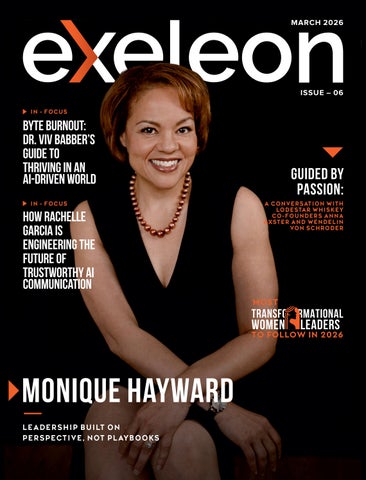
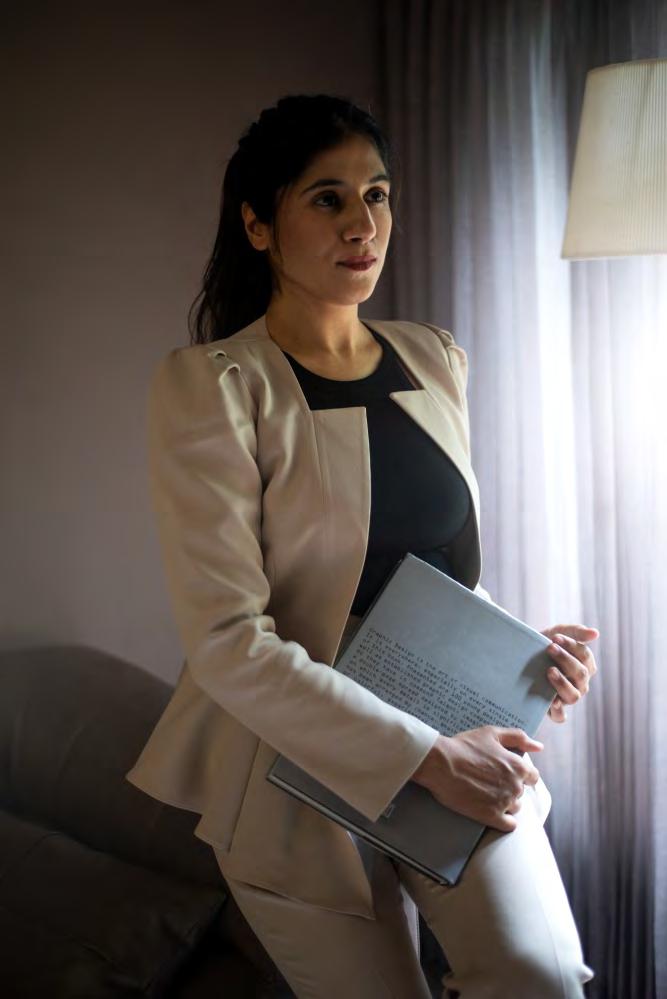
Most Transformational Women Leaders to Follow in 2026 | Monique Hayward
exeleon_magazine
exeleon_magazine
exeleon_magazine
exeleon_magazine
exeleon_magazine
exeleon_magazine
exeleon_magazine
exeleon_magazine
exeleon_magazine
exeleon_magazine
exeleon_magazine
Embracing Excellence
600 N Broad St 5 Middletown, DE 19709, United States +1 302-907-9110
Editor-in-Chief –
Art Director –
Naomi Lam
Managing EditorCreative Director –Daryl Yeung
Matt Reis Adam Waring
Project Manager –Marketing Manager –
Customer Relationship –
Business Development –
Richard Dann Sofia Brown
Natasha Green
Matt Hale, Josh Wilder, Anish Miller
For any advertising related information, please contact info@exeleonmagazine.com. Submissions as well as contributions to the magazine are welcome.
Take a moment and let us know about our magazine; whether it be about the design or a possible mistake, we would appreciate any feedback from your end. You can reach out to daryl@exeleonmagazine.com.
MESSAGE
THE EDITOR from
Every year, International Women's Day arrives with celebration, recognition, and reection. It is a moment when the world pauses to acknowledge the achievements of women across industries, communities, and homes. Yet beyond the ceremonies and social media tributes lies a deeper story, one that deserves attention every single day.
Women have always been architects of progress. In boardrooms, classrooms, laboratories, farms, studios, and living rooms, they shape the direction of families, economies, and societies. Their work is not limited to titles or positions. Often it appears in quiet persistence, resilience in the face of barriers, and an unwavering commitment to growth.
But progress has never been automatic. The journey toward equality has been built through courage. Women have questioned norms, opened doors that were once closed, and created opportunities where none existed. Each generation has carried the responsibility of pushing boundaries a little further so the next generation can begin from a stronger place.
Today, we see inspiring examples everywhere. Entrepreneurs building companies from the ground up. Researchers leading scientic breakthroughs. Artists reshaping culture and conversation. Leaders guiding communities through complex challenges. Alongside them are countless women whose contributions may never make headlines but whose impact is deeply woven into everyday life.
At Exeleon Magazine, this Women's Day edition is dedicated to the voices, ideas, and achievements of women who are redening leadership, creativity, and resilience. Their stories are not simply about success. They are about determination, purpose, and the courage to challenge limitations.
When we listen to these stories, we begin to understand that empowerment is not a slogan. It is a process. It grows through opportunity, mentorship, representation, and belief.
Dyl Yeung
MONIQUE HAYWARD 12
RACHELLE GARCIA
COVER STORY
Monique Hayward
Leadership Built on Perspective, Not Playbooks
TThere are leaders whose journeys follow predictable arcs, and then there are those whose paths are shaped by pressure, adaptation, and reflection. Monique Hayward belongs firmly to the latter. Entrepreneur, marketing executive, author, and speaker, she has spent more than two decades navigating corporate leadership, building businesses, mentoring emerging professionals, and writing candidly about the realities of ambition. Her story is not a polished tale of uninterrupted ascent. It is one marked by recalibration, perspective, and the willingness to question widely accepted definitions of success.
When Pressure Redefined Leadership
Every career has moments that define perspective. For Monique, one of the most formative moments came in 2006, when professional demands, financial stress, and personal responsibilities converged all at once.At the time, she was balancing entrepreneurship with a corporate leadership role, each demanding in its own way.
Reflecting on that period, she explains, “It's incredibly hard to believe that 20 years have passed
Monique's career spans industries, leadership roles, and entrepreneurial ventures, grounded in both corporate rigor and personal initiative. Yet beyond titles and milestones, her work has consistently focused on understanding how people make decisions, how to build resilience, and how to create sustainable success over time. That philosophy has been shaped by pivotal experiences that tested her judgment, challenged conventional wisdom, and ultimately reshaped how she approaches risk and leadership.
since that pivotal moment, when everything in my life seemed to collide at once.” Her restaurant business was under strain, facing serious financial challenges and operational instability.
Simultaneously, her corporate employer was restructuring, requiring her to manage layoffs, guide remaining employees, and take on expanded responsibilities.
The emotional toll was significant. “Leading others through uncertainty while privately feeling overwhelmed myself was enormous,” she recalls. Even her home life was affected, as
the pressures of business and work created tension and difficult conversations with her husband about whether continuing was worth the cost.
From this convergence came a shift in philosophy. “Up until then, I believed that if you followed the playbooks, worked hard enough, and made smart decisions, things would eventually work themselves out,” Monique says. “2006 taught me that leadership isn't about certainty. Rather, it's about judgment.”
That realization reframed her understanding of risk. It was no longer a matter of financial exposure alone, but a multidimensional consideration of health, relationships, and personal integrity. “I stopped romanticizing struggle and started valuing sustainability,” she explains. “I became more honest with myself about what success actually looks like and what I was willing to sacrifice to achieve it.”
Rather than breaking her resolve, the experience sharpened her perspective. Leadership, she discovered, is as much about restraint as endurance. Strength lies not just in persistence, but in clarity.
Beyond Playbooks and Frameworks
Before she fully realized those lessons , Monique had already
the
encountered another defining insight during her early entrepreneurial experiences: the gap between theory and reality.
Like many first-time business owners, she immersed herself in widely recommended guidance, attending seminars and studying established frameworks. “On paper, the process looked logical and achievable,” she recalls. “In reality, it rarely accounted for the messiness of human behavior, imperfect timing, lack of access to capital, or the weight of being solely responsible when things go wrong.”
Her perspective was also shaped by context.As a woman of color, she noticed that much of the prevailing advice assumed access to networks and resources that were not universally available. “The advice wasn't wrong, exactly. It was
incomplete,” she explains.
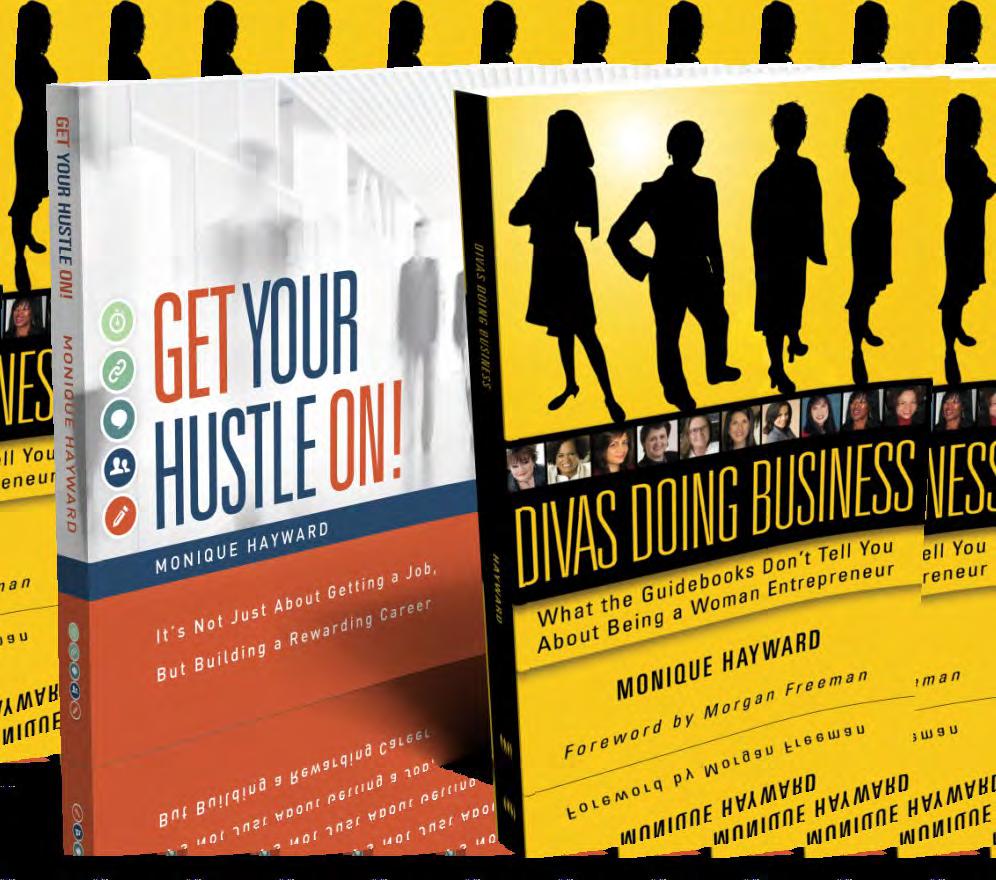
That realization prompted her to write her first book, Divas Doing Business: What the Guidebooks Don't Tell You About Being a Woman Entrepreneur. Through writing, she aimed to fill the gaps she had experienced firsthand, offering perspective grounded in reality rather than theory.
This shift in thinking influenced how she approached business thereafter. Instead of searching for formulas, she studied patterns. Instead of adhering rigidly to plans, she prioritized adaptability. “I learned to trust judgment over the tried and true, experience over theory, and adaptability over rigid plans,” she says.
The lesson extended beyond strategy into mindset. Success was no longer
about endurance alone, but about sustainability. Entrepreneurship, she concluded, should support life rather than consume it.
TurningAbsence intoAdvocacy
The scarcity of practical guidance during her early career did more than inspire authorship. It shaped her commitment to mentoring and advocacy. During challenging moments, Monique sought insight grounded in lived experience rather than motivational rhetoric.
“I wasn't looking for inspiration,” she says. “I needed practical, experience-based advice from people who understood the realities I was facing.”
Instead, she often found silence around failure, recovery, and difficult decision-making. That absence led her to create the networks she wished existed, and later to share what she learned with others.
Over time, mentoring became an extension of responsibility.
“Becoming a mentor, author, and advocate was a natural outgrowth of my own personal responsibility once I had perspective and distance from those early experiences,” she reflects.
Her approach emphasizes honesty. Rather than offering prescriptive answers, she shares candid insights so others can navigate their own choices with greater awareness. “My goal is to help others move forward with more confidence and fewer blind spots,” she says. “Not by telling them what to do, but by
Time-Tested Strategies for Advancing an Entrepreneurial and Corporate Career
sharing what I've learned.”
This philosophy has guided her speaking engagements, writing, and professional mentorship, reinforcing her belief that experience becomes most meaningful when it is shared.
Corporate Leadership and Entrepreneurial Independence
Monique's career is distinctive in the way it bridges corporate leadership and entrepreneurship. With more than 25 years in marketing and communications, she developed expertise in navigating complex organizational systems while simultaneously building ventures of her own.
“In the corporate world, I learned how systems work,” she explains. Leadership roles at major organizations taught her how strategy translates into execution and how resources and decisions are shaped by structure and influence. These experiences cultivated discipline and long-term thinking.
Entrepreneurship offered a different education. “With my own businesses, there were no buffers, safety nets, or anyone else to absorb the impact when things went wrong,” she says. Risk became personal, immediate, and tangible.
Balancing these environments gave her a unique vantage point. Corporate roles built strategic rigor, while entrepreneurship developed resilience and decisiveness.
“Together, they helped me redefine success,” she notes. “Not as constant upward momentum, but as the ability to build something
sustainable while staying aligned with your values.”
Her perspective on risk evolved accordingly. Rather than avoiding it or glorifying it, she learned to assess it in context, considering both potential gains and human costs. This balanced approach now informs her leadership philosophy, emphasizing integration over extremes.
Timing, Sustainability, and theArt of the Pivot
Launching businesses across different phases of life further refined Monique's understanding of adaptability. Early on, she equated perseverance with progress. Experience taught her otherwise.
“Abusiness can survive on grit for a while,” she says, “but it can't thrive on it indefinitely.”
She came to see planning not as a fixed roadmap, but as a flexible process. “The plan is the pivot,” she explains. Markets shift, opportunities evolve, and leadership requires responsiveness rather than rigidity.
Her current ventures reflect this philosophy. Through DRISCOLL Cuisine & Cocktail Concepts, she is preparing to launch DRISCOLL Dry, a zero-proof beverage line, and Tableside, anAI-powered hospitality coaching platform. Both initiatives illustrate her willingness to adjust execution while preserving vision.
“When outside investment didn't materialize, we pivoted the how without abandoning the why,” she says of DRISCOLL Dry. Similarly, Tableside has evolved through
listening to industry feedback and refining offerings rather than pursuing scale prematurely.
These experiences reinforce a core lesson: pivots are signals rather than setbacks. They represent awareness, not defeat. By asking not only whether something can succeed but whether it should, Monique has built ventures aligned with both opportunity and sustainability.
Writing with Honesty and Perspective
Monique's books extend her philosophy beyond boardrooms and ventures. Titles like Divas Doing Business and Get Your Hustle On! aim to provide readers with grounded
insights rather than idealized narratives.
“They offer perspective you don't often get with traditional career advice,” she says. Drawing from her dual experience in corporate and entrepreneurial spaces, she writes candidly about navigating ambiguity and making decisions without guarantees.
Her intention is not to provide templates, but to encourage critical thinking. “The insights are practical and meant to help readers think more critically about their own paths rather than follow someone else's blueprint.”
understanding the human dimensions of ambition and resilience.
By sharing both successes and setbacks, she contributes to a broader conversation about authenticity in leadership development. Her writing invites readers to approach ambition with realism and self-awareness.
ALegacy Defined by Generosity
As Monique reflects on her journey today, legacy has become a central consideration. Without children of her own, she thinks about the broader impact of her work on future generations, including family members and emerging professionals.
“At its core, the legacy I hope to leave is about helping people see the
potential in themselves that they can't yet see,” she says. She has observed that many talented individuals underestimate their abilities, often due to limited affirmation or representation.
Her goal is to change that narrative through mentorship, education, and eventually philanthropic initiatives focused on access and opportunity. The guiding principle behind these ambitions echoes a sentiment she often cites: service is the responsibility that accompanies achievement.
Ultimately, she hopes to be remembered for generosity of insight and encouragement. “If the next generation feels more empowered to
define success on their own terms and build lives that are ambitious and aligned, then I'll know I've done my part.”
The Enduring Measure of Leadership
Monique Hayward's journey illustrates a perspective grounded not in certainty but in awareness.Across corporate leadership, entrepreneurship, writing, and mentorship, her focus has remained consistent: understanding the human dimensions of ambition and resilience.
Her story challenges simplified narratives of achievement, replacing them with a more nuanced view of leadership rooted in judgment, sustainability, and integrity. From confronting pressure to redefining risk, from questioning conventional guidance to mentoring others, she has built a career that values clarity over illusion.
Leadership, in her view, is not about having all the answers. It is about knowing when to adapt, when to persist, and when to reassess. It is about integrating experience into wisdom and sharing that wisdom with others.
In doing so, Monique continues to demonstrate that meaningful success lies not only in what one builds, but in what one makes possible for those who follow.
Unlock Your DIGITAL SUBSCRIPTION!
Ready to fuel your ambition and receive your dose of inspiration directly to your digital doorstep?
Subscribe to Exeleon Magazine today, and enjoy the following perks:
Convenience at Your Fingertips
Access each issue on your preferred digital device anytime, anywhere.
Exclusive Extras
Dive deeper with bonus content, behind-the-scenes interviews, and special features reserved for our esteemed subscribers.
Community Connection
Join a network of likeminded individuals, share your story or interview, and be part of a thriving entrepreneurial community. SIMPLY SCAN AND SUBSCRIBE
Byte
Burnout
Dr. Viv Babber's Guide to Thriving in an AI-Driven World
Thank you for this interview, Dr. Babber. Can you please share your journey from being a seasoned physician to becoming an AI consultant? What inspired this transition?
From kitchen tables to billion-dollar companies—true stories of women who refused to wait for permission.
TRAILBLAZER
Madam C.J. Walker: First Female Self-Made Millionaire
Born to enslaved parents in 1867, Sarah Breedlove built a haircare empire when Black women were excluded from business. Her door-to-door strategy became the blueprint for modern direct selling. By 1919, she employed 40,000 agents—mostly Black women. Died worth $1 million ($16M today), gave most to NAACP and education.
KEY METRIC
INSTANT TAKEAWAY
She didn't wait for permission or capital. Built distribution through empowerment, not exploitation.
Hedy Lamarr: Hollywood Star Who Invented WiFi Technology
Fled Nazi Austria in 1937, became Hollywood icon. But her real legacy? Co-invented frequency-hopping technology in 1942—the foundation of WiFi, Bluetooth, and GPS. U.S. Navy rejected her patent because she was 'just an actress.' Decades later, her tech powers billions of devices. Inducted into National Inventors Hall of Fame in 2014.
INSTANT TAKEAWAY
KEY METRIC
Your expertise isn't confined to your job title. The best innovations come from unexpected intersections.
Started in 1946 mixing face creams in her kitchen. Her guerrilla tactic? Invented 'gift with purchase.' Couldn't afford ads, so gave free samples relentlessly. Crashed exclusive department stores until they stocked her. Told Saks they were 'making a mistake'—returned until they relented. Built empire into $16B company.
INSTANT TAKEAWAY
KEY METRIC
When traditional paths close, invent new tactics. One strategic innovation can reshape an entire industry.
DISRUPTOR
Sara Blakely: $5,000 Savings to Spanx Billionaire
At 27, selling fax machines, she cut feet off pantyhose for a smooth look. Spent two years developing Spanx with $5,000 savings. Manufacturers hung up. Stores rejected her. Cold-called Neiman Marcus, demonstrated in their bathroom. Oprah named it a 'Favorite Thing.' Never took outside funding—owned 100% when she became youngest self-made female billionaire at 41.
KEY METRIC
INSTANT TAKEAWAY
VISIONARY
Kiran Mazumdar-Shaw: 800 Rejections to $4B Biotech Giant
KEY METRIC
REVOLUTIONARY
Solve your own problem. If you need it, millions of others do too. Bootstrap maintains control and vision.
Founded Biocon in 1978 in her Bangalore garage with $450. As a 25-year-old woman in biotech, banks refused loans. Suppliers wouldn't work with her. Faced 800+ rejections. Her father guaranteed her first loan. Today, Biocon is a $4B pharma giant making life-saving drugs affordable globally. India's richest self-made woman. Her garage is now a museum.
INSTANT TAKEAWAY
Count rejections as market research. Each 'no' refined her pitch until she found the one 'yes' that mattered.
Coco Chanel: Orphanage to Global Fashion Icon
Raised in orphanage, started as cabaret singer. Opened first boutique in 1910 selling hats. Revolutionized women's fashion by liberating them from corsets—gave them pockets, comfort, elegance. Introduced 'the little black dress' when black was only for mourning. Created Chanel No. 5—first celebrity-branded perfume. Built global empire by asking: 'What do women actually want to wear?’
INSTANT TAKEAWAY
KEY METRIC
Challenge the 'rules' everyone accepts. True innovation questions the fundamental assumptions of your industry. 90-SECOND
Why Women Are Taught to Be Grateful Instead of Strategic
Written by of NatashaGreen Exeleon Media Team
The story women learn early
Somewhere between “be polite” and “don't make a fuss,” a quieter lesson settles in: if you are invited into the room, you should be grateful you were invited at all. The language changes by workplace and culture, but the message is familiar. Do not press. Do not angle. Do not ask in a way that could be mistaken for appetite.
Gratitude is not the problem. Real gratitude can be a stabilizer, a way to stay grounded while you build, lead, and take risks. In healthy cultures, gratitude is mutual: the organization is grateful for the work, and the worker is grateful for the opportunity. Gratitude becomes toxic when it is used as a leash, when it is demanded only from one side of the power imbalance.
Women are often socialized toward communal behavior and away from overt self-advocacy, while leadership and high-status roles are still widely associated with agentic traits like assertiveness and self-promotion. This mismatch creates a predictable workplace penalty: the very behaviors that signal “leadership potential” in a man can be read as “too much” in a woman. This is not just cultural commentary. It is a core idea in role congruity theory: perceived incongruity between gender role
expectations and leadership expectations invites bias in how capability and behavior are judged.
That is the hook for this editorial: it is hard to teach women to be strategic if we still punish them for acting strategic. And it is impossible to close compensation and condence gaps if mentorship keeps handing women gratitude scripts while men are handed strategy scripts.
When “strategic” is treated like a personality aw
In business, strategy is a neutral word. It should mean clarity about value, leverage, timing, and trade-offs. But for many women, “strategic” gets translated by listeners into something else: calculating, aggressive, political, ungrateful. That translation is the real problem because it turns normal career behavior into a social risk.
Research on backlash has documented social and economic penalties for women who violate gendered expectations through selfpromotion or agentic conduct. The point is not that women should never self-promote. It is that the cost-benet math for self-promotion is different when audiences believe women are supposed to be modest, warm, and accommodating.
Even when performance is equal, men
tend to rate or present their performance more favorably in settings like job applications and performance reviews. Experimental research has found persistent gender gaps in self-promotion even when controlling for condence about performance. If one group is trained to downplay and another is trained to headline, the market does what markets do: it prices the story it can see.
This is why “just tell women to be more condent” is lazy advice. Condence is not only a personal trait. It is also feedback from the environment. When a workplace penalizes women for standing tall, what looks like “low condence” can be legitimate risk management.
The negotiation dilemma that mentorship often ignores
If you want one piece of evidence that the “grateful” script is rational under biased conditions, look at negotiation.
In controlled experiments, evaluators penalized women more than men for initiating negotiations for higher compensation. The same act, negotiating, produced different social consequences depending on whether the candidate was male or female. That is a structural trap: women are told to negotiate, but are also punished for negotiating.
This dovetails with broader ndings in negotiation research. A large metaanalysis on economic negotiation outcomes connects gender differences and their moderators to role congruity dynamics: behaviors associated with better outcomes can be perceived as more congruent with male roles than female roles, which affects evaluations and outcomes.
Now bring this into real business life. Salary is not one conversation. A small difference at entry can compound over years through raises, bonuses, and percentage-based increases. Negotiation is not a “nice to have.” It is part of the economic engine of a career. Yet women receive mentorship that emphasizes patience, loyalty, and being “easy to work with,” while men more often receive coaching on leverage, positioning, and timing.
This is not only about corporate jobs. The same pattern shows up in entrepreneurship and fundraising. Research on investor Q&A has found gendered differences in the kinds of questions women and men are asked, with funding outcomes tied to how conversations are framed. When the gatekeepers steer women into a defensive posture, “grateful” becomes the default tone and “strategic” becomes harder to project.
What strategic mentorship looks like in practice
Most mentorship programs are wellintentioned. Many are also incomplete. They teach women how to endure systems, not how to shape them.
Strategic mentorship has a different curriculum. It covers at least ve things.
First, it teaches negotiation as value
The hidden curriculum
Non-promotableworkandgratitudelabor
There is another reason gratitude crowds out strategy: women are routinely nudged into work that keeps the lights on but does not move their careers forward.
Research on non-promotable tasks documents that women are asked more often to take on lowpromotability work, and are more likely to say yes. This matters because promotions are driven by visible, high-impact work, not by being the glue. If women are over-allocated the glue work, the performance story that leadership sees is incomplete by design.
The “gratitude” script gets weaponized here in subtle ways. The request often arrives bundled with praise: “You're so reliable,” “You're so organized,” “We trust you.” Women are trained to receive that praise as proof of belonging and to respond with compliance. The organization receives the benet, and the woman receives the compliment. Compliments do not compound. Equity and title do.
This is why strategy without guilt matters. Guilt is the emotional tax that keeps women saying yes to work that helps everyone except their own career trajectory. It keeps them soft in compensation conversations. It keeps them hesitant to ask for sponsorship, not just mentoring. And it keeps leadership pipelines weaker than they should be, because the system is misallocating high-potential talent into low-visibility labor.
If you want a workplace diagnostic, ask a simple question: in your organization, who is expected to be grateful? If the answer is “mostly the people with less power,” you are not building culture. You are maintaining hierarchy.
translation, not pleading. A strategic mentor does not tell a woman to “ask for more” as if the ask is the point. They teach her to connect measurable outcomes to business priorities, to build a compensation narrative anchored in market benchmarks and internal impact, and to make the ask feel like a rational decision, not a favor. This responds directly to the documented social penalties women face by shifting the frame from entitlement to business case.
Second, it teaches positioning before the meeting, not just performance in the meeting. Promotions and raises are rarely decided in the room. They are decided in the weeks before, through what leaders already believe about your scope and trajectory. The self-promotion gap research matters here: if women systematically understate achievements, decisionmakers have less raw material to advocate for them. A strategic mentor helps women build “evidence les” and narrate impact in language leaders use to allocate resources.
Third, it treats sponsorship as a requirement, not a bonus. Mentors advise. Sponsors advocate. Sponsors spend political capital. The literature and practitioner evidence consistently distinguish the two, and women are often over-mentored and undersponsored. A strategic mentor helps a woman identify who can sponsor her, what outcomes that sponsor cares about, and how to create low-risk opportunities for that sponsor to publicly back her.
Fourth, it teaches refusal as an economic skill. If women are disproportionately asked to do nonpromotable tasks, then learning to decline or renegotiate those requests is not selsh. It is career preservation.
But “just say no” is not enough if the system simply redirects the ask to the next woman. Strategic mentorship includes scripts for redirecting work back to the system: rotating ownership, making the work visible, or attaching promotable credit to necessary labor.
Fifth, it teaches women to separate likability from leadership. This is the deepest psychological shift. If a woman believes she must be liked to be safe, she will pay with her ambition. Strategy without guilt is the decision to accept that not everyone will feel comfortable when you act like a leader, and to do it anyway.
What institutions must change so women do not have to “outstrategize” bias
Here is the uncomfortable truth: women can become better negotiators and still lose in biased systems. That is why this conversation cannot end with individual coaching. It has to move into policy, process, and power.
Pay transparency is one structural lever. OECD work on pay transparency notes that wage gaps persist across many economies and that transparency tools, from pay reporting to audits, are increasingly used to diagnose and address inequities. Research on pay transparency laws suggests effects can be modest but positive, with details depending on design and enforcement. Even when impacts are not revolutionary, transparency changes the information environment that makes “gratitude pricing” possible.
Promotion criteria and performance evaluation also need redesign. If highimpact work is rewarded but non-
promotable work is unevenly assigned, the system is manufacturing unequal outcomes and calling them merit. Organizations should track non-promotable task allocation, rotate it, and ensure that essential internal work is recognized and does not quietly tax the same group.
Sponsorship should be operationalized, not romanticized. It cannot be left to informal networks. Leadership teams can set goals for sponsorship activity, measure who receives stretch opportunities, and treat sponsorship as a leadership obligation, not a personal favor.
Finally, leaders need to stop confusing discomfort with dysfunction. When women shift from grateful to strategic, people used to the old script may label the change “political” or “difcult.” Role congruity research predicts this: evaluations change when women enact leadership behaviors. The x is not to counsel women back into softness. The x is to train evaluators, clarify standards, and hold managers accountable for equitable talent decisions.
None of this is charity. It is performance. Diverse leadership correlates with better nancial outcomes in large datasets, and slow progress wastes talent at scale. If you care about competitiveness, you should care about how your organization mentors women to use strategy, not gratitude, as their operating system.
Rachelle Garcia Is Engineering the Future of Trustworthy AI Communication How
The whiskey industry has historically been male dominated, with only 8 percent of distilleries owned by women. How does it feel to be part of the movement challenging that norm?
What has the reception been like from the Los Angeles bar and restaurant community, where Lodestar is already carried in several well-known venues? How do you see distribution evolving as you expand beyond Los Angeles?