“LUCK IS WHAT HAPPENS WHEN PREPARATION MEETS OPPORTUNITY.”
“LA SUERTE ES LO QUE SUCEDE CUANDO LA PREPARACIÓN SE ENCUENTRA CON LA OPORTUNIDAD.”
ISéneca
n an age obsessed with immediacy, luxury has quietly ceased to be merely a matter of possession, becoming instead a matter of perception. Perhaps this is why the ancient Greeks placed such emphasis on moderation, virtue, and self-knowledge.
Today, surrounded by constant stimuli, we mistake abundance for fulfilment. Yet the Stoics advanced a radical idea: it is not the one who has the most who is richest, but the one who needs the least. Far from a renunciation, this notion reveals a refined form of freedom. In a world designed to provoke desire, the ability to choose what to ignore becomes the ultimate privilege.
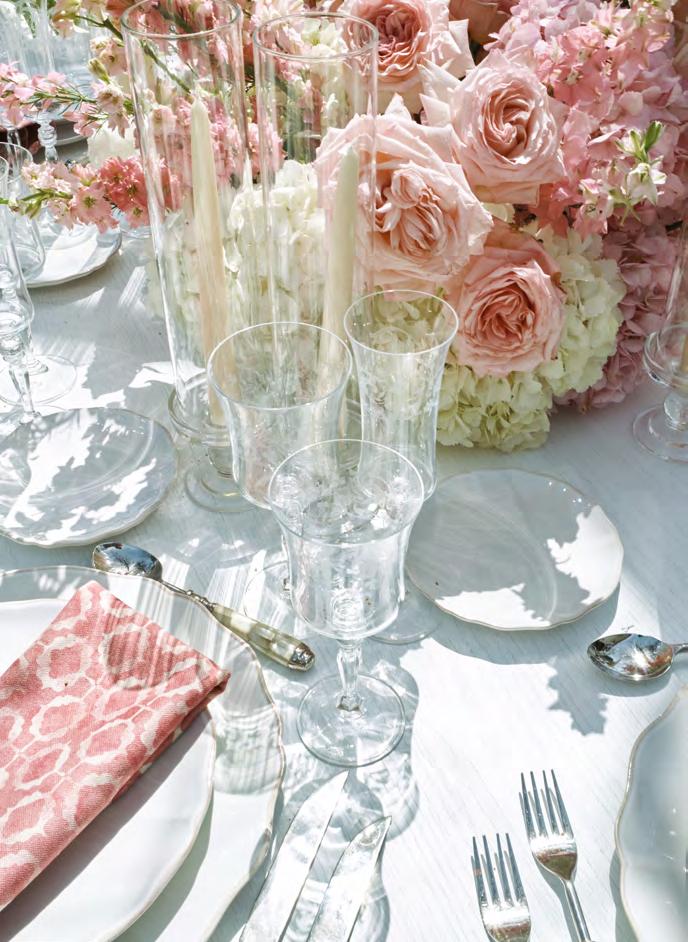
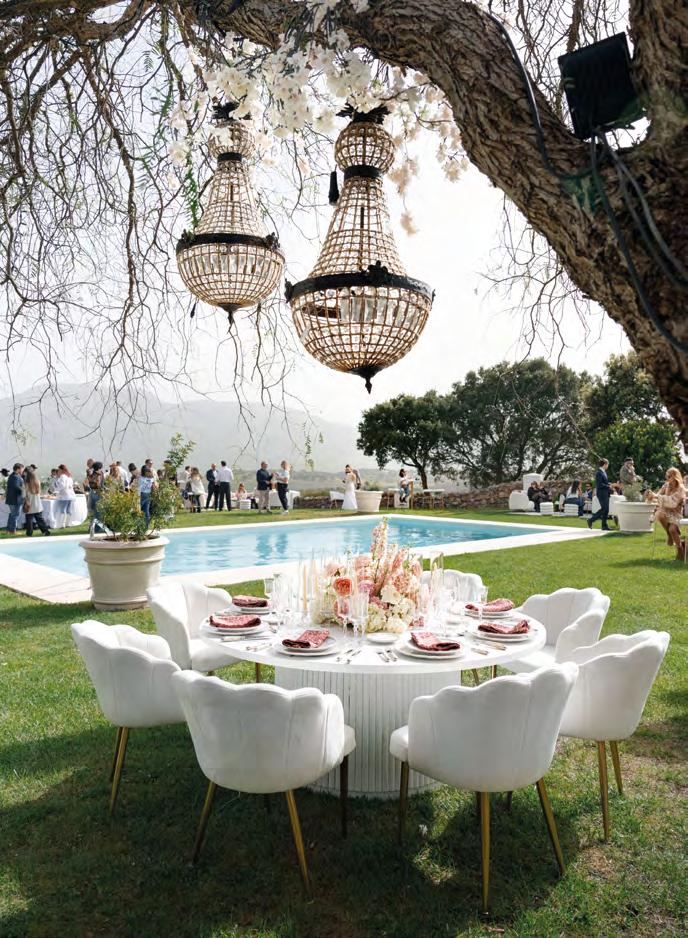
Contemporary luxury is no longer measured in excess. It resides in a beautifully set table, an unhurried conversation, the deliberate choice of silence over incessant noise. There is a profound elegance in conscious restraint—in knowing when to pause when everything urges us to accumulate more; in contemplating a work of art, immersing oneself in a compelling book, and momentarily setting aside traffic, consumerism, empty television, divisive rhetoric, mobile phones, social media, even the distant clamour of conflict. To possess discernment and individuality is a luxury. To embody charisma and honesty is rarer still.
Luxury and elegance, then, no longer lie in what is displayed, but in serenity, discipline, and self-mastery—timeless virtues, reinterpreted as the hallmarks of modern distinction. To say “no” to the superfluous is to embrace a quieter, more meaningful form of luxury.
In a world competing relentlessly for our attention, understanding the value of time may well be the most refined form of power. As Robert Greene observes in The 48 Laws of Power—a work I warmly recommend—those who master timing, who know how to wait, who do not rush, possess a subtle yet decisive advantage. Power, in essence, lies also in the stewardship of one’s time.
For this reason, true luxury is also the possession of time—and the wisdom to invest it well. Reading is among its highest expressions: to open a fine book or immerse oneself in a magazine such as ours, conceived to inspire, is to choose depth over the fleeting immediacy of social media.
In this spring edition, Exclusive Life invites you to do precisely that: to savour the pleasure of unhurried reading through a carefully curated selection of articles and interviews.
This edition is further enriched by a journey through high jewellery, fashion, the art of investing, golf, and emerging trends...
“I wish you a serene and joyful evening, perfumed by the sea breeze; may the night find you with a glass of fine wine in hand, toasting each achievement, and may the morning greet you with vitality, purpose, and success.”
Enjoy your time.
En una época obsesionada con la inmediatez, el lujo ha dejado de ser únicamente una cuestión de posesión, para convertirse silenciosamente, en una cuestión de percepción. Quizá los antiguos griegos por ello, insistían en el valor de la mesura, la virtud y el conocimiento de uno mismo. Hoy, rodeados de estímulos, confundimos abundancia con plenitud. Sin embargo, los estoicos defendían una idea radical: no es más rico quien más tiene, sino quien menos necesita. Esta afirmación, lejos de ser una renuncia, encierra una forma refinada de libertad. En un mundo donde todo parece diseñado para generar deseo, la capacidad de elegir qué ignorar , se convierte en el verdadero privilegio.
El lujo contemporáneo ya no se mide en excesos...Una mesa bien dispuesta, una conversación sin prisa, el silencio elegido en lugar del ruido constante. Hay una elegancia profunda en la sobriedad consciente, en saber detenerse cuando todo invita a seguir acumulando, contemplar una obra de arte, profundizar en una lectura interesante, dejar aparcados por un instante el tráfico, el consumismo, los programas de televisión sin valores, la polarización sembrada por intereses partidistas, los teléfonos, redes sociales, las guerras...
Tener personalidad y criterio, es un lujo. Tener carisma, ser honestos... El lujo y la elegancia, entonces, ya no implican diferenciarse por lo que se muestra, sino por la serenidad, la disciplina, el dominio de uno mismo: valores antiguos que, reinterpretados, se convierten en símbolos de distinción contemporánea. Decir “no” a lo superfluo, apostar por ese lujo silencioso .
En un mundo que compite por nuestra atención, comprender el valor del tiempo es, quizá, la forma más refinada de poder. Robert Greene lo plantea con claridad en The 48 Laws of Power, un libro que os recomiendo: quien domina el ritmo, quien sabe esperar, quien no se precipita, posee una ventaja silenciosa pero decisiva. El poder, en esencia, también es saber administrar el tiempo. Por eso, el verdadero lujo también es disponer de tiempo… y saber en qué invertirlo.
Leer es una de sus formas más elevadas del lujo. Abrir un buen libro o sumergirse en una revista como la nuestra, concebida para inspirar, es elegir profundidad frente a la inmediatez de las redes sociales.
En esta edición primaveral, Exclusive Life le invita precisamente a eso: a disfrutar de su lectura . A concederse el tiempo de una lectura pausada a través de una cuidada selección de artículos y entrevistas...
La experiencia en esta edición, se completa con un recorrido por la alta joyería, la moda, el arte de invertir, golf y las nuevas tendencias...
“Os deseo un feliz y sereno atardecer perfumado con la brisa del mar, que la noche os encuentre con una copa de buen vino entre las manos, con el que brindar por cada objetivo conseguido y un amanecer alegre y vital , productivo y exitoso...”
Disfruten del tiempo!
Ana Pavón
A LETTER FROM THE DIRECTOR
Dear friends and readers,
Spring is here once again, and with it, a new opportunity to bloom, renew ourselves, and embrace all that life has to offer. At Exclusive Life Magazine – ELM, we celebrate this season as a symbol of inspiration, light, and natural elegance.
This spring issue is filled with inspiring stories, places that awaken the senses, and people who, like flowers, shine with their own power. From lifestyle and gastronomy proposals to interviews with fascinating figures, each page is designed to offer you a visual and emotional journey through the exclusive and the essential.
Thank you for joining us on this journey, for reading, for sharing, and for being part of this community that values the art of living well. This spring, more than ever, we want to invite you to stop, take a deep breath, and let yourself be carried away by the beauty of the small, great moments.
With love,
Queridos amigos y lectores, De nuevo la primavera ya está aquí y con ella, una nueva oportunidad para florecer, renovarnos y abrazar todo lo que la vida tiene para ofrecernos. En Exclusive Life Magazine – ELM, celebramos esta estación como un símbolo de inspiración, luz y elegancia natural.
Esta edición primaveral está llena de historias que inspiran, lugares que despiertan los sentidos, y personas que, como las flores, brillan con fuerza propia. Desde propuestas de lifestyle y gastronomía, hasta entrevistas con figuras fascinantes, cada página está pensada para ofrecerles un viaje visual y emocional a través de lo exclusivo y lo esencial. Gracias por acompañarnos en este recorrido, por leernos, por compartir, y por ser parte de esta comunidad que valora el arte de vivir bien. Esta primavera, más que nunca, queremos invitarles a detenerse, respirar profundo y dejarse llevar por la belleza de los pequeños grandes momentos.
Con cariño,
Rafael Barrio
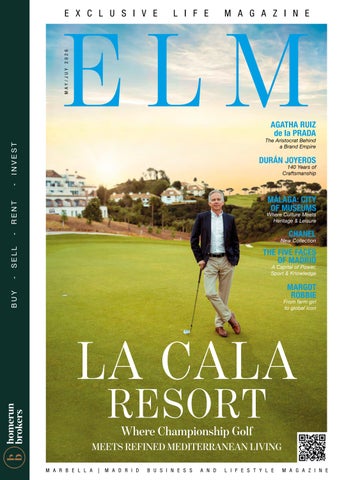
LA CALA RESORT
A distinctive destination
AGATHA RUIZ DE LA PRADA
Exclusive interview
MARGOT ROBBIE
When Beauty Never Outshines Talent
ICONS MARBELLA
A new Standard of Wellness
DURAN JEWELERS
140 years of Silversmithing, Jewellery and Art
ROBERTO COIN
Jasmine Collection
PALACIO DE VILLAPANÉS
A Luxury Hotel in the City of Seville
SANDOVAL BROTHERS
El Jaral de la Mira
BOHO CLUB
Where Marbella Reveals Its Truest Self
EXCLUSIVE FASHION
CHANEL - Between Legacy and Innovation
GRACIANO PALOMO
The 5 Madrids That Astound The World LORENA MORLOTE
An Internationally acclaimed Stylist HYATT REGENCY HESPERIA MADRID
Exclusive Experiences in the Heart of Luxury ZALACAÍN
A Living Legacy of Spanish Haute Cuisine
THE MANDARIN ORIENTAL RITZ MADRID
Silvia García - Head Sommelier
TABLAO FLAMENCO CASA FARAONA
A Unique Sensory Experience
PABÚ RESTAURANT
A project by Chef Coco Montes
FERNAN GONZALEZ
The Profitability of Time Well Lived
SANTIAGO DE LA CRUZ
The Real Estate Market on the Costa del Sol
ENGEL & VÖLKERS
Where Luxury Learns To Breathe In Marbella
ROSMARINO RIVIERA HILL
Where light finds its home
CARMEN SANCHEZ
Interview “Awakening Without Violence”
EXCLUSIVE TRAVEL VENICE
The Floating City of Wealth and Art KIROS JEWELERS
Katya Manaenko, Stories Marbella, Juan Carlos Domínguez and Marcos Reyes
HAIRDRESSING
Lorena Morlote, David Hairstylist Sassoon, Miguel Codina & Luis Suárez Estilistas
CONTRIBUTING WRITERS
Graciano Palomo, Eva del Amo, Maribel Martínez, Santiago de la Cruz, Amparo de la Gama, Iván Ballesteros, Fernán González, Silvia García, Jesús Torres and Ana Pavón
SPECIAL THANKS
Sean Corte-Real, Agatha Ruiz de la Prada, Juan Miguel Albarracín, Hyatt Regency Hesperia Madrid, Ayuntamiento de Rincón de la Victoria, Silvia García, Jorge Manzur, Carmen González, Carmen Sánchez, Carlos Bosch and Jesús Torres
DEPOSITO LEGAL MA 66-2026
PRINTER Solprint
While every effort has been made to ensure that the contents of this magazine are correct, Exclusive Life cannot guarantee the completeness or accuracy of the information published, and assumes no legal liability or responsibility to any party for the quality, legality or usefulness of any information, product or service represented within the magazine. No part of this publication, including texts, photographs, illustrations or other graphics, may be copied or reproduced in any form without the prior written consent of Exclusive Life Magazine.
LA CALA RESORT
A DISTINCTIVE DESTINATION CONNECTING GOLF, LIFESTYLE AND COMMUNITY
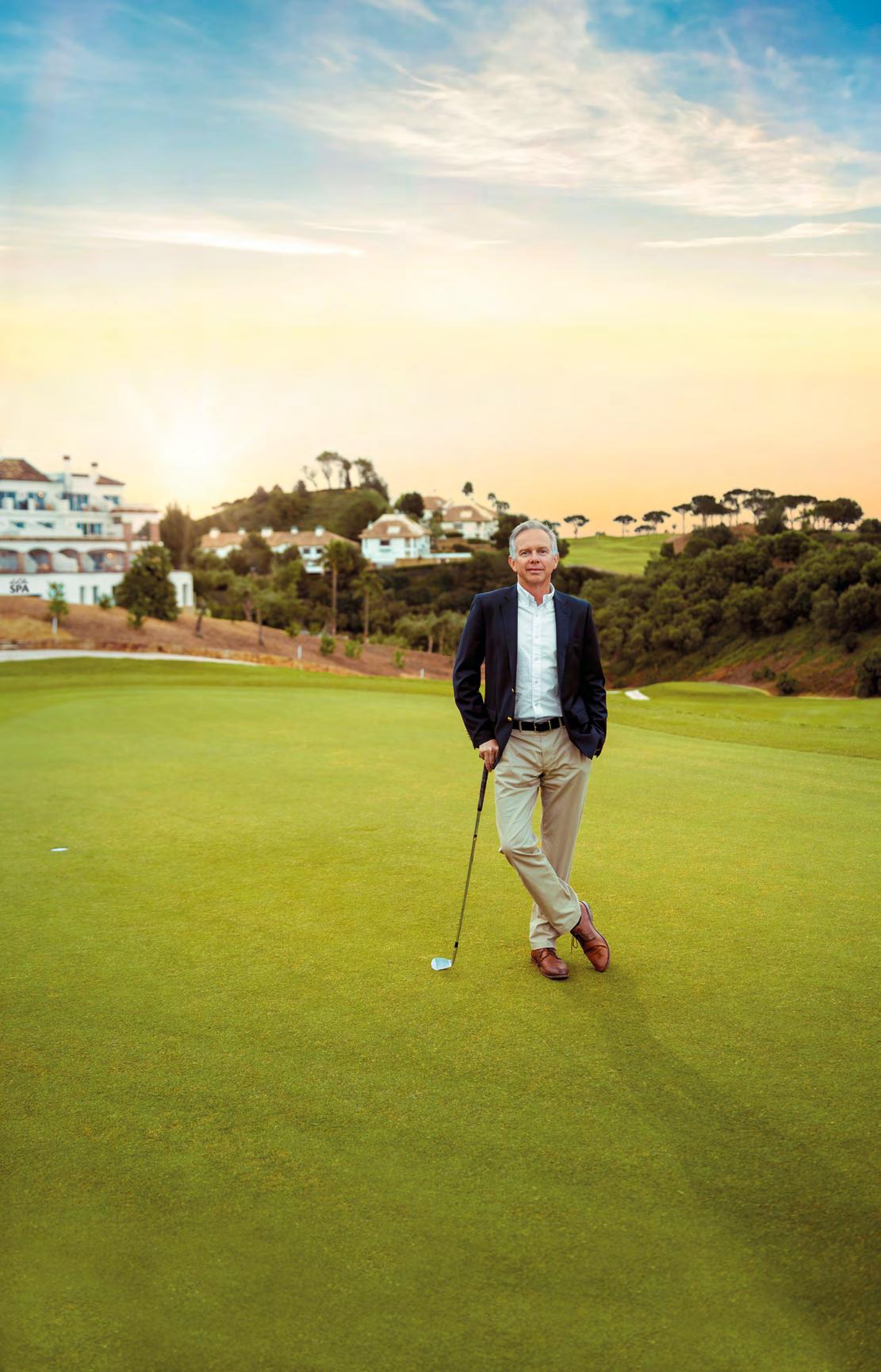
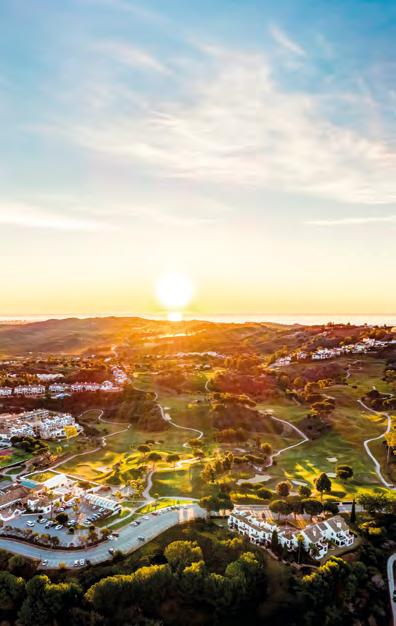
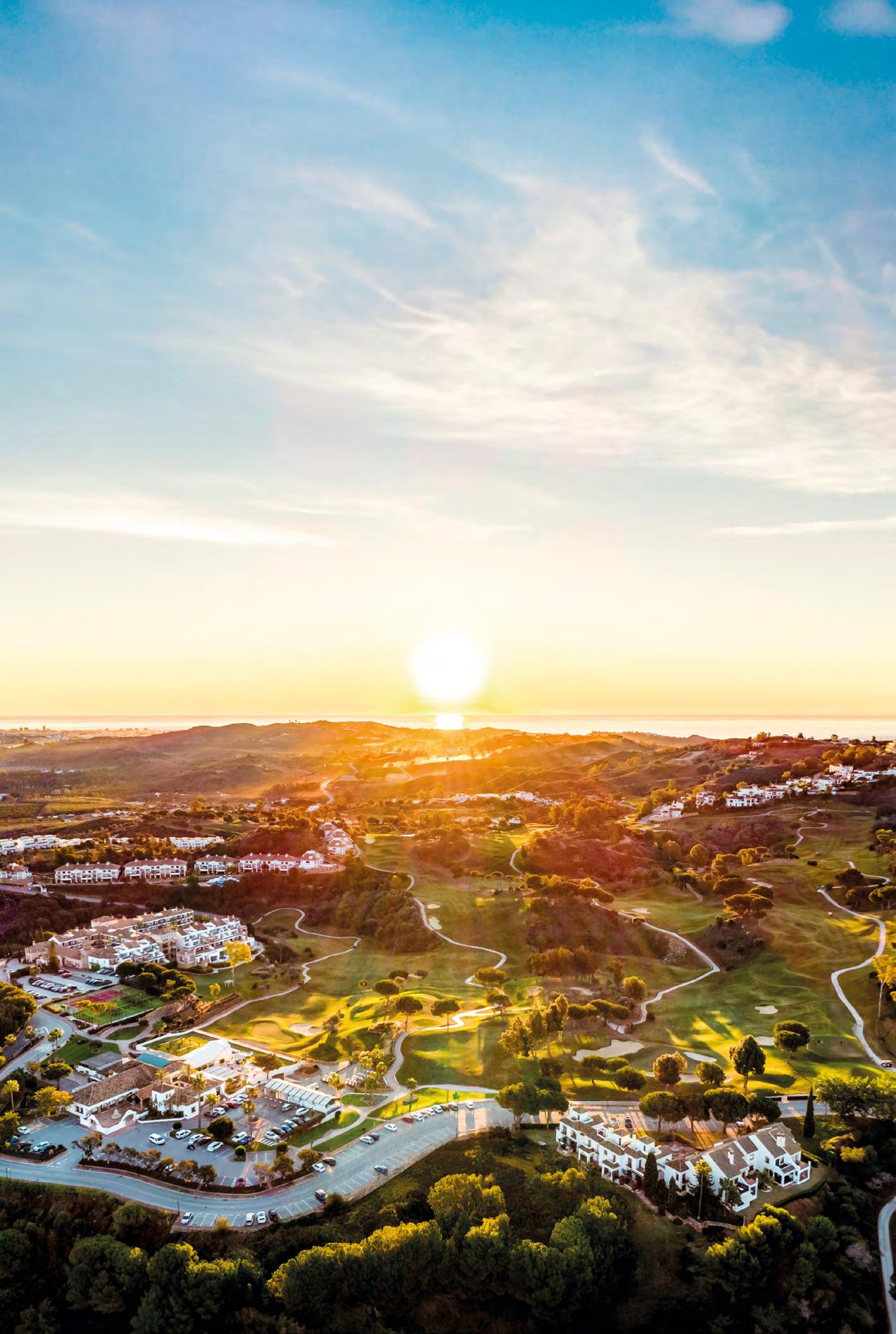
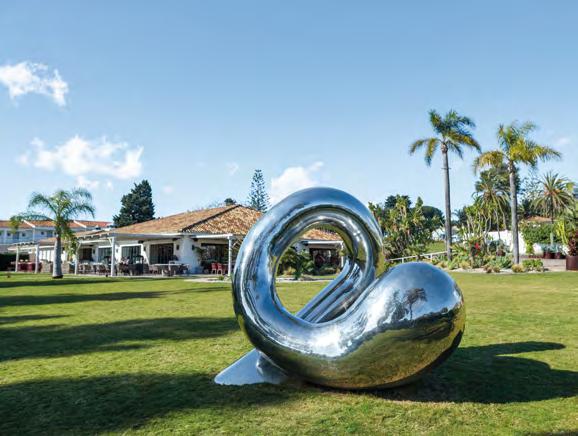
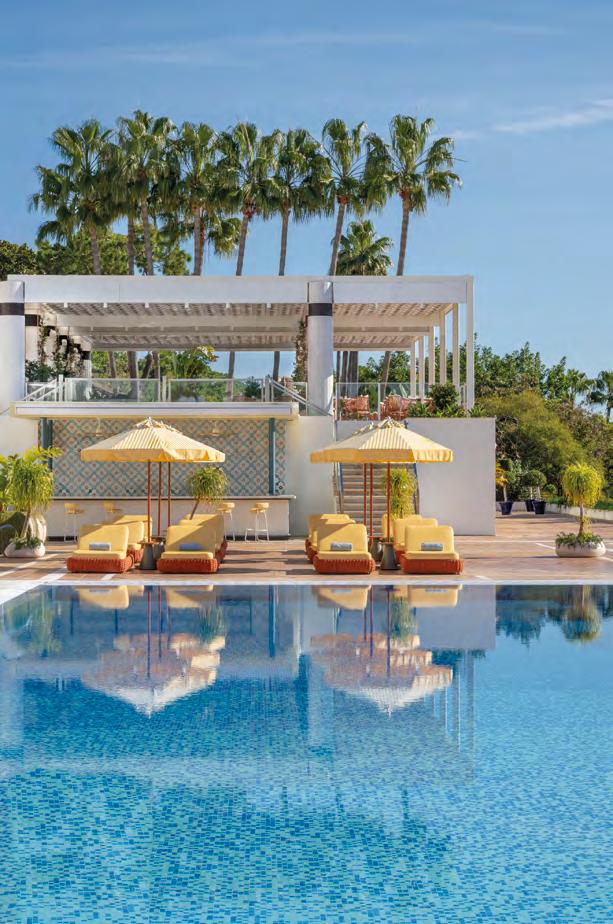
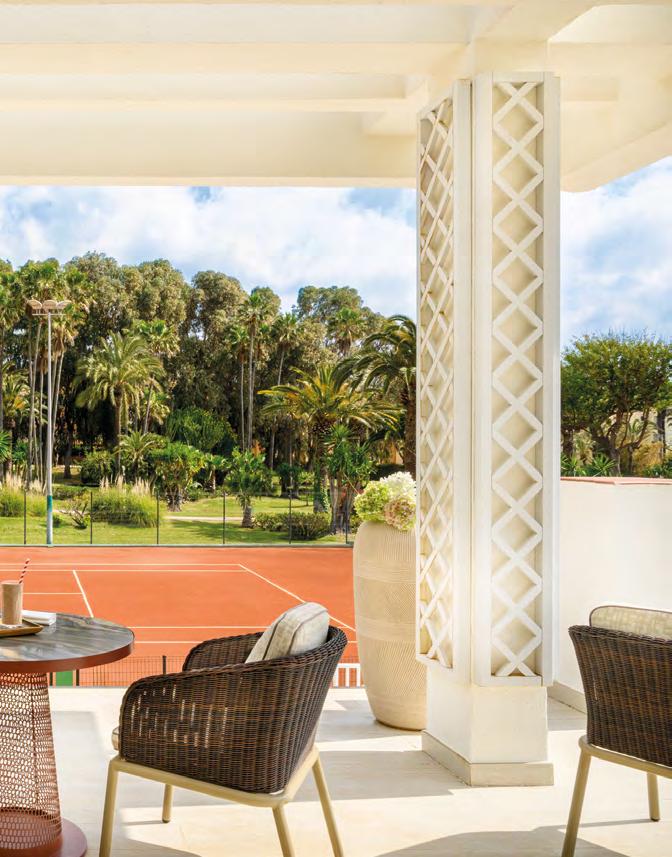
In the world of golf and Mediterranean living, La Cala Resort is one of Southern Europe’s most complete and recognised destinations. Set between the Sierra de Mijas and the coast, it balances natural calm with the vibrant energy of a contemporary Costa del Sol lifestyle. Championship golf remains its anchor, with 63 holes, a renovated hotel awarded Spain’s Best Golf Hotel 2025, a luxury spa and wellness offering shaped by a deep Andalusian soul, refined dining, a social calendar, and a varied residential offering. All of this results in a high-quality resort experience, reinforced by international accolades and continued Top 100 rankings.
“Golf is only the beginning. We craft a fuller way to experience the Costa del Sola journey that stays with you.”
“The Guest is not a visitor at La Cala Resort, but part of it, connected through authenticity, with a real sense of belonging and community.”
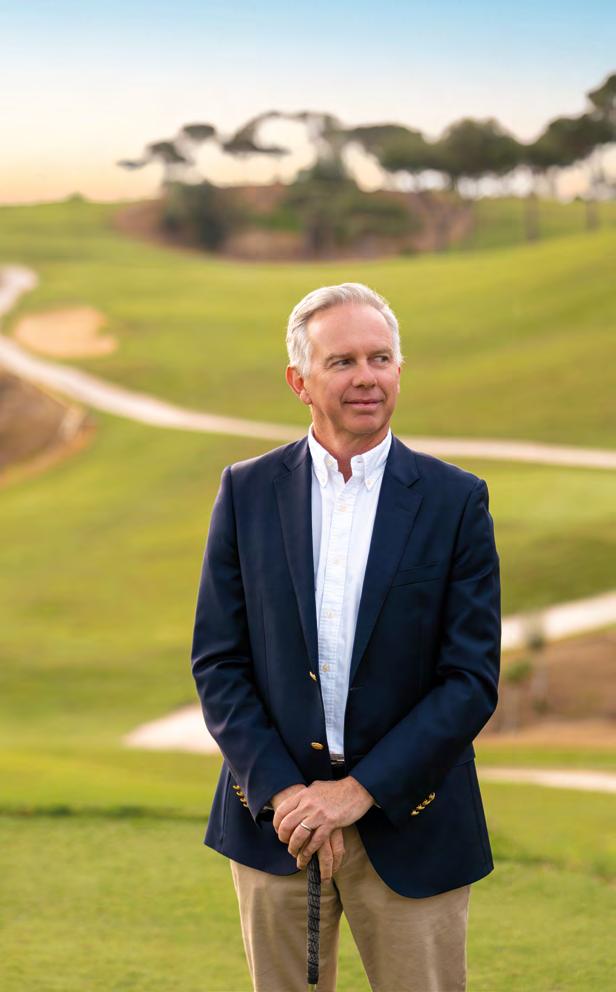
Interview with Sean Corte-Real General Manager
Many people know La Cala for golf. What do they tend to discover once they get here?
Golf is the starting point, but once guests arrive, they quickly realise La Cala Resort has much more life around than they expected. There is a real sense of place here. The setting has a lot to do with that: the hills, the Mediterranean light, the openness, and a resort that feels calm without ever feeling still. Then the wider experience begins to reveal itself: a recently renovated hotel with an authentic Andalusian identity, a complete wellbeing spa, varied dining, live music, and a social calendar that keeps the resort active throughout the year.
Very often, it’s in the small moments - a sunset on a terrace, a long lunch after a round, or an evening with music - where it all comes together. That’s usually the surprise: people come for the golf, but they stay for everything around it. And quite often, they realise the experience goes beyond what they had imagined before arriving.
What makes La Cala so distinctive over other resorts on the Costa del Sol?
What makes La Cala distinctive is how complete it is. Few resorts on the Costa del Sol bring together this level of golf, lifestyle and residential living in one place. We have the scale and credibility of a leading golf destination - 63 holes across three championship courses and a 9-hole par 3 course.
That balance is important to us. We want the international golfer to think of La Cala as a reference, but at the same time, we want people living on the Costa del Sol to feel this is their placesomewhere they can come regularly, spend time well, and enjoy a different rhythm to their day.
That combination of championship golf, Mediterranean lifestyle and a genuine sense of community is what sets La Cala apart.
When does a stay at La Cala become something more?
A stay usually becomes something more when people realise that La Cala can fit naturally into their lives.
Some arrive for a short golf break and return for longer stays. Others discover the flexibility of the rental offering and begin spending several weeks here each year. And for some, that naturally leads to property ownership. Real estate has always been part of La Cala Resort, so it never feels separate - it grows from the same lifestyle and sense of belonging.
Spaces like the Golf Hub reflect that evolution. It’s not just about practice, but about spending time differently - with the academy, the short course, fittings, swing analysis, and places like Vista Café, where people stay for the views, meet friends, or simply slow down.
Very often, that’s the moment it shifts - when it stops feeling like a visit, and starts feeling personal.
“Tradition,
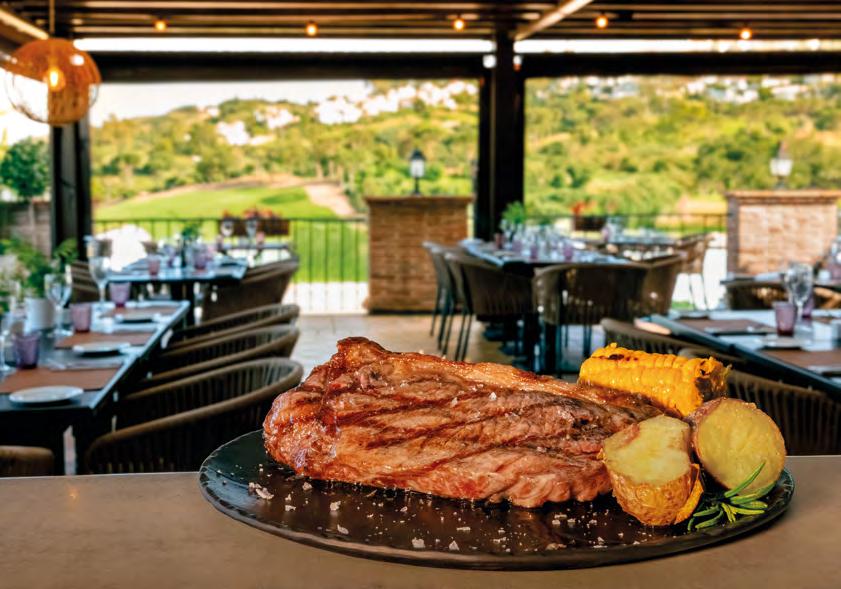
evolution and the finest charcoalgrilled meats shape our dining experience into something memorable.”
““With a deep Andalusian soul, our Spa elevates restoration into optimal health and lasting wellness.”
GOLF
Widely recognised on the international golf stage, La Cala stands out for the scale and character of its golf offer: three 18 holes championship courses - Asia, America and Europa - plus a Short Course -Par 3, 63 holes in total and the largest golf offering within a single resort in Spain. Each course brings a distinct personality to the experience: Asia is more strategic, America more dramatic in its elevation and views, and Europa more flowing and playable, giving the resort unusual variety for different levels and styles of play. That depth is now being extended through the Golf Hub, the natural evolution of La Cala’s historic academy into a more contemporary, versatile and social environment. Bringing together the Short Course, academy, driving range, swing analysis, custom fittings, pro shop and the newly opened Vista Café with spectacular Mediterranean views and a Starbucks corner - it opens golf up in a way that feels more current, more accessible and more connected to how the game is enjoyed today. Its standing is further reinforced by IAGTO Golf Resort of the Year (Europe) 2024 and continued Top 100 rankings among the world’s best golf resorts.
HOTEL
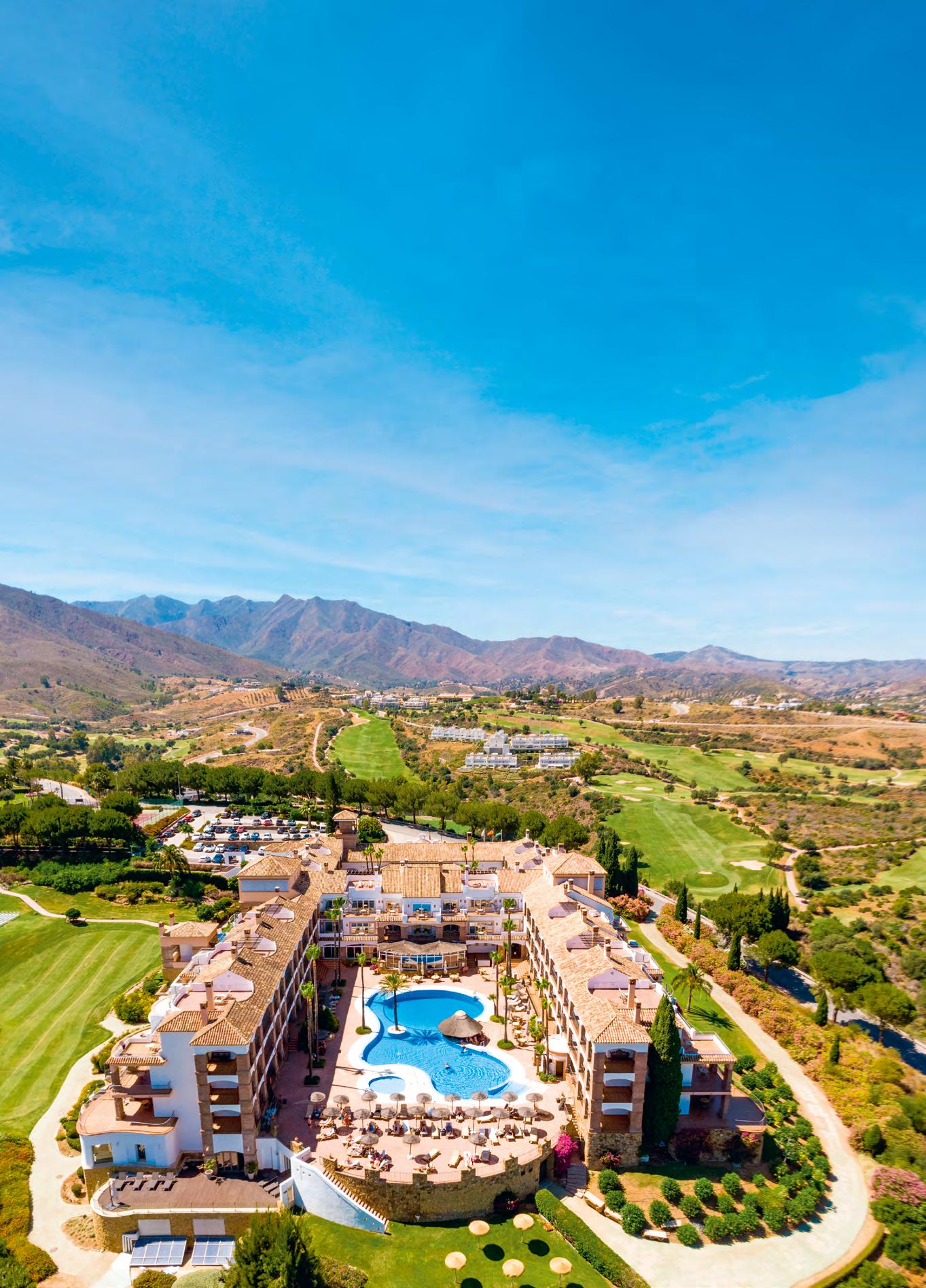
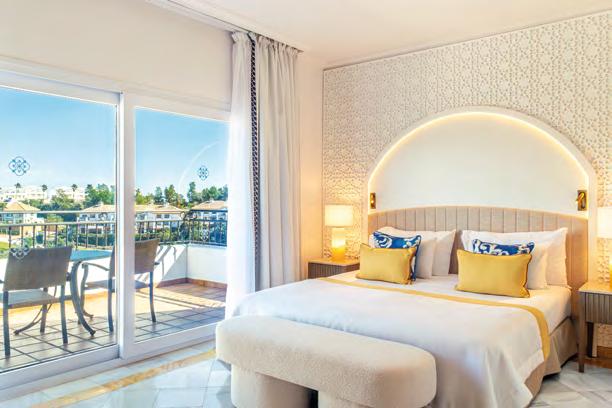
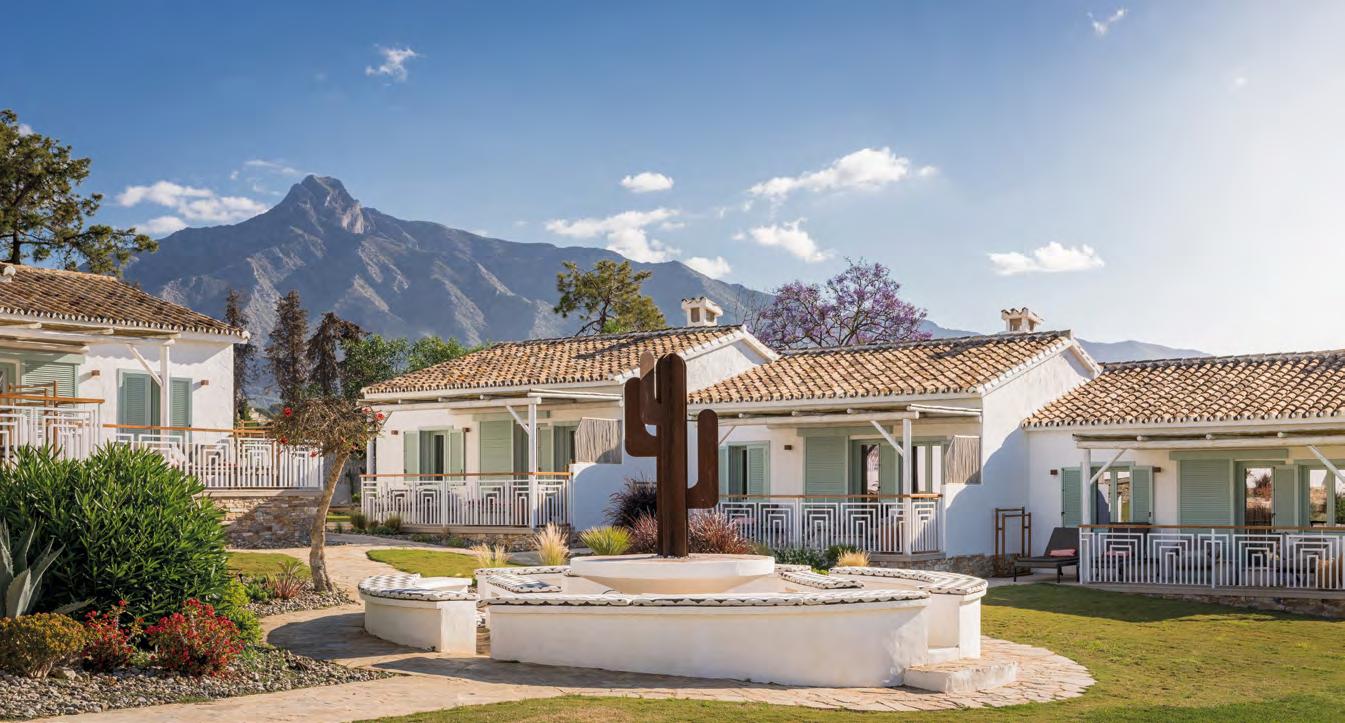
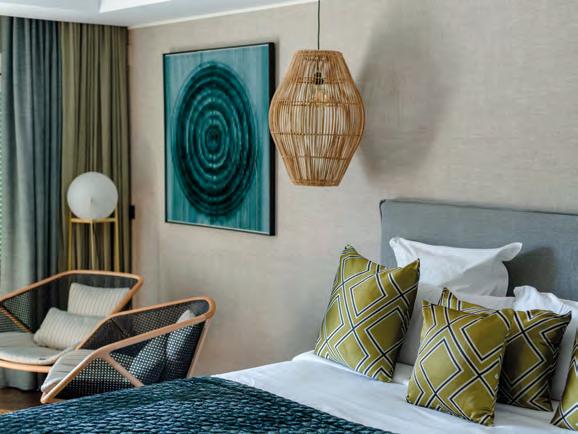
Set in a typical Andalusian hacienda style, with a central patio, Moorish fountain and panoramic views over the Sierra de Mijas and the fairways, the hotel gives La Cala a strong sense of place from the moment you arrive. Its 107 rooms were fully renovated in March, bringing brighter interiors and details inspired by Andalusian and Moorish design, while the outdoor pool and dedicated Pool Bar add an easy, open-air rhythm to the stay. The SPA sits within the hotel itself, and La Terraza and El Patio extend the experience into long lunches, dinners and live music evenings. It is this complete, polished and deeply rooted hotel experience that earned La Cala the title of Spain’s Best Golf Hotel 2025.
SPA
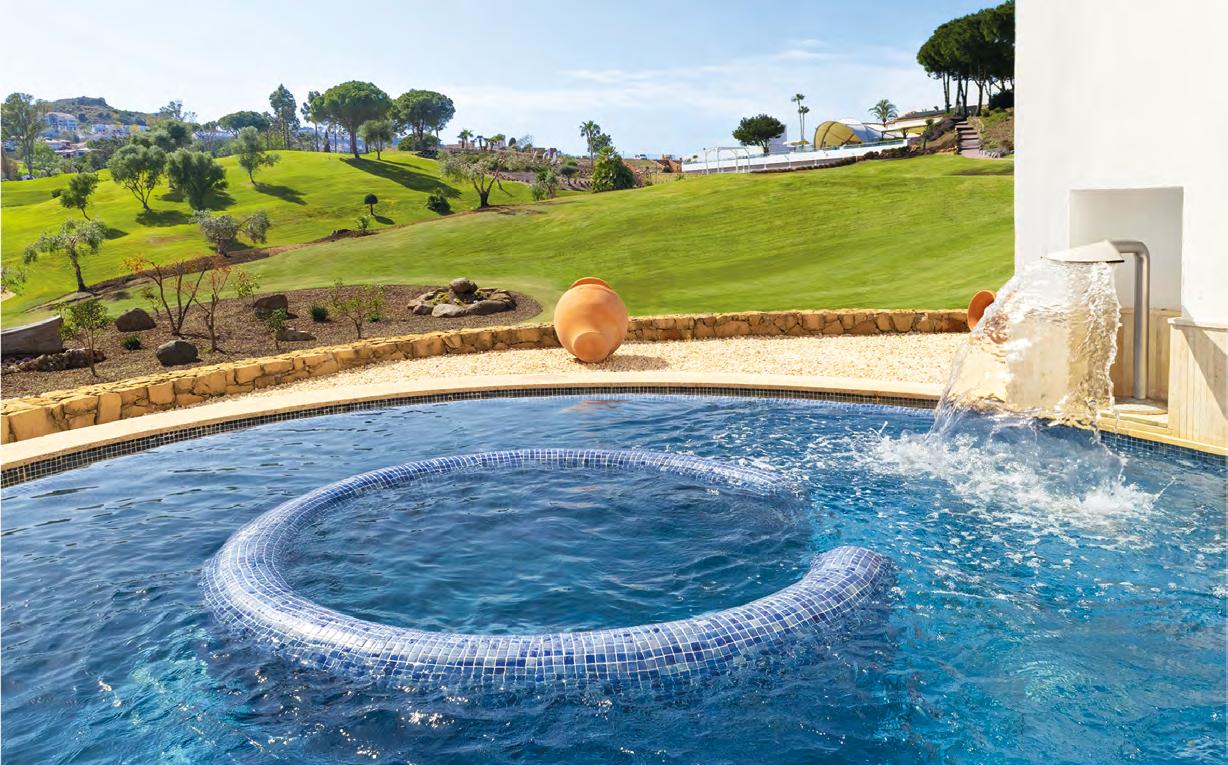
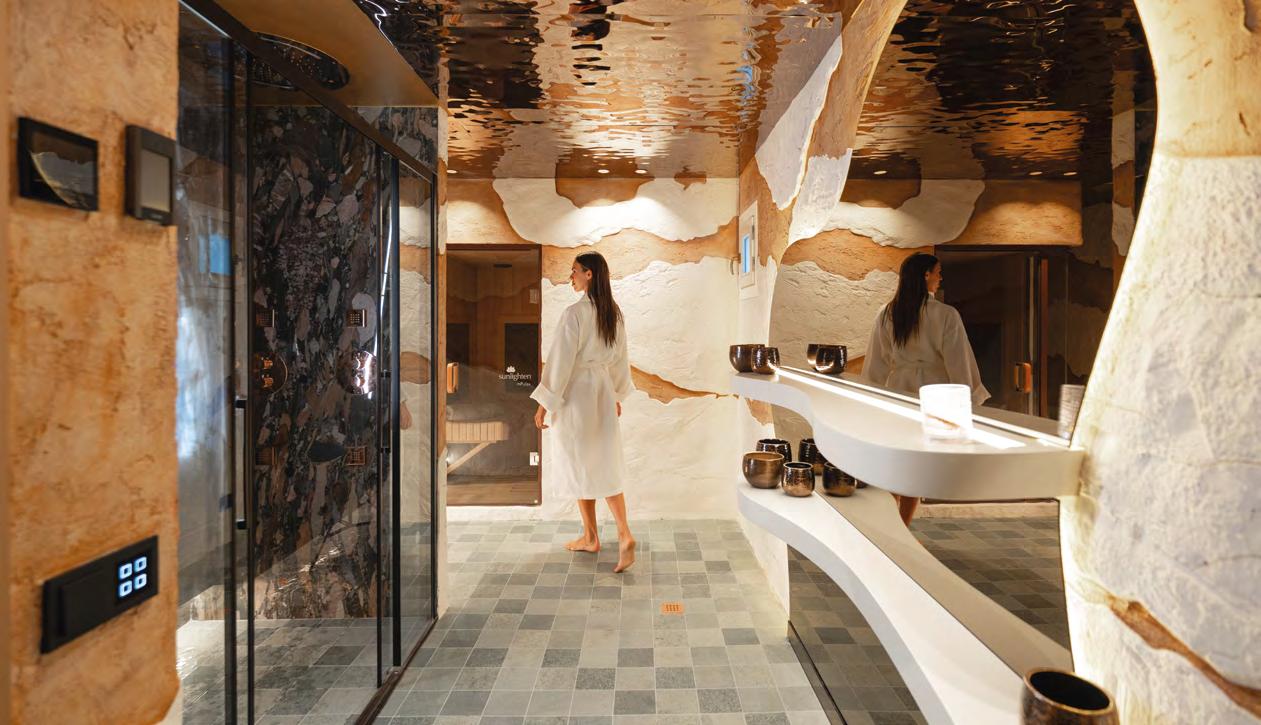
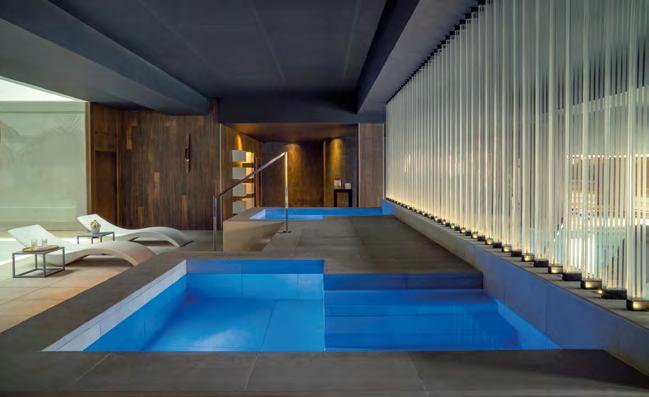
With a deep Andalusian soul, the SPA adds a more sensorial and restorative dimension to life at La Cala. Across 1,300 sqm plus outdoor terraces, hydrotherapy pools, hammam, sauna, herbal steam room, tepidarium, igloo, experience showers and an outdoor jacuzzi create a wellness journey designed to restore body and mind after golf, sport or simply time well lived. Signature treatments such as the Andalusian Ritual give it an identity of its own, while the wider approach to recovery, balance and care makes the experience feel active, holistic and lasting.
DINING
Central to the wider La Cala experience, dining is defined by variety, atmosphere and a distinctly Mediterranean sense of enjoyment. The Steakhouse gives the offer its boldest signature, with premium cuts, Andalusian starters, curated wines and precise charcoal-grilled cooking, all served in a relaxed setting with a terrace opening onto the course. La Terraza and El Patio offer a lighter expression: Mediterranean fine dining, cava and champagne, and signature cocktails. At the Golf Hub, Vista Café adds a more contemporary note: a casual yet carefully curated coffee and eatery concept, with a terrace overlooking spectacular views, fresh and agile dishes, and a Starbucks coffee corner, all designed for a relaxed and sociable way to enjoy the Resort.
REAL ESTATE
With more than 1,500 homes already developed and new phases underway, Real Estate has always been part of La Cala rather than separate from it. Apartments, townhouses, villas and plots for custom builds are conceived in a contemporary Mediterranean style, with high-quality finishes, open-plan living and panoramic views over golf, mountain and sea. Shaped by the concept of Buy Smart · Live Better, direct buyers also gain access to the Privilege Card, while rentals add a more flexible way to enjoy longer stays and a closer connection to resort life.
SOCIAL EVENTS
Much of La Cala’s social energy comes from a calendar designed to be lived and enjoyed. Bluefin tuna ronqueo evenings, Gin & Jazz nights, country grill suppers at The Steakhouse, artisanal markets, wine tastings and tribute concerts - including Europe’s awardwinning Elvis performer - bring together high-quality live music, strong gastronomy and a warm, shared atmosphere. These are not just events, but part of what makes La Cala feel lively, memorable and unmistakably Mediterranean.
C. Mirador del Golf, 1 29649 La Cala de Mijas, Málaga, Spain www.lacala.com
The Spirit Sea of the
A place where Marbella is not just seen, but felt.
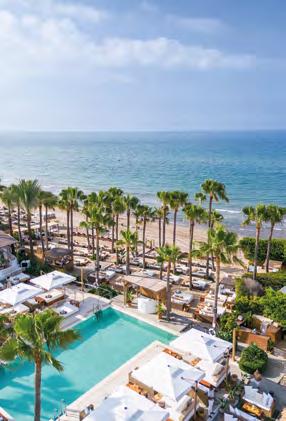
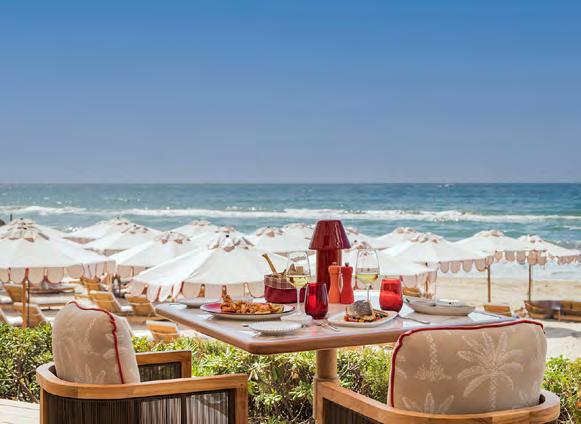
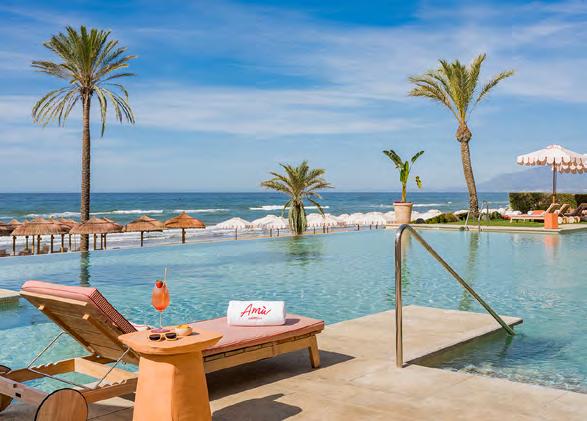
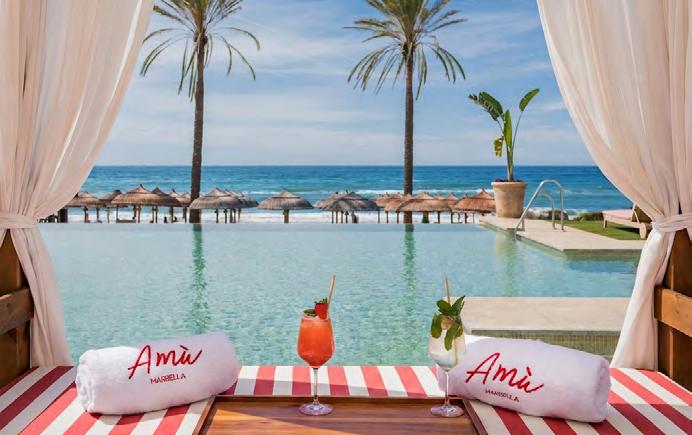
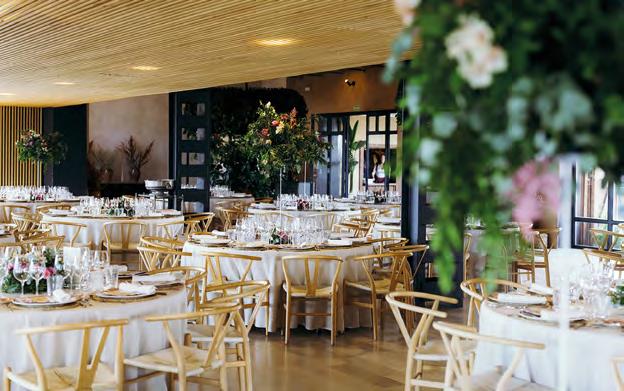
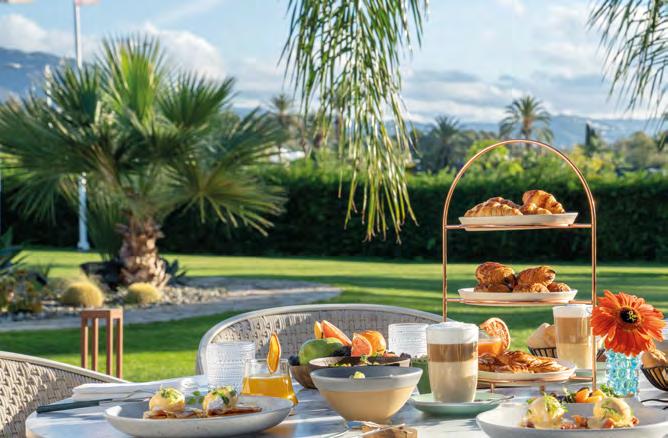
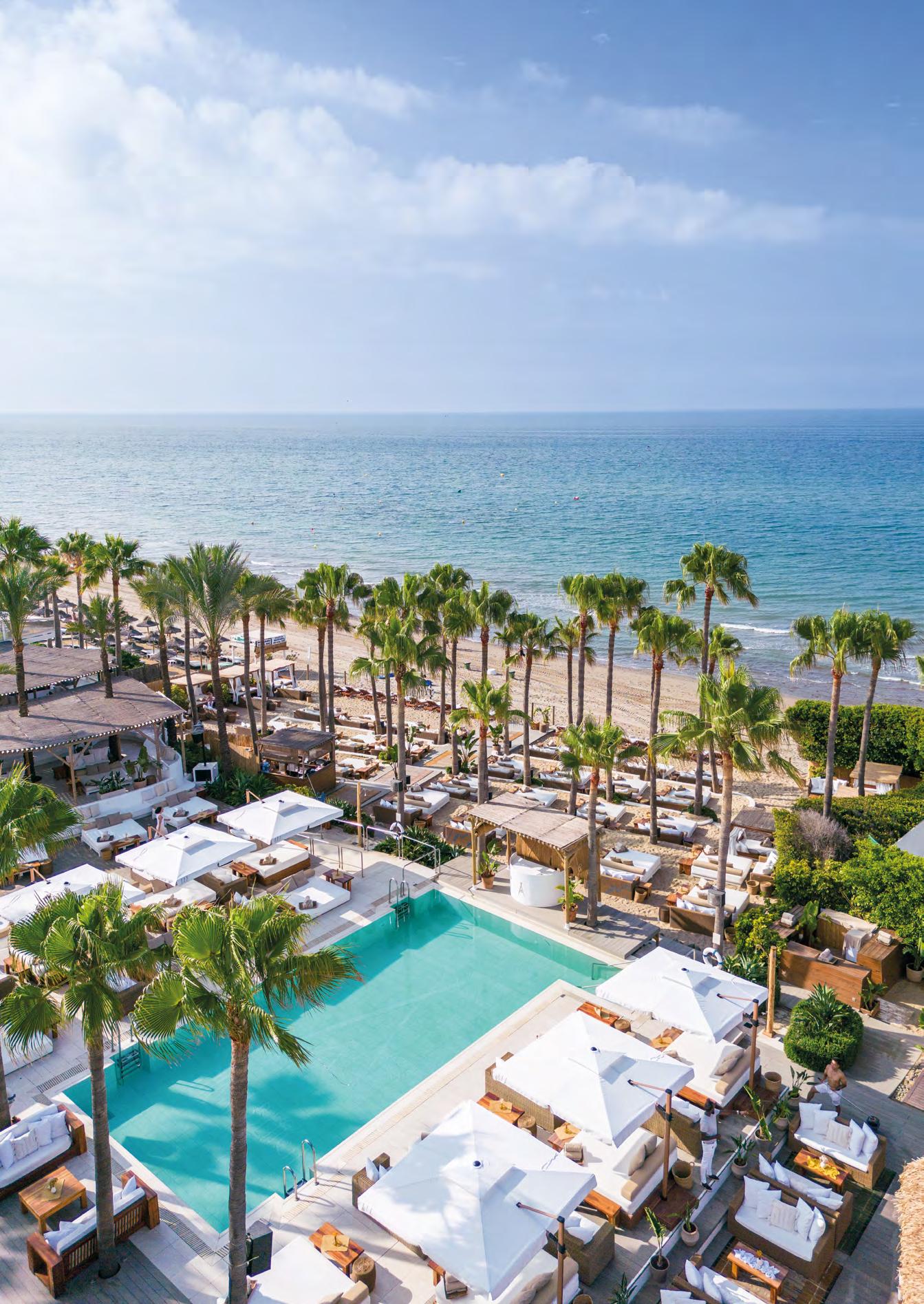
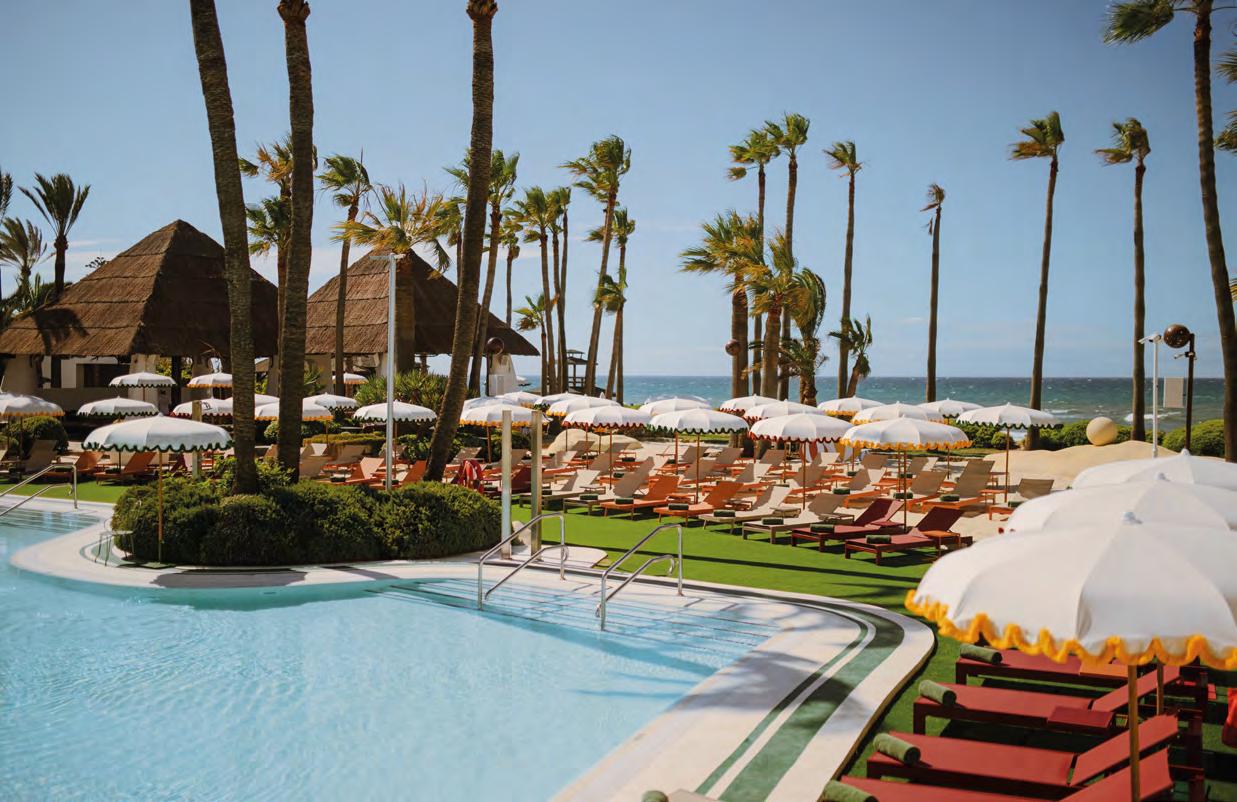
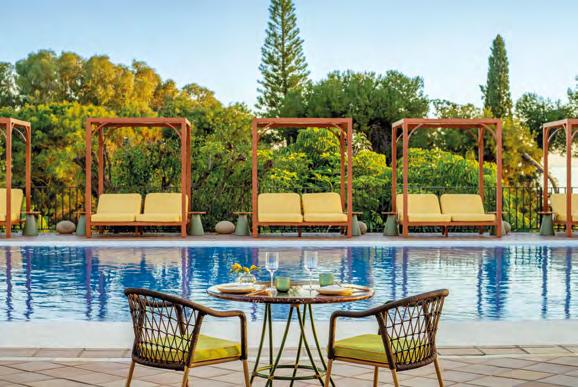
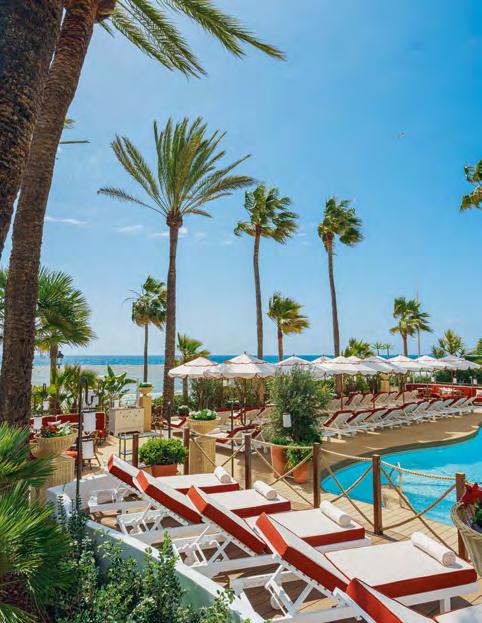
On the beachfront at Gran Marbella Resort, Amù is the Costa del Sol’s finest beach club, open-air dining, a private stretch of sand, poolside lounging, and cocktails as the sun goes down. Everything in one place, at the right pace.
A long lunch that stretches into afternoon. The sound of the sea, close enough to feel it. Andalusian coastal cuisine that tastes of where you are. A terrace that comes alive as the evening does.
Everything considered, nothing forced.
This is the Costa del Sol as it should be experienced.
Interview with
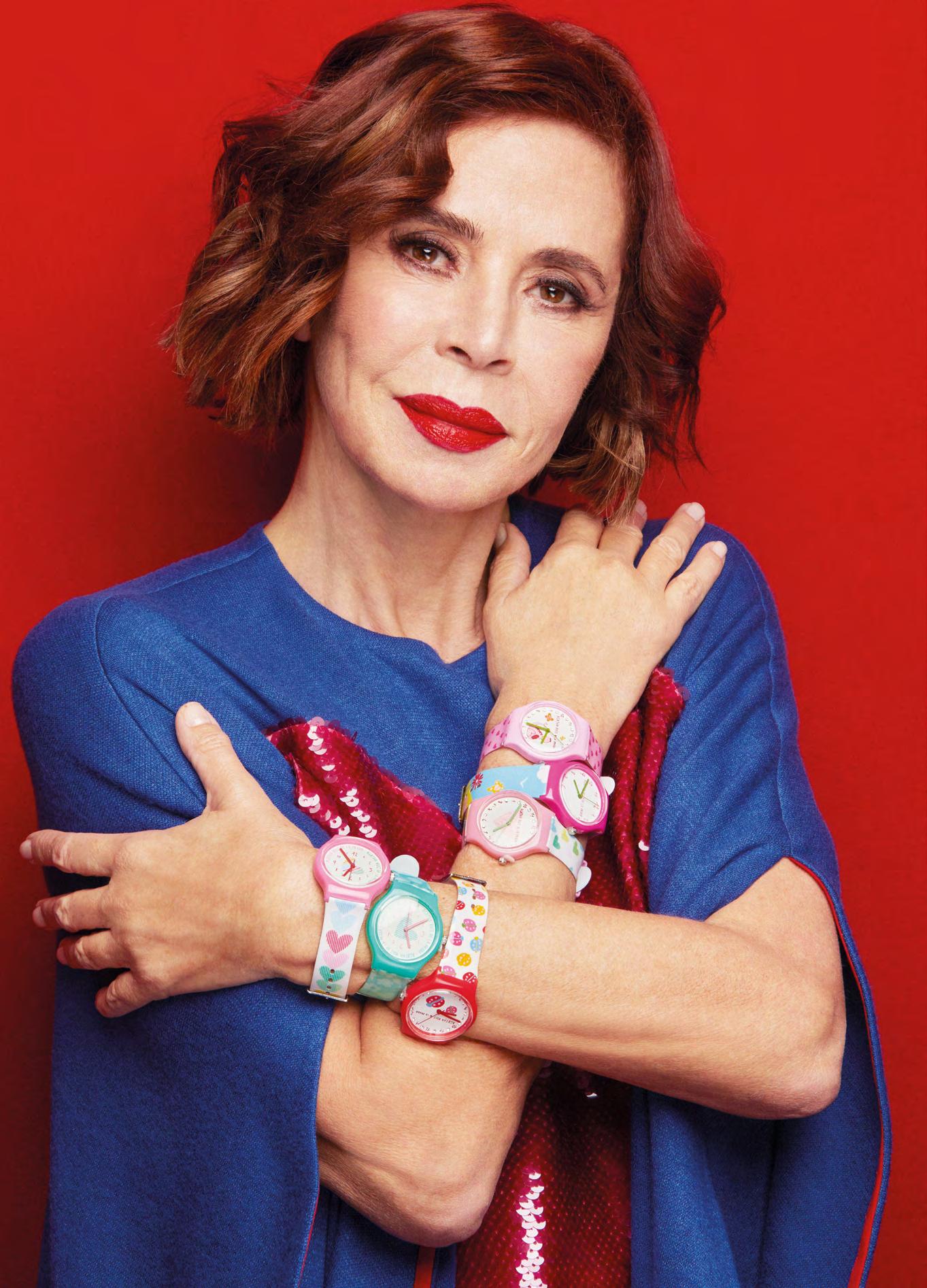
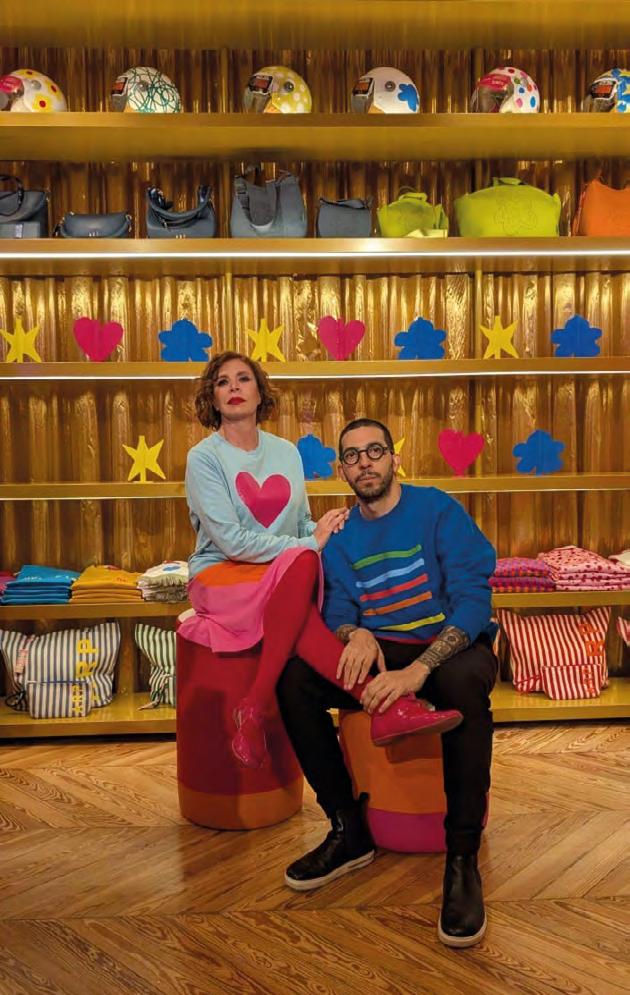
AGATHA R uiz de la Prada
THE ARISTOCRAT WHO TURNED HER COMMITMENT TO JOY AND COLOUR IN DESIGN INTO AN EMPIRE
By Ana Pavón
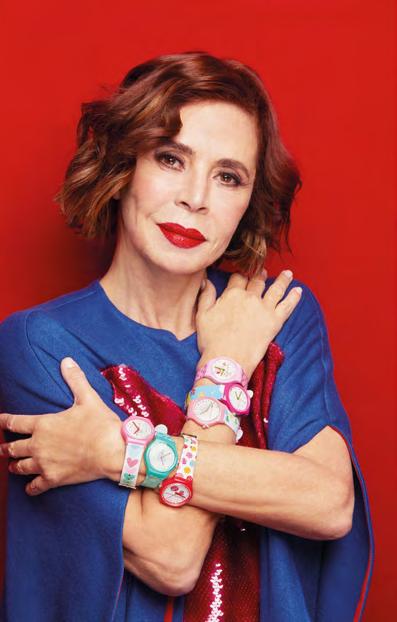
Ágatha Ruiz de la Prada y Sentmenat (Madrid, 1960), born into an aristocratic family and holder of two noble titles — XIII Marchioness of Castelldosríus and XXIX Baroness of Santa Pau — is a distinguished Spanish fashion designer and businesswoman. Hers is not the story of a conventional woman, but of a restless young spirit with entrepreneurial drive in her veins, determined to leave her own imprint on history and take it across the world, infused with the heritage of her charismatic personality. A true example of perseverance and tenacity in the pursuit of her goals from the very beginning. And she remains ready to continue surprising us...
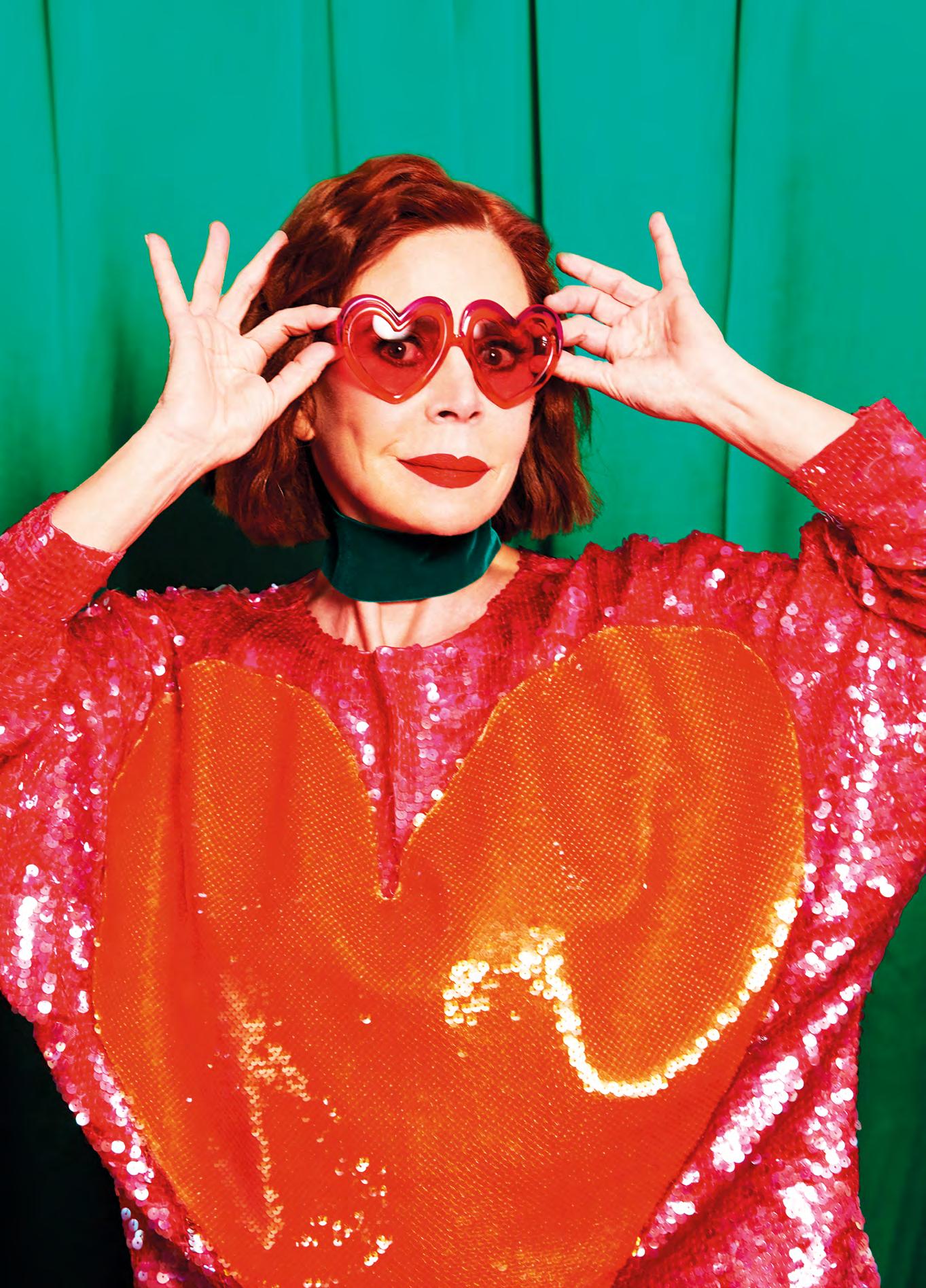
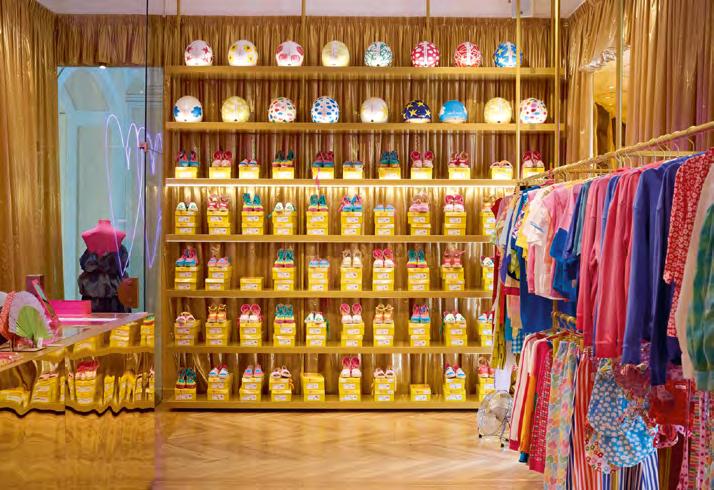
A businesswoman who has left no one indifferent, from her earliest steps in the vibrant cultural scene of the 1980s her proposal was clear: no minimalism, no discretion. Hearts, stars, vibrant and joyful colours… An aesthetic many considered naïve, yet one that concealed a brilliant positioning strategy, where her brand communicated joy and a passion for life.
Far from limiting herself to the runway, Agatha understood — earlier than many — the power of lifestyle. Today, her universe extends into everyday objects, experiential stores and international collaborations. The key to her success has not been following trends, but ignoring them and offering a new universe to fashion. In an industry obsessed with trends, this remains her greatest legacy as a Spanish brand: to continue, with the coherence and optimism that define her, faithful to her creativity and her bold commitment to colour in every project.
You were born into a Spanish aristocratic family. How did that environment influence your creative development? How did you move from that world to creating such an… explosive brand? Well, my environment had an enormous influence on my life. I believe everyone’s does. Childhood is an immensely important stage in shaping who you become as an adult. I lived in a house that was extremely modern for its time, very, very modern, and my father loved the world of art — something that was not common then, especially contemporary art of his time. That meant I became very familiar with that world and grew to love it deeply. I have always said it had a huge influence on the way I see life. It also instilled in me the idea of seeking happiness through work: I lived in
“Hearts, stars, vibrant and joyful colours… An aesthetic many considered naïve, yet one that concealed a brilliant positioning strategy, where her brand communicated joy and a passion for life.”
a family where people did not work, but my father did, and I could see that working was more enjoyable than not working.
You are a businesswoman, designer and writer, but also a mother. How have you managed to reconcile these different roles? Who resembles you the most?
I think with children it is very difficult to get it right. When they are young, you are so eager to give them everything: for them to speak English, French, German; to take tennis, golf, sailing, piano, guitar, dance, fencing lessons… absolutely everything. In the end, you overwhelm them. It is very hard to find the right balance.
Since the 1980s, your visual language has not changed — and that is precisely the key. What were your first steps in the world of design like?
Thanks to my connection with the art world, I was fortunate to discover the guiding thread of my style at a very young age. At first, it was a style that was difficult to understand and seemed complicated to make commercially viable. But little by little, it became very easy to recognise, and when you have a recognisable style, people really enjoy identifying it.
Your aesthetic is unmistakable. How would you define the DNA of your brand?
It is clear that my brand has a very defined DNA, and I remain very faithful to it. Even if everyone else dresses in black, I continue with my ideas of colour and form. Even if it seems I am the only one, it does not matter to me. In the end, that consistency is something people admire.
“I am very happy with the “Colors” collection, although in reality it is a project by my son Tristán”
What has it been like taking your brand beyond Spain? Has it been easy?
The development of stores has been quite complicated. I was very excited about having shops in Paris, New York, Milan and many other countries, but the idea that a designer must have many stores is very dangerous. Today everything can be bought online, and a store requires an enormous amount of energy. It is impossible to manage many at once.
For example, Toni Miró had the highest-grossing store in Barcelona and everyone wore his brand, but he insisted on opening many shops and ran into financial difficulties. If he had kept just one, he would probably have been just as wealthy. The same has happened to Adolfo Domínguez and many others. Moreover, it is not enjoyable: if you want to be creative, managing stores involves constant problems, from breakdowns to staff issues.
Your brand is a case study in branding. What has been the key to that success?
I would say the key to my success has been having my own style and being very consistent with it.
For me, taking my brand beyond Spain — and also across Spain — has always been an obsession. I dedicate a great deal of effort to it; right now, I am in Mexico.
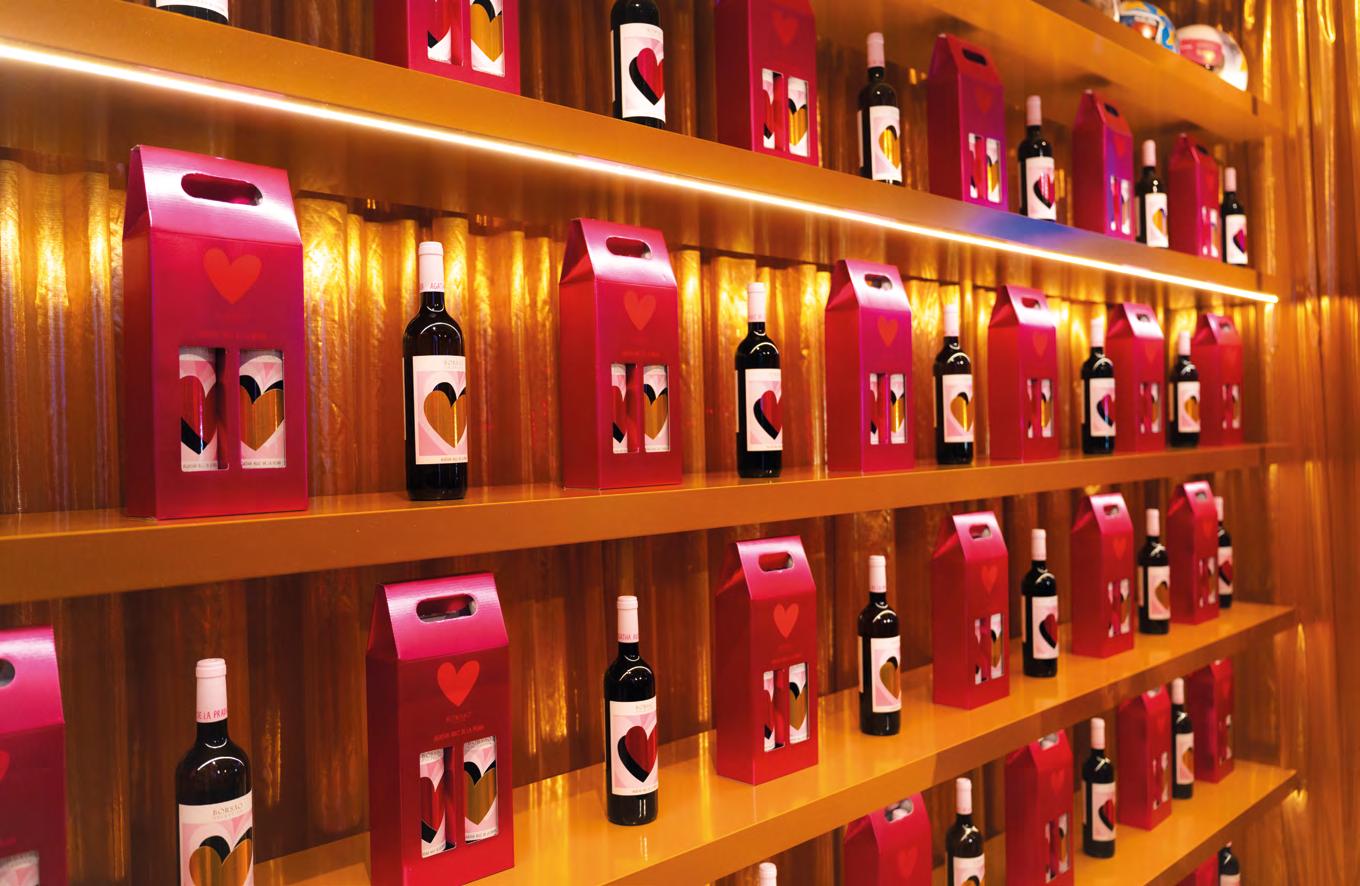
Your brand spans all kinds of licences — clothing, home décor, shoes, perfumes, handbags, eyewear, wines, furniture… As a businesswoman, could you share what your upcoming projects might be?
The truth is I have many projects, and very beautiful ones. I approach them with great enthusiasm, although you never know when you will succeed. Even so, it is a privilege to have so many projects that excite me.
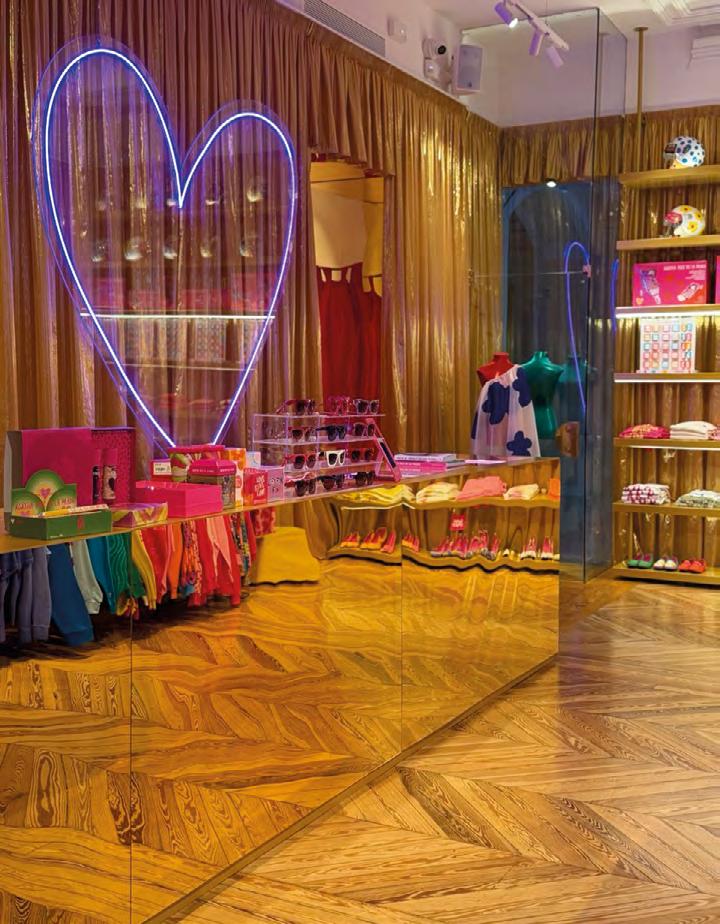
Tell us about the capsule collection Colors x Agatha Ruiz de la Prada (trousers, T-shirts, overshirts), created in collaboration with Colors of Basque Country and presented at your new store on Calle Villanueva 5 in Madrid’s exclusive Salamanca district. What do you think will surprise us the most?
I am very happy with the “Colors” collection, although in reality it is a project by my son Tristán. He has done it very well — he has connected with young people in a fun, intelligent and brilliant way. It is performing very well and makes me very happy.
Your sweetest note has been the launch of your own brand, Chocolates Marcos Tonda by Agatha Ruiz de la Prada, at your space Cielo in the Sweet Space Museum in Madrid — now also available in Marbella. For those who have not yet tried them, what flavours can we expect?
In recent years, I have developed many projects related to gastronomy. I had long sensed that fashion would have a great deal to do with this field, and now many designers are exploring
it, such as Dolce & Gabbana, Prada… It is a very creative and very enjoyable field.
At the beginning of March, you made headlines for moving into a spectacular new “urban mansion” in Madrid’s Salamanca district. You have described it as your “new singlelady apartment”, although with your beauty, that label may not last long. How did you conceive your new home? What is true luxury for you?
Thank you very much for that charming comment, Ana. I felt quite reluctant to move because I was very comfortable in my home, but suddenly you realise you are entering a new stage of life. I wanted to make changes, and I understood it was the right moment — because changing your life requires energy and determination.
Where can we find you in Madrid?
The best place to find me in Madrid is my store at Villanueva 5. For years it was an iconic design space called BD, where spectacular exhibitions were held. Now I am there, and I am delighted.
You have been passionate about culture and art since childhood, as was your family, especially your father. In your new home, your commitment to contemporary art is evident. As a collector, what must an artist convey for their work to become part of your private collection?
I have some pieces, but I do not consider myself a collector. I do not have the money to be one and, besides, I believe collecting involves a very strong obsession. I am more focused and obsessed with my work.
Judging by your career, you are a very demanding woman with yourself and your projects. Which city in the world best reflects your style and personality? Where do you feel most at home?
Madrid is my home, where I was born and where my roots are. But I love travelling. I feel very comfortable in Paris, in Italy — although I go less often than I would like — in Latin America and in New York. Travelling has become an essential part of my life. In general, I feel very good when travelling. I never imagined I would become such a traveller.
What is your philosophy of life, and which colour defines you?
My philosophy of life is closely linked to ecology, love for animals, art, culture, curiosity, friendship and work.
In your latest collection, you mentioned using AI to create designs. How do you think this new revolution will impact the global fashion industry?
I believe we are living in a fascinating era with artificial intelligence, which is going to change everything. We will have to adapt to this new reality. Personally, I find it fascinating.
Margot
Robbie
WHEN BEAUTY NEVER OUTSHINES TALENT CUANDO LA BELLEZA NO ECLIPSA AL TALENTO
BY EVA DEL AMO
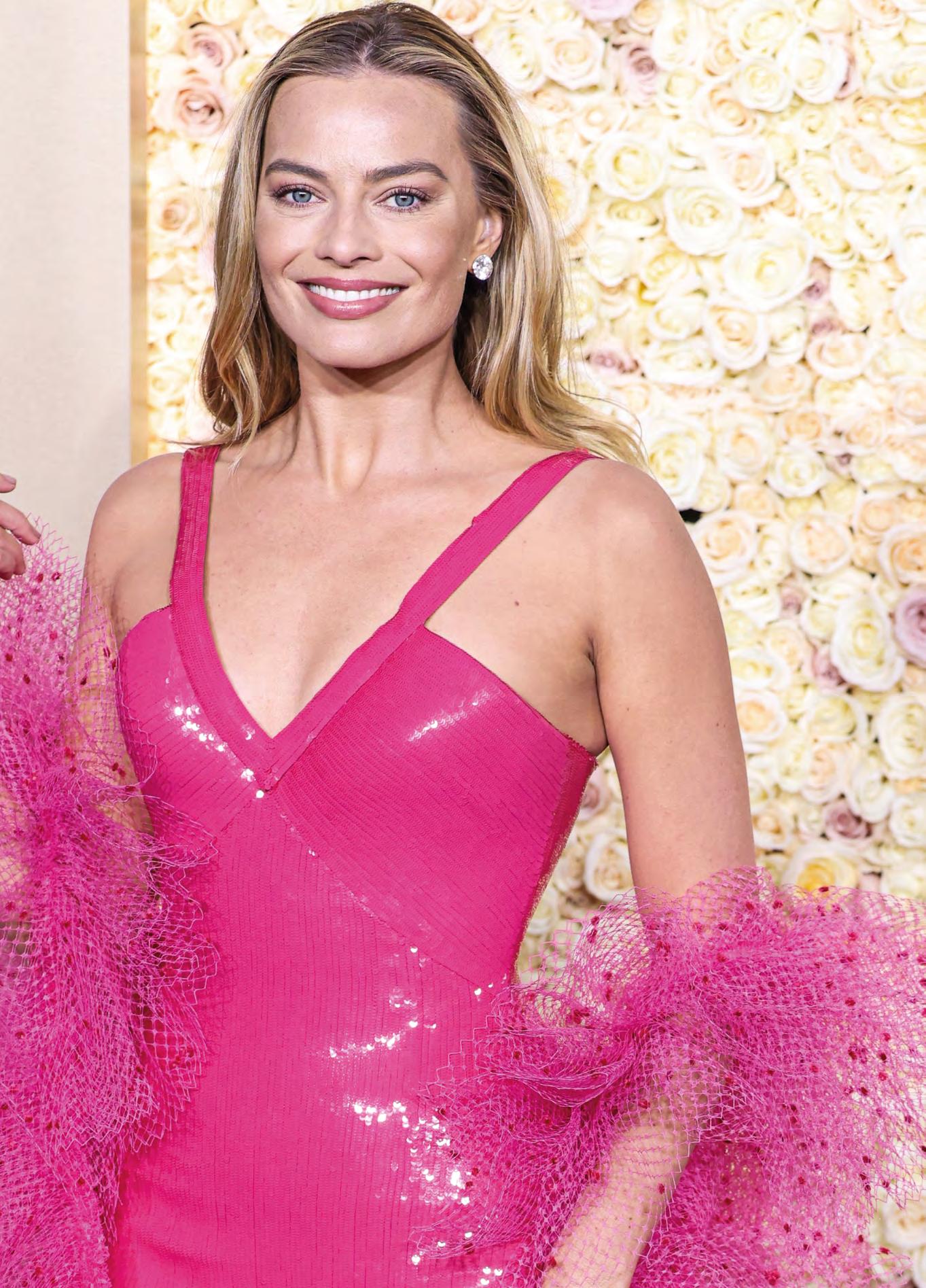
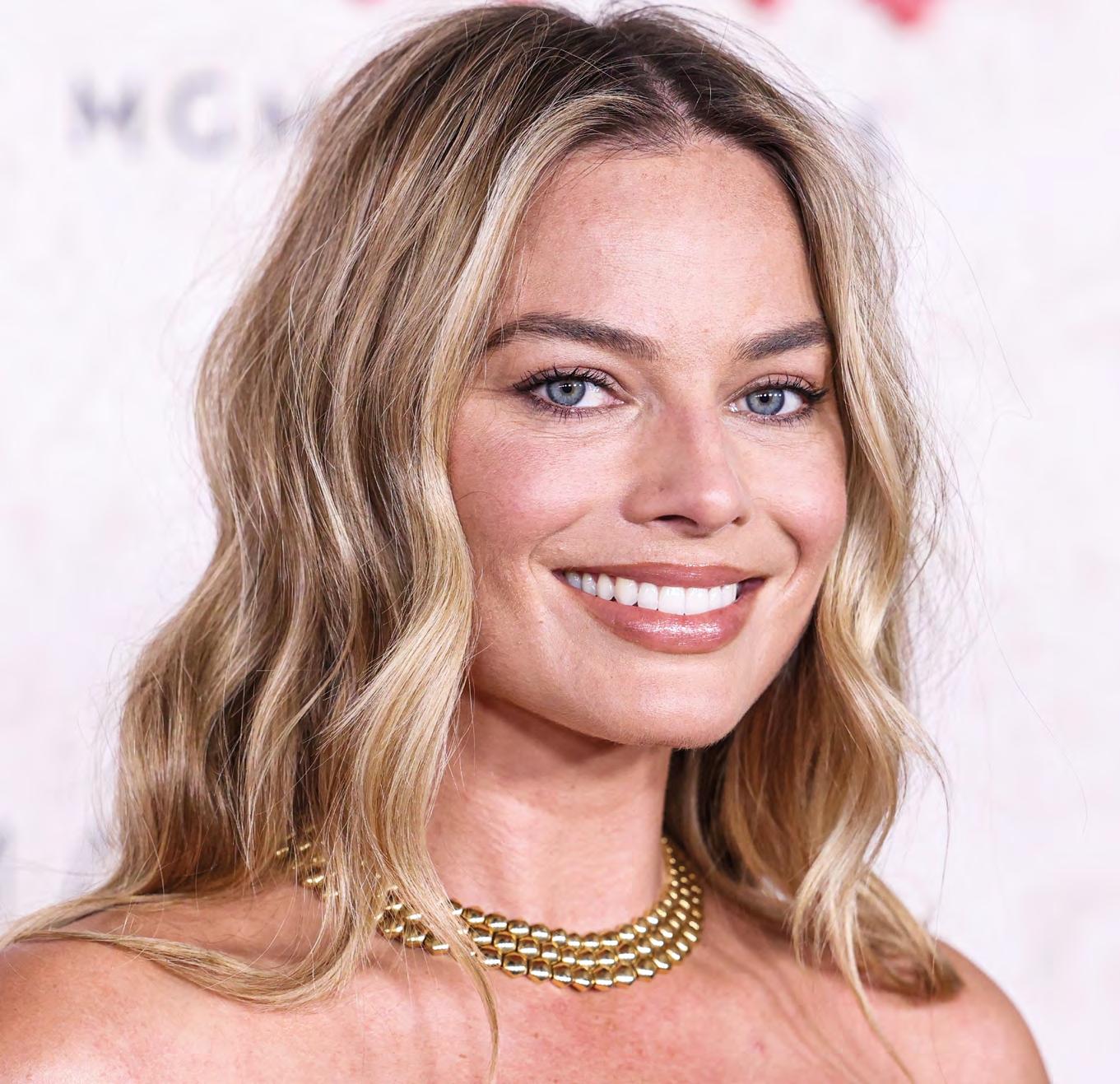
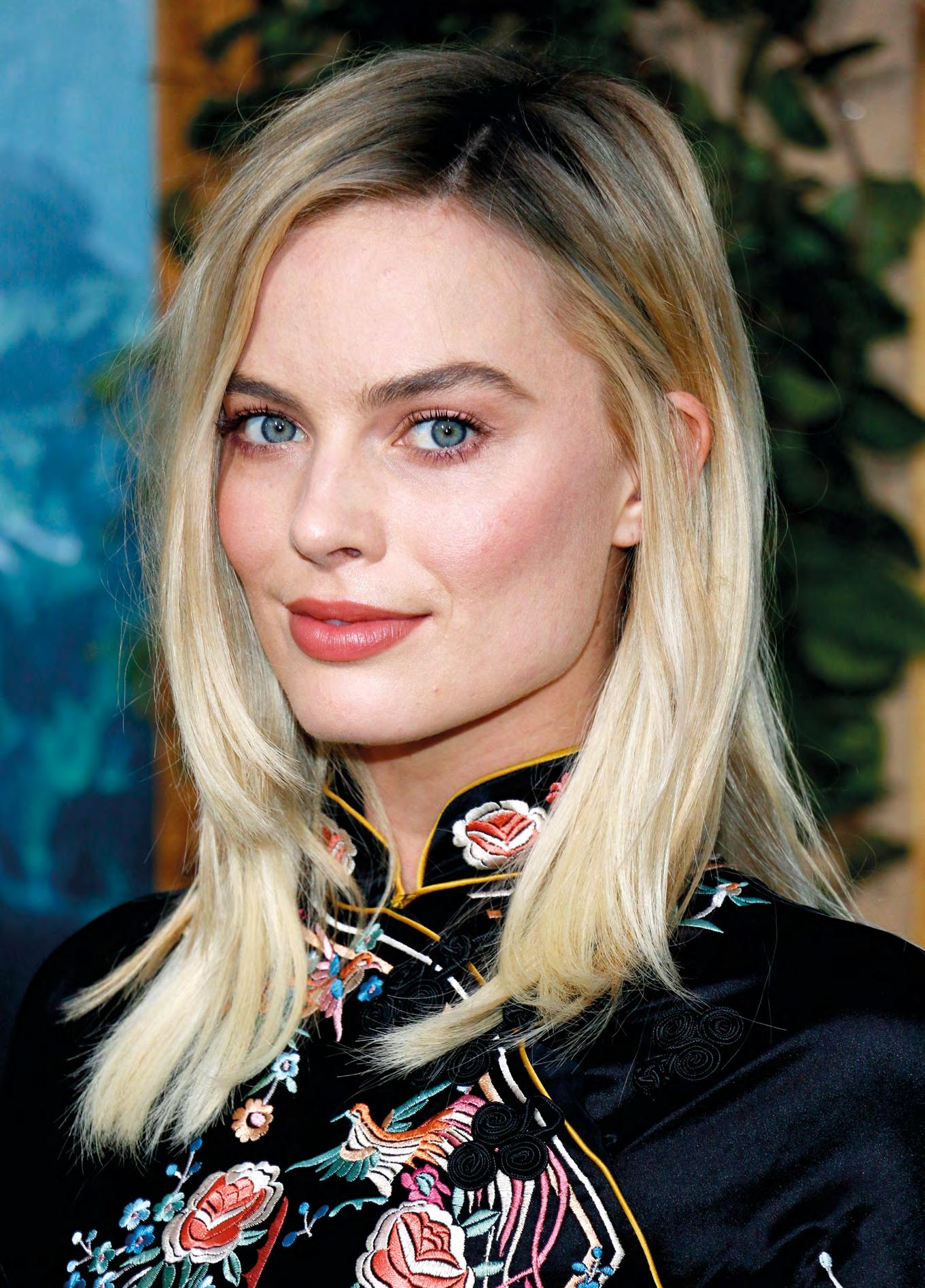
Few could have imagined that Sarie Kessler’s daughter, Margot Elise Robbie, would one day become one of the most celebrated actresses in the world. Born in Australia in 1990, Margot spent her childhood on a farm in Dalby alongside her three siblings. Her parents separated when she was still very young, and it was her mother—a physiotherapist by profession—who took on the responsibility of raising the family, doing so with determination despite modest means.
Poco se podía imaginar Sarie Kessler que su hija Margot Elise Robbie se convertiría en una de las actrices más famosas del mundo. Nacida en 1990 en Australia, Margot pasó su infancia en una granja de Dalby junto a sus tres hermanos. Sus padres se separaron cuando era pequeña y su madre, fisioterapeuta de profesión, fue la que se encargó de sacar adelante a la familia sin grandes lujos.
“Yet the most decisive turning point in her career arrived in 2023 with Barbie, a film that bore Robbie’s unmistakable imprint both in front of and behind the camera.”
From an early age, Margot balanced her studies with a variety of jobs to help support the household. While working as a waitress in Melbourne, she quietly nurtured her dream of becoming a great actress, a passion that eventually led her to enrol in acting classes and begin shaping the path that would transform her life.
The first defining step in her career came with a role in the popular television series Neighbours. Robbie often recalls those years as an invaluable training ground: long filming schedules, constant exposure and, above all, the growing sense that her future in the industry could extend far beyond the confines of the small screen.
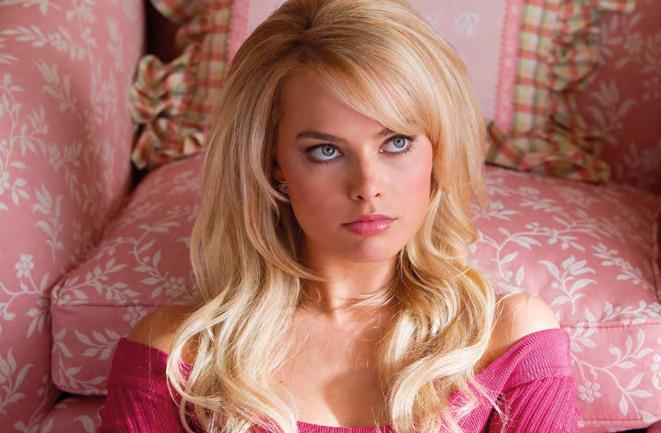
Despite already enjoying considerable popularity, she made the bold decision to leave everything behind and move to Los Angeles. After appearing in the American series Pan Am, her breakthrough arrived in 2013 when Martin Scorsese cast her in The Wolf of Wall Street. Her portrayal of Naomi Lapaglia revealed to international audiences not only her striking beauty, but also her natural charisma, confidence and undeniable screen presence.
A succession of major roles soon followed. Films such as Suicide Squad (2016), I, Tonya (2017), Bombshell and Once Upon a Time in Hollywood (2019) confirmed her remarkable versatility and earned her nominations for the Golden Globes, the BAFTA Awards and the Oscars. By then, Robbie had clearly moved beyond the category of promising newcomer to establish herself as one of Hollywood’s most compelling stars.
With her career firmly consolidated, she continued to shine in large-scale productions while also seeking a more active role behind the scenes. The creation of her own production company, LuckyChap Entertainment, allowed her to champion projects with stronger creative voices and to support stories that offer greater space and visibility for women within the industry.
FOLLOWING HER INSTINCT
Margot Robbie’s elegance and effortless sophistication soon caught the attention of Chanel, which named her the official ambassador of its fragrance Gabrielle. Yet the most decisive turning point in her career arrived in 2023 with Barbie, a film that bore Robbie’s unmistakable imprint both in front of and behind the camera. The production became a global cultural phenomenon, confirming her remarkable instinct when selecting projects destined to resonate with audiences worldwide.
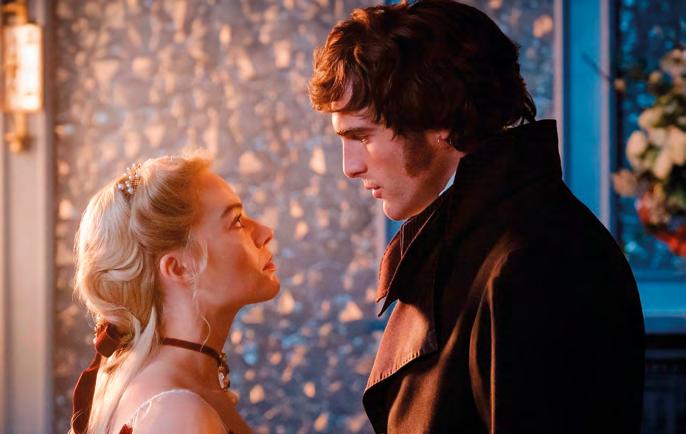
Never one to rest on success, Robbie chose in 2026 to take on a far darker and emotionally complex role in Wuthering Heights, directed by Emerald Fennell. In this new adaptation of Emily Brontë’s timeless novel, she portrays Catherine, a character as passionate as she is contradictory. Opposite Jacob
Elordi as Heathcliff, Robbie leads a story of enduring love in a film distinguished by its striking visual aesthetic—one that has captivated critics and audiences alike.
In her private life, Margot Robbie has always favoured discretion. Married since 2016 to British producer and director Tom Ackerley, she has managed to keep their relationship largely away from the media spotlight, particularly since the couple welcomed their first and only child in 2024.
Today, Margot Robbie represents far more than cinematic success. As a reflection of her immense popularity, this year she was voted “the most beautiful woman in the world” in a public poll conducted by the website Ranker. A distinction that surprises no one and merely adds another accolade to a career defined by talent, versatility and a strong, determined character—qualities that, far beyond her beauty, have made her a true icon of her generation.
Desde adolescente, Margot compaginó sus estudios con diferentes empleos para ayudar en la economía familiar. Mientras servía mesas como camarera en Melbourne, alimentaba su sueño de convertirse en una gran actriz, lo que le hizo apuntarse a clases de interpretación.
El primer paso crucial de su carrera fue un papel en la popular serie Neighbours. La actriz recuerda aquellos días como un auténtico aprendizaje, con rodajes eternos, una exposición constante y la sensación interna de que su carrera podría ir mucho más allá.
Aunque ya gozaba de una gran popularidad, Margot decidió dejarlo todo atrás y mudarse a Los Ángeles. Tras un papel en la serie estadounidense Pan Am, Martin Scorsese la eligió en 2013 para su película El lobo de Wall Street. Su papel como Naomi Lapaglia permitió que el mundo descubriera su gran carisma, su seguridad y su belleza, que traspasaba la gran pantalla.
Después llegarían películas como Escuadrón Suicida (2016), Yo, Tonya (2017), Bombshell y Once Upon a Time in Hollywood (2019, y las sucesivas nominaciones a los Globos de Oro, los premios Bafta y los Oscar, unos reconocimientos que le permitieron dejar de ser una gran promesa para convertirse en una gran estrella de Hollywood.
Con una carrera ya consolidada, Robbie triunfaba a las grandes producciones, pero también quería tener un papel muy activo en la industria. La creación de su propia productora, LuckyChap Entertainment, le permitió apostar por historias con un mayor peso creativo y otorgar más espacio a las mujeres en Hollywood.
SIGUIENDO SU INSTINTO
La elegancia y belleza de Margot Robbie captó la atención de Chanel, que la convirtió en embajadora oficial de su fragancia Gabrielle. Pero el punto de inflexión definitivo de su carrera llegó en 2023 con Barbie, una película que tenía la impronta de Robin tanto en la interpretación como en la producción. El film se convirtió en un fenómeno internacional, demostrando su instinto a la hora de seleccionar los proyectos que le harían triunfar. Lejos de acomodarse en el éxito, en 2026 ha elegido interpretar un papel mucho más oscuro y emocional con Cumbres Borrascosas, una película dirigida por Emerald Fennell. En esta nueva adaptación del clásico de Emily Brontë, Robbie da vida a Catherine, un personaje tan apasionado como contradictorio. Junto a Jacob Elordi como Heathcliff, protagoniza una historia de amor atemporal en un film que destaca por su increíble estética, y que le ha hecho ganar la admiración de crítica y público a partes iguales. En lo personal, Margot Robbie siempre ha elegido la discreción. Casada desde 2016 con el productor y director británico Tom Ackerley, ha logrado mantener su relación lejos del ruido mediático, especialmente desde que en 2024 dieran la bienvenida a su primer y único hijo. Hoy, Margot Robbie es mucho más que una estrella de cine. Como guiño a su enorme popularidad, este año ha sido elegida como “la mujer más guapa del mundo” en una votación popular del portal Ranker. Un título que a nadie le sorprende y solo sirve para adornar su talento, su versatilidad a la hora de interpretar y su firme carácter, que más allá de su belleza le han convertido en todo un icono para su generación.
“Su papel oscuro y emocional en Cumbres Borrascosas, le ha hecho ganar la admiración de crítica y público a partes iguales”
A NEW STANDARD OF WELLNESS ON MARBELLA’S GOLDEN
MILE
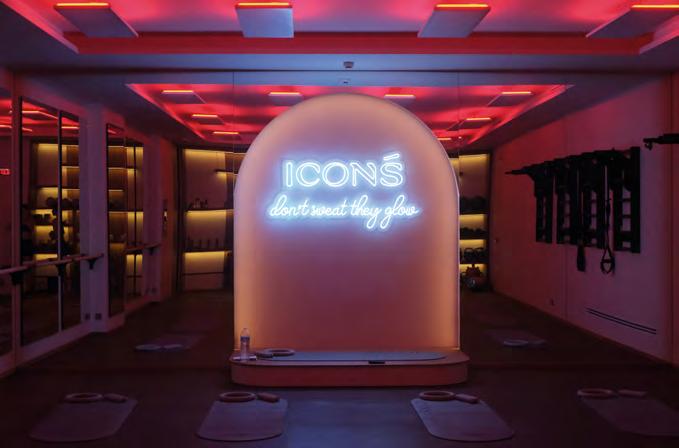
Marbella has never been short of places to train, nor places to unwind. What has often been missing, however, is a space that brings both together in a cohesive and considered way, where performance, recovery, and social connection are given equal importance. This is where ICONS Marbella positions itself.
“The space is intentionally structured into distinct zones, each supporting a different aspect of modern wellbeing.”
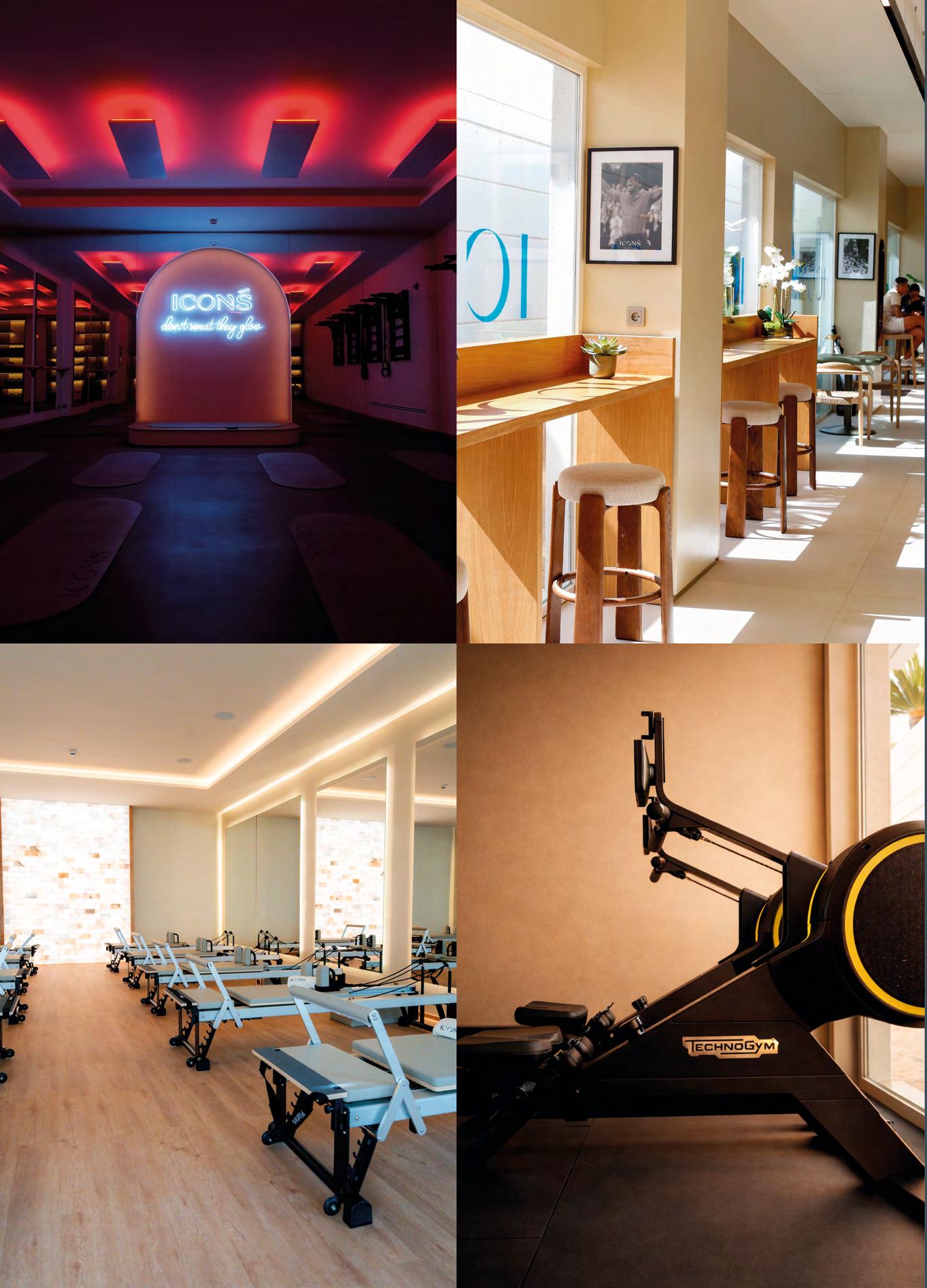
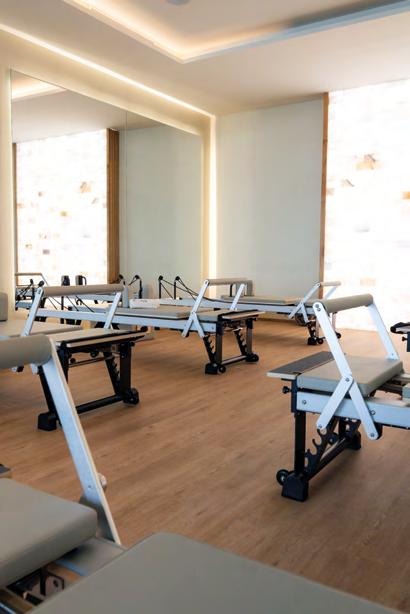
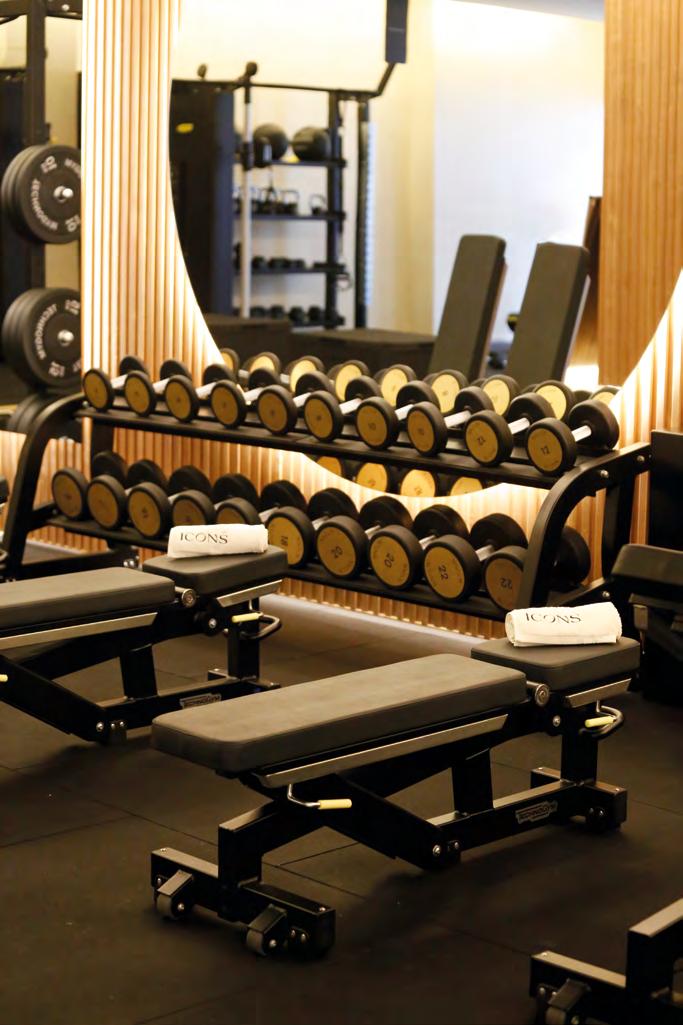
Located within the Alanda Hotel on the Golden Mile, ICONS is designed as a full-service wellness and social club, rather than a traditional gym. The space is intentionally structured into distinct zones, each supporting a different aspect of modern wellbeing.
At its core, the training offering spans multiple disciplines. A fully equipped functional gym floor provides the foundation for strength, conditioning, and individual training, while a dedicated Reformer Pilates studio delivers both beginner and advanced sessions, centred on precision, control, and alignment.
Group training plays a defining role within the club. Strength-led classes, conditioning sessions, and hybrid formats, including HYROX-inspired training, cater to those seeking a more performance-driven approach, with a clear focus on progression and measurable results.
A standout feature is the club’s heated infrared studio. Set within a high-temperature environment, it hosts a curated mix of Pilates-based and functional training classes. Sessions here are designed to challenge both physically and mentally, combining endurance, mobility, and strength in a more immersive format.
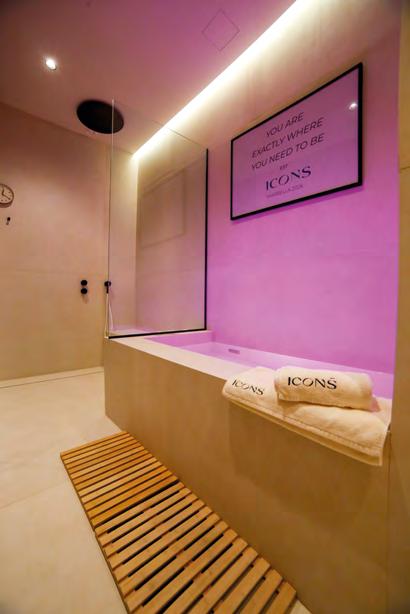
Recovery is given equal weighting. Dedicated spaces include sauna and cold plunge facilities, alongside advanced recovery technologies that support muscle repair, circulation, and overall performance optimisation.
A MEMBERS-LED COMMUNITY
Beyond the physical environment, ICONS offers a carefully curated programme of member experiences. From wellness talks and guided workshops to group hikes and seasonal retreats, these are designed to extend the club beyond training, fostering a strong sense of community.
ICONS Marbella is not defined by any single offering, but by the way each element is considered and connected. Training, recovery and connection are brought into alignment, forming a more refined and intentional approach to wellbeing, one that reflects a new standard of modern living.
Discover ICONS Marbella.
Visit icons.club or arrange a private tour.
ONE HUNDRED FORTY YEARS OF SILVERSMITHING, JEWELLERY AND ART CIENTO CUARENTA AÑOS DE ORFEBRERÍA, JOYERÍA Y ARTE
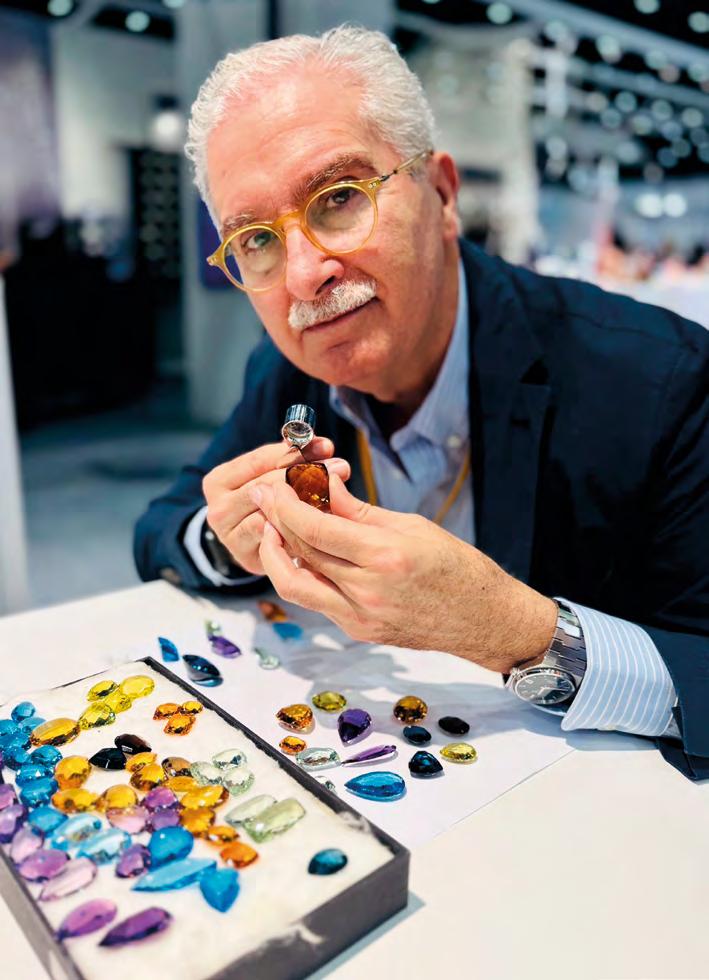
Juan Miguel Albarracin CEO workshop Durán Joyeros
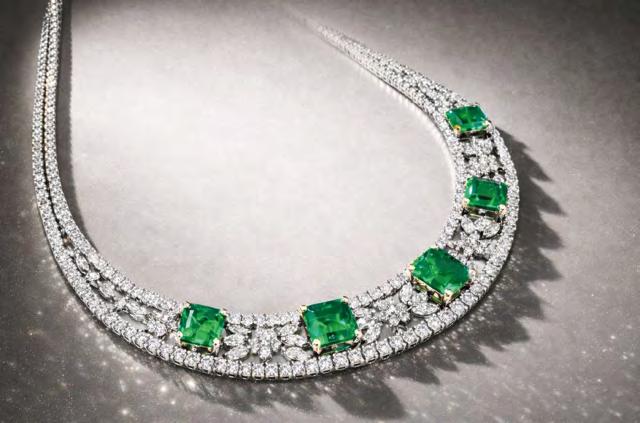
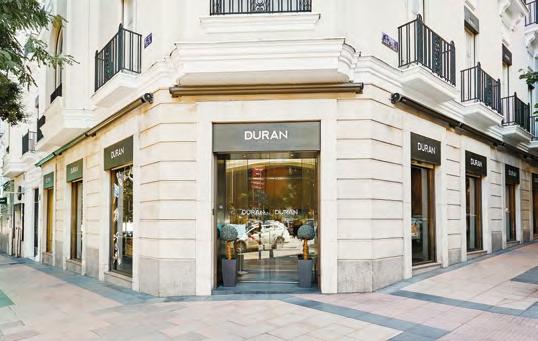
DURÁN, the iconic Spanish silversmith, jeweller and auction house, celebrates its rich history and legacy, firmly established as a benchmark in the world of luxury, jewellery, watchmaking and art.
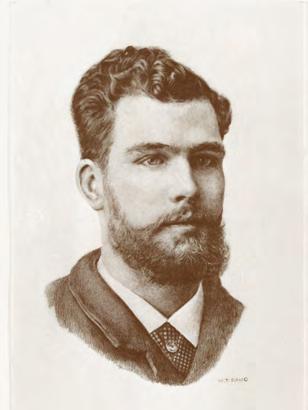
With a trajectory spanning four generations, DURÁN has upheld its commitment to excellence, innovation and tradition, becoming a symbol of luxury and prestige in Spain. Since its founding in 1886 by Pedro Durán Morales, master silversmith and Royal Court artisan, the company has evolved and diversified, encompassing jewellery and watchmaking as well as art, auctions and the design of exclusive pieces.
A LEGACY OF EXCELLENCE
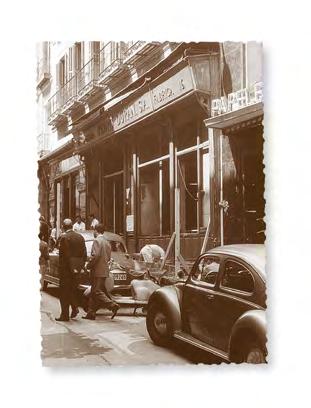
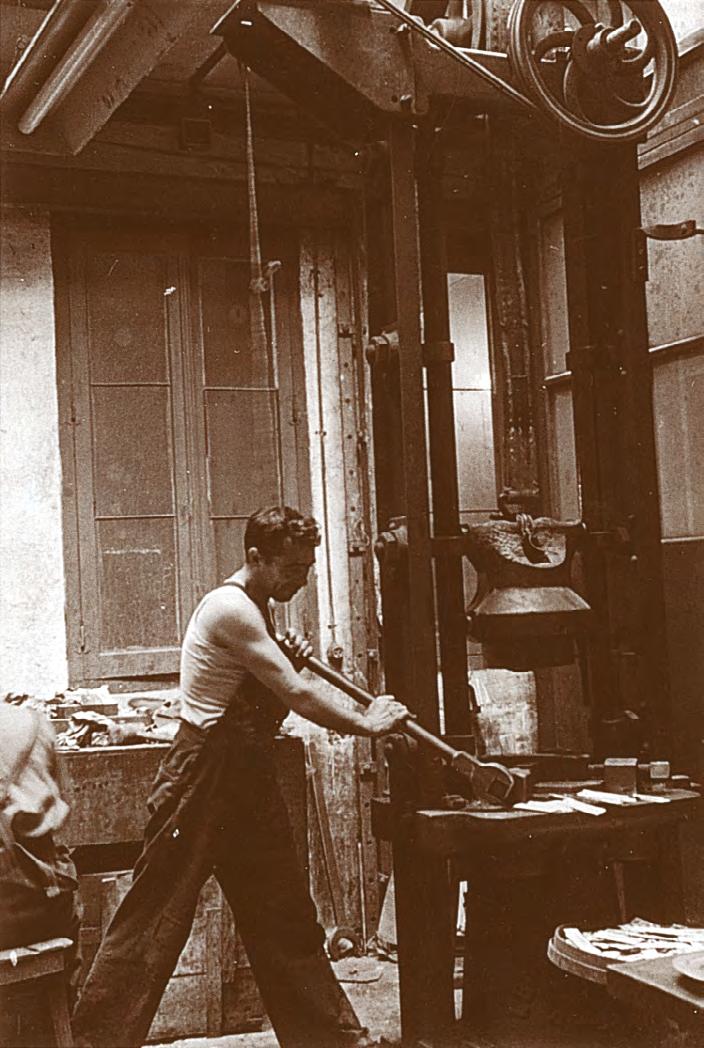
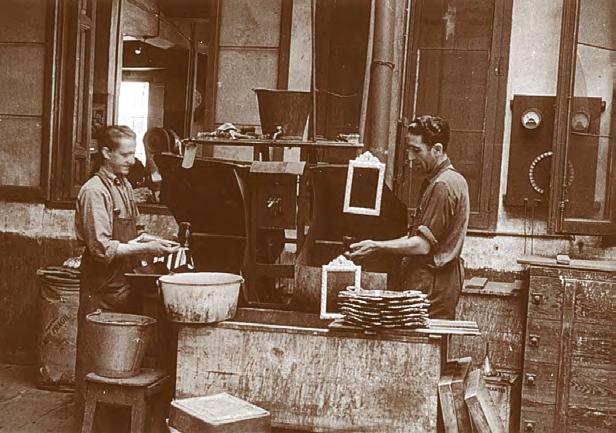
The story of DURÁN began in Santiago de Compostela, where Pedro Durán Morales trained as a silversmith in a workshop at the foot of the cathedral. He later travelled to Madrid and Paris to continue his training, where he encountered new techniques and became a master engraver. In 1886, he opened his own silversmith workshop in Madrid and, in 1899, was appointed supplier to the Royal Household. The second generation, led by Pedro Durán Rey, drove industrial development and consolidated the brand in the fields of silversmithing and jewellery. The third generation oversaw unprecedented growth, marking a milestone in the Spanish art market with the opening of Spain’s first art auction room in 1969.
THE FOURTH GENERATION: DIVERSIFICATION AND LUXURY
Under the leadership of Juan Miguel Albarracín Durán, CEO and Chairman of DURÁN, the company has continued to experience significant growth, embracing diversification and expanding into new markets. Over the years, the company has developed several brands and projects, including Pedro Durán, Durán Joyeros, Durán Arte y Subastas, and its prêtà-porter line Durán Exquse, all of which combine contemporary design with timeless elegance.
MARKET PRESENCE
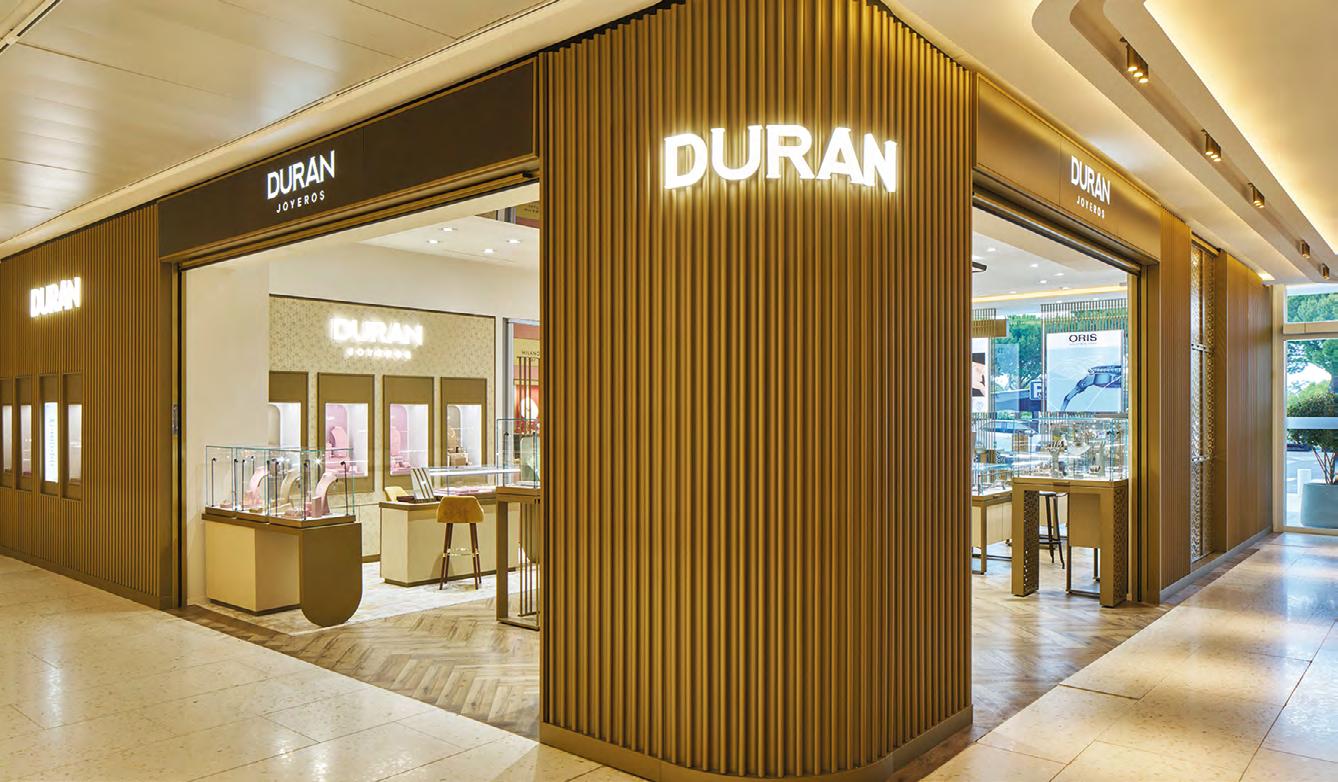
Durán Joyeros operates boutiques in key cities such as Madrid and Valencia, as well as multi-brand boutiques within El Corte Inglés in Marbella and Pozuelo (Madrid).
Durán Joyeros offers creations from its own collections alongside prestigious maisons such as Cartier, Omega, Roberto Coin, Chaumet, Messika, Damiani, Marco Bicego, Norqain, Hamilton, Tissot, Longines o firmas del grupo de lujo Kering (Gucci y Pomellato) among others.
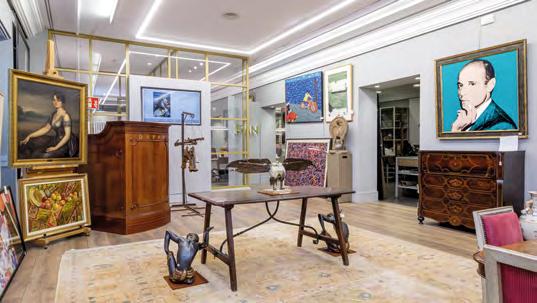
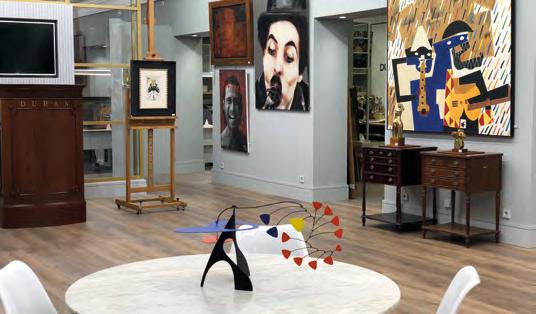
DURÁN has maintained its leadership in the auction world, establishing itself as a reference point for the buying and selling of paintings, contemporary art, decorative arts, jewellery and rare books, while adapting to evolving market trends and expanding its digital presence.
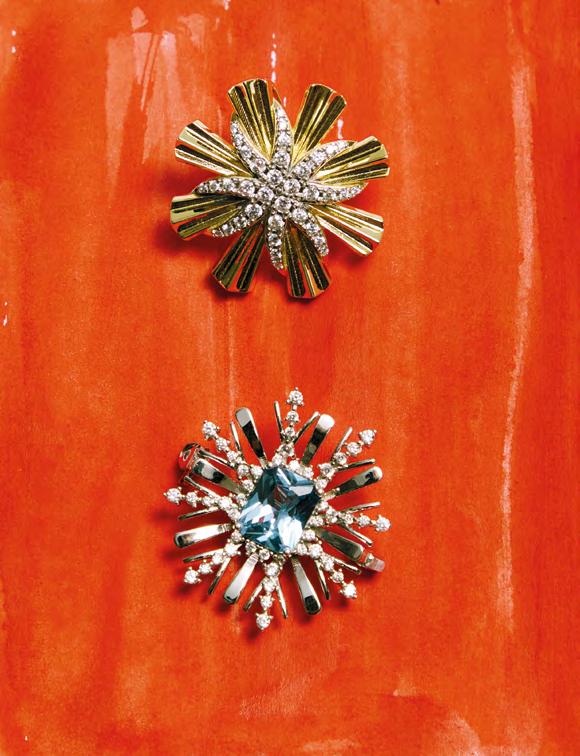
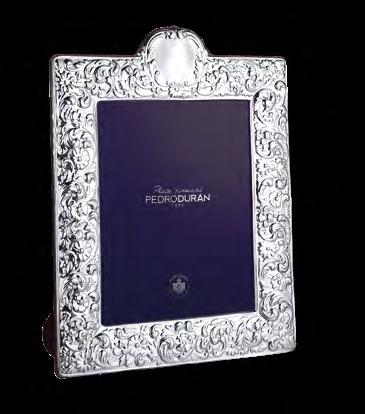
Iconic piece Durán Joyeros
Pedro Durán founder
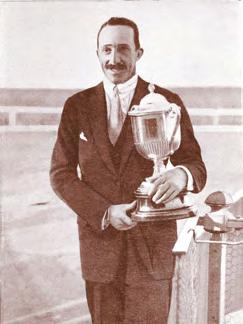
The King Alfonso XIII
Iconic piece Durán Joyeros
Pedro Durán fabric
CELEBRATING 140 YEARS
To mark its 140th anniversary, DURÁN has planned a series of celebratory initiatives throughout the year. Through these, the company seeks to share its legacy and expertise with clients and friends, while continuing to stand as a benchmark in the world of luxury and fine jewellery. With a legacy of excellence that transcends generations, the company will continue to write its story with the same passion and mastery that defined its founder.
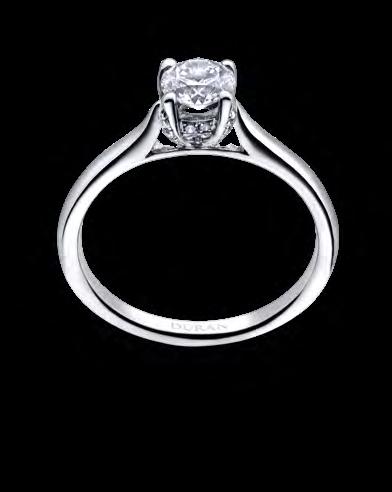
Colección Solitario
Pedro Durán fabric
DURÁN, la icónica platería, joyería y casa de subastas española, celebra su rica historia y legado, consolidándose como un referente en el mundo del lujo, la joyería, la relojería y el arte.
Con una trayectoria que abarca cuatro generaciones, DURÁN ha mantenido su compromiso con la excelencia, la innovación y la tradición, convirtiéndose en un símbolo de lujo y prestigio en España. Desde su fundación en 1886 por Pedro Durán Morales, maestro orfebre y platero de palacio, la empresa ha evolucionado y se ha diversificado, abarcando desde la joyería y relojería hasta el arte, las subastas y el diseño de productos exclusivos.
UN LEGADO DE EXCELENCIA
La historia de DURÁN comenzó en Santiago de Compostela, donde Pedro Durán Morales se formó como platero en un taller a los pies de la catedral. Posteriormente, viajó a Madrid y París para continuar su formación, donde conoció nuevas técnicas y se convirtió en un maestro del cincel. En 1886, abrió su propio taller de platería en Madrid y se convirtió en proveedor de la Casa Real en 1899.
La segunda generación, liderada por Pedro Durán Rey, impulsó el desarrollo industrial y consolidó la marca en el ámbito de la platería y la joyería. La tercera generación protagonizó un crecimiento sin precedentes, marcando un hito en el mercado del arte español con la inauguración de la primera sala de subastas de arte de España en 1969.
Sello del 1º fabricante de Pedro Durán
CELEBRACIÓN DE LOS 140 AÑOS
Con motivo de su 140 aniversario, DURÁN ha preparado diversas acciones de celebración a lo largo del año. La empresa busca así compartir su legado y experiencia con sus clientes y amigos, y seguir siendo un referente en el mundo del lujo y la joyería. Con un legado de excelencia que trasciende generaciones, la empresa continuará escribiendo su historia con la misma pasión y excelencia que su fundador.
Orla
LA CUARTA GENERACIÓN: DIVERSIFICACIÓN Y LUJO
Bajo la dirección de Juan Miguel Albarracín Durán, CEO y presidente de DURÁN, la empresa ha continuado experimentando un crecimiento significativo, apostando por la diversificación y la apertura de nuevos mercados. La empresa ha desarrollado varias marcas y proyectos a lo largo de estos años, como Pedro Durán, Durán Joyeros, Durán Arte y Subastas, y su firma pret a porter Durán Exquse, que combinan diseño contemporáneo y elegancia.
PRESENCIA EN EL MERCADO
Durán Joyeros cuenta con boutiques en ciudades referentes como Madrid y Valencia, así como boutiques multimarca en El Corte Inglés de Marbella y Pozuelo (Madrid).
Durán Joyeros vende piezas de su propia marca, así como de firmas tan importantes como Cartier, Omega, Roberto Coin, Chaumet, Messika, Damiani, Marco Bicego, Norqain, Hamilton, Tissot, Longines o firmas del grupo de lujo Kering (Gucci y Pomellato) entre otras
DURÁN ha mantenido su liderazgo en el mundo de las subastas, consolidándose como un referente en la compra y venta de pinturas, arte contemporánea, artes decorativas, joyas y libros únicos, adaptándose a las nuevas tendencias del mercado y ampliando su presencia en el ámbito digital.
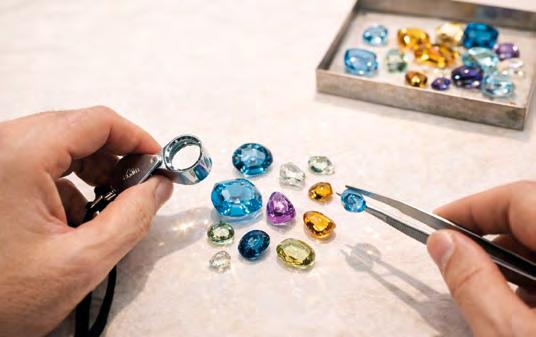
Juan Miguel Albarracín, CEO of DURÁN JOYEROS, at the brand’s workshop during the 73rd Bangkok Gems & Jewelry Fair
Colección
Pedro Durán- Marco adorno pieza iconica
Colección Cintas
Pedro Durán fabrica
Durán Joyeros unveils
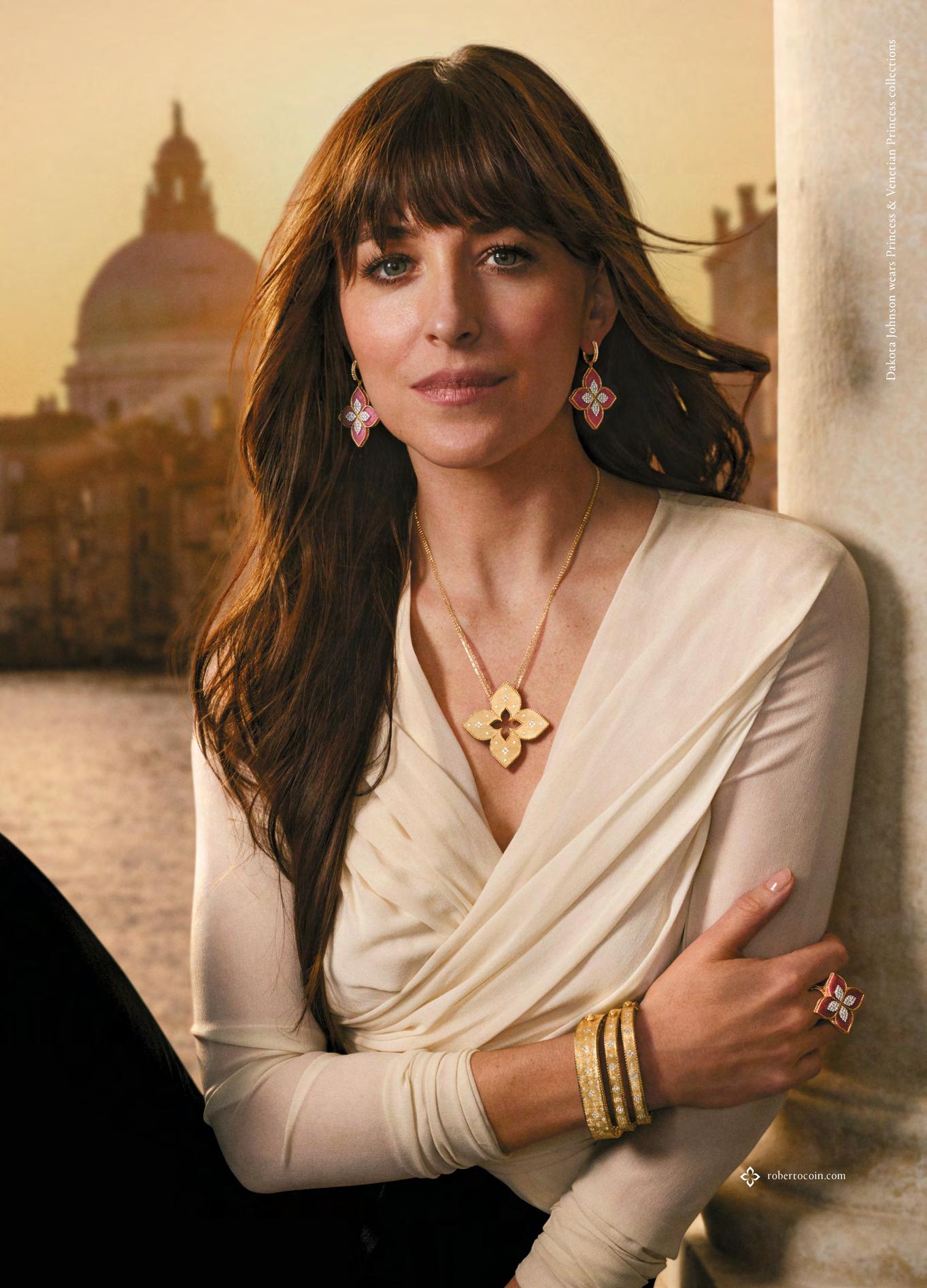
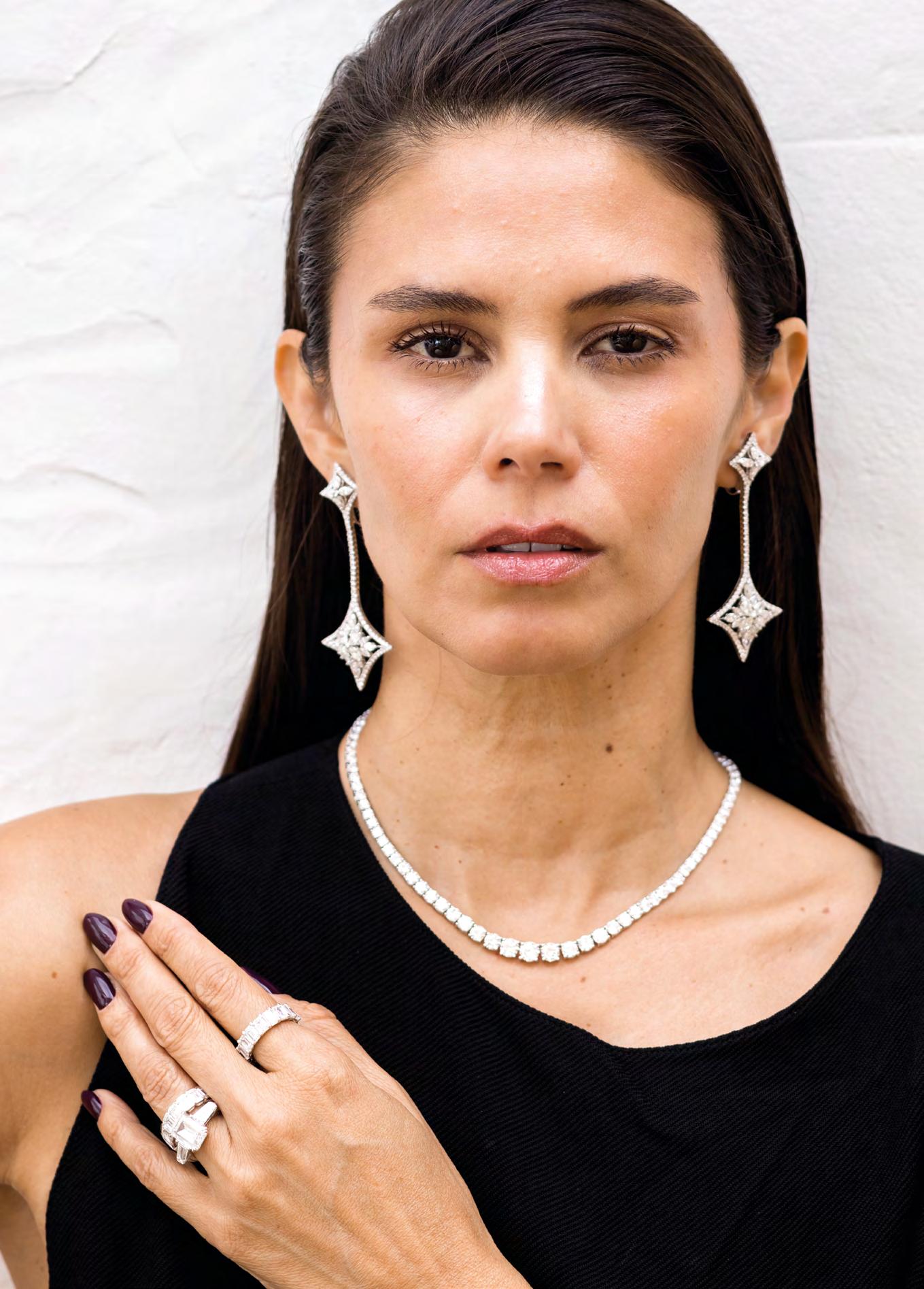
ROBERTO COIN
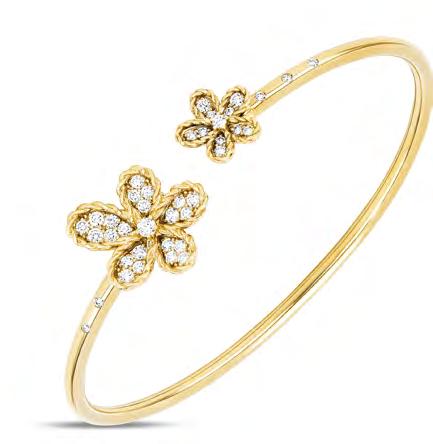
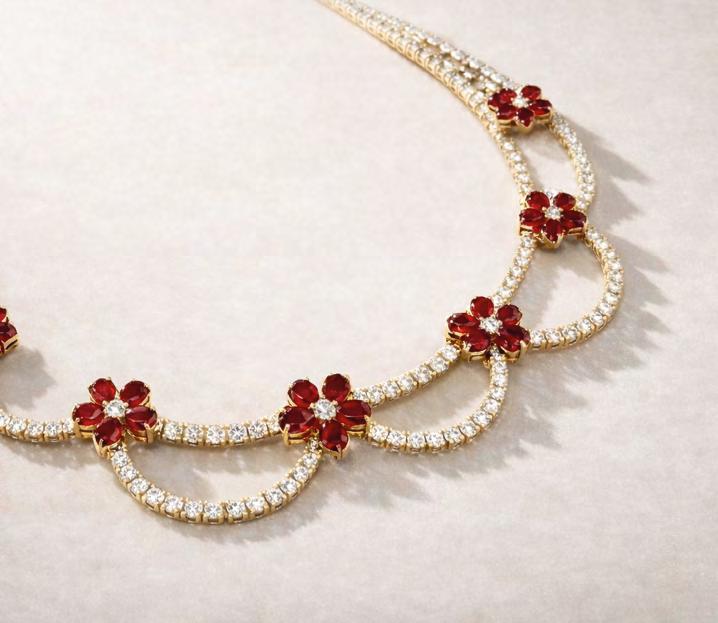
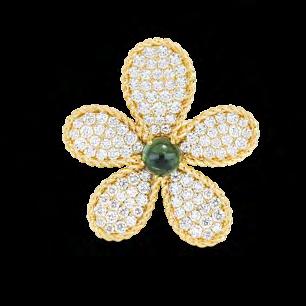
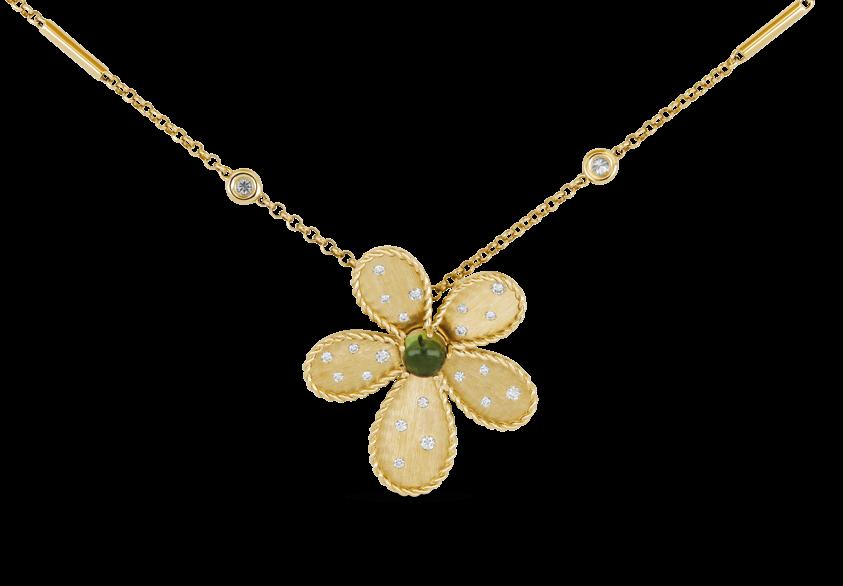
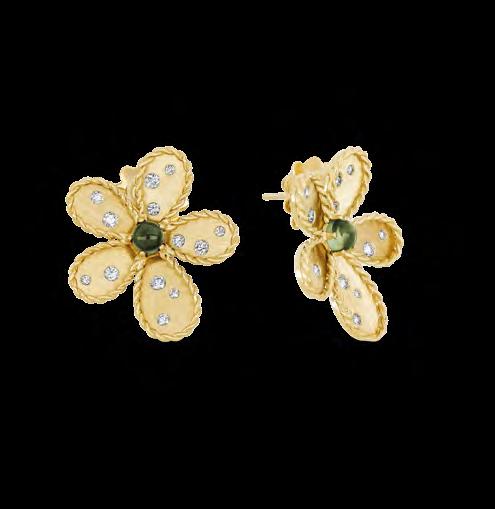
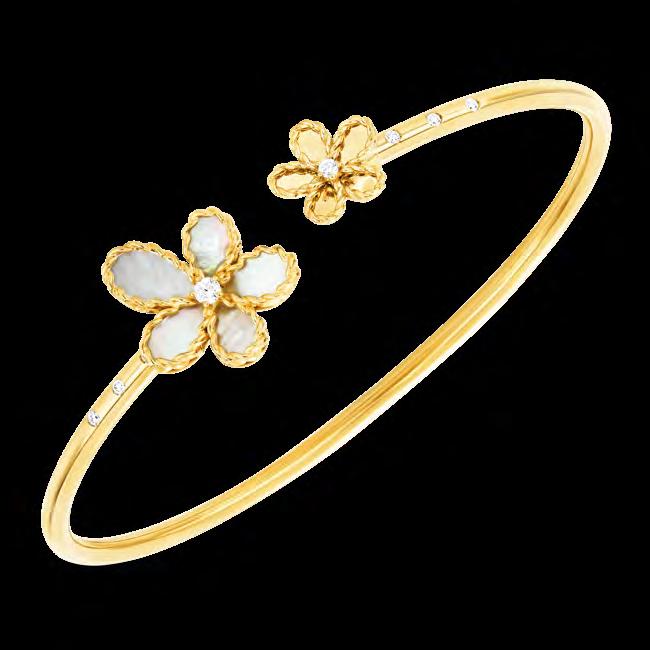
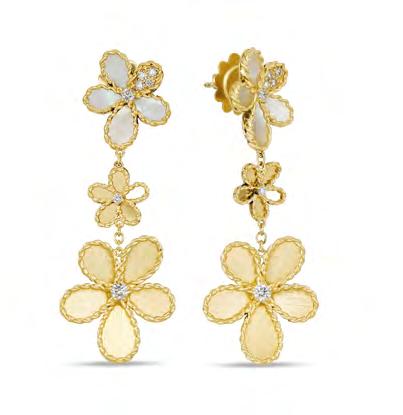
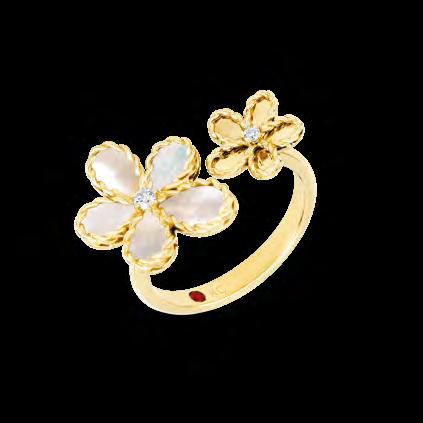
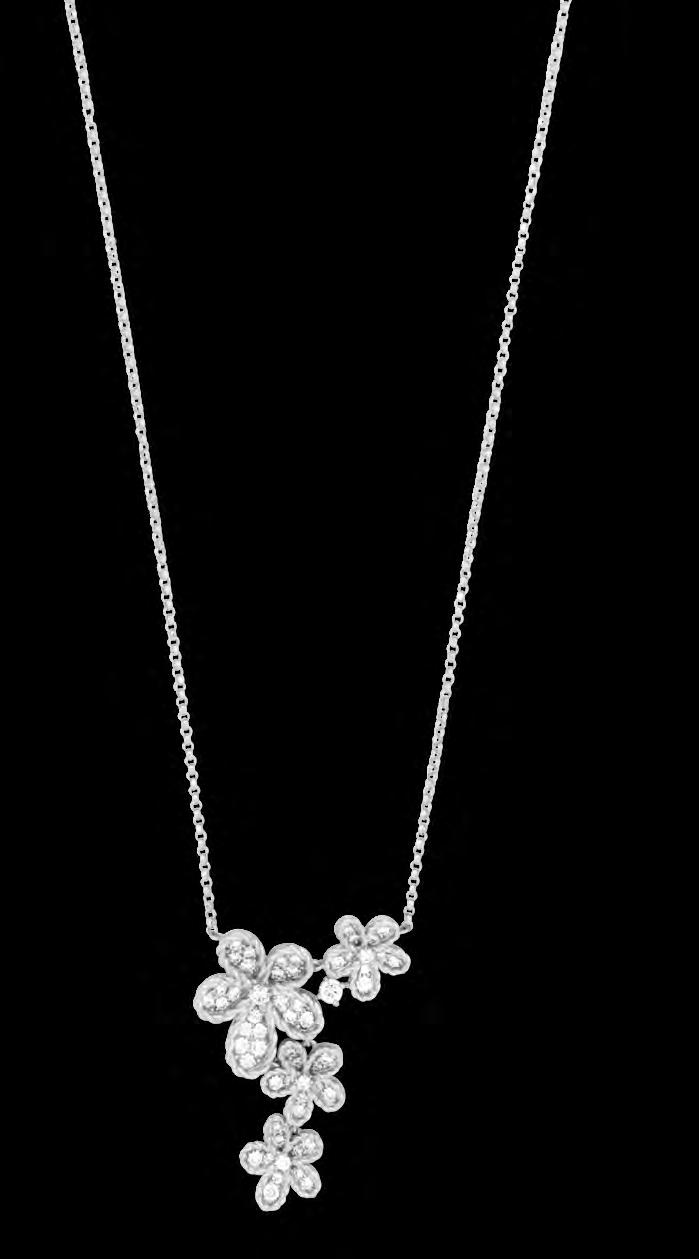
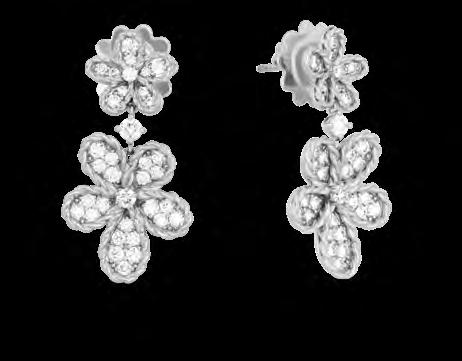
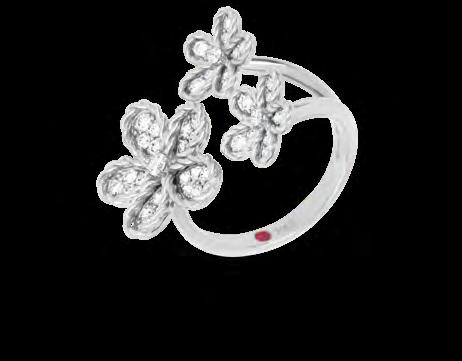
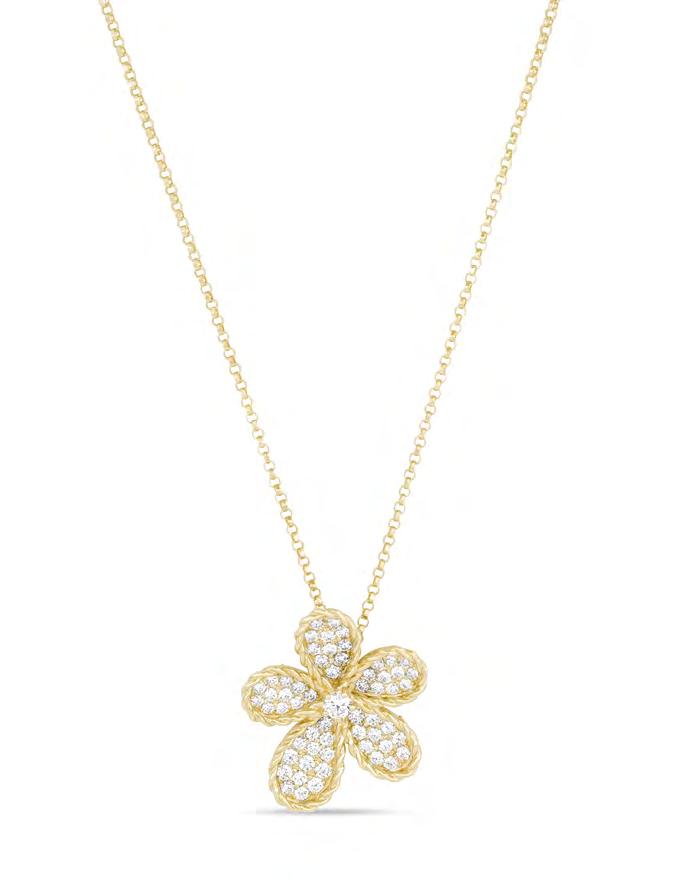
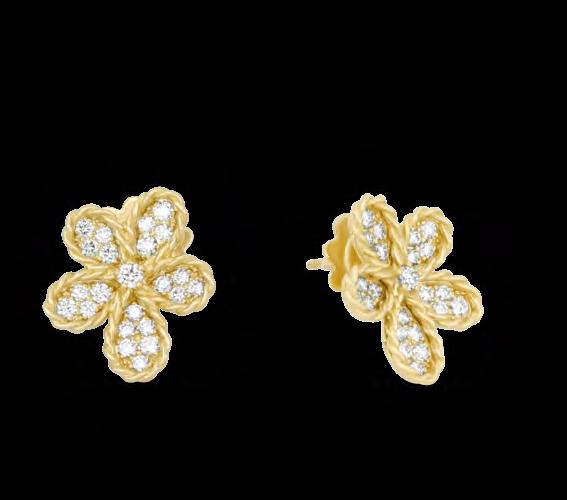
Jasmine Collection
Inspired by the jasmine flower and the timeless spirit of Disney stories, the new line blends delicacy and strength in luminous, versatile pieces designed to captivate every generation.
As lovely and as revolutionary as the Princess of the same name in the Aladdin trilogy.
Jasmine is a new collection in Roberto Coin’s universe, a nod to a number of generations with a simple, refined design suitable for all ages, just like Disney stories, spanning generations and breaking down the limits of time.
As we know, Jasmine is also a flower. Here in Italy is called Gelsomino Bianco and despite its delicate appearance and soft fragrance, its strength makes it nearly invincible in its relationship with the ground. It imposes its presence, climbing and flowering both in winter and in summer – a plant that knows the secret of going beyond the limits.
Roberto Coin conveys this inspiration into a collection whose size and look evokes lightheartedness and luminosity. The design of the petals seems to soften the mother-of-pearl, and the diamonds that illuminate it rest on the surface like a winter dew.
The jewels are easy to wear - a phrase with incredible power, since it means that they’re so appealing that they’ll be liked without any convincing. If luxury came in flavors, the Jasmine collection would be milk toffee, so irresistible that everyone loves it!
DURAN JOYEROS
Goya, 19. 28001. Madrid
DURAN JOYEROS multi-brand boutique
El Corte Inglés C.C. Marbella. Ramón Areces, s/n Nueva Andalucía. 29660. Marbella
PALACIO DE VILLAPANÉS
ELEGANCE THAT ENDURES THROUGH TIME AND BECOMES A LUXURY HOTEL IN THE CITY OF SEVILLE
LA ELEGANCIA QUE PERDURA EN EL TIEMPO Y SE CONVIERTE EN UN HOTEL DE LUJO EN LA CIUDAD DE SEVILLA
TEXT: BY MARIBEL MARTÍNEZ
A LITTLE HISTORY
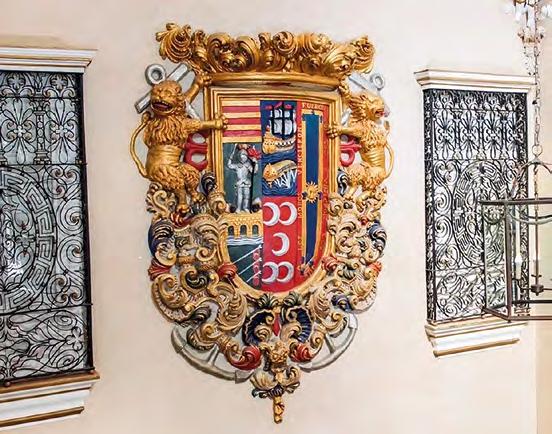
The Palace of the Marquises of Villapanés, regarded as a jewel of Sevillian Baroque, was built in 1728 as the residence of Admiral Manuel López Pintado. Through successive inheritances, the titles of the Marquises of Estrada and the Marquises of Villapanés were incorporated, the latter giving the Palace its name at the beginning of the 19th century.
Today, this building is considered one of the finest examples of Baroque architecture in the city. It enjoys a strategic location in the Santa Catalina district, at Calle Santiago No. 31. The building was acquired by a hotel group in 2006 and, in 2009, was declared an Asset of Cultural Interest. It is currently owned by CoolRooms Hotels.
A HISTORIC JEWEL DECORATED BY PATRICIA
URQUIOLA
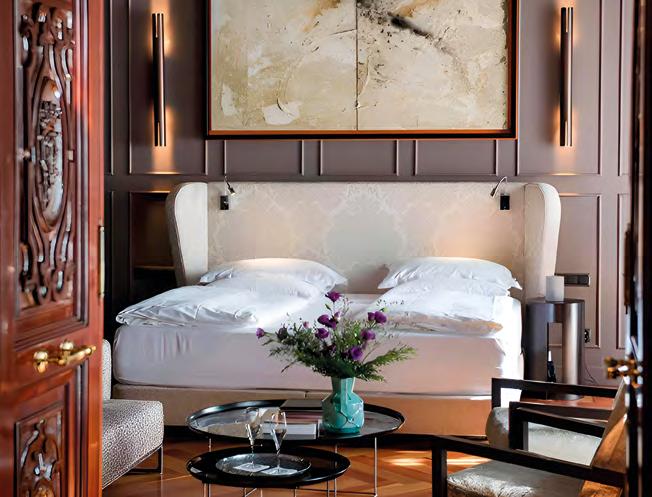
GCA Arquitectos and Patricia Urquiola formed the creative team behind this palace turned luxury hotel, where 18th-century tiles coexist with designer furniture and iconic pieces by Philippe Starck,
in an interior design project that elevates the contrast between past and present to an art form. Among its treasures, the Torreón Suite shines with a light of its own, located in the palace’s former dome: 85 m² with a private terrace and panoramic views over Seville’s rooftops and bell towers, presided over by a 19th-century marble bathtub.
The hotel has 50 rooms, where period details have been preserved, including immense ceilings, cast-iron pillars and tall wooden doors.
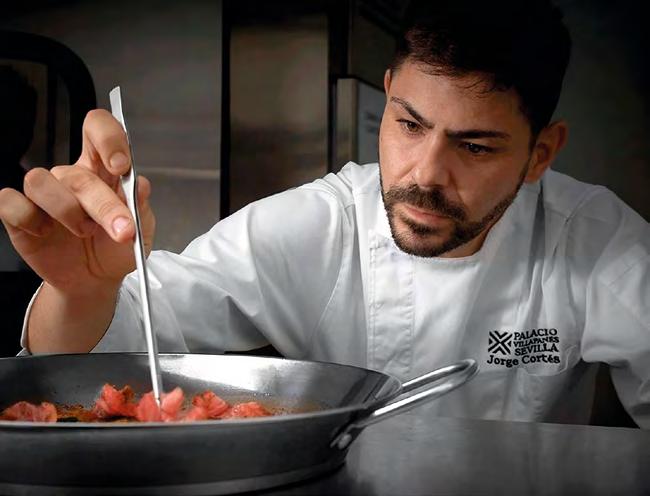
JORGE CORTÉS AT LOS RINCONES DEL MARQUÉS RESTAURANT
Jorge Cortés presents a proposal of contemporary Sevillian gastronomy with Andalusian flavours, accompanied by a wine selection capable of surprising guests with its creativity and wealth of nuances, alongside a menu that recreates the essence of Mediterranean cuisine.
Los Rincones del Marqués is a living part of the history, culture and traditions of its surroundings. A memorable experience for those seeking the true art of gastronomy.
UN POCO DE HISTORIA
El palacio de los marqueses de Villapanés, considerado una Joya del barroco sevillano, fue construido en el año 1728 como residencia del Almirante Manuel López Pintado. Tras sucesivas herencias se fueron incorporando los títulos de los Marqueses de Estrada y de los Marqueses de Villapanés , título por el que se cambió el nombre del Palacio a principios del siglo XIX.Este edificio hoy en día es considerado como una de las principales manifestaciones de arquitectura del barroco en la ciudad .Cuenta con una ubicación estratégica en el barrio de Santa Catalina en la calle Santiago n.º 31.El edificio fue adquirido por una cadena hotelera en el año 2006 y declarado en el año 2009 de bien cultural de interés cultural. En la actualidad es propiedad CoolRooms.Hotels.
UNA JOYA HISTÓRICA DECORADA POR PATRICIA
URQUIOLA
GCA Arquitectos y Patricia Urquiola han sido el equipo creativo de este palacio convertido en hotel de lujo donde los azulejos del XVIII conviven con mobiliario de autor y piezas icónicas de Philippe Starck, en un proyecto de interiorismo que eleva el contraste entre pasado y presente a un arte. Entre ellas brilla con luz propia la Suite Torreón, en la antigua cúpula del palacio: 85 m² con terraza privada y vistas panorámicas sobre los tejados y campanarios de Sevilla, presidida por una bañera de mármol del siglo XIX. El hotel cuenta con 50 habitaciones donde se conservan los detalles de la época como enormes techos, pilares de hierro fundido y puertas altas de madera.
JORGE CORTÉS EN EL RESTAURANTE LOS RINCONES DEL MARQUÉS
Jorge Cortés nos presenta una propuesta de gastronomía sevillana contemporánea de sabores andaluces con una selección de vinos capaz de sorprender por su creatividad llena de matices con una carta que recrea la esencia de la cocina mediterránea. Los Rincones del Marqués es parte viva de la historia, la cultura y las tradiciones del lugar. Una experiencia memorable para quien busca el verdadero arte de la gastronomía.
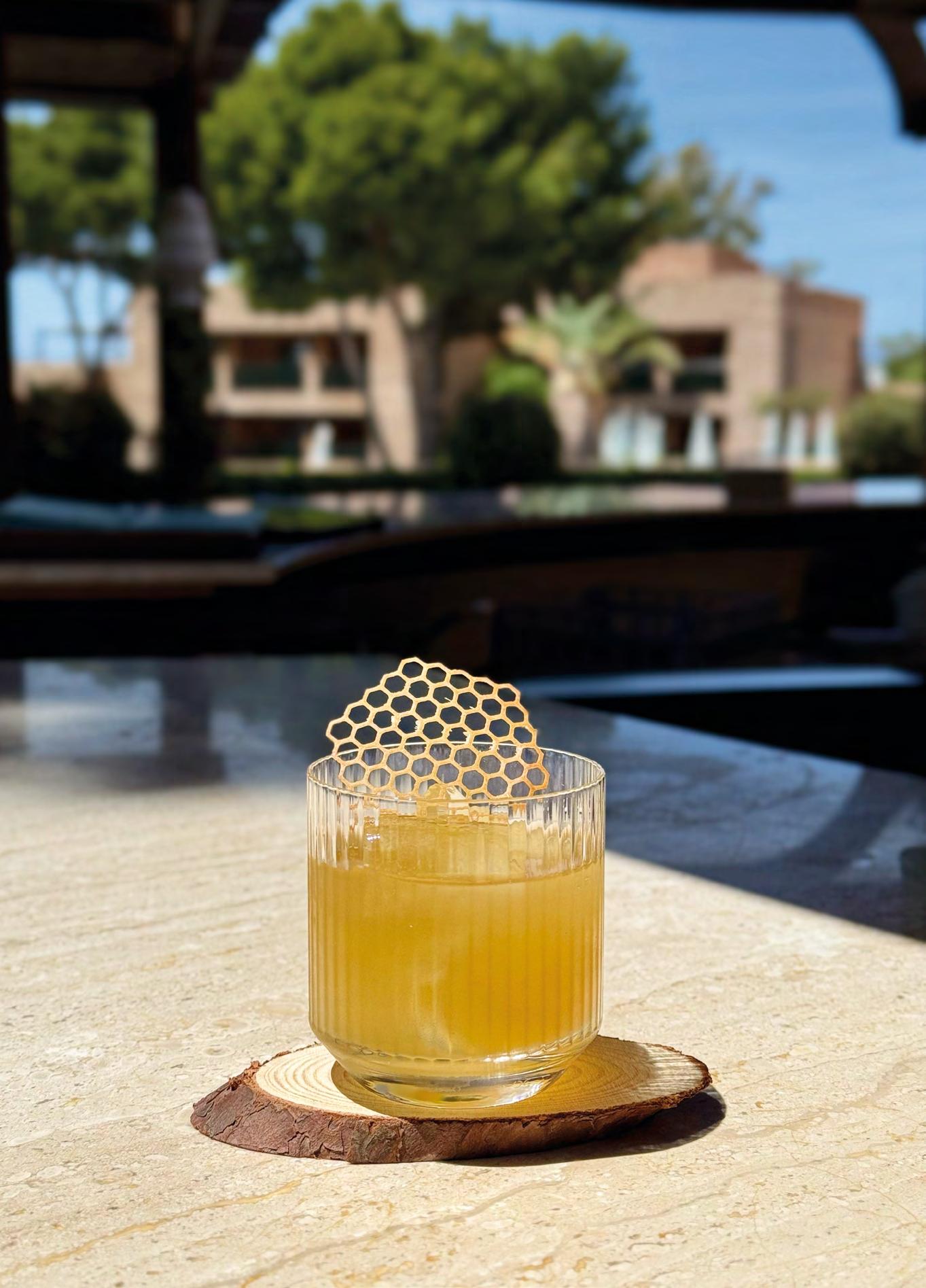
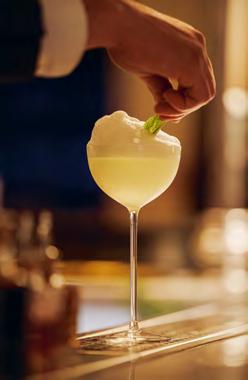
Inspired by Málaga’s slower rhythm, Bee’s Side is a cocktail built around warmth and balance. The honey comes from Frigiliana, Málaga, delivered fresh each week by local beekeepers, bringing a soft, rounded sweetness that reflects the surrounding landscape.
Layered with gentle camomile and a touch of ginger for a subtle lift, it’s smooth and quietly vibrant—an easy, elegant drink that invites you to slow down and enjoy the moment.
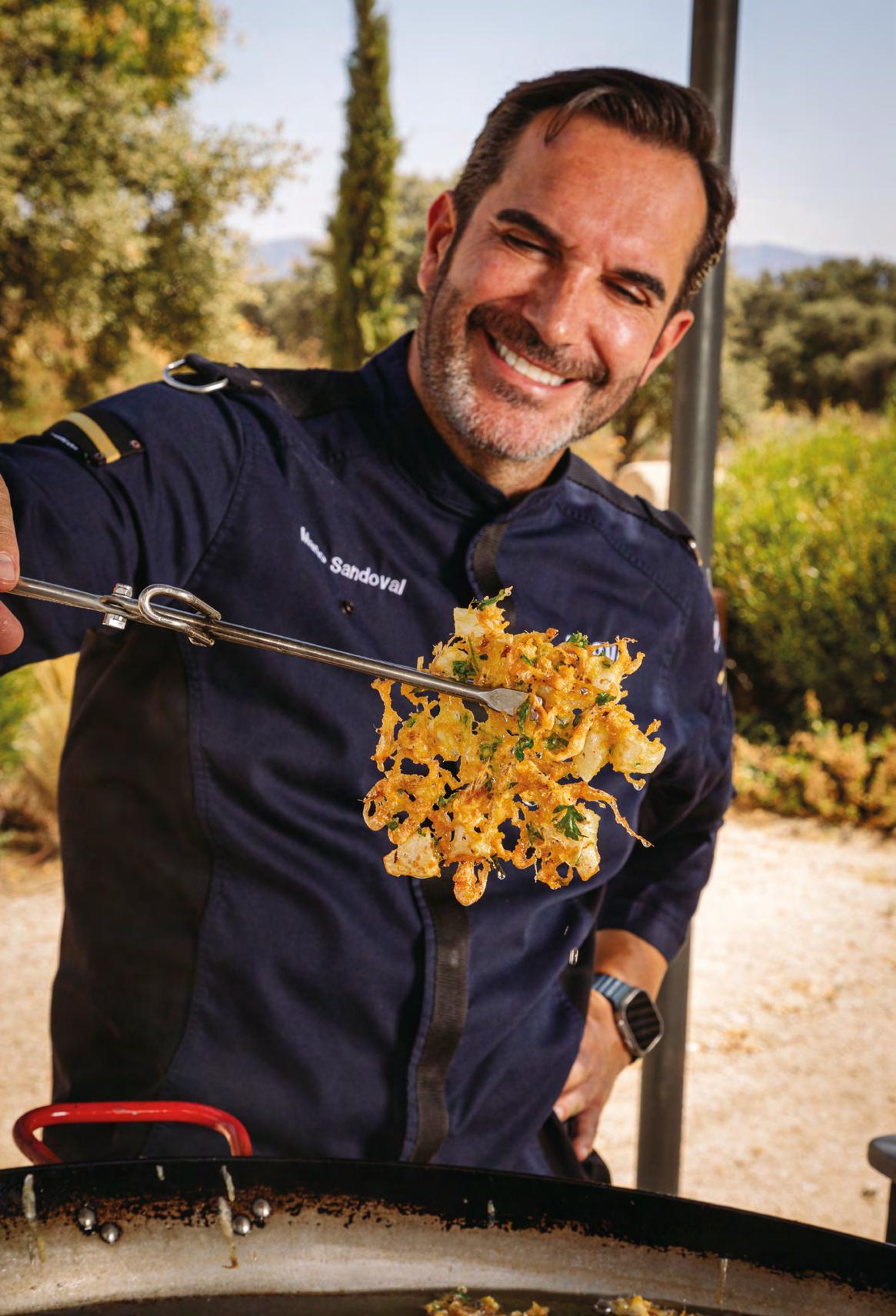
Chef Mario Sandoval
EL JARAL DE LA MIRA
THE EXCLUSIVE ESTATE FOR WEDDINGS AND LARGE-SCALE EVENTS BY THE SANDOVAL BROTHERS
LA EXCLUSIVA FINCA DE BODAS Y EVENTOS DE GRAN ENVERGADURA DE LOS HERMANOS SANDOVAL
“El Jaral de la Mira represents our passion for gastronomy and hospitality, elevated to the scale of an unforgettable event. We want every wedding and celebration here to be unique, memorable and infused with our essence,” affirm the Sandoval brothers
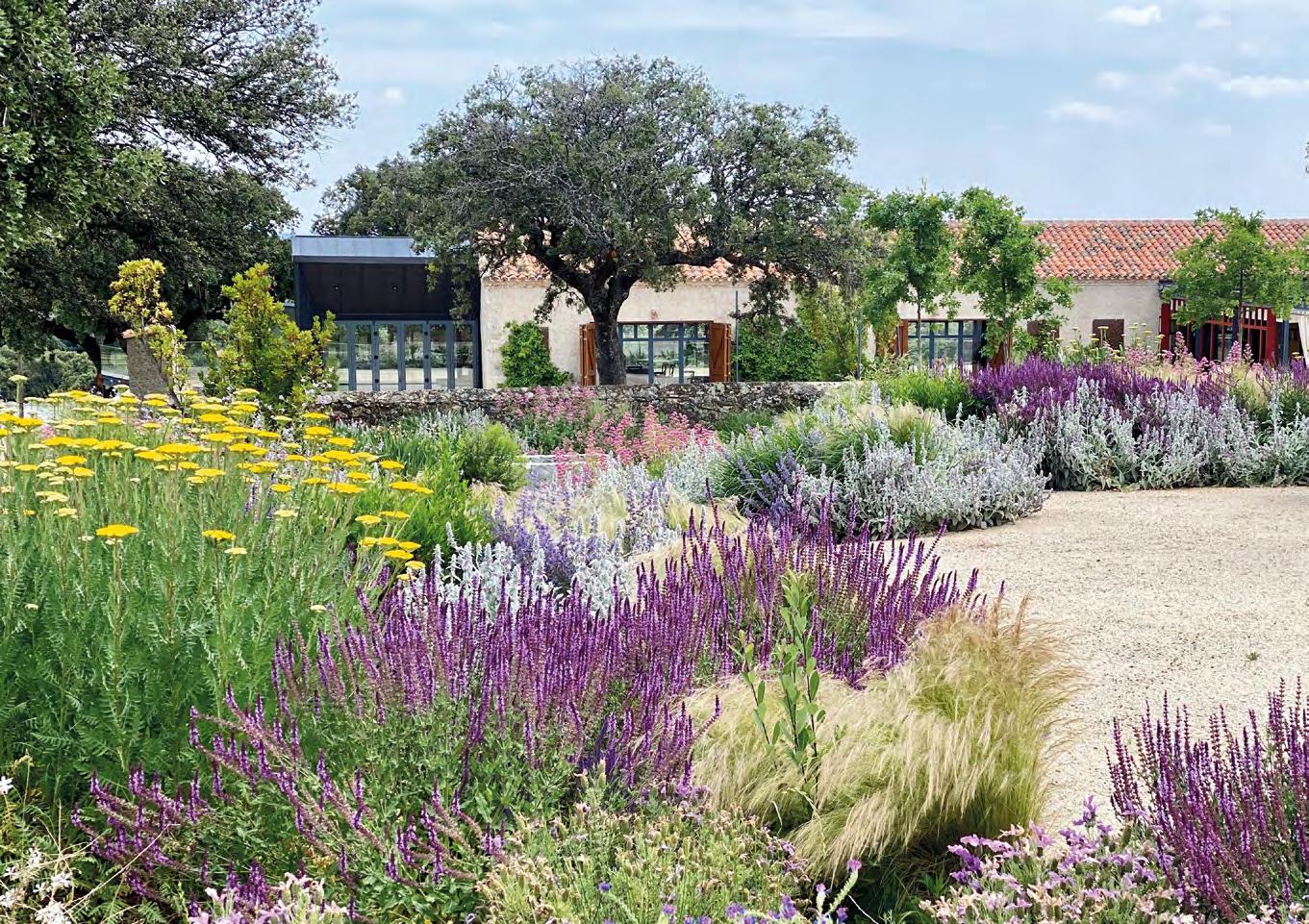
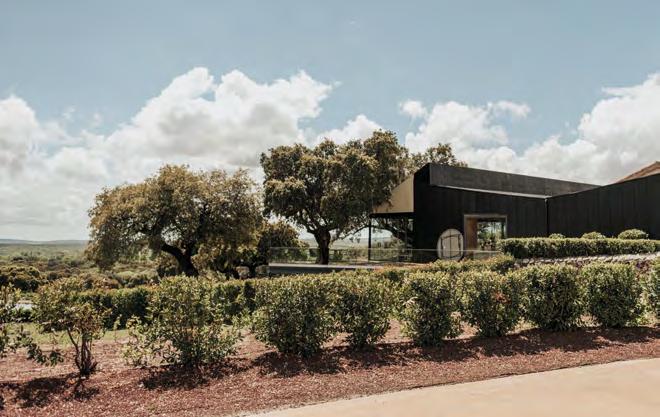
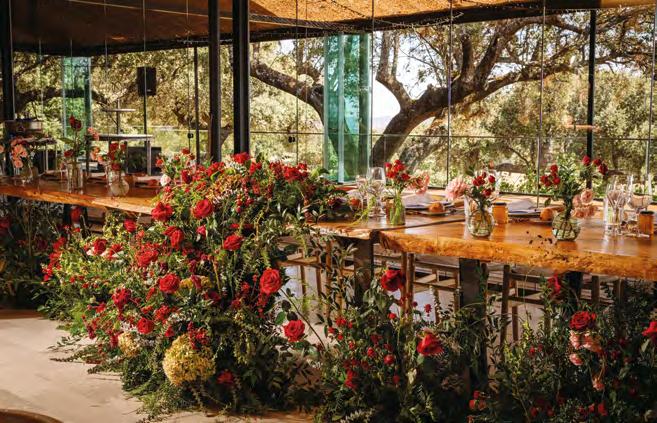
The Sandoval brothers—undisputed benchmarks of haute cuisine and luxury hospitality in Spain—present El Jaral de la Mira, a singular estate conceived to host exclusive weddings and high-profile events in an incomparable natural setting. Nestled in the heart of the Sierra de Madrid, the estate seamlessly blends stately architecture, dreamlike gardens and privileged views, creating an idyllic backdrop for truly memorable celebrations. Every corner of El Jaral de la Mira has been thoughtfully designed to deliver a magical experience, where nature, gastronomy and bespoke service come together in perfect harmony.
A UNIQUE VISION BY THE SANDOVAL BROTHERS
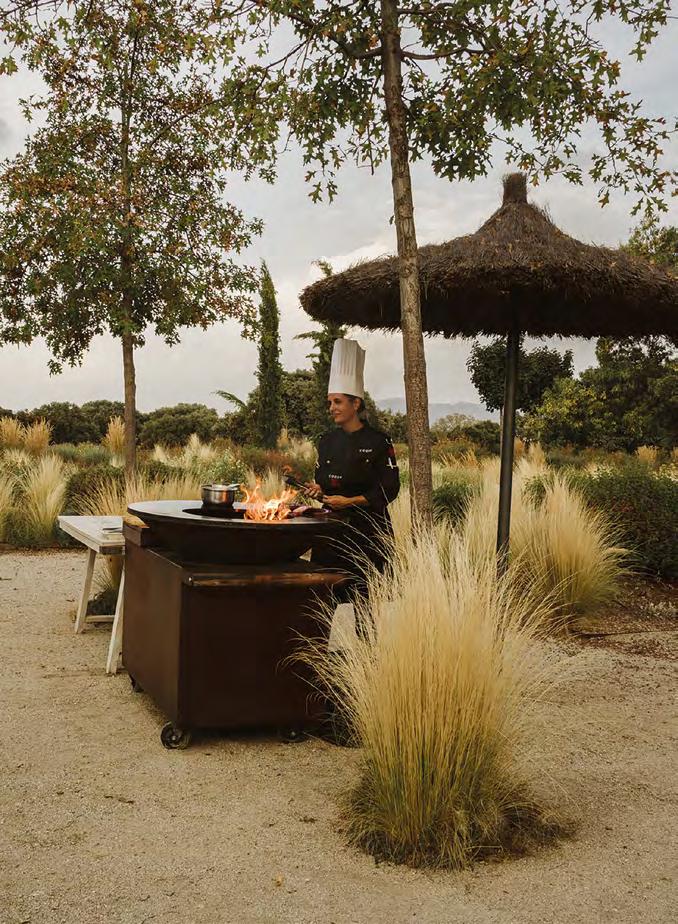
Building on the established excellence of their restaurant Coque (2 Michelin Stars, 3 Repsol Suns), the Sandoval brothers now extend their vision to large-scale events: Mario Sandoval, an internationally renowned chef, curates the gastronomic offering, merging tradition and innovation through tailor-made menus. Rafael Sandoval, sommelier, contributes his oenological expertise with a refined selection of signature wines and exclusive pairings. Diego Sandoval, responsible for front-of-house and the overall hospitality experience, ensures impeccable and highly personalised service down to the finest detail.
A PRIVILEGED SETTING FOR GRAND CELEBRATIONS
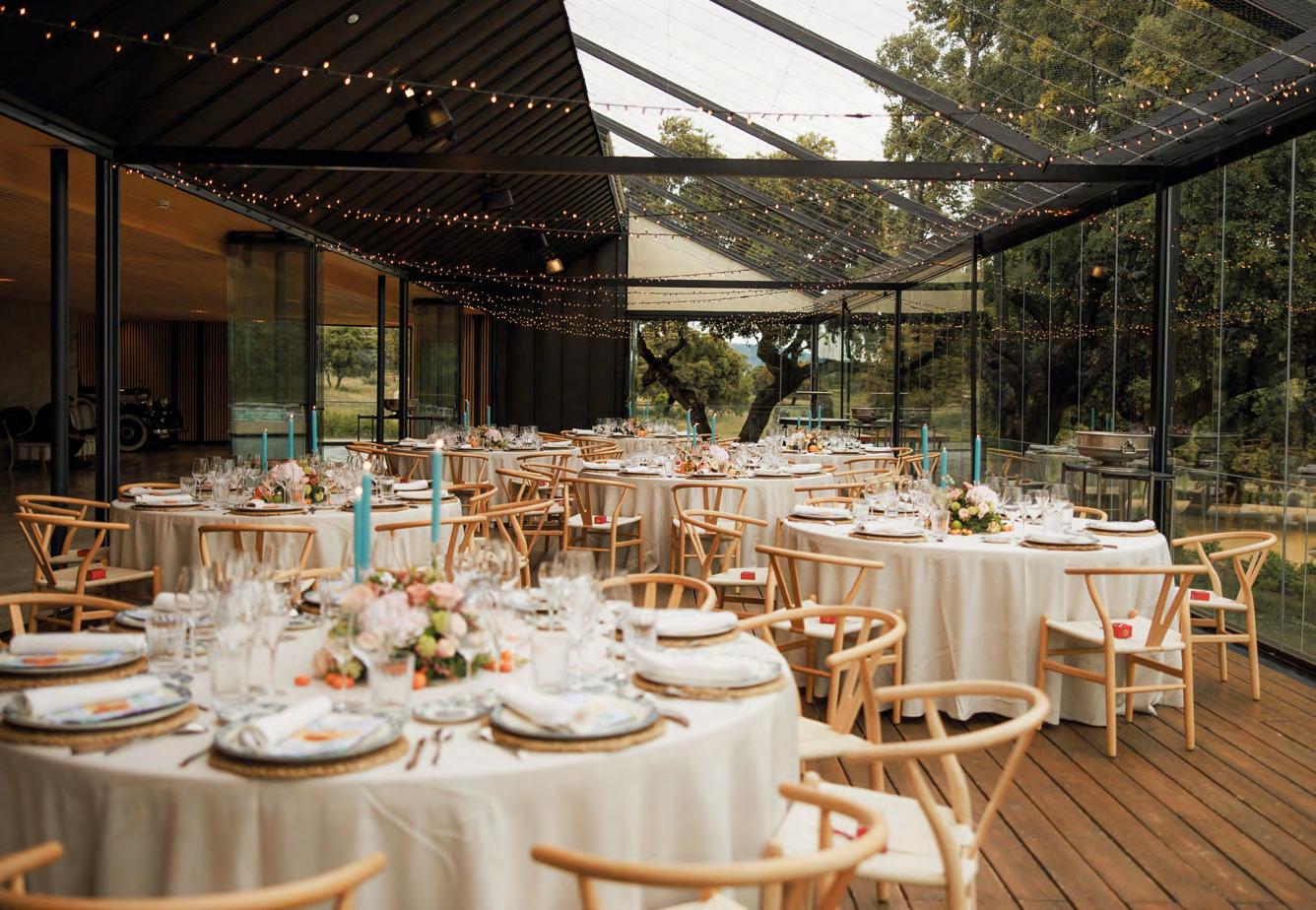
El Jaral de la Mira offers expansive and versatile spaces, both indoors and outdoors, capable of hosting large weddings, corporate events and celebrations of considerable scale. Its elegant salons, landscaped gardens and outdoor areas allow each event to be fully customised, ensuring a unique experience tailored to the hosts’ vision.
SPECIAL OFFERS FOR 2026 AND 2027
To facilitate the planning of large celebrations, El Jaral de la Mira introduces exclusive packages with special pricing for Sundays in 2026, as well as for weekends in January and February 2027. A rare opportunity to experience Sandoval excellence in a privileged setting under advantageous conditions. “EL JARAL DE LA MIRA represents our passion for gastronomy and hospitality, elevated to the scale of an unforgettable event. We want every wedding and celebration here to be unique, memorable and infused with our essence,” affirm the Sandoval brothers.
ABOUT THE SANDOVAL BROTHERS
The Sandoval brothers are the family behind Coque Madrid, a restaurant awarded 2 Michelin Stars and 3 Repsol Suns. Renowned for their innovation, excellence and commitment to tradition, they have become an undisputed reference in Spanish haute cuisine.
Address: Exit 47 of the La Coruña Road, Km 14. (In front of Valle de los Caidos entrance) San Lorenzo de El Escorial (Madrid) www.jaraldelamira.com / info@jaraldelamira.com
Tel.: +34 648 716 727
Los hermanos Sandoval son indudablemente referentes de la alta gastronomía y la hospitalidad de lujo en España, presentan El Jaral de la Mira, una finca única destinada a acoger bodas y eventos exclusivos en un entorno natural incomparable.
Ubicada en plena Sierra de Madrid, la finca combina arquitectura señorial, jardines de ensueño y unas vistas privilegiadas, creando un escenario idílico para celebraciones memorables. Cada rincón de El Jaral de la Mira ha sido concebido para ofrecer una experiencia mágica, donde la naturaleza, la gastronomía y el servicio personalizado se unen en perfecta armonía.
UNA PROPUESTA ÚNICA
DE LOS HERMANOS
SANDOVAL
Consolidada la excelencia de su restaurante Coque (2 Estrellas Michelin, 3 Soles Repsol), los hermanos Sandoval trasladan ahora su visión a los grandes eventos: Mario Sandoval, chef de renombre internacional, firma la propuesta gastronómica, que fusiona tradición e innovación con menús diseñados a medida.Rafael Sandoval, sumiller, aporta su experiencia enológica con una selección de vinos de autor y maridajes exclusivos.Diego Sandoval, responsable de sala y de la experiencia de hospitalidad, asegura una atención impecable y personalizada en cada detalle.
UN ENCLAVE PRIVILEGIADO PARA GRANDES CELEBRACIONES
El Jaral de la Mira ofrece espacios amplios y versátiles, tanto en interiores como en exteriores, capaces de acoger bodas multitudinarias, eventos corporativos y celebraciones de gran envergadura. Los salones, jardines y zonas ajardinadas permiten personalizar cada evento para que sea único y adaptado a los deseos de los anfitriones.
Ofertas especiales para 2026 y 2027
Con el objetivo de facilitar la organización de grandes celebraciones, El Jaral de la Mira lanza packs cerrados con precios especiales para los domingos de 2026, así como para los fines de semana de enero y febrero de 2027. Una oportunidad exclusiva para disfrutar de la excelencia Sandoval en un entorno privilegiado con condiciones ventajosas.
“El Jaral de la Mira representa nuestra pasión por la gastronomía y la hospitalidad, pero llevada a la escala de un evento inolvidable. Queremos que cada boda y cada celebración aquí sean únicas, memorables y con nuestra esencia”, afirman los hermanos Sandoval.
SOBRE LOS HERMANOS SANDOVAL
Los hermanos Sandoval son la familia al frente de Coque Madrid, restaurante distinguido con 2 Estrellas Michelin y 3
Soles Repsol. Reconocidos por su capacidad de innovación, excelencia y compromiso con la tradición, se han convertido en un referente indiscutible de la alta gastronomía española.
Dirección: Salida 47 carretera a La Coruña, Km 14.
(Frente a la entrada del Valle de los Caidos)
San Lorenzo de El Escorial (Madrid) www.jaraldelamira.com / info@jaraldelamira.com
Tel.: +34 648 716 727
BOHO CLUB
WHERE MARBELLA REVEALS ITS TRUEST SELF
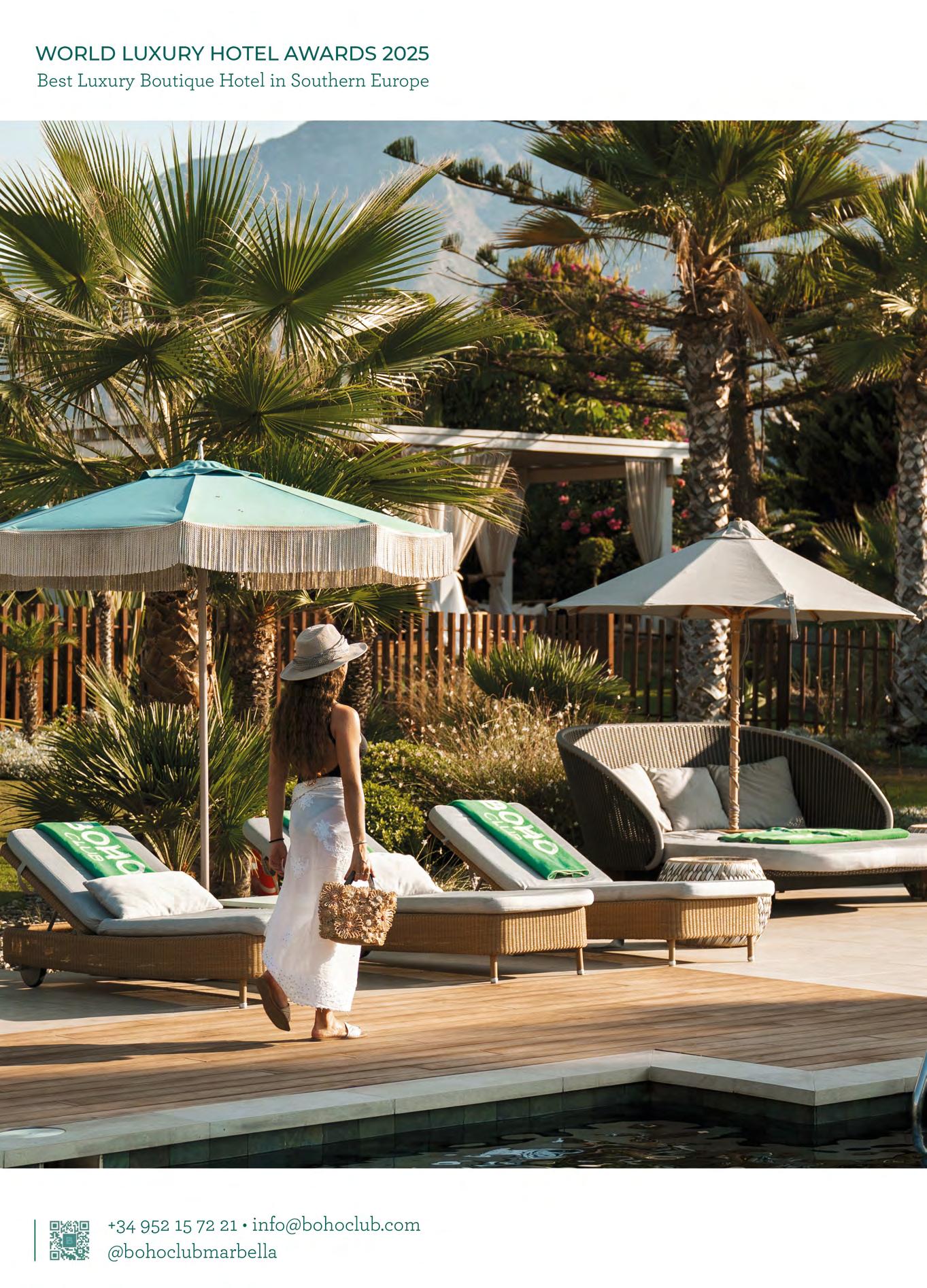
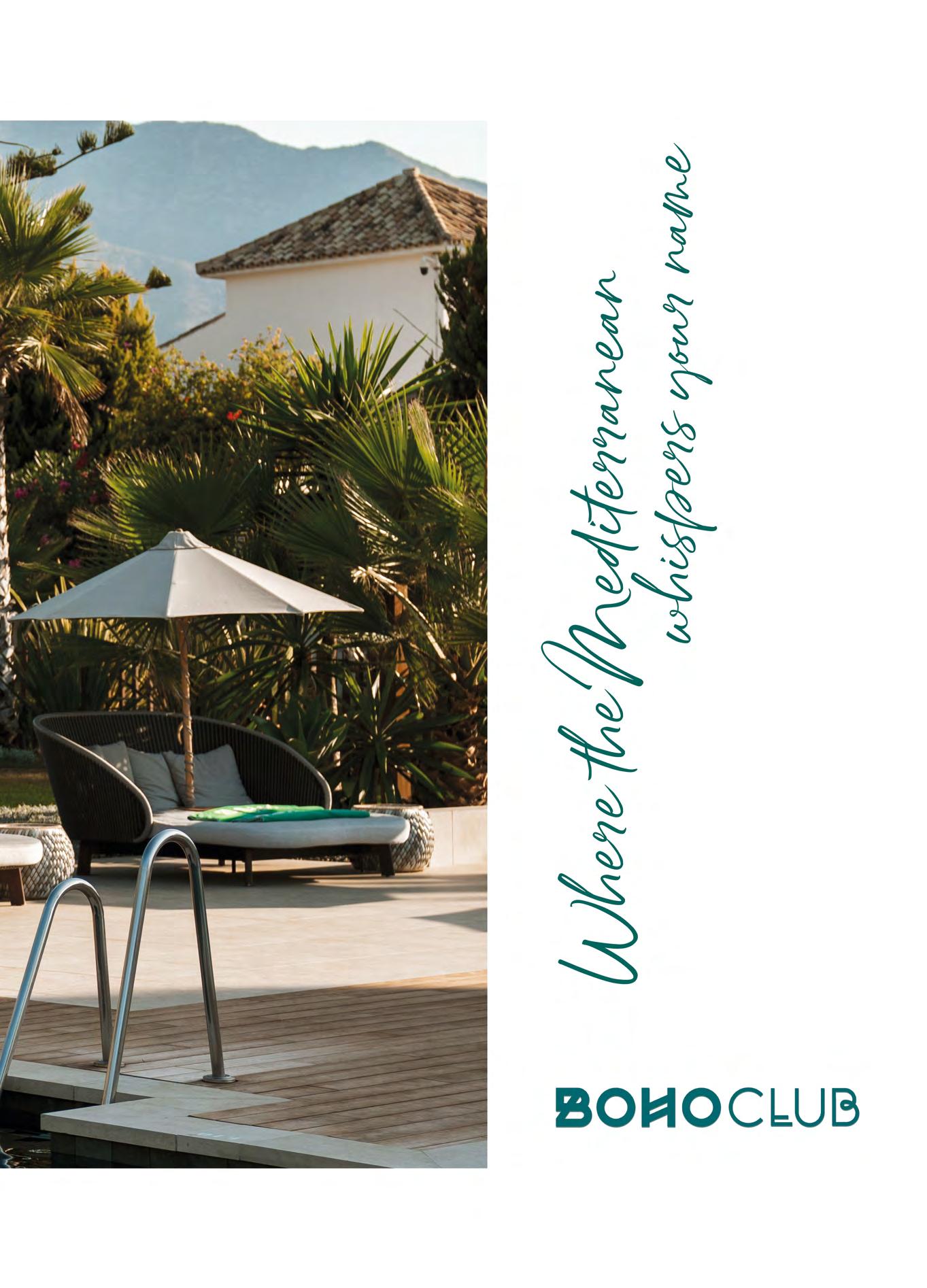
There’s a moment at Boho Club that no itinerary prepares you for. The afternoon light shifts from white to gold, the terrace hums with quiet conversation, and you realise you’ve stopped counting the hours. That feeling, unhurried, alive, impossibly warm, is the entire point.
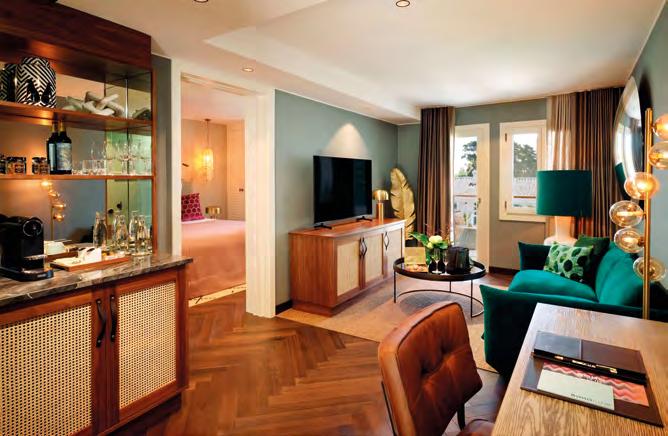
Set along Marbella’s Golden Mile, Boho Club is a boutique hotel that refuses to behave like one. The interiors tell a story in every corner, herringbone floors, botanical walls, brass accents, and a reception desk carved from pink onyx that sets the tone before you’ve even reached your room. The rooms and bungalow suites feel less like accommodation and more like a beautifully put-together home. Eclectic art, natural textures, soft linen. Every piece handpicked, every corner has its own quiet story.
The kitchen is in the hands of Diego del Río, a Málaga-born Michelin-starred chef trained at Le Cordon Bleu, whose cooking is Mediterranean at its core, seasonal, honest and rooted in good produce. It starts at breakfast, awarded best in Spain at Madrid
Fusión, and only gets better from there. Boho Restaurant is the kind of place where the food does the talking and nobody is in any rush to leave. Down in the gardens, Bungalow 21 sits beneath La Concha with a diff erent energy altogether, a kitchen that cooks with fire and smoke, long lunches that drift into golden evenings, and a mood that tilts towards the unhurried summers of 1970s Marbella.
Boho Wellness exists in quiet contrast to all of this. A space built around the idea that proper rest takes time, with immersive treatments, biohacking technology, yoga and meditation designed not just to relax but to genuinely restore. At the end of May, the hotel hosts Back to Nature & Inner Strength, a retreat that pulls you away from the noise and back into yourself. Self-care here isn’t a trend. It’s a ritual.
What makes Boho Club difficult to describe is precisely what makes it worth discovering. It’s not a resort. It’s not a scene. It’s a place with a soul, one that invites you in, pours you a glass, and makes you feel like you’ve always belonged.
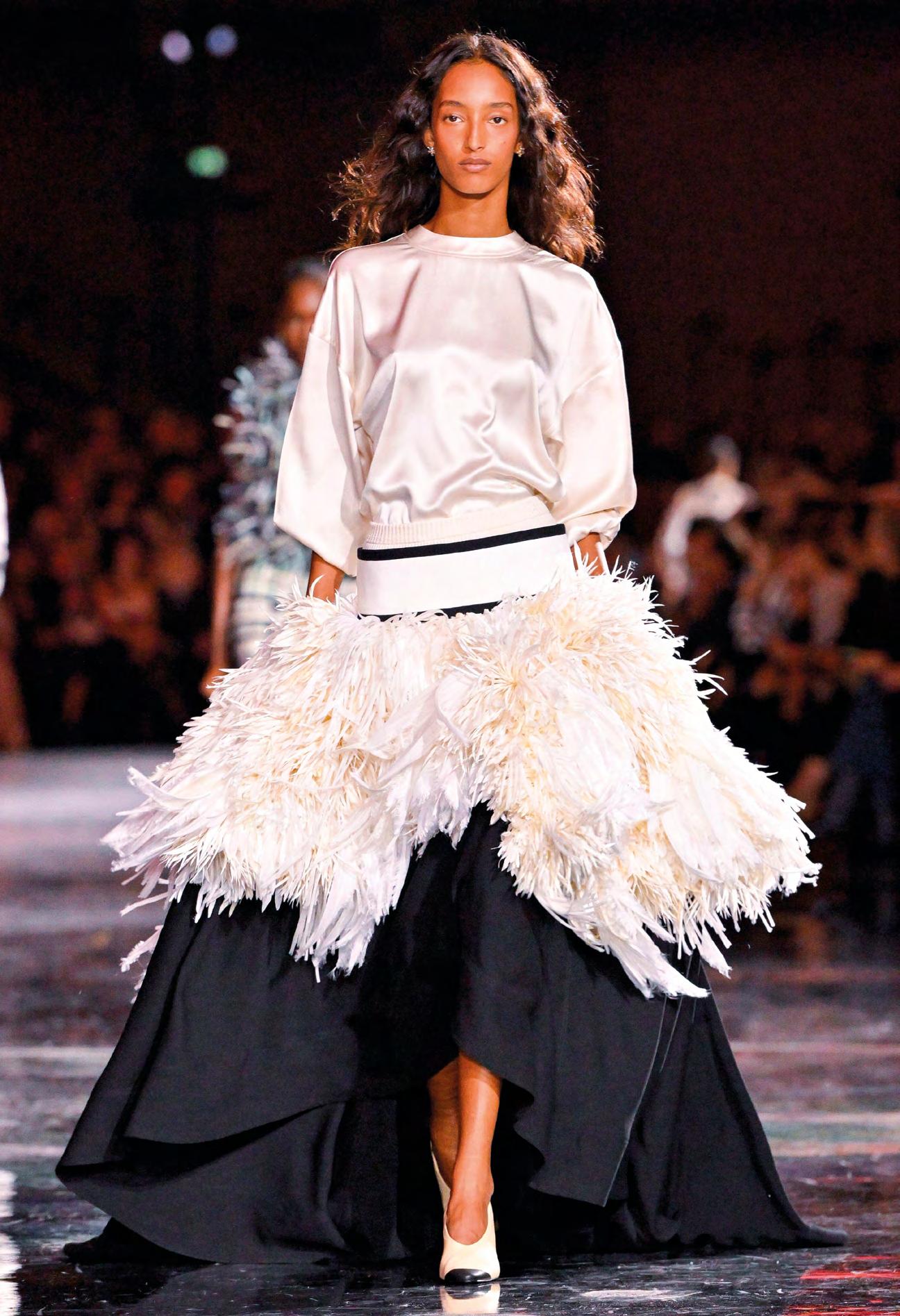
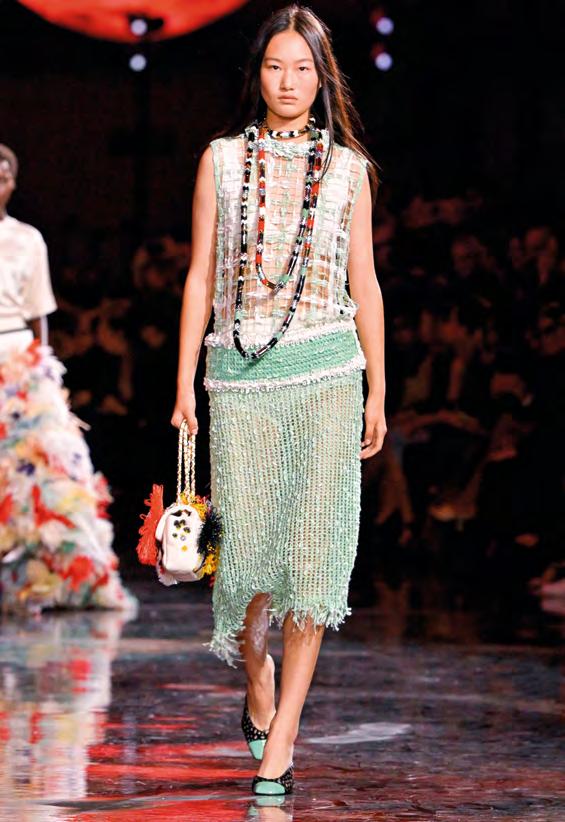
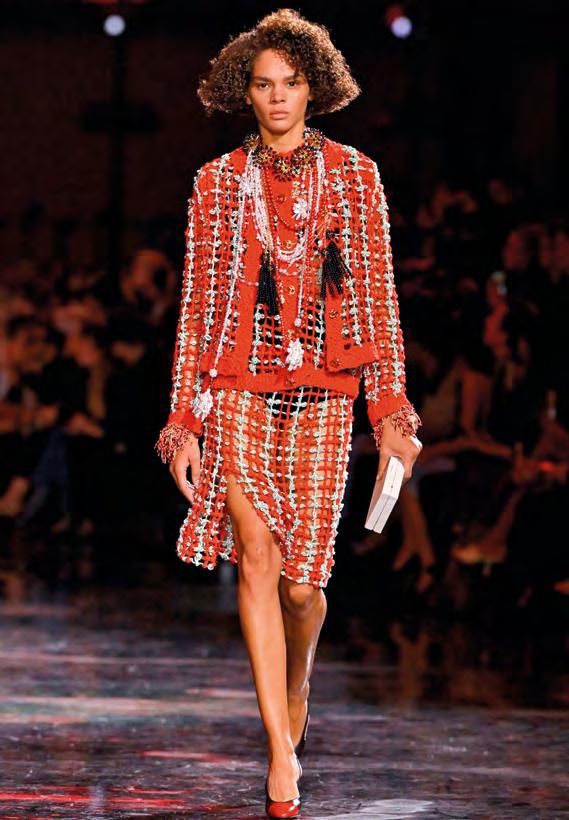
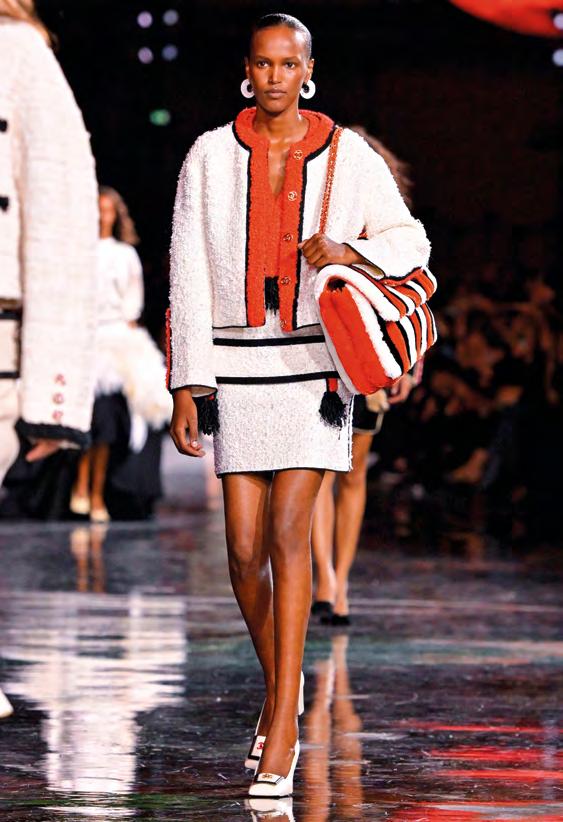
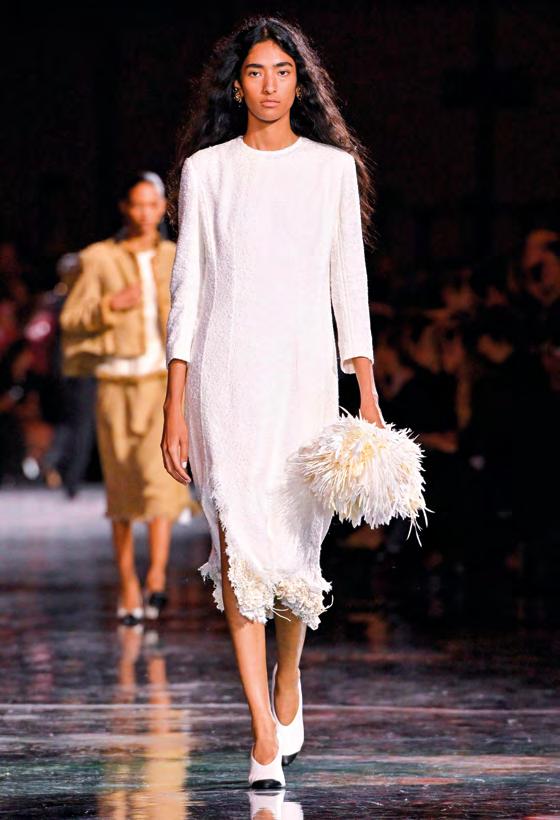
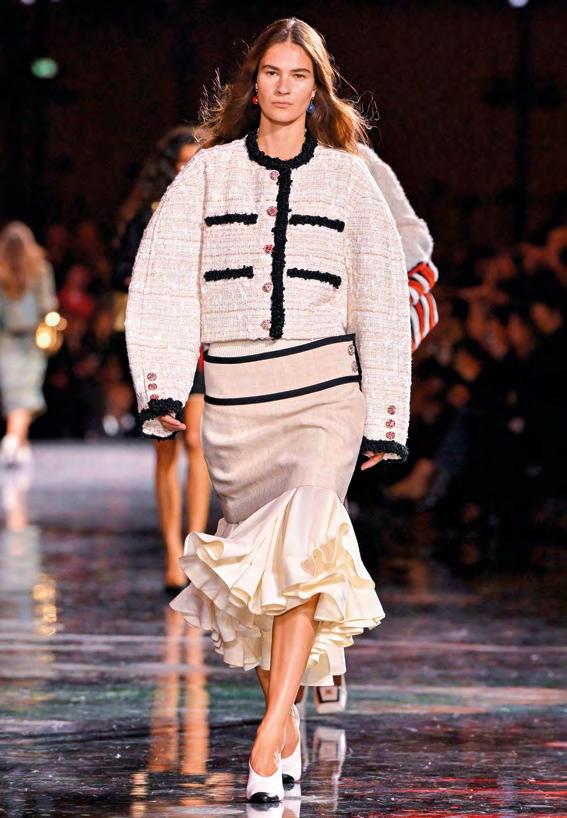
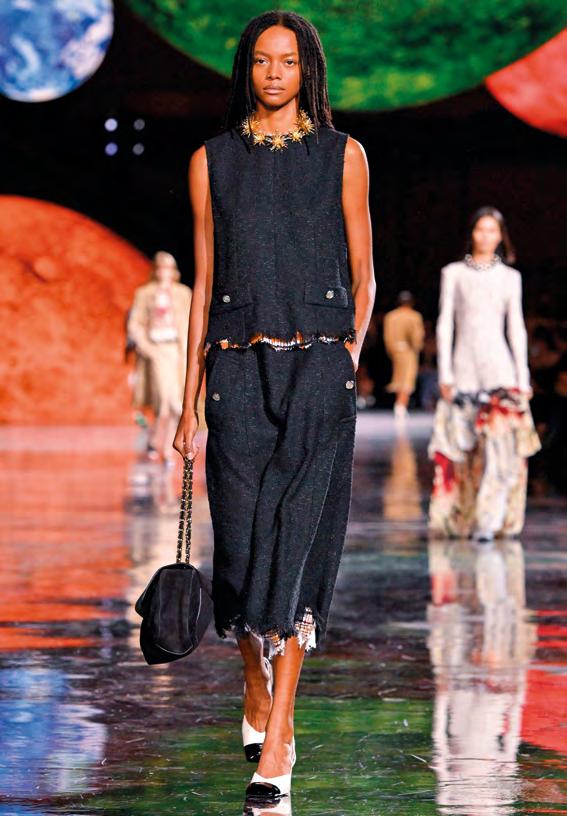
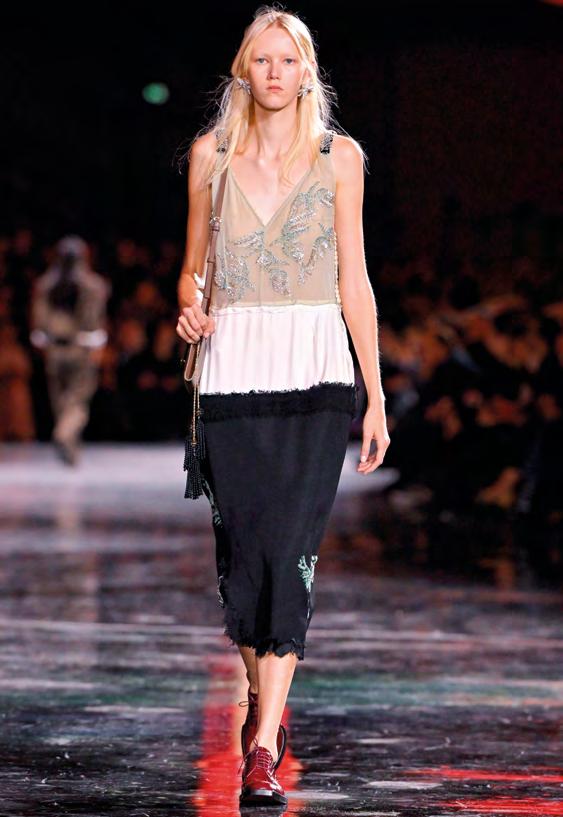
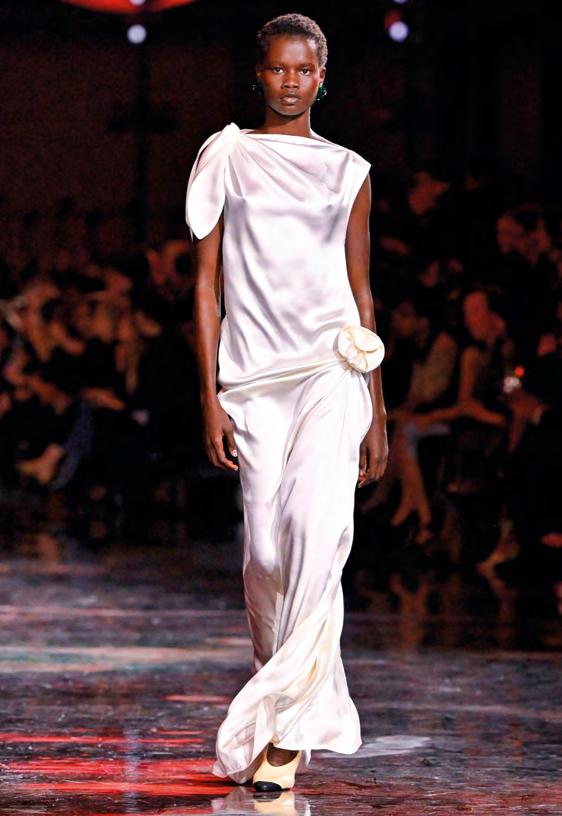
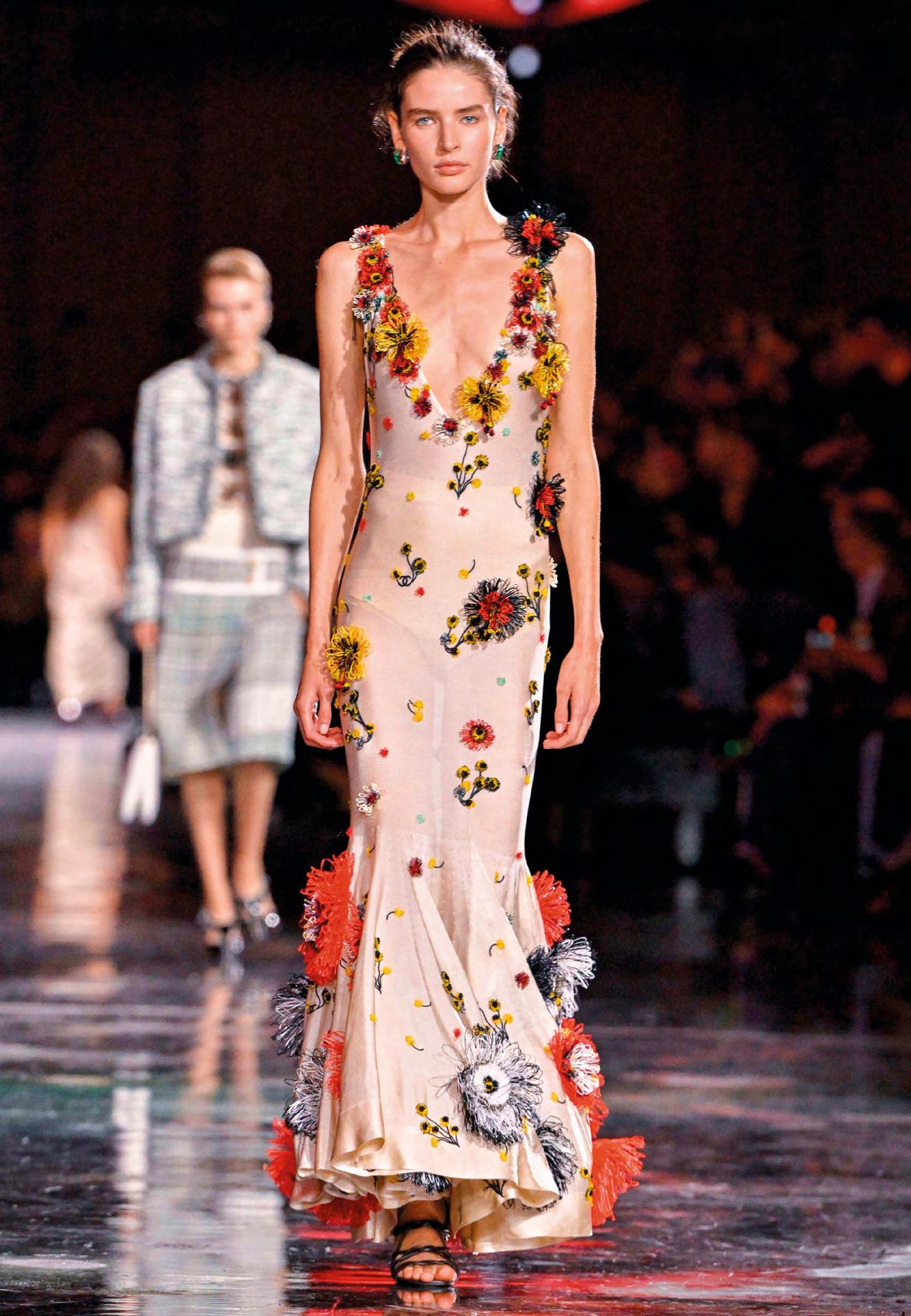
CHANEL LIT UP PARIS Between Legacy and Innovation
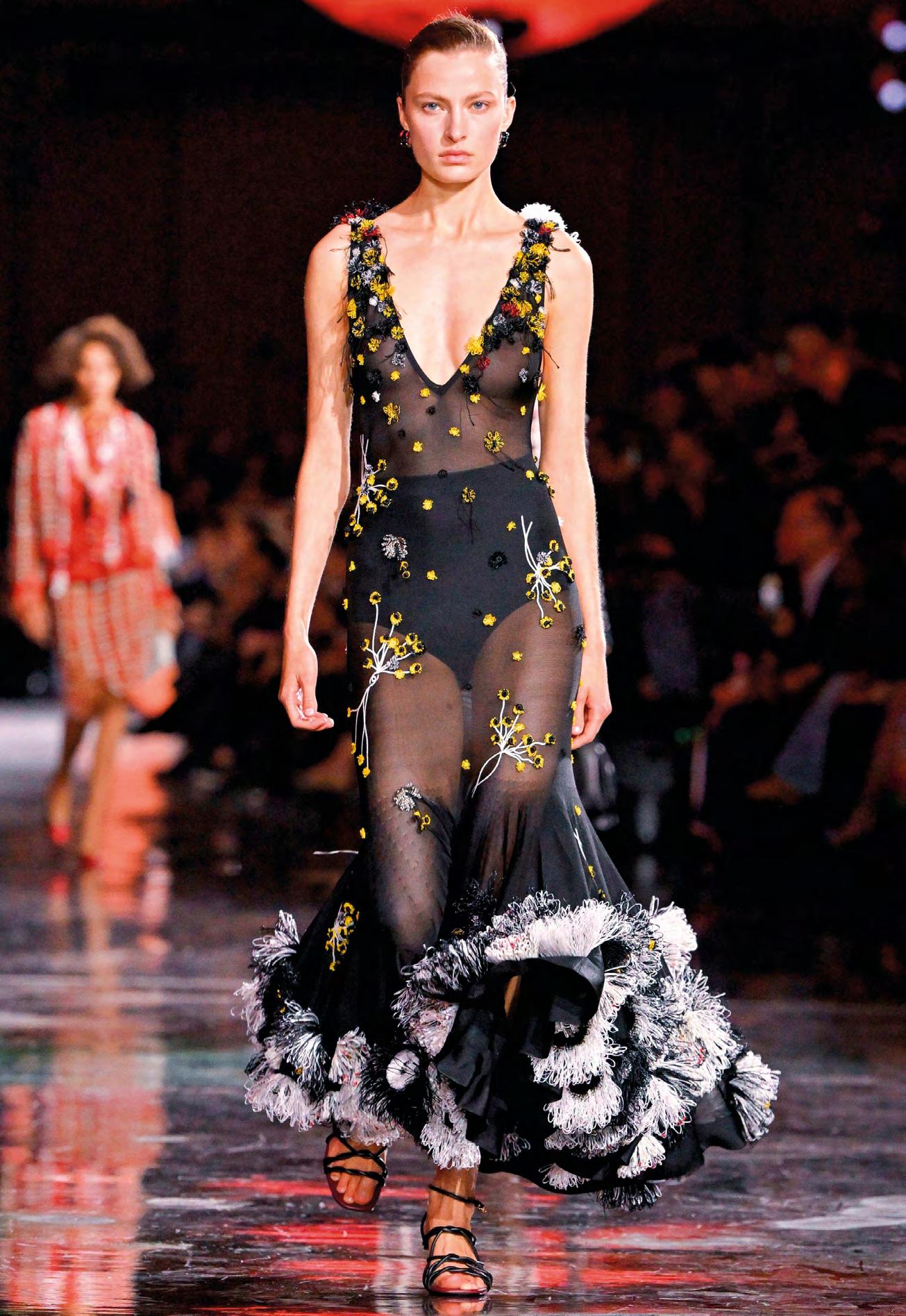
Set beneath a cosmic-inspired universe, the Spring-Summer 2026 collection merged heritage and experimentation through deconstructed tailoring, innovative textures, and renewed elegance. The collection signaled a new creative era, reinterpreting house codestweed, camellias, and fluid silhouettes.
“This collection was a dialogue between the house’s heritage and a new way of seeing the present, where each silhouette aimed to reinterpret Chanel’s essence without losing its identity.”
“On the runway, Chanel not only revisited its classic codes but projected them into the future with an almost ethereal lightness and a quiet sophistication.”
THE MADRIDS
that astound the world
LOS “CINCO MADRID” QUE ASOMBRAN AL MUNDO
TEXT BY GRACIANO PALOMO
PHOTOS COURTESY OF MADRID DESTINO
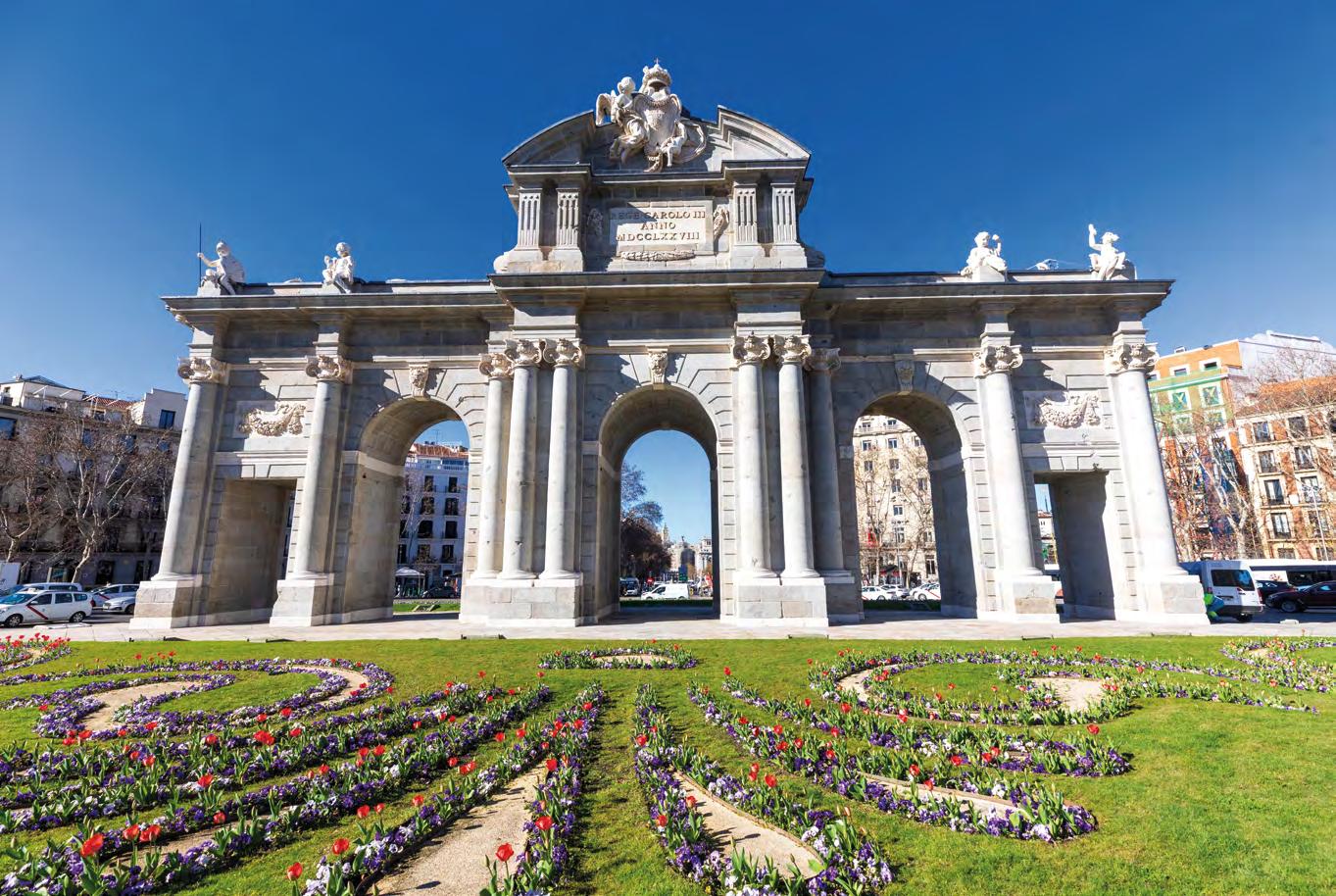
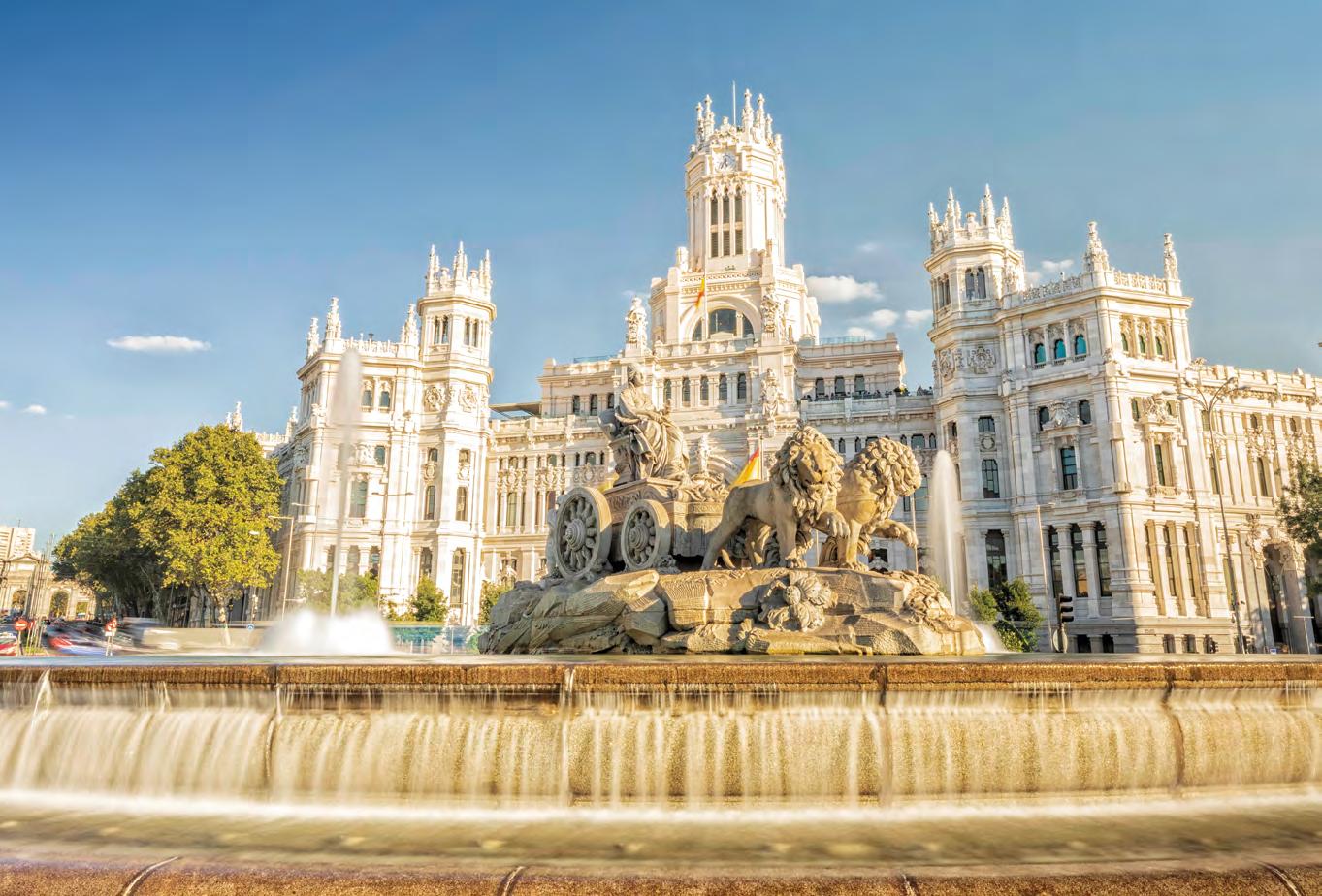
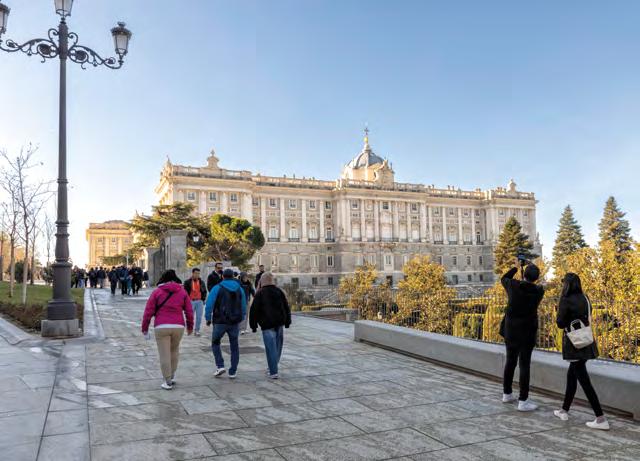
Its current economic momentum, ancestral cultural touch, global sporting prestige, outstanding university and research ecosystem, and, finally, its vibrant leisure scene make Madrid one of the most attractive capitals in the world.
—The Madrid “City” seeking to compete with London. Few cities possess such a vocation for sport; Madrid is the European capital with the highest number of Erasmus students, major research centres attract medical scientists from across the globe, and its cultural and leisure offering rivals that of New York, London or Vienna.
Madrid—celebrated in verse and written in prose—is a city of a thousand and one definitions. Yet even when expressed one by one, they fail to exhaust the title and essence of a villa that has proudly borne that designation since the Middle Ages, after 1,161 years witnessing the course of world, European and Spanish history—history in which it has often played a leading role.
Put plainly and directly, today’s Madrid (3,526,730 inhabitants) has evolved from that once-apt description of a “large Castilian provincial town of the plateau” which, however, from a handful of noble quarters established in the Madrid of the Habsburgs discovered, conquered and dominated the globe for centuries, leaving fertile seeds across the vast territories of the New World. Today, that dual Madrid harmoniously blends tradition and modernity without ever abandoning the “new Babylon” so aptly described by Calderón de la Barca—a reference to its diversity
and vitality that has endured since the Spanish Golden Age. It was here, in the lands of Isidro the labourer, that figures such as Calderón, Cervantes, Lope de Vega, Quevedo and his mortal rival Luis de Góngora once walked.
Its welcoming spirit, they say, dates back more than a millennium to its founding by Emir Muhammad I: a simple fortress on the banks of the River Manzanares—today the site of the historic Royal Palace, the largest of its kind in the world— built to defend Toledo from the Christian kings. Since then, Madrid has continuously refined itself, reinventing its character through the very history it has helped to shape. It was a city that made the universal actress Ava Gardner sigh with admiration— the great lover of Habsburg Madrid—who often sought refuge in its flamenco tablaos, still alive today, after her marital quarrels with Frank Sinatra.
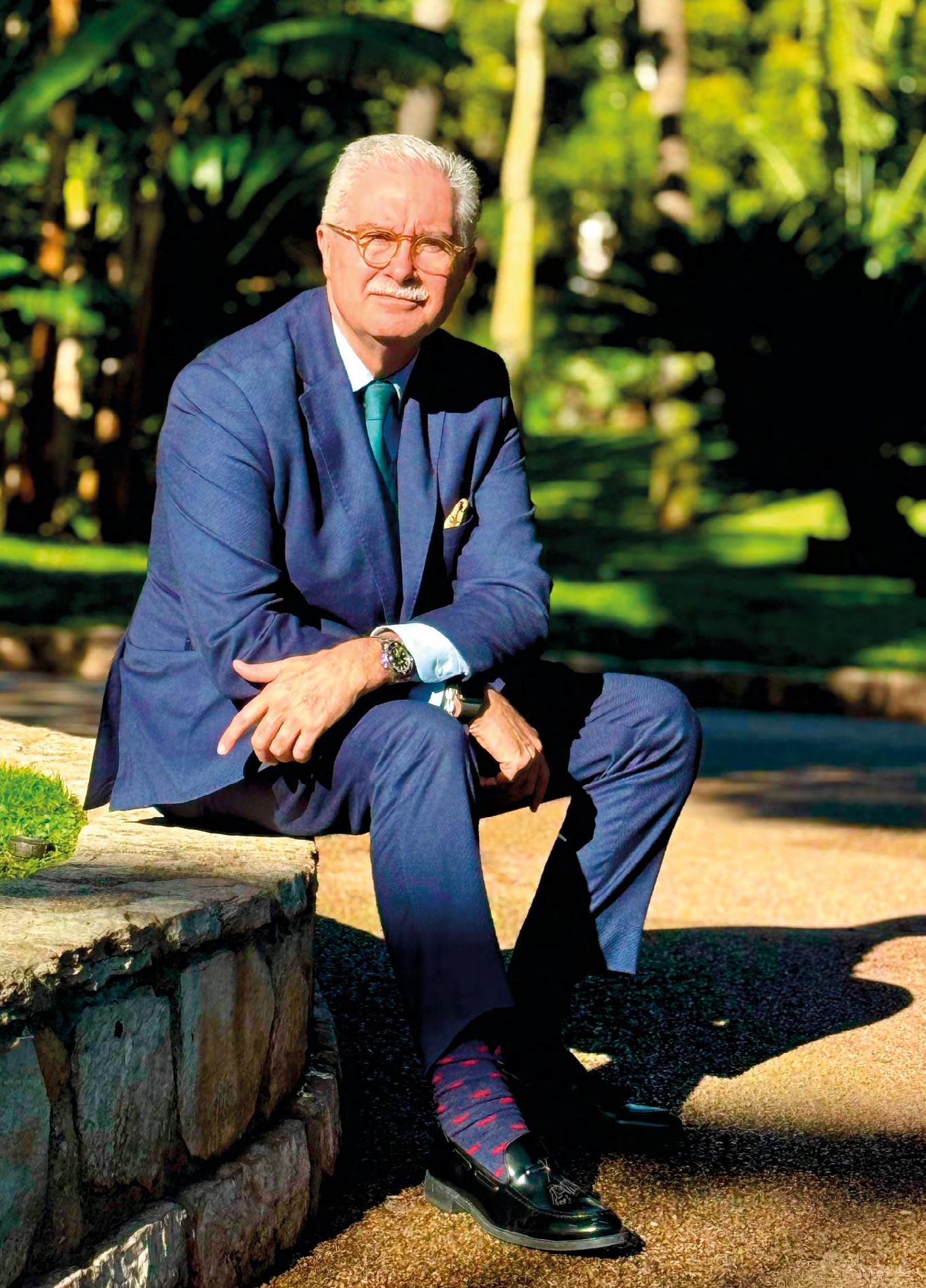
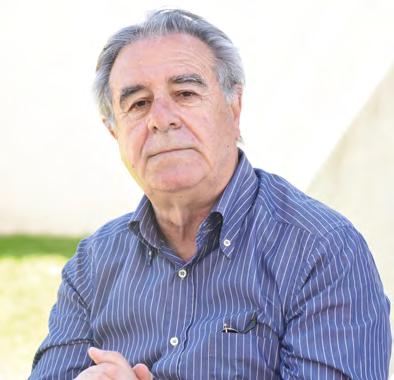
Graciano Palomo
Today, which Madrid astonishes the world? At least five distinct facets do—each reflecting its legendary hospitality and diversity, allowing it to stand as the “breakwater of all the Spains”, including the more than one million people from every background who have arrived from across the seas.
THE MADRID OF THE CITY
There is a Madrid of entrepreneurs and corporate executives seeking to capitalise on the United Kingdom’s Brexit by successfully filling its space within the European Union. At the same time, the city competes directly with Miami—the great Hispanic metropolis of Florida with its Caribbean pulse along the American Riviera.
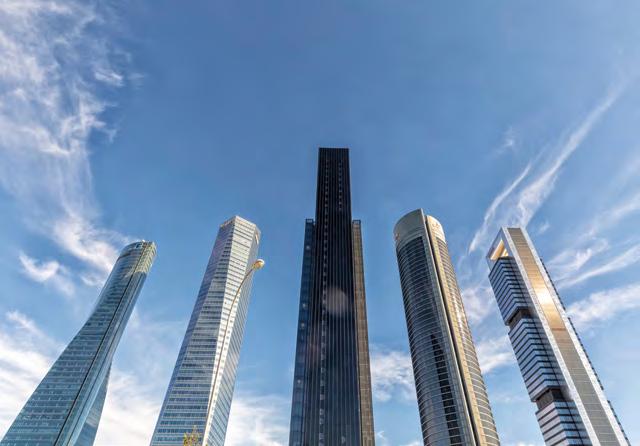
Today Madrid attracts more than 70 per cent of all foreign investment arriving in Spain: €26.499 billion in 2025 alone. Could anyone offer more?
THE MADRID OF SPORTING SPIRIT
Hundreds of charity races take place throughout the year along Madrid’s streets, drawing thousands of participants in every season. Then there is elite sport: Real Madrid and what is widely considered the finest stadium in the world, attracting millions of fans from all five continents. Atlético de Madrid is no less formidable, consistently ranked among Europe’s best clubs. Madrid has also become a magnet for international sporting events. The NFL has already chosen the Santiago Bernabéu Stadium as its gateway into Europe. The city hosts the prestigious ATP Masters 1000 tournament each May at the Caja Mágica, where the world’s best players compete. And in 2026, Formula 1 will once again return to the capital’s streets. Could anyone offer
more? Impossible. Sooner or later—by sheer merit—the Olympic Games must arrive.
ETERNAL MADRID
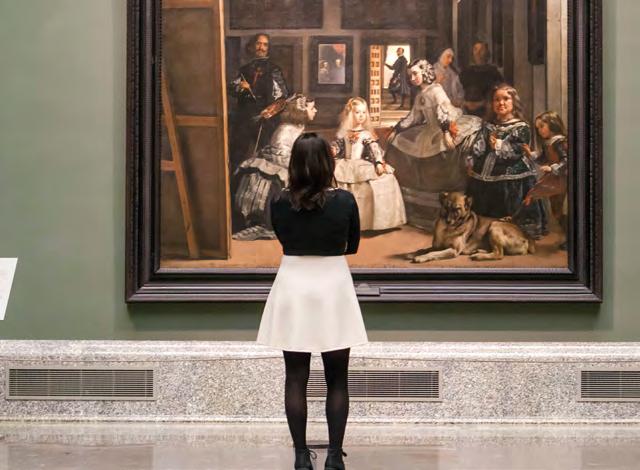
This is none other than the Madrid of the Habsburgs. From this small historic cosmos—Royal Palace included—the world was governed for 450 years. Here lie its markets, intimate streets and legendary taverns; the palaces of the Princess of Éboli and the great Mariana of Austria, today restored and proudly preserved. From the historic Botín, the oldest restaurant in the world, to theatres older than the comedies of the great Lope de Vega. The eternal Madrid of great national museums: the Prado, shining with unmistakable international brilliance; nearby, the ThyssenBornemisza, the Sorolla Museum… And the iconic Ritz and Palace hotels that once dazzled Hollywood stars as well as Dalí and Lorca. To wander here is, quite simply, to lose oneself on the road to heaven.
THE MADRID OF LEISURE
In modern Madrid—visited by more than 27 million travellers each year—gastronomy embraces every origin and style imaginable. From traditional taverns of old to avant-garde fusion menus that captivate Michelin-starred chefs.
At dusk, the La Latina district becomes a buzzing hive where young people and adults alike gather to celebrate life with the same vitality as the neighbourhood itself. Taverns, nightclubs, gaming lounges and wine bars illuminate the joyful early hours of the morning. This is the district of new artists, clearly distinct from the Barrio de las Letras, where the most celebrated literary and artistic creators—who chose
Madrid to drink life in great draughts—now rest in its churches. Here too stands the Congress of Deputies, the stage for countless historic moments in the long history of Spain.
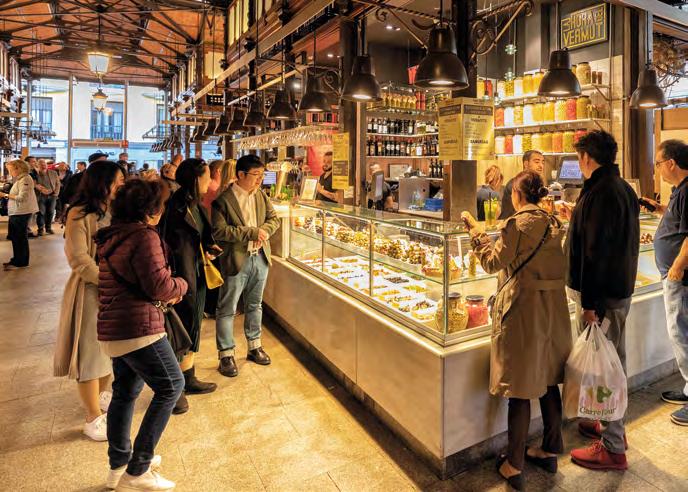
Legendary restaurants such as Lhardy, Ciriaco, El Landó, El Anciano Rey de los Vinos, and Lucio, along with the new establishments inside the renovated Mercado de San Miguel, leave no one indifferent—if, that is, one can secure a table.
SCHOLARS OF THE WORLD, UNITE
The fifth great facet of Madrid in the early decades of the 21st century is its intellectual and research environment—an ecosystem of knowledge, creativity and innovation.
It is the European city most frequently chosen as the first destination by EU university students. Around 30,000 Erasmus students arrive every year. Madrid is home to six public universities and thirteen private institutions, with the Complutense University, boasting around 190,000 students, ranking among the largest in Europe.
Education is only part of the story. In the heart of the capital stands the Spanish National Cancer Research Centre (CNIO), founded by Dr Mariano Barbacid—arguably one of the world’s leading cancer researchers. Since achieving groundbreaking results in the treatment of pancreatic cancer in laboratory mice, hundreds of patients from around the world have travelled to his laboratories in the Fuencarral district seeking hope and solutions.
Talent, new technologies, progress in action… a city where no one is above another and, above all, where no one feels like a stranger. Madrid is a gateway to the world.
Even this brief chronicle cannot overlook one more detail: Madrid possesses one of the finest metro systems in the world—and one of the most affordable. With a monthly pass of just €15, its famous motto “Vuela” (“Fly”) accompanies more than two million passengers every day from every walk of life. This short media space allows only a few brushstrokes to sketch the portrait of Madrid, now the fourth great city of Europe. Its standing was recently confirmed by the “World’s Best Cities 2026” award granted by the consultancy Resonance following a comparative study of twelve global cities. In essence, Madrid stands among the most influential urban destinations in the world, its leaders striving to consolidate a brand built upon excellence and quality. Everything humanity has invented seems to exist in Spain’s capital. In an era increasingly concerned with environmental preservation, Madrid is undertaking the renaturalisation of its Metropolitan Forest—the largest urban green belt in Europe—with an extraordinary 450,000 new trees across 75 square kilometres. Another compelling chapter in the city’s remarkable appeal.
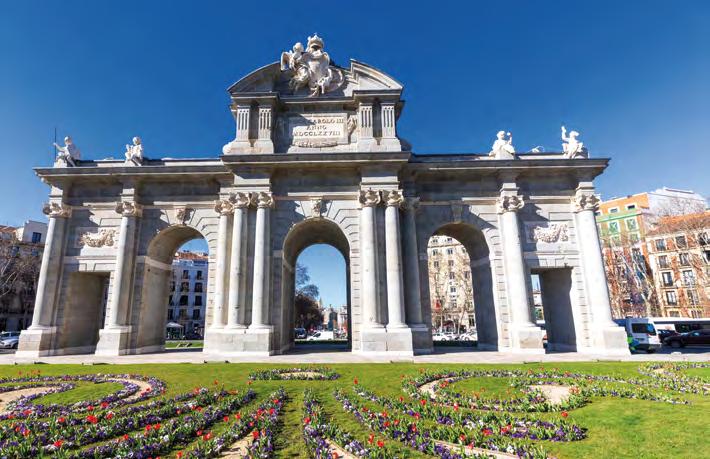
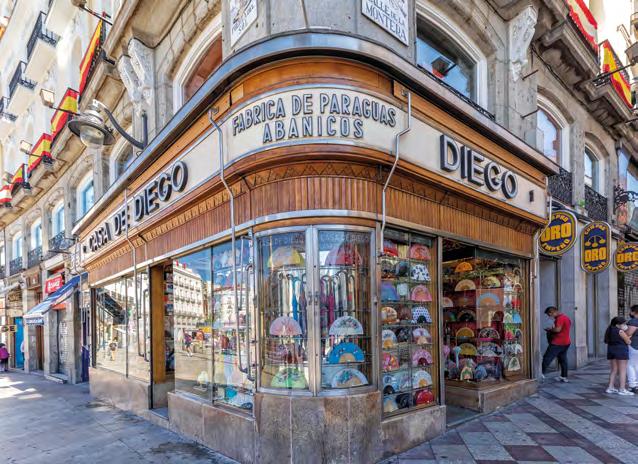
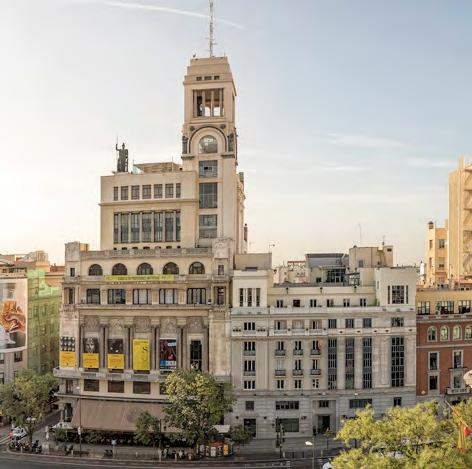
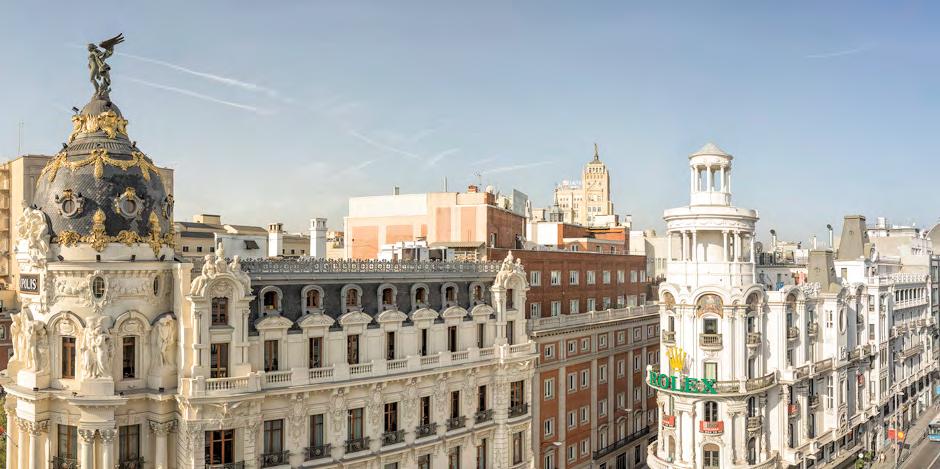
The secret corners of old Madrid deserve another feature in this magazine. Such is the nature of cities where life feels inexhaustible. Gran Vía, with its theatres, cinemas, shops and iconic architecture, is Madrid’s own Broadway—where every minute matters. Nearby lies Puerta del Sol, the historic crossroads of politics, society and gastronomy, the stage for the best and the worst moments of Spain’s centuries-old history. Here, quite literally, the “breakwater” begins. Madrid is a genuine city. No one asks where you come from—much less excludes you for it. Not even where you are going. Back in 1992 it was named European Capital of Culture, a moment that marked the beginning of its modern transformation. As the proverb says, one cannot love what one does not know—and Madrid embraced this idea with a complete openness to the world.
Yet perhaps that spirit had been present all along: eleven centuries ago, when the city was founded by an Arab who already loved this land. A journey, ultimately, that takes us—from Madrid to heaven.
Madrid, la cantada en verso y la escrita en prosa, es la ciudad de las mil y una definición que, expresadas una a una, no agotan en sí mismas, el título y la esencia de una “villa” que exhibe orgullosa ese título desde la Edad Media, tras 1.161 años contemplando el devenir de la Historia del mundo, Europa y España que ella misma ha protagonizado. Escrito por corto y por derecho, el Madrid actual (3.526.730 habitantes) deviene de aquella definición, otrora acertada, de “poblachón manchego y mesetario” que, sin embargo, desde unas cuantas y nobles cuadras instaladas en el Madrid de los Austrias descubrió, conquistó y dominó durante siglos el globo terráqueo, dejando fructífera semilla en los anchos lares del Nuevo Mundo. Hoy ese Madrid dual, combina tradición y modernidad al unísono sin dejar atrás nunca aquella “nueva Babilonia”, que tan cabalmente definió Calderón de la Barca, referenciada a su diversidad y bullicio que ha mantenido desde el Siglo de Oro, porque fue por estos pagos de Isidro, el labrador, donde hollaron, además de Calderón, Cervantes, Lope de Vega, Quevedo y su enemigo mortal Luis de Góngora.
Dicen que su carácter acogedor viene de más de un milenio atrás cuando fue fundada por el emir Muhammed I. Una simple fortaleza a orillas del rio Manzanares (hoy pagos del histórico Palacio Real, el más grande del mundo) al objeto de defender Toledo de los reyes cristianos. Desde entonces hasta hoy, Madrid se ha ido puliendo así misma; reinventándose a la luz de su propio acontecer histórico que ella misma ha protagonizado y que hacía suspirar a la actriz universal Ava Gardner, la gran enamorada del Madrid de los Austrias, y en cuyos tablaos flamencos que hoy subsisten se refugiaba tras sus broncas matrimoniales con Frank Sinatra.
Hoy, ¿qué Madrid asombra al mundo? Cinco, como mínimo, que hacen gala a su proverbial acogimiento y diversidad, que, permite constituirse como “rompeolas de todas las Españas”, incluyendo en esas Españas, al más de un millón de gentes de toda clase y condición que han venido allende los mares.
EL MADRID DE LA CITY
Hay un Madrid de emprendedores por cuenta propia y de ejecutivos por cuenta ajena que tratan de aprovechar el “Brexit” del Reino Unido para llenar su espacio con éxito en la Unión Europea. Pero, también compitiendo directamente con Miami, la gran urbe hispana de Florida, con su latido caribeño de la riviera americana. Madrid en la actualidad recibe más del 70% de toda la inversión extranjera que llega a España. 26.499 millones de euros en el 2025. ¿Alguien da más?
ESE MADRID CON ESPÍRITU DEPORTIVO.
Centenares de marchas solidarias a lo largo del año se celebran por las calles madrileñas con miles de participantes a lo largo de todas las estaciones. Luego, viene el deporte de élite con el Real Madrid y el mejor estadio del mundo que atrae a millones de fans de los cinco continentes. Tampoco el Atlético de Madrid es manco, siempre entre los mejores europeos. El polo de atracción deportiva pasa ya, cada año, por la Liga del Fútbol Americano (NFL) que escogió el Santiago Bernabéu para presentar credenciales en Europa. Madrid tiene el Master 1000 en su Caja Mágica en su mes de mayo donde compiten las mejores raquetas del mundo. Y este 2026 volverá a las calles de la capital la Fórmula 1. ¿Alguien da más? ¡Imposible! Un año u otro tienen que llegar, por justicia, unos JJOO.
EL MADRID ETERNO
No es otros que el llamado Madrid de los Austrias. Desde ese pequeño cosmos histórico, Palacio Real incluido, se dominó el mundo durante
450 años. Con sus mercados, sus calles recoletas, sus tabernas legendarias. Los palacios de la Princesa de Eboli ó la gran Mariana de Austria, hoy remozados y puestos en valor. Desde la taberna Botín, el restaurante más antiguo del mundo, a los clásicos teatros con más años que las comedias del gran Lope de Vega. El Madrid eterno de los grandes museos nacionales. El Prado brillando con luz internacional propia; muy cerca el Thyssen-Bornemisza, Sorolla... Los hoteles Ritz y Palace que deslumbraron a las estrellas hollywoodienses y a Dalí y Lorca en presente continuo. En definitiva, perderse por aquí para ir directamente al cielo.
EL MADRID LÚDICO.
La gastronomía tiene todo tipo de orígenes y fin en el Madrid moderno que recibe anualmente más de 27 millones de visitantes. Desde las típicas tabernas de antaño a los menús de fusión que asombran a las estrellas Michelín. El Barrio de La Latina se convierte en una colmena al atardecer para recoger a jóvenes y adultos que desean vivir la existencia vital como el propio Barrio. Tascas, discotecas, ludotecas, vinacotecas alumbran hasta las gozosas madrugadas. Es el barrio de los nuevos artistas, claramente diferenciado del Barrio de Las Letras
“El tirón económico actual, el ancestral toque cultural, la referencia deportiva mundial, la oferta universitaria e investigativa y, finalmente, la expansión lúdica, hacen de Madrid una de las capitales mundiales más atractivas del globo.”
en cuyas iglesias reposan los más famosos creadores literarios y de artes varias que escogieron Madrid para beber a borbotones la vida. Aquí se encuentra ubicado el Congreso de los Diputados, escenario de tantos momentos históricos en la vieja piel de toro. Legendarios restaurantes como “Lhardy”, “Ciriaco”, “El Landó”, “El Anciano rey de los vinos”, “Lucio” o los nuevos establecimientos abiertos en el remodelado “Mercado de San Miguel”, no dejan a nadie indiferente, si es que se puede encontrar mesa.
UNIVERSITARIOS DEL MUNDO, UNÍOS.
El quinto “gran pupilo” madrileño en los albores del siglo XXI es todo lo que tiene que ver con la intelectualidad, la investigación, la creación en su conjunto y sus distintos corolarios. Es la ciudad europea donde los universitarios de la UE escogen Madrid como primera opción. Cada año llegan alrededor de 30.000 de ellos. Madrid cuenta con 6 universidades públicas y 13 privadas. La Complutense con sus 190.000 encabeza el ránking europeo por número de alumnos.
No todo se agota en los centros educativos. Por ejemplo, en medio de la capital habita el Centro Nacional de Investigaciones Oncológicas (CNIO9), fundador por el doctor Mariano Barbacid, hoy quizá el primer investigador contra el cáncer. Desde que supo liquidar el cáncer de páncreas en ratones, centenares de pacientes de todo el mundo llegan hasta su laboratorio en el distrito de Fuencarral en busca de soluciones a sus dolencias. Talento, nuevas tecnologías, progreso “in action”...Dónde nadie es más que nadie, y, sobre todo, nadie es ni se siente extranjero. Madrid, puerta del mundo. Incluso una crónica de urgencia como esta no puede obviar que Madrid cuenta con el mejor “Metro” del mundo (y más barato, 15 euros) con su famoso lema “vuela” que es utilizado por gentes de todo tipo y condición con la cifra superior a los dos millones diarios.
Este espacio mediático, lógicamente escueto, solo permite dar algunas pinceladas para apuntalar una descripción somera del Madrid, la cuarta ciudad Europea. Lo anterior se sustancia, sin ir más lejos, en el Premio “World´s Best cities” 2026, galardón concedido por la consultora “Resonance” sobre un estudio de doce ciudades. En definitiva, uno de los destinos urbanos más influyentes del mundo. Sus gestores buscan consolidar la marca sobre la excelencia y la calidad.
Todo lo que el hombre haya inventado está en la capital de España. En los tiempos del furor por la conservación de la naturaleza, Madrid se apresta a renaturalizar y sostener el “Bosque Metropolitano” que representa el mayor cinturón forestal de Europa, con la friolera de 450.000 nuevos árboles en una extensión de 75 kilómetros cuadrados... ¡Por si faltara algo en el capítulo de la atracción “gata”!
Los rincones secretos de la vieja ciudad de Madrid dan para otra entrega en esta revista. Es lo que sucede con aquellas ciudades donde la vida se hace inagotable. La Gran Vía es el “Broadway” madrileño, por sus teatros cines tiendas y su arquitectura donde cada minuto cuenta. Muy cerca, inevitable, esta la Puerta del Sol, parada y fonda, política y gastronómica de los mejor y de lo peor que sucedió en los últimos siglos en la nación más antigua del mundo. Ahí empieza, justamente, el “rompeolas”.
Madrid es una ciudad de verdad. Nadie te pregunta, mucho menos te margina, de dónde eres. Ni siquiera a dónde vas. Ya en el lejano 1992 fue “Capital Europea de la Cultura” y ahí empezó casi todo en lo referido a la “modernidad”. Dice el proverbio que nadie ama lo que no conoce y es algo que Madrid se aplicó así mismo con una apertura total al mundo, aunque, ello, hace 11 siglos cuando se fundó por un árabe que amaba esta tierra, parece que se tuvo claro.
Un viaje, en definitiva, que nos lleva de Madrid al cielo.
LORENA MORLOTE
Lorena Morlote is an internationally acclaimed stylist who has devoted more than 20 years to perfecting the art of high-end hairdressing. Renowned for her creativity and her ability to transform hair into a work of art, Lorena has established herself as an influential figure in the world of fashion and beauty.
From her headquarters in Madrid, with expansion in Marbella and franchise development underway, she leads a team of professionals who cater to both private clients and figures from the worlds of entertainment and fashion. Her mission is for
every client to feel unique and one of a kind, as she believes that beauty is not a standard, but a personal expression.
The entrepreneur also has another space in Puerto Banús, Marbella. She is one of the most recognised hairdressers and stylists on the national scene, with a client portfolio that extends far beyond our borders and includes celebrities such as the Beckham family, the inimitable Paris Hilton, Shakira, Salma Hayek and Leonardo DiCaprio. She is the founder of the Lorena Morlote Beauty Art salons.
Lorena Morlote es una estilista reconocida internacionalmente que ha dedicado más de 20 años a perfeccionar el arte de la peluquería de alta gama. Reconocida por su creatividad y habilidad para transformar el cabello en una obra de arte, Lorena se ha consolidado como una figura influyente en el mundo de la moda y la belleza. Desde su sede en Madrid, con expansión en Marbella y en desarrollo de franquicias, dirige un equipo de profesionales que acompaña tanto a particulares, como a figuras del mundo del espectáculo y la moda. Su misión es que cada cliente se sienta único e irrepetible, porque para ella la belleza no es un estándar, sino una expresión personal. La empresaria cuenta con otro espacio en Puerto Banús, Marbella. Es una de las peluqueras y estilistas más reconocidas del panorama nacional, su cartera de clientes va más allá de nuestras fronteras y contempla a celebrities como la familia Beckham, la mismísima París Hilton, Shakira, Salma Hayek o a Leonardo di Caprio. Es fundadora de los salones Lorena Morlote Beauty Art.
Calle José Abascal 52, Madrid. Hotel BlueBay, Ctra. de Cádiz, 173, Marbella.
HYATT REGENCY Hesperia Madrid
TEXT BY: MARIBEL MARTÍNEZ
Located on the iconic Paseo de la Castellana, where Madrid reveals its most sophisticated side, Hyatt Regency Hesperia Madrid stands as a meeting point between the city, its rhythm, and a contemporary vision of urban luxury. Surrounded by embassies, galleries, museums, and the financial pulse of the capital, the hotel naturally connects the Golden Mile of Serrano Street, the Prado’s cultural axis, and the dynamism of the business district.
This prime location makes it an exceptionally convenient and versatile base, perfectly suited to meet the needs of both leisure and business travelers, offering easy access to key attractions, transport links, and essential services.
Far from a rigid notion of luxury, the hotel’s concept revolves around a more relaxed and effortless experience, where comfort, location, and attention to detail allow guests to navigate the city with ease while simultaneously disconnecting from its pace.
The hotel features 169 rooms and suites that combine classic sophistication and elegance with a modern, functional style, including 2 Presidential Suites with private terraces and outdoor hot tubs, 2 Ambassador Suites with private terraces and outdoor hot tubs, and 28 Regency Suites with privileged views over Paseo de la Castellana. Each room has been carefully designed to ensure absolute comfort, using premium materials, advanced technology, and meticulous attention to detail that sets the experience apart.
GASTRONOMIC EXCELLENCE
Gastronomy is one of the cornerstones of Hyatt Regency Hesperia Madrid, establishing the hotel as a true culinary destination within the city.
Leña Madrid, by renowned chef Dani García, reinvents wood-fired cuisine with innovative techniques and bold, distinctive flavours.
Smoked Room, awarded two Michelin stars, offers an exclusive dining experience with a 15-course tasting menu for just 14 guests.
Mery Bárbola Bar, located in the lobby, is an elegant social hub combining a refined gastronomic offering with an exquisite cocktail menu. Every Thursday, it hosts a live music afterwork, perfect for enjoying a relaxed yet sophisticated atmosphere.
Zuara, the new Asian restaurant by chef David Arauz, has been awarded one Michelin star.
REGENCY CLUB & GUEST EXPERIENCE
The hotel features the Regency Club, a private space where guests can enjoy breakfast, snacks, and beverages throughout the day in a quieter and more exclusive setting. Conceived as an extension of the stay, it offers a more serene alternative within the hotel’s rhythm.
OTHER LUXURY EXPERIENCES
Hyatt Regency Hesperia Madrid presents a curated collection of exclusive experiences combining luxury, gastronomy, culture, and wellbeing, designed for those who seek excellence in every detail. Each proposal reflects the hotel’s commitment to high-end hospitality and the creation of truly memorable moments.
“The hotel features the Regency Club, a private space where guests can enjoy breakfast, snacks, and beverages throughout the day in a quieter and more exclusive setting. Conceived as an extension of the stay, it offers a more serene alternative within the hotel’s rhythm.”
“Hyatt Regency Hesperia Madrid presents a curated collection of exclusive experiences combining luxury, gastronomy, culture, and wellbeing, designed for those who seek excellence in every detail.”
HALMMA EXPERIENCE
The Halmma Experience offers a wellness escape that combines a luxury stay at Hyatt Regency Hesperia Madrid with a spa treatment at Halmma, located just ten minutes from the hotel. The experience includes access to a water circuit that acts as a preparatory ritual for body and mind, followed by a personalised massage. This experience is designed to integrate rest, self-care, and hospitality into a single plan, allowing guests to disconnect from the urban pace through a journey created to restore balance and wellbein.
LAS ROZAS VILLAGE
The hotel offers its guests an exclusive service at Las Rozas Village, a distinctive proposal that enhances the stay by combining premium hospitality with the finest shopping experience in Madrid. Guests gain access to a private space and enjoy benefits such as hands-free shopping, exclusive discounts, and personalised styling services. An experience designed to discover the latest trends and select garments, accessories, and products aligned with their personal style. The service also includes private round-trip transfers
to and from the city centre, ensuring a comfortable, sophisticated, and fully tailored shopping experience.
PORSCHE EXPERIENCE
This experience includes accommodation in a Regency Suite, the use of a Porsche to explore Madrid in style, and dinner at Leña Madrid, the restaurant by renowned chef Dani García. An upgraded version is also available, offering two nights in an Ambassador Suite, dinner at Smoked Room—the two Michelin-starred restaurant by Dani García— and the experience of driving a Porsche through the capital. The offer can also be enjoyed in an Executive Excellence Suite. Both options are fully customisable, allowing guests to enjoy the complete experience or select individual components.
CHISPA EXPERIENCE
Inspired by the essence of the Spanish lifestyle, this experience celebrates the pleasure of fine dining and leisurely rest. It includes lunch at Leña Madrid and a siesta of up to three hours in one of the hotel’s rooms.
ZALACAÍN
A LIVING LEGACY OF SPANISH HAUTE CUISINE WITH OVER 50 YEARS OF HISTORY
HISTORIA VIVA DE LA ALTA GASTRONOMÍA ESPAÑOLA CON MÁS DE 50 AÑOS DE TRAYECTORIA
BY: MARIBEL MARTÍNEZ
TEXT
Located in Madrid’s distinguished El Viso district, Zalacaín opened its doors more than half a century ago, swiftly establishing itself as a temple of fine dining from its very inception and becoming the first gastronomic restaurant in Spain to be awarded three Michelin stars. Over the years, it has borne witness to the gatherings of intellectuals and to meetings of influential political figures who helped shape a significant chapter of Spain’s history, welcoming personalities such as Salvador Dalí, Mario Vargas Llosa and King Emeritus Juan Carlos I, for whom it became a favoured destination. Queen Sofía, former Prime Minister Adolfo Suárez and Jaime de Marichalar were also among its loyal clientele.
Ubicado en el distrito madrileño de El Viso, Zalacaín abrió sus puertas hace casi una década convirtiéndose en un templo gastronómico desde sus inicios hasta hoy en día convirtiéndose en el primer restaurante gastronómico con 3 estrellas Michelín.Ha sido testigo durante años de las tertulias de los intelectuales y de reuniones de relevantes políticos que forjaron una parte importante de la historia de España acogiendo a personalidades como Salvador Dalí, Mario Vargas Llosa o el rey emérito Juan Carlos I , siendo uno de sus restaurantes predilectos.Su esposa la reina Sofía y el ex Presidente Adolfo Suarez o Jaime de Marichalar también se convirtieron en clientes habituales.
SILVIA GARCÍA
HEAD SOMMELIER AT MANDARIN ORIENTAL RITZ HOTEL, MADRID
Head Sommelier at the Mandarin Oriental Ritz, Madrid, Silvia García is one of Spain’s leading sommeliers. She has been working with the Kabuki Group and was part of the team at Mugaritz. Since November 2020, she has held the position of Head Sommelier at the Mandarin Oriental Ritz, Madrid—an iconic hotel that now boasts five dining venues led by chef Quique Dacosta.
Good morning, Silvia.
TEXT: BY MARIBEL MARTÍNEZ
What proportion of your regular clients is Spanish, and what share is international,? which we assume is higher given that this is a hotel?
We are lucky because in the Food & Beverage side where I operate we see a strong presence of both international and Spanish guests. Our F&B offering includes five restaurants and a cocktail bar, so it is very open and also very much geared towards the Madrid clients.
The Ritz has been a flagship of Madrid since the opening in 1910. It was in the city the first luxury hotel and a reflect of the character of Madrileños. that in the past was visited only for the luxury clients . Nowadays the Guests who is looking for a more refined experience do the reservations in Palm Court and Deessa however the International visitors are more interested on the premium Spanish wines. The more traditional profile tends use to drink
classic Riojas—Marqués de Murrieta, Tondonia, the great historic vintages. They are not looking to discover these wines because they have already tried them Vega Sicilia, for instance—but however they like enjoying them again. More recently, there is also growing interest in small-scale, high-quality productions that are difficult to source and often found beyond our borders.
International guests are increasingly interested about our indigenous grape varieties, which wasn’t always the case. In the past, the demand was largely for Pinot Noir or Chardonnay. Spanish clients, meanwhile, tend to fall into two camps, the classic drinker, who remains loyal to Rioja, Ribera, Albariño or Verdejo; and a more adventurous guest, with broader gastronomic and oenological knowledge, who is willing to explore beyond Spain—venturing into other regions, not just Champagne or familiar Spanish whites, but further afield.
The Ritz Hotel has been a flagship of Madrid since its opening in 1910. It was the city’s first luxury hotel”
“My vision of the Ritz is intrinsically tied to its historical identity—a place that has contributed significantly to Madrid’s gastronomic evolution, and indeed to that of Spain as a whole.”
What is the most hidden gem in the Ritz cellar—one that few clients tend to request?
We have several hidden gems. When I arrived at the Ritz, there was actually no wine cellar, which was quite challenging for me.
I came with the expectation of working in a historic hotel where a cellar should naturally exist, but following the refurbishment, the original cellar had been sold, so there were no wines at all.
My vision of the Ritz is intrinsically tied to its historical identity—a place that has contributed significantly to Madrid’s gastronomic evolution, and indeed to that of Spain as a whole.
Rebuilding that legacy meant creating what I call a “liquid history.”
Gradually, I began sourcing wines from 1934 to the present day, constructing a curated narrative of around fifty wines spanning from 1934 onwards. I have not yet managed to find bottles dating back to 1910, when the hotel opened—but if I do, they will undoubtedly become part of the collection.
From 1934 through to approximately 1985 and 1986, there have been remarkable and highly distinctive vintages. I carefully selected prestigious houses and leading wineries, not only from Spain but also predominantly from France.
We also feature Portuguese wines, including exceptional Colares that age beautifully, as well as Italian, German and French wines—particularly Bordeaux and Champagne. The collection includes Colares from 1994, Champagne vintages from the 1980s, Bordeaux from the 1970s and 1980s, and early 1990s releases.
Which historic vintage would you recommend tasting?
I always recommend the 1982 vintage, which was exceptional for Champagne. In Rioja, many say that 1983 may prove even greater over time. Personally, I am also very fond of Bordeaux— particularly 1996.
And of course, Rioja 1964 is essential; tasting a Rioja from that year is truly a must.
Jefa de sumilleres del hotel Mandarín Oriental Ritz Madrid, es sin duda una de las mejores sumilleres de España. Ha trabajado para el Grupo Kabuki y formado parte del equipo de Mugaritz, desde noviembre de 2020, es la Head Sumiller del Mandarín Oriental Ritz, Madrid; icónico hotel que cuenta actualmente con cinco espacios gastronómicos liderados por el chef Quique Dacosta.
Buenos días Silvia. Cuál es el porcentaje de clientes españoles que acuden al restaurante con más asiduidad y cuál es el de clientes internacionales que entendemos que al tratarse de un hotel es mayor?
Nosotros tenemos la suerte que en la parte de Food & Beverage, en la que yo me muevo hay bastante cliente extranjero, pero también bastante cliente español, porque nuestro F&B son cinco restaurantes y una coctelería, con lo cual está muy abierto y muy enfocado también al cliente madrileño. El Hotel Ritz, es un buque insignia de Madrid desde que se abrió en 1910.Es el primer hotel de lujo que se abrió y es como un reflejo de los madrileños, pero es verdad que, hasta ahora, estaba solamente enfocado al cliente de lujo. El cliente que busca un perfil más lujoso está, fundamentalmente, en Palm Court y en Deessa , es verdad que el internacional está muy interesado en conocer vinos españoles, vinos españoles de alta gama.
El perfil clásico, siempre prefiere los riojas clásicos, de Marqués de Murrieta, de Tondonias, de grandes riojas con añadas antiguas, siempre están dispuestos no a conocerlos, porque ya los conocen, Vega, Sicilia, sino a probarlos. Ahora están también muy enfocados en esas producciones pequeñitas, de mucha calidad, que son difíciles de conseguir, y que salen más allá, fuera de nuestras fronteras, El extranjero se interesa mucho por nuestras variedades autóctonas, que antes no pasaba, antes se quería Pinot Noir, Chardonnay. En el cliente español, siempre hay dos partes, el clásico, que no le sacas de su clasicismo, de Rioja, Ribera, Albariños, Verdejos, y luego un cliente que tiene un poquito más de cultura gastronómica, y un poco más de cultura vitivinícola, que se deja llevar para salir fuera de España y conocer regiones distintas, no solamente España y Champagne y Verdejos, sino que va un poco más allá.
¿Cuál es la joya más escondida que hay en la bodega del Ritz que pocos clientes piden?
La joya, pues, tenemos varias joyas escondidas
Sí que es verdad que cuando yo llego al Hotel Ritz no había vino, fue algo complicado para mí porque yo llegaba con la ilusión de trabajar en un hotel histórico, allí tenía que haber una bodega, pero cuando se hizo el cambio, se vendió la bodega, entonces no había vinos. Mi manera de entender el Ritz es ese concepto de lugar histórico, que ha contribuido, además, al crecimiento gastronómico también de Madrid y no solo de Madrid, sino de toda España. Fue un trabajo hacer una historia líquida., lo que he ido haciendo poco a poco, es ir consiguiendo, vinos 1934 hasta
nuestros días y hacer una pequeña historia líquida de todos los 50 vinos que van desde 1934. No he podido encontrar de 1910 cuando abrió el hotel, pero si lo encuentro, lo meteré.
Pero desde 1934 hasta, aproximadamente, 1985 y 1986 ha habido añadas muy buenas y muy marcadas. Fui haciendo una selección de grandes casas, de bodegas principales, no solamente de España, sino también de Francia, fundamentalmente. También tenemos vinos portugueses, algunos colares que son fabulosos y envejecen de maravilla e italianos, de Alemania y Francia, como burdeos y champán. Tengo colares del 94, y añadas de champán de los 80, burdeos de los 70, de los 80, de principios de los 90.
Yo siempre recomiendo el 82, que fue una añada excepcional en champán, en Rioja dicen que más el 83 será con el paso de los años, o, a mí me gusta mucho, Burdeos.
y el 96 . Tienes también el 64 en Rioja, que es imprescindible probar algún Rioja del 64.
TABLAO FLAMENCO CASA FARAONA
Tablao Flamenco Casa Faraona is a unique sensory experience that captures the true essence of Andalusian culture, where the passion of flamenco and the excellence of haute cuisine come together in perfect harmony. Located at Puerta de Alcalá, in the very heart of Madrid, this venue presents an exclusive concept, open from Wednesday to Sunday with two daily performances. Each show features internationally renowned flamenco artists whose talent, strength and emotion create an authentic and unforgettable artistic experience. In addition, the programme changes weekly, continuously offering new interpretations while preserving the ever-evolving spirit of flamenco. The gastronomic offering reflects the vibrant and generous soul of southern Spain. Inspired by Mediterranean traditions, the menu presents refined interpretations of classic Andalusian dishes, prepared with the finest seasonal ingredients and thoughtfully designed to complement the intensity and elegance of the performance.
Tablao Flamenco Casa Faraona es una experiencia sensorial única que captura la verdadera esencia de la cultura andaluza, donde la pasión del flamenco y la excelencia de la alta cocina se unen en perfecta armonía. Ubicado en la Puerta de Alcalá, en pleno corazón de Madrid, Tablao Flamenco Casa Faraona ofrece una propuesta exclusiva que abre de miércoles a domingo con doble pase diario. Cada espectáculo cuenta con artistas de flamenco reconocidos internacionalmente, cuyo talento, fuerza y emoción crean una experiencia artística auténtica e inolvidable. Además, la programación cambia cada semana, ofreciendo siempre nuevas propuestas y manteniendo viva la esencia del flamenco en constante evolución. La propuesta gastronómica refleja el espíritu vibrante y generoso del sur de España. Inspirada en las tradiciones mediterráneas, la carta presenta interpretaciones refinadas de platos clásicos andaluces, elaborados con ingredientes de temporada de la más alta calidad y concebidos para acompañar la intensidad y elegancia del espectáculo.
Bookings/Reservas: +34 662 299 923. Adress/Localización: Puerta de Alcalá www.flamencodeleones.es
“Tablao Flamanco Casa Faraona is a unique sensory experience that captures the true essence of Andalusian culture, where the passion of flamenco and the excellence of haute cuisine come together in perfect harmony”
PABÚ COCO MONTES
MICRO-SEASONALITY, CRAFTSMANSHIP, HOSPITALITY, AND A CUISINE THAT BEGINS FROM SCRATCH EVERY DAY
TEXT: BY MARIBEL MARTÍNEZ
This restaurant, a project by Chef Coco Montes, is located just off Paseo de la Castellana, very close to the Santiago Bernabéu football stadium. It features two distinct spaces where design and comfort are seamlessly combined. Upon entering, guests are welcomed into a cosy area ideal for an aperitif, alongside a private dining room accommodating up to 14 guests. The main dining room, more spacious and open-plan, houses nine tables with a capacity for 30 diners, offering views of both the kitchen and the wine cellar.
The restaurant’s culinary offering places a strong emphasis on the vegetable world, while also incorporating fish and meats of exceptional quality. Each day, eight different dishes are created, which may be enjoyed through three tasting menus — Pate (long), Pate a medias (short), and Bubú — or selected à la carte, without the requirement for the entire table to participate. Ingredients are impeccably fresh and delivered daily.
The wine list, which changes every day, presents an extensive selection of over two hundred references, including around 40 labels
from the prestigious AOC Champagne, providing a broad spectrum of options for the most discerning palates.
Coco Montes, the driving force behind the project, trained at Le Cordon Bleu in Paris, where he obtained the Grand Diplôme in cuisine and pastry. He made a decisive shift in dedicating himself to gastronomy. His career was profoundly shaped by six years at L’Arpège, the restaurant of the legendary Alain Passard (three Michelin stars), one of the world’s foremost temples of vegetable cuisine. There, he developed his philosophy: absolute respect for ingredients, extreme seasonality, precise technique without artifice, and unfettered creativity.
As Head of International Events at L’Arpège, he cooked in cities such as Shanghai, Bangkok, Los Angeles, Sydney, Aspen, Abu Dhabi, New Delhi, and Punta Cana, integrating new perspectives into his culinary sensitivity. He also worked at Zalacaín, Azurmendi, and Eleven Madison Park (all three Michelin stars), acquiring a global vision of contemporary haute cuisine.
THE PROFITABILITY OF TIME WELL LIVED
GLOBAL FORTUNES ARE NO LONGER MEASURED SOLELY IN ASSETS: THEY ARE MANAGED IN HOURS, HEALTH, AND CONTROL OVER ONE’S LIFE.
TEXT BY FERNÁN GONZÁLEZ
There was a time when wealth was displayed. Watches, cars, square metres. Today, the true signal of power among the global elite is something else entirely: having no urgency. A new generation of great fortunes has begun to treat time for what it is—what economist Daniel Hamermesh, Professor at the University of Texas at Austin and author of Spending Time: The Most Valuable Resource, has defined with surgical precision: “Time is the ultimate scarce resource.” In a world where capital multiplies, is inherited, and automated, the hours in a day remain exactly twenty-four. And the most sophisticated fortunes have concluded that optimising them is more profitable than acquiring yet another asset.
This shift has not been abrupt. It has matured over more than two decades, but the Covid-19 pandemic has accelerated it irreversibly.
According to Kate Everett-Allen, Head of International Residential Research at Knight Frank, “the pandemic has accelerated lifestyleled relocations.” What was once a marginal decision among affluent retirees has become a widespread strategy among executives, investors and active entrepreneurs who have discovered they can work from wherever they choose to live—not the other way around.
The phenomenon is rooted in deep intellectual foundations. As early as 1899, sociologist and economist Thorstein Veblen argued in The Theory of the Leisure Class that true privilege did not lie in owning goods, but in being freed from urgency. More than a century later, his intuition has evolved into a business model. Contemporary luxury no longer sells objects; it sells the elimination of friction. It reduces waiting times, simplifies decisions, and minimises what behavioural economists call cognitive costs. This is not about ostentation. It is about life efficiency.
Joseph Pine and James Gilmore anticipated part of this transformation in 1999, when they published The Experience Economy. Their thesis—“work is theatre and every business a stage”—described the shift from a goods-based economy to one centred on experiences. Luxury has taken that logic one step further: from experience to time management. Less ownership, more control. Less accumulation, more availability.
The data supports this shift. The Global Wellness Institute estimates that the global wellness economy reached $5.6 trillion in 2022, with an annual growth rate double that of global GDP. What for decades was considered superfluous spending—spas, retreats, preventive medicine, personal training—is now understood as investment. Susie Ellis, Chair and CEO of the Global Wellness Institute, has expressed it unambiguously: “Wellness is not a luxury anymore, it’s a necessity.”
This redefinition has had tangible consequences in the highend real estate market. Knight Frank has documented in its 2024 European reports how premium residences have evolved into what might be described as life infrastructure: not merely homes, but integrated spaces combining office, refuge, and health environment. The residence of great wealth is no longer a place to rest after work. It is the operational centre from which an entire life is managed.
LUXURY AND REMOTE WORK
High-level remote work has been the definitive catalyst. We are not speaking of video calls from the living room. We are speaking of executives who have redistributed their schedules between global cities and residential enclaves selected for their quality of life, connectivity, and ability to offer something no office tower in the City of London or Midtown Manhattan can guarantee: productive silence.
Knight Frank identified this pattern in its European Lifestyle Report of September 2024. The consultancy observed that political and fiscal changes, combined with the normalisation of remote work, have driven high-net-worth individuals towards jurisdictions that offer not only tax advantages, but environments where time is experienced differently. Marbella, the South of France, Portugal’s Algarve, and the Greek islands have emerged in their surveys as preferred destinations. These are not holiday locations. They are places to live.
German sociologist Hartmut Rosa, author of Social Acceleration: A New Theory of Modernity, has provided perhaps the most compelling theoretical framework for understanding this movement. Rosa argues that late modernity generates constant acceleration, deteriorating the individual’s relationship with time. Everything moves faster, yet the feeling of having less time does not disappear—it intensifies. In this context, contemporary luxury offers something no other good can provide: voluntary deceleration. Not imposed by poverty or illness, but chosen from a position of abundance.
WELLNESS AS INVESTMENT
The connection between time, wellbeing, and longevity has ultimately closed the circle. Personalised preventive medicine, sleep optimisation programmes, precision nutrition, and supervised training have ceased to be Silicon Valley eccentricities and have become integrated into the wealth planning strategies of Europe’s great fortunes. The reasoning is simple and difficult to refute: a growing fortune is of little use if the body meant to enjoy it deteriorates. Data from Henley & Partners on millionaire migration confirms that up to 20% of high-net-worth individuals who have changed country in recent years are active entrepreneurs. They are not seeking retirement. They are seeking to operate from environments that allow them to perform better and live longer. Relocation is not an escape. It is, in financial terms, a reallocation of assets: fewer hours spent commuting, less regulatory stress, more time for decisions that truly matter.
Hamermesh, in his research on how time is distributed across income groups, has demonstrated that time inequality is as real as economic inequality. The wealthiest not only have more money; they effectively have more usable time. Luxury, understood in this way, does not extend the day—it refines it. It removes the superfluous so that only the essential remains.
Ultimately, the future of luxury will not be defined by who owns more. It will be defined by who has more time—and has learned not to waste it. In a world that continues to accelerate, true extravagance is no longer a yacht in the Mediterranean. It is an afternoon without an agenda.
TEXT BY FERNÁN GONZÁLEZ
Hubo un tiempo en que la riqueza se exhibía. Relojes, coches, metros cuadrados. Hoy, la verdadera señal de poder entre la élite global es otra: no tener prisa. La nueva generación de grandes patrimonios ha empezado a tratar el tiempo como lo que el economista Daniel Hamermesh, catedrático de la Universidad de Texas en Austin y autor de Spending Time: The Most Valuable Resource, ha definido con precisión quirúrgica: “Time is the ultimate scarce resource”. En un mundo donde el capital se multiplica, se hereda y se automatiza, las horas del día siguen siendo exactamente veinticuatro. Y las fortunas más sofisticadas han decidido que optimizarlas es más rentable que acumular otro activo.
El giro no ha sido repentino. Ha madurado durante más de dos décadas, pero la pandemia de covid-19 lo ha acelerado de forma irreversible. Según Kate Everett-Allen, responsable de investigación residencial internacional de Knight Frank, “the pandemic has accelerated lifestyle-led relocations”. Lo que antes era una decisión marginal de jubilados adinerados se ha convertido en una estrategia generalizada entre ejecutivos, inversores y emprendedores en activo que han descubierto que pueden trabajar desde donde elijan vivir, y no al revés.
El fenómeno tiene raíces intelectuales profundas. Ya en 1899, el sociólogo y economista Thorstein Veblen argumentó en The Theory of the Leisure Class que el verdadero privilegio no consistía en poseer bienes, sino en estar liberado de la urgencia. Más de un siglo después, su intuición se ha convertido en modelo de negocio.
El lujo contemporáneo no vende objetos: vende la eliminación de fricciones. Reduce esperas, simplifica decisiones, minimiza lo que los economistas conductuales denominan costes cognitivos. No se trata de ostentación. Se trata de eficiencia vital. Joseph Pine y James Gilmore anticiparon parte de esta transformación en 1999, cuando publicaron The Experience Economy. Su tesis —”work is theatre and every business a stage”— describía el tránsito de una economía de bienes a una economía de experiencias. El lujo ha llevado esa lógica un paso más allá: de la experiencia a la gestión del tiempo. Menos posesión, más control. Menos acumulación, más disponibilidad. Los datos respaldan el cambio. El Global Wellness Institute ha estimado que la economía global del bienestar ha alcanzado los 5,6 billones de dólares en 2022, con una tasa de crecimiento anual que duplica la del PIB mundial. Lo que durante décadas se ha considerado un gasto superfluo —spas, retiros, medicina preventiva, entrenamiento personal— ha pasado a entenderse como inversión. Susie Ellis, presidenta y fundadora del Global Wellness Institute, lo ha expresado sin ambigüedades: “Wellness is not a luxury anymore, it’s a necessity”.
Esta redefinición ha tenido consecuencias tangibles en el mercado inmobiliario de alta gama. Knight Frank ha documentado en sus informes europeos de 2024 cómo las residencias premium se han transformado en lo que podría describirse como infraestructura vital: no solo vivienda, sino oficina, refugio y espacio de salud integrados en un mismo entorno. El hogar del gran patrimonio ya no es un lugar donde se descansa después del trabajo. Es el centro operativo desde el que se gestiona una vida entera.
LUJO Y TELETRABAJO
El teletrabajo de alto nivel ha sido el catalizador definitivo. No hablamos de videoconferencias desde el salón. Hablamos de ejecutivos que han redistribuido su calendario entre ciudades globales y enclaves residenciales escogidos por su calidad de vida, su conectividad y su capacidad para ofrecer algo que ninguna torre de oficinas en la City de Londres o en Midtown Manhattan puede garantizar: silencio productivo.
Knight Frank ha identificado este patrón en su European Lifestyle Report de septiembre de 2024. La consultora ha constatado que los cambios políticos y fiscales, combinados con la normalización del trabajo remoto, han empujado a los individuos de alto patrimonio neto hacia jurisdicciones que no solo ofrecen ventajas tributarias, sino un entorno donde el tiempo se vive de otra manera. Marbella, el sur de Francia, el Algarve portugués o las islas griegas han aparecido en sus encuestas como destinos preferentes. No son lugares de vacaciones. Son lugares de vida.
El sociólogo alemán Hartmut Rosa, autor de Social Acceleration: A New Theory of Modernity, ha ofrecido el marco teórico más sugerente para entender este movimiento. Rosa ha argumentado que la modernidad tardía genera una aceleración constante que deteriora la relación del individuo con su propio tiempo. Todo va más rápido, pero la sensación de disponer de menos horas no desaparece; se intensifica. En ese contexto, el lujo contemporáneo ofrece algo que ningún otro bien puede proporcionar: desaceleración voluntaria. No impuesta por la pobreza ni por la enfermedad, sino elegida desde la abundancia.
BIENESTAR COMO INVERSIÓN
La conexión entre tiempo, bienestar y longevidad ha terminado de cerrar el círculo. La medicina preventiva personalizada, los programas de optimización del sueño, la nutrición de precisión y el entrenamiento supervisado han dejado de ser excentricidades de Silicon Valley para integrarse en la planificación patrimonial de las grandes fortunas europeas. El razonamiento es sencillo y difícilmente rebatible: de poco sirve un patrimonio creciente si el cuerpo que debe disfrutarlo se deteriora. Los datos de Henley & Partners sobre migración de millonarios confirman que hasta un 20% de los grandes patrimonios que han cambiado de país en los últimos años son emprendedores activos. No buscan retirarse. Buscan operar desde entornos que les permitan rendir mejor y vivir más. El traslado no es una huida. Es, en términos financieros, una reasignación de activos: menos horas en desplazamientos, menos estrés regulatorio, más tiempo para las decisiones que realmente importan.
Hamermesh, en sus investigaciones sobre la distribución del tiempo entre distintos estratos de renta, ha demostrado que la desigualdad temporal es tan real como la desigualdad económica. Los más ricos no solo tienen más dinero; tienen, en la práctica, más tiempo utilizable. El lujo, entendido así, no amplía la jornada: la depura. Elimina lo prescindible para que quede lo esencial. El futuro del lujo, en definitiva, no lo definirá quién posee más. Lo definirá quién dispone de más tiempo y ha aprendido a no malgastarlo. En un mundo que no deja de acelerarse, la verdadera extravagancia ya no es un yate en el Mediterráneo. Es una tarde sin agenda.
LA RENTABILIDAD DEL TIEMPO BIEN VIVIDO
MARKET
The Real Estate on the Costa del Sol
BY SANTIAGO DE LA CRUZ
The Costa del Sol real estate market has experienced sustained growth over several years, reaching levels that surpass those last seen in 2006 and 2007. Financing remains relatively controlled, although certain risks persist, hopefully of a temporary nature, such as the geopolitical uncertainty arising from the war in Iran. Overall, the sector shows no signs of collapse; rather, it continues to expand, though at a more moderate pace.
That said, such assertions are no more certain than the forecasts we routinely encounter regarding the future price of a given stock, gold, or a particular cryptocurrency. For this reason, I will refrain from attempting to predict the future, even in the short term, and will instead offer a concise and practical exposition of recent and current data, based on my experience as a lawyer specialising in real estate law on the Costa del Sol. To do this, I have been reviewing reports from international real estate agencies and consultants, as well as national and local firms, specialised property portals, especially the notarial statistical data, financial institutions, developers, and other
market participants. This provided a reliable foundation for analysing the trends that can be stated with confidence.
Focusing first on the most recent complete year, 2025, foreign nationals accounted for approximately 32.7%–32.8% of all residential property purchases in the province of Málaga. In absolute terms, this represents around 11,800 transactions. Málaga has thus consolidated its position as the second province in Spain in terms of the proportion of foreign buyers, behind only Alicante. In practical terms, this means that nearly one in three homes sold in the province of Malaga was acquired by a foreign buyer, reinforcing Malaga’s status as one of the most internationalised property markets in Europe. Although this percentage is lower than in 2024—when foreign purchases reached an exceptional peak of 40.9%—the total number of transactions in 2025 was higher, marking a record volume. In other words, while the relative share of foreign buyers has decreased, their absolute presence in the market continues to grow.
Photo:
maksim-shutov-unsplash
Preliminary data for 2026 suggests that this pattern is continuing, despite the uncertainty generated by geopolitical instability. Approximately one in three properties in the province is still being purchased by foreign buyers, while the number of new building permits has risen significantly (by around 37%).
At the moment, foreign demand remains strong and appears to be structural rather than temporary. However, a key concern—already evident in recent years—is becoming increasingly acute: a shortage of supply. If the focus is narrowed to Marbella, Benahavís and Estepona, the proportion of foreign buyers rises to approximately 63%, confirming the distinctly international character of the market in these prime locations. If we refer to the weight of foreign buyers by municipality, we see, reviewing the statistics, reliable data, but in ranges with a certain margin.
In Marbella, foreign buyers account for approximately 60%–65% of transactions, exceeding 80% in the luxury segment. These purchasers typically have high purchasing power and are seeking either second homes or premium investment opportunities. A significant proportion complete transactions without mortgage financing.
In Estepona, foreigners have been the buyers of 45% – 55% of total purchases, with significant growth continuing since 2022. They are new-build buyers who are looking for “value for money” (at least more than in Marbella) and who intend to establish themselves as residents or acquire a second home, alternatively.
In Benahavis, the number of international buyers also exceeds 60% with a high concentration in luxury or ultra-luxury developments. Beyond this triangle, it is worth making a quick comparison with Mijas or Malaga. In Mijas, international purchases account for approximately 35%–45% of transactions. The area offers more accessible pricing, has a strong British presence, and is primarily associated with second-home ownership. By contrast, in Málaga city, the proportion of foreign buyers is lower—between 15% and 25%. Here, purchasers are more likely to be digital nomads, investors attracted by the stability of a growing urban centre, or those seeking rental yields.
Those of us who live and work in this sector have observed a clear shift in the profile of the international buyer. The traditional retiree is increasingly being replaced by professionals—whether self-employed or salaried—who are able to work remotely, as well as younger families seeking either permanent residence or a second home.
While British buyers remain prominent, their relative share has declined as the market becomes more diversified. There has been a notable increase in buyers from other EU countries—including
According to the various data sources consulted, indicative average prices for 2025-2026 (subject, of course, to variation depending on location and property type) are as follows:
Marbella: average €4,000/m²; luxury segment exceeding €10,000/m²
Estepona: €3,000–€4,500/m²
Benahavís: €4,000–€7,000/m²
Mijas: €2,500–€3,500/m²
Málaga city: €2,800–€4,000/m²
Poland, the Czech Republic and the Baltic states—as well as growing interest from the United States.
In terms of development, Marbella has fallen behind in new construction, significantly surpassed by Estepona and Mijas. This is largely due to well-known urban planning constraints, which it is hoped will be resolved in the near future.
In conclusion, several trends appear likely. Demand is expected to remain strong, potentially including increased interest from Middle Eastern buyers—although the scale of this remains uncertain. The imbalance between supply and demand is likely to persist, placing continued upward pressure on prices and limiting the emergence of lower-cost opportunities. The luxury segment will become ever more international, while the broader international mid-market—reflecting the fragmentation of the traditional middle class in Spain—may approach or exceed 40% of total activity. The domestic Spanish market will remain predominant only in certain coastal cities and in Málaga itself.
Finally, and without any claim to foresight, after more than thirty-six years working in this sector—and having visited and even worked in many of the destinations that compete with Marbella and the Costa del Sol—I can say that, if I were to choose a place to live offering security, investment potential, climate and quality of life, I would choose this one again.
Camino de Camoján, 7. Edificio Camoján, Oficina 18. 29602 Marbella
Tel.: (+34) 952 77 37 00 | Fax: (+34) 952 826 443
LOOKING AT BUYER NATIONALITIES, THE COMPOSITION REMAINS RELATIVELY STABLE. THE PRINCIPAL GROUPS IN RECENT YEARS—AND SO FAR IN 2026—ARE
BRITISH, GERMAN, DUTCH, FRENCH AND SCANDINAVIAN BUYERS.
BRITISH: They are still the No. 1 group and especially in Mijas and Estepona.
Germans: With a strong and preferential presence in Marbella and Benahavis
Dutch: Strong growth, regular buyers of new builds and modern housing.
French: Focus on luxury and semi-luxury
Scandinavians: Buyers with high purchasing power who are very active in Marbella and Benahavis.
Where Luxury Learns to Breathe in
MARBELLA
Why the world’s most conscious buyers are redefining luxury
Picture the ideal luxury home. For decades, the answer came easily: floor-to-ceiling ocean views, a chef’s kitchen, a wine cellar, perhaps a cinema room. Size was the ultimate status symbol. The address, the statement. Luxury, in other words, was something you could see.
SOMETHING IS CHANGING WORLDWIDE.
The world’s most perceptive buyers are asking a different set of questions now. Not only about how a home looks, but about how it makes them feel. Not about what it signals, but about what it does. Does the air inside support their health, or silently compromise it? Does the building work in harmony with the natural world, or against it? Is this a home that will serve the people who live in it, not just impress the people who visit?
These are not fringe concerns. According to the Global Wellness Institute’s landmark 2025 report Build Well to Live Well, the wellness real estate market reached $584 billion in 2024, growing at nearly 20% annually; almost four times the rate of global construction overall. By 2029, it is projected to surpass $1.1 trillion. Europe is one of the fastest-growing regions at 22.4% per year, and wellness-certified properties consistently command a price premium of 10 to 25% over conventional equivalents. The World Health Organization underscores why: we spend approximately 90% of our lives indoors, in spaces that, in one in four European homes, fail to meet basic air quality standards. The built environment is not neutral. It either supports our health, or quietly undermines it. For a generation of buyers who track their sleep, monitor their nutrition and invest seriously in their longevity, a home that does not reflect those same values has simply become unacceptable.
Nowhere is this shift more visible, or more naturally at home, than in Marbella. Walk through the city today and the evidence is everywhere: world-class wellness clinics, high-performance gyms, longevity-focused medical centres, cryotherapy clinics and biohacking facilities that would not look out of place in Beverly
“The World Health Organization underscores why: we spend approximately 90% of our lives indoors, in spaces that, in one in four European homes, fail to meet basic air quality standards. The built environment supports our health, or quietly undermines it.”
Hills or Zurich. Marbella has become, quietly and organically, one of Europe’s foremost destinations for people who have made health not a hobby, but a way of life. And that culture is now shaping the very homes being built here. Across the Costa del Sol’s finest new residential communities, developers are no longer delivering four walls and a pool, they are delivering ecosystems: spa facilities, resort-calibre amenities, concierge wellness services. The luxury home of today is, in many respects, indistinguishable from a five-star retreat, except that people live there permanently.
“We see this shift every day in the conversations we are having with our clients,” says Smadar Kahana, CEO of Engel & Völkers Marbella. “They are choosing between lifestyles, between visions of what a home should do for them, not just say about them. Marbella has always been exceptional. What is new is the depth of intention that the very best projects here are now bringing to that conversation.”
It was precisely this conviction that gave birth to Villa Ayantam. The story begins in 2020, in the quiet aftermath of a world brought suddenly, and uncomfortably, indoors. It was then that the team at S&H Sun Coast Real Estate began asking the question that would define the project: what would a home look like if it were designed, from the very beginning, to genuinely support the health of the people living in it? Working alongside OÖD Architects — specialists in sustainable and healthy building design — they set about turning that conviction into reality. The choice of location was never in doubt. Marbella’s clean air, proximity to the sea, unhurried pace of life and absence of heavy industry made it the only fitting home for a project of this ambition. Specifically, they chose Cascada de Camoján, one of the city’s most coveted and private enclaves, minutes from the Golden Mile and the Mediterranean shore.
Villa Ayantam is, in every measurable sense, without equal. Designed from its very first sketch with BREEAM Outstanding certification as a governing ambition, it holds the highest BREEAM score ever achieved by a residential project in Spain: 89.25%, a distinction shared by fewer than 1% of buildings worldwide. It is not simply the finest home currently available on the Costa del Sol. It is the most certified sustainable private residences on the planet.
And yet numbers, however impressive, tell only part of the story.
Villa Ayantam announces itself not through scale or spectacle, but through something far rarer: the feeling of arriving somewhere that has been designed, in every detail, for you. The air is clean in a way you notice without quite knowing why. The temperature simply feels right, wherever you are in the house, at whatever time of day. Light moves through the spaces with an ease that lifts the mood without demanding attention. The building breathes, generating its own energy, harvesting rainwater from the skies above and returning it to the gardens below, its very structure built from natural timber that lends every room a quiet, grounded warmth. This is not technology for its own sake. It is care, expressed in architecture.
Step outside, and the same intention reveals itself on a grander scale. Beautiful terraces and landscaped gardens open toward La Concha and the shimmering Mediterranean horizon, while a rooftop solarium with jacuzzi frames those views from the very summit of the villa. Below, a private wellness floor unfolds with the unhurried generosity of a five-star retreat: a heated indoor pool,
“A home where every material, every system, every design decision is in service of the same conviction: that where you live, and how your home is built, has a profound and lasting effect on who you are and how you feel.”
gymnasium, hammam and sauna, conceived not as amenities to list, but as spaces to return to. A private cinema, temperaturecontrolled wine display and garage for eight vehicles complete a home that anticipates, and quietly resolves, every dimension of a life lived at the highest level. Nothing has been forgotten. Nothing feels excessive. Everything, simply, belongs.
“Villa Ayantam is unlike anything we have ever presented,” says Alfredo Migueles, the Engel & Völkers Marbella advisor entrusted with its exclusive sale. “What makes it truly exceptional is the coherence of the whole — a home where every material, every system, every design decision is in service of the same conviction: that where you live, and how your home is built, has a profound and lasting effect on who you are and how you feel.”
To bring this singular project to the world, S&H Sun Coast Real Estate turned to Engel & Völkers — Marbella’s leading luxury real estate agency, and the natural partner to present exclusively a home of this ambition and significance to the buyers it deserves. It is, by any measure, a home that earns that word in its fullest sense; not a backdrop, not a statement, but a living, breathing environment designed to make every day within it better than the last. www.marbella-ev.com
Signature Properties
BY HOMERUN DEVELOPMENTS
Homerun Developments is the investment arm of Homerun Brokers Marbella, specialising in high-end renovation projects across the Costa del Sol. Investors provide the capital; the team handles everything else, from acquisition and design to construction and sale.
In the heart of Los Arqueros, overlooking manicured fairways and the glittering Mediterranean beyond, Homerun Developments has created something extraordinary. Villa Fortuna, a 1.016 m² masterpiece of modern luxury, stands as the finest expression of what happens when vision, craftsmanship, and investment acumen converge. Five ensuite bedroms, a bespoke cinema, glass wine cellar, private pool, and a master suite with panoramic sea views: this is renovation elevated to an art form.
VILLA FORTUNA €5.495.000 | 5 BEDS | 5 BATHS | 522 m² BUILT | 1.016 m² PLOT
At Homerun Developments, we don’t just renovate properties, we create investment opportunities with purpose. Every project is driven by vision, precision, and a deep understanding of what today’s luxury buyer truly values. Our goal is simple: maximise potential, elevate design, and deliver results that outperform the market.
- ERIC EBBING, FOUNDER & CEO
W here light finds ITS HOME
Between Marbella and Málaga, in one of the most balanced enclaves of the Costa del Sol, Riviera Hill offers a lifestyle where architecture, landscape, and well-being meet naturally. A project conceived to savour time, the surroundings, and every single space.
A NEW WAY OF LIVING ON THE COSTA DEL SOL
Some places are defined by their location, while others are defined by how they are experienced. Riviera Hill clearly belongs to the latter.
Situated in Riviera del Sol, in the heart of the Costa del Sol, the project combines proximity to key hubs—Marbella, Málaga, and Fuengirola— with the tranquillity of an elevated residential setting open to the landscape. Here, daily life is built on a different logic: slower, brighter, and more connected to the outdoors. Just minutes away from the
beach, golf courses, and shopping centres, yet sufficiently secluded so that time is perceived differently.
ARCHITECTURE OPEN TO THE LANDSCAPE
The project has been designed with a clear vision: to let light and the environment become part of the home. The various layouts—ranging from one to three bedrooms and penthouses—are organised around open spaces and generous terraces, many of which offer sea views.
The architecture, featuring contemporary lines and horizontal volumes, integrates naturally into the topography, enhancing both privacy and views. Inside, the seamless flow between rooms, visual spaciousness, and the use of neutral materials reinforce the sense of calm that defines the development.
“Pure Mediterranean living, surrounded by beaches, gastronomy, and the finest golf courses on the Costa del Sol.”
SPACES DESIGNED FOR ENJOYMENT
Beyond the residences, Riviera Hill offers a complete residential experience. With communal areas rivaling those of a holiday resort, facilities include indoor and outdoor swimming pools, a spa, gym, co-working spaces, a social club, and even a golf simulator. Everything is designed to complement different moments of the day: from activity to relaxation, and from socialising to quiet reflection. An uncommon balance that caters to modern ways of living, working, and enjoying life.
QUALITY, EFFICIENCY, AND WELL-BEING
At Riviera Hill, comfort is not merely an aesthetic matter, but a technical one. The homes incorporate solutions that enhance energy efficiency and interior well-being: aerothermal systems, high-quality thermal and acoustic insulation, and an A-rated energy certification. Details such as fully equipped kitchens, meticulously crafted joinery, and large-format materials complete a proposal that seeks durability and functionality without compromising on design.
A VISION THAT TRANSCENDS THE PROJECT
Riviera Hill is a development by Grupo Rosmarino, a company with a solid track record in residential development, boasting over 2,000
homes delivered and an international presence. Their philosophy is based on creating spaces that do more than just meet a housing need; they add value to the residents’ way of life.
The project has been designed by the prestigious Maíz y Díaz Arquitectos studio, which has over three decades of experience on the Costa del Sol and a renowned ability to integrate architecture with the environment. Their influence is evident in the balance between aesthetics, functionality, and landscape that defines the entire complex.
SIMPLY LIVING BETTER
At a time when the concept of home has evolved, Riviera Hill proposes a coherent response: open, well-connected, efficient spaces designed for enjoyment. A place where the light, the climate, and the surroundings cease to be mere additions and become an essential part of the home.
Rosmarino Riviera Hill
Sales Office: Centro Comercial Zoco C/ San Wenceslao de Calypso, Local 35-36 29649, Calahonda, Málaga Tel: +34 600 952 670 e: rivierahill@rosmarino.es
CARMEN
SÁNCHEZ Interview with
PRESIDENT OF “AWAKENING WITHOUT VIOLENCE
ENTREVISTA A CARMEN SÁNCHEZ, PRESIDENTA DE “DESPERTAR SIN VIOLENCIA”
By Ana Pavón
In a society that increasingly speaks of equality and rights, violence continues to find cracks through which it seeps: within the home, in relationships, and in the silences that often weigh more heavily than words. In response to this reality, associations are emerging that not only denounce but also accompany, listen, and help rebuild lives.
One such organisation is “Awakening without Violence”, an entity committed to prevention, emotional education, and support for those who have suffered different forms of violence.
At the head of this association is Carmen Sánchez, president and activist who has devoted years to working with victims and promoting spaces for social reflection. Her perspective combines human closeness, psychological analysis, and a clear stance: violence is not fought solely through laws, but also through education, awareness, and collective responsibility.
In this conversation, Carmen Sánchez reflects on the roots of violence, the challenges society still faces, and the importance of emotionally educating new generations. An interview that invites not only listening, but also questioning ourselves as individuals and as a community.
The president of Awakening without Violence calls for moving beyond ideological polarisation and addressing the issue from a broader perspective: emotional education, prevention, and the protection of all victims.
In recent years, public debate surrounding violence in relationships has intensified and, at the same time, become polarised. Terms such as sexist violence or gender-based violence dominate political and media discourse, while other realities remain less visible: men who suffer psychological or physical abuse, children who grow up in environments of constant conflict, or family dynamics in which violence takes multiple forms.
For Carmen Sánchez, the problem cannot be reduced to a single narrative. Drawing on her experience supporting victims and working in prevention, she argues that violence within the family sphere is a complex phenomenon that requires a broader perspective—less ideological and more focused on emotional education and the protection of all vulnerable individuals.
“When the debate becomes a battle of labels, we risk making part of the victims invisible,” she states. For Sánchez, recognising that many women have historically suffered violence should not prevent us from seeing other realities: men who do not report abuse due to stigma, children who internalise violence as a relational model, or couples trapped in destructive dynamics that rarely make headlines.
From this perspective, she insists that society must move towards a less polarised and more human approach. “Violence should not be an issue of sides. It is a social problem that affects entire families,” she maintains.
“Violence should not become an ideological label,but rather a reality we must understand and prevent. Violence does not have a single gender: there are also abused men and children who grow up in silence within conflict.”
Carmen, the name of the association already conveys a powerful message: Awakening without Violence. What do we, as a society, need to awaken to?
To many things. Society has changed enormously in recent years, but it still needs to develop real awareness of the problem. I believe we are using terms that generate more confrontation than solutions. Hatred is being encouraged instead of understanding the root of violence. We need to awaken to a broader, more human perspective that allows us to heal rather than divide.
Society often reacts with outrage to cases of violence, but that reaction tends to be fleeting. Is there a certain social hypocrisy?
Yes, quite a lot. When someone experiences a situation of violence, they are often judged without understanding. People ask why they do not leave, why they endure it… but they fail to understand that there is an emotional, economic, or psychological bond that makes it very difficult to break away. There is a lack of empathy and real knowledge of what is happening.
From an educational perspective, what are we doing wrong?
The education system is falling short. Although education begins within the family, schools must become far more involved. It is essential to have psychologists from an early age, to detect problems and work on them. We cannot act only when the issue is already deeply rooted.
Are we educating young people to manage emotions such as jealousy or frustration?
No. These emotions stem from deep insecurities formed in childhood. If they are not addressed, they can lead to toxic or even violent behaviour. We must teach young people to understand themselves, to value themselves, and to manage their emotions from an early age.
In your work with young people, are you concerned about the role of technology?
Very much so. Social media is creating new forms of control and risk. We have seen very serious cases. In addition, children are exposed to inappropriate content and real dangers. Technology is not being managed properly.
What role does the family play in all this?
It is fundamental. Children learn from what they see at home. If they grow up in a healthy environment, with dialogue and respect, it will be much more difficult for them to develop violent behaviours. But if they grow up in unstable environments, the risk increases enormously. They replicate the roles they observe in their parents.
The term sexist violence is very present in public debate. Does it help to understand the problem, or does it oversimplify it?
It oversimplifies it and generates confrontation. The problem of violence is far more complex and cannot be reduced to a single perspective. Each case must be analysed from its origin, without labels that divide.
Some sectors argue that the root of the problem is structural and patriarchal. Do you share that view?
No. Reality is much more diverse. I, for example, have lived within a matriarchal environment and in situations that do not fit that framework. Generalising does not help to solve the problem.
Do you believe public debate has become polarised?
Completely. And that polarisation is preventing us from finding real solutions. We are moving away from what truly matters.
Yes, we have already spoken about how polarisation is dividing society and not helping us at all. Of course it is. I believe we are focusing on more superficial matters. Meanwhile, the real issue we should be tackling—for the benefit of everyone, women, men, and children who suffer abuse—is being neglected. We still have so much to do, and resources are being diverted elsewhere, even though we have the means to move forward. When a woman suffers violence, do not give her money—give her a job. That woman needs to keep her mind occupied and feel useful to society. But do not tell her that her husband has taken away her self-esteem.
“The education system is falling short. Although education begins within the family, schools must become far more involved. It is essential to have psychologists from an early age, to detect problems and work on them.”
What is happening within today’s family?
There is a lack of time and attention. Parents work long hours, children spend many hours alone or with technology. Communication has been lost. And that has very serious consequences for their emotional development.
Have you encountered cases of men who suffer abuse and do not report it?
Yes, many. They do not report it out of shame, because of their children, or out of fear. It is a reality that exists and also requires attention.
You emphasise the impact on minors. Why are they so crucial?
Because they are the most affected. They do not just witness violence— they suffer it. And they internalise it. These children will become the adults of tomorrow and may repeat these patterns if intervention does not take place in time.
Where does the root of the problem lie?
In childhood. In unresolved wounds. In the lack of emotional education. If the origin is not healed, the pattern is constantly repeated.
Are young people being educated to build healthy relationships?
Not enough—we’re too late. We must start very early.
If you could change something about the current debate, what would it be?
Everything. I would introduce profound changes in education, in the judicial system, and in victim support. There are many possible improvements that are not being implemented.
You argue that violence should not be addressed through confrontation between men and women. Why?
Because that only creates more division. Violence is a human problem, not a gender issue. It must be approached through understanding, not confrontation. I would ask society to reflect deeply on this, to help eliminate hatred and resentment, because things can improve.
After so many years listening to difficult stories, what gives you hope?
Seeing that people can heal. I have witnessed victims recover, rebuild their lives, and find peace. That shows that change is possible.
And what message would you send to society?
Reflect, suspend judgment, and focus on healing—only then can we build a fairer, more conscious, and truly nonviolent society.
Stories is a family-run creative studio on the Costa del Sol, where every project is shaped in-house by a close-knit team of visual storytellers. Alena and Viktor work behind the camera as photographers, Anna brings each shoot together with makeup and hair styling, and Evgeny leads video production. Together, they create content that feels polished, natural and full of atmosphere.
For more than two years, Stories has been working with clients across the coast, producing photo and video content for events, real estate, interviews, social media, portraits and brand campaigns. From elegant property showcases and on-location shoots to expert talking-head videos and event coverage, the studio combines creativity, speed and a strong eye for detail to deliver visuals that connect and leave a lasting impression. Stories is more than a production team — it is a family studio built around trust, taste and the art of making every frame matter. Their website highlights services including event coverage, video production, expert talking-head videos, on-location photography, and real estate content.
(+34)
storiesmarbella.es
@stories.marbella
stories.marbella@gmail.com
En una sociedad que cada vez habla más de igualdad y derechos, la violencia sigue encontrando grietas por donde filtrarse: en el hogar, en las relaciones, en los silencios que muchas veces pesan más que las palabras. Frente a esa realidad nacen asociaciones que no solo denuncian, sino que acompañan, escuchan y ayudan a reconstruir vidas. Una de ellas es “Despertar sin Violencia”, una entidad comprometida con la prevención, la educación emocional y el apoyo a quienes han sufrido diferentes formas de violencia.
Al frente de esta asociación está Carmen Sánchez, presidenta y activista que ha dedicado años a trabajar con víctimas y a impulsar espacios de reflexión social. Su mirada combina cercanía humana, análisis psicológico y una postura clara: la violencia no se combate solo con leyes, sino también con educación, conciencia y responsabilidad colectiva.
En esta conversación, Carmen Sánchez reflexiona sobre las raíces de la violencia, los retos que aún enfrenta la sociedad y la importancia de educar emocionalmente a las nuevas generaciones. Una entrevista que invita no solo a escuchar, sino también a cuestionarnos como individuos y como comunidad.
La presidenta de la asociación Despertar sin Violencia pide salir de la polarización ideológica y abordar el problema desde una perspectiva más amplia: educación emocional, prevención y protección de todas las víctimas.
En los últimos años, el debate público sobre la violencia en las relaciones se ha intensificado y, al mismo tiempo, se ha polarizado. Términos como violencia machista o violencia de género dominan el discurso político y mediático, mientras otras realidades permanecen menos visibles: hombres que sufren maltrato psicológico o físico, niños que crecen en entornos de conflicto permanente o dinámicas familiares donde la violencia adopta múltiples formas.
Para Carmen Sánchez, el problema no se puede reducir a una sola narrativa. Desde su experiencia acompañando a víctimas y trabajando en prevención, defiende que la violencia en el ámbito familiar es un fenómeno complejo que exige una mirada más amplia, menos ideológica y más centrada en la educación emocional y la protección de todas las personas vulnerables.
“Cuando el debate se convierte en una batalla de etiquetas, corremos el riesgo de invisibilizar a parte de las víctimas”, afirma. Para Sánchez, reconocer que históricamente muchas mujeres han sufrido violencia no debería impedir ver otras realidades: hombres que no denuncian por miedo al estigma, niños que interiorizan la violencia como modelo de relación o parejas atrapadas en dinámicas destructivas que rara vez aparecen en los titulares.
Desde esta perspectiva, insiste en que la sociedad necesita avanzar hacia un enfoque menos polarizado y más humano. “La violencia no debería ser un tema de bandos. Es un problema social que afecta a familias enteras”, sostiene.
Carmen, el nombre de la asociación supone ya un mensaje poderoso: Despertar sin Violencia. ¿De qué necesitamos despertar como sociedad?
De muchas cosas. La sociedad ha cambiado muchísimo en los últimos años, pero aún necesita tomar conciencia real del problema.
Creo que estamos utilizando términos que generan más confrontación que soluciones. Se está fomentando el odio en lugar de comprender la raíz de la violencia. Necesitamos despertar hacia una mirada más amplia, más humana, que permita sanar en lugar de dividir.
A veces la sociedad reacciona con indignación ante los casos de violencia, pero esa reacción suele ser momentánea. ¿Existe cierta hipocresía social?
Sí, bastante. Cuando alguien vive una situación de violencia, muchas veces se juzga sin comprender. Se preguntan por qué no se va, por qué aguanta… pero no entienden que existe un vínculo emocional, económico o psicológico que hace muy difícil romper. Falta empatía y conocimiento real de lo que ocurre.
Desde una perspectiva educativa, ¿qué estamos haciendo mal?
El sistema educativo se está quedando corto. Aunque educar corresponde a la familia, los colegios deben implicarse mucho más. Es fundamental contar con psicólogos desde edades tempranas, detectar problemas y trabajar sobre ellos. No podemos actuar cuando el problema ya está consolidado.
¿Estamos educando a los jóvenes para gestionar emociones como los celos o la frustración?
No. Esas emociones nacen de inseguridades profundas que se generan en la infancia. Si no se trabajan, pueden derivar en comportamientos tóxicos o incluso violentos. Hay que enseñar a los jóvenes a conocerse, a quererse y a gestionar sus emociones desde pequeños.
En su trabajo con jóvenes, ¿le preocupa el papel de la tecnología?
Carmen Sánchez: Muchísimo. Las redes sociales están generando nuevas formas de control y riesgo. Hemos visto casos muy graves. Además, los niños están expuestos a contenidos inadecuados y a peligros reales. La tecnología no está siendo bien gestionada.
¿Cuál es el papel de la familia en todo esto?
Es fundamental. Los niños aprenden de lo que ven en casa. Si crecen en un entorno sano, con diálogo y respeto, será mucho más difícil que desarrollen conductas violentas. Pero si viven en entornos desestructurados, el riesgo aumenta enormemente. Ellos repiten los roles que ven en sus padres.
El término violencia machista está muy presente en el debate público. ¿Ayuda a entender el problema o lo simplifica? Lo simplifica y genera confrontación. El problema de la violencia es mucho más complejo y no se puede reducir a una única perspectiva. Hay que analizar cada caso desde su origen, sin etiquetas que dividan.
Algunos sectores sostienen que la raíz del problema es estructural y patriarcal. ¿Comparte esa visión?
No. La realidad es mucho más diversa, yo, por ejemplo, he vivido un matriarcado y en situaciones que no encajan en ese enfoque. Generalizar no ayuda a resolver el problema.
¿Cree que el debate público se ha polarizado?
Totalmente. Y esa polarización está impidiendo encontrar soluciones reales. Nos estamos alejando de lo verdaderamente importante. Si, hemos hablado antes de que la polarización precisamente lo que está haciendo es dividir a la sociedad y que no nos está ayudando absolutamente nada, pues claro que sí. Yo creo que nos estamos preocupando de cosas que son más superfluas, más. Y sin embargo, la realidad del problema que deberíamos atajar para beneficiarnos a todos, a mujeres, a hombres y a niños que sufren maltrato. Tenemos muchísimo por hacer y el dinero se está yendo por otro lado y sin embargo tendríamos medios para poderlos sacar adelante.
A una mujer cuando sufre violencia no le des dinero, dale un puesto de trabajo. Esa mujer mentalmente tiene que tener su cabeza ocupada y tiene que sentirse útil a la sociedad. Pero no le digas que su marido le ha quitado la autoestima.
¿Qué está ocurriendo dentro de la familia actual?
Falta tiempo y atención. Los padres trabajan mucho, los niños pasan muchas horas solos o con las tecnologías. Se ha perdido la comunicación. Y eso tiene consecuencias muy graves en su desarrollo emocional.
¿Ha conocido casos de hombres que sufren maltrato y no denuncian?
Sí, muchos. No denuncian por vergüenza, por sus hijos o por miedo. Es una realidad que existe y que también necesita atención.
Usted insiste en el impacto en los menores. ¿Por qué son clave?
Porque son los grandes perjudicados. No solo ven la violencia, la sufren. Y además, la interiorizan. Esos niños serán los adultos del mañana y pueden repetir esos patrones si no se interviene a tiempo.
¿Dónde está la raíz del problema?
En la infancia. En las heridas no resueltas. En la falta de educación emocional. Si no se sana el origen, el patrón se repite constantemente.
“La violencia no debería convertirse en una etiqueta ideológica, sino en una realidad que debemos entender y prevenir. La violencia no tiene género único: también hay hombres maltratados y niños que crecen en silencio dentro del conflicto”
¿Se está educando a los jóvenes para tener relaciones sanas?
No lo suficiente. Se está llegando tarde. Hay que empezar desde edades muy tempranas.
Usted defiende que la violencia no debe abordarse desde la confrontación entre hombres y mujeres. ¿Por qué?
Porque eso solo genera más división. La violencia es un problema humano, no de género. Hay que abordarlo desde la comprensión, no desde el enfrentamiento. Yo pediría a la sociedad que piense mucho en esto, que nos ayuden a que no haya ese odio y ese rencor, que las cosas se pueden mejorar.
Si pudiera cambiar algo del debate actual, ¿qué sería?
Todo. Haría cambios profundos en educación, en el sistema judicial y en la atención a las víctimas. Hay muchas mejoras posibles que no se están implementando.
Después de tantos años escuchando historias duras, ¿qué le da esperanza?
Ver que las personas pueden sanar. He visto a víctimas recuperarse, reconstruir sus vidas y encontrar paz. Eso demuestra que el cambio es posible.
¿Y qué mensaje lanzaría a la sociedad?
Que reflexionemos, que dejemos de juzgar y que trabajemos en sanar. Solo así podremos construir una sociedad más justa, más consciente y realmente libre de violencia.
The Art that Drew the Great Tourists to Italy
VENICE THE FLOATING CITY
of wealth and art
BY MARIBEL MARTÍNEZ
“The Venetian Biennale is the oldest and most relevant of the world’s great artistic appointment, still celebrating in the most beautiful city in the world, Venice, where beauty never dies but is eternal.”
There were many reasons for travellers to chose the Grand Tour of Europe during the eighteenth and nineteenth centuries, but the main one was to behold the great treasures of ancient and Renaissance Italy, as well as to visit the treasures and wonders of history.
They chosed the Grand Tour commissioned works of art during their journeys, their aim was to preserve the memory of these experiences and allow them to last for in the time. Exclusive travellers would take professional artists with them; one of the most famous in Venice was Giovanni Battista Piranesi, whose engravings have been going down from generation to generation among the European nobility.
Venice is considered as one of the most magical and excited cities in the world. It was an compulsory stop on the Grand Tour, thanks to its wealth that the city had built through the commercial trade, admired qualities by an 18 th-century British travellers. The art and culture of the Venetian Renaissance made them to come back to the city. I come back always to Venice because, I have never left the city of canals. Its memory lasts for in the time and in the history for the travellers who need cultural experience and knowledge. The world is changing through our eyes for the art . The Venetian Biennale is the oldest and most relevant of the world’s great artistic appointment, still celebrating in the most beautiful city in the world, Venice, where beauty never dies but is eternal.
“ The hotel will also host cultural programs and experiences designed around Venice’s artistic scene. Orient Express is a join venture between Accor and the luxury empire LVMH.”
THE VENICE BIENNALE: INTERNATIONAL ART AT HOME
The Venice Biennale, one of the most prestigious artistic institutions in the world, has for more than a century as an international exhibition of contemporary art in the lagoon, the first one took place at the end of the 19th century. During the next years has been celebrating , exhibitions and music festivals, cinema, theatre and architecture . The quality of its events make Venice one of the most exciting capitals of creativity in the world. Founded in 1895, has it has growed during the years and has got an artistic and social transformations of more than a century.
The 61st Venice Art Biennale will be held from 9 May to 22 November 2026. The concept was devised by the Cameroonian-Swiss
curator Koyo Kouoh, who died in May 2025. The organization decided to follow her original vision in order to preserve her tought . It will convoque 110 invited artists and the participation of 99 countries in their national pavilions.
Visite Venice during the Art Biennale is a unique experience. It changes the city into the global epicenter of the contemporary art. With more than a century of history the Biennale transforms the Giardini, the Arsenale and several spaces into a singular exhibition along the city of Venice.
In the 2026 th in the city of Venice has been opened new luxury hotels supported by luxury brands and restored historic building.
ORIENT EXPRESS PALAZZO DONÀ GIOVANNELLI
Opened in March 2026, this hotel becomes the brand’s first property in the city. It is located in the restored Palazzo Donà Giovannelli, a 15th century palace in the Cannaregio district and located in the house of the Duke of Urbino. The palazzo was renovated in 1800 by Gian Battista Meduna and belongs to the Donà and Giovannelli families. It i designed by architect Aline Asmar d’Amman, and inspired by the cultures and eras that will always be a part of its history.
The hotel makes that the historic palace comes back to life with 47 rooms, suites and residences. Original elements such as frescoes, high ceilings and decorative details have been preserved, and combined with renewed interiors. Its gastronomic offer is in charge of 3-Michelin-starred chef Heinz Beck, with a restaurant, bar and lounges inspired by the legacy of the Orient Express brand. The hotel will also host cultural programs and experiences designed around Venice’s artistic scene. Orient Express is a join venture between Accor and the luxury empire LVMH.
Strada Nova, Venice
AIRELLES PALLADIO, VENICE A PLAYFUL ESCAPE IN THE CITY OF CANALS
Airelles is a French company , a project specialized in houses with soul and unique stories through the magic of emotion. Today, for the first time, Airelles arrives in Italy in an emblematic city with an extraordinary heritage, Venice.
THE ART OF LIVING, REINVENTED
THROUGH THE SEASONS: AIRELLES VENICE
The French luxury group Airelles has opened its first hotel in Italy, Airelles Palladio Venice. The hotel has built in a 16th -century palace and has 45 rooms, beautiful gardens and a swimming pool with views of St Mark’s Square. The palace is located in the exclusive island of Giudecca, where there is the Venetian heritage and secret gardens and has unique gastronomic experiences. The island is a part of the hidden Venice, and an exciting neighbourhood full of creativity and energy. Its beauty and serenity has made to fall in love to the Venetian aristocracy and artists from all over the world for centuries.
Inspired by Venetian refinement, the décor creates a dialogue between the ancestral craftsmanship of local artisans and contemporary excellence. Hand-painted frescoes, precious fabrics by Rubelli and Fortuny, and antique furnishings lend a unique character to the 17 rooms and 28 suites, as well as to the private three-bedroom villa.
Fondamenta Zitelle 33. Venecia
“Airelles is a French company , a project specialized in houses with soul and unique stories through the magic of emotion.”
“From
charm to pendant: Pure gold, brilliant diamonds, infinite ways to shine.”
The City of irresistible temptations
TEXT BY AMPARO DE LA GAMA
Leisure has transformed Málaga into one of the finest cities in the world in which to live. Beyond icons such as Picasso, Antonio Banderas or Anita Delgado, the city reveals itself as a vibrant cultural destination, rich in heritage: from its Holy Week, declared an Event of International Tourist Interest, to a film festival of ever-growing prominence, and the undeniable pleasure of its gastronomy. As a crowning achievement, Málaga now boasts over 40 museums, placing it firmly on a par with Madrid in terms of cultural offering.
In this issue, ELM presents its curated selection of leisure pursuits: where to stay in culturally infused hotels, the noble art of tapas, palatial retreats such as Solecio, and the story of a city that never sleeps—overflowing with irresistible temptations. Among them, culture undoubtedly reigns supreme. Over the past two decades, Málaga has evolved from a destination known primarily for its climate and beaches into one of the leading cultural hubs of southern Europe. Today, the city proudly bears a well-earned title: “The City of Museums.”
FROM PICASSO TO THE GLASS MUSEUM
The transformation began at the start of the 21st century, when local institutions committed to diversifying the tourism offering and placing culture at the heart of urban development. The opening of the Museo Picasso Málaga in 2003 marked a turning point. Dedicated to the universal artist Pablo Picasso, born in the city, the museum quickly became a symbol of Málaga’s new cultural identity.
Today, Málaga is home to more than 40 museums, spanning from classical art to the most contemporary expressions. Among the most notable is the Centre Pompidou Málaga, the first international branch of the renowned French institution. Its iconic multicoloured cube has become one of the most recognisable images of the city’s port.
Just a few steps away, the Museo Carmen Thyssen Málaga offers a comprehensive view of 19th-century Spanish art, now further enhanced by the discovery of a patrician house beneath its foundations, which has brought Roman heritage into focus and is now integrated into the museum experience.
“Today, Málaga is home to more than 40 museums, spanning from classical art to the most contemporary expressions”
Ivan Dražic Unsplash
Equally significant are the so-called “boutique museums”, such as the Glass Museum—an authentic gem located opposite the Church of San Felipe Neri. Its owner, Gonzalo Fernández, has embraced the role of patron, championing this lesser-known treasure that captivates all who visit. “My aim with this museum is to revive Málaga’s glass industry, drawing on the best of the past to inspire the future,” he tells ELM.
Housed in a beautifully restored mansion, the museum contains over 3,000 unique pieces ranging from Roman times to the 21st century, including exceptional stained glass, as well as works such as plates designed by Salvador Dalí or Andy Warhol. Across 1,200 square metres, furniture, painting and glass coexist within a single universe, inviting visitors on a journey through the domestic history of centuries—for just eight euros.
ART EVEN IN YOUR SLEEP
Málaga’s cultural significance is undeniable, yet beyond the walls of its most emblematic museums, the city continues to offer an abundance of artistic expression. Calle Larios, one of the main arteries that set the city’s heart beating, is a perfect example. This vibrant thoroughfare, lined
with shops, restaurants and life, divides the historic centre from the modern city.
It is essential to stroll beneath its neoclassical façades en route to Plaza del Zegri, where one finds El Pimpi, one of Málaga’s most iconic gastronomic landmarks. Just a hundred metres away, in the heart of the city, stand two emblematic places to stay: Palacio Solecio, a building steeped in tradition and art, and the iconic Soho Boutique Equitativa, the tallest building in Málaga, from whose rooms one can admire a sweeping panorama of the city—from the port to the surrounding mountains.
From here, the ideal route continues through Pasaje de Chinitas towards Plaza del Obispo, leading to the city’s religious icon: its cathedral, affectionately known as La Manquita, designed by Diego de Siloé and regarded as one of the great Renaissance jewels of Andalusia.
As one of the oldest cities in Europe, no visit to Málaga would be complete without exploring the Alcazaba, or at the very least the Roman Theatre, set against the backdrop of this imposing fortress that rises towards Gibralfaro Castle. The effort is richly rewarded with one of the most breathtaking panoramic views of the city—an image that has become, without doubt, a powerful allure on Instagram.
Fernando Távora en Unsplash
El ocio ha convertido a Málaga en la mejor ciudad del mundo para vivir. Más allá de emblemas como Picasso, Antonio Banderas o Anita Delgado, por su anatomía discurre una ciudad cultural cargada de emblemas: desde una Semana Santa declarada de Interés Turístico Internacional, un festival de cine con cada vez más protagonismo o el placer de su gastronomía. Y para colmo de bienes el colofón de 40 museos situándose a la altura de Madrid, en oferta cultural. ELM en este número les muestra su propuesta de ocio, salir alojarse en hoteles con cultura, el noble arte del tapeo, hoteles con cultura, palacios como Solecio y la historia de una ciudad que nunca duerme plagada de irrenunciables tentaciones. Una de ellas indudablemente es la cultura. En las últimas dos décadas, Málaga ha pasado de ser un destino turístico conocido principalmente por su clima y sus playas a consolidarse como uno de los grandes referentes culturales del sur de Europa. Hoy, la ciudad presume de un título ganado a pulso: el de “La ciudad de los museos”.
DE PICASSO AL MUSEO DEL VIDRIO
El cambio comenzó a principios del siglo XXI, cuando las instituciones locales apostaron por diversificar la oferta turística y situar la cultura en el centro del desarrollo urbano. La inauguración del Museo Picasso Málaga en 2003 marcó un antes y un después. Dedicado al artista universal Pablo Picasso, nacido en la ciudad, este museo se convirtió rápidamente en un símbolo de la nueva identidad cultural malagueña. Hoy, Málaga cuenta con más de 40 museos que abarcan desde el arte clásico hasta las propuestas más contemporáneas. Entre los más destacados se encuentra el Centro Pompidou Málaga, primera sede internacional del prestigioso museo francés Centre Pompidou. Su icónico cubo de colores se ha convertido en una de las imágenes más reconocibles del puerto malagueño. A pocos pasos, el Museo Carmen Thyssen Málaga ofrece una mirada al arte español del siglo XIX, que ahora se ha fortificado con la aparición de una casa patricia en el subsuelo, que ha puesto en valor el patrimonio romano y ya se visita en conjunto con el museo. No menos importante son los “museos boutique” como el del vidrio que es una auténtica alhaja, situado frente a la iglesia de San Felipe Neri. Aquí su dueño Gonzalo Fernández, ha apostado con ojos de mecenas por el desconocido por muchos, Museo del Vidrio que todo el mundo desea conocer. «Lo que pretendo con este museo es que se vuelva a recuperar en Málaga la industria del vidrio, que pueda dar lo mejor del pasado para inspirar el futuro”, nos comenta a ELM. Esta casona restaurada que alberga el museo, tiene en su haber 3.000 piezas únicas desde la época romana al siglo XXI, con vidrieras singulares, pasando por platos de Salvador Dalí o Andy Wharol. 1.200 metros donde muebles, pintura y vidrio son parte del mismo universo que invita a viajar por el ajuar de la historia por sólo ocho euros la visita.
ARTE HASTA EN LA CAMA
La relevancia de Málaga en el mundo de la cultura es un hecho, pero fuera de las cuatro paredes de sus museos más representativos, la ciudad sigue ofreciendo mucho arte y la famosa calle Larios, una de las arterias que hace latir al corazón de la ciudad, es buena prueba de ello. Esta vía neurálgica repleta de comercios, restaurantes y mucha vida, divide la parte antigua y la moderna de la ciudad y es de recibo atravesar sus edificios neoclásicos para llegar hasta la Plaza del Zegri, un rincón de Málaga donde se encuentra el Pimpi, uno de los emblemas.
Vera Wijermars | Feathering en Unsplas
Ivan Dražic Unsplash
Málaga ha pasado de ser un destino turístico conocido principalmente por su clima y sus playas a consolidarse como uno de los grandes referentes culturales del sur de Europa.
gastronómicos de la ciudad. Y a solo cien metros, en pleno centro de dos templos representativos para alojarse: uno, el Palacio de Solecio un edificio lleno de tradiciones y arte y otro, el mítico Soho Boutique Equitativa, el edificio de más altura de Málaga, desde donde puede divisarse desde la cama toda la ciudad, del puerto a sus montes en toda una panorámica. Desde aquí, lo ideal es recorrer el pasaje de Chinitas en dirección a la Plaza del Obispo, hasta llegar al icono religioso de la ciudad, su catedral “La Manquita” obra de Diego de Siloé, que está considerada como una de las joyas renacentistas de Andalucía. Y como estamos en una de las ciudades más antiguas de Europa, nadie debería abandonar Málaga sin haber visitado la Alcazaba, o al menos el Teatro Romano con vistas a esta fortificación que rodea el castillo de Gibralfaro. El esfuerzo por la excursión se ve recompensado cuando se descubre una de las mejores panorámicas de la ciudad. Una foto que es, sin duda, un gran señuelo en Instagram
Danielle Suijkerbuijk en Unsplash
de la Victoria RINCÓN
THE MEDITERRANEAN REFUGE WHERE LUXURY IS MEASURED IN CALM, AUTHENTICITY AND NATURAL BEAUTY
On the Costa del Sol, there are places that remain true to the most authentic Mediterranean essence. Places where luxury is not displayed, but quietly felt in a slower, more relaxed rhythm of life. Rincón de la Victoria is one of those destinations.
“All year round, the municipality celebrates events combining tradition and social life, with a special emphasis on its gastronomy and the Festival of the Virgen del Carmen.”
Rincón de la Victorias: a discreetly privileged enclave that combines luminous landscapes, wide beaches, a surprising historical legacy and a cultural offering that continues to evolve.
An area made up of four population centre three coastal and one inland a perfect destination for those seeking inspiration in authenticity, nature and beauty that emerges without artifice.
THE ELEGANCE OF THE SILENCE BY THE SEA
The municipality stretches along a wide and serene coastline where light reflects on warm sands and mornings begin with a gentle and welcoming Mediterranean views. Its beaches — among the most spacious on the Costa del Sol — invite visitors to enjoy the sunlight calmly, the wellbeing of the sea and the openness of a landscape that encourages rest and contemplation. Here, luxury reveals itself in the details: the harmony of the surroundings, the absence of excess, the feeling of discovering a destination that still preserves its genuine character.
BETWEEN CLIFFS AND CENTURIES-OLD WATCHTOWERS
One of the most evocative landscapes in the municipality is the El Cantal Cliffs, a stretch of coastline where rock rises above the sea creating natural balconies of extraordinary beauty and recalling its past as a former railway route. The route, dotted with ancient 16thcentury watchtowers, blends heritage, landscape and sea to form
one of the most distinguished panoramas of the Málaga coastline. The Torre de Benagalbón Ecological Promenade adds a more natural dimension, with paths integrated into the environment and views that open towards wide, luminous and unmistakably Mediterranean horizons.
ARCHAEOLOGICAL TREASURES IN A SURPRISING DESTINATION
Rincón de la Victoria possesses one of Europe’s most unique historical legacies: Cueva del Tesoro, the only marine cave in Europe open to visitors. An enigmatic site that combines fascinating geological formations with archaeological remains from the Neolithic and Upper Paleolithic periods. Very close by, Cueva de la Victoria invites visitors to an exclusive journey to the origins of European art, with engravings and paintings dating back more than 30,000 years — an intimate and deeply evocative experience. The cultural offering is completed by the Villa Antiopa Museum Site, a Roman archaeological complex where an immersive experience reveals mosaics, domestic structures and discoveries that shed light on everyday life in a privileged enclave of the Roman Empire.
CULTURE, TRADITION AND THE SIMPLE ELEGANCE OF THE SOUTH
The Bezmiliana Fortified House, an 18th-century fortress, hosts exhibitions that connect contemporary art with a historic space of monumental character. In the nearby hills, Benagalbón preserves
“The Torre de Benagalbón Ecological Promenade adds a more natural dimension, with paths integrated into the environment and views that open towards wide, luminous and unmistakably Mediterranean horizons”
the intimate white aesthetic of Andalusian villages of Moorish origin, with narrow, quiet streets full of charm.
A DESTINATION TO ENJOY OUTDOORS
Nature plays a central role in the municipality’s identity. The Mediterranean Archaeological Park, with more than 90,000 square metres of native flora, offers walking routes where spectacular views of El Cantal, vegetation and history coexist in perfect harmony.
Its beaches allow visitors to enjoy water sports such as surfing, paddle surfing and kayaking, while inland routes offer opportunities for hiking, cycling and horse-riding, leading to spectacular panoramic views over Málaga Bay.
Golf also takes the spotlight in Añoreta Golf, an 18-hole course that combines design, technique and exceptional views.
A CUISINE THAT HONOURS THE SEA
The cuisine of Rincón de la Victoria pays tribute to the sea with complete authenticity. Along its eight kilometres of coastline, restaurants and beach bars reinterpret maritime traditions using local products and contemporary proposals.
The Boquerón Victoriano, fresh, delicate and emblematic, is essential to understanding the flavour of the municipality. Here, cuisine combines simplicity and excellence, tradition and creativity, always framed by the incomparable Mediterranean.
Throughout the year the municipality celebrates events that combine tradition and social life while highlighting its cuisine, such as the Tapas Route, the Spoon Route, and the Boquerón Victoriano Festival, as well as celebrations that preserve local heritage and folklore, including the Traditional Verdiales Competition in Benagalbón and the Festival of the Virgen del Carmen, among others.
THE ESSENCE OF NATURAL LUXURY
Rincón de la Victoria is a destination to enjoy without excess — a place to discover slowly, one that captivates through authenticity. A place where history, landscape and culture come together to create a different Mediterranean: sophisticated, luminous and deeply real Mediterranean.
A luxury that does not need to be proven.
A luxury that is simply lived — in a spot full of life.
DON CARLOS MARBELLA HOTEL
A CLASSIC REINVENTED UN CLÁSICO QUE SE REINVENTA
TEXT BY MARIBEL MARTÍNEZ
“Staying at Don Carlos Hotel is, without doubt, a unique experience, steeped in a history that has stood the test of time.”
“Rafa Nadal Tennis Center and the exclusive beach club Lucia Marbella by Nikki Beach Hospitality Group”
Staying at Don Carlos Hotel is, without doubt, a unique experience, steeped in a history that has stood the test of time.
Set in a privileged enclave on the Costa del Sol, it has been a symbol of glamour, sophistication and elegance for more than five decades. Don Carlos Hotel first opened its doors in 1969 and today remains an icon of luxury and hospitality. Following an ambitious and comprehensive refurbishment led by Selenta Group, this emblematic establishment embarks on a new chapter in which contemporary luxury and Andalusian heritage come together to create an unprecedented hospitality experience on the Costa del Sol.
The hotel is surrounded by 20,000 square metres of tropical gardens, with direct access to one of Marbella’s finest beaches. Its architecture blends modernity with Andalusian tradition. The newly renovated hotel offers 284 rooms and suites, designed to provide the utmost comfort and luxury, with privileged views stretching across both the coastline and Marbella’s mountains. In addition, it features 24 one- and two-bedroom Residences, set in a more private environment, with their own swimming pool exclusively for guests.
Among its most notable new additions are the Rafa Nadal Tennis Center and the exclusive beach club Lucia Marbella by Nikki Beach Hospitality Group. Don Carlos Marbella
also offers three Mediterranean restaurants, including Sol y Sombra and Los Naranjos, while Campari Bar Manero delivers a unique cocktail experience, blending the Italian sophistication of the aperitivo with the warmth and vitality of Mediterranean culture.
Don Carlos Spa is a sanctuary of calm, surrounded by tropical gardens and designed to reconnect guests with what truly matters. Across 1,600 square metres dedicated to wellbeing, soft aromas, natural light and noble materials envelop you from the very first moment.
DON CARLOS MARBELLA
Av. Zurita, s/n 29604, Marbella
Málaga - España +34 951 05 33 33
“Don Carlos Spa es un santuario de calma, rodeado de jardines tropicales y diseñado para reconectar con lo esencial. 1.600 m² dedicados al bienestar, donde los aromas suaves, la luz natural y los materiales nobles te envuelven desde el primer instante.”
Alojarse en el hotel Don Carlos es sin duda una experiencia única con una historia que perdura en el tiempo
Ubicado en un enclave privilegiado en la Costa del Sol ha sido durante más de 5 décadas un símbolo de glamour, sofisticación y elegancia. El hotel Don Carlos abrió sus puertas en 1969 convirtiéndose hoy en día en un símbolo del lujo y la hospitalidad . Tras una ambiciosa reforma integral liderada por Selenta Group este emblemático establecimiento inicia una nueva etapa en la que el lujo contemporáneo y la herencia andaluza se funden para dar lugar a una experiencia hotelera sin precedentes en la Costa del Sol.
El hotel se encuentra rodeado de 20.000 metros de jardines tropicales con acceso directo a una de las mejores playas de Marbella, su arquitectura, que fusiona modernidad y tradición andaluza. El renovado hotel dispone de c 284 habitaciones y suites, diseñadas para ofrecer el máximo confort y lujo, con vistas privilegiadas que abarcarán tanto la costa y la montaña marbellí. Además, dispone de 24 Residences de uno o dos dormitorios, situadas en un entorno más privado, con su propia piscina de acceso exclusivo para sus huéspedes.
Entre sus grandes novedades, el hotel cuenta con el Rafa Nadal Tennis Center, y un exclusivo club de playa Lucia Marbella by Nikki Beach Hospitality Group. Don Carlos Marbella ofrece también tres restaurantes con cocina mediterránea como el restaurante Sol y Sombra, el restaurante los Naranjos y Campari Bar Manero es una experiencia de coctelería única que fusiona la sofisticación italiana del aperitivo con el calor y la vitalidad de la cultura. Don Carlos Spa es un santuario de calma, rodeado de jardines tropicales y diseñado para reconectar con lo esencial. 1.600 m² dedicados al bienestar, donde los aromas suaves, la luz natural y los materiales nobles te envuelven desde el primer instante.
Interview with
CARLOS BOSCH
CREATOR OF THE “MANERO UNIVERSE”
A BENCHMARK OF LUXURY, GLAMOUR, DESIGN AND FINE GASTRONOMY IN SPAIN
By Ana Pavón
Carlos, Manero has become a true benchmark. How did the concept come about?
Manero was born from a very simple and very stubborn certainty: Spain has a way of eating, gathering and celebrating that is unparalleled, yet we had never told that story properly abroad. Italy did it with Cipriani, Japan with Nobu. I set out to build something equivalent from our own perspective. The embryo was El Portal, in Alicante, in 2009; it was there that I first tested the idea that gastronomy, mixology, interior design and music could speak the same language. Years later, that intuition crystallised into Manero —a name taken from a street in my city, Calle Manero Mollá— conceived as a scalable brand with an international vocation from day one. What we call Gastrolifestyle is, ultimately, just that: a way of being in the world shaped as a restaurant.
Your venues in Madrid —Manero Claudio Coello, Marqués de Cubas— and now the new Manero in Marbella, stand out for their aesthetics and atmosphere. How important is design in the experience?
Everything. At Manero, interior design is not decoration: it is a script. Each venue is a
narrative journey where the guest sits, stands, moves through different settings and, without realising it, lives a story. I work hand in hand with Lázaro Rosa-Violán and Raquel Giménez, from Apple Tart, and together we create spaces where music, light, materials and art form a single narrative. We invest up to ten thousand euros per square metre because we believe the setting is just as important as what it contains. At Marqués de Cubas, for example, one can start at the bar, dine in a French bistro, pass through a caviar bar sponsored by Dom Pérignon and end in a karaoke room featuring works intervened by Domingo Zapata. That is the experience we pursue: that eating becomes, beyond eating, something memorable.
Let’s talk about expansion. Manero has grown rapidly across different cities. What is your philosophy?
I have a formula I repeat like a mantra: adapt without diluting. Each Manero must engage with its city —the Marbella clientele is not the same as Madrid, nor Alicante as Paris— while maintaining an untouchable core structured around four pillars: exceptional product, impeccable service, curated music and interior
design with its own narrative. Expansion interests me as a process, not as a race. I prefer a project that endures for twenty years over one that shines for three. Our goal is to surpass twenty establishments in the medium term, with Paris and Lisbon already on the horizon, but we will not open for the sake of opening. Madrid has taught me something important: growing in an orderly way is more difficult, but it is the only way to sustain a brand.
You have just opened a new space in the emblematic Hotel Don Carlos Resort & Spa. What makes this project special? And I understand you are finishing a new Manero Bistró overlooking the sea at this hotel — can you give us a preview?
Don Carlos is a hotel with soul, one of those places that carries memory. Opening there, in Elviria, with nearly one thousand square metres and an integrated art gallery, was the perfect setting for our arrival on the Costa del Sol. We wanted the project to respect the hotel’s DNA while introducing a contemporary layer: cuisine, art and a carefully considered interpretation of Mediterranean lifestyle. And yes, we are finalising a new Manero Bistró by
the sea, which will be a chapter of its own: a brighter, more relaxed proposal, designed to extend lunch into sunset. I cannot reveal everything yet, but I can say we will work with local produce, daily catch and a concise menu conceived for the Mediterranean ritual. It will be thoroughly enjoyed.
What can guests expect from this new Manero? Which dishes should not be missed? They will find the same level of excellence as in Madrid, translated into the Mediterranean. Exceptional produce treated with respect, a dynamic wine cellar —with our private Manero label and a carefully curated selection of champagnes, cavas and national and international wines— and signature cocktails. Among the must-tries are our sandwiches —the bikini, the lobster roll, the calamari sandwich, the steak pepito— the croquettes, the charcoal-confited leek and, of course, the chocolate bar with Manero extra virgin olive oil and the torrija with vanilla ice cream, which are already house classics. In Marbella we add maritime touches, such as Santa Pola prawns and our gourmet tinned selection. But my advice is always the same: let yourself be guided by the Mediterranean paella (Alicantestyle rice), grilled fish and any of the dishes already validated by our clientele in Madrid and Alicante.
Grupo Manero has joined forces with Campari. Tell us how this partnership came about. Campari is a brand with which we share DNA: heritage, elegance, discernment and a deeply rooted culture of fine drinking. The conversation arose naturally, from a genuine affinity between two houses that understand the aperitif as an art. For Manero, it is a privilege that an icon of the cocktail world trusts our spaces as a showcase; for Campari, it is an opportunity to reach an audience that seeks experience, not just consumption. We are preparing joint initiatives that will unfold throughout the year and will undoubtedly surprise our guests. Beyond the agreement, what I value most is the alignment: when two brands believe in the same things, collaborations cease to be commercial and become cultural.
Gastronomy is undergoing transformation. How do you see the future of the sector? We are in a fascinating yet decisive moment. Spanish gastronomy has gained technical prestige, but now it must build brand value. I
“Don Carlos is a hotel with soul, one of those places that carries memory. Opening there, in Elviria, with nearly one thousand square metres and an integrated art gallery, was the perfect setting for our arrival on the Costa del Sol.”
see three clear movements: a return to product and craftsmanship —with genuine respect for producers—; the consolidation of experience as the central value —it is no longer enough to eat well, one must live something—; and an increasing demand regarding human teams: without well-cared-for people, excellence is impossible. I call this excellence with dignity, and it is my red line. Those groups capable of growing without losing their identity, of industrialising processes without industrialising their soul, will define the next decade. Everything else is noise.
What is the next step for Grupo Manero?
To consolidate what we have and grow intelligently. In 2026, our priority is to establish Marbella, perfect Madrid’s ecosystem and prepare for international expansion. Paris is very
much on our minds —we will work on a licensing and management model— and Lisbon remains under constant consideration. At the same time, we are developing other concepts by Manero, allowing us to continue expanding the product and the Manero universe; and we are further developing our line of Manero gourmet products: wines, nougat, oils, preserves… a revival of Spanish craftsmanship under our umbrella. The medium-term objective remains intact: to grow, consolidate establishments and become the benchmark Spanish luxury bar worldwide.
What does success mean to you?
For me, success is not measured in euros or openings. It is measured in freedom —the freedom to choose who you work with, which projects you undertake and how you live. It is also measured in having reached this point without stepping over anyone. I come from humble beginnings; I have worked in a hypermarket and in marketing, I had a company that went bankrupt, I paid off debts for years, and from all that I kept one lesson that I repeat to my children: Dad never gives up. Perseverance and enthusiasm are, for me, the only raw materials that never fail. If, at the end of the road, I can look back and recognise myself, and my children can look at me and feel they inherit values rather than a business, then I will have succeeded.
Finally, after achieving great success in all your projects, what is your dream?
That Manero represents Spain in the world with the same naturalness with which Cipriani represents Italy or Nobu represents the USA/ Japan. To internationalise the Spain brand through luxury, not folklore. But if you press me, my most intimate dream is another: that in twenty years, when I am no longer at the helm, someone walks into a Manero in Paris, Dubai or Lisbon and feels exactly the same as one does today in Alicante, Marbella or Madrid —that someone has taken the care to perfect every detail. That Manero has become a school. That, for me, would be the legacy. Everything else is a consequence.
Grupo GastroPortal
Manero · El Portal · MarMía grupogastroportal.com
Carlos Bosch, creador del “Universo Manero”
Referente del lujo, el glamour, el diseño y la buena gastronomía en España.
Carlos, Manero se ha convertido en todo un referente. ¿Cómo nace el concepto?
Manero nace de una certeza muy sencilla y muy terca: España tiene una forma de comer, de reunirse y de celebrar que es irrepetible, pero nunca la habíamos contado bien fuera. Italia lo hizo con Cipriani, Japón con Nobu. Yo me propuse construir algo equivalente desde nuestro acento. El embrión fue El Portal, en Alicante, en 2009; allí ensayé por primera vez la idea de que la gastronomía, la coctelería, el interiorismo y la música podían hablar el mismo idioma. Años después, aquella intuición cristalizó en Manero —un nombre tomado de una calle de mi ciudad, la calle Manero Mollá—, concebido como marca escalable y con vocación internacional desde el primer día. Lo que llamamos Gastrolifestyle es, al final, eso: una forma de estar en el mundo hecha restaurante.
Tus locales en Madrid, Manero Claudio Coello, el Marqués de Cubas y ahora el nuevo Manero en Marbella, destacan por su estética y ambiente. ¿Qué importancia tiene el diseño en la experiencia?
Carlos Bosch: Toda. El interiorismo, en Manero, no es decoración: es guion. Cada local es un recorrido narrativo donde el cliente se sienta, se levanta, cambia de ambiente y, sin darse cuenta, vive una historia. Trabajo mano a mano con Lázaro Rosa-Violán y con Raquel Giménez, de Apple Tart, y juntos construimos espacios donde la música, la luz, los materiales y el arte forman un solo relato. Invertimos hasta diez mil euros por metro cuadrado porque creemos que el continente es tan importante como el contenido. En Marqués de Cubas, por ejemplo, uno puede empezar en la barra, cenar en un bistró francés, pasar por un caviar bar apadrinado por Dom Pérignon y acabar en un karaoke con obras intervenidas por Domingo Zapata. Esa es la experiencia que perseguimos: que comer sea, además de comer, vivir algo que se recuerde.
Hablemos de expansión. Manero ha crecido rápidamente en distintas ciudades. ¿Cuál es tu filosofía?
Tengo una fórmula que repito como un mantra: adaptar sin diluir. Cada Manero debe dialogar con su ciudad —el público de Marbella no es el de Madrid, ni el de Alicante el de París— y, al mismo tiempo, mantener un núcleo
intocable articulado en cuatro pilares: producto excepcional, servicio impecable, música con criterio e interiorismo con narrativa propia. La expansión me interesa como proceso, no como carrera. Prefiero un proyecto que perdure veinte años a uno que brille tres. Nuestro objetivo es superar los veinte establecimientos a medio plazo, con París y Lisboa ya en el horizonte, pero no abriremos por abrir. Madrid me ha enseñado algo importante: crecer con orden es más difícil, pero es lo único que sostiene una marca.
“Don Carlos es un hotel con alma, uno de esos lugares que tienen memoria. Abrirnos allí, en Elviria, con cerca de mil metros cuadrados y una galería de arte integrada, era el escenario perfecto para nuestro desembarco en la Costa del Sol.”
el ADN del hotel y, al mismo tiempo, introduzca una capa contemporánea: cocina, arte y una lectura muy cuidada del lifestyle mediterráneo. Y sí, estamos rematando un nuevo Manero Bistró frente al mar que será un capítulo aparte: una propuesta más luminosa, más relajada, pensada para alargar el almuerzo hasta la puesta de sol. Todavía no puedo contarlo todo, pero puedo adelantar que trabajaremos producto local, pescado del día y una carta breve pensada para el ritual mediterráneo. Se va a disfrutar mucho.
¿Qué puede esperar el cliente de este nuevo Manero? ¿Cuáles son los platos que no nos podemos perder?
Va a encontrar la misma exigencia de Madrid traducida al Mediterráneo. Producto excepcional tratado con respeto, una bodega viva —con nuestra etiqueta privada Manero y una selección muy cuidada de champanes, cavas y vinos nacionales e internacionales — y una coctelería de autor. Entre lo que yo no me perdería están nuestros entrepanes —el bikini, el lobster roll, el bocadillo de calamares, el pepito de ternera—, las croquetas, el puerro confitado a la brasa y, por supuesto, la tira de chocolate con aceite de oliva virgen extra Manero y la torrija con helado de vainilla, que son ya clásicos de la casa. En Marbella sumamos guiños propios del mar, como las quisquillas de Santa Pola y nuestro laterío gourmet. Pero mi consejo es siempre el mismo: dejarse llevar por la paella mediterránea (arroz alicantino), los pescados a la brasa y cualquiera de sus platos ya contrastados por todos nuestros clientes de Madrid y Alicante.
Acabáis de abrir un nuevo espacio en el emblemático Hotel Don Carlos Resort & Spa. ¿Qué hace especial a este proyecto? ¿Y veo que estáis terminando un nuevo Manero Bistró con vistas al mar en este hotel? Adelántanos alguna novedad.
Don Carlos es un hotel con alma, uno de esos lugares que tienen memoria. Abrirnos allí, en Elviria, con cerca de mil metros cuadrados y una galería de arte integrada, era el escenario perfecto para nuestro desembarco en la Costa del Sol. Hemos querido que el proyecto respete
El Grupo Manero se une a Campari. Cuéntanos un poco cómo surgió ese enlace. Campari es una marca con la que compartimos ADN: herencia, elegancia, criterio y una cultura muy arraigada del bien beber. La conversación surgió de forma natural, a partir de una afinidad real entre dos casas que entienden el aperitivo como un arte. Para Manero es un privilegio que un icono del universo del cóctel confíe en nuestros espacios como escaparate; para Campari, una oportunidad de llegar a un público que busca experiencia, no solo consumo. Estamos preparando iniciativas conjuntas que se desplegarán a lo largo del año y que, estoy convencido, sorprenderán a nuestros clientes.
Más allá del acuerdo, lo que más valoro es la sintonía: cuando dos marcas creen en lo mismo, las colaboraciones dejan de ser comerciales y se convierten en cultura.
La gastronomía vive un momento de transformación. ¿Cómo ves el futuro del sector?
Estamos en un momento apasionante y, a la vez, decisivo. La gastronomía española ha ganado prestigio técnico, pero ahora le toca ganar marca. Veo tres movimientos claros: una vuelta al producto y al oficio —con respeto real a quien lo produce—; la consolidación de la experiencia como valor central —ya no basta comer bien, hay que vivir algo—; y una exigencia creciente en torno al equipo humano: sin gente cuidada no hay excelencia posible. Yo llamo a eso excelencia con dignidad, y es mi línea roja. Los grupos que sepan crecer sin despersonalizarse, que sepan industrializar sus procesos sin industrializar su alma, serán los que marquen la próxima década. Todo lo demás es ruido.
Cuál es el siguiente paso para Grupo Manero?
Consolidar lo que tenemos y crecer con cabeza. En 2026, nuestra prioridad es asentar
Marbella, dejar redondo el ecosistema de Madrid y preparar el salto internacional. París está muy en nuetra cabeza —trabajaremos en un modelo de licencia y gestión—, y Lisboa está en estudio permanente. Paralelamente, estamos desarrollando otros conceptos by Manero, que nos permitan seguir ampliando el producto y universo Manero; y seguimos ampliando la línea de productos gourmet Manero: vinos, turrón, aceites, conservas… una recuperación de oficios españoles bajo nuestro paraguas. El objetivo de medio plazo sigue intacto: crecer y consolidad establecimientos y ser el bar de lujo español de referencia en el mundo.
¿Qué significa para ti el éxito?
El éxito, para mí, no se mide en euros ni en aperturas. Se mide en libertad. En poder elegir con quién trabajas, qué proyectos emprendes y cómo vives. Y se mide también en haber llegado hasta aquí sin pasar por encima de nadie. Vengo de abajo, he trabajado en hipermercado y en el sector del marketing, he tenido una empresa que quebró, he pagado deudas durante años, y de todo eso me quedé con una lección que repito a mis hijos: papá nunca se rinde. La perseverancia
y la ilusión es, para mí, la única materia prima que nunca falla. Si al final del camino puedo mirar atrás y reconocerme, y mis hijos pueden mirarme y sentir que heredan unos valores más que un negocio, habré tenido éxito.
Para terminar, después de cosechar grandes éxitos en todos tus proyectos, ¿cuál es tu sueño?
Que Manero represente a España en el mundo con la misma naturalidad con la que Cipriani representa a Italia o Nobu representa a EEUU/ Japón. Internacionalizar la marca España desde el lujo, no desde el folclore. Pero, si me apura, mi sueño más íntimo es otro: que dentro de veinte años, cuando yo ya no esté al frente, alguien entre en un Manero en París, en Dubái o en Lisboa, y sienta exactamente lo mismo que se siente hoy en Alicante, Marbella o en Madrid: que alguien se ha tomado la molestia de cuidar cada detalle. Que Manero se haya convertido en escuela. Ese, para mí, sería el legado. Lo demás es consecuencia.
Grupo GastroPortal Manero · El Portal · MarMía grupogastroportal.com
The last Major
ITEXT BY: IVÁN BALLESTEROS
n April 2007, Seve Ballesteros returned to Augusta National with no intention of competing, but with the need to be there. It would be his last appearance in a major. Nineteen years later, during Masters week, this article revisits from the inside a farewell that no one understood at the time.
I write these lines today, April 9th, 2026, during the week of the Masters Tournament. This week always carries something special. For golf lovers, and especially for those of us who had the fortune and privilege of knowing Seve Ballesteros very closely, it is even more so. This year, the tournament begins on Thursday the 9th, a date that coincides with his birthday. On that day, Seve would have turned 69.
April always opens the year with the first major of the season at Augusta National Golf Club. It returns with its colors, its measured silence, with that distinct atmosphere that can only be felt there. Its famous melody comes back and draws golf fans to play as the weather begins to improve.
There are weeks that, with time, you come to understand were not just another week. The 2007 Masters was one of them. We arrived the previous Sunday morning, among the first to enter Augusta National. He registered with number 7. Number 1 is reserved for the defending champion, and the rest are assigned in
“Shots that only he could produce, shots not in any manual, from someone who understands the game from a different place. Today, knowing what was happening inside his body, those shots take on another dimension: they were not just talent, but pure instinct holding on”
order of arrival. It may seem like a small detail, but at Augusta even the smallest details carry weight.
The entrance through Magnolia Lane is something impossible to forget, and I remember that arrival as if it were yesterday. I had been there before, but I remember that day’s entrance more vividly than others. Probably because that day I had the opportunity to play 9 holes with Seve. I have been fortunate enough to play there twice, once with Seve and once with my brother Raúl. But that arrival in 2007 was different and, for whatever reason, it is the one I remember most.
On that occasion, Seve was not there to compete. He was there to be present. His game was no longer what it had been. Neither was his body. His back forced him into long daily sessions of massage and stretching just to be able to go out onto the course and recover afterward. Years later, we learned that the brain tumor which would take his life in 2011 was already there, affecting his vision and, probably, his game long before it was diagnosed, as doctors later confirmed.
Seve was never a player for tributes. He had a very clear rule: if I don’t have something to do where I have to go, I don’t go. However, on that occasion, knowing the way he thought, he was aware that he had little to do there beyond being one of the greats, but without being able to do what he loved most, play good golf. In his own words, his body would not allow what his mind demanded.
Augusta National is not just another place for any golfer. It is a place that calls you in a different way. You can feel that you are somewhere unique. And especially so when you have been the first European to make history there. In 1980, at just 23 years old, Seve Ballesteros not only won the Masters, he also became the youngest to do so. He opened the door for other European players to follow.
That week in 2007 had something of a return and, with time, after everything that followed, it had everything of a farewell, although we did not know it then.
That week also had another special meaning. One of the reasons Seve decided to go to the Masters was that in 2007 we finished filming the documentary about his sporting career, titled Seve, produced by the British company Lace Productions. It made perfect sense to be at Augusta to film and revisit the years when Seve dominated the tournament. The film crew was present on site, something unusual, but the club allowed it given that it was Seve and his documentary, in order to capture images of him on the course.
That week, we stayed in a house near the course, and each day we drove to the club. The routines were simple: course, treatment, and rest. Most nights we had dinner at home, calmly, with no need for anything else. Only once did we go out to take in the atmosphere of
Augusta during tournament week.
Friday was especially tough. He had to play 36 holes in the same day due to the weather. Thursday’s round had been suspended, and Augusta is a demanding course under normal conditions, but when the body does not respond and the ground becomes even heavier, each hole turns into a hard test.
Even so, there were moments. Moments in which those of us accompanying Seve saw shots that only he could produce. Shots that were not in any manual. Shots that can only come from someone who understands the game from a different place. There were also others that clearly indicated it was time not to continue. In fact, in July of that same 2007, in Carnoustie, Scotland, Seve announced his retirement from competitive golf. Today, knowing what was happening inside his body, those shots take on another dimension. They were not just talent. They were pure instinct holding on.
Iván Ballesteros
That 2007 Masters was, without knowing it, Seve’s way of saying goodbye to Augusta National. Of being once more where he had changed history. Of closing, without saying it, an unrepeatable chapter.
Seve’s connection with Augusta National did not end with his final appearance. It remains alive in memory, in the imagination of those who love the game, and also in the gestures that continue to honour him. During this year’s Masters, Nike pays tribute to Seve with notable elegance, revisiting the celebrated double swoosh that he himself made sure was sewn onto the visor he wore during his appearance at the 1986 Masters. That detail had a very particular origin. Although Seve already had an agreement with Nike, he did not have one of the brand’s visors available that week. It was Seve himself who came up with the idea of cutting two Nike logo tags from two of his shirts and sewing them onto a visor, in order to give visibility to the brand that was supporting him. That solution, as intuitive as it was imaginative, gave rise to one of the most recognisable visual details of that edition and said a great deal about the natural commitment Seve always showed towards the brands that believed in him. Forty years later, Nike brings back that gesture through a special design featured on golf shoes worn during this Masters week by players such as Scottie Scheffler and Brooks Koepka. The tribute is understated, respectful, and entirely worthy of the man it seeks to honour, and it serves as a quiet reminder that Seve’s style, creativity, and legacy still have a place at Augusta. It is also a gesture deserving of sincere gratitude for remembering Seve with such elegance, sensitivity, and respect. This week, as the Masters begins again, on that same Thursday on which Seve would have turned 69, Augusta will once again be Augusta.
And for many of us, it will always be something more. It will be memory. It will be respect and recognition. And it will be, forever, the mark of a genius who, through his natural way of doing things, will never be forgotten in that place, nor in many others. Because in Seve’s case, it is not about what he won, which was a lot, but how he did it, from where he did it, and what he represented.
That final major in 2007 was not a declared farewell, but it was the last echo of his genius on the stage where he made history. Today, every Masters still carries something of him: in imagination, in courage, and in that unique way of understanding the game that continues to inspire European golf.
CASA CENOTE
FINDING THE SOUL OF A HOME IN THE UNEXPECTED
OMEO Design approaches each project with a simple mindset: listen carefully to the space and respond to what it needs, even when that is not immediately obvious. Often, it is the constraints that reveal the most interesting direction. For Olivia O. Wickets, every challenge presents a question: what is this space trying to become?
“Part of OMEO’s “Secret Spaces” approach is also present here. An unexpected stone wall quietly opens to reveal the spa. It is not immediately obvious, and that is intentional. The experience unfolds gradually, adding a sense of surprise.”
At the centre of this approach is the idea of uncovering the soul of a home. In properties with history, that soul is already there to be refined. In full renovations or new projects, it is created through a defining idea, material or feature that gives the space its identity. From there, every detail comes together to shape a home with character.
Casa Cenote is one of those projects.
What began as a basement excavation quickly presented an unforeseen challenge. Large structural blocks were uncovered during the process — immovable, unavoidable, and, at first glance, limiting. For many, this would have meant compromise. For Olivia, it became the starting point. Rather than working against the structure, she chose to work with it. The solution was unexpected. Inspired by a recent trip to Mexico, where natural cenotes — open, cave-like pools — became the reference point, Olivia opened up the ceiling to introduce height and natural light. The space began to feel more expansive and connected.
The result is a cave-inspired spa that feels calm, open and grounded. A hammam, cold plunge, indoor pool with jet stream, a waterfall from the ceiling and a poolside shower are all integrated into the design, alongside a discreet sound system and direct access to the home bar. Natural light filters down from above, softening the stone and bringing balance to the space.
Part of OMEO’s “Secret Spaces” approach is also present here. An unexpected stone wall quietly opens to reveal the spa. It is not immediately obvious, and that is intentional. The experience unfolds gradually, adding a sense of surprise. What could have been the most problematic part of the home became its defining feature. As the design took shape, the cenote revealed itself not just as a space, but as the soul of the home.
At the entrance, a spiral staircase curves in the shape of a C, drawing natural light down from a skylight above and guiding you into the lower level. Outside, another challenge appeared in the absence of sea views. Instead of competing with this, the outdoor space was reimagined as a private beach-like setting, drawing on the textures and atmosphere of Mexico.
Casa Cenote reflects OMEO Design’s way of working. For homes with constraints, this approach often leads to something more considered and personal.
OMEO Design specialises in creating impactful, “wow-factor” spaces, unlocking each environment’s full potential through a fresh approach that transforms what it is into what it could become. They remain open to new projects, particularly those where a different perspective can help uncover the true character of a home.
www.omeodesign.com
No montamos una carpa
Carpa Premium Deluxe
M ucho más que una carpa
un lugar donde la excelencia toma forma
Nuestra carpa premium nace para desaparecer y, al mismo tiempo, hacerse imprescindible. Para integrarse de forma natural en el entorno, respetarlo y elevarlo sin imponerlo. Para cubrir un espacio sin restarle magia, permitiendo que la luz, el paisaje y el propio momento sigan siendo los verdaderos protagonistas. Nada sobra. Nada distrae. Todo acompaña.
Cada estructura está pensada para ofrecer amplitud, comodidad y belleza en equilibrio. Las líneas curvas, la selección de materiales, la altura generosa y la forma en la que la luz entra y se filtra crean una atmósfera única: un refugio elegante, cálido y
natural. Un espacio que acoge desde el primer instante, que invita a quedarse y que envuelve a quienes lo habitan, transformando cualquier celebración en una experiencia que se recuerda.
No entendemos la carpa como una simple solución técnica, sino como una extensión del evento y de la historia que se quiere contar. Un escenario vivo que se adapta, que se viste con mobiliario, iluminación y detalles cuidadosamente elegidos para crear armonía, coherencia y estilo. Cada elemento dialoga con el espacio para que todo fluya de forma natural y sin esfuerzo.
Porque cuando el entorno acompana, las emociones se intensifican. Y cuando el espacio esta bien pensado, todo cobra sentido.
HACIENDA LA YEDRA THE VENUE
On 9th April, Hacienda La Yedra, in Antequera, opened its doors as an exclusive, high-end estate designed to host corporate events and weddings.
El pasado 9 de abril, Hacienda La Yedra, en Antequera abrió sus puertas, como una finca exclusiva y de alto nivel donde celebrar eventos corporativos y bodas.
For over 12 hours, this 800-hectare property was transformed into an immersive journey, thoughtfully curated to showcase the uniqueness of its spaces: Ermita Natural, La Cantera, Patio El Algarrobo, Cortijo La Yedra, among many other distinctive settings.
More than 100 industry professionals —including producers and event planners from across Spain— took part in this itinerary, structured across nine locations that highlighted the venue’s potential through carefully conceived interventions.
Pedro Navarro’s floral concept, the sensory atmosphere created
by Marquee Audiovisuales, and the bespoke furnishings by Armonia Eventos brought a distinctive identity to each setting.
The organisation, production and creative direction were led by CeciBodas. The event also featured a talented creative team responsible for capturing its essence, including Rafa Lora, Alex Phillip, Anna Goryacheva, Anna Miel, Daniel García Pérez, Kristi Gor (Adore Socials) and One Plus One Films.
The owners, Nora Benavides and Francisco Zambrana, guided the experience with warmth and professionalism, contributing significantly to the success of the day.
Durante más de 12 horas, esta finca de 800 hectáreas se transformó en un recorrido diseñado para poner en valor su singularidad, en sus espacios: Ermita Natural, La Cantera, Patio el Algarrobo, Cortijo la Yedra entre otras muchas otras zonas.
Más de 100 profesionales del sector —productores y organizadores de eventos de toda España— participaron en este itinerario, estructurado en nueve espacios que mostraron el potencial del enclave a través de intervenciones cuidadosamente diseñadas.
La propuesta floral y decoración de Pedro Navarro , la atmósfera sensorial creada por Marquee Audiovisuales y el mobiliario de Armonia Eventos aportaron identidad a cada escenario.
La organización, producción y dirección creativa corrieron a cargo de CeciBoda. Asi mismo, el evento contó con un equipo creativo encargado de capturar su esencia, entre ellos Rafa Lora, Alex Phillip, Anna Goryacheva, Anna Miel, Daniel García Pérez, Kristi Gor (Adore Socials) y One Plus One Films.
Agradecimiento a Marbella Wedding en toda su colaboración.
Los propietarios, Nora Benavides y Francisco Zambrana guiaron la experiencia con cercanía y profesionalidad, contribuyendo al éxito de la jornada.
“Más de 100 profesionales del sector —productores y organizadores de eventos de toda España— participaron en este itinerario, estructurado en nueve espacios que mostraron el potencial del enclave a través de intervenciones cuidadosamente diseñadas.”
A truly unique experience with
IGNACIO GOITIA
UNDOUBTEDLY ONE OF THE MOST ELEGANT AND COSMOPOLITAN MEN I HAVE ENCOUNTERED IN RECENT TIMES IN SPAIN
SIN DUDA UNO DE LOS HOMBRES MÁS ELEGANTES Y COSMOPOLITAS DE ESPAÑA CON LOS QUE ME HE CRUZADO EN LOS ÚLTIMOS TIEMPOS
TEXT BY BY MARIBEL MARTÍNEZ
Ignacio opens the doors of his boutique, located in Madrid’s Plaza de las Salesas, in the Justicia district—an essential stop on the agenda of those who take pride in their love of culture and art, and who are eager to discover the most international trends shaping the market. Its rooms exude a distinctly Italian air that transports me through time to Florence and its Renaissance treasures. The space takes on a personality of its own, revealing the artist as a tireless traveller in search of knowledge and beauty—a reflection of his journeys. Educated in an appreciation for art and architecture across all periods of European culture, he translates his experiences into his work: paintings, scarves inspired by his canvases, tableware and umbrella stands, all exemplifying the most sophisticated and refined design, accessible to his guests and visitors.
It does not take long to realise that Ignacio is an indescribable painter. He tells me he holds a degree in Fine Arts and is also a Doctor of Art History, having studied in England, Florence and Paris. He has presented his work in prestigious institutions such as the National Library of Spain, where he designed the museography for the exhibition Palabras de viajero, centred on Spanish travellers of the Grand Tour—a contemporary perspective on the formative journeys undertaken by young Englishmen to Italy between the 17th and 19th centuries. His work has always been defined by a deeply personal narrative that questions globalisation, uniformity and the loss of essence in today’s society. Over more than three decades of artistic career, he explains, he has held numerous exhibitions in cities such as Madrid, Miami, Rome, Paris, Lisbon, Bordeaux, New York, Monterrey, Arnhem, Brussels and Bilbao. For over 35 years he has been professionally dedicated to the world of art. Throughout this time, he has built a distinctive universe, rich in symbols, reflections and questions that invite us to look beyond the obvious. According to Goitia, staging is an essential part of presenting his work. He incorporates painted wallpapers, architectural
elements and references to urbanism, seeking to create immersive atmospheres that transport the viewer into another world. His inspirations include landmarks such as the Pantheon in Rome, Paris, the Opéra Garnier and various European palaces, as well as everyday urban scenes. He is particularly interested in the tension between the classical and the contemporary in order to create something timeless. The grand ceiling of the dining room at Château Le Fresne, an 18th-century historic building in France’s Loire Valley, stands as one of his most representative creations.
One of his most iconic works is Visita a la Gliptoteca de Múnich, which he has adapted into scarves. In it, a group of women wearing burqas observe the nude sculpture of the Barberini Faun, powerfully evoking the tension between freedom and suppression, tradition and modernity, political power and artistic expression.
Goitia understands art as a language that has been used by societies, bourgeoisies and nations for different purposes, yet which must simultaneously remain a space of freedom and individuality.
Today, the artist takes a further step by opening his work to a wider audience. His aim is to bring art into everyday life through pieces that transform spaces and accompany daily living. Scarves, wallpapers and lithographs, porcelain and lampshades are now among his most sought-after creations. These designs retain the same reflective depth as his canvases, while becoming accessible pieces for a broader public.
Ignacio Goitia conveys a clear message: “One invents one’s own life in order to make it as beautiful as possible.” And his proposal—whether through his canvases, scarves or wallpapers— seeks precisely that: beauty, knowledge, reflection and art within everyone’s reach, to make life more beautiful.
Sharing the universe of Ignacio Goitia has been one of the most enriching experiences of recent times.
“He has presented his work in prestigious institutions such as the National Library of Spain, where he designed the museography for the exhibition Palabras de viajero, centred on Spanish travellers of the Grand Tour”
“Goitia understands art as a language that has been used by societies, bourgeoisies and nations for different purposes, yet which must simultaneously remain a space of freedom and individuality”
Ignacio me abre las puertas de su tienda situda en la madrileña Plaza de las Salesas en el barrio de Justicia , una visita obligada en la agenda de aquellos que se precien por el amor a la cultura , al arte ávidos de conocer las tendencias más internacionales del mercado .Sus estancias respiran un cierto aire italiano que me traslada en el tiempo a Florencia y a sus tesoros renacentistas.El espacio cobra personalidad propia donde se puede apreciar que el artista es un viajero incansable en búsqueda del conocimiento y la belleza , un reflejo de sus viajes .Educado en el gusto por el arte y la arquitectura de todas las épocas en las culturas europeas refleja sus experiencias en su arte, cuadros, pañuelos inspirados en sus cuadros , vajillas , paragueros, son un ejemplo del más sofisticado y refinado diseño accesible a sus huéspedes y visitantes. No transcurre mucho tiempo para percibir que Ignacio es pintor indescriptible, me cuenta que se licenció en Bellas Artes pero que además es Doctor en Historia del Arte con estudios en Inglaterra, Florencia o París.Ha mostrado su obra en instituciones de prestigio como la Biblioteca Nacional, donde diseñó la museografía para la exposición Palabras de viajero, sobre los viajeros españoles de El Grand Tour, una mirada contemporánea a los viajes iniciáticos de los jóvenes ingleses a Italia entre los siglos XVII y XIX. Su obra se ha caracterizado siempre
por una narrativa muy personal que cuestiona la globalización, la uniformidad y la pérdida de esencia en la sociedad actual.
En sus más de treinta años de trayectoria artística me comenta ha realizado numerosas exposiciones en ciudades como Madrid, Miami, Roma, París, Lisboa, Burdeos, Nueva York, Monterrey, Arnhem, Bruselas o Bilbao. LLeva más de 35 años dedicándose profesionalmente al mundo del arte. En todo este tiempo, ha construido un universo propio, lleno de símbolos, reflexiones y preguntas que invitan a mirar más allá de lo evidente. Según Gioitia la puesta en escena es parte esencial de la presentación de la obra. Utiliza papeles pintados, elementos arquitectónicos, guiños al urbanismo.Busca crear atmósferas inmersivas para conseguir que el espectador entre en otro mundo. Cuenta con. referencias como el Panteón de Roma o París, la Ópera Garnier o diferentes palacios europeos presentes, pero también escenas urbanas cotidianas. Le interesa esa tensión entre lo clásico y lo contemporáneo para crear algo atempora.- El gran techo del comedor del Châteu Le Fresne, un histórico edificio del siglo XVIII en el francés Valle del Loira es otra de sus creaciones más representativas.
Una de sus obras más icónicas es Visita a la Gliptoteca de Múnich, que ha adaptado en pañuelos, en la que un grupo de mujeres vestidas
“Su propuesta, tanto en sus lienzos como en sus pañuelos o papeles pintados, busca exactamente eso: belleza, conocimiento, reflexión y arte al alcance de todos para hacer la vida más hermosa”
“Su obra se ha caracterizado siempre por una narrativa muy personal que cuestiona la globalización, la uniformidad y la pérdida de esencia en la sociedad actual.”
con burka observa la escultura desnuda del Fauno Barberini, plantean con fuerza la tensión entre libertad y anulación, tradición y modernidad, poder político y expresión artística. Goitia entiende el arte como un lenguaje que ha sido utilizado por sociedades, burguesías o países para diferentes fines, pero que al mismo tiempo debe ser un espacio de libertad y de individualidad. En la actualidad, el artista da un paso más y abre su obra a un público más amplio. Su objetivo es llevar el arte a la cotidianeidad, a través de piezas que transforman espacios y acompañan la vida diaria. Pañuelos, papeles pintados y litografías, porcelanas o pantallas para lámparas
son hoy algunas de sus creaciones más demandadas. Son diseños que mantienen el mismo trasfondo reflexivo de sus lienzos pero que al mismo tiempo se convierten en piezas accesibles para un público más amplio.
Ignacio Goitia tiene un mensaje claro que transmitirnos “La vida se la va inventando uno mismo para hacerla lo más bonita posible”. Y su propuesta, tanto en sus lienzos como en sus pañuelos o papeles pintados, busca exactamente eso: belleza, conocimiento, reflexión y arte al alcance de todos para hacer la vida más hermosa.
Compartir el universo de Ignacio Gioitia ha sido una de las mejores experiencias de mis últimos tiempos.
Ángeles AGRELA
Redefining Women in Art History
INTERVIEW BY: ANA
PAVÓN
Women are, and always will be, the very heart of art. Since the dawn of mankind, the feminine form has played the role of the ultimate muse, one that is prim, proper and docile under the watchful eyes of the male gaze.
Many of art history’s most iconic works are depictions of women - the Mona Lisa, Ophelia, the Birth of Venus, the list can go on and on. While we all know these works, and the many male artists behind them, we often overlook and undervalue the women not only depicted within these works, but many of the women who stood behind the canvas. Centuries of artworks have come to life through a women’s caring touch and while we might not be able to name them all, contemporary artist Ángeles Agrela is a name that many will remember as her work acts to subvert expectations and change the way we see women both in front and behind the canvas.
Ángeles Agrela has been making waves in the Spanish art scene since the 1990s and is currently one of the most recognised artists in her home country. Growing up in Renaissance-shaped Úbeda in the south of Spain, Ángeles has had a long standing relationship with art including centuries worth of artistic renditions of the feminine form. Her current body of work explores the role that women have played throughout art’s history. Using a combination of acrylic paint
and coloured pencil, Ángeles creates bold and beautiful portraits of women using hair as a driving force for important discussion. Hair has long held deep historical and cultural importance when concerning the feminine experience. For centuries, hair has been shown as signs of beauty and strength, of community and individuality, of politics and freedom. Hair isn’t only a bold fashion statement from Ángeles, but a malleable organic mass that can be shaped to fit our identities. It is practically weightless, yet is weighed down by so many societal and self-imposed connotations. It is a mask to hide behind, a representation of individuality and in Ángeles’ case her way of recontextualising our history.
What is your first memory of art?
It’s hard to say. I don’t have a specific memory of the moment I first encountered something I recognised as art—it’s more that I grew up surrounded by it. I was born in Úbeda, a small city in southern Spain that’s a UNESCO World Heritage Site due to its Renaissance architecture. The primary school I went to was actually a 16th-
century palace, and the city is filled with churches covered in Catholic religious art. Spanish Baroque painting and sculpture—those hyperrealistic Virgins and Saints are some of the earliest representations of femininity I remember seeing.
My parents were also very enthusiastic about art and modest collectors. Growing up, we often travelled to Madrid or abroad to visit museums and galleries. Thanks to them, I always felt it was natural to want to be surrounded by art. Our house was full of paintings, and some of their friends were artists. I remember visiting their studios— something that seemed both magical and completely normal to me.
I also learned to sew from my maternal grandmother, and that love of clothing has strongly influenced my work, though I didn’t realise it until much later.
Who are the subjects you paint? Are they real people or are they from imagination?
A bit of both. In the early 2000s, I painted a long-running series of self-portraits, where I appeared as a superhero or a fighter. Later, as my focus shifted and my generation changed, I began working with younger models for a series called El Favor de las Bellas (“The Favour of the Beauties”). These were girls barely out of adolescence, some even children—daughters of friends or their friends, who also wanted to be painted. Each painting required a model, but sometimes a model would inspire a new work, so the creative relationship with them was very fertile. I was looking for a serene, natural beauty with bold features—something I could enjoy painting but that also suited the intentions behind each piece. Still, my works were never meant to be portraits in the traditional sense. I would often change certain features—eye colour, for example.
In my more recent work, I’ve moved away from using real models. Now, I mainly search online or on social media for reference images. This marks a conceptual shift in my practice. These new pieces are collages of found materials—patterns, backgrounds, prints, faces, eyes, bodies, hair. The final result is more like a layered avatar than a naturalistic depiction, so it makes more sense to construct a subject rather than look for one in a particular model.
Your work focuses on the role of women within the history of art, can you tell us more about your interest in this topic and what initially drew you to pursue it as a theme within your work. It’s been a long journey for me to arrive at this specific focus. Since the beginning of my artistic practice, I’ve always been interested in the body—my own and that of others. In the past, I explored questions of identity by using myself as the subject in drawing, photography, and video series. I wanted to speak about what it means to be an artist through my body
and my lived experience—and it just so happens that I’m a woman, so that naturally led my work to be read as feminist.
At the same time, I’ve always been fascinated by art history, classical painting, and the ways human beings—especially women—have been represented across different eras: goddesses, saints, sinners, heroines, companions, artist’s models. These images were almost always filtered through the male gaze, since we’ve inherited very little of the story told from women’s perspectives. At a certain point, a combination of personal and societal shifts led me to reflect more deeply on all of this. I couldn’t remain passive in the face of the global social movements happening around us. I realised that, even today, women artists still need to interrogate how we construct our identities in a world where we are practically overwhelmed by images.
Who are some of the women from art’s history who you particularly admire and why?
There are many contemporary artists I admire, but I think I’ve been most profoundly affected by women artists from earlier centuries.
When I began studying art in the 1980s, there were already academic references to women artists, and some were represented in museums. There were historical figures like Frida Kahlo, Georgia O’Keeffe or Sonia Delaunay, and others more recent, who were already widely recognised. During my years of training, I was constantly looking at the work of major artists like Eva Hesse, Ana Mendieta, Rosemarie Trockel, Cindy Sherman, and above all, Louise Bourgeois. I could see their work in major exhibitions and museums, seemingly on equal footing with their male counterparts—or so it seemed at the time.
There’s no doubt that my generation of women artists benefited from the foundational work done by those who came before us—women who had to fight incredibly hard to be seen in what was almost entirely a male-dominated art world. The list of contemporary women I admire is endless, and I’d include not only visual artists but filmmakers like Agnès Varda and Chantal Akerman, and many writers as well.
However, I must admit that for many years I was completely unaware of the existence of certain women artists from earlier centuries who now move me deeply. It wasn’t my fault— their work was simply not widely known or studied. Like many people, my experience in major museums was being captivated by incredible works that had almost exclusively been created by men. That’s why I was so struck in recent years by the rediscovery of figures like Artemisia Gentileschi, Clara Peeters, Sofonisba Anguissola, or Lavinia Fontana. They were extraordinary painters whose stories had been erased. I had the chance to see the Prado’s 2019 exhibition on Anguissola and Fontana, A Tale of Two Women Painters.
I can honestly say that seeing some of those works in person was an indescribably emotional experience.
What have your own experiences been like navigating the art world as a woman and how have these experiences shaped your art?
I consider myself lucky to belong to a generation of women who enjoy many of the opportunities that others had to fight hard to secure. As I mentioned earlier, when I was a student, I already had strong female references. Honestly, in the early stages of my career, I wasn’t very aware of being judged differently just because I was a woman, and in practical terms, I didn’t encounter many obstacles in my dealings with galleries or institutions.
My art has always revolved around identity and the body, so I used my own identity and body as a way into those themes. To be honest, I’ve never seen myself as a specialist on gender issues. I’ve often operated from a gendered position—simply by virtue of being a woman—more than I’ve consciously reflected on the politics of gender.
I love your playful use of hair within your paintings, using it as a mask, a fashion statement and a cultural ode as hair has always been an important part of the feminine experience. Tell us more about how you use hair as a mask within your work and what it adds in terms of symbolism.
Hair fascinates me because it’s one of the most enduring parts of the human body. It’s a living organ you can cut without pain. It serves a function, but it’s also ornamental. What really interests me is how, when it comes to women, hair on the head is considered beautiful— but hair on the body is seen as repulsive.
That’s where the boundaries of ornamentation come into play: when does a decorative element stop being beautiful and become unsettling or grotesque? In my work, as you mentioned, I sometimes use hairstyles to cover parts of the face or to create masks. Other times, hair gives a surreal or animalistic quality to the figure. Hair can be a symbol of power and guilt, conformity and individuality, duty and freedom. Sometimes it’s a badge of strength and independence, and at other times it acts more like a tool of restraint—silencing, blinding, or suffocating the subject.
And I’m not just referring to cultures where women’s hair is taboo— this applies to Western culture too, or however we want to define it. Hair grows out of you. It’s part of you. You decide how to live with it, but you can’t ignore it—and others don’t ignore it either. Through these female portraits, I try to subtly play with the tragicomic dimension of a society like ours, one that’s both “civilised” and utterly absurd.
How do you think artists and art lovers alike can continue to uplift women not only from art history but moving forward into the future?
Art and culture shape the kind of future we want to live in and leave for future generations—of that I’m absolutely sure. That’s why I believe we, as artists, have a responsibility to contribute our own vision to the ongoing story of history. We need to keep pushing forward the ideas of equality and diversity that we inherited from previous generations— without taking a single step back.
We’re living through strange ideological times and major societal shifts, and we need to make sure those changes move in the right direction. I hope that when people in the future look back at today’s contemporary art as part of the historical record, they can see the progress we’ve made—and ideally, that our work has played a part in driving that progress. In the end, it all comes down to fighting ignorance, again and again.
For those of us looking to learn more about women’s role within the history of art, do you have any recommendations for where people can start?
Museums, of course, are a good place to begin. But we need to walk through them with a critical eye—not just passively accept what we’ve always been told we should see. Sometimes, the most telling part of a painting lies in its details. That’s where you find the subtle biases that keep repeating over time.
Can you tell me more about your new body of work created for KIAF Seoul Art Fair?
For my solo project at KIAF with Yusto Giner Gallery, I’ve created nine medium-format works that continue the line of inquiry I’ve been pursuing lately. But I’ve approached them as a cohesive group. When I’m invited to show at a fair with a personal project, I like to treat it like a solo exhibition—an installation in its own right. I’ve paid close attention to the visual and chromatic relationships between the pieces so they have a strong visual impact and create a distinct space within the usual noise and chaos of a fair, where you’re surrounded by so many different proposals.
What lasting impact do you hope your work will leave behind?
I think every artist, in one way or another, has a vision of their work that projects into the future. Our egos hope that what we create will outlive us and resonate with others. But as you said, that’s just a hope. What I aim for is to spark a sense of fascination in the viewer—with the characters I create and the inner stories they suggest. To do that, I rely on a technical and visual arsenal that I’ve refined over time. But ultimately, the most meaningful part of the conversation—how the work is interpreted—is entirely out of the artist’s control. A work of art is like a message in a semi-strange language, where each viewer thinks they understand a few words and uses that to connect with their own experiences, shaped by culture and generation.
I try to create images rich in possible associations, but I don’t expect to control how they’ll interact with viewers—or whether they’ll have any lasting impact at all. I just hope that, at the very least, my work can serve as a mirror to the time I’ve lived in.
EXHIBITIONS:
KIAF, Seoul – September 3–7, 2025 (Solo Project) – Yusto Giner Gallery
The Armory Show, New York – September 5–7, 2025 – Nicodim Gallery
Art Basel Miami – December 5–7, 2025 – Nicodim Gallery
Zona Maco, Mexico City – February 4–8, 2026 – Yusto Giner Gallery
MARBELLA CELEBRATED THE EXCLUSIVE VIP FLOWER BALL “BLOOM” AT ART VICTORY GALLERY
On March 14, Art Victory Gallery in Marbella became the setting for an elegant social evening — the VIP Flower Ball “Bloom”, an event that brought together art, fashion, and music in a refined and intimate atmosphere.
Located in the prestigious Golden Mile district, the gallery opened its doors to a select circle of guests — collectors, art enthusiasts, and representatives of the cultural community — to celebrate the arrival of spring through a unique aesthetic and social experience.
The evening began with the opening of the art exhibition “Bloom”, dedicated to the symbolism of blossoming, renewal, and natural beauty. Surrounded by floral compositions and carefully curated artworks, guests were able to explore the exhibition in a sophisticated atmosphere that blended contemporary art with the elegance of spring.
One of the most anticipated highlights of the evening was the fashion show by designer Victoria Varga, who presented pieces inspired by the delicacy of flowers and femininity.
The elegant and flowing gowns added a touch of glamour to the event and perfectly complemented its artistic concept.
The program continued with live saxophone music, creating a refined and relaxed ambiance, as well as a performance by soprano Nadiia Yurko, whose interpretation brought a special artistic dimension to the evening.
Guests also enjoyed floral and artistic performances that transformed the gallery space into a dynamic stage where art, nature, and creativity interacted in harmony.
Held in an intimate salon-style format, the VIP Flower Ball offered guests a truly exclusive social experience. Following the dress code — evening gowns with floral accents — attendees contributed to an atmosphere of classic elegance inspired by the traditions of high-society balls.
The event was made possible thanks to the participation of several partners and creative collaborations that helped bring this cultural and social initiative to life. Among them were BC Dance Titov Ferkho, Bailacosta, F.Lovers Marbella, Be Your Best Academy of Marbella, Alex Marbella Ru, and designer Victoria Varga, as well as Art Victory Gallery, which served as both the artistic partner and the venue for the evening. The evening concluded with warm conversations, toasts, and moments of artistic appreciation, accompanied by a refined selection of drinks and a buffet that completed this cultural and social gathering.
The VIP Flower Ball “Bloom” once again confirmed the role of Art Victory Gallery as a cultural space that brings together art, fashion, and exclusive experiences within Marbella’s artistic and social scene.
PHOTO: @FOTOGRAFITI
LA CÔTE D’AZUR COMES TO MARBELLA LA PETITE MAISON
OPENS AT PUENTE ROMANO MARBELLA
There are restaurant openings, and then there are occasions. The arrival of La Petite Maison at Puente Romano Marbella this spring was most certainly the latter. ELMExclusive Life Magazine was there, sharing a beautiful Marbella afternoon with many of the city’s well-known faces, including Mayor Ángeles Muñoz.
Founded in Nice over three decades ago, La Petite Maison has always conveyed a playful joie de vivre, and La Petite Maison Marbella captures that joy with its sunkissed menu, beautiful Riviera design, beachfront setting, and live music.
The menu speaks for itself. Escargots de Bourgogne. Yellowtail carpaccio with avocado and citrus. The famous salt-crusted sea bass fillet ‘Nicole style’. Rigatoni with fresh summer truffle. As the afternoon drew to a close, the La Petite Maison band played on and the Tomatinis kept coming.
Welcome La Petite Maison to our sun-drenched coast. Puente Romano Marbella has done it again.
A CIELO ABIERTO OPENS OUTDOOR FOCUSED SHOWROOM IN MARBELLA
A Cielo Abierto strengthens its presence on the Costa del Sol with the opening of its new showroom in Marbella, a space conceived to seamlessly connect indoor and outdoor living. Designed as a meeting point for both design professionals and private clients, the showroom presents a carefully curated selection of international luxury brands, including interior collections from Dôme Deco and outdoor furniture from Jati & Kebon, among others.
More than a showroom, the Marbella space offers a comprehensive advisory service, supporting each project from its earliest stages. From initial concept and layout development to the selection of materials, colours and textures, the team delivers fully tailored solutions adapted to each client’s needs. Through detailed renderings and bespoke proposals, clients are able to visualise every aspect of their project before execution, ensuring a refined and cohesive result.
This new opening reinforces A Cielo Abierto’s national footprint, with showrooms located in Altea, Benissa, Marbella, Estepona, Jávea and Empuriabrava. The brand has also recently inaugurated its Jávea showroom, further consolidating its growth and commitment to a contemporary lifestyle rooted in Mediterranean living.
THE CHEFS FOR CHILDREN: WHEN HAUTE CUISINE MEETS SOLIDARITY ON THE COSTA DEL SOL
The eighth edition of ChefsForChildren once again proved that gastronomy can go far beyond the plate. Set in the elegant Anantara Villa Padierna Palace Benahavís Marbella Resort, the event brought together top chefs, institutions and young participants for a day defined by emotion, learning and purpose.
At the heart of the initiative, 150 children from FEDER, along with students from local schools, took part in interactive cooking workshops under the motto “Eating healthy is fun”. Guided by renowned chefs, they explored simple recipes in an atmosphere filled with joy, curiosity and shared discovery.
As the day evolved, the setting shifted into a refined evening experience. A cocktail reception in the gardens preceded a gala dinner attended by 360 guests, where 36 chefs came together in support of the cause. Málaga’s Michelin-starred chefs created an exceptional tasting menu, showcasing the region’s culinary excellence.
One of the most meaningful moments was the presentation of donations to Juan Carrión, highlighting the impact of this initiative.
ChefsForChildren continues to stand as a unique platform where gastronomy and solidarity come together — creating memories that last far beyond the table.
MAMZEL REINVENTS ITSELF:
THE WILDEST JUNGLE TAKES OVER MARBELLA
The flagship of Casanis Group once again exceeds expectations with a renewed concept designed to cement its position as an international benchmark in high-end entertainment. More than a hundred professionals are involved in this ambitious production, seamlessly blending live music, dance and fine dining into a truly unique experience.
Located on the Golden Mile, Mamzel Marbella redefines the dinner show concept through a fully immersive staging: a lush jungle where the night takes on a life of its own. Enveloping vegetation, warm lighting and a strikingly untamed scenography transform the venue into a vibrant, sensory environment.
The new show heightens the intensity with a bolder, more provocative approach. Dancers, live music and captivating performances accompany an evening that evolves progressively — from an elegant dinner to an unrestrained celebration. In doing so, Mamzel firmly establishes itself as one of Marbella’s most compelling and visually arresting shows.
More than a dinner, it is a nocturnal experience where luxury merges with the unexpected and the untamed.