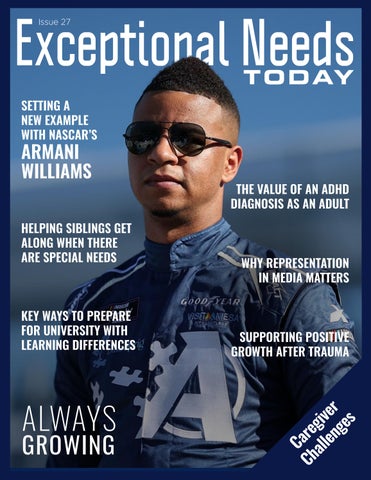
SETTING A NEW EXAMPLE WITH NASCAR’S ARMANI WILLIAMS
THE VALUE OF AN ADHD DIAGNOSIS AS AN ADULT
HELPING SIBLINGS GET ALONG WHEN THERE ARE SPECIAL NEEDS
KEY WAYS TO PREPARE FOR UNIVERSITY WITH LEARNING DIFFERENCES
WHY REPRESENTATION IN MEDIA MATTERS
SUPPORTING POSITIVE GROWTH AFTER TRAUMA
12 HOME ORGANIZATIONAL TIPS FOR PARENTS OF EXCEPTIONAL CHILDREN
Rose Adams, OTD, OTR/L
Parenting exceptional children comes with many daily demands. Rose Adams shares simple, practical strategies to organize your home, support children’s independence, and create a calmer, more manageable environment.
20 THE EMOTIONAL LABOR OF BEING A SPECIAL NEEDS PARENT: REAL TALK & REAL SUPPORT
Meshell Baylor, MHS, MSW
Behind every special needs parent is unseen emotional labor—advocacy, resilience, and love. Discover why community, support, and self-care are essential on this powerful parenting journey.
OUR COVER STORIES
SETTING A NEW EXAMPLE WITH NASCAR DRIVER ARMANI WILLIAMS
Kauy Ostlien
From toy cars in Michigan to NASCAR’s national stage, Armani Williams is racing past expectations while using his platform to champion autism awareness and inspire the next generation.
16
WHY REPRESENTATION IN MEDIA MATTERS: FROM RAIN MAN TO LOVE ON THE SPECTRUM
Dr. Stephanie Holmes, BCCC
From Rain Man to Love on the Spectrum, media shapes how society understands autism. Authentic representation can challenge stereotypes, foster empathy, and help neurodivergent individuals feel truly seen.
34 KATE MAKES IT GREAT WAYS TO HELP SIBLINGS GET ALONG WHEN THERE ARE SPECIAL NEEDS
Kate C. Wilde
Sibling relationships can be complicated—especially when special needs are involved. Discover practical, compassionate strategies to reduce conflict and help brothers and sisters build stronger, more understanding bonds.
52 PREPARING FOR UNIVERSITY WITH AUTISM AND OTHER LEARNING DIFFERENCES
Dr. Ronald I. Malcolm, EdD
University can be an exciting step for students with autism. Let’s consider practical ways parents can help build independence, self-advocacy, and daily living skills for success.
56 SAFETY GOALS WITH NICOLE WHEN THE WORLD FEELS SHAKEN: SUPPORTING POSITIVE GROWTH AFTER TRAUMA WHEN THERE ARE DISABILITIES
Nicole Moehring
When trauma disrupts a child’s sense of safety, healing takes patience and support. Learn how caregivers can help individuals with disabilities rebuild trust, resilience, and emotional strength
60 THE VALUE OF AN ADHD DIAGNOSIS AS AN ADULT
Robin Tate, MA, MS, BCC, CAS
An ADHD diagnosis in adulthood can bring relief, grief, and clarity. One woman shares how understanding her brain transformed shame into self-acceptance and strength.
24 JENNIFER'S JAM WHEN I AM THE STORM: RADICAL ACCEPTANCE AFTER MELTDOWNS
Jennifer McAvoy, MEd
Autistic meltdowns can bring intense overwhelm and guilt. One autistic adult shares how radical acceptance, self-compassion, and practical tools help her to navigate the storm and recover afterward.
26 SUMMER IS COMING: AN ENDOF-YEAR IEP SUPPORT CHECKIN FOR INCLUSIVE CLASSROOMS
Dr. Alexis L. Hamlor, EdD
An educational leader and scholarpractitioner provides top advice on how to ensure your child gets support and maintains vital communication between school and home during the school year.
30 THE CLOCKS INSIDE THEIR HEADS: WHAT ADHD PARENTS NEED TO KNOW ABOUT TIME BLINDNESS
Sarah Ragab
Why do children with ADHD struggle to “feel” time passing? Understanding time blindness can transform chaotic mornings—and help parents build routines that work with their child’s brain.
38 A PARENT’S GUIDE TO SUPPORTING OLDER STUDENTS WITH DISABILITIES
Amy Endo, PhD
As students with disabilities grow older, their independence needs evolve. Discover practical ways parents can support learning, build executive skills, and nurture confidence at home.
EXCEPTIONAL BOOKS AUTISM AFTER 22 LIFE BEYOND SCHOOL
What happens after school ends for autistic adults? Autism After 22 shares one mother’s heartfelt journey navigating adulthood, advocacy, and the search for meaningful opportunities
42 THE FRIENDSHIP & DATING DUO THE $69 HOT DOG: WHAT COMPARISON DOES TO SELFWORTH AND SOCIAL CONFIDENCE
Jeremy and Ilana Hamburgh
What can a $69 hot dog teach us about confidence? Learn how comparison undermines self-worth—and why believing in your value is key to social success.
45 EXCEPTIONAL TOOLS & PRODUCTS WHIZKID GAMES
Discover Whizkid Games, a research-based mobile app that helps autistic children build everyday independence.
46 NEURODIVERSITY IN ACTION: SCHOOLS THAT ARE GETTING INCLUSION RIGHT
Meshell Baylor, MHS, MSW
True inclusion goes beyond classroom placement; it creates schools where neurodivergent students belong, participate, and thrive. Discover how some schools are redefining inclusion and what families should look for.
48 THE HIDDEN CHALLENGES CAREGIVERS FACE AND WHY SUPPORT MATTERS
LaKeesha Hines
Caregivers give endlessly—but the emotional, physical, and financial toll often goes unseen. Learn why support, resources, and community are vital to preventing burnout.
50 TOP WAYS TO INCLUDE A DIFFERENT LEARNER THROUGH TEACHING STYLES & APPROACHES
Karen Kaplan, MS
Every brain learns differently. Uncover practical strategies teachers can use to adapt classrooms, engage diverse learners, and create environments where every student has the opportunity to succeed.
58 PROPRIOCEPTION: THE ROLE OF ‘HEAVY WORK’ IN SENSORY AND EMOTIONAL REGULATION
Laura Ryan
Why do activities like pushing, jumping, or squeezing help children feel calmer? Discover how proprioception and “heavy work” support sensory processing, emotional regulation, and daily functioning.
64 BEING UNAFRAID TO MAKE CHANGES TO SUPPORT YOUR CHILD’S GROWTH
Camila Titone
Making changes to your child’s diet can feel overwhelming. Learn how small, confident steps toward better nutrition can support your child’s growth, regulation, and overall well-being
68 NATURE NOTES NATURE-THEMED FINGERPLAYS FOR FINE MOTOR SKILL ENHANCEMENT
Amy Wagenfeld, PhD, OTR/L, SCEM, FAOTA
Turn learning into play with nature-themed fingerplays that build fine motor skills, encourage movement, and spark joyful connections between children, music, and the outdoors.
70 VALUABLE WAYS TO NAVIGATE ALBINISM WITH YOUR CHILD
Dr. Ronald I. Malcolm, EdD
When your child is diagnosed with albinism, questions and challenges can follow. Learn practical ways to support their health, confidence, and success at school and beyond.
74 GEORGETOWN UNIVERSITY IS A LEADER ON DISABILITIES
Miriam Edelman, MPA, MSSW
Georgetown University is redefining disability inclusion in higher education by launching a student-driven disability studies major and building a campus culture where disability is recognized as essential to humanity.
80 LIFE WITH ASPERGER’S MY EXPERIENCE WITH AUTISM AND GASTROINTESTINAL ISSUES
Julie Day
Gastrointestinal issues are common in autism. In this personal story, Julie Day shares how food intolerances shaped her journey and offers practical tips for managing triggers.
83 REFLECTIONS
LOVE THEM FOR WHO THEY ARE
Gary Shulman, MS Ed
Read a heartfelt poem celebrating unconditional love and reminding parents to embrace their child’s unique spirit, quirks, and to cherish them exactly as they are.
84 FINANCIAL FOCUS EXPERT GUIDANCE IN EXCEPTIONAL NEEDS FAMILY PLANNING
Ryan F. Platt, MBA, ChFC, ChSNC, CFBS
Find out what you should consider when preparing for the future and how to build a structure to allow a loved one with a disability to survive and thrive.
87 DIRECTORY 2026 SUMMER CAMPS AND PROGRAMS
Explore summer camps and programs that support neurodiverse youth and adults through travel, adventure, friendship, and skill-building.
NEEDS TODAY
Exceptional Needs
Our mission is to educate, support, and energize families, caregivers, educators, and professionals while preparing all families for a healthy future.
exceptionalneedstoday.com
Founder/Publisher
Amy KD Tobik, BA
Founder | CEO
Lone Heron Publishing, LLC
Magazine Staff
Editor-in-Chief: Amy KD Tobik, BA
Copy Editor: Emily Ansell Elfer, BA
Digital Marketing Coordinator & Social Media: Dione Sabella, MS
Graphic Designer: Annie Rutherford, BA IT & Digital Solutions Specialist: Jared Cochran Intern: Abigail Schreiner
Exceptional Needs Today is a bimonthly publication produced by Lone Heron Publishing.
Disclaimer: Advertised businesses and products are not endorsed or guaranteed by Exceptional Needs Today, it’s writers or employees. Always follow medical advice from your physician.
From the Editor’s Desk
How do you measure growth in yourself or in a loved one with a disability? Do you find it difficult to recognize meaningful progress—whether day to day or over the long term?
Sometimes, during those more frustrating, drawn-out days, it’s tough to notice signs of development. Tracking and celebrating individual growth is so important. These practices help us set clear, measurable goals. Supporting each other's achievements remains key to encouraging positive outcomes.
Meshell Baylor, MHS, MSW, the mother of four children (two of whom are on the autism spectrum), encourages families to keep a log of small victories, every step forward, no matter how tiny. As Meshell shares, “These are proof of progress and fuel for your spirit.” In her piece, “The Emotional Labor of Being a SpecialNeeds Parent: Real Talk & Real Support,” Meshell says every effort you make is one more step toward a brighter future for your child and for families walking this path beside you.
Jeremy and Ilana Hamburgh note that measuring progress against one's own previous achievements is far more meaningful than comparing ourselves to others. This is especially true in an environment where social competition is prevalent. Be sure to read their article, “The $69 Hot Dog: What Comparison Really Does to SelfWorth and Social Confidence.” As the duo explains, “The only comparison that truly builds confidence is: Who was I before, and who am I becoming?”
Amy Endo, PhD, in her piece “A Parent’s Guide to Supporting Older Students with Disabilities,” urges parents to celebrate
all achievements and prioritize persistence over outcomes. She emphasizes teaching self-advocacy to promote resilience and independence, noting that steady support and patience help students gain confidence and reach their academic potential.
We are excited to feature Armani Williams this month. An American professional stock car racing driver, he last competed in the NASCAR Xfinity Series. Armani is racing past expectations, so to speak, while using his platform to champion autism awareness and inspire the next generation. Be sure to read, “Setting a New Example with NASCAR’s Armani Williams,” written by Kauy Ostlien. Diagnosed with autism at two years old, Armani didn’t speak until he was three. He says he had some social interaction and sensory issues as a child, but he worked continuously to adapt to the loud racetrack environment and realize his dream.
We always appreciate our contributors, advertisers, and subscribers who support and play a vital role in our awardwinning magazine. Together, let's advocate for awareness, acceptance, and inclusion.
And let’s remember to celebrate our ever-growing selves.
Setting a New Example with NASCAR Driver Armani Williams
By Kauy Ostlien
It’s amazing how one small moment can change a person's entire life, especially the way it did for NASCAR driver and autism awareness advocate Armani Williams.
Growing Up
Though the 25-year-old's family had a minor connection to the automotive world — his great-grandfather owned an auto body shop in downtown Detroit — Williams, a native of Grosse Pointe, Michigan, did not grow up in a racing family.
In fact, he attributes his love for racing to toy cars and being gifted a toy model of a NASCAR race car at a young age. These small toys sparked a love affair with racing that turned into a career in one of America's highest forms of motorsports.
Growing up in Michigan, Williams spent a lot of time focused on the details of his toy cars. He enjoyed the way they looked and how they moved, a common trait among many children later diagnosed with autism. This early interest gave him a way to connect with the world around him. As he got older, that interest turned into a deep knowledge of how race cars work. His family noticed that he had a natural ability to stay focused on racing for long periods, which eventually helped him when he started competing in actual races.
Going Racing
After working his way through the lower levels of youth racing since the late 2010s, Williams has charted a path from the lowest rungs of NASCAR's structured development system, all
the way to the sport's top divisions, all while dealing with the challenges presented to him as one of the first professional NASCAR drivers openly diagnosed with autism.
Moving up through the different levels of NASCAR is a very difficult process for any driver. It requires extensive travel, constant practice, and the ability to work closely with a large team of mechanics and engineers. For Williams, this meant learning how to handle the loud noises and busy environments of the racetrack while staying calm behind the wheel. He worked hard to prove that he could compete at the same level as everyone else. Each step up the ladder brought new challenges, but he used his focus and engineering background to understand the car better and improve his lap times.
Williams, who was diagnosed with autism at a young age, says that he sees his platform as an opportunity not only to help teach those who may not understand the challenges and achievements of those with autism, but also to show fellow members of the autism community everything they can achieve.
"I feel like by sharing everything that I've experienced in more of a positive way, I can help people understand what autism is all about and the strengths that come with autism," Williams said, adding that he hopes his story "can kind of create some light of hope for everyone in the autism community."
It is through his story of triumph that Williams has worked his way across the country, advocating for and teaching about autism. Along the way, he has had many incredible opportunities to find new ways to tell his story to the world.
Meeting Dr. Condoleezza Rice
In early 2026, Williams was given a once-in-a-lifetime opportunity to sit down with former United States Secretary of State Dr. Condoleezza Rice as part of a series of recorded interviews at Stanford University.
Dr. Rice is a trailblazing figure in American diplomacy and academia, having served as the 66th United States Secretary of State — the first African American woman to hold the post. A specialist in Soviet and Eastern European affairs, she also served as National Security Advisor and is currently the Director of the Hoover Institution at Stanford University. Her career is defined by breaking barriers in high-stakes environments, making her a uniquely resonant figure for Williams to connect with regarding his own journey of overcoming obstacles.
Recognizing her impact on American history, Williams felt honored to receive the invitation and the opportunity
Williams when he was 11 years old going to watch a race at Michigan International Speedway
Williams when he was 12 years old racing at Jackson Speedway in Jackson, Michigan
for them to get to know each other better, discussing the challenges they have both faced in building their careers.
Even though Rice and Williams have worked their way into very different career paths, facing many different battles along the way, Williams says his biggest takeaway from the interview with Dr. Rice was the similarities they shared in their journey to the top of their respective worlds.
"I think mainly it was more so how much in common we have, how much we could relate," Williams said. "And that's what made that conversation a lot easier, it's a moment I won't forget for a long time in terms of people I've met throughout my life. That's for sure."
During this interview with Dr. Rice, Williams credited his parents for his drive to overcome challenges, noting that his father, an African American, and his mother, a Serbian immigrant, set a strong example for the future racer to follow.
As a result of his success, Williams now finds himself in the spotlight as a role model for the many individuals diagnosed with autism across the country.
Becoming a Public Speaker
Williams started with racing ambitions but soon turned to public speaking to expand his skills beyond the track. Drawing on lessons from his parents, he has used this skill set to tell his life story and share his triumphs with as many people as he can.
Working with schools, companies, and organizations, Williams uses his story, platform, and achievements to bookend what he calls the "ups and downs" that he has faced as a professional athlete with autism.
When Williams speaks to these groups, he often talks about the importance of having a strong support system. He
credits his family and his team for helping him reach his goals in NASCAR. He explains to the audience that everyone faces various kinds of obstacles, and having autism is just one part of his story. During these visits, Williams answers questions from students and parents who want to know more about how he manages his daily life as a driver. These conversations help break down the barriers and the many misunderstandings that people sometimes have about the autism community.
Of course, as someone who was once a child learning how to manage the highs and lows of autism, Williams has found a special connection with the many children he meets at schools and is proud to be a role model for children with autism.
Serving as a role model for some of these kids, Williams preaches that you can still achieve your dreams no matter the obstacles placed in front of you.
"My main message to them is if you have a dream of something that you want to grow up to be or something that you want to be successful at, go for it," Williams said. "At the end of the day, we all share this great world, and I think no matter what you have, you can be successful at whatever you want to accomplish."
While Williams may not have a chance to share his story with every kid across the country, his net is getting even wider with the development of his new coloring and activity book.
A New Book for Families
This new book tells the story of Williams’ journey and is filled with interactive games and educational coloring sheets.
The Michigan native developed the idea while seeking creative ways to share his story. After months of work, the project is nearing completion.
The idea for the book came from a desire to reach younger children who might not be able to attend a race or a speaking event. Williams wanted to create something that was both fun and educational for families to use at home. The book includes stories about his own childhood and the steps he took to become a professional driver. By including coloring pages and games, he hopes to make the information more relatable for kids. He believes that starting these conversations at a young age can help children with autism feel more confident about their futures and what they can achieve.
In this book, Williams aims to inform readers about the daily experiences of individuals with autism, while also fostering family connections through engaging activities and sharing
One of the most fun things Williams gets to do is visit with students and teachers, like this photo of him with the fourth and fifth graders at Hillcrest Elementary School in San Francisco
insights into his background and progression toward a career in NASCAR.
Of course, for Williams, who, in addition to being a race car driver, is a graduate of Oakland University with a degree in mechanical engineering, the addition of a coloring and activity book to his repertoire was an unexpected yet fun experience.
Regardless, no matter what comes next for Williams, whether it's a trip to victory lane, a meeting with an iconic figure of American politics, or speaking with a classroom of children, he maintains his message of overcoming life's challenges with a positive mindset and hard work.
"Anything is possible with autism as long as you believe in yourself and stay encouraged," Williams said. "Work hard at whatever you're doing to try and help you move up the ladder and continue your life forward."
Here are samples from his coloring book:
Armani Williams’ Activity Book: A Story That Continues at Homee
For most NASCAR drivers, the story ends when the helmet comes off.
For Armani Williams, that is often when the most important part of his work begins.
After races, speaking engagements, and school visits across the country, Williams noticed something that stayed with him. Kids were curious. Parents had questions. Teachers wanted ways to continue the conversation about autism, perseverance, and believing in yourself.
But once the day ended, there wasn't always something those families could take home to keep the conversation going.
So, Williams decided to create one.
His new Armani Williams Coloring and Activity Book is designed to bring his story to life in a way that young readers can experience themselves. The book blends fun with learning, featuring interactive games, puzzles, and coloring pages alongside the story of how a kid who loved toy cars in Michigan grew up to become a professional NASCAR driver.
It is not just a book about racing. It is about believing that obstacles do not define your future.
The book is already drawing interest from schools, autism organizations, community groups, and corporate partners who want to use it as both an educational tool and a positive message for families.
Organizations can also place bulk orders for classrooms, community programs, and special events, with special pricing available for larger distributions.
Williams plans for this first edition to be Volume 1 of an ongoing series, with several new books planned each year. Each edition will introduce new stories, activities, and lessons designed to continue the conversation with families while giving kids fresh ways to learn, create, and connect with the journey.
Because sometimes the most powerful stories do not just live on the racetrack. Sometimes they start with a crayon.
To learn more or order the Armani Williams Coloring and Activity Book, visit: teamarmaniracing.com
Kauy Ostlien is a sports broadcaster and writer from Texas. Alongside play-by-play, analyst, and hosting duties in collegiate athletic broadcasts, he covers NASCAR for The Daily Downforce and NASCAR Pole Position Magazine.
Recently while I was working with one of my students at a daycare center, he asked for a toy we had played with in the past. I could not find it. He continued to ask for the toy over a few sessions, and my answer was the same: I could not find it in my office. Then he said, “Maybe you should organize.” I smiled and chuckled because I didn’t expect him to say that and I was wondering if he knew what “organized” meant. If you know me, you will know I am an organized person. But his feedback was not intended to be a personal attack, it was simply him offering a suggestion so that I could locate one of his favorite toys. So, I welcomed the feedback.
In curiosity, I asked him if he knew what the word organized meant. He confidently said “Yes,” then began to explain, “It’s when you have a bunch of things and you put them in a certain place so that when you need something you know where it is.” His definition was spot on! I then asked him if he could give me some examples of how he organizes his things at home; he gladly did. Lastly, he offered another suggestion, and said, “When you find it (the toy), put it on the window.” He figured that if it’s on my window, I will see it on my way out. Clever! Not too long after, I did find the toy, and all was well.
The Struggle is Real
Long before having children of my own, I was hyper-focused on maintaining a neat and organized living space. When I became a mom and our boys were toddlers, that level of focus went out the window. Now, I pick certain spaces or rooms in the home to maintain my need to organize. I don’t know about you, but when I am feeling overwhelmed, I get into cleaning mode. Cleaning not only provides my body with the sensory input it needs to feel calm, but it also provides a sense of external order. Our children may also be experiencing a sense of internal overwhelm.
So, let’s explore ways to help create a more organized physical environment for our children, too. Research suggests that there is a relationship between a cluttered space and mental well-being (Quinn, 2025). Like my example, I feel better when I have deep cleaned my space until I’ve found a place of calm. Another example is work. When work is particularly busy, my office space starts to look a lot less organized. In my busier seasons, I try to prioritize rest over organization. However, I recognize that when I need to be more productive and efficient, an organized space is essential. Can you relate?
In this article, I’d like to offer a few suggestions for helping you get your home space organized so that you and your children might experience the benefits of the “calm” that follows. They are (1) Identify, (2) Sort, and (3) Practice.
Identify
Why is organization so important? An organized space not only allows you to find things that you need when you need them, it also provides a sense of calm and visual order. First, identify the space, room, or location that you’d like to create order or a sense of external calm. Then, identify the items that you want or need to organize. These are items that you consider important or relevant for your day-to-day. Think of the things that might make your home routines smoother. As parents, we are frequently multi-managing internally (thoughts, plans) and externally (childcare, meal prep, work, etc.). If we structure our physical environment in a way that provides order, it’s one less thing to manage or think about.
Sort
The second tip is to sort. Sort out the things that you’ve identified in the above step. For my family, the location is the living room. The items are backpacks, shoes, and band instruments. These are the common items that might create chaos if they are not located or in a place where our boys need them in the morning. Organizing these items in this space helps to make our morning routines smoother. We do not always get it right, but we try. Give daily grace to yourself for trying.
Here are some ways to sort out items that you are seeking to organize:
• Use wall hooks for backpacks or other essential items.
• Pick a designated spot or location for things that often go missing.
• You may want to also consider visuals such as labeling if that works for your family. Providing a visual cue
PARENTAL SUPPORT
for children (and adults) prompts the visual system to “look” or notice the item when so much is going on. Children might benefit from a visual chart (Buffett, 2025) or checklist with a rewards system if that aligns with their interests.
• Consider bins, or clear containers for your items. Clear bins provide an easy view of the items you need.
• If clothing items are something that you’ve identified, consider sorting them by color or type (e.g., hats, gloves, boots). Can you think of other examples?
Early in my career, I wanted to create a company that helped people organize their home and workspaces. I informally attempted this venture but it didn’t get too far. Now, I get joy from keeping my closet organized (most of the time) and helping my family to do the same. As an occupational therapy practitioner, I have helped children and adults discover ways to organize their personal belongings at school or their meaningful items at home to support regulation and engagement. In the sorting phase, be sure to include your children in the process! Including children in the plans gives them a say into how things are organized so that the systems we create work for them as well (Adams, 2022).
Practice
The last is practice. Put your organization into practice. Practicing through repetition helps make behaviors more automatic so that they won’t require much thought in moments of stress, hurry, or overwhelm. Give your organization routine some time. Practicing also gives insight into how well it’s working and what parts or components need to be changed. If you’re saying it’s not working and everything needs changing, that’s good! Let’s try again. Remember, offer daily grace to yourself and children for trying. How often do we celebrate effort (Adams, 2026)? The goal here isn’t to get it perfect, but rather it’s to get it working for you and your family.
Take-Home Message
Creating an organized physical environment might seem simple or perhaps overwhelming. Start with identifying the location. That’s the start. Pick a place to start. Think about it or sleep on it. Then identify the “What.” What items are important for you and your family so that the day-today might feel less cumbersome and overwhelming. Once you’ve identified the place and items, start the sorting process. Include your children and other family members in the process. Lastly, practice. Practice not to perfect, but to get things working. In the process of practicing offer yourself grace to do-over or modify if needed so that the organization process works for you and your family. An organized space not only provides visual flow and order; it promotes a sense of calm. Let’s get organized!
An organized space not only allows you to find things that you need when you need them, it also provides a sense of calm and visual order.
References:
Adams, R. (2026, January). ENOUGH: Helping children celebrate effort over perfection at school. Exceptional Needs Today, 25, 16-18. https://issuu. com/exceptionalneedstoday/docs/issue_25
Adams, R. (2022, July). Giving kids a voice: Promoting early self-advocacy among children with disabilities. Exceptional Needs Today, 9, 18-21. https://issuu.com/exceptionalneedstoday/docs/ent_issue_9
Buffett, S. (2025, February 10). Teaching children to be organized –Cultivating organization in children: A parent’s guide: Organize for Life. https://organizeforlife.org/teachingchildren
Quinn, F. (2025). Home clutter and mental well-being: Exploring moderators and the mediating role of home beauty. Journal of Environmental Psychology, 105, Article 102672. https://doi.org/10.1016/j.jenvp.2025.102672
Rose Adams, OTD, OTR/L is an occupational therapy practitioner with a clinical focus in pediatrics. She works with children and families of children on the autism spectrum, multiple disabilities, and other neurodiverse needs. Dr. Adams has worked in schools, private practice settings, and community-based programs. She is the executive director at Changing Lives Occupational Therapy, P.C., where she provides occupational therapy services, summer camps and enrichment programs, professional development trainings, mentorship, and parent support workshops. Dr. Adams is a graduate of Boston University’s online Post Professional Occupational Therapy Doctorate (PP-OTD) program and currently serves as an academic mentor. Her doctoral project focused on using song-based interventions to support young children with autism and related disabilities participate in school-based occupations. Dr. Adams is also a continuing education course instructor at Aspire OT. When she is not working, she enjoys writing, baking, singing, and sharing time exploring the outdoors with her school-aged twin boys.
Autism Advocacy Interrupted is more than a book—it’s a wake-up call for anyone who cares about the autism community.
In today’s advocacy landscape, families often face a storm of competing voices: infighting, ego-driven agendas, and fragmented messages that do little to meet real needs. Jeanetta Bryant, both a mother and seasoned advocate, has lived through the confusion, frustration, and heartbreak this division causes. With unflinching honesty and compassion, she lifts the veil on the hidden fractures in the movement, introducing four distinct advocate types—Revolutionists, Trailblazers, Mavericks, and Disruptors.
Through these portraits, Bryant invites readers to examine who they follow, why their message matters, and whether the noise is helping or hurting the very people we claim to serve. She challenges us to trade division for unity, volume for vision, and personal agendas for purpose.
This is not a call to choose sides—it’s a rallying cry to rebuild the foundation of autism advocacy so that dignity, wellbeing, and future opportunity for those on the spectrum come first.
If you’re ready to reflect, engage, and make a difference, Autism Advocacy Interrupted will give you the insight, courage, and clarity to be part of lasting change.
Why Representation in Media Matters: From Rain Man to Love on the Spectrum
By Dr. Stephanie Holmes, BCCC
When Rain Man was released in 1988, it was one of the first times many Americans encountered the word “autism.” For better or worse, that film became the cultural reference point. For decades, when someone said “autistic,” what people pictured was Raymond Babbitt — brilliant with numbers, socially disconnected, rigid, a savant. It opened a door. It also built a very narrow frame. Representation in media is never neutral. Stories shape imagination, and imagination shapes expectations. Expectations, in turn, shape relationships, classrooms, churches, workplaces, and homes.
Over time, portrayals have expanded. Television introduced characters like Max Braverman in Parenthood, and later, adults discovering their own diagnosis. More recently, Love on the Spectrum has allowed autistic individuals to tell their own stories in their own voices — full of humor, longing,
vulnerability, and complexity. That shift matters. But we still have work to do.
Autism Is Not a Plot Device
Too often, neurodivergent characters are used as side characters to teach the neurotypical lead a lesson. They exist to soften someone else, to provide comic relief, to display a special talent at a convenient moment, or to create conflict that someone else must heroically solve. Autism becomes a narrative tool rather than a lived reality.
When autism is reduced to quirks, genius, or social awkwardness, we miss the depth of internal experience: the sensory overwhelm, the moral clarity, the loyalty, the deep focus, the anxiety, the beauty of pattern recognition, the fatigue of masking, the longing for connection.
And when autistic characters are always secondary, viewers who are themselves autistic may internalize a subtle message: “You are not the main character.” That is not a small thing.
The Power of Recognition
Human beings need mirrors. We need to see ourselves reflected somewhere in the cultural story. For children and teens growing up neurodivergent, media representation can be profoundly regulating. To see someone who thinks like you, who processes the world like you, who loves deeply but differently— It reduces shame, creates language, and fosters self-understanding.
For adults (especially those diagnosed later in life), seeing nuanced portrayals can be life-altering. I have sat with couples where a television character sparked the first real conversation about autism in their marriage. A fictional storyline permitted a real one.
That is the power of story.
When the media reflects the true diversity of minds, it does more than entertain. It fosters empathy. It invites curiosity. It reduces fear. It dignifies difference.
Moving Beyond Stereotype
We must move beyond two extremes: the tragic burden narrative and the quirky genius narrative. Autism is not a tragedy to overcome, nor is it a superpower to romanticize. It is a neurodevelopmental difference that shapes perception, communication, and relational style. It includes strengths and vulnerabilities, just like any other wiring. When media creators consult autistic adults, hire neurodivergent writers, and allow characters to be complex — capable of growth, conflict, humor, faith, doubt, leadership, and love — we move closer to authenticity. Authentic characters are not flattened into diagnostic
checklists. They are allowed contradictions. They are allowed development. They are allowed to be protagonists.
Why This Matters to Families
As someone who works closely with families navigating autism and other neurodivergences, I see firsthand how cultural narratives seep into identity. Parents absorb media messages about what autism “should” look like. Spouses compare their partner to a caricature they’ve seen on screen. Autistic adults measure themselves against exaggerated portrayals and wonder why they do not fit the mold.
Healthy representation expands the narrative. It reminds us that autism exists across genders, ages, cultures, faith communities, and personality types. It shows dating, marriage, employment, disappointment, resilience, and joy. It tells a fuller truth.
The Future of Storytelling
We are in a moment of growth. More autistic creators are entering the conversation. More nuanced portrayals are emerging. Social media has allowed self-advocates to speak directly rather than being spoken for. That is hopeful.
But the goal is not simply more autistic characters. It is better storytelling. Stories where autism is integrated into the whole person. Stories where neurodivergent individuals are not reduced to their diagnosis, but neither is their wiring erased for comfort.
When the media reflects the true diversity of minds, it does more than entertain. It fosters empathy. It invites curiosity. It reduces fear. It dignifies difference.
And perhaps most importantly, it allows someone sitting quietly on a couch somewhere — child, teenager, spouse, adult newly discovering their diagnosis—to whisper, “That feels like me.”
Holmes’ Cinema Clues welcomes Dr. Temple Grandin in our first season to discuss Autism & Media and her own movie, The Temple Grandin Movie, made about her life.
Holmes’ Cinema Clues is a media conversation series that explores film and television through the lens of neurodivergent minds and specialists who work in the field of autism. Hosted by Dan Holmes and Dr. Stephanie Holmes, the show looks beyond surface storytelling to examine how characters think, relate, and make meaning—especially those who live on the margins of conventional narratives. Rather than “diagnosing characters,” Holmes’ Cinema Clues investigates the patterns, perspectives, and relational dynamics that resonate with autistic and other neurodivergent viewers, highlighting how stories shape understanding of difference, identity, and belonging.
With a blend of thoughtful analysis, curiosity, and a touch of detective-style fun, the show invites audiences to reconsider familiar films and discover the hidden clues about humanity woven into the stories we love. Dr. Stephanie Holmes and Dan Holmes, alongside Cinema Squad members Sydney Holmes Roberts, Dave Glick, and Kristin Sunata Walker, bring thoughtful insight and lively curiosity to each cinematic case. Together, they examine the characters, themes, and hidden relational dynamics woven into the story — approaching every discussion with a blend of professional depth, personal experience, and detective-style intrigue.
Dr. Stephanie C. Holmes, BCCC, is a former LPC, educator, researcher, author, and certified autism specialist and coach with neurodiversity training. However, her most significant credential comes from being a mother to two amazing young adult neurodivergent (ASD & ADHD) daughters. Dr. Holmes' career focus changed in 2006 when her daughter was diagnosed with Asperger's (now AS Level One). Her family wrote and released a book from a four-person family perspective called Embracing the Autism Spectrum: Finding Hope & Joy Navigating the NeuroDiverse Family Journey in 2023, available now on Amazon and audio in the BookBaby store. She and her husband, Dan, are a neurodiverse couple (Dan was diagnosed in 2019 ASD Level 1), and with other contributing authors in the neurodiverse marriage field, have written Uniqu ely Us: Gracefully Navigating the Maze of NeuroDiverse Marriage; pre-orders available wherever books are sold. Stephanie and Dan host a podcast that is listened to in over 40 countries, the NeuroDiverse Christian Couples podcast. �� holmesasr.com �� christianneurodiversemarriage.com/membership
The Emotional Labor of Being a Special Needs Parent: Real Talk & Real Support
By Meshell Baylor, MHS, MSW
"Be strong, be fearless, be beautiful. And believe that anything is possible when you have the right people there to support you.”
Misty Copeland
Being a parent to a child with special needs is one of the most meaningful yet demanding journeys a person can experience. It is an act of profound love, ongoing effort, and relentless advocacy. This labor is not simply daily caregiving — it is about ensuring that, through your love, your child’s unique needs are consistently met, academically, socially, emotionally, and physically. From the moment a child enters your world, you begin learning resilience, creativity, endurance, and advocacy — not from textbooks, but from showing up every day for someone you love unconditionally.
Laboring for Your Child
The labor of love begins long before your first school meeting. It begins in the quiet moments of observing your child, interpreting their cues, trying to understand what they’re telling you when words may not be enough. It’s the early mornings and late nights, the notebooks filled with unfamiliar acronyms, the whispered promises to yourself to learn one more thing today.
I carried tiny composition notebooks to every meeting. When a professional used a word I didn’t know, I pretended to write notes, but really I was writing that word down so I could research it later. I sat at the back of classrooms, asking educators for tips on behaviors and strategies, then went home and practiced them — with love and persistent trial and error. Home dynamics created new layers of complexity, as children transition from structured school environments into the emotional and sensory world of home.
This labor — steady, intentional, and full of love — shapes your child’s development and enhances their capacity to thrive.
Research on Parent Involvement
The research is clear:
• Children with disabilities demonstrate significantly better academic and social outcomes when parents are actively involved in their education and development. This involvement supports better communication, consistent behavior strategies, and more effective individualized supports.
• Parental engagement enhances continuity of interventions, increases parental satisfaction, and helps families and schools’ problemsolve more effectively.
• In children with autism spectrum disorder (ASD), parental involvement correlates with stronger motivation, emotional wellbeing, and academic performance.
These outcomes show that your participation isn’t just loving — it’s evidencebased and impactful.
This community didn’t take away the challenges — but it gave us shoulders to lean on, voices to share triumphs with, and hearts that understood.
Finding Strength in Community
No parent should navigate this journey alone, but for many of us, that sense of isolation was real long before we found community.
One of the most transformative parts of my journey came from connecting with other mothers walking the same path. I remember meeting moms in hallways with tears in their eyes, overwhelmed and unsure if they were “doing enough.” Instead of brushing past those moments, we talked. We cried. We shared what worried us and what we hoped for our children. We began forming a network, a real community.
We met for morning breakfasts at school while our kids ate. Sometimes we sat in silence; sometimes we laughed; sometimes we cried together. We attended each other’s children’s birthday parties. We helped each other write questions and strategies for Individualized Education Plan (IEP) meetings. We sat beside one another in those meetings, offering emotional support and strength. When one child transitioned to a new school or program, we traveled together as a group to provide social and emotional backup. Those connections weren’t just helpful — they were transformative.
A community is defined as a social unit with shared characteristics, values, identities, and support systems. What we learned was that our shared identity as mothers raising children with special needs created a powerful bond. We weren’t just support partners; we became family.
Why Community Matters
Studies show that peer support networks for parents of children with special needs reduce stress, increase coping strategies, and strengthen emotional resilience. When parents feel supported by others who truly understand, the quality of life improves — not just for the parents, but for the parent–child relationship as well.
EMOTIONAL HEALTH
This community did not take away the challenges but it gave us shoulders to lean on, voices to share triumphs with, and hearts that understood.
The Emotional and Physical Toll of Parenting a Special Needs Child
Parenting a child with special needs can take a toll — emotionally, physically, and mentally.
Research shows that parents of children with special educational needs experience higher levels of stress, anxiety, and emotional strain than parents of typically developing children.
This stress comes from multiple directions: navigating educational systems, medical appointments, financial pressures, behavior challenges, and the constant emotional labor of care. It is why selfcare isn’t indulgent — it’s essential for sustainability.
Practical Tips for Special Needs Moms
Here are research supported strategies and practical tips to sustain you on this journey:
1. Educate yourself
Attend workshops, trainings, and advocacy classes. Knowledge empowers confidence and helps you partner more effectively with educators and therapists. Special education processes can be complex but learning them gives you agency in your child’s world.
2. Practice selfcare
Short breaks, mindfulness, physical movement, therapy, journaling — these are not luxuries. They are protective, restorative actions that help you show up more fully for others.
3. Build your support network
Peer support groups aren’t just helpful, they’re healing. Talking with parents who understand the unique challenges you face normalizes your experiences and opens doors to new strategies and perspectives.
Research shows that perceiving parenttoparent support correlates with improved parent–child relationships and overall quality of life.
4. Pace yourself
Advocacy and learning are marathons, not sprints. If you can’t complete an Individualized Education Program (IEP) or therapeutic plan today, that’s okay — you will meet it with greater clarity tomorrow.
5. Celebrate milestones
Keep a log of the small victories — every step forward, no matter how tiny, matters. These are proof of progress and fuel for your spirit.
6. Use community resources
Investigate local and national organizations, therapy programs, advocacy groups, and online platforms. Sharing resources with other parents strengthens the whole community.
Final Thoughts
The emotional labor of being a specialneeds mom is built on hundreds of tiny decisions, daily acts of love, and unwavering presence. It’s writing down a word to look up later. It’s trying strategies at home. It’s showing up in meetings. It’s sharing laughs and tears with others who understand.
This journey is challenging, sometimes exhausting, and often emotional — but it is also transformative. You aren’t just raising a resilient child; you are modeling resilience, courage, and advocacy for a generation. You are shaping a community. You matter. Your labor matters. And every effort you make is one more step toward a brighter future for your child and for families walking this path beside you.
References:
Bray. L . et al. Parent-to-parent peer support for parents of children with a disability: A mixed method study. Patient Education and Counseling. https://www.sciencedirect.com/science/article/pii/S0738399117301313
Cheng. A. Parental stress in families of children with special educational needs: a systematic review. Front Psychiatry. https://pmc.ncbi.nlm.nih. gov/articles/PMC10449392/ Family Involvement in Special Education. https://www.ebsco.com/ research-starters/education/family-involvement-special-education
Meshell Baylor, MHS, is a mother of four children—two of whom are on the autism spectrum. She serves her community as a social worker and advocate in the Los Angeles area. She has a Bachelor’s degree in human services from Springfield College and a Master of Science degree in human and social services. Meshell continues volunteering and giving within her local area while serving the special needs community.
�� Center for Autism and Developmental Disabilities
ItJENNIFER'S JAM
When I Am the Storm: Radical Acceptance After Meltdowns
By Jennifer McAvoy, MEd
feels as if my body might explode or implode — I am never really sure which. When I reach meltdown, all of my skills vanish, and I am reduced to a hysterical, overloaded ball of emotion. The complexity of meltdowns, especially in adults, deserves to be part of the narrative on autism. For adults, the emotional toll of meltdowns can be intense. For me, it is not uncommon to feel a tremendous amount of guilt after an epic meltdown.
Stress is pretty vile for most of us. Stress combined with sensory overload is the perfect storm. Recent illness, changes in scheduling, unpredictable routines, and high stress created a dynamic in which a meltdown was bound to happen. It really was a case of buckling my seat belt and waiting for the inevitable to happen. Meltdowns can happen despite the best proactive measures.
Meltdowns are not tantrums. A meltdown is the result of physical and emotional distress at levels beyond what the individual is able to endure. The result is a breaking down and diminishing of abilities, often with a corresponding rise in emotional distress. From the inside, it feels like the world is ending. The discomfort I feel during a meltdown is so extreme that it often makes me physically ill. My brain, my body, every ounce of me is wrecked by anxiety, sensory overload, stress, and emotional dysregulation. It is an experience that is truly awful.
The meltdown that occurred recently was of such enormity in my mind that it forced me to look at my tool belt. For myself, I needed to break down ways to proactively tackle meltdowns, ways to de-escalate when at the height of a meltdown, and ways to process the emotional toll during recovery. Taking the time to really look at these different elements and strategically plan for how to handle crises can better equip individuals to face meltdowns without fear.
Employing proactive measures to reduce distress and minimize the occurrence of meltdowns is pivotal. However, even when “all shields are up,” it is still possible for a
Meltdowns are not pleasant, but they are part of the package. Radical acceptance allows me to engage in selflove even in the aftermath of a level 10 meltdown.
meltdown to occur. That does not diminish the value of proactive tools. I commonly use noise-canceling headphones, fidgets, essential oils, distraction tools, and proactive support from others. It is pretty common for me to escape to the park when I feel a meltdown is likely; swinging is a huge help in smoothing out my sensory experience.
During a meltdown, what helps me the most is full-body deep pressure. My weighted blanket comes to the rescue. In the heat of the moment, it is all about practical ways to bring the stress down and regulate my nervous system. I also have a compression sleep sack that offers a similar calm as the weighted blanket. My husband squeezing my arms and legs will calm me at times.
When the pot does boil over and a meltdown occurs, the results are often widespread. For me, shame and guilt are part of the equation. I often experience immense guilt after meltdowns, as if my behavior were a sign of a character flaw rather than a symptom of nervous-system dysregulation. I can fail to acknowledge the very real challenges I experience and instead engage in harsh self-criticism.
Meltdowns are, for me, part of autism. Self-acceptance entails embracing even parts of myself that can prove inconvenient. I don’t mind being autistic. I don’t dislike the way I experience the world, for the most part. Meltdowns
are not pleasant, but they are part of the package. Radical acceptance allows me to engage in self-love even in the aftermath of a level 10 meltdown.
Radical acceptance means acknowledging and embracing the chaos that cannot be tamed. The premise for radical acceptance has Eastern origins in Buddhist philosophy. My understanding is that by engaging in radical acceptance one can reclaim peace of mind through accepting that certain aspects of life cannot be controlled — and that is okay. Instead of fighting reality, grow comfortable with accepting it as it is.
Learning to challenge cognitive distortions, or errors in thinking, has also been huge in my adoption of a more balanced mindset. Faulty thinking is human nature; learning to recognize it is an extremely beneficial skill. One example I am particularly prone to is all-or-nothing thinking. A key way to detect this is when one’s self-talk includes words like “always” or “never”: “I am always having meltdowns!” “I can never do things without chaos!” When I recognize
Jennifer
my thinking has gone off track, I can make the needed adjustments to bring myself back to a more balanced perspective: “I sometimes have meltdowns, but I am able to recover and reapproach things later.”
As for guilt and shame, they are only useful when they serve as indicators that you can make better decisions in the future. However, as they apply to meltdowns, they serve no purpose. Feel free to dispose of these with other waste and rubbish. Guilt and shame apply when we have willingly and knowingly engaged in hurtful actions that have inflicted harm. Meltdowns do not fit this category.
My recent epic meltdown took some definite recovery time. It took even more time before I was prepared to articulate my thoughts on the matter. And all of that is okay. It is okay to have meltdowns, and it is okay to take time to recover from them. Radical acceptance taught me that I can love myself even in the storm — and more importantly, I can love myself even when I am the storm.
earned a Master’s Degree in Education from Arizona State University. She has also obtained a graduate-level certificate in Positive Behavior Support from Northern Arizona University. She has spent more than 20 years working to support individuals with unique needs. She has worked as a classroom teacher, behavioral consultant, and clinical liaison. Currently, Jennifer works to assist in the oversight of behavior treatment planning in her home state.
McAvoy, MEd,
Bymid-May, families usually know.
Not because anyone said it out loud—but because life at home tells the truth. Homework turns into stress. Your child starts saying things like, “I don’t get it,” or “I don’t know who to ask.” Sometimes it looks like tears over assignments, shutdowns, missing work, or a child who suddenly seems anxious about school. And you’re left wondering: Is my child actually being supported… or are we just hoping things improve on their own?
As the school year dwindles down and summer approaches, this question matters even more because what’s inconsistent now often becomes the same struggle again in September.
If your child has an Individualized Education Program (IEP) and is in an inclusive, co-taught classroom (often called ICT in some districts), this end-of-year moment matters. I’ve worked in these classrooms as a special educator and school leader, and I can tell you this: inclusion works when support is consistent, predictable, and built into instruction—not when it depends on which adult happens to notice your child struggling that day. The good news is you don’t have to be a special education expert to spot the difference. You just need to know what to look for—and what to ask for.
Why an End-of-Year Check-In Builds Accountability
Sometimes schools miss the mark not because they don’t care, but because systems get messy: staffing changes, inconsistent co-planning, unclear roles, or accommodations that aren’t embedded into instruction. An end-of-year check-in helps everyone get back on the same page.
Federal special education law requires schools to implement an IEP as written and to measure and report progress to families. When you ask clear questions and request a short plan, you’re strengthening followthrough and protecting access—not creating conflict. For a clear, family-friendly overview of IEP purpose, required components, and family participation, see the Parent Center Hub IEP overview (Center for Parent Information & Resources, n.d.).
A 10-Minute End-of-Year Check-In
Answer yes/no:
1. My child can explain what they’re supposed to do (even if they need help doing it).
2. My child knows who to ask for help and feels safe doing so.
3. IEP accommodations show up in daily work (not only major tests).
4. Directions are accessible (examples, visuals, chunking, guided notes).
5. Routines are predictable (especially important for autistic and neurodivergent learners).
6. Missing work is addressed early—not weeks later.
7. I’ve received at least one specific update about progress (a skill, not just “doing fine”).
If you answered “no” to three or more, don’t wait. Ask for a short end-of-year plan.
What Strong Support Looks Like
Inclusive classrooms work best when supports are built into instruction from the start (Florian & Black-Hawkins, 2011). In real life, that often looks like:
• Built-in access: content taught in more than one way (modeling, visuals, audio, vocabulary supports). This aligns with UDL’s focus on multiple means of representation, action/expression, and engagement (CAST, 2018).
• Consistent accommodations: extended time, reduced copy demands, chunked assignments, checks for understanding, assistive technology—used routinely and predictably (Center for Parent Information & Resources, n.d.).
• Clear co-teaching roles: both teachers share instruction and support rather than one “teaching” and one “floating” (Friend & Cook, 2013).
• Progress monitoring: adults track growth toward IEP goals and key skills (Center for Parent Information & Resources, n.d.).
• Dignity and belonging: support is private, respectful, and normalized so students aren’t shamed for needing help.
Red Flags Families Notice Late in the School Year
A child doesn’t need to “fail” to need support. End-of-year red flags may include:
• “I don’t know what to do” is becoming a daily phrase.
• Shutdowns, tears, or avoidance during homework.
• Missing work building up even when effort is present.
• “One teacher is the real teacher” or “The other teacher doesn’t help”.
• Anxiety increases (stomachaches, nurse visits, school refusal, irritability).
These signs are information. They’re your cue to ask for clarity and consistency.
Before summer approaches, it helps to think about continuity between the classroom and home. You’ve made it through the start of the school year, the mid-year push, and now you’re in the home stretch. Keeping routines steady now can protect momentum and make the transition into next year feel less stressful.
How to Support Your Child at Home Without Doing the School’s Job
The goal isn’t to become the teacher, it’s to reduce overwhelm and gather useful data.
• Two-minute debrief: “What was hardest today?” “When did you feel stuck?” “Who did you ask for help?”
• One simple start routine: “Underline the direction → do the first step only.”
• Work/break rhythm: 10 minutes work + 3 minutes break + 10 minutes work (often helpful for ADHD/ autistic learners).
• Track patterns for one week: which subject, which task type, and what time of day.
• Save one work sample that shows what “stuck” looks like.
This helps you advocate with evidence while protecting your child’s emotional bandwidth.
Questions That Get Clear Answers
Try questions that focus on routines and measurable followthrough:
1. “Which IEP accommodations are used daily, and what do they look like in class?”
2. “When my child is stuck, what is the step-by-step plan for support?”
3. "How are you tracking progress toward IEP goals, and when do families receive updates?”
4. “What two adjustments can we try for 30 days, and what data will show they’re working?”
I’d like to schedule a short end-of-year check-in to discuss
how [Child’s name] 's IEP supports are consistently showing up in the classroom and how progress is being monitored. At home, we’re seeing [brief example: shutdowns, missing work, confusion starting tasks]. Could we meet for 20 minutes this week or next? I’d appreciate leaving with a short plan to try for the next 30 days.
Thank you,
[Your Name-Parent/Guardian]
Template 2: Clarify accommodations in writing
Hello [Name],
To make sure we’re aligned, could you confirm which accommodations from [Child’s name ]'s IEP are being used most consistently right now (and when)? If any are difficult to implement in this setting, I’d like to problem-solve together so support is consistent.
Thank you,
[Your Name-Parent/Guardian]
A Simple 30-Day Action Plan
Ask the team to pick 1–2 changes and measure them weekly. Examples:
• Weekly progress email for four weeks (completion rate, fewer missing assignments, improved quiz scores).
Then ask: “What data will tell us this is working?” (Center for Parent Information & Resources, n.d.).
If Nothing Changes: Next Steps to Consider
Start with the teacher(s), loop in the case manager/IEP coordinator, and request an IEP meeting if supports aren’t being implemented consistently or needs have shifted. The
goal is simple: consistent access and a classroom where your child’s support is real—not occasional.
References:
CAST. (2018). Universal design for learning guidelines version 2.2 https:// udlguidelines.cast.org /
Center for Parent Information & Resources. (n.d.). The short-and-sweet IEP overview. Parent Center Hub. Retrieved March 4, 2026, from https://www. parentcenterhub.org/iep-overview
Florian, L., & Black-Hawkins, K. (2011). Exploring inclusive pedagogy. British Educational Research Journal, 37(5), 813–828.
Friend, M., & Cook, L. (2013). Interactions: Collaboration skills for school professionals (7th ed.). Pearson.
Dr. Alexis L. Hamlor is an educational leader and scholar-practitioner with over a decade of experience in New York City public and charter schools. She has served as a special education teacher, instructional coach, mentor, and former Dean of Special Education. Her work centers on inclusive instructional design, co-teaching, culturally responsive teaching, differentiated instruction, and teacher development. Throughout her career, she has supported teachers and school leaders in building practical systems that strengthen instruction, increase student engagement, and improve learning outcomes across diverse school communities.
�� Follow her work on Substack: @TheHonestInfluencHER
The Clocks Inside Their Heads:
What ADHD Parents Need to Know About Time Blindness
By Sarah Ragab
Build the support around her. Reshape the morning to fit her brain. Don't ask her brain to fit the morning.
"He
had 30 minutes to get ready. He used 29 of them looking for his other shoe."
"She set a timer for her homework. When it went off, she looked at me like I had tricked her. She said it had been five minutes. It had actually been 40."
"I stopped saying ‘hurry up.’ I stopped because it wasn't working, and it was making us both cry before the bus even came."
These are three different parents describing three different children. All of them have attention-deficit/hyperactivity disorder (ADHD). All of them are dealing with something researchers have been studying for decades, but most families discover on their own one wrecked morning at a time: time blindness.
I've spent the last two years talking with parents of children who have ADHD, mostly through my work in product design. I build tools that are supposed to help people manage their days. What I've learned from these conversations is that the tools I spent my career thinking about built on an assumption I never questioned: that the person using them can feel time passing. For millions of children, and for the adults they eventually become, that assumption is wrong.
Dr. Russell Barkley, who has studied ADHD and executive function for over 30 years, uses the term temporal myopia. Nearsightedness to the future. The child sees what is right in front of them with perfect clarity; 10 minutes from now barely exists. Barkley's line that stays with me: ADHD is not a disorder of knowing what to do. It's a disorder of doing what you know.
The neuroscience behind this is not vague or theoretical. A brain imaging study from 2007 at the National Institute of Mental Health scanned over 400 children and found that the ADHD brain follows the exact same developmental path as any other brain, same structure, same destination, but runs three to five years behind in the prefrontal cortex, where the sense of time passing lives. A nine-year-old with ADHD may be operating in that one region, with the timing capacity of a four-year-old. The brain is not broken. It is on a different schedule.
For 20 to 30 percent of these children, the research found, the brain catches up entirely. The wiring was always there. Only the timeline was different.
What shifted how I think about all of this was a finding I didn't expect. A 2025 study placed 71 children with ADHD and 71 children without ADHD into a virtual reality apartment and asked them to finish a set of household tasks while keeping track of the time. The researchers assumed
the ADHD children would check the clock less. They did not. They checked it just as often. But they checked it at the wrong times.
The children without ADHD bunched their clock-checks near deadlines, looking up more and more as the time got closer. The ADHD children checked at intervals that had no relationship to when the deadline was approaching. Some stopped checking altogether in the final minutes, right when it counted most.
I read that paper twice because it changed the question. The problem isn't that the child forgets about time. It is that they cannot feel which moments are the ones where time matters most. Telling a child to "watch the clock" assumes they know when watching the clock is urgent.
The brain hasn't learned that yet.
A 2025 study of 86 children found that 88% of those with ADHD had parent-reported time management difficulties, compared to 37% in children without the diagnosis. The researchers also found something I hadn't seen described this way before: children with more hyperactivity tended to feel time moving too fast, while children with more inattention tended to feel it dragging. Same diagnosis. Opposite experience of the clock.
A mother I spoke with described timing her son brushing his teeth. Seven minutes. She stood in the bathroom doorway holding her phone and watched him move the brush in slow absent circles, staring at the faucet handle, and she could see in real time the distance between his experience of those seven minutes and hers. She said the hardest part wasn't the lateness. It was watching him cry in the car on the drive to school and knowing she was the one who made him feel like something was wrong with him. The morning just wasn't built for how his brain measured time.
That emotional weight is not just one family's experience. A 2024 study on the lives of parents raising children with ADHD found that parents of children with ADHD were more than four times as likely to be depressed as parents of children without ADHD. Morning routines and bedtime routines were named, repeatedly, as the biggest sources of conflict, guilt, and exhaustion.
And the children carry their own version of it. A 2024 study in The Lancet Psychiatry found that girls with ADHD are diagnosed at roughly half the rate of boys, and on average four years later. Girls compensate. They stay after school to finish work, rewrite notes at home, build color-coded systems to hold themselves together, and the effort gets mistaken for coping until one day it can't hold anymore. One woman, looking back on her teenage years, said, "I literally
hated myself for most of my life."
She was talking about years she couldn't get back. You still have time.
What does not work, and the research is consistent in this, is information by itself. A randomized study from Sweden divided 38 children with ADHD into two groups. One group received time-skill training with physical tools: visual timers, structured schedules, environmental cues they could see and hold. The other group received education about ADHD and time management. No devices. Just knowledge. The group with tools got better at feeling time pass and managing daily routines. The education group didn't. Understanding time blindness does not fix it. Making time visible does. Barkley calls this externalizing time, building an external support for a sense the brain cannot generate on its own.
What does this look like at home?
Analog clocks on the walls in rooms where routines happen. Not digital. A display reading 7:23 requires subtracting from a departure time, and in a time-blind brain that arithmetic step simply gets dropped. An analog face makes time physical, a hand sweeping a circle, and gives the brain something it cannot produce by itself.
A visual timer on the bathroom counter. The Time Timer is the one parents mention most, a red disc that shrinks as minutes pass. When the red is gone the child moves on. Several families have told me the morning arguments dropped inside a week because the child was answering to a shrinking red disc instead of a parent's voice they could negotiate with or feel ashamed about disappointing.
A morning playlist built together. Eight or nine songs. Song one is wake up. Song five is shoes. The child learns the shape of their routine through music instead of numbers. Let them pick every track. That part matters more than the timer does.
And strategies that are newer. A 2025 review of wearable technology for ADHD found that devices worn on the wrist, like watches that vibrate at set intervals and screens that display visual prompts, can interrupt the time-blindness loop in real time. One device designed for children 8 to 12 uses gentle vibrations paired with visual cues. If the brain will not send the timing signal, the wrist can. The difference between a wearable and a wall timer is that the wearable follows the child from room to room, which matters on mornings when the hallway between the bedroom and the bathroom is where 20 minutes go to disappear.
A 2025 study from China tested structured skills training with 70 children and found that it nearly doubled the rate at which children with ADHD could independently manage their daily routines: 79% in the training group versus 38% receiving standard care. The sessions were weekly and hands-on. No worksheets about feelings. No lectures about trying harder. Just repeated, supported practice with the actual routines and materials of a child's real day.
One in nine children in the United States has an ADHD diagnosis. That’s over seven million kids. For most of them, the clock inside their head keeps its own time, and the people around them can't hear it ticking.
If you are living inside this right now, if the mornings feel impossible and the homework stretches past dinner and you've caught yourself saying something you wish you could take back, the research is clear that this isn't a discipline problem and it's not a motivation problem. The brain region responsible for feeling time pass is the region developing on the slowest schedule in your child's
head, and depending on the child, it may be running years behind everything else. That gap is measurable. It shows up on scans. It is not a character flaw, and it is not something you caused. And for a real number of children, the science shows, it closes on its own.
Until it does, make time something a child can see on the wall and hear through the speakers and feel on the wrist. Build the support around them. Reshape the morning to fit their brain. Don't ask their brain to fit the morning. And on the mornings when it still falls apart — because on some mornings it will — try to remember that the child standing in the hallway, confused about how it got so late when they are sure they only just woke up, is telling you the truth as their brain understands it.
References:
Barkley. A. R. The Important Role of Executive Functioning and SelfRegulation in ADHD. https://www.russellbarkley.org/factsheets/ADHD_EF_ and_SR.pdf
Chutko. L. S. et al. Impaired Time Perception in Attention Deficit Hyperactivity Disorder. Neuroscience and Behavioral Physiology. https:// link.springer.com/article/10.1007/s11055-025-01925-6
Holden. E. et al. Adverse experiences of women with undiagnosed ADHD and the invaluable role of diagnosis. Scientific Reports. https://pmc.ncbi. nlm.nih.gov/articles/PMC12218314/
Huang. X. et. al. A Randomized Controlled Trial of the Effects of Organizational Skills Training on Children With Attention Deficit Hyperactivity Disorder in China. J Atten Disord. https://pubmed.ncbi.nlm. nih.gov/39431479/
Martin. J. Why are females less likely to be diagnosed with ADHD in childhood than males? The Lancet Psychiatry. https://www.thelancet. com/journals/lanpsy/article/PIIS2215-0366(24)00010-5/fulltext
National Institute of Mental Health. Brain Matures a Few Years Late in ADHD, But Follows Normal Pattern. https://www.nimh.nih.gov/news/ science-updates/2007/brain-matures-a-few-years-late-in-adhd-butfollows-normal-pattern
Olinic. M. S. Wearables in ADHD: Monitoring and Intervention—Where Are We Now? Diagnostics (Basel). https://pmc.ncbi.nlm.nih.gov/articles/ PMC12468562/
Reuben. C. et al. Attention-Deficit/Hyperactivity Disorder in Children Ages 5–17 Years: United States, 2020–2022. NCHS Data Brief. https://www.cdc. gov/nchs/products/databriefs/db499.htm
Seesjärvi. E et al. A naturalistic virtual reality task reveals difficulties in time-based prospective memory and strategic time-monitoring in children with ADHD. Scientific Reports. https://www.nature.com/articles/s41598025-08944-w
Wennberg. B. Effectiveness of time-related interventions in children with ADHD aged 9–15 years: a randomized controlled study. Eur Child Adolesc Psychiatry. https://pmc.ncbi.nlm.nih.gov/articles/PMC5852175/
Yurdakul. Y. et al. A phenomenological study on the life experiences of parents of children with ADHD. Current Psychology. https://link.springer. com/article/10.1007/s12144-024-06210-2
Sarah Ragab is an AI Product Design Lead at Microsoft and a parent. She has spent her career making technology human and empowering, from designing her first game teaching kids to code to shaping Copilot experiences. She is the co-founder of Habi, a habit tracker and focus timer app for people with ADHD, designed around accommodation rather than compliance.
KATE MAKES IT GREAT! Ways to Help Siblings Get Along When There Are Special Needs
By Kate C. Wilde
Hello reader, it is a pleasure to be with you again. I am writing this in spring, the sun is out, blossoms are blooming on the trees and hope for growth and change is in the air. No matter where your child, adult, or student is right now, there is always something else we can try. Even in the moments when we are at a loss at what to do, we can offer compassion to ourselves, and to our children. Once we choose compassion we are already on a new road. Below I have chosen questions where siblings are struggling to get along.
Isabella from the UK asks:
“My seven-year-old granddaughter is aggressive and violent combined with being smart, sociable, articulate, and having a great vocabulary. She can be calm and involved in a favorite project for a period of time and then her mood changes quickly. I completely understand the stages of regulation, going into dysregulation and complete dysregulation that are taking place in her brain, and I understand about her sensory overload and the necessity of not making demands. I struggle with her hitting her little neurotypical sister and worry about the lack of selfworth this could create for her little sister's future. Please advise.”
Isabella, what a great question. It is important to take care of both your granddaughters. Your observation that her mood changes quickly could be the key to helping you avoid any future hitting episodes.
One of the reasons your granddaughter is hitting her sister
may be because (through no fault of either of the sisters), she gets dysregulated in her presence, because her sister is too unpredictable or overwhelming from a sensory overload perspective. This pushes her into fight or flight and the hitting occurs. If this is the reason, then, as you have already seen, there is a limited amount of time you can leave her and her sister alone or together. Find out what the average amount of time is for her to be calmly involved in an activity, or for them both to be playing together before a hitting episode happens. Once you know this time, shave five minutes off. So, if you estimate that it is roughly 20 minutes, then come in at the 15-minute mark and shift the energy by:
• Calling your younger granddaughter to you and involving just her in an activity or game with you.
• Going into the room and sitting between them; this will shift the energy and help you deflect any hitting before it begins.
This will help stop the episodes from happening and get her out of the “habit” of hitting her sister when she is dysregulated. Although this approach requires vigilance, structuring their time together can reduce episodes and make her less likely to use hitting as self-regulation.
Another reason this could occur is because she is interested in seeing your or her sister’s reaction to the hitting. Maybe your voice gets loud or animated in some way, maybe you give her attention by giving her a lecture about not hitting her sister. Even a lecture is attention. Often, unintentionally, the person doing the hitting gets more attention than the person who has been hit. If this is the reason, we want to shift the energy away from her to her little sister. You can do
that in the following way:
1. Pick up the younger sibling and both of you move to a different room.
2. As you do this, don’t talk to your autistic grandchild; I am sure that you have shared with her in the past not to hit her sister. She is smart, she knows this, and talking to her about it is not helping her stop.
This way you take care of the younger sibling without paying attention to the other’s hitting.
Another reason children hit is because intense energy can build up in their bodies, and the only way they know to release it is to hit. Pinching, hitting, and biting something hard can release tension in the body. Here are some signals to look for before or after she hits, that are indicators that this may be the reason:
• Banging or slapping her legs, head or arms
• Asking lots of questions in an urgent manner without
waiting for the answer
• Jumping up and down vigorously
• Pacing
• Chewing or grinding her teeth
• Tensing up her face
If you believe this is the case, then I recommend you introduce hand, feet, and head squeezes at regular intervals throughout the day. Do the squeezing as deeply as you can. This deep pressure will help release any buildup of intense energy, so she stays more balanced and does not have to hit to release energy.
Isabella, there is hope, and this can be turned around. There is a whole chapter on hitting and, also on sibling relationships in my book, Autistic Logistic, second edition. I think that will be very useful for you, too.
KATE MAKES IT
Frank from Greenland writes:
“I have two sons, one is nonverbal and autistic, aged eight, the other is 11 and as far as I can tell, developing without any challenges. I am a single dad and struggle with helping them to get along. My oldest son seems to really resent his brother for being annoying, taking up my time, being embarrassing, the list is endless. What can I do to help change this?”
The first step to start with is to connect with your 11-yearold’s experience. Sometimes we just want to be seen and heard. We want someone to validate our experience. You can do this by simply listening to and understanding his point of view without attempting to change it. Siblings, no matter their neurotype, can be annoying. That is, after all, partly their job. They are also our greatest gift, the only relationship that, if we are lucky, we will have all our lives.
The second step is to start spending time with him each week that is just for him. Maybe it is 30 minutes where you play or do whatever he wants. Maybe it is one evening a week where you go for a walk together, just the two of you, or out to dinner. Make this time the same every week, so that it is a scheduled event that your son can be certain will happen. Make the time just about him. That way, when he comes to you at another time and you are busy with his brother, you can say, “Yes, let’s do that or talk about that in our next special time.”
The third step is to consider this idea: our children’s first interpretation of the world is through our eyes. We are the first reference they have when it comes to adopting thoughts, beliefs, and perspectives. If you embrace this idea, it means that you play a hugely important role in how your neurotypical, and autistic children feel about themselves and each other. I would suggest that you get clear on two things:
1. What attitude would you like him to have?
2. What kind of family experience would you like them to have?
It is certainly not too late to recreate this. Once you are clear on this, you can become a model of this by actively demonstrating this attitude and perspective. Your son will follow your genuine and sincere lead.
One place to start could be this belief: “Your brother on the spectrum is cool, and enjoyable to be around.”
You can do this by finding genuine ways to express through action and words that you enjoy your autistic son just as he is. You could start by enjoying the things that make him different, you could say, “Oh that is so clever that he can spin like that.” Or “I love that sound he makes” or “He is so funny when he….” Or “I love that expression of his.” Making celebration of his autistic traits a centerpiece will give your son the opportunity to enjoy him, too. It is important to note that this is not about celebrating a new skill or something your autistic son has learned, but celebrating his essence, who he is right now, today.
Thank you for your questions, keep sending them in. See you in the next issue!
Kate C. Wilde has spent the past 30 years working with children and adults on the autism spectrum and their families, as well as with therapists, educators, and schools. She is the author of the acclaimed books Autism Abracadabra: Seven Magic Ingredients to Help Develop Your Child's Interactive Attention Span, Autistic Logistics: A Parent's Guide to Tackling Bedtime, Toilet Training, Tantrums, Hitting, and Other Everyday Challenges, and The Autism Language Launcher: A Parent's Guide to Helping Your Child Turn Sounds and Words into Simple Conversations, and is renowned for the well-attended courses she teaches throughout the U.S., Europe, and Asia. Her YouTube autism quick-tip videos, delivered with her trademark infectious enthusiasm, have garnered a worldwide following. �� www.katecwilde.com �� www.safetoconnectapproach.com
A Parent’s Guide to Supporting Older Students with Disabilities
By Amy Endo, PhD
Supporting students with disabilities, whether at school or at home, is paramount to the success of the students. The most recent results from the National Assessment of Educational Progress show a steady decline or stagnation in fourth- and eighth-grade reading since 2017 for students with disabilities, who make up roughly 15% of the K-12 student population. Addressing these declines while supporting the unique needs of students with disabilities is essential, and an integral way to support these needs is through family involvement. According to research, strong, active support at home has been shown to increase academic success rates.
As a parent of neurodiverse high school students, I understand the need to provide individualized, unique
support even when students may have the same diagnosis. The learning behaviors students exhibit, the strengths they showcase, and the difficulties they experience mean that the appropriate instruction and support may be different.
Here are key areas to consider when it comes to engaging families and empowering them to be supportive pillars at home.
Identification
• View your child through a supportive lens
First, see your child through a lens of understanding and compassion, recognizing that struggles with reading, homework, or attention may stem from neurobiological or physical differences rather than lack of effort. Begin
with empathy and curiosity about what's happening beyond what can be observed through behaviors and attitudes. Have the mindset and understanding that the student may have a different way of processing text or sensory inputs within their learning environment that is not always in their control.
• Identify your child’s strengths and challenges
Knowing how to best support your child is dependent upon knowing what skills to encourage and nurture while identifying the areas that need deeper support and attention. This first begins with obtaining an accurate diagnosis. The diagnosis helps to explain overall strengths and challenges, while specific assessments can pinpoint a student’s unique areas of need. Collaborate with school staff to put together appropriate plans of action, whether it is an Individualized Education Plan (IEP) or 504 Plan, to ensure that school strategies and home supports are aligned.
Knowing how to best support your child is dependent upon knowing what skills to encourage and nurture while identifying the areas that need deeper support and attention.
Executive Function Support
Executive function is the cognitive process that allows individuals to plan, focus, monitor, manage time, and selfregulate their behaviors, which affect their academics, social relationships, and emotions. Students with neurodivergence such as attention-deficit/hyperactivity disorder (ADHD), autism, or learning disabilities may exhibit deficits in executive function, and therefore, it is crucial to address these skills for optimal learning to take place.
• Create a home learning environment free from distraction: Setting up students for success comes from helping students situate themselves where they can focus their attention on schoolwork. When video games or electronics easily cause distractions, having all electronics on a separate charging station in a separate room is helpful. Studying at a desk instead of a bed,
choosing a dedicated reading spot, or working where they can be supervised helps keep students focused.
• Establish a routine: Students with disabilities thrive on consistent and predictable routines and knowing explicitly what is expected. As multiple commitments with extracurricular activities arise, keeping a schedule and routine where students are aware of the next step — whether homework time, extracurricular activity, mealtime, or bedtime — is important. Creating a visual checklist for the routines can be helpful.
• Stay organized: When juggling multiple classes with various assignments, keeping a planner (whether digital or print) with the due dates of their assignments and tests is useful. Each Monday or on the Sunday night before the week begins, set aside time to look at the week’s assignments together with the student. Plan out together how to manage the homework assignments each day of the week. Explicitly talking through how to prioritize time for each assignment is a lifelong skill for students that they will eventually learn to do independently. x Have any learning tools they need readily accessible (e.g., reading rulers, noise-canceling headphones, calculators, etc.).
• Take brain breaks: As students focus on completing assignments, encourage them to take short brain breaks to allow them to refocus on a new assignment. Building in brain breaks sharpens their focus on a given task, combats learning fatigue, and promotes on-task behavior.
Academic Support
• Break down tasks: Often, students become overwhelmed with the amount of work that needs to be done. Break down each assignment into manageable tasks. For reading assignments, rather than answering all the comprehension questions at the end, break texts into smaller sections and answer one question at a time. Break down multi-step processes (e.g., writing) to focus on each step separately (e.g., brainstorm, organize, outline, first draft, etc.) or, in math, break down word problems that require reading longer texts and tackle one operation at a time. When reading a book or longer texts, paired reading helps to break down the task by having the student read one page or paragraph and then the parent read the next page or paragraph. This helps keep the student engaged and the task manageable.
• Read widely and deeply: Reading is a lifelong skill that is crucial to nurture during the students’ school years, starting at an early age. Developing the habit of reading widely and deeply is essential to students’ academic success. Intentionally carving out time at home
dedicated to supporting reading, particularly with those exhibiting reading difficulties, is fundamental to their future success. Have two separate times for reading:
• Set aside time to support grade-level complex texts that they may have been assigned at school. Providing support with complex texts involves more scaffolded support in the form of word decoding strategies, vocabulary support, and understanding the main idea and meaning of the text.
• In addition, have another time devoted to reading for pleasure. These books can be at an easier reading level, topics based on interest or hobbies, comic books, manga, or graphic novels. When students need to unwind prior to bedtime, spend that time off electronics and have students pick a book to read for enjoyment.
• Engage in dialogue when reading: Rather than making reading a passive activity, keep students engaged while they are reading with dialogue. Break up long texts with moments to check for understanding. What was the main point of the section? What were some of the key details? What did they have trouble understanding? Actively engaging with the text when reading helps students stay focused and ensures comprehension, so that students are equipped to complete the subsequent assignment.
• Use accessibility tools: Audiobooks, text-to-speech, speech-to-text features, or screen readers are helpful tools for students to access content and maintain the pace of learning in school. Text-to-speech features may allow students to optimally comprehend texts, while speech-to-text features may allow some students to focus on creative thinking during the writing process.
Summing up
The success of students with disabilities must be nurtured through strong home support that reinforces reading skills, builds confidence, and celebrates progress. Families can be an immense pillar of support when they embrace the student as a whole — acknowledging challenges as differences in learning, not lack of effort — and providing motivation, encouragement, and advocacy. Celebrating both big and small achievements, praising persistence more than outcomes, and teaching students to advocate for themselves
all help strengthen resilience and independence. Progress takes time, and with patience and consistent support, each small success builds momentum and confidence, paving the way for students to reach their full academic potential.
References:
NAEP Report Card: Reading. The Nation’s Report Card. https://www. nationsreportcard.gov/reports/reading/2024/g4_8/performance-bystudent-group/
Connor. M. C. et al. Improving Reading Outcomes for Students with or at Risk for Reading Disabilities: A Synthesis of the Contributions from the Institute of Education Sciences Research Centers. U.S. Department of Education https://ies.ed.gov/ies/2025/01/improving-reading-outcomesstudents-or-risk-reading-disabilities
Dr. Amy Endo, PhD, is an Education Research Director at NWEA, managing the research work for the supplemental, intervention literacy and language development programs at HMH (NWEA’s parent company). �� nwea.org LINKEDIN www.linkedin.com/in/amy-endo-phd/
AUTISM AFTER 22
LIFE BEYOND SCHOOL
By Diana Romeo
Diana Romeo is the mother of two fabulous young adults. William is 25 years old and has level 3 autism. Jessica is 22 and has attention-deficit/ hyperactivity disorder (ADHD). The first book that Diana wrote, From an Autism Mom with Love, was about the journey of raising William from birth to age 22, when he finished school. Diana worked tirelessly to advocate for her son and carve out a place in the world for him.
Diana’s second book, Autism After 22: Life Beyond School, picks up at age 22. The advocating continues and takes you on the journey of finding appropriate programs, activities, volunteer, and employment opportunities, and group homes. There is a distinct lack of programs after the age of 22, especially for autistic people with self-injurious or aggressive behaviors. This book is written in letter form, with letters written to God, William, and people in the community. It shows the real struggles but also the tender and loving relationship she shares with her son. Diana hopes that this book will help other parents navigate and learn from these challenges.
Diana Romeo is the author of Autism After 22: Life Beyond School, and From an Autism Mom with Love. She has published articles describing her family 's adventures in autism in Exceptional Needs Today, Her View from Home, The Christian Post, and Your Teen Magazine. She has a degree in Business Management and has worked in Human Resources.
THE FRIENDSHIP & DATING DUO
The $69 Hot Dog: What Comparison Really Does to Self-Worth and Social Confidence
By Jeremy and Ilana Hamburgh
Letus begin with writing about something very important: Hot dogs.
We found ourselves outside in the rain grilling hot dogs for our kids, and it reminded us of something we’ve always found fascinating.
With all due respect to the Dodger Dog in Los Angeles and the Fenway Frank in Boston, we lived most of our lives in New York City – which, as far as we’re concerned, is the hot dog capital of the world.
In New York, you can buy a hot dog every 10 feet. You can get one from a street cart for a dollar or two. You can grab one from Gray’s Papaya or Papaya King for about the same. Even 7-Eleven will happily sell you a hot dog for a couple of bucks.
And yet, people walk past all those perfectly good $1 hot dogs and go to a restaurant like Serendipity 3 and pay something like $69 for a hot dog.
Yes, you read that correctly.
So, here’s the question: If that restaurant compared itself to every other hot dog stand in New York City, would it ever charge $69?
Of course not.
Maybe $3. Maybe $5. Maybe $19.99, if it was feeling bold. But $69?
So, what’s the difference between a $1 hot dog and a $69 hot dog? Simple: An ironclad belief in its own value.
And that brings us to something that affects nearly every autistic and neurodivergent adult we work with – and, frankly, many parents and professionals too. It’s called, “The Comparison Game.”
Why We Compare Ourselves in the First Place
Human beings have a powerful tendency to compare themselves to others. Research suggests that a significant part of our daily thoughts involve some form of comparison.
Am I successful? Am I attractive? Am I smart? Am I behind?
The reason is simple: Comparison helps us define ourselves.
If you weigh 150 pounds on a cruise ship where the average passenger is far heavier, you feel skinny. If you’re standing on a beach in Southern California where most people are gym regulars, you may feel out of shape.
Same person. Different comparison group. And that’s the trap.
Because when it comes to building a social life, comparison tends not to motivate action and growth. It tends to shrink our self-confidence and heighten our self-doubt.
Why Comparison Is Especially Harmful for Neurodivergent Adults
For neurodivergent adults, The Comparison Game can be particularly destructive.
Many have spent years observing their neurotypical peers move more fluidly through social situations. They may compare themselves to the loudest person in the room, the person with the most friends, or the person who seems effortlessly confident.
The internal dialogue can often sound like this: I’m not as smooth. I’m not as funny. I’m not as attractive. I’m not as far along in my life.
That narrative doesn’t just affect their mood – it affects their behavior and well-being.
When someone walks into a room believing they are “less than,” their posture changes, their energy changes, they speak less, and they withdraw faster.
Comparison becomes a self-fulfilling prophecy.
Over time, chronic comparison can contribute to anxiety, social avoidance, and in some cases, increased vulnerability to unhealthy relationships. When someone believes their value is low, they may tolerate treatment they would otherwise reject.
And that’s where the hot dog metaphor becomes useful.
Your Value Is Not Determined by the People Around You
If you compare yourself to the loudest person in the room, you will feel small. If you compare yourself to someone who never leaves their house, you’ll feel advanced.
In other words, comparison is inherently unstable because it depends entirely on who happens to be nearby.
For parents and professionals, this can be a crucial reframing point because we do not want autistic and neurodivergent adults measuring themselves against other people’s highlight reels. Rather, we want them measuring themselves against their own personal growth.
Are they going out more than they were six months ago? Are they initiating more conversations? Are they practicing skills consistently? Are they recovering faster from rough social moments?
Growth relative to your past self is measurable. Growth relative to random peers is chaotic, especially in a world in which social media “flexing” is rampant.
The only comparison that truly builds confidence is: Who was I before, and who am I becoming?
Comparison Distorts Reality
Comparison doesn’t just shrink a person’s confidence – it can even distort their perception of the world.
If you’re surrounded by wealthy neighbors, you may feel financially unsuccessful – even if you’re doing well making ends meet.
If you’re surrounded by highly extroverted personalities, you may feel socially deficient – even if you’re a thoughtful, loyal, interesting person.
There will always be people ahead of us in some domain, just as there will also always be people behind us. Neither comparison fuels meaningful growth.
What fuels growth is clarity: Who do I want to become? What kind of relationships do I want? What kind of friend do I want to be? What skills do I need to develop to get there?
When autistic and neurodivergent adults shift from comparison to planning, something powerful can happen: They can start moving from self-judgment to strategy. And strategy is empowering!
Instead of thinking, I’m behind everyone else, the thought becomes, I need to practice starting conversations twice a week. Instead of, I’m bad at socializing, it becomes, I need clearer frameworks for group dynamics.
That shift can change everything.
Believing You’re Worth Connecting With
This may be the most important idea of all.
Social success is not about being the loudest, richest, funniest, or most stylish person in the room. It’s about believing you are worth connecting with.
If someone enters a room thinking: “I’m not as good looking. My job isn’t impressive. My stories aren’t exciting,” their nervous system goes on high alert and they minimize themselves.
But if someone walks in thinking: “I’m loyal. I’m thoughtful. I bring depth. I care about people,” the energy shifts. That belief helps them create a presence and it communicates, without arrogance, “I belong here.”
The $69 hot dog isn’t magical meat. It’s confidence in value.
The restaurant isn’t apologizing for its price. It simply assumes the hot dog belongs on that menu at that price.
Autistic adults do not need to become someone else in order to deserve connection. They need to internalize that their loyalty, focus, honesty, humor, and unique perspective are valuable traits. That internal belief changes how they show up. And how someone shows up changes how others respond to them.
Social success is not about being the loudest, richest, funniest, or most stylish person in the room. It’s about believing you are worth connecting with.
Jeremy and Ilana Hamburgh are friendship and dating coaches who empower autistic and neurodivergent adults to find community, form friendships, start dating, and build meaningful relationships. With Ilana's 16 years of experience as a special education teacher in New York City and Jeremy's 15 years as a social coach, their clients benefit from their depth of knowledge and an unparalleled sense of compassion.
Their cutting-edge program, Social Life 360, teaches clients how to meet new people in new places with more confidence by decoding social situations for their clients in an innovative way: They break down the complexities of social and dating strategies into formulas, diagrams, checklists, and step-by-step processes that are more intuitive for people with neurodivergent minds.
The Social Life 360 program also provides its clients with a warm, inclusive, and vibrant online community of other clients and graduates from all across the United States, and different corners of the world, so clients feel embraced on their social journey from day one.
Learn more and take their free training at MyBestSocialLife.com.
Parents can schedule a complimentary family Strategy Session here
Autistic and neurodivergent adults can schedule a complimentary family Strategy Session here
WHIZKID GAMES
What it is
Whizkid Games is a research-based mobile app that helps Level 2–3 autistic children build everyday independence. It was developed over 15 years with more than 150 designers, researchers, carers, parents and autistic children. The original suite of 16 games won Overall Best Design at the Premier’s Design Awards and has been used by 1.3+ million families.
Why it’s different
Whizkid Games is defining a new category of special needs apps, one that combines exceptional design and production values with genuine scientific rigor. It is the only autism app being built, from inception, to map explicitly to the DSM-5 autism diagnostic criteria (A1–A3, B1–B4). Children experience fun, autism-specific games, while parents and therapists gain clear, actionable insights into progressive growth across social and behavioral domains.
Core areas covered
• Coping with change
• Understanding and moderating emotions
• Social/behavioral skills and non-verbal gestures
• Making eye contact
• Getting dressed / independent living skills
• Communicating pain and asking for help
• Hygiene and toileting
• Online safety
• Schedules, and purposeful navigation
Current version
• Category: Educational Apps for Kids and Parents
• Title: Whizkid Games – Educational Games
• iOS rating: 5
• iOS: iOS Link
• Android: Android Link
• Universal Link: Universal Link
• Developer site: https://www.autismgames.com.au
• Product site: https://whizkidgames.com/
The app now includes free, must-have games that help children in the areas they need most, such as coping with change, transactions, matching emotions, non-verbal gestures, grouping objects, purposeful navigation and making eye contact. A further 18 games are being phased in over the coming months, plus new titles based on parent/teacher input including schedules, online safety, communicating pain, basic nutrition, asking for help, hygiene, and toileting.
Install your free copy now! ADVERTISEMENT
Neurodiversity in Action: Schools That Are Getting Inclusion Right
By Meshell Baylor, MHS, MSW
" Inclusion is not about fitting a child into an existing system; it is about building a system where every child belongs, is valued, and given the opportunity to thrive" Mohay, H & Reid, E. 2006
Inclusion is the intentional practice of welcoming, supporting, and valuing individuals of all abilities by ensuring equal access to learning, community, and meaningful participation — without asking them to change who they are.
As education moves toward a future where neurodiversity is increasingly recognized as the norm, I often reflect on the programs and schools that allowed my own child to flourish
Reflections
When my son was young, finding the right school felt nearly impossible. We weren’t just searching for academic support — we were searching for acceptance. Too often, inclusion came with limitations, conditions, or quiet exclusions from programs, sports, and school-wide events.
Another mother, Nicole, and I set out to find something different: a school that celebrated neurodiversity and demanded inclusion as a core value, not a compliance requirement.
That search led us to Willenburg Special Education Center.
From the moment we arrived, we felt the difference. We were greeted in the parking lot by staff and students, and as we walked through the double doors, it felt like entering Disneyland for children with special needs.
Bulletin boards told stories of possibility — photos of students skating, attending field trips, performing in plays, and competing in sports. These were not symbolic gestures. They were real moments of joy, pride, and belonging.
While the Individuals with Disabilities Education Act (IDEA) guarantees students ages 3–21 a Free Appropriate Public Education (FAPE) in the Least Restrictive Environment (LRE), the true measure of inclusion goes beyond legal mandates. It asks a deeper question: Are schools creating environments where neurodivergent students can truly thrive?
As Nicole and I walked through the halls, the answer surrounded us. Students DJ’d music in one room. Floor hockey games unfolded in another, complete with cheerleaders cheering from the sidelines. In every corner of the school, children were planning concerts, collaborating with peers, and defying expectations.
What became clear was this: Willenburg had created a world where every child was accepted exactly as they were.
After much discussion, we took the leap and enrolled our children. We waited, hoped, and watched — and over time, we witnessed them blossom.
One unforgettable moment came at the LA Disabilities Music and Art Festival, where my son, Justin, performed as Michael Jackson before a full community audience. Right beside him, my friend’s son performed using assistive technology. Both were celebrated. Both belonged.
Justin remained at Willenburg until age 21. To this day, I remain deeply grateful for a school that served not only as an educational setting, but as a true bridge to inclusion — for our children and our families.
What Parents Should Look for in an Inclusive School
• Inclusion that extends beyond the classroom into arts, sports, and social life
• Visible joy, creativity, and student pride
• Staff who speak about students with respect and high expectations
• Meaningful peer engagement and collaboration
• Access to assistive technology and individualized supports
• A culture that adapts to students — rather than asking students to adapt to the system
A Call to Action
Inclusion is not optional — it is a civil right. Under IDEA, schools are legally obligated to meet the needs of students with disabilities. But laws alone do not create belonging; people do.
The world is making significant strides toward inclusive education. Neurodiversity is increasingly understood as a strength, not a deficit. Schools across the globe are embracing adaptive programming, inclusive arts, sensoryinformed classrooms, and student-centered learning models that honor differences.
If you find yourself in a school setting that has not yet embraced this shift, be the change.
Advocate. Collaborate. Share resources. Ask hard questions. Demand better — not only for your child, but for every child whose brilliance deserves to be recognized.
Our children are not waiting to be fixed. They are waiting to be understood. And when they are, they rise.
Resources for Families & Educators:
Individuals with Disabilities Education Act (IDEA) – U.S. Department of Education, Office of Special Education Programs
Wrightslaw – Special education law and advocacy
Understood.org – Learning differences and neurodiversity support
Parent Training and Information Centers (PTIs) – Free, state-based family support
Meshell Baylor, MHS, is a mother of four children—two of whom are on the autism spectrum. She serves her community as a social worker and advocate in the Los Angeles area. She has a Bachelor’s degree in human services from Springfield College and a Master of Science degree in human and social services. Meshell continues volunteering and giving within her local area while serving the special needs community.
�� Center for Autism and Developmental Disabilities
The Hidden Challenges Caregivers Face and Why Support Matters
By LaKeesha Hines
Caregivers are the quiet heroes of our communities. Whether they care for aging parents, spouses with chronic illnesses, children with special needs, or loved ones recovering from injury, caregivers dedicate countless hours to meeting the physical, emotional, and medical needs of others. Yet behind their compassion and strength lies a reality that is often overlooked: caregiving is deeply challenging.
The Emotional Toll
Caregivers frequently experience emotional strain. Watching a loved one decline in health or struggle daily can bring feelings of sadness, helplessness, frustration, and anticipatory grief.
Many caregivers also report:
• Chronic stress.
• Anxiety and depression.
• Feelings of isolation.
• Guilt when taking time for themselves.
Because their focus is always on someone else, their own emotional needs often go unmet.
Physical and Mental Exhaustion
Caregiving is not only emotionally draining but also physically demanding. Assisting with mobility, managing medications, attending medical appointments, and maintaining a household can quickly lead to burnout.
Sleep deprivation and neglect of personal health are common. Over time, caregivers may develop their own health issues because of prolonged stress.
Financial Pressure
Many caregivers reduce work hours or leave jobs entirely to provide care. This can create significant financial strain, especially when paired with medical expenses, home modifications, or specialized equipment.
The long-term financial impact can affect savings, retirement plans, and overall stability.
Social Isolation
Caregiving responsibilities often limit time for friendships, hobbies, and social activities. Over time, caregivers may feel disconnected from the outside world. Loneliness can compound stress and emotional fatigue.
The Need for Support
Caregivers cannot — and should not — do this alone. Support systems are essential for maintaining balance and preventing burnout. Access to resources, community, education, and encouragement can make a life-changing difference.
Caregiving is an act of love, but love should not come at the cost of your own well-being. By recognizing the challenges caregivers face and connecting them with meaningful resources, we can build stronger families, healthier communities, and a culture that truly honors those who give so much of themselves.
About Support4Caregivers
Support4Caregivers is dedicated to empowering caregivers with the tools, resources, and community they need to thrive — not just survive. Their mission is to ensure caregivers feel seen, supported, and strengthened throughout their journey.
They provide:
• Emotional support and community connection through their monthly support group
• Educational resources and practical guidance
• Tools for stress management and self-care
• Advocacy and awareness initiatives
Caregivers deserve care too — and Support4Caregivers is committed to making that a reality. If you are a caregiver in need of support, reaching out could be the first step toward restoring balance and hope.
LaKeesha Hines is a Certified Professional Life Coach, Marriage Coach, Certified Sex Counselor, and Case Manager who is deeply passionate about strengthening families, improving marital satisfaction, supporting emotional wellness, and advocating for caregivers navigating complex and often overwhelming systems of care. She is also a self-published author whose creative interests include music, dance, and poetry. Through both her professional work and lived experience as a caregiver, LaKeesha brings empathy, creativity, and a holistic approach to supporting individuals and families.
Top Ways to Include a Different Learner Through Teaching Styles and Approaches
By Karen Kaplan, MS
Weall know that not everyone learns in the same way. We all know that some of us learn better through seeing, some through doing, and some by physically engaging in an activity. Not all of us learn optimally through just listening. So, teachers, it is time to think about ways to modify, accommodate, and expand your teaching approaches to include all kinds of minds in the learning process.
Discover All You Can About a Student’s Learning Style
Review their 504 Plan. Review their Individualized Education Program (IEP) or individual transition plan (ITP). Speak with
the student's family or care provider to understand how the family supports or affects the student's learning. Ask for additional personnel to assist in the classroom so all learners can benefit equally.
Scan Your Teaching Environment
What could be distracting from the focus and the learning process? Might there be too many visuals on the walls, shelves, cupboards, and blackboard or bulletin boards? How is the brightness of the room? Would dimming the lights help? How are the sounds coming into the room affecting your students? (chairs scraping, bells, unexpected visitors).
Review How Your Classroom is Organized
Can students easily locate all the tools and equipment they need? Are you making sure you refer to the visual daily schedule frequently to help students know what is coming next or how they might imagine their day evolving? Are there other visuals needed in your classroom to support learning how to access next activities (sitting in a circle for morning meeting, lining up to transition to recess or lunch).
Consider Different Teaching Approaches
Have you thought about different ways to present a lesson to accommodate a student who may learn better visually or kinesthetically, rather than just auditorily?
Consider Physical Supports
Do you have supports for those with writing challenges? Can you offer slant boards, pen and pencil grips, or special lined paper? Have you ensured that the students’ chairs and desks are the right height for them?
Have you considered ways to help students who have difficulty sitting for long periods or who do not sit well in those stationary chairs? You might consider offering them a ball chair, a sensory cushion on the chair's seat, something squishy to press on while sitting, frequent movement breaks, or a Thera-band around the legs of their chairs or desks for them to press on during a lesson.
Determine Students Who May Need Extra Time
Have you considered what you might do for students who need more time to complete an assignment and who get frustrated if not allowed to finish what has been asked of them? You might give them fewer redundant problems to complete. You might let them start the task a bit earlier. You could provide some additional visual warnings that the assignment time is coming to an end.
Consider All Students’ Levels of Understanding
Do you know each student’s cognitive level? What are they not understanding? How can you ensure comprehension? I suggest using Priming. Send the keywords and definitions home prior to the lesson. Check in with students. Use why questions to check their understanding.
• Teach students how to ask for help
• Praise all steps towards learning
• Teach social skills, do not just expect them to have them all (sharing, playing, greeting, cooperation, teamwork)
We all learn differently. It is time teachers learn about their students’ differences and find ways to connect with all types of learners. We need different brains in this world to come up with ways to approach life, solve problems, and find unique ways to live a positive and meaningful life.
Karen Kaplan, MS, is a native San Franciscan. She completed her bachelor’s and master’s degrees in speech pathology and audiology at Arizona State University, Tempe, Arizona. She minored in special education and obtained her speech therapist and special education credentials in California. Karen worked as a speech therapist for schools for 20 years before opening her own residential and education program for students with autism. She worked in credential programs at Sacramento State University as well as UC Davis and spent 20 years directing private schools for those with autism and similar learning challenges.
Karen founded a non-profit, Offerings, which helps cultures globally to understand those with developmental challenges. For seven years, she founded and facilitated an autism lecture series and resource fair in Northern California. Karen still facilitates an annual Autism Awesomeness event. She is currently consulting and helping families, schools, and centers for children, teens, and adults. Karen has authored three books: Reach Me Teach Me: A Public School Program for the Autistic Child; A Handbook for Teachers and Administrators, On the Yellow Brick Road: My Search for Home and Hope for the Child with Autism, and Typewriting to Heaven…and Back: Conversations with My Dad on Death, Afterlife and Living (which is not about autism but about having important conversations with those we love).
�� karenkaplanasd.com
Preparing for University with Autism and Other Learning Differences
By Dr. Ronald I. Malcolm, EdD
The day has finally arrived for your child to leave home and begin their new journey toward university. For many parents of children with autism and other exceptional needs, this is a day they may have believed would never arrive. Here are some simple tips to consider when preparing your child as they leave on this journey.
1. Learning to let go
Many parents of children with autism have been actively involved in the decisions occurring in the educational setting of their children for many years. Now that the children have become young adults, that will change. You will not be involved with the decisions that occur daily with your own child at their university. Due to the Family Educational Rights and Privacy Act (FERPA), you will not have access to their professors to discuss issues such as their grades or attendance. However, prior to them arriving at the university, there are things you can do to assist them with being properly prepared.
2. Involvement in the Individualized Education Program (IEP)
Ahead of university, while your child is in high school, actively involve them in their own IEP. They need to understand the accommodations that will help them succeed both academically and socially. They can learn how to make decisions about their own education as part of their IEP process. This will increase their level of self-advocacy as well as allowing their voice to be heard.
3. Daily living skills
While academic skills are essential for success when attending university, so are daily living skills. When your child with autism is living independently on or off campus, their success with their daily living skills will assist them with meeting their daily needs. While they are still at home with you, involve them in tasks that will increase their level of independence. Let them decide what needs to be cooked for a meal. They can open a bank account and begin learning to manage their own money. Teach them how to make their own bed, do their laundry, handle their own hygiene needs, arrange for alternative transportation methods, iron their clothing, do dishes, make a grocery list, and wake themselves up in the morning.
4. Disability services
Each university generally has an office that deals specifically with disability-related services for students. You’ll need to encourage your child to set up an
appointment to meet with these individuals. A qualified individual will meet with your child and assist them with accessing the services they require in their classes or at the dorm. It will also allow your child to understand where on campus to go when they need additional support and advice.
While academic skills are essential for success when attending university, so are daily living skills.
5. Self-disclosure
It is important that individuals working at the University Disability Services Office understand that your child has a diagnosis. They will need to prepare for accommodations while at university. However, your own child will need to begin to decide when and to whom they disclose their diagnosis to. This skill will become part of their self-advocacy skills. Not everyone needs to be informed on campus. Part of maturing is making that decision.
6. Documents
Your child should arrive at the university with a packet or file of necessary important documents. They have probably relied upon you to take care of such things over the years. However, providing them with certain documents can save them time and money as they navigate their university experience. Such documents can include a copy of their birth certificate, emergency phone numbers, a copy of their high school IEP, their social security card, a medical report confirming their diagnosis of autism, their bank account number, service animal registration, etc.
7. Medicine/Medical
Some children have additional concerns that may require daily medications or medical services. Teaching your child how to handle these concerns independently at an early age will assist them with tackling these challenges. If your child also has diabetes or epilepsy, for example, they can be taught how to organize their daily medicines and place alerts on their cell phone for reminders to take their pills or insulin. They may need to pack additional food supplies and water in a backpack to deal with daily lows and highs with their blood sugar levels. If they wear hearing aids or a cochlear implant, they need to
keep a supply of batteries throughout the day in case their batteries die. If your child has certain food-related allergies or is allergic to certain medicines, they will need to be prepared to self-advocate for these needs.
8. Transportation
Not every young adult with special needs is comfortable driving their own vehicle. If your child does drive a vehicle, you can remind them to obtain a parking pass for campus. If your child will need to rely on campus transportation, you can provide direct assistance to them. Prior to arriving at the university, study a map of the campus. You can assist them with understanding the timing of the bus, the costs involved, and where to obtain a campus bus pass.
9. Service Animals
Some young adults are now arriving at university campuses with service animals. Your young adult will need to learn how to properly care for the needs of their service animal throughout their day at university. Personnel within their dorm will need to be made aware of the presence of a service-animal in the facility in case of an emergency. Your young adult will also have to learn how to self-advocate in local establishments within the community to explain the presence of the service animal.
10. Food
Some young adults with special needs present with no food-related issues. Others have significant issues related to their diet. Just as some students may require vegan or kosher options, your child may only eat certain food items. If your child needs to order their food daily, then they need to learn how to access services such as “Door Dash” and how to handle their own financial resources. If they are restricted to cafeterias on campus, they may need your assistance in knowing the various locations throughout the campus. They can also visit the Director of Food Services to discuss any special dietary services they have. Most university cafeteria services are extremely helpful in meeting the needs of students with dietary issues these days.
Dr. Ronald I. Malcolm, EdD, is an Assistant Director of Student Services and Special Education for a public school district and a Special Graduate Faculty member at the University of Kansas. He has Bachelor level Degrees in English and Special Education. He holds Master level Degrees in Counseling, Special Education and School Administration. His Doctorate Degree is from Northern Arizona University in Educational Leadership. His Post Graduate Degrees are in Positive Behavior Supports and Autism Spectrum Disorders. He has worked for the past 41 years with students between the ages of 3-21 with autism and various medical needs in various school and community-based settings
SAFETY GOALS WITH NICOLE
REDUCING THE RISK OF ABUSE WITH CHILDREN WITH DISABILITY
When the World Feels Shaken Supporting Positive Growth After Trauma When There Are Disabilities
By Nicole Moehring
Over the course of a lifetime, individuals with disabilities may face experiences that deeply shake their sense of safety. Trauma is not one-size-fits-all. It does not come from only one type of event, and it does not affect every person the same way.
For some, trauma may follow persistent bullying at school. For others, it may come after the death of a loved one or a pet, a parent’s divorce, a frightening medical procedure, a serious accident, or witnessing community violence. In today’s world, even exposure to events like school shootings or mass violence, whether directly or through constant media coverage, can create lasting fear and confusion.
For individuals with cognitive, intellectual, and developmental disabilities (IDD), these experiences can be especially overwhelming. Changes in routine, heightened sensory sensitivities, difficulty processing complex emotions, and reliance on trusted adults can all intensify the impact. What may seem manageable to others can feel
and frightening to someone whose world depends heavily on structure and trust.
But even after life feels deeply disrupted, growth is possible. Growth does not mean the experience was acceptable or that the pain simply disappears. Hard things are still difficult. Instead, growth means that with the right support, individuals can regain stability, rebuild confidence, and develop stronger coping skills for the future.
Recognizing How Trauma May Appear
Trauma does not always look the way people expect. After a difficult event, an individual with a disability may not say, “I am scared” or “I am grieving.” Instead, their distress often shows up through behavior and body responses that adults must learn to read with compassion, patience, and empathy.
You might see increased anxiety, sleep disturbances, regression in previously mastered skills, withdrawal from favorite activities, emotional outbursts, or difficulty
unpredictable
concentrating at school. Some individuals become more rigid. Others become clingier. Some may appear unusually quiet.
These responses are not misbehavior. They are often the nervous system signaling that something feels unsafe. When we shift our mindset from, “What is wrong?” to “What might this person be carrying right now?” we create space for healing to begin.
Rebuilding a Sense of Safety
After any traumatic experience, whether it was bullying, loss, family separation, community violence, or another frightening event, the first priority is helping the individual feel safe again.
For many individuals with disabilities, safety grows through predictability and connection. Consistent routines, trust, familiar caregivers, and clear expectations help calm an overwhelmed nervous system. Preparing the individual ahead of changes, limiting overwhelming media exposure, and using simple, concrete language to explain what happened can reduce uncertainty.
It is important to remember that feeling safe again may take time. Trust in the world can be shaken by events adults may underestimate. Patience is not optional in this process. It is essential.
Talking About Hard Things
One of the most protective things parents and caregivers can do is create space for supportive, ongoing conversation. Individuals with disabilities benefit when trusted adults gently invite communication at the person’s level of understanding.
This might sound like, “I noticed you seem worried lately,” or “That was a really scary change.” Some individuals communicate with words; others through visuals, devices, drawing, or behavior. All forms of communication matter and deserve a response.
Avoid overwhelming the individual with too much information at once. Offer honest but developmentally appropriate explanations and be prepared to revisit conversations more than once. Processing often happens in layers.
Building Coping and Resilience Skills
Growth is supported when individuals are given concrete tools to manage big feelings and uncertainty. This may include identifying emotions using visuals, practicing calming strategies such as deep breathing or movement, and using social stories to process major life changes.
Repetition is key. Skills practiced during calm moments become far more accessible during stressful ones. Over time, these tools help restore a sense of control that trauma often disrupts.
The Critical Role of Supportive Adults
Healing and growth rarely happen in isolation. Families, educators, therapists, and community members all influence what happens next.
Supportive adults foster growth when they remain steady, patient, and consistently responsive. With compassionate support, individuals can move forward feeling safer, stronger, and more confident in the world around them each new day.
Nicole Moehring is a devoted mother, international award-winning author, and nationally recognized disability advocate. Her work is not theoretical; it was born from lived experience and unimaginable pain.
Nicole’s journey into advocacy began after both of her children were victims of sexual abuse and assault. Her daughter, who is neurotypical, was believed, protected, and supported through the systems meant to provide justice and healing. Her son, who has autism and Fragile X syndrome, was not afforded the same compassion or protection. Instead, Nicole watched as bias, disbelief, and systemic failure denied him the dignity, safety, and resources he deserved. In fighting for his recovery, she encountered barriers at every turn, revealing a painful truth about how society treats individuals with disabilities.
Out of that injustice, Nicole chose action.
Alongside her daughter Maci, she co-founded Voices of Change 2018 (VOC18), a disability-led national nonprofit currently piloting its groundbreaking programs in Ohio. VOC18 is dedicated to preventing abuse before it occurs by educating, empowering, and protecting individuals with disabilities. Grounded in lived experience and strengthened through partnerships with law enforcement, medical professionals, mental health experts, and community organizations, VOC18 is helping build a national framework for prevention, accountability, and change.
Nicole is also the author of Evan’s Voice and Evan Says, using storytelling as a powerful tool for truth, healing, education, and systemic reform. Through her advocacy, writing, and leadership, Nicole is changing how the world sees and safeguards individuals with disabilities, ensuring their voices are not only heard, but believed, protected, and empowered. �� voicesofchange2018.org
Follow VOC18 on Facebook, Instagram, LinkedIn, and Pinterest: Voices of Change2018
ALL THINGS OT Proprioception: The Role Of ‘Heavy Work’ In Sensory and Emotional Regulation
By Laura A. Ryan, OT, OTR, OTD
Ifyour child has received an occupational therapy evaluation you have likely read or heard recommendations from that report that mention heavy work as part of a sensory diet. You may also have directly experienced the impact heavy work has had on your child’s sensory regulation. However, do you fully understand what proprioception is and how to best integrate it into a daily sensory routine?
What is Proprioception?
Imagine this: you are sitting at the kitchen table, and someone asks you to describe your lower body which you cannot see because it is under the table. After just a moment of thought you can describe your body position as having your knees bent and your legs crossed at the ankles with your right foot resting on top of your left foot. This is an example of proprioception; the ability to know where your body is in space without needing to look at it.
There are eight senses with five being more well-known and “visible” (seeing, hearing, smelling, tasting, and feeling) and three being lesser known and visible. The three less visible senses include vestibular, interoception, and proprioception.
As defined by the Cleveland Clinic, proprioception is your body’s ability to sense its own position and movements. It’s an automatic or subconscious process that occurs through tiny receptors in your joints, ligaments, and muscles that transmit information to the brain. Proprioception allows your brain to know the position of your body in space
without having to rely on visual input alone. It’s also crucial to maintaining balance (Cleveland Clinic, July 2024).
A strong sense of proprioception is evident through effective physical navigation through narrow, crowded, or chaotic spaces and comfort in socially robust situations. Additionally, proprioception has been found to be impactful in emotional regulation because a strong proprioceptive sense allows one to feel grounded and neurologically organized.
A recent webinar given by Mick Olds, an autistic occupational therapy practitioner, reveals three subtypes of proprioceptive input. Input that creates exertion is high energy input and tends to be more visible.
Internal exertion could be activities such as chewing on objects (both edible and nonedible), screaming/shouting, spitting, and whining. External exertion could be activities such as pushing or pulling objects. These activities create pressure in the body which adds weight to internal body parts such as muscles, the lungs, and throat (when screaming), and the mouth. Oral proprioceptive input is especially regulating because it is a motor pattern organized from birth. Input that creates an impact is high energy input and also tends to be more visible. These activities could include hitting, kicking, jumping, flopping, crashing, clapping, and drumming. Taking a shower with the shower head on a high impact setting is also an example of impact proprioception. These activities create pressure in the joints, muscles, and skin. Input that creates pressure is low impact and low energy proprioception. Examples of pressure proprioception include asking for squeezes (or fitting oneself into a small space such as a closet), wrapping oneself in a blanket, or laying under pillows. These activities create consistent deep overall pressure throughout the body and can be very calming. While the above activities are good examples of proprioceptive input, they may be hard to incorporate into every setting.
Heavy Work Activities
There are several heavy work activities that can be discreetly done in any setting (Figure 1). Determining exactly what proprioceptive input your child is seeking is incredibly helpful in building their sensory routine and educating their other caregivers (such as teachers or babysitters) in what your child needs to be happy, regulated, and engaged.
Figuring out what your child is seeking can be done by watching the activities they engage in during free play and when they are dysregulated. For example, while wearing compression garments may provide a steady regulating base of support that could, in theory, help your child stay regulated, if they really crave a high energy input such as jumping on a trampoline or pushing heavy objects those activities should be placed front and center in their sensory diet. Proprioception is a superpower in so many areas of life; from effective navigation around the environment to emotional regulation and social interactions and supporting proprioceptive needs can be easily integrated into daily routines leading to more regulated days.
References: Riquelme, I. Hatem, S.M., Sabater-Garriz, A. Martin-Jiminez, E. & Montoya, P. The Occupational Therapist. Proprioception, Emotion and Social Responsiveness in Children with Developmental Disorders: An Exploratory Study in Autism Spectrum Disorder, Cerebral Palsy and Different Neurodevelopmental Situations. Children. Cleveland Clinic.
Quiet Heavy Work Activities
• Take a deep breath and hold
• Clench and release your jaw
• Press your hands together
• Shrug your shoulders and hold for a count of three
• Turn your palms up and stretch your arms
• Cross your arms and push your forearms together (the upper body part of the Eagle Pose in yoga)
• Tense your entire body
• Stand on your tiptoes then rock back on your heels
• Gently press your open palm into your forehead
• Clench and release your hands
• Calf raises
• Wear compression garments such as T-shirts and socks
Laura A. Ryan, OT, OTR, OTD, is an occupational therapist who grew up on a large horse farm in Massachusetts. She has been practicing for over 30 years and has been using hippotherapy as a treatment tool since 2001. She enjoys seeing the happiness and progress each person has achieved through the therapeutic impact of the horse. Laura has also developed a program for breast cancer rehabilitation using therapeutic input from the horse.
✉ hooves4healingot@gmail.com
Figure 1
The Value of an ADHD Diagnosis as an Adult
By Robin Tate, MA, MS, BCC, CAS
Iwas 30 years old when I was diagnosed with attention-deficit/hyperactivity disorder (ADHD). I walked out of that evaluation with a label, a pamphlet, and the quiet hope that something was about to change. There was relief, a quiet sense of recognition, and the hope that understanding might change things, followed quickly by grief. Sometimes that grief came in waves, sometimes in long stretches that felt like they would not end.
I had spent years achieving while working to “fit in.” Without consciously knowing, I had built systems to compensate for brain differences that I did not know had names: staying up all night to finish work my colleagues completed during the workday, taking days off to catch up on what others seemed to manage effortlessly. From the outside, I appeared capable. I was. But the cost was invisible, and I was paying it constantly.
As a special education teacher, I knew that I had legal rights to accommodations both at work and in my graduate program. Yet, when I tested the waters and asked for support, I heard more than once: “Well, everyone has a little ADHD.” As an intelligent, high-functioning woman who had learned to mask her way through almost everything, I was not getting accommodations. I was getting dismissed — and I felt it.
So, before I tell you about the value of this diagnosis, I want to say this clearly: not all of the value was immediate. Much of it took years. If you are newly diagnosed and still waiting to feel it, that is not failure. If you are considering a diagnosis, I share this not to discourage you. This process can be the honest reality of a late diagnosis.
The ADHD brain is often above average in intelligence, with a capacity for depth, pattern recognition, and creative problem-solving.
The Grief That Had to Come First
The questions in those early years were not small. Who would I be without these genes, this dysfunctional family history, these struggles, this brain? A diagnosis does not change what is hard. The things that were difficult before remained difficult after. I tried medication, thinking it
would be a cure. My sensitive nervous system and health challenges made stimulants problematic, so I had to find other ways. What I have observed across decades of working with adults with ADHD is that, for those who can tolerate medication, it manages our challenges but it does not cure them. And the people who cannot use medication are also capable of developing strategies that work with their brain rather than against it.
The grief that was heavy at the time turned out not to be a detour. It was part of the process. Those questions eventually gave way to something more useful: Who am I? What do I actually need? How do I build a life that is honest about both and based on something I did not know I had: strengths.
When Acceptance Arrived
At some point, acceptance arrived—not the kind that means giving up, but the kind that means stopping the war with yourself long enough to see yourself clearly. Understanding the world was not prepared to provide accommodations for someone like me at that time, even though the law said it should have been, I began to talk to people about what I needed without always naming ADHD. I learned to evaluate what I could and could not reasonably do. As an example, it took me four years to finish a master’s degree that my peers completed in 18 months. I was managing more than most people knew, and that was reason enough. Although my school did not offer accommodations for ADHD, my professors saw my genuine effort and ability and worked with me. I was grounded in who I was and grateful for the humility that allowed me to accept help, and for those who offered it.
I moved from that degree to building a company and working virtually from home, because that environment allowed me to balance motherhood and purposeful work without constantly apologizing for how my brain works. I created a sensory-friendly environment, my own work systems, and a schedule that balanced life and work, while providing purpose to people through my strengths. Over time, I became better at hearing myself and building a life that honored who I actually am. The mask slowly came off. The fatigue and burnout decreased as sleep and other healthy brain choices increased.
What the Diagnosis Offers
For women especially, understanding that estrogen plays a direct role in dopamine regulation is a turning point. As we age through perimenopause and menopause, symptoms that were manageable at 30 can intensify significantly. Many women in this season are told they are anxious or depressed. An ADHD diagnosis opens the door to targeted
conversations about hormone replacement therapy and stimulant and non-stimulant interventions.
A diagnosis creates standing to seek accommodations. Under the Americans with Disabilities Act, employers are required to provide reasonable accommodations when ADHD substantially limits a major life activity. ADHD is invisible, and as technology has taxed everyone’s executive function, it has become easier than ever to dismiss ADHD as typical. Many adults find that informal accommodations, negotiated through honest requests rather than a formal process, are more accessible. But the diagnosis gives you the awareness to have those conversations and the legal rights to pursue accommodations if it is right for you.
ADHD is a heritable condition. Your diagnosis equips you to recognize these patterns in your children and grandchildren earlier, to advocate for them, and to offer them what you did not have: language for who they are while they are young enough for it to shape their foundation rather than their recovery.
A diagnosis also helps you escape years of misdiagnosis and brings understanding to chronic invisible illnesses that are common in neurodivergent people. Treatment-resistant depression, anxiety that never fully responds, Ehlers-Danlos syndrome, Postural Orthostatic Tachycardia syndrome (POTS), mast cell disorder, and more. When the underlying neurology goes unnamed, treatments address the surface or go overlooked. My diagnosis empowered me to address this better as well. When doctors did not understand, I learned to come prepared, to bring research, name my needs clearly, and find clinicians willing to meet me there. For women, especially, masking can delay a diagnosis by decades. Understanding what has been happening gives you the map to rebuild.
Understanding your dopamine-driven brain can also be protective. The ADHD brain seeks dopamine, the neurotransmitter at the center of motivation and focus. Without awareness, that seeking can quietly become dependence on alcohol, food, substances, or behaviors that temporarily fill the gap. With awareness, it becomes an invitation to feed your brain what it actually needs through exercise, creativity, deep work, meaningful connection, and rest. Burnout is not a character flaw. It is what happens when you have pushed past what your brain can sustain. A diagnosis names what has been happening and opens the door to health.
Shame, Strengths, and the Same Brain
If you have spent your life being told to try harder, focus more, be more — and you have been trying, every single
day — the message that accumulates is: I am defective. A diagnosis does not erase those years. But it reframes them.
A diagnosis can replace those words and thoughts with more accurate ones. You were not lazy. Your brain initiates differently. You were not stupid. You were, in many cases, working harder than anyone around you to produce results that looked comparable from the outside. The ADHD brain is often above average in intelligence, with a capacity for depth, pattern recognition, and creative problem-solving.
Your strengths are neurological. Your challenges are neurological. The creativity. The way you see details that others walk past or big creative concepts that others missed. The deep empathy. The problem-solving that arrives from angles no one else tried. The humor that surfaces at exactly the right moment. The capacity to go deep in ideas and in relationships because surface has never been enough. These are not personality quirks layered on top of a disorder. They are the same brain that also forgets where it was driving, interrupts without meaning to, and gives 100% to everything because it genuinely does not know another way.
Even with awareness and strategy, time is still my biggest challenge. The shame still visits. But it is smaller, and it does not stay as long. It is almost always followed by a reminder of my strengths now. The brain that forgets where it is going is the same brain that built a practice around sitting with people in their hardest moments and not flinching. Both are true. Both are mine.
Always remember: It is not your fault.
The Long Game
A diagnosis guides you toward people who already know and who do not need you to explain the paralysis before a simple task. People with a brain like yours. It connects you to resources built for your brain: coaches, clinicians, publications dedicated to ADHD, and podcasts created by and for neurodivergent adults.
A diagnosis also changes how you understand your closest relationships. When you have language for the fact that your brain works differently — and for why you initiate, plan, regulate, and communicate differently than most — you can stop interpreting those differences as character flaws and start building real bridges between neurotypes.
It also helps you to finally understand your own history — the school years that seemed to contradict your intelligence, the relationships that made no sense, the jobs that should have worked and did not. And for many adults, the ADHD diagnosis is the first piece of a larger picture. Years after my diagnosis, I came to understand that my fatigue, my sensory sensitivities, and my physical pain were not me being “too sensitive” — they were neurological. The ADHD diagnosis opened the door to identifying my above-average intelligence and my strengths, as well as my learning challenges, autistic traits, and other co-occurring health conditions that had been there all along.
Over 33 years, I went from being alone in a room with an ADHD label to watching a generation of women find language for what was always true about them. One of the unforeseen gifts of my own diagnosis is the privilege of walking alongside those women out of shame and burnout, into their strengths. That purpose found me through the grief and through the years of working it out.
A Final Word
The value of a diagnosis is not the same for every person. It may or may not be well-received by your employer or immediately understood by your family. I want to name that honestly.
For each person, the value is unique. But as with most things worth doing, the richness has been in the learning. In coming to know who I actually am — not the version I performed for decades, but the actual person with this interesting brain. That knowledge has been worth everything it cost to get here.
You are not starting over. You are starting with information you should have had a long time ago. And everything from here gets to be built with that.
References:
ADDitude Editors. (2025). Menopause, hormones, and ADHD symptoms in women: An overview. ADDitude Magazine. additudemag.com/menopausehormones-adhd-women-research/ Americans with Disabilities Act of 1990, Pub. L. No. 101-336. For workplace accommodation guidance, see: askjan.org/disabilities/Attention-DeficitHyperactivity-Disorder-AD-HD.cfm
Faraone, S. V., & Larsson, H. (2019). Genetics of ADHD. Molecular Psychiatry, 24(4), 562–575.
Robin Tate, MA, MS, BCC, CAS, is a Board-Certified Coach and Certified Autism Specialist specializing in neurodivergent adults and couples. She holds Gottman Method Level 1 & 2 training, AANE certification, and UCLA PEERS certification, and is a contributing author to Uniquely Us by Dr. Stephanie & Dan Holmes. Diagnosed with ADHD at age 30, she works with neurodivergent adults and couples through her practice, Knots So Neurotypical. �� robintatellc.com
Being Unafraid to Make Changes to Support Your Child’s Growth
By Camila Titone
It’s Sunday evening and you’ve finally had time to prepare a homemade, nourishing meal for your family using whole foods. The kitchen smells wonderful. The meal looks beautiful on the table, and you know it contains all the nutrients your child’s body and nervous system truly need.
You call everyone to the table, and feel hopeful.
And then the tears start.
Your child gags and screams, “I am NOT eating this!” The begging begins. The full-body protest over the absence of their pizza (or chicken nuggets… or pasta).
You hold the line for a while. You explain why this meal will
help them. But the cries grow louder, the distress becomes unbearable, and eventually you reach deep into the freezer for that last hidden slice of pizza.
The storm passes. The house becomes quiet again.
Except inside, you feel defeated.
You know what your child needs. You’re just not quite able to get there. Yet.
If this scene feels familiar, this article is here to help. Many parents find themselves standing in this exact moment — knowing something needs to change, but feeling unsure how to begin.
You’ve known for a while that there are changes you want to support your child’s development — but the moment you start thinking about it, you feel paralyzed:
“What if I make things worse?”
“What if my child resists?”
“What if this causes aggression?”
“What if it doesn’t work?”
“What if I cannot sustain it?”
These fears are real. They are not excuses. They are the voice of a parent who loves their child deeply and is afraid of getting it wrong.
Life is messy and busy, and we have to learn to take the “mess” with us as we go. When we take the first step in the direction we want to go, the path becomes clearer and we feel more empowered to continue. We don’t need the whole plan mapped out before we start. We just need to take the first step.
Perhaps you already know what would help — but you’re either too afraid to begin or too exhausted to try. You are not alone. Here are seven of the most common fears I hear from families, and what I want you to know about each one.
Seven Fears That Keep Parents Stuck — And What to Do with Each One
“I feel sorry for my child. I don’t want to add another challenge or stressor for them.”
This belief comes from the most tender place in a parent’s heart. Of course you don’t want your child to suffer. But here’s a gentle question worth sitting with: Is keeping things the same protecting them or is it protecting us from the discomfort of seeing them struggle temporarily?
A child whose gut is inflamed, whose blood sugar is crashing, and whose brain is starving for nutrients is already experiencing a quiet, chronic stress. The short-term discomfort of change is a passage, not a punishment. You are not adding a challenge. You are walking through one with them, toward something better.
A helpful shift: Replace “I don’t want to make things hard for them” with “I am willing to walk through hard things with them, because I believe in where we are going.”
“When my child doesn’t get his preferred food, he turns into a wild bear. We are afraid of how he will react.”
PARENTAL SUPPORT
That explosive reaction is information. When a child reacts intensely to the removal of a particular food, it is often a sign of physiological dependency — an addiction — not simply a preference. The intensity of the reaction points directly to how much that food has been affecting their nervous system.
Your child’s nervous system (and gut flora) has learned to rely on that food as a regulator. When it’s removed, it will protest. That protest is temporary. Most families find that within 7–14 days of removing the problematic foods, their child’s overall regulation improves, because the underlying driver of dysregulation is being addressed.
Practical support: Work with a practitioner who knows how to guide this transition. Put extra co-regulation tools in place — more outdoor time, more movement, more sensory support.
“My child would never eat the healthy foods I want her to eat.”
Get ready to be surprised. Taste preferences are not fixed — they are shaped by exposure, blood sugar stability, gut microbiome composition, and habits. Many children once described as eating “only three foods” have gone on to enjoy a wide, varied diet — not because they were forced, but because their digestive imbalances healed and their palates followed.
The gut microbiome, when populated with harmful bacteria and yeast, sends signals to the brain craving sugar and refined carbohydrates — the very foods those organisms feed on. Changing the gut changes the cravings.
Start here: Gradually upgrading what’s already accepted — more grilled chicken, ghee instead of vegetable oil, homemade instead of packaged. Build slowly and with persistence.
“I can’t let my child starve. They are already underweight.”
Here is an important distinction: there is a difference between weight and nourishment. A child can be low weight while eating a high volume of processed food — and may actually be malnourished, because those foods provide empty calories.
When the diet shifts to nutrient-dense whole foods, the body begins to absorb and use nutrition efficiently. Many parents are surprised to find their underweight child begins to thrive once the gut heals and real nourishment becomes available.
Important: If your child is significantly underweight, please work with a trusted practitioner to make dietary transitions thoughtfully.
“I am afraid this will be too much work. I don’t know how to fit another thing into my schedule.”
You are already doing so much.
Nourishing your family does not have to be complicated. Some of the most healing foods are also the simplest — a scrambled egg with butter, a bowl of homemade soup, a grass-fed beef patty. Real food doesn’t require a culinary degree.
You are not adding work. You are redirecting effort that is already happening. You already shop, cook, and feed your family. The goal is to gradually shift what you’re buying and preparing. Batch cooking on weekends and a well-stocked freezer can carry an entire week. And as your child becomes more regulated and nourished, they may even want to join you in the kitchen.
“My extended family thinks food has no effect on my child’s behavior and doesn’t support our decision.”
Ah, the extended family dinner table — sometimes the most challenging environment of all. It is genuinely hard to hold your ground when the people you love are skeptical or actively undermining your choices. You may hear: “A little bit won’t hurt,” or “We fed you that and you turned out fine.”
You do not need their agreement. You need their respect — and that begins with your own unwavering clarity about why you are doing this. When you are confident and calm, your conviction communicates more than any argument could.
Focus your energy on what you can control — your own home, your own shopping, your own meals. For extended family gatherings, bring food you trust. Have one honest, warm conversation about what you have observed in your child — not the science, not the studies, but your child’s story. That is harder to argue with than a research paper.
You don’t need a unanimous vote to move forward. You just need to know what you already know.
“What if I put all this work into changing how my family eats and we don’t see any positive results?”
This is the fear underneath all the other fears — the fear of hope. Because hoping means risking disappointment. And many parents of children with exceptional needs have been
�� camilatitone.com
disappointed so many times that protecting themselves from one more letdown feels like survival.
First: the risk of not trying is also a cost. Every week that passes with an inflamed gut, dysregulated blood sugar, and a nutrient-starved brain is a week of missed potential. Inaction is not neutral — it is also a choice, with its own consequences.
Second: you are not just doing this for outcomes. You are doing this because your child needs nourishment. That act of love — regardless of the timeline — is never wasted.
In over two decades of working with families, I have never met a parent who made genuine, sustained changes to their family’s nutrition and regretted it. Not one.
A Word on Persistence
Change is rarely linear. There will be hard days, setbacks, and moments when the frozen pizza wins. That is not failure — that is the reality of parenting while also being a human being with limits.
What matters is that you keep returning to your intention. Every meal is a new opportunity. And every time you hold the line with love and confidence, your child’s nervous system receives a signal that goes far beyond the food on the plate: that they are safe, that they are cared for, and that you believe in their capacity to grow.
That Sunday evening will come again. The nourishing meal will be on the table. And your child will eventually eat it.
References:
Alcock, J., Maley, C.C., & Aktipis, C.A. (2014). Is eating behavior manipulated by the gastrointestinal microbiota? Evolutionary pressures and potential mechanisms. BioEssays, 36(10), 940–949.
Avena, N.M., Rada, P., & Hoebel, B.G. (2008). Evidence for sugar addiction: Behavioral and neurochemical effects of intermittent, excessive sugar intake. Neuroscience & Biobehavioral Reviews, 32(1), 20–39.
Cryan, J.F., et al. (2019). The Microbiota-Gut-Brain Axis. Physiological Reviews, 99(4), 1877–2013.
Ledochowski, M., et al. (2003). Carbohydrate malabsorption and intestinal permeability in autism spectrum disorders. Journal of Autism and Developmental Disorders.
Mennella, J.A., & Bobowski, N.K. (2015). The sweetness and bitterness of childhood: Insights from basic research on taste preferences. Physiology & Behavior, 152, 502–507.
Camila Titone is an autism educator and parenting coach who has spent 20+ years guiding more than 1,000 autism families worldwide. She specializes in helping parents support their children from stress mode into healing and learning mode through emotional resilience practices and gut–brain health strategies. Camila is a Certified GAPS (Gut and Psychology Syndrome) Practitioner, Safe to Connect Approach™ Provider, former teacher with The Son-Rise Program, and founder of Intentional Parenting for Sensitive Kids.
Nature Notes
Nature-Themed Fingerplays for Fine Motor Skill Enhancement
By Amy Wagenfeld, PhD, OTR/L, SCEM, FAOTA
One area of focus for occupational therapists is working with clients on improving fine motor skills. Fine motor skills are the refined things people do with their fingers and hands, like coloring and writing, grasping, and using utensils, and cutting with scissors, to name just a few. While a therapy session or activities that you do at home with your children could be rote and yes, perhaps a bit boring, let’s spice it up and do fingerplays that have a nature focus! The same end goal of improving skills is there, but why not have some fun with it?
Fingerplays have been around for ages, and many are passed down from generation to generation. Think, Patty Cake! The basic premise of a fingerplay is to pair fine motor movement with music, often to the tune of the nursery rhymes we all remember from our childhood. Music, as our dear Exceptional Needs Today contributor, Rose Adams, OTD, OTR/L has
shared, is the foundation for learning and reinforcing skills, for connecting with others, and yes, for fun!
For this installment of Nature Notes, I compiled a list of websites that include no cost instructions for naturefocused fingerplays that you can do with your children. Enjoy this intergenerational activity! When possible, do them outside with the special children in your lives.
Top 10 Fingerplay Songs to Develop Fine Motor Skills
The Erikson Institute Early Math Collaborative compiled a two-page handout of nature-themed fingerplays with easyto-follow instructions. The great thing about this handout is that there is an intentional math focus to the fingerplays for children who would also benefit from this extra layer of skill building.
Prepared by Childhood101, this website includes some fun and likely familiar fingerplays and action songs to do with your children. If you are interested, scroll towards the bottom of the website for a link to download printable song cards and song files to listen to.
NOTE: Speaking of listening to downloadable song files, I recommend that you, the adult, initiate the singing and invite your children to join in. Your voice (versus a recorded one) is what your child knows best. And the joyful act of singing together builds lasting and warm connections with your children. And hey, no worries if you think your singing voice is “bad.” I am sure it is not and even if it is, overlook it and know that making music together = healthy attachment relationship building.
This short two-page PDF contains one page of fingerplays and another with a list of some nature themed books (watch for an upcoming Nature Notes column on this topic) and two fun nature-based activities.
Booklyn Forest Circle Time Songs
https://brooklynforest.org/circle-time-songs
Brooklyn Forest has compiled several nature-themed fingerplays that are accompanied by music files. As these fingerplay songs may be unfamiliar to readers it is well worth it to have a listen first before introducing them to your children.
This gem of a resource not only contains several naturefocused fingerplays but also contains a grid of the age ranges and skills that each song provides for children.
This is yet another wonderful resource from Childhood 101. In fact, if you search the website you will find many different nature themed fingerplays to enjoy with your children.
Amy Wagenfeld, PhD, OTR/L, SCEM, EDAC, FAOTA, is Principal of Amy Wagenfeld | Design and Lecturer in the PostProfessional Occupational Therapy Doctoral Program at Boston University. She is a Fellow of the American Occupational Therapy Association and the Center for Health Systems and Design at Texas A&M University and holds evidencebased design accreditation and certification (EDAC) through the Center for Health Design, specialty certification in environmental modifications (SCEM) through the American Occupational Therapy Association, and certification in healthcare garden design through the Chicago Botanical Garden. Amy presents and publishes widely on topics relating to access to nature and is co-author of the award-winning book Therapeutic Gardens: Design for Healing Spaces, published by Timber Press. When not designing gardens, researching, or developing garden and nature programs, Amy can be found happily digging in the dirt. �� amywagenfelddesign.com ✉ amy@amywagenfelddesign.com
Eugene Chystiakov on Unsplash
Valuable Ways to Navigate Albinism with Your Child
By Dr. Ronald I. Malcolm, EdD
Albinism, while considered rare, is an inherited genetic disorder where an individual has limited or no production of the pigment melanin. As a result, their skin may appear white or pink and their hair may present as white or blonde. Issues surrounding their vision are often common. For a child to be born with albinism, both their parents need to carry the gene. There is no cure.
In this article, I will offer some guidance on how to navigate your child’s albinism diagnosis.
1. Visit Your Pediatrician
As a parent, you’ll want to obtain a formal diagnosis from your child’s pediatrician. There are different types of albinism and each presents with different conditions
that can affect your child’s independence. Ocular albinism may only affect your child’s eyes and not their skin or hair. However, one of the most common forms of albinism is oculocutaneous albinism which will affect their eyes, hair, and skin. Some forms of albinism present with milder symptoms while others present with more severe symptoms. Rare forms can also impact your child’s lungs or lead to bowel disorders such as syndromic albinism.
Regardless of the type of albinism your child has, it is important for you to be aware of the type. This will assist you with preparing your child for issues that can impact their success at school and their own health in the future.
2. Visit Your Ophthalmologist
You’ll need to have your child examined by an ophthalmologist. It is very common that children need corrective lenses. However, children with albinism present with a wide range of vision losses. Some will be diagnosed as having “low vision.” Others will be “legally blind” or “blind” because of their albinism.
As a parent, you’ll want to take your child for regular visits to their ophthalmologist. This way, their vision can be consistently monitored. This will ensure that if their visual acuity begins to decline, that it can be addressed with the necessary accommodations as soon as possible.
People in your community and students at your child’s school may be naturally curious about your child’s Albinism.
3. Find a Teacher for the Visually Impaired
Having your child examined prior to pre-school by a licensed Teacher of the Visually Impaired can offer you some valuable feedback. A qualified teacher can conduct a functional vision exam to see what vision difficulties your child is experiencing. Your child may qualify for special education services resulting from their vision concerns. If the vision is impacting their ability to learn or access print-related materials, the Teacher of the Visually Impaired may recommend that an Individual Education Plan (IEP) be written to assist your child with receiving appropriate modifications or accommodations at school.
4. Research School Placements
Every child with albinism is different. There are a wide variety of educational options available. Many children attend their neighborhood school with their peers who do not have albinism. They may be in the regular classroom all day. Others may require additional supports from accessing the resource room classroom on campus or spend part of their day receiving services from a Teacher of the Visually Impaired if one is available on campus, or if they visit the school itinerantly. Other
parents have found that the best educational option for their child has been a placement at a state school for the visually impaired. You’ll need to educate yourself on all the options available. The best way to do so would be to plan a visit to each of these programs with your child. This will allow you the ability to ask staff your questions and get a better “feel” of what program would provide the best services for your child.
5. Accommodations
Not all children with albinism require accommodations or modifications at school, but many do. For some children, it may be as simple as providing them with large print reading materials or a magnifier. Other children with albinism may require braille or other form of assistive
technology. Some have found CCTVs, a monocular, books on tape, and screen readers helpful with completing their daily school assignments. Each child with albinism may find different forms of assistive technology helpful. Allowing your child to try a device on a trial basis will give them an opportunity to decide for themselves what would benefit them with their independence.
6. Mobility Issues
Some students with albinism appear to navigate their school environment with ease. Many are quick to memorize the overall layout of the school and seem to get from place to place without much difficulty. However, then they step outside and may experience immediate mobility issues. Due to a condition called photophobia or light sensitivity, their visual acuity becomes reduced. You may need to request a full evaluation from an Orientation and Mobility specialist. They may recommend that your child utilizes a white cane when traveling independently outside.
7. Use Appropriate Skin Care
As with any child, skin care is important. However, this becomes even more critical for your child due to their lack of pigment melanin. Children can burn easily with exposure to sunlight. The use of protective clothing such as long sleeves or hats may assist. Some children with albinism may also discover wearing sunglasses when outdoors beneficial. To assist your child from easily becoming sunburnt, be certain to train them to use high-SPF sunscreen. Not only can this assist with not receiving a painful sunburn, but it might also assist with not becoming vulnerable to future forms of skin cancer.
8. Look Out for Masking
As mentioned earlier, children with albinism present with visible differences in their skin, hair, and eyes. It does not affect their cognitive abilities. Some children become frustrated with always being easily recognized or being asked if they need assistance. Most children just want to “fit in.” As a result of wanting to “fit in” with peers, they may “mask” their own needs to avoid being considered “different.” They may turn down requests for
assistance when they really need extra support. If you notice that your child is masking their daily needs to “fit in,” you may want to reach out to the school counselor, a local support group for those with albinism or a professional counselor if you feel their self-esteem or levels of anxiety are being affected.
9. Community Questions
People in your community and students at your child’s school may be naturally curious about your child’s diagnosis. You can assist your child at home by practicing what to say when confronted by some of these questions. You’ll need to serve as a role model for your own child. If someone asks you a question about your child’s albinism in public, you’ll need to be prepared on how to handle this. If you ignore the question, become upset or aggressive, be aware that your child is being exposed to your responses and may copy them in the future. If your child is old enough and prepared to answer the questions themselves, let them. No one likes being talked about when they are visibly present. It can also create a sense of “learned helplessness” on the part of your child. You don’t want them thinking that someone else will always be available to answer questions surrounding albinism for them.
Many students may become tired of the constant questions. While it is not their responsibility to educate the entire world on issues surrounding albinism, they may become depressed or stressed as a result. Students without Albinism may ask them why they don’t just dye their hair, so they aren’t as obvious. They may get asked why they don’t use their white cane within the school but seem to when they go outside. They may even get asked about their involuntary eye movement if they have nystagmus. Some typical peers may even ask your child why they wear glasses if they can’t see.
Allowing your child to meet other children or young adults with albinism may assist with these issues. There may be support groups online for children and teenagers. It will allow your child to interact with others and become aware that they are not alone.
Dr. Ronald I. Malcolm, EdD, is an Assistant Director of Student Services and Special Education for a public school district and a Special Graduate Faculty member at the University of Kansas. He has Bachelor level Degrees in English and Special Education. He holds Master level Degrees in Counseling, Special Education and School Administration. His Doctorate Degree is from Northern Arizona University in Educational Leadership. His Post Graduate Degrees are in Positive Behavior Supports and Autism Spectrum Disorders. He has worked for the past 41 years with students between the ages of 3-21 with autism and various medical needs in various school and community-based settings
Georgetown University is a Leader on Disabilities
By Miriam Edelman, MPA, MSSW
Georgetown University, the nation’s oldest Catholic and Jesuit institution, took a significant step forward in how higher education understands disability when it launched a disability studies major in fall 2025. The new program did not emerge quietly from administrative offices; it was shaped in large part by the persistence and advocacy of Georgetown students themselves. Long described by thehoya.com as “some of the leading voices for the disability community on campus,” students have played a central role in pushing the university toward greater disability inclusion. The major represents the latest milestone in a series of disability-related advances at the Washington, D.C., university — one that could inspire other colleges and universities to rethink how they approach disability, access and belonging.
Cura personalis, a Latin phrase meaning “care of the whole person,” is central to Georgetown’s approach to education. Georgetown’s website says, “Our long-held Jesuit tradition of cura personalis means a profound care and responsibility for one another, attentive to each person’s circumstances and concerns and gifts.”
As part of Georgetown’s mission, there is a focus on cura personalis, there’s a focus on social justice and there’s also a focus on understanding what it means to be human.
Georgetown’s New Disability Studies Major
Georgetown’s major is "one of the first programs of its kind" in the nation. University of California, Los Angeles (UCLA), the University of Washington, Roanoke College, and The City University of New York also have majors and programs focused on disabilities.
According to Joel Michael Reynolds, who directs Georgetown’s disability studies program, the new major shows Georgetown’s dedication to cura personalis. Connecting cura personalis with disabilities, he said, “As part of Georgetown’s mission, there is a focus on cura personalis, there’s a focus on social justice and there’s also a focus on understanding what it means to be human.” He
added, “Disability is essential, and is foundational to what it is to be human.”
The disability studies major is Georgetown’s latest academic credential about disabilities. Student advocacy led to Georgetown’s minor, which has been offered since 2017, and to Georgetown’s certificate in disability studies for current Georgetown MA and PhD students. This certificate was approved in 2020. Disability-related courses and opportunities are also offered in other Georgetown schools.
Students were the impetus for the new major. Once there was a minor, people began to discuss a major. Compared to a minor, a major would allow more engagement and opportunities for research. English Professor Jennifer Natalya Fink, a core faculty member in disability studies, remarked that the major “allows for both more depth and breadth.” Faculty, staff, and community members also advocated for the major.
The interdisciplinary major can be completed alongside another major and draws from a wide range of fields, including biology, psychology, music, medicine, and English. While the program includes core requirements, it is designed to be flexible, allowing students to tailor the coursework to their interests.
The 31-credit program begins with an introduction to disability studies. Students also take a course focused on disability culture or on disability law, policy and advocacy. Additional coursework spans the natural or social sciences, the humanities and ethics, reflecting the program’s interdisciplinary approach.
The major culminates in a seminar and a capstone project. Students can choose to complete a traditional senior thesis or pursue a “major community-based learning project,” which concludes with a final report and oral presentation. Elective courses allow students to further shape their academic path.
Faculty say the major can also offer meaningful advantages after graduation.
Reynolds noted that understanding disability can set students apart professionally. “Having knowledge about disability immediately puts you in a better position than the person next to you who doesn’t have that knowledge,” Reynolds said. “This is one of those sorts of fields of study where it gives you an immediate edge.”
English professor Libbie Rifkin, the founding director of Georgetown’s disability studies program, also emphasized the major’s broad relevance and usefulness across many career paths.
Non-Academic Georgetown Programs on Disabilities
Georgetown also stands apart from most other American universities regarding disabilities in non-academic ways. Highlighting disabilities is part of Georgetown’s culture.
Georgetown’s Disability Cultural Center (DCC), which launched during the fall of 2023, is an inclusive place for students with and without disabilities. It has roots in Georgetown’s Jesuit values. The DCC “celebrates disability as an intersectional identity through the transformative power of the arts, sciences, and community” and “celebrates disability culture, builds community and provides programming for disabled students, faculty, staff, allies and those interested in learning about disability.” The DCC is the first disability cultural center at a Catholic, Jesuit university. As of November 2025, Georgetown is just one of fewer than 25 schools of higher learning to have a disability cultural center.
Like the disability studies offerings, the DCC resulted from advocacy by students. In 2012, then-Georgetown student and current Georgetown Professor Lydia X. Z. Brown began a campaign, which was based on the premise that disability is part of diversity not a “maladaptation.”
The campaign was revived in December 2020 after a Georgetown cultural climate survey reported that at Georgetown, students with disabilities were more isolated and less connected culturally than students without disabilities. On December 21, 2020, students Nesreen Shahrour, Dominic DeRamo, and Gwyneth Murphy met with Professor Brown about creating a campaign for the DCC. Shahrour, who chaired the GUSA Accessibility Policy Team (APT), made the DCC a top goal for the group. The APT created a proposal for the DCC and distributed a petition, which had the support of 755 students, 100 faculty and staff, 226 alumni, 91 clubs, and others.
On January 21, 2021, Professor Rifkin assisted with arranging a meeting with alumni. In 2021 and 2022, the three students met with the provost and other university
officials. They, faculty, and staff formed a search committee to hire the first Associate Director of the Disability Cultural Initiative, who was tasked with creating a DCC. Dr. Amy Kenny was hired.
Meanwhile, in an online article published in the Georgetown Public Policy Review on January 27, 2022, Georgetown student Alisha Saxena wrote about the need for a DCC:
Creating a DCC means providing an open-access resource that ALL [sic.] Disabled students, staff, and faculty could utilize. It would provide a source of community and personalized support for all members of the Disabled community at Georgetown and could provide personalized support in ways that a DS [Disability Services] office would never have the capacity to do.
The DCC was designed by and for students. It was set to include a sensory room “with a bubble wall, a nano leaf panel, bean bags, a dinosaur panel and interactive light furniture.” Georgetown became the first D.C.-area university to have a sensory room. The DCC has resources, such as Accessibility Guides; holds disability-related events; and collaborates with others. For example, during the fall of 2025, the DCC and the D.C. Public Library (DCPL) created an exhibit, entitled Not Without Us: A Celebration of Disabled Joy, which featured art of students with disabilities. The exhibit was located on the first floor of DCPL's large Martin Luther King Jr. Library. Professor Brown and others serve on the DCC's Advisory Council.
Georgetown has both a University Center for Excellence in Developmental Disabilities (UCEDD) and Leadership Education in Neurodevelopmental and Related Disabilities (LEND) program. The nation’s 68 UCEDDs collaborate with individuals with disabilities, government agencies, and others on projects that help communities. Georgetown's UCEDD, the UCCEDD for D.C., was created almost four decades ago and has innovative projects. LEND trains people to help with disabilities.
Georgetown is engaged with disabilities in other ways. Celebrating Disability Cultural Month in October, Georgetown also provides a “guide to research resources for disability studies.” Georgetown students can join disabilityrelated organizations, and employees can participate in the Disability Employee Resource Group.
Final Thoughts
Other colleges and universities can follow in Georgetown's footsteps. They can create their own academic programs in disability studies and disability cultural centers.
References:
“About Us.” Disability Cultural Center, n.d. https://disabilityculture.georgetown. edu/about-us/. Accessed 22 December, 2025.
“About Us.” Georgetown University Center for Excellence in Developmental Disabilities, n.d. https://ucedd.georgetown.edu/about-us/. Accessed 22 December, 2025.
“Accessibility Guides.” Disability Cultural Center, n.d. https://disabilityculture. georgetown.edu/accessibility-2/. Accessed 22 December, 2025.
“Announcing the Disability Study Major.” Instagram, 2025. https://www.instagram. com/p/DIcBLhKSdkB/. Accessed 22 December, 2025.
“Bachelor of Arts in Disability Studies.” CUNY, n.d. https://sps.cuny.edu/academics/ undergraduate/bachelor-arts-disability-studies. Accessed 22 December, 2025.
Clarke, Elaine and Dwin, Connor. “Georgetown becomes second top 25 university to offer a disability studies major.” The Georgetown Voice, 2025. https:// georgetownvoice.com/2025/04/27/georgetown-becomes-second-top-25-universityto-offer-a-disability-studies-major/. Accessed 22 December, 2025.
“Complete List of J.D. Courses.” Georgetown Law, n.d. https://curriculum.law. georgetown.edu/jd/jd-alpha-schedule/. Accessed 22 December, 2025.
“Cura Personalis.” College of Arts & Sciences, 2025. https://college.georgetown. edu/academics/cura-personalis/. Accessed 22 December, 2025.
“DCI Campaign History.” Disability Cultural Center, n.d. https://disabilityculture. georgetown.edu/dci-history/. Accessed 22 December, 2025.
“Directory Center List.” Association of University Centers on Disabilities, n.d. https:// www.aucd.org/directory-center-list?type=UCEDD. Accessed 22 December, 2025.
“Disability Cultural Center (DCC) Advisory Council.” Disability Cultural Center, n.d. https://disabilityculture.georgetown.edu/disability-cultural-initiative-dci-advisorycouncil/. Accessed 22 December, 2025.
“Events.” Disability Cultural Center, n.d. https://disabilityculture.georgetown.edu/ events/. Accessed 22 December, 2025.
“Georgetown introduces major in disability studies.” The Feed, 2025. https://feed. georgetown.edu/access-affordability/georgetown-introduces-major-in-disabilitystudies/. Accessed 22 December, 2025.
“Leadership Education in Neurodevelopmental and Related Disabilities.” Georgetown University Center for Excellence in Developmental Disabilities, n.d. https://ucedd.georgetown.edu/leadership-education-in-neurodevelopmentaldisabilities-lend/. Accessed 22 December, 2025.
“List of DCCs.” University of Illinois Chicago, n.d. https://dcc.uic.edu/symposium/ list-of-dccs/. Accessed 22 December, 2025.
Luzader, Makea. “On This Day: Anniversary of Georgetown University’s establishment.” DCnews.com, 2025. https://www.dcnewsnow.com/news/ local-news/washington-dc/on-this-day-anniversary-of-georgetown-universitysestablishment/. Accessed 22 December, 2025.
“Not Without Us: A Celebration of Disabled Joy. ” DC Public Library, n.d. https:// www.dclibrary.org/not-without-us-celebration-disabled-joy. Accessed 22 December, 2025.
“Pilot Initiatives.” Department of Family Medicine, n.d. https://familymedicine. georgetown.edu/pilot-initiatives-2/. Accessed 22 December, 2025.
“Projects.” Georgetown University Center for Excellence in Developmental Disabilities, n.d. https://ucedd.georgetown.edu/projects/. Accessed 22 December, 2025.
Patel, Pritika. “Disability Studies Program Launches Major.” The Hoya, 2025. https:// thehoya.com/news/academics-2/disability-studies-program-launches-major/ Accessed 22 December, 2025.
Rouge, Dominique. “Brown’s proposal for establishment of Disability Cultural Center gains momentum.” The Georgetown Voice, 2015. https://georgetownvoice. com/2015/03/05/browns-proposal-for-the-establishment-of-a-disability-culturalcenter-gains-momentum/. Accessed 22 December, 2025.
Saxena, Alisha. “Disability Services are Not Enough: Making the Case for a Disability Cultural Center at Georgetown University.” Georgetown Public Policy Review, 2022. https://gppreview.com/2022/01/27/disability-services-not-enough-making-casedisability-cultural-center-georgetown-university/. Accessed 22 December, 2025.
“Sitemap.” Disability Cultural Center, n.d. https://disabilityculture.georgetown.edu/ sitemap. Accessed 22 December, 2025.
Soong, Kelyn. “Starting Fall 2025, College of Arts & Sciences Students Can Major in Disability Studies.” College of Arts & Sciences, 2025. https://college.georgetown. edu/news-story/disability-studies-major-college-of-arts-and-sciences/. Accessed 22 December, 2025.
“The Disability Cultural Center (DCC) celebrates disability through arts, sciences, and community. In line with our Jesuit values, DCC calls on Georgetown University to foster a culture of access and embrace all disabilities as vital to human diversity.” Disability Cultural Center, n.d. https://disabilityculture.georgetown.edu/. Accessed 22 December, 2025.
“The mission of the Georgetown University Center for Excellence in Developmental Disabilities (UCEDD) is to advance self-determination among the diversity of people with developmental and other disabilities and their families, throughout the life course, and advocate for their full participation in all aspects of community life.” Georgetown University Center for Excellence in Developmental Disabilities, n.d. https://ucedd.georgetown.edu/. Accessed 22 December, 2025.
“University Centers for Excellence in Developmental Disabilities (UCEDD).” Association of University Centers on Disabilities, n.d. https://www.aucd.org/aboutucedds. Accessed 22 December, 2025.
“What's In Disability Studies For You?” Disability Studies, n.d. https:// disabilitystudies.washington.edu/skills-learning-goals. Accessed 22 December, 2025.
Young, Haley. “Georgetown Establishes New Disability Cultural Center.” The Hoya, 2023. https://thehoya.com/news/news-top/georgetown-establishes-new-disabilitycultural-center/#google_vignette. Accessed 22 December, 2025
Miriam Edelman, MPA, MSSW, is a Washington, D.C. -based policy professional. Her experience includes policy work for both the Senate and House of Representatives. Miriam’s undergraduate degree is from Barnard College, Columbia University, with majors in political science and urban studies and a concentration in history. She has a master’s in public administration from Cornell University, where she was inducted into Pi Alpha, the national honorary society for public administration, and was awarded the Cornell-wide Distinguished Leadership Award. She also has a master’s of science in social work (focusing on policy) from Columbia University. She is a commissioner on the DC Commission on Persons with Disabilities. Miriam aims to continue her career in public service. She is especially interested in democracy, civic education, District of Columbia autonomy, diversity, health policy, women’s issues, and disabilities. LINKEDIN linkedin.com/in/miriamgedelman
LIFE WITH ASPERGERS My Experience with Autism and Gastrointestinal Issues
By Julie Day
Ihave read that it is common for autistics to have gastrointestinal issues. I can attest to this as I have irritable bowel syndrome (IBS) which can be caused by anxiety and nerves, food intolerances, or sitting for too long.
Looking back now, I believe that my issues with food began when I was small and at primary school in the 70s. Back then we were given small bottles of milk to drink, and the lucky ones sometimes were allowed to have another one. I was often one of the lucky ones, so I had two bottles in one day. At that same time, I think, I had eczema badly behind my knees. I can't recall how it started or ended. I don't think my mum knew what caused it. It was years later when I became intolerant to dairy that I wondered, was I intolerant then, and was the eczema was a sign? I will never know.
The next occasion I recall having stomach problems was when my mum and I went to a local restaurant. I used to love ice cream sundaes, and on this day, I chose a chocolate one. It was big. I got halfway through, felt bloated, my head felt fuzzy and I felt generally unwell. I knew something wasn't right so stopped eating it. I put it down to the type of ice cream that it was. The type you get in a cone from an ice cream truck, soft, and light. I didn't eat any more of that but still ate other dairy foods until 2003.
It was then that I had a stomach bug. I hadn’t eaten much, certainly not much dairy as I had in the past, only a spoonful of ice cream a day. My symptoms improved and I went back to work, and to my usual diet. Cereal with milk, sandwiches with maybe cheese and yogurt. Ice cream for dessert at home.
After a few days of that I got stomach upsets. At first, I thought it was the oranges I had (one a day) but then thought no, it wasn't enough. I went through what I had eaten and realized that it was dairy that was the culprit. I cut it out of my diet and chose alternatives. I have read that eating dairy after a stomach bug can make you worse. I no longer eat any dairy at all, especially butter as that is the worst culprit. The last time I had it, accidentally, I ended up with a stomach upset which made me feel faint at the same time.
If you discover it is a certain food causing issues, then swap that one for another one your child might like to eat.
As if one intolerance wasn't enough, I soon found out that I am intolerant to gluten too. It started one weekend after I had returned from a writing conference. I'd had toast for breakfast, a roll with lunch and when I got home, I had toast. All that bread disagreed with me and I got IBS. I thought it was just bread I couldn't eat, but one day when I went for a meal at an Italian restaurant near a pub I was going to for a writing talk, I had spaghetti Bolognese. Halfway through I
had to go to the toilet. By the time I ate another third of it I had to go twice more. I didn't eat the rest of it. I worked out I couldn't eat whole wheat either. Thankfully by then the supermarkets had expanded their special free from foods and I had a choice. Also, by that time my mum had been diagnosed with celiac disease, so we ate the same foods, saving money.
There are a lot of other foods that trigger my IBS symptoms, such as apples, pears, and fermented foods. All of these, including dairy and gluten, are classed as high FODMAPs (Fermentable Oligosaccharides, Disaccharides, Monosaccharides, and Polyols).
There are a few other foods that I can't eat now because they can affect the effects of the warfarin tablets I am on due to being high in vitamin K. They include eggs, chickpeas, and Brussels sprouts. If I have too many sprouts that can cause my IBS to flare up too, so I only have three or four when I do have them. I don't eat any of the other two now.
I now steer clear of all dairy and gluten foods, knowing they have an impact on my IBS symptoms. Here are a few tips if your child is experiencing food issues:
• If they have a skin problem such as a rash or ongoing stomach upsets, write a food diary of what they have eaten and any problems afterwards. Do this for a week or two and you might see a pattern.
• Some people follow the elimination diet where you leave out certain foods that might be causing problems for say two weeks, then gradually introduce them back into your diet. If you continue to have similar issues with it, then cut it out completely.
• If you discover it is a certain food causing issues, then swap that one for another one your child might like to eat.
Hopefully, your local grocery stores have a variety of foods that are “free from” so that you can have a choice, like me. Be sure to contact a doctor to discuss your symptoms.
julieaday.co.uk
Julie Day lives in South East London, UK. She writes magical realism fiction for adults and children, and her children's books feature autistic characters. She has also published her memoir Endocarditis – My Journey' About Coping With This Rare Serious Infection And Its Recovery. She also writes short stories in anthologies and fillers for magazines. She blogs about her life with Asperger’s and her memoir.
julieaday.blogspot.com
@juliednomo
REFLECTIONS
REFLECTIONS Love Them for Who They Are
By Gary Shulman, MS Ed
Love your child for being a fearless warrior
Expressing their unbridled passion and joy
Love your child for the talents and quirks
Gary Shulman, MS. Ed., has spent a lifetime supporting vulnerable families and children. He began his career working with children with and without disabilities in an inclusive Head Start program in Brooklyn NY. He then transitioned to become the Special Needs and Early Childhood Coordinator for the Brooklyn Children Museum for 10 years. His passion for advocacy grew as he worked more and more with parents of children with disabilities. For over 24 years he passionately advocated for the needs of these parents as the Social Services and Training Director for Resources for Children with Special Needs, Inc. in NYC. During the last years of his working life, Gary served as a private Special Needs Consultant conducting hundreds of training sessions throughout NYC and beyond to help parents and professionals find and access the services and systems required to facilitate maximizing the potential of their children with disabilities. Now retired in Arlington VA but still supporting vulnerable families serving as an Advisory Commissioner for the Partnership for Children, Youth and Families, Gary continues his workshop presentations and now also enjoys sharing his poetry that he passionately writes with the goal of leaving this world a better place one word at a time.
✉ shulman.gary@yahoo.com
garyshulman.jimdo.com
Expert Guidance in Exceptional Needs Family Planning
By Ryan F. Platt, MBA, ChFC, ChSNC, CFBS
Ifyou’re part of an exceptional needs family, your planning is unique. It is unique because your goal is different, and your timeframe is longer. Actually, your timeframe is generational. When planning for the rest of your lifetime and the lifetime of your loved one with a disability, you must ensure your plan works through the generations. This type of planning requires a unique perspective and specialized knowledge. A perspective and knowledge
that most families just don’t have will be imperative to ensure your loved one has the proper structure so that they will receive all the necessary supports that will allow them to live their best life possible. You will need an Expert Guide!
What is an Expert Guide?
I like to refer to this expert planner as a guide because your plan will be a journey filled with twists and turns, changes,
modifications, and adjustments, and you will need your guide to avoid any missteps along the way. Your guide needs to have specific knowledge of government benefits, taxation, legal structure, financial strategies (investments, insurance, and more), estate planning, trust management, and techniques for communicating the plan with the nextgeneration care team. Your guide needs to know not only how all these areas work but also how to coordinate them all in the appropriate fashion to provide for your family and your loved one.
When planning for the rest of your lifetime and the lifetime of your loved one with a disability, you must ensure your plan works through the generations.
Selecting your Expert Guide
In selecting your guide, you should consider if they are part of a team. The reason for this is that your plan is multigenerational, and if possible, you want your guide to be multi-generational as well. As you build your plan today, you need this guidance and advice, but as you age and then die, the next generation will also need guidance and advice. Due to your family’s unique needs, the ideal guide will be a member of an organization where the specialized knowledge your family continually exists throughout the organization, not just in one person.
It is rare to find this level of expertise and specialization, and many times, it will require very difficult decisions if you have current advisors who do not have the expertise your family needs. You will have to decide to find a new team of advisors to have a special needs plan that will
truly work for your family through the generations. This can be challenging. However, the results of an incorrect, incomplete, and uncoordinated special needs plan translate into your child with a disability being left with no support and leaving their siblings (or other family or friends) with a catastrophic mess to clean up and no idea how to do it.
The guides you are looking for are usually financial planners or attorneys specializing in this type of planning. As you interview possible guides, you will want to ask the following questions:
• Have you had formal training in special needs planning?
• Do you do continuing education in this field? If yes, what is it? How often?
• Can you explain why tax planning is so important in this type of planning?
• Please describe two government benefits you have found to be applicable to families like ours.
• Do you have a team that can help us if you die, are disabled, or retire? If yes, can you describe the expertise of your team members?
• What is your process in planning and supporting our family?
The above questions will certainly help you select your guide. If you have current advisors, asking them these questions will help you determine whether you are working with the right ones, or need to find a new team.
You can find additional questions by downloading our Special Needs Planning Guidebook from www. ASpecialNeedsPlan.com. This guidebook can help you ensure that you are working with the best team to support your family and your loved one with a disability.
Contact a financial advisor who specializes in serving families with special needs for more information on how to prepare for the future. The team at A Special Needs Plan is driven by their purpose of Leading Families to Independence through an ongoing, multi-generational plan. We are passionate about families confidently moving forward.
2026 Summer Camps and Programs
Our program takes groups of neurodiverse young adults all over the world to experience new cultures, develop independence, and have fun while practicing social, emotional, and executive functioning skills. We have four two-week tours upcoming this summer, a monthly Northeast Travel Club, as well as our weekly Social Sunday get-togethers in South Florida. We are also excited to announce that our Independent Living Center is coming in the Fall of 2026. We are committed to providing personalized support and maintaining a 5:1 ratio, with excellent staff who have extensive experience working with neurodiverse populations.
Camp Starfish is a program for children with social, emotional, and behavioral challenges. We believe every child deserves personalized attention so they can successfully learn, grow, and have fun in a safe and supportive environment. That’s why Starfish is unique: we provide a 1:1 staff-to-camper ratio. We are an overnight summer camp for all genders, located on Lake Monomonac in Rindge, NH, and offer a variety of activities, including swimming, boating, sports, arts, sensory gym, outdoor skills, and more.
Special Friends Camps are faith-based camps serving adults with intellectual disabilities. Each camp runs for five days/four nights and offers unique indoor and outdoor activities, creating a fun, engaging, and inclusive environment for differently abled adults while offering respite for their caretakers. With over 30 years of fantastic memories under our belt, we invite you to try new things, make lifelong friends, and grow closer to God with Special Friends.
Autism Advocacy Interrupted is more than a book it’s a wake-up call for anyone who cares about the autism community.
In today’s advocacy landscape, families often face a storm of competing voices: infighting, ego-driven agendas, and fragmented messages that do little to meet real needs. Jeanetta Bryant, both a mother and seasoned advocate, has lived through the confusion, frustration, and heartbreak this division causes. With unflinching honesty and compassion, she lifts the veil on the hidden fractures in the movement, introducing four distinct advocate types Revolutionists, Trailblazers, Mavericks, and Disruptors.
Through these portraits, Bryant invites readers to examine who they follow, why their message matters, and whether the noise is helping or hurting the very people we claim to serve. She challenges us to trade division for unity, volume for vision, and personal agendas for purpose.
This is not a call to choose sides it’s a rallying cry to rebuild the foundation of autism advocacy so that dignity, wellbeing, and future opportunity for those on the spectrum come first.
If you’re ready to reflect, engage, and make a difference, Autism Advocacy Interrupted will give you the insight, courage, and clarity to be part of lasting change.